EP2728596A1 - Use of TiOF2 as semiconductor - Google Patents
Use of TiOF2 as semiconductor Download PDFInfo
- Publication number
- EP2728596A1 EP2728596A1 EP20140151936 EP14151936A EP2728596A1 EP 2728596 A1 EP2728596 A1 EP 2728596A1 EP 20140151936 EP20140151936 EP 20140151936 EP 14151936 A EP14151936 A EP 14151936A EP 2728596 A1 EP2728596 A1 EP 2728596A1
- Authority
- EP
- European Patent Office
- Prior art keywords
- formula
- photoelectric conversion
- fluorinated
- conversion device
- compound
- Prior art date
- Legal status (The legal status is an assumption and is not a legal conclusion. Google has not performed a legal analysis and makes no representation as to the accuracy of the status listed.)
- Withdrawn
Links
- 239000004065 semiconductor Substances 0.000 title claims description 27
- 229910010273 TiOF2 Inorganic materials 0.000 title claims 8
- 238000006243 chemical reaction Methods 0.000 claims abstract description 34
- GWEVSGVZZGPLCZ-UHFFFAOYSA-N Titan oxide Chemical compound O=[Ti]=O GWEVSGVZZGPLCZ-UHFFFAOYSA-N 0.000 claims description 30
- 239000011521 glass Substances 0.000 claims description 5
- XOLBLPGZBRYERU-UHFFFAOYSA-N tin dioxide Chemical compound O=[Sn]=O XOLBLPGZBRYERU-UHFFFAOYSA-N 0.000 claims description 4
- 239000004020 conductor Substances 0.000 claims description 3
- 239000011164 primary particle Substances 0.000 claims description 3
- 150000001875 compounds Chemical class 0.000 abstract description 74
- 239000000975 dye Substances 0.000 abstract description 33
- 238000000034 method Methods 0.000 abstract description 25
- IEQIEDJGQAUEQZ-UHFFFAOYSA-N phthalocyanine Chemical compound N1C(N=C2C3=CC=CC=C3C(N=C3C4=CC=CC=C4C(=N4)N3)=N2)=C(C=CC=C2)C2=C1N=C1C2=CC=CC=C2C4=N1 IEQIEDJGQAUEQZ-UHFFFAOYSA-N 0.000 abstract description 11
- LKKPNUDVOYAOBB-UHFFFAOYSA-N naphthalocyanine Chemical class N1C(N=C2C3=CC4=CC=CC=C4C=C3C(N=C3C4=CC5=CC=CC=C5C=C4C(=N4)N3)=N2)=C(C=C2C(C=CC=C2)=C2)C2=C1N=C1C2=CC3=CC=CC=C3C=C2C4=N1 LKKPNUDVOYAOBB-UHFFFAOYSA-N 0.000 abstract description 5
- YTPLMLYBLZKORZ-UHFFFAOYSA-N Thiophene Chemical group C=1C=CSC=1 YTPLMLYBLZKORZ-UHFFFAOYSA-N 0.000 description 40
- 125000003118 aryl group Chemical group 0.000 description 26
- 239000002243 precursor Substances 0.000 description 20
- 229930192474 thiophene Natural products 0.000 description 19
- 125000000217 alkyl group Chemical group 0.000 description 15
- -1 phthalocyanine compound Chemical class 0.000 description 15
- 239000004408 titanium dioxide Substances 0.000 description 13
- 238000004768 lowest unoccupied molecular orbital Methods 0.000 description 10
- 125000002496 methyl group Chemical group [H]C([H])([H])* 0.000 description 10
- 125000001997 phenyl group Chemical group [H]C1=C([H])C([H])=C(*)C([H])=C1[H] 0.000 description 10
- 150000003577 thiophenes Chemical class 0.000 description 9
- 125000001495 ethyl group Chemical group [H]C([H])([H])C([H])([H])* 0.000 description 8
- 125000006342 heptafluoro i-propyl group Chemical group FC(F)(F)C(F)(*)C(F)(F)F 0.000 description 8
- 125000000999 tert-butyl group Chemical group [H]C([H])([H])C(*)(C([H])([H])[H])C([H])([H])[H] 0.000 description 8
- FKTXDTWDCPTPHK-UHFFFAOYSA-N 1,1,1,2,3,3,3-heptafluoropropane Chemical group FC(F)(F)[C](F)C(F)(F)F FKTXDTWDCPTPHK-UHFFFAOYSA-N 0.000 description 7
- 125000003545 alkoxy group Chemical group 0.000 description 7
- 238000004770 highest occupied molecular orbital Methods 0.000 description 7
- 229910052751 metal Inorganic materials 0.000 description 7
- 239000002184 metal Substances 0.000 description 7
- 125000000956 methoxy group Chemical group [H]C([H])([H])O* 0.000 description 7
- 125000005010 perfluoroalkyl group Chemical group 0.000 description 7
- OAWAZQITIZDJRB-UHFFFAOYSA-N 2-chloro-2,2-difluoroacetic acid Chemical compound OC(=O)C(F)(F)Cl OAWAZQITIZDJRB-UHFFFAOYSA-N 0.000 description 6
- 125000003178 carboxy group Chemical group [H]OC(*)=O 0.000 description 6
- 125000005843 halogen group Chemical group 0.000 description 6
- 125000001449 isopropyl group Chemical group [H]C([H])([H])C([H])(*)C([H])([H])[H] 0.000 description 6
- 125000004108 n-butyl group Chemical group [H]C([H])([H])C([H])([H])C([H])([H])C([H])([H])* 0.000 description 6
- 125000004123 n-propyl group Chemical group [H]C([H])([H])C([H])([H])C([H])([H])* 0.000 description 6
- FDLABKBUOMBKLS-UHFFFAOYSA-N thiophene-2,3-dicarbonitrile Chemical class N#CC=1C=CSC=1C#N FDLABKBUOMBKLS-UHFFFAOYSA-N 0.000 description 6
- 239000011701 zinc Substances 0.000 description 6
- IAZDPXIOMUYVGZ-UHFFFAOYSA-N Dimethylsulphoxide Chemical compound CS(C)=O IAZDPXIOMUYVGZ-UHFFFAOYSA-N 0.000 description 5
- 230000009102 absorption Effects 0.000 description 5
- 238000010521 absorption reaction Methods 0.000 description 5
- 230000008033 biological extinction Effects 0.000 description 5
- 229910052731 fluorine Inorganic materials 0.000 description 5
- 150000004820 halides Chemical group 0.000 description 5
- 150000003839 salts Chemical class 0.000 description 5
- 229910052725 zinc Inorganic materials 0.000 description 5
- OZAIFHULBGXAKX-UHFFFAOYSA-N 2-(2-cyanopropan-2-yldiazenyl)-2-methylpropanenitrile Chemical compound N#CC(C)(C)N=NC(C)(C)C#N OZAIFHULBGXAKX-UHFFFAOYSA-N 0.000 description 4
- XUIMIQQOPSSXEZ-UHFFFAOYSA-N Silicon Chemical compound [Si] XUIMIQQOPSSXEZ-UHFFFAOYSA-N 0.000 description 4
- HCHKCACWOHOZIP-UHFFFAOYSA-N Zinc Chemical compound [Zn] HCHKCACWOHOZIP-UHFFFAOYSA-N 0.000 description 4
- 125000000959 isobutyl group Chemical group [H]C([H])([H])C([H])(C([H])([H])[H])C([H])([H])* 0.000 description 4
- 239000011777 magnesium Substances 0.000 description 4
- 239000000463 material Substances 0.000 description 4
- 239000002105 nanoparticle Substances 0.000 description 4
- 229920006391 phthalonitrile polymer Polymers 0.000 description 4
- 238000002360 preparation method Methods 0.000 description 4
- 230000008569 process Effects 0.000 description 4
- 229910052710 silicon Inorganic materials 0.000 description 4
- 239000010703 silicon Substances 0.000 description 4
- 125000002088 tosyl group Chemical group [H]C1=C([H])C(=C([H])C([H])=C1C([H])([H])[H])S(*)(=O)=O 0.000 description 4
- 125000000876 trifluoromethoxy group Chemical group FC(F)(F)O* 0.000 description 4
- 0 Cc1c(*)c(C(*=C([C@@]2C(*O)=C(C=C(*C=[U])O)N[C@@]22)[*@](C*34)C2=*C(c(c(O)c2N)c5c(O)c2N)=*(*2)C5=*C3=C3C(*)=C5N)=*2C2*C4=C3C(O)=C5N)c2c(*)c1N Chemical compound Cc1c(*)c(C(*=C([C@@]2C(*O)=C(C=C(*C=[U])O)N[C@@]22)[*@](C*34)C2=*C(c(c(O)c2N)c5c(O)c2N)=*(*2)C5=*C3=C3C(*)=C5N)=*2C2*C4=C3C(O)=C5N)c2c(*)c1N 0.000 description 3
- LYCAIKOWRPUZTN-UHFFFAOYSA-N Ethylene glycol Chemical compound OCCO LYCAIKOWRPUZTN-UHFFFAOYSA-N 0.000 description 3
- PTFCDOFLOPIGGS-UHFFFAOYSA-N Zinc dication Chemical compound [Zn+2] PTFCDOFLOPIGGS-UHFFFAOYSA-N 0.000 description 3
- 125000003172 aldehyde group Chemical group 0.000 description 3
- 230000008901 benefit Effects 0.000 description 3
- 238000004364 calculation method Methods 0.000 description 3
- 230000027756 respiratory electron transport chain Effects 0.000 description 3
- NGNBDVOYPDDBFK-UHFFFAOYSA-N 2-[2,4-di(pentan-2-yl)phenoxy]acetyl chloride Chemical class CCCC(C)C1=CC=C(OCC(Cl)=O)C(C(C)CCC)=C1 NGNBDVOYPDDBFK-UHFFFAOYSA-N 0.000 description 2
- WSNMPAVSZJSIMT-UHFFFAOYSA-N COc1c(C)c2COC(=O)c2c(O)c1CC(O)C1(C)CCC(=O)O1 Chemical compound COc1c(C)c2COC(=O)c2c(O)c1CC(O)C1(C)CCC(=O)O1 WSNMPAVSZJSIMT-UHFFFAOYSA-N 0.000 description 2
- JUTMFDQDTLGVJH-UHFFFAOYSA-N FC1=C(S(C=C1)(F)(F)F)F Chemical compound FC1=C(S(C=C1)(F)(F)F)F JUTMFDQDTLGVJH-UHFFFAOYSA-N 0.000 description 2
- FYYHWMGAXLPEAU-UHFFFAOYSA-N Magnesium Chemical compound [Mg] FYYHWMGAXLPEAU-UHFFFAOYSA-N 0.000 description 2
- 229930192627 Naphthoquinone Natural products 0.000 description 2
- JUJWROOIHBZHMG-UHFFFAOYSA-N Pyridine Chemical compound C1=CC=NC=C1 JUJWROOIHBZHMG-UHFFFAOYSA-N 0.000 description 2
- 229910021626 Tin(II) chloride Inorganic materials 0.000 description 2
- VSCWAEJMTAWNJL-UHFFFAOYSA-K aluminium trichloride Chemical compound Cl[Al](Cl)Cl VSCWAEJMTAWNJL-UHFFFAOYSA-K 0.000 description 2
- 150000001555 benzenes Chemical class 0.000 description 2
- DOBRDRYODQBAMW-UHFFFAOYSA-N copper(i) cyanide Chemical compound [Cu+].N#[C-] DOBRDRYODQBAMW-UHFFFAOYSA-N 0.000 description 2
- 239000003792 electrolyte Substances 0.000 description 2
- 230000005281 excited state Effects 0.000 description 2
- 238000004128 high performance liquid chromatography Methods 0.000 description 2
- 238000002347 injection Methods 0.000 description 2
- 239000007924 injection Substances 0.000 description 2
- 230000007774 longterm Effects 0.000 description 2
- 229910052749 magnesium Inorganic materials 0.000 description 2
- 238000004519 manufacturing process Methods 0.000 description 2
- 239000000203 mixture Substances 0.000 description 2
- 238000012986 modification Methods 0.000 description 2
- 230000004048 modification Effects 0.000 description 2
- UHOVQNZJYSORNB-UHFFFAOYSA-N monobenzene Natural products C1=CC=CC=C1 UHOVQNZJYSORNB-UHFFFAOYSA-N 0.000 description 2
- 150000002791 naphthoquinones Chemical class 0.000 description 2
- XQZYPMVTSDWCCE-UHFFFAOYSA-N phthalonitrile Chemical class N#CC1=CC=CC=C1C#N XQZYPMVTSDWCCE-UHFFFAOYSA-N 0.000 description 2
- 238000012545 processing Methods 0.000 description 2
- 238000001228 spectrum Methods 0.000 description 2
- 125000001424 substituent group Chemical group 0.000 description 2
- AXZWODMDQAVCJE-UHFFFAOYSA-L tin(II) chloride (anhydrous) Chemical compound [Cl-].[Cl-].[Sn+2] AXZWODMDQAVCJE-UHFFFAOYSA-L 0.000 description 2
- YKYIFUROKBDHCY-ONEGZZNKSA-N (e)-4-ethoxy-1,1,1-trifluorobut-3-en-2-one Chemical compound CCO\C=C\C(=O)C(F)(F)F YKYIFUROKBDHCY-ONEGZZNKSA-N 0.000 description 1
- BYEAHWXPCBROCE-UHFFFAOYSA-N 1,1,1,3,3,3-hexafluoropropan-2-ol Chemical compound FC(F)(F)C(O)C(F)(F)F BYEAHWXPCBROCE-UHFFFAOYSA-N 0.000 description 1
- DWYMLLKXKWHAIC-UHFFFAOYSA-N 1,2-dibromo-3-methoxy-5-nitrobenzene Chemical compound COC1=CC([N+]([O-])=O)=CC(Br)=C1Br DWYMLLKXKWHAIC-UHFFFAOYSA-N 0.000 description 1
- YJTKZCDBKVTVBY-UHFFFAOYSA-N 1,3-Diphenylbenzene Chemical group C1=CC=CC=C1C1=CC=CC(C=2C=CC=CC=2)=C1 YJTKZCDBKVTVBY-UHFFFAOYSA-N 0.000 description 1
- JJBQXTABLSZHGC-UHFFFAOYSA-N 1,4-dihydroxynaphthalene-2,3-dicarbonitrile Chemical compound C1=CC=C2C(O)=C(C#N)C(C#N)=C(O)C2=C1 JJBQXTABLSZHGC-UHFFFAOYSA-N 0.000 description 1
- OFLRJMBSWDXSPG-UHFFFAOYSA-N 3,4,5,6-tetrafluorobenzene-1,2-dicarbonitrile Chemical compound FC1=C(F)C(F)=C(C#N)C(C#N)=C1F OFLRJMBSWDXSPG-UHFFFAOYSA-N 0.000 description 1
- MPAIWVOBMLSHQA-UHFFFAOYSA-N 3,6-dihydroxybenzene-1,2-dicarbonitrile Chemical compound OC1=CC=C(O)C(C#N)=C1C#N MPAIWVOBMLSHQA-UHFFFAOYSA-N 0.000 description 1
- IHCNWWQQHZNTSG-UHFFFAOYSA-N 3-aminobenzene-1,2-dicarbonitrile Chemical compound NC1=CC=CC(C#N)=C1C#N IHCNWWQQHZNTSG-UHFFFAOYSA-N 0.000 description 1
- YRSFNRJEUZECSL-UHFFFAOYSA-N 3-methoxy-5-nitrobenzene-1,2-dicarbonitrile Chemical compound COC1=CC([N+]([O-])=O)=CC(C#N)=C1C#N YRSFNRJEUZECSL-UHFFFAOYSA-N 0.000 description 1
- CHRAVDVWAPGZOY-UHFFFAOYSA-N 4,5-dibromothiophene-2-carbaldehyde Chemical compound BrC=1C=C(C=O)SC=1Br CHRAVDVWAPGZOY-UHFFFAOYSA-N 0.000 description 1
- NTZMSBAAHBICLE-UHFFFAOYSA-N 4-nitrobenzene-1,2-dicarbonitrile Chemical compound [O-][N+](=O)C1=CC=C(C#N)C(C#N)=C1 NTZMSBAAHBICLE-UHFFFAOYSA-N 0.000 description 1
- JBGDSRCPFIPMBO-UHFFFAOYSA-N Brc(cc(C1OCCO1)[s]1)c1Br Chemical compound Brc(cc(C1OCCO1)[s]1)c1Br JBGDSRCPFIPMBO-UHFFFAOYSA-N 0.000 description 1
- CPELXLSAUQHCOX-UHFFFAOYSA-M Bromide Chemical compound [Br-] CPELXLSAUQHCOX-UHFFFAOYSA-M 0.000 description 1
- FUZAEBNFZLOENU-UHFFFAOYSA-N CCOC(C(C(C(F)(F)F)=O)S)=O Chemical compound CCOC(C(C(C(F)(F)F)=O)S)=O FUZAEBNFZLOENU-UHFFFAOYSA-N 0.000 description 1
- OCJKUQIPRNZDTK-UHFFFAOYSA-N CCOC(CC(C(F)(F)F)=O)=O Chemical compound CCOC(CC(C(F)(F)F)=O)=O OCJKUQIPRNZDTK-UHFFFAOYSA-N 0.000 description 1
- LHDKJXOYDIIQPK-UHFFFAOYSA-N N#CC(C1)=C(C#N)SC1C1OCCO1 Chemical compound N#CC(C1)=C(C#N)SC1C1OCCO1 LHDKJXOYDIIQPK-UHFFFAOYSA-N 0.000 description 1
- AMWOEGXGALFBNL-UHFFFAOYSA-N N#Cc(c(C#N)c(c1c2cccc1)Oc1ccccc1)c2Oc1ccccc1 Chemical compound N#Cc(c(C#N)c(c1c2cccc1)Oc1ccccc1)c2Oc1ccccc1 AMWOEGXGALFBNL-UHFFFAOYSA-N 0.000 description 1
- OPFUMNKDXPQKPY-UHFFFAOYSA-N N#Cc1c(C#N)[s]c(C=O)c1 Chemical compound N#Cc1c(C#N)[s]c(C=O)c1 OPFUMNKDXPQKPY-UHFFFAOYSA-N 0.000 description 1
- KSNRUWIXBPXTGA-UHFFFAOYSA-N N#Cc1c(C#N)[s]c(C=O)c1C(F)(F)F Chemical compound N#Cc1c(C#N)[s]c(C=O)c1C(F)(F)F KSNRUWIXBPXTGA-UHFFFAOYSA-N 0.000 description 1
- FIBNBFULCXWMKH-UHFFFAOYSA-N N#Cc1c(C#N)[s]c(CC(C(F)(F)F)C(O)=O)c1C(F)(F)F Chemical compound N#Cc1c(C#N)[s]c(CC(C(F)(F)F)C(O)=O)c1C(F)(F)F FIBNBFULCXWMKH-UHFFFAOYSA-N 0.000 description 1
- 206010034972 Photosensitivity reaction Diseases 0.000 description 1
- 238000000862 absorption spectrum Methods 0.000 description 1
- 125000004036 acetal group Chemical group 0.000 description 1
- ZOIORXHNWRGPMV-UHFFFAOYSA-N acetic acid;zinc Chemical compound [Zn].CC(O)=O.CC(O)=O ZOIORXHNWRGPMV-UHFFFAOYSA-N 0.000 description 1
- AZDRQVAHHNSJOQ-UHFFFAOYSA-N alumane Chemical class [AlH3] AZDRQVAHHNSJOQ-UHFFFAOYSA-N 0.000 description 1
- 229910021417 amorphous silicon Inorganic materials 0.000 description 1
- 125000004429 atom Chemical group 0.000 description 1
- 239000002585 base Substances 0.000 description 1
- 229910052794 bromium Inorganic materials 0.000 description 1
- 239000002800 charge carrier Substances 0.000 description 1
- 239000003638 chemical reducing agent Substances 0.000 description 1
- 229910052801 chlorine Inorganic materials 0.000 description 1
- 238000004440 column chromatography Methods 0.000 description 1
- 238000004891 communication Methods 0.000 description 1
- 229940125890 compound Ia Drugs 0.000 description 1
- 230000007797 corrosion Effects 0.000 description 1
- 238000005260 corrosion Methods 0.000 description 1
- 230000007423 decrease Effects 0.000 description 1
- 230000006866 deterioration Effects 0.000 description 1
- 238000011161 development Methods 0.000 description 1
- VDQVEACBQKUUSU-UHFFFAOYSA-M disodium;sulfanide Chemical compound [Na+].[Na+].[SH-] VDQVEACBQKUUSU-UHFFFAOYSA-M 0.000 description 1
- 238000001035 drying Methods 0.000 description 1
- 238000004043 dyeing Methods 0.000 description 1
- 230000000694 effects Effects 0.000 description 1
- 230000005611 electricity Effects 0.000 description 1
- 238000005516 engineering process Methods 0.000 description 1
- 230000007613 environmental effect Effects 0.000 description 1
- 230000005284 excitation Effects 0.000 description 1
- 230000001747 exhibiting effect Effects 0.000 description 1
- 239000010408 film Substances 0.000 description 1
- 125000001153 fluoro group Chemical group F* 0.000 description 1
- USEGOPGXFRQEMV-UHFFFAOYSA-N fluoro hypofluorite titanium Chemical compound [Ti].FOF USEGOPGXFRQEMV-UHFFFAOYSA-N 0.000 description 1
- 238000003306 harvesting Methods 0.000 description 1
- HCDGVLDPFQMKDK-UHFFFAOYSA-N hexafluoropropylene Chemical group FC(F)=C(F)C(F)(F)F HCDGVLDPFQMKDK-UHFFFAOYSA-N 0.000 description 1
- XMBWDFGMSWQBCA-UHFFFAOYSA-N hydrogen iodide Chemical compound I XMBWDFGMSWQBCA-UHFFFAOYSA-N 0.000 description 1
- 230000006872 improvement Effects 0.000 description 1
- 238000011031 large-scale manufacturing process Methods 0.000 description 1
- 150000002678 macrocyclic compounds Chemical class 0.000 description 1
- 239000000395 magnesium oxide Substances 0.000 description 1
- CPLXHLVBOLITMK-UHFFFAOYSA-N magnesium oxide Inorganic materials [Mg]=O CPLXHLVBOLITMK-UHFFFAOYSA-N 0.000 description 1
- AXZKOIWUVFPNLO-UHFFFAOYSA-N magnesium;oxygen(2-) Chemical compound [O-2].[Mg+2] AXZKOIWUVFPNLO-UHFFFAOYSA-N 0.000 description 1
- 150000005573 methoxybenzenes Chemical class 0.000 description 1
- 125000001624 naphthyl group Chemical group 0.000 description 1
- 239000012860 organic pigment Substances 0.000 description 1
- 239000002245 particle Substances 0.000 description 1
- 230000000737 periodic effect Effects 0.000 description 1
- 239000003880 polar aprotic solvent Substances 0.000 description 1
- 125000006239 protecting group Chemical group 0.000 description 1
- UMJSCPRVCHMLSP-UHFFFAOYSA-N pyridine Natural products COC1=CC=CN=C1 UMJSCPRVCHMLSP-UHFFFAOYSA-N 0.000 description 1
- 238000011160 research Methods 0.000 description 1
- XMVJITFPVVRMHC-UHFFFAOYSA-N roxarsone Chemical group OC1=CC=C([As](O)(O)=O)C=C1[N+]([O-])=O XMVJITFPVVRMHC-UHFFFAOYSA-N 0.000 description 1
- 150000003303 ruthenium Chemical class 0.000 description 1
- 125000000467 secondary amino group Chemical class [H]N([*:1])[*:2] 0.000 description 1
- 230000001235 sensitizing effect Effects 0.000 description 1
- 150000003376 silicon Chemical class 0.000 description 1
- FDNAPBUWERUEDA-UHFFFAOYSA-N silicon tetrachloride Chemical compound Cl[Si](Cl)(Cl)Cl FDNAPBUWERUEDA-UHFFFAOYSA-N 0.000 description 1
- 229910052979 sodium sulfide Inorganic materials 0.000 description 1
- 235000011150 stannous chloride Nutrition 0.000 description 1
- 239000000758 substrate Substances 0.000 description 1
- JBQYATWDVHIOAR-UHFFFAOYSA-N tellanylidenegermanium Chemical group [Te]=[Ge] JBQYATWDVHIOAR-UHFFFAOYSA-N 0.000 description 1
- 239000010409 thin film Substances 0.000 description 1
- JSLBLMYJYPZTEB-UHFFFAOYSA-N thiophene-3,4-dicarbonitrile Chemical class N#CC1=CSC=C1C#N JSLBLMYJYPZTEB-UHFFFAOYSA-N 0.000 description 1
- XROWMBWRMNHXMF-UHFFFAOYSA-J titanium tetrafluoride Chemical compound [F-].[F-].[F-].[F-].[Ti+4] XROWMBWRMNHXMF-UHFFFAOYSA-J 0.000 description 1
- ZESXUEKAXSBANL-UHFFFAOYSA-N trifluoromethyl prop-2-enoate Chemical group FC(F)(F)OC(=O)C=C ZESXUEKAXSBANL-UHFFFAOYSA-N 0.000 description 1
- WRTMQOHKMFDUKX-UHFFFAOYSA-N triiodide Chemical compound I[I-]I WRTMQOHKMFDUKX-UHFFFAOYSA-N 0.000 description 1
- XLYOFNOQVPJJNP-UHFFFAOYSA-N water Substances O XLYOFNOQVPJJNP-UHFFFAOYSA-N 0.000 description 1
- 150000003751 zinc Chemical class 0.000 description 1
- 239000004246 zinc acetate Substances 0.000 description 1
Images

Classifications
-
- C—CHEMISTRY; METALLURGY
- C09—DYES; PAINTS; POLISHES; NATURAL RESINS; ADHESIVES; COMPOSITIONS NOT OTHERWISE PROVIDED FOR; APPLICATIONS OF MATERIALS NOT OTHERWISE PROVIDED FOR
- C09B—ORGANIC DYES OR CLOSELY-RELATED COMPOUNDS FOR PRODUCING DYES, e.g. PIGMENTS; MORDANTS; LAKES
- C09B47/00—Porphines; Azaporphines
- C09B47/04—Phthalocyanines abbreviation: Pc
-
- C—CHEMISTRY; METALLURGY
- C09—DYES; PAINTS; POLISHES; NATURAL RESINS; ADHESIVES; COMPOSITIONS NOT OTHERWISE PROVIDED FOR; APPLICATIONS OF MATERIALS NOT OTHERWISE PROVIDED FOR
- C09B—ORGANIC DYES OR CLOSELY-RELATED COMPOUNDS FOR PRODUCING DYES, e.g. PIGMENTS; MORDANTS; LAKES
- C09B47/00—Porphines; Azaporphines
- C09B47/04—Phthalocyanines abbreviation: Pc
- C09B47/045—Special non-pigmentary uses, e.g. catalyst, photosensitisers of phthalocyanine dyes or pigments
-
- C—CHEMISTRY; METALLURGY
- C09—DYES; PAINTS; POLISHES; NATURAL RESINS; ADHESIVES; COMPOSITIONS NOT OTHERWISE PROVIDED FOR; APPLICATIONS OF MATERIALS NOT OTHERWISE PROVIDED FOR
- C09B—ORGANIC DYES OR CLOSELY-RELATED COMPOUNDS FOR PRODUCING DYES, e.g. PIGMENTS; MORDANTS; LAKES
- C09B47/00—Porphines; Azaporphines
- C09B47/04—Phthalocyanines abbreviation: Pc
- C09B47/06—Preparation from carboxylic acids or derivatives thereof, e.g. anhydrides, amides, mononitriles, phthalimide, o-cyanobenzamide
- C09B47/067—Preparation from carboxylic acids or derivatives thereof, e.g. anhydrides, amides, mononitriles, phthalimide, o-cyanobenzamide from phthalodinitriles naphthalenedinitriles, aromatic dinitriles prepared in situ, hydrogenated phthalodinitrile
-
- C—CHEMISTRY; METALLURGY
- C09—DYES; PAINTS; POLISHES; NATURAL RESINS; ADHESIVES; COMPOSITIONS NOT OTHERWISE PROVIDED FOR; APPLICATIONS OF MATERIALS NOT OTHERWISE PROVIDED FOR
- C09B—ORGANIC DYES OR CLOSELY-RELATED COMPOUNDS FOR PRODUCING DYES, e.g. PIGMENTS; MORDANTS; LAKES
- C09B47/00—Porphines; Azaporphines
- C09B47/04—Phthalocyanines abbreviation: Pc
- C09B47/06—Preparation from carboxylic acids or derivatives thereof, e.g. anhydrides, amides, mononitriles, phthalimide, o-cyanobenzamide
- C09B47/067—Preparation from carboxylic acids or derivatives thereof, e.g. anhydrides, amides, mononitriles, phthalimide, o-cyanobenzamide from phthalodinitriles naphthalenedinitriles, aromatic dinitriles prepared in situ, hydrogenated phthalodinitrile
- C09B47/0671—Preparation from carboxylic acids or derivatives thereof, e.g. anhydrides, amides, mononitriles, phthalimide, o-cyanobenzamide from phthalodinitriles naphthalenedinitriles, aromatic dinitriles prepared in situ, hydrogenated phthalodinitrile having halogen atoms linked directly to the Pc skeleton
-
- C—CHEMISTRY; METALLURGY
- C09—DYES; PAINTS; POLISHES; NATURAL RESINS; ADHESIVES; COMPOSITIONS NOT OTHERWISE PROVIDED FOR; APPLICATIONS OF MATERIALS NOT OTHERWISE PROVIDED FOR
- C09B—ORGANIC DYES OR CLOSELY-RELATED COMPOUNDS FOR PRODUCING DYES, e.g. PIGMENTS; MORDANTS; LAKES
- C09B47/00—Porphines; Azaporphines
- C09B47/04—Phthalocyanines abbreviation: Pc
- C09B47/06—Preparation from carboxylic acids or derivatives thereof, e.g. anhydrides, amides, mononitriles, phthalimide, o-cyanobenzamide
- C09B47/067—Preparation from carboxylic acids or derivatives thereof, e.g. anhydrides, amides, mononitriles, phthalimide, o-cyanobenzamide from phthalodinitriles naphthalenedinitriles, aromatic dinitriles prepared in situ, hydrogenated phthalodinitrile
- C09B47/0673—Preparation from carboxylic acids or derivatives thereof, e.g. anhydrides, amides, mononitriles, phthalimide, o-cyanobenzamide from phthalodinitriles naphthalenedinitriles, aromatic dinitriles prepared in situ, hydrogenated phthalodinitrile having alkyl radicals linked directly to the Pc skeleton; having carbocyclic groups linked directly to the skeleton
-
- C—CHEMISTRY; METALLURGY
- C09—DYES; PAINTS; POLISHES; NATURAL RESINS; ADHESIVES; COMPOSITIONS NOT OTHERWISE PROVIDED FOR; APPLICATIONS OF MATERIALS NOT OTHERWISE PROVIDED FOR
- C09B—ORGANIC DYES OR CLOSELY-RELATED COMPOUNDS FOR PRODUCING DYES, e.g. PIGMENTS; MORDANTS; LAKES
- C09B47/00—Porphines; Azaporphines
- C09B47/04—Phthalocyanines abbreviation: Pc
- C09B47/06—Preparation from carboxylic acids or derivatives thereof, e.g. anhydrides, amides, mononitriles, phthalimide, o-cyanobenzamide
- C09B47/067—Preparation from carboxylic acids or derivatives thereof, e.g. anhydrides, amides, mononitriles, phthalimide, o-cyanobenzamide from phthalodinitriles naphthalenedinitriles, aromatic dinitriles prepared in situ, hydrogenated phthalodinitrile
- C09B47/0675—Preparation from carboxylic acids or derivatives thereof, e.g. anhydrides, amides, mononitriles, phthalimide, o-cyanobenzamide from phthalodinitriles naphthalenedinitriles, aromatic dinitriles prepared in situ, hydrogenated phthalodinitrile having oxygen or sulfur linked directly to the skeleton
-
- C—CHEMISTRY; METALLURGY
- C09—DYES; PAINTS; POLISHES; NATURAL RESINS; ADHESIVES; COMPOSITIONS NOT OTHERWISE PROVIDED FOR; APPLICATIONS OF MATERIALS NOT OTHERWISE PROVIDED FOR
- C09B—ORGANIC DYES OR CLOSELY-RELATED COMPOUNDS FOR PRODUCING DYES, e.g. PIGMENTS; MORDANTS; LAKES
- C09B47/00—Porphines; Azaporphines
- C09B47/04—Phthalocyanines abbreviation: Pc
- C09B47/06—Preparation from carboxylic acids or derivatives thereof, e.g. anhydrides, amides, mononitriles, phthalimide, o-cyanobenzamide
- C09B47/067—Preparation from carboxylic acids or derivatives thereof, e.g. anhydrides, amides, mononitriles, phthalimide, o-cyanobenzamide from phthalodinitriles naphthalenedinitriles, aromatic dinitriles prepared in situ, hydrogenated phthalodinitrile
- C09B47/0676—Preparation from carboxylic acids or derivatives thereof, e.g. anhydrides, amides, mononitriles, phthalimide, o-cyanobenzamide from phthalodinitriles naphthalenedinitriles, aromatic dinitriles prepared in situ, hydrogenated phthalodinitrile having nitrogen atom(s) linked directly to the skeleton
-
- H—ELECTRICITY
- H01—ELECTRIC ELEMENTS
- H01G—CAPACITORS; CAPACITORS, RECTIFIERS, DETECTORS, SWITCHING DEVICES, LIGHT-SENSITIVE OR TEMPERATURE-SENSITIVE DEVICES OF THE ELECTROLYTIC TYPE
- H01G9/00—Electrolytic capacitors, rectifiers, detectors, switching devices, light-sensitive or temperature-sensitive devices; Processes of their manufacture
- H01G9/20—Light-sensitive devices
-
- H—ELECTRICITY
- H01—ELECTRIC ELEMENTS
- H01G—CAPACITORS; CAPACITORS, RECTIFIERS, DETECTORS, SWITCHING DEVICES, LIGHT-SENSITIVE OR TEMPERATURE-SENSITIVE DEVICES OF THE ELECTROLYTIC TYPE
- H01G9/00—Electrolytic capacitors, rectifiers, detectors, switching devices, light-sensitive or temperature-sensitive devices; Processes of their manufacture
- H01G9/20—Light-sensitive devices
- H01G9/2059—Light-sensitive devices comprising an organic dye as the active light absorbing material, e.g. adsorbed on an electrode or dissolved in solution
-
- H—ELECTRICITY
- H10—SEMICONDUCTOR DEVICES; ELECTRIC SOLID-STATE DEVICES NOT OTHERWISE PROVIDED FOR
- H10F—INORGANIC SEMICONDUCTOR DEVICES SENSITIVE TO INFRARED RADIATION, LIGHT, ELECTROMAGNETIC RADIATION OF SHORTER WAVELENGTH OR CORPUSCULAR RADIATION
- H10F71/00—Manufacture or treatment of devices covered by this subclass
-
- H—ELECTRICITY
- H10—SEMICONDUCTOR DEVICES; ELECTRIC SOLID-STATE DEVICES NOT OTHERWISE PROVIDED FOR
- H10K—ORGANIC ELECTRIC SOLID-STATE DEVICES
- H10K85/00—Organic materials used in the body or electrodes of devices covered by this subclass
- H10K85/30—Coordination compounds
- H10K85/311—Phthalocyanine
-
- H—ELECTRICITY
- H01—ELECTRIC ELEMENTS
- H01G—CAPACITORS; CAPACITORS, RECTIFIERS, DETECTORS, SWITCHING DEVICES, LIGHT-SENSITIVE OR TEMPERATURE-SENSITIVE DEVICES OF THE ELECTROLYTIC TYPE
- H01G9/00—Electrolytic capacitors, rectifiers, detectors, switching devices, light-sensitive or temperature-sensitive devices; Processes of their manufacture
- H01G9/20—Light-sensitive devices
- H01G9/2027—Light-sensitive devices comprising an oxide semiconductor electrode
- H01G9/2031—Light-sensitive devices comprising an oxide semiconductor electrode comprising titanium oxide, e.g. TiO2
-
- H—ELECTRICITY
- H10—SEMICONDUCTOR DEVICES; ELECTRIC SOLID-STATE DEVICES NOT OTHERWISE PROVIDED FOR
- H10K—ORGANIC ELECTRIC SOLID-STATE DEVICES
- H10K85/00—Organic materials used in the body or electrodes of devices covered by this subclass
- H10K85/30—Coordination compounds
- H10K85/381—Metal complexes comprising a group IIB metal element, e.g. comprising cadmium, mercury or zinc
-
- Y—GENERAL TAGGING OF NEW TECHNOLOGICAL DEVELOPMENTS; GENERAL TAGGING OF CROSS-SECTIONAL TECHNOLOGIES SPANNING OVER SEVERAL SECTIONS OF THE IPC; TECHNICAL SUBJECTS COVERED BY FORMER USPC CROSS-REFERENCE ART COLLECTIONS [XRACs] AND DIGESTS
- Y02—TECHNOLOGIES OR APPLICATIONS FOR MITIGATION OR ADAPTATION AGAINST CLIMATE CHANGE
- Y02E—REDUCTION OF GREENHOUSE GAS [GHG] EMISSIONS, RELATED TO ENERGY GENERATION, TRANSMISSION OR DISTRIBUTION
- Y02E10/00—Energy generation through renewable energy sources
- Y02E10/50—Photovoltaic [PV] energy
- Y02E10/542—Dye sensitized solar cells
-
- Y—GENERAL TAGGING OF NEW TECHNOLOGICAL DEVELOPMENTS; GENERAL TAGGING OF CROSS-SECTIONAL TECHNOLOGIES SPANNING OVER SEVERAL SECTIONS OF THE IPC; TECHNICAL SUBJECTS COVERED BY FORMER USPC CROSS-REFERENCE ART COLLECTIONS [XRACs] AND DIGESTS
- Y02—TECHNOLOGIES OR APPLICATIONS FOR MITIGATION OR ADAPTATION AGAINST CLIMATE CHANGE
- Y02E—REDUCTION OF GREENHOUSE GAS [GHG] EMISSIONS, RELATED TO ENERGY GENERATION, TRANSMISSION OR DISTRIBUTION
- Y02E10/00—Energy generation through renewable energy sources
- Y02E10/50—Photovoltaic [PV] energy
- Y02E10/549—Organic PV cells
Definitions
- the present invention relates to dye compounds, in particular dye compounds based on phthalocyanine and naphthalocyanine analogues, more particularly on fluorinated phthalocyanine analogues, method(s) of making them, and their use as dyes in photoelectric conversion devices, especially in dye-sensitized solar cells (DSSC).
- dye compounds in particular dye compounds based on phthalocyanine and naphthalocyanine analogues, more particularly on fluorinated phthalocyanine analogues, method(s) of making them, and their use as dyes in photoelectric conversion devices, especially in dye-sensitized solar cells (DSSC).
- DSSC dye-sensitized solar cells
- the commercial solar cells convert light into electricity by exploiting the photovoltaic effect that exists at semiconductor junctions.
- the commercial solar cells absorb energy from visible light and converts excited charge carriers thereof to electric energy.
- the main commercial solar cells are silicon-based solar cells.
- silicon-based solar cell there are shortcomings in that high energy costs for material processing is required and many problems to be addressed such as environmental burdens and cost and material supply limitations are involved.
- amorphous silicon solar cell there are also shortcomings in that energy conversion efficiency decreases when used for a long time due to deterioration in a short period.
- DSSC dye-sensitized solar cell
- the DSSC offers the prospect of a cheap and versatile technology for large scale production of solar cells.
- the dye-sensitized solar cell (DSSC) is formed by a combination of organic and inorganic components that could be produced at a low cost.
- the dye-sensitized solar cells have advantages over silicon-based solar cells in terms of simplified processing steps, low fabrication cost, transparency and pleochroism.
- the dye-sensitized solar cells can be fabricated from flexible substrates to function as cells of mobility and portability. Dye-sensitized solar cells have also the advantage to be lightweight.
- the dye-sensitized solar cells have lower energy (photoelectric) conversion efficiency over that of the silicon-based solar cells such that a wide range of researches are briskly under way to enhance the energy conversion efficiency.
- energy bandgap (eV) for use in solar cells must exceed 1.4 eV (electron volt).
- the basic element of a DSSC is generally a TiO 2 (titanium dioxide) nanoparticulate structure sensitized with dye molecules to form its core of a DSSC.
- TiO 2 titanium dioxide
- the assembly of titanium dioxide nanoparticles is well connected to their neighbors.
- TiO 2 is the preferred material for the nanoparticles since its surface is highly resistant to the continued electron transfer. However, TiO 2 only absorbs a small fraction of the solar photons (those in the UV). The dye molecules attached to the semiconductor surface are used to harvest a great portion of the solar light.
- the main dye molecules consist on one metal atom and a large organic structure that provides the required properties (wide absorption range, fast electron injection, and stability), such as ruthenium complexes.
- the dye is sensible to the visible light.
- the light creates and excitation in the dye that consists on a highly energetic electron, which is rapidly injected to the semiconductor (usually TiO 2 ) nanoparticles.
- the nanoparticulate semiconductor functions as the transporter of light induced electrons towards the external contact, a transparent conductor that lies at the basis of the semiconductor (usually TiO 2 ) film.
- phthalocyanine is an intensely colored macrocyclic compound that is widely used in dyeing. Phthalocyanines form coordination complexes with most elements of the periodic table. These complexes are also intensely colored and also are used as dyes. Approximately 25 % of all artificial organic pigments are phthalocyanine derivatives.
- Phthalocyanine (Pc) compound used as a dye in electrodes for solar cells has advantages such as high transmittivity relative to visible light, excellent selective absorption power in the near infrared region, high heat resistance, high weatherability and high thermotolerance, so that the phthalocyanine compound has a wide range of applications.
- the purpose of the present invention is to provide new dyes showing particularly advantageous properties when used in photoelectric conversion devices, in particular in dye sensitized solar cells (DSSC), especially an improved conversion efficiency of the devices or cells More particularly, the purpose of the present invention is to provide new dyes having a broad absorption spectrum, particularly in the visible and near-IR regions, i.e. absorbing as much of the solar spectrum as possible.
- the new dyes of the present invention should also exhibit a high molar extinction coefficient. Therefore phthalocyanine and naphthalocyanine analogues absorbing up to around 850 nm with high extinction coefficients of >10 5 L mol -1 cm -1 are used.
- Such dyes should preferably exhibit the very high or even higher electron injection speed into a semiconductor as previous dyes and generally have an improved communication and directionality of the electrons when being transferred from the sensitizer to the semiconductor electrode.
- Such dyes should also contribute to the long-term stability of such devices, for example, better resistance to water contained in trace amounts in the devices and better shielding of the Ti-electrode against corrosion through components present in the electrolyte, such as the triiodide/iodide couple.
- the dyes should also be anchored and/or persistently attached to the semiconductor surface and/or to the surface of the photoelectrode. The attachment should be such that the dye stays attached over extended periods of several months and preferably years.
- One embodiment of the present invention relates to a compound, especially a dye compound, based on phthalocyanine and naphthalocyanine analogues, comprising an element M in a macrocyclic structure having a formula (X) : wherein :
- M is preferably selected from zinc (Zn(II)), magnesium (Mg(II)), Al(III)X, Si(IV)X 2 , Sn(IV)X 2 wherein X is selected from halides, preferably from F, Cl and Br ; more preferably from Zn(II) and stannous halide (SnHal 2 ). M may also advantageously be selected from 2H, which corresponds to the metal free analogues and which may result also in high excited state life times for efficient electron transfer to the semiconductor.
- R' is preferably selected from optionally fluorinated alkyl or aryl groups, more preferably from perfluorinated alkyl (-C n F 2n+1 ) or aryl groups, for instance from (per)fluorinated methyl, ethyl, n-propyl, i-propyl, n-butyl, t-butyl and phenyl groups.
- R' also can be an optionally substituted terphenyl group, such as alkoxyterphenyl, in particular.
- R' may be selected from the group consisting of methyl, ethyl, n-propyl, i-propyl, n-butyl, t-butyl, phenyl, and their corresponding perfluorinated groups such as -CF 3 , -C 2 F 5 , heptafluoroisopropyl (-CF(CF 3 ) 2 ), or hexafluoroisopropyl (-CH(CF 3 ) 2 ).
- R 1 may be selected from H and alkyl groups substituted by at least one halogen atom, in particular a perhalogenated alkyl group, for example -CH 2 F, -CHF 2 , -CF 3 , -CF 2 Cl, and -C 2 F 5 .
- R 1 may more particularly be selected from H, -CF 3 or -C 2 F 5 .
- R 2 may be selected from -CN and alkyl groups substituted by at least one halogen atom.
- alkyl groups substituted by at least one halogen atom is a perhalogenated alkyl group, for instance -CH 2 F, -CHF 2 , -CF 3 , -CF 2 Cl, and -C 2 F 5 .
- R 2 may more especially be selected from -CN and -CF 3 .
- R 2 may be -COOH.
- R 3 are the same or different, especially the same, and are advantageously selected from -C n F 2n+1 , -OR', and NR 2 ' ; preferably from -C n F 2n+1 , -OC n H 2n+1 and -OC n F 2n+1 , for instance -OCH 3 , -OCF 3 , -OCF(CF 3 ) 2 , or -OCH(CF 3 ) 2 .
- R 4 are the same or different, usually the same, and are typically selected from H, F, -C n F 2n+1 , -OR', and NR 2 '; preferably from -C n F 2n+1 , -OC n H 2n+1 and -OC n F 2n+1 , for instance -OCH 3 , -OCF 3 , -OCF(CF 3 ) 2 , or -OCH(CF 3 ) 2 .
- R 4 are selected from groups forming an optionally substituted aromatic cycle, adjacent to the external aromatic cycles of the macrocyclic structure.
- the aromatic cycle is especially a C6 aromatic cycle, thus forming a naphthalene moiety with the benzene moiety of the macrocyclic structure.
- the compound will be a naphthalocyanine analogue.
- Said external aromatic cycle may optionally be substituted, especially by halogen atoms, in particular with F atoms.
- R 1 is -CF 3 or -C 2 F 5 .
- R 1 is H and R 2 is -CN.
- R 2 is -CN, and R 4 is H.
- R 2 is -CF 3 , and R 4 is H.
- R 2 is -CF 3 , and R 4 is F.
- a specific embodiment of the present invention relates to a compound comprising an element M in a macrocyclic structure having a formula (X) : wherein :
- R2 may be CF 3 or -CN. In another aspect of this specific embodiment, R2 is -COOH.
- Any substituted benzene for instance methoxy or fluoromethoxy benzenes, can be combined with any thiophene moiety mentioned hereafter.
- fluorinated benzenes are combined with a fluorinated thiophene moiety.
- Another embodiment of the present invention relates to a compound comprising the element M (same as defined above) in a macrocyclic structure having a similar formula than formula (X), but which comprises more than one thiophenic moiety.
- a preferred compound according to the present invention comprising the element M (same as defined above), has a structure of formula being selected from the group consisting of :
- any of the compounds of the present invention described herein is a dye which is suitable for use photoelectric conversion devices, especially in dye-sensitized solar cells (DSSC).
- DSSC dye-sensitized solar cells
- the present invention also relates to the use of TiOF 2 (titanyl oxyfluoride, titanium oxyfluoride or titanium fluoride oxide) as semiconductor in a photoelectric conversion device, in particular in a dye sensitized solar cell.
- TiOF 2 has the conduction band level at lower energy compared to TiO 2 which should improve the photo-induced electron transfer from the excited dye to the semiconductor.
- the present invention therefore also relates to a photoelectric conversion device, in particular a dye sensitized solar cell (DSSC), comprising a semiconductor layer containing at least TiOF 2 on a transparent conducting glass electrode (e.g. F doped SnO 2 as conducting material).
- DSSC dye sensitized solar cell
- the TiOF 2 is preferably used in the form of TiOF 2 nanoparticles, in particular TiOF 2 particles having a mean primary particle size from 15 to 50 nm.
- the layer thickness is typically from 500 nm to 10 ⁇ m.
- the TiOF 2 may be used as the sole semiconductor in the DSSC semiconductor layer or may be combined in mixture with any other suitable semiconductor compound, for instance TiO 2 .
- Another possibility is to have at first a dense TiO 2 layer on the conducting glass followed by a nanoporous TiOF 2 layer.
- Fluorinated compounds according to the present invention are especially advantageous, in particular when combined with TiOF 2 used as semiconductor in dye sensitized solar cells. Indeed, without being bound by any theory, it is believed that the conduction band edge of TiOF 2 is lower in energy compared to the conduction band of TiO 2 while the fluorinated compounds of the present invention exhibit a lower LUMO level compared to similar non-fluorinated compounds. Such combination is thus especially advantageous.
- the present invention further relates to a photoelectric conversion device, preferably a dye-sensitized solar cell, which comprises the compound of the present invention.
- a photoelectric conversion device preferably a dye-sensitized solar cell
- the compound of the present invention is used as a dye, in particular as a sensitizing dye, in such device or cell.
- the present invention relates to a dye-sensitized solar cell comprising at least one fluorinated compound according to the present invention as a dye and at least TiOF 2 as semiconductor.
- the fluorinated compound according to the present invention may be fluorinated via at least part of its R 1 , R 2 , R 3 or R 4 groups.
- the fluorinated compound according to the present invention may for instance be selected from any compound of Structure I to XIV wherein R 1 is selected from halogenated groups as defined above, especially from any compound of Structure II, III, IV, V, VI, VII, VIII, XI, VII and VIII, more particularly from any compound of Structure II, III, IV, V and VI.
- the present invention further relates to a method for making the above-mentioned compounds.
- the method comprises utilizing one or more aromatic dinitriles, for instance fluorinated alkoxyphthalonitriles, and one or more thiophenes as building blocks for the macrocyclic structure.
- the method may further comprise utilizing an M-containing precursor.
- the present invention further relates to a compound obtained by such method.
- the aromatic dinitriles may be selected, for example, from the group consisting of aryloxyphthalonitriles, aryloxynaphthalonitriles, alkylthiophthalonitriles and alkylthionaphthalonitriles.
- the thiophene used in the preparation of the compounds of the present invention is preferably fluorinated.
- the method may comprise using a single aromatic dinitrile (for instance a fluorinated alkoxyphthalonitrile) building block (one formula) ; alternatively the method may comprise using two or more aromatic dinitriles (for instance fluorinated alkoxyphthalonitriles) of different formulae.
- the method may comprise using a single thiophene building block ; alternatively the method may comprise using two or more thiophene building blocks of different formulae, including a mixture of 2,3- and 3,4-dicyanothiophenes.
- Aromatic dinitriles for manufacturing the compounds of the present invention may be selected from any suitably substituted aromatic dinitriles of following formula : wherein R 3 and R 4 have the same meaning as defined above for compound of formula (X).
- the aromatic dinitriles may be selected from suitably substituted phthalonitriles and naphthalodinitriles, including among others alkoxyphthalonitriles, aminophthalonitriles, amino-alkoxyphthalonitriles, fluorinated phthalonitriles, fluorinated alkoxyphthalonitriles, or optionally substituted naphthalodinitriles such as alkoxy naphthalodinitriles, fluorinated naphthalodinitriles, or fluorinated alkoxy naphthalodinitriles.
- Suitable alkoxyphthalonitriles may for instance be selected from compounds of following formula (A) : wherein R' has the same meaning as defined above for compound of formula (X).
- R' may for instance be selected from optionally fluorinated alkyl or aryl groups such as methyl, ethyl, n-propyl, i-propyl, n-butyl, i-butyl, t-butyl, phenyl and their corresponding perfluorinated groups such as -CF 3 , -C 2 F 5 , or hexafluoroisopropyl (-CH(CF 3 ) 2 ).
- Suitable aminophthalonitriles may be selected from compounds of following formula (B) : wherein R' has the same meaning as defined above for compound of formula (X).
- R' may for example be selected from alkyl and aryl groups such as methyl, ethyl, n-propyl, i-propyl, n-butyl, i-butyl, t-butyl and phenyl groups.
- the aminophthalonitriles are preferably from 4- and 4,5-substituted phthalonitriles.
- Amino-alkoxyphthalonitriles of following formula (C) may also suitably be used in the present method : wherein R' has the same meaning as defined above for compound of formula (X) and more preferably the same meaning as defined for compounds of formula (A) for the -OR' group and of formula (B) for the NR' 2 group.
- Suitable fluorinated phthalonitriles and fluorinated alkoxyphthalonitriles may be selected from the group consisting of : preferably from (D), (E), (G), (H), and (J).
- Suitable alkoxy naphthalodinitriles are for instance compounds of following formula (M) : wherein R' has the same meaning as defined above for compound of formula (X).
- R' may for instance be selected from optionally fluorinated alkyl or aryl groups such as methyl, ethyl, n-propyl, i-propyl, n-butyl, i-butyl, t-butyl, phenyl and their corresponding perfluorinated groups such as -CF 3 , -C 2 F 5 , heptafluoroisopropyl (-CF(CF 3 ) 2 ), or hexafluoroisopropyl (-CH(CF 3 ) 2 ), more preferably from methyl, ethyl, t-butyl, phenyl, heptafluoroisopropyl (-CF(CF 3 ) 2 ), and hexafluoroisopropyl (-CH(CF 3
- Suitable fluorinated alkoxy naphthalodinitriles are for instance compounds of following formulas : wherein R' has the same meaning as defined above for compound of formula (X).
- R' may for instance be selected from optionally fluorinated alkyl or aryl groups such as methyl, ethyl, n-propyl, i-propyl, n-butyl, i-butyl, t-butyl, phenyl and their corresponding perfluorinated groups such as -CF 3 , -C 2 F 5 , heptafluoroisopropyl (-CF(CF 3 ) 2 ), or hexafluoroisopropyl (-CH(CF 3 ) 2 ), more preferably from methyl, ethyl, t-butyl, phenyl, heptafluoroisopropyl (-CF(CF 3 ) 2 ), and hexafluoroisopropyl (-CH(
- Suitable fluorinated naphthalodinitriles are for example compounds of following formula :
- Suitable aryloxyphthalonitriles are for example compounds of following formula :
- Suitable aryloxynaphthalonitriles are for example compounds of following formula :
- Suitable alkylthiophthalonitriles are tor example compounds of following formula : wherein R' has the same meaning as defined above for compound of formula (X).
- Suitable alkylthionaphthalonitriles are for example compounds of following formula : wherein R' has the same meaning as defined above for compound of formula (X).
- the alkoxyphthalonitrile of formula (A) may be prepared as follows, starting from commercially available 2,3-dicyanohydroquinone :
- aminophthalonitrile of formula (B) may be prepared as follows, starting from commercially available 3-nitro or 4-nitrophthalonitrile :
- the amino-alkoxyphthalonitrile of formula (C) may be prepared, for example, by reacting 1,2-dibromo-3-methoxy-5-nitrobenzene with CuCN to form 3-methoxy-5-nitrophthalonitrile which is then treated with a secondary amine to obtain 3-methoxy- 5-dialkylaminophthalonitrile.
- the fluorinated alkoxyphthalonitrile of formula (D) may be prepared as follows:
- the fluorinated alkoxyphthalonitrile of formula (E) may be prepared as follows: wherein CDFA means chlorodifluoroacetic acid and wherein CDFA derivative is for instance the acid chloride derivative.
- the fluorinated alkoxyphthalonitrile of formula (G) may be prepared as follows: wherein DMSO means dimethylsulfoxide.
- the fluorinated alkoxyphthalonitrile of formula (H) may be prepared as follows:
- the fluorinated alkoxyphthalonitrile of formula (J) may be prepared as follows: wherein Red. means reducing agent, for instance H 2 , and wherein CDFA means chlorodifluoroacetic acid and wherein CDFA derivative is for instance the acid chloride derivative.
- the fluorinated phthalonitrile of formula (L) may be prepared as follows, starting from commercially available tetrafluorophthalonitrile :
- This reaction is preferably conducted at low temperature, for instance around -78°C.
- the alkoxy naphthalodinitrile of formula (M) may be prepared as follows, starting from commercially available 2,3-dicyanonaphthalene-1,4-diol :
- the alkoxy naphthalodinitrile of formula (M) might also be prepared by converting the naphthoquinone precursor with hexafluoroisopropanol under drying conditions (e.g. with SO 3 or P 2 O 5 ) or by converting the naphthoquinone precursor with two equivalents of hexafluoropropylene directly under radicalar conditions (e.g. in the presence of azobisisobutyronitrile (AIBN) or light).
- AIBN azobisisobutyronitrile
- the fluorinated alkoxynahthalodinitrile of formula (N) may be prepared as follows :
- the fluorinated naphthalodinitriles of formula (Q) and (T) may be prepared follows:
- aryloxyphthalonitriles of formula (U) may be prepared as follows : wherein Ts is understood to denote tosyl group.
- aryloxyphthalonitriles of formula (V) may be prepared as follows :
- aryloxynaphthalonitriles of formula (W) may be prepared as follows : wherein Ts is understood to denote tosyl group and R' has the same meaning as defined above for compound of formula (X).
- alkylthiophthalonitriles of formula (X) may be prepared as follows : wherein Ts is understood to denote tosyl group and R' has the same meaning as defined above for compound of formula (X).
- alkylthionaphthalonitriles of formula (Y) may be prepared as follows : wherein Ts is understood to denote tosyl group and R' has the same meaning as defined above for compound of formula (X).
- the thiophene building blocks used in the method of preparation of the compounds according to the present invention may be selected from the group consisting of the following 2,3-dicyanothiophene compounds :
- the present invention also concerns the 2,3-dicyanothiophene compounds of formula (1) to formula (9) described above.
- the thiophene building block used in the method for preparing the compound of the present invention is usually prepared from the following precursor:
- the thiophene used in the method of preparation may be a fluorinated thiophene. It may be selected from the group consisting of fluorinated thiophenes of formula (1), (3), (4), (5) or (6). Also, it may be fluorinated thiophenes of formula (8) or (9).
- the thiophene may be a 'F-free' thiophene of formula (1) or (2).
- the "F-free" 2,3-dicyanothiophene of formula (1) or (2) may be prepared by a method comprising the following steps, via precursor (A') :
- the "F-free" 2,3-dicyanothiophene of formula (1) or (2) may also be prepared by a method comprising the following steps, via the protected form of precursor (A') :
- the first reaction, between 4,5-dibromothiophene-2-carbaldehyde and CuCN may for instance be carried out in polar aprotic solvents such as DMF or pyridine.
- the thiophene may be a 'CF 3 ' fluorinated thiophene of formula (3) or (4).
- the fluorinated thiophene of formula (3) or (4) may be prepared by a process employing a thiophene precursor (B'), for instance as follows :
- the thiophene precursor (B') may be prepared by a process comprising the following steps :
- the thiophene may be a pentafluorothiophene of formula (5) or (6).
- the pentafluorothiophene of formula (5) or (6) may be prepared by a process employing a thiophene precursor (C') :
- the process may comprise steps to prepare the fluorinated thiophene precursor (C') and/or steps to make either the fluorinated thiophene of formula (5) or (6) from the fluorinated thiophene precursor (C') as follows:
- the dicyanothiophene of formula (7), (8) or (9) may be prepared by a method comprising the following steps, from the protected form of precursor (A') :
- a metal salt or derivative of M it is possible to react the thiophene building block with the aromatic dinitrile building block in the optional presence of a metal salt or derivative of M to form the compound of the present invention by statistical cyclotetramerization.
- Such reaction is typically performed by reacting the aromatic dinitrile building block with the thiophene building block in a molar ratio around 3:1.
- a second embodiment it is possible to first react the aromatic dinitrile building block with a precursor of the thiophene building block, in the presence of a metal salt or derivative of M, by statistical cyclotetramerization, and to further react the resulting compound to form the compound of the present invention.
- the reaction is typically performed by reacting the aromatic dinitrile building block with a precursor of the thiophene building block in a molar ratio around 3:1, in the optional presence of a metal salt or derivative of M.
- the precursor of the thiophene building block may for instance be selected from precursors (A'), (B') or (C') as described above or from corresponding compounds wherein the aldehyde group has been protected by an acetal group.
- precursors (A'), (B') or (C') as described above or from corresponding compounds wherein the aldehyde group has been protected by an acetal group.
- An example of corresponding compound for precursor (A') is shown below :
- the metal salt or derivative of M may for instance be a Zn salt such as zinc acetate, magnesium oxide, an aluminum derivative such as aluminum chloride or bromide, a silicon derivative such as tetrachlorosilane, or a stannous halide (SnHal 2 ) such as tin dichloride (TiCl 2 ).
- Zn salt such as zinc acetate, magnesium oxide, an aluminum derivative such as aluminum chloride or bromide, a silicon derivative such as tetrachlorosilane, or a stannous halide (SnHal 2 ) such as tin dichloride (TiCl 2 ).
- the compound of the present invention may be further isolated, for instance by column chromatography, preferably by high pressure liquid chromatography (HPLC).
- HPLC high pressure liquid chromatography
- HOMO / LUMO calculations were performed using program Hyperchem, Release 4.5, PM3 method, gradient 10exp-3, next lowest RHF.
- Figure 1 summarizes the HOMO / LUMO calculated levels for the following compounds :
- the LUMO level is above the conduction band level of titanium dioxide (TiO 2 ). In the case of the other ZnPc's, the LUMO level is under the conduction band level of titanium dioxide (Ti02).
- TiOF 2 titaniumoxy difluoride
- substituents such as alkoxy groups the longest wavelength absorptions of phthalocyanines shift to around 750 nm and of naphthalocyanines to around 860 nm, and extinction coefficients of >10 5 L mol -1 cm -1 .
- Phthalocyanines and naphthalocyanines described in this patent are absorbing in dependence on the kind of substituents between 700-750 nm or 790-860 nm with extinction coefficients of >10 5 L mol -1 cm -1 , respectively.
Landscapes
- Chemical & Material Sciences (AREA)
- Organic Chemistry (AREA)
- Engineering & Computer Science (AREA)
- Power Engineering (AREA)
- Materials Engineering (AREA)
- Microelectronics & Electronic Packaging (AREA)
- Chemical Kinetics & Catalysis (AREA)
- Inorganic Chemistry (AREA)
- Hybrid Cells (AREA)
- Manufacturing & Machinery (AREA)
Abstract
Description
- This application claims priority to
U.S. provisional application No. 61/433179 filed on 14 Jan. 2011 11170427.6 filed on 17 Jun. 2011 - The present invention relates to dye compounds, in particular dye compounds based on phthalocyanine and naphthalocyanine analogues, more particularly on fluorinated phthalocyanine analogues, method(s) of making them, and their use as dyes in photoelectric conversion devices, especially in dye-sensitized solar cells (DSSC).
- Conventional solar cells convert light into electricity by exploiting the photovoltaic effect that exists at semiconductor junctions. In other words, the commercial solar cells absorb energy from visible light and converts excited charge carriers thereof to electric energy. At present, the main commercial solar cells are silicon-based solar cells. For a silicon-based solar cell, there are shortcomings in that high energy costs for material processing is required and many problems to be addressed such as environmental burdens and cost and material supply limitations are involved. For an amorphous silicon solar cell, there are also shortcomings in that energy conversion efficiency decreases when used for a long time due to deterioration in a short period.
- Recently, many attempts have been undertaken to develop low-cost organic solar cells, whereby development of one particular type of solar cell which is a dye-sensitized solar cell (DSSC) is accelerated that is a class of thin film solar cells, is based on a semiconductor formed between a photo-sensitized anode and an electrolyte, and generally uses an organic dye to absorb incoming light to produce excited electrons.
- The DSSC offers the prospect of a cheap and versatile technology for large scale production of solar cells. The dye-sensitized solar cell (DSSC) is formed by a combination of organic and inorganic components that could be produced at a low cost. The dye-sensitized solar cells have advantages over silicon-based solar cells in terms of simplified processing steps, low fabrication cost, transparency and pleochroism. The dye-sensitized solar cells can be fabricated from flexible substrates to function as cells of mobility and portability. Dye-sensitized solar cells have also the advantage to be lightweight.
- The dye-sensitized solar cells have lower energy (photoelectric) conversion efficiency over that of the silicon-based solar cells such that a wide range of researches are briskly under way to enhance the energy conversion efficiency. In order to improve the energy conversion efficiency, extension of wave length up to infrared regions is being waged with great concern. It is known that the energy bandgap (eV) for use in solar cells must exceed 1.4 eV (electron volt).
- The basic element of a DSSC is generally a TiO2 (titanium dioxide) nanoparticulate structure sensitized with dye molecules to form its core of a DSSC. The assembly of titanium dioxide nanoparticles is well connected to their neighbors. TiO2 is the preferred material for the nanoparticles since its surface is highly resistant to the continued electron transfer. However, TiO2 only absorbs a small fraction of the solar photons (those in the UV). The dye molecules attached to the semiconductor surface are used to harvest a great portion of the solar light.
- The main dye molecules consist on one metal atom and a large organic structure that provides the required properties (wide absorption range, fast electron injection, and stability), such as ruthenium complexes. The dye is sensible to the visible light. The light creates and excitation in the dye that consists on a highly energetic electron, which is rapidly injected to the semiconductor (usually TiO2) nanoparticles. The nanoparticulate semiconductor functions as the transporter of light induced electrons towards the external contact, a transparent conductor that lies at the basis of the semiconductor (usually TiO2) film.
- Meanwhile, phthalocyanine is an intensely colored macrocyclic compound that is widely used in dyeing. Phthalocyanines form coordination complexes with most elements of the periodic table. These complexes are also intensely colored and also are used as dyes. Approximately 25 % of all artificial organic pigments are phthalocyanine derivatives.
- Phthalocyanine (Pc) compound used as a dye in electrodes for solar cells has advantages such as high transmittivity relative to visible light, excellent selective absorption power in the near infrared region, high heat resistance, high weatherability and high thermotolerance, so that the phthalocyanine compound has a wide range of applications.
- For instance, the use of zinc phthalocyanines in DSSCs has been disclosed by Md. Nazeeruddin et al., Angew. Chem. Int. Ed., 2007, 46, 373-376 and by M. Grätzel et al., Solar Energy Materials & Solar Cells, 2007, 91, 1611-1617.
- However, there is still a need for dyes that could lead to an improvement of DSSCs, in particular to improved conversion efficiency. More particularly, there is still a need for dyes exhibiting a broad spectrum of adsorbed light (i.e. absorbing as much of the solar spectrum as possible), a high molar extinction coefficient, contributing to the long-term stability of the device and/or allowing an improved conversion efficiency.
- In view of the above, the purpose of the present invention is to provide new dyes showing particularly advantageous properties when used in photoelectric conversion devices, in particular in dye sensitized solar cells (DSSC), especially an improved conversion efficiency of the devices or cells More particularly, the purpose of the present invention is to provide new dyes having a broad absorption spectrum, particularly in the visible and near-IR regions, i.e. absorbing as much of the solar spectrum as possible. The new dyes of the present invention should also exhibit a high molar extinction coefficient. Therefore phthalocyanine and naphthalocyanine analogues absorbing up to around 850 nm with high extinction coefficients of >105 L mol-1 cm-1 are used. Such dyes should preferably exhibit the very high or even higher electron injection speed into a semiconductor as previous dyes and generally have an improved communication and directionality of the electrons when being transferred from the sensitizer to the semiconductor electrode. Such dyes should also contribute to the long-term stability of such devices, for example, better resistance to water contained in trace amounts in the devices and better shielding of the Ti-electrode against corrosion through components present in the electrolyte, such as the triiodide/iodide couple. The dyes should also be anchored and/or persistently attached to the semiconductor surface and/or to the surface of the photoelectrode. The attachment should be such that the dye stays attached over extended periods of several months and preferably years.
- One embodiment of the present invention relates to a compound, especially a dye compound, based on phthalocyanine and naphthalocyanine analogues, comprising an element M in a macrocyclic structure having a formula (X) :
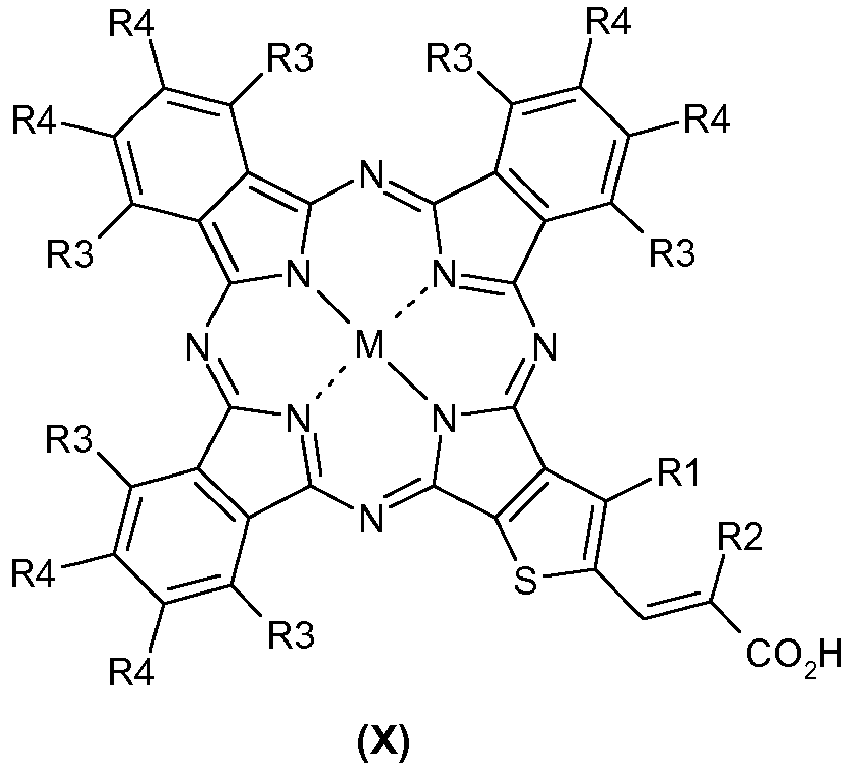
- M is 2H (metal free analogue), zinc (Zn(II)), magnesium (Mg(II)), Al(III)X, Si(IV)X2, Sn(IV)X2 wherein X is selected from halides, OH and OR with R being an alkyl or aryl group ;
- R1 is H or an alkyl group substituted by at least one halogen atom ;
- R2 is -CN, -COOH or an alkyl group substituted by at least one halogen atom;
- R3 is independently selected from H, F, -CnF2n+1, -OR', and NR2' ; and
- R4 are independently selected from H, F, -CnF2n+1, -OR', -NR'2, and from groups forming an optionally substituted aromatic cycle, adjacent to the external aromatic cycles of the macrocyclic structure,
- In the compounds of the present invention, M is preferably selected from zinc (Zn(II)), magnesium (Mg(II)), Al(III)X, Si(IV)X2, Sn(IV)X2 wherein X is selected from halides, preferably from F, Cl and Br ; more preferably from Zn(II) and stannous halide (SnHal2). M may also advantageously be selected from 2H, which corresponds to the metal free analogues and which may result also in high excited state life times for efficient electron transfer to the semiconductor.
- In the compounds of the present invention, R' is preferably selected from optionally fluorinated alkyl or aryl groups, more preferably from perfluorinated alkyl (-CnF2n+1) or aryl groups, for instance from (per)fluorinated methyl, ethyl, n-propyl, i-propyl, n-butyl, t-butyl and phenyl groups. R' also can be an optionally substituted terphenyl group, such as alkoxyterphenyl, in particular.

- In the present invention, R1 may be selected from H and alkyl groups substituted by at least one halogen atom, in particular a perhalogenated alkyl group, for example -CH2F, -CHF2, -CF3, -CF2Cl, and -C2F5. R1 may more particularly be selected from H, -CF3 or -C2F5.
- In the present invention R2 may be selected from -CN and alkyl groups substituted by at least one halogen atom. A particular example of alkyl groups substituted by at least one halogen atom is a perhalogenated alkyl group, for instance -CH2F, -CHF2, -CF3, -CF2Cl, and -C2F5. R2 may more especially be selected from -CN and -CF3. In another aspect, R2 may be -COOH.
- In the compounds of the present invention, R3 are the same or different, especially the same, and are advantageously selected from -CnF2n+1, -OR', and NR2' ; preferably from -CnF2n+1, -OCnH2n+1 and -OCnF2n+1, for instance
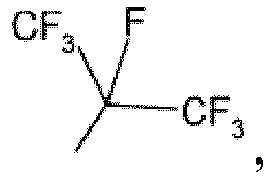
- In the compounds of the present invention, R4 are the same or different, usually the same, and are typically selected from H, F, -CnF2n+1, -OR', and NR2'; preferably from -CnF2n+1, -OCnH2n+1 and -OCnF2n+1, for instance

- In some preferred embodiments, R1 is -CF3 or -C2F5. In some embodiments, R1 is H and R2 is -CN. In some other embodiments, R2 is -CN, and R4 is H. In some alternate embodiments, R2 is -CF3, and R4 is H. In some yet alternate embodiments, R2 is -CF3, and R4 is F.
- A specific embodiment of the present invention relates to a compound comprising an element M in a macrocyclic structure having a formula (X) :

- M is zinc (Zn) or stannous halide (SnHal2) ;
- R1 is H, -CF3, or -C2F5 ;
- R2 is -CF3, -COOH or -CN ;
- R3 is -OCF3, -OCH3, or

- R4 is H or F.
- In this specific embodiment, R2 may be CF3 or -CN. In another aspect of this specific embodiment, R2 is -COOH.
- Any substituted benzene, for instance methoxy or fluoromethoxy benzenes, can be combined with any thiophene moiety mentioned hereafter. In an especially advantageous embodiment, methoxy benzenes or combined with any thiophene moiety. In another especially advantageous embodiment, fluorinated benzenes are combined with a fluorinated thiophene moiety.
- Another embodiment of the present invention relates to a compound comprising the element M (same as defined above) in a macrocyclic structure having a similar formula than formula (X), but which comprises more than one thiophenic moiety.
- A preferred compound according to the present invention, comprising the element M (same as defined above), has a structure of formula being selected from the group consisting of :


- Any of the compounds of the present invention described herein is a dye which is suitable for use photoelectric conversion devices, especially in dye-sensitized solar cells (DSSC).
- The present invention also relates to the use of TiOF2 (titanyl oxyfluoride, titanium oxyfluoride or titanium fluoride oxide) as semiconductor in a photoelectric conversion device, in particular in a dye sensitized solar cell. TiOF2 has the conduction band level at lower energy compared to TiO2 which should improve the photo-induced electron transfer from the excited dye to the semiconductor. The present invention therefore also relates to a photoelectric conversion device, in particular a dye sensitized solar cell (DSSC), comprising a semiconductor layer containing at least TiOF2 on a transparent conducting glass electrode (e.g. F doped SnO2 as conducting material). The TiOF2 is preferably used in the form of TiOF2 nanoparticles, in particular TiOF2 particles having a mean primary particle size from 15 to 50 nm. The layer thickness is typically from 500 nm to 10 µm. The TiOF2 may be used as the sole semiconductor in the DSSC semiconductor layer or may be combined in mixture with any other suitable semiconductor compound, for instance TiO2. Another possibility is to have at first a dense TiO2 layer on the conducting glass followed by a nanoporous TiOF2 layer.
- Fluorinated compounds according to the present invention are especially advantageous, in particular when combined with TiOF2 used as semiconductor in dye sensitized solar cells. Indeed, without being bound by any theory, it is believed that the conduction band edge of TiOF2 is lower in energy compared to the conduction band of TiO2 while the fluorinated compounds of the present invention exhibit a lower LUMO level compared to similar non-fluorinated compounds. Such combination is thus especially advantageous.
- The present invention further relates to a photoelectric conversion device, preferably a dye-sensitized solar cell, which comprises the compound of the present invention. The compound of the present invention is used as a dye, in particular as a sensitizing dye, in such device or cell.
- In a preferred embodiment, the present invention relates to a dye-sensitized solar cell comprising at least one fluorinated compound according to the present invention as a dye and at least TiOF2 as semiconductor. The fluorinated compound according to the present invention may be fluorinated via at least part of its R1, R2, R3 or R4 groups. The fluorinated compound according to the present invention may for instance be selected from any compound of Structure I to XIV wherein R1 is selected from halogenated groups as defined above, especially from any compound of Structure II, III, IV, V, VI, VII, VIII, XI, VII and VIII, more particularly from any compound of Structure II, III, IV, V and VI.
- The present invention further relates to a method for making the above-mentioned compounds. The method comprises utilizing one or more aromatic dinitriles, for instance fluorinated alkoxyphthalonitriles, and one or more thiophenes as building blocks for the macrocyclic structure. The method may further comprise utilizing an M-containing precursor. The present invention further relates to a compound obtained by such method. The aromatic dinitriles may be selected, for example, from the group consisting of aryloxyphthalonitriles, aryloxynaphthalonitriles, alkylthiophthalonitriles and alkylthionaphthalonitriles.
- The thiophene used in the preparation of the compounds of the present invention is preferably fluorinated.
- In the method of the present invention, it is especially advantageous to use a fluorinated phthalonitrile or a fluorinated alkoxyphthalonitrile and a
fluorinated 2,3-dicyanothiophene as building blocks for the preparation of the macrocyclic structure. - The method may comprise using a single aromatic dinitrile (for instance a fluorinated alkoxyphthalonitrile) building block (one formula) ; alternatively the method may comprise using two or more aromatic dinitriles (for instance fluorinated alkoxyphthalonitriles) of different formulae. The method may comprise using a single thiophene building block ; alternatively the method may comprise using two or more thiophene building blocks of different formulae, including a mixture of 2,3- and 3,4-dicyanothiophenes.
- Aromatic dinitriles for manufacturing the compounds of the present invention may be selected from any suitably substituted aromatic dinitriles of following formula :

- Suitable alkoxyphthalonitriles may for instance be selected from compounds of following formula (A) :

- Suitable aminophthalonitriles may be selected from compounds of following formula (B) :

- Amino-alkoxyphthalonitriles of following formula (C) may also suitably be used in the present method :

- Suitable fluorinated phthalonitriles and fluorinated alkoxyphthalonitriles may be selected from the group consisting of :

- Suitable alkoxy naphthalodinitriles are for instance compounds of following formula (M) :

- Suitable fluorinated alkoxy naphthalodinitriles are for instance compounds of following formulas :

- Suitable fluorinated naphthalodinitriles are for example compounds of following formula :


- Suitable aryloxyphthalonitriles are for example compounds of following formula :

- Suitable aryloxynaphthalonitriles are for example compounds of following formula :

- Suitable alkylthiophthalonitriles are tor example compounds of following formula :

- Suitable alkylthionaphthalonitriles are for example compounds of following formula :

- The alkoxyphthalonitrile of formula (A) may be prepared as follows, starting from commercially available 2,3-dicyanohydroquinone :

- The aminophthalonitrile of formula (B) may be prepared as follows, starting from commercially available 3-nitro or 4-nitrophthalonitrile :

- The amino-alkoxyphthalonitrile of formula (C) may be prepared, for example, by reacting 1,2-dibromo-3-methoxy-5-nitrobenzene with CuCN to form 3-methoxy-5-nitrophthalonitrile which is then treated with a secondary amine to obtain 3-methoxy- 5-dialkylaminophthalonitrile.

- The fluorinated alkoxyphthalonitrile of formula (D) may be prepared as follows:

- The fluorinated alkoxyphthalonitrile of formula (E) may be prepared as follows:

- The fluorinated alkoxyphthalonitrile of formula (G) may be prepared as follows:

- The fluorinated alkoxyphthalonitrile of formula (H) may be prepared as follows:

- The fluorinated alkoxyphthalonitrile of formula (J) may be prepared as follows:

- The fluorinated phthalonitrile of formula (L) may be prepared as follows, starting from commercially available tetrafluorophthalonitrile :

- This reaction is preferably conducted at low temperature, for instance around -78°C.
- The alkoxy naphthalodinitrile of formula (M) may be prepared as follows, starting from commercially available 2,3-dicyanonaphthalene-1,4-diol :

- Such a reaction is typically conducted in the presence of a base. The alkoxy naphthalodinitrile of formula (M) might also be prepared by converting the naphthoquinone precursor with hexafluoroisopropanol under drying conditions (e.g. with SO3 or P2O5) or by converting the naphthoquinone precursor with two equivalents of hexafluoropropylene directly under radicalar conditions (e.g. in the presence of azobisisobutyronitrile (AIBN) or light).
- The fluorinated alkoxynahthalodinitrile of formula (N) may be prepared as follows :

- The fluorinated naphthalodinitriles of formula (Q) and (T) may be prepared follows:

- These reactions are preferably conducted at low temperature, for instance around -78°C.
- The aryloxyphthalonitriles of formula (U) may be prepared as follows :

- The aryloxyphthalonitriles of formula (V) may be prepared as follows :

- The aryloxynaphthalonitriles of formula (W) may be prepared as follows :

- The alkylthiophthalonitriles of formula (X) may be prepared as follows :

- The alkylthionaphthalonitriles of formula (Y) may be prepared as follows :

- The thiophene building blocks used in the method of preparation of the compounds according to the present invention may be selected from the group consisting of the following 2,3-dicyanothiophene compounds :

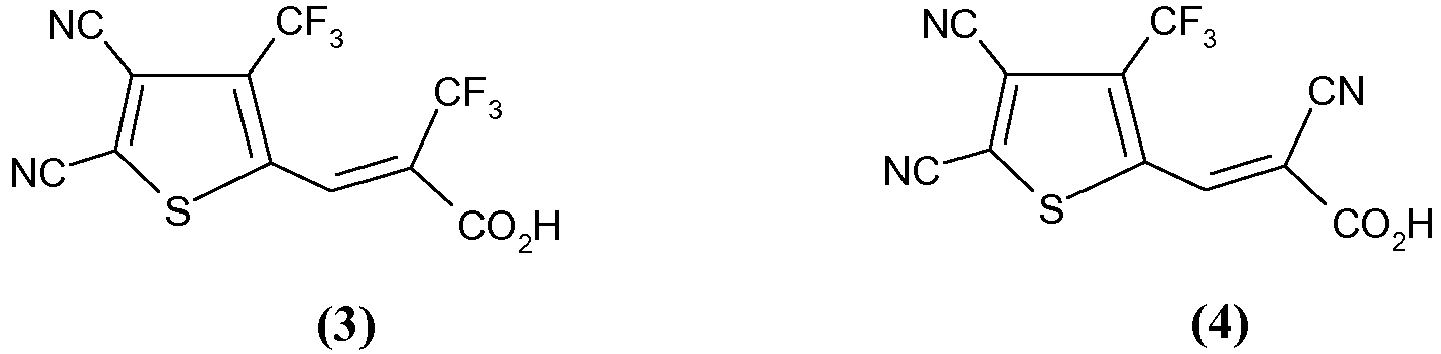
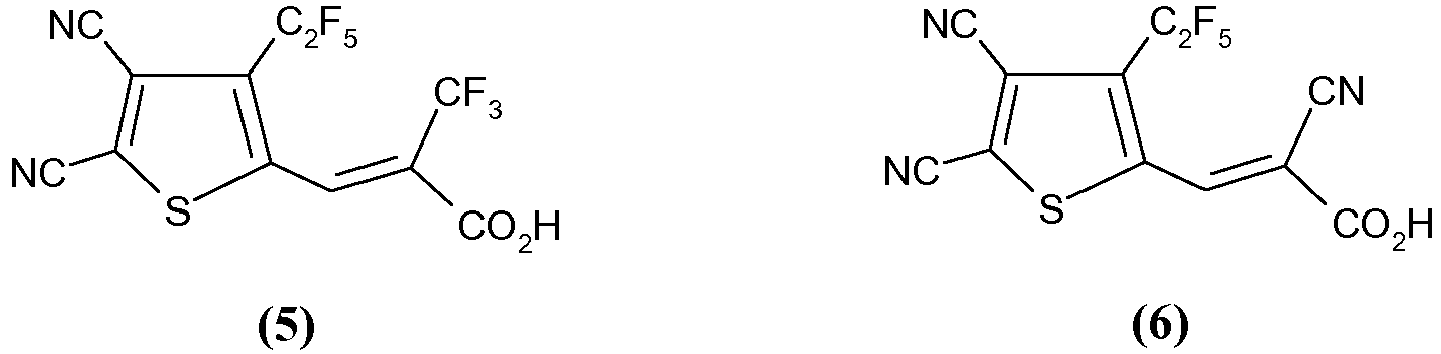


- The present invention also concerns the 2,3-dicyanothiophene compounds of formula (1) to formula (9) described above.
- The thiophene building block used in the method for preparing the compound of the present invention is usually prepared from the following precursor:

- The thiophene used in the method of preparation may be a fluorinated thiophene. It may be selected from the group consisting of fluorinated thiophenes of formula (1), (3), (4), (5) or (6). Also, it may be fluorinated thiophenes of formula (8) or (9).
- The thiophene may be a 'F-free' thiophene of formula (1) or (2).
- The "F-free" 2,3-dicyanothiophene of formula (1) or (2) may be prepared by a method comprising the following steps, via precursor (A') :

- The "F-free" 2,3-dicyanothiophene of formula (1) or (2) may also be prepared by a method comprising the following steps, via the protected form of precursor (A') :


- The first reaction, between 4,5-dibromothiophene-2-carbaldehyde and CuCN may for instance be carried out in polar aprotic solvents such as DMF or pyridine.
- The thiophene may be a 'CF3' fluorinated thiophene of formula (3) or (4). The fluorinated thiophene of formula (3) or (4) may be prepared by a process employing a thiophene precursor (B'), for instance as follows :


- The thiophene precursor (B') may be prepared by a process comprising the following steps :


- The thiophene may be a pentafluorothiophene of formula (5) or (6). The pentafluorothiophene of formula (5) or (6) may be prepared by a process employing a thiophene precursor (C') :

- The process may comprise steps to prepare the fluorinated thiophene precursor (C') and/or steps to make either the fluorinated thiophene of formula (5) or (6) from the fluorinated thiophene precursor (C') as follows:


- The dicyanothiophene of formula (7), (8) or (9) may be prepared by a method comprising the following steps, from the protected form of precursor (A') :

- Compound of formula CF3-CO-CH=CH-SH may for instance be prepared by reacting ethoxy-4,4,4-trifluoro-3-buten-2-one (ETFBO, CF3-CO-CH=CH-OEt) with H2S or Na2S.
- According to a first embodiment, it is possible to react the thiophene building block with the aromatic dinitrile building block in the optional presence of a metal salt or derivative of M to form the compound of the present invention by statistical cyclotetramerization. Such reaction is typically performed by reacting the aromatic dinitrile building block with the thiophene building block in a molar ratio around 3:1.

- According to a second embodiment, it is possible to first react the aromatic dinitrile building block with a precursor of the thiophene building block, in the presence of a metal salt or derivative of M, by statistical cyclotetramerization, and to further react the resulting compound to form the compound of the present invention. In such second embodiment, the reaction is typically performed by reacting the aromatic dinitrile building block with a precursor of the thiophene building block in a molar ratio around 3:1, in the optional presence of a metal salt or derivative of M. In said second embodiment, the precursor of the thiophene building block may for instance be selected from precursors (A'), (B') or (C') as described above or from corresponding compounds wherein the aldehyde group has been protected by an acetal group. An example of corresponding compound for precursor (A') is shown below :
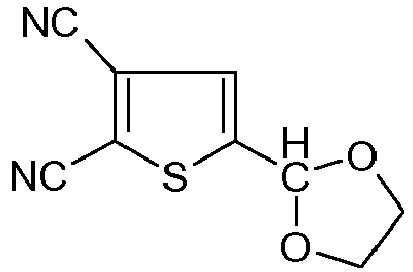
- Such a protected precursor compound may for instance be prepared by reacting precursor compound of formula (A') with ethylene glycol (HOCH2-CH2OH). If such a protected precursor is used, the protecting group is then removed to yield the corresponding aldehyde group. The aldehyde group may then be transformed into the required functionality (i.e. -CH=C(CF3)(CO2H) or -CH=C(CN)(CO2H)), for instance by reaction with CF3CH2CO2H, CF3COCO2H or NCCH2CO2H.
- In the method of the present invention, the metal salt or derivative of M may for instance be a Zn salt such as zinc acetate, magnesium oxide, an aluminum derivative such as aluminum chloride or bromide, a silicon derivative such as tetrachlorosilane, or a stannous halide (SnHal2) such as tin dichloride (TiCl2).
- The compound of the present invention may be further isolated, for instance by column chromatography, preferably by high pressure liquid chromatography (HPLC).
- While preferred embodiments of this invention have been shown and described, modifications thereof can be made by one skilled in the art without departing from the spirit or teaching of this invention. The embodiments described herein are exemplary only and are not limiting. Many variations and modifications of systems and methods are possible and are within the scope of the invention. Accordingly, the scope of protection is not limited to the embodiments described herein, but is only limited by the claims that follow, the scope of which shall include all equivalents of the subject matter of the claims.
- Should the disclosure of any patents, patent applications, and publications which are incorporated herein by reference conflict with the description of the present application to the extent that it may render a term unclear, the present description shall take precedence.
-
-
Figure 1 shows the HOMO / LUMO calculated levels for thecompounds ZnPc 1 ∼ 7 in Example. - HOMO / LUMO calculations were performed using program Hyperchem, Release 4.5, PM3 method, gradient 10exp-3, next lowest RHF.
-
Figure 1 summarizes the HOMO / LUMO calculated levels for the following compounds : - ZnPc 1 : unsubstituted zinc phthalocyanine ;
- ZnPc 2 : compound of formula (X) wherein R1 = R3 = R4 = H and R2 = CN ;
- ZnPc 3 : compound of formula (X) wherein R1 = R3 = R4 = H and R2 = CF3 ;
- ZnPc 4 : compound Ia with R1 = H (i.e. compound of formula (X) wherein R1 = R4 = H, R2 = CN, and R3 = OCH3) ;
- ZnPc 5 : compound Va with R1 = H (i.e. compound of formula (X) wherein R1= R4 = H, R2 = CF3, and R3 = OCH3) ;
- ZnPc 6 : compound VIa with R1 = H (i.e. compound of formula (X) wherein R1= R4 = H, R2 = CF3, and R3 = OCF3) ;
- ZnPc 7 : compound XIIIa with R1 = H (i.e. compound of formula (X) wherein R1 = H, R2 = CN ; R3 = F, and R4 = CF(CF3)2).
- These calculations show that, compared to unsubstubsituted zinc phthalocyanine (ZnPc 1), the HOMO/LUMO levels of
ZnPc 2 andZnPc 3 bearing a thiophene unit connected with a cyano- or a trifluoromethylacrylate group are shifted downwards to lower energy. Further introduction of methoxy groups at the three benzene unit inZnPc 4 andZnPc 5 shifts the HOMO/LUMO energy levels upwards. Further introduction of fluorinated residues inZnPc 6 andZnPc 7 shift the HOMO/LUMO energy levels again downwards. - In the case of
ZnPc 1,ZnPc 4 andZnPc 5, the LUMO level is above the conduction band level of titanium dioxide (TiO2). In the case of the other ZnPc's, the LUMO level is under the conduction band level of titanium dioxide (Ti02). Using titaniumoxy difluoride (TiOF2), which has a lower conduction band level compared to TiO2, it is possible to tranfer from the excited state ofZnPc 2,ZnPc 3,ZnPc 6 andZnPc 7 an electron to this semiconductor. - The longest wavelength absorptions (Q band) of phthalocyanines are seen at λ = 670-700 nm and of naphthalocyanines at 760-780 nm. By introduction of substituents such as alkoxy groups the longest wavelength absorptions of phthalocyanines shift to around 750 nm and of naphthalocyanines to around 860 nm, and extinction coefficients of >105 L mol-1 cm-1. Phthalocyanines and naphthalocyanines described in this patent are absorbing in dependence on the kind of substituents between 700-750 nm or 790-860 nm with extinction coefficients of >105 L mol-1 cm-1, respectively.
Claims (15)
- Use of TiOF2 as semiconductor in a photoelectric conversion device.
- The use according to claim 1 wherein the photoelectric conversion device is a dye sensitized solar cell.
- The use according to claim 1 wherein the TiOF2 is present in nanoparticular form.
- The use according to claim 3 wherein the TiOF2 has a mean primary particle size from 15 to 50 nm.
- The use according to claim 2 wherein the dye sensitized solar cell comprises a fluorinated dye molecule.
- A photoelectric conversion device comprising a semiconductor layer, wherein the semiconductor layer comprises TiOF2.
- The photoelectric conversion device of claim 6 wherein the photoelectric conversion device is a dye sensitized solar cell.
- The photoelectric conversion device of claim 6 wherein the TiOF2 is present in nanoparticular form.
- The photoelectric conversion device of claim 6 wherein the TiOF2 has a mean primary particle size from 15 to 50 nm.
- The photoelectric conversion device of claim 6 wherein the thickness of the semiconductor layer is from 500 nm to 10 µm.
- The photoelectric conversion device of claim 7 wherein semiconductor layer comprises TiOF2 as the sole semiconductor.
- The photoelectric conversion device of claim 6 further comprising a dense TiO2 layer on a transparent conducting glass electrode.
- The photoelectric conversion device of claim 6 wherein the semiconductor layer is on a transparent conducting glass electrode.
- The photoelectric conversion device of claim 13 wherein the transparent conducting glass electrode comprises F doped SnO2 as conducting material.
- The photoelectric conversion device of claim 7 further comprising a fluorinated dye molecule.
Priority Applications (1)
| Application Number | Priority Date | Filing Date | Title |
|---|---|---|---|
| EP20140151936 EP2728596A1 (en) | 2011-01-14 | 2012-01-13 | Use of TiOF2 as semiconductor |
Applications Claiming Priority (4)
| Application Number | Priority Date | Filing Date | Title |
|---|---|---|---|
| US201161433179P | 2011-01-14 | 2011-01-14 | |
| EP11170427 | 2011-06-17 | ||
| EP12700809.2A EP2663599A1 (en) | 2011-01-14 | 2012-01-13 | Phthalocyanine dyes, method of making them, and their use in dye sensitized solar cells |
| EP20140151936 EP2728596A1 (en) | 2011-01-14 | 2012-01-13 | Use of TiOF2 as semiconductor |
Related Parent Applications (1)
| Application Number | Title | Priority Date | Filing Date |
|---|---|---|---|
| EP12700809.2A Division EP2663599A1 (en) | 2011-01-14 | 2012-01-13 | Phthalocyanine dyes, method of making them, and their use in dye sensitized solar cells |
Publications (1)
| Publication Number | Publication Date |
|---|---|
| EP2728596A1 true EP2728596A1 (en) | 2014-05-07 |
Family
ID=45524527
Family Applications (2)
| Application Number | Title | Priority Date | Filing Date |
|---|---|---|---|
| EP12700809.2A Withdrawn EP2663599A1 (en) | 2011-01-14 | 2012-01-13 | Phthalocyanine dyes, method of making them, and their use in dye sensitized solar cells |
| EP20140151936 Withdrawn EP2728596A1 (en) | 2011-01-14 | 2012-01-13 | Use of TiOF2 as semiconductor |
Family Applications Before (1)
| Application Number | Title | Priority Date | Filing Date |
|---|---|---|---|
| EP12700809.2A Withdrawn EP2663599A1 (en) | 2011-01-14 | 2012-01-13 | Phthalocyanine dyes, method of making them, and their use in dye sensitized solar cells |
Country Status (5)
| Country | Link |
|---|---|
| US (1) | US9080055B2 (en) |
| EP (2) | EP2663599A1 (en) |
| KR (1) | KR20140005958A (en) |
| CN (1) | CN103476872B (en) |
| WO (1) | WO2012095524A1 (en) |
Families Citing this family (7)
| Publication number | Priority date | Publication date | Assignee | Title |
|---|---|---|---|---|
| CN103058886B (en) * | 2013-01-29 | 2015-04-01 | 石家庄诚志永华显示材料有限公司 | Poly-fluorine poly-cyanogen liquid crystal compound as well as preparation method and application thereof |
| CN103296215A (en) * | 2013-05-21 | 2013-09-11 | 京东方科技集团股份有限公司 | Organic light emitting device and display device |
| US9472771B2 (en) * | 2013-10-31 | 2016-10-18 | Sabic Global Technologies B.V. | Method of making axially fluorinated-phthalocyanines with an aprotic fluoride compound |
| EP3069392B1 (en) * | 2013-11-15 | 2019-08-07 | Merck Patent GmbH | Compound with novel six-membered ring structure for use in organic electronic devices |
| CN104860970B (en) * | 2015-05-15 | 2016-10-12 | 苏州大学 | A kind of zinc coordination polymer and the preparation method of Congo red complex thereof and purposes |
| KR102012711B1 (en) * | 2016-04-05 | 2019-08-21 | 한국화학연구원 | perovskite solar cells having high heat resistance |
| KR102061244B1 (en) | 2017-05-17 | 2019-12-31 | 삼성에스디아이 주식회사 | Photosensitive resin composition, photosensitive resin layer using the same and color filter |
Citations (2)
| Publication number | Priority date | Publication date | Assignee | Title |
|---|---|---|---|---|
| US5597515A (en) * | 1995-09-27 | 1997-01-28 | Kerr-Mcgee Corporation | Conductive, powdered fluorine-doped titanium dioxide and method of preparation |
| JP2011207628A (en) * | 2010-03-27 | 2011-10-20 | Univ Of Fukui | Method for producing colored titanium dioxide powder |
Family Cites Families (10)
| Publication number | Priority date | Publication date | Assignee | Title |
|---|---|---|---|---|
| KR100400438B1 (en) * | 2000-10-13 | 2003-10-01 | 주식회사 엔비텍 | Photoelectrochemical metal corrosion prevention system |
| CN1209824C (en) * | 2001-09-26 | 2005-07-06 | 北京科技大学 | Nano titanium dioxide film and its manufacturing method |
| JP4085421B2 (en) * | 2002-08-23 | 2008-05-14 | ソニー株式会社 | Dye-sensitized photoelectric conversion device and manufacturing method thereof |
| JP4625947B2 (en) * | 2004-11-22 | 2011-02-02 | 国立大学法人広島大学 | Optoelectronic device |
| US20070017569A1 (en) * | 2005-07-25 | 2007-01-25 | General Electric Company | Metal complex compositions and use thereof in dye sensitized solar cells |
| US20080072960A1 (en) | 2006-09-26 | 2008-03-27 | Mi-Ra Kim | Phthalocyanine compound for solar cells |
| CN101140961A (en) * | 2007-10-16 | 2008-03-12 | 哈尔滨工业大学 | A method for in-situ growth of titanium dioxide thin film electrodes |
| US20110244220A1 (en) | 2008-12-16 | 2011-10-06 | Solvay Fluor Gmbh | Metals parts containing a protective coating |
| WO2012172107A1 (en) | 2011-06-17 | 2012-12-20 | Solvay Sa | Dyes, method of making them, and their use in dye sensitized solar cells |
| WO2012175536A1 (en) | 2011-06-20 | 2012-12-27 | Solvay Sa | Dyes, method of making them, and their use in dye-sensitized solar cells |
-
2012
- 2012-01-13 EP EP12700809.2A patent/EP2663599A1/en not_active Withdrawn
- 2012-01-13 KR KR1020137021202A patent/KR20140005958A/en not_active Withdrawn
- 2012-01-13 WO PCT/EP2012/050502 patent/WO2012095524A1/en not_active Ceased
- 2012-01-13 EP EP20140151936 patent/EP2728596A1/en not_active Withdrawn
- 2012-01-13 CN CN201280013103.0A patent/CN103476872B/en not_active Expired - Fee Related
-
2013
- 2013-07-10 US US13/938,650 patent/US9080055B2/en not_active Expired - Fee Related
Patent Citations (2)
| Publication number | Priority date | Publication date | Assignee | Title |
|---|---|---|---|---|
| US5597515A (en) * | 1995-09-27 | 1997-01-28 | Kerr-Mcgee Corporation | Conductive, powdered fluorine-doped titanium dioxide and method of preparation |
| JP2011207628A (en) * | 2010-03-27 | 2011-10-20 | Univ Of Fukui | Method for producing colored titanium dioxide powder |
Non-Patent Citations (4)
| Title |
|---|
| A.DEMOURGUES ET AL.: "New Titanium Hydroxyfluoride Ti0.75(OH)1.5F1.5 as a UV Absorber", CHEM.MATER., vol. 21, 2009, pages 1275 - 1283, XP002722382 * |
| S.N.SUBBARAO ET AL.: "Electrical and Optical Properties of the System TiO2-xFx", INORG.CHEM., vol. 18, no. 2, 1979, pages 488 - 492, XP002722381 * |
| T.ENDO ET AL.: "The preparation and electrical properties of TiO2-xFx", J.MATER.RES., vol. 3, no. 2, 1988, pages 392 - 397, XP002722383 * |
| X.ROCQUEFELTE ET AL.: "Analysis of the refractive Indices of TiO2, TiOF2, and TiF4: Concept of Optical Channel as a Guide to understand and design Optical Materials", INORG.CHEM., vol. 44, no. 10, 2005, pages 3589 - 3593, XP002722384 * |
Also Published As
| Publication number | Publication date |
|---|---|
| EP2663599A1 (en) | 2013-11-20 |
| CN103476872A (en) | 2013-12-25 |
| US9080055B2 (en) | 2015-07-14 |
| KR20140005958A (en) | 2014-01-15 |
| CN103476872B (en) | 2016-04-27 |
| WO2012095524A1 (en) | 2012-07-19 |
| US20130291930A1 (en) | 2013-11-07 |
Similar Documents
| Publication | Publication Date | Title |
|---|---|---|
| JP5106381B2 (en) | Dye-sensitized photoelectric conversion element | |
| US9080055B2 (en) | Photoelectric conversion device using TiOF2 as semiconductor | |
| KR20110042326A (en) | Dye-sensitized photoelectric conversion element | |
| US20110100462A1 (en) | Dye-sensitized solar cell and photoanode thereof | |
| WO2012172107A1 (en) | Dyes, method of making them, and their use in dye sensitized solar cells | |
| JP2019085378A (en) | Aromatic amine derivative having organic cation moiety, and perovskite solar cell using the same | |
| EP2700641A1 (en) | Azulenocyanine analogue compounds comprising anchoring group, method of making the same, and their use as dye for dye-sensitized solar cells | |
| WO2013027838A1 (en) | Dye-sensitized solar cell and sensitizing dye | |
| KR101808982B1 (en) | Photoelectric conversion element, dye-sensitized solar cell, metal-complex pigment, pigment solution, and terpyridine compound or esterified terpyridine compound | |
| US20180204683A1 (en) | Photoelectric conversion element, dye-sensitized solar cell, dye composition, and oxide semiconductor electrode | |
| JP2014508822A (en) | Phthalocyanine dye, method for producing the same, and use thereof in dye-sensitized solar cells | |
| KR101380837B1 (en) | Novel dithiophenepyrroloisoindole derivates, preparation method thereof and organic solar cell having them | |
| KR101874496B1 (en) | Novel compound and photoelectric conversion element | |
| KR101419923B1 (en) | Novel benzodithiophene derivates, preparation method thereof and organic solar cell having them | |
| KR102089819B1 (en) | Redox pair, and photoelectric conversion element produced using same | |
| JP4394392B2 (en) | Materials for photoelectric conversion elements, photoelectric conversion elements | |
| JP6591691B2 (en) | Photoelectric conversion element, dye-sensitized solar cell, and dipyrromethene complex compound | |
| WO2015037676A1 (en) | Methine dye and dye-sensitized photoelectric conversion element | |
| TW201313837A (en) | Dyes, method of making them, and their use in dye sensitized solar cells | |
| EP2700640A1 (en) | Azulenocyanine compounds, method of making the same, and their use as semiconductor and absorber for organic photovoltaics | |
| JP5790546B2 (en) | Dye for photoelectric conversion element, photoelectric conversion element and method for producing the same | |
| TW201245344A (en) | Dyes, method of making them, and their use in dye sensitized solar cells | |
| JP6574051B2 (en) | Dye solution for photoelectric conversion element, dye solution preparation kit, and method for producing photoelectric conversion element | |
| CN120077770A (en) | Photoelectric conversion element | |
| TW202541672A (en) | Photoelectric conversion element, photoelectric conversion device, and method for manufacturing photoelectric conversion element |
Legal Events
| Date | Code | Title | Description |
|---|---|---|---|
| PUAI | Public reference made under article 153(3) epc to a published international application that has entered the european phase |
Free format text: ORIGINAL CODE: 0009012 |
|
| 17P | Request for examination filed |
Effective date: 20140121 |
|
| AC | Divisional application: reference to earlier application |
Ref document number: 2663599 Country of ref document: EP Kind code of ref document: P |
|
| AK | Designated contracting states |
Kind code of ref document: A1 Designated state(s): AL AT BE BG CH CY CZ DE DK EE ES FI FR GB GR HR HU IE IS IT LI LT LU LV MC MK MT NL NO PL PT RO RS SE SI SK SM TR |
|
| 17P | Request for examination filed |
Effective date: 20141107 |
|
| RBV | Designated contracting states (corrected) |
Designated state(s): AL AT BE BG CH CY CZ DE DK EE ES FI FR GB GR HR HU IE IS IT LI LT LU LV MC MK MT NL NO PL PT RO RS SE SI SK SM TR |
|
| 17Q | First examination report despatched |
Effective date: 20150311 |
|
| GRAP | Despatch of communication of intention to grant a patent |
Free format text: ORIGINAL CODE: EPIDOSNIGR1 |
|
| RIC1 | Information provided on ipc code assigned before grant |
Ipc: C09B 47/067 20060101ALI20151028BHEP Ipc: C09B 47/04 20060101AFI20151028BHEP Ipc: H01G 9/20 20060101ALI20151028BHEP Ipc: H01L 51/00 20060101ALI20151028BHEP |
|
| INTG | Intention to grant announced |
Effective date: 20151127 |
|
| GRAS | Grant fee paid |
Free format text: ORIGINAL CODE: EPIDOSNIGR3 |
|
| STAA | Information on the status of an ep patent application or granted ep patent |
Free format text: STATUS: THE APPLICATION IS DEEMED TO BE WITHDRAWN |
|
| 18D | Application deemed to be withdrawn |
Effective date: 20160408 |