EP2727957A1 - Rubber composition with encapsulated resin and pneumatic tire - Google Patents
Rubber composition with encapsulated resin and pneumatic tire Download PDFInfo
- Publication number
- EP2727957A1 EP2727957A1 EP13190129.0A EP13190129A EP2727957A1 EP 2727957 A1 EP2727957 A1 EP 2727957A1 EP 13190129 A EP13190129 A EP 13190129A EP 2727957 A1 EP2727957 A1 EP 2727957A1
- Authority
- EP
- European Patent Office
- Prior art keywords
- rubber composition
- resin
- methylene
- vulcanizable rubber
- microencapsulated
- Prior art date
- Legal status (The legal status is an assumption and is not a legal conclusion. Google has not performed a legal analysis and makes no representation as to the accuracy of the status listed.)
- Granted
Links
- 229920001971 elastomer Polymers 0.000 title claims abstract description 97
- 239000005060 rubber Substances 0.000 title claims abstract description 81
- 239000011347 resin Substances 0.000 title claims abstract description 67
- 229920005989 resin Polymers 0.000 title claims abstract description 67
- 239000000203 mixture Substances 0.000 title claims abstract description 51
- 125000000325 methylidene group Chemical group [H]C([H])=* 0.000 claims abstract description 68
- 239000000806 elastomer Substances 0.000 claims abstract description 15
- 150000001993 dienes Chemical class 0.000 claims abstract description 9
- 238000004519 manufacturing process Methods 0.000 claims abstract description 4
- 239000000463 material Substances 0.000 claims description 24
- 238000000034 method Methods 0.000 claims description 22
- -1 N-substituted oxymethylmelamines Chemical class 0.000 claims description 17
- 238000011065 in-situ storage Methods 0.000 claims description 16
- 150000002989 phenols Chemical class 0.000 claims description 14
- 125000004432 carbon atom Chemical group C* 0.000 claims description 12
- GHMLBKRAJCXXBS-UHFFFAOYSA-N resorcinyl group Chemical group C1(O)=CC(O)=CC=C1 GHMLBKRAJCXXBS-UHFFFAOYSA-N 0.000 claims description 12
- 238000002156 mixing Methods 0.000 claims description 11
- 239000003094 microcapsule Substances 0.000 claims description 10
- 229920003986 novolac Polymers 0.000 claims description 10
- 229920001568 phenolic resin Polymers 0.000 claims description 10
- 239000005062 Polybutadiene Substances 0.000 claims description 9
- 229920002857 polybutadiene Polymers 0.000 claims description 7
- KXGFMDJXCMQABM-UHFFFAOYSA-N 2-methoxy-6-methylphenol Chemical compound [CH]OC1=CC=CC([CH])=C1O KXGFMDJXCMQABM-UHFFFAOYSA-N 0.000 claims description 6
- BNCADMBVWNPPIZ-UHFFFAOYSA-N 2-n,2-n,4-n,4-n,6-n,6-n-hexakis(methoxymethyl)-1,3,5-triazine-2,4,6-triamine Chemical compound COCN(COC)C1=NC(N(COC)COC)=NC(N(COC)COC)=N1 BNCADMBVWNPPIZ-UHFFFAOYSA-N 0.000 claims description 5
- 125000000217 alkyl group Chemical group 0.000 claims description 5
- 239000004743 Polypropylene Substances 0.000 claims description 4
- VKYKSIONXSXAKP-UHFFFAOYSA-N hexamethylenetetramine Chemical group C1N(C2)CN3CN1CN2C3 VKYKSIONXSXAKP-UHFFFAOYSA-N 0.000 claims description 4
- 229910052739 hydrogen Inorganic materials 0.000 claims description 4
- 239000001257 hydrogen Substances 0.000 claims description 4
- 125000004435 hydrogen atom Chemical group [H]* 0.000 claims description 4
- 229920001155 polypropylene Polymers 0.000 claims description 4
- OKTJSMMVPCPJKN-UHFFFAOYSA-N Carbon Chemical compound [C] OKTJSMMVPCPJKN-UHFFFAOYSA-N 0.000 claims description 3
- 239000004698 Polyethylene Substances 0.000 claims description 3
- 229920001807 Urea-formaldehyde Polymers 0.000 claims description 3
- 229920003229 poly(methyl methacrylate) Polymers 0.000 claims description 3
- 229920000573 polyethylene Polymers 0.000 claims description 3
- 239000004926 polymethyl methacrylate Substances 0.000 claims description 3
- 229920002451 polyvinyl alcohol Polymers 0.000 claims description 3
- 235000019422 polyvinyl alcohol Nutrition 0.000 claims description 3
- IXVLQYYLJLOXNV-UHFFFAOYSA-M 1-(dodecoxymethyl)pyridin-1-ium;chloride Chemical compound [Cl-].CCCCCCCCCCCCOC[N+]1=CC=CC=C1 IXVLQYYLJLOXNV-UHFFFAOYSA-M 0.000 claims description 2
- PEDLLJRDEYHUTM-UHFFFAOYSA-M 1-(ethoxymethyl)pyridin-1-ium trioxane chloride Chemical compound O1OOCCC1.[Cl-].C(C)OC[N+]1=CC=CC=C1 PEDLLJRDEYHUTM-UHFFFAOYSA-M 0.000 claims description 2
- CZLMJPDPOJDKPV-UHFFFAOYSA-N 6-diazenyl-2-N-(2-methylpropoxymethyl)-1,3,5-triazine-2,4-diamine Chemical compound N=NC1=NC(=NC(=N1)N)NCOCC(C)C CZLMJPDPOJDKPV-UHFFFAOYSA-N 0.000 claims description 2
- WBVDVNONLVYXKT-UHFFFAOYSA-N 6-diazenyl-2-n-(methoxymethyl)-1,3,5-triazine-2,4-diamine Chemical compound COCNC1=NC(N)=NC(N=N)=N1 WBVDVNONLVYXKT-UHFFFAOYSA-N 0.000 claims description 2
- 229920003171 Poly (ethylene oxide) Polymers 0.000 claims description 2
- 229920001710 Polyorthoester Polymers 0.000 claims description 2
- 229920002125 Sokalan® Polymers 0.000 claims description 2
- 229910052799 carbon Inorganic materials 0.000 claims description 2
- 239000007859 condensation product Substances 0.000 claims description 2
- MIHINWMALJZIBX-UHFFFAOYSA-N cyclohexa-2,4-dien-1-ol Chemical class OC1CC=CC=C1 MIHINWMALJZIBX-UHFFFAOYSA-N 0.000 claims description 2
- 239000004312 hexamethylene tetramine Substances 0.000 claims description 2
- 235000010299 hexamethylene tetramine Nutrition 0.000 claims description 2
- 239000012188 paraffin wax Substances 0.000 claims description 2
- 239000011295 pitch Substances 0.000 claims description 2
- 229920001200 poly(ethylene-vinyl acetate) Polymers 0.000 claims description 2
- 239000002745 poly(ortho ester) Substances 0.000 claims description 2
- 239000004584 polyacrylic acid Substances 0.000 claims description 2
- 229920000515 polycarbonate Polymers 0.000 claims description 2
- 239000004417 polycarbonate Substances 0.000 claims description 2
- 229920002689 polyvinyl acetate Polymers 0.000 claims description 2
- 239000011118 polyvinyl acetate Substances 0.000 claims description 2
- 229920000036 polyvinylpyrrolidone Polymers 0.000 claims description 2
- 239000001267 polyvinylpyrrolidone Substances 0.000 claims description 2
- 235000013855 polyvinylpyrrolidone Nutrition 0.000 claims description 2
- 229920002725 thermoplastic elastomer Polymers 0.000 claims description 2
- 235000019809 paraffin wax Nutrition 0.000 claims 1
- 235000019271 petrolatum Nutrition 0.000 claims 1
- 239000000376 reactant Substances 0.000 description 26
- 239000000370 acceptor Substances 0.000 description 23
- 239000011248 coating agent Substances 0.000 description 21
- 238000000576 coating method Methods 0.000 description 21
- PPBRXRYQALVLMV-UHFFFAOYSA-N Styrene Chemical compound C=CC1=CC=CC=C1 PPBRXRYQALVLMV-UHFFFAOYSA-N 0.000 description 18
- KAKZBPTYRLMSJV-UHFFFAOYSA-N Butadiene Chemical compound C=CC=C KAKZBPTYRLMSJV-UHFFFAOYSA-N 0.000 description 16
- 238000012545 processing Methods 0.000 description 16
- NINIDFKCEFEMDL-UHFFFAOYSA-N Sulfur Chemical compound [S] NINIDFKCEFEMDL-UHFFFAOYSA-N 0.000 description 15
- 239000003921 oil Substances 0.000 description 14
- 235000019198 oils Nutrition 0.000 description 14
- 239000011593 sulfur Substances 0.000 description 14
- 229910052717 sulfur Inorganic materials 0.000 description 14
- 150000001875 compounds Chemical class 0.000 description 13
- 150000003961 organosilicon compounds Chemical class 0.000 description 9
- 239000011324 bead Substances 0.000 description 8
- 238000004073 vulcanization Methods 0.000 description 6
- NLHHRLWOUZZQLW-UHFFFAOYSA-N Acrylonitrile Chemical compound C=CC#N NLHHRLWOUZZQLW-UHFFFAOYSA-N 0.000 description 5
- 239000000654 additive Substances 0.000 description 5
- 229920001577 copolymer Polymers 0.000 description 5
- 238000007720 emulsion polymerization reaction Methods 0.000 description 5
- 239000000178 monomer Substances 0.000 description 5
- 230000008569 process Effects 0.000 description 5
- 244000226021 Anacardium occidentale Species 0.000 description 4
- RRHGJUQNOFWUDK-UHFFFAOYSA-N Isoprene Chemical compound CC(=C)C=C RRHGJUQNOFWUDK-UHFFFAOYSA-N 0.000 description 4
- OKKJLVBELUTLKV-UHFFFAOYSA-N Methanol Chemical class OC OKKJLVBELUTLKV-UHFFFAOYSA-N 0.000 description 4
- 229910000831 Steel Inorganic materials 0.000 description 4
- XLOMVQKBTHCTTD-UHFFFAOYSA-N Zinc monoxide Chemical compound [Zn]=O XLOMVQKBTHCTTD-UHFFFAOYSA-N 0.000 description 4
- 239000006229 carbon black Substances 0.000 description 4
- 235000019241 carbon black Nutrition 0.000 description 4
- 235000020226 cashew nut Nutrition 0.000 description 4
- 238000006243 chemical reaction Methods 0.000 description 4
- 239000003795 chemical substances by application Substances 0.000 description 4
- 238000002844 melting Methods 0.000 description 4
- 230000008018 melting Effects 0.000 description 4
- 239000010466 nut oil Substances 0.000 description 4
- 239000005011 phenolic resin Substances 0.000 description 4
- 239000010959 steel Substances 0.000 description 4
- 229920001897 terpolymer Polymers 0.000 description 4
- 230000000930 thermomechanical effect Effects 0.000 description 4
- 230000007704 transition Effects 0.000 description 4
- 239000004215 Carbon black (E152) Substances 0.000 description 3
- 241000254043 Melolonthinae Species 0.000 description 3
- MUBZPKHOEPUJKR-UHFFFAOYSA-N Oxalic acid Chemical compound OC(=O)C(O)=O MUBZPKHOEPUJKR-UHFFFAOYSA-N 0.000 description 3
- 239000003963 antioxidant agent Substances 0.000 description 3
- MTAZNLWOLGHBHU-UHFFFAOYSA-N butadiene-styrene rubber Chemical compound C=CC=C.C=CC1=CC=CC=C1 MTAZNLWOLGHBHU-UHFFFAOYSA-N 0.000 description 3
- 229920003193 cis-1,4-polybutadiene polymer Polymers 0.000 description 3
- 239000000839 emulsion Substances 0.000 description 3
- HQQADJVZYDDRJT-UHFFFAOYSA-N ethene;prop-1-ene Chemical group C=C.CC=C HQQADJVZYDDRJT-UHFFFAOYSA-N 0.000 description 3
- 238000010528 free radical solution polymerization reaction Methods 0.000 description 3
- 230000009477 glass transition Effects 0.000 description 3
- 238000010438 heat treatment Methods 0.000 description 3
- 229930195733 hydrocarbon Natural products 0.000 description 3
- 150000002430 hydrocarbons Chemical class 0.000 description 3
- 229920001195 polyisoprene Polymers 0.000 description 3
- 239000000126 substance Substances 0.000 description 3
- 239000001993 wax Substances 0.000 description 3
- ZGHFDIIVVIFNPS-UHFFFAOYSA-N 3-Methyl-3-buten-2-one Chemical compound CC(=C)C(C)=O ZGHFDIIVVIFNPS-UHFFFAOYSA-N 0.000 description 2
- HGINCPLSRVDWNT-UHFFFAOYSA-N Acrolein Chemical compound C=CC=O HGINCPLSRVDWNT-UHFFFAOYSA-N 0.000 description 2
- ZRALSGWEFCBTJO-UHFFFAOYSA-N Guanidine Chemical compound NC(N)=N ZRALSGWEFCBTJO-UHFFFAOYSA-N 0.000 description 2
- VEXZGXHMUGYJMC-UHFFFAOYSA-N Hydrochloric acid Chemical compound Cl VEXZGXHMUGYJMC-UHFFFAOYSA-N 0.000 description 2
- ISWSIDIOOBJBQZ-UHFFFAOYSA-N Phenol Chemical compound OC1=CC=CC=C1 ISWSIDIOOBJBQZ-UHFFFAOYSA-N 0.000 description 2
- QAOWNCQODCNURD-UHFFFAOYSA-N Sulfuric acid Chemical compound OS(O)(=O)=O QAOWNCQODCNURD-UHFFFAOYSA-N 0.000 description 2
- 239000003377 acid catalyst Substances 0.000 description 2
- 150000001299 aldehydes Chemical class 0.000 description 2
- 125000003545 alkoxy group Chemical group 0.000 description 2
- HUMNYLRZRPPJDN-UHFFFAOYSA-N benzaldehyde Chemical compound O=CC1=CC=CC=C1 HUMNYLRZRPPJDN-UHFFFAOYSA-N 0.000 description 2
- 230000015572 biosynthetic process Effects 0.000 description 2
- RTACIUYXLGWTAE-UHFFFAOYSA-N buta-1,3-diene;2-methylbuta-1,3-diene;styrene Chemical compound C=CC=C.CC(=C)C=C.C=CC1=CC=CC=C1 RTACIUYXLGWTAE-UHFFFAOYSA-N 0.000 description 2
- 229920005549 butyl rubber Polymers 0.000 description 2
- 238000003490 calendering Methods 0.000 description 2
- 239000007795 chemical reaction product Substances 0.000 description 2
- 229920003211 cis-1,4-polyisoprene Polymers 0.000 description 2
- 238000013329 compounding Methods 0.000 description 2
- 235000014113 dietary fatty acids Nutrition 0.000 description 2
- 239000012990 dithiocarbamate Substances 0.000 description 2
- FJKIXWOMBXYWOQ-UHFFFAOYSA-N ethenoxyethane Chemical compound CCOC=C FJKIXWOMBXYWOQ-UHFFFAOYSA-N 0.000 description 2
- 238000001125 extrusion Methods 0.000 description 2
- 239000000194 fatty acid Substances 0.000 description 2
- 229930195729 fatty acid Natural products 0.000 description 2
- 150000004665 fatty acids Chemical class 0.000 description 2
- 239000000945 filler Substances 0.000 description 2
- 239000004615 ingredient Substances 0.000 description 2
- 239000002245 particle Substances 0.000 description 2
- 229920001084 poly(chloroprene) Polymers 0.000 description 2
- 229920000642 polymer Polymers 0.000 description 2
- 238000006116 polymerization reaction Methods 0.000 description 2
- ODGAOXROABLFNM-UHFFFAOYSA-N polynoxylin Chemical compound O=C.NC(N)=O ODGAOXROABLFNM-UHFFFAOYSA-N 0.000 description 2
- 239000005077 polysulfide Substances 0.000 description 2
- 229920001021 polysulfide Polymers 0.000 description 2
- 150000008117 polysulfides Polymers 0.000 description 2
- 239000010734 process oil Substances 0.000 description 2
- 239000000047 product Substances 0.000 description 2
- 230000002787 reinforcement Effects 0.000 description 2
- 230000003014 reinforcing effect Effects 0.000 description 2
- 238000010058 rubber compounding Methods 0.000 description 2
- 238000006467 substitution reaction Methods 0.000 description 2
- 229920003051 synthetic elastomer Polymers 0.000 description 2
- 239000005061 synthetic rubber Substances 0.000 description 2
- JOXIMZWYDAKGHI-UHFFFAOYSA-N toluene-4-sulfonic acid Chemical compound CC1=CC=C(S(O)(=O)=O)C=C1 JOXIMZWYDAKGHI-UHFFFAOYSA-N 0.000 description 2
- 239000003981 vehicle Substances 0.000 description 2
- 125000000391 vinyl group Chemical group [H]C([*])=C([H])[H] 0.000 description 2
- 239000011787 zinc oxide Substances 0.000 description 2
- PMJHHCWVYXUKFD-SNAWJCMRSA-N (E)-1,3-pentadiene Chemical compound C\C=C\C=C PMJHHCWVYXUKFD-SNAWJCMRSA-N 0.000 description 1
- CBXRMKZFYQISIV-UHFFFAOYSA-N 1-n,1-n,1-n',1-n',2-n,2-n,2-n',2-n'-octamethylethene-1,1,2,2-tetramine Chemical compound CN(C)C(N(C)C)=C(N(C)C)N(C)C CBXRMKZFYQISIV-UHFFFAOYSA-N 0.000 description 1
- HECLRDQVFMWTQS-RGOKHQFPSA-N 1755-01-7 Chemical compound C1[C@H]2[C@@H]3CC=C[C@@H]3[C@@H]1C=C2 HECLRDQVFMWTQS-RGOKHQFPSA-N 0.000 description 1
- LLMLGZUZTFMXSA-UHFFFAOYSA-N 2,3,4,5,6-pentachlorobenzenethiol Chemical compound SC1=C(Cl)C(Cl)=C(Cl)C(Cl)=C1Cl LLMLGZUZTFMXSA-UHFFFAOYSA-N 0.000 description 1
- SDJHPPZKZZWAKF-UHFFFAOYSA-N 2,3-dimethylbuta-1,3-diene Chemical compound CC(=C)C(C)=C SDJHPPZKZZWAKF-UHFFFAOYSA-N 0.000 description 1
- SMZOUWXMTYCWNB-UHFFFAOYSA-N 2-(2-methoxy-5-methylphenyl)ethanamine Chemical compound COC1=CC=C(C)C=C1CCN SMZOUWXMTYCWNB-UHFFFAOYSA-N 0.000 description 1
- IXQGCWUGDFDQMF-UHFFFAOYSA-N 2-Ethylphenol Chemical class CCC1=CC=CC=C1O IXQGCWUGDFDQMF-UHFFFAOYSA-N 0.000 description 1
- NIXOWILDQLNWCW-UHFFFAOYSA-N 2-Propenoic acid Natural products OC(=O)C=C NIXOWILDQLNWCW-UHFFFAOYSA-N 0.000 description 1
- CRBJBYGJVIBWIY-UHFFFAOYSA-N 2-isopropylphenol Chemical class CC(C)C1=CC=CC=C1O CRBJBYGJVIBWIY-UHFFFAOYSA-N 0.000 description 1
- QTWJRLJHJPIABL-UHFFFAOYSA-N 2-methylphenol;3-methylphenol;4-methylphenol Chemical compound CC1=CC=C(O)C=C1.CC1=CC=CC(O)=C1.CC1=CC=CC=C1O QTWJRLJHJPIABL-UHFFFAOYSA-N 0.000 description 1
- CZFJRMBYCKMYHU-UHFFFAOYSA-N 2-n,4-n,6-n-tris(methoxymethyl)-1,3,5-triazine-2,4,6-triamine Chemical compound COCNC1=NC(NCOC)=NC(NCOC)=N1 CZFJRMBYCKMYHU-UHFFFAOYSA-N 0.000 description 1
- WJQOZHYUIDYNHM-UHFFFAOYSA-N 2-tert-Butylphenol Chemical class CC(C)(C)C1=CC=CC=C1O WJQOZHYUIDYNHM-UHFFFAOYSA-N 0.000 description 1
- ZCYVEMRRCGMTRW-UHFFFAOYSA-N 7553-56-2 Chemical compound [I] ZCYVEMRRCGMTRW-UHFFFAOYSA-N 0.000 description 1
- BWGNESOTFCXPMA-UHFFFAOYSA-N Dihydrogen disulfide Chemical compound SS BWGNESOTFCXPMA-UHFFFAOYSA-N 0.000 description 1
- 244000043261 Hevea brasiliensis Species 0.000 description 1
- 238000012695 Interfacial polymerization Methods 0.000 description 1
- VQTUBCCKSQIDNK-UHFFFAOYSA-N Isobutene Chemical group CC(C)=C VQTUBCCKSQIDNK-UHFFFAOYSA-N 0.000 description 1
- 229920000877 Melamine resin Polymers 0.000 description 1
- CERQOIWHTDAKMF-UHFFFAOYSA-N Methacrylic acid Chemical compound CC(=C)C(O)=O CERQOIWHTDAKMF-UHFFFAOYSA-N 0.000 description 1
- VVQNEPGJFQJSBK-UHFFFAOYSA-N Methyl methacrylate Chemical compound COC(=O)C(C)=C VVQNEPGJFQJSBK-UHFFFAOYSA-N 0.000 description 1
- UTGQNNCQYDRXCH-UHFFFAOYSA-N N,N'-diphenyl-1,4-phenylenediamine Chemical compound C=1C=C(NC=2C=CC=CC=2)C=CC=1NC1=CC=CC=C1 UTGQNNCQYDRXCH-UHFFFAOYSA-N 0.000 description 1
- CHJJGSNFBQVOTG-UHFFFAOYSA-N N-methyl-guanidine Natural products CNC(N)=N CHJJGSNFBQVOTG-UHFFFAOYSA-N 0.000 description 1
- 239000006057 Non-nutritive feed additive Substances 0.000 description 1
- 229930040373 Paraformaldehyde Natural products 0.000 description 1
- 229920005683 SIBR Polymers 0.000 description 1
- 229920000026 Si 363 Polymers 0.000 description 1
- XUIMIQQOPSSXEZ-UHFFFAOYSA-N Silicon Chemical compound [Si] XUIMIQQOPSSXEZ-UHFFFAOYSA-N 0.000 description 1
- 235000021355 Stearic acid Nutrition 0.000 description 1
- ATJFFYVFTNAWJD-UHFFFAOYSA-N Tin Chemical compound [Sn] ATJFFYVFTNAWJD-UHFFFAOYSA-N 0.000 description 1
- MBHRHUJRKGNOKX-UHFFFAOYSA-N [(4,6-diamino-1,3,5-triazin-2-yl)amino]methanol Chemical compound NC1=NC(N)=NC(NCO)=N1 MBHRHUJRKGNOKX-UHFFFAOYSA-N 0.000 description 1
- YGCOKJWKWLYHTG-UHFFFAOYSA-N [[4,6-bis[bis(hydroxymethyl)amino]-1,3,5-triazin-2-yl]-(hydroxymethyl)amino]methanol Chemical compound OCN(CO)C1=NC(N(CO)CO)=NC(N(CO)CO)=N1 YGCOKJWKWLYHTG-UHFFFAOYSA-N 0.000 description 1
- SUPOBRXPULIDDX-UHFFFAOYSA-N [[4-amino-6-(hydroxymethylamino)-1,3,5-triazin-2-yl]amino]methanol Chemical compound NC1=NC(NCO)=NC(NCO)=N1 SUPOBRXPULIDDX-UHFFFAOYSA-N 0.000 description 1
- 230000009102 absorption Effects 0.000 description 1
- 238000010521 absorption reaction Methods 0.000 description 1
- 230000009471 action Effects 0.000 description 1
- 239000012190 activator Substances 0.000 description 1
- 230000000996 additive effect Effects 0.000 description 1
- 150000001336 alkenes Chemical class 0.000 description 1
- 125000005370 alkoxysilyl group Chemical group 0.000 description 1
- 150000001412 amines Chemical class 0.000 description 1
- 238000013459 approach Methods 0.000 description 1
- 125000003118 aryl group Chemical group 0.000 description 1
- 229920005557 bromobutyl Polymers 0.000 description 1
- WFYPICNXBKQZGB-UHFFFAOYSA-N butenyne Chemical group C=CC#C WFYPICNXBKQZGB-UHFFFAOYSA-N 0.000 description 1
- DKVNPHBNOWQYFE-UHFFFAOYSA-N carbamodithioic acid Chemical compound NC(S)=S DKVNPHBNOWQYFE-UHFFFAOYSA-N 0.000 description 1
- 238000006555 catalytic reaction Methods 0.000 description 1
- 229920005556 chlorobutyl Polymers 0.000 description 1
- 239000002131 composite material Substances 0.000 description 1
- 229940125810 compound 20 Drugs 0.000 description 1
- 238000009833 condensation Methods 0.000 description 1
- 230000005494 condensation Effects 0.000 description 1
- 239000000470 constituent Substances 0.000 description 1
- 238000001816 cooling Methods 0.000 description 1
- 229930003836 cresol Natural products 0.000 description 1
- 150000001896 cresols Chemical class 0.000 description 1
- 125000000000 cycloalkoxy group Chemical group 0.000 description 1
- 125000000113 cyclohexyl group Chemical group [H]C1([H])C([H])([H])C([H])([H])C([H])(*)C([H])([H])C1([H])[H] 0.000 description 1
- 230000003111 delayed effect Effects 0.000 description 1
- 230000001419 dependent effect Effects 0.000 description 1
- CJSBUWDGPXGFGA-UHFFFAOYSA-N dimethyl-butadiene Natural products CC(C)=CC=C CJSBUWDGPXGFGA-UHFFFAOYSA-N 0.000 description 1
- SWSQBOPZIKWTGO-UHFFFAOYSA-N dimethylaminoamidine Natural products CN(C)C(N)=N SWSQBOPZIKWTGO-UHFFFAOYSA-N 0.000 description 1
- 239000002270 dispersing agent Substances 0.000 description 1
- 150000002019 disulfides Chemical class 0.000 description 1
- 150000004659 dithiocarbamates Chemical class 0.000 description 1
- 238000005538 encapsulation Methods 0.000 description 1
- 150000002170 ethers Chemical class 0.000 description 1
- 125000002534 ethynyl group Chemical class [H]C#C* 0.000 description 1
- 239000004744 fabric Substances 0.000 description 1
- 239000012530 fluid Substances 0.000 description 1
- SLGWESQGEUXWJQ-UHFFFAOYSA-N formaldehyde;phenol Chemical compound O=C.OC1=CC=CC=C1 SLGWESQGEUXWJQ-UHFFFAOYSA-N 0.000 description 1
- JAXFJECJQZDFJS-XHEPKHHKSA-N gtpl8555 Chemical compound OC(=O)C[C@H](N)C(=O)N[C@@H](CCC(O)=O)C(=O)N[C@@H](C(C)C)C(=O)N[C@@H](C(C)C)C(=O)N1CCC[C@@H]1C(=O)N[C@H](B1O[C@@]2(C)[C@H]3C[C@H](C3(C)C)C[C@H]2O1)CCC1=CC=C(F)C=C1 JAXFJECJQZDFJS-XHEPKHHKSA-N 0.000 description 1
- 150000002357 guanidines Chemical class 0.000 description 1
- 229920005555 halobutyl Polymers 0.000 description 1
- 125000004968 halobutyl group Chemical group 0.000 description 1
- 229910052740 iodine Inorganic materials 0.000 description 1
- 239000011630 iodine Substances 0.000 description 1
- 150000002576 ketones Chemical class 0.000 description 1
- WSFSSNUMVMOOMR-NJFSPNSNSA-N methanone Chemical compound O=[14CH2] WSFSSNUMVMOOMR-NJFSPNSNSA-N 0.000 description 1
- 239000004200 microcrystalline wax Substances 0.000 description 1
- 235000019808 microcrystalline wax Nutrition 0.000 description 1
- 230000004048 modification Effects 0.000 description 1
- 238000012986 modification Methods 0.000 description 1
- 229920003052 natural elastomer Polymers 0.000 description 1
- 229920001194 natural rubber Polymers 0.000 description 1
- QIQXTHQIDYTFRH-UHFFFAOYSA-N octadecanoic acid Chemical compound CCCCCCCCCCCCCCCCCC(O)=O QIQXTHQIDYTFRH-UHFFFAOYSA-N 0.000 description 1
- OQCDKBAXFALNLD-UHFFFAOYSA-N octadecanoic acid Natural products CCCCCCCC(C)CCCCCCCCC(O)=O OQCDKBAXFALNLD-UHFFFAOYSA-N 0.000 description 1
- JRZJOMJEPLMPRA-UHFFFAOYSA-N olefin Natural products CCCCCCCC=C JRZJOMJEPLMPRA-UHFFFAOYSA-N 0.000 description 1
- 125000001979 organolithium group Chemical group 0.000 description 1
- 235000006408 oxalic acid Nutrition 0.000 description 1
- QNGNSVIICDLXHT-UHFFFAOYSA-N para-ethylbenzaldehyde Natural products CCC1=CC=C(C=O)C=C1 QNGNSVIICDLXHT-UHFFFAOYSA-N 0.000 description 1
- 229920002866 paraformaldehyde Polymers 0.000 description 1
- PMJHHCWVYXUKFD-UHFFFAOYSA-N penta-1,3-diene Chemical compound CC=CC=C PMJHHCWVYXUKFD-UHFFFAOYSA-N 0.000 description 1
- 239000003208 petroleum Substances 0.000 description 1
- 125000001997 phenyl group Chemical group [H]C1=C([H])C([H])=C(*)C([H])=C1[H] 0.000 description 1
- 239000000049 pigment Substances 0.000 description 1
- 239000004014 plasticizer Substances 0.000 description 1
- 230000000379 polymerizing effect Effects 0.000 description 1
- 229920001296 polysiloxane Polymers 0.000 description 1
- 238000001556 precipitation Methods 0.000 description 1
- 230000002028 premature Effects 0.000 description 1
- 238000002360 preparation method Methods 0.000 description 1
- 238000010074 rubber mixing Methods 0.000 description 1
- JPPLPDOXWBVPCW-UHFFFAOYSA-N s-(3-triethoxysilylpropyl) octanethioate Chemical compound CCCCCCCC(=O)SCCC[Si](OCC)(OCC)OCC JPPLPDOXWBVPCW-UHFFFAOYSA-N 0.000 description 1
- 229910052710 silicon Inorganic materials 0.000 description 1
- 239000010703 silicon Substances 0.000 description 1
- 239000000243 solution Substances 0.000 description 1
- 239000002904 solvent Substances 0.000 description 1
- 238000001694 spray drying Methods 0.000 description 1
- 238000010561 standard procedure Methods 0.000 description 1
- 239000008117 stearic acid Substances 0.000 description 1
- QAZLUNIWYYOJPC-UHFFFAOYSA-M sulfenamide Chemical group [Cl-].COC1=C(C)C=[N+]2C3=NC4=CC=C(OC)C=C4N3SCC2=C1C QAZLUNIWYYOJPC-UHFFFAOYSA-M 0.000 description 1
- 239000004094 surface-active agent Substances 0.000 description 1
- 239000000725 suspension Substances 0.000 description 1
- 229920001059 synthetic polymer Polymers 0.000 description 1
- 229920003002 synthetic resin Polymers 0.000 description 1
- 239000000057 synthetic resin Substances 0.000 description 1
- 239000003784 tall oil Substances 0.000 description 1
- 238000012360 testing method Methods 0.000 description 1
- 229920001169 thermoplastic Polymers 0.000 description 1
- 239000004416 thermosoftening plastic Substances 0.000 description 1
- 150000003557 thiazoles Chemical class 0.000 description 1
- 150000003585 thioureas Chemical class 0.000 description 1
- 229960002447 thiram Drugs 0.000 description 1
- VTHOKNTVYKTUPI-UHFFFAOYSA-N triethoxy-[3-(3-triethoxysilylpropyltetrasulfanyl)propyl]silane Chemical compound CCO[Si](OCC)(OCC)CCCSSSSCCC[Si](OCC)(OCC)OCC VTHOKNTVYKTUPI-UHFFFAOYSA-N 0.000 description 1
- 235000015112 vegetable and seed oil Nutrition 0.000 description 1
- 239000008158 vegetable oil Substances 0.000 description 1
- 229920001567 vinyl ester resin Polymers 0.000 description 1
- 239000012991 xanthate Substances 0.000 description 1
Images
Classifications
-
- C—CHEMISTRY; METALLURGY
- C08—ORGANIC MACROMOLECULAR COMPOUNDS; THEIR PREPARATION OR CHEMICAL WORKING-UP; COMPOSITIONS BASED THEREON
- C08L—COMPOSITIONS OF MACROMOLECULAR COMPOUNDS
- C08L9/00—Compositions of homopolymers or copolymers of conjugated diene hydrocarbons
-
- B—PERFORMING OPERATIONS; TRANSPORTING
- B60—VEHICLES IN GENERAL
- B60C—VEHICLE TYRES; TYRE INFLATION; TYRE CHANGING; CONNECTING VALVES TO INFLATABLE ELASTIC BODIES IN GENERAL; DEVICES OR ARRANGEMENTS RELATED TO TYRES
- B60C1/00—Tyres characterised by the chemical composition or the physical arrangement or mixture of the composition
-
- C—CHEMISTRY; METALLURGY
- C08—ORGANIC MACROMOLECULAR COMPOUNDS; THEIR PREPARATION OR CHEMICAL WORKING-UP; COMPOSITIONS BASED THEREON
- C08L—COMPOSITIONS OF MACROMOLECULAR COMPOUNDS
- C08L21/00—Compositions of unspecified rubbers
-
- C—CHEMISTRY; METALLURGY
- C08—ORGANIC MACROMOLECULAR COMPOUNDS; THEIR PREPARATION OR CHEMICAL WORKING-UP; COMPOSITIONS BASED THEREON
- C08L—COMPOSITIONS OF MACROMOLECULAR COMPOUNDS
- C08L61/00—Compositions of condensation polymers of aldehydes or ketones; Compositions of derivatives of such polymers
- C08L61/04—Condensation polymers of aldehydes or ketones with phenols only
- C08L61/06—Condensation polymers of aldehydes or ketones with phenols only of aldehydes with phenols
-
- C—CHEMISTRY; METALLURGY
- C08—ORGANIC MACROMOLECULAR COMPOUNDS; THEIR PREPARATION OR CHEMICAL WORKING-UP; COMPOSITIONS BASED THEREON
- C08L—COMPOSITIONS OF MACROMOLECULAR COMPOUNDS
- C08L61/00—Compositions of condensation polymers of aldehydes or ketones; Compositions of derivatives of such polymers
- C08L61/20—Condensation polymers of aldehydes or ketones with only compounds containing hydrogen attached to nitrogen
- C08L61/26—Condensation polymers of aldehydes or ketones with only compounds containing hydrogen attached to nitrogen of aldehydes with heterocyclic compounds
- C08L61/28—Condensation polymers of aldehydes or ketones with only compounds containing hydrogen attached to nitrogen of aldehydes with heterocyclic compounds with melamine
-
- B—PERFORMING OPERATIONS; TRANSPORTING
- B60—VEHICLES IN GENERAL
- B60C—VEHICLE TYRES; TYRE INFLATION; TYRE CHANGING; CONNECTING VALVES TO INFLATABLE ELASTIC BODIES IN GENERAL; DEVICES OR ARRANGEMENTS RELATED TO TYRES
- B60C1/00—Tyres characterised by the chemical composition or the physical arrangement or mixture of the composition
- B60C2001/005—Compositions of the bead portions, e.g. clinch or chafer rubber or cushion rubber
- B60C2001/0058—Compositions of the bead apexes
Definitions
- a tire is a composite of several components each serving a specific and unique function yet all synergistically functioning to produce the desired performance.
- One important component is the carcass ply.
- the carcass ply is a continuous layer of rubber-coated parallel cords which extends from bead to bead and functions as a reinforcing element of the tire.
- the plies are turned up around the bead, thereby locking the bead into the assembly or carcass.
- the tire is assembled in the green (uncured) state and upon completion is then vulcanized.
- a resin also called an in-situ resin
- methylene acceptor-methylene donor systems are used as such resins or in-situ resins.
- stiff compounds are used for example in the apex, chafer, chipper, and flipper of a tire. Therefore, there exists a continuing need for alternative compounding approaches to maintain or improve the properties of rubber compounds.
- the present invention is directed to a vulcanizable rubber composition in accordance with claim 1, to a method in accordance with claim 10 and to a pneumatic tire in accordance with claim 8.
- a vulcanizable rubber composition comprising at least one diene based elastomer and an in-situ resin, the in-situ resin comprising a methylene acceptor and a methylene donor, wherein at least one of the methylene acceptor and methylene donor are microencapsulated.
- a method of making a rubber composition comprising the step of mixing a diene based elastomer with an in-situ resin, the in-situ resin comprising a methylene acceptor and a methylene donor, wherein at least one of the methylene acceptor and methylene donor are microencapsulated.
- a pneumatic tire comprising a component, wherein the component comprises the vulcanizable rubber composition.
- the present invention relates to a pneumatic tire.
- Pneumatic tire means a laminated mechanical device of generally toroidal shape (usually an open torus) having beads and a tread and made of rubber, chemicals, fabric and steel or other materials. When mounted on the wheel of a motor vehicle, the tire through its tread provides traction and contains the fluid that sustains the vehicle load.
- the present invention relates to both bias and radial-ply tires.
- the present invention is a radial-ply tire.
- the pneumatic tire preferably contains a single steel cord reinforced carcass ply 10 with a turnup portion 12 and a terminal end 14.
- Steel cord means one or more of the reinforcement elements, formed by one or more steel filaments/wires which may or may not be twisted or otherwise formed which may further include strands so formed which strands may or may not be also so formed, of which the carcass ply in the tire is comprised.
- the apex 16 is in the immediate proximity of the carcass ply turnup 14 including the area above the bead 18 and is encased by the carcass ply 10 and carcass ply turnup 12 or sidewall compound 20.
- the apex also includes the area 22 located between the lower sidewall 20 and the axially outer side of the carcass ply turnup 12.
- the interface between the bead 18 and the carcass ply 10 is a flipper 24.
- a rubber tire having an apex 16, 22 in the region of the carcass ply turnup 12 wherein the rubber composition in the apex 16, 22 is the herein-described rubber composition.
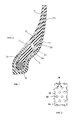
- Figure 2 a magnified region of the apex from Figure 1 is shown.
- An encapsulated resin reactant 30, as shown in Figure 2 is provided dispersed in apex 16 of the tire.
- the encapsulated resin reactant 30 includes a resin reactant 32 encapsulated by a coating material defining a microcapsule 34.
- the apex 16, containing the encapsulated resin reactant 30, generally can be formulated by means and methods known to those having ordinary skill in the art.
- rubber and “elastomer” when used herein, are used interchangeably, unless otherwise prescribed.
- rubber composition if used herein, are used interchangeably to refer to "rubber which has been blended or mixed with various ingredients and materials”.
- the Tg of an elastomer refers to a "glass transition temperature" of the elastomer which can conveniently be determined by a differential scanning calorimeter at a heating rate of 10°C per minute.
- the rubber composition includes one or more rubbers or elastomers containing olefinic unsaturation.
- the phrases "rubber or elastomer containing olefinic unsaturation" or “diene based elastomer” are intended to include both natural rubber and its various raw and reclaim forms as well as various synthetic rubbers.
- Representative synthetic polymers are the homopolymerization products of butadiene and its homologues and derivatives, for example, methylbutadiene, dimethylbutadiene and pentadiene as well as copolymers such as those formed from butadiene or its homologues or derivatives with other unsaturated monomers.
- acetylenes for example, vinyl acetylene
- olefins for example, isobutylene, which copolymerizes with isoprene to form butyl rubber
- vinyl compounds for example, acrylic acid, acrylonitrile (which polymerize with butadiene to form NBR), methacrylic acid and styrene, the latter compound polymerizing with butadiene to form SBR, as well as vinyl esters and various unsaturated aldehydes, ketones and ethers, e.g., acrolein, methyl isopropenyl ketone and vinylethyl ether.
- synthetic rubbers include neoprene (polychloroprene), polybutadiene (including cis-1,4-polybutadiene), polyisoprene (including cis-1,4-polyisoprene), butyl rubber, halobutyl rubber such as chlorobutyl rubber or bromobutyl rubber, styrene/isoprene/butadiene rubber, copolymers of 1,3-butadiene or isoprene with monomers such as styrene, acrylonitrile and methyl methacrylate, as well as ethylene/propylene terpolymers, also known as ethylene/propylene/diene monomer (EPDM), and in particular, ethylene/propylene/ dicyclopentadiene terpolymers.
- neoprene polychloroprene
- polybutadiene including cis-1,4-polybutadiene
- rubbers which may be used include alkoxysilyl end functionalized solution polymerized polymers (SBR, PBR, IBR and SIBR), silicon-coupled and tin-coupled star-branched polymers.
- SBR alkoxysilyl end functionalized solution polymerized polymers
- PBR polybutadiene
- SIBR silicon-coupled and tin-coupled star-branched polymers.
- the preferred rubber or elastomers are polyisoprene (natural or synthetic), polybutadiene and SBR.
- the at least one additional rubber is preferably of at least two of diene based rubbers.
- a combination of two or more rubbers is preferred such as cis 1,4-polyisoprene rubber (natural or synthetic, although natural is preferred), 3,4-polyisoprene rubber, styrene/isoprene/butadiene rubber, emulsion and solution polymerization derived styrene/butadiene rubbers, cis 1,4-polybutadiene rubbers and emulsion polymerization prepared butadiene/acrylonitrile copolymers.
- an emulsion polymerization derived styrene/butadiene might be used having a relatively conventional styrene content of 20 to 28 percent bound styrene or, for some applications, an E-SBR having a medium to relatively high bound styrene content, namely, a bound styrene content of 30 to 45 percent.
- E-SBR emulsion polymerization prepared E-SBR
- styrene and 1,3-butadiene are copolymerized as an aqueous emulsion.
- the bound styrene content can vary, for example, from 5 to 50 percent.
- the E-SBR may also contain acrylonitrile to form a terpolymer rubber, as E-SBAR, in amounts, for example, of 2 to 30 weight percent bound acrylonitrile in the terpolymer.
- Emulsion polymerization prepared styrene/butadiene/acrylonitrile copolymer rubbers containing 2 to 40 weight percent bound acrylonitrile in the copolymer are also contemplated as diene based rubbers for use in this invention.
- S-SBR solution polymerization prepared SBR
- S-SBR typically has a bound styrene content in a range of 5 to 50, preferably 9 to 36, percent.
- the S-SBR can be conveniently prepared, for example, by organo lithium catalyzation in the presence of an organic hydrocarbon solvent.
- cis 1,4-polybutadiene rubber may be used.
- BR cis 1,4-polybutadiene rubber
- Such BR can be prepared, for example, by organic solution polymerization of 1,3-butadiene.
- the BR may be conveniently characterized, for example, by having at least a 90 percent cis 1,4-content.
- the vulcanizable rubber composition also includes an in-situ resin system comprising a methylene donor and methylene acceptor, wherein at least one of the methylene donor and methylene acceptor is microencapsulated.
- the methylene donor and methylene acceptor are the resin reactants in an in-situ resin system where the resin reactants may react to form an in-situ resin.
- the methylene donor is encapsulated, and the methylene acceptor is not encapsulated.
- the methylene acceptor is encapsulated, and the methylene donor is not encapsulated. In either case, the resin reactants in the vulcanizable rubber composition that is not encapsulated is thoroughly mixed in the rubber composition, so as to ensure good contact with the other resin reactant upon release of that resin reactant from encapsulation.
- the coating material of the microcapsule can be selected from a multitude of materials or mixtures thereof.
- the coating may include waxes such as paraffins, resins such as phenol formaldehyde or urea formaldehyde, carbon pitches, thermoplastic elastomers such as KratonTM and thermoplastics such as syndiotactic polybutadiene, polyethylene (PE), polyethylene oxide, polyvinyl acetate, ethylene-vinyl acetate copolymers, polyvinyl alcohols (PVA), polyacrylic acid and derivatives, polycarbonates, polymethylmethacrylate (PMMA), polyorthoester, polyvinylpyrrolidone, or polypropylene (PP).
- the coating material is polypropylene.
- the coating material is paraffin.
- the coating material is urea formaldehyde.
- the coating material selected must be able to withstand the processing temperatures.
- processing can include mixing, calendaring, and extrusion, for example.
- the temperature experienced by the rubber composition may be high enough to promote significant reaction between the resin reactants.
- One or both of the resin reactants is microencapsulated to avoid such reaction during processing.
- the coating material of the microcapsule is chosen so as to be thermally stable at the temperatures it encounters during processing of the rubber compound, yet selected to be thermally unstable the desired curing temperature which is greater than those processing temperatures.
- the coating material for the microcapsule is selected to both prevent release of the resin reactant during the processing steps, such as can occur through melting or softening of the coating material, and to release the resin reactant, such as via melting or softening at the curing temperature of the rubber composition.. This release can allow the resin reactant to interact with its resin reactant counterpart (ie., methylene acceptor or methylene donor).
- the stiffness of the rubber compound during processing is kept low to facilitate the processing, and the stiffness imparted by the in-situ resin is realized only during the cure of the rubber composition.
- the point at which the coating material becomes thermally unstable may be defined by its glass transition temperature rather than its melting point.
- a transition temperature of the coating material refers to its melting temperature or its glass transition temperature.
- Typical mixing temperatures for the rubber composition are kept less than 130 °C to avoid premature cure, so the coating material should have a transition temperature above this level.
- the coating material has a transition temperature greater than 130 °C. In one embodiment, the coating material has a transition temperature greater than 140 °C.
- the coating thickness of the microcapsule also must provide enough durability for the encapsulated resin reactant to withstand the rigors of processing, such as mixing, but allow for release of the resin reactant during the cure.
- the coating thickness is 18 nm to 6000 nm, alternatively 100 nm to 1000 nm, thick.
- the diameter of the microcapsules can vary widely but generally may be from 1 micron to 2000 microns, alternatively from 10 microns to 500 microns. In one embodiment, the diameter is from 10 microns to 150 microns.
- the encapsulated resin reactant can be prepared in a variety of ways.
- One feature of the processes is that microcapsules are formed completely encasing the resin reactant to provide microcapsules of the type and size described above.
- the microcapsule is formed of a synthetic resin material, and may be produced by well-known polymerization methods, such as interfacial polymerization, in-situ polymerization or the like.
- the encapsulated resin reactant may be prepared by allowing a mixture, which contains resin reactant, molten coating material, and optionally other auxiliaries such as surfactants or dispersants, to flow in a cooling column onto a rapidly rotating device such as a rotary table and migrate to the outside because of the high centrifugal force. Because the diameter is greater at the edge, the particles are separated and the formation of agglomerates avoided. After being flung off from the edge of the rotating device, the particles, or encapsulated resin reactant, fly away to the outside individually and cool in the process, as a result of which the coating solidifies.
- auxiliaries such as surfactants or dispersants
- the vulcanizable rubber composition contains from 1 to 35 phr of the reaction product of a methylene acceptor and a methylene donor. Preferably, from 7 to 15 phr of the reaction product is used.
- methylene acceptor is known to those skilled in the art and is used to describe the reactant to which the methylene donor reacts to form what is believed to be a methylol monomer.
- the condensation of the methylol monomer by the formation of a methylene bridge produces the resin.
- the initial reaction that contributes the moiety that later forms into the methylene bridge is the methylene donor wherein the other reactant is the methylene acceptor.
- Representative compounds which may be used as a methylene acceptor include but are not limited to resorcinol, resorcinolic derivatives, monohydric phenols and their derivatives, dihydric phenols and their derivatives, polyhydric phenols and their derivatives, unmodified phenol novolak resins, modified phenol novolak resin, phenol formaldehyde resin, resorcinol novolak resins and mixtures thereof.
- Examples of methylene acceptors include but are not limited to those disclosed in US-A-6,605,670 ; US-A-6,541,551 ; US-A-6,472,457 ; US-A-5,945,500 ; US-A-5,936,056 ; US-A-5,688,871 ; US-A-5,665,799 ; US-A-5,504,127 ; US-A-5,405,897 ; US-A-5,244,725 ; US-A-5,206,289 ; US-A-5,194,513 ; US-A-5,030,692 ; US-A-4,889,481 ; US-A-4,605,696 ; US-A-4,436,853 ; and US-A-4,092,455 .
- modified phenol novolak resins include but are not limited to cashew nut oil modified phenol novolak resin, tall oil modified phenol novolak resin and alkyl modified phenol novolak resin.
- the methylene acceptor is a reactive phenol-formaldehyde resin. Suitable reactive phenol-formaldehyde resins include SMD 30207 from Schenectedy Chemicals.
- methylene acceptors include activated phenols by ring substitution and a cashew nut oil modified novolak-type phenolic resin.
- activated phenols by ring substitution include resorcinol, cresols, t-butyl phenols, isopropyl phenols, ethyl phenols and mixtures thereof.
- Cashew nut oil modified novolak-type phenolic resins are commercially available from Schenectady Chemicals Inc under the designation SP6700. The modification rate of oil based on total novolak-type phenolic resin may range from 10 to 50 percent.
- various processes may be used for production of the novolak-type phenolic resin modified with cashew nut oil.
- phenols such as phenol, cresol and resorcinol may be reacted with aldehydes such as formaldehyde, paraformaldehyde and benzaldehyde using acid catalysts.
- acid catalysts include oxalic acid, hydrochloric acid, sulfuric acid and p-toluenesulfonic acid. After the catalytic reaction, the resin is modified with the oil.
- the amount of methylene acceptor in the rubber stock may vary. In one embodiment, the amount of methylene acceptor ranges from 2 to 25 phr. In another embodiment, the amount of methylene acceptor ranges from 5 to 20 phr.
- In-situ resins are formed in the rubber stock and involve the reaction of a methylene acceptor and a methylene donor.
- methylene donor is intended to mean a compound capable of reacting with the methylene acceptor and generate the resin in-situ.
- Examples of methylene donors which are suitable for use in the present invention include hexamethylenetetramine, hexamethoxymethylmelamine, hexaethoxymethylmelamine, imino-methoxymethylmelamine, imino-isobutoxymethylmelamine, lauryloxymethylpyridinium chloride, ethoxymethylpyridinium chloride trioxan and hexamethoxymethylmelamine.
- the methylene donors may be N-substituted oxymethylmelamines, of the general formula: wherein X is hydrogen or an alkyl having from 1 to 8 carbon atoms, R 1' R 2 , R 3 , R 4 and R 5 are individually selected from the group consisting of hydrogen, an alkyl having from 1 to 8 carbon atoms, the group -CH2OX or their condensation products.
- Specific methylene donors include hexakis-(methoxymethyl)melamine, N,N',N"-trimethyl/N,N',N"-trimethylolmelamine, hexamethylolmelamine, N,N',N"-dimethylolmelamine, N-methylolmelamine, N,N'-dimethylolmelamine, N,N',N"-tris(methoxymethyl)melamine and N,N'N"-tributyl-N,N',N"-trimethylol-melamine.
- the N-methylol derivatives of melamine are prepared by known methods.
- the amount of methylene donor that is present in the rubber stock may vary. Typically, the amount of methylene donor that is present will range from about 0.1 phr to 10 phr. Preferably, the amount of methylene donor ranges from about 0.2 phr to 4 phr.
- the weight ratio of the methylene acceptor to methylene donor may vary. Generally speaking, the weight ratio ranges from about 0.5:1 to 25:1. Preferably, the range is from 2:1 to 20:1.
- the rubber composition may also include up to 70 phr of processing oil.
- Processing oil may be included in the rubber composition as extending oil typically used to extend elastomers. Processing oil may also be included in the rubber composition by addition of the oil directly during rubber compounding.
- the processing oil used may include both extending oil present in the elastomers, and process oil added during compounding.
- Suitable process oils include various oils as are known in the art, including aromatic, paraffinic, naphthenic, vegetable oils, and low PCA oils, such as MES, TDAE, SRAE and heavy naphthenic oils.
- Suitable low PCA oils include those having a polycyclic aromatic content of less than 3 percent by weight as determined by the IP346 method. Procedures for the IP346 method may be found in Standard Methods for Analysis & Testing of Petroleum and Related Products and British Standard 2000 Parts , 2003, 62nd edition, published by the Institute of Petroleum, United Kingdom.
- carbon blacks can be used as a filler.
- Representative examples of such carbon blacks include N110, N121, N134, N220, N231, N234, N242, N293, N299, N315, N326, N330, N332, N339, N343, N347, N351, N358, N375, N539, N550, N582, N630, N642, N650, N683, N754, N762, N765, N774, N787, N907, N908, N990 and N991.
- These carbon blacks have iodine absorptions ranging from 9 to 145 g/kg and DBP number ranging from 34 to 150 cm 3 /100 g. Carbon black may be used in an amount ranging from 10 to 150 phr.
- the rubber composition may contain a conventional sulfur containing organosilicon compound.
- suitable sulfur containing organosilicon compounds are of the formula: Z-Alk-S n -Alk-Z I in which Z is selected from the group consisting of where R 1 is an alkyl group of 1 to 4 carbon atoms, cyclohexyl or phenyl; R 2 is alkoxy of 1 to 8 carbon atoms, or cycloalkoxy of 5 to 8 carbon atoms; Alk is a divalent hydrocarbon of 1 to 18 carbon atoms and n is an integer of 2 to 8.
- the sulfur containing organosilicon compounds are the 3,3'-bis(trimethoxy or triethoxy silylpropyl) polysulfides. In one embodiment, the sulfur containing organosilicon compounds are 3,3'-bis(triethoxysilylpropyl) disulfide and/or 3,3'-bis(triethoxysilylpropyl) tetrasulfide. Therefore, as to formula I, Z may be where R 2 is an alkoxy of 2 to 4 carbon atoms, alternatively 2 carbon atoms; alk is a divalent hydrocarbon of 2 to 4 carbon atoms, alternatively with 3 carbon atoms; and n is an integer of from 2 to 5, alternatively 2 or 4.
- suitable sulfur containing organosilicon compounds include compounds disclosed in US-B-6,608,125 .
- suitable sulfur containing organosilicon compounds include those disclosed in US-A-2003/0130535 .
- the sulfur containing organosilicon compound is Si-363 from Degussa.
- the amount of the sulfur containing organosilicon compound in a rubber composition will vary depending on the level of other additives that are used. Generally speaking, the amount of the compound will range from 0.5 to 20 phr. In one embodiment, the amount will range from 1 to 10 phr.
- the rubber composition would be compounded by methods generally known in the rubber compounding art, such as mixing the various sulfur-vulcanizable constituent rubbers with various commonly used additive materials such as, for example, sulfur donors, curing aids, such as activators and retarders and processing additives, such as oils, resins including tackifying resins and plasticizers, fillers, pigments, fatty acid, zinc oxide, waxes, antioxidants and antiozonants and peptizing agents.
- additives mentioned above are selected and commonly used in conventional amounts.
- sulfur donors include elemental sulfur (free sulfur), an amine disulfide, polymeric polysulfide and sulfur olefin adducts.
- the sulfur-vulcanizing agent is elemental sulfur.
- the sulfur-vulcanizing agent may be used in an amount ranging from 0.5 to 8 phr.
- Typical amounts of tackifier resins, if used, comprise 0.5 to 10 phr.
- Typical amounts of processing aids comprise 1 to 50 phr.
- Typical amounts of antioxidants comprise 1 to 5 phr.
- Representative antioxidants may be, for example, diphenyl-p-phenylenediamine and others, such as, for example, those disclosed in The Vanderbilt Rubber Handbook (1978), Pages 344 through 346 .
- Typical amounts of antiozonants comprise 1 to 5 phr.
- Typical amounts of fatty acids, if used, which can include stearic acid comprise 0.5 to 3 phr.
- Typical amounts of zinc oxide comprise 1 to 5 phr.
- Typical amounts of waxes comprise 1 to 5 phr. Often microcrystalline waxes are used.
- Typical amounts of peptizers comprise 0.1 to 1 phr. Typical peptizers may be, for example, pentachlorothiophenol and dibenzamidodiphenyl disulfide.
- Accelerators are used to control the time and/or temperature required for vulcanization and to improve the properties of the vulcanizate.
- a single accelerator system may be used, i.e., primary accelerator.
- the primary accelerator(s) may be used in total amounts ranging from 0.5 to 4.
- combinations of a primary and a secondary accelerator might be used with the secondary accelerator being used in smaller amounts, such as from 0.05 to 3 phr, in order to activate and to improve the properties of the vulcanizate.
- delayed action accelerators may be used which are not affected by normal processing temperatures but produce a satisfactory cure at ordinary vulcanization temperatures.
- Vulcanization retarders might also be used.
- Suitable types of accelerators that may be used in the present invention are amines, disulfides, guanidines, thioureas, thiazoles, thiurams, sulfenamides, dithiocarbamates and xanthates.
- the primary accelerator is a sulfenamide.
- the secondary accelerator may be a guanidine, dithiocarbamate or thiuram compound.
- the mixing of the rubber composition can be accomplished by methods known to those having skill in the rubber mixing art.
- the ingredients are typically mixed in at least two stages, namely, at least one non-productive stage followed by a productive mix stage.
- the final curatives including sulfur-vulcanizing agents are typically mixed in the final stage which is conventionally called the "productive" mix stage in which the mixing typically occurs at a temperature, or ultimate temperature, lower than the mix temperature(s) than the preceding non-productive mix stage(s).
- the rubber composition may be subjected to a thermomechanical mixing step.
- the thermomechanical mixing step generally comprises a mechanical working in a mixer or extruder for a period of time suitable in order to produce a rubber temperature between 140°C and 190°C.
- the appropriate duration of the thermomechanical working varies as a function of the operating conditions, and the volume and nature of the components.
- the thermomechanical working may be from 1 to 20 minutes.
- the rubber composition may be incorporated in a variety of rubber components of the tire.
- the rubber component may be an apex, chafer, flipper or chipper.
- the pneumatic tire of the present invention may be a race tire, passenger tire, aircraft tire, agricultural, earthmover, off-the-road or truck tire.
- the tire is a passenger or truck tire.
- the tire may also be a radial or bias.
- Vulcanization of the pneumatic tire of the present invention is generally carried out at conventional temperatures ranging from 100°C to 200°C. In one embodiment, the vulcanization is conducted at temperatures ranging from 110°C to 180°C. Any of the usual vulcanization processes may be used such as heating in a press or mold, heating with superheated steam or hot air. Such tires can be built, shaped, molded and cured by various methods which are known and will be readily apparent to those having skill in such art.
Landscapes
- Chemical & Material Sciences (AREA)
- Health & Medical Sciences (AREA)
- Chemical Kinetics & Catalysis (AREA)
- Medicinal Chemistry (AREA)
- Polymers & Plastics (AREA)
- Organic Chemistry (AREA)
- Engineering & Computer Science (AREA)
- Mechanical Engineering (AREA)
- Compositions Of Macromolecular Compounds (AREA)
Abstract
Description
- A tire is a composite of several components each serving a specific and unique function yet all synergistically functioning to produce the desired performance. One important component is the carcass ply. The carcass ply is a continuous layer of rubber-coated parallel cords which extends from bead to bead and functions as a reinforcing element of the tire. The plies are turned up around the bead, thereby locking the bead into the assembly or carcass. The tire is assembled in the green (uncured) state and upon completion is then vulcanized. Typically a resin, also called an in-situ resin, is included in an apex rubber composition to impart desirable properties to the rubber composition, including hardness, tear strength, and adhesion to reinforcement. Typically, methylene acceptor-methylene donor systems are used as such resins or in-situ resins.
- The usage of reinforcing in-situ resins for stiff compounds is currently limited by the poor processability of the rubber compounds due to preliminary curing of the resin additives during mixing, calendering and extrusion. Such stiff compounds may be used for example in the apex, chafer, chipper, and flipper of a tire. Therefore, there exists a continuing need for alternative compounding approaches to maintain or improve the properties of rubber compounds.
- The invention will be described by way of example and with reference to the accompanying drawings in which:
-
Figure 1 is a partial cross-sectional view of a tire according to the present invention, and -
Figure 2 shows a magnified region ofFigure 1 . - The present invention is directed to a vulcanizable rubber composition in accordance with claim 1, to a method in accordance with
claim 10 and to a pneumatic tire in accordance with claim 8. - Dependent claims refer to preferred embodiments of the invention.
- There is disclosed a vulcanizable rubber composition comprising at least one diene based elastomer and an in-situ resin, the in-situ resin comprising a methylene acceptor and a methylene donor, wherein at least one of the methylene acceptor and methylene donor are microencapsulated.
- There is further disclosed a method of making a rubber composition, comprising the step of mixing a diene based elastomer with an in-situ resin, the in-situ resin comprising a methylene acceptor and a methylene donor, wherein at least one of the methylene acceptor and methylene donor are microencapsulated.
- There is further disclosed a pneumatic tire comprising a component, wherein the component comprises the vulcanizable rubber composition.
- In one embodiment, the present invention relates to a pneumatic tire. Pneumatic tire means a laminated mechanical device of generally toroidal shape (usually an open torus) having beads and a tread and made of rubber, chemicals, fabric and steel or other materials. When mounted on the wheel of a motor vehicle, the tire through its tread provides traction and contains the fluid that sustains the vehicle load. The present invention relates to both bias and radial-ply tires. Preferably, the present invention is a radial-ply tire.
- An embodiment of this invention is shown in
Figure 1 . The pneumatic tire preferably contains a single steel cord reinforcedcarcass ply 10 with aturnup portion 12 and aterminal end 14. Steel cord means one or more of the reinforcement elements, formed by one or more steel filaments/wires which may or may not be twisted or otherwise formed which may further include strands so formed which strands may or may not be also so formed, of which the carcass ply in the tire is comprised. Theapex 16 is in the immediate proximity of thecarcass ply turnup 14 including the area above thebead 18 and is encased by thecarcass ply 10 andcarcass ply turnup 12 orsidewall compound 20. The apex also includes thearea 22 located between thelower sidewall 20 and the axially outer side of thecarcass ply turnup 12. Preferably, the interface between thebead 18 and thecarcass ply 10 is aflipper 24. Located outside of thecarcass ply 10 and extending in an essentially parallel relationship to thecarcass ply 10 there may be achipper 26. Located around the outside of thebead 18 there may be achafer 28 to protect thecarcass ply 12 from the rim (not shown), distribute flexing above the rim, and seal the tire. - In one embodiment, a rubber tire is provided having an
apex carcass ply turnup 12 wherein the rubber composition in theapex Figure 2 , a magnified region of the apex fromFigure 1 is shown. - An encapsulated resin reactant 30, as shown in
Figure 2 , is provided dispersed inapex 16 of the tire. The encapsulatedresin reactant 30 includes aresin reactant 32 encapsulated by a coating material defining amicrocapsule 34. Theapex 16, containing the encapsulated resin reactant 30, generally can be formulated by means and methods known to those having ordinary skill in the art. - In the description of this invention, the terms "rubber" and "elastomer" when used herein, are used interchangeably, unless otherwise prescribed. The terms "rubber composition", "compounded rubber" and "rubber compound", if used herein, are used interchangeably to refer to "rubber which has been blended or mixed with various ingredients and materials".
- The term "phr" if used herein, and according to conventional practice, refers to "parts of a respective material per 100 parts by weight of rubber, or elastomer".
- The Tg of an elastomer, if referred to herein, refers to a "glass transition temperature" of the elastomer which can conveniently be determined by a differential scanning calorimeter at a heating rate of 10°C per minute.
- The rubber composition includes one or more rubbers or elastomers containing olefinic unsaturation. The phrases "rubber or elastomer containing olefinic unsaturation" or "diene based elastomer" are intended to include both natural rubber and its various raw and reclaim forms as well as various synthetic rubbers. Representative synthetic polymers are the homopolymerization products of butadiene and its homologues and derivatives, for example, methylbutadiene, dimethylbutadiene and pentadiene as well as copolymers such as those formed from butadiene or its homologues or derivatives with other unsaturated monomers. Among the latter are acetylenes, for example, vinyl acetylene; olefins, for example, isobutylene, which copolymerizes with isoprene to form butyl rubber; vinyl compounds, for example, acrylic acid, acrylonitrile (which polymerize with butadiene to form NBR), methacrylic acid and styrene, the latter compound polymerizing with butadiene to form SBR, as well as vinyl esters and various unsaturated aldehydes, ketones and ethers, e.g., acrolein, methyl isopropenyl ketone and vinylethyl ether. Specific examples of synthetic rubbers include neoprene (polychloroprene), polybutadiene (including cis-1,4-polybutadiene), polyisoprene (including cis-1,4-polyisoprene), butyl rubber, halobutyl rubber such as chlorobutyl rubber or bromobutyl rubber, styrene/isoprene/butadiene rubber, copolymers of 1,3-butadiene or isoprene with monomers such as styrene, acrylonitrile and methyl methacrylate, as well as ethylene/propylene terpolymers, also known as ethylene/propylene/diene monomer (EPDM), and in particular, ethylene/propylene/ dicyclopentadiene terpolymers. Additional examples of rubbers which may be used include alkoxysilyl end functionalized solution polymerized polymers (SBR, PBR, IBR and SIBR), silicon-coupled and tin-coupled star-branched polymers. The preferred rubber or elastomers are polyisoprene (natural or synthetic), polybutadiene and SBR.
- In one aspect the at least one additional rubber is preferably of at least two of diene based rubbers. For example, a combination of two or more rubbers is preferred such as cis 1,4-polyisoprene rubber (natural or synthetic, although natural is preferred), 3,4-polyisoprene rubber, styrene/isoprene/butadiene rubber, emulsion and solution polymerization derived styrene/butadiene rubbers, cis 1,4-polybutadiene rubbers and emulsion polymerization prepared butadiene/acrylonitrile copolymers.
- In one aspect of this invention, an emulsion polymerization derived styrene/butadiene (E-SBR) might be used having a relatively conventional styrene content of 20 to 28 percent bound styrene or, for some applications, an E-SBR having a medium to relatively high bound styrene content, namely, a bound styrene content of 30 to 45 percent.
- By emulsion polymerization prepared E-SBR, it is meant that styrene and 1,3-butadiene are copolymerized as an aqueous emulsion. The bound styrene content can vary, for example, from 5 to 50 percent. In one aspect, the E-SBR may also contain acrylonitrile to form a terpolymer rubber, as E-SBAR, in amounts, for example, of 2 to 30 weight percent bound acrylonitrile in the terpolymer.
- Emulsion polymerization prepared styrene/butadiene/acrylonitrile copolymer rubbers containing 2 to 40 weight percent bound acrylonitrile in the copolymer are also contemplated as diene based rubbers for use in this invention.
- The solution polymerization prepared SBR (S-SBR) typically has a bound styrene content in a range of 5 to 50, preferably 9 to 36, percent. The S-SBR can be conveniently prepared, for example, by organo lithium catalyzation in the presence of an organic hydrocarbon solvent.
- In one embodiment, cis 1,4-polybutadiene rubber (BR) may be used. Such BR can be prepared, for example, by organic solution polymerization of 1,3-butadiene. The BR may be conveniently characterized, for example, by having at least a 90 percent cis 1,4-content.
- The vulcanizable rubber composition also includes an in-situ resin system comprising a methylene donor and methylene acceptor, wherein at least one of the methylene donor and methylene acceptor is microencapsulated. The methylene donor and methylene acceptor are the resin reactants in an in-situ resin system where the resin reactants may react to form an in-situ resin. In one embodiment, the methylene donor is encapsulated, and the methylene acceptor is not encapsulated. In one embodiment, the methylene acceptor is encapsulated, and the methylene donor is not encapsulated. In either case, the resin reactants in the vulcanizable rubber composition that is not encapsulated is thoroughly mixed in the rubber composition, so as to ensure good contact with the other resin reactant upon release of that resin reactant from encapsulation.
- The coating material of the microcapsule can be selected from a multitude of materials or mixtures thereof. For example, the coating may include waxes such as paraffins, resins such as phenol formaldehyde or urea formaldehyde, carbon pitches, thermoplastic elastomers such as Kraton™ and thermoplastics such as syndiotactic polybutadiene, polyethylene (PE), polyethylene oxide, polyvinyl acetate, ethylene-vinyl acetate copolymers, polyvinyl alcohols (PVA), polyacrylic acid and derivatives, polycarbonates, polymethylmethacrylate (PMMA), polyorthoester, polyvinylpyrrolidone, or polypropylene (PP). In one embodiment, the coating material is polypropylene. In another embodiment, the coating material is paraffin. In yet another embodiment, the coating material is urea formaldehyde.
- Since the encapsulated resin reactant is processed with rubbery polymers, as further discussed below, to ultimately provide a rubber compound, e.g., for use in an apex, the coating material selected must be able to withstand the processing temperatures. Such processing can include mixing, calendaring, and extrusion, for example. During the processing steps, the temperature experienced by the rubber composition may be high enough to promote significant reaction between the resin reactants. One or both of the resin reactants is microencapsulated to avoid such reaction during processing.
- To that end, the coating material of the microcapsule is chosen so as to be thermally stable at the temperatures it encounters during processing of the rubber compound, yet selected to be thermally unstable the desired curing temperature which is greater than those processing temperatures. In particular, during cure, the rubber composition is exposed to high temperatures. Accordingly, the coating material for the microcapsule is selected to both prevent release of the resin reactant during the processing steps, such as can occur through melting or softening of the coating material, and to release the resin reactant, such as via melting or softening at the curing temperature of the rubber composition.. This release can allow the resin reactant to interact with its resin reactant counterpart (ie., methylene acceptor or methylene donor). In this way, the stiffness of the rubber compound during processing is kept low to facilitate the processing, and the stiffness imparted by the in-situ resin is realized only during the cure of the rubber composition. Depending upon the type of coating material used, the point at which the coating material becomes thermally unstable may be defined by its glass transition temperature rather than its melting point. In this regard, a transition temperature of the coating material refers to its melting temperature or its glass transition temperature.
- Typical mixing temperatures for the rubber composition are kept less than 130 °C to avoid premature cure, so the coating material should have a transition temperature above this level. In one embodiment, the coating material has a transition temperature greater than 130 °C. In one embodiment, the coating material has a transition temperature greater than 140 °C.
- The coating thickness of the microcapsule also must provide enough durability for the encapsulated resin reactant to withstand the rigors of processing, such as mixing, but allow for release of the resin reactant during the cure. As such, in one example, the coating thickness is 18 nm to 6000 nm, alternatively 100 nm to 1000 nm, thick. Also, the diameter of the microcapsules can vary widely but generally may be from 1 micron to 2000 microns, alternatively from 10 microns to 500 microns. In one embodiment, the diameter is from 10 microns to 150 microns.
- Microencapsulation techniques are known to those having ordinary skill in the art. To that end, the encapsulated resin reactant can be prepared in a variety of ways. One feature of the processes is that microcapsules are formed completely encasing the resin reactant to provide microcapsules of the type and size described above. In one example, the microcapsule is formed of a synthetic resin material, and may be produced by well-known polymerization methods, such as interfacial polymerization, in-situ polymerization or the like. In another example, the encapsulated resin reactant may be prepared by allowing a mixture, which contains resin reactant, molten coating material, and optionally other auxiliaries such as surfactants or dispersants, to flow in a cooling column onto a rapidly rotating device such as a rotary table and migrate to the outside because of the high centrifugal force. Because the diameter is greater at the edge, the particles are separated and the formation of agglomerates avoided. After being flung off from the edge of the rotating device, the particles, or encapsulated resin reactant, fly away to the outside individually and cool in the process, as a result of which the coating solidifies.
- Other processes, such as spray-drying, fluidized-bed coating, emulsion or suspension processes and precipitation also come into consideration for the preparation of the encapsulated resin reactant.
- The vulcanizable rubber composition contains from 1 to 35 phr of the reaction product of a methylene acceptor and a methylene donor. Preferably, from 7 to 15 phr of the reaction product is used.
- The term "methylene acceptor" is known to those skilled in the art and is used to describe the reactant to which the methylene donor reacts to form what is believed to be a methylol monomer. The condensation of the methylol monomer by the formation of a methylene bridge produces the resin. The initial reaction that contributes the moiety that later forms into the methylene bridge is the methylene donor wherein the other reactant is the methylene acceptor. Representative compounds which may be used as a methylene acceptor include but are not limited to resorcinol, resorcinolic derivatives, monohydric phenols and their derivatives, dihydric phenols and their derivatives, polyhydric phenols and their derivatives, unmodified phenol novolak resins, modified phenol novolak resin, phenol formaldehyde resin, resorcinol novolak resins and mixtures thereof. Examples of methylene acceptors include but are not limited to those disclosed in
US-A-6,605,670 ;US-A-6,541,551 ;US-A-6,472,457 ;US-A-5,945,500 ;US-A-5,936,056 ;US-A-5,688,871 ;US-A-5,665,799 ;US-A-5,504,127 ;US-A-5,405,897 ;US-A-5,244,725 ;US-A-5,206,289 ;US-A-5,194,513 ;US-A-5,030,692 ;US-A-4,889,481 ;US-A-4,605,696 ;US-A-4,436,853 ; andUS-A-4,092,455 . Examples of modified phenol novolak resins include but are not limited to cashew nut oil modified phenol novolak resin, tall oil modified phenol novolak resin and alkyl modified phenol novolak resin. In one embodiment, the methylene acceptor is a reactive phenol-formaldehyde resin. Suitable reactive phenol-formaldehyde resins include SMD 30207 from Schenectedy Chemicals. - Other examples of methylene acceptors include activated phenols by ring substitution and a cashew nut oil modified novolak-type phenolic resin. Representative examples of activated phenols by ring substitution include resorcinol, cresols, t-butyl phenols, isopropyl phenols, ethyl phenols and mixtures thereof. Cashew nut oil modified novolak-type phenolic resins are commercially available from Schenectady Chemicals Inc under the designation SP6700. The modification rate of oil based on total novolak-type phenolic resin may range from 10 to 50 percent. For production of the novolak-type phenolic resin modified with cashew nut oil, various processes may be used. For example, phenols such as phenol, cresol and resorcinol may be reacted with aldehydes such as formaldehyde, paraformaldehyde and benzaldehyde using acid catalysts. Examples of acid catalysts include oxalic acid, hydrochloric acid, sulfuric acid and p-toluenesulfonic acid. After the catalytic reaction, the resin is modified with the oil.
- The amount of methylene acceptor in the rubber stock may vary. In one embodiment, the amount of methylene acceptor ranges from 2 to 25 phr. In another embodiment, the amount of methylene acceptor ranges from 5 to 20 phr.
- In-situ resins are formed in the rubber stock and involve the reaction of a methylene acceptor and a methylene donor. The term "methylene donor" is intended to mean a compound capable of reacting with the methylene acceptor and generate the resin in-situ. Examples of methylene donors which are suitable for use in the present invention include hexamethylenetetramine, hexamethoxymethylmelamine, hexaethoxymethylmelamine, imino-methoxymethylmelamine, imino-isobutoxymethylmelamine, lauryloxymethylpyridinium chloride, ethoxymethylpyridinium chloride trioxan and hexamethoxymethylmelamine. In addition, the methylene donors may be N-substituted oxymethylmelamines, of the general formula:

- The amount of methylene donor that is present in the rubber stock may vary. Typically, the amount of methylene donor that is present will range from about 0.1 phr to 10 phr. Preferably, the amount of methylene donor ranges from about 0.2 phr to 4 phr.
- The weight ratio of the methylene acceptor to methylene donor may vary. Generally speaking, the weight ratio ranges from about 0.5:1 to 25:1. Preferably, the range is from 2:1 to 20:1.
- The rubber composition may also include up to 70 phr of processing oil. Processing oil may be included in the rubber composition as extending oil typically used to extend elastomers. Processing oil may also be included in the rubber composition by addition of the oil directly during rubber compounding. The processing oil used may include both extending oil present in the elastomers, and process oil added during compounding. Suitable process oils include various oils as are known in the art, including aromatic, paraffinic, naphthenic, vegetable oils, and low PCA oils, such as MES, TDAE, SRAE and heavy naphthenic oils. Suitable low PCA oils include those having a polycyclic aromatic content of less than 3 percent by weight as determined by the IP346 method. Procedures for the IP346 method may be found in Standard Methods for Analysis & Testing of Petroleum and Related Products and British Standard 2000 Parts, 2003, 62nd edition, published by the Institute of Petroleum, United Kingdom.
- Commonly employed carbon blacks can be used as a filler. Representative examples of such carbon blacks include N110, N121, N134, N220, N231, N234, N242, N293, N299, N315, N326, N330, N332, N339, N343, N347, N351, N358, N375, N539, N550, N582, N630, N642, N650, N683, N754, N762, N765, N774, N787, N907, N908, N990 and N991. These carbon blacks have iodine absorptions ranging from 9 to 145 g/kg and DBP number ranging from 34 to 150 cm3/100 g. Carbon black may be used in an amount ranging from 10 to 150 phr.
- In one embodiment the rubber composition may contain a conventional sulfur containing organosilicon compound. Examples of suitable sulfur containing organosilicon compounds are of the formula:
Z-Alk-Sn-Alk-Z I
in which Z is selected from the group consisting of
- In one embodiment, the sulfur containing organosilicon compounds are the 3,3'-bis(trimethoxy or triethoxy silylpropyl) polysulfides. In one embodiment, the sulfur containing organosilicon compounds are 3,3'-bis(triethoxysilylpropyl) disulfide and/or 3,3'-bis(triethoxysilylpropyl) tetrasulfide. Therefore, as to formula I, Z may be

- In another embodiment, suitable sulfur containing organosilicon compounds include compounds disclosed in
US-B-6,608,125 . In one embodiment, the sulfur containing organosilicon compounds includes 3-(octanoylthio)-1-propyltriethoxysilane, CH3(CH2)6C(=O) -S-CH2CH2CH2Si(OCH2CH3)3, which is available commercially as NXT™ from GE Silicones. - In another embodiment, suitable sulfur containing organosilicon compounds include those disclosed in
US-A-2003/0130535 . In one embodiment, the sulfur containing organosilicon compound is Si-363 from Degussa. - The amount of the sulfur containing organosilicon compound in a rubber composition will vary depending on the level of other additives that are used. Generally speaking, the amount of the compound will range from 0.5 to 20 phr. In one embodiment, the amount will range from 1 to 10 phr.
- It is readily understood by those having skill in the art that the rubber composition would be compounded by methods generally known in the rubber compounding art, such as mixing the various sulfur-vulcanizable constituent rubbers with various commonly used additive materials such as, for example, sulfur donors, curing aids, such as activators and retarders and processing additives, such as oils, resins including tackifying resins and plasticizers, fillers, pigments, fatty acid, zinc oxide, waxes, antioxidants and antiozonants and peptizing agents. As known to those skilled in the art, depending on the intended use of the sulfur vulcanizable and sulfur-vulcanized material (rubbers), the additives mentioned above are selected and commonly used in conventional amounts. Representative examples of sulfur donors include elemental sulfur (free sulfur), an amine disulfide, polymeric polysulfide and sulfur olefin adducts. In one embodiment, the sulfur-vulcanizing agent is elemental sulfur. The sulfur-vulcanizing agent may be used in an amount ranging from 0.5 to 8 phr. Typical amounts of tackifier resins, if used, comprise 0.5 to 10 phr. Typical amounts of processing aids comprise 1 to 50 phr. Typical amounts of antioxidants comprise 1 to 5 phr. Representative antioxidants may be, for example, diphenyl-p-phenylenediamine and others, such as, for example, those disclosed in The Vanderbilt Rubber Handbook (1978), Pages 344 through 346. Typical amounts of antiozonants comprise 1 to 5 phr. Typical amounts of fatty acids, if used, which can include stearic acid comprise 0.5 to 3 phr. Typical amounts of zinc oxide comprise 1 to 5 phr. Typical amounts of waxes comprise 1 to 5 phr. Often microcrystalline waxes are used. Typical amounts of peptizers comprise 0.1 to 1 phr. Typical peptizers may be, for example, pentachlorothiophenol and dibenzamidodiphenyl disulfide.
- Accelerators are used to control the time and/or temperature required for vulcanization and to improve the properties of the vulcanizate. In one embodiment, a single accelerator system may be used, i.e., primary accelerator. The primary accelerator(s) may be used in total amounts ranging from 0.5 to 4. In another embodiment, combinations of a primary and a secondary accelerator might be used with the secondary accelerator being used in smaller amounts, such as from 0.05 to 3 phr, in order to activate and to improve the properties of the vulcanizate. In addition, delayed action accelerators may be used which are not affected by normal processing temperatures but produce a satisfactory cure at ordinary vulcanization temperatures. Vulcanization retarders might also be used. Suitable types of accelerators that may be used in the present invention are amines, disulfides, guanidines, thioureas, thiazoles, thiurams, sulfenamides, dithiocarbamates and xanthates. In one embodiment, the primary accelerator is a sulfenamide. If a second accelerator is used, the secondary accelerator may be a guanidine, dithiocarbamate or thiuram compound.
- The mixing of the rubber composition can be accomplished by methods known to those having skill in the rubber mixing art. For example, the ingredients are typically mixed in at least two stages, namely, at least one non-productive stage followed by a productive mix stage. The final curatives including sulfur-vulcanizing agents are typically mixed in the final stage which is conventionally called the "productive" mix stage in which the mixing typically occurs at a temperature, or ultimate temperature, lower than the mix temperature(s) than the preceding non-productive mix stage(s). The rubber composition may be subjected to a thermomechanical mixing step. The thermomechanical mixing step generally comprises a mechanical working in a mixer or extruder for a period of time suitable in order to produce a rubber temperature between 140°C and 190°C. The appropriate duration of the thermomechanical working varies as a function of the operating conditions, and the volume and nature of the components. For example, the thermomechanical working may be from 1 to 20 minutes.
- The rubber composition may be incorporated in a variety of rubber components of the tire. For example, the rubber component may be an apex, chafer, flipper or chipper.
- The pneumatic tire of the present invention may be a race tire, passenger tire, aircraft tire, agricultural, earthmover, off-the-road or truck tire. In one embodiment, the tire is a passenger or truck tire. The tire may also be a radial or bias.
- Vulcanization of the pneumatic tire of the present invention is generally carried out at conventional temperatures ranging from 100°C to 200°C. In one embodiment, the vulcanization is conducted at temperatures ranging from 110°C to 180°C. Any of the usual vulcanization processes may be used such as heating in a press or mold, heating with superheated steam or hot air. Such tires can be built, shaped, molded and cured by various methods which are known and will be readily apparent to those having skill in such art.
Claims (14)
- A vulcanizable rubber composition comprising at least one diene based elastomer and at least one resin, the resin comprising a methylene acceptor and a methylene donor, wherein at least one of the methylene acceptor and the methylene donor is microencapsulated.
- The vulcanizable rubber composition of claim 1 wherein the resin is an in-situ resin.
- The vulcanizable rubber composition of claim 1 or 2, wherein the methylene donor or only the methylene donor is microencapsulated.
- The vulcanizable rubber composition of claim 1 or 2, wherein the methylene acceptor or only the methylene acceptor is microencapsulated
- The vulcanizable rubber composition of at least one of the previous claims, wherein the methylene donor is selected from the group consisting of hexamethylenetetramine, hexamethoxymethylmelamine, hexaethoxymethylmelamine, imino-methoxymethylmelamine, imino-isobutoxymethylmelamine, lauryloxymethylpyridinium chloride, ethoxymethylpyridinium chloride trioxan and hexamethoxymethylmelamine, N-substituted oxymethylmelamines, of the general formula:

- The vulcanizable rubber composition of at least one of the previous claims, wherein the methylene acceptor is selected from the group consisting of resorcinol, resorcinolic derivatives, monohydric phenols and their derivatives, dihydric phenols and their derivatives, polyhydric phenols and their derivatives, unmodified phenol novolak resins, modified phenol novolak resin, phenol formaldehyde resin, and resorcinol novolak resins.
- The vulcanizable rubber composition of at least one of the previous claims, wherein the microcapsule comprises a material selected from the group consisting of paraffin waxes, phenol formaldehyde resins, urea formaldehyde resins, carbon pitches, thermoplastic elastomers, syndiotactic polybutadiene, polyethylene, polyethylene oxide, polyvinyl acetate, ethylene-vinyl acetate copolymers, polyvinyl alcohols, polyacrylic acid and derivatives, polycarbonates, polymethylmethacrylate, polyorthoester, polyvinylpyrrolidone, and polypropylene.
- A pneumatic tire comprising a component, the component comprising the vulcanizable rubber composition of at least one of the previous claims.
- The tire of claim 8 wherein the tire comprises an apex (16), the apex (16) comprising the vulcanizable rubber composition.
- A method of making a rubber composition, the method comprising the step of mixing a diene based elastomer with a resin, the resin comprising a methylene acceptor and a methylene donor, wherein at least one of the methylene acceptor and the methylene donor is microencapsulated.
- The method of claim 10 wherein the resin is an in-situ resin.
- The method of claim 10 or 11, wherein the methylene donor or only the methylene donor is microencapsulated.
- The method of claim 10 or 11, wherein the methylene acceptor or only the methylene acceptor is microencapsulated
- The method of claim 9, wherein the method comprises making a vulcanizable rubber composition in accordance with at least one of the claims 1 to 7.
Applications Claiming Priority (2)
| Application Number | Priority Date | Filing Date | Title |
|---|---|---|---|
| US201261721101P | 2012-11-01 | 2012-11-01 | |
| US14/027,395 US8962719B2 (en) | 2012-11-01 | 2013-09-16 | Rubber composition with encapsulated resin and pneumatic tire |
Publications (2)
| Publication Number | Publication Date |
|---|---|
| EP2727957A1 true EP2727957A1 (en) | 2014-05-07 |
| EP2727957B1 EP2727957B1 (en) | 2015-09-02 |
Family
ID=49474300
Family Applications (1)
| Application Number | Title | Priority Date | Filing Date |
|---|---|---|---|
| EP13190129.0A Not-in-force EP2727957B1 (en) | 2012-11-01 | 2013-10-24 | Rubber composition with encapsulated resin and pneumatic tire |
Country Status (2)
| Country | Link |
|---|---|
| US (1) | US8962719B2 (en) |
| EP (1) | EP2727957B1 (en) |
Cited By (3)
| Publication number | Priority date | Publication date | Assignee | Title |
|---|---|---|---|---|
| WO2017050954A1 (en) * | 2015-09-25 | 2017-03-30 | Compagnie Generale Des Etablissements Michelin | Use of an esterified aromatic polyphenol derivative for the production of a phenol-aldehyde resin for reinforcement of a rubber composition |
| US10590225B2 (en) | 2015-09-25 | 2020-03-17 | Compagnie Generale Des Etablissements Michelin | Use of a silylated aromatic polyphenol derivative for the production of a phenol-aldehyde resin for reinforcement of a rubber composition |
| US10711131B2 (en) | 2015-09-25 | 2020-07-14 | Compagnie Generale Des Etablissements Michelin | High-strength rubber composition comprising an aromatic polyphenol derivative |
Families Citing this family (1)
| Publication number | Priority date | Publication date | Assignee | Title |
|---|---|---|---|---|
| JP6989223B2 (en) * | 2018-05-30 | 2022-01-05 | 株式会社ブリヂストン | Pneumatic tires |
Citations (26)
| Publication number | Priority date | Publication date | Assignee | Title |
|---|---|---|---|---|
| US4092455A (en) | 1976-03-08 | 1978-05-30 | American Cyanamid Company | Use of methylenebis- and thiobisnaphthols as promoters in tire cord adhesion to rubber |
| US4102800A (en) * | 1973-10-01 | 1978-07-25 | Pennwalt Corporation | Microencapsulated vulcanizing agents |
| US4436853A (en) | 1982-08-20 | 1984-03-13 | The Goodyear Tire & Rubber Company | Phenol-melamine resins for improving rubber to metal adhesion |
| US4605696A (en) | 1985-09-27 | 1986-08-12 | The Goodyear Tire & Rubber Company | Enhanced adhesion of rubber to reinforcing materials through the use of phenolic esters |
| US4889481A (en) | 1988-08-16 | 1989-12-26 | Hi-Tech Ceramics, Inc. | Dual structure infrared surface combustion burner |
| US5030692A (en) | 1988-08-10 | 1991-07-09 | Indspec Chemical Corporation | Rubber compounding resorcinolic resins and process for making the same |
| US5194513A (en) | 1990-08-28 | 1993-03-16 | The Goodyear Tire & Rubber Company | Rubber compositions containing a hydroxy aryl substituted maleamic acid |
| US5206289A (en) | 1992-01-27 | 1993-04-27 | The Goodyear Tire & Rubber Company | Rubber stock containing a polyhydric phenoxy resin |
| US5244725A (en) | 1992-02-24 | 1993-09-14 | Indspec Chemical Corporation | Hydroxyalkyl aryl ethers of di- and polyhydric phenols |
| US5405897A (en) | 1993-02-09 | 1995-04-11 | The Goodyear Tire & Rubber Company | Rubber stock containing phenoxyacetic acid |
| US5504127A (en) | 1993-06-07 | 1996-04-02 | The Goodyear Tire & Rubber Company | Monoesters of rosin acid |
| US5665799A (en) | 1994-09-07 | 1997-09-09 | Sumitomo Chemical Company, Limited | Rubber composition and a vulcanizing adhesion method using the same |
| US5688871A (en) | 1994-03-18 | 1997-11-18 | Sumitomo Chemical Company, Limited | Rubber composition containing a flavan compound and a method for producing a vulcanized rubber containing same |
| US5936056A (en) | 1997-03-07 | 1999-08-10 | Indspec Chemical Corporation | Non-volatile resorcinolic resins and methods of making and using the same |
| US6472457B1 (en) | 2000-12-21 | 2002-10-29 | Indspec Chemical Corporation | Nonformaldehyde, nonfuming resorcinolic resins and methods of making and using the same |
| US6541551B1 (en) | 2000-12-21 | 2003-04-01 | Indspec Chemical Corporation | Resorcinolic derivative for rubber compounds |
| US20030130535A1 (en) | 2001-08-06 | 2003-07-10 | Degussa Ag, | Organosilicon compounds |
| US6605670B1 (en) | 2001-11-06 | 2003-08-12 | Indspec Chemical Corporation | Resorcinolic derivatives and methods of making and using the same |
| US6608125B2 (en) | 1997-08-21 | 2003-08-19 | Crompton Corporation | Blocked mercaptosilane coupling agents for filled rubbers |
| KR20040011258A (en) * | 2002-07-30 | 2004-02-05 | 금호타이어 주식회사 | rubber composition for tire steel cord adhesion |
| US20040055686A1 (en) * | 2002-07-22 | 2004-03-25 | Cowger Katharine M. | Tire components having improved durability |
| WO2004050756A2 (en) * | 2002-12-02 | 2004-06-17 | Societe De Technologie Michelin | Tire containing antidegradant agents |
| EP1669400A1 (en) * | 2004-12-09 | 2006-06-14 | The Goodyear Tire & Rubber Company | A rubber composition and a tire with such a rubber composition containing in-situ resin |
| EP1930184A1 (en) * | 2006-11-21 | 2008-06-11 | The Goodyear Tire & Rubber Company | Tire with apex containing in-situ resin and rubber with pendant hydroxyl groups |
| US20080227888A1 (en) * | 2005-07-28 | 2008-09-18 | Schill + Seilacher Ag | Microencapsulated Rubber Additives and Method For Production Thereof |
| EP2492307A1 (en) * | 2011-02-24 | 2012-08-29 | The Goodyear Tire & Rubber Company | Rubber composition and pneumatic tire |
Family Cites Families (6)
| Publication number | Priority date | Publication date | Assignee | Title |
|---|---|---|---|---|
| US4895884A (en) | 1987-10-06 | 1990-01-23 | The Goodyear Tire & Rubber Company | Rubber containing microencapsulated antidegradants |
| US6998088B2 (en) | 2003-11-21 | 2006-02-14 | The Goodyear Tire & Rubber Company | Self-releasing curing bladder containing a micro-encapsulated lubricant and use thereof to cure rubber products such as tires |
| US7528181B2 (en) | 2004-04-08 | 2009-05-05 | Michelin Recherche Et Technique, S.A. | Rubber composition and tire comprising same |
| US7441574B2 (en) | 2006-08-17 | 2008-10-28 | The Goodyear Tire & Rubber Company | Pneumatic tire |
| US20080173382A1 (en) | 2007-01-18 | 2008-07-24 | Thulasiram Gobinath | Self-healing materials and use thereof for extending the lifespan of a tire |
| CN101412821B (en) | 2007-10-17 | 2012-08-08 | 横滨橡胶株式会社 | Rubber composition for tire |
-
2013
- 2013-09-16 US US14/027,395 patent/US8962719B2/en not_active Expired - Fee Related
- 2013-10-24 EP EP13190129.0A patent/EP2727957B1/en not_active Not-in-force
Patent Citations (27)
| Publication number | Priority date | Publication date | Assignee | Title |
|---|---|---|---|---|
| US4102800A (en) * | 1973-10-01 | 1978-07-25 | Pennwalt Corporation | Microencapsulated vulcanizing agents |
| US4092455A (en) | 1976-03-08 | 1978-05-30 | American Cyanamid Company | Use of methylenebis- and thiobisnaphthols as promoters in tire cord adhesion to rubber |
| US4436853A (en) | 1982-08-20 | 1984-03-13 | The Goodyear Tire & Rubber Company | Phenol-melamine resins for improving rubber to metal adhesion |
| US4605696A (en) | 1985-09-27 | 1986-08-12 | The Goodyear Tire & Rubber Company | Enhanced adhesion of rubber to reinforcing materials through the use of phenolic esters |
| US5030692A (en) | 1988-08-10 | 1991-07-09 | Indspec Chemical Corporation | Rubber compounding resorcinolic resins and process for making the same |
| US4889481A (en) | 1988-08-16 | 1989-12-26 | Hi-Tech Ceramics, Inc. | Dual structure infrared surface combustion burner |
| US5194513A (en) | 1990-08-28 | 1993-03-16 | The Goodyear Tire & Rubber Company | Rubber compositions containing a hydroxy aryl substituted maleamic acid |
| US5206289A (en) | 1992-01-27 | 1993-04-27 | The Goodyear Tire & Rubber Company | Rubber stock containing a polyhydric phenoxy resin |
| US5244725A (en) | 1992-02-24 | 1993-09-14 | Indspec Chemical Corporation | Hydroxyalkyl aryl ethers of di- and polyhydric phenols |
| US5405897A (en) | 1993-02-09 | 1995-04-11 | The Goodyear Tire & Rubber Company | Rubber stock containing phenoxyacetic acid |
| US5504127A (en) | 1993-06-07 | 1996-04-02 | The Goodyear Tire & Rubber Company | Monoesters of rosin acid |
| US5688871A (en) | 1994-03-18 | 1997-11-18 | Sumitomo Chemical Company, Limited | Rubber composition containing a flavan compound and a method for producing a vulcanized rubber containing same |
| US5665799A (en) | 1994-09-07 | 1997-09-09 | Sumitomo Chemical Company, Limited | Rubber composition and a vulcanizing adhesion method using the same |
| US5936056A (en) | 1997-03-07 | 1999-08-10 | Indspec Chemical Corporation | Non-volatile resorcinolic resins and methods of making and using the same |
| US5945500A (en) | 1997-03-07 | 1999-08-31 | Indspec Chemical Corp. | Non-volatile resorcinolic resins and methods of making and using the same |
| US6608125B2 (en) | 1997-08-21 | 2003-08-19 | Crompton Corporation | Blocked mercaptosilane coupling agents for filled rubbers |
| US6472457B1 (en) | 2000-12-21 | 2002-10-29 | Indspec Chemical Corporation | Nonformaldehyde, nonfuming resorcinolic resins and methods of making and using the same |
| US6541551B1 (en) | 2000-12-21 | 2003-04-01 | Indspec Chemical Corporation | Resorcinolic derivative for rubber compounds |
| US20030130535A1 (en) | 2001-08-06 | 2003-07-10 | Degussa Ag, | Organosilicon compounds |
| US6605670B1 (en) | 2001-11-06 | 2003-08-12 | Indspec Chemical Corporation | Resorcinolic derivatives and methods of making and using the same |
| US20040055686A1 (en) * | 2002-07-22 | 2004-03-25 | Cowger Katharine M. | Tire components having improved durability |
| KR20040011258A (en) * | 2002-07-30 | 2004-02-05 | 금호타이어 주식회사 | rubber composition for tire steel cord adhesion |
| WO2004050756A2 (en) * | 2002-12-02 | 2004-06-17 | Societe De Technologie Michelin | Tire containing antidegradant agents |
| EP1669400A1 (en) * | 2004-12-09 | 2006-06-14 | The Goodyear Tire & Rubber Company | A rubber composition and a tire with such a rubber composition containing in-situ resin |
| US20080227888A1 (en) * | 2005-07-28 | 2008-09-18 | Schill + Seilacher Ag | Microencapsulated Rubber Additives and Method For Production Thereof |
| EP1930184A1 (en) * | 2006-11-21 | 2008-06-11 | The Goodyear Tire & Rubber Company | Tire with apex containing in-situ resin and rubber with pendant hydroxyl groups |
| EP2492307A1 (en) * | 2011-02-24 | 2012-08-29 | The Goodyear Tire & Rubber Company | Rubber composition and pneumatic tire |
Non-Patent Citations (2)
| Title |
|---|
| "Standard Methods for Analysis & Testinq of Petroleum and Related Products and British Standard 2000 Parts", 2003, INSTITUTE OF PETROLEUM |
| "The Vanderbilt Rubber Handbook", 1978, pages: 344 - 346 |
Cited By (4)
| Publication number | Priority date | Publication date | Assignee | Title |
|---|---|---|---|---|
| WO2017050954A1 (en) * | 2015-09-25 | 2017-03-30 | Compagnie Generale Des Etablissements Michelin | Use of an esterified aromatic polyphenol derivative for the production of a phenol-aldehyde resin for reinforcement of a rubber composition |
| US10590225B2 (en) | 2015-09-25 | 2020-03-17 | Compagnie Generale Des Etablissements Michelin | Use of a silylated aromatic polyphenol derivative for the production of a phenol-aldehyde resin for reinforcement of a rubber composition |
| US10711132B2 (en) | 2015-09-25 | 2020-07-14 | Compagnie Generale Des Etablissements Michelin | Use of an esterified aromatic polyphenol derivative for the production of a phenol-aldehyde resin for reinforcement of a rubber composition |
| US10711131B2 (en) | 2015-09-25 | 2020-07-14 | Compagnie Generale Des Etablissements Michelin | High-strength rubber composition comprising an aromatic polyphenol derivative |
Also Published As
| Publication number | Publication date |
|---|---|
| US8962719B2 (en) | 2015-02-24 |
| EP2727957B1 (en) | 2015-09-02 |
| US20140121308A1 (en) | 2014-05-01 |
Similar Documents
| Publication | Publication Date | Title |
|---|---|---|
| EP3323633B1 (en) | Pneumatic tire having a dual layer tread | |
| EP2072283B1 (en) | Tire with component containing aramid fibers | |
| EP2353887A2 (en) | Pneumatic tire | |
| US20160237255A1 (en) | Rubber composition and pneumatic tire | |
| US6467520B2 (en) | Tire with apex rubber containing in-situ resin | |
| EP3888940B1 (en) | A rubber composition and a rubber product | |
| US8448684B2 (en) | Tire with component containing polybenzobisoxazole short fiber and epoxidized polyisoprene | |
| EP2065219B1 (en) | Tire with silica tread comprising a resin | |
| EP2492307B1 (en) | Rubber composition and pneumatic tire | |
| EP3778262B1 (en) | A tire tread and a tire comprising a tread | |
| US8261796B2 (en) | Tire with component containing polybenzobisoxazole short fiber and epoxidized palm oil | |
| EP1930184A1 (en) | Tire with apex containing in-situ resin and rubber with pendant hydroxyl groups | |
| EP2727957B1 (en) | Rubber composition with encapsulated resin and pneumatic tire | |
| EP3040212B1 (en) | Pneumatic tire | |
| EP2070728A1 (en) | Tire with component containing polymeric nanofiber |
Legal Events
| Date | Code | Title | Description |
|---|---|---|---|
| PUAI | Public reference made under article 153(3) epc to a published international application that has entered the european phase |
Free format text: ORIGINAL CODE: 0009012 |
|
| 17P | Request for examination filed |
Effective date: 20131024 |
|
| AK | Designated contracting states |
Kind code of ref document: A1 Designated state(s): AL AT BE BG CH CY CZ DE DK EE ES FI FR GB GR HR HU IE IS IT LI LT LU LV MC MK MT NL NO PL PT RO RS SE SI SK SM TR |
|
| AX | Request for extension of the european patent |
Extension state: BA ME |
|
| 17P | Request for examination filed |
Effective date: 20141107 |
|
| RBV | Designated contracting states (corrected) |
Designated state(s): AL AT BE BG CH CY CZ DE DK EE ES FI FR GB GR HR HU IE IS IT LI LT LU LV MC MK MT NL NO PL PT RO RS SE SI SK SM TR |
|
| GRAP | Despatch of communication of intention to grant a patent |
Free format text: ORIGINAL CODE: EPIDOSNIGR1 |
|
| RIC1 | Information provided on ipc code assigned before grant |
Ipc: C08L 21/00 20060101AFI20150310BHEP Ipc: B60C 1/00 20060101ALI20150310BHEP Ipc: C08L 9/00 20060101ALI20150310BHEP Ipc: C08L 61/28 20060101ALI20150310BHEP Ipc: C08L 61/06 20060101ALI20150310BHEP |
|
| INTG | Intention to grant announced |
Effective date: 20150331 |
|
| GRAS | Grant fee paid |
Free format text: ORIGINAL CODE: EPIDOSNIGR3 |
|
| GRAA | (expected) grant |
Free format text: ORIGINAL CODE: 0009210 |
|
| AK | Designated contracting states |
Kind code of ref document: B1 Designated state(s): AL AT BE BG CH CY CZ DE DK EE ES FI FR GB GR HR HU IE IS IT LI LT LU LV MC MK MT NL NO PL PT RO RS SE SI SK SM TR |
|
| REG | Reference to a national code |
Ref country code: GB Ref legal event code: FG4D |
|
| REG | Reference to a national code |
Ref country code: AT Ref legal event code: REF Ref document number: 746593 Country of ref document: AT Kind code of ref document: T Effective date: 20150915 Ref country code: CH Ref legal event code: EP |
|
| REG | Reference to a national code |
Ref country code: IE Ref legal event code: FG4D |
|
| REG | Reference to a national code |
Ref country code: FR Ref legal event code: PLFP Year of fee payment: 3 |
|
| REG | Reference to a national code |
Ref country code: DE Ref legal event code: R096 Ref document number: 602013002818 Country of ref document: DE |
|
| REG | Reference to a national code |
Ref country code: AT Ref legal event code: MK05 Ref document number: 746593 Country of ref document: AT Kind code of ref document: T Effective date: 20150902 |
|
| PG25 | Lapsed in a contracting state [announced via postgrant information from national office to epo] |
Ref country code: LT Free format text: LAPSE BECAUSE OF FAILURE TO SUBMIT A TRANSLATION OF THE DESCRIPTION OR TO PAY THE FEE WITHIN THE PRESCRIBED TIME-LIMIT Effective date: 20150902 Ref country code: GR Free format text: LAPSE BECAUSE OF FAILURE TO SUBMIT A TRANSLATION OF THE DESCRIPTION OR TO PAY THE FEE WITHIN THE PRESCRIBED TIME-LIMIT Effective date: 20151203 Ref country code: NO Free format text: LAPSE BECAUSE OF FAILURE TO SUBMIT A TRANSLATION OF THE DESCRIPTION OR TO PAY THE FEE WITHIN THE PRESCRIBED TIME-LIMIT Effective date: 20151202 Ref country code: LV Free format text: LAPSE BECAUSE OF FAILURE TO SUBMIT A TRANSLATION OF THE DESCRIPTION OR TO PAY THE FEE WITHIN THE PRESCRIBED TIME-LIMIT Effective date: 20150902 Ref country code: FI Free format text: LAPSE BECAUSE OF FAILURE TO SUBMIT A TRANSLATION OF THE DESCRIPTION OR TO PAY THE FEE WITHIN THE PRESCRIBED TIME-LIMIT Effective date: 20150902 |
|
| REG | Reference to a national code |
Ref country code: LT Ref legal event code: MG4D Ref country code: NL Ref legal event code: MP Effective date: 20150902 |
|
| PG25 | Lapsed in a contracting state [announced via postgrant information from national office to epo] |
Ref country code: AT Free format text: LAPSE BECAUSE OF FAILURE TO SUBMIT A TRANSLATION OF THE DESCRIPTION OR TO PAY THE FEE WITHIN THE PRESCRIBED TIME-LIMIT Effective date: 20150902 Ref country code: PL Free format text: LAPSE BECAUSE OF FAILURE TO SUBMIT A TRANSLATION OF THE DESCRIPTION OR TO PAY THE FEE WITHIN THE PRESCRIBED TIME-LIMIT Effective date: 20150902 Ref country code: RS Free format text: LAPSE BECAUSE OF FAILURE TO SUBMIT A TRANSLATION OF THE DESCRIPTION OR TO PAY THE FEE WITHIN THE PRESCRIBED TIME-LIMIT Effective date: 20150902 Ref country code: SE Free format text: LAPSE BECAUSE OF FAILURE TO SUBMIT A TRANSLATION OF THE DESCRIPTION OR TO PAY THE FEE WITHIN THE PRESCRIBED TIME-LIMIT Effective date: 20150902 Ref country code: ES Free format text: LAPSE BECAUSE OF FAILURE TO SUBMIT A TRANSLATION OF THE DESCRIPTION OR TO PAY THE FEE WITHIN THE PRESCRIBED TIME-LIMIT Effective date: 20150902 |
|
| PG25 | Lapsed in a contracting state [announced via postgrant information from national office to epo] |
Ref country code: SK Free format text: LAPSE BECAUSE OF FAILURE TO SUBMIT A TRANSLATION OF THE DESCRIPTION OR TO PAY THE FEE WITHIN THE PRESCRIBED TIME-LIMIT Effective date: 20150902 Ref country code: NL Free format text: LAPSE BECAUSE OF FAILURE TO SUBMIT A TRANSLATION OF THE DESCRIPTION OR TO PAY THE FEE WITHIN THE PRESCRIBED TIME-LIMIT Effective date: 20150902 Ref country code: IS Free format text: LAPSE BECAUSE OF FAILURE TO SUBMIT A TRANSLATION OF THE DESCRIPTION OR TO PAY THE FEE WITHIN THE PRESCRIBED TIME-LIMIT Effective date: 20160102 Ref country code: EE Free format text: LAPSE BECAUSE OF FAILURE TO SUBMIT A TRANSLATION OF THE DESCRIPTION OR TO PAY THE FEE WITHIN THE PRESCRIBED TIME-LIMIT Effective date: 20150902 Ref country code: CZ Free format text: LAPSE BECAUSE OF FAILURE TO SUBMIT A TRANSLATION OF THE DESCRIPTION OR TO PAY THE FEE WITHIN THE PRESCRIBED TIME-LIMIT Effective date: 20150902 |
|
| PG25 | Lapsed in a contracting state [announced via postgrant information from national office to epo] |
Ref country code: RO Free format text: LAPSE BECAUSE OF FAILURE TO SUBMIT A TRANSLATION OF THE DESCRIPTION OR TO PAY THE FEE WITHIN THE PRESCRIBED TIME-LIMIT Effective date: 20150902 Ref country code: PT Free format text: LAPSE BECAUSE OF FAILURE TO SUBMIT A TRANSLATION OF THE DESCRIPTION OR TO PAY THE FEE WITHIN THE PRESCRIBED TIME-LIMIT Effective date: 20160104 |
|
| REG | Reference to a national code |
Ref country code: DE Ref legal event code: R097 Ref document number: 602013002818 Country of ref document: DE |
|
| PG25 | Lapsed in a contracting state [announced via postgrant information from national office to epo] |
Ref country code: MC Free format text: LAPSE BECAUSE OF FAILURE TO SUBMIT A TRANSLATION OF THE DESCRIPTION OR TO PAY THE FEE WITHIN THE PRESCRIBED TIME-LIMIT Effective date: 20150902 |
|
| PLBE | No opposition filed within time limit |
Free format text: ORIGINAL CODE: 0009261 |
|
| STAA | Information on the status of an ep patent application or granted ep patent |
Free format text: STATUS: NO OPPOSITION FILED WITHIN TIME LIMIT |
|
| REG | Reference to a national code |
Ref country code: IE Ref legal event code: MM4A |
|
| 26N | No opposition filed |
Effective date: 20160603 |
|
| PG25 | Lapsed in a contracting state [announced via postgrant information from national office to epo] |
Ref country code: DK Free format text: LAPSE BECAUSE OF FAILURE TO SUBMIT A TRANSLATION OF THE DESCRIPTION OR TO PAY THE FEE WITHIN THE PRESCRIBED TIME-LIMIT Effective date: 20150902 Ref country code: SI Free format text: LAPSE BECAUSE OF FAILURE TO SUBMIT A TRANSLATION OF THE DESCRIPTION OR TO PAY THE FEE WITHIN THE PRESCRIBED TIME-LIMIT Effective date: 20150902 |
|
| REG | Reference to a national code |
Ref country code: FR Ref legal event code: PLFP Year of fee payment: 4 |
|
| PG25 | Lapsed in a contracting state [announced via postgrant information from national office to epo] |
Ref country code: IE Free format text: LAPSE BECAUSE OF NON-PAYMENT OF DUE FEES Effective date: 20151024 |
|
| PG25 | Lapsed in a contracting state [announced via postgrant information from national office to epo] |
Ref country code: BE Free format text: LAPSE BECAUSE OF FAILURE TO SUBMIT A TRANSLATION OF THE DESCRIPTION OR TO PAY THE FEE WITHIN THE PRESCRIBED TIME-LIMIT Effective date: 20150902 |
|
| PG25 | Lapsed in a contracting state [announced via postgrant information from national office to epo] |
Ref country code: BG Free format text: LAPSE BECAUSE OF FAILURE TO SUBMIT A TRANSLATION OF THE DESCRIPTION OR TO PAY THE FEE WITHIN THE PRESCRIBED TIME-LIMIT Effective date: 20150902 Ref country code: HU Free format text: LAPSE BECAUSE OF FAILURE TO SUBMIT A TRANSLATION OF THE DESCRIPTION OR TO PAY THE FEE WITHIN THE PRESCRIBED TIME-LIMIT; INVALID AB INITIO Effective date: 20131024 |
|
| REG | Reference to a national code |
Ref country code: CH Ref legal event code: PL |
|
| PG25 | Lapsed in a contracting state [announced via postgrant information from national office to epo] |
Ref country code: CY Free format text: LAPSE BECAUSE OF FAILURE TO SUBMIT A TRANSLATION OF THE DESCRIPTION OR TO PAY THE FEE WITHIN THE PRESCRIBED TIME-LIMIT Effective date: 20150902 |
|
| PG25 | Lapsed in a contracting state [announced via postgrant information from national office to epo] |
Ref country code: HR Free format text: LAPSE BECAUSE OF FAILURE TO SUBMIT A TRANSLATION OF THE DESCRIPTION OR TO PAY THE FEE WITHIN THE PRESCRIBED TIME-LIMIT Effective date: 20150902 Ref country code: LI Free format text: LAPSE BECAUSE OF NON-PAYMENT OF DUE FEES Effective date: 20161031 Ref country code: CH Free format text: LAPSE BECAUSE OF NON-PAYMENT OF DUE FEES Effective date: 20161031 |
|
| PG25 | Lapsed in a contracting state [announced via postgrant information from national office to epo] |
Ref country code: MT Free format text: LAPSE BECAUSE OF FAILURE TO SUBMIT A TRANSLATION OF THE DESCRIPTION OR TO PAY THE FEE WITHIN THE PRESCRIBED TIME-LIMIT Effective date: 20150902 |
|
| REG | Reference to a national code |
Ref country code: FR Ref legal event code: PLFP Year of fee payment: 5 |
|
| PGFP | Annual fee paid to national office [announced via postgrant information from national office to epo] |
Ref country code: FR Payment date: 20170922 Year of fee payment: 5 |
|
| PG25 | Lapsed in a contracting state [announced via postgrant information from national office to epo] |
Ref country code: LU Free format text: LAPSE BECAUSE OF NON-PAYMENT OF DUE FEES Effective date: 20151024 |
|
| PGFP | Annual fee paid to national office [announced via postgrant information from national office to epo] |
Ref country code: DE Payment date: 20171027 Year of fee payment: 5 |
|
| PGFP | Annual fee paid to national office [announced via postgrant information from national office to epo] |
Ref country code: IT Payment date: 20171018 Year of fee payment: 5 |
|
| PG25 | Lapsed in a contracting state [announced via postgrant information from national office to epo] |
Ref country code: SM Free format text: LAPSE BECAUSE OF FAILURE TO SUBMIT A TRANSLATION OF THE DESCRIPTION OR TO PAY THE FEE WITHIN THE PRESCRIBED TIME-LIMIT Effective date: 20150902 |
|
| GBPC | Gb: european patent ceased through non-payment of renewal fee |
Effective date: 20171024 |
|
| PG25 | Lapsed in a contracting state [announced via postgrant information from national office to epo] |
Ref country code: MK Free format text: LAPSE BECAUSE OF FAILURE TO SUBMIT A TRANSLATION OF THE DESCRIPTION OR TO PAY THE FEE WITHIN THE PRESCRIBED TIME-LIMIT Effective date: 20150902 |
|
| PG25 | Lapsed in a contracting state [announced via postgrant information from national office to epo] |
Ref country code: GB Free format text: LAPSE BECAUSE OF NON-PAYMENT OF DUE FEES Effective date: 20171024 |
|
| PG25 | Lapsed in a contracting state [announced via postgrant information from national office to epo] |
Ref country code: TR Free format text: LAPSE BECAUSE OF FAILURE TO SUBMIT A TRANSLATION OF THE DESCRIPTION OR TO PAY THE FEE WITHIN THE PRESCRIBED TIME-LIMIT Effective date: 20150902 Ref country code: AL Free format text: LAPSE BECAUSE OF FAILURE TO SUBMIT A TRANSLATION OF THE DESCRIPTION OR TO PAY THE FEE WITHIN THE PRESCRIBED TIME-LIMIT Effective date: 20150902 |
|
| REG | Reference to a national code |
Ref country code: DE Ref legal event code: R119 Ref document number: 602013002818 Country of ref document: DE |
|
| PG25 | Lapsed in a contracting state [announced via postgrant information from national office to epo] |
Ref country code: DE Free format text: LAPSE BECAUSE OF NON-PAYMENT OF DUE FEES Effective date: 20190501 |
|
| PG25 | Lapsed in a contracting state [announced via postgrant information from national office to epo] |
Ref country code: FR Free format text: LAPSE BECAUSE OF NON-PAYMENT OF DUE FEES Effective date: 20181031 |
|
| PG25 | Lapsed in a contracting state [announced via postgrant information from national office to epo] |
Ref country code: IT Free format text: LAPSE BECAUSE OF NON-PAYMENT OF DUE FEES Effective date: 20181024 |