EP2725049A1 - Polycarbonate resin and transparent film formed therefrom - Google Patents
Polycarbonate resin and transparent film formed therefrom Download PDFInfo
- Publication number
- EP2725049A1 EP2725049A1 EP20130198923 EP13198923A EP2725049A1 EP 2725049 A1 EP2725049 A1 EP 2725049A1 EP 20130198923 EP20130198923 EP 20130198923 EP 13198923 A EP13198923 A EP 13198923A EP 2725049 A1 EP2725049 A1 EP 2725049A1
- Authority
- EP
- European Patent Office
- Prior art keywords
- transparent film
- polycarbonate resin
- general formula
- dihydroxy compound
- film
- Prior art date
- Legal status (The legal status is an assumption and is not a legal conclusion. Google has not performed a legal analysis and makes no representation as to the accuracy of the status listed.)
- Withdrawn
Links
- 229920005668 polycarbonate resin Polymers 0.000 title claims abstract description 146
- 239000004431 polycarbonate resin Substances 0.000 title claims abstract description 146
- 150000001875 compounds Chemical class 0.000 claims abstract description 135
- 230000002829 reductive effect Effects 0.000 claims description 34
- 125000004432 carbon atom Chemical group C* 0.000 claims description 30
- XLYOFNOQVPJJNP-UHFFFAOYSA-N water Substances O XLYOFNOQVPJJNP-UHFFFAOYSA-N 0.000 claims description 27
- 230000009477 glass transition Effects 0.000 claims description 21
- 238000010521 absorption reaction Methods 0.000 claims description 19
- 230000014509 gene expression Effects 0.000 claims description 14
- 125000002993 cycloalkylene group Chemical group 0.000 claims description 9
- 125000000217 alkyl group Chemical group 0.000 claims description 6
- 125000002947 alkylene group Chemical group 0.000 claims description 6
- DGAQECJNVWCQMB-PUAWFVPOSA-M Ilexoside XXIX Chemical compound C[C@@H]1CC[C@@]2(CC[C@@]3(C(=CC[C@H]4[C@]3(CC[C@@H]5[C@@]4(CC[C@@H](C5(C)C)OS(=O)(=O)[O-])C)C)[C@@H]2[C@]1(C)O)C)C(=O)O[C@H]6[C@@H]([C@H]([C@@H]([C@H](O6)CO)O)O)O.[Na+] DGAQECJNVWCQMB-PUAWFVPOSA-M 0.000 claims description 5
- 229920000515 polycarbonate Polymers 0.000 claims description 5
- 239000004417 polycarbonate Substances 0.000 claims description 5
- 229910052708 sodium Inorganic materials 0.000 claims description 5
- 239000011734 sodium Substances 0.000 claims description 5
- 125000003118 aryl group Chemical group 0.000 claims description 4
- 125000004435 hydrogen atom Chemical group [H]* 0.000 claims description 4
- 125000000732 arylene group Chemical group 0.000 claims description 3
- 125000000753 cycloalkyl group Chemical group 0.000 claims description 3
- 238000010030 laminating Methods 0.000 claims description 3
- 229920005989 resin Polymers 0.000 abstract description 17
- 239000011347 resin Substances 0.000 abstract description 17
- 239000010408 film Substances 0.000 description 225
- 238000006243 chemical reaction Methods 0.000 description 38
- 238000000034 method Methods 0.000 description 33
- -1 2,4'-dihydroxydiphenyl sulfone Chemical class 0.000 description 22
- 239000000203 mixture Substances 0.000 description 16
- 230000000052 comparative effect Effects 0.000 description 14
- MTHSVFCYNBDYFN-UHFFFAOYSA-N diethylene glycol Chemical compound OCCOCCO MTHSVFCYNBDYFN-UHFFFAOYSA-N 0.000 description 14
- 238000006116 polymerization reaction Methods 0.000 description 13
- 230000007423 decrease Effects 0.000 description 11
- 150000005690 diesters Chemical class 0.000 description 11
- 238000010438 heat treatment Methods 0.000 description 11
- KLDXJTOLSGUMSJ-JGWLITMVSA-N Isosorbide Chemical compound O[C@@H]1CO[C@@H]2[C@@H](O)CO[C@@H]21 KLDXJTOLSGUMSJ-JGWLITMVSA-N 0.000 description 9
- IISBACLAFKSPIT-UHFFFAOYSA-N bisphenol A Chemical class C=1C=C(O)C=CC=1C(C)(C)C1=CC=C(O)C=C1 IISBACLAFKSPIT-UHFFFAOYSA-N 0.000 description 9
- 239000003054 catalyst Substances 0.000 description 9
- 238000004040 coloring Methods 0.000 description 9
- 229960002479 isosorbide Drugs 0.000 description 9
- 238000000465 moulding Methods 0.000 description 9
- LYCAIKOWRPUZTN-UHFFFAOYSA-N Ethylene glycol Chemical compound OCCO LYCAIKOWRPUZTN-UHFFFAOYSA-N 0.000 description 8
- YIMQCDZDWXUDCA-UHFFFAOYSA-N [4-(hydroxymethyl)cyclohexyl]methanol Chemical compound OCC1CCC(CO)CC1 YIMQCDZDWXUDCA-UHFFFAOYSA-N 0.000 description 8
- 239000012760 heat stabilizer Substances 0.000 description 8
- 239000000463 material Substances 0.000 description 8
- 125000002950 monocyclic group Chemical group 0.000 description 8
- 229920001223 polyethylene glycol Polymers 0.000 description 8
- 239000000243 solution Substances 0.000 description 8
- 150000001339 alkali metal compounds Chemical class 0.000 description 7
- 150000001341 alkaline earth metal compounds Chemical class 0.000 description 7
- FJDQFPXHSGXQBY-UHFFFAOYSA-L caesium carbonate Chemical compound [Cs+].[Cs+].[O-]C([O-])=O FJDQFPXHSGXQBY-UHFFFAOYSA-L 0.000 description 7
- 229910000024 caesium carbonate Inorganic materials 0.000 description 7
- 230000000694 effects Effects 0.000 description 7
- 238000004519 manufacturing process Methods 0.000 description 7
- OJMIONKXNSYLSR-UHFFFAOYSA-N phosphorous acid Chemical class OP(O)O OJMIONKXNSYLSR-UHFFFAOYSA-N 0.000 description 7
- 239000002685 polymerization catalyst Substances 0.000 description 7
- 230000001105 regulatory effect Effects 0.000 description 7
- 150000003839 salts Chemical class 0.000 description 7
- 239000007858 starting material Substances 0.000 description 7
- YMWUJEATGCHHMB-UHFFFAOYSA-N Dichloromethane Chemical compound ClCCl YMWUJEATGCHHMB-UHFFFAOYSA-N 0.000 description 6
- ISWSIDIOOBJBQZ-UHFFFAOYSA-N Phenol Chemical compound OC1=CC=CC=C1 ISWSIDIOOBJBQZ-UHFFFAOYSA-N 0.000 description 6
- DNIAPMSPPWPWGF-UHFFFAOYSA-N Propylene glycol Chemical compound CC(O)CO DNIAPMSPPWPWGF-UHFFFAOYSA-N 0.000 description 6
- 125000002723 alicyclic group Chemical group 0.000 description 6
- ROORDVPLFPIABK-UHFFFAOYSA-N diphenyl carbonate Chemical compound C=1C=CC=CC=1OC(=O)OC1=CC=CC=C1 ROORDVPLFPIABK-UHFFFAOYSA-N 0.000 description 6
- 238000005259 measurement Methods 0.000 description 6
- 239000000155 melt Substances 0.000 description 6
- 230000003287 optical effect Effects 0.000 description 6
- NQXNYVAALXGLQT-UHFFFAOYSA-N 2-[4-[9-[4-(2-hydroxyethoxy)phenyl]fluoren-9-yl]phenoxy]ethanol Chemical compound C1=CC(OCCO)=CC=C1C1(C=2C=CC(OCCO)=CC=2)C2=CC=CC=C2C2=CC=CC=C21 NQXNYVAALXGLQT-UHFFFAOYSA-N 0.000 description 5
- 125000004122 cyclic group Chemical group 0.000 description 5
- 238000011156 evaluation Methods 0.000 description 5
- 230000001771 impaired effect Effects 0.000 description 5
- 229910052751 metal Inorganic materials 0.000 description 5
- 239000002184 metal Substances 0.000 description 5
- NBIIXXVUZAFLBC-UHFFFAOYSA-N phosphoric acid Substances OP(O)(O)=O NBIIXXVUZAFLBC-UHFFFAOYSA-N 0.000 description 5
- 238000006068 polycondensation reaction Methods 0.000 description 5
- 238000002834 transmittance Methods 0.000 description 5
- NUDSREQIJYWLRA-UHFFFAOYSA-N 4-[9-(4-hydroxy-3-methylphenyl)fluoren-9-yl]-2-methylphenol Chemical compound C1=C(O)C(C)=CC(C2(C3=CC=CC=C3C3=CC=CC=C32)C=2C=C(C)C(O)=CC=2)=C1 NUDSREQIJYWLRA-UHFFFAOYSA-N 0.000 description 4
- UIIMBOGNXHQVGW-UHFFFAOYSA-M Sodium bicarbonate Chemical compound [Na+].OC([O-])=O UIIMBOGNXHQVGW-UHFFFAOYSA-M 0.000 description 4
- 229910000147 aluminium phosphate Inorganic materials 0.000 description 4
- WERYXYBDKMZEQL-UHFFFAOYSA-N butane-1,4-diol Chemical compound OCCCCO WERYXYBDKMZEQL-UHFFFAOYSA-N 0.000 description 4
- 238000012937 correction Methods 0.000 description 4
- 230000003028 elevating effect Effects 0.000 description 4
- 239000004973 liquid crystal related substance Substances 0.000 description 4
- 239000000178 monomer Substances 0.000 description 4
- 230000007935 neutral effect Effects 0.000 description 4
- 235000011007 phosphoric acid Nutrition 0.000 description 4
- 150000003016 phosphoric acids Chemical class 0.000 description 4
- 239000000047 product Substances 0.000 description 4
- 230000009467 reduction Effects 0.000 description 4
- 238000003756 stirring Methods 0.000 description 4
- WGTYBPLFGIVFAS-UHFFFAOYSA-M tetramethylammonium hydroxide Chemical compound [OH-].C[N+](C)(C)C WGTYBPLFGIVFAS-UHFFFAOYSA-M 0.000 description 4
- WVLBCYQITXONBZ-UHFFFAOYSA-N trimethyl phosphate Chemical compound COP(=O)(OC)OC WVLBCYQITXONBZ-UHFFFAOYSA-N 0.000 description 4
- AIBRSVLEQRWAEG-UHFFFAOYSA-N 3,9-bis(2,4-ditert-butylphenoxy)-2,4,8,10-tetraoxa-3,9-diphosphaspiro[5.5]undecane Chemical compound CC(C)(C)C1=CC(C(C)(C)C)=CC=C1OP1OCC2(COP(OC=3C(=CC(=CC=3)C(C)(C)C)C(C)(C)C)OC2)CO1 AIBRSVLEQRWAEG-UHFFFAOYSA-N 0.000 description 3
- WMFOQBRAJBCJND-UHFFFAOYSA-M Lithium hydroxide Chemical compound [Li+].[OH-] WMFOQBRAJBCJND-UHFFFAOYSA-M 0.000 description 3
- JKIJEFPNVSHHEI-UHFFFAOYSA-N Phenol, 2,4-bis(1,1-dimethylethyl)-, phosphite (3:1) Chemical compound CC(C)(C)C1=CC(C(C)(C)C)=CC=C1OP(OC=1C(=CC(=CC=1)C(C)(C)C)C(C)(C)C)OC1=CC=C(C(C)(C)C)C=C1C(C)(C)C JKIJEFPNVSHHEI-UHFFFAOYSA-N 0.000 description 3
- KWYUFKZDYYNOTN-UHFFFAOYSA-M Potassium hydroxide Chemical compound [OH-].[K+] KWYUFKZDYYNOTN-UHFFFAOYSA-M 0.000 description 3
- HEMHJVSKTPXQMS-UHFFFAOYSA-M Sodium hydroxide Chemical compound [OH-].[Na+] HEMHJVSKTPXQMS-UHFFFAOYSA-M 0.000 description 3
- 239000003963 antioxidant agent Substances 0.000 description 3
- 239000007864 aqueous solution Substances 0.000 description 3
- 230000015572 biosynthetic process Effects 0.000 description 3
- VTYYLEPIZMXCLO-UHFFFAOYSA-L calcium carbonate Substances [Ca+2].[O-]C([O-])=O VTYYLEPIZMXCLO-UHFFFAOYSA-L 0.000 description 3
- 230000008859 change Effects 0.000 description 3
- 238000013461 design Methods 0.000 description 3
- WGCNASOHLSPBMP-UHFFFAOYSA-N hydroxyacetaldehyde Natural products OCC=O WGCNASOHLSPBMP-UHFFFAOYSA-N 0.000 description 3
- RAXXELZNTBOGNW-UHFFFAOYSA-N imidazole Natural products C1=CNC=N1 RAXXELZNTBOGNW-UHFFFAOYSA-N 0.000 description 3
- 239000012299 nitrogen atmosphere Substances 0.000 description 3
- 150000003018 phosphorus compounds Chemical class 0.000 description 3
- 230000002441 reversible effect Effects 0.000 description 3
- 239000007787 solid Substances 0.000 description 3
- 239000002904 solvent Substances 0.000 description 3
- 238000005809 transesterification reaction Methods 0.000 description 3
- 150000003751 zinc Chemical class 0.000 description 3
- KLDXJTOLSGUMSJ-UNTFVMJOSA-N (3s,3ar,6s,6ar)-2,3,3a,5,6,6a-hexahydrofuro[3,2-b]furan-3,6-diol Chemical compound O[C@H]1CO[C@@H]2[C@@H](O)CO[C@@H]21 KLDXJTOLSGUMSJ-UNTFVMJOSA-N 0.000 description 2
- LVLNPXCISNPHLE-UHFFFAOYSA-N 2-[(4-hydroxyphenyl)methyl]phenol Chemical compound C1=CC(O)=CC=C1CC1=CC=CC=C1O LVLNPXCISNPHLE-UHFFFAOYSA-N 0.000 description 2
- LUXQHIIWBDDUDE-UHFFFAOYSA-N 2-[4-[9-[4-(2-hydroxyethoxy)-3-methylphenyl]fluoren-9-yl]-2-methylphenoxy]ethanol Chemical compound C1=C(OCCO)C(C)=CC(C2(C3=CC=CC=C3C3=CC=CC=C32)C=2C=C(C)C(OCCO)=CC=2)=C1 LUXQHIIWBDDUDE-UHFFFAOYSA-N 0.000 description 2
- ICSNLGPSRYBMBD-UHFFFAOYSA-N 2-aminopyridine Chemical compound NC1=CC=CC=N1 ICSNLGPSRYBMBD-UHFFFAOYSA-N 0.000 description 2
- SSADPHQCUURWSW-UHFFFAOYSA-N 3,9-bis(2,6-ditert-butyl-4-methylphenoxy)-2,4,8,10-tetraoxa-3,9-diphosphaspiro[5.5]undecane Chemical compound CC(C)(C)C1=CC(C)=CC(C(C)(C)C)=C1OP1OCC2(COP(OC=3C(=CC(C)=CC=3C(C)(C)C)C(C)(C)C)OC2)CO1 SSADPHQCUURWSW-UHFFFAOYSA-N 0.000 description 2
- IJGRMHOSHXDMSA-UHFFFAOYSA-N Atomic nitrogen Chemical compound N#N IJGRMHOSHXDMSA-UHFFFAOYSA-N 0.000 description 2
- CURLTUGMZLYLDI-UHFFFAOYSA-N Carbon dioxide Chemical compound O=C=O CURLTUGMZLYLDI-UHFFFAOYSA-N 0.000 description 2
- RTZKZFJDLAIYFH-UHFFFAOYSA-N Diethyl ether Chemical compound CCOCC RTZKZFJDLAIYFH-UHFFFAOYSA-N 0.000 description 2
- QXNVGIXVLWOKEQ-UHFFFAOYSA-N Disodium Chemical class [Na][Na] QXNVGIXVLWOKEQ-UHFFFAOYSA-N 0.000 description 2
- ABLZXFCXXLZCGV-UHFFFAOYSA-N Phosphorous acid Chemical compound OP(O)=O ABLZXFCXXLZCGV-UHFFFAOYSA-N 0.000 description 2
- 239000002202 Polyethylene glycol Substances 0.000 description 2
- CDBYLPFSWZWCQE-UHFFFAOYSA-L Sodium Carbonate Chemical compound [Na+].[Na+].[O-]C([O-])=O CDBYLPFSWZWCQE-UHFFFAOYSA-L 0.000 description 2
- XDODWINGEHBYRT-UHFFFAOYSA-N [2-(hydroxymethyl)cyclohexyl]methanol Chemical compound OCC1CCCCC1CO XDODWINGEHBYRT-UHFFFAOYSA-N 0.000 description 2
- LUSFFPXRDZKBMF-UHFFFAOYSA-N [3-(hydroxymethyl)cyclohexyl]methanol Chemical compound OCC1CCCC(CO)C1 LUSFFPXRDZKBMF-UHFFFAOYSA-N 0.000 description 2
- 229910052783 alkali metal Inorganic materials 0.000 description 2
- 150000003868 ammonium compounds Chemical class 0.000 description 2
- 230000003078 antioxidant effect Effects 0.000 description 2
- 238000010420 art technique Methods 0.000 description 2
- 150000007514 bases Chemical class 0.000 description 2
- 230000005540 biological transmission Effects 0.000 description 2
- PXKLMJQFEQBVLD-UHFFFAOYSA-N bisphenol F Chemical compound C1=CC(O)=CC=C1CC1=CC=C(O)C=C1 PXKLMJQFEQBVLD-UHFFFAOYSA-N 0.000 description 2
- 150000001639 boron compounds Chemical class 0.000 description 2
- PPTSBERGOGHCHC-UHFFFAOYSA-N boron lithium Chemical compound [Li].[B] PPTSBERGOGHCHC-UHFFFAOYSA-N 0.000 description 2
- XLKNMWIXNFVJRR-UHFFFAOYSA-N boron potassium Chemical compound [B].[K] XLKNMWIXNFVJRR-UHFFFAOYSA-N 0.000 description 2
- MOOAHMCRPCTRLV-UHFFFAOYSA-N boron sodium Chemical compound [B].[Na] MOOAHMCRPCTRLV-UHFFFAOYSA-N 0.000 description 2
- 235000010216 calcium carbonate Nutrition 0.000 description 2
- 238000005266 casting Methods 0.000 description 2
- 239000007795 chemical reaction product Substances 0.000 description 2
- 230000001276 controlling effect Effects 0.000 description 2
- PFURGBBHAOXLIO-UHFFFAOYSA-N cyclohexane-1,2-diol Chemical compound OC1CCCCC1O PFURGBBHAOXLIO-UHFFFAOYSA-N 0.000 description 2
- OXDOANYFRLHSML-UHFFFAOYSA-N dimethoxyphosphorylbenzene Chemical compound COP(=O)(OC)C1=CC=CC=C1 OXDOANYFRLHSML-UHFFFAOYSA-N 0.000 description 2
- 238000001125 extrusion Methods 0.000 description 2
- NIHNNTQXNPWCJQ-UHFFFAOYSA-N fluorene Chemical compound C1=CC=C2CC3=CC=CC=C3C2=C1 NIHNNTQXNPWCJQ-UHFFFAOYSA-N 0.000 description 2
- 238000007731 hot pressing Methods 0.000 description 2
- XLYOFNOQVPJJNP-UHFFFAOYSA-M hydroxide Chemical compound [OH-] XLYOFNOQVPJJNP-UHFFFAOYSA-M 0.000 description 2
- 238000011835 investigation Methods 0.000 description 2
- 239000007788 liquid Substances 0.000 description 2
- HQKMJHAJHXVSDF-UHFFFAOYSA-L magnesium stearate Chemical compound [Mg+2].CCCCCCCCCCCCCCCCCC([O-])=O.CCCCCCCCCCCCCCCCCC([O-])=O HQKMJHAJHXVSDF-UHFFFAOYSA-L 0.000 description 2
- 239000012788 optical film Substances 0.000 description 2
- NFHFRUOZVGFOOS-UHFFFAOYSA-N palladium;triphenylphosphane Chemical compound [Pd].C1=CC=CC=C1P(C=1C=CC=CC=1)C1=CC=CC=C1.C1=CC=CC=C1P(C=1C=CC=CC=1)C1=CC=CC=C1.C1=CC=CC=C1P(C=1C=CC=CC=1)C1=CC=CC=C1.C1=CC=CC=C1P(C=1C=CC=CC=1)C1=CC=CC=C1 NFHFRUOZVGFOOS-UHFFFAOYSA-N 0.000 description 2
- 239000003208 petroleum Substances 0.000 description 2
- 229910052698 phosphorus Inorganic materials 0.000 description 2
- 239000011574 phosphorus Substances 0.000 description 2
- 229920000642 polymer Polymers 0.000 description 2
- SCVFZCLFOSHCOH-UHFFFAOYSA-M potassium acetate Chemical compound [K+].CC([O-])=O SCVFZCLFOSHCOH-UHFFFAOYSA-M 0.000 description 2
- BWHMMNNQKKPAPP-UHFFFAOYSA-L potassium carbonate Chemical compound [K+].[K+].[O-]C([O-])=O BWHMMNNQKKPAPP-UHFFFAOYSA-L 0.000 description 2
- 230000008569 process Effects 0.000 description 2
- UBQKCCHYAOITMY-UHFFFAOYSA-N pyridin-2-ol Chemical compound OC1=CC=CC=N1 UBQKCCHYAOITMY-UHFFFAOYSA-N 0.000 description 2
- 239000011541 reaction mixture Substances 0.000 description 2
- 229910000030 sodium bicarbonate Inorganic materials 0.000 description 2
- 235000017557 sodium bicarbonate Nutrition 0.000 description 2
- 125000006850 spacer group Chemical group 0.000 description 2
- 125000003003 spiro group Chemical group 0.000 description 2
- 238000003860 storage Methods 0.000 description 2
- 239000000126 substance Substances 0.000 description 2
- 239000000758 substrate Substances 0.000 description 2
- VDZOOKBUILJEDG-UHFFFAOYSA-M tetrabutylammonium hydroxide Chemical compound [OH-].CCCC[N+](CCCC)(CCCC)CCCC VDZOOKBUILJEDG-UHFFFAOYSA-M 0.000 description 2
- TUQOTMZNTHZOKS-UHFFFAOYSA-N tributylphosphine Chemical compound CCCCP(CCCC)CCCC TUQOTMZNTHZOKS-UHFFFAOYSA-N 0.000 description 2
- DQWPFSLDHJDLRL-UHFFFAOYSA-N triethyl phosphate Chemical compound CCOP(=O)(OCC)OCC DQWPFSLDHJDLRL-UHFFFAOYSA-N 0.000 description 2
- HVLLSGMXQDNUAL-UHFFFAOYSA-N triphenyl phosphite Chemical compound C=1C=CC=CC=1OP(OC=1C=CC=CC=1)OC1=CC=CC=C1 HVLLSGMXQDNUAL-UHFFFAOYSA-N 0.000 description 2
- RIOQSEWOXXDEQQ-UHFFFAOYSA-N triphenylphosphine Chemical compound C1=CC=CC=C1P(C=1C=CC=CC=1)C1=CC=CC=C1 RIOQSEWOXXDEQQ-UHFFFAOYSA-N 0.000 description 2
- WGKLOLBTFWFKOD-UHFFFAOYSA-N tris(2-nonylphenyl) phosphite Chemical compound CCCCCCCCCC1=CC=CC=C1OP(OC=1C(=CC=CC=1)CCCCCCCCC)OC1=CC=CC=C1CCCCCCCCC WGKLOLBTFWFKOD-UHFFFAOYSA-N 0.000 description 2
- VLCQYXZALXDPEV-UHFFFAOYSA-N (2,3,4-triethylphenyl)boron Chemical compound [B]C1=CC=C(CC)C(CC)=C1CC VLCQYXZALXDPEV-UHFFFAOYSA-N 0.000 description 1
- PJAWEFMLSSLAIM-UHFFFAOYSA-N (2,3,4-trimethylphenyl)boron Chemical compound [B]C1=CC=C(C)C(C)=C1C PJAWEFMLSSLAIM-UHFFFAOYSA-N 0.000 description 1
- IHPFDBSMYWRYHQ-UHFFFAOYSA-N (2-benzylphenyl)-diphenylborane Chemical compound C=1C=CC=C(B(C=2C=CC=CC=2)C=2C=CC=CC=2)C=1CC1=CC=CC=C1 IHPFDBSMYWRYHQ-UHFFFAOYSA-N 0.000 description 1
- GCLVVFYKIZYIIL-UHFFFAOYSA-N (2-butylphenyl)-diphenylborane Chemical compound CCCCC1=CC=CC=C1B(C=1C=CC=CC=1)C1=CC=CC=C1 GCLVVFYKIZYIIL-UHFFFAOYSA-N 0.000 description 1
- KBIWOGUYLGWUTF-UHFFFAOYSA-N (2-methylphenyl)-diphenylborane Chemical compound CC1=CC=CC=C1B(C=1C=CC=CC=1)C1=CC=CC=C1 KBIWOGUYLGWUTF-UHFFFAOYSA-N 0.000 description 1
- HCNHNBLSNVSJTJ-UHFFFAOYSA-N 1,1-Bis(4-hydroxyphenyl)ethane Chemical compound C=1C=C(O)C=CC=1C(C)C1=CC=C(O)C=C1 HCNHNBLSNVSJTJ-UHFFFAOYSA-N 0.000 description 1
- VNQNXQYZMPJLQX-UHFFFAOYSA-N 1,3,5-tris[(3,5-ditert-butyl-4-hydroxyphenyl)methyl]-1,3,5-triazinane-2,4,6-trione Chemical compound CC(C)(C)C1=C(O)C(C(C)(C)C)=CC(CN2C(N(CC=3C=C(C(O)=C(C=3)C(C)(C)C)C(C)(C)C)C(=O)N(CC=3C=C(C(O)=C(C=3)C(C)(C)C)C(C)(C)C)C2=O)=O)=C1 VNQNXQYZMPJLQX-UHFFFAOYSA-N 0.000 description 1
- OXFSTTJBVAAALW-UHFFFAOYSA-N 1,3-dihydroimidazole-2-thione Chemical compound SC1=NC=CN1 OXFSTTJBVAAALW-UHFFFAOYSA-N 0.000 description 1
- HSNJERRVXUNQLS-UHFFFAOYSA-N 1-(4-tert-butylphenyl)propan-2-one Chemical compound CC(=O)CC1=CC=C(C(C)(C)C)C=C1 HSNJERRVXUNQLS-UHFFFAOYSA-N 0.000 description 1
- XGVZPMZEBYEFAD-UHFFFAOYSA-N 2,2-dimethylpropylboron Chemical compound [B]CC(C)(C)C XGVZPMZEBYEFAD-UHFFFAOYSA-N 0.000 description 1
- GJDRKHHGPHLVNI-UHFFFAOYSA-N 2,6-ditert-butyl-4-(diethoxyphosphorylmethyl)phenol Chemical compound CCOP(=O)(OCC)CC1=CC(C(C)(C)C)=C(O)C(C(C)(C)C)=C1 GJDRKHHGPHLVNI-UHFFFAOYSA-N 0.000 description 1
- QUMMIJOYXPIWKT-UHFFFAOYSA-N 2-(2-methylphenyl)propan-2-ylboron Chemical compound [B]C(C)(C)C1=CC=CC=C1C QUMMIJOYXPIWKT-UHFFFAOYSA-N 0.000 description 1
- QSRJVOOOWGXUDY-UHFFFAOYSA-N 2-[2-[2-[3-(3-tert-butyl-4-hydroxy-5-methylphenyl)propanoyloxy]ethoxy]ethoxy]ethyl 3-(3-tert-butyl-4-hydroxy-5-methylphenyl)propanoate Chemical compound CC(C)(C)C1=C(O)C(C)=CC(CCC(=O)OCCOCCOCCOC(=O)CCC=2C=C(C(O)=C(C)C=2)C(C)(C)C)=C1 QSRJVOOOWGXUDY-UHFFFAOYSA-N 0.000 description 1
- YBHWVDKCKDWQBX-UHFFFAOYSA-N 2-[2-cyclohexyl-4-[9-[3-cyclohexyl-4-(2-hydroxyethoxy)phenyl]fluoren-9-yl]phenoxy]ethanol Chemical compound OCCOC1=CC=C(C2(C3=CC=CC=C3C3=CC=CC=C32)C=2C=C(C(OCCO)=CC=2)C2CCCCC2)C=C1C1CCCCC1 YBHWVDKCKDWQBX-UHFFFAOYSA-N 0.000 description 1
- CUPZWXCTZHAVPP-UHFFFAOYSA-N 2-[2-tert-butyl-4-[9-[3-tert-butyl-4-(2-hydroxyethoxy)phenyl]fluoren-9-yl]phenoxy]ethanol Chemical compound C1=C(OCCO)C(C(C)(C)C)=CC(C2(C3=CC=CC=C3C3=CC=CC=C32)C=2C=C(C(OCCO)=CC=2)C(C)(C)C)=C1 CUPZWXCTZHAVPP-UHFFFAOYSA-N 0.000 description 1
- JTLKXEMTIVAKJG-UHFFFAOYSA-N 2-[2-tert-butyl-4-[9-[5-tert-butyl-4-(2-hydroxyethoxy)-2-methylphenyl]fluoren-9-yl]-5-methylphenoxy]ethanol Chemical compound CC1=CC(OCCO)=C(C(C)(C)C)C=C1C1(C=2C(=CC(OCCO)=C(C=2)C(C)(C)C)C)C2=CC=CC=C2C2=CC=CC=C21 JTLKXEMTIVAKJG-UHFFFAOYSA-N 0.000 description 1
- IRTFFZWZLVOXMG-UHFFFAOYSA-N 2-[4-[9-[4-(2-hydroxyethoxy)-3,5-dimethylphenyl]fluoren-9-yl]-2,6-dimethylphenoxy]ethanol Chemical compound CC1=C(OCCO)C(C)=CC(C2(C3=CC=CC=C3C3=CC=CC=C32)C=2C=C(C)C(OCCO)=C(C)C=2)=C1 IRTFFZWZLVOXMG-UHFFFAOYSA-N 0.000 description 1
- QRCCWWMVEGTUOR-UHFFFAOYSA-N 2-[4-[9-[4-(2-hydroxyethoxy)-3-(2-methylpropyl)phenyl]fluoren-9-yl]-2-(2-methylpropyl)phenoxy]ethanol Chemical compound C1=C(OCCO)C(CC(C)C)=CC(C2(C3=CC=CC=C3C3=CC=CC=C32)C=2C=C(CC(C)C)C(OCCO)=CC=2)=C1 QRCCWWMVEGTUOR-UHFFFAOYSA-N 0.000 description 1
- HBTONAMIPDVQRI-UHFFFAOYSA-N 2-[4-[9-[4-(2-hydroxyethoxy)-3-phenylphenyl]fluoren-9-yl]-2-phenylphenoxy]ethanol Chemical compound OCCOC1=CC=C(C2(C3=CC=CC=C3C3=CC=CC=C32)C=2C=C(C(OCCO)=CC=2)C=2C=CC=CC=2)C=C1C1=CC=CC=C1 HBTONAMIPDVQRI-UHFFFAOYSA-N 0.000 description 1
- WXNRFPMJYZGKSS-UHFFFAOYSA-N 2-[4-[9-[4-(2-hydroxyethoxy)-3-propan-2-ylphenyl]fluoren-9-yl]-2-propan-2-ylphenoxy]ethanol Chemical compound C1=C(OCCO)C(C(C)C)=CC(C2(C3=CC=CC=C3C3=CC=CC=C32)C=2C=C(C(OCCO)=CC=2)C(C)C)=C1 WXNRFPMJYZGKSS-UHFFFAOYSA-N 0.000 description 1
- MFGOFGRYDNHJTA-UHFFFAOYSA-N 2-amino-1-(2-fluorophenyl)ethanol Chemical compound NCC(O)C1=CC=CC=C1F MFGOFGRYDNHJTA-UHFFFAOYSA-N 0.000 description 1
- HQRSOHFIGHYESQ-UHFFFAOYSA-N 2-butan-2-yl-4-[9-(3-butan-2-yl-4-hydroxyphenyl)fluoren-9-yl]phenol Chemical compound C1=C(O)C(C(C)CC)=CC(C2(C3=CC=CC=C3C3=CC=CC=C32)C=2C=C(C(O)=CC=2)C(C)CC)=C1 HQRSOHFIGHYESQ-UHFFFAOYSA-N 0.000 description 1
- VFIWRWAGUSQPKU-UHFFFAOYSA-N 2-butyl-4-[9-(3-butyl-4-hydroxyphenyl)fluoren-9-yl]phenol Chemical compound C1=C(O)C(CCCC)=CC(C2(C3=CC=CC=C3C3=CC=CC=C32)C=2C=C(CCCC)C(O)=CC=2)=C1 VFIWRWAGUSQPKU-UHFFFAOYSA-N 0.000 description 1
- UQFAPXHGDUABRM-UHFFFAOYSA-N 2-cyclohexyl-4-[9-(3-cyclohexyl-4-hydroxyphenyl)fluoren-9-yl]phenol Chemical compound OC1=CC=C(C2(C3=CC=CC=C3C3=CC=CC=C32)C=2C=C(C(O)=CC=2)C2CCCCC2)C=C1C1CCCCC1 UQFAPXHGDUABRM-UHFFFAOYSA-N 0.000 description 1
- MQSVWTXCKSCUBT-UHFFFAOYSA-N 2-ethyl-4-[9-(3-ethyl-4-hydroxyphenyl)fluoren-9-yl]phenol Chemical compound C1=C(O)C(CC)=CC(C2(C3=CC=CC=C3C3=CC=CC=C32)C=2C=C(CC)C(O)=CC=2)=C1 MQSVWTXCKSCUBT-UHFFFAOYSA-N 0.000 description 1
- YQSPOXMPYQYCSI-UHFFFAOYSA-N 2-methoxy-1h-imidazole Chemical compound COC1=NC=CN1 YQSPOXMPYQYCSI-UHFFFAOYSA-N 0.000 description 1
- IWTFOFMTUOBLHG-UHFFFAOYSA-N 2-methoxypyridine Chemical compound COC1=CC=CC=N1 IWTFOFMTUOBLHG-UHFFFAOYSA-N 0.000 description 1
- LXBGSDVWAMZHDD-UHFFFAOYSA-N 2-methyl-1h-imidazole Chemical compound CC1=NC=CN1 LXBGSDVWAMZHDD-UHFFFAOYSA-N 0.000 description 1
- LYZMKCWNBRTLTJ-UHFFFAOYSA-N 2-methylcyclohexane-1,4-diol Chemical compound CC1CC(O)CCC1O LYZMKCWNBRTLTJ-UHFFFAOYSA-N 0.000 description 1
- VEORPZCZECFIRK-UHFFFAOYSA-N 3,3',5,5'-tetrabromobisphenol A Chemical compound C=1C(Br)=C(O)C(Br)=CC=1C(C)(C)C1=CC(Br)=C(O)C(Br)=C1 VEORPZCZECFIRK-UHFFFAOYSA-N 0.000 description 1
- RKSBPFMNOJWYSB-UHFFFAOYSA-N 3,3-Bis(4-hydroxyphenyl)pentane Chemical compound C=1C=C(O)C=CC=1C(CC)(CC)C1=CC=C(O)C=C1 RKSBPFMNOJWYSB-UHFFFAOYSA-N 0.000 description 1
- PZRWFKGUFWPFID-UHFFFAOYSA-N 3,9-dioctadecoxy-2,4,8,10-tetraoxa-3,9-diphosphaspiro[5.5]undecane Chemical compound C1OP(OCCCCCCCCCCCCCCCCCC)OCC21COP(OCCCCCCCCCCCCCCCCCC)OC2 PZRWFKGUFWPFID-UHFFFAOYSA-N 0.000 description 1
- CCZFANLSRKSNMX-UHFFFAOYSA-N 3-(2-ethylphenyl)pentan-3-ylboron Chemical compound CCC([B])(CC)C1=CC=CC=C1CC CCZFANLSRKSNMX-UHFFFAOYSA-N 0.000 description 1
- FJDLQLIRZFKEKJ-UHFFFAOYSA-N 3-(3,5-ditert-butyl-4-hydroxyphenyl)propanamide Chemical compound CC(C)(C)C1=CC(CCC(N)=O)=CC(C(C)(C)C)=C1O FJDLQLIRZFKEKJ-UHFFFAOYSA-N 0.000 description 1
- GCQUOBKUEHYBMC-UHFFFAOYSA-N 3-(diethylamino)-7,8-dihydro-6h-cyclopenta[2,3]thieno[2,4-b][1,3]oxazin-1-one Chemical compound O=C1OC(N(CC)CC)=NC2=C1C(CCC1)=C1S2 GCQUOBKUEHYBMC-UHFFFAOYSA-N 0.000 description 1
- OBNBMKQOGZKSIM-UHFFFAOYSA-N 3-[4-[9-[4-(3-hydroxy-2,2-dimethylpropoxy)phenyl]fluoren-9-yl]phenoxy]-2,2-dimethylpropan-1-ol Chemical compound C1=CC(OCC(C)(CO)C)=CC=C1C1(C=2C=CC(OCC(C)(C)CO)=CC=2)C2=CC=CC=C2C2=CC=CC=C21 OBNBMKQOGZKSIM-UHFFFAOYSA-N 0.000 description 1
- PQXOTHUSZUHPBK-UHFFFAOYSA-N 3-ethylpentan-3-ylboron Chemical compound CCC([B])(CC)CC PQXOTHUSZUHPBK-UHFFFAOYSA-N 0.000 description 1
- VPWNQTHUCYMVMZ-UHFFFAOYSA-N 4,4'-sulfonyldiphenol Chemical compound C1=CC(O)=CC=C1S(=O)(=O)C1=CC=C(O)C=C1 VPWNQTHUCYMVMZ-UHFFFAOYSA-N 0.000 description 1
- VWGKEVWFBOUAND-UHFFFAOYSA-N 4,4'-thiodiphenol Chemical compound C1=CC(O)=CC=C1SC1=CC=C(O)C=C1 VWGKEVWFBOUAND-UHFFFAOYSA-N 0.000 description 1
- NZGQHKSLKRFZFL-UHFFFAOYSA-N 4-(4-hydroxyphenoxy)phenol Chemical compound C1=CC(O)=CC=C1OC1=CC=C(O)C=C1 NZGQHKSLKRFZFL-UHFFFAOYSA-N 0.000 description 1
- VHYFNPMBLIVWCW-UHFFFAOYSA-N 4-Dimethylaminopyridine Chemical compound CN(C)C1=CC=NC=C1 VHYFNPMBLIVWCW-UHFFFAOYSA-N 0.000 description 1
- DTOMAXGIWFLDMR-UHFFFAOYSA-N 4-[(4-hydroxy-3-nitrophenyl)methyl]-2-nitrophenol Chemical compound C1=C([N+]([O-])=O)C(O)=CC=C1CC1=CC=C(O)C([N+]([O-])=O)=C1 DTOMAXGIWFLDMR-UHFFFAOYSA-N 0.000 description 1
- XAIZOTQTRJYNHC-UHFFFAOYSA-N 4-[2-(3,5-diethyl-4-hydroxyphenyl)propan-2-yl]-2,6-diethylphenol Chemical compound CCC1=C(O)C(CC)=CC(C(C)(C)C=2C=C(CC)C(O)=C(CC)C=2)=C1 XAIZOTQTRJYNHC-UHFFFAOYSA-N 0.000 description 1
- ODJUOZPKKHIEOZ-UHFFFAOYSA-N 4-[2-(4-hydroxy-3,5-dimethylphenyl)propan-2-yl]-2,6-dimethylphenol Chemical compound CC1=C(O)C(C)=CC(C(C)(C)C=2C=C(C)C(O)=C(C)C=2)=C1 ODJUOZPKKHIEOZ-UHFFFAOYSA-N 0.000 description 1
- ACWKCNYOCGALDS-UHFFFAOYSA-N 4-[2-(4-hydroxy-3,5-diphenylphenyl)propan-2-yl]-2,6-diphenylphenol Chemical compound C=1C(C=2C=CC=CC=2)=C(O)C(C=2C=CC=CC=2)=CC=1C(C)(C)C(C=C(C=1O)C=2C=CC=CC=2)=CC=1C1=CC=CC=C1 ACWKCNYOCGALDS-UHFFFAOYSA-N 0.000 description 1
- WCUDAIJOADOKAW-UHFFFAOYSA-N 4-[2-(4-hydroxyphenyl)pentan-2-yl]phenol Chemical compound C=1C=C(O)C=CC=1C(C)(CCC)C1=CC=C(O)C=C1 WCUDAIJOADOKAW-UHFFFAOYSA-N 0.000 description 1
- FLMZHPQIDVOWEJ-UHFFFAOYSA-N 4-[9-(4-hydroxy-3-phenylphenyl)fluoren-9-yl]-2-phenylphenol Chemical compound OC1=CC=C(C2(C3=CC=CC=C3C3=CC=CC=C32)C=2C=C(C(O)=CC=2)C=2C=CC=CC=2)C=C1C1=CC=CC=C1 FLMZHPQIDVOWEJ-UHFFFAOYSA-N 0.000 description 1
- PSLSQHVPMSZQGS-UHFFFAOYSA-N 4-[9-(4-hydroxy-3-propan-2-ylphenyl)fluoren-9-yl]-2-propan-2-ylphenol Chemical compound C1=C(O)C(C(C)C)=CC(C2(C3=CC=CC=C3C3=CC=CC=C32)C=2C=C(C(O)=CC=2)C(C)C)=C1 PSLSQHVPMSZQGS-UHFFFAOYSA-N 0.000 description 1
- GUGCDEVISPTZJD-UHFFFAOYSA-N 4-[9-(4-hydroxy-3-propylphenyl)fluoren-9-yl]-2-propylphenol Chemical compound C1=C(O)C(CCC)=CC(C2(C3=CC=CC=C3C3=CC=CC=C32)C=2C=C(CCC)C(O)=CC=2)=C1 GUGCDEVISPTZJD-UHFFFAOYSA-N 0.000 description 1
- VSAWBBYYMBQKIK-UHFFFAOYSA-N 4-[[3,5-bis[(3,5-ditert-butyl-4-hydroxyphenyl)methyl]-2,4,6-trimethylphenyl]methyl]-2,6-ditert-butylphenol Chemical compound CC1=C(CC=2C=C(C(O)=C(C=2)C(C)(C)C)C(C)(C)C)C(C)=C(CC=2C=C(C(O)=C(C=2)C(C)(C)C)C(C)(C)C)C(C)=C1CC1=CC(C(C)(C)C)=C(O)C(C(C)(C)C)=C1 VSAWBBYYMBQKIK-UHFFFAOYSA-N 0.000 description 1
- NUKYPUAOHBNCPY-UHFFFAOYSA-N 4-aminopyridine Chemical compound NC1=CC=NC=C1 NUKYPUAOHBNCPY-UHFFFAOYSA-N 0.000 description 1
- XQABVLBGNWBWIV-UHFFFAOYSA-N 4-methoxypyridine Chemical compound COC1=CC=NC=C1 XQABVLBGNWBWIV-UHFFFAOYSA-N 0.000 description 1
- ZVVFVKJZNVSANF-UHFFFAOYSA-N 6-[3-(3,5-ditert-butyl-4-hydroxyphenyl)propanoyloxy]hexyl 3-(3,5-ditert-butyl-4-hydroxyphenyl)propanoate Chemical compound CC(C)(C)C1=C(O)C(C(C)(C)C)=CC(CCC(=O)OCCCCCCOC(=O)CCC=2C=C(C(O)=C(C=2)C(C)(C)C)C(C)(C)C)=C1 ZVVFVKJZNVSANF-UHFFFAOYSA-N 0.000 description 1
- ZCYVEMRRCGMTRW-UHFFFAOYSA-N 7553-56-2 Chemical compound [I] ZCYVEMRRCGMTRW-UHFFFAOYSA-N 0.000 description 1
- YWFPGFJLYRKYJZ-UHFFFAOYSA-N 9,9-bis(4-hydroxyphenyl)fluorene Chemical compound C1=CC(O)=CC=C1C1(C=2C=CC(O)=CC=2)C2=CC=CC=C2C2=CC=CC=C21 YWFPGFJLYRKYJZ-UHFFFAOYSA-N 0.000 description 1
- 239000002028 Biomass Substances 0.000 description 1
- SDDLEVPIDBLVHC-UHFFFAOYSA-N Bisphenol Z Chemical compound C1=CC(O)=CC=C1C1(C=2C=CC(O)=CC=2)CCCCC1 SDDLEVPIDBLVHC-UHFFFAOYSA-N 0.000 description 1
- MTQXOVGWNMGSAU-UHFFFAOYSA-N C(CCCCCCCCCCCCCCCCC)C(C(=S)OCC(CO)O)C Chemical compound C(CCCCCCCCCCCCCCCCC)C(C(=S)OCC(CO)O)C MTQXOVGWNMGSAU-UHFFFAOYSA-N 0.000 description 1
- BVKZGUZCCUSVTD-UHFFFAOYSA-L Carbonate Chemical compound [O-]C([O-])=O BVKZGUZCCUSVTD-UHFFFAOYSA-L 0.000 description 1
- FBPFZTCFMRRESA-FSIIMWSLSA-N D-Glucitol Natural products OC[C@H](O)[C@H](O)[C@@H](O)[C@H](O)CO FBPFZTCFMRRESA-FSIIMWSLSA-N 0.000 description 1
- JYFHYPJRHGVZDY-UHFFFAOYSA-N Dibutyl phosphate Chemical compound CCCCOP(O)(=O)OCCCC JYFHYPJRHGVZDY-UHFFFAOYSA-N 0.000 description 1
- OIFBSDVPJOWBCH-UHFFFAOYSA-N Diethyl carbonate Chemical compound CCOC(=O)OCC OIFBSDVPJOWBCH-UHFFFAOYSA-N 0.000 description 1
- 241000692870 Inachis io Species 0.000 description 1
- WHXSMMKQMYFTQS-UHFFFAOYSA-N Lithium Chemical compound [Li] WHXSMMKQMYFTQS-UHFFFAOYSA-N 0.000 description 1
- QAEPIAHUOVJOOM-UHFFFAOYSA-N OP(O)OP(O)O.C(CCCCCCCC)C1=C(C=CC=C1)C(O)(C(CO)(CO)CO)C1=C(C=CC=C1)CCCCCCCCC Chemical compound OP(O)OP(O)O.C(CCCCCCCC)C1=C(C=CC=C1)C(O)(C(CO)(CO)CO)C1=C(C=CC=C1)CCCCCCCCC QAEPIAHUOVJOOM-UHFFFAOYSA-N 0.000 description 1
- 229910019142 PO4 Inorganic materials 0.000 description 1
- YGYAWVDWMABLBF-UHFFFAOYSA-N Phosgene Chemical compound ClC(Cl)=O YGYAWVDWMABLBF-UHFFFAOYSA-N 0.000 description 1
- ZLMJMSJWJFRBEC-UHFFFAOYSA-N Potassium Chemical compound [K] ZLMJMSJWJFRBEC-UHFFFAOYSA-N 0.000 description 1
- 239000004820 Pressure-sensitive adhesive Substances 0.000 description 1
- VMHLLURERBWHNL-UHFFFAOYSA-M Sodium acetate Chemical compound [Na+].CC([O-])=O VMHLLURERBWHNL-UHFFFAOYSA-M 0.000 description 1
- 229920002472 Starch Polymers 0.000 description 1
- ORLQHILJRHBSAY-UHFFFAOYSA-N [1-(hydroxymethyl)cyclohexyl]methanol Chemical class OCC1(CO)CCCCC1 ORLQHILJRHBSAY-UHFFFAOYSA-N 0.000 description 1
- CGRTZESQZZGAAU-UHFFFAOYSA-N [2-[3-[1-[3-(3-tert-butyl-4-hydroxy-5-methylphenyl)propanoyloxy]-2-methylpropan-2-yl]-2,4,8,10-tetraoxaspiro[5.5]undecan-9-yl]-2-methylpropyl] 3-(3-tert-butyl-4-hydroxy-5-methylphenyl)propanoate Chemical compound CC(C)(C)C1=C(O)C(C)=CC(CCC(=O)OCC(C)(C)C2OCC3(CO2)COC(OC3)C(C)(C)COC(=O)CCC=2C=C(C(O)=C(C)C=2)C(C)(C)C)=C1 CGRTZESQZZGAAU-UHFFFAOYSA-N 0.000 description 1
- VSVVZZQIUJXYQA-UHFFFAOYSA-N [3-(3-dodecylsulfanylpropanoyloxy)-2,2-bis(3-dodecylsulfanylpropanoyloxymethyl)propyl] 3-dodecylsulfanylpropanoate Chemical compound CCCCCCCCCCCCSCCC(=O)OCC(COC(=O)CCSCCCCCCCCCCCC)(COC(=O)CCSCCCCCCCCCCCC)COC(=O)CCSCCCCCCCCCCCC VSVVZZQIUJXYQA-UHFFFAOYSA-N 0.000 description 1
- JOBBTVPTPXRUBP-UHFFFAOYSA-N [3-(3-sulfanylpropanoyloxy)-2,2-bis(3-sulfanylpropanoyloxymethyl)propyl] 3-sulfanylpropanoate Chemical compound SCCC(=O)OCC(COC(=O)CCS)(COC(=O)CCS)COC(=O)CCS JOBBTVPTPXRUBP-UHFFFAOYSA-N 0.000 description 1
- BGYHLZZASRKEJE-UHFFFAOYSA-N [3-[3-(3,5-ditert-butyl-4-hydroxyphenyl)propanoyloxy]-2,2-bis[3-(3,5-ditert-butyl-4-hydroxyphenyl)propanoyloxymethyl]propyl] 3-(3,5-ditert-butyl-4-hydroxyphenyl)propanoate Chemical compound CC(C)(C)C1=C(O)C(C(C)(C)C)=CC(CCC(=O)OCC(COC(=O)CCC=2C=C(C(O)=C(C=2)C(C)(C)C)C(C)(C)C)(COC(=O)CCC=2C=C(C(O)=C(C=2)C(C)(C)C)C(C)(C)C)COC(=O)CCC=2C=C(C(O)=C(C=2)C(C)(C)C)C(C)(C)C)=C1 BGYHLZZASRKEJE-UHFFFAOYSA-N 0.000 description 1
- MGONUNJWACERJR-UHFFFAOYSA-L [Cs+].[Cs+].[O-]P([O-])(=O)OC1=CC=CC=C1 Chemical compound [Cs+].[Cs+].[O-]P([O-])(=O)OC1=CC=CC=C1 MGONUNJWACERJR-UHFFFAOYSA-L 0.000 description 1
- 238000009825 accumulation Methods 0.000 description 1
- 230000009471 action Effects 0.000 description 1
- 239000000853 adhesive Substances 0.000 description 1
- 230000001070 adhesive effect Effects 0.000 description 1
- 125000001931 aliphatic group Chemical group 0.000 description 1
- 150000001340 alkali metals Chemical class 0.000 description 1
- 229910052784 alkaline earth metal Inorganic materials 0.000 description 1
- 150000001342 alkaline earth metals Chemical class 0.000 description 1
- 150000005010 aminoquinolines Chemical class 0.000 description 1
- ITHZDDVSAWDQPZ-UHFFFAOYSA-L barium acetate Chemical compound [Ba+2].CC([O-])=O.CC([O-])=O ITHZDDVSAWDQPZ-UHFFFAOYSA-L 0.000 description 1
- 229940112016 barium acetate Drugs 0.000 description 1
- RQPZNWPYLFFXCP-UHFFFAOYSA-L barium dihydroxide Chemical compound [OH-].[OH-].[Ba+2] RQPZNWPYLFFXCP-UHFFFAOYSA-L 0.000 description 1
- 229910001863 barium hydroxide Inorganic materials 0.000 description 1
- 159000000009 barium salts Chemical class 0.000 description 1
- UCVMQZHZWWEPRC-UHFFFAOYSA-L barium(2+);hydrogen carbonate Chemical compound [Ba+2].OC([O-])=O.OC([O-])=O UCVMQZHZWWEPRC-UHFFFAOYSA-L 0.000 description 1
- AGXUVMPSUKZYDT-UHFFFAOYSA-L barium(2+);octadecanoate Chemical compound [Ba+2].CCCCCCCCCCCCCCCCCC([O-])=O.CCCCCCCCCCCCCCCCCC([O-])=O AGXUVMPSUKZYDT-UHFFFAOYSA-L 0.000 description 1
- AYJRCSIUFZENHW-DEQYMQKBSA-L barium(2+);oxomethanediolate Chemical compound [Ba+2].[O-][14C]([O-])=O AYJRCSIUFZENHW-DEQYMQKBSA-L 0.000 description 1
- 239000002585 base Substances 0.000 description 1
- QSRFYFHZPSGRQX-UHFFFAOYSA-N benzyl(tributyl)azanium Chemical compound CCCC[N+](CCCC)(CCCC)CC1=CC=CC=C1 QSRFYFHZPSGRQX-UHFFFAOYSA-N 0.000 description 1
- FKPSBYZGRQJIMO-UHFFFAOYSA-M benzyl(triethyl)azanium;hydroxide Chemical compound [OH-].CC[N+](CC)(CC)CC1=CC=CC=C1 FKPSBYZGRQJIMO-UHFFFAOYSA-M 0.000 description 1
- QCRBMEFNXGBPLL-UHFFFAOYSA-M benzyl(triphenyl)azanium;hydroxide Chemical compound [OH-].C=1C=CC=CC=1[N+](C=1C=CC=CC=1)(C=1C=CC=CC=1)CC1=CC=CC=C1 QCRBMEFNXGBPLL-UHFFFAOYSA-M 0.000 description 1
- NDKBVBUGCNGSJJ-UHFFFAOYSA-M benzyltrimethylammonium hydroxide Chemical compound [OH-].C[N+](C)(C)CC1=CC=CC=C1 NDKBVBUGCNGSJJ-UHFFFAOYSA-M 0.000 description 1
- LUJQZRBUOWMZTF-UHFFFAOYSA-N boron cesium Chemical class [B].[Cs] LUJQZRBUOWMZTF-UHFFFAOYSA-N 0.000 description 1
- ZWRWUGGYDBHANL-UHFFFAOYSA-N butyl diphenyl phosphite Chemical compound C=1C=CC=CC=1OP(OCCCC)OC1=CC=CC=C1 ZWRWUGGYDBHANL-UHFFFAOYSA-N 0.000 description 1
- SXVFRTBMWHHATP-UHFFFAOYSA-M butyl(triphenyl)azanium;hydroxide Chemical compound [OH-].C=1C=CC=CC=1[N+](C=1C=CC=CC=1)(CCCC)C1=CC=CC=C1 SXVFRTBMWHHATP-UHFFFAOYSA-M 0.000 description 1
- 239000006227 byproduct Substances 0.000 description 1
- 229910052792 caesium Inorganic materials 0.000 description 1
- ZOAIGCHJWKDIPJ-UHFFFAOYSA-M caesium acetate Chemical compound [Cs+].CC([O-])=O ZOAIGCHJWKDIPJ-UHFFFAOYSA-M 0.000 description 1
- TVFDJXOCXUVLDH-UHFFFAOYSA-N caesium atom Chemical compound [Cs] TVFDJXOCXUVLDH-UHFFFAOYSA-N 0.000 description 1
- ZMCUDHNSHCRDBT-UHFFFAOYSA-M caesium bicarbonate Chemical compound [Cs+].OC([O-])=O ZMCUDHNSHCRDBT-UHFFFAOYSA-M 0.000 description 1
- HUCVOHYBFXVBRW-UHFFFAOYSA-M caesium hydroxide Inorganic materials [OH-].[Cs+] HUCVOHYBFXVBRW-UHFFFAOYSA-M 0.000 description 1
- VSGNNIFQASZAOI-UHFFFAOYSA-L calcium acetate Chemical compound [Ca+2].CC([O-])=O.CC([O-])=O VSGNNIFQASZAOI-UHFFFAOYSA-L 0.000 description 1
- 239000001639 calcium acetate Substances 0.000 description 1
- 235000011092 calcium acetate Nutrition 0.000 description 1
- 229960005147 calcium acetate Drugs 0.000 description 1
- NKWPZUCBCARRDP-UHFFFAOYSA-L calcium bicarbonate Chemical compound [Ca+2].OC([O-])=O.OC([O-])=O NKWPZUCBCARRDP-UHFFFAOYSA-L 0.000 description 1
- 229910000020 calcium bicarbonate Inorganic materials 0.000 description 1
- 229910000019 calcium carbonate Inorganic materials 0.000 description 1
- AXCZMVOFGPJBDE-UHFFFAOYSA-L calcium dihydroxide Chemical compound [OH-].[OH-].[Ca+2] AXCZMVOFGPJBDE-UHFFFAOYSA-L 0.000 description 1
- 239000000920 calcium hydroxide Substances 0.000 description 1
- 229910001861 calcium hydroxide Inorganic materials 0.000 description 1
- 159000000007 calcium salts Chemical class 0.000 description 1
- CJZGTCYPCWQAJB-UHFFFAOYSA-L calcium stearate Chemical compound [Ca+2].CCCCCCCCCCCCCCCCCC([O-])=O.CCCCCCCCCCCCCCCCCC([O-])=O CJZGTCYPCWQAJB-UHFFFAOYSA-L 0.000 description 1
- 235000013539 calcium stearate Nutrition 0.000 description 1
- 239000008116 calcium stearate Substances 0.000 description 1
- 238000003490 calendering Methods 0.000 description 1
- 239000001569 carbon dioxide Substances 0.000 description 1
- 229910002092 carbon dioxide Inorganic materials 0.000 description 1
- BLUMOBPWAAOPOY-UHFFFAOYSA-M cesium;benzoate Chemical compound [Cs+].[O-]C(=O)C1=CC=CC=C1 BLUMOBPWAAOPOY-UHFFFAOYSA-M 0.000 description 1
- WLZGEDNSZCPRCJ-UHFFFAOYSA-M cesium;octadecanoate Chemical compound [Cs+].CCCCCCCCCCCCCCCCCC([O-])=O WLZGEDNSZCPRCJ-UHFFFAOYSA-M 0.000 description 1
- PMMYEEVYMWASQN-IMJSIDKUSA-N cis-4-Hydroxy-L-proline Chemical compound O[C@@H]1CN[C@H](C(O)=O)C1 PMMYEEVYMWASQN-IMJSIDKUSA-N 0.000 description 1
- 238000003181 co-melting Methods 0.000 description 1
- 239000011248 coating agent Substances 0.000 description 1
- 238000000576 coating method Methods 0.000 description 1
- 238000009833 condensation Methods 0.000 description 1
- 230000005494 condensation Effects 0.000 description 1
- 238000001816 cooling Methods 0.000 description 1
- 238000004132 cross linking Methods 0.000 description 1
- RLMGYIOTPQVQJR-UHFFFAOYSA-N cyclohexane-1,3-diol Chemical compound OC1CCCC(O)C1 RLMGYIOTPQVQJR-UHFFFAOYSA-N 0.000 description 1
- VCVOSERVUCJNPR-UHFFFAOYSA-N cyclopentane-1,2-diol Chemical compound OC1CCCC1O VCVOSERVUCJNPR-UHFFFAOYSA-N 0.000 description 1
- NUUPJBRGQCEZSI-UHFFFAOYSA-N cyclopentane-1,3-diol Chemical compound OC1CCC(O)C1 NUUPJBRGQCEZSI-UHFFFAOYSA-N 0.000 description 1
- 230000003247 decreasing effect Effects 0.000 description 1
- GLOQRSIADGSLRX-UHFFFAOYSA-N decyl diphenyl phosphite Chemical compound C=1C=CC=CC=1OP(OCCCCCCCCCC)OC1=CC=CC=C1 GLOQRSIADGSLRX-UHFFFAOYSA-N 0.000 description 1
- 230000007547 defect Effects 0.000 description 1
- 230000006866 deterioration Effects 0.000 description 1
- 230000002542 deteriorative effect Effects 0.000 description 1
- 238000011161 development Methods 0.000 description 1
- GFAUEQXLYWIWRU-UHFFFAOYSA-L dicesium hydrogen phosphate Chemical compound [Cs+].[Cs+].OP([O-])([O-])=O GFAUEQXLYWIWRU-UHFFFAOYSA-L 0.000 description 1
- NMAKPIATXQEXBT-UHFFFAOYSA-N didecyl phenyl phosphite Chemical compound CCCCCCCCCCOP(OCCCCCCCCCC)OC1=CC=CC=C1 NMAKPIATXQEXBT-UHFFFAOYSA-N 0.000 description 1
- VZEGPPPCKHRYGO-UHFFFAOYSA-N diethoxyphosphorylbenzene Chemical compound CCOP(=O)(OCC)C1=CC=CC=C1 VZEGPPPCKHRYGO-UHFFFAOYSA-N 0.000 description 1
- WZPMZMCZAGFKOC-UHFFFAOYSA-N diisopropyl hydrogen phosphate Chemical compound CC(C)OP(O)(=O)OC(C)C WZPMZMCZAGFKOC-UHFFFAOYSA-N 0.000 description 1
- SMBQBQBNOXIFSF-UHFFFAOYSA-N dilithium Chemical class [Li][Li] SMBQBQBNOXIFSF-UHFFFAOYSA-N 0.000 description 1
- REKWWOFUJAJBCL-UHFFFAOYSA-L dilithium;hydrogen phosphate Chemical compound [Li+].[Li+].OP([O-])([O-])=O REKWWOFUJAJBCL-UHFFFAOYSA-L 0.000 description 1
- YZHWSGFHCJNITE-UHFFFAOYSA-L dilithium;phenyl phosphate Chemical compound [Li+].[Li+].[O-]P([O-])(=O)OC1=CC=CC=C1 YZHWSGFHCJNITE-UHFFFAOYSA-L 0.000 description 1
- IEJIGPNLZYLLBP-UHFFFAOYSA-N dimethyl carbonate Chemical compound COC(=O)OC IEJIGPNLZYLLBP-UHFFFAOYSA-N 0.000 description 1
- HTDKEJXHILZNPP-UHFFFAOYSA-N dioctyl hydrogen phosphate Chemical compound CCCCCCCCOP(O)(=O)OCCCCCCCC HTDKEJXHILZNPP-UHFFFAOYSA-N 0.000 description 1
- MKZVQIIAAIPNGH-UHFFFAOYSA-N dioctyl phenyl phosphite Chemical compound CCCCCCCCOP(OCCCCCCCC)OC1=CC=CC=C1 MKZVQIIAAIPNGH-UHFFFAOYSA-N 0.000 description 1
- QARIOUOTENZTDH-UHFFFAOYSA-N diphenyl (2-phenylphenyl) phosphate Chemical compound C=1C=CC=CC=1OP(OC=1C(=CC=CC=1)C=1C=CC=CC=1)(=O)OC1=CC=CC=C1 QARIOUOTENZTDH-UHFFFAOYSA-N 0.000 description 1
- ZPWVASYFFYYZEW-UHFFFAOYSA-L dipotassium hydrogen phosphate Chemical compound [K+].[K+].OP([O-])([O-])=O ZPWVASYFFYYZEW-UHFFFAOYSA-L 0.000 description 1
- KCIDZIIHRGYJAE-YGFYJFDDSA-L dipotassium;[(2r,3r,4s,5r,6r)-3,4,5-trihydroxy-6-(hydroxymethyl)oxan-2-yl] phosphate Chemical class [K+].[K+].OC[C@H]1O[C@H](OP([O-])([O-])=O)[C@H](O)[C@@H](O)[C@H]1O KCIDZIIHRGYJAE-YGFYJFDDSA-L 0.000 description 1
- DVXOPOCXFDGNKS-UHFFFAOYSA-L dipotassium;phenyl phosphate Chemical compound [K+].[K+].[O-]P([O-])(=O)OC1=CC=CC=C1 DVXOPOCXFDGNKS-UHFFFAOYSA-L 0.000 description 1
- PXGLYSITKOROKV-UHFFFAOYSA-N dipropoxyphosphorylbenzene Chemical compound CCCOP(=O)(OCCC)C1=CC=CC=C1 PXGLYSITKOROKV-UHFFFAOYSA-N 0.000 description 1
- BNIILDVGGAEEIG-UHFFFAOYSA-L disodium hydrogen phosphate Chemical compound [Na+].[Na+].OP([O-])([O-])=O BNIILDVGGAEEIG-UHFFFAOYSA-L 0.000 description 1
- TYJOJLOWRIQYQM-UHFFFAOYSA-L disodium;phenyl phosphate Chemical compound [Na+].[Na+].[O-]P([O-])(=O)OC1=CC=CC=C1 TYJOJLOWRIQYQM-UHFFFAOYSA-L 0.000 description 1
- ODCCJTMPMUFERV-UHFFFAOYSA-N ditert-butyl carbonate Chemical compound CC(C)(C)OC(=O)OC(C)(C)C ODCCJTMPMUFERV-UHFFFAOYSA-N 0.000 description 1
- 238000001035 drying Methods 0.000 description 1
- 238000005516 engineering process Methods 0.000 description 1
- 150000002148 esters Chemical class 0.000 description 1
- KVFVBPYVNUCWJX-UHFFFAOYSA-M ethyl(trimethyl)azanium;hydroxide Chemical compound [OH-].CC[N+](C)(C)C KVFVBPYVNUCWJX-UHFFFAOYSA-M 0.000 description 1
- 229960004979 fampridine Drugs 0.000 description 1
- 238000010528 free radical solution polymerization reaction Methods 0.000 description 1
- 239000007863 gel particle Substances 0.000 description 1
- XXMIOPMDWAUFGU-UHFFFAOYSA-N hexane-1,6-diol Chemical compound OCCCCCCO XXMIOPMDWAUFGU-UHFFFAOYSA-N 0.000 description 1
- 230000002209 hydrophobic effect Effects 0.000 description 1
- 125000002887 hydroxy group Chemical group [H]O* 0.000 description 1
- BDAGIHXWWSANSR-NJFSPNSNSA-N hydroxyformaldehyde Chemical compound O[14CH]=O BDAGIHXWWSANSR-NJFSPNSNSA-N 0.000 description 1
- IPJIKGJKMCILGV-UHFFFAOYSA-N imidazo[1,2-a]pyridin-6-ylboronic acid Chemical compound C1=C(B(O)O)C=CC2=NC=CN21 IPJIKGJKMCILGV-UHFFFAOYSA-N 0.000 description 1
- 238000010348 incorporation Methods 0.000 description 1
- 230000000977 initiatory effect Effects 0.000 description 1
- 229910052740 iodine Inorganic materials 0.000 description 1
- 239000011630 iodine Substances 0.000 description 1
- 229910052744 lithium Inorganic materials 0.000 description 1
- XIXADJRWDQXREU-UHFFFAOYSA-M lithium acetate Chemical compound [Li+].CC([O-])=O XIXADJRWDQXREU-UHFFFAOYSA-M 0.000 description 1
- 229940031993 lithium benzoate Drugs 0.000 description 1
- XGZVUEUWXADBQD-UHFFFAOYSA-L lithium carbonate Chemical compound [Li+].[Li+].[O-]C([O-])=O XGZVUEUWXADBQD-UHFFFAOYSA-L 0.000 description 1
- 229910052808 lithium carbonate Inorganic materials 0.000 description 1
- 229910000032 lithium hydrogen carbonate Inorganic materials 0.000 description 1
- 229910003002 lithium salt Inorganic materials 0.000 description 1
- 159000000002 lithium salts Chemical class 0.000 description 1
- HGPXWXLYXNVULB-UHFFFAOYSA-M lithium stearate Chemical compound [Li+].CCCCCCCCCCCCCCCCCC([O-])=O HGPXWXLYXNVULB-UHFFFAOYSA-M 0.000 description 1
- LDJNSLOKTFFLSL-UHFFFAOYSA-M lithium;benzoate Chemical compound [Li+].[O-]C(=O)C1=CC=CC=C1 LDJNSLOKTFFLSL-UHFFFAOYSA-M 0.000 description 1
- HQRPHMAXFVUBJX-UHFFFAOYSA-M lithium;hydrogen carbonate Chemical compound [Li+].OC([O-])=O HQRPHMAXFVUBJX-UHFFFAOYSA-M 0.000 description 1
- UEGPKNKPLBYCNK-UHFFFAOYSA-L magnesium acetate Chemical compound [Mg+2].CC([O-])=O.CC([O-])=O UEGPKNKPLBYCNK-UHFFFAOYSA-L 0.000 description 1
- 239000011654 magnesium acetate Substances 0.000 description 1
- 235000011285 magnesium acetate Nutrition 0.000 description 1
- 229940069446 magnesium acetate Drugs 0.000 description 1
- QWDJLDTYWNBUKE-UHFFFAOYSA-L magnesium bicarbonate Chemical compound [Mg+2].OC([O-])=O.OC([O-])=O QWDJLDTYWNBUKE-UHFFFAOYSA-L 0.000 description 1
- 229910000022 magnesium bicarbonate Inorganic materials 0.000 description 1
- 239000002370 magnesium bicarbonate Substances 0.000 description 1
- 235000014824 magnesium bicarbonate Nutrition 0.000 description 1
- ZLNQQNXFFQJAID-UHFFFAOYSA-L magnesium carbonate Chemical compound [Mg+2].[O-]C([O-])=O ZLNQQNXFFQJAID-UHFFFAOYSA-L 0.000 description 1
- 239000001095 magnesium carbonate Substances 0.000 description 1
- 229910000021 magnesium carbonate Inorganic materials 0.000 description 1
- VTHJTEIRLNZDEV-UHFFFAOYSA-L magnesium dihydroxide Chemical compound [OH-].[OH-].[Mg+2] VTHJTEIRLNZDEV-UHFFFAOYSA-L 0.000 description 1
- 239000000347 magnesium hydroxide Substances 0.000 description 1
- 229910001862 magnesium hydroxide Inorganic materials 0.000 description 1
- 159000000003 magnesium salts Chemical class 0.000 description 1
- 235000019359 magnesium stearate Nutrition 0.000 description 1
- 239000011159 matrix material Substances 0.000 description 1
- KPTPYMHWVGAEGG-UHFFFAOYSA-M methyl(triphenyl)azanium;hydroxide Chemical compound [OH-].C=1C=CC=CC=1[N+](C=1C=CC=CC=1)(C)C1=CC=CC=C1 KPTPYMHWVGAEGG-UHFFFAOYSA-M 0.000 description 1
- 238000012986 modification Methods 0.000 description 1
- 230000004048 modification Effects 0.000 description 1
- ODKLEQPZOCJQMT-UHFFFAOYSA-N n,n-diethylpyridin-4-amine Chemical compound CCN(CC)C1=CC=NC=C1 ODKLEQPZOCJQMT-UHFFFAOYSA-N 0.000 description 1
- WLFOHIVICZSIKG-UHFFFAOYSA-N n,n-dimethyl-1h-imidazol-2-amine Chemical compound CN(C)C1=NC=CN1 WLFOHIVICZSIKG-UHFFFAOYSA-N 0.000 description 1
- 229910052757 nitrogen Inorganic materials 0.000 description 1
- SSDSCDGVMJFTEQ-UHFFFAOYSA-N octadecyl 3-(3,5-ditert-butyl-4-hydroxyphenyl)propanoate Chemical compound CCCCCCCCCCCCCCCCCCOC(=O)CCC1=CC(C(C)(C)C)=C(O)C(C(C)(C)C)=C1 SSDSCDGVMJFTEQ-UHFFFAOYSA-N 0.000 description 1
- OTLDLKLSNZMTTA-UHFFFAOYSA-N octahydro-1h-4,7-methanoindene-1,5-diyldimethanol Chemical compound C1C2C3C(CO)CCC3C1C(CO)C2 OTLDLKLSNZMTTA-UHFFFAOYSA-N 0.000 description 1
- KCRLWVVFAVLSAP-UHFFFAOYSA-N octyl dihydrogen phosphite Chemical compound CCCCCCCCOP(O)O KCRLWVVFAVLSAP-UHFFFAOYSA-N 0.000 description 1
- AXRSHKZFNKUGQB-UHFFFAOYSA-N octyl diphenyl phosphite Chemical compound C=1C=CC=CC=1OP(OCCCCCCCC)OC1=CC=CC=C1 AXRSHKZFNKUGQB-UHFFFAOYSA-N 0.000 description 1
- 230000003534 oscillatory effect Effects 0.000 description 1
- 230000003647 oxidation Effects 0.000 description 1
- 238000007254 oxidation reaction Methods 0.000 description 1
- 230000036961 partial effect Effects 0.000 description 1
- 230000000737 periodic effect Effects 0.000 description 1
- 150000004707 phenolate Chemical class 0.000 description 1
- SMIZARYCGYRDGF-UHFFFAOYSA-N phenyl dipropan-2-yl phosphite Chemical compound CC(C)OP(OC(C)C)OC1=CC=CC=C1 SMIZARYCGYRDGF-UHFFFAOYSA-N 0.000 description 1
- 235000021317 phosphate Nutrition 0.000 description 1
- 150000004714 phosphonium salts Chemical group 0.000 description 1
- XRBCRPZXSCBRTK-UHFFFAOYSA-N phosphonous acid Chemical compound OPO XRBCRPZXSCBRTK-UHFFFAOYSA-N 0.000 description 1
- 150000003013 phosphoric acid derivatives Chemical class 0.000 description 1
- 239000004033 plastic Substances 0.000 description 1
- 229920003023 plastic Polymers 0.000 description 1
- 230000010287 polarization Effects 0.000 description 1
- 230000037048 polymerization activity Effects 0.000 description 1
- 229910052700 potassium Inorganic materials 0.000 description 1
- 239000011591 potassium Substances 0.000 description 1
- 229960003975 potassium Drugs 0.000 description 1
- 235000011056 potassium acetate Nutrition 0.000 description 1
- XAEFZNCEHLXOMS-UHFFFAOYSA-M potassium benzoate Chemical compound [K+].[O-]C(=O)C1=CC=CC=C1 XAEFZNCEHLXOMS-UHFFFAOYSA-M 0.000 description 1
- 239000004300 potassium benzoate Substances 0.000 description 1
- 235000010235 potassium benzoate Nutrition 0.000 description 1
- 229940103091 potassium benzoate Drugs 0.000 description 1
- 229910000028 potassium bicarbonate Inorganic materials 0.000 description 1
- 235000015497 potassium bicarbonate Nutrition 0.000 description 1
- 239000011736 potassium bicarbonate Substances 0.000 description 1
- 229910000027 potassium carbonate Inorganic materials 0.000 description 1
- 235000011181 potassium carbonates Nutrition 0.000 description 1
- TYJJADVDDVDEDZ-UHFFFAOYSA-M potassium hydrogencarbonate Chemical compound [K+].OC([O-])=O TYJJADVDDVDEDZ-UHFFFAOYSA-M 0.000 description 1
- 229940086066 potassium hydrogencarbonate Drugs 0.000 description 1
- 159000000001 potassium salts Chemical class 0.000 description 1
- 229940114930 potassium stearate Drugs 0.000 description 1
- ANBFRLKBEIFNQU-UHFFFAOYSA-M potassium;octadecanoate Chemical compound [K+].CCCCCCCCCCCCCCCCCC([O-])=O ANBFRLKBEIFNQU-UHFFFAOYSA-M 0.000 description 1
- 238000002360 preparation method Methods 0.000 description 1
- 238000011160 research Methods 0.000 description 1
- 239000001632 sodium acetate Substances 0.000 description 1
- 235000017281 sodium acetate Nutrition 0.000 description 1
- WXMKPNITSTVMEF-UHFFFAOYSA-M sodium benzoate Chemical compound [Na+].[O-]C(=O)C1=CC=CC=C1 WXMKPNITSTVMEF-UHFFFAOYSA-M 0.000 description 1
- 239000004299 sodium benzoate Substances 0.000 description 1
- 235000010234 sodium benzoate Nutrition 0.000 description 1
- 229960003885 sodium benzoate Drugs 0.000 description 1
- 229910000029 sodium carbonate Inorganic materials 0.000 description 1
- RYYKJJJTJZKILX-UHFFFAOYSA-M sodium octadecanoate Chemical compound [Na+].CCCCCCCCCCCCCCCCCC([O-])=O RYYKJJJTJZKILX-UHFFFAOYSA-M 0.000 description 1
- 159000000000 sodium salts Chemical class 0.000 description 1
- 239000000600 sorbitol Substances 0.000 description 1
- 235000019698 starch Nutrition 0.000 description 1
- 230000003068 static effect Effects 0.000 description 1
- 229910000018 strontium carbonate Inorganic materials 0.000 description 1
- UUCCCPNEFXQJEL-UHFFFAOYSA-L strontium dihydroxide Chemical compound [OH-].[OH-].[Sr+2] UUCCCPNEFXQJEL-UHFFFAOYSA-L 0.000 description 1
- 229910001866 strontium hydroxide Inorganic materials 0.000 description 1
- 159000000008 strontium salts Chemical class 0.000 description 1
- WJMMDJOFTZAHHS-UHFFFAOYSA-L strontium;carbonic acid;carbonate Chemical compound [Sr+2].OC([O-])=O.OC([O-])=O WJMMDJOFTZAHHS-UHFFFAOYSA-L 0.000 description 1
- RXSHXLOMRZJCLB-UHFFFAOYSA-L strontium;diacetate Chemical compound [Sr+2].CC([O-])=O.CC([O-])=O RXSHXLOMRZJCLB-UHFFFAOYSA-L 0.000 description 1
- FRKHZXHEZFADLA-UHFFFAOYSA-L strontium;octadecanoate Chemical compound [Sr+2].CCCCCCCCCCCCCCCCCC([O-])=O.CCCCCCCCCCCCCCCCCC([O-])=O FRKHZXHEZFADLA-UHFFFAOYSA-L 0.000 description 1
- ISIJQEHRDSCQIU-UHFFFAOYSA-N tert-butyl 2,7-diazaspiro[4.5]decane-7-carboxylate Chemical compound C1N(C(=O)OC(C)(C)C)CCCC11CNCC1 ISIJQEHRDSCQIU-UHFFFAOYSA-N 0.000 description 1
- 238000010998 test method Methods 0.000 description 1
- 229940073455 tetraethylammonium hydroxide Drugs 0.000 description 1
- LRGJRHZIDJQFCL-UHFFFAOYSA-M tetraethylazanium;hydroxide Chemical compound [OH-].CC[N+](CC)(CC)CC LRGJRHZIDJQFCL-UHFFFAOYSA-M 0.000 description 1
- ZJKOMXZUJBYOOK-UHFFFAOYSA-M tetraphenylazanium;hydroxide Chemical compound [OH-].C1=CC=CC=C1[N+](C=1C=CC=CC=1)(C=1C=CC=CC=1)C1=CC=CC=C1 ZJKOMXZUJBYOOK-UHFFFAOYSA-M 0.000 description 1
- LPSKDVINWQNWFE-UHFFFAOYSA-M tetrapropylazanium;hydroxide Chemical compound [OH-].CCC[N+](CCC)(CCC)CCC LPSKDVINWQNWFE-UHFFFAOYSA-M 0.000 description 1
- 239000010409 thin film Substances 0.000 description 1
- STCOOQWBFONSKY-UHFFFAOYSA-N tributyl phosphate Chemical compound CCCCOP(=O)(OCCCC)OCCCC STCOOQWBFONSKY-UHFFFAOYSA-N 0.000 description 1
- BDZBKCUKTQZUTL-UHFFFAOYSA-N triethyl phosphite Chemical compound CCOP(OCC)OCC BDZBKCUKTQZUTL-UHFFFAOYSA-N 0.000 description 1
- ZIBGPFATKBEMQZ-UHFFFAOYSA-N triethylene glycol Chemical compound OCCOCCOCCO ZIBGPFATKBEMQZ-UHFFFAOYSA-N 0.000 description 1
- RXJKFRMDXUJTEX-UHFFFAOYSA-N triethylphosphine Chemical compound CCP(CC)CC RXJKFRMDXUJTEX-UHFFFAOYSA-N 0.000 description 1
- IGNTWNVBGLNYDV-UHFFFAOYSA-N triisopropylphosphine Chemical compound CC(C)P(C(C)C)C(C)C IGNTWNVBGLNYDV-UHFFFAOYSA-N 0.000 description 1
- CYTQBVOFDCPGCX-UHFFFAOYSA-N trimethyl phosphite Chemical compound COP(OC)OC CYTQBVOFDCPGCX-UHFFFAOYSA-N 0.000 description 1
- HADKRTWCOYPCPH-UHFFFAOYSA-M trimethylphenylammonium hydroxide Chemical compound [OH-].C[N+](C)(C)C1=CC=CC=C1 HADKRTWCOYPCPH-UHFFFAOYSA-M 0.000 description 1
- CNUJLMSKURPSHE-UHFFFAOYSA-N trioctadecyl phosphite Chemical compound CCCCCCCCCCCCCCCCCCOP(OCCCCCCCCCCCCCCCCCC)OCCCCCCCCCCCCCCCCCC CNUJLMSKURPSHE-UHFFFAOYSA-N 0.000 description 1
- QOQNJVLFFRMJTQ-UHFFFAOYSA-N trioctyl phosphite Chemical compound CCCCCCCCOP(OCCCCCCCC)OCCCCCCCC QOQNJVLFFRMJTQ-UHFFFAOYSA-N 0.000 description 1
- XZZNDPSIHUTMOC-UHFFFAOYSA-N triphenyl phosphate Chemical compound C=1C=CC=CC=1OP(OC=1C=CC=CC=1)(=O)OC1=CC=CC=C1 XZZNDPSIHUTMOC-UHFFFAOYSA-N 0.000 description 1
- KCTAHLRCZMOTKM-UHFFFAOYSA-N tripropylphosphane Chemical compound CCCP(CCC)CCC KCTAHLRCZMOTKM-UHFFFAOYSA-N 0.000 description 1
- QQBLOZGVRHAYGT-UHFFFAOYSA-N tris-decyl phosphite Chemical compound CCCCCCCCCCOP(OCCCCCCCCCC)OCCCCCCCCCC QQBLOZGVRHAYGT-UHFFFAOYSA-N 0.000 description 1
- 229910021642 ultra pure water Inorganic materials 0.000 description 1
- 239000012498 ultrapure water Substances 0.000 description 1
- 238000010792 warming Methods 0.000 description 1
- LRXTYHSAJDENHV-UHFFFAOYSA-H zinc phosphate Chemical class [Zn+2].[Zn+2].[Zn+2].[O-]P([O-])([O-])=O.[O-]P([O-])([O-])=O LRXTYHSAJDENHV-UHFFFAOYSA-H 0.000 description 1
Classifications
-
- C—CHEMISTRY; METALLURGY
- C08—ORGANIC MACROMOLECULAR COMPOUNDS; THEIR PREPARATION OR CHEMICAL WORKING-UP; COMPOSITIONS BASED THEREON
- C08G—MACROMOLECULAR COMPOUNDS OBTAINED OTHERWISE THAN BY REACTIONS ONLY INVOLVING UNSATURATED CARBON-TO-CARBON BONDS
- C08G64/00—Macromolecular compounds obtained by reactions forming a carbonic ester link in the main chain of the macromolecule
- C08G64/02—Aliphatic polycarbonates
-
- C—CHEMISTRY; METALLURGY
- C08—ORGANIC MACROMOLECULAR COMPOUNDS; THEIR PREPARATION OR CHEMICAL WORKING-UP; COMPOSITIONS BASED THEREON
- C08G—MACROMOLECULAR COMPOUNDS OBTAINED OTHERWISE THAN BY REACTIONS ONLY INVOLVING UNSATURATED CARBON-TO-CARBON BONDS
- C08G64/00—Macromolecular compounds obtained by reactions forming a carbonic ester link in the main chain of the macromolecule
- C08G64/04—Aromatic polycarbonates
- C08G64/06—Aromatic polycarbonates not containing aliphatic unsaturation
-
- C—CHEMISTRY; METALLURGY
- C08—ORGANIC MACROMOLECULAR COMPOUNDS; THEIR PREPARATION OR CHEMICAL WORKING-UP; COMPOSITIONS BASED THEREON
- C08G—MACROMOLECULAR COMPOUNDS OBTAINED OTHERWISE THAN BY REACTIONS ONLY INVOLVING UNSATURATED CARBON-TO-CARBON BONDS
- C08G64/00—Macromolecular compounds obtained by reactions forming a carbonic ester link in the main chain of the macromolecule
- C08G64/16—Aliphatic-aromatic or araliphatic polycarbonates
- C08G64/1608—Aliphatic-aromatic or araliphatic polycarbonates saturated
-
- C—CHEMISTRY; METALLURGY
- C08—ORGANIC MACROMOLECULAR COMPOUNDS; THEIR PREPARATION OR CHEMICAL WORKING-UP; COMPOSITIONS BASED THEREON
- C08J—WORKING-UP; GENERAL PROCESSES OF COMPOUNDING; AFTER-TREATMENT NOT COVERED BY SUBCLASSES C08B, C08C, C08F, C08G or C08H
- C08J5/00—Manufacture of articles or shaped materials containing macromolecular substances
- C08J5/18—Manufacture of films or sheets
-
- G—PHYSICS
- G02—OPTICS
- G02B—OPTICAL ELEMENTS, SYSTEMS OR APPARATUS
- G02B1/00—Optical elements characterised by the material of which they are made; Optical coatings for optical elements
- G02B1/04—Optical elements characterised by the material of which they are made; Optical coatings for optical elements made of organic materials, e.g. plastics
-
- G—PHYSICS
- G02—OPTICS
- G02B—OPTICAL ELEMENTS, SYSTEMS OR APPARATUS
- G02B5/00—Optical elements other than lenses
- G02B5/30—Polarising elements
-
- G—PHYSICS
- G02—OPTICS
- G02B—OPTICAL ELEMENTS, SYSTEMS OR APPARATUS
- G02B5/00—Optical elements other than lenses
- G02B5/30—Polarising elements
- G02B5/3025—Polarisers, i.e. arrangements capable of producing a definite output polarisation state from an unpolarised input state
- G02B5/3033—Polarisers, i.e. arrangements capable of producing a definite output polarisation state from an unpolarised input state in the form of a thin sheet or foil, e.g. Polaroid
- G02B5/3041—Polarisers, i.e. arrangements capable of producing a definite output polarisation state from an unpolarised input state in the form of a thin sheet or foil, e.g. Polaroid comprising multiple thin layers, e.g. multilayer stacks
- G02B5/305—Polarisers, i.e. arrangements capable of producing a definite output polarisation state from an unpolarised input state in the form of a thin sheet or foil, e.g. Polaroid comprising multiple thin layers, e.g. multilayer stacks including organic materials, e.g. polymeric layers
-
- G—PHYSICS
- G02—OPTICS
- G02B—OPTICAL ELEMENTS, SYSTEMS OR APPARATUS
- G02B5/00—Optical elements other than lenses
- G02B5/30—Polarising elements
- G02B5/3083—Birefringent or phase retarding elements
-
- C—CHEMISTRY; METALLURGY
- C08—ORGANIC MACROMOLECULAR COMPOUNDS; THEIR PREPARATION OR CHEMICAL WORKING-UP; COMPOSITIONS BASED THEREON
- C08J—WORKING-UP; GENERAL PROCESSES OF COMPOUNDING; AFTER-TREATMENT NOT COVERED BY SUBCLASSES C08B, C08C, C08F, C08G or C08H
- C08J2369/00—Characterised by the use of polycarbonates; Derivatives of polycarbonates
-
- Y—GENERAL TAGGING OF NEW TECHNOLOGICAL DEVELOPMENTS; GENERAL TAGGING OF CROSS-SECTIONAL TECHNOLOGIES SPANNING OVER SEVERAL SECTIONS OF THE IPC; TECHNICAL SUBJECTS COVERED BY FORMER USPC CROSS-REFERENCE ART COLLECTIONS [XRACs] AND DIGESTS
- Y10—TECHNICAL SUBJECTS COVERED BY FORMER USPC
- Y10T—TECHNICAL SUBJECTS COVERED BY FORMER US CLASSIFICATION
- Y10T428/00—Stock material or miscellaneous articles
- Y10T428/31504—Composite [nonstructural laminate]
- Y10T428/31507—Of polycarbonate
Definitions
- the present invention relates to a polycarbonate resin and a transparent film formed therefrom.
- Polycarbonate resins are generally produced from starting materials induced from petroleum resources. In recent years, however, there is a fear about depletion of petroleum resources, and it is desired to supply a polycarbonate produced from a starting material obtained from biomass resources such as plants. Furthermore, in view of the fact that the global warming caused by increases in carbon dioxide emission and by accumulation thereof brings about climate changes, etc., there is a need for the development of a polycarbonate resin which is produced using a plant-derived monomer as a starting material and which, even when discarded after use, is carbon-neutral.
- polycarbonate resins produced from starting materials including isosorbide have high transparency, a low photoelastic coefficient, and heat resistance
- it has been proposed to use the polycarbonate resins in optical applications such as the retardation plates and substrates of liquid-crystal display devices (see patent document 2).
- a polycarbonate resin which has been produced from 9,9-bis(4-(2-hydroxyethoxy)phenyl)fluorene and isosorbide and which has a low photoelastic coefficient and excellent heat resistance and moldability and is suitable for use in optical applications see patent document 3).
- a film formed from a polycarbonate resin which contains isosorbide and biscresolfluorene has also been disclosed, and it is disclosed that a retardation film formed from this polycarbonate resin not only has a low photoelastic coefficient but also shows reverse wavelength-dispersive characteristics, in which the phase retardation decreases as the wavelength decreases (see patent document 4).
- a material having higher orientation properties i.e., a material which, even when formed into a thin film, attains a large retardation, has come to be desired in recent years as a result of the trend toward thickness reduction in appliances.
- the patent documents and other documents include statements to the effect that the polycarbonate resins according to the prior-art techniques have high transparency and a low photoelastic coefficient.
- the films formed therefrom have insufficient toughness and the orientation properties and photoelastic coefficients thereof also have been unsatisfactory.
- those polycarbonate resins are to be used as a retardation film, a high stretch ratio cannot be used because of the lack of film toughness, resulting in poor orientation properties. Consequently, films formed therefrom cannot have a sufficiently reduced thickness and have been unsuitable for use in thin appliances.
- An object of the invention is to eliminate the problems of the prior-art techniques and to provide a polycarbonate resin which has excellent film toughness, a low photoelastic coefficient, excellent orientation properties, and high birefringence and a transparent film formed from the polycarbonate resin.
- a polycarbonate resin which contains a structural unit derived from a dihydroxy compound represented by the following general formula (1), a structural unit derived from a dihydroxy compound represented by the following general formula (2), and a structural unit derived from at least one dihydroxy compound selected from the group consisting of a dihydroxy compound represented by the following general formula (3), a dihydroxy compound represented by the following general formula (4), a dihydroxy compound represented by the following general formula (5), and a dihydroxy compound represented by the following general formula (6), and in which the structural unit derived from a dihydroxy compound represented by the general formula (1) accounts for 18% by mole or more of the polycarbonate resin; and a transparent film formed from the polycarbonate resin.
- R 1 to R 4 each independently represent a hydrogen atom, a substituted or unsubstituted alkyl group having 1-20 carbon atoms, a substituted or unsubstituted cycloalkyl group having 6-20 carbon atoms, or a substituted or unsubstituted aryl group having 6-20 carbon atoms
- X represents a substituted or unsubstituted alkylene group having 2-10 carbon atoms, a substituted or unsubstituted cycloalkylene group having 6-20 carbon atoms, or a substituted or unsubstituted arylene group having 6-20 carbon atoms
- m and n each independently are an integer of 0-5.
- the present inventors further made investigations. As a result, the inventors have found out requirements for a transparent film capable of eliminating the problems described above, the material of the transparent film being not limited to the specific polycarbonate resin of the invention described above, although it is most preferred to use the polycarbonate resin. A second aspect of the invention has been thus reached.
- the polycarbonate resin of the invention and the transparent film formed therefrom have a low photoelastic coefficient and a moderate glass transition temperature.
- the polycarbonate resin has excellent film formation properties.
- the film formed therefrom has high toughness and hence high durability and has excellent orientation properties.
- the film hence is suitable for use as an optical film such as, for example, a retardation film.
- the polycarbonate resin according to the invention is a polycarbonate resin which contains a structural unit derived from a dihydroxy compound represented by the general formula (1), a structural unit derived from a dihydroxy compound represented by the general formula (2), and a structural unit derived from at least one dihydroxy compound selected from the group consisting of a dihydroxy compound represented by the general formula (3), a dihydroxy compound represented by the general formula (4), a dihydroxy compound represented by the general formula (5), and a dihydroxy compound represented by the general formula (6), wherein the structural unit derived from a dihydroxy compound represented by the general formula (1) accounts for 18% by mole or more of the polycarbonate resin.
- Examples of the dihydroxy compound represented by the general formula (1) include 9,9-bis(4-hydroxyphenyl)fluorene, 9,9-bis(4-hydroxy-3-methylphenyl)fluorene, 9,9-bis(4-hydroxy-3-ethylphenyl)fluorene, 9,9-bis(4-hydroxy-3-n-propylphenyl)fluorene, 9,9-bis(4-hydroxy-3-isopropylphenyl)fluorene, 9,9-bis(4-hydroxy-3-n-butylphenyl)fluorene, 9,9-bis(4-hydroxy-3-sec-butylphenyl)fluorene, 9,9-bis(4-hydroxy-3-tert-propylphenyl)fluorene, 9,9-bis(4-hydroxy-3-cyclohexylphenyl)fluorene, 9,9-bis(4-hydroxy-3-phenylphenyl)fluorene, 9,9-bis(4-(2-hydroxyethoxy
- 9,9-bis(4-hydroxy-3-methylphenyl)fluorene 9,9-bis(4-(2-hydroxyethoxy)phenyl)fluorene, and 9,9-bis(4-(2-hydroxyethoxy)-3-methylphenyl)fluorene.
- 9,9-bis(4-(2-hydroxyethoxy)phenyl)fluorene is especially preferred.
- dihydroxy compound represented by the general formula (2) examples include isosorbide, isomannide, and isoidide, which are stereoisomers. One of these may be used alone, or two or more thereof may be used in combination. Preferred of these dihydroxy compounds is isosorbide from the standpoints of ease of procurement and production thereof, optical properties, and moldability. Isosorbide is obtained by the dehydrating condensation of sorbitol, which is produced from various starches which are abundant resources and are easily available.
- Examples of the dihydroxy compounds represented by the general formula (3) include compounds containing a monocyclic cycloalkylene group.
- the polycarbonate resin to be obtained can be made to give films having improved toughness.
- Examples thereof usually include compounds containing a 5-membered cyclic structure or a 6-membered cyclic structure.
- the polycarbonate resin to be obtained can be made to have enhanced heat resistance.
- the 6-membered cyclic structure may have a chair form or boat form which has been fixed by means of covalent bonding.
- Specific examples thereof include 1,2-cyclopentanediol, 1,3-cyclopentanediol, 1,2-cyclohexanediol, 1,3-cyclohexanediol, 1,4-cyclohexanediol, and 2-methyl-1,4-cyclohexanediol.
- Examples of the dihydroxy compounds represented by the general formula (4) include compounds containing a monocyclic cycloalkylene group. By using such a compound having a monocyclic structure, the polycarbonate resin to be obtained can be made to give films having improved toughness.
- the compounds include various isomers represented by the general formula (4) in which R 6 is represented by the following general formula (Ia) (wherein R 3 represents a hydrogen atom or a substituted or unsubstituted alkyl group having 1-12 carbon atoms). Specific examples thereof include 1,2-cyclohexanedimethanol, 1,3-cyclohexanedimethanol, and 1,4-cyclohexanedimethanol.
- cyclohexanedimethanols are cyclohexanedimethanols. Preferred from the standpoints of availability and handleability are 1,4-cyclohexanedimethanol, 1,3-cyclohexanedimethanol, and 1,2-cyclohexanedimethanol.
- alicyclic dihydroxy compounds usable in the invention, and the alicyclic dihydroxy compounds should not be construed as being limited to those examples in any way.
- One of those alicyclic dihydroxy compounds may be used alone, or a mixture of two or more thereof may be used.
- dihydroxy compounds represented by the general formula (5) examples include diethylene glycol, triethylene glycol, and polyethylene glycol (molecular weight, 150-2,000). Preferred of these is diethylene glycol.
- Examples of the dihydroxy compounds represented by the general formula (6) include ethylene glycol, propylene glycol, 1,4-butanediol, 1,6-hexanediol, or the spiro glycol represented by the following formula (8). Preferred of these are propylene glycol, 1,4-butanediol, and the spiro glycol.
- the polycarbonate resin of the invention should contain a structural unit derived from a dihydroxy compound represented by the general formula (4) and/or a structural unit derived from a dihydroxy compound represented by the general formula (5), among a structural unit derived from a dihydroxy compound represented by the general formula (3), a structural unit derived from a dihydroxy compound represented by the general formula (4), a structural unit derived from a dihydroxy compound represented by the general formula (5), and a structural unit derived from a dihydroxy compound represented by the general formula (6). It is more preferred that the polycarbonate resin should contain a structural unit derived from a dihydroxy compound represented by the general formula (5).
- the polycarbonate resin of the invention may further contain a structural unit derived from other dihydroxy compound.
- Examples of the other dihydroxy compounds include bisphenol compounds.
- the structural unit derived from a dihydroxy compound represented by the general formula (1) accounts for 18% by mole or more of the resin.
- the proportion of the structural unit in the polycarbonate resin is preferably 20% by mole or more, more preferably 25% by mole or more. In the case where the proportion of the structural unit is too small, there is a possibility that the polycarbonate resin might not show reverse wavelength-dispersive characteristics.
- the structural unit derived from at least one dihydroxy compound selected from the group consisting of a dihydroxy compound represented by the general formula (3), a dihydroxy compound represented by the general formula (4), a dihydroxy compound represented by the general formula (5), and a dihydroxy compound represented by the general formula (6) account for usually preferably 25% by mole or more, more preferably 30% by mole or more, even more preferably 35% by mole or more, of the polycarbonate resin. In the case where the proportion of the structural unit is too small, there are the cases where this polycarbonate resin give films having poor toughness.
- the polycarbonate resin of the invention has a glass transition temperature of preferably 110-150°C, more preferably 120-140°C. In the case where the glass transition temperature thereof is too low, this polycarbonate resin tends to have impaired heat resistance and there is a possibility that films formed therefrom might suffer a dimensional change. In addition, there are the cases where use of a retardation film formed therefrom and laminated to a polarizing plate results in a decrease in image quality. When the glass transition temperature of the polycarbonate resin is too high, there are the cases where this resin shows impaired molding stability during film formation therefrom and where the films have impaired transparency.
- the molecular weight of the polycarbonate resin can be expressed in terms of reduced viscosity.
- the reduced viscosity thereof is determined in the following manner. A solution thereof having a polycarbonate concentration precisely adjusted to 0.6 g/dL is prepared using methylene chloride as a solvent, and the viscosity of the solution is measured at a temperature of 20.0 ⁇ 0.1°C using an Ubbelohde viscometer.
- the lower limit of the reduced viscosity thereof is usually preferably 0.30 dL/g, more preferably 0.35 dL/g or higher.
- the upper limit of the reduced viscosity thereof is usually preferably 1.20 dL/g, more preferably 1.00 dL/g, even more preferably 0.80 dL/g.
- the transparent film obtained by molding the polycarbonate resin of the invention should have a birefringence of 0.001 or higher. Higher values of birefringence are preferred from the standpoint that the film to be formed from the polycarbonate resin is designed so as to have an exceedingly small thickness. Consequently, the birefringence thereof is more preferably 0.002 or higher.
- the birefringence thereof is less than 0.001
- the transparent film produced from the polycarbonate resin has a birefringence less than 0.001
- this film cannot be applied to appliances which are required to be precise, thin, and homogeneous.
- properties of the polycarbonate resin of the invention are to be evaluated, it is preferred to evaluate the properties thereof in terms of the birefringence ( ⁇ n2) of a film obtained through stretching conducted in a free-end stretch ratio of 2.0 under the conditions of (glass-transition temperature of the polycarbonate resin) +5°C.
- ⁇ n2 the birefringence of the film obtained under those conditions.
- the transparent film obtained by molding the polycarbonate resin of the invention should have a refractive index, as measured with sodium d-line (589 nm), of 1.57-1.62.
- this refractive index thereof is lower than 1.57, there is a possibility that this film might have too low birefringence.
- the refractive index thereof exceeds 1.62, there is a possibility that this film might have an increased reflectance and reduced light transmission properties.
- the ratio of the retardation R450 measured at a wavelength of 450 nm to the retardation R550 measured at a wavelength of 550 nm is preferably from 0.5 to 1.0, more preferably from 0.7 to 0.98, especially preferably from 0.75 to 0.95. So long as the ratio is within that range, ideal retardation characteristics can be obtained at each wavelength within the visible region. For example, when a retardation film having such a wavelength dependence is produced, for example, as a 1/4 ⁇ plate and laminated to a polarizing plate, then a circularly polarizing plate or the like can be produced. Thus, a neutral polarizing plate and a neutral display device which have a small wavelength dependence of hue are rendered possible. On the other hand, in the case where that ratio is outside the range, the result is an increased wavelength dependence of hue, posing the problem of coloring in the polarizing plate or display device.
- the thickness of the transparent film is preferably 80 ⁇ m or less, more preferably 60 ⁇ m or less, even more preferably 40 ⁇ m or less. In the case where the thickness thereof exceeds 80 ⁇ m, it is necessary to use the material in a larger amount, resulting in difficulties in controlling homogeneity. Such a transparent film hence cannot be applied to appliances which are required to be precise, thin, and homogeneous.
- the transparent film should have refractive indexes, as measured respectively in two in-plane directions, of nx and ny and have a thickness-direction refractive index of nz, the refractive indexes nx, ny, and nz having a relationship which satisfies any of the following expressions [6] to [8].
- nx > ny nz nx > ny > nz nx > nz > ny
- uniaxial retardation films such as a ⁇ plate, ⁇ /2 plate, and ⁇ /4 plate are obtained.
- Such films can be used in the viewing-angle compensators of liquid-crystal displays or for the color correction of reflected light in reflection-type or semi-transmissive displays, organic EL devices, and the like.
- this transparent film can be used as the viewing-angle compensator of a liquid-crystal display, especially as the viewing-angle compensator working in the VA mode, which is of the type in which one sheet is used for compensation or the type in which two sheets are used for compensation. Furthermore, this transparent film can be used also as a film for the color correction of reflected light like the film described above.
- this transparent film can be used as the viewing-angle compensation film of a polarizing plate or as the viewing-angle compensation film of a circularly polarizing plate, and is usable also as a film for the color correction of reflected light like the film described above. Furthermore, besides being used for such front-view applications, this transparent film can be used also for viewing-angle compensation.
- the two in-plane refractive indexes nx and ny, thickness-direction refractive index nz, and thickness d of the transparent film should have a relationship which satisfies the following expressions [9] and [10].
- this transparent film can be used to produce retardation films for viewing-angle compensation or color correction in various displays.
- this transparent film can be used to easily produce ⁇ /2 plates and ⁇ /4 plates therefrom.
- the And exceeds 400 nm, it is necessary to increase the thickness in order to obtain a large value of retardation, and the increased thickness may be a cause of a decrease in productivity or reliability.
- the transparent film should have a water absorption higher than 1.0% by weight.
- the water absorption thereof is higher than 1.0% by weight, adhesiveness can be easily ensured when this transparent film is laminated to another film, etc.
- the transparent film is to be laminated to a polarizing plate, it is easy to design an adhesive at will because this transparent film is hydrophilic and hence has a small contact angle with water. A high degree of adhesion design is hence possible.
- the water absorption thereof is 1.0% by weight or less, there are the cases where this film is hydrophobic and has a large contact angle with water, making it difficult to design adhesiveness.
- this film is apt to be electrostatically charged and this may pose a problem that when this film is incorporated into a polarizing plate or display device, the product has an increased number of appearance defects due to inclusion of foreign matter, etc.
- the water absorption of the transparent film according to the invention is preferably higher than 1.0% by weight but not higher than 2.0% by weight, and is more preferably 1.1-1.5% by weight.
- the transparent film of the invention should have a photoelastic coefficient of 40 ⁇ 10 -12 Pa -1 or less.
- the photoelastic coefficient thereof exceeds 40 ⁇ 10 -12 Pa -1 , the following problem may arise when this transparent film is laminated as a retardation film to a polarizing plate and this polarizing plate is mounted in a display device. Due to the stress which was caused during the laminating, partial stress is imposed on the retardation film by the action of the heat of the environment in which the display device is used or of the backlight. An uneven change in retardation hence occurs, resulting in a considerable decrease in image quality. Consequently, the photoelastic coefficient of the transparent film of the invention is preferably 40 ⁇ 10 -12 Pa -1 or less, more preferably 35 ⁇ 10 -12 Pa -1 or less.
- a polarizing plate By laminating the transparent film to a polarizer, a polarizing plate can be configured.
- any of known polarizers having various configurations can be employed.
- a polarizer produced by adsorbing a dichroic substance, e.g., iodine or a dichroic dye, onto any of various films to dye the film and then crosslinking, stretching, and drying the film, according to a conventionally-known method.
- a dichroic substance e.g., iodine or a dichroic dye
- the other transparent film of the invention is formed from a polycarbonate resin which is not limited to the specific polycarbonate resin described above.
- This transparent film of the invention has a birefringence of 0.001 or higher and a water absorption higher than 1.0% by weight and has a retardation R450 measured at a wavelength of 450 nm and a retardation R550 measured at a wavelength of 550 nm, the ratio of the R450 to the R550 satisfying the following expression [11]. 0.75 ⁇ R ⁇ 450 / R ⁇ 550 ⁇ 0.98
- the excellent effects described above are obtained. Furthermore, the limitation of the ratio (R450/R550) to a value of 0.75-0.98 makes it possible to sufficiently obtain the excellent effect that the retardation is enhanced as the wavelength decreases and ideal retardation characteristics are obtained at each wavelength within the visible-light region. For example, when a retardation film having such a wavelength dependence is produced as a 1/4 ⁇ plate and laminated to a polarizing plate, a circularly polarizing plate or the like can be produced. Thus, a neutral polarizing plate and a neutral display device which have no wavelength dependence of hue are rendered highly possible.
- the polycarbonate resin in this case should be a copolycarbonate resin.
- the polycarbonate resin in this case should be a copolycarbonate resin.
- This transparent film according to the invention has a transmittance of preferably 80% or higher, more preferably 90% or higher. So long as the transmittance thereof is within that range, the film obtained has been colored little and is transparent.
- this transparent film is laminated to a polarizing plate, the resultant polarizing plate has a high degree of polarization and a high transmittance.
- this polarizing plate is incorporated into a display device, high display quality is rendered possible.
- the polycarbonate resin of the invention can be produced by a polymerization method in general use.
- the polymerization method may be either a solution polymerization method in which phosgene is used or a melt polymerization method in which dihydroxy compounds are reacted with a carbonic diester.
- a melt polymerization method is preferred in which a dihydroxy compound represented by the general formula (1), a dihydroxy compound represented by the general formula (2), and at least one dihydroxy compound selected from the group consisting of a dihydroxy compound represented by the general formula (3), a dihydroxy compound represented by the general formula (4), a dihydroxy compound represented by the general formula (5), and a dihydroxy compound represented by the general formula (6) are reacted, optionally together with other dihydroxy compound, with a carbonic diester in the presence of a polymerization catalyst.
- Examples of the carbonic diester to be used in this melt polymerization method usually include carbonic diesters represented by the following general formula (9).
- a 1 and A 2 each independently are a substituted or unsubstituted aliphatic group having 1-18 carbon atoms or a substituted or unsubstituted aromatic group having 6-18 carbon atoms.
- Examples of the carbonic diesters represented by the general formula (9) include diphenyl carbonate, substituted diphenyl carbonates represented by ditolyl carbonate, dimethyl carbonate, diethyl carbonate, and di-t-butyl carbonate. Especially preferred examples thereof include diphenyl carbonate and substituted diphenyl carbonates.
- One of these carbonic diesters may be used alone, or a mixture of two or more thereof may be used.
- the carbonic diester is used in such an amount that the molar ratio thereof to all dihydroxy compounds to be subjected to the reaction, which include oxyalkylene glycols, is preferably 0.90-1.10, more preferably 0.96-1.04.
- the molar ratio thereof is less than 0.90, there are the cases where the polycarbonate resin produced has an increased amount of terminal hydroxyl groups and the polymer has impaired thermal stability or where a desired high-molecular polymer is not obtained.
- the rate of the transesterification reaction decreases when the reaction is conducted under the same conditions, or it becomes difficult to produce a polycarbonate resin having a desired molecular weight.
- the polycarbonate resin thus produced has an increased residual carbonic diester content, and there are the cases where this residual carbonic diester is a cause of odor during molding or in the molded articles.
- the polymerization catalyst i.e., transesterification catalyst
- an alkali metal compound and/or an alkaline earth metal compound use may be made of an alkali metal compound and/or an alkaline earth metal compound.
- a basic compound such as a basic boron compound, basic phosphorus compound, basic ammonium compound, or amine compound as an auxiliary together with an alkali metal compound and/or an alkaline earth metal compound, it is especially preferred to use an alkali metal compound and/or an alkaline earth metal compound only.
- alkali metal compound to be used as a polymerization catalyst examples include sodium hydroxide, potassium hydroxide, lithium hydroxide, cesium hydroxide, sodium hydrogen carbonate, potassium hydrogen carbonate, lithium hydrogen carbonate, cesium hydrogen carbonate, sodium carbonate, potassium carbonate, lithium carbonate, cesium carbonate, sodium acetate, potassium acetate, lithium acetate, cesium acetate, sodium stearate, potassium stearate, lithium stearate, cesium stearate, sodium boron hydride, potassium boron hydride, lithium boron hydride, cesium boron hydride, phenylated boron-sodium compounds, phenylated boron-potassium compounds, phenylated boron-lithium compounds, phenylated boron-cesium compounds, sodium benzoate, potassium benzoate, lithium benzoate, cesium benzoate, disodium hydrogen phosphate, dipotassium hydrogen phosphate, dilithium hydrogen phosphat,
- alkaline earth metal compound examples include calcium hydroxide, barium hydroxide, magnesium hydroxide, strontium hydroxide, calcium hydrogen carbonate, barium hydrogen carbonate, magnesium hydrogen carbonate, strontium hydrogen carbonate, calcium carbonate, barium carbonate, magnesium carbonate, strontium carbonate, calcium acetate, barium acetate, magnesium acetate, strontium acetate, calcium stearate, barium stearate, magnesium stearate, and strontium stearate.
- alkali metal and “alkaline earth metal” are used as terms having the same meanings as “Group-1 element” and “Group-2 element”, respectively, within the long-form periodic table (Nomenclature of Inorganic Chemistry IUPAC Recommendations 2005).
- alkali metal compounds and/or alkaline earth metal compounds may be used alone, or two or more thereof may be used in combination.
- Examples of the basic boron compound which may be used in combination with the alkali metal compound and/or alkaline earth metal compound include the sodium salts, potassium salts, lithium salts, calcium salts, barium salts, magnesium salts, or strontium salts of tetramethylboron, tetraethylboron, tetrapropylboron, tetrabutylboron, trimethylethylboron, trimethylbenzylboron, trimethylphenylboron, triethylmethylboron, triethylbenzylboron, triethylphenylboron, tributylbenzylboron, tributylphenylboron, tetraphenylboron, benzyltriphenylboron, methyltriphenylboron, and butyltriphenylboron.
- Examples of the basic phosphorus compound include triethylphosphine, tri-n-propylphosphine, triisopropylphosphine, tri-n-butylphosphine, triphenylphosphine, tributylphosphine, and quaternary phosphonium salts.
- Examples of the basic ammonium compound include tetramethylammonium hydroxide, tetraethylammonium hydroxide, tetrapropylammonium hydroxide, tetrabutylammonium hydroxide, trimethylethylammonium hydroxide, trimethylbenzylammonium hydroxide, trimethylphenylammonium hydroxide, triethylmethylammonium hydroxide, triethylbenzylammonium hydroxide, triethylphenylammonium hydroxide, tributylbenzylammonium hydroxide, tributylphenylammonium hydroxide, tetraphenylammonium hydroxide, benzyltriphenylammonium hydroxide, methyltriphenylammonium hydroxide, and butyltriphenylammonium hydroxide.
- Examples of the amine compound include 4-aminopyridine, 2-aminopyridine, N,N-dimethyl-4-aminopyridine, 4-diethylaminopyridine, 2-hydroxypyridine, 2-methoxypyridine, 4-methoxypyridine, 2-dimethylaminoimidazole, 2-methoxyimidazole, imidazole, 2-mercaptoimidazole, 2-methylimidazole, and aminoquinoline.
- One of these basic compounds also may be used alone, or two or more thereof may be used in combination.
- the amount of the polymerization catalyst to be used in terms of metal amount per mole of all dihydroxy compounds to be subjected to the reaction, is generally in the range of 0.1-100 ⁇ mol, preferably in the range of 0.5-50 ⁇ mol, more preferably in the range of 1-25 ⁇ mol. In the case where the polymerization catalyst is used in too small an amount, polymerization activity required for producing a polycarbonate resin having a desired molecular weight is not obtained.
- the dihydroxy compound represented by the general formula (1) may be fed as a solid, or may be heated and fed in a molten state, or may be fed as an aqueous solution.
- each of the dihydroxy compound represented by the general formula (2) and the at least one dihydroxy compound selected from the group consisting of a dihydroxy compound represented by the general formula (3), a dihydroxy compound represented by the general formula (4), a dihydroxy compound represented by the general formula (5), and a dihydroxy compound represented by the general formula (6) also may be fed as a solid, or may be heated and fed in a molten state, or may be fed as an aqueous solution when soluble in water. The same applies to the other dihydroxy compound.
- the method in which a dihydroxy compound represented by the general formula (1), a dihydroxy compound represented by the general formula (2), and at least one dihydroxy compound selected from the group consisting of a dihydroxy compound represented by the general formula (3), a dihydroxy compound represented by the general formula (4), a dihydroxy compound represented by the general formula (5), and a dihydroxy compound represented by the general formula (6) are reacted, optionally together with other dihydroxy compound, with a carbonic diester in the presence of a polymerization catalyst in the invention is usually conducted in multiple steps including two or more stages. Specifically, the reaction in the first stage is conducted at a temperature of 140-220°C, preferably 150-200°C, for 0.1-10 hours, preferably 0.5-3 hours.
- the reaction temperature is raised while gradually lowering the pressure of the reaction system from the pressure used in the first stage.
- the polycondensation reaction is thus conducted while the monohydroxy compound, e.g., phenol, which generates simultaneously is being removed from the reaction system.
- the polycondensation reaction is conducted at a pressure of the reaction system of 200 Pa or below and at a temperature in the range of 210-280°C.
- reaction mixture is reacted at a reduced internal pressure of the reaction system of about 13 kPa while elevating the temperature at a heating rate of 40 °C/hr or less and further reacted at a pressure down to about 6.67 kPa while elevating the temperature at a heating rate of 40 °C/hr or less, and the polycondensation reaction is finally conducted at a pressure of 200 Pa or less and a temperature of 200-250°C.
- This method is preferred because a polycarbonate resin having a sufficiently increased degree of polymerization is obtained.
- the mode of reaction operation may be any of the batch type, the continuous type, and a combination of the batch type and the continuous type.
- the polycarbonate resin of the invention is produced by the melt polymerization method, it is possible to add phosphoric acid compounds, phosphorous acid compounds, or metal salts of either during the polymerization for the purpose of preventing coloring.
- Suitable as the phosphoric acid compounds are one or more of trialkyl phosphates such as trimethyl phosphate and triethyl phosphate.
- the amount of such phosphoric acid compounds to be added is preferably 0.0001-0.005% by mole, more preferably 0.0003-0.003% by mole, based on all dihydroxy compounds to be reacted.
- phosphorus compounds are added in an amount smaller than the lower limit, there are the cases where the effect of preventing coloring is low.
- the amount thereof is larger than the upper limit, there are the cases where the phosphorus compounds are causative of an increase in haze or enhance, rather than diminish, coloring, or where the phosphorus compounds reduce the heat resistance.
- any of the following heat stabilizers can be selected at will.
- use of one or more of trimethyl phosphite, triethyl phosphite, trisnonylphenyl phosphite, trimethyl phosphate, tris(2,4-di-tert-butylphenyl) phosphite, and bis(2,4-di-tert-butylphenyl)pentaerythritol diphosphite is suitable.
- the amount of these phosphorous acid compounds to be added is preferably 0.0001-0.005% by mole, more preferably 0.0003-0.003% by mole, based on all dihydroxy compounds to be reacted.
- the total addition amount of the phosphoric acid compound and the phosphorous acid compound or the total addition amount of the metal salts thereof is preferably 0.0001-0.005% by mole, more preferably 0.0003-0.003% by mole, based on all the dihydroxy compounds shown above.
- the addition amount thereof is smaller than the lower limit, there are the cases where the effect of preventing coloring is low.
- the addition amount thereof is larger than the upper limit, there are the cases where the compounds or salts are causative of an increase in haze or enhance, rather than diminish, coloring, or where the compounds or salts reduce the heat resistance.
- the metal salts of phosphoric acid compounds and of phosphorous acid compounds preferably are alkali metal salts thereof and the zinc salts thereof. Especially preferred are the zinc salts.
- Preferred of the phosphoric acid zinc salts are the zinc salts of (long-chain-alkyl)phosphoric acids.
- a heat stabilizer can be incorporated into the polycarbonate resin of the invention thus produced, in order to prevent the resin from decreasing in molecular weight or deteriorating in hue during molding, etc.
- heat stabilizer examples include phosphorous acid, phosphoric acid, phosphonous acid, phosphonic acid, and esters thereof. Specific examples thereof include triphenyl phosphite, tris(nonylphenyl) phosphite, tris(2,4-di-tert-butylphenyl) phosphite, tridecyl phosphite, trioctyl phosphite, trioctadecyl phosphite, didecyl monophenyl phosphite, dioctyl monophenyl phosphite, diisopropyl monophenyl phosphite, monobutyl diphenyl phosphite, monodecyl diphenyl phosphite, monooctyl diphenyl phosphite, bis(2,6-di-tert-butyl-4-methylphenyl) pentaerythr
- Preferred of these are tris(nonylphenyl) phosphite, trimethyl phosphate, tris(2,4-di-tert-butylphenyl) phosphite, bis(2,4-di-tert-butylphenyl) pentaerythritol diphosphite, bis(2,6-di-tert-butyl-4-methylphenyl) pentaerythritol diphosphite, and dimethyl benzenephosphonate.
- One of these heat stabilizers may be used alone, or two or more thereof may be used in combination.
- Such a heat stabilizer can be additionally incorporated in addition to the amount of the heat stabilizer which was added during the melt polymerization. Namely, after a polycarbonate resin has been obtained using an adequate amount of a phosphorous acid compound or phosphoric acid compound incorporated into the system, a phosphorous acid compound may be further incorporated by the incorporation method which will be described later.
- the heat stabilizer can be incorporated in a larger amount while avoiding an increase in haze, coloring, and a decrease in heat resistance during the polymerization, making it possible to prevent hue deterioration.
- the amount of those heat stabilizers to be incorporated per 100 parts by weight of the polycarbonate resin is preferably 0.0001-1 part by weight, more preferably 0.0005-0.5 parts by weight, even more preferably 0.001-0.2 parts by weight.
- a generally known antioxidant can be incorporated into the polycarbonate resin of the invention for the purpose of preventing oxidation.
- antioxidants examples include one or more of pentaerythritol tetrakis(3-mercaptopropionate), pentaerythritol tetrakis(3-laurylthiopropionate), glycerol 3-stearylthiopropionate, triethylene glycol bis[3-(3-tert-butyl-5-methyl-4-hydroxyphenyl)propionate], 1,6-hexanediol bis[3-(3,5-di-tert-butyl-4-hydroxyphenyl)propionate], pentaerythritol tetrakis[3-(3,5-di-tert-butyl-4-hydroxyphenyl)propionate], octadecyl 3-(3,5-di-tert-butyl-4-hydroxyphenyl)propionate, 1,3,5-trimethyl-2,4,6-tris(3,5-di-tert-butyl-4-hydroxybenzyl)
- the amount of these antioxidants to be incorporated is preferably 0.0001-0.5 parts by weight per 100 parts by weight of the polycarbonate.
- melt extrusion e.g., T-die molding
- cast coating e.g., casting
- calendering hot pressing
- coextrusion co-melting
- multilayer extrusion multilayer extrusion
- inflation molding can be used without particular limitations.
- Preferred examples include T-die molding, inflation molding, and casting.
- the transparent films of the invention can be used as retardation plates, when the films have been stretched at least in one direction.
- stretching use may be made of various stretching techniques such as free-end stretching, fixed-end stretching, free-end shrinkage, and fixed-end shrinkage.
- One of such techniques can be used alone, or such techniques may be used simultaneously or successively.
- the films can be stretched in various directions or various dimensions without particular limitations.
- the films can be stretched in a horizontal direction, a vertical direction, a thickness direction, or a diagonal direction.
- a stretching temperature within the range of (glass transition temperature (Tg) of the polycarbonate resin) ⁇ 20°C can be suitably set according to the method of stretching, thickness of the film, and desired retardation.
- a 4.0-g portion of a polycarbonate resin sample which had been vacuum-dried at 80°C for 5 hours was pressed for 1 minute with a hot press using a spacer having a width of 8 cm, length of 8 cm, and thickness of 0.5 mm, under the conditions of a hot-pressing temperature of 200-250°C, a preheating period of 1-3 minutes, and a pressure of 20 MPa. Thereafter, the sample was taken out together with the spacer and then pressed and cooled with a water tube cooling type press at a pressure of 20 MPa for 3 minutes to produce a sheet. A sample having a width of 5 mm and a length of 20 mm was cut out of the sheet.
- a measurement was made using an apparatus including a combination of a birefringence analyzer constituted of a He-Ne laser, a polarizer, a compensator, an analyzer, and a photodetector and an oscillatory type viscoelastometer ("DVE-3", manufactured by Rheology Co., Ltd.).
- DVE-3 oscillatory type viscoelastometer
- the sample cut out was fixed to the viscoelastometer and examined for storage modulus E' at a frequency of 96 Hz at room temperature of 25°C. Simultaneously therewith, the laser light emitted was passed through the polarizer, the sample, the compensator, and the analyzer in this order, picked up with the photodetector (photodiode), and passed through a lock-in amplifier, and the waveform at an angular frequency of ⁇ or 2 ⁇ was examined for retardation with respect to the amplitude and strain. A strain-optical coefficient O' was determined therefrom.
- the polarizer and the analyzer were regulated so that the directions thereof were perpendicular to each other and each formed an angle of ⁇ /4 with the direction of extension of the sample.
- the photoelastic coefficient C was determined from the storage modulus E' and the strain-optical coefficient O' using the following equation.
- C O ⁇ / E ⁇
- a polycarbonate resin which had been vacuum-dried at 80°C for 5 hours was formed into a film having a thickness of 100 ⁇ m using a film production apparatus equipped with a single-screw extruder (manufactured by Isuzu Kakoki; screw diameter, 25 mm; set cylinder temperature, 220°C), a T-die (width, 200 mm; set temperature, 220°C), a chill roll (set temperature, 120-130°C), and a winder.
- a sample having a width of 6 cm and a length of 6 cm was cut out of the film.
- This sample was subjected to uniaxial stretching using a batch-type biaxially stretching apparatus (manufactured by Toyo Seiki Seisaku-Sho, Ltd.) at a stretching temperature of (glass transition temperature of the polycarbonate resin)+15°C and a stretching speed of 720 mm/min (strain rate, 1,200 %/min) in a stretch ratio of 1 ⁇ 2.0 to obtain a transparent film.
- strain rate 1,200 %/min
- a sample having a width of 4 cm and a length of 4 cm cut out of the transparent film was examined for phase retardation at a measuring wavelength of 450 nm (R450) and phase retardation at a measuring wavelength of 550 nm (R550).
- the ratio between the measured values of retardation (R450) and retardation (R550) was calculated.
- a sample having a width of 2 cm and a length of 7 cm cut out of the transparent film obtained in (2) above was folded into two at the center thereof and then folded in the reverse direction. This folding was repeated, and the number of folding operations required for the sample to break was counted.
- DSC 220 differential scanning calorimeter
- SII Nano Technology Inc. Using a differential scanning calorimeter ("DSC 220", manufactured by SII Nano Technology Inc.), about 10 mg of a polycarbonate resin was examined while heating the resin at a heating rate of 10 °C/min.
- the lower-temperature-side base line was extended toward the higher-temperature side to draw a straight line, and a tangent that touched the stepwise changing part, which was due to a glass transition, at the point where the curve had a maximum slope was drawn.
- the extrapolated glass transition initiation temperature which was the temperature corresponding to the intersection of the straight line and the tangent, was determined and taken as the glass transition temperature.
- the reduced viscosity of a polycarbonate resin was determined using an Ubbelohde viscometer manufactured by Moritomo Rika Kogyo. Methylene chloride was used as a solvent, and a measurement was made at a temperature of 20.0 ⁇ 0.1°C. The concentration was precisely adjusted to 0.6 g/dL.
- the internal pressure of the reaction vessel was reduced from ordinary pressure to 13.3 kPa, and the temperature of the heat medium of the reaction vessel was elevated to 190°C over 1 hour, during which the phenol that generated was discharged from the reaction vessel.
- the internal temperature of the reaction vessel was kept at 190°C for 15 minutes. Thereafter, a second step was conducted in which at an internal pressure of the reaction vessel of 6.67 kPa, the temperature of the heat medium of the reaction vessel was elevated to 230°C over 15 minutes and the phenol that generated was discharged from the reaction vessel.
- the stirring torque of the stirrer increased gradually and, hence, the temperature was elevated to 250°C over 8 minutes. Furthermore, the internal pressure of the reaction vessel was reduced to 0.200 kPa or below in order to remove the phenol that generated. After a given stirring torque had been reached, the reaction was terminated. The reaction product yielded was extruded in water and then pelletized.
- the polycarbonate resin A obtained was examined for properties including reduced viscosity, and the measured values are shown in Table 1.
- the polycarbonate resin A obtained was vacuum-dried at 80°C for 5 hours and then formed into a film having a thickness of 100 ⁇ m using a film production apparatus equipped with a single-screw extruder (manufactured by Isuzu Kakoki; screw diameter, 25 mm; set cylinder temperature, 220°C), a T-die (width, 200 mm; set temperature, 220°C), a chill roll (set temperature, 120-130°C), and a winder. A sample having a width of 6 cm and a length of 6 cm was cut out of the film.
- This sample was subjected to uniaxial stretching using a batch-type biaxially stretching apparatus (manufactured by Toyo Seiki Seisaku-Sho, Ltd.) at a stretching temperature of (glass transition temperature)+15°C and a stretching speed of 720 mm/min (strain rate, 1,200 %/min) in a stretch ratio of 1 ⁇ 2.0 to obtain a transparent film.
- a stretching temperature of (glass transition temperature)+15°C
- a stretching speed of 720 mm/min strain rate, 1,200 %/min
- the stretched transparent film obtained was examined for properties including birefringence, and the measured values are shown in Table 1.
- Example 1 The same procedure as in Example 1 was conducted, except that use was made of 35.1 parts by weight of ISB, 90.2 parts by weight of BHEPF, 10.6 parts by weight of diethylene glycol (hereinafter often abbreviated to "DEG"), 118.6 parts by weight of DPC, and 0.666 parts by weight of the aqueous cesium carbonate solution as a catalyst.
- a polycarbonate resin B was obtained.
- the properties of the polycarbonate resin B were determined.
- a transparent film was formed therefrom in the same manner as in Example 1, and the properties thereof were determined. The results thereof are shown in Table 1.
- Example 1 The same procedure as in Example 1 was conducted, except that use was made of 27.8 parts by weight of ISB, 82.1 parts by weight of BHEPF, 25.6 parts by weight of 1,4-CHDM, 120.8 parts by weight of DPC, and 0.679 parts by weight of the aqueous cesium carbonate solution as a catalyst.
- a polycarbonate resin C was obtained.
- the properties of the polycarbonate resin C were determined.
- a transparent film was formed therefrom in the same manner as in Example 1, and the properties thereof were determined. The results thereof are shown in Table 1.
- Example 1 The same procedure as in Example 1 was conducted, except that use was made of 37.5 parts by weight of ISB, 91.5 parts by weight of BHEPF, 8.4 parts by weight of polyethylene glycol having an average molecular weight of 400 (hereinafter often abbreviated to "PEG#400"), 105.7 parts by weight of DPC, and 0.594 parts by weight of the aqueous cesium carbonate solution as a catalyst.
- PEG#400 polyethylene glycol having an average molecular weight of 400
- DPC average molecular weight of 400
- DPC average molecular weight of 400
- aqueous cesium carbonate solution a catalyst.
- a polycarbonate resin D was obtained.
- the properties of the polycarbonate resin D were determined.
- a transparent film was formed therefrom in the same manner as in Example 1, and the properties thereof were determined.
- Example 1 The same procedure as in Example 1 was conducted, except that use was made of 44.8 parts by weight of ISB, 85.6 parts by weight of BHEPF, 6.2 parts by weight of PEG#400, 112.3 parts by weight of DPC, and 0.631 parts by weight of the aqueous cesium carbonate solution as a catalyst.
- a polycarbonate resin E was obtained.
- the properties of the polycarbonate resin E were determined.
- a transparent film was formed therefrom in the same manner as in Example 1, and the properties thereof were determined. The results thereof are shown in Table 1.
- Example 1 The same procedure as in Example 1 was conducted, except that use was made of 41.8 parts by weight of ISB, 88.1 parts by weight of BHEPF, 5.9 parts by weight of DEG, 118.1 parts by weight of DPC, and 0.664 parts by weight of the aqueous cesium carbonate solution as a catalyst.
- a polycarbonate resin F was obtained.
- the properties of the polycarbonate resin F were determined.
- a transparent film was formed therefrom in the same manner as in Example 1, and the properties thereof were determined. The results thereof are shown in Table 1.
- the internal temperature of the reaction vessel was then elevated to 200°C. Thereafter, the pressure was gradually reduced, and the mixture was reacted at 3.99 kPa for 20 minutes and further reacted at an elevated reaction-vessel internal temperature of 215°C for 20 minutes, while the phenol that generated was being discharged from the reaction vessel. Subsequently, the mixture was reacted at an elevated reaction-vessel internal temperature of 230°C for 10 minutes, continuously reacted at a reduced pressure of 2.66 kPa for 10 minutes, and further reacted at an elevated temperature of 250°C for 10 minutes.
- reaction vessel Into a reaction vessel were introduced 34.3 parts by weight of ISB, 103.3 parts by weight of BHEPF, 102.5 parts by weight of DPC, and 5.0 ⁇ 10 -3 parts by weight of sodium hydrogen carbonate as a catalyst. In a nitrogen atmosphere, the temperature of the heat medium of the reaction vessel was regulated to 180°C to dissolve the starting materials.
- the pressure of the reaction vessel was reduced from ordinary pressure to 20 kPa, and the temperature was elevated to 200°C at a heating rate of 60 °C/hr. This state was maintained for 20 minutes to react the mixture.
- the temperature was further elevated to 225°C at a heating rate of 75 °C/hr.
- the degree of vacuum began to be reduced while holding the mixture at that temperature. The degree of vacuum was thus reduced to 1 mmHg or below over 1 hour.
- the temperature was elevated to 235°C at a heating rate of 60 °C/hr, and the mixture was reacted for further 1.5 hours with stirring.
- Example 1 The same procedure as in Example 1 was conducted, except that use was made of 31.9 parts by weight of ISB, 71.8 parts by weight of BHEPF, 32.1 parts by weight of TCDDM, and 118.7 parts by weight of DPC. Thus, a polycarbonate resin I was obtained.
- the properties of the polycarbonate resin I obtained were determined.
- a transparent film was formed therefrom in the same manner as in Example 1, and the properties thereof were determined. The measured values are shown in Table 1.
- the thickness was measured using contact type thickness gauge "PEACOCK” (product name), manufactured by Ozaki MFG. Co., Ltd.
- Y measured with a spectrophotometer (product name "DOT-3", manufactured by Murakami Color Research Laboratory Co., Ltd.) at 23°C and a wavelength of 550 nm as reference conditions was used.
- a solid/liquid interface analyzer (product name "Drop Master 300", manufactured by Kyowa Interface Science Co., Ltd.) was used. A liquid was dropped onto a substrate, and the contact angle was measured at 5 seconds after the dropping. The measurement conditions were conditions for static contact angle measurement. The water used was ultrapure water, and the droplet volume was adjusted to 0.5 ⁇ L. Each film was repeatedly subjected to the measurement 10 times, and an average value thereof was taken as the measured value.
- the retardation characteristics of a film were determined by measuring the three-dimensional-direction refractive indexes and retardation (590 nm, 23°C) thereof using a Mueller matrix polarimeter (AXO Scan, manufactured by AXOMETRICS Inc.).
- the birefringence here is expressed by ⁇ n2 for the purpose of distinction because the film examined here had been produced under conditions different from the conditions for the birefringence ( ⁇ n1) described above.
- Example 1 The resin used in Example 1 was vacuum-dried at 80°C for 5 hours.
- This polycarbonate resin was formed into a film having a thickness of 90 ⁇ m using a film production apparatus equipped with a single-screw extruder (manufactured by Isuzu Kakoki; screw diameter, 25 mm; set cylinder temperature, 220°C), a T-die (width, 200 mm; set temperature, 220°C), a chill roll (set temperature, 120-130°C), and a winder.
- a single-screw extruder manufactured by Isuzu Kakoki; screw diameter, 25 mm; set cylinder temperature, 220°C
- T-die width, 200 mm
- set temperature, 220°C set temperature, 120-130°C
- a winder set temperature, 120-130°C
- This film was subjected to free-end uniaxial stretching using a batch-type biaxially stretching apparatus (manufactured by Toyo Seiki Seisaku-Sho, Ltd.) at a stretching temperature of 142°C in a stretch ratio of 2.0 to obtain a retardation film having a ⁇ nd of 140 nm, a thickness of 61 ⁇ m, and an R450/R550 nm of 0.851.
- the properties of the retardation film obtained were determined, and the results thereof are shown in Table 2.
- This retardation film was laminated to a polarizing plate, and this laminate was mounted on a display device. As a result, exceedingly high display quality was obtained.
- Example 2 The resin used in Example 2 was formed into a film in the same manner as in Example 7. Thus, a film having a thickness of 90 ⁇ m was produced. This film was subjected to free-end uniaxial stretching with the stretching machine used in Example 7, at a stretching temperature of 129°C in a stretch ratio of 2.0 to obtain a retardation film having a And of 139 nm, a thickness of 46 ⁇ m, and an R450/R550 nm of 0.889. The properties of the retardation film obtained were determined, and the results thereof are shown in Table 2. This retardation film was laminated to a polarizing plate, and this laminate was mounted on a display device. As a result, exceedingly high display quality was obtained.
- Example 3 The resin used in Example 3 was formed into a film in the same manner as in Example 7. Thus, a film having a thickness of 90 ⁇ m was produced.
- This film was subjected to free-end uniaxial stretching with the stretching machine used in Example 7, at a stretching temperature of 129°C in a stretch ratio of 2.0 to obtain a retardation film having a ⁇ nd of 140 nm, a thickness of 40 ⁇ m, and an R450/R550 nm of 0.954.
- the properties of the retardation film obtained were determined, and the results thereof are shown in Table 2.
- This retardation film was laminated to a polarizing plate, and this laminate was mounted on a display device. As a result, exceedingly high display quality was obtained.
- Example 4 The resin used in Example 4 was formed into a film in the same manner as in Example 7. Thus, a film having a thickness of 70 ⁇ m was produced. This film was subjected to free-end uniaxial stretching with the stretching machine used in Example 7, at a stretching temperature of 131°C in a stretch ratio of 2.0 to obtain a retardation film having a ⁇ nd of 140 nm, a thickness of 46 ⁇ m, and an R450/R550 nm of 0.879. The properties of the retardation film obtained were determined, and the results thereof are shown in Table 2. This retardation film was laminated to a polarizing plate, and this laminate was mounted on a display device. As a result, exceedingly high display quality was obtained.
- Example 5 The resin used in Example 5 was formed into a film in the same manner as in Example 7. Thus, a film having a thickness of 70 ⁇ m was produced. This film was subjected to free-end uniaxial stretching with the stretching machine used in Example 7, at a stretching temperature of 135°C in a stretch ratio of 2.0 to obtain a retardation film having a ⁇ nd of 139 nm, a thickness of 43 ⁇ m, and an R450/R550 nm of 0.914. The properties of the retardation film obtained were determined, and the results thereof are shown in Table 2. This retardation film was laminated to a polarizing plate, and this laminate was mounted on a display device. As a result, exceedingly high display quality was obtained.
- Example 6 The resin used in Example 6 was formed into a film in the same manner as in Example 7. Thus, a film having a thickness of 70 ⁇ m was produced. This film was subjected to free-end uniaxial stretching with the stretching machine used in Example 7, at a stretching temperature of 140°C in a stretch ratio of 2.0 to obtain a retardation film having a And of 141 nm, a thickness of 49 ⁇ m, and an R450/R550 nm of 0.906. The properties of the retardation film obtained were determined, and the results thereof are shown in Table 2. This retardation film was laminated to a polarizing plate, and this laminate was mounted on a display device. As a result, exceedingly high display quality was obtained.
- Example 6 The resin used in Example 6 was formed into a film in the same manner as in Example 7. Thus, a film having a thickness of 130 ⁇ m was produced. This film was laminated to a shrinkable film (biaxially stretched PP film) with a pressure-sensitive adhesive. Using the stretching machine used in Example 7, the laminate was shrunk by 20% and further subjected to fixed-end uniaxial stretching in a stretch ratio of 1.2, at a stretching temperature of 135°C. Thus, a retardation film having a And of 140 nm, a thickness of 128 ⁇ m, and an R450/R550 nm of 0.906 was obtained. The properties of the retardation film obtained were determined, and the results thereof are shown in Table 2. This retardation film was laminated to a polarizing plate, and this laminate was mounted on a display device. As a result, exceedingly high display quality was obtained.
- Example 6 The resin used in Example 6 was formed into a film in the same manner as in Example 7. Thus, a film having a thickness of 170 ⁇ m was produced. Using the stretching machine used in Example 7, this film was subjected to free-end longitudinal stretching at a stretching temperature of 126°C in a stretch ratio of 1.3 and then to fixed-end uniaxial stretching at 140°C in a stretch ratio of 1.5 to obtain a retardation film having a And of 54 nm, a thickness of 60 ⁇ m, and an R450/R550 nm of 0.906. The properties of the retardation film obtained were determined, and the results thereof are shown in Table 2. This retardation film was laminated to a polarizing plate, and this laminate was mounted on a display device. As a result, exceedingly high display quality was obtained.
- the resin used in Comparative Example 3 was formed into a film and stretched in the same manner as in Example 7 to obtain a retardation film having a ⁇ nd of 32 nm, a thickness of 62 ⁇ m, and an R450/R550 nm of 0.925.
- the properties of the retardation film obtained were determined, and the results thereof are shown in Table 2.
- This retardation film was combined with a polarizing plate, and this combination was combined with a display device. As a result, the device came to have display quality including extremely poor visibility.
- the polycarbonate resins which contain a specific amount of a structural unit derived from a dihydroxy compound represented by the general formula (1) and a specific amount of a structural unit derived from at least one compounds selected from the group consisting of a dihydroxy compound represented by the general formula (2), an alicyclic dihydroxy compound, and an oxyalkylene glycol and which have a glass transition temperature of 110-150°C and the transparent films formed from these polycarbonate resins have excellent toughness, a low photoelastic coefficient, excellent orientation properties, and high birefringence.
Landscapes
- Chemical & Material Sciences (AREA)
- Physics & Mathematics (AREA)
- Optics & Photonics (AREA)
- Chemical Kinetics & Catalysis (AREA)
- Medicinal Chemistry (AREA)
- Polymers & Plastics (AREA)
- Organic Chemistry (AREA)
- Health & Medical Sciences (AREA)
- General Physics & Mathematics (AREA)
- Engineering & Computer Science (AREA)
- Manufacturing & Machinery (AREA)
- Materials Engineering (AREA)
- Polyesters Or Polycarbonates (AREA)
- Polarising Elements (AREA)
- Manufacture Of Macromolecular Shaped Articles (AREA)
- Liquid Crystal (AREA)
Abstract
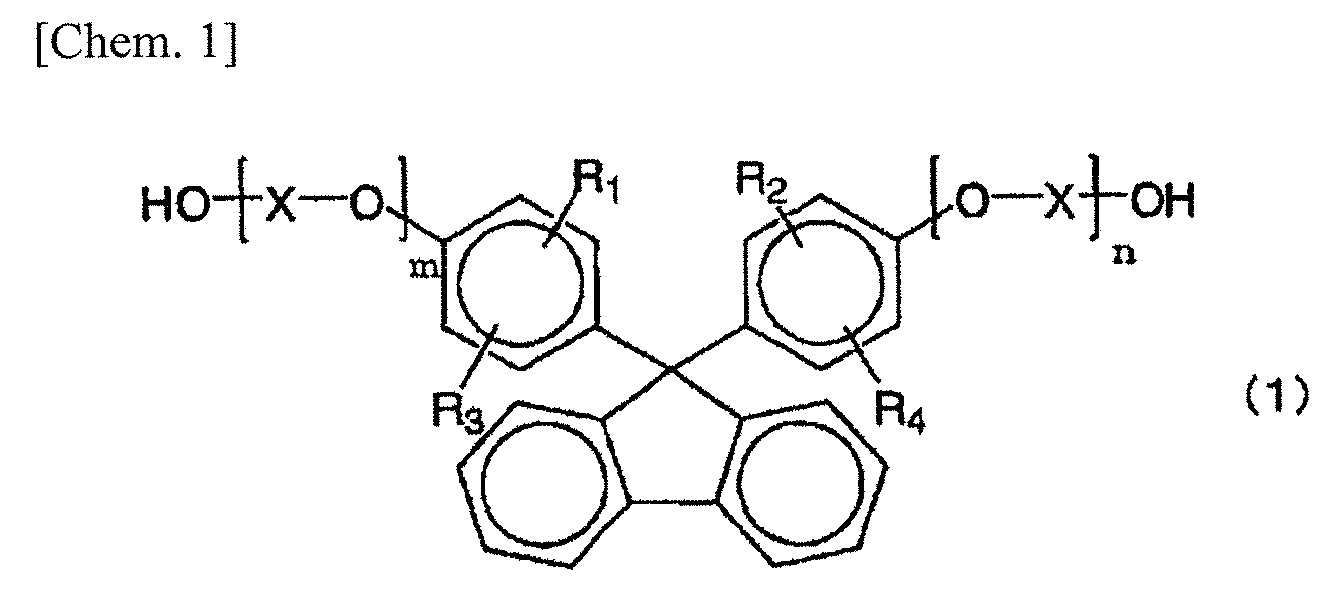
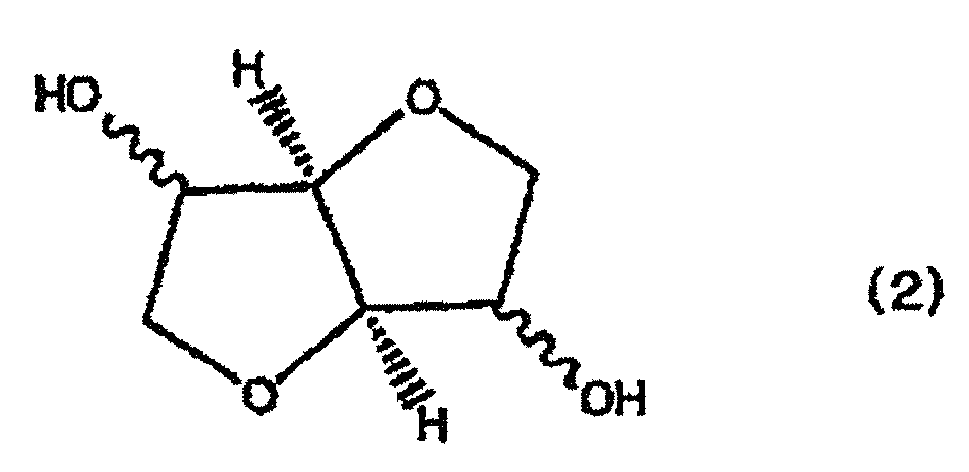
H-(O-R7)p-OH (5)
Description
- The present invention relates to a polycarbonate resin and a transparent film formed therefrom.
- Polycarbonate resins are generally produced from starting materials induced from petroleum resources. In recent years, however, there is a fear about depletion of petroleum resources, and it is desired to supply a polycarbonate produced from a starting material obtained from biomass resources such as plants. Furthermore, in view of the fact that the global warming caused by increases in carbon dioxide emission and by accumulation thereof brings about climate changes, etc., there is a need for the development of a polycarbonate resin which is produced using a plant-derived monomer as a starting material and which, even when discarded after use, is carbon-neutral.
- For example, a technique has been proposed in which isosorbide is used as a plant-derived monomer to obtain a polycarbonate resin through a transesterification reaction with diphenyl carbonate (see, for example, patent document 1).
- Meanwhile, since polycarbonate resins produced from starting materials including isosorbide have high transparency, a low photoelastic coefficient, and heat resistance, it has been proposed to use the polycarbonate resins in optical applications such as the retardation plates and substrates of liquid-crystal display devices (see patent document 2). Also disclosed is a polycarbonate resin which has been produced from 9,9-bis(4-(2-hydroxyethoxy)phenyl)fluorene and isosorbide and which has a low photoelastic coefficient and excellent heat resistance and moldability and is suitable for use in optical applications (see patent document 3). Furthermore, a film formed from a polycarbonate resin which contains isosorbide and biscresolfluorene has also been disclosed, and it is disclosed that a retardation film formed from this polycarbonate resin not only has a low photoelastic coefficient but also shows reverse wavelength-dispersive characteristics, in which the phase retardation decreases as the wavelength decreases (see patent document 4).
-
- Patent Document 1: British Patent No.
1,079,686 - Patent Document 2:
JP-A-2006-28441 - Patent Document 3:
JP-A-2004-67990 - Patent Document 4: International Publication No.
2006/41190 - In the filed of transparent films including optical films such as retardation films for use in liquid-crystal display appliances, mobile appliances, etc., a material having higher orientation properties, i.e., a material which, even when formed into a thin film, attains a large retardation, has come to be desired in recent years as a result of the trend toward thickness reduction in appliances.
- The patent documents and other documents include statements to the effect that the polycarbonate resins according to the prior-art techniques have high transparency and a low photoelastic coefficient. However, the films formed therefrom have insufficient toughness and the orientation properties and photoelastic coefficients thereof also have been unsatisfactory. In the case where those polycarbonate resins are to be used as a retardation film, a high stretch ratio cannot be used because of the lack of film toughness, resulting in poor orientation properties. Consequently, films formed therefrom cannot have a sufficiently reduced thickness and have been unsuitable for use in thin appliances.
- An object of the invention is to eliminate the problems of the prior-art techniques and to provide a polycarbonate resin which has excellent film toughness, a low photoelastic coefficient, excellent orientation properties, and high birefringence and a transparent film formed from the polycarbonate resin.
- The present inventors made investigations in order to overcome those problems. As a result, the inventors have found that the problems can be eliminated with: a polycarbonate resin which contains a structural unit derived from a dihydroxy compound represented by the following general formula (1), a structural unit derived from a dihydroxy compound represented by the following general formula (2), and a structural unit derived from at least one dihydroxy compound selected from the group consisting of a dihydroxy compound represented by the following general formula (3), a dihydroxy compound represented by the following general formula (4), a dihydroxy compound represented by the following general formula (5), and a dihydroxy compound represented by the following general formula (6), and in which the structural unit derived from a dihydroxy compound represented by the general formula (1) accounts for 18% by mole or more of the polycarbonate resin; and a transparent film formed from the polycarbonate resin. A first aspect of the invention has been thus reached.


[Chem. 3] HO-R5-OH (3)
(In the general formula (3), R5 represents a substituted or unsubstituted, monocyclic cycloalkylene group having 4-20 carbon atoms.)
[Chem. 4] HO-CH2-R6-CH2-OH (4)
(In the general formula (4), R6 represents a substituted or unsubstituted, monocyclic cycloalkylene group having 4-20 carbon atoms.)
[Chem. 5] H-(O-R7)p-OH (5)
(In the general formula (5), R7 represents a substituted or unsubstituted alkylene group having 2-10 carbon atoms, and p is an integer of 2 to 15.)
[Chem. 6] HO-R11-OH (6)
(In the general formula (6), R11 represents either an alkyl group having 2-20 carbon atoms or the group represented by the following formula (7).)
- Namely, essential points of the first aspect of the invention reside in the following [1] to [16].
- [1] A polycarbonate resin which contains a structural unit derived from a dihydroxy compound represented by the general formula (1), a structural unit derived from a dihydroxy compound represented by the general formula (2), and a structural unit derived from at least one dihydroxy compound selected from the group consisting of a dihydroxy compound represented by the general formula (3), a dihydroxy compound represented by the general formula (4), a dihydroxy compound represented by the general formula (5), and a dihydroxy compound represented by the general formula (6),
wherein the structural unit derived from a dihydroxy compound represented by the general formula (1) accounts for 18% by mole or more of the polycarbonate resin. - [2] The polycarbonate resin according to [1] above wherein the structural unit derived from at least one dihydroxy compound selected from the group consisting of a dihydroxy compound represented by the general formula (3), a dihydroxy compound represented by the general formula (4), a dihydroxy compound represented by the general formula (5), and a dihydroxy compound represented by the general formula (6) account for 25% by mole or more of the polycarbonate resin.
- [3] The polycarbonate resin according to [1] or [2] above which has a glass transition temperature of 110-150°C.
- [4] The polycarbonate resin according to any one of [1] to [3] above which has a reduced viscosity of 0.30 dL/g or higher.
- [5] The polycarbonate resin according to any one of [1] to [4] above which, in the state of having been stretched in a free-end stretch ratio of 2.0 under the conditions of (glass-transition temperature of the polycarbonate resin)+5°C, has a birefringence (Δn2) of 0.001 or higher.
- [6] A transparent film formed from the polycarbonate resin according to any one of [1] to [5] above.
- [7] The transparent film according to [6] above which has been formed through stretching conducted at least in one direction.
- [8] The transparent film according to [6] or [7] above which has a refractive index as measured with sodium d-line (589 nm) of 1.57-1.62.
- [9] The transparent film according to any one of [6] to [8] above which has a retardation R450 measured at a wavelength of 450 nm and a retardation R550 measured at a wavelength of 550 nm, the ratio of the R450 to the R550 satisfying the following expression [5].

- [10] The transparent film according to any one of [6] to [9] above which has a birefringence of 0.001 or higher.
- [11] The transparent film according to any one of [6] to [10] above which has a thickness of 80 µm or less.
- [12] The transparent film according to any one of [6] to [11] above which has refractive indexes, as measured respectively in two in-plane directions, of nx and ny and has a thickness-direction refractive index of nz, the refractive indexes nx, ny, and nz having a relationship which satisfies any of the following expressions [6] to [8].


- [13] The transparent film according to any one of [6] to [12] above which has refractive indexes, as measured respectively in two in-plane directions, of nx and ny, a thickness-direction refractive index of nz, and a thickness of d, the refractive indexes nx, ny, and nz and the thickness d having a relationship which satisfies the following expressions [9] and [10].


- [14] The transparent film according to any one of [6] to [13] above which has a water absorption higher than 1.0% by weight.
- [15] The transparent film according to any one of [6] to [14] above which has a photoelastic coefficient of 40×10-12 Pa-1 or less.
- [16] A polarizing plate which comprises the transparent film according to any one of [6] to [15] above and a polarizer to which the transparent film has been laminated.
- The present inventors further made investigations. As a result, the inventors have found out requirements for a transparent film capable of eliminating the problems described above, the material of the transparent film being not limited to the specific polycarbonate resin of the invention described above, although it is most preferred to use the polycarbonate resin. A second aspect of the invention has been thus reached.
- Namely, essential points of the second aspect of the invention reside in the following [17] to [20].
- [17] A transparent film formed from a polycarbonate resin, the transparent film having a birefringence of 0.001 or higher and a water absorption higher than 1.0% by weight and having a retardation R450 measured at a wavelength of 450 nm and a retardation R550 measured at a wavelength of 550 nm, the ratio of the R450 to the R550 satisfying the following expression [11].

- [18] The transparent film according to [17] above which has a thickness of 80 µm or less.
- [19] The transparent film according to [17] or [18] above wherein the polycarbonate resin is a copolycarbonate resin.
- [20] A polarizing plate which comprises the transparent film according to any one of [17] to [19] above and a polarizer to which the transparent film has been laminated.
- The polycarbonate resin of the invention and the transparent film formed therefrom have a low photoelastic coefficient and a moderate glass transition temperature. The polycarbonate resin has excellent film formation properties. The film formed therefrom has high toughness and hence high durability and has excellent orientation properties. The film hence is suitable for use as an optical film such as, for example, a retardation film.
- The invention will be explained below in detail. The invention should not be construed as being limited to the following embodiments, and various modifications can be made therein without departing from the spirit of the invention.
- [1] The polycarbonate resin according to the invention is a polycarbonate resin which contains a structural unit derived from a dihydroxy compound represented by the general formula (1), a structural unit derived from a dihydroxy compound represented by the general formula (2), and a structural unit derived from at least one dihydroxy compound selected from the group consisting of a dihydroxy compound represented by the general formula (3), a dihydroxy compound represented by the general formula (4), a dihydroxy compound represented by the general formula (5), and a dihydroxy compound represented by the general formula (6), wherein the structural unit derived from a dihydroxy compound represented by the general formula (1) accounts for 18% by mole or more of the polycarbonate resin.
- Examples of the dihydroxy compound represented by the general formula (1) include 9,9-bis(4-hydroxyphenyl)fluorene, 9,9-bis(4-hydroxy-3-methylphenyl)fluorene, 9,9-bis(4-hydroxy-3-ethylphenyl)fluorene, 9,9-bis(4-hydroxy-3-n-propylphenyl)fluorene, 9,9-bis(4-hydroxy-3-isopropylphenyl)fluorene, 9,9-bis(4-hydroxy-3-n-butylphenyl)fluorene, 9,9-bis(4-hydroxy-3-sec-butylphenyl)fluorene, 9,9-bis(4-hydroxy-3-tert-propylphenyl)fluorene, 9,9-bis(4-hydroxy-3-cyclohexylphenyl)fluorene, 9,9-bis(4-hydroxy-3-phenylphenyl)fluorene, 9,9-bis(4-(2-hydroxyethoxy)phenyl)fluorene, 9,9-bis(4-(2-hydroxyethoxy)-3-methylphenyl)fluorene, 9,9-bis(4-(2-hydroxyethoxy)-3-isopropylphenyl)fluorene, 9,9-bis(4-(2-hydroxyethoxy)-3-isobutylphenyl)fluorene, 9,9-bis(4-(2-hydroxyethoxy)-3-tert-butylphenyl)fluorene, 9,9-bis(4-(2-hydroxyethoxy)-3-cyclohexylphenyl)fluorene, 9,9-bis(4-(2-hydroxyethoxy)-3-phenylphenyl)fluorene, 9,9-bis(4-(2-hydroxyethoxy)-3,5-dimethylphenyl)fluorene, 9,9-bis(4-(2-hydroxyethoxy)-3-tert-butyl-6-methylphenyl)fluorene, and 9,9-bis(4-(3-hydroxy-2,2-dimethylpropoxy)phenyl)fluorene.
- Preferred are 9,9-bis(4-hydroxy-3-methylphenyl)fluorene, 9,9-bis(4-(2-hydroxyethoxy)phenyl)fluorene, and 9,9-bis(4-(2-hydroxyethoxy)-3-methylphenyl)fluorene. Especially preferred is 9,9-bis(4-(2-hydroxyethoxy)phenyl)fluorene.
- Examples of the dihydroxy compound represented by the general formula (2) include isosorbide, isomannide, and isoidide, which are stereoisomers. One of these may be used alone, or two or more thereof may be used in combination. Preferred of these dihydroxy compounds is isosorbide from the standpoints of ease of procurement and production thereof, optical properties, and moldability. Isosorbide is obtained by the dehydrating condensation of sorbitol, which is produced from various starches which are abundant resources and are easily available.
- Examples of the dihydroxy compounds represented by the general formula (3) include compounds containing a monocyclic cycloalkylene group. By using such a compound having a monocyclic structure, the polycarbonate resin to be obtained can be made to give films having improved toughness. Examples thereof usually include compounds containing a 5-membered cyclic structure or a 6-membered cyclic structure. By using such a compound having a 5-membered cyclic structure or 6-membered cyclic structure, the polycarbonate resin to be obtained can be made to have enhanced heat resistance. The 6-membered cyclic structure may have a chair form or boat form which has been fixed by means of covalent bonding. Specific examples thereof include 1,2-cyclopentanediol, 1,3-cyclopentanediol, 1,2-cyclohexanediol, 1,3-cyclohexanediol, 1,4-cyclohexanediol, and 2-methyl-1,4-cyclohexanediol.
- Examples of the dihydroxy compounds represented by the general formula (4) include compounds containing a monocyclic cycloalkylene group. By using such a compound having a monocyclic structure, the polycarbonate resin to be obtained can be made to give films having improved toughness. Usually, the compounds include various isomers represented by the general formula (4) in which R6 is represented by the following general formula (Ia) (wherein R3 represents a hydrogen atom or a substituted or unsubstituted alkyl group having 1-12 carbon atoms). Specific examples thereof include 1,2-cyclohexanedimethanol, 1,3-cyclohexanedimethanol, and 1,4-cyclohexanedimethanol.

- Especially preferred of the alicyclic dihydroxy compounds shown above are cyclohexanedimethanols. Preferred from the standpoints of availability and handleability are 1,4-cyclohexanedimethanol, 1,3-cyclohexanedimethanol, and 1,2-cyclohexanedimethanol.
- Those compounds were shown as mere examples of the alicyclic dihydroxy compounds usable in the invention, and the alicyclic dihydroxy compounds should not be construed as being limited to those examples in any way. One of those alicyclic dihydroxy compounds may be used alone, or a mixture of two or more thereof may be used.
- Examples of the dihydroxy compounds represented by the general formula (5) include diethylene glycol, triethylene glycol, and polyethylene glycol (molecular weight, 150-2,000). Preferred of these is diethylene glycol.
- Examples of the dihydroxy compounds represented by the general formula (6) include ethylene glycol, propylene glycol, 1,4-butanediol, 1,6-hexanediol, or the spiro glycol represented by the following formula (8). Preferred of these are propylene glycol, 1,4-butanediol, and the spiro glycol.

- It is preferred that the polycarbonate resin of the invention should contain a structural unit derived from a dihydroxy compound represented by the general formula (4) and/or a structural unit derived from a dihydroxy compound represented by the general formula (5), among a structural unit derived from a dihydroxy compound represented by the general formula (3), a structural unit derived from a dihydroxy compound represented by the general formula (4), a structural unit derived from a dihydroxy compound represented by the general formula (5), and a structural unit derived from a dihydroxy compound represented by the general formula (6). It is more preferred that the polycarbonate resin should contain a structural unit derived from a dihydroxy compound represented by the general formula (5).
- The polycarbonate resin of the invention may further contain a structural unit derived from other dihydroxy compound.
- Examples of the other dihydroxy compounds include bisphenol compounds.
- Examples of the bisphenol compounds include 2,2-bis(4-hydroxyphenyl)propane [= bisphenol A], 2,2-bis(4-hydroxy-3,5-dimethylphenyl)propane, 2,2-bis(4-hydroxy-3,5-diethylphenyl)propane, 2,2-bis(4-hydroxy-(3,5-diphenyl)phenyl)propane, 2,2-bis(4-hydroxy-3,5-dibromophenyl)propane, 2,2-bis(4-hydroxyphenyl)pentane, 2,4'-dihydroxydiphenylmethane, bis(4-hydroxyphenyl)methane, bis(4-hydroxy-5-nitrophenyl)methane, 1,1-bis(4-hydroxyphenyl)ethane, 3,3-bis(4-hydroxyphenyl)pentane, 1,1-bis(4-hydroxyphenyl)cyclohexane, bis(4-hydroxyphenyl) sulfone, 2,4'-dihydroxydiphenyl sulfone, bis(4-hydroxyphenyl) sulfide, 4,4'-dihydroxydiphenyl ether, 4,4'-dihydroxy-3,3'-dichlorodiphenyl ether, and 4,4'-dihydroxy-2,5-diethoxydiphenyl ether.
- In the polycarbonate resin of the invention, the structural unit derived from a dihydroxy compound represented by the general formula (1) accounts for 18% by mole or more of the resin. The proportion of the structural unit in the polycarbonate resin is preferably 20% by mole or more, more preferably 25% by mole or more. In the case where the proportion of the structural unit is too small, there is a possibility that the polycarbonate resin might not show reverse wavelength-dispersive characteristics.
- Furthermore, in the polycarbonate resin of the invention, the structural unit derived from at least one dihydroxy compound selected from the group consisting of a dihydroxy compound represented by the general formula (3), a dihydroxy compound represented by the general formula (4), a dihydroxy compound represented by the general formula (5), and a dihydroxy compound represented by the general formula (6) account for usually preferably 25% by mole or more, more preferably 30% by mole or more, even more preferably 35% by mole or more, of the polycarbonate resin. In the case where the proportion of the structural unit is too small, there are the cases where this polycarbonate resin give films having poor toughness.
- The polycarbonate resin of the invention has a glass transition temperature of preferably 110-150°C, more preferably 120-140°C. In the case where the glass transition temperature thereof is too low, this polycarbonate resin tends to have impaired heat resistance and there is a possibility that films formed therefrom might suffer a dimensional change. In addition, there are the cases where use of a retardation film formed therefrom and laminated to a polarizing plate results in a decrease in image quality. When the glass transition temperature of the polycarbonate resin is too high, there are the cases where this resin shows impaired molding stability during film formation therefrom and where the films have impaired transparency.
- The molecular weight of the polycarbonate resin can be expressed in terms of reduced viscosity. The reduced viscosity thereof is determined in the following manner. A solution thereof having a polycarbonate concentration precisely adjusted to 0.6 g/dL is prepared using methylene chloride as a solvent, and the viscosity of the solution is measured at a temperature of 20.0±0.1°C using an Ubbelohde viscometer. The lower limit of the reduced viscosity thereof is usually preferably 0.30 dL/g, more preferably 0.35 dL/g or higher. The upper limit of the reduced viscosity thereof is usually preferably 1.20 dL/g, more preferably 1.00 dL/g, even more preferably 0.80 dL/g.
- When the reduced viscosity of the polycarbonate resin is lower than the lower limit, there are the cases where this polycarbonate resin poses a problem that molded articles obtained therefrom have reduced mechanical strength. On the other hand, in the case where the reduced viscosity thereof is higher than the upper limit, there are the cases where this polycarbonate resin shows reduced flowability when molded, thereby posing a problem that productivity and moldability decrease.
- It is preferred that the transparent film obtained by molding the polycarbonate resin of the invention should have a birefringence of 0.001 or higher. Higher values of birefringence are preferred from the standpoint that the film to be formed from the polycarbonate resin is designed so as to have an exceedingly small thickness. Consequently, the birefringence thereof is more preferably 0.002 or higher.
- In the case where the birefringence thereof is less than 0.001, it is necessary to excessively increase the film thickness and hence to use the material in a larger amount, resulting in difficulties in controlling homogeneity with respect to thickness, transparency, and retardation. Because of this, when the transparent film produced from the polycarbonate resin has a birefringence less than 0.001, there is a possibility that this film cannot be applied to appliances which are required to be precise, thin, and homogeneous.
- When properties of the polycarbonate resin of the invention are to be evaluated, it is preferred to evaluate the properties thereof in terms of the birefringence (Δn2) of a film obtained through stretching conducted in a free-end stretch ratio of 2.0 under the conditions of (glass-transition temperature of the polycarbonate resin) +5°C. By evaluating the birefringence (Δn2) of the film obtained under those conditions, the birefringence of the film in the state of having been highly oriented by stretching can be determined. There hence is a merit that the polycarbonate resin can be evaluated without impairing the orientation properties inherent in the material.
- It is preferred that the transparent film obtained by molding the polycarbonate resin of the invention should have a refractive index, as measured with sodium d-line (589 nm), of 1.57-1.62. In the case where this refractive index thereof is lower than 1.57, there is a possibility that this film might have too low birefringence. On the other hand, in the case where the refractive index thereof exceeds 1.62, there is a possibility that this film might have an increased reflectance and reduced light transmission properties.
- In the transparent film, the ratio of the retardation R450 measured at a wavelength of 450 nm to the retardation R550 measured at a wavelength of 550 nm (R450/R550) is preferably from 0.5 to 1.0, more preferably from 0.7 to 0.98, especially preferably from 0.75 to 0.95. So long as the ratio is within that range, ideal retardation characteristics can be obtained at each wavelength within the visible region. For example, when a retardation film having such a wavelength dependence is produced, for example, as a 1/4λ plate and laminated to a polarizing plate, then a circularly polarizing plate or the like can be produced. Thus, a neutral polarizing plate and a neutral display device which have a small wavelength dependence of hue are rendered possible. On the other hand, in the case where that ratio is outside the range, the result is an increased wavelength dependence of hue, posing the problem of coloring in the polarizing plate or display device.
- The thickness of the transparent film is preferably 80 µm or less, more preferably 60 µm or less, even more preferably 40 µm or less. In the case where the thickness thereof exceeds 80 µm, it is necessary to use the material in a larger amount, resulting in difficulties in controlling homogeneity. Such a transparent film hence cannot be applied to appliances which are required to be precise, thin, and homogeneous.
- It is preferred that the transparent film should have refractive indexes, as measured respectively in two in-plane directions, of nx and ny and have a thickness-direction refractive index of nz, the refractive indexes nx, ny, and nz having a relationship which satisfies any of the following expressions [6] to [8].


- When the refractive indexes thereof have the relationship nx>ny=nz, then uniaxial retardation films such as a λ plate, λ/2 plate, and λ/4 plate are obtained. Such films can be used in the viewing-angle compensators of liquid-crystal displays or for the color correction of reflected light in reflection-type or semi-transmissive displays, organic EL devices, and the like.
- When the refractive indexes thereof have the relationship nx>ny>nz, this transparent film can be used as the viewing-angle compensator of a liquid-crystal display, especially as the viewing-angle compensator working in the VA mode, which is of the type in which one sheet is used for compensation or the type in which two sheets are used for compensation. Furthermore, this transparent film can be used also as a film for the color correction of reflected light like the film described above.
- When the refractive indexes thereof have the relationship nx>nz>ny, this transparent film can be used as the viewing-angle compensation film of a polarizing plate or as the viewing-angle compensation film of a circularly polarizing plate, and is usable also as a film for the color correction of reflected light like the film described above. Furthermore, besides being used for such front-view applications, this transparent film can be used also for viewing-angle compensation.
- It is preferred that the two in-plane refractive indexes nx and ny, thickness-direction refractive index nz, and thickness d of the transparent film should have a relationship which satisfies the following expressions [9] and [10].


- By regulating the NZ coefficient so as to be within that range, this transparent film can be used to produce retardation films for viewing-angle compensation or color correction in various displays.
- On the other hand, in the case where the NZ coefficient is less than 0.2, this necessitates an exceedingly special production process. This case hence may involve a drawback that the film has poor NZ coefficient accuracy and reduced productivity.
- In the case where the NZ coefficient exceeds 8, this transparent film has an exceedingly large value of thickness-direction retardation, which is calculated using the equation Rth=(nx-nz)·d. Namely, it is necessary to increase the thickness of the material. This case hence may involve drawbacks such as an increase in material cost and a decrease in retardation reliability.
- By regulating the And so as to be within that range, this transparent film can be used to easily produce λ/2 plates and λ/4 plates therefrom.
- On the other hand, in the case where the And is less than 30 nm, this transparent film falls under C-plates, which are so-called negatively uniaxial retardation films. A C-plate by itself cannot be used for the viewing-angle compensation of a display and use of another retardation film is necessary, resulting in an increase in the total number of retardation films. This case hence may involve a drawback that a thickness reduction and a cost reduction are difficult.
- In the case where the And exceeds 400 nm, it is necessary to increase the thickness in order to obtain a large value of retardation, and the increased thickness may be a cause of a decrease in productivity or reliability.
- It is preferred that the transparent film should have a water absorption higher than 1.0% by weight. When the water absorption thereof is higher than 1.0% by weight, adhesiveness can be easily ensured when this transparent film is laminated to another film, etc. For example, when the transparent film is to be laminated to a polarizing plate, it is easy to design an adhesive at will because this transparent film is hydrophilic and hence has a small contact angle with water. A high degree of adhesion design is hence possible. When the water absorption thereof is 1.0% by weight or less, there are the cases where this film is hydrophobic and has a large contact angle with water, making it difficult to design adhesiveness. In addition, there are the cases where this film is apt to be electrostatically charged and this may pose a problem that when this film is incorporated into a polarizing plate or display device, the product has an increased number of appearance defects due to inclusion of foreign matter, etc.
- On the other hand, in the case where the water absorption thereof exceeds 2.0% by weight, the durability of optical properties in a high-humidity environment becomes poor. Such too high a water absorption hence is not so desirable.
- Consequently, the water absorption of the transparent film according to the invention is preferably higher than 1.0% by weight but not higher than 2.0% by weight, and is more preferably 1.1-1.5% by weight.
- It is preferred that the transparent film of the invention should have a photoelastic coefficient of 40×10-12 Pa-1 or less. In the case where the photoelastic coefficient thereof exceeds 40×10-12 Pa-1, the following problem may arise when this transparent film is laminated as a retardation film to a polarizing plate and this polarizing plate is mounted in a display device. Due to the stress which was caused during the laminating, partial stress is imposed on the retardation film by the action of the heat of the environment in which the display device is used or of the backlight. An uneven change in retardation hence occurs, resulting in a considerable decrease in image quality. Consequently, the photoelastic coefficient of the transparent film of the invention is preferably 40×10-12 Pa-1 or less, more preferably 35×10-12 Pa-1 or less.
- By laminating the transparent film to a polarizer, a polarizing plate can be configured.
- As the polarizer, any of known polarizers having various configurations can be employed. For example, use can be made of a polarizer produced by adsorbing a dichroic substance, e.g., iodine or a dichroic dye, onto any of various films to dye the film and then crosslinking, stretching, and drying the film, according to a conventionally-known method.
- The other transparent film of the invention is formed from a polycarbonate resin which is not limited to the specific polycarbonate resin described above. This transparent film of the invention has a birefringence of 0.001 or higher and a water absorption higher than 1.0% by weight and has a retardation R450 measured at a wavelength of 450 nm and a retardation R550 measured at a wavelength of 550 nm, the ratio of the R450 to the R550 satisfying the following expression [11].

- By regulating the birefringence thereof to 0.001 or higher and the water absorption thereof to above 1.0% by weight, the excellent effects described above are obtained. Furthermore, the limitation of the ratio (R450/R550) to a value of 0.75-0.98 makes it possible to sufficiently obtain the excellent effect that the retardation is enhanced as the wavelength decreases and ideal retardation characteristics are obtained at each wavelength within the visible-light region. For example, when a retardation film having such a wavelength dependence is produced as a 1/4λ plate and laminated to a polarizing plate, a circularly polarizing plate or the like can be produced. Thus, a neutral polarizing plate and a neutral display device which have no wavelength dependence of hue are rendered highly possible.
- It is preferred that the polycarbonate resin in this case should be a copolycarbonate resin. Thus, it is possible to obtain a film strength, reliability, and optical properties which are suitable for the intended use of the film.
- This transparent film according to the invention has a transmittance of preferably 80% or higher, more preferably 90% or higher. So long as the transmittance thereof is within that range, the film obtained has been colored little and is transparent. When this transparent film is laminated to a polarizing plate, the resultant polarizing plate has a high degree of polarization and a high transmittance. When this polarizing plate is incorporated into a display device, high display quality is rendered possible.
- The polycarbonate resin of the invention can be produced by a polymerization method in general use. The polymerization method may be either a solution polymerization method in which phosgene is used or a melt polymerization method in which dihydroxy compounds are reacted with a carbonic diester. However, a melt polymerization method is preferred in which a dihydroxy compound represented by the general formula (1), a dihydroxy compound represented by the general formula (2), and at least one dihydroxy compound selected from the group consisting of a dihydroxy compound represented by the general formula (3), a dihydroxy compound represented by the general formula (4), a dihydroxy compound represented by the general formula (5), and a dihydroxy compound represented by the general formula (6) are reacted, optionally together with other dihydroxy compound, with a carbonic diester in the presence of a polymerization catalyst.
- Examples of the carbonic diester to be used in this melt polymerization method usually include carbonic diesters represented by the following general formula (9).

- Examples of the carbonic diesters represented by the general formula (9) include diphenyl carbonate, substituted diphenyl carbonates represented by ditolyl carbonate, dimethyl carbonate, diethyl carbonate, and di-t-butyl carbonate. Especially preferred examples thereof include diphenyl carbonate and substituted diphenyl carbonates. One of these carbonic diesters may be used alone, or a mixture of two or more thereof may be used.
- The carbonic diester is used in such an amount that the molar ratio thereof to all dihydroxy compounds to be subjected to the reaction, which include oxyalkylene glycols, is preferably 0.90-1.10, more preferably 0.96-1.04. When the molar ratio thereof is less than 0.90, there are the cases where the polycarbonate resin produced has an increased amount of terminal hydroxyl groups and the polymer has impaired thermal stability or where a desired high-molecular polymer is not obtained. In the case where the molar ratio thereof exceeds 1.10, the rate of the transesterification reaction decreases when the reaction is conducted under the same conditions, or it becomes difficult to produce a polycarbonate resin having a desired molecular weight. In addition, the polycarbonate resin thus produced has an increased residual carbonic diester content, and there are the cases where this residual carbonic diester is a cause of odor during molding or in the molded articles.
- As the polymerization catalyst (i.e., transesterification catalyst) for the melt polymerization, use may be made of an alkali metal compound and/or an alkaline earth metal compound. Although it is possible to use a basic compound such as a basic boron compound, basic phosphorus compound, basic ammonium compound, or amine compound as an auxiliary together with an alkali metal compound and/or an alkaline earth metal compound, it is especially preferred to use an alkali metal compound and/or an alkaline earth metal compound only.
- Examples of the alkali metal compound to be used as a polymerization catalyst include sodium hydroxide, potassium hydroxide, lithium hydroxide, cesium hydroxide, sodium hydrogen carbonate, potassium hydrogen carbonate, lithium hydrogen carbonate, cesium hydrogen carbonate, sodium carbonate, potassium carbonate, lithium carbonate, cesium carbonate, sodium acetate, potassium acetate, lithium acetate, cesium acetate, sodium stearate, potassium stearate, lithium stearate, cesium stearate, sodium boron hydride, potassium boron hydride, lithium boron hydride, cesium boron hydride, phenylated boron-sodium compounds, phenylated boron-potassium compounds, phenylated boron-lithium compounds, phenylated boron-cesium compounds, sodium benzoate, potassium benzoate, lithium benzoate, cesium benzoate, disodium hydrogen phosphate, dipotassium hydrogen phosphate, dilithium hydrogen phosphate, dicesium hydrogen phosphate, disodium phenyl phosphate, dipotassium phenyl phosphate, dilithium phenyl phosphate, dicesium phenyl phosphate, alcoholates or phenolates of sodium, potassium, lithium, and cesium, and the disodium salt, dipotassium salt, dilithium salt, and dicesium salt of bisphenol A.
- Examples of the alkaline earth metal compound include calcium hydroxide, barium hydroxide, magnesium hydroxide, strontium hydroxide, calcium hydrogen carbonate, barium hydrogen carbonate, magnesium hydrogen carbonate, strontium hydrogen carbonate, calcium carbonate, barium carbonate, magnesium carbonate, strontium carbonate, calcium acetate, barium acetate, magnesium acetate, strontium acetate, calcium stearate, barium stearate, magnesium stearate, and strontium stearate. In this description, the terms "alkali metal" and "alkaline earth metal" are used as terms having the same meanings as "Group-1 element" and "Group-2 element", respectively, within the long-form periodic table (Nomenclature of Inorganic Chemistry IUPAC Recommendations 2005).
- One of these alkali metal compounds and/or alkaline earth metal compounds may be used alone, or two or more thereof may be used in combination.
- Examples of the basic boron compound which may be used in combination with the alkali metal compound and/or alkaline earth metal compound include the sodium salts, potassium salts, lithium salts, calcium salts, barium salts, magnesium salts, or strontium salts of tetramethylboron, tetraethylboron, tetrapropylboron, tetrabutylboron, trimethylethylboron, trimethylbenzylboron, trimethylphenylboron, triethylmethylboron, triethylbenzylboron, triethylphenylboron, tributylbenzylboron, tributylphenylboron, tetraphenylboron, benzyltriphenylboron, methyltriphenylboron, and butyltriphenylboron.
- Examples of the basic phosphorus compound include triethylphosphine, tri-n-propylphosphine, triisopropylphosphine, tri-n-butylphosphine, triphenylphosphine, tributylphosphine, and quaternary phosphonium salts.
- Examples of the basic ammonium compound include tetramethylammonium hydroxide, tetraethylammonium hydroxide, tetrapropylammonium hydroxide, tetrabutylammonium hydroxide, trimethylethylammonium hydroxide, trimethylbenzylammonium hydroxide, trimethylphenylammonium hydroxide, triethylmethylammonium hydroxide, triethylbenzylammonium hydroxide, triethylphenylammonium hydroxide, tributylbenzylammonium hydroxide, tributylphenylammonium hydroxide, tetraphenylammonium hydroxide, benzyltriphenylammonium hydroxide, methyltriphenylammonium hydroxide, and butyltriphenylammonium hydroxide.
- Examples of the amine compound include 4-aminopyridine, 2-aminopyridine, N,N-dimethyl-4-aminopyridine, 4-diethylaminopyridine, 2-hydroxypyridine, 2-methoxypyridine, 4-methoxypyridine, 2-dimethylaminoimidazole, 2-methoxyimidazole, imidazole, 2-mercaptoimidazole, 2-methylimidazole, and aminoquinoline.
- One of these basic compounds also may be used alone, or two or more thereof may be used in combination.
- In the case where an alkali metal compound and/or an alkaline earth metal compound is employed, the amount of the polymerization catalyst to be used, in terms of metal amount per mole of all dihydroxy compounds to be subjected to the reaction, is generally in the range of 0.1-100 µmol, preferably in the range of 0.5-50 µmol, more preferably in the range of 1-25 µmol. In the case where the polymerization catalyst is used in too small an amount, polymerization activity required for producing a polycarbonate resin having a desired molecular weight is not obtained. On the other hand, in the case where the polymerization catalyst is used in too large an amount, a polycarbonate resin having an impaired hue is obtained, and by-products are generated, resulting in reduced flowability and an increased amount of gel particles. There are hence the cases where it is difficult to produce a polycarbonate resin of desired quality.
- In such production of a polycarbonate resin of the invention, the dihydroxy compound represented by the general formula (1) may be fed as a solid, or may be heated and fed in a molten state, or may be fed as an aqueous solution.
- Furthermore, each of the dihydroxy compound represented by the general formula (2) and the at least one dihydroxy compound selected from the group consisting of a dihydroxy compound represented by the general formula (3), a dihydroxy compound represented by the general formula (4), a dihydroxy compound represented by the general formula (5), and a dihydroxy compound represented by the general formula (6) also may be fed as a solid, or may be heated and fed in a molten state, or may be fed as an aqueous solution when soluble in water. The same applies to the other dihydroxy compound.
- The method in which a dihydroxy compound represented by the general formula (1), a dihydroxy compound represented by the general formula (2), and at least one dihydroxy compound selected from the group consisting of a dihydroxy compound represented by the general formula (3), a dihydroxy compound represented by the general formula (4), a dihydroxy compound represented by the general formula (5), and a dihydroxy compound represented by the general formula (6) are reacted, optionally together with other dihydroxy compound, with a carbonic diester in the presence of a polymerization catalyst in the invention is usually conducted in multiple steps including two or more stages. Specifically, the reaction in the first stage is conducted at a temperature of 140-220°C, preferably 150-200°C, for 0.1-10 hours, preferably 0.5-3 hours. In the second and any succeeding stages, the reaction temperature is raised while gradually lowering the pressure of the reaction system from the pressure used in the first stage. The polycondensation reaction is thus conducted while the monohydroxy compound, e.g., phenol, which generates simultaneously is being removed from the reaction system. Finally, the polycondensation reaction is conducted at a pressure of the reaction system of 200 Pa or below and at a temperature in the range of 210-280°C.
- With respect to pressure reduction in this polycondensation reaction, it is important to control a balance between the temperature and the internal pressure of the reaction system. Especially when either the temperature or the pressure is changed too early, there are the cases where an unreacted monomer is distilled off from the reaction system to change the molar ratio of the dihydroxy compounds to the carbonic diester, resulting in a decrease in polymerization degree. For example, when a dihydroxy compound represented by the general formula (1), isosorbide as a dihydroxy compound represented by the general formula (2), and 1,4-cyclohexanedimethanol as an alicyclic dihydroxy compound are used and when the molar proportion of the 1,4-cyclohexanedimethanol to all dihydroxy compounds is 50% by mole or more, then some of the 1,4-cyclohexanedimethanol is apt to be distilled off in the monomer state from the reaction system. In this case, use may be made of a method in which the reaction mixture is reacted at a reduced internal pressure of the reaction system of about 13 kPa while elevating the temperature at a heating rate of 40 °C/hr or less and further reacted at a pressure down to about 6.67 kPa while elevating the temperature at a heating rate of 40 °C/hr or less, and the polycondensation reaction is finally conducted at a pressure of 200 Pa or less and a temperature of 200-250°C. This method is preferred because a polycarbonate resin having a sufficiently increased degree of polymerization is obtained.
- On the other hand, when the molar proportion of the 1,4-cyclohexanedimethanol to all dihydroxy compounds including oxyalkylene glycols is less than 50% by mole, in particular, 30% by mole or less, an abrupt increase in viscosity occurs as compared with the case in which the proportion of the 1,4-cyclohexanedimethanol is 50% by mole or more. Consequently, use may be made, for example, of a method in which the reaction mixture is reacted, while elevating the temperature at a heating rate of 40 °C/hr or less until the internal pressure of the reaction system is reduced to about 13 kPa, and further reacted at a pressure down to about 6.67 kPa while elevating the temperature at a heating rate of 40 °C/hr or higher, preferably at a heating rate of 50 °C/hr or higher, and the polycondensation reaction is finally conducted at a reduced pressure of 200 Pa or less and a temperature of 220-290°C. This method is preferred because a polycarbonate resin having a sufficiently increased degree of polymerization is obtained.
- The mode of reaction operation may be any of the batch type, the continuous type, and a combination of the batch type and the continuous type.
- When the polycarbonate resin of the invention is produced by the melt polymerization method, it is possible to add phosphoric acid compounds, phosphorous acid compounds, or metal salts of either during the polymerization for the purpose of preventing coloring.
- Suitable as the phosphoric acid compounds are one or more of trialkyl phosphates such as trimethyl phosphate and triethyl phosphate. The amount of such phosphoric acid compounds to be added is preferably 0.0001-0.005% by mole, more preferably 0.0003-0.003% by mole, based on all dihydroxy compounds to be reacted. When phosphorus compounds are added in an amount smaller than the lower limit, there are the cases where the effect of preventing coloring is low. When the amount thereof is larger than the upper limit, there are the cases where the phosphorus compounds are causative of an increase in haze or enhance, rather than diminish, coloring, or where the phosphorus compounds reduce the heat resistance.
- In the case of adding phosphorous acid compounds, any of the following heat stabilizers can be selected at will. In particular, use of one or more of trimethyl phosphite, triethyl phosphite, trisnonylphenyl phosphite, trimethyl phosphate, tris(2,4-di-tert-butylphenyl) phosphite, and bis(2,4-di-tert-butylphenyl)pentaerythritol diphosphite is suitable. The amount of these phosphorous acid compounds to be added is preferably 0.0001-0.005% by mole, more preferably 0.0003-0.003% by mole, based on all dihydroxy compounds to be reacted. When phosphorous acid compounds are added in an amount smaller than the lower limit, there are the cases where the effect of preventing coloring is low. When the amount thereof is larger than the upper limit, there are the cases where the phosphorous acid compounds are causative of an increase in haze or enhance, rather than diminish, coloring, or where the phosphorous acid compounds reduce the heat resistance.
- It is possible to add a phosphoric acid compound and a phosphorous acid compound in combination or to add metal salts thereof in combination. In this case, the total addition amount of the phosphoric acid compound and the phosphorous acid compound or the total addition amount of the metal salts thereof is preferably 0.0001-0.005% by mole, more preferably 0.0003-0.003% by mole, based on all the dihydroxy compounds shown above. When the addition amount thereof is smaller than the lower limit, there are the cases where the effect of preventing coloring is low. When the addition amount thereof is larger than the upper limit, there are the cases where the compounds or salts are causative of an increase in haze or enhance, rather than diminish, coloring, or where the compounds or salts reduce the heat resistance.
- The metal salts of phosphoric acid compounds and of phosphorous acid compounds preferably are alkali metal salts thereof and the zinc salts thereof. Especially preferred are the zinc salts. Preferred of the phosphoric acid zinc salts are the zinc salts of (long-chain-alkyl)phosphoric acids.
- A heat stabilizer can be incorporated into the polycarbonate resin of the invention thus produced, in order to prevent the resin from decreasing in molecular weight or deteriorating in hue during molding, etc.
- Examples of the heat stabilizer include phosphorous acid, phosphoric acid, phosphonous acid, phosphonic acid, and esters thereof. Specific examples thereof include triphenyl phosphite, tris(nonylphenyl) phosphite, tris(2,4-di-tert-butylphenyl) phosphite, tridecyl phosphite, trioctyl phosphite, trioctadecyl phosphite, didecyl monophenyl phosphite, dioctyl monophenyl phosphite, diisopropyl monophenyl phosphite, monobutyl diphenyl phosphite, monodecyl diphenyl phosphite, monooctyl diphenyl phosphite, bis(2,6-di-tert-butyl-4-methylphenyl) pentaerythritol diphosphite, 2,2-methylenebis(4,6-di-tert-butylphenyl) octyl phosphite, bis(nonylphenyl) pentaerythritol diphosphite, bis(2,4-di-tert-butylphenyl) pentaerythritol diphosphite, distearyl pentaerythritol diphosphite, tributyl phosphate, triethyl phosphate, trimethyl phosphate, triphenyl phosphate, diphenyl mono-o-xenyl phosphate, dibutyl phosphate, dioctyl phosphate, diisopropyl phosphate, tetrakis(2,4-di-tert-butylphenyl) 4,4'-biphenylenediphosphinate, dimethyl benzenephosphonate, diethyl benzenephosphonate, and dipropyl benzenephosphonate. Preferred of these are tris(nonylphenyl) phosphite, trimethyl phosphate, tris(2,4-di-tert-butylphenyl) phosphite, bis(2,4-di-tert-butylphenyl) pentaerythritol diphosphite, bis(2,6-di-tert-butyl-4-methylphenyl) pentaerythritol diphosphite, and dimethyl benzenephosphonate.
- One of these heat stabilizers may be used alone, or two or more thereof may be used in combination.
- Such a heat stabilizer can be additionally incorporated in addition to the amount of the heat stabilizer which was added during the melt polymerization. Namely, after a polycarbonate resin has been obtained using an adequate amount of a phosphorous acid compound or phosphoric acid compound incorporated into the system, a phosphorous acid compound may be further incorporated by the incorporation method which will be described later. Thus, the heat stabilizer can be incorporated in a larger amount while avoiding an increase in haze, coloring, and a decrease in heat resistance during the polymerization, making it possible to prevent hue deterioration.
- The amount of those heat stabilizers to be incorporated per 100 parts by weight of the polycarbonate resin is preferably 0.0001-1 part by weight, more preferably 0.0005-0.5 parts by weight, even more preferably 0.001-0.2 parts by weight.
- A generally known antioxidant can be incorporated into the polycarbonate resin of the invention for the purpose of preventing oxidation.
- Examples of the antioxidant include one or more of pentaerythritol tetrakis(3-mercaptopropionate), pentaerythritol tetrakis(3-laurylthiopropionate), glycerol 3-stearylthiopropionate, triethylene glycol bis[3-(3-tert-butyl-5-methyl-4-hydroxyphenyl)propionate], 1,6-hexanediol bis[3-(3,5-di-tert-butyl-4-hydroxyphenyl)propionate], pentaerythritol tetrakis[3-(3,5-di-tert-butyl-4-hydroxyphenyl)propionate], octadecyl 3-(3,5-di-tert-butyl-4-hydroxyphenyl)propionate, 1,3,5-trimethyl-2,4,6-tris(3,5-di-tert-butyl-4-hydroxybenzyl)benzene, N,N-hexamethylenebis(3,5-di-tert-butyl-4-hydroxyhydrocinnamamide), diethyl 3,5-di-tert-butyl-4-hydroxybenzylphosphonate, tris(3,5-di-tert-butyl-4-hydroxybenzyl) isocyanurate, tetrakis(2,4-di-tert-butylphenyl) 4,4'-biphenylenediphosphinate, 3,9-bis{1,1-dimethyl-2-[β-(3-tert-butyl-4-hydroxy-5-methylphenyl)propionyloxy]ethyl}-2,4,8,10-tetraoxaspiro(5,5)undecane, and the like.
- The amount of these antioxidants to be incorporated is preferably 0.0001-0.5 parts by weight per 100 parts by weight of the polycarbonate.
- For producing a transparent film from a polycarbonate resin in the invention, various film formation techniques such as, for example, melt extrusion (e.g., T-die molding), cast coating (e.g., casting), calendering, hot pressing, coextrusion, co-melting, multilayer extrusion, and inflation molding can be used without particular limitations. Preferred examples include T-die molding, inflation molding, and casting.
- The transparent films of the invention can be used as retardation plates, when the films have been stretched at least in one direction. For the stretching, use may be made of various stretching techniques such as free-end stretching, fixed-end stretching, free-end shrinkage, and fixed-end shrinkage. One of such techniques can be used alone, or such techniques may be used simultaneously or successively.
- With respect to stretching directions also, the films can be stretched in various directions or various dimensions without particular limitations. For example, the films can be stretched in a horizontal direction, a vertical direction, a thickness direction, or a diagonal direction.
- With respect to the temperature at which each film is to be stretched, a stretching temperature within the range of (glass transition temperature (Tg) of the polycarbonate resin)±20°C can be suitably set according to the method of stretching, thickness of the film, and desired retardation.
- The invention will be explained below in more detail by reference to Examples, but the invention should not be construed as being limited by the following Examples unless the invention departs from the spirit thereof. In the following Examples, properties of polycarbonate resins and transparent films were evaluated by the following methods. Incidentally, methods for property evaluation are not limited to the following methods, and suitable methods can be selected by a person skilled in the art.
- A 4.0-g portion of a polycarbonate resin sample which had been vacuum-dried at 80°C for 5 hours was pressed for 1 minute with a hot press using a spacer having a width of 8 cm, length of 8 cm, and thickness of 0.5 mm, under the conditions of a hot-pressing temperature of 200-250°C, a preheating period of 1-3 minutes, and a pressure of 20 MPa. Thereafter, the sample was taken out together with the spacer and then pressed and cooled with a water tube cooling type press at a pressure of 20 MPa for 3 minutes to produce a sheet. A sample having a width of 5 mm and a length of 20 mm was cut out of the sheet.
- A measurement was made using an apparatus including a combination of a birefringence analyzer constituted of a He-Ne laser, a polarizer, a compensator, an analyzer, and a photodetector and an oscillatory type viscoelastometer ("DVE-3", manufactured by Rheology Co., Ltd.). (For details, refer to Journal of the Society of RheologyJapan, Vol.19, pp.93-97 (1991).)
- The sample cut out was fixed to the viscoelastometer and examined for storage modulus E' at a frequency of 96 Hz at room temperature of 25°C. Simultaneously therewith, the laser light emitted was passed through the polarizer, the sample, the compensator, and the analyzer in this order, picked up with the photodetector (photodiode), and passed through a lock-in amplifier, and the waveform at an angular frequency of ω or 2ω was examined for retardation with respect to the amplitude and strain. A strain-optical coefficient O' was determined therefrom. In this apparatus, the polarizer and the analyzer were regulated so that the directions thereof were perpendicular to each other and each formed an angle of π/4 with the direction of extension of the sample.
- The photoelastic coefficient C was determined from the storage modulus E' and the strain-optical coefficient O' using the following equation.

- A polycarbonate resin which had been vacuum-dried at 80°C for 5 hours was formed into a film having a thickness of 100 µm using a film production apparatus equipped with a single-screw extruder (manufactured by Isuzu Kakoki; screw diameter, 25 mm; set cylinder temperature, 220°C), a T-die (width, 200 mm; set temperature, 220°C), a chill roll (set temperature, 120-130°C), and a winder. A sample having a width of 6 cm and a length of 6 cm was cut out of the film. This sample was subjected to uniaxial stretching using a batch-type biaxially stretching apparatus (manufactured by Toyo Seiki Seisaku-Sho, Ltd.) at a stretching temperature of (glass transition temperature of the polycarbonate resin)+15°C and a stretching speed of 720 mm/min (strain rate, 1,200 %/min) in a stretch ratio of 1×2.0 to obtain a transparent film. In this operation, the sample was stretched while being held (stretch ratio, 1.0) along the direction perpendicular to the stretch direction.
- Using a retardation analyzer ("KOBRA-WPR", manufactured by Oji Scientific Instruments), a sample having a width of 4 cm and a length of 4 cm cut out of the transparent film was examined for phase retardation at a measuring wavelength of 450 nm (R450) and phase retardation at a measuring wavelength of 550 nm (R550). The ratio between the measured values of retardation (R450) and retardation (R550) was calculated.
- A sample cut out of the transparent film obtained in (2) above was examined for retardation at a wavelength of 590 nm (R590) using the retardation analyzer. This retardation (R590) was divided by the thickness (t) of the sample to determine the birefringence using the following equation.

- A sample having a width of 2 cm and a length of 7 cm cut out of the transparent film obtained in (2) above was folded into two at the center thereof and then folded in the reverse direction. This folding was repeated, and the number of folding operations required for the sample to break was counted.
- Using a differential scanning calorimeter ("DSC 220", manufactured by SII Nano Technology Inc.), about 10 mg of a polycarbonate resin was examined while heating the resin at a heating rate of 10 °C/min. In accordance with JIS-K7121 (1987), the lower-temperature-side base line was extended toward the higher-temperature side to draw a straight line, and a tangent that touched the stepwise changing part, which was due to a glass transition, at the point where the curve had a maximum slope was drawn. The extrapolated glass transition initiation temperature, which was the temperature corresponding to the intersection of the straight line and the tangent, was determined and taken as the glass transition temperature.
- The reduced viscosity of a polycarbonate resin was determined using an Ubbelohde viscometer manufactured by Moritomo Rika Kogyo. Methylene chloride was used as a solvent, and a measurement was made at a temperature of 20.0±0.1°C. The concentration was precisely adjusted to 0.6 g/dL.
- From the flow-down time of the solvent t0 and the flow-down time of the solution t, the relative viscosity ηrel was determined using the following equation.

- The specific viscosity ηsp was determined from the relative viscosity ηrel using the following equation.

- The specific viscosity ηsp was divided by the concentration c (g/dL) to determine the reduced viscosity (converted viscosity) ηred, as shown by the following equation.

- The larger the value thereof, the higher the molecular weight.
- Water absorption was determined by examining a stretched film having a thickness of 130±50 µm in accordance with the "Test Method for Determining Water Absorption and Boiling-water Absorption of Plastics" as provided for in JIS K 7209.
- Into a reaction vessel were introduced 26.2 parts by weight of isosorbide (hereinafter often abbreviated to "ISB"), 100.5 parts by weight of 9,9-bis(4-(2-hydroxyethoxy)phenyl)fluorene (hereinafter often abbreviated to "BHEPF"), 10.7 parts by weight of 1,4-cyclohexanedimethanol (hereinafter often abbreviated to "1,4-CHDM"), 105.1 parts by weight of diphenyl carbonate (hereinafter often abbreviated to "DPC"), and 0.591 parts by weight of cesium carbonate (0.2% by weight aqueous solution) as a catalyst. In a nitrogen atmosphere, the temperature of the heat medium of the reaction vessel was regulated to 150°C to dissolve the starting materials while stirring the mixture according to need (about 15 minutes) in preparation for a first reaction step.
- Subsequently, the internal pressure of the reaction vessel was reduced from ordinary pressure to 13.3 kPa, and the temperature of the heat medium of the reaction vessel was elevated to 190°C over 1 hour, during which the phenol that generated was discharged from the reaction vessel.
- The internal temperature of the reaction vessel was kept at 190°C for 15 minutes. Thereafter, a second step was conducted in which at an internal pressure of the reaction vessel of 6.67 kPa, the temperature of the heat medium of the reaction vessel was elevated to 230°C over 15 minutes and the phenol that generated was discharged from the reaction vessel. The stirring torque of the stirrer increased gradually and, hence, the temperature was elevated to 250°C over 8 minutes. Furthermore, the internal pressure of the reaction vessel was reduced to 0.200 kPa or below in order to remove the phenol that generated. After a given stirring torque had been reached, the reaction was terminated. The reaction product yielded was extruded in water and then pelletized. Thus, a polycarbonate resin A configured of BHEPF/ISB/1,4-CHDM = 47.4 mol%/37.1 mol%/15.5 mol% was obtained. The polycarbonate resin A obtained was examined for properties including reduced viscosity, and the measured values are shown in Table 1.
- The polycarbonate resin A obtained was vacuum-dried at 80°C for 5 hours and then formed into a film having a thickness of 100 µm using a film production apparatus equipped with a single-screw extruder (manufactured by Isuzu Kakoki; screw diameter, 25 mm; set cylinder temperature, 220°C), a T-die (width, 200 mm; set temperature, 220°C), a chill roll (set temperature, 120-130°C), and a winder. A sample having a width of 6 cm and a length of 6 cm was cut out of the film. This sample was subjected to uniaxial stretching using a batch-type biaxially stretching apparatus (manufactured by Toyo Seiki Seisaku-Sho, Ltd.) at a stretching temperature of (glass transition temperature)+15°C and a stretching speed of 720 mm/min (strain rate, 1,200 %/min) in a stretch ratio of 1×2.0 to obtain a transparent film. In this operation, the sample was stretched while being held (stretch ratio, 1.0) along the direction perpendicular to the stretch direction.
- The stretched transparent film obtained was examined for properties including birefringence, and the measured values are shown in Table 1.
- The same procedure as in Example 1 was conducted, except that use was made of 35.1 parts by weight of ISB, 90.2 parts by weight of BHEPF, 10.6 parts by weight of diethylene glycol (hereinafter often abbreviated to "DEG"), 118.6 parts by weight of DPC, and 0.666 parts by weight of the aqueous cesium carbonate solution as a catalyst. Thus, a polycarbonate resin B was obtained. The polycarbonate resin B obtained had a composition composed of BHEPF/ISB/DEG = 37.7 mol%/44.0 mol%/18.3 mol%. The properties of the polycarbonate resin B were determined. A transparent film was formed therefrom in the same manner as in Example 1, and the properties thereof were determined. The results thereof are shown in Table 1.
- The same procedure as in Example 1 was conducted, except that use was made of 27.8 parts by weight of ISB, 82.1 parts by weight of BHEPF, 25.6 parts by weight of 1,4-CHDM, 120.8 parts by weight of DPC, and 0.679 parts by weight of the aqueous cesium carbonate solution as a catalyst. Thus, a polycarbonate resin C was obtained. The polycarbonate resin C obtained had a composition composed of BHEPF/ISB/1,4-CHDM = 33.7 mol%/34.3 mol%/32.0 mol%. The properties of the polycarbonate resin C were determined. A transparent film was formed therefrom in the same manner as in Example 1, and the properties thereof were determined. The results thereof are shown in Table 1.
- The same procedure as in Example 1 was conducted, except that use was made of 37.5 parts by weight of ISB, 91.5 parts by weight of BHEPF, 8.4 parts by weight of polyethylene glycol having an average molecular weight of 400 (hereinafter often abbreviated to "PEG#400"), 105.7 parts by weight of DPC, and 0.594 parts by weight of the aqueous cesium carbonate solution as a catalyst. Thus, a polycarbonate resin D was obtained. The polycarbonate resin D obtained had a composition composed of BHEPF/ISB/PEG#400 = 42.9 mol%/52.8 mol%/4.3 mol%. The properties of the polycarbonate resin D were determined. A transparent film was formed therefrom in the same manner as in Example 1, and the properties thereof were determined. The results thereof are shown in Table 1.
- The same procedure as in Example 1 was conducted, except that use was made of 44.8 parts by weight of ISB, 85.6 parts by weight of BHEPF, 6.2 parts by weight of PEG#400, 112.3 parts by weight of DPC, and 0.631 parts by weight of the aqueous cesium carbonate solution as a catalyst. Thus, a polycarbonate resin E was obtained. The polycarbonate resin E obtained had a composition composed of BHEPF/ISB/PEG#400 = 37.8 mol%/59.3 mol%/2.9 mol%. The properties of the polycarbonate resin E were determined. A transparent film was formed therefrom in the same manner as in Example 1, and the properties thereof were determined. The results thereof are shown in Table 1.
- The same procedure as in Example 1 was conducted, except that use was made of 41.8 parts by weight of ISB, 88.1 parts by weight of BHEPF, 5.9 parts by weight of DEG, 118.1 parts by weight of DPC, and 0.664 parts by weight of the aqueous cesium carbonate solution as a catalyst. Thus, a polycarbonate resin F was obtained. The polycarbonate resin F obtained had a composition composed of BHEPF/ISB/DEG = 37.0 mol%/52.7 mol%/10.3 mol%. The properties of the polycarbonate resin F were determined. A transparent film was formed therefrom in the same manner as in Example 1, and the properties thereof were determined. The results thereof are shown in Table 1.
- Into a reaction vessel were introduced 13.16 parts by weight of ISB, 22.72 parts by weight of 9,9-bis(4-hydroxy-3-methylphenyl)fluorene (hereinafter often abbreviated to "BCF"), 29.44 parts by weight of tricyclodecanedimethanol (hereinafter often abbreviated to "TCDDM"), 64.9 parts by weight of DPC, and 2.74×10⁻³ parts by weight of tetramethylammonium hydroxide and 40.84×10⁻⁶ parts by weight of the disodium salt of 2,2-bis(4-hydroxyphenyl)propane as catalysts. In a nitrogen atmosphere, the temperature of the heat medium of the reaction vessel was regulated to 180°C to dissolve the starting materials.
- Subsequently, the internal pressure of the reaction vessel was reduced from ordinary pressure to 13.3 kPa, and the phenol that generated was discharged from the reaction vessel.
- The internal temperature of the reaction vessel was then elevated to 200°C. Thereafter, the pressure was gradually reduced, and the mixture was reacted at 3.99 kPa for 20 minutes and further reacted at an elevated reaction-vessel internal temperature of 215°C for 20 minutes, while the phenol that generated was being discharged from the reaction vessel. Subsequently, the mixture was reacted at an elevated reaction-vessel internal temperature of 230°C for 10 minutes, continuously reacted at a reduced pressure of 2.66 kPa for 10 minutes, and further reacted at an elevated temperature of 250°C for 10 minutes. Thereafter, the mixture was reacted at a reduced pressure of 1.33 kPa for 10 minutes, and the pressure was further reduced finally to 0.133 kPa or below, at which the mixture was reacted for 1.5 hours to complete the reaction. The reaction product yielded was extruded in water and then pelletized. Thus, a polycarbonate resin G configured of ISB/TCDDM/BCF = 30.0 mol%/50.0 mol%/20.0 mol% was obtained. The properties of the polycarbonate resin G obtained were determined. A transparent film was formed therefrom in the same manner as in Example 1, and the properties thereof were determined. The measured values are shown in Table 1.
- Into a reaction vessel were introduced 34.3 parts by weight of ISB, 103.3 parts by weight of BHEPF, 102.5 parts by weight of DPC, and 5.0×10⁻³ parts by weight of sodium hydrogen carbonate as a catalyst. In a nitrogen atmosphere, the temperature of the heat medium of the reaction vessel was regulated to 180°C to dissolve the starting materials.
- Subsequently, the pressure of the reaction vessel was reduced from ordinary pressure to 20 kPa, and the temperature was elevated to 200°C at a heating rate of 60 °C/hr. This state was maintained for 20 minutes to react the mixture. The temperature was further elevated to 225°C at a heating rate of 75 °C/hr. At 10 minutes after completion of the heating, the degree of vacuum began to be reduced while holding the mixture at that temperature. The degree of vacuum was thus reduced to 1 mmHg or below over 1 hour. Thereafter, the temperature was elevated to 235°C at a heating rate of 60 °C/hr, and the mixture was reacted for further 1.5 hours with stirring. After completion of the reaction, nitrogen was introduced into the reaction vessel to return the pressure to ordinary pressure, and the polycarbonate resin yielded was taken out. Thus, a polycarbonate resin H configured of BHEPF/ISB = 50.0 mol%/50.0 mol% was obtained. The properties of the polycarbonate resin H obtained were determined. A transparent film was formed therefrom in the same manner as in Example 1, and the properties thereof were determined. The measured values are shown in Table 1.
- The same procedure as in Example 1 was conducted, except that use was made of 31.9 parts by weight of ISB, 71.8 parts by weight of BHEPF, 32.1 parts by weight of TCDDM, and 118.7 parts by weight of DPC. Thus, a polycarbonate resin I was obtained. The polycarbonate resin I obtained had a composition composed of BHEPF/ISB/TCDDM = 30.0 mol%/40.0 mol%/30.0 mol%. The properties of the polycarbonate resin I obtained were determined. A transparent film was formed therefrom in the same manner as in Example 1, and the properties thereof were determined. The measured values are shown in Table 1.
[Table 1](Table 1) Example 1 Example 2 Example 3 Example 4 Example 5 Example 6 Comparative Example 1 Comparative Example 2 Comparative Example 3 Polycarbonate resin BHEPF mol% 47.4 37.7 33.7 42.9 37.8 37.0 - 50.0 30.0 ISB mol% 37.1 44.0 34.3 52.8 59.3 52.7 30.0 50.0 40.0 1,4-CHDM mol% 15.5 - 32.0 - - - - - - TCDDM mol% - - - - - - 50.0 - 30.0 DEG mol% - 18.3 - - - 10.3 - - - PEG#400 mol% - - - 4.3 2.9 - - - - BCF mol% - - - - - - 20 - - Results of various kinds of evaluation Reduced viscosity dL/g 0.395 0.402 0.445 0.372 0.363 0.359 0.315 0.375 0.381 Glass transition point °C 136.6 123 126 126 130 135 140 157 132 Refractive index 1.608 1.595 1.586 1.595 1.590 1.601 1.575 1.611 1.579 Film toughness Number of folding operations 7 18 10 16 13 12 3 2 5 Birefringence Δn1 0.0011 0.0014 0.0026 0.0012 0.0017 0.0013 0.0006 0.0005 0.001 Photoelastic coeffcient (×100-12Pa-1) 30 29 30 28 25 26 19 26 25 R450/R550 0.885 0.861 0.954 0.88 0.927 0.92 0.885 0.523 0.925 Water absorption % 0.8 1.0 0.7 1.2 1.3 1.2 0.7 0.8 0.7 - Besides the Examples and Comparative Examples given above, the following Examples and Comparative Examples were further conducted.
- The evaluation items which were added in the following Examples and Comparative Examples were evaluated in the following manners.
- The thickness was measured using contact type thickness gauge "PEACOCK" (product name), manufactured by Ozaki MFG. Co., Ltd.
- The value of Y measured with a spectrophotometer (product name "DOT-3", manufactured by Murakami Color Research Laboratory Co., Ltd.) at 23°C and a wavelength of 550 nm as reference conditions was used.
- A solid/liquid interface analyzer (product name "Drop Master 300", manufactured by Kyowa Interface Science Co., Ltd.) was used. A liquid was dropped onto a substrate, and the contact angle was measured at 5 seconds after the dropping. The measurement conditions were conditions for static contact angle measurement. The water used was ultrapure water, and the droplet volume was adjusted to 0.5 µL. Each film was repeatedly subjected to the measurement 10 times, and an average value thereof was taken as the measured value.
- The retardation characteristics of a film were determined by measuring the three-dimensional-direction refractive indexes and retardation (590 nm, 23°C) thereof using a Mueller matrix polarimeter (AXO Scan, manufactured by AXOMETRICS Inc.). The birefringence here is expressed by Δn2 for the purpose of distinction because the film examined here had been produced under conditions different from the conditions for the birefringence (Δn1) described above.
- The resin used in Example 1 was vacuum-dried at 80°C for 5 hours. This polycarbonate resin was formed into a film having a thickness of 90 µm using a film production apparatus equipped with a single-screw extruder (manufactured by Isuzu Kakoki; screw diameter, 25 mm; set cylinder temperature, 220°C), a T-die (width, 200 mm; set temperature, 220°C), a chill roll (set temperature, 120-130°C), and a winder. This film was subjected to free-end uniaxial stretching using a batch-type biaxially stretching apparatus (manufactured by Toyo Seiki Seisaku-Sho, Ltd.) at a stretching temperature of 142°C in a stretch ratio of 2.0 to obtain a retardation film having a Δnd of 140 nm, a thickness of 61 µm, and an R450/R550 nm of 0.851. The properties of the retardation film obtained were determined, and the results thereof are shown in Table 2. This retardation film was laminated to a polarizing plate, and this laminate was mounted on a display device. As a result, exceedingly high display quality was obtained.
- The resin used in Example 2 was formed into a film in the same manner as in Example 7. Thus, a film having a thickness of 90 µm was produced. This film was subjected to free-end uniaxial stretching with the stretching machine used in Example 7, at a stretching temperature of 129°C in a stretch ratio of 2.0 to obtain a retardation film having a And of 139 nm, a thickness of 46 µm, and an R450/R550 nm of 0.889. The properties of the retardation film obtained were determined, and the results thereof are shown in Table 2. This retardation film was laminated to a polarizing plate, and this laminate was mounted on a display device. As a result, exceedingly high display quality was obtained.
- The resin used in Example 3 was formed into a film in the same manner as in Example 7. Thus, a film having a thickness of 90 µm was produced. This film was subjected to free-end uniaxial stretching with the stretching machine used in Example 7, at a stretching temperature of 129°C in a stretch ratio of 2.0 to obtain a retardation film having a Δnd of 140 nm, a thickness of 40 µm, and an R450/R550 nm of 0.954. The properties of the retardation film obtained were determined, and the results thereof are shown in Table 2. This retardation film was laminated to a polarizing plate, and this laminate was mounted on a display device. As a result, exceedingly high display quality was obtained.
- The resin used in Example 4 was formed into a film in the same manner as in Example 7. Thus, a film having a thickness of 70 µm was produced. This film was subjected to free-end uniaxial stretching with the stretching machine used in Example 7, at a stretching temperature of 131°C in a stretch ratio of 2.0 to obtain a retardation film having a Δnd of 140 nm, a thickness of 46 µm, and an R450/R550 nm of 0.879. The properties of the retardation film obtained were determined, and the results thereof are shown in Table 2. This retardation film was laminated to a polarizing plate, and this laminate was mounted on a display device. As a result, exceedingly high display quality was obtained.
- The resin used in Example 5 was formed into a film in the same manner as in Example 7. Thus, a film having a thickness of 70 µm was produced. This film was subjected to free-end uniaxial stretching with the stretching machine used in Example 7, at a stretching temperature of 135°C in a stretch ratio of 2.0 to obtain a retardation film having a Δnd of 139 nm, a thickness of 43 µm, and an R450/R550 nm of 0.914. The properties of the retardation film obtained were determined, and the results thereof are shown in Table 2. This retardation film was laminated to a polarizing plate, and this laminate was mounted on a display device. As a result, exceedingly high display quality was obtained.
- The resin used in Example 6 was formed into a film in the same manner as in Example 7. Thus, a film having a thickness of 70 µm was produced. This film was subjected to free-end uniaxial stretching with the stretching machine used in Example 7, at a stretching temperature of 140°C in a stretch ratio of 2.0 to obtain a retardation film having a And of 141 nm, a thickness of 49 µm, and an R450/R550 nm of 0.906. The properties of the retardation film obtained were determined, and the results thereof are shown in Table 2. This retardation film was laminated to a polarizing plate, and this laminate was mounted on a display device. As a result, exceedingly high display quality was obtained.
- The resin used in Example 6 was formed into a film in the same manner as in Example 7. Thus, a film having a thickness of 130 µm was produced. This film was laminated to a shrinkable film (biaxially stretched PP film) with a pressure-sensitive adhesive. Using the stretching machine used in Example 7, the laminate was shrunk by 20% and further subjected to fixed-end uniaxial stretching in a stretch ratio of 1.2, at a stretching temperature of 135°C. Thus, a retardation film having a And of 140 nm, a thickness of 128 µm, and an R450/R550 nm of 0.906 was obtained. The properties of the retardation film obtained were determined, and the results thereof are shown in Table 2. This retardation film was laminated to a polarizing plate, and this laminate was mounted on a display device. As a result, exceedingly high display quality was obtained.
- The resin used in Example 6 was formed into a film in the same manner as in Example 7. Thus, a film having a thickness of 170 µm was produced. Using the stretching machine used in Example 7, this film was subjected to free-end longitudinal stretching at a stretching temperature of 126°C in a stretch ratio of 1.3 and then to fixed-end uniaxial stretching at 140°C in a stretch ratio of 1.5 to obtain a retardation film having a And of 54 nm, a thickness of 60 µm, and an R450/R550 nm of 0.906. The properties of the retardation film obtained were determined, and the results thereof are shown in Table 2. This retardation film was laminated to a polarizing plate, and this laminate was mounted on a display device. As a result, exceedingly high display quality was obtained.
- The resin used in Comparative Example 3 was formed into a film and stretched in the same manner as in Example 7 to obtain a retardation film having a Δnd of 32 nm, a thickness of 62 µm, and an R450/R550 nm of 0.925. The properties of the retardation film obtained were determined, and the results thereof are shown in Table 2. This retardation film was combined with a polarizing plate, and this combination was combined with a display device. As a result, the device came to have display quality including extremely poor visibility.
- "WRF", manufactured by Teijin Chemicals Ltd., was used and examined for optical properties and film properties. The results thereof are shown in Table 2. This retardation film was combined with a polarizing plate, and this combination was combined with a display device. As a result, uneven light transmission (i.e., unevenness) was observed. Namely, poor display uniformity resulted.
[Table 2](Table 2) Example 7 Example 8 Example 9 Example 10 Example 11 Example 12 Example 13 Example 14 Comparative Example 4 Comparative Example 5 Polycarbonate resin BHEPF mol% 47.4 37.7 33.7 42.9 37.8 37.0 37.0 37.0 30.0 - ISB mol% 37.1 44.0 34.3 52.8 59.3 52.7 52.7 52.7 40.0 - 1.4-CHDM mol% 15.5 - 32.0 - - - - - - - TCDDM mol% - - - - - - - - 30.0 - DEG mol% - 18.3 - - - 10.3 10.3 10.3 - - PEG#400 mol% - - - 4.3 2.9 - - - - BCF mol% - - - - - - - - - - Results of various kinds of evaluation Reduced viscosity dL/g 0.395 0.402 0.445 0.372 0.363 0.359 0.359 0.359 0.381 - Glass transition point °C 136.6 123 126 130 126 135 135 135 132 - Film toughness Number of folding operations 7 18 10 16 13 12 12 12 5 - Birefringence Δn2 0.0023 0.003 0.0035 0.0026 0.0032 0.0029 0.0029 0.0029 0.0023 Photoelastic coefficient (×10-12 Pa-1) 30 29 30 28 25 26 26 26 25 60 R450/R550 0.951 0.889 0.954 0.879 0.914 0.906 0.906 0.906 0.925 0.891 Stretching method Uniaxial stretching free-end free-end free-end free-end free-end free-end shrink-age + fixed-end free-end + fixed-end fixed-end free-end Water absorption % 0.8 1.0 0.7 1.2 1.3 1.2 1.2 1.2 0.7 0.2 Retardation value nm 140 139 140 140 139 141 140 54 32 140 NZ coefficient 1.0 1.0 1.0 1.0 1.0 1.0 0.5 2.9 1.5 1.0 nx, ny, nz nx>ny= nz nx>ny= nz nx>ny= nz nx>ny= nz nx>ny= nz nx>ny= nz nx>ny>nz nx>nz>ny nx>ny=nz nx>ny= nz Transmittance % 93 92 92 92 92 92 92 92 92 91 Thickness µm 61 46 40 54 43 49 128 60 62 50 Evaluation of mounting ○ ○ ○ ○ ○ ○ ○ ○ × × - It is apparent from the results given in Table 1 and Table 2 that the polycarbonate resins which contain a specific amount of a structural unit derived from a dihydroxy compound represented by the general formula (1) and a specific amount of a structural unit derived from at least one compounds selected from the group consisting of a dihydroxy compound represented by the general formula (2), an alicyclic dihydroxy compound, and an oxyalkylene glycol and which have a glass transition temperature of 110-150°C and the transparent films formed from these polycarbonate resins have excellent toughness, a low photoelastic coefficient, excellent orientation properties, and high birefringence.
- It can be seen from the results given in Table 2 that the retardation films obtained by uniaxially stretching films formed from the polycarbonate resins are excellent in terms of the control of thickness, transparency, and retardation and accommodate polarizing plates suitable for appliances required to be precise, thin, and homogeneous.
- This application is based on a Japanese patent application filed on
November 27, 2009 (Application No. 2009-262011 May 27, 2010 (Application No. 2010-121984 June 30, 2010 (Application No. 2010-149798 - The present application also pertains to the following numbered embodiments.
- [Item 1] A polycarbonate resin which contains a structural unit derived from a dihydroxy compound represented by the following general formula (1), a structural unit derived from a dihydroxy compound represented by the following general formula (2), and a structural unit derived from at least one dihydroxy compound selected from the group consisting of a dihydroxy compound represented by the following general formula (3), a dihydroxy compound represented by the following general formula (4), a dihydroxy compound represented by the following general formula (5), and a dihydroxy compound represented by the following general formula (6), and in which the structural unit derived from a dihydroxy compound represented by the general formula (1) accounts for 18% by mole or more of the polycarbonate resin.
(In the general formula (1), R1 to R4 each independently represent a hydrogen atom, a substituted or unsubstituted alkyl group having 1-20 carbon atoms, a substituted or unsubstituted cycloalkyl group having 6-20 carbon atoms, or a substituted or unsubstituted aryl group having 6-20 carbon atoms, X represents a substituted or unsubstituted alkylene group having 2-10 carbon atoms, a substituted or unsubstituted cycloalkylene group having 6-20 carbon atoms, or a substituted or unsubstituted arylene group having 6-20 carbon atoms, and m and n each independently are an integer of 0-5.)


[Chem. 3] HO-R5-OH (3)
(In the general formula (3), R5 represents a substituted or unsubstituted, monocyclic cycloalkylene group having 4-20 carbon atoms.)
[Chem. 4] HO-CH2-R6-CH2-OH (4)
(In the general formula (4), R6 represents a substituted or unsubstituted, monocyclic cycloalkylene group having 4-20 carbon atoms.)
[Chem. 5] H-(O-R7)p-OH (5)
(In the general formula (5), R7 represents a substituted or unsubstituted alkylene group having 2-10 carbon atoms, and p is an integer of 2 to 15.)
[Chem. 6] HO-R11-OH (6)
(In the general formula (6), R11 represents either an alkyl group having 2-20 carbon atoms or the group represented by the following formula (7).)
- [Item 2] The polycarbonate resin as claimed in item 1, wherein the structural unit derived from at least one dihydroxy compound selected from the group consisting of a dihydroxy compound represented by the general formula (3), a dihydroxy compound represented by the general formula (4), a dihydroxy compound represented by the general formula (5), and a dihydroxy compound represented by the general formula (6) account for 25% by mole or more of the polycarbonate resin.
- [Item 3] The polycarbonate resin as claimed in item 1 or 2 which has a glass transition temperature of 110-150°C.
- [Item 4] The polycarbonate resin as claimed in any one of items 1 to 3 which has a reduced viscosity of 0.30 dL/g or higher.
- [Item 5] The polycarbonate resin as claimed in any one of items 1 to 4 which, in the state of having been stretched in a free-end stretch ratio of 2.0 under the conditions of (glass-transition temperature of the polycarbonate resin)+5°C, has a birefringence (Δn2) of 0.001 or higher.
- [Item 6] A transparent film formed from the polycarbonate resin according to any one of items 1 to 5.
- [Item 7] The transparent film as claimed in item 6 which has been formed through stretching conducted at least in one direction.
- [Item 8] The transparent film as claimed in item 6 or 7 which has a refractive index as measured with sodium d-line (589 nm) of 1.57-1.62.
- [Item 9] The transparent film as claimed in any one of items 6 to 8 which has a retardation R450 measured at a wavelength of 450 nm and a retardation R550 measured at a wavelength of 550 nm, the ratio of the R450 to the R550 satisfying the following expression [5].

- [Item 10] The transparent film as claimed in any one of items 6 to 9 which has a birefringence of 0.001 or higher.
- [Item 11] The transparent film as claimed in any one of items 6 to 10 which has a thickness of 80 µm or less.
- [Item 12] The transparent film as claimed in any one of items 6 to 11 which has refractive indexes, as measured respectively in two in-plane directions, of nx and ny and has a thickness-direction refractive index of nz, the refractive indexes nx, ny, and nz having a relationship which satisfies any of the following expressions [6] to [8].


- [Item 13] The transparent film as claimed in any one of items 6 to 12 which has refractive indexes, as measured respectively in two in-plane directions, of nx and ny, a thickness-direction refractive index of nz, and a thickness of d, the refractive indexes nx, ny, and nz and the thickness d having a relationship which satisfies the following expressions [9] and [10].


- [Item 14] The transparent film as claimed in any one of items 6 to 13 which has a water absorption higher than 1.0% by weight.
- [Item 15] The transparent film as claimed in any one of items 6 to 14 which has a photoelastic coefficient of 40×10-12 Pa-1 or less.
- [Item 16] A polarizing plate which comprises the transparent film according to any one of items 6 to 15 and a polarizer to which the transparent film has been laminated.
- [Item 17] A transparent film formed from a polycarbonate resin, the transparent film having a birefringence of 0.001 or higher and a water absorption higher than 1.0% by weight and having a retardation R450 measured at a wavelength of 450 nm and a retardation R550 measured at a wavelength of 550 nm, the ratio of the R450 to the R550 satisfying the following expression [11].

- [Item 18] The transparent film as claimed in item 17 which has a thickness of 80 µm or less.
- [Item 19] The transparent film as claimed in item 17 or 18, wherein the polycarbonate resin is a copolycarbonate resin.
- [Item 20] A polarizing plate which comprises the transparent film according to any one of items 17 to 19 and a polarizer to which the transparent film has been laminated.
Claims (16)
- A polycarbonate resin comprising:a structural unit derived from a dihydroxy compound represented by a general formula (1);a structural unit derived from a dihydroxy compound represented by a general formula (2); anda structural unit derived from a dihydroxy compound represented by a general formula (5),wherein the structural unit derived from a dihydroxy compound represented by a general formula (1) accounts for 18% by mole or more of the polycarbonate resin;


wherein in the general formula (5), R7 represents a substituted or unsubstituted alkylene group having 2-10 carbon atoms, and p is an integer of 2 to 15. - The polycarbonate resin according to claim 1, wherein the structural unit derived from a dihydroxy compound represented by a general formula (5) accounts for 25% by mole or more of the polycarbonate resin.
- The polycarbonate resin according to claim 1 or 2, wherein the polycarbonate has a glass transition temperature of 110-150°C.
- The polycarbonate resin according to any one of claims 1 to 3, wherein the polycarbonate has a reduced viscosity of 0.30 dL/g or higher.
- The polycarbonate resin according to any one of claims 1 to 4 wherein the polycarbonate resin has a birefringence (Δn2) of 0.001 or higher in the state of having been stretched in a free-end stretch ratio of 2.0 under the conditions of (glass-transition temperature of the polycarbonate resin) +5°C.
- A transparent film formed from the polycarbonate resin according to any one of claims 1 to 5.
- The transparent film as claimed in claim 6, wherein the transparent film is obtainable by stretching at least in one direction.
- The transparent film as claimed in claim 6 or 7, wherein the transparent film has a refractive index as measured with sodium D-line (589 nm) in the range of 1.57-1.62.
- The transparent film as claimed in any one of claims 6 to 8, wherein the transparent film is formed from the polycarbonate resin according to embodiment (A) or (C) of Claim 1, and the transparent film has a retardation R450 measured at a wavelength of 450 nm and a retardation R550 measured at a wavelength of 550 nm, the ratio of the R450 to the R550 satisfying the following expression (5).

- The transparent film as claimed in any one of claims 6 to 9, wherein the transparent film has a birefringence of 0.001 or higher.
- The transparent film as claimed in any one of claims 6 to 10 which has a thickness of 80 µm or less.
- The transparent film as claimed in any one of claims 6 to 11, wherein the transparent film has refractive indexes, as measured respectively in two in-plane directions, of nx and ny and has a thickness-direction refractive index of nz, the refractive indexes nx, ny, and nz having a relationship which satisfies one of the following expressions (6) to (8).


- The transparent film as claimed in any one of claims 6 to 12, wherein the transparent film has refractive indexes, as measured respectively in two in-plane directions, of nx and ny, a thickness-direction refractive index of nz, and a thickness of d, the refractive indexes nx, ny, and nz and the thickness d having a relationship which satisfies the following expressions (9) and (10).


- The transparent film as claimed in any one of claims 6 to 13 which has a water absorption higher than 1.0% by weight.
- The transparent film as claimed in any one of claims 6 to 14 which has a photoelastic coefficient of 40×10-12 Pa-1 or less.
- A polarizing plate which is obtainable by laminating the transparent film according to any one of claims 6 to 15 to a polarizer.
Applications Claiming Priority (4)
| Application Number | Priority Date | Filing Date | Title |
|---|---|---|---|
| JP2009262011 | 2009-11-17 | ||
| JP2010121984 | 2010-05-27 | ||
| JP2010149798 | 2010-06-30 | ||
| EP10831557.3A EP2502947B1 (en) | 2009-11-17 | 2010-11-16 | Polycarbonate resin and transparent film comprising same |
Related Parent Applications (2)
| Application Number | Title | Priority Date | Filing Date |
|---|---|---|---|
| EP10831557.3A Division EP2502947B1 (en) | 2009-11-17 | 2010-11-16 | Polycarbonate resin and transparent film comprising same |
| EP10831557.3A Division-Into EP2502947B1 (en) | 2009-11-17 | 2010-11-16 | Polycarbonate resin and transparent film comprising same |
Publications (1)
| Publication Number | Publication Date |
|---|---|
| EP2725049A1 true EP2725049A1 (en) | 2014-04-30 |
Family
ID=44059641
Family Applications (3)
| Application Number | Title | Priority Date | Filing Date |
|---|---|---|---|
| EP20130198923 Withdrawn EP2725049A1 (en) | 2009-11-17 | 2010-11-16 | Polycarbonate resin and transparent film formed therefrom |
| EP10831557.3A Active EP2502947B1 (en) | 2009-11-17 | 2010-11-16 | Polycarbonate resin and transparent film comprising same |
| EP13198926.1A Active EP2711386B1 (en) | 2009-11-17 | 2010-11-16 | Polycarbonate resin and transparent film formed therefrom |
Family Applications After (2)
| Application Number | Title | Priority Date | Filing Date |
|---|---|---|---|
| EP10831557.3A Active EP2502947B1 (en) | 2009-11-17 | 2010-11-16 | Polycarbonate resin and transparent film comprising same |
| EP13198926.1A Active EP2711386B1 (en) | 2009-11-17 | 2010-11-16 | Polycarbonate resin and transparent film formed therefrom |
Country Status (7)
| Country | Link |
|---|---|
| US (2) | US8778486B2 (en) |
| EP (3) | EP2725049A1 (en) |
| JP (4) | JP5204200B2 (en) |
| KR (1) | KR101796442B1 (en) |
| CN (4) | CN102630234A (en) |
| TW (2) | TWI504633B (en) |
| WO (1) | WO2011062163A1 (en) |
Families Citing this family (61)
| Publication number | Priority date | Publication date | Assignee | Title |
|---|---|---|---|---|
| CN102630234A (en) * | 2009-11-17 | 2012-08-08 | 三菱化学株式会社 | Polycarbonate resin and transparent film formed from the polycarbonate resin |
| WO2011149073A1 (en) * | 2010-05-27 | 2011-12-01 | 三菱化学株式会社 | Polycarbonate resin and transparent film formed from same |
| WO2012133856A1 (en) * | 2011-03-31 | 2012-10-04 | 三菱化学株式会社 | Method for producing polycarbonate resin, polycarbonate resin pellets and stretched film |
| CN103459463B (en) * | 2011-03-31 | 2015-09-30 | 三菱化学株式会社 | Production method of polycarbonate and transparent film |
| CN103517937B (en) * | 2011-05-09 | 2015-06-17 | 三菱化学株式会社 | Polycarbonate resin and transparent film formed therefrom |
| KR20140061363A (en) * | 2011-07-28 | 2014-05-21 | 미쓰비시 가가꾸 가부시키가이샤 | Film laminate, film roll, and method for producing film roll |
| JP2013076981A (en) * | 2011-09-14 | 2013-04-25 | Mitsubishi Chemicals Corp | Phase difference film, circularly polarizing plate using the same, and image display device |
| JP2013076982A (en) * | 2011-09-14 | 2013-04-25 | Mitsubishi Chemicals Corp | Phase difference film, circularly polarizing plate using the same, and image display device |
| JP2014044394A (en) * | 2012-03-30 | 2014-03-13 | Nitto Denko Corp | Long retardation film, circularly polarizing plate and organic electroluminescent (el) panel |
| JP6321435B2 (en) * | 2012-06-21 | 2018-05-09 | 日東電工株式会社 | Polarizing plate and organic EL panel |
| JP5528606B2 (en) | 2012-06-21 | 2014-06-25 | 日東電工株式会社 | Polarizing plate and organic EL panel |
| JP6335422B2 (en) | 2012-06-29 | 2018-05-30 | 日東電工株式会社 | Circular polarizing plate and organic EL panel |
| CN104471451A (en) | 2012-08-01 | 2015-03-25 | 三菱化学株式会社 | Polycarbonate resin composition and transparent film |
| WO2014051114A1 (en) * | 2012-09-28 | 2014-04-03 | 三菱化学株式会社 | Polycarbonate resin and transparent film comprising same |
| EP3385300B1 (en) | 2012-10-16 | 2020-12-30 | Mitsubishi Chemical Corporation | Resin composition, stretched film, circularly polarizing plate, and image display device |
| CN104768728B (en) | 2012-11-06 | 2016-08-31 | 柯尼卡美能达株式会社 | The oblique stretched film of strip, the circular polarizing disk employing the oblique stretched film of this strip and organic el display |
| CN104769007B (en) * | 2012-11-07 | 2018-04-06 | 三菱瓦斯化学株式会社 | Polycarbonate resin, method for producing same, and optical molded article |
| JP6097547B2 (en) * | 2012-12-14 | 2017-03-15 | 帝人株式会社 | Display film |
| JP2019091091A (en) * | 2013-02-07 | 2019-06-13 | 日東電工株式会社 | Circularly polarizing plate and bendable display device |
| JP2014194482A (en) | 2013-03-29 | 2014-10-09 | Nitto Denko Corp | Method for manufacturing retardation film and method for manufacturing circular polarization plate |
| JP5755675B2 (en) | 2013-03-29 | 2015-07-29 | 日東電工株式会社 | Method for producing retardation film and method for producing circularly polarizing plate |
| JP2014198761A (en) * | 2013-03-29 | 2014-10-23 | 三菱化学株式会社 | Polycarbonate resin molded product |
| JP5755674B2 (en) | 2013-03-29 | 2015-07-29 | 日東電工株式会社 | Method for producing retardation film and method for producing circularly polarizing plate |
| JP5755684B2 (en) | 2013-06-10 | 2015-07-29 | 日東電工株式会社 | Method for producing retardation film and method for producing circularly polarizing plate |
| JP6219734B2 (en) * | 2014-01-24 | 2017-10-25 | 帝人株式会社 | Polycarbonate resin and optical film |
| WO2015129833A1 (en) * | 2014-02-27 | 2015-09-03 | 三菱化学株式会社 | Polycondensation resin and optical film comprising same |
| KR102306920B1 (en) | 2014-04-16 | 2021-09-29 | 닛토덴코 가부시키가이샤 | Retardation film, circularly-polarizing plate, and image-displaying device |
| KR20160146702A (en) | 2014-04-16 | 2016-12-21 | 닛토덴코 가부시키가이샤 | Retardation film, circularly-polarizing plate, and image-displaying device |
| CN106461836B (en) | 2014-04-16 | 2020-11-06 | 日东电工株式会社 | Phase difference film, circularly polarizing plate, and image display device |
| KR101757025B1 (en) * | 2014-09-30 | 2017-07-11 | 주식회사 엘지화학 | Preparing method for the optical film, optical member and optical film by the same method, polarizing plate and liquid crystal display comprising the same |
| CN107108873B (en) * | 2014-12-19 | 2020-08-18 | 三菱化学株式会社 | polycarbonate resin |
| EP3050915A1 (en) | 2015-01-27 | 2016-08-03 | Keiwa Inc. | Glass plate substitute film, and display device |
| JP2016147485A (en) * | 2015-01-27 | 2016-08-18 | 恵和株式会社 | Film alternative to glass plate and display device |
| JP6641700B2 (en) * | 2015-02-17 | 2020-02-05 | 三菱ケミカル株式会社 | Method for producing film and method for producing polarizing plate |
| KR102384037B1 (en) * | 2015-02-25 | 2022-04-06 | 한양대학교 산학협력단 | Diol compounds derived from hexaol compounds, ester derivatives thereof and polymers thereof |
| JP2015111311A (en) * | 2015-03-20 | 2015-06-18 | 日東電工株式会社 | Phase-difference film |
| JP2015129970A (en) * | 2015-03-20 | 2015-07-16 | 日東電工株式会社 | Retardation film |
| CN107709458B (en) * | 2015-06-30 | 2020-06-19 | 华东理工大学 | Polycarbonate resin composition, method for producing same, and molded article |
| KR102648445B1 (en) * | 2015-11-04 | 2024-03-15 | 미츠비시 가스 가가쿠 가부시키가이샤 | Method for producing thermoplastic resins |
| JP2017161719A (en) * | 2016-03-09 | 2017-09-14 | 日東電工株式会社 | Polarizing plate with optical compensation layer and organic EL panel using the same |
| JP6712157B2 (en) | 2016-03-25 | 2020-06-17 | 日東電工株式会社 | Polarizing plate with optical compensation layer and organic EL panel using the same |
| JP6712161B2 (en) | 2016-03-30 | 2020-06-17 | 日東電工株式会社 | Polarizing plate with optical compensation layer and organic EL panel using the same |
| JP2018128568A (en) * | 2017-02-08 | 2018-08-16 | 帝人株式会社 | Retardation film, method for producing the same, and display device using the same |
| JP6412195B1 (en) * | 2017-03-30 | 2018-10-24 | 日東電工株式会社 | Image display device |
| JP7451072B2 (en) * | 2017-08-30 | 2024-03-18 | Dic株式会社 | Moisture-curing hot melt adhesives and laminates |
| JP7451071B2 (en) * | 2017-08-30 | 2024-03-18 | Dic株式会社 | Moisture-curable hot melt resin composition and laminate or molded body |
| EP3677614B1 (en) | 2017-08-30 | 2026-05-27 | Teijin Limited | Thermoplastic resin and optical member |
| JP7016269B2 (en) | 2018-02-02 | 2022-02-04 | 日東電工株式会社 | Method for manufacturing stretched film |
| EP3766913B1 (en) | 2018-03-12 | 2025-04-30 | Teijin Limited | Polyester resin or polyester carbonate resin, and optical member using said resin |
| EP3778699B1 (en) * | 2018-03-30 | 2023-04-12 | Teijin Limited | Polycarbonate resin and optical member containing same |
| JP2018151651A (en) * | 2018-05-01 | 2018-09-27 | 日東電工株式会社 | Circularly polarizing plate and organic el panel |
| JP7258475B2 (en) * | 2018-05-23 | 2023-04-17 | 日東電工株式会社 | Polarizing plate with surface protective film |
| JP7270718B2 (en) | 2019-02-27 | 2023-05-10 | 帝人株式会社 | Thermoplastic resin and optical components |
| KR102981172B1 (en) | 2019-05-30 | 2026-06-23 | 다이니폰 인사츠 가부시키가이샤 | Plastic film for optical use, polarizer, and image display device |
| EP3988599B1 (en) | 2019-06-24 | 2023-10-18 | Mitsubishi Chemical Corporation | Thermoplastic resin, optical film made therefrom, diol compound, diester compound |
| CN114930208B (en) | 2020-01-08 | 2025-02-07 | 大阪燃气化学有限公司 | Phase difference film and its application |
| CN115605789A (en) * | 2020-03-31 | 2023-01-13 | 大日本印刷株式会社(Jp) | Optical plastic film, optical layered body, polarizing plate and image display device using the plastic film |
| JP7673462B2 (en) | 2020-03-31 | 2025-05-09 | 三菱ケミカル株式会社 | Thermoplastic resin with carbonate bonds |
| JP2024008152A (en) * | 2022-07-07 | 2024-01-19 | 日東電工株式会社 | resin film |
| JP2025070267A (en) | 2023-10-19 | 2025-05-02 | 日東電工株式会社 | Elliptical polarizing plate and image display device |
| CN118166479A (en) * | 2024-03-19 | 2024-06-11 | 中国建筑第八工程局有限公司 | Flexible self-supporting transparent porous micro-nano fiber membrane and preparation method thereof |
Citations (5)
| Publication number | Priority date | Publication date | Assignee | Title |
|---|---|---|---|---|
| GB1079686A (en) | 1963-05-17 | 1967-08-16 | Courtaulds Ltd | Polyesters |
| JP2004067990A (en) | 2002-06-12 | 2004-03-04 | Mitsubishi Gas Chem Co Inc | Polycarbonate copolymer |
| JP2006028441A (en) | 2004-07-21 | 2006-02-02 | Teijin Ltd | Optical film made of aliphatic polycarbonate |
| WO2006041190A1 (en) | 2004-10-14 | 2006-04-20 | Teijin Limited | Polycarbonate with low photoelastic constant and film made thereof |
| EP2502954A1 (en) * | 2009-11-19 | 2012-09-26 | Mitsubishi Chemical Corporation | Polycarbonate resin film, transparent film, and process for producing same |
Family Cites Families (10)
| Publication number | Priority date | Publication date | Assignee | Title |
|---|---|---|---|---|
| EP0482620B1 (en) * | 1990-10-24 | 1997-03-05 | Nitto Denko Corporation | Birefringent film, process for producing the same, retardation film, elliptically polarizing plate, and liquid crystal display |
| JP3600528B2 (en) * | 1999-01-12 | 2004-12-15 | 株式会社宇宙環境工学研究所 | Low environmental hormone polycarbonate resin |
| JP2005031610A (en) * | 2003-06-16 | 2005-02-03 | Mitsubishi Gas Chem Co Inc | Polarizer |
| JP4351675B2 (en) * | 2003-06-16 | 2009-10-28 | 帝人株式会社 | Polycarbonate and process for producing the same |
| KR101357473B1 (en) | 2006-06-19 | 2014-02-03 | 미쓰비시 가가꾸 가부시키가이샤 | Polycarbonate copolymer and process for production thereof |
| CN101490130B (en) * | 2006-08-18 | 2012-11-07 | 三菱瓦斯化学株式会社 | Polycarbonate resin and optical film using the same |
| EP2163922B1 (en) * | 2007-06-19 | 2012-01-25 | Teijin Chemicals, Ltd. | Optical film |
| JP2009161746A (en) * | 2007-12-12 | 2009-07-23 | Mitsubishi Chemicals Corp | Polycarbonate production method and polycarbonate molding |
| WO2010071079A1 (en) * | 2008-12-16 | 2010-06-24 | 帝人化成株式会社 | Optical film |
| CN102630234A (en) * | 2009-11-17 | 2012-08-08 | 三菱化学株式会社 | Polycarbonate resin and transparent film formed from the polycarbonate resin |
-
2010
- 2010-11-16 CN CN2010800519507A patent/CN102630234A/en active Pending
- 2010-11-16 WO PCT/JP2010/070390 patent/WO2011062163A1/en not_active Ceased
- 2010-11-16 CN CN201510870318.XA patent/CN105348503A/en active Pending
- 2010-11-16 EP EP20130198923 patent/EP2725049A1/en not_active Withdrawn
- 2010-11-16 CN CN201410249717.XA patent/CN104017200A/en active Pending
- 2010-11-16 EP EP10831557.3A patent/EP2502947B1/en active Active
- 2010-11-16 EP EP13198926.1A patent/EP2711386B1/en active Active
- 2010-11-16 KR KR1020127012597A patent/KR101796442B1/en active Active
- 2010-11-16 CN CN201410250291.XA patent/CN104017198A/en active Pending
- 2010-11-17 JP JP2010257073A patent/JP5204200B2/en active Active
- 2010-11-17 TW TW103111430A patent/TWI504633B/en active
- 2010-11-17 TW TW99139483A patent/TWI434875B/en active
-
2011
- 2011-09-26 JP JP2011208698A patent/JP4938151B2/en active Active
-
2012
- 2012-01-20 JP JP2012009848A patent/JP5033935B2/en active Active
- 2012-05-17 US US13/474,224 patent/US8778486B2/en active Active
-
2013
- 2013-01-10 JP JP2013002698A patent/JP2013100528A/en active Pending
-
2014
- 2014-05-30 US US14/291,730 patent/US20140268334A1/en not_active Abandoned
Patent Citations (5)
| Publication number | Priority date | Publication date | Assignee | Title |
|---|---|---|---|---|
| GB1079686A (en) | 1963-05-17 | 1967-08-16 | Courtaulds Ltd | Polyesters |
| JP2004067990A (en) | 2002-06-12 | 2004-03-04 | Mitsubishi Gas Chem Co Inc | Polycarbonate copolymer |
| JP2006028441A (en) | 2004-07-21 | 2006-02-02 | Teijin Ltd | Optical film made of aliphatic polycarbonate |
| WO2006041190A1 (en) | 2004-10-14 | 2006-04-20 | Teijin Limited | Polycarbonate with low photoelastic constant and film made thereof |
| EP2502954A1 (en) * | 2009-11-19 | 2012-09-26 | Mitsubishi Chemical Corporation | Polycarbonate resin film, transparent film, and process for producing same |
Non-Patent Citations (2)
| Title |
|---|
| JOURNAL OF THE SOCIETY OF RHEOLOGYJAPAN, vol. 19, 1991, pages 93 - 97 |
| NOMENCLATURE OF INORGANIC CHEMISTRY IUPAC RECOMMENDATIONS, 2005 |
Also Published As
| Publication number | Publication date |
|---|---|
| US20140268334A1 (en) | 2014-09-18 |
| US8778486B2 (en) | 2014-07-15 |
| CN102630234A (en) | 2012-08-08 |
| TWI434875B (en) | 2014-04-21 |
| JP2012031369A (en) | 2012-02-16 |
| EP2502947B1 (en) | 2015-09-23 |
| EP2502947A1 (en) | 2012-09-26 |
| JP2012117075A (en) | 2012-06-21 |
| CN104017198A (en) | 2014-09-03 |
| US20120308796A1 (en) | 2012-12-06 |
| JP2012067300A (en) | 2012-04-05 |
| KR101796442B1 (en) | 2017-11-10 |
| CN105348503A (en) | 2016-02-24 |
| JP2013100528A (en) | 2013-05-23 |
| TW201125891A (en) | 2011-08-01 |
| EP2502947A4 (en) | 2013-04-24 |
| JP5204200B2 (en) | 2013-06-05 |
| CN104017200A (en) | 2014-09-03 |
| EP2711386A1 (en) | 2014-03-26 |
| TW201439145A (en) | 2014-10-16 |
| JP4938151B2 (en) | 2012-05-23 |
| TWI504633B (en) | 2015-10-21 |
| WO2011062163A1 (en) | 2011-05-26 |
| JP5033935B2 (en) | 2012-09-26 |
| KR20120116395A (en) | 2012-10-22 |
| EP2711386B1 (en) | 2017-05-31 |
Similar Documents
| Publication | Publication Date | Title |
|---|---|---|
| EP2502947B1 (en) | Polycarbonate resin and transparent film comprising same | |
| US9709701B2 (en) | Polycarbonate resin film, and transparent film and process for producing the same | |
| US8487067B2 (en) | Polycarbonate resin and transparent film formed therefrom | |
| EP2708568B1 (en) | Polycarbonate resin and transparent film comprising same | |
| EP2821821B1 (en) | Long retardation film, circularly polarizing plate and organic el panel | |
| EP2881771A1 (en) | Polycarbonate resin composition and transparent film |
Legal Events
| Date | Code | Title | Description |
|---|---|---|---|
| PUAI | Public reference made under article 153(3) epc to a published international application that has entered the european phase |
Free format text: ORIGINAL CODE: 0009012 |
|
| 17P | Request for examination filed |
Effective date: 20131220 |
|
| AC | Divisional application: reference to earlier application |
Ref document number: 2502947 Country of ref document: EP Kind code of ref document: P |
|
| AK | Designated contracting states |
Kind code of ref document: A1 Designated state(s): AL AT BE BG CH CY CZ DE DK EE ES FI FR GB GR HR HU IE IS IT LI LT LU LV MC MK MT NL NO PL PT RO RS SE SI SK SM TR |
|
| RBV | Designated contracting states (corrected) |
Designated state(s): AL AT BE BG CH CY CZ DE DK EE ES FI FR GB GR HR HU IE IS IT LI LT LU LV MC MK MT NL NO PL PT RO RS SE SI SK SM TR |
|
| 17Q | First examination report despatched |
Effective date: 20141028 |
|
| STAA | Information on the status of an ep patent application or granted ep patent |
Free format text: STATUS: THE APPLICATION IS DEEMED TO BE WITHDRAWN |
|
| 18D | Application deemed to be withdrawn |
Effective date: 20160127 |