EP2719826A1 - Process for producing a fiber web and arrangement for producing a fiber web - Google Patents
Process for producing a fiber web and arrangement for producing a fiber web Download PDFInfo
- Publication number
- EP2719826A1 EP2719826A1 EP12187736.9A EP12187736A EP2719826A1 EP 2719826 A1 EP2719826 A1 EP 2719826A1 EP 12187736 A EP12187736 A EP 12187736A EP 2719826 A1 EP2719826 A1 EP 2719826A1
- Authority
- EP
- European Patent Office
- Prior art keywords
- starch
- arrangement
- sizing
- web
- fiber web
- Prior art date
- Legal status (The legal status is an assumption and is not a legal conclusion. Google has not performed a legal analysis and makes no representation as to the accuracy of the status listed.)
- Withdrawn
Links
- 239000000835 fiber Substances 0.000 title claims abstract description 50
- 238000000034 method Methods 0.000 title claims abstract description 32
- 229920002472 Starch Polymers 0.000 claims abstract description 111
- 235000019698 starch Nutrition 0.000 claims abstract description 111
- 239000008107 starch Substances 0.000 claims abstract description 111
- 238000004513 sizing Methods 0.000 claims abstract description 86
- 239000003795 chemical substances by application Substances 0.000 claims abstract description 47
- 239000000203 mixture Substances 0.000 claims abstract description 31
- 238000001035 drying Methods 0.000 claims abstract description 21
- 238000010438 heat treatment Methods 0.000 claims abstract description 7
- 238000011282 treatment Methods 0.000 claims description 17
- 239000007921 spray Substances 0.000 claims description 9
- XLYOFNOQVPJJNP-UHFFFAOYSA-N water Substances O XLYOFNOQVPJJNP-UHFFFAOYSA-N 0.000 claims description 7
- 229910001868 water Inorganic materials 0.000 claims description 7
- HEMHJVSKTPXQMS-UHFFFAOYSA-M Sodium hydroxide Chemical compound [OH-].[Na+] HEMHJVSKTPXQMS-UHFFFAOYSA-M 0.000 description 17
- 239000000123 paper Substances 0.000 description 14
- 238000004519 manufacturing process Methods 0.000 description 11
- 239000007787 solid Substances 0.000 description 9
- 238000002156 mixing Methods 0.000 description 7
- 238000000576 coating method Methods 0.000 description 6
- 239000004744 fabric Substances 0.000 description 6
- 239000000853 adhesive Substances 0.000 description 5
- 230000001070 adhesive effect Effects 0.000 description 5
- 239000011248 coating agent Substances 0.000 description 5
- 235000011121 sodium hydroxide Nutrition 0.000 description 5
- 230000007423 decrease Effects 0.000 description 4
- 238000005516 engineering process Methods 0.000 description 4
- 239000008187 granular material Substances 0.000 description 4
- 238000010411 cooking Methods 0.000 description 3
- 230000003247 decreasing effect Effects 0.000 description 3
- 239000000463 material Substances 0.000 description 3
- 239000002184 metal Substances 0.000 description 3
- 239000002002 slurry Substances 0.000 description 3
- 239000000126 substance Substances 0.000 description 3
- 229920002261 Corn starch Polymers 0.000 description 2
- 229910021538 borax Inorganic materials 0.000 description 2
- 239000008120 corn starch Substances 0.000 description 2
- 239000003292 glue Substances 0.000 description 2
- 229910052739 hydrogen Inorganic materials 0.000 description 2
- 239000001257 hydrogen Substances 0.000 description 2
- 230000014759 maintenance of location Effects 0.000 description 2
- 239000004328 sodium tetraborate Substances 0.000 description 2
- 235000010339 sodium tetraborate Nutrition 0.000 description 2
- 238000003892 spreading Methods 0.000 description 2
- 239000012756 surface treatment agent Substances 0.000 description 2
- 229920000881 Modified starch Polymers 0.000 description 1
- 239000004368 Modified starch Substances 0.000 description 1
- 239000011230 binding agent Substances 0.000 description 1
- 238000003490 calendering Methods 0.000 description 1
- 239000003518 caustics Substances 0.000 description 1
- 239000012141 concentrate Substances 0.000 description 1
- 238000001816 cooling Methods 0.000 description 1
- 230000000694 effects Effects 0.000 description 1
- 238000001704 evaporation Methods 0.000 description 1
- 230000008020 evaporation Effects 0.000 description 1
- 239000007788 liquid Substances 0.000 description 1
- 235000019426 modified starch Nutrition 0.000 description 1
- 230000003287 optical effect Effects 0.000 description 1
- 238000004806 packaging method and process Methods 0.000 description 1
- 239000011087 paperboard Substances 0.000 description 1
- 230000000149 penetrating effect Effects 0.000 description 1
- 230000035515 penetration Effects 0.000 description 1
- 239000000049 pigment Substances 0.000 description 1
- 230000000485 pigmenting effect Effects 0.000 description 1
- 239000002244 precipitate Substances 0.000 description 1
- 239000000047 product Substances 0.000 description 1
- 239000002994 raw material Substances 0.000 description 1
- 229920006395 saturated elastomer Polymers 0.000 description 1
- 238000005507 spraying Methods 0.000 description 1
- 238000004381 surface treatment Methods 0.000 description 1
Images

Classifications
-
- D—TEXTILES; PAPER
- D21—PAPER-MAKING; PRODUCTION OF CELLULOSE
- D21H—PULP COMPOSITIONS; PREPARATION THEREOF NOT COVERED BY SUBCLASSES D21C OR D21D; IMPREGNATING OR COATING OF PAPER; TREATMENT OF FINISHED PAPER NOT COVERED BY CLASS B31 OR SUBCLASS D21G; PAPER NOT OTHERWISE PROVIDED FOR
- D21H19/00—Coated paper; Coating material
- D21H19/36—Coatings with pigments
- D21H19/44—Coatings with pigments characterised by the other ingredients, e.g. the binder or dispersing agent
- D21H19/54—Starch
-
- D—TEXTILES; PAPER
- D21—PAPER-MAKING; PRODUCTION OF CELLULOSE
- D21H—PULP COMPOSITIONS; PREPARATION THEREOF NOT COVERED BY SUBCLASSES D21C OR D21D; IMPREGNATING OR COATING OF PAPER; TREATMENT OF FINISHED PAPER NOT COVERED BY CLASS B31 OR SUBCLASS D21G; PAPER NOT OTHERWISE PROVIDED FOR
- D21H17/00—Non-fibrous material added to the pulp, characterised by its constitution; Paper-impregnating material characterised by its constitution
- D21H17/20—Macromolecular organic compounds
- D21H17/21—Macromolecular organic compounds of natural origin; Derivatives thereof
- D21H17/24—Polysaccharides
- D21H17/28—Starch
-
- D—TEXTILES; PAPER
- D21—PAPER-MAKING; PRODUCTION OF CELLULOSE
- D21H—PULP COMPOSITIONS; PREPARATION THEREOF NOT COVERED BY SUBCLASSES D21C OR D21D; IMPREGNATING OR COATING OF PAPER; TREATMENT OF FINISHED PAPER NOT COVERED BY CLASS B31 OR SUBCLASS D21G; PAPER NOT OTHERWISE PROVIDED FOR
- D21H21/00—Non-fibrous material added to the pulp, characterised by its function, form or properties; Paper-impregnating or coating material, characterised by its function, form or properties
- D21H21/14—Non-fibrous material added to the pulp, characterised by its function, form or properties; Paper-impregnating or coating material, characterised by its function, form or properties characterised by function or properties in or on the paper
- D21H21/16—Sizing or water-repelling agents
-
- D—TEXTILES; PAPER
- D21—PAPER-MAKING; PRODUCTION OF CELLULOSE
- D21H—PULP COMPOSITIONS; PREPARATION THEREOF NOT COVERED BY SUBCLASSES D21C OR D21D; IMPREGNATING OR COATING OF PAPER; TREATMENT OF FINISHED PAPER NOT COVERED BY CLASS B31 OR SUBCLASS D21G; PAPER NOT OTHERWISE PROVIDED FOR
- D21H23/00—Processes or apparatus for adding material to the pulp or to the paper
- D21H23/02—Processes or apparatus for adding material to the pulp or to the paper characterised by the manner in which substances are added
- D21H23/22—Addition to the formed paper
- D21H23/50—Spraying or projecting
-
- D—TEXTILES; PAPER
- D21—PAPER-MAKING; PRODUCTION OF CELLULOSE
- D21H—PULP COMPOSITIONS; PREPARATION THEREOF NOT COVERED BY SUBCLASSES D21C OR D21D; IMPREGNATING OR COATING OF PAPER; TREATMENT OF FINISHED PAPER NOT COVERED BY CLASS B31 OR SUBCLASS D21G; PAPER NOT OTHERWISE PROVIDED FOR
- D21H23/00—Processes or apparatus for adding material to the pulp or to the paper
- D21H23/02—Processes or apparatus for adding material to the pulp or to the paper characterised by the manner in which substances are added
- D21H23/22—Addition to the formed paper
- D21H23/52—Addition to the formed paper by contacting paper with a device carrying the material
- D21H23/56—Rolls
Definitions
- present invention relates to producing fiber web in a fiber web machine. More especially the present invention relates to a process according to preamble part of claim 1 and to an arrangement according to preamble part of claim 7.
- a typical production and treatment line comprises a head box, a wire section and a press section as well as a subsequent drying section and a reel-up.
- the production and treatment line can further comprise other devices and sections for finishing the fiber web, for example, a sizer, a calender, a coating section.
- the production and treatment line also comprises at least one winder for forming customer rolls as well as a roll packaging apparatus.
- fiber webs are meant for example paper and board webs.
- sizing is used to alter the properties of a fiber web by adding sizing agents, for example glue chemicals.
- Sizing can be divided to internal sizing and surface sizing.
- internal sizing the sizing agent is added to pulp in the wet end of the fiber web machine before forming.
- surface sizing the sizing agent is added onto the surface of the fiber web at the dry end of the fiber web machine.
- Internal sizing is done in the beginning of the wet end of the fiber web machine by using different kinds of chemical treatments in order to influence the penetration of a liquid, for example of water into the fiber web.
- surface sizing is used to alter the properties of a fiber web by adding sizing agents, for example starch or other glue chemicals.
- sizing agents for example starch or other glue chemicals.
- the sizing agent is added onto the surface of the fiber web at the dry end of the fiber web machine.
- Surface sizing is used in production of many fiber web grades, for example of uncoated fine papers and of several board grades.
- the sizing of paper and board web typically utilise a separate sizer. In connection with the sizer different kinds of sizing technology are employed in prior art arrangements, for example pond sizing technology or film transfer technology or spray sizing technology.
- WO publication 03/004770 A1 discloses a further method for manufacturing a surface sized web of paper of paperboard, the method comprising a step of applying to at least one side of the web an aqueous furnish of size and according to the method the solids content of the size furnish being applied is at least 15% and the size furnish is applied to one side of the web by amount not greater than 5 g/m2 as aqueous furnish of size applied to the web.
- applicator apparatus for the method disclosed the publication mentions spray applicators.
- WO publication 2006/058961 A1 discloses a method and arrangement for processing a paper or board web or similar fiber web. In this prior art method a processing mixture is spread on the surface of the web with spray nozzles.
- the web to be processed is lead from a press nip and between rolls in this nip. Before the web enters the nip such an amount of processing mixture is spread onto at least one side of the web that the processing mixture is still wet when it enters the nip.
- the arrangement comprises at least one press nip, elements for taking the web to the press nip an elements for spreading the processing mixture and the element for spreading the processing mixture are spray nozzles which are arranged at an adjustable distance in the arrival direction of the web from the press nip to feed the processing mixture to at least one surface of the web.
- the solid contents of the web In surface sizing with a size press for increasing the strength of the web the solid contents of the web must be sufficiently high in order to achieve good runnability of the web and infiltrating of cooked starch. Due to this the solid contents of the web are to be at least 90 % before surface sizing, which decreases the solid content level to 70 % or even below. Low solid content of the web raises runnability problems and may cause web breaks.
- a process of coating paper in the form of a web or sheet which comprises applying thereto an aqueous slurry containing raw starch and contacting the wet coated paper with steam.
- the aqueous slurry may also contain a pigment and the coated paper is subjected to sufficient heat without substantial drying to gelatinize the starch and the coated paper is dried and finished.
- the heating of the coated paper to gelatinizing temperature of the starch is performed in the presence of sufficient moisture to effect the gelatinization of the starch.
- the wet coated paper may be contacted with steam or with saturated or slightly superheated steam. In this process only raw starch is used as binding agent in coatings.
- DE patent application publication 102008040057 is disclosed a process for surface treatment, preferably for surface sizing, of material web, preferably paper or board.
- the process comprises applying a starch containing surface treatment agent as a pre-dosed film on assigned surface of the material web using a film applying device.
- the starch is a thermally-chemically modified starch and the solid content of the surface treatment agent is reduced, when compared to native starch viscosity.
- the object is to decrease the need for drying of the material web after the surface sizing.
- sizing agent in the internal sizing at highest about 2 % of sizing agent can be added since too high amount of sixing agent added at the wet end lowers the drying properties of the web as the moisture infiltrates into the starch granules during drying.
- native i.e. raw i.e. uncooked starch in internal sizing but its retention is rather low as mentioned only up to 2 %. For improving the retention agents are used.
- Native starch is used as sizing agent in single webs but it can also be used in multilayer forming to improve the adherence of layers.
- the capability of native starch to form hydrogen bonds is based on the presence of heat and moisture, which swell the starch granules, whereby the infiltrated moisture creates hydrogen bonds. By the heat also the moisture is evaporated and the stabile bonds are created as the starch dries.
- An object of the invention is to create a process for producing fiber web and an arrangement for producing fiber web, in which the problems and disadvantages of prior art are eliminated or at least minimized.
- inventive process is mainly characterized by the features of claim 1.
- inventive arrangement in turn is mainly characterized by the features of claim 7.
- the fiber web by surface sizing of the web sizing agent is applied onto the fiber web, which sizing agent comprises a mixture of at least two different starch solutions, which mixture comprises at least a starch solution with high viscosity and a starch solution with low viscosity.
- the starch mixture has low viscosity, advantageously less than 100 mPas (Br100) which improves the sizing of starch mixture of high starch content, for example starch content is 8-20 % solids content.
- the mixture comprises as one starch solution native i.e. uncooked i.e. raw starch and water.
- the sizing agent mixture preferably comprises a native i.e. uncooked starch solution and a cooked starch solution.
- a native starch solution is native starch and 30-70 % of the starch content is cooked starch.
- the temperature of the mixture in sizing is held below the gelatinization temperature of 30-55 °C.
- uncooked starch is modified, oxygenized or enzymatically converted cooked starch.
- the size content of the web can be adjusted in the thickness direction of the web.
- starch solutions may also function as carrier agent for hydrophilic agents, optical brighteners etc. in case in particular the surface properties of the web are to be modified.
- the sizing agent may also comprise fines for improving or pigmenting the surface of the web.
- the sizing agent mixture comprises a native i.e. uncooked starch solution and a cooked solution.
- the native starch is dispersed into a lye solution of 0,1 - 0,5 %.
- the gelatinization temperature of native starch is lowered to a desired level and a fast reaction and early gelatinization is achieved thus creating a longer time, more moisture and more heat for sizing reaction.
- the viscosity is adjusted.
- mixture of pearl starch, borax, caustic soda and water can be suspended in a paste of cooked starch.
- the addition of caustic soda helps gelatinize the starch.
- the primary value of borax is to buffer the caustic soda present in the formula. It also provides viscosity control and adds tack to the finished adhesive.
- 15-20 % of the starch is fully cooked in part of the water with caustic to provide a carrier for the pearl starch.
- Starch solids levels usually are 23-35 % to achieve finished adhesive viscosity of 30-50 Stein Hall seconds.
- the arrangement for producing fiber web comprises means to apply sizing agent that comprises partially native starch on the surface of the fiber web and means for heating and/or drying the web.
- the means to apply sizing agent are micro jet or film or bond or spray sizing means.
- the means for drying and/or heating are belt and/or cylinder and/or infra and/or air-borne and/or steam and/or other drying means in such known to one skilled in the art.
- a heated belt nip or roll nip is used for gelatinization of starch before drying.
- a blade or a rod is located after means to apply sizing agent that is a mixture of at least two different starch solutions for smoothening the applied sizing agent.
- the arrangement comprises means for applying the native starch solution directly after sizing, for example the arrangement comprises a spray device without nip.
- the location of the means to apply sizing agent that comprises partially native starch are located at wire section, at press section or at drying section of the fiber web production line.
- the means to apply sizing agent could even be located at head box section, for example the means to apply sizing agent could be a water jet of a double (twin) head box.
- the invention can be utilized in production of different fiber web grades, for example container boards.
- the fiber web is advantageously already internally sized.
- strength and/or surface strength and/or rigidity of the web can be optimized by rationing the starch solutions, for example raw material costs can be decreased by using bigger ratio of native starch that is less expensive than cooked starch and for example the surface of the web can be modified by filling and/or coating and/or sizing it by native starch.
- the sizing agent is applied in or directly before a treatment zone in which the web is threated by pressure and heat.
- the sizing agent is applied by a spray sizing device or corresponding spraying device and the web is guided into a nip formed between a roll or a cylinder and a belt, advantageously a metal belt.
- the surface pressure of the belt provides for the sizing agent to penetrate into the web.
- the belt provides for heating of the web surface, by which the moisture evaporates and rises the temperature of the sizing agent over the gelatinization temperature. The moisture evaporation also provides for the sizing agent to penetrate further into the web.
- the web is surface sized on at least one surface during closed web transfer, with sizing agent mixture of at least two different starch solutions as explained above.
- the belt can be heated or not heated and also the roll or the cylinder can provide for the heat.
- the web can be supported by a fabric and one-sidedness created by the fabric can be used in creating the properties of the final fiber web product or it can be modified by coating and/or calendering.
- the fabric can also be porous such that is receives moisture.
- the fabric can also be provided with a coating for decreasing adherence of the web.
- the roll or the cylinder can also be provided with suction for increasing the moisture removal and penetrating of the sizing agent.
- the location of the sizing means and the treatment zone can be for example in connection with a press section, a drying section, a metal belt drying device, a sizing press, a calender or a reel-up of the fiber web production line.
- the sizing agent mixture comprising at least two starch solutions is applied onto the web before drying section of the fiber web production line such that the solid content of the fiber web after applying the sizing agent is below 80% and thus there is high amount of moisture which as it evaporates due to the heat of a treatment zone in which the web is threated by pressure and heat the sizing agent is activated.
- the temperature in the treatment zone is such that the gelatinization temperature is reached, for example 60-85 °C, advantageously 80-100 °C, and also the drying is efficient and bonds are created is the sizing agent and the strength properties of the web are improved.
- the treatment time in the treatment zone is advantageously over 50 ms and the surface pressure in the treatment zone is 20 - 500 kPa, in case where metal belt is used and 2 - 20 kPa if a fabric is used.
- a cooling device may follow the treatment zone.
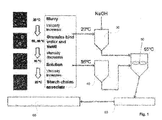
- FIG 1 is schematically shown an example of cooking and mixing of starch.
- FIG. 1 At left side of the figure is shown how the microstructure of starch changes as the temperature increases and decreases and as how the properties of the starch develop during the cooking and mixing of the starch.
- the viscosity increases and starch chains associate.
- two starch solutions are mixed one with high viscosity at temperature of 20 °C from uncooked stage 30 and one with low viscosity at temperature of 95 °C from cooked stage 40 and mixed in mixing stage 50 with temperature of 55 °C.
- the starch agent as mixture of the two starch solution are applied in sizing process 60, in which by the energy obtained from the fiber web and from drying in drying stage the starch is gelatinized and strong bonding is created.
- the solutions of native and cooked starch in stages 30, 40 into the native starch is dispersed into a lye solution of 0,1 - 0,5 % (NaOH).
- the gelatinization temperature of native starch is lowered to a desired level of 60 °C and a fast reaction and early gelatinization is achieved thus creating a longer time, more moisture and more heat for sizing reaction.
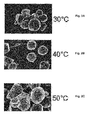
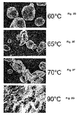
- Figures 2A - 2G show schematically examples of starch microstructure during corn starch gelling process when the temperature increases from 30 °C to 90 °C. As can be seen from the figures first the starch begins to swell and from the gelling temperatures of about 65 °C the dispersing begins.
- the fiber web W is supported by a fabric F.
- the fiber web sizing agent mixture comprising at least two starch solutions is applied by a sizing device 11 after which the web is guided into a nip or treatment zone formed in between a heated cylinder 10 and a belt B.
- the guide rolls 13 guide the belt B and by a roll 12 further pressure is provided in the treatment zone.
- the fiber web sizing agent mixture comprising at least two starch solutions is applied by a sizing devices 11 after which the web is guided into a nip or treatment zone formed in between a heated cylinder 10 and a belt B.
- the guide rolls 13 guide the belt B.
- the example comprises three sizing devices 11 and three treatment zones.
Landscapes
- Paper (AREA)
- Treatments For Attaching Organic Compounds To Fibrous Goods (AREA)
Abstract
Description
- In general present invention relates to producing fiber web in a fiber web machine. More especially the present invention relates to a process according to preamble part of claim 1 and to an arrangement according to preamble part of claim 7.
- As known from the prior art in fiber web producing processes typically comprise an assembly formed by a number of apparatuses arranged consecutively in the process line. A typical production and treatment line comprises a head box, a wire section and a press section as well as a subsequent drying section and a reel-up. The production and treatment line can further comprise other devices and sections for finishing the fiber web, for example, a sizer, a calender, a coating section. The production and treatment line also comprises at least one winder for forming customer rolls as well as a roll packaging apparatus. In this description and the following claims by fiber webs are meant for example paper and board webs.
- In production of fiber webs, for example of paper or board webs, sizing is used to alter the properties of a fiber web by adding sizing agents, for example glue chemicals. Sizing can be divided to internal sizing and surface sizing. In internal sizing the sizing agent is added to pulp in the wet end of the fiber web machine before forming. In surface sizing the sizing agent is added onto the surface of the fiber web at the dry end of the fiber web machine. Internal sizing is done in the beginning of the wet end of the fiber web machine by using different kinds of chemical treatments in order to influence the penetration of a liquid, for example of water into the fiber web.
- In production of fiber webs, for example of paper or board webs, surface sizing is used to alter the properties of a fiber web by adding sizing agents, for example starch or other glue chemicals. In surface sizing the sizing agent is added onto the surface of the fiber web at the dry end of the fiber web machine. Surface sizing is used in production of many fiber web grades, for example of uncoated fine papers and of several board grades. The sizing of paper and board web typically utilise a separate sizer. In connection with the sizer different kinds of sizing technology are employed in prior art arrangements, for example pond sizing technology or film transfer technology or spray sizing technology.
WO publication 03/004770 A1 WO publication 2006/058961 A1 discloses a method and arrangement for processing a paper or board web or similar fiber web. In this prior art method a processing mixture is spread on the surface of the web with spray nozzles. In the method the web to be processed is lead from a press nip and between rolls in this nip. Before the web enters the nip such an amount of processing mixture is spread onto at least one side of the web that the processing mixture is still wet when it enters the nip. In the prior art arrangement according to this publication the arrangement comprises at least one press nip, elements for taking the web to the press nip an elements for spreading the processing mixture and the element for spreading the processing mixture are spray nozzles which are arranged at an adjustable distance in the arrival direction of the web from the press nip to feed the processing mixture to at least one surface of the web. - In surface sizing with a size press for increasing the strength of the web the solid contents of the web must be sufficiently high in order to achieve good runnability of the web and infiltrating of cooked starch. Due to this the solid contents of the web are to be at least 90 % before surface sizing, which decreases the solid content level to 70 % or even below. Low solid content of the web raises runnability problems and may cause web breaks.
- In
GB patent publication 333,226 - In
DE patent application publication 102008040057 is disclosed a process for surface treatment, preferably for surface sizing, of material web, preferably paper or board. The process comprises applying a starch containing surface treatment agent as a pre-dosed film on assigned surface of the material web using a film applying device. The starch is a thermally-chemically modified starch and the solid content of the surface treatment agent is reduced, when compared to native starch viscosity. The object is to decrease the need for drying of the material web after the surface sizing. - In the internal sizing at highest about 2 % of sizing agent can be added since too high amount of sixing agent added at the wet end lowers the drying properties of the web as the moisture infiltrates into the starch granules during drying. It is known to use native i.e. raw i.e. uncooked starch in internal sizing but its retention is rather low as mentioned only up to 2 %. For improving the retention agents are used. Native starch is used as sizing agent in single webs but it can also be used in multilayer forming to improve the adherence of layers.
- The capability of native starch to form hydrogen bonds is based on the presence of heat and moisture, which swell the starch granules, whereby the infiltrated moisture creates hydrogen bonds. By the heat also the moisture is evaporated and the stabile bonds are created as the starch dries.
- In surface sizing uncooked i.e. native starch or cooked starch with high viscosity remain at surface of the web and thus inner strength of the web does not increase. The gelatinization of the native starch requires temperatures of 55 - 86 °C for the starch to create strong bonds with the fibers of the web.
- It is also problematic to apply native starch in high consistency since the starch precipitates easily creating a hard and concentrated mixture.
- An object of the invention is to create a process for producing fiber web and an arrangement for producing fiber web, in which the problems and disadvantages of prior art are eliminated or at least minimized.
- In order to solve the above problems and those that will come apparent later the inventive process is mainly characterized by the features of claim 1. The inventive arrangement in turn is mainly characterized by the features of claim 7.
- According to the invention in the process for producing the fiber web by surface sizing of the web sizing agent is applied onto the fiber web, which sizing agent comprises a mixture of at least two different starch solutions, which mixture comprises at least a starch solution with high viscosity and a starch solution with low viscosity. The starch mixture has low viscosity, advantageously less than 100 mPas (Br100) which improves the sizing of starch mixture of high starch content, for example starch content is 8-20 % solids content.
- Preferably the mixture comprises as one starch solution native i.e. uncooked i.e. raw starch and water.
- According to according to one aspect of the invention the sizing agent mixture preferably comprises a native i.e. uncooked starch solution and a cooked starch solution. Advantageously 30-70 % of the starch content is native starch and 30-70 % of the starch content is cooked starch. The temperature of the mixture in sizing is held below the gelatinization temperature of 30-55 °C. By mixing native starch solution and cooked starch solution a stabile mixture with high consistency is achieved that does not concentrate in the pipes of the device or on the bottom of the container.
- Advantageously the uncooked starch is modified, oxygenized or enzymatically converted cooked starch.
- By altering the ratio of starch solutions the size content of the web can be adjusted in the thickness direction of the web.
- One of the starch solutions may also function as carrier agent for hydrophilic agents, optical brighteners etc. in case in particular the surface properties of the web are to be modified.
- The sizing agent may also comprise fines for improving or pigmenting the surface of the web.
- Advantageously according to one aspect of the invention the sizing agent mixture comprises a native i.e. uncooked starch solution and a cooked solution. According to this aspect of the invention before mixing the solutions of native and cooked starch the native starch is dispersed into a lye solution of 0,1 - 0,5 %. By this the gelatinization temperature of native starch is lowered to a desired level and a fast reaction and early gelatinization is achieved thus creating a longer time, more moisture and more heat for sizing reaction.
- According to one advantageous feature of the invention the viscosity is adjusted. For example mixture of pearl starch, borax, caustic soda and water can be suspended in a paste of cooked starch. The addition of caustic soda helps gelatinize the starch. An increase in the amount of caustic soda, based on the total starch, will lower the gel temperature of the entire adhesive. The primary value of borax is to buffer the caustic soda present in the formula. It also provides viscosity control and adds tack to the finished adhesive. Generally, 15-20 % of the starch is fully cooked in part of the water with caustic to provide a carrier for the pearl starch. Starch solids levels usually are 23-35 % to achieve finished adhesive viscosity of 30-50 Stein Hall seconds. After the adhesive is applied to the flute tips and heated, the pearl starch gelatinizes in place. When the starch swells and gelatinization begins, a green bond is formed. Nearly all of the corrugated board produced today is bonded with a starch-based adhesive. Since the quality and bonding properties of the starch directly affect final board quality, decisions regarding starch should be made carefully and treated with importance in the process.
- According to the invention the arrangement for producing fiber web comprises means to apply sizing agent that comprises partially native starch on the surface of the fiber web and means for heating and/or drying the web.
- Advantageously the means to apply sizing agent are micro jet or film or bond or spray sizing means.
- Advantageously the means for drying and/or heating are belt and/or cylinder and/or infra and/or air-borne and/or steam and/or other drying means in such known to one skilled in the art.
- According to one advantageous feature of the invention as a sizing nip a heated belt nip or roll nip is used for gelatinization of starch before drying.
- According to one advantageous feature of the invention in the arrangement a blade or a rod is located after means to apply sizing agent that is a mixture of at least two different starch solutions for smoothening the applied sizing agent.
- According to one advantageous feature of the invention the arrangement comprises means for applying the native starch solution directly after sizing, for example the arrangement comprises a spray device without nip.
- According to one advantageous feature of the invention the location of the means to apply sizing agent that comprises partially native starch are located at wire section, at press section or at drying section of the fiber web production line. The means to apply sizing agent could even be located at head box section, for example the means to apply sizing agent could be a water jet of a double (twin) head box.
- The invention can be utilized in production of different fiber web grades, for example container boards. The fiber web is advantageously already internally sized.
- By the invention many advantages are achieved: for example strength and/or surface strength and/or rigidity of the web can be optimized by rationing the starch solutions, for example raw material costs can be decreased by using bigger ratio of native starch that is less expensive than cooked starch and for example the surface of the web can be modified by filling and/or coating and/or sizing it by native starch.
- According to one example of the invention the sizing agent is applied in or directly before a treatment zone in which the web is threated by pressure and heat. The sizing agent is applied by a spray sizing device or corresponding spraying device and the web is guided into a nip formed between a roll or a cylinder and a belt, advantageously a metal belt. In the nip the surface pressure of the belt provides for the sizing agent to penetrate into the web. Simultaneously the belt provides for heating of the web surface, by which the moisture evaporates and rises the temperature of the sizing agent over the gelatinization temperature. The moisture evaporation also provides for the sizing agent to penetrate further into the web. In this example the web is surface sized on at least one surface during closed web transfer, with sizing agent mixture of at least two different starch solutions as explained above. In this example the belt can be heated or not heated and also the roll or the cylinder can provide for the heat. The web can be supported by a fabric and one-sidedness created by the fabric can be used in creating the properties of the final fiber web product or it can be modified by coating and/or calendering. The fabric can also be porous such that is receives moisture. The fabric can also be provided with a coating for decreasing adherence of the web. The roll or the cylinder can also be provided with suction for increasing the moisture removal and penetrating of the sizing agent. The location of the sizing means and the treatment zone can be for example in connection with a press section, a drying section, a metal belt drying device, a sizing press, a calender or a reel-up of the fiber web production line.
- According to another example of the invention the sizing agent mixture comprising at least two starch solutions is applied onto the web before drying section of the fiber web production line such that the solid content of the fiber web after applying the sizing agent is below 80% and thus there is high amount of moisture which as it evaporates due to the heat of a treatment zone in which the web is threated by pressure and heat the sizing agent is activated. The temperature in the treatment zone is such that the gelatinization temperature is reached, for example 60-85 °C, advantageously 80-100 °C, and also the drying is efficient and bonds are created is the sizing agent and the strength properties of the web are improved. The treatment time in the treatment zone is advantageously over 50 ms and the surface pressure in the treatment zone is 20 - 500 kPa, in case where metal belt is used and 2 - 20 kPa if a fabric is used. A cooling device may follow the treatment zone.
- In the following the invention is describe in more detail with reference to the accompanying drawing in which
-
Figure 1 shows schematically an example of cooking and mixing starch. -
Figures 2A - 2G show schematically examples of starch microstructure during corn starch gelling process. -
Figure 3 shows schematically one example of the arrangement according to the invention. -
Figure 4 shows schematically another example of the arrangement according to the invention. - In the
figure 1 is schematically shown an example of cooking and mixing of starch. At left side of the figure is shown how the microstructure of starch changes as the temperature increases and decreases and as how the properties of the starch develop during the cooking and mixing of the starch. At temperature 20 °C viscosity of the starch s still in slurry form increased and when the temperature of the starch is 55 - 85 °C the starch granules bind to water and the granules begin to swell and simultaneously the viscosity decreased until temperature of 95 °C has been reached after which the starch is in solution form. During the temperature decrease from 95 °C to 20 °C the viscosity increases and starch chains associate. According to the invention two starch solutions are mixed one with high viscosity at temperature of 20 °C fromuncooked stage 30 and one with low viscosity at temperature of 95 °C from cookedstage 40 and mixed in mixingstage 50 with temperature of 55 °C. After which the starch agent as mixture of the two starch solution are applied in sizingprocess 60, in which by the energy obtained from the fiber web and from drying in drying stage the starch is gelatinized and strong bonding is created. By before mixing the solutions of native and cooked starch instages -
Figures 2A - 2G show schematically examples of starch microstructure during corn starch gelling process when the temperature increases from 30 °C to 90 °C. As can be seen from the figures first the starch begins to swell and from the gelling temperatures of about 65 °C the dispersing begins. - In the
figures 3 - 4 same reference signs are used for corresponding parts, components or part components unless otherwise mentioned. - In the schematical example of
figure 3 the fiber web W is supported by a fabric F. Onto the fiber web sizing agent mixture comprising at least two starch solutions is applied by a sizingdevice 11 after which the web is guided into a nip or treatment zone formed in between aheated cylinder 10 and a belt B. The guide rolls 13 guide the belt B and by aroll 12 further pressure is provided in the treatment zone. - In the schematical example of
figure 4 onto the fiber web sizing agent mixture comprising at least two starch solutions is applied by asizing devices 11 after which the web is guided into a nip or treatment zone formed in between aheated cylinder 10 and a belt B. The guide rolls 13 guide the belt B. The example comprises threesizing devices 11 and three treatment zones.
Claims (14)
- Process for producing a fiber web in which process by surface sizing of the web sizing agent is applied onto the fiber web, characterized in, that the sizing agent comprises a mixture of at least two different starch solutions and that the mixture comprises a starch solution with high viscosity and a starch solution with low viscosity.
- Process according to claim 1, characterized in, that the mixture comprises as one of the starch solutions native i.e. uncooked i.e. raw starch and water.
- Process according to any of claims 1 or 2, characterized in, that the sizing agent mixture comprises a native i.e. uncooked starch solution and a cooked starch solution and that 30-70 % of the starch content is native starch and 30-70 % of the starch content is cooked starch.
- Process according to claim 1, characterized in, that temperature of the mixture during sizing is held below the gelatinization temperature of 30-55 °C.
- Process according to claim 1, characterized in, that the uncooked starch is modified, oxygenized or enzymatically converted cooked starch.
- Process according to claim 1, characterized in, that the fiber web is heated and/or dried before or after or during the surface sizing.
- Arrangement for producing a fiber web, characterized in, that the arrangement for producing fiber web (W) comprises means (11) to apply sizing agent that is a mixture of at least two different starch solutions.
- Arrangement according to claim 7, characterized in, that the arrangement for producing fiber web (W) comprises means (10; B) for heating and/or drying the web (W).
- Arrangement according to claim 7, characterized in, that the means to apply sizing agent are micro jet or film or bond or spray sizing means.
- Arrangement according to claim 8, characterized in, that the means for drying and/or heating are belt and/or cylinder and/or infra and/or air-borne and/or steam drying means.
- Arrangement according to claim 7, characterized in, that in the arrangement a heated belt nip or a heated roll nip is used for gelatinization of starch before drying.
- Arrangement according to claim 7, characterized in, that in the arrangement a blade or a rod is located after means (11) to apply sizing agent that is a mixture of at least two different starch solutions for smoothening the applied sizing agent.
- Arrangement according to claim 7, characterized in, that the arrangement further comprises means for applying the native starch solution directly after sizing, for example the arrangement comprises a spray device without nip.
- Arrangement according to claim 7, characterized in, that the arrangement comprises a treatment zone formed between a roll (10) or a cylinder and a belt (B).
Priority Applications (2)
| Application Number | Priority Date | Filing Date | Title |
|---|---|---|---|
| EP12187736.9A EP2719826A1 (en) | 2012-10-09 | 2012-10-09 | Process for producing a fiber web and arrangement for producing a fiber web |
| CN201310467563.7A CN103711038B (en) | 2012-10-09 | 2013-10-09 | Manufacture the method for fiber web and manufacture the configuration of fiber web |
Applications Claiming Priority (1)
| Application Number | Priority Date | Filing Date | Title |
|---|---|---|---|
| EP12187736.9A EP2719826A1 (en) | 2012-10-09 | 2012-10-09 | Process for producing a fiber web and arrangement for producing a fiber web |
Publications (1)
| Publication Number | Publication Date |
|---|---|
| EP2719826A1 true EP2719826A1 (en) | 2014-04-16 |
Family
ID=47018870
Family Applications (1)
| Application Number | Title | Priority Date | Filing Date |
|---|---|---|---|
| EP12187736.9A Withdrawn EP2719826A1 (en) | 2012-10-09 | 2012-10-09 | Process for producing a fiber web and arrangement for producing a fiber web |
Country Status (2)
| Country | Link |
|---|---|
| EP (1) | EP2719826A1 (en) |
| CN (1) | CN103711038B (en) |
Families Citing this family (3)
| Publication number | Priority date | Publication date | Assignee | Title |
|---|---|---|---|---|
| EP3617403B1 (en) * | 2018-08-30 | 2021-09-01 | Valmet Technologies Oy | Method of treating a fiber web and a treatment system for treatment of a fiber web |
| FI20185867A1 (en) * | 2018-10-15 | 2020-04-16 | Valmet Technologies Oy | Method for sizing a multi-ply fiber web and a forming section for a multi-ply fiber web |
| EP3910103B1 (en) * | 2020-05-15 | 2025-09-10 | Valmet Technologies Oy | Method and system for applying a substance layer onto a moving fiber web by foam application |
Citations (12)
| Publication number | Priority date | Publication date | Assignee | Title |
|---|---|---|---|---|
| GB333226A (en) | 1929-05-03 | 1930-08-05 | Champion Coated Paper Co | Coating paper |
| JPH05195489A (en) * | 1992-01-22 | 1993-08-03 | Honen Corp | Starch composition for coating paper |
| US5340405A (en) * | 1993-06-14 | 1994-08-23 | National Starch And Chemical Investment Holding Corporation | High solids liquid starch prepared by batch cooking |
| US5972167A (en) * | 1993-11-16 | 1999-10-26 | Nippon Paper Industries Co., Ltd. | Transfer roll coating color and a coated paper |
| WO2003004770A1 (en) | 2001-07-03 | 2003-01-16 | Metso Paper, Inc. | Method for producing sized paper or cardboard |
| WO2003018638A1 (en) * | 2001-08-28 | 2003-03-06 | Raisio Chemicals Ltd | Method for modification of starch, starch and its use |
| WO2004074367A1 (en) * | 1999-03-08 | 2004-09-02 | Valerie Ann Bailey | Melt processable starch compositions |
| WO2006058961A1 (en) | 2004-12-01 | 2006-06-08 | Metso Paper, Inc. | Method and apparatus for treating a fibre web |
| WO2009047233A1 (en) * | 2007-10-08 | 2009-04-16 | Basf Se | Aqueous polymer dispersions based on copolymers formed from vinylaromatics and conjugated aliphatic dienes, processes for preparation thereof and use thereof |
| DE102008040057A1 (en) | 2008-07-01 | 2010-01-07 | Voith Patent Gmbh | Process for surface treatment, preferably surface sizing, of continuous material web, preferably paper or cardboard, comprises applying starch containing surface treatment agent as pre-dosed film on the web using a film applying device |
| US20100159104A1 (en) * | 2006-03-21 | 2010-06-24 | Roquette Freres | Method for cooking a starchy material with a high content of dry matter for the preparation of an adhesive composition |
| US8088209B2 (en) * | 2003-07-08 | 2012-01-03 | Roquette Freres | Cationic liquid starchy composition and uses thereof |
Family Cites Families (2)
| Publication number | Priority date | Publication date | Assignee | Title |
|---|---|---|---|---|
| NZ508191A (en) * | 1999-11-23 | 2002-03-28 | Nat Starch Chem Invest | A method of modulating surface sizing properties such as porosity reduction, resistance to liquid penetration and surface strength when used as surface size on paper |
| US7381300B2 (en) * | 2006-10-31 | 2008-06-03 | International Paper Company | Process for manufacturing paper and paperboard products |
-
2012
- 2012-10-09 EP EP12187736.9A patent/EP2719826A1/en not_active Withdrawn
-
2013
- 2013-10-09 CN CN201310467563.7A patent/CN103711038B/en not_active Expired - Fee Related
Patent Citations (12)
| Publication number | Priority date | Publication date | Assignee | Title |
|---|---|---|---|---|
| GB333226A (en) | 1929-05-03 | 1930-08-05 | Champion Coated Paper Co | Coating paper |
| JPH05195489A (en) * | 1992-01-22 | 1993-08-03 | Honen Corp | Starch composition for coating paper |
| US5340405A (en) * | 1993-06-14 | 1994-08-23 | National Starch And Chemical Investment Holding Corporation | High solids liquid starch prepared by batch cooking |
| US5972167A (en) * | 1993-11-16 | 1999-10-26 | Nippon Paper Industries Co., Ltd. | Transfer roll coating color and a coated paper |
| WO2004074367A1 (en) * | 1999-03-08 | 2004-09-02 | Valerie Ann Bailey | Melt processable starch compositions |
| WO2003004770A1 (en) | 2001-07-03 | 2003-01-16 | Metso Paper, Inc. | Method for producing sized paper or cardboard |
| WO2003018638A1 (en) * | 2001-08-28 | 2003-03-06 | Raisio Chemicals Ltd | Method for modification of starch, starch and its use |
| US8088209B2 (en) * | 2003-07-08 | 2012-01-03 | Roquette Freres | Cationic liquid starchy composition and uses thereof |
| WO2006058961A1 (en) | 2004-12-01 | 2006-06-08 | Metso Paper, Inc. | Method and apparatus for treating a fibre web |
| US20100159104A1 (en) * | 2006-03-21 | 2010-06-24 | Roquette Freres | Method for cooking a starchy material with a high content of dry matter for the preparation of an adhesive composition |
| WO2009047233A1 (en) * | 2007-10-08 | 2009-04-16 | Basf Se | Aqueous polymer dispersions based on copolymers formed from vinylaromatics and conjugated aliphatic dienes, processes for preparation thereof and use thereof |
| DE102008040057A1 (en) | 2008-07-01 | 2010-01-07 | Voith Patent Gmbh | Process for surface treatment, preferably surface sizing, of continuous material web, preferably paper or cardboard, comprises applying starch containing surface treatment agent as pre-dosed film on the web using a film applying device |
Also Published As
| Publication number | Publication date |
|---|---|
| CN103711038B (en) | 2016-06-01 |
| CN103711038A (en) | 2014-04-09 |
Similar Documents
| Publication | Publication Date | Title |
|---|---|---|
| KR102782754B1 (en) | Manufacture of corrugated paperboard and cardboard containing chemically treated paper | |
| EP3535340B1 (en) | A corrugated board comprising an adhesive comprising starch and fine micofibrillated cellulose | |
| US20070295466A1 (en) | Method for treating a substrate | |
| US8673398B2 (en) | Method for treating a substrate | |
| CN110158364A (en) | A kind of low basis weight application type food packaging body paper and preparation method thereof | |
| WO2023062557A1 (en) | Method for manufacturing a multiply paperboard, and a multiply paperboard | |
| EP2719826A1 (en) | Process for producing a fiber web and arrangement for producing a fiber web | |
| EP3988713B1 (en) | Method of treating a fiber web and a treatment system for treatment of a fiber web | |
| JP6217497B2 (en) | Corrugated cardboard production method | |
| EP1415040A1 (en) | Method for producing sized paper or cardboard | |
| KR100662135B1 (en) | Partially impregnated lignocellulosic material | |
| CN115768948A (en) | Method of making foam-coated cellulose-based substrates | |
| JP2017218721A (en) | Corrugated cardboard production method | |
| EP4379016A1 (en) | Water repellent oil repellent agent | |
| CN116997695B (en) | Method, a board product, foam coater and use of a subsequent high-consistency metering size press | |
| EP2179089B1 (en) | Method and apparatus for treating a substrate | |
| JP5009698B2 (en) | Manufacturing method of coated paper | |
| CA3146960A1 (en) | Method for manufacturing a coated cellulosic substrate and a coated cellulosic substrate | |
| EP4379017A1 (en) | Water repellent oil repellent agent | |
| JP2003113595A (en) | Coated paper for offset printing |
Legal Events
| Date | Code | Title | Description |
|---|---|---|---|
| PUAI | Public reference made under article 153(3) epc to a published international application that has entered the european phase |
Free format text: ORIGINAL CODE: 0009012 |
|
| 17P | Request for examination filed |
Effective date: 20130912 |
|
| AK | Designated contracting states |
Kind code of ref document: A1 Designated state(s): AL AT BE BG CH CY CZ DE DK EE ES FI FR GB GR HR HU IE IS IT LI LT LU LV MC MK MT NL NO PL PT RO RS SE SI SK SM TR |
|
| AX | Request for extension of the european patent |
Extension state: BA ME |
|
| RAP1 | Party data changed (applicant data changed or rights of an application transferred) |
Owner name: VALMET TECHNOLOGIES, INC. |
|
| 17Q | First examination report despatched |
Effective date: 20171102 |
|
| STAA | Information on the status of an ep patent application or granted ep patent |
Free format text: STATUS: THE APPLICATION IS DEEMED TO BE WITHDRAWN |
|
| 18D | Application deemed to be withdrawn |
Effective date: 20180313 |