EP2719695A1 - Azole derivative, method for producing azole derivative, and intermediate compound - Google Patents
Azole derivative, method for producing azole derivative, and intermediate compound Download PDFInfo
- Publication number
- EP2719695A1 EP2719695A1 EP12796434.4A EP12796434A EP2719695A1 EP 2719695 A1 EP2719695 A1 EP 2719695A1 EP 12796434 A EP12796434 A EP 12796434A EP 2719695 A1 EP2719695 A1 EP 2719695A1
- Authority
- EP
- European Patent Office
- Prior art keywords
- compound
- group
- formula
- azole derivative
- general formula
- Prior art date
- Legal status (The legal status is an assumption and is not a legal conclusion. Google has not performed a legal analysis and makes no representation as to the accuracy of the status listed.)
- Granted
Links
- 150000007980 azole derivatives Chemical class 0.000 title claims abstract description 170
- 150000001875 compounds Chemical class 0.000 title claims description 535
- 238000004519 manufacturing process Methods 0.000 title claims description 89
- 125000004178 (C1-C4) alkyl group Chemical group 0.000 claims abstract description 25
- 125000004435 hydrogen atom Chemical group [H]* 0.000 claims abstract description 25
- 125000005843 halogen group Chemical group 0.000 claims abstract description 23
- 125000001997 phenyl group Chemical group [H]C1=C([H])C([H])=C(*)C([H])=C1[H] 0.000 claims abstract description 18
- 125000001797 benzyl group Chemical group [H]C1=C([H])C([H])=C(C([H])=C1[H])C([H])([H])* 0.000 claims abstract description 15
- 229910052757 nitrogen Inorganic materials 0.000 claims abstract description 9
- 125000004433 nitrogen atom Chemical group N* 0.000 claims abstract description 9
- 125000004093 cyano group Chemical group *C#N 0.000 claims abstract description 5
- 125000001434 methanylylidene group Chemical group [H]C#[*] 0.000 claims abstract description 5
- 125000000449 nitro group Chemical group [O-][N+](*)=O 0.000 claims abstract description 5
- 238000000034 method Methods 0.000 claims description 61
- 239000002253 acid Substances 0.000 claims description 41
- 239000003795 chemical substances by application Substances 0.000 claims description 32
- 229910052751 metal Inorganic materials 0.000 claims description 30
- 239000002184 metal Substances 0.000 claims description 30
- DHKHKXVYLBGOIT-UHFFFAOYSA-N acetaldehyde Diethyl Acetal Natural products CCOC(C)OCC DHKHKXVYLBGOIT-UHFFFAOYSA-N 0.000 claims description 14
- 125000006273 (C1-C3) alkyl group Chemical group 0.000 claims description 10
- 125000000229 (C1-C4)alkoxy group Chemical group 0.000 claims description 9
- 150000002576 ketones Chemical class 0.000 claims description 7
- 125000004767 (C1-C4) haloalkoxy group Chemical group 0.000 claims description 5
- 125000004765 (C1-C4) haloalkyl group Chemical group 0.000 claims description 5
- JECYNCQXXKQDJN-UHFFFAOYSA-N 2-(2-methylhexan-2-yloxymethyl)oxirane Chemical compound CCCCC(C)(C)OCC1CO1 JECYNCQXXKQDJN-UHFFFAOYSA-N 0.000 claims description 3
- 125000002777 acetyl group Chemical class [H]C([H])([H])C(*)=O 0.000 claims 1
- 125000001188 haloalkyl group Chemical group 0.000 abstract description 14
- 125000004438 haloalkoxy group Chemical group 0.000 abstract description 3
- 125000003545 alkoxy group Chemical group 0.000 abstract 1
- 239000002904 solvent Substances 0.000 description 130
- -1 2-substituted-5-benzyl-1-azolylmethylcyclopentanol Chemical class 0.000 description 117
- 238000006243 chemical reaction Methods 0.000 description 101
- 239000000203 mixture Substances 0.000 description 94
- HEDRZPFGACZZDS-MICDWDOJSA-N Trichloro(2H)methane Chemical compound [2H]C(Cl)(Cl)Cl HEDRZPFGACZZDS-MICDWDOJSA-N 0.000 description 90
- 125000002496 methyl group Chemical group [H]C([H])([H])* 0.000 description 84
- 239000002585 base Substances 0.000 description 83
- YXFVVABEGXRONW-UHFFFAOYSA-N Toluene Chemical compound CC1=CC=CC=C1 YXFVVABEGXRONW-UHFFFAOYSA-N 0.000 description 78
- ZMXDDKWLCZADIW-UHFFFAOYSA-N N,N-Dimethylformamide Chemical compound CN(C)C=O ZMXDDKWLCZADIW-UHFFFAOYSA-N 0.000 description 57
- 238000005160 1H NMR spectroscopy Methods 0.000 description 54
- HEMHJVSKTPXQMS-UHFFFAOYSA-M Sodium hydroxide Chemical compound [OH-].[Na+] HEMHJVSKTPXQMS-UHFFFAOYSA-M 0.000 description 54
- XLYOFNOQVPJJNP-UHFFFAOYSA-N water Substances O XLYOFNOQVPJJNP-UHFFFAOYSA-N 0.000 description 47
- 238000009472 formulation Methods 0.000 description 46
- 241000209140 Triticum Species 0.000 description 44
- 235000021307 Triticum Nutrition 0.000 description 42
- XEKOWRVHYACXOJ-UHFFFAOYSA-N Ethyl acetate Chemical compound CCOC(C)=O XEKOWRVHYACXOJ-UHFFFAOYSA-N 0.000 description 41
- WSFSSNUMVMOOMR-UHFFFAOYSA-N Formaldehyde Chemical compound O=C WSFSSNUMVMOOMR-UHFFFAOYSA-N 0.000 description 41
- 125000001309 chloro group Chemical group Cl* 0.000 description 41
- WYURNTSHIVDZCO-UHFFFAOYSA-N Tetrahydrofuran Chemical compound C1CCOC1 WYURNTSHIVDZCO-UHFFFAOYSA-N 0.000 description 40
- 239000000243 solution Substances 0.000 description 38
- 230000015572 biosynthetic process Effects 0.000 description 37
- 238000003786 synthesis reaction Methods 0.000 description 37
- 244000005700 microbiome Species 0.000 description 36
- IAZDPXIOMUYVGZ-UHFFFAOYSA-N Dimethylsulphoxide Chemical compound CS(C)=O IAZDPXIOMUYVGZ-UHFFFAOYSA-N 0.000 description 35
- 239000011369 resultant mixture Substances 0.000 description 31
- 241000196324 Embryophyta Species 0.000 description 30
- 125000002887 hydroxy group Chemical group [H]O* 0.000 description 30
- 125000005537 sulfoxonium group Chemical group 0.000 description 28
- SECXISVLQFMRJM-UHFFFAOYSA-N N-Methylpyrrolidone Chemical compound CN1CCCC1=O SECXISVLQFMRJM-UHFFFAOYSA-N 0.000 description 27
- 230000035484 reaction time Effects 0.000 description 27
- VEXZGXHMUGYJMC-UHFFFAOYSA-N Hydrochloric acid Chemical compound Cl VEXZGXHMUGYJMC-UHFFFAOYSA-N 0.000 description 26
- 239000004480 active ingredient Substances 0.000 description 26
- 125000006239 protecting group Chemical group 0.000 description 26
- LFQSCWFLJHTTHZ-UHFFFAOYSA-N Ethanol Chemical compound CCO LFQSCWFLJHTTHZ-UHFFFAOYSA-N 0.000 description 24
- 230000009036 growth inhibition Effects 0.000 description 24
- QAOWNCQODCNURD-UHFFFAOYSA-N Sulfuric acid Chemical compound OS(O)(=O)=O QAOWNCQODCNURD-UHFFFAOYSA-N 0.000 description 22
- OKKJLVBELUTLKV-UHFFFAOYSA-N Methanol Chemical compound OC OKKJLVBELUTLKV-UHFFFAOYSA-N 0.000 description 21
- KWYUFKZDYYNOTN-UHFFFAOYSA-M Potassium hydroxide Chemical compound [OH-].[K+] KWYUFKZDYYNOTN-UHFFFAOYSA-M 0.000 description 21
- 235000019441 ethanol Nutrition 0.000 description 21
- 239000000284 extract Substances 0.000 description 21
- 239000012044 organic layer Substances 0.000 description 21
- PMZURENOXWZQFD-UHFFFAOYSA-L Sodium Sulfate Chemical compound [Na+].[Na+].[O-]S([O-])(=O)=O PMZURENOXWZQFD-UHFFFAOYSA-L 0.000 description 20
- 239000012770 industrial material Substances 0.000 description 20
- YLQBMQCUIZJEEH-UHFFFAOYSA-N tetrahydrofuran Natural products C=1C=COC=1 YLQBMQCUIZJEEH-UHFFFAOYSA-N 0.000 description 20
- 238000000605 extraction Methods 0.000 description 19
- UHOVQNZJYSORNB-UHFFFAOYSA-N Benzene Chemical compound C1=CC=CC=C1 UHOVQNZJYSORNB-UHFFFAOYSA-N 0.000 description 18
- KAESVJOAVNADME-UHFFFAOYSA-N Pyrrole Chemical compound C=1C=CNC=1 KAESVJOAVNADME-UHFFFAOYSA-N 0.000 description 18
- MFRIHAYPQRLWNB-UHFFFAOYSA-N sodium tert-butoxide Chemical compound [Na+].CC(C)(C)[O-] MFRIHAYPQRLWNB-UHFFFAOYSA-N 0.000 description 18
- 238000007142 ring opening reaction Methods 0.000 description 17
- HPALAKNZSZLMCH-UHFFFAOYSA-M sodium;chloride;hydrate Chemical class O.[Na+].[Cl-] HPALAKNZSZLMCH-UHFFFAOYSA-M 0.000 description 17
- 239000000126 substance Substances 0.000 description 17
- RWSOTUBLDIXVET-UHFFFAOYSA-N Dihydrogen sulfide Chemical class S RWSOTUBLDIXVET-UHFFFAOYSA-N 0.000 description 16
- FXHOOIRPVKKKFG-UHFFFAOYSA-N N,N-Dimethylacetamide Chemical compound CN(C)C(C)=O FXHOOIRPVKKKFG-UHFFFAOYSA-N 0.000 description 16
- KEAYESYHFKHZAL-UHFFFAOYSA-N Sodium Chemical compound [Na] KEAYESYHFKHZAL-UHFFFAOYSA-N 0.000 description 16
- 239000012312 sodium hydride Substances 0.000 description 16
- 229910000104 sodium hydride Inorganic materials 0.000 description 16
- ZMANZCXQSJIPKH-UHFFFAOYSA-N Triethylamine Chemical compound CCN(CC)CC ZMANZCXQSJIPKH-UHFFFAOYSA-N 0.000 description 15
- 125000001495 ethyl group Chemical group [H]C([H])([H])C([H])([H])* 0.000 description 15
- JEIPFZHSYJVQDO-UHFFFAOYSA-N iron(III) oxide Inorganic materials O=[Fe]O[Fe]=O JEIPFZHSYJVQDO-UHFFFAOYSA-N 0.000 description 15
- 239000003223 protective agent Substances 0.000 description 15
- RTZKZFJDLAIYFH-UHFFFAOYSA-N Diethyl ether Chemical compound CCOCC RTZKZFJDLAIYFH-UHFFFAOYSA-N 0.000 description 14
- WQDUMFSSJAZKTM-UHFFFAOYSA-N Sodium methoxide Chemical compound [Na+].[O-]C WQDUMFSSJAZKTM-UHFFFAOYSA-N 0.000 description 14
- 150000001408 amides Chemical class 0.000 description 14
- 239000007864 aqueous solution Substances 0.000 description 14
- RAXXELZNTBOGNW-UHFFFAOYSA-N imidazole Natural products C1=CNC=N1 RAXXELZNTBOGNW-UHFFFAOYSA-N 0.000 description 14
- 150000002924 oxiranes Chemical class 0.000 description 14
- BWHMMNNQKKPAPP-UHFFFAOYSA-L potassium carbonate Chemical compound [K+].[K+].[O-]C([O-])=O BWHMMNNQKKPAPP-UHFFFAOYSA-L 0.000 description 14
- YBBRCQOCSYXUOC-UHFFFAOYSA-N sulfuryl dichloride Chemical class ClS(Cl)(=O)=O YBBRCQOCSYXUOC-UHFFFAOYSA-N 0.000 description 14
- 240000007594 Oryza sativa Species 0.000 description 13
- 235000007164 Oryza sativa Nutrition 0.000 description 13
- 125000000217 alkyl group Chemical group 0.000 description 13
- 239000012043 crude product Substances 0.000 description 13
- 235000009566 rice Nutrition 0.000 description 13
- CSCPPACGZOOCGX-UHFFFAOYSA-N Acetone Chemical compound CC(C)=O CSCPPACGZOOCGX-UHFFFAOYSA-N 0.000 description 12
- UIIMBOGNXHQVGW-UHFFFAOYSA-M Sodium bicarbonate Chemical compound [Na+].OC([O-])=O UIIMBOGNXHQVGW-UHFFFAOYSA-M 0.000 description 12
- 201000010099 disease Diseases 0.000 description 12
- 208000037265 diseases, disorders, signs and symptoms Diseases 0.000 description 12
- 229910052736 halogen Inorganic materials 0.000 description 12
- 150000002367 halogens Chemical class 0.000 description 12
- KJIFKLIQANRMOU-UHFFFAOYSA-N oxidanium;4-methylbenzenesulfonate Chemical compound O.CC1=CC=C(S(O)(=O)=O)C=C1 KJIFKLIQANRMOU-UHFFFAOYSA-N 0.000 description 12
- RWSOTUBLDIXVET-UHFFFAOYSA-O sulfonium Chemical compound [SH3+] RWSOTUBLDIXVET-UHFFFAOYSA-O 0.000 description 12
- 230000000844 anti-bacterial effect Effects 0.000 description 11
- 150000002170 ethers Chemical class 0.000 description 11
- 239000008187 granular material Substances 0.000 description 11
- 230000017074 necrotic cell death Effects 0.000 description 11
- 230000001681 protective effect Effects 0.000 description 11
- RYHBNJHYFVUHQT-UHFFFAOYSA-N 1,4-Dioxane Chemical compound C1COCCO1 RYHBNJHYFVUHQT-UHFFFAOYSA-N 0.000 description 10
- YYROPELSRYBVMQ-UHFFFAOYSA-N 4-toluenesulfonyl chloride Chemical compound CC1=CC=C(S(Cl)(=O)=O)C=C1 YYROPELSRYBVMQ-UHFFFAOYSA-N 0.000 description 10
- 240000005979 Hordeum vulgare Species 0.000 description 10
- 235000007340 Hordeum vulgare Nutrition 0.000 description 10
- CPELXLSAUQHCOX-UHFFFAOYSA-N Hydrogen bromide Chemical compound Br CPELXLSAUQHCOX-UHFFFAOYSA-N 0.000 description 10
- AFVFQIVMOAPDHO-UHFFFAOYSA-N Methanesulfonic acid Chemical compound CS(O)(=O)=O AFVFQIVMOAPDHO-UHFFFAOYSA-N 0.000 description 10
- 230000001276 controlling effect Effects 0.000 description 10
- 230000003902 lesion Effects 0.000 description 10
- KWGKDLIKAYFUFQ-UHFFFAOYSA-M lithium chloride Chemical compound [Li+].[Cl-] KWGKDLIKAYFUFQ-UHFFFAOYSA-M 0.000 description 10
- 239000002609 medium Substances 0.000 description 10
- 125000000999 tert-butyl group Chemical group [H]C([H])([H])C(*)(C([H])([H])[H])C([H])([H])[H] 0.000 description 10
- JOXIMZWYDAKGHI-UHFFFAOYSA-N toluene-4-sulfonic acid Chemical compound CC1=CC=C(S(O)(=O)=O)C=C1 JOXIMZWYDAKGHI-UHFFFAOYSA-N 0.000 description 10
- DYLIWHYUXAJDOJ-OWOJBTEDSA-N (e)-4-(6-aminopurin-9-yl)but-2-en-1-ol Chemical compound NC1=NC=NC2=C1N=CN2C\C=C\CO DYLIWHYUXAJDOJ-OWOJBTEDSA-N 0.000 description 9
- QTBSBXVTEAMEQO-UHFFFAOYSA-N Acetic acid Chemical compound CC(O)=O QTBSBXVTEAMEQO-UHFFFAOYSA-N 0.000 description 9
- 241000221785 Erysiphales Species 0.000 description 9
- VYPSYNLAJGMNEJ-UHFFFAOYSA-N Silicium dioxide Chemical compound O=[Si]=O VYPSYNLAJGMNEJ-UHFFFAOYSA-N 0.000 description 9
- 230000003115 biocidal effect Effects 0.000 description 9
- 230000000694 effects Effects 0.000 description 9
- 230000012010 growth Effects 0.000 description 9
- 239000004094 surface-active agent Substances 0.000 description 9
- FKLJPTJMIBLJAV-UHFFFAOYSA-N Compound IV Chemical compound O1N=C(C)C=C1CCCCCCCOC1=CC=C(C=2OCCN=2)C=C1 FKLJPTJMIBLJAV-UHFFFAOYSA-N 0.000 description 8
- CTQNGGLPUBDAKN-UHFFFAOYSA-N O-Xylene Chemical compound CC1=CC=CC=C1C CTQNGGLPUBDAKN-UHFFFAOYSA-N 0.000 description 8
- NBIIXXVUZAFLBC-UHFFFAOYSA-N Phosphoric acid Chemical compound OP(O)(O)=O NBIIXXVUZAFLBC-UHFFFAOYSA-N 0.000 description 8
- JUJWROOIHBZHMG-UHFFFAOYSA-N Pyridine Chemical compound C1=CC=NC=C1 JUJWROOIHBZHMG-UHFFFAOYSA-N 0.000 description 8
- CDBYLPFSWZWCQE-UHFFFAOYSA-L Sodium Carbonate Chemical compound [Na+].[Na+].[O-]C([O-])=O CDBYLPFSWZWCQE-UHFFFAOYSA-L 0.000 description 8
- DTQVDTLACAAQTR-UHFFFAOYSA-N Trifluoroacetic acid Chemical compound OC(=O)C(F)(F)F DTQVDTLACAAQTR-UHFFFAOYSA-N 0.000 description 8
- 150000001241 acetals Chemical class 0.000 description 8
- 150000001298 alcohols Chemical class 0.000 description 8
- IXCSERBJSXMMFS-UHFFFAOYSA-N hydrogen chloride Substances Cl.Cl IXCSERBJSXMMFS-UHFFFAOYSA-N 0.000 description 8
- 229910000041 hydrogen chloride Inorganic materials 0.000 description 8
- 239000010410 layer Substances 0.000 description 8
- 150000007522 mineralic acids Chemical class 0.000 description 8
- 125000004430 oxygen atom Chemical group O* 0.000 description 8
- 229910052717 sulfur Inorganic materials 0.000 description 8
- KEPJZBFFLDRKSF-UHFFFAOYSA-M trimethylsulfoxonium bromide Chemical compound [Br-].C[S+](C)(C)=O KEPJZBFFLDRKSF-UHFFFAOYSA-M 0.000 description 8
- 239000008096 xylene Substances 0.000 description 8
- NSPMIYGKQJPBQR-UHFFFAOYSA-N 4H-1,2,4-triazole Chemical compound C=1N=CNN=1 NSPMIYGKQJPBQR-UHFFFAOYSA-N 0.000 description 7
- IAYPIBMASNFSPL-UHFFFAOYSA-N Ethylene oxide Chemical compound C1CO1 IAYPIBMASNFSPL-UHFFFAOYSA-N 0.000 description 7
- 150000004703 alkoxides Chemical class 0.000 description 7
- 239000000460 chlorine Substances 0.000 description 7
- 239000004927 clay Substances 0.000 description 7
- 230000001747 exhibiting effect Effects 0.000 description 7
- 229910052987 metal hydride Inorganic materials 0.000 description 7
- 150000004681 metal hydrides Chemical class 0.000 description 7
- 125000004123 n-propyl group Chemical group [H]C([H])([H])C([H])([H])C([H])([H])* 0.000 description 7
- 150000007524 organic acids Chemical class 0.000 description 7
- 230000001717 pathogenic effect Effects 0.000 description 7
- 229910000027 potassium carbonate Inorganic materials 0.000 description 7
- 235000011181 potassium carbonates Nutrition 0.000 description 7
- 230000002633 protecting effect Effects 0.000 description 7
- 238000010898 silica gel chromatography Methods 0.000 description 7
- QDRKDTQENPPHOJ-UHFFFAOYSA-N sodium ethoxide Chemical compound [Na+].CC[O-] QDRKDTQENPPHOJ-UHFFFAOYSA-N 0.000 description 7
- WEVYAHXRMPXWCK-UHFFFAOYSA-N Acetonitrile Chemical compound CC#N WEVYAHXRMPXWCK-UHFFFAOYSA-N 0.000 description 6
- 241000228257 Aspergillus sp. Species 0.000 description 6
- HEDRZPFGACZZDS-UHFFFAOYSA-N Chloroform Chemical compound ClC(Cl)Cl HEDRZPFGACZZDS-UHFFFAOYSA-N 0.000 description 6
- YMWUJEATGCHHMB-UHFFFAOYSA-N Dichloromethane Chemical compound ClCCl YMWUJEATGCHHMB-UHFFFAOYSA-N 0.000 description 6
- VQTUBCCKSQIDNK-UHFFFAOYSA-N Isobutene Chemical compound CC(C)=C VQTUBCCKSQIDNK-UHFFFAOYSA-N 0.000 description 6
- 241000228168 Penicillium sp. Species 0.000 description 6
- NINIDFKCEFEMDL-UHFFFAOYSA-N Sulfur Chemical compound [S] NINIDFKCEFEMDL-UHFFFAOYSA-N 0.000 description 6
- 239000012752 auxiliary agent Substances 0.000 description 6
- 229910052801 chlorine Inorganic materials 0.000 description 6
- 229910052731 fluorine Inorganic materials 0.000 description 6
- 125000001153 fluoro group Chemical group F* 0.000 description 6
- 125000000524 functional group Chemical group 0.000 description 6
- 231100001261 hazardous Toxicity 0.000 description 6
- 125000000623 heterocyclic group Chemical group 0.000 description 6
- 238000011081 inoculation Methods 0.000 description 6
- 125000001449 isopropyl group Chemical group [H]C([H])([H])C([H])(*)C([H])([H])[H] 0.000 description 6
- 239000007788 liquid Substances 0.000 description 6
- AMXOYNBUYSYVKV-UHFFFAOYSA-M lithium bromide Chemical compound [Li+].[Br-] AMXOYNBUYSYVKV-UHFFFAOYSA-M 0.000 description 6
- 125000004184 methoxymethyl group Chemical group [H]C([H])([H])OC([H])([H])* 0.000 description 6
- 239000002798 polar solvent Substances 0.000 description 6
- LPNYRYFBWFDTMA-UHFFFAOYSA-N potassium tert-butoxide Chemical compound [K+].CC(C)(C)[O-] LPNYRYFBWFDTMA-UHFFFAOYSA-N 0.000 description 6
- 150000003242 quaternary ammonium salts Chemical class 0.000 description 6
- 150000003839 salts Chemical class 0.000 description 6
- 239000007787 solid Substances 0.000 description 6
- 239000011593 sulfur Substances 0.000 description 6
- 230000002194 synthesizing effect Effects 0.000 description 6
- 241000088530 Chaetomium sp. Species 0.000 description 5
- 229920001732 Lignosulfonate Polymers 0.000 description 5
- 235000011430 Malus pumila Nutrition 0.000 description 5
- 235000015103 Malus silvestris Nutrition 0.000 description 5
- 241000736122 Parastagonospora nodorum Species 0.000 description 5
- 235000014443 Pyrus communis Nutrition 0.000 description 5
- 240000001987 Pyrus communis Species 0.000 description 5
- 125000004849 alkoxymethyl group Chemical group 0.000 description 5
- 230000002152 alkylating effect Effects 0.000 description 5
- 150000004945 aromatic hydrocarbons Chemical class 0.000 description 5
- 229910052799 carbon Inorganic materials 0.000 description 5
- 125000004432 carbon atom Chemical group C* 0.000 description 5
- 230000000052 comparative effect Effects 0.000 description 5
- 125000001511 cyclopentyl group Chemical group [H]C1([H])C([H])([H])C([H])([H])C([H])(*)C1([H])[H] 0.000 description 5
- 239000000428 dust Substances 0.000 description 5
- 230000002140 halogenating effect Effects 0.000 description 5
- 230000009931 harmful effect Effects 0.000 description 5
- 229910000042 hydrogen bromide Inorganic materials 0.000 description 5
- XMBWDFGMSWQBCA-UHFFFAOYSA-N hydrogen iodide Chemical compound I XMBWDFGMSWQBCA-UHFFFAOYSA-N 0.000 description 5
- 125000002768 hydroxyalkyl group Chemical group 0.000 description 5
- INQOMBQAUSQDDS-UHFFFAOYSA-N iodomethane Chemical compound IC INQOMBQAUSQDDS-UHFFFAOYSA-N 0.000 description 5
- 229940098779 methanesulfonic acid Drugs 0.000 description 5
- 239000003444 phase transfer catalyst Substances 0.000 description 5
- 238000010992 reflux Methods 0.000 description 5
- 150000008054 sulfonate salts Chemical class 0.000 description 5
- 239000000725 suspension Substances 0.000 description 5
- NRZWQKGABZFFKE-UHFFFAOYSA-N trimethylsulfonium Chemical class C[S+](C)C NRZWQKGABZFFKE-UHFFFAOYSA-N 0.000 description 5
- YRYSAWZMIRQUBO-UHFFFAOYSA-N trimethylsulfoxonium Chemical class C[S+](C)(C)=O YRYSAWZMIRQUBO-UHFFFAOYSA-N 0.000 description 5
- HEWZVZIVELJPQZ-UHFFFAOYSA-N 2,2-dimethoxypropane Chemical compound COC(C)(C)OC HEWZVZIVELJPQZ-UHFFFAOYSA-N 0.000 description 4
- NLXLAEXVIDQMFP-UHFFFAOYSA-N Ammonia chloride Chemical compound [NH4+].[Cl-] NLXLAEXVIDQMFP-UHFFFAOYSA-N 0.000 description 4
- 241000194110 Bacillus sp. (in: Bacteria) Species 0.000 description 4
- WKBOTKDWSSQWDR-UHFFFAOYSA-N Bromine atom Chemical group [Br] WKBOTKDWSSQWDR-UHFFFAOYSA-N 0.000 description 4
- 241001207508 Cladosporium sp. Species 0.000 description 4
- 240000008067 Cucumis sativus Species 0.000 description 4
- 235000010799 Cucumis sativus var sativus Nutrition 0.000 description 4
- 239000005909 Kieselgur Substances 0.000 description 4
- WCUXLLCKKVVCTQ-UHFFFAOYSA-M Potassium chloride Chemical compound [Cl-].[K+] WCUXLLCKKVVCTQ-UHFFFAOYSA-M 0.000 description 4
- FAPWRFPIFSIZLT-UHFFFAOYSA-M Sodium chloride Chemical compound [Na+].[Cl-] FAPWRFPIFSIZLT-UHFFFAOYSA-M 0.000 description 4
- DKGAVHZHDRPRBM-UHFFFAOYSA-N Tert-Butanol Chemical compound CC(C)(C)O DKGAVHZHDRPRBM-UHFFFAOYSA-N 0.000 description 4
- 241001557886 Trichoderma sp. Species 0.000 description 4
- OKJPEAGHQZHRQV-UHFFFAOYSA-N Triiodomethane Natural products IC(I)I OKJPEAGHQZHRQV-UHFFFAOYSA-N 0.000 description 4
- 150000008052 alkyl sulfonates Chemical class 0.000 description 4
- 229910000147 aluminium phosphate Inorganic materials 0.000 description 4
- 239000000440 bentonite Substances 0.000 description 4
- 229910000278 bentonite Inorganic materials 0.000 description 4
- SVPXDRXYRYOSEX-UHFFFAOYSA-N bentoquatam Chemical compound O.O=[Si]=O.O=[Al]O[Al]=O SVPXDRXYRYOSEX-UHFFFAOYSA-N 0.000 description 4
- HTZCNXWZYVXIMZ-UHFFFAOYSA-M benzyl(triethyl)azanium;chloride Chemical compound [Cl-].CC[N+](CC)(CC)CC1=CC=CC=C1 HTZCNXWZYVXIMZ-UHFFFAOYSA-M 0.000 description 4
- 125000004218 chloromethyl group Chemical group [H]C([H])(Cl)* 0.000 description 4
- 239000000287 crude extract Substances 0.000 description 4
- XCIXKGXIYUWCLL-UHFFFAOYSA-N cyclopentanol Chemical compound OC1CCCC1 XCIXKGXIYUWCLL-UHFFFAOYSA-N 0.000 description 4
- 239000003085 diluting agent Substances 0.000 description 4
- DKWOHBPRFZIUQL-UHFFFAOYSA-N dimethyl-methylidene-oxo-$l^{6}-sulfane Chemical compound C[S+](C)([CH2-])=O DKWOHBPRFZIUQL-UHFFFAOYSA-N 0.000 description 4
- 239000002270 dispersing agent Substances 0.000 description 4
- 239000002552 dosage form Substances 0.000 description 4
- 239000004495 emulsifiable concentrate Substances 0.000 description 4
- 239000003995 emulsifying agent Substances 0.000 description 4
- 125000005745 ethoxymethyl group Chemical group [H]C([H])([H])C([H])([H])OC([H])([H])* 0.000 description 4
- 230000003301 hydrolyzing effect Effects 0.000 description 4
- 125000000959 isobutyl group Chemical group [H]C([H])([H])C([H])(C([H])([H])[H])C([H])([H])* 0.000 description 4
- PQXKHYXIUOZZFA-UHFFFAOYSA-M lithium fluoride Chemical compound [Li+].[F-] PQXKHYXIUOZZFA-UHFFFAOYSA-M 0.000 description 4
- LGRLWUINFJPLSH-UHFFFAOYSA-N methanide Chemical compound [CH3-] LGRLWUINFJPLSH-UHFFFAOYSA-N 0.000 description 4
- BDAGIHXWWSANSR-UHFFFAOYSA-N methanoic acid Natural products OC=O BDAGIHXWWSANSR-UHFFFAOYSA-N 0.000 description 4
- 125000004108 n-butyl group Chemical group [H]C([H])([H])C([H])([H])C([H])([H])C([H])([H])* 0.000 description 4
- 238000010899 nucleation Methods 0.000 description 4
- 150000007530 organic bases Chemical class 0.000 description 4
- IOLCXVTUBQKXJR-UHFFFAOYSA-M potassium bromide Chemical compound [K+].[Br-] IOLCXVTUBQKXJR-UHFFFAOYSA-M 0.000 description 4
- NROKBHXJSPEDAR-UHFFFAOYSA-M potassium fluoride Chemical compound [F-].[K+] NROKBHXJSPEDAR-UHFFFAOYSA-M 0.000 description 4
- 239000001965 potato dextrose agar Substances 0.000 description 4
- UMJSCPRVCHMLSP-UHFFFAOYSA-N pyridine Natural products COC1=CC=CN=C1 UMJSCPRVCHMLSP-UHFFFAOYSA-N 0.000 description 4
- 239000000741 silica gel Substances 0.000 description 4
- 229910002027 silica gel Inorganic materials 0.000 description 4
- 235000017557 sodium bicarbonate Nutrition 0.000 description 4
- 229910000030 sodium bicarbonate Inorganic materials 0.000 description 4
- JHJLBTNAGRQEKS-UHFFFAOYSA-M sodium bromide Chemical compound [Na+].[Br-] JHJLBTNAGRQEKS-UHFFFAOYSA-M 0.000 description 4
- 229910000029 sodium carbonate Inorganic materials 0.000 description 4
- 235000017550 sodium carbonate Nutrition 0.000 description 4
- PUZPDOWCWNUUKD-UHFFFAOYSA-M sodium fluoride Chemical compound [F-].[Na+] PUZPDOWCWNUUKD-UHFFFAOYSA-M 0.000 description 4
- 125000001424 substituent group Chemical group 0.000 description 4
- 239000000454 talc Substances 0.000 description 4
- 229910052623 talc Inorganic materials 0.000 description 4
- 230000017105 transposition Effects 0.000 description 4
- 125000002023 trifluoromethyl group Chemical group FC(F)(F)* 0.000 description 4
- ZWEHNKRNPOVVGH-UHFFFAOYSA-N 2-Butanone Chemical compound CCC(C)=O ZWEHNKRNPOVVGH-UHFFFAOYSA-N 0.000 description 3
- UHPMCKVQTMMPCG-UHFFFAOYSA-N 5,8-dihydroxy-2-methoxy-6-methyl-7-(2-oxopropyl)naphthalene-1,4-dione Chemical compound CC1=C(CC(C)=O)C(O)=C2C(=O)C(OC)=CC(=O)C2=C1O UHPMCKVQTMMPCG-UHFFFAOYSA-N 0.000 description 3
- ZCYVEMRRCGMTRW-UHFFFAOYSA-N 7553-56-2 Chemical group [I] ZCYVEMRRCGMTRW-UHFFFAOYSA-N 0.000 description 3
- WFDIJRYMOXRFFG-UHFFFAOYSA-N Acetic anhydride Chemical compound CC(=O)OC(C)=O WFDIJRYMOXRFFG-UHFFFAOYSA-N 0.000 description 3
- BVKZGUZCCUSVTD-UHFFFAOYSA-L Carbonate Chemical compound [O-]C([O-])=O BVKZGUZCCUSVTD-UHFFFAOYSA-L 0.000 description 3
- LYCAIKOWRPUZTN-UHFFFAOYSA-N Ethylene glycol Chemical compound OCCO LYCAIKOWRPUZTN-UHFFFAOYSA-N 0.000 description 3
- 241000223218 Fusarium Species 0.000 description 3
- 241000896246 Golovinomyces cichoracearum Species 0.000 description 3
- DGAQECJNVWCQMB-PUAWFVPOSA-M Ilexoside XXIX Chemical compound C[C@@H]1CC[C@@]2(CC[C@@]3(C(=CC[C@H]4[C@]3(CC[C@@H]5[C@@]4(CC[C@@H](C5(C)C)OS(=O)(=O)[O-])C)C)[C@@H]2[C@]1(C)O)C)C(=O)O[C@H]6[C@@H]([C@H]([C@@H]([C@H](O6)CO)O)O)O.[Na+] DGAQECJNVWCQMB-PUAWFVPOSA-M 0.000 description 3
- 235000007688 Lycopersicon esculentum Nutrition 0.000 description 3
- 241001459558 Monographella nivalis Species 0.000 description 3
- 229920001213 Polysorbate 20 Polymers 0.000 description 3
- 241000589774 Pseudomonas sp. Species 0.000 description 3
- 241001515790 Rhynchosporium secalis Species 0.000 description 3
- 240000003768 Solanum lycopersicum Species 0.000 description 3
- 240000008042 Zea mays Species 0.000 description 3
- 235000002017 Zea mays subsp mays Nutrition 0.000 description 3
- 241001360088 Zymoseptoria tritici Species 0.000 description 3
- 239000003377 acid catalyst Substances 0.000 description 3
- 230000002378 acidificating effect Effects 0.000 description 3
- 150000001346 alkyl aryl ethers Chemical class 0.000 description 3
- 125000005997 bromomethyl group Chemical group 0.000 description 3
- 239000000969 carrier Substances 0.000 description 3
- 238000010511 deprotection reaction Methods 0.000 description 3
- 239000000839 emulsion Substances 0.000 description 3
- 125000001301 ethoxy group Chemical group [H]C([H])([H])C([H])([H])O* 0.000 description 3
- NYPJDWWKZLNGGM-UHFFFAOYSA-N fenvalerate Aalpha Natural products C=1C=C(Cl)C=CC=1C(C(C)C)C(=O)OC(C#N)C(C=1)=CC=CC=1OC1=CC=CC=C1 NYPJDWWKZLNGGM-UHFFFAOYSA-N 0.000 description 3
- 239000002917 insecticide Substances 0.000 description 3
- 229910052740 iodine Inorganic materials 0.000 description 3
- 125000000654 isopropylidene group Chemical group C(C)(C)=* 0.000 description 3
- 239000000463 material Substances 0.000 description 3
- QARBMVPHQWIHKH-UHFFFAOYSA-N methanesulfonyl chloride Chemical compound CS(Cl)(=O)=O QARBMVPHQWIHKH-UHFFFAOYSA-N 0.000 description 3
- 125000000956 methoxy group Chemical group [H]C([H])([H])O* 0.000 description 3
- 244000000010 microbial pathogen Species 0.000 description 3
- 238000002156 mixing Methods 0.000 description 3
- VLKZOEOYAKHREP-UHFFFAOYSA-N n-Hexane Chemical compound CCCCCC VLKZOEOYAKHREP-UHFFFAOYSA-N 0.000 description 3
- 125000003506 n-propoxy group Chemical group [H]C([H])([H])C([H])([H])C([H])([H])O* 0.000 description 3
- 125000001624 naphthyl group Chemical group 0.000 description 3
- 239000000256 polyoxyethylene sorbitan monolaurate Substances 0.000 description 3
- 235000010486 polyoxyethylene sorbitan monolaurate Nutrition 0.000 description 3
- 108090000623 proteins and genes Proteins 0.000 description 3
- 239000011734 sodium Substances 0.000 description 3
- 229910052708 sodium Inorganic materials 0.000 description 3
- MDUSUFIKBUMDTJ-UHFFFAOYSA-N sodium;1h-1,2,4-triazole Chemical compound [Na].C=1N=CNN=1 MDUSUFIKBUMDTJ-UHFFFAOYSA-N 0.000 description 3
- 150000003459 sulfonic acid esters Chemical class 0.000 description 3
- 238000005732 thioetherification reaction Methods 0.000 description 3
- 125000003866 trichloromethyl group Chemical group ClC(Cl)(Cl)* 0.000 description 3
- 239000004563 wettable powder Substances 0.000 description 3
- 239000000080 wetting agent Substances 0.000 description 3
- NAWXUBYGYWOOIX-SFHVURJKSA-N (2s)-2-[[4-[2-(2,4-diaminoquinazolin-6-yl)ethyl]benzoyl]amino]-4-methylidenepentanedioic acid Chemical compound C1=CC2=NC(N)=NC(N)=C2C=C1CCC1=CC=C(C(=O)N[C@@H](CC(=C)C(O)=O)C(O)=O)C=C1 NAWXUBYGYWOOIX-SFHVURJKSA-N 0.000 description 2
- 125000006677 (C1-C3) haloalkoxy group Chemical group 0.000 description 2
- 125000006583 (C1-C3) haloalkyl group Chemical group 0.000 description 2
- 125000006274 (C1-C3)alkoxy group Chemical group 0.000 description 2
- BGJSXRVXTHVRSN-UHFFFAOYSA-N 1,3,5-trioxane Chemical compound C1OCOCO1 BGJSXRVXTHVRSN-UHFFFAOYSA-N 0.000 description 2
- FFWVSCSMODUFDE-UHFFFAOYSA-N 1-[[4-[(4-chlorophenyl)methyl]-1-(methoxymethyl)-6-oxabicyclo[3.2.0]heptan-5-yl]methyl]-1,2,4-triazole Chemical compound C=1C=C(Cl)C=CC=1CC1CCC2(COC)COC21CN1C=NC=N1 FFWVSCSMODUFDE-UHFFFAOYSA-N 0.000 description 2
- QPUYECUOLPXSFR-UHFFFAOYSA-N 1-methylnaphthalene Chemical compound C1=CC=C2C(C)=CC=CC2=C1 QPUYECUOLPXSFR-UHFFFAOYSA-N 0.000 description 2
- DCTOHCCUXLBQMS-UHFFFAOYSA-N 1-undecene Chemical compound CCCCCCCCCC=C DCTOHCCUXLBQMS-UHFFFAOYSA-N 0.000 description 2
- 125000004793 2,2,2-trifluoroethoxy group Chemical group FC(CO*)(F)F 0.000 description 2
- LBLYYCQCTBFVLH-UHFFFAOYSA-N 2-Methylbenzenesulfonic acid Chemical compound CC1=CC=CC=C1S(O)(=O)=O LBLYYCQCTBFVLH-UHFFFAOYSA-N 0.000 description 2
- XGVGTFSWOQMISL-UHFFFAOYSA-N 3-[(4-chlorophenyl)methyl]-8,8-dimethyl-7,9-dioxaspiro[4.5]decan-4-one Chemical compound C1OC(C)(C)OCC11C(=O)C(CC=2C=CC(Cl)=CC=2)CC1 XGVGTFSWOQMISL-UHFFFAOYSA-N 0.000 description 2
- JQHYOQGPGGCYMT-UHFFFAOYSA-N 3-[(4-fluorophenyl)methyl]-8,8-dimethyl-7,9-dioxaspiro[4.5]decan-4-one Chemical compound C1OC(C)(C)OCC11C(=O)C(CC=2C=CC(F)=CC=2)CC1 JQHYOQGPGGCYMT-UHFFFAOYSA-N 0.000 description 2
- VXHRFBPGSWMLRO-UHFFFAOYSA-N 3-benzyl-8,8-dimethyl-7,9-dioxaspiro[4.5]decan-4-one Chemical compound C1OC(C)(C)OCC11C(=O)C(CC=2C=CC=CC=2)CC1 VXHRFBPGSWMLRO-UHFFFAOYSA-N 0.000 description 2
- OSWFIVFLDKOXQC-UHFFFAOYSA-N 4-(3-methoxyphenyl)aniline Chemical compound COC1=CC=CC(C=2C=CC(N)=CC=2)=C1 OSWFIVFLDKOXQC-UHFFFAOYSA-N 0.000 description 2
- VHYFNPMBLIVWCW-UHFFFAOYSA-N 4-Dimethylaminopyridine Chemical compound CN(C)C1=CC=NC=C1 VHYFNPMBLIVWCW-UHFFFAOYSA-N 0.000 description 2
- 125000000590 4-methylphenyl group Chemical group [H]C1=C([H])C(=C([H])C([H])=C1*)C([H])([H])[H] 0.000 description 2
- 239000005660 Abamectin Substances 0.000 description 2
- 241000223600 Alternaria Species 0.000 description 2
- 241000223602 Alternaria alternata Species 0.000 description 2
- 239000005995 Aluminium silicate Substances 0.000 description 2
- 239000005727 Amisulbrom Substances 0.000 description 2
- 241000879125 Aureobasidium sp. Species 0.000 description 2
- 241000219310 Beta vulgaris subsp. vulgaris Species 0.000 description 2
- 241001480061 Blumeria graminis Species 0.000 description 2
- 241000123650 Botrytis cinerea Species 0.000 description 2
- CPELXLSAUQHCOX-UHFFFAOYSA-M Bromide Chemical compound [Br-] CPELXLSAUQHCOX-UHFFFAOYSA-M 0.000 description 2
- FERIUCNNQQJTOY-UHFFFAOYSA-N Butyric acid Chemical compound CCCC(O)=O FERIUCNNQQJTOY-UHFFFAOYSA-N 0.000 description 2
- VTYYLEPIZMXCLO-UHFFFAOYSA-L Calcium carbonate Chemical compound [Ca+2].[O-]C([O-])=O VTYYLEPIZMXCLO-UHFFFAOYSA-L 0.000 description 2
- 235000009852 Cucurbita pepo Nutrition 0.000 description 2
- 240000001980 Cucurbita pepo Species 0.000 description 2
- LCGLNKUTAGEVQW-UHFFFAOYSA-N Dimethyl ether Chemical compound COC LCGLNKUTAGEVQW-UHFFFAOYSA-N 0.000 description 2
- 241000510928 Erysiphe necator Species 0.000 description 2
- KRHYYFGTRYWZRS-UHFFFAOYSA-N Fluorane Chemical compound F KRHYYFGTRYWZRS-UHFFFAOYSA-N 0.000 description 2
- 235000016623 Fragaria vesca Nutrition 0.000 description 2
- 240000009088 Fragaria x ananassa Species 0.000 description 2
- 235000011363 Fragaria x ananassa Nutrition 0.000 description 2
- 241000223195 Fusarium graminearum Species 0.000 description 2
- 241000768015 Gliocladium sp. Species 0.000 description 2
- 235000010469 Glycine max Nutrition 0.000 description 2
- 244000068988 Glycine max Species 0.000 description 2
- KFZMGEQAYNKOFK-UHFFFAOYSA-N Isopropanol Chemical compound CC(C)O KFZMGEQAYNKOFK-UHFFFAOYSA-N 0.000 description 2
- WHXSMMKQMYFTQS-UHFFFAOYSA-N Lithium Chemical compound [Li] WHXSMMKQMYFTQS-UHFFFAOYSA-N 0.000 description 2
- 241001330975 Magnaporthe oryzae Species 0.000 description 2
- 239000012359 Methanesulfonyl chloride Substances 0.000 description 2
- 241000191936 Micrococcus sp. Species 0.000 description 2
- 241001373584 Myrothecium sp. Species 0.000 description 2
- JLTDJTHDQAWBAV-UHFFFAOYSA-N N,N-dimethylaniline Chemical compound CN(C)C1=CC=CC=C1 JLTDJTHDQAWBAV-UHFFFAOYSA-N 0.000 description 2
- MZRVEZGGRBJDDB-UHFFFAOYSA-N N-Butyllithium Chemical compound [Li]CCCC MZRVEZGGRBJDDB-UHFFFAOYSA-N 0.000 description 2
- IMNFDUFMRHMDMM-UHFFFAOYSA-N N-Heptane Chemical compound CCCCCCC IMNFDUFMRHMDMM-UHFFFAOYSA-N 0.000 description 2
- 235000002637 Nicotiana tabacum Nutrition 0.000 description 2
- 244000061176 Nicotiana tabacum Species 0.000 description 2
- 229930040373 Paraformaldehyde Natural products 0.000 description 2
- 241000233679 Peronosporaceae Species 0.000 description 2
- 241001207509 Phoma sp. Species 0.000 description 2
- 229920003171 Poly (ethylene oxide) Polymers 0.000 description 2
- 241001123583 Puccinia striiformis Species 0.000 description 2
- 241000228454 Pyrenophora graminea Species 0.000 description 2
- 240000005384 Rhizopus oryzae Species 0.000 description 2
- 235000013752 Rhizopus oryzae Nutrition 0.000 description 2
- 241000952054 Rhizopus sp. Species 0.000 description 2
- 206010039509 Scab Diseases 0.000 description 2
- 241000221662 Sclerotinia Species 0.000 description 2
- 241000221696 Sclerotinia sclerotiorum Species 0.000 description 2
- 241000607714 Serratia sp. Species 0.000 description 2
- 235000002597 Solanum melongena Nutrition 0.000 description 2
- 244000061458 Solanum melongena Species 0.000 description 2
- 235000021536 Sugar beet Nutrition 0.000 description 2
- XSQUKJJJFZCRTK-UHFFFAOYSA-N Urea Chemical compound NC(N)=O XSQUKJJJFZCRTK-UHFFFAOYSA-N 0.000 description 2
- 235000009754 Vitis X bourquina Nutrition 0.000 description 2
- 235000012333 Vitis X labruscana Nutrition 0.000 description 2
- 240000006365 Vitis vinifera Species 0.000 description 2
- 235000014787 Vitis vinifera Nutrition 0.000 description 2
- 235000016383 Zea mays subsp huehuetenangensis Nutrition 0.000 description 2
- HKGXBSIIHMSGOV-UHFFFAOYSA-N [4-[(4-chlorophenyl)methyl]-5-(1,2,4-triazol-1-ylmethyl)-6-oxabicyclo[3.2.0]heptan-1-yl]methanol Chemical compound C=1C=C(Cl)C=CC=1CC1CCC2(CO)COC21CN1C=NC=N1 HKGXBSIIHMSGOV-UHFFFAOYSA-N 0.000 description 2
- 230000000895 acaricidal effect Effects 0.000 description 2
- 239000000642 acaricide Substances 0.000 description 2
- SPEUIVXLLWOEMJ-UHFFFAOYSA-N acetaldehyde dimethyl acetal Natural products COC(C)OC SPEUIVXLLWOEMJ-UHFFFAOYSA-N 0.000 description 2
- 150000007513 acids Chemical class 0.000 description 2
- 150000001299 aldehydes Chemical class 0.000 description 2
- 150000001338 aliphatic hydrocarbons Chemical class 0.000 description 2
- 150000003973 alkyl amines Chemical class 0.000 description 2
- 125000002521 alkyl halide group Chemical group 0.000 description 2
- 150000001350 alkyl halides Chemical class 0.000 description 2
- 150000001351 alkyl iodides Chemical class 0.000 description 2
- 150000001356 alkyl thiols Chemical class 0.000 description 2
- 230000029936 alkylation Effects 0.000 description 2
- 238000005804 alkylation reaction Methods 0.000 description 2
- FPIPGXGPPPQFEQ-OVSJKPMPSA-N all-trans-retinol Chemical compound OC\C=C(/C)\C=C\C=C(/C)\C=C\C1=C(C)CCCC1(C)C FPIPGXGPPPQFEQ-OVSJKPMPSA-N 0.000 description 2
- 235000012211 aluminium silicate Nutrition 0.000 description 2
- VSCWAEJMTAWNJL-UHFFFAOYSA-K aluminium trichloride Chemical compound Cl[Al](Cl)Cl VSCWAEJMTAWNJL-UHFFFAOYSA-K 0.000 description 2
- BREATYVWRHIPIY-UHFFFAOYSA-N amisulbrom Chemical compound CN(C)S(=O)(=O)N1C=NC(S(=O)(=O)N2C3=CC(F)=CC=C3C(Br)=C2C)=N1 BREATYVWRHIPIY-UHFFFAOYSA-N 0.000 description 2
- 235000019270 ammonium chloride Nutrition 0.000 description 2
- 239000012300 argon atmosphere Substances 0.000 description 2
- 239000003849 aromatic solvent Substances 0.000 description 2
- 125000004429 atom Chemical group 0.000 description 2
- 230000001580 bacterial effect Effects 0.000 description 2
- 239000003899 bactericide agent Substances 0.000 description 2
- AYJRCSIUFZENHW-UHFFFAOYSA-L barium carbonate Chemical compound [Ba+2].[O-]C([O-])=O AYJRCSIUFZENHW-UHFFFAOYSA-L 0.000 description 2
- LLEMOWNGBBNAJR-UHFFFAOYSA-N biphenyl-2-ol Chemical compound OC1=CC=CC=C1C1=CC=CC=C1 LLEMOWNGBBNAJR-UHFFFAOYSA-N 0.000 description 2
- WTEOIRVLGSZEPR-UHFFFAOYSA-N boron trifluoride Chemical compound FB(F)F WTEOIRVLGSZEPR-UHFFFAOYSA-N 0.000 description 2
- 239000006227 byproduct Substances 0.000 description 2
- 150000001728 carbonyl compounds Chemical class 0.000 description 2
- 239000003054 catalyst Substances 0.000 description 2
- MVPPADPHJFYWMZ-UHFFFAOYSA-N chlorobenzene Chemical compound ClC1=CC=CC=C1 MVPPADPHJFYWMZ-UHFFFAOYSA-N 0.000 description 2
- 150000004696 coordination complex Chemical class 0.000 description 2
- 239000007799 cork Substances 0.000 description 2
- 239000013078 crystal Substances 0.000 description 2
- JHIVVAPYMSGYDF-UHFFFAOYSA-N cyclohexanone Chemical compound O=C1CCCCC1 JHIVVAPYMSGYDF-UHFFFAOYSA-N 0.000 description 2
- 235000014113 dietary fatty acids Nutrition 0.000 description 2
- 125000004786 difluoromethoxy group Chemical group [H]C(F)(F)O* 0.000 description 2
- NZZFYRREKKOMAT-UHFFFAOYSA-N diiodomethane Chemical compound ICI NZZFYRREKKOMAT-UHFFFAOYSA-N 0.000 description 2
- ZUOUZKKEUPVFJK-UHFFFAOYSA-N diphenyl Chemical compound C1=CC=CC=C1C1=CC=CC=C1 ZUOUZKKEUPVFJK-UHFFFAOYSA-N 0.000 description 2
- DMBHHRLKUKUOEG-UHFFFAOYSA-N diphenylamine Chemical compound C=1C=CC=CC=1NC1=CC=CC=C1 DMBHHRLKUKUOEG-UHFFFAOYSA-N 0.000 description 2
- 238000010410 dusting Methods 0.000 description 2
- 239000004210 ether based solvent Substances 0.000 description 2
- 125000005448 ethoxyethyl group Chemical group [H]C([H])([H])C([H])([H])OC([H])([H])C([H])([H])* 0.000 description 2
- 239000000194 fatty acid Substances 0.000 description 2
- 229930195729 fatty acid Natural products 0.000 description 2
- 235000019253 formic acid Nutrition 0.000 description 2
- 239000007789 gas Substances 0.000 description 2
- OCDGBSUVYYVKQZ-UHFFFAOYSA-N gramine Chemical compound C1=CC=C2C(CN(C)C)=CNC2=C1 OCDGBSUVYYVKQZ-UHFFFAOYSA-N 0.000 description 2
- 150000004820 halides Chemical class 0.000 description 2
- 239000004009 herbicide Substances 0.000 description 2
- 229910000040 hydrogen fluoride Inorganic materials 0.000 description 2
- 229910000043 hydrogen iodide Inorganic materials 0.000 description 2
- XLYOFNOQVPJJNP-UHFFFAOYSA-M hydroxide Chemical compound [OH-] XLYOFNOQVPJJNP-UHFFFAOYSA-M 0.000 description 2
- 125000004029 hydroxymethyl group Chemical group [H]OC([H])([H])* 0.000 description 2
- KGVPNLBXJKTABS-UHFFFAOYSA-N hymexazol Chemical compound CC1=CC(O)=NO1 KGVPNLBXJKTABS-UHFFFAOYSA-N 0.000 description 2
- RONFGUROBZGJKP-UHFFFAOYSA-N iminoctadine Chemical compound NC(N)=NCCCCCCCCNCCCCCCCCN=C(N)N RONFGUROBZGJKP-UHFFFAOYSA-N 0.000 description 2
- 150000007529 inorganic bases Chemical class 0.000 description 2
- ZNJFBWYDHIGLCU-HWKXXFMVSA-N jasmonic acid Chemical compound CC\C=C/C[C@@H]1[C@@H](CC(O)=O)CCC1=O ZNJFBWYDHIGLCU-HWKXXFMVSA-N 0.000 description 2
- NLYAJNPCOHFWQQ-UHFFFAOYSA-N kaolin Chemical compound O.O.O=[Al]O[Si](=O)O[Si](=O)O[Al]=O NLYAJNPCOHFWQQ-UHFFFAOYSA-N 0.000 description 2
- ZCSHNCUQKCANBX-UHFFFAOYSA-N lithium diisopropylamide Chemical compound [Li+].CC(C)[N-]C(C)C ZCSHNCUQKCANBX-UHFFFAOYSA-N 0.000 description 2
- 231100000053 low toxicity Toxicity 0.000 description 2
- 235000009973 maize Nutrition 0.000 description 2
- UAEPNZWRGJTJPN-UHFFFAOYSA-N methylcyclohexane Chemical compound CC1CCCCC1 UAEPNZWRGJTJPN-UHFFFAOYSA-N 0.000 description 2
- 235000005985 organic acids Nutrition 0.000 description 2
- AHHWIHXENZJRFG-UHFFFAOYSA-N oxetane Chemical class C1COC1 AHHWIHXENZJRFG-UHFFFAOYSA-N 0.000 description 2
- 125000000466 oxiranyl group Chemical group 0.000 description 2
- 229920002866 paraformaldehyde Polymers 0.000 description 2
- 239000005648 plant growth regulator Substances 0.000 description 2
- 239000004033 plastic Substances 0.000 description 2
- 239000011736 potassium bicarbonate Substances 0.000 description 2
- 235000015497 potassium bicarbonate Nutrition 0.000 description 2
- 229910000028 potassium bicarbonate Inorganic materials 0.000 description 2
- 239000001103 potassium chloride Substances 0.000 description 2
- 235000011164 potassium chloride Nutrition 0.000 description 2
- 239000011698 potassium fluoride Substances 0.000 description 2
- 235000003270 potassium fluoride Nutrition 0.000 description 2
- TYJJADVDDVDEDZ-UHFFFAOYSA-M potassium hydrogencarbonate Chemical compound [K+].OC([O-])=O TYJJADVDDVDEDZ-UHFFFAOYSA-M 0.000 description 2
- 229940086066 potassium hydrogencarbonate Drugs 0.000 description 2
- 238000007363 ring formation reaction Methods 0.000 description 2
- 125000002914 sec-butyl group Chemical group [H]C([H])([H])C([H])([H])C([H])(*)C([H])([H])[H] 0.000 description 2
- 239000011780 sodium chloride Substances 0.000 description 2
- 239000011775 sodium fluoride Substances 0.000 description 2
- 235000013024 sodium fluoride Nutrition 0.000 description 2
- 159000000000 sodium salts Chemical class 0.000 description 2
- 239000007921 spray Substances 0.000 description 2
- 238000005507 spraying Methods 0.000 description 2
- 125000004434 sulfur atom Chemical group 0.000 description 2
- 238000010189 synthetic method Methods 0.000 description 2
- XLNZEKHULJKQBA-UHFFFAOYSA-N terbufos Chemical compound CCOP(=S)(OCC)SCSC(C)(C)C XLNZEKHULJKQBA-UHFFFAOYSA-N 0.000 description 2
- VZGDMQKNWNREIO-UHFFFAOYSA-N tetrachloromethane Chemical compound ClC(Cl)(Cl)Cl VZGDMQKNWNREIO-UHFFFAOYSA-N 0.000 description 2
- DLYUQMMRRRQYAE-UHFFFAOYSA-N tetraphosphorus decaoxide Chemical compound O1P(O2)(=O)OP3(=O)OP1(=O)OP2(=O)O3 DLYUQMMRRRQYAE-UHFFFAOYSA-N 0.000 description 2
- FYSNRJHAOHDILO-UHFFFAOYSA-N thionyl chloride Chemical compound ClS(Cl)=O FYSNRJHAOHDILO-UHFFFAOYSA-N 0.000 description 2
- 125000000876 trifluoromethoxy group Chemical group FC(F)(F)O* 0.000 description 2
- XQKBFQXWZCFNFF-UHFFFAOYSA-K triiodosamarium Chemical compound I[Sm](I)I XQKBFQXWZCFNFF-UHFFFAOYSA-K 0.000 description 2
- GOTIICCWNAPLMN-UHFFFAOYSA-M trimethylsulfanium;bromide Chemical compound [Br-].C[S+](C)C GOTIICCWNAPLMN-UHFFFAOYSA-M 0.000 description 2
- VFJYIHQDILEQNR-UHFFFAOYSA-M trimethylsulfanium;iodide Chemical compound [I-].C[S+](C)C VFJYIHQDILEQNR-UHFFFAOYSA-M 0.000 description 2
- BPLKQGGAXWRFOE-UHFFFAOYSA-M trimethylsulfoxonium iodide Chemical compound [I-].C[S+](C)(C)=O BPLKQGGAXWRFOE-UHFFFAOYSA-M 0.000 description 2
- ZCVAOQKBXKSDMS-PVAVHDDUSA-N (+)-trans-(S)-allethrin Chemical compound CC1(C)[C@H](C=C(C)C)[C@H]1C(=O)O[C@@H]1C(C)=C(CC=C)C(=O)C1 ZCVAOQKBXKSDMS-PVAVHDDUSA-N 0.000 description 1
- ZCVAOQKBXKSDMS-AQYZNVCMSA-N (+)-trans-allethrin Chemical compound CC1(C)[C@H](C=C(C)C)[C@H]1C(=O)OC1C(C)=C(CC=C)C(=O)C1 ZCVAOQKBXKSDMS-AQYZNVCMSA-N 0.000 description 1
- SNICXCGAKADSCV-JTQLQIEISA-N (-)-Nicotine Chemical compound CN1CCC[C@H]1C1=CC=CN=C1 SNICXCGAKADSCV-JTQLQIEISA-N 0.000 description 1
- YNWVFADWVLCOPU-MDWZMJQESA-N (1E)-1-(4-chlorophenyl)-4,4-dimethyl-2-(1H-1,2,4-triazol-1-yl)pent-1-en-3-ol Chemical compound C1=NC=NN1/C(C(O)C(C)(C)C)=C/C1=CC=C(Cl)C=C1 YNWVFADWVLCOPU-MDWZMJQESA-N 0.000 description 1
- FJDPATXIBIBRIM-QFMSAKRMSA-N (1R)-trans-cyphenothrin Chemical compound CC1(C)[C@H](C=C(C)C)[C@H]1C(=O)OC(C#N)C1=CC=CC(OC=2C=CC=CC=2)=C1 FJDPATXIBIBRIM-QFMSAKRMSA-N 0.000 description 1
- XERJKGMBORTKEO-VZUCSPMQSA-N (1e)-2-(ethylcarbamoylamino)-n-methoxy-2-oxoethanimidoyl cyanide Chemical compound CCNC(=O)NC(=O)C(\C#N)=N\OC XERJKGMBORTKEO-VZUCSPMQSA-N 0.000 description 1
- UDPGUMQDCGORJQ-UHFFFAOYSA-N (2-chloroethyl)phosphonic acid Chemical compound OP(O)(=O)CCCl UDPGUMQDCGORJQ-UHFFFAOYSA-N 0.000 description 1
- NHOWDZOIZKMVAI-UHFFFAOYSA-N (2-chlorophenyl)(4-chlorophenyl)pyrimidin-5-ylmethanol Chemical compound C=1N=CN=CC=1C(C=1C(=CC=CC=1)Cl)(O)C1=CC=C(Cl)C=C1 NHOWDZOIZKMVAI-UHFFFAOYSA-N 0.000 description 1
- SAPGTCDSBGMXCD-UHFFFAOYSA-N (2-chlorophenyl)-(4-fluorophenyl)-pyrimidin-5-ylmethanol Chemical compound C=1N=CN=CC=1C(C=1C(=CC=CC=1)Cl)(O)C1=CC=C(F)C=C1 SAPGTCDSBGMXCD-UHFFFAOYSA-N 0.000 description 1
- IXVMHGVQKLDRKH-YEJCTVDLSA-N (22s,23s)-epibrassinolide Chemical compound C1OC(=O)[C@H]2C[C@H](O)[C@H](O)C[C@]2(C)[C@H]2CC[C@]3(C)[C@@H]([C@H](C)[C@H](O)[C@@H](O)[C@H](C)C(C)C)CC[C@H]3[C@@H]21 IXVMHGVQKLDRKH-YEJCTVDLSA-N 0.000 description 1
- ZMYFCFLJBGAQRS-IRXDYDNUSA-N (2R,3S)-epoxiconazole Chemical compound C1=CC(F)=CC=C1[C@@]1(CN2N=CN=C2)[C@H](C=2C(=CC=CC=2)Cl)O1 ZMYFCFLJBGAQRS-IRXDYDNUSA-N 0.000 description 1
- RYAUSSKQMZRMAI-ALOPSCKCSA-N (2S,6R)-4-[3-(4-tert-butylphenyl)-2-methylpropyl]-2,6-dimethylmorpholine Chemical compound C=1C=C(C(C)(C)C)C=CC=1CC(C)CN1C[C@H](C)O[C@H](C)C1 RYAUSSKQMZRMAI-ALOPSCKCSA-N 0.000 description 1
- CXNPLSGKWMLZPZ-GIFSMMMISA-N (2r,3r,6s)-3-[[(3s)-3-amino-5-[carbamimidoyl(methyl)amino]pentanoyl]amino]-6-(4-amino-2-oxopyrimidin-1-yl)-3,6-dihydro-2h-pyran-2-carboxylic acid Chemical compound O1[C@@H](C(O)=O)[C@H](NC(=O)C[C@@H](N)CCN(C)C(N)=N)C=C[C@H]1N1C(=O)N=C(N)C=C1 CXNPLSGKWMLZPZ-GIFSMMMISA-N 0.000 description 1
- LDVVMCZRFWMZSG-OLQVQODUSA-N (3ar,7as)-2-(trichloromethylsulfanyl)-3a,4,7,7a-tetrahydroisoindole-1,3-dione Chemical compound C1C=CC[C@H]2C(=O)N(SC(Cl)(Cl)Cl)C(=O)[C@H]21 LDVVMCZRFWMZSG-OLQVQODUSA-N 0.000 description 1
- XUNYDVLIZWUPAW-UHFFFAOYSA-N (4-chlorophenyl) n-(4-methylphenyl)sulfonylcarbamate Chemical compound C1=CC(C)=CC=C1S(=O)(=O)NC(=O)OC1=CC=C(Cl)C=C1 XUNYDVLIZWUPAW-UHFFFAOYSA-N 0.000 description 1
- PPDBOQMNKNNODG-NTEUORMPSA-N (5E)-5-(4-chlorobenzylidene)-2,2-dimethyl-1-(1,2,4-triazol-1-ylmethyl)cyclopentanol Chemical compound C1=NC=NN1CC1(O)C(C)(C)CC\C1=C/C1=CC=C(Cl)C=C1 PPDBOQMNKNNODG-NTEUORMPSA-N 0.000 description 1
- PGOOBECODWQEAB-UHFFFAOYSA-N (E)-clothianidin Chemical compound [O-][N+](=O)\N=C(/NC)NCC1=CN=C(Cl)S1 PGOOBECODWQEAB-UHFFFAOYSA-N 0.000 description 1
- BKBSMMUEEAWFRX-NBVRZTHBSA-N (E)-flumorph Chemical compound C1=C(OC)C(OC)=CC=C1C(\C=1C=CC(F)=CC=1)=C\C(=O)N1CCOCC1 BKBSMMUEEAWFRX-NBVRZTHBSA-N 0.000 description 1
- CFRPSFYHXJZSBI-DHZHZOJOSA-N (E)-nitenpyram Chemical compound [O-][N+](=O)/C=C(\NC)N(CC)CC1=CC=C(Cl)N=C1 CFRPSFYHXJZSBI-DHZHZOJOSA-N 0.000 description 1
- IQVNEKKDSLOHHK-FNCQTZNRSA-N (E,E)-hydramethylnon Chemical compound N1CC(C)(C)CNC1=NN=C(/C=C/C=1C=CC(=CC=1)C(F)(F)F)\C=C\C1=CC=C(C(F)(F)F)C=C1 IQVNEKKDSLOHHK-FNCQTZNRSA-N 0.000 description 1
- XGWIJUOSCAQSSV-XHDPSFHLSA-N (S,S)-hexythiazox Chemical compound S([C@H]([C@@H]1C)C=2C=CC(Cl)=CC=2)C(=O)N1C(=O)NC1CCCCC1 XGWIJUOSCAQSSV-XHDPSFHLSA-N 0.000 description 1
- RMOGWMIKYWRTKW-UONOGXRCSA-N (S,S)-paclobutrazol Chemical compound C([C@@H]([C@@H](O)C(C)(C)C)N1N=CN=C1)C1=CC=C(Cl)C=C1 RMOGWMIKYWRTKW-UONOGXRCSA-N 0.000 description 1
- ZFHGXWPMULPQSE-SZGBIDFHSA-N (Z)-(1S)-cis-tefluthrin Chemical compound FC1=C(F)C(C)=C(F)C(F)=C1COC(=O)[C@@H]1C(C)(C)[C@@H]1\C=C(/Cl)C(F)(F)F ZFHGXWPMULPQSE-SZGBIDFHSA-N 0.000 description 1
- DARPYRSDRJYGIF-PTNGSMBKSA-N (Z)-3-ethoxy-2-naphthalen-2-ylsulfonylprop-2-enenitrile Chemical compound C1=CC=CC2=CC(S(=O)(=O)C(\C#N)=C/OCC)=CC=C21 DARPYRSDRJYGIF-PTNGSMBKSA-N 0.000 description 1
- QNBTYORWCCMPQP-JXAWBTAJSA-N (Z)-dimethomorph Chemical compound C1=C(OC)C(OC)=CC=C1C(\C=1C=CC(Cl)=CC=1)=C/C(=O)N1CCOCC1 QNBTYORWCCMPQP-JXAWBTAJSA-N 0.000 description 1
- PCKNFPQPGUWFHO-SXBRIOAWSA-N (Z)-flucycloxuron Chemical compound FC1=CC=CC(F)=C1C(=O)NC(=O)NC(C=C1)=CC=C1CO\N=C(C=1C=CC(Cl)=CC=1)\C1CC1 PCKNFPQPGUWFHO-SXBRIOAWSA-N 0.000 description 1
- HOKKPVIRMVDYPB-UVTDQMKNSA-N (Z)-thiacloprid Chemical compound C1=NC(Cl)=CC=C1CN1C(=N/C#N)/SCC1 HOKKPVIRMVDYPB-UVTDQMKNSA-N 0.000 description 1
- CKPCAYZTYMHQEX-NBVRZTHBSA-N (e)-1-(2,4-dichlorophenyl)-n-methoxy-2-pyridin-3-ylethanimine Chemical compound C=1C=C(Cl)C=C(Cl)C=1C(=N/OC)/CC1=CC=CN=C1 CKPCAYZTYMHQEX-NBVRZTHBSA-N 0.000 description 1
- ZAIDIVBQUMFXEC-UHFFFAOYSA-N 1,1-dichloroprop-1-ene Chemical compound CC=C(Cl)Cl ZAIDIVBQUMFXEC-UHFFFAOYSA-N 0.000 description 1
- 125000001376 1,2,4-triazolyl group Chemical group N1N=C(N=C1)* 0.000 description 1
- GBBZLMLLFVFKJM-UHFFFAOYSA-N 1,2-diiodoethane Chemical compound ICCI GBBZLMLLFVFKJM-UHFFFAOYSA-N 0.000 description 1
- JWUCHKBSVLQQCO-UHFFFAOYSA-N 1-(2-fluorophenyl)-1-(4-fluorophenyl)-2-(1H-1,2,4-triazol-1-yl)ethanol Chemical compound C=1C=C(F)C=CC=1C(C=1C(=CC=CC=1)F)(O)CN1C=NC=N1 JWUCHKBSVLQQCO-UHFFFAOYSA-N 0.000 description 1
- WURBVZBTWMNKQT-UHFFFAOYSA-N 1-(4-chlorophenoxy)-3,3-dimethyl-1-(1,2,4-triazol-1-yl)butan-2-one Chemical compound C1=NC=NN1C(C(=O)C(C)(C)C)OC1=CC=C(Cl)C=C1 WURBVZBTWMNKQT-UHFFFAOYSA-N 0.000 description 1
- PXMNMQRDXWABCY-UHFFFAOYSA-N 1-(4-chlorophenyl)-4,4-dimethyl-3-(1H-1,2,4-triazol-1-ylmethyl)pentan-3-ol Chemical compound C1=NC=NN1CC(O)(C(C)(C)C)CCC1=CC=C(Cl)C=C1 PXMNMQRDXWABCY-UHFFFAOYSA-N 0.000 description 1
- VGPIBGGRCVEHQZ-UHFFFAOYSA-N 1-(biphenyl-4-yloxy)-3,3-dimethyl-1-(1,2,4-triazol-1-yl)butan-2-ol Chemical compound C1=NC=NN1C(C(O)C(C)(C)C)OC(C=C1)=CC=C1C1=CC=CC=C1 VGPIBGGRCVEHQZ-UHFFFAOYSA-N 0.000 description 1
- NWLFZPXBACNDGO-UHFFFAOYSA-N 1-[(4-chlorophenyl)methyl]-3,3-bis(hydroxymethyl)-4-methyl-2-oxocyclopentane-1-carboxylic acid Chemical compound O=C1C(CO)(CO)C(C)CC1(C(O)=O)CC1=CC=C(Cl)C=C1 NWLFZPXBACNDGO-UHFFFAOYSA-N 0.000 description 1
- SNPWJRNYYANSRB-UHFFFAOYSA-N 1-[(4-chlorophenyl)methyl]-3-methyl-2-oxocyclopentane-1-carboxylic acid Chemical compound O=C1C(C)CCC1(C(O)=O)CC1=CC=C(Cl)C=C1 SNPWJRNYYANSRB-UHFFFAOYSA-N 0.000 description 1
- LQDARGUHUSPFNL-UHFFFAOYSA-N 1-[2-(2,4-dichlorophenyl)-3-(1,1,2,2-tetrafluoroethoxy)propyl]1,2,4-triazole Chemical compound C=1C=C(Cl)C=C(Cl)C=1C(COC(F)(F)C(F)F)CN1C=NC=N1 LQDARGUHUSPFNL-UHFFFAOYSA-N 0.000 description 1
- WKBPZYKAUNRMKP-UHFFFAOYSA-N 1-[2-(2,4-dichlorophenyl)pentyl]1,2,4-triazole Chemical compound C=1C=C(Cl)C=C(Cl)C=1C(CCC)CN1C=NC=N1 WKBPZYKAUNRMKP-UHFFFAOYSA-N 0.000 description 1
- PZBPKYOVPCNPJY-UHFFFAOYSA-N 1-[2-(allyloxy)-2-(2,4-dichlorophenyl)ethyl]imidazole Chemical compound ClC1=CC(Cl)=CC=C1C(OCC=C)CN1C=NC=C1 PZBPKYOVPCNPJY-UHFFFAOYSA-N 0.000 description 1
- MGNFYQILYYYUBS-UHFFFAOYSA-N 1-[3-(4-tert-butylphenyl)-2-methylpropyl]piperidine Chemical compound C=1C=C(C(C)(C)C)C=CC=1CC(C)CN1CCCCC1 MGNFYQILYYYUBS-UHFFFAOYSA-N 0.000 description 1
- ZXOMYQLRFBDJEM-UHFFFAOYSA-N 1-[[1-(ethoxymethyl)-4-[(4-fluorophenyl)methyl]-6-oxabicyclo[3.2.0]heptan-5-yl]methyl]-1,2,4-triazole Chemical compound C=1C=C(F)C=CC=1CC1CCC2(COCC)COC21CN1C=NC=N1 ZXOMYQLRFBDJEM-UHFFFAOYSA-N 0.000 description 1
- DZDJNXOGSQVWKC-UHFFFAOYSA-N 1-[[4-[(4-chlorophenyl)methyl]-1-(ethoxymethyl)-6-oxabicyclo[3.2.0]heptan-5-yl]methyl]-1,2,4-triazole Chemical compound C=1C=C(Cl)C=CC=1CC1CCC2(COCC)COC21CN1C=NC=N1 DZDJNXOGSQVWKC-UHFFFAOYSA-N 0.000 description 1
- SZTFBNBMHPAXGR-UHFFFAOYSA-N 1-[[4-[(4-fluorophenyl)methyl]-1-(methoxymethyl)-6-oxabicyclo[3.2.0]heptan-5-yl]methyl]-1,2,4-triazole Chemical compound C=1C=C(F)C=CC=1CC1CCC2(COC)COC21CN1C=NC=N1 SZTFBNBMHPAXGR-UHFFFAOYSA-N 0.000 description 1
- GTQJDPFPOMPBBN-UHFFFAOYSA-N 1-[[4-benzyl-1-(ethoxymethyl)-6-oxabicyclo[3.2.0]heptan-5-yl]methyl]-1,2,4-triazole Chemical compound C=1C=CC=CC=1CC1CCC2(COCC)COC21CN1C=NC=N1 GTQJDPFPOMPBBN-UHFFFAOYSA-N 0.000 description 1
- 125000006083 1-bromoethyl group Chemical group 0.000 description 1
- 125000001478 1-chloroethyl group Chemical group [H]C([H])([H])C([H])(Cl)* 0.000 description 1
- YIKWKLYQRFRGPM-UHFFFAOYSA-N 1-dodecylguanidine acetate Chemical compound CC(O)=O.CCCCCCCCCCCCN=C(N)N YIKWKLYQRFRGPM-UHFFFAOYSA-N 0.000 description 1
- 125000004776 1-fluoroethyl group Chemical group [H]C([H])([H])C([H])(F)* 0.000 description 1
- PFFIDZXUXFLSSR-UHFFFAOYSA-N 1-methyl-N-[2-(4-methylpentan-2-yl)-3-thienyl]-3-(trifluoromethyl)pyrazole-4-carboxamide Chemical compound S1C=CC(NC(=O)C=2C(=NN(C)C=2)C(F)(F)F)=C1C(C)CC(C)C PFFIDZXUXFLSSR-UHFFFAOYSA-N 0.000 description 1
- SHDPRTQPPWIEJG-UHFFFAOYSA-N 1-methylcyclopropene Chemical compound CC1=CC1 SHDPRTQPPWIEJG-UHFFFAOYSA-N 0.000 description 1
- NFGXHKASABOEEW-UHFFFAOYSA-N 1-methylethyl 11-methoxy-3,7,11-trimethyl-2,4-dodecadienoate Chemical compound COC(C)(C)CCCC(C)CC=CC(C)=CC(=O)OC(C)C NFGXHKASABOEEW-UHFFFAOYSA-N 0.000 description 1
- FMTFEIJHMMQUJI-NJAFHUGGSA-N 102130-98-3 Natural products CC=CCC1=C(C)[C@H](CC1=O)OC(=O)[C@@H]1[C@@H](C=C(C)C)C1(C)C FMTFEIJHMMQUJI-NJAFHUGGSA-N 0.000 description 1
- 125000000453 2,2,2-trichloroethyl group Chemical group [H]C([H])(*)C(Cl)(Cl)Cl 0.000 description 1
- 125000004206 2,2,2-trifluoroethyl group Chemical group [H]C([H])(*)C(F)(F)F 0.000 description 1
- 125000004778 2,2-difluoroethyl group Chemical group [H]C([H])(*)C([H])(F)F 0.000 description 1
- CCBICDLNWJRFPO-UHFFFAOYSA-N 2,6-dichloroindophenol Chemical compound C1=CC(O)=CC=C1N=C1C=C(Cl)C(=O)C(Cl)=C1 CCBICDLNWJRFPO-UHFFFAOYSA-N 0.000 description 1
- YTOPFCCWCSOHFV-UHFFFAOYSA-N 2,6-dimethyl-4-tridecylmorpholine Chemical compound CCCCCCCCCCCCCN1CC(C)OC(C)C1 YTOPFCCWCSOHFV-UHFFFAOYSA-N 0.000 description 1
- STMIIPIFODONDC-UHFFFAOYSA-N 2-(2,4-dichlorophenyl)-1-(1H-1,2,4-triazol-1-yl)hexan-2-ol Chemical compound C=1C=C(Cl)C=C(Cl)C=1C(O)(CCCC)CN1C=NC=N1 STMIIPIFODONDC-UHFFFAOYSA-N 0.000 description 1
- DNBMPXLFKQCOBV-UHFFFAOYSA-N 2-(2-ethoxyethoxy)ethyl n-(1h-benzimidazol-2-yl)carbamate Chemical compound C1=CC=C2NC(NC(=O)OCCOCCOCC)=NC2=C1 DNBMPXLFKQCOBV-UHFFFAOYSA-N 0.000 description 1
- HZJKXKUJVSEEFU-UHFFFAOYSA-N 2-(4-chlorophenyl)-2-(1H-1,2,4-triazol-1-ylmethyl)hexanenitrile Chemical compound C=1C=C(Cl)C=CC=1C(CCCC)(C#N)CN1C=NC=N1 HZJKXKUJVSEEFU-UHFFFAOYSA-N 0.000 description 1
- UFNOUKDBUJZYDE-UHFFFAOYSA-N 2-(4-chlorophenyl)-3-cyclopropyl-1-(1H-1,2,4-triazol-1-yl)butan-2-ol Chemical compound C1=NC=NN1CC(O)(C=1C=CC(Cl)=CC=1)C(C)C1CC1 UFNOUKDBUJZYDE-UHFFFAOYSA-N 0.000 description 1
- KWLVWJPJKJMCSH-UHFFFAOYSA-N 2-(4-chlorophenyl)-N-{2-[3-methoxy-4-(prop-2-yn-1-yloxy)phenyl]ethyl}-2-(prop-2-yn-1-yloxy)acetamide Chemical compound C1=C(OCC#C)C(OC)=CC(CCNC(=O)C(OCC#C)C=2C=CC(Cl)=CC=2)=C1 KWLVWJPJKJMCSH-UHFFFAOYSA-N 0.000 description 1
- YABFPHSQTSFWQB-UHFFFAOYSA-N 2-(4-fluorophenyl)-1-(1,2,4-triazol-1-yl)-3-(trimethylsilyl)propan-2-ol Chemical compound C=1C=C(F)C=CC=1C(O)(C[Si](C)(C)C)CN1C=NC=N1 YABFPHSQTSFWQB-UHFFFAOYSA-N 0.000 description 1
- QKJJCZYFXJCKRX-HZHKWBLPSA-N 2-[(2s,3s,6r)-6-[4-amino-5-(hydroxymethyl)-2-oxopyrimidin-1-yl]-3-[[(2s)-2-amino-3-hydroxypropanoyl]amino]-3,6-dihydro-2h-pyran-2-yl]-5-(diaminomethylideneamino)-2,4-dihydroxypentanoic acid Chemical compound O1[C@H](C(O)(CC(O)CN=C(N)N)C(O)=O)[C@@H](NC(=O)[C@H](CO)N)C=C[C@@H]1N1C(=O)N=C(N)C(CO)=C1 QKJJCZYFXJCKRX-HZHKWBLPSA-N 0.000 description 1
- KSMHUQITLIATLJ-UHFFFAOYSA-N 2-[(4-chlorophenyl)methyl]-5-(2-methylpropoxymethyl)-1-(1,2,4-triazol-1-ylmethyl)cyclopentan-1-ol Chemical compound C1=NC=NN1CC1(O)C(COCC(C)C)CCC1CC1=CC=C(Cl)C=C1 KSMHUQITLIATLJ-UHFFFAOYSA-N 0.000 description 1
- MNHVNIJQQRJYDH-UHFFFAOYSA-N 2-[2-(1-chlorocyclopropyl)-3-(2-chlorophenyl)-2-hydroxypropyl]-1,2-dihydro-1,2,4-triazole-3-thione Chemical compound N1=CNC(=S)N1CC(C1(Cl)CC1)(O)CC1=CC=CC=C1Cl MNHVNIJQQRJYDH-UHFFFAOYSA-N 0.000 description 1
- BOTNFCTYKJBUMU-UHFFFAOYSA-N 2-[4-(2-methylpropyl)piperazin-4-ium-1-yl]-2-oxoacetate Chemical compound CC(C)C[NH+]1CCN(C(=O)C([O-])=O)CC1 BOTNFCTYKJBUMU-UHFFFAOYSA-N 0.000 description 1
- 125000005999 2-bromoethyl group Chemical group 0.000 description 1
- OWDLFBLNMPCXSD-UHFFFAOYSA-N 2-chloro-N-(2,6-dimethylphenyl)-N-(2-oxotetrahydrofuran-3-yl)acetamide Chemical compound CC1=CC=CC(C)=C1N(C(=O)CCl)C1C(=O)OCC1 OWDLFBLNMPCXSD-UHFFFAOYSA-N 0.000 description 1
- 125000001340 2-chloroethyl group Chemical group [H]C([H])(Cl)C([H])([H])* 0.000 description 1
- ZNQVEEAIQZEUHB-UHFFFAOYSA-N 2-ethoxyethanol Chemical compound CCOCCO ZNQVEEAIQZEUHB-UHFFFAOYSA-N 0.000 description 1
- XVNFJUWMIMLDLR-UHFFFAOYSA-N 2-ethyl-1-(1,2,4-triazol-1-ylmethyl)cyclopentan-1-ol Chemical compound C(C)C1C(CCC1)(O)CN1N=CN=C1 XVNFJUWMIMLDLR-UHFFFAOYSA-N 0.000 description 1
- 125000004777 2-fluoroethyl group Chemical group [H]C([H])(F)C([H])([H])* 0.000 description 1
- SDTMFDGELKWGFT-UHFFFAOYSA-N 2-methylpropan-2-olate Chemical compound CC(C)(C)[O-] SDTMFDGELKWGFT-UHFFFAOYSA-N 0.000 description 1
- 229940061334 2-phenylphenol Drugs 0.000 description 1
- SOUGWDPPRBKJEX-UHFFFAOYSA-N 3,5-dichloro-N-(1-chloro-3-methyl-2-oxopentan-3-yl)-4-methylbenzamide Chemical compound ClCC(=O)C(C)(CC)NC(=O)C1=CC(Cl)=C(C)C(Cl)=C1 SOUGWDPPRBKJEX-UHFFFAOYSA-N 0.000 description 1
- SWBHWUYHHJCADA-UHFFFAOYSA-N 3-(2-chlorophenyl)-6-(2,6-difluorophenyl)-1,2,4,5-tetrazine Chemical compound FC1=CC=CC(F)=C1C1=NN=C(C=2C(=CC=CC=2)Cl)N=N1 SWBHWUYHHJCADA-UHFFFAOYSA-N 0.000 description 1
- BZGLBXYQOMFXAU-UHFFFAOYSA-N 3-(2-methylpiperidin-1-yl)propyl 3,4-dichlorobenzoate Chemical compound CC1CCCCN1CCCOC(=O)C1=CC=C(Cl)C(Cl)=C1 BZGLBXYQOMFXAU-UHFFFAOYSA-N 0.000 description 1
- FSCWZHGZWWDELK-UHFFFAOYSA-N 3-(3,5-dichlorophenyl)-5-ethenyl-5-methyl-2,4-oxazolidinedione Chemical compound O=C1C(C)(C=C)OC(=O)N1C1=CC(Cl)=CC(Cl)=C1 FSCWZHGZWWDELK-UHFFFAOYSA-N 0.000 description 1
- XTDZGXBTXBEZDN-UHFFFAOYSA-N 3-(difluoromethyl)-N-(9-isopropyl-1,2,3,4-tetrahydro-1,4-methanonaphthalen-5-yl)-1-methylpyrazole-4-carboxamide Chemical compound CC(C)C1C2CCC1C1=C2C=CC=C1NC(=O)C1=CN(C)N=C1C(F)F XTDZGXBTXBEZDN-UHFFFAOYSA-N 0.000 description 1
- UQPKDCMRJBEZMM-UHFFFAOYSA-N 3-[(4-chlorophenyl)methyl]-7,9-dioxaspiro[4.5]decan-4-one Chemical compound C1=CC(Cl)=CC=C1CC1C(=O)C2(COCOC2)CC1 UQPKDCMRJBEZMM-UHFFFAOYSA-N 0.000 description 1
- ZFJMKZGFVNGXBR-UHFFFAOYSA-N 3-[(4-chlorophenyl)methyl]-8,8-dimethyl-4-(1,2,4-triazol-1-ylmethyl)-7,9-dioxaspiro[4.5]decan-4-ol Chemical compound C1OC(C)(C)OCC11C(CN2N=CN=C2)(O)C(CC=2C=CC(Cl)=CC=2)CC1 ZFJMKZGFVNGXBR-UHFFFAOYSA-N 0.000 description 1
- RRHXPYCZFHUGAK-UHFFFAOYSA-N 3-[(4-chlorophenyl)methyl]-8-methyl-4-(1,2,4-triazol-1-ylmethyl)-7,9-dioxaspiro[4.5]decan-4-ol Chemical compound C1OC(C)OCC11C(CN2N=CN=C2)(O)C(CC=2C=CC(Cl)=CC=2)CC1 RRHXPYCZFHUGAK-UHFFFAOYSA-N 0.000 description 1
- MSJBZMNVNPSDBQ-UHFFFAOYSA-N 3-[(4-chlorophenyl)methyl]-8-methyl-7,9-dioxaspiro[4.5]decan-4-one Chemical compound C1OC(C)OCC11C(=O)C(CC=2C=CC(Cl)=CC=2)CC1 MSJBZMNVNPSDBQ-UHFFFAOYSA-N 0.000 description 1
- BMYNFMYTOJXKLE-UHFFFAOYSA-N 3-azaniumyl-2-hydroxypropanoate Chemical compound NCC(O)C(O)=O BMYNFMYTOJXKLE-UHFFFAOYSA-N 0.000 description 1
- NMWKWBPNKPGATC-UHFFFAOYSA-N 4,5,6,7-tetrachloro-2-benzofuran-1(3H)-one Chemical compound ClC1=C(Cl)C(Cl)=C2COC(=O)C2=C1Cl NMWKWBPNKPGATC-UHFFFAOYSA-N 0.000 description 1
- PKTIFYGCWCQRSX-UHFFFAOYSA-N 4,6-diamino-2-(cyclopropylamino)pyrimidine-5-carbonitrile Chemical compound NC1=C(C#N)C(N)=NC(NC2CC2)=N1 PKTIFYGCWCQRSX-UHFFFAOYSA-N 0.000 description 1
- RQDJADAKIFFEKQ-UHFFFAOYSA-N 4-(4-chlorophenyl)-2-phenyl-2-(1,2,4-triazol-1-ylmethyl)butanenitrile Chemical compound C1=CC(Cl)=CC=C1CCC(C=1C=CC=CC=1)(C#N)CN1N=CN=C1 RQDJADAKIFFEKQ-UHFFFAOYSA-N 0.000 description 1
- PKFMOKGEQZSZLZ-UHFFFAOYSA-N 4-methyl-7,9-dioxaspiro[4.5]decan-4-ol Chemical compound CC1(O)CCCC11COCOC1 PKFMOKGEQZSZLZ-UHFFFAOYSA-N 0.000 description 1
- PWVXXGRKLHYWKM-UHFFFAOYSA-N 5-[2-(benzenesulfonyl)ethyl]-3-[(1-methylpyrrolidin-2-yl)methyl]-1h-indole Chemical compound CN1CCCC1CC(C1=C2)=CNC1=CC=C2CCS(=O)(=O)C1=CC=CC=C1 PWVXXGRKLHYWKM-UHFFFAOYSA-N 0.000 description 1
- ZOCSXAVNDGMNBV-UHFFFAOYSA-N 5-amino-1-[2,6-dichloro-4-(trifluoromethyl)phenyl]-4-[(trifluoromethyl)sulfinyl]-1H-pyrazole-3-carbonitrile Chemical compound NC1=C(S(=O)C(F)(F)F)C(C#N)=NN1C1=C(Cl)C=C(C(F)(F)F)C=C1Cl ZOCSXAVNDGMNBV-UHFFFAOYSA-N 0.000 description 1
- XJFIKRXIJXAJGH-UHFFFAOYSA-N 5-chloro-1,3-dihydroimidazo[4,5-b]pyridin-2-one Chemical group ClC1=CC=C2NC(=O)NC2=N1 XJFIKRXIJXAJGH-UHFFFAOYSA-N 0.000 description 1
- NRTLIYOWLVMQBO-UHFFFAOYSA-N 5-chloro-1,3-dimethyl-N-(1,1,3-trimethyl-1,3-dihydro-2-benzofuran-4-yl)pyrazole-4-carboxamide Chemical compound C=12C(C)OC(C)(C)C2=CC=CC=1NC(=O)C=1C(C)=NN(C)C=1Cl NRTLIYOWLVMQBO-UHFFFAOYSA-N 0.000 description 1
- NEKULYKCZPJMMJ-UHFFFAOYSA-N 5-chloro-N-{1-[4-(difluoromethoxy)phenyl]propyl}-6-methylpyrimidin-4-amine Chemical compound C=1C=C(OC(F)F)C=CC=1C(CC)NC1=NC=NC(C)=C1Cl NEKULYKCZPJMMJ-UHFFFAOYSA-N 0.000 description 1
- PCCSBWNGDMYFCW-UHFFFAOYSA-N 5-methyl-5-(4-phenoxyphenyl)-3-(phenylamino)-1,3-oxazolidine-2,4-dione Chemical compound O=C1C(C)(C=2C=CC(OC=3C=CC=CC=3)=CC=2)OC(=O)N1NC1=CC=CC=C1 PCCSBWNGDMYFCW-UHFFFAOYSA-N 0.000 description 1
- IBSREHMXUMOFBB-JFUDTMANSA-N 5u8924t11h Chemical compound O1[C@@H](C)[C@H](O)[C@@H](OC)C[C@@H]1O[C@@H]1[C@@H](OC)C[C@H](O[C@@H]2C(=C/C[C@@H]3C[C@@H](C[C@@]4(O3)C=C[C@H](C)[C@@H](C(C)C)O4)OC(=O)[C@@H]3C=C(C)[C@@H](O)[C@H]4OC\C([C@@]34O)=C/C=C/[C@@H]2C)/C)O[C@H]1C.C1=C[C@H](C)[C@@H]([C@@H](C)CC)O[C@]11O[C@H](C\C=C(C)\[C@@H](O[C@@H]2O[C@@H](C)[C@H](O[C@@H]3O[C@@H](C)[C@H](O)[C@@H](OC)C3)[C@@H](OC)C2)[C@@H](C)\C=C\C=C/2[C@]3([C@H](C(=O)O4)C=C(C)[C@@H](O)[C@H]3OC\2)O)C[C@H]4C1 IBSREHMXUMOFBB-JFUDTMANSA-N 0.000 description 1
- 239000005964 Acibenzolar-S-methyl Substances 0.000 description 1
- 239000005652 Acrinathrin Substances 0.000 description 1
- 240000002234 Allium sativum Species 0.000 description 1
- 241000352690 Alternaria kikuchiana Species 0.000 description 1
- 241000213004 Alternaria solani Species 0.000 description 1
- 239000005726 Ametoctradin Substances 0.000 description 1
- 244000144730 Amygdalus persica Species 0.000 description 1
- 235000017060 Arachis glabrata Nutrition 0.000 description 1
- 244000105624 Arachis hypogaea Species 0.000 description 1
- 235000010777 Arachis hypogaea Nutrition 0.000 description 1
- 235000018262 Arachis monticola Nutrition 0.000 description 1
- 235000007319 Avena orientalis Nutrition 0.000 description 1
- 244000075850 Avena orientalis Species 0.000 description 1
- 239000005878 Azadirachtin Substances 0.000 description 1
- 239000005730 Azoxystrobin Substances 0.000 description 1
- 229910015900 BF3 Inorganic materials 0.000 description 1
- 241000193747 Bacillus firmus Species 0.000 description 1
- 244000063299 Bacillus subtilis Species 0.000 description 1
- 235000014469 Bacillus subtilis Nutrition 0.000 description 1
- 241000193388 Bacillus thuringiensis Species 0.000 description 1
- 239000005734 Benalaxyl Substances 0.000 description 1
- BVKZGUZCCUSVTD-UHFFFAOYSA-M Bicarbonate Chemical compound OC([O-])=O BVKZGUZCCUSVTD-UHFFFAOYSA-M 0.000 description 1
- 239000005653 Bifenazate Substances 0.000 description 1
- 239000005874 Bifenthrin Substances 0.000 description 1
- 241001450781 Bipolaris oryzae Species 0.000 description 1
- 239000005738 Bixafen Substances 0.000 description 1
- 239000005739 Bordeaux mixture Substances 0.000 description 1
- 239000005740 Boscalid Substances 0.000 description 1
- 241000167854 Bourreria succulenta Species 0.000 description 1
- 240000002791 Brassica napus Species 0.000 description 1
- 240000007124 Brassica oleracea Species 0.000 description 1
- 235000003899 Brassica oleracea var acephala Nutrition 0.000 description 1
- 235000011301 Brassica oleracea var capitata Nutrition 0.000 description 1
- 235000001169 Brassica oleracea var oleracea Nutrition 0.000 description 1
- 235000004977 Brassica sinapistrum Nutrition 0.000 description 1
- IXVMHGVQKLDRKH-VRESXRICSA-N Brassinolide Natural products O=C1OC[C@@H]2[C@@H]3[C@@](C)([C@H]([C@@H]([C@@H](O)[C@H](O)[C@H](C(C)C)C)C)CC3)CC[C@@H]2[C@]2(C)[C@@H]1C[C@H](O)[C@H](O)C2 IXVMHGVQKLDRKH-VRESXRICSA-N 0.000 description 1
- 239000005741 Bromuconazole Substances 0.000 description 1
- 235000004936 Bromus mango Nutrition 0.000 description 1
- LVDKZNITIUWNER-UHFFFAOYSA-N Bronopol Chemical compound OCC(Br)(CO)[N+]([O-])=O LVDKZNITIUWNER-UHFFFAOYSA-N 0.000 description 1
- 239000005742 Bupirimate Substances 0.000 description 1
- 239000005885 Buprofezin Substances 0.000 description 1
- JFLRKDZMHNBDQS-UCQUSYKYSA-N CC[C@H]1CCC[C@@H]([C@H](C(=O)C2=C[C@H]3[C@@H]4C[C@@H](C[C@H]4C(=C[C@H]3[C@@H]2CC(=O)O1)C)O[C@H]5[C@@H]([C@@H]([C@H]([C@@H](O5)C)OC)OC)OC)C)O[C@H]6CC[C@@H]([C@H](O6)C)N(C)C.CC[C@H]1CCC[C@@H]([C@H](C(=O)C2=C[C@H]3[C@@H]4C[C@@H](C[C@H]4C=C[C@H]3C2CC(=O)O1)O[C@H]5[C@@H]([C@@H]([C@H]([C@@H](O5)C)OC)OC)OC)C)O[C@H]6CC[C@@H]([C@H](O6)C)N(C)C Chemical compound CC[C@H]1CCC[C@@H]([C@H](C(=O)C2=C[C@H]3[C@@H]4C[C@@H](C[C@H]4C(=C[C@H]3[C@@H]2CC(=O)O1)C)O[C@H]5[C@@H]([C@@H]([C@H]([C@@H](O5)C)OC)OC)OC)C)O[C@H]6CC[C@@H]([C@H](O6)C)N(C)C.CC[C@H]1CCC[C@@H]([C@H](C(=O)C2=C[C@H]3[C@@H]4C[C@@H](C[C@H]4C=C[C@H]3C2CC(=O)O1)O[C@H]5[C@@H]([C@@H]([C@H]([C@@H](O5)C)OC)OC)OC)C)O[C@H]6CC[C@@H]([C@H](O6)C)N(C)C JFLRKDZMHNBDQS-UCQUSYKYSA-N 0.000 description 1
- 241001334841 Cadophora sp. Species 0.000 description 1
- 229910021532 Calcite Inorganic materials 0.000 description 1
- OYPRJOBELJOOCE-UHFFFAOYSA-N Calcium Chemical compound [Ca] OYPRJOBELJOOCE-UHFFFAOYSA-N 0.000 description 1
- 240000004160 Capsicum annuum Species 0.000 description 1
- 235000008534 Capsicum annuum var annuum Nutrition 0.000 description 1
- 235000007862 Capsicum baccatum Nutrition 0.000 description 1
- 239000005745 Captan Substances 0.000 description 1
- TWFZGCMQGLPBSX-UHFFFAOYSA-N Carbendazim Natural products C1=CC=C2NC(NC(=O)OC)=NC2=C1 TWFZGCMQGLPBSX-UHFFFAOYSA-N 0.000 description 1
- OKTJSMMVPCPJKN-UHFFFAOYSA-N Carbon Chemical compound [C] OKTJSMMVPCPJKN-UHFFFAOYSA-N 0.000 description 1
- 239000004215 Carbon black (E152) Substances 0.000 description 1
- 239000005746 Carboxin Substances 0.000 description 1
- 235000009467 Carica papaya Nutrition 0.000 description 1
- 240000006432 Carica papaya Species 0.000 description 1
- 240000004045 Cassia javanica Species 0.000 description 1
- 241000386920 Ceratostomella Species 0.000 description 1
- 241000530549 Cercospora beticola Species 0.000 description 1
- 239000005886 Chlorantraniliprole Substances 0.000 description 1
- 239000005747 Chlorothalonil Substances 0.000 description 1
- 239000005944 Chlorpyrifos Substances 0.000 description 1
- 239000005945 Chlorpyrifos-methyl Substances 0.000 description 1
- 239000005887 Chromafenozide Substances 0.000 description 1
- 235000007516 Chrysanthemum Nutrition 0.000 description 1
- 244000189548 Chrysanthemum x morifolium Species 0.000 description 1
- 235000005979 Citrus limon Nutrition 0.000 description 1
- 244000131522 Citrus pyriformis Species 0.000 description 1
- 241001672694 Citrus reticulata Species 0.000 description 1
- 239000005654 Clofentezine Substances 0.000 description 1
- 239000005888 Clothianidin Substances 0.000 description 1
- 241001133184 Colletotrichum agaves Species 0.000 description 1
- 241000222235 Colletotrichum orbiculare Species 0.000 description 1
- RYGMFSIKBFXOCR-UHFFFAOYSA-N Copper Chemical compound [Cu] RYGMFSIKBFXOCR-UHFFFAOYSA-N 0.000 description 1
- 239000005750 Copper hydroxide Substances 0.000 description 1
- JJLJMEJHUUYSSY-UHFFFAOYSA-L Copper hydroxide Chemical compound [OH-].[OH-].[Cu+2] JJLJMEJHUUYSSY-UHFFFAOYSA-L 0.000 description 1
- QPLDLSVMHZLSFG-UHFFFAOYSA-N Copper oxide Chemical compound [Cu]=O QPLDLSVMHZLSFG-UHFFFAOYSA-N 0.000 description 1
- 239000005751 Copper oxide Substances 0.000 description 1
- 239000005752 Copper oxychloride Substances 0.000 description 1
- 241000051573 Corticium sp. (in: Fungi) Species 0.000 description 1
- 241000219112 Cucumis Species 0.000 description 1
- 235000015510 Cucumis melo subsp melo Nutrition 0.000 description 1
- 241000371644 Curvularia ravenelii Species 0.000 description 1
- 241001558166 Curvularia sp. Species 0.000 description 1
- 239000005754 Cyazofamid Substances 0.000 description 1
- XDTMQSROBMDMFD-UHFFFAOYSA-N Cyclohexane Chemical compound C1CCCCC1 XDTMQSROBMDMFD-UHFFFAOYSA-N 0.000 description 1
- 239000005755 Cyflufenamid Substances 0.000 description 1
- 239000005756 Cymoxanil Substances 0.000 description 1
- 239000005946 Cypermethrin Substances 0.000 description 1
- 239000005757 Cyproconazole Substances 0.000 description 1
- 239000005758 Cyprodinil Substances 0.000 description 1
- 239000005891 Cyromazine Substances 0.000 description 1
- YVGGHNCTFXOJCH-UHFFFAOYSA-N DDT Chemical compound C1=CC(Cl)=CC=C1C(C(Cl)(Cl)Cl)C1=CC=C(Cl)C=C1 YVGGHNCTFXOJCH-UHFFFAOYSA-N 0.000 description 1
- 235000002767 Daucus carota Nutrition 0.000 description 1
- 244000000626 Daucus carota Species 0.000 description 1
- 239000005644 Dazomet Substances 0.000 description 1
- 239000005892 Deltamethrin Substances 0.000 description 1
- 102100034289 Deoxynucleoside triphosphate triphosphohydrolase SAMHD1 Human genes 0.000 description 1
- 241000605786 Desulfovibrio sp. Species 0.000 description 1
- MDNWOSOZYLHTCG-UHFFFAOYSA-N Dichlorophen Chemical compound OC1=CC=C(Cl)C=C1CC1=CC(Cl)=CC=C1O MDNWOSOZYLHTCG-UHFFFAOYSA-N 0.000 description 1
- URDNHJIVMYZFRT-UHFFFAOYSA-N Diclobutrazol Chemical compound C1=NC=NN1C(C(O)C(C)(C)C)CC1=CC=C(Cl)C=C1Cl URDNHJIVMYZFRT-UHFFFAOYSA-N 0.000 description 1
- 239000005759 Diethofencarb Substances 0.000 description 1
- 239000005760 Difenoconazole Substances 0.000 description 1
- 239000005893 Diflubenzuron Substances 0.000 description 1
- 239000005947 Dimethoate Substances 0.000 description 1
- 239000005761 Dimethomorph Substances 0.000 description 1
- XTHFKEDIFFGKHM-UHFFFAOYSA-N Dimethoxyethane Chemical compound COCCOC XTHFKEDIFFGKHM-UHFFFAOYSA-N 0.000 description 1
- 239000005762 Dimoxystrobin Substances 0.000 description 1
- HDWLUGYOLUHEMN-UHFFFAOYSA-N Dinobuton Chemical compound CCC(C)C1=CC([N+]([O-])=O)=CC([N+]([O-])=O)=C1OC(=O)OC(C)C HDWLUGYOLUHEMN-UHFFFAOYSA-N 0.000 description 1
- 208000035240 Disease Resistance Diseases 0.000 description 1
- 239000005764 Dithianon Substances 0.000 description 1
- 239000005765 Dodemorph Substances 0.000 description 1
- 239000005766 Dodine Substances 0.000 description 1
- AIGRXSNSLVJMEA-UHFFFAOYSA-N EPN Chemical compound C=1C=CC=CC=1P(=S)(OCC)OC1=CC=C([N+]([O-])=O)C=C1 AIGRXSNSLVJMEA-UHFFFAOYSA-N 0.000 description 1
- 239000005894 Emamectin Substances 0.000 description 1
- 239000005767 Epoxiconazole Substances 0.000 description 1
- 239000005895 Esfenvalerate Substances 0.000 description 1
- FNELVJVBIYMIMC-UHFFFAOYSA-N Ethiprole Chemical compound N1=C(C#N)C(S(=O)CC)=C(N)N1C1=C(Cl)C=C(C(F)(F)F)C=C1Cl FNELVJVBIYMIMC-UHFFFAOYSA-N 0.000 description 1
- 239000005961 Ethoprophos Substances 0.000 description 1
- 239000004258 Ethoxyquin Substances 0.000 description 1
- 239000005897 Etoxazole Substances 0.000 description 1
- 239000005769 Etridiazole Substances 0.000 description 1
- 239000005772 Famoxadone Substances 0.000 description 1
- 239000005774 Fenamidone Substances 0.000 description 1
- 239000005958 Fenamiphos (aka phenamiphos) Substances 0.000 description 1
- 239000005656 Fenazaquin Substances 0.000 description 1
- 239000005775 Fenbuconazole Substances 0.000 description 1
- 239000005776 Fenhexamid Substances 0.000 description 1
- HMIBKHHNXANVHR-UHFFFAOYSA-N Fenothiocarb Chemical compound CN(C)C(=O)SCCCCOC1=CC=CC=C1 HMIBKHHNXANVHR-UHFFFAOYSA-N 0.000 description 1
- 239000005898 Fenoxycarb Substances 0.000 description 1
- 239000005777 Fenpropidin Substances 0.000 description 1
- 239000005778 Fenpropimorph Substances 0.000 description 1
- 239000005657 Fenpyroximate Substances 0.000 description 1
- PNVJTZOFSHSLTO-UHFFFAOYSA-N Fenthion Chemical compound COP(=S)(OC)OC1=CC=C(SC)C(C)=C1 PNVJTZOFSHSLTO-UHFFFAOYSA-N 0.000 description 1
- 239000004606 Fillers/Extenders Substances 0.000 description 1
- 239000005899 Fipronil Substances 0.000 description 1
- 241000589564 Flavobacterium sp. Species 0.000 description 1
- 239000005900 Flonicamid Substances 0.000 description 1
- 239000005780 Fluazinam Substances 0.000 description 1
- 239000005901 Flubendiamide Substances 0.000 description 1
- 239000005781 Fludioxonil Substances 0.000 description 1
- 239000005782 Fluopicolide Substances 0.000 description 1
- 239000005783 Fluopyram Substances 0.000 description 1
- 239000005784 Fluoxastrobin Substances 0.000 description 1
- 239000005785 Fluquinconazole Substances 0.000 description 1
- 239000005786 Flutolanil Substances 0.000 description 1
- 239000005787 Flutriafol Substances 0.000 description 1
- 239000005789 Folpet Substances 0.000 description 1
- 241001105467 Fomitopsis palustris Species 0.000 description 1
- 239000005948 Formetanate Substances 0.000 description 1
- 239000005959 Fosthiazate Substances 0.000 description 1
- 239000005791 Fuberidazole Substances 0.000 description 1
- 241000233866 Fungi Species 0.000 description 1
- 241000221778 Fusarium fujikuroi Species 0.000 description 1
- 241000223221 Fusarium oxysporum Species 0.000 description 1
- 241000603729 Geotrichum sp. Species 0.000 description 1
- 229930191978 Gibberellin Natural products 0.000 description 1
- 241001204679 Gliomastix sp. Species 0.000 description 1
- PEDCQBHIVMGVHV-UHFFFAOYSA-N Glycerol Natural products OCC(O)CO PEDCQBHIVMGVHV-UHFFFAOYSA-N 0.000 description 1
- 241001194823 Gymnosporangium asiaticum Species 0.000 description 1
- 239000005661 Hexythiazox Substances 0.000 description 1
- 101000641031 Homo sapiens Deoxynucleoside triphosphate triphosphohydrolase SAMHD1 Proteins 0.000 description 1
- 239000005794 Hymexazol Substances 0.000 description 1
- 239000005795 Imazalil Substances 0.000 description 1
- PPCUNNLZTNMXFO-ACCUITESSA-N Imicyafos Chemical compound CCCSP(=O)(OCC)N1CCN(CC)\C1=N/C#N PPCUNNLZTNMXFO-ACCUITESSA-N 0.000 description 1
- 239000005906 Imidacloprid Substances 0.000 description 1
- PFDCOZXELJAUTR-UHFFFAOYSA-N Inabenfide Chemical compound C=1C(Cl)=CC=C(NC(=O)C=2C=CN=CC=2)C=1C(O)C1=CC=CC=C1 PFDCOZXELJAUTR-UHFFFAOYSA-N 0.000 description 1
- 239000005907 Indoxacarb Substances 0.000 description 1
- 239000005796 Ipconazole Substances 0.000 description 1
- 239000005867 Iprodione Substances 0.000 description 1
- 239000005797 Iprovalicarb Substances 0.000 description 1
- 239000005799 Isopyrazam Substances 0.000 description 1
- 229930194542 Keto Natural products 0.000 description 1
- 239000005800 Kresoxim-methyl Substances 0.000 description 1
- NWUWYYSKZYIQAE-ZBFHGGJFSA-N L-(R)-iprovalicarb Chemical compound CC(C)OC(=O)N[C@@H](C(C)C)C(=O)N[C@H](C)C1=CC=C(C)C=C1 NWUWYYSKZYIQAE-ZBFHGGJFSA-N 0.000 description 1
- 241000603578 Lentinus sp. Species 0.000 description 1
- 241000890492 Lenzites sp. Species 0.000 description 1
- 239000002841 Lewis acid Substances 0.000 description 1
- 239000005912 Lufenuron Substances 0.000 description 1
- 241001667714 Macrosporium Species 0.000 description 1
- 241001344131 Magnaporthe grisea Species 0.000 description 1
- 239000005949 Malathion Substances 0.000 description 1
- 241000220225 Malus Species 0.000 description 1
- 239000005802 Mancozeb Substances 0.000 description 1
- 239000005804 Mandipropamid Substances 0.000 description 1
- 235000014826 Mangifera indica Nutrition 0.000 description 1
- 240000007228 Mangifera indica Species 0.000 description 1
- 206010027146 Melanoderma Diseases 0.000 description 1
- 241001099842 Memnoniella sp. Species 0.000 description 1
- 239000005805 Mepanipyrim Substances 0.000 description 1
- 239000005807 Metalaxyl Substances 0.000 description 1
- 239000002169 Metam Substances 0.000 description 1
- 241001465754 Metazoa Species 0.000 description 1
- 239000005868 Metconazole Substances 0.000 description 1
- 239000005951 Methiocarb Substances 0.000 description 1
- 239000005916 Methomyl Substances 0.000 description 1
- 239000005917 Methoxyfenozide Substances 0.000 description 1
- 239000005809 Metiram Substances 0.000 description 1
- 239000005810 Metrafenone Substances 0.000 description 1
- 239000005918 Milbemectin Substances 0.000 description 1
- 241001095209 Monascus sp. (in: Fungi) Species 0.000 description 1
- 241001518729 Monilinia Species 0.000 description 1
- 241001518731 Monilinia fructicola Species 0.000 description 1
- 241001363493 Monilinia mali Species 0.000 description 1
- 241001558145 Mucor sp. Species 0.000 description 1
- 239000005811 Myclobutanil Substances 0.000 description 1
- IUOKJNROJISWRO-UHFFFAOYSA-N N-(2-cyano-3-methylbutan-2-yl)-2-(2,4-dichlorophenoxy)propanamide Chemical compound CC(C)C(C)(C#N)NC(=O)C(C)OC1=CC=C(Cl)C=C1Cl IUOKJNROJISWRO-UHFFFAOYSA-N 0.000 description 1
- NQRFDNJEBWAUBL-UHFFFAOYSA-N N-[cyano(2-thienyl)methyl]-4-ethyl-2-(ethylamino)-1,3-thiazole-5-carboxamide Chemical compound S1C(NCC)=NC(CC)=C1C(=O)NC(C#N)C1=CC=CS1 NQRFDNJEBWAUBL-UHFFFAOYSA-N 0.000 description 1
- NWBJYWHLCVSVIJ-UHFFFAOYSA-N N-benzyladenine Chemical compound N=1C=NC=2NC=NC=2C=1NCC1=CC=CC=C1 NWBJYWHLCVSVIJ-UHFFFAOYSA-N 0.000 description 1
- XQJQCBDIXRIYRP-UHFFFAOYSA-N N-{2-[1,1'-bi(cyclopropyl)-2-yl]phenyl}-3-(difluoromethyl)-1-methyl-1pyrazole-4-carboxamide Chemical compound FC(F)C1=NN(C)C=C1C(=O)NC1=CC=CC=C1C1C(C2CC2)C1 XQJQCBDIXRIYRP-UHFFFAOYSA-N 0.000 description 1
- VJAWBEFMCIINFU-UHFFFAOYSA-N Nitrothal-isopropyl Chemical compound CC(C)OC(=O)C1=CC(C(=O)OC(C)C)=CC([N+]([O-])=O)=C1 VJAWBEFMCIINFU-UHFFFAOYSA-N 0.000 description 1
- 241001668536 Oculimacula yallundae Species 0.000 description 1
- 239000005950 Oxamyl Substances 0.000 description 1
- YXLXNENXOJSQEI-UHFFFAOYSA-L Oxine-copper Chemical compound [Cu+2].C1=CN=C2C([O-])=CC=CC2=C1.C1=CN=C2C([O-])=CC=CC2=C1 YXLXNENXOJSQEI-UHFFFAOYSA-L 0.000 description 1
- KYGZCKSPAKDVKC-UHFFFAOYSA-N Oxolinic acid Chemical compound C1=C2N(CC)C=C(C(O)=O)C(=O)C2=CC2=C1OCO2 KYGZCKSPAKDVKC-UHFFFAOYSA-N 0.000 description 1
- 239000004100 Oxytetracycline Substances 0.000 description 1
- 239000005985 Paclobutrazol Substances 0.000 description 1
- 241000684698 Paecilomyces sp. (in: Hypocreales) Species 0.000 description 1
- 239000005662 Paraffin oil Substances 0.000 description 1
- 239000005813 Penconazole Substances 0.000 description 1
- 239000005814 Pencycuron Substances 0.000 description 1
- 239000005816 Penthiopyrad Substances 0.000 description 1
- 244000025272 Persea americana Species 0.000 description 1
- 235000008673 Persea americana Nutrition 0.000 description 1
- 241000440445 Phakopsora meibomiae Species 0.000 description 1
- 241000682645 Phakopsora pachyrhizi Species 0.000 description 1
- 239000005921 Phosmet Substances 0.000 description 1
- 241001618091 Phyllactinia pyri Species 0.000 description 1
- 241000233614 Phytophthora Species 0.000 description 1
- 241000233616 Phytophthora capsici Species 0.000 description 1
- 239000005818 Picoxystrobin Substances 0.000 description 1
- 239000005923 Pirimicarb Substances 0.000 description 1
- 239000005924 Pirimiphos-methyl Substances 0.000 description 1
- 240000004713 Pisum sativum Species 0.000 description 1
- 235000010582 Pisum sativum Nutrition 0.000 description 1
- 241001281803 Plasmopara viticola Species 0.000 description 1
- 241000317981 Podosphaera fuliginea Species 0.000 description 1
- 241001337928 Podosphaera leucotricha Species 0.000 description 1
- 241001294742 Podosphaera macularis Species 0.000 description 1
- 229930182764 Polyoxin Natural products 0.000 description 1
- ZLMJMSJWJFRBEC-UHFFFAOYSA-N Potassium Chemical compound [K] ZLMJMSJWJFRBEC-UHFFFAOYSA-N 0.000 description 1
- 239000005820 Prochloraz Substances 0.000 description 1
- 239000005986 Prohexadione Substances 0.000 description 1
- 239000005821 Propamocarb Substances 0.000 description 1
- 239000005822 Propiconazole Substances 0.000 description 1
- 239000005823 Propineb Substances 0.000 description 1
- 239000005824 Proquinazid Substances 0.000 description 1
- 241000334216 Proteus sp. Species 0.000 description 1
- 239000005825 Prothioconazole Substances 0.000 description 1
- 235000006040 Prunus persica var persica Nutrition 0.000 description 1
- 241001281805 Pseudoperonospora cubensis Species 0.000 description 1
- 241000221300 Puccinia Species 0.000 description 1
- 241000221301 Puccinia graminis Species 0.000 description 1
- 241001123569 Puccinia recondita Species 0.000 description 1
- 239000005869 Pyraclostrobin Substances 0.000 description 1
- VQXSOUPNOZTNAI-UHFFFAOYSA-N Pyrethrin I Natural products CC(=CC1CC1C(=O)OC2CC(=O)C(=C2C)CC=C/C=C)C VQXSOUPNOZTNAI-UHFFFAOYSA-N 0.000 description 1
- 239000005663 Pyridaben Substances 0.000 description 1
- 239000005926 Pyridalyl Substances 0.000 description 1
- 239000005828 Pyrimethanil Substances 0.000 description 1
- MWMQNVGAHVXSPE-UHFFFAOYSA-N Pyriprole Chemical compound ClC=1C=C(C(F)(F)F)C=C(Cl)C=1N1N=C(C#N)C(SC(F)F)=C1NCC1=CC=CC=N1 MWMQNVGAHVXSPE-UHFFFAOYSA-N 0.000 description 1
- 241000918585 Pythium aphanidermatum Species 0.000 description 1
- 239000005831 Quinoxyfen Substances 0.000 description 1
- 244000088415 Raphanus sativus Species 0.000 description 1
- 235000006140 Raphanus sativus var sativus Nutrition 0.000 description 1
- 241000813090 Rhizoctonia solani Species 0.000 description 1
- ISRUGXGCCGIOQO-UHFFFAOYSA-N Rhoden Chemical compound CNC(=O)OC1=CC=CC=C1OC(C)C ISRUGXGCCGIOQO-UHFFFAOYSA-N 0.000 description 1
- 241000208422 Rhododendron Species 0.000 description 1
- 240000000111 Saccharum officinarum Species 0.000 description 1
- 235000007201 Saccharum officinarum Nutrition 0.000 description 1
- 229910052772 Samarium Inorganic materials 0.000 description 1
- 241000682924 Sarcopodium Species 0.000 description 1
- 239000005834 Sedaxane Substances 0.000 description 1
- 239000005930 Spinosad Substances 0.000 description 1
- 239000005664 Spirodiclofen Substances 0.000 description 1
- 239000005665 Spiromesifen Substances 0.000 description 1
- 239000005931 Spirotetramat Substances 0.000 description 1
- 239000005837 Spiroxamine Substances 0.000 description 1
- 235000009184 Spondias indica Nutrition 0.000 description 1
- 241001085826 Sporotrichum Species 0.000 description 1
- 241001574328 Stachybotrys sp. Species 0.000 description 1
- 241001147693 Staphylococcus sp. Species 0.000 description 1
- 241000873576 Stemphylium sp. Species 0.000 description 1
- 241000741780 Stereum sp. Species 0.000 description 1
- 241000187180 Streptomyces sp. Species 0.000 description 1
- ULUAUXLGCMPNKK-UHFFFAOYSA-N Sulfobutanedioic acid Chemical class OC(=O)CC(C(O)=O)S(O)(=O)=O ULUAUXLGCMPNKK-UHFFFAOYSA-N 0.000 description 1
- 239000005839 Tebuconazole Substances 0.000 description 1
- 239000005658 Tebufenpyrad Substances 0.000 description 1
- 239000005938 Teflubenzuron Substances 0.000 description 1
- 239000005939 Tefluthrin Substances 0.000 description 1
- 239000005840 Tetraconazole Substances 0.000 description 1
- 239000005940 Thiacloprid Substances 0.000 description 1
- 239000005941 Thiamethoxam Substances 0.000 description 1
- 239000005842 Thiophanate-methyl Substances 0.000 description 1
- 239000005843 Thiram Substances 0.000 description 1
- 239000005845 Tolclofos-methyl Substances 0.000 description 1
- 241000222355 Trametes versicolor Species 0.000 description 1
- 239000005846 Triadimenol Substances 0.000 description 1
- 239000005847 Triazoxide Substances 0.000 description 1
- 241001079965 Trichosporon sp. Species 0.000 description 1
- 239000005857 Trifloxystrobin Substances 0.000 description 1
- 239000005858 Triflumizole Substances 0.000 description 1
- 239000005942 Triflumuron Substances 0.000 description 1
- 239000005859 Triticonazole Substances 0.000 description 1
- 241000007070 Ustilago nuda Species 0.000 description 1
- 229930195482 Validamycin Natural products 0.000 description 1
- 239000005860 Valifenalate Substances 0.000 description 1
- 241001645362 Valsa Species 0.000 description 1
- 241001512566 Valsa mali Species 0.000 description 1
- 241000228452 Venturia inaequalis Species 0.000 description 1
- 241001669638 Venturia nashicola Species 0.000 description 1
- CVQODEWAPZVVBU-UHFFFAOYSA-N XMC Chemical compound CNC(=O)OC1=CC(C)=CC(C)=C1 CVQODEWAPZVVBU-UHFFFAOYSA-N 0.000 description 1
- 241000589652 Xanthomonas oryzae Species 0.000 description 1
- 235000005824 Zea mays ssp. parviglumis Nutrition 0.000 description 1
- 239000005870 Ziram Substances 0.000 description 1
- 239000005863 Zoxamide Substances 0.000 description 1
- 241001520823 Zoysia Species 0.000 description 1
- 241000823831 Zygorhynchus sp. Species 0.000 description 1
- GBAWQJNHVWMTLU-RQJHMYQMSA-N [(1R,5S)-7-chloro-6-bicyclo[3.2.0]hepta-2,6-dienyl] dimethyl phosphate Chemical compound C1=CC[C@@H]2C(OP(=O)(OC)OC)=C(Cl)[C@@H]21 GBAWQJNHVWMTLU-RQJHMYQMSA-N 0.000 description 1
- FZSVSABTBYGOQH-XFFZJAGNSA-N [(e)-(3,3-dimethyl-1-methylsulfanylbutan-2-ylidene)amino] n-methylcarbamate Chemical compound CNC(=O)O\N=C(C(C)(C)C)\CSC FZSVSABTBYGOQH-XFFZJAGNSA-N 0.000 description 1
- CTJBHIROCMPUKL-WEVVVXLNSA-N [(e)-3-methylsulfonylbutan-2-ylideneamino] n-methylcarbamate Chemical compound CNC(=O)O\N=C(/C)C(C)S(C)(=O)=O CTJBHIROCMPUKL-WEVVVXLNSA-N 0.000 description 1
- BZMIHNKNQJJVRO-LVZFUZTISA-N [(e)-c-(3-chloro-2,6-dimethoxyphenyl)-n-ethoxycarbonimidoyl] benzoate Chemical compound COC=1C=CC(Cl)=C(OC)C=1C(=N/OCC)\OC(=O)C1=CC=CC=C1 BZMIHNKNQJJVRO-LVZFUZTISA-N 0.000 description 1
- FSAVDKDHPDSCTO-WQLSENKSSA-N [(z)-2-chloro-1-(2,4-dichlorophenyl)ethenyl] diethyl phosphate Chemical compound CCOP(=O)(OCC)O\C(=C/Cl)C1=CC=C(Cl)C=C1Cl FSAVDKDHPDSCTO-WQLSENKSSA-N 0.000 description 1
- QSGNQELHULIMSJ-POHAHGRESA-N [(z)-2-chloro-1-(2,4-dichlorophenyl)ethenyl] dimethyl phosphate Chemical compound COP(=O)(OC)O\C(=C/Cl)C1=CC=C(Cl)C=C1Cl QSGNQELHULIMSJ-POHAHGRESA-N 0.000 description 1
- FJJCIZWZNKZHII-UHFFFAOYSA-N [4,6-bis(cyanoamino)-1,3,5-triazin-2-yl]cyanamide Chemical compound N#CNC1=NC(NC#N)=NC(NC#N)=N1 FJJCIZWZNKZHII-UHFFFAOYSA-N 0.000 description 1
- GQNBIMLHUAWKHJ-UHFFFAOYSA-N [4-(methoxymethyl)phenyl]methyl 2,2-dimethyl-3-(2-methylprop-1-enyl)cyclopropane-1-carboxylate Chemical compound C1=CC(COC)=CC=C1COC(=O)C1C(C)(C)C1C=C(C)C GQNBIMLHUAWKHJ-UHFFFAOYSA-N 0.000 description 1
- KRZYRFVSWTXTDP-UHFFFAOYSA-N [4-[(4-fluorophenyl)methyl]-5-(1,2,4-triazol-1-ylmethyl)-6-oxabicyclo[3.2.0]heptan-1-yl]methanol Chemical compound C=1C=C(F)C=CC=1CC1CCC2(CO)COC21CN1C=NC=N1 KRZYRFVSWTXTDP-UHFFFAOYSA-N 0.000 description 1
- YAWCZDXXWPRODI-UHFFFAOYSA-N [4-benzyl-5-(1,2,4-triazol-1-ylmethyl)-6-oxabicyclo[3.2.0]heptan-1-yl]methanol Chemical compound C=1C=CC=CC=1CC1CCC2(CO)COC21CN1C=NC=N1 YAWCZDXXWPRODI-UHFFFAOYSA-N 0.000 description 1
- INISTDXBRIBGOC-CGAIIQECSA-N [cyano-(3-phenoxyphenyl)methyl] (2s)-2-[2-chloro-4-(trifluoromethyl)anilino]-3-methylbutanoate Chemical compound N([C@@H](C(C)C)C(=O)OC(C#N)C=1C=C(OC=2C=CC=CC=2)C=CC=1)C1=CC=C(C(F)(F)F)C=C1Cl INISTDXBRIBGOC-CGAIIQECSA-N 0.000 description 1
- YXWCBRDRVXHABN-JCMHNJIXSA-N [cyano-(4-fluoro-3-phenoxyphenyl)methyl] 3-[(z)-2-chloro-2-(4-chlorophenyl)ethenyl]-2,2-dimethylcyclopropane-1-carboxylate Chemical compound C=1C=C(F)C(OC=2C=CC=CC=2)=CC=1C(C#N)OC(=O)C1C(C)(C)C1\C=C(/Cl)C1=CC=C(Cl)C=C1 YXWCBRDRVXHABN-JCMHNJIXSA-N 0.000 description 1
- 229950008167 abamectin Drugs 0.000 description 1
- YASYVMFAVPKPKE-UHFFFAOYSA-N acephate Chemical compound COP(=O)(SC)NC(C)=O YASYVMFAVPKPKE-UHFFFAOYSA-N 0.000 description 1
- UELITFHSCLAHKR-UHFFFAOYSA-N acibenzolar-S-methyl Chemical group CSC(=O)C1=CC=CC2=C1SN=N2 UELITFHSCLAHKR-UHFFFAOYSA-N 0.000 description 1
- YLFSVIMMRPNPFK-WEQBUNFVSA-N acrinathrin Chemical compound CC1(C)[C@@H](\C=C/C(=O)OC(C(F)(F)F)C(F)(F)F)[C@H]1C(=O)O[C@H](C#N)C1=CC=CC(OC=2C=CC=CC=2)=C1 YLFSVIMMRPNPFK-WEQBUNFVSA-N 0.000 description 1
- GMAUQNJOSOMMHI-JXAWBTAJSA-N alanycarb Chemical compound CSC(\C)=N/OC(=O)N(C)SN(CCC(=O)OCC)CC1=CC=CC=C1 GMAUQNJOSOMMHI-JXAWBTAJSA-N 0.000 description 1
- QGLZXHRNAYXIBU-WEVVVXLNSA-N aldicarb Chemical compound CNC(=O)O\N=C\C(C)(C)SC QGLZXHRNAYXIBU-WEVVVXLNSA-N 0.000 description 1
- 229910052784 alkaline earth metal Inorganic materials 0.000 description 1
- 150000001342 alkaline earth metals Chemical class 0.000 description 1
- 150000008055 alkyl aryl sulfonates Chemical class 0.000 description 1
- 229940045714 alkyl sulfonate alkylating agent Drugs 0.000 description 1
- 239000002168 alkylating agent Substances 0.000 description 1
- 239000011717 all-trans-retinol Substances 0.000 description 1
- 235000019169 all-trans-retinol Nutrition 0.000 description 1
- 229940024113 allethrin Drugs 0.000 description 1
- GGKQIOFASHYUJZ-UHFFFAOYSA-N ametoctradin Chemical compound NC1=C(CCCCCCCC)C(CC)=NC2=NC=NN21 GGKQIOFASHYUJZ-UHFFFAOYSA-N 0.000 description 1
- 238000005576 amination reaction Methods 0.000 description 1
- 150000001412 amines Chemical class 0.000 description 1
- 229960002587 amitraz Drugs 0.000 description 1
- QXAITBQSYVNQDR-ZIOPAAQOSA-N amitraz Chemical compound C=1C=C(C)C=C(C)C=1/N=C/N(C)\C=N\C1=CC=C(C)C=C1C QXAITBQSYVNQDR-ZIOPAAQOSA-N 0.000 description 1
- BFNBIHQBYMNNAN-UHFFFAOYSA-N ammonium sulfate Chemical compound N.N.OS(O)(=O)=O BFNBIHQBYMNNAN-UHFFFAOYSA-N 0.000 description 1
- 229910052921 ammonium sulfate Inorganic materials 0.000 description 1
- 235000011130 ammonium sulphate Nutrition 0.000 description 1
- HUTDUHSNJYTCAR-UHFFFAOYSA-N ancymidol Chemical compound C1=CC(OC)=CC=C1C(O)(C=1C=NC=NC=1)C1CC1 HUTDUHSNJYTCAR-UHFFFAOYSA-N 0.000 description 1
- 230000000049 anti-anxiety effect Effects 0.000 description 1
- 230000002082 anti-convulsion Effects 0.000 description 1
- 239000002249 anxiolytic agent Substances 0.000 description 1
- RRZXIRBKKLTSOM-XPNPUAGNSA-N avermectin B1a Chemical compound C1=C[C@H](C)[C@@H]([C@@H](C)CC)O[C@]11O[C@H](C\C=C(C)\[C@@H](O[C@@H]2O[C@@H](C)[C@H](O[C@@H]3O[C@@H](C)[C@H](O)[C@@H](OC)C3)[C@@H](OC)C2)[C@@H](C)\C=C\C=C/2[C@]3([C@H](C(=O)O4)C=C(C)[C@@H](O)[C@H]3OC\2)O)C[C@H]4C1 RRZXIRBKKLTSOM-XPNPUAGNSA-N 0.000 description 1
- AKNQMEBLVAMSNZ-UHFFFAOYSA-N azaconazole Chemical compound ClC1=CC(Cl)=CC=C1C1(CN2N=CN=C2)OCCO1 AKNQMEBLVAMSNZ-UHFFFAOYSA-N 0.000 description 1
- 229950000294 azaconazole Drugs 0.000 description 1
- VEHPJKVTJQSSKL-UHFFFAOYSA-N azadirachtin Natural products O1C2(C)C(C3(C=COC3O3)O)CC3C21C1(C)C(O)C(OCC2(OC(C)=O)C(CC3OC(=O)C(C)=CC)OC(C)=O)C2C32COC(C(=O)OC)(O)C12 VEHPJKVTJQSSKL-UHFFFAOYSA-N 0.000 description 1
- FTNJWQUOZFUQQJ-NDAWSKJSSA-N azadirachtin A Chemical compound C([C@@H]([C@]1(C=CO[C@H]1O1)O)[C@]2(C)O3)[C@H]1[C@]23[C@]1(C)[C@H](O)[C@H](OC[C@@]2([C@@H](C[C@@H]3OC(=O)C(\C)=C\C)OC(C)=O)C(=O)OC)[C@@H]2[C@]32CO[C@@](C(=O)OC)(O)[C@@H]12 FTNJWQUOZFUQQJ-NDAWSKJSSA-N 0.000 description 1
- FTNJWQUOZFUQQJ-IRYYUVNJSA-N azadirachtin A Natural products C([C@@H]([C@]1(C=CO[C@H]1O1)O)[C@]2(C)O3)[C@H]1[C@]23[C@]1(C)[C@H](O)[C@H](OC[C@@]2([C@@H](C[C@@H]3OC(=O)C(\C)=C/C)OC(C)=O)C(=O)OC)[C@@H]2[C@]32CO[C@@](C(=O)OC)(O)[C@@H]12 FTNJWQUOZFUQQJ-IRYYUVNJSA-N 0.000 description 1
- VNKBTWQZTQIWDV-UHFFFAOYSA-N azamethiphos Chemical compound C1=C(Cl)C=C2OC(=O)N(CSP(=O)(OC)OC)C2=N1 VNKBTWQZTQIWDV-UHFFFAOYSA-N 0.000 description 1
- RQVGAIADHNPSME-UHFFFAOYSA-N azinphos-ethyl Chemical group C1=CC=C2C(=O)N(CSP(=S)(OCC)OCC)N=NC2=C1 RQVGAIADHNPSME-UHFFFAOYSA-N 0.000 description 1
- CJJOSEISRRTUQB-UHFFFAOYSA-N azinphos-methyl Chemical group C1=CC=C2C(=O)N(CSP(=S)(OC)OC)N=NC2=C1 CJJOSEISRRTUQB-UHFFFAOYSA-N 0.000 description 1
- ONHBDDJJTDTLIR-UHFFFAOYSA-N azocyclotin Chemical compound C1CCCCC1[Sn](N1N=CN=C1)(C1CCCCC1)C1CCCCC1 ONHBDDJJTDTLIR-UHFFFAOYSA-N 0.000 description 1
- WFDXOXNFNRHQEC-GHRIWEEISA-N azoxystrobin Chemical compound CO\C=C(\C(=O)OC)C1=CC=CC=C1OC1=CC(OC=2C(=CC=CC=2)C#N)=NC=N1 WFDXOXNFNRHQEC-GHRIWEEISA-N 0.000 description 1
- 229940005348 bacillus firmus Drugs 0.000 description 1
- 229940097012 bacillus thuringiensis Drugs 0.000 description 1
- XEGGRYVFLWGFHI-UHFFFAOYSA-N bendiocarb Chemical compound CNC(=O)OC1=CC=CC2=C1OC(C)(C)O2 XEGGRYVFLWGFHI-UHFFFAOYSA-N 0.000 description 1
- FYZBOYWSHKHDMT-UHFFFAOYSA-N benfuracarb Chemical compound CCOC(=O)CCN(C(C)C)SN(C)C(=O)OC1=CC=CC2=C1OC(C)(C)C2 FYZBOYWSHKHDMT-UHFFFAOYSA-N 0.000 description 1
- RIOXQFHNBCKOKP-UHFFFAOYSA-N benomyl Chemical compound C1=CC=C2N(C(=O)NCCCC)C(NC(=O)OC)=NC2=C1 RIOXQFHNBCKOKP-UHFFFAOYSA-N 0.000 description 1
- YFXPPSKYMBTNAV-UHFFFAOYSA-N bensultap Chemical compound C=1C=CC=CC=1S(=O)(=O)SCC(N(C)C)CSS(=O)(=O)C1=CC=CC=C1 YFXPPSKYMBTNAV-UHFFFAOYSA-N 0.000 description 1
- USRKFGIXLGKMKU-ABAIWWIYSA-N benthiavalicarb-isopropyl Chemical compound C1=C(F)C=C2SC([C@@H](C)NC(=O)[C@H](C(C)C)NC(=O)OC(C)C)=NC2=C1 USRKFGIXLGKMKU-ABAIWWIYSA-N 0.000 description 1
- MITFXPHMIHQXPI-UHFFFAOYSA-N benzoxaprofen Natural products N=1C2=CC(C(C(O)=O)C)=CC=C2OC=1C1=CC=C(Cl)C=C1 MITFXPHMIHQXPI-UHFFFAOYSA-N 0.000 description 1
- 238000005574 benzylation reaction Methods 0.000 description 1
- VHLKTXFWDRXILV-UHFFFAOYSA-N bifenazate Chemical compound C1=C(NNC(=O)OC(C)C)C(OC)=CC=C1C1=CC=CC=C1 VHLKTXFWDRXILV-UHFFFAOYSA-N 0.000 description 1
- OMFRMAHOUUJSGP-IRHGGOMRSA-N bifenthrin Chemical compound C1=CC=C(C=2C=CC=CC=2)C(C)=C1COC(=O)[C@@H]1[C@H](\C=C(/Cl)C(F)(F)F)C1(C)C OMFRMAHOUUJSGP-IRHGGOMRSA-N 0.000 description 1
- 229960001901 bioallethrin Drugs 0.000 description 1
- 239000003139 biocide Substances 0.000 description 1
- 230000004071 biological effect Effects 0.000 description 1
- 229950002373 bioresmethrin Drugs 0.000 description 1
- VEMKTZHHVJILDY-UXHICEINSA-N bioresmethrin Chemical compound CC1(C)[C@H](C=C(C)C)[C@H]1C(=O)OCC1=COC(CC=2C=CC=CC=2)=C1 VEMKTZHHVJILDY-UXHICEINSA-N 0.000 description 1
- 239000004305 biphenyl Substances 0.000 description 1
- 235000010290 biphenyl Nutrition 0.000 description 1
- OIPMQULDKWSNGX-UHFFFAOYSA-N bis[[ethoxy(oxo)phosphaniumyl]oxy]alumanyloxy-ethoxy-oxophosphanium Chemical compound [Al+3].CCO[P+]([O-])=O.CCO[P+]([O-])=O.CCO[P+]([O-])=O OIPMQULDKWSNGX-UHFFFAOYSA-N 0.000 description 1
- LDLMOOXUCMHBMZ-UHFFFAOYSA-N bixafen Chemical compound FC(F)C1=NN(C)C=C1C(=O)NC1=CC=C(F)C=C1C1=CC=C(Cl)C(Cl)=C1 LDLMOOXUCMHBMZ-UHFFFAOYSA-N 0.000 description 1
- CXNPLSGKWMLZPZ-UHFFFAOYSA-N blasticidin-S Natural products O1C(C(O)=O)C(NC(=O)CC(N)CCN(C)C(N)=N)C=CC1N1C(=O)N=C(N)C=C1 CXNPLSGKWMLZPZ-UHFFFAOYSA-N 0.000 description 1
- 229910021538 borax Inorganic materials 0.000 description 1
- 229940118790 boscalid Drugs 0.000 description 1
- WYEMLYFITZORAB-UHFFFAOYSA-N boscalid Chemical compound C1=CC(Cl)=CC=C1C1=CC=CC=C1NC(=O)C1=CC=CN=C1Cl WYEMLYFITZORAB-UHFFFAOYSA-N 0.000 description 1
- 238000009395 breeding Methods 0.000 description 1
- 230000001488 breeding effect Effects 0.000 description 1
- HJJVPARKXDDIQD-UHFFFAOYSA-N bromuconazole Chemical compound ClC1=CC(Cl)=CC=C1C1(CN2N=CN=C2)OCC(Br)C1 HJJVPARKXDDIQD-UHFFFAOYSA-N 0.000 description 1
- 229960003168 bronopol Drugs 0.000 description 1
- DSKJPMWIHSOYEA-UHFFFAOYSA-N bupirimate Chemical compound CCCCC1=C(C)N=C(NCC)N=C1OS(=O)(=O)N(C)C DSKJPMWIHSOYEA-UHFFFAOYSA-N 0.000 description 1
- PRLVTUNWOQKEAI-VKAVYKQESA-N buprofezin Chemical compound O=C1N(C(C)C)\C(=N\C(C)(C)C)SCN1C1=CC=CC=C1 PRLVTUNWOQKEAI-VKAVYKQESA-N 0.000 description 1
- SFNPDDSJBGRXLW-UITAMQMPSA-N butocarboxim Chemical compound CNC(=O)O\N=C(\C)C(C)SC SFNPDDSJBGRXLW-UITAMQMPSA-N 0.000 description 1
- KXRPCFINVWWFHQ-UHFFFAOYSA-N cadusafos Chemical compound CCC(C)SP(=O)(OCC)SC(C)CC KXRPCFINVWWFHQ-UHFFFAOYSA-N 0.000 description 1
- 229910052791 calcium Inorganic materials 0.000 description 1
- 239000011575 calcium Substances 0.000 description 1
- 229910000019 calcium carbonate Inorganic materials 0.000 description 1
- 239000001728 capsicum frutescens Substances 0.000 description 1
- JHRWWRDRBPCWTF-OLQVQODUSA-N captafol Chemical compound C1C=CC[C@H]2C(=O)N(SC(Cl)(Cl)C(Cl)Cl)C(=O)[C@H]21 JHRWWRDRBPCWTF-OLQVQODUSA-N 0.000 description 1
- 229940117949 captan Drugs 0.000 description 1
- 239000004202 carbamide Substances 0.000 description 1
- 229960005286 carbaryl Drugs 0.000 description 1
- CVXBEEMKQHEXEN-UHFFFAOYSA-N carbaryl Chemical compound C1=CC=C2C(OC(=O)NC)=CC=CC2=C1 CVXBEEMKQHEXEN-UHFFFAOYSA-N 0.000 description 1
- 239000006013 carbendazim Substances 0.000 description 1
- JNPZQRQPIHJYNM-UHFFFAOYSA-N carbendazim Chemical compound C1=C[CH]C2=NC(NC(=O)OC)=NC2=C1 JNPZQRQPIHJYNM-UHFFFAOYSA-N 0.000 description 1
- DUEPRVBVGDRKAG-UHFFFAOYSA-N carbofuran Chemical compound CNC(=O)OC1=CC=CC2=C1OC(C)(C)C2 DUEPRVBVGDRKAG-UHFFFAOYSA-N 0.000 description 1
- 150000004649 carbonic acid derivatives Chemical class 0.000 description 1
- JLQUFIHWVLZVTJ-UHFFFAOYSA-N carbosulfan Chemical compound CCCCN(CCCC)SN(C)C(=O)OC1=CC=CC2=C1OC(C)(C)C2 JLQUFIHWVLZVTJ-UHFFFAOYSA-N 0.000 description 1
- GYSSRZJIHXQEHQ-UHFFFAOYSA-N carboxin Chemical compound S1CCOC(C)=C1C(=O)NC1=CC=CC=C1 GYSSRZJIHXQEHQ-UHFFFAOYSA-N 0.000 description 1
- RXDMAYSSBPYBFW-UHFFFAOYSA-N carpropamid Chemical compound C=1C=C(Cl)C=CC=1C(C)NC(=O)C1(CC)C(C)C1(Cl)Cl RXDMAYSSBPYBFW-UHFFFAOYSA-N 0.000 description 1
- IRUJZVNXZWPBMU-UHFFFAOYSA-N cartap Chemical compound NC(=O)SCC(N(C)C)CSC(N)=O IRUJZVNXZWPBMU-UHFFFAOYSA-N 0.000 description 1
- 235000019693 cherries Nutrition 0.000 description 1
- BIWJNBZANLAXMG-YQELWRJZSA-N chloordaan Chemical compound ClC1=C(Cl)[C@@]2(Cl)C3CC(Cl)C(Cl)C3[C@]1(Cl)C2(Cl)Cl BIWJNBZANLAXMG-YQELWRJZSA-N 0.000 description 1
- PSOVNZZNOMJUBI-UHFFFAOYSA-N chlorantraniliprole Chemical compound CNC(=O)C1=CC(Cl)=CC(C)=C1NC(=O)C1=CC(Br)=NN1C1=NC=CC=C1Cl PSOVNZZNOMJUBI-UHFFFAOYSA-N 0.000 description 1
- XFDJMIHUAHSGKG-UHFFFAOYSA-N chlorethoxyfos Chemical compound CCOP(=S)(OCC)OC(Cl)C(Cl)(Cl)Cl XFDJMIHUAHSGKG-UHFFFAOYSA-N 0.000 description 1
- UISUNVFOGSJSKD-UHFFFAOYSA-N chlorfluazuron Chemical compound FC1=CC=CC(F)=C1C(=O)NC(=O)NC(C=C1Cl)=CC(Cl)=C1OC1=NC=C(C(F)(F)F)C=C1Cl UISUNVFOGSJSKD-UHFFFAOYSA-N 0.000 description 1
- QGTYWWGEWOBMAK-UHFFFAOYSA-N chlormephos Chemical compound CCOP(=S)(OCC)SCCl QGTYWWGEWOBMAK-UHFFFAOYSA-N 0.000 description 1
- HKMOPYJWSFRURD-UHFFFAOYSA-N chloro hypochlorite;copper Chemical compound [Cu].ClOCl HKMOPYJWSFRURD-UHFFFAOYSA-N 0.000 description 1
- PFIADAMVCJPXSF-UHFFFAOYSA-N chloroneb Chemical compound COC1=CC(Cl)=C(OC)C=C1Cl PFIADAMVCJPXSF-UHFFFAOYSA-N 0.000 description 1
- LFHISGNCFUNFFM-UHFFFAOYSA-N chloropicrin Chemical compound [O-][N+](=O)C(Cl)(Cl)Cl LFHISGNCFUNFFM-UHFFFAOYSA-N 0.000 description 1
- CRQQGFGUEAVUIL-UHFFFAOYSA-N chlorothalonil Chemical compound ClC1=C(Cl)C(C#N)=C(Cl)C(C#N)=C1Cl CRQQGFGUEAVUIL-UHFFFAOYSA-N 0.000 description 1
- SBPBAQFWLVIOKP-UHFFFAOYSA-N chlorpyrifos Chemical compound CCOP(=S)(OCC)OC1=NC(Cl)=C(Cl)C=C1Cl SBPBAQFWLVIOKP-UHFFFAOYSA-N 0.000 description 1
- HPNSNYBUADCFDR-UHFFFAOYSA-N chromafenozide Chemical compound CC1=CC(C)=CC(C(=O)N(NC(=O)C=2C(=C3CCCOC3=CC=2)C)C(C)(C)C)=C1 HPNSNYBUADCFDR-UHFFFAOYSA-N 0.000 description 1
- UXADOQPNKNTIHB-UHFFFAOYSA-N clofentezine Chemical compound ClC1=CC=CC=C1C1=NN=C(C=2C(=CC=CC=2)Cl)N=N1 UXADOQPNKNTIHB-UHFFFAOYSA-N 0.000 description 1
- 239000010949 copper Substances 0.000 description 1
- 229910052802 copper Inorganic materials 0.000 description 1
- 229910001956 copper hydroxide Inorganic materials 0.000 description 1
- 229940120693 copper naphthenate Drugs 0.000 description 1
- 229910000431 copper oxide Inorganic materials 0.000 description 1
- ARUVKPQLZAKDPS-UHFFFAOYSA-L copper(II) sulfate Chemical compound [Cu+2].[O-][S+2]([O-])([O-])[O-] ARUVKPQLZAKDPS-UHFFFAOYSA-L 0.000 description 1
- SEVNKWFHTNVOLD-UHFFFAOYSA-L copper;3-(4-ethylcyclohexyl)propanoate;3-(3-ethylcyclopentyl)propanoate Chemical compound [Cu+2].CCC1CCC(CCC([O-])=O)C1.CCC1CCC(CCC([O-])=O)CC1 SEVNKWFHTNVOLD-UHFFFAOYSA-L 0.000 description 1
- JOXAXMBQVHFGQT-UHFFFAOYSA-J copper;manganese(2+);n-[2-(sulfidocarbothioylamino)ethyl]carbamodithioate Chemical compound [Mn+2].[Cu+2].[S-]C(=S)NCCNC([S-])=S.[S-]C(=S)NCCNC([S-])=S JOXAXMBQVHFGQT-UHFFFAOYSA-J 0.000 description 1
- 235000005822 corn Nutrition 0.000 description 1
- BXNANOICGRISHX-UHFFFAOYSA-N coumaphos Chemical compound CC1=C(Cl)C(=O)OC2=CC(OP(=S)(OCC)OCC)=CC=C21 BXNANOICGRISHX-UHFFFAOYSA-N 0.000 description 1
- 150000003983 crown ethers Chemical class 0.000 description 1
- 229910001610 cryolite Inorganic materials 0.000 description 1
- SCKHCCSZFPSHGR-UHFFFAOYSA-N cyanophos Chemical compound COP(=S)(OC)OC1=CC=C(C#N)C=C1 SCKHCCSZFPSHGR-UHFFFAOYSA-N 0.000 description 1
- YXKMMRDKEKCERS-UHFFFAOYSA-N cyazofamid Chemical compound CN(C)S(=O)(=O)N1C(C#N)=NC(Cl)=C1C1=CC=C(C)C=C1 YXKMMRDKEKCERS-UHFFFAOYSA-N 0.000 description 1
- LSFUGNKKPMBOMG-UHFFFAOYSA-N cycloprothrin Chemical compound ClC1(Cl)CC1(C=1C=CC=CC=1)C(=O)OC(C#N)C1=CC=CC(OC=2C=CC=CC=2)=C1 LSFUGNKKPMBOMG-UHFFFAOYSA-N 0.000 description 1
- APJLTUBHYCOZJI-VZCXRCSSSA-N cyenopyrafen Chemical compound CC1=NN(C)C(\C(OC(=O)C(C)(C)C)=C(/C#N)C=2C=CC(=CC=2)C(C)(C)C)=C1C APJLTUBHYCOZJI-VZCXRCSSSA-N 0.000 description 1
- ACMXQHFNODYQAT-UHFFFAOYSA-N cyflufenamid Chemical compound FC1=CC=C(C(F)(F)F)C(C(NOCC2CC2)=NC(=O)CC=2C=CC=CC=2)=C1F ACMXQHFNODYQAT-UHFFFAOYSA-N 0.000 description 1
- 229960001591 cyfluthrin Drugs 0.000 description 1
- QQODLKZGRKWIFG-QSFXBCCZSA-N cyfluthrin Chemical compound CC1(C)[C@@H](C=C(Cl)Cl)[C@H]1C(=O)O[C@@H](C#N)C1=CC=C(F)C(OC=2C=CC=CC=2)=C1 QQODLKZGRKWIFG-QSFXBCCZSA-N 0.000 description 1
- ZXQYGBMAQZUVMI-UNOMPAQXSA-N cyhalothrin Chemical compound CC1(C)C(\C=C(/Cl)C(F)(F)F)C1C(=O)OC(C#N)C1=CC=CC(OC=2C=CC=CC=2)=C1 ZXQYGBMAQZUVMI-UNOMPAQXSA-N 0.000 description 1
- WCMMILVIRZAPLE-UHFFFAOYSA-M cyhexatin Chemical compound C1CCCCC1[Sn](C1CCCCC1)(O)C1CCCCC1 WCMMILVIRZAPLE-UHFFFAOYSA-M 0.000 description 1
- 229960005424 cypermethrin Drugs 0.000 description 1
- KAATUXNTWXVJKI-UHFFFAOYSA-N cypermethrin Chemical compound CC1(C)C(C=C(Cl)Cl)C1C(=O)OC(C#N)C1=CC=CC(OC=2C=CC=CC=2)=C1 KAATUXNTWXVJKI-UHFFFAOYSA-N 0.000 description 1
- HAORKNGNJCEJBX-UHFFFAOYSA-N cyprodinil Chemical compound N=1C(C)=CC(C2CC2)=NC=1NC1=CC=CC=C1 HAORKNGNJCEJBX-UHFFFAOYSA-N 0.000 description 1
- LVQDKIWDGQRHTE-UHFFFAOYSA-N cyromazine Chemical compound NC1=NC(N)=NC(NC2CC2)=N1 LVQDKIWDGQRHTE-UHFFFAOYSA-N 0.000 description 1
- 229950000775 cyromazine Drugs 0.000 description 1
- QAYICIQNSGETAS-UHFFFAOYSA-N dazomet Chemical compound CN1CSC(=S)N(C)C1 QAYICIQNSGETAS-UHFFFAOYSA-N 0.000 description 1
- 229960002483 decamethrin Drugs 0.000 description 1
- OWZREIFADZCYQD-NSHGMRRFSA-N deltamethrin Chemical compound CC1(C)[C@@H](C=C(Br)Br)[C@H]1C(=O)O[C@H](C#N)C1=CC=CC(OC=2C=CC=CC=2)=C1 OWZREIFADZCYQD-NSHGMRRFSA-N 0.000 description 1
- WEBQKRLKWNIYKK-UHFFFAOYSA-N demeton-S-methyl Chemical compound CCSCCSP(=O)(OC)OC WEBQKRLKWNIYKK-UHFFFAOYSA-N 0.000 description 1
- 238000001212 derivatisation Methods 0.000 description 1
- 230000002542 deteriorative effect Effects 0.000 description 1
- WOWBFOBYOAGEEA-UHFFFAOYSA-N diafenthiuron Chemical compound CC(C)C1=C(NC(=S)NC(C)(C)C)C(C(C)C)=CC(OC=2C=CC=CC=2)=C1 WOWBFOBYOAGEEA-UHFFFAOYSA-N 0.000 description 1
- FHIVAFMUCKRCQO-UHFFFAOYSA-N diazinon Chemical compound CCOP(=S)(OCC)OC1=CC(C)=NC(C(C)C)=N1 FHIVAFMUCKRCQO-UHFFFAOYSA-N 0.000 description 1
- WURGXGVFSMYFCG-UHFFFAOYSA-N dichlofluanid Chemical compound CN(C)S(=O)(=O)N(SC(F)(Cl)Cl)C1=CC=CC=C1 WURGXGVFSMYFCG-UHFFFAOYSA-N 0.000 description 1
- BIXZHMJUSMUDOQ-UHFFFAOYSA-N dichloran Chemical compound NC1=C(Cl)C=C([N+]([O-])=O)C=C1Cl BIXZHMJUSMUDOQ-UHFFFAOYSA-N 0.000 description 1
- 125000004772 dichloromethyl group Chemical group [H]C(Cl)(Cl)* 0.000 description 1
- 229960003887 dichlorophen Drugs 0.000 description 1
- OEBRKCOSUFCWJD-UHFFFAOYSA-N dichlorvos Chemical compound COP(=O)(OC)OC=C(Cl)Cl OEBRKCOSUFCWJD-UHFFFAOYSA-N 0.000 description 1
- 229950001327 dichlorvos Drugs 0.000 description 1
- YEJGPFZQLRMXOI-PKEIRNPWSA-N diclocymet Chemical compound N#CC(C(C)(C)C)C(=O)N[C@H](C)C1=CC=C(Cl)C=C1Cl YEJGPFZQLRMXOI-PKEIRNPWSA-N 0.000 description 1
- UWQMKVBQKFHLCE-UHFFFAOYSA-N diclomezine Chemical compound C1=C(Cl)C(C)=C(Cl)C=C1C1=NNC(=O)C=C1 UWQMKVBQKFHLCE-UHFFFAOYSA-N 0.000 description 1
- 229940004812 dicloran Drugs 0.000 description 1
- UOAMTSKGCBMZTC-UHFFFAOYSA-N dicofol Chemical compound C=1C=C(Cl)C=CC=1C(C(Cl)(Cl)Cl)(O)C1=CC=C(Cl)C=C1 UOAMTSKGCBMZTC-UHFFFAOYSA-N 0.000 description 1
- VEENJGZXVHKXNB-VOTSOKGWSA-N dicrotophos Chemical compound COP(=O)(OC)O\C(C)=C\C(=O)N(C)C VEENJGZXVHKXNB-VOTSOKGWSA-N 0.000 description 1
- LNJNFVJKDJYTEU-UHFFFAOYSA-N diethofencarb Chemical compound CCOC1=CC=C(NC(=O)OC(C)C)C=C1OCC LNJNFVJKDJYTEU-UHFFFAOYSA-N 0.000 description 1
- JXSJBGJIGXNWCI-UHFFFAOYSA-N diethyl 2-[(dimethoxyphosphorothioyl)thio]succinate Chemical compound CCOC(=O)CC(SP(=S)(OC)OC)C(=O)OCC JXSJBGJIGXNWCI-UHFFFAOYSA-N 0.000 description 1
- BQYJATMQXGBDHF-UHFFFAOYSA-N difenoconazole Chemical compound O1C(C)COC1(C=1C(=CC(OC=2C=CC(Cl)=CC=2)=CC=1)Cl)CN1N=CN=C1 BQYJATMQXGBDHF-UHFFFAOYSA-N 0.000 description 1
- 229940019503 diflubenzuron Drugs 0.000 description 1
- 125000001028 difluoromethyl group Chemical group [H]C(F)(F)* 0.000 description 1
- MCWXGJITAZMZEV-UHFFFAOYSA-N dimethoate Chemical compound CNC(=O)CSP(=S)(OC)OC MCWXGJITAZMZEV-UHFFFAOYSA-N 0.000 description 1
- NKDDWNXOKDWJAK-UHFFFAOYSA-N dimethoxymethane Chemical compound COCOC NKDDWNXOKDWJAK-UHFFFAOYSA-N 0.000 description 1
- WXUZAHCNPWONDH-DYTRJAOYSA-N dimoxystrobin Chemical compound CNC(=O)C(=N\OC)\C1=CC=CC=C1COC1=CC(C)=CC=C1C WXUZAHCNPWONDH-DYTRJAOYSA-N 0.000 description 1
- FBOUIAKEJMZPQG-BLXFFLACSA-N diniconazole-M Chemical compound C1=NC=NN1/C([C@H](O)C(C)(C)C)=C/C1=CC=C(Cl)C=C1Cl FBOUIAKEJMZPQG-BLXFFLACSA-N 0.000 description 1
- YKBZOVFACRVRJN-UHFFFAOYSA-N dinotefuran Chemical compound [O-][N+](=O)\N=C(/NC)NCC1CCOC1 YKBZOVFACRVRJN-UHFFFAOYSA-N 0.000 description 1
- 235000021186 dishes Nutrition 0.000 description 1
- PYZSVQVRHDXQSL-UHFFFAOYSA-N dithianon Chemical compound S1C(C#N)=C(C#N)SC2=C1C(=O)C1=CC=CC=C1C2=O PYZSVQVRHDXQSL-UHFFFAOYSA-N 0.000 description 1
- JMXKCYUTURMERF-UHFFFAOYSA-N dodemorph Chemical compound C1C(C)OC(C)CN1C1CCCCCCCCCCC1 JMXKCYUTURMERF-UHFFFAOYSA-N 0.000 description 1
- 235000013399 edible fruits Nutrition 0.000 description 1
- AWZOLILCOUMRDG-UHFFFAOYSA-N edifenphos Chemical compound C=1C=CC=CC=1SP(=O)(OCC)SC1=CC=CC=C1 AWZOLILCOUMRDG-UHFFFAOYSA-N 0.000 description 1
- 229920001971 elastomer Polymers 0.000 description 1
- CXEGAUYXQAKHKJ-NSBHKLITSA-N emamectin B1a Chemical compound C1=C[C@H](C)[C@@H]([C@@H](C)CC)O[C@]11O[C@H](C\C=C(C)\[C@@H](O[C@@H]2O[C@@H](C)[C@H](O[C@@H]3O[C@@H](C)[C@H](NC)[C@@H](OC)C3)[C@@H](OC)C2)[C@@H](C)\C=C\C=C/2[C@]3([C@H](C(=O)O4)C=C(C)[C@@H](O)[C@H]3OC\2)O)C[C@H]4C1 CXEGAUYXQAKHKJ-NSBHKLITSA-N 0.000 description 1
- RDYMFSUJUZBWLH-SVWSLYAFSA-N endosulfan Chemical compound C([C@@H]12)OS(=O)OC[C@@H]1[C@]1(Cl)C(Cl)=C(Cl)[C@@]2(Cl)C1(Cl)Cl RDYMFSUJUZBWLH-SVWSLYAFSA-N 0.000 description 1
- 229960002125 enilconazole Drugs 0.000 description 1
- VMNULHCTRPXWFJ-UJSVPXBISA-N enoxastrobin Chemical compound CO\C=C(\C(=O)OC)C1=CC=CC=C1CO\N=C(/C)\C=C\C1=CC=C(Cl)C=C1 VMNULHCTRPXWFJ-UJSVPXBISA-N 0.000 description 1
- NYPJDWWKZLNGGM-RPWUZVMVSA-N esfenvalerate Chemical compound C=1C([C@@H](C#N)OC(=O)[C@@H](C(C)C)C=2C=CC(Cl)=CC=2)=CC=CC=1OC1=CC=CC=C1 NYPJDWWKZLNGGM-RPWUZVMVSA-N 0.000 description 1
- 150000002148 esters Chemical class 0.000 description 1
- HEZNVIYQEUHLNI-UHFFFAOYSA-N ethiofencarb Chemical compound CCSCC1=CC=CC=C1OC(=O)NC HEZNVIYQEUHLNI-UHFFFAOYSA-N 0.000 description 1
- RIZMRRKBZQXFOY-UHFFFAOYSA-N ethion Chemical compound CCOP(=S)(OCC)SCSP(=S)(OCC)OCC RIZMRRKBZQXFOY-UHFFFAOYSA-N 0.000 description 1
- VJYFKVYYMZPMAB-UHFFFAOYSA-N ethoprophos Chemical compound CCCSP(=O)(OCC)SCCC VJYFKVYYMZPMAB-UHFFFAOYSA-N 0.000 description 1
- DECIPOUIJURFOJ-UHFFFAOYSA-N ethoxyquin Chemical compound N1C(C)(C)C=C(C)C2=CC(OCC)=CC=C21 DECIPOUIJURFOJ-UHFFFAOYSA-N 0.000 description 1
- 229940093500 ethoxyquin Drugs 0.000 description 1
- 235000019285 ethoxyquin Nutrition 0.000 description 1
- IGUYEXXAGBDLLX-UHFFFAOYSA-N ethyl 3-(3,5-dichlorophenyl)-5-methyl-2,4-dioxo-1,3-oxazolidine-5-carboxylate Chemical compound O=C1C(C(=O)OCC)(C)OC(=O)N1C1=CC(Cl)=CC(Cl)=C1 IGUYEXXAGBDLLX-UHFFFAOYSA-N 0.000 description 1
- 125000006534 ethyl amino methyl group Chemical group [H]N(C([H])([H])*)C([H])([H])C([H])([H])[H] 0.000 description 1
- YREQHYQNNWYQCJ-UHFFFAOYSA-N etofenprox Chemical compound C1=CC(OCC)=CC=C1C(C)(C)COCC1=CC=CC(OC=2C=CC=CC=2)=C1 YREQHYQNNWYQCJ-UHFFFAOYSA-N 0.000 description 1
- IXSZQYVWNJNRAL-UHFFFAOYSA-N etoxazole Chemical compound CCOC1=CC(C(C)(C)C)=CC=C1C1N=C(C=2C(=CC=CC=2F)F)OC1 IXSZQYVWNJNRAL-UHFFFAOYSA-N 0.000 description 1
- KQTVWCSONPJJPE-UHFFFAOYSA-N etridiazole Chemical compound CCOC1=NC(C(Cl)(Cl)Cl)=NS1 KQTVWCSONPJJPE-UHFFFAOYSA-N 0.000 description 1
- JISACBWYRJHSMG-UHFFFAOYSA-N famphur Chemical compound COP(=S)(OC)OC1=CC=C(S(=O)(=O)N(C)C)C=C1 JISACBWYRJHSMG-UHFFFAOYSA-N 0.000 description 1
- 230000002349 favourable effect Effects 0.000 description 1
- LMVPQMGRYSRMIW-KRWDZBQOSA-N fenamidone Chemical compound O=C([C@@](C)(N=C1SC)C=2C=CC=CC=2)N1NC1=CC=CC=C1 LMVPQMGRYSRMIW-KRWDZBQOSA-N 0.000 description 1
- ZCJPOPBZHLUFHF-UHFFFAOYSA-N fenamiphos Chemical compound CCOP(=O)(NC(C)C)OC1=CC=C(SC)C(C)=C1 ZCJPOPBZHLUFHF-UHFFFAOYSA-N 0.000 description 1
- DMYHGDXADUDKCQ-UHFFFAOYSA-N fenazaquin Chemical compound C1=CC(C(C)(C)C)=CC=C1CCOC1=NC=NC2=CC=CC=C12 DMYHGDXADUDKCQ-UHFFFAOYSA-N 0.000 description 1
- JFSPBVWPKOEZCB-UHFFFAOYSA-N fenfuram Chemical compound O1C=CC(C(=O)NC=2C=CC=CC=2)=C1C JFSPBVWPKOEZCB-UHFFFAOYSA-N 0.000 description 1
- VDLGAVXLJYLFDH-UHFFFAOYSA-N fenhexamid Chemical compound C=1C=C(O)C(Cl)=C(Cl)C=1NC(=O)C1(C)CCCCC1 VDLGAVXLJYLFDH-UHFFFAOYSA-N 0.000 description 1
- ZNOLGFHPUIJIMJ-UHFFFAOYSA-N fenitrothion Chemical compound COP(=S)(OC)OC1=CC=C([N+]([O-])=O)C(C)=C1 ZNOLGFHPUIJIMJ-UHFFFAOYSA-N 0.000 description 1
- DIRFUJHNVNOBMY-UHFFFAOYSA-N fenobucarb Chemical compound CCC(C)C1=CC=CC=C1OC(=O)NC DIRFUJHNVNOBMY-UHFFFAOYSA-N 0.000 description 1
- HJUFTIJOISQSKQ-UHFFFAOYSA-N fenoxycarb Chemical compound C1=CC(OCCNC(=O)OCC)=CC=C1OC1=CC=CC=C1 HJUFTIJOISQSKQ-UHFFFAOYSA-N 0.000 description 1
- FKLFBQCQQYDUAM-UHFFFAOYSA-N fenpiclonil Chemical compound ClC1=CC=CC(C=2C(=CNC=2)C#N)=C1Cl FKLFBQCQQYDUAM-UHFFFAOYSA-N 0.000 description 1
- XQUXKZZNEFRCAW-UHFFFAOYSA-N fenpropathrin Chemical compound CC1(C)C(C)(C)C1C(=O)OC(C#N)C1=CC=CC(OC=2C=CC=CC=2)=C1 XQUXKZZNEFRCAW-UHFFFAOYSA-N 0.000 description 1
- YYJNOYZRYGDPNH-MFKUBSTISA-N fenpyroximate Chemical compound C=1C=C(C(=O)OC(C)(C)C)C=CC=1CO/N=C/C=1C(C)=NN(C)C=1OC1=CC=CC=C1 YYJNOYZRYGDPNH-MFKUBSTISA-N 0.000 description 1
- BFWMWWXRWVJXSE-UHFFFAOYSA-M fentin hydroxide Chemical compound C=1C=CC=CC=1[Sn](C=1C=CC=CC=1)(O)C1=CC=CC=C1 BFWMWWXRWVJXSE-UHFFFAOYSA-M 0.000 description 1
- WHDGWKAJBYRJJL-UHFFFAOYSA-K ferbam Chemical compound [Fe+3].CN(C)C([S-])=S.CN(C)C([S-])=S.CN(C)C([S-])=S WHDGWKAJBYRJJL-UHFFFAOYSA-K 0.000 description 1
- GOWLARCWZRESHU-AQTBWJFISA-N ferimzone Chemical compound C=1C=CC=C(C)C=1C(/C)=N\NC1=NC(C)=CC(C)=N1 GOWLARCWZRESHU-AQTBWJFISA-N 0.000 description 1
- 238000000855 fermentation Methods 0.000 description 1
- 230000004151 fermentation Effects 0.000 description 1
- 229940013764 fipronil Drugs 0.000 description 1
- RLQJEEJISHYWON-UHFFFAOYSA-N flonicamid Chemical compound FC(F)(F)C1=CC=NC=C1C(=O)NCC#N RLQJEEJISHYWON-UHFFFAOYSA-N 0.000 description 1
- MXWAGQASUDSFBG-RVDMUPIBSA-N fluacrypyrim Chemical compound CO\C=C(\C(=O)OC)C1=CC=CC=C1COC1=CC(C(F)(F)F)=NC(OC(C)C)=N1 MXWAGQASUDSFBG-RVDMUPIBSA-N 0.000 description 1
- UZCGKGPEKUCDTF-UHFFFAOYSA-N fluazinam Chemical compound [O-][N+](=O)C1=CC(C(F)(F)F)=C(Cl)C([N+]([O-])=O)=C1NC1=NC=C(C(F)(F)F)C=C1Cl UZCGKGPEKUCDTF-UHFFFAOYSA-N 0.000 description 1
- ZGNITFSDLCMLGI-UHFFFAOYSA-N flubendiamide Chemical compound CC1=CC(C(F)(C(F)(F)F)C(F)(F)F)=CC=C1NC(=O)C1=CC=CC(I)=C1C(=O)NC(C)(C)CS(C)(=O)=O ZGNITFSDLCMLGI-UHFFFAOYSA-N 0.000 description 1
- GBIHOLCMZGAKNG-CGAIIQECSA-N flucythrinate Chemical compound O=C([C@@H](C(C)C)C=1C=CC(OC(F)F)=CC=1)OC(C#N)C(C=1)=CC=CC=1OC1=CC=CC=C1 GBIHOLCMZGAKNG-CGAIIQECSA-N 0.000 description 1
- MUJOIMFVNIBMKC-UHFFFAOYSA-N fludioxonil Chemical compound C=12OC(F)(F)OC2=CC=CC=1C1=CNC=C1C#N MUJOIMFVNIBMKC-UHFFFAOYSA-N 0.000 description 1
- RYLHNOVXKPXDIP-UHFFFAOYSA-N flufenoxuron Chemical compound C=1C=C(NC(=O)NC(=O)C=2C(=CC=CC=2F)F)C(F)=CC=1OC1=CC=C(C(F)(F)F)C=C1Cl RYLHNOVXKPXDIP-UHFFFAOYSA-N 0.000 description 1
- GBOYJIHYACSLGN-UHFFFAOYSA-N fluopicolide Chemical compound ClC1=CC(C(F)(F)F)=CN=C1CNC(=O)C1=C(Cl)C=CC=C1Cl GBOYJIHYACSLGN-UHFFFAOYSA-N 0.000 description 1
- KVDJTXBXMWJJEF-UHFFFAOYSA-N fluopyram Chemical compound ClC1=CC(C(F)(F)F)=CN=C1CCNC(=O)C1=CC=CC=C1C(F)(F)F KVDJTXBXMWJJEF-UHFFFAOYSA-N 0.000 description 1
- IPENDKRRWFURRE-UHFFFAOYSA-N fluoroimide Chemical compound C1=CC(F)=CC=C1N1C(=O)C(Cl)=C(Cl)C1=O IPENDKRRWFURRE-UHFFFAOYSA-N 0.000 description 1
- 125000004216 fluoromethyl group Chemical group [H]C([H])(F)* 0.000 description 1
- UFEODZBUAFNAEU-NLRVBDNBSA-N fluoxastrobin Chemical compound C=1C=CC=C(OC=2C(=C(OC=3C(=CC=CC=3)Cl)N=CN=2)F)C=1C(=N/OC)\C1=NOCCO1 UFEODZBUAFNAEU-NLRVBDNBSA-N 0.000 description 1
- IJJVMEJXYNJXOJ-UHFFFAOYSA-N fluquinconazole Chemical compound C=1C=C(Cl)C=C(Cl)C=1N1C(=O)C2=CC(F)=CC=C2N=C1N1C=NC=N1 IJJVMEJXYNJXOJ-UHFFFAOYSA-N 0.000 description 1
- FQKUGOMFVDPBIZ-UHFFFAOYSA-N flusilazole Chemical compound C=1C=C(F)C=CC=1[Si](C=1C=CC(F)=CC=1)(C)CN1C=NC=N1 FQKUGOMFVDPBIZ-UHFFFAOYSA-N 0.000 description 1
- GNVDAZSPJWCIQZ-UHFFFAOYSA-N flusulfamide Chemical compound ClC1=CC([N+](=O)[O-])=CC=C1NS(=O)(=O)C1=CC=C(Cl)C(C(F)(F)F)=C1 GNVDAZSPJWCIQZ-UHFFFAOYSA-N 0.000 description 1
- KGXUEPOHGFWQKF-ZCXUNETKSA-N flutianil Chemical compound COC1=CC=CC=C1N(CCS\1)C/1=C(C#N)/SC1=CC(C(F)(F)F)=CC=C1F KGXUEPOHGFWQKF-ZCXUNETKSA-N 0.000 description 1
- PTCGDEVVHUXTMP-UHFFFAOYSA-N flutolanil Chemical compound CC(C)OC1=CC=CC(NC(=O)C=2C(=CC=CC=2)C(F)(F)F)=C1 PTCGDEVVHUXTMP-UHFFFAOYSA-N 0.000 description 1
- HKIOYBQGHSTUDB-UHFFFAOYSA-N folpet Chemical compound C1=CC=C2C(=O)N(SC(Cl)(Cl)Cl)C(=O)C2=C1 HKIOYBQGHSTUDB-UHFFFAOYSA-N 0.000 description 1
- RMFNNCGOSPBBAD-MDWZMJQESA-N formetanate Chemical compound CNC(=O)OC1=CC=CC(\N=C\N(C)C)=C1 RMFNNCGOSPBBAD-MDWZMJQESA-N 0.000 description 1
- DUFVKSUJRWYZQP-UHFFFAOYSA-N fosthiazate Chemical compound CCC(C)SP(=O)(OCC)N1CCSC1=O DUFVKSUJRWYZQP-UHFFFAOYSA-N 0.000 description 1
- ZEYJIQLVKGBLEM-UHFFFAOYSA-N fuberidazole Chemical compound C1=COC(C=2N=C3[CH]C=CC=C3N=2)=C1 ZEYJIQLVKGBLEM-UHFFFAOYSA-N 0.000 description 1
- 239000000295 fuel oil Substances 0.000 description 1
- HAWJXYBZNNRMNO-UHFFFAOYSA-N furathiocarb Chemical compound CCCCOC(=O)N(C)SN(C)C(=O)OC1=CC=CC2=C1OC(C)(C)C2 HAWJXYBZNNRMNO-UHFFFAOYSA-N 0.000 description 1
- 230000004927 fusion Effects 0.000 description 1
- JLYXXMFPNIAWKQ-GNIYUCBRSA-N gamma-hexachlorocyclohexane Chemical compound Cl[C@H]1[C@H](Cl)[C@@H](Cl)[C@@H](Cl)[C@H](Cl)[C@H]1Cl JLYXXMFPNIAWKQ-GNIYUCBRSA-N 0.000 description 1
- JLYXXMFPNIAWKQ-UHFFFAOYSA-N gamma-hexachlorocyclohexane Natural products ClC1C(Cl)C(Cl)C(Cl)C(Cl)C1Cl JLYXXMFPNIAWKQ-UHFFFAOYSA-N 0.000 description 1
- 235000004611 garlic Nutrition 0.000 description 1
- 239000003502 gasoline Substances 0.000 description 1
- 238000010353 genetic engineering Methods 0.000 description 1
- IXORZMNAPKEEDV-UHFFFAOYSA-N gibberellic acid GA3 Natural products OC(=O)C1C2(C3)CC(=C)C3(O)CCC2C2(C=CC3O)C1C3(C)C(=O)O2 IXORZMNAPKEEDV-UHFFFAOYSA-N 0.000 description 1
- 239000003448 gibberellin Substances 0.000 description 1
- 235000011187 glycerol Nutrition 0.000 description 1
- XDDAORKBJWWYJS-UHFFFAOYSA-L glyphosate(2-) Chemical compound OP([O-])(=O)CNCC([O-])=O XDDAORKBJWWYJS-UHFFFAOYSA-L 0.000 description 1
- WIFXJBMOTMKRMM-UHFFFAOYSA-N halfenprox Chemical compound C=1C=C(OC(F)(F)Br)C=CC=1C(C)(C)COCC(C=1)=CC=CC=1OC1=CC=CC=C1 WIFXJBMOTMKRMM-UHFFFAOYSA-N 0.000 description 1
- 150000008282 halocarbons Chemical class 0.000 description 1
- CNKHSLKYRMDDNQ-UHFFFAOYSA-N halofenozide Chemical compound C=1C=CC=CC=1C(=O)N(C(C)(C)C)NC(=O)C1=CC=C(Cl)C=C1 CNKHSLKYRMDDNQ-UHFFFAOYSA-N 0.000 description 1
- 230000002363 herbicidal effect Effects 0.000 description 1
- CKAPSXZOOQJIBF-UHFFFAOYSA-N hexachlorobenzene Chemical compound ClC1=C(Cl)C(Cl)=C(Cl)C(Cl)=C1Cl CKAPSXZOOQJIBF-UHFFFAOYSA-N 0.000 description 1
- RGNPBRKPHBKNKX-UHFFFAOYSA-N hexaflumuron Chemical compound C1=C(Cl)C(OC(F)(F)C(F)F)=C(Cl)C=C1NC(=O)NC(=O)C1=C(F)C=CC=C1F RGNPBRKPHBKNKX-UHFFFAOYSA-N 0.000 description 1
- 229930195733 hydrocarbon Natural products 0.000 description 1
- 150000002430 hydrocarbons Chemical group 0.000 description 1
- 229940071870 hydroiodic acid Drugs 0.000 description 1
- FUKUFMFMCZIRNT-UHFFFAOYSA-N hydron;methanol;chloride Chemical compound Cl.OC FUKUFMFMCZIRNT-UHFFFAOYSA-N 0.000 description 1
- 150000004679 hydroxides Chemical class 0.000 description 1
- HICUREFSAIZXFQ-JOWPUVSESA-N i9z29i000j Chemical compound C1C[C@H](C)[C@@H](CC)O[C@@]21O[C@H](C\C=C(C)\[C@H](OC(=O)C(=N/OC)\C=1C=CC=CC=1)[C@@H](C)\C=C\C=C/1[C@]3([C@H](C(=O)O4)C=C(C)[C@@H](O)[C@H]3OC\1)O)C[C@H]4C2 HICUREFSAIZXFQ-JOWPUVSESA-N 0.000 description 1
- AGKSTYPVMZODRV-UHFFFAOYSA-N imibenconazole Chemical compound C1=CC(Cl)=CC=C1CSC(CN1N=CN=C1)=NC1=CC=C(Cl)C=C1Cl AGKSTYPVMZODRV-UHFFFAOYSA-N 0.000 description 1
- 229940056881 imidacloprid Drugs 0.000 description 1
- YWTYJOPNNQFBPC-UHFFFAOYSA-N imidacloprid Chemical compound [O-][N+](=O)\N=C1/NCCN1CC1=CC=C(Cl)N=C1 YWTYJOPNNQFBPC-UHFFFAOYSA-N 0.000 description 1
- 125000002883 imidazolyl group Chemical group 0.000 description 1
- VPRAQYXPZIFIOH-UHFFFAOYSA-N imiprothrin Chemical compound CC1(C)C(C=C(C)C)C1C(=O)OCN1C(=O)N(CC#C)CC1=O VPRAQYXPZIFIOH-UHFFFAOYSA-N 0.000 description 1
- VBCVPMMZEGZULK-NRFANRHFSA-N indoxacarb Chemical compound C([C@@]1(OC2)C(=O)OC)C3=CC(Cl)=CC=C3C1=NN2C(=O)N(C(=O)OC)C1=CC=C(OC(F)(F)F)C=C1 VBCVPMMZEGZULK-NRFANRHFSA-N 0.000 description 1
- 239000000411 inducer Substances 0.000 description 1
- 230000005764 inhibitory process Effects 0.000 description 1
- 230000000749 insecticidal effect Effects 0.000 description 1
- QTYCMDBMOLSEAM-UHFFFAOYSA-N ipconazole Chemical compound C1=NC=NN1CC1(O)C(C(C)C)CCC1CC1=CC=C(Cl)C=C1 QTYCMDBMOLSEAM-UHFFFAOYSA-N 0.000 description 1
- FCOAHACKGGIURQ-UHFFFAOYSA-N iprobenfos Chemical compound CC(C)OP(=O)(OC(C)C)SCC1=CC=CC=C1 FCOAHACKGGIURQ-UHFFFAOYSA-N 0.000 description 1
- ONUFESLQCSAYKA-UHFFFAOYSA-N iprodione Chemical compound O=C1N(C(=O)NC(C)C)CC(=O)N1C1=CC(Cl)=CC(Cl)=C1 ONUFESLQCSAYKA-UHFFFAOYSA-N 0.000 description 1
- QBSJMKIUCUGGNG-UHFFFAOYSA-N isoprocarb Chemical compound CNC(=O)OC1=CC=CC=C1C(C)C QBSJMKIUCUGGNG-UHFFFAOYSA-N 0.000 description 1
- UFHLMYOGRXOCSL-UHFFFAOYSA-N isoprothiolane Chemical compound CC(C)OC(=O)C(C(=O)OC(C)C)=C1SCCS1 UFHLMYOGRXOCSL-UHFFFAOYSA-N 0.000 description 1
- WLPCAERCXQSYLQ-UHFFFAOYSA-N isotianil Chemical compound ClC1=NSC(C(=O)NC=2C(=CC=CC=2)C#N)=C1Cl WLPCAERCXQSYLQ-UHFFFAOYSA-N 0.000 description 1
- SDMSCIWHRZJSRN-UHFFFAOYSA-N isoxathion Chemical compound O1N=C(OP(=S)(OCC)OCC)C=C1C1=CC=CC=C1 SDMSCIWHRZJSRN-UHFFFAOYSA-N 0.000 description 1
- ZNJFBWYDHIGLCU-UHFFFAOYSA-N jasmonic acid Natural products CCC=CCC1C(CC(O)=O)CCC1=O ZNJFBWYDHIGLCU-UHFFFAOYSA-N 0.000 description 1
- PVTHJAPFENJVNC-MHRBZPPQSA-N kasugamycin Chemical compound N[C@H]1C[C@H](NC(=N)C(O)=O)[C@@H](C)O[C@@H]1O[C@H]1[C@H](O)[C@@H](O)[C@@H](O)[C@H](O)[C@@H]1O PVTHJAPFENJVNC-MHRBZPPQSA-N 0.000 description 1
- 239000003350 kerosene Substances 0.000 description 1
- ZOTBXTZVPHCKPN-HTXNQAPBSA-N kresoxim-methyl Chemical compound CO\N=C(\C(=O)OC)C1=CC=CC=C1COC1=CC=CC=C1C ZOTBXTZVPHCKPN-HTXNQAPBSA-N 0.000 description 1
- 150000007517 lewis acids Chemical class 0.000 description 1
- 229910052744 lithium Inorganic materials 0.000 description 1
- 229910000103 lithium hydride Inorganic materials 0.000 description 1
- PWPJGUXAGUPAHP-UHFFFAOYSA-N lufenuron Chemical compound C1=C(Cl)C(OC(F)(F)C(C(F)(F)F)F)=CC(Cl)=C1NC(=O)NC(=O)C1=C(F)C=CC=C1F PWPJGUXAGUPAHP-UHFFFAOYSA-N 0.000 description 1
- 229960000521 lufenuron Drugs 0.000 description 1
- 239000010721 machine oil Substances 0.000 description 1
- 229960000453 malathion Drugs 0.000 description 1
- YKSNLCVSTHTHJA-UHFFFAOYSA-L maneb Chemical compound [Mn+2].[S-]C(=S)NCCNC([S-])=S YKSNLCVSTHTHJA-UHFFFAOYSA-L 0.000 description 1
- 229920000940 maneb Polymers 0.000 description 1
- 230000013011 mating Effects 0.000 description 1
- KLGMSAOQDHLCOS-UHFFFAOYSA-N mecarbam Chemical compound CCOC(=O)N(C)C(=O)CSP(=S)(OCC)OCC KLGMSAOQDHLCOS-UHFFFAOYSA-N 0.000 description 1
- CIFWZNRJIBNXRE-UHFFFAOYSA-N mepanipyrim Chemical compound CC#CC1=CC(C)=NC(NC=2C=CC=CC=2)=N1 CIFWZNRJIBNXRE-UHFFFAOYSA-N 0.000 description 1
- BCTQJXQXJVLSIG-UHFFFAOYSA-N mepronil Chemical compound CC(C)OC1=CC=CC(NC(=O)C=2C(=CC=CC=2)C)=C1 BCTQJXQXJVLSIG-UHFFFAOYSA-N 0.000 description 1
- 150000002739 metals Chemical class 0.000 description 1
- HYVVJDQGXFXBRZ-UHFFFAOYSA-N metam Chemical compound CNC(S)=S HYVVJDQGXFXBRZ-UHFFFAOYSA-N 0.000 description 1
- XWPZUHJBOLQNMN-UHFFFAOYSA-N metconazole Chemical compound C1=NC=NN1CC1(O)C(C)(C)CCC1CC1=CC=C(Cl)C=C1 XWPZUHJBOLQNMN-UHFFFAOYSA-N 0.000 description 1
- NNKVPIKMPCQWCG-UHFFFAOYSA-N methamidophos Chemical compound COP(N)(=O)SC NNKVPIKMPCQWCG-UHFFFAOYSA-N 0.000 description 1
- MEBQXILRKZHVCX-UHFFFAOYSA-N methidathion Chemical compound COC1=NN(CSP(=S)(OC)OC)C(=O)S1 MEBQXILRKZHVCX-UHFFFAOYSA-N 0.000 description 1
- YFBPRJGDJKVWAH-UHFFFAOYSA-N methiocarb Chemical compound CNC(=O)OC1=CC(C)=C(SC)C(C)=C1 YFBPRJGDJKVWAH-UHFFFAOYSA-N 0.000 description 1
- UHXUZOCRWCRNSJ-QPJJXVBHSA-N methomyl Chemical compound CNC(=O)O\N=C(/C)SC UHXUZOCRWCRNSJ-QPJJXVBHSA-N 0.000 description 1
- 229950003442 methoprene Drugs 0.000 description 1
- 229930002897 methoprene Natural products 0.000 description 1
- QCAWEPFNJXQPAN-UHFFFAOYSA-N methoxyfenozide Chemical compound COC1=CC=CC(C(=O)NN(C(=O)C=2C=C(C)C=C(C)C=2)C(C)(C)C)=C1C QCAWEPFNJXQPAN-UHFFFAOYSA-N 0.000 description 1
- AQDGKZBGBKTQNB-UHFFFAOYSA-N methyl 1-[(4-fluorophenyl)methyl]-2-oxocyclopentane-1-carboxylate Chemical compound C=1C=C(F)C=CC=1CC1(C(=O)OC)CCCC1=O AQDGKZBGBKTQNB-UHFFFAOYSA-N 0.000 description 1
- HWLKXULKCYKDGF-UHFFFAOYSA-N methyl 1-benzyl-2-oxocyclopentane-1-carboxylate Chemical compound C=1C=CC=CC=1CC1(C(=O)OC)CCCC1=O HWLKXULKCYKDGF-UHFFFAOYSA-N 0.000 description 1
- GDBJJCPHMKRMGO-UHFFFAOYSA-N methyl 3-[(4-chlorophenyl)methyl]-4-oxo-7,9-dioxaspiro[4.5]decane-3-carboxylate Chemical compound C1CC2(COCOC2)C(=O)C1(C(=O)OC)CC1=CC=C(Cl)C=C1 GDBJJCPHMKRMGO-UHFFFAOYSA-N 0.000 description 1
- CKYORIXJGIAVSF-UHFFFAOYSA-N methyl 3-[(4-chlorophenyl)methyl]-8,8-dimethyl-4-oxo-7,9-dioxaspiro[4.5]decane-3-carboxylate Chemical compound C1CC2(COC(C)(C)OC2)C(=O)C1(C(=O)OC)CC1=CC=C(Cl)C=C1 CKYORIXJGIAVSF-UHFFFAOYSA-N 0.000 description 1
- DZRDXLUUUOUZHT-UHFFFAOYSA-N methyl 3-[(4-chlorophenyl)methyl]-8-methyl-4-oxo-7,9-dioxaspiro[4.5]decane-3-carboxylate Chemical compound C1CC2(COC(C)OC2)C(=O)C1(C(=O)OC)CC1=CC=C(Cl)C=C1 DZRDXLUUUOUZHT-UHFFFAOYSA-N 0.000 description 1
- ZQEIXNIJLIKNTD-UHFFFAOYSA-N methyl N-(2,6-dimethylphenyl)-N-(methoxyacetyl)alaninate Chemical compound COCC(=O)N(C(C)C(=O)OC)C1=C(C)C=CC=C1C ZQEIXNIJLIKNTD-UHFFFAOYSA-N 0.000 description 1
- CJPQIRJHIZUAQP-UHFFFAOYSA-N methyl N-(2,6-dimethylphenyl)-N-(phenylacetyl)alaninate Chemical compound CC=1C=CC=C(C)C=1N(C(C)C(=O)OC)C(=O)CC1=CC=CC=C1 CJPQIRJHIZUAQP-UHFFFAOYSA-N 0.000 description 1
- CIEXPHRYOLIQQD-UHFFFAOYSA-N methyl N-(2,6-dimethylphenyl)-N-2-furoylalaninate Chemical compound CC=1C=CC=C(C)C=1N(C(C)C(=O)OC)C(=O)C1=CC=CO1 CIEXPHRYOLIQQD-UHFFFAOYSA-N 0.000 description 1
- 125000006533 methyl amino methyl group Chemical group [H]N(C([H])([H])[H])C([H])([H])* 0.000 description 1
- GYNNXHKOJHMOHS-UHFFFAOYSA-N methyl-cycloheptane Natural products CC1CCCCCC1 GYNNXHKOJHMOHS-UHFFFAOYSA-N 0.000 description 1
- 125000000325 methylidene group Chemical group [H]C([H])=* 0.000 description 1
- 229920000257 metiram Polymers 0.000 description 1
- VOEYXMAFNDNNED-UHFFFAOYSA-N metolcarb Chemical compound CNC(=O)OC1=CC=CC(C)=C1 VOEYXMAFNDNNED-UHFFFAOYSA-N 0.000 description 1
- HIIRDDUVRXCDBN-OBGWFSINSA-N metominostrobin Chemical compound CNC(=O)C(=N\OC)\C1=CC=CC=C1OC1=CC=CC=C1 HIIRDDUVRXCDBN-OBGWFSINSA-N 0.000 description 1
- AMSPWOYQQAWRRM-UHFFFAOYSA-N metrafenone Chemical compound COC1=CC=C(Br)C(C)=C1C(=O)C1=C(C)C=C(OC)C(OC)=C1OC AMSPWOYQQAWRRM-UHFFFAOYSA-N 0.000 description 1
- 229960001952 metrifonate Drugs 0.000 description 1
- 239000011859 microparticle Substances 0.000 description 1
- ZLBGSRMUSVULIE-GSMJGMFJSA-N milbemycin A3 Chemical compound O1[C@H](C)[C@@H](C)CC[C@@]11O[C@H](C\C=C(C)\C[C@@H](C)\C=C\C=C/2[C@]3([C@H](C(=O)O4)C=C(C)[C@@H](O)[C@H]3OC\2)O)C[C@H]4C1 ZLBGSRMUSVULIE-GSMJGMFJSA-N 0.000 description 1
- KCIRYJNISRMYFI-UHFFFAOYSA-N mildiomycin Natural products NC(CO)C(=O)NC1C=CC(OC1C(O)(CC(O)CNC(=N)N)C(=O)O)N2CN=C(N)C(=C2)CO KCIRYJNISRMYFI-UHFFFAOYSA-N 0.000 description 1
- 230000004048 modification Effects 0.000 description 1
- 238000012986 modification Methods 0.000 description 1
- KRTSDMXIXPKRQR-AATRIKPKSA-N monocrotophos Chemical compound CNC(=O)\C=C(/C)OP(=O)(OC)OC KRTSDMXIXPKRQR-AATRIKPKSA-N 0.000 description 1
- SYSQUGFVNFXIIT-UHFFFAOYSA-N n-[4-(1,3-benzoxazol-2-yl)phenyl]-4-nitrobenzenesulfonamide Chemical class C1=CC([N+](=O)[O-])=CC=C1S(=O)(=O)NC1=CC=C(C=2OC3=CC=CC=C3N=2)C=C1 SYSQUGFVNFXIIT-UHFFFAOYSA-N 0.000 description 1
- YNKFZRGTXAPYFD-UHFFFAOYSA-N n-[[2-chloro-3,5-bis(trifluoromethyl)phenyl]carbamoyl]-2,6-difluorobenzamide Chemical compound FC1=CC=CC(F)=C1C(=O)NC(=O)NC1=CC(C(F)(F)F)=CC(C(F)(F)F)=C1Cl YNKFZRGTXAPYFD-UHFFFAOYSA-N 0.000 description 1
- BUYMVQAILCEWRR-UHFFFAOYSA-N naled Chemical compound COP(=O)(OC)OC(Br)C(Cl)(Cl)Br BUYMVQAILCEWRR-UHFFFAOYSA-N 0.000 description 1
- 230000001069 nematicidal effect Effects 0.000 description 1
- 239000005645 nematicide Substances 0.000 description 1
- 229960002715 nicotine Drugs 0.000 description 1
- SNICXCGAKADSCV-UHFFFAOYSA-N nicotine Natural products CN1CCCC1C1=CC=CN=C1 SNICXCGAKADSCV-UHFFFAOYSA-N 0.000 description 1
- 229940079888 nitenpyram Drugs 0.000 description 1
- 150000002825 nitriles Chemical class 0.000 description 1
- NJPPVKZQTLUDBO-UHFFFAOYSA-N novaluron Chemical compound C1=C(Cl)C(OC(F)(F)C(OC(F)(F)F)F)=CC=C1NC(=O)NC(=O)C1=C(F)C=CC=C1F NJPPVKZQTLUDBO-UHFFFAOYSA-N 0.000 description 1
- YTYGAJLZOJPJGH-UHFFFAOYSA-N noviflumuron Chemical compound FC1=C(Cl)C(OC(F)(F)C(C(F)(F)F)F)=C(Cl)C=C1NC(=O)NC(=O)C1=C(F)C=CC=C1F YTYGAJLZOJPJGH-UHFFFAOYSA-N 0.000 description 1
- PZXOQEXFMJCDPG-UHFFFAOYSA-N omethoate Chemical compound CNC(=O)CSP(=O)(OC)OC PZXOQEXFMJCDPG-UHFFFAOYSA-N 0.000 description 1
- 239000002420 orchard Substances 0.000 description 1
- 150000002902 organometallic compounds Chemical class 0.000 description 1
- 235000010292 orthophenyl phenol Nutrition 0.000 description 1
- JHIPUJPTQJYEQK-ZLHHXESBSA-N orysastrobin Chemical compound CNC(=O)C(=N\OC)\C1=CC=CC=C1CO\N=C(/C)\C(=N\OC)\C(\C)=N\OC JHIPUJPTQJYEQK-ZLHHXESBSA-N 0.000 description 1
- UWVQIROCRJWDKL-UHFFFAOYSA-N oxadixyl Chemical compound CC=1C=CC=C(C)C=1N(C(=O)COC)N1CCOC1=O UWVQIROCRJWDKL-UHFFFAOYSA-N 0.000 description 1
- KZAUOCCYDRDERY-UHFFFAOYSA-N oxamyl Chemical compound CNC(=O)ON=C(SC)C(=O)N(C)C KZAUOCCYDRDERY-UHFFFAOYSA-N 0.000 description 1
- 229960000321 oxolinic acid Drugs 0.000 description 1
- AMEKQAFGQBKLKX-UHFFFAOYSA-N oxycarboxin Chemical compound O=S1(=O)CCOC(C)=C1C(=O)NC1=CC=CC=C1 AMEKQAFGQBKLKX-UHFFFAOYSA-N 0.000 description 1
- IWVCMVBTMGNXQD-PXOLEDIWSA-N oxytetracycline Chemical compound C1=CC=C2[C@](O)(C)[C@H]3[C@H](O)[C@H]4[C@H](N(C)C)C(O)=C(C(N)=O)C(=O)[C@@]4(O)C(O)=C3C(=O)C2=C1O IWVCMVBTMGNXQD-PXOLEDIWSA-N 0.000 description 1
- 229960000625 oxytetracycline Drugs 0.000 description 1
- 235000019366 oxytetracycline Nutrition 0.000 description 1
- LCCNCVORNKJIRZ-UHFFFAOYSA-N parathion Chemical compound CCOP(=S)(OCC)OC1=CC=C([N+]([O-])=O)C=C1 LCCNCVORNKJIRZ-UHFFFAOYSA-N 0.000 description 1
- 239000006072 paste Substances 0.000 description 1
- 235000020232 peanut Nutrition 0.000 description 1
- OGYFATSSENRIKG-UHFFFAOYSA-N pencycuron Chemical compound C1=CC(Cl)=CC=C1CN(C(=O)NC=1C=CC=CC=1)C1CCCC1 OGYFATSSENRIKG-UHFFFAOYSA-N 0.000 description 1
- 230000000149 penetrating effect Effects 0.000 description 1
- WBTYBAGIHOISOQ-UHFFFAOYSA-N pent-4-en-1-yl 2-[(2-furylmethyl)(imidazol-1-ylcarbonyl)amino]butanoate Chemical compound C1=CN=CN1C(=O)N(C(CC)C(=O)OCCCC=C)CC1=CC=CO1 WBTYBAGIHOISOQ-UHFFFAOYSA-N 0.000 description 1
- LKPLKUMXSAEKID-UHFFFAOYSA-N pentachloronitrobenzene Chemical compound [O-][N+](=O)C1=C(Cl)C(Cl)=C(Cl)C(Cl)=C1Cl LKPLKUMXSAEKID-UHFFFAOYSA-N 0.000 description 1
- 229960000490 permethrin Drugs 0.000 description 1
- RLLPVAHGXHCWKJ-UHFFFAOYSA-N permethrin Chemical compound CC1(C)C(C=C(Cl)Cl)C1C(=O)OCC1=CC=CC(OC=2C=CC=CC=2)=C1 RLLPVAHGXHCWKJ-UHFFFAOYSA-N 0.000 description 1
- 239000000575 pesticide Substances 0.000 description 1
- 239000003208 petroleum Substances 0.000 description 1
- XAMUDJHXFNRLCY-UHFFFAOYSA-N phenthoate Chemical compound CCOC(=O)C(SP(=S)(OC)OC)C1=CC=CC=C1 XAMUDJHXFNRLCY-UHFFFAOYSA-N 0.000 description 1
- BULVZWIRKLYCBC-UHFFFAOYSA-N phorate Chemical compound CCOP(=S)(OCC)SCSCC BULVZWIRKLYCBC-UHFFFAOYSA-N 0.000 description 1
- IOUNQDKNJZEDEP-UHFFFAOYSA-N phosalone Chemical compound C1=C(Cl)C=C2OC(=O)N(CSP(=S)(OCC)OCC)C2=C1 IOUNQDKNJZEDEP-UHFFFAOYSA-N 0.000 description 1
- LMNZTLDVJIUSHT-UHFFFAOYSA-N phosmet Chemical compound C1=CC=C2C(=O)N(CSP(=S)(OC)OC)C(=O)C2=C1 LMNZTLDVJIUSHT-UHFFFAOYSA-N 0.000 description 1
- RGCLLPNLLBQHPF-HJWRWDBZSA-N phosphamidon Chemical compound CCN(CC)C(=O)C(\Cl)=C(/C)OP(=O)(OC)OC RGCLLPNLLBQHPF-HJWRWDBZSA-N 0.000 description 1
- ATROHALUCMTWTB-OWBHPGMISA-N phoxim Chemical compound CCOP(=S)(OCC)O\N=C(\C#N)C1=CC=CC=C1 ATROHALUCMTWTB-OWBHPGMISA-N 0.000 description 1
- 229950001664 phoxim Drugs 0.000 description 1
- 230000003032 phytopathogenic effect Effects 0.000 description 1
- IBSNKSODLGJUMQ-SDNWHVSQSA-N picoxystrobin Chemical compound CO\C=C(\C(=O)OC)C1=CC=CC=C1COC1=CC=CC(C(F)(F)F)=N1 IBSNKSODLGJUMQ-SDNWHVSQSA-N 0.000 description 1
- YFGYUFNIOHWBOB-UHFFFAOYSA-N pirimicarb Chemical compound CN(C)C(=O)OC1=NC(N(C)C)=NC(C)=C1C YFGYUFNIOHWBOB-UHFFFAOYSA-N 0.000 description 1
- QHOQHJPRIBSPCY-UHFFFAOYSA-N pirimiphos-methyl Chemical group CCN(CC)C1=NC(C)=CC(OP(=S)(OC)OC)=N1 QHOQHJPRIBSPCY-UHFFFAOYSA-N 0.000 description 1
- 230000008635 plant growth Effects 0.000 description 1
- 239000003375 plant hormone Substances 0.000 description 1
- 229920000233 poly(alkylene oxides) Polymers 0.000 description 1
- YEBIHIICWDDQOL-YBHNRIQQSA-N polyoxin Polymers O[C@@H]1[C@H](O)[C@@H](C(C=O)N)O[C@H]1N1C(=O)NC(=O)C(C(O)=O)=C1 YEBIHIICWDDQOL-YBHNRIQQSA-N 0.000 description 1
- 229920001021 polysulfide Polymers 0.000 description 1
- 229960003975 potassium Drugs 0.000 description 1
- 239000011591 potassium Substances 0.000 description 1
- 229910052700 potassium Inorganic materials 0.000 description 1
- NTTOTNSKUYCDAV-UHFFFAOYSA-N potassium hydride Chemical compound [KH] NTTOTNSKUYCDAV-UHFFFAOYSA-N 0.000 description 1
- 229910000105 potassium hydride Inorganic materials 0.000 description 1
- 239000000843 powder Substances 0.000 description 1
- 238000002360 preparation method Methods 0.000 description 1
- WHHIPMZEDGBUCC-UHFFFAOYSA-N probenazole Chemical compound C1=CC=C2C(OCC=C)=NS(=O)(=O)C2=C1 WHHIPMZEDGBUCC-UHFFFAOYSA-N 0.000 description 1
- TVLSRXXIMLFWEO-UHFFFAOYSA-N prochloraz Chemical compound C1=CN=CN1C(=O)N(CCC)CCOC1=C(Cl)C=C(Cl)C=C1Cl TVLSRXXIMLFWEO-UHFFFAOYSA-N 0.000 description 1
- QXJKBPAVAHBARF-BETUJISGSA-N procymidone Chemical compound O=C([C@]1(C)C[C@@]1(C1=O)C)N1C1=CC(Cl)=CC(Cl)=C1 QXJKBPAVAHBARF-BETUJISGSA-N 0.000 description 1
- QYMMJNLHFKGANY-UHFFFAOYSA-N profenofos Chemical compound CCCSP(=O)(OCC)OC1=CC=C(Br)C=C1Cl QYMMJNLHFKGANY-UHFFFAOYSA-N 0.000 description 1
- BUCOQPHDYUOJSI-UHFFFAOYSA-N prohexadione Chemical compound CCC(=O)C1C(=O)CC(C(O)=O)CC1=O BUCOQPHDYUOJSI-UHFFFAOYSA-N 0.000 description 1
- 230000001737 promoting effect Effects 0.000 description 1
- WZZLDXDUQPOXNW-UHFFFAOYSA-N propamocarb Chemical compound CCCOC(=O)NCCCN(C)C WZZLDXDUQPOXNW-UHFFFAOYSA-N 0.000 description 1
- STJLVHWMYQXCPB-UHFFFAOYSA-N propiconazole Chemical compound O1C(CCC)COC1(C=1C(=CC(Cl)=CC=1)Cl)CN1N=CN=C1 STJLVHWMYQXCPB-UHFFFAOYSA-N 0.000 description 1
- KKMLIVYBGSAJPM-UHFFFAOYSA-L propineb Chemical compound [Zn+2].[S-]C(=S)NC(C)CNC([S-])=S KKMLIVYBGSAJPM-UHFFFAOYSA-L 0.000 description 1
- 125000006225 propoxyethyl group Chemical group [H]C([H])([H])C([H])([H])C([H])([H])OC([H])([H])C([H])([H])* 0.000 description 1
- 125000005767 propoxymethyl group Chemical group [H]C([H])([H])C([H])([H])C([H])([H])[#8]C([H])([H])* 0.000 description 1
- 125000006235 propyl amino ethyl group Chemical group [H]N(C([H])([H])C([H])([H])*)C([H])([H])C([H])([H])C([H])([H])[H] 0.000 description 1
- FLVBXVXXXMLMOX-UHFFFAOYSA-N proquinazid Chemical compound C1=C(I)C=C2C(=O)N(CCC)C(OCCC)=NC2=C1 FLVBXVXXXMLMOX-UHFFFAOYSA-N 0.000 description 1
- 102000004169 proteins and genes Human genes 0.000 description 1
- FITIWKDOCAUBQD-UHFFFAOYSA-N prothiofos Chemical compound CCCSP(=S)(OCC)OC1=CC=C(Cl)C=C1Cl FITIWKDOCAUBQD-UHFFFAOYSA-N 0.000 description 1
- QHMTXANCGGJZRX-WUXMJOGZSA-N pymetrozine Chemical compound C1C(C)=NNC(=O)N1\N=C\C1=CC=CN=C1 QHMTXANCGGJZRX-WUXMJOGZSA-N 0.000 description 1
- HZRSNVGNWUDEFX-UHFFFAOYSA-N pyraclostrobin Chemical compound COC(=O)N(OC)C1=CC=CC=C1COC1=NN(C=2C=CC(Cl)=CC=2)C=C1 HZRSNVGNWUDEFX-UHFFFAOYSA-N 0.000 description 1
- JOOMJVFZQRQWKR-UHFFFAOYSA-N pyrazophos Chemical compound N1=C(C)C(C(=O)OCC)=CN2N=C(OP(=S)(OCC)OCC)C=C21 JOOMJVFZQRQWKR-UHFFFAOYSA-N 0.000 description 1
- HYJYGLGUBUDSLJ-UHFFFAOYSA-N pyrethrin Natural products CCC(=O)OC1CC(=C)C2CC3OC3(C)C2C2OC(=O)C(=C)C12 HYJYGLGUBUDSLJ-UHFFFAOYSA-N 0.000 description 1
- VJFUPGQZSXIULQ-XIGJTORUSA-N pyrethrin II Chemical compound CC1(C)[C@H](/C=C(\C)C(=O)OC)[C@H]1C(=O)O[C@@H]1C(C)=C(C\C=C/C=C)C(=O)C1 VJFUPGQZSXIULQ-XIGJTORUSA-N 0.000 description 1
- CRFYLQMIDWBKRT-LPYMAVHISA-N pyribencarb Chemical compound C1=C(Cl)C(CNC(=O)OC)=CC(C(\C)=N\OCC=2N=C(C)C=CC=2)=C1 CRFYLQMIDWBKRT-LPYMAVHISA-N 0.000 description 1
- DWFZBUWUXWZWKD-UHFFFAOYSA-N pyridaben Chemical compound C1=CC(C(C)(C)C)=CC=C1CSC1=C(Cl)C(=O)N(C(C)(C)C)N=C1 DWFZBUWUXWZWKD-UHFFFAOYSA-N 0.000 description 1
- AEHJMNVBLRLZKK-UHFFFAOYSA-N pyridalyl Chemical group N1=CC(C(F)(F)F)=CC=C1OCCCOC1=C(Cl)C=C(OCC=C(Cl)Cl)C=C1Cl AEHJMNVBLRLZKK-UHFFFAOYSA-N 0.000 description 1
- MIOBBYRMXGNORL-UHFFFAOYSA-N pyrifluquinazon Chemical compound C1C2=CC(C(F)(C(F)(F)F)C(F)(F)F)=CC=C2N(C(=O)C)C(=O)N1NCC1=CC=CN=C1 MIOBBYRMXGNORL-UHFFFAOYSA-N 0.000 description 1
- ZLIBICFPKPWGIZ-UHFFFAOYSA-N pyrimethanil Chemical compound CC1=CC(C)=NC(NC=2C=CC=CC=2)=N1 ZLIBICFPKPWGIZ-UHFFFAOYSA-N 0.000 description 1
- ITKAIUGKVKDENI-UHFFFAOYSA-N pyrimidifen Chemical compound CC1=C(C)C(CCOCC)=CC=C1OCCNC1=NC=NC(CC)=C1Cl ITKAIUGKVKDENI-UHFFFAOYSA-N 0.000 description 1
- NHDHVHZZCFYRSB-UHFFFAOYSA-N pyriproxyfen Chemical compound C=1C=CC=NC=1OC(C)COC(C=C1)=CC=C1OC1=CC=CC=C1 NHDHVHZZCFYRSB-UHFFFAOYSA-N 0.000 description 1
- XRJLAOUDSILTFT-UHFFFAOYSA-N pyroquilon Chemical compound O=C1CCC2=CC=CC3=C2N1CC3 XRJLAOUDSILTFT-UHFFFAOYSA-N 0.000 description 1
- JYQUHIFYBATCCY-UHFFFAOYSA-N quinalphos Chemical compound C1=CC=CC2=NC(OP(=S)(OCC)OCC)=CN=C21 JYQUHIFYBATCCY-UHFFFAOYSA-N 0.000 description 1
- FBQQHUGEACOBDN-UHFFFAOYSA-N quinomethionate Chemical compound N1=C2SC(=O)SC2=NC2=CC(C)=CC=C21 FBQQHUGEACOBDN-UHFFFAOYSA-N 0.000 description 1
- WRPIRSINYZBGPK-UHFFFAOYSA-N quinoxyfen Chemical compound C1=CC(F)=CC=C1OC1=CC=NC2=CC(Cl)=CC(Cl)=C12 WRPIRSINYZBGPK-UHFFFAOYSA-N 0.000 description 1
- 230000001105 regulatory effect Effects 0.000 description 1
- SONJTKJMTWTJCT-UHFFFAOYSA-K rhodium(iii) chloride Chemical compound [Cl-].[Cl-].[Cl-].[Rh+3] SONJTKJMTWTJCT-UHFFFAOYSA-K 0.000 description 1
- KZUNJOHGWZRPMI-UHFFFAOYSA-N samarium atom Chemical compound [Sm] KZUNJOHGWZRPMI-UHFFFAOYSA-N 0.000 description 1
- BHRZNVHARXXAHW-UHFFFAOYSA-N sec-butylamine Chemical compound CCC(C)N BHRZNVHARXXAHW-UHFFFAOYSA-N 0.000 description 1
- 238000007086 side reaction Methods 0.000 description 1
- HPYNBECUCCGGPA-UHFFFAOYSA-N silafluofen Chemical compound C1=CC(OCC)=CC=C1[Si](C)(C)CCCC1=CC=C(F)C(OC=2C=CC=CC=2)=C1 HPYNBECUCCGGPA-UHFFFAOYSA-N 0.000 description 1
- MXMXHPPIGKYTAR-UHFFFAOYSA-N silthiofam Chemical compound CC=1SC([Si](C)(C)C)=C(C(=O)NCC=C)C=1C MXMXHPPIGKYTAR-UHFFFAOYSA-N 0.000 description 1
- 239000000344 soap Substances 0.000 description 1
- 239000004328 sodium tetraborate Substances 0.000 description 1
- 235000010339 sodium tetraborate Nutrition 0.000 description 1
- 229940014213 spinosad Drugs 0.000 description 1
- DTDSAWVUFPGDMX-UHFFFAOYSA-N spirodiclofen Chemical compound CCC(C)(C)C(=O)OC1=C(C=2C(=CC(Cl)=CC=2)Cl)C(=O)OC11CCCCC1 DTDSAWVUFPGDMX-UHFFFAOYSA-N 0.000 description 1
- GOLXNESZZPUPJE-UHFFFAOYSA-N spiromesifen Chemical compound CC1=CC(C)=CC(C)=C1C(C(O1)=O)=C(OC(=O)CC(C)(C)C)C11CCCC1 GOLXNESZZPUPJE-UHFFFAOYSA-N 0.000 description 1
- CLSVJBIHYWPGQY-GGYDESQDSA-N spirotetramat Chemical compound CCOC(=O)OC1=C(C=2C(=CC=C(C)C=2)C)C(=O)N[C@@]11CC[C@H](OC)CC1 CLSVJBIHYWPGQY-GGYDESQDSA-N 0.000 description 1
- PUYXTUJWRLOUCW-UHFFFAOYSA-N spiroxamine Chemical compound O1C(CN(CC)CCC)COC11CCC(C(C)(C)C)CC1 PUYXTUJWRLOUCW-UHFFFAOYSA-N 0.000 description 1
- 238000003892 spreading Methods 0.000 description 1
- 239000003381 stabilizer Substances 0.000 description 1
- 238000003756 stirring Methods 0.000 description 1
- CCEKAJIANROZEO-UHFFFAOYSA-N sulfluramid Chemical compound CCNS(=O)(=O)C(F)(F)C(F)(F)C(F)(F)C(F)(F)C(F)(F)C(F)(F)C(F)(F)C(F)(F)F CCEKAJIANROZEO-UHFFFAOYSA-N 0.000 description 1
- 230000006103 sulfonylation Effects 0.000 description 1
- 238000005694 sulfonylation reaction Methods 0.000 description 1
- 239000003826 tablet Substances 0.000 description 1
- ZZYSLNWGKKDOML-UHFFFAOYSA-N tebufenpyrad Chemical compound CCC1=NN(C)C(C(=O)NCC=2C=CC(=CC=2)C(C)(C)C)=C1Cl ZZYSLNWGKKDOML-UHFFFAOYSA-N 0.000 description 1
- AWYOMXWDGWUJHS-UHFFFAOYSA-N tebupirimfos Chemical compound CCOP(=S)(OC(C)C)OC1=CN=C(C(C)(C)C)N=C1 AWYOMXWDGWUJHS-UHFFFAOYSA-N 0.000 description 1
- ROZUQUDEWZIBHV-UHFFFAOYSA-N tecloftalam Chemical compound OC(=O)C1=C(Cl)C(Cl)=C(Cl)C(Cl)=C1C(=O)NC1=CC=CC(Cl)=C1Cl ROZUQUDEWZIBHV-UHFFFAOYSA-N 0.000 description 1
- XQTLDIFVVHJORV-UHFFFAOYSA-N tecnazene Chemical compound [O-][N+](=O)C1=C(Cl)C(Cl)=CC(Cl)=C1Cl XQTLDIFVVHJORV-UHFFFAOYSA-N 0.000 description 1
- CJDWRQLODFKPEL-UHFFFAOYSA-N teflubenzuron Chemical compound FC1=CC=CC(F)=C1C(=O)NC(=O)NC1=CC(Cl)=C(F)C(Cl)=C1F CJDWRQLODFKPEL-UHFFFAOYSA-N 0.000 description 1
- WWJZWCUNLNYYAU-UHFFFAOYSA-N temephos Chemical compound C1=CC(OP(=S)(OC)OC)=CC=C1SC1=CC=C(OP(=S)(OC)OC)C=C1 WWJZWCUNLNYYAU-UHFFFAOYSA-N 0.000 description 1
- IWVCMVBTMGNXQD-UHFFFAOYSA-N terramycin dehydrate Natural products C1=CC=C2C(O)(C)C3C(O)C4C(N(C)C)C(O)=C(C(N)=O)C(=O)C4(O)C(O)=C3C(=O)C2=C1O IWVCMVBTMGNXQD-UHFFFAOYSA-N 0.000 description 1
- UBCKGWBNUIFUST-YHYXMXQVSA-N tetrachlorvinphos Chemical compound COP(=O)(OC)O\C(=C/Cl)C1=CC(Cl)=C(Cl)C=C1Cl UBCKGWBNUIFUST-YHYXMXQVSA-N 0.000 description 1
- 239000004308 thiabendazole Substances 0.000 description 1
- 235000010296 thiabendazole Nutrition 0.000 description 1
- WJCNZQLZVWNLKY-UHFFFAOYSA-N thiabendazole Chemical compound S1C=NC(C=2NC3=CC=CC=C3N=2)=C1 WJCNZQLZVWNLKY-UHFFFAOYSA-N 0.000 description 1
- 229960004546 thiabendazole Drugs 0.000 description 1
- NWWZPOKUUAIXIW-FLIBITNWSA-N thiamethoxam Chemical compound [O-][N+](=O)\N=C/1N(C)COCN\1CC1=CN=C(Cl)S1 NWWZPOKUUAIXIW-FLIBITNWSA-N 0.000 description 1
- WOSNCVAPUOFXEH-UHFFFAOYSA-N thifluzamide Chemical compound S1C(C)=NC(C(F)(F)F)=C1C(=O)NC1=C(Br)C=C(OC(F)(F)F)C=C1Br WOSNCVAPUOFXEH-UHFFFAOYSA-N 0.000 description 1
- BAKXBZPQTXCKRR-UHFFFAOYSA-N thiodicarb Chemical compound CSC(C)=NOC(=O)NSNC(=O)ON=C(C)SC BAKXBZPQTXCKRR-UHFFFAOYSA-N 0.000 description 1
- OPASCBHCTNRLRM-UHFFFAOYSA-N thiometon Chemical compound CCSCCSP(=S)(OC)OC OPASCBHCTNRLRM-UHFFFAOYSA-N 0.000 description 1
- QGHREAKMXXNCOA-UHFFFAOYSA-N thiophanate-methyl Chemical compound COC(=O)NC(=S)NC1=CC=CC=C1NC(=S)NC(=O)OC QGHREAKMXXNCOA-UHFFFAOYSA-N 0.000 description 1
- 229960002447 thiram Drugs 0.000 description 1
- KUAZQDVKQLNFPE-UHFFFAOYSA-N thiram Chemical compound CN(C)C(=S)SSC(=S)N(C)C KUAZQDVKQLNFPE-UHFFFAOYSA-N 0.000 description 1
- OBZIQQJJIKNWNO-UHFFFAOYSA-N tolclofos-methyl Chemical compound COP(=S)(OC)OC1=C(Cl)C=C(C)C=C1Cl OBZIQQJJIKNWNO-UHFFFAOYSA-N 0.000 description 1
- WPALTCMYPARVNV-UHFFFAOYSA-N tolfenpyrad Chemical compound CCC1=NN(C)C(C(=O)NCC=2C=CC(OC=3C=CC(C)=CC=3)=CC=2)=C1Cl WPALTCMYPARVNV-UHFFFAOYSA-N 0.000 description 1
- HYVWIQDYBVKITD-UHFFFAOYSA-N tolylfluanid Chemical compound CN(C)S(=O)(=O)N(SC(F)(Cl)Cl)C1=CC=C(C)C=C1 HYVWIQDYBVKITD-UHFFFAOYSA-N 0.000 description 1
- YWSCPYYRJXKUDB-KAKFPZCNSA-N tralomethrin Chemical compound CC1(C)[C@@H](C(Br)C(Br)(Br)Br)[C@H]1C(=O)O[C@H](C#N)C1=CC=CC(OC=2C=CC=CC=2)=C1 YWSCPYYRJXKUDB-KAKFPZCNSA-N 0.000 description 1
- XNFIRYXKTXAHAC-UHFFFAOYSA-N tralopyril Chemical compound BrC1=C(C(F)(F)F)NC(C=2C=CC(Cl)=CC=2)=C1C#N XNFIRYXKTXAHAC-UHFFFAOYSA-N 0.000 description 1
- BAZVSMNPJJMILC-UHFFFAOYSA-N triadimenol Chemical compound C1=NC=NN1C(C(O)C(C)(C)C)OC1=CC=C(Cl)C=C1 BAZVSMNPJJMILC-UHFFFAOYSA-N 0.000 description 1
- NKNFWVNSBIXGLL-UHFFFAOYSA-N triazamate Chemical compound CCOC(=O)CSC1=NC(C(C)(C)C)=NN1C(=O)N(C)C NKNFWVNSBIXGLL-UHFFFAOYSA-N 0.000 description 1
- AMFGTOFWMRQMEM-UHFFFAOYSA-N triazophos Chemical compound N1=C(OP(=S)(OCC)OCC)N=CN1C1=CC=CC=C1 AMFGTOFWMRQMEM-UHFFFAOYSA-N 0.000 description 1
- IQGKIPDJXCAMSM-UHFFFAOYSA-N triazoxide Chemical compound N=1C2=CC=C(Cl)C=C2[N+]([O-])=NC=1N1C=CN=C1 IQGKIPDJXCAMSM-UHFFFAOYSA-N 0.000 description 1
- NFACJZMKEDPNKN-UHFFFAOYSA-N trichlorfon Chemical compound COP(=O)(OC)C(O)C(Cl)(Cl)Cl NFACJZMKEDPNKN-UHFFFAOYSA-N 0.000 description 1
- DQJCHOQLCLEDLL-UHFFFAOYSA-N tricyclazole Chemical compound CC1=CC=CC2=C1N1C=NN=C1S2 DQJCHOQLCLEDLL-UHFFFAOYSA-N 0.000 description 1
- ONCZDRURRATYFI-TVJDWZFNSA-N trifloxystrobin Chemical compound CO\N=C(\C(=O)OC)C1=CC=CC=C1CO\N=C(/C)C1=CC=CC(C(F)(F)F)=C1 ONCZDRURRATYFI-TVJDWZFNSA-N 0.000 description 1
- HSMVPDGQOIQYSR-KGENOOAVSA-N triflumizole Chemical compound C1=CN=CN1C(/COCCC)=N/C1=CC=C(Cl)C=C1C(F)(F)F HSMVPDGQOIQYSR-KGENOOAVSA-N 0.000 description 1
- XAIPTRIXGHTTNT-UHFFFAOYSA-N triflumuron Chemical compound C1=CC(OC(F)(F)F)=CC=C1NC(=O)NC(=O)C1=CC=CC=C1Cl XAIPTRIXGHTTNT-UHFFFAOYSA-N 0.000 description 1
- RROQIUMZODEXOR-UHFFFAOYSA-N triforine Chemical compound O=CNC(C(Cl)(Cl)Cl)N1CCN(C(NC=O)C(Cl)(Cl)Cl)CC1 RROQIUMZODEXOR-UHFFFAOYSA-N 0.000 description 1
- RVKCCVTVZORVGD-UHFFFAOYSA-N trinexapac-ethyl Chemical group O=C1CC(C(=O)OCC)CC(=O)C1=C(O)C1CC1 RVKCCVTVZORVGD-UHFFFAOYSA-N 0.000 description 1
- JARYYMUOCXVXNK-IMTORBKUSA-N validamycin Chemical compound N([C@H]1C[C@@H]([C@H]([C@H](O)[C@H]1O)O[C@H]1[C@@H]([C@@H](O)[C@H](O)[C@@H](CO)O1)O)CO)[C@H]1C=C(CO)[C@H](O)[C@H](O)[C@H]1O JARYYMUOCXVXNK-IMTORBKUSA-N 0.000 description 1
- DBXFMOWZRXXBRN-LWKPJOBUSA-N valifenalate Chemical compound CC(C)OC(=O)N[C@@H](C(C)C)C(=O)NC(CC(=O)OC)C1=CC=C(Cl)C=C1 DBXFMOWZRXXBRN-LWKPJOBUSA-N 0.000 description 1
- LESVOLZBIFDZGS-UHFFFAOYSA-N vamidothion Chemical compound CNC(=O)C(C)SCCSP(=O)(OC)OC LESVOLZBIFDZGS-UHFFFAOYSA-N 0.000 description 1
- WCJYTPVNMWIZCG-UHFFFAOYSA-N xylylcarb Chemical compound CNC(=O)OC1=CC=C(C)C(C)=C1 WCJYTPVNMWIZCG-UHFFFAOYSA-N 0.000 description 1
- DUBNHZYBDBBJHD-UHFFFAOYSA-L ziram Chemical compound [Zn+2].CN(C)C([S-])=S.CN(C)C([S-])=S DUBNHZYBDBBJHD-UHFFFAOYSA-L 0.000 description 1
- FJBGIXKIXPUXBY-UHFFFAOYSA-N {2-[3-(4-chlorophenyl)propyl]-2,4,4-trimethyl-1,3-oxazolidin-3-yl}(imidazol-1-yl)methanone Chemical compound C1=CN=CN1C(=O)N1C(C)(C)COC1(C)CCCC1=CC=C(Cl)C=C1 FJBGIXKIXPUXBY-UHFFFAOYSA-N 0.000 description 1
Classifications
-
- A—HUMAN NECESSITIES
- A01—AGRICULTURE; FORESTRY; ANIMAL HUSBANDRY; HUNTING; TRAPPING; FISHING
- A01N—PRESERVATION OF BODIES OF HUMANS OR ANIMALS OR PLANTS OR PARTS THEREOF; BIOCIDES, e.g. AS DISINFECTANTS, AS PESTICIDES OR AS HERBICIDES; PEST REPELLANTS OR ATTRACTANTS; PLANT GROWTH REGULATORS
- A01N43/00—Biocides, pest repellants or attractants, or plant growth regulators containing heterocyclic compounds
- A01N43/64—Biocides, pest repellants or attractants, or plant growth regulators containing heterocyclic compounds having rings with three nitrogen atoms as the only ring hetero atoms
- A01N43/647—Triazoles; Hydrogenated triazoles
- A01N43/653—1,2,4-Triazoles; Hydrogenated 1,2,4-triazoles
-
- A—HUMAN NECESSITIES
- A01—AGRICULTURE; FORESTRY; ANIMAL HUSBANDRY; HUNTING; TRAPPING; FISHING
- A01N—PRESERVATION OF BODIES OF HUMANS OR ANIMALS OR PLANTS OR PARTS THEREOF; BIOCIDES, e.g. AS DISINFECTANTS, AS PESTICIDES OR AS HERBICIDES; PEST REPELLANTS OR ATTRACTANTS; PLANT GROWTH REGULATORS
- A01N43/00—Biocides, pest repellants or attractants, or plant growth regulators containing heterocyclic compounds
- A01N43/48—Biocides, pest repellants or attractants, or plant growth regulators containing heterocyclic compounds having rings with two nitrogen atoms as the only ring hetero atoms
- A01N43/50—1,3-Diazoles; Hydrogenated 1,3-diazoles
-
- C—CHEMISTRY; METALLURGY
- C07—ORGANIC CHEMISTRY
- C07D—HETEROCYCLIC COMPOUNDS
- C07D249/00—Heterocyclic compounds containing five-membered rings having three nitrogen atoms as the only ring hetero atoms
- C07D249/02—Heterocyclic compounds containing five-membered rings having three nitrogen atoms as the only ring hetero atoms not condensed with other rings
- C07D249/08—1,2,4-Triazoles; Hydrogenated 1,2,4-triazoles
-
- C—CHEMISTRY; METALLURGY
- C07—ORGANIC CHEMISTRY
- C07D—HETEROCYCLIC COMPOUNDS
- C07D319/00—Heterocyclic compounds containing six-membered rings having two oxygen atoms as the only ring hetero atoms
- C07D319/04—1,3-Dioxanes; Hydrogenated 1,3-dioxanes
- C07D319/08—1,3-Dioxanes; Hydrogenated 1,3-dioxanes condensed with carbocyclic rings or ring systems
-
- C—CHEMISTRY; METALLURGY
- C07—ORGANIC CHEMISTRY
- C07D—HETEROCYCLIC COMPOUNDS
- C07D405/00—Heterocyclic compounds containing both one or more hetero rings having oxygen atoms as the only ring hetero atoms, and one or more rings having nitrogen as the only ring hetero atom
- C07D405/02—Heterocyclic compounds containing both one or more hetero rings having oxygen atoms as the only ring hetero atoms, and one or more rings having nitrogen as the only ring hetero atom containing two hetero rings
- C07D405/06—Heterocyclic compounds containing both one or more hetero rings having oxygen atoms as the only ring hetero atoms, and one or more rings having nitrogen as the only ring hetero atom containing two hetero rings linked by a carbon chain containing only aliphatic carbon atoms
Definitions
- the present invention relates to a novel azole derivative, a method for producing the same, a method for using the same, and an intermediate compound thereof.
- Patent Literature 3 does not disclose agro-horticultural agents or industrial material protecting agents, and does not specifically disclose compounds that are encompassed in the scope of the present invention.
- an agro-horticultural pesticide having a low toxicity to humans, capable of being handled safely, and exhibiting a high controlling effect on a wide range of plant diseases has been desired.
- a plant growth regulator which regulates the growth of a variety of crops and horticultural plants thereby exhibiting yield-increasing effects and quality-improving effects, or for an industrial material protecting agent which protects an industrial material from a wide range of hazardous microorganisms which invade such materials.
- a main object of the present invention is to provide a compound and a method for producing the same which can be used to produce an agro-horticultural agent and an industrial material protecting agent which fulfill the need described above.
- an azole derivative in accordance with the present invention is an azole derivative represented by the following general formula (V').
- R 6 and R 7 independently represent a hydrogen atom, a C 1 -C 4 alkyl group, a phenyl group, or a benzyl group, and one or more hydrogen atoms of the phenyl group and one or more hydrogen atoms in a phenyl part of the benzyl group may be substituted with a C 1 -C 4 alkyl group, a C 1 -C 4 alkoxy group, or a halogen atom;
- X represents a halogen atom, a C 1 -C 4 alkyl group, a C 1 -C 4 haloalkyl group, a C 1 -C 4 alkoxy group, a C 1 -C 4 haloalkoxy group, a phenyl group, a cyano group, or a nitro group;
- m represents an integer
- a first aspect of a method for producing an azole derivative in accordance with the present invention is a method for producing the above azole derivative, and the method includes the step of: reacting a compound represented by the following general formula (VII'), which compound has been obtained by converting a compound represented by the following general formula (VIII') into an oxirane, with a compound represented by the following general formula (VI) in order to obtain an azole derivative represented by the general formula (V').
- a second aspect of a method for producing an azole derivative in accordance with the present invention is a method for producing the above azole derivative represented by the following general formula (IV'), and the method includes the step of: reacting the azole derivative recited in claim 1 in the presence of an acid, in order to obtain the azole derivative represented by the following general formula (IV').
- the azole derivative represented by the following general formula (IV') (where X, m, and A in the formula (IV') are identical with those in the formula (V'), respectively.)
- an intermediate compound in accordance with the present invention is an intermediate compound represented by the following general formula (VIII'), the intermediate compound being used for producing the above azole derivative (V').
- VIII' general formula (VIII')
- R 6 , R 7 , X, and m in the formula (VIII') are identical with those in the formula (V), respectively.
- an intermediate compound in accordance with the present invention is an intermediate compound represented by the following general formula (IX'), the intermediate compound being used for producing the above azole derivative (V').
- R 6 , R 7 , X, and m in the formula (IX') are identical with those in the formula (V'), respectively, and R 4 represents a C 1 -C 4 alkyl group.
- an azole derivative represented by the following general formula (Ia'), the azole derivative being produced by the above is also encompassed in the scope of the present invention.
- R 10 represents a C 1 -C 3 alkyl group
- L represents a halogen atom
- X, m, A in the formula (Ia') are identical with those in the formula (V'), respectively.
- an agro-horticultural agent or an industrial material protecting agent containing as an active ingredient an azole derivative in accordance with the present invention is also encompassed in the scope of the present invention.
- An azole derivative and a method for producing an azole derivative in accordance with the present invention make it possible to obtain, with a good yield, an intermediate compound of a compound having a biocidal activity.
- azole derivative specifically, 2-substituted alkyl-2-haloalkyl-5-benzyl-1-azolylmethylcyclopentanol
- general formula (I) an azole derivative represented by the following general formula (I) in accordance with the present invention.
- Compound (I) has, at position 2 of a cyclopentane ring, a hydrocarbon substituent group in which a hydrogen atom(s) is/are substituted by a halogen atom(s).
- Compound (I) is a novel compound that any literatures do not disclose.
- R 1 represents a hydrogen atom or a C 1 -C 3 alkyl group.
- R 1 represents a C 1 -C 3 alkyl group
- specific examples of R 1 encompass a methyl group, an ethyl group, a (1-methyl)ethyl group, and an n-propyl group. Among them, a methyl group and an ethyl group are preferable.
- Y represents an oxygen atom, a sulfur atom, or NR 3 . Further, n1 represents 1 or 2. Note that R 3 represents a hydrogen atom or a C 1 -C 3 alkyl group.
- R 1 -Y-(CH 2 ) n1 encompass methoxymethyl group, ethoxymethyl group, propoxymethyl group, methoxyethyl group, ethoxyethyl group, and propoxyethyl group.
- R 1 -Y-(CH 2 ) n1 encompass methylsulfanylmethyl group, ethylsulfanylmethyl group, propylsulfanylmethyl group, methylsulfanylethyl group, propylsulfanylethyl group, and propylsulfanylpropyl group.
- R 1 -Y-(CH 2 ) n1 encompass methylaminomethyl group, ethylaminomethyl group, propylaminomethyl group, methylaminoethyl group, ethylaminoethyl group, propylaminoethyl group, (dimethylamino)methyl group, (ethylmethylamino)methyl group, (methylpropylamino)methyl group, (diethylamino)methyl group, (ethylmethylamino)methyl group, (ethylpropylamino)methyl group, (dipropylamino)methyl group, (dimethylamino)ethyl group, (ethylmethylamino)ethyl group, (methylpropylamino)ethyl group, (diethylamino)ethyl group, (ethylmethylamino)ethyl group, (ethylmethylamino)ethyl group, (eth
- Y preferably represents an oxygen atom
- n1 preferably represents 1. That is, R 1 -Y-(CH 2 ) n1 preferably represents a methoxymethyl group or an ethoxymethyl group.
- R 2 represents, for example, a haloalkyl group.
- haloalkyl group in the present specification etc. means a functional group in which at least one hydrogen atom of an alkyl group is substituted by a halogen atom.
- R 2 preferably represents a haloalkyl group having a C 1 -C 4 alkyl chain.
- the alkyl chain may be a linear or branched.
- R 2 preferably represents a haloalkyl group in which a hydrogen atom to be attached to a carbon atom positioned at an end of an alkyl chain is substituted by a halogen atom. That is, R 2 preferably represents a haloalkyl group represented by a general formula (CH 2 ) n3 CH 3 - qZq . In the general formula, n3 represents 0 to 3, and q represents 1 to 3.
- Z represents a halogen atom. Specific examples of Z encompass a chlorine atom, a fluorine atom, a bromine atom, and an iodine atom.
- examples of R 2 encompass chloromethyl group, dichloromethyl group, trichloromethyl group, 2-chloroethyl group, 1-chloroethyl group, 2,2-dichloroethyl group, 1,2-dichloroethyl group, 2,2,2-trichloroethyl group, 3-chloropropyl group, 2,3-dichloropropyl group, 1-chloro-1-methylethyl group, 2-chloro-1-methylethyl group, 2-chloropropyl group, 4-chlorobutyl group, 5-chloropentyl group, fluoromethyl group, difluoromethyl group, trifluoromethyl group, 2-fluoroethyl group, 1-fluoroethyl group, 2,2-difluoroethyl group, 1,2-difluoroethyl group, 2,2,2-trifluoroethyl group, 3-fluoropropyl group, 2,3-difluoropropyl
- Halogen atom specifically, a chlorine atom, a fluorine atom, a bromine atom, and an iodine atom.
- C 1 -C 4 alkyl group specifically, a methyl group, an ethyl group, an n-propyl group, a 1-methylethyl group, a 2-methylpropyl group, an n-butyl group, a 1,1-dimethylethyl group, and the like.
- C 1 -C 4 haloalkyl group specifically, a trifluoromethyl group, a 1,1,2,2,2-pentafluoroethyl group, a chloromethyl group, a trichloromethyl group, a bromomethyl group, and the like.
- C 1 -C 4 alkoxy group specifically, a methoxy group, an ethoxy group, an n-propoxy group, and the like.
- C 1 -C 4 haloalkoxy group specifically, a trifluoromethoxy group, a difluoromethoxy group, a 1,1,2,2,2-pentafluoroethoxy group, a 2,2,2-trifluoroethoxy group, and the like.
- X may be a phenyl group, a cyano group, or a nitro group.
- X preferably represents a halogen atom, a C 1 -C 3 haloalkyl group, a C 1 -C 3 haloalkoxy group, a C 1 -C 3 alkyl group, or a C 1 -C 3 alkoxy group, and particularly preferably represents a halogen atom, a C 1 -C 2 haloalkyl group, or a C 1 -C 2 haloalkoxy group.
- m is an integer of 0 to 5.
- a plurality of Xs may be identical with or different from each other.
- m preferably represents an integer of 0 to 3, and more preferably an integer of 0 to 2.
- A is a nitrogen atom or a methyne group.
- A preferably represents a nitrogen atom.
- Compound (I) has stereoisomers (Type C and Type T) which are represented by the following general formulae (CC), (TT), (CT), and (TC).
- Compound (I) may be any one of isomers, or a mixture thereof. Note that, in the following general formulae, in a case where a hydroxy group at position 1 and a haloalkyl group (R 2 ) at position 2 are in a cis position and a hydroxy group at position 1 and a benzyl group at position 5 are in a cis position, a relative configuration is (CC).
- a hydroxy group at position 1 and a haloalkyl group (R 2 ) at position 2 are in a trans position and a hydroxy group at position 1 and a benzyl group at position 5 are in a trans position
- a relative configuration is (TT).
- a hydroxy group at position 1 and a haloalkyl group (R 2 ) at position 2 are in a cis position and a hydroxy group at position 1 and a benzyl group at position 5 are in a trans position
- CT relative configuration
- a hydroxy group at position 1 and a haloalkyl group (R 2 ) at position 2 are in a trans position and a hydroxy group at position 1 and a benzyl group at position 5 are in a cis position
- a relative configuration is (TC). Note that, in this specification, a position of a carbon to which a hydroxy group is attached is defined as a position 1 of a cyclopentane ring.
- An azole derivative of the present invention has an excellent biocidal effect on a wide range of microorganisms which are pathogenic to plants. Therefore, an agro-horticultural agent containing the azole derivative of the present invention as an active ingredient can advantageously exhibit a high controlling effect on a wide range of plant diseases.
- the agro-horticultural agent containing the azole derivative of the present invention as an active ingredient can advantageously regulate the growth of a variety of crops and horticultural plants thereby increasing their yields while improving their qualities.
- An industrial material protecting agent containing the azole derivative of the present invention as an active ingredient can further advantageously protect an industrial material from a wide range of hazardous microorganisms which invade such materials.
- a solvent employed is not particularly limited provided that the solvent does not affect any reaction.
- the solvent generally encompass: ethers such as diethyl ether, tetrahydrofuran (hereinafter, also referred to as "THF"), and dioxane; alcohols such as methanol, ethanol, and isopropanol; aromatic hydrocarbons such as benzene, toluene, and xylene; aliphatic hydrocarbons such as petroleum ether, hexane, and methylcyclohexane; and amides such as N,N-dimethylformamide (hereinafter, also referred to as "DMF”), N,N-dimethylacetamide, and N-methyl-2-pyrrolidinone.
- ethers such as diethyl ether, tetrahydrofuran (hereinafter, also referred to as "THF"), and dioxane
- alcohols such as methanol, ethanol, and isopropanol
- water, acetonitrile, ethyl acetate, acetic anhydride, acetic acid, pyridine, and dimethyl sulfoxide may be also used as the solvent. Two or more of these solvents may be used in combination.
- a solvent Exemplified as a solvent is a solvent composition consisting of solvents which do not form a homogenous layer with each other.
- a phase transfer catalyst such as customary quaternary ammonium salt or crown ether may be added to the reaction system.
- a base or an acid may be added to the solvent described above.
- a base employed is not particularly limited.
- the base encompass: a carbonate of an alkaline metal such as sodium carbonate, sodium hydrogen carbonate, potassium carbonate, and potassium hydrogen carbonate; a carbonate of an alkaline earth metal such as calcium carbonate and barium carbonate; a hydroxide of an alkaline metal such as sodium hydroxide and potassium hydroxide; an alkaline metal such as lithium, sodium, and potassium; an alkoxide of an alkaline metal such as sodium methoxide, sodium ethoxide, and potassium t-butoxide; an alkaline metal hydride such as sodium hydride, potassium hydride, and lithium hydride; an organometallic compound of an alkaline metal such as n-butyl lithium; an alkaline metal amide such as lithium diisopropyl amide; and an organic amine such as triethylamine, pyridine, 4-dimethylaminopyridine, N,N-dimethylaniline, and 1,8-diazabicyclo
- An acid employed is not particularly limited.
- the acid encompass: an inorganic acid such as hydrochloric acid, hydrobromic acid, hydroiodic acid, and sulfuric acid; an organic acid such as formic acid, acetic acid, butyric acid, trifluoroacetic acid, and p-toluenesulfonic acid; a Lewis acid such as lithium chloride, lithium bromide, rhodium chloride, aluminum chloride, and boron trifluoride.
- Step 1A a method for producing the following Compound (Ia) will be described in Step 1A.
- R 1 , R 2 , X, m, A, and n 1 are as having been already described above.
- One embodiment of the method includes the steps of alkylating a hydroxy group of a compound represented by the following general formula (IIIa) in order to obtain Compound (IIa), and opening, with use of an arbitrary halogen acid, a heterocycle in Compound (IIa), which heterocycle contains an oxygen atom, in order to obtain Compound (Ia).
- This embodiment will exemplify a step of alkylating a hydroxyalkyl group of a compound represented by the following general formula (IIIa), which compound has a hydroxyalkyl group at position 2 of a cyclopentane ring, and subjecting the resultant compound to ring opening (Step 1A; see a reaction formula (1)).
- the compound represented by the general formula (Ia) is a compound having a haloalkyl group at position 2 of a cyclopentane ring.
- a compound represented by the general formula ⁇ is referred to as "Compound ⁇ ”.
- the compound represented by the general formula (Ia) is referred to as "Compound (Ia)”.
- Reaction formula (1) where R 1 , R 2 , X, m, A, and n 1 are as having been already described above.
- n2 represents the number of carbons of an alkyl group in R 2 .
- Step 1A1 The following description will discuss a step (Step 1A1) of alkylating Compound (IIIa) in Step 1A in order to obtain Compound (IIa).
- a method for performing alkylation to obtain Compound (IIa) is not particularly limited.
- the alkylation can be performed such that metalalkoxide, prepared from a hydroxy group of Compound (IIIa) and alkaline metal base, is reacted in a solvent with alkyl having a leaving group at a room temperature.
- solvent examples include ether solvents such as THF; solvents of amides such as N-methylpyrrolidone (NMP), N,N-dimethylformamide (DMF), and N,N-dimethylacetamide; aromatic solvents such as benzene and toluene; and halide solvents such as methylene chloride.
- ether solvents such as THF
- solvents of amides such as N-methylpyrrolidone (NMP), N,N-dimethylformamide (DMF), and N,N-dimethylacetamide
- aromatic solvents such as benzene and toluene
- halide solvents such as methylene chloride.
- THF can be more preferably used.
- alkyl having a leaving group examples include: alkyl halide such as iodide and bromide; and sulfonic acid ester such as tosyloxyalkyl and mesyloxyalkyl.
- alkyl iodides can be preferably used.
- a methyl iodide is more preferably used.
- alkaline metal base encompass sodium, sodium hydride, sodium hydroxide, and potassium hydroxide. Among them, sodium hydride is preferably used.
- Step 1A2 Ring-opening step
- Step 1A2 a step of subjecting Compound (IIa) to ring opening in Step 1A in order to obtain Compound (Ia).
- Compound (Ia) can be preferably produced by mixing Compound (IIa) and a halogen acid with each other in a solvent, performing a ring-opening reaction of a heterocycle having an oxygen atom, whereby producing an alkyl halide group and a tertiary hydroxy group.
- halogen acid encompass hydrogen fluoride, hydrogen chloride, hydrogen bromide, and hydrogen iodide.
- the hydrogen chloride and the hydrogen bromide are preferably used.
- the halogen acid may be introduced as gas, or may be dissolved in a solvent and then the resultant solution may be added.
- Compound (Ia) may be obtained from Compound (IIa) by adding a halide salt and another kind of acid (e.g., toluenesulfonic acid, methanesulfonic acid, or sulfuric acid) to thereby produce a halogen acid in a system.
- the halide salt encompass lithium chloride, lithium bromide, lithium fluoride, sodium chloride, sodium bromide, sodium fluoride, potassium chloride, potassium bromide, and potassium fluoride.
- the solvent is not particularly limited.
- the solvent encompass: amides such as N,N-dimethylacetamide, N-methylpyrrolidone, and N,N-dimethylformamide; alcohols such as methanol and ethanol; ethers such as tetrahydrofuran and dioxane; and water.
- amides such as N,N-dimethylacetamide, N-methylpyrrolidone, and N,N-dimethylformamide
- alcohols such as methanol and ethanol
- ethers such as tetrahydrofuran and dioxane
- water water.
- N,N-dimethylformamide is preferably used.
- reaction temperature can be set appropriately in accordance with a solvent, a base, and the like to be used, the reaction temperature is preferably -20°C to 250°C, and more preferably -10°C to 150°C.
- a reaction time can be set appropriately in accordance with a solvent, a base, and the like to be used, and is preferably 0.1 hour to several days, and more preferably 0.5 hour to 2 days.
- Step 1A The following description will discuss a method for producing Compound (IIIa) for use in Step 1A.
- Compound (IIIa) for use in Step 1A can be preferably produced by the following synthesizing method.
- Step 1B includes the step of subjecting a hydoroxyalkyl compound, represented by the following general formula (IV), to ring closing in order to obtain Compound (IIIa) (Step 1B; see the following reaction formula (2)).
- Reaction formula (2) where X, m, A, n1, and n2 are as having been already described above.
- Compound (IIIa) is preferably synthesized by reacting Compound (IV) in a solvent in the presence of sulfonyl chlorides and an excess amount of the base.
- sulfonyl chlorides encompass p-toluene sulfonyl chloride and methan sulfonyl chloride. Among them, p-toluene sulfonyl chloride is preferably used.
- the base is not particularly limited.
- Examples of the base encompass: metal hydrides such as sodium hydride; and alkoxide of alkalin metal such as sodium methoxide, sodium ethoxide, sodium t-butoxide, and pottasium t-butoxide.
- metal hydrides such as sodium hydride
- alkoxide of alkalin metal such as sodium methoxide, sodium ethoxide, sodium t-butoxide, and pottasium t-butoxide.
- a sodium hydride can be preferably used.
- An amount of the sulfonyl chloride to be used per mole of Compound (IV) is preferably 1 mole to 2 moles.
- An amount of the base employed per mole of Compound (IV) is preferably 2.5 moles to 10 moles, and more preferably 2.8 moles to 6 moles.
- the solvent is not particularly limited.
- the solvent encompass: amides such as N,N-dimethylacetamide, N-methylpyrrolidone, and N,N-dimethylformamide; and ethers such as tetrahydrofuran and dioxane; dimethylsulfoxide; and mixture solvents thereof.
- amides such as N,N-dimethylacetamide, N-methylpyrrolidone, and N,N-dimethylformamide
- ethers such as tetrahydrofuran and dioxane; dimethylsulfoxide; and mixture solvents thereof.
- tetrahydrofuran can be preferably used.
- a reaction temperature can be set appropriately in accordance with the kinds of a solvent, Compound (IV), a sulfonyl chloride, and a base to be used, and is preferably -100°C to 200°C, and more preferably -50°C to 150°C.
- a reaction time can be set appropriately in accordance with the kinds of a solvent, Compound (IV), a sulfonyl chloride, and a base to be used, and is preferably 0.1 hour to several days, and more preferably 0.5 hour to 2 days.
- Compound (IV) for use in Step 1B can be preferably produced by the following synthesizing method.
- an oxirane derivative represented by the following general formula (VII) is obtained by converting a carbonyl compound represented by the following general formula (VIII) into an oxirane.
- the resultant Compound (VII) is reacted with 1,2,4-triazole or an imidazole compound ("Compound (VI)") represented by the following general formula (VI) to thereby obtain a compound represented by the following general formula (V).
- Compound (VI) 1,2,4-triazole or an imidazole compound
- a protective group of a hydroxy group represented by G is deprotected in the resultant Compound (V), which results in synthesis of Compound (IV).
- a series of the above reaction steps (Step 1C) is represented by the following Reaction formula (3).
- G represents a protective group, and is not particularly limited provided that Compound (V) can be produced from Compound (VII). Further, two G may be identical with or different from each other. Examples of the protective group encompass: alkoxymethyl groups such as methoxymethyl group and ethoxymethyl group; lower alkyl groups such as t-butyl group and methyl group; and substituted or unsubstituted benzyl group. Further, two G may form a ring, and, in this case, methylene acetal, isopropylidene ketal, or the like may be used as a protective group. A specific example where two G form a ring will be described below.
- Step 1C1 a step of converting Compound (VIII) into oxirane in Step 1C in order to obtain Compound (VII).
- Compound (VII) and sulfur ylide can be reacted with each other in a solvent.
- sulfur ylide encompass sulfonium methylides such as dimetylsulfonium methylide and sulfoxonium methylides such as dimethylsulfoxonium methylide.
- the sulfonium methylides and the sulfoxonium methylides employed can be produced by reacting, in a solvent, a sulfonium salt (e.g., sulfonium halide such as trimethylsulfonium iodide and trimethylsulfonium bromide) or a sulfoxonium salt (e.g., sulfoxonium halide such as trimethylsulfoxonium iodide and trimethylsulfoxonium bromide) with a base.
- a sulfonium salt e.g., sulfonium halide such as trimethylsulfonium iodide and trimethylsulfoxonium bromide
- a sulfoxonium salt e.g., sulfoxonium halide such as trimethylsulfoxonium iodide and trimethylsulfoxonium bromide
- an amount of sulfonium methylides or sulfoxonium methylides to be used per mole of Compound (VIII) is preferably 0.5 mole to 5 moles, and more preferably 0.8 mole to 2 moles.
- the solvent to be used is not particularly limited.
- the solvent encompass: amides such as N-methylpyrrolidone, N,N-dimethylacetamide, and N,N-dimethylformamide; ethers such as tetrahydrofuran and dioxane; dimethylsulfoxide; and mixture solvents thereof.
- the base to be used to produce sulfonium methylides or sulfoxonium methylides is not particularly limited.
- Examples of the base encompass: metal hydrides such as sodium hydride; and alkoxide of alkalin metals such as sodium methoxide, sodium ethoxide, sodium t-butoxide, and potassium t-butoxide.
- a reaction temperature and a reaction time can be set appropriately in accordance with the kinds of solvent, Compound (VIII), sulfonium salt or sulfoxonium salt, base, etc. to be used.
- the reaction temperature is preferably -100°C to 200°C, and more preferably -50°C to 150°C.
- the reaction time is preferably 0.1 hour to several days, and more preferably 0.5 hour to 2 days.
- Compound (VII) can be produced by reacting Compound (VIII) with samarium iodide and diiodomethane in a solvent, and then treating the compound thus reacted with a base.
- the base is not particularly limited, sodium hydroxide, for example, can be used.
- Samarium iodide to be used can be produced by reacting metal samarium with 1,2-diiodoethane or diiodomethane in an anhydrous solvent.
- the solvent to be used is not particularly limited. Examples of the solvent encompass ethers such as tetrahydrofuran.
- an amount of the base with respect to Compound (VIII) is not particularly limited, the amount of the base employed per mole of Compound (VIII) is preferably 0.5 mole to 10 moles, and more preferably 0.8 mole to 6 moles. Further, in the case where the compound thus reacted is processed with a base, a sodium hydroxide aqueous solution or the like may be used since no anhydrous system is required.
- a reaction temperature and a reaction time can be set appropriately in accordance with the kinds of solvent, base, etc. to be used.
- the reaction temperature is preferably -100°C to 150°C, and more preferably -50°C to 100°C.
- the reaction time is preferably 0.1 hour to several days, and more preferably 0.5 hour to 2 days.
- Step 1C2 a step of reacting Compound (VII) and Compound (VI) with each other in Step 1C in order to obtain Compound (V).
- Compound (V) is produced by mixing Compound (VII) with Compound (VI) in a solvent, and then forming a carbon-nitrogen bond between a carbon atom constituting an oxirane ring in an oxirane derivative (Compound (VII)) and a nitrogen atom in 1,2,4-triazole or imidazole (Compound(VI)).
- solvent employed is not particularly limited, can be, for example, amides such as N-methylpyrrolidone, N,N-dimethylacetamide, and N,N-dimethylformamide.
- the amount of Compound (VI) employed per mole of Compound (VII) is preferably 0.5 to 10 moles, and more preferably 0.8 to 5 moles.
- a base may be added if necessary.
- the amount of the base employed per mole of Compound (VI) is preferably 0 mole to 5 moles (excluding 0), and more preferably 0.5 mole to 2 moles.
- a reaction temperature may be set appropriately in accordance with the kinds of the solvent, the base, and the like to be used.
- the reaction temperature is preferably 0°C to 250°C, and more preferably 10°C to 150°C.
- a reaction time may be set appropriately in accordance with the kinds of the solvent, the base, and the like to be used.
- the reaction time is preferably 0.1 hour to several days, and more preferably 0.5 hour to 2 days.
- Compound (VIII) and Compound (VI) are dissolved in (i) a polar solvent having an amide bond, (ii) dimethyl sulfoxide, or (iii) a mixture solvent of a polar solvent and an alcohol. Then, (a) a sulfonium salt such as a trimethylsulfonium salt or a sulfoxonium salt such as a trimethylsulfoxonium salt and (b) a base are added to this, so that sulfonium methylides such as dimetylsulfonium methylide or sulfoxonium methylides such as dimethyl sulfoxonium methylide are produced in the reaction system.
- a sulfonium salt such as a trimethylsulfonium salt or a sulfoxonium salt such as a trimethylsulfoxonium salt
- a base are added to this, so that sulfonium methylides such as dimetylsulfon
- Compound (VII) is produced while being converted into an azole.
- a sulfonium salt such as a trimethylsulfonium salt or a sulfoxonium salt such as a trimethylsulfoxonium salt and (ii) a base
- the solvent to be used is not particularly limited.
- the solvent encompass: polar solvents having an amide bond such as N-methylpyrrolidone, N,N-dimethylacetamide, and N,N-dimethylformamide; and dimethyl sulfoxide.
- the alcohol to be added to the mixture solvent may be, for example, t-butanol.
- the base employed for producing sulfonium methylides or sulfoxonium methylides are not particularly limited.
- examples of the base encompass: a metal hydride such as sodium hydride; and an alkoxide of an alkaline metal such as sodium methoxide, sodium ethoxide, sodium t-butoxide, and potassium t-butoxide.
- an alkaline metal salt of 1,2,4-triazole or imidazole may also be used.
- a reaction temperature may be set appropriately in accordance with the kinds of the solvent, Compound (VIII), sulfonium salt or sulfoxonium salt, base, and the like to be used.
- the reaction temperature is preferably -100°C to 250°C, and more preferably -50°C to 200°C.
- a reaction time may be set appropriately in accordance with the kinds of the solvent, Compound (VIII), sulfonium salt or sulfoxonium salt, base, and the like to be used.
- the reaction time is preferably 0.1 hour to several days, and more preferably 0.5 hour to 2 days.
- the number of times when at least one of (i) a sulfonium salt (e.g., trimethyl sulfonium halide) or a sulfoxonium salt (e.g., trimethyl sulfonium halide) and (ii) a base is added intermittently is not particularly limited provided that it is the number of times allowing a predetermined aim to be accomplished.
- the number of times is preferably 2 to 20 times, and more preferably 3 to 15 times.
- the total amount of a sulfonium salt or a sulfoxonium salt employed per mole of Compound (VIII) is preferably 0.5 mole to 5 moles, more preferably 0.8 mole to 2 moles.
- the amount of Compound (VI) employed per mole of Compound (VIII) is preferably 0.5 mole to 10 moles, and more preferably 0.8 mole to 5 moles. It is preferable to use Compound (VI) in which M is an alkaline metal.
- a method for converting Compound (VII) into an azole while producing the oxirane derivative may be carried out by referring to a known technique.
- Step 1C3 for deprotecting a protective group of Compound (V) in Step 1C in order to obtain Compound (IV).
- a preferable condition of the deprotection differs depending on the kind of the protective group. Note, however, that, in the case of using an alkoxymethyl group such as a methoxymethyl group and an ethoxyethyl group, a lower alkyl group such as a t-butyl group and a methyl group, or a cyclic acetal or ketal protective group such as methylene acetal and isopropylidene ketal, the deprotection is carried out preferably in a solvent under an acidic condition involving hydrogen chloride or sulfuric acid and the like.
- the acid preferably employed in the deprotection may be a halogenated hydrogen such as hydrogen chloride or an inorganic acid such as sulfuric acid. While the amount employed is not particularly limited, the amount of the acid employed per mole of Compound (V) is 0.5 mole to 100 moles, and preferably 0.8 mole to 20 moles.
- a reaction temperature is preferably 0°C to 200°C, and more preferably a room temperature to 100°C.
- a reaction time is preferably 0.1 hour to several days, and more preferably 0.5 hour to 2 days.
- a protective group G for protecting -(CH 2 ) n1 -OH may be maintained when Compound (IV) is obtained.
- the protective group G for protecting -(CH 2 ) n1 -OH may be appropriately selected so as not to be deprotected in this step.
- the protective group maintained may be deprotected in the same way as Step 1C3 after a ring-closing reaction in Step 1B. With this method, it is possible in some cases to reduce a side reaction of the ring-closing reaction.
- Compound (VIII) for use in Step 1C can be synthesized preferably by the method shown below.
- a keto ester compound represented by the following general formula (XII) which has been obtained by causing a compound represented by the following general formula (XIII) to be subjected to benzylation, is hydroxyalkylated to obtain a compound represented by the following general formula (XI). Further, Compound (XI) is hydroxyalkylated to obtain a compound represented by the following general formula (X). Then, for example, a protective group such as a methoxymethyl group or a t-butyl group is introduced into the hydroxy group in Compound (X) to effect derivatization into a compound represented by the following general formula (IX).
- Step 1D A series of these reaction steps (“Step 1D") is represented by the following reaction formula (5).
- Reaction formula (5) where X, m, G, n1, and n2 are as having been already described above.
- R 4 represents a C 1 -C 4 alkyl group.
- Step 1D1 includes the step (Step 1D1a) of hydroxyalkylating Compound (XII) in order to obtain Compound (XI) and the step of (Step 1D1b) further hydroxyalkylating Compound (XI) in order to obtain Compound (X).
- Step 1D1a and Step 1D1b will be described below more specifically.
- Step 1D1a First hydroxyalkylating step
- Step 1D1a Compound (XI) can be produced by reacting Compound (XII) and hydroxyalkyl halide with each other in a solvent in the presence of a base.
- a hydroxy group of hydroxyalkyl halide to be used may be protected by a protective group G in advance.
- the amount of hydroxyalkyl halide employed per mole of Compound (XII) is 0.5 mole to 20 moles, and preferably 0.8 mole to 10 moles.
- the base can for example be, but not limited to, a carbonate of an alkaline metal such as sodium carbonate and potassium carbonate, a hydroxide of an alkaline metal such as sodium hydroxide, or an organic base such as triethylamine.
- the amount of the base employed per mole of Compound (XII) is 0.1 mole to 10 moles, and preferably 0.2 mole to 5 moles.
- a reaction temperature is preferably 0°C to 250°C, and more preferably 0 to 100°C.
- a reaction time is preferably 0.1 hour to several days, and more preferably 0.5 hour to 2 days.
- the solvent is not particularly limited, examples of the solvent encompass: ethers such as diethyl ether, tetrahydrofuran, and dioxane; aromatic hydrocarbons such as benzene, toluene, and xylene; and water, and these solvents may be used in combination as necessary.
- ethers such as diethyl ether, tetrahydrofuran, and dioxane
- aromatic hydrocarbons such as benzene, toluene, and xylene
- water and these solvents may be used in combination as necessary.
- a phase transfer catalyst such as a customary quaternary ammonium salt (e.g., benzyltriethylammonium chloride).
- Compound (XII) may be reacted with formaldehyde or a formaldehyde derivative (hereinafter, referred to as "formaldehyde etc.") in a solvent in the presence of a base.
- formaldehyde derivative encompass paraformaldehyde, 1,3,5-trioxane, and formaldehyde dialkyl acetal.
- Compound (XII) a compound produced by a known method (e.g., a method described in Patent Literature 1) may be used.
- Step 1D1b Second hydroxyalkylating step
- a hydroxyalkyl group in Step 1D1b can be introduced in the same way as the method in Step 1D1a.
- Compound (XII) can be hydroxyalkylated at a time by setting an amount of hydroxyalkyl halide employed per mole of Compound (XII) to 2 or more moles in Step 1D1a.
- an amount of formaldehyde etc. employed per mole of Compound (XI) may be set to 2 or more moles.
- Step 1 D2 a step of introducing a protective group for a hydroxy group of Compound (X) in Step 1D in order to obtain Compound (IX).
- the protective group for protecting the hydroxy group is not particularly limited.
- the protective group is preferably an alkoxymethyl group such as a methoxymethyl group and an ethoxymethyl group or a lower alkyl group such as a t-butyl group. Introduction of these protective groups is carried out with use of an acid catalyst. Note that, (a) in the case of introduction of an alkoxymethyl group, it is preferable to employ a method involving an acetal exchange of the hydroxy group in Compound (X) with use of a formaldehyde dialkylacetal.
- (b) in the case of introduction of a t-butyl group it is preferable to employ a method involving introduction of the protective group to the hydroxy group in Compound (X) with use of isobutene.
- (c) in the case of protecting two hydroxy groups with acetal and ketal simultaneously it is preferable to employ a method involving a suitable aldehyde, ketone, acetal corresponding to the aldehyde, or ketal corresponding to the ketone under an acidic catalyst.
- an acid encompass: an inorganic acid such as hydrochloric acid, phosphoric acid (including a compound allowing an acidic group to be produced by addition of an alcohol or water, such as diphosphorus pentoxide), and sulfuric acid; and an organic acid such as p-toluenesulfonic acid and methanesulfonic acid.
- the formaldehyde dialkylacetal is employed preferably in the presence of an acid in a solvent or in a solvent-free system. It is further preferable to add a compound (for example, diphosphorus pentoxide) capable of removing a produced alcohol.
- the amount of the formaldehyde dialkylacetal employed per mole of Compound (X) is preferably 0.5 mole to 50 moles, and more preferably 0.8 mole to 10 moles.
- the amount of the acid employed per mole of Compound (X) is preferably 0.001 mole to 10 moles, and more preferably 0.002 mole to 5 moles.
- a reaction temperature is preferably 0°C to 250°C, and more preferably 0°C to 150°C.
- a reaction time is preferably 0.1 hour to several days, and more preferably 0.5 hour to 2 days.
- the protective group is a t-butyl group (case (b))
- an inorganic acid such as hydrochloric acid, phosphoric acid, and sulfuric acid
- an organic acid such as p-toluenesulfonic acid and trifluoroacetic acid
- An amount of isobutene employed per mole of Compound (X) is preferably 0.5 mole to 100 moles, and more preferably 0.8 mole to 20 moles.
- the amount of the acid employed per mole of Compound (X) is preferably 0.001 mole to 10 moles, and more preferably 0.002 mole to 5 moles.
- a reaction temperature is preferably 0°C to 200°C, and more preferably 0°C to 100°C.
- a reaction time is preferably 0.1 hour to several days, and more preferably 0.5 hour to 2 days.
- the protective group is isopropylidene ketal (case (c))
- an inorganic acid such as hydrochloric acid, phosphoric acid, and sulfuric acid
- an organic acid such as p-toluenesulfonic acid, methanesulfonic acid, and trifluoroacetic acid
- An amount of acetone or acetone dimethyl acetal employed per mole of Compound (X) is preferably 0.5 to 100 moles, and more preferably 0.8 to 20 moles.
- the amount of the acid employed per mole of Compound (X) is preferably 0.001 to 10 moles, and more preferably 0.002 to 5 moles.
- a reaction temperature is preferably 0 °C to 200 °C, and more preferably 0°C to 100°C.
- a reaction time is preferably 0.1 hour to several days, and more preferably 0.5 hour to 2 days.
- Step 1D2 does not have to be carried out.
- Step 1D3 The following description will discuss a step (Step 1D3) of hydrolyzing/decarbonating Compound (IX) in Step 1D in order to obtain Compound (VIII).
- Step 1D3 is preferably carried out in a solvent in the presence of a base.
- a base an alkaline metal base such as sodium hydroxide and potassium hydroxide can be used.
- An amount of the base employed per mole of Compound (IX) is preferably 0.1 mole to 50 moles, and more preferably 0.2 mole to 20 moles.
- the solvent encompass water, water combined with, for example, an alcohol, a solvent composition consisting of solvents which do not form a homogenous layer (such as water and toluene).
- a phase transfer catalyst e.g., a customary quaternary ammonium salt
- a phase transfer catalyst e.g., a customary quaternary ammonium salt
- a reaction temperature is preferably 0°C to a reflux temperature, and more preferably a room temperature to the reflux temperature.
- a reaction time is preferably 0.1 hour to several days, and more preferably 0.5 hour to 24 hours.
- azole derivative (V') As Compound (V) in which two G form a ring, there is an azole derivative (hereinafter, referred to as azole derivative (V')) represented by the following general formula (V').
- R 6 and R 7 independently represent a hydrogen atom, a C 1 -C 4 alkyl group, a phenyl group, or a benzyl group.
- C 1 -C 4 alkyl group encompass methyl group, ethyl group, n-propyl group, 1-methylethyl group, 1-methylpropyl group, 2-methylpropyl group, n-butyl group, and 1,1-dimethylethyl group.
- At least one hydrogen atom of a phenyl group in R 6 and R 7 , and at least one hydrogen atom of a phenyl part of a benzyl group in R 6 or R 7 may be substituted with a C 1 -C 4 alkyl group, a C 1 -C 4 alkoxy group, or a halogen atom.
- Examples of the C 1 -C 4 alkyl group as a substituent encompass methyl group, ethyl group, n-propyl group, 1-methylethyl group, 1-methylpropyl group, 2-methylpropyl group, n-butyl group, and 1,1-dimethylethyl group.
- Examples of the C 1 -C 4 alkoxy group as a substituent encompass methoxy group, ethoxy group, and n-propoxy group.
- Examples of the halogen atom as a substituent encompass fluorine atom, chlorine atom, and bromine atom.
- R 6 and R 7 independently represent a hydrogen atom or a C 1 -C 4 alkyl group, more preferable that R 6 and R 7 independently represent a C 1 -C 4 alkyl group, further preferable that R 6 and R 7 independently represent a C 1 -C 2 alkyl group, and particularly preferable that both R 6 and R 7 represent a methyl group.
- X is identical with X described above, and represents a halogen atom, a C 1 -C 4 alkyl group, a C 1 -C 4 haloalkyl group, a C 1 -C 4 alkoxy group, a C 1 -C 4 haloalkoxy group, a phenyl group, a cyano group, or a nitro group.
- halogen atom encompass chlorine atom, fluorine atom, bromine atom, and iodine atom.
- Examples of the C 1 -C 4 alkyl group encompass methyl group, ethyl group, n-propyl group, 1-methylethyl group, 2-methylpropyl group, n-butyl group, and 1,1-dimethylethyl group.
- C 1 -C 4 haloalkyl group encompass trifluoromethyl group, 1,1,2,2,2-pentafluoroethyl group, chloromethyl group, trichloromethyl group, and bromomethyl group.
- Examples of the C 1 -C 4 alkoxy group encompass methoxy group, ethoxy group, and n-propoxy group.
- Examples of the C 1 -C 4 haloalkoxy group encompass trifluoromethoxy group, difluoromethoxy group, 1,1,2,2,2-pentafluoroethoxy group, and 2,2,2-trifluoroethoxy group.
- X preferably represents a halogen atom, a C 1 -C 3 haloalkyl group, a C 1 -C 3 haloalkoxy group, a C 1 -C 3 alkyl group, or a C 1 -C 3 alkoxy group, more preferably a halogen atom, C 1 -C 2 haloalkyl group or C 1 -C 2 haloalkoxy group, further preferably a halogen atom, and particularly preferably a fluorine atom or a chlorine atom.
- m is identical with the m described above, and represents an integer of 0 to 5.
- the plurality of Xs may be identical with or different from each other.
- m preferably represents an integer of 0 to 3, and more preferably an integer of 0 to 2.
- a bond position of X is not particularly limited.
- X is preferably positioned such that the benzyl becomes 4-substituted benzyl.
- A represents a nitrogen atom or a methyne group.
- A is a nitrogen atom.
- a preferable example of the azole derivative (V') is an azole derivative represented by the following general formula (V'-1), however, the azole derivative (V') is not limited thereto. (where X 1 represents a hydrogen atom, a fluorine atom, or a chlorine atom.)
- the azole derivative (V') is preferably used in production of an azole derivative (hereinafter, referred to as "azole derivative (IV')”) represented by the following general formula (IV'). (where X, m, and A in the formula (IV') are identical with those in the formula (V'), respectively.)
- the azole derivative (IV') is one form of Compound (IV), and is preferably used as an intermediate compound of an azole derivative which is advantageous in exhibiting an excellent biocidal effect on a wide range of microorganisms which are pathogenic to plants.
- the azole derivative (V') itself is also advantageous in exhibiting an excellent biocidal effect on a wide range of microorganisms which are pathogenic to plants.
- the azole derivative (V') is one form of Compound (V), and can be produced from Compound (XII) by carrying out the above Step 1D and Step 1C. That is, the azole derivative (V') can be produced in accordance with the following scheme 1 from Compound (XII) that can be produced by using a known technique. Note that scheme 1 shows, in addition to the steps of producing the azole derivative (V'), a step of producing the azole derivative (IV') from the azole derivative (V').
- Step 1D1' which is one form of Step 1D1, Compound (XII) described above is hydroxymethylated in order to obtain a compound (Compound (X) where n1 is 1 and n2 is 1; hereinafter, referred to as "Compound (X')”) represented by a general formula (X').
- Compound (XII) is reacted with formaldehyde or a formaldehyde derivative in a solvent in the presence of a base.
- Examples of the base encompass: carbonates of an alkaline metal such as sodium carbonate, potassium carbonate, sodium hydrogen carbonate, and potassium hydrogen carbonate; hydroxides of alkaline metal such as sodium hydroxide; and organic bases such as triethylamine, however, the base is not limited thereto.
- An amount of the base per mole of Compound (XII) is, for example, 0.01 mole to 10 moles, and more preferably 0.1 mole to 5 moles.
- a reaction temperature is, for example, 0°C to 250°C, and preferably 0°C to 100°C.
- a reaction time is, for example, 0.1 hour to several days, and preferably 0.5 hour to 2 days.
- the solvent is not particularly limited.
- the solvent encompass: ethers such as diethyl ether, tetrahydrofuran (THF), dimethoxyethane, and dioxane; aromatic hydrocarbons such as benzene, toluene, and xylene; and alcohols such as methanol and ethanol, amides such as N-methylpyrrolidone, N,N-dimethylacetamide, and N,N-dimethylformamide; and water, and those solvents may be used in combination as necessary.
- a phase transfer catalyst such as a customary quaternary ammonium salt (e.g., benzyltriethylammonium chloride).
- formaldehyde derivative encompass paraformaldehyde, 1,3,5-trioxane, and formaldehyde dialkyl acetal.
- An amount of the formaldehyde or the formaldehyde derivative employed per mole of Compound (XII) is, for example, 1 mole to 40 moles, and preferably 1.6 moles 20 moles.
- Step 1D2' Protective group introducing step
- Step 1D2' which is one form of Step 1D2
- protective groups respectively for protecting each hydroxy group in respective two hydroxymethyl groups of Compound (X') are introduced with use of a compound simultaneously, thereby obtaining a compound (hereinafter, referred to as "Compound (IX')") represented by a general formula (IX').
- Compound (X') is reacteded with acetal or ketone in the presence of acid.
- acetal a compound represented by the following general formula (XIV) may be used.
- R 6 and R 7 in the formula (XIV) are identical with functional groups represented by R 6 and R 7 in the azole derivative (V').
- R 8 and R 9 independently represent a C 1 -C 4 alkyl group such as a methyl group and an ethyl group.
- ketone a compound represented by the following general formula (XV) can be used.
- R 6 and R 7 in the formula (XV) are identical with functional groups represented by R 6 and R 7 in the azole derivative (V').
- An amount of acetal or ketone employed per mole of Compound (X') is, for example, 0.5 mole to 20 moles, and preferably 0.8 mole to 10 moles.
- Examples of the acid encompass: inorganic acids such as hydrochloric acid, phosphoric acid, and sulfuric acid; and organic acids such as p-toluenesulfonic acid, methanesulfonic acid, and trifluoroacetic acid.
- An amount of the acid employed per mole of Compound (X') is, for example, 0.001 mole to 10 moles, and preferably 0.002 mole to 2 moles.
- a reaction temperature is, for example, 0°C to 200°C, and preferably 0°C to 100°C.
- a reaction time is, for example, 0.1 hour to several days, and preferably 0.5 hour to 2 days.
- Step 1D3' which is a form of Step 1D3, Compound (IX') is hydrolyzed and decarbonated in order to obtain a compound (hereinafter, referred to as "Compound (VIII')”) represented by a general formula (VIII').
- Compound (IX') is reacted in a solvent in the presence of a base.
- an alkaline metal salt base such as sodium hydroxide or potassium hydroxide can be preferably used.
- An amount of the base employed per mole of Compound (IX') is, for example, 0.1 mole to 50 moles, and preferably 0.2 mole to 20 moles.
- the solvent encompass water, water combined with alcohols, a solvent composition consisting of solvents which do not form a homogenous layer (such as water and toluene).
- a phase transfer catalyst e.g., a customary quaternary ammonium salt
- a phase transfer catalyst e.g., a customary quaternary ammonium salt
- a reaction temperature is, for example, 0°C to a reflux temperature, and preferably a room temperature to the reflux temperature.
- a reaction time is, for example, 0.1 hour to several days, and preferably 0.5 hour to 24 hours.
- Step 1C1' which is one form of Step 1C1
- Compound (VIII') is converted into oxirane in order to obtain an oxirane derivative (hereinafter, referred to as "oxirane derivative (VII')") represented by the general formula (VII').
- sulfur ylide encompass: sulfonium methylides such as dimetylsulfonium methylide; and sulfoxonium methylides such as dimethylsulfoxonium methylide.
- Sulfonium methylides and sulfoxonium methylides employed can be produced by reacting, in a solvent, a sulfonium salt (e.g., sulfonium halide such as trimethylsulfonium iodide and trimethylsulfonium bromide) or a sulfoxonium salt (e.g., sulfoxonium halide such as trimethylsulfoxonium iodide and trimethylsulfoxonium bromide (TMSOB)) with a base.
- a sulfonium salt e.g., sulfonium halide such as trimethylsulfoxonium iodide and trimethylsulfoxonium bromide (TMSOB)
- an amount of the sulfonium methylides or sulfoxonium methylides employed per mole of Compound (VIII') is preferably 0.5 mole to 5 moles, and more preferably 0.8 mole to 2 moles.
- the solvent is not particularly limited, and examples of the solvent encompass: amides such as N-methylpyrrolidone (NMP), N,N-dimethylacetamide (DMA); and N,N-dimethylformamide (DMF); ethers such as tetrahydrofuran and dioxane; dimethylsulfoxide; and mixture solvent thereof.
- amides such as N-methylpyrrolidone (NMP), N,N-dimethylacetamide (DMA); and N,N-dimethylformamide (DMF)
- ethers such as tetrahydrofuran and dioxane
- dimethylsulfoxide dimethylsulfoxide
- the base for use in production of sulfonium methylides or sulfoxonium methylides is not particularly limited. It is preferable to use a base such as a metal hydride (e.g., sodium hydride) or an alkoxide of alkalin metal (e.g., sodium methoxide, sodium ethoxide, sodium t-butoxide, and potassium t-butoxide).
- a metal hydride e.g., sodium hydride
- an alkoxide of alkalin metal e.g., sodium methoxide, sodium ethoxide, sodium t-butoxide, and potassium t-butoxide.
- a reaction temperature and a reaction time are set appropriately in accordance with the kinds of solvent, Compound (VIII'), sulfonium salt or sulfoxonium salt, and base.
- the reaction temperature is, for example, -100°C to 200°C, and preferably -50°C to 150°C.
- the reaction time is, for example, 0.1 hour to several days, and preferably 0.5 hour to 2 days.
- Step 1C2' which is one form of Step 1C2, an oxirane derivative (VII') is converted into azole in order to obtain an azole derivative (V').
- the oxirane derivative (VII') is reacted with Compound (VI) described above in a solvent. More specifically, the oxirane derivative (VII') and Compound (VI) are mixed with each other in the solvent, which results in producing a carbon-nitrogen bond between a carbon atom constituting an oxirane ring in the oxirane derivative (VII') and a nitrogen atom of 1,2,4-triazole or imidazole. Thus the azole derivative (V') is produced.
- solvent is not particularly limited, for example, amides such as N-methylpyrrolidone, N,N-dimethylacetamide, and N,N-dimethylformamide can be used.
- An amount of Compound (VI) employed per mole of the oxirane derivative (VII') is, for example, 0.5 mole to 10 moles, and preferably 0.8 mole to 5 moles.
- a base may be added as necessary.
- an amount of the base employed per mole of the oxirane derivative (VII') is, for example, 0 mole to 5 moles (excluding 0), and more preferably 0.5 mole to 2 moles.
- a reaction temperature can be set appropriately in accordance with the kind of solvent or base, and is, for example, preferably 0°C to 250°C, and preferably 10°C to 150°C.
- a reaction time can be set appropriately in accordance with the kinds of solvent or base, and is, for example, 0.1 hour to several days, and more preferably 0.5 hour to 2 days.
- Compound (VIII') and Compound (VI) are dissolved in (i) a polar solvent having an amide bond, (ii) dimethyl sulfoxide, or (iii) a mixture solvent of a polar solvent and alcohol.
- a sulfonium salt such as trimethylsulfonium salt or a sulfoxonium salt such as trimethylsulfoxonium salt and a base are added to produce sulfonium methylides such as dimetylsulfonium methylide or sulfoxonium methylides such as dimethyl sulfoxonium methylide in the reaction system.
- the oxirane derivative (VII') is produced while being converted into azole.
- a sulfonium salt such as a trimethylsulfonium salt or a sulfoxonium salt such as a trimethylsulfoxonium salt and (ii) a base
- the solvent encompass: a polar solvent having an amide bond such as N-methylpyrrolidone, N,N-dimethylacetamide, and N,N-dimethylformamide; and dimethylsulfoxide.
- a polar solvent having an amide bond such as N-methylpyrrolidone, N,N-dimethylacetamide, and N,N-dimethylformamide
- dimethylsulfoxide is, for example, t-butanol.
- the base for use in production of sulfonium methylides or sulfoxonium methylides is not particularly limited.
- Examples of base encompass metal hydrides such as sodium hydride and alkoxide of alkalin metal such as sodium methoxide, sodium ethoxide, sodium t-butoxide, and potassium t-butoxide.
- alkaline metal salt of 1,2,4-triazole or imidazole may be used.
- a reaction temperature can be set appropriately in accordance with the kinds of solvent, Compound (VIII'), sulfonium salt or sulfoxonium salt, and base.
- the reaction temperature is, for example, -100°C to 250°C, and preferably -50°C to 200°C.
- a reaction time can be set appropriately in accordance with the kinds of solvent, Compound (VIII'), sulfonium salt or sulfoxonium salt, and base.
- the reaction time is, for example, 0.1 hour to several days, and preferably 0.5 hour to 2 days.
- the number of times at least one of (i) sulfonium salt such as trimethylsulfonium salt or sulfoxonium salt such as trimethylsulfoxonium salt and (ii) a base is intermittently added is not particularly limited provided that it is the number of times allowing a predetermined aim to be accomplished.
- a preferable number of times is 2 times to 20 times, and more preferably 3 times to 15 times.
- a total amount of sulfonium salt or sulfoxonium salt employed per mole of Compound (VIII') is preferably 0.5 mole to 5 moles, and more preferably 0.8 mole to 2 moles.
- An amount of Compound (VI) employed per mole of Compound (VIII') is, for example, 0.5 mole to 10 moles, and preferably 0.8 mole to 5 moles. It is preferable to use Compound (VI) in which M is an alkaline metal.
- Step 1C3' which is one form of Step 1C3, a protective group of the azole derivative (V') is deprotected in order to obtain the azole derivative (IV') from the azole derivative (V').
- the azole derivative (V') is reacted in a solvent in the presence of acid.
- the solvent employed is not particularly limited provided that a deprotecting reaction is carried out.
- a solvent which forms a homogenous layer with water such as alcohols (e.g., methanol and ethanol)
- a solvent which does not form a homogenous layer with water such as aromatic hydrocarbons (e.g., toluene and xylene) can be preferably used.
- An inorganic acid can be preferably used as the acid, and examples of the acid encompass halogenated hydrogens such as hydrogen chloride and sulfuric acid. While an amount of the acid employed is not particularly limited, the amount of the acid employed per mole of the azole derivative (V') is, for example, 0.5 mole to 100 moles, and preferably 0.8 mole to 20 moles.
- a reaction temperature is, for example, 0°C to 200°C, and preferably a room temperature to 100°C.
- a reaction time is, for example, 0.1 hour to several days, and preferably 0.5 hour to 2 days.
- an azole derivative (V') of the present invention by carrying out those reactions from Step 1D1' to Step 1D3' and those reactions from Step 1C1' to Step 1C2' as described above. Further, it is possible to produce the azole derivative (IV') from the azole derivative (V') by carrying out the reaction of Step 1C3'.
- the azole derivative (IV') can be preferably used as a production intermediate of an azole derivative (hereinafter, referred to as "azole derivative (Ia') ”) represented by the following general formula (Ia').
- azole derivative (Ia') represented by the following general formula (Ia').
- A, X, and m in the formula (Ia') are identical with those in the formula (V'), respectively, L represents a halogen atom, and R 10 represents a C 1 -C 3 alkyl group.
- the azole derivative (Ia') is one form of Compound (Ia), and is a novel azole derivative which is advantageous in exhibiting an excellent biocidal effect on a wide range of microorganisms which are pathogenic to plants.
- the azole derivative (Ia') is one form of Compound (Ia), and can be produced from the azole derivative (V') by carrying out the above Steps 1B and 1A.
- the following description will discuss a method for producing the azole derivative (Ia') from the azole derivative (IV') in accordance with Scheme 2.
- Step 1B' Ring-closing step
- Step 1B' which is one form of Step 1B, the azole derivative (IV') is subjected to ring closing in order to obtain an azole derivative (hereinafter, referred to as "azole derivative (IIIa')") represented by the general formula (IIIa').
- azole derivative (IIIa') represented by the general formula (IIIa').
- the azole derivative (IV') is reacted with sulfonyl chlorides in a solvent in the presence of a base.
- sulfonyl chlorides encompass p-toluene sulfonyl chloride and methanesulfonyl chloride.
- the base is not particularly limited.
- Examples of the base encompass metal hydrides such as sodium hydride and alkoxide of alkalin metal such as sodium methoxide, sodium ethoxide, sodium t-butoxide, and potassium t-butoxide.
- An amount of the sulfonyl chlorides employed per mole of the azole derivative (IV') is preferably 1 mole to 2 moles.
- An amount of the base employed per mole of the azole derivative (IV') is preferably 2.5 moles to 10 moles, and more preferably 2.8 moles to 6 moles.
- the solvent is not particularly limited, and examples of the solvent encompass: amides such as N,N-dimethylacetamide, N-methylpyrrolidone, and N,N-dimethylformamide; ethers such as tetrahydrofuran and dioxane; dimethylsulfoxide; and mixture solvents thereof.
- a reaction temperature can be set appropriately in accordance with the kinds of solvent, azole derivative (IV'), sulfonyl chloride, and base, and is, for example, -100°C to 200°C, and preferably -50°C to 150°C.
- a reaction time can be set appropriately in accordance with the kinds of solvent, azole derivative (IV'), sulfonyl chloride, and base, and is, for example, 0.1 hour to several days, and preferably 0.5 hour to 2 days.
- Step 1A1' Alkylating step
- Step 1A1' which is one form of Step 1A1
- the azole derivative (IIIa') is alkylated in order to obtain an azole derivative (hereinafter, referred to as "azole derivative (IIa')”) represented by the general formula (IIa').
- R 10 represents a C 1 -C 3 alkyl group. Specific examples of R 10 encompass methyl group, ethyl group, 1-methylethyl group, and n-propyl group.
- metalalkoxide prepared from a hydroxy group of the azole derivative (IIIa') and an alkaline metal base is reacted with a C 1 -C 3 alkyl having a leaving group in a solvent at a room temperature.
- solvent examples include ether solvents such as THF; solvents of amides such as N-methylpyrrolidone, and N,N-dimethylacetamide; aromatic solvents such as benzene and toluene; and a halide solvent such as methylene chloride.
- ether solvents such as THF
- solvents of amides such as N-methylpyrrolidone, and N,N-dimethylacetamide
- aromatic solvents such as benzene and toluene
- a halide solvent such as methylene chloride.
- alkyl having a leaving group examples include alkyl halide such as iodide and bromide and sulfonic acid ester such as tosyloxyalkyl and mesyloxyalkyl.
- alkaline metal base examples include sodium, sodium hydride, sodium hydroxide, and potassium hydroxide.
- Step 1A2' Ring-opening step
- Step 1A2' which is one form of Step 1A2
- the azole derivative (IIa') is subjected to ring opening in order to obtain the azole derivative (Ia').
- the azole derivative (Ia') can be preferably produced as follows: the azole derivative (IIa') and a halogen acid are mixed with each other in a solvent; and an alkyl halide group and a tertiary hydroxy group are produced by carrying out a ring-opening reaction.
- halogen acid encompass hydrogen fluoride, hydrogen chloride, hydrogen bromide, and hydrogen iodide.
- the hydrogen chloride and the hydrogen bromide are preferably used.
- the halogen acid may be introduced as gas, or may be dissolved and then added to a solvent.
- the azole derivative (Ia') may be obtained from the azole derivative (IIa') by adding a halide salt and another kind of acid (e.g., a toluenesulfonic acid, a methanesulfonic acid, or a sulfuric acid) to thereby produce halogen acid in a system.
- the halide salt encompass lithium chloride, lithium bromide, lithium fluoride, sodium chloride, sodium bromide, sodium fluoride, potassium chloride, potassium bromide, and potassium fluoride.
- solvent is not particularly limited, examples of the solvent encompass: amides such as N-methylpyrrolidone, N,N-dimethylacetamide, and N,N-dimethylformamide; alcohols such as methanol and ethanol; ethers such as tetrahydrofuran and dioxane; and water.
- amides such as N-methylpyrrolidone, N,N-dimethylacetamide, and N,N-dimethylformamide
- alcohols such as methanol and ethanol
- ethers such as tetrahydrofuran and dioxane
- water water.
- a reaction temperature can be set appropriately in accordance with a solvent and a base, and is, for example, -20°C to 250°C, and preferably -10°C to 150°C.
- a reaction time can be set appropriately in accordance with a solvent and a base, and is, for example, 0.1 hour to several days, and preferably 0.5 hour to 2 days.
- the azole derivative (IV') can be preferably used for producing the azole derivative (Ia') as described above.
- the azole derivative (IV') is not used only as an intermediate compound of the azole derivative (Ia').
- the azole derivative (IV') can be also preferably used as an intermediate of an azole derivative represented by the following general formula (XVI).
- An azole derivative (XVI) is also a novel azole derivative which is advantageous in exhibiting an excellent biocidal effect on a wide range of microorganisms which are pathogenic to plants. (where A, X, and m in the formula (XVI) are identical with those in the formula (V'), respectively, and L represents a halogen atom.)
- the azole derivative (V') is also advantageous in exhibiting an excellent biocidal activity on microorganisms which are pathogenic to plants. Therefore, the azole derivative (V') can be used as an active ingredient of an agro-horticultural agent.
- An agro-horticultural agent containing the azole derivative (V') is particularly effective for controlling diseases in stems, leaves, seeds of wheat by subjecting the seeds a seed treatment.
- the azole derivative (V') can be used solely as the active ingredient of the agro-horticultural agent, i.e., can be used without containing any other components
- the azole derivative (V') is usually used in various forms, such as a dust formulation, wettable powder, granule, and emulsifiable concentrate, by mixing the azole derivative (V') with a solid carrier, a liquid carrier, a surfactant, and other formulation auxiliary agents.
- a carrier and an auxiliary agent are not particularly limited, and it is possible to appropriately select any carrier and auxiliary agent from those which have been conventionally used for the agro-horticultural agent.
- the following carriers and auxiliary agents can be used.
- a mixture ratio thereof can be selected from various ratios, and is not limited to ratios described in the following Examples.
- the seeds which have been subjected to the seed treatment with use of the agro-horticultural agent containing the azole derivative (V') are also encompassed in the present invention.
- Compound (Ib) a compound represented by the following general formula (Ib) is produced in Step 2A.
- Step 2A the method for producing Compound (Ib) in Step 2A will be described.
- R 1 , R 2 , X, m, A, and n1 are as having been already described above.
- the second method for producing Compound (Ib) includes the steps of: thioetherifying Compound (IIIa) with use of a condensing agent; and obtaining Compound (Ib) by reacting the resultant compound represented by the following general formula (IIb) with an arbitrary halogen acid to open a heterocycle having an oxygen atom (Step 2A: see the following reaction formula (7)).
- Reaction formula (7) where R 1 , R 2 , X, m, A, n1, and n2 are as having been already described above.
- Step 2A the following description will discuss more specifically a step (Step 2A1) in which Compound (IIb) is obtained by condensing Compound (IIIa) to thioetherify Compound (IIIa). Note that, in order to obtain Compound (IIIa), a method similar to the method described in the first method for producing Compound (I) described above may be used.
- a method for condensing Compound (IIIa) is not particularly limited, a method for thioetherifying a hydroxy group in Compound (IIIa) with alkyl thiol (R 1 SH) with use of an acid catalyst or a condensing agent can be preferably used.
- the acid catalysts such as acid aqueous solutions (e.g., a sulfuric acid and hydrochloric acid) and organic acids (e.g., formic acid and acetic acid) can be preferably used.
- acid aqueous solutions e.g., a sulfuric acid and hydrochloric acid
- organic acids e.g., formic acid and acetic acid
- DCC condensing agent
- Step 2A2 As to a step (Step 2A2) of obtaining Compound (Ib) by subjecting Compound (IIb) used in Step 2A to ring opening, Compound (Ib) can be obtained in the same way as Compound (Ia) except that Compound (IIb) is used instead of Compound (IIa) and Compound (IIb) is subjected to ring opening to obtain Compound (Ib) in the above Step 1A2.
- Compound (IIIa) can be obtained by performing Step 1B, Step 1C, and Step 1D described above.
- Step 3A As well as Step 2A described above.
- the following description will discuss a method for producing Compound (1b) in Step 3A.
- the method for producing Compound (Ib) includes the steps of: halogenating Compound (IIIa); thioetherifying the resultant halogenated Compound (IIIb); opening, with use of an arbitrary halogen acid, a heterocycle containing an oxygen atom of Compound (IIb) which has been obtained by such thioetherification in order to obtain Compound (Ib) (Step 3A: see the following reaction formula (8)).
- Reaction formula (8) where R 1 , R 2 , X, m, A, n1, and n2 are as having been already described above.
- Step 3A the following description will discuss more specifically a step (Step 3A1) of halogenating Compound (IIIa) in order to obtain Compound (IIIb).
- Step 3A1 a step of halogenating Compound (IIIa) in order to obtain Compound (IIIb).
- Compound (IIIa) can be obtained by a method similar to the method described in the first method for producing Compound (I) described above.
- halogenating Compound (IIIa) is not particularly limited, there can be employed a method with use of a hydrochloric acid, thionyl chloride, an aqueous hydrogen bromide solution, or the like can be used.
- Step 3A2 a step of carrying out a thioetherification reaction with respect to Compound (IIIb) in Step 3A in order to obtain Compound (IIb).
- a method for thioetherifying a hydroxy group of Compound (IIIa) with use of alkyl thiol (R 1 SH) in the presence of a base catalyst can be preferably used.
- Examples of the base encompass: inorganic bases such as sodium hydroxide, potassium hydroxide, and potassium carbonate; and organic bases such as triethylamine and pyridine.
- Step 3A3 Ring-opening step
- Step 3A3 As to a step (Step 3A3) of subjecting Compound (IIb) to ring opening to obtain Compound (Ib), Compound (Ib) can be obtained in the same way as Compound (Ia) which is obtained by opening the ring of Compound (IIa) in the above Step 1A2 except that Compound (IIb) is used instead of Compound (IIa) and Compound (IIb) is subjected to ring opening to obtain Compound (Ib) in Step 1A2.
- Compound (IIIa) can be obtained by carrying out Step 1B, Step 1C, and Step 1D described above.
- Step 4A a compound represented by the following general formula (Ic) (hereinafter, referred to as "Compound (Ic)”) is produced in Step 4A.
- the following description will discuss a method for producing Compound (Ic) in Step 4A.
- the method for producing Compound (Ic) includes the steps of: reacting Compound (IIIa) with substituted sulfonyl chloride to sulfonylate Compound (IIIa); aminating a compound which has been obtained through such sulfonylation, which compound is represented by the following general formula (IIIc); and opening, with use of an arbitrary halogen acid, a heterocycle containing an oxygen atom in a compound which has been obtained through such amination, which compound is represented by the following general formula (IIc), in order to obtain Compound (Ic) (Step 4A: see the following reaction formula (9)).
- Reaction formula (9) where R 1 , R 2 , R 3 , X, m, A, n1, and n2 are as having been already described above.
- R 5 represents a lower alkyl group, a phenyl group, or a naphthyl group.
- the lower alkyl group encompass methyl group, ethyl group, n-propyl group, isopropyl group, and trifluoromethyl group.
- the phenyl group and the naphthyl group may be configured such that one or more hydrogen atoms are substituted.
- Examples of a substituted phenyl group or a substituted naphthyl group encompass 4-methylphenyl group, 2-nitrophenyl group, and 5-dimethylamino naphthyl group.
- R 5 preferably represents a methyl group or a 4-methylphenyl group.
- Step 4A1 a step of obtaining sulfonylated Compound (IIIc) by reacting Compound (IIIa) with substituted sulfonyl chloride in Step 4A.
- Step 4A1 a method similar to the method described in the first method for producing Compound (I) described above can be used.
- substituted sulfonic acid ester may be obtained by, for example, reacting a hydroxy group of Compound (IIIa) with substituted sulfonyl chloride in the presence of a base.
- substituted sulfonyl chloride encompass p-toluene sulfonyl chloride and methanesulfonyl chloride.
- Step 4A2 a step of aminating Compound (IIIc) obtained in Step 4A1 in order to obtain Compound (IIc).
- a method for obtaining Compound (IIc) may include the steps of: halogenating Compound (IIIa); and aminating the resultant Compound (IIIb) (see the following reaction formula (10)).
- Reaction formula (10) where R 1 , R 2 , R 3 , X, m, A, n1, and n2 are as having been already described above.
- Compound (IIIb) can be obtained from Compound (IIIa) by the above method as well as Step 3A1 described above. Further, Compound (IIc) can be produced by reacting a haloalkyl group of Compound (IIIb) with alkylamine (R 1 R 3 NH).
- Examples of the base encompass: inorganic bases such as sodium hydroxide, potassium hydroxide, and potassium carbonate; and organic bases such as triethylamine and pyridine.
- Step 4A3 Ring-opening step
- Step 4A3 of obtaining Compound (Ic) by subjecting Compound (IIc) used in Step 4A to ring opening Compound (Ic) can be obtained in the same way as Compound (Ia) which is obtained by subjecting Compound (IIa) to ring opening in the above Step 1A2 except that Compound (IIc) is used instead of Compound (IIa) and Compound (IIc) is subjected to ring opening to obtain Compound (Ia) in Step 1A2.
- Compound (IIIa) can be obtained by carrying out Step 1B, Step 1C, and Step 1D described above.
- agro-horticultural agent an industrial material protecting agent (hereinafter, also referred to as "agro-horticultural agent etc.") containing an azole derivative (see Compound (I)) of the present invention as an active ingredient.
- An agro-horticultural agent containing Compound (I) as an active ingredient exhibits a controlling effect on a broad range of plant diseases. Examples of diseases are as follows.
- Soybean rust (Phakopsora pachyrhizi, Phakopsora meibomiae), rice blast (Pyricularia grisea), rice brown spot (Cochliobolus miyabeanus), rice leaf blight (Xanthomonas oryzae), rice sheath blight (Rhizoctonia solani), rice stem rot (Helminthosporium sigmoideun), rice Bakanae disease (Gibberella fujikuroi), rice bacterial seedling blight (Pythium aphanidermatum), apple powdery mildew (Podosphaera leucotricha), apple scab (Venturia inaequalis), apple blossom blight (Monilinia mali), apple alternaria blotch (Alternaria alternata), apple valsa canker (Valsa mali), pear black spot (Alternaria kikuchiana), pear powdery mildew (Phyllact
- Examples of applicable plants may be, for example, wild plants, cultivated plant cultivars, plants and cultivated plant cultivars obtained by conventional biological breeding such as heterologous mating or plasma fusion, and plants and cultivated plant cultivars obtained by genetic engineering.
- the genetically-engineered plants and the cultivated plant cultivars may be, for example, herbicide-resistant crops, vermin-resistant crops having insecticidal protein-producing genes integrated therein, disease-resistant crops having disease resistance inducer-producing genes integrated therein, palatably improved crops, productively improved crops, preservably improved crops, and productively improved crops.
- the genetically-engineered cultivated plant cultivars may be, for example, those involving trademarks such as ROUNDUP READY, LIBERTY LINK, CLEARFIELD, YIELDGARD, HERCULEX, BOLLGARD and the like.
- the agro-horticultural agent containing Compound (I) as the active ingredient exhibits yield-increasing effects and quality-improving effects by regulating the growth of the crops and plants.
- crops may be, for example, those listed below.
- an industrial material protecting agent containing Compound (I) as the active ingredient exhibits an excellent ability of protecting an industrial material from a broad spectrum of hazardous microorganisms which invade such a material. Examples of such microorganisms are listed below.
- Paper/pulp deteriorating microorganisms such as Aspergillus sp., Trichoderma sp., Penicillium sp., Geotrichum sp., Chaetomium sp., Cadophora sp., Ceratostomella sp., Cladosporium sp., Corticium sp., Lentinus sp., Lenzites sp., Phoma sp., Polysticus sp., Pullularia sp., Stereum sp., Trichosporium sp., Aerobacter sp., Bacillus sp., Desulfovibrio sp., Pseudomonas sp., Flavobacterium sp., and Micrococcus sp.; fiber-deteriorating microorganisms such as Aspergillus sp., Penicillium s
- Lumber-deteriorating microorganisms such as Tyromyces palustris, Coriolus versicolor, Aspergillus sp., Penicillium sp., Rhizopus sp., Aureobasidium sp., Gliocladium sp., Cladosporium sp., Chaetomium sp., and Trichoderma sp.; leather-deteriorating microorganisms such as Aspergillus sp., Penicillium sp., Chaetomium sp., Cladosporium sp., Mucor sp., Paecilomyces sp., Pilobus sp., Pullularia sp., Trichosporon sp., and Tricothecium sp.; rubber/plastic-deteriorating microorganisms such as Aspergillus sp., Penicillium sp., Rh
- An agro-horticultural formulation containing Compound (I) as an active ingredient may contain various components other than Compound (I).
- the agro-horticultural formulation containing Compound (I) as an active ingredient may contain a solid carrier, a liquid carrier, a surfactant, and other formulation auxiliary agents.
- the agro-horticultural formulation containing Compound (I) as an active ingredient may have various dosage forms such as a dust formulation, wettable powder, granule, and emulsifiable concentrate.
- the agro-horticultural formulation may contain Compound (I) as an active ingredient in an amount of 0.1 to 95% by weight based on the total amount of the agro-horticultural formulation.
- Compound (I) as an active ingredient is contained preferably in an amount of 0.5 to 90% by weight, and more preferably 2 to 80% by weight.
- Carriers, diluents, and surfactants employed as formulation auxiliary agents are exemplified below.
- the solid carriers encompass talc, kaolin, bentonite, diatomaceous earth, white carbon, and clay.
- Examples of the liquid diluents encompass water, xylene, toluene, chlorobenzene, cyclohexane, cyclohexanone, dimethyl sulfoxide, dimethyl formamide, and alcohols.
- the surfactant can be employed depending on its effect. In the case where the surfactant is an emulsifier, the emulsifier may be, for example, polyoxiethylene alkylaryl ether, polyoxyethylene sorbitan monolaurate and the like.
- the dispersing agent may be, for example, lignin sulfonate salt, or dibutylnaphthalene sulfonate salt.
- the wetting agent may be, for example, an alkyl sulfonate salt or alkylphenyl sulfonate salt.
- the formulation may be used as it is, or used as being diluted in a diluent such as water to a predetermined concentration.
- a diluent such as water
- the concentration of Compound (I) in a spray solution is preferably 0.001% to 1.0%.
- the amount of the agro-horticultural agent containing Compound (I) employed per one hectare of the agro-horticultural field such as a farm, paddy field, orchard, or greenhouse is 20 g to 5000 g, and more preferably 50 g to 2000 g.
- concentration and the amount may vary depending on the dosage form, timing of use, method for use, place of use, subject crop, and the like, it is possible to increase or decrease the concentration and the amount regardless of the ranges mentioned above.
- the agro-horticultural agent in accordance with the present invention can be used by containing active ingredients other than Compound (I), including bactericides, insecticides, acaricides, and herbicides, such as those listed below, thereby enabling the use as an agro-horticultural agent having an enhanced performance.
- active ingredients other than Compound (I) including bactericides, insecticides, acaricides, and herbicides, such as those listed below, thereby enabling the use as an agro-horticultural agent having an enhanced performance.
- An industrial material protecting agents containing Compound (I) as an active ingredient may contain various components other than Compound (I).
- the industrial material protecting agents containing Compound (I) as an active ingredient can be used as being dissolved or dispersed in a suitable liquid carrier or as being mixed with a solid carrier.
- the industrial material protecting agents containing Compound (I) as an active ingredient may further contain an emulsifier, dispersing agent, spreading agent, penetrating agent, wetting agent, stabilizer, and the like.
- the industrial material protecting agents containing Compound (I) as an active ingredient may have various dosage forms such as a wettable powder, dust formulation, granule, tablet, paste, suspension, and spray.
- the industrial material protecting agents containing Compound (I) as an active ingredient may contain other biocides, insecticides, deterioration-preventing agent, and the like.
- the liquid carrier is not particularly limited provided that it is unreactive with the active ingredient, and may be selected from water, alcohols (e.g., methyl alcohol, ethyl alcohol, ethylene glycol, and cellosolve), ketones (e.g., acetone and methylethylketone), ethers (for example, dimethyl ether, diethyl ether, dioxane, and tetrahydrofuran), aromatic hydrocarbons (e.g., benzene, toluene, xylene, and methylnaphthalene), aliphatic hydrocarbons (e.g., gasoline, kerosene, paraffin oil, machine oil, and fuel oil), acid amides (e.g., dimethyl formamide, N,N-dimethylacetamide, and N-methylpyrrolidone), halogenated hydrocarbons (e.g., chloroform and carbon tetrachloride), esters (e.g., acetic acid
- the solid carrier may be, for example, a microparticle or a granule of kaolin clay, bentonite, acid clay, pyrophylite, talc, diatomaceous earth, calcite, urea, and ammonium sulfate.
- the emulsifiers and the dispersing agents may be, for example, soaps, alkyl sulfonates, alkylaryl sulfonates, dialkyl sulfosuccinates, quaternary ammonium salts, oxyalkylamines, fatty acid esters, polyalkylene oxide-based surfactants, and anhydrosorbitol-based surfactants.
- the concentration may be set to 0.1 % by mass to 99.9% by mass of the entire amount of the formulation in the case where Compound (I) is contained as an active ingredient in a formulation.
- a solvent, diluent, extender, and the like be added appropriately so that the treatment concentration is, for example, 0.005% by mass to 5% by mass, and preferably 0.01% by mass to 1% by mass.
- agro-horticultural agent and the industrial material protecting agent may contain, as active ingredients, plural compounds which are encompassed in Compound (I).
- an azole derivative represented by Compound (I) exhibits an excellent biocidal effect on a wide range of microorganisms which are pathogenic to plants. That is, the agro-horticultural disease controlling agent containing an azole derivative represented by Compound (I) as an active ingredient has a low toxicity to humans and animals, are capable of being handled safely, and exhibits a high controlling effect on a wide range of plant diseases.
- Compound (I) since Compound (I) has a 1,2,4-triazolyl group or an imidazolyl group, Compound (I) forms an acid addition salt of an inorganic acid or an organic acid and a metal complex. Accordingly, Compound (I) can be employed also in the form of such an acid addition salt or the metal complex.
- Compound (I) has at least three asymmetric carbon atoms.
- Compound (I) is a stereoisomer mixture (enantiomer or diastereomer) or either one of the stereoisomers. Accordingly, at least one of these stereoisomers can be employed also as an active ingredient of an agro-horticultural agent and the like.
- iodomethane (0.0112 ml) was added and the resultant mixture was stirred at 50°C for 5 hours. Then iodomethane (0.0112 ml) and sodium hydride (7.2 mg) were added, and the resultant mixture was stirred at a room temperature for 15 hours and stirred at 50°C for 4 hours. Then iodomethane (0.0112 ml) and sodium hydride (7.2 mg) were added, and the resultant mixture was further stirred for 1.5 hours. After the reaction, water was added, then extraction was performed with use of ethyl acetate, and an extract was washed with a saturated brine solution.
- [1,2,4]-triazolesodium salt (1.14g) was dissolved in N-methylpyrrolidinone (6.4 ml), and heated to an internal temperature of 115°C.
- cis isomer and trans isomer are based on a steric configuration regarding how a hydroxy group and a benzyl group are attached to a cyclopentane ring of the azole derivative (V'). Also in Production Examples described below, “cis isomer” and “trans isomer” in each compound are based on a steric configuration regarding a group corresponding to the hydroxy group and a group corresponding to the benzyl group which are attached to the ring.
- NMP (2 ml) was added to a mixture of Compound VIII'-a (1.00 g), 1,2,4-triazole sodium salt (0.442 g), and TMSOB (0.785 g), and then the resultant mixture was heated to 85°C under an argon atmosphere.
- t-BuONa (0.157 g) was added intermittently over 50 minutes, and then the resultant mixture was reacted for 50 minutes.
- NMP (8 ml) was added to a mixture of Compound VIII'-a (5.00 g), 1,2,4-triazole sodium salt (1.92 g), and TMSOB (3.36 g), and the resultant mixture was heated to 85°C under an argon atmosphere.
- t-BuONa (0.94 g) was added, and then the resultant mixture was reacted for 3 hours, then was stirred at 115°C for 15 minutes.
- 1,2,4-triazole sodium salt (0.973 g) was dissolved in NMP (4 ml), and was heated to 115°C (internal temperature).
- Compound VIII'-b (1.96 g) dissolved in NMP (3 ml) was added.
- TMSOB (1.55 g) and t-BuONa (0.363 g) were added intermittently to the mixture over 2 hours at 115°C, and the resultant mixture was reacted for 0.5 hour.
- the resultant reaction solution was heated to 125°C (bath temperature), and was reacted for 1 hour. After the reaction, a saturated brine solution is added to the reaction solution, and extraction was performed with use of ethyl acetate.
- Test Examples 1 to 5 described below Compounds (Compound No. I-16, 1-170, I-187, I-226, I-234, I-198, and I-203) produced in Production Examples described above were used as compounds in accordance with the present invention. Further, a compound of Compound No. I-16 having an isomer type of CC is defined as "I-16a”, whereas a compound of Compound No. I-16 having an isomer type of CT is defined as "I-16b". Meanwhile, in Test Examples 6 to 8, Compound V'-a produced in Production Examples described above was used as a compound in accordance with the present invention.
- Compound (I-16) 50 parts Lignin sulfonate salt 5 parts Alkyl sulfonate salt 3 parts Diatomaceous earth 42 parts are ground and mixed with each other, and is produced as a wettable formulation. The wettable formulation is used as being diluted with water.
- a cis isomer and a trans isomer of Compound V'-a thus synthesized were used to prepare a wettable formulation, a dust formulation, a granule formulation, and an emulsion formulation.
- the cis isomer of Compound V'-a is represented by "Compound V'-a-cis”
- the trans isomer of Compound V'-a is represented by "Compound V'-a-trans”.
- test Examples an anti-bacterial effect of a compound in accordance with the present invention on the wheat leaf blight-causing microorganisms was tested, and was compared with the anti-bacterial effect of a comparative compound (1).
- a dimethyl sulfoxide solution (0.6 ml) containing a compound in accordance with the present invention was added to a PDA medium (potato dextrose agar medium) (60 ml) having about 60°C, and the resultant mixture was mixed thoroughly in a 100-ml conical flask. The mixture was poured into a dish, and was solidified. Thus a plate medium containing the compound of the present invention at a concentration of 1.25 mg/L was obtained.
- PDA medium potato dextrose agar medium
- a wettable formulation such as Formulation Example 1 which was diluted and suspended in water at a concentration of 1 mg/L was sprayed at a rate of 1,000 L/ha.
- the sprayed leaves were air-dried, and inoculated with spore suspension of wheat-brown-rust-causing microorganisms (adjusted at 200 spores/vision, Gramin S was added at 60 ppm) by spraying, and kept at 25°C and a high humidity for 48 hours. Thereafter, the plant was kept in a greenhouse.
- Protection value % 1 - mean lesion degree in sprayed plot / mean lesion degree in unsprayed plot ⁇ 100 [Table 2] Lesion degree % Area of onset 0 No onset 0.5 Less than 1% 1 1% or more but Less than 5% 2 5% or more but Less than 10% 3 10% or more but Less than 30% 4 30% or more but Less than 50% 5 50% or more [Table 3] Wheat brown rust lesion protective index Protective value 1 0 to 20 2 21 to 40 3 41 to 60 4 61 to 80 5 81 to 100 [Table 4] Compound Number Concentration (mg/L) Protective value 1-16a 1 4 1-170 1 4 1-187 1 4 1-226 1 4 1-234 1 4 1-198 1 4 1-203 1 4 V'-d 1 4 Compound (1) 1 3
- a plate medium containing a compound of the present invention was formed at a concentration of 5 mg/ L or 1.25 mg/L, and the anti-bacterial effects of the compounds of the present invention on various phytopathogenic fungi for plants and hazardous microorganism for industrial materials were examined by the method described in Test Example 1.
- Compound I-16a, Compound V'-d, and Compound V'-e have a protective value of 100, and Compound (1) has a protective value of 95.
- Harmful effect (growth inhibition) to wheat was evaluated by performing a pot test.
- Compounds (2 mg) of the present invention and a comparative compound (2 mg) were weighed, and those compounds were each dissolved in DMSO (18 ⁇ l).
- Chemical thus prepared were applied to wheat seeds (1 g) in a vial, and eight wheat seeds were seeded in a pot of 80 cm 2 .
- the seeds were cultivated in a greenhouse with supplying water underneath. 36 days after the seeding, damage (growth inhibition) was evaluated.
- a damage index was 2 in the case of treating seeds with Compound (1), whereas the damage index was 4 in the case of using Compound I-16a, Compound V'-d, Compound V'-e, Compound V'-a-cis, or Compound V'-a-trans.
- the damage (growth inhibition) index was calculated on the basis of the following table. As the growth inhibition index becomes larger, the damage of growth inhibition caused by the treatment of the chemicals becomes smaller. [Table 6] Growth degree (with respect to untreated plot) Harmful effect index (growth inhibition) 80% or more 0 Less than 80% but 60% or more 1 Less than 60% but 40% or more 2 Less than 40% but 20% or more 3 Less than 20% but 1% or more 4 No growth inhibition 5
- Harmful effect (growth inhibition) to wheat was evaluated by performing a pot chemicals (2 mg) of the present invention and a comparative compound (2 mg) were weighed, and those compounds were each dissolved in DMSO (18 ⁇ l). Chemicals thus prepared were applied to wheat seeds (1 g) in a vial, and eight wheat seeds were seeded in a pot of 80 cm 2 . The seeds were cultivated in a greenhouse with supplying water underneath. Thirty one days after the seeding, a degree of necrosis (necrosis area ratio) in wheat was evaluated. By using criteria shown in Table 7, necrosis indexes were calculated on the basis of the necrosis area ratio.
- necrosis index was 1 in the case of using Compound (1), whereas the necrosis index was 0 in the case of using Compound V'-d, V'-e, V'-a-cis, or Compound V'-a-trans. Note that, as the necrosis indexes become smaller, the harmful effect of the necrosis caused by treatment of the chemicals becomes smaller.
- Necrosis area rate Necrosis index Less than 1% 0 1% or more but less than 5% 1 5% or more but less than 20% 2 20% or more 3
- Compound V'-a-cis or Compound V'-e in the form of a wettable formulation shown in Formulation Example 2 was diluted and suspended in water at a concentration of 100 mg/L, and was sprayed at a rate of 1,000 L/ha onto a wheat plant (variety: NORIN No.61) grown to the two-leaf phase with use of a square plastic pot (6 cm ⁇ 6 cm).
- the sprayed leaves were air-dried, and inoculated with spore suspension of Puccinia recondita-causing microorganisms (adjusted at 200 spores/vision, Gramin S was added at 60 ppm) by spraying, and kept at 25°C and a high humidity for 48 hours. Thereafter, the plant was kept in a greenhouse.
- the wheat brown rust lesion degree was evaluated, and the protective value was calculated in the same way as Test Example 2.
- the present invention can be preferably used for producing a compound which can be used as an active constitutent of bactericides for an agro-horticultural agent.
Landscapes
- Chemical & Material Sciences (AREA)
- Organic Chemistry (AREA)
- Life Sciences & Earth Sciences (AREA)
- Agronomy & Crop Science (AREA)
- Pest Control & Pesticides (AREA)
- Plant Pathology (AREA)
- Health & Medical Sciences (AREA)
- Engineering & Computer Science (AREA)
- Dentistry (AREA)
- General Health & Medical Sciences (AREA)
- Wood Science & Technology (AREA)
- Zoology (AREA)
- Environmental Sciences (AREA)
- Plural Heterocyclic Compounds (AREA)
- Agricultural Chemicals And Associated Chemicals (AREA)
- Pretreatment Of Seeds And Plants (AREA)
- Heterocyclic Compounds That Contain Two Or More Ring Oxygen Atoms (AREA)
Abstract
Description
- The present invention relates to a novel azole derivative, a method for producing the same, a method for using the same, and an intermediate compound thereof.
- It is known that certain kinds of 2-substituted-5-benzyl-1-azolylmethylcyclopentanol derivative show biocidal activities (e.g., see Patent Literatures 1 and 2).
- Further, it is reported that some compounds encompassed in 2-(halogenated alkyl hydrocarbon)-5-benzyl-1-azolylmethylcyclopentanol derivative show an anticonvulsive property and an anti-anxiety fighting activity (see Patent Literature 3). Note that Patent Literature 3 does not disclose agro-horticultural agents or industrial material protecting agents, and does not specifically disclose compounds that are encompassed in the scope of the present invention.
-
- Patent Literature 1
Japanese Patent Application Publication, Tokukaihei, No.01-93574 A - Patent Literature 2
Japanese Patent Application Publication, Tokukaihei, No.01-186871 A - Patent Literature 3
German Patent Application Publication, No.3902031 , specification - Patent Literature 4
Japanese Patent Application Publication, Tokukaihei, No.05-271197 A - Patent Literature 5
Japanese Patent Application Publication, Tokukaihei, No.01-301664 A - Conventionally, an agro-horticultural pesticide having a low toxicity to humans, capable of being handled safely, and exhibiting a high controlling effect on a wide range of plant diseases has been desired. Also, there has been a need for a plant growth regulator which regulates the growth of a variety of crops and horticultural plants thereby exhibiting yield-increasing effects and quality-improving effects, or for an industrial material protecting agent which protects an industrial material from a wide range of hazardous microorganisms which invade such materials.
- A main object of the present invention is to provide a compound and a method for producing the same which can be used to produce an agro-horticultural agent and an industrial material protecting agent which fulfill the need described above.
- In order to attain the object, an azole derivative in accordance with the present invention is an azole derivative represented by the following general formula (V').

- Further, in order to attain the object, a first aspect of a method for producing an azole derivative in accordance with the present invention is a method for producing the above azole derivative, and the method includes the step of: reacting a compound represented by the following general formula (VII'), which compound has been obtained by converting a compound represented by the following general formula (VIII') into an oxirane, with a compound represented by the following general formula (VI) in order to obtain an azole derivative represented by the general formula (V').


- Further, in order to attain the object, a second aspect of a method for producing an azole derivative in accordance with the present invention is a method for producing the above azole derivative represented by the following general formula (IV'), and the method includes the step of: reacting the azole derivative recited in claim 1 in the presence of an acid, in order to obtain the azole derivative represented by the following general formula (IV').

- Further, in order to attain the object, a first aspect of an intermediate compound in accordance with the present invention is an intermediate compound represented by the following general formula (VIII'), the intermediate compound being used for producing the above azole derivative (V').

- Further, in order to attain the object, a second aspect of an intermediate compound in accordance with the present invention is an intermediate compound represented by the following general formula (IX'), the intermediate compound being used for producing the above azole derivative (V').

- Further, an azole derivative represented by the following general formula (Ia'), the azole derivative being produced by the above is also encompassed in the scope of the present invention.

- Note that an agro-horticultural agent or an industrial material protecting agent containing as an active ingredient an azole derivative in accordance with the present invention is also encompassed in the scope of the present invention.
- In the present specification etc., identical functional groups (or atoms) in general formulae are denoted by identical symbols and the detailed description thereof is omitted appropriately. For example, R1 shown in a general formula (I) is identical with R1 shown in a different general formula. As a matter of course, in addition to R1, the same applies to other functional groups (or atoms).
- An azole derivative and a method for producing an azole derivative in accordance with the present invention make it possible to obtain, with a good yield, an intermediate compound of a compound having a biocidal activity.
- The following description will discuss favorable embodiments for implementing the present invention. Note that Embodiments described below are merely examples of typical embodiments of the present invention, so that the scope of the present invention should not be limited by such embodiments.
- The inventors of the present invention studied chemical structures and biological activities of a large number of azole derivatives in detail. As a result, the inventors found that an azole derivative (specifically, 2-substituted alkyl-2-haloalkyl-5-benzyl-1-azolylmethylcyclopentanol) represented by the following general formula (I) had an excellent activity. First, the following description will discuss an azole derivative (hereinafter, referred to as "Compound (I)") represented by the following general formula (I) in accordance with the present invention. Compound (I) has, at position 2 of a cyclopentane ring, a hydrocarbon substituent group in which a hydrogen atom(s) is/are substituted by a halogen atom(s). Compound (I) is a novel compound that any literatures do not disclose.

- The following description will discuss specific examples of symbols (R1, R2, X, m, A, Y, and n1) of Compound (I).
- First, the following description will be discussed on the assumption that R1-Y-(CH2)n1, which is attached to a carbon atom to which R2 (described below) is also attached, in Compound (I) is regarded as a single functional group.
- R1 represents a hydrogen atom or a C1-C3 alkyl group. In the case where R1 represents a C1-C3 alkyl group, specific examples of R1 encompass a methyl group, an ethyl group, a (1-methyl)ethyl group, and an n-propyl group. Among them, a methyl group and an ethyl group are preferable.
- Y represents an oxygen atom, a sulfur atom, or NR3. Further, n1 represents 1 or 2. Note that R3 represents a hydrogen atom or a C1-C3 alkyl group.
- In the case where Y represents an oxygen atom, specific examples of R1-Y-(CH2)n1 encompass methoxymethyl group, ethoxymethyl group, propoxymethyl group, methoxyethyl group, ethoxyethyl group, and propoxyethyl group.
- In the case where Y represents a sulfur atom, specific examples of R1-Y-(CH2)n1 encompass methylsulfanylmethyl group, ethylsulfanylmethyl group, propylsulfanylmethyl group, methylsulfanylethyl group, propylsulfanylethyl group, and propylsulfanylpropyl group.
- In the case where Y represents NR3, specific examples of R1-Y-(CH2)n1 encompass methylaminomethyl group, ethylaminomethyl group, propylaminomethyl group, methylaminoethyl group, ethylaminoethyl group, propylaminoethyl group, (dimethylamino)methyl group, (ethylmethylamino)methyl group, (methylpropylamino)methyl group, (diethylamino)methyl group, (ethylmethylamino)methyl group, (ethylpropylamino)methyl group, (dipropylamino)methyl group, (dimethylamino)ethyl group, (ethylmethylamino)ethyl group, (methylpropylamino)ethyl group, (diethylamino)ethyl group, (ethylmethylamino)ethyl group, (ethylpropylamino)ethyl group, and (dipropylamino)ethyl group.
- Among them, Y preferably represents an oxygen atom, n1 preferably represents 1. That is, R1-Y-(CH2)n1 preferably represents a methoxymethyl group or an ethoxymethyl group.
- The following description will discuss R2 in detail. R2 represents, for example, a haloalkyl group. The term "haloalkyl group" in the present specification etc. means a functional group in which at least one hydrogen atom of an alkyl group is substituted by a halogen atom.
- R2 preferably represents a haloalkyl group having a C1-C4 alkyl chain. The alkyl chain may be a linear or branched. Further, R2 preferably represents a haloalkyl group in which a hydrogen atom to be attached to a carbon atom positioned at an end of an alkyl chain is substituted by a halogen atom. That is, R2 preferably represents a haloalkyl group represented by a general formula (CH2)n3CH3-qZq. In the general formula, n3 represents 0 to 3, and q represents 1 to 3. Z represents a halogen atom. Specific examples of Z encompass a chlorine atom, a fluorine atom, a bromine atom, and an iodine atom.
- More specifically, examples of R2 encompass chloromethyl group, dichloromethyl group, trichloromethyl group, 2-chloroethyl group, 1-chloroethyl group, 2,2-dichloroethyl group, 1,2-dichloroethyl group, 2,2,2-trichloroethyl group, 3-chloropropyl group, 2,3-dichloropropyl group, 1-chloro-1-methylethyl group, 2-chloro-1-methylethyl group, 2-chloropropyl group, 4-chlorobutyl group, 5-chloropentyl group, fluoromethyl group, difluoromethyl group, trifluoromethyl group, 2-fluoroethyl group, 1-fluoroethyl group, 2,2-difluoroethyl group, 1,2-difluoroethyl group, 2,2,2-trifluoroethyl group, 3-fluoropropyl group, 2,3-difluoropropyl group, 1-fluoro-1-methylethyl group, 2-fluoro-1-methylethyl group, 2-fluoropropyl group, 3,3,3-trifluoropropyl group, 2,2,3,3-tetrafluoropropyl group, 2,2,3,3,3-pentafluoropropyl group, 4-fluorobutyl group, 5-fluoropentyl group, bromomethyl group, dibromomethyl group, tribromomethyl group, 2-bromoethyl group, 1-bromoethyl group, 2,2-dibromoethyl group, 1,2-dibromoethyl group, 2,2,2-tribromoethyl group, 3-bromopropyl group, 2,3-dibromopropyl group, 1-bromo-1-methylethyl group, 2-bromo-1-methylethyl group, 2-bromopropyl group, 4-bromobutyl group, 5-bromopentyl group, iodomethyl group, diiodomethyl group, 2-iodoethyl group, 1-iodoethyl group, 2,2-diiodoethyl group, 1,2-diiodoethyl group, 2,2,2-triiodoethyl group, 3-iodopropyl group, 2,3-diiodopropyl group, 1-iodo-1-methylethyl group, 2-iodo-1-methylethyl group, 2-iodopropyl group, and 4-iodobutyl group. Among them, R2 preferably represents a chloromethyl group.
- The following substituents are examples of X.
- Halogen atom: specifically, a chlorine atom, a fluorine atom, a bromine atom, and an iodine atom.
- C1-C4 alkyl group: specifically, a methyl group, an ethyl group, an n-propyl group, a 1-methylethyl group, a 2-methylpropyl group, an n-butyl group, a 1,1-dimethylethyl group, and the like.
- C1-C4 haloalkyl group: specifically, a trifluoromethyl group, a 1,1,2,2,2-pentafluoroethyl group, a chloromethyl group, a trichloromethyl group, a bromomethyl group, and the like.
- C1-C4 alkoxy group: specifically, a methoxy group, an ethoxy group, an n-propoxy group, and the like.
- C1-C4 haloalkoxy group: specifically, a trifluoromethoxy group, a difluoromethoxy group, a 1,1,2,2,2-pentafluoroethoxy group, a 2,2,2-trifluoroethoxy group, and the like.
- Note that X may be a phenyl group, a cyano group, or a nitro group.
- X preferably represents a halogen atom, a C1-C3 haloalkyl group, a C1-C3 haloalkoxy group, a C1-C3 alkyl group, or a C1-C3 alkoxy group, and particularly preferably represents a halogen atom, a C1-C2 haloalkyl group, or a C1-C2 haloalkoxy group.
- The symbol m is an integer of 0 to 5. In the case where m is 2 or more, a plurality of Xs may be identical with or different from each other. Here, m preferably represents an integer of 0 to 3, and more preferably an integer of 0 to 2.
- A is a nitrogen atom or a methyne group. A preferably represents a nitrogen atom.
- Compound (I) has stereoisomers (Type C and Type T) which are represented by the following general formulae (CC), (TT), (CT), and (TC). Compound (I) may be any one of isomers, or a mixture thereof. Note that, in the following general formulae, in a case where a hydroxy group at position 1 and a haloalkyl group (R2) at position 2 are in a cis position and a hydroxy group at position 1 and a benzyl group at position 5 are in a cis position, a relative configuration is (CC). Further, although a hydroxy group at position 1 and a haloalkyl group (R2) at position 2 are in a trans position and a hydroxy group at position 1 and a benzyl group at position 5 are in a trans position, a relative configuration is (TT). Furthermore, although a hydroxy group at position 1 and a haloalkyl group (R2) at position 2 are in a cis position and a hydroxy group at position 1 and a benzyl group at position 5 are in a trans position, a relative configuration (CT). Still further, although a hydroxy group at position 1 and a haloalkyl group (R2) at position 2 are in a trans position and a hydroxy group at position 1 and a benzyl group at position 5 are in a cis position, a relative configuration is (TC). Note that, in this specification, a position of a carbon to which a hydroxy group is attached is defined as a position 1 of a cyclopentane ring.


- An azole derivative of the present invention has an excellent biocidal effect on a wide range of microorganisms which are pathogenic to plants. Therefore, an agro-horticultural agent containing the azole derivative of the present invention as an active ingredient can advantageously exhibit a high controlling effect on a wide range of plant diseases.
- Moreover, the agro-horticultural agent containing the azole derivative of the present invention as an active ingredient can advantageously regulate the growth of a variety of crops and horticultural plants thereby increasing their yields while improving their qualities.
- An industrial material protecting agent containing the azole derivative of the present invention as an active ingredient can further advantageously protect an industrial material from a wide range of hazardous microorganisms which invade such materials.
- A method for producing an azole derivative referred to as Compound (I) will be described below. Solvents, bases, acids, and the like employed in each Step in the production method according to the invention may be those listed below unless otherwise specified.
- A solvent employed is not particularly limited provided that the solvent does not affect any reaction. Examples of the solvent generally encompass: ethers such as diethyl ether, tetrahydrofuran (hereinafter, also referred to as "THF"), and dioxane; alcohols such as methanol, ethanol, and isopropanol; aromatic hydrocarbons such as benzene, toluene, and xylene; aliphatic hydrocarbons such as petroleum ether, hexane, and methylcyclohexane; and amides such as N,N-dimethylformamide (hereinafter, also referred to as "DMF"), N,N-dimethylacetamide, and N-methyl-2-pyrrolidinone. In addition, for example, water, acetonitrile, ethyl acetate, acetic anhydride, acetic acid, pyridine, and dimethyl sulfoxide may be also used as the solvent. Two or more of these solvents may be used in combination.
- Exemplified as a solvent is a solvent composition consisting of solvents which do not form a homogenous layer with each other. In this case, a phase transfer catalyst such as customary quaternary ammonium salt or crown ether may be added to the reaction system.
- A base or an acid may be added to the solvent described above.
- A base employed is not particularly limited. Examples of the base encompass: a carbonate of an alkaline metal such as sodium carbonate, sodium hydrogen carbonate, potassium carbonate, and potassium hydrogen carbonate; a carbonate of an alkaline earth metal such as calcium carbonate and barium carbonate; a hydroxide of an alkaline metal such as sodium hydroxide and potassium hydroxide; an alkaline metal such as lithium, sodium, and potassium; an alkoxide of an alkaline metal such as sodium methoxide, sodium ethoxide, and potassium t-butoxide; an alkaline metal hydride such as sodium hydride, potassium hydride, and lithium hydride; an organometallic compound of an alkaline metal such as n-butyl lithium; an alkaline metal amide such as lithium diisopropyl amide; and an organic amine such as triethylamine, pyridine, 4-dimethylaminopyridine, N,N-dimethylaniline, and 1,8-diazabicyclo-7-[5.4.0]undecene.
- An acid employed is not particularly limited. Examples of the acid encompass: an inorganic acid such as hydrochloric acid, hydrobromic acid, hydroiodic acid, and sulfuric acid; an organic acid such as formic acid, acetic acid, butyric acid, trifluoroacetic acid, and p-toluenesulfonic acid; a Lewis acid such as lithium chloride, lithium bromide, rhodium chloride, aluminum chloride, and boron trifluoride.
- The following description will discuss a first method for producing azole derivatives in accordance with the present invention.
- Among the azole derivatives of the present invention, a method for producing the following Compound (Ia) will be described in Step 1A.

- One embodiment of the method includes the steps of alkylating a hydroxy group of a compound represented by the following general formula (IIIa) in order to obtain Compound (IIa), and opening, with use of an arbitrary halogen acid, a heterocycle in Compound (IIa), which heterocycle contains an oxygen atom, in order to obtain Compound (Ia).
- This embodiment will exemplify a step of alkylating a hydroxyalkyl group of a compound represented by the following general formula (IIIa), which compound has a hydroxyalkyl group at position 2 of a cyclopentane ring, and subjecting the resultant compound to ring opening (Step 1A; see a reaction formula (1)).
- Note that the compound represented by the general formula (Ia) is a compound having a haloalkyl group at position 2 of a cyclopentane ring. Hereinafter, a compound represented by the general formula α is referred to as "Compound α". For example, the compound represented by the general formula (Ia) is referred to as "Compound (Ia)".
Reaction formula (1)

- The following description will discuss a step (Step 1A1) of alkylating Compound (IIIa) in Step 1A in order to obtain Compound (IIa).
- A method for performing alkylation to obtain Compound (IIa) is not particularly limited. For example, the alkylation can be performed such that metalalkoxide, prepared from a hydroxy group of Compound (IIIa) and alkaline metal base, is reacted in a solvent with alkyl having a leaving group at a room temperature.
- Examples of the solvent encompass: ether solvents such as THF; solvents of amides such as N-methylpyrrolidone (NMP), N,N-dimethylformamide (DMF), and N,N-dimethylacetamide; aromatic solvents such as benzene and toluene; and halide solvents such as methylene chloride. Among them, THF can be more preferably used.
- Examples of the alkyl having a leaving group encompass: alkyl halide such as iodide and bromide; and sulfonic acid ester such as tosyloxyalkyl and mesyloxyalkyl. Among them, alkyl iodides can be preferably used. Further, among the alkyl iodides, a methyl iodide is more preferably used.
- Examples of alkaline metal base encompass sodium, sodium hydride, sodium hydroxide, and potassium hydroxide. Among them, sodium hydride is preferably used.
- Note that, in the case where R1 of Compound (Ia) is a hydrogen atom, the above step is unnecessary.
- The following description will discuss a step (Step 1A2) of subjecting Compound (IIa) to ring opening in Step 1A in order to obtain Compound (Ia).
- Compound (Ia) can be preferably produced by mixing Compound (IIa) and a halogen acid with each other in a solvent, performing a ring-opening reaction of a heterocycle having an oxygen atom, whereby producing an alkyl halide group and a tertiary hydroxy group.
- Examples of the halogen acid encompass hydrogen fluoride, hydrogen chloride, hydrogen bromide, and hydrogen iodide. Among them, the hydrogen chloride and the hydrogen bromide are preferably used. The halogen acid may be introduced as gas, or may be dissolved in a solvent and then the resultant solution may be added. Note that Compound (Ia) may be obtained from Compound (IIa) by adding a halide salt and another kind of acid (e.g., toluenesulfonic acid, methanesulfonic acid, or sulfuric acid) to thereby produce a halogen acid in a system. Examples of the halide salt encompass lithium chloride, lithium bromide, lithium fluoride, sodium chloride, sodium bromide, sodium fluoride, potassium chloride, potassium bromide, and potassium fluoride.
- The solvent is not particularly limited. Examples of the solvent encompass: amides such as N,N-dimethylacetamide, N-methylpyrrolidone, and N,N-dimethylformamide; alcohols such as methanol and ethanol; ethers such as tetrahydrofuran and dioxane; and water. Among them, N,N-dimethylformamide is preferably used.
- While a reaction temperature can be set appropriately in accordance with a solvent, a base, and the like to be used, the reaction temperature is preferably -20°C to 250°C, and more preferably -10°C to 150°C. A reaction time can be set appropriately in accordance with a solvent, a base, and the like to be used, and is preferably 0.1 hour to several days, and more preferably 0.5 hour to 2 days.
- Note that, in the case where R1 of Compound (Ia) is a hydrogen atom, the above step is performed with use of Compound (IIIa) instead of Compound (IIa).
- The following description will discuss a method for producing Compound (IIIa) for use in Step 1A.
- Compound (IIIa) for use in Step 1A can be preferably produced by the following synthesizing method.
- Step 1B includes the step of subjecting a hydoroxyalkyl compound, represented by the following general formula (IV), to ring closing in order to obtain Compound (IIIa) (Step 1B; see the following reaction formula (2)).
Reaction formula (2)

- Compound (IIIa) is preferably synthesized by reacting Compound (IV) in a solvent in the presence of sulfonyl chlorides and an excess amount of the base.
- Examples of the sulfonyl chlorides encompass p-toluene sulfonyl chloride and methan sulfonyl chloride. Among them, p-toluene sulfonyl chloride is preferably used.
- The base is not particularly limited. Examples of the base encompass: metal hydrides such as sodium hydride; and alkoxide of alkalin metal such as sodium methoxide, sodium ethoxide, sodium t-butoxide, and pottasium t-butoxide. Among them, a sodium hydride can be preferably used.
- An amount of the sulfonyl chloride to be used per mole of Compound (IV) is preferably 1 mole to 2 moles. An amount of the base employed per mole of Compound (IV) is preferably 2.5 moles to 10 moles, and more preferably 2.8 moles to 6 moles.
- The solvent is not particularly limited. Examples of the solvent encompass: amides such as N,N-dimethylacetamide, N-methylpyrrolidone, and N,N-dimethylformamide; and ethers such as tetrahydrofuran and dioxane; dimethylsulfoxide; and mixture solvents thereof. Among them, tetrahydrofuran can be preferably used.
- A reaction temperature can be set appropriately in accordance with the kinds of a solvent, Compound (IV), a sulfonyl chloride, and a base to be used, and is preferably -100°C to 200°C, and more preferably -50°C to 150°C. A reaction time can be set appropriately in accordance with the kinds of a solvent, Compound (IV), a sulfonyl chloride, and a base to be used, and is preferably 0.1 hour to several days, and more preferably 0.5 hour to 2 days.
- Compound (IV) for use in Step 1B can be preferably produced by the following synthesizing method.
- First, an oxirane derivative represented by the following general formula (VII) is obtained by converting a carbonyl compound represented by the following general formula (VIII) into an oxirane. Next, the resultant Compound (VII) is reacted with 1,2,4-triazole or an imidazole compound ("Compound (VI)") represented by the following general formula (VI) to thereby obtain a compound represented by the following general formula (V). Then, a protective group of a hydroxy group represented by G is deprotected in the resultant Compound (V), which results in synthesis of Compound (IV). A series of the above reaction steps (Step 1C) is represented by the following Reaction formula (3).
Reaction formula (3)
- The following description will discuss more specifically a step (Step 1C1) of converting Compound (VIII) into oxirane in Step 1C in order to obtain Compound (VII).
- As a first method for synthesizing Compound (VII), for example, Compound (VIII) and sulfur ylide can be reacted with each other in a solvent. Examples of sulfur ylide encompass sulfonium methylides such as dimetylsulfonium methylide and sulfoxonium methylides such as dimethylsulfoxonium methylide.
- The sulfonium methylides and the sulfoxonium methylides employed can be produced by reacting, in a solvent, a sulfonium salt (e.g., sulfonium halide such as trimethylsulfonium iodide and trimethylsulfonium bromide) or a sulfoxonium salt (e.g., sulfoxonium halide such as trimethylsulfoxonium iodide and trimethylsulfoxonium bromide) with a base.
- In this case, an amount of sulfonium methylides or sulfoxonium methylides to be used per mole of Compound (VIII) is preferably 0.5 mole to 5 moles, and more preferably 0.8 mole to 2 moles.
- The solvent to be used is not particularly limited. Examples of the solvent encompass: amides such as N-methylpyrrolidone, N,N-dimethylacetamide, and N,N-dimethylformamide; ethers such as tetrahydrofuran and dioxane; dimethylsulfoxide; and mixture solvents thereof.
- The base to be used to produce sulfonium methylides or sulfoxonium methylides is not particularly limited. Examples of the base encompass: metal hydrides such as sodium hydride; and alkoxide of alkalin metals such as sodium methoxide, sodium ethoxide, sodium t-butoxide, and potassium t-butoxide.
- A reaction temperature and a reaction time can be set appropriately in accordance with the kinds of solvent, Compound (VIII), sulfonium salt or sulfoxonium salt, base, etc. to be used. The reaction temperature is preferably -100°C to 200°C, and more preferably -50°C to 150°C. The reaction time is preferably 0.1 hour to several days, and more preferably 0.5 hour to 2 days.
- Next, another method for synthesizing Compound (VII) (second synthesizing method) will be described. Specifically, Compound (VII) can be produced by reacting Compound (VIII) with samarium iodide and diiodomethane in a solvent, and then treating the compound thus reacted with a base.
- While the base is not particularly limited, sodium hydroxide, for example, can be used. Samarium iodide to be used can be produced by reacting metal samarium with 1,2-diiodoethane or diiodomethane in an anhydrous solvent. The solvent to be used is not particularly limited. Examples of the solvent encompass ethers such as tetrahydrofuran.
- While an amount of the base with respect to Compound (VIII) is not particularly limited, the amount of the base employed per mole of Compound (VIII) is preferably 0.5 mole to 10 moles, and more preferably 0.8 mole to 6 moles. Further, in the case where the compound thus reacted is processed with a base, a sodium hydroxide aqueous solution or the like may be used since no anhydrous system is required.
- A reaction temperature and a reaction time can be set appropriately in accordance with the kinds of solvent, base, etc. to be used. The reaction temperature is preferably -100°C to 150°C, and more preferably -50°C to 100°C. The reaction time is preferably 0.1 hour to several days, and more preferably 0.5 hour to 2 days.
- The following description will discuss more specifically a step (Step 1C2) of reacting Compound (VII) and Compound (VI) with each other in Step 1C in order to obtain Compound (V).
- Compound (V) is produced by mixing Compound (VII) with Compound (VI) in a solvent, and then forming a carbon-nitrogen bond between a carbon atom constituting an oxirane ring in an oxirane derivative (Compound (VII)) and a nitrogen atom in 1,2,4-triazole or imidazole (Compound(VI)).
- While the solvent employed is not particularly limited, can be, for example, amides such as N-methylpyrrolidone, N,N-dimethylacetamide, and N,N-dimethylformamide.
- The amount of Compound (VI) employed per mole of Compound (VII) is preferably 0.5 to 10 moles, and more preferably 0.8 to 5 moles. A base may be added if necessary. In a case where the base is added, the amount of the base employed per mole of Compound (VI) is preferably 0 mole to 5 moles (excluding 0), and more preferably 0.5 mole to 2 moles.
- A reaction temperature may be set appropriately in accordance with the kinds of the solvent, the base, and the like to be used. The reaction temperature is preferably 0°C to 250°C, and more preferably 10°C to 150°C. A reaction time may be set appropriately in accordance with the kinds of the solvent, the base, and the like to be used. The reaction time is preferably 0.1 hour to several days, and more preferably 0.5 hour to 2 days.
- It is possible to produce Compound (V) by producing Compound (VII) and then reacting it stepwise with Compound (VI). However, when a reaction for conversion into an oxirane is carried out alone in the first synthetic method described above, a by-product (such as an oxetane derivative) is produced, resulting in a reduced yield. In order to avoid this reduced yield, it is necessary to carry out conversion into an azole while producing Compound (VII) (see the following reaction formula (4)).
Reaction formula (4)
- In such a case, Compound (VIII) and Compound (VI) are dissolved in (i) a polar solvent having an amide bond, (ii) dimethyl sulfoxide, or (iii) a mixture solvent of a polar solvent and an alcohol. Then, (a) a sulfonium salt such as a trimethylsulfonium salt or a sulfoxonium salt such as a trimethylsulfoxonium salt and (b) a base are added to this, so that sulfonium methylides such as dimetylsulfonium methylide or sulfoxonium methylides such as dimethyl sulfoxonium methylide are produced in the reaction system. In this way, Compound (VII) is produced while being converted into an azole. In a case where it is preferable to intermittently add at least one of (i) a sulfonium salt such as a trimethylsulfonium salt or a sulfoxonium salt such as a trimethylsulfoxonium salt and (ii) a base, it is preferable to intermittently add one of them or both of them.
- The solvent to be used is not particularly limited. Examples of the solvent encompass: polar solvents having an amide bond such as N-methylpyrrolidone, N,N-dimethylacetamide, and N,N-dimethylformamide; and dimethyl sulfoxide. The alcohol to be added to the mixture solvent may be, for example, t-butanol.
- The base employed for producing sulfonium methylides or sulfoxonium methylides are not particularly limited. Examples of the base encompass: a metal hydride such as sodium hydride; and an alkoxide of an alkaline metal such as sodium methoxide, sodium ethoxide, sodium t-butoxide, and potassium t-butoxide. In addition, an alkaline metal salt of 1,2,4-triazole or imidazole may also be used.
- A reaction temperature may be set appropriately in accordance with the kinds of the solvent, Compound (VIII), sulfonium salt or sulfoxonium salt, base, and the like to be used. The reaction temperature is preferably -100°C to 250°C, and more preferably -50°C to 200°C. A reaction time may be set appropriately in accordance with the kinds of the solvent, Compound (VIII), sulfonium salt or sulfoxonium salt, base, and the like to be used. The reaction time is preferably 0.1 hour to several days, and more preferably 0.5 hour to 2 days.
- The number of times when at least one of (i) a sulfonium salt (e.g., trimethyl sulfonium halide) or a sulfoxonium salt (e.g., trimethyl sulfonium halide) and (ii) a base is added intermittently is not particularly limited provided that it is the number of times allowing a predetermined aim to be accomplished. For example, the number of times is preferably 2 to 20 times, and more preferably 3 to 15 times. The total amount of a sulfonium salt or a sulfoxonium salt employed per mole of Compound (VIII) is preferably 0.5 mole to 5 moles, more preferably 0.8 mole to 2 moles.
- The amount of Compound (VI) employed per mole of Compound (VIII) is preferably 0.5 mole to 10 moles, and more preferably 0.8 mole to 5 moles. It is preferable to use Compound (VI) in which M is an alkaline metal.
- A method for converting Compound (VII) into an azole while producing the oxirane derivative may be carried out by referring to a known technique.
- The following description will discuss more preferably a step (Step 1C3) for deprotecting a protective group of Compound (V) in Step 1C in order to obtain Compound (IV).
- A preferable condition of the deprotection differs depending on the kind of the protective group. Note, however, that, in the case of using an alkoxymethyl group such as a methoxymethyl group and an ethoxyethyl group, a lower alkyl group such as a t-butyl group and a methyl group, or a cyclic acetal or ketal protective group such as methylene acetal and isopropylidene ketal, the deprotection is carried out preferably in a solvent under an acidic condition involving hydrogen chloride or sulfuric acid and the like.
- The acid preferably employed in the deprotection may be a halogenated hydrogen such as hydrogen chloride or an inorganic acid such as sulfuric acid. While the amount employed is not particularly limited, the amount of the acid employed per mole of Compound (V) is 0.5 mole to 100 moles, and preferably 0.8 mole to 20 moles.
- A reaction temperature is preferably 0°C to 200°C, and more preferably a room temperature to 100°C. A reaction time is preferably 0.1 hour to several days, and more preferably 0.5 hour to 2 days.
- Note that, in the case where two G are different from each other, a protective group G for protecting -(CH2)n1-OH may be maintained when Compound (IV) is obtained. In this case, the protective group G for protecting -(CH2)n1-OH may be appropriately selected so as not to be deprotected in this step.
- Further, the protective group maintained may be deprotected in the same way as Step 1C3 after a ring-closing reaction in Step 1B. With this method, it is possible in some cases to reduce a side reaction of the ring-closing reaction.
- Compound (VIII) for use in Step 1C can be synthesized preferably by the method shown below.
- That is, a keto ester compound represented by the following general formula (XII), which has been obtained by causing a compound represented by the following general formula (XIII) to be subjected to benzylation, is hydroxyalkylated to obtain a compound represented by the following general formula (XI). Further, Compound (XI) is hydroxyalkylated to obtain a compound represented by the following general formula (X). Then, for example, a protective group such as a methoxymethyl group or a t-butyl group is introduced into the hydroxy group in Compound (X) to effect derivatization into a compound represented by the following general formula (IX). Thereafter, Compound (IX) is hydrolyzed/decarbonated to obtain a carbonyl compound represented by the following general formula (VIII). A series of these reaction steps ("Step 1D") is represented by the following reaction formula (5).


- The following description will discuss a step (Step 1D1) of hydroxyalkylating Compound (XII) in Step 1D in order to obtain Compound (X). Step 1D1 includes the step (Step 1D1a) of hydroxyalkylating Compound (XII) in order to obtain Compound (XI) and the step of (Step 1D1b) further hydroxyalkylating Compound (XI) in order to obtain Compound (X). Hereinafter, Step 1D1a and Step 1D1b will be described below more specifically.
- In Step 1D1a, Compound (XI) can be produced by reacting Compound (XII) and hydroxyalkyl halide with each other in a solvent in the presence of a base. A hydroxy group of hydroxyalkyl halide to be used may be protected by a protective group G in advance.
- The amount of hydroxyalkyl halide employed per mole of Compound (XII) is 0.5 mole to 20 moles, and preferably 0.8 mole to 10 moles.
- The base can for example be, but not limited to, a carbonate of an alkaline metal such as sodium carbonate and potassium carbonate, a hydroxide of an alkaline metal such as sodium hydroxide, or an organic base such as triethylamine. The amount of the base employed per mole of Compound (XII) is 0.1 mole to 10 moles, and preferably 0.2 mole to 5 moles.
- A reaction temperature is preferably 0°C to 250°C, and more preferably 0 to 100°C. A reaction time is preferably 0.1 hour to several days, and more preferably 0.5 hour to 2 days.
- While the solvent is not particularly limited, examples of the solvent encompass: ethers such as diethyl ether, tetrahydrofuran, and dioxane; aromatic hydrocarbons such as benzene, toluene, and xylene; and water, and these solvents may be used in combination as necessary. Note that, in the case where the reaction system forms two phases, it is preferable to use a phase transfer catalyst such as a customary quaternary ammonium salt (e.g., benzyltriethylammonium chloride).
- In the case where a hydroxyalkyl group to be introduced is a hydroxymethyl group, Compound (XII) may be reacted with formaldehyde or a formaldehyde derivative (hereinafter, referred to as "formaldehyde etc.") in a solvent in the presence of a base.
- Examples of the formaldehyde derivative encompass paraformaldehyde, 1,3,5-trioxane, and formaldehyde dialkyl acetal.
- Note that, as Compound (XII), a compound produced by a known method (e.g., a method described in Patent Literature 1) may be used.
- A hydroxyalkyl group in Step 1D1b can be introduced in the same way as the method in Step 1D1a.
- Note that, in the case where two hydroxyalkyl groups to be introduced are identical with each other (in the case of n1 = n2), it is not always necessary to carry out Step 1D1b. In this case, Compound (XII) can be hydroxyalkylated at a time by setting an amount of hydroxyalkyl halide employed per mole of Compound (XII) to 2 or more moles in Step 1D1a. For example, in the case where Compound (XII) is bishydroxymethylated (n 1 = n2 = 1), an amount of formaldehyde etc. employed per mole of Compound (XI) may be set to 2 or more moles.
- The following description will discuss a step (Step 1 D2) of introducing a protective group for a hydroxy group of Compound (X) in Step 1D in order to obtain Compound (IX).
- The protective group for protecting the hydroxy group is not particularly limited. The protective group is preferably an alkoxymethyl group such as a methoxymethyl group and an ethoxymethyl group or a lower alkyl group such as a t-butyl group. Introduction of these protective groups is carried out with use of an acid catalyst. Note that, (a) in the case of introduction of an alkoxymethyl group, it is preferable to employ a method involving an acetal exchange of the hydroxy group in Compound (X) with use of a formaldehyde dialkylacetal. Meanwhile, (b) in the case of introduction of a t-butyl group, it is preferable to employ a method involving introduction of the protective group to the hydroxy group in Compound (X) with use of isobutene. Further, (c) in the case of protecting two hydroxy groups with acetal and ketal simultaneously, it is preferable to employ a method involving a suitable aldehyde, ketone, acetal corresponding to the aldehyde, or ketal corresponding to the ketone under an acidic catalyst.
- First, the description will discuss the case where the protective group is an alkoxymethyl group (case (a)).
- Preferable examples of an acid encompass: an inorganic acid such as hydrochloric acid, phosphoric acid (including a compound allowing an acidic group to be produced by addition of an alcohol or water, such as diphosphorus pentoxide), and sulfuric acid; and an organic acid such as p-toluenesulfonic acid and methanesulfonic acid. The formaldehyde dialkylacetal is employed preferably in the presence of an acid in a solvent or in a solvent-free system. It is further preferable to add a compound (for example, diphosphorus pentoxide) capable of removing a produced alcohol.
- The amount of the formaldehyde dialkylacetal employed per mole of Compound (X) is preferably 0.5 mole to 50 moles, and more preferably 0.8 mole to 10 moles. The amount of the acid employed per mole of Compound (X) is preferably 0.001 mole to 10 moles, and more preferably 0.002 mole to 5 moles.
- A reaction temperature is preferably 0°C to 250°C, and more preferably 0°C to 150°C. A reaction time is preferably 0.1 hour to several days, and more preferably 0.5 hour to 2 days.
- In a case where the protective group is a t-butyl group (case (b)), it is preferable to react Compound (X) with isobutene in a solvent in the presence of an inorganic acid (such as hydrochloric acid, phosphoric acid, and sulfuric acid) or an organic acid (such as p-toluenesulfonic acid and trifluoroacetic acid).
- An amount of isobutene employed per mole of Compound (X) is preferably 0.5 mole to 100 moles, and more preferably 0.8 mole to 20 moles. The amount of the acid employed per mole of Compound (X) is preferably 0.001 mole to 10 moles, and more preferably 0.002 mole to 5 moles.
- A reaction temperature is preferably 0°C to 200°C, and more preferably 0°C to 100°C. A reaction time is preferably 0.1 hour to several days, and more preferably 0.5 hour to 2 days.
- In a case where the protective group is isopropylidene ketal (case (c)), it is preferable to react Compound (X) with acetone or acetone dimethyl acetal in a solvent in the presence of an inorganic acid (such as hydrochloric acid, phosphoric acid, and sulfuric acid) or an organic acid (such as p-toluenesulfonic acid, methanesulfonic acid, and trifluoroacetic acid).
- An amount of acetone or acetone dimethyl acetal employed per mole of Compound (X) is preferably 0.5 to 100 moles, and more preferably 0.8 to 20 moles. The amount of the acid employed per mole of Compound (X) is preferably 0.001 to 10 moles, and more preferably 0.002 to 5 moles.
- A reaction temperature is preferably 0 °C to 200 °C, and more preferably 0°C to 100°C. A reaction time is preferably 0.1 hour to several days, and more preferably 0.5 hour to 2 days.
- In the case where hydroxyalkyl halide whose hydroxy group has been protected in advance is used in Step 1D1a and 1D1b, Step 1D2 does not have to be carried out.
- The following description will discuss a step (Step 1D3) of hydrolyzing/decarbonating Compound (IX) in Step 1D in order to obtain Compound (VIII).
- Step 1D3 is preferably carried out in a solvent in the presence of a base. As the base, an alkaline metal base such as sodium hydroxide and potassium hydroxide can be used. An amount of the base employed per mole of Compound (IX) is preferably 0.1 mole to 50 moles, and more preferably 0.2 mole to 20 moles.
- Examples of the solvent encompass water, water combined with, for example, an alcohol, a solvent composition consisting of solvents which do not form a homogenous layer (such as water and toluene). When using a solvent which does not form a homogenous layer, a phase transfer catalyst (e.g., a customary quaternary ammonium salt) may be used in the reaction system.
- A reaction temperature is preferably 0°C to a reflux temperature, and more preferably a room temperature to the reflux temperature. A reaction time is preferably 0.1 hour to several days, and more preferably 0.5 hour to 24 hours.
- The method for producing Compound (Ia) among azole derivatives in accordance with the present invention have been described so far. The above Steps 1A to 1D can be summarized as a flow shown in the following reaction formula (6).
Reaction formula (6)
- As Compound (V) in which two G form a ring, there is an azole derivative (hereinafter, referred to as azole derivative (V')) represented by the following general formula (V').

- In the general formula (V'), R6 and R7 independently represent a hydrogen atom, a C1-C4 alkyl group, a phenyl group, or a benzyl group.
- Examples of C1-C4 alkyl group encompass methyl group, ethyl group, n-propyl group, 1-methylethyl group, 1-methylpropyl group, 2-methylpropyl group, n-butyl group, and 1,1-dimethylethyl group.
- At least one hydrogen atom of a phenyl group in R6 and R7, and at least one hydrogen atom of a phenyl part of a benzyl group in R6 or R7 may be substituted with a C1-C4 alkyl group, a C1-C4 alkoxy group, or a halogen atom. Examples of the C1-C4 alkyl group as a substituent encompass methyl group, ethyl group, n-propyl group, 1-methylethyl group, 1-methylpropyl group, 2-methylpropyl group, n-butyl group, and 1,1-dimethylethyl group. Examples of the C1-C4 alkoxy group as a substituent encompass methoxy group, ethoxy group, and n-propoxy group. Examples of the halogen atom as a substituent encompass fluorine atom, chlorine atom, and bromine atom.
- In particular, it is preferable that R6 and R7 independently represent a hydrogen atom or a C1-C4 alkyl group, more preferable that R6 and R7 independently represent a C1-C4 alkyl group, further preferable that R6 and R7 independently represent a C1-C2 alkyl group, and particularly preferable that both R6 and R7 represent a methyl group.
- X is identical with X described above, and represents a halogen atom, a C1-C4 alkyl group, a C1-C4 haloalkyl group, a C1-C4 alkoxy group, a C1-C4 haloalkoxy group, a phenyl group, a cyano group, or a nitro group.
- Examples of the halogen atom encompass chlorine atom, fluorine atom, bromine atom, and iodine atom.
- Examples of the C1-C4 alkyl group encompass methyl group, ethyl group, n-propyl group, 1-methylethyl group, 2-methylpropyl group, n-butyl group, and 1,1-dimethylethyl group.
- Examples of C1-C4 haloalkyl group encompass trifluoromethyl group, 1,1,2,2,2-pentafluoroethyl group, chloromethyl group, trichloromethyl group, and bromomethyl group.
- Examples of the C1-C4 alkoxy group encompass methoxy group, ethoxy group, and n-propoxy group.
- Examples of the C1-C4 haloalkoxy group encompass trifluoromethoxy group, difluoromethoxy group, 1,1,2,2,2-pentafluoroethoxy group, and 2,2,2-trifluoroethoxy group.
- X preferably represents a halogen atom, a C1-C3 haloalkyl group, a C1-C3 haloalkoxy group, a C1-C3 alkyl group, or a C1-C3 alkoxy group, more preferably a halogen atom, C1-C2 haloalkyl group or C1-C2 haloalkoxy group, further preferably a halogen atom, and particularly preferably a fluorine atom or a chlorine atom.
- The symbol m is identical with the m described above, and represents an integer of 0 to 5. In the case where m is 2 or more, the plurality of Xs may be identical with or different from each other. In particular, m preferably represents an integer of 0 to 3, and more preferably an integer of 0 to 2.
- A bond position of X is not particularly limited. In the case where m is 1, X is preferably positioned such that the benzyl becomes 4-substituted benzyl.
- A represents a nitrogen atom or a methyne group. Preferably A is a nitrogen atom.
- A preferable example of the azole derivative (V') is an azole derivative represented by the following general formula (V'-1), however, the azole derivative (V') is not limited thereto.

- The azole derivative (V') is preferably used in production of an azole derivative (hereinafter, referred to as "azole derivative (IV')") represented by the following general formula (IV').


- The azole derivative (IV') is one form of Compound (IV), and is preferably used as an intermediate compound of an azole derivative which is advantageous in exhibiting an excellent biocidal effect on a wide range of microorganisms which are pathogenic to plants.
- Note that the azole derivative (V') itself is also advantageous in exhibiting an excellent biocidal effect on a wide range of microorganisms which are pathogenic to plants.
- The azole derivative (V') is one form of Compound (V), and can be produced from Compound (XII) by carrying out the above Step 1D and Step 1C. That is, the azole derivative (V') can be produced in accordance with the following scheme 1 from Compound (XII) that can be produced by using a known technique. Note that scheme 1 shows, in addition to the steps of producing the azole derivative (V'), a step of producing the azole derivative (IV') from the azole derivative (V').

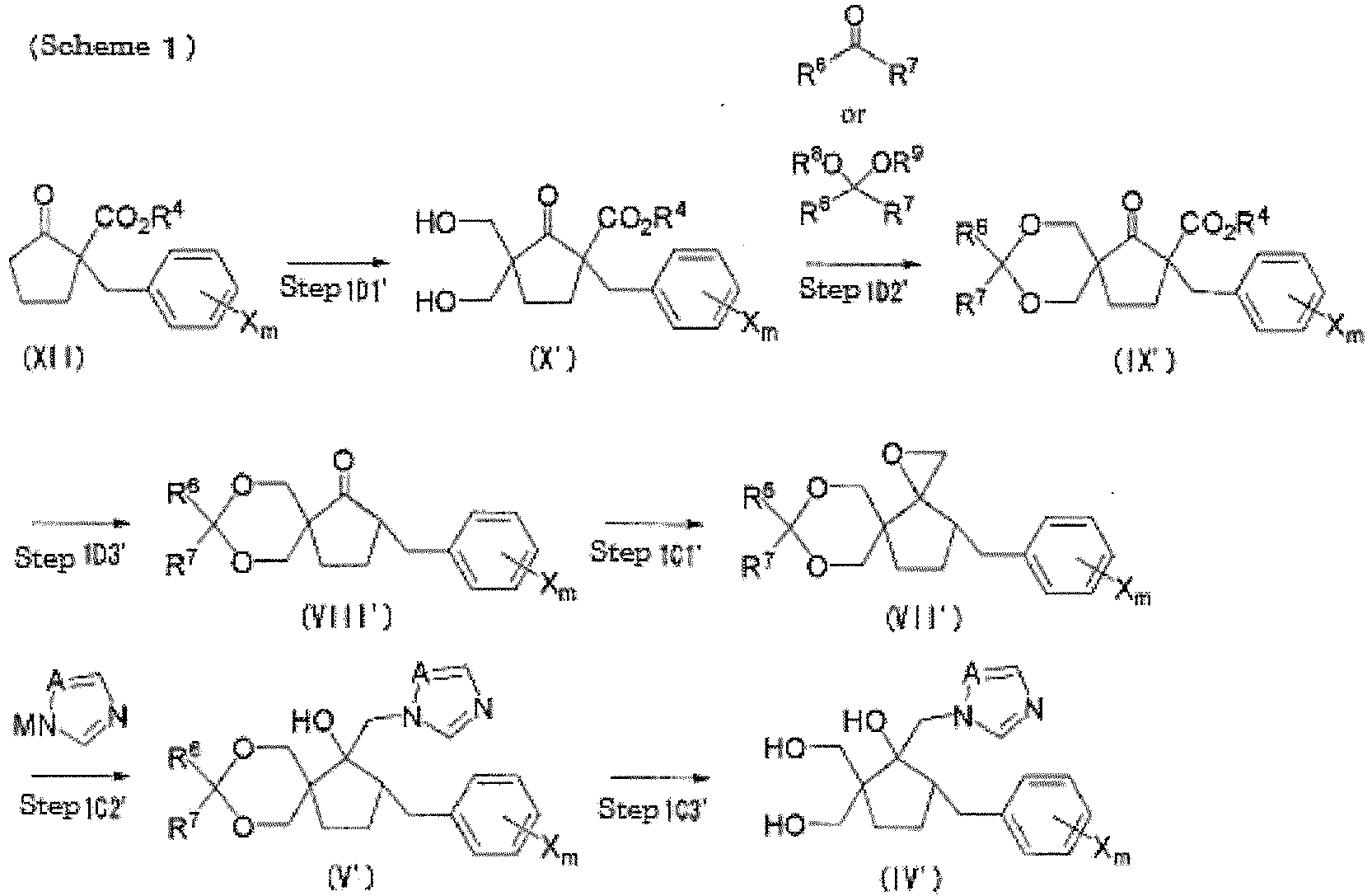
- Hereinafter, each step will be described.
- In Step 1D1', which is one form of Step 1D1, Compound (XII) described above is hydroxymethylated in order to obtain a compound (Compound (X) where n1 is 1 and n2 is 1; hereinafter, referred to as "Compound (X')") represented by a general formula (X').
- As a method for hydroxymethylating Compound (XII), for example, Compound (XII) is reacted with formaldehyde or a formaldehyde derivative in a solvent in the presence of a base.
- Examples of the base encompass: carbonates of an alkaline metal such as sodium carbonate, potassium carbonate, sodium hydrogen carbonate, and potassium hydrogen carbonate; hydroxides of alkaline metal such as sodium hydroxide; and organic bases such as triethylamine, however, the base is not limited thereto. An amount of the base per mole of Compound (XII) is, for example, 0.01 mole to 10 moles, and more preferably 0.1 mole to 5 moles.
- A reaction temperature is, for example, 0°C to 250°C, and preferably 0°C to 100°C. A reaction time is, for example, 0.1 hour to several days, and preferably 0.5 hour to 2 days.
- The solvent is not particularly limited. Examples of the solvent encompass: ethers such as diethyl ether, tetrahydrofuran (THF), dimethoxyethane, and dioxane; aromatic hydrocarbons such as benzene, toluene, and xylene; and alcohols such as methanol and ethanol, amides such as N-methylpyrrolidone, N,N-dimethylacetamide, and N,N-dimethylformamide; and water, and those solvents may be used in combination as necessary. Note that, in the case where the reaction system forms two phases, it is preferable to use a phase transfer catalyst such as a customary quaternary ammonium salt (e.g., benzyltriethylammonium chloride).
- Examples of the formaldehyde derivative encompass paraformaldehyde, 1,3,5-trioxane, and formaldehyde dialkyl acetal.
- An amount of the formaldehyde or the formaldehyde derivative employed per mole of Compound (XII) is, for example, 1 mole to 40 moles, and preferably 1.6 moles 20 moles.
- In Step 1D2', which is one form of Step 1D2, protective groups respectively for protecting each hydroxy group in respective two hydroxymethyl groups of Compound (X') are introduced with use of a compound simultaneously, thereby obtaining a compound (hereinafter, referred to as "Compound (IX')") represented by a general formula (IX').
- As a method for introducing a protective group for a hydroxy group of Compound (X'), for example, Compound (X') is reacteded with acetal or ketone in the presence of acid.
- As acetal, a compound represented by the following general formula (XIV) may be used.

- R6 and R7 in the formula (XIV) are identical with functional groups represented by R6 and R7 in the azole derivative (V'). R8 and R9 independently represent a C1-C4 alkyl group such as a methyl group and an ethyl group.
- Further, as ketone, a compound represented by the following general formula (XV) can be used.

- R6 and R7 in the formula (XV) are identical with functional groups represented by R6 and R7 in the azole derivative (V').
- An amount of acetal or ketone employed per mole of Compound (X') is, for example, 0.5 mole to 20 moles, and preferably 0.8 mole to 10 moles.
- Examples of the acid encompass: inorganic acids such as hydrochloric acid, phosphoric acid, and sulfuric acid; and organic acids such as p-toluenesulfonic acid, methanesulfonic acid, and trifluoroacetic acid. An amount of the acid employed per mole of Compound (X') is, for example, 0.001 mole to 10 moles, and preferably 0.002 mole to 2 moles.
- A reaction temperature is, for example, 0°C to 200°C, and preferably 0°C to 100°C. A reaction time is, for example, 0.1 hour to several days, and preferably 0.5 hour to 2 days.
- In Step 1D3', which is a form of Step 1D3, Compound (IX') is hydrolyzed and decarbonated in order to obtain a compound (hereinafter, referred to as "Compound (VIII')") represented by a general formula (VIII').
- As a method for hydrolyzing/decarbonating Compound (IX'), for example, Compound (IX') is reacted in a solvent in the presence of a base.
- As the base, an alkaline metal salt base such as sodium hydroxide or potassium hydroxide can be preferably used. An amount of the base employed per mole of Compound (IX') is, for example, 0.1 mole to 50 moles, and preferably 0.2 mole to 20 moles.
- Examples of the solvent encompass water, water combined with alcohols, a solvent composition consisting of solvents which do not form a homogenous layer (such as water and toluene). When using a solvent which does not form a homogenous layer, a phase transfer catalyst (e.g., a customary quaternary ammonium salt) may be used in the reaction system.
- A reaction temperature is, for example, 0°C to a reflux temperature, and preferably a room temperature to the reflux temperature. A reaction time is, for example, 0.1 hour to several days, and preferably 0.5 hour to 24 hours.
- In Step 1C1' which is one form of Step 1C1, Compound (VIII') is converted into oxirane in order to obtain an oxirane derivative (hereinafter, referred to as "oxirane derivative (VII')") represented by the general formula (VII').
- As a method for converting Compound (VIII') into oxirane, for example, Compound (VIII') and sulfur ylide are reacted with each other in a solvent.
- Examples of the sulfur ylide encompass: sulfonium methylides such as dimetylsulfonium methylide; and sulfoxonium methylides such as dimethylsulfoxonium methylide. Sulfonium methylides and sulfoxonium methylides employed can be produced by reacting, in a solvent, a sulfonium salt (e.g., sulfonium halide such as trimethylsulfonium iodide and trimethylsulfonium bromide) or a sulfoxonium salt (e.g., sulfoxonium halide such as trimethylsulfoxonium iodide and trimethylsulfoxonium bromide (TMSOB)) with a base. In this case, an amount of the sulfonium methylides or sulfoxonium methylides employed per mole of Compound (VIII') is preferably 0.5 mole to 5 moles, and more preferably 0.8 mole to 2 moles.
- The solvent is not particularly limited, and examples of the solvent encompass: amides such as N-methylpyrrolidone (NMP), N,N-dimethylacetamide (DMA); and N,N-dimethylformamide (DMF); ethers such as tetrahydrofuran and dioxane; dimethylsulfoxide; and mixture solvent thereof.
- The base for use in production of sulfonium methylides or sulfoxonium methylides is not particularly limited. It is preferable to use a base such as a metal hydride (e.g., sodium hydride) or an alkoxide of alkalin metal (e.g., sodium methoxide, sodium ethoxide, sodium t-butoxide, and potassium t-butoxide).
- A reaction temperature and a reaction time are set appropriately in accordance with the kinds of solvent, Compound (VIII'), sulfonium salt or sulfoxonium salt, and base. The reaction temperature is, for example, -100°C to 200°C, and preferably -50°C to 150°C. The reaction time is, for example, 0.1 hour to several days, and preferably 0.5 hour to 2 days.
- In Step 1C2', which is one form of Step 1C2, an oxirane derivative (VII') is converted into azole in order to obtain an azole derivative (V').
- As a method for converting the oxirane derivative (VII') into azole, for example, the oxirane derivative (VII') is reacted with Compound (VI) described above in a solvent. More specifically, the oxirane derivative (VII') and Compound (VI) are mixed with each other in the solvent, which results in producing a carbon-nitrogen bond between a carbon atom constituting an oxirane ring in the oxirane derivative (VII') and a nitrogen atom of 1,2,4-triazole or imidazole. Thus the azole derivative (V') is produced.
- While the solvent is not particularly limited, for example, amides such as N-methylpyrrolidone, N,N-dimethylacetamide, and N,N-dimethylformamide can be used.
- An amount of Compound (VI) employed per mole of the oxirane derivative (VII') is, for example, 0.5 mole to 10 moles, and preferably 0.8 mole to 5 moles. Further, a base may be added as necessary. In the case of adding the base, an amount of the base employed per mole of the oxirane derivative (VII') is, for example, 0 mole to 5 moles (excluding 0), and more preferably 0.5 mole to 2 moles.
- A reaction temperature can be set appropriately in accordance with the kind of solvent or base, and is, for example, preferably 0°C to 250°C, and preferably 10°C to 150°C. A reaction time can be set appropriately in accordance with the kinds of solvent or base, and is, for example, 0.1 hour to several days, and more preferably 0.5 hour to 2 days.
- As described above, it is possible to produce the azole derivative (V') by producing the oxirane derivative (VII') and then reacting it stepwise with Compound (VI). However, when a reaction for conversion of Compound (VIII') into an oxirane is carried out alone in the first synthetic method described above, a by-product (such as an oxetane derivative) is produced, resulting in a reduced yield. In order to avoid this reduced yield, it is necessary to carry out conversion into azole may be carried out while producing Compound (VII') (see the following reaction formula (4')).

- In such a case, Compound (VIII') and Compound (VI) are dissolved in (i) a polar solvent having an amide bond, (ii) dimethyl sulfoxide, or (iii) a mixture solvent of a polar solvent and alcohol. Then, to this, a sulfonium salt such as trimethylsulfonium salt or a sulfoxonium salt such as trimethylsulfoxonium salt and a base are added to produce sulfonium methylides such as dimetylsulfonium methylide or sulfoxonium methylides such as dimethyl sulfoxonium methylide in the reaction system. Then the oxirane derivative (VII') is produced while being converted into azole. In this case, in the case where it is preferable to intermittently add at least one of (i) a sulfonium salt such as a trimethylsulfonium salt or a sulfoxonium salt such as a trimethylsulfoxonium salt and (ii) a base, it is preferable to intermittently add one of them or both of them.
- Examples of the solvent encompass: a polar solvent having an amide bond such as N-methylpyrrolidone, N,N-dimethylacetamide, and N,N-dimethylformamide; and dimethylsulfoxide. Further, the alcohol in the mixture solvent is, for example, t-butanol.
- The base for use in production of sulfonium methylides or sulfoxonium methylides is not particularly limited. Examples of base encompass metal hydrides such as sodium hydride and alkoxide of alkalin metal such as sodium methoxide, sodium ethoxide, sodium t-butoxide, and potassium t-butoxide. Further, alkaline metal salt of 1,2,4-triazole or imidazole may be used.
- A reaction temperature can be set appropriately in accordance with the kinds of solvent, Compound (VIII'), sulfonium salt or sulfoxonium salt, and base. The reaction temperature is, for example, -100°C to 250°C, and preferably -50°C to 200°C. A reaction time can be set appropriately in accordance with the kinds of solvent, Compound (VIII'), sulfonium salt or sulfoxonium salt, and base. The reaction time is, for example, 0.1 hour to several days, and preferably 0.5 hour to 2 days.
- The number of times at least one of (i) sulfonium salt such as trimethylsulfonium salt or sulfoxonium salt such as trimethylsulfoxonium salt and (ii) a base is intermittently added is not particularly limited provided that it is the number of times allowing a predetermined aim to be accomplished. A preferable number of times is 2 times to 20 times, and more preferably 3 times to 15 times. A total amount of sulfonium salt or sulfoxonium salt employed per mole of Compound (VIII') is preferably 0.5 mole to 5 moles, and more preferably 0.8 mole to 2 moles.
- An amount of Compound (VI) employed per mole of Compound (VIII') is, for example, 0.5 mole to 10 moles, and preferably 0.8 mole to 5 moles. It is preferable to use Compound (VI) in which M is an alkaline metal.
- Further, in Step 1C3', which is one form of Step 1C3, a protective group of the azole derivative (V') is deprotected in order to obtain the azole derivative (IV') from the azole derivative (V').
- As a method for deprotecting the protective group of the azole derivative (V'), for example, the azole derivative (V') is reacted in a solvent in the presence of acid.
- The solvent employed is not particularly limited provided that a deprotecting reaction is carried out. As the solvent, for example, both of a solvent which forms a homogenous layer with water such as alcohols (e.g., methanol and ethanol) and a solvent which does not form a homogenous layer with water such as aromatic hydrocarbons (e.g., toluene and xylene) can be preferably used.
- An inorganic acid can be preferably used as the acid, and examples of the acid encompass halogenated hydrogens such as hydrogen chloride and sulfuric acid. While an amount of the acid employed is not particularly limited, the amount of the acid employed per mole of the azole derivative (V') is, for example, 0.5 mole to 100 moles, and preferably 0.8 mole to 20 moles.
- A reaction temperature is, for example, 0°C to 200°C, and preferably a room temperature to 100°C. A reaction time is, for example, 0.1 hour to several days, and preferably 0.5 hour to 2 days.
- It is possible to preferably produce an azole derivative (V') of the present invention by carrying out those reactions from Step 1D1' to Step 1D3' and those reactions from Step 1C1' to Step 1C2' as described above. Further, it is possible to produce the azole derivative (IV') from the azole derivative (V') by carrying out the reaction of Step 1C3'.
- The azole derivative (IV') can be preferably used as a production intermediate of an azole derivative (hereinafter, referred to as "azole derivative (Ia') ") represented by the following general formula (Ia').

- The azole derivative (Ia') is one form of Compound (Ia), and is a novel azole derivative which is advantageous in exhibiting an excellent biocidal effect on a wide range of microorganisms which are pathogenic to plants. The azole derivative (Ia') is one form of Compound (Ia), and can be produced from the azole derivative (V') by carrying out the above Steps 1B and 1A. The following description will discuss a method for producing the azole derivative (Ia') from the azole derivative (IV') in accordance with Scheme 2.


- In Step 1B', which is one form of Step 1B, the azole derivative (IV') is subjected to ring closing in order to obtain an azole derivative (hereinafter, referred to as "azole derivative (IIIa')") represented by the general formula (IIIa').
- As a preferable method for synthesizing the azole derivative (IIIa'), for example, the azole derivative (IV') is reacted with sulfonyl chlorides in a solvent in the presence of a base.
- Examples of the sulfonyl chlorides encompass p-toluene sulfonyl chloride and methanesulfonyl chloride.
- The base is not particularly limited. Examples of the base encompass metal hydrides such as sodium hydride and alkoxide of alkalin metal such as sodium methoxide, sodium ethoxide, sodium t-butoxide, and potassium t-butoxide.
- An amount of the sulfonyl chlorides employed per mole of the azole derivative (IV') is preferably 1 mole to 2 moles. An amount of the base employed per mole of the azole derivative (IV') is preferably 2.5 moles to 10 moles, and more preferably 2.8 moles to 6 moles.
- The solvent is not particularly limited, and examples of the solvent encompass: amides such as N,N-dimethylacetamide, N-methylpyrrolidone, and N,N-dimethylformamide; ethers such as tetrahydrofuran and dioxane; dimethylsulfoxide; and mixture solvents thereof.
- A reaction temperature can be set appropriately in accordance with the kinds of solvent, azole derivative (IV'), sulfonyl chloride, and base, and is, for example, -100°C to 200°C, and preferably -50°C to 150°C. A reaction time can be set appropriately in accordance with the kinds of solvent, azole derivative (IV'), sulfonyl chloride, and base, and is, for example, 0.1 hour to several days, and preferably 0.5 hour to 2 days.
- In Step 1A1', which is one form of Step 1A1, the azole derivative (IIIa') is alkylated in order to obtain an azole derivative (hereinafter, referred to as "azole derivative (IIa')") represented by the general formula (IIa').
- In the general formula (IIa'), R10 represents a C1-C3 alkyl group. Specific examples of R10 encompass methyl group, ethyl group, 1-methylethyl group, and n-propyl group.
- As a method for alkylating the azole derivative (IIIa'), for example, metalalkoxide prepared from a hydroxy group of the azole derivative (IIIa') and an alkaline metal base is reacted with a C1-C3 alkyl having a leaving group in a solvent at a room temperature.
- Examples of the solvent encompass: ether solvents such as THF; solvents of amides such as N-methylpyrrolidone, and N,N-dimethylacetamide; aromatic solvents such as benzene and toluene; and a halide solvent such as methylene chloride.
- Examples of the alkyl having a leaving group encompass alkyl halide such as iodide and bromide and sulfonic acid ester such as tosyloxyalkyl and mesyloxyalkyl.
- Examples of the alkaline metal base encompass sodium, sodium hydride, sodium hydroxide, and potassium hydroxide.
- In Step 1A2', which is one form of Step 1A2, the azole derivative (IIa') is subjected to ring opening in order to obtain the azole derivative (Ia'). For example, the azole derivative (Ia') can be preferably produced as follows: the azole derivative (IIa') and a halogen acid are mixed with each other in a solvent; and an alkyl halide group and a tertiary hydroxy group are produced by carrying out a ring-opening reaction.
- Examples of the halogen acid encompass hydrogen fluoride, hydrogen chloride, hydrogen bromide, and hydrogen iodide. Among them, the hydrogen chloride and the hydrogen bromide are preferably used. The halogen acid may be introduced as gas, or may be dissolved and then added to a solvent. Note that the azole derivative (Ia') may be obtained from the azole derivative (IIa') by adding a halide salt and another kind of acid (e.g., a toluenesulfonic acid, a methanesulfonic acid, or a sulfuric acid) to thereby produce halogen acid in a system. Examples of the halide salt encompass lithium chloride, lithium bromide, lithium fluoride, sodium chloride, sodium bromide, sodium fluoride, potassium chloride, potassium bromide, and potassium fluoride.
- While the solvent is not particularly limited, examples of the solvent encompass: amides such as N-methylpyrrolidone, N,N-dimethylacetamide, and N,N-dimethylformamide; alcohols such as methanol and ethanol; ethers such as tetrahydrofuran and dioxane; and water.
- A reaction temperature can be set appropriately in accordance with a solvent and a base, and is, for example, -20°C to 250°C, and preferably -10°C to 150°C. A reaction time can be set appropriately in accordance with a solvent and a base, and is, for example, 0.1 hour to several days, and preferably 0.5 hour to 2 days.
- The azole derivative (IV') can be preferably used for producing the azole derivative (Ia') as described above. However, the azole derivative (IV') is not used only as an intermediate compound of the azole derivative (Ia'). For example, the azole derivative (IV') can be also preferably used as an intermediate of an azole derivative represented by the following general formula (XVI). An azole derivative (XVI) is also a novel azole derivative which is advantageous in exhibiting an excellent biocidal effect on a wide range of microorganisms which are pathogenic to plants.

- As described above, the azole derivative (V') is also advantageous in exhibiting an excellent biocidal activity on microorganisms which are pathogenic to plants. Therefore, the azole derivative (V') can be used as an active ingredient of an agro-horticultural agent. An agro-horticultural agent containing the azole derivative (V') is particularly effective for controlling diseases in stems, leaves, seeds of wheat by subjecting the seeds a seed treatment. While the azole derivative (V') can be used solely as the active ingredient of the agro-horticultural agent, i.e., can be used without containing any other components, the azole derivative (V') is usually used in various forms, such as a dust formulation, wettable powder, granule, and emulsifiable concentrate, by mixing the azole derivative (V') with a solid carrier, a liquid carrier, a surfactant, and other formulation auxiliary agents. A carrier and an auxiliary agent are not particularly limited, and it is possible to appropriately select any carrier and auxiliary agent from those which have been conventionally used for the agro-horticultural agent. For example, the following carriers and auxiliary agents can be used. Further, a mixture ratio thereof can be selected from various ratios, and is not limited to ratios described in the following Examples. Further, the seeds which have been subjected to the seed treatment with use of the agro-horticultural agent containing the azole derivative (V') are also encompassed in the present invention.
- The following description will discuss a second method for producing an azole derivative of the present invention.
- Among azole derivatives of the present invention a compound (hereinafter, referred to as "Compound (Ib)") represented by the following general formula (Ib) is produced in Step 2A. Hereinafter, the method for producing Compound (Ib) in Step 2A will be described.

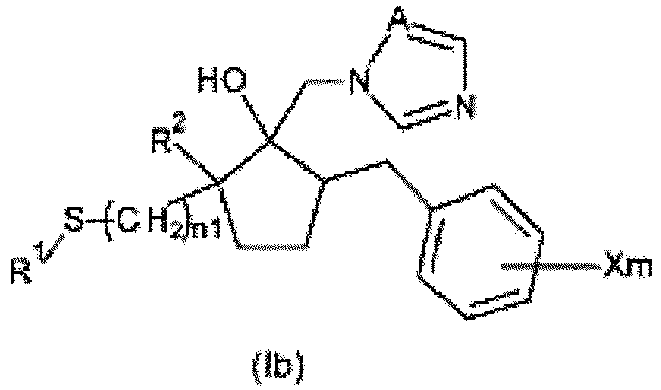
- The second method for producing Compound (Ib) includes the steps of: thioetherifying Compound (IIIa) with use of a condensing agent; and obtaining Compound (Ib) by reacting the resultant compound represented by the following general formula (IIb) with an arbitrary halogen acid to open a heterocycle having an oxygen atom (Step 2A: see the following reaction formula (7)).
Reaction formula (7)

- In Step 2A, the following description will discuss more specifically a step (Step 2A1) in which Compound (IIb) is obtained by condensing Compound (IIIa) to thioetherify Compound (IIIa). Note that, in order to obtain Compound (IIIa), a method similar to the method described in the first method for producing Compound (I) described above may be used.
- While the method for condensing Compound (IIIa) is not particularly limited, a method for thioetherifying a hydroxy group in Compound (IIIa) with alkyl thiol (R1SH) with use of an acid catalyst or a condensing agent can be preferably used.
- The acid catalysts such as acid aqueous solutions (e.g., a sulfuric acid and hydrochloric acid) and organic acids (e.g., formic acid and acetic acid) can be preferably used. Further, as the condensing agent, DCC can be preferably used.
- As to a step (Step 2A2) of obtaining Compound (Ib) by subjecting Compound (IIb) used in Step 2A to ring opening, Compound (Ib) can be obtained in the same way as Compound (Ia) except that Compound (IIb) is used instead of Compound (IIa) and Compound (IIb) is subjected to ring opening to obtain Compound (Ib) in the above Step 1A2.
- Further, Compound (IIIa) can be obtained by performing Step 1B, Step 1C, and Step 1D described above.
- The following description will discuss a third method for producing an azole derivative in accordance with the present invention.
- Among the azole derivatives of the present invention, Compound (Ib) is produced in Step 3A as well as Step 2A described above. The following description will discuss a method for producing Compound (1b) in Step 3A.
- The method for producing Compound (Ib) includes the steps of: halogenating Compound (IIIa); thioetherifying the resultant halogenated Compound (IIIb); opening, with use of an arbitrary halogen acid, a heterocycle containing an oxygen atom of Compound (IIb) which has been obtained by such thioetherification in order to obtain Compound (Ib) (Step 3A: see the following reaction formula (8)).
Reaction formula (8)
- In Step 3A, the following description will discuss more specifically a step (Step 3A1) of halogenating Compound (IIIa) in order to obtain Compound (IIIb). Note that Compound (IIIa) can be obtained by a method similar to the method described in the first method for producing Compound (I) described above.
- While the method for halogenating Compound (IIIa) is not particularly limited, there can be employed a method with use of a hydrochloric acid, thionyl chloride, an aqueous hydrogen bromide solution, or the like can be used.
- The following description will discuss a step (Step 3A2) of carrying out a thioetherification reaction with respect to Compound (IIIb) in Step 3A in order to obtain Compound (IIb).
- While the method of carrying out the thioetherification reaction is not particularly limited, a method for thioetherifying a hydroxy group of Compound (IIIa) with use of alkyl thiol (R1SH) in the presence of a base catalyst can be preferably used.
- Examples of the base encompass: inorganic bases such as sodium hydroxide, potassium hydroxide, and potassium carbonate; and organic bases such as triethylamine and pyridine.
- As to a step (Step 3A3) of subjecting Compound (IIb) to ring opening to obtain Compound (Ib), Compound (Ib) can be obtained in the same way as Compound (Ia) which is obtained by opening the ring of Compound (IIa) in the above Step 1A2 except that Compound (IIb) is used instead of Compound (IIa) and Compound (IIb) is subjected to ring opening to obtain Compound (Ib) in Step 1A2.
- Further, Compound (IIIa) can be obtained by carrying out Step 1B, Step 1C, and Step 1D described above.
- The following description will discuss a fourth method for producing an azole derivative in accordance with the present invention.
- Among the azole derivatives of the present invention, a compound represented by the following general formula (Ic) (hereinafter, referred to as "Compound (Ic)") is produced in Step 4A. The following description will discuss a method for producing Compound (Ic) in Step 4A.

- The method for producing Compound (Ic) includes the steps of: reacting Compound (IIIa) with substituted sulfonyl chloride to sulfonylate Compound (IIIa); aminating a compound which has been obtained through such sulfonylation, which compound is represented by the following general formula (IIIc); and opening, with use of an arbitrary halogen acid, a heterocycle containing an oxygen atom in a compound which has been obtained through such amination, which compound is represented by the following general formula (IIc), in order to obtain Compound (Ic) (Step 4A: see the following reaction formula (9)).
Reaction formula (9)

- R5 represents a lower alkyl group, a phenyl group, or a naphthyl group. Examples of the lower alkyl group encompass methyl group, ethyl group, n-propyl group, isopropyl group, and trifluoromethyl group. The phenyl group and the naphthyl group may be configured such that one or more hydrogen atoms are substituted. Examples of a substituted phenyl group or a substituted naphthyl group encompass 4-methylphenyl group, 2-nitrophenyl group, and 5-dimethylamino naphthyl group. In particular, R5 preferably represents a methyl group or a 4-methylphenyl group.
- The following description will discuss a step (Step 4A1) of obtaining sulfonylated Compound (IIIc) by reacting Compound (IIIa) with substituted sulfonyl chloride in Step 4A. Note that, in order to obtain Compound (IIIa), a method similar to the method described in the first method for producing Compound (I) described above can be used.
- While the method for sulfonylating Compound (IIIa) is not particularly limited, substituted sulfonic acid ester may be obtained by, for example, reacting a hydroxy group of Compound (IIIa) with substituted sulfonyl chloride in the presence of a base. Examples of the substituted sulfonyl chloride encompass p-toluene sulfonyl chloride and methanesulfonyl chloride.
- The following description will discuss a step (Step 4A2) of aminating Compound (IIIc) obtained in Step 4A1 in order to obtain Compound (IIc).
- While the method for aminating Compound (IIIc) is not particularly limited, for example, Compound (IIIc) can be reacted with alkylamine.
- Alternatively, a method for obtaining Compound (IIc) may include the steps of: halogenating Compound (IIIa); and aminating the resultant Compound (IIIb) (see the following reaction formula (10)).
Reaction formula (10)
- Compound (IIIb) can be obtained from Compound (IIIa) by the above method as well as Step 3A1 described above. Further, Compound (IIc) can be produced by reacting a haloalkyl group of Compound (IIIb) with alkylamine (R1R3NH).
- Examples of the base encompass: inorganic bases such as sodium hydroxide, potassium hydroxide, and potassium carbonate; and organic bases such as triethylamine and pyridine.
- As to a step (Step 4A3) of obtaining Compound (Ic) by subjecting Compound (IIc) used in Step 4A to ring opening, Compound (Ic) can be obtained in the same way as Compound (Ia) which is obtained by subjecting Compound (IIa) to ring opening in the above Step 1A2 except that Compound (IIc) is used instead of Compound (IIa) and Compound (IIc) is subjected to ring opening to obtain Compound (Ia) in Step 1A2.
- Further, Compound (IIIa) can be obtained by carrying out Step 1B, Step 1C, and Step 1D described above.
- The following description will discuss the usability of an agro-horticultural agent and an industrial material protecting agent (hereinafter, also referred to as "agro-horticultural agent etc.") containing an azole derivative (see Compound (I)) of the present invention as an active ingredient.
- An agro-horticultural agent containing Compound (I) as an active ingredient exhibits a controlling effect on a broad range of plant diseases. Examples of diseases are as follows.
- Soybean rust (Phakopsora pachyrhizi, Phakopsora meibomiae), rice blast (Pyricularia grisea), rice brown spot (Cochliobolus miyabeanus), rice leaf blight (Xanthomonas oryzae), rice sheath blight (Rhizoctonia solani), rice stem rot (Helminthosporium sigmoideun), rice Bakanae disease (Gibberella fujikuroi), rice bacterial seedling blight (Pythium aphanidermatum), apple powdery mildew (Podosphaera leucotricha), apple scab (Venturia inaequalis), apple blossom blight (Monilinia mali), apple alternaria blotch (Alternaria alternata), apple valsa canker (Valsa mali), pear black spot (Alternaria kikuchiana), pear powdery mildew (Phyllactinia pyri), pear rust (Gymnosporangium asiaticum), pear scab (Venturia nashicola), grape powdery mildew (Uncinula necator), grape downy mildew (Plasmopara viticola), grape ripe rot (Glomerella cingulata), barley powdery mildew (Erysiphe graminis f. sp hordei), barley stem rust (Puccinia graminis), barley stripe rust (Puccinia striiformis), barley stripe (Pyrenophora graminea), barley leaf blotch (Rhynchosporium secalis), wheat powdery mildew (Erysiphe graminis f. sp tritici), wheat brown rust (Puccinia recondita), wheat stripe rust (Puccinia striiformis), wheat eye spot (Pseudocercosporella herpotrichoides), wheat Fusarium blight (Fusarium graminearum, Microdochium nivale), wheat glume blotch (Phaeosphaeria nodorum), wheat leaf blight (Septoria tritici), gourd powdery mildew (Sphaerotheca fuliginea), gourd anthracnose (Colletotrichum lagenarium), cucumber downy mildew (Pseudoperonospora cubensis), cucumber phytophthora rot (Phytophthora capsici), tomato powdery mildew (Erysiphe cichoracearum), tomato early blight (Alternaria solani), eggplant powdery mildew (Erysiphe cichoracearum), strawberry powdery mildew (Sphaerotheca humuli), tobacco powdery mildew (Erysiphe cichoracearum), sugar beet cercpspora leaf spot (Cercospora beticola), maize smut (Ustillaga maydis), plum brown rot (Monilinia fructicola), various plants-affecting gray mold (Botrytis cinerea), sclerotinia rot (Sclerotinia sclerotiorum) and the like may be exemplified. Among them, wheat leaf blight (Septoria tritici), which is a critical disease in wheat, is particularly applicable.
- Examples of applicable plants may be, for example, wild plants, cultivated plant cultivars, plants and cultivated plant cultivars obtained by conventional biological breeding such as heterologous mating or plasma fusion, and plants and cultivated plant cultivars obtained by genetic engineering. The genetically-engineered plants and the cultivated plant cultivars may be, for example, herbicide-resistant crops, vermin-resistant crops having insecticidal protein-producing genes integrated therein, disease-resistant crops having disease resistance inducer-producing genes integrated therein, palatably improved crops, productively improved crops, preservably improved crops, and productively improved crops. The genetically-engineered cultivated plant cultivars may be, for example, those involving trademarks such as ROUNDUP READY, LIBERTY LINK, CLEARFIELD, YIELDGARD, HERCULEX, BOLLGARD and the like.
- Furthermore, on a broad range of crops and horticultural plants, the agro-horticultural agent containing Compound (I) as the active ingredient exhibits yield-increasing effects and quality-improving effects by regulating the growth of the crops and plants. Such crops may be, for example, those listed below.
- Wheat, barley, oats, rice, rapeseed, sugarcane, corn, maize, soybean, pea, peanut, sugar beet, cabbage, garlic, radish, carrot, apple, pear, citric fruits such as mandarin, orange, and lemon, peach, cherry, avocado, mango, papaya, red pepper, cucumber, melon, strawberry, tobacco, tomato, eggplant, lawn grass, chrysanthemum, azalea, and other ornamental plants.
- Moreover, an industrial material protecting agent containing Compound (I) as the active ingredient exhibits an excellent ability of protecting an industrial material from a broad spectrum of hazardous microorganisms which invade such a material. Examples of such microorganisms are listed below.
- Paper/pulp deteriorating microorganisms (including slime-forming microorganisms) such as Aspergillus sp., Trichoderma sp., Penicillium sp., Geotrichum sp., Chaetomium sp., Cadophora sp., Ceratostomella sp., Cladosporium sp., Corticium sp., Lentinus sp., Lenzites sp., Phoma sp., Polysticus sp., Pullularia sp., Stereum sp., Trichosporium sp., Aerobacter sp., Bacillus sp., Desulfovibrio sp., Pseudomonas sp., Flavobacterium sp., and Micrococcus sp.; fiber-deteriorating microorganisms such as Aspergillus sp., Penicillium sp., Chaetomium sp., Myrothecium sp., Curvularia sp., Gliomastix sp., Memnoniella sp., Sarcopodium sp., Stachybotrys sp., Stemphylium sp., Zygorhynchus sp., Bacillus sp. and Staphylococcus sp.; lumber-deteriorating microorganisms such as Tyromyces palustris, Coriolus versicolor, Aspergillus sp., Penicillium sp., Rhizopus sp., Aureobasidium sp., Gliocladium sp., Cladosporium sp., Chaetomium sp., and Trichoderma sp.; leather-deteriorating microorganisms such as Aspergillus sp., Penicillium sp., Chaetomium sp., Cladosporium sp., Mucor sp., Paecilomyces sp., Pilobus sp., Pullularia sp., Trichosporon sp., and Tricothecium sp.; rubber/plastic-deteriorating microorganisms such as Aspergillus sp., Penicillium sp., Rhizopus sp., Trichoderma sp., Chaetomium sp., Myrothecium sp., Streptomyces sp., Pseudomonas sp., Bacillus sp., Micrococcus sp., Serratia sp., Margarinomyces sp., and Monascus sp.; paint-deteriorating microorganisms such as Aspergillus sp., Penicillium sp., Cladosporium sp., Aureobasidium sp., Gliocladium sp., Botryodiplodia sp., Macrosporium sp., Monilia sp., Phoma sp., Pullularia sp., Sporotrichum sp., Trichoderma sp., Bacillus sp., Proteus sp., Pseudomonas sp., and Serratia sp.
- An agro-horticultural formulation containing Compound (I) as an active ingredient may contain various components other than Compound (I). For example, the agro-horticultural formulation containing Compound (I) as an active ingredient may contain a solid carrier, a liquid carrier, a surfactant, and other formulation auxiliary agents. The agro-horticultural formulation containing Compound (I) as an active ingredient may have various dosage forms such as a dust formulation, wettable powder, granule, and emulsifiable concentrate.
- The agro-horticultural formulation may contain Compound (I) as an active ingredient in an amount of 0.1 to 95% by weight based on the total amount of the agro-horticultural formulation. Compound (I) as an active ingredient is contained preferably in an amount of 0.5 to 90% by weight, and more preferably 2 to 80% by weight.
- Carriers, diluents, and surfactants employed as formulation auxiliary agents are exemplified below. Examples of the solid carriers encompass talc, kaolin, bentonite, diatomaceous earth, white carbon, and clay. Examples of the liquid diluents encompass water, xylene, toluene, chlorobenzene, cyclohexane, cyclohexanone, dimethyl sulfoxide, dimethyl formamide, and alcohols. The surfactant can be employed depending on its effect. In the case where the surfactant is an emulsifier, the emulsifier may be, for example, polyoxiethylene alkylaryl ether, polyoxyethylene sorbitan monolaurate and the like. In the case where the surfactant is a dispersing agent, the dispersing agent may be, for example, lignin sulfonate salt, or dibutylnaphthalene sulfonate salt. In the case where the surfactant is a wetting agent, the wetting agent may be, for example, an alkyl sulfonate salt or alkylphenyl sulfonate salt.
- The formulation may be used as it is, or used as being diluted in a diluent such as water to a predetermined concentration. In the case where the formulation is used as being diluted, the concentration of Compound (I) in a spray solution is preferably 0.001% to 1.0%.
- The amount of the agro-horticultural agent containing Compound (I) employed per one hectare of the agro-horticultural field such as a farm, paddy field, orchard, or greenhouse is 20 g to 5000 g, and more preferably 50 g to 2000 g. However, because the concentration and the amount may vary depending on the dosage form, timing of use, method for use, place of use, subject crop, and the like, it is possible to increase or decrease the concentration and the amount regardless of the ranges mentioned above.
- In addition, the agro-horticultural agent in accordance with the present invention can be used by containing active ingredients other than Compound (I), including bactericides, insecticides, acaricides, and herbicides, such as those listed below, thereby enabling the use as an agro-horticultural agent having an enhanced performance.
- Acibenzolar-S-methyl, 2-phenylphenol (OPP), azaconazole, azoxystrobin, amisulbrom, bixafen, benalaxyl, benomyl, benthiavalicarb-isopropyl, bicarbonate, biphenyl, bitertanol, blasticidin-S, borax, Bordeaux mixture, boscalid, bromuconazole, bronopol, bupirimate, sec-butylamine, calcium polysulphide, captafol, captan, carbendazim, carboxin, carpropamid, quinomethionate, chloroneb, chloropicrin, chlorothalonil, chlozolinate, cyazofamid, cyflufenamid, cymoxanil, cyproconazole, cyprodinil, dazomet, debacarb, dichlofluanid, diclocymet, diclomezine, dicloran, diethofencarb, difenoconazole, diflumetorim, dimethomorph, dimethoxystrobin, diniconazole, dinocap, diphenylamine, dithianon, dodemorph, dodine, edifenphos, epoxiconazole, ethaboxam, ethoxyquin, etridiazole, enestroburin, famoxadone, fenamidone, fenarimol, fenbuconazole, fenfuram, fenhexamid, fenoxanil, fenpiclonil, fenpropidin, fenpropimorph, fentin, ferbam, ferimzone, fluazinam, fludioxonil, flumorph, fluoroimide, fluoxastrobin, fluquinconazole, flusilazole, flusulfamide, flutolanil, flutriafol, folpet, fosetyl-Al, fuberidazole, furalaxyl, furametpyr, fluopicolide, fluopyram, guazatine, hexachlorobenzene, hexaconazole, hymexazol, imazalil, imibenconazole, iminoctadine, ipconazole, iprobenfos, iprodione, iprovalicarb, isoprothiolane, isopyrazam, isotianil, kasugamycin, copper preparations, such as:copper hydroxide, copper naphthenate, copper oxychloride, copper sulphate, copper oxide, oxine copper, kresoxim-methyl, mancopper, mancozeb, maneb, mandipropamid, mepanipyrim, mepronil, metalaxyl, metconazole, metiram, metominostrobin, mildiomycin, myclobutanil, nitrothal-isopropyl, nuarimol, ofurace, oxadixyl, oxolinic acid, oxpoconazole, oxycarboxin, oxytetracycline, pefurazoate, orysastrobin, penconazole, pencycuron, penthiopyrad, pyribencarb, fthalide, picoxystrobin, piperalin, polyoxin, probenazole, prochloraz, procymidone, propamocarb, propiconazole, propineb, proquinazid, prothioconazole, pyraclostrobin, pyrazophos, pyrifenox, pyrimethanil, pyroquilon, quinoxyfen, quintozene, silthiopham, simeconazole, spiroxamine, Sulfur and sulfur formulations, tebuconazole, tecloftalam, tecnazen, tetraconazole, thiabendazole, thifluzamide, thiophanate-methyl, thiram, thiadinil, tolclofos-methyl, tolylfluanid, triadimefon, triadimenol, triazoxide, tricyclazole, tridemorph, trifloxystrobin, triflumizole, triforine, triticonazole, validamycin, vinclozolin, zineb, ziram, zoxamide, amisulbrom, sedaxane, flutianil, valiphenal, ametoctradin, dimoxystrobin, metrafenone, hydroxyisoxazole, metasulfocarb and the like.
- Abamectin, acephate, acrinathrin, alanycarb, aldicarb, allethrin, amitraz, avermectin, azadirachtin, azamethiphos, azinphos-ethyl, azinphos-methyl, azocyclotin, Bacillus firmus, Bacillus subtilis, Bacillus thuringiensis, bendiocarb, benfuracarb, bensultap, benzoximate, bifenazate, bifenthrin, bioallethrin, bioresmethrin, bistrifluron, buprofezin, butocarboxim, butoxycarboxim, cadusafos, carbaryl, carbofuran, carbosulfan, cartap, CGA50439, chlordane, chlorethoxyfos, chlorphenapyr, chlorfenvinphos, chlorfluazuron, chlormephos, chlorpyrifos, chlorpyrifos methyl, chromafenozide, clofentezine, clothianidin, chlorantraniliprole, coumaphos, cryolite, cyanophos, cycloprothrin, cyfluthrin, cyhalothrin, cyhexatin, cypermethrin, cyphenothrin, cyromazine, Cyazapyr, cyenopyrafen, DCIP, DDT, deltamethrin, demeton-S-methyl, diafenthiuron, diazinon, dichlorophen, dichloropropene, dichlorvos, dicofol, dicrotophos, dicyclanil, diflubenzuron, dimethoate, dimethylvinphos, dinobuton, dinotefuran, emamectin, endosulfan, EPN, esfenvalerate, ethiofencarb, ethion, ethiprole, ethofenprox, ethoprophos, etoxazole, famphur, fenamiphos, fenazaquin, fenbutatin oxide, fenitrothion, fenobucarb, fenothiocarb, fenoxycarb, fenpropathrin, fenpyroximate, fenthion, fenvalerate, fipronil, flonicamid, fluacrypyrim, flucycloxuron, flucythrinate, flufenoxuron, flumethrin, fluvalinate, flubendiamide, formetanate, fosthiazate, halfenprox, furathiocarb, halofenozide, gamma-HCH, heptenophos, hexaflumuron, hexythiazox, hydramethylnon, imidacloprid, imiprothrin, indoxacarb, isoprocarb, isoxathion, lufenuron, malathion, mecarbam, metam, methamidophos, methidathion, methiocarb, methomyl, methoprene, methothrin, methoxyfenozide, metolcarb, milbemectin, monocrotophos, naled, nicotine, nitenpyram, novaluron, noviflumuron, omethoate, oxamyl, oxydemethon methyl, parathion, permethrin, phenthoate, phorate, phosalone, phosmet, phosphamidon, phoxim, pirimicarb, pirimiphos-methyl, profenofos, propoxur, prothiophos, pymetrozin, pyrachlophos, pyrethrin, pyridaben, pyridalyl, pyrimidifen, pyriproxifen, pyrifluquinazon, pyriprole, quinalphos, silafluofen, spinosad, spirodiclofen, spiromesifen, spirotetramat, sulfluramid, sulphotep, SZI-121, tebufenozid, tebufenpyrad, tebupirimphos, teflubenzuron, tefluthrin, temephos, terbufos, tetrachlorvinphos, thiacloprid, thiamethoxam, thiodicarb, thiofanox, thiometon, tolfenpyrad, tralomethrin, tralopyril, triazamate, triazophos, trichlorfon, triflumuron, vamidothion, valifenal, XMC, xylylcarb, imicyafos, lepimectin and the like.
- Ancymidol, 6-benzylaminopurine, paclobutrazol, diclobutrazole, uniconazole, methylcyclopropene, mepiquat chloride, ethefon, chlormequat chloride, inabenfide, prohexadione and its salts, trinexapac-ethyl and the like. As plant hormones, jasmonic acid, brassinosteroid, gibberellin and the like.
- An industrial material protecting agents containing Compound (I) as an active ingredient may contain various components other than Compound (I). The industrial material protecting agents containing Compound (I) as an active ingredient can be used as being dissolved or dispersed in a suitable liquid carrier or as being mixed with a solid carrier. The industrial material protecting agents containing Compound (I) as an active ingredient may further contain an emulsifier, dispersing agent, spreading agent, penetrating agent, wetting agent, stabilizer, and the like. The industrial material protecting agents containing Compound (I) as an active ingredient may have various dosage forms such as a wettable powder, dust formulation, granule, tablet, paste, suspension, and spray. The industrial material protecting agents containing Compound (I) as an active ingredient may contain other biocides, insecticides, deterioration-preventing agent, and the like.
- The liquid carrier is not particularly limited provided that it is unreactive with the active ingredient, and may be selected from water, alcohols (e.g., methyl alcohol, ethyl alcohol, ethylene glycol, and cellosolve), ketones (e.g., acetone and methylethylketone), ethers (for example, dimethyl ether, diethyl ether, dioxane, and tetrahydrofuran), aromatic hydrocarbons (e.g., benzene, toluene, xylene, and methylnaphthalene), aliphatic hydrocarbons (e.g., gasoline, kerosene, paraffin oil, machine oil, and fuel oil), acid amides (e.g., dimethyl formamide, N,N-dimethylacetamide, and N-methylpyrrolidone), halogenated hydrocarbons (e.g., chloroform and carbon tetrachloride), esters (e.g., acetic acid ethyl ester and fatty acid glycerin ester), nitriles (e.g., acetonitrile), and dimethyl sulfoxide and the like.
- The solid carrier may be, for example, a microparticle or a granule of kaolin clay, bentonite, acid clay, pyrophylite, talc, diatomaceous earth, calcite, urea, and ammonium sulfate.
- The emulsifiers and the dispersing agents may be, for example, soaps, alkyl sulfonates, alkylaryl sulfonates, dialkyl sulfosuccinates, quaternary ammonium salts, oxyalkylamines, fatty acid esters, polyalkylene oxide-based surfactants, and anhydrosorbitol-based surfactants.
- Although the content may vary depending on the dosage form and the purpose of use, the concentration may be set to 0.1 % by mass to 99.9% by mass of the entire amount of the formulation in the case where Compound (I) is contained as an active ingredient in a formulation. Upon being used practically, it is preferable that a solvent, diluent, extender, and the like be added appropriately so that the treatment concentration is, for example, 0.005% by mass to 5% by mass, and preferably 0.01% by mass to 1% by mass.
- Note that the agro-horticultural agent and the industrial material protecting agent may contain, as active ingredients, plural compounds which are encompassed in Compound (I).
- As described above, an azole derivative represented by Compound (I) exhibits an excellent biocidal effect on a wide range of microorganisms which are pathogenic to plants. That is, the agro-horticultural disease controlling agent containing an azole derivative represented by Compound (I) as an active ingredient has a low toxicity to humans and animals, are capable of being handled safely, and exhibits a high controlling effect on a wide range of plant diseases.
- Note that, since Compound (I) has a 1,2,4-triazolyl group or an imidazolyl group, Compound (I) forms an acid addition salt of an inorganic acid or an organic acid and a metal complex. Accordingly, Compound (I) can be employed also in the form of such an acid addition salt or the metal complex.
- Furthermore, Compound (I) has at least three asymmetric carbon atoms. Thus, depending on a composition of Compound (I), Compound (I) is a stereoisomer mixture (enantiomer or diastereomer) or either one of the stereoisomers. Accordingly, at least one of these stereoisomers can be employed also as an active ingredient of an agro-horticultural agent and the like.
- The present invention is not limited to the description of the embodiments above, and can be modified in numerous ways by a skilled person as long as such modification falls within the scope of the claims. An embodiment derived from a proper combination of technical means disclosed in different embodiments is also encompassed in the technical scope of the present invention.
- The invention will be embodied below with reference to Production Examples, Formulation Examples, and Test Examples. The invention is not limited to the following Production Examples, Formulation Examples, and Test Examples unless the inventions departs from its scope.
- (1SR,4SR,5RS)-4-(4-chlorobenzyl)-1-methoxymethyl-5-(1 H-[1,2,4]triazole-1-ylmethyl)-6-oxabicyclo-[3,2,0]heptane (Compound (IIa), R1=CH3, Xm=4-Cl, A=N, n1=1, n2=1, isomer type CC; similarly, azole derivative (IIa'), R10=CH3, Xm=4-Cl, A=N) (1.37 g) was dissolved in N,N-dimethylformamide (25 ml), and lithium chloride (2.25 g) and p-toluenesulfonic acid monohydrate (1.12 g) were added, and the resultant mixture was stirred at 80 °C for 2.2 hours. After the reaction, water was added to the mixture, and extraction was performed with use of ethyl acetate. An organic layer of the extract was washed with water and a saturated brine, and dried with use of anhydrous sodium sulfate. The solvent was distilled off, and the resultant crude product was purified by Silica gel column chromatography. The resultant slightly-yellow viscous liquid was recrystallized, and thus the desired substance was obtained.
Yield :78% - The following compounds were synthesized in the same way as the compound in Production Example 1 described above.
- 1H-NMR(CDCl3)δ= 1.31-1.40 (m,1H), 1.55-1.66 (m,1H), 1.79-1.92 (m,2H), 2.22-2.28 (m,2H), 2.80 (m,1H), 3.34 (s,3H), 3.49 (s,2H), 3.69 (d,J=11.0Hz,1H), 3.74 (d,J=11.0Hz,1H), 4.29 (s,1H), 4.49 (d,J=14.2Hz,1H), 4.59 (d,J=14.2Hz,1H), 6.96 (d,J=8.3Hz,2H), 7.21 (d,J=8.5Hz,2H), 8.00 (s,1H), 8.23 (s,1H).
- 1H-NMR(CDCl3)δ= 1.35-1.42 (1H,m), 1.53-1.60 (2H,m), 1.85-1.93 (1H,m), 2.32-2.35 (1H,m), 2.43 (1H, dd,J=13.6,4.3Hz), 2.57 (1H,dd,J=13.6,10.3Hz), 3.04 (1H,d,J=10.5Hz), 3.39 (3H,s), 3.43 (1H,d,J=10.4Hz), 3.47 (1H,d,J=10.4Hz), 3.55 (1H,d,J=10.5Hz), 4.23 (1H,d,J=13.9Hz), 4.58 (1H,d, 13.9Hz), 4.76 (1H,s), 6.92-6.97 (2H,m), 7.06-7.09 (2H,m), 7.98 (1H,s), 8.12 (1H,s)
- 1H-NMR(CDCl3)δ= 1.34-1.41 (1H,m), 1.57-1.65 (2H,m), 1.85-1.93 (1H,m), 2.37-2.39 (1H,m), 2.48 (1H,dd,J=13. 5,4.3Hz), 2.60 (1H,dd,J=13.5,10.2Hz), 3.02 (1H,d,J=10.4Hz), 3.39 (3H,s), 3.43 (1H,d,J=10.5Hz), 3.46 (1H,d,J=10.5Hz), 3.55 (1H,d,J=10.4Hz), 4.23 (1H,d,J=14.0Hz), 4.58 (1H,d, 14.0Hz), 4.77 (1H,s), 7.12-7.14 (2H,d,J=7.0Hz), 7.18-7.28 (3H,m), 7.98 (1H,s), 8.12 (1H,s)
- 1H-NMR(CDCl3)δ= 1.27 (3H,t,J=7.0Hz), 1.34-1.42 (1H,m), 1.48-1.66 (2H,m), 1.89 (1H,ddd,J=13.4,10.9,6.1Hz), 2.29-2.39 (1H,m), 2.45 (1H,dd,J=13.6,3.6Hz), 2.58 (1H,dd,J=13.6,10.2Hz), 3.06 (1H,d,J=10.4Hz), 3.44-3.59 (4H,m), 3.45 (1H,d,J=10.4Hz), 4.23 (1H,d,J=13.9Hz), 4.65 (1H,d,J=13.9Hz), 4.76 (1H,s), 7.06 (2H,d,J=8.4Hz), 7.22 (2H,d,J=8.4Hz), 7.98 (1H,s), 8.18 (1H,s).
- 1H-NMR(CDCl3)δ= 1.28 (3H,t,J=7.0Hz), 1.37-1.41 (1H,m), 1.53-1.62 (2H,m), 1.86-1.94 (1H,m), 2.34-2.37 (1H,m), 2.46 (1H,dd,J=13.6,4.4Hz), 2.58 (1H,dd,J=13.6,10.3Hz), 3.05 (1H,d,J=10.4Hz), 3.46 (1H,d,J=10.4Hz), 3.50 (1H,d,J=10.4Hz), 3.53-3.58 (3H,m), 4.23 (1H,d,J=13.9Hz), 4.66 (1H, d,J=13.9Hz), 4.78 (1H,s), 6.93-6.97 (2H,m), 7.07-7.10 (2H,m), 7.98 (1H,s), 8.19 (1H,s).
- 1H-NMR(CDCl3)δ=
1.28 (3H,t,J=7.0Hz), 1.34-1.41 (1H,m), 1.51-1.69 (2H,m), 1.86-1.94 (1H,m), 2.35-2.43 (1H, m), 2.52 (1H,dd,J=13.4,4.3Hz), 2.62 (1H,dd,J=13.4,10.1Hz), 3.04 (1H,d,J=10.4Hz), 3.45-3.66 (5H,m), 4.24 (1H,d,J=13.9Hz), 4.65 (1H,d,J=13.9Hz), 4.80 (1H,s), 7.13-7.20 (3H,m), 7.25-7.28 (2H,m), 7.98 (1H,s), 8.19 (1H,s) - Similarly, the following compounds were synthesized.
- 1H-NMR(CDCl3) δ= 1.33-1.40 (1H,m), 1.50-1.60 (2H,m), 1.86-1.94 (1H,m), 2.36-2.38 (1H,m), 2.49 (1H,dd,J=13.6,4.5Hz), 2.60 (1H,dd,J=13.6,10.1Hz), 2.86 (1H,d,J=9.6Hz), 3.40 (3H,s), 3.45-3.47 (3H,m), 4.22 (1H,d,J=13.9Hz), 4.58 (1H,d,J=13.9Hz), 4.86 (1H,s), 6.93-6.97 (2H,m), 7.07-7.11 (2H,m), 7.98 (1H,s), 8.11 (1H,s).
- 1H-NMR(CDCl3)δ= 1.33-1.40 (1H,m), 1.54-1.65 (2H,m), 1.86-1.94 (1H,m), 2.39-2.42 (H,m), 2.54 (1H,dd,J=13.5,4.5Hz), 2.63 (1H,dd,J=13.5,10.0Hz), 2.84 (1H,d,J=9.6Hz), 3.39 (3H,s), 3.46-3.48 (3H,m), 4.23 (1H,d,J=14.0Hz), 4.57 (1H,d,J=14.0Hz), 4.88 (1H,s), 7.14-7.20 (3H,m), 7.25-7.29 (2H,m), 7.98 (1H,s), 8.11 (1H,s).
- (1SR,4SR,5RS)-4-(4-chlorobenzyl)-1-hydroxymethyl-5-(1 H-[1,2,4]-triazole-1-ylmethyl)-6-oxabicyclo-[3,2,0]heptane (azole derivative (IIIa'), Xm=4-Cl, A=N) (50.0 mg) was dissolved in THF (1.5 ml), and sodium hydride (7.2 mg) was added. The mixture was stirred at a room temperature for 15 minutes. Iodomethane (0.0112 ml) was added to the mixture, and the resultant mixture was stirred at a room temperature for 1 hour. The mixture was then stirred at 50°C for 3 hours. Further, iodomethane (0.0112 ml) was added and the resultant mixture was stirred at 50°C for 5 hours. Then iodomethane (0.0112 ml) and sodium hydride (7.2 mg) were added, and the resultant mixture was stirred at a room temperature for 15 hours and stirred at 50°C for 4 hours. Then iodomethane (0.0112 ml) and sodium hydride (7.2 mg) were added, and the resultant mixture was further stirred for 1.5 hours. After the reaction, water was added, then extraction was performed with use of ethyl acetate, and an extract was washed with a saturated brine solution. Then, an organic layer of the extract was dried with use of anhydrous sodium sulfate, and a solvent was distilled off. A residue was purified by Silica gel column chromatography, and thus the desired substance was obtained.
Yield: 81.3%
1H-NMR(CDCl3)δ= 1.45-1.53 (1H,m), 1.57-1.64 (H,m), 1.68-1.76 (1H,m), 1.81-1.94 (2H,m), 2.33 (1H,dd,J=13.5,4.0Hz), 2.45 (1H,dd,J=13.5,9.6Hz), 3.34 (1H,d,J=10.1Hz), 3.38 (3H,s), 3.39 (1H,d,J=10.1Hz), 4.14 (1H,d,J=6.1Hz), 4.48 (1H,dd,J=6.1,1.3Hz), 4.53 (1H,d,J=14.8Hz), 4.73 (1H,d,J=14.8Hz), 7.05 (2H,d,J=8.4Hz), 7.21 (2H,d,J=8.4Hz), 7.96 (1H,s), 8.16 (1H,s). - The following compounds were synthesized in the same way as the compound in Production Example 3 described above.
- 1H-NMR(CDCl3)δ= 1.57 (dd,J=12.8, 6.4Hz, 1H), 1.67 (dd,J=13.4, 6.2Hz, 1H), 1.97-2.01 (m, 2H), 2.14 (dd,J=12.6,6.2Hz, 1H), 2.17 (t-like, J=13.1Hz, 1H), 3.02 (dd,J=13.1, 3.6Hz, 1H), 3. 36 (d,J=10.0Hz, 1H), 3.42 (s, 3H), 3.54 (d,J=10.0Hz, 1H), 4.08 (d,J=6.0Hz, 1H), 4. 49 (d,J=6.0Hz, 1H), 4.64 (d,J=14.8Hz, 1H), 4.89 (d,J=14.8Hz, 1H), 6.96 (d,J=8.3Hz, 2H), 7.22 (d,J=8.3Hz, 2H), 7.96 (s,1H), 8.30 (s, 1H).
- 1H-NMR(CDCl3)δ= 1.48-1.53 (1H,m), 1.61 (1H,dd,J=13.4,5.6Hz), 1.71-1.74 (1H,m), 1.81-1.90 (2H,m), 2.36 (1H,dd,J=13.5,3.7Hz), 2.46 (1H,dd,J=13.5,9.5Hz), 3.35 (1H,d,J=10.1Hz), 3.38 (3H,s), 3.39 (1H,d,J=10.1Hz), 4.15 (1H,d,J=6.1Hz), 4.48 (1H, dd,6.1,1.3Hz), 4.53 (1H,d,14.8Hz), 4.73 (1H,d,J=14.8Hz), 6.91-6.96 (2H,m), 7.06-7.10 (2H,m), 7.96 (1H,s), 8.15 (1H,s)
- 1H-NMR(CDCl3)δ= 1.45-1.51 (1H,m), 1.61 (1H,dd,J=13.1,5.6Hz), 1.75-1.79 (1H,m), 1.88-1.94 (2H,m), 2.45 (1H,dd,J=13.4,4.4Hz), 2.52 (1H,dd,J=13.4,8.8Hz), 3.35 (1H,d,J=10.0Hz), 3.37 (3H,s), 3.42 (1H,d,J=10.0Hz), 4.15 (1H,d,J=6.1Hz), 4.47 (1H,d,6.1Hz), 4.48 (1H,d,14.8Hz), 4.70 (1H,d,J=14.8Hz), 7.12-7.19 (3H,m), 7.24-7.27 (2H,m), 7.95 (1H,s), 8.05 (1H,s)
- Similarly, the following compounds were synthesized.
- 1H-NMR(CDCl3)δ= 1.23 (3H,t,J=7.0Hz), 1.47-1.52 (1H,m), 1.60 (1H,dd,J=13.3,5.5Hz), 1.69-1.74 (1H,m), 1.81-1.88 (2H,m), 2.32 (1H,dd,J=13.6,3.4Hz), 2.44 (1H,dd,J=13.5,9.6Hz), 3.41 (1H,d,J=10.2Hz), 3.44 (1H,d,J=10.2Hz), 3.51 (2H,qd,J=7.0,2.0Hz), 4.15 (1H,d,J=6.0Hz), 4.53 (1H,dd,J=6.0,1.2Hz), 4.54 (1H,d,J=14.8Hz), 4.78 (1H,d,J=14.8Hz), 6.91-6.96 (2H,m), 7.06-7.10 (2H,m), 7.96 (1H,s), 8.17 (1H,s).
- 1H-NMR(CDCl3)δ= 1.23 (3H,t,J=7.0Hz), 1.44-1.52 (1H,m), 1.56-1.63 (1H,m), 1.67-1.76 (1H,m), 1.81-1.94 (2H, m), 2.30 (1H,dd,J=13.4,3.9Hz), 2.44 (1H,dd,J=13.4,9.7Hz), 3.42 (1H,d,J=10.3Hz), 3.43 (1H,d,J=10.3Hz), 3.50 (2H,qd,J=7.0,2.0Hz), 4.14 (1H,d,J=6.0Hz), 4.52 (1H,dd,J=6.0,1.2Hz), 4.55 (1H,d,J=14.8Hz), 4.78 (1H,d,J=14.8Hz), 7.06 (2H,d,J=8.4Hz), 7.21 (2H,d,J=8.4Hz), 7. 95(1H,s), 8.18(1H,s)
- 1H-NMR(CDCl3)δ= 1.22 (3H,t,J=7.0Hz), 1.44-1.52 (1H,m), 1.61 (1H,dd,J=13.2,5.5Hz), 1.74-1.78 (1H,m), 1.84-1.93 (2H,m), 2.42 (1H,dd,J=13.6,3.8Hz), 2.50 (1H,dd,J=13.6,9.5Hz), 3.40 (1H,d,J=10.1Hz), 3.47 (1H,d,J=10.1Hz), 3.49-3.51 (2H,m), 4.15 (1H,d,J=6.0Hz), 4.50 (1H,d,J=14.8Hz), 4.51 (1H,d,J=6.0Hz), 4.76 (1H,d,J=14.8Hz), 7.12-7.19 (3H,m), 7.24-7.26 (2H, m), 7.94 (1H,s), 8.07 (1H,s).
- (cis, trans mixture)-2-(4-chlorobenzyl)-8,8-dimethyl-1-[1,2,4]triazole-1-yl methyl7,9-dioxaspiro[4,5]decane-1-ol (azole derivative (V'), R6=CH3, R7=CH3, Xm=4-Cl, A=N) (359 mg) was dissolved in a 10% hydrogen chloride methanol solution, and was stirred at a room temperature for 23 hours. After the reaction, a solvent was distilled off, and water was added to a residue. A 2 mol/L sodium hydroxide aqueous solution was added to this suspension, and the resultant mixture was stirred at a room temperature for 15 minutes. The mixture was filtered to obtain a crystal, and the crystal was dried in vacuum to obtain 271.1 mg of (1SR,5RS)-5-(4-chlorobenzyl)-2,2-bishydroxymethyl-1-[1,2,4]tr iazole-1-ylmethylcyclopentanol(azole derivative (IV'), Xm=4-Cl, A=N).
Yield 84.1%.
1H-NMR(CDCl3)δ= 1.20-1.25 (1H,m), 1.43-1.61 (5H,m), 2.05-2.15 (2H,m), 2.40-2.48 (1H,m), 3.63 (1H,d,J=11.2Hz), 3.75 (1H,d,J=14.0Hz), 3.77 (1H,d,J=14.0Hz), 3.86 (1H,d,J=11.2Hz), 4.45 (1H,d,J=14.3Hz), 4.75 (1H,d,J=14.3Hz), 4.84 (1H,brs), 6.97 (2H,d,J=8.4Hz), 7.20 (2H,d,J=8.4Hz), 8.00 (1H,s), 8.24 (1H,s). - An azole derivative (IV') (Xm=4-Cl, A=N) (30.0 mg) was dissolve in tetrahydrofuran (0.9 ml), and was cooled to 0°C in an ice bath. Sodium hydride (8.2 mg) was added to this solution, and the resultant mixture was stirred at 0°C for 10 minutes. Further, p-toluene sulfonyl chloride (16.2 mg) was added, and the mixture was stirred for 2.5 hours while letting the temperature of the mixture back to a room temperature. After the reaction, water was added, and extraction was performed with use of ethyl acetate. An organic layer of the extract was washed with a saturated brine solution, and was dried with use of anhydrous sodium sulfate. A solvent was distilled off, and a residue was purified by Silica gel column chromatography. Thus the desired substance was obtained.
Yield: 71.6%
1H-NMR(CDCl3)δ= 1.46-1.58 (2H,m), 1.79-1.96 (3H,m), 2.61 (1H,dd,J=13.7,8.3Hz), 2.67 (1H,dd,J=13.7,6.4Hz), 3.45 (1H,dd,J=12.9,9.6Hz), 3.94 (1H,dd,J=12.9,3.1Hz), 4.14 (1H,d,J=6.3Hz), 4.19 (1H,d,J=6.3Hz), 4.22 (1H,d,J=15.0Hz), 4.57 (1H,dd,J=9.6,3.1Hz), 4.68 (1H,d,J=15.0Hz), 7.01 (2H,d,J=8.4Hz), 7.25 (2H,d,J=8.4Hz), 7.70 (1H,s), 7.97 (1H,s). - Similarly, the following compounds were synthesized.
- 1H-NMR(CDCl3)δ= 1.58-1.67(m,2H), 2.09-2.19(m,3H), 2.28 (dd-like,J=13.3,12.3Hz,1H), 2.42 (bs,1H), 2.97 (dd-like,J=13.3,4.1Hz,1H), 3.60 (d,J=4.4Hz,2H), 4.06 (d,J=6.2Hz,1H), 4.26 (d,J=6.2Hz,1H), 4.61 (d,J=14.8Hz,1H), 4.91 (d,J=14.8Hz,1H), 7.01 (d,J=8.5Hz,2H), 7.24 (d,J=8.5Hz,2H), 7.99 (s,1H), 8.35 (s,1H).
- 1H-NMR(CDCl3)δ= 1.19-1.28 (1H,m), 1.47-1.60 (3H,m), 2.05-2.14 (2H,m), 2.44 (1H,dd,J=13.8,10.9Hz), 2.91 (1H,t-like,J=5.7Hz), 3.28 (1H,dd,J=6.3,4.8Hz), 3.63 (1H,dd,J=11.2,5.6Hz), 3.74-3.84 (2H, m), 3.87 (1H,dd,J=11.2,5.6Hz), 4.45 (1H,d,J=14.3Hz), 4.75 (1H,d,J=14.3Hz), 4.83 (1H,s), 6.90-7.01 (4H,m), 8.00 (1H,s), 8.24 (1H,s)
- 1H-NMR(CDCl3)δ= 1.47-1.56 (2H,m), 1.84-1.97 (3H,m), 2.62 (1H,dd,J=13.7,8.2Hz), 2.69 (1H,dd,J=13.7,6. 4Hz), 3.45 (1H,dd,J=12.9,9.9Hz), 3.97 (1H,dd,J=12.9,3.5Hz), 4.15 (1H,d,J=6.3Hz), 4.19 (1H,d,J=6.3Hz), 4.22 (1H,d,J=15.0Hz), 4.67 (1H,d,J=15.0Hz), 4.69 (1H,dd,J=9.9,3.5Hz), 6.95-7.00 (2H,m), 7.01-7.05 (2H,m), 7.64 (1H,s), 7.97 (1H,s)
- 1H-NMR(CDCl3)δ= 1.20-1.28 (1H,m), 1.47-1.61 (3H,m), 2.11-2.16 (1H,m), 2.20 (1H,dd,J=13.4,5.3Hz), 2.48 (1H,dd,J=13.4,10.5Hz), 2.98 (1H,t-like,J=5.8Hz), 3.40 (1H,dd,J=6.5,4.7Hz), 3.63 (1H,dd,J=11.3,5.7Hz), 3.72-3.81 (2H,m), 3.87 (1H,dd,J=11.3,5.7Hz), 4.44 (1H,d,J=14.3Hz), 4.75 (1H,d,J=14.3Hz), 4.81 (1H,s), 7.04-7.06 (2H,m), 7.14-7.18 (1H,m), 7.23-7.24 (1H,m), 8.00 (1H,s), 8.23 (1H,s)
- 1H-NMR(CDCl3)δ= 1.50-1.53 (2H,m), 1.91-1.99 (3H,m), 2.66 (1H,dd,J=13.6,7.1Hz), 2.76 (1H,dd,J=13.6,7. 2Hz), 3.44 (1H,dd,J=13.0,10.2Hz), 4.03 (1H,dd,J=13.0,3.4Hz), 4.16 (1H,d,J=6.3Hz), 4.16 (1H,d,J=15.0Hz), 4.19 (1H,d,J=6.3Hz), 4.63 (1H,d,J=15.0Hz), 4.94 (1H,dd,J=10.2,3.4Hz), 7.08-7.10 (2H,m), 7.22-7.30 (3H,m), 7.23 (1H,s), 7.93 (1H,s)
- [1,2,4]-triazolesodium salt (1.14g) was dissolved in N-methylpyrrolidinone (6.4 ml), and heated to an internal temperature of 115°C. 2-(4-chlorobenzyl)-8,8-dimethyl-7,9-dioxaspiro[4,5]decane-1-o n (azole derivative (VIII'), R6=CH3, R7=CH3, Xm=4-Cl, A=N) (2.59 g) was added to this, and the mixture was washed thoroughly with N-methylpyrrolidinone (2.0 ml). After the internal temperature was back to 115°C, sodium t-butoxide (725 mg) and TMSOB (2.77 g) were gradually added over 12.5 hours. Then the mixture was stirred for 5 hours. The resultant reaction solution was cooled to a room temperature, then water was added, and extraction was performed with use of ethyl acetate. An organic layer of the extract was washed with water and a saturated brine solution, and was dried with use of anhydrous sodium sulfate. The solvent was distilled off, and the resultant crude product was purified by Silica gel column chromatography. Thus the desired substance was produced as a mixture containing 7% of trans isomers. Here, "cis isomer" and "trans isomer" are based on a steric configuration regarding how a hydroxy group and a benzyl group are attached to a cyclopentane ring of the azole derivative (V'). Also in Production Examples described below, "cis isomer" and "trans isomer" in each compound are based on a steric configuration regarding a group corresponding to the hydroxy group and a group corresponding to the benzyl group which are attached to the ring.
Yield: 55.0%
Cis isomer
1H-NMR(CDCl3)δ= 1.22-1.32 (1H,m), 1.32-1.41 (1H,m), 1.39 (3H,s), 1.46 (3H,s), 1.46-1.62 (3H,m), 2.13-2.20 (1H,m), 2.25-2.33 (1H,m), 3.68 (1H,d,J=12.0Hz), 3.76 (1H,d,J=12.6Hz), 3.87 (1H,dd,J=12.6,2.1Hz), 4.20 (1H,dd,J=12.0,2.1Hz), 4.26 (1H,s), 4.60 (1H,d,J=14.4Hz), 4.79 (1H,d,J=14.4Hz), 6.90 (2H,d,J=8.3Hz), 7.16 (2H,d,J=8.3Hz), 8.02 (1H,s), 8.29 (1H,s).
Trans isomer
1H-NMR(CDCl3)δ= 1.22-1.60 (3H,m), 1.38 (3H,s), 1.47 (3H,s), 1.65-1.80 (1H,m), 2.10-2.21 (2H,m), 2.72-2.86 (1H,m), 3.67 (1H,d,J=12.0Hz), 3.75 (1H,d,J=12.5Hz), 3.97 (1H,dd,J=12.5,2.5Hz), 4.25 (1H,dd,J=12.0,2.5Hz), 4.65-4.75 (3H,m), 6.90 (2H,d,J=8.3Hz), 7.13-7.23 (2H,m), 8.00 (1H,s), 8.39 (1H,s). - The following compounds were synthesized in the same way as the compound in Production Example 7 described above.
- 1H-NMR(CDCl3)δ= 1.24-1.29 (1H,m), 1.39 (3H,s), 1.35-1.42 (1H,m), 1.46 (3H,s), 1.46-1.61 (3H,m), 2.16 (1H,dd,J=13.2,11.3Hz) 2.26-2.34 (1H,m), 3.68 (1H,d,J=12.0Hz), 3.76 (1H,d,J=12.6Hz), 3.88 (1H, dd,J=12.6,2.2Hz), 4.20 (1H,dd,J=12.0,2.2Hz), 4.28 (1H,s), 4.62 (1H,d,J=14.4Hz), 4.80 (1H,d,J=14.4Hz), 6.86-6.94 (4H,m), 8.02 (1H,s), 8.30 (1H,s)
- 1H-NMR(CDCl3)δ= 1.26-1.31 (1H,m), 1.28 (3H,s), 1.40-1.44 (1H,m), 1.46 (3H,s), 1.52-1.61 (3H,m), 2.19 (1H,dd,J=13.2,11.3Hz),2.29-2.37 (1H,m), 3.67 (1H,d,J=12.0Hz), 3.75 (1H,d,J=12.5Hz), 3. 89 (1H,dd,J=12.5,2.2Hz), 4.19 (1H,dd,J=12.0,2.2Hz), 4.26 (1H,s), 4.62 (1H,d,J=14.5Hz), 4.79 (1H,d,J=14.5Hz), 6.97-6.98 (2H,m), 7.11-7.15 (H,m), 7.19-7.22 (2H,m), 8.02 (1H,s), 8.30 (1H,s)
- Potassium carbonate (3.5 g) and 12 ml of aqueous solution of formaldehyde were added to methyl 1-(4-chlorobenzyl)-2-oxocyclopentanecarboxylic acid (Compound (XII), Xm=4-Cl, R4=CH3) (13.34 g), and the mixture was vigorously stirred at a room temperature for 7 hours. After the reaction, water was added, and extraction was performed with use of ethyl acetate. An organic layer of the extract was washed with a saturated brine solution, and was dried with use of anhydrous sodium sulfate. The solvent was distilled off, to obtain a crude product of methyl 1-(4-chlorobenzyl)-3,3-bis(hydroxylmethyl)-2-oxocyclopentane carboxylic acid (Compound (X'), R4=CH3, Xm=4-Cl). This crude product was dissolved in acetone (26 ml), and acetonedimethylacetal (Compound (XIV), R6=CH3, R7=CH3, R8=CH3, R9=CH3) (33 ml), and p-toluenesulfonic acid monohydrate (1.5 g) were added. The resultant mixture was stirred at a room temperature for 2.7 hours. After the reaction, an aqueous saturated sodium hydrogen carbonate was added, and then a white solid was deposited. Extraction was performed with use of ethyl acetate, then an organic layer of the extract was washed with a saturated brine solution and was dried with use of anhydrous sodium sulfate. The solvent was distilled off, to obtain a crude product of methyl 2-(4-chlorobenzyl)-8,8-dimethyl-1-oxo-7,9-dioxaspiro[4,5]deca ne-2-carboxylate (Compound (IX'), X6=CH3, X7=CH3, Xm=4-Cl, R4=CH3).
1H-NMR(CDCl3)δ= 1.33 (s,3H), 1.45 (s,3H), 1.97-2.13 (m,4H), 2.33-2.38 (m,1H), 2.78 (dd,J=11.6,2.4Hz,1H), 3.04 (d,J=14.6Hz,1H), 3.20 (d,J=14.6Hz,1H), 3.55 (dd,J=11.2,2.6Hz,1H), 3.71 (s,3H), 4.06 (d,J=11.2Hz,1H), 7.00 (d,J=8.4Hz,2H), 7.22 (d,J=8.4Hz,2H). - Toluene (1.1 ml) was added to the crude product of Compound (IX') (X6=CH3, X7=CH3, Xm=4-Cl, R4=CH3), and further 25% sodium hydroxide aqueous solution (36 ml) was added. Then the resultant mixture was heated at 98°C for 3 hours under stirring. After the reaction, water and a small amount of 2N HCl aqueous solution was added, and extraction was performed with use of ethyl acetate. An organic layer of the extract was washed with water and a saturated brine solution, and was dried with use of anhydrous sodium sulfate. The solvent was distilled off, and the resultant crude product was purified by Silica gel column chromatography. Thus the desired substance was obtained.
Yield: 58%
1H-NMR(CDCl3)δ= 1.37 (s,3H), 1.49 (s,3H), 1.53-1.57 (m,1H), 1.83-1.88 (m,1H), 2.04-2.10 (m,1H), 2.39-2.50 (m,2H), 2.60 (dd,J=14.0,8.4Hz,1H), 3.00 (dd,J=14.0,4.4Hz,1H), 3.24 (dd,J=11.4,2.6Hz,1H), 3.47 (dd,J=11.4,2.6Hz,1H), 3.78 (dd,J=11.4,2.0Hz,1H), 4.14 (d,J=11.4Hz,1H), 7.05 (d,J=8.4Hz,2H), 7.23 (d,J=8.4Hz,2H). - Similarly, the following compound was synthesized.
- 1H-NMR(CDCl3)δ= 1.37 (3H,s), 1.49 (3H,s), 1.52-1.60 (1H,m), 1.80-1.88 (1H,m), 2.04-2.12 (1H,m), 2.39-2.50 (2H,m), 2.62 (1H,dd,J=13.9,8.3Hz), 3.00 (1H,dd,J=13.9,4.6Hz), 3.22 (1H,dd,J=11.4,2.6Hz), 3.47 (1H,dd,J=11.4,2.6Hz), 3.77 (1H,dd,J=11.4,1.6Hz), 4.15 (1H,d,J=11.4Hz), 6.93-6.97 (2H,m), 7.06-7.09 (2H,m)
- Similarly, the following compound was synthesized.
- 1H-NMR(CDCl3)δ= 1.37 (3H,s), 1.49 (3H,s), 1.52-1.63 (1H,m), 1.82-1.87 (1H,m), 2.06-2.11 (1H,m), 2.37-2.43 (1H,m), 2.45-2.53 (1H,m), 2.61 (1H,dd,J=13.7,8.6Hz), 3.04 (1H,dd,J=13.7,4.3Hz), 3.24 (1H, dd,J=11.4,2.6Hz), 3.47 (1H,dd,J=11.4,2.6Hz), 3.79 (1H,dd,J=11.4,1.6Hz), 4.15 (1H,d,J=11.4Hz), 7.12 (2H,d,J=6.8Hz), 7.20 (1H,t,J=7.3Hz), 7.25-7.29 (2H,m).
- Compound (XII) (R4=CH3,Xm=4-Cl) (79.98 g) was added to tetrahydrofuran (250 ml), and potassium carbonate (10.38 g) and a 37% formaldehyde aqueous solution (65 ml) were added to this. The resultant mixture was stirred at a room temperature for 23 hours. Water (250 ml) and a concentrated hydrochloric acid (51 ml) were added to the resultant reaction solution, and then the resultant mixture was further stirred for 7 hours. After the reaction, water was added, and extraction was performed with use of ethyl acetate. An organic layer of the extract was washed with water and a saturated brine solution, and was dried with use of anhydrous sodium sulfate. The solvent was distilled off. Thus a crude extract of Compound X'-a was obtained.
- Acetonedimethylacetal (Compound (XIV), R6=CH3, R7=CH3, R8=CH3, R9=CH3) (90 ml), toluene (180 ml), and p-toluenesulfonic acid monohydrate (1.43 g) were added to a whole quantity of the crude extract of Compound X'-a obtained in the above (1), and the resultant mixture was stirred at 55°C for 1 hour, and then was further stirred at a room temperature for 15 hours. Sodium bicarbonate and toluene were added to the resultant reaction solution, and were partitioned. An aqueous layer was extracted with use of toluene, and then an organic layer of the extract was dried with use of anhydrous sodium sulfate. The solvent was distilled off. Thus, a crude extract of Compound IX'-a was obtained.
1H-NMR(CDCl3)δ= 1.33 (3H,s), 1.45 (3H,s), 1.97-2.13 (4H,m), 2.33-2.38 (1H,m), 2.78 (1H,dd,J=11.6,2.4Hz), 3.04 (1H,d,J=14.6Hz), 3.20 (1H,d,J=14.6Hz), 3.55 (1H,dd,J=11.2,2.6Hz), 3.71 (3H,s), 4.06 (1H,d,J=11.2 Hz), 7.00 (2H,d,J=8.4Hz), 7.22 (2H,d,J=8.4Hz). - Toluene (8 ml) was added to the crude extract of Compound IX'-a obtained in the above (2), and the resultant mixture was heated to 100°C so that Compound IX'-a is dissolved in the toluene. 25 wt% sodium hydroxide aqueous solution (80.0 g) was added to the mixture, was reacted for 2 hours under reflux, and was let stand so as to be cooled. Water was added to the resultant reaction solution, and extraction was performed with use of toluene. An organic layer of the extract was washed with aqueous ammonium chloride, and was dried with use of anhydrous sodium sulfate. The solvent was distilled off. Thus Compound VIII'-a was obtained.
Yield: 69.0% (Yield after 3 steps from Compound (XII))
1H-NMR(CDCl3)δ= 1.37 (3H,s), 1.49 (3H,s), 1.53-1.57 (1H,m), 1.83-1.88 (1H,m), 2.04-2.10 (1H,m), 2.39-2.50 (2H,m), 2.60 (1H,dd,J=14.0,8.4Hz), 3.00 (1H,dd,J=14.0,4.4Hz), 3.24 (1H,dd,J=11.4,2.6Hz), 3.47 (1H,dd,J=11.4,2.6Hz), 3.78 (1H,dd,J=11.4,2.0Hz), 4.14 (1H,d,J=11.4Hz), 7.02-7.10 (2H,m), 7.21-7.27 (2H,m). - Sodium hydride (0.91 g) was suspended in NMP (8 ml), and 1,2,4-triazole (1.67 g) was added to the resultant suspension and was stirred for 0.5 hour. Thus sodium salt of 1,2,4-triazole was produced. Compound VIII'-a (5.00 g) was added to the sodium salt, and the mixture was heated to 90°C (bath temperature). Then TMSOB (4.20 g) and t-BuONa (0.77 g) were added intermittently to the mixture over 1.5 hours, and then the mixture was reacted for 1.5 hours. The resultant reaction solution was heated to 125°C (bath temperature), and was reacted for 1 hour. An ammonium chloride aqueous solution was added to the resultant reaction solution, and extraction was performed with use of ethyl acetate. An organic layer of the extract was dried with use of anhydrous sodium sulfate, and the solvent was distilled off. A resultant crude product was purified by Silica gel column. Thus Compound V'-a was obtained as an isomer mixture (cis isomer:trans isomer = 93:7).
Yield: 74.3% - NMP (2 ml) was added to a mixture of Compound VIII'-a (1.00 g), 1,2,4-triazole sodium salt (0.442 g), and TMSOB (0.785 g), and then the resultant mixture was heated to 85°C under an argon atmosphere. To the mixture, t-BuONa (0.157 g) was added intermittently over 50 minutes, and then the resultant mixture was reacted for 50 minutes.
- Water was added to the resultant reaction solution, and extraction was performed with use of ethyl acetate. An organic layer of the extract was washed with water and a saturated brine solution, and was dried with use of anhydrous sodium sulfate. The solvent was distilled off, and the resultant crude product was purified by Silica gel column. Thus Compound V'-a was obtained as an isomer mixture (cis isomer:trans isomer = 94:6).
Yield: 80% - NMP (8 ml) was added to a mixture of Compound VIII'-a (5.00 g), 1,2,4-triazole sodium salt (1.92 g), and TMSOB (3.36 g), and the resultant mixture was heated to 85°C under an argon atmosphere. Here, t-BuONa (0.94 g) was added, and then the resultant mixture was reacted for 3 hours, then was stirred at 115°C for 15 minutes.
- Water was added to the reaction solution, and extraction was performed with use of toluene. An organic layer of the extract was washed with water, and was dried with use of anhydrous sodium sulfate. The solvent was distilled off, and the resultant crude product was purified by Silica gel column. Thus Compound V'-a was obtained as isomer mixture (cis isomer:trans isomer = 92:8).
Yield: 70% - Compound V'-a (8.98 g) was dissolved in a solution mixture of methanol (30 ml) and 6N hydrochloric acid aqueous solution (40 ml), and the resultant mixture was stirred at a room temperature for 4 hours. Water was added to the resultant reaction solution, and then the resultant mixture was neutralized with use of sodium carbonate and sodium hydrogen carbonate. Extraction was performed with use of ethyl acetate, and an organic layer of the extract was washed with a saturated brine solution (100 ml). The organic layer was dried with use of anhydrous sodium sulfate, and the solvent was distilled off. Thus Compound IV'-a was obtained as an isomer mixture.
Yield: 98.7% - As to 1H-NMR values, only that of a cis isomer of Compound IV'-a is described below.
1H-NMR(CDCl3)δ= 1.20-1.25 (1H,m), 1.43-1.61 (5H,m), 2.05-2.15 (2H,m), 2.40-2.48 (1H,m), 3.63 (1H,d,J=11.2Hz), 3.75 (1H,d,J=14.0Hz), 3.77 (1H,d,J=14.0Hz), 3.86 (1H,d,J=11.2Hz), 4.45 (1H,d,J=14.3Hz), 4.75 (1H,d,J=14.3Hz), 4.84 (1H,brs 6.97 (2H,d,J=8.4Hz), 7.20 (2H,d,J=8.4Hz), 8.00 (1H,s), 8.24 (1H,s). - Synthesis was performed in the same way as Production Example 11 except that methyl 1-benzyl-2-oxocyclopentanecarboxylate (Compound (XII), R4=CH3, Xm=unsubstituted) was used instead of Compound (XII) (R4=CH3, Xm=4-Cl), to thereby obtain Compound VIII'-b. A 1H-NMR value of the resultant compound is described below.
1H-NMR(CDCl3)δ= 1.37 (3H,s), 1.49 (3H,s), 1.52-1.63 (1H,m), 1.82-1.87 (1H,m), 2.06-2.11 (1H,m), 2.37-2.43 (1H,m), 2.45-2.53 (1H,m), 2.61 (1H,dd,J=13.7,8.6Hz), 3.04 (1H,dd,J=13.7,4.3Hz), 3.24 (1H,dd,J=11.4,2.6Hz), 3.47 (1H,dd,J=11.4,2.6Hz), 3.79 (1H, dd,J=11.4,1.6Hz), 4.15 (1H,d,J=11.4Hz), 7.12 (2H,d,J=6.8Hz), 7.20 (1H,t,J=7.3 Hz), 7.25-7.29 (2H,m). - 1,2,4-triazole sodium salt (0.973 g) was dissolved in NMP (4 ml), and was heated to 115°C (internal temperature). Compound VIII'-b (1.96 g) dissolved in NMP (3 ml) was added. TMSOB (1.55 g) and t-BuONa (0.363 g) were added intermittently to the mixture over 2 hours at 115°C, and the resultant mixture was reacted for 0.5 hour. The resultant reaction solution was heated to 125°C (bath temperature), and was reacted for 1 hour. After the reaction, a saturated brine solution is added to the reaction solution, and extraction was performed with use of ethyl acetate. An organic layer of the extract was washed with a saturated brine solution, and was dried with use of anhydrous sodium sulfate. The solvent was distilled off, and the resultant crude product was obtained by Silica gel column. Thus Compound V'-b was obtained as an isomer mixture (cis isomer:trans isomer = 94:6).
Yield: 78.9% - As to 1H-NMR values, only that of a cis isomer of Compound V'-b is described below.
1H-NMR(CDCl3)δ= 1.26-1.31 (1H,m), 1.28 (3H,s), 1.40-1.44 (1H,m), 1.46 (3H,s), 1.52-1.61 (3H,m), 2.19 (1H,dd,J=13.2,11.3Hz),2.29-2.37 (1H,m),3.67 (1H,d,J=12.0Hz),3.75 (1H,d,J=12.5Hz), 3.89 (1H,dd,J=12.5,2.2Hz), 4.19 (1H,dd,J=12.0,2.2Hz), 4.26 (1H,s), 4.62 (1H,d,J=14.5Hz), 4.79 (1H,d,J=14.5Hz), 6.97-6.98 (2H,m), 7.11-7.15 (1H,m), 7.19-7.22 (2H,m), 8.02 (1H,s), 8.30 (1H,s) - Synthesis was performed in the same way as Production Example 15 except that Compound V'-b was used instead of Compound V'-a. Thus 5-benzyl-2,2-bis(hydroxymethyl)-1-(1H-1,2,4-triazole-1-ylmeth yl)cyclopentanol (Compound IV'-b) was obtained. A 1H-NMR value of the resultant compound is described below.
1H-NMR(CDCl3)δ= 1.20-1.28 (1H,m), 1.47-1.61 (3H,m),2.11-2.16 (1H,m),2.20 (1H,dd,J=13.4,5.3Hz), 2.48 (1H,dd,J=13.4,10.5Hz), 2.98 (1H,t-like,J=5.8Hz), 3.40 (1H,dd,J=6.5,4.7Hz), 3.63 (1H,dd,J=11.3,5.7Hz), 3.72-3.81 (2H,m), 3.87 (1H,dd,J=11.3,5.7Hz), 4.44 (1H,d,J=14.3Hz), 4.75 (1H,d,J=14.3Hz), 4.81 (1H,s), 7.04-7.06 (2H,m), 7.14-7.18 (1H,m), 7.23-7.24 (2H,m), 8.00 (1H,s), 8.23 (1H,s). - Synthesis was performed in the same way as Production Example 11 except that methyl 1-(4-fluorobenzyl)-2-oxocyclopentanecarboxylate (Compound (XII), R4=CH3, Xm=4-F) was used instead of Compound (XII) (R4=CH3,Xm=4-Cl), to thereby obtain Compound VIII'-c. A 1H-NMR value of the resultant compound is described below.
1H-NMR(CDCl3)δ= 1.37 (3H,s), 1.49 (3H,s), 1.52-1.60 (1H,m), 1.80-1.88 (1H,m), 2.04-2.12 (1H,m), 2.39-2.50 (2H,m), 2.62 (1H,dd,J=13.9,8.3Hz), 3.00 (1H,dd,J=13.9,4.6Hz), 3.22 (1H,dd,J=11.4,2.6Hz), 3.47 (1H,dd,J=11.4,2.6Hz), 3.77 (1H,dd,J=11.4,1.6Hz), 4.15 (1H,d,J=11.4Hz), 6.93-6.97 (2H,m), 7.06-7.09 (2H,m). - Synthesis was performed in the same way as Production Example 17 except that Compound VIII'-c was used instead of compound VIII'-b, to thereby obtain Compound V'-c as an isomer mixture.
- As to 1H-NMR values, only that of a cis isomer of Compound V'-c is described below.
1H-NMR(CDCl3)δ= 1.24-1.29 (1H,m), 1.39 (3H,s), 1.35-1.42 (1H,m), 1.46 (3H,s), 1.46-1.61 (3H,m), 2.16 (1H,dd,J=13.2,11.3Hz), 2.26-2.34 (1H,m), 3.68 (1H,d,J=12.0Hz), 3.76 (1H,d,J=12.6Hz), 3.88 (1H,dd,J=12.6,2.2Hz), 4.20 (1H,dd,J=12.0,2.2Hz), 4.28 (1H,s), 4.62 (1H,d,J=14.4Hz), 4.80 (1H,d,J=14.4Hz), 6.86-6.94 (4H,m), 8.02 (1H,s), 8.30 (1H,s). - Synthesis was performed in the same way as Production Example 15 except that Compound V'-c was used instead of Compound V'-a, to thereby obtain Compound IV'-c as an isomer mixture. As to 1H-NMR values, only that of a cis isomer of Compound IV'-c is described below.
1H-NMR(CDCl3)δ= 1.19-1.28 (1H,m), 1.47-1.60 (3H,m), 2.05-2.14 (2H,m), 2.44 (1H,dd,J=13.8,10.9Hz), 2.91 (1H,t-like,J=5.7Hz), 3.28 (1H,dd,J=6.3,4.8Hz), 3.63 (1H,dd,J=11.2,5.6Hz), 3.74-3.84 (2H,m), 3.87 (1H,dd,J=11.2,5.6Hz), 4.45 (1H,d,J=14.3Hz), 4.75 (1H,d,J=14.3Hz), 4.83 (1H,s), 6.90-7.01 (4H,m), 8.00 (1H,s), 8.24 (1H,s). - Compound X'-a (1.00 g) prepared in Production Example 11-(1) was dissolved in chloroform (4 ml) and dimethoxymethane (4 ml), and p-toluenesulfonic acid monohydrate (58.2 mg) and lithium chloride (53.2 mg) were added. The resultant mixture was stirred at a room temperature for 1.5 hours. After the reaction, an aqueous saturated sodium hydrogen carbonate was added to the mixture and extraction was performed with use of chloroform. An organic layer of the extract was washed with a saturated brine solution, and was dried with use of anhydrous sodium sulfate. Then the solvent was concentrated, and was dried in vacuum. Thus an intermediate crude product (1.28 g) was obtained. The intermediate crude product (100 mg) was dissolved in toluene (3 ml), and p-toluenesulfonic acid monohydrate (2.7 mg) was added. The resultant mixture was stirred at 100°C for 9 hours. After the reaction, an aqueous saturated sodium hydrogen carbonate was added to the resultant mixture, and extraction was performed with use of toluene. An organic layer of the extract was washed with a saturated brine solution, and was dried with use of anhydrous sodium sulfate. The solvent was distilled off, and the residue was purified by Silica gel column chromatography. Thus Compound IX'-d was obtained (yield 74.9%).
1H-NMR(400MHz,CDCl3):δ= 1.90-2.03 (2H,m), 2.10-2.20 (1H,m), 2.32-2.39 (1H,m), 3.00 (1H,dd,J=11.1,1.9Hz), 3.05 (1H,d,J=13.8Hz), 3.20 (1H,d,J=13.8Hz), 3.42 (1H,dd,J=11.1,1.1Hz), 3.72 (3H,s), 3.77 (1H,dd,J=11.1,2.1Hz), 3.82 (1H,d,J=11.1Hz), 4.61 (1H,d,J=6.1Hz), 4.91 (1H,d,J=6.1Hz), 7.01 (2H,d,J=8.5Hz), 7.23 (2H,d,J=8.5Hz). - Toluene (0.065 ml) and a 1 mol/L sodium hydroxide aqueous solution (1.88 ml) were added to Compound IX'-d (640 mg), and was refluxed for 2.5 hours. A 1 mol/L sodium hydroxide aqueous solution (0.94 ml) was added, and the resultant mixture was further refluxed for 4 hours. After the reaction, extraction was performed with use of toluene. An organic layer of the extract was washed with a saturated brine solution, and was dried with use of anhydrous sodium sulfate. The solvent was distilled off, and the residue was purified by Silica gel column chromatography. Thus Compound VIII'-d was obtained (yield 72.7%).
1H-NMR(400MHz,CDCl3):δ= 1.51-1.59 (1H,m), 1.83-1.93 (1H,m), 2.03-2.14 (1H,m), 2.37-2.46 (1H,m), 2.46-2.52 (1H,m), 2.60 (1H,dd,J=13.8,8.3Hz), 3.00 (1H,dd,J=13.8,4.4Hz), 3.47 (1H,dd,J=11.1,2.3Hz), 3.54 (1H,dd,J=11.1,1.5Hz), 3.70 (1H,dd,J=11.1,2.3Hz), 3.88 (1H,d,J=11.1Hz), 4.67 (1H,d,J=6.1Hz), 4.97 (1H,d,J=6.1Hz), 7.05 (2H,d,J=8.4Hz), 7.23 (1H,d,J=8.4Hz). - Synthesis was performed in the same way as Production Example 17 except that Compound VIII'-d was used instead of Compound VIII'-b, to thereby obtain Compound V'-d as an isomer mixture.
- As to 1H-NMR values, only that of a cis isomer of Compound V'-d is described below.
1H-NMR(400MHz,CDCl3):δ=
1.10-1.14 (1H,m), 1.36-1.45 (1H,m), 1.45-1.57 (2H,m), 1.93 (1H,dd,J=12.7,2.9Hz), 2.27-2.35 (1H,m), 2.38 (1H,dd,J=12.7,10.9Hz), 3.35 (1H,d,J=11.1Hz), 3.54 (1H,d,J=12.3Hz), 4.07 (1H,dd,J=12.3,2.3Hz), 4.29 (1H,d,J=11.1,1.9Hz), 4.50 (1H,d,J=14.3Hz), 4.59 (1H,J=6.0Hz), 4.74 (1H,d,J=14.3Hz), 4.83 (1H,s), 4.87 (1H,d,J=6.0Hz), 6.98 (2H,d,J=8.4Hz), 7.19 (2H,d,J=8.4Hz), 8.00 (1H,s), 8.23 (1H,s). - Compound X'-a (2.50 g) prepared in Production Example 11-(1) was dissolved in toluene (12.5 ml), and acetaldehyde diethyl acetal (2.72 ml) and p-toluenesulfonic acid monohydrate (72.8 mg) are added, and the resultant mixture was stirred at a room temperature for 3.5 hours. The mixture was further stirred at 60°C for 2 hours, and was further stirred at 80°C for 2 hours. After the reaction, the resultant reaction solution was concentrated until an amount of the reaction solution was reduced by half. An aqueous saturated sodium hydrogen carbonate was added, and extraction was performed with use of toluene. An organic layer of the extract was washed with a saturated brine solution, and was dried with use of anhydrous sodium sulfate. The solvent was concentrated, and was dried in vacuum. Thus Compound IX'-e was obtained (yield 89.2%).
1H-NMR(400MHz,CDCl3):δ= 1.27 (3H,d,J=5.1Hz), 1.95-2.04 (2H,m), 2.09-2.18 (1H,m), 2.32-2.41 (1H,m), 2.96 (1H,dd,J=11.1,2.7Hz), 3.04 (1H,d,J=13.7Hz), 3.20 (1H,d,J=13.7Hz), 3.47 (1H,dd,J=11.1,1.3Hz), 3.72 (3H,s), 3.78 (1H,dd,J=11.1,2.7Hz), 3.84 (1H,d,J=11.1Hz), 4.60 (1H,q,J=5.1Hz), 7.00 (2H,d,J=8.5Hz), 7.23 (2H,d,J=8.5Hz). - Toluene (0.234 ml) and a 0.5 mol/L sodium hydroxide aqueous solution (21.8 ml) were added to Compound IX'-e (2.34 g) in one-third portions every hour while the resultant mixture was being refluxed for 4 hours. A 6.25 mol/L sodium hydroxide aqueous solution (0.57 ml) was added, and the resultant mixture was further refluxed for 2 hours. After the reaction, extraction was performed with use of toluene. An organic layer of the extract was washed with a saturated brine solution, and was dried with use of anhydrous sodium sulfate. By distilling the solvent, Compound VIII'-e was obtained (yield 72.0%).
1H-NMR(400MHz,CDCl3):δ= 1.31 (3H,d,J=5.1Hz), 1.49-1.61 (1H,m), 1.84-1.93 (1H,m), 2.05-2.14 (1H,m), 2.40-2.51 (2H,m), 2.59 (1H,dd,J=13.8,8.3Hz), 2.99 (1H,dd,J=13.8,4.4Hz), 3.46 (1H,dd,J=11.1,2.8Hz), 3.57 (1H,dd,J=11.1,1.8Hz), 3.70 (1H,dd,J=11.1,2.8Hz), 3.94 (1H,d,J=11.1Hz), 4.66 (1H,q,J=5.1Hz), 7.05 (2H,d,J=8.4Hz), 7.23 (1H,d,J=8.4Hz). - Synthesis was performed in the same way as Production Example 17 except that Compound VIII'-e was used instead of Compound VIII'-b, to thereby obtain Compound V'-e as an isomer mixture.
- As to 1H-NMR values, only that of a cis isomer of Compound V'-e is described below.
1H-NMR(400MHz,CDCl3):δ= 1.03-1.10 (1H,m), 1.31 (3H,d,J=5.1Hz), 1.35-1.41 (1H,m), 1.41.42-1.55 (3H,m), 2.17 (1H,dd,J=13.3,11.4Hz), 2.30-2.39 (1H,m), 3.44 (1H,d,J=11.7Hz), 3.58 (1H,d,J=12.5Hz), 4.09 (1H,dd,J=12.5,2.9Hz), 4.51 (1H,s), 4.56 (1H,dd,J=11.7,2.9Hz), 4.59 (1H,d,J=14.5Hz), 4.67 (1H,q,J=5.1Hz), 4.83 (1H,d,J=14.5Hz), 6.91 (2H,d,J=8.4Hz), 7.17 (2H,d,J=8.4Hz), 8.02 (1H,s), 8.28 (1H,s). - Synthesis was performed in the same way as Production Example 8 except that the reaction temperature in Production Example 8 was changed to 95°C (bath temperature).
Yield: 95.5% - In Test Examples 1 to 5 described below, Compounds (Compound No. I-16, 1-170, I-187, I-226, I-234, I-198, and I-203) produced in Production Examples described above were used as compounds in accordance with the present invention. Further, a compound of Compound No. I-16 having an isomer type of CC is defined as "I-16a", whereas a compound of Compound No. I-16 having an isomer type of CT is defined as "I-16b". Meanwhile, in Test Examples 6 to 8, Compound V'-a produced in Production Examples described above was used as a compound in accordance with the present invention.
-
Compound (I-16) 50 parts Lignin sulfonate salt 5 parts Alkyl sulfonate salt 3 parts Diatomaceous earth 42 parts -
Compound (I-16) 3 parts Clay 40 parts Talc 57 parts -
Compound (I-16) 5 parts Bentonite 43 parts Clay 45 parts Lignin sulfonate salt 7 parts -
Compound (I-16) 20 parts Polyoxyethylene alkylaryl ether 10 parts Polyoxyethylene sorbitan monolaurate 3 parts Xylene 67 parts - A cis isomer and a trans isomer of Compound V'-a thus synthesized were used to prepare a wettable formulation, a dust formulation, a granule formulation, and an emulsion formulation. Hereinafter, the cis isomer of Compound V'-a is represented by "Compound V'-a-cis", and the trans isomer of Compound V'-a is represented by "Compound V'-a-trans". For the sake of easy explanation, only combinations with use of Compound V'-a-cis is described below, however, Compound V'-a-trans was prepared in the same combination. Note that the term "part(s)" in Formulation Examples represents weight by parts.
-
Compound V'-a-cis 50 parts Lignin sulfonate salt 5 parts Alkyl sulfonate salt 3 parts Diatomaceous earth 42 parts -
Compound V'-a-cis 3 parts Clay 40 parts Talc 57 parts -
Compound V'-a-cis 5 parts Bentonite 43 parts Clay 45 parts Lignin sulfonate salt 7 parts -
Compound V'-a-cis 20 parts Polyoxyethylene alkylaryl ether 10 parts Polyoxyethylene sorbitan monolaurate 3 parts Xylene 67 parts - In Test Examples, an anti-bacterial effect of a compound in accordance with the present invention on the wheat leaf blight-causing microorganisms was tested, and was compared with the anti-bacterial effect of a comparative compound (1).
- Comparative compound (1) : (1RS,5SR)-5-(4-chlorobenzyl)-2-methyl-2-methylethoxymethyl-1-(1H-1,2,4-triazole -1-ylmethyl)cyclopentanol

- A dimethyl sulfoxide solution (0.6 ml) containing a compound in accordance with the present invention was added to a PDA medium (potato dextrose agar medium) (60 ml) having about 60°C, and the resultant mixture was mixed thoroughly in a 100-ml conical flask. The mixture was poured into a dish, and was solidified. Thus a plate medium containing the compound of the present invention at a concentration of 1.25 mg/L was obtained.
- On the other hand, a subject microorganism previously cultured on a plate medium was cut out with use of a cork borer whose diameter was 4 mm, and the wheat leaf blight-causing microorganism on the plate medium thus cut out was inoculated to the chemical-containing plate medium described above. After such inoculation, the chemical-containing plate medium was incubated at 25°C for 14 days, and then diameters of its flora were measured. A % mycelial growth inhibition was calculated with use of the formula.

(where R=% mycelial extension inhibition, dc=flora diameter in untreated plate, dt=flora diameter in treated plate) - The results obtained as described above were evaluated on a five-point scale according to the following criteria.
-
- 5: % Mycerial growth inhibition of 80% or higher
- 4: % Mycerial growth inhibition of less than 80 to 60% or higher
- 3: % Mycerial growth inhibition of less than 60 to 40% or higher
- 2: % Mycerial growth inhibition of less than 40 to 20% or higher
- 1: % Mycerial growth inhibition of less than 20%
- Onto a wheat plant (cultivar: NORIN No.61) grown to the two-leaf stage with use of a square plastic pot (6cm × 6cm), a wettable formulation such as Formulation Example 1 which was diluted and suspended in water at a concentration of 1 mg/L was sprayed at a rate of 1,000 L/ha. The sprayed leaves were air-dried, and inoculated with spore suspension of wheat-brown-rust-causing microorganisms (adjusted at 200 spores/vision, Gramin S was added at 60 ppm) by spraying, and kept at 25°C and a high humidity for 48 hours. Thereafter, the plant was kept in a greenhouse. Nine to fourteen days after inoculation, the wheat brown rust lesion degree was evaluated. Nine to fourteen days after inoculation, the wheat brown rust lesion degree was evaluated. The protective value was calculated by the following equation.

[Table 2] Lesion degree % Area of onset 0 No onset 0.5 Less than 1% 1 1% or more but Less than 5% 2 5% or more but Less than 10% 3 10% or more but Less than 30% 4 30% or more but Less than 50% 5 50% or more [Table 3] Wheat brown rust lesion protective index Protective value 1 0 to 20 2 21 to 40 3 41 to 60 4 61 to 80 5 81 to 100 [Table 4] Compound Number Concentration (mg/L) Protective value 1-16a 1 4 1-170 1 4 1-187 1 4 1-226 1 4 1-234 1 4 1-198 1 4 1-203 1 4 V'-d 1 4 Compound (1) 1 3 - In this Test Example, a plate medium containing a compound of the present invention was formed at a concentration of 5 mg/ L or 1.25 mg/L, and the anti-bacterial effects of the compounds of the present invention on various phytopathogenic fungi for plants and hazardous microorganism for industrial materials were examined by the method described in Test Example 1.
- The results obtained as described above were evaluated on a five-point scale according to the following criteria.
-
- 5: % Mycerial growth inhibition of 80% or higher
- 4: % Mycerial growth inhibition of less than 80 to 60% or higher
- 3: % Mycerial growth inhibition of less than 60 to 40% or higher
- 2: % Mycerial growth inhibition of less than 40 to 20% or higher
- 1: % Mycerial growth inhibition of less than 20%
- An efficacy against wheat brown rust was evaluated by performing a pot test. Compounds (2 mg) of the present invention and a comparative compound (2 mg) were weighed, and those compounds were each dissolved in DMSO (18 µl). Chemicals thus prepared were applied to wheat seeds (1 g) in a vial, and eight wheat seeds were seeded in a pot of 80 cm2. The pots were kept in a greenhouse with supplying water underneath. Twenty one days after the seeding, wheat brown rust-causing microorganisms was inoculated, and the pots were stored in a humidity chamber for 2 days. The pots were kept again in a greenhouse with supplying water underneath. Fourteen days after the inoculation, a lesion degree was evaluated, and a protective value was calculated.
- The protective value was calculated with use of the following formula, and was defined as a wheat brown rust protective value.

- As a result, Compound I-16a, Compound V'-d, and Compound V'-e have a protective value of 100, and Compound (1) has a protective value of 95.
- Harmful effect (growth inhibition) to wheat was evaluated by performing a pot test. Compounds (2 mg) of the present invention and a comparative compound (2 mg) were weighed, and those compounds were each dissolved in DMSO (18 µl). Chemical thus prepared were applied to wheat seeds (1 g) in a vial, and eight wheat seeds were seeded in a pot of 80 cm2. The seeds were cultivated in a greenhouse with supplying water underneath. 36 days after the seeding, damage (growth inhibition) was evaluated.
- As a result, a damage index was 2 in the case of treating seeds with Compound (1), whereas the damage index was 4 in the case of using Compound I-16a, Compound V'-d, Compound V'-e, Compound V'-a-cis, or Compound V'-a-trans.
- The damage (growth inhibition) index was calculated on the basis of the following table. As the growth inhibition index becomes larger, the damage of growth inhibition caused by the treatment of the chemicals becomes smaller.
[Table 6] Growth degree (with respect to untreated plot) Harmful effect index (growth inhibition) 80% or more 0 Less than 80% but 60% or more 1 Less than 60% but 40% or more 2 Less than 40% but 20% or more 3 Less than 20% but 1% or more 4 No growth inhibition 5 - Harmful effect (growth inhibition) to wheat was evaluated by performing a pot chemicals (2 mg) of the present invention and a comparative compound (2 mg) were weighed, and those compounds were each dissolved in DMSO (18 µl). Chemicals thus prepared were applied to wheat seeds (1 g) in a vial, and eight wheat seeds were seeded in a pot of 80 cm2. The seeds were cultivated in a greenhouse with supplying water underneath. Thirty one days after the seeding, a degree of necrosis (necrosis area ratio) in wheat was evaluated. By using criteria shown in Table 7, necrosis indexes were calculated on the basis of the necrosis area ratio.
- As a result, the necrosis index was 1 in the case of using Compound (1), whereas the necrosis index was 0 in the case of using Compound V'-d, V'-e, V'-a-cis, or Compound V'-a-trans. Note that, as the necrosis indexes become smaller, the harmful effect of the necrosis caused by treatment of the chemicals becomes smaller.
[Table 7] Necrosis area rate Necrosis index Less than 1% 0 1% or more but less than 5% 1 5% or more but less than 20% 2 20% or more 3 - Compound V'-a-cis or Compound V'-e in the form of a wettable formulation shown in Formulation Example 2 was diluted and suspended in water at a concentration of 100 mg/L, and was sprayed at a rate of 1,000 L/ha onto a wheat plant (variety: NORIN No.61) grown to the two-leaf phase with use of a square plastic pot (6 cm × 6 cm). The sprayed leaves were air-dried, and inoculated with spore suspension of Puccinia recondita-causing microorganisms (adjusted at 200 spores/vision, Gramin S was added at 60 ppm) by spraying, and kept at 25°C and a high humidity for 48 hours. Thereafter, the plant was kept in a greenhouse. Nine to fourteen days after inoculation, the wheat brown rust lesion degree was evaluated, and the protective value was calculated in the same way as Test Example 2.
- As a result of the test, the protective values of Compound V'-a-cis and Compound V'-e were 90% or more.
- In this Test Example, the anti-bacterial effects of Compound V'-d, compound V'-e, Compound V'-a-cis, and Compound V'-a-trans on various pathogenic microorganism were tested.
- Compound V'-d, Compound V'-e, Compound V'-a-cis, and Compound V'-a-trans were each dissolved in dimethyl sulfoxide (2 ml). Each (0.6 ml) of these solutions was added to a PDA medium (potato dextrose agar medium) (60 ml) at about 60°C, and the resultant mixture was mixed thoroughly in a 100-ml conical flask, was poured into a dish, and was solidified. Thus plate mediums containing Compound V'-d, Compound V'-e, Compound V'-a-cis, and Compound V'-a-trans, respectively, are formed at 5 mg/L.
- On the other hand, subject microorganisms previously cultured on plate mediums were cut out using a cork borer whose diameter was 4 mm, and were inoculated to the chemical-containing plate mediums described above. After inoculation, the dishes was grown at the optimum growth temperatures for respective microorganisms (for this growth temperature, see, for example, a reference LIST OF CULTURES 1996 microorganisms 10th edition, Institute for Fermentation (foundation)) for 1 to 14 days, and the mycelial growth was measured as a diameter of its flora. The growth degree of the microorganisms on the chemical-containing plate mediums thus observed was compared with the growth degree of the microorganism in the untreated group, and % mycelial growth inhibition was calculated in the same way as Test Example 1. Results of the test were evaluated on a five-point scale in the same way as Test Example 1. The results are shown in Table 8.
[Table 8] Compound Anti-bacterial effect index against various microorganisms P.n G.g P.g P.o S.t R.sec M.n R.o V'-a-cis 5 5 5 5 5 5 5 5 V'-a-trans 5 5 5 5 5 5 5 5 V'-d 5 5 5 5 4 5 3 5 V'-e 5 5 5 5 5 5 5 5 P.n: Wheat Septoria nodorum blotch microorganism (Phaeosphaeria nodorum)
G.g:
P.g: Barley stripe (Pyrenophora graminea)
P.o: Rice blast (Pyricularia oryzae)
S.t: Wheat leaf blight (Septoria tritici)
R.sec: Barley leaf blotch (Rhynchosporium secalis)
M.n: Snow mold of winter wheat (Microdochium nivale)
R.o: Swollen rice seedling (Rhizopus oryzae) - The present invention can be preferably used for producing a compound which can be used as an active constitutent of bactericides for an agro-horticultural agent.
| Compound Number | Concentration (mg/L) | Growth inhibition grade |
| 1-16a | 1.25 | 5 |
| 1-170 | 1.25 | 5 |
| 1-187 | 1.25 | 5 |
| 1-226 | 1.25 | 5 |
| 1-234 | 1.25 | 5 |
| 1-198 | 1.25 | 5 |
| 1-203 | 1.25 | 4 |
| V'-a-cis | 1.25 | 5 |
| V'-e | 1.25 | 5 |
| Compound (1) | 1.25 | 4 |
| Compound Number | Concentration (mg/L) | P.n | P.h | F.g | U.n | P.o | G.f | A.m | S.s | B.c | F.c | R.sec | M.n | R.o |
| 1-16a | 5 | 5 | 5 | 5 | 5 | 5 | 5 | 5 | 5 | 5 | 5 | 5 | 5 | 5 |
| 1.25 | 5 | 4 | 5 | 5 | 5 | 5 | 4 | 5 | 5 | 5 | 5 | 5 | 5 | |
| 1-170 | 5 | 5 | 5 | 5 | 5 | 5 | 5 | 5 | 5 | 5 | 5 | 5 | 5 | 5 |
| 1.25 | 5 | 5 | 5 | 5 | 5 | 5 | 4 | 5 | 5 | 5 | 5 | 5 | 5 | |
| 1-187 | 5 | 5 | 5 | 5 | 5 | 5 | 5 | 5 | 5 | 5 | 5 | 5 | 5 | 5 |
| 1.25 | 4 | 5 | 5 | 5 | 5 | 5 | 4 | 5 | 5 | 5 | 5 | 5 | 5 | |
| 1-226 | 5 | 5 | 5 | 5 | 5 | 5 | 5 | 5 | 5 | 5 | 5 | 5 | 5 | 5 |
| 1.25 | 5 | 4 | 5 | 5 | 5 | 5 | 4 | 5 | 5 | 5 | 5 | 5 | 5 | |
| 1-234 | 5 | 5 | 5 | 5 | 5 | 5 | 5 | 5 | 5 | 5 | 5 | 5 | 5 | 5 |
| 1.25 | 5 | 4 | 5 | 5 | 5 | 5 | 4 | 5 | 5 | 5 | 5 | 5 | 5 | |
| 1-198 | 5 | 5 | 5 | 5 | 5 | 5 | 5 | 5 | 5 | 5 | 5 | 5 | 5 | 5 |
| 1.25 | 4 | 4 | 4 | 4 | 5 | 5 | 4 | 5 | 5 | 5 | 5 | 4 | 5 | |
| 1-203 | 5 | 5 | 5 | 5 | 5 | 5 | 5 | 5 | 5 | 5 | 5 | 5 | 5 | 5 |
| 1.25 | 4 | 4 | 5 | 5 | 5 | 5 | 4 | 5 | 5 | 5 | 5 | 5 | 4 | |
| 1-16b | 5 | - | - | - | - | - | - | - | - | - | - | - | 5 | 5 |
| 1.25 | - | - | - | - | - | - | - | - | - | - | - | 3 | 5 | |
| Compound (1) | 5 | - | - | - | - | - | - | - | - | - | - | - | 5 | 5 |
| 1.25 | - | - | - | - | - | - | - | - | - | - | - | 2 | 4 |
| Wheat Septoria nodorum blotch microorganism (Phaeosphaeria nodorum) P.n Wheat eye spot (Pseudocercoporella herpotrichoides) P.h Wheat fusarium blight (Fusarium graminearum) F.g Barley loose smut (Ustilago nuda) U.n Rice blast (Pyricularia oryzae) P.o Rice bakanae disease (Giberella fujikuroi) G.f Alternaria blotch (Alternaria alternata) A.m Sclerotinia rot (Sclerotinia sclerotiorum) S.s Gray mold (Botritis cinerea) B.c Cucumber fusarium wilt (Fusarium oxysporum) F.c Barley leaf blotch (Rhynchosporium secalis) R.sec Wheat pink snow mold (Microdochium nivale) M.n Rice bacterial seeding blight (Rhizopus oryzae) R.o |
Claims (12)
- An azole derivative represented by the following general formula (V').

- A method for producing the azole derivative recited in claim 1, comprising the step of:reacting a compound represented by the following general formula (VII'), which compound has been obtained by converting a compound represented by the following general formula (VIII') into an oxirane, with a compound represented by the following general formula (VI) in order to obtain an azole derivative represented by the general formula (V').(where R6, R7, X, and m in the formula (VIII') are identical with those in the formula (V'), respectively.)


- A method as set forth in claim 2, further comprising the step of:reacting a compound represented by the following general formula (IX') in the presence of a base, in order to obtain the compound represented by general formula (VIII').(where R6, R7, X, and m in the formula (IX') are identical with those in the formula (V'), respectively, and R4 represents a C1-C4 alkyl group.)

- A method as set forth in claim 3, further comprising the step of:reacting a compound represented by the following general formula (X') with an acetal represented by the following general formula (XIV) or with a ketone represented by the following general formula (XV) in the presence of an acid, in order to obtain the compound represented by the general formula (IX').(where X and m in the formula (X') are identical with those in the formula (V'), respectively, and R4 in the formula (X') is identical with that in the formula (IX').)


- A method for producing an azole derivative represented by the following general formula (IV'), comprising the step of:reacting the azole derivative recited in claim 1 in the presence of an acid, in order to obtain the azole derivative represented by the following general formula (IV').(where X, m, and A in the formula (IV') are identical with those in the formula (V'), respectively.)
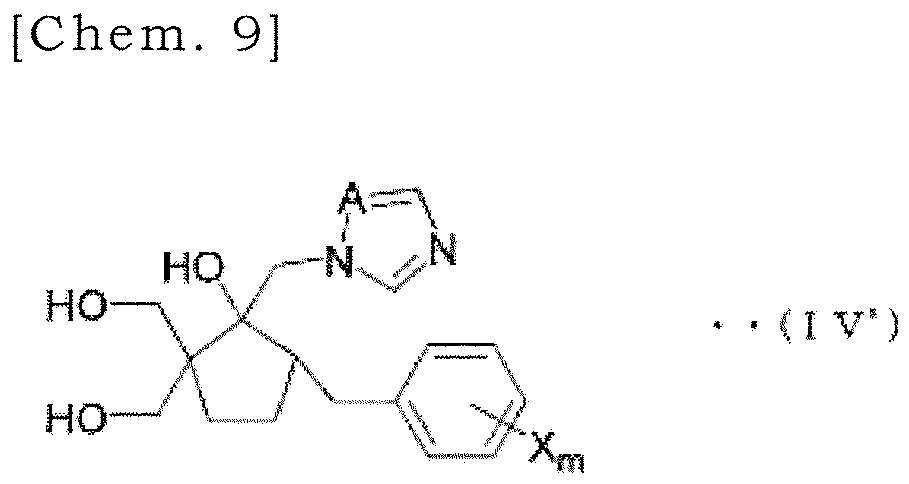
- A method as set forth in claim 5, further comprising a method recited in any one of claims 2 to 4.
- The method as set forth in any one of claims 2 to 6,
wherein R6 and R7 independently represent a C1-C4 alkyl group. - An intermediate compound represented by the following general formula (VIII'), the intermediate compound being used for producing the azole derivative recited in claim 1.

- An intermediate compound represented by the following general formula (IX'), the intermediate compound being used for producing the azole derivative recited in claim 1.

- An azole derivative represented by the following general formula (Ia'), the azole derivative being produced by a method recited in any one of claims 2 to 4.

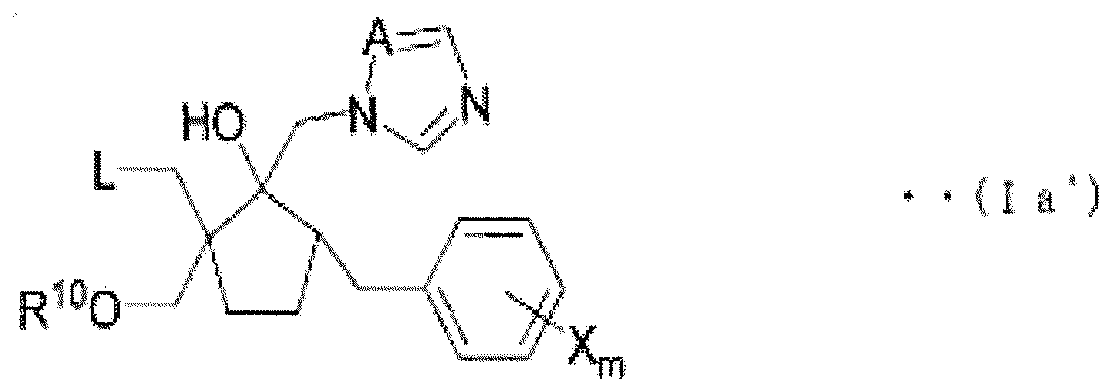
- An agro-horticultural agent containing the azole derivative recited in claim 1 as an active constitutent, the agro-horticultural agent being used in a seed treatment.
- A seed treated by the agro-horticultural agent recited in claim 11.
Applications Claiming Priority (3)
| Application Number | Priority Date | Filing Date | Title |
|---|---|---|---|
| JP2011126817 | 2011-06-07 | ||
| JP2012001476 | 2012-01-06 | ||
| PCT/JP2012/064605 WO2012169559A1 (en) | 2011-06-07 | 2012-06-06 | Azole derivative, method for producing azole derivative, and intermediate compound |
Publications (3)
| Publication Number | Publication Date |
|---|---|
| EP2719695A1 true EP2719695A1 (en) | 2014-04-16 |
| EP2719695A4 EP2719695A4 (en) | 2014-10-22 |
| EP2719695B1 EP2719695B1 (en) | 2016-05-18 |
Family
ID=47296118
Family Applications (1)
| Application Number | Title | Priority Date | Filing Date |
|---|---|---|---|
| EP12796434.4A Not-in-force EP2719695B1 (en) | 2011-06-07 | 2012-06-06 | Azole derivative, method for producing azole derivative, and intermediate compound |
Country Status (5)
| Country | Link |
|---|---|
| US (1) | US9241488B2 (en) |
| EP (1) | EP2719695B1 (en) |
| JP (1) | JP5826839B2 (en) |
| CN (1) | CN103596942A (en) |
| WO (1) | WO2012169559A1 (en) |
Families Citing this family (6)
| Publication number | Priority date | Publication date | Assignee | Title |
|---|---|---|---|---|
| CN103917537B (en) * | 2011-11-11 | 2016-03-16 | 株式会社吴羽 | 4-benzyl-1-methyl-6-oxabicyclo [3,2, the 0] manufacture method of heptane derivative and the manufacture method of azole derivative |
| CN104540818A (en) * | 2012-10-11 | 2015-04-22 | 株式会社吴羽 | Method for producing cycloalkanol derivative, and method for producing azole derivative |
| JPWO2014083911A1 (en) * | 2012-11-28 | 2017-01-05 | 株式会社クレハ | Method for producing cyclopentanone derivative, intermediate compound and method for producing intermediate compound |
| US20160122328A1 (en) * | 2013-06-26 | 2016-05-05 | Kureha Corporation | Method for producing azole derivative |
| CN105308051A (en) * | 2013-07-03 | 2016-02-03 | 株式会社吴羽 | Production method for oxirane derivative and production method for azole derivative |
| JP2016003226A (en) * | 2014-06-19 | 2016-01-12 | 株式会社クレハ | Method for producing cyclopentanol derivative |
Family Cites Families (17)
| Publication number | Priority date | Publication date | Assignee | Title |
|---|---|---|---|---|
| US5239089A (en) | 1986-11-10 | 1993-08-24 | Kureha Kagaku Kogyo Kabushiki Kaisha | Oxirane derivatives useful for making fungicidal azole compounds |
| JPH0625140B2 (en) | 1986-11-10 | 1994-04-06 | 呉羽化学工業株式会社 | Novel azole derivative, method for producing the same and agricultural / horticultural drug of the derivative |
| NZ223444A (en) * | 1987-06-30 | 1990-06-26 | Kureha Chemical Ind Co Ltd | Di- and tri-azole derivatives, and their use as herbicides and fungicides |
| JP2680319B2 (en) | 1988-01-18 | 1997-11-19 | 呉羽化学工業株式会社 | Novel azole derivative, production method thereof, and agricultural / horticultural fungicide containing the derivative as an active ingredient |
| JPH0762001B2 (en) | 1988-02-16 | 1995-07-05 | 呉羽化学工業株式会社 | Process for producing azolylmethylcycloalkanol derivative |
| US5292764A (en) | 1988-05-10 | 1994-03-08 | Kureha Kagaku Kogyo K.K. | Azole derivatives for protecting industrial materials from bacteria |
| JPH0699251B2 (en) * | 1988-05-10 | 1994-12-07 | 呉羽化学工業株式会社 | Industrial fungicide |
| US5256683A (en) * | 1988-12-29 | 1993-10-26 | Rhone-Poulenc Agrochimie | Fungicidal compositions containing (benzylidene)-azolylmethylcycloalkane |
| MA21706A1 (en) | 1988-12-29 | 1990-07-01 | Rhone Poulenc Agrochimie | BENZOLIDENE AZOLYLMETHYLCYCLOALCANE AND USE AS A FUNGICIDE. |
| DE3902031A1 (en) * | 1989-01-25 | 1990-07-26 | Hoechst Ag | Substituted azolylmethylcycloalkane derivatives, their preparation and use, and medicaments containing these |
| JP3138055B2 (en) | 1992-03-24 | 2001-02-26 | 呉羽化学工業株式会社 | New (hydroxyalkyl) azolylmethylcyclopentanol derivatives |
| WO2009088070A1 (en) * | 2008-01-09 | 2009-07-16 | Kureha Corporation | (heterocyclic methyl)azolylmethylcyclopentanol derivative and intermediate thereof, process for production of the derivative, and agricultural or horticultural preparation and protective agent for industrial material each comprising the derivative |
| AU2009285455A1 (en) * | 2008-08-26 | 2010-03-04 | Kureha Corporation | 5-benzyl-4-azolylmethyl-4-spiro[2.4]heptanol derivatives, methods for producing the same, and agro-horticultural agents and industrial material protecting agents thereof |
| AR076430A1 (en) * | 2009-04-24 | 2011-06-08 | Basf Se | DERIVATIVES OF TRIAZOL AS FUNGICIDES IN AGRICULTURAL COMPOSITIONS AND THEIR USE AS ANTIVIRALS AND IN THE TREATMENT OF CANCER AND INTERMEDIARIES TO PRODUCE THEM |
| UA108867C2 (en) * | 2009-12-08 | 2015-06-25 | APPROACHES OF AZOLS, THE METHOD OF THEIR PRODUCTS (OPTIONS), INTERMEDIATES, AGRICULTURAL AND HORTICULTURAL PRODUCTS | |
| WO2012169555A1 (en) | 2011-06-07 | 2012-12-13 | 株式会社クレハ | Method for manufacturing oxetane compound, method for manufacturing azolylmethylcyclopentanol compound, and intermediate compound |
| UA110647C2 (en) * | 2011-06-07 | 2016-01-25 | Куреха Корпорейшн | Azole derivative, method of its preparation, intermediate compounds and chemical agent designed for use in agriculture and horticulture, and an agent for protecting industrial materials |
-
2012
- 2012-06-06 JP JP2013519518A patent/JP5826839B2/en not_active Expired - Fee Related
- 2012-06-06 WO PCT/JP2012/064605 patent/WO2012169559A1/en not_active Ceased
- 2012-06-06 CN CN201280028080.0A patent/CN103596942A/en active Pending
- 2012-06-06 US US14/124,033 patent/US9241488B2/en not_active Expired - Fee Related
- 2012-06-06 EP EP12796434.4A patent/EP2719695B1/en not_active Not-in-force
Also Published As
| Publication number | Publication date |
|---|---|
| JPWO2012169559A1 (en) | 2015-02-23 |
| EP2719695B1 (en) | 2016-05-18 |
| EP2719695A4 (en) | 2014-10-22 |
| WO2012169559A1 (en) | 2012-12-13 |
| CN103596942A (en) | 2014-02-19 |
| US9241488B2 (en) | 2016-01-26 |
| JP5826839B2 (en) | 2015-12-02 |
| US20140113815A1 (en) | 2014-04-24 |
Similar Documents
| Publication | Publication Date | Title |
|---|---|---|
| EP2509958A1 (en) | Azole derivatives, methods for producing the same, intermediate thereof, agro-horticultural agents | |
| CA2838586C (en) | Azole derivative, method for producing same, intermediate compound, and agricultural or horticultural chemical agent and industrial material protecting agent | |
| EP2784067B1 (en) | Antifungal azole derivatives | |
| WO2010023862A1 (en) | 5-benzyl-4-azolylmethyl-4-spiro[2.4]heptanol derivatives, methods for producing the same, and agro-horticultural agents and industrial material protecting agents thereof | |
| EP2509959A1 (en) | Azole derivatives and methods for producing the same, intermediate compounds for the derivatives and methods for producing the same, and agro-horticultural agents and industrial material protecting agents containing the derivatives | |
| US9241488B2 (en) | Azole derivative, method for producing azole derivative, and intermediate compound | |
| JP5858999B2 (en) | Agricultural and horticultural agents, plant disease control compositions, plant disease control methods, and plant disease control products | |
| EP2719693B1 (en) | Method for manufacturing oxetane compound, method for manufacturing azolylmethylcyclopentanol compound, and intermediate compound | |
| US9253983B2 (en) | Triazole compound and use thereof | |
| JP2013100238A (en) | Triazole derivative, intermediate compound, method for producing triazole derivative, agricultural and horticultural chemical, and industrial material protective agent | |
| WO2012165498A1 (en) | Triazole compound and use thereof |
Legal Events
| Date | Code | Title | Description |
|---|---|---|---|
| PUAI | Public reference made under article 153(3) epc to a published international application that has entered the european phase |
Free format text: ORIGINAL CODE: 0009012 |
|
| 17P | Request for examination filed |
Effective date: 20131203 |
|
| AK | Designated contracting states |
Kind code of ref document: A1 Designated state(s): AL AT BE BG CH CY CZ DE DK EE ES FI FR GB GR HR HU IE IS IT LI LT LU LV MC MK MT NL NO PL PT RO RS SE SI SK SM TR |
|
| DAX | Request for extension of the european patent (deleted) | ||
| A4 | Supplementary search report drawn up and despatched |
Effective date: 20140922 |
|
| RIC1 | Information provided on ipc code assigned before grant |
Ipc: C07D 249/08 20060101ALI20140916BHEP Ipc: C07D 405/06 20060101AFI20140916BHEP Ipc: C07D 319/08 20060101ALI20140916BHEP Ipc: A01P 3/00 20060101ALI20140916BHEP Ipc: A01N 43/653 20060101ALI20140916BHEP |
|
| 17Q | First examination report despatched |
Effective date: 20150709 |
|
| GRAP | Despatch of communication of intention to grant a patent |
Free format text: ORIGINAL CODE: EPIDOSNIGR1 |
|
| INTG | Intention to grant announced |
Effective date: 20151201 |
|
| GRAS | Grant fee paid |
Free format text: ORIGINAL CODE: EPIDOSNIGR3 |
|
| GRAA | (expected) grant |
Free format text: ORIGINAL CODE: 0009210 |
|
| AK | Designated contracting states |
Kind code of ref document: B1 Designated state(s): AL AT BE BG CH CY CZ DE DK EE ES FI FR GB GR HR HU IE IS IT LI LT LU LV MC MK MT NL NO PL PT RO RS SE SI SK SM TR |
|
| REG | Reference to a national code |
Ref country code: GB Ref legal event code: FG4D |
|
| REG | Reference to a national code |
Ref country code: CH Ref legal event code: EP |
|
| REG | Reference to a national code |
Ref country code: IE Ref legal event code: FG4D Ref country code: AT Ref legal event code: REF Ref document number: 800351 Country of ref document: AT Kind code of ref document: T Effective date: 20160615 |
|
| REG | Reference to a national code |
Ref country code: FR Ref legal event code: PLFP Year of fee payment: 5 |
|
| REG | Reference to a national code |
Ref country code: DE Ref legal event code: R096 Ref document number: 602012018723 Country of ref document: DE |
|
| PGFP | Annual fee paid to national office [announced via postgrant information from national office to epo] |
Ref country code: DE Payment date: 20160621 Year of fee payment: 5 Ref country code: GB Payment date: 20160621 Year of fee payment: 5 |
|
| PGFP | Annual fee paid to national office [announced via postgrant information from national office to epo] |
Ref country code: FR Payment date: 20160627 Year of fee payment: 5 |
|
| REG | Reference to a national code |
Ref country code: NL Ref legal event code: MP Effective date: 20160518 |
|
| REG | Reference to a national code |
Ref country code: LT Ref legal event code: MG4D |
|
| PG25 | Lapsed in a contracting state [announced via postgrant information from national office to epo] |
Ref country code: NL Free format text: LAPSE BECAUSE OF FAILURE TO SUBMIT A TRANSLATION OF THE DESCRIPTION OR TO PAY THE FEE WITHIN THE PRESCRIBED TIME-LIMIT Effective date: 20160518 Ref country code: FI Free format text: LAPSE BECAUSE OF FAILURE TO SUBMIT A TRANSLATION OF THE DESCRIPTION OR TO PAY THE FEE WITHIN THE PRESCRIBED TIME-LIMIT Effective date: 20160518 Ref country code: NO Free format text: LAPSE BECAUSE OF FAILURE TO SUBMIT A TRANSLATION OF THE DESCRIPTION OR TO PAY THE FEE WITHIN THE PRESCRIBED TIME-LIMIT Effective date: 20160818 Ref country code: LT Free format text: LAPSE BECAUSE OF FAILURE TO SUBMIT A TRANSLATION OF THE DESCRIPTION OR TO PAY THE FEE WITHIN THE PRESCRIBED TIME-LIMIT Effective date: 20160518 |
|
| REG | Reference to a national code |
Ref country code: AT Ref legal event code: MK05 Ref document number: 800351 Country of ref document: AT Kind code of ref document: T Effective date: 20160518 |
|
| PG25 | Lapsed in a contracting state [announced via postgrant information from national office to epo] |
Ref country code: GR Free format text: LAPSE BECAUSE OF FAILURE TO SUBMIT A TRANSLATION OF THE DESCRIPTION OR TO PAY THE FEE WITHIN THE PRESCRIBED TIME-LIMIT Effective date: 20160819 Ref country code: PT Free format text: LAPSE BECAUSE OF FAILURE TO SUBMIT A TRANSLATION OF THE DESCRIPTION OR TO PAY THE FEE WITHIN THE PRESCRIBED TIME-LIMIT Effective date: 20160919 Ref country code: RS Free format text: LAPSE BECAUSE OF FAILURE TO SUBMIT A TRANSLATION OF THE DESCRIPTION OR TO PAY THE FEE WITHIN THE PRESCRIBED TIME-LIMIT Effective date: 20160518 Ref country code: ES Free format text: LAPSE BECAUSE OF FAILURE TO SUBMIT A TRANSLATION OF THE DESCRIPTION OR TO PAY THE FEE WITHIN THE PRESCRIBED TIME-LIMIT Effective date: 20160518 Ref country code: HR Free format text: LAPSE BECAUSE OF FAILURE TO SUBMIT A TRANSLATION OF THE DESCRIPTION OR TO PAY THE FEE WITHIN THE PRESCRIBED TIME-LIMIT Effective date: 20160518 Ref country code: LV Free format text: LAPSE BECAUSE OF FAILURE TO SUBMIT A TRANSLATION OF THE DESCRIPTION OR TO PAY THE FEE WITHIN THE PRESCRIBED TIME-LIMIT Effective date: 20160518 Ref country code: SE Free format text: LAPSE BECAUSE OF FAILURE TO SUBMIT A TRANSLATION OF THE DESCRIPTION OR TO PAY THE FEE WITHIN THE PRESCRIBED TIME-LIMIT Effective date: 20160518 |
|
| PG25 | Lapsed in a contracting state [announced via postgrant information from national office to epo] |
Ref country code: BE Free format text: LAPSE BECAUSE OF NON-PAYMENT OF DUE FEES Effective date: 20160630 Ref country code: IT Free format text: LAPSE BECAUSE OF FAILURE TO SUBMIT A TRANSLATION OF THE DESCRIPTION OR TO PAY THE FEE WITHIN THE PRESCRIBED TIME-LIMIT Effective date: 20160518 |
|
| PG25 | Lapsed in a contracting state [announced via postgrant information from national office to epo] |
Ref country code: SK Free format text: LAPSE BECAUSE OF FAILURE TO SUBMIT A TRANSLATION OF THE DESCRIPTION OR TO PAY THE FEE WITHIN THE PRESCRIBED TIME-LIMIT Effective date: 20160518 Ref country code: DK Free format text: LAPSE BECAUSE OF FAILURE TO SUBMIT A TRANSLATION OF THE DESCRIPTION OR TO PAY THE FEE WITHIN THE PRESCRIBED TIME-LIMIT Effective date: 20160518 Ref country code: CZ Free format text: LAPSE BECAUSE OF FAILURE TO SUBMIT A TRANSLATION OF THE DESCRIPTION OR TO PAY THE FEE WITHIN THE PRESCRIBED TIME-LIMIT Effective date: 20160518 Ref country code: EE Free format text: LAPSE BECAUSE OF FAILURE TO SUBMIT A TRANSLATION OF THE DESCRIPTION OR TO PAY THE FEE WITHIN THE PRESCRIBED TIME-LIMIT Effective date: 20160518 Ref country code: RO Free format text: LAPSE BECAUSE OF FAILURE TO SUBMIT A TRANSLATION OF THE DESCRIPTION OR TO PAY THE FEE WITHIN THE PRESCRIBED TIME-LIMIT Effective date: 20160518 |
|
| REG | Reference to a national code |
Ref country code: CH Ref legal event code: PL |
|
| REG | Reference to a national code |
Ref country code: DE Ref legal event code: R097 Ref document number: 602012018723 Country of ref document: DE |
|
| PG25 | Lapsed in a contracting state [announced via postgrant information from national office to epo] |
Ref country code: BE Free format text: LAPSE BECAUSE OF FAILURE TO SUBMIT A TRANSLATION OF THE DESCRIPTION OR TO PAY THE FEE WITHIN THE PRESCRIBED TIME-LIMIT Effective date: 20160518 Ref country code: AT Free format text: LAPSE BECAUSE OF FAILURE TO SUBMIT A TRANSLATION OF THE DESCRIPTION OR TO PAY THE FEE WITHIN THE PRESCRIBED TIME-LIMIT Effective date: 20160518 Ref country code: PL Free format text: LAPSE BECAUSE OF FAILURE TO SUBMIT A TRANSLATION OF THE DESCRIPTION OR TO PAY THE FEE WITHIN THE PRESCRIBED TIME-LIMIT Effective date: 20160518 Ref country code: SM Free format text: LAPSE BECAUSE OF FAILURE TO SUBMIT A TRANSLATION OF THE DESCRIPTION OR TO PAY THE FEE WITHIN THE PRESCRIBED TIME-LIMIT Effective date: 20160518 |
|
| REG | Reference to a national code |
Ref country code: IE Ref legal event code: MM4A |
|
| PLBE | No opposition filed within time limit |
Free format text: ORIGINAL CODE: 0009261 |
|
| STAA | Information on the status of an ep patent application or granted ep patent |
Free format text: STATUS: NO OPPOSITION FILED WITHIN TIME LIMIT |
|
| PG25 | Lapsed in a contracting state [announced via postgrant information from national office to epo] |
Ref country code: MC Free format text: LAPSE BECAUSE OF FAILURE TO SUBMIT A TRANSLATION OF THE DESCRIPTION OR TO PAY THE FEE WITHIN THE PRESCRIBED TIME-LIMIT Effective date: 20160518 |
|
| 26N | No opposition filed |
Effective date: 20170221 |
|
| PG25 | Lapsed in a contracting state [announced via postgrant information from national office to epo] |
Ref country code: CH Free format text: LAPSE BECAUSE OF NON-PAYMENT OF DUE FEES Effective date: 20160630 Ref country code: LI Free format text: LAPSE BECAUSE OF NON-PAYMENT OF DUE FEES Effective date: 20160630 |
|
| PG25 | Lapsed in a contracting state [announced via postgrant information from national office to epo] |
Ref country code: IE Free format text: LAPSE BECAUSE OF NON-PAYMENT OF DUE FEES Effective date: 20160606 Ref country code: SI Free format text: LAPSE BECAUSE OF FAILURE TO SUBMIT A TRANSLATION OF THE DESCRIPTION OR TO PAY THE FEE WITHIN THE PRESCRIBED TIME-LIMIT Effective date: 20160518 |
|
| REG | Reference to a national code |
Ref country code: DE Ref legal event code: R119 Ref document number: 602012018723 Country of ref document: DE |
|
| GBPC | Gb: european patent ceased through non-payment of renewal fee |
Effective date: 20170606 |
|
| REG | Reference to a national code |
Ref country code: FR Ref legal event code: ST Effective date: 20180228 |
|
| PG25 | Lapsed in a contracting state [announced via postgrant information from national office to epo] |
Ref country code: GB Free format text: LAPSE BECAUSE OF NON-PAYMENT OF DUE FEES Effective date: 20170606 Ref country code: DE Free format text: LAPSE BECAUSE OF NON-PAYMENT OF DUE FEES Effective date: 20180103 |
|
| PG25 | Lapsed in a contracting state [announced via postgrant information from national office to epo] |
Ref country code: HU Free format text: LAPSE BECAUSE OF FAILURE TO SUBMIT A TRANSLATION OF THE DESCRIPTION OR TO PAY THE FEE WITHIN THE PRESCRIBED TIME-LIMIT; INVALID AB INITIO Effective date: 20120606 Ref country code: FR Free format text: LAPSE BECAUSE OF NON-PAYMENT OF DUE FEES Effective date: 20170630 Ref country code: CY Free format text: LAPSE BECAUSE OF FAILURE TO SUBMIT A TRANSLATION OF THE DESCRIPTION OR TO PAY THE FEE WITHIN THE PRESCRIBED TIME-LIMIT Effective date: 20160518 |
|
| PG25 | Lapsed in a contracting state [announced via postgrant information from national office to epo] |
Ref country code: MT Free format text: LAPSE BECAUSE OF NON-PAYMENT OF DUE FEES Effective date: 20160630 Ref country code: LU Free format text: LAPSE BECAUSE OF NON-PAYMENT OF DUE FEES Effective date: 20160606 Ref country code: TR Free format text: LAPSE BECAUSE OF FAILURE TO SUBMIT A TRANSLATION OF THE DESCRIPTION OR TO PAY THE FEE WITHIN THE PRESCRIBED TIME-LIMIT Effective date: 20160518 Ref country code: IS Free format text: LAPSE BECAUSE OF FAILURE TO SUBMIT A TRANSLATION OF THE DESCRIPTION OR TO PAY THE FEE WITHIN THE PRESCRIBED TIME-LIMIT Effective date: 20160518 Ref country code: MK Free format text: LAPSE BECAUSE OF FAILURE TO SUBMIT A TRANSLATION OF THE DESCRIPTION OR TO PAY THE FEE WITHIN THE PRESCRIBED TIME-LIMIT Effective date: 20160518 |
|
| PG25 | Lapsed in a contracting state [announced via postgrant information from national office to epo] |
Ref country code: BG Free format text: LAPSE BECAUSE OF FAILURE TO SUBMIT A TRANSLATION OF THE DESCRIPTION OR TO PAY THE FEE WITHIN THE PRESCRIBED TIME-LIMIT Effective date: 20160518 |
|
| PG25 | Lapsed in a contracting state [announced via postgrant information from national office to epo] |
Ref country code: AL Free format text: LAPSE BECAUSE OF FAILURE TO SUBMIT A TRANSLATION OF THE DESCRIPTION OR TO PAY THE FEE WITHIN THE PRESCRIBED TIME-LIMIT Effective date: 20160518 |