EP2719684A1 - Method of manufacturing benzylamine compound - Google Patents
Method of manufacturing benzylamine compound Download PDFInfo
- Publication number
- EP2719684A1 EP2719684A1 EP12793853.8A EP12793853A EP2719684A1 EP 2719684 A1 EP2719684 A1 EP 2719684A1 EP 12793853 A EP12793853 A EP 12793853A EP 2719684 A1 EP2719684 A1 EP 2719684A1
- Authority
- EP
- European Patent Office
- Prior art keywords
- group optionally
- halogen atoms
- compound represented
- formula
- integer
- Prior art date
- Legal status (The legal status is an assumption and is not a legal conclusion. Google has not performed a legal analysis and makes no representation as to the accuracy of the status listed.)
- Withdrawn
Links
- 0 CC(c(cc1)cc(C*)c1Cl)=O Chemical compound CC(c(cc1)cc(C*)c1Cl)=O 0.000 description 2
Classifications
-
- C—CHEMISTRY; METALLURGY
- C07—ORGANIC CHEMISTRY
- C07D—HETEROCYCLIC COMPOUNDS
- C07D261/00—Heterocyclic compounds containing 1,2-oxazole or hydrogenated 1,2-oxazole rings
- C07D261/02—Heterocyclic compounds containing 1,2-oxazole or hydrogenated 1,2-oxazole rings not condensed with other rings
- C07D261/04—Heterocyclic compounds containing 1,2-oxazole or hydrogenated 1,2-oxazole rings not condensed with other rings having one double bond between ring members or between a ring member and a non-ring member
-
- C—CHEMISTRY; METALLURGY
- C07—ORGANIC CHEMISTRY
- C07C—ACYCLIC OR CARBOCYCLIC COMPOUNDS
- C07C231/00—Preparation of carboxylic acid amides
- C07C231/14—Preparation of carboxylic acid amides by formation of carboxamide groups together with reactions not involving the carboxamide groups
-
- C—CHEMISTRY; METALLURGY
- C07—ORGANIC CHEMISTRY
- C07C—ACYCLIC OR CARBOCYCLIC COMPOUNDS
- C07C233/00—Carboxylic acid amides
- C07C233/01—Carboxylic acid amides having carbon atoms of carboxamide groups bound to hydrogen atoms or to acyclic carbon atoms
- C07C233/30—Carboxylic acid amides having carbon atoms of carboxamide groups bound to hydrogen atoms or to acyclic carbon atoms having the nitrogen atom of at least one of the carboxamide groups bound to a carbon atom of a hydrocarbon radical substituted by doubly-bound oxygen atoms
- C07C233/31—Carboxylic acid amides having carbon atoms of carboxamide groups bound to hydrogen atoms or to acyclic carbon atoms having the nitrogen atom of at least one of the carboxamide groups bound to a carbon atom of a hydrocarbon radical substituted by doubly-bound oxygen atoms with the substituted hydrocarbon radical bound to the nitrogen atom of the carboxamide group by an acyclic carbon atom
-
- C—CHEMISTRY; METALLURGY
- C07—ORGANIC CHEMISTRY
- C07C—ACYCLIC OR CARBOCYCLIC COMPOUNDS
- C07C269/00—Preparation of derivatives of carbamic acid, i.e. compounds containing any of the groups, the nitrogen atom not being part of nitro or nitroso groups
- C07C269/04—Preparation of derivatives of carbamic acid, i.e. compounds containing any of the groups, the nitrogen atom not being part of nitro or nitroso groups from amines with formation of carbamate groups
-
- C—CHEMISTRY; METALLURGY
- C07—ORGANIC CHEMISTRY
- C07C—ACYCLIC OR CARBOCYCLIC COMPOUNDS
- C07C269/00—Preparation of derivatives of carbamic acid, i.e. compounds containing any of the groups, the nitrogen atom not being part of nitro or nitroso groups
- C07C269/06—Preparation of derivatives of carbamic acid, i.e. compounds containing any of the groups, the nitrogen atom not being part of nitro or nitroso groups by reactions not involving the formation of carbamate groups
-
- C—CHEMISTRY; METALLURGY
- C07—ORGANIC CHEMISTRY
- C07C—ACYCLIC OR CARBOCYCLIC COMPOUNDS
- C07C271/00—Derivatives of carbamic acids, i.e. compounds containing any of the groups, the nitrogen atom not being part of nitro or nitroso groups
- C07C271/06—Esters of carbamic acids
- C07C271/08—Esters of carbamic acids having oxygen atoms of carbamate groups bound to acyclic carbon atoms
- C07C271/10—Esters of carbamic acids having oxygen atoms of carbamate groups bound to acyclic carbon atoms with the nitrogen atoms of the carbamate groups bound to hydrogen atoms or to acyclic carbon atoms
- C07C271/18—Esters of carbamic acids having oxygen atoms of carbamate groups bound to acyclic carbon atoms with the nitrogen atoms of the carbamate groups bound to hydrogen atoms or to acyclic carbon atoms to carbon atoms of hydrocarbon radicals substituted by doubly-bound oxygen atoms
Definitions
- the present invention relates to a method for producing a benzylamine compound and a production intermediate thereof.
- a benzylamine compound represented by the following formula (7) is useful, for example, as an active ingredient of a pesticide.
- WO2010/032437 discloses a method for synthesizing a benzylamine compound represented by the following formula (7).
- an object of the present invention is to provide a new method that can produce the benzylamine compound represented by the following formula (7) and a production intermediate thereof.
- a benzylamine compound represented by the following formula (7) can be produced by reacting an amide compound represented by the following formula (1) with a trifluoroacetophenone compound represented by the following formula a (2) to produce an aldol compound represented by the following formula (3), reacting the obtained aldol compound represented by the following formula (3) with an acid anhydride compound represented by the following formula (4) to produce an enone compound represented by the following formula (5), reacting the obtained enone compound represented by the following formula (5) with hydroxylamine to produce an isoxazoline compound represented by the following formula (6), and reacting the obtained isoxazoline compound represented by the following formula (6) with an acid.
- a new method for producing the benzylamine compound (7), a production intermediate thereof and the like can be provided.
- Examples of the "C1-C12 alkyl group optionally having one or more halogen atoms" represented by R 1 include a methyl group, an ethyl group, a propyl group, an isopropyl group, a butyl group, a tert-butyl group, an isobutyl group, a pentyl group, a hexyl group, a dodecyl group, a trifluoromethyl group, and a 3,3,3-trifluoropropyl group.
- Examples of the "C3-C12 cycloalkyl group optionally having one or more halogen atoms" represented by R 1 include a cyclopropyl group, a cyclobutyl group, a cyclopentyl group, a cyclohexyl group, and a cycloheptyl group.
- Examples of the "C1-C12 alkoxy group optionally having one or more halogen atoms" represented by R 1 include a methoxy group, an ethoxy group, a propoxy group, an isopropoxy group, and a tert-butoxy group.
- halogen atom represented by R 2 include a fluorine atom, a chlorine atom, a bromine atom, and an iodine atom.
- Examples of the "C1-C6 alkyl group optionally having one or more halogen atoms" represented by R 2 include a methyl group and a trifluoromethyl group.
- halogen atom represented by R 3
- examples of the "halogen atom" represented by R 3 include a fluorine atom, a chlorine atom, a bromine atom, and an iodine atom.
- Examples of the "C1-C12 alky- group optionally having one or more halogen atoms" represented by R 4 include a methyl group and a trifluoromethyl group.
- Examples of the "C1-C12 alkoxy group optionally having one or more halogen atoms" represented by R 4 include a methoxy group and a tert-butoxy group.
- the aldol compound (3) is produced by reacting the amide compound (1) with the trifluoroacetophenone compound (2).
- the amount of the trifluoroacetophenone compound (2) used for the reaction is usually 0.1 to 10 mol, based on 1 mol of the amide compound (1).
- the reaction is usually carried out in the presence of a base.
- Examples of the base used for the reaction include organic bases such as triethylamine and diazabicycloundecene (1,8-diazabicyclo[5.4.0]-7-undecene). These bases can be used alone or in combination of two or more thereof.
- the amount of the base used for the reaction is usually 0.1 to 10 mol, based on 1 mol of the amide compound (1).
- the reaction is usually carried out in the presence of a solvent.
- a solvent examples include ethers such as tetrahydrofuran and hydrocarbons such as toluene, and these solvents can be used alone or in combination of two or more thereof.
- the amount of the solvent used when the reaction is carried out in a solvent is 100 L or less, based on 1 mol of the amide compound (1).
- the reaction temperature is usually in the range of -20 to 200°C or not more than the boiling point of the solvent used in the reaction.
- the reaction time is usually in the range of 0.1 to 100 hours.
- the aldol compound (3) can be produced. Further, it is also possible to purify the obtained aldol compound by means such as extraction by separation, filtration, recrystallization, or column chromatography, as necessary.
- the enone compound (5) is produced by reacting the aldol compound (3) with the acid anhydride compound (4).
- the amount of the acid anhydride compound (4) used for the reaction is usually 1 to 10 mol, based on 1 mol of the aldol compound (3).
- the reaction is usually carried out in the presence of a base.
- Examples of the base used for the reaction include organic bases such as triethylamine, pyridine, and N,N-dimethyl-4-aminopyridine. These bases can be used alone or in combination of two or more thereof.
- the amount of the base used for the reaction is usually 0.1 to 10 mol, based on 1 mol of the aldol compound (3).
- the reaction is usually carried out in the presence of a solvent.
- a solvent examples include ethers such as tetrahydrofuran, hydrocarbons such as toluene, and halogenated hydrocarbons such as chloroform, and these solvents can be used alone or in combination of two or more thereof.
- the amount of the solvent used when the reaction is carried out in a solvent is 100 L or less, based on 1 mol of the aldol compound (3).
- the reaction temperature is usually in the range of -20 to 200°C or not more than the boiling point of the solvent used in the reaction.
- the reaction time is usually in the range of 0.1 to 100 hours.
- the resultant can also be reacted with sodium methoxide.
- the solvent used in the step include methanol.
- the enone compound (5) can be produced. Further, it is also possible to purify the obtained enone compound by means such as extraction by separation, filtration, recrystallization, or column chromatography, as necessary.
- the isoxazoline compound (6) is produced by reacting the enone compound (5) with hydroxylamine.
- the reaction is usually carried out in the presence of a base.
- Examples of the base used for the reaction include metal hydroxides such as sodium hydroxide and organic bases such as diazabicycloundecene. These bases can be used alone or in combination of two or more thereof.
- the amount of the base used for the reaction is usually 0.01 to 10 mol, based on 1 mol of the enone compound (5).
- the reaction is usually carried out in the presence of a solvent.
- a solvent examples include hydrocarbons such as toluene, ethers such as methyl tert-butyl ether, and water, and these solvents can be used alone or in combination of two or more thereof.
- the amount of the solvent used when the reaction is carried out in a solvent is 100 L or less, based on 1 mol of the enone compound (5).
- hydroxylamine used for the reaction hydroxylamine in the form of an aqueous solution or a salt such as hydroxylamine hydrochloride can be used. These can be used alone or in combination of two or more thereof.
- the amount of the hydroxylamine used for the reaction is usually 1 to 10 mol, based on 1 mol of the enone compound (5).
- the reaction can be carried out also in the presence of a phase transfer catalyst.
- phase transfer catalyst used for the reaction include tetrabutylammonium bromide and tetraoctylammonium chloride. These phase transfer catalysts can be used alone or in combination of two or more thereof.
- the amount of the phase transfer catalyst used for the reaction is usually 0.001 to 1 mol, based on 1 mol of the enone compound (5).
- the reaction temperature is usually in the range of -20 to 200°C or the boiling point of the solvent used in the reaction.
- the reaction time is usually in the range of 0.1 to 100 hours.
- the isoxazoline compound (6) can be produced. Further, it is also possible to purify the obtained isoxazoline compound by means such as extraction by separation, filtration, recrystallization, or column chromatography, as necessary.
- the benzylamine compound (7) is produced by reacting the isoxazoline compound (6) with the acid.
- the amount of the acid used in the reaction is usually 0.1 to 100 mol, based on 1 mol of the isoxazoline compound (6).
- Examples of the acid used fcr the reaction include carboxylic acids such as trifluoroacetic acid and mineral acids such as hydrochloric acid. These acids can be used alone or in combination of two or more thereof.
- the reaction can be carried out also in the presence of a solvent.
- a solvent examples include ethanol.
- the reaction temperature is usually in the range of -20 to 200°C or the boiling point of the acid used in the reaction.
- the reaction time is usually in the range of 0.1 to 100 hours.
- the benzylamine compound (7) can be produced. Further, it is also possible to purify the obtained benzylamine compound by means such as extraction by separation, filtration, recrystallization, or column chromatography, as necessary.
- the amide compound (1) can be produced by the method described in WO2004/058681 , WO2008/134036 , or Journal of Labelled compounds and Radiopharmaceuticals, vol. 51, p. 72 (2008 ).
- trifluoroacetophenone compounds (2) are commercially available, and other compounds can be produced, for example, according to the method described in Canadian Journal of Chemistry vol. 58, p. 2491 (1980 ) or Angewandte Chemie International Edition vol. 37, p- 820 (1998 ).
- aldol compound (3) Specific examples of the aldol compound (3) are shown below.
Landscapes
- Chemical & Material Sciences (AREA)
- Organic Chemistry (AREA)
- Chemical Kinetics & Catalysis (AREA)
- Heterocyclic Carbon Compounds Containing A Hetero Ring Having Nitrogen And Oxygen As The Only Ring Hetero Atoms (AREA)
- Organic Low-Molecular-Weight Compounds And Preparation Thereof (AREA)
Abstract

and an intermediate for the said methodare provided.
Description
- The present invention relates to a method for producing a benzylamine compound and a production intermediate thereof.
- It has been known that a benzylamine compound represented by the following formula (7) is useful, for example, as an active ingredient of a pesticide. In addition, for example,
WO2010/032437 discloses a method for synthesizing a benzylamine compound represented by the following formula (7). - The above conventional method is not necessarily satisfactory in the production of the benzylamine compound represented by the following formula (7).
- Thus, an object of the present invention is to provide a new method that can produce the benzylamine compound represented by the following formula (7) and a production intermediate thereof.
- As a result of intensive studies, the present inventors have found that a benzylamine compound represented by the following formula (7) can be produced by reacting an amide compound represented by the following formula (1) with a trifluoroacetophenone compound represented by the following formula a (2) to produce an aldol compound represented by the following formula (3),
reacting the obtained aldol compound represented by the following formula (3) with an acid anhydride compound represented by the following formula (4) to produce an enone compound represented by the following formula (5), reacting the obtained enone compound represented by the following formula (5) with hydroxylamine to produce an isoxazoline compound represented by the following formula (6), and
reacting the obtained isoxazoline compound represented by the following formula (6) with an acid. - More specifically, the present invention is as described below.
- [1] An aldol compound represented by formula (3):

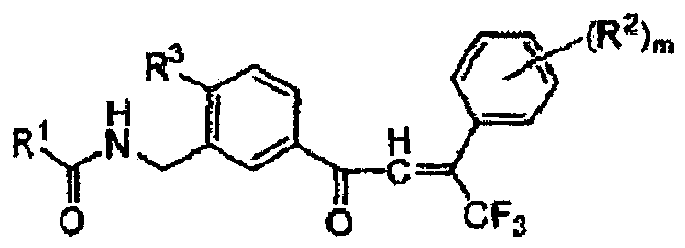
- [2] An enone compound represented by formula (5):

- [3] tert-Butyl (5-acetyl-2-chlorobenzyl)carbamate.
- [4] tert-Butyl {2-chloro-5-[5-(3,5-dichlorophenyl)-5-trifluoromethyl-4,5-dihydroisoxazol-3-yl]benzyl}carbamate.
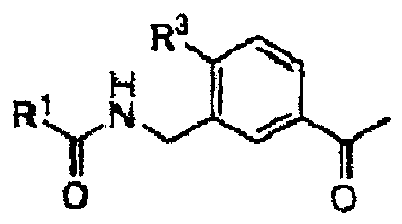
- [5] A method for producing an aldol compound represented by formula (3) :

comprising a step of reacting an amide compound represented by formula (1) :
with a trifluoroacetophenone compound represented by formula (2) :
- [6] A method for producing an enone compound represented by formula (5) :

comprising a step of reacting the aldol compound (3) with an acid anhydride compound represented by formula (4):
- [7] A method for producing an isoxazoline compound represented by formula (6):

comprising a step of reacting the enone compound (5) with hydroxylamine. - [8] A method for producing a benzylamine compound represented by formula (7):

comprising a step of reacting the the isoxazoline compound (6) with an acid. - [9] A method for producing the benzylamine compound (7), comprising steps of reacting the amide compound (1) with the trifluoroacetophenone compound (2) to produce the aldol compound (3) ; reacting the obtained aldol compound (3) with the acid anhydride compound (4) to produce the enone compound (5); reacting the obtained enone compound (5) with hydroxylamine to produce the isoxazoline compound (6); and reacting the obtained isoxazoline compound (6) with an acid.
- According to the present invention, a new method for producing the benzylamine compound (7), a production intermediate thereof and the like can be provided.
- Examples of the "C1-C12 alkyl group optionally having one or more halogen atoms" represented by R1 include a methyl group, an ethyl group, a propyl group, an isopropyl group, a butyl group, a tert-butyl group, an isobutyl group, a pentyl group, a hexyl group, a dodecyl group, a trifluoromethyl group, and a 3,3,3-trifluoropropyl group.
- Examples of the "C3-C12 cycloalkyl group optionally having one or more halogen atoms" represented by R1 include a cyclopropyl group, a cyclobutyl group, a cyclopentyl group, a cyclohexyl group, and a cycloheptyl group.
- Examples of the "C1-C12 alkoxy group optionally having one or more halogen atoms" represented by R1 include a methoxy group, an ethoxy group, a propoxy group, an isopropoxy group, and a tert-butoxy group.
- Examples of the "halogen atom" represented by R2 include a fluorine atom, a chlorine atom, a bromine atom, and an iodine atom.
- Examples of the "C1-C6 alkyl group optionally having one or more halogen atoms" represented by R2 include a methyl group and a trifluoromethyl group.
- Examples of the "halogen atom" represented by R3 include a fluorine atom, a chlorine atom, a bromine atom, and an iodine atom.
- Examples of the "C1-C12 alky- group optionally having one or more halogen atoms" represented by R4 include a methyl group and a trifluoromethyl group.
- Examples of the "C1-C12 alkoxy group optionally having one or more halogen atoms" represented by R4 include a methoxy group and a tert-butoxy group.
- In the production of the aldol compound (3) from the amide compound (1) and the trifluoroacetophenone compound (2), the aldol compound (3) is produced by reacting the amide compound (1) with the trifluoroacetophenone compound (2).
- The amount of the trifluoroacetophenone compound (2) used for the reaction is usually 0.1 to 10 mol, based on 1 mol of the amide compound (1).
- The reaction is usually carried out in the presence of a base.
- Examples of the base used for the reaction include organic bases such as triethylamine and diazabicycloundecene (1,8-diazabicyclo[5.4.0]-7-undecene). These bases can be used alone or in combination of two or more thereof.
- The amount of the base used for the reaction is usually 0.1 to 10 mol, based on 1 mol of the amide compound (1).
- The reaction is usually carried out in the presence of a solvent. Examples of the solvent used in the reaction include ethers such as tetrahydrofuran and hydrocarbons such as toluene, and these solvents can be used alone or in combination of two or more thereof.
- The amount of the solvent used when the reaction is carried out in a solvent is 100 L or less, based on 1 mol of the amide compound (1).
- The reaction temperature is usually in the range of -20 to 200°C or not more than the boiling point of the solvent used in the reaction.
- The reaction time is usually in the range of 0.1 to 100 hours.
- As mentioned above, the aldol compound (3) can be produced. Further, it is also possible to purify the obtained aldol compound by means such as extraction by separation, filtration, recrystallization, or column chromatography, as necessary.
- In the production of the enone compound (5) from the aldol compound (3), the enone compound (5) is produced by reacting the aldol compound (3) with the acid anhydride compound (4).
- The amount of the acid anhydride compound (4) used for the reaction is usually 1 to 10 mol, based on 1 mol of the aldol compound (3).
- The reaction is usually carried out in the presence of a base.
- Examples of the base used for the reaction include organic bases such as triethylamine, pyridine, and N,N-dimethyl-4-aminopyridine. These bases can be used alone or in combination of two or more thereof.
- The amount of the base used for the reaction is usually 0.1 to 10 mol, based on 1 mol of the aldol compound (3).
- The reaction is usually carried out in the presence of a solvent. Examples of the solvent used for the reaction include ethers such as tetrahydrofuran, hydrocarbons such as toluene, and halogenated hydrocarbons such as chloroform, and these solvents can be used alone or in combination of two or more thereof.
- The amount of the solvent used when the reaction is carried out in a solvent is 100 L or less, based on 1 mol of the aldol compound (3).
- The reaction temperature is usually in the range of -20 to 200°C or not more than the boiling point of the solvent used in the reaction.
- The reaction time is usually in the range of 0.1 to 100 hours.
- After carrying out the reaction, the resultant can also be reacted with sodium methoxide. Examples of the solvent used in the step include methanol.
- As mentioned above, the enone compound (5) can be produced. Further, it is also possible to purify the obtained enone compound by means such as extraction by separation, filtration, recrystallization, or column chromatography, as necessary.
- In the production of the isoxazoline compound (6) from the enone compound (5), the isoxazoline compound (6) is produced by reacting the enone compound (5) with hydroxylamine.
- The reaction is usually carried out in the presence of a base.
- Examples of the base used for the reaction include metal hydroxides such as sodium hydroxide and organic bases such as diazabicycloundecene. These bases can be used alone or in combination of two or more thereof.
- The amount of the base used for the reaction is usually 0.01 to 10 mol, based on 1 mol of the enone compound (5).
- The reaction is usually carried out in the presence of a solvent. Examples of the solvent used for the reaction include hydrocarbons such as toluene, ethers such as methyl tert-butyl ether, and water, and these solvents can be used alone or in combination of two or more thereof.
- The amount of the solvent used when the reaction is carried out in a solvent is 100 L or less, based on 1 mol of the enone compound (5).
- As the hydroxylamine used for the reaction, hydroxylamine in the form of an aqueous solution or a salt such as hydroxylamine hydrochloride can be used. These can be used alone or in combination of two or more thereof.
- The amount of the hydroxylamine used for the reaction is usually 1 to 10 mol, based on 1 mol of the enone compound (5).
- The reaction can be carried out also in the presence of a phase transfer catalyst. Examples of the phase transfer catalyst used for the reaction include tetrabutylammonium bromide and tetraoctylammonium chloride. These phase transfer catalysts can be used alone or in combination of two or more thereof.
- The amount of the phase transfer catalyst used for the reaction is usually 0.001 to 1 mol, based on 1 mol of the enone compound (5).
- The reaction temperature is usually in the range of -20 to 200°C or the boiling point of the solvent used in the reaction.
- The reaction time is usually in the range of 0.1 to 100 hours.
- As mentioned above, the isoxazoline compound (6) can be produced. Further, it is also possible to purify the obtained isoxazoline compound by means such as extraction by separation, filtration, recrystallization, or column chromatography, as necessary.
- In the production of the benzylamine compound (7) from the isoxazoline compound (6) and an acid, the benzylamine compound (7) is produced by reacting the isoxazoline compound (6) with the acid.
- The amount of the acid used in the reaction is usually 0.1 to 100 mol, based on 1 mol of the isoxazoline compound (6).
- Examples of the acid used fcr the reaction include carboxylic acids such as trifluoroacetic acid and mineral acids such as hydrochloric acid. These acids can be used alone or in combination of two or more thereof.
- The reaction can be carried out also in the presence of a solvent. Examples of the solvent used for the reaction include ethanol.
- The reaction temperature is usually in the range of -20 to 200°C or the boiling point of the acid used in the reaction.
- The reaction time is usually in the range of 0.1 to 100 hours.
- As mentioned above, the benzylamine compound (7) can be produced. Further, it is also possible to purify the obtained benzylamine compound by means such as extraction by separation, filtration, recrystallization, or column chromatography, as necessary.
- The amide compound (1) can be produced by the method described in
WO2004/058681 ,WO2008/134036 , or Journal of Labelled compounds and Radiopharmaceuticals, vol. 51, p. 72 (2008). - Some of the trifluoroacetophenone compounds (2) are commercially available, and other compounds can be produced, for example, according to the method described in Canadian Journal of Chemistry vol. 58, p. 2491 (1980) or Angewandte Chemie International Edition vol. 37, p- 820 (1998).
- Specific examples of the aldol compound (3) are shown below.
- Aldol compounds represented by formula (3):

[Table 1] No. R1 (R2)m R3 1 CH3 3-Cl, 5-Cl Cl 2 CH2CH3 3-Cl, 5-Cl Cl 3 CH2CH2CH3 3-Cl, 5-Cl Cl 4 CH(CH3)2 3-Cl, 5-Cl Cl 5 C(CH3)3 3-Cl, 5-Cl Cl 6 CH2CH(CH3 2 3-Cl, 5-Cl Cl 7 CF3 3-Cl, 5-Cl Cl 8 CH2CH2CF3 3-Cl, 5-Cl Cl 9 OCH3 3-Cl, 5-Cl Cl 10 OCH2CH3 3-Cl, 5-Cl Cl 11 OCH(CH3)2 3-Cl, 5-Cl Cl 12 OC(CH2)3 3-Cl, 5-Cl Cl 13 CH3 3-Cl, 5-Cl H 14 CH3 3-Cl, 5-Cl F 15 CH3 3-Cl, 5-Cl Br 16 Cyclopropyl 3-Cl, 5-Cl Cl 17 Cyclobutyl 3-Cl, 5-Cl Cl 18 Cyclopentyl 3-Cl, 5-Cl Cl 19 Cyclohexyl 3-Cl, 5-Cl Cl 20 Cycloheptyl 3-Cl, 5-Cl Cl 21 (CH2)3CH3 3-Cl, 5-Cl Cl 22 (CH2)4CH3 3-Cl, 5-Cl Cl 23 (CH2)5CH3 3-Cl, 5-Cl Cl 24 (CH2)11CH3 3-Cl, 5-Cl Cl 25 CH3 3-CF3, 5-CF3 Cl 26 CH3 3-Cl, 4-Cl, 5-Cl Cl - Specific examples of the enone compound (5) are shown below.
- Enone compounds represented by formula (5) :

[Table 2] No. R1 (R2)m R3 1 CH3 3-Cl, 5-Cl Cl 2 CH2CH3 3-Cl, 5-Cl Cl 3 CH2CH2CH3 3-Cl, 5-Cl Cl 4 CH(CH3)2 3-Cl, 5-Cl Cl 5 C(CH3)3 3-Cl, 5-Cl Cl 6 CH2CH(CH3)2 3-Cl, 5-Cl Cl 7 CF3 3-Cl, 5-Cl Cl 8 CH2CH2CF3 3-Cl, 5-Cl Cl 9 OCH3 3-Cl, 5-Cl Cl 10 OCH2CH3 3-Cl, 5-Cl Cl 11 OCH(CH3)2 3-Cl, 5-Cl Cl 12 OC(CH3)3 3-Cl, 5-Cl Cl 13 CH3 3-Cl, 5-Cl H 14 CH3 3-Cl, 5-Cl F 15 CH3 3-Cl, 5-Cl Br 16 Cyclopropyl 3-Cl, 5-Cl Cl 17 Cyclobutyl 3-Cl, 5-Cl Cl 18 Cyclopentyl 3-Cl, 5-Cl Cl 19 Cyclohexyl 3-Cl, 5-Cl Cl 20 Cycloheptyl 3-Cl, 5-Cl Cl 21 (CH2)3CH3 3-Cl, 5-Cl Cl 22 (CH2)4CH3 3-Cl, 5-Cl Cl 23 (CH2)5CH3 3-Cl, 5-Cl Cl 24 (CH2)11CH3 3-Cl, 5-Cl Cl 25 CH3 3-CF3, 5-CF3 Cl 26 CH3 3-Cl, 4-Cl, 5-Cl Cl - Here, in (R2)m of Table 1 and Table 2 above, for example, the description of "3-Cl, 5-Cl" means that (R2)m is substituents in the positions 3 and 5, m is 2, and R2s are each a chlorine atom.
- Examples of the present invention are shown below, but the present invention is not limited by these examples.
-

- In tetrahydrofuran (100 ml) was dissolved 1-(3-aminomethyl-4-chlorophenyl)ethanone (13.58 g), and di-tert-butyl dicarbonate (15.90 g) was added thereto at room temperature. After stirring at room temperature for 1 hour, this reaction mixture liquid was concentrated under reduced pressure, and the resulting residue was dissolved in methyl tert-butyl ether, and then washed with 1 M hydrochloric acid and an aqueous saturated sodium bicarbonate solution. The organic layer was dried over anhydrous sodium sulfate and then concentrated under reduced pressure. The resulting residue was subjected to silica gel column chromatography to obtain tert-butyl (5-acetyl-2-chlorobenzyl)carbamate (16.31 g). 1H-NMR (CDCl3) δ: 7.95 (1H, d), 7.79 (1H, dd), 7.44 (1H, d), 5.15 (1H, br s), 4.44 (2H, d), 2.58 (3H, s), 1.46 (9H, s).
-

- In toluene (4 ml) were dissolved tert-butyl (5-acetyl-2-chlorobenzyl)carbamate (521 mg) obtained in Example 1, α,α,α-trifluoro-3,5-dichloroacetophenone (446 mg) and triethylamine (136 mg), and stirred at 80°C for 2 hours. This reaction mixture liquid cooled to room temperature was concentrated under reduced pressure, and the resulting residue was subjected to silica gel column chromatography to obtain tert-butyl {2-chloro-5-[3-(3,5-dichlorophenyl)-4,4,4-trifluro-3-hydroxybutyryl]benzyl}carbamate (486 mg, Compound of Table 1-No. 12).
1H-NMR (CDCl3) δ: 7.94 (1H, d), 7.78 (1H, dd), 7.53-7.46 (3H, m), 7.35 (1H, t), 5.67 (1H, s), 5.08 (1H, br s), 4.46 (2H, d), 3.81 (1H, d), 3.66 (1H, d), 1.47 (9H, s). -

- In tetrahydrofuran (4 ml) were dissolved tert-butyl {2-chloro-5-[3-(3,5-dichlorophenyl)-4,4,4-trifluoro-3-hydroxybutyryl]benzyl}carbamate (489 mg) obtained in Example 2, triethylamine (188 mg) and N,N-dimethyl-4-aminopyridine (14 mg), and acetic anhydride (95 mg) was added dropwise thereto at room temperature. After stirring at room temperature for 24 hours, this reaction mixture liquid was dissolved in methyl tert-butyl ether, and then washed with 1 M hydrochloric acid and an aqueous saturated sodium bicarbonate solution. The organic layer was dried over anhydrous sodium sulfate and then concentrated under reduced pressure to obtain crude tert-butyl {2-chloro-5-[3-(3,5-dichlorophenyl)-4,4,4-trifluoro-2-butenoyl]benzyl]carbamate (404 mg, Compound of Table 2-No.12). 1H-NMR (CDCl3) δ: 7.81 (1H, s), 7.66 (1H, d), 7.46-7.41 (1H, m), 7.36 (1H, br s), 7.32 (1H, d), 7.15 (2H, br s), 5.17 (1H, s), 4.41 (2H, d), 1.47 (9H, s).
-

-

-

- In toluene (5 ml) were dissolved N-(5-acetyl-2-chlorobenzyl]acetamide (1128 mg), α,α,α-trifluoro-3,5-dichloroacetophenone (1822 mg) and triethylamine (1019 mg), and stirred at 80°C for 4 hours. This reaction mixture liquid cooled to room temperature was concentrated under reduced pressure, and the resulting residue was subj ected to silica gel column chromatography to obtain N-{2-chloro-5-[3-(3,5-dichlorophenyl]-4,4,4-trifluoro-3-hydroxybutyryl]benzyl} acetamide (1490 mg, Compound of Table 1-No. 1).
1H-NMR (CDCl3) δ: 7.96 (1H, d), 7.79 (1H, dd), 7.51 (1H, d), 7.48 (2H, d), 7.35 (1H, t), 6.03-6.00 (1H, br m), 5.64 (1H, s), 4.56 (2H, d), 3.81 (1H, d), 3.66 (1H, d), 2.05 (3H, s). -

- In tetrahydrofuran (2 ml) were dissolved N-{2-chloro-5- [3- (3, 5-dichlorophenyl)-4,4,4-trifluoro-3-hydroxybutyryl] benzyl}acetamide (469 mg) obtained in Example 6, triethylamine (121 mg) and N,N-dimethyl-4-aminopyridine (12 mg), and acetic anhydride (123 mg) was added dropwise thereto at room temperature. The mixture was stirred at room temperature for 3 hours, then stirred at 50°C for 2 hours. This reaction mixture liquid cooled to room temperature was concentrated under reduced pressure, and the resulting residue was subjected to silica gel column chromatography to obtain N-{2-chloro-5-[3-(3,5-dichlorophenyl)-4,4,4-trifluoro-2-butenoyl]benzyl} acetamide (410 mg, Compound of Table 2-No. 1).
1H-NMR (CDCl3) δ: 7.82 (1H, d), 7.68 (1H, dd), 7.45 (1H, d), 7.34-7.33 (2H, m), 7.15 (2H, d), 5.92 (1H, br s), 4.53 (2H, d), 2.06 (3H, s). -

- The crude N-{2-chloro-5-[3-(3,5-dichlorophenyl)-4,4,4-trifluoro-2-buteroyl]benzyl}acetamide (410 mg) obtained in Example 7 and tetrabutylammonium bromide (88 mg) were dissolved in tetrahydrofuran (1.8 ml). Thereto was added dropwise a solution obtained by dissolving hydroxylamine hydrochloride (126 mg) and sodium hydroxide (154 mg) in water (0.7 ml) under ice-cooling, and the mixture was stirred under ice-cooling for 1 hour, then stirred at room temperature for 2 hours. To the reaction mixture was added 2 M hydrochloric acid, and the mixture was extracted with ethyl acetate. The organic layer was dried over anhydrous sodium sulfate and then concentrated under reduced pressure, and the resulting residue was subjected to silica gel column chromatography to obtain N-{2-chloro-5-[5-(3,5-dichlorophenyl)-5-trifluoromethyl-4,5-dihydroisoxazol-3-yl]benzyl}acetamide (369 mg).
1H-NMR (CDCl3) δ: 7.64 (1H, d), 7.59 (1H, dd), 7.50 (2H, s), 7.43-7.42 (2H, m), 6.00-5.97 (1H, br m], 4.53 (2h, d), 4.07 (1H, d), 3.68 (1H, d), 2.04 (3H, s). -

- In ethanol (6 ml) was dissolved N-{2-chloro-5-[5-(3,5-dichlorophenyl)-5-trifluoromethyl-4,5-dihydroisoxazol-3-yl] benzyl}acetamide (200 mg) obtained in Example 8, and concentrated hydrochloric acid (2 ml) was added thereto at room temperature, then the mixture was stirred under reflux for 40 hours. This reaction mixture cooled to room temperature was concentrated under reduced pressure, and an aqueous saturated sodium bicarbonate solution was added to the resulting residue, then the mixture was extracted with ethyl acetate. The organic layer was dried over anhydrous sodium sulfate and then concentrated under reduced pressure to obtain 2-chloro-5-[5-(3,5-dichlorophenyl)-5-trifluoromethyl-4,5-dihydroisoxazol--3-yl]benzylamine (160 mg). 1H-NMR (CDCl3) δ: 7.72 (1H, d), 7.52-7.42 (5H, m), 4.09 (1H, d), 3.98 (2H, s), 3.71 (1H, d), 1.96 (2H, br s).
Claims (9)
- An aldol compound represented by formula (3):

- An enone compound represented by formula (5) :
- tert-Butyl (5-acetyl-2-chlorobenzyl)carbamate.
- tert-Butyl {2-chloro-5-[5-(3,5-dichlorophenyl)-5-trifluoromethyl-4,5-dihydroisoxazol-3-yl]benzyl}carbamate.
- A method for producing an aldol compound represented by formula (3):


- A method for producing an enone compound represented by formula (5):


- A method for producing an isoxazoline compound represented by formula (6):


- A method for producing a benzylamine compound represented by formula (7):

comprising a step of reacting an isoxazoline compound represented by formula (6):
with an acid. - A method for producing a benzylamine compound represented by formula (7):

comprising steps of
reacting an amide compound represented by formula (1):
with a trifluoroacetophenone compound represented by formula (2):

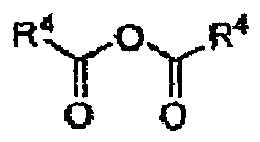
to produce an enone compound represented by formula (5):

reacting the obtained isoxazoline compound represented by the formula (6) with an acid.
Applications Claiming Priority (4)
| Application Number | Priority Date | Filing Date | Title |
|---|---|---|---|
| JP2011125013 | 2011-06-03 | ||
| JP2011134837 | 2011-06-17 | ||
| JP2012017674A JP2013018767A (en) | 2011-06-03 | 2012-01-31 | Method of manufacturing benzylamine compound |
| PCT/JP2012/064488 WO2012165651A1 (en) | 2011-06-03 | 2012-05-30 | Method of manufacturing benzylamine compound |
Publications (2)
| Publication Number | Publication Date |
|---|---|
| EP2719684A1 true EP2719684A1 (en) | 2014-04-16 |
| EP2719684A4 EP2719684A4 (en) | 2014-11-26 |
Family
ID=47259493
Family Applications (1)
| Application Number | Title | Priority Date | Filing Date |
|---|---|---|---|
| EP12793853.8A Withdrawn EP2719684A4 (en) | 2011-06-03 | 2012-05-30 | METHOD FOR MANUFACTURING BENZYLAMINE COMPOUND |
Country Status (5)
| Country | Link |
|---|---|
| EP (1) | EP2719684A4 (en) |
| JP (1) | JP2013018767A (en) |
| CN (1) | CN103619808A (en) |
| IL (1) | IL229491A0 (en) |
| WO (1) | WO2012165651A1 (en) |
Family Cites Families (6)
| Publication number | Priority date | Publication date | Assignee | Title |
|---|---|---|---|---|
| US5523302A (en) * | 1993-11-24 | 1996-06-04 | The Du Pont Merck Pharmaceutical Company | Aromatic compounds containing basic and acidic termini useful as fibrinogen receptor antagonists |
| BR0317781B1 (en) * | 2002-12-26 | 2013-10-01 | acylbenzylamine derivative and processes for producing benzylamine derivative and carbamate derivative | |
| BRPI0707091B8 (en) * | 2006-03-10 | 2018-02-14 | Nissan Chemical Ind Ltd | isoxaline and substituted benzaldoxime compound or a salt thereof; pesticide, agrochemical, endo- or ectoparasiticide for mammals or birds, insecticide and acaricide containing as one or more active ingredients selected from the substituted isoxaline compound and the salt thereof |
| JP5488835B2 (en) * | 2008-09-04 | 2014-05-14 | 日産化学工業株式会社 | Substituted acetophenone compound, method for producing the same, and use thereof |
| CA2737291C (en) * | 2008-09-18 | 2013-04-16 | Nippon Soda Co., Ltd. | Nitrogen-containing heterocyclic compound and pest control agent |
| JP5747440B2 (en) * | 2009-02-06 | 2015-07-15 | 住友化学株式会社 | Hydrazide compound and its use for pest control |
-
2012
- 2012-01-31 JP JP2012017674A patent/JP2013018767A/en active Pending
- 2012-05-30 WO PCT/JP2012/064488 patent/WO2012165651A1/en not_active Ceased
- 2012-05-30 CN CN201280026809.0A patent/CN103619808A/en active Pending
- 2012-05-30 EP EP12793853.8A patent/EP2719684A4/en not_active Withdrawn
-
2013
- 2013-11-18 IL IL229491A patent/IL229491A0/en unknown
Also Published As
| Publication number | Publication date |
|---|---|
| WO2012165651A1 (en) | 2012-12-06 |
| IL229491A0 (en) | 2014-01-30 |
| JP2013018767A (en) | 2013-01-31 |
| CN103619808A (en) | 2014-03-05 |
| EP2719684A4 (en) | 2014-11-26 |
Similar Documents
| Publication | Publication Date | Title |
|---|---|---|
| CN103387541B (en) | A kind of preparation method of substituted pyrazolecarboxylic ether compound | |
| MX2010014224A (en) | A process for the preparation of the apoptosis promoter abt-263. | |
| JP2017518272A (en) | Process for the preparation of substituted cycloserine | |
| US20100113778A1 (en) | Process for preparing o-chloromethylphenylglyoxylic esters, improved process for preparing (e)-2-(2-chloromethylphenyl)-2-alkoximinoacetic esters, and novel intermediates for their preparation | |
| WO2023214552A1 (en) | Trifluoromethane sulfonylation agent composition and method for producing trifluoromethanesulfonyloxy compound or trifluoromethane sulfonyl compound | |
| WO2007105793A1 (en) | Method for nitrating isourea | |
| JP6781030B2 (en) | L-carnosine derivative or salt thereof, and method for producing L-carnosine or salt thereof | |
| US9828340B2 (en) | Asymmetric synthesis of a substituted pyrrolidine-2-carboxamide | |
| EP2716628A1 (en) | Method of manufacturing isoxazoline compound | |
| JP6197868B2 (en) | Method for producing pyridazinone compound | |
| EP2719684A1 (en) | Method of manufacturing benzylamine compound | |
| EP2716627A1 (en) | Method for producing isoxazoline compound | |
| JP4929717B2 (en) | Process for producing N, N'-dialkoxy-N, N'-dialkyloxamide | |
| CN105636938A (en) | Method for preparation of 3-alkylthio-2-bromopyridine | |
| JP2007277232A (en) | Nitration method | |
| JP2012062284A (en) | O-acyl-n-aryl-n-(trifluoromethyl)hydroxylamine derivative and method for producing the same | |
| JP3918468B2 (en) | 3,3-bis (alkoxycarbonyl-methylthio) propionitrile and process for producing the same | |
| EP3287448A1 (en) | Method for producing dicarboxylic acid compound | |
| JP4854255B2 (en) | 2-Fluorine-containing alkoxy fatty acid ester compound production method | |
| JP2002173476A (en) | 1,4-phenylenediamine derivative and method for producing the same | |
| JP4013772B2 (en) | 2-Hydroxyimino-3-oxopropionitrile and process for producing the same | |
| WO2025094700A1 (en) | Trifluoromethanesulfonating agent composition and method for producing trifluoromethanesulfonyloxy compound | |
| JP2000229920A (en) | Production of amide derivative | |
| JP2017105778A (en) | Method for producing 5-pyridyl-oxy-methyl-1,2-oxazol-3-yl pyrrolidine derivative | |
| JP2005350390A (en) | Method for producing 3-aminoflavone compound |
Legal Events
| Date | Code | Title | Description |
|---|---|---|---|
| PUAI | Public reference made under article 153(3) epc to a published international application that has entered the european phase |
Free format text: ORIGINAL CODE: 0009012 |
|
| 17P | Request for examination filed |
Effective date: 20131113 |
|
| AK | Designated contracting states |
Kind code of ref document: A1 Designated state(s): AL AT BE BG CH CY CZ DE DK EE ES FI FR GB GR HR HU IE IS IT LI LT LU LV MC MK MT NL NO PL PT RO RS SE SI SK SM TR |
|
| DAX | Request for extension of the european patent (deleted) | ||
| A4 | Supplementary search report drawn up and despatched |
Effective date: 20141023 |
|
| RIC1 | Information provided on ipc code assigned before grant |
Ipc: C07C 269/04 20060101ALI20141017BHEP Ipc: C07C 233/31 20060101AFI20141017BHEP Ipc: C07C 231/14 20060101ALI20141017BHEP Ipc: C07C 269/06 20060101ALI20141017BHEP Ipc: C07D 261/04 20060101ALI20141017BHEP Ipc: C07C 271/18 20060101ALI20141017BHEP |
|
| STAA | Information on the status of an ep patent application or granted ep patent |
Free format text: STATUS: THE APPLICATION IS DEEMED TO BE WITHDRAWN |
|
| 18D | Application deemed to be withdrawn |
Effective date: 20150522 |