EP2713245A1 - Data processing device, data processing method, data processing program, and computer-readable recording medium which records program - Google Patents
Data processing device, data processing method, data processing program, and computer-readable recording medium which records program Download PDFInfo
- Publication number
- EP2713245A1 EP2713245A1 EP12826291.2A EP12826291A EP2713245A1 EP 2713245 A1 EP2713245 A1 EP 2713245A1 EP 12826291 A EP12826291 A EP 12826291A EP 2713245 A1 EP2713245 A1 EP 2713245A1
- Authority
- EP
- European Patent Office
- Prior art keywords
- processing
- selected object
- position information
- enclosed
- data processing
- Prior art date
- Legal status (The legal status is an assumption and is not a legal conclusion. Google has not performed a legal analysis and makes no representation as to the accuracy of the status listed.)
- Granted
Links
Images






Classifications
-
- G—PHYSICS
- G06—COMPUTING OR CALCULATING; COUNTING
- G06F—ELECTRIC DIGITAL DATA PROCESSING
- G06F3/00—Input arrangements for transferring data to be processed into a form capable of being handled by the computer; Output arrangements for transferring data from processing unit to output unit, e.g. interface arrangements
- G06F3/01—Input arrangements or combined input and output arrangements for interaction between user and computer
- G06F3/03—Arrangements for converting the position or the displacement of a member into a coded form
- G06F3/033—Pointing devices displaced or positioned by the user, e.g. mice, trackballs, pens or joysticks; Accessories therefor
- G06F3/0354—Pointing devices displaced or positioned by the user, e.g. mice, trackballs, pens or joysticks; Accessories therefor with detection of two-dimensional [2D] relative movements between the device, or an operating part thereof, and a plane or surface, e.g. 2D mice, trackballs, pens or pucks
- G06F3/03545—Pens or stylus
-
- G—PHYSICS
- G06—COMPUTING OR CALCULATING; COUNTING
- G06F—ELECTRIC DIGITAL DATA PROCESSING
- G06F3/00—Input arrangements for transferring data to be processed into a form capable of being handled by the computer; Output arrangements for transferring data from processing unit to output unit, e.g. interface arrangements
- G06F3/01—Input arrangements or combined input and output arrangements for interaction between user and computer
- G06F3/03—Arrangements for converting the position or the displacement of a member into a coded form
- G06F3/041—Digitisers, e.g. for touch screens or touch pads, characterised by the transducing means
-
- G—PHYSICS
- G06—COMPUTING OR CALCULATING; COUNTING
- G06F—ELECTRIC DIGITAL DATA PROCESSING
- G06F3/00—Input arrangements for transferring data to be processed into a form capable of being handled by the computer; Output arrangements for transferring data from processing unit to output unit, e.g. interface arrangements
- G06F3/01—Input arrangements or combined input and output arrangements for interaction between user and computer
- G06F3/048—Interaction techniques based on graphical user interfaces [GUI]
- G06F3/0481—Interaction techniques based on graphical user interfaces [GUI] based on specific properties of the displayed interaction object or a metaphor-based environment, e.g. interaction with desktop elements like windows or icons, or assisted by a cursor's changing behaviour or appearance
- G06F3/04817—Interaction techniques based on graphical user interfaces [GUI] based on specific properties of the displayed interaction object or a metaphor-based environment, e.g. interaction with desktop elements like windows or icons, or assisted by a cursor's changing behaviour or appearance using icons
-
- G—PHYSICS
- G06—COMPUTING OR CALCULATING; COUNTING
- G06F—ELECTRIC DIGITAL DATA PROCESSING
- G06F3/00—Input arrangements for transferring data to be processed into a form capable of being handled by the computer; Output arrangements for transferring data from processing unit to output unit, e.g. interface arrangements
- G06F3/01—Input arrangements or combined input and output arrangements for interaction between user and computer
- G06F3/048—Interaction techniques based on graphical user interfaces [GUI]
- G06F3/0487—Interaction techniques based on graphical user interfaces [GUI] using specific features provided by the input device, e.g. functions controlled by the rotation of a mouse with dual sensing arrangements, or of the nature of the input device, e.g. tap gestures based on pressure sensed by a digitiser
- G06F3/0488—Interaction techniques based on graphical user interfaces [GUI] using specific features provided by the input device, e.g. functions controlled by the rotation of a mouse with dual sensing arrangements, or of the nature of the input device, e.g. tap gestures based on pressure sensed by a digitiser using a touch-screen or digitiser, e.g. input of commands through traced gestures
- G06F3/04883—Interaction techniques based on graphical user interfaces [GUI] using specific features provided by the input device, e.g. functions controlled by the rotation of a mouse with dual sensing arrangements, or of the nature of the input device, e.g. tap gestures based on pressure sensed by a digitiser using a touch-screen or digitiser, e.g. input of commands through traced gestures for inputting data by handwriting, e.g. gesture or text
-
- G—PHYSICS
- G06—COMPUTING OR CALCULATING; COUNTING
- G06F—ELECTRIC DIGITAL DATA PROCESSING
- G06F3/00—Input arrangements for transferring data to be processed into a form capable of being handled by the computer; Output arrangements for transferring data from processing unit to output unit, e.g. interface arrangements
- G06F3/01—Input arrangements or combined input and output arrangements for interaction between user and computer
- G06F3/048—Interaction techniques based on graphical user interfaces [GUI]
- G06F3/0487—Interaction techniques based on graphical user interfaces [GUI] using specific features provided by the input device, e.g. functions controlled by the rotation of a mouse with dual sensing arrangements, or of the nature of the input device, e.g. tap gestures based on pressure sensed by a digitiser
- G06F3/0488—Interaction techniques based on graphical user interfaces [GUI] using specific features provided by the input device, e.g. functions controlled by the rotation of a mouse with dual sensing arrangements, or of the nature of the input device, e.g. tap gestures based on pressure sensed by a digitiser using a touch-screen or digitiser, e.g. input of commands through traced gestures
- G06F3/04886—Interaction techniques based on graphical user interfaces [GUI] using specific features provided by the input device, e.g. functions controlled by the rotation of a mouse with dual sensing arrangements, or of the nature of the input device, e.g. tap gestures based on pressure sensed by a digitiser using a touch-screen or digitiser, e.g. input of commands through traced gestures by partitioning the display area of the touch-screen or the surface of the digitising tablet into independently controllable areas, e.g. virtual keyboards or menus
Definitions
- the present invention relates to a data processing device, a data processing method, a data processing program, and a computer-readable recording medium storing the program.
- a data processing device such as a game machine, for example, that executes specified processing by an operation of enclosing an object displayed on a display screen with the input path of a pointing device.
- a data processing device such as a game machine, for example, that executes specified processing by an operation of enclosing an object displayed on a display screen with the input path of a pointing device.
- Patent Literature 1 a device that, when an object displayed on a display screen is enclosed with the input path of a pointing device, executes processing in accordance with the type of the enclosed object is disclosed.
- the detail of processing after selection of an object is decided in accordance with the type of the enclosed object.
- a user selects desired processing from candidates for processing and desires execution of the processing on the object.
- the processing to be performed is decided in accordance with the type of a selected object, and therefore the processing desired by a user cannot be executed.
- an object of the present invention is to provide a data processing device, a data processing method, a data processing program, and a computer-readable recording medium storing the program that allow execution of processing desired by a user among candidates for processing with a simple instruction input.
- a data processing device including a display means configured to display an image including an object representing an object to be processed in an image display area on a display screen and an input means configured to receive an instruction input indicating a position on the display screen, including an acquisition means configured to acquire position information indicating a position of an instruction input received by the input means, a recognition means configured to specify an enclosed region in the image display area based on a trajectory indicated by a set of position information acquired by the acquisition means according to sequential instruction inputs through the input means, and when an object is included in the enclosed region, recognize the object as a selected object and recognize a direction in which the selected object is enclosed by the trajectory of the set of position information as a direction of selection, a determination means configured to determine processing to be performed on the selected object in accordance with the direction of selection recognized by the recognition means, and an execution means configured to execute the processing determined by the determination means on the selected object.
- a data processing method is a data processing method in a data processing device including a display means configured to display an image including an object representing an object to be processed in an image display area on a display screen and an input means configured to receive an instruction input indicating a position on the display screen, the method including an acquisition step of acquiring position information indicating a position of an instruction input received by the input means, a recognition step of specifying an enclosed region in the image display area based on a trajectory indicated by a set of position information acquired in the acquisition step according to sequential instruction inputs through the input means, and when an object is included in the enclosed region, recognizing the object as a selected object and recognizing a direction in which the selected object is enclosed by the trajectory of the set of position information as a direction of selection, a determination step of determining processing to be performed on the selected object in accordance with the direction of selection recognized in the recognition step, and an execution step of executing the processing determined in the determination step on the selected object.
- a data processing program is a data processing program causing a computer to function as a data processing device including a display means configured to display an image including an object representing an object to be processed in an image display area on a display screen and an input means configured to receive an instruction input indicating a position on the display screen, the program causing the computer to implement an acquisition function to acquire position information indicating a position of an instruction input received by the input means, a recognition function to specify an enclosed region in the image display area based on a trajectory indicated by a set of position information acquired by the acquisition function according to sequential instruction inputs through the input means, and when an object is included in the enclosed region, recognize the object as a selected object and recognize a direction in which the selected object is enclosed by the trajectory of the set of position information as a direction of selection, a determination function to determine processing to be performed on the selected object in accordance with the direction of selection recognized by the recognition function, and an execution function to execute the processing determined by the determination function on the selected object.
- a computer-readable recording medium is a computer-readable recording medium storing a data processing program causing a computer to function as a data processing device including a display means configured to display an image including an object representing an object to be processed in an image display area on a display screen and an input means configured to receive an instruction input indicating a position on the display screen, the data processing program causing the computer to implement an acquisition function to acquire position information indicating a position of an instruction input received by the input means, a recognition function to specify an enclosed region in the image display area based on a trajectory indicated by a set of position information acquired by the acquisition function according to sequential instruction inputs through the input means, and when an object is included in the enclosed region, recognize the object as a selected object and recognize a direction in which the selected object is enclosed by the trajectory of the set of position information as a direction of selection, a determination function to determine processing to be performed on the selected object in accordance with the direction of selection recognized by the recognition function, and an execution function to execute the processing determined by the determination function on
- the object when, in response to sequential instruction inputs by a user, an operation of enclosing an object displayed on a display screen by the trajectory of position information indicated by the instruction inputs is performed, the object is selected as the selected object and further the direction of selection in which the selected object is enclosed is recognized. Then, processing determined in accordance with the direction of selection is executed on the selected object, and therefore selection of processing desired by a user is made by simple instruction inputs such as selection of the direction of enclosing an object by the trajectory of position information, and the selected processing can be executed on the selected object.
- the recognition means may recognize which of a first direction and a second direction opposite to the first direction the direction of selection is, the determination means may determine to perform first processing on the selected object when the selected object is enclosed in the first direction by the trajectory of the set of position information and perform second processing different from the first processing on the selected object when the selected object is enclosed in the second direction by the trajectory of the set of position information, the first processing may be processing to change an object to be processed represented by the selected object from a first state to a second state, and the second processing may be processing to change the object to be processed from the second state to the first state.
- a user encloses an object with instruction inputs forming a trajectory in any of the first direction and the second direction, and thereby processing desired by a user selected from processing to change an object to be processed represented by the object from the first state to the second state and processing to change it from the second state to the first state can be executed.
- the recognition means may further recognize a number of times the selected object is enclosed by the trajectory of the set of position information as a number of selections, and the determination means may determine processing to be performed on the selected object in accordance with the direction of selection and the number of selections recognized by the recognition means.
- the recognition means may recognize which of a first direction and a second direction opposite to the first direction the direction of selection is, the first processing may be processing to change an object to be processed represented by the selected object from an unselected state to a selected state in a quantity corresponding to the number of selections in the first direction, and the second processing may be processing to change an object to be processed represented by the selected object from a selected state to an unselected state in a quantity corresponding to the number of selections in the second direction.
- processing to change an object to be processed represented by the object from an unselected state to a selected state or changing it from a selected state to an unselected state can be executed, setting a desired quantity as an attribute of the object to be processed.
- the recognition means may recognize which of a first direction and a second direction opposite to the first direction the direction of selection is, the first processing may be processing to increase a level of weighting on an object to be processed represented by the selected object by a level corresponding to the number of selections in the first direction, and the second processing may be processing to decrease a level of weighting on an object to be processed represented by the selected object by a level corresponding to the number of selections in the second direction.
- the recognition means may recognize a number of times obtained by subtracting, from the number of times the selected object is enclosed in one direction by the trajectory of the set of position information, the number of times the selected object is enclosed in an opposite direction to the one direction as the number of selections in the one direction.
- the number of selections for determining the processing to be performed on the selected object can be easily adjusted.
- the first processing may be processing to encrypt data identified by the selected object
- the second processing may be processing to decrypt data identified by the selected object
- the first processing may be processing to compress data identified by the selected object
- the second processing may be processing to decompress data identified by the selected object
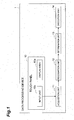
- Fig. 1 is a block diagram showing a functional configuration of a data processing device 1 according to this embodiment.
- the data processing device 1 is a device that includes a display means that displays an image including an object representing an object to be processed on a display screen and an input means that receives an instruction input indicating a position on the display screen.
- the data processing device 1 is a terminal having a so-called touch panel, for example.
- the touch panel displays an image on a display screen and is provided with an input means that detects physical contact on the display screen and can thereby detect a position at which physical contact on the display screen is detected.
- the data processing device 1 may be a personal computer that includes a display and a pointing device, for example.
- the display displays an image on a display screen, and the pointing device can receive an instruction input indicating a position on the display screen.
- a user uses the pointing device to make an instruction input indicating an arbitrary position of an image that is displayed on the display screen.
- the data processing device 1 functionally includes a touch panel 10, an acquisition unit 11, (acquisition means), a recognition unit 12 (recognition means), a determination unit 13 (determination means), and an execution unit 14 (execution means).
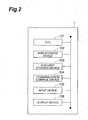
- Fig. 2 is a hardware configuration diagram of the data processing device 1.
- the data processing device 1 is physically configured as a computer system that includes a CPU 101, a main storage device 102 such as memory like RAM and ROM, an auxiliary storage device 103 such as a hard disk, a communication control device 104 such as a network card, input device 105 such as a keyboard and a mouse, an output device 106 such as a display and the like.
- Fig. 1 The functions shown in Fig. 1 are implemented by loading given computer software (data processing program) onto hardware such as the CPU 101 or the main storage device 102 shown in Fig. 2 , making the communication control device 104, the input device 105 and the output device 106 operate under control of the CPU 101, and performing reading and writing of data in the main storage device 102 or the auxiliary storage device 103. Data and database required for the processing is stored in the main storage device 102 or the auxiliary storage device 103.
- the touch panel 10 includes a display area 10a (display screen) and an input unit 10b (input means).
- the display area 10a is an area on a display screen that displays an image including an object representing an object to be processed, and displays an image under control of the execution unit 14.
- the input unit 10b is a unit that receives an instruction input indicating a position on the display area 10a.
- the object representing an object to be processed is an icon representing a file, text representing a file name and the like, for example. Further, on an item selection screen of an e-commerce site or the like, the object is text representing an item name, an image of an item and the like, for example.
- the acquisition unit 11 is a part that acquires position information indicating the position of the instruction input received by the input unit 10b.
- Fig. 3 is a diagram showing an example of position information acquired by the acquisition unit 11.
- position information P includes a coordinate value indicating a position in the display area 10a and time when the position information is acquired.
- the x-axis and the y-axis in the coordinate system in the position information P are respectively set to the crosswise direction and the lengthwise direction when the data processing device 1 is in the position where a normal operation by a user is performed thereon, for example.
- the acquisition unit 11 acquires a plurality of position information P 1 to P 7 in time-series fashion as shown in Fig. 3 , for example.
- the acquisition unit 11 outputs the acquired position information P to the recognition unit 12.
- the recognition unit 12 is a part that specifies an enclosed region on the basis of the trajectory of a set of position information received by the acquisition unit 11 based on the sequential instruction inputs through the input unit 10b and, when an object is included in the enclosed region, recognizes the object as a selected object and further recognizes the direction in which the selected object is enclosed by the trajectory of a set of position information as a direction of selection.
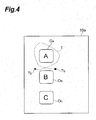
- An example of recognition of the selected object by the recognition unit 12 is described with reference to Fig. 4 .
- an image including objects O A to O C is displayed on the display area 10a of the touch panel 10, and the trajectory T of the position information received by the acquisition unit 11 based on the sequential instruction inputs extends from the starting point T S to the end point T E , forming a closed region.
- the recognition unit 12 specifies the closed region formed by the trajectory T of the position information as the enclosed region. Then, when the object O A is included in the enclosed region, the recognition unit 12 recognizes the object O A as the selected object.
- the recognition unit 12 can specify the enclosed region.
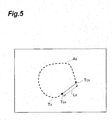
- the trajectory T X of position information reaches the end point T EX without any intersection from the starting point T SX , and thus a closed region is not formed by the trajectory T X .
- the recognition unit 12 can specify the enclosed region by assuming that the trajectory of position information exists between the starting point T SX and the end point T EX of the trajectory T X . Then, the recognition unit 12 can set the selected region A X based on the specified enclosed region.
- the recognition unit 12 may specify the selected region A X by assuming that the trajectory of position information exists between the starting point T SX and the end point T EX of the trajectory T X .
- the recognition unit 12 recognizes a direction in which an object is enclosed by the trajectory T of the position information as a direction of selection. Specifically, the recognition unit 12 recognizes which of a first direction and a second direction opposite to the first direction the direction of selection is.
- the determination as to whether the closed recon or the enclosed region is formed based on the trajectory of continuous position information may be made by applying a known character recognition technique or the like, for example.
- the known character recognition technique the open source library which is known to those skilled in the art or the like is used, for example. Further, in such a technique, it can be determined by which of the clockwise and counterclockwise trajectories the closed region or the enclosed region is formed.
- the recognition unit 12 can determine by which of the clockwise and counterclockwise trajectories the enclosed region is formed based on a change in the slope of the vector connecting the two position information acquired sequentially in a time series, for example.
- the recognition unit 12 can determine whether an object is within the enclosed region or not by comparing position information indicating the range of the enclosed region and position information indicating the layout position of the object on the display screen.
- Fig. 6 An example of recognition of the direction of selection by the recognition unit 12 is described with reference to Fig. 6 .
- the recognition unit 12 recognizes which of the clockwise and counterclockwise directions the direction of selection is.
- an image including objects O A to O C is displayed on the display area 10a, and the trajectory T 1 of the position information extends from the starting point T 1S to the end point T 1E , and the object O A is enclosed in the clockwise direction by the trajectory T 1 .
- the recognition unit 12 recognizes the object O A as the selected object and recognizes the clockwise direction as the direction of selection.
- an image including objects O A to O C is displayed on the display area 10a, and the trajectory T 2 of the position information extends from the starting point T 2S to the end point T 2E , and the object O C is enclosed in the counterclockwise direction by the trajectory T 2 .
- the recognition unit 12 recognizes the object O C as the selected object and recognizes the counterclockwise direction as the direction of selection.
- the determination unit 13 is a part that determines processing to be performed on the selected object in accordance with the direction of selection recognized by the recognition unit 12. Specifically, the determination unit 13 can determine to perform first processing on the selected object when the selected object is enclosed in the first direction by the trajectory T of the position information and to perform second processing, which is different from the first processing, on the selected object when the selected object is enclosed in the second direction by the trajectory T of the position information.
- the determination unit 13 determines to perform the first processing on the object O A that is enclosed in the clockwise direction by the trajectory T 1 of the position information, for example.
- the determination unit 13 determines to perform the second processing on the object O C that is enclosed in the counterclockwise direction by the trajectory T 2 of the position information, for example.
- the first processing or the second processing is selected by selecting the direction of enclosing an object with instruction inputs sequentially indicating positions, and therefore a user can easily select the processing to be performed on the object.
- the execution unit 14 is a part that executes the processing determined by the determination unit 13 on the selected object. In the example shown in Fig. 6 , the execution unit 14 executes the first processing on the object O A and executes the second processing on the object O C .
- the execution unit 14 may execute processing to changing an object to be processed represented by the selected object from a first state to a second state as the first processing and executes processing to change an object to be processed represented by the selected object from the second state to the first state as the second processing.
- a user can make the data processing device 1 perform the processing to change an object to be processed from the first state to the second state and the processing to change an object to be processed from the second state to the first state easily by selection of the direction of enclosing the object.
- the execution unit 14 may execute processing to encrypt data identified by the selected object as the first processing and processing to decrypt data identified by the selected object as the second processing.
- execution unit 14 may execute processing to compress data identified by the selected object as the first processing and processing to decompress data identified by the selected object as the second processing.
- the execution unit 14 may execute processing to add an attribute as an item to be purchased to an item identified by the selected object as the first processing and processing to delete an attribute as an item to be purchased from item identified by the selected object as the second processing.
- the processing such as adding and deleting an attribute as an item to be purchased is represented as a user interface for adding or deleting an item to or from a so-called shopping cart on the item selection screen.
- the first and second processing executed in accordance with the direction of selection is not limited to the above-described examples and may be any processing as long as they are different from each other.
- the execution unit 14 may execute processing to sort email into one folder as the first processing when an icon indicating the email is enclosed in the first direction by the trajectory T of the position information, and execute processing to sort email into another folder different from the one folder as the second processing when an icon indicating the email is enclosed in the second direction by the trajectory T of the position information.
- execution unit 14 may execute processing to archive email as the first processing when an icon indicating the email is enclosed in the first direction by the trajectory T of the position information, and execute processing to delete email as the second processing when an icon indicating the email is enclosed in the second direction by the trajectory T of the position information.
- the execution unit 14 may execute processing to add a marker (for example, underline) to text as the first processing when the text is enclosed in the first direction by the trajectory T of the position information, and execute processing to delete a marker from text as the second processing when the text is enclosed in the second direction by the trajectory T of the position information. Furthermore, the execution unit 14 may execute processing to copy text as the first processing when the text is enclosed in the first direction by the trajectory T of the position information, and execute processing to cut text as the second processing when the text is enclosed in the second direction by the trajectory T of the position information.
- a marker for example, underline
- the recognition unit 12 may additionally recognize the number of times the selected object is enclosed by the trajectory T of the position information as the number of selections, and the determination unit 13 may determine processing to be performed on the selected object in accordance with the direction of selection and the number of selections recognized by the recognition unit 12.
- the recognition unit 12 recognizes which of the first direction and the second direction opposite to the first direction the direction of selection is and further recognizes the number of selections, for example. Then, the determination unit 13 may determine to perform the first processing that is specified by a first parameter on the selected object when the selected object is enclosed in the first direction and to perform the second processing, which is different from the first processing, that is specified by a second parameter on the selected object when the selected object is enclosed in the second direction. In this case, the determination unit 13 can determine the first parameter in accordance with the number of selections in the first direction and determine the second parameter in accordance with the number of selections in the second direction.
- Figs. 7 to 8 are diagrams showing examples of processing to select an item on an item selection screen as an item to be purchased in the case where the data processing device 1 provides an e-commerce site, and the item selection screen is displayed on the display area 10a.
- Figs. 7 to 8 it is assumed that, when an icon is enclosed in the clockwise direction, processing to add an item represented by the icon to a shopping cart is executed, and when an icon is enclosed in the counterclockwise direction, processing to delete an item represented by the icon from a shopping cart is executed, and further the number of times the icon is enclosed is associated with a parameter such as the quantity of the item.
- an image including icons M A to M C that represent items is displayed on the display area 10a of the touch panel 10, and the trajectory T 3 of the position information encloses the icon M B twice in the clockwise direction.
- the recognition unit 12 recognizes the icon M B as the selected object. Further, the recognition unit 12 recognizes the clockwise direction as the direction of selection and recognizes twice as the number of selections.
- the determination unit 13 determines to perform processing to add two of the item B to a shopping cart based on the direction of selection and the number of selections recognized by the recognition unit 12.
- the execution unit 14 executes processing to add two items B to a shopping cart B K according to the processing determined by the determination unit 13 (see the shopping list L 1 in the shopping cart B K ).
- the trajectory T 4 of the position information encloses the icon M B twice in the clockwise direction.
- the recognition unit 12 recognizes the icon M B as the selected object. Further, the recognition unit 12 recognizes the counterclockwise direction as the direction of selection and recognizes once as the number of selections.
- the determination unit 13 determines to perform processing to delete one of the item B from a shopping cart based on the direction of selection and the number of selections recognized by the recognition unit 12.
- the execution unit 14 executes processing to delete one item B from the shopping cart B K where two items B have been saved according to the processing determined by the determination unit 13 (see the shopping list L 2 in the shopping cart B K ).
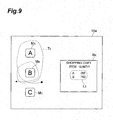
- the trajectory T 5 of the position information encloses the icons M A and M B once in the clockwise direction and further encloses the icon M B once in the clockwise direction.
- the icon M A is enclosed once by the trajectory T 5 of the position information and the icon M B is enclosed twice by the trajectory T 5 of the position information.
- the determination unit determines processing to be performed for each icon M. Specifically, the determination unit determines to perform processing to add one of the item A to a shopping cart and performing processing to add two of the item B to the shopping cart. Then, the execution unit 14 executes processing to add one item A and two items B to the shopping cart B K according to the processing determined by the determination unit 13 (see the shopping list L 3 in the shopping cart B K ).
- the processing executed in accordance with the direction of selection and the number of selections is not limited to the above-described examples, and any processing may be executed as long as they are different from each other in accordance with the direction of selection and the number of selections.
- the execution unit 14 may execute processing to ZIP compression of data or the like identified by the icon when the selected object is enclosed once in the first direction by the trajectory T of the position information, execute processing to encrypt ZIP compression of data or the like identified by the icon when it is enclosed twice in the first direction, execute processing to Lha low compression of data or the like identified by the icon when it is enclosed once in the second direction, and execute processing to Lha high compression of data or the like identified by the icon when it is enclosed twice in the second direction.
- the execution unit 14 may execute processing to DES encryption of data or the like identified by the icon when the selected object is enclosed once in the first direction by the trajectory T of the position information, execute processing to AES encryption of data or the like identified by the icon when it is enclosed twice in the first direction, execute processing to DES decryption of data or the like identified by the icon when it is enclosed once in the second direction, and execute processing to AES decryption of data or the like identified by the icon when it is enclosed twice in the second direction.
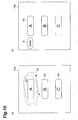
- FIGs. 10 and 11 are diagrams showing examples of processing to evaluate an item on an item evaluation screen in the case where the data processing device 1 provides a site that evaluates items and the like, and icons W that identify items are displayed on the display area 10a.
- an image including icons W A to W C that represent items is displayed on the display area 10a of the touch panel 10, and the trajectory T 6 of the position information encloses the icon W A twice in the clockwise direction.
- the recognition unit 12 recognizes the icon W A as the selected object. Further, the recognition unit 12 recognizes the clockwise direction as the direction of selection and recognizes twice as the number of selections.
- the determination unit 13 determines to perform processing to select the item A as an item to be evaluated and adding a flag F 1 "better” representing the second level of evaluation corresponding to the number of selections "twice” based on the direction of selection and the number of selections recognized by the recognition unit 12.
- the execution unit 14 executes processing to add the flag F 1 to the icon W A representing the item A in accordance with the processing determined by the determination unit 13 as shown in Fig. 10(b) .
- a flag in accordance with the number of times the icon is enclosed may be displayed each time the icon is enclosed. Specifically, at the point of time when the icon W A is enclosed once by the trajectory T 6 of the position information, the determination unit 13 determines to perform processing to add the flag "good" representing the first level of evaluation, and the execution unit 14 executes processing to add the flag to the icon W A .
- the determination unit 13 determines to perform processing to add the flag F 1 "better" representing the second level of evaluation, and the execution unit 14 executes processing to add the flag to the icon W A .
- the trajectory T 7 of the position information encloses the icon W B three times in the clockwise direction and continuously encloses the icon W A once in the counterclockwise direction.
- the determination unit 13 determines to perform processing to select the item B as an item to be evaluated and adding a flag F 3 representing the third level of evaluation corresponding to the number of selections "three times". Further, the determination unit 13 determines to perform processing to lower the level of weighting from the second level of weighting having assigned to the item A by one level corresponding to the number of selections "once" and adding a flag F 2 representing the first level of evaluation.
- the execution unit 14 executes processing to add the flag F 2 to the icon W A representing the item A and adding the flag F 3 to the icon W B representing the item B in accordance with the processing determined by the determination unit 13 as shown in Fig. 11(b) .
- the recognition unit 12 can recognize the number of times obtained by subtracting, from the number of times the selected object is enclosed in one direction by the trajectory T of the position information, the number of times it is enclosed in the opposite direction to the one direction as the number of selections in one direction. Such recognition of the number of selections is described specifically with reference to Fig. 12 .
- the object O A is enclosed three times in the clockwise direction and then enclosed once in the counterclockwise direction by the trajectory T 8 of the position information.
- the recognition unit 12 recognizes twice, which is a result of subtracting one from three, as the number of selections in the clockwise direction. This allows easy adjustment of the number of selections for determining the processing to be performed on the selected object.
- Fig. 2 is a flowchart showing a process of a data processing method performed in the data processing device 1.
- the acquisition unit 11 acquires position information indicating the position of an instruction input received by the input unit 10b of the touch panel 10 (S1).
- the recognition unit 12 specifies an enclosed region on the basis of the trajectory of the position information received by the acquisition unit 11 based on the sequential instruction inputs through the input unit 10b and determines whether an object is enclosed by the enclosed region (S2). When it is determined that an object is enclosed by the enclosed region, the process proceeds to Step S3. On the other hand, when it is not determined that an object is enclosed by the enclosed region, the process ends.
- Step S3 the recognition unit 12 recognizes the object enclosed by the enclosed region and recognizes the direction in which the object is enclosed by the trajectory of the position information as the direction of selection (S3).
- the recognition unit 12 determines which of the first direction and the second direction opposite to the first direction the direction of selection is (S4).
- the process proceeds to Step S5.
- the direction of selection is the second direction, the process proceeds to Step S6.
- Step S5 the determination unit 13 determines to perform processing in accordance with the first direction on the selected object (S5).
- Step S6 the determination unit 13 determines to perform processing in accordance with the second direction on the selected object (S6).
- the execution unit 14 executes the processing determined in Step S5 or S6 on the object (S7).
- Step S11 to S12 is the same as the processing to Steps S1 to S2 in Fig. 13 .
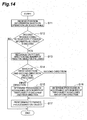
- the recognition unit 12 recognizes the object enclosed by the enclosed region and recognizes the direction and the number of times the object is enclosed by the trajectory of the position information as the direction of selection and the number of selections (S 13).
- the recognition unit 12 determines which of the first direction and the second direction opposite to the first direction the direction of selection is (S14). When the direction of selection is the first direction, the process proceeds to Step S15. On the other hand, when the direction of selection is the second direction, the process proceeds to Step S16.
- Step S15 the determination unit 13 determines to perform processing in accordance with the number of selections, which is the number of times the object is enclosed by the trajectory of the position information, and the first direction on the selected object (S15).
- Step S16 the determination unit 13 determines to perform processing in accordance with the number of selections and the second direction on the selected object (S16).
- Step S 17 the execution unit 14 executes the processing determined in Step S15 or S16 on the object (S 17).
- a data processing program that causes a computer to function as the data processing device 1 is described hereinafter with reference to Fig. 15 .
- a data processing program P1 includes a main module P10, an acquisition module P11, a recognition control module P12, a determination module P 13, and an execution module P 14.
- the main module P10 is a part that exercises control over the object processing.
- the functions implemented by executing the acquisition module P11, the recognition control module P12, the determination module P 13 and the execution module P 14 are equal to the functions of the acquisition unit 11, the recognition unit 12, the determination unit 13 and the execution unit 14 of the data processing device 1 shown in Fig. 1 , respectively.
- the data processing program P1 is provided through a storage medium such as CD-ROM or DVD-ROM or semiconductor memory, for example. Further, the data processing program P1 may be provided as a computer data signal superimposed onto a carrier wave over a communication network.
- the data processing device 1 when, upon sequential instruction inputs by a user, an operation of enclosing an object displayed on a display screen by the trajectory of position information indicated by the instruction inputs is performed, the object is recognized as the selected object and further the direction of selection in which the selected object is enclosed is recognized by the recognition unit 12. Then, processing determined by the determination unit 13 in accordance with the direction of selection is executed on the selected object, and therefore selection of processing desired by a user is made by simple instruction inputs such as selection of the direction of enclosing an object by the trajectory of position information, and the selected processing can be executed on the selected object.
- a data processing device that allows execution of processing desired by a user among candidates for processing with a simple instruction input.
- 1...data processing device 10... touch panel, 10a...display area, 10b...input unit, 11...acquisition unit, 12...recognition unit, 13...determination unit, 14...execution unit, D1...storage medium, P1...data processing program, P10...main module, P11...acquisition module, P12...recognition module, P13...determination module, P14...execution module
Landscapes
- Engineering & Computer Science (AREA)
- General Engineering & Computer Science (AREA)
- Theoretical Computer Science (AREA)
- Human Computer Interaction (AREA)
- Physics & Mathematics (AREA)
- General Physics & Mathematics (AREA)
- User Interface Of Digital Computer (AREA)
- Position Input By Displaying (AREA)
Abstract
Description
- The present invention relates to a data processing device, a data processing method, a data processing program, and a computer-readable recording medium storing the program.
- There has been a data processing device, such as a game machine, for example, that executes specified processing by an operation of enclosing an object displayed on a display screen with the input path of a pointing device. For example, in
Patent Literature 1 below, a device that, when an object displayed on a display screen is enclosed with the input path of a pointing device, executes processing in accordance with the type of the enclosed object is disclosed. - PTL 1: Japanese Unexamined Patent Application Publication No.
2009-119288 - In the above-described related art, the detail of processing after selection of an object is decided in accordance with the type of the enclosed object. However, there is a case where a user selects desired processing from candidates for processing and desires execution of the processing on the object. According to the related art, the processing to be performed is decided in accordance with the type of a selected object, and therefore the processing desired by a user cannot be executed.
- In view of the foregoing, an object of the present invention is to provide a data processing device, a data processing method, a data processing program, and a computer-readable recording medium storing the program that allow execution of processing desired by a user among candidates for processing with a simple instruction input.
- To solve the above problem, a data processing device according to one aspect of the invention is a data processing device including a display means configured to display an image including an object representing an object to be processed in an image display area on a display screen and an input means configured to receive an instruction input indicating a position on the display screen, including an acquisition means configured to acquire position information indicating a position of an instruction input received by the input means, a recognition means configured to specify an enclosed region in the image display area based on a trajectory indicated by a set of position information acquired by the acquisition means according to sequential instruction inputs through the input means, and when an object is included in the enclosed region, recognize the object as a selected object and recognize a direction in which the selected object is enclosed by the trajectory of the set of position information as a direction of selection, a determination means configured to determine processing to be performed on the selected object in accordance with the direction of selection recognized by the recognition means, and an execution means configured to execute the processing determined by the determination means on the selected object.
- A data processing method according to one aspect of the invention is a data processing method in a data processing device including a display means configured to display an image including an object representing an object to be processed in an image display area on a display screen and an input means configured to receive an instruction input indicating a position on the display screen, the method including an acquisition step of acquiring position information indicating a position of an instruction input received by the input means, a recognition step of specifying an enclosed region in the image display area based on a trajectory indicated by a set of position information acquired in the acquisition step according to sequential instruction inputs through the input means, and when an object is included in the enclosed region, recognizing the object as a selected object and recognizing a direction in which the selected object is enclosed by the trajectory of the set of position information as a direction of selection, a determination step of determining processing to be performed on the selected object in accordance with the direction of selection recognized in the recognition step, and an execution step of executing the processing determined in the determination step on the selected object.
- A data processing program according to one aspect of the invention is a data processing program causing a computer to function as a data processing device including a display means configured to display an image including an object representing an object to be processed in an image display area on a display screen and an input means configured to receive an instruction input indicating a position on the display screen, the program causing the computer to implement an acquisition function to acquire position information indicating a position of an instruction input received by the input means, a recognition function to specify an enclosed region in the image display area based on a trajectory indicated by a set of position information acquired by the acquisition function according to sequential instruction inputs through the input means, and when an object is included in the enclosed region, recognize the object as a selected object and recognize a direction in which the selected object is enclosed by the trajectory of the set of position information as a direction of selection, a determination function to determine processing to be performed on the selected object in accordance with the direction of selection recognized by the recognition function, and an execution function to execute the processing determined by the determination function on the selected object.
- A computer-readable recording medium according to one aspect of the invention is a computer-readable recording medium storing a data processing program causing a computer to function as a data processing device including a display means configured to display an image including an object representing an object to be processed in an image display area on a display screen and an input means configured to receive an instruction input indicating a position on the display screen, the data processing program causing the computer to implement an acquisition function to acquire position information indicating a position of an instruction input received by the input means, a recognition function to specify an enclosed region in the image display area based on a trajectory indicated by a set of position information acquired by the acquisition function according to sequential instruction inputs through the input means, and when an object is included in the enclosed region, recognize the object as a selected object and recognize a direction in which the selected object is enclosed by the trajectory of the set of position information as a direction of selection, a determination function to determine processing to be performed on the selected object in accordance with the direction of selection recognized by the recognition function, and an execution function to execute the processing determined by the determination function on the selected object.
- According to the above-described aspect, when, in response to sequential instruction inputs by a user, an operation of enclosing an object displayed on a display screen by the trajectory of position information indicated by the instruction inputs is performed, the object is selected as the selected object and further the direction of selection in which the selected object is enclosed is recognized. Then, processing determined in accordance with the direction of selection is executed on the selected object, and therefore selection of processing desired by a user is made by simple instruction inputs such as selection of the direction of enclosing an object by the trajectory of position information, and the selected processing can be executed on the selected object.
- In the data processing device according to another aspect, the recognition means may recognize which of a first direction and a second direction opposite to the first direction the direction of selection is, the determination means may determine to perform first processing on the selected object when the selected object is enclosed in the first direction by the trajectory of the set of position information and perform second processing different from the first processing on the selected object when the selected object is enclosed in the second direction by the trajectory of the set of position information, the first processing may be processing to change an object to be processed represented by the selected object from a first state to a second state, and the second processing may be processing to change the object to be processed from the second state to the first state.
- According to the above aspect, a user encloses an object with instruction inputs forming a trajectory in any of the first direction and the second direction, and thereby processing desired by a user selected from processing to change an object to be processed represented by the object from the first state to the second state and processing to change it from the second state to the first state can be executed.
- In the data processing device according to another aspect, the recognition means may further recognize a number of times the selected object is enclosed by the trajectory of the set of position information as a number of selections, and the determination means may determine processing to be performed on the selected object in accordance with the direction of selection and the number of selections recognized by the recognition means.
- According to the above aspect, when instruction inputs for enclosing an object are made by a user, the direction of selection in which the object is enclosed and the number of times the object is enclosed are recognized, and processing determined in accordance with the direction of selection and the number of selections is executed on the selected object. Therefore, selection of processing desired by a user is made by simple instruction inputs such as selection of the direction and the number of times of enclosing an object by the trajectory of position information, and the selected processing can be executed on the selected object.
- In the data processing device according to another aspect, the recognition means may recognize which of a first direction and a second direction opposite to the first direction the direction of selection is, the first processing may be processing to change an object to be processed represented by the selected object from an unselected state to a selected state in a quantity corresponding to the number of selections in the first direction, and the second processing may be processing to change an object to be processed represented by the selected object from a selected state to an unselected state in a quantity corresponding to the number of selections in the second direction.
- According to the above aspect, by simple instruction inputs such as selection of the direction and the number of times of enclosing an object by the trajectory of position information, processing to change an object to be processed represented by the object from an unselected state to a selected state or changing it from a selected state to an unselected state can be executed, setting a desired quantity as an attribute of the object to be processed.
- In the data processing device according to another aspect, the recognition means may recognize which of a first direction and a second direction opposite to the first direction the direction of selection is, the first processing may be processing to increase a level of weighting on an object to be processed represented by the selected object by a level corresponding to the number of selections in the first direction, and the second processing may be processing to decrease a level of weighting on an object to be processed represented by the selected object by a level corresponding to the number of selections in the second direction.
- According to the above aspect, by simple instruction inputs such as selection of the direction and the number of times of enclosing an object by the trajectory of position information, processing to increase or decrease the level of weighting on an object to be processed represented by the object can be executed.
- In the data processing device according to another aspect, the recognition means may recognize a number of times obtained by subtracting, from the number of times the selected object is enclosed in one direction by the trajectory of the set of position information, the number of times the selected object is enclosed in an opposite direction to the one direction as the number of selections in the one direction.
- According to the above aspect, the number of selections for determining the processing to be performed on the selected object can be easily adjusted.
- In the data processing device according to another aspect, the first processing may be processing to encrypt data identified by the selected object, and the second processing may be processing to decrypt data identified by the selected object.
- According to the above aspect, by simple instruction inputs such as selection of the direction of enclosing an object by the trajectory of position information, processing to encrypt or decrypt data identified by the object can be executed.
- In the data processing device according to another aspect, the first processing may be processing to compress data identified by the selected object, and the second processing may be processing to decompress data identified by the selected object.
- According to the above aspect, by simple instruction inputs such as selection of the direction of enclosing an object by the trajectory of position information, processing to compress or decompress data identified by the object can be executed.
- According to one aspect of the present invention, it is possible to allow execution of processing desired by a user among candidates for processing with a simple instruction input.
-
-
Fig. 1 is a block diagram showing a functional configuration of a data processing device. -
Fig. 2 is a diagram showing a hardware configuration of a data processing device. -
Fig. 3 is a diagram showing an example of position information acquired by an acquisition unit. -
Fig. 4 is a diagram showing an example of recognition of a selected object by a recognition unit. -
Fig. 5 is a diagram showing an example of processing to recognize a selected region by a recognition unit. -
Fig. 6 is a diagram showing an example of recognition of the direction of selection by a recognition unit. -
Fig. 7 is a diagram showing an example of recognition of the direction of selection and the number of selections and processing to be executed. -
Fig. 8 is a diagram showing an example of recognition of the direction of selection and the number of selections and processing to be executed. -
Fig. 9 is a diagram showing an example of recognition of the direction of selection and the number of selections and processing to be executed. -
Fig. 10 is a diagram showing another embodiment where processing in accordance with the number of selections and the direction of selection of a selected object is executed. -
Fig. 11 is a diagram showing another embodiment where processing in accordance with the number of selections and the direction of selection of a selected object executed. -
Fig. 12 is a diagram showing an example of recognition of the number of selections by a recognition unit. -
Fig. 13 is a flowchart showing a process in a data processing device. -
Fig. 14 is a flowchart showing a process in a data processing device. -
Fig. 15 is a diagram showing a configuration of a data processing program. - An embodiment of the present invention is described hereinafter in detail with reference to the appended drawings. Note that, in the description of the drawings, the same or equivalent elements are denoted by the same reference symbols, and the redundant explanation thereof is omitted.
-
Fig. 1 is a block diagram showing a functional configuration of adata processing device 1 according to this embodiment. Thedata processing device 1 is a device that includes a display means that displays an image including an object representing an object to be processed on a display screen and an input means that receives an instruction input indicating a position on the display screen. Thedata processing device 1 is a terminal having a so-called touch panel, for example. The touch panel displays an image on a display screen and is provided with an input means that detects physical contact on the display screen and can thereby detect a position at which physical contact on the display screen is detected. - Further, the
data processing device 1 may be a personal computer that includes a display and a pointing device, for example. The display displays an image on a display screen, and the pointing device can receive an instruction input indicating a position on the display screen. A user uses the pointing device to make an instruction input indicating an arbitrary position of an image that is displayed on the display screen. - The
data processing device 1 according to this embodiment is described hereinafter using the example of the terminal having a touch panel. As shown inFig. 1 , thedata processing device 1 functionally includes atouch panel 10, anacquisition unit 11, (acquisition means), a recognition unit 12 (recognition means), a determination unit 13 (determination means), and an execution unit 14 (execution means). -
Fig. 2 is a hardware configuration diagram of thedata processing device 1. As shown inFig. 2 , thedata processing device 1 is physically configured as a computer system that includes aCPU 101, amain storage device 102 such as memory like RAM and ROM, anauxiliary storage device 103 such as a hard disk, acommunication control device 104 such as a network card,input device 105 such as a keyboard and a mouse, anoutput device 106 such as a display and the like. - The functions shown in
Fig. 1 are implemented by loading given computer software (data processing program) onto hardware such as theCPU 101 or themain storage device 102 shown inFig. 2 , making thecommunication control device 104, theinput device 105 and theoutput device 106 operate under control of theCPU 101, and performing reading and writing of data in themain storage device 102 or theauxiliary storage device 103. Data and database required for the processing is stored in themain storage device 102 or theauxiliary storage device 103. - The
touch panel 10 includes adisplay area 10a (display screen) and aninput unit 10b (input means). Thedisplay area 10a is an area on a display screen that displays an image including an object representing an object to be processed, and displays an image under control of theexecution unit 14. Theinput unit 10b is a unit that receives an instruction input indicating a position on thedisplay area 10a. - The object representing an object to be processed is an icon representing a file, text representing a file name and the like, for example. Further, on an item selection screen of an e-commerce site or the like, the object is text representing an item name, an image of an item and the like, for example.
- The
acquisition unit 11 is a part that acquires position information indicating the position of the instruction input received by theinput unit 10b.Fig. 3 is a diagram showing an example of position information acquired by theacquisition unit 11. As shown inFig. 3 , position information P includes a coordinate value indicating a position in thedisplay area 10a and time when the position information is acquired. The x-axis and the y-axis in the coordinate system in the position information P are respectively set to the crosswise direction and the lengthwise direction when thedata processing device 1 is in the position where a normal operation by a user is performed thereon, for example. - Further, when sequential instruction inputs are received through the
input unit 10b, theacquisition unit 11 acquires a plurality of position information P1 to P7 in time-series fashion as shown inFig. 3 , for example. Theacquisition unit 11 outputs the acquired position information P to therecognition unit 12. - The
recognition unit 12 is a part that specifies an enclosed region on the basis of the trajectory of a set of position information received by theacquisition unit 11 based on the sequential instruction inputs through theinput unit 10b and, when an object is included in the enclosed region, recognizes the object as a selected object and further recognizes the direction in which the selected object is enclosed by the trajectory of a set of position information as a direction of selection. An example of recognition of the selected object by therecognition unit 12 is described with reference toFig. 4 . - In the example shown in
Fig. 4 , an image including objects OA to OC is displayed on thedisplay area 10a of thetouch panel 10, and the trajectory T of the position information received by theacquisition unit 11 based on the sequential instruction inputs extends from the starting point TS to the end point TE, forming a closed region. In this case, therecognition unit 12 specifies the closed region formed by the trajectory T of the position information as the enclosed region. Then, when the object OA is included in the enclosed region, therecognition unit 12 recognizes the object OA as the selected object. - Further, as shown in
Fig. 5 , even when a closed region is not formed by the trajectory of a set of position information, if the trajectory of a set of position information satisfies specified conditions, therecognition unit 12 can specify the enclosed region. In the example ofFig. 5 , the trajectory TX of position information reaches the end point TEX without any intersection from the starting point TSX, and thus a closed region is not formed by the trajectory TX. In this case also, when specified conditions such as that a distance LX between the starting point TSX and the end point TEX is a specified distance or less, or when the ratio of the distance LX between the starting point TSX and the end point TEX to the length of the trajectory TX is a specified ratio or less are satisfied, therecognition unit 12 can specify the enclosed region by assuming that the trajectory of position information exists between the starting point TSX and the end point TEX of the trajectory TX. Then, therecognition unit 12 can set the selected region AX based on the specified enclosed region. - Further, when the center-of-gravity point of a region enclosed by a line connecting the trajectory TX and the points TEX and TSX is calculated, and an angle between a line connecting the point TEX and the center-of-gravity point and a line connecting the point TSX and the center-of-gravity point is a specified angle or less, the
recognition unit 12 may specify the selected region AX by assuming that the trajectory of position information exists between the starting point TSX and the end point TEX of the trajectory TX. - Further, the
recognition unit 12 recognizes a direction in which an object is enclosed by the trajectory T of the position information as a direction of selection. Specifically, therecognition unit 12 recognizes which of a first direction and a second direction opposite to the first direction the direction of selection is. - Note that the determination as to whether the closed recon or the enclosed region is formed based on the trajectory of continuous position information may be made by applying a known character recognition technique or the like, for example. In the known character recognition technique, the open source library which is known to those skilled in the art or the like is used, for example. Further, in such a technique, it can be determined by which of the clockwise and counterclockwise trajectories the closed region or the enclosed region is formed. Furthermore, when the closed region or the enclosed region is formed by the character recognition technique using the open source library or the like, the
recognition unit 12 can determine by which of the clockwise and counterclockwise trajectories the enclosed region is formed based on a change in the slope of the vector connecting the two position information acquired sequentially in a time series, for example. - Further, the
recognition unit 12 can determine whether an object is within the enclosed region or not by comparing position information indicating the range of the enclosed region and position information indicating the layout position of the object on the display screen. - An example of recognition of the direction of selection by the
recognition unit 12 is described with reference toFig. 6 . In the example ofFig. 6 , therecognition unit 12 recognizes which of the clockwise and counterclockwise directions the direction of selection is. - In the example shown in
Fig. 6(a) , an image including objects OA to OC is displayed on thedisplay area 10a, and the trajectory T1 of the position information extends from the starting point T1S to the end point T1E, and the object OA is enclosed in the clockwise direction by the trajectory T1. In this case, therecognition unit 12 recognizes the object OA as the selected object and recognizes the clockwise direction as the direction of selection. - On the other hand, in the example shown in
Fig. 6(b) , an image including objects OA to OC is displayed on thedisplay area 10a, and the trajectory T2 of the position information extends from the starting point T2S to the end point T2E, and the object OC is enclosed in the counterclockwise direction by the trajectory T2. In this case, therecognition unit 12 recognizes the object OC as the selected object and recognizes the counterclockwise direction as the direction of selection. - The
determination unit 13 is a part that determines processing to be performed on the selected object in accordance with the direction of selection recognized by therecognition unit 12. Specifically, thedetermination unit 13 can determine to perform first processing on the selected object when the selected object is enclosed in the first direction by the trajectory T of the position information and to perform second processing, which is different from the first processing, on the selected object when the selected object is enclosed in the second direction by the trajectory T of the position information. - In the example shown in
Fig. 6 , thedetermination unit 13 determines to perform the first processing on the object OA that is enclosed in the clockwise direction by the trajectory T1 of the position information, for example. On the other hand, thedetermination unit 13 determines to perform the second processing on the object OC that is enclosed in the counterclockwise direction by the trajectory T2 of the position information, for example. In this manner, the first processing or the second processing is selected by selecting the direction of enclosing an object with instruction inputs sequentially indicating positions, and therefore a user can easily select the processing to be performed on the object. - The
execution unit 14 is a part that executes the processing determined by thedetermination unit 13 on the selected object. In the example shown inFig. 6 , theexecution unit 14 executes the first processing on the object OA and executes the second processing on the object OC. - Further, the
execution unit 14 may execute processing to changing an object to be processed represented by the selected object from a first state to a second state as the first processing and executes processing to change an object to be processed represented by the selected object from the second state to the first state as the second processing. In this case, a user can make thedata processing device 1 perform the processing to change an object to be processed from the first state to the second state and the processing to change an object to be processed from the second state to the first state easily by selection of the direction of enclosing the object. - To be more specific, the
execution unit 14 may execute processing to encrypt data identified by the selected object as the first processing and processing to decrypt data identified by the selected object as the second processing. - Further, the
execution unit 14 may execute processing to compress data identified by the selected object as the first processing and processing to decompress data identified by the selected object as the second processing. - Furthermore, in the case where the
data processing device 1 according to this embodiment provides an e-commerce site and an item selection screen is displayed on thedisplay area 10a, theexecution unit 14 may execute processing to add an attribute as an item to be purchased to an item identified by the selected object as the first processing and processing to delete an attribute as an item to be purchased from item identified by the selected object as the second processing. The processing such as adding and deleting an attribute as an item to be purchased is represented as a user interface for adding or deleting an item to or from a so-called shopping cart on the item selection screen. - Note that the first and second processing executed in accordance with the direction of selection is not limited to the above-described examples and may be any processing as long as they are different from each other. For example, in the case where the
data processing device 1 according to this embodiment is applied to an application for managing email, theexecution unit 14 may execute processing to sort email into one folder as the first processing when an icon indicating the email is enclosed in the first direction by the trajectory T of the position information, and execute processing to sort email into another folder different from the one folder as the second processing when an icon indicating the email is enclosed in the second direction by the trajectory T of the position information. Further, theexecution unit 14 may execute processing to archive email as the first processing when an icon indicating the email is enclosed in the first direction by the trajectory T of the position information, and execute processing to delete email as the second processing when an icon indicating the email is enclosed in the second direction by the trajectory T of the position information. - Further, in the case where the
data processing device 1 according to this embodiment is applied to an application for displaying or editing text, for example, theexecution unit 14 may execute processing to add a marker (for example, underline) to text as the first processing when the text is enclosed in the first direction by the trajectory T of the position information, and execute processing to delete a marker from text as the second processing when the text is enclosed in the second direction by the trajectory T of the position information. Furthermore, theexecution unit 14 may execute processing to copy text as the first processing when the text is enclosed in the first direction by the trajectory T of the position information, and execute processing to cut text as the second processing when the text is enclosed in the second direction by the trajectory T of the position information. - Further, the
recognition unit 12 may additionally recognize the number of times the selected object is enclosed by the trajectory T of the position information as the number of selections, and thedetermination unit 13 may determine processing to be performed on the selected object in accordance with the direction of selection and the number of selections recognized by therecognition unit 12. - To be more specific, the
recognition unit 12 recognizes which of the first direction and the second direction opposite to the first direction the direction of selection is and further recognizes the number of selections, for example. Then, thedetermination unit 13 may determine to perform the first processing that is specified by a first parameter on the selected object when the selected object is enclosed in the first direction and to perform the second processing, which is different from the first processing, that is specified by a second parameter on the selected object when the selected object is enclosed in the second direction. In this case, thedetermination unit 13 can determine the first parameter in accordance with the number of selections in the first direction and determine the second parameter in accordance with the number of selections in the second direction. - The above-described processing is described hereinafter with reference to
Figs. 7 to 8. Figs. 7 to 8 are diagrams showing examples of processing to select an item on an item selection screen as an item to be purchased in the case where thedata processing device 1 provides an e-commerce site, and the item selection screen is displayed on thedisplay area 10a. In the examples shown inFigs. 7 to 8 , it is assumed that, when an icon is enclosed in the clockwise direction, processing to add an item represented by the icon to a shopping cart is executed, and when an icon is enclosed in the counterclockwise direction, processing to delete an item represented by the icon from a shopping cart is executed, and further the number of times the icon is enclosed is associated with a parameter such as the quantity of the item. - In the example shown in
Fig. 7 , an image including icons MA to MC that represent items is displayed on thedisplay area 10a of thetouch panel 10, and the trajectory T3 of the position information encloses the icon MB twice in the clockwise direction. In this case, therecognition unit 12 recognizes the icon MB as the selected object. Further, therecognition unit 12 recognizes the clockwise direction as the direction of selection and recognizes twice as the number of selections. Then, thedetermination unit 13 determines to perform processing to add two of the item B to a shopping cart based on the direction of selection and the number of selections recognized by therecognition unit 12. Then, theexecution unit 14 executes processing to add two items B to a shopping cart BK according to the processing determined by the determination unit 13 (see the shopping list L1 in the shopping cart BK). - In the example shown in
Fig. 8 , the trajectory T4 of the position information encloses the icon MB twice in the clockwise direction. In this case, therecognition unit 12 recognizes the icon MB as the selected object. Further, therecognition unit 12 recognizes the counterclockwise direction as the direction of selection and recognizes once as the number of selections. Then, thedetermination unit 13 determines to perform processing to delete one of the item B from a shopping cart based on the direction of selection and the number of selections recognized by therecognition unit 12. Then, theexecution unit 14 executes processing to delete one item B from the shopping cart BK where two items B have been saved according to the processing determined by the determination unit 13 (see the shopping list L2 in the shopping cart BK). - Further, in the example shown in
Fig. 9 , the trajectory T5 of the position information encloses the icons MA and MB once in the clockwise direction and further encloses the icon MB once in the clockwise direction. Thus, the icon MA is enclosed once by the trajectory T5 of the position information and the icon MB is enclosed twice by the trajectory T5 of the position information. In this case, the determination unit determines processing to be performed for each icon M. Specifically, the determination unit determines to perform processing to add one of the item A to a shopping cart and performing processing to add two of the item B to the shopping cart. Then, theexecution unit 14 executes processing to add one item A and two items B to the shopping cart BK according to the processing determined by the determination unit 13 (see the shopping list L3 in the shopping cart BK). - Note that the processing executed in accordance with the direction of selection and the number of selections is not limited to the above-described examples, and any processing may be executed as long as they are different from each other in accordance with the direction of selection and the number of selections. For example, in the case where an object is an icon or the like that identifies data, a file or the like, the
execution unit 14 may execute processing to ZIP compression of data or the like identified by the icon when the selected object is enclosed once in the first direction by the trajectory T of the position information, execute processing to encrypt ZIP compression of data or the like identified by the icon when it is enclosed twice in the first direction, execute processing to Lha low compression of data or the like identified by the icon when it is enclosed once in the second direction, and execute processing to Lha high compression of data or the like identified by the icon when it is enclosed twice in the second direction. Further, theexecution unit 14 may execute processing to DES encryption of data or the like identified by the icon when the selected object is enclosed once in the first direction by the trajectory T of the position information, execute processing to AES encryption of data or the like identified by the icon when it is enclosed twice in the first direction, execute processing to DES decryption of data or the like identified by the icon when it is enclosed once in the second direction, and execute processing to AES decryption of data or the like identified by the icon when it is enclosed twice in the second direction. - Other embodiments where processing in accordance with the number of selections and the direction of selection of the selected object is executed are described hereinafter with reference to
Figs. 10 and11 .Figs. 10 and11 are diagrams showing examples of processing to evaluate an item on an item evaluation screen in the case where thedata processing device 1 provides a site that evaluates items and the like, and icons W that identify items are displayed on thedisplay area 10a. - Note that, in the examples shown in
Figs. 10 and11 , when the icon W is enclosed in the clockwise direction, processing to make an item represented by the icon W selected as an item to be evaluated is executed, and further processing to assign weighting in accordance with the number of times the icon W is enclosed as a parameter to the item is executed. The weightings are represented in three levels: "good", "better" and "best" and associated as a flag F with the icon W on thedisplay area 10a. On the other hand, when the icon W is enclosed in the counterclockwise direction, processing to lower the weighting set to an item represented by the icon or processing to exclude the item from an item to be evaluated to make it unselected is executed. The degree of lowering the weighting is set in accordance with the number of selections. - In the example shown in
Fig. 10(a) , an image including icons WA to WC that represent items is displayed on thedisplay area 10a of thetouch panel 10, and the trajectory T6 of the position information encloses the icon WA twice in the clockwise direction. In this case, therecognition unit 12 recognizes the icon WA as the selected object. Further, therecognition unit 12 recognizes the clockwise direction as the direction of selection and recognizes twice as the number of selections. Then, thedetermination unit 13 determines to perform processing to select the item A as an item to be evaluated and adding a flag F1 "better" representing the second level of evaluation corresponding to the number of selections "twice" based on the direction of selection and the number of selections recognized by therecognition unit 12. Then, theexecution unit 14 executes processing to add the flag F1 to the icon WA representing the item A in accordance with the processing determined by thedetermination unit 13 as shown inFig. 10(b) . - Note that, when an operation of enclosing an icon twice such as shown in
Fig. 10(a) is performed, a flag in accordance with the number of times the icon is enclosed may be displayed each time the icon is enclosed. Specifically, at the point of time when the icon WA is enclosed once by the trajectory T6 of the position information, thedetermination unit 13 determines to perform processing to add the flag "good" representing the first level of evaluation, and theexecution unit 14 executes processing to add the flag to the icon WA. Then, at the point of time when the icon WA is further enclosed once by the trajectory T6 of the position information, thedetermination unit 13 determines to perform processing to add the flag F1 "better" representing the second level of evaluation, and theexecution unit 14 executes processing to add the flag to the icon WA. - In the example shown in
Fig. 11(a) , in the state of the display screen shown inFig. 10(b) , the trajectory T7 of the position information encloses the icon WB three times in the clockwise direction and continuously encloses the icon WA once in the counterclockwise direction. In this case, thedetermination unit 13 determines to perform processing to select the item B as an item to be evaluated and adding a flag F3 representing the third level of evaluation corresponding to the number of selections "three times". Further, thedetermination unit 13 determines to perform processing to lower the level of weighting from the second level of weighting having assigned to the item A by one level corresponding to the number of selections "once" and adding a flag F2 representing the first level of evaluation. Then, theexecution unit 14 executes processing to add the flag F2 to the icon WA representing the item A and adding the flag F3 to the icon WB representing the item B in accordance with the processing determined by thedetermination unit 13 as shown inFig. 11(b) . - Note that the
recognition unit 12 can recognize the number of times obtained by subtracting, from the number of times the selected object is enclosed in one direction by the trajectory T of the position information, the number of times it is enclosed in the opposite direction to the one direction as the number of selections in one direction. Such recognition of the number of selections is described specifically with reference toFig. 12 . In the example shown inFig. 12 , the object OA is enclosed three times in the clockwise direction and then enclosed once in the counterclockwise direction by the trajectory T8 of the position information. In this case, therecognition unit 12 recognizes twice, which is a result of subtracting one from three, as the number of selections in the clockwise direction. This allows easy adjustment of the number of selections for determining the processing to be performed on the selected object. - The operation of the
data processing device 1 according to this embodiment is described hereinafter with reference toFig. 13 .Fig. 2 is a flowchart showing a process of a data processing method performed in thedata processing device 1. - First, the
acquisition unit 11 acquires position information indicating the position of an instruction input received by theinput unit 10b of the touch panel 10 (S1). Therecognition unit 12 specifies an enclosed region on the basis of the trajectory of the position information received by theacquisition unit 11 based on the sequential instruction inputs through theinput unit 10b and determines whether an object is enclosed by the enclosed region (S2). When it is determined that an object is enclosed by the enclosed region, the process proceeds to Step S3. On the other hand, when it is not determined that an object is enclosed by the enclosed region, the process ends. - In Step S3, the
recognition unit 12 recognizes the object enclosed by the enclosed region and recognizes the direction in which the object is enclosed by the trajectory of the position information as the direction of selection (S3). Therecognition unit 12 then determines which of the first direction and the second direction opposite to the first direction the direction of selection is (S4). When the direction of selection is the first direction, the process proceeds to Step S5. On the other hand, when the direction of selection is the second direction, the process proceeds to Step S6. - In Step S5, the
determination unit 13 determines to perform processing in accordance with the first direction on the selected object (S5). On the other hand, in Step S6, thedetermination unit 13 determines to perform processing in accordance with the second direction on the selected object (S6). Then, in Step S7, theexecution unit 14 executes the processing determined in Step S5 or S6 on the object (S7). - Another example of the data processing method performed in the
data processing device 1 is described hereinafter with reference toFig. 14 . The processing to Steps S11 to S12 is the same as the processing to Steps S1 to S2 inFig. 13 . In the following Step S13, therecognition unit 12 recognizes the object enclosed by the enclosed region and recognizes the direction and the number of times the object is enclosed by the trajectory of the position information as the direction of selection and the number of selections (S 13). - Then, the
recognition unit 12 determines which of the first direction and the second direction opposite to the first direction the direction of selection is (S14). When the direction of selection is the first direction, the process proceeds to Step S15. On the other hand, when the direction of selection is the second direction, the process proceeds to Step S16. - In Step S15, the
determination unit 13 determines to perform processing in accordance with the number of selections, which is the number of times the object is enclosed by the trajectory of the position information, and the first direction on the selected object (S15). On the other hand, in Step S16, thedetermination unit 13 determines to perform processing in accordance with the number of selections and the second direction on the selected object (S16). Then, in Step S 17, theexecution unit 14 executes the processing determined in Step S15 or S16 on the object (S 17). - A data processing program that causes a computer to function as the
data processing device 1 is described hereinafter with reference toFig. 15 . A data processing program P1 includes a main module P10, an acquisition module P11, a recognition control module P12, adetermination module P 13, and anexecution module P 14. - The main module P10 is a part that exercises control over the object processing. The functions implemented by executing the acquisition module P11, the recognition control module P12, the
determination module P 13 and theexecution module P 14 are equal to the functions of theacquisition unit 11, therecognition unit 12, thedetermination unit 13 and theexecution unit 14 of thedata processing device 1 shown inFig. 1 , respectively. - The data processing program P1 is provided through a storage medium such as CD-ROM or DVD-ROM or semiconductor memory, for example. Further, the data processing program P1 may be provided as a computer data signal superimposed onto a carrier wave over a communication network.
- According to the
data processing device 1, the data processing method and the data processing program P1 described above, when, upon sequential instruction inputs by a user, an operation of enclosing an object displayed on a display screen by the trajectory of position information indicated by the instruction inputs is performed, the object is recognized as the selected object and further the direction of selection in which the selected object is enclosed is recognized by therecognition unit 12. Then, processing determined by thedetermination unit 13 in accordance with the direction of selection is executed on the selected object, and therefore selection of processing desired by a user is made by simple instruction inputs such as selection of the direction of enclosing an object by the trajectory of position information, and the selected processing can be executed on the selected object. - Hereinbefore, the present invention has been described in detail with respect to the embodiment thereof. However, the present invention is not limited to the above-described embodiment. Various changes and modifications may be made therein without departing from the scope of the invention.
- As described above, according to the embodiment, there is provided a data processing device that allows execution of processing desired by a user among candidates for processing with a simple instruction input.
- 1...data processing device, 10... touch panel, 10a...display area, 10b...input unit, 11...acquisition unit, 12...recognition unit, 13...determination unit, 14...execution unit, D1...storage medium, P1...data processing program, P10...main module, P11...acquisition module, P12...recognition module, P13...determination module, P14...execution module
Claims (11)
- A data processing device including a display means configured to display an image including an object representing an object to be processed in an image display area on a display screen and an input means configured to receive an instruction input indicating a position on the display screen, comprising:an acquisition means configured to acquire position information indicating a position of an instruction input received by the input means;a recognition means configured to specify an enclosed region in the image display area based on a trajectory indicated by a set of position information acquired by the acquisition means according to sequential instruction inputs through the input means, and when an object is included in the enclosed region, recognize the object as a selected object and recognize a direction in which the selected object is enclosed by the trajectory of the set of position information as a direction of selection;a determination means configured to determine processing to be performed on the selected object in accordance with the direction of selection recognized by the recognition means; andan execution means configured to execute the processing determined by the determination means on the selected object.
- The data processing device according to Claim 1, wherein
the recognition means recognizes which of a first direction and a second direction opposite to the first direction the direction of selection is,
the determination means determines to perform first processing on the selected object when the selected object is enclosed in the first direction by the trajectory of the set of position information and perform second processing different from the first processing on the selected object when the selected object is enclosed in the second direction by the trajectory of the set of position information,
the first processing is processing to change an object to be processed represented by the selected object from a first state to a second state, and
the second processing is processing to change the object to be processed from the second state to the first state. - The data processing device according to Claim 1, wherein
the recognition means further recognizes a number of times the selected object is enclosed by the trajectory of the set of position information as a number of selections, and
the determination means determines processing to be performed on the selected object in accordance with the direction of selection and the number of selections recognized by the recognition means. - The data processing device according to Claim 3, wherein
the recognition means recognizes which of a first direction and a second direction opposite to the first direction the direction of selection is,
the first processing is processing to change an object to be processed represented by the selected object from an unselected state to a selected state in a quantity corresponding to the number of selections in the first direction, and
the second processing is processing to change an object to be processed represented by the selected object from a selected state to an unselected state in a quantity corresponding to the number of selections in the second direction. - The data processing device according to Claim 3, wherein
the recognition means recognizes which of a first direction and a second direction opposite to the first direction the direction of selection is,
the first processing is processing to increase a level of weighting on an object to be processed represented by the selected object by a level corresponding to the number of selections in the first direction, and
the second processing is processing to decrease a level of weighting on an object to be processed represented by the selected object by a level corresponding to the number of selections in the second direction. - The data processing device according to any one of Claims 3 to 5, wherein
the recognition means recognizes a number of times obtained by subtracting, from the number of times the selected object is enclosed in one direction by the trajectory of the set of position information, the number of times the selected object is enclosed in an opposite direction to the one direction as the number of selections in the one direction. - The data processing device according to Claim 2, wherein
the first processing is processing to encrypt data identified by the selected object, and
the second processing is processing to decrypt data identified by the selected object. - The data processing device according to Claim 2, wherein
the first processing is processing to compress data identified by the selected object, and
the second processing is processing to decompress data identified by the selected object. - A data processing method in a data processing device including a display means configured to display an image including an object representing an object to be processed in an image display area on a display screen and an input means configured to receive an instruction input indicating a position on the display screen, the method comprising:an acquisition step of acquiring position information indicating a position of an instruction input received by the input means;a recognition step of specifying an enclosed region in the image display area based on a trajectory indicated by a set of position information acquired in the acquisition step according to sequential instruction inputs through the input means, and when an object is included in the enclosed region, recognizing the object as a selected object and recognizing a direction in which the selected object is enclosed by the trajectory of the set of position information as a direction of selection;a determination step of determining processing to be performed on the selected object in accordance with the direction of selection recognized in the recognition step; andan execution step of executing the processing determined in the determination step on the selected object.
- A data processing program causing a computer to function as a data processing device including a display means configured to display an image including an object representing an object to be processed in an image display area on a display screen and an input means configured to receive an instruction input indicating a position on the display screen, the program causing the computer to implement:an acquisition function to acquire position information indicating a position of an instruction input received by the input means;a recognition function to specify an enclosed region in the image display area based on a trajectory indicated by a set of position information acquired by the acquisition function according to sequential instruction inputs through the input means, and when an object is included in the enclosed region, recognize the object as a selected object and recognize a direction in which the selected object is enclosed by the trajectory of the set of position information as a direction of selection;a determination function to determine processing to be performed on the selected object in accordance with the direction of selection recognized by the recognition function; andan execution function to execute the processing determined by the determination function on the selected object.
- A computer-readable recording medium storing a data processing program causing a computer to function as a data processing device including a display means configured to display an image including an object representing an object to be processed in an image display area on a display screen and an input means configured to receive an instruction input indicating a position on the display screen, the data processing program causing the computer to implement:an acquisition function to acquire position information indicating a position of an instruction input received by the input means;a recognition function to specify an enclosed region in the image display area based on a trajectory indicated by a set of position information acquired by the acquisition function according to sequential instruction inputs through the input means, and when an object is included in the enclosed region, recognize the object as a selected object and recognize a direction in which the selected object is enclosed by the trajectory of the set of position information as a direction of selection;a determination function to determine processing to be performed on the selected object in accordance with the direction of selection recognized by the recognition function; andan execution function to execute the processing determined by the determination function on the selected object.
Applications Claiming Priority (2)
| Application Number | Priority Date | Filing Date | Title |
|---|---|---|---|
| JP2011180835A JP5341152B2 (en) | 2011-08-22 | 2011-08-22 | Data processing apparatus, data processing method, data processing program, and computer-readable recording medium for recording the program |
| PCT/JP2012/059403 WO2013027442A1 (en) | 2011-08-22 | 2012-04-05 | Data processing device, data processing method, data processing program, and computer-readable recording medium which records program |
Publications (3)
| Publication Number | Publication Date |
|---|---|
| EP2713245A1 true EP2713245A1 (en) | 2014-04-02 |
| EP2713245A4 EP2713245A4 (en) | 2014-04-30 |
| EP2713245B1 EP2713245B1 (en) | 2018-09-26 |
Family
ID=47746198
Family Applications (1)
| Application Number | Title | Priority Date | Filing Date |
|---|---|---|---|
| EP12826291.2A Active EP2713245B1 (en) | 2011-08-22 | 2012-04-05 | Data processing device, data processing method, data processing program, and computer-readable recording medium which records program |
Country Status (6)
| Country | Link |
|---|---|
| US (1) | US8963873B2 (en) |
| EP (1) | EP2713245B1 (en) |
| JP (1) | JP5341152B2 (en) |
| CN (1) | CN103703436A (en) |
| ES (1) | ES2695584T3 (en) |
| WO (1) | WO2013027442A1 (en) |
Families Citing this family (11)
| Publication number | Priority date | Publication date | Assignee | Title |
|---|---|---|---|---|
| US8037423B2 (en) * | 2006-09-27 | 2011-10-11 | Digital Delivery Networks, Inc. | Apparatus, method and computer-readable medium for organizing the display of visual icons associated with information technology processes |
| CN103309579B (en) * | 2013-06-26 | 2017-02-22 | 珠海金山办公软件有限公司 | Multi-level positioning method and system |
| JP2015032271A (en) * | 2013-08-06 | 2015-02-16 | パイオニア株式会社 | Touch operation position determination device |
| JP5939594B2 (en) * | 2014-11-25 | 2016-06-22 | インターナショナル・ビジネス・マシーンズ・コーポレーションInternational Business Machines Corporation | Apparatus and method for enlarging or reducing image |
| CN104699400B (en) * | 2015-03-06 | 2017-12-12 | 惠州Tcl移动通信有限公司 | Track based on touch-screen surrounds icon central point angle detecting method and system |
| US20160259488A1 (en) | 2015-03-06 | 2016-09-08 | Alibaba Group Holding Limited | Navigation user interface for compact mobile devices |
| CN105159538A (en) * | 2015-09-09 | 2015-12-16 | 广州市久邦数码科技有限公司 | Display window data loading method and display window data loading system |
| JP6718335B2 (en) * | 2016-08-18 | 2020-07-08 | 株式会社ミクシィ | Information processing apparatus, control method of information processing apparatus, and control program |
| JP2019109614A (en) * | 2017-12-15 | 2019-07-04 | 株式会社寺岡精工 | Commodity sales data processing apparatus |
| JP6886119B2 (en) * | 2019-10-25 | 2021-06-16 | 株式会社ミクシィ | Information processing equipment and programs |
| JP7037089B2 (en) * | 2020-06-05 | 2022-03-16 | 株式会社ミクシィ | Information processing equipment, information processing methods and programs |
Family Cites Families (20)
| Publication number | Priority date | Publication date | Assignee | Title |
|---|---|---|---|---|
| JPH08305821A (en) | 1995-04-28 | 1996-11-22 | Canon Inc | Data processing method and apparatus |
| JP3585357B2 (en) * | 1997-11-19 | 2004-11-04 | シャープ株式会社 | Information processing apparatus and method, and recording medium recording information processing program |
| KR20010097455A (en) * | 2000-04-24 | 2001-11-08 | 윤종용 | Osd(on screen display) cursor display method and osd image display apparatus |
| US7554530B2 (en) * | 2002-12-23 | 2009-06-30 | Nokia Corporation | Touch screen user interface featuring stroke-based object selection and functional object activation |
| JP4717489B2 (en) * | 2005-04-07 | 2011-07-06 | 任天堂株式会社 | Game program |
| TW200743993A (en) | 2006-05-26 | 2007-12-01 | Uniwill Comp Corp | Input apparatus and input method thereof |
| JP4940911B2 (en) * | 2006-11-29 | 2012-05-30 | セイコーエプソン株式会社 | Image processing apparatus and image processing selection method |
| US7877707B2 (en) * | 2007-01-06 | 2011-01-25 | Apple Inc. | Detecting and interpreting real-world and security gestures on touch and hover sensitive devices |
| JP4602371B2 (en) * | 2007-03-12 | 2010-12-22 | 株式会社コナミデジタルエンタテインメント | Information processing apparatus, information processing apparatus control method, and program |
| KR101430445B1 (en) * | 2007-08-20 | 2014-08-14 | 엘지전자 주식회사 | A terminal having a screen size adjustment function and a medium recording a program implementing the function |
| TWI374658B (en) * | 2007-09-29 | 2012-10-11 | Htc Corp | Image process method |
| JP4533943B2 (en) * | 2008-04-28 | 2010-09-01 | 株式会社東芝 | Information processing apparatus, display control method, and program |
| KR101569427B1 (en) * | 2008-10-02 | 2015-11-16 | 삼성전자주식회사 | Touch Input Device of Portable Device And Operating Method using the same |
| JP5093080B2 (en) * | 2008-12-05 | 2012-12-05 | 富士通モバイルコミュニケーションズ株式会社 | Mobile device |
| JP4360563B2 (en) | 2009-03-05 | 2009-11-11 | 任天堂株式会社 | GAME PROGRAM AND GAME DEVICE |
| JP5326802B2 (en) * | 2009-05-19 | 2013-10-30 | ソニー株式会社 | Information processing apparatus, image enlargement / reduction method, and program thereof |
| US8823749B2 (en) | 2009-06-10 | 2014-09-02 | Qualcomm Incorporated | User interface methods providing continuous zoom functionality |
| US8490013B2 (en) | 2009-07-30 | 2013-07-16 | Atmel Corporation | Method and apparatus for single touch zoom using spiral rotation |
| JP2012190215A (en) | 2011-03-10 | 2012-10-04 | Sony Corp | Input processor, input processing method, and program |
| JP5260708B2 (en) * | 2011-07-07 | 2013-08-14 | 株式会社コナミデジタルエンタテインメント | Information processing apparatus, information processing apparatus control method, and program |
-
2011
- 2011-08-22 JP JP2011180835A patent/JP5341152B2/en active Active
-
2012
- 2012-04-05 WO PCT/JP2012/059403 patent/WO2013027442A1/en not_active Ceased
- 2012-04-05 US US14/131,702 patent/US8963873B2/en active Active
- 2012-04-05 EP EP12826291.2A patent/EP2713245B1/en active Active
- 2012-04-05 CN CN201280036214.3A patent/CN103703436A/en active Pending
- 2012-04-05 ES ES12826291T patent/ES2695584T3/en active Active
Also Published As
| Publication number | Publication date |
|---|---|
| JP5341152B2 (en) | 2013-11-13 |
| US8963873B2 (en) | 2015-02-24 |
| EP2713245A4 (en) | 2014-04-30 |
| EP2713245B1 (en) | 2018-09-26 |
| JP2013045175A (en) | 2013-03-04 |
| CN103703436A (en) | 2014-04-02 |
| WO2013027442A1 (en) | 2013-02-28 |
| ES2695584T3 (en) | 2019-01-09 |
| US20140146022A1 (en) | 2014-05-29 |
Similar Documents
| Publication | Publication Date | Title |
|---|---|---|
| US8963873B2 (en) | Data processing device, data processing method, data processing program, and computer-readable recording medium which records program | |
| US9501219B2 (en) | 2D line data cursor | |
| EP2915031B1 (en) | Apparatus and method for dynamic actions based on context | |
| US9519369B2 (en) | Touch screen selection | |
| US20150199096A1 (en) | Electronic device and method of displaying data | |
| EP2889739A1 (en) | User interface device, user interface method, and program | |
| US20140152702A1 (en) | Image display device, image display method, image display program, and computer-readable recording medium whereon program is recorded | |
| US10216401B2 (en) | Information processing device and method for multi-touch user interface | |
| CN104881232A (en) | Page ordering method and device for operation interface | |
| CN105302828B (en) | Page label information display method and device and electronic equipment | |
| KR101459447B1 (en) | Method for selecting items using a touch screen and system thereof | |
| EP2722743B1 (en) | Information processing device, information processing method, and information processing program | |
| CN106066966B (en) | Frozen application display method, frozen application display device and terminal | |
| KR101106156B1 (en) | How to select multiple items in the checkbox area | |
| US9383906B2 (en) | Object processing device, object processing method, and object processing program | |
| EP3210101B1 (en) | Hit-test to determine enablement of direct manipulations in response to user actions | |
| CN114518819A (en) | Icon management method and device and electronic equipment | |
| CN110362249B (en) | Control method and device for page jump of writing screen software | |
| JP5683764B1 (en) | Data input system, data input method, data input program, and data input device | |
| JP7248279B2 (en) | Computer system, program and method | |
| KR20170060602A (en) | Method and system for providing service for patent classification | |
| TW202548642A (en) | Method, recording medium, and apparatus of providing web page for product | |
| WO2019229438A1 (en) | Apparatus and method for displaying media | |
| CN105468721A (en) | Deletion method and terminal | |
| CN105468257A (en) | Deletion method and terminal |
Legal Events
| Date | Code | Title | Description |
|---|---|---|---|
| PUAI | Public reference made under article 153(3) epc to a published international application that has entered the european phase |
Free format text: ORIGINAL CODE: 0009012 |
|
| 17P | Request for examination filed |
Effective date: 20131223 |
|
| AK | Designated contracting states |
Kind code of ref document: A1 Designated state(s): AL AT BE BG CH CY CZ DE DK EE ES FI FR GB GR HR HU IE IS IT LI LT LU LV MC MK MT NL NO PL PT RO RS SE SI SK SM TR |
|
| A4 | Supplementary search report drawn up and despatched |
Effective date: 20140401 |
|
| RIC1 | Information provided on ipc code assigned before grant |
Ipc: G06F 3/0481 20130101ALI20140326BHEP Ipc: G06F 3/0488 20130101ALI20140326BHEP Ipc: G06F 3/048 20130101ALI20140326BHEP Ipc: G06F 3/041 20060101AFI20140326BHEP |
|
| DAX | Request for extension of the european patent (deleted) | ||
| 17Q | First examination report despatched |
Effective date: 20150202 |
|
| RAP1 | Party data changed (applicant data changed or rights of an application transferred) |
Owner name: RAKUTEN, INC. |
|
| STAA | Information on the status of an ep patent application or granted ep patent |
Free format text: STATUS: EXAMINATION IS IN PROGRESS |
|
| GRAP | Despatch of communication of intention to grant a patent |
Free format text: ORIGINAL CODE: EPIDOSNIGR1 |
|
| STAA | Information on the status of an ep patent application or granted ep patent |
Free format text: STATUS: GRANT OF PATENT IS INTENDED |
|
| INTG | Intention to grant announced |
Effective date: 20180404 |
|
| GRAS | Grant fee paid |
Free format text: ORIGINAL CODE: EPIDOSNIGR3 |
|
| GRAA | (expected) grant |
Free format text: ORIGINAL CODE: 0009210 |
|
| STAA | Information on the status of an ep patent application or granted ep patent |
Free format text: STATUS: THE PATENT HAS BEEN GRANTED |
|
| AK | Designated contracting states |
Kind code of ref document: B1 Designated state(s): AL AT BE BG CH CY CZ DE DK EE ES FI FR GB GR HR HU IE IS IT LI LT LU LV MC MK MT NL NO PL PT RO RS SE SI SK SM TR |
|
| REG | Reference to a national code |
Ref country code: GB Ref legal event code: FG4D |
|
| REG | Reference to a national code |
Ref country code: CH Ref legal event code: EP |
|
| REG | Reference to a national code |
Ref country code: AT Ref legal event code: REF Ref document number: 1046805 Country of ref document: AT Kind code of ref document: T Effective date: 20181015 |
|
| REG | Reference to a national code |
Ref country code: IE Ref legal event code: FG4D |
|
| REG | Reference to a national code |
Ref country code: DE Ref legal event code: R096 Ref document number: 602012051587 Country of ref document: DE |
|
| REG | Reference to a national code |
Ref country code: ES Ref legal event code: FG2A Ref document number: 2695584 Country of ref document: ES Kind code of ref document: T3 Effective date: 20190109 |
|
| REG | Reference to a national code |
Ref country code: NL Ref legal event code: MP Effective date: 20180926 |
|
| PG25 | Lapsed in a contracting state [announced via postgrant information from national office to epo] |
Ref country code: RS Free format text: LAPSE BECAUSE OF FAILURE TO SUBMIT A TRANSLATION OF THE DESCRIPTION OR TO PAY THE FEE WITHIN THE PRESCRIBED TIME-LIMIT Effective date: 20180926 Ref country code: LT Free format text: LAPSE BECAUSE OF FAILURE TO SUBMIT A TRANSLATION OF THE DESCRIPTION OR TO PAY THE FEE WITHIN THE PRESCRIBED TIME-LIMIT Effective date: 20180926 Ref country code: NO Free format text: LAPSE BECAUSE OF FAILURE TO SUBMIT A TRANSLATION OF THE DESCRIPTION OR TO PAY THE FEE WITHIN THE PRESCRIBED TIME-LIMIT Effective date: 20181226 Ref country code: GR Free format text: LAPSE BECAUSE OF FAILURE TO SUBMIT A TRANSLATION OF THE DESCRIPTION OR TO PAY THE FEE WITHIN THE PRESCRIBED TIME-LIMIT Effective date: 20181227 Ref country code: FI Free format text: LAPSE BECAUSE OF FAILURE TO SUBMIT A TRANSLATION OF THE DESCRIPTION OR TO PAY THE FEE WITHIN THE PRESCRIBED TIME-LIMIT Effective date: 20180926 Ref country code: SE Free format text: LAPSE BECAUSE OF FAILURE TO SUBMIT A TRANSLATION OF THE DESCRIPTION OR TO PAY THE FEE WITHIN THE PRESCRIBED TIME-LIMIT Effective date: 20180926 Ref country code: BG Free format text: LAPSE BECAUSE OF FAILURE TO SUBMIT A TRANSLATION OF THE DESCRIPTION OR TO PAY THE FEE WITHIN THE PRESCRIBED TIME-LIMIT Effective date: 20181226 |
|
| REG | Reference to a national code |
Ref country code: LT Ref legal event code: MG4D |
|
| PG25 | Lapsed in a contracting state [announced via postgrant information from national office to epo] |
Ref country code: LV Free format text: LAPSE BECAUSE OF FAILURE TO SUBMIT A TRANSLATION OF THE DESCRIPTION OR TO PAY THE FEE WITHIN THE PRESCRIBED TIME-LIMIT Effective date: 20180926 Ref country code: AL Free format text: LAPSE BECAUSE OF FAILURE TO SUBMIT A TRANSLATION OF THE DESCRIPTION OR TO PAY THE FEE WITHIN THE PRESCRIBED TIME-LIMIT Effective date: 20180926 Ref country code: HR Free format text: LAPSE BECAUSE OF FAILURE TO SUBMIT A TRANSLATION OF THE DESCRIPTION OR TO PAY THE FEE WITHIN THE PRESCRIBED TIME-LIMIT Effective date: 20180926 |
|
| PG25 | Lapsed in a contracting state [announced via postgrant information from national office to epo] |
Ref country code: IT Free format text: LAPSE BECAUSE OF FAILURE TO SUBMIT A TRANSLATION OF THE DESCRIPTION OR TO PAY THE FEE WITHIN THE PRESCRIBED TIME-LIMIT Effective date: 20180926 Ref country code: EE Free format text: LAPSE BECAUSE OF FAILURE TO SUBMIT A TRANSLATION OF THE DESCRIPTION OR TO PAY THE FEE WITHIN THE PRESCRIBED TIME-LIMIT Effective date: 20180926 Ref country code: CZ Free format text: LAPSE BECAUSE OF FAILURE TO SUBMIT A TRANSLATION OF THE DESCRIPTION OR TO PAY THE FEE WITHIN THE PRESCRIBED TIME-LIMIT Effective date: 20180926 Ref country code: RO Free format text: LAPSE BECAUSE OF FAILURE TO SUBMIT A TRANSLATION OF THE DESCRIPTION OR TO PAY THE FEE WITHIN THE PRESCRIBED TIME-LIMIT Effective date: 20180926 Ref country code: NL Free format text: LAPSE BECAUSE OF FAILURE TO SUBMIT A TRANSLATION OF THE DESCRIPTION OR TO PAY THE FEE WITHIN THE PRESCRIBED TIME-LIMIT Effective date: 20180926 Ref country code: IS Free format text: LAPSE BECAUSE OF FAILURE TO SUBMIT A TRANSLATION OF THE DESCRIPTION OR TO PAY THE FEE WITHIN THE PRESCRIBED TIME-LIMIT Effective date: 20190126 Ref country code: PL Free format text: LAPSE BECAUSE OF FAILURE TO SUBMIT A TRANSLATION OF THE DESCRIPTION OR TO PAY THE FEE WITHIN THE PRESCRIBED TIME-LIMIT Effective date: 20180926 |
|
| PG25 | Lapsed in a contracting state [announced via postgrant information from national office to epo] |
Ref country code: SK Free format text: LAPSE BECAUSE OF FAILURE TO SUBMIT A TRANSLATION OF THE DESCRIPTION OR TO PAY THE FEE WITHIN THE PRESCRIBED TIME-LIMIT Effective date: 20180926 Ref country code: PT Free format text: LAPSE BECAUSE OF FAILURE TO SUBMIT A TRANSLATION OF THE DESCRIPTION OR TO PAY THE FEE WITHIN THE PRESCRIBED TIME-LIMIT Effective date: 20190126 Ref country code: SM Free format text: LAPSE BECAUSE OF FAILURE TO SUBMIT A TRANSLATION OF THE DESCRIPTION OR TO PAY THE FEE WITHIN THE PRESCRIBED TIME-LIMIT Effective date: 20180926 |
|
| REG | Reference to a national code |
Ref country code: DE Ref legal event code: R097 Ref document number: 602012051587 Country of ref document: DE |
|
| PG25 | Lapsed in a contracting state [announced via postgrant information from national office to epo] |
Ref country code: DK Free format text: LAPSE BECAUSE OF FAILURE TO SUBMIT A TRANSLATION OF THE DESCRIPTION OR TO PAY THE FEE WITHIN THE PRESCRIBED TIME-LIMIT Effective date: 20180926 |
|
| PLBE | No opposition filed within time limit |
Free format text: ORIGINAL CODE: 0009261 |
|
| STAA | Information on the status of an ep patent application or granted ep patent |
Free format text: STATUS: NO OPPOSITION FILED WITHIN TIME LIMIT |
|
| 26N | No opposition filed |
Effective date: 20190627 |
|
| PG25 | Lapsed in a contracting state [announced via postgrant information from national office to epo] |
Ref country code: SI Free format text: LAPSE BECAUSE OF FAILURE TO SUBMIT A TRANSLATION OF THE DESCRIPTION OR TO PAY THE FEE WITHIN THE PRESCRIBED TIME-LIMIT Effective date: 20180926 |
|
| REG | Reference to a national code |
Ref country code: CH Ref legal event code: PL |
|
| REG | Reference to a national code |
Ref country code: BE Ref legal event code: MM Effective date: 20190430 |
|
| PG25 | Lapsed in a contracting state [announced via postgrant information from national office to epo] |
Ref country code: LU Free format text: LAPSE BECAUSE OF NON-PAYMENT OF DUE FEES Effective date: 20190405 Ref country code: MC Free format text: LAPSE BECAUSE OF FAILURE TO SUBMIT A TRANSLATION OF THE DESCRIPTION OR TO PAY THE FEE WITHIN THE PRESCRIBED TIME-LIMIT Effective date: 20180926 |
|
| PG25 | Lapsed in a contracting state [announced via postgrant information from national office to epo] |
Ref country code: CH Free format text: LAPSE BECAUSE OF NON-PAYMENT OF DUE FEES Effective date: 20190430 Ref country code: LI Free format text: LAPSE BECAUSE OF NON-PAYMENT OF DUE FEES Effective date: 20190430 |
|
| PG25 | Lapsed in a contracting state [announced via postgrant information from national office to epo] |
Ref country code: BE Free format text: LAPSE BECAUSE OF NON-PAYMENT OF DUE FEES Effective date: 20190430 |
|
| PG25 | Lapsed in a contracting state [announced via postgrant information from national office to epo] |
Ref country code: TR Free format text: LAPSE BECAUSE OF FAILURE TO SUBMIT A TRANSLATION OF THE DESCRIPTION OR TO PAY THE FEE WITHIN THE PRESCRIBED TIME-LIMIT Effective date: 20180926 |
|
| PG25 | Lapsed in a contracting state [announced via postgrant information from national office to epo] |
Ref country code: IE Free format text: LAPSE BECAUSE OF NON-PAYMENT OF DUE FEES Effective date: 20190405 |
|
| PG25 | Lapsed in a contracting state [announced via postgrant information from national office to epo] |
Ref country code: CY Free format text: LAPSE BECAUSE OF FAILURE TO SUBMIT A TRANSLATION OF THE DESCRIPTION OR TO PAY THE FEE WITHIN THE PRESCRIBED TIME-LIMIT Effective date: 20180926 |
|
| PG25 | Lapsed in a contracting state [announced via postgrant information from national office to epo] |
Ref country code: MT Free format text: LAPSE BECAUSE OF FAILURE TO SUBMIT A TRANSLATION OF THE DESCRIPTION OR TO PAY THE FEE WITHIN THE PRESCRIBED TIME-LIMIT Effective date: 20180926 Ref country code: HU Free format text: LAPSE BECAUSE OF FAILURE TO SUBMIT A TRANSLATION OF THE DESCRIPTION OR TO PAY THE FEE WITHIN THE PRESCRIBED TIME-LIMIT; INVALID AB INITIO Effective date: 20120405 |
|
| REG | Reference to a national code |
Ref country code: DE Ref legal event code: R082 Ref document number: 602012051587 Country of ref document: DE Representative=s name: DENNEMEYER & ASSOCIATES RECHTSANWALTSGESELLSCH, DE Ref country code: DE Ref legal event code: R081 Ref document number: 602012051587 Country of ref document: DE Owner name: RAKUTEN GROUP, INC., JP Free format text: FORMER OWNER: RAKUTEN, INC., TOKYO, JP Ref country code: DE Ref legal event code: R082 Ref document number: 602012051587 Country of ref document: DE Representative=s name: DENNEMEYER & ASSOCIATES S.A., DE |
|
| REG | Reference to a national code |
Ref country code: ES Ref legal event code: PC2A Owner name: RAKUTEN GROUP, INC. Effective date: 20220121 |
|
| PG25 | Lapsed in a contracting state [announced via postgrant information from national office to epo] |
Ref country code: MK Free format text: LAPSE BECAUSE OF FAILURE TO SUBMIT A TRANSLATION OF THE DESCRIPTION OR TO PAY THE FEE WITHIN THE PRESCRIBED TIME-LIMIT Effective date: 20180926 |
|
| REG | Reference to a national code |
Ref country code: AT Ref legal event code: HC Ref document number: 1046805 Country of ref document: AT Kind code of ref document: T Owner name: RAKUTEN GROUP, INC., JP Effective date: 20220719 |
|
| REG | Reference to a national code |
Ref country code: DE Ref legal event code: R082 Ref document number: 602012051587 Country of ref document: DE Representative=s name: DENNEMEYER & ASSOCIATES RECHTSANWALTSGESELLSCH, DE |
|
| PGFP | Annual fee paid to national office [announced via postgrant information from national office to epo] |
Ref country code: DE Payment date: 20250319 Year of fee payment: 14 |
|
| PGFP | Annual fee paid to national office [announced via postgrant information from national office to epo] |
Ref country code: ES Payment date: 20250502 Year of fee payment: 14 |
|
| PGFP | Annual fee paid to national office [announced via postgrant information from national office to epo] |
Ref country code: AT Payment date: 20250321 Year of fee payment: 14 |
|
| PGFP | Annual fee paid to national office [announced via postgrant information from national office to epo] |
Ref country code: GB Payment date: 20260319 Year of fee payment: 15 |
|
| PGFP | Annual fee paid to national office [announced via postgrant information from national office to epo] |
Ref country code: FR Payment date: 20260319 Year of fee payment: 15 |