EP2711358A1 - Process for producing aryl ester of thionocarboxylic acid - Google Patents
Process for producing aryl ester of thionocarboxylic acid Download PDFInfo
- Publication number
- EP2711358A1 EP2711358A1 EP13184934.1A EP13184934A EP2711358A1 EP 2711358 A1 EP2711358 A1 EP 2711358A1 EP 13184934 A EP13184934 A EP 13184934A EP 2711358 A1 EP2711358 A1 EP 2711358A1
- Authority
- EP
- European Patent Office
- Prior art keywords
- formula
- compound represented
- arylated
- alkali metal
- metal compound
- Prior art date
- Legal status (The legal status is an assumption and is not a legal conclusion. Google has not performed a legal analysis and makes no representation as to the accuracy of the status listed.)
- Granted
Links
- 0 Nc(cccc1N)c1[Cn] Chemical compound Nc(cccc1N)c1[Cn] 0.000 description 4
- MWZCQJJHTNSELY-OCOTYSGXSA-N C/C=C(\C=C/C[F]=C)/O[C@H](c(c(F)ccc1)c1F)S Chemical compound C/C=C(\C=C/C[F]=C)/O[C@H](c(c(F)ccc1)c1F)S MWZCQJJHTNSELY-OCOTYSGXSA-N 0.000 description 1
- DQFSPMHTGVVWSN-MXROLJPVSA-N CC(C(C)F)/C(/F)=C\COC(C/C(/F)=C\C(\C)=C/CF)S Chemical compound CC(C(C)F)/C(/F)=C\COC(C/C(/F)=C\C(\C)=C/CF)S DQFSPMHTGVVWSN-MXROLJPVSA-N 0.000 description 1
- CJVBGJHFOQNBAP-BENRWUELSA-N CCCC(C)/C=C\[I](C(C)F)C(C)(C)CC(CCCF)F Chemical compound CCCC(C)/C=C\[I](C(C)F)C(C)(C)CC(CCCF)F CJVBGJHFOQNBAP-BENRWUELSA-N 0.000 description 1
Classifications
-
- C—CHEMISTRY; METALLURGY
- C07—ORGANIC CHEMISTRY
- C07C—ACYCLIC OR CARBOCYCLIC COMPOUNDS
- C07C327/00—Thiocarboxylic acids
- C07C327/20—Esters of monothiocarboxylic acids
- C07C327/26—Esters of monothiocarboxylic acids having carbon atoms of esterified thiocarboxyl groups bound to carbon atoms of six-membered aromatic rings
-
- C—CHEMISTRY; METALLURGY
- C07—ORGANIC CHEMISTRY
- C07C—ACYCLIC OR CARBOCYCLIC COMPOUNDS
- C07C315/00—Preparation of sulfones; Preparation of sulfoxides
Definitions
- the present invention relates to a process for producing an aryl ester of aryl-containing thionocarboxylic acid that is useful as a liquid crystal material, etc.
- the aryl ester of arylthionocarboxylic acid represented by the formula R 1 C (S)OR 2 , wherein R 1 and R 2 independently represent an optionally substituted aryl group, is a compound that is useful as a liquid crystal material, etc.
- Non-patent Literature 1 a method comprising reacting a chlorothionoformic acid ester with an aromatic compound
- NPL Non-patent Literature
- NPL Non-patent Literature
- NPL Non-patent Literature
- NPL a method comprising reacting a carboxylic acid ester with phosphorus pentasulfide or Lawesson's reagent
- the methods disclosed in NPL 1, 2, 4, 7, etc. are low-yield; in particular, the method disclosed in NPL 4 requires a high temperature of 100°C or more for the reaction, and also has a drawback of generating a large amount of by-products; therefore, these methods cannot be regarded as efficient methods.
- NPL 3 and 6 use hydrogen sulfide, which is so toxic that its handling requires specialized equipment; therefore, these methods are unsuitable as industrial processes for production. Further, the method disclosed in NPL 5 cannot be regarded as a comprehensively superior method due to a low synthesis yield of the starting thionocarboxylic acid chloride.
- the method disclosed in NPL 8 comprises a large number of steps, including synthesizing a thioacyl disulfide from a dithiocarboxylic acid derivative and then reacting the thioacyl disulfide with an alcoholate; therefore, this method cannot be regarded as a convenient method.
- a primary object of the invention is to provide a relatively convenient and industrially advantageous process for producing, in a high yield, an aryl ester of arylthionocarboxylic acid, which is useful as a liquid crystal material, etc.
- the present inventors conducted extensive research. As a result, the inventors found that when a halogenated thiocarbonyl compound is used as a starting material and reacted with a specific arylated metal compound, the desired aryl ester of arylthionocarboxylic acid can be produced in a high yield under mild reaction conditions using relatively safe starting materials.
- the present invention has been accomplished based on this finding.
- the present invention provides the following processes for producing an aryl ester of arylthionocarboxylic acid.
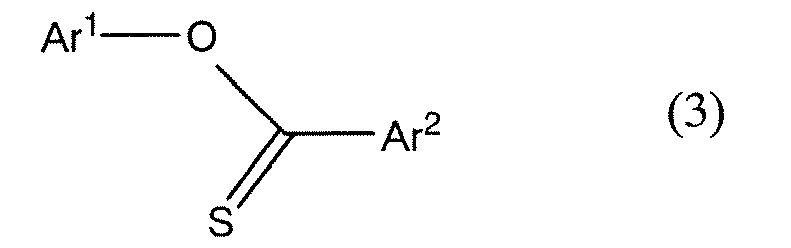
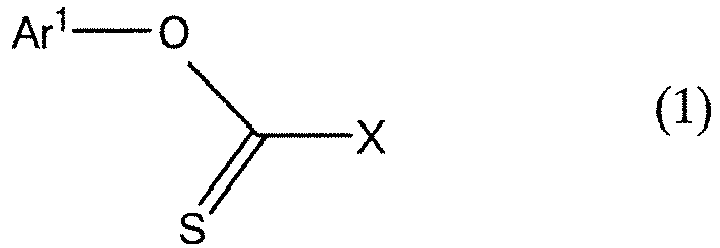
- Item 1 A process for producing an aryl ester of arylthionocarboxylic acid represented by Formula (3): wherein Ar 1 and Ar 2 independently represent an optionally substituted aryl group; the process comprising reacting a halogenated thiocarbonyl compound represented by Formula (1): wherein Ar 1 is as defined above and X is halogen, with an arylated metal compound represented by Formula (2): Ar 2 -M, wherein Ar 2 is as defined above and M is an alkali metal or monovalent copper.
- Item 2 The process according to Item 1, wherein the reaction is performed in an aprotic organic solvent.
- Item 3 The process according to Item 1 or 2, wherein the arylated metal compound represented by Formula (2): Ar 2 -M, wherein Ar 2 is an optionally substituted aryl group and M is an alkali metal or monovalent copper, is an arylated alkali metal compound represented by Formula (2'): Ar 2 -M 1 , wherein Ar 2 is as defined above and M 1 is an alkali metal, the arylated alkali metal compound being obtained by reacting an aryl compound represented by Formula (4): Ar 2 -Y, wherein Ar 2 is as defined above and Y is hydrogen or halogen other than F, with an organic alkali metal compound represented by Formula (5): R-M 1 , wherein R is alkyl or phenyl and M 1 is as defined above.
- Item 4 The process according to Item 1 or 2, wherein the arylated metal compound represented by Formula (2): Ar 2 -M, wherein Ar 2 is an optionally substituted aryl group and M is an alkali metal or monovalent copper, is an arylated copper compound represented by Formula (2"): Ar 2 -Cu, wherein Ar 2 is as defined above, the arylated copper compound being obtained by producing an arylated alkali metal compound represented by Formula (2'): Ar 2 -M 1 , wherein Ar 2 is as defined above and M 1 is an alkali metal, by the process described in Item 3, and then reacting the arylated alkali metal compound with a monovalent copper compound.
- Formula (2" arylated copper compound represented by Formula (2": Ar 2 -Cu, wherein Ar 2 is as defined above, the arylated copper compound being obtained by producing an arylated alkali metal compound represented by Formula (2'): Ar 2 -M 1 , wherein Ar 2 is as defined above and M 1 is an al
- Item 5 The process according to any one of Items 1 to 4, wherein the halogenated thiocarbonyl compound represented by Formula (1) is reacted with the arylated metal compound represented by Formula (2) in the presence of at least one component selected from the group consisting of trivalent iron compounds and divalent nickel compounds.
- Item 7 The process according to Item 6, wherein the reaction with the halogenated thiocarbonyl compound represented by Formula (1) is performed in the presence of at least one component selected from the group consisting of trivalent iron compounds and divalent nickel compounds.
- the process of the present invention for producing an aryl ester of arylthionocarboxylic acid comprises reacting a halogenated thiocarbonyl compound represented by Formula (1): wherein Ar 1 is an optionally substituted aryl group and X is halogen, with an arylated metal compound represented by Formula (2): Ar 2 -M, wherein Ar 2 is an optionally substituted aryl group and M is an alkali metal or monovalent copper.
- This process can produce an aryl ester of arylthionocarboxylic acid represented by Formula (3): wherein Ar 1 and Ar 2 are as defined above, in a high yield under relatively mild conditions.
- Ar 1 is an optionally substituted aryl group.
- optionally substituted aryl groups include optionally substituted phenyl, optionally substituted naphthyl, and the like.
- substituent on the aryl group there is no specific limitation on the substituent on the aryl group, insofar as the substituent is inert to the reaction with an arylated metal compound represented by Formula (2): Ar 2 -M described below.
- substituents include alkyl, fluoroalkyl, alkoxy, fluoroalkoxy, cyano, aryl, halogen, and the like.
- alkyl groups include linear or branched lower alkyl groups having about 1 to 5 carbon atoms
- fluoroalkyl groups include linear or branched lower alkyl groups having about 1 to 5 carbon atoms in which hydrogen atoms are partially or completely replaced by fluorine.
- alkoxy groups include linear or branched lower alkoxy groups having about 1 to 5 carbon atoms.
- fluoroalkoxy groups include linear or branched lower alkoxy groups having about 1 to 5 carbon atoms in which hydrogen atoms are partially or completely replaced by fluorine.
- aryl groups as substituents include phenyl, naphthyl, and the like. The substituent aryl groups may further contain a substituent that is inert to the reaction.
- halogen atoms include fluorine, chlorine, bromine, and iodine.
- the halogen atom represented by X may be, for example, fluorine, chlorine, bromine, or iodine. Chlorine is particularly preferable.
- the aryl group represented by Ar 2 may be, for example, an optionally substituted phenyl group or an optionally substituted naphthyl group.
- the substituent on the aryl group may be any substituent that is inert to the reaction with a halogenated thiocarbonyl compound represented by Formula (1), and that is also inert to the reaction for producing an arylated metal compound represented by Formula (2): Ar 2 -M from an aryl compound represented by Formula (4): Ar 2 -Y described below. Specific examples of such substituents may be the same as the aforementioned examples of substituents on the aryl group represented by Ar 1 .
- M is an alkali metal or monovalent copper.
- alkali metals include Li, Na, K, and the like.
- arylated alkali metal compounds represented by Formula (2'): Ar 2 -M 1 , wherein Ar 2 is as defined above and M 1 is an alkali metal can be obtained by reacting an aryl compound represented by Formula (4): Ar 2 -Y, wherein Ar 2 is as defined above and Y is hydrogen or halogen other than F, with an organic alkali metal compound represented by Formula (5): R-M 1 , wherein R is alkyl or phenyl and M 1 is an alkali metal.
- the halogen other than F represented by Y may be, for example, chlorine, bromine, or iodine.
- R is alkyl or phenyl.
- alkyl groups include linear or branched alkyl groups having about 1 to 5 carbon atoms.
- the amount of the organic alkali metal compound represented by Formula (5): R-M 1 may be about 0.9 to 5.0 mol, and preferably about 0.9 to 1.5 mol, per mol of the aryl compound represented by Formula (4): Ar 2 -Y.
- the reaction of an aryl compound represented by Formula (4): Ar 2 -Y with an organic alkali metal compound represented by Formula (5): R-M 1 is preferably performed in an aprotic organic solvent that is inert to the reaction.
- aprotic organic solvents include tetrahydrofuran, diethyl ether, 2-methyltetrahydrofuran, dibutyl ether, tert -butyl methyl ether, cyclopentyl methyl ether, dimethoxyethane, dioxane, benzene, toluene, xylene, pentane, hexane, heptane, and the like.
- Such aprotic organic solvents may be used as a mixture of two or more, if necessary.
- concentrations of the starting materials in the reaction solvent there is no particular limitation on the concentrations of the starting materials in the reaction solvent.
- the concentration of the aryl compound represented by Formula (4): Ar 2 -Y may be about 0.1 to 3 mol/L.
- the temperature at which the reaction of an aryl compound represented by Formula (4): Ar 2 -Y with an organic alkali metal compound represented by Formula (5):R-M 1 is performed is preferably not higher than room temperature, and more preferably about -78°C to 2°C.
- the pressure during the reaction is not particularly limited, and can typically be performed under atmospheric pressure.
- the atmosphere during the reaction is not particularly limited.
- the reaction is preferably performed in an inert gas atmosphere, such as a nitrogen atmosphere or an argon atmosphere.
- the reaction time is not particularly limited. Typically, the reaction time may be about 5 minutes to about 10 hours.
- the desired aryl ester of arylthionocarboxylic acid represented by Formula (3): wherein Ar 2 and M 1 are as defined above, can be obtained by reacting an arylated alkali metal compound represented by Formula (2') obtained by the above method with a halogenated thiocarbonyl compound represented by Formula (1).
- the desired aryl ester of arylthionocarboxylic acid represented by Formula (3) can be obtained in an increased yield by reacting an arylated alkali metal compound represented by Formula (2'): Ar 2 -M 1 , wherein Ar 2 and M 1 are as defined above, with a monovalent copper compound to produce an arylated copper compound represented by Formula (2"): Ar 2 -Cu wherein Ar 2 is as defined above, and then reacting the obtained arylated copper compound with a halogenated thiocarbonyl compound represented by Formula (1).
- the arylated copper compound represented by Formula (2": Ar 2 -Cu can be obtained by reacting an arylated alkali metal compound represented by Formula (2'): Ar 2 -M 1 with a monovalent copper compound.
- a copper halide such as copper chloride, copper bromide, or copper iodide; copper cyanide (CuCN), or the like can be used as the monovalent copper compound.
- the amount of the monovalent copper compound used may be about 0.1 to 5 mol, and is preferably about 0.7 to 1.2 mol, per mol of the arylated alkali metal compound represented by Formula (2'): Ar 2 -M 1 .
- the reaction of the arylated alkali metal compound represented by Formula (2'): Ar 2 -M 1 with a monovalent copper compound is preferably performed in an aprotic organic solvent.
- aprotic organic solvents may be the same as the aforementioned examples of solvents that can be used in the reaction of an arylated compound represented by Formula (4): Ar 2 -Y with an organic alkali metal compound represented by Formula (5): R-M 1 .
- concentrations of the starting materials in the solvent there is no particular limitation on the concentrations of the starting materials in the solvent.
- concentration of the arylated alkali metal compound represented by Formula (2'): Ar 2 -M 1 may be about 0.1 to 3 mol/L.
- the temperature at which the reaction of an arylated alkali metal compound represented by Formula (2'): Ar 2 -M 1 with a monovalent copper compound is performed is preferably not higher than room temperature, and more preferably about -78°C to room temperature, and even more preferably about -30 to 2°C.
- the pressure during the reaction is not particularly limited.
- the reaction can typically be performed under atmospheric pressure.
- the atmosphere during the reaction is not particularly limited.
- the reaction is preferably performed in an inert gas atmosphere, such as a nitrogen atmosphere or an argon atmosphere.
- the reaction time may be about 5 minutes to about 10 hours.
- the above process can produce an arylated metal compound represented by Formula (2): Ar 2 -M wherein M is Cu, i.e., an arylated copper compound represented by Formula (2"): Ar 2 -Cu.
- the desired aryl ester of arylthionocarboxylic acid of the present invention which is represented by Formula (3): wherein Ar 1 and Ar 2 independently represent an optionally substituted aryl group, can be obtained by reacting a halogenated thiocarbonyl compound represented by Formula (1): wherein Ar 1 is as defined above and X is halogen, with an arylated metal compound represented by Formula (2): Ar 2 -M, wherein M is an alkali metal or monovalent copper.
- the amount of the arylated metal compound represented by Formula (2): Ar 2 -M may be about 1 to 1.5 mol, and is preferably about 1 to 1.2 mol, per mol of the halogenated thiocarbonyl compound represented by Formula (1).
- the reaction of a halogenated thiocarbonyl compound represented by Formula (1) with an arylated metal compound represented by Formula (2): Ar 2 -M is preferably performed in an aprotic organic solvent.
- aprotic organic solvent examples may be the same as the aforementioned examples of solvents that can be used in the reaction of an aryl compound represented by Formula (4): Ar 2 -Y with an organic alkali metal compound represented by Formula (5): R-M 1 .
- concentrations of the starting materials in the reaction solvent there is no particular limitation on the concentrations of the starting materials in the reaction solvent.
- concentration of the halogenated thiocarbonyl compound represented by Formula (1) may be about 0.1 to 3 mol/L.
- the temperature at which the reaction of a halogenated thiocarbonyl compound with an arylated metal compound is performed is preferably not higher than room temperature, and more preferably about -30 to 2°C.
- the pressure during the reaction is not particularly limited.
- the reaction can typically be performed under atmospheric pressure.
- the atmosphere during the reaction is not particularly limited.
- the reaction is preferably performed in an inert gas atmosphere, such as a nitrogen atmosphere or an argon atmosphere.
- the reaction time may be about 5 to 10 hours.
- the above process can produce the desired aryl ester of arylthionocarboxylic acid represented by Formula (3): in a high yield.
- arylated metal compound represented by Formula (2): Ar 2 -M wherein M is Cu, i.e., an arylated copper compound represented by Formula (2"): Ar 2 -Cu the aryl ester of arylthionocarboxylic acid represented by Formula (3) can be obtained in a particularly high yield.
- the yield of the desired aryl ester of arylthionocarboxylic acid represented by Formula (3) can be increased particularly by reacting a halogenated thiocarbonyl compound represented by Formula (1) with an arylated metal compound represented by Formula (2) in the presence of a catalyst.
- a halogenated thiocarbonyl compound represented by Formula (1) with an arylated metal compound represented by Formula (2) in the presence of a catalyst.
- the arylated metal compound represented by Formula (2): Ar 2 -M is an arylated alkali metal compound represented by Formula (2'): Ar 2 -M 1
- the yield of the aryl ester of arylthionocarboxylic acid represented by Formula (3) can be greatly increased.
- Examples of usable catalysts include trivalent iron compounds, divalent nickel compounds, and the like. Such compounds can be used singly, or as a mixture of two or more. Specific examples of trivalent iron compounds include tris(2,4-pentanedionato)iron (III), ferric chloride, and the like. Specific examples of divalent nickel compounds include nickel chloride and the like.
- the amount of catalyst is preferably about 0.03 mol or more, per mol of the halogenated thiocarbonyl compound represented by Formula (1). Although there is no particular limitation on the upper limit of the amount of catalyst used, the use of an excess amount of catalyst does not increase the effect, and is disadvantageously costly. Therefore, the amount of catalyst is preferably not more than about 0.5 mol, and more preferably not more than 0.1 mol, per mol of the halogenated thiocarbonyl compound.
- the aryl ester of arylthionocarboxylic acid can be purified and collected by a known method, such as silica gel column chromatography or recrystallization.
- This process can produce the desired aryl ester of arylthionocarboxylic acid represented by Formula (3) in a high yield in a continuous manner without separating an arylated alkali metal compound represented by Formula (2'): Ar 2 -M 1 or an arylated copper compound represented by Formula (2"): Ar 2 -Cu that is an intermediate product.
- the reaction conditions in the step of obtaining an arylated alkali metal compound represented by Formula (2'): Ar 2 -M 1 and in the step of obtaining an arylated copper compound represented by Formula (2") in this continuous process may be the same as the aforementioned conditions in each reaction step.
- the aryl ester of arylthionocarboxylic acid obtained by this process can be purified and collected by a known method, such as column chromatography or recrystallization.
- the desired aryl ester of arylthionocarboxylic acid can be obtained in a high yield by using relatively inexpensive and highly safe starting materials under mild reaction conditions.
- 2,4-Difluorobenzene (2.32 g, 87.7 mmol) and tetrahydrofuran (hereinafter abbreviated as "THF") (31 ml) were added in a nitrogen atmosphere to a 100 ml three-necked flask equipped with a stirring bar and a thermometer. After the mixture was cooled to -50°C, a hexane solution of n-butyl lithium (55 ml, 87.7 mmol) was added dropwise, and the resulting mixture was stirred for 1 hour.
- THF tetrahydrofuran
- phenyl chlorothio no formate (15.1 g, 87.7 mmol) was added dropwise, and the resulting mixture was stirred for 30 minutes to complete the reaction. This mixture was returned to room temperature, and extracted with toluene/hydrochloric acid. The organic layer was evaporated under reduced pressure. The obtained solid was purified by silica gel column chromatography to give phenyl 2,6-difluorophenylthionobenzoate (7.3 g, 29.0 mmol) as a yellow solid. The yield was 32%.
- 2,4-Difluorobenzene (2.32 g, 87.7 mmol) and tetrahydrofuran (hereinafter abbreviated as "THF") (31 ml) were added in a nitrogen atmosphere to a 100 ml three-necked flask equipped with a stirring bar and a thermometer. After the mixture was cooled to 2°C, hexane solution of n-butyl lithium (55 ml, 87.7 mmol) was added dropwise. Subsequently, copper chloride (4.34 mg, 43.8 mmol) was added, and the resulting mixture was stirred for 1 hour.
- THF tetrahydrofuran
- phenyl chlorothionoformate (15.1 g, 87.7 mmol) was added dropwise, and the resulting mixture was stirred for 30 minutes to complete the reaction. This mixture was returned to room temperature, and extracted with toluene/hydrochloric acid. The organic layer was evaporated under reduced pressure.
- Tables 1 and 2 show the kinds and yields of the obtained products.
- the numerical values shown in the copper compound items in the Reagent column of the tables refer to the number of equivalents of each copper compound per equivalent of the lithium compound used.
- Table 1 Example [1] Starting material Reagent [2] Solvent Temp.
- 2,4-Difluorobenzene (2.32 g, 87.7 mmol) and tetrahydrofuran (hereinafter abbreviated as "THF") (31 ml) were added in a nitrogen atmosphere to a 100 ml three-necked flask equipped with a stirring bar and a thermometer. After the mixture was cooled to 2°C, a hexane solution of n-butyl lithium (55 ml, 87.7 mmol) was added dropwise.
- THF tetrahydrofuran
- phenyl chlorothionoformate (15.1 g, 87.7 mmol) was added dropwise, and the resulting mixture was stirred for 30 minutes to complete the reaction. This mixture was returned to room temperature, and extracted with toluene/hydrochloric acid. The organic layer was evaporated under reduced pressure.
- the obtained solid was purified by silica gel chromatography to give phenyl 2,6-difluorophenylthionobenzoate as a yellow solid (9.9 g, 39.5 mmol). The yield was 45%.
- Example 21 The same procedure as in Example 21 was repeated, except that instead of using tris(2,4-pentanedionato)iron (III) (Fe(acac) 3 ), NiCl 2 was used in an amount of 0.1 mol per mol of 2,4-difluorobenzene. Phenyl 2,6-difluorophenylthionobenzoate was obtained as a yellow solid (9.2 g, 35.8 mmol). The yield was 42%.
Landscapes
- Chemical & Material Sciences (AREA)
- Organic Chemistry (AREA)
- Organic Low-Molecular-Weight Compounds And Preparation Thereof (AREA)
- Low-Molecular Organic Synthesis Reactions Using Catalysts (AREA)
- Catalysts (AREA)
Abstract

Description
- The present invention relates to a process for producing an aryl ester of aryl-containing thionocarboxylic acid that is useful as a liquid crystal material, etc.
- The aryl ester of arylthionocarboxylic acid represented by the formula R1C=(S)OR2, wherein R1 and R2 independently represent an optionally substituted aryl group, is a compound that is useful as a liquid crystal material, etc.
- Various methods are known as methods for producing thionocarboxylic acid esters having this structure. Examples of such methods include a method comprising reacting a chlorothionoformic acid ester with an aromatic compound (Non-patent Literature (NPL) 1); a method comprising treating a carbanion with a dithiocarbonic acid ester or a thionocarbonic acid ester (Non-patent Literature (NPL) 2); a method comprising reacting an orthoester with hydrogen sulfide (Non-patent Literature (NPL) 3); a method comprising reacting a carboxylic acid ester with phosphorus pentasulfide or Lawesson's reagent (Non-patent Literature (NPL) 4); a method comprising reacting a thionocarboxylic acid chloride with an alcohol or phenol (Non-patent Literature (NPL) 5); a method comprising reacting a nitrile with an alcohol and then reacting the resulting product with hydrogen sulfide (Non-patent Literature (NPL) 6); a method comprising treating a methylated aromatic compound with sulfur and an alcohol (Non-patent Literature (NPL) 7); and a method comprising reacting a thioacyl disulfide with an alcoholate (Non-patent Literature (NPL) 8).
- However, among these methods, the methods disclosed in NPL 1, 2, 4, 7, etc., are low-yield; in particular, the method disclosed in NPL 4 requires a high temperature of 100°C or more for the reaction, and also has a drawback of generating a large amount of by-products; therefore, these methods cannot be regarded as efficient methods.
- The methods disclosed in NPL 3 and 6 use hydrogen sulfide, which is so toxic that its handling requires specialized equipment; therefore, these methods are unsuitable as industrial processes for production. Further, the method disclosed in NPL 5 cannot be regarded as a comprehensively superior method due to a low synthesis yield of the starting thionocarboxylic acid chloride. The method disclosed in NPL 8 comprises a large number of steps, including synthesizing a thioacyl disulfide from a dithiocarboxylic acid derivative and then reacting the thioacyl disulfide with an alcoholate; therefore, this method cannot be regarded as a convenient method.
-
- NPL 1: H. Viola, et al., Chem. Ber., 101, 3517 (1968)
- NPL 2: Liebigs Ann. Chem., 1973, 1637
- NPL 3: A. Ohno et al., Tetrahedron Lett., 1968, 2083
- NPL 4: Synthesis, 1973, 149; Bull. Chem. Soc. Belg., 87, 293 (1987)
- NPL 5: S. Scheithauer et al., Chem. Ber., 98, 838 (1965)
- NPL 6: Liebigs Ann. Chem., 1974, 671
- NPL 7: Z. Chem., 6, 108 (1966)
- NPL 8: K.A. Latif et al., Tetrahedron, 26, 4247 (1970)
- The present invention was made in view of the above-mentioned problems in the prior art. A primary object of the invention is to provide a relatively convenient and industrially advantageous process for producing, in a high yield, an aryl ester of arylthionocarboxylic acid, which is useful as a liquid crystal material, etc.
- To achieve the above object, the present inventors conducted extensive research. As a result, the inventors found that when a halogenated thiocarbonyl compound is used as a starting material and reacted with a specific arylated metal compound, the desired aryl ester of arylthionocarboxylic acid can be produced in a high yield under mild reaction conditions using relatively safe starting materials. The present invention has been accomplished based on this finding.
- More specifically, the present invention provides the following processes for producing an aryl ester of arylthionocarboxylic acid.
- Item 1. A process for producing an aryl ester of arylthionocarboxylic acid represented by Formula (3):

the process comprising reacting a halogenated thiocarbonyl compound represented by Formula (1):
- Item 2. The process according to Item 1, wherein the reaction is performed in an aprotic organic solvent.
- Item 3. The process according to Item 1 or 2, wherein the arylated metal compound represented by Formula (2): Ar2-M, wherein Ar2 is an optionally substituted aryl group and M is an alkali metal or monovalent copper, is an arylated alkali metal compound represented by Formula (2'): Ar2-M1, wherein Ar2 is as defined above and M1 is an alkali metal, the arylated alkali metal compound being obtained by reacting an aryl compound represented by Formula (4): Ar2-Y, wherein Ar2 is as defined above and Y is hydrogen or halogen other than F, with an organic alkali metal compound represented by Formula (5): R-M1, wherein R is alkyl or phenyl and M1 is as defined above.
- Item 4. The process according to Item 1 or 2, wherein the arylated metal compound represented by Formula (2): Ar2-M, wherein Ar2 is an optionally substituted aryl group and M is an alkali metal or monovalent copper, is an arylated copper compound represented by Formula (2"): Ar2-Cu, wherein Ar2 is as defined above, the arylated copper compound being obtained by producing an arylated alkali metal compound represented by Formula (2'): Ar2-M1, wherein Ar2 is as defined above and M1 is an alkali metal, by the process described in Item 3, and then reacting the arylated alkali metal compound with a monovalent copper compound.
- Item 5. The process according to any one of Items 1 to 4, wherein the halogenated thiocarbonyl compound represented by Formula (1) is reacted with the arylated metal compound represented by Formula (2) in the presence of at least one component selected from the group consisting of trivalent iron compounds and divalent nickel compounds.
- Item 6. A process for producing an aryl ester of arylthionocarboxylic acid represented by Formula (3):

the process comprising the steps of reacting an aryl compound represented by Formula (4): Ar2-Y, wherein Ar2 is as defined above and Y is hydrogen or halogen other than F, with an organic alkali metal compound represented by Formula (5): R-M1, wherein R is alkyl or phenyl and M1 is an alkali metal; optionally reacting the resulting product with a monovalent copper compound; and then reacting the resulting product with a halogenated thiocarbonyl compound represented by Formula (1):
- Item 7. The process according to Item 6, wherein the reaction with the halogenated thiocarbonyl compound represented by Formula (1) is performed in the presence of at least one component selected from the group consisting of trivalent iron compounds and divalent nickel compounds.
- The process of the present invention for producing an aryl ester of arylthionocarboxylic acid is explained in more detail below.
- The process of the present invention for producing an aryl ester of arylthionocarboxylic acid comprises reacting a halogenated thiocarbonyl compound represented by Formula (1):


- First, the starting compounds used in the production process of the present invention are explained in more detail.
- In the starting halogenated thiocarbonyl compound represented by Formula (1), Ar1 is an optionally substituted aryl group. Examples of optionally substituted aryl groups include optionally substituted phenyl, optionally substituted naphthyl, and the like.
- There is no specific limitation on the substituent on the aryl group, insofar as the substituent is inert to the reaction with an arylated metal compound represented by Formula (2): Ar2-M described below. Specific examples of such substituents include alkyl, fluoroalkyl, alkoxy, fluoroalkoxy, cyano, aryl, halogen, and the like. Among these, examples of alkyl groups include linear or branched lower alkyl groups having about 1 to 5 carbon atoms; and examples of fluoroalkyl groups include linear or branched lower alkyl groups having about 1 to 5 carbon atoms in which hydrogen atoms are partially or completely replaced by fluorine. Examples of alkoxy groups include linear or branched lower alkoxy groups having about 1 to 5 carbon atoms. Examples of fluoroalkoxy groups include linear or branched lower alkoxy groups having about 1 to 5 carbon atoms in which hydrogen atoms are partially or completely replaced by fluorine. Examples of aryl groups as substituents include phenyl, naphthyl, and the like. The substituent aryl groups may further contain a substituent that is inert to the reaction. Examples of halogen atoms include fluorine, chlorine, bromine, and iodine.
- In the above Formula (1), the halogen atom represented by X may be, for example, fluorine, chlorine, bromine, or iodine. Chlorine is particularly preferable.
- In the arylated metal compound represented by Formula (2): Ar2-M, the aryl group represented by Ar2 may be, for example, an optionally substituted phenyl group or an optionally substituted naphthyl group. The substituent on the aryl group may be any substituent that is inert to the reaction with a halogenated thiocarbonyl compound represented by Formula (1), and that is also inert to the reaction for producing an arylated metal compound represented by Formula (2): Ar2-M from an aryl compound represented by Formula (4): Ar2-Y described below. Specific examples of such substituents may be the same as the aforementioned examples of substituents on the aryl group represented by Ar1.
- In Formula (2), M is an alkali metal or monovalent copper. Examples of alkali metals include Li, Na, K, and the like.
- Among the arylated metal compounds, those wherein M is an alkali metal, i.e., arylated alkali metal compounds represented by Formula (2'): Ar2-M1, wherein Ar2 is as defined above and M1 is an alkali metal, can be obtained by reacting an aryl compound represented by Formula (4): Ar2-Y, wherein Ar2 is as defined above and Y is hydrogen or halogen other than F, with an organic alkali metal compound represented by Formula (5): R-M1, wherein R is alkyl or phenyl and M1 is an alkali metal.
- In the aryl compound represented by Formula (4): Ar2-Y, the halogen other than F represented by Y may be, for example, chlorine, bromine, or iodine.
- In the organic alkali metal compound represented by Formula (5): R-M1, R is alkyl or phenyl. Examples of alkyl groups include linear or branched alkyl groups having about 1 to 5 carbon atoms.
- The amount of the organic alkali metal compound represented by Formula (5): R-M1 may be about 0.9 to 5.0 mol, and preferably about 0.9 to 1.5 mol, per mol of the aryl compound represented by Formula (4): Ar2-Y.
- The reaction of an aryl compound represented by Formula (4): Ar2-Y with an organic alkali metal compound represented by Formula (5): R-M1 is preferably performed in an aprotic organic solvent that is inert to the reaction. Examples of aprotic organic solvents include tetrahydrofuran, diethyl ether, 2-methyltetrahydrofuran, dibutyl ether, tert-butyl methyl ether, cyclopentyl methyl ether, dimethoxyethane, dioxane, benzene, toluene, xylene, pentane, hexane, heptane, and the like. Such aprotic organic solvents may be used as a mixture of two or more, if necessary.
- There is no particular limitation on the concentrations of the starting materials in the reaction solvent. For example, the concentration of the aryl compound represented by Formula (4): Ar2-Y may be about 0.1 to 3 mol/L.
- The temperature at which the reaction of an aryl compound represented by Formula (4): Ar2-Y with an organic alkali metal compound represented by Formula (5):R-M1 is performed is preferably not higher than room temperature, and more preferably about -78°C to 2°C.
- The pressure during the reaction is not particularly limited, and can typically be performed under atmospheric pressure. The atmosphere during the reaction is not particularly limited. Typically, the reaction is preferably performed in an inert gas atmosphere, such as a nitrogen atmosphere or an argon atmosphere. The reaction time is not particularly limited. Typically, the reaction time may be about 5 minutes to about 10 hours.
- According to the above process, an arylated alkali metal compound represented by Formula (2'): Ar2-M1, wherein Ar2 and M1 are as defined above, can be obtained.
- In the present invention, the desired aryl ester of arylthionocarboxylic acid represented by Formula (3):

- The arylated copper compound represented by Formula (2"): Ar2-Cu can be obtained by reacting an arylated alkali metal compound represented by Formula (2'): Ar2-M1 with a monovalent copper compound. In this reaction, a copper halide such as copper chloride, copper bromide, or copper iodide; copper cyanide (CuCN), or the like can be used as the monovalent copper compound.
- The amount of the monovalent copper compound used may be about 0.1 to 5 mol, and is preferably about 0.7 to 1.2 mol, per mol of the arylated alkali metal compound represented by Formula (2'): Ar2-M1.
- The reaction of the arylated alkali metal compound represented by Formula (2'): Ar2-M1 with a monovalent copper compound is preferably performed in an aprotic organic solvent. Examples of usable aprotic organic solvents may be the same as the aforementioned examples of solvents that can be used in the reaction of an arylated compound represented by Formula (4): Ar2-Y with an organic alkali metal compound represented by Formula (5): R-M1.
- There is no particular limitation on the concentrations of the starting materials in the solvent. For example, the concentration of the arylated alkali metal compound represented by Formula (2'): Ar2-M1 may be about 0.1 to 3 mol/L.
- The temperature at which the reaction of an arylated alkali metal compound represented by Formula (2'): Ar2-M1 with a monovalent copper compound is performed is preferably not higher than room temperature, and more preferably about -78°C to room temperature, and even more preferably about -30 to 2°C.
- The pressure during the reaction is not particularly limited. The reaction can typically be performed under atmospheric pressure. The atmosphere during the reaction is not particularly limited. Typically, the reaction is preferably performed in an inert gas atmosphere, such as a nitrogen atmosphere or an argon atmosphere. Typically, the reaction time may be about 5 minutes to about 10 hours.
- The above process can produce an arylated metal compound represented by Formula (2): Ar2-M wherein M is Cu, i.e., an arylated copper compound represented by Formula (2"): Ar2-Cu.
- As described above, the desired aryl ester of arylthionocarboxylic acid of the present invention, which is represented by Formula (3):


- The amount of the arylated metal compound represented by Formula (2): Ar2-M may be about 1 to 1.5 mol, and is preferably about 1 to 1.2 mol, per mol of the halogenated thiocarbonyl compound represented by Formula (1).
- The reaction of a halogenated thiocarbonyl compound represented by Formula (1) with an arylated metal compound represented by Formula (2): Ar2-M is preferably performed in an aprotic organic solvent. Examples of usable aprotic organic solvents may be the same as the aforementioned examples of solvents that can be used in the reaction of an aryl compound represented by Formula (4): Ar2-Y with an organic alkali metal compound represented by Formula (5): R-M1.
- There is no particular limitation on the concentrations of the starting materials in the reaction solvent. For example, the concentration of the halogenated thiocarbonyl compound represented by Formula (1) may be about 0.1 to 3 mol/L.
- The temperature at which the reaction of a halogenated thiocarbonyl compound with an arylated metal compound is performed is preferably not higher than room temperature, and more preferably about -30 to 2°C.
- The pressure during the reaction is not particularly limited. The reaction can typically be performed under atmospheric pressure. The atmosphere during the reaction is not particularly limited. Typically, the reaction is preferably performed in an inert gas atmosphere, such as a nitrogen atmosphere or an argon atmosphere. Typically, the reaction time may be about 5 to 10 hours.
- The above process can produce the desired aryl ester of arylthionocarboxylic acid represented by Formula (3):

- In the production process of the present invention, the yield of the desired aryl ester of arylthionocarboxylic acid represented by Formula (3) can be increased particularly by reacting a halogenated thiocarbonyl compound represented by Formula (1) with an arylated metal compound represented by Formula (2) in the presence of a catalyst. In particular, when the arylated metal compound represented by Formula (2): Ar2-M is an arylated alkali metal compound represented by Formula (2'): Ar2-M1, the yield of the aryl ester of arylthionocarboxylic acid represented by Formula (3) can be greatly increased.
- Examples of usable catalysts include trivalent iron compounds, divalent nickel compounds, and the like. Such compounds can be used singly, or as a mixture of two or more. Specific examples of trivalent iron compounds include tris(2,4-pentanedionato)iron (III), ferric chloride, and the like. Specific examples of divalent nickel compounds include nickel chloride and the like.
- The amount of catalyst is preferably about 0.03 mol or more, per mol of the halogenated thiocarbonyl compound represented by Formula (1). Although there is no particular limitation on the upper limit of the amount of catalyst used, the use of an excess amount of catalyst does not increase the effect, and is disadvantageously costly. Therefore, the amount of catalyst is preferably not more than about 0.5 mol, and more preferably not more than 0.1 mol, per mol of the halogenated thiocarbonyl compound.
- The aryl ester of arylthionocarboxylic acid can be purified and collected by a known method, such as silica gel column chromatography or recrystallization.
- In the process of the present invention, instead of directly reacting a halogenated thiocarbonyl compound represented by Formula (1):


- The aryl ester of arylthionocarboxylic acid obtained by this process can be purified and collected by a known method, such as column chromatography or recrystallization.
- According to the present invention, the desired aryl ester of arylthionocarboxylic acid can be obtained in a high yield by using relatively inexpensive and highly safe starting materials under mild reaction conditions.
- The present invention is explained in more detail below with reference to Examples.
- 2,4-Difluorobenzene (2.32 g, 87.7 mmol) and tetrahydrofuran (hereinafter abbreviated as "THF") (31 ml) were added in a nitrogen atmosphere to a 100 ml three-necked flask equipped with a stirring bar and a thermometer. After the mixture was cooled to -50°C, a hexane solution of n-butyl lithium (55 ml, 87.7 mmol) was added dropwise, and the resulting mixture was stirred for 1 hour.
- Subsequently, phenyl chlorothionoformate (15.1 g, 87.7 mmol) was added dropwise, and the resulting mixture was stirred for 30 minutes to complete the reaction. This mixture was returned to room temperature, and extracted with toluene/hydrochloric acid. The organic layer was evaporated under reduced pressure. The obtained solid was purified by silica gel column chromatography to give phenyl 2,6-difluorophenylthionobenzoate (7.3 g, 29.0 mmol) as a yellow solid. The yield was 32%.
- 2,4-Difluorobenzene (2.32 g, 87.7 mmol) and tetrahydrofuran (hereinafter abbreviated as "THF") (31 ml) were added in a nitrogen atmosphere to a 100 ml three-necked flask equipped with a stirring bar and a thermometer. After the mixture was cooled to 2°C, hexane solution of n-butyl lithium (55 ml, 87.7 mmol) was added dropwise. Subsequently, copper chloride (4.34 mg, 43.8 mmol) was added, and the resulting mixture was stirred for 1 hour.
- Subsequently, phenyl chlorothionoformate (15.1 g, 87.7 mmol) was added dropwise, and the resulting mixture was stirred for 30 minutes to complete the reaction. This mixture was returned to room temperature, and extracted with toluene/hydrochloric acid. The organic layer was evaporated under reduced pressure.
- The obtained solid was purified by recrystallization to give phenyl 2,6-difluorophenylthionobenzoate (20.6 g, 82.3 mmol) as yellow needle-like crystals. The yield was 94%.
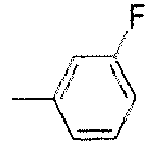
- Using the starting materials shown in Tables 1 and 2, the reaction was performed in the same manner as in Example 2. Tables 1 and 2 show the kinds and yields of the obtained products. The numerical values shown in the copper compound items in the Reagent column of the tables refer to the number of equivalents of each copper compound per equivalent of the lithium compound used.
Table 1 Example [1] Starting material Reagent [2] Solvent Temp. °C Product Yield(%)* 2 

n-BuLi CuCl 0.5eq 
THF 2°C 
94 3 

n-BuLi CuBr 0.5eq 
THF 2°C 
92* 4 

n-BuLi Cul 0.5eq 
THF 2°C 
95* 5 

n-BuLi CuCN 0.5eq 
THF 2°C 
92 6 

n-BuLi CuCl 0.5eq 
THF 2°C 
88* 7 

n-BuLi CuCl 0.5eq 
THF 2°C 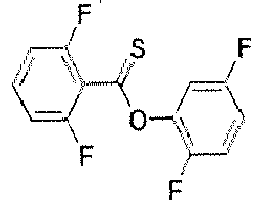
90* 8 

n-BuLi CuCl 0.5eq 
THF 2°C 
92 9 

n-BuLi CuCl 0.5eq 
THF 2°C 
95 * Determined by 19F NMR Table 2 Example [1] Starting material Reagent [2] Solvent Temp. °C Product Yield(%)* 10 

n-BuLi CuCl 0.5eq 
THF 2°C 
76* 11 

n-BuLi CuCl 0.5eq 
THF 2°C 
77* 12 

sec-BuLi CuCl 0.5eq 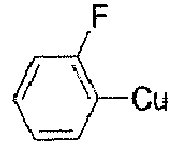
THF 2°C 
76* 13 
sec-BuLi CuCl 0.5eq 
THF 2°C 
88* 14 

sec-BuLi CuCl 0.5eq 
THF 2°C 
92* 15 

n-BuLi CuCl 0.5eq 
THF 2°C 
95 16 

n-BuLi CuCl 0.5eq 
THF 2°C 
94 17 

n-BuLi CuCl 0.5eq 
THF 2°C 
88 18 

n-BuLi CuCl 0.5eq 
THF 2°C 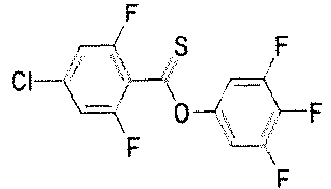
92 19 

n-BuLi CuCl 0.5eq 
THF 2°C 
88 20 

n-BuLi CuCl 0.5eq 
THF -78°C 
67* * Determined by 19F NMR - 2,4-Difluorobenzene (2.32 g, 87.7 mmol) and tetrahydrofuran (hereinafter abbreviated as "THF") (31 ml) were added in a nitrogen atmosphere to a 100 ml three-necked flask equipped with a stirring bar and a thermometer. After the mixture was cooled to 2°C, a hexane solution of n-butyl lithium (55 ml, 87.7 mmol) was added dropwise. Subsequently, tris(2,4-pentanedionato)iron (III) (Fe(acac)3) was added in an amount of 0.1 mol per mol of 2,4-difluorobenzene, and the resulting mixture was stirred for 1 hour.
- Subsequently, phenyl chlorothionoformate (15.1 g, 87.7 mmol) was added dropwise, and the resulting mixture was stirred for 30 minutes to complete the reaction. This mixture was returned to room temperature, and extracted with toluene/hydrochloric acid. The organic layer was evaporated under reduced pressure.
- The obtained solid was purified by silica gel chromatography to give phenyl 2,6-difluorophenylthionobenzoate as a yellow solid (9.9 g, 39.5 mmol). The yield was 45%.
- The same procedure as in Example 21 was repeated, except that instead of using tris(2,4-pentanedionato)iron (III) (Fe(acac)3), NiCl2 was used in an amount of 0.1 mol per mol of 2,4-difluorobenzene. Phenyl 2,6-difluorophenylthionobenzoate was obtained as a yellow solid (9.2 g, 35.8 mmol). The yield was 42%.
Claims (7)
- A process for producing an aryl ester of arylthionocarboxylic acid represented by Formula (3):

the process comprising reacting a halogenated thiocarbonyl compound represented by Formula (1):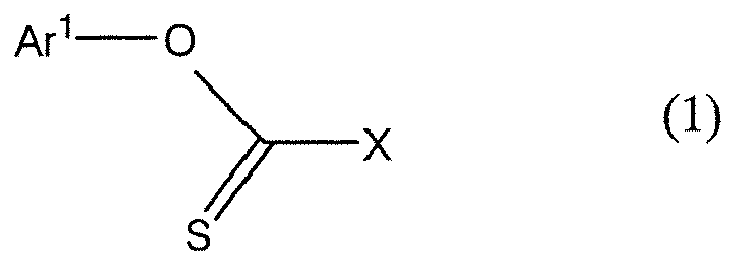
- The process according to claim 1, wherein the reaction is performed in an aprotic organic solvent.
- The process according to claim 1 or 2, wherein the arylated metal compound represented by Formula (2): Ar2-M, wherein Ar2 is an optionally substituted aryl group and M is an alkali metal or monovalent copper, is an arylated alkali metal compound represented by Formula (2'): Ar2-M1 wherein Ar2 is as defined above and M1 is an alkali metal,
the arylated alkali metal compound being obtained by reacting an aryl compound represented by Formula (4): Ar2-Y, wherein Ar2 is as defined above and Y is hydrogen or halogen other than F, with an organic alkali metal compound represented by Formula (5): R-M1 wherein R is alkyl or phenyl and M1 is as defined above. - The process according to claim 1 or 2, wherein the arylated metal compound represented by Formula (2): Ar2-M, wherein Ar2 is an optionally substituted aryl group and M is an alkali metal or monovalent copper, is an arylated copper compound represented by Formula (2"): Ar2-Cu wherein Ar2 is as defined above,
the arylated copper compound being obtained by producing an arylated alkali metal compound represented by Formula (2'): Ar2-M1, wherein Ar2 is as defined above and M1 is an alkali metal, by the process described in Claim 3, and then reacting the arylated alkali metal compound with a monovalent copper compound. - The process according to any one of claims 1 to 4, wherein the halogenated thiocarbonyl compound represented by Formula (1) is reacted with the arylated metal compound represented by Formula (2) in the presence of at least one component selected from the group consisting of trivalent iron compounds and divalent nickel compounds.
- A process for producing an aryl ester of arylthionocarboxylic acid represented by Formula (3):

the process comprising the steps of reacting an aryl compound represented by Formula (4): Ar2-Y, wherein Ar2 is as defined above and Y is hydrogen or halogen other than F, with an organic alkali metal compound represented by Formula (5): R-M1, wherein R is alkyl or phenyl and M1 is an alkali metal; optionally reacting the resulting product with a monovalent copper compound; and then reacting the resulting product with a halogenated thiocarbonyl compound represented by Formula (1):
- The process according to claim 6, wherein the reaction with the halogenated thiocarbonyl compound represented by Formula (1) is performed in the presence of at least one component selected from the group consisting of trivalent iron compounds and divalent nickel compounds.
Applications Claiming Priority (1)
| Application Number | Priority Date | Filing Date | Title |
|---|---|---|---|
| JP2012209774 | 2012-09-24 |
Publications (2)
| Publication Number | Publication Date |
|---|---|
| EP2711358A1 true EP2711358A1 (en) | 2014-03-26 |
| EP2711358B1 EP2711358B1 (en) | 2015-04-08 |
Family
ID=49182165
Family Applications (1)
| Application Number | Title | Priority Date | Filing Date |
|---|---|---|---|
| EP20130184934 Active EP2711358B1 (en) | 2012-09-24 | 2013-09-18 | Process for producing aryl ester of thionocarboxylic acid |
Country Status (4)
| Country | Link |
|---|---|
| EP (1) | EP2711358B1 (en) |
| JP (1) | JP5915607B2 (en) |
| KR (1) | KR101546143B1 (en) |
| CN (1) | CN103664721B (en) |
Families Citing this family (3)
| Publication number | Priority date | Publication date | Assignee | Title |
|---|---|---|---|---|
| WO2015141811A1 (en) * | 2014-03-20 | 2015-09-24 | ダイキン工業株式会社 | Method for producing compound having oxydifluoromethylene skeleton |
| CN103980098B (en) * | 2014-05-16 | 2016-07-13 | 上海康鹏化学有限公司 | Containing difluoromethoxy ether bridged bond (CF2The preparation method of monomer liquid crystal compound O) |
| CN110156652B (en) * | 2019-06-27 | 2021-05-11 | 上海应用技术大学 | Preparation method of thioglycollate geraniol ester |
Family Cites Families (7)
| Publication number | Priority date | Publication date | Assignee | Title |
|---|---|---|---|---|
| FR1521896A (en) * | 1966-05-04 | 1968-04-19 | Ohio State University Represen | Process for converting thioncarbamates into thiolcarbamates |
| DE2603293C3 (en) * | 1976-01-29 | 1981-01-08 | Merck Patent Gmbh, 6100 Darmstadt | Thiobenzoic acid esters, process for their preparation and their use as components of liquid-crystalline dielectrics |
| DE3274982D1 (en) * | 1981-07-08 | 1987-02-12 | Hoechst Uk Ltd | Antibacterial penem derivatives |
| GB9221820D0 (en) * | 1992-10-16 | 1992-12-02 | Secr Defence | Thio-ester compounds, and mixtures and devices containing such compounds |
| JPH1017544A (en) * | 1996-07-02 | 1998-01-20 | Chisso Corp | Thion-o-ester derivative and its production |
| AUPQ319799A0 (en) * | 1999-10-01 | 1999-10-28 | Institute Of Drug Technology Australia Limited | Chemical methods |
| KR20070086762A (en) * | 2004-12-10 | 2007-08-27 | 젠야쿠코교가부시키가이샤 | Method for preparing thiocarbamate derivative |
-
2013
- 2013-09-11 JP JP2013188096A patent/JP5915607B2/en active Active
- 2013-09-18 EP EP20130184934 patent/EP2711358B1/en active Active
- 2013-09-23 KR KR1020130112580A patent/KR101546143B1/en active Active
- 2013-09-24 CN CN201310438773.3A patent/CN103664721B/en active Active
Non-Patent Citations (14)
| Title |
|---|
| A. OHNO ET AL., TETRAHEDRON LETT., 1968, pages 2083 |
| BELOSLUDTSEV Y Y ET AL: "C-Glycosides: Pd/Cu co-catalyzed thiocarboxylation of stannyl glucopyranosides", TETRAHEDRON LETTERS, PERGAMON, vol. 36, no. 33, 14 August 1995 (1995-08-14), pages 5881 - 5882, XP027242224, ISSN: 0040-4039, [retrieved on 19950814] * |
| BULL. CHEM. SOC. BELG., vol. 87, 1987, pages 293 |
| H. VIOLA ET AL., CHEM. BER., vol. 101, 1968, pages 3517 |
| HORST VIOLA ET AL: "Organische Schwefelverbindungen,97. Friedel-Crafts-Reaktionen mit Thiosäurechloriden", CHEMISCHE BERICHTE, vol. 101, no. 10, 1 October 1968 (1968-10-01), pages 3517 - 3529, XP055084572, ISSN: 0009-2940, DOI: 10.1002/cber.19681011024 * |
| J. FALCK ET AL: "Cu 2 S Mediated Cross-Coupling of [alpha]-Stannylepoxides", SYNLETT, vol. 1997, no. Sup. I, 1 June 1997 (1997-06-01), pages 481 - 482, XP055084571, ISSN: 0936-5214, DOI: 10.1055/s-1997-6123 * |
| J. R. FALCK ET AL: "Tin-Copper Transmetalation: Cross-Coupling of .alpha.-Heteroatom-Substituted Alkyltributylstannanes with Organohalides", JOURNAL OF THE AMERICAN CHEMICAL SOCIETY, vol. 117, no. 22, 1 June 1995 (1995-06-01), pages 5973 - 5982, XP055084573, ISSN: 0002-7863, DOI: 10.1021/ja00127a010 * |
| K.A. LATIF ET AL., TETRAHEDRON, vol. 26, 1970, pages 4247 |
| KLAUS HARTKE ET AL: "[alpha],[beta]-acetylenic dithio and thiono esters", TETRAHEDRON LETTERS, vol. 30, no. 9, 1 January 1989 (1989-01-01), pages 1073 - 1076, XP055084574, ISSN: 0040-4039, DOI: 10.1016/S0040-4039(01)80363-4 * |
| LIEBIGS ANN. CHEM., 1973, pages 1637 |
| LIEBIGS ANN. CHEM., 1974, pages 671 |
| S. SCHEITHAUER ET AL., CHEM. BER., vol. 98, 1965, pages 838 |
| SYNTHESIS, 1973, pages 149 |
| Z. CHEM., vol. 6, 1966, pages 108 |
Also Published As
| Publication number | Publication date |
|---|---|
| JP5915607B2 (en) | 2016-05-11 |
| KR20140040032A (en) | 2014-04-02 |
| CN103664721A (en) | 2014-03-26 |
| CN103664721B (en) | 2016-05-11 |
| JP2014076986A (en) | 2014-05-01 |
| KR101546143B1 (en) | 2015-08-20 |
| EP2711358B1 (en) | 2015-04-08 |
Similar Documents
| Publication | Publication Date | Title |
|---|---|---|
| EP3042889A1 (en) | Method for producing fluorine-containing olefin | |
| JPWO2008102661A1 (en) | Method for producing trialkylsilyl nitrile | |
| CN101878192B (en) | Method for producing 4-perfluoroisopropylaniline | |
| EP2711358B1 (en) | Process for producing aryl ester of thionocarboxylic acid | |
| EP2712858B1 (en) | Process for producing thionocarboxylic acid ester | |
| US20230130333A1 (en) | Method for manufacturing phosphonate esters and method for manufacturing phosphate esters | |
| US5817837A (en) | Tetrathiafulvalene derivative precursors, tetrathiafulvalene derivatives, and processes for producing them | |
| JP6637880B2 (en) | 5- (trifluoromethyl) pyrimidine derivative and method for producing the same | |
| EP3239126B1 (en) | Method for producing olefin containing chlorine and fluorine | |
| JP5488786B2 (en) | Process for producing azaboracyclopentene compound and synthetic intermediate thereof | |
| JP4999115B2 (en) | Catalyst precursor for producing olefins having an odd number of carbon atoms, process for the preparation thereof, and process for the production of such olefins | |
| JP4635251B2 (en) | Organic bismuth compound and process for producing the same | |
| JP2014005214A (en) | Aryldichlorophosphine production method | |
| KR20240073969A (en) | Method for producing organo-titanium compounds | |
| KR20230060027A (en) | Method for preparing nonsymmetric phosphate based compound | |
| KR20240060025A (en) | Manufacturing method of n-aryl amide compound | |
| JPS62120327A (en) | Fluoroalkylation process | |
| JPWO2008149841A1 (en) | Process for producing β-fluoro-α, β-unsaturated carbonyl compound | |
| WO2022174524A1 (en) | Method for synthesizing 3',5'-dichloro-2,2,2-trifluoroacetophenone derivative | |
| WO2020105712A1 (en) | Method for producing triazine derivative and organic copper compound | |
| JP2010275226A (en) | Method for producing cyclic aldehyde | |
| JP2020503301A (en) | Method for preparing pesticidal compounds | |
| PL221979B1 (en) | A new catalytic method of obtaining substituted (triorganogermyl) alkynes | |
| JPH0370717B2 (en) | ||
| JP2011173804A (en) | Hypervalent bromine body and method for producing silyl aromatic sulfonate compound |
Legal Events
| Date | Code | Title | Description |
|---|---|---|---|
| PUAI | Public reference made under article 153(3) epc to a published international application that has entered the european phase |
Free format text: ORIGINAL CODE: 0009012 |
|
| 17P | Request for examination filed |
Effective date: 20130918 |
|
| AK | Designated contracting states |
Kind code of ref document: A1 Designated state(s): AL AT BE BG CH CY CZ DE DK EE ES FI FR GB GR HR HU IE IS IT LI LT LU LV MC MK MT NL NO PL PT RO RS SE SI SK SM TR |
|
| AX | Request for extension of the european patent |
Extension state: BA ME |
|
| RAP1 | Party data changed (applicant data changed or rights of an application transferred) |
Owner name: DAIKIN INDUSTRIES, LTD. |
|
| GRAP | Despatch of communication of intention to grant a patent |
Free format text: ORIGINAL CODE: EPIDOSNIGR1 |
|
| INTG | Intention to grant announced |
Effective date: 20141016 |
|
| GRAS | Grant fee paid |
Free format text: ORIGINAL CODE: EPIDOSNIGR3 |
|
| GRAA | (expected) grant |
Free format text: ORIGINAL CODE: 0009210 |
|
| AK | Designated contracting states |
Kind code of ref document: B1 Designated state(s): AL AT BE BG CH CY CZ DE DK EE ES FI FR GB GR HR HU IE IS IT LI LT LU LV MC MK MT NL NO PL PT RO RS SE SI SK SM TR |
|
| REG | Reference to a national code |
Ref country code: GB Ref legal event code: FG4D |
|
| REG | Reference to a national code |
Ref country code: CH Ref legal event code: EP Ref country code: CH Ref legal event code: NV Representative=s name: SERVOPATENT GMBH, CH |
|
| REG | Reference to a national code |
Ref country code: IE Ref legal event code: FG4D |
|
| REG | Reference to a national code |
Ref country code: AT Ref legal event code: REF Ref document number: 720451 Country of ref document: AT Kind code of ref document: T Effective date: 20150515 |
|
| REG | Reference to a national code |
Ref country code: DE Ref legal event code: R096 Ref document number: 602013001459 Country of ref document: DE Effective date: 20150521 |
|
| REG | Reference to a national code |
Ref country code: NL Ref legal event code: VDEP Effective date: 20150408 |
|
| REG | Reference to a national code |
Ref country code: LT Ref legal event code: MG4D |
|
| PG25 | Lapsed in a contracting state [announced via postgrant information from national office to epo] |
Ref country code: NL Free format text: LAPSE BECAUSE OF FAILURE TO SUBMIT A TRANSLATION OF THE DESCRIPTION OR TO PAY THE FEE WITHIN THE PRESCRIBED TIME-LIMIT Effective date: 20150408 |
|
| PG25 | Lapsed in a contracting state [announced via postgrant information from national office to epo] |
Ref country code: LT Free format text: LAPSE BECAUSE OF FAILURE TO SUBMIT A TRANSLATION OF THE DESCRIPTION OR TO PAY THE FEE WITHIN THE PRESCRIBED TIME-LIMIT Effective date: 20150408 Ref country code: PT Free format text: LAPSE BECAUSE OF FAILURE TO SUBMIT A TRANSLATION OF THE DESCRIPTION OR TO PAY THE FEE WITHIN THE PRESCRIBED TIME-LIMIT Effective date: 20150810 Ref country code: HR Free format text: LAPSE BECAUSE OF FAILURE TO SUBMIT A TRANSLATION OF THE DESCRIPTION OR TO PAY THE FEE WITHIN THE PRESCRIBED TIME-LIMIT Effective date: 20150408 Ref country code: ES Free format text: LAPSE BECAUSE OF FAILURE TO SUBMIT A TRANSLATION OF THE DESCRIPTION OR TO PAY THE FEE WITHIN THE PRESCRIBED TIME-LIMIT Effective date: 20150408 Ref country code: FI Free format text: LAPSE BECAUSE OF FAILURE TO SUBMIT A TRANSLATION OF THE DESCRIPTION OR TO PAY THE FEE WITHIN THE PRESCRIBED TIME-LIMIT Effective date: 20150408 Ref country code: NO Free format text: LAPSE BECAUSE OF FAILURE TO SUBMIT A TRANSLATION OF THE DESCRIPTION OR TO PAY THE FEE WITHIN THE PRESCRIBED TIME-LIMIT Effective date: 20150708 |
|
| PG25 | Lapsed in a contracting state [announced via postgrant information from national office to epo] |
Ref country code: GR Free format text: LAPSE BECAUSE OF FAILURE TO SUBMIT A TRANSLATION OF THE DESCRIPTION OR TO PAY THE FEE WITHIN THE PRESCRIBED TIME-LIMIT Effective date: 20150709 Ref country code: RS Free format text: LAPSE BECAUSE OF FAILURE TO SUBMIT A TRANSLATION OF THE DESCRIPTION OR TO PAY THE FEE WITHIN THE PRESCRIBED TIME-LIMIT Effective date: 20150408 Ref country code: IS Free format text: LAPSE BECAUSE OF FAILURE TO SUBMIT A TRANSLATION OF THE DESCRIPTION OR TO PAY THE FEE WITHIN THE PRESCRIBED TIME-LIMIT Effective date: 20150808 Ref country code: LV Free format text: LAPSE BECAUSE OF FAILURE TO SUBMIT A TRANSLATION OF THE DESCRIPTION OR TO PAY THE FEE WITHIN THE PRESCRIBED TIME-LIMIT Effective date: 20150408 |
|
| REG | Reference to a national code |
Ref country code: DE Ref legal event code: R097 Ref document number: 602013001459 Country of ref document: DE |
|
| PG25 | Lapsed in a contracting state [announced via postgrant information from national office to epo] |
Ref country code: DK Free format text: LAPSE BECAUSE OF FAILURE TO SUBMIT A TRANSLATION OF THE DESCRIPTION OR TO PAY THE FEE WITHIN THE PRESCRIBED TIME-LIMIT Effective date: 20150408 Ref country code: EE Free format text: LAPSE BECAUSE OF FAILURE TO SUBMIT A TRANSLATION OF THE DESCRIPTION OR TO PAY THE FEE WITHIN THE PRESCRIBED TIME-LIMIT Effective date: 20150408 |
|
| PLBE | No opposition filed within time limit |
Free format text: ORIGINAL CODE: 0009261 |
|
| STAA | Information on the status of an ep patent application or granted ep patent |
Free format text: STATUS: NO OPPOSITION FILED WITHIN TIME LIMIT |
|
| PG25 | Lapsed in a contracting state [announced via postgrant information from national office to epo] |
Ref country code: SK Free format text: LAPSE BECAUSE OF FAILURE TO SUBMIT A TRANSLATION OF THE DESCRIPTION OR TO PAY THE FEE WITHIN THE PRESCRIBED TIME-LIMIT Effective date: 20150408 Ref country code: CZ Free format text: LAPSE BECAUSE OF FAILURE TO SUBMIT A TRANSLATION OF THE DESCRIPTION OR TO PAY THE FEE WITHIN THE PRESCRIBED TIME-LIMIT Effective date: 20150408 Ref country code: RO Free format text: LAPSE BECAUSE OF NON-PAYMENT OF DUE FEES Effective date: 20150408 Ref country code: PL Free format text: LAPSE BECAUSE OF FAILURE TO SUBMIT A TRANSLATION OF THE DESCRIPTION OR TO PAY THE FEE WITHIN THE PRESCRIBED TIME-LIMIT Effective date: 20150408 |
|
| 26N | No opposition filed |
Effective date: 20160111 |
|
| PG25 | Lapsed in a contracting state [announced via postgrant information from national office to epo] |
Ref country code: MC Free format text: LAPSE BECAUSE OF FAILURE TO SUBMIT A TRANSLATION OF THE DESCRIPTION OR TO PAY THE FEE WITHIN THE PRESCRIBED TIME-LIMIT Effective date: 20150408 Ref country code: LU Free format text: LAPSE BECAUSE OF FAILURE TO SUBMIT A TRANSLATION OF THE DESCRIPTION OR TO PAY THE FEE WITHIN THE PRESCRIBED TIME-LIMIT Effective date: 20150918 |
|
| PG25 | Lapsed in a contracting state [announced via postgrant information from national office to epo] |
Ref country code: SI Free format text: LAPSE BECAUSE OF FAILURE TO SUBMIT A TRANSLATION OF THE DESCRIPTION OR TO PAY THE FEE WITHIN THE PRESCRIBED TIME-LIMIT Effective date: 20150408 |
|
| REG | Reference to a national code |
Ref country code: IE Ref legal event code: MM4A |
|
| PG25 | Lapsed in a contracting state [announced via postgrant information from national office to epo] |
Ref country code: IE Free format text: LAPSE BECAUSE OF NON-PAYMENT OF DUE FEES Effective date: 20150918 |
|
| REG | Reference to a national code |
Ref country code: FR Ref legal event code: PLFP Year of fee payment: 4 |
|
| PG25 | Lapsed in a contracting state [announced via postgrant information from national office to epo] |
Ref country code: BE Free format text: LAPSE BECAUSE OF FAILURE TO SUBMIT A TRANSLATION OF THE DESCRIPTION OR TO PAY THE FEE WITHIN THE PRESCRIBED TIME-LIMIT Effective date: 20150408 |
|
| REG | Reference to a national code |
Ref country code: AT Ref legal event code: UEP Ref document number: 720451 Country of ref document: AT Kind code of ref document: T Effective date: 20150408 |
|
| PG25 | Lapsed in a contracting state [announced via postgrant information from national office to epo] |
Ref country code: MT Free format text: LAPSE BECAUSE OF FAILURE TO SUBMIT A TRANSLATION OF THE DESCRIPTION OR TO PAY THE FEE WITHIN THE PRESCRIBED TIME-LIMIT Effective date: 20150408 |
|
| PG25 | Lapsed in a contracting state [announced via postgrant information from national office to epo] |
Ref country code: BG Free format text: LAPSE BECAUSE OF FAILURE TO SUBMIT A TRANSLATION OF THE DESCRIPTION OR TO PAY THE FEE WITHIN THE PRESCRIBED TIME-LIMIT Effective date: 20150408 Ref country code: HU Free format text: LAPSE BECAUSE OF FAILURE TO SUBMIT A TRANSLATION OF THE DESCRIPTION OR TO PAY THE FEE WITHIN THE PRESCRIBED TIME-LIMIT; INVALID AB INITIO Effective date: 20130918 |
|
| PG25 | Lapsed in a contracting state [announced via postgrant information from national office to epo] |
Ref country code: SE Free format text: LAPSE BECAUSE OF FAILURE TO SUBMIT A TRANSLATION OF THE DESCRIPTION OR TO PAY THE FEE WITHIN THE PRESCRIBED TIME-LIMIT Effective date: 20150408 Ref country code: CY Free format text: LAPSE BECAUSE OF FAILURE TO SUBMIT A TRANSLATION OF THE DESCRIPTION OR TO PAY THE FEE WITHIN THE PRESCRIBED TIME-LIMIT Effective date: 20150408 |
|
| REG | Reference to a national code |
Ref country code: FR Ref legal event code: PLFP Year of fee payment: 5 |
|
| PG25 | Lapsed in a contracting state [announced via postgrant information from national office to epo] |
Ref country code: SM Free format text: LAPSE BECAUSE OF FAILURE TO SUBMIT A TRANSLATION OF THE DESCRIPTION OR TO PAY THE FEE WITHIN THE PRESCRIBED TIME-LIMIT Effective date: 20150408 |
|
| PG25 | Lapsed in a contracting state [announced via postgrant information from national office to epo] |
Ref country code: TR Free format text: LAPSE BECAUSE OF FAILURE TO SUBMIT A TRANSLATION OF THE DESCRIPTION OR TO PAY THE FEE WITHIN THE PRESCRIBED TIME-LIMIT Effective date: 20150408 Ref country code: MK Free format text: LAPSE BECAUSE OF FAILURE TO SUBMIT A TRANSLATION OF THE DESCRIPTION OR TO PAY THE FEE WITHIN THE PRESCRIBED TIME-LIMIT Effective date: 20150408 |
|
| REG | Reference to a national code |
Ref country code: FR Ref legal event code: PLFP Year of fee payment: 6 |
|
| PG25 | Lapsed in a contracting state [announced via postgrant information from national office to epo] |
Ref country code: AL Free format text: LAPSE BECAUSE OF FAILURE TO SUBMIT A TRANSLATION OF THE DESCRIPTION OR TO PAY THE FEE WITHIN THE PRESCRIBED TIME-LIMIT Effective date: 20150408 |
|
| REG | Reference to a national code |
Ref country code: CH Ref legal event code: PCAR Free format text: NEW ADDRESS: WANNERSTRASSE 9/1, 8045 ZUERICH (CH) |
|
| P01 | Opt-out of the competence of the unified patent court (upc) registered |
Effective date: 20230525 |
|
| REG | Reference to a national code |
Ref country code: CH Ref legal event code: U11 Free format text: ST27 STATUS EVENT CODE: U-0-0-U10-U11 (AS PROVIDED BY THE NATIONAL OFFICE) Effective date: 20251001 |
|
| PGFP | Annual fee paid to national office [announced via postgrant information from national office to epo] |
Ref country code: DE Payment date: 20250730 Year of fee payment: 13 |
|
| PGFP | Annual fee paid to national office [announced via postgrant information from national office to epo] |
Ref country code: IT Payment date: 20250825 Year of fee payment: 13 |
|
| PGFP | Annual fee paid to national office [announced via postgrant information from national office to epo] |
Ref country code: GB Payment date: 20250731 Year of fee payment: 13 |
|
| PGFP | Annual fee paid to national office [announced via postgrant information from national office to epo] |
Ref country code: FR Payment date: 20250808 Year of fee payment: 13 Ref country code: AT Payment date: 20250827 Year of fee payment: 13 |
|
| PGFP | Annual fee paid to national office [announced via postgrant information from national office to epo] |
Ref country code: CH Payment date: 20251001 Year of fee payment: 13 |