EP2711178A2 - Biodegradable sheet - Google Patents
Biodegradable sheet Download PDFInfo
- Publication number
- EP2711178A2 EP2711178A2 EP12785337.2A EP12785337A EP2711178A2 EP 2711178 A2 EP2711178 A2 EP 2711178A2 EP 12785337 A EP12785337 A EP 12785337A EP 2711178 A2 EP2711178 A2 EP 2711178A2
- Authority
- EP
- European Patent Office
- Prior art keywords
- resin
- layer
- weight
- parts
- biodegradable sheet
- Prior art date
- Legal status (The legal status is an assumption and is not a legal conclusion. Google has not performed a legal analysis and makes no representation as to the accuracy of the status listed.)
- Granted
Links
- 229920005989 resin Polymers 0.000 claims abstract description 200
- 239000011347 resin Substances 0.000 claims abstract description 200
- 239000004626 polylactic acid Substances 0.000 claims abstract description 119
- 239000010410 layer Substances 0.000 claims description 192
- 229920000747 poly(lactic acid) Polymers 0.000 claims description 113
- 239000000203 mixture Substances 0.000 claims description 26
- 239000012790 adhesive layer Substances 0.000 claims description 23
- 239000004800 polyvinyl chloride Substances 0.000 claims description 20
- -1 polybutylene succinate Polymers 0.000 claims description 19
- ZWEHNKRNPOVVGH-UHFFFAOYSA-N 2-Butanone Chemical group CCC(C)=O ZWEHNKRNPOVVGH-UHFFFAOYSA-N 0.000 claims description 18
- 239000004088 foaming agent Substances 0.000 claims description 18
- 239000000654 additive Substances 0.000 claims description 16
- 229920006025 bioresin Polymers 0.000 claims description 15
- 239000000945 filler Substances 0.000 claims description 15
- 239000000314 lubricant Substances 0.000 claims description 15
- 239000006057 Non-nutritive feed additive Substances 0.000 claims description 14
- 230000000996 additive effect Effects 0.000 claims description 14
- 239000004631 polybutylene succinate Substances 0.000 claims description 14
- 229920002961 polybutylene succinate Polymers 0.000 claims description 14
- 229920003002 synthetic resin Polymers 0.000 claims description 14
- 239000000057 synthetic resin Substances 0.000 claims description 14
- 239000004014 plasticizer Substances 0.000 claims description 13
- 239000002202 Polyethylene glycol Substances 0.000 claims description 9
- 229920001223 polyethylene glycol Polymers 0.000 claims description 9
- 229920002803 thermoplastic polyurethane Polymers 0.000 claims description 9
- 229920000459 Nitrile rubber Polymers 0.000 claims description 8
- 229920000954 Polyglycolide Polymers 0.000 claims description 8
- 239000004372 Polyvinyl alcohol Substances 0.000 claims description 8
- 239000004433 Thermoplastic polyurethane Substances 0.000 claims description 8
- 229920008262 Thermoplastic starch Polymers 0.000 claims description 8
- FACXGONDLDSNOE-UHFFFAOYSA-N buta-1,3-diene;styrene Chemical compound C=CC=C.C=CC1=CC=CC=C1.C=CC1=CC=CC=C1 FACXGONDLDSNOE-UHFFFAOYSA-N 0.000 claims description 8
- 239000004629 polybutylene adipate terephthalate Substances 0.000 claims description 8
- 229920001610 polycaprolactone Polymers 0.000 claims description 8
- 239000004632 polycaprolactone Substances 0.000 claims description 8
- 239000004633 polyglycolic acid Substances 0.000 claims description 8
- 229920002451 polyvinyl alcohol Polymers 0.000 claims description 8
- 239000004628 starch-based polymer Substances 0.000 claims description 8
- 229920000468 styrene butadiene styrene block copolymer Polymers 0.000 claims description 8
- 229920002725 thermoplastic elastomer Polymers 0.000 claims description 8
- 229920000728 polyester Polymers 0.000 claims description 7
- 239000002904 solvent Substances 0.000 claims description 6
- CSCPPACGZOOCGX-UHFFFAOYSA-N Acetone Chemical compound CC(C)=O CSCPPACGZOOCGX-UHFFFAOYSA-N 0.000 claims description 5
- 229920002472 Starch Polymers 0.000 claims description 5
- 229920000098 polyolefin Chemical class 0.000 claims description 5
- 239000008107 starch Substances 0.000 claims description 5
- 235000019698 starch Nutrition 0.000 claims description 5
- 229920002101 Chitin Polymers 0.000 claims description 4
- LFQSCWFLJHTTHZ-UHFFFAOYSA-N Ethanol Chemical compound CCO LFQSCWFLJHTTHZ-UHFFFAOYSA-N 0.000 claims description 4
- 244000043261 Hevea brasiliensis Species 0.000 claims description 4
- NTIZESTWPVYFNL-UHFFFAOYSA-N Methyl isobutyl ketone Chemical compound CC(C)CC(C)=O NTIZESTWPVYFNL-UHFFFAOYSA-N 0.000 claims description 4
- UIHCLUNTQKBZGK-UHFFFAOYSA-N Methyl isobutyl ketone Natural products CCC(C)C(C)=O UIHCLUNTQKBZGK-UHFFFAOYSA-N 0.000 claims description 4
- 239000004952 Polyamide Substances 0.000 claims description 4
- 229920000331 Polyhydroxybutyrate Polymers 0.000 claims description 4
- 150000001252 acrylic acid derivatives Chemical class 0.000 claims description 4
- 239000004676 acrylonitrile butadiene styrene Chemical class 0.000 claims description 4
- 229920002678 cellulose Polymers 0.000 claims description 4
- 239000001913 cellulose Substances 0.000 claims description 4
- 239000005038 ethylene vinyl acetate Substances 0.000 claims description 4
- 229920000554 ionomer Polymers 0.000 claims description 4
- 229920003052 natural elastomer Polymers 0.000 claims description 4
- 229920001194 natural rubber Polymers 0.000 claims description 4
- 229920001982 poly(ester urethane) Polymers 0.000 claims description 4
- 239000005014 poly(hydroxyalkanoate) Substances 0.000 claims description 4
- 239000005015 poly(hydroxybutyrate) Substances 0.000 claims description 4
- 229920002647 polyamide Polymers 0.000 claims description 4
- 239000004814 polyurethane Substances 0.000 claims description 4
- 125000000383 tetramethylene group Chemical group [H]C([H])([*:1])C([H])([H])C([H])([H])C([H])([H])[*:2] 0.000 claims description 4
- 229940070710 valerate Drugs 0.000 claims description 4
- NQPDZGIKBAWPEJ-UHFFFAOYSA-N valeric acid Chemical compound CCCCC(O)=O NQPDZGIKBAWPEJ-UHFFFAOYSA-N 0.000 claims description 4
- 235000019441 ethanol Nutrition 0.000 claims description 2
- 229920000915 polyvinyl chloride Polymers 0.000 description 12
- KRKNYBCHXYNGOX-UHFFFAOYSA-N citric acid Chemical compound OC(=O)CC(O)(C(O)=O)CC(O)=O KRKNYBCHXYNGOX-UHFFFAOYSA-N 0.000 description 9
- 238000000034 method Methods 0.000 description 9
- VTYYLEPIZMXCLO-UHFFFAOYSA-L Calcium carbonate Chemical group [Ca+2].[O-]C([O-])=O VTYYLEPIZMXCLO-UHFFFAOYSA-L 0.000 description 8
- 238000007639 printing Methods 0.000 description 8
- WSFSSNUMVMOOMR-UHFFFAOYSA-N Formaldehyde Chemical compound O=C WSFSSNUMVMOOMR-UHFFFAOYSA-N 0.000 description 7
- 239000003963 antioxidant agent Substances 0.000 description 7
- 230000007613 environmental effect Effects 0.000 description 7
- 238000004519 manufacturing process Methods 0.000 description 7
- 230000015572 biosynthetic process Effects 0.000 description 6
- 230000000052 comparative effect Effects 0.000 description 6
- 239000003431 cross linking reagent Substances 0.000 description 6
- 230000000694 effects Effects 0.000 description 6
- 238000003490 calendering Methods 0.000 description 5
- 239000003208 petroleum Substances 0.000 description 5
- 230000000704 physical effect Effects 0.000 description 5
- 235000021355 Stearic acid Nutrition 0.000 description 4
- 230000003078 antioxidant effect Effects 0.000 description 4
- 229910000019 calcium carbonate Inorganic materials 0.000 description 4
- 239000000470 constituent Substances 0.000 description 4
- 235000014113 dietary fatty acids Nutrition 0.000 description 4
- 229930195729 fatty acid Natural products 0.000 description 4
- 239000000194 fatty acid Substances 0.000 description 4
- JVTAAEKCZFNVCJ-UHFFFAOYSA-N lactic acid Chemical compound CC(O)C(O)=O JVTAAEKCZFNVCJ-UHFFFAOYSA-N 0.000 description 4
- 239000000463 material Substances 0.000 description 4
- 239000004745 nonwoven fabric Substances 0.000 description 4
- QIQXTHQIDYTFRH-UHFFFAOYSA-N octadecanoic acid Chemical compound CCCCCCCCCCCCCCCCCC(O)=O QIQXTHQIDYTFRH-UHFFFAOYSA-N 0.000 description 4
- OQCDKBAXFALNLD-UHFFFAOYSA-N octadecanoic acid Natural products CCCCCCCC(C)CCCCCCCCC(O)=O OQCDKBAXFALNLD-UHFFFAOYSA-N 0.000 description 4
- 239000002245 particle Substances 0.000 description 4
- 230000035699 permeability Effects 0.000 description 4
- 239000008029 phthalate plasticizer Substances 0.000 description 4
- 239000002994 raw material Substances 0.000 description 4
- 239000008117 stearic acid Substances 0.000 description 4
- 239000000126 substance Substances 0.000 description 4
- XLYOFNOQVPJJNP-UHFFFAOYSA-N water Substances O XLYOFNOQVPJJNP-UHFFFAOYSA-N 0.000 description 4
- 229920006243 acrylic copolymer Polymers 0.000 description 3
- 229920001577 copolymer Polymers 0.000 description 3
- 238000001125 extrusion Methods 0.000 description 3
- 150000004665 fatty acids Chemical class 0.000 description 3
- 238000000465 moulding Methods 0.000 description 3
- 239000000049 pigment Substances 0.000 description 3
- 230000008569 process Effects 0.000 description 3
- 238000012545 processing Methods 0.000 description 3
- OZAIFHULBGXAKX-UHFFFAOYSA-N 2-(2-cyanopropan-2-yldiazenyl)-2-methylpropanenitrile Chemical compound N#CC(C)(C)N=NC(C)(C)C#N OZAIFHULBGXAKX-UHFFFAOYSA-N 0.000 description 2
- 239000004925 Acrylic resin Substances 0.000 description 2
- 229920000178 Acrylic resin Polymers 0.000 description 2
- 239000004156 Azodicarbonamide Substances 0.000 description 2
- 229920000742 Cotton Polymers 0.000 description 2
- 244000061456 Solanum tuberosum Species 0.000 description 2
- 235000002595 Solanum tuberosum Nutrition 0.000 description 2
- 240000008042 Zea mays Species 0.000 description 2
- 235000005824 Zea mays ssp. parviglumis Nutrition 0.000 description 2
- 235000002017 Zea mays subsp mays Nutrition 0.000 description 2
- XOZUGNYVDXMRKW-AATRIKPKSA-N azodicarbonamide Chemical compound NC(=O)\N=N\C(N)=O XOZUGNYVDXMRKW-AATRIKPKSA-N 0.000 description 2
- 235000019399 azodicarbonamide Nutrition 0.000 description 2
- 239000003086 colorant Substances 0.000 description 2
- 235000005822 corn Nutrition 0.000 description 2
- 230000006866 deterioration Effects 0.000 description 2
- 238000011156 evaluation Methods 0.000 description 2
- 239000004744 fabric Substances 0.000 description 2
- 239000004310 lactic acid Substances 0.000 description 2
- 235000014655 lactic acid Nutrition 0.000 description 2
- 239000000155 melt Substances 0.000 description 2
- 238000002156 mixing Methods 0.000 description 2
- 235000012015 potatoes Nutrition 0.000 description 2
- 238000005979 thermal decomposition reaction Methods 0.000 description 2
- 238000010023 transfer printing Methods 0.000 description 2
- 235000013311 vegetables Nutrition 0.000 description 2
- MWRWFPQBGSZWNV-UHFFFAOYSA-N Dinitrosopentamethylenetetramine Chemical compound C1N2CN(N=O)CN1CN(N=O)C2 MWRWFPQBGSZWNV-UHFFFAOYSA-N 0.000 description 1
- 239000004593 Epoxy Substances 0.000 description 1
- OAICVXFJPJFONN-UHFFFAOYSA-N Phosphorus Chemical compound [P] OAICVXFJPJFONN-UHFFFAOYSA-N 0.000 description 1
- UIIMBOGNXHQVGW-DEQYMQKBSA-M Sodium bicarbonate-14C Chemical compound [Na+].O[14C]([O-])=O UIIMBOGNXHQVGW-DEQYMQKBSA-M 0.000 description 1
- NINIDFKCEFEMDL-UHFFFAOYSA-N Sulfur Chemical compound [S] NINIDFKCEFEMDL-UHFFFAOYSA-N 0.000 description 1
- 230000004075 alteration Effects 0.000 description 1
- 230000003466 anti-cipated effect Effects 0.000 description 1
- 229910052788 barium Inorganic materials 0.000 description 1
- VJRITMATACIYAF-UHFFFAOYSA-N benzenesulfonohydrazide Chemical compound NNS(=O)(=O)C1=CC=CC=C1 VJRITMATACIYAF-UHFFFAOYSA-N 0.000 description 1
- 230000000740 bleeding effect Effects 0.000 description 1
- 125000004432 carbon atom Chemical group C* 0.000 description 1
- BVKZGUZCCUSVTD-UHFFFAOYSA-N carbonic acid Chemical class OC(O)=O BVKZGUZCCUSVTD-UHFFFAOYSA-N 0.000 description 1
- 230000015556 catabolic process Effects 0.000 description 1
- 238000006243 chemical reaction Methods 0.000 description 1
- 150000001860 citric acid derivatives Chemical class 0.000 description 1
- 239000011248 coating agent Substances 0.000 description 1
- 238000000576 coating method Methods 0.000 description 1
- 238000010276 construction Methods 0.000 description 1
- 239000010779 crude oil Substances 0.000 description 1
- 230000007423 decrease Effects 0.000 description 1
- 238000006731 degradation reaction Methods 0.000 description 1
- 125000005442 diisocyanate group Chemical group 0.000 description 1
- 238000007598 dipping method Methods 0.000 description 1
- 238000001035 drying Methods 0.000 description 1
- 125000003700 epoxy group Chemical group 0.000 description 1
- 238000000855 fermentation Methods 0.000 description 1
- 230000004151 fermentation Effects 0.000 description 1
- 238000005187 foaming Methods 0.000 description 1
- 150000002314 glycerols Chemical class 0.000 description 1
- 238000007646 gravure printing Methods 0.000 description 1
- 229930195733 hydrocarbon Natural products 0.000 description 1
- 150000002430 hydrocarbons Chemical class 0.000 description 1
- 238000007641 inkjet printing Methods 0.000 description 1
- JJTUDXZGHPGLLC-UHFFFAOYSA-N lactide Chemical compound CC1OC(=O)C(C)OC1=O JJTUDXZGHPGLLC-UHFFFAOYSA-N 0.000 description 1
- 238000002844 melting Methods 0.000 description 1
- 230000008018 melting Effects 0.000 description 1
- 238000012986 modification Methods 0.000 description 1
- 230000004048 modification Effects 0.000 description 1
- 231100000252 nontoxic Toxicity 0.000 description 1
- 230000003000 nontoxic effect Effects 0.000 description 1
- 239000003921 oil Substances 0.000 description 1
- 235000019198 oils Nutrition 0.000 description 1
- 230000003647 oxidation Effects 0.000 description 1
- 238000007254 oxidation reaction Methods 0.000 description 1
- 239000008188 pellet Substances 0.000 description 1
- 239000002530 phenolic antioxidant Substances 0.000 description 1
- 239000011574 phosphorus Substances 0.000 description 1
- 229910052698 phosphorus Inorganic materials 0.000 description 1
- 229920003023 plastic Polymers 0.000 description 1
- 239000004033 plastic Substances 0.000 description 1
- 238000006116 polymerization reaction Methods 0.000 description 1
- 229920001296 polysiloxane Polymers 0.000 description 1
- 239000000843 powder Substances 0.000 description 1
- 230000009467 reduction Effects 0.000 description 1
- 239000011342 resin composition Substances 0.000 description 1
- 229920006395 saturated elastomer Polymers 0.000 description 1
- 239000011593 sulfur Substances 0.000 description 1
- 229910052717 sulfur Inorganic materials 0.000 description 1
- 238000004381 surface treatment Methods 0.000 description 1
- 229920001169 thermoplastic Polymers 0.000 description 1
- 239000004416 thermosoftening plastic Substances 0.000 description 1
- 125000005147 toluenesulfonyl group Chemical group C=1(C(=CC=CC1)S(=O)(=O)*)C 0.000 description 1
- 235000015112 vegetable and seed oil Nutrition 0.000 description 1
- 239000008158 vegetable oil Substances 0.000 description 1
- 239000012855 volatile organic compound Substances 0.000 description 1
- 239000001993 wax Substances 0.000 description 1
Images

Classifications
-
- B—PERFORMING OPERATIONS; TRANSPORTING
- B32—LAYERED PRODUCTS
- B32B—LAYERED PRODUCTS, i.e. PRODUCTS BUILT-UP OF STRATA OF FLAT OR NON-FLAT, e.g. CELLULAR OR HONEYCOMB, FORM
- B32B5/00—Layered products characterised by the non- homogeneity or physical structure, i.e. comprising a fibrous, filamentary, particulate or foam layer; Layered products characterised by having a layer differing constitutionally or physically in different parts
- B32B5/02—Layered products characterised by the non- homogeneity or physical structure, i.e. comprising a fibrous, filamentary, particulate or foam layer; Layered products characterised by having a layer differing constitutionally or physically in different parts characterised by structural features of a fibrous or filamentary layer
- B32B5/022—Non-woven fabric
-
- B—PERFORMING OPERATIONS; TRANSPORTING
- B32—LAYERED PRODUCTS
- B32B—LAYERED PRODUCTS, i.e. PRODUCTS BUILT-UP OF STRATA OF FLAT OR NON-FLAT, e.g. CELLULAR OR HONEYCOMB, FORM
- B32B27/00—Layered products comprising a layer of synthetic resin
- B32B27/04—Layered products comprising a layer of synthetic resin as impregnant, bonding, or embedding substance
-
- B—PERFORMING OPERATIONS; TRANSPORTING
- B32—LAYERED PRODUCTS
- B32B—LAYERED PRODUCTS, i.e. PRODUCTS BUILT-UP OF STRATA OF FLAT OR NON-FLAT, e.g. CELLULAR OR HONEYCOMB, FORM
- B32B27/00—Layered products comprising a layer of synthetic resin
- B32B27/36—Layered products comprising a layer of synthetic resin comprising polyesters
-
- B—PERFORMING OPERATIONS; TRANSPORTING
- B32—LAYERED PRODUCTS
- B32B—LAYERED PRODUCTS, i.e. PRODUCTS BUILT-UP OF STRATA OF FLAT OR NON-FLAT, e.g. CELLULAR OR HONEYCOMB, FORM
- B32B25/00—Layered products comprising a layer of natural or synthetic rubber
- B32B25/04—Layered products comprising a layer of natural or synthetic rubber comprising rubber as the main or only constituent of a layer, which is next to another layer of the same or of a different material
- B32B25/045—Layered products comprising a layer of natural or synthetic rubber comprising rubber as the main or only constituent of a layer, which is next to another layer of the same or of a different material of foam
-
- B—PERFORMING OPERATIONS; TRANSPORTING
- B32—LAYERED PRODUCTS
- B32B—LAYERED PRODUCTS, i.e. PRODUCTS BUILT-UP OF STRATA OF FLAT OR NON-FLAT, e.g. CELLULAR OR HONEYCOMB, FORM
- B32B25/00—Layered products comprising a layer of natural or synthetic rubber
- B32B25/04—Layered products comprising a layer of natural or synthetic rubber comprising rubber as the main or only constituent of a layer, which is next to another layer of the same or of a different material
- B32B25/06—Layered products comprising a layer of natural or synthetic rubber comprising rubber as the main or only constituent of a layer, which is next to another layer of the same or of a different material of paper or cardboard
-
- B—PERFORMING OPERATIONS; TRANSPORTING
- B32—LAYERED PRODUCTS
- B32B—LAYERED PRODUCTS, i.e. PRODUCTS BUILT-UP OF STRATA OF FLAT OR NON-FLAT, e.g. CELLULAR OR HONEYCOMB, FORM
- B32B25/00—Layered products comprising a layer of natural or synthetic rubber
- B32B25/10—Layered products comprising a layer of natural or synthetic rubber next to a fibrous or filamentary layer
-
- B—PERFORMING OPERATIONS; TRANSPORTING
- B32—LAYERED PRODUCTS
- B32B—LAYERED PRODUCTS, i.e. PRODUCTS BUILT-UP OF STRATA OF FLAT OR NON-FLAT, e.g. CELLULAR OR HONEYCOMB, FORM
- B32B25/00—Layered products comprising a layer of natural or synthetic rubber
- B32B25/12—Layered products comprising a layer of natural or synthetic rubber comprising natural rubber
-
- B—PERFORMING OPERATIONS; TRANSPORTING
- B32—LAYERED PRODUCTS
- B32B—LAYERED PRODUCTS, i.e. PRODUCTS BUILT-UP OF STRATA OF FLAT OR NON-FLAT, e.g. CELLULAR OR HONEYCOMB, FORM
- B32B25/00—Layered products comprising a layer of natural or synthetic rubber
- B32B25/16—Layered products comprising a layer of natural or synthetic rubber comprising polydienes homopolymers or poly-halodienes homopolymers
-
- B—PERFORMING OPERATIONS; TRANSPORTING
- B32—LAYERED PRODUCTS
- B32B—LAYERED PRODUCTS, i.e. PRODUCTS BUILT-UP OF STRATA OF FLAT OR NON-FLAT, e.g. CELLULAR OR HONEYCOMB, FORM
- B32B27/00—Layered products comprising a layer of synthetic resin
-
- B—PERFORMING OPERATIONS; TRANSPORTING
- B32—LAYERED PRODUCTS
- B32B—LAYERED PRODUCTS, i.e. PRODUCTS BUILT-UP OF STRATA OF FLAT OR NON-FLAT, e.g. CELLULAR OR HONEYCOMB, FORM
- B32B27/00—Layered products comprising a layer of synthetic resin
- B32B27/06—Layered products comprising a layer of synthetic resin as the main or only constituent of a layer, which is next to another layer of the same or of a different material
- B32B27/065—Layered products comprising a layer of synthetic resin as the main or only constituent of a layer, which is next to another layer of the same or of a different material of foam
-
- B—PERFORMING OPERATIONS; TRANSPORTING
- B32—LAYERED PRODUCTS
- B32B—LAYERED PRODUCTS, i.e. PRODUCTS BUILT-UP OF STRATA OF FLAT OR NON-FLAT, e.g. CELLULAR OR HONEYCOMB, FORM
- B32B27/00—Layered products comprising a layer of synthetic resin
- B32B27/06—Layered products comprising a layer of synthetic resin as the main or only constituent of a layer, which is next to another layer of the same or of a different material
- B32B27/08—Layered products comprising a layer of synthetic resin as the main or only constituent of a layer, which is next to another layer of the same or of a different material of synthetic resin
-
- B—PERFORMING OPERATIONS; TRANSPORTING
- B32—LAYERED PRODUCTS
- B32B—LAYERED PRODUCTS, i.e. PRODUCTS BUILT-UP OF STRATA OF FLAT OR NON-FLAT, e.g. CELLULAR OR HONEYCOMB, FORM
- B32B27/00—Layered products comprising a layer of synthetic resin
- B32B27/06—Layered products comprising a layer of synthetic resin as the main or only constituent of a layer, which is next to another layer of the same or of a different material
- B32B27/10—Layered products comprising a layer of synthetic resin as the main or only constituent of a layer, which is next to another layer of the same or of a different material of paper or cardboard
-
- B—PERFORMING OPERATIONS; TRANSPORTING
- B32—LAYERED PRODUCTS
- B32B—LAYERED PRODUCTS, i.e. PRODUCTS BUILT-UP OF STRATA OF FLAT OR NON-FLAT, e.g. CELLULAR OR HONEYCOMB, FORM
- B32B27/00—Layered products comprising a layer of synthetic resin
- B32B27/12—Layered products comprising a layer of synthetic resin next to a fibrous or filamentary layer
-
- B—PERFORMING OPERATIONS; TRANSPORTING
- B32—LAYERED PRODUCTS
- B32B—LAYERED PRODUCTS, i.e. PRODUCTS BUILT-UP OF STRATA OF FLAT OR NON-FLAT, e.g. CELLULAR OR HONEYCOMB, FORM
- B32B27/00—Layered products comprising a layer of synthetic resin
- B32B27/18—Layered products comprising a layer of synthetic resin characterised by the use of special additives
- B32B27/20—Layered products comprising a layer of synthetic resin characterised by the use of special additives using fillers, pigments, thixotroping agents
-
- B—PERFORMING OPERATIONS; TRANSPORTING
- B32—LAYERED PRODUCTS
- B32B—LAYERED PRODUCTS, i.e. PRODUCTS BUILT-UP OF STRATA OF FLAT OR NON-FLAT, e.g. CELLULAR OR HONEYCOMB, FORM
- B32B27/00—Layered products comprising a layer of synthetic resin
- B32B27/18—Layered products comprising a layer of synthetic resin characterised by the use of special additives
- B32B27/22—Layered products comprising a layer of synthetic resin characterised by the use of special additives using plasticisers
-
- B—PERFORMING OPERATIONS; TRANSPORTING
- B32—LAYERED PRODUCTS
- B32B—LAYERED PRODUCTS, i.e. PRODUCTS BUILT-UP OF STRATA OF FLAT OR NON-FLAT, e.g. CELLULAR OR HONEYCOMB, FORM
- B32B27/00—Layered products comprising a layer of synthetic resin
- B32B27/30—Layered products comprising a layer of synthetic resin comprising vinyl (co)polymers; comprising acrylic (co)polymers
- B32B27/302—Layered products comprising a layer of synthetic resin comprising vinyl (co)polymers; comprising acrylic (co)polymers comprising aromatic vinyl (co)polymers, e.g. styrenic (co)polymers
-
- B—PERFORMING OPERATIONS; TRANSPORTING
- B32—LAYERED PRODUCTS
- B32B—LAYERED PRODUCTS, i.e. PRODUCTS BUILT-UP OF STRATA OF FLAT OR NON-FLAT, e.g. CELLULAR OR HONEYCOMB, FORM
- B32B27/00—Layered products comprising a layer of synthetic resin
- B32B27/30—Layered products comprising a layer of synthetic resin comprising vinyl (co)polymers; comprising acrylic (co)polymers
- B32B27/304—Layered products comprising a layer of synthetic resin comprising vinyl (co)polymers; comprising acrylic (co)polymers comprising vinyl halide (co)polymers, e.g. PVC, PVDC, PVF, PVDF
-
- B—PERFORMING OPERATIONS; TRANSPORTING
- B32—LAYERED PRODUCTS
- B32B—LAYERED PRODUCTS, i.e. PRODUCTS BUILT-UP OF STRATA OF FLAT OR NON-FLAT, e.g. CELLULAR OR HONEYCOMB, FORM
- B32B27/00—Layered products comprising a layer of synthetic resin
- B32B27/30—Layered products comprising a layer of synthetic resin comprising vinyl (co)polymers; comprising acrylic (co)polymers
- B32B27/306—Layered products comprising a layer of synthetic resin comprising vinyl (co)polymers; comprising acrylic (co)polymers comprising vinyl acetate or vinyl alcohol (co)polymers
-
- B—PERFORMING OPERATIONS; TRANSPORTING
- B32—LAYERED PRODUCTS
- B32B—LAYERED PRODUCTS, i.e. PRODUCTS BUILT-UP OF STRATA OF FLAT OR NON-FLAT, e.g. CELLULAR OR HONEYCOMB, FORM
- B32B27/00—Layered products comprising a layer of synthetic resin
- B32B27/30—Layered products comprising a layer of synthetic resin comprising vinyl (co)polymers; comprising acrylic (co)polymers
- B32B27/308—Layered products comprising a layer of synthetic resin comprising vinyl (co)polymers; comprising acrylic (co)polymers comprising acrylic (co)polymers
-
- B—PERFORMING OPERATIONS; TRANSPORTING
- B32—LAYERED PRODUCTS
- B32B—LAYERED PRODUCTS, i.e. PRODUCTS BUILT-UP OF STRATA OF FLAT OR NON-FLAT, e.g. CELLULAR OR HONEYCOMB, FORM
- B32B27/00—Layered products comprising a layer of synthetic resin
- B32B27/34—Layered products comprising a layer of synthetic resin comprising polyamides
-
- B—PERFORMING OPERATIONS; TRANSPORTING
- B32—LAYERED PRODUCTS
- B32B—LAYERED PRODUCTS, i.e. PRODUCTS BUILT-UP OF STRATA OF FLAT OR NON-FLAT, e.g. CELLULAR OR HONEYCOMB, FORM
- B32B27/00—Layered products comprising a layer of synthetic resin
- B32B27/40—Layered products comprising a layer of synthetic resin comprising polyurethanes
-
- B—PERFORMING OPERATIONS; TRANSPORTING
- B32—LAYERED PRODUCTS
- B32B—LAYERED PRODUCTS, i.e. PRODUCTS BUILT-UP OF STRATA OF FLAT OR NON-FLAT, e.g. CELLULAR OR HONEYCOMB, FORM
- B32B29/00—Layered products comprising a layer of paper or cardboard
- B32B29/002—Layered products comprising a layer of paper or cardboard as the main or only constituent of a layer, which is next to another layer of the same or of a different material
- B32B29/005—Layered products comprising a layer of paper or cardboard as the main or only constituent of a layer, which is next to another layer of the same or of a different material next to another layer of paper or cardboard layer
-
- B—PERFORMING OPERATIONS; TRANSPORTING
- B32—LAYERED PRODUCTS
- B32B—LAYERED PRODUCTS, i.e. PRODUCTS BUILT-UP OF STRATA OF FLAT OR NON-FLAT, e.g. CELLULAR OR HONEYCOMB, FORM
- B32B29/00—Layered products comprising a layer of paper or cardboard
- B32B29/02—Layered products comprising a layer of paper or cardboard next to a fibrous or filamentary layer
-
- B—PERFORMING OPERATIONS; TRANSPORTING
- B32—LAYERED PRODUCTS
- B32B—LAYERED PRODUCTS, i.e. PRODUCTS BUILT-UP OF STRATA OF FLAT OR NON-FLAT, e.g. CELLULAR OR HONEYCOMB, FORM
- B32B38/00—Ancillary operations in connection with laminating processes
- B32B38/14—Printing or colouring
- B32B38/145—Printing
-
- B—PERFORMING OPERATIONS; TRANSPORTING
- B32—LAYERED PRODUCTS
- B32B—LAYERED PRODUCTS, i.e. PRODUCTS BUILT-UP OF STRATA OF FLAT OR NON-FLAT, e.g. CELLULAR OR HONEYCOMB, FORM
- B32B5/00—Layered products characterised by the non- homogeneity or physical structure, i.e. comprising a fibrous, filamentary, particulate or foam layer; Layered products characterised by having a layer differing constitutionally or physically in different parts
- B32B5/02—Layered products characterised by the non- homogeneity or physical structure, i.e. comprising a fibrous, filamentary, particulate or foam layer; Layered products characterised by having a layer differing constitutionally or physically in different parts characterised by structural features of a fibrous or filamentary layer
- B32B5/08—Layered products characterised by the non- homogeneity or physical structure, i.e. comprising a fibrous, filamentary, particulate or foam layer; Layered products characterised by having a layer differing constitutionally or physically in different parts characterised by structural features of a fibrous or filamentary layer the fibres or filaments of a layer being of different substances, e.g. conjugate fibres, mixture of different fibres
-
- B—PERFORMING OPERATIONS; TRANSPORTING
- B32—LAYERED PRODUCTS
- B32B—LAYERED PRODUCTS, i.e. PRODUCTS BUILT-UP OF STRATA OF FLAT OR NON-FLAT, e.g. CELLULAR OR HONEYCOMB, FORM
- B32B5/00—Layered products characterised by the non- homogeneity or physical structure, i.e. comprising a fibrous, filamentary, particulate or foam layer; Layered products characterised by having a layer differing constitutionally or physically in different parts
- B32B5/18—Layered products characterised by the non- homogeneity or physical structure, i.e. comprising a fibrous, filamentary, particulate or foam layer; Layered products characterised by having a layer differing constitutionally or physically in different parts characterised by features of a layer of foamed material
-
- B—PERFORMING OPERATIONS; TRANSPORTING
- B32—LAYERED PRODUCTS
- B32B—LAYERED PRODUCTS, i.e. PRODUCTS BUILT-UP OF STRATA OF FLAT OR NON-FLAT, e.g. CELLULAR OR HONEYCOMB, FORM
- B32B5/00—Layered products characterised by the non- homogeneity or physical structure, i.e. comprising a fibrous, filamentary, particulate or foam layer; Layered products characterised by having a layer differing constitutionally or physically in different parts
- B32B5/18—Layered products characterised by the non- homogeneity or physical structure, i.e. comprising a fibrous, filamentary, particulate or foam layer; Layered products characterised by having a layer differing constitutionally or physically in different parts characterised by features of a layer of foamed material
- B32B5/20—Layered products characterised by the non- homogeneity or physical structure, i.e. comprising a fibrous, filamentary, particulate or foam layer; Layered products characterised by having a layer differing constitutionally or physically in different parts characterised by features of a layer of foamed material foamed in situ
-
- B—PERFORMING OPERATIONS; TRANSPORTING
- B32—LAYERED PRODUCTS
- B32B—LAYERED PRODUCTS, i.e. PRODUCTS BUILT-UP OF STRATA OF FLAT OR NON-FLAT, e.g. CELLULAR OR HONEYCOMB, FORM
- B32B5/00—Layered products characterised by the non- homogeneity or physical structure, i.e. comprising a fibrous, filamentary, particulate or foam layer; Layered products characterised by having a layer differing constitutionally or physically in different parts
- B32B5/22—Layered products characterised by the non- homogeneity or physical structure, i.e. comprising a fibrous, filamentary, particulate or foam layer; Layered products characterised by having a layer differing constitutionally or physically in different parts characterised by the presence of two or more layers which are next to each other and are fibrous, filamentary, formed of particles or foamed
- B32B5/24—Layered products characterised by the non- homogeneity or physical structure, i.e. comprising a fibrous, filamentary, particulate or foam layer; Layered products characterised by having a layer differing constitutionally or physically in different parts characterised by the presence of two or more layers which are next to each other and are fibrous, filamentary, formed of particles or foamed one layer being a fibrous or filamentary layer
- B32B5/26—Layered products characterised by the non- homogeneity or physical structure, i.e. comprising a fibrous, filamentary, particulate or foam layer; Layered products characterised by having a layer differing constitutionally or physically in different parts characterised by the presence of two or more layers which are next to each other and are fibrous, filamentary, formed of particles or foamed one layer being a fibrous or filamentary layer another layer next to it also being fibrous or filamentary
-
- B—PERFORMING OPERATIONS; TRANSPORTING
- B32—LAYERED PRODUCTS
- B32B—LAYERED PRODUCTS, i.e. PRODUCTS BUILT-UP OF STRATA OF FLAT OR NON-FLAT, e.g. CELLULAR OR HONEYCOMB, FORM
- B32B7/00—Layered products characterised by the relation between layers; Layered products characterised by the relative orientation of features between layers, or by the relative values of a measurable parameter between layers, i.e. products comprising layers having different physical, chemical or physicochemical properties; Layered products characterised by the interconnection of layers
- B32B7/04—Interconnection of layers
- B32B7/06—Interconnection of layers permitting easy separation
-
- B—PERFORMING OPERATIONS; TRANSPORTING
- B32—LAYERED PRODUCTS
- B32B—LAYERED PRODUCTS, i.e. PRODUCTS BUILT-UP OF STRATA OF FLAT OR NON-FLAT, e.g. CELLULAR OR HONEYCOMB, FORM
- B32B9/00—Layered products comprising a layer of a particular substance not covered by groups B32B11/00 - B32B29/00
- B32B9/02—Layered products comprising a layer of a particular substance not covered by groups B32B11/00 - B32B29/00 comprising animal or vegetable substances, e.g. cork, bamboo, starch
-
- B—PERFORMING OPERATIONS; TRANSPORTING
- B32—LAYERED PRODUCTS
- B32B—LAYERED PRODUCTS, i.e. PRODUCTS BUILT-UP OF STRATA OF FLAT OR NON-FLAT, e.g. CELLULAR OR HONEYCOMB, FORM
- B32B9/00—Layered products comprising a layer of a particular substance not covered by groups B32B11/00 - B32B29/00
- B32B9/04—Layered products comprising a layer of a particular substance not covered by groups B32B11/00 - B32B29/00 comprising such particular substance as the main or only constituent of a layer, which is next to another layer of the same or of a different material
- B32B9/046—Layered products comprising a layer of a particular substance not covered by groups B32B11/00 - B32B29/00 comprising such particular substance as the main or only constituent of a layer, which is next to another layer of the same or of a different material of foam
-
- B—PERFORMING OPERATIONS; TRANSPORTING
- B32—LAYERED PRODUCTS
- B32B—LAYERED PRODUCTS, i.e. PRODUCTS BUILT-UP OF STRATA OF FLAT OR NON-FLAT, e.g. CELLULAR OR HONEYCOMB, FORM
- B32B9/00—Layered products comprising a layer of a particular substance not covered by groups B32B11/00 - B32B29/00
- B32B9/04—Layered products comprising a layer of a particular substance not covered by groups B32B11/00 - B32B29/00 comprising such particular substance as the main or only constituent of a layer, which is next to another layer of the same or of a different material
- B32B9/047—Layered products comprising a layer of a particular substance not covered by groups B32B11/00 - B32B29/00 comprising such particular substance as the main or only constituent of a layer, which is next to another layer of the same or of a different material made of fibres or filaments
-
- B—PERFORMING OPERATIONS; TRANSPORTING
- B32—LAYERED PRODUCTS
- B32B—LAYERED PRODUCTS, i.e. PRODUCTS BUILT-UP OF STRATA OF FLAT OR NON-FLAT, e.g. CELLULAR OR HONEYCOMB, FORM
- B32B9/00—Layered products comprising a layer of a particular substance not covered by groups B32B11/00 - B32B29/00
- B32B9/04—Layered products comprising a layer of a particular substance not covered by groups B32B11/00 - B32B29/00 comprising such particular substance as the main or only constituent of a layer, which is next to another layer of the same or of a different material
- B32B9/06—Layered products comprising a layer of a particular substance not covered by groups B32B11/00 - B32B29/00 comprising such particular substance as the main or only constituent of a layer, which is next to another layer of the same or of a different material of paper or cardboard
-
- C—CHEMISTRY; METALLURGY
- C08—ORGANIC MACROMOLECULAR COMPOUNDS; THEIR PREPARATION OR CHEMICAL WORKING-UP; COMPOSITIONS BASED THEREON
- C08L—COMPOSITIONS OF MACROMOLECULAR COMPOUNDS
- C08L67/00—Compositions of polyesters obtained by reactions forming a carboxylic ester link in the main chain; Compositions of derivatives of such polymers
- C08L67/04—Polyesters derived from hydroxycarboxylic acids, e.g. lactones
-
- C—CHEMISTRY; METALLURGY
- C09—DYES; PAINTS; POLISHES; NATURAL RESINS; ADHESIVES; COMPOSITIONS NOT OTHERWISE PROVIDED FOR; APPLICATIONS OF MATERIALS NOT OTHERWISE PROVIDED FOR
- C09J—ADHESIVES; NON-MECHANICAL ASPECTS OF ADHESIVE PROCESSES IN GENERAL; ADHESIVE PROCESSES NOT PROVIDED FOR ELSEWHERE; USE OF MATERIALS AS ADHESIVES
- C09J7/00—Adhesives in the form of films or foils
- C09J7/20—Adhesives in the form of films or foils characterised by their carriers
-
- C—CHEMISTRY; METALLURGY
- C09—DYES; PAINTS; POLISHES; NATURAL RESINS; ADHESIVES; COMPOSITIONS NOT OTHERWISE PROVIDED FOR; APPLICATIONS OF MATERIALS NOT OTHERWISE PROVIDED FOR
- C09J—ADHESIVES; NON-MECHANICAL ASPECTS OF ADHESIVE PROCESSES IN GENERAL; ADHESIVE PROCESSES NOT PROVIDED FOR ELSEWHERE; USE OF MATERIALS AS ADHESIVES
- C09J7/00—Adhesives in the form of films or foils
- C09J7/30—Adhesives in the form of films or foils characterised by the adhesive composition
- C09J7/38—Pressure-sensitive adhesives [PSA]
-
- G—PHYSICS
- G09—EDUCATION; CRYPTOGRAPHY; DISPLAY; ADVERTISING; SEALS
- G09F—DISPLAYING; ADVERTISING; SIGNS; LABELS OR NAME-PLATES; SEALS
- G09F3/00—Labels, tag tickets, or similar identification or indication means; Seals; Postage or like stamps
- G09F3/08—Fastening or securing by means not forming part of the material of the label itself
- G09F3/10—Fastening or securing by means not forming part of the material of the label itself by an adhesive layer
-
- B—PERFORMING OPERATIONS; TRANSPORTING
- B32—LAYERED PRODUCTS
- B32B—LAYERED PRODUCTS, i.e. PRODUCTS BUILT-UP OF STRATA OF FLAT OR NON-FLAT, e.g. CELLULAR OR HONEYCOMB, FORM
- B32B2250/00—Layers arrangement
- B32B2250/02—2 layers
-
- B—PERFORMING OPERATIONS; TRANSPORTING
- B32—LAYERED PRODUCTS
- B32B—LAYERED PRODUCTS, i.e. PRODUCTS BUILT-UP OF STRATA OF FLAT OR NON-FLAT, e.g. CELLULAR OR HONEYCOMB, FORM
- B32B2250/00—Layers arrangement
- B32B2250/03—3 layers
-
- B—PERFORMING OPERATIONS; TRANSPORTING
- B32—LAYERED PRODUCTS
- B32B—LAYERED PRODUCTS, i.e. PRODUCTS BUILT-UP OF STRATA OF FLAT OR NON-FLAT, e.g. CELLULAR OR HONEYCOMB, FORM
- B32B2250/00—Layers arrangement
- B32B2250/04—4 layers
-
- B—PERFORMING OPERATIONS; TRANSPORTING
- B32—LAYERED PRODUCTS
- B32B—LAYERED PRODUCTS, i.e. PRODUCTS BUILT-UP OF STRATA OF FLAT OR NON-FLAT, e.g. CELLULAR OR HONEYCOMB, FORM
- B32B2255/00—Coating on the layer surface
- B32B2255/10—Coating on the layer surface on synthetic resin layer or on natural or synthetic rubber layer
-
- B—PERFORMING OPERATIONS; TRANSPORTING
- B32—LAYERED PRODUCTS
- B32B—LAYERED PRODUCTS, i.e. PRODUCTS BUILT-UP OF STRATA OF FLAT OR NON-FLAT, e.g. CELLULAR OR HONEYCOMB, FORM
- B32B2262/00—Composition or structural features of fibres which form a fibrous or filamentary layer or are present as additives
- B32B2262/02—Synthetic macromolecular fibres
- B32B2262/0276—Polyester fibres
-
- B—PERFORMING OPERATIONS; TRANSPORTING
- B32—LAYERED PRODUCTS
- B32B—LAYERED PRODUCTS, i.e. PRODUCTS BUILT-UP OF STRATA OF FLAT OR NON-FLAT, e.g. CELLULAR OR HONEYCOMB, FORM
- B32B2262/00—Composition or structural features of fibres which form a fibrous or filamentary layer or are present as additives
- B32B2262/06—Vegetal fibres
- B32B2262/062—Cellulose fibres, e.g. cotton
-
- B—PERFORMING OPERATIONS; TRANSPORTING
- B32—LAYERED PRODUCTS
- B32B—LAYERED PRODUCTS, i.e. PRODUCTS BUILT-UP OF STRATA OF FLAT OR NON-FLAT, e.g. CELLULAR OR HONEYCOMB, FORM
- B32B2262/00—Composition or structural features of fibres which form a fibrous or filamentary layer or are present as additives
- B32B2262/14—Mixture of at least two fibres made of different materials
-
- B—PERFORMING OPERATIONS; TRANSPORTING
- B32—LAYERED PRODUCTS
- B32B—LAYERED PRODUCTS, i.e. PRODUCTS BUILT-UP OF STRATA OF FLAT OR NON-FLAT, e.g. CELLULAR OR HONEYCOMB, FORM
- B32B2266/00—Composition of foam
- B32B2266/02—Organic
- B32B2266/0214—Materials belonging to B32B27/00
- B32B2266/0264—Polyester
-
- B—PERFORMING OPERATIONS; TRANSPORTING
- B32—LAYERED PRODUCTS
- B32B—LAYERED PRODUCTS, i.e. PRODUCTS BUILT-UP OF STRATA OF FLAT OR NON-FLAT, e.g. CELLULAR OR HONEYCOMB, FORM
- B32B2270/00—Resin or rubber layer containing a blend of at least two different polymers
-
- B—PERFORMING OPERATIONS; TRANSPORTING
- B32—LAYERED PRODUCTS
- B32B—LAYERED PRODUCTS, i.e. PRODUCTS BUILT-UP OF STRATA OF FLAT OR NON-FLAT, e.g. CELLULAR OR HONEYCOMB, FORM
- B32B2274/00—Thermoplastic elastomer material
-
- B—PERFORMING OPERATIONS; TRANSPORTING
- B32—LAYERED PRODUCTS
- B32B—LAYERED PRODUCTS, i.e. PRODUCTS BUILT-UP OF STRATA OF FLAT OR NON-FLAT, e.g. CELLULAR OR HONEYCOMB, FORM
- B32B2307/00—Properties of the layers or laminate
- B32B2307/40—Properties of the layers or laminate having particular optical properties
- B32B2307/402—Coloured
-
- B—PERFORMING OPERATIONS; TRANSPORTING
- B32—LAYERED PRODUCTS
- B32B—LAYERED PRODUCTS, i.e. PRODUCTS BUILT-UP OF STRATA OF FLAT OR NON-FLAT, e.g. CELLULAR OR HONEYCOMB, FORM
- B32B2307/00—Properties of the layers or laminate
- B32B2307/50—Properties of the layers or laminate having particular mechanical properties
- B32B2307/558—Impact strength, toughness
-
- B—PERFORMING OPERATIONS; TRANSPORTING
- B32—LAYERED PRODUCTS
- B32B—LAYERED PRODUCTS, i.e. PRODUCTS BUILT-UP OF STRATA OF FLAT OR NON-FLAT, e.g. CELLULAR OR HONEYCOMB, FORM
- B32B2307/00—Properties of the layers or laminate
- B32B2307/70—Other properties
- B32B2307/716—Degradable
- B32B2307/7163—Biodegradable
-
- B—PERFORMING OPERATIONS; TRANSPORTING
- B32—LAYERED PRODUCTS
- B32B—LAYERED PRODUCTS, i.e. PRODUCTS BUILT-UP OF STRATA OF FLAT OR NON-FLAT, e.g. CELLULAR OR HONEYCOMB, FORM
- B32B2307/00—Properties of the layers or laminate
- B32B2307/70—Other properties
- B32B2307/718—Weight, e.g. weight per square meter
-
- B—PERFORMING OPERATIONS; TRANSPORTING
- B32—LAYERED PRODUCTS
- B32B—LAYERED PRODUCTS, i.e. PRODUCTS BUILT-UP OF STRATA OF FLAT OR NON-FLAT, e.g. CELLULAR OR HONEYCOMB, FORM
- B32B2307/00—Properties of the layers or laminate
- B32B2307/70—Other properties
- B32B2307/724—Permeability to gases, adsorption
-
- B—PERFORMING OPERATIONS; TRANSPORTING
- B32—LAYERED PRODUCTS
- B32B—LAYERED PRODUCTS, i.e. PRODUCTS BUILT-UP OF STRATA OF FLAT OR NON-FLAT, e.g. CELLULAR OR HONEYCOMB, FORM
- B32B2307/00—Properties of the layers or laminate
- B32B2307/70—Other properties
- B32B2307/732—Dimensional properties
- B32B2307/734—Dimensional stability
-
- B—PERFORMING OPERATIONS; TRANSPORTING
- B32—LAYERED PRODUCTS
- B32B—LAYERED PRODUCTS, i.e. PRODUCTS BUILT-UP OF STRATA OF FLAT OR NON-FLAT, e.g. CELLULAR OR HONEYCOMB, FORM
- B32B2307/00—Properties of the layers or laminate
- B32B2307/70—Other properties
- B32B2307/75—Printability
-
- B—PERFORMING OPERATIONS; TRANSPORTING
- B32—LAYERED PRODUCTS
- B32B—LAYERED PRODUCTS, i.e. PRODUCTS BUILT-UP OF STRATA OF FLAT OR NON-FLAT, e.g. CELLULAR OR HONEYCOMB, FORM
- B32B2307/00—Properties of the layers or laminate
- B32B2307/70—Other properties
- B32B2307/752—Corrosion inhibitor
-
- B—PERFORMING OPERATIONS; TRANSPORTING
- B32—LAYERED PRODUCTS
- B32B—LAYERED PRODUCTS, i.e. PRODUCTS BUILT-UP OF STRATA OF FLAT OR NON-FLAT, e.g. CELLULAR OR HONEYCOMB, FORM
- B32B2479/00—Furniture
-
- B—PERFORMING OPERATIONS; TRANSPORTING
- B32—LAYERED PRODUCTS
- B32B—LAYERED PRODUCTS, i.e. PRODUCTS BUILT-UP OF STRATA OF FLAT OR NON-FLAT, e.g. CELLULAR OR HONEYCOMB, FORM
- B32B7/00—Layered products characterised by the relation between layers; Layered products characterised by the relative orientation of features between layers, or by the relative values of a measurable parameter between layers, i.e. products comprising layers having different physical, chemical or physicochemical properties; Layered products characterised by the interconnection of layers
- B32B7/04—Interconnection of layers
- B32B7/12—Interconnection of layers using interposed adhesives or interposed materials with bonding properties
-
- Y—GENERAL TAGGING OF NEW TECHNOLOGICAL DEVELOPMENTS; GENERAL TAGGING OF CROSS-SECTIONAL TECHNOLOGIES SPANNING OVER SEVERAL SECTIONS OF THE IPC; TECHNICAL SUBJECTS COVERED BY FORMER USPC CROSS-REFERENCE ART COLLECTIONS [XRACs] AND DIGESTS
- Y10—TECHNICAL SUBJECTS COVERED BY FORMER USPC
- Y10S—TECHNICAL SUBJECTS COVERED BY FORMER USPC CROSS-REFERENCE ART COLLECTIONS [XRACs] AND DIGESTS
- Y10S428/00—Stock material or miscellaneous articles
- Y10S428/9133—Decorative article for viewing from one side only, e.g. plaque
-
- Y—GENERAL TAGGING OF NEW TECHNOLOGICAL DEVELOPMENTS; GENERAL TAGGING OF CROSS-SECTIONAL TECHNOLOGIES SPANNING OVER SEVERAL SECTIONS OF THE IPC; TECHNICAL SUBJECTS COVERED BY FORMER USPC CROSS-REFERENCE ART COLLECTIONS [XRACs] AND DIGESTS
- Y10—TECHNICAL SUBJECTS COVERED BY FORMER USPC
- Y10S—TECHNICAL SUBJECTS COVERED BY FORMER USPC CROSS-REFERENCE ART COLLECTIONS [XRACs] AND DIGESTS
- Y10S428/00—Stock material or miscellaneous articles
- Y10S428/914—Transfer or decalcomania
-
- Y—GENERAL TAGGING OF NEW TECHNOLOGICAL DEVELOPMENTS; GENERAL TAGGING OF CROSS-SECTIONAL TECHNOLOGIES SPANNING OVER SEVERAL SECTIONS OF THE IPC; TECHNICAL SUBJECTS COVERED BY FORMER USPC CROSS-REFERENCE ART COLLECTIONS [XRACs] AND DIGESTS
- Y10—TECHNICAL SUBJECTS COVERED BY FORMER USPC
- Y10T—TECHNICAL SUBJECTS COVERED BY FORMER US CLASSIFICATION
- Y10T428/00—Stock material or miscellaneous articles
- Y10T428/14—Layer or component removable to expose adhesive
-
- Y—GENERAL TAGGING OF NEW TECHNOLOGICAL DEVELOPMENTS; GENERAL TAGGING OF CROSS-SECTIONAL TECHNOLOGIES SPANNING OVER SEVERAL SECTIONS OF THE IPC; TECHNICAL SUBJECTS COVERED BY FORMER USPC CROSS-REFERENCE ART COLLECTIONS [XRACs] AND DIGESTS
- Y10—TECHNICAL SUBJECTS COVERED BY FORMER USPC
- Y10T—TECHNICAL SUBJECTS COVERED BY FORMER US CLASSIFICATION
- Y10T428/00—Stock material or miscellaneous articles
- Y10T428/14—Layer or component removable to expose adhesive
- Y10T428/1471—Protective layer
-
- Y—GENERAL TAGGING OF NEW TECHNOLOGICAL DEVELOPMENTS; GENERAL TAGGING OF CROSS-SECTIONAL TECHNOLOGIES SPANNING OVER SEVERAL SECTIONS OF THE IPC; TECHNICAL SUBJECTS COVERED BY FORMER USPC CROSS-REFERENCE ART COLLECTIONS [XRACs] AND DIGESTS
- Y10—TECHNICAL SUBJECTS COVERED BY FORMER USPC
- Y10T—TECHNICAL SUBJECTS COVERED BY FORMER US CLASSIFICATION
- Y10T428/00—Stock material or miscellaneous articles
- Y10T428/14—Layer or component removable to expose adhesive
- Y10T428/1486—Ornamental, decorative, pattern, or indicia
-
- Y—GENERAL TAGGING OF NEW TECHNOLOGICAL DEVELOPMENTS; GENERAL TAGGING OF CROSS-SECTIONAL TECHNOLOGIES SPANNING OVER SEVERAL SECTIONS OF THE IPC; TECHNICAL SUBJECTS COVERED BY FORMER USPC CROSS-REFERENCE ART COLLECTIONS [XRACs] AND DIGESTS
- Y10—TECHNICAL SUBJECTS COVERED BY FORMER USPC
- Y10T—TECHNICAL SUBJECTS COVERED BY FORMER US CLASSIFICATION
- Y10T428/00—Stock material or miscellaneous articles
- Y10T428/24—Structurally defined web or sheet [e.g., overall dimension, etc.]
- Y10T428/24802—Discontinuous or differential coating, impregnation or bond [e.g., artwork, printing, retouched photograph, etc.]
-
- Y—GENERAL TAGGING OF NEW TECHNOLOGICAL DEVELOPMENTS; GENERAL TAGGING OF CROSS-SECTIONAL TECHNOLOGIES SPANNING OVER SEVERAL SECTIONS OF THE IPC; TECHNICAL SUBJECTS COVERED BY FORMER USPC CROSS-REFERENCE ART COLLECTIONS [XRACs] AND DIGESTS
- Y10—TECHNICAL SUBJECTS COVERED BY FORMER USPC
- Y10T—TECHNICAL SUBJECTS COVERED BY FORMER US CLASSIFICATION
- Y10T428/00—Stock material or miscellaneous articles
- Y10T428/24—Structurally defined web or sheet [e.g., overall dimension, etc.]
- Y10T428/24802—Discontinuous or differential coating, impregnation or bond [e.g., artwork, printing, retouched photograph, etc.]
- Y10T428/24851—Intermediate layer is discontinuous or differential
- Y10T428/24868—Translucent outer layer
-
- Y—GENERAL TAGGING OF NEW TECHNOLOGICAL DEVELOPMENTS; GENERAL TAGGING OF CROSS-SECTIONAL TECHNOLOGIES SPANNING OVER SEVERAL SECTIONS OF THE IPC; TECHNICAL SUBJECTS COVERED BY FORMER USPC CROSS-REFERENCE ART COLLECTIONS [XRACs] AND DIGESTS
- Y10—TECHNICAL SUBJECTS COVERED BY FORMER USPC
- Y10T—TECHNICAL SUBJECTS COVERED BY FORMER US CLASSIFICATION
- Y10T428/00—Stock material or miscellaneous articles
- Y10T428/24—Structurally defined web or sheet [e.g., overall dimension, etc.]
- Y10T428/24802—Discontinuous or differential coating, impregnation or bond [e.g., artwork, printing, retouched photograph, etc.]
- Y10T428/24893—Discontinuous or differential coating, impregnation or bond [e.g., artwork, printing, retouched photograph, etc.] including particulate material
-
- Y—GENERAL TAGGING OF NEW TECHNOLOGICAL DEVELOPMENTS; GENERAL TAGGING OF CROSS-SECTIONAL TECHNOLOGIES SPANNING OVER SEVERAL SECTIONS OF THE IPC; TECHNICAL SUBJECTS COVERED BY FORMER USPC CROSS-REFERENCE ART COLLECTIONS [XRACs] AND DIGESTS
- Y10—TECHNICAL SUBJECTS COVERED BY FORMER USPC
- Y10T—TECHNICAL SUBJECTS COVERED BY FORMER US CLASSIFICATION
- Y10T428/00—Stock material or miscellaneous articles
- Y10T428/249921—Web or sheet containing structurally defined element or component
- Y10T428/249953—Composite having voids in a component [e.g., porous, cellular, etc.]
-
- Y—GENERAL TAGGING OF NEW TECHNOLOGICAL DEVELOPMENTS; GENERAL TAGGING OF CROSS-SECTIONAL TECHNOLOGIES SPANNING OVER SEVERAL SECTIONS OF THE IPC; TECHNICAL SUBJECTS COVERED BY FORMER USPC CROSS-REFERENCE ART COLLECTIONS [XRACs] AND DIGESTS
- Y10—TECHNICAL SUBJECTS COVERED BY FORMER USPC
- Y10T—TECHNICAL SUBJECTS COVERED BY FORMER US CLASSIFICATION
- Y10T428/00—Stock material or miscellaneous articles
- Y10T428/25—Web or sheet containing structurally defined element or component and including a second component containing structurally defined particles
-
- Y—GENERAL TAGGING OF NEW TECHNOLOGICAL DEVELOPMENTS; GENERAL TAGGING OF CROSS-SECTIONAL TECHNOLOGIES SPANNING OVER SEVERAL SECTIONS OF THE IPC; TECHNICAL SUBJECTS COVERED BY FORMER USPC CROSS-REFERENCE ART COLLECTIONS [XRACs] AND DIGESTS
- Y10—TECHNICAL SUBJECTS COVERED BY FORMER USPC
- Y10T—TECHNICAL SUBJECTS COVERED BY FORMER US CLASSIFICATION
- Y10T428/00—Stock material or miscellaneous articles
- Y10T428/28—Web or sheet containing structurally defined element or component and having an adhesive outermost layer
-
- Y—GENERAL TAGGING OF NEW TECHNOLOGICAL DEVELOPMENTS; GENERAL TAGGING OF CROSS-SECTIONAL TECHNOLOGIES SPANNING OVER SEVERAL SECTIONS OF THE IPC; TECHNICAL SUBJECTS COVERED BY FORMER USPC CROSS-REFERENCE ART COLLECTIONS [XRACs] AND DIGESTS
- Y10—TECHNICAL SUBJECTS COVERED BY FORMER USPC
- Y10T—TECHNICAL SUBJECTS COVERED BY FORMER US CLASSIFICATION
- Y10T428/00—Stock material or miscellaneous articles
- Y10T428/28—Web or sheet containing structurally defined element or component and having an adhesive outermost layer
- Y10T428/2839—Web or sheet containing structurally defined element or component and having an adhesive outermost layer with release or antistick coating
-
- Y—GENERAL TAGGING OF NEW TECHNOLOGICAL DEVELOPMENTS; GENERAL TAGGING OF CROSS-SECTIONAL TECHNOLOGIES SPANNING OVER SEVERAL SECTIONS OF THE IPC; TECHNICAL SUBJECTS COVERED BY FORMER USPC CROSS-REFERENCE ART COLLECTIONS [XRACs] AND DIGESTS
- Y10—TECHNICAL SUBJECTS COVERED BY FORMER USPC
- Y10T—TECHNICAL SUBJECTS COVERED BY FORMER US CLASSIFICATION
- Y10T428/00—Stock material or miscellaneous articles
- Y10T428/28—Web or sheet containing structurally defined element or component and having an adhesive outermost layer
- Y10T428/2848—Three or more layers
-
- Y—GENERAL TAGGING OF NEW TECHNOLOGICAL DEVELOPMENTS; GENERAL TAGGING OF CROSS-SECTIONAL TECHNOLOGIES SPANNING OVER SEVERAL SECTIONS OF THE IPC; TECHNICAL SUBJECTS COVERED BY FORMER USPC CROSS-REFERENCE ART COLLECTIONS [XRACs] AND DIGESTS
- Y10—TECHNICAL SUBJECTS COVERED BY FORMER USPC
- Y10T—TECHNICAL SUBJECTS COVERED BY FORMER US CLASSIFICATION
- Y10T428/00—Stock material or miscellaneous articles
- Y10T428/28—Web or sheet containing structurally defined element or component and having an adhesive outermost layer
- Y10T428/2852—Adhesive compositions
-
- Y—GENERAL TAGGING OF NEW TECHNOLOGICAL DEVELOPMENTS; GENERAL TAGGING OF CROSS-SECTIONAL TECHNOLOGIES SPANNING OVER SEVERAL SECTIONS OF THE IPC; TECHNICAL SUBJECTS COVERED BY FORMER USPC CROSS-REFERENCE ART COLLECTIONS [XRACs] AND DIGESTS
- Y10—TECHNICAL SUBJECTS COVERED BY FORMER USPC
- Y10T—TECHNICAL SUBJECTS COVERED BY FORMER US CLASSIFICATION
- Y10T428/00—Stock material or miscellaneous articles
- Y10T428/31504—Composite [nonstructural laminate]
- Y10T428/31786—Of polyester [e.g., alkyd, etc.]
Definitions
- the present invention relates to sheets, and more particularly, to biodegradable sheets including a base layer, a resin layer formed on the base layer, and a printed layer formed on the resin layer wherein the resin layer includes a polylactic acid (PLA) resin.
- PLA polylactic acid
- Sheets using petroleum resins such as polyvinyl chloride (PVC) are widely used in various building structures such as houses, mansions, apartments, offices, and stores.
- Such sheets are produced by T-die extrusion or calendering of resins such as polyvinyl chloride (PVC).
- PVC polyvinyl chloride
- Raw materials for these sheets are exclusively derived from limited resources such as crude oil. It is thus anticipated that depletion of petroleum resources will lead to various problems related to the supply of raw materials.
- PVC polyvinyl chloride
- An aspect of the present invention is to provide an environmentally friendly sheet that uses a PLA resin, which can solve problems associated with the supply of raw materials of the constituent layers.
- a biodegradable sheet includes a base layer, a resin layer formed on the base layer, and a printed layer formed on the resin layer wherein the resin layer includes a PLA resin.
- a biodegradable sheet includes a base layer, a resin layer formed on the base layer, a printed layer formed on the resin layer, and a surface-treated layer formed on the printed layer wherein the resin layer includes a PLA resin.
- a biodegradable sheet includes a first base layer, a resin layer formed on the first base layer, a printed layer formed on the resin layer, an adhesive layer formed under the first base layer, and a second base layer formed under the adhesive layer wherein at least one layer of the resin layer and the adhesive layer includes a PLA resin.
- a biodegradable sheet includes a first base layer, a resin layer formed on the first base layer, a printed layer formed on the resin layer, an adhesive layer formed under the first base layer, a second base layer formed under the adhesive layer, and a partially foamed layer formed on the printed layer wherein at least one layer of the resin layer, the adhesive layer, and the partially foamed layer includes a PLA resin.
- the biodegradable sheets of the present invention use a PLA resin derived from vegetable resources as a substitute for conventional PVC. Therefore, the present invention can solve problems associated with the supply of raw materials arising from depletion of petroleum resources.
- biodegradable sheets of the present invention emit less environmentally harmful substances such as CO 2 during production and are safely discarded.
- biodegradable sheets of the present invention are applicable to a wide range of fields, including wallpapers and interior decorative elements of buildings, and covers of electronic products and furniture.
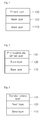
- Figs. 1 to 3 are cross-sectionals view illustrating biodegradable sheets according to embodiments of the present invention.
- the biodegradable sheet illustrated in Fig. 1 includes a base layer 110, a resin layer 120, and a printed layer 130 formed in this order from the bottom.
- the resin layer 120 includes a PLA resin.
- PLA resins are thermoplastic polyesters of lactide or lactic acid.
- PLA resins may be produced by polymerization of lactic acid, which is obtained by fermentation of starch extracted from corn or potatoes.
- the use of PLA resins obtained from readily available renewable vegetable resources such as corn and potatoes can effectively solve problems arising from depletion of petroleum resources.
- PLA resins are environmentally friendly materials that emit far fewer environmentally harmful substances such as CO 2 during use or when discarded than petroleum-based substances such as polyvinyl chloride (PVC), and are readily biodegradable once disposed of under natural environmental conditions.
- PVC polyvinyl chloride
- PLA resins can be classified into crystalline PLA (c-PLA) resins and amorphous PLA (a-PLA) resins.
- Plasticizers may bleed toward the surface of sheets using crystalline PLA resins.
- amorphous PLA resins it is preferred to use amorphous PLA resins.
- the use of amorphous PLA resins avoids the need to add compatibilizers, which are essential components in PVC production to prevent the occurrence of bleeding.
- compatibilizers which are essential components in PVC production to prevent the occurrence of bleeding.
- 100% amorphous PLA resins are most preferably used. If needed, combinations of crystalline PLA resins and amorphous PLA resins may be used.
- PLA resin as used herein is intended to include a PLA resin in the form of a sol, a PLA resin blended with a bioresin, and a PLA resin blended with a synthetic resin.
- a PLA resin in the form of a sol may be used in the biodegradable sheet of the present invention.
- the PLA resin in the form of a sol may be produced by adding a PLA resin to a volatile solvent to prepare a PLA solution, adding a plasticizer to the PLA solution, and drying the mixture to remove the volatile solvent.
- the PLA resin in the form of a sol may be produced by adding a plasticizer to a PLA resin in a pellet or powder form.
- a blended resin of a PLA resin and a bioresin may also be used in the biodegradable sheet of the present invention.
- the bioresin type is not limited so long as it is biodegradable.
- the bioresin is selected from cellulose, chitin, starch, polyhydroxyalkanoate (PHA), polyhydroxybutyrate valerate (PHBV), polyvinyl alcohol (PVA), polyglycolic acid (PGA), polybutylene succinate (PBS), poly(butylene adipate-co-butylene succinate) (PBSA), polybutylene adipate terephthalate (PBAT), polycaprolactone (PCL), poly(ester-amide), poly(ester-urethane), and mixtures thereof.
- PHA polyhydroxyalkanoate
- PHBV polyhydroxybutyrate valerate
- PVA polyvinyl alcohol
- PGA polyglycolic acid
- PBS polybutylene succinate
- PBSA poly(butylene
- the blended resin includes 10 to 70 parts by weight of the bioresin, based on 100 parts by weight of the PLA resin. If the bioresin is present in an amount of less than 10 parts by weight, blending is likely to be ineffective. Meanwhile, the presence of the bioresin in an amount exceeding 70 parts by weight may cause problems in terms of compatibility with other additives.
- the biodegradable sheet of the present invention may also use a blended resin of a PLA resin and a synthetic resin.
- the synthetic resin is selected from polyvinyl chloride (PVC), polyethylene glycol (PEG), ethylene vinyl acetate (EVA), thermoplastic elastomers (TPEs), thermoplastic polyurethane (TPU), thermoplastic starch (TPS), epoxidized natural rubbers (ENRs), ionomers, styrene butadiene styrene (SBS), nitrile butadiene rubbers (NBRs), styrene ethylene butylene styrene (SEBS), acrylates, acrylonitrile butadiene styrene (ABS), polyolefin modified with compatibilizer, polyurethane (PU), polyamide, polyester, and mixtures thereof.
- These synthetic resins are preferred in terms of compatibility with PLA resins and biodegradability.
- the blended resin includes 10 to 70 parts by weight of the synthetic resin, based on 100 parts by weight of the PLA resin.
- the presence of the synthetic resin in an amount of less than 10 parts by weight results in ineffective blending. Meanwhile, the presence of the synthetic resin in an amount exceeding 70 parts by weight may cause problems in terms of compatibility with other additives and may inhibit the objective of biodegradability.
- a plasticizer and a processing aid may be added to the PLA resin constituting the biodegradable sheet of the present invention.
- the plasticizer is particularly preferably a non-phthalate plasticizer.
- the non-phthalate plasticizer is environmentally friendly and softens the PLA resin to achieve enhanced thermoplasticity, which facilitates molding of the PLA resin at high temperature.
- the non-phthalate plasticizer is preferably selected from citric acid, citrates, epoxidized vegetable oils, fatty acid esters, polyethylene glycol, polyethylene propylene glycol, and glycerol esters.
- the non-phthalate plasticizer is preferably used in an amount of 10 to 50 parts by weight, based on 100 parts by weight of the PLA resin.
- the plasticizer content is less than 10 parts by weight, based on 100 parts by weight of the PLA resin, the hardness of the PLA resin may increase, resulting in poor processability. Meanwhile, if the plasticizer content exceeds 50 parts by weight, based on 100 parts by weight of the PLA resin, compatibility with the other components may be poor, causing degradation of physical properties.
- the processing aid serves to increase the melt strength of the PLA resin. Low melt strength or heat resistance inherent to the PLA resin is the reason why the addition of the processing aid is preferred.
- the processing aid is preferably selected from acrylic copolymers, epoxy copolymers, urethane copolymers, and polyolefin copolymers.
- the processing aid compensates for the melt strength of the PLA resin to facilitate processing, for example, calendering of the PLA resin.
- the processing aid is preferably used in an amount of 1 to 10 parts by weight, based on 100 parts by weight of the PLA resin.
- the processing aid content is less than 1 part by weight, based on 100 parts by weight of the PLA resin, sufficient improvements in the melting efficiency and melt strength of the PLA resin are not obtained. Meanwhile, if the processing aid content exceeds 10 parts by weight, based on 100 parts by weight of the PLA resin, a rise in production costs is inevitable and poor compatibility with other materials constituting the layers of the sheet may be caused, leading to deterioration in overall physical properties of the layers.
- a filler, a lubricant, an additive or a mixture thereof may be further added to the PLA resin constituting the biodegradable sheet of the present invention.
- the filler is generally added to prevent changes in the physical properties of the PLA resin composition and to reduce the production cost of the sheet. There is no restriction on the kind of the filler.
- the filler may be one commonly used in the art but is preferably calcium carbonate (CaCO 3 ).
- the filler is preferably used in an amount of 50 to 150 parts by weight, based on 100 parts by weight of the PLA resin.
- the presence of the filler in an amount of less than 50 parts by weight, based on 100 parts by weight of the PLA resin, does not contribute to cost reduction. Meanwhile, the presence of the filler in an amount exceeding 150 parts by weight may cause changes in physical properties.
- the lubricant is added to prevent the PLA resin from adhering to a calender roll or a press during processing, for example, calendering of the PLA resin.
- lubricants include, but are not limited to, stearic acid, waxes, hydrocarbons, and silicone.
- Environmentally friendly higher fatty acids are particularly preferable in the present invention.
- stearic acid which is a saturated higher fatty acid having 18 carbon atoms.
- the lubricant is preferably used in an amount of 0.1 to 8 parts by weight, based on 100 parts by weight of the PLA resin.
- the lubricant content is less than 0.1 parts by weight, based on 100 parts by weight of the PLA resin, the lubricant does not exhibit any of the desired effects. Meanwhile, if the lubricant content exceeds 8 parts by weight, based on 100 parts by weight of the PLA resin, the impact resistance, heat resistance and gloss of the PLA resin may be degraded.
- additive there may be used, for example, a cross-linking agent or an antioxidant.
- the cross-linking agent serves to increase the molecular weight of the PLA resin through chain extension, achieving improved physical properties such as high tensile strength and heat resistance.
- cross-linking agents include, but are not necessarily limited to, diisocyanates, epoxy group-containing copolymers, and hydroxycarboxylic acid compounds.
- the antioxidant serves to prevent the mechanical properties (e.g., impact resistance) of the PLA resin from deterioration resulting from oxidation of the PLA resin.
- antioxidants include, but are not necessarily limited to, phenolic antioxidants, sulfur-based antioxidants, and phosphorus-based antioxidants, which are currently in use for plastics.
- the antioxidant is selected from those that are non-toxic, stable at processing molding temperatures, and highly compatible with the resin without losing their activity and impeding the processability of the resin.
- the cross-linking agent or the antioxidant as the additive is preferably used in an amount of 0.2 to 5 parts by weight, based on 100 parts by weight of the PLA resin.
- the additive content is less than 0.2 parts by weight, based on 100 parts by weight of the PLA resin, the effect of using the additive cannot be obtained. Meanwhile, if the additive content exceeds 5 parts by weight, based on 100 parts by weight of the PLA resin, the molding processability of the PLA resin may deteriorate and the production cost of the sheet may rise.
- the base layer 110 is the most basic layer of the sheet and supports the overlying resin layer 120 and printed layer 130.
- the base layer 110 may be formed using any suitable material known in the art.
- Non-limiting examples of materials for the base layer 110 include vellum paper, a non-woven fabric, and a cotton fabric.
- the vellum paper is composed of pulp
- the non-woven fabric is composed of a combination of pulp and polyester.
- the basis weight of the vellum paper, the non-woven fabric or the cotton fabric constituting the base layer 110 is preferably from 80 to 200 g/m 2 . If the base layer has a basis weight of less than 80 g/m 2 , the sheet may be damaged, for example, tearing may occur during construction or in use. Meanwhile, if the base layer has a basis weight exceeding 200 g/m 2 , the base layer becomes excessively heavy and is apt to crack and curl, making it difficult to construct the sheet.
- the resin layer 120 formed on the base layer 110 imparts an aesthetic effect to the sheet.
- the presence of a biodegradable PLA resin in the resin layer 120 ensures environmental friendliness of the resin layer.
- the resin layer 120 may employ a PLA resin containing a plasticizer and a processing aid.
- a filler, a lubricant, an additive or a mixture thereof may be further added to the PLA resin.
- the composition of the components has been described above.
- the resin layer 120 may be formed by a known calendering or T-die extrusion process.
- the printed layer 130 formed on the resin layer 120 imparts various patterns and/or colors to the sheet to further improve the aesthetics of the sheet.
- the printed layer may be formed by any suitable printing technique known in the art, such as gravure printing, transfer printing, digital printing or rotary printing.
- the printed layer 130 may be a photorealistically printed layer 131 ( Fig. 2 ) or a transfer-printed layer 132 ( Fig. 3 ).
- a photorealistic printing technique such as ink-jet printing, or a transfer printing technique can impart a more natural aesthetic effect in a simple manner.
- Fig. 4 is a cross-sectional view of a biodegradable sheet according to another embodiment of the present invention.
- the biodegradable sheet may further include a surface-treated layer 140.
- the surface-treated layer 140 overlies the base layer 110, the resin layer 120 and the printed layer 130.
- the surface-treated layer 140 formed on the printed layer 130 serves to improve the durability of the sheet while protecting the pattern formed on the upper side of the printed layer 130.
- the surface-treated layer 140 may be formed using a transparent resin, such as an acrylic resin or a urethane resin.
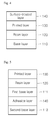
- Figs. 5 and 6 are cross-sectional views of biodegradable sheets according to further embodiments of the present invention.
- each of the biodegradable sheets may include a first base layer 111 and a second base layer 112 between which an adhesive layer 140 is interposed.
- the first base layer 111 and the second base layer 112 can be sufficiently understood from the explanation of the base layer 110, and thus explanation thereof is omitted here.
- the adhesive layer 140 allows the first base layer 111 and the second base layer 112 to have a laminate structure.
- the adhesive layer 140 includes a PLA resin to ensure biodegradability.
- the adhesive layer 140 preferably includes 10 to 40% by weight of a PLA resin and 60 to 90% by weight of a solvent.
- the solvent is preferably selected from methyl ethyl ketone (MEK), methyl isobutyl ketone (MIBK), acetone, ethyl alcohol, and mixtures thereof.
- the biodegradable sheet illustrated in Fig. 6 may further include a partially foamed layer 150 formed on the printed layer 130 illustrated in Fig. 5 .
- the partially foamed layer 150 serves to impart a three-dimensional appearance to the sheet and includes a PLA resin to ensure biodegradability.
- the partially foamed layer 150 may be formed by printing a foamable resin on the printed layer using a suitable printing technique such as rotary printing to form a desired pattern, followed by known foaming and gelling processes.
- the partially foamed layer 150 includes a PLA resin.
- the PLA resin may further contain a plasticizer and a processing aid.
- a filler, a lubricant, an additive, a foaming agent or a mixture thereof may be further added to the PLA resin.
- the composition of the components except the foaming agent has been described above.
- the foaming agent is preferably added in an amount of 0.5 to 2 parts by weight, based on 100 parts by weight of the PLA resin.
- the kind of the foaming agent can be appropriately selected depending on the desired shape of the pattern or the desired number of cells. Any general foaming agent may be used without particular limitation, but a thermally decomposable foaming agent undergoing an exothermic reaction is particularly preferred.
- the foaming agent is preferably selected from azodicarbonamide, azodicarboxyamide, benzenesulfonyl hydrazide, dinitrosopentamethylenetetramine, toluenesulfonyl hydrazide, azobisisobutyronitrile, barium azodicarboxylate, sodium bicarbonate, and mixtures thereof.
- the foaming agent is preferably used in an amount of 0.5 to 5 parts by weight, based on 100 parts by weight of the PLA resin.
- the content of the foaming agent is less than 0.5 parts by weight, based on 100 parts by weight of the PLA resin, poor foamability is caused. If the content of the foaming agent exceeds 5 parts by weight, the strength and heat resistance of the foamed layer tend to deteriorate.
- the average particle diameter of the foaming agent is preferably adjusted to 3 to 30 ⁇ m, more preferably 5 to 28 ⁇ m. Within this range, the foamed resin layer has cells whose diameter is uniform.
- the constituent layers were sequentially laminated from the layer shown in the left column in Table 1 to produce biodegradable sheets of Examples 1-10.
- a blend of the PLA resin and a bioresin, and a blend of the PLA resin and a synthetic resin were used in Examples 2, 3, 6, 7, 9, and 10, and the compositions thereof are shown in Table 1.
- the constituent layers selected from the second base layer, the adhesive layer, the first base layer, the resin layer, the printed layer, the partially foamed layer, and the surface-treated layer were sequentially laminated to produce biodegradable sheets of Examples 1-10.
- the biodegradable sheet of Example 2 was produced under the same conditions as those in Example 1, except that a blended resin of 100 parts by weight of the PLA resin and 30 parts by weight of a PBS resin was used to form the resin layer.
- the biodegradable sheet of Example 3 was produced under the same conditions as those in Example 1, except that a blended resin of 100 parts by weight of the PLA resin and 30 parts by weight of a PVC resin was used to form the printed layer.
- the biodegradable sheet of Example 6 was produced under the same conditions as those in Example 5, except that a blended resin of 100 parts by weight of the PLA resin and 30 parts by weight of a PBS resin was used to form the resin layer.
- the biodegradable sheet of Example 7 was produced under the same conditions as those in Example 5, except that a blended resin of 100 parts by weight of the PLA resin and 30 parts by weight of a PVC resin was used to form the printed layer.
- the biodegradable sheet of Example 9 was produced under the same conditions as those in Example 8, except that a blended resin of 100 parts by weight of the PLA resin and 30 parts by weight of a PBS resin was used to form the partially foamed layer.
- Example 10 The biodegradable sheet of Example 10 was produced under the same conditions as those in Example 8, except that a blended resin of 100 parts by weight of the PLA resin and 30 parts by weight of a PVC resin was used to form the partially foamed layer.
- Table 1 Second base layer Adhesive layer First base layer Resin layer Printed layer Partially foamed layer Surface-treated layer
- Example 1 ⁇ ⁇ ⁇ Example 2 ⁇ ⁇ ⁇ PLA 100 parts by weight PBS 30 parts by weight
- Example 3 ⁇ ⁇ ⁇ PLA 100 parts by weight PVC 30 parts by weight
- Example 4 ⁇ ⁇ ⁇ ⁇ Example 5 ⁇ ⁇ ⁇ ⁇ ⁇ Example 6 ⁇ ⁇ ⁇ ⁇ PLA 100 parts by weight PBS 30 parts by weight
- Example 7 ⁇ ⁇ ⁇ ⁇ ⁇ PLA 100 parts by weight PVC 30 parts by weight
- Example 8 ⁇ ⁇ ⁇ ⁇ ⁇ PLA 100 parts by weight PBS 30 parts by weight
- Example 9 ⁇ ⁇ ⁇ ⁇ ⁇ ⁇ PLA 100
- a base layer was formed using a base paper composed of 100% pulp.
- a paste including a PVC resin was coated on the base layer, and dried to produce a commercially available PVC silk sheet.
- Example 1 ⁇ ⁇ ⁇ ⁇ Example 2 ⁇ ⁇ ⁇ ⁇ Example 3 ⁇ ⁇ ⁇ ⁇ Example 4 ⁇ ⁇ ⁇ ⁇ Example 5 ⁇ ⁇ ⁇ ⁇ Example 6 ⁇ ⁇ ⁇ ⁇ Example 7 ⁇ ⁇ ⁇ ⁇ Example 8 ⁇ ⁇ ⁇ ⁇ Example 9 ⁇ ⁇ ⁇ ⁇ Example 10 ⁇ ⁇ ⁇ ⁇ Comparative Example ⁇ ⁇ ⁇ ⁇ ⁇
- Dimensional stability was defined as the shrinkage of the specimen, which was calculated from the difference between the length of the specimen after dipping in a water bath and the length of the specimen after standing at 80 °C. Dimensional stability was evaluated to be "good ( ⁇ )” when the shrinkage was less than 2.0%, “fair ( ⁇ )” when it was 2.0-2.2%, and “poor ( ⁇ )” when it was not less than 2.2%.
- Moisture vapor permeability was defined as the mass of water vapor passing through the product. Moisture vapor permeability was evaluated to be "good ( ⁇ )" when the mass of passing water vapor was not less than 175 g/m 2 ⁇ 24 hr, and “poor ( ⁇ )” when it was less than 175 g/m 2 ⁇ 24 hr.
- Light fastness was graded based on the criteria specified in KS M 7305. Light fastness was evaluated to be "good ( ⁇ )” when the grade was not less than 4 and “poor ( ⁇ )” when it was less than 4.
- Environmental friendliness refers to the emission levels of total volatile organic compounds (TVOCs) and formaldehyde (HCHO). Environmental friendliness was evaluated to be "good ( ⁇ )” when the TVOC and HCHO emission levels were less than 0.1 mg/m 2 ⁇ h and less than 0.015 mg/m 2 ⁇ h, respectively, "fair ( ⁇ )” when the TVOC emission level was 0.09-0.12 mg/m 2 ⁇ h or the HCHO emission level was 0.013-0.017 mg/m 2 ⁇ h, and poor ( ⁇ ) when the TVOC and HCHO emission levels were not less than 0.1 mg/m 2 ⁇ h and not less than 0.015 mg/m 2 ⁇ h, respectively.
- TVOCs total volatile organic compounds
- HCHO formaldehyde
- the dimensional stability, moisture vapor permeability, and light fastness of the inventive biodegradable sheets were sufficient to replace the PVC sheet.
- the inventive biodegradable sheets emitted smaller amounts of TVOCs than the PVC sheet, demonstrating superior environmental friendliness thereof.
Landscapes
- Chemical & Material Sciences (AREA)
- Engineering & Computer Science (AREA)
- Organic Chemistry (AREA)
- Ceramic Engineering (AREA)
- Physics & Mathematics (AREA)
- General Physics & Mathematics (AREA)
- Theoretical Computer Science (AREA)
- Textile Engineering (AREA)
- Chemical Kinetics & Catalysis (AREA)
- Medicinal Chemistry (AREA)
- Polymers & Plastics (AREA)
- Health & Medical Sciences (AREA)
- Laminated Bodies (AREA)
- Biological Depolymerization Polymers (AREA)
- Compositions Of Macromolecular Compounds (AREA)
Abstract
Description
- The present invention relates to sheets, and more particularly, to biodegradable sheets including a base layer, a resin layer formed on the base layer, and a printed layer formed on the resin layer wherein the resin layer includes a polylactic acid (PLA) resin.
- Sheets using petroleum resins such as polyvinyl chloride (PVC) are widely used in various building structures such as houses, mansions, apartments, offices, and stores.
- Such sheets are produced by T-die extrusion or calendering of resins such as polyvinyl chloride (PVC). Raw materials for these sheets are exclusively derived from limited resources such as crude oil. It is thus anticipated that depletion of petroleum resources will lead to various problems related to the supply of raw materials.
- As interest in environmental issues is recently growing in importance, polyvinyl chloride (PVC) sheets are problematic in that they are likely to emit harmful substances and create an environmental burden even after disposed of.
- An aspect of the present invention is to provide an environmentally friendly sheet that uses a PLA resin, which can solve problems associated with the supply of raw materials of the constituent layers.
- In accordance with an aspect of the present invention, a biodegradable sheet includes a base layer, a resin layer formed on the base layer, and a printed layer formed on the resin layer wherein the resin layer includes a PLA resin.
- In accordance with another aspect of the present invention, a biodegradable sheet includes a base layer, a resin layer formed on the base layer, a printed layer formed on the resin layer, and a surface-treated layer formed on the printed layer wherein the resin layer includes a PLA resin.
- In accordance with a further aspect of the present invention, a biodegradable sheet includes a first base layer, a resin layer formed on the first base layer, a printed layer formed on the resin layer, an adhesive layer formed under the first base layer, and a second base layer formed under the adhesive layer wherein at least one layer of the resin layer and the adhesive layer includes a PLA resin.
- In accordance with a further aspect of the present invention, a biodegradable sheet includes a first base layer, a resin layer formed on the first base layer, a printed layer formed on the resin layer, an adhesive layer formed under the first base layer, a second base layer formed under the adhesive layer, and a partially foamed layer formed on the printed layer wherein at least one layer of the resin layer, the adhesive layer, and the partially foamed layer includes a PLA resin.
- The biodegradable sheets of the present invention use a PLA resin derived from vegetable resources as a substitute for conventional PVC. Therefore, the present invention can solve problems associated with the supply of raw materials arising from depletion of petroleum resources.
- In addition, the biodegradable sheets of the present invention emit less environmentally harmful substances such as CO2 during production and are safely discarded.
- Furthermore, the biodegradable sheets of the present invention are applicable to a wide range of fields, including wallpapers and interior decorative elements of buildings, and covers of electronic products and furniture.
-
-
Figs. 1 and6 are cross-sectional views illustrating embodiments of biodegradable sheets according to the present invention. - The above and other aspects, features, and advantages of the present invention will become apparent from the detailed description of the following embodiments in conjunction with the accompanying drawings. It should be understood that the present invention is not limited to the following embodiments and may be embodied in different ways, and that the embodiments are provided for complete disclosure and a thorough understanding of the present invention by those skilled in the art. The scope of the present invention is defined only by the claims. Like components will be denoted by like reference numerals throughout the specification.
- Hereinafter, biodegradable sheets according to preferred embodiments of the present invention will be described in detail with reference to the accompanying drawings.
-
Figs. 1 to 3 are cross-sectionals view illustrating biodegradable sheets according to embodiments of the present invention. - First, the biodegradable sheet illustrated in
Fig. 1 includes abase layer 110, aresin layer 120, and a printedlayer 130 formed in this order from the bottom. Theresin layer 120 includes a PLA resin. - PLA resins are thermoplastic polyesters of lactide or lactic acid. For example, PLA resins may be produced by polymerization of lactic acid, which is obtained by fermentation of starch extracted from corn or potatoes. The use of PLA resins obtained from readily available renewable vegetable resources such as corn and potatoes can effectively solve problems arising from depletion of petroleum resources.
- PLA resins are environmentally friendly materials that emit far fewer environmentally harmful substances such as CO2 during use or when discarded than petroleum-based substances such as polyvinyl chloride (PVC), and are readily biodegradable once disposed of under natural environmental conditions.
- PLA resins can be classified into crystalline PLA (c-PLA) resins and amorphous PLA (a-PLA) resins. Plasticizers may bleed toward the surface of sheets using crystalline PLA resins. In view of this phenomenon, it is preferred to use amorphous PLA resins. The use of amorphous PLA resins avoids the need to add compatibilizers, which are essential components in PVC production to prevent the occurrence of bleeding. Particularly, 100% amorphous PLA resins are most preferably used. If needed, combinations of crystalline PLA resins and amorphous PLA resins may be used.
- The term "PLA resin' as used herein is intended to include a PLA resin in the form of a sol, a PLA resin blended with a bioresin, and a PLA resin blended with a synthetic resin.
- First, a PLA resin in the form of a sol may be used in the biodegradable sheet of the present invention. The PLA resin in the form of a sol may be produced by adding a PLA resin to a volatile solvent to prepare a PLA solution, adding a plasticizer to the PLA solution, and drying the mixture to remove the volatile solvent. Alternatively, the PLA resin in the form of a sol may be produced by adding a plasticizer to a PLA resin in a pellet or powder form.
- A blended resin of a PLA resin and a bioresin may also be used in the biodegradable sheet of the present invention. The bioresin type is not limited so long as it is biodegradable. Particularly, the bioresin is selected from cellulose, chitin, starch, polyhydroxyalkanoate (PHA), polyhydroxybutyrate valerate (PHBV), polyvinyl alcohol (PVA), polyglycolic acid (PGA), polybutylene succinate (PBS), poly(butylene adipate-co-butylene succinate) (PBSA), polybutylene adipate terephthalate (PBAT), polycaprolactone (PCL), poly(ester-amide), poly(ester-urethane), and mixtures thereof. These bioresins are preferred in terms of compatibility with PLA resins and biodegradability.
- Preferably, the blended resin includes 10 to 70 parts by weight of the bioresin, based on 100 parts by weight of the PLA resin. If the bioresin is present in an amount of less than 10 parts by weight, blending is likely to be ineffective. Meanwhile, the presence of the bioresin in an amount exceeding 70 parts by weight may cause problems in terms of compatibility with other additives.
- The biodegradable sheet of the present invention may also use a blended resin of a PLA resin and a synthetic resin. The synthetic resin is selected from polyvinyl chloride (PVC), polyethylene glycol (PEG), ethylene vinyl acetate (EVA), thermoplastic elastomers (TPEs), thermoplastic polyurethane (TPU), thermoplastic starch (TPS), epoxidized natural rubbers (ENRs), ionomers, styrene butadiene styrene (SBS), nitrile butadiene rubbers (NBRs), styrene ethylene butylene styrene (SEBS), acrylates, acrylonitrile butadiene styrene (ABS), polyolefin modified with compatibilizer, polyurethane (PU), polyamide, polyester, and mixtures thereof. These synthetic resins are preferred in terms of compatibility with PLA resins and biodegradability.
- Preferably, the blended resin includes 10 to 70 parts by weight of the synthetic resin, based on 100 parts by weight of the PLA resin. The presence of the synthetic resin in an amount of less than 10 parts by weight results in ineffective blending. Meanwhile, the presence of the synthetic resin in an amount exceeding 70 parts by weight may cause problems in terms of compatibility with other additives and may inhibit the objective of biodegradability.
- A plasticizer and a processing aid may be added to the PLA resin constituting the biodegradable sheet of the present invention.
- The plasticizer is particularly preferably a non-phthalate plasticizer. The non-phthalate plasticizer is environmentally friendly and softens the PLA resin to achieve enhanced thermoplasticity, which facilitates molding of the PLA resin at high temperature. The non-phthalate plasticizer is preferably selected from citric acid, citrates, epoxidized vegetable oils, fatty acid esters, polyethylene glycol, polyethylene propylene glycol, and glycerol esters.
- The non-phthalate plasticizer is preferably used in an amount of 10 to 50 parts by weight, based on 100 parts by weight of the PLA resin.
- If the plasticizer content is less than 10 parts by weight, based on 100 parts by weight of the PLA resin, the hardness of the PLA resin may increase, resulting in poor processability. Meanwhile, if the plasticizer content exceeds 50 parts by weight, based on 100 parts by weight of the PLA resin, compatibility with the other components may be poor, causing degradation of physical properties.
- The processing aid serves to increase the melt strength of the PLA resin. Low melt strength or heat resistance inherent to the PLA resin is the reason why the addition of the processing aid is preferred.
- The processing aid is preferably selected from acrylic copolymers, epoxy copolymers, urethane copolymers, and polyolefin copolymers. The processing aid compensates for the melt strength of the PLA resin to facilitate processing, for example, calendering of the PLA resin.
- The processing aid is preferably used in an amount of 1 to 10 parts by weight, based on 100 parts by weight of the PLA resin.
- If the processing aid content is less than 1 part by weight, based on 100 parts by weight of the PLA resin, sufficient improvements in the melting efficiency and melt strength of the PLA resin are not obtained. Meanwhile, if the processing aid content exceeds 10 parts by weight, based on 100 parts by weight of the PLA resin, a rise in production costs is inevitable and poor compatibility with other materials constituting the layers of the sheet may be caused, leading to deterioration in overall physical properties of the layers.
- A filler, a lubricant, an additive or a mixture thereof may be further added to the PLA resin constituting the biodegradable sheet of the present invention.
- The filler is generally added to prevent changes in the physical properties of the PLA resin composition and to reduce the production cost of the sheet. There is no restriction on the kind of the filler. The filler may be one commonly used in the art but is preferably calcium carbonate (CaCO3).
- The filler is preferably used in an amount of 50 to 150 parts by weight, based on 100 parts by weight of the PLA resin.
- The presence of the filler in an amount of less than 50 parts by weight, based on 100 parts by weight of the PLA resin, does not contribute to cost reduction. Meanwhile, the presence of the filler in an amount exceeding 150 parts by weight may cause changes in physical properties.
- The lubricant is added to prevent the PLA resin from adhering to a calender roll or a press during processing, for example, calendering of the PLA resin.
- Examples of such lubricants include, but are not limited to, stearic acid, waxes, hydrocarbons, and silicone. Environmentally friendly higher fatty acids are particularly preferable in the present invention. As an example of the higher fatty acids, there may be mentioned stearic acid, which is a saturated higher fatty acid having 18 carbon atoms.
- The lubricant is preferably used in an amount of 0.1 to 8 parts by weight, based on 100 parts by weight of the PLA resin.
- If the lubricant content is less than 0.1 parts by weight, based on 100 parts by weight of the PLA resin, the lubricant does not exhibit any of the desired effects. Meanwhile, if the lubricant content exceeds 8 parts by weight, based on 100 parts by weight of the PLA resin, the impact resistance, heat resistance and gloss of the PLA resin may be degraded.
- As the additive, there may be used, for example, a cross-linking agent or an antioxidant.
- The cross-linking agent serves to increase the molecular weight of the PLA resin through chain extension, achieving improved physical properties such as high tensile strength and heat resistance.
- Examples of such cross-linking agents include, but are not necessarily limited to, diisocyanates, epoxy group-containing copolymers, and hydroxycarboxylic acid compounds.
- The antioxidant serves to prevent the mechanical properties (e.g., impact resistance) of the PLA resin from deterioration resulting from oxidation of the PLA resin.
- Examples of such antioxidants include, but are not necessarily limited to, phenolic antioxidants, sulfur-based antioxidants, and phosphorus-based antioxidants, which are currently in use for plastics.
- The antioxidant is selected from those that are non-toxic, stable at processing molding temperatures, and highly compatible with the resin without losing their activity and impeding the processability of the resin.
- The cross-linking agent or the antioxidant as the additive is preferably used in an amount of 0.2 to 5 parts by weight, based on 100 parts by weight of the PLA resin.
- If the additive content is less than 0.2 parts by weight, based on 100 parts by weight of the PLA resin, the effect of using the additive cannot be obtained. Meanwhile, if the additive content exceeds 5 parts by weight, based on 100 parts by weight of the PLA resin, the molding processability of the PLA resin may deteriorate and the production cost of the sheet may rise.
- An explanation will be given concerning the
base layer 110, the resin layer120, the printedlayer 130, a photorealistically printedlayer 131, and a transfer-printedlayer 132 illustrated inFigs. 1 to 3 . - The
base layer 110 is the most basic layer of the sheet and supports the overlyingresin layer 120 and printedlayer 130. - The
base layer 110 may be formed using any suitable material known in the art. Non-limiting examples of materials for thebase layer 110 include vellum paper, a non-woven fabric, and a cotton fabric. - The vellum paper is composed of pulp, and the non-woven fabric is composed of a combination of pulp and polyester.
- The basis weight of the vellum paper, the non-woven fabric or the cotton fabric constituting the
base layer 110 is preferably from 80 to 200 g/m2. If the base layer has a basis weight of less than 80 g/m2, the sheet may be damaged, for example, tearing may occur during construction or in use. Meanwhile, if the base layer has a basis weight exceeding 200 g/m2, the base layer becomes excessively heavy and is apt to crack and curl, making it difficult to construct the sheet. - The
resin layer 120 formed on thebase layer 110 imparts an aesthetic effect to the sheet. The presence of a biodegradable PLA resin in theresin layer 120 ensures environmental friendliness of the resin layer. - As described above, the
resin layer 120 may employ a PLA resin containing a plasticizer and a processing aid. A filler, a lubricant, an additive or a mixture thereof may be further added to the PLA resin. The composition of the components has been described above. - There is no restriction on the method for forming the
resin layer 120. For example, theresin layer 120 may be formed by a known calendering or T-die extrusion process. - The printed
layer 130 formed on theresin layer 120 imparts various patterns and/or colors to the sheet to further improve the aesthetics of the sheet. There is no particular restriction on the method for the formation of the printed layer. For example, the printed layer may be formed by any suitable printing technique known in the art, such as gravure printing, transfer printing, digital printing or rotary printing. As illustrated inFigs. 2 and 3 , the printedlayer 130 may be a photorealistically printed layer 131 (Fig. 2 ) or a transfer-printed layer 132 (Fig. 3 ). The use of a known photorealistic printing technique, such as ink-jet printing, or a transfer printing technique can impart a more natural aesthetic effect in a simple manner. -
Fig. 4 is a cross-sectional view of a biodegradable sheet according to another embodiment of the present invention. - As illustrated in
Fig. 4 , the biodegradable sheet may further include a surface-treatedlayer 140. The surface-treatedlayer 140 overlies thebase layer 110, theresin layer 120 and the printedlayer 130. - The surface-treated
layer 140 formed on the printedlayer 130 serves to improve the durability of the sheet while protecting the pattern formed on the upper side of the printedlayer 130. - The surface-treated
layer 140 may be formed using a transparent resin, such as an acrylic resin or a urethane resin. -
Figs. 5 and6 are cross-sectional views of biodegradable sheets according to further embodiments of the present invention. - As illustrated in
Figs. 5 and6 , each of the biodegradable sheets may include afirst base layer 111 and asecond base layer 112 between which anadhesive layer 140 is interposed. - The
first base layer 111 and thesecond base layer 112 can be sufficiently understood from the explanation of thebase layer 110, and thus explanation thereof is omitted here. - The
adhesive layer 140 allows thefirst base layer 111 and thesecond base layer 112 to have a laminate structure. Theadhesive layer 140 includes a PLA resin to ensure biodegradability. - The
adhesive layer 140 preferably includes 10 to 40% by weight of a PLA resin and 60 to 90% by weight of a solvent. The solvent is preferably selected from methyl ethyl ketone (MEK), methyl isobutyl ketone (MIBK), acetone, ethyl alcohol, and mixtures thereof. - The biodegradable sheet illustrated in
Fig. 6 may further include a partially foamedlayer 150 formed on the printedlayer 130 illustrated inFig. 5 . - The partially foamed
layer 150 serves to impart a three-dimensional appearance to the sheet and includes a PLA resin to ensure biodegradability. - The partially foamed
layer 150 may be formed by printing a foamable resin on the printed layer using a suitable printing technique such as rotary printing to form a desired pattern, followed by known foaming and gelling processes. - As a result of the processes, only the printed pattern is foamed in the partially foamed
layer 150. - The partially foamed
layer 150 includes a PLA resin. As described above, the PLA resin may further contain a plasticizer and a processing aid. A filler, a lubricant, an additive, a foaming agent or a mixture thereof may be further added to the PLA resin. The composition of the components except the foaming agent has been described above. - The foaming agent is preferably added in an amount of 0.5 to 2 parts by weight, based on 100 parts by weight of the PLA resin. The kind of the foaming agent can be appropriately selected depending on the desired shape of the pattern or the desired number of cells. Any general foaming agent may be used without particular limitation, but a thermally decomposable foaming agent undergoing an exothermic reaction is particularly preferred.
- Specifically, the foaming agent is preferably selected from azodicarbonamide, azodicarboxyamide, benzenesulfonyl hydrazide, dinitrosopentamethylenetetramine, toluenesulfonyl hydrazide, azobisisobutyronitrile, barium azodicarboxylate, sodium bicarbonate, and mixtures thereof.
- The foaming agent is preferably used in an amount of 0.5 to 5 parts by weight, based on 100 parts by weight of the PLA resin.
- If the content of the foaming agent is less than 0.5 parts by weight, based on 100 parts by weight of the PLA resin, poor foamability is caused. If the content of the foaming agent exceeds 5 parts by weight, the strength and heat resistance of the foamed layer tend to deteriorate.
- As the particle diameter of the foaming agent decreases, the thermal decomposition of the foaming agent proceeds rapidly, leaving large cells. Meanwhile, as the particle diameter of the foaming agent increases, the thermal decomposition of the foaming agent is retarded, leaving small cells. For these reasons, it is necessary to limit the particle diameter of the foaming agent. The average particle diameter of the foaming agent is preferably adjusted to 3 to 30 µm, more preferably 5 to 28 µm. Within this range, the foamed resin layer has cells whose diameter is uniform.
- In the following examples and comparative example, sheets according to preferred embodiments of the present invention and a comparative sheet were produced. However, these examples are provided for illustrative purposes only and are not be construed as in any way limiting the invention.
- Embodiments that are not described herein will be readily recognized and appreciated by those skilled in the art, and thus explanation thereof is omitted.
-
- 1. Base layer
A base layer was formed using a non-woven fabric composed of 70% pulp and 30% polyester. - 2. Formation of resin layer
100 parts by weight of a PLA resin, 50 parts by weight of citric acid, 150 parts by weight of CaCO3 10 parts by weight of an acrylic copolymer, 8 parts by weight of stearic acid, and 5 parts by weight of a cross-linking agent were mixed, kneaded in a kneader at 90-200 °C, followed by calendering or extrusion to produce an about 0.01 mm thick sheet. - 3. Formation of adhesive layer
40 wt% of a PLA resin was mixed with 60 wt% of methyl ethyl ketone at 80 °C to prepare a PLA resin paste for an adhesive layer. - 4. Formation of printed layer
A water-based ink pigment and an oil-based ink pigment were mixed depending on the number of printing colors. The pigment mixture was gravure printed on the resin layer to form a pattern. - 5. Formation of partially foamed layer
100 parts by weight of a PLA resin, 50 parts by weight of citric acid, 150 parts by weight of CaCO3, 10 parts by weight of an acrylic copolymer, 8 parts by weight of stearic acid, 5 parts by weight of a cross-linking agent, and 2 parts by weight of azodicarbonamide were mixed to prepare a paste. The paste was partially coated on the printed layer using a rotary screen roll, and dried in an oven to form a partially foamed layer where a portion corresponding to the printed pattern was foamed. - 6. Formation of surface-treated layer
20 wt% of an acrylic resin was mixed with 80 wt% of methyl ethyl ketone to prepare a coating solution for surface treatment. - The constituent layers were sequentially laminated from the layer shown in the left column in Table 1 to produce biodegradable sheets of Examples 1-10.
- A blend of the PLA resin and a bioresin, and a blend of the PLA resin and a synthetic resin were used in Examples 2, 3, 6, 7, 9, and 10, and the compositions thereof are shown in Table 1.
- In accordance with the layer structures shown in Table 1, the constituent layers selected from the second base layer, the adhesive layer, the first base layer, the resin layer, the printed layer, the partially foamed layer, and the surface-treated layer were sequentially laminated to produce biodegradable sheets of Examples 1-10.
- Specifically, the biodegradable sheet of Example 2 was produced under the same conditions as those in Example 1, except that a blended resin of 100 parts by weight of the PLA resin and 30 parts by weight of a PBS resin was used to form the resin layer.
- The biodegradable sheet of Example 3 was produced under the same conditions as those in Example 1, except that a blended resin of 100 parts by weight of the PLA resin and 30 parts by weight of a PVC resin was used to form the printed layer.
- The biodegradable sheet of Example 6 was produced under the same conditions as those in Example 5, except that a blended resin of 100 parts by weight of the PLA resin and 30 parts by weight of a PBS resin was used to form the resin layer.
- The biodegradable sheet of Example 7 was produced under the same conditions as those in Example 5, except that a blended resin of 100 parts by weight of the PLA resin and 30 parts by weight of a PVC resin was used to form the printed layer.
- The biodegradable sheet of Example 9 was produced under the same conditions as those in Example 8, except that a blended resin of 100 parts by weight of the PLA resin and 30 parts by weight of a PBS resin was used to form the partially foamed layer.
- The biodegradable sheet of Example 10 was produced under the same conditions as those in Example 8, except that a blended resin of 100 parts by weight of the PLA resin and 30 parts by weight of a PVC resin was used to form the partially foamed layer.
Table 1 Second base layer Adhesive layer First base layer Resin layer Printed layer Partially foamed layer Surface-treated layer Example 1 ○ ○ ○ Example 2 ○ ○ ○ PLA 100 parts by weight PBS 30 parts by weight Example 3 ○ ○ ○ PLA 100 parts by weight PVC 30 parts by weight Example 4 ○ ○ ○ ○ Example 5 ○ ○ ○ ○ ○ Example 6 ○ ○ ○ ○ ○ PLA 100 parts by weight PBS 30 parts by weight Example 7 ○ ○ ○ ○ ○ PLA 100 parts by weight PVC 30 parts by weight Example 8 ○ ○ ○ ○ ○ ○ Example 9 ○ ○ ○ ○ ○ ○ PLA 100 parts by weight PBS 30 parts by weight Example 10 ○ ○ ○ ○ ○ ○ PLA 100 parts by weight PVC 30 parts by weight - A base layer was formed using a base paper composed of 100% pulp. A paste including a PVC resin was coated on the base layer, and dried to produce a commercially available PVC silk sheet.
- The sheets of Examples 1-10 and Comparative Example were evaluated with regard to the parameters shown in Table 2, and the results were compared.
Table 2 Dimensional stability Moisture vapor permeability Light fastness TVOCs Example 1 ○ ○ ○ ○ Example 2 Δ ○ Δ ○ Example 3 ○ Δ ○ ○ Example 4 ○ ○ ○ ○ Example 5 ○ ○ ○ ○ Example 6 ○ ○ Δ ○ Example 7 ○ ○ ○ ○ Example 8 ○ ○ ○ ○ Example 9 ○ ○ Δ ○ Example 10 ○ ○ ○ ○ Comparative Example ○ ○ ○ Δ - Dimensional stability was defined as the shrinkage of the specimen, which was calculated from the difference between the length of the specimen after dipping in a water bath and the length of the specimen after standing at 80 °C. Dimensional stability was evaluated to be "good (○)" when the shrinkage was less than 2.0%, "fair (Δ)" when it was 2.0-2.2%, and "poor (×)" when it was not less than 2.2%.
- Moisture vapor permeability was defined as the mass of water vapor passing through the product. Moisture vapor permeability was evaluated to be "good (○)" when the mass of passing water vapor was not less than 175 g/m2·24 hr, and "poor (×)" when it was less than 175 g/m2·24 hr.
- Light fastness was graded based on the criteria specified in KS M 7305. Light fastness was evaluated to be "good (○)" when the grade was not less than 4 and "poor (×)" when it was less than 4.
- Environmental friendliness refers to the emission levels of total volatile organic compounds (TVOCs) and formaldehyde (HCHO). Environmental friendliness was evaluated to be "good (○)" when the TVOC and HCHO emission levels were less than 0.1 mg/m2·h and less than 0.015 mg/m2·h, respectively, "fair (Δ)" when the TVOC emission level was 0.09-0.12 mg/m2·h or the HCHO emission level was 0.013-0.017 mg/m2·h, and poor (×) when the TVOC and HCHO emission levels were not less than 0.1 mg/m2·h and not less than 0.015 mg/m2·h, respectively.
- As can be seen from the results of evaluations, the dimensional stability, moisture vapor permeability, and light fastness of the inventive biodegradable sheets were sufficient to replace the PVC sheet. The inventive biodegradable sheets emitted smaller amounts of TVOCs than the PVC sheet, demonstrating superior environmental friendliness thereof.
- Although the present invention has been described with reference to some embodiments and the accompanying drawings, it will be understood by those skilled in the art that these embodiments are provided for illustrative purposes only, and various modifications, changes, alterations and equivalent embodiments can be made without departing from the scope of the present invention. Therefore, the scope and sprit of the present invention should be defined only by the accompanying claims and equivalents thereof.
Claims (30)
- A biodegradable sheet comprising:a base layer;a resin layer formed on the base layer; anda printed layer formed on the resin layer,wherein the resin layer comprises a polylactic acid (PLA) resin.
- A biodegradable sheet comprising:a base layer;a resin layer formed on the base layer;a printed layer formed on the resin layer; anda surface-treated layer formed on the printed layer,wherein the resin layer comprises a polylactic acid (PLA) resin.
- The biodegradable sheet according to claim 1 or 2, wherein the PLA resin is in the form of a sol.
- The biodegradable sheet according to claim 1 or 2, wherein the resin layer comprises a blended resin of a PLA resin and a bioresin.
- The biodegradable sheet according to claim 4, wherein the bioresin is selected from cellulose, chitin, starch, polyhydroxyalkanoate (PHA), polyhydroxybutyrate valerate (PHBV), polyvinyl alcohol (PVA), polyglycolic acid (PGA), polybutylene succinate (PBS), poly(butylene adipate-co-butylene succinate) (PBSA), polybutylene adipate terephthalate (PBAT), polycaprolactone (PCL), poly(ester-amide), poly(ester-urethane), and mixtures thereof.
- The biodegradable sheet according to claim 1 or 2, wherein the resin layer comprises a blended resin of a PLA resin and a synthetic resin.
- The biodegradable sheet according to claim 6, wherein the synthetic resin is selected from polyvinyl chloride (PVC), polyethylene glycol (PEG), ethylene vinyl acetate (EVA), thermoplastic elastomers (TPEs), thermoplastic polyurethane (TPU), thermoplastic starch (TPS), epoxidized natural rubbers (ENRs), ionomers, styrene butadiene styrene (SBS), nitrile butadiene rubbers (NBRs), styrene ethylene butylene styrene (SEBS), acrylates, acrylonitrile butadiene styrene (ABS), polyolefin modified with compatibilizer, polyurethane (PU), polyamide, polyester, and mixtures thereof.
- The biodegradable sheet according to claim 1 or 2, wherein the resin layer further comprises a plasticizer, a processing aid, or a mixture thereof.
- The biodegradable sheet according to claim 1 or 2, wherein the resin layer comprises 10 to 50 parts by weight of a plasticizer and 1 to 10 parts by weight of a processing aid, based on 100 parts by weight of the PLA resin.
- The biodegradable sheet according to claim 8, wherein the resin layer further comprises a filler, a lubricant, an additive, or a mixture thereof.
- The biodegradable sheet according to claim 10, wherein the resin layer comprises 50 to 150 parts by weight of the filler, 0.1 to 8 parts by weight of the lubricant, and 0.2 to 5 parts by weight of the additive, based on 100 parts by weight of the PLA resin.
- A biodegradable sheet comprising:a first base layer;a resin layer formed on the first base layer;a printed layer formed on the resin layer;an adhesive layer formed under the first base layer; anda second base layer formed under the adhesive layer,wherein at least one layer of the resin layer and the adhesive layer comprises a polylactic acid (PLA) resin.
- A biodegradable sheet comprising:a first base layer;a resin layer formed on the first base layer;a printed layer formed on the resin layer;an adhesive layer formed under the first base layer;a second base layer formed under the adhesive layer; anda partially foamed layer formed on the printed layer,wherein at least one layer of the resin layer, the adhesive layer, and the partially foamed layer comprises a polylactic acid (PLA) resin.
- The biodegradable sheet according to claim 12 or 13, wherein the PLA resin is in the form of a sol.
- The biodegradable sheet according to claim 12 or 13, wherein at least one layer of the resin layer and the adhesive layer comprises a blended resin of a PLA resin and a bioresin.
- The biodegradable sheet according to claim 15, wherein the bioresin is selected from cellulose, chitin, starch, polyhydroxyalkanoate (PHA), polyhydroxybutyrate valerate (PHBV), polyvinyl alcohol (PVA), polyglycolic acid (PGA), polybutylene succinate (PBS), poly(butylene adipate-co-butylene succinate) (PBSA), polybutylene adipate terephthalate (PBAT), polycaprolactone (PCL), poly(ester-amide), poly(ester-urethane), and mixtures thereof.
- The biodegradable sheet according to claim 13, wherein the partially foamed layer comprises a blended resin of a PLA resin and a bioresin.
- The biodegradable sheet according to claim 17, wherein the bioresin is selected from cellulose, chitin, starch, polyhydroxyalkanoate (PHA), polyhydroxybutyrate valerate (PHBV), polyvinyl alcohol (PVA), polyglycolic acid (PGA), polybutylene succinate (PBS), poly(butylene adipate-co-butylene succinate) (PBSA), polybutylene adipate terephthalate (PBAT), polycaprolactone (PCL), poly(ester-amide), poly(ester-urethane), and mixtures thereof.
- The biodegradable sheet according to claim 12 or 13, wherein at least one layer of the resin layer and the adhesive layer comprises a blended resin of a PLA resin and a synthetic resin.
- The biodegradable sheet according to claim 19, wherein the synthetic resin is selected from polyvinyl chloride (PVC), polyethylene glycol (PEG), ethylene vinyl acetate (EVA), thermoplastic elastomers (TPEs), thermoplastic polyurethane (TPU), thermoplastic starch (TPS), epoxidized natural rubbers (ENRs), ionomers, styrene butadiene styrene (SBS), nitrile butadiene rubbers (NBRs), styrene ethylene butylene styrene (SEBS), acrylates, acrylonitrile butadiene styrene (ABS), polyolefin modified with compatibilizer, polyurethane (PU), polyamide, polyester, and mixtures thereof.
- The biodegradable sheet according to claim 13, wherein the partially foamed layer comprises a blended resin of a PLA resin and a synthetic resin.
- The biodegradable sheet according to claim 21, wherein the synthetic resin is selected from polyvinyl chloride (PVC), polyethylene glycol (PEG), ethylene vinyl acetate (EVA), thermoplastic elastomers (TPEs), thermoplastic polyurethane (TPU), thermoplastic starch (TPS), epoxidized natural rubbers (ENRs), ionomers, styrene butadiene styrene (SBS), nitrile butadiene rubbers (NBRs), styrene ethylene butylene styrene (SEBS), acrylates, acrylonitrile butadiene styrene (ABS), polyolefin modified with compatibilizer, polyurethane (PU), polyamide, polyester, and mixtures thereof.
- The biodegradable sheet according to claim 13, wherein at least one layer of the resin layer and the partially foamed layer further comprises a plasticizer, a processing aid, or a mixture thereof.
- The biodegradable sheet according to claim 13, wherein at least one layer of the resin layer and the partially foamed layer comprises 10 to 50 parts by weight of a plasticizer and 1 to 10 parts by weight of a processing aid, based on 100 parts by weight of the PLA resin.
- The biodegradable sheet according to claim 23, wherein the resin layer further comprises a filler, a lubricant, an additive, or a mixture thereof.
- The biodegradable sheet according to claim 25, wherein the resin layer comprises 50 to 150 parts by weight of the filler, 0.1 to 8 parts by weight of the lubricant, and 0.2 to 5 parts by weight of the additive, based on 100 parts by weight of the PLA resin.
- The biodegradable sheet according to claim 23, wherein the partially foamed layer further comprises a filler, a lubricant, an additive, a foaming agent, or a mixture thereof.
- The biodegradable sheet according to claim 27, wherein the partially foamed layer comprises 50 to 150 parts by weight of the filler, 0.1 to 8 parts by weight of the lubricant, 0.2 to 5 parts by weight of the additive, and 0.5 to 2 parts by weight of the foaming agent, based on 100 parts by weight of the PLA resin.
- The biodegradable sheet according to claim 12 or 13, wherein the adhesive layer comprises 10 to 40% by weight of a PLA resin and 60 to 90% by weight of a solvent.
- The biodegradable sheet according to claim 29, wherein the solvent is selected from methyl ethyl ketone (MEK), methyl isobutyl ketone (MIBK), acetone, ethyl alcohol, and mixtures thereof.
Applications Claiming Priority (2)
| Application Number | Priority Date | Filing Date | Title |
|---|---|---|---|
| KR1020110045392A KR101304144B1 (en) | 2011-05-13 | 2011-05-13 | Biodegradable sheet |
| PCT/KR2012/003509 WO2012157874A2 (en) | 2011-05-13 | 2012-05-04 | Biodegradable sheet |
Publications (3)
| Publication Number | Publication Date |
|---|---|
| EP2711178A2 true EP2711178A2 (en) | 2014-03-26 |
| EP2711178A4 EP2711178A4 (en) | 2014-10-22 |
| EP2711178B1 EP2711178B1 (en) | 2020-05-06 |
Family
ID=47177437
Family Applications (1)
| Application Number | Title | Priority Date | Filing Date |
|---|---|---|---|
| EP12785337.2A Not-in-force EP2711178B1 (en) | 2011-05-13 | 2012-05-04 | Biodegradable sheet |
Country Status (6)
| Country | Link |
|---|---|
| US (1) | US8962118B2 (en) |
| EP (1) | EP2711178B1 (en) |
| JP (1) | JP2014513640A (en) |
| KR (1) | KR101304144B1 (en) |
| CN (1) | CN103534091B (en) |
| WO (1) | WO2012157874A2 (en) |
Cited By (5)
| Publication number | Priority date | Publication date | Assignee | Title |
|---|---|---|---|---|
| WO2012091366A2 (en) | 2010-12-30 | 2012-07-05 | Lg Hausys, Ltd. | Eco-friendly foaming sheet |
| EP2746047A4 (en) * | 2011-08-18 | 2014-07-30 | Lg Hausys Ltd | Environmentally-friendly sheet using pla resin |
| EP2877344A4 (en) * | 2012-07-27 | 2015-12-02 | Arkema France | MULTILAYER STRUCTURES CONTAINING BIOPOLYMERS |
| EP3047069A4 (en) * | 2014-05-08 | 2017-05-03 | LG Hausys, Ltd. | Wallpaper using pla and pha blend resin and method for manufacturing the same |
| IT202100001757A1 (en) * | 2021-01-28 | 2022-07-28 | Laboratory Two Sagl | BIODEGRADABLE WALLPAPER AND RELATED PRODUCTION METHOD |
Families Citing this family (17)
| Publication number | Priority date | Publication date | Assignee | Title |
|---|---|---|---|---|
| KR101304144B1 (en) * | 2011-05-13 | 2013-09-05 | (주)엘지하우시스 | Biodegradable sheet |
| JP2015501236A (en) | 2012-09-21 | 2015-01-15 | エルジー・ハウシス・リミテッドLg Hausys,Ltd. | Biodegradable panel |
| WO2014046320A1 (en) | 2012-09-21 | 2014-03-27 | (주)엘지하우시스 | Biodegradable sheet having adhesive layer |
| CN103396622B (en) * | 2013-07-15 | 2015-11-25 | 安徽济峰节能材料有限公司 | Environment-friendly PVC Foam ceiling sheet material and preparation method thereof |
| KR102417035B1 (en) * | 2014-10-27 | 2022-07-04 | 티파 코퍼레이션 리미티드 | Biodegradable sheets |
| JP2017105162A (en) * | 2015-11-27 | 2017-06-15 | 株式会社リコー | Ink application method and wallpaper manufacturing method |
| CN105348753A (en) * | 2015-12-01 | 2016-02-24 | 济南舜昊生物科技有限公司 | Completely degradable bio-based plastic and preparation method thereof |
| US10457021B2 (en) | 2016-03-29 | 2019-10-29 | Amisha Patel | Bio resin paperboard containers and cartons |
| CN106753017A (en) * | 2017-01-23 | 2017-05-31 | 广东天元实业集团股份有限公司 | A kind of biodegradable Jing Yin tape and preparation method thereof |
| WO2019058391A1 (en) * | 2017-09-21 | 2019-03-28 | Vijayaraghavan Raju | The biodegradable paper |
| CN108893071A (en) * | 2018-06-22 | 2018-11-27 | 浙江福莱新材料股份有限公司 | A kind of degradable numerial code spray drawing printed material |
| CN109505143A (en) * | 2018-11-05 | 2019-03-22 | 加通汽车内饰(常熟)有限公司 | A kind of degradable PVC artificial leather of novel environment friendly and its production technology |
| CN109208340A (en) * | 2018-11-05 | 2019-01-15 | 加通汽车内饰(常熟)有限公司 | A kind of degradable PVC artificial leather and its preparation process and its production technology |
| CN114479701A (en) * | 2020-10-27 | 2022-05-13 | 江苏华萱包装有限公司 | A kind of biodegradable adhesive tape and preparation method thereof |
| KR102820087B1 (en) * | 2021-11-02 | 2025-06-12 | 에스케이씨 주식회사 | Biodegradable resin composition comprising high content of calcium carbonate |
| IT202100029957A1 (en) * | 2021-11-26 | 2023-05-26 | Siser S R L | COMPOSTABLE LAYERED PRODUCT SUITABLE FOR THE DECORATION OF FABRICS, PARTICULARLY CLOTHING |
| CN114806431B (en) * | 2022-03-18 | 2022-11-01 | 上海工程技术大学 | Flame-retardant degradable adhesive tape and preparation method thereof |
Family Cites Families (15)
| Publication number | Priority date | Publication date | Assignee | Title |
|---|---|---|---|---|
| US5288548A (en) * | 1992-07-31 | 1994-02-22 | Mobil Oil Corporation | Label face stock |
| JPH07310417A (en) * | 1994-05-17 | 1995-11-28 | Toppan Printing Co Ltd | Decorative paper and method of manufacturing decorative board using the decorative paper |
| JP2005163476A (en) * | 2003-12-05 | 2005-06-23 | Kyowa Co Ltd | Biodegradable construction sheet and manufacturing method thereof |
| JP4400230B2 (en) | 2004-01-29 | 2010-01-20 | 東レ株式会社 | Polylactic acid film and decorative sheet |
| US7972669B2 (en) * | 2005-11-04 | 2011-07-05 | Unitika Ltd. | Biodegradable resin foam sheet, biodegradable resin foam article and biodegradable resin molded container |
| WO2008078413A1 (en) * | 2006-12-22 | 2008-07-03 | Unitika Ltd. | Biodegradable polyester resin composition, and molded body, foamed body and molded container obtained from the biodegradable polyester resin composition |
| TW200900241A (en) * | 2007-06-25 | 2009-01-01 | xi-qing Zhang | Base material structure of paper-made container for finished food product |
| AU2009229406A1 (en) * | 2008-03-24 | 2009-10-01 | Biovation, Llc | Biolaminate composite assembly and related methods |
| KR101092047B1 (en) * | 2008-09-09 | 2011-12-12 | (주)엘지하우시스 | Removable And Reattachable Wallpaper |
| JP2010069852A (en) * | 2008-09-22 | 2010-04-02 | Toppan Cosmo Inc | Face sheet |
| KR101342218B1 (en) * | 2008-10-30 | 2013-12-16 | (주)엘지하우시스 | Bio-wallpapers and preparation methods thereof |
| US9150004B2 (en) * | 2009-06-19 | 2015-10-06 | Toray Plastics (America), Inc. | Biaxially oriented polylactic acid film with improved heat seal properties |
| KR101302335B1 (en) * | 2009-09-23 | 2013-08-30 | (주)엘지하우시스 | Flooring material and preparation method thereof |
| CN102031073B (en) * | 2009-09-27 | 2014-04-09 | 乐金华奥斯株式会社 | Bondable/ uncoverable wallpaper |
| KR101304144B1 (en) * | 2011-05-13 | 2013-09-05 | (주)엘지하우시스 | Biodegradable sheet |
-
2011
- 2011-05-13 KR KR1020110045392A patent/KR101304144B1/en not_active Expired - Fee Related
-
2012
- 2012-05-04 WO PCT/KR2012/003509 patent/WO2012157874A2/en not_active Ceased
- 2012-05-04 EP EP12785337.2A patent/EP2711178B1/en not_active Not-in-force
- 2012-05-04 CN CN201280022852.XA patent/CN103534091B/en not_active Expired - Fee Related
- 2012-05-04 US US14/115,960 patent/US8962118B2/en active Active
- 2012-05-04 JP JP2014511285A patent/JP2014513640A/en active Pending
Cited By (7)
| Publication number | Priority date | Publication date | Assignee | Title |
|---|---|---|---|---|
| WO2012091366A2 (en) | 2010-12-30 | 2012-07-05 | Lg Hausys, Ltd. | Eco-friendly foaming sheet |
| EP2658906A4 (en) * | 2010-12-30 | 2015-11-25 | Lg Hausys Ltd | ECOLOGICAL FOAMING FOIL |
| EP2746047A4 (en) * | 2011-08-18 | 2014-07-30 | Lg Hausys Ltd | Environmentally-friendly sheet using pla resin |
| US9321885B2 (en) | 2011-08-18 | 2016-04-26 | Lg Hausys, Ltd. | Environmentally-friendly sheet using PLA resin |
| EP2877344A4 (en) * | 2012-07-27 | 2015-12-02 | Arkema France | MULTILAYER STRUCTURES CONTAINING BIOPOLYMERS |
| EP3047069A4 (en) * | 2014-05-08 | 2017-05-03 | LG Hausys, Ltd. | Wallpaper using pla and pha blend resin and method for manufacturing the same |
| IT202100001757A1 (en) * | 2021-01-28 | 2022-07-28 | Laboratory Two Sagl | BIODEGRADABLE WALLPAPER AND RELATED PRODUCTION METHOD |
Also Published As
| Publication number | Publication date |
|---|---|
| CN103534091A (en) | 2014-01-22 |
| KR101304144B1 (en) | 2013-09-05 |
| EP2711178A4 (en) | 2014-10-22 |
| US20140072782A1 (en) | 2014-03-13 |
| WO2012157874A2 (en) | 2012-11-22 |
| US8962118B2 (en) | 2015-02-24 |
| CN103534091B (en) | 2016-03-16 |
| KR20120127113A (en) | 2012-11-21 |
| WO2012157874A3 (en) | 2013-03-21 |
| EP2711178B1 (en) | 2020-05-06 |
| JP2014513640A (en) | 2014-06-05 |
Similar Documents
| Publication | Publication Date | Title |
|---|---|---|
| EP2711178B1 (en) | Biodegradable sheet | |
| EP2708357B1 (en) | Biodegradable sheet having foaming layer | |
| US9403348B2 (en) | Biodegradable sheets having adhesive layer | |
| CN102470650B (en) | Flooring material and fabrication method thereof | |
| US9388581B2 (en) | Biodegradable panels | |
| KR20120127115A (en) | Biodegradable sheet using pla resin | |
| KR101285981B1 (en) | Biodegradable panel | |
| KR200473372Y1 (en) | Flooring and wallpaper including biodegradable materials | |
| KR101327574B1 (en) | Biodegradable sheet having adhesion layer | |
| KR102436617B1 (en) | Eco-friendly foaming wallpaper and method for preparing the same | |
| KR101305741B1 (en) | Biodegradable panel having board layer | |
| KR101297044B1 (en) | Biodegradable sheet having fabric layer | |
| KR101317605B1 (en) | Biodegradable wallpaper using natural material | |
| KR101333849B1 (en) | Biodegradable laminated wallpaper | |
| KR101295408B1 (en) | Biodegradable sheet having flexibility | |
| KR102436619B1 (en) | Eco-friendly foaming wallpaper and method for preparing the same | |
| KR20150135621A (en) | Foamed sheet and method for preparing foamed sheet |
Legal Events
| Date | Code | Title | Description |
|---|---|---|---|
| PUAI | Public reference made under article 153(3) epc to a published international application that has entered the european phase |
Free format text: ORIGINAL CODE: 0009012 |
|
| 17P | Request for examination filed |
Effective date: 20131113 |
|
| AK | Designated contracting states |
Kind code of ref document: A2 Designated state(s): AL AT BE BG CH CY CZ DE DK EE ES FI FR GB GR HR HU IE IS IT LI LT LU LV MC MK MT NL NO PL PT RO RS SE SI SK SM TR |
|
| DAX | Request for extension of the european patent (deleted) | ||
| A4 | Supplementary search report drawn up and despatched |
Effective date: 20140924 |
|
| RIC1 | Information provided on ipc code assigned before grant |
Ipc: C08L 67/04 20060101ALI20140918BHEP Ipc: B32B 27/08 20060101ALI20140918BHEP Ipc: B32B 7/12 20060101ALI20140918BHEP Ipc: B32B 27/04 20060101AFI20140918BHEP |
|
| STAA | Information on the status of an ep patent application or granted ep patent |
Free format text: STATUS: EXAMINATION IS IN PROGRESS |
|
| 17Q | First examination report despatched |
Effective date: 20170119 |
|
| GRAP | Despatch of communication of intention to grant a patent |
Free format text: ORIGINAL CODE: EPIDOSNIGR1 |
|
| STAA | Information on the status of an ep patent application or granted ep patent |
Free format text: STATUS: GRANT OF PATENT IS INTENDED |
|
| INTG | Intention to grant announced |
Effective date: 20191108 |
|
| GRAS | Grant fee paid |
Free format text: ORIGINAL CODE: EPIDOSNIGR3 |
|
| GRAJ | Information related to disapproval of communication of intention to grant by the applicant or resumption of examination proceedings by the epo deleted |
Free format text: ORIGINAL CODE: EPIDOSDIGR1 |
|
| GRAL | Information related to payment of fee for publishing/printing deleted |
Free format text: ORIGINAL CODE: EPIDOSDIGR3 |
|
| STAA | Information on the status of an ep patent application or granted ep patent |
Free format text: STATUS: EXAMINATION IS IN PROGRESS |
|
| GRAR | Information related to intention to grant a patent recorded |
Free format text: ORIGINAL CODE: EPIDOSNIGR71 |
|
| STAA | Information on the status of an ep patent application or granted ep patent |
Free format text: STATUS: GRANT OF PATENT IS INTENDED |
|
| GRAA | (expected) grant |
Free format text: ORIGINAL CODE: 0009210 |
|
| STAA | Information on the status of an ep patent application or granted ep patent |
Free format text: STATUS: THE PATENT HAS BEEN GRANTED |
|
| INTC | Intention to grant announced (deleted) | ||
| RAP1 | Party data changed (applicant data changed or rights of an application transferred) |
Owner name: LG HAUSYS, LTD. |
|
| INTG | Intention to grant announced |
Effective date: 20200324 |
|
| AK | Designated contracting states |
Kind code of ref document: B1 Designated state(s): AL AT BE BG CH CY CZ DE DK EE ES FI FR GB GR HR HU IE IS IT LI LT LU LV MC MK MT NL NO PL PT RO RS SE SI SK SM TR |
|
| REG | Reference to a national code |
Ref country code: GB Ref legal event code: FG4D |
|
| GRAT | Correction requested after decision to grant or after decision to maintain patent in amended form |
Free format text: ORIGINAL CODE: EPIDOSNCDEC |
|
| REG | Reference to a national code |
Ref country code: CH Ref legal event code: EP Ref country code: AT Ref legal event code: REF Ref document number: 1266126 Country of ref document: AT Kind code of ref document: T Effective date: 20200515 |
|
| REG | Reference to a national code |
Ref country code: IE Ref legal event code: FG4D |
|
| REG | Reference to a national code |
Ref country code: DE Ref legal event code: R096 Ref document number: 602012069934 Country of ref document: DE |
|
| REG | Reference to a national code |
Ref country code: LT Ref legal event code: MG4D |
|
| REG | Reference to a national code |
Ref country code: NL Ref legal event code: MP Effective date: 20200506 |
|
| PG25 | Lapsed in a contracting state [announced via postgrant information from national office to epo] |
Ref country code: IS Free format text: LAPSE BECAUSE OF FAILURE TO SUBMIT A TRANSLATION OF THE DESCRIPTION OR TO PAY THE FEE WITHIN THE PRESCRIBED TIME-LIMIT Effective date: 20200906 Ref country code: PT Free format text: LAPSE BECAUSE OF FAILURE TO SUBMIT A TRANSLATION OF THE DESCRIPTION OR TO PAY THE FEE WITHIN THE PRESCRIBED TIME-LIMIT Effective date: 20200907 Ref country code: FI Free format text: LAPSE BECAUSE OF FAILURE TO SUBMIT A TRANSLATION OF THE DESCRIPTION OR TO PAY THE FEE WITHIN THE PRESCRIBED TIME-LIMIT Effective date: 20200506 Ref country code: SE Free format text: LAPSE BECAUSE OF FAILURE TO SUBMIT A TRANSLATION OF THE DESCRIPTION OR TO PAY THE FEE WITHIN THE PRESCRIBED TIME-LIMIT Effective date: 20200506 Ref country code: LT Free format text: LAPSE BECAUSE OF FAILURE TO SUBMIT A TRANSLATION OF THE DESCRIPTION OR TO PAY THE FEE WITHIN THE PRESCRIBED TIME-LIMIT Effective date: 20200506 Ref country code: GR Free format text: LAPSE BECAUSE OF FAILURE TO SUBMIT A TRANSLATION OF THE DESCRIPTION OR TO PAY THE FEE WITHIN THE PRESCRIBED TIME-LIMIT Effective date: 20200807 Ref country code: NO Free format text: LAPSE BECAUSE OF FAILURE TO SUBMIT A TRANSLATION OF THE DESCRIPTION OR TO PAY THE FEE WITHIN THE PRESCRIBED TIME-LIMIT Effective date: 20200806 |
|
| PG25 | Lapsed in a contracting state [announced via postgrant information from national office to epo] |
Ref country code: BG Free format text: LAPSE BECAUSE OF FAILURE TO SUBMIT A TRANSLATION OF THE DESCRIPTION OR TO PAY THE FEE WITHIN THE PRESCRIBED TIME-LIMIT Effective date: 20200806 Ref country code: RS Free format text: LAPSE BECAUSE OF FAILURE TO SUBMIT A TRANSLATION OF THE DESCRIPTION OR TO PAY THE FEE WITHIN THE PRESCRIBED TIME-LIMIT Effective date: 20200506 Ref country code: HR Free format text: LAPSE BECAUSE OF FAILURE TO SUBMIT A TRANSLATION OF THE DESCRIPTION OR TO PAY THE FEE WITHIN THE PRESCRIBED TIME-LIMIT Effective date: 20200506 Ref country code: LV Free format text: LAPSE BECAUSE OF FAILURE TO SUBMIT A TRANSLATION OF THE DESCRIPTION OR TO PAY THE FEE WITHIN THE PRESCRIBED TIME-LIMIT Effective date: 20200506 |
|
| REG | Reference to a national code |
Ref country code: AT Ref legal event code: MK05 Ref document number: 1266126 Country of ref document: AT Kind code of ref document: T Effective date: 20200506 |
|
| PG25 | Lapsed in a contracting state [announced via postgrant information from national office to epo] |
Ref country code: AL Free format text: LAPSE BECAUSE OF FAILURE TO SUBMIT A TRANSLATION OF THE DESCRIPTION OR TO PAY THE FEE WITHIN THE PRESCRIBED TIME-LIMIT Effective date: 20200506 Ref country code: NL Free format text: LAPSE BECAUSE OF FAILURE TO SUBMIT A TRANSLATION OF THE DESCRIPTION OR TO PAY THE FEE WITHIN THE PRESCRIBED TIME-LIMIT Effective date: 20200506 |
|
| PG25 | Lapsed in a contracting state [announced via postgrant information from national office to epo] |
Ref country code: AT Free format text: LAPSE BECAUSE OF FAILURE TO SUBMIT A TRANSLATION OF THE DESCRIPTION OR TO PAY THE FEE WITHIN THE PRESCRIBED TIME-LIMIT Effective date: 20200506 Ref country code: ES Free format text: LAPSE BECAUSE OF FAILURE TO SUBMIT A TRANSLATION OF THE DESCRIPTION OR TO PAY THE FEE WITHIN THE PRESCRIBED TIME-LIMIT Effective date: 20200506 Ref country code: DK Free format text: LAPSE BECAUSE OF FAILURE TO SUBMIT A TRANSLATION OF THE DESCRIPTION OR TO PAY THE FEE WITHIN THE PRESCRIBED TIME-LIMIT Effective date: 20200506 Ref country code: SM Free format text: LAPSE BECAUSE OF FAILURE TO SUBMIT A TRANSLATION OF THE DESCRIPTION OR TO PAY THE FEE WITHIN THE PRESCRIBED TIME-LIMIT Effective date: 20200506 Ref country code: EE Free format text: LAPSE BECAUSE OF FAILURE TO SUBMIT A TRANSLATION OF THE DESCRIPTION OR TO PAY THE FEE WITHIN THE PRESCRIBED TIME-LIMIT Effective date: 20200506 Ref country code: CZ Free format text: LAPSE BECAUSE OF FAILURE TO SUBMIT A TRANSLATION OF THE DESCRIPTION OR TO PAY THE FEE WITHIN THE PRESCRIBED TIME-LIMIT Effective date: 20200506 Ref country code: RO Free format text: LAPSE BECAUSE OF FAILURE TO SUBMIT A TRANSLATION OF THE DESCRIPTION OR TO PAY THE FEE WITHIN THE PRESCRIBED TIME-LIMIT Effective date: 20200506 Ref country code: IT Free format text: LAPSE BECAUSE OF FAILURE TO SUBMIT A TRANSLATION OF THE DESCRIPTION OR TO PAY THE FEE WITHIN THE PRESCRIBED TIME-LIMIT Effective date: 20200506 |
|
| REG | Reference to a national code |
Ref country code: DE Ref legal event code: R097 Ref document number: 602012069934 Country of ref document: DE |
|
| PG25 | Lapsed in a contracting state [announced via postgrant information from national office to epo] |
Ref country code: SK Free format text: LAPSE BECAUSE OF FAILURE TO SUBMIT A TRANSLATION OF THE DESCRIPTION OR TO PAY THE FEE WITHIN THE PRESCRIBED TIME-LIMIT Effective date: 20200506 Ref country code: PL Free format text: LAPSE BECAUSE OF FAILURE TO SUBMIT A TRANSLATION OF THE DESCRIPTION OR TO PAY THE FEE WITHIN THE PRESCRIBED TIME-LIMIT Effective date: 20200506 |
|
| PLBE | No opposition filed within time limit |
Free format text: ORIGINAL CODE: 0009261 |
|
| STAA | Information on the status of an ep patent application or granted ep patent |
Free format text: STATUS: NO OPPOSITION FILED WITHIN TIME LIMIT |
|
| 26N | No opposition filed |
Effective date: 20210209 |
|
| PG25 | Lapsed in a contracting state [announced via postgrant information from national office to epo] |
Ref country code: SI Free format text: LAPSE BECAUSE OF FAILURE TO SUBMIT A TRANSLATION OF THE DESCRIPTION OR TO PAY THE FEE WITHIN THE PRESCRIBED TIME-LIMIT Effective date: 20200506 |
|
| REG | Reference to a national code |
Ref country code: DE Ref legal event code: R119 Ref document number: 602012069934 Country of ref document: DE |
|
| REG | Reference to a national code |
Ref country code: CH Ref legal event code: PL |
|
| PG25 | Lapsed in a contracting state [announced via postgrant information from national office to epo] |
Ref country code: CH Free format text: LAPSE BECAUSE OF NON-PAYMENT OF DUE FEES Effective date: 20210531 Ref country code: LI Free format text: LAPSE BECAUSE OF NON-PAYMENT OF DUE FEES Effective date: 20210531 Ref country code: MC Free format text: LAPSE BECAUSE OF FAILURE TO SUBMIT A TRANSLATION OF THE DESCRIPTION OR TO PAY THE FEE WITHIN THE PRESCRIBED TIME-LIMIT Effective date: 20200506 Ref country code: LU Free format text: LAPSE BECAUSE OF NON-PAYMENT OF DUE FEES Effective date: 20210504 |
|
| REG | Reference to a national code |
Ref country code: BE Ref legal event code: MM Effective date: 20210531 |
|
| PG25 | Lapsed in a contracting state [announced via postgrant information from national office to epo] |
Ref country code: IE Free format text: LAPSE BECAUSE OF NON-PAYMENT OF DUE FEES Effective date: 20210504 Ref country code: DE Free format text: LAPSE BECAUSE OF NON-PAYMENT OF DUE FEES Effective date: 20211201 |
|
| PG25 | Lapsed in a contracting state [announced via postgrant information from national office to epo] |
Ref country code: FR Free format text: LAPSE BECAUSE OF NON-PAYMENT OF DUE FEES Effective date: 20210531 |
|
| PG25 | Lapsed in a contracting state [announced via postgrant information from national office to epo] |
Ref country code: BE Free format text: LAPSE BECAUSE OF NON-PAYMENT OF DUE FEES Effective date: 20210531 |
|
| PG25 | Lapsed in a contracting state [announced via postgrant information from national office to epo] |
Ref country code: HU Free format text: LAPSE BECAUSE OF FAILURE TO SUBMIT A TRANSLATION OF THE DESCRIPTION OR TO PAY THE FEE WITHIN THE PRESCRIBED TIME-LIMIT; INVALID AB INITIO Effective date: 20120504 Ref country code: CY Free format text: LAPSE BECAUSE OF FAILURE TO SUBMIT A TRANSLATION OF THE DESCRIPTION OR TO PAY THE FEE WITHIN THE PRESCRIBED TIME-LIMIT Effective date: 20200506 |
|
| PGFP | Annual fee paid to national office [announced via postgrant information from national office to epo] |
Ref country code: GB Payment date: 20230306 Year of fee payment: 12 |
|
| PG25 | Lapsed in a contracting state [announced via postgrant information from national office to epo] |
Ref country code: MK Free format text: LAPSE BECAUSE OF FAILURE TO SUBMIT A TRANSLATION OF THE DESCRIPTION OR TO PAY THE FEE WITHIN THE PRESCRIBED TIME-LIMIT Effective date: 20200506 |
|
| PG25 | Lapsed in a contracting state [announced via postgrant information from national office to epo] |
Ref country code: TR Free format text: LAPSE BECAUSE OF FAILURE TO SUBMIT A TRANSLATION OF THE DESCRIPTION OR TO PAY THE FEE WITHIN THE PRESCRIBED TIME-LIMIT Effective date: 20200506 |
|
| PG25 | Lapsed in a contracting state [announced via postgrant information from national office to epo] |
Ref country code: MT Free format text: LAPSE BECAUSE OF FAILURE TO SUBMIT A TRANSLATION OF THE DESCRIPTION OR TO PAY THE FEE WITHIN THE PRESCRIBED TIME-LIMIT Effective date: 20200506 |
|
| GBPC | Gb: european patent ceased through non-payment of renewal fee |
Effective date: 20240504 |
|
| PG25 | Lapsed in a contracting state [announced via postgrant information from national office to epo] |
Ref country code: GB Free format text: LAPSE BECAUSE OF NON-PAYMENT OF DUE FEES Effective date: 20240504 |