EP2709990B1 - 1-((3-((1-Piperazinyl)carbonyl)phenyl)methyl)-2,4(1H,3H)-quinazolinedione derivatives as PARP inhibitors for treating cancer - Google Patents
1-((3-((1-Piperazinyl)carbonyl)phenyl)methyl)-2,4(1H,3H)-quinazolinedione derivatives as PARP inhibitors for treating cancer Download PDFInfo
- Publication number
- EP2709990B1 EP2709990B1 EP12765230.3A EP12765230A EP2709990B1 EP 2709990 B1 EP2709990 B1 EP 2709990B1 EP 12765230 A EP12765230 A EP 12765230A EP 2709990 B1 EP2709990 B1 EP 2709990B1
- Authority
- EP
- European Patent Office
- Prior art keywords
- carbonyl
- dione
- piperazine
- quinazoline
- benzyl
- Prior art date
- Legal status (The legal status is an assumption and is not a legal conclusion. Google has not performed a legal analysis and makes no representation as to the accuracy of the status listed.)
- Active
Links
- 0 BC(*)(*)C(N(C*)CCNC(C1=CCC(CN(C(C(C2=O)=CC=CC)=*)[N+]2[O-])=CC=C1C)=O)=O Chemical compound BC(*)(*)C(N(C*)CCNC(C1=CCC(CN(C(C(C2=O)=CC=CC)=*)[N+]2[O-])=CC=C1C)=O)=O 0.000 description 5
- DNIZMGHNLZRONC-UHFFFAOYSA-N CC1(CC1)c1c(C)nc(C)[o]1 Chemical compound CC1(CC1)c1c(C)nc(C)[o]1 DNIZMGHNLZRONC-UHFFFAOYSA-N 0.000 description 1
- DUXSDWCTOOGMHY-QMMMGPOBSA-N C[C@]1(C2CC2)NCCC1 Chemical compound C[C@]1(C2CC2)NCCC1 DUXSDWCTOOGMHY-QMMMGPOBSA-N 0.000 description 1
Classifications
-
- C—CHEMISTRY; METALLURGY
- C07—ORGANIC CHEMISTRY
- C07D—HETEROCYCLIC COMPOUNDS
- C07D409/00—Heterocyclic compounds containing two or more hetero rings, at least one ring having sulfur atoms as the only ring hetero atoms
- C07D409/02—Heterocyclic compounds containing two or more hetero rings, at least one ring having sulfur atoms as the only ring hetero atoms containing two hetero rings
- C07D409/12—Heterocyclic compounds containing two or more hetero rings, at least one ring having sulfur atoms as the only ring hetero atoms containing two hetero rings linked by a chain containing hetero atoms as chain links
-
- A—HUMAN NECESSITIES
- A61—MEDICAL OR VETERINARY SCIENCE; HYGIENE
- A61K—PREPARATIONS FOR MEDICAL, DENTAL OR TOILETRY PURPOSES
- A61K31/00—Medicinal preparations containing organic active ingredients
- A61K31/33—Heterocyclic compounds
- A61K31/395—Heterocyclic compounds having nitrogen as a ring hetero atom, e.g. guanethidine or rifamycins
- A61K31/495—Heterocyclic compounds having nitrogen as a ring hetero atom, e.g. guanethidine or rifamycins having six-membered rings with two or more nitrogen atoms as the only ring heteroatoms, e.g. piperazine or tetrazines
- A61K31/505—Pyrimidines; Hydrogenated pyrimidines, e.g. trimethoprim
- A61K31/517—Pyrimidines; Hydrogenated pyrimidines, e.g. trimethoprim ortho- or peri-condensed with carbocyclic ring systems, e.g. quinazoline, perimidine
-
- A—HUMAN NECESSITIES
- A61—MEDICAL OR VETERINARY SCIENCE; HYGIENE
- A61K—PREPARATIONS FOR MEDICAL, DENTAL OR TOILETRY PURPOSES
- A61K45/00—Medicinal preparations containing active ingredients not provided for in groups A61K31/00 - A61K41/00
- A61K45/06—Mixtures of active ingredients without chemical characterisation, e.g. antiphlogistics and cardiaca
-
- A—HUMAN NECESSITIES
- A61—MEDICAL OR VETERINARY SCIENCE; HYGIENE
- A61P—SPECIFIC THERAPEUTIC ACTIVITY OF CHEMICAL COMPOUNDS OR MEDICINAL PREPARATIONS
- A61P15/00—Drugs for genital or sexual disorders; Contraceptives
-
- A—HUMAN NECESSITIES
- A61—MEDICAL OR VETERINARY SCIENCE; HYGIENE
- A61P—SPECIFIC THERAPEUTIC ACTIVITY OF CHEMICAL COMPOUNDS OR MEDICINAL PREPARATIONS
- A61P25/00—Drugs for disorders of the nervous system
-
- A—HUMAN NECESSITIES
- A61—MEDICAL OR VETERINARY SCIENCE; HYGIENE
- A61P—SPECIFIC THERAPEUTIC ACTIVITY OF CHEMICAL COMPOUNDS OR MEDICINAL PREPARATIONS
- A61P25/00—Drugs for disorders of the nervous system
- A61P25/28—Drugs for disorders of the nervous system for treating neurodegenerative disorders of the central nervous system, e.g. nootropic agents, cognition enhancers, drugs for treating Alzheimer's disease or other forms of dementia
-
- A—HUMAN NECESSITIES
- A61—MEDICAL OR VETERINARY SCIENCE; HYGIENE
- A61P—SPECIFIC THERAPEUTIC ACTIVITY OF CHEMICAL COMPOUNDS OR MEDICINAL PREPARATIONS
- A61P3/00—Drugs for disorders of the metabolism
- A61P3/12—Drugs for disorders of the metabolism for electrolyte homeostasis
- A61P3/14—Drugs for disorders of the metabolism for electrolyte homeostasis for calcium homeostasis
-
- A—HUMAN NECESSITIES
- A61—MEDICAL OR VETERINARY SCIENCE; HYGIENE
- A61P—SPECIFIC THERAPEUTIC ACTIVITY OF CHEMICAL COMPOUNDS OR MEDICINAL PREPARATIONS
- A61P35/00—Antineoplastic agents
-
- A—HUMAN NECESSITIES
- A61—MEDICAL OR VETERINARY SCIENCE; HYGIENE
- A61P—SPECIFIC THERAPEUTIC ACTIVITY OF CHEMICAL COMPOUNDS OR MEDICINAL PREPARATIONS
- A61P35/00—Antineoplastic agents
- A61P35/02—Antineoplastic agents specific for leukemia
-
- A—HUMAN NECESSITIES
- A61—MEDICAL OR VETERINARY SCIENCE; HYGIENE
- A61P—SPECIFIC THERAPEUTIC ACTIVITY OF CHEMICAL COMPOUNDS OR MEDICINAL PREPARATIONS
- A61P7/00—Drugs for disorders of the blood or the extracellular fluid
- A61P7/02—Antithrombotic agents; Anticoagulants; Platelet aggregation inhibitors
-
- A—HUMAN NECESSITIES
- A61—MEDICAL OR VETERINARY SCIENCE; HYGIENE
- A61P—SPECIFIC THERAPEUTIC ACTIVITY OF CHEMICAL COMPOUNDS OR MEDICINAL PREPARATIONS
- A61P9/00—Drugs for disorders of the cardiovascular system
-
- C—CHEMISTRY; METALLURGY
- C07—ORGANIC CHEMISTRY
- C07D—HETEROCYCLIC COMPOUNDS
- C07D239/00—Heterocyclic compounds containing 1,3-diazine or hydrogenated 1,3-diazine rings
- C07D239/70—Heterocyclic compounds containing 1,3-diazine or hydrogenated 1,3-diazine rings condensed with carbocyclic rings or ring systems
- C07D239/72—Quinazolines; Hydrogenated quinazolines
- C07D239/95—Quinazolines; Hydrogenated quinazolines with hetero atoms directly attached in positions 2 and 4
- C07D239/96—Two oxygen atoms
-
- C—CHEMISTRY; METALLURGY
- C07—ORGANIC CHEMISTRY
- C07D—HETEROCYCLIC COMPOUNDS
- C07D401/00—Heterocyclic compounds containing two or more hetero rings, having nitrogen atoms as the only ring hetero atoms, at least one ring being a six-membered ring with only one nitrogen atom
- C07D401/02—Heterocyclic compounds containing two or more hetero rings, having nitrogen atoms as the only ring hetero atoms, at least one ring being a six-membered ring with only one nitrogen atom containing two hetero rings
- C07D401/06—Heterocyclic compounds containing two or more hetero rings, having nitrogen atoms as the only ring hetero atoms, at least one ring being a six-membered ring with only one nitrogen atom containing two hetero rings linked by a carbon chain containing only aliphatic carbon atoms
-
- C—CHEMISTRY; METALLURGY
- C07—ORGANIC CHEMISTRY
- C07D—HETEROCYCLIC COMPOUNDS
- C07D401/00—Heterocyclic compounds containing two or more hetero rings, having nitrogen atoms as the only ring hetero atoms, at least one ring being a six-membered ring with only one nitrogen atom
- C07D401/02—Heterocyclic compounds containing two or more hetero rings, having nitrogen atoms as the only ring hetero atoms, at least one ring being a six-membered ring with only one nitrogen atom containing two hetero rings
- C07D401/12—Heterocyclic compounds containing two or more hetero rings, having nitrogen atoms as the only ring hetero atoms, at least one ring being a six-membered ring with only one nitrogen atom containing two hetero rings linked by a chain containing hetero atoms as chain links
-
- C—CHEMISTRY; METALLURGY
- C07—ORGANIC CHEMISTRY
- C07D—HETEROCYCLIC COMPOUNDS
- C07D403/00—Heterocyclic compounds containing two or more hetero rings, having nitrogen atoms as the only ring hetero atoms, not provided for by group C07D401/00
- C07D403/02—Heterocyclic compounds containing two or more hetero rings, having nitrogen atoms as the only ring hetero atoms, not provided for by group C07D401/00 containing two hetero rings
- C07D403/12—Heterocyclic compounds containing two or more hetero rings, having nitrogen atoms as the only ring hetero atoms, not provided for by group C07D401/00 containing two hetero rings linked by a chain containing hetero atoms as chain links
-
- C—CHEMISTRY; METALLURGY
- C07—ORGANIC CHEMISTRY
- C07D—HETEROCYCLIC COMPOUNDS
- C07D405/00—Heterocyclic compounds containing both one or more hetero rings having oxygen atoms as the only ring hetero atoms, and one or more rings having nitrogen as the only ring hetero atom
- C07D405/02—Heterocyclic compounds containing both one or more hetero rings having oxygen atoms as the only ring hetero atoms, and one or more rings having nitrogen as the only ring hetero atom containing two hetero rings
- C07D405/12—Heterocyclic compounds containing both one or more hetero rings having oxygen atoms as the only ring hetero atoms, and one or more rings having nitrogen as the only ring hetero atom containing two hetero rings linked by a chain containing hetero atoms as chain links
-
- C—CHEMISTRY; METALLURGY
- C07—ORGANIC CHEMISTRY
- C07D—HETEROCYCLIC COMPOUNDS
- C07D413/00—Heterocyclic compounds containing two or more hetero rings, at least one ring having nitrogen and oxygen atoms as the only ring hetero atoms
- C07D413/02—Heterocyclic compounds containing two or more hetero rings, at least one ring having nitrogen and oxygen atoms as the only ring hetero atoms containing two hetero rings
- C07D413/12—Heterocyclic compounds containing two or more hetero rings, at least one ring having nitrogen and oxygen atoms as the only ring hetero atoms containing two hetero rings linked by a chain containing hetero atoms as chain links
-
- C—CHEMISTRY; METALLURGY
- C07—ORGANIC CHEMISTRY
- C07D—HETEROCYCLIC COMPOUNDS
- C07D417/00—Heterocyclic compounds containing two or more hetero rings, at least one ring having nitrogen and sulfur atoms as the only ring hetero atoms, not provided for by group C07D415/00
- C07D417/02—Heterocyclic compounds containing two or more hetero rings, at least one ring having nitrogen and sulfur atoms as the only ring hetero atoms, not provided for by group C07D415/00 containing two hetero rings
- C07D417/12—Heterocyclic compounds containing two or more hetero rings, at least one ring having nitrogen and sulfur atoms as the only ring hetero atoms, not provided for by group C07D415/00 containing two hetero rings linked by a chain containing hetero atoms as chain links
-
- C—CHEMISTRY; METALLURGY
- C07—ORGANIC CHEMISTRY
- C07D—HETEROCYCLIC COMPOUNDS
- C07D417/00—Heterocyclic compounds containing two or more hetero rings, at least one ring having nitrogen and sulfur atoms as the only ring hetero atoms, not provided for by group C07D415/00
- C07D417/14—Heterocyclic compounds containing two or more hetero rings, at least one ring having nitrogen and sulfur atoms as the only ring hetero atoms, not provided for by group C07D415/00 containing three or more hetero rings
-
- C—CHEMISTRY; METALLURGY
- C07—ORGANIC CHEMISTRY
- C07D—HETEROCYCLIC COMPOUNDS
- C07D471/00—Heterocyclic compounds containing nitrogen atoms as the only ring hetero atoms in the condensed system, at least one ring being a six-membered ring with one nitrogen atom, not provided for by groups C07D451/00 - C07D463/00
- C07D471/02—Heterocyclic compounds containing nitrogen atoms as the only ring hetero atoms in the condensed system, at least one ring being a six-membered ring with one nitrogen atom, not provided for by groups C07D451/00 - C07D463/00 in which the condensed system contains two hetero rings
- C07D471/04—Ortho-condensed systems
-
- C—CHEMISTRY; METALLURGY
- C07—ORGANIC CHEMISTRY
- C07D—HETEROCYCLIC COMPOUNDS
- C07D487/00—Heterocyclic compounds containing nitrogen atoms as the only ring hetero atoms in the condensed system, not provided for by groups C07D451/00 - C07D477/00
- C07D487/02—Heterocyclic compounds containing nitrogen atoms as the only ring hetero atoms in the condensed system, not provided for by groups C07D451/00 - C07D477/00 in which the condensed system contains two hetero rings
- C07D487/04—Ortho-condensed systems
Definitions
- This invention is in the field of medicinal chemistry.
- the invention relates to 1-(arylmethyl)quinazoline-2,4(1 H ,3 H )-diones, and these compounds for use as PARP inhibitors and anti-cancer drugs.
- PARP Poly (ADP-ribose) polymerase
- Cancer cells with DNA repair defects are particularly sensitive to DNA damaging anticancer agents, including platinum chemotherapy drugs, DNA methylation anticancer drugs and DNA topoisomerase inhibitors, or radiation therapy.
- PARP-1 inhibitor olaparib (AZD2281) was effective for the treatment of advanced breast cancer ( Andrew Tutt et al., 2009, J. Clin. Oncol 27:18 s ; Andrew Tutt et al., 2010 Lancet 376:235 ; RA Dent et al., 2010 J. Clin. Oncol. 28:15 s ).
- PARP-1 inhibitors may be used as effective anti-cancer drugs to treat a variety of cancers.
- the applications of PARP-1 inhibitors for the treatment of cancer are mainly based on two mechanisms.
- DNA repair enzymes such as PARP-1, the therapeutic effects of these drugs can not be fully materialized.
- PARP-1 inhibitors in combination with commonly used DNA damaging anti-cancer drugs, such as temozolomide can achieve synergy effects and greatly enhance the anticancer effects of currently used anticancer drugs.
- PARP-1 inhibitors can directly kill the cancer cells and function as anticancer drugs independently. According to statistics, about 10-15% of breast cancer pateints have family history of genetic factors, in which the BRCA1 or BRCA2 gene mutations account for 15-20% of all hereditary breast cancers. Since PARP-1 is involved in DNA repair, utilization of PARP-1 inhibitors to inhibit DNA repair may be an effective and selective treatment for cancers with DNA repair genetic defect, including triple-negative breast cancers. Furthermore, PARP-1 inhibitors may also be used to treat diseases due to excessive cell death, including central nervous system diseases such as stroke and neurodegenerative diseases ( Akinori Iwashita et al., 2004, J. Pharmacol. Exp. Thera. 310: 425 ).
- the inhibitory activity of PARP-1 inhibitors can be measured by directly using PARP-1 enzymes.
- PARP-1 inhibitors can increase the cytotoxicity of DNA damaging anti-cancer drugs such as methyl mathanesulfonate (MMS) on cancer cells
- the activity of PARP-1 inhibitors can also be determined by measuring cell viability, such as using a MTT assay, in the presence of MMS and PARP-1 inhibitors.
- Cancer cells with deficiency in DNA repair such as in the case of BRCA1 or BRCA2 deficient triple-negative breast cancer, can be killed by PARP-1 inhibitors alone. Therefore the anticancer activity of PARP-1 inhibitors can be determined by measuring the inhibitory effect of these compounds on cell growth of BRCA-2 deficient CAPAN-1 human pancreatic cancer cells.
- caspases are a family of cysteine proteases that require aspartic acid residues at the P 1 position of substrates for efficient cleavage.
- caspase-3, 6, and 7 are key effector caspases that cleave multiple protein substrates in cells, leading to cell death.
- Cellular caspase activity can be determined using caspase substrates and used as a measurement of cell apoptosis.
- PARP-1 inhibitors can increase the apoptosisinducing activity of many DNA damaging anticancer drugs such as MMS. Therefore, the activity of PARP-1 inhibitors can be determined via measuring the intracelluar caspase activity of cancer cells treated with DNA damaging anticancer drugs in combination with PARP-1 inhibitors.
- PARP poly(ADP-ribose) polymerase
- the invention provides novel 1-(arylmethyl)quinazoline-2,4(1 H ,3 H )-diones, as represented in Formula III. These compounds have PARP inhibitory activities.
- the present invention also provides pharmaceutical compositions comprising a compound of Formula III in an effective amount for the treatment of cancer.
- the invention also provides a pharmaceutical composition useful for the treatment of cancer, containing an effective amount of a compound of one of the Formula III in admixture with one or more pharmaceutically acceptable carriers or diluents.
- the invention also provides a pharmaceutical composition useful for the treatment of cancer, containing an effective amount of a compound of one of the Formula III, in combination with one known anticancer drugs or its pharmaceutically acceptable salts.
- novel and potent PARP inhibitors of the present invention include 1-(arylmethyl)quinazoline-2,4(1 H ,3 H )-diones, as represented in Formula III in accordance with claim 1.
- one group of preferred compounds of Formula III includes compounds wherein R 12 is selected from the group consisting of cycloalkyl, aryl, heteroaryl, carbocyclic group, heterocyclic group, arylalkyl, heteroarylalkyl, carbocycloalkyl, heterocycloalkyl, alkylcarbonyl, cycloalkylcarbonyl, arylcarbonyl, heteroarylcarbonyl or heterocyclocarbonyl.
- Another group of preferred compounds of Formula III includes compounds wherein R 1 or R 2 is hydrogen, fluoro, chloro, bromo or methyl; R 4 is hydrogen, fluoro, methoxy or hydroxy; R 7 , R 8 , R 9 or R 10 is hydrogen or fluoro.
- Exemplary preferred compounds of Formula III include, without limitation:
- alkyl refers to both straight and branched chain radicals of up to ten carbons.
- Useful alkyl groups include straight-chained and branched C 1-10 alkyl groups, more preferably C 1-6 alkyl groups.
- Typical C 1-10 alkyl groups include methyl, ethyl, propyl, isopropyl, butyl, sec -butyl, tert -butyl, 3-pentyl, hexyl and octyl groups, which may be optionally substituted.
- alkenyl as employed herein by itself or as part of another group means a straigh or branched chain radical of 2-10 carbon atoms, unless the chain length is limited thereto, including at least one double bond between two of the carbon atoms in the chain.
- Typical alkenyl groups include ethenyl, 1-propenyl, 2-propenyl, 2-methyl-1-propenyl, 1-butenyl and 2-butenyl.
- alkynyl is used herein to mean a straight or branched chain radical of 2-10 carbon atoms, unless the chain length is limited thereto, wherein there is at least one triple bond between two of the carbon atoms in the chain.
- Typical alkynyl groups include ethynyl, 1-propynyl, 1-methyl-2-propynyl, 2-propynyl, 1-butynyl and 2-butynyl.
- Useful alkoxy groups include oxygen substituted by one of the C 1-10 alkyl groups mentioned above, which may be optionally substituted.
- Alkoxy substituents include, without limitation, halo, morpholino, amino including alkylamino and dialkylamino, and carboxy including esters thereof.
- Useful alkylthio groups include sulfur substituted by one of the C 1-10 alkyl groups mentioned above, which may be optionally substituted. Also included are the sulfoxides and sulfones of such alkylthio groups.
- Useful amino and optionally substituted amino groups include -NH 2 , -NHR 15 and -NR 15 R 16 , wherein R 15 and R 16 are optionally substituted C 1-10 alkyl, cycloalkyl, aryl, heteroaryl, or amino; or R 15 and R 16 are combined with the N to form a 5-8 membered heterocyclic ring structure, such as a piperidine; or R 15 and R 16 are combined with the N and an additional N or O atom to form a 5-8 membered heterocyclic ring, such as a piperazine, which are optionally substituted.
- the term "optionally substituted” used herein indicates that the group that is “optionally subsitutited” may be optionally substituted by one or more (such as 1, 2, 3, or 4) substituents selected from the group consisting of halo, hydroxy, carboxyl, amino, nitro, cyano, C 1 -C 6 acylamino, C 1 -C 6 acyloxy, C 1 -C 6 alkoxy, aryloxy, alkylthio, C 1 -C 6 alkyl, C 6 -C 10 aryl, C 3 -C 8 cycloalkyl, C 2 -C 6 alkenyl, C 2 -C 6 alkynyl, C 6 -C 10 aryl(C 2 -C 6 )alkenyl, C 6 -C 10 aryl(C 2 -C 6 )alkynyl, saturated and unsaturated heterocyclic and heteroaryl, methylenedioxy, C 1 -C 6 halo
- Optional substituents on the alkyl, alkoxy, alkylthio, alkenyl, alkynyl, cycloalkyl, carbonyl, carbocyclic and heterocyclic groups may be one or more (such as 1, 2, 3, or 4) groups selected from the group consisting of halo, hydroxy, carboxyl, amino, nitro, cyano, C 1 -C 6 acylamino, C 1 -C 6 acyloxy, C 1 -C 6 alkoxy, aryloxy, alkylthio, C 6 -C 10 aryl, C 3 -C 8 cycloalkyl, C 2 -C 6 alkenyl, C 2 -C 6 alkynyl, C 6 -C 10 aryl(C 2 -C 6 )alkenyl, C 6 -C 10 aryl(C 2 -C 6 )alkynyl, saturated and unsaturated heterocyclic and heteroaryl.
- Optional substituents on the aryl, arylalkyl, arylalkenyl, arylalkynyl and heteroaryl and heteroarylalkyl groups may be one or more (such as 1, 2, 3, or 4) groups selected from the gourp consisting of halo, methylenedioxy, C 1 -C 6 haloalkyl, C 6 -C 10 aryl, C 3 -C 8 cycloalkyl, C 1 -C 6 alkyl, C 2 -C 6 alkenyl, C 2 -C 6 alkynyl, C 6 -C 10 aryl(C 1 -C 6 )alkyl, C 6 -C 10 aryl(C 2 -C 6 )alkenyl, C 6 -C 10 aryl(C 2 -C 6 )alkynyl, C 1 -C 6 hydroxyalkyl, nitro, amino, ureido, cyano, C 1 -C 6 acyla
- aryl as employed herein by itself or as part of another group refers to monocyclic, bicyclic or tricyclic aromatic groups containing from 6 to 14 carbons in the ring portion.
- Useful aryl groups include C 6-14 aryl, preferably C 6-10 aryl.
- Typical C 6-14 aryl groups include phenyl, naphthyl, phenanthrenyl, anthracenyl, indenyl, azulenyl, biphenyl, biphenylenyl and fluorenyl groups.
- Carbocycle as employed herein include cycloalkyl and partially saturated carbocyclic groups.
- Useful cycloalkyl groups are C 3-8 cycloalkyl.
- Typical cycloalkyl groups include cyclopropyl, cyclobutyl, cyclopentyl, cyclohexyl and cycloheptyl.
- Useful saturated or partially saturated carbocyclic groups are cycloalkyl groups as described above, as well as cycloalkenyl groups, such as cyclopentenyl, cycloheptenyl and cyclooctenyl.
- Useful halo or halogen groups include fluorine, chlorine, bromine and iodine.
- arylalkyl is used herein to mean any of the above-mentioned C 1-10 alkyl groups substituted by any of the above-mentioned C 6-14 aryl groups.
- the arylalkyl group is benzyl, phenethyl or naphthylmethyl.
- arylalkenyl is used herein to mean any of the above-mentioned C 2-10 alkenyl groups substituted by any of the above-mentioned C 6-14 aryl groups.
- arylalkynyl is used herein to mean any of the above-mentioned C 2-10 alkynyl groups substituted by any of the above-mentioned C 6-14 aryl groups.
- aryloxy is used herein to mean oxygen substituted by one of the above-mentioned C 6-14 aryl groups, which may be optionally substituted.
- Useful aryloxy groups include phenoxy and 4-methylphenoxy.
- arylalkoxy is used herein to mean any of the above mentioned C 1-10 alkoxy groups substituted by any of the above-mentioned aryl groups, which may be optionally substituted.
- Useful arylalkoxy groups include benzyloxy and phenethyloxy.
- Useful haloalkyl groups include alkyl groups, such as C 1-10 alkyl, or preferably C 1-6 alkyl substituted by one or more fluorine, chlorine, bromine or iodine atoms, e.g., fluoromethyl, difluoromethyl, trifluoromethyl, pentafluoroethyl, 1,1-difluoroethyl, chloromethyl, chlorofluoromethyl and trichloromethyl groups.
- alkyl groups such as C 1-10 alkyl, or preferably C 1-6 alkyl substituted by one or more fluorine, chlorine, bromine or iodine atoms, e.g., fluoromethyl, difluoromethyl, trifluoromethyl, pentafluoroethyl, 1,1-difluoroethyl, chloromethyl, chlorofluoromethyl and trichloromethyl groups.
- Useful acylamino (acylamido) groups are any C 1-6 acyl (alkanoyl) attached to an amino nitrogen, e.g., acetamido, chloroacetamido, propionamido, butanoylamido, pentanoylamido and hexanoylamido, as well as aryl-substituted C 1-6 acylamino groups, e.g., benzoylamido, and pentafluorobenzoylamido.
- Usefule acyl includes C 1-6 acyl, such as acetyl.
- acyloxy groups are any C 1-6 acyl (alkanoyl) attached to an oxy (-O-) group, e.g., formyloxy, acetoxy, propionoyloxy, butanoyloxy, pentanoyloxy and hexanoyloxy.
- heterocycle is used herein to mean a saturated or partially saturated 3-7 membered monocyclic, or 7-10 membered bicyclic ring system, which consists of carbon atoms and one to four heteroatoms independently selected from the group consisting of O, N, and S, wherein the nitrogen and sulfur heteroatoms can be optionally oxidized, the nitrogen can be optionally quaternized.
- the term also includes any bicyclic group in which any of the above-defined heterocyclic rings is fused to a benzene ring.
- the heterocyclic ring of heterocycle can be substituted on carbon or on a nitrogen atom if the resulting compound is stable.
- Useful saturated or partially saturated heterocyclic groups include tetrahydrofuranyl, pyranyl, piperidinyl, piperazinyl, pyrrolidinyl, imidazolidinyl, imidazolinyl, indolinyl, isoindolinyl, quinuclidinyl, morpholinyl, isochromanyl, chromanyl, pyrazolidinyl pyrazolinyl, tetronoyl and tetramoyl groups, which are optionally substituted.
- heteroaryl refers to groups having 5 to 14 ring atoms; 6, 10 or 14 ⁇ electrons shared in a cyclic array; and containing, as ring atom, carbon atoms and 1-3 heteroatoms selected from oxygen, nitrogen and sulfur.
- Useful heteroaryl groups include thienyl (thiophenyl), benzo[d]isothiazol-3-yl, benzo[ b ]thienyl, naphtho[2,3- b ]thienyl, thianthrenyl, furyl (furanyl), pyranyl, isobenzofuranyl, chromenyl, xanthenyl, phenoxanthiinyl, pyrrolyl, imidazolyl, pyrazolyl, pyridyl (pyridinyl), including without limitation 2-pyridyl, 3-pyridyl, and 4-pyridyl, pyrazinyl, pyrimidinyl, pyridazinyl, indolizinyl, isoindolyl, 3 H -indolyl, indolyl, indazolyl, purinyl, 4 H -quinolizinyl, isoquinolyl, quinolyl,
- heteroaryl group contains a nitrogen atom in a ring
- nitrogen atom may be in the form of an N -oxide, e.g., a pyridyl N -oxide, pyrazinyl N -oxide and pyrimidinyl N -oxide.
- heteroaryloxy is used herein to mean oxygen substituted by one of the above-mentioned heteroaryl groups, which may be optionally substituted.
- Useful heteroaryloxy groups include pyridyloxy, pyrazinyloxy, pyrrolyloxy, pyrazolyloxy, imidazolyloxy and thiophenyloxy.
- heteroarylalkoxy is used herein to mean any of the above-mentioned C 1-10 alkoxy groups substituted by any of the above-mentioned heteroaryl groups, which may be optionally substituted.
- stereoisomers including optical isomers.
- the invention includes all stereoisomers and both the racemic mixtures of such stereoisomers as well as the individual enantiomers that may be separated according to methods that are well known to those of ordinary skill in the art.
- addition salts include inorganic and organic acid addition salts, such as hydrochloride, hydrobromide, phosphate, sulphate, citrate, lactate, tartrate, maleate, fumarate, mandelate and oxalate; and inorganic and organic base addition salts with bases, such as sodium hydroxy, Tris(hydroxymethyl)aminomethane (TRIS, tromethane) and N -methyl-glucamine.
- inorganic and organic acid addition salts such as hydrochloride, hydrobromide, phosphate, sulphate, citrate, lactate, tartrate, maleate, fumarate, mandelate and oxalate
- bases such as sodium hydroxy, Tris(hydroxymethyl)aminomethane (TRIS, tromethane) and N -methyl-glucamine.
- the compounds of this invention may be prepared using methods known to those skilled in the art, or the novel methods of this invention. Specifically, the compounds of this invention with Formula III can be prepared as illustrated by the exemplary reaction in Scheme 1 ( Shunsuke Goto et al. Organic Process Research & Development, 2003, 7, 700-706 ). Reaction of quinazoline-2,4(1 H ,3 H )-dione with hexamethyldisilazane (HMDS) in toluene in the presence of sulfuric acid produced the intermediate 2,4-di(trimethylsiloxy)quinazoline.
- Scheme 1 Shunsuke Goto et al. Organic Process Research & Development, 2003, 7, 700-706 .
- Coupling of the acid with a substituted amine such as 1-(pyridin-2-yl)piperazine
- a substituted amine such as 1-(pyridin-2-yl)piperazine
- coupling agents such as 2-(7-aza-1 H -benzotriazole-1-yl)-1,1,3,3-tetramethyluronium hexafluorophosphate (HATU) and N , N -diisopropylethylamine (DIPEA) in DMF, produced the targeted compound 1-(3-(4-(pyridin-2-yl)piperazine-1-carbonyl)benzyl)quinazoline-2,4(1 H ,3 H )-dione.
- coupling agents such as 2-(7-aza-1 H -benzotriazole-1-yl)-1,1,3,3-tetramethyluronium hexafluorophosphate (HATU) and N , N -diisopropylethyl
- the mixture can be separared, hydrolyzed, and coupled with a substituted amine to produce the 1-substitued compound and 3-substituted compound, respectively.
- the 3-substituted compound also can be prepared from reaction of quinazoline-2,4(1 H ,3 H )-dione with methyl 3-(bromomethyl)benzoate and K 2 CO 3 in DMF, followed by hydrolysis and coupling of the acid with a substituted amine.
- a substituted amine such as 1-cyclopentylcarbonylpiperazine
- quinazoline-2,4(1 H ,3 H )-dione replacement of quinazoline-2,4(1 H ,3 H )-dione with a substituted quinazoline-2,4(1 H ,3 H )-dione, such as 5-fluoroquinazoline-2,4(1 H ,3 H )-dione, which can be prepared from reaction of 2-amino-6-fluorobenzoic acid with potassium cyanate, produced the targeted compound 1-(3-(4-cyclopentylcarbonylpiperazine-1-carbonyl)-4-fluorobenzyl)-5-fluoroquinazoline-2,4(1 H ,3 H )-dione.
- the compounds of this invention can be prepared as illustrated by the exemplary reaction in Scheme 3. Reaction of 2-amino-3-methylbenzoic acid with triphosgene in THF produced 8-methyl-1 H benzo[ d ][1,3]oxazine-2,4-dione, which was treated with tert-butylamine and DMAP in DMF to produce 2-amino- N -tert-butyl-3-methylbenzamide.
- the 1-phenyl substituted compound can be prepared as illustrated by the exemplary reaction in Scheme 4. Reaction of 2-bromobenzamide with oxalyl chloride in DCM, followed by addition of methyl 3-aminobenzoate produced methyl 3-(3-(2-bromobenzoyl)ureido)benzoate. Reaction of the benzoate with potassium tert -butoxide in DMF produced 1-(3-methoxycarbonylphenyl)quinazoline-2,4(1 H ,3 H )-dione Hydrolysis of the ester with NaOH in water-methanol produced 1-(3-carboxyphenyl)quinazoline-2,4(1 H ,3 H )-dione.
- the present invention includes compound of Formula III, or a pharmaceutically acceptable salt thereof, for use as a medicament in a therapeutic method comprising administering to a mammal an effective amount of a compound of Formula III, or a pharmaceutically acceptable saltthereof, wherein said therapeutic method is useful for the treatment of diseases due to to abnormal PARP activity, such as cancer.
- Such diseases that can be treated or prevented by the pharmaceutical composition of the present invention include, but are not limited to, liver cancer, melanoma, Hodgkin's disease, non-Hodgkin's lymphoma, acute lymphocytic leukemia, chronic lymphocytic leukemia, multiple myeloma, neuroblastoma, breast carcinoma, ovarian carcinoma, lung carcinoma, Wilms' tumor, cervical carcinoma, testicular carcinoma, soft-tissue sarcoma, primary macroglobulinemia, bladder carcinoma, chronic granulocytic leukemia, primary brain carcinoma, malignant melanoma, small-cell lung carcinoma, stomach carcinoma, colon carcinoma, malignant pancreatic insulinoma, malignant carcinoid carcinoma, choriocarcinoma, mycosis fungoides, head and neck carcinoma, osteogenic sarcoma, pancreatic carcinoma, acute granulocytic leukemia, hairy cell leukemia, neuroblastoma, rhabdomyosarcom
- Compounds of the present invention also are useful for the treatment or prevention of other clinical conditions due to abnormal PARP activity, such as excessive cell death, including central nervous system diseases such as stroke and neurodegenerative diseases.
- compositions containing therapeutically effective concentrations of the compounds of Formula III formulated for oral, intravenous, local or topical application, for the treatment of neoplastic diseases and other diseases are administered to an individual exhibiting the symptoms of one or more of these disorders.
- the amounts are effective to ameliorate or eliminate one or more symptoms of the disorders.
- An effective amount of a compound for treating a particular disease is an amount that is sufficient to ameliorate, or in some manner reduce, the symptoms associated with the disease.
- Such amount may be administered as a single dosage or may be administered according to a regimen, whereby it is effective.
- the amount may cure the disease but, typically, is administered in order to ameliorate the symptoms of the disease. Typically, repeated administration is required to achieve the desired amelioration of symptom.
- a pharmaceutical composition comprising a compound of Formula III or a pharmaceutically acceptable salt thereof, which functions as PARP inhibitor, in combination with a pharmaceutically acceptable vehicle, is provided.
- Another embodiment of the present invention is directed to a composition effective to inhibit neoplasia comprising a compound of Formula III, or a pharmaceutically acceptable salt thereof, which functions as a PARP inhibitor, in combination with at least one known anticancer agent or a pharmaceutically acceptable salt thereof.
- the compound of the invention may be administered together with at least one known anticancer agent as part of a unitary pharmaceutical composition.
- the compound of the invention may be administered apart from at least one known anticancer agent.
- the compound of the invention and at least one known anticancer agent are administered substantially simultaneously, i.e. the compounds are administered at the same time or one after the other, so long as the compounds reach therapeutic levels in the blood at the same time.
- the compound of the invention and at least one known anticancer agent are administered according to their individual dose schedule, so long as the compounds reach therapeutic levels in the blood.
- Another embodiment of the present invention is directed to a composition effective to inhibit neoplasia comprising a bioconjugate of a compound described herein, which functions as a PARP inhibitor, in bioconjugation with at least one known therapeutically useful antibody, such as Herceptin® or Rituxan®, growth factors, such as DGF, NGF; cytokines, such as IL-2, IL-4, or any molecule that binds to the cell surface.
- the antibodies and other molecules will deliver a compound described herein to its targets and make it an effective anticancer agent.
- the bioconjugates could also enhance the anticancer effect of the therapeutically useful antibodies, such as Herceptin® or Rituxan®.
- another embodiment of the present invention is directed to a composition effective to inhibit neoplasia comprising a compound of Formula III, or its pharmaceutically acceptable salt, which functions as a PARP inhibitor, in combination with radiation therapy.
- the compound of the invention may be administered at the same time as the radiation therapy is administered or at a different time.
- Yet another embodiment of the present invention is directed to a composition effective for post-surgical treatment of cancer, comprising a compound of Formula III, or its pharmaceutically acceptable salt, which functions as a PARP inhibitor.
- the invention also relates to a method of treating cancer by surgically removing the cancer and then treating the mammal with one of the pharmaceutical compositions described herein.
- compositions within the scope of this invention include all compositions wherein the compounds of the present invention are contained in an amount that is effective to achieve its intended purpose. While individual needs vary, determination of optimal ranges of effective amounts of each component is within the skill of the art.
- the compounds may be administered to mammals, orally at a dose of 0.0025 to 50 mg/kg of body weight, per day, or an equivalent amount of the pharmaceutically acceptable salt thereof, to a mammal being treated. Preferably, approximately 0.01 to approximately 10 mg/kg of body weight is orally administered.
- a known anticancer agent is also administered, it is administered in an amount that is effective to achieve its intended purpose. The amounts of such known anticancer agents effective for cancer are well known to those skilled in the art.
- the unit oral dose may comprise from approximately 0.01 to approximately 50 mg, preferably approximately 0.1 to approximately 10 mg of the compound of the invention.
- the unit dose may be administered one or more times daily, as one or more tablets, each containing from approximately 0.1 to approximately 50 mg, conveniently approximately 0.25 to 10 mg of the compound or its solvates.
- the compound may be present at a concentration of approximately 0.01 to 100 mg per gram of carrier.
- the compounds of the invention may be administered as part of a pharmaceutical preparation containing suitable pharmaceutically acceptable carriers comprising excipients and auxiliaries, which facilitate processing of the compounds into preparations that may be used pharmaceutically.
- suitable pharmaceutically acceptable carriers comprising excipients and auxiliaries, which facilitate processing of the compounds into preparations that may be used pharmaceutically.
- the preparations particularly those preparations which may be administered orally and that may be used for the preferred type of administration, such as tablets, dragees, and capsules, as well as suitable solutions for administration by injection or orally, contain from approximately 0.01 to 99 percent, preferably from approximately 0.25 to 75 percent of active compound(s), together with the excipient.
- Non-toxic pharmaceutically acceptable salts of the compounds of the present invention are also included within the scope of the present invention.
- Acid addition salts are formed by mixing a solution of the compounds of the present invention with a solution of a pharmaceutically acceptable non-toxic acid, such as hydrochloric acid, fumaric acid, maleic acid, succinic acid, acetic acid, citric acid, tartaric acid, carbonic acid, phosphoric acid, oxalic acid, and the like.
- Base addition salts are formed by mixing a solution of the compounds of the present invention with a solution of a pharmaceutically acceptable non-toxic base, such as sodium hydroxide, potassium hydroxide, choline hydroxide, sodium carbonate, Tris, N -methyl-glucamine and the like.
- compositions of the invention may be administered to any mammal, which may experience the beneficial effects of the compounds of the invention.
- mammals Foremost among such mammals are humans and veterinary animals, although the invention is not intended to be so limited.
- compositions of the present invention may be administered by any means that achieve their intended purpose.
- administration may be by parenteral, subcutaneous, intravenous, intramuscular, intraperitoneal, transdermal, buccal, intrathecal, intracranial, intranasal or topical routes.
- administration may be by the oral route.
- the dosage administered will be dependent upon the age, health, and weight of the recipient, kind of concurrent treatment, if any, frequency of treatment, and the nature of the effect desired.
- compositions of the present invention are manufactured in a manner, which is itself known, e.g., by means of conventional mixing, granulating, dragee-making, dissolving, or lyophilizing processes.
- pharmaceutical preparations for oral use may be obtained by combining the active compounds with solid excipients, optionally grinding the resulting mixture and processing the mixture of granules, after adding suitable auxiliaries, if desired or necessary, to obtain tablets or dragee cores.
- Suitable excipients are, in particular: fillers, such as saccharides, e.g. lactose or sucrose, mannitol or sorbitol; cellulose preparations and/or calcium phosphates, e.g. tricalcium phosphate or calcium hydrogen phosphate; as well as binders, such as starch paste, using, e.g., maize starch, wheat starch, rice starch, potato starch, gelatin, tragacanth, methyl cellulose, hydroxypropylmethylcellulose, sodium carboxymethylcellulose, and/or polyvinyl pyrrolidone.
- fillers such as saccharides, e.g. lactose or sucrose, mannitol or sorbitol
- cellulose preparations and/or calcium phosphates e.g. tricalcium phosphate or calcium hydrogen phosphate
- binders such as starch paste, using, e.g., maize starch, wheat starch, rice starch, potato
- disintegrating agents may be added, such as the above-mentioned starches and also carboxymethyl-starch, cross-linked polyvinyl pyrrolidone, agar, or alginic acid or a salt thereof, such as sodium alginate.
- Auxiliaries are, above all, flow-regulating agents and lubricants, e.g., silica, talc, stearic acid or salts thereof, such as magnesium stearate or calcium stearate, and/or polyethylene glycol.
- Dragee cores are provided with suitable coatings which, if desired, are resistant to gastric juices.
- concentrated saccharide solutions may be used, which may optionally contain gum arabic, talc, polyvinyl pyrrolidone, poly-ethylene glycol and/or titanium dioxide, lacquer solutions and suitable organic solvents or solvent mixtures.
- suitable cellulose preparations such as acetylcellulose phthalate or hydroxypropylmethyl-cellulose phthalate, are used.
- Dye stuffs or pigments may be added to the tablets or dragee coatings, e.g., for identification or in order to characterize combinations of active compound doses.
- Other pharmaceutical preparations which may be used orally, include push-fit capsules made of gelatin, as well as soft, sealed capsules made of gelatin and a plasticizer, such as glycerol or sorbitol.
- the push-fit capsules may contain the active compounds in the form of: granules, which may be mixed with fillers, such as lactose; binders, such as starches; and/or lubricants, such as talc or magnesium stearate and, optionally, stabilizers.
- the active compounds are preferably dissolved or suspended in suitable liquids, such as fatty oils, or liquid paraffin.
- suitable liquids such as fatty oils, or liquid paraffin.
- stabilizers may be added.
- Suitable formulations for parenteral administration include aqueous solutions of the active compounds in water-soluble form, e.g., water-soluble salts and alkaline solutions.
- suspensions of the active compounds as appropriate oily injection suspensions may be administered.
- Suitable lipophilic solvents or vehicles include fatty oils, e.g., sesame oil, or synthetic fatty acid esters, e.g., ethyl oleate or triglycerides or polyethylene glycol-400, or cremophor, or cyclodextrins.
- Aqueous injection suspensions may contain substances which increase the viscosity of the suspension include, e.g., sodium carboxymethyl cellulose, sorbitol, and/or dextran.
- the suspension may also contain stabilizers.
- compounds of the invention are employed in topical and parenteral formulations and are used for the treatment of skin cancer.
- the topical compositions of this invention are formulated preferably as oils, creams, lotions, ointments and the like by choice of appropriate carriers.
- Suitable carriers include vegetable or mineral oils, white petrolatum (white soft paraffin), branched chain fats or oils, animal fats and high molecular weight alcohol (greater than C 12 ).
- the preferred carriers are those in which the active ingredient is soluble.
- Emulsifiers, stabilizers, humectants and antioxidants may also be included, as well as agents imparting color or fragrance, if desired.
- transdermal penetration enhancers may be employed in these topical formulations. Examples of such enhancers are found in U.S. Patent Nos. 3,989,816 and 4,444,762 .
- Creams are preferably formulated from a mixture of mineral oil, self-emulsifying beeswax and water in which mixture of the active ingredient, dissolved in a small amount of an oil, such as almond oil, is admixed.
- An oil such as almond oil
- a typical example of such a cream is one which includes approximately 40 parts water, approximately 20 parts beeswax, approximately 40 parts mineral oil and approximately 1 part almond oil.
- Ointments may be formulated by mixing a solution of the active ingredient in a vegetable oil, such as almond oil, with warm soft paraffin and allowing the mixture to cool.
- a vegetable oil such as almond oil
- a typical example of such an ointment is one which includes approximately 30% almond oil and approximately 70% white soft paraffin by weight.
- the present invention also includes the use of the compounds of the subject invention in the manufacture of a medicament for treating or preventing a disorder responsive to the inhibition of PARP activity in a mammal suffering therefrom.
- the medicament may include, such as the pharmaceutical compositions as described above.
- compositions of the present invention are illustrative of the compositions of the present invention.
- Example 138 Compound of Example 138 was prepared from 1-(3-carboxybenzyl)- 8-fluoroquinazoline-2,4(1 H ,3 H )-dione (prepared from 8-fluouoquinazoline-2,4(1 H ,3 H )-dione and methyl 3-(bromomethyl)benzoate using a procedure similar to those used for Examples 1 and 2), and the corresponding substituted piperazine using a procedure similar to those described for the synthesis of compound of Example 3.
- the title compound was prepared from 1-(2-carboxybenzyl)quinazoline-2,4(1 H ,3 H )-dione (prepared from quinazoline-2,4(1 H ,3 H )-dione and methyl 2-(bromomethyl)benzoate using a procedure similar to those used for compounds of Example 1 and 2), and 2-(piperazin-1-yl)pyrimidine using a procedure similar to that described for the synthesis of compound of Example 3.
- the compound was prepared from 8-chloro-3-(3-carboxybenzyl)quinazoline-2,4(1 H ,3 H )-dione (prepared from 8-chloro-3-(3-methoxycarbonylbenzyl)quinazoline-2,4(1 H ,3 H )-dione and NaOH using a procedur similar to those of compound of Example 2), and 2-(piperazin-1-yl)pyrimidine using a procedure similar to those described for the synthesis of compound of Example 3.
- the compound was prepared from 8-chloro-1-(3-carboxybenzyl)quinazoline-2,4(1 H ,3 H )-dione (prepared from 8-chloro-1-(3-methoxycarbonylbenzyl)quinazoline-2,4( 1 H,3 H )-dione and NaOH using a procedure similar to those of compound of Examples 2), and 2-(piperazin-1-yl)pyrimidine using a procedure similar to those described for the synthesis of compound of Example 3.
- the compound was prepared from 8-methyl-3-(3-carboxybenzyl)quinazoline-2,4(1 H ,3 H )-dione (prepared from 8-methylquinazoline-2,4(1 H ,3 H )-dione and methyl 3-(bromomethyl)benzoate using a procedure similar to those used for Examples 222 and 223), and 2-(piperazin-1-yl)pyrimidine using a procedure similar to those described for the synthesis of compound of Example 3.
- the compound was prepared from 1-(3-carboxyphenethyl)quinazoline-2,4(1 H ,3 H )-dione (prepared from quinazoline-2,4(1 H ,3 H )-dione and methyl 3-(2-bromoethyl)benzoate using a procedure similar to those used for Examples 1 and 2) and 2-(piperazin-1-yl)pyrimidine using a procedure similar to those described for the synthesis of compound of Example 3.
- the synergistic potentiation effect of PARP inhibitors on the growth inhibiting activity of DNA damaging anticancer drugs such as methyl methanesulphonate (MMS) were measured with SW620 human colorectal cancer cells using a MTT based cell viability assay. Briefly, SW620 human colorectal cancer cells were used to measure the cell growth inhibiting activity of DNA alkylating anticancer drug MMS.
- the MMS concentration used in the assay was carefully titrated to a level at which MMS only had a minimal inhibitory effect on the cell growth, and under this conditions it was sensitive to detect the potentiation effect of 1-(arylmethyl)quinazoline-2,4(1 H ,3 H )-diones on MMS's inhibiting activity on cell growth.
- SW620 cells were grown and maintained in RPMI1640 (Gibco) medium supplemented with 10% FBS (Hyclone).
- 4000 cells were seeded to each well of a 96-well cell culture plate and incubated at 37°C and 5% CO 2 in a cell culture incubator overnight. In the next day, the cell culture medium was removed.
- One hundred and eighty ⁇ l fresh medium containing 1.5 ⁇ g/ml MMS and 20 ⁇ l of 10-fold concentration of testing compounds or reference compounds (AZD2281 and ABT-888) were added to each well sequencially.
- the serial dilutions of the reference compounds and the compounds to be tested were made with a 1:3 and 1:10 fashion in DMSO.
- the 10-fold concentrated solutions of these compounds were made by mixing 10 ⁇ l of the serial dilutions in DMSO with 90 ⁇ l fresh medium. The final concentration of DMSO in the medium was 1%.
- the cells were incubated at 37°C in 5% CO 2 cell culture incubator for additional 5 days (120 hours).
- the 96-well cell culture plate was taken out and 20 ⁇ l of MTT solution was added to each well and incubated at 37°C for 4 h. The medium was removed and 100 ⁇ l DMSO was added to each well. The 96-well cell culture plates were shaked adequately for 10 min and readed in a Varioskan Flash plate reader (Thermo Fisher Scientific) at 520 and 690 nm. The data were analyzed by Prism 5 software (GraphPad). The obtained 520 nm absorbance readings substracting corresponding 690 nm reading were analyzed and plotted against the Log scale of the compound concentrations.
- the calculated IC 50 values are listed in Table 1. These values reflect the potentiation effect of 1-(arylmethyl)quinazoline-2,4(1 H ,3 H )-diones on the growth inhibiting activity of a fixed concentration of MMS in a MTT based cell viability assays. Table 1.
- Human breast cancer cell line T47D was used to determine the potentiation effect of PARP inhibitors on the apoptosis inducing activity of DNA damaging anticancer drugs such as MMS.
- Intracellular caspase-3 activity was used to measure cell apoptosis.
- the dose response effect of MMS to induce intracellular caspase activity was carefully titrated and the concentration that only induces a minimal level of caspase activity was used to test the potentiation effect of PARP inhibitors.
- T47D cells were grown in DMEM/F12 cell culture medium (Hyclone) supplemented with 0.2 U/ml insulin (Genview) and 10% FBS (Hyclone).
- T47D cells were seeded to each well of a 96-well cell culture plate and maintained at 37°C and 5% CO 2 in a cell culture incubator overnight. On the day of experiment, cell culture medium was removed. One hundred and eighty ⁇ l of fresh medium containing 100 nM MMS was added to each well and followed by 20 ⁇ l medium containing 10 folds of the concentrations of experimental drugs or reference compounds (ADZ2281 and ABT-888). The serial dilutions of the compounds to be tested and the reference compounds were made in a 1:3 and 1:10 fashion in DMSO. The 10-fold compound solutions were made by mixing 10 ⁇ l DMSO serial dilution solutions with 90 ⁇ l fresh growth medium.
- the cells in the 96-well plates were centrifuged at 1000 g for 5 min and the supernatants were removed.
- Fifty ⁇ l lysis buffer (10mM Tris, pH7.5, 0.1M NaCl, 1 mM EDTA, 0.01% Triton X-100) was added to each well and the plates were shaked horizontally for 30 min at 4°C. After centrifugation at 1000 g at 4°C for 10 min, 20 ⁇ l of supernatant was transferred from each well to a corresponding well in a 384-well black plate.
- the obtained fluorescence readings were analyzed using a commercial graphic software (GraphPad Prism 5) and plotted against the Log value of the compound concentrations.
- BRCA-deficient cancer cells are sensitive to PARP inhibition. In the presence of PARP inhibitors, BRCA-deficient cancer cells could not grow and eventually will lead to death of cells.
- BRCA-2 deficient CAPAN-1 human pancreatic cancer cells were used to test the growth inhibiting activity of substituted 1-(arylmethyl)quinazoline-2,4(1 H ,3 H )-diones. Briefly, CAPAN-1 cells are grown and maintained in IMEM medium supplemented with 20% FBS. The assay takes 10 days to finish. On day 1, 6000 CAPAN-1 cells are seeded to each well of a 96-well plate. The cells are incubated at 37°C in a cell culture incubator overnight.
- serial dilutions of compounds to be tested and reference compound were prepared with a 1:3 and 1:10 fashion in DMSO.
- Ten-fold compound solutions were made by mixing 10 ⁇ l DMSO serial dilution solutions with 90 ⁇ l fresh growth medium.
- the cell culture medium was removed and 180 ⁇ l fresh media with FBS and 20 ⁇ l of compound solutions were added to each well.
- the final concentration of DMSO was 1%.
- Cells were then returned to the CO 2 cell culture incubator and incubated at 37°C for two days (day 3 and day 4). On day 5, the same procedure as what was done on day 2 was repeated.
- Cell culture medium was removed and fresh medium containing serial dilutions of compounds or reference compounds were added.
- Reference compound (AZD2281) and compounds to be tested are serially diluted 1:10 with a 1X buffer.
- 10 ⁇ l of 5-fold concentrations of testing compounds or reference compound 15 ⁇ l of PARP-1 enzyme (0.5 unit) and 25 ⁇ l reaction buffer were added and the plates were incubated at room temperature for 60 min.
- the plates were washed with 200 ⁇ l PBS with 0.1% Triton X-100 twice and then with 200 ⁇ l PBS twice.
- the residual liquid was removed by carefully tapping the plates on paper towels. Equal volumes of PeroxyGlowTM solution A and B were mixed and 100 ⁇ l of the solution was added to each well.
- the inhibitory effect of compounds on the PARP-1 enzymatic activity is expressed as IC 50 values and listed in Table 4. Table 4.
- the inhibitory effect of substituted 1-(arylmethyl)quinazoline-2,4(1 H ,3 H )-diones on PARP-1 enzymatic activity (IC 50 )
- Example # 3 4 8 14 25 44 127 132 135 139 IC 50 (nM) 4.2 0.96 5.3 2.3 0.21 0.88 0.37 1.19 1.74 1.3
Landscapes
- Chemical & Material Sciences (AREA)
- Organic Chemistry (AREA)
- Health & Medical Sciences (AREA)
- Veterinary Medicine (AREA)
- Life Sciences & Earth Sciences (AREA)
- Public Health (AREA)
- General Health & Medical Sciences (AREA)
- Animal Behavior & Ethology (AREA)
- Medicinal Chemistry (AREA)
- Pharmacology & Pharmacy (AREA)
- Nuclear Medicine, Radiotherapy & Molecular Imaging (AREA)
- General Chemical & Material Sciences (AREA)
- Chemical Kinetics & Catalysis (AREA)
- Bioinformatics & Cheminformatics (AREA)
- Engineering & Computer Science (AREA)
- Epidemiology (AREA)
- Biomedical Technology (AREA)
- Neurosurgery (AREA)
- Neurology (AREA)
- Hematology (AREA)
- Endocrinology (AREA)
- Diabetes (AREA)
- Obesity (AREA)
- Heart & Thoracic Surgery (AREA)
- Psychiatry (AREA)
- Oncology (AREA)
- Rheumatology (AREA)
- Hospice & Palliative Care (AREA)
- Reproductive Health (AREA)
- Cardiology (AREA)
- Pharmaceuticals Containing Other Organic And Inorganic Compounds (AREA)
- Plural Heterocyclic Compounds (AREA)
- Nitrogen Condensed Heterocyclic Rings (AREA)
- Medicines That Contain Protein Lipid Enzymes And Other Medicines (AREA)
Description
- This invention is in the field of medicinal chemistry. In particular, the invention relates to 1-(arylmethyl)quinazoline-2,4(1H,3H)-diones, and these compounds for use as PARP inhibitors and anti-cancer drugs.
- Poly (ADP-ribose) polymerase (PARP) catalyzes the addition of poly (ADP-ribose) to the target protein using NAD+ that is an important process in DNA repair. This is an essential process for maintaining DNA and chromosome integrity and stability, and for ensuring the survival of mammalian cells. PARP-1 catalyzes the majority of the intracellular ADP-ribose polymerization reactions, although PARP-2 and other subtypes also have this function. The PARP-1 knockout mice do not have the repair function for single-stranded DNA damages (Krishnakumar and Kraus, 2010, Molecular Cell 39:8). Cancer cells with DNA repair defects, such as BRCA1 (breast cancer 1) or BRCA2 (breast cancer 2) deficiency, are particularly sensitive to DNA damaging anticancer agents, including platinum chemotherapy drugs, DNA methylation anticancer drugs and DNA topoisomerase inhibitors, or radiation therapy. Phase II clinical trial data have shown that PARP-1 inhibitor olaparib (AZD2281) was effective for the treatment of advanced breast cancer (Andrew Tutt et al., 2009, J. Clin. Oncol 27:18 s ; Andrew Tutt et al., 2010 Lancet 376:235; RA Dent et al., 2010 J. Clin. Oncol. 28:15 s). These scientific and clinical results demonstrated that PARP-1 inhibitors may be used as effective anti-cancer drugs to treat a variety of cancers. The applications of PARP-1 inhibitors for the treatment of cancer are mainly based on two mechanisms. First, because of the rapid growth, DNA replication is much higher in cancer cells than in normal cells. Drugs that cause DNA damage will induce cancer cell death selectively. However, due to the presence of DNA repair enzymes such as PARP-1, the therapeutic effects of these drugs can not be fully materialized. By inhibiting the DNA repair mechanism, PARP-1 inhibitors in combination with commonly used DNA damaging anti-cancer drugs, such as temozolomide, can achieve synergy effects and greatly enhance the anticancer effects of currently used anticancer drugs. Second, for cancer cells with DNA repair deficiency, such as BRCA1 or BRCA2 deficient triple-negative breast cancer, PARP-1 inhibitors can directly kill the cancer cells and function as anticancer drugs independently. According to statistics, about 10-15% of breast cancer pateints have family history of genetic factors, in which the BRCA1 or BRCA2 gene mutations account for 15-20% of all hereditary breast cancers. Since PARP-1 is involved in DNA repair, utilization of PARP-1 inhibitors to inhibit DNA repair may be an effective and selective treatment for cancers with DNA repair genetic defect, including triple-negative breast cancers. Furthermore, PARP-1 inhibitors may also be used to treat diseases due to excessive cell death, including central nervous system diseases such as stroke and neurodegenerative diseases (Akinori Iwashita et al., 2004, J. Pharmacol. Exp. Thera. 310: 425).
- The inhibitory activity of PARP-1 inhibitors can be measured by directly using PARP-1 enzymes. In addition, since PARP-1 inhibitors can increase the cytotoxicity of DNA damaging anti-cancer drugs such as methyl mathanesulfonate (MMS) on cancer cells, the activity of PARP-1 inhibitors can also be determined by measuring cell viability, such as using a MTT assay, in the presence of MMS and PARP-1 inhibitors. Furthermore, Cancer cells with deficiency in DNA repair, such as in the case of BRCA1 or BRCA2 deficient triple-negative breast cancer, can be killed by PARP-1 inhibitors alone. Therefore the anticancer activity of PARP-1 inhibitors can be determined by measuring the inhibitory effect of these compounds on cell growth of BRCA-2 deficient CAPAN-1 human pancreatic cancer cells.
- It has been known that many cancer chemotherapeutic drugs trigger cancer cells to undergo apoptosis. The mechanism of apoptosis involves a cascade of initiator and effector caspases that are activated sequentially. Caspases are a family of cysteine proteases that require aspartic acid residues at the P1 position of substrates for efficient cleavage. Among these caspases, caspase-3, 6, and 7 are key effector caspases that cleave multiple protein substrates in cells, leading to cell death. Cellular caspase activity can be determined using caspase substrates and used as a measurement of cell apoptosis. PARP-1 inhibitors can increase the apoptosisinducing activity of many DNA damaging anticancer drugs such as MMS. Therefore, the activity of PARP-1 inhibitors can be determined via measuring the intracelluar caspase activity of cancer cells treated with DNA damaging anticancer drugs in combination with PARP-1 inhibitors.
-
JP2007137818 
-
WO2006003148 disclosed the preparation of quinazolinedione derivatives as PARP inhibitors for the treatment of PARP mediated diseases, wherein X and Y are each independently N or CH; L1 = a bond or alkylene; L2 = a bond, CO, alkylene, CO-alkylene, etc.; R1 = H or OH; Z = H or (un)substituted (hetero)aryl; etc. -
- In
WO2012125521 , quinazolinediones and their use to inhibit PARP enzymes are disclosed.
- The invention provides novel 1-(arylmethyl)quinazoline-2,4(1H,3H)-diones, as represented in Formula III. These compounds have PARP inhibitory activities.
- The present invention also provides pharmaceutical compositions comprising a compound of Formula III in an effective amount for the treatment of cancer.
- The invention also provides a pharmaceutical composition useful for the treatment of cancer, containing an effective amount of a compound of one of the Formula III in admixture with one or more pharmaceutically acceptable carriers or diluents.
- The invention also provides a pharmaceutical composition useful for the treatment of cancer, containing an effective amount of a compound of one of the Formula III, in combination with one known anticancer drugs or its pharmaceutically acceptable salts.
- The novel and potent PARP inhibitors of the present invention include 1-(arylmethyl)quinazoline-2,4(1H,3H)-diones, as represented in Formula III in accordance with claim 1.
- Specifically, compounds of the present invention are represented by Formula III and in accordance with claim 1:

- R1-R4 independently are hydrogen, halo, optionally substituted amino, optionally substituted alkoxy, optionally substituted C1-10 alkyl, haloalkyl, alkenyl, alkynyl, hydroxyalkyl, aminoalkyl, carboxyalkyl, nitro, cyano, acylamido, hydroxy, thiol, acyloxy, azido, carboxy, ethylenedioxo, carbonylamido or optionally substituted alkylthiol;
- R7-R10 independently are hydrogen, halo, optionally substituted amino, alkoxy, C1-10 alkyl, haloalkyl, aryl, heteroaryl, a carbocyclic group, a heterocyclic group, alkenyl, alkynyl, arylalkyl, arylalkenyl, arylalkynyl, heteroarylalkyl, heteroarylalkenyl, heteroarylalkynyl, carbocycloalkyl, heterocycloalkyl, hydroxyalkyl, hydroxyalkoxy, aminoalkyl, aminoalkoxy, carboxyalkyl, carboxyalkoxy, nitro, cyano, acylamido, aminocarbonyl, hydroxy, thiol, acyloxy, azido, carboxy, carbonylamido, alkylsulfonyl, aminosulfonyl, dialkylaminosulfonyl, alkylsulfiniyl, alkylthiol, or substituted carbonyl;
- R12 is an optionally substituted C1-10 alkyl, haloalkyl, cycloalkyl, aryl, heteroaryl, carbocyclic group, heterocyclic group, alkenyl, alkynyl, acyl, arylalkyl, arylalkenyl, arylalkynyl, heteroarylalkyl, heteroarylalkenyl, heteroarylalkynyl, carbocycloalkyl, heterocycloalkyl, hydroxyalkyl, aminoalkyl, carboxyalkyl, alkylcarbonyl, cycloalkylcarbonyl, arylcarbonyl, heteroarylcarbonyl, heterocyclocarbonyl, aminocarbonyl, alkylsulfonyl, cycloalkylsulfonyl or aminosulfonyl.
- In one preferred embodiment, one group of preferred compounds of Formula III includes compounds wherein R12 is selected from the group consisting of cycloalkyl, aryl, heteroaryl, carbocyclic group, heterocyclic group, arylalkyl, heteroarylalkyl, carbocycloalkyl, heterocycloalkyl, alkylcarbonyl, cycloalkylcarbonyl, arylcarbonyl, heteroarylcarbonyl or heterocyclocarbonyl. Another group of preferred compounds of Formula III includes compounds wherein R1 or R2 is hydrogen, fluoro, chloro, bromo or methyl; R4 is hydrogen, fluoro, methoxy or hydroxy; R7, R8, R9 or R10 is hydrogen or fluoro.
- Exemplary preferred compounds of Formula III include, without limitation:
- 1-(3-Methoxycarbonylbenzyl)quinazoline-2,4(1H,3H)-dione;
- 1-(3-Carboxybenzyl)quinazoline-2,4(1H,3H)-dione;
- 1-(3-(4-(Pyridin-2-yl)piperazine-1-carbonyl)benzyl)quinazoline-2,4(1H,3H)-dione;
- 1-(3-(4-(Pyrimidin-2-yl)piperazine-1-carbonyl)benzyl)quinazoline-2,4(1H,3H)-dione;
- 1-(3-(4-Cyclohexylpiperazine-1-carbonyl)benzyl)quinazoline-2,4(1H,3H)-dione;
- 1-(3-(4-([1,2,4]Triazolo[4,3-b]pyridazin-6-yl)piperazine-1-carbonyl)benzyl)quinazoline-2,4(1H,3H)-dione;
- 1-(3-(4-Ethylpiperazine-1-carbonyl)benzyl)quinazoline-2,4(1H,3H)-dione;
- 1-(3-(4-Benzoylpiperazine-1-carbonyl)benzyl)quinazoline-2,4(1H,3H)-dione;
- 1-(3-(4-(4-Fluorobenzoyl)piperazine-1-carbonyl)benzyl)quinazoline-2,4(1H,3H)-dione;
- 1-(3-(4-(4-Chlorobenzoyl)piperazine-1-carbonyl)benzyl)quinazoline-2,4(1H,3H)-dione;
- 1-(3-(4-(4-Bromobenzoyl)piperazine-1-carbonyl)benzyl)quinazoline-2,4(1H,3H)-dione;
- 1-(3-(4-(4-Methoxybenzoyl)piperazine-1-carbonyl)benzyl)quinazoline-2,4(1H,3H)-dione;
- 1-(3-(4-(Tetrahydro-2H-pyran-4-yl)carbonylpiperazine-1-carbonyl)benzyl)quinazoline-2,4(1H,3H)-dione;
- 1-(3-(4-(Cyclopentylcarbonyl)piperazine-1-carbonyl)benzyl)quinazoline-2,4(1H,3H)-dione;
- 1-(3-(4-(Ethylsulfonyl)piperazine-1-carbonyl)benzyl)quinazoline-2,4(1H,3H)-dione;
- 1-(3-(4-Acetylpiperazine-1-carbonyl)benzyl)quinazoline-2,4(1H,3H)-dione;
- 1-(3-(4-Phenylpiperidine-1-carbonyl)benzyl)quinazoline-2,4(1H,3H)-dione;
- 1-(3-(4-Phenylpiperazine-1-carbonyl)benzyl)quinazoline-2,4(1H,3H)-dione;
- 1-(3-(4-(Pyrazin-2-yl)piperazine-1-carbonyl)benzyl)quinazoline-2,4(1H,3H)-dione;
- 1-(4-Fluoro-3-methoxycarbonylbenzyl)quinazoline-2,4(1H,3H)-dione;
- 1-(3-(4-(Cyclopentylcarbonyl)piperazine-1-carbonyl)-4-fluorobenzyl)quinazoline-2,4(1H,3H)-dione;
- 1-(3-(4-(Cyclohexylcarbonyl)piperazine-1-carbonyl)benzyl)quinazoline-2,4(1H,3H)-dione;
- 1-(3-(4-(Benzo[d]isothiazol-3-yl)piperazine-1-carbonyl)benzyl)quinazoline-2,4(1H,3H)-dione;
- 1-(3-(4-(Piperidin-1-yl)piperidine-1-carbonyl)benzyl)quinazoline-2,4(1H,3H)-dione;
- 1-(3-(4-(Pyridin-4-yl)piperazine-1-carbonyl)benzyl)quinazoline-2,4(1H,3H)-dione;
- 1-(3-(4-(Cyclobutylcarbonyl)piperazine-1-carbonyl)benzyl)quinazoline-2,4(1H,3H)-dione;
- 1-(3-(4-(6-Fluorobenzo[d]isoxazol-3-yl)piperidine-1-carbonyl)benzyl)quinazoline-2,4(1H,3H)-dione;
- 1-(3-(4-(Thiophene-2-carbonyl)piperazine-1-carbonyl)benzyl)quinazoline-2,4(1H,3H)-dione;
- 1-(3-(4-(Furan-2-carbonyl)piperazine-1-carbonyl)benzyl)quinazoline-2,4(1H,3H)-dione;
- 1-(3-(4-(Furan-3-carbonyl)piperazine-1-carbonyl)benzyl)quinazoline-2,4(1H,3H)-dione;
- 1-(3-(4-(Thiophene-3-carbonyl)piperazine-1-carbonyl)benzyl)quinazoline-2,4(1H,3H)-dione;
- 1-(3-(4-(Pyridine-3-carbonyl)piperazine-1-carbonyl)benzyl)quinazoline-2,4(1H,3H)-dione;
- 1-(3-(4-(Pyridine-2-carbonyl)piperazine-1-carbonyl)benzyl)quinazoline-2,4(1H,3H)-dione;
- 1-(3-(4-(Pyridine-4-carbonyl)piperazine-1-carbonyl)benzyl)quinazoline-2,4(1H,3H)-dione;
- 1-(3-(4-Phenoxypiperidine-1-carbonyl)benzyl)quinazoline-2,4(1H,3H)-dione;
- 1-(3-(4-(Cyclohexylcarbonyl)piperazine-1-carbonyl)-4-fluorobenzyl)quinazoline-2,4(1H,3H)-dione;
- 1-(3-(4-(Benzo[d]isothiazol-3-yl)piperazine-1-carbonyl)-4-fluorobenzyl)quinazoline-2,4(1H,3H)-dione;
- 1-(3-(4-(Cyclobutylcarbonyl)piperazine-1-carbonyl)-4-fluorobenzyl)quinazoline-2,4(1H,3H)-dione;
- 1-(3-(4-Benzoylpiperazine-1-carbonyl)-4-fluorobenzyl)quinazoline-2,4(1H,3H)-dione;
- 1-(4-Fluoro-3-(4-(thiophene-2-carbonyl)piperazine-1-carbonyl)benzyl)quinazoline-2,4(1H,3H)-dione;
- 1-(4-Fluoro-3-(4-(furan-2-carbonyl)piperazine-1-carbonyl)benzyl)quinazoline-2,4(1H,3H)-dione;
- 1-(3-(4-(Cyclopentylcarbonyl)piperazine-1-carbonyl)-6-fluorobenzyl)quinazoline-2,4(1H,3H)-dione;
- 1-(3-(4-(Cyclohexylcarbonyl)piperazine-1-carbonyl)-6-fluorobenzyl)quinazoline-2,4(1H,3H)-dione;
- 1-(6-Fluoro-3-(4-(pyrimidin-2-yl)piperazine-1-carbonyl)benzyl)quinazoline-2,4(1H,3H)-dione;
- 1-(6-Fluoro-3-(4-(pyridin-2-yl)piperazine-1-carbonyl)benzyl)quinazoline-2,4(1H-3H)-dione;
- 1-(6-Fluoro-3-(4-(thiophene-2-carbonyl)piperazine-1-carbonyl)benzyl)quinazoline-2,4(1H,3H)-dione;
- 1-(3-(4-(Cyclobutylcarbonyl)piperazine-1-carbonyl)-6-fluorobenzyl)quinazoline-2,4(1H,3H)-dione;
- 1-(6-Fluoro-3-(4-(furan-2-carbonyl)piperazine-1-carbonyl)benzyl)quinazoline-2,4(1H,3H)-dione;
- 1-(6-Chloro-3-(4-(cyclopentylcarbonyl)piperazine-1-carbonyl)benzyl)quinazoline-2,4(1H,3H)-dione;
- 1-(6-Chloro-3-(4-(pyrimidin-2-yl)piperazine-1-carbonyl)benzyl)quinazoline-2,4(1H,3H)-dione;
- 1-(6-Chloro-3-(4-(cyclohexylcarbonyl)piperazine-1-carbonyl)benzyl)quinazoline-2,4(1H,3H)-dione;
- 1-(6-Chloro-3-(4-(pyridin-2-yl)piperazine-1-carbonyl)benzyl)quinazoline-2,4(1H-3H)-dione;
- 1-(2-Chloro-3-(4-(cyclopentylcarbonyl)piperazine-1-carbonyl)benzyl)quinazoline-2,4(1H,3H)-dione;
- 1-(2-Chloro-3-(4-(pyrimidin-2-yl)piperazine-1-carbonyl)benzyl)quinazoline-2,4(1H,3H)-dione;
- 1-(2-Fluoro-3-(4-(pyrimidin-2-yl)piperazine-1-carbonyl)benzyl)quinazoline-2,4(1H,3H)-dione;
- 1-(3-(4-(Cyclopentylcarbonyl)piperazine-1-carbonyl)-2-fluorobenzyl)quinazoline-2,4(1H,3H)-dione;
- 1-(5-Fluoro-3-(4-(pyrimidin-2-yl)piperazine-1-carbonyl)benzyl)quinazoline-2,4(1H,3H)-dione;
- 1-(3-(4-(Cyclopentylcarbonyl)piperazine-1-carbonyl)-5-fluorobenzyl)quinazoline-2,4(1H,3H)-dione;
- 1-(4-Chloro-3-(4-(pyrimidin-2-yl)piperazine-1-carbonyl)benzyl)quinazoline-2,4(1H,3H)-dione;
- 1-(4-Chloro-3-(4-(cyclohexylcarbonyl)piperazine-1-carbonyl)benzyl)quinazoline-2,4(1H,3H)-dione;
- 1-((2-(4-(Cyclopentylcarbonyl)piperazine-1-carbonyl)furan-5 -yl)methyl)quinazoline-2,4(1H,3H)-dione;
- 1-((2-(4-(Benzo[d]isothiazol-3-yl)piperazine-1-carbonyl)furan-5-yl)methyl)quinazoline-2,4(1H,3H)-dione;
- 1-((2-(4-(Cyclopentylcarbonyl)piperazine-1-carbonyl)pyridin-6-yl)methyl)quinazoline-2,4(1H,3H)-dione;
- 1-((2-(4-(Pyridin-2-yl)piperazine-1-carbonyl)pyridin-6-yl)methyl)quinazoline-2,4(1H,3H)-dione;
- 1-(3-(4-(Thiazol-2-yl)piperazine-1-carbonyl)benzyl)quinazoline-2,4(1H,3H)-dione;
- 1-(3-(4-(Cyclohexylmethyl)piperazine-1-carbonyl)benzyl)quinazoline-2,4(1H,3H)-dione;
- 1-(3-(4-(Cyclopentylmethyl)piperazine-1-carbonyl)benzyl)quinazoline-2,4(1H,3H)-dione;
- 1-(3-(4-(Cyclohexylsulfonyl)piperazine-1-carbonyl)benzyl)quinazoline-2,4(1H,3H)-dione;
- 1-(3-(4-(Cyclopentylcarbonyl)piperazine-1-carbonyl)benzyl)-7-fluoroquinazoline-2,4(1H,3H)-dione;
- 7-Fluoro-1-(3-(4-(pyrimidin-2-yl)piperazine-1-carbonyl)benzyl)quinazoline-2,4(1H,3H)-dione;
- 1-(3-(4-(Cyclopentylcarbonyl)piperazine-1-carbonyl)benzyl)-7-methylquinazoline-2,4(1H,3H)-dione;
- 7-Methyl-1-(3-(4-(pyrimidin-2-yl)piperazine-1-carbonyl)benzyl)quinazoline-2,4(1H,3H)-dione;
- 6-Methyl-1-(3-(4-(pyrimidin-2-yl)piperazine-1-carbonyl)benzyl)quinazoline-2,4(1H,3H)-dione;
- 1-(3-(4-(Cyclopentylcarbonyl)piperazine-1-carbonyl)benzyl)-6-methylquinazoline-2,4(1H,3H)-dione;
- 1-(4-Fluoro-3-(4-(pyrimidin-2-yl)piperazine-1-carbonyl)benzyl)-6-methylquinazoline-2,4(1H,3H)-dione;
- 1-(3-(4-(Cyclohexylcarbonyl)piperazine-1-carbonyl)-4-fluorobenzyl)-6-methylquinazoline-2,4(1H,3H)-dione;
- 1-(3-(4-(Cyclopentylcarbonyl)piperazine-1-carbonyl)-4-fluorobenzyl)-6-methylquinazoline-2,4(1H,3H)-dione;
- 6-Bromo-1-(3-(4-(cyclohexylcarbonyl)piperazine-1-carbonyl)benzyl)quinazoline-2,4(1H,3H)-dione;
- 6-Bromo-1-(3-(4-(cyclopentylcarbonyl)piperazine-1-carbonyl)benzyl)quinazoline-2,4(1H,3H)-dione;
- 6-Bromo-1-(3-(4-(pyrimidin-2-yl)piperazine-1-carbonyl)benzyl)quinazoline-2,4(1H,3H)-dione;
- 1 -(3-(4-(Cyclopentylcarbonyl)piperazine-1-carbonyl)benzyl)-6-nitroquinazoline-2,4(1H,3H)-dione;
- 6-Nitro-1-(3-(4-(pyrimidin-2-yl)piperazine-1-carbonyl)benzyl)quinazoline-2,4(1H,3H)-dione;
- 1 -(3-(4-(Cyclohexylcarbonyl)piperazine-1-carbonyl)benzyl)-6-nitroquinazoline-2,4(1H,3H)-dione;
- 1-(4-(4-Benzoylpiperazine-1-carbonyl)benzyl)quinazoline-2,4(1H,3H)-dione;
- 1-(4-(4-(Pyridin-2-yl)piperazine-1-carbonyl)benzyl)quinazoline-2,4(1H,3H)-dione;
- 1-(4-(4-(4-Methoxybenzoyl)piperazine-1-carbonyl)benzyl)quinazoline-2,4(1H,3H)-dione;
- 1-(4-(4-(4-Fluorobenzoyl)piperazine-1-carbonyl)benzyl)quinazoline-2,4(1H,3H)-dione;
- 1-(4-(4-(Pyrimidin-2-yl)piperazine-1-carbonyl)benzyl)quinazoline-2,4(1H,3H)-dione;
- 1-(4-(4-(4-Bromobenzoyl)piperazine-1-carbonyl)benzyl)quinazoline-2,4(1H,3H)-dione;
- 1-(4-(4-(Cyclopentylcarbonyl)piperazine-1-carbonyl)benzyl)quinazoline-2,4(1H,3H)-dione;
- 5-Chloro-1-(3-(4-(pyrimidin-2-yl)piperazine-1-carbonyl)benzyl)quinazoline-2,4(1H,3H)-dione;
- 5-Chloro-1-(3-(4-(cyclopentylcarbonyl)piperazine-1-carbonyl)benzyl)quinazoline-2,4(1H,3H)-dione;
- 5-Chloro-1-(3-(4-(cyclohexylcarbonyl)piperazine-1-carbonyl)benzyl)quinazoline-2,4(1H,3H)-dione;
- 5-Chloro-1-(4-fluoro-3-(4-(pyrimidin-2-yl)piperazine-1-carbonyl)benzyl)quinazoline-2,4(1H,3H)-dione;
- 5-Chloro-1-(3-(4-(cyclopentylcarbonyl)piperazine-1-carbonyl)-4-fluorobenzyl)quinazoline-2,4(1H,3H)-dione;
- 5-Chloro-1-(3-(4-(cyclohexylcarbonyl)piperazine-1-carbonyl)-4-fluorobenzyl)quinazoline-2,4(1H,3H)-dione;
- 5-Chloro-1-(4-fluoro-3-(4-(pyridin-2-yl)piperazine-1-carbonyl)benzyl)quinazoline-2,4(1H,3H)-dione;
- 5-Chloro-1-(4-fluoro-3-(4-(thiophene-2-carbonyl)piperazine-1-carbonyl)benzyl)quinazoline-2,4(1H,3H)-dione;
- 5-Chloro-1-(3-(4-(cyclohexylcarbonyl)piperazine-1-carbonyl)-6-fluorobenzyl)quinazoline-2,4(1H,3H)-dione;
- 5-Chloro-1-(3-(4-(cyclopentylcarbonyl)piperazine-1-carbonyl)-6-fluorobenzyl)quinazoline-2,4(1H,3H)-dione;
- 5-Chloro-1-(6-fluoro-3-(4-(pyrimidin-2-yl)piperazine-1-carbonyl)benzyl)quinazoline-2,4(1H,3H)-dione;
- 6-Chloro-1-(3-(4-(pyrimidin-2-yl)piperazine-1-carbonyl)benzyl)quinazoline-2,4(1H,3H)-dione;
- 6-Chloro-1-(3-(4-(cyclopentylcarbonyl)piperazine-1-carbonyl)benzyl)quinazoline-2,4(1H,3H)-dione;
- 6-Chloro-1-(3-(4-(cyclohexylcarbonyl)piperazine-1-carbonyl)benzyl)quinazoline-2,4(1H,3H)-dione;
- 6-Chloro-1-(3-(4-(pyridin-2-yl)piperazine-1-carbonyl)benzyl)quinazoline-2,4(1H,3H)-dione;
- 6-Chloro-1-(3-(4-(thiophene-2-carbonyl)piperazine-1-carbonyl)benzyl)quinazoline-2,4(1H,3H)-dione;
- 6-Chloro-1-(3-(4-(cyclobutylcarbonyl)piperazine-1-carbonyl)benzyl)quinazoline-2,4(1H,3H)-dione;
- 6-Chloro-1-(4-fluoro-3-(4-(pyrimidin-2-yl)piperazine-1-carbonyl)benzyl)quinazoline-2,4(1H,3H)-dione;
- 6-Chloro-1-(3-(4-(cyclopentylcarbonyl)piperazine-1-carbonyl)-4-fluorobenzyl)quinazoline-2,4(1H,3H)-dione;
- 6-Chloro-1-(3-(4-(cyclohexylcarbonyl)piperazine-1-carbonyl)-4-fluorobenzyl)quinazoline-2,4(1H,3H)-dione;
- 6-Chloro-1-(4-fluoro-3-(4-(pyridin-2-yl)piperazine-1-carbonyl)benzyl)quinazoline-2,4(1H,3H)-dione;
- 6-Chloro-1-(4-fluoro-3-(4-(thiophene-2-carbonyl)piperazine-1-carbonyl)benzyl)quinazoline-2,4(1H,3H)-dione;
- 6-Chloro-1-(3-(4-(cyclopropylcarbonyl)piperazine-1-carbonyl)-4-fluorobenzyl)quinazoline)-2,4(1H,3H)-dione;
- 6-Chloro-1-(6-fluoro-3-(4-(pyrimidin-2-yl)piperazine-1-carbonyl)benzyl)quinazoline-2,4(1H,3H)-dione;
- 6-Chloro-1-(3-(4-(cyclopentylcarbonyl)piperazine-1-carbonyl)-6-fluorobenzyl)quinazoline-2,4(1H,3H)-dione;
- 6-Chloro-1-(3-(4-(cyclohexylcarbonyl)piperazine-1-carbonyl)-6-fluorobenzyl)quinazoline-2,4(1H,3H)-dione;
- 6-Chloro-1-(6-fluoro-3-(4-(thiophene-2-carbonyl)piperazine-1-carbonyl)benzyl)quinazoline-2,4(1H,3H)-dione;
- 5-Fluoro-1-(3-(4-(pyrimidin-2-yl)piperazine-1-carbonyl)benzyl)quinazoline-2,4(1H,3H)-dione;
- 1-(3-(4-(Cyclopentylcarbonyl)piperazine-1-carbonyl)benzyl)-5-fluoroquinazoline-2,4(1H,3H)-dione;
- 1-(3-(4-(Cyclohexylcarbonyl)piperazine-1-carbonyl)benzyl)-5-fluoroquinazoline-2,4(1H,3H)-dione;
- 5-Fluoro-1-(3-(4-(pyridin-2-yl)piperazine-1-carbonyl)benzyl)quinazoline-2,4(1H,3H)-dione;
- 5-Fluoro-(1-(3-(4-(thiophene-2-carbonyl)piperazine-1-carbonyl)benzyl)quinazoline)-2,4(1H,3H)-dione;
- 5-Fluoro-1-(4-fluoro-3-(4-(pyrimidin-2-yl)piperazine-1-carbonyl)benzyl)quinazoline-2,4(1H,3H)-dione;
- 1-(3-(4-(Cyclopentylcarbonyl)piperazine-1-carbonyl)-4-fluorobenzyl)-5-fluoroquinazoline-2,4(1H,3H)-dione;
- 1-(3-(4-(Cyclohexylcarbonyl)piperazine-1-carbonyl)-4-fluorobenzyl)-5-fluoroquinazoline-2,4(1H,3H)-dione;
- 5-Fluoro-1-(4-fluoro-3-(4-(pyridin-2-yl)piperazine-1-carbonyl)benzyl)quinazoline-2,4(1H,3H)-dione;
- 5-Fluoro-1-(4-fluoro-3-(4-(thiophene-2-carbonyl)piperazine-1-carbonyl)benzyl)quinazoline-2,4(1H,3H)-dione;
- 1-(3-(4-Benzoylpiperazine-1-carbonyl)-4-fluorobenzyl)-5-fluoroquinazoline-2,4(1H,3H)-dione;
- 1-(3-(4-(Cyclohexylcarbonyl)piperazine-1-carbonyl)benzyl)-8-fluoroquinazoline-2,4(1H,3H)-dione;
- 6-Fluoro-1-(3-(4-(pyrimidin-2-yl)piperazine-1-carbonyl)benzyl)quinazoline-2,4(1H,3H)-dione;
- 6-Fluoro-1-(3-(4-(pyridin-2-yl)piperazine-1-carbonyl)benzyl)quinazoline-2,4(1H-3H)-dione;
- 6-Fluoro-1-(3-(4-(thiophene-2-carbonyl)piperazine-1-carbonyl)benzyl)quinazoline-2,4(1H,3H)-dione;
- 1-(3-(4-(Cyclohexylcarbonyl)piperazine-1-carbonyl)benzyl)-6-fluoroquinazoline-2,4(1H,3H)-dione;
- 1-(3-(4-(Cyclopentylcarbonyl)piperazine-1-carbonyl)benzyl)-6-fluoroquinazoline-2,4(1H,3H)-dione;
- 6-Fluoro-1-(4-fluoro-3-(4-(pyrimidin-2-yl)piperazine-1-carbonyl)benzyl)quinazoline-2,4(1H,3H)-dione;
- 6-Fluoro-1-(4-fluoro-3-(4-(pyridin-2-yl)piperazine-1-carbonyl)benzyl)quinazoline-2,4(1H,3H)-dione;
- 6-Fluoro-1-(4-fluoro-3-(4-(thiophene-2-carbonyl)piperazine-1-carbonyl)benzyl)quinazoline-2,4(1H,3H)-dione;
- 1-(3-(4-(Cyclohexylcarbonyl)piperazine-1-carbonyl)-4-fluorobenzyl)-6-fluoroquinazoline-2,4(1H,3H)-dione;
- 1-(3-(4-(Cyclopentylcarbonyl)piperazine-1-carbonyl)-4-fluorobenzyl)-6-fluoroquinazoline-2,4(1H,3H)-dione;
- 6-Fluoro-1-(6-fluoro-3-(4-(pyrimidin-2-yl)piperazine-1-carbonyl)benzyl)quinazoline-2,4(1H,3H)-dione;
- 6-Fluoro-1-(6-fluoro-3-(4-(pyridin-2-yl)piperazine-1-carbonyl)benzyl)quinazoline-2,4(1H,3H)-dione;
- 6-Fluoro-1-(6-fluoro-3-(4-(thiophene-2-carbonyl)piperazine-1-carbonyl)benzyl)quinazoline-2,4(1H,3H)-dione;
- 1-(3-(4-(Cyclohexylcarbonyl)piperazine-1-carbonyl)-6-fluorobenzyl)-6-fluoroquinazoline-2,4(1H,3H)-dione;
- 1-(3-(4-(Cyclopentylcarbonyl)piperazine-1-carbonyl)-6-fluorobenzyl)-6-fluoroquinazoline-2,4(1H,3H)-dione;
- 5-Fluoro-1-(6-fluoro-3-(4-(pyrimidin-2-yl)piperazine-1-carbonyl)benzyl)quinazoline-2,4(1H,3H)-dione;
- 5-Fluoro-1-(6-fluoro-3-(4-(pyridm-2-yl)piperazme-1-carbonyl)benzyl)qumazolme-2,4(1H,3H)-dione;
- 5-Fluoro-1-(6-fluoro-3-(4-(thiophene-2-carbonyl)piperazine-1-carbonyl)benzyl)quinazoline-2,4(1H,3H)-dione;
- 1-(3-(4-(Cyclohexylcarbonyl)piperazine-1-carbonyl)-6-fluorobenzyl)-5-fluoroquinazoline-2,4(1H,3H)-dione;
- 1-(3-(4-(Cyclopentylcarbonyl)piperazine-1-carbonyl)-6-fluorobenzyl)-5-fluoroquinazoline-2,4(1H,3H)-dione;
- 5-Methyl-1-(3-(4-(pyrimidin-2-yl)piperazine-1-carbonyl)benzyl)quinazoline-2,4(1H,3H)-dione;
- 1-(3-(4-(Cyclopentylcarbonyl)piperazine-1-carbonyl)benzyl)-5-methylquinazoline-2,4(1H,3H)-dione;
- 7-Chloro-1-(3-(4-(pyrimidin-2-yl)piperazine-1-carbonyl)benzyl)quinazoline-2,4(1H,3H)-dione;
- 7-Chloro-1-(3-(4-(cyclopentylcarbonyl)piperazine-1-carbonyl)benzyl)quinazoline-2,4(1H,3H)-dione;
- 1-(3-(4-(Cyclopropylcarbonyl)piperazine-1-carbonyl)-4-fluorobenzyl)-5-fluoroquinazoline)-2,4(1H,3H)-dione;
- 6-Chloro-(1-(3-(4-benzoylpiperazine-1-carbonyl)-4-fluorobenzyl)quinazoline)-2,4(1H,3H)-dione;
- 1-(3-(4-(Cyclobutylcarbonyl)piperazine-1-carbonyl)benzyl)-5-fluoroquinazoline-2,4(1H,3H)-dione;
- 1-(3-(4-(Cyclobutylcarbonyl)piperazine-1-carbonyl)-4-fluorobenzyl)-5-fluoroquinazoline-2,4(1H,3H)-dione;
- 6-Chloro-1-(3-(4-(cyclobutylcarbonyl)piperazine-1-carbonyl)-6-fluorobenzyl)quinazoline-2,4(1H,3H)-dione;
- 5-Chloro-1-(3-(4-(cyclobutylcarbonyl)piperazine-1-carbonyl)-4-fluorobenzyl)quinazoline-2,4(1H,3H)-dione;
- 6-Chloro-1-(3-(4-(cyclobutylcarbonyl)piperazine-1-carbonyl)-4-fluorobenzyl)quinazoline-2,4(1H,3H)-dione;
- 5-Chloro-1-(3-(4-(cyclobutylcarbonyl)piperazine-1-carbonyl)-6-fluorobenzyl)quinazoline-2,4(1H,3H)-dione;
- 5-Chloro-1 -(6-fluoro-3-(4-(thiophene-2-carbonyl)piperazine-1-carbonyl)benzyl)quinazoline-2,4(1H,3H)-dione;
- 5-Fluoro-1-(4-fluoro-3-(4-(furan-2-carbonyl)piperazine-1-carbonyl)benzyl)quinazoline-2,4(1H,3H)-dione;
- 5-Chloro-1-(6-fluoro-3-(4-(pyridin-2-yl)piperazine-1-carbonyl)benzyl)quinazoline-2,4(1H,3H)-dione;
- 6-Chloro-1-(6-fluoro-3-(4-(pyridin-2-yl)piperazine-1-carbonyl)benzyl)quinazoline-2,4(1H,3H)-dione;
- 6-Chloro-1-(5-fluoro-3-(4-(pyrimidin-2-yl)piperazine-1-carbonyl)benzyl)quinazoline-2,4(1H,3H)-dione;
- 5-Fluoro-1-(5-fluoro-3-(4-(pyrimidin-2-yl)piperazine-1-carbonyl)benzyl)quinazoline-2,4(1H,3H)-dione;
- 1-(3-(4-Cyclopentylpiperazine-1-carbonyl)benzyl)quinazoline-2,4(1H-3H)-dione;
- 1-(3-(4-(Cyclopropylcarbonyl)piperazine-1-carbonyl)-4-fluorobenzyl)-6-fluoroquinazoline-2,4(1H,3H)-dione;
- 1-(3-(4-(Cyclobutylcarbonyl)piperazine-1-carbonyl)benzyl)-6-fluoroquinazoline-2,4(1H,3H)-dione;
- 1-(3-(4-(Cyclobutylcarbonyl)piperazine-1-carbonyl)-4-fluorobenzyl)-6-fluoroquinazoline-2,4(1H,3H)-dione;
- 1-(3-(4-Benzoylpiperazine-1-carbonyl)-4-fluorobenzyl)-6-fluoroquinazoline-2,4(1H,3H)-dione;
- 1-(3-(4-(Cyclobutylcarbonyl)piperazine-1-carbonyl)-6-fluorobenzyl)-5-fluoroquinazoline-2,4(1H,3H)-dione;
- 1-(3-(4-(Cyclobutylcarbonyl)piperazine-1-carbonyl)-6-fluorobenzyl)-6-fluoroquinazoline-2,4(1H,3H)-dione;
- 5-Fluoro-1-(6-fluoro-3-(4-(furan-2-carbonyl)piperazine-1-carbonyl)benzyl)quinazoline-2,4(1H,3H)-dione;
- 6-Fluoro-1-(4-fluoro-3-(4-(furan-2-carbonyl)piperazine-1-carbonyl)benzyl)quinazoline-2,4(1H,3H)-dione;
- 6-Fluoro-1-(5-fluoro-3-(4-(pyrimidin-2-yl)piperazine-1-carbonyl)benzyl)quinazoline-2,4(1H,3H)-dione;
- 1-(6-Chloro-3-(4-(pyrimidin-2-yl)piperazine-1-carbonyl)benzyl)-6-fluoroquinazoline-2,4(1H,3H)-dione;
- 6-Fluoro-1-(4-fluoro-3-(4-(thiazol-2-yl)piperazine-1-carbonyl)benzyl)quinazoline-2,4(1H,3H)-dione;
- 5-Fluoro-1-(4-fluoro-3-(4-(thiazol-2-yl)piperazine-1-carbonyl)benzyl)quinazoline-2,4(1H,3H)-dione;
- 1-(4-Fluoro-3-(4-(thiazol-2-yl)piperazine-1-carbonyl)benzyl)quinazoline-2,4(1H,3H)-dione;
- 1-(3-(4-(Cyclohexylcarbamoyl)piperazine-1-carbonyl)benzyl)quinazoline-2,4(1H,3H)-dione;
- 1-(4-Fluoro-3-(4-(pyrimidin-2-yl)piperazine-1-carbonyl)benzyl)quinazoline-2,4(1H,3H)-dione hydrochloride;
- 5-Fluoro-1-(4-fluoro-3-(4-(pyrimidin-2-yl)piperazine-1-carbonyl)benzyl)quinazoline-2,4(1H,3H)-dione hydrochloride;
- 1-(3-(4-(Pyrimidin-2-yl)piperazine-1-carbonyl)benzyl)quinazoline-2,4(1H,3H)-dione hydrochloride;
- 1-(3-((4-(Pyridin-2-yl)piperazin-1-yl)methyl)benzyl)quinazoline-2,4(1H,3H)-dione;
- 1-(3-(Naphthalen-2-yl)acetamidobenzyl)quinazoline-2,4(1H,3H)-dione;
- 1-(3-(3,4-Dimethoxyphenyl)acetamidobenzyl)quinazoline-2,4(1H,3H)-dione;
- 1-(3-([1,2,4]Triazolo[4,3-a]pyridine-6-carbonyl)benzyl)quinazoline-2,4(1H,3H)-dione;
- 6-Fluoro-1-((2-(4-(pyrimidin-2-yl)piperazine-1-carbonyl)pyridin-6-yl)methyl)quinazoline-2,4(1H,3H)-dione;
- 5-Fluoro-1-(4-fluoro-3-(4-methoxybenzylcarbamoyl)benzyl)quinazoline-2,4(1H,3H)-dione;
- 1-(3-(3-Chlorobenzylcarbamoyl)-4-fluorobenzyl)-5-fluoroquinazoline-2,4(1H,3H)-dione;
- 1-(3-(Benzylcarbamoyl)-4-fluorobenzyl)-5-fluoroquinazoline-2,4(1H,3H)-dione;
- 5-Methoxy-1-(3-(4-(pyrimidin-2-yl)piperazine-1-carbonyl)benzyl)quinazoline-2,4(1H,3H)-dione;
- 6-Methoxy-1-(3-(4-(pyrimidin-2-yl)piperazine-1-carbonyl)benzyl)quinazoline-2,4(1H,3H)-dione;
- 1-(3-(5-Bromopyrimidin-2-aminocarbamoyl)-4-fluorobenzyl)-5-fluoroquinazoline-2,4(1H,3H)-dione;
- 1-(3-(4-(Pyrimidin-2-yl)piperazine-1-carbonyl)benzyl)-7-(trifluoromethyl)quinazoline-2,4(1H,3H)-dione;
- 6,7-Ethylenedioxo-1-(3-(4-(pyrimidin-2-yl)piperazine-1-carbonyl)benzyl)quinazoline-2,4(1H,3H)-dione;
- 5-Fluoro-1-(6-methoxy-3-(4-(pyrimidin-2-yl)piperazine-1-carbonyl)benzyl)quinazoline-2,4(1H,3H)-dione;
- 7-Methoxy-1-(3-(4-(pyrimidin-2-yl)piperazine-1-carbonyl)benzyl)quinazoline-2,4(1H,3H)-dione;
- 5-Fluoro-1-(4-fluoro-3-(4-(tetrahydrofuran-2-carbonyl)piperazine-1-carbonyl)benzyl)quinazoline-2,4(1H-3H)-dione;
- 5-Fluoro-1-(4-nitro-3-(4-(pyrimidin-2-yl)piperazine-1-carbonyl)benzyl)quinazoline-2,4(1H,3H)-dione;
- 1-(3-(4-Cyclohexylpiperazine-1-carbonyl)-4-fluorobenzyl)-5-fluoroquinazoline-2,4(1H,3H)-dione;
- 5-Fluoro-1-(4-fluoro-3-(4-phenylpiperazine-1-carbonyl)benzyl)quinazoline-2,4(1H,3H)-dione;
- 5-Fluoro-1-(4-fluoro-3-(4-phenylpiperidine-1-carbonyl)benzyl)quinazoline-2,4(1H,3H)-dione;
- 1-(4-Bromo-3-(4-(pyrimidin-2-yl)piperazine-1-carbonyl)benzyl)-5-fluoroquinazoline-2,4(1H,3H)-dione;
- 6,7-Methylenedioxo-1-(3-(4-(pyrimidin-2-yl)piperazine-1-carbonyl)benzyl)quinazoline-2,4(1H,3H)-dione;
- 1-(3-(4-(Cyclohexylmethyl)piperazine-1-carbonyl)-4-fluorobenzyl)-5-fluoroquinazoline-2,4(1H-3H)-dione;
- 8-Fluoro-1-(3-(4-(pyrimidin-2-yl)piperazine-1-carbonyl)benzyl)quinazoline-2,4(1H,3H)-dione;
- 6-Amino-1-(3-(4-(pyrimidin-2-yl)piperazine-1-carbonyl)benzyl)quinazoline-2,4(1H,3H)-dione;
- 1-(2-(4-(Pyrimidin-2-yl)piperazine-1-carbonyl)benzyl)quinazoline-2,4(1H,3H)-dione;
- 8-Chloro-1-(3-(4-(pyrimidin-2-yl)piperazine-1-carbonyl)benzyl)quinazoline-2,4(1H,3H)-dione;
- 8-Methyl-1-(3-(4-(pyrimidin-2-yl)piperazine-1-carbonyl)benzyl)quinazoline-2,4(1H,3H)-dione;
- 8-Methoxy-1-(3-(4-(pyrimidin-2-yl)piperazine-1-carbonyl)benzyl)quinazoline-2,4(1H,3H)-dione;
- 8-Hydroxy-1-(3-(4-(pyrimidin-2-yl)piperazine-1-carbonyl)benzyl)quinazoline-2,4(1H,3H)-dione;
- and pharmaceutically acceptable salts thereof.
- The term "alkyl" as employed herein by itself or as part of another group refers to both straight and branched chain radicals of up to ten carbons. Useful alkyl groups include straight-chained and branched C1-10 alkyl groups, more preferably C1-6 alkyl groups. Typical C1-10 alkyl groups include methyl, ethyl, propyl, isopropyl, butyl, sec-butyl, tert-butyl, 3-pentyl, hexyl and octyl groups, which may be optionally substituted.
- The term "alkenyl" as employed herein by itself or as part of another group means a straigh or branched chain radical of 2-10 carbon atoms, unless the chain length is limited thereto, including at least one double bond between two of the carbon atoms in the chain. Typical alkenyl groups include ethenyl, 1-propenyl, 2-propenyl, 2-methyl-1-propenyl, 1-butenyl and 2-butenyl.
- The term "alkynyl" is used herein to mean a straight or branched chain radical of 2-10 carbon atoms, unless the chain length is limited thereto, wherein there is at least one triple bond between two of the carbon atoms in the chain. Typical alkynyl groups include ethynyl, 1-propynyl, 1-methyl-2-propynyl, 2-propynyl, 1-butynyl and 2-butynyl.
- Useful alkoxy groups include oxygen substituted by one of the C1-10 alkyl groups mentioned above, which may be optionally substituted. Alkoxy substituents include, without limitation, halo, morpholino, amino including alkylamino and dialkylamino, and carboxy including esters thereof.
- Useful alkylthio groups include sulfur substituted by one of the C1-10 alkyl groups mentioned above, which may be optionally substituted. Also included are the sulfoxides and sulfones of such alkylthio groups.
- Useful amino and optionally substituted amino groups include -NH2, -NHR15 and -NR15R16, wherein R15 and R16 are optionally substituted C1-10 alkyl, cycloalkyl, aryl, heteroaryl, or amino; or R15 and R16 are combined with the N to form a 5-8 membered heterocyclic ring structure, such as a piperidine; or R15 and R16 are combined with the N and an additional N or O atom to form a 5-8 membered heterocyclic ring, such as a piperazine, which are optionally substituted.
- The groups as described herein, such as alkyl, alkoxy, alkylthio, alkenyl, alkynyl, cycloalkyl, carbonyl, carbocyclic and heterocyclic groups, aryl, arylalkyl, arylalkenyl, arylalkynyl and heteroaryl and heteroarylalkyl groups, may be optionally substituted. Generally, the term "optionally substituted" used herein indicates that the group that is "optionally subsitutited" may be optionally substituted by one or more (such as 1, 2, 3, or 4) substituents selected from the group consisting of halo, hydroxy, carboxyl, amino, nitro, cyano, C1-C6 acylamino, C1-C6 acyloxy, C1-C6 alkoxy, aryloxy, alkylthio, C1-C6 alkyl, C6-C10 aryl, C3-C8 cycloalkyl, C2-C6 alkenyl, C2-C6 alkynyl, C6-C10 aryl(C2-C6)alkenyl, C6-C10 aryl(C2-C6)alkynyl, saturated and unsaturated heterocyclic and heteroaryl, methylenedioxy, C1-C6 haloalkyl, C6-C10 aryl(C1-C6)alkyl, C1-C6 hydroxyalkyl, ureido, thiol, azido, C1-C6 alkoxy, carbonyl, di(C1-10 alkyl)amino, alkylsulfonyl, aminosulfonyl, dialkylaminosulfonyl, and alkylsulfiniyl, and the like. The substituent itself may also be optionally substituted.
- Optional substituents on the alkyl, alkoxy, alkylthio, alkenyl, alkynyl, cycloalkyl, carbonyl, carbocyclic and heterocyclic groups may be one or more (such as 1, 2, 3, or 4) groups selected from the group consisting of halo, hydroxy, carboxyl, amino, nitro, cyano, C1-C6 acylamino, C1-C6 acyloxy, C1-C6 alkoxy, aryloxy, alkylthio, C6-C10 aryl, C3-C8 cycloalkyl, C2-C6 alkenyl, C2-C6 alkynyl, C6-C10 aryl(C2-C6)alkenyl, C6-C10 aryl(C2-C6)alkynyl, saturated and unsaturated heterocyclic and heteroaryl.
- Optional substituents on the aryl, arylalkyl, arylalkenyl, arylalkynyl and heteroaryl and heteroarylalkyl groups may be one or more (such as 1, 2, 3, or 4) groups selected from the gourp consisting of halo, methylenedioxy, C1-C6 haloalkyl, C6-C10 aryl, C3-C8 cycloalkyl, C1-C6 alkyl, C2-C6 alkenyl, C2-C6 alkynyl, C6-C10 aryl(C1-C6)alkyl, C6-C10 aryl(C2-C6)alkenyl, C6-C10 aryl(C2-C6)alkynyl, C1-C6 hydroxyalkyl, nitro, amino, ureido, cyano, C1-C6 acylamino, hydroxy, thiol, C1-C6 acyloxy, azido, C1-C6 alkoxy, carbonyl, carboxy, di(C1-10 alkyl)amino, alkylsulfonyl, aminosulfonyl, dialkylaminosulfonyl, and alkylsulfiniyl.
- The term "aryl" as employed herein by itself or as part of another group refers to monocyclic, bicyclic or tricyclic aromatic groups containing from 6 to 14 carbons in the ring portion.
- Useful aryl groups include C6-14 aryl, preferably C6-10 aryl. Typical C6-14 aryl groups include phenyl, naphthyl, phenanthrenyl, anthracenyl, indenyl, azulenyl, biphenyl, biphenylenyl and fluorenyl groups.
- The term "carbocycle" as employed herein include cycloalkyl and partially saturated carbocyclic groups. Useful cycloalkyl groups are C3-8 cycloalkyl. Typical cycloalkyl groups include cyclopropyl, cyclobutyl, cyclopentyl, cyclohexyl and cycloheptyl.
- Useful saturated or partially saturated carbocyclic groups are cycloalkyl groups as described above, as well as cycloalkenyl groups, such as cyclopentenyl, cycloheptenyl and cyclooctenyl.
- Useful halo or halogen groups include fluorine, chlorine, bromine and iodine.
- The term "arylalkyl" is used herein to mean any of the above-mentioned C1-10 alkyl groups substituted by any of the above-mentioned C6-14 aryl groups. Preferably the arylalkyl group is benzyl, phenethyl or naphthylmethyl.
- The term "arylalkenyl" is used herein to mean any of the above-mentioned C2-10 alkenyl groups substituted by any of the above-mentioned C6-14 aryl groups.
- The term "arylalkynyl" is used herein to mean any of the above-mentioned C2-10 alkynyl groups substituted by any of the above-mentioned C6-14 aryl groups.
- The term "aryloxy" is used herein to mean oxygen substituted by one of the above-mentioned C6-14 aryl groups, which may be optionally substituted. Useful aryloxy groups include phenoxy and 4-methylphenoxy.
- The term "arylalkoxy" is used herein to mean any of the above mentioned C1-10 alkoxy groups substituted by any of the above-mentioned aryl groups, which may be optionally substituted. Useful arylalkoxy groups include benzyloxy and phenethyloxy.
- Useful haloalkyl groups include alkyl groups, such as C1-10 alkyl, or preferably C1-6 alkyl substituted by one or more fluorine, chlorine, bromine or iodine atoms, e.g., fluoromethyl, difluoromethyl, trifluoromethyl, pentafluoroethyl, 1,1-difluoroethyl, chloromethyl, chlorofluoromethyl and trichloromethyl groups.
- Useful acylamino (acylamido) groups are any C1-6 acyl (alkanoyl) attached to an amino nitrogen, e.g., acetamido, chloroacetamido, propionamido, butanoylamido, pentanoylamido and hexanoylamido, as well as aryl-substituted C1-6 acylamino groups, e.g., benzoylamido, and pentafluorobenzoylamido. Usefule acyl includes C1-6 acyl, such as acetyl.
- Useful acyloxy groups are any C1-6 acyl (alkanoyl) attached to an oxy (-O-) group, e.g., formyloxy, acetoxy, propionoyloxy, butanoyloxy, pentanoyloxy and hexanoyloxy.
- The term heterocycle (heterocyclic group) is used herein to mean a saturated or partially saturated 3-7 membered monocyclic, or 7-10 membered bicyclic ring system, which consists of carbon atoms and one to four heteroatoms independently selected from the group consisting of O, N, and S, wherein the nitrogen and sulfur heteroatoms can be optionally oxidized, the nitrogen can be optionally quaternized. The term also includes any bicyclic group in which any of the above-defined heterocyclic rings is fused to a benzene ring. The heterocyclic ring of heterocycle can be substituted on carbon or on a nitrogen atom if the resulting compound is stable.
- Useful saturated or partially saturated heterocyclic groups include tetrahydrofuranyl, pyranyl, piperidinyl, piperazinyl, pyrrolidinyl, imidazolidinyl, imidazolinyl, indolinyl, isoindolinyl, quinuclidinyl, morpholinyl, isochromanyl, chromanyl, pyrazolidinyl pyrazolinyl, tetronoyl and tetramoyl groups, which are optionally substituted.
- The term "heteroaryl" as employed herein refers to groups having 5 to 14 ring atoms; 6, 10 or 14 π electrons shared in a cyclic array; and containing, as ring atom, carbon atoms and 1-3 heteroatoms selected from oxygen, nitrogen and sulfur.
- Useful heteroaryl groups include thienyl (thiophenyl), benzo[d]isothiazol-3-yl, benzo[b]thienyl, naphtho[2,3-b]thienyl, thianthrenyl, furyl (furanyl), pyranyl, isobenzofuranyl, chromenyl, xanthenyl, phenoxanthiinyl, pyrrolyl, imidazolyl, pyrazolyl, pyridyl (pyridinyl), including without limitation 2-pyridyl, 3-pyridyl, and 4-pyridyl, pyrazinyl, pyrimidinyl, pyridazinyl, indolizinyl, isoindolyl, 3H-indolyl, indolyl, indazolyl, purinyl, 4H-quinolizinyl, isoquinolyl, quinolyl, phthalzinyl, naphthyridinyl, quinozalinyl, cinnolinyl, pteridinyl, carbazolyl, β-carbolinyl, phenanthridinyl, acrindinyl, perimidinyl, phenanthrolinyl, phenazinyl, isothiazolyl, phenothiazinyl, isoxazolyl, furazanyl, phenoxazinyl, 1,4-dihydroquinoxaline-2,3-dione, 7-amino-isocoumarin, pyrido[1,2-a]pyrimidin-4-one, tetrahydrocyclopenta[c]pyrazol-3-yl, pyrazolo[1,5-a]pyrimidinyl, benzoisoxazolyl such as 1,2-benzoisoxazol-3-yl, benzimidazolyl, 2-oxindolyl, thiadiazolyl, and 2-oxobenzimidazolyl. Where the heteroaryl group contains a nitrogen atom in a ring, such nitrogen atom may be in the form of an N-oxide, e.g., a pyridyl N-oxide, pyrazinyl N-oxide and pyrimidinyl N-oxide.
- The term "heteroaryloxy" is used herein to mean oxygen substituted by one of the above-mentioned heteroaryl groups, which may be optionally substituted. Useful heteroaryloxy groups include pyridyloxy, pyrazinyloxy, pyrrolyloxy, pyrazolyloxy, imidazolyloxy and thiophenyloxy.
- The term "heteroarylalkoxy" is used herein to mean any of the above-mentioned C1-10 alkoxy groups substituted by any of the above-mentioned heteroaryl groups, which may be optionally substituted.
- Some of the compounds of the present invention may exist as stereoisomers including optical isomers. The invention includes all stereoisomers and both the racemic mixtures of such stereoisomers as well as the individual enantiomers that may be separated according to methods that are well known to those of ordinary skill in the art.
- Examples of pharmaceutically acceptable addition salts include inorganic and organic acid addition salts, such as hydrochloride, hydrobromide, phosphate, sulphate, citrate, lactate, tartrate, maleate, fumarate, mandelate and oxalate; and inorganic and organic base addition salts with bases, such as sodium hydroxy, Tris(hydroxymethyl)aminomethane (TRIS, tromethane) and N-methyl-glucamine.
- The compounds of this invention may be prepared using methods known to those skilled in the art, or the novel methods of this invention. Specifically, the compounds of this invention with Formula III can be prepared as illustrated by the exemplary reaction in Scheme 1 (Shunsuke Goto et al. Organic Process Research & Development, 2003, 7, 700-706). Reaction of quinazoline-2,4(1H,3H)-dione with hexamethyldisilazane (HMDS) in toluene in the presence of sulfuric acid produced the intermediate 2,4-di(trimethylsiloxy)quinazoline. Reaction of 2,4-di(trimethylsiloxy)quinazoline with a substituted alkyl 3-(halomethyl)benzoate, such as methyl 3-(bromomethyl)benzoate in DMF, followed by treatment with 1,4-dioxane and methanol, produced 1-(3-methoxycarbonylbenzyl)quinazoline-2,4(1H,3H)-dione. Treatment of the ester with NaOH in water-methanol produced 1-(3-carboxybenzyl)quinazoline-2,4(1H,3H)-dione. Coupling of the acid with a substituted amine, such as 1-(pyridin-2-yl)piperazine, in the presence of coupling agents, such as 2-(7-aza-1H-benzotriazole-1-yl)-1,1,3,3-tetramethyluronium hexafluorophosphate (HATU) and N,N-diisopropylethylamine (DIPEA) in DMF, produced the targeted compound 1-(3-(4-(pyridin-2-yl)piperazine-1-carbonyl)benzyl)quinazoline-2,4(1H,3H)-dione.
- Other related compounds can be prepared similarly. For example, replacement of methyl 3-(bromomethyl)benzoate with methyl 6-(bromomethyl)pyridine-2-carboxylate produced the targeted compound 1-((2-(4-(pyridin-2-yl)piperazine-1-carbonyl)pyridin-6-yl)methyl)quinazoline-2,4(1H,3H)-dione. Replacement of methyl 3-(bromomethyl)benzoate with ethyl 5-(chloromethyl)furan-2-carboxylate produced the targeted compound 1-((2-(4-cyclopentylcarbonylpiperazine-1-carbonyl)furan-5-yl)methyl)quinazoline-2,4(1H,3H)-dione. Replacement of methyl 3-(bromomethyl)benzoate with methyl 3-(2-bromoethyl)benzoate produced the targeted compound 1-(3-(4-(pyrimidin-2-yl)piperazine-1-carbonyl)phenethyl)quinazoline-2,4(1H,3H)-dione.
- For quinazoline-2,4(1H,3H)-dione with a substituent in the 8-position, such as 8-chloro quinazoline-2,4(1H,3H)-dione, reaction with hexamethyldisilazane (HMDS) followed by treatment of the intermediate 8-chloro-2,4-di(trimethylsiloxy)quinazoline with methyl 3-(bromomethyl)benzoate produced a mixture of 1-(3-methoxycarbonylbenzyl)quinazoline-2,4(1H,3H)-dione and 3-(3-methoxycarbonylbenzyl)quinazoline-2,4(1H,3H)-dione. The mixture can be separared, hydrolyzed, and coupled with a substituted amine to produce the 1-substitued compound and 3-substituted compound, respectively. Alternatively, the 3-substituted compound also can be prepared from reaction of quinazoline-2,4(1H,3H)-dione with methyl 3-(bromomethyl)benzoate and K2CO3 in DMF, followed by hydrolysis and coupling of the acid with a substituted amine.

- Compounds of this invention can be prepared as illustrated by the exemplary reaction in Scheme 2. Reaction of the intermediate 2,4-di(trimethylsiloxy)quinazoline with a substituted alkyl 3-(halomethyl)benzoate, such as methyl 5-(bromomethyl)-2-fluorobenzoate in DMF, followed by treatment with 1,4-dioxane and methanol, produced 1-(4-fluoro-3-methoxycarbonylbenzyl)quinazoline-2,4(1H,3H)-dione. Treatment of the ester with NaOH in water-methanol produced 1-(3-carboxy-4-fluorobenzyl)quinazoline-2,4(1H,3H)-dione. Coupling of the acid with a substituted amine, such as 1-cyclopentylcarbonylpiperazine, in the presence of coupling agents, such as HATU and DIPEA in DMF, produced the targeted compound 1-(3-(4-cyclopentylcarbonylpiperazine-1-carbonyl)-4-fluorobenzyl)quinazoline-2,4(1H,3H)-dione.
- Other related compounds can be prepared similarly. For example, replacement of quinazoline-2,4(1H,3H)-dione with a substituted quinazoline-2,4(1H,3H)-dione, such as 5-fluoroquinazoline-2,4(1H,3H)-dione, which can be prepared from reaction of 2-amino-6-fluorobenzoic acid with potassium cyanate, produced the targeted compound 1-(3-(4-cyclopentylcarbonylpiperazine-1-carbonyl)-4-fluorobenzyl)-5-fluoroquinazoline-2,4(1H,3H)-dione. Replacement of methyl 5-(bromomethyl)-2-fluorobenzoate with another substituted methyl 3-(bromomethyl)benzoate, such as methyl 3-(bromomethyl)-4-fluorobenzoate, produced the targeted compound 1-(3-(4-cyclopentylcarbonylpiperazine-1-carbonyl)-6-fluorobenzyl)quinazoline-2,4(1H,3H)-dione. Replacement of 1-cyclopentylcarbonylpiperazine with another substituted amine, such as 1-(pyrimidin-2-yl)piperazine, prodcued the targeted compound 1-(-4-fluoro-3-(4-(pyrimidin-2-yl)carbonylpiperazine-1-carbonyl)benzyl)quinazoline-2,4(1H,3H)-dione.

- The compounds of this invention can be prepared as illustrated by the exemplary reaction in Scheme 3. Reaction of 2-amino-3-methylbenzoic acid with triphosgene in THF produced 8-methyl-1Hbenzo[d][1,3]oxazine-2,4-dione, which was treated with tert-butylamine and DMAP in DMF to produce 2-amino-N-tert-butyl-3-methylbenzamide. Reaction of the benzamide with CDI in THF produced 3-tert-butyl-8-methylquinazoline-2,4(1H,3H)-dione, which was reacted with methyl 3-(bromomethyl)benzoate and MeONa in DMF, followed by treatment with hydrochloric acid aqueous solution, to produce 8-methyl-1-(3-carboxybenzyl)quinazoline-2,4(1H,3H)-dione. Coupling of the acid with 2-(piperazin-1-yl)pyrimidine in the presence of coupling agents, such as HATU and DIPEA in DMF, produced the targeted compound 8-methyl-1-(3-(4-(pyrimidin-2-yl)piperazine-1-carbonyl)benzyl)quinazoline-2,4(1H,3H)-dione.
- Other related compounds can be prepared similarly. For example, replacement of 2-amino-3-methylbenzoic acid with other substituted 2-aminobenzoic acid, such as 2-amino-3-methoxybenzoic acid, produced the targeted compound 8-methoxy-1-(3-(4-(pyrimidin-2-yl)piperazine-1-carbonyl)benzyl)quinazoline-2,4(1H,3H)-dione.

- The 1-phenyl substituted compound can be prepared as illustrated by the exemplary reaction in Scheme 4. Reaction of 2-bromobenzamide with oxalyl chloride in DCM, followed by addition of methyl 3-aminobenzoate produced methyl 3-(3-(2-bromobenzoyl)ureido)benzoate. Reaction of the benzoate with potassium tert-butoxide in DMF produced 1-(3-methoxycarbonylphenyl)quinazoline-2,4(1H,3H)-dione Hydrolysis of the ester with NaOH in water-methanol produced 1-(3-carboxyphenyl)quinazoline-2,4(1H,3H)-dione. Coupling of the acid with 2-(piperazin-1-yl)pyrimidine in the presence of coupling agents, such as HATU and DIPEA in DMF, produced the targeted compound 1-(3-(1-(pyrimidin-2-yl)piperazine-4-carbonyl)phenyl)quinazoline-2,4(1H,3H)-dione.
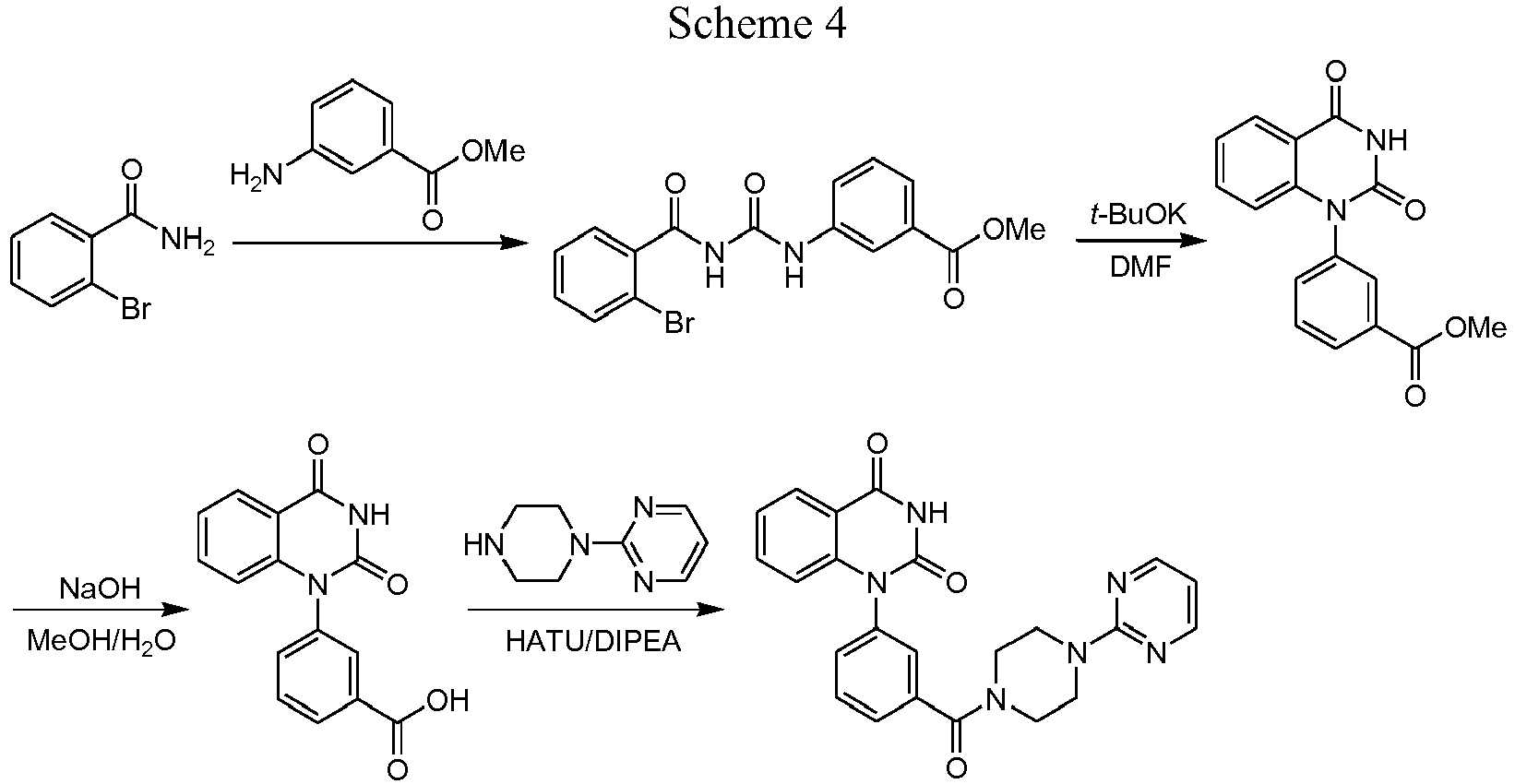
- An important aspect of the present invention is the discovery that compounds having Formula III are PARP inhibitors. Therefore, these compounds are useful for the treatment of a variety of clinical conditions responsive to the inhibition of PARP activity, such as cancer.
- The present invention includes compound of Formula III, or a pharmaceutically acceptable salt thereof, for use as a medicament in a therapeutic method comprising administering to a mammal an effective amount of a compound of Formula III, or a pharmaceutically acceptable saltthereof, wherein said therapeutic method is useful for the treatment of diseases due to to abnormal PARP activity, such as cancer. Such diseases that can be treated or prevented by the pharmaceutical composition of the present invention include, but are not limited to, liver cancer, melanoma, Hodgkin's disease, non-Hodgkin's lymphoma, acute lymphocytic leukemia, chronic lymphocytic leukemia, multiple myeloma, neuroblastoma, breast carcinoma, ovarian carcinoma, lung carcinoma, Wilms' tumor, cervical carcinoma, testicular carcinoma, soft-tissue sarcoma, primary macroglobulinemia, bladder carcinoma, chronic granulocytic leukemia, primary brain carcinoma, malignant melanoma, small-cell lung carcinoma, stomach carcinoma, colon carcinoma, malignant pancreatic insulinoma, malignant carcinoid carcinoma, choriocarcinoma, mycosis fungoides, head and neck carcinoma, osteogenic sarcoma, pancreatic carcinoma, acute granulocytic leukemia, hairy cell leukemia, neuroblastoma, rhabdomyosarcoma, Kaposi's sarcoma, genitourinary carcinoma, thyroid carcinoma, esophageal carcinoma, malignant hypercalcemia, cervical hyperplasia, renal cell carcinoma, endometrial carcinoma, polycythemia vera, essential thrombocytosis, adrenal cortex carcinoma, skin cancer, and prostatic carcinoma.
- Compounds of the present invention also are useful for the treatment or prevention of other clinical conditions due to abnormal PARP activity, such as excessive cell death, including central nervous system diseases such as stroke and neurodegenerative diseases.
- In practicing the therapeutic methods, effective amounts of compositions containing therapeutically effective concentrations of the compounds of Formula III formulated for oral, intravenous, local or topical application, for the treatment of neoplastic diseases and other diseases, are administered to an individual exhibiting the symptoms of one or more of these disorders. The amounts are effective to ameliorate or eliminate one or more symptoms of the disorders. An effective amount of a compound for treating a particular disease is an amount that is sufficient to ameliorate, or in some manner reduce, the symptoms associated with the disease. Such amount may be administered as a single dosage or may be administered according to a regimen, whereby it is effective. The amount may cure the disease but, typically, is administered in order to ameliorate the symptoms of the disease. Typically, repeated administration is required to achieve the desired amelioration of symptom.
- In another embodiment, a pharmaceutical composition comprising a compound of Formula III or a pharmaceutically acceptable salt thereof, which functions as PARP inhibitor, in combination with a pharmaceutically acceptable vehicle, is provided.
- Another embodiment of the present invention is directed to a composition effective to inhibit neoplasia comprising a compound of Formula III, or a pharmaceutically acceptable salt thereof, which functions as a PARP inhibitor, in combination with at least one known anticancer agent or a pharmaceutically acceptable salt thereof. Examples of known anticancer agents which may be used for combination therapy include, but not are limited to alkylating agents, such as busulfan, melphalan, chlorambucil, cyclophosphamide, ifosfamide, temozolomide, bendamustine, cis-platin, mitomycin C, bleomycin, and carboplatin; topoisomerase I inhibitors, such as camptothecin, irinotecan, and topotecan; topoisomerase II inhibitors, such as doxorubicin, epirubicin, aclarubicin, mitoxantrone, elliptinium and etoposide; RNA/DNA antimetabolites, such as 5-azacytidine, gemcitabine, 5-fluorouracil and methotrexate; DNA antimetabolites, such as 5-fluoro-2'-deoxy-uridine, fludarabine, nelarabine, ara-C, alanosine, pralatrexate, pemetrexed, hydroxyurea and thioguanine; antimitotic agents, such as colchicine, vinblastine, vincristine, vinorelbine, paclitaxel, ixabepilone, cabazitaxel, and docetaxel; antibodies, such as campath, Panitumumab, Ofatumumab, Avastin, Herceptin®, Rituxan®; kinase inhibitors such as imatinib, gefitinib, erlotinib, lapatinib, sorafenib, sunitinib, nilotinib, dasatinib, pazopanib, temsirolimus and everolimus; HDAC inhibitors such as vorinostat and romidepsin. Other known anticancer agents which may be used for combination therapy include tamoxifen, letrozole, fulvestrant, mitoguazone, octreotide, retinoic acid, arsenic trioxide, zoledronic acid, bortezomib, thalidomide and lenalidomide.
- In practicing the present invention, the compound of the invention may be administered together with at least one known anticancer agent as part of a unitary pharmaceutical composition. Alternatively, the compound of the invention may be administered apart from at least one known anticancer agent. In one embodiment, the compound of the invention and at least one known anticancer agent are administered substantially simultaneously, i.e. the compounds are administered at the same time or one after the other, so long as the compounds reach therapeutic levels in the blood at the same time. In another embodiment, the compound of the invention and at least one known anticancer agent are administered according to their individual dose schedule, so long as the compounds reach therapeutic levels in the blood.
- Another embodiment of the present invention is directed to a composition effective to inhibit neoplasia comprising a bioconjugate of a compound described herein, which functions as a PARP inhibitor, in bioconjugation with at least one known therapeutically useful antibody, such as Herceptin® or Rituxan®, growth factors, such as DGF, NGF; cytokines, such as IL-2, IL-4, or any molecule that binds to the cell surface. The antibodies and other molecules will deliver a compound described herein to its targets and make it an effective anticancer agent. The bioconjugates could also enhance the anticancer effect of the therapeutically useful antibodies, such as Herceptin® or Rituxan®.
- Similarly, another embodiment of the present invention is directed to a composition effective to inhibit neoplasia comprising a compound of Formula III, or its pharmaceutically acceptable salt, which functions as a PARP inhibitor, in combination with radiation therapy. In this embodiment, the compound of the invention may be administered at the same time as the radiation therapy is administered or at a different time.
- Yet another embodiment of the present invention is directed to a composition effective for post-surgical treatment of cancer, comprising a compound of Formula III, or its pharmaceutically acceptable salt, which functions as a PARP inhibitor. The invention also relates to a method of treating cancer by surgically removing the cancer and then treating the mammal with one of the pharmaceutical compositions described herein.
- Pharmaceutical compositions within the scope of this invention include all compositions wherein the compounds of the present invention are contained in an amount that is effective to achieve its intended purpose. While individual needs vary, determination of optimal ranges of effective amounts of each component is within the skill of the art. Typically, the compounds may be administered to mammals, orally at a dose of 0.0025 to 50 mg/kg of body weight, per day, or an equivalent amount of the pharmaceutically acceptable salt thereof, to a mammal being treated. Preferably, approximately 0.01 to approximately 10 mg/kg of body weight is orally administered. If a known anticancer agent is also administered, it is administered in an amount that is effective to achieve its intended purpose. The amounts of such known anticancer agents effective for cancer are well known to those skilled in the art.
- The unit oral dose may comprise from approximately 0.01 to approximately 50 mg, preferably approximately 0.1 to approximately 10 mg of the compound of the invention. The unit dose may be administered one or more times daily, as one or more tablets, each containing from approximately 0.1 to approximately 50 mg, conveniently approximately 0.25 to 10 mg of the compound or its solvates.
- In a topical formulation, the compound may be present at a concentration of approximately 0.01 to 100 mg per gram of carrier.
- In addition to administering the compound as a raw chemical, the compounds of the invention may be administered as part of a pharmaceutical preparation containing suitable pharmaceutically acceptable carriers comprising excipients and auxiliaries, which facilitate processing of the compounds into preparations that may be used pharmaceutically. Preferably, the preparations, particularly those preparations which may be administered orally and that may be used for the preferred type of administration, such as tablets, dragees, and capsules, as well as suitable solutions for administration by injection or orally, contain from approximately 0.01 to 99 percent, preferably from approximately 0.25 to 75 percent of active compound(s), together with the excipient.
- Also included within the scope of the present invention are the non-toxic pharmaceutically acceptable salts of the compounds of the present invention. Acid addition salts are formed by mixing a solution of the compounds of the present invention with a solution of a pharmaceutically acceptable non-toxic acid, such as hydrochloric acid, fumaric acid, maleic acid, succinic acid, acetic acid, citric acid, tartaric acid, carbonic acid, phosphoric acid, oxalic acid, and the like. Base addition salts are formed by mixing a solution of the compounds of the present invention with a solution of a pharmaceutically acceptable non-toxic base, such as sodium hydroxide, potassium hydroxide, choline hydroxide, sodium carbonate, Tris, N-methyl-glucamine and the like.
- The pharmaceutical compositions of the invention may be administered to any mammal, which may experience the beneficial effects of the compounds of the invention. Foremost among such mammals are humans and veterinary animals, although the invention is not intended to be so limited.
- The pharmaceutical compositions of the present invention may be administered by any means that achieve their intended purpose. For example, administration may be by parenteral, subcutaneous, intravenous, intramuscular, intraperitoneal, transdermal, buccal, intrathecal, intracranial, intranasal or topical routes. Alternatively, or concurrently, administration may be by the oral route. The dosage administered will be dependent upon the age, health, and weight of the recipient, kind of concurrent treatment, if any, frequency of treatment, and the nature of the effect desired.
- The pharmaceutical preparations of the present invention are manufactured in a manner, which is itself known, e.g., by means of conventional mixing, granulating, dragee-making, dissolving, or lyophilizing processes. Thus, pharmaceutical preparations for oral use may be obtained by combining the active compounds with solid excipients, optionally grinding the resulting mixture and processing the mixture of granules, after adding suitable auxiliaries, if desired or necessary, to obtain tablets or dragee cores.
- Suitable excipients are, in particular: fillers, such as saccharides, e.g. lactose or sucrose, mannitol or sorbitol; cellulose preparations and/or calcium phosphates, e.g. tricalcium phosphate or calcium hydrogen phosphate; as well as binders, such as starch paste, using, e.g., maize starch, wheat starch, rice starch, potato starch, gelatin, tragacanth, methyl cellulose, hydroxypropylmethylcellulose, sodium carboxymethylcellulose, and/or polyvinyl pyrrolidone. If desired, disintegrating agents may be added, such as the above-mentioned starches and also carboxymethyl-starch, cross-linked polyvinyl pyrrolidone, agar, or alginic acid or a salt thereof, such as sodium alginate. Auxiliaries are, above all, flow-regulating agents and lubricants, e.g., silica, talc, stearic acid or salts thereof, such as magnesium stearate or calcium stearate, and/or polyethylene glycol. Dragee cores are provided with suitable coatings which, if desired, are resistant to gastric juices. For this purpose, concentrated saccharide solutions may be used, which may optionally contain gum arabic, talc, polyvinyl pyrrolidone, poly-ethylene glycol and/or titanium dioxide, lacquer solutions and suitable organic solvents or solvent mixtures. In order to produce coatings resistant to gastric juices, solutions of suitable cellulose preparations, such as acetylcellulose phthalate or hydroxypropylmethyl-cellulose phthalate, are used. Dye stuffs or pigments may be added to the tablets or dragee coatings, e.g., for identification or in order to characterize combinations of active compound doses.
- Other pharmaceutical preparations, which may be used orally, include push-fit capsules made of gelatin, as well as soft, sealed capsules made of gelatin and a plasticizer, such as glycerol or sorbitol. The push-fit capsules may contain the active compounds in the form of: granules, which may be mixed with fillers, such as lactose; binders, such as starches; and/or lubricants, such as talc or magnesium stearate and, optionally, stabilizers. In soft capsules, the active compounds are preferably dissolved or suspended in suitable liquids, such as fatty oils, or liquid paraffin. In addition, stabilizers may be added.
- Suitable formulations for parenteral administration include aqueous solutions of the active compounds in water-soluble form, e.g., water-soluble salts and alkaline solutions. In addition, suspensions of the active compounds as appropriate oily injection suspensions may be administered. Suitable lipophilic solvents or vehicles include fatty oils, e.g., sesame oil, or synthetic fatty acid esters, e.g., ethyl oleate or triglycerides or polyethylene glycol-400, or cremophor, or cyclodextrins. Aqueous injection suspensions may contain substances which increase the viscosity of the suspension include, e.g., sodium carboxymethyl cellulose, sorbitol, and/or dextran. Optionally, the suspension may also contain stabilizers.
- In accordance with one aspect of the present invention, compounds of the invention are employed in topical and parenteral formulations and are used for the treatment of skin cancer.
- The topical compositions of this invention are formulated preferably as oils, creams, lotions, ointments and the like by choice of appropriate carriers. Suitable carriers include vegetable or mineral oils, white petrolatum (white soft paraffin), branched chain fats or oils, animal fats and high molecular weight alcohol (greater than C12). The preferred carriers are those in which the active ingredient is soluble. Emulsifiers, stabilizers, humectants and antioxidants may also be included, as well as agents imparting color or fragrance, if desired. Additionally, transdermal penetration enhancers may be employed in these topical formulations. Examples of such enhancers are found in
U.S. Patent Nos. 3,989,816 and4,444,762 . - Creams are preferably formulated from a mixture of mineral oil, self-emulsifying beeswax and water in which mixture of the active ingredient, dissolved in a small amount of an oil, such as almond oil, is admixed. A typical example of such a cream is one which includes approximately 40 parts water, approximately 20 parts beeswax, approximately 40 parts mineral oil and approximately 1 part almond oil.
- Ointments may be formulated by mixing a solution of the active ingredient in a vegetable oil, such as almond oil, with warm soft paraffin and allowing the mixture to cool. A typical example of such an ointment is one which includes approximately 30% almond oil and approximately 70% white soft paraffin by weight.
- The present invention also includes the use of the compounds of the subject invention in the manufacture of a medicament for treating or preventing a disorder responsive to the inhibition of PARP activity in a mammal suffering therefrom. The medicament may include, such as the pharmaceutical compositions as described above.
- The following examples are illustrative of the compositions of the present invention.
- All reagents were of commercial quality. Solvents were dried and purified by standard methods. Mass spectrum analyses were recorded on a Platform II (Agilent 6110) quadrupole mass spectrometer fitted with an electrospray rinterface. 1H NMR spectra was recorded at 300 MHz and at 300 K, on a Brücker AMX 300 apparatus. Chemical shifts were recorded as parts per million (ppm) downfield from TMS (0.00 ppm), and J coupling constants were reported in hertz (Hz).
- Quinazoline-2,4(1H,3H)-dione (1.0 g, 6.2 mmol), hexamethyldisilazane (HMDS, 2.5 g, 15.4 mmol), and toluene (50 mL) were added into 100 mL two-mouth flask. Concentrated sulfuric acid (0.06 g) was added into the flask when stirring. The mixture was refluxed and reacted for 8h. Toluene and excessive HMDS were removed via evaporation under reduced pressure, thus obtaining an intermediate product 2,4-di(trimethylsilyloxy)quinazoline.
- The intermediate product 2,4-di(trimethylsilyloxy)quinazoline, methyl 3-(bromomethyl)benzoate (2.1 g, 9.2 mmol) and DMF (1 mL) were added in turn into a 50 mL single-mouth flask, and then the temperature were raised to 115-130°C and reacted for 3 hours. 1,4-dioxane (6 mL) and methanol (10 mL) were added after the reaction mixture was cooled to 100°C. Then the mixture was refluxed for 30 minutes. The mixture was filtered after it was cooled to room temperature. The precipitate was washed with water (20 mL) and methonal (10mL), respectively, and dried to give the title compound (1.6 g, 83.7% yield) as white powder. 1H NMR (DMSO-d6 ): 11.76 (s, 1H), 8.00 (dd, J = 7.8 and 1.2 Hz, 1H), 7.89 (s, 1H), 7.83 (d, J= 7.8 Hz, 1H), 7.65-7.43 (m, 3H), 7.25-7.20 (m, 2H), 5.36 (s, 2H), 3.80 (s, 3H). MS: m/z 311.1 [M+H]+.
- 1-(3-Methoxycarbonylbenzyl)quinazoline-2,4(1H,3H)-dione (1.6 g, 5.2 mmol), NaOH (0.31g, 7.7 mmol), water (40 mL) and methanol (40 mL) were added into a 250 mL three-mouth flask. The mixture was refluxed and reacted for 3 hours. The methanol was removed via evaporation under reduced pressure after the reaction was finished. The mixture was adjusted to pH = 2-3 by 3N HCl, forming many precipitates. The mixture was filtered and the solid was washed by water and methonal. The solids were dried to give the title compound as white solid (1.2 g, 78% yield). 1H NMR (300 M, DMSO-d6 ): 13.09 (brs, 1H), 11.77 (s, 1H), 8.01 (dd, J = 7.7 and 1.4 Hz, 1H), 7.84-7.80 (m, 2H), 7.66-7.61 (m, 1H), 7.53 (d, J = 7.8 Hz, 1H), 7.44 (t, J= 7.7 Hz, 1H), 7.27-7.21 (m, 2H), 5.36 (s, 2H). MS: m/z 297.1 [M+H]+.
- 1-(3-Carboxybenzyl)quinazoline-2,4(1H,3H)-dione (0.2 mmol), 1-(pyridin-2-yl)piperazine (0.2 mmol), 2-(7-aza-1H-benzotriazole-1-yl)-1,1,3,3-tetramethyluronium hexafluorophosphate (HATU, 0.26 mmol), N,N-diisopropylethylamine (DIPEA, 0.4 mmol) and DMF (5 mL) were added into a 50mL two-mouth flask. The obtained mixture was stirred at room temperature for 3 hours. To the mixture was added 50 mL of water and it was extracted by dichloromethane (DCM, 50 mL × 2). The organic layer was washed by IN HCl (50 mL × 2) and saturated NaCl aquenous solution (50 mL × 2), dried with anhydrous sodium sulphate, and evaporated under reduced pressure to give the crude product. The crude product was purified by column chromatography (ethyl acetate) to give the title compound as white solid (7.7 mg, 8.6% yield). 1H NMR (DMSO-d6 ): 11.69 (s, 1H), 8.09 (dd, J = 5.0 and 1.7 Hz, 1H), 7.99 (dd, J = 8.0 and 1.7 Hz, 1H), 7.64 (t, J = 7.1 Hz, 1H), 7.53 (t, J = 7.8 Hz, 1H), 7.40-7.21 (m, 6H), 6.77 (d, J = 8.7 Hz, 1H), 6.64 (dd, J = 7.1 and 5.0 Hz, 1H), 5.34 (s, 2H), 3.40-3.20 (m, 8H). MS: m/z 442.3 [M+H]+.
- The following compounds were prepared from 1-(3-carboxybenzyl)quinazoline-2,4(1H,3H)-dione and the corresponding substituted piperazine or piperidine using a procedure similar to those described for the synthesis of compound of Example 3.
- White solid. 1H NMR (DMSO-d6 ): 11.71 (s, 1H), 8.36 (d, J = 4.8 Hz, 2H), 8.01 (d, J= 6.9 Hz, 1H), 7.67-7.61 (m, 1H), 7.42-7.24 (m, 6H), 6.65 (t, J = 4.8 Hz, 1H), 5.35 (s, 2H), 3.40-3.20 (m, 8H). MS: m/z 443.3 [M+H]+.
- White solid. 1H NMR (DMSO-d6 ): 11.74 (s, 1H), 8.00 (d, J = 7.8 Hz, 1H), 7.62 (t, J= 7.5 Hz, 1H), 7.43-7.38 (m, 2H), 7.26-7.20 (m, 4H), 5.33 (s, 2H), 3.40-3.20 (m, 4H), 2.21-2.15 (m, 4H), 1.96-1.70 (m, 5H), 1.21-1.08 (m, 6H). MS: m/z 447.3 [M+H]+.
- White solid. 1H NMR (DMSO-d6 ): 11.73 (s, 1H), 9.24 (s, 1H), 8.12 (d, J = 10.2 Hz, 1H), 8.02 (d, J = 7.8 Hz, 1H), 7.66 (t, J = 6.9 Hz, 1H), 7.42-7.24 (m, 7H), 5.36 (s, 2H), 3.40-3.20 (m, 8H). MS: m/z 483.3 [M+H]+.
- White solid. 1H NMR (DMSO-d6 ): 11.72 (s, 1H), 8.01 (dd, J= 7.8 and 1.2 Hz, 1H), 7.63 (t, J= 8.0 Hz, 1H), 7.42-7.38 (m, 2H), 7.26-7.23 (m, 4H), 5.34 (s, 2H), 3.40-3.20 (m, 4H), 2.35-2.29 (m, 6H), 0.97 (t, J = 7.1 Hz, 3H). MS: m/z 393.2 [M+H]+.
- White solid. 1H NMR (DMSO-d6 ): 11.71 (s, 1H), 7.97 (d, J = 8.1 Hz, 1H), 7.60-7.56 (m, 1H), 7.45-7.18 (m, 11H), 5.34 (s, 2H), 3.40-3.20 (m, 8H). MS: m/z 469.3 [M+H]+.
- White solid. 1H NMR (DMSO-d6 ): 11.71 (s, 1H), 7.99 (d, J = 7.8 Hz, 1H), 7.60-7.19 (m, 11H), 5.34 (s, 2H), 3.60-3.20 (m, 8H). MS: m/z 487.3 [M+H]+.
- White solid. 1H NMR (DMSO-d6 ): 11.73 (s, 1H), 7.98-7.97 (m, 1H), 7.63-7.57 (m, 1H), 7.48-7.19 (m, 10H), 5.33 (s, 2H), 3.75-3.15 (m, 8H). MS: m/z 503.2, 505.2 [M+H]+.
- White solid. 1H NMR (DMSO-d6 ): 11.74 (s, 1H), 8.02-7.95 (m, 2H), 7.68-7.59 (m, 2H), 7.40-7.15 (m, 8H), 5.35 (s, 2H), 3.40-3.20 (m, 8H). MS: m/z 547.2 [M+H]+.
- White solid. 1H NMR (DMSO-d6 ): 11.73 (s, 1H), 7.99 (d, J= 7.2 Hz, 1H), 7.70-7.50 (m, 1H), 7.40-7.29 (m, 6H), 7.21-7.18 (m, 2H), 6.99-6.96 (m, 2H), 5.33 (s, 2H), 3.77 (s, 3H), 3.56-3.15 (m, 8H). MS: m/z 499.3 [M+H]+.
- White solid. 1H NMR (DMSO-d6 ): 11.74 (s, 1H), 8.02 (d, J = 7.5 Hz, 1H), 7.65 (t, J= 7.8 Hz, 1H), 7.45-7.38 (m, 2H), 7.32-7.23 (m, 4H), 5.36 (s, 2H), 3.86-3.82 (m, 2H), 3.75-3.10 (m, 10H), 2.90-2.80 (m, 1H), 1.64-1.48 (m, 4H). MS: m/z 477.3 [M+H]+.
- White solid. 1H NMR (DMSO-d6 ): 11.71 (s, 1H), 8.01 (d, J= 6.9 Hz, 1H), 7.70-7.60 (m, 1H), 7.41-7.39 (m, 2H), 7.30-7.21 (m, 4H), 5.34 (s, 2H), 3.70-3.10 (m, 8H), 2.95-2.89 (m, 1H), 1.80-1.40 (m, 8H). MS: m/z 461.3 [M+H]+.
- White solid. 1H NMR (DMSO-d6 ): 11.71 (s, 1H), 8.01 (d, J = 6.6 Hz, 1H), 7.63 (t, J= 7.2 Hz, 1H), 7.41-7.21 (m, 6H), 5.34 (s, 2H), 3.80-3.15 (m, 8H), 1.94-1.91 (m, 1H), 0.72-0.69 (m, 4H). MS: m/z 433.2 [M+H]+.
- White solid. 1H NMR (DMSO-d6 ): 11.74 (s, 1H), 8.01 (dd, J = 7.8 and 1.2 Hz, 1H), 7.70-7.55 (m, 1H), 7.45-7.35 (m, 2H), 7.31-7.19 (m, 4H), 5.35 (s, 2H), 3.75-3.11 (m, 6H), 3.10-2.90 (m, 4H), 1.20 (t, J = 7.4 Hz, 3H). MS: m/z 457.2 [M+H]+.
- White solid. 1H NMR (DMSO-d6 ): 11.71 (s, 1H), 8.01 (d, J = 6.6 Hz, 1H), 7.63 (t, J= 7.2 Hz, 1H), 7.43-7.37 (m, 2H), 7.30-7.21 (m, 4H), 5.34 (s, 2H), 3.70-3.10 (m, 8H), 1.93 (s, 3H). MS: m/z 407.2 [M+H]+.
- White solid. 1H NMR (300 M, DMSO-d6 ): 11.75 (s, 1H), 7.99 (dd, J = 7.8 and 1.2 Hz, 1H), 7.61 (t, J = 7.2 Hz, 1H), 7.41-7.17 (m, 11H), 5.37 (s, 2H), 3.55-3.42 (m, 2H), 3.06-2.99 (m, 1H), 2.78-2.71 (m, 2H), 1.97-1.51 (m, 4H). MS: m/z 407.2 [M+H]+.
- White solid. 1H NMR (300 M, DMSO-d6 ): 11.75 (s, 1H), 8.03 (d, J= 6.6 Hz, 1H), 7.67 (t, J = 7.2 Hz, 1H), 7.46-7.39 (m, 2H), 7.34-7.21 (m, 6H), 6.93-6.91 (m, 2H), 6.81 (t, J = 7.2 Hz, 1H), 5.37 (s, 2H), 3.85-2.85 (m, 8H). MS: m/z 441.3 [M+H]+.
- White solid. 1H NMR (300 M, DMSO-d6 ): 11.75 (s, 1H), 8.31 (s, 1H), 8.11 (s, 1H), 8.02 (d, J = 7.8 Hz, 1H), 7.87 (d, J = 2.7 Hz, 1H), 7.67 (t, J = 7.2 Hz, 1H), 7.44-7.24 (m, 6H), 5.37 (s, 2H), 3.80-3.25 (m, 8H). MS: m/z 443.3 [M+H]+.
- The title compound was prepared from quinazoline-2,4(1H,3H)-dione and methyl 5-(bromomethyl)-2-fluorobenzoate using a procedure similar to those described for the synthesis of compound of Example 1. 1HNMR (DMSO-d6 ): 11.75 (s, 1H), 8.00 (d, J= 7.8 Hz, 1H), 7.84 (d, J= 6.9 Hz, 1H), 7.67-7.55 (m, 2H), 7.32-7.21 (m, 3H), 5.32 (s, 2H), 3.81 (s, 3H). MS: m/z 329.1 [M+H]+.
- The title compound was prepared from 1-(4-fluoro-3-methoxycarbonylbenzyl)quinazoline-2,4(1H,3H)-dione using a procedure similar to those described for the synthesis of compound of Example 2. 1H NMR (DMSO-d6 ): 13.23 (brs, 1H), 11.75 (s, 1H), 8.00 (d, J = 7.5 Hz, 1H), 7.80 (dd, J = 6.9 and 2.1 Hz, 1H), 7.67-7.54 (m, 2H), 7.30-7.21 (m, 3H), 5.31 (s, 2H). MS: m/z 315.3 [M+H]+.
- The following compounds were prepared from 1-(3-carboxy-4-fluorobenzyl)quinazoline-2,4(1H,3H)-dione and the corresponding substituted piperazine using a procedure similar to those described for the synthesis of compound of Example 3.
- White solid. 1H NMR (300 M, DMSO-d6 ): 11.73 (s, 1H), 8.00 (d, J= 6.9 Hz, 1H), 7.64 (t, J = 7.8 Hz, 1H), 7.43-7.21 (m, 5H), 5.30 (s, 2H), 3.56-2.97 (m, 8H), 2.89-2.84 (m, 1H), 1.80-1.40 (m, 8H). MS: m/z 479.3 [M+H]+.
- White solid. 1H NMR (300 M, DMSO-d6 ): 11.74 (s, 1H), 8.12 (d, J = 3.3 Hz, 1H), 8.02 (d, J = 6.6 Hz, 1H), 7.67 (t, J = 8.4 Hz, 1H), 7.58-7.53 (m, 1H), 7.47-7.39 (m, 2H), 7.32-7.24 (m, 3H), 6.82 (d, J = 8.4 Hz, 1H), 6.67 (t, J = 6.9 Hz, 1H), 5.32 (s, 2H), 3.75-3.67 (m, 2H), 3.61-3.53 (m, 2H), 3.42-3.37 (m. 2H), 3.28-3.20 (m, 2H). MS: m/z 460.3 [M+H]+.
- White solid. 1H NMR (300 M, DMSO-d6 ): 11.72 (s, 1H), 8.37 (d, J = 4.8 Hz, 2H), 8.00 (d, J = 7.8 Hz, 1H), 7.65 (t, J = 6.8 Hz, 1H), 7.48-7.38 (m, 2H), 7.30-7.22 (m, 3H), 6.66 (t, J = 4.8 Hz, 1H), 5.31 (s, 2H), 3.70-3.10 (m, 8H). MS: m/z 461.3 [M+H]+.
- The following compounds were prepared from 1-(3-carboxybenzyl)quinazoline-2,4(1H,3H)-dione and the corresponding substituted piperazine or piperidine using a procedure similar to those described for the synthesis of compound of Example 3.
- 1H NMR (DMSO-d6 ): 11.75 (s, 1H), 8.02 (d, J = 7.8 Hz, 1H), 7.64 (t, J = 7.2 Hz, 1H), 7.50-7.45 (m, 2H), 7.35-7.20 (m, 4H), 5.35 (s, 2H), 3.50-3.10 (m, 9H), 1.80-1.25 (m, 10H). MS: m/z 475.3 [M+H]+.
- 1H NMR (DMSO-d6 ): 11.75 (s, 1H), 8.08-8.06 (m, 2H), 8.01 (d, J = 7.8 Hz, 1H), 7.87 (s, 1H), 7.67-7.54 (m, 2H), 7.48-7.30 (m, 5H), 7.27-7.20 (m, 2H), 5.37 (s, 2H), 3.80-3.31 (m, 8H). MS: m/z 498.3 [M+H]+.
- 1H NMR (DMSO-d6 ): 11.76 (s, 1H), 8.03 (d, J = 7.2 Hz, 1H), 7.65 (t, J = 7.8 Hz, 1H), 7.42-7.21 (m, 6H), 5.41-5.32 (m, 2H), 3.10-2.60 (m, 9H), 1.90-1.30 (m, 10H). MS: m/z 447.3 [M+H]+.
- 1H NMR (DMSO-d6 ): 11.72 (s, 1H), 8.19 (d, J= 6.6 Hz, 2H), 8.02 (d, J= 6.3 Hz, 1H), 7.68-7.63 (m, 1H), 7.46-7.39 (m, 2H), 7.34-7.23 (m, 4H), 6.89 (d, J = 6.6 Hz, 2H), 5.35 (s, 2H), 3.84-3.31 (m, 8H). MS: m/z 442.3 [M+H]+.
- 1H NMR (DMSO-d6 ): 11.72 (s, 1H), 8.03 (d, J = 6.4 Hz, 1H), 7.66 (t, J = 7.8 Hz, 1H), 7.46-7.39 (m, 2H), 7.32-7.23 (m, 4H), 5.36 (s, 2H), 3.52-3.31 (m, 9H), 2.19-1.75 (m, 6H). MS: m/z 447.3 [M+H]+.
- 1H NMR (DMSO-d6 ): 11.72 (s, 1H), 8.06 (dd, J = 8.7 and 6.4 Hz, 1H), 7.95 (dd, J = 7.8 and 1.5 Hz, 1H), 7.70 (dd, J = 9.3 and 2.1 Hz, 1H), 7.64-7.59 (m, 1H), 7.46-7.14 (m, 7H), 5.36 (s, 2H), 3.45-3.28 (m, 5H), 2.10-2.04 (m, 1H), 1.99-1.94 (m, 3H). MS: m/z 499.3[M+H]+.
- 1H NMR (DMSO-d 6): 11.70 (s, 1H), 8.00 (dd, J = 8.1 and 1.2 Hz, 1H), 7.76 (d, J = 5.1 Hz, 1H), 7.64-7.59 (m, 1H), 7.44-7.11 (m, 8H), 5.34 (s, 2H), 3.81-3.40 (m, 8H). MS: m/z 475.2 [M+H]+.
- 1H NMR (DMSO-d 6): 11.72 (s, 1H), 8.02 (d, J = 6.9 Hz, 1H), 7.86 (s, 1H), 7.65 (t, J = 7.5 Hz, 1H), 7.50-7.15 (m, 6H), 7.00 (d, J = 3.3 Hz, 1H), 6.70-6.60 (m, 1H), 5.37 (s, 2H), 3.85-3.20 (m, 8H). MS: m/z 459.2 [M+H]+.
- 1H NMR (DMSO-d 6): 11.71 (s, 1H), 8.15-7.90 (m, 2H), 7.73 (s, 1H), 7.62 (t, J = 7.5 Hz, 1H), 7.50-7.10 (m, 6H), 6.64 (s, 1H), 5.34 (s, 2H), 3.80-3.10 (m, 8H). MS: m/z 459.3 [M+H]+.
- 1H NMR (DMSO-d 6): 11.70 (s, 1H), 7.99 (d, J = 7.5 Hz, 1H), 7.77 (s, 1H), 7.63-7.58 (m, 2H), 7.41-7.39 (m, 2H), 7.30-7.28 (m, 2H), 7.22-7.17 (m, 3H), 5.34 (s, 2H), 3.81-3.40 (m, 8H). MS: m/z 475.3 [M+H]+.
- 1H NMR (DMSO-d 6): 11.72 (s, 1H), 8.67 (dd, J = 4.8 and 1.5 Hz, 1H), 8.61 (s, 1H), 8.01 (d, J = 7.2 Hz, 1H), 7.82 (d, J = 6.8 Hz, 1H), 7.52-7.20 (m, 8H), 5.36 (s, 2H), 3.52-3.31 (m, 8H). MS: m/z 470.3 [M+H]+.
- 1H NMR (DMSO-d 6): 11.78 (s, 1H), 8.68 (d, J = 4.2 Hz, 1H), 8.20-7.95 (m, 2H), 7.68-7.27 (m, 9H), 5.43 (s, 2H), 3.90-3.50 (m, 8H). MS: m/z 470.3 [M+H]+.
- 1H NMR (DMSO-d 6): 11.62 (s, 1H), 8.58 (d, J = 4.2 Hz, 2H), 7.91-7.89 (m, 1H), 7.57-7.44 (m, 1H), 7.29-7.10 (m, 8H), 5.25 (s, 2H), 3.80-2.75 (m, 8H). MS: m/z 470.3 [M+H]+.
- 1H NMR (DMSO-d 6): 11.67 (s, 1H), 7.95 (d, J = 8.1 Hz, 1H), 7.57 (t, J = 7.8 Hz, 1H), 7.38-7.30 (m, 2H), 7.27-7.14 (m, 6H), 6.92-6.85 (m, 3H), 5.30 (s, 2H), 4.58-4.52 (m, 1H), 3.90-3.10 (m, 4H), 1.95-1.35 (m, 4H). MS: m/z 456.3 [M+H]+.
- The following compounds were prepared from 1-(3-carboxy-4-fluorobenzyl)quinazoline-2,4(1H,3H)-dione and the corresponding substituted piperazine using a procedure similar to those described for the synthesis of compound of Example 3.
- 1H NMR (DMSO-d 6): 11.72 (s, 1H), 8.01 (d, J = 6.6 Hz, 1H), 7.65 (t, J = 7.8 Hz, 1H), 7.39-7.22 (m, 5H), 5.31 (s, 2H), 3.52-3.31 (m, 8H), 2.01-1.86 (m, 1H), 0.73-0.70 (m, 4H). MS: m/z 451.3 [M+H]+.
- 1H NMR (DMSO-d 6): 11.71 (s, 1H), 8.00 (dd, J = 7.8 and 1.2 Hz, 1H), 7.64 (t, J = 7.4 Hz, 1H), 7.43-7.21 (m, 5H), 5.30 (s, 2H), 3.58-3.10 (m, 9H), 1.68-1.00 (m, 10H). MS: m/z 493.3 [M+H]+.
- 1H NMR (DMSO-d 6): 11.71 (s, 1H), 8.29 (s, 1H), 8.08 (s, 1H), 8.00 (d, J = 7.8 Hz, 1H), 7.86 (d, J = 2.1 Hz, 1H), 7.65 (t, J = 7.5 Hz, 1H), 7.46-7.36 (m, 2H), 7.30-7.22 (m, 3H), 5.31 (s, 2H), 3.81-3.40 (m, 8H). MS: m/z 461.3 [M+H]+.
- 1H NMR (DMSO-d 6): 11.72 (s, 1H), 8.08-8.05 (m, 2H), 8.00 (dd, J = 7.8 and 1.2 Hz, 1H), 7.64 (t, J = 7.2 Hz, 1H), 7.56 (t, J = 7.7 Hz, 1H), 7.46-7.41 (m, 3H), 7.31-7.19 (m, 3H), 5.31 (s, 2H), 3.87-3.81 (m, 2H), 3.49-3.31 (m, 6H). MS: m/z 516.2 [M+H]+.
- 1H NMR (DMSO-d 6): 11.69 (s, 1H), 8.00 (d, J = 7.8 Hz, 1H), 7.64 (t, J = 8.0 Hz, 1H), 7.44-7.41 (m, 1H), 7.35 (d, J = 5.7 Hz, 1H), 7.28-7.21 (m, 3H), 5.30 (s, 2H), 3.70-3.00 (m, 9H), 2.25-1.60 (m, 6H). MS: m/z 465.3 [M+H]+.
- 1H NMR (DMSO-d 6): 11.68 (s, 1H), 7.99 (d, J = 7.8 Hz, 1H), 7.70-7.10 (m, 11H), 5.30 (s, 2H), 3.80-3.10 (m, 8H). MS: m/z 487.3 [M+H]+.
- 1H NMR (DMSO-d 6): 11.67 (s, 1H), 8.00 (d, J = 7.5 Hz, 1H), 7.75 (d, J = 5.1 Hz, 1H), 7.62 (t, J = 7.7 Hz, 1H), 7.50-7.15 (m, 6H), 7.12 (t, J = 4.4 Hz, 1H), 5.30 (s, 2H), 3.80-3.10 (m, 8H). MS: m/z 493.2 [M+H]+.
- 1H NMR (DMSO-d 6): 11.69 (s, 1H), 8.00 (d, J = 6.6 Hz, 1H), 7.83 (s, 1H), 7.64 (t, J = 7.1 Hz, 1H), 7.50-7.35 (m, 2H), 7.30-7.15 (m, 3H), 6.99 (d, J = 3.3 Hz, 1H), 6.70-6.55 (m, 1H), 5.31 (s, 2H), 3.85-3.10 (m, 8H). MS: m/z 477.3 [M+H]+.
- The following compounds were prepared from 1-(3-carboxy-6-fluorobenzyl)quinazoline-2,4(1H,3H)-dione (prepared from quinazoline-2,4(1H,3H)-dione and methyl 3-(bromomethyl)-4-fluorobenzoate using a procedure similar to those used for compounds of Example 1 and 2), and the corresponding substituted piperazine using a procedure similar to those described for the synthesis of compound of Example 3.
- 1H NMR (DMSO-d 6): 11.75 (s, 1H), 8.03 (dd, J = 7.8 and 1.2 Hz, 1H), 7.66 (t, J = 7.8 Hz, 1H), 7.38-7.35 (m, 2H), 7.26 (t, J = 7.7 Hz, 1H), 7.20-7.15 (m, 2H), 5.35 (s, 2H), 3.38-3.15 (m, 9H), 1.70-1.55 (m, 8H). MS: m/z 479.3 [M+H]+.
- 1H NMR (DMSO-d 6): 11.75 (s, 1H), 8.04 (d, J = 7.8 Hz, 1H), 7.67 (d, J = 7.4 Hz, 1H), 7.50-7.10 (m, 5H), 5.37 (s, 2H), 3.70-2.90 (m, 9H), 1.80-1.00 (m, 10H). MS: m/z 493.3 [M+H]+.
- 1H NMR (DMSO-d 6): 11.71 (s, 1H), 8.35 (d, J = 4.5 Hz, 2H), 8.01 (d, J = 7.6 Hz, 1H), 7.67 (t, J = 8.4 Hz, 1H), 7.40-7.17 (m, 5H), 6.64 (t, J = 4.8 Hz, 1H), 5.35 (s, 2H), 3.81-3.14 (m, 8H). MS: m/z 461.2 [M+H]+.
- 1H NMR (DMSO-d 6): 11.72 (s, 1H), 8.12 (d, J = 3.3 Hz, 1H), 8.03 (d, J = 6.6 Hz, 1H), 7.70 (t, J = 8.0 Hz, 1H), 7.56 (t, J = 8.0 Hz, 1H), 7.42-7.18 (m, 5H), 6.76 (d, J = 8.4 Hz, 1H), 6.67 (dd, J = 6.9 and 5.1 Hz, 1H), 5.38 (s, 2H), 3.70-3.00 (m, 8H). MS: m/z 460.3 [M+H]+.
- 1H NMR (DMSO-d 6): 11.71 (s, 1H), 8.01 (d, J = 8.1 Hz, 1H), 7.76 (d, J = 4.8 Hz, 1H), 7.62 (t, J = 7.8 Hz, 1H), 7.43-7.32 (m, 3H), 7.22-7.12 (m, 4H), 5.35 (s, 2H), 3.80-2.90 (m, 8H). MS: m/z 493.2 [M+H]+.
- 1H NMR (DMSO-d 6): 11.71 (s, 1H), 8.02 (d, J = 7.8 Hz, 1H), 7.65 (t, J = 8.0 Hz, 1H), 7.36-7.13 (m, 5H), 5.34 (s, 2H), 3.60-2.80 (m, 9H), 2.20-1.70 (m, 6H). MS: m/z 465.3 [M+H]+.
- 1H NMR (DMSO-d 6): 11.71 (s, 1H), 8.01 (d, J = 6.6 Hz, 1H), 7.84 (s, 1H), 7.64 (t, J = 7.5 Hz, 1H), 7.43-7.32 (m,2H), 7.25-7.16 (m, 3H), 6.96 (d, J = 3.0 Hz, 1H), 7.63-6.62 (m, 1H), 5.35 (s, 2H), 3.80-2.90 (m, 8H). MS: m/z 477.3 [M+H]+.
- The following compounds were prepared from 1-(3-carboxy-6-chlorobenzyl)quinazoline-2,4(1H,3H)-dione (prepared from quinazoline-2,4(1H,3H)-dione and methyl 3-(bromomethyl)-4-chlorobenzoate using a procedure similar to those for compounds of Example 1 and 2), and the corresponding substituted piperazine using a procedure similar to those described for the synthesis of compound of Example 3.
- 1H NMR (DMSO-d 6): 11.75 (s, 1H), 8.05 (d, J = 7.8 Hz, 1H), 7.69-7.64 (m, 2H), 7.37 (d, J = 8.1 Hz, 1H), 7.28 (t, J = 7.3 Hz, 1H), 7.08-7.02 (m, 2H), 5.33 (s, 2H), 3.70-2.80 (m, 9H), 1.80-1.55 (m, 8H). MS: m/z 495.3 [M+H]+.
- 1H NMR (DMSO-d 6): 11.71 (s,1H), 8.36 (d, J = 4.8 Hz, 2H), 8.03 (d, J = 6.6 Hz, 1H), 7.69-7.64 (m, 2H), 7.38 (d, J = 6.9 Hz, 1H), 7.28 (t, J = 7.5 Hz, 1H), 7.09-7.04 (m, 2H), 6.65 (t, J = 4.8 Hz, 1H), 5.33 (s, 2H), 3.80-3.00 (m, 8H). MS: m/z 477.2 [M+H]+.
- 1H NMR (DMSO-d 6): 11.71 (s, 1H), 8.02 (d, J = 7.5 Hz, 1H), 7.75-7.55 (m, 2H), 7.34 (d, J = 8.1 Hz, 1H), 7.25 (t, J = 7.5 Hz, 1H), 7.10-6.90 (m, 2H), 5.30 (s, 2H), 3.60-2.80 (m, 9H), 1.80-1.00 (m, 10H). MS: m/z 509.3 [M+H]+.
- 1H NMR (DMSO-d 6): 11.73 (s, 1H), 8.11 (d, J = 3.6 Hz, 1H), 8.03 (d, J = 7.8 Hz, 1H), 7.80-7.60 (m, 2H), 7.55 (t, J = 6.9 Hz, 1H), 7.39 (d, J = 6.6 Hz, 1H), 7.30 (t, J = 7.5 Hz, 1H), 7.15-7.00 (m, 2H), 6.72 (d, J = 8.4 Hz, 1H), 6.66 (dd, J = 6.8 and 5.0 Hz, 1H), 5.34 (s, 2H), 3.70-3.00 (m, 8H). MS: m/z 476.2 [M+H]+.
- The following compounds were prepared from 1-(3-carboxyl-2-chlorobenzyl)quinazoline-2,4(1H,3H)-dione (prepared from quinazoline-2,4(1H,3H)-dione and methyl 3-(bromomethyl)-2-chlorobenzoate using a procedure similar to those used for compounds of Example 1 and 2), and the corresponding substituted piperazine using a procedure similar to those described for the synthesis of compound of Example 3.
- 1H NMR (DMSO-d 6): 11.78 (s, 1H), 8.07 (d, J = 7.8 Hz, 1H), 7.67 (t, J = 7.5 Hz, 1H), 7.45-7.20 (m, 3H), 7.15-6.95 (m, 2H), 5.50-5.15 (m, 2H), 3.80-3.10 (m, 8H), 3.04-2.94 (m, 1H), 1.90-1.35 (m, 8H). MS: m/z 495.3 [M+H]+.
- 1H NMR (DMSO-d 6): 11.88 (s, 1H), 8.49 (d, J = 4.8 Hz, 2H), 8.16 (d, J = 7.8 Hz, 1H), 7.77 (t, J = 7.8 Hz, 1H), 7.50-7.30 (m, 3H), 7.25-7.05 (m, 2H), 6.78 (t, J = 7.7 Hz, 1H), 5.60-5.30 (m, 2H), 4.10-3.70 (m, 8H). MS: m/z 477.2 [M+H]+.
- The following compounds were prepared from 1-(3-carboxy-2-fluorobenzyl)quinazoline-2,4(1H,3H)-dione (prepared from quinazoline-2,4(1H,3H)-dione and methyl 3-(bromomethyl)-2-fluorobenzoate using a procedure similar to those used for compounds of Example 1 and 2), and the corresponding substituted piperazine using a procedure similar to those described for the synthesis compound of Example 3.
- 1H NMR (DMSO-d 6): 11.71 (s, 1H), 8.37 (d, J = 4.8 Hz, 2H), 8.03 (d, J = 6.6 Hz, 1H), 7.66 (t, J = 7.1 Hz, 1H), 7.45-7.05 (m, 5H), 6.66 (t, J = 4.7 Hz, 1H), 5.35 (s, 2H), 3.90-3.60 (m, 8H). MS: m/z 461.3 [M+H]+.
- 1H NMR (DMSO-d 6): 11.74 (s, 1H), 8.03 (d, J = 7.5 Hz, 1H), 7.66 (t, J = 7.7 Hz, 1H), 7.40-7.10 (m, 5H), 5.34 (s, 2H), 3.80-3.20 (m, 8H), 3.10-2.80 (m, 1H), 1.90-1.40 (m, 8H). MS: m/z 479.3 [M+H]+.
- The following compounds were prepared from 1-(3-carboxy-5-fluorobenzyl)quinazoline-2,4(1H,3H)-dione (prepared from quinazoline-2,4(1H,3H)-dione and methyl 3-(bromomethyl)-5-fluorobenzoate using a procedure similar to those used for compounds of Example 1 and 2), and the corresponding substituted piperazine using a procedure similar to those described for the synthesis compound of Example 3.
- 1H NMR (DMSO-d 6): 11.68 (s,1H), 8.36 (d, J = 4.8 Hz, 2H), 8.00 (d, J = 7.8 Hz, 1H), 7.64 (t, J = 8.0 Hz, 1H), 7.30-7.15 (m, 5H), 6.64 (t, J = 4.8 Hz, 1H), 5.34 (s, 2H), 3.80-3.50 (m, 8H). MS: m/z 461.3 [M+H]+.
- 1H NMR (DMSO-d 6): 11.69 (s,1H), 8.00 (d, J = 9.0 Hz, 1H), 7.64 (t, J = 7.1 Hz, 1H), 7.31-7.15 (m, 5H), 5.34 (s, 2H), 3.70-3.10 (m, 8H), 2.94-2.86 (m, 1H), 1.80-1.40 (m, 8H). MS: m/z 479.3 [M+H]+.
- The following compounds were prepared from 1-(3-carboxy-4-chlorobenzyl)quinazoline-2,4(1H,3H)-dione (prepared from quinazoline-2,4(1H,3H)-dione and methyl 5-(bromomethyl)-2-chlorobenzoate using a procedure similar to those used for compounds of Example 1 and 2), and the corresponding substituted piperazine using a procedure similar to those described for the synthesis compound of of Example 3.
- 1H NMR (CD3OD): 8.38 (d, J = 4.6 Hz, 2H), 8.16 (d, J = 9.0 Hz, 1H), 7.69 (t, J = 8.7 Hz, 1H), 7.54-7.29 (m, 5H), 6.67 (t, J = 4.6 Hz, 1H), 5.51-5.39 (m, 2H), 3.98-3.57 (m, 8H). MS: m/z 477.2 [M+H]+.
- 1H NMR (DMSO-d 6): 11.60 (s, 1H), 7.91 (d, J = 7.8 Hz, 1H), 7.53 (t, J = 7.5 Hz, 1H), 7.39 (d, J = 9.0 Hz, 1H), 7.28-7.26 (m, 2H), 7.16-7.07 (m, 2H), 5.31-5.13 (m, 2H), 3.48-2.90 (m, 9H), 1.59-1.09 (m, 10H). MS: m/z 509.3 [M+H]+.
- The following compounds were prepared from 1-((2-carboxy-furan-5-yl)methyl)quinazoline-2,4(1H,3H)-dione (prepared from quinazoline-2,4(1H,3H)-dione and ethyl 5-(chloromethyl)furan-2-carboxylate using a procedure similar to those described for the synthesis of compounds of Example 1 and 2), and the corresponding substituted piperazine using a procedure similar to those described for the synthesis of compound of Example 3.
- 1H NMR (DMSO-d 6) 11.75 (s, 1H), 8.01 (d, J = 7.5 Hz, 1H), 7.74 (t, J = 7.5 Hz, 1H), 7.57 (d, J = 8.1 Hz, 1H), 7.28 (t, J = 7.5 Hz, 1H), 6.96 (d, J = 3.3 Hz, 1H), 6.59 (d, J = 3.3 Hz, 1H), 5.36 (s, 2H), 3.61-3.14 (m, 9H), 1.73-1.54 (m, 8H). MS: m/z 451.3 [M+1]+.
- 1H NMR (DMSO-d 6) 11.74 (s, 1H), 8.10-8.08 (m, 2H), 8.02 (d, J = 7.8 Hz, 1H), 7.76 (t, J = 4.5 Hz, 1H), 7.61-7.57 (m, 2H), 7.48 (t, J = 7.5 Hz, 1H), 7.30-7.25 (m, 1H), 7.00 (d, J = 3.3 Hz, 1H), 6.60 (d, J = 3.3 Hz, 1H), 5.39 (s, 2H), 3.85-3.78 (m, 4H), 3.49-3.40 (m, 4H). MS: m/z 488.2 [M+1]+.
- The following compounds were prepared from 1-((2-carboxylpyridin-6-yl)methyl)quinazoline-2,4(1H,3H)-dione (prepared from quinazoline-2,4(1H,3H)-dione and methyl 6-(bromomethyl)pyridine-2-carboxylate using a procedure similar to those described for the synthesis of compounds of Example 1 and 2), and the corresponding substituted piperazine using a procedure similar to those described for the synthesis of compound of Example 3.
- 1H NMR (CD3OD): 8.16 (d, J = 6.3 Hz, 1H), 7.98-7.96 (m, 1H), 7.64-7.59 (m, 3H), 7.32-7.26 (m, 2H), 5.57 (s, 2H), 3.70-3.58 (m, 4H), 3.31-2.92 (m, 5H), 1.84-1.70 (m, 8H). MS: m/z 462.3 [M+H]+.
- 1H NMR (CD3OD): 8.15-8.12 (m, 2H), 7.96 (t, J = 7.5 Hz, 1H), 7.67-7.58 (m, 4H), 7.30-7.25 (m, 2H), 6.80-6.71 (m, 2H), 5.57 (s, 2H), 3.81-3.78 (m, 2H), 3.59-3.55 (m, 2H), 3.44-3.41 (m, 2H), 3.23-3.19 (m, 2H). MS: m/z 443.3 [M+H]+.
- 1H NMR (CD3OD): 8.36 (d, J = 4.8 Hz, 2H), 8.14 (d, J = 6.9 Hz, 1H), 7.96 (t, J = 7.5 Hz, 1H), 7.65-7.58 (m, 3H), 7.31-7.28 (m, 2H), 6.64 (t, J = 4.8 Hz, 1H), 5.57 (s, 2H), 3.85-3.82 (m, 2H), 3.78-3.73 (m, 2H), 3.57-3.53 (m, 2H), 3.39-3.35 (m, 2H). MS: m/z 444.3 [M+H]+.
- The following compounds were prepared from 1-(3-carboxybenzyl)quinazoline-2,4(1H,3H)-dione and the corresponding substituted piperazine using a procedure similar to those described for the synthesis of compound of Example 3.
- 1H NMR (DMSO-d 6): 11.72 (s, 1H), 8.03 (d, J = 7.3 Hz, 1H), 7.66 (t, J = 7.7 Hz, 1H), 7.46-7.23 (m, 6H), 7.18 (d, J = 3.6 Hz, 1H), 6.88 (d, J = 3.6 Hz, 1H), 5.37 (s, 2H), 3.80-3.40 (m, 8H). MS: m/z 448.3 [M+H]+.
- 1H NMR (DMSO-d 6): 11.75 (s, 1H), 8.02 (dd, J = 8.0 and 1.4 Hz, 1H), 7.67-7.62 (m, 1H), 7.41-7.39 (m, 2H), 7.27-7.23 (m, 4H), 5.35 (s, 2H), 3.54-3.15 (m, 4H), 2.32-2.03 (m, 6H), 1.73-1.44 (m, 5H), 1.23-1.06 (m, 6H). MS: m/z 461.3 [M+1]+.
- 1H NMR (DMSO-d 6): 11.73 (s, 1H), 8.03 (d, J = 7.5 Hz, 1H), 7.65 (d, J = 7.5 Hz, 1H), 7.42-7.23 (m, 6H), 5.36 (s, 2H), 3.54-2.87 (m, 6H), 2.25-2.20 (m, 4H), 1.80-1.24 (m, 9H). MS: m/z 447.3 [M+1]+.
- 1H NMR (DMSO-d 6): 11.69 (s, 1H), 8.01 (dd, J = 8.0 and 1.4 Hz, 1H), 7.64-7.60 (m, 1H), 7.42-7.38 (m, 2H), 7.29-7.16 (m, 4H), 5.35 (s, 2H), 3.56-3.52 (m, 2H), 3.20-3.05 (m, 6H), 1.96-1.93 (m, 1H), 1.80-1.76 (m, 2H), 1.62-1.58 (m, 2H), 1.27-1.22 (m, 6H). MS: m/z 511.3 [M+1]+.
- To a mixture of 2-amino-4-fluorobenzoic acid (4.0 g, 26 mmol) and potassium cyanate (3.5 g, 43 mmol) in water (200 mL) was added acetic acid (3 mL, 45 mmol) and the mixture was stirred at room temperature for about 5 h. To the mixture was added NaOH (15 g, 375 mmol) and it was stirred for another 1 h. The mixture was filtered and the solid was mixed in hot water, and it was adjusted to pH = 5∼6 by addition of acetic acid. The mixture was filtered and washed with water, dried to give the title compound (3.0 g, 65% yield) as gray solid. MS: m/z 181.1 [M+H]+
- The following compounds were prepared from 1-(3-carboxybenzyl)-7-fluoroquinazoline-2,4(1H,3H)-dione (prepared from 7-fluoroquinazoline-2,4(1H,3H)-dione and methyl 3-(bromomethyl)benzoate using a procedure similar to those for compounds of Example 1 and 2), and the corresponding substituted piperazine using a procedure similar to those described for the synthesis of compound of Example 3.
- 1H NMR (DMSO-d 6): 11.81 (s, 1H), 8.08 (t, J = 7.6 Hz, 1H), 7.44-7.31 (m, 4H), 7.18-7.12 (m, 2H), 5.34 (s, 2H), 3.70-2.80 (m, 9H), 1.80-1.55 (m, 8H). MS: m/z 479.3 [M+H]+.
- 1H NMR (DMSO-d 6): 11.79 (s, 1H), 8.37 (d, J = 4.8 Hz, 2H), 8.05 (t, J = 7.6 Hz, 1H), 7.45-7.31 (m, 4H), 7.17-7.07 (m, 2H), 6.65 (t, J = 4.8 Hz, 1H), 5.33 (s, 2H), 3.78-3.55 (m, 8H). MS: m/z 461.3 [M+H]+.
- The following compounds were prepared from 1-(3-carboxybenzyl)-7-methylquinazoline-2,4(1H,3H)-dione (prepared from 7-methylquinazoline-2,4(1H,3H)-dioneand methyl 3-(bromomethyl)benzoate using a procedure similar to those for compounds of Example 1 and 2), and the corresponding substituted piperazine using a procedure similar to those described for the synthesis of compound of Example 3.
- 1H NMR (CD3OD): 8.04 (d, J = 8.1 Hz, 1H), 7.51-7.49 (m, 2H), 7.40-7.38 (m, 2H), 7.15-7.11 (m, 2H), 5.45 (s, 2H), 3.75-3.50 (m, 8H), 3.12-3.09 (m, 1H), 2.39 (s, 3H), 1.88-1.64 (m, 8H). MS: m/z 475.3 [M+H]+.
- 1H NMR (CD3OD): 8.38-8.36 (m, 2H), 8.04 (d, J = 7.8 Hz, 1H), 7.52-7.50 (m, 2H), 7.42-7.40 (m, 2H), 7.16-7.13 (m, 2H), 6.66 (t, J = 4.8 Hz, 1H), 5.46 (s, 2H), 3.92-3.56 (m, 8H), 2.40 (s, 3H). MS: m/z 457.3 [M+H]+.
- The following compounds were prepared from 1-(3-carboxybenzyl)-6-methylquinazoline-2,4(1H,3H)-dione (prepared from 6-methylquinazoline-2,4(1H,3H)-dioneand methyl 3-(bromomethyl)benzoate using a procedure similar to those for compounds of Example 1 and 2), and the corresponding substituted piperazine using a procedure similar to those described for the synthesis of compound of Example 3.
- 1H NMR (CD3OD): 8.34 (d, J = 4.8 Hz, 2H), 7.94 (s, 1H), 7.49-7.47 (m, 3H), 7.39-7.34 (m, 2H), 7.18 (d, J = 8.4 Hz, 1H), 6.64 (t, J = 4.8 Hz, 1H), 5.44 (s, 2H), 3.89-3.39 (m, 8H), 2.39 (s, 3H). MS: m/z 457.3 [M+H]+.
- 1H NMR (CD3OD): 7.95 (s, 1H), 7.49-7.47 (m, 3H), 7.38-7.35 (m, 2H), 7.18 (d, J = 8.7 Hz, 1H), 5.43 (s, 2H), 3.71-3.69 (m, 4H), 3.49-3.47 (m, 4H), 3.09-3.08 (m, 1H), 2.39 (s, 3H), 1.88-1.63 (m, 8H). MS: m/z 475.3 [M+H]+.
- The following compounds were prepared from 1-(3-carboxy-4-fluorobenzyl)-6-methylquinazoline-2,4(1H,3H)-dione (prepared from 6-methylquinazoline-2,4(1H,3H)-dione and methyl 5-(bromomethyl)-2-fluorobenzoate using a procedure similar to those for compounds of Example 1 and 2), and the corresponding substituted piperazine using a procedure similar to those described for the synthesis of compound of Example 3.
- 1H NMR (CD3OD): 8.37 (d, J = 4.8 Hz, 2H), 7.96 (s, 1H), 7.54-7.51 (m, 2H), 7.40 (dd, J = 6.3 and 2.1 Hz, 1H), 7.28-7.21 (m, 2H), 6.66 (t, J = 4.8 Hz, 1H), 5.41 (s, 2H), 3.93-3.56 (m, 8H), 2.41 (s, 3H). MS: m/z 475.3 [M+H]+.
- 1H NMR (DMSO-d 6): 11.54 (s, 1H), 7.71 (s, 1H), 7.38-7.24 (m, 3H), 7.16 (t, J = 9.0 Hz, 1H), 7.04 (d, J = 8.7 Hz, 1H), 5.19 (s, 2H), 3.45-2.99 (m, 9H), 2.22 (s, 3H), 1.59-1.49 (m, 5H), 1.22-1.13 (m, 5H). MS: m/z 507.3 [M+H]+.
- 1H NMR (DMSO-d 6): 11.63 (s, 1H), 7.80 (s, 1H), 7.46-7.22 (m, 4H), 7.12 (d, J =8.4 Hz, 1H), 5.27 (s, 2H), 3.55-2.97 (m, 8H), 2.99-2.84 (m, 1H), 2.30 (s, 3H), 1.73-1.49 (m, 8H). MS: m/z493.3 [M+H]+.
- The following compounds were prepared from 6-bromo-1-(3-carboxybenzyl) quinazoline-2,4(1H,3H)-dione (prepared from 6-bromoquinazoline-2,4(1H,3H)-dione and methyl 3-(bromomethyl)benzoate using a procedure similar to those for compounds of Example 1 and 2), and the corresponding substituted piperazine using a procedure similar to those described for the synthesis of compound of Example 3.
- 1H NMR (DMSO-d 6): 11.86 (s, 1H), 8.05 (d, J = 2.4 Hz, 1H), 7.79 (dd, J = 9.0 and 2.4 Hz, 1H), 7.40-7.38 (m, 2H), 7.30-7.27 (m, 2H), 7.16 (d, J = 9.0 Hz, 1H), 5.32 (s, 2H), 3.80-3.11 (m, 9H), 1.68-1.59 (m, 5H), 1.32-1.19 (m, 5H). MS: m/z 553.3 [M+H]+.
- 1H NMR (DMSO-d 6): 11.86 (s, 1H), 8.04 (d, J = 2.4 Hz, 1H), 7.78 (dd, J = 9.0 and 2.4 Hz, 1H), 7.41-7.38 (m, 2H), 7.29-7.27 (m, 2H), 7.15 (d, J = 8.7 Hz, 1H), 5.32 (s, 2H), 3.57-2.90 (m, 9H), 1.71-1.51 (m, 8H). MS: m/z 539.2 [M+H]+.
- 1H NMR (CD3OD): 8.38 (d, J = 4.8 Hz, 2H), 8.25-8.24 (m, 1H), 7.78 (dd, J = 8.9 and 2.3 Hz, 1H), 7.52-7.50 (m, 2H), 7.42-7.41 (m, 2H), 7.25 (d, J = 9.3 Hz, 1H), 6.66 (t, J = 4.6 Hz, 1H), 5.45 (s, 2H), 3.93-3.40 (m, 8H). MS: m/z 521.2 [M+H]+.
- A mixture of 2-amino-5-nitrobenzoic acid (0.588 g, 3.23 mmol) and urea (1.164 g, 19.38 mmol) was heated at 200°C under N2 for 1 h. The mixture was cooled to room temperature and 4 M NaOH was added until pH = 14. It was acidified to pH = 5.0 via addition of AcOH. The mixture was filtered and the yellow solid was dried to give the title compound (0.49 g, 72.8%) as a yellow solid. MS: m/z 208.1 [M+1]+.
- The following compounds were prepared from 1-(3-carboxybenzyl)-6-nitroquinazoline-2,4(1H,3H)-dione (prepared from 6-nitroquinazoline-2,4(1H,3H)-dione and methyl 3-(bromomethyl)benzoate using a procedure similar to those for compounds of Example 1 and 2), and the corresponding substituted piperazine using a procedure similar to those described for the synthesis of compound of Example 3.
- 1H NMR (DMSO-d 6): 12.22 (s, 1H), 8.77 (d, J = 2.4 Hz, 1H), 8.51 (dd, J = 9.3 and 2.4 Hz, 1H), 7.52-7.46 (m, 3H), 7.43-7.39 (m, 2H), 5.50 (s, 2H), 3.58-2.96 (m, 9H), 1.68-1.31 (m, 8H). MS: m/z 506.3 [M+H]+.
- 1H NMR (DMSO-d 6): 12.10 (s, 1H), 8.66 (d, J = 2.7 Hz, 1H), 8.44 (d, J = 9.3 Hz, 1H), 8.33 (d, J = 4.5 Hz, 2H), 7.45-7.39 (m, 3H), 7.34-7.32 (m, 2H), 6.65 (t, J = 4.6 Hz, 1H), 5.42 (s, 2H), 3.77-3.46 (m, 8H). MS: m/z 488.3 [M+H]+.
- 1H NMR (DMSO-d 6): 12.21 (s, 1H), 8.77 (d, J = 2.7 Hz, 1H), 8.51 (dd, J = 9.2 and 2.6 Hz, 1H), 7.52-7.50 (m, 3H), 7.44-7.39 (m, 2H), 5.50 (s, 2H), 3.68-3.24 (m, 9H), 1.78-1.68 (m, 5H), 1.45-1.23 (m, 5H). MS: m/z 520.3 [M+H]+.
- The following compounds were prepared from 1-(4-carboxybenzyl)quinazoline-2,4(1H,3H)-dione (prepared from quinazoline-2,4(1H,3H)-dione and methyl 4-(bromomethyl)benzoate using a procedure similar to those used for Examples 1 and 2), and the corresponding substituted piperazine using a procedure similar to those described for the synthesis of compound of Example 3.
- 1H NMR (CD3OD): 8.17 (d, J = 7.5 Hz, 1H), 7.68-7.63 (m, 1H), 7.53-7.41 (m, 9H), 7.30-7.27 (m, 2H), 5.46 (s, 2H), 3.76-3.40 (m, 8H). MS: m/z 469.2 [M+H]+.
- 1H NMR (CD3OD): 8.15 (d, J = 8.1 Hz, 1H), 8.11 (d, J = 5.1 Hz, 1H), 7.67-7.59 (m, 2H), 7.49-7.43 (m, 4H), 7.32-7.27 (m, 2H), 6.86 (d, J = 8.4 Hz, 1H), 6.72 (t, J = 6.0 Hz, 1H), 5.46 (s, 2H), 3.85-3.42 (m, 8H). MS: m/z 442.2 [M+H]+.
- 1H NMR (CD3OD): 8.15 (d, J = 7.5 Hz, 1H), 7.64 (t, J = 7.5 Hz, 1H), 7.43-7.41 (m, 6H), 7.31-7.26 (m, 2H), 7.02-6.99 (m, 2H), 5.45 (s, 2H), 3.84 (s, 3H), 3.80-3.40 (m, 8H). MS: m/z 499.2 [M+H]+.
- 1H NMR (CD3OD): 8.15 (d, J = 6.9 Hz, 1H), 7.66-7.61 (m, 1H), 7.59-7.44 (m, 6H), 7.28-7.21 (m, 4H), 5.45 (s, 2H), 3.65-3.40 (m, 8H). MS: m/z 487.2 [M+H]+.
- 1H NMR (CD3OD): 8.35 (d, J = 4.8 Hz, 2H), 8.16 (dd, J = 8.0 and 1.1 Hz, 1H), 7.65 (t, J = 6.9 Hz, 1H), 7.49-7.41 (m, 4H), 7.32-7.28 (m, 2H), 6.64 (t, J = 4.8 Hz, 1H), 5.46 (s, 2H), 3.80-3.40 (m, 8H). MS: m/z 443.3 [M+H]+.
- 1H NMR (CD3OD): 8.16 (d, J = 7.8 Hz, 1H), 7.88-7.63 (m, 3H), 7.49-7.39 (m, 6H), 7.32-7.27 (m, 2H), 5.45 (s, 2H), 3.90-3.42 (m, 8H). MS: 547.2 [M+H]+.
- 1H NMR (CD3OD): 8.15 (dd, J = 8.1 and 1.5 Hz, 1H), 7.64 (t, J = 8.0 Hz, 1H), 7.49-7.42 (m, 4H), 7.31-7.26 (m, 2H), 5.45 (s, 2H), 3.83-3.39 (m, 8H), 3.09-3.00 (m, 1H), 2.02-1.51 (m, 8H). MS: 461.3 [M+H]+.
- The following compounds were prepared from 5-chloro-1-(3-carboxybenzyl)quinazoline-2,4(1H,3H)-dione (prepared from 5-chloroquinazoline-2,4(1H,3H)-dione and methyl 3-(bromomethyl)benzoate using a procedure similar to those used for Examples 1 and 2), and the corresponding substituted piperazine using a procedure similar to those described for the synthesis of compound of Example 3.
- 1H NMR (CD3OD): 8.38 (d, J = 4.8 Hz, 2H), 7.60-7.50 (m, 3H), 7.45-7.39 (m, 2H), 7.35-7.20 (m, 2H), 7.26 (d, J = 8.4 Hz, 1H), 6.66 (t, J = 4.7 Hz, 1H), 5.48 (s, 2H), 4.00-3.40 (m, 8H). MS: m/z 477.2 [M+H]+.
- 1H NMR (CD3OD): 7.60-7.49 (m, 3H), 7.40-7.35 (m, 2H), 7.31 (d, J = 9.0 Hz, 1H), 7.23 (d, J = 9.0 Hz, 1H), 5.46 (s, 2H), 3.85-2.90 (m, 9H), 2.00-1.55 (m, 8H). MS: m/z 495.3 [M+H]+.
- 1H NMR (DMSO-d6): 11.68 (s, 1H), 7.53 (t, J = 8.3 Hz, 1H), 7.45-7.39 (m, 2H), 7.30-7.20 (m, 3H), 7.15 (d, J = 8.7 Hz, 1H), 5.34 (s, 2H), 3.70-3.00 (m, 9H), 1.80-1.00 (m, 10H). MS: m/z 509.3 [M+H]+.
- The following compounds were prepared from 5-chloro-1-(3-carboxy-4-fluorobenzyl)quinazoline-2,4(1H,3H)-dione (prepared from 5-chloroquinazoline-2,4(1H,3H)-dione and methyl 5-(bromomethyl)-2-fluorobenzoate using a procedure similar to those used for Examples 1 and 2), and the corresponding substituted piperazine using a procedure similar to those described for the synthesis of compound of Example 3.
- 1H NMR (DMSO-d6 ): 11.69 (s, 1H), 8.39 (d, J = 4.5 Hz, 2H), 7.50 (t, J = 7.8 Hz, 1H), 7.47-7.39 (m, 2H), 7.32-7.25 (m, 2H), 7.20 (d, J = 9.0 Hz, 1H), 6.67 (t, J = 4.5 Hz, 1H), 5.32 (s, 2H), 3.81-3.33 (m, 8H). MS: m/z 495.2 [M+H]+.
- 1H NMR (DMSO-d6 ): 11.69 (s, 1H), 7.58 (t, J = 7.8 Hz, 1H), 7.47-7.42 (m, 1H), 7.38 (d, J = 6.0 Hz, 1H), 7.31-7.25 (m, 2H), 7.18-7.14 (m, 1H), 5.31 (s, 2H), 3.70-3.00 (m, 9H), 1.85-1.40 (m, 8H). MS: m/z 513.3 [M+H]+.
- 1H NMR (DMSO-d6 ): 11.67 (s, 1H), 7.53 (t, J = 8.3 Hz, 1H), 7.45-7.41 (m, 1H), 7.35 (dd, J = 6.2 and 2.0 Hz, 1H), 7.31-7.20 (m, 2H), 7.15 (s, 1H), 5.29 (s, 2H), 3.70-3.00 (m, 9H), 1.80-1.00 (m, 10H). MS: m/z 527.3 [M+H]+.
- 1H NMR (DMSO-d6 ): 11.66 (s, 1H), 8.11 (d, J = 1.8 Hz, 1H), 7.57-7.52 (m, 2H), 7.45-7.37 (m, 2H), 7.31-7.20 (m, 2H), 7.17 (d, J = 8.7 Hz, 1H), 6.81 (d, J = 8.7 Hz, 1H), 6.56 (t, J = 6.0 Hz, 1H), 5.30 (s, 2H), 3.80-3.10 (m, 8H). MS: m/z 494.2 [M+H]+.
- 1H NMR (DMSO-d6 ): 11.68 (s, 1H), 7.76 (dd, J = 5.0 and 1.1 Hz, 1H), 7.46 (t, J = 8.4 Hz, 1H), 7.49-7.36 (m, 3H), 7.30-7.19 (m, 2H), 7.15-7.05 (m, 2H), 5.30 (s, 2H), 3.80-3.15 (m, 8H). MS: m/z 527.2 [M+H]+.
- The following compounds were prepared from 5-chloro-1-(6-fluoro-3-carboxybenzyl)quinazoline-2,4(1H,3H)-dione (prepared from 5-chloroquinazoline-2,4(1H,3H)-dione and methyl 3-(bromomethyl)-4-fluorobenzoate using a procedure similar to those used for Examples 1 and 2), and the corresponding substituted piperazine using a procedure similar to those described for the synthesis of compound of Example 3.
- 1H NMR (DMSO-d6 ): 11.70 (s, 1H), 7.55 (t, J = 8.7 Hz, 1H), 7.45-7.34 (m, 2H), 7.27 (d, J = 7.5 Hz, 1H), 7.17 (d, J = 6.9 Hz, 1H), 7.13 (d, J = 7.8 Hz, 1H), 5.33 (s, 2H), 3.80-3.00 (m, 9H), 1.80-1.10 (m, 10H). MS: m/z 527.3 [M+H]+.
- 1H NMR (DMSO-d6 ): 11.71 (s, 1H), 7.57 (t, J = 8.3 Hz, 1H), 7.45-7.25 (m, 3H), 7.20 (d, J = 7.5 Hz, 1H), 7.14 (d, J = 8.7 Hz, 1H), 5.35 (s, 2H), 3.70-2.80 (m, 9H), 1.85-1.40 (m, 8H). MS: m/z 513.3 [M+H]+.
- 1H NMR (DMSO-d6 ): 11.68 (s, 1H), 8.35 (d, J = 4.5 Hz, 2H), 7.56 (t, J = 8.4 Hz, 1H), 7.45-7.27 (m, 3H), 7.22 (d, J = 6.6 Hz,1H), 7.15 (d, J = 8.7 Hz,1H), 6.64 (t, J = 4.5 Hz, 1H), 5.34 (s, 2H), 3.80-3.10 (m, 8H). MS: m/z 495.3 [M+H]+.
- The following compounds were prepared from 6-chloro-1-(3-carboxybenzyl)quinazoline-2,4(1H,3H)-dione (prepared from 6-chloroquinazoline-2,4(1H,3H)-dione and methyl 3-(bromomethyl)benzoate using a procedure similar to those used for Examples 1 and 2), and the corresponding substituted piperazine using a procedure similar to those described for the synthesis of compound of Example 3.
- 1H NMR (CD3OD): 8.37 (d, J = 4.8 Hz, 2H), 8.09 (d, J = 2.7 Hz, 1H), 7.64 (dd, J = 9.2 and 2.6 Hz, 1H), 7.55-7.45 (m, 2H), 7.45-7.35 (m, 2H), 7.32 (d, J = 9.0 Hz, 1H), 6.66 (t, J = 4.7 Hz, 1H), 5.45 (s, 2H), 4.00-3.33 (m, 8H). MS: m/z 477.2 [M+H]+.
- 1H NMR (DMSO-d6 ): 11.87 (s, 1H), 7.94 (d, J = 2.7 Hz,1H), 7.70 (dd, J = 9.0 and 2.7 Hz, 1H), 7.46-7.38 (m, 2H), 7.31-7.23 (m, 3H), 5.35 (s, 2H), 3.70-2.80 (m, 9H), 1.90-1.40 (m, 8H). MS: m/z 495.2 [M+H]+.
- 1H NMR (DMSO-d6 ): 11.88 (s, 1H), 7.94 (d, J = 2.4 Hz, 1H), 7.74 (dd, J = 9.0 and 2.4 Hz, 1H), 7.46-7.37 (m, 2H), 7.32-7.23(m, 3H), 5.35 (s, 2H), 3.80-3.10 (m, 9H), 1.80-1.10 (m, 10H). MS: m/z 509.3 [M+H]+.
- 1H NMR (DMSO-d6 ): 11.95 (s, 1H), 8.21-8.20 (m, 1H), 8.02 (s, 1H), 7.82-7.78 (m, 1H), 7.66-7.60 (m, 1H), 7.49-7.42 (m, 5H), 6.89 (d, J = 3.0 Hz, 1H), 6.75 (t, J = 6.0 Hz, 1H), 5.44 (s, 2H), 3.85-3.29 (m, 8H). MS: m/z 476.3 [M+H]+.
- 1H NMR (DMSO-d6 ): 11.87 (s, 1H), 7.92 (d, J = 2.7 Hz, 1H), 7.76 (d, J = 4.8 Hz, 1H), 7.67 (dd, J = 8.9 and 2.6 Hz, 1H), 7.50-7.35 (m, 3H), 7.32-7.29 (m, 2H), 7.23 (d, J = 9.0 Hz, 1H), 7.12 (dd, J = 4.8 and 3.6 Hz, 1H), 5.33 (s, 2H), 3.79-3.45 (m, 8H). MS: m/z 509.2 [M+H]+.
- 1H NMR (DMSO-d6 ): 11.87 (s, 1H), 7.93 (d, J = 2.4 Hz, 1H), 7.68 (dd, J = 9.0 and 2.4 Hz, 1H), 7.43-7.35 (m, 2H), 7.31-7.22 (m, 3H), 5.33 (s, 2H), 3.60-3.00 (m, 9H), 2.20-1.60 (m, 6H). MS: m/z 481.3 [M+H]+.
- The following compounds were prepared from 6-chloro-1-(3-carboxy-4-fluorobenzyl)quinazoline-2,4(1H,3H)-dione (prepared from 6-chloroquinazoline-2,4(1H,3H)-dione and methyl 5-(bromomethyl)-2-fluorobenzoate using a procedure similar to those used for Examples 1 and 2), and the corresponding substituted piperazine using a procedure similar to those described for the synthesis of compound of Example 3.
- 1H NMR (DMSO-d6 ): 11.84 (s, 1H), 8.37 (d, J = 4.8 Hz, 2H), 7.92 (s, 1H), 7.69 (dd, J = 8.9 and 2.6 Hz, 1H), 7.47-7.36 (m, 2H), 7.30-7.24 (m, 2H), 6.65 (t, J = 4.8 Hz, 1H), 5.30 (s, 2H), 3.78-3.21 (m, 8H). MS: m/z 495.2 [M+H]+.
- 1H NMR (DMSO-d6 ): 11.85 (s, 1H), 7.92 (d, J = 2.4 Hz, 1H), 7.68 (dd, J = 9.0 and 2.4 Hz, 1H), 7.44-7.41 (m, 1H), 7.36-7.34 (m, 1H), 7.30-7.15 (m, 2H), 5.29 (s, 2H), 3.70-2.80 (m, 9H), 1.80-1.40 (m, 8H). MS: m/z 513.3 [M+H]+.
- 1H NMR (DMSO-d6 ): 11.85 (s, 1H), 7.92 (d, J = 2.1 Hz, 1H), 7.68 (dd, J = 8.7 and 2.4 Hz, 1H), 7.45-7.39 (m, 1H), 7.35 (d, J = 5.4 Hz, 1H), 7.31-7.15 (m, 2H), 5.29 (s, 2H), 3.70-3.00 (m, 9H), 1.80-1.10 (m, 10H). MS: m/z 527.3 [M+H]+.
- 1H NMR (DMSO-d 6 ): 8.10 (d, J = 3.6 Hz, 1H), 7.92 (s, 1H), 7.69 (d, J = 9.0 Hz, 1H), 7.54 (t, J = 9.0 Hz, 1H), 7.45-7.36 (m, 2H), 7.30-7.23 (m, 2H), 6.81 (d, J = 7.8 Hz, 1H), 6.66 (t, J = 6.3 Hz, 1H), 5.30 (s, 2H), 3.68-3.21 (m, 8H). MS: m/z 494.2 [M+H]+.
- 1H NMR (DMSO-d6 ): 11.86 (s, 1H), 7.92 (s, J = 2.4 Hz, 1H), 7.76 (d, J = 4.2 Hz, 1H), 7.68 (dd, J = 9.0 and 2.4 Hz, 1H), 7.46-7.36 (m, 3H), 7.30-7.22 (m, 2H), 7.12 (dd, J = 5.0 and 3.8 Hz, 1H), 5.30 (s, 2H), 3.68-3.21 (m, 8H). MS: m/z 527.2 [M+H]+.
- 1H NMR (DMSO-d6): 11.85 (s, 1H), 7.94 (s, 1H), 7.70 (dd, J = 8.4 and 2.1 Hz, 1H), 7.47-7.23 (m, 4H), 5.31 (s, 2H), 3.59-3.09 (m, 8H), 2.01-1.96 (m, 1H), 0.77-0.69 (m, 4H). MS: m/z 485.3 [M+H]+.
- The following compounds were prepared from 6-chloro-1-(6-fluoro-3-carboxybenzyl)quinazoline-2,4(1H,3H)-dione (prepared from 6-chloroquinazoline-2,4(1H,3H)-dione and methyl 3-(bromomethyl)-4-fluorobenzoate using a procedure similar to those used for Examples 1 and 2), and the corresponding substituted piperazine using a procedure similar to those described for the synthesis of compound of Example 3.
- 1H NMR (DMSO-d6 ): 11.88 (s, 1H), 8.36 (d, J = 4.5 Hz, 2H), 7.93 (d, J = 2.4 Hz, 1H), 7.73 (dd, J = 9.0 and 2.4 Hz, 1H), 7.36-7.20 (m, 4H), 6.65 (t, J = 4.8 Hz, 1H), 5.37 (s, 2H), 3.78-3.21 (m, 8H). MS: m/z 495.2 [M+H]+.
- 1H NMR (DMSO-d6 ): 11.87 (s, 1H), 7.94 (d, J = 2.4 Hz, 1H), 7.71 (dd, J = 9.2 and 2.3 Hz, 1H), 7.42-7.32 (m, 2H), 7.23-7.17 (m, 2H), 5.34 (s, 2H), 3.59-3.09 (m, 9H), 1.71-1.56 (m, 8H). MS: m/z 513.3 [M+H]+.
- 1H NMR (DMSO-d6 ): 11.87 (s, 1H), 7.93 (d, J = 2.4 Hz, 1H), 7.70 (dd, J = 8.9 and 2.6 Hz, 1H), 7.41-7.31 (m, 2H), 7.22-7.16 (m, 2H), 5.33 (s, 2H), 3.54-3.10 (m, 9H), 1.70-1.15 (m, 10H). MS: m/z 527.3 [M+H]+.
- 1H NMR (DMSO-d6 ): 11.86 (s, 1H), 7.93 (d, J = 2.4 Hz, 1H), 7.76 (d, J = 4.8 Hz, 1H), 7.67 (dd, J = 9.0 and 1.8 Hz, 1H), 7.43-7.32 (m, 3H), 7.22-7.19 (m, 2H), 7.12 (t, J = 4.2 Hz, 1H), 5.33 (s, 2H), 3.54-3.19 (m, 8H). MS: m/z 527.2 [M+H]+.
- The following compounds were prepared from 5-fluoro-1-(3-carboxybenzyl)quinazoline-2,4(1H,3H)-dione (prepared from 5-fluouoquinazoline-2,4(1H,3H)-dione and methyl 3-(bromomethyl)benzoate using a procedure similar to those used for Examples 1 and 2), and the corresponding substituted piperazine using a procedure similar to those described for the synthesis of compound of Example 3.
- 1H NMR (CD3OD): 8.35 (d, J = 4.8 Hz, 2H), 7.61 (td, J = 8.4 and 5.7 Hz, 1H), 7.50-7.32 (m, 4H), 7.06 (d, J = 8.4 Hz, 1H), 6.99 (dd, J = 10.8 and 8.4 Hz, 1H), 6.64 (t, J = 4.8 Hz, 1H), 5.48 (s, 2H), 3.89-3.38 (m, 8H). MS: m/z 461.2 [M+H]+.
- 1H NMR (DMSO-d6): 11.67 (s, 1H), 7.65-7.57 (m, 1H), 7.41-7.39 (m, 2H), 7.31-7.27 (m, 2H), 7.05-6.97 (m, 2H), 5.32 (s, 2H), 3.69-2.90 (m, 9H), 1.81-1.51 (m, 8H). MS: m/z 479.3 [M+H]+.
- 1H NMR (DMSO-d6 ): 11.69 (s, 1H), 7.62 (td, J = 8.4 and 6.0 Hz, 1H), 7.46-7.41 (m, 2H), 7.32-7.29 (m, 2H), 7.05-6.99 (m, 2H), 5.34 (s, 2H), 3.79-3.11 (m, 9H), 1.71-1.61 (m, 5H), 1.33-1.17 (m, 5H). MS: m/z 493.3 [M+H]+.
- 1H NMR (DMSO-d6 ): 11.67 (s, 1H), 8.10 (d, J = 3.6 Hz, 1H), 7.66-7.51 (m, 2H), 7.44-7.29 (m, 4H), 7.04-6.98 (m, 2H), 6.80 (d, J = 8.7 Hz, 1H), 6.64 (t, J = 6.6 Hz, 1H), 5.33 (s, 2H), 3.79-3.41 (m, 8H). MS: m/z 460.3 [M+H]+.
- 1H NMR (DMSO-d6 ): 11.67 (s, 1H), 7.77 (d, J = 5.1 Hz, 1H), 7.59 (td, J = 6.0 and 8.4 Hz, 1H), 7.44-7.29 (m, 5H), 7.14 (d, J = 3.9 Hz, 1H), 7.02-6.95 (m, 2H), 5.33 (s, 2H), 3.64-3.41 (m, 8H). MS: m/z 493.2 [M+H]+.
- The following compounds were prepared from 1-(3-carboxy-4-fluorobenzyl)-5-fluoroquinazoline-2,4(1H,3H)-dione (prepared from 5-fluouoquinazoline-2,4(1H,3H)-dione and methyl 5-(bromomethyl)-2-fluorobenzoate using a procedure similar to those used for Examples 1 and 2), and the corresponding substituted piperazine using a procedure similar to those described for the synthesis of compound of Example 3.
- 1H NMR (DMSO-d6 ): 11.65 (s, 1H), 8.38 (d, J = 4.8 Hz, 2H), 7.95-7.66 (m, 1H), 7.47-7.38 (m, 2H), 7.28 (t, J = 9.0 Hz, 1H), 7.05-6.99 (m, 2H), 6.66 (t, J = 4.8 Hz, 1H), 5.30 (s, 2H), 3.82-3.79 (m, 2H), 3.69-3.61 (m, 4H), 3.23-3.21 (m, 2H). MS: m/z 479.2 [M+H]+.
- 1H NMR (DMSO-d6 ): 11.66 (s, 1H), 7.65-7.58 (m,1H), 7.47-7.41 (m, 1H), 7.38 (d, J = 5.7 Hz, 1H), 7.27 (t, J = 9.0 Hz, 1H), 7.05-6.98 (m, 2H), 5.29 (s, 2H), 3.59-2.89 (m, 9H), 1.79-1.45 (m, 8H). MS: m/z 497.3 [M+H]+.
- 1H NMR (DMSO-d6 ): 11.67 (s, 1H), 7.66-7.59 (m, 1H), 7.47-7.43 (m, 1H), 7.38 (d, J = 6.0 Hz, 1H), 7.28 (t, J = 8.9 Hz, 1H), 7.05-6.99 (m, 2H), 5.30 (s, 2H), 3.55-3.12 (m, 9H), 1.62-1.06 (m, 10H). MS: m/z 511.3 [M+H]+.
- 1H NMR (DMSO-d6 ): 11.65 (s, 1H), 8.11 (dd, J = 5.0 and 1.7 Hz, 1H), 7.70-7.50 (m, 2H), 7.48-7.37 (m, 2H), 7.27 (t, J = 9.0 Hz, 1H), 7.04-6.98 (m, 2H), 6.81 (d, J = 8.7 Hz, 1H), 6.66 (t, J = 5.7 Hz, 1H), 5.29 (s, 2H), 3.70-3.68 (m, 2H), 3.57-3.54 (m, 2H), 3.38-3.34 (m, 2H), 3.24-3.22 (m, 2H). MS: m/z 478.2 [M+H]+.
- 1H NMR (DMSO-d6 ): 11.64 (s, 1H), 7.77 (d, J = 4.8 Hz, 1H), 7.64-7.56 (m, 1H), 7.46-7.37 (m, 3H), 7.27 (t, J = 9.0 Hz, 1H), 7.13 (t, J = 4.8 Hz, 1H), 7.02-6.97 (m, 2H), 5.30 (s, 2H), 3.70-3.23 (m, 8H). MS: m/z 511.2 [M+H]+.
- 1H NMR (DMSO-d6 ): 11.67 (s, 1H), 7.60-7.27 (m, 9H), 7.05-6.95 (m, 2H), 5.30 (s, 2H), 3.66-3.29 (m, 8H). MS: m/z 505.3 [M+H]+.
- Compound of Example 138 was prepared from 1-(3-carboxybenzyl)- 8-fluoroquinazoline-2,4(1H,3H)-dione (prepared from 8-fluouoquinazoline-2,4(1H,3H)-dione and methyl 3-(bromomethyl)benzoate using a procedure similar to those used for Examples 1 and 2), and the corresponding substituted piperazine using a procedure similar to those described for the synthesis of compound of Example 3.
- 1H NMR (DMSO-d6 ): 11.90 (s, 1H), 7.91 (d, J = 7.2 Hz, 1H), 7.59-7.51 (m, 1H), 7.44-7.33 (m, 2H), 7.29-7.28 (m, 3H), 5.40 (s, 2H), 3.59-3.19 (m, 9H), 1.61-1.24 (m, 10H). MS: m/z 493.3 [M+H]+.
- The following compounds were prepared from 6-fluoro-1-(3-carboxybenzyl) quinazoline-2,4(1H,3H)-dione (prepared from 6-fluoroquinazoline-2,4(1H,3H)-dione and methyl 3-(bromomethyl)benzoate using procedures similar to those of compounds of Examples 1 and 2), and the corresponding substituted piperazine using a procedure similar to those described for the synthesis of compound of Example 3.
- 1H NMR (DMSO-d6 ): 11.86 (s, 1H), 8.38 (d, J = 4.5 Hz, 2H), 7.73 (dd, J = 8.1 and 3.0 Hz, 1H), 7.57 (td, J = 9.0 and 3.3 Hz, 1H), 7.36-7.27 (m, 5H), 6.67 (t, J = 4.7 Hz, 1H), 5.36 (s, 2H), 3.65-3.30 (m, 8H). MS: m/z 461.2 [M+H]+.
- 1H NMR (DMSO-d6 ): 11.85 (s, 1H), 8.13 (d, J = 3.3 Hz, 1H), 7.73 (dd, J = 8.4 and 3.0 Hz, 1H), 7.61-7.53 (m, 2H), 7.46-7.38 (m, 2H), 7.35-7.28 (m, 3H), 6.82 (d, J = 8.4 Hz, 1H), 6.67 (t, J = 4.8 Hz, 1H), 5.36 (s, 2H), 3.76-3.33 (m, 8H). MS: m/z 460.3 [M+H]+.
- 1H NMR (DMSO-d6 ): 11.85 (s, 1H), 7.77-7.76 (m, 2H), 7.73 (dd, J = 8.4 and 3.0 Hz, 1H), 7.54-7.14 (m, 6H), 7.13 (t, J = 4.4 Hz, 1H), 5.35 (s, 2H), 3.66-3.30 (m, 8H). MS: m/z 493.2 [M+H]+.
- 1H NMR (DMSO-d6 ): 11.86 (s, 1H), 7.74 (dd, J = 8.1 and 3.0 Hz, 1H), 7.56 (m, 1H), 7.43-7.41 (m, 2H), 7.32-7.29 (m, 3H), 5.36 (s, 2H), 3.60-3.10 (m, 9H), 1.61-1.29 (m, 10H). MS: m/z 493.3 [M+H]+.
- 1H NMR (CD3OD): 7.84 (dd, J = 8.4 and 3.0 Hz, 1H), 7.52-7.43 (m, 5H), 7.34 (dd, J = 9.2 and 4.1 Hz, 1H), 5.46 (s, 2H), 3.72-3.11 (m, 9H), 1.88-1.66 (m, 8H). MS: m/z 479.3 [M+H]+.
- The following compounds were prepared from 6-fluoro-1-(3-carboxy-4-fluorobenzyl)quinazoline-2,4(1H,3H)-dione (prepared from 6-fluoroquinazoline-2,4(1H,3H)-dione and methyl 5-(bromomethyl)-2-fluorobenzoate using procedures similar to those of compounds of Examples 1 and 2), and the corresponding substituted piperazine using a procedure similar to those described for the synthesis ofcompound of Example 3.
- 1H NMR (DMSO-d6 ): 11.83 (s, 1H), 8.39 (d, J = 4.8 Hz, 2H), 7.74 (dd, J =8.4 and 3.0 Hz, 1H), 7.60-7.54 (m, 1H), 7.41-7.29 (m, 4H), 6.67 (t, J = 4.8 Hz, 1H), 5.32 (s, 2H), 3.81-3.23 (m, 8H). MS: m/z 479.3[M+H]+.
- 1H NMR (DMSO-d6 ): 11.85 (s, 1H), 8.12 (dd, J = 4.8 and 1.5 Hz, 1H), 7.72 (dd, J = 8.3 and 3.2 Hz, 1H), 7.60-7.53 (m, 2H), 7.47-7.40 (m, 2H),7.32-7.26 (m, 2H), 6.83 (d, J = 8.7 Hz, 1H), 6.68 (dd, J = 6.9 and 5.1 Hz, 1H), 5.33 (s, 2H), 3.72-3.25 (m, 8H). MS: m/z 478.3 [M+H]+.
- 1H NMR (DMSO-d6 ): 11.83 (s, 1H), 7.77-7.70 (m, 2H), 7.57-7.51 (m, 1H), 7.41-7.37 (m, 3H), 7.31-7.25 (m, 2H), 7.12 (t, J= 4.2 Hz, 1H), 5.31 (s, 2H), 3.70-3.16 (m, 8H). MS: m/z 511.2 [M+H]+.
- 1H NMR (DMSO-d6 ): 11.83 (s, 1H), 7.72 (dd, J = 8.3 and 3.2 Hz, 1H), 7.57-7.50 (m, 1H), 7.45-7.41 (m, 1H), 7.36 (d, J= 6.3 Hz, 1H), 7.29-7.23 (m, 2H), 5.30 (s, 2H), 3.53-3.10 (m, 9H), 1.60-1.21(m, 10H). MS: m/z 511.3 [M+H]+.
- 1H NMR (DMSO-d6 ): 11.83 (s, 1H), 7.73 (dd, J = 8.4 and 3.0 Hz, 1H), 7.55 (t, J = 8.4 Hz, 1H), 7.46-7.42 (m, 1H), 7.36 (d, J = 6.0 Hz, 1H), 7.30-7.24 (m, 2H), 5.31 (s, 2H), 3.56-3.12 (m, 9H), 1.60-1.56 (m, 8H). MS: m/z 479.3 [M+H]+.
- The following compounds were prepared from 6-fluoro-1-(3-carboxy-6-fluorobenzyl)quinazoline-2,4(1H,3H)-dione (prepared from 6-fluoroquinazoline-2,4(1H,3H)-dione and methyl 3-(bromomethyl)-4-fluorobenzoate using procedures similar to those of compounds of Examples 1 and 2), and the corresponding substituted piperazine or piperidine using a procedure similar to those described for the synthesis of compound of Example 3.
- 1H NMR (DMSO-d6 ): 11.85 (s, 1H), 8.38 (d, J = 4.5 Hz, 2H), 7.74 (dd, J = 8.3 and 3.2 Hz, 1H), 7.62-7.55 (m, 1H), 7.39-7.33 (m, 2H), 7.30-7.20 (m, 2H), 6.66 (t, J = 4.8 Hz, 1H), 5.37 (s, 2H), 3.65-3.30 (m, 8H). MS: m/z 479.3[M+H]+.
- 1H NMR (DMSO-d6 ): 11.85 (s, 1H), 8.12 (d, J = 3.3 Hz, 1H), 7.74 (d, J = 8.4 Hz, 1H), 7.63-7.52 (m, 2H), 7.40-7.26 (m, 3H), 7.21 (d, J = 7.2 Hz, 1H), 6.77 (d, J = 8.4 Hz, 1H), 6.66 (t, J = 5.9 Hz, 1H), 5.37 (s, 2H), 3.51-3.32 (m, 8H). MS: m/z 478.3 [M+H]+.
- 1H NMR (DMSO-d6 ): 11.83 (s, 1H), 7.75-7.69 (m, 2H), 7.52-7.49 (m, 1H), 7.39-7.30 (m, 3H), 7.23-7.17 (m, 2H), 7.11 (t, J = 4.2 Hz, 1H), 5.33 (s, 2H), 3.70-3.13 (m, 8H). MS: m/z 511.2 [M+H]+.
- 1H NMR (DMSO-d6 ): 11.86 (s, 1H), 7.76 (dd, J = 8.1 and 3.0 Hz, 1H), 7.60-7.54 (m, 1H), 7.39-7.35 (m, 2H), 7.24 (dd, J = 9.2 and 4.1 Hz, 1H), 7.18 (d, J = 6.9 Hz, 1H), 5.36 (s, 2H), 3.53-3.10 (m, 9H), 1.70-1.25 (m, 10H). MS: m/z 511.3 [M+H]+.
- 1H NMR (DMSO-d6 ): 7.72 (dd, J = 8.6 and 3.9 Hz, 1H), 7.58-7.51 (m, 1H), 7.36-7.33 (m, 2H), 7.23 (dd, J = 9.5 and 3.8 Hz, 1H), 7.16 (d, J = 7.2 Hz, 1H), 5.33 (s, 2H), 3.31-2.63 (m, 9H), 1.73-1.43 (m, 8H). MS: m/z 479.3 [M+H]+.
- The following compounds were prepared from 5-fluoro-1-(3-carboxy-6-fluorobenzyl)quinazoline-2,4(1H,3H)-dione and the corresponding substituted piperazine using a procedure similar to those described for the synthesis of compound of Example 3.
- 1H NMR (DMSO-d6 ): 11.68 (s, 1H), 8.38 (d, J = 4.5 Hz, 2H), 7.67-7.65 (m, 1H), 7.40-7.33 (m, 2H), 7.21 (d, J = 7.2 Hz, 1H), 7.08-7.00 (m, 2H), 6.66 (t, J = 4.8 Hz, 1H), 5.35 (s, 2H), 3.81-3.23 (m, 8H). MS: m/z 479.3[M+H]+.
- 1H NMR (DMSO-d6 ): 11.66 (s, 1H), 8.10 (d, J = 3.3 Hz, 1H), 7.69-7.61 (m, 1H), 7.53 (t, J = 6.9 Hz, 1H), 7.40-7.31 (m, 2H), 7.21 (d, J = 6.6 Hz, 1H), 7.08-6.99 (m, 2H), 6.76 (d, J = 8.7 Hz, 1H), 6.65 (t, J = 6.9 Hz, 1H), 5.34 (s, 2H), 3.51-3.30 (m, 8H). MS: m/z 478.3 [M+H]+.
- 1H NMR (DMSO-d6 ): 11.69 (s, 1H), 7.78 (d, J = 4.5 Hz, 1H), 7.64-7.60 (m, 1H), 7.38-7.35 (m, 3H), 7.22 (d, J = 6.0 Hz, 1H), 7.16-7.13 (m, 1H), 7.00-6.94 (m, 2H), 5.33 (s, 2H), 3.32-3.15 (m, 8H). MS: m/z 511.2 [M+H]+.
- 1H NMR (DMSO-d6 ): 11.70 (s, 1H), 7.68-7.61 (m, 1H), 7.39-7.33 (m, 2H), 7.21 (d, J = 7.2 Hz, 1H), 7.06-6.97 (m, 2H), 5.34 (s, 2H), 3.53-3.10 (m, 9H), 1.70-1.24 (m, 10H). MS: m/z 511.3 [M+H]+.
- 1H NMR (DMSO-d6 ): 11.68 (s, 1H), 7.67-7.60 (m, 1H), 7.41-7.32 (m, 2H), 7.20 (d, J = 7.5 Hz, 1H), 7.06-6.97 (m, 2H), 5.33 (s, 2H), 3.60-3.15 (m, 9H), 1.60-1.55 (m, 8H). MS: m/z 497.3 [M+H]+.
- The following compounds were prepared from 5-methyl-1-(3-carboxybenzyl)quinazoline-2,4(1H,3H)-dione and the corresponding substituted piperazine using a procedure similar to those described for the synthesis of compound of Example 3.
- 1H NMR (CD3OD): 8.37 (d, J = 4.8 Hz, 2H), 7.49-7.47 (m, 3H), 7.42-7.36 (m, 2H), 7.14-7.08 (m, 2H), 6.66 (t, J = 5.0 Hz, 1H), 5.46 (s, 2H), 3.91-3.62 (m, 8H), 2.79 (s, 3H). MS: m/z 457.3 [M+H]+.
- 1H NMR (CD3OD): 7.49-7.36 (m, 5H), 7.14-7.08 (m, 2H), 5.46 (s, 2H), 3.82-3.10 (m, 9H), 2.80 (s, 3H), 1.88-1.56 (m, 8H). MS: m/z 475.3 [M+H]+.
- The following compounds were prepared from 1-(3-carboxybenzyl)-7-chloroquinazoline-2,4(1H,3H)-dione and the corresponding substituted piperazine using a procedure similar to those described for the synthesis of compound of Example 3.
- 1H NMR (DMSO-d6 ): 11.81 (s, 1H), 8.37 (d, J = 4.8 Hz, 2H), 8.00 (d, J = 8.4 Hz, 1H), 7.40-7.27 (m, 6H), 6.65 (t, J = 4.7 Hz, 1H), 5.36 (s, 2H), 3.77-3.63 (m, 8H). MS: m/z 477.2 [M+H]+.
- 1H NMR (DMSO-d6 ): 11.85 (s, 1H), 8.02 (d, J = 9.0 Hz, 1H), 7.44-7.29 (m, 6H), 5.36 (s, 2H), 3.40-3.10 (m, 9H), 1.81-1.51 (m, 8H). MS: m/z 495.3 [M+H]+.
- The following compounds were prepared from the corresponding substituted 1-(3-carboxybenzyl)quinazoline-2,4(1H,3H)-dione and substituted piperazine using a procedure similar to those described for the synthesis of compound of Example 3.
- 1H NMR (DMSO-d6 ): 11.65 (s, 1H), 7.65-7.57 (m, 1H), 7.46-7.41 (m, 1H), 7.38-7.35 (m, 1H), 7.30-7.23 (m, 1H), 7.04-6.98 (m, 2H), 5.29 (s, 2H), 3.75-3.15 (m, 8H), 1.99-1.96 (m, 1H), 0.72-0.69 (m, 4H). MS: m/z 469.5 [M+H]+.
- 1H NMR (DMSO-d6 ): 11.85 (s, 1H), 7.91 (s, 1H), 7.68-7.62 (m, 1H), 7.44-7.35 (m, 7H), 7.28-7.22 (m, 2H), 5.29 (s, 2H), 3.64-3.21 (m, 8H). MS: m/z 521.5 [M+H]+.
- 1H NMR (DMSO-d6 ): 11.66 (s, 1H), 7.64-7.57 (m, 1H), 7.43-7.36 (m, 2H), 7.29-7.26 (m, 2H), 7.04-6.98 (m, 2H), 5.32 (s, 2H), 3.56-3.00 (m, 9H), 2.17-1.66 (m, 6H). MS: m/z 465.6 [M+H]+.
- 1H NMR (DMSO-d6 ): 11.65 (s, 1H), 7.65-7.57 (m, 1H), 7.46-7.40 (m, 1H), 7.36 (d, J = 5.4 Hz, 1H), 7.26 (t, J = 9.0 Hz, 1H), 7.04-6.99 (m, 2H), 5.28 (s, 2H), 3.55-3.09 (m, 9H), 2.18-1.67 (m, 6H). MS: m/z 483.3 [M+H]+.
- 1H NMR (DMSO-d6 ): 11.87 (s, 1H), 7.95 (d, J = 2.4 Hz, 1H), 7.69 (dd, J = 8.9 and 2.6 Hz, 1H), 7.42-7.30 (m, 2H), 7.22-7.15 (m, 2H), 5.33 (s, 2H), 3.55-3.09 (m, 9H), 2.14-1.72 (m, 6H). MS: m/z 499.3 [M+H]+.
- 1H NMR (DMSO-d6 ): 11.69 (s, 1H), 7.55 (t, J = 8.3 Hz, 1H), 7.46-7.42 (m, 1H), 7.37 (d, J = 6.3 Hz, 1H), 7.30-7.24 (m, 2H), 7.18-7.13 (m, 1H), 5.31 (s, 2H), 3.56-3.11 (m, 9H), 2.10-1.73 (m, 6H). MS: m/z 499.3 [M+H]+.
- 1H NMR (DMSO-d6 ): 11.88 (s, 1H), 7.94 (s, 1H), 7.70 (dd, J = 9.0 and 2.7 Hz, 1H), 7.46-7.42 (m, 1H), 7.36 (dd, J = 6.3 and 1.8 Hz, 1H), 7.31-7.21 (m, 2H), 5.30 (s, 2H), 3.56-3.11 (m, 9H), 2.50-1.73 (m, 6H). MS: m/z 499.3 [M+H]+.
- 1H NMR (DMSO-d6 ): 11.69 (s, 1H), 7.57 (t, J = 8.3 Hz, 1H), 7.38-7.29 (m, 3H), 7.20 (d, J = 6.9 Hz, 1H), 7.15 (d, J = 8.7 Hz, 1H), 5.35 (s, 2H), 3.56-3.00 (m, 9H), 2.12-1.74 (m, 6H). MS: m/z 499.4 [M+H]+.
- 1H NMR (DMSO-d6 ): 11.72 (s, 1H), 7.79 (d, J = 5.1 Hz, 1H), 7.54 (t, J = 8.3 Hz, 1H), 7.39-7.36 (m, 3H), 7.23 (m, 2H), 7.14-7.11 (m, 2H), 5.35 (s, 2H), 3.66-3.10 (m, 8H). MS: m/z 527.2 [M+H]+.
- 1H NMR (DMSO-d6 ): 11.67 (s, 1H), 7.85 (s, 1H), 7.66-7.58 (m, 1H), 7.46-7.39 (m, 2H), 7.29 (t, J = 9.0 Hz, 1H), 7.04-6.98 (m, 3H), 6.64-6.63 (m, 1H), 5.31 (s, 2H), 3.73-3.70 (m, 4H), 3.55-3.54 (m, 2H), 3.23-3.22 (m, 2H). MS: m/z 495.3 [M+H]+.
- 1H NMR (DMSO-d6 ): 11.70 (s, 1H), 8.12 (dd, J = 4.8 and 1.2 Hz, 1H), 7.62-7.52 (m, 2H), 7.45-7.31 (m, 3H), 7.22 (d, J = 7.5 Hz, 1H), 7.15 (d, J = 8.4 Hz, 1H), 6.75 (d, J = 8.7 Hz, 1H), 6.68-6.64 (m, 1H), 5.36 (s, 2H), 3.69-3.21 (m, 8H). MS: m/z 494.3 [M+H]+.
- 1H NMR (DMSO-d6 ): 11.86 (s, 1H), 8.08 (d, J = 3.9 Hz, 1H), 7.92 (d, J = 2.4 Hz, 1H), 7.72 (dd, J = 9.0 and 2.4 Hz, 1H), 7.66-7.59 (m, 1H), 7.44-7.32 (m, 2H), 7.24 (d, J = 9.0 Hz, 1H), 7.20 (d, J = 7.8 Hz, 1H), 6.84 (d, J = 7.5 Hz, 1H), 6.70 (t, J = 5.4 Hz, 1H), 5.34 (s, 2H), 3.69-3.21 (m, 8H). MS: m/z 494.3 [M+H]+.
- 1H NMR (DMSO-d6 ): 11.83 (s, 1H), 8.36 (d, J = 4.8 Hz, 2H), 7.92 (d, J = 2.4 Hz, 1H), 7.70 (d, J = 8.7 Hz, 1H), 7.24-7.18 (m, 4H), 6.64 (t, J = 4.8 Hz, 1H), 5.34 (s, 2H), 3.69-3.21 (m, 8H). MS: m/z 495.3 [M+H]+.
- 1H NMR (DMSO-d6 ): 11.63 (s, 1H), 8.36 (d, J = 4.8 Hz, 2H), 7.66-7.61 (m, 1H), 7.29 (d, J = 9.3 Hz,1H), 7.19-7.16 (m, 2H), 7.05-6.98 (m, 2H), 6.65 (t, J = 4.8 Hz, 1H), 5.33 (s, 2H), 3.80-3.20 (m, 8H). MS: m/z 479.3 [M+H]+.
- 1H NMR (DMSO-d6 ): 11.71 (s, 1H), 8.02 (dd, J = 8.0 and 1.4 Hz,1H), 7.63 (t, J = 7.1 Hz, 1H), 7.43-7.36 (m, 2H), 7.26-7.21 (m, 4H), 5.34 (s, 2H), 3.65-3.30 (m, 9H), 1.48-1.22 (m, 8H). MS: m/z 433.3 [M+H]+.
- 1H NMR (DMSO-d6 ): 11.84 (s, 1H), 7.74 (dd, J = 8.1 and 3.0 Hz, 1H), 7.56 (t, J = 8.4 Hz, 1H), 7.45-7.39 (m, 2H), 7.31-7.25 (m, 2H), 5.32 (s, 2H), 3.54-3.16 (m, 8H), 1.92 (m, 1H), 0.73-0.70 (m, 4H). MS: m/z 469.3 [M+H]+.
- 1H NMR (DMSO-d6 ): 11.86 (s, 1H), 7.75 (dd, J = 8.3 and 2.9 Hz, 1H), 7.56 (t, J = 8.7 Hz, 1H), 7.43-7.40 (m, 2H), 7.31-7.26 (m, 3H), 5.35 (s, 2H), 3.52-3.31 (m, 9H), 2.18-1.75 (m, 6H). MS: m/z 465.3 [M+H]+.
- 1H NMR (DMSO-d6 ): 11.84 (s, 1H), 7.74 (d, J = 8.1 Hz, 1H), 7.59-7.53 (m, 1H), 7.46-7.44 (m, 1H), 7.37 (d, J = 5.7 Hz, 1H), 7.31-7.25 (m, 2H), 5.31 (s, 2H), 3.57-3.11 (m, 9H), 2.14-1.74 (m, 6H). MS: m/z 483.3 [M+H]+.
- 1H NMR (DMSO-d6 ): 11.84 (s, 1H), 7.74 (dd, J = 8.1 and 2.7 Hz, 1H), 7.55-7.53 (m, 1H), 7.46-7.42 (m, 7H), 7.30-7.24 (m, 2H), 5.31 (s, 2H), 3.67-3.20 (m, 8H). MS: m/z 505.3 [M+H]+.
- 1H NMR (DMSO-d6 ): 11.68 (s, 1H), 7.66-7.59 (m, 1H), 7.36-7.33 (m, 2H), 7.18 (d, J = 7.2 Hz, 1H), 7.07-6.96 (m, 2H), 5.32 (s, 2H), 3.60-3.01 (m, 9H), 2.11-1.73 (m, 6H). MS: m/z 483.4 [M+H]+.
- 1H NMR (DMSO-d6 ): 11.84 (s, 1H), 7.73 (dd, J = 8.1 and 2.7 Hz, 1H), 7.56 (t, J = 8.4 Hz, 1H), 7.36-7.30 (m, 2H), 7.24-7.14 (m, 2H), 5.34 (s, 2H), 3.60-3.01 (m, 9H), 2.14-1.72 (m, 6H). MS: m/z 483.3 [M+H]+.
- 1H NMR (DMSO-d6 ): 11.70 (s, 1H), 7.86 (s, 1H), 7.67-7.59 (m, 1H), 7.39-7.36 (m, 2H), 7.23 (d, J = 7.2 Hz, 1H), 7.05-6.97 (m, 3H), 6.65-6.63 (m, 1H), 5.34 (s, 2H), 3.70-3.10 (m, 8H). MS: m/z 495.4 [M+H]+.
- 1H NMR (DMSO-d6 ): 11.84 (s, 1H), 7.84 (s,1H), 7.74 (dd, J = 8.4 and 3.0 Hz, 1H), 7.59-7.53 (m, 1H), 7.45-7.39 (m, 2H), 7.32-7.26 (m, 2H), 7.02 (d, J = 3.3 Hz, 1H), 6.63 (dd, J = 3.3 Hz and 1.8 Hz, 1H), 5.32 (s, 2H), 3.67-3.23 (m, 8H). MS: m/z 495.3 [M+H]+.
- 1H NMR (DMSO-d6 ): 11.83 (s, 1H), 8.39 (d, J = 4.5 Hz, 2H), 7.74 (dd, J = 8.3 and 3.2 Hz, 1H), 7.60-7.54 (m, 1H), 7.33-7.29 (m, 2H), 7.27-7.18 (m, 2H), 6.67 (t, J = 4.8 Hz, 1H), 5.36 (s, 2H), 3.80-3.35 (m, 8H). MS: m/z 479.4 [M+H]+.
- 1H NMR (DMSO-d6 ): 11.86 (s, 1H), 8.37 (d, J = 4.8 Hz, 2H), 7.76-7.69 (m, 1H), 7.65 (d, J = 8.1 Hz, 1H), 7.60-7.59 (m, 1H), 7.38 (dd, J = 8.3 and 1.7 Hz, 1H), 7.13-7.09 (m, 2H), 6.65 (t, J = 4.7 Hz, 1H), 5.32 (s, 2H), 3.73-3.03 (m, 8H). MS: m/z 495.3 [M+H]+.
- 1H NMR (DMSO-d6 ): 11.82 (s, 1H), 7.71 (dd, J = 8.4 and 3.0 Hz, 1H), 7.58-7.51 (m, 1H), 7.43-7.38 (m, 2H), 7.30-7.23 (m, 2H), 7.17 (d, J = 3.6 Hz, 1H), 6.88 (d, J = 3.6 Hz, 1H), 5.30 (s, 2H), 3.73-3.26 (m, 8H). MS: m/z 484.3 [M+H]+.
- 1H NMR (DMSO-d6 ): 11.65 (s, 1H), 7.65-7.57 (m, 1H), 7.43-7.38 (m,2H), 7.27 (t, J = 9.0 Hz, 1H), 7.17 (d, J = 3.6 Hz, 1H), 7.04-6.98 (m, 2H), 6.87 (d, J = 3.6 Hz, 1H), 5.29 (s, 2H), 3.73-3.26 (m, 8H). MS: m/z 484.3 [M+H]+.
- 1H NMR (DMSO-d 6): 11.70 (s, 1H), 8.00 (d, J = 8.1 Hz, 1H), 7.64 (t, J = 7.9 Hz, 1H), 7.46-7.38 (m, 2H), 7.30-7.22 (m, 3H), 7.17 (d, J = 3.6 Hz, 1H), 6.87 (d, J = 3.6 Hz, 1H), 5.31 (s, 2H), 3.79-3.23 (m, 8H). MS: m/z 466.3 [M+H]+.
- 1H NMR (DMSO-d 6): 11.67 (s, 1H), 8.01 (d, J = 7.8 Hz, 1H), 7.63 (t, J = 7.8 Hz, 1H), 7.40-7.37 (m, 2H), 7.30-7.22 (m, 4H), 6.20 (d, J = 4.0 Hz, 1H), 5.33 (s, 2H), 3.80-3.00 (m, 9H), 1.80-1.00 (m, 10H). MS: m/z 490.4 [M+H]+.
- The following salts were prepared from the corresponding free base via stirring the free base in HCl/ethyl acetate for 2.5 h at room temperature, followed by evaporation of the solvents.
- 1H NMR (DMSO-d6 ): 11.71 (s, 1H), 8.38 (d, J = 4.8 Hz, 2H), 8.00 (d, J = 6.9 Hz, 1H), 7.64 (t, J = 7.8 Hz, 1H), 7.46-7.39 (m, 2H), 7.30-7.21 (m, 3H), 6.67 (t, J = 4.8 Hz, 1H), 5.31 (s, 2H), 3.81-3.78 (m, 2H), 3.67-3.62 (m, 4H), 3.24-3.20 (m, 2H). MS: m/z 461.2 [M+H]+.
- 1H NMR (DMSO-d6 ): 11.66 (s, 1H), 8.41 (d, J = 4.5 Hz, 2H), 7.67-7.59 (m, 1H), 7.47-7.39 (m, 2H), 7.28 (t, J = 4.5 Hz, 1H), 7.06-6.99 (m, 2H), 6.70 (t, J = 4.8 Hz, 1H), 5.31(s, 2H), 3.82-3.81 (m, 2H), 3.69-3.64 (m, 4H), 3.25-3.22 (m, 2H). MS: m/z 479.3 [M+H]+.
- 1H NMR (DMSO-d6 ): 11.72 (s, 1H), 8.37 (d, J = 4.8 Hz, 2H), 8.01 (d, J = 6.9 Hz, 1H), 7.64 (t, J = 6.9 Hz, 1H), 7.50-7.20 (m, 6H), 6.66 (t, J = 4.7 Hz, 1H), 5.35 (s, 2H), 4.10-3.20 (m, 8H). MS: m/z 443.3 [M+H]+.
-
- a) 1-(3-(Hydroxymethyl)benzyl)quinazoline-2,4(1H,3H)-dione: To the solution of 1-(3-methoxycarbonylbenzyl)quinazoline-2,4(1H,3H)-dione (0.5 g, 1.6 mmol) in THF (30 mL) and ethanol (10 mL) was added NaBH4 (1.2 g, 32 mmol) at room temperature under N2. It was stirred at room temperature for 4 h, then refluxed overnight. The reaction mixture was quenched with HCl (2N), then concentrated. The residue was diluted with H2O (10 mL), and it was extracted with ethyl acetate (3 × 10 mL). The combined organic layers were washed with brine, dried over anhydrous Na2SO4, and concentrated to afford the crude product, which was used for the next reaction without purification.
- b) 1-(3-(Methanesulfonoylmethyl)benzyl)quinazoline-2,4(1H,3H)-dione: To a solution of 1-(3-(hydroxymethyl)benzyl)quinazoline-2,4(1H,3H)-dione (0.1 g, 0.35 mmol) and triethylamine (0.1 g, 1.1 mmol) in dry DCM (2 mL) was added MsCl dropwise at 0°C under N2. The mixture was stirred for 2 h, and was used for the next reaction directly.
- c) 1-(3-((4-(Pyridin-2-yl)piperazin-1-yl)methyl)benzyl)quinazoline-2,4(1H,3H)-dione: A solution of 1-(pyridin-2-yl)piperazine (0.057 g, 0.35 mmol) in dry DCM (0.2 mL) was added to the above solution at room temperature under N2, and the mixture was refluxed overnight. The reaction mixture was concentrated, and the residue was diluted with H2O (2 mL). It was extracted with ethyl acetate (3 × 10 mL). The combined organic layers was washed with brine, dried with anhydrous Na2SO4, and concentrated. The crude product was purified by preparative TLC to give the title compound (5 mg) as white solid. 1H NMR (DMSO-d6 ): 8.09 (d, J = 3.3 Hz, 1H), 8.02 (d, J = 6.6 Hz, 1H), 7.66-7.61 (m, 1H), 7.54-7.48 (m, 1H), 7.29-7.15 (m, 6H), 6.78 (d, J = 8.7 Hz, 1H), 6.64-6.59 (m, 1H), 5.32 (s, 2H), 3.42-3.39 (m, 4H), 2.40-2.37 (m, 4H). MS: m/z 428.3 [M+H]+.
- The following compounds were prepared from 1-(3-aminobenzyl)quinazoline-2,4(1H,3H)-dione (prepared from quinazoline-2,4(1H,3H)-dione and 1-(bromomethyl)-3-nitrobenzene followed by reduction) and the corresponding substituted acetic acid using a procedure similar to those described for the synthesis of compound of Example 3.
- 1H NMR (DMSO-d6 ): 11.72 (brs, 1H), 10.23 (s, 1H), 8.10-7.99 (m, 1H), 7.90-7.76 (m, 4H), 7.62-7.56 (m, 2H), 7.46-7.38 (m, 4H), 7.26-7.16 (m, 3H), 7.05-6.90 (m, 1H), 5.25 (s, 2H), 3.75 (s, 2H). MS: m/z 436.4 [M+H]+.
- 1H NMR (DMSO-d6 ): 11.70 (brs, 1H), 10.03 (s, 1H), 8.01 (dd, J = 7.8 and 1.2 Hz, 1H), 7.65-7.55 (m, 2H), 7.34 (s, 1H), 7.27-7.17 (m, 3H), 6.98 (d, J = 7.8 Hz, 1H), 6.83-6.77 (m, 3H), 5.26 (s, 2H), 3.69(s, 6H), 3.47 (s, 2H). MS: m/z 446.3 [M+H]+.
-
- a) 1-(3-(N-Methoxy-N-methylcarbamoyl)benzyl)quinazoline-2,4(1H,3H)-dione: To a solution of 1-(3-carboxybenzyl)quinazoline-2,4(1H,3H)-dione (0.5 g, 1.68 mmol), HATU (0.96 g, 2.53 mmol) and DIEA (0.9 g, 7 mmol) in dry DCM (20 mL) was added N,O-dimethylhydroxylamine hydrochloride (0.2 g, 2.0 mmol) at room temperature under N2, then the mixture was heated to 4°C and stirred overnight. The reaction solution was concentrated, the residue was diluted with H2O and it was extracted with ethyl acetate (3 × 10 mL). The combined organic layers were washed with water and brine, dried over anhydrous Na2SO4 and concentrated. The crude product was purified via chromatography to give the title compound (0.4 g, 70% yield).
- b) 1-(3-([1,2,4]Triazolo[4,3-a]pyridine-6-carbonyl)benzyl)quinazoline-2,4(1H,3H)-dione: To a solution of 6-bromo-[1,2,4]triazolo[4,3-a]pyridine (35 mg, 0.18mmol) in anhydrous THF (1 mL) was added n-BuLi (0.15 mL, 0.38 mmol) dropwise at -65°C under N2, then it was maintained at this temperature for 3 h. To this solution was added dropwise a solution of 1-(3-(N-methoxy-N-methylcarbamoyl)benzyl)quinazoline-2,4(1H,3H)-dione (50 mg, 0.15 mmol) in THF (1 mL), then it was stirred for 4 h at -65 °C. It was allowed to warm to 0°C for over 4 h. The reaction solution was poured into saturated aqueous NH4Cl, extracted with ethyl acetate (3 × 10 mL). The combined organic layers were washed with brine, dried over anhydrous Na2SO4, and concentrated. The crude product was purified by preparative TLC to give the title compound (6.5 mg, 11% yield) as white solid. 1H NMR (CD3OD+CDCl3): 9.42 (d, J = 7.2 Hz, 1H), 8.41-8.39 (m, 2H), 8.10 (d, J = 7.2 Hz, 1H), 7.95 (d, J = 9.0 Hz, 1H), 7.58-7.45 (m, 4H), 7.18-7.11 (m, 3H), 5.38 (s, 2H). MS: m/z 398.2 [M+H]+.
- The following compounds were prepared from the corresponding substituted 1-(3-carboxybenzyl)quinazoline-2,4(1H,3H)-dione or 1-((2-carboxylpyridin-6-yl)methyl)quinazoline-2,4(1H,3H)-dione and substituted amine using a procedure similar to those described for the synthesis of compound of Example 3.
- 1H NMR (DMSO-d6): 11.84 (s, 1H), 8.39 (d, J = 4.8 Hz, 2H), 7.94 (t, J = 7.8 Hz, 1H), 7.72-7.70 (m, 1H), 7.57-7.53 (m, 3H), 7.34-7.30 (m, 1H), 6.67 (t, J = 4.8 Hz, 1H), 5.46 (s, 2H), 3.73-3.63 (m, 4H), 3.42-3.32 (m, 4H). MS: m/z 462.5 [M+H]+.
- 1H NMR (DMSO-d6 ): 11.70 (s, 1H), 8.79 (t, J = 5.3 Hz, 1H), 7.66-7.57 (m, 2H), 7.46-7.41 (m, 1H), 7.27-7.20 (m, 3H), 7.08-6.99 (m, 2H), 6.90-6.87 (m, 2H), 5.30 (s, 2H), 4.37 (d, J = 6.0 Hz, 2H), 3.73 (s, 3H). MS: m/z 452.2 [M+H]+.
- 1H NMR (DMSO-d6 ): 11.70 (s, 1H), 9.01 (t, J = 5.1 Hz, 1H), 7.75-7.68 (m, 2H), 7.57-7.52 (m, 1H), 7.48-7.32 (m, 5H), 7.18-7.08 (m, 2H), 5.31 (s, 2H), 4.45 (d, J = 5.7 Hz, 2H). MS: m/z 456.1 [M+H]+.
- 1H NMR (DMSO-d6 ): 11.70 (s, 1H), 8.87 (t, J = 5.1 Hz, 1H), 7.67-7.59 (m, 2H), 7.47-7.42 (m, 1H), 7.36-7.22 (m, 6H), 7.09-6.99 (m, 2H), 5.31 (s, 2H), 4.45 (d, J = 6.0 Hz, 1H). MS: m/z 422.3 [M+H]+.
- 1H NMR (DMSO-d6 ): 11.32 (s, 1H), 8.38 (d, J = 4.8 Hz, 2H), 7.53 (t, J = 8.4 Hz, 1H), 7.44-7.29 (m, 4H), 6.85 (d, J = 8.4 Hz, 1H), 6.75 (d, J = 8.4 Hz, 1H), 6.67 (t, J = 4.8 Hz, 1H), 5.33 (s, 2H), 3.84 (s, 3H), 3.79-3.42 (m, 8H). MS: m/z 473.3 [M+H]+.
- 1H NMR (DMSO-d6 ): 11.71 (s, 1H), 8.38 (d, J = 4.8 Hz, 2H), 7.47-7.40 (m, 3H), 7.34-7.26 (m, 3H), 7.20 (d, J = 9.3 Hz, 1H), 6.67 (t, J = 4.8 Hz, 1H), 5.35 (s, 2H), 3.80 (s, 3H), 3.63-3.46 (m, 8H). MS: m/z 473.3 [M+H]+.
- 1H NMR (DMSO-d6 ): 11.73 (s, 1H), 10.27 (s, 1H), 9.43 (s, 1H), 8.50 (s, 2H), 7.68-7.52 (m, 3H), 7.28 (t, J = 9.3 Hz, 1H), 7.11-7.00 (m, 2H), 5.33 (s, 2H). MS: m/z 503.0 [M+H]+.
- 1H NMR (300 M, DMSO-d6 ): δ11.96 (s, 1H), 8.36 (d, J = 4.8 Hz, 2H), 8.19 (d, J = 8.1 Hz, 1H), 7.55 (d, J = 8.4 Hz, 1H), 7.47 (s, 1H), 7.43-7.39 (m, 3H), 7.33-7.30 (m, 1H), 6.65 (t, J = 4.7 Hz, 1H), 5.44 (s, 2H), 3.59-3.46 (m, 8H). MS: m/z 511.2 [M+H]+.
- 1H NMR (DMSO-d6 ): 11.55 (s, 1H), 8.39 (d, J = 4.8 Hz, 2H), 7.44-7.34 (m, 5H), 6.75 (s, 1H), 6.67 (t, J = 4.8 Hz, 1H), 5.29 (s, 2H), 4.32-4.27 (m, 4H), 3.88-3.56 (m, 8H). MS: m/z 501.2 [M+H]+.
- 1H NMR (DMSO-d6 ): 11.65 (s, 1H), 8.37 (d, J = 4.8 Hz, 2H), 7.67-7.60 (m, 1H), 7.39 (dd, J = 8.4 and 1.8 Hz, 1H), 7.16 (d, J = 8.4 Hz, 1H), 7.07-6.98 (m, 2H), 6.87 (d, J = 8.4 Hz, 1H), 6.65 (t, J = 4.7 Hz, 1H), 5.20 (s, 2H), 3.95 (s, 3H), 3.82-3.16 (m, 8H). MS: m/z 491.2 [M+H]+.
- 1H NMR (DMSO-d6 ): 11.54 (s, 1H), 8.37 (d, J = 4.8 Hz, 2H), 7.92 (d, J = 8.7 Hz, 1H), 7.42-7.30 (m, 4H), 6.84 (dd, J = 8.9 and 2.3 Hz, 1H), 6.68-6.63 (m, 2H), 5.34 (s, 2H), 3.76 (s, 3H), 3.71-3.51 (m, 8H). MS: m/z 473.3[M+H]+
- 1H NMR (DMSO-d6 ): 11.67 (s, 1H), 7.66-7.59 (m, 1H), 7.47-7.42 (m, 1H), 7.38 (d, J = 6.0 Hz, 1H), 7.28 (t, J = 9.0 Hz, 1H), 7.10-6.95 (m, 2H), 5.30 (s, 2H), 4.75-4.50 (m, 1H), 3.85-3.45 (m, 8H), 3.25-3.00 (m, 2H), 2.15-1.70 (m, 4H). MS: m/z 499.3 [M+H]+.
- 1H NMR (DMSO-d6 ): 11.71 (s, 1H), 8.40 (d, J = 3.9 Hz, 2H), 8.17 (d, J = 8.7 Hz, 1H), 7.63-7.57 (m, 3H), 7.07-6.94 (m, 2H), 6.69 (t, J = 4.4 Hz, 1H), 5.45 (s, 2H), 3.85-3.84 (m, 2H), 3.70-3.69 (m, 2H), 3.61-3.59 (m, 2H), 3.21-3.18 (m, 2H). MS: m/z 506.2 [M+H]+.
- 1H NMR (DMSO-d6 ): 11.68 (s, 1H), 7.66-7.58 (m, 1H), 7.45-7.40 (m, 1H), 7.30-7.23 (m, 2H), 7.06-6.99 (m, 2H), 5.30 (s, 2H), 3.56-3.07 (m, 8H), 2.33-2.25 (m, 1H), 1.72-1.04 (m, 10H). MS: m/z 483.5 [M+H]+.
- 1H NMR (DMSO-d6 ): 11.68 (s, 1H), 7.67-7.60 (m, 1H), 7.48-7.38 (m, 2H), 7.32-7.20 (m, 3H), 7.07-7.00 (m, 2H), 6.94-6.91 (m, 2H), 6.82 (t, J = 7.2 Hz, 1H), 5.31 (s, 2H), 3.85-3.65 (m, 2H), 3.45-3.10 (m, 4H), 3.10-2.90 (m, 2H). MS: m/z 477.4 [M+H]+.
- 1H NMR (DMSO-d6 ): 11.68 (s, 1H), 7.62-7.56 (m, 1H), 7.45-7.37 (m, 2H), 7.33-7.18 (m, 6H), 7.04-6.93 (m, 2H), 5.45-5.15 (m, 2H), 4.70-4.55 (m, 1H), 3.50-3.05 (m, 2H), 2.95-2.65 (m, 2H), 1.80-1.20 (m, 4H). MS: m/z 476.4 [M+H]+.
- 1H NMR (DMSO-d6 ): 11.67 (s, 1H), 8.39 (d, J = 4.8 Hz, 2H), 7.66-7.58 (m, 2H), 7.37 (d, J = 1.8 Hz, 1H), 7.30 (dd, J = 8.4 and 2.1 Hz, 1H), 7.06-6.97 (m, 2H), 6.68 (t, J = 4.8 Hz, 1H), 5.37-5.22 (m, 2H), 3.82-3.11 (m, 8H).MS: m/z 539.3 [M+H]+.
- 1H NMR (DMSO-d6 ): 11.64 (s, 1H), 8.39 (d, J = 4.5 Hz, 2H), 7.44-7.32 (m, 5H), 6.95 (s, 1H), 6.67 (t, J = 4.4 Hz, 1H), 6.14 (s, 2H), 5.33 (s, 2H), 3.81-3.65 (m, 8H). MS: m/z 487.2 [M+H]+.
- 1H NMR (DMSO-d6 ): 11.70 (s, 1H), 7.66-7.58 (m, 1H), 7.44-7.40 (m, 1H), 7.32-7.23 (m, 2H), 7.05-6.99 (m, 2H), 5.30 (s, 2H), 3.70-3.50 (m, 2H), 3.20-3.00 (m, 2H), 2.38-2.28 (m, 2H), 2.20-2.10 (m, 2H), 2.05 (d, J = 6.6 Hz, 2H), 1.73-1.63 (m, 5H), 1.45-1.39 (m, 1H), 1.30-1.00 (m, 3H), 0.90-0.70 (m, 2H). MS: m/z 497.3 [M+H]+.
- 1H NMR (DMSO-d6 ): 11.93 (s, 1H), 8.38 (d, J = 4.8 Hz, 2H), 7.89 (d, J = 7.8 Hz, 1H), 7.60-7.52 (m, 1H), 7.45-7.22 (m, 5H), 6.66 (t, J = 4.8 Hz, 1H), 5.40 (s, 2H), 3.90-3.20 (m, 8H). MS: m/z 461.2 [M+H]+.
- A mixture of 6-nitro-1-(3-(4-(pyrimidin-2-yl)piperazine-1-carbonyl)benzyl)-quinazoline-2,4(1H,3H)-dione (50 mg, 0.10 mmol) in EtOH (10 mL) with Fe powder (33.5 mg, 0.60 mmol) and sat. NH4Cl solution (0.2 mL) were refluxed under N2 overnight. The mixture was filtered to remove the solid. The solution was concentrated and purified by flash chromatography (DCM:MeOH = 50:3) to give the titile compound (10.79 mg, 23.6% yield) as yellow solid. 1H NMR (DMSO-d6 ): 11.46 (s, 1H), 8.39 (d, J = 4.8 Hz, 2H), 7.42-7.31 (m, 4H), 7.20 (d, J = 2.7 Hz, 1H), 7.00 (d, J = 8.7 Hz, 1H), 6.89 (dd, J = 8.7 and 2.7 Hz, 1H), 6.67 (t, J = 4.8 Hz, 1H), 5.26 (s, 4H), 3.81-3.68 (m, 8H). MS: m/z 458.3 [M+H]+.
- The title compound was prepared from 1-(2-carboxybenzyl)quinazoline-2,4(1H,3H)-dione (prepared from quinazoline-2,4(1H,3H)-dione and methyl 2-(bromomethyl)benzoate using a procedure similar to those used for compounds of Example 1 and 2), and 2-(piperazin-1-yl)pyrimidine using a procedure similar to that described for the synthesis of compound of Example 3. 1H NMR (DMSO-d6 ): 11.76 (s, 1H), 8.40 (d, J = 4.8 Hz, 2H), 8.03-8.00 (m, 1H), 7.70-7.50 (m, 1H), 7.35-7.00 (m, 6H), 6.68 (t, J = 4.8 Hz, 1H), 5.25 (s, 2H), 4.10-3.60 (m, 8H). MS: m/z 443.2 [M+H]+.
-
- a) Methyl 3-(3-(2-bromobenzoyl)ureido)benzoate: To a solution of 2-bromobenzamide (2.0 g, 10.0 mmol) in DCM (30 mL) was added oxalyl chloride (1.65 g, 13.0 mmol) and it was heated under reflux for 23 h. To the reaction mixture was added methyl 3-aminobenzoate (1.66 g, 11.0 mmol) and it was stirred for 20 min. The mixture was poured into water, and the precipitate was filtered. It was recrystallized from ethanol to give the crude product (1.80g, 48%), which was used for the next step without further purification.
- b) 1-(3-Methoxycarbonylphenyl)quinazoline-2,4(1H,3H)-dione: A mixture of methyl 3-(3-(2-bromobenzoyl)ureido)benzoate (1.8 g, 4.8 mmol), potassium tert-butoxide (2.69 g, 24 mmol) and DMF (20 mL) was stirred at 70-80°C under nitrogen for 2.25 h. It was cooled, diluted with water, and the mixture was filtered. The crude product was purified by preparative TLC (EtOAc) to give the title compound (0.34 g, 24% yield) as white solid. MS: m/z 297 [M+1]+.
- c) 1-(3-Carboxyphenyl)quinazoline-2,4(1H,3H)-dione: The title compound was prepared from 1-(3-methoxycarbonylphenyl)quinazoline-2,4(1H,3H)-dione and NaOH using a procedur similar to those of compound of Example 2, and was isolated as white solid. MS: m/z 283 [M+H]+.
- d) 1-(3-(4-(Pyrimidin-2-yl)piperazine-1-carbonyl)phenyl)quinazoline-2,4(1H,3H)-dione: The title compound was prepared from 1-(3-carboxyphenyl)quinazoline-2,4(1H,3H)-dione and 2-(piperazin-1-yl)pyrimidine using a procedur similar to those of compound of Example 3, and was isolated as white solid. 1H NMR (DMSO-d6 ): 11.72 (s, 1H), 8.36 (d, J = 4.8 Hz, 2H), 8.02 (d, J = 6.6 Hz, 1H), 7.69-7.55 (m, 5H), 7.25 (t, J = 7.5 Hz, 1H), 6.65 (t, J= 4.7 Hz, 1H), 6.48 (d, J = 8.4 Hz, 1H), 3.80-3.20 (m, 8H). MS: m/z 429.1 [M+H]+.
- To a suspension of 8-chloroquinazoline-2,4(1H,3H)-dione (5.1 g, 25.9 mmol) in toluene (50 mL) and hexamethyldisilazane (HMDS, 10.4 g, 64.9 mmol) was added sulfuric acid (0.25 g, 2.6 mmol). The mixture was heated to reflux and refluxed for 8 h until a clear solution was obtained. The solvent and excessive HMDS was removed via vacuum evaporation, and methyl 3-(bromomethyl)benzoate (5.9 g, 25.9 mmol) and DMF (1 mL) was added to the residue. The reaction mixture was heated to 160°C and was stirred at this temperature for 3 h. It was diluted with 1,4-dioxane (6 mL) at 100°C, and then methanol (10 mL) was added at 70°C and it was stirred for 30 min. The mixture was cooled to 5°C and the precipitates were collected. The solids was washed with methanol (10 mL) and water (20 mL), dried under vacuum for 12 h to give the title compound 8-chloro-3-(3-methoxycarbonylbenzyl)quinazoline-2,4(1H,3H)-dione (2.6 g, 29.1% yield) as gray solid. MS: m/z 477.1 [M+H]+. The filtrate was concentrated, and the residue was purified by preparative TLC (PE:EA = 1:1) to give the other title compound 8-chloro-1-(3-methoxycarbonylbenzyl)quinazoline-2,4(1H,3H)-dione (0.2 g, 1.8%) as yellow solid. MS: m/z 477.1 [M+H]+.
- The compound was prepared from 8-chloro-3-(3-carboxybenzyl)quinazoline-2,4(1H,3H)-dione (prepared from 8-chloro-3-(3-methoxycarbonylbenzyl)quinazoline-2,4(1H,3H)-dione and NaOH using a procedur similar to those of compound of Example 2), and 2-(piperazin-1-yl)pyrimidine using a procedure similar to those described for the synthesis of compound of Example 3. 1H NMR (DMSO-d6 ): 11.15 (s, 1H), 8.38 (d, J = 4.8 Hz, 2H), 7.95 (d, J = 7.8 Hz, 1H), 7.82 (d, J = 7.5 Hz, 1H), 7.50-7.30 (m, 4H), 7.23 (t, J = 7.8 Hz, 1H), 6.67 (t, J = 4.8 Hz, 1H), 5.14 (s, 2H), 3.90-3.55 (m, 8H). MS: m/z 477.1 [M+H]+.
- The compound was prepared from 8-chloro-1-(3-carboxybenzyl)quinazoline-2,4(1H,3H)-dione (prepared from 8-chloro-1-(3-methoxycarbonylbenzyl)quinazoline-2,4(1H,3H)-dione and NaOH using a procedure similar to those of compound of Examples 2), and 2-(piperazin-1-yl)pyrimidine using a procedure similar to those described for the synthesis of compound of Example 3. 1H NMR (DMSO-d6 ): 11.94 (s, 1H), 8.38 (d, J = 4.8 Hz, 2H), 8.05 (d, J = 6.6 Hz, 1H), 7.77 (d, J = 6.6 Hz, 1H), 7.50-7.20 (m, 5H), 6.66 (t, J = 4.8 Hz, 1H), 5.53 (s, 2H), 3.90-3.50 (m, 8H). MS: m/z 477.1 [M+H]+.
- The compound was prepared from 8-methyl-3-(3-carboxybenzyl)quinazoline-2,4(1H,3H)-dione (prepared from 8-methylquinazoline-2,4(1H,3H)-dione and methyl 3-(bromomethyl)benzoate using a procedure similar to those used for Examples 222 and 223), and 2-(piperazin-1-yl)pyrimidine using a procedure similar to those described for the synthesis of compound of Example 3. 1H NMR (DMSO-d6 ): 10.81 (s, 1H), 8.36 (d, J = 4.5 Hz, 2H), 7.83 (d, J = 7.5 Hz, 1H), 7.52 (d, J = 7.2 Hz, 1H), 7.45-7.30 (m, 4H), 7.13 (t, J = 7.7 Hz, 1H), 6.67 (t, J = 4.7 Hz, 1H), 5.15 (s, 2H), 3.92-3.46 (m, 8H), 2.36 (s, 3H). MS: m/z 457.3 [M+H]+.
-
- a) 8-Methyl-1H-benzo[d][1,3]oxazine-2,4-dione: To a solution of 2-amino-3-methylbenzoic acid (5.03 g, 33.3 mmol) in THF (50 mL) was added triphosgene (9.92 g, 33.4 mmol). The mixture was stirred at room temperature for 15 min and then filtered. The precipitate was washed by THF and water, dried to give the title compound (5.10 g, 86.4% yield) as white solid. MS: m/z 178.1 [M+H]+.
- b) 2-Amino-N-tert-butyl-3-methylbenzamide: To a solution of 8-methyl-1H-benzo[d][1,3]oxazine-2,4-dione (3.89 g, 22.0 mmol) in DMF (30 mL) were added DMAP (0.27 g, 2.2 mmol) and tert-butylamine (2.55 mL, 24.1 mmol). It was stirred at room temperature overnight, then the mixture was poured into water and the precipitate was filtered. The solid was washed with water and dried to give the product (1.68g, 37.1% yield). MS: m/z 207.2 [M+H]+.
- c) 3-Tert-butyl-8-methylquinazoline-2,4(1H,3H)-dione: To a solution of 2-amino-N-tert-butyl-3-methylbenzamide (0.52 g, 2.5 mmol) in THF (20 mL) were added CDI (0.85 g, 5.2 mmol). It was refluxed overnight, cooled to room temperature, then the mixture was poured into water and the precipitate was filtered. The solid was washed with water and dried to give the title compound (0.25 g, 42.6% yield). 1H NMR (DMSO-d6 ): 10.33 (s, 1H), 7.68 (d, J = 7.8 Hz, 1H), 7.41 (d, J = 7.2 Hz, 1H), 7.04 (t, J = 7.6 Hz, 1H), 2.31 (s, 3H), 1.66 (s, 9H).
- d) 3-Tert-butyl-8-methyl-1-(3-methoxycarbonylbenzyl)quinazoline-2,4(1H,3H)-dione: A mixture of 3-tert-butyl-8-methylquinazoline-2,4(1H,3H)-dione (1.00 g, 4.3 mmol), methyl 3-(bromomethyl)benzoate (0.99 g, 4.3 mmol) and MeONa (0.28 g, 5.2 mmol) in DMF (15 mL) was stirred at 50°C overnight. The resulting mixture was used directly for next step reaction. MS: m/z 403.2 [M+Na]+.
- e) 8-Methyl-1-(3-carboxybenzyl)quinazoline-2,4(1H,3H)-dione To the reaction mixture from above was added 6N HCl (a.q., 40 mL), and the mixture was heated at 80°C for 6 h. It was cooled to room temperature, poured into water and the precipitate was filtered. The solid was washed with water and dried to give the title compound (0.27 g, 20.1% yield). MS: m/z 311.1 [M+H]+.
- f) 8-Methyl-1-(3-(4-(pyrimidin-2-yl)piperazine-1-carbonyl)benzyl)quinazoline-2,4(1H,3H)-dione: The title compound was prepared from 8-methyl-1-(3-carboxybenzyl)quinazoline-2,4(1H,3H)-dione and 2-(piperazin-1-yl)pyrimidine using a procedure similar to those described for the synthesis of compound of Example 3. 1H NMR (DMSO-d6 ): 11.70 (s, 1H), 8.38 (d, J = 4.8 Hz, 2H), 7.92 (d, J = 6.9 Hz, 1H), 7.50-7.26 (m, 5H), 7.17 (t, J = 7.5 Hz, 1H), 6.65 (t, J = 4.8 Hz, 1H), 5.35 (s, 2H), 3.85-3.15 (m, 8H), 2.35 (s, 3H). MS: m/z 457.2 [M+H]+.
- The compound was perpared from 2-amino-3-methoxylbenzoic acid using procedures similar to those described for the synthesis of compound of Example 226. 1H NMR (DMSO-d6 ): 11.76 (s, 1H), 8.38 (d, J = 4.8 Hz, 2H), 7.65 (d, J = 6.6 Hz, 1H), 7.45-7.17 (m, 6H), 6.67 (t, J = 4.7 Hz, 1H), 5.51 (s, 2H), 3.80-3.64 (m, 8H), 3.56 (s, 3H). MS: m/z 473.2 [M+H]+.
-
- a) 3-(3-Methoxycarbonylbenzyl)quinazoline-2,4(1H,3H)-dione: A suspension of quinazoline-2,4(1H,3H)-dione (2.5 g, 15.4 mmol), methyl 3-(bromomethyl)benzoate (3.56 g, 15.4 mmol) and K2CO3 (4.26 g, 30.8 mmol) in DMF (30 mL) was stirred at room temperature overnight. To the mixture was added 150 mL water and the precipitates were collected. The crude product was purified by chromatography on silica (CH2Cl2:MeOH=200:1) to give the title compound (0.87 g, 18.2% yield) as white solid. 1H NMR (DMSO-d6 ): 11.51 (s, 1H), 8.00-7.90 (m, 2H), 7.84 (d, J = 7.5 Hz, 1H), 7.75-7.55 (m, 2H), 7.47 (t, J = 7.8 Hz, 1H), 7.30-7.15 (m, 2H), 5.14 (s, 2H), 3.83 (s, 3H). MS: m/z 311.2 [M+H]+.
- b) 3-(3-Carboxybenzyl)quinazoline-2,4(1H,3H)-dione: The title compound was prepared from 3-(3-methoxycarbonylbenzyl)quinazoline-2,4(1H,3H)-dione using a procedure similar to those described for the synthesis of compound of Example 2. MS: m/z 297.2 [M+H]+.
- c) 3-(3-(4-(Pyrimidin-2-yl)piperazine-1-carbonyl)benzyl)quinazoline-2,4(1H,3H)-dione: The title compound was prepared from 3-(3-carboxybenzyl)quinazoline-2,4(1H,3H)-dione and 2-(piperazin-1-yl)pyrimidine using a procedure similar to those described for the synthesis of compound of Example 3. 1H NMR (DMSO-d6 ): 11.55 (s, 1H), 8.36 (d, J = 4.8 Hz, 2H), 7.93 (d, J = 6.9 Hz, 1H), 7.66 (t, J = 7.1 Hz, 1H), 7.45-7.26 (m, 4H), 7.25-7.12 (m, 2H), 6.65 (t, J = 4.7 Hz, 1H), 5.11 (s, 2H), 3.90-3.20 (m, 8H). MS: m/z 443.3 [M+H]+.
- The compound was prepared from 1-(3-carboxyphenethyl)quinazoline-2,4(1H,3H)-dione (prepared from quinazoline-2,4(1H,3H)-dione and methyl 3-(2-bromoethyl)benzoate using a procedure similar to those used for Examples 1 and 2) and 2-(piperazin-1-yl)pyrimidine using a procedure similar to those described for the synthesis of compound of Example 3. 1H NMR (DMSO-d6 ): 11.54 (s, 1H), 8.37 (d, J = 4.8 Hz, 2H), 7.78 (dd, J = 7.8 and 1.5 Hz, 1H), 7.73 (t, J = 6.9 Hz, 1H), 7.52 (d, J = 7.2 Hz, 1H), 7.35-7.22 (m, 5H), 6.66 (t, J = 4.7 Hz, 1H), 4.28 (t, J = 7.5 Hz, 2H), 3.80-3.20 (m, 8H), 2.95 (t, J = 7.4 Hz, 1H). MS: m/z 457.4 [M+H]+.
- A solution of BBr3 (4N in DCM, 10 mL, 40 mmol) was added dropwise to a mixture of 8-methoxy-1-(3-(4-(pyrimidin-2-yl)piperazine-1-carbonyl)benzyl)quinazoline-2,4(1H,3H)-dione (60 mg, 0.13 mmol) in DCM (25 mL) at -70°C. The mixture was warmed to room temperature and stirred at r.t overnight. After cooled at ice-bath, 10 mL MeOH was added dropwise and then NH4Cl (a.q.) was added. The mixture was extracted by DCM (50 mL × 2), the combined organic layer was dried to give crude product which was purified by TLC (DCM/MeOH = 20:1) to give the target product (7.64 mg, 13.1% yield). 1H NMR (DMSO-d6 ): 11.64 (s, 1H), 10.34 (s, 1H), 8.36 (d, J = 4.8 Hz, 2H), 7.51 (dd, J = 6.8 and 2.6 Hz, 1H), 7.39-7.34 (m, 1H), 7.27-7.23 (m, 3H), 7.10-7.03 (m, 2H), 6.65 (t, J = 4.7 Hz, 1H), 5.63 (s, 2H), 3.85-3.53 (m, 8H). MS: m/z 459.4 [M+H]+.
- The synergistic potentiation effect of PARP inhibitors on the growth inhibiting activity of DNA damaging anticancer drugs such as methyl methanesulphonate (MMS) were measured with SW620 human colorectal cancer cells using a MTT based cell viability assay. Briefly, SW620 human colorectal cancer cells were used to measure the cell growth inhibiting activity of DNA alkylating anticancer drug MMS. The MMS concentration used in the assay was carefully titrated to a level at which MMS only had a minimal inhibitory effect on the cell growth, and under this conditions it was sensitive to detect the potentiation effect of 1-(arylmethyl)quinazoline-2,4(1H,3H)-diones on MMS's inhibiting activity on cell growth. SW620 cells were grown and maintained in RPMI1640 (Gibco) medium supplemented with 10% FBS (Hyclone). In the first day of experiment, 4000 cells were seeded to each well of a 96-well cell culture plate and incubated at 37°C and 5% CO2 in a cell culture incubator overnight. In the next day, the cell culture medium was removed. One hundred and eighty µl fresh medium containing 1.5 µg/ml MMS and 20 µl of 10-fold concentration of testing compounds or reference compounds (AZD2281 and ABT-888) were added to each well sequencially. The serial dilutions of the reference compounds and the compounds to be tested were made with a 1:3 and 1:10 fashion in DMSO. The 10-fold concentrated solutions of these compounds were made by mixing 10µl of the serial dilutions in DMSO with 90 µl fresh medium. The final concentration of DMSO in the medium was 1%. The cells were incubated at 37°C in 5% CO2 cell culture incubator for additional 5 days (120 hours). Afterwards, the 96-well cell culture plate was taken out and 20 µl of MTT solution was added to each well and incubated at 37°C for 4 h. The medium was removed and 100 µl DMSO was added to each well. The 96-well cell culture plates were shaked adequately for 10 min and readed in a Varioskan Flash plate reader (Thermo Fisher Scientific) at 520 and 690 nm. The data were analyzed by Prism 5 software (GraphPad). The obtained 520 nm absorbance readings substracting corresponding 690 nm reading were analyzed and plotted against the Log scale of the compound concentrations. The curves were fitted using the following equation to calculate the IC50 value of each compound, Y (absorbance) = minimal absorbance value + (maximal absorbance value - minimal absorbance value)/(1 + 10^(LogC - LogIC50)), C was the compound concentration.
- The calculated IC50 values are listed in Table 1. These values reflect the potentiation effect of 1-(arylmethyl)quinazoline-2,4(1H,3H)-diones on the growth inhibiting activity of a fixed concentration of MMS in a MTT based cell viability assays.
Table 1. Substituted 1-(arylmethyl)quinazoline-2,4(1H,3H)-diones potentiate the growth inhibiting activity of MMS (IC50) Example # 1 2 3 4 5 6 7 8 IC50 (nM) >10000 >10000 90 12 5356 7026 5269 112 Example # 9 10 11 12 13 14 15 16 IC50 (nM) 500 439 618 533 727 102 666 7259 Example # 17 18 19 20 21 22 23 24 IC50 (nM) >10000 >10000 >10000 391 >10000 >10000 8.2 26 Example # 25 26 27 28 29 30 31 32 IC50 (nM) 9.8 149 83 >10000 >10000 119 2595 106 Example # 33 34 35 36 37 38 39 40 IC50 (nM) 130 294 265 >10000 >10000 >10000 604 182 Example # 41 42 43 44 45 46 47 48 IC50 (nM) 11 78 51 6.8 34 21 54 56 Example # 49 50 51 52 53 54 55 56 IC50 (nM) 32 37 33 55 59 217 89 30 Example # 57 58 59 60 61 62 63 64 IC50 (nM) 46 171 >10000 >10000 61 816 50 177 Example # 65 66 67 68 69 70 71 72 IC50 (nM) 417 991 2054 673 352 136 70 80 Example # 73 74 75 76 77 78 79 80 IC50 (nM) 3379 >10000 2661 ND 2964 269 5543 >10000 Example # 81 82 83 84 85 86 87 88 IC50 (nM) 99 459 72 52 25 86 35 137 Example # 89 90 91 92 93 94 95 96 IC50 (nM) ND >10000 >10000 >10000 >10000 >10000 >10000 >10000 Example # 97 98 99 100 101 102 103 104 IC50 (nM) >10000 >10000 >10000 202 117 87 45 8.3 Example # 105 106 107 108 109 110 111 112 IC50 (nM) 7.9 105 6.3 78 48 72 27 14 Example # 113 114 115 116 117 118 119 120 IC50 (nM) 9.6 51 19 48 5.1 0.82 0.72 42 Example # 121 122 123 124 125 126 127 128 IC50 (nM) 4.5 Td 15 9.9 6.7 18 13 37 Example # 129 130 131 132 133 134 135 136 IC50 (nM) 18 15 17 4.1 4.1 5.8 6.8 7.1 Example # 137 138 139 140 141 142 143 144 IC50 (nM) 7.0 351 16 37 12 22 15 2.8 Example # 145 146 147 148 149 150 151 152 IC50 (nM) 12 3.4 2.7 2.1 14 25 18 13 Example # 153 154 155 156 157 158 159 160 IC50 (nM) 9.2 7.3 23 28 18 7.8 648 394 Example # 161 162 163 164 165 166 167 168 IC50 (nM) 506 1193 28 6.2 49 4.0 5.2 15 Example # 169 170 171 172 173 174 175 176 IC50 (nM) 3.4 120 70 9.5 228 94 16 15 Example # 177 178 179 180 181 182 183 184 IC50 (nM) >10000 7.9 12 3.1 4.9 16 13 62 Example # 185 186 187 188 189 190 191 192 IC50 (nM) 6.7 24 27 7.8 10 21 192 7.2 Example # 193 194 195 196 197 198 199 200 IC50 (nM) 4.5 18 1440 985 >10000 >10000 19 >10000 Example # 201 202 203 204 205 206 207 208 IC50 (nM) >10000 >10000 >10000 >10000 >10000 >10000 >10000 37 Example # 209 210 211 212 213 214 215 216 IC50 (nM) 103 10 145 19 58 517 1388 >10000 Example # 217 218 219 220 221 223 224 225 IC50 (nM) 2.5 103 481 >10000 >10000 >10000 1113 >10000 Example # 226 227 228 229 230 AZD2281 ABT-888 IC50 (nM) 84 13 >10000 >10000 2.6 28 2642 ND, not determined. - In summary, 1-(3-(4-(pyrimidin-2-yl)piperazine-1-carbonyl)benzyl)quinazoline-2,4(1H,3H)-dione (Example 4) and analogs have excellent potentiation effects on the growth inhibiting activity of DNA damaging anticancer agent MMS in a MTT based cell viability assay.
- Human breast cancer cell line T47D was used to determine the potentiation effect of PARP inhibitors on the apoptosis inducing activity of DNA damaging anticancer drugs such as MMS. Intracellular caspase-3 activity was used to measure cell apoptosis. The dose response effect of MMS to induce intracellular caspase activity was carefully titrated and the concentration that only induces a minimal level of caspase activity was used to test the potentiation effect of PARP inhibitors. Briefly, T47D cells were grown in DMEM/F12 cell culture medium (Hyclone) supplemented with 0.2 U/ml insulin (Genview) and 10% FBS (Hyclone). A day before experiment, 20000 of T47D cells were seeded to each well of a 96-well cell culture plate and maintained at 37°C and 5% CO2 in a cell culture incubator overnight. On the day of experiment, cell culture medium was removed. One hundred and eighty µl of fresh medium containing 100 nM MMS was added to each well and followed by 20 µl medium containing 10 folds of the concentrations of experimental drugs or reference compounds (ADZ2281 and ABT-888). The serial dilutions of the compounds to be tested and the reference compounds were made in a 1:3 and 1:10 fashion in DMSO. The 10-fold compound solutions were made by mixing 10 µl DMSO serial dilution solutions with 90 µl fresh growth medium. Twenty four hours later, the cells in the 96-well plates were centrifuged at 1000 g for 5 min and the supernatants were removed. Fifty µl lysis buffer (10mM Tris, pH7.5, 0.1M NaCl, 1 mM EDTA, 0.01% Triton X-100) was added to each well and the plates were shaked horizontally for 30 min at 4°C. After centrifugation at 1000 g at 4°C for 10 min, 20 µl of supernatant was transferred from each well to a corresponding well in a 384-well black plate. Twenty µl of buffer (20mM PIPES, pH7.4, 4 mM EDTA and 0.2% CHAPS) containing 20 µM fluorescent caspase-3 substrate ((Ac-DEVD)2-R110, AnaSpec Cat #60304-5) was added to each well afterwards. The plates were shaked to uniformly mix the wells and incubated at 37°C for 3 h. The fluorescence intensity was measured using the following wavelength: ex: 496nm, em: 520nm using a fluorescence plate reader (Varioskan Flash, Thermo Fisher Scientific). The caspase-3 activity induced by the compounds was expressed as a relativefluorescence unit (RFU). The obtained fluorescence readings were analyzed using a commercial graphic software (GraphPad Prism 5) and plotted against the Log value of the compound concentrations. The EC50 values were obtained by fitting the data points with the equation of Y (fluorescence reading) = minimal fluorescence reading + (maximal fluorescence reading - minimal fluorescence reading)/(1 + 10^(LogEC50 - LogC)), where C is the concentration of the testing compound.
- The synergistic potentiation effect of compounds on MMS induced apoptosis in T47D cells is expressed as EC50 values and listed in Table 2.
Table 2. Substituted 1-(arylmethyl)quinazoline-2,4(1H,3H)-diones potentiate the apoptosis inducing activity of MMS (EC50) Example # 1 2 3 4 5 6 7 8 EC50 (nM) >10000 >10000 56 12 450 2518 2655 120 Example # 9 10 11 12 13 14 15 16 EC50 (nM) 426 400 214 318 6601 39 803 9206 Example # 17 18 19 20 21 22 23 24 EC50 (nM) 5018 >10000 >10000 139 5797 >10000 4.0 20 Example # 25 26 27 28 29 30 31 32 EC50 (nM) 3.9 20 51 5894 >10000 39 112 96 Example # 33 34 35 36 37 38 39 40 EC50 (nM) 96 104 238 >10000 1914 267 614 29 Example # 41 42 43 44 45 46 47 48 EC50 (nM) 2.2 11 18 5.7 11 6.6 2.6 8.2 Example # 49 50 51 52 53 54 55 56 EC50 (nM) 10 13 20 22 18 124 20 16 Example # 57 58 59 60 61 62 63 64 EC50 (nM) 22 108 >10000 >10000 17 379 15 51 Example # 65 66 67 68 69 70 71 72 EC50 (nM) 373 604 4820 635 76 34 67 41 Example # 73 74 75 76 77 78 79 80 EC50 (nM) 811 2111 2869 ND 5206 112 3219 1192 Example # 81 82 83 84 85 86 87 88 EC50 (nM) 63 154 21 18 7.6 27 27 67 Example # 89 90 91 92 93 94 95 96 EC50 (nM) ND 4168 1987 2926 >10000 >10000 >10000 >10000 Example # 97 98 99 100 101 102 103 104 EC50 (nM) >10000 >10000 >10000 70 20 26 29 2.6 Example # 105 106 107 108 109 110 111 112 EC50 (nM) 14 217 9.5 68 23 32 1.7 2.9 Example # 113 114 115 116 117 118 119 120 EC50 (nM) 17 19 23 13 5.8 3.1 3.0 8.8 Example # 121 122 123 124 125 126 127 128 EC50 (nM) 4.9 8.4 11 3.8 22 6.5 4.1 12 Example # 129 130 131 132 133 134 135 136 EC50 (nM) 49 87 20 0.93 2.1 4.7 9.8 3.2 Example # 137 138 139 140 141 142 143 144 EC50 (nM) 2.1 281 4.0 8.9 13 3.8 6.0 3.4 Example # 145 146 147 148 149 150 151 152 EC50 (nM) 6.5 4.1 3.4 2.3 5.8 16 5.2 5.1 Example # 153 154 155 156 157 158 159 160 EC50 (nM) 2.0 6.7 12 14 26 8.6 220 261 Example # 161 162 163 164 165 166 167 168 EC50 (nM) 405 495 42 2.1 18 1.6 5.0 3.8 Example # 169 170 171 172 173 174 175 176 EC50 (nM) 1.0 43 23 3.2 122 37 14 10 Example # 177 178 179 180 181 182 183 184 EC50 (nM) 743 11 7.4 1.4 2.4 14 6.1 18 Example # 185 186 187 188 189 190 191 192 EC50 (nM) 2.1 6.8 30 ND ND ND ND 3.1 Example # 193 194 195 196 197 198 199 200 EC50 (nM) 1.6 11 471 >10000 >10000 >10000 4.9 >10000 Example # 201 202 203 204 205 206 207 208 EC50 (nM) >10000 >10000 >10000 >10000 >10000 >10000 >10000 24 Example # 209 210 211 212 213 214 215 216 EC50 (nM) 294 15 166 45 590 654 743 >10000 Example # 217 218 219 220 221 223 224 225 EC50 (nM) 19 37 445 >10000 >10000 >10000 274 >10000 Example # 226 227 228 229 230 AZD2281 ABT-888 EC50 (nM) 24 40 >10000 >10000 3.2 24 3494 ND, not determined. - In summary, as measured by the intracellular caspase activity, 1-(3-(4-(pyrimidin-2-yl)piperazine-1-carbonyl)benzyl)quinazoline-2,4(1H,3H)-dione (Example 4) and its analogs have shown excellent potentiation effect on DNA damaging anticancer drug MMS induced cancer cell apoptosis.
- BRCA-deficient cancer cells are sensitive to PARP inhibition. In the presence of PARP inhibitors, BRCA-deficient cancer cells could not grow and eventually will lead to death of cells. BRCA-2 deficient CAPAN-1 human pancreatic cancer cells were used to test the growth inhibiting activity of substituted 1-(arylmethyl)quinazoline-2,4(1H,3H)-diones. Briefly, CAPAN-1 cells are grown and maintained in IMEM medium supplemented with 20% FBS. The assay takes 10 days to finish. On day 1, 6000 CAPAN-1 cells are seeded to each well of a 96-well plate. The cells are incubated at 37°C in a cell culture incubator overnight. In the next day, serial dilutions of compounds to be tested and reference compound (AZD2281) were prepared with a 1:3 and 1:10 fashion in DMSO. Ten-fold compound solutions were made by mixing 10 µl DMSO serial dilution solutions with 90 µl fresh growth medium. The cell culture medium was removed and 180 µl fresh media with FBS and 20 µl of compound solutions were added to each well. The final concentration of DMSO was 1%. Cells were then returned to the CO2 cell culture incubator and incubated at 37°C for two days (day 3 and day 4). On day 5, the same procedure as what was done on day 2 was repeated. Cell culture medium was removed and fresh medium containing serial dilutions of compounds or reference compounds were added. Cells were returned to the CO2 cell culture incubator and incubated for two more days. On day 8, same procedure was repeated again and fresh medium containing the testing compounds or reference compounds were added and incubated for an additional 2 days. On day 10, 20 µl of MTT reagent (5mg/ml) was added to each well of the cell culture plate and incubated for 4 h. The cell culture media was removed and 100 µl DMSO was added to each well. The 96-well cell culture plates were shaked horizontally for 10 min and readed in a Varioskan Flash plate reader (Thermo Fisher Scientific) at 520 and 690 nm. The obtained 520 nm absorbance readings substracting corresponding 690 nm reading were analyzed using a commercial graphic software (GraphPad Prism 5) and plotted against the Log scale of the compound concentrations. The curves were fitted using the following equation to calculate the IC50 value of each compound, Y (520 nm - 690 nm) = minimal absorbance value + (maximal absorbance value - minimal absorbance value) /(1 + 10^(LogC - LogIC50)), where C was the concentration of testing compounds.
- The inhibitory effect of compounds on the CAPAN-1 cell growth is expressed as IC50 values and listed in Table 3.
Table 3. Growth inhibition of CAPAN-1 cells by selected substituted 1-(arylmethyl)quinazoline-2,4(1H,3H)-diones (IC50) Example # 3 4 8 11 15 20 23 24 IC50 (nM) 445 55 2360 1841 >10000 4942 160 735 Example # 25 26 27 30 40 41 42 43 IC50 (nM) 98 400 281 1785 1739 208 2539 974 Example # 44 45 46 48 49 50 51 56 IC50 (nM) 318 668 446 168 421 173 402 1181 Example # 65 69 70 81 83 85 100 101 IC50 (nM) 3189 1982 339 421 746 291 312 1049 Example # 103 104 105 107 111 112 113 117 IC50 (nM) 665 452 97 161 77 767 170 39 Example # 118 119 123 124 127 128 132 133 IC50 (nM) 54 56 111 137 44 442 17 22 Example # 134 136 139 140 142 143 144 145 IC50 (nM) 45 40 36 155 223 73 78 146 Example # 147 149 150 152 154 155 157 161 IC50 (nM) 47 52 176 121 56 142 202 3547 Example # 168 172 176 185 186 188 189 190 IC50 (nM) 1465 389 187 358 167 472 736 1383 Example # 199 210 212 217 AZD2281 IC50 (nM) 25 948 3445 >10000 460 - In summary, 1-(3-(4-(pyrimidin-2-yl)piperazine-1-carbonyl)benzyl)quinazoline-2,4(1H,3H)-dione (Example 4) and analogs are excellent inhibitors of CAPAN-1 cell growth, suggesting that they are good PARP inhibitors.
- Measurement of the inhibitory effect of 1-(3-(4-(pyrimidin-2-yl)piperazine-1-carbonyl)benzyl)quinazoline-2,4(1H,3H)-dione and analogs on PARP-1 enzymtic activity The measurement of PARP-1 enzymtic activity was achieved by using a commercial 96-well colorimetric assay kit (4676-096-K, Trevigen, Inc. Gaithersburg, MD 20877 USA). Briefly, PARP-1 catalyzes the NAD-dependent addition of poly(ADP-ribose) to its nuclear protein substrates such as histones. The assay kit measures the incorporation of biotynylated poly(ADP-ribose) onto histone proteins in a 96-well format.
- Reference compound (AZD2281) and compounds to be tested are serially diluted 1:10 with a 1X buffer. To each well of histone pre-coated plate 10 µl of 5-fold concentrations of testing compounds or reference compound, 15 µl of PARP-1 enzyme (0.5 unit) and 25 µl reaction buffer were added and the plates were incubated at room temperature for 60 min. The plates were washed with 200 µl PBS with 0.1% Triton X-100 twice and then with 200 µl PBS twice. The residual liquid was removed by carefully tapping the plates on paper towels. Equal volumes of PeroxyGlow™ solution A and B were mixed and 100 µl of the solution was added to each well. The luminescence readings were read immeidately in a Varioskan Flash plate reader (Thermo Fisher Scientific). The obtained luminescence readings were analyzed using a commercial graphic software (GraphPad Prism 5) and plotted against the Log scale of the compound concentrations. The IC50 values were obtained by fitting the data points with the equation of Y (Luminescence reading) = minimal luminescence reading + (maximal luminescence reading - minimal luminescence reading)/(1 + 10^(LogC - LogEC50)), where C is the concentration of the testing compound.
- The inhibitory effect of compounds on the PARP-1 enzymatic activity is expressed as IC50 values and listed in Table 4.
Table 4. The inhibitory effect of substituted 1-(arylmethyl)quinazoline-2,4(1H,3H)-diones on PARP-1 enzymatic activity (IC50) Example # 3 4 8 14 25 44 127 132 135 139 IC50 (nM) 4.2 0.96 5.3 2.3 0.21 0.88 0.37 1.19 1.74 1.3 Example # 144 147 189 AZD2281 IC50 (nM) 1.15 1.2 2.20 2.2 - In summary, as measured in the PARP-1 enzymatic assay, 1-(3-(4-(pyrimidin-2-yl)piperazine-1-carbonyl)benzyl)quinazoline-2,4(1H,3H)-dione (Example 4) and analogs are potent PARP-1 inhibitors.
Claims (15)
- A compound having the Formula III:
 R1-R4 independently are hydrogen, halo, optionally substituted amino, optionally substituted alkoxy, optionally substituted C1-10 alkyl, haloalkyl, alkenyl, alkynyl, hydroxyalkyl, aminoalkyl, carboxyalkyl, nitro, cyano, ethylenedioxo, acylamido, hydroxy, thiol, acyloxy, azido, carboxy, carbonylamido or optionally substituted alkylthiol;R7-R10 independently are hydrogen, halo, optionally substituted amino, alkoxy, C1-10 alkyl, haloalkyl, aryl, carbocyclic, a heterocyclic group, a heteroaryl group, alkenyl, alkynyl, arylalkyl, arylalkenyl, arylalkynyl, heteroarylalkyl, heteroarylalkenyl, heteroarylalkynyl, carbocycloalkyl, heterocycloalkyl, hydroxyalkyl, hydroxyalkoxy, aminoalkyl, aminoalkoxy, carboxyalkyl, carboxyalkoxy, nitro, cyano, acylamido, aminocarbonyl, hydroxy, thiol, acyloxy, azido, carboxy, carbonylamido, alkylsulfonyl, aminosulfonyl, dialkylaminosulfonyl, alkylsulfiniyl, alkylthiol, or substituted carbonyl; andR12 is an optionally substituted C1-10 alkyl, haloalkyl, cycloalkyl, aryl, heteroaryl, carbocyclic group, heterocyclic group, alkenyl, alkynyl, arylalkyl, arylalkenyl, arylalkynyl, heteroarylalkyl, heteroarylalkenyl, heteroarylalkynyl, carbocycloalkyl, heterocycloalkyl, hydroxyalkyl, aminoalkyl, carboxyalkyl, alkylcarbonyl, acyl, cycloalkylcarbonyl, arylcarbonyl, heteroarylcarbonyl, heterocyclocarbonyl, aminocarbonyl, alkylsulfonyl, cycloalkylsulfonyl, or aminosulfonyl;wherein said compound is not a compound selected from the group consisting of
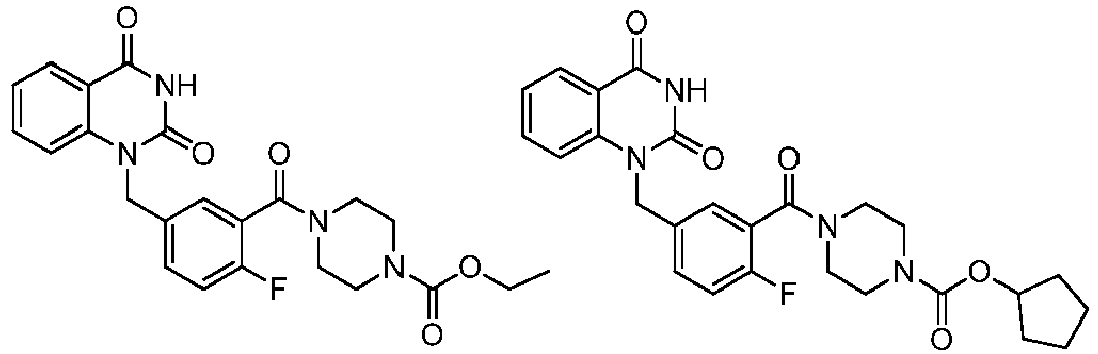
 wherein said compound is not a compound of formula
 wherein G is absent or (CO); andJ is selected from the group consisting of unsubstituted or substituted alkyl, unsubstituted or substituted cycloalkyl, unsubstituted or substituted heterocycloalkyl; unsubstituted or substituted aryl, and unsubstituted or substituted heteroaryl; orJ is selected from the group consisting of: unsubstituted or substituted phenyl, unsubstituted or substituted pyridinyl, unsubstituted or substituted pyrrolidinyl, unsubstituted or substituted piperazinyl, unsubstituted or substituted pyrazole, unsubstituted or substituted imidazole, unsubstituted or substituted indoline, unsubstituted or substituted pyrimidinyl, unsubstituted or substituted oxazole, unsubstituted or substituted isoxazole, and unsubstituted or substituted pyrazinyl; orJ is selected from the group consisting of:
 wherein said compound is not a compound of formula
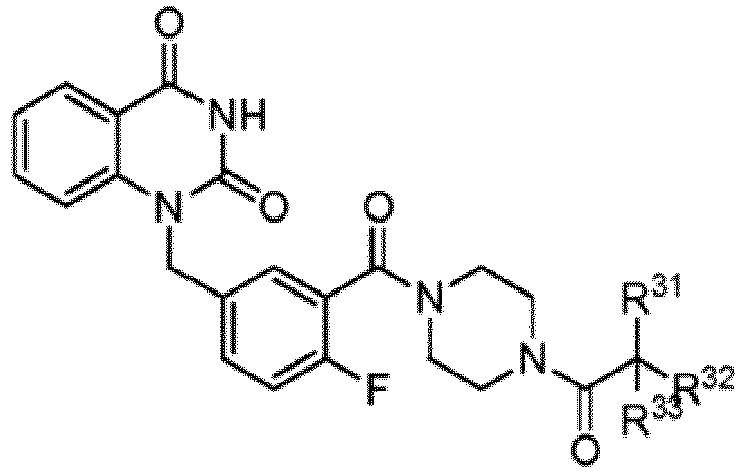 wherein R31, R32 and R33 are each independently selected from the group consisting of hydrogen, halogen, and unsubstituted or substituted alkyl; or R31 and R32, together with the carbon atom to which they are attached, may form cyclic moiety selected from the group consisting of unsubstituted or substituted cycloalkyl, and unsubstituted or substituted heterocycloalkyl;or wherein R31 and R32, together with the carbon atom to which they are attached, form cyclopropyl.or wherein R31 and R32, together with the carbon atom to which they are attached, form heterocycloalkyl.
 - The compound of claim 1, or a pharmaceutically acceptable salt thereof, wherein R1 or R2 is hydrogen, fluoro, chloro, bromo or methyl; R4 is hydrogen, fluoro, methyl, methoxy or hydroxy; R7, R8, R9, or R10 is hydrogen or fluoro.
- The compound of claim 1, or a pharmaceutically acceptable salt thereof, wherein R12 is cycloalkyl, aryl, heteroaryl, carbocyclic group, heterocyclic group, arylalkyl, heteroarylalkyl, carbocycloalkyl, heterocycloalkyl, alkylcarbonyl, cycloalkylcarbonyl, arylcarbonyl, heteroarylcarbonyl or heterocyclocarbonyl.
- The compound of claim 1, or a pharmaceutically acceptable salt thereof, wherein R1 and R2 each independently are selected from the group consisting of H, halo, C1-C6 alkyl or C1-C6 alkoxy; R3 is H; R4 is selected from the group consisting of H, halo, C1-C6 alkyl, C1-C6 alkoxy or hydroxyl; R7, R8, R9 and R10 are each independently selected from the group consisting of H and halo; and R12 is optionally substituted cycloalkyl, aryl, heteroaryl, carbocyclic group, heterocyclic group, arylalkyl, heteroarylalkyl, carbocycloalkyl, heterocycloalkyl, alkylcarbonyl, cycloalkylcarbonyl, arylcarbonyl, heteroarylcarbonyl or heterocyclocarbonyl.
- The compound of claim 4, or a pharmaceutically acceptable salt thereof, wherein R12 is optionally substituted C3-8 cycloalkylcarbonyl, pyridyl, pyrimidinyl, benzoyl, phenyl, piperidinyl, thienylcarbonyl, furylcarbonyl, pyrazinyl, or thiazolyl.
- The compound of claim 1, or a pharmaceutically acceptable salt thereof, wherein R1 and R2 each independently are selected from the group consisting of hydrogen, fluoro, chloro, bromo or methyl; R3 is H; R4 is selected from the group consisting of hydrogen, fluoro, methyl, methoxy or hydroxy; R7, R8, R9 and R10 are each independently selected from the group consisting of H and fluoro; and R12 is C3-8 cycloalkylcarbonyl, pyridyl, pyrimidinyl, benzoyl, phenyl, piperidinyl, thienylcarbonyl, furylcarbonyl, pyrazinyl, or thiazolyl, optionally substituted by 1, 2, 3, or 4 substituents selected from the gourp consisting of halo, C1-C6 haloalkyl, C1-C6 alkyl, amino, hydroxy, or C1-C6 alkoxy.
- The compound of claim 1, or a pharmaceutically acceptable salt thereof, wherein:R1-R4 independently are hydrogen, halo, C1-10 alkoxy, C1-10 alkyl, or hydroxy;R7-R10 independently are hydrogen or halo, or C1-10 alkyl; andR12 is cycloalkyl, aryl, heteroaryl, carbocyclic group, heterocyclic group, arylalkyl, heteroarylalkyl, carbocycloalkyl, heterocycloalkyl, alkylcarbonyl, cycloalkylcarbonyl, arylcarbonyl, heteroarylcarbonyl or heterocyclocarbonyl.
- The compound of claim 1, wherein said compound is selected from the group consisting of:1-(3-Methoxycarbonylbenzyl)quinazoline-2,4(1H,3H)-dione;1-(3-Carboxybenzyl)quinazoline-2,4(1H,3H)-dione;1-(3-(4-(Pyridin-2-yl)piperazine-1-carbonyl)benzyl)quinazoline-2,4(1H,3H)-dione;1-(3-(4-(Pyrimidin-2-yl)piperazine-1-carbonyl)benzyl)quinazoline-2,4(1H,3H)-dione;1-(3-(4-Cyclohexylpiperazine-1-carbonyl)benzyl)quinazoline-2,4(1H,3H)-dione;1-(3-(4-([1,2,4]Triazolo[4,3-b]pyridazin-6-yl)piperazine-1-carbonyl)benzyl)quinazoline-2,4(1H,3H)-dione;1-(3-(4-Ethylpiperazine-1-carbonyl)benzyl)quinazoline-2,4(1H,3H)-dione;1-(3-(4-Benzoylpiperazine-1-carbonyl)benzyl)quinazoline-2,4(1H,3H)-dione;1-(3-(4-(4-fluorobenzoyl)piperazine-1-carbonyl)benzyl)quinazoline-2,4(1H,3H)-dione;1-(3-(4-(4-Chlorobenzoyl)piperazine-1-carbonyl)benzyl)quinazoline-2,4(1H,3H)-dione;1-(3-(4-(4-Bromobenzoyl)piperazine-1-carbonyl)benzyl)quinazoline-2,4(1H,3H)-dione;1-(3-(4-(4-Methoxybenzoyl)piperazine-1-carbonyl)benzyl)quinazoline-2,4(1H,3H)-dione;1-(3-(4-(Tetrahydro-2H-pyran-4-yl)carbonylpiperazine-1-carbonyl)benzyl)quinazoline-2,4(1H,3H)-dione;1-(3-(4-(Cyclopentylcarbonyl)piperazine-1-carbonyl)benzyl)quinazoline-2,4(1H,3H)-dione;1-(3-(4-(Ethylsulfonyl)piperazine-1-carbonyl)benzyl)quinazoline-2,4(1H,3H)-dione;1-(3-(4-Acetylpiperazine-1-carbonyl)benzyl)quinazoline-2,4(1H,3H)-dione;1-(3-(4-Phenylpiperidine-1-carbonyl)benzyl)quinazoline-2,4(1H,3H)-dione;1-(3-(4-Phenylpiperazine-1-carbonyl)benzyl)quinazoline-2,4(1H,3H)-dione;1-(3-(4-(Pyrazin-2-yl)piperazine-1-carbonyl)benzyl)quinazoline-2,4(1H,3H)-dione;1-(4-Fluoro-3-methoxycarbonylbenzyl)quinazoline-2,4(1H,3H)-dione;1-(3-(4-(Cyclopentylcarbonyl)piperazine-1-carbonyl)-4-fluorobenzyl)quinazoline-2,4(1H,3H)-dione;1-(3-(4-(Cyclohexylcarbonyl)piperazine-1-carbonyl)benzyl)quinazoline-2,4(1H,3H)-dione;1-(3-(4-(Benzo[d]isothiazol-3-yl)piperazine-1-carbonyl)benzyl)quinazoline-2,4(1H,3H)-dione;1-(3-(4-(Piperidin-1-yl)piperidine-1-carbonyl)benzyl)quinazoline-2,4(1H,3H)-dione;1-(3-(4-(Pyridin-4-yl)piperazine-1-carbonyl)benzyl)quinazoline-2,4(1H,3H)-dione;1-(3-(4-(Cyclobutylcarbonyl)piperazine-1-carbonyl)benzyl)quinazoline-2,4(1H,3H)-dione;1-(3-(4-(6-Fluorobenzo[d]isoxazol-3-yl)piperidine-1-carbonyl)benzyl)quinazoline-2,4(1H,3H)-dione;1-(3-(4-(Thiophene-2-carbonyl)piperazine-1-carbonyl)benzyl)quinazoline-2,4(1H,3H)-dione;1-(3-(4-(Furan-2-carbonyl)piperazine-1-carbonyl)benzyl)quinazoline-2,4(1H,3H)-dione;1-(3-(4-(Furan-3-carbonyl)piperazine-1-carbonyl)benzyl)quinazoline-2,4(1H,3H)-dione;1-(3-(4-(Thiophene-3-carbonyl)piperazine-1-carbonyl)benzyl)quinazoline-2,4(1H,3H)-dione;1-(3-(4-(Pyridine-3-carbonyl)piperazine-1-carbonyl)benzyl)quinazoline-2,4(1H,3H)-dione;1-(3-(4-(Pyridine-2-carbonyl)piperazine-1-carbonyl)benzyl)quinazoline-2,4(1H,3H)-dione;1-(3-(4-(Pyridine-4-carbonyl)piperazine-1-carbonyl)benzyl)quinazoline-2,4(1H,3H)-dione;1-(3-(4-Phenoxypiperidine-1-carbonyl)benzyl)quinazoline-2,4(1H,3H)-dione;1-(3-(4-(Cyclohexylcarbonyl)piperazine-1-carbonyl)- 4-fluorobenzyl)quinazoline-2,4(1H,3H)-dione;1-(3-(4-(Benzo[d]isothiazol-3-yl)piperazine-1-carbonyl)-4-fluorobenzyl)quinazoline-2,4(1H,3H)-dione;1-(3-(4-(Cyclobutylcarbonyl)piperazine-1-carbonyl)-4-fluorobenzyl)quinazoline-2,4(1H,3H)-dione;1-(3-(4-Benzoylpiperazine-1-carbonyl)-4-fluorobenzyl)quinazoline-2,4(1H,3H)-dione;1-(4-Fluoro-3-(4-(thiophene-2-carbonyl)piperazine-1-carbonyl)benzyl)quinazoline-2,4(1H,3H)-dione;1-(4-Fluoro-3-(4-(furan-2-carbonyl)piperazine-1-carbonyl)benzyl)quinazoline-2,4(1H,3H)-dione;1-(3-(4-(Cyclopentylcarbonyl)piperazine-1-carbonyl)-6-fluorobenzyl)quinazoline-2,4(1H,3H)-dione;1-(3-(4-(Cyclohexylcarbonyl)piperazine-1-carbonyl)- 6-fluorobenzyl)quinazoline-2,4(1H,3H)-dione;1-(6-Fluoro-3-(4-(pyrimidin-2-yl)piperazine-1-carbonyl)benzyl)quinazoline-2,4(1H,3H)-dione;1-(6-Fluoro-3-(4-(pyridin-2-yl)piperazine-1-carbonyl)benzyl)quinazoline-2,4(1H,3H)-dione;1-(6-Fluoro-3-(4-(thiophene-2-carbonyl)piperazine-1-carbonyl)benzyl)quinazoline-2,4(1H,3H)-dione;1-(3-(4-(Cyclobutylcarbonyl)piperazine-1-carbonyl)-6-fluorobenzyl)quinazoline-2,4(1H,3H)-dione;1-(6-Fluoro-3-(4-(furan-2-carbonyl)piperazine-1-carbonyl)benzyl)quinazoline-2,4(1H,3H)-dione;1-(6-Chloro- 3-(4-(cyclopentylcarbonyl)piperazine-1-carbonyl)benzyl)quinazoline-2,4(1H,3H)-dione;1-(6-Chloro-3-(4-(pyrimidin-2-yl)piperazine-1-carbonyl)benzyl)quinazoline-2,4(1H,3H)-dione;1-(6-Chloro-3-(4-(cyclohexylcarbonyl)piperazine-1-carbonyl)benzyl)quinazoline-2,4(1H,3H)-dione;1-(6-Chloro-3-(4-(pyridin-2-yl)piperazine-1-carbonyl)benzyl)quinazoline-2,4(1H,3H)-dione;1-(2-Chloro-3-(4-(cyclopentylcarbonyl)piperazine- 1-carbonyl)benzyl)quinazoline-2,4(1H,3H)-dione;1-(2-Chloro-3-(4-(pyrimidin-2-yl)piperazine-1-carbonyl)benzyl)quinazoline-2,4(1H,3H)-dione;1-(2-Fluoro-3-(4-(pyrimidin-2-yl)piperazine-1-carbonyl)benzyl)quinazoline-2,4(1H,3H)-dione;1-(3-(4-(Cyclopentylcarbonyl)piperazine-1-carbonyl)-2-fluorobenzyl)quinazoline-2,4(1H,3H)-dione;1-(5-Fluoro-3-(4-(pyrimidin-2-yl)piperazine-1-carbonyl)benzyl)quinazoline-2,4(1H,3H)-dione;1-(3-(4-(Cyclopentylcarbonyl)piperazine-1-carbonyl)-5-fluorobenzyl)quinazoline-2,4(1H,3H)-dione;1-(4-Chloro-3-(4-(pyrimidin-2-yl)piperazine-1-carbonyl)benzyl)quinazoline-2,4(1H,3H)-dione;1-(4-Chloro-3-(4-(cyclohexylcarbonyl)piperazine-1-carbonyl)benzyl)quinazoline-2,4(1H,3H)-dione;1-((2-(4-(Cyclopentylcarbonyl)piperazine-1-carbonyl)furan-5-yl)methyl)quinazoline-2,4(1H,3H)-dione;1-((2-(4-(Benzo[d]isothiazol-3-yl)piperazine-1-carbonyl)furan-5-yl)methyl)quinazoline-2,4(1H,3H)-dione;1-((2-(4-(Cyclopentylcarbonyl)piperazine-1-carbonyl)pyridin-6-yl)methyl)quinazoline-2,4(1H,3H)-dione;1-((2-(4-(Pyridin-2-yl)piperazine-1-carbonyl)pyridin -6-yl)methyl)quinazoline-2,4(1H,3H)-dione;1-(3-(4-(Thiazol-2-yl)piperazine-1-carbonyl)benzyl)quinazoline-2,4(1H,3H)-dione;1-(3-(4-(Cyclohexylmethyl)piperazine-1-carbonyl)benzyl)quinazoline-2,4(1H,3H)-dione;1-(3-(4-(Cyclopentylmethyl)piperazine-1-carbonyl)benzyl)quinazoline-2,4(1H,3H)-dione;1-(3-(4-(Cyclohexylsulfonyl)piperazine-1-carbonyl)benzyl)quinazoline-2,4(1H,3H)-dione;1-(3-(4-(Cyclopentylcarbonyl)piperazine-1-carbonyl)benzyl)-7-fluoroquinazoline-2,4(1H,3H)-dione;7-Fluoro-1-(3-(4-(pyrimidin-2-yl)piperazine-1-carbonyl)benzyl)quinazoline-2,4(1H,3H)-dione;1-(3-(4-(Cyclopentylcarbonyl)piperazine-1-carbonyl)benzyl)-7-methylquinazoline-2,4(1H,3H)-dione;7-Methyl-1-(3-(4-(pyrimidin-2-yl)piperazine-1-carbonyl)benzyl)quinazoline-2,4(1H,3H)-dione;6-Methyl-1-(3-(4-(pyrimidin-2-yl)piperazine-1-carbonyl)benzyl)quinazoline-2,4(1H,3H)-dione;1-(3-(4-(Cyclopentylcarbonyl)piperazine-1-carbonyl)benzyl)-6-methylquinazoline-2,4(1H,3H)-dione;1-(4-Fluoro-3-(4-(pyrimidin-2-yl)piperazine-1-carbonyl)benzyl)-6-methylquinazoline-2,4(1H,3H)-dione;1-(3-(4-(Cyclohexylcarbonyl)piperazine-1-carbonyl)-4-fluorobenzyl)-6-methylquinazoline-2,4(1H,3H)-dione;1-(3-(4-(Cyclopentylcarbonyl)piperazine-1-carbonyl)-4-fluorobenzyl)-6-methylquinazoline-2,4(1H,3H)-dione;6-Bromo-1-(3-(4-(cyclohexylcarbonyl)piperazine-1-carbonyl)benzyl)quinazoline-2,4(1H,3H)-dione;6-Bromo-1-(3-(4-(cyclopentylcarbonyl)piperazine-1-carbonyl)benzyl)quinazoline-2,4(1H,3H)-dione;6-Bromo-1-(3-(4-(pyrimidin-2-yl)piperazine-1-carbonyl)benzyl)quinazoline-2,4(1H,3H)-dione;1-(3-(4-(Cyclopentylcarbonyl)piperazine-1-carbonyl)benzyl)-6-nitroquinazoline-2,4(1H,3H)-dione;6-Nitro-1-(3-(4-(pyrimidin-2-yl)piperazine-1-carbonyl)benzyl)quinazoline-2,4(1H,3H)-dione;1-(3-(4-(Cyclohexylcarbonyl)piperazine-1-carbonyl)benzyl)-6-nitroquinazoline-2,4(1H,3H)-dione;5-Chloro-1-(3-(4-(pyrimidin-2-yl)piperazine-1-carbonyl)benzyl)quinazoline-2,4(1H,3H)-dione;5-Chloro-1-(3-(4-(cyclopentylcarbonyl)piperazine-1-carbonyl)benzyl)quinazoline-2,4(1H,3H)-dione;5-Chloro-1-(3-(4-(cyclohexylcarbonyl)piperazine-1-carbonyl)benzyl)quinazoline-2,4(1H,3H)-dione;5-Chloro-1-(4-fluoro-3-(4-(pyrimidin-2-yl)piperazine-1-carbonyl)benzyl)quinazoline-2,4(1H,3H)-dione;5-Chloro-1-(3-(4-(cyclopentylcarbonyl)piperazine-1-carbonyl)-4-fluorobenzyl)quinazoline-2,4(1H,3H)-dione;5-Chloro-1-(3-(4-(cyclohexylcarbonyl)piperazine-1-carbonyl)-4-fluorobenzyl)quinazoline-2,4(1H,3H)-dione;5-Chloro-1-(4-fluoro-3-(4-(pyridin-2-yl)piperazine-1-carbonyl)benzyl)quinazoline-2,4(1H,3H)-dione;5-Chloro-1-(4-fluoro-3-(4-(thiophene-2-carbonyl)piperazine-1-carbonyl)benzyl)quinazoline-2,4(1H,3H)-dione;5-Chloro-1-(3-(4-(cyclohexylcarbonyl)piperazine-1-carbonyl)-6-fluorobenzyl)quinazoline-2,4(1H,3H)-dione;5-Chloro-1-(3-(4-(cyclopentylcarbonyl)piperazine-1-carbonyl)-6-fluorobenzyl)quinazoline-2,4(1H,3H)-dione;5-Chloro-1-(6-fluoro-3-(4-(pyrimidin-2-yl)piperazine-1-carbonyl)benzyl)quinazoline-2,4(1H,3H)-dione;6-Chloro-1-(3-(4-(pyrimidin-2-yl)piperazine-1-carbonyl)benzyl)quinazoline-2,4(1H,3H)-dione;6-Chloro-1-(3-(4-(cyclopentylcarbonyl)piperazine-1-carbonyl)benzyl)quinazoline-2,4(1H,3H)-dione;6-Chloro-1-(3-(4-(cyclohexylcarbonyl)piperazine-1-carbonyl)benzyl)quinazoline-2,4(1H,3H)-dione;6-Chloro-1-(3-(4-(pyridin-2-yl)piperazine-1-carbonyl)benzyl)quinazoline-2,4(1H,3H)-dione;6-Chloro-1-(3-(4-(thiophene-2-carbonyl)piperazine-1-carbonyl)benzyl)quinazoline-2,4(1H,3H)-dione;6-Chloro-1-(3-(4-(cyclobutylcarbonyl)piperazine-1-carbonyl)benzyl)quinazoline-2,4(1H,3H)-dione;6-Chloro-1-(4-fluoro-3-(4-(pyrimidin-2-yl)piperazine-1-carbonyl)benzyl)quinazoline-2,4(1H,3H)-dione;6-Chloro-1-(3-(4-(cyclopentylcarbonyl)piperazine-1-carbonyl)-4-fluorobenzyl)quinazoline-2,4(1H,3H)-dione;6-Chloro-1-(3-(4-(cyclohexylcarbonyl)piperazine-1-carbonyl)-4-fluorobenzyl)quinazoline-2,4(1H,3H)-dione;6-Chloro-1-(4-fluoro-3-(4-(pyridin-2-yl)piperazine-1-carbonyl)benzyl)quinazoline-2,4(1H,3H)-dione;6-Chloro-1-(4-fluoro-3-(4-(thiophene-2-carbonyl)piperazine-1-carbonyl)benzyl)quinazoline-2,4(1H,3H)-dione;6-Chloro-1-(3-(4-(cyclopropylcarbonyl)piperazine-1-carbonyl)-4-fluorobenzyl)quinazoline)-2,4(1H,3H)-dione;6- Chloro-1-(6-fluoro- 3- (4-(pyrimidin-2-yl)piperazine-1-carbonyl)benzyl)quinazoline-2,4(1H,3H)-dione;6-Chloro-1-(3-(4-(cyclopentylcarbonyl)piperazine-1-carbonyl)-6-fluorobenzyl)quinazoline-2,4(1H,3H)-dione;6-Chloro-1-(3-(4-(cyclohexylcarbonyl)piperazine-1-carbonyl)-6-fluorobenzyl)quinazoline-2,4(1H,3H)-dione;6-Chloro-1-(6-fluoro-3-(4-(thiophene-2-carbonyl)piperazine-1-carbonyl)benzyl)quinazoline-2,4(1H,3H)-dione;5-Fluoro-1-(3-(4-(pyrimidin-2-yl)piperazine-1-carbonyl)benzyl)quinazoline-2,4(1H,3H)-dione;1-(3-(4-(Cyclopentylcarbonyl)piperazine-1-carbonyl)benzyl)-5-fluoroquinazoline-2,4(1H,3H)-dione;1-(3-(4-(Cyclohexylcarbonyl)piperazine-1-carbonyl)benzyl)-5-fluoroquinazoline-2,4(1H,3H)-dione;5-Fluoro-1-(3-(4-(pyridin-2-yl)piperazine-1-carbonyl)benzyl)quinazoline-2,4(1H,3H)-dione;5-Fluoro-(1-(3-(4-(thiophene-2-carbonyl)piperazine-1-carbonyl)benzyl)quinazoline)-2,4(1H,3H)-dione;5-Fluoro-1-(4-fluoro-3-(4-(pyrimidin-2-yl)piperazine-1-carbonyl)benzyl)quinazoline-2,4(1H,3H)-dione;1-(3-(4-(Cyclopentylcarbonyl)piperazine-1-carbonyl)-4-fluorobenzyl)-5-fluoroquinazoline-2,4(1H,3H)-dione;1-(3-(4-(Cyclohexylcarbonyl)piperazine-1-carbonyl)-4-fluorobenzyl)-5-fluoroquinazoline-2,4(1H,3H)-dione;5-Fluoro-1-(4-fluoro-3-(4-(pyridin-2-yl)piperazine-1-carbonyl)benzyl)quinazoline-2,4(1H,3H)-dione;5-Fluoro-1-(4-fluoro-3-(4-(thiophene-2-carbonyl)piperazine-1-carbonyl)benzyl)quinazoline-2,4(1H,3H)-dione;1-(3-(4-Benzoylpiperazine-1-carbonyl)-4-fluorobenzyl)-5-fluoroquinazoline-2,4(1H,3H)-dione;1-(3-(4-(Cyclohexylcarbonyl)piperazine-1-carbonyl)benzyl)-8-fluoroquinazoline-2,4(1H,3H)-dione;6-Fluoro-1-(3-(4-(pyrimidin-2-yl)piperazine-1-carbonyl)benzyl)quinazoline-2,4(1H,3H)-dione;6-Fluoro-1-(3-(4-(pyridin-2-yl)piperazine-1-carbonyl)benzyl)quinazoline-2,4(1H,3H)-dione;6-Fluoro-1-(3-(4-(thiophene-2-carbonyl)piperazine-1-carbonyl)benzyl)quinazoline-2,4(1H,3H)-dione;1-(3-(4-(Cyclohexylcarbonyl)piperazine-1-carbonyl)benzyl)-6-fluoroquinazoline-2,4(1H,3H)-dione;1-(3-(4-(Cyclopentylcarbonyl)piperazine-1-carbonyl)benzyl)-6-fluoroquinazoline-2,4(1H,3H)-dione;6-Fluoro-1-(4-fluoro-3-(4-(pyrimidin-2-yl)piperazine-1-carbonyl)benzyl)quinazoline-2,4(1H,3H)-dione;6-Fluoro-1-(4-fluoro-3-(4-(pyridin-2-yl)piperazine-1-carbonyl)benzyl)quinazoline-2,4(1H,3H)-dione;6-Fluoro-1-(4-fluoro-3-(4-(thiophene-2-carbonyl)piperazine-1-carbonyl)benzyl)quinazoline-2,4(1H,3H)-dione;1-(3-(4-(Cyclohexylcarbonyl)piperazine-1-carbonyl)-4-fluorobenzyl)-6-fluoroquinazoline-2,4(1H,3H)-dione;1-(3-(4-(Cyclopentylcarbonyl)piperazine-1-carbonyl)-4-fluorobenzyl)-6-fluoroquinazoline-2,4(1H,3H)-dione;6-Fluoro-1-(6-fluoro-3-(4-(pyrimidin-2-yl)piperazine-1-carbonyl)benzyl)quinazoline-2,4(1H,3H)-dione;6-Fluoro-1-(6-fluoro-3-(4-(pyridin-2-yl)piperazine-1-carbonyl)benzyl)quinazoline-2,4(1H,3H)-dione;6-Fluoro-1-(6-fluoro-3-(4-(thiophene-2-carbonyl)piperazine-1-carbonyl)benzyl)quinazoline-2,4(1H,3H)-dione;1-(3-(4-(Cyclohexylcarbonyl)piperazine-1-carbonyl)-6-fluorobenzyl)-6-fluoroquinazoline-2,4(1H,3H)-dione;1-(3-(4-(Cyclopentylcarbonyl)piperazine-1-carbonyl)-6-fluorobenzyl)-6-fluoroquinazoline-2,4(1H,3H)-dione;5-Fluoro-1-(6-fluoro-3-(4-(pyrimidin-2-yl)piperazine-1-carbonyl)benzyl)quinazoline-2,4(1H,3H)-dione;5-Fluoro-1-(6-fluoro-3-(4-(pyridin-2-yl)piperazine-1-carbonyl)benzyl)quinazoline-2,4(1H,3H)-dione;5-Fluoro-1-(6-fluoro-3-(4-(thiophene-2-carbonyl)piperazine-1-carbonyl)benzyl)quinazoline-2,4(1H,3H)-dione;1-(3-(4-(Cyclohexylcarbonyl)piperazine-1-carbonyl)-6-fluorobenzyl)-5-fluoroquinazoline-2,4(1H,3H)-dione;1-(3-(4-(Cyclopentylcarbonyl)piperazine-1-carbonyl)-6-fluorobenzyl)-5-fluoroquinazoline-2,4(1H,3H)-dione;5-Methyl-1-(3-(4-(pyrimidin-2-yl)piperazine-1-carbonyl)benzyl)quinazoline-2,4(1H,3H)-dione;1-(3-(4-(Cyclopentylcarbonyl)piperazine-1-carbonyl)benzyl)-5-methylquinazoline-2,4(1H,3H)-dione;7-Chloro-1-(3-(4-(pyrimidin-2-yl)piperazine-1-carbonyl)benzyl)quinazoline-2,4(1H,3H)-dione;7-Chloro-1-(3-(4-(cyclopentylcarbonyl)piperazine-1-carbonyl)benzyl)quinazoline-2,4(1H,3H)-dione;1-(3-(4-(Cyclopropylcarbonyl)piperazine-1-carbonyl)-4-fluorobenzyl)-5-fluoroquinazoline-2,4(1H,3H)-dione;6-Chloro-(1-(3-(4-benzoylpiperazine-1-carbonyl)-4-fluorobenzyl)quinazoline-2,4(1H,3H)-dione;1-(3-(4-(Cyclobutylcarbonyl)piperazine-1-carbonyl)benzyl)-5-fluoroquinazoline-2,4(1H,3H)-dione;1-(3-(4-(Cyclobutylcarbonyl)piperazine-1-carbonyl)-4-fluorobenzyl)-5-fluoroquinazoline-2,4(1H,3H)-dione;6-Chloro-1-(3-(4-(cyclobutylcarbonyl)piperazine-1-carbonyl)-6-fluorobenzyl)quinazoline-2,4(1H,3H)-dione;5-Chloro-1-(3-( 4-(cyclobutylcarbonyl)piperazine-1-carbonyl)-4-fluorobenzyl)quinazoline-2,4(1H,3H)-dione;6-Chloro-1-(3-(4-(cyclobutylcarbonyl)piperazine-1-carbonyl)-4-fluorobenzyl)quinazoline-2,4(1H,3H)-dione;5-Chloro-1-(3-(4-(cyclobutylcarbonyl)piperazine-1-carbonyl)-6-fluorobenzyl)quinazoline-2,4(1H,3H)-dione;5-Chloro-1-(6-fluoro-3-(4-(thiophene-2-carbonyl)piperazine-1-carbonyl)benzyl)quinazoline-2,4(1H,3H)-dione;5-Fluoro-1-(4-fluoro-3-(4-(furan-2-carbonyl)piperazine-1-carbonyl)benzyl)quinazoline-2,4(1H,3H)-dione;5-Chloro-1-(6-fluoro-3-(4-(pyridin-2-yl)piperazine-1-carbonyl)benzyl)quinazoline-2,4(1H,3H)-dione;6-Chloro-1-(6-fluoro-3-(4-(pyridin-2-yl)piperazine-1-carbonyl)benzyl)quinazoline-2,4(1H,3H)-dione;6-Chloro-1-(5-fluoro-3-(4-(pyrimidin-2-yl)piperazine-1-carbonyl)benzyl)quinazoline-2,4(1H,3H)-dione;5-Fluoro-1-(5-fluoro-3-(4-(pyrimidin-2-yl)piperazine-1-carbonyl)benzyl)quinazoline-2,4(1H,3H)-dione;1-(3-(4-Cyclopentylpiperazine-1-carbonyl)benzyl)quinazoline-2,4(1H,3H)-dione;1-(3-(4-(Cyclopropylcarbonyl)piperazine-1-carbonyl)- 4-fluorobenzyl)-6-fluoroquinazoline-2,4(1H,3H)-dione;1-(3-(4-(Cyclobutylcarbonyl)piperazine-1-carbonyl)benzyl)-6-fluoroquinazoline-2,4(1H,3H)-dione;1-(3-(4-(Cyclobutylcarbonyl)piperazine-1-carbonyl)-4-fluorobenzyl)-6-fluoroquinazoline-2,4(1H,3H)-dione;1-(3-(4-Benzoylpiperazine-1-carbonyl)-4-fluorobenzyl)-6-fluoroquinazoline-2,4(1H,3H)-dione;1-(3-(4-(Cyclobutylcarbonyl)piperazine-1-carbonyl)-6-fluorobenzyl)-5-fluoroquinazoline-2,4(1H,3H)-dione;1-(3-(4-(Cyclobutylcarbonyl)piperazine-1-carbonyl)-6-fluorobenzyl)-6-fluoroquinazoline-2,4(1H,3H)-dione;5-Fluoro-1-(6-fluoro-3-(4-(furan-2-carbonyl)piperazine-1-carbonyl)benzyl)quinazoline-2,4(1H,3H)-dione;6-Fluoro-1-(4-fluoro-3-(4-(furan-2-carbonyl)piperazine-1-carbonyl)benzyl)quinazoline-2,4(1H,3H)-dione;6-Fluoro-1-(5-fluoro-3-(4-(pyrimidin-2-yl)piperazine-1-carbonyl)benzyl)quinazoline-2,4(1H,3H)-dione;1-(6-Chloro-3-(4-(pyrimidin-2-yl)piperazine-1-carbonyl)benzyl)-6-fluoroquinazoline-2,4(1H,3H)-dione;6-Fluoro-1-(4-fluoro-3-(4-(thiazol-2-yl)piperazine-1-carbonyl)benzyl)quinazoline-2,4(1H,3H)-dione;5-Fluoro-1-(4-fluoro-3-(4-(thiazol-2-yl)piperazine-1-carbonyl)benzyl)quinazoline-2,4(1H,3H)-dione;1-(4-Fluoro-3-(4-(thiazol-2-yl)piperazine-1-carbonyl)benzyl)quinazoline-2,4(1H,3H)-dione;1-(3-(4-(Cyclohexylcarbamoyl)piperazine-1-carbonyl)benzyl)quinazoline-2,4(1H,3H)-dione;1-(3-([1,2,4]Triazolo[4,3-a]pyridine-6-carbonyl)benzyl)quinazoline-2,4(1H,3H)-dione;6-Fluoro-1-((2-(4-(pyrimidin-2-yl)piperazine-1-carbonyl)pyridin-6-yl)methyl)quinazoline-2,4(1H,3H)-dione;5-Fluoro-1-(4-fluoro-3-(4-methoxybenzylcarbamoyl)benzyl)quinazoline-2,4(1H,3H)-dione;1-(3-(3-Chlorobenzylcarbamoyl)-4-fluorobenzyl)-5-fluoroquinazoline-2,4(1H,3H)-dione;1-(3-(Benzylcarbamoyl)-4-fluorobenzyl)-5-fluoroquinazoline-2,4(1H,3H)-dione;5-Methoxy-1-(3-(4-(pyrimidin-2-yl)piperazine-1-carbonyl)benzyl)quinazoline-2,4(1H,3H)-dione;6-Methoxy-1-(3-(4-(pyrimidin-2-yl)piperazine-1-carbonyl)benzyl)quinazoline-2,4(1H,3H)-dione;1-(3-(5-Bromopyrimidin-2-aminocarbamoyl)-4-fluorobenzyl)-5-fluoroquinazoline-2,4(1H,3H)-dione;1-(3-(4-(Pyrimidin-2-yl)piperazine-1-carbonyl)benzyl)-7-(trifluoromethyl)quinazoline-2,4(1H,3H)-dione;6,7-Ethylenedioxo-1-(3-(4-(pyrimidin-2-yl)piperazine-1-carbonyl)benzyl)quinazoline-2,4(1H,3H)-dione;5-Fluoro-1-(6-methoxy-3-(4-(pyrimidin-2-yl)piperazine-1-carbonyl)benzyl)quinazoline-2,4(1H,3H)-dione;7-Methoxy-1-(3-(4-(pyrimidin-2-yl)piperazine-1-carbonyl)benzyl)quinazoline-2,4(1H,3H)-dione;5-Fluoro-1-(4-fluoro-3-(4-(tetrahydrofuran-2-carbonyl)piperazine-1-carbonyl)benzyl)quinazoline-2,4(1H,3H)-dione;5-Fluoro-1-(4-nitro-3-(4-(pyrimidin-2-yl)piperazine-1-carbonyl)benzyl)quinazoline-2,4(1H,3H)-dione;1-(3-(4-Cyclohexylpiperazine-1-carbonyl)-4-fluorobenzyl)-5-fluoroquinazoline-2,4(1H,3H)-dione;5-Fluoro-1-(4-fluoro-3-(4-phenylpiperazine-1-carbonyl)benzyl)quinazoline-2,4(1H,3H)-dione;5-Fluoro-1-(4-fluoro-3-(4-phenylpiperidine-1-carbonyl)benzyl)quinazoline-2,4(1H,3H)-dione;1-(4-Bromo-3-(4-(pyrimidin-2-yl)piperazine-1-carbonyl)benzyl)-5-fluoroquinazoline-2,4(1H,3H)-dione;6,7-Methylenedioxo-1-(3-(4-(pyrimidin-2-yl)piperazine-1-carbonyl)benzyl)quinazoline-2,4(1H,3H)-dione;1-(3-(4-(Cyclohexylmethyl)piperazine-1-carbonyl)-4-fluorobenzyl)-5-fluoroquinazoline-2,4(1H,3H)-dione;8-Fluoro-1-(3-(4-(pyrimidin-2-yl)piperazine-1-carbonyl)benzyl)quinazoline-2,4(1H,3H)-dione;6-Amino-1-(3-(4-(pyrimidin-2-yl)piperazine-1-carbonyl)benzyl)quinazoline-2,4(1H,3H)-dione;8-Chloro-1-(3-(4-(pyrimidin-2-yl)piperazine-1-carbonyl)benzyl)quinazoline-2,4(1H,3H)-dione;8-Methyl-1-(3-(4-(pyrimidin-2-yl)piperazine-1-carbonyl)benzyl)quinazoline-2,4(1H,3H)-dione;8-Methoxy-1-(3-(4-(pyrimidin-2-yl)piperazine-1-carbonyl)benzyl)quinazoline-2,4(1H,3H)-dione;8-Hydroxy-1-(3-(4-(pyrimidin-2-yl)piperazine-1-carbonyl)benzyl)quinazoline-2,4(1H,3H)-dione;or a pharmaceutically acceptable salt thereof.
- The compound of claim 1, wherein said compound is selected from the group consisting of:1-(4-Fluoro-3-(4-(pyrimidin-2-yl)piperazine-1-carbonyl)benzyl)quinazoline-2,4(1H,3H)-dione hydrochloride;5-Fluoro-1-(4-fluoro-3-(4-(pyrimidin-2-yl)piperazine-1-carbonyl)benzyl)quinazoline-2,4(1H,3H)-dione hydrochloride;1-(3-(4-(Pyrimidin-2-yl)piperazine-1-carbonyl)benzyl)quinazoline-2,4(1H,3H)-dione hydrochloride.
- Compound of any of claims 1-6, or a pharmaceutically acceptable salt thereof, for use as a medicament.
- Compound for use according to claim 10, for use in treating or preventing a disorder responsive to the inhibition of PARP activity in a mammal suffering therefrom; preferably wherein said disorder is cancer.
- The compound for use according to claim 11, wherein said cancer is liver cancer, melanoma, Hodgkin's disease, non-Hodgkin's lymphomas, acute or chronic lymphocytic leukemia, multiple myeloma, neuroblastoma, breast carcinoma, ovarian carcinoma, lung carcinoma, Wilms' tumor, cervical carcinoma, testicular carcinoma, soft-tissue sarcoma, chronic lymphocytic leukemia, primary macroglobulinemia, bladder carcinoma, chronic granulocytic leukemia, primary brain carcinoma, malignant melanoma, small-cell lung carcinoma, stomach carcinoma, colon carcinoma, malignant pancreatic insulinoma, malignant carcinoid carcinoma, malignant melanoma, choriocarcinoma, mycosis fungoide, head and neck carcinoma, osteogenic sarcoma, pancreatic carcinoma, acute granulocytic leukemia, hairy cell leukemia, neuroblastoma, rhabdomyosarcoma, Kaposi's sarcoma, genitourinary carcinoma, thyroid carcinoma, esophageal carcinoma, malignant hypercalcemia, cervical hyperplasia, renal cell carcinoma, endometrial carcinoma, polycythemia vera, essential thrombocytosis, adrenal cortex carcinoma, skin cancer, or prostatic carcinoma,
which use preferably further comprises administering at least one known anticancer agent, or a pharmaceutically acceptable salt of said agent;
and/or wherein preferably said use comprises administering said compound together with at least one compound selected from the group consisting of busulfan, melphalan, chlorambucil, cyclophosphamide, ifosfamide, temozolomide, bendamustine, cis-platin, mitomycin C, bleomycin, carboplatin, camptothecin, irinotecan, topotecan, doxorubicin, epirubicin, aclarubicin, mitoxantrone, elliptinium, etoposide, 5-azacytidine, gemcitabine, 5-fluorouracil, methotrexate, 5-fluoro-2'-deoxy-uridine, fludarabine, nelarabine, ara-C, alanosine, pralatrexate, pemetrexed, hydroxyurea, thioguanine, colchicine, vinblastine, vincristine, vinorelbine, paclitaxel, ixabepilone, cabazitaxel, docetaxel, campath, Panitumumab, Ofatumumab, Avastin, Herceptin®, Rituxan®, imatinib, gefitinib, erlotinib, lapatinib, sorafenib, sunitinib, nilotinib, dasatinib, pazopanib, temsirolimus, everolimus, vorinostat, romidepsin, tamoxifen, letrozole, fulvestrant, mitoguazone, octreotide, retinoic acid, arsenic trioxide, zoledronic acid, bortezomib, thalidomide or lenalidomide and/or preferably further comprising treating said mammal with radiation-therapy. - A pharmaceutical composition comprising the compound of any of claims 1 to 9 and a pharmaceutically acceptable carrier.
- The pharmaceutical composition of claim 13, further comprising at least one known anticancer agent, or a pharmaceutically acceptable salt of said agent.
- The pharmaceutical composition of claim 13, further comprising at least one compound selected from the group consisting of busulfan, melphalan, chlorambucil, cyclophosphamide, ifosfamide, temozolomide, bendamustine, cis-platin, mitomycin C, bleomycin, carboplatin, camptothecin, irinotecan, topotecan, doxorubicin, epirubicin, aclarubicin, mitoxantrone, elliptinium, etoposide, 5-azacytidine, gemcitabine, 5-fluorouracil, methotrexate, 5-fluoro-2'-deoxy-uridine, fludarabine, nelarabine, ara-C, alanosine, pralatrexate, pemetrexed, hydroxyurea, thioguanine, colchicine, vinblastine, vincristine, vinorelbine, paclitaxel, ixabepilone, cabazitaxel, docetaxel, campath, Panitumumab, Ofatumumab, Avastin, Herceptin®, Rituxan®, imatinib, gefitinib, erlotinib, lapatinib, sorafenib, sunitinib, nilotinib, dasatinib, pazopanib, temsirolimus, everolimus, vorinostat, romidepsin, tamoxifen, letrozole, fulvestrant, mitoguazone, octreotide, retinoic acid, arsenic trioxide, zoledronic acid, bortezomib, thalidomide or lenalidomide.
Priority Applications (4)
| Application Number | Priority Date | Filing Date | Title |
|---|---|---|---|
| RS20190877A RS59091B1 (en) | 2011-04-01 | 2012-03-31 | 1-((3-((1-piperazinyl)carbonyl)phenyl)methyl)-2,4(1h,3h)-quinazolinedione derivatives as parp inhibitors for treating cancer |
| SI201231630T SI2709990T1 (en) | 2011-04-01 | 2012-03-31 | 1-((3-((1-Piperazinyl)carbonyl)phenyl)methyl)-2,4(1H,3H)-quinazolinedione derivatives as PARP inhibitors for treating cancer |
| PL12765230T PL2709990T3 (en) | 2011-04-01 | 2012-03-31 | 1-((3-((1-Piperazinyl)carbonyl)phenyl)methyl)-2,4(1H,3H)-quinazolinedione derivatives as PARP inhibitors for treating cancer |
| HRP20191273TT HRP20191273T1 (en) | 2011-04-01 | 2012-03-31 | 1-((3-((1-piperazinyl)carbonyl)phenyl)methyl)-2,4(1h,3h)-quinazolinedione derivatives as parp inhibitors for treating cancer |
Applications Claiming Priority (3)
| Application Number | Priority Date | Filing Date | Title |
|---|---|---|---|
| CN2011100824756A CN102731416A (en) | 2011-04-01 | 2011-04-01 | 1-(aryl methyl)-quinazoline-2,4-dione as PARP inhibitor and its application |
| CN2011077034 | 2011-07-11 | ||
| PCT/CN2012/073362 WO2012130166A1 (en) | 2011-04-01 | 2012-03-31 | 1-(arylmethyl)quinazoline-2,4(1h,3h)-diones as parp inhibitors and the use thereof |
Publications (3)
| Publication Number | Publication Date |
|---|---|
| EP2709990A1 EP2709990A1 (en) | 2014-03-26 |
| EP2709990A4 EP2709990A4 (en) | 2014-11-26 |
| EP2709990B1 true EP2709990B1 (en) | 2019-06-12 |
Family
ID=46929484
Family Applications (1)
| Application Number | Title | Priority Date | Filing Date |
|---|---|---|---|
| EP12765230.3A Active EP2709990B1 (en) | 2011-04-01 | 2012-03-31 | 1-((3-((1-Piperazinyl)carbonyl)phenyl)methyl)-2,4(1H,3H)-quinazolinedione derivatives as PARP inhibitors for treating cancer |
Country Status (19)
| Country | Link |
|---|---|
| US (4) | US9290460B2 (en) |
| EP (1) | EP2709990B1 (en) |
| JP (1) | JP6270713B2 (en) |
| CN (2) | CN103097361B (en) |
| AU (1) | AU2012237776B2 (en) |
| CA (1) | CA2831015C (en) |
| CY (1) | CY1121847T1 (en) |
| DK (1) | DK2709990T3 (en) |
| ES (1) | ES2736299T3 (en) |
| HR (1) | HRP20191273T1 (en) |
| HU (1) | HUE046121T2 (en) |
| PL (1) | PL2709990T3 (en) |
| PT (1) | PT2709990T (en) |
| RS (1) | RS59091B1 (en) |
| SG (1) | SG193599A1 (en) |
| SI (1) | SI2709990T1 (en) |
| TR (1) | TR201910675T4 (en) |
| TW (1) | TWI527800B (en) |
| WO (1) | WO2012130166A1 (en) |
Families Citing this family (41)
| Publication number | Priority date | Publication date | Assignee | Title |
|---|---|---|---|---|
| EP2686305B1 (en) | 2011-03-14 | 2020-09-16 | Impact Therapeutics, Inc. | Quinazolinediones and their use |
| TWI527800B (en) | 2011-04-01 | 2016-04-01 | 南京英派藥業有限公司 | 1-(arylmethyl)quinazoline-2,4(1h,3h)-diones as parp inhibitors and the use thereof |
| US9102631B2 (en) | 2011-11-01 | 2015-08-11 | Impact Therapeutics, Inc. | 1-(arylmethyl)-5,6,7,8-tetrahydroquinazoline-2,4-diones and analogs and the use thereof |
| BR112014026266A2 (en) | 2012-04-24 | 2017-06-27 | Chugai Pharmaceutical Co Ltd | quinazolidinedione derivative |
| BR112014026305A2 (en) | 2012-04-24 | 2017-06-27 | Chugai Pharmaceutical Co Ltd | quinazolidinedione derivative |
| HRP20191860T1 (en) | 2013-03-13 | 2019-12-27 | Forma Therapeutics, Inc. | 2-hydroxy-1-{4-[(4-phenylphenyl)carbonyl]piperazin-1-yl}ethan-1-one derivatives and related compounds as fatty acid synthase (fasn) inhibitors for the treatment of cancer |
| US10005739B2 (en) | 2013-10-23 | 2018-06-26 | Chugai Seiyaku Kabushiki Kaisha | Quinazolinone and isoquinolinone derivative |
| WO2016016268A1 (en) * | 2014-07-28 | 2016-02-04 | Technische Universität Dresden | Thymine derivatives and quinazoline-dione derivatives for the inhibition of hsp27 |
| WO2016155655A1 (en) * | 2015-04-03 | 2016-10-06 | 上海瑛派药业有限公司 | Solid pharmaceutical dosage form of parp inhibitor, and application of solid pharmaceutical dosage form of parp inhibitor |
| CN106083741A (en) * | 2016-02-22 | 2016-11-09 | 南京中医药大学 | 2 sulfur are for quinazolinedione derivatives |
| CN107098886B (en) * | 2016-02-26 | 2020-07-14 | 中国医学科学院药物研究所 | Prazinone-containing quinazolinone PARP-1/2 inhibitor and preparation method, pharmaceutical composition and application thereof |
| US10722484B2 (en) | 2016-03-09 | 2020-07-28 | K-Gen, Inc. | Methods of cancer treatment |
| PL3438096T3 (en) * | 2016-04-01 | 2021-05-17 | Impact Therapeutics, Inc | Manufacturing process for 1-(arylmethyl) quinazoline-2,4 (1h, 3h)-dione |
| CN108727343A (en) * | 2017-04-21 | 2018-11-02 | 中国医学科学院药物研究所 | Quinazolinones PARP-1/2 inhibitor containing 3- amino nafoxidines and preparation method thereof, pharmaceutical composition and purposes |
| TWI767148B (en) | 2018-10-10 | 2022-06-11 | 美商弗瑪治療公司 | Inhibiting fatty acid synthase (fasn) |
| WO2020092395A1 (en) | 2018-10-29 | 2020-05-07 | Forma Therapeutics, Inc. | SOLID FORMS OF (4-(2-FLUORO-4-(1-METHYL-1 H-BENZO[d]IMIDAZOL-5-YL)BENZOYL) PIPERAZIN-1-YL)(1-HYDROXYCYCLOPROPYL)METHANONE |
| CN111269216A (en) * | 2018-12-05 | 2020-06-12 | 中国医学科学院药物研究所 | Quinazolinedione salt compound containing piperazinone, its preparation method, pharmaceutical composition and use |
| CN114206864B (en) * | 2019-05-14 | 2024-05-24 | 苏州四体康宸医药科技有限公司 | Quinazoline-2,4-dione derivatives as PARP inhibitors |
| US20230263801A1 (en) * | 2020-07-24 | 2023-08-24 | Impact Therapeutics (Shanghai), Inc | Combination therapy of parp inhibitors |
| WO2022099442A1 (en) * | 2020-11-10 | 2022-05-19 | 上海瑛派药业有限公司 | Crystalline forms of 5-fluoro-1-(4-fluoro-3-(4-(pyrimidin-2-yl)piperazine-1-carbonyl)benzyl)quinazoline-2,4(1h,3h)-dione and preparation therefor |
| KR20230163467A (en) * | 2021-03-26 | 2023-11-30 | 임팩트 테라퓨틱스 (상하이), 인코포레이티드 | Oral capsule of PARP inhibitor and method for preparing same |
| MX2023012039A (en) * | 2021-04-12 | 2024-03-05 | Impact Therapeutics Shanghai Inc | Substituted fused bicyclic compounds as parp inhibitors and the use thereof. |
| CN118574622B (en) * | 2022-01-21 | 2026-04-03 | 上海瑛派药业有限公司 | A compound preparation of Senaparib and temozolomide and its preparation method |
| CN121712509A (en) | 2023-05-04 | 2026-03-20 | 锐新医药公司 | Combination therapy for RAS related diseases or conditions |
| US20250049810A1 (en) | 2023-08-07 | 2025-02-13 | Revolution Medicines, Inc. | Methods of treating a ras protein-related disease or disorder |
| IL327306A (en) | 2023-10-12 | 2026-05-01 | Revolution Medicines Inc | Macrocyclic ras inhibitors |
| WO2025171296A1 (en) | 2024-02-09 | 2025-08-14 | Revolution Medicines, Inc. | Ras inhibitors |
| WO2025217307A1 (en) | 2024-04-09 | 2025-10-16 | Revolution Medicines, Inc. | Methods for predicting response to a ras(on) inhibitor and combination therapies |
| WO2025240847A1 (en) | 2024-05-17 | 2025-11-20 | Revolution Medicines, Inc. | Ras inhibitors |
| WO2025255438A1 (en) | 2024-06-07 | 2025-12-11 | Revolution Medicines, Inc. | Methods of treating a ras protein-related disease or disorder |
| WO2025265060A1 (en) | 2024-06-21 | 2025-12-26 | Revolution Medicines, Inc. | Therapeutic compositions and methods for managing treatment-related effects |
| WO2026006747A1 (en) | 2024-06-28 | 2026-01-02 | Revolution Medicines, Inc. | Ras inhibitors |
| WO2026015796A1 (en) | 2024-07-12 | 2026-01-15 | Revolution Medicines, Inc. | Methods of treating a ras related disease or disorder |
| WO2026015801A1 (en) | 2024-07-12 | 2026-01-15 | Revolution Medicines, Inc. | Methods of treating a ras related disease or disorder |
| WO2026015790A1 (en) | 2024-07-12 | 2026-01-15 | Revolution Medicines, Inc. | Methods of treating a ras related disease or disorder |
| WO2026015825A1 (en) | 2024-07-12 | 2026-01-15 | Revolution Medicines, Inc. | Use of ras inhibitor for treating pancreatic cancer |
| WO2026050446A1 (en) | 2024-08-29 | 2026-03-05 | Revolution Medicines, Inc. | Ras inhibitors |
| WO2026072904A2 (en) | 2024-09-26 | 2026-04-02 | Revolution Medicines, Inc. | Compositions and methods for treating lung cancer |
| WO2026090116A2 (en) | 2024-10-21 | 2026-04-30 | Revolution Medicines, Inc. | Ras inhibitors |
| US20260108528A1 (en) | 2024-10-22 | 2026-04-23 | Revolution Medicines, Inc. | Methods of treating a ras protein-related disease or disorder |
| WO2026090245A1 (en) | 2024-10-22 | 2026-04-30 | Revolution Medicines, Inc. | Use of ras inhibitors for treating cancer |
Family Cites Families (22)
| Publication number | Priority date | Publication date | Assignee | Title |
|---|---|---|---|---|
| US3989816A (en) | 1975-06-19 | 1976-11-02 | Nelson Research & Development Company | Vehicle composition containing 1-substituted azacycloheptan-2-ones |
| DE2652144A1 (en) * | 1976-11-16 | 1978-05-18 | Merck Patent Gmbh | Quinazoline:di:one derivs. - useful as analgesics, antiinflammatory agents and sedatives |
| US4444762A (en) | 1980-04-04 | 1984-04-24 | Nelson Research & Development Company | Vehicle composition containing 1-substituted azacyclopentan-2-ones |
| CA1161036A (en) | 1980-05-15 | 1984-01-24 | Masayuki Ishikawa | Quinazoline-dione compounds, process for production thereof and pharmaceutical use thereof |
| MX7829A (en) | 1986-08-21 | 1993-08-01 | Pfizer | QUINAZOLINDIONAS AND PIRIDOPIRIMINDIONAS AND THE PROCEDURE FOR THEIR PREPARATION |
| WO1997011941A1 (en) | 1995-09-28 | 1997-04-03 | Suntory Limited | Quinazoline derivatives and use thereof |
| EP0896961A4 (en) | 1995-12-28 | 1999-04-07 | Fuji Chem Ind Co Ltd | Process for the preparation of 3-dihalobenzyl-2,4-quinazolinedione derivatives |
| WO1998027975A1 (en) | 1996-12-20 | 1998-07-02 | Geron Corporation | Poly(adp-ribose) polymerase inhibitors to treat diseases associated with cellular senescence |
| AUPO440496A0 (en) * | 1996-12-30 | 1997-01-23 | Fujisawa Pharmaceutical Co., Ltd. | Quinazoline derivatives |
| US6344559B1 (en) | 1997-03-17 | 2002-02-05 | Fujisawa Pharmaceutical Co., Ltd. | Process for producing quinazoline derivatives |
| JP2001302515A (en) * | 2000-04-18 | 2001-10-31 | Sumitomo Pharmaceut Co Ltd | Poly (ADP-ribose) polymerase inhibitor |
| JP2002284699A (en) | 2001-03-28 | 2002-10-03 | Sumitomo Pharmaceut Co Ltd | Remedies for photoreceptor degenerative diseases |
| AU2002302894A1 (en) * | 2001-06-19 | 2003-01-02 | Warner-Lambert Company Llc | Quinazolinediones as antibacterial agents |
| DE10201240A1 (en) | 2002-01-15 | 2003-07-24 | Bayer Ag | New 1-substituted fused bicyclic uracil derivatives, are poly-(ADP-ribose) synthase inhibitors useful for treating e.g. ischemia, reperfusion damage, cardiovascular diseases, arthritis, asthma and neurodegenerative diseases |
| SG154432A1 (en) | 2004-06-30 | 2009-08-28 | Janssen Pharmaceutica Nv | Quinazolinedione derivatives as parp inhibitors |
| JP2007137818A (en) * | 2005-11-17 | 2007-06-07 | Taisho Pharmaceut Co Ltd | 8-Hydroxy-2,4 (1H, 3H) -quinazolinedione derivatives |
| ES2422603T3 (en) | 2007-05-31 | 2013-09-12 | Shionogi & Co | Oxyimino compounds and the use of these |
| GB0716532D0 (en) | 2007-08-24 | 2007-10-03 | Angeletti P Ist Richerche Bio | Therapeutic compounds |
| AU2009228945B2 (en) | 2008-03-27 | 2013-05-02 | Janssen Pharmaceutica Nv | Quinazolinone derivatives as tubulin polymerization inhibitors |
| US20140018376A1 (en) * | 2009-10-20 | 2014-01-16 | Hans Allgeier | Use of 1H-Quinazoline-2,4-Diones |
| EP2686305B1 (en) | 2011-03-14 | 2020-09-16 | Impact Therapeutics, Inc. | Quinazolinediones and their use |
| TWI527800B (en) | 2011-04-01 | 2016-04-01 | 南京英派藥業有限公司 | 1-(arylmethyl)quinazoline-2,4(1h,3h)-diones as parp inhibitors and the use thereof |
-
2012
- 2012-03-29 TW TW101111039A patent/TWI527800B/en active
- 2012-03-31 CN CN201280001822.0A patent/CN103097361B/en active Active
- 2012-03-31 JP JP2014501428A patent/JP6270713B2/en active Active
- 2012-03-31 SG SG2013071543A patent/SG193599A1/en unknown
- 2012-03-31 CA CA2831015A patent/CA2831015C/en active Active
- 2012-03-31 HR HRP20191273TT patent/HRP20191273T1/en unknown
- 2012-03-31 AU AU2012237776A patent/AU2012237776B2/en active Active
- 2012-03-31 TR TR2019/10675T patent/TR201910675T4/en unknown
- 2012-03-31 WO PCT/CN2012/073362 patent/WO2012130166A1/en not_active Ceased
- 2012-03-31 RS RS20190877A patent/RS59091B1/en unknown
- 2012-03-31 ES ES12765230T patent/ES2736299T3/en active Active
- 2012-03-31 HU HUE12765230A patent/HUE046121T2/en unknown
- 2012-03-31 SI SI201231630T patent/SI2709990T1/en unknown
- 2012-03-31 PL PL12765230T patent/PL2709990T3/en unknown
- 2012-03-31 US US14/006,722 patent/US9290460B2/en active Active
- 2012-03-31 EP EP12765230.3A patent/EP2709990B1/en active Active
- 2012-03-31 PT PT12765230T patent/PT2709990T/en unknown
- 2012-03-31 DK DK12765230.3T patent/DK2709990T3/en active
- 2012-03-31 CN CN201410398758.5A patent/CN104230827B/en active Active
-
2016
- 2016-02-12 US US15/042,366 patent/US9926304B2/en active Active
-
2018
- 2018-03-26 US US15/935,694 patent/US10316027B2/en active Active
-
2019
- 2019-05-17 US US16/415,803 patent/US11358955B2/en active Active
- 2019-07-18 CY CY20191100769T patent/CY1121847T1/en unknown
Non-Patent Citations (1)
| Title |
|---|
| None * |
Also Published As
Similar Documents
| Publication | Publication Date | Title |
|---|---|---|
| US11358955B2 (en) | 1-(arylmethyl)quinazoline-2,4(1H,3H)-diones as PARP inhibitors and the use thereof | |
| EP2773623B1 (en) | 1-(arylmethyl)-5,6,7,8-tetrahydroquinazoline-2,4-diones and analogs and the use thereof | |
| EP3543242B1 (en) | 8,9-dihydroimidazole[1,2-a]pyrimido[5,4-e]pyrimidine-5(6h)-ketone compound | |
| EP4406948A1 (en) | Pyridine derivative and use thereof | |
| KR102086871B1 (en) | Anticancer benzopyrazines via the inhibition of fgfr kinases | |
| EP2604610B1 (en) | Phthalazinone ketone derivative, preparation method thereof, and pharmaceutical use thereof | |
| EP1853602B1 (en) | Chemical compounds | |
| EP2875005B1 (en) | N-(3-heteroarylaryl)-4-arylarylcarboxamtdes and analogs as hedgehog pathway inhibitors and use thereof | |
| US11345710B2 (en) | Imidazo[1,2-b]pyrimido[4,5-d]pyridazin-5(6H)-ones and the use thereof | |
| MX2014004857A (en) | Quinolines as fgfr kinase modulators. | |
| JP2024540921A (en) | Substituted triazoloheteroaryl compounds as USP1 inhibitors and their applications | |
| CN117653636B (en) | Anticancer drug containing fused bicyclic compound and pharmaceutical use of the compound | |
| HK40052071A (en) | Pan-kit kinase inhibitor having quinoline structure and application thereof |
Legal Events
| Date | Code | Title | Description |
|---|---|---|---|
| PUAI | Public reference made under article 153(3) epc to a published international application that has entered the european phase |
Free format text: ORIGINAL CODE: 0009012 |
|
| 17P | Request for examination filed |
Effective date: 20131101 |
|
| AK | Designated contracting states |
Kind code of ref document: A1 Designated state(s): AL AT BE BG CH CY CZ DE DK EE ES FI FR GB GR HR HU IE IS IT LI LT LU LV MC MK MT NL NO PL PT RO RS SE SI SK SM TR |
|
| DAX | Request for extension of the european patent (deleted) | ||
| A4 | Supplementary search report drawn up and despatched |
Effective date: 20141027 |
|
| RIC1 | Information provided on ipc code assigned before grant |
Ipc: C07D 239/96 20060101AFI20141021BHEP Ipc: A61P 9/00 20060101ALI20141021BHEP Ipc: C07D 401/06 20060101ALI20141021BHEP Ipc: A61P 35/00 20060101ALI20141021BHEP Ipc: A61K 31/517 20060101ALI20141021BHEP |
|
| 17Q | First examination report despatched |
Effective date: 20151215 |
|
| STAA | Information on the status of an ep patent application or granted ep patent |
Free format text: STATUS: EXAMINATION IS IN PROGRESS |
|
| GRAP | Despatch of communication of intention to grant a patent |
Free format text: ORIGINAL CODE: EPIDOSNIGR1 |
|
| STAA | Information on the status of an ep patent application or granted ep patent |
Free format text: STATUS: GRANT OF PATENT IS INTENDED |
|
| INTG | Intention to grant announced |
Effective date: 20190109 |
|
| GRAS | Grant fee paid |
Free format text: ORIGINAL CODE: EPIDOSNIGR3 |
|
| GRAA | (expected) grant |
Free format text: ORIGINAL CODE: 0009210 |
|
| STAA | Information on the status of an ep patent application or granted ep patent |
Free format text: STATUS: THE PATENT HAS BEEN GRANTED |
|
| AK | Designated contracting states |
Kind code of ref document: B1 Designated state(s): AL AT BE BG CH CY CZ DE DK EE ES FI FR GB GR HR HU IE IS IT LI LT LU LV MC MK MT NL NO PL PT RO RS SE SI SK SM TR |
|
| REG | Reference to a national code |
Ref country code: GB Ref legal event code: FG4D |
|
| REG | Reference to a national code |
Ref country code: CH Ref legal event code: EP |
|
| REG | Reference to a national code |
Ref country code: AT Ref legal event code: REF Ref document number: 1142395 Country of ref document: AT Kind code of ref document: T Effective date: 20190615 |
|
| REG | Reference to a national code |
Ref country code: DE Ref legal event code: R096 Ref document number: 602012060942 Country of ref document: DE |
|
| REG | Reference to a national code |
Ref country code: IE Ref legal event code: FG4D |
|
| REG | Reference to a national code |
Ref country code: HR Ref legal event code: TUEP Ref document number: P20191273 Country of ref document: HR |
|
| REG | Reference to a national code |
Ref country code: RO Ref legal event code: EPE |
|
| REG | Reference to a national code |
Ref country code: PT Ref legal event code: SC4A Ref document number: 2709990 Country of ref document: PT Date of ref document: 20190724 Kind code of ref document: T Free format text: AVAILABILITY OF NATIONAL TRANSLATION Effective date: 20190717 |
|
| REG | Reference to a national code |
Ref country code: DK Ref legal event code: T3 Effective date: 20190724 |
|
| REG | Reference to a national code |
Ref country code: SE Ref legal event code: TRGR |
|
| REG | Reference to a national code |
Ref country code: NO Ref legal event code: T2 Effective date: 20190612 |
|
| REG | Reference to a national code |
Ref country code: NL Ref legal event code: FP |
|
| REG | Reference to a national code |
Ref country code: EE Ref legal event code: FG4A Ref document number: E017782 Country of ref document: EE Effective date: 20190719 |
|
| REG | Reference to a national code |
Ref country code: HR Ref legal event code: T1PR Ref document number: P20191273 Country of ref document: HR |
|
| REG | Reference to a national code |
Ref country code: LT Ref legal event code: MG4D |
|
| PG25 | Lapsed in a contracting state [announced via postgrant information from national office to epo] |
Ref country code: LT Free format text: LAPSE BECAUSE OF FAILURE TO SUBMIT A TRANSLATION OF THE DESCRIPTION OR TO PAY THE FEE WITHIN THE PRESCRIBED TIME-LIMIT Effective date: 20190612 Ref country code: AL Free format text: LAPSE BECAUSE OF FAILURE TO SUBMIT A TRANSLATION OF THE DESCRIPTION OR TO PAY THE FEE WITHIN THE PRESCRIBED TIME-LIMIT Effective date: 20190612 |
|
| REG | Reference to a national code |
Ref country code: SK Ref legal event code: T3 Ref document number: E 31796 Country of ref document: SK |
|
| PG25 | Lapsed in a contracting state [announced via postgrant information from national office to epo] |
Ref country code: LV Free format text: LAPSE BECAUSE OF FAILURE TO SUBMIT A TRANSLATION OF THE DESCRIPTION OR TO PAY THE FEE WITHIN THE PRESCRIBED TIME-LIMIT Effective date: 20190612 |
|
| REG | Reference to a national code |
Ref country code: ES Ref legal event code: FG2A Ref document number: 2736299 Country of ref document: ES Kind code of ref document: T3 Effective date: 20191227 |
|
| REG | Reference to a national code |
Ref country code: GR Ref legal event code: EP Ref document number: 20190402290 Country of ref document: GR Effective date: 20191128 |
|
| PG25 | Lapsed in a contracting state [announced via postgrant information from national office to epo] |
Ref country code: SM Free format text: LAPSE BECAUSE OF FAILURE TO SUBMIT A TRANSLATION OF THE DESCRIPTION OR TO PAY THE FEE WITHIN THE PRESCRIBED TIME-LIMIT Effective date: 20190612 |
|
| REG | Reference to a national code |
Ref country code: HU Ref legal event code: AG4A Ref document number: E046121 Country of ref document: HU |
|
| REG | Reference to a national code |
Ref country code: DE Ref legal event code: R097 Ref document number: 602012060942 Country of ref document: DE |
|
| REG | Reference to a national code |
Ref country code: HR Ref legal event code: ODRP Ref document number: P20191273 Country of ref document: HR Payment date: 20200206 Year of fee payment: 9 |
|
| PLBE | No opposition filed within time limit |
Free format text: ORIGINAL CODE: 0009261 |
|
| STAA | Information on the status of an ep patent application or granted ep patent |
Free format text: STATUS: NO OPPOSITION FILED WITHIN TIME LIMIT |
|
| 26N | No opposition filed |
Effective date: 20200313 |
|
| REG | Reference to a national code |
Ref country code: AT Ref legal event code: UEP Ref document number: 1142395 Country of ref document: AT Kind code of ref document: T Effective date: 20190612 |
|
| REG | Reference to a national code |
Ref country code: HR Ref legal event code: ODRP Ref document number: P20191273 Country of ref document: HR Payment date: 20210326 Year of fee payment: 10 |
|
| REG | Reference to a national code |
Ref country code: HR Ref legal event code: ODRP Ref document number: P20191273 Country of ref document: HR Payment date: 20220310 Year of fee payment: 11 |
|
| PG25 | Lapsed in a contracting state [announced via postgrant information from national office to epo] |
Ref country code: MT Free format text: LAPSE BECAUSE OF FAILURE TO SUBMIT A TRANSLATION OF THE DESCRIPTION OR TO PAY THE FEE WITHIN THE PRESCRIBED TIME-LIMIT Effective date: 20190612 |
|
| REG | Reference to a national code |
Ref country code: HR Ref legal event code: ODRP Ref document number: P20191273 Country of ref document: HR Payment date: 20230329 Year of fee payment: 12 |
|
| REG | Reference to a national code |
Ref country code: HR Ref legal event code: ODRP Ref document number: P20191273 Country of ref document: HR Payment date: 20240301 Year of fee payment: 13 |
|
| REG | Reference to a national code |
Ref country code: HR Ref legal event code: ODRP Ref document number: P20191273 Country of ref document: HR Payment date: 20250207 Year of fee payment: 14 |
|
| PGFP | Annual fee paid to national office [announced via postgrant information from national office to epo] |
Ref country code: ES Payment date: 20250404 Year of fee payment: 14 |
|
| PGFP | Annual fee paid to national office [announced via postgrant information from national office to epo] |
Ref country code: CH Payment date: 20250401 Year of fee payment: 14 |
|
| PGFP | Annual fee paid to national office [announced via postgrant information from national office to epo] |
Ref country code: NL Payment date: 20260213 Year of fee payment: 15 |
|
| REG | Reference to a national code |
Ref country code: CH Ref legal event code: U11 Free format text: ST27 STATUS EVENT CODE: U-0-0-U10-U11 (AS PROVIDED BY THE NATIONAL OFFICE) Effective date: 20260401 |
|
| PGFP | Annual fee paid to national office [announced via postgrant information from national office to epo] |
Ref country code: SE Payment date: 20260211 Year of fee payment: 15 |
|
| PGFP | Annual fee paid to national office [announced via postgrant information from national office to epo] |
Ref country code: GB Payment date: 20260209 Year of fee payment: 15 |
|
| PGFP | Annual fee paid to national office [announced via postgrant information from national office to epo] |
Ref country code: MC Payment date: 20260226 Year of fee payment: 15 |
|
| REG | Reference to a national code |
Ref country code: HR Ref legal event code: ODRP Ref document number: P20191273 Country of ref document: HR Payment date: 20260205 Year of fee payment: 15 |
|
| PGFP | Annual fee paid to national office [announced via postgrant information from national office to epo] |
Ref country code: NO Payment date: 20260310 Year of fee payment: 15 Ref country code: IE Payment date: 20260211 Year of fee payment: 15 Ref country code: DK Payment date: 20260313 Year of fee payment: 15 Ref country code: DE Payment date: 20260211 Year of fee payment: 15 |
|
| PGFP | Annual fee paid to national office [announced via postgrant information from national office to epo] |
Ref country code: AT Payment date: 20260225 Year of fee payment: 15 Ref country code: HR Payment date: 20260205 Year of fee payment: 15 |
|
| PGFP | Annual fee paid to national office [announced via postgrant information from national office to epo] |
Ref country code: FI Payment date: 20260312 Year of fee payment: 15 Ref country code: LU Payment date: 20260316 Year of fee payment: 15 Ref country code: RO Payment date: 20260213 Year of fee payment: 15 Ref country code: BE Payment date: 20260216 Year of fee payment: 15 Ref country code: IT Payment date: 20260220 Year of fee payment: 15 |
|
| PGFP | Annual fee paid to national office [announced via postgrant information from national office to epo] |
Ref country code: HU Payment date: 20260303 Year of fee payment: 15 |
|
| PGFP | Annual fee paid to national office [announced via postgrant information from national office to epo] |
Ref country code: RS Payment date: 20260303 Year of fee payment: 15 |
|
| PGFP | Annual fee paid to national office [announced via postgrant information from national office to epo] |
Ref country code: IS Payment date: 20260312 Year of fee payment: 15 Ref country code: FR Payment date: 20260209 Year of fee payment: 15 |
|
| PGFP | Annual fee paid to national office [announced via postgrant information from national office to epo] |
Ref country code: TR Payment date: 20260327 Year of fee payment: 15 |
|
| PGFP | Annual fee paid to national office [announced via postgrant information from national office to epo] |
Ref country code: CZ Payment date: 20260323 Year of fee payment: 15 Ref country code: PT Payment date: 20260323 Year of fee payment: 15 |
|
| PGFP | Annual fee paid to national office [announced via postgrant information from national office to epo] |
Ref country code: GR Payment date: 20260211 Year of fee payment: 15 Ref country code: PL Payment date: 20260210 Year of fee payment: 15 Ref country code: CY Payment date: 20260212 Year of fee payment: 15 |
|
| PGFP | Annual fee paid to national office [announced via postgrant information from national office to epo] |
Ref country code: EE Payment date: 20260227 Year of fee payment: 15 Ref country code: SK Payment date: 20260212 Year of fee payment: 15 |
|
| PGFP | Annual fee paid to national office [announced via postgrant information from national office to epo] |
Ref country code: SI Payment date: 20260213 Year of fee payment: 15 |
|
| PGFP | Annual fee paid to national office [announced via postgrant information from national office to epo] |
Ref country code: BG Payment date: 20260218 Year of fee payment: 15 |
|
| PGFP | Annual fee paid to national office [announced via postgrant information from national office to epo] |
Ref country code: MK Payment date: 20260303 Year of fee payment: 15 |