EP2708900A1 - Verfahren zur Bestimmung der Thrombozytenfunktion mit einem Resonator - Google Patents
Verfahren zur Bestimmung der Thrombozytenfunktion mit einem Resonator Download PDFInfo
- Publication number
- EP2708900A1 EP2708900A1 EP13196301.9A EP13196301A EP2708900A1 EP 2708900 A1 EP2708900 A1 EP 2708900A1 EP 13196301 A EP13196301 A EP 13196301A EP 2708900 A1 EP2708900 A1 EP 2708900A1
- Authority
- EP
- European Patent Office
- Prior art keywords
- adhesion
- aggregation
- platelets
- vibration
- activation
- Prior art date
- Legal status (The legal status is an assumption and is not a legal conclusion. Google has not performed a legal analysis and makes no representation as to the accuracy of the status listed.)
- Granted
Links
Images

Classifications
-
- G—PHYSICS
- G01—MEASURING; TESTING
- G01N—INVESTIGATING OR ANALYSING MATERIALS BY DETERMINING THEIR CHEMICAL OR PHYSICAL PROPERTIES
- G01N29/00—Investigating or analysing materials by the use of ultrasonic, sonic or infrasonic waves; Visualisation of the interior of objects by transmitting ultrasonic or sonic waves through the object
- G01N29/02—Analysing fluids
- G01N29/036—Analysing fluids by measuring frequency or resonance of acoustic waves
-
- G—PHYSICS
- G01—MEASURING; TESTING
- G01N—INVESTIGATING OR ANALYSING MATERIALS BY DETERMINING THEIR CHEMICAL OR PHYSICAL PROPERTIES
- G01N33/00—Investigating or analysing materials by specific methods not covered by groups G01N1/00 - G01N31/00
- G01N33/48—Biological material, e.g. blood, urine; Haemocytometers
- G01N33/50—Chemical analysis of biological material, e.g. blood, urine; Testing involving biospecific ligand binding methods; Immunological testing
- G01N33/86—Chemical analysis of biological material, e.g. blood, urine; Testing involving biospecific ligand binding methods; Immunological testing involving blood coagulating time or factors, or their receptors
-
- G—PHYSICS
- G01—MEASURING; TESTING
- G01N—INVESTIGATING OR ANALYSING MATERIALS BY DETERMINING THEIR CHEMICAL OR PHYSICAL PROPERTIES
- G01N2291/00—Indexing codes associated with group G01N29/00
- G01N2291/02—Indexing codes associated with the analysed material
- G01N2291/025—Change of phase or condition
- G01N2291/0256—Adsorption, desorption, surface mass change, e.g. on biosensors
Definitions
- the invention relates to a method for determining the platelet function according to the type specified in the preamble of claim 1.
- both primary and secondary hemostasis must be functional. There are many ways to check for secondary hemostasis.
- primary hemostasis which is subdivided into platelet adhesion and aggregation, the prior art does not provide a sufficiently accurate analytical method for determining specific platelet function.
- platelets can be attached to the surface of a quartz crystal by adhesion. This attachment is qualitatively measurable, but does not allow any specific identification of a malfunction of the aggregation.
- the ability to aggregate is known. It is not possible to reliably distinguish between adhesion and aggregation capacity of the platelets according to this method, since the frequency deviation is dependent not only on the addition of ADP, but also on the platelet concentration, the bond strength of the quartz crystal surface and the adhesion capacity of the platelets. By this consideration, a false positive decision may possibly be made, since only a distinction is made between a frequency drop and no drop in frequency, whereby only the adhesion of the platelets under certain conditions can lead to a strong drop in frequency. Also the US 2005/0015001 A1 essentially describes the above.
- the vibration parameters of a resonator which is provided with a surface which is in contact with a sample fluid containing thrombocytes, are measured to determine parameters of the primary hemostasis.
- platelets or other blood components attach to the surface of the quartz crystal, which influence its vibration behavior.
- a sample fluid is applied to a resonator surface and an analysis of the characteristic or kinetics of the or the measured vibration parameter is carried out, on the basis of which the platelet function is evaluated.
- an analysis of the characteristic or kinetics of the or the measured vibration parameter is carried out, on the basis of which the platelet function is evaluated.
- total dysfunction or adhesion disorder and aggregation disorder of the platelets. It is the characteristic of the course of the vibration parameters evaluated over time and depending on a statement is made, which branch of the cell-mediated coagulation is disturbed.
- the vibration parameters are evaluated in the form of the resonance frequency.
- the attenuation or amplitude of the resonator can be evaluated.
- the fundamental vibration is considered.
- a platelet-containing sample fluid is applied to the quartz crystal. If the curve of the vibration parameters does not change over time, a dysfunction in the platelet function is concluded. This means that the platelets can not adhere, with the result that no aggregation is possible. Further examination is not necessary, as no adhesion is possible and no blood clotting takes place. The dysfunction thus corresponds to an adhesion disorder.
- the platelets are classified as being adhesive in an unactivated sample fluid applied to a quartz crystal due to the decrease in vibration parameters.
- the activation of the sample is carried out by adding an activator.
- the activator can either be introduced shortly before the application of the sample or the quartz crystal itself has on its surface an already introduced activator.
- the oscillation parameter is also recorded over time. If one notes a very strong decrease in the vibration parameters, for example in an exponential form, the platelets are classified as capable of aggregation.
- the platelets are capable of adhesion but not capable of aggregation. It is concluded on an aggregation disorder.
- vWF van Willebrand factor
- AA archidonic acid
- ADP adenosine diphosphate
- fibrinogen fibrinogen
- This limitation can also be achieved by blocking different receptors in the event of successful aggregation of the platelets. If all receptors are blocked except for a receptor to be examined, it can be determined whether this receptor has a disorder by measuring the aggregation behavior of the activated sample and, in a course of the Vibration parameter corresponding to adhesion may indicate interference with the unblocked receptor.
- Fig.1 the procedure for examining the platelet function of a blood sample is shown.
- platelets that are not activated and whose adhesiveness is blocked are applied to a quartz crystal.
- Adhesion capability can be artificially disrupted by, for example, blocking the collagen receptor or GPIB-IX receptor with abciximab. This prevents the adhesion of the platelets on the quartz crystal surface, whereby an unloaded reference curve of the resonant frequency is recorded.
- an activator-induced sample fluid is applied to the quartz crystal surface, for example with adenosine diphosphate (ADP), van Willebrand factor (vWF) or another factor. If the measured resonance frequency decreases more rapidly over time than in the previous step in which the adhesion was measured, then, when activated by fibrinogen, it can be concluded that the primary aggregation is functional. In a further step, an activator or an activator-induced sample is added, causing secondary aggregation.
- ADP adenosine diphosphate
- vWF van Willebrand factor
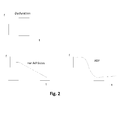
- Fig. 2 shows three frequency responses of the quartz crystal over the time of three different platelet functions.
- the first frequency curve showed a straight curve over the whole time. A frequency drop can not be determined in this case. This means that no or negligible few platelets attach to the quartz crystal surface. Such a frequency course clearly indicates a dysfunction of the platelets. Perhaps this is also prevented by a deliberate blockade by adding abciximab, at the To attach quartz crystal surface. The platelets are unable to adhere either due to dysfunction or because they have been deliberately inhibited with abciximab, for example.
- the second curve shows a linearly decreasing frequency course over time. This shows that progressively an increasing number of platelets and other blood components attach to the quartz crystal surface. Such a frequency curve allows the clear conclusion that an adhesion takes place.
- a steeply falling frequency curve is shown.
- Such a curve may indicate the presence of functional platelets having at least one functional receptor for aggregation.
- the blood For aggregation, the blood must be activated. This can be triggered by adenosine diphosphate (ADP), fibrinogen or van Willebrand factor (vWF). Also possible is activation by means of archidonic acid (AA). Depending on the activator used or any selective inhibitor used, the functionality of the individual receptors of the platelets can thus be checked.
- ADP adenosine diphosphate
- vWF van Willebrand factor
- AA archidonic acid
Landscapes
- Health & Medical Sciences (AREA)
- Life Sciences & Earth Sciences (AREA)
- Immunology (AREA)
- Engineering & Computer Science (AREA)
- Chemical & Material Sciences (AREA)
- Hematology (AREA)
- Physics & Mathematics (AREA)
- Pathology (AREA)
- Molecular Biology (AREA)
- General Health & Medical Sciences (AREA)
- Biochemistry (AREA)
- Analytical Chemistry (AREA)
- Urology & Nephrology (AREA)
- Biomedical Technology (AREA)
- General Physics & Mathematics (AREA)
- Cell Biology (AREA)
- Microbiology (AREA)
- Biotechnology (AREA)
- Acoustics & Sound (AREA)
- Food Science & Technology (AREA)
- Medicinal Chemistry (AREA)
- Investigating Or Analysing Biological Materials (AREA)
Abstract
Description
- Die Erfindung betrifft ein Verfahren zur Bestimmung der Thrombozytenfunktion gemäß der im Oberbegriff des Anspruchs 1 angegebenen Art.
- Für die Blutgerinnung müssen sowohl die primäre als auch die sekundäre Hämostase funktionsfähig sein. Zur Überprüfung der sekundären Hämostase sind viele Möglichkeiten bekannt. Für die primäre Hämostase, die sich in Adhäsion und Aggregation von Thrombozyten unterteilt, ist dem Stand der Technik kein ausreichend genaues Analyseverfahren zur Bestimmung der spezifischen Thrombozytenfunktion zu entnehmen.
- Nach dem Stand der Technik sind Blutanalysen, welche die Hämostase betreffen möglich. Jedoch ist eine Unterscheidung, bei der primären Hämostase, ob Adhäsion oder Aggregation geschädigt ist, oder in welcher Art die Aggregation gehemmt ist, nicht möglich.
- Es ist bekannt, dass Blutplättchen auf der Oberfläche eines Schwingquarzes durch Adhäsion angelagert werden können. Diese Anlagerung ist qualitativ messbar, lässt jedoch keine spezifische Identifikation einer Fehlfunktion der Aggregation zu.
- Die Veröffentlichung "real-time monitoring of adhesion and aggregation of platelets using thickness shear mode sensors" (E. Ergezen et al., Biosensors and Bioelectronics 23 (2007), 575 - 582) beschreibt eine Analyse der Blutgerinnung von Adhäsion und Aggregation von Blutplättchen mittels eines Schwingquarzes. Diese Schrift zeigt, dass verschiedene Phasen, Adhäsion, und Aggregation mit Hilfe eines Schwingquarzes qualitativ nachweisbar ist. Sie löst nicht das Problem, die Funktionsfähigkeit der Thrombozyten zu Adhäsion und Aggregation zu unterscheiden. Aus dieser Druckschrift ist bekannt, dass die Aggregation von mangelnder Adhäsionsfähigkeit gut abgrenzbar ist, da eine erfolgreiche Aggregation eine hohe Frequenz bzw. Dämpfungsänderung nach sich zieht.
- Entsprechend ist bekannt die Aggregationsfähigkeit festzustellen. Zwischen Adhäsionsfähigkeit und Aggregationsfähigkeit der Thrombozyten kann nach diesem Verfahren nicht zuverlässig unterschieden werden, da der Frequenzhub nicht nur von der Zugabe von ADP abhängig ist, sondern auch von der Thrombozytenkonzentration, der Bindungsstärke der Schwingquarzoberfläche und der Adhäsionsfähigkeit der Thrombozyten. Durch diese Betrachtung kann möglicherweise eine falschpositive Entscheidung erfolgen, da lediglich zwischen einem erfolgten Frequenzabfall und keinem Frequenzabfall unterschieden wird, wobei auch lediglich die Adhäsion der Thrombozyten unter bestimmten Vorraussetzungen zu einem starken Frequenzabfall führen kann. Auch die
US 2005/0015001 A1 beschreibt im Wesentlichen das oben genannte. - Die Druckschrift "A new method for continuous measurement of platelet adhesion under flow conditions" (K. Kawakami et al., ASAIO Journal 39 (1993), M558 - M560) offenbart, dass eine Adhäsion von Plättchen messbar ist, stellt aber keinen Bezug zur Analyse einer Dysfunktion noch einer Kombination mit einer Bewertung der Aggregationsfunktion her.
- Im Vortrag "Potenzial der Schwingquarzsensoren zur inline Hämothese-Prüfung" (F.K. Gehring, Miniaturisierte Biosystemtechnik, BMBF, Hannover, 07.10.2008) auf Folie 24 sind zwei Frequenzverläufe dargestellt, die Rückschluss auf die Thrombozytenfunktion geben sollen. Eine Darstellung zeigt einen Frequenzabfall bei einer Schwingquarzmessung von aktiviertem Blut, die zweite Kurve zeigt keinen Frequenzabfall bei inhibiertem Blut. Dies gibt in der Form lediglich wieder, dass sich eine Funktion anhand des Verhaltens der Schwingungsparameter ablesen lässt. Es ist aufgrund dieser Unterlagen unklar, ob die dargelegte Funktion eine Adhäsion, Aggregation oder sonstige Ablagerung eines Stoffs auf der Schwingquarzoberfläche abbildet. Eine eindeutige Funktionszuordnung kann dieser Offenbarung nicht entnommen werden.
- Auch die Druckschrift "Novel instrumentation monitoring in situ platelet adhesivity with a quartz crystal microbalance" (T. Matsuda, ASAIO 38 (1992), M171 - M173) beschreibt eine Untersuchung der Thrombozytenfunktion mittels eines Schwingquarzes, wobei der zeitliche Verlauf der Resonanzfrequenz beobachtet wird.
- Es ist die Aufgabe der Erfindung ein Verfahren anzugeben mittels dem eine Aussage getroffen werden kann, welcher Zweig der zellulär vermittelten Gerinnung gestört ist.
- Die Aufgabe wird durch die kennzeichnenden Merkmale des Anspruchs 1 gelöst.
- In bekannter Weise werden zur Bestimmung von Parametern der primären Hämostase die Schwingungsparameter eines Resonators gemessen, der mit einer Oberfläche versehen ist, die in Kontakt mit einem Thrombozyten enthaltenden Probenfluid steht. Dadurch lagern sich Thrombozyten oder andere Blutbestandteile an der Oberfläche des Schwingquarzes an, die dessen Schwingungsverhalten beeinflussen.
- Erfindungsgemäß wird zur Bestimmung der Thrombozytenfunktion ein Probenfluid auf eine Resonatoroberfläche und eine Analyse der Charakteristik beziehungsweise Kinetik der oder des gemessenen Schwingungsparameters durchgeführt, aufgrund der die Thrombozytenfunktion bewertet wird. Anhand der Charakteristik wird zwischen totaler Dysfunktion bzw. Adhäsionsstörung und Aggregationsstörung der Thrombozyten unterschieden. Es wird die Charakteristik des Verlaufs der Schwingungsparameter über die Zeit ausgewertet und abhängig davon wird eine Aussage getroffen, welcher Zweig der zellulär vermittelten Gerinnung gestört ist. Durch dieses Verfahren wird eine Diagnostik mit einem Resonator ermöglicht.
- Dies hat den enormen Vorteil, dass durch eine Unterscheidung welcher Zweig der Gerinnung gestört ist eine entsprechend abgestimmte Medikation erfolgen kann. Grundsätzlich wird aufgrund dieser Untersuchungsmöglichkeiten ein großer Informationspool der zellulär vermittelten Gerinnung bereitgestellt. Eine gezielte Medikation vermindert die Nebenwirkungen für den Patienten deutlich und kann bedeutend Kosten sparen.
- Grundsätzlich werden in einer ersten Ausführungsform die Schwingungsparameter in Form der Resonanzfrequenz ausgewertet. Alternativ dazu kann auch die Dämpfung bzw. Amplitude des Resonators ausgewertet werden. Insbesondere wird die Grundschwingung betrachtet.
- Nach Starten der Messung wird ein Thrombozyten enthaltendes Probefluid auf den Schwingquarz aufgebracht. Verändert sich die Kurve der Schwingungsparameter über die Zeit nicht, wird auf eine Dysfunktion in der Thrombozytenfunktion geschlossen. Dies bedeutet, dass die Thrombozyten nicht adhärieren können, was zur Folge hat, dass auch keine Aggregation möglich ist. Eine weitere Untersuchung ist nicht notwendig, da sofern keine Adhäsion möglich ist auch keine Blutgerinnung erfolgt. Die Dysfunktion entspricht also einer Adhäsionsstörung.
- Im Gegensatz dazu schließt man bei einem mehr oder weniger linearen Abfall der Schwingungsparameter über die Zeit auf eine grundsätzliche Adhäsionsfähigkeit der Thrombozyten. Die Adhäsion kann durch Zusatz einInhibitors verhindert werden. So kann beispielsweise der GPIIb/IIIa-Rezeptor blockiert werden, um eine Adhäsion zu vermeiden. Es ist also möglich, dass nachdem eine Probe positiv auf ihre Adhäsionsfunktion getestet wurde der Versuch mit künstlich gehemmter Thrombozytenfunktion wiederholt wird, um das Ergebnis zu verifizieren.
- Nach dem Verfahren werden die Thrombozyten in einem nicht aktivierten Probenfluid, das auf einen Schwingquarz aufgebracht wird aufgrund des Abfalls von Schwingungsparametern als adhäsionsfähig eingestuft.
- Um die Aggregationsfähigkeit der Thrombozyten im Probenfluid zu untersuchen, muss dieses aktiviert werden. Die Aktivierung der Probe erfolgt durch Zugabe eines Aktivators. Der Aktivator kann entweder kurz vor der Applikation der Probe eingebracht werden oder der Schwingquarz selbst weist an seiner Oberfläche einen bereits eingebrachten Aktivator auf. Entsprechend dem Verfahren wird auch hier der Schwingungsparameter über die Zeit aufgezeichnet. Stellt man einen sehr starken Abfall der Schwingungsparameter etwa in exponentieller Form fest, werden die Thrombozyten als aggregationsfähig eingestuft.
- Entspricht das Schwingungsverhalten des Schwingquarzes mit aktivierter Probe dem der nicht aktivierten Probe, so wird darauf geschlossen, dass die Thrombozyten adhäsionsfähig aber nicht aggregationsfähig sind. Es wird auf eine Aggregationsstörung geschlossen.
- Darüber hinaus kann durch Zugabe verschiedener Aktivatoren ermittelt werden, welcher Rezeptor der Thrombozyten eine Dysfunktion aufweist. Die unterschiedlichen Aktivierungszweige können somit über Zugabe von entweder van Willebrand Faktor (vWF), Archidonsäure (AA), Adenosin-Diphosphat (ADP) oder Fibrinogen ausgelöst werden, was eine Eingrenzung der Dysfunktion der entsprechenden Aktivierungszweige erlaubt.
- Diese Eingrenzung kann auch dadurch erfolgen, dass bei einer erfolgreichen Aggregation der Thrombozyten unterschiedliche Rezeptoren blockiert werden. Sind alle Rezeptoren bis auf einen zu untersuchenden Rezeptor blockiert, kann festgestellt werden, ob dieser Rezeptor eine Störung aufweist, indem das Aggregationsverhalten der aktivierten Probe gemessen wird und man bei einem Verlauf der Schwingungsparameter, der einer Adhäsion entspricht, auf eine Störung des nicht blockierten Rezeptors schließen kann.
- Insbesondere durch Aktivierung und Blockierung einzelner Rezeptoren werden jene identifiziert, welche Funktionsstörungen aufweisen. Des Weiteren ist die Blockierung oder Aktivierung einzelner Gruppen von Rezeptoren durch einen spezifischen Antikörper oder Teile davon vorgesehen. Darüber hinaus kann diese Funktion auch durch andere spezifisch bindende Moleküle wie zum Beispiel Lektine oder Fragmente von Nukleinsäuren bewirkt werden.
- Vorteilhafte Auswirkungen hat es auch, einen Aktivator, wie beispielsweise Fibrinogen bereits in die Oberfläche beispielsweise eines Schwingquarzes zu integrieren. Man umgeht dabei das Problem, dass der Zeitpunkt von der Aktivierung der Probe bis zur Messung nicht besonders kurz sein muss und daher die gesamte Vorrichtung einfacher gestaltet werden kann. Die Thrombozyten adhärieren an der Fibrinogenschicht und werden gleichzeitig aktiviert, wodurch die Aggregation ausgelöst wird.
- Weitere Vorteile, Merkmale und Anwendungsmöglichkeiten der vorliegenden Erfindung ergeben sich aus der nachfolgenden Beschreibung in Verbindung mit den in den Zeichnungen dargestellten Ausführungsbeispielen.
- In der Beschreibung, in den Ansprüchen und in der Zeichnung werden die in der unten aufgeführten Liste der Bezugszeichen verwendeten Begriffe und zugeordneten Bezugszeichen verwendet. In der Zeichnung bedeutet:
- Fig. 1
- einen Verfahrensablauf zur Bestimmung der Thrombozytenfunktion, und
- Fig. 2
- schematische Darstellung des Vorlaufs von Schwingungsparametern für Dysfunktion und Adhäsion und Aggregation.
- In
Fig.1 ist der Ablauf zur Untersuchung der Thrombozytenfunktion einer Blutprobe dargestellt. Als erstes werden Thrombozyten, die nicht aktiviert sind und deren Adhäsionsfähigkeit blockiert ist auf einen Schwingquarz aufgebracht. Die Adhäsionsfähigkeit kann künstlich gestört werden, indem beispielsweise der Collagenrezeptor oder GPIB-IX Rezeptor durch Abciximab blockiert wird. Dies verhindert die Adhäsion der Thrombozyten auf der Schwingquarzoberfläche, wodurch eine unbelastete Referenzkurve der Resonanzfrequenz aufgenommen wird. - Nach Aufnahme der Referenzkurve wird eine weiteres Probenfluid entweder auf denselben Schwingquarz oder auf den gereinigten Schwingquarz aufgebracht. Dieses Probenfluid enthält Thrombozyten deren Rezeptoren bezüglich der Adhäsion weder blockiert noch aktiviert sind. Anschließend erfolgt die Analyse der Kurve. Fällt die Resonanzfrequenz über die Zeit stärker ab, als dies bei der Probe mit den gehemmten Adhäsionsrezeptoren der Fall war, sind die Thrombozyten in dem Probenfluid adhäsionsfähig und es schließt sich ein weiterer Messschritt an.
- In einem weiteren Schritt wird eine mit einem Aktivator induziertes Probenfluid beispielsweise mit Adenosin-Diphosphat (ADP), van Willebrand Faktor (vWF) oder einem anderen Faktor auf die Schwingquarzoberfläche aufgebracht. Fällt die gemessene Resonanzfrequenz über die Zeit stärker ab als im vorangegangenen Schritt, in dem die Adhäsion gemessen wurde, lässt sich dann bei einer Aktivierung durch Fibrinogen darauf schließen, dass die primäre Aggregation funktionsfähig ist. In einem weiteren Schritt wird ein Aktivator oder eine mit einem Aktivator induzierte Probe zugegeben, was die sekundäre Aggregation auslöst.
- Nimmt die Resonanzfrequenz über die Zeit deutlich stärker ab als zuvor, ist auch die sekundäre Aggregation funktionsfähig. Beeinflussen entsprechend zugegebene Aktivatoren das Schwingungsverhalten des Resonators nicht, wird auf eine Fehlfunktion der korrespondierenden Rezeptoren geschlossen.
- Durch diesen Ablauf ist ein grundsätzlicher Ablauf gegeben, der darin besteht, zuerst eine inhibierte, dann eine nicht-aktivierte und anschließend eine aktivierte Probe, unterbrochen durch beliebige Spülschritte, zu vermessen. Darüber hinaus können auf diese Weise mehrere Kombinationen aus Inhibition und Aktivierung in diesen Ablauf aufgenommen werden.
- Auf diese Weise lässt sich eindeutig der gestörte Zweig der zellulär vermittelten Gerinnung ermitteln.
-
Fig. 2 zeigt drei Frequenzverläufe des Schwingquarzes über die Zeit von drei unterschiedlichen Thrombozytenfunktionen. Der erste Frequenzverlauf zeigte eine gerade Kurve über die gesamte Zeit. Ein Frequenzabfall ist in diesem Fall nicht festzustellen. Dies bedeutet, dass sich keine oder vernachlässigbar wenige Thrombozyten an der Schwingquarzoberfläche anlagern. Ein solcher Frequenzverlauf lässt eindeutig auf eine Dysfunktion der Thrombozyten schließen. Möglicherweise ist dieser auch durch eine bewusste Blockade durch Zugabe von Abciximab daran gehindert, sich an der Schwingquarzoberfläche anzulagern. Die Thrombozyten sind nicht in der Lage zu adhärieren, entweder aufgrund einer Dysfunktion oder weil diese beispielsweise mit Abciximab bewusst gehemmt wurden. - Die zweite Kurve zeigt einen linear abfallenden Verlauf der Frequenz über die Zeit. Dies zeigt, dass sich nach und nach eine zunehmende Anzahl von Thrombozyten und andere Blutbestandteile an der Schwingquarzoberfläche anlagern. Ein derartiger Frequenzverlauf lässt den eindeutigen Schluss zu, dass eine Adhäsion stattfindet.
- In einem dritten Graph ist eine stark abfallende Frequenzkurve dargestellt. Ein solcher Kurvenverlauf kann lässt auf das Vorhandensein funktionsfähiger Thrombozyten schließen, die mindestens einen funktionsfähigen Rezeptor für die Aggregation aufweisen. Für eine Aggregation muss das Blut aktiviert werden. Dies kann mittels Adenosin-Diphosphat (ADP), Fibrinogen oder dem van Willebrand Faktor (vWF) ausgelöst werden. Möglich ist auch eine Aktivierung mittels Archidonsäure (AA). Abhängig vom verwendeten Aktivator beziehungsweise einem etwaig angewandten selektiven Inhibitor kann so die Funktionsfähigkeit der einzelnen Rezeptoren der Thrombozyten überprüft werden.
Claims (12)
- Verfahren zur Bestimmung von Parametern der Hämostase mittels der Messung von Schwingungsparametern eines Resonators mit einer Messoberfläche, die in Kontakt mit einem Thrombozyten enthaltenden Probenfluid steht, gekennzeichnet durch, die Analyse der Charakteristik eines Schwingungsparameters über die Zeit, aufgrund welcher die Thrombozytenfunktion bewertet wird und zwischen Adhäsionsstörung und Aggregationsstörung unterschieden wird.
- Verfahren nach Anspruch 1, dadurch gekennzeichnet, dass als Schwingungsparameter die Resonanzfrequenz ausgewertet wird.
- Verfahren nach Anspruch 1 bis 2, dadurch gekennzeichnet, dass als Schwingungsparameter die Dämpfung und oder Amplitude ausgewertet wird.
- Verfahren nach einem der vorangegangenen Ansprüche, dadurch gekennzeichnet, dass bei unveränderten Schwingungsparametern auf eine absolute Dysfunktion geschlossen wird.
- Verfahren nach einem der vorangegangenen Ansprüche, dadurch gekennzeichnet, dass bei einem Abfall der Schwingungsparameter eines nicht aktivierten Probenfluids die Thrombozyten als adhäsionsfähig eingestuft werden.
- Verfahren nach einem der vorangegangenen Ansprüche, dadurch gekennzeichnet, dass das Probefluid aktiviert wird.
- Verfahren nach Anspruch 6, dadurch gekennzeichnet, dass sofern ein mehr oder minder exponentieller Abfall der Schwingungsparameter vorliegt die Thrombozyten als funktionsfähig eingestuft werden.
- Verfahren nach Anspruch 6, dadurch gekennzeichnet, dass sofern ein mehr oder minder linearer Abfall der Schwingungsparameter vorliegt die Thrombozytenfunktion als Aggregations-Dysfunktion jedoch mit einer funktionierenden Adhäsions-Funktion eingestuft wird.
- Verfahren nach den Ansprüchen 6 bis 7, dadurch gekennzeichnet, dass die Thrombozytenfunktion durch Zugabe verschiedener Aktivatoren, die unterschiedliche Aktivierungszweige auslösen, näher spezifiziert wird.
- Verfahren nach einem der vorangegangenen Ansprüche, dadurch gekennzeichnet, dass das Aktivierungszweige durch Zugabe entsprechender Inhibitoren blockiert werden.
- Verfahren nach den Ansprüchen 9 und 10, dadurch gekennzeichnet, dass durch Aktivierung und Blockierung einzelner Rezeptoren diejenigen identifiziert werden, die Funktionsstörungen aufweisen.
- Verfahren nach einem der vorangegangenen Ansprüche, dadurch gekennzeichnet, dass die Blockierung oder Aktivierung einzelner oder Gruppen von Rezeptoren durch einen spezifischen Antikörper, durch Teile davon oder durch andere spezifisch bindende Moleküle wie Lektine, Fragmente von Nukleinsäuren oder Ähnlichem bewirkt wird.
Applications Claiming Priority (2)
| Application Number | Priority Date | Filing Date | Title |
|---|---|---|---|
| DE102009040881A DE102009040881A1 (de) | 2009-09-09 | 2009-09-09 | Verfahren zur Bestimmung der Thrombozytenfunktion mit einem Resonator |
| EP10760912.5A EP2475979B1 (de) | 2009-09-09 | 2010-09-09 | Verfahren zur bestimmung der thrombozytenfunktion mit einem resonator |
Related Parent Applications (1)
| Application Number | Title | Priority Date | Filing Date |
|---|---|---|---|
| EP10760912.5A Division EP2475979B1 (de) | 2009-09-09 | 2010-09-09 | Verfahren zur bestimmung der thrombozytenfunktion mit einem resonator |
Publications (2)
| Publication Number | Publication Date |
|---|---|
| EP2708900A1 true EP2708900A1 (de) | 2014-03-19 |
| EP2708900B1 EP2708900B1 (de) | 2017-04-12 |
Family
ID=43217462
Family Applications (2)
| Application Number | Title | Priority Date | Filing Date |
|---|---|---|---|
| EP10760912.5A Not-in-force EP2475979B1 (de) | 2009-09-09 | 2010-09-09 | Verfahren zur bestimmung der thrombozytenfunktion mit einem resonator |
| EP13196301.9A Not-in-force EP2708900B1 (de) | 2009-09-09 | 2010-09-09 | Verfahren zur Bestimmung der Thrombozytenfunktion mit einem Resonator |
Family Applications Before (1)
| Application Number | Title | Priority Date | Filing Date |
|---|---|---|---|
| EP10760912.5A Not-in-force EP2475979B1 (de) | 2009-09-09 | 2010-09-09 | Verfahren zur bestimmung der thrombozytenfunktion mit einem resonator |
Country Status (5)
| Country | Link |
|---|---|
| US (1) | US8883510B2 (de) |
| EP (2) | EP2475979B1 (de) |
| JP (1) | JP5738864B2 (de) |
| DE (1) | DE102009040881A1 (de) |
| WO (1) | WO2011029600A1 (de) |
Families Citing this family (3)
| Publication number | Priority date | Publication date | Assignee | Title |
|---|---|---|---|---|
| US8448499B2 (en) | 2008-12-23 | 2013-05-28 | C A Casyso Ag | Cartridge device for a measuring system for measuring viscoelastic characteristics of a sample liquid, a corresponding measuring system, and a corresponding method |
| US10816559B2 (en) | 2014-09-29 | 2020-10-27 | Ca Casyso Ag | Blood testing system and method |
| US10539579B2 (en) | 2014-09-29 | 2020-01-21 | C A Casyso Gmbh | Blood testing system and method |
Citations (1)
| Publication number | Priority date | Publication date | Assignee | Title |
|---|---|---|---|---|
| US20050015001A1 (en) | 2003-04-16 | 2005-01-20 | Lec Ryszard M. | Acoustic blood analyzer for assessing blood properties |
Family Cites Families (10)
| Publication number | Priority date | Publication date | Assignee | Title |
|---|---|---|---|---|
| US4246344A (en) * | 1979-04-09 | 1981-01-20 | Minnesota Mining And Manufacturing Company | Method of detecting adherent cells |
| US4695956A (en) * | 1984-11-01 | 1987-09-22 | Leveen Eric G | Apparatus and method of quantifying hemostasis using oscillations from a transducer immersed in the blood sample |
| WO1991001383A1 (en) * | 1989-07-14 | 1991-02-07 | Michigan State University | Method for diagnosing blood clotting disorders |
| JP2851510B2 (ja) * | 1993-04-27 | 1999-01-27 | 新日本製鐵株式会社 | 材料の抗血栓性判定方法及び判定装置 |
| JPH0885726A (ja) * | 1993-07-30 | 1996-04-02 | Dainippon Ink & Chem Inc | 顔料分散体の製法、インキおよび塗料 |
| US6046051A (en) * | 1997-06-27 | 2000-04-04 | Hemosense, Inc. | Method and device for measuring blood coagulation or lysis by viscosity changes |
| WO2003019981A2 (en) * | 2001-08-28 | 2003-03-06 | Michael Thompson | Electromagnetic piezoelectric acoustic sensor |
| US20080261261A1 (en) * | 2006-03-31 | 2008-10-23 | Kmg2 Sensors Corporation | System/unit and method employing a plurality of magnetoelastic sensor elements for automatically quantifying parameters of whole blood and platelet-rich plasma |
| US20080114549A1 (en) * | 2006-11-09 | 2008-05-15 | Mark Evan Schafer | Rapid response blood analyzer |
| WO2009075891A2 (en) | 2007-12-12 | 2009-06-18 | Kmg2 Sensors Corporation (Kmg2) | Magnetoelastic sensor element having a liquid-solid interface with a roughened nano/microstructure |
-
2009
- 2009-09-09 DE DE102009040881A patent/DE102009040881A1/de not_active Ceased
-
2010
- 2010-09-09 EP EP10760912.5A patent/EP2475979B1/de not_active Not-in-force
- 2010-09-09 JP JP2012528272A patent/JP5738864B2/ja not_active Expired - Fee Related
- 2010-09-09 EP EP13196301.9A patent/EP2708900B1/de not_active Not-in-force
- 2010-09-09 WO PCT/EP2010/005548 patent/WO2011029600A1/de not_active Ceased
- 2010-09-09 US US13/394,550 patent/US8883510B2/en not_active Expired - Fee Related
Patent Citations (1)
| Publication number | Priority date | Publication date | Assignee | Title |
|---|---|---|---|---|
| US20050015001A1 (en) | 2003-04-16 | 2005-01-20 | Lec Ryszard M. | Acoustic blood analyzer for assessing blood properties |
Non-Patent Citations (5)
| Title |
|---|
| E. ERGEZEN ET AL.: "Yeal-time monitoring of adhesion and aggregation of platelets using thickness shear mode sensors", BIOSENSORS AND BIOELECTRONICS, vol. 23, 2007, pages 575 - 582 |
| F.K. GEHRING: "Potenzial der Schwingquarzsensoren zur inline Hämothese-Prüfung", MINIATURISIERTE BIOSYSTEMTECHNIK, BMBF, HANNOVER, 7 October 2008 (2008-10-07) |
| K. KAWAKAMI ET AL.: "A new method for continuous measurement of platelet adhesion under flow conditions", ASAIO JOURNAL, vol. 39, 1993, pages M558 - M560, XP008130070 |
| T. MATSUDA: "Novel instrumentation monitoring in situ platelet adhesivity with a quartz crystal microbalance", ASAIO, vol. 38, 1992, pages M171 - M173 |
| TAKEHISA MATSUDA ET AL: "NOVEL INSTRUMENTATION MONITORING IN SITU PLATELET ADHESIVITY WITH A QUARTZ CRYSTAL MICROBALANCE", ASAIO JOURNAL, LIPPINCOTT WILLIAMS & WILKINS / ASAIO, HAGERSTOWN, MD, US, vol. 38, no. 3, July 1992 (1992-07-01), pages 171 - 173, XP000321538, ISSN: 1058-2916 * |
Also Published As
| Publication number | Publication date |
|---|---|
| WO2011029600A1 (de) | 2011-03-17 |
| EP2475979B1 (de) | 2013-12-11 |
| JP2013504070A (ja) | 2013-02-04 |
| US8883510B2 (en) | 2014-11-11 |
| DE102009040881A1 (de) | 2011-05-05 |
| EP2708900B1 (de) | 2017-04-12 |
| JP5738864B2 (ja) | 2015-06-24 |
| US20120270326A1 (en) | 2012-10-25 |
| EP2475979A1 (de) | 2012-07-18 |
Similar Documents
| Publication | Publication Date | Title |
|---|---|---|
| DE102015121621B4 (de) | Vorrichtung zur sicheren Bestimmung und/oder Überwachung einer Prozessgröße | |
| EP0737853B1 (de) | Biosensor | |
| EP1491887B1 (de) | Verfahren zum Ermitteln der Porosität eines Werkstückes mittels Ultraschall | |
| EP3489634A1 (de) | Ultraschall-messvorrichtung und verfahren zur ultraschallmessung an einem strömenden fluid | |
| EP2708900B1 (de) | Verfahren zur Bestimmung der Thrombozytenfunktion mit einem Resonator | |
| EP2629088A1 (de) | Vorrichtung und Verfahren zum Bestimmen einer biochemischen Funktion eines Fluids | |
| EP3517946A1 (de) | Verfahren zur ermittlung eines korrigierten werts für die viskositätsabhängige schallgeschwindigkeit in einem zu untersuchenden fluid | |
| EP2475980B1 (de) | Verfahren zur bestimmung der gerinnungszeit | |
| EP2131197A1 (de) | Verfahren zum Bestimmen eines Analyten in einer Flüssigkeitsprobe und Analysevorrichtung | |
| EP2475990B1 (de) | Vorrichtung zur durchführung von tests zur hämostase | |
| EP3417290B1 (de) | Testkit zur bioanalytik und verfahren zur auswertung eines solchen testkits | |
| WO2021110434A1 (de) | Verfahren zur bestimmung und/oder überwachung zumindest einer rheologischen eigenschaft eines mediums | |
| DE102012108401B4 (de) | Verfahren und Vorrichtung zur synchronen Bestimmung der rheologischen und akustischen Eigenschaften | |
| DE102015210604B4 (de) | Verfahren zur Ermittlung von Materialeigenschaften | |
| DE102010049766B4 (de) | Verfahren und Vorrichtung zum Messen der Viskosität | |
| DE102004057350B3 (de) | Verfahren zur Klassifikation und zur Bestimmung der Einzelkonzentrationen eines Stoffgemisches | |
| WO2011121097A2 (de) | Verfahren und vorrichtung zur untersuchung von molekülbindungen | |
| DE102008019973A1 (de) | Verfahren und Einrichtung zum Messen von Gaskonzentrationen | |
| DE102012107667A1 (de) | Verfahren und Vorrichtung zur Bestimmung eines Sauerstoffgehaltes in einem flüssigen oder gasförmigen Medium, vorzugsweise zur Überwachung einer sicherheitsrelevanten Anlage | |
| EP2146203A2 (de) | Verfahren zur spannungsunabhängigen Texturbestimmung eines ferromagnetischen Werkstückes | |
| DE102008019991A1 (de) | Konzentrationsbestimmungsverfahren und Messgerät | |
| EP0612990A2 (de) | Anordnung und Verfahren zur Bestimmung des Schädigungsniveaus eines mechanisch belasteten Bauteils |
Legal Events
| Date | Code | Title | Description |
|---|---|---|---|
| PUAI | Public reference made under article 153(3) epc to a published international application that has entered the european phase |
Free format text: ORIGINAL CODE: 0009012 |
|
| AC | Divisional application: reference to earlier application |
Ref document number: 2475979 Country of ref document: EP Kind code of ref document: P |
|
| AK | Designated contracting states |
Kind code of ref document: A1 Designated state(s): AL AT BE BG CH CY CZ DE DK EE ES FI FR GB GR HR HU IE IS IT LI LT LU LV MC MK MT NL NO PL PT RO SE SI SK SM TR |
|
| RIN1 | Information on inventor provided before grant (corrected) |
Inventor name: SINN, STEFAN Inventor name: MUELLER, LOTHAR Inventor name: GEHRING, FRANK K. Inventor name: WENDEL, HANS-PETER |
|
| 17P | Request for examination filed |
Effective date: 20140919 |
|
| RBV | Designated contracting states (corrected) |
Designated state(s): AL AT BE BG CH CY CZ DE DK EE ES FI FR GB GR HR HU IE IS IT LI LT LU LV MC MK MT NL NO PL PT RO SE SI SK SM TR |
|
| 17Q | First examination report despatched |
Effective date: 20150116 |
|
| GRAP | Despatch of communication of intention to grant a patent |
Free format text: ORIGINAL CODE: EPIDOSNIGR1 |
|
| STAA | Information on the status of an ep patent application or granted ep patent |
Free format text: STATUS: GRANT OF PATENT IS INTENDED |
|
| INTG | Intention to grant announced |
Effective date: 20161118 |
|
| GRAS | Grant fee paid |
Free format text: ORIGINAL CODE: EPIDOSNIGR3 |
|
| GRAA | (expected) grant |
Free format text: ORIGINAL CODE: 0009210 |
|
| STAA | Information on the status of an ep patent application or granted ep patent |
Free format text: STATUS: THE PATENT HAS BEEN GRANTED |
|
| AC | Divisional application: reference to earlier application |
Ref document number: 2475979 Country of ref document: EP Kind code of ref document: P |
|
| AK | Designated contracting states |
Kind code of ref document: B1 Designated state(s): AL AT BE BG CH CY CZ DE DK EE ES FI FR GB GR HR HU IE IS IT LI LT LU LV MC MK MT NL NO PL PT RO SE SI SK SM TR |
|
| REG | Reference to a national code |
Ref country code: GB Ref legal event code: FG4D Free format text: NOT ENGLISH |
|
| REG | Reference to a national code |
Ref country code: CH Ref legal event code: EP |
|
| REG | Reference to a national code |
Ref country code: IE Ref legal event code: FG4D Free format text: LANGUAGE OF EP DOCUMENT: GERMAN |
|
| REG | Reference to a national code |
Ref country code: AT Ref legal event code: REF Ref document number: 884427 Country of ref document: AT Kind code of ref document: T Effective date: 20170515 |
|
| REG | Reference to a national code |
Ref country code: DE Ref legal event code: R096 Ref document number: 502010013474 Country of ref document: DE |
|
| REG | Reference to a national code |
Ref country code: SE Ref legal event code: TRGR |
|
| REG | Reference to a national code |
Ref country code: NL Ref legal event code: MP Effective date: 20170412 |
|
| REG | Reference to a national code |
Ref country code: LT Ref legal event code: MG4D |
|
| PG25 | Lapsed in a contracting state [announced via postgrant information from national office to epo] |
Ref country code: NL Free format text: LAPSE BECAUSE OF FAILURE TO SUBMIT A TRANSLATION OF THE DESCRIPTION OR TO PAY THE FEE WITHIN THE PRESCRIBED TIME-LIMIT Effective date: 20170412 |
|
| PG25 | Lapsed in a contracting state [announced via postgrant information from national office to epo] |
Ref country code: ES Free format text: LAPSE BECAUSE OF FAILURE TO SUBMIT A TRANSLATION OF THE DESCRIPTION OR TO PAY THE FEE WITHIN THE PRESCRIBED TIME-LIMIT Effective date: 20170412 Ref country code: GR Free format text: LAPSE BECAUSE OF FAILURE TO SUBMIT A TRANSLATION OF THE DESCRIPTION OR TO PAY THE FEE WITHIN THE PRESCRIBED TIME-LIMIT Effective date: 20170713 Ref country code: HR Free format text: LAPSE BECAUSE OF FAILURE TO SUBMIT A TRANSLATION OF THE DESCRIPTION OR TO PAY THE FEE WITHIN THE PRESCRIBED TIME-LIMIT Effective date: 20170412 Ref country code: FI Free format text: LAPSE BECAUSE OF FAILURE TO SUBMIT A TRANSLATION OF THE DESCRIPTION OR TO PAY THE FEE WITHIN THE PRESCRIBED TIME-LIMIT Effective date: 20170412 Ref country code: LT Free format text: LAPSE BECAUSE OF FAILURE TO SUBMIT A TRANSLATION OF THE DESCRIPTION OR TO PAY THE FEE WITHIN THE PRESCRIBED TIME-LIMIT Effective date: 20170412 Ref country code: NO Free format text: LAPSE BECAUSE OF FAILURE TO SUBMIT A TRANSLATION OF THE DESCRIPTION OR TO PAY THE FEE WITHIN THE PRESCRIBED TIME-LIMIT Effective date: 20170712 |
|
| PG25 | Lapsed in a contracting state [announced via postgrant information from national office to epo] |
Ref country code: IS Free format text: LAPSE BECAUSE OF FAILURE TO SUBMIT A TRANSLATION OF THE DESCRIPTION OR TO PAY THE FEE WITHIN THE PRESCRIBED TIME-LIMIT Effective date: 20170812 Ref country code: PL Free format text: LAPSE BECAUSE OF FAILURE TO SUBMIT A TRANSLATION OF THE DESCRIPTION OR TO PAY THE FEE WITHIN THE PRESCRIBED TIME-LIMIT Effective date: 20170412 Ref country code: LV Free format text: LAPSE BECAUSE OF FAILURE TO SUBMIT A TRANSLATION OF THE DESCRIPTION OR TO PAY THE FEE WITHIN THE PRESCRIBED TIME-LIMIT Effective date: 20170412 Ref country code: BG Free format text: LAPSE BECAUSE OF FAILURE TO SUBMIT A TRANSLATION OF THE DESCRIPTION OR TO PAY THE FEE WITHIN THE PRESCRIBED TIME-LIMIT Effective date: 20170712 |
|
| REG | Reference to a national code |
Ref country code: DE Ref legal event code: R097 Ref document number: 502010013474 Country of ref document: DE |
|
| PG25 | Lapsed in a contracting state [announced via postgrant information from national office to epo] |
Ref country code: DK Free format text: LAPSE BECAUSE OF FAILURE TO SUBMIT A TRANSLATION OF THE DESCRIPTION OR TO PAY THE FEE WITHIN THE PRESCRIBED TIME-LIMIT Effective date: 20170412 Ref country code: CZ Free format text: LAPSE BECAUSE OF FAILURE TO SUBMIT A TRANSLATION OF THE DESCRIPTION OR TO PAY THE FEE WITHIN THE PRESCRIBED TIME-LIMIT Effective date: 20170412 Ref country code: SK Free format text: LAPSE BECAUSE OF FAILURE TO SUBMIT A TRANSLATION OF THE DESCRIPTION OR TO PAY THE FEE WITHIN THE PRESCRIBED TIME-LIMIT Effective date: 20170412 Ref country code: EE Free format text: LAPSE BECAUSE OF FAILURE TO SUBMIT A TRANSLATION OF THE DESCRIPTION OR TO PAY THE FEE WITHIN THE PRESCRIBED TIME-LIMIT Effective date: 20170412 Ref country code: RO Free format text: LAPSE BECAUSE OF FAILURE TO SUBMIT A TRANSLATION OF THE DESCRIPTION OR TO PAY THE FEE WITHIN THE PRESCRIBED TIME-LIMIT Effective date: 20170412 |
|
| PLBE | No opposition filed within time limit |
Free format text: ORIGINAL CODE: 0009261 |
|
| STAA | Information on the status of an ep patent application or granted ep patent |
Free format text: STATUS: NO OPPOSITION FILED WITHIN TIME LIMIT |
|
| PG25 | Lapsed in a contracting state [announced via postgrant information from national office to epo] |
Ref country code: IT Free format text: LAPSE BECAUSE OF FAILURE TO SUBMIT A TRANSLATION OF THE DESCRIPTION OR TO PAY THE FEE WITHIN THE PRESCRIBED TIME-LIMIT Effective date: 20170412 Ref country code: SM Free format text: LAPSE BECAUSE OF FAILURE TO SUBMIT A TRANSLATION OF THE DESCRIPTION OR TO PAY THE FEE WITHIN THE PRESCRIBED TIME-LIMIT Effective date: 20170412 |
|
| 26N | No opposition filed |
Effective date: 20180115 |
|
| REG | Reference to a national code |
Ref country code: CH Ref legal event code: PL |
|
| PG25 | Lapsed in a contracting state [announced via postgrant information from national office to epo] |
Ref country code: MC Free format text: LAPSE BECAUSE OF FAILURE TO SUBMIT A TRANSLATION OF THE DESCRIPTION OR TO PAY THE FEE WITHIN THE PRESCRIBED TIME-LIMIT Effective date: 20170412 Ref country code: SI Free format text: LAPSE BECAUSE OF FAILURE TO SUBMIT A TRANSLATION OF THE DESCRIPTION OR TO PAY THE FEE WITHIN THE PRESCRIBED TIME-LIMIT Effective date: 20170412 |
|
| REG | Reference to a national code |
Ref country code: IE Ref legal event code: MM4A |
|
| REG | Reference to a national code |
Ref country code: BE Ref legal event code: MM Effective date: 20170930 |
|
| PG25 | Lapsed in a contracting state [announced via postgrant information from national office to epo] |
Ref country code: LU Free format text: LAPSE BECAUSE OF NON-PAYMENT OF DUE FEES Effective date: 20170909 |
|
| REG | Reference to a national code |
Ref country code: FR Ref legal event code: ST Effective date: 20180531 |
|
| PG25 | Lapsed in a contracting state [announced via postgrant information from national office to epo] |
Ref country code: LI Free format text: LAPSE BECAUSE OF NON-PAYMENT OF DUE FEES Effective date: 20170930 Ref country code: CH Free format text: LAPSE BECAUSE OF NON-PAYMENT OF DUE FEES Effective date: 20170930 Ref country code: IE Free format text: LAPSE BECAUSE OF NON-PAYMENT OF DUE FEES Effective date: 20170909 |
|
| PG25 | Lapsed in a contracting state [announced via postgrant information from national office to epo] |
Ref country code: BE Free format text: LAPSE BECAUSE OF NON-PAYMENT OF DUE FEES Effective date: 20170930 Ref country code: FR Free format text: LAPSE BECAUSE OF NON-PAYMENT OF DUE FEES Effective date: 20171002 |
|
| PG25 | Lapsed in a contracting state [announced via postgrant information from national office to epo] |
Ref country code: MT Free format text: LAPSE BECAUSE OF FAILURE TO SUBMIT A TRANSLATION OF THE DESCRIPTION OR TO PAY THE FEE WITHIN THE PRESCRIBED TIME-LIMIT Effective date: 20170412 |
|
| REG | Reference to a national code |
Ref country code: AT Ref legal event code: MM01 Ref document number: 884427 Country of ref document: AT Kind code of ref document: T Effective date: 20170909 |
|
| PG25 | Lapsed in a contracting state [announced via postgrant information from national office to epo] |
Ref country code: AT Free format text: LAPSE BECAUSE OF NON-PAYMENT OF DUE FEES Effective date: 20170909 |
|
| PG25 | Lapsed in a contracting state [announced via postgrant information from national office to epo] |
Ref country code: HU Free format text: LAPSE BECAUSE OF FAILURE TO SUBMIT A TRANSLATION OF THE DESCRIPTION OR TO PAY THE FEE WITHIN THE PRESCRIBED TIME-LIMIT; INVALID AB INITIO Effective date: 20100909 |
|
| PG25 | Lapsed in a contracting state [announced via postgrant information from national office to epo] |
Ref country code: CY Free format text: LAPSE BECAUSE OF NON-PAYMENT OF DUE FEES Effective date: 20170412 |
|
| PG25 | Lapsed in a contracting state [announced via postgrant information from national office to epo] |
Ref country code: MK Free format text: LAPSE BECAUSE OF FAILURE TO SUBMIT A TRANSLATION OF THE DESCRIPTION OR TO PAY THE FEE WITHIN THE PRESCRIBED TIME-LIMIT Effective date: 20170412 |
|
| PG25 | Lapsed in a contracting state [announced via postgrant information from national office to epo] |
Ref country code: TR Free format text: LAPSE BECAUSE OF FAILURE TO SUBMIT A TRANSLATION OF THE DESCRIPTION OR TO PAY THE FEE WITHIN THE PRESCRIBED TIME-LIMIT Effective date: 20170412 |
|
| PG25 | Lapsed in a contracting state [announced via postgrant information from national office to epo] |
Ref country code: PT Free format text: LAPSE BECAUSE OF FAILURE TO SUBMIT A TRANSLATION OF THE DESCRIPTION OR TO PAY THE FEE WITHIN THE PRESCRIBED TIME-LIMIT Effective date: 20170412 |
|
| PG25 | Lapsed in a contracting state [announced via postgrant information from national office to epo] |
Ref country code: AL Free format text: LAPSE BECAUSE OF FAILURE TO SUBMIT A TRANSLATION OF THE DESCRIPTION OR TO PAY THE FEE WITHIN THE PRESCRIBED TIME-LIMIT Effective date: 20170412 |
|
| PGFP | Annual fee paid to national office [announced via postgrant information from national office to epo] |
Ref country code: GB Payment date: 20200925 Year of fee payment: 11 Ref country code: DE Payment date: 20200929 Year of fee payment: 11 |
|
| PGFP | Annual fee paid to national office [announced via postgrant information from national office to epo] |
Ref country code: SE Payment date: 20200923 Year of fee payment: 11 |
|
| REG | Reference to a national code |
Ref country code: DE Ref legal event code: R119 Ref document number: 502010013474 Country of ref document: DE |
|
| REG | Reference to a national code |
Ref country code: SE Ref legal event code: EUG |
|
| GBPC | Gb: european patent ceased through non-payment of renewal fee |
Effective date: 20210909 |
|
| PG25 | Lapsed in a contracting state [announced via postgrant information from national office to epo] |
Ref country code: SE Free format text: LAPSE BECAUSE OF NON-PAYMENT OF DUE FEES Effective date: 20210910 Ref country code: GB Free format text: LAPSE BECAUSE OF NON-PAYMENT OF DUE FEES Effective date: 20210909 Ref country code: DE Free format text: LAPSE BECAUSE OF NON-PAYMENT OF DUE FEES Effective date: 20220401 |