EP2706472A1 - A system and method for phonetic searching of data - Google Patents
A system and method for phonetic searching of data Download PDFInfo
- Publication number
- EP2706472A1 EP2706472A1 EP13171002.2A EP13171002A EP2706472A1 EP 2706472 A1 EP2706472 A1 EP 2706472A1 EP 13171002 A EP13171002 A EP 13171002A EP 2706472 A1 EP2706472 A1 EP 2706472A1
- Authority
- EP
- European Patent Office
- Prior art keywords
- search
- expressions
- documents
- phonetic
- pseudo
- Prior art date
- Legal status (The legal status is an assumption and is not a legal conclusion. Google has not performed a legal analysis and makes no representation as to the accuracy of the status listed.)
- Withdrawn
Links
Images
Classifications
-
- G—PHYSICS
- G06—COMPUTING OR CALCULATING; COUNTING
- G06F—ELECTRIC DIGITAL DATA PROCESSING
- G06F16/00—Information retrieval; Database structures therefor; File system structures therefor
- G06F16/60—Information retrieval; Database structures therefor; File system structures therefor of audio data
- G06F16/68—Retrieval characterised by using metadata, e.g. metadata not derived from the content or metadata generated manually
- G06F16/683—Retrieval characterised by using metadata, e.g. metadata not derived from the content or metadata generated manually using metadata automatically derived from the content
- G06F16/685—Retrieval characterised by using metadata, e.g. metadata not derived from the content or metadata generated manually using metadata automatically derived from the content using automatically derived transcript of audio data, e.g. lyrics
-
- G—PHYSICS
- G06—COMPUTING OR CALCULATING; COUNTING
- G06F—ELECTRIC DIGITAL DATA PROCESSING
- G06F40/00—Handling natural language data
- G06F40/20—Natural language analysis
Definitions
- the present invention relates to a system and method for phonetic searching of data.
- Query expansion for text searching is known.
- a text search expression is compared with a set of reference documents to select from these documents a relatively small set of expressions relevant to the search expression.
- This set of expressions is then used to search a target set of documents.
- the results for each search from the expanded set of expressions are combined to provide a final search result - for example, by ranking the most relevant documents from the result set and removing duplicate results.
- audio databases do not typically or necessarily have a corresponding text database (one reason being that text transcription is extremely processor intensive) and if the database had been transcribed into text, it would be much easier to search the text database and to find a corresponding entry in the audio database. Thus, the need for phonetic searching would be obviated.
- US 2010/0211569 discloses a system which utilizes training data that comprises a plurality of training documents.
- Each of the plurality of training documents comprises a training token(s).
- the plurality of training documents are clustered into a plurality of clusters based on at least one training token in the plurality of training documents.
- Each cluster contains at least one training document.
- a Boolean query(s) is generated for a cluster based on an occurrence of the at least one training token in a training document in the plurality of training documents.
- the system gets production data that comprises a plurality of production documents.
- Each of the plurality of production documents comprises a production token(s).
- the Boolean query(s) is then executed on the production data.
- US2009/0326947 discloses using a topic categorisation mechanism, but based around explicit training with audio material labelled according to a pre-specified topic hierarchy.
- the present invention comprises a method for phonetic searching of data according to claim 1.
- a computer program product stored on a computer readable storage medium which when executed on a processor is arranged to perform the steps of any one of claims 1 to 15.
- a phonetic search system arranged to perform the steps of any one of claims 1 to 15.
- the present invention allows a user to search for the occurrence of topics in audio material, where the topics are specified by a search string, but with the desire to broaden the search beyond occurrences purely containing the words in the search string.
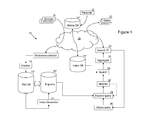
- a recording system 12 provides a database 14' of media files including tracks of audio information which is to be searched.
- the media could comprise, for example, broadcast television or radio programmes or in other implementations, the media could comprise recordings of contacts from a contact center (not shown) between users and agents of the contact center, or in still further implementations the media could comprise recordings of video calls; or video recorded events.
- access to the media files is provided across a network 16 which could be any of a LAN, WAN or Internet.
- the media files could be copied so that they are locally available to the search system 10.
- Phonetic information is extracted for each media file and this is stored in an index database 14" with index information in the database 14" pointing to corresponding audio information in the database 14'.
- index database 14 index information in the database 14" pointing to corresponding audio information in the database 14'.
- One particularly useful scheme for implementing this indexing is described in co-filed European Application No. 13170987.5 entitled “A system and method for phonetic searching of data” (Ref: 512125-EP-NP / P105534EP00).
- phonetic information extracted from the audio files is shown stored locally in the index database 14".
- a phonetic search engine 20 and the index database 14" could be remote from the remainder of the system 10 with a search interface requesting the phonetic search engine 20 to make specific searches as required.
- at least phonetic information corresponding to the audio information to be searched needs to be available to the phonetic search engine 20.
- source material 18 for a reference database 15' is generated by a collector 17.
- the material for this database 15' comprises a collection of general text material, with as far as possible each database file or object containing text relevant to one or a small number of related topics, these topics in turn being of interest to users and relating to the subject of the audio tracks stored in the database 14'.
- Source material 18 could include broadcaster web sites which often include news articles corresponding to broadcast programme material - each article or substantial section of an article representing a separate reference document/object within the database 15'.
- source material 18 could comprise transcriptions of such broadcasts which are usually available separately.
- Other useful sources 18 could be user manuals for products being handled by agents of a contact center. These could be broken down by section to provide separate reference database objects/files relating to given topics.
- sources 18 could be more general and could comprise for example feeds from social networking sources such as Twitter or Facebook.
- Collected material can either be cleaned as it is received by a cleaner 19 before being written to the database; and/or in addition or alternatively the database material can be cleaned once it is written to the database 15'.
- the reference database 15' can be continually updated by the collector 17 and cleaner 19 and, for example, once it has reached capacity, older documents or redundant material can be removed.
- Some examples of the cleaning of reference documents include:
- a set of expressions is generated for each separate document/object of the reference database 15' by an index generator 21.
- N-grams For text searching, a document might be divided into a bag of words with a count kept of each occurrence of (non-stop) word within the document, in the present case, a document/object is associated with sets of N-grams, each N-gram comprising a sequence of N words from the reference document, with N typically varying from 2-5. Thus, a count is kept of each instance of word pair, word triplet, quad etc appearing in respective documents of the reference database 15'.
- the result of this is a set of indexed candidate search phrases 15" associated with each cleaned document/object of the reference database 15'.
- the target database 14 comprises phonetic streams corresponding to spoken phrases
- only the most limited forms of stemming of the candidate search phrases are employed by the index generator 21 - so for example, only certain stop words might be trimmed from either end of the search string.
- NLP natural language processing
- Other processing of the candidate search phrases might include natural language processing (NLP) of the word sequences to convert written forms into one or more alternative strings more closely resembling normal speech.
- NLP natural language processing
- the string “2012” might be converted into "twenty twelve” if the context suggested a date.
- Multiple alternatives arise if the context is ambiguous or there are variant spoken forms - "two thousand twelve” would be another way of saying the year in a date context.
- inverse text normalization see for example US patent application 2009/0157385 ).
- users 22 access the search system 10 via a search interface 24.
- this could comprise a web application accessed across the network 16, nonetheless, the application could equally be implemented as a stand-alone or dedicated client-server application.
- search query comprising a text string.
- Phonetic audio search works better on longer search expressions, and so the goal of a query expander 28 is to find sets of sequences of words (N-grams) as possible search phrases based on the initial text search string supplied through the search interface.
- the query expander 28 operates in 2 phases:
- the resulting set of search expressions provided by the expander 28 can in turn be provided to a modifier 30 before the search is executed. So, in one implementation, the set of search expressions is presented via the search interface 24 (connection not shown) to the user 22 for manual verification, augmentation and/or deletion. It would also be possible for the modifier 30 to return the user-specified (or verified) expressions to the expander 28 to repeat the query expansion process based on modified expressions in order to refine or extend the set of terms.
- the modifier 30 could use the methods disclosed in Koen Deschacht et al. 2012, "The latent words language model", Computer Speech and Language 26, 384-409 to expand the set of search expressions to include synonyms and/or find more related words/phrases.
- the expanded set of search expressions is submitted to a search engine 20 which uses a phonetic representation of each of the set of search expressions to search phonetic representations of audio information stored within the index database 14".
- the Aurix audio miner phonetic search engine scans the index database 14" for occurrences of each of the set of search expressions and returns a stream of search hits, each including: an identity of the media file within the database 14' where the search expression occurs, time information indicating the location within the media file of the search expression, identity of the search expression and possibly a match score.
- the search engine 20 and index database 14" are implemented on a distributed file sharing (DFS) platform as disclosed in co-filed European Application No.
- DFS distributed file sharing
- the search engine 20 provides the stream of search hits as they are generated for each search expression to an aggregation mechanism 32 which processes the hits.
- the aggregator 32 can perform any combination of the following steps:
- the search interface 24 which allows the user 22 to adjust the expanded set of search expressions could be arranged to allow the user to specify Boolean combinations of the search expressions within the expanded set of search expressions.
- the results from search engine 20 could be combined by the aggregator 32 in accordance with the Boolean logic specified for the search expressions.
- the set of search results is passed back to the user 22 via the search interface 24.
- search results do not have to be passed back to the same user who formulated the original query; nor does a query have to be formulated from scratch each time a search is executed.
- the final query which is used by the search engine 20 to provide what might be a quite useful media analysis could be saved and labelled for example with a topic identifier. Then the saved query could either be repeated by the original user later, perhaps limited to the most recently acquired media fulfilling the query; or alternatively the query could be re-executed immediately by any users who have an interest in the topic identified by the saved search label.
- query results can be proactively disseminated through social networks of individuals who have indicated an interest in the topic identifier in the form of newsfeeds.
- media is shown as being stored in a database 14'.
- the media information being searched could equally be live, streamed media information being indexed and scanned with expanded search queries to automatically detect topics being broadcast and to notify interested users of the occurrence of a topic of interest within a programme being broadcast.
Landscapes
- Engineering & Computer Science (AREA)
- Theoretical Computer Science (AREA)
- Library & Information Science (AREA)
- Multimedia (AREA)
- Audiology, Speech & Language Pathology (AREA)
- General Health & Medical Sciences (AREA)
- Physics & Mathematics (AREA)
- General Engineering & Computer Science (AREA)
- General Physics & Mathematics (AREA)
- Health & Medical Sciences (AREA)
- Artificial Intelligence (AREA)
- Data Mining & Analysis (AREA)
- Databases & Information Systems (AREA)
- Computational Linguistics (AREA)
- Information Retrieval, Db Structures And Fs Structures Therefor (AREA)
Applications Claiming Priority (1)
| Application Number | Priority Date | Filing Date | Title |
|---|---|---|---|
| US13/605,084 US20140067374A1 (en) | 2012-09-06 | 2012-09-06 | System and method for phonetic searching of data |
Publications (1)
| Publication Number | Publication Date |
|---|---|
| EP2706472A1 true EP2706472A1 (en) | 2014-03-12 |
Family
ID=48670363
Family Applications (1)
| Application Number | Title | Priority Date | Filing Date |
|---|---|---|---|
| EP13171002.2A Withdrawn EP2706472A1 (en) | 2012-09-06 | 2013-06-07 | A system and method for phonetic searching of data |
Country Status (4)
| Country | Link |
|---|---|
| US (1) | US20140067374A1 (enExample) |
| EP (1) | EP2706472A1 (enExample) |
| BR (1) | BR102013016668A2 (enExample) |
| IN (1) | IN2013MU02064A (enExample) |
Cited By (1)
| Publication number | Priority date | Publication date | Assignee | Title |
|---|---|---|---|---|
| CN105847913A (zh) * | 2016-05-20 | 2016-08-10 | 腾讯科技(深圳)有限公司 | 一种控制视频直播的方法、移动终端及系统 |
Families Citing this family (11)
| Publication number | Priority date | Publication date | Assignee | Title |
|---|---|---|---|---|
| US9275139B2 (en) | 2012-03-30 | 2016-03-01 | Aurix Limited | “At least” operator for combining audio search hits |
| US9405828B2 (en) | 2012-09-06 | 2016-08-02 | Avaya Inc. | System and method for phonetic searching of data |
| US20160171122A1 (en) * | 2014-12-10 | 2016-06-16 | Ford Global Technologies, Llc | Multimodal search response |
| CN109213954A (zh) * | 2018-08-23 | 2019-01-15 | 武汉斗鱼网络科技有限公司 | 直播间话题设置方法、装置、计算机设备和存储介质 |
| US11647046B2 (en) * | 2018-09-24 | 2023-05-09 | Microsoft Technology Licensing, Llc | Fuzzy inclusion based impersonation detection |
| US11210337B2 (en) * | 2018-10-16 | 2021-12-28 | International Business Machines Corporation | System and method for searching audio data |
| US11720718B2 (en) | 2019-07-31 | 2023-08-08 | Microsoft Technology Licensing, Llc | Security certificate identity analysis |
| US12159119B2 (en) | 2023-02-15 | 2024-12-03 | Casetext, Inc. | Text generation interface system |
| US11861320B1 (en) | 2023-02-27 | 2024-01-02 | Casetext, Inc. | Text reduction and analysis interface to a text generation modeling system |
| US11860914B1 (en) * | 2023-02-27 | 2024-01-02 | Casetext, Inc. | Natural language database generation and query system |
| US12079587B1 (en) | 2023-04-18 | 2024-09-03 | OpenAI Opco, LLC | Multi-task automatic speech recognition system |
Citations (5)
| Publication number | Priority date | Publication date | Assignee | Title |
|---|---|---|---|---|
| US20090132251A1 (en) * | 2007-11-21 | 2009-05-21 | Hitachi, Ltd. | Spoken document retrieval system |
| US20090157385A1 (en) | 2007-12-14 | 2009-06-18 | Nokia Corporation | Inverse Text Normalization |
| US20090326947A1 (en) | 2008-06-27 | 2009-12-31 | James Arnold | System and method for spoken topic or criterion recognition in digital media and contextual advertising |
| US20100211569A1 (en) | 2009-02-18 | 2010-08-19 | Avaya Inc. | System and Method for Generating Queries |
| US20110040774A1 (en) * | 2009-08-14 | 2011-02-17 | Raytheon Company | Searching Spoken Media According to Phonemes Derived From Expanded Concepts Expressed As Text |
Family Cites Families (4)
| Publication number | Priority date | Publication date | Assignee | Title |
|---|---|---|---|---|
| US6321226B1 (en) * | 1998-06-30 | 2001-11-20 | Microsoft Corporation | Flexible keyboard searching |
| US6718323B2 (en) * | 2000-08-09 | 2004-04-06 | Hewlett-Packard Development Company, L.P. | Automatic method for quantifying the relevance of intra-document search results |
| US8694318B2 (en) * | 2006-09-19 | 2014-04-08 | At&T Intellectual Property I, L. P. | Methods, systems, and products for indexing content |
| GB2470007A (en) * | 2009-05-05 | 2010-11-10 | Aurix Ltd | Analysing non-deterministic results of a search query |
-
2012
- 2012-09-06 US US13/605,084 patent/US20140067374A1/en not_active Abandoned
-
2013
- 2013-06-07 EP EP13171002.2A patent/EP2706472A1/en not_active Withdrawn
- 2013-06-18 IN IN2064MU2013 patent/IN2013MU02064A/en unknown
- 2013-06-27 BR BRBR102013016668-5A patent/BR102013016668A2/pt not_active IP Right Cessation
Patent Citations (5)
| Publication number | Priority date | Publication date | Assignee | Title |
|---|---|---|---|---|
| US20090132251A1 (en) * | 2007-11-21 | 2009-05-21 | Hitachi, Ltd. | Spoken document retrieval system |
| US20090157385A1 (en) | 2007-12-14 | 2009-06-18 | Nokia Corporation | Inverse Text Normalization |
| US20090326947A1 (en) | 2008-06-27 | 2009-12-31 | James Arnold | System and method for spoken topic or criterion recognition in digital media and contextual advertising |
| US20100211569A1 (en) | 2009-02-18 | 2010-08-19 | Avaya Inc. | System and Method for Generating Queries |
| US20110040774A1 (en) * | 2009-08-14 | 2011-02-17 | Raytheon Company | Searching Spoken Media According to Phonemes Derived From Expanded Concepts Expressed As Text |
Non-Patent Citations (8)
| Title |
|---|
| CHRISTIAN KOHISCHUTTER; PETER FANKHAUSER; WOLFGANG NEJDL: "Boilerplate detection using shallow text features", WSDM, 2010, pages 441 - 450, XP058313404, DOI: doi:10.1145/1718487.1718542 |
| CHRISTOPHE CERISARA: "Automatic discovery of topics and acoustic morphemes from speech", COMPUTER SPEECH AND LANGUAGE, vol. 23, no. 2, April 2009 (2009-04-01), pages 220 - 239, XP025560123, DOI: doi:10.1016/j.csl.2008.06.004 |
| DESCHACHT ET AL.: "The latent words language model", COMPUTER SPEECH AND LANGUAGE, vol. 26, 2012, pages 384 - 409, XP028508965, DOI: doi:10.1016/j.csl.2012.04.001 |
| J. WRIGHT; M. CAREY; E. PARRIS: "Improved topic spotting through statistical modelling of keyword dependencies", PROC. IEEE ICASSP, vol. 1, 1995, pages 313 - 316, XP010625233, DOI: doi:10.1109/ICASSP.1995.479536 |
| PIERRE JOURLIN ET AL: "GENERAL QUERY EXPANSION TECHNIQUES FOR SPOKEN DOCUMENT RETRIEVAL", ETRW ON ACCESSING INFORMATION IN SPOKEN AUDIO, 19 April 1999 (1999-04-19) - 20 April 1999 (1999-04-20), Cambridge, UK, pages 8 - 13, XP007005461 * |
| PIERRE JOURLIN; SUE E. JOHNSON; KAREN SPARCK JONES; PHILIP C. WOODLAND: "General query expansion techniques for spoken document retrieval", ACCESSING INFORMATION IN SPOKEN AUDIO, April 1999 (1999-04-01), pages 8 - 13 |
| STEPHEN ROBERTSON; HUGO ZARAGOZA: "The probabilistic relevance model: Bm25 and beyond", 2007, SIGIR ACM, article "SIGIR 2007 tutorial 2d" |
| TIMOTHY J. HAZEN; FRED RICHARDSON; ANNA MARGOLIS: "Topic identification from audio recordings using word and phone recognition lattices", PROCEEDINGS OF THE IEEE WORKSHOP ON AUTOMATIC SPEECH RECOGNITION AND UNDERSTANDING, December 2007 (2007-12-01) |
Cited By (2)
| Publication number | Priority date | Publication date | Assignee | Title |
|---|---|---|---|---|
| CN105847913A (zh) * | 2016-05-20 | 2016-08-10 | 腾讯科技(深圳)有限公司 | 一种控制视频直播的方法、移动终端及系统 |
| CN105847913B (zh) * | 2016-05-20 | 2019-05-31 | 腾讯科技(深圳)有限公司 | 一种控制视频直播的方法、移动终端及系统 |
Also Published As
| Publication number | Publication date |
|---|---|
| IN2013MU02064A (enExample) | 2015-06-12 |
| US20140067374A1 (en) | 2014-03-06 |
| BR102013016668A2 (pt) | 2015-08-04 |
Similar Documents
| Publication | Publication Date | Title |
|---|---|---|
| EP2706472A1 (en) | A system and method for phonetic searching of data | |
| US11978439B2 (en) | Generating topic-specific language models | |
| JP4241934B2 (ja) | テキスト処理及び検索システム及び方法 | |
| CN104219575B (zh) | 相关视频推荐方法及系统 | |
| US8161041B1 (en) | Document-based synonym generation | |
| US9483557B2 (en) | Keyword generation for media content | |
| CN101889281B (zh) | 内容检索装置及内容检索方法 | |
| US8375033B2 (en) | Information retrieval through identification of prominent notions | |
| US8122022B1 (en) | Abbreviation detection for common synonym generation | |
| KR20010015368A (ko) | 정보 검색 방법과 정보 검색 장치 | |
| JP6429382B2 (ja) | コンテンツ推薦装置、及びプログラム | |
| US20120036139A1 (en) | Content recommendation device, method of recommending content, and computer program product | |
| JP2011529600A (ja) | 意味ベクトルおよびキーワード解析を使用することによるデータセットを関係付けるための方法および装置 | |
| CN102456060A (zh) | 信息处理装置及信息处理方法 | |
| Shaikh | Keyword Detection Techniques: A Comprehensive Study. | |
| Gaizauskas et al. | The University of Sheffield's TREC 2004 QA Experiments. | |
| Li et al. | Incorporating document keyphrases in search results | |
| CN116414968A (zh) | 信息搜索方法、装置、设备、介质及产品 | |
| Tejedor et al. | Ontology-based retrieval of human speech | |
| JohnsonÝ et al. | Audio indexing and retrieval of complete broadcast news shows | |
| Pizzato et al. | Extracting exact answers using a meta question answering system | |
| Cucchiarelli et al. | What to write and why: a recommender for news media | |
| Sarkar | Automatic keyphrase extraction from bengali documents: A preliminary study | |
| KR102820763B1 (ko) | 사용자 검색어 설정 의도 파악에 따른 검색 결과 제공방법 및 이를 실행시키기 위한 프로그램을 기록한 컴퓨터로 읽을 수 있는 저장매체 | |
| Khwileh et al. | Investigating segment-based query expansion for user-generated spoken content retrieval |
Legal Events
| Date | Code | Title | Description |
|---|---|---|---|
| PUAI | Public reference made under article 153(3) epc to a published international application that has entered the european phase |
Free format text: ORIGINAL CODE: 0009012 |
|
| AK | Designated contracting states |
Kind code of ref document: A1 Designated state(s): AL AT BE BG CH CY CZ DE DK EE ES FI FR GB GR HR HU IE IS IT LI LT LU LV MC MK MT NL NO PL PT RO RS SE SI SK SM TR |
|
| AX | Request for extension of the european patent |
Extension state: BA ME |
|
| 17P | Request for examination filed |
Effective date: 20140828 |
|
| RBV | Designated contracting states (corrected) |
Designated state(s): AL AT BE BG CH CY CZ DE DK EE ES FI FR GB GR HR HU IE IS IT LI LT LU LV MC MK MT NL NO PL PT RO RS SE SI SK SM TR |
|
| STAA | Information on the status of an ep patent application or granted ep patent |
Free format text: STATUS: EXAMINATION IS IN PROGRESS |
|
| 17Q | First examination report despatched |
Effective date: 20180530 |
|
| STAA | Information on the status of an ep patent application or granted ep patent |
Free format text: STATUS: THE APPLICATION IS DEEMED TO BE WITHDRAWN |
|
| 18D | Application deemed to be withdrawn |
Effective date: 20181010 |