EP2706471A1 - A system and method for phonetic searching of data - Google Patents
A system and method for phonetic searching of data Download PDFInfo
- Publication number
- EP2706471A1 EP2706471A1 EP13170987.5A EP13170987A EP2706471A1 EP 2706471 A1 EP2706471 A1 EP 2706471A1 EP 13170987 A EP13170987 A EP 13170987A EP 2706471 A1 EP2706471 A1 EP 2706471A1
- Authority
- EP
- European Patent Office
- Prior art keywords
- file
- files
- index
- search
- archive
- Prior art date
- Legal status (The legal status is an assumption and is not a legal conclusion. Google has not performed a legal analysis and makes no representation as to the accuracy of the status listed.)
- Withdrawn
Links
Images


Classifications
-
- G—PHYSICS
- G06—COMPUTING OR CALCULATING; COUNTING
- G06F—ELECTRIC DIGITAL DATA PROCESSING
- G06F16/00—Information retrieval; Database structures therefor; File system structures therefor
- G06F16/60—Information retrieval; Database structures therefor; File system structures therefor of audio data
- G06F16/61—Indexing; Data structures therefor; Storage structures
-
- G—PHYSICS
- G06—COMPUTING OR CALCULATING; COUNTING
- G06F—ELECTRIC DIGITAL DATA PROCESSING
- G06F16/00—Information retrieval; Database structures therefor; File system structures therefor
- G06F16/10—File systems; File servers
- G06F16/18—File system types
- G06F16/182—Distributed file systems
-
- G—PHYSICS
- G06—COMPUTING OR CALCULATING; COUNTING
- G06F—ELECTRIC DIGITAL DATA PROCESSING
- G06F16/00—Information retrieval; Database structures therefor; File system structures therefor
- G06F16/60—Information retrieval; Database structures therefor; File system structures therefor of audio data
- G06F16/68—Retrieval characterised by using metadata, e.g. metadata not derived from the content or metadata generated manually
- G06F16/683—Retrieval characterised by using metadata, e.g. metadata not derived from the content or metadata generated manually using metadata automatically derived from the content
- G06F16/685—Retrieval characterised by using metadata, e.g. metadata not derived from the content or metadata generated manually using metadata automatically derived from the content using automatically derived transcript of audio data, e.g. lyrics
-
- G—PHYSICS
- G06—COMPUTING OR CALCULATING; COUNTING
- G06F—ELECTRIC DIGITAL DATA PROCESSING
- G06F40/00—Handling natural language data
- G06F40/20—Natural language analysis
Definitions
- This invention relates to a system and method for phonetic searching of data.
- Distributed File Systems allow access to files from multiple hosts via a computer network. This makes it possible for multiple processors to share files and storage resources and for example to access and process data in parallel.
- Distributed file systems may include facilities for transparent replication and fault tolerance, that is, when a limited number of nodes in a file system go offline, the system continues to work without any data loss.
- DFS are particularly useful for providing access to large data sources particularly for parallel processing and searching and the Hadoop Distributed File System (HDFS) is an example of one such open source DFS.
- HDFS Hadoop Distributed File System
- Hurence Hadoop Audio Miner is a product employed in call centers for performing audio to text transcription of source audio files, typically recordings of client contacts on the Hadoop platform.
- a Hadoop-based text mining engine is then used to perform searches on behalf of users.
- phonetic searching does not create the same processing demands for indexing files, but local access to indexed information is important for performing phonetic searching.
- Nexidia Search GRID provides a REST-based development environment where applications use multiple machines in parallel to provide phonetic searching.
- the Aurix Phonetic Speech Search Engine allows high volumes of recordings to be processed, with less hardware power than with conventional Large Vocabulary Continuous Speech Recognition (LVCSR) systems.
- the Aurix Engine allows audio to be indexed at high rates with the index files being compressed as they are generated.
- Still further aspects comprise distributed multi-processor systems arranged to perform the steps of any one of claims 1 to 9, 12 and 13.
- the scheduling of indexing tasks ensures that no single indexing task can block a cluster of processors within a distributed file system.
- Embodiments of the invention can provide efficient phonetic search (audio mining) of a large corpus of audio material within the constraints imposed by the Hadoop software framework for distributed computation; in particular by aggregating generated index data (searchable phonetic representations of the audio material) into a relatively small number of archive files.
- the management of the archive files permits dynamic change of the searchable audio corpus; and provides for efficient access to the archive files for audio search.
- a DFS framework can ensure data locality, so that where possible, searching occurs on a cluster node that holds a local copy of a block of index data.
- the index data within the block can thus be read by the framework in an efficient streaming read operation (possibly skipping over any data for media files which are not included within the search).
- indexing and searching each of these being linked through a set of common archive files.
- the embodiment is implemented on Hadoop which allows the system to run on a distributed cluster of commodity server hardware which can be easily expanded as required.
- Hadoop Distributed Filing System HDFS
- MR Hadoop Map-Reduce Framework
- HBase Hadoop Distributed Database
- HDFS provides an interface to a fault-tolerant distributed filing system that transcends the limitations of any individual machine in a cluster.
- HDFS is optimized for the storage of a relatively small number of large (i.e. gigabyte to terabyte-scale) files, and for high data read rates via fast sequential streaming read operations, at the expense of latency, i.e. slow seek times to random positions within these files.
- All files within HDFS are stored as a sequence of blocks, each replicated across a number of cluster nodes in order to provide overall resilience against failure of any individual cluster node.
- the block size is configurable and while it defaults to 64MB, in the present embodiment, it is set to 256MB.
- Files within HDFS, once created, may not be modified: however they may be deleted, and data may be appended to an existing file.
- the MR framework provides for scheduled computation against individual blocks of files stored within HDFS in so far as is possible on a cluster node that contains a local copy of that block, in order to minimise network traffic between cluster nodes. This is particularly useful for audio mining, where the index files contain relatively high amounts of data to be read and so remote access could result in a networking bottleneck.
- HBase provides a convenient means of storing the results of audio mining in a form that can be readily accessed.
- Figure 1 shows the operation of the indexing component.
- a recording system 10 produces media files which are stored in a media database 12.
- the media files could be programme files produced by a broadcaster or publisher, whereas in other implementations, the media files could be recordings of contacts between clients and agents within a contact center (not shown).
- the media files could comprise recordings of video calls; or video recorded events. In the latter cases, it will be appreciated that large numbers of files could be produced at any given time and so the resources involved in processing and searching these files need to be as optimized as possible in order to remain computationally feasible.
- audio tracks are extracted (possibly from an associated video file), transcoded to linear PCM and placed in the external audio database by a single external process operating in tandem with or within the recording system 10.
- this could present a significant scalability bottleneck to the ingestion rate of files for indexing.
- the audio extraction and transcoding processing could be performed in a distributed manner or possibly combined with or incorporated into the indexing jobs described below.
- the media database 12 could include any combination of video files, audio files or transcoded audio information.
- the recording system 10 produces a list of pointers 14, for example, URLs, to each media file which is to be processed and searchable by the system.
- the pointers are essentially written to a queue and processed on a FIFO basis.
- a partitioning pre-processor 16 grabs a set number of URLs from the front of the pointer queue and partitions this set into a number of subsets, in such a fashion that each subset represents an approximately equal workload; these subsets form the input to a Hadoop MR indexing job 18. (In the current embodiment this partitioning is not itself performed as a distributed computation, but it could be implemented as such). The partitioning determines the way that the overall indexing computation is split between a set of indexing tasks 20 that comprise the indexing job 18. Each task 20 processes one subset of the overall set of URLs. These tasks get scheduled for execution among the nodes of the cluster as free computational resource becomes available.
- indexing jobs 18 1 ...18 3 there are 3 indexing jobs 18 1 ...18 3 .
- the number N of indexing jobs which run concurrently depends on several factors including: the number of concurrent feeds (NF) from which input media files is taken; the "chunk size” (C) into which each feed is broken before being stored, for example, television programmes are typically 1 hour in length; the frequency (FR) with which the system schedules new indexing jobs; and the overall cluster throughput (TP), which is a function of indexing rate per node (hardware dependent) and cluster size (number of nodes).
- NF concurrent feeds
- C the "chunk size"
- TP cluster throughput
- N f NF . FR C . TP
- indexing jobs are allowed to run concurrently; thus indexing is not blocked even if one particular indexing job takes a long time to complete. (This can occur if a constituent indexing task represents a disproportionately large amount of the overall computational workload, for example because it contains one or more unusually large files).
- breaking the overall work burden into sufficiently small chunks distributes work efficiently across the cluster, without danger that any one task ends up with a disproportionate share of the load.
- this also improves responsiveness of the system to concurrent search requests described later, ensuring that a cluster does not risk becoming dominated by long-running indexing tasks if there are search requests pending.
- Each indexing job 18 instantiates one or more Map tasks 20, each task processing the media files from one of the sets of URLs provided to the job 18 by the partitioner 16.
- a single task handles the set of media files awaiting ingest, and this may contain multiple URLs.
- the task 20 reads the corresponding source media file and generates a binary index file corresponding to a probabilistic phonetic representation of the audio contents of media file.
- Each index file 21 is then appended to an archive file 22. Since the process of appending files is inherently serial in nature, it is arranged that concurrently executing indexing tasks append the index files they generate to different archive files, in order that the indexing tasks are able to run in parallel.
- index data associated with specific media files if required. This would require rewriting the containing archive file with the deleted index data excluded, then replacing the old archive file with the updated one and updating the corresponding meta-data. This would be a potentially expensive operation, and would need to be carried out by a periodic maintenance activity that physically removes index data associated with media files that have been logically deleted, somewhat analogous to defragmenting a hard disk.
- the fact that the index data is distributed across a number of archive files would help, since each archive file typically represents only a proportion of the total, and as the archive files can be maintained individually, there would be no need to take the entire archive offline at any point in time.
- the phonetic stream which is produced by the indexing tasks can be of any given format, but essentially it needs to be compatible with the search tasks which will be searching through the indexed information.
- the indexing is performed so as to allow search tasks running the Aurix Phonetic Speech Search Engine to search through the indexed information.
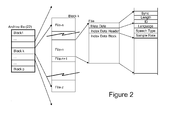
- FIG. 2 shows the layout of an archive file in more detail.
- Each file comprises a series of blocks which, as mentioned above, in this case are 256MB in length.
- Each block includes index data for a number of media files, typically at least 10.
- File index data divides into meta data, a data header and then the data extracted from the media itself.
- meta-data and index header sections of the record for a given media file show a sync field (essentially a flag comprising a byte sequence that allows the start of an index data record to be validated), an ID field indicating the ID of the media file in the database 12 to which the index data record corresponds, and a length field (a 64-bit record of the length of the index data block).
- Other meta-data includes offsets within the containing archive file for the start and end of the index data associated with a given audio file.
- the index data header is shown as comprising a record of the audio sample rate and the language and speech type used to generate the audio data. It should also be appreciated that other fields could potentially be added to the meta-data: for example, the number of audio channels. This meta-data could also be stored in a separate database (possibly a HBase), keyed by the audio ID.
- distributed file systems and particularly HDFS store data blocks in a redundant fashion and as such any given block of an archive file can be replicated on a number of nodes within a cluster. Search tasks against that block will be preferentially run on one of these nodes that holds a local copy of the block, in order to minimize network traffic. Nonetheless, it will be appreciated that writing indexed information in this format enables efficient searching to be performed by tasks running in parallel across the nodes of a cluster.
- an archive file may contain an incomplete block (at the end), and as indicated in Figure 2 for File-a and File-z, the boundaries between index data records corresponding to individual media files do not in general correspond to block boundaries. Thus, a (small) minority of index files might be stored across more than one block.
- tasks typically run on a processor that has a local copy of a block which it is to access.
- the task begins searching through an index file which continues to another block, it is still possible for the task to retrieve the index file information from the other block and to continue processing until the end of the of the index file - although its throughput for that particular index file will not be as high as for index files that are read by the task sequentially from a single locally available block.
- index data could in theory be appended into a single archive file
- multiple active archive files tend to be more efficient, as appending to a single archive file could represent a performance bottleneck whereas multiple archive files can be appended to concurrently (up to a limit imposed by the number of processing cores and the I/O capacity of the DFS cluster).
- the data for a given block of an archive file within HDFS can be read from disk in an efficient streaming read operation, rather than requiring individual seeks to the start of each index data file (as would be the case if the index data was stored as individual files). It is therefore best if the archive files are a significant multiple of the block size, rather than being of the order of the block size or less, in order to amortize the proportionately greater cost of processing a part block.
- a search interface 24 is provided to enable users to submit queries.
- users might be running either a web client or a dedicated search application which generates the query and transmits this across a network 26 to the search interface.
- the query has been input as text, it is converted to a phonetic representation corresponding to the text and compatible with the representation stored within the archive files.
- the query could be spoken by a user and converted to a phonetic representation in a manner analogous to the operation of the indexing tasks 20. In either case, the conversion can be performed either remotely at the client or by the search interface 25.
- the interface can run as a Hadoop client submitting searches to a Search Queue 28 where they are handled within the MR framework.
- search query can be one of a number of queries expanded from an original single query input by a user as described in US Application No. 13/605,084 filed 6 September 2012 entitled “A system and method for phonetic searching of data” (Ref: 512115-US-NP / P105558us00 / A181FC).
- the search job 32 looks for searches in a search queue 28 and it passes the search query to each task which has not performed that search on its block i.e. at any given time a task may be performing more than 1 search as it traverses its block.
- each task writes its search results to a common HBase database 30 for later retrieval.
- results can be retrieved by the search interface 24 and returned to a client across the network 26 - these results typically take the form of a number of links to the original media files along with the detected locations of the search query in those files.
- Distributed file systems are replicated across nodes of a cluster and in typical configurations, blocks might be mirrored across three nodes - bearing in mind that any block can be replicated to any given three nodes of a cluster which might in fact comprise a large number of nodes. So for example, the search tasks for given search jobs might be scheduled across a large proportion of the nodes in the cluster.
- the search job 32 is shown as comprising a set of Tasks 1...P associated with respective blocks of a single archive file, but it will be appreciated that in some implementations, a search job could potentially comprise tasks for all the blocks of a number of archive files. Thus, in some such implementations, a number of concurrently-executing search jobs could each be dedicated to a different subset of the set of archive files 18.
- the scheduler normally prioritizes tasks for jobs according to their position in the job queue, the scheduler also allows a priority to be assigned to each job, and this could be useful. For example, if each archive file contains material accrued within a given time period, searches on archive files containing more recently-ingested material could potentially be given priority over those on archive files containing older material - this could be particularly useful in a contact center implementation.
- the partitioner 16 submits set of a fixed number of URLs to each indexing job.
- partitioning could be handled on the basis of media file size, such that each subset contained approximately the same amount of data.
Landscapes
- Engineering & Computer Science (AREA)
- Theoretical Computer Science (AREA)
- Physics & Mathematics (AREA)
- General Engineering & Computer Science (AREA)
- General Physics & Mathematics (AREA)
- Data Mining & Analysis (AREA)
- Databases & Information Systems (AREA)
- Multimedia (AREA)
- Artificial Intelligence (AREA)
- Audiology, Speech & Language Pathology (AREA)
- General Health & Medical Sciences (AREA)
- Software Systems (AREA)
- Health & Medical Sciences (AREA)
- Library & Information Science (AREA)
- Computational Linguistics (AREA)
- Information Retrieval, Db Structures And Fs Structures Therefor (AREA)
Applications Claiming Priority (1)
| Application Number | Priority Date | Filing Date | Title |
|---|---|---|---|
| US13/605,055 US9405828B2 (en) | 2012-09-06 | 2012-09-06 | System and method for phonetic searching of data |
Publications (1)
| Publication Number | Publication Date |
|---|---|
| EP2706471A1 true EP2706471A1 (en) | 2014-03-12 |
Family
ID=48670362
Family Applications (1)
| Application Number | Title | Priority Date | Filing Date |
|---|---|---|---|
| EP13170987.5A Withdrawn EP2706471A1 (en) | 2012-09-06 | 2013-06-07 | A system and method for phonetic searching of data |
Country Status (4)
| Country | Link |
|---|---|
| US (1) | US9405828B2 (enExample) |
| EP (1) | EP2706471A1 (enExample) |
| BR (1) | BR102013016670A2 (enExample) |
| IN (1) | IN2013MU02066A (enExample) |
Families Citing this family (7)
| Publication number | Priority date | Publication date | Assignee | Title |
|---|---|---|---|---|
| US9268808B2 (en) | 2012-12-31 | 2016-02-23 | Facebook, Inc. | Placement policy |
| US9176973B1 (en) * | 2013-06-14 | 2015-11-03 | Timmes, Inc. | Recursive-capable lossless compression mechanism |
| GB2530052A (en) | 2014-09-10 | 2016-03-16 | Ibm | Outputting map-reduce jobs to an archive file |
| US20200250326A1 (en) * | 2017-10-25 | 2020-08-06 | Telefonaktiebolaget Lm Ericsson (Publ) | Operation of an Electronic Device during Maintenance |
| CN109918184B (zh) * | 2019-03-01 | 2023-09-26 | 腾讯科技(深圳)有限公司 | 图片处理系统、方法及相关装置和设备 |
| KR102559290B1 (ko) * | 2020-01-06 | 2023-07-26 | 주식회사 아미크 | 하이브리드 클라우드 기반의 실시간 데이터 아카이빙 방법 및 시스템 |
| US11520732B2 (en) * | 2020-06-16 | 2022-12-06 | Sap Se | Systems and tools for data archiving |
Citations (2)
| Publication number | Priority date | Publication date | Assignee | Title |
|---|---|---|---|---|
| US20080033986A1 (en) * | 2006-07-07 | 2008-02-07 | Phonetic Search, Inc. | Search engine for audio data |
| US20100332401A1 (en) * | 2009-06-30 | 2010-12-30 | Anand Prahlad | Performing data storage operations with a cloud storage environment, including automatically selecting among multiple cloud storage sites |
Family Cites Families (16)
| Publication number | Priority date | Publication date | Assignee | Title |
|---|---|---|---|---|
| US6321226B1 (en) | 1998-06-30 | 2001-11-20 | Microsoft Corporation | Flexible keyboard searching |
| US7177795B1 (en) * | 1999-11-10 | 2007-02-13 | International Business Machines Corporation | Methods and apparatus for semantic unit based automatic indexing and searching in data archive systems |
| US6868380B2 (en) * | 2000-03-24 | 2005-03-15 | Eliza Corporation | Speech recognition system and method for generating phonotic estimates |
| US6718323B2 (en) | 2000-08-09 | 2004-04-06 | Hewlett-Packard Development Company, L.P. | Automatic method for quantifying the relevance of intra-document search results |
| EP1704558B8 (en) * | 2004-01-16 | 2011-09-21 | Nuance Communications, Inc. | Corpus-based speech synthesis based on segment recombination |
| US7725318B2 (en) * | 2004-07-30 | 2010-05-25 | Nice Systems Inc. | System and method for improving the accuracy of audio searching |
| US7809568B2 (en) * | 2005-11-08 | 2010-10-05 | Microsoft Corporation | Indexing and searching speech with text meta-data |
| US8694318B2 (en) * | 2006-09-19 | 2014-04-08 | At&T Intellectual Property I, L. P. | Methods, systems, and products for indexing content |
| US20090157385A1 (en) | 2007-12-14 | 2009-06-18 | Nokia Corporation | Inverse Text Normalization |
| US20090326947A1 (en) | 2008-06-27 | 2009-12-31 | James Arnold | System and method for spoken topic or criterion recognition in digital media and contextual advertising |
| US8301619B2 (en) | 2009-02-18 | 2012-10-30 | Avaya Inc. | System and method for generating queries |
| GB2470007A (en) | 2009-05-05 | 2010-11-10 | Aurix Ltd | Analysing non-deterministic results of a search query |
| WO2011137386A1 (en) * | 2010-04-30 | 2011-11-03 | Orbis Technologies, Inc. | Systems and methods for semantic search, content correlation and visualization |
| US20120254149A1 (en) * | 2011-03-29 | 2012-10-04 | Peervyne, Inc. | Brand results ranking process based on degree of positive or negative comments about brands related to search request terms |
| AU2012290042A1 (en) * | 2011-08-02 | 2014-02-20 | Ajay JADHAV | Cloud-based distributed persistence and cache data model |
| US20140067374A1 (en) | 2012-09-06 | 2014-03-06 | Avaya Inc. | System and method for phonetic searching of data |
-
2012
- 2012-09-06 US US13/605,055 patent/US9405828B2/en active Active
-
2013
- 2013-06-07 EP EP13170987.5A patent/EP2706471A1/en not_active Withdrawn
- 2013-06-18 IN IN2066MU2013 patent/IN2013MU02066A/en unknown
- 2013-06-27 BR BRBR102013016670-7A patent/BR102013016670A2/pt not_active IP Right Cessation
Patent Citations (2)
| Publication number | Priority date | Publication date | Assignee | Title |
|---|---|---|---|---|
| US20080033986A1 (en) * | 2006-07-07 | 2008-02-07 | Phonetic Search, Inc. | Search engine for audio data |
| US20100332401A1 (en) * | 2009-06-30 | 2010-12-30 | Anand Prahlad | Performing data storage operations with a cloud storage environment, including automatically selecting among multiple cloud storage sites |
Non-Patent Citations (4)
| Title |
|---|
| "Pro Hadoop", 17 June 2009, APRESS, New York, NY, ISBN: 978-1-4302-1942-2, article JASON VENNER: "Pro Hadoop", pages: 1 - 407, XP055463607 * |
| CLEMENTS ET AL: "Phonetic Searching of Digital Audio", INTERNET CITATION, 4 August 2002 (2002-08-04), pages 1 - 10, XP002977606, Retrieved from the Internet <URL:http://web.archive.org/web/*/www.fast-talk.com/technology_how.html> [retrieved on 20020804] * |
| ELLIOT JAFFE ET AL: "Architecture of the internet archive", PROCEEDINGS OF SYSTOR 2009: THE ISRAELI EXPERIMENTAL SYSTEMS CONFERENCE ON, SYSTOR '09, 1 January 2009 (2009-01-01), New York, New York, USA, pages 1 - 10, XP055090886, ISBN: 978-1-60-558623-6, DOI: 10.1145/1534530.1534545 * |
| HYUNSEOK CHANG ET AL: "Scheduling in mapreduce-like systems for fast completion time", INFOCOM, 2011 PROCEEDINGS IEEE, IEEE, 10 April 2011 (2011-04-10), pages 3074 - 3082, XP031953538, ISBN: 978-1-4244-9919-9, DOI: 10.1109/INFCOM.2011.5935152 * |
Also Published As
| Publication number | Publication date |
|---|---|
| US9405828B2 (en) | 2016-08-02 |
| IN2013MU02066A (enExample) | 2015-07-10 |
| BR102013016670A2 (pt) | 2015-08-04 |
| US20140067820A1 (en) | 2014-03-06 |
Similar Documents
| Publication | Publication Date | Title |
|---|---|---|
| US9405828B2 (en) | System and method for phonetic searching of data | |
| JP5218060B2 (ja) | 情報検索システムと情報検索方法ならびにプログラム | |
| JP5233233B2 (ja) | 情報検索システム、情報検索用インデックスの登録装置、情報検索方法及びプログラム | |
| US11146614B2 (en) | Distributed computing on document formats | |
| EP3825863B1 (en) | Distributed computer system for delivering data | |
| CN110196885B (zh) | 一种云化分布式实时数据库系统 | |
| US12487887B2 (en) | Fileset partitioning for data storage and management | |
| JP2015518223A (ja) | メモリ検索、リアルタイム検索システム及び方法、コンピュータ記憶媒体 | |
| CN119415481B (zh) | 基于数据库的文件资源复用库管理方法及装置 | |
| US11132383B2 (en) | Techniques for processing database tables using indexes | |
| EP2548122A2 (en) | Highly scalable and distributed data de-duplication | |
| CN105160039A (zh) | 一种基于大数据的查询方法 | |
| US11687533B2 (en) | Centralized storage for search servers | |
| CN112328702B (zh) | 数据同步方法及系统 | |
| US20170270149A1 (en) | Database systems with re-ordered replicas and methods of accessing and backing up databases | |
| CN111309768A (zh) | 信息检索方法、装置、设备及存储介质 | |
| Al-Khasawneh et al. | MapReduce a comprehensive review | |
| US12050549B2 (en) | Client support of multiple fingerprint formats for data file segments | |
| CN115398414B (zh) | 数据存储和数据检索方法和设备 | |
| US20190057028A1 (en) | Conflict Resolution and Garbage Collection in Distributed Databases | |
| US20250181455A1 (en) | Maintaining read-after-write consistency between dataset snapshots across a distributed architecture | |
| CN120950005B (zh) | 一种多模态数据存储方法、装置、设备、介质及产品 | |
| JP2016149049A (ja) | 情報処理装置、情報処理システム、ペアデータ更新方法及びプログラム | |
| EP4664315A1 (en) | Hybrid tiered storage for cloud platforms | |
| US12688203B1 (en) | Distributed point-in-time restore across storage formats on a hybrid database |
Legal Events
| Date | Code | Title | Description |
|---|---|---|---|
| PUAI | Public reference made under article 153(3) epc to a published international application that has entered the european phase |
Free format text: ORIGINAL CODE: 0009012 |
|
| AK | Designated contracting states |
Kind code of ref document: A1 Designated state(s): AL AT BE BG CH CY CZ DE DK EE ES FI FR GB GR HR HU IE IS IT LI LT LU LV MC MK MT NL NO PL PT RO RS SE SI SK SM TR |
|
| AX | Request for extension of the european patent |
Extension state: BA ME |
|
| 17P | Request for examination filed |
Effective date: 20140912 |
|
| RBV | Designated contracting states (corrected) |
Designated state(s): AL AT BE BG CH CY CZ DE DK EE ES FI FR GB GR HR HU IE IS IT LI LT LU LV MC MK MT NL NO PL PT RO RS SE SI SK SM TR |
|
| STAA | Information on the status of an ep patent application or granted ep patent |
Free format text: STATUS: EXAMINATION IS IN PROGRESS |
|
| 17Q | First examination report despatched |
Effective date: 20180405 |
|
| STAA | Information on the status of an ep patent application or granted ep patent |
Free format text: STATUS: THE APPLICATION HAS BEEN WITHDRAWN |
|
| 18W | Application withdrawn |
Effective date: 20180504 |