EP2706062B1 - Novel cephalosporin derivative and pharmaceutical composition thereof - Google Patents
Novel cephalosporin derivative and pharmaceutical composition thereof Download PDFInfo
- Publication number
- EP2706062B1 EP2706062B1 EP12765589.2A EP12765589A EP2706062B1 EP 2706062 B1 EP2706062 B1 EP 2706062B1 EP 12765589 A EP12765589 A EP 12765589A EP 2706062 B1 EP2706062 B1 EP 2706062B1
- Authority
- EP
- European Patent Office
- Prior art keywords
- compound
- mmol
- nmr
- preparation
- 600mhz
- Prior art date
- Legal status (The legal status is an assumption and is not a legal conclusion. Google has not performed a legal analysis and makes no representation as to the accuracy of the status listed.)
- Active
Links
- 0 C*(C)C(C(NC=C1O)=CC1=O)=O Chemical compound C*(C)C(C(NC=C1O)=CC1=O)=O 0.000 description 52
- DTQVDTLACAAQTR-UHFFFAOYSA-N OC(C(F)(F)F)=O Chemical compound OC(C(F)(F)F)=O DTQVDTLACAAQTR-UHFFFAOYSA-N 0.000 description 2
- VQIYWERKFVMJAH-WUVDHXHCSA-O CC(C(O)=O)O/N=C(\C(N[C@@H](C1SCC(C[n+]2cc(NCCNC(C(NC=C3O)=CC3=O)=O)c(N)nc2)=C(C(O)=O)N11)C1=O)=O)/C(C(C)CC=C(N)S1)=C1Cl Chemical compound CC(C(O)=O)O/N=C(\C(N[C@@H](C1SCC(C[n+]2cc(NCCNC(C(NC=C3O)=CC3=O)=O)c(N)nc2)=C(C(O)=O)N11)C1=O)=O)/C(C(C)CC=C(N)S1)=C1Cl VQIYWERKFVMJAH-WUVDHXHCSA-O 0.000 description 1
- HXVAYRRVYWGDGQ-HIPWEDQQSA-O CC(C)(C(O)=O)O/N=C(/C(/C(C)=C)=N/SC(N)=C)\C(NC(C1SCC(/C=C/C/[N+](/C=C)=C/C(/NCCN)=C(\C(C)=C)/N)=C(C(O)=O)N11)C1=O)=O Chemical compound CC(C)(C(O)=O)O/N=C(/C(/C(C)=C)=N/SC(N)=C)\C(NC(C1SCC(/C=C/C/[N+](/C=C)=C/C(/NCCN)=C(\C(C)=C)/N)=C(C(O)=O)N11)C1=O)=O HXVAYRRVYWGDGQ-HIPWEDQQSA-O 0.000 description 1
- MZJGKUZNMNEWAO-OHUIHDMLSA-O CC(C)(C(O)=O)O/N=C(\C(NC(C1SCC(C[n+]2cc(NCCN)c(N)nc2)=C(C(O)=O)N11)C1=O)=O)/c1n[s]c(N)n1 Chemical compound CC(C)(C(O)=O)O/N=C(\C(NC(C1SCC(C[n+]2cc(NCCN)c(N)nc2)=C(C(O)=O)N11)C1=O)=O)/c1n[s]c(N)n1 MZJGKUZNMNEWAO-OHUIHDMLSA-O 0.000 description 1
- GAVRDFDSKVXXEI-HBRRFCRHSA-O CC(C)(C(O)=O)O/N=C(\C(N[C@@H](C1SCC(C[n+]2cc(NCCCC(O)=O)c(N)nc2C)=C(C(O)=O)N11)C1=O)=O)/c1c[s]c(N)n1 Chemical compound CC(C)(C(O)=O)O/N=C(\C(N[C@@H](C1SCC(C[n+]2cc(NCCCC(O)=O)c(N)nc2C)=C(C(O)=O)N11)C1=O)=O)/c1c[s]c(N)n1 GAVRDFDSKVXXEI-HBRRFCRHSA-O 0.000 description 1
- CKRJMQFTARELQF-CPOUQYKBSA-O CC(C)(C(O)=O)O/N=C(\C(N[C@@H](C1SCC(C[n+]2cc(NCCN)c(N)nc2)=C(C(O)=O)N11)C1=O)=O)/c1c[s]c(N)n1 Chemical compound CC(C)(C(O)=O)O/N=C(\C(N[C@@H](C1SCC(C[n+]2cc(NCCN)c(N)nc2)=C(C(O)=O)N11)C1=O)=O)/c1c[s]c(N)n1 CKRJMQFTARELQF-CPOUQYKBSA-O 0.000 description 1
- IMFRAHYQKOISFH-UHFFFAOYSA-P CC(C)(C(O)=O)ON=C(C(NC(C1SCC(C=CC[n+]2cc(NC(C[NH3+])=O)c(N)nc2)=C(C(O)=O)N11)C1=O)=O)c1c[s]c(N)n1 Chemical compound CC(C)(C(O)=O)ON=C(C(NC(C1SCC(C=CC[n+]2cc(NC(C[NH3+])=O)c(N)nc2)=C(C(O)=O)N11)C1=O)=O)c1c[s]c(N)n1 IMFRAHYQKOISFH-UHFFFAOYSA-P 0.000 description 1
- BGWHENSRGLTKIK-UHFFFAOYSA-N CC(C)(C)C(C(N(C)C=C1O)=CC1=O)=O Chemical compound CC(C)(C)C(C(N(C)C=C1O)=CC1=O)=O BGWHENSRGLTKIK-UHFFFAOYSA-N 0.000 description 1
- CVLANUMDCBTCHW-MFOYZWKCSA-N CC(C)(C)OC(C(C)(C)O/N=C(\C(O)=O)/c1c[s]c(N=C)n1)=O Chemical compound CC(C)(C)OC(C(C)(C)O/N=C(\C(O)=O)/c1c[s]c(N=C)n1)=O CVLANUMDCBTCHW-MFOYZWKCSA-N 0.000 description 1
- WCFJUSRQHZPVKY-UHFFFAOYSA-N CC(C)(C)OC(NCCC(O)=O)=O Chemical compound CC(C)(C)OC(NCCC(O)=O)=O WCFJUSRQHZPVKY-UHFFFAOYSA-N 0.000 description 1
- ILIGGKJVYFHLRL-UHFFFAOYSA-N CC(C)(C)OC(NCCNc1c(N)ncnc1)=O Chemical compound CC(C)(C)OC(NCCNc1c(N)ncnc1)=O ILIGGKJVYFHLRL-UHFFFAOYSA-N 0.000 description 1
- TZPXMSCXSCUABO-UHFFFAOYSA-N CN(C=C1O)C(C(NCCC(Nc2cncnc2N)=O)=O)=CC1=O Chemical compound CN(C=C1O)C(C(NCCC(Nc2cncnc2N)=O)=O)=CC1=O TZPXMSCXSCUABO-UHFFFAOYSA-N 0.000 description 1
- HZALACLYVKNVBB-ZDFKYCODSA-O C[C@@H](C(O)=O)O/N=C(\C(NC(C1SCC(C[n+]2cc(NCCNC(C(N(C=C3O)O)=CC3=O)=O)c(N)nc2)=C(C(O)=O)N11)C1=O)=O)/C(C(C)CC=C(N)S1)=C1Cl Chemical compound C[C@@H](C(O)=O)O/N=C(\C(NC(C1SCC(C[n+]2cc(NCCNC(C(N(C=C3O)O)=CC3=O)=O)c(N)nc2)=C(C(O)=O)N11)C1=O)=O)/C(C(C)CC=C(N)S1)=C1Cl HZALACLYVKNVBB-ZDFKYCODSA-O 0.000 description 1
- JFQZMBZYAMGVKR-UHFFFAOYSA-N NCCCNc1cncnc1N Chemical compound NCCCNc1cncnc1N JFQZMBZYAMGVKR-UHFFFAOYSA-N 0.000 description 1
- MPNBXFXEMHPGTK-UHFFFAOYSA-N Nc1c(N)ncnc1N Chemical compound Nc1c(N)ncnc1N MPNBXFXEMHPGTK-UHFFFAOYSA-N 0.000 description 1
Classifications
-
- C—CHEMISTRY; METALLURGY
- C07—ORGANIC CHEMISTRY
- C07D—HETEROCYCLIC COMPOUNDS
- C07D501/00—Heterocyclic compounds containing 5-thia-1-azabicyclo [4.2.0] octane ring systems, i.e. compounds containing a ring system of the formula:, e.g. cephalosporins; Such ring systems being further condensed, e.g. 2,3-condensed with an oxygen-, nitrogen- or sulfur-containing hetero ring
- C07D501/14—Compounds having a nitrogen atom directly attached in position 7
- C07D501/60—Compounds having a nitrogen atom directly attached in position 7 with a double bond between positions 3 and 4
-
- A—HUMAN NECESSITIES
- A61—MEDICAL OR VETERINARY SCIENCE; HYGIENE
- A61P—SPECIFIC THERAPEUTIC ACTIVITY OF CHEMICAL COMPOUNDS OR MEDICINAL PREPARATIONS
- A61P31/00—Antiinfectives, i.e. antibiotics, antiseptics, chemotherapeutics
-
- A—HUMAN NECESSITIES
- A61—MEDICAL OR VETERINARY SCIENCE; HYGIENE
- A61P—SPECIFIC THERAPEUTIC ACTIVITY OF CHEMICAL COMPOUNDS OR MEDICINAL PREPARATIONS
- A61P31/00—Antiinfectives, i.e. antibiotics, antiseptics, chemotherapeutics
- A61P31/04—Antibacterial agents
-
- C—CHEMISTRY; METALLURGY
- C07—ORGANIC CHEMISTRY
- C07D—HETEROCYCLIC COMPOUNDS
- C07D501/00—Heterocyclic compounds containing 5-thia-1-azabicyclo [4.2.0] octane ring systems, i.e. compounds containing a ring system of the formula:, e.g. cephalosporins; Such ring systems being further condensed, e.g. 2,3-condensed with an oxygen-, nitrogen- or sulfur-containing hetero ring
- C07D501/02—Preparation
- C07D501/04—Preparation from compounds already containing the ring or condensed ring systems, e.g. by dehydrogenation of the ring, by introduction, elimination or modification of substituents
-
- C—CHEMISTRY; METALLURGY
- C07—ORGANIC CHEMISTRY
- C07D—HETEROCYCLIC COMPOUNDS
- C07D501/00—Heterocyclic compounds containing 5-thia-1-azabicyclo [4.2.0] octane ring systems, i.e. compounds containing a ring system of the formula:, e.g. cephalosporins; Such ring systems being further condensed, e.g. 2,3-condensed with an oxygen-, nitrogen- or sulfur-containing hetero ring
- C07D501/14—Compounds having a nitrogen atom directly attached in position 7
- C07D501/16—Compounds having a nitrogen atom directly attached in position 7 with a double bond between positions 2 and 3
- C07D501/20—7-Acylaminocephalosporanic or substituted 7-acylaminocephalosporanic acids in which the acyl radicals are derived from carboxylic acids
- C07D501/24—7-Acylaminocephalosporanic or substituted 7-acylaminocephalosporanic acids in which the acyl radicals are derived from carboxylic acids with hydrocarbon radicals, substituted by hetero atoms or hetero rings, attached in position 3
-
- C—CHEMISTRY; METALLURGY
- C07—ORGANIC CHEMISTRY
- C07D—HETEROCYCLIC COMPOUNDS
- C07D501/00—Heterocyclic compounds containing 5-thia-1-azabicyclo [4.2.0] octane ring systems, i.e. compounds containing a ring system of the formula:, e.g. cephalosporins; Such ring systems being further condensed, e.g. 2,3-condensed with an oxygen-, nitrogen- or sulfur-containing hetero ring
- C07D501/14—Compounds having a nitrogen atom directly attached in position 7
- C07D501/16—Compounds having a nitrogen atom directly attached in position 7 with a double bond between positions 2 and 3
- C07D501/20—7-Acylaminocephalosporanic or substituted 7-acylaminocephalosporanic acids in which the acyl radicals are derived from carboxylic acids
- C07D501/24—7-Acylaminocephalosporanic or substituted 7-acylaminocephalosporanic acids in which the acyl radicals are derived from carboxylic acids with hydrocarbon radicals, substituted by hetero atoms or hetero rings, attached in position 3
- C07D501/38—Methylene radicals, substituted by nitrogen atoms; Lactams thereof with the 2-carboxyl group; Methylene radicals substituted by nitrogen-containing hetero rings attached by the ring nitrogen atom; Quaternary compounds thereof
- C07D501/46—Methylene radicals, substituted by nitrogen atoms; Lactams thereof with the 2-carboxyl group; Methylene radicals substituted by nitrogen-containing hetero rings attached by the ring nitrogen atom; Quaternary compounds thereof with the 7-amino radical acylated by carboxylic acids containing hetero rings
-
- Y—GENERAL TAGGING OF NEW TECHNOLOGICAL DEVELOPMENTS; GENERAL TAGGING OF CROSS-SECTIONAL TECHNOLOGIES SPANNING OVER SEVERAL SECTIONS OF THE IPC; TECHNICAL SUBJECTS COVERED BY FORMER USPC CROSS-REFERENCE ART COLLECTIONS [XRACs] AND DIGESTS
- Y02—TECHNOLOGIES OR APPLICATIONS FOR MITIGATION OR ADAPTATION AGAINST CLIMATE CHANGE
- Y02A—TECHNOLOGIES FOR ADAPTATION TO CLIMATE CHANGE
- Y02A50/00—TECHNOLOGIES FOR ADAPTATION TO CLIMATE CHANGE in human health protection, e.g. against extreme weather
- Y02A50/30—Against vector-borne diseases, e.g. mosquito-borne, fly-borne, tick-borne or waterborne diseases whose impact is exacerbated by climate change
Definitions
- the present invention relates to novel cephalosporin derivatives.
- the present invention also relates to pharmaceutical antibiotic compositions including novel cephalosporin derivatives, hydrate thereof, solvates thereof, or pharmaceutically acceptable salts thereof as an effective ingredient.
- Gram-negative bacteria has intensified with many development programs during its golden era from the 1960s through to the 1980s.
- MRSA Metal-resistant Staphylococcus aureus
- NDM-1 New Delhi metalo-beta-lactamase
- the NDM-1 mainly appears in Gram-negative bacteria, and currently colistin and tigecycline are the only two effective drugs.
- these drugs are not readily used due to their toxicity and side effects.
- the rapid spread of these pathogens is not just a burden on few affected countries but on every country where an international join effort is a must to control such spread.
- ⁇ -lactam inhibitors As the demand increases for Gram-negative bacteria treatments, pharmaceutical companies are showing strong interest, but only few antibiotics are in development. Among them is ⁇ -lactam inhibitors, and some noteworthy compounds are CEF-104 and CAZ-104 from Novexel, CAX-201 from Cubist, and one compound from each of the following classes: Polymyxin, tetracycline and aminoglycoside. Among effective acinetobacters, there are PTK-0796, a tetracycline class, and CB-182,804, a polymyxin derivative. However, these two compounds are not widely used due to their toxicity issues in their safety profile.
- cephalosporin and carbapenem are the two most widely used Gram-negative antibiotics classes.
- carbapenem class imipenem and meropenem are the market dominating compounds, but the predominantmarket leading compounds are the generic drugs.
- Ceftobiprole was the most promising candidate within the cephalosporin class, but unfortunately its development program was discontinued. Therefore, within the cephalosporin class, generic compounds and combi-therapy will be the main treatment options.
- siderophore-mimicking moiety can be attached to antibiotic, and bacteria's siderophoe receptor can bind to antibiotic. Bacteria will then internalize the antibiotic. This internalization is much easier then the typical porin channel mediated antibiotic internalization, and it is also immune to resistancy cause by the porin channel mutation.
- Figure 2 represents the internalization of iron ions by biding of siderophore to bacteria's receptor.
- catechol is mainly used for siderophore moiety, but it is rapidly transformed by catechol O-methyl transferase (COMT) and can no longer be bind to siderophore receptor.
- CCT catechol O-methyl transferase
- Many catechol modification has been made to overcome this issue, but they often resulted in low efficacy and, or high toxicity.
- cephalosporins there are critical needs to develop more potent antimicrobial activity against Gram-negative bacteria drug than currently existing cephalosporins. Especially there are urgent needs to develop cephalosporins against P. aeruginosa and K. pneumonia resistant strains.
- EP 1 489 084 A1 relates to cephem compounds having a broad antibacterial spectrum over various pathogenic bacteria and pharmaceutical compositions containing the same, as well as a production method and intermediates therefor.
- the compounds are stable against beta-lactamase and efficacious against beta-lactamase-producing cephem-resistant bacteria including Pseudomonas aeruginosa.
- the cephalosporin derivatives are substituted at the 3-position by a nitrogen containing heterocycle linked through methylene.
- EP 1 489 084 A1 does not disclose or suggest compounds which contain a siderophore.
- the inventors of the present invention have synthesized novel cephalosporin derivatives represented by Chemical Formula 1, particularly novel cephalosporin compounds with a siderophore group.
- the present invention have superior antibacterial activity as compared to existing antibiotics, more effective against gram negative bacteria, and stronger antimicrobial activity against the major resistant strains.
- first object of the present invention is to provide novel chemical compound represented by Chemical Formula 1.
- Second object of the present invention is to provide pharmaceutical antibiotic compositions including novel cephalosporin derivatives, solvates thereof, or pharmaceutically acceptable salts thereof as an effective ingredient.
- the present invention relates to novel cephalosporin derivatives represented by Chemical Formula 1, i.e. novel cephalosporin compounds with a siderophore group.
- the present invention also relates to pharmaceutical antibiotic compositions comprising a novel cephalosporin derivative represented by Chemical Formula 1, a hydrate thereof, a solvate thereof, or a pharmaceutically acceptable salt thereof as an effective ingredient.
- R 11 , and R 21 independently represent a group selected from the followings: R 12 and R 22 each independently represent hydrogen or C 1 -C 2 alkyl; m and n each independently represent an integer of 1 to 6; R 3 is hydrogen or NH 2 .
- Cephalosporin derivatives of the present invention have effective antibacterial activity against antibiotic resistant Gram-negative bacteria at a lower concentration.
- present invention shows superior antimicrobial activity against P. aeruginosa, A. baumannii, and K. pneumonia as compared to currently marketed cephalosporin.
- the efficacy increases substantially, and in particular, the following hydroxy piridons show excellent antibacterial activities:
- cephalosporin derivative represented by Chemical Formula 1 is represented by the compounds derived from the Chemical Formula 2.
- R 11 and R 21 are independently a group selected from following groups; R 12 and R 22 each independently represent hydrogen or C 1 -C 2 alkyl; m and n each independently represent an integer of 1 to 6.
- alkyl includes a structure of the linear and branch types.
- (C 1 -C 6 ) alkyl is methyl, ethyl, propyl, isopropyl, butyl, isobutyl, tert-butyl, pentyl and hexyl and all possible locations and isomers.
- novel cephalosporin derivatives according to the present invention include the following compounds:
- novel cephalosporin derivatives according to the present invention can be prepared into hydrates thereof, solvates thereof, or pharmaceutically acceptable salts thereof in order to improve absorption into the body or to enhance solubility. Therefore, hydrates thereof, solvates thereof, or pharmaceutically acceptable salts thereof also fall within the scope of the present invention.
- pharmaceutically acceptable salt refers to a formulation of a compound that does not cause significant irritation to an organism to which it is administered and does not abrogate the biological activity and properties of the compound.
- the terms "hydrate” and”solvate” have the same meanings as above.
- the pharmaceutically acceptable salt thereof can be non-toxic acid added salt containing pharmaceutically acceptable anion, for example, the acid-added salts produced by inorganic acids such as hydrochloric acid, sulfuric acid, nitric acid, phosphoric acid, hydrobromic acid and hydrolodic acid; organocarboxylic acids such as tartaric acid, formic acid, citric acid, acetic acid, trichloroacetic acid, trifluoroacetic acid, gluconic acid, benzoic acid, lactic acid, fumaric acid and maleic acid; and sulfonic acids such as methanesulfonic acid, benzenesulfonic acid, p-toluenesulfonic acid and naphthalen
- hydrate refers to a compound of the present invention or a salt thereof,that further includes a stoichiometric or non-stoichiometric amount of water bound by non-covalent intermolecular forces.
- solvate means a compound of the invention or a salt thereof, that further includes a stoichiometric or non-stoichiometric amount of a solvent bound by non-covalent intermolecular forces.
- Preferred solvents are volatile, non-toxic, and/or acceptable for administration to humans.
- the compounds of the present invention can represent polymorphism compounds and polymorphism compounds with antimicrobial activity.
- Novel cephalosporin derivatives according to the present invention can be prepared in various ways depending on the type of substituents.
- the composition of compounds can be prepared according to the method illustrated below. Manufacturing methods to the proposed reaction schemes are examples only, and depending on the particular substituents, the reaction schemes can be easily transformed by those skilled in the art.
- the exemplified reaction schemes of a method for preparing cephalosporin compounds according to the present invention are not limited thereto, and unless otherwise stated, reactions of the substituents expression are the same as defined in Chemical Formula 1.
- t-butyl, boc, or as pmb can be used as the P1 and P2 protectors, although it is not limited thereto, the halogens (Cl, Br, I, etc.) can be used as the carbon substituted leaving group in the pyrimidine reaction.
- Y in Part B of the Reaction Scheme 1 are dimethyl acetyl group protected by t-butyl, and methyl acetyl group protected by diphenyl methyl.
- Polar and Aprotic solvent can be used as a solvent in this reaction.Preferred example is solvent such as DMF.Amine base such as TEA or DIPEA can be used as the bases of the reaction, but more preferred reaction method is using no bases at all.
- the second reaction of the above Reaction Scheme 1 is removing the protector by using acids like FTA or HCl.
- Reaction Scheme 2 prior to reacting with pyrimidine of Part A, create sulfoxide compound by oxidating cephem compound with MCPBA first and then react with Part A. React the resulting product to conduct the reduction reaction with acetyl chloride (AcCl) and KI to obtain the desired product as the major products.
- acetyl chloride (AcCl) and KI acetyl chloride
- KI KI
- MC methylene chloride
- the reagent which can be used in oxidation and reduction reactions are not limited to MCPBA and AcCl/KI, but the oxidant and reductant with similar reactions can be used.
- the invention also relates to, (a) a pharmaceutical compositions comprising a novel cephalosporin derivative represented by Chemical Formula 1, a hydrate thereof, a solvate thereof, or a pharmaceutically acceptable salt thereof as an effective ingredient, and (b) a pharmaceutical antibiotic compositions comprising a pharmaceutically acceptable carrier thereof, diluent thereof, adjuvant thereof, or any combination thereof.
- composition means a mixture of the compound of the present invention with other chemical components such as diluents or carriers.
- the above pharmaceutical composition facilitates administration of the compound to an organism. Multiple techniques of administering a compound exist in the art including, but not limited to, oral, injection, aerosol, parenteral, and topical administration.
- Pharmaceutical compositions can also be obtained by reacting compounds with inorganic or organic acids such as hydrochloric acid, hydrobromic acid, sulfuric acid, nitric acid, phosphoric acid, methanesulfonic acid, p-toluenesulfonic acid, salicylic acid and the like.
- the term "therapeutically effective amount” means the amount of active ingredient effective to alleviate or remove one or more symptoms of the disorder to be treated, or to delay clinical markers or the initiation of symptoms of the disease to be prevented.
- the therapeutically effective amount means the amount having the effect of (1) reversing the rate of progress of the disease, (2) prohibiting further progress of the disease and/or (3) alleviating (preferably, removing) one or more symptoms associated with the disease.Testing the compounds in vivo and in vitro model systems can empirically determine therapeutically effective amount for the treatment of the disease.
- carrier defines a chemical compound that facilitates the incorporation of a compound into cells or tissues.
- DMSO dimethyl sulfoxide
- carrier facilitates the uptake of many organic compounds into the cells or tissues of an organism.
- diot defines chemical compounds diluted in water that will dissolve the compound of interest as well as stabilize the biologically active form of the compound. Salts dissolved in buffered solutions are utilized as diluents in the art.
- One commonly used buffered solution is phosphate buffered saline because it mimics the salt conditions of human blood. Since buffer salts can control the pH of a solution at low concentrations, a buffered diluent rarely modifies the biological activity of a compound.
- the compound used herein may be administered as the compound per se or as a pharmaceutical composition comprising the compound with other active ingredients in the combination therapy or with other suitable carriers or excipients, to the human patient.
- Any of the formulation and administration techniques of the compounds in this invention may be used as suitable and as understood in the art; " Remington's Pharmaceutical Sciences,” Mack Publishing Co., Easton, PA, 18th edition, 1990 .
- the pharmaceutical composition of the present invention may be prepared in a manner that is itself known, e.g. by means of conventional mixing, dissolving, granulating, dragee-making, powdering, emulsifying, encapsulating, entrapping or lyophilizing processes.
- compositions for use in accordance with the present invention may be formulated in conventional manner using one or more physiologically acceptable carriers comprising excipients and auxiliaries, which facilitate processing of the active compounds into preparations, which can be used pharmaceutically. Proper formulation is dependent upon the route of administration chosen. Any of the well-known techniques, carriers, and excipients may be used as suitable and as understood in the art; e.g., in Remington's Pharmaceutical Sciences, above. In the present invention according to the composition of the Chemical Formula 1, injectable and oral formulation may be formulated for such purposes.
- the agents of the present invention may be formulated in aqueous solutions or lipid emulsions, preferably in physiologically compatible buffers such as Hanks's solution, Ringer's solution, or physiological saline buffer.
- physiologically compatible buffers such as Hanks's solution, Ringer's solution, or physiological saline buffer.
- penetrants appropriate to the barrier to be permeated are used in the formulation. Such penetrants are generally known in the art.
- the compounds can be formulated readily by combining the active compounds with pharmaceutically acceptable carriers well known in the art.
- Such carriers enable the compounds of the present invention to be formulated as tablets, pills, powders, granules, dragees, capsules, liquids, gels, syrups, slurries, suspensions and the like, for oral ingestion by a patient to be treated.
- the formulations are in capsules, tablets, pills, powders, and granules forms, and especially, capsules and tablets forms are more useful. Tablets and pills are preferable to manufacture as the intestinal-targeted dissolving formulation.
- compositions for oral use can be obtained by mixing one or more solid excipient with pharmaceutical combination of the invention, optionally grinding the resulting mixture, and processing the mixture of granules, after adding suitable auxiliaries, if desired, to obtain tablets or dragee cores.
- suitable excipients are, in particular, fillers such as sugars, including lactose, sucrose, mannitol, or sorbitol; cellulose preparations such as, for example, maize starch, wheat starch, rice starch, potato starch, gelatin, gum tragacanth, methyl cellulose, hydroxypropylmethyl-cellulose, sodium carboxymethylcellulose, and/or polyvinylpyrrolidone (PVP).
- fillers such as sugars, including lactose, sucrose, mannitol, or sorbitol
- cellulose preparations such as, for example, maize starch, wheat starch, rice starch, potato starch, gelatin, gum tragacanth, methyl cellulose, hydroxy
- disintegrating agents such as the cross-linked polyvinyl pyrrolidone, agar, or alginic acid or a salt thereof such as sodium alginate and magnesium stearates such as lubricants and binders may be added.
- compositions which can be used orally, include push-fit capsules made of gelatin, as well as soft, sealed capsules made of gelatin and a plasticizer, such as glycerol or sorbitol.
- the push-fit capsules can contain the active ingredients in admixture with filler such as lactose, binders such as starches, and/or lubricants such as talc or magnesium stearate and, optionally, stabilizers.
- the active compounds may be dissolved or suspended in suitable liquids, such as fatty oils, liquid paraffin, or liquid polyethylene glycols.
- stabilizers may be added.
- the formulations of the present invention may be coated with enteric polymers. All formulations for oral administration should be in dosages suitable for such administration.
- the compounds may be formulated for parenteral administration by injection, e.g., by bolus injection or continuous infusion.
- Formulations for injection may be presented in unit dosage form, e.g., in ampoules or in multi-dose containers, with an added preservative.
- the compositions may take such forms as suspensions, solutions or emulsions in oily or aqueous vehicles, and may contain formulatory agents such as suspending, stabilizing and/or dispersing agents.
- an active ingredient may be for examples, a dry powder form, which can be dissolved in non-pyrogenic and non-bacterial water prior to use.
- the compounds may also be formulated in rectal compositions such as suppositories or retention enemas, e.g., containing conventional suppository bases such as cocoa butter or other glycerides.
- compositions suitable for use in the present invention include compositions where the active ingredients are contained in an amount effective to achieve its intended purpose. More specifically, a therapeutically effective amount means an amount of compound effective to prevent, alleviate or ameliorate symptoms of disease or prolong the survival of the subject being treated. Determination of a therapeutically effective amount is well within the capability of those skilled in the art, especially in light of the detailed disclosure provided herein.
- the active ingredient of composition of the Chemical Formula 1 is preferably administered at a doseof from 1 to 1,500 mg.
- the administration dose of the compound of the present invention is determined according to the instructions of a physician or pharmacist.
- the dose ranges from about 1 to 1,500 mg per one to three times a day for an adult.
- the compounds of the present invention may be intramuscularly or intravenously injected at a dose of from 1 to 1,500 mg per one to three times a day to an adult. A higher dose may be effective from some patients.
- compositions of the present invention may further comprise (i.e., formulated together with one or more known drug(s) selected from clinically useful antibacterial agents (e.g., ⁇ -lactam, macrolide, quinolone or aminoglycoside) and antiinflammatory agent (e.g., antifungal triazole or amphotericin), or may be administered in combination with one or more the known drug(s).
- the compounds of the present invention may be formulated together with or administered in combination with a bactericidal/permeability increasing protein (BPI) product or an efflux pump inhibitor, in order to increase activity against Gram-negative bacteria and antibiotic resistant bacteria.
- BPI bactericidal/permeability increasing protein
- the compounds of the present invention may be formulated together with or administered in combination with vitamin, e.g., vitamin B, such as vitamin B2, vitamin B6 or vitamin B12, and folic acid. Further, the compounds of the present invention may be formulated together with or administered in combination with a cyclooxygenase (COX) inhibitor, particularly COX-2 inhibitor.
- vitamin B such as vitamin B2, vitamin B6 or vitamin B12
- folic acid e.g., folic acid
- COX cyclooxygenase
- the present invention a novel cephalosporin derivative, possesses superior efficacy antimicrobial activity against Gram-negative bacteria such as P. aeruginosa, K. pneumonia, A. baumannii and also against multidrug resistant Gram-negative bacteria, and especially against the most problematic multidrug resistant Gram-negative bacteria Pseudomonas aeruginosa.
- these compounds show excellent potential as drugs during the development stage by possessing excellent pharmacokinetic profile.
- Oxalyl chloride (1.3 mL, 15 mmol) was added to a reaction chamber containing methylene chloride (120 mL) at -78°C and a solution of dimethyl sulfoxide (2.45 mL,30 mmol) dissolved in methylene chloride (20 mL) was added. The resulting solution was stirred for 10 minutes at -78°C. A solution of N-Boc-ethanolamine (2g, 12.4 mmol) dissolved in methylene chloride (20 mL) was slowly added and then triethylamine (8.64 ml,62 mmol) was added.
- 4,5-diaminopyrimidine hydrochloride 2.0 g, 18.1 mmol
- Compound I 3.0 g, 18.8 mmol
- acetic acid 1.0 g, 18.1 mmol
- the resulting solution was stirred for 12 hours at room temperature.
- sodium cyanoborochloride 2.2 g, 36.3 mmol
- Compound XV 150 mg(100%) was prepared by a method similar to Preparation Example 5-2 by using Compound XIV (218 mg, 0.51 mmol) and was used for next step without performing purification.
- Compound A-XI (147 mg(86%)) was prepared by a method similar to Preparation Example 2-5 by using Compound XXIX (66.3 mg, 0.30 mmol) and Compound XXVIII (120 mg, 0.30 mmol).
- Compound XXXII was prepared by a method similar to Preparation Example 6-1 by using Compound XXXI (180 mg, 0.67 mmol) and used for next step without performing purification.
- Compound A-XIV (35 mg(49%) was prepared by a method similar to Preparation Example 2-5 by using CompoundXXIX (35 mg, 0.16 mmol) and 3-hydroxy-4-(4-methoxybenzyloxy)benzoic acid (49 mg, 0.18 mmol).
- Compound A-XV (221 mg(43%) was prepared by a method similar to Preparation Example 8-2 by using CompoundXXXII (200 mg, 0.98 mmol) and 3,4-bis(4-methoxybenzyloxy)benzaldehyde (408 mg, 1.08 mmol).
- Compound A-XVI (40 mg(20%)) was prepared by a method similar to Preparation Example 2-5 by using Compound VI (95 mg, 500 umol) and 3-hydroxy-4-(4-methoxybenzyloxy)benzoic acid (165 mg, 600 umol).
- Compound A-XVIII (35 mg (41%) was prepared by a method similar to Preparation Example 2-5 by using CompoundXXXIII (50 mg, 245 umol)and 3-hydroxy-4-(4-methoxybenzyloxy)benzoic acid (92 mg, 335 umol).
- Compound A-XIX (357 mg (68%)) was prepared by a method similar to Preparation Example 2-5 by using CompoundXXXV (250 mg, 1.23 mmol) and 3-hydroxy-4-(4-methoxybenzyloxy)benzoic acid(337 mg, 1.23 mmol).
- 2,4-dichloro-5-nitropyrimidine(3g, 15.4 mmol) was dissolved in tetrahydrofuran(52 mL) and 2N methylamine(15.4 mL) dissolved in tetrahydrofuran was slowly added at -78°C.
- Lithium aluminium hydride(87 mg, 2.3 mmol) was added to tetrahydrofuran(5 mL) and the resulting solution was stirred at room temperature.After adding Compound XLII(180 mg, 0.78 mmol), the resulting solution was stirred for 20 minutes with reflux. 15% sodium hydroxide aqueous solution(0.1mL) was added. The thus-obtained solid was filtered under reduced pressure. The filtrate was concentrated under reduced pressure and dissolved in methanol (4 mL). Di-tert-butyl dicarbonate(171 mg, 0.78 mmol) was added.
- Crotonic acid (4 g,47 mmol) was dissolved in CCl 4 (30 mL). NBS (9 g, 51 mmol) and benzoylperoxide (75 mg, 0.3 mmol) were added with reflux over 3 hours. (i.e., o hour: 4 g, 25 mg;after 1 hour: 3 g,25 mg; after 2 hours: 2 g, 25 mg) The resulting solution was cooled to room temperature, diluted with methylene chloride (20 mL), and washed with 0.2 N HCl aqueous solution. The organic layer was dehydrated with anhydrous sodium sulfate and concentrated under reduced pressure to yield Compound XLIII (2.2 g (27%)).
- GCLE ((6S,7R)-4-methoxybenzyl 3-(chloromethyl)-8-oxo-7-(2-phenylacetamido)-5-thia-1-azabicyclo[4.2.0]oct-2-ene-2-carboxylate) (49 g, 0.1 mol) was dissolved in methylene chloride (700 mL). A solution of pyridine (15.8 g, 0.2 mol) and phophorous pentachloride (33.3 g, 0.16 mol) dissolved in methylene chloride(350 mL) was added at 0°C. The resulting solution was stirred for 2 hours at 0°C and cooled to -40°C.
- Benzophenone 25 g, 137 mmol was dissolved in ethanol (250 mL) and hydrazine monohydrate (13.7 g, 274 mmol) was added. The resulting solution was stirred for one day with reflux. Then, additional hydrazine monohydrate (13 g) was added and the resulting solution was stirred for one day with reflux.After the starting material, benzophenone, disappeared,the resulting solution was concentrated under reduced pressure to remove ethanol, diluted with ethyl acetate (500 mL), and washed with water (300 mL x 2) and saline (200 mL).The organic layer was dehydrated with anhydrous sodium sulfate and concentrated under reduced pressure.
- Compound B-II (2.62 g (54%) was prepared by a method similar to Preparation Example 38-8 by using Compound LIX(3.0 g, 5.35 mmol) and Compound XLV(2.82g, 6.96 mmol).
- Acetamidine hydrochloride(6 g, 64 mmol) was dissolved in distilled water(75 mL) and the resulting solution was cooled to 0°C.
- Sodium hyperchloride (4% chlorine available sol, 95 mL) was added over 1.5 hours and the resulting solution was stirred for 1 hour.
- Excessive amount of sodium chloride was added and the resultant was extracted with ethyl acetate(150 mL x 2).
- the organic layer was dehydrated with anhydrous sodium sulfate and concentrated under reduced pressure to yield CompoundLXII (5.1 g (87%)), which was used for next step without performing purification.
- Compound B-III (4.12 g (39%)) was prepared by a method similar to Preparation Example 38-8 by using Compound LXVII(5.85 g, 13.6 mmol) and Compound XLV(7.16 g, 17.6 mmol).
- Compound LXXII was prepared by a method similar to Preparation Example 38-7 by using Compound XLVII and Compound LXI.
- Compound B-V (18 g (95%) was prepared by a method similar to Preparation Example 42-1 by using CompoundB-IV(17g, 17.9 mmol) and used for next step without performing purification.
- Compound B-VII (1.1 g (99%) was prepared by a method similar to Preparation Example 42-1 by using Compound B-VI (1 g, 0.96 mmol) and used for next step without performing purificatoin.
- Compound B-VIII (5.3 g (52%) was prepared by a method similar to Preparation Example 38-8 by using Compound LXXII (6.8 g, 10 mmol) and Compound XLV (4.86 g, 12 mmol).
- Compound LXXIII was prepared by a method similar to Preparation Example 38-7 by using Compound LVIII and Compound LXI.
- Compound B-X (4 g (25%) was prepared by a method similar to Preparation Example 38-8 by using Compound LXXIII(9.2 g, 19.8 mmol) and Compound XLV(10.45 g, 25.8 mmol).
- Compound B-XI was prepared by a method similar to Preparation Example 43 by using Compound LXVII and Compound LXXI.
- Compound B-XIII was prepared by a method similar to Preparation Example 43-3 by using Compound LXXIII and Compound LXXI.
- the quaternary salt compound (67 mg, 40 umol) was dissolved in methylene chloride(0.5 mL). Anisole (0.2 mL) and trifluoroacetic acid (0.5 mL) were sequentially added. The resulting solution was stirred for 4 hours at room temperature.Isopropylether (5 mL) was added. The thus-created solid was filtered under reduced pressure to yield Compound 1 (34 mg (94%)).
- the quaternary salt compound (323 mg, 0.22 mmol) was dissolved in methylene chloride(4 mL). Anisole (0.5 mL) and trifluoroacetic acid (4 mL) were sequentially added. The resulting solution was stirred for 3 hours at room temperature. Isopropylether (20 mL) was added and the thus-created solid was filtered under reduced pressure to yield Compound8 (176 mg, 100%).
- the quaternary salt compound(78 mg, 0.075 mmol) was dissolved in methylene chloride(0.5 mL). Triethylsilane (0.5 mL) and trifluoroacetic acid (1.5 mL) were sequentially added. The resulting solution was stirred for 4 hours at room temperature.Isopropylether (25 mL) was added to the resulting solution, creating a solid. The solid was filtered under reduced pressure to yield Compound 68 (50mg, 99%)(In the middle of the reaction, due to acetyl chloride, acetylation occurred at 5 position of 4,5-diaminopyrimidine).
- MIC 90 ug/mL
- MIC 90 values were measured by the broth microdilution method developed by the Clinical and Laboratory Standards Institute (CLSI) (see CLSI M7-A5, Methods for Dilution Antimicrobial Susceptibility Test for Bacteria that Grow Aerobically-Fifth Edition (2000):CLSI, Villanova, PA).
- CAZ Ceftazidime
- CXA-101 represented by Formula C
- Doripenem represented by Formula D
- Ceftazidime represented by Formula B is a third-generation cephalosporin antibiotic and is widely used against Pseudomonas aeruginosa.
- CXA-101 represented by Formula C is a cephalosporin antibiotic which is in phase 2 clinical trials by Cubist Pharmaceuticals, Inc.
- Doripenem represented by Formula D belongs to a subgroup of cabapenems and is one of the antibiotics that are most widely used to treat drug-resistant Gram-negative infection.
- Test compounds each (the cephalosporin derivative compounds prepared in Examples 1 to 68) were dissolved in DMSO at the concentration of 10,240 ug/mL, were diluted by two fold with DMSO, and then were diluted by twenty fold with sterilized distilled water.
- the final concentration in the antibacterial activity test was in the range of 0.0626ug/mL to 128ug/mL, and the final concentration of DMSO used as an adjuvant was 2.5%(V/V).
- the antibacterial activities of the compounds with a siderophore group were significantly greater than those of the compounds without a siderophore group.
- the antibacterial activities varied depending on the kind of the siderophore group and the site at which the group is introduced.
- the antibacterial activity was greatly affected by the site to which the group is introduced.
- the cephalosporin derivatives according to the present invention which have a siderophore group exhibited superior antibacterial spectrum compared with the comparison compounds, Ceftazidime, CXA-101, and Doripenem, and they exhibited excellent activity against, in particular, P. aeruginosa, suggesting that they have a great potential to be used to treat drug-resistance Gram-negative infection.
- Tables 3 and 4 show survival rate and ED 50 values for the two compounds with excellent antibacterial activity with regard to an infected mouse by a drug-sensitive bacteria and a drug-resistant bacteria.
- Test animals 3 week old male ICR mouse,weight 18 ⁇ 22g; 5 mice/group. Lab conditions: Temperature of 23 ⁇ 2°C; humidityof 55 ⁇ 20%.
- Administration method Inducing whole-body infection by bacterial solution followed by subcutaneous injection (0.2 mL) after 1 hour and 4 hours.
- Test method Cultured bacteria were diluted with 0.9% NaCl to prepare a bacterial solution having a concentration that is 5 to 10 times of minimal inhibitory concentration (MIC). 0.5 mL of bacterial solution was injected through abdominal cavity to induce whole-body infection. Test compounds were administered in four different amounts, which were designed considering in vitro MIC values of the test bacteria.After 1 hour and 4 hours, the four different amounts of the test compounds were subcutaneously administered.
- catechol O-metyl transferase In case of catechol, a typical siderophore, in vivo pharmaceutical efficacy was reported to be sharply decreased by catechol O-metyl transferase (COMT). On the other hand, the compounds according to the present invention did not show such a decrease. It suggests that the present compounds are capable of being used as a treating agent against drug-resistant bacteria that are known to be difficult to be treated.
- PK values were evaluated in a rat model. Table 5 shows the results of two representative compounds.
- Test animals 9 week old SD rat,weight 290 ⁇ 310g;3 rats/sample time point Lab conditions: Temperature of 21 ⁇ 2°C; humidity of 50 ⁇ 20%
- Administration method Injecting test compound solution through tail vein (IV)
- Test method Blood samples were taken from jugular vein at a predetermined time period for 24 hours after administration, plasma was separated, and quantified by using LC-MS/MS.
- the cephalosporin derivatives according to the present invention maintained higher concentration in blood and exhibited an excellent pharmacokinetic profile, thereby being able to be used as a promising antibiotic.
Landscapes
- Chemical & Material Sciences (AREA)
- Organic Chemistry (AREA)
- Health & Medical Sciences (AREA)
- Chemical Kinetics & Catalysis (AREA)
- Life Sciences & Earth Sciences (AREA)
- General Chemical & Material Sciences (AREA)
- Medicinal Chemistry (AREA)
- Nuclear Medicine, Radiotherapy & Molecular Imaging (AREA)
- Communicable Diseases (AREA)
- Pharmacology & Pharmacy (AREA)
- Oncology (AREA)
- Animal Behavior & Ethology (AREA)
- General Health & Medical Sciences (AREA)
- Public Health (AREA)
- Veterinary Medicine (AREA)
- Pharmaceuticals Containing Other Organic And Inorganic Compounds (AREA)
- Cephalosporin Compounds (AREA)
Description
- The present invention relates to novel cephalosporin derivatives. The present invention also relates to pharmaceutical antibiotic compositions including novel cephalosporin derivatives, hydrate thereof, solvates thereof, or pharmaceutically acceptable salts thereof as an effective ingredient.
- The treatment of Gram-negative bacteria has intensified with many development programs during its golden era from the 1960s through to the 1980s. However, with the increasing Gram-positive bacteria infections, such as MRSA (Methicillin-resistant Staphylococcus aureus) in the 1990s, the Gram-negative researches were overshadowed. Since late 2000, due to the growing concern of the lack of multidrug-resistant Gram-negative bacteria treatment, the Gram-negative bacteria research re-gained its interest.
- According to the recent publication by the Infectious Diseases Society of America (IDSA), The European Centre for Disease Prevention and Control (ECDC), and the European Medicines Agency (EMEA), there are only 8 effective drugs against Gram-negative bacteria worldwide. Especially the multidrug-resistant Gram-negative bacteria new drug discovery is extremely scarce.
- In particular, the recently discovered NDM-1 (New Delhi metalo-beta-lactamase) is rapidly spreading and became a threat to international community. The NDM-1 mainly appears in Gram-negative bacteria, and currently colistin and tigecycline are the only two effective drugs. However, these drugs are not readily used due to their toxicity and side effects. Thus urgent needs to replace these two drugs are in demand. The rapid spread of these pathogens is not just a burden on few affected countries but on every country where an international join effort is a must to control such spread.
- Already in 2004, the Infectious Diseases Society of America (IDSA) had published a report called the "Bad Bugs, No Drugs." A hit list was published in this report as the current global rate of resistance increases. The list is based on the morbidity, mortality with high pathogen, and absence of the effective drug therapy. Amongst the list, 3 of them are the Gram-negative bacteria: P. aeruginosa, A. baumannii, and K. pneumoniae isolates. They require 28-29government's support as they create serious disease outbreak problems. Currently, there are few classes of drug available against these bacteria, such as cephalosporins, carbapenems, aminoglycosides, and tigecyclines. However, there are no effective drugs available against the resistant stains, and especially against acinetobacter, tigecyclines is the only effective class of drug.
- In 2006, the multidrug-resistant K. pneumoniae was reported in patients with XDR-KP only in the eastern part of the United States, but more recently, it spread throughout the rest of the country. In case of acinetobacter, the infection spread nationwide by the soldiers who were previously deployed to Middle Eastern countries. Carbapenems is mainly used as the leading treatment, but there is rapid increase in carbapenems resistant stains, thus it is left with any effective treatment.
- As the demand increases for Gram-negative bacteria treatments, pharmaceutical companies are showing strong interest, but only few antibiotics are in development. Among them is β-lactam inhibitors, and some noteworthy compounds are CEF-104 and CAZ-104 from Novexel, CAX-201 from Cubist, and one compound from each of the following classes: Polymyxin, tetracycline and aminoglycoside. Among effective acinetobacters, there are PTK-0796, a tetracycline class, and CB-182,804, a polymyxin derivative. However, these two compounds are not widely used due to their toxicity issues in their safety profile.
- Currently cephalosporin and carbapenem are the two most widely used Gram-negative antibiotics classes. Within carbapenem class, imipenem and meropenem are the market dominating compounds, but the predominantmarket leading compounds are the generic drugs. Ceftobiprole was the most promising candidate within the cephalosporin class, but unfortunately its development program was discontinued. Therefore, within the cephalosporin class, generic compounds and combi-therapy will be the main treatment options.
- One of the reason why the multidrug-resistant Gram-negative bacteria causes serious problem is that most of the strains show resistance to antibiotics currently in use, leaving many strains untreatable.There are several reasons for the increase in resistant strains, but in case of P. aeruginosa, the mutations in outer membrane and porin channel are the main causes of the resistance. Due to these mutations, many β-lactam inhibitors are not able to enter into Gram-negative bacteria.
- To overcome these resistances caused by the mutations in outer membrane and in porin channel, siderophore driven antibiotic was being heavily researched.Iron ions are essential ingredient for the growth of bacteria. These iron ions have high affinity to siderosphore, and bacteria produces siderophore to bind these iron ions and internalize them into their system. Bacteria have siderophore recognizing cell membrane receptors to bind and internalize iron ions. Figure 1 represents bacteria's binding mechanism to siderophore and iron ions using its membrane receptors.
- Therefore, siderophore-mimicking moiety can be attached to antibiotic, and bacteria's siderophoe receptor can bind to antibiotic. Bacteria will then internalize the antibiotic. This internalization is much easier then the typical porin channel mediated antibiotic internalization, and it is also immune to resistancy cause by the porin channel mutation. Figure 2 represents the internalization of iron ions by biding of siderophore to bacteria's receptor.
- Although, there are many research efforts went in to overcome resistancy problem by incorporating siderophore moiety, not many had succeed thus far.
- One of the reasons is that catechol is mainly used for siderophore moiety, but it is rapidly transformed by catechol O-methyl transferase (COMT) and can no longer be bind to siderophore receptor. Many catechol modification has been made to overcome this issue, but they often resulted in low efficacy and, or high toxicity. There were also dramatic variations on the location of the siderophore moiety in antibiotic.
- Therefore, there are critical needs to develop more potent antimicrobial activity against Gram-negative bacteria drug than currently existing cephalosporins. Especially there are urgent needs to develop cephalosporins against P. aeruginosa and K. pneumonia resistant strains.
-
EP 1 489 084 A1 relates to cephem compounds having a broad antibacterial spectrum over various pathogenic bacteria and pharmaceutical compositions containing the same, as well as a production method and intermediates therefor. The compounds are stable against beta-lactamase and efficacious against beta-lactamase-producing cephem-resistant bacteria including Pseudomonas aeruginosa. The cephalosporin derivatives are substituted at the 3-position by a nitrogen containing heterocycle linked through methylene.EP 1 489 084 A1 does not disclose or suggest compounds which contain a siderophore. - The inventors of the present invention have synthesized novel cephalosporin derivatives represented by Chemical Formula 1, particularly novel cephalosporin compounds with a siderophore group. The present invention have superior antibacterial activity as compared to existing antibiotics, more effective against gram negative bacteria, and stronger antimicrobial activity against the major resistant strains.
- Accordingly, first object of the present invention is to provide novel chemical compound represented by Chemical Formula 1.
- Second object of the present invention is to provide pharmaceutical antibiotic compositions including novel cephalosporin derivatives, solvates thereof, or pharmaceutically acceptable salts thereof as an effective ingredient.
- Hereinafter, the embodiments of the present invention will be described in detail. The present invention relates to novel cephalosporin derivatives represented by Chemical Formula 1, i.e. novel cephalosporin compounds with a siderophore group. The present invention also relates to pharmaceutical antibiotic compositions comprising a novel cephalosporin derivative represented by Chemical Formula 1, a hydrate thereof, a solvate thereof, or a pharmaceutically acceptable salt thereof as an effective ingredient.

- In Chemical Formula 1,
X represents CR, N, or Cl-substituted carbon (C-C1), and where R is hydrogen or C1-C3 alkyl;
Y represents C1-C2 alkyl, CH(CH3)CO2H, or C(CH3)2CO2H is;
L represents the CH2 or CH = CHCH2;
R1 represents NH2, NHR11 or NH(CH2)mNR11R12 is;
R2 represents NHR21, NH(CH2)nCOOH, NH(CH2)nNR21R22, or NHC(=O) (CH2)nNR21R22 is;
Here, R11, and R21 independently represent a group selected from the followings:
m and n each independently represent an integer of 1 to 6;
R3 is hydrogen or NH2. - Cephalosporin derivatives of the present invention have effective antibacterial activity against antibiotic resistant Gram-negative bacteria at a lower concentration. Particularly, present invention shows superior antimicrobial activity against P. aeruginosa, A. baumannii, and K. pneumonia as compared to currently marketed cephalosporin.
When the following groups are attached to the position R11 and R12,

- An example of the cephalosporin derivative represented by Chemical Formula 1, is represented by the compounds derived from the Chemical Formula 2.


- Wherein,
X represents CR, N, or Cl-substituted carbon (C-C1), and where R represents hydrogen or C1-C3 alkyl;
Y represents C1-C2 alkyl, CH(CH3)CO2H, or C(CH3)2CO2H;
L represents the CH2 or CH=CHCH2;
R1 represents NH2, NHR11 or NH(CH2)mNR11R12;
R2 represents NMR21, NH(CH2)nNR21R22 or NHC(=O) (CH2)nNR21R22;
Here, R11 and R21 are independently a group selected from following groups;
m and n each independently represent an integer of 1 to 6. - According to the present invention, more preferred examples of cephalosporin derivatives of Chemical Formula 2 are,
X represents CR, N, or Cl-substituted carbon (C-C1), and where R represents hydrogen or C1-C3 alkyl;
Y represents CH(CH3)CO2H, or C(CH3)2CO2H;
L represents the CH2 or CH = CHCH2;
R1 represents NH2 or NH(CH2)mNH2;
R2 represents NHR21, NH(CH2)nNHR21 or NHC(=O) (CH2)nNHR21;
R21 is selected from the following groups;
- As used herein the term "alkyl" includes a structure of the linear and branch types. For example, (C1-C6) alkyl is methyl, ethyl, propyl, isopropyl, butyl, isobutyl, tert-butyl, pentyl and hexyl and all possible locations and isomers.
- Examples of the novel cephalosporin derivatives according to the present invention, but not limited to, can be presented as the compounds below.


- More preferred examples of the novel cephalosporin derivatives according to the present invention include the following compounds:



- The novel cephalosporin derivatives according to the present invention can be prepared into hydrates thereof, solvates thereof, or pharmaceutically acceptable salts thereof in order to improve absorption into the body or to enhance solubility. Therefore, hydrates thereof, solvates thereof, or pharmaceutically acceptable salts thereof also fall within the scope of the present invention.
- The terms used herein will be described briefly.
- The term "pharmaceutically acceptable salt" refers to a formulation of a compound that does not cause significant irritation to an organism to which it is administered and does not abrogate the biological activity and properties of the compound. The terms "hydrate" and"solvate" have the same meanings as above.The pharmaceutically acceptable salt thereof can be non-toxic acid added salt containing pharmaceutically acceptable anion, for example, the acid-added salts produced by inorganic acids such as hydrochloric acid, sulfuric acid, nitric acid, phosphoric acid, hydrobromic acid and hydrolodic acid; organocarboxylic acids such as tartaric acid, formic acid, citric acid, acetic acid, trichloroacetic acid, trifluoroacetic acid, gluconic acid, benzoic acid, lactic acid, fumaric acid and maleic acid; and sulfonic acids such as methanesulfonic acid, benzenesulfonic acid, p-toluenesulfonic acid and naphthalenesulfonic acid, can be included.Also, pharmaceutically acceptable carboxylic acid salts may be obtained by allowing the compound of the present invention with bases to form with metal salts or alkaline earth metal salts bases such as lithium salt, sodium salt, potassium salt, calcium salt, and magnesium salt;salts with amino acids such as lysine, arginine, guanidine;salts with organic bases such as dicyclohexylamine, N-methyl-D-glutamine, tris (hydroxymethyl) methylamine, diethanolamine, choline, and triethylamine.The present invention according to Chemical Formula 1 can be converted to its salt forms by conventional methods.
- The term "hydrate" refers to a compound of the present invention or a salt thereof,that further includes a stoichiometric or non-stoichiometric amount of water bound by non-covalent intermolecular forces.
- The term "solvate" as used herein means a compound of the invention or a salt thereof, that further includes a stoichiometric or non-stoichiometric amount of a solvent bound by non-covalent intermolecular forces. Preferred solvents are volatile, non-toxic, and/or acceptable for administration to humans.
- The compounds of the present invention can represent polymorphism compounds and polymorphism compounds with antimicrobial activity.
- Novel cephalosporin derivatives according to the present inventioncan be prepared in various ways depending on the type of substituents.For example, the composition of compounds can be prepared according to the method illustrated below. Manufacturing methods to the proposed reaction schemes are examples only, and depending on the particular substituents, the reaction schemes can be easily transformed by those skilled in the art. Thus the exemplified reaction schemes of a method for preparing cephalosporin compounds according to the present invention are not limited thereto, and unless otherwise stated, reactions of the substituents expression are the same as defined in Chemical Formula 1.
- The reaction scheme of the novel cephalosporin derivatives according to the Chemical Formula 1 is shown below.


- As shown in Reaction Scheme 1, pyrimidine substituted Part A of the Chemical Formula 1, and the protector (P1, P2) substituted by Part B, are reacted together and the reaction is synthesized by removing the protectors by acid.
- In the Reaction Scheme 1, t-butyl, boc, or as pmb can be used as the P1 and P2 protectors, although it is not limited thereto, the halogens (Cl, Br, I, etc.) can be used as the carbon substituted leaving group in the pyrimidine reaction.Examples of Y in Part B of the Reaction Scheme 1, but not limited to, are dimethyl acetyl group protected by t-butyl, and methyl acetyl group protected by diphenyl methyl.Polar and Aprotic solvent can be used as a solvent in this reaction.Preferred example is solvent such as DMF.Amine base such as TEA or DIPEA can be used as the bases of the reaction, but more preferred reaction method is using no bases at all.
- The second reaction of the above Reaction Scheme 1 is removing the protector by using acids like FTA or HCl.
- In the first reaction of Reaction Scheme 1, the following isomers (Δ-2 isomer) are created as a by-product,and in order to reduce the production of isomers of these by-products following the reaction shown in Reaction Scheme 2 may be made.

- As shown in Reaction Scheme 2, prior to reacting with pyrimidine of Part A, create sulfoxide compound by oxidating cephem compound with MCPBA first and then react with Part A. React the resulting product to conduct the reduction reaction with acetyl chloride (AcCl) and KI to obtain the desired product as the major products.In Reaction Scheme 2, methylene chloride (MC) can be used as the solvent for the MCPBA reaction, but it is not limited thereto.In addition, the reagent which can be used in oxidation and reduction reactions are not limited to MCPBA and AcCl/KI, but the oxidant and reductant with similar reactions can be used.
- The invention also relates to, (a) a pharmaceutical compositions comprising a novel cephalosporin derivative represented by Chemical Formula 1, a hydrate thereof, a solvate thereof, or a pharmaceutically acceptable salt thereof as an effective ingredient, and (b) a pharmaceutical antibiotic compositions comprising a pharmaceutically acceptable carrier thereof, diluent thereof, adjuvant thereof, or any combination thereof.
- The term "pharmaceutical composition" means a mixture of the compound of the present invention with other chemical components such as diluents or carriers. The above pharmaceutical composition facilitates administration of the compound to an organism. Multiple techniques of administering a compound exist in the art including, but not limited to, oral, injection, aerosol, parenteral, and topical administration. Pharmaceutical compositions can also be obtained by reacting compounds with inorganic or organic acids such as hydrochloric acid, hydrobromic acid, sulfuric acid, nitric acid, phosphoric acid, methanesulfonic acid, p-toluenesulfonic acid, salicylic acid and the like.
- As used herein, the term "therapeutically effective amount" means the amount of active ingredient effective to alleviate or remove one or more symptoms of the disorder to be treated, or to delay clinical markers or the initiation of symptoms of the disease to be prevented. Thus, the therapeutically effective amount means the amount having the effect of (1) reversing the rate of progress of the disease, (2) prohibiting further progress of the disease and/or (3) alleviating (preferably, removing) one or more symptoms associated with the disease.Testing the compounds in vivo and in vitro model systems can empirically determine therapeutically effective amount for the treatment of the disease.
- The term "carrier" defines a chemical compound that facilitates the incorporation of a compound into cells or tissues. For example dimethyl sulfoxide (DMSO) is a commonly utilized carrier as it facilitates the uptake of many organic compounds into the cells or tissues of an organism.
- The term "diluent" defines chemical compounds diluted in water that will dissolve the compound of interest as well as stabilize the biologically active form of the compound. Salts dissolved in buffered solutions are utilized as diluents in the art. One commonly used buffered solution is phosphate buffered saline because it mimics the salt conditions of human blood. Since buffer salts can control the pH of a solution at low concentrations, a buffered diluent rarely modifies the biological activity of a compound.
- The compound used herein may be administered as the compound per se or as a pharmaceutical composition comprising the compound with other active ingredients in the combination therapy or with other suitable carriers or excipients, to the human patient.Any of the formulation and administration techniques of the compounds in this invention may be used as suitable and as understood in the art; "Remington's Pharmaceutical Sciences," Mack Publishing Co., Easton, PA, 18th edition, 1990.
- The pharmaceutical composition of the present invention may be prepared in a manner that is itself known, e.g. by means of conventional mixing, dissolving, granulating, dragee-making, powdering, emulsifying, encapsulating, entrapping or lyophilizing processes.
- Thus, pharmaceutical compositions for use in accordance with the present invention may be formulated in conventional manner using one or more physiologically acceptable carriers comprising excipients and auxiliaries, which facilitate processing of the active compounds into preparations, which can be used pharmaceutically. Proper formulation is dependent upon the route of administration chosen. Any of the well-known techniques, carriers, and excipients may be used as suitable and as understood in the art; e.g., in Remington's Pharmaceutical Sciences, above. In the present invention according to the composition of the Chemical Formula 1, injectable and oral formulation may be formulated for such purposes.
- For injection, the agents of the present invention may be formulated in aqueous solutions or lipid emulsions, preferably in physiologically compatible buffers such as Hanks's solution, Ringer's solution, or physiological saline buffer. For transmucosal administration, penetrants appropriate to the barrier to be permeated are used in the formulation. Such penetrants are generally known in the art.
- For oral administration, the compounds can be formulated readily by combining the active compounds with pharmaceutically acceptable carriers well known in the art. Such carriers enable the compounds of the present invention to be formulated as tablets, pills, powders, granules, dragees, capsules, liquids, gels, syrups, slurries, suspensions and the like, for oral ingestion by a patient to be treated. Preferably the formulations are in capsules, tablets, pills, powders, and granules forms, and especially, capsules and tablets forms are more useful. Tablets and pills are preferable to manufacture as the intestinal-targeted dissolving formulation. Pharmaceutical preparations for oral use can be obtained by mixing one or more solid excipient with pharmaceutical combination of the invention, optionally grinding the resulting mixture, and processing the mixture of granules, after adding suitable auxiliaries, if desired, to obtain tablets or dragee cores. Suitable excipients are, in particular, fillers such as sugars, including lactose, sucrose, mannitol, or sorbitol; cellulose preparations such as, for example, maize starch, wheat starch, rice starch, potato starch, gelatin, gum tragacanth, methyl cellulose, hydroxypropylmethyl-cellulose, sodium carboxymethylcellulose, and/or polyvinylpyrrolidone (PVP). If desired, disintegrating agents, such as the cross-linked polyvinyl pyrrolidone, agar, or alginic acid or a salt thereof such as sodium alginate and magnesium stearates such as lubricants and binders may be added.
- Pharmaceutical preparations, which can be used orally, include push-fit capsules made of gelatin, as well as soft, sealed capsules made of gelatin and a plasticizer, such as glycerol or sorbitol. The push-fit capsules can contain the active ingredients in admixture with filler such as lactose, binders such as starches, and/or lubricants such as talc or magnesium stearate and, optionally, stabilizers. In soft capsules, the active compounds may be dissolved or suspended in suitable liquids, such as fatty oils, liquid paraffin, or liquid polyethylene glycols.
In addition, stabilizers may be added. Furthermore, the formulations of the present invention may be coated with enteric polymers. All formulations for oral administration should be in dosages suitable for such administration. - The compounds may be formulated for parenteral administration by injection, e.g., by bolus injection or continuous infusion. Formulations for injection may be presented in unit dosage form, e.g., in ampoules or in multi-dose containers, with an added preservative. The compositions may take such forms as suspensions, solutions or emulsions in oily or aqueous vehicles, and may contain formulatory agents such as suspending, stabilizing and/or dispersing agents.
- In addition, an active ingredient may be for examples, a dry powder form, which can be dissolved in non-pyrogenic and non-bacterial water prior to use.
- The compounds may also be formulated in rectal compositions such as suppositories or retention enemas, e.g., containing conventional suppository bases such as cocoa butter or other glycerides.
- Pharmaceutical compositions suitable for use in the present invention include compositions where the active ingredients are contained in an amount effective to achieve its intended purpose. More specifically, a therapeutically effective amount means an amount of compound effective to prevent, alleviate or ameliorate symptoms of disease or prolong the survival of the subject being treated. Determination of a therapeutically effective amount is well within the capability of those skilled in the art, especially in light of the detailed disclosure provided herein.
- When formulated into unit dose, the active ingredient of composition of the Chemical Formula 1 is preferably administered at a doseof from 1 to 1,500 mg. Depending on the conditions of patients, including age, body weight, sex, administration route, state of health, and severity of disease, the administration dose of the compound of the present invention is determined according to the instructions of a physician or pharmacist. Typically, the dose ranges from about 1 to 1,500 mg per one to three times a day for an adult. For example, the compounds of the present invention may be intramuscularly or intravenously injected at a dose of from 1 to 1,500 mg per one to three times a day to an adult. A higher dose may be effective from some patients.
- In addition to the compounds of the present invention, the pharmaceutical compositions of the present invention may further comprise (i.e., formulated together with one or more known drug(s) selected from clinically useful antibacterial agents (e.g., β-lactam, macrolide, quinolone or aminoglycoside) and antiinflammatory agent (e.g., antifungal triazole or amphotericin), or may be administered in combination with one or more the known drug(s). Further, the compounds of the present invention may be formulated together with or administered in combination with a bactericidal/permeability increasing protein (BPI) product or an efflux pump inhibitor, in order to increase activity against Gram-negative bacteria and antibiotic resistant bacteria.
- The compounds of the present invention may be formulated together with or administered in combination with vitamin, e.g., vitamin B, such as vitamin B2, vitamin B6 or vitamin B12, and folic acid. Further, the compounds of the present invention may be formulated together with or administered in combination with a cyclooxygenase (COX) inhibitor, particularly COX-2 inhibitor.
- As described above, the present invention, a novel cephalosporin derivative, possesses superior efficacy antimicrobial activity against Gram-negative bacteria such as P. aeruginosa, K. pneumonia, A. baumannii and also against multidrug resistant Gram-negative bacteria, and especially against the most problematic multidrug resistant Gram-negative bacteria Pseudomonas aeruginosa. In addition, these compounds show excellent potential as drugs during the development stage by possessing excellent pharmacokinetic profile.
- Figure 1 presents schematic diagram of siderophore iron (Fe) and its receptors;
- Figure 2 presents schematic view of the transportation process of iron ion and siderophore.
- Hereinafter reference will now be made in detail to various Preparation Examples, Examples, and Test Examples.
- The following Preparation Examples describe preparation of the compounds in Part A and Part B of the Reaction Scheme 1.
-

- Oxalyl chloride (1.3 mL, 15 mmol) was added to a reaction chamber containing methylene chloride (120 mL) at -78°C and a solution of dimethyl sulfoxide (2.45 mL,30 mmol) dissolved in methylene chloride (20 mL) was added.The resulting solution was stirred for 10 minutes at -78°C. A solution of N-Boc-ethanolamine (2g, 12.4 mmol) dissolved in methylene chloride (20 mL) was slowly added and then triethylamine (8.64 ml,62 mmol) was added. The resulting solution was stirred for 30 minutes at -78°C and additional 30 minutes at room temperature, washed with water (100 mL) and saline (100 mL). The organic layer was dehydrated with anhydrous sodium sulfate,concentrated under reduced pressure, and applied to column chromatography (n-hex : EA = 3 :1∼1:1) to yield Compound I (270 mg (14%)).
1H NMR (600MHz, DMSO-d6) δ= 7.83(s, 1H), 7.49(s, 1H), 6.88(d, J = 5.4Hz, 1H), 6.36(br, 2H), 4.81(br, 1H), 3.13(m, 4H), 1.39(s, 9H) - 4,5-diaminopyrimidine hydrochloride (2.0 g, 18.1 mmol) and Compound I (3.0 g, 18.8 mmol) were dissolved in methanol (60 mL) and then acetic acid (1.0 g, 18.1 mmol) was added. The resulting solution was stirred for 12 hours at room temperature.Sodium cyanoborochloride (2.2 g, 36.3 mmol) was added. The resulting solution was stirred for 3 hours at room temperature, concentrated under reduced pressure, and applied to column chromatography (MC:MeOH = 50:1-20:1) to yield Compound A-I (1.09 g (24%)).
1H NMR (600MHz, chloroform-d1) δ 8.15(s, 1H), 7.65(s, 1H), 5.01(br, 2H), 3.47(br, 2H), 3.22(t, J=5.4Hz, 2H), 1.46(s, 9H) -

- Kojic acid (50 g, 0.35 mol) was dissolved in N,N-dimethylformamide (900 mL) and then potassium carbonate (58.4 g, 0.42 mol) and 4-methoxybenzyl chloride (61.7 g, 0.39 mol) were sequentially added.
- The resulting solution was stirred for 3 hours at 80°C, concentrated under reduced pressure, and slowly added to water (800 mL) to yield a solid. The solid was washed with ether:hexane=1:1(800 mL) to yield Compound II (90 g(98%)).
1H NMR (600MHz, chloroform-d1) δ 7.51(s, 1H), 7.32(d, J = 8.4Hz, 2H), 6.90(d, J = 8.0Hz, 2H), 6.45(s, 1H), 5.00(s, 2H), 4.45(s, 2H), 3.81(s, 3H) - Compound II (50 g, 0.19 mol) and hydroxylamine hydrochloride (66.2 g, 0.95 mol) were dissolved in pyridine (620 mL). The resulting solution was stirred for a hours at 70°C∼75°C, concentrated under reduced pressure, and dissolved in water (350 mL). 6N HCl (pH 1∼2) was added to the resulting solution while stirring at 0°C to yield a solid. The solid was washed with ether (300 mL) to yield Compound III (15g(30%)).
1H NMR (600MHz, DMSO-d6) δ 7.96(s, 1H), 7.38(d, J = 8.0Hz, 2H), 6.96(d, J = 8.0Hz, 2H0, 6.86(s, 1H), 5.54(br, 1H), 5.03(s, 2H), 4.45(s, 2H), 3.74(s, 3H) - Compound III (31 g, 0.11 mol) was dissolved in N,N-dimethylformamide (350 mL) and then potassium carbonate (31 g, 0.22 mol) and 4-methoxybenzyl chloride (19.3 g, 0.12 mol) were sequentially added. The resulting solution was stirred for 15 hours at room temperature, concentrated under reduced pressure, diluted with ethyl acetate (400 mL), and filtered under reduced pressure. The filtrate was washed with water (300 mL) and saline (300 mL). The organic layer was dehydrated with anhydrous sodium sulfate. The resultant was washed with ether:hexane=1:1(400 mL) to yield Compound IV (42 g(95%)).
1H NMR (600MHz, chloroform-d1) δ 7.27∼7.21(m, 5H), 6.99(s, 1H), 6.90(d, J= 8.0Hz, 2H), 6.86(d, J = 8.0Hz, 2H), 6.49(s, 1H), 5.03(s, 2H), 4.93(s, 2H), 4.50(s, 2H), 3.82(s, 3H), 3.78(s, 3H) - Compound IV (20 g, 50.3 mmol) was dissolved in methylene chloride (580 mL) and then distilled water (50 mL) was added. The resulting solution was stirred at 0°C. 1M sodium bromide (30 mL), 1M tetrabutyl ammonium bromide (55 mL), TEMPO(2.36 g, 15.1 mmol), sodium hydrocarbonate saturated solution (110 mL), and sodium hypochlorite solution (120 mL, 2.01 mol) were added sequentially.The resulting solution was stirred for 1 and a half hours at the temperature changing from 0°C to room temperature. 1N HCl (pH6∼7) was added. Then, t-butanol (380 mL) was added and 2M 2-methly-2-butene dissolved in tetrahydrofuran (607 mL) was subsequently added.Thereafter, a solution of sodium chloride (45.5 g, 503 mmol) and sodium dihydrogen phosphate monohydrate (52 g, 377 mmol) dissolved in distilled water (170 mL) was added.The resulting solution was stirred for 1 hour at room temperature.The resulting solution was poured in a filter funnel to separate an organic layer and aqueous layer. The organic layer was washed with sodium dihydrogen phosphate saturated solution (800 mL), dehydrated with anhydrous sodium sulfate, concentrated under reduced pressure, and applied to column chromatography (MC : MeOH = 50 : 1 ∼ 8 : 1) to yield Compound V (40 g(61%)).
1H NMR (600MHz, chloroform-d1) δ 7.35(d,J = 8.4Hz, 2H), 7.25(d, 8.4Hz, 2H), 6.86(m, 4H), 6.72(s, 1H), 6.38(s, 1H), 6.49(s, 1H), 5.30(s, 2H), 4.85(s, 2H), 3.80(s, 3H), 3.79(s, 3H), 3.28(m, 8H), 1.65(m, 8H), 1.42(m, 8H), 0.99(t, J = 6.6Hz, 12H) - Compound VI (1.89 g, 10 mmol) was dissolved in N,N-dimethylformamide (50 ml), diisopropyl ethylamine (7.2 mL, 40 mmol) and Compound V (6.52 g, 10 mmol) were sequentially added, and benzotriazol-1-yl-oxytripyrolidino phosphononium hexafluoro phosphate (6.24 g, 12 mmol) was added. The resulting solution was stirred for 30 minutes at room temperature, diluted with ethyl acetate (300 mL), washed with water (200 mL) and saline (150 mL), dehydrated with anhydrous sodium sulfate, concentrated under reduced pressure, and applied to column chromatography (MC : MeOH = 40 : 1 ∼ 10 : 1) to yield Compound A-II (2.2 g(40%)).
1H NMR (600MHz, CD3OD) 5 7.92(s, 1H), 7.45(d, J = 8.4Hz, 2H), 7.35(s, 1H), 7.02(d, J = 12.6Hz, 2H), 6.95(d, J = 12.6Hz, 2H), 6.66(d, J = 13.2Hz, 2H), 6.41(s, 1H), 5.33(s, 2H), 4.77(s, 2H), 3.79(s, 3H), 3.73(s, 3H), 3.56(t, J = 9.0Hz, 2H), 3.10(t, J = 9.0Hz, 2H), -

- Compound II (1.0 g, 3.81 mmol) is added to 33% methylamine dissolved in ethanol (19 mL). The resulting solution was stirred for 20 hours at room temperature, creating a white solid. The resulting solution was filtered under reduced pressure to obtain the white solide. The white solid was washed with ethanol (50 mL) and ether (20 mL) to yield Compound VII (778 mg(75%)).
1H NMR (600MHz, DMSO-d6) δ 7.53(s, 1H), 7.34(d, J = 9.0Hz, 2H), 6.94(d, J = 9.0Hz, 2H), 6.21(s, 1H), 5.55(brs, 1H), 4.91(s, 2H), 4.36(s, 2H), 3.75(s, 3H), 3.58(s, 3H) - Compound VII (778 mg, 2.83 mmol) was dissolved in dimethyl sulfoxide (7 mL) and trimethylamine (1.3 g, 12.7 mmol), methylene chloride (7 mL), sulfur trioxide complex (1.35 g, 8.48 mmol) were added.The resulting solution was stirred for 2 hours at room temperature, diluted with chloroform (150 mL), washed with water (30 mL), dehydrated with anhydrous sodium sulfate, concentrated under reduced pressure, and applied to column chromatography (MC : MeOH = 30 : 1 ∼ 10 : 1) to yield Compound VIII(718 mg(93%)).
1H NMR (600MHz, chloroform-d1) δ 9.61(s, 1H), 7.34(d, J =8.4Hz, 2H), 6.99(s, 1H), 6.97(s, 1H), 6.88(d, J = 8.4Hz, 2H), 5.18(s, 2H), 3.86(s, 3H), 3.80(s, 3H) - Compound VIII (718 mg, 2.63 mmol) was dissolved in a mixture of t-butanol (8.5mL) and tetrahydrofuran (8.5 mL) and then 2M 2-methyl-2-butene (3.3 mL) dissolved in tetrahydrofuran was added. The resulting solution was stirred at room temperature. To the resulting solution, a solution of sodium chloride (1.9 g, 21.0 mmol) and sodium dihydrogen phosphate monohydrate (2.1 g, 15.2 mmol) dissolved in water (8.5mL) was added. The resulting solution was stirred for 1 hour at room temperature, creating a white solid. The resulting solution was filtered under reduced pressure to obtain the white solid. The white solid was dissolved in water (4 mL). 1N HCl (pH 1∼2) was added. The thus-obtained solid was filtered under reduced pressure and washed with ethyl acetate (50 mL) and ether (50 mL) to yield Compound IX (510 mg(67%)).
1H NMR (600MHz, DMSO-d6) δ 7.79(s, 1H), 7.37(d, J = 12.6Hz, 2H), 6.96(d, J = 12.6Hz, 2H), 6.71(s, 1H), 4.97(s, 2H), 3.83(s, 3H), 3.76(s, 3H), - Compound A-III (19.mg (25%)) was prepared by a method similar to Preparation Example 2-5 by using Compound VI (34.5 mg, 0.18 mmol).
1H NMR (600MHz, CD3OD) δ 7.96(s, 1H), 7.64(s, 1H), 7.59(s, 1H), 7.38(d, J = 8.4Hz, 2H), 6.91(d, J =8.4Hz, 2H), 6.56(s, 1H), 5.02(s, 2H), 3.79(s, 3H), 3.77(s, 3H), 3.61(t, J = 6.0Hz, 3.39(t, J = 6.6Hz, 2H) -

- 2-aminoethanol (2.0 g, 32.7 mmol) was dissolved in methylene chloride(110 mL) and benzyloxycarbonyl chloride (5.07 g, 29.8 mmol) and triethylamine (4.44 g, 44.6 mmol) were sequentially added. The resulting solution was stirred for 1 hour at room temperature. Water (40 mL) was added to the resulting solution.The resultant was dehydrated with anhydrous sodium sulfate and concentrated under reduced pressure to yield Compound X (4.05 g(70%)).
1H NMR (600MHz, chloroform-d1) δ=7.40(m, 5H), 5.19(brs, 1H), 5.11(s, 2H), 3.73(t, J = 4.2Hz, 2H), 3.37(q, J = 5.4Hz, 2H), 2.23(brs, 1H) - Compound XI (2.72 g(91%)) was prepared by a method similar to Preparation Example 3-2 by using Compound X (3 g, 15.3 mmol).
1H NMR (600MHz, chloroform-d1) δ=9.66(s, 1H), 7.39(m, 5H), 5.44(brs, 1H), 5.13(s, 2H), 4.16(d, J = 4.8Hz, 2H) -

- 2,4-dichloro-5-nitropyrimidine (3g, 15.4 mmol) was dissolved in tetrahydrofuran (50 mL) and isopropyl ethylamine (2.0 g, 15.4 mmol) was added.To the resulting solution, N-Boc-ethyldiamine (2.48 g, 15.4 mmol) dissolved in tetrahydrofuran (20 mL) was slowly added at -78°C while stirring for 50 minutes and then the resulting solution was stirred for 10 minutes at room temperature. The resultant was concentrated under reduced pressure and applied to column chromatography (EA : Hex = 1:4 ∼ 1:3) to yield Compound XII (3.16 g(64%)).
1H NMR (600MHz, CDCl3) δ 9.05(s, 1H), 8.80(br, 1H), 4.84(br, 1H), 3.78 (q, J=6Hz, 2H), 3.48(q, J=6Hz, 2H), 1.43(s, 9H) - Compound XII(3.1 g, 9.75 mmol) was dissolved in methanol(50 ml) and 10% palladium charcoal (1 g, 0.98 mmol) was added. The resulting solution was applied to hydrogen purge, stirred for 40 minutes at room temperature, filtered with celite, and concentrated under reduced pressure to yield Compound XIII (2.8g (99%)).
1H NMR (600MHz, DMSO-d6) δ 8.62(br, 1H), 8.33(s, 1H), 7.48(s, 1H), 6.99 (brs, 1H), 5.88(brs, 2H), 3.45(br, 2H), 3.19(br, 2H), 1.35(s, 9H) - Compound XIII(1.02 g, 3.52 mmol) was dissolved in 1,2-dichloroethane (34 mL) and diisopropyl ethylamine (455 mg, 3.52 mmol), Compound XI (796 mg, 4.12 mmol), and sodium triacetoxy borohydride (1.12 g, 5.28 mmol) were sequentially added. The resulting solution was stirred for 3 hours at room temperature, diluted with methylene chloride (180 mL), washed with water (100 mL) and saline(100 mL), dehydrated with anhydrous sodium sulfate, concentrated under reduced pressure, and applied to column chromatography (MC:MeOH = 60:1 ∼ 20:1) to yield Compound XIV (218 mg(14%)).
1H NMR (600MHz, CDCl3) δ 8.22(s, 1H), 7.60(s, 1H), 7.34∼7.30(m, 5H), 5.77(br, 1H), 5.46(br, 1H), 5.18(br, 1H), 5.11(s, 2H), 3.58(br, 2H), 3.54(br, 2H), 3.38(br, 2H), 3.20(br, 2H), 1.39(s, 9H) - Compound XV (150 mg(100%) was prepared by a method similar to Preparation Example 5-2 by using Compound XIV (218 mg, 0.51 mmol) and was used for next step without performing purification.
- Compound A-IV (198 mg (57%) was prepared by a method similar to Preparation Example 5-2 by using Compound XV(150 mg, 0.51 mmol) and Compound V (330 mg, 0.51 mmol).
1H NMR (600MHz, CDCl3) δ 8.22(s, 1H), 8.44(br, 1H), 8.09(s, 1H), 7.55(d, J=7.8Hz, 2H), 7.29(s, 1H), 7.03(s, 2H), 6.94(d, J=8.4Hz, 2H), 6.67(d, J=7.2Hz, 2H), 6.44(m, 3H), 5.49(br, 2H), 4.48(s, 2H), 4.32(br, 1H), 3.79(s, 3H), 3.75(s, 3H), 3.60(br, 2H), 3.42(br, 2H), 3.09(br, 2H), 2.79(br, 2H), 1.39(9H) -

- 4M HCl dissolved in 1,4-dioxane was added to Compound XIII(90 mg, 0.35 mmol). The resulting solution was stirred for 1 hour at room temperature, distilled under reduced pressure, and dried to yield Compound XVI (70mg(100%)), which was used for next step without performing purification.
- Compound A-V (103 mg(59%)) was prepared by a method similar to Preparation Example 2-5 by using Compound XVI (60 mg, 0.31 mmol) and Compound V (206 mg, 0.31 mmol).
1H NMR (600MHz, CDCl3) δ 8.55(br, 1H), 8.05(s, 1H), 7.48(s, 1H), 7.40(d, J=8.4Hz, 2H), 7.11(s, 1H), 6.92(m, 4H), 6.69(br, 1H), 6.60(d, J=7.8Hz, 2H), 6.33(s, 1H), 5.35(s, 2H), 4.48(s, 2H), 3.80(s, 3H), 3.73(s, 3H), 3.44(br, 2H), 3.34(br, 2H) -

- Tert-butyl 4-hydroxybutyl carbamate (1.5 g, 7.93 mmol) was dissolved in methylene chloride (36 mL) and imidazole (1.35 g, 19.8 mmol) and tert-butyl dimethylsilyl chloride (1.43 g, 9.51 mmol) were sequentially added at 0°C. The resulting solution was diluted with ether (250mL), washed with water (40 mL x 2) and saline (40 mL x 2), dehydrated with anhydrous sodium sulfate, and concentrated under reduced pressure to yield Compound XVII (2.4 g(100%)).
1H NMR (600MHz, CDCl3) δ 4.68(s, 1H), 3.63(m, 2H), 3.13(br, 2H), 1.54(m, 4H), 1.43(s, 9H), 0.88(s, 9H), 0.04(s, 6H) - Compound XVII(2.5 g, 8.23 mmol) was dissolved in tetrahydrofuran (50 mL) and 1.6 M n-butyl lithium dissolved in hexane was added at 0°C.Di-tert-butyl dicarbonate (2.15 g, 9.88 mmol) was then added. The resulting solution was stirred for 2 hours at room temperature, diluted with ether (300 mL), washed with water (30 mL) and saline (30 mL), dehydrated with anhydrous sodium sulfate, and concentrated under reduced pressure. The resultant was dissolved in tetrahydrofuran (18 mL) and 1.0M tetrabutyl ammonium bromide (14.8 mL, 14.8 mmol) dissolved in tetrahydrofuran was slowly added.The resulting solution was stirred for 4 and a half hours at room temperature, diluted with ether (150 mL), washed with water (30 mL x 2) and saline (40 mL), dehydrated with anhydrous sodium sulfate, concentrated under reduced pressure, and applied to column chromatography (EA : Hex = 1 : 4) to yield Compound XVIII (1.33 g(56%)).
1H NMR (600MHz, CDCl3) δ 3.68(m, 2H), 3.61(t, J=7.2Hz, 2H), 1.68(m, 2H), 1.59(m, 2H), 1.50(s, 18H) - Compound XVIII(330 mg, 1.14 mmol) was dissolved in dimethyl sulfoxide (2.5 mL) and diisopropyl ethylamine (300 mg, 2.30 mmol), methylene chloride (2.5 mL), and sulfur trioxide complex (370 mg, 2.28 mmol) were added at -20°C. The resulting solution was stirred for 30 minutes at room temperature, diluted with ethyl acetate (150 mL), washed with water (40 mL) and saline (40 mL), dehydrated with anhydrous sodium sulfate, and concentrated under reduced pressure to yield Compound XIX (333 mg(100%)).
1H NMR (600MHz, CDCl3) δ 9.78(s, 1H), 3.63(t, J=7.2Hz, 2H), 2.48(t, J=7.2Hz, 2H), 1.91(m, 2H), 1.50(s, 18H) - Compound XX (220mg (35%)) was prepared by a method similar to Preparation Example 5-3 by using 4,5-diamino pyrimidine (182 mg, 1.65 mmol) and Compound XIX (948 mg, 3.30 mmol).
1H NMR (600MHz, CDCl3) δ 8.09(s, 1H), 7.63(s, 1H), 5.84(br, 2H), 3.65(t, J=6.6Hz, 2H), 3.15(t, J=6Hz, 2H), 1.74(m, 2H), 1.68(m, 2H), 1.50(s, 18H) - Compound XXI (111mg (89%)) was prepared by a method similar to Preparation Example 6-1 by using Compound XX(220 mg, 0.58 mmol).
- Compound A-VI (153mg (53%)) was obtained by a method similar to Preparation Example 2-5 by using Compound XXI (110 mg, 0.50 mmol) and Compound V (330 mg, 0.50 mmol).
1H NMR (600MHz, CDCl3) δ 8.36(br, 1H), 7.98(s, 1H), 7.44(d, J=12.6Hz, 2H), 7.33(s, 1H), 7.11(br, 1H), 6.94(m, 4H), 6.65(d, J=12.6Hz, 2H), 6.25(s,1H), 5.85(br, 2H), 5.34(s, 2H), 4.49(s, 2H), 3.77(s, 3H), 3.75(s, 3H), 3.26(br, 2H), 2.78(br, 2H), 1.63(br, 2H), 1.44(br, 2H) -

- Compound IV (1.0 g, 2.51 mmol) was dissolved in acetonitrile (13 mL). Manganese(IV) oxide (5.5 g, 63.5 mmol) was added at 50°C. The resulting solution was stirred for 7 hours, filtered with celite, concentrated under reduced pressure, and applied to column chromatography (MC : MeOH = 40 : 1) to yield Compound XXII (0.73 g(24%)).
- Compound VI (60 mg, 0.39 mmol) and Compound XXII (232 mg, 0.59 mmol) were dissolved in methanol(13 ml) and 10 drops of acetic acid were added. The resulting solution was stirred for 12 hours at room temperature.Sodium cyanoborohydride (370 mg, 587 mmol) was added. The resulting solution was stirred for 3 hours at room temperature, concentrated under reduced pressure, and applied to column chromatography (MC : MeOH = 50:1-20:1) to yield Compound XXIII (40 mg(20%)).
1H NMR (600MHz, CD3OD) δ 8.05(s, 1H), 7.50(s, 1H), 7.20(d, J=8.4Hz, 2H), 7.16(d, J=8.4Hz, 2H), 7.05(s, 1H), 6.88(d, J=8.4Hz, 2H), 6.81(d, J=8.4Hz, 2H), 6.42(s, 1H), 5.05(s, 2H), 4.76(s, 2H), 3.80(s, 3H), 3.76(s, 3H), 3.61(s, 2H), 3.12(br, 2H), 2.90(br, 2H) - Compound XXIII(40 mg, 0.07 mmol) was dissolved in tetrahydrofuran (1 mL) and methanol (0.5 mL). Di-tert-butyl dicarbonate (18 mg, 0.08 mmol) was added. The resulting solution was stirred with reflux for 1 and a half hours, concentrated under reduced pressure, and applied to column chromatography (MC : MeOH = 50 : 1 ∼ 8 : 1) to yield Compound A-VII (16 mg(34%)).
1H NMR (600MHz, CDCl3) δ 8.08(s, 1H), 7.49∼7.43(br, 1H), 7.22(Br, 2H), 7.14(br, 2H), 7.09∼7.02(br, 1H), 6.91∼6.87(br, 2H), 6.79(br, 2H), 6.12∼6.02(s, 1H), 5.03(s, 1H), 4.97(s, 1H), 4.87(s, 1H), 4.72(s, 1H), 4.45(s, 1H), 4.22(s, 1H), 3.79(s, 3H), 3.77(s, 3H), 3.36(br, 2H), 3.1∼3.02(2H), 1.44∼1.35(br, 9H) -

- Compound II(2 g, 7.63 mmol) was dissolved in acetone (100 mL) with heating and Jones reagent (H2SO41.88 mL, distilled water 6 mL, CrO3 2.14 g) was slowly added at 0°C. The resulting solution was stirred for 1 hour at 0°C and then further stirred for 1 hour at room temperature. Methanol (20 ml) was added and the resulting solution was stirred for 5 minutes at room temperature.The resulting solid was removed by filtering under reduced pressure and the filtrate was concentrated under reduced pressure.The resulting solid was washed with methanol to yield Compound XXV (560 mg(27%)).
1H NMR (600MHz, DMSO-d6) δ 8.34(s, 1H), 7.37(d, J = 11.4Hz, 2H), 6.97(d, J = 11.4Hz , 2H), 6.92(s, 1H), 4.90(s, 2H), 3.76(s, 3H), - Compound XXV(550 mg, 2 mmol) was dissolved in ammonia (15 mL) and the resulting solution was stirred for 2 hours with reflux.Ammonia (7 mL) was then added. The resulting solution was stirred for 1 hour with reflux, cooled to room temperature, and concentrated under reduced pressure to remove excessive ammonia.The resulting solution was acidified with 5N HCl solution and the resulting solid was filtered under reduced pressure to yield Compound XXVI (500 mg(91%)).
1H NMR (600MHz, DMSO-d6) δ 7.88(br, 1H), 7.38(d, J = 8.4Hz, 2H), 7.19(br, 1H), 6.91(d, J =7.8Hz, 2H), 5.15(s, 2H), 3.72(s, 3H), - Compound XXVI (200 mg, 0.73mmol) was dissolved in N,N-dimethylformamide (9 mL). Potassium carbonate (1 g, 7.3 mmol) and 4-methoxybenzyl chloride (570 mg, 3.64 mmol) were sequentially added.The resulting solution was stirred for 18 hours at 60°C, diluted with ethyl acetate (60 mL), and filtered under reduced pressure. The filtrate was washed with water (30 mL x 3) and saline (30 mL). The organic layer was dehydrated with anhydrous sodium sulfate. The resultant was applied to column chromatography (SiO2, n-hex : EA = 3 : 1∼ 1 : 1) to yield Compound XXVII (220 mg(59%)).
1H NMR (600MHz, chloroform-d1) δ 8.22(s, 1H), 7.70(s, 1H), 7.39∼7.23(m, 6H), 6.88∼6.84(m, 6H), 5.31(s, 2H), 5.15(s, 2H), 5.12(s, 2H), 3.79(s, 3H), 3.78(s, 3H), 3.77(s, 3H) - Compound XXVII (220 mg, 427 umol) was dissolved in tetrahydrofuran (11 mL) and 2N potassium hydroxide aqueous solution (4.4 mL) was added. The resulting solution was stirred for 1 and a half hours with reflux, cooled to room temperature, concentrated under reduced pressure to remove organic solvent, and acidified with 1N HCl solution.The resulting solid was filtered under reduced pressure to yield Compound XXVIII (160 mg(95%)).
1H NMR (600MHz, DMSO-d6) δ 8.31(s, 1H), 7.74(s, 1H), 7.35(m, 4H), 6.93(m, 4H), 5.21(s, 2H), 5.18(s, 2H), 3.71(s, 3H), 3.70(s, 3H) - Compound A-VIII (110 mg(55%) was prepared by a method similar to Preparation Example 2-5 by using Compound VI (86 mg, 455 umol) and Compound XXVIII (150 mg, 380 umol).
1H NMR (600MHz, DMSO-d6) δ 8.79(t, J = 5.4Hz, 1H), 8.25(s, 1H), 7.84(s, 1H), 7,73(s, 1H), 7.56(s, 1H), 7.39(m, 4H), 6.97(m, 4H), 6.40(br, 2H), 5.22(s, 2H), 5.20(s, 2H), 4.97(t, J = 5.4Hz, 1H), 3.76(s, 3H), 3.75(s, 3H), 3.51(q, J = 6.6Hz, 2H), 3.21(q, J = 6Hz, 2H) -

- 4,5-diaminopyrimidine hydrochloride (100 mg, 0.91 mmol) and 4-dimethylaminopyridine (22 mg, 0.18 mmol) were dissolved in methylene chloride (3 mL) and 3-(tert-butoxycarbonyl)propanoic acid was added.Diisopropyl carbodiimide (138 mg, 1.1 mmol) was then slowly added at 0°C. The resulting solution was stirred at room temperature, concentrated under reduced pressure, and applied to column chromatography (MC:MeOH=40:1∼10:1) to yield Compound A-IX (133 mg(52%)).
1H NMR (600MHz, chloroform-d1) δ=8.44(s, 1H), 8.34(s, 1H), 8.17(br, 1H), 5.67(br, 1H), 5.16(br, 1H), 3.56(q, J = 9.0Hz, 2H), 2.69(t, J = 9.0Hz, 2H), 1.45(s, 9H) -

- Compound XXIX (112 mg (100%)) was prepared by a method similar to Preparation Example 6-1 by using Compound A-IX (146 mg, 0.52 mmol).
- Compound A-X (102 mg(61%)) was prepared by a method similar to Preparation Example 2-5 by using Compound XXIX (63 mg, 0.29 mmol) and Compound V(189 mg, 0.29 mmol).
1H NMR (600MHz, CDCl3) δ 8.29(s, 1H), 8.19(s, 1H), 7.27(br, 2H), 7.09(br, 2H), 6.97(s, 1H), 6.87(d, J=8.4Hz, 2H), 6.77(d, J=7.8Hz, 2H), 6.38(s, 1H), 5.20(s, 2H), 4.51(s, 2H), 3.77(s, 3H), 3.76(s, 3H), 3.53(br, 2H), 2.47(br, 2H) -

- Compound A-XI (147 mg(86%)) was prepared by a method similar to Preparation Example 2-5 by using Compound XXIX (66.3 mg, 0.30 mmol) and Compound XXVIII (120 mg, 0.30 mmol).
1H NMR (600MHz, CDCl3) δ 8.36(s, 1H), 8.30(s, 1H), 8.06(s, 1H), 7.73(s, 1H), 7.37(d, J=8.4Hz, 2H), 7.31(d, J=8.4Hz, 2H), 6.91(d, J=8.4Hz, 2H), 6.87(d, J=8.4Hz, 2H), 5.16(s, 2H), 5.13(s, 2H), 3.80(s, 3H), 3.79(s, 3H), 3.75(t, J=5.4Hz, 2H), 2.72(t, J=6Hz, 2H) -

- Compound A-XII (146 mg (16%)) was prepared by a method similar to Preparation Example 2-5 by using 4,5-diaminopyrimidine (200 mg, 1.81 mmol) and Compound V (1.18g, 1.81 mmol).
1H NMR (600MHz, DMSO-d6) δ 8.28(s, 1H), 8.19(s, 1H), 8.06(s, 1H), 7.38(m, 4H), 6.98(m, 4H), 5.28(s, 2H), 4.95(s, 2H), 3.76(s, 3H), 3.75(s, 3H) -

- Compound XXX (12g (71%)) was prepared by a method similar to Preparation Example 3-2 by using tert-butyl 2-hydroxyethyl(methyl)carbamate (17 g, 97 mmol).
1H NMR (600MHz, chloroform-d1) δ=9.61(s, 1H), 3.92(s, 2H), 2.92(s, 3H), 1.46(s, 9H) - Compound XXXI (180mg (38%)) was prepared by a method similar to Preparation Example 8-2 by using 4,5-diaminopyrimidine (200 mg, 1.82 mmol) and Compound XXX (536 mg, 3.09 mmol).
1H NMR (600MHz, chloroform-d1) δ 8.09(s, 1H), 7.53(s, 1H), 6.74(br, 2H), 3.48∼3.32(m,4H), 2.97(s, 3H), 1.46(s, 9H) - Compound XXXII was prepared by a method similar to Preparation Example 6-1 by using Compound XXXI (180 mg, 0.67 mmol) and used for next step without performing purification.
- Compound A-XIII (30 mg (22%)) was prepared by a method similar to Preparation Example 2-5 by using Compound XXXII (70 mg, 0.34 mmol) and 3-hydroxy-4-(4-methoxybenzyloxy)benzoic acid (103 mg, 0.38 mmol).
1H NMR (600MHz, chloroform-d1) δ 8.11(s, 1H), 7.64(s, 1H), 7.37(d, J = 8.4Hz, 2H), 7.03(br, 1H), 6.93(d, J = 8.4Hz, 2H), 6.81(br, 1H), 5.21(m, 3H), 3.80(s, 3H), 3.42(br, 5H), 3.07(br, 2H) -

- Compound A-XIV (35 mg(49%)) was prepared by a method similar to Preparation Example 2-5 by using CompoundXXIX (35 mg, 0.16 mmol) and 3-hydroxy-4-(4-methoxybenzyloxy)benzoic acid (49 mg, 0.18 mmol).
1H NMR (600MHz, DMSO-d6, + D20) δ 8.22(s, 1H), 8.16(s, 1H), 7.41(d, J = 8.4Hz, 2H), 7.29(d, J = 1.8Hz, 1H), 7.26(dd, J = 1.8Hz, 9.4Hz, 1H), 7.04(d, J = 8.4Hz, 2H), 6.95(d, J = 8.4Hz, 2H), 5.09(s, 2H), 3.76(s, 3H), 3.54(t, J = 7.2Hz, 2H), 2.61(t, J = 7.2Hz, 2H) -

- Compound A-XV (221 mg(43%)) was prepared by a method similar to Preparation Example 8-2 by using CompoundXXXII (200 mg, 0.98 mmol) and 3,4-bis(4-methoxybenzyloxy)benzaldehyde (408 mg, 1.08 mmol).
1H NMR (600MHz, DMSO-d6) δ 7.94(s, 1H), 7.47(s, 1H), 7.31(m, 4H), 7.08(br, 1H), 6.99(br d, 1H), 6.90(m, 5H), 5.94(br, 2H), 4.97(s, 2H), 4.94(s, 2H), 3.71(s, 3H), 3.70(s, 3H), 3.30(br, 5H), 2.85(br, 2H), 2.41(m, 2H), 3.02(d, J = 4.2Hz, 3H) -

- Compound A-XVI (40 mg(20%)) was prepared by a method similar to Preparation Example 2-5 by using Compound VI (95 mg, 500 umol) and 3-hydroxy-4-(4-methoxybenzyloxy)benzoic acid (165 mg, 600 umol).
1H NMR (600MHz, DMSO-d6) δ 9.17(s 1H) 8.30 (t, J=6Hz, 1H), 7.8 (s,1H) 7.52(s, 1H), 7.36(d, J = 8.4Hz, 2H), 7.28(d, J = 1.8Hz, 1H), 7.24(dd, J = 8.4Hz, 2.4H, 1H), 7.00(d, J = 8.4Hz, 1H), 6.91(d, J = 9Hz, 2H), 6.34(br, 2H) 5.04(s, 2H), 4.93(br, 1H) 3.71(s, 3H),3.38(q, J=6Hz, 2H), 3.17(q, J = 6Hz, 2H) -
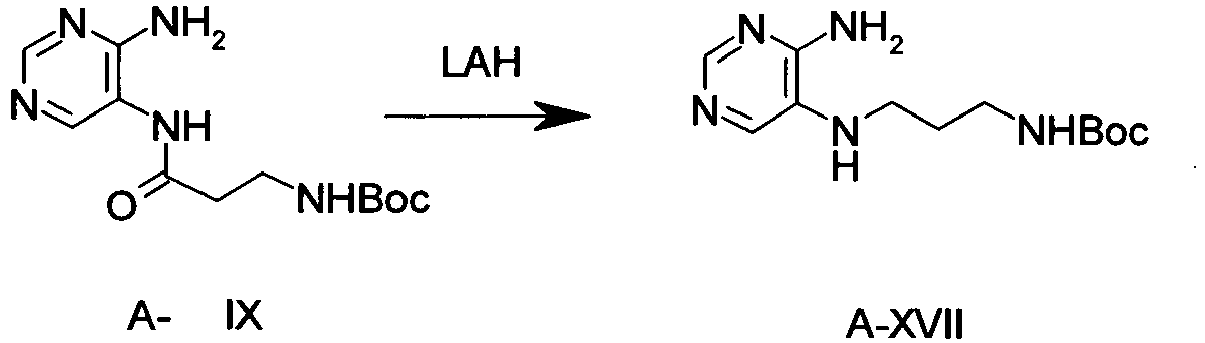
- Compound A-IX (450 mg, 1.6 mmol) was dissolved in anhydrous tetrahydrofuran (12 mL) and lithium aluminium hydride (152 mg, 3.2 mmol) was slowly added at 0°C. The resulting solution was stirred for 3 hours at room temperature.15% sodium hydroxide aqueous solution (200 uL) was then added. The resulting solution was stirred for 1 hour at room temperature. The-thus obtained solid was filtrated under reduced pressure.The filtrate was concentrated under reduced pressure. The resultant was applied to column chromatography (SiO2, MC : MeOH = 30 :1 ∼ 10 : 1) to yield CompoundA-XVII 140 mg (33%).
1H NMR (600MHz, chloroform-d1 + CD3OD) δ 8.01(s, 1H), 7.44(s, 1H), 3.23∼3.12(m, 4H), 1.85(m, 2H), 1.48(s, 9H), -

- Compound XXXIII (110 mg (100%)) was prepared by a method similar to Preparation Example 6-1 by using CompoundA-XVII (150 mg, 560umol).
- Compound A-XVIII (35 mg (41%)) was prepared by a method similar to Preparation Example 2-5 by using CompoundXXXIII (50 mg, 245 umol)and 3-hydroxy-4-(4-methoxybenzyloxy)benzoic acid (92 mg, 335 umol).
1H NMR (600MHz, DMSO-d6) δ 9.15(s, 1H), 8.24(t, J = 6Hz, 1H), 7.78(s, 1H), 7.38(s, 1H), 7.37(d, J=8.4Hz, 2H), 7.26(d, J = 2.4Hz, 1H), 7.22(dd, J = 8.4Hz, 2.4Hz, 1H), 6.99(d, J = 8.4Hz, 1H), 6.90(d, J =8.4Hz), 6.37(br, 2H), 5.03(s, 2H), 4.73(t, J = 5.4Hz, 1H), 3.71(s, 3H), 3.30(m, 2H), 3.04(q, J = 6.6Hz, 2H), 1.80(m, 2H) -

- Compound XXXIV (854 mg (70%)) was prepared by a method similar to Preparation Example 2-5 by using 4,5-diaminopyrimidine(500 mg, 4.54 mmol) and 2-(tert-butoxycarbonylamino)acetic acid(876 mg, 4.99 mmol).
1H NMR (600MHz, chloroform-d1) δ 8.46(s, 1H), 8.25(br, 1H), 8.11(br, 1H), 5.45(br d, 3H), 3.91(s, 2H), 1.48(s, 9H) - Compound XXXV (650mg (100%)) was prepared by a method similar to Preparation Example 6-1 by using CompoundXXXIV (854 mg, 3.19 mmol).
- Compound A-XIX (357 mg (68%)) was prepared by a method similar to Preparation Example 2-5 by using CompoundXXXV (250 mg, 1.23 mmol) and 3-hydroxy-4-(4-methoxybenzyloxy)benzoic acid(337 mg, 1.23 mmol).
1H NMR (600MHz, DMSO-d6) δ 8.24(s, 1H), 8.14(s, 1H), 7.41(d, J = 8.4Hz, 2H), 7.35∼7.31(m, 2H), 7.07(d, J = 8.0Hz, 1H), 6.95(d, J = 8.4Hz, 2H), 6.79(br, 2H), 5.10 (s, 2H), 4.02(d, J = 6.0Hz, 2H) -

- 4-bromoasophthalic acid (1 g, 4.1 mmol) was dissolved in distilled water (4 mL) and sodium bicarbonate(1.2 g, 11 mmol) was added. The resulting solution was stirred for 1 and a half our at 85°C. N1,N1,N2,N2-tetramethylethane-1,2-diamine(31 mg, 270 umol) and cooper bromide (18 mg, 126 umol) were dissolved in distilled water (0.5 mL). The resulting solution was stirred for 1 hour. The two resulting solutions were mixed and stirred for 18 hours at 85°C, cooled to room temperature, and acidified with 1N HCl aqueous solution. The resulting solid was filtered under reduced pressure, washed with water, and dried under reduced pressure to yield CompoundXXXVI (720 mg(97%)).
1H NMR (600MHz, DMSO-d6) δ 8.34(t, J = 3.6Hz, 1H), 8.04(dt, J = 1.2Hz, 13.2Hz, 1H), 7.05(dd, J =3.6Hz, 12.6Hz, 1H) - Compound XXXVI (720 mg, 3.95 mmol) was dissolved in trifluoroacetic acid (4.32 mL). Acetone(2 mL) and trifluoroacetic anhydride(TFAA) (1.45 mL) were added sequentially. The resulting solution was stirred for 8 hours at 100°C, cooled to room temperature, and concentrated under reduced pressure.The resultant was dissolved in ethyl acetate (100 mL) and washed with 1N HCl aqueous solution(50 mL).The organic layer was dehydrated with anhydrous sodium sulfate and concentrated under reduced pressure. The thus-obtained solid was filtered under reduced pressure to yield CompoundXXXVII (500 mg(57%)).
1H NMR (600MHz, chloroform-d1) δ 8.76(d, J= 2.4Hz, 1H), 8.30(dd, J =9.0Hz, 1.8Hz, 1H), 7.08(d, J = 8.4Hz, 1H), 1.78(s, 6H) - Compound A-XX (90mg (72%)) was prepared by a method similar to Preparation Example 2-5 by using Compound VI (80 mg, 416 umol) and CompoundXXXVII (78 mg, 350umol).
1H NMR (600MHz, CD3OD) δ 8.42(d, J = 3.6Hz, 1H), 8.13(m, 1H), 7.94(s, 1H), 7.61(s, 1H), 7.14(d, 12.6Hz, 1H) 3.66(t, 9.6Hz, 2Hz) 3.40(t, 9.6Hz, 2H), 1.74(s, 6H), -

- Ethyl 3,4-dihydroxybenzoate (5g, 28 mmol) was dissolved in N,N-dimethylformamide (50 mL) and potassium carbonate (15 g, 110 mmol) was added. The resulting solution was stirred for 2 days at room temperature, diluted with ethyl acetate (400 mL), and filtered under reduced pressure. The filtrate was washed with water (300 mL x 3) and saline (300 mL).The organic layer was concentrated under reduced pressure. Hexane was added to the resultant. The thus-obtained solid was filtered under reduced pressure to yield CompoundXXXVIII (11 g (97%)).
1H NMR (600MHz, chloroform-d1) δ 7.64(d, J= 1.8Hz, 1H), 7.63(dd, J =7.8Hz, 2.4Hz, 1H), 7.38(m, 4H), 6.93(m, 5H), 5.13(s, 2H), 5.11(s, 2H), 4.35(q, J = 7.2Hz, 2H), 3.81(s, 6H), 1.38(t, J = 7.2Hz, 3H) - Compound XXXVIII (11 g, 27 mmol) was dissolved in tetrahydrofuran (120 mL) and ethanol (130 mL). 2N lithium hydroxide aqueous solution (52 mL) was added. The resulting solution was stirred for 12 hours at room temperature, concentrated under reduced pressure, diluted with distilled water (200 mL), and washed with ethyl acetate (200 mL). The thus-obtained aqueous solution layer was acidified with 1N HCl aqueous solution. The thus-obtained solid was filtered under reduced pressure and vacuum dried to yield CompoundXXXIX (8.6 g (81%)).
1H NMR (600MHz, DMSO-d6) δ 7. 50 (m, 2H), 7.34(m, 4H), 7.11(d, J = 9.6Hz, 1H),6.91(m, 4H), 5.07(s, 2H), 5.02(s, 2H), 3.71(s, 6H) - Compound A-XXI (300mg (57%)) was prepared by a method similar to Preparation Example 2-5 by using Compound VI (190 mg, 1 mmol) and CompoundXXXIX(410 mg, 1.1 mmol).
1H NMR (600MHz, DMSO-d6) δ 8.46(t, J= 5.4Hz, 1H), 7.84(s, 1H), 7.56(d, 11.4Hz, 2H), 7.46(dd, J= 9.0Hz, 2.4Hz, 1H), 7.37(d, J = 9Hz, 4H), 7.132(d, J = 8.4Hz, 1H), 6.94(d, J = 9hz, 4H), 6.37(br, 2H) 5.09 (s, 2H), 5.06(s, 2H), 4.99(t, J=5.4Hz, 1H), 3.75(s, 6H), 3.45(q, J = 6Hz, 2H), 3.26(q, J =6Hz, 2H) -

- Compound A-XXII (135mg (59%)) was prepared by a method similar to Preparation Example 8-2 by using 4,5-diaminopyrimidine hydrochloride (100 mg, 0.91 mmol) and tert-butyl 4-oxobutanoate (158 mg, 0.99 mmol).
1H NMR (600MHz, chloroform-d1) δ=8.11(s, 1H), 7.33(s, 1H), 6.43(br, 2H), 5.06(br, 1H), 3.16(t, J = 6.6Hz, 2H), 2.48(t, J = 6.6Hz, 2H), 2.02(m, 2H), 1.47(s, 9H) -

- 2,4-dichloro-5-nitropyrimidine(3g, 15.4 mmol) was dissolved in tetrahydrofuran(52 mL) and 2N methylamine(15.4 mL) dissolved in tetrahydrofuran was slowly added at -78°C. The resulting solution was stirred for 10 minutes and then further stirred for 50 minutes at room temperature.The resulting solution was concentrated under reduced pressure, diluted with ethyl acetate(50 mL), and washed with water (30 mL) and saline (30 mL).The resultant was dehydrated with anhydrous sodium sulfate, concentrated under reduced pressure, and applied to column chromatography(EA : Hex = 20 : 1 ∼ 5 : 1) to yield CompoundXL (925 mg (32%)).
1H NMR (600MHz, chloroform-d1) δ 9.05(s, 1H), 8.41(br, 1H), 3.23(d, J = 4.8Hz, 3H), - Compound XL(506 mg, 2.68 mmol) was dissolved in methanol(5 mL) and 10%palladium charcoal (285 mg, 0.27 mmol) was added. The resulting solution was applied to hydrogen gas purge, stirred for 2 hours at room temperature, filtered with celite, and concentrated under reduced pressure to yield CompoundA-XXIII (411 mg (98%)).
1H NMR (600MHz, DMSO-d6) δ 8.87(br, 1H), 8.37(s, 1H), 7.47(s, 1H), 5.94(br, 2H), 3.02(d, J = 4.2Hz, 3H) -

- Compound VI(50 mg, 0.32 mmol) was dissolved in methanol (1 mL). Triethylamine(40 mg, 0.40 mmol) and tert-butyl imino(1H-pyrazole-1-yl)methylcarbamate(69 mg, 0.32 mmol) were added. The resulting solution was stirred for 15 hours at room temperature, concentrated under reduced pressure, and applied to column chromatography (MC : MeOH = 10 : 1 ∼ 7 : 1) to yield CompoundA-XXIV (24 mg (25%)).
1H NMR (600MHz, CD3OD) 5 8.02(br, 1H), 7.60(br, 1H), 3.64(t, J=5.4Hz, 2H), 3.44(br, 2H), 1.55sm, 9H) -

- Compound A-XXV (189mg (50%)) was prepared by a method similar to Preparation Example 8-2 by using Compound XLI(192 mg, 0.68 mmol) and Compound XIX(333 mg, 1.16 mmol).
1H NMR (600MHz, CDCl3) 5 8.19(s, 1H), 7.49(s, 1H), 6.07(br, 1H), 4.92(br, 1H), 3.64(t, J=7.2Hz, 2H), 3.53(br, 2H), 3.20(br, 2H), 3.11(t, J=6.6Hz, 2H), 1.72(m, 6H), 1.60(m, 2H), 1.50∼1.44(m, 27H) -

- Compound A-XXVI (228mg (59%)) was prepared by a method similar to Preparation Example 2-5 by using 4,5-diaminopyrimidine(144 mg, 1.31 mmol) and 4-(tert-butoxycarbonylamino)butanoic acid(266 mg, 1.31 mmol).
1H NMR (600MHz, CD3OD) δ 8.30(s, 1H), 8.24(s, 1H), 3.18(t, J=6Hz, 2H), 2.51(t, J=6.6Hz, 2H), 1.89(t, J=6.6Hz, 2H), 1.47(s, 9H) -

- Compound XLII (180mg (100%)) was prepared by a method similar to Preparation Example 6-1 by using CompoundA-XXVI(232 mg, 0.78 mmol).
- Lithium aluminium hydride(87 mg, 2.3 mmol) was added to tetrahydrofuran(5 mL) and the resulting solution was stirred at room temperature.After adding Compound XLII(180 mg, 0.78 mmol), the resulting solution was stirred for 20 minutes with reflux. 15% sodium hydroxide aqueous solution(0.1mL) was added. The thus-obtained solid was filtered under reduced pressure.The filtrate was concentrated under reduced pressure and dissolved in methanol (4 mL). Di-tert-butyl dicarbonate(171 mg, 0.78 mmol) was added.
- The resulting solution was stirred for 30 minutes with reflux, concentrated under reduced pressure, and applied to column chromatography (MC : MeOH = 45 : 1 ∼ 15 : 1) to yield CompoundA-XXVII (25.6 mg (11%)).
1H NMR (600MHz, CDCl3) δ 8.14(s, 1H), 7.62(s, 1H), 3.28(br, 2H), 3.15(br, 2H), 1.71(m, 2H), 1.64(m, 2H), 1.45(s, 9H) -

- Compound A-XXVIII (135 mg (55%)) was prepared by a method similar to Preparation Example 2-5 by using 4,5,6-triaminopyrimidine sulfate(200 mg, 0.86 mmol) and 2-(tert-butoxycarbonylamino)acetic acid(166 mg, 0.95 mmol).
1H NMR (600MHz, CD3OD) δ 7.83(s, 1H), 3.82(s, 2H), 1.46(s, 9H) -

- Compound A-XXIX (257 mg (62%)) was prepared by a method similar to Preparation Example 8-2 by using 4,5,6-triaminopyrimidine(193 mg, 1.54 mmol) and Compound I (370 mg, 2.31 mmol).
1H NMR (600MHz, CD3OD) δ 7.89(s, 1H), 3.19(t, J=6Hz, 2H), 2.90(t, J=6Hz, 2H), 1.42 (s, 9H) -
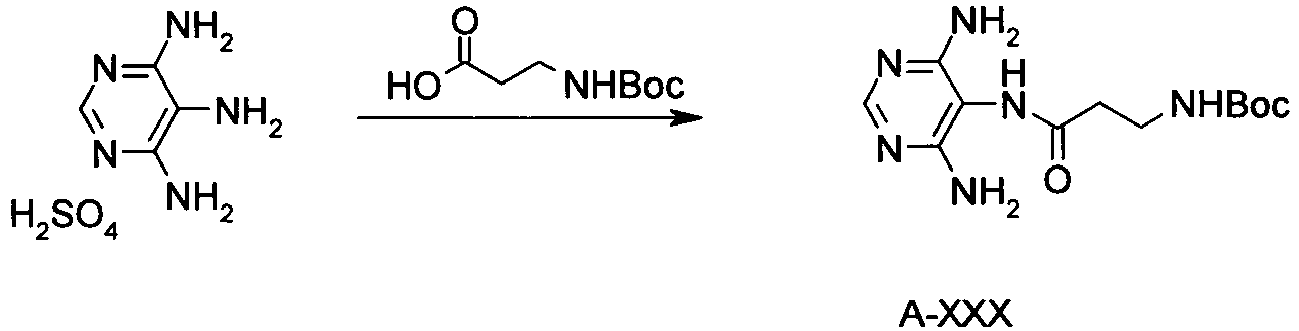
- Compound A-XXX(112 mg (44%)) was prepared by a method similar to Preparation Example 2-5 by using 4,5,6-triaminopyrimidine sulfate(200 mg, 0.86 mmol) and 2-(tert-butoxycarbonylamino)acetic acid(179 mg, 0.95 mmol).
1H NMR (600MHz, CD3OD) δ 7.81(s, 1H), 3.42(t, J=6.6Hz, 2H), 2.60(t, J=6Hz, 2H), 1.43(s, 9H) -

- Compound A-XXXI (420 mg (60%)) was obtained as a white solid by a method similar to Preparation Example 2-5 by using 4,5,6-triaminopyrimidine sulfate(500 mg, 2.24 mmol) and 3-(tert-butoxycarbonylamino)butanoic acid(500 mg, 2.46 mmol).
1H NMR (400 MHz, DMSO d-6) δ 8.47(s, 1H), 7.72(s, 1H), 6.85(t, J = 8.4Hz, 1H), 5.87(brs, 4H), 2.94(m, 2H), 2.30(t, J = 10.8Hz, 2H), 1.64(m, 2H), 1.39(s, 9H) -

- Crotonic acid (4 g,47 mmol) was dissolved in CCl4 (30 mL). NBS (9 g, 51 mmol) and benzoylperoxide (75 mg, 0.3 mmol) were added with reflux over 3 hours. (i.e., o hour: 4 g, 25 mg;after 1 hour: 3 g,25 mg; after 2 hours: 2 g, 25 mg) The resulting solution was cooled to room temperature, diluted with methylene chloride (20 mL), and washed with 0.2 N HCl aqueous solution. The organic layer was dehydrated with anhydrous sodium sulfate and concentrated under reduced pressure to yield Compound XLIII (2.2 g (27%)).
1H NMR (600MHz, chloroform-d1) δ=7.10 (q, J=7.2Hz, 1H), 6.01(dt, J=15Hz, 1.2Hz 1H), 4.00(dd, J=7.2Hz, 0.6Hz ,2H) - Compound XLIII (1 g, 6.06 mmol) was dissolved in anhydrous methylene chloride (20 mL). At room temperature, oxalyl chloride (1.03 mL, 12 mmol) was added and 3 drops of N,N-dimethylformamide were added. The resulting solution was stirred for 1 hour at room temperature and distilled under reduced pressure to remove the solvent. The resultant was dissolved in tetrahydrofuran (12 mL) and cooled to 0°C by using ice water. 0-(4-methoxybenzyl)hydroxylamine(928 mg, 6 mmol) dissolved in tetrahydrofuran (20 mL) was slowly added. Diisopropylethylamine (4.1 mL, 21 mmol) was then added. The resulting solution was stirred for 30 minutes at 0°C and for 20 minutes at room temperature.The resultant was concentrated under reduced pressure, diluted with ethyl acetate 30 ml, and washed with water30 mL and saline 30 mL. The organic layer was dehydrated with anhydrous sodium sulfate and concentrated under reduced pressure. The resultant was applied to column chromatography (n-Hex : EA = 3 : 1) to yield Compound XLIV (515 mg (28%)).
1H NMR (600MHz, chloroform-d1) δ 7.30 (d J=7.8Hz 2H) 7.00 (q, J=7.2Hz, 1H), 6.96 (d,J =7.2Hz 2H) 4.86(br, 2H), 4.00(d,J=11.42Hz, 2H), 3.79(s, 2H) - Compound XLIV (150 mg, 0.5 mmol) and 4,5-diaminopyrimidine were dissolved in N,N-dimethylformamide (1 mL). The resulting solution was stirred for 12 hours at room temperature, diluted with ethyl acetate(10 mL), and washed with water (10 ml). The organic layer was dehydrated with anhydrous sodium sulfate and concentrated under reduced pressure.The resultant was applied to column chromatography to yield CompoundA-XXXII (5 mg (3%)).
1H NMR (600MHz, chloroform-d1 + CD3OD) δ 7.98(s, 1H) 7.30 (m 3H) 6.84 (m, 3H), 5.87(br, 1H) 4.86(br , 2H), 3.83∼3.75 (m, 5H) -

- Compound A-XXXIII (854 mg (71%)) was obtained by a method similar to Preparation Example 2-5 by using 4,5-diaminopyrimidine(500 mg, 4.54 mmol) and 2-(tert-butoxycarbonylamino)acetic acid(876 mg, 4.99 mmol).
1H NMR (600MHz, chloroform-d1) δ 8.46 (s, 1H), 8.24 (s, 1H), 8.11(s, 1H) 5.49(br, 2H), 5.41(s, 1H), 3.91(s, 2H), 1.47(s, 9H) -

- GCLE ((6S,7R)-4-methoxybenzyl 3-(chloromethyl)-8-oxo-7-(2-phenylacetamido)-5-thia-1-azabicyclo[4.2.0]oct-2-ene-2-carboxylate) (49 g, 0.1 mol) was dissolved in methylene chloride (700 mL). A solution of pyridine (15.8 g, 0.2 mol) and phophorous pentachloride (33.3 g, 0.16 mol) dissolved in methylene chloride(350 mL) was added at 0°C. The resulting solution was stirred for 2 hours at 0°C and cooled to -40°C. After adding methanol (80 mL), the resulting solution was stirred for 10 minutes at -40°C and for 2 hours at 0°C, diluted with methylene chloride(400 mL), and washed with 5% sodium bicarbonate aqueous solution(800 mL x 2) and 1N HCl aqueous solution(1 L). The organic layer was dehydrated with anhydrous sodium sulfate and concentrated under reduced pressure to about 200 mL. Ether (3 L) was added and the thus-obtained solid was filtered under reduced pressure to yield Compound XLV (30 g (74%)).
1H NMR (600MHz, DMSO-d6) δ 8.8(br, 2H), 7.33(d, J = 12.6Hz, 2H), 6.91(d, J = 12.6Hz, 2H), 5.23(m, 4H), 4.55(dd, J = 17.4Hz, 57Hz, 2H), 3.78(dd, J = 26.4Hz, 70.8Hz, 2H), 3.71(s, 3H) -

- Ethyl 2-oxo-2-(2-(tritylamino)thiazol-4-yl)acetate (100 g, 230 mmol) was dissolved in methanol (95 mL). A solution of sodiumhydroxide(9.4 g, 235 mmol) dissolved in methanol (235 mL) was added. The resulting solution was stirred for 10 minutes with reflux. The thus-obtained solid was filtered under reduced pressure, washed with methanol, dissolved in water (200 mL), and acidified with 2N HCl aqueous solution.The resulting solid was filtered under reduced pressure to yield CompoundXLVII (84 g (84%)).
1H NMR (600MHz, DMSO-d6) δ 9.03(s, 1H), 7.79(s, 1H), 7.34∼7.21(m, 15) -

- Benzophenone (25 g, 137 mmol) was dissolved in ethanol (250 mL) and hydrazine monohydrate (13.7 g, 274 mmol) was added. The resulting solution was stirred for one day with reflux. Then, additional hydrazine monohydrate (13 g) was added and the resulting solution was stirred for one day with reflux.After the starting material, benzophenone, disappeared,the resulting solution was concentrated under reduced pressure to remove ethanol, diluted with ethyl acetate (500 mL), and washed with water (300 mL x 2) and saline (200 mL).The organic layer was dehydrated with anhydrous sodium sulfate and concentrated under reduced pressure. The thus-obtained solid was filtered under reduced pressure to yield Compound XLVIII (20g (75%)). The filtrate was recrystalized with ethyl acetate and hexane to yield Compound XLVIII (4g (15%)).
1H NMR (400MHz, DMSO-d6) δ 7.55∼7.17(m, 10H), 6.20(s, 2H) - Compound XLVIII (20 g, 102 mmol) was dissolved in ether (320 mL). Sodiumsulfate(Na2SO4, 22 g, 153 mmol), saturated potassiumhydroxide ethanol solution (8 mL, 40 g/100 mL EtOH), and mercury oxide (HgO, 55 g, 255 mmol) were sequentially added. The resulting solution was stirred at a high speed for 1 hour. The thus-created solid was filtered under reduced pressure with celite and the filtrate was concentrated under reduced pressure to yield CompoundXLIX (19 g (100%)), which was used for next step without performing purification.
1H NMR (400MHz, chloroform-d1) δ 7.39∼7.15(m, 10H), - (+) lactic acid(85%,9.6g, 90 mmol) was dissolved in ethyl acetate(400 mL) and a solution of Compound XLIX (19 g, 100 mmol) dissolved in ethyl acetate(200 mL) was added at 0°C over 20 minutes. The resulting solution was stirred for 12 hours at room temperature.The resultant was concentrated under reduced pressure and applied to column chromatography (SiO2, EA : n-hex =1 : 6) to yield Compound L (17 g (76%)).

- Compound L (10 g, 39 mmol) was dissolved in N,N-dimethylformamide(40 mL). The resulting solution was cooled to 0°C and sulfuryl chloride(5.79 g, 42.9 mmol) was slowly added over 15 minutes.The resulting solution was stirred for 20 minutes at 0°C and for 1 and a half hour at room temperature and diluted with ethyl acetate (200 ml). Cool sodium bicarbonate solution (100 mL) was added to end the reaction. The resulting solution was washed with saturated sodiumbicarbonate solution (100 mL) and saline (100 mL).The organic layer was dehydrated with anhydrous sodium sulfate and the filtrate was concentrated under reduced pressure.The resultant was applied to column chromatography (SiO2, EA : n-hex =1 : 9) to yield Compound LI (5.3g (49%)).
1H NMR (600MHz, chloroform-d1) δ = 7.36∼7.26(m, 10H), 6.90(s, 1H), 4.51(q, J= 6.6Hz, 1H), 1.72(d, J = 6.6Hz, 3H) - Compound LI (4 g, 14.6 mmol) was dissolved in N,N-dimethylformamide(30 mL). N-hydroxy phthalamide (2.45 g, 15 mmol) and potassium carbonate(2.07g, 15 mmol) were added. The resulting solution was stirred for 12 hours at room temperature, diluted with ethyl acetate (400 mL), washed with water (200 mL) and saline (200 mL x 2), and recrystalized with hexane to yield CompoundLII (6 g (99%)).

- Compound LII (2.5 g, 6.23 mmol) was dissolved in methylene chloride(10 mL). Methylhydrazine(287 mg, 6.2 3 mmol) was added at 0°C. The resulting solution was stirred for 2 hours at 0°C to create a solid. The solid was filtered under reduced pressure and the filtrate was concentrated under reduced pressure to yield Compound LIII, which was used for next step without performing purification.
- Compound LIII was dissolved in methylene chloride(5 mL) and methanol (20 mL). Compound XLVII (2.6 g, 6.2 mmol) was added at 0°C. The resulting solution was stirred for 30 minutes at 0°C and 3 hours at room temperature, concentrated under reduced pressure to remove the solvent, diluted with ethyl acetate (150 mL), and washed with 0.1N HCl aqueous solution (100 mL) and saline (100 mL).The organic layer was dehydrated with anhydrous sodium carbonate, concentrated under reduced pressure to remove the solvent, and crystalized with ethyl acetate and hexane to yield Compound LIV (2.5g (60%)).
1H NMR (600MHz, DMSO-d6) δ 8.87(s, 1H), 7.44(m, 25H), 6.82(s, 2H), 4.89(q, J = 7.2Hz, 1H), 1.41(d, J = 6.6Hz, 3H) - Compound LIV (2.07 g, 4.03 mmol) and CompoundXLV (1.8 g, 4.44 mmol) were dissolved in methylene chloride (45 mL). At 0°C, pyridine(1.47 mL, 18 mmol) and phosphoryl chloride (POCl3, 376 uL, 4.03 mmol) were added.The resulting solution was stirred for 20 minutes at 0°C, diluted with ethyl acetate(150 mL), washed with water (50 mL) and saline (30 mL x 2).The organic layer was dehydrated with anhydrous sodium sulfate, concentrated under reduced pressure, and applied to column chromatography (SiO2, n-hex : EA = 6 : 1∼ 2 : 1) to yield Compound B-1 (1.9 g (47%)).
1H NMR (600MHz, chloroform-d1) δ =8.10(d, J = 8.4Hz, 1H), 7.34∼7.22(m, 27H), 6.98(s, 1H), 6.91(s, 1H), 6.89(d, J = 7.8Hz, 2H), 6.73(s, 1H), 5.91(dd, J = 4.8Hz, 8.4Hz, 1H), 5.26(m, 4H), 4.94(d, J = 5.4Hz, 1H), 4.58(dd, J = 11.4Hz, 94.8Hz, 2H), 3.79(s, 3H), 3.546(dd, 18Hz, 105.6Hz, 2H), 1.61(d, J = 6.6Hz, 3H) -

- Compound LV (30 g, 149 mmol) was dissolved in tetrahydrofuran(500 mL). Di-tert-butyl dicarbonate(33 g, 152 mmol) and 4-dimethylaminopyridine(388 mg, 3.17 mmol) were sequentially added. The resulting solution was stirred for 20 hours at room temperature, concentrated under reduced pressure, and applied to column chromatography (EA : Hex = 1 : 7 ∼ 1 : 5) to yield CompoundLVI (17.7 g (39%)).
1H NMR (600MHz, chloroform-d1) δ =8.58(br, 1H), 8.27(s, 1H), 4.44(q, J=7.8Hz, 2H), 1.54(s, 9H), 1.42(t, J=6.6Hz, 3H) - Compound LVI (17.7 g, 58.9 mmol) was dissolved in methanol (118 mL) and the resulting solution was stirred at room temperature.Sodium hydroxide(4.24 g, 106 mmol) dissolved in distilled water (40 mL) was slowly added. The resulting solution was stirred for 1 hour, concentrated under reduced pressure, dissolved in water (200 mL), and solidified with 1N HCl (pH 1∼2). The thus-obtained solid was filtered under reduced pressure and washed with water (200 mL) to yield CompoundLVII (16 g (100%)).
1H NMR (600MHz, DMSO-d6) δ 11.92(s, 1H), 8.35(s, 1H), 1.47(s, 9H) - Compound LVII (16 g, 58.7 mmol) was dissolved in 1,4-dioxane (118 mL) and N-chlorosuccineimide (NCS, 8.1 g, 60.7 mmol) was added.The resulting solution was stirred for 30 minutes at room temperature and for 15 hours at 40°C. The resulting solution was filtered under reduced pressure and the filtrate was concentrated under reduced pressure. The resultant was filtered under reduced pressure with ether/n-hexane =2/1 (150 mL) to remove the thus-created solid and the filtrate was concentrated under reduced pressure to yield CompoundLVIII (12.3 g (68%)).
1H NMR (600MHz, DMSO-d6) δ 12.19(s, 1H), 1.43(s, 9H) - Compound LIX (14.2 g (63%)) was prepared by a method similar to Preparation Example 38-7 by using Compound LVIII (12.3 g, 40.1 mmol) and Compound LIII(12.8 g, 47.2 mmol).
1H NMR (600MHz, chloroform-d1) δ =7.34∼7.27(m, 10H), 6.92(s, 1H), 5.09(q, J=6.6Hz, 1H), 1.60(d, J=7.2Hz, 3H), 1.51(s, 9H) - Compound B-II (2.62 g (54%)) was prepared by a method similar to Preparation Example 38-8 by using Compound LIX(3.0 g, 5.35 mmol) and Compound XLV(2.82g, 6.96 mmol).
1H NMR (600MHz, chloroform-d1) δ 7.96(br, 1H), 7.86(d, J=9.6Hz, 1H), 7.35(d, J=9Hz, 2H), 7.29∼7.25(m, 10H), 6.92∼6.87(m, 3H), 6.03(q, J=4.8Hz, 1H), 5.27(d, J=11.4Hz, 1H), 5.21(d, J=11.4Hz, 1H), 5.10(q, J=7.2Hz, 1H), 4.98(d, J=5.4Hz, 1H), 4.60(d, J=12Hz, 1H), 4.44(d, J=12Hz, 1H), 3.81(s, 3H), 3.59(d, J=18.6Hz, 1H), 3.41(d, J=18Hz, 1H), 1.64(d, J=7.2Hz, 3H), 1.52(s, 9H) -

- Tert-butyl 2-bromo-2-methylpropanoate (100 g, 0.6 mol), N-hydroxy phthalamide (136 g, 0.6 mol), and triethylamine(93 g, 0.9 mol) were stirred for 24 hours at 80°C. The resultant was diluted with ethyl acetate(1L x 2), washed with water (1L), 1N HCl (800 mL), and 0.5N sodium hydroxide(500 mL), dehydrated with anhydrous sodium sulfate, and concentrated under reduced pressure.The thus-obtained white solid was washed with n-hexane(800 mL) and filtered under reduced pressure to yield CompoundLX (91g (49%)).
1H NMR (600MHz, chloroform-d1) δ 7.85(q, J=3Hz, 2H), 7.76(q, J=3Hz, 2H), 1.59(s, 6H), 1.52(s, 9H) - Compound LX(2.63 g, 8.6 mmol) was dissolved in methylene chloride(11 mL) and methanol (2 mL). Hydrazine monohydrate (1.7 mL) was added. The resulting solution was stirred for 1 and a half hour at room temperature.The thus-obtained solid was filtered under reduced pressure. The filtrate was diluted with ethyl acetate(20 mL) and washed with distilled water(20 mL x 2) and saline (20 mL).The organic layer was dehydrated with anhydrous sodium sulfate and concentrated under reduced pressure to yield Compound LXI (1.4g, (93%)), which was used for next step without performing purification.
- Acetamidine hydrochloride(6 g, 64 mmol) was dissolved in distilled water(75 mL) and the resulting solution was cooled to 0°C. Sodium hyperchloride (4% chlorine available sol, 95 mL) was added over 1.5 hours and the resulting solution was stirred for 1 hour.Excessive amount of sodium chloride was added and the resultant was extracted with ethyl acetate(150 mL x 2). The organic layer was dehydrated with anhydrous sodium sulfate and concentrated under reduced pressure to yield CompoundLXII (5.1 g (87%)), which was used for next step without performing purification.
- CompoundLXII (5,1 g, 55 mmol) was dissolved in methanol (250 mL) and the resulting solution was cooled to 0°C. Potassium thiocyanate (5.3 g, 55 mmol) was then added. The resulting solution was stirred for 12 hours at room temperature, concentrated under reduced pressure, diluted with ethyl acetate(200 mL), and filtered under reduced pressure to remove a solid. The filtrate was concentrated under reduced pressure, creating a solid which was filtered under reduced pressure to yield CompoundLXIII (2 g (32%)).The filtrate was further concentrated and applied to column chromatography (SiO2, n-hex : EA = 4 : 1) to yield Compound LXIII (2 g (32%)).
1H NMR (600MHz, CD3OD) δ 3.27(s, 3H) - Compound LXIII (2 g, 17.4 mmol) was added to Boc2O (6 mL). The resultant was stirred for 12 hours with reflux, concentrated under reduced pressure, and applied to column chromatography (SiO2, n-hex : EA = 4 : 1) to yield CompoundLXIV (2 g (53%)).
1H NMR (600MHz, chloroform-d1) δ = 10.97(br, 1H), 2.55(s, 3H), 1.55(s, 9H) - Diisopropylamine (11.37 mL, 82 mmol) was dissolved in anhydrous tetrahydrofuran (50 mL) and the resulting solution wsa cooled to - 78°C. Butyl lithium (1.6 M n-hex sol., 56.1 mL, 90 mmol) was added and the resulting solution was stirred for 10 minutes at the same temperature to prepare LDA solution.
- To the LDA solution, a solution of Compound LXIV (4,39 g, 20.4 mmol) dissolved in anhydrous tetrahydrofuran(20 mL) was slowly added at -78°C. Carbonic acid gas was introduced in the resulting solutoin -40°C. The resulting solution was stirred for 1 hour at - 40°C, 30 minutes at 0°C, and 4 hours at room temperature. Distilled water(5 mL) was added to end the reaction. The resulting solution was concentrated under reduced pressure.By adding distilled water(200 mL) and extracting with ether(150 mL x 3), remaining starting material was recovered (2 g). The resulting aqueous solution was acidified with 1N HCl aqueous solution and extracted with ethyl acetate(250 mL).The organic layer was dehydrated with anhydrous sodium sulfate and concentrated under reduced pressure to yield CompoundLXV (2.2 g (40%)).
1H NMR (600MHz, DMSO-d6) δ 12.34(s, 1H), 3.74(s, 2H), 1.50(s, 9H) - Compound LXV (2.2 g, 8.5 mmol) was dissolved in 1,4-dioxane (33 mL) and selenium dioxide (SeO2, 1.87 g, 17 mmol) was added. The resulting solution was stirred at 100°C, cooled to room temperature, filtered under reduced pressure, washed with 1,4-dioxane.The filtrate was concentrated under reduced pressure to yield Compound LXVI, which was used for next step without performing purification.
- Compound LXVII(12.9 g (64%)) was prepared by a method similar to Preparation Example 38-7 by using Compound LXVI (12.8 g, 47.1 mmol) and Compound LXI(10.2 g, 58.2 mmol).
1H NMR (600MHz, DMSO-d6) δ 1.49(s, 9H), 1.44(s, 6H), 1.36(s, 9H) - Compound B-III (4.12 g (39%)) was prepared by a method similar to Preparation Example 38-8 by using Compound LXVII(5.85 g, 13.6 mmol) and Compound XLV(7.16 g, 17.6 mmol).
1H NMR (600MHz, chloroform-d1) δ = 8.75(br, 1H), 8.05(br, 1H), 7.35(d, J=7.8Hz, 2H), 6.96(d, J=9Hz, 2H), 6.09(dd, J=4.8Hz, 1H), 5.26(d, J=11.4Hz, 1H), 5.21(d, J=11.4Hz, 1H), 5.05(d, J=4.8Hz, 1H), 4.53(d, J=11.4Hz, 1H), 4.47(d, J=11.4Hz, 1H), 3.82(s, 3H), 3.65(d, J=18Hz, 1H), 3.49(d, J=18Hz, 1H), 1.66(s, 3H),1.63(s, 3H), 1.54(s, 9H), 1.40(s, 9H) -

- Compound LXXIIwas prepared by a method similar to Preparation Example 38-7 by using Compound XLVII and Compound LXI.
-

- GCLE (49 g, 0.1 mol) was dissolved in acetone (1 L) and sodium iodide (45 g, 0.3 mol) was added. The resulting solution was stirred for 2 hours at room temperature, concentrated under reduced pressure, diluted with ethyl acetate (1.2 L), and washed with water (500 ml), 10% sodium thiosulfate(Na2S2O3.5H2O) aqueous solution(1 L), and saline (500 mL x 2). The organic layer was washed with anhydrous sodium sulfate and concentrated under reduced pressure to yield Compound LXVIII (57 g (99%)), which was used for next step without performing purification.
- Compound LXVIII (57 g, 0.1 mol) was dissolved in ethyl acetate (1 L) and triphenylphosphine (52 g, 0.2 mol) was added at room temperature. The resulting solution was stirred for 2 hours.The thus-created solid was filtered under reduced pressure and washed with ethyl acetate and dried to yield CompoundLXIX (80 g (95%)).
1H NMR (600MHz, chloroform-d1) δ = 7.80∼7.64(m, 15H), 7.35∼7.26(m, 5H), 7.16(d, J = 7.8Hz, 2H), 7.65(d, J = 7.8Hz, 2H), 6.46(d, J = 3.0Hz, 1H), 5.66(dd, J = 5.4Hz, 9Hz, 1H), 5.62(t, J = 15Hz, 1H) 5.16(t, J= 15Hz, 1H), 4.58(m, 3H), 4.05(dd, 4.8Hz, 18.6Hz, 1H), 3.80(s, 3H), 3.66(s, 2H), 3.37(d, 18.6Hz, 1H) - Compound LXIX (40 g, 48 mmol) was dissolved in methylene chloride(450 ml) and distilled water(150 mL). The resulting solution was cooled to 0°C and chloroacetaldehyde (50% aq sol, 30 mL, 238 mmol) was added.Then, 2N sodiumhydroxide aqueous solution (29 mL) was added and the resulting solution was stirred for 30 minutes at the same temperature.The organic layer was washed with water (200 mL) and saline (250 mL), dehydrated with anhydrous sodium sulfate, concentrated under reduced pressure, and applied to column chromatography (SiO2, n-hex : EA : MC = 2 : 1 : 1) to yield CompoundLXX (9.1 g (37%)).
1H NMR (600MHz, chloroform-d1) δ =7.63(m, 7H), 6.86(d, J = 9Hz, 2H), 6.20(d, J =11.4Hz, 1H), 6.01(d, J =8.4Hz, 1H), 5.82(dd, 4.8Hz, 9Hz, 1H), 5.72(m, 1H), 5.14(m, 2H), 4.98(d, J = 4.8Hz, 1H), 3.91(dd, J = 8.4Hz, 12.6Hz, 1H), 3.78(s, 3H), 3.72(dd, J = 7.2Hz, 12Hz, 1H), 3.67(q, J = 16.2Hz, 2H), 3.47(dd, J = 18.6Hz, 124.8Hz, 2H) - Compound LXXI (15 g (50%)) was prepared by a method similar to Preparation Example 36 by using Compound LXX (36 g, 70.2 mmol).
1H NMR (600MHz, chloroform-d1) δ =7.31 (d, J = 9.0Hz, 2H), 6.87 (d, J = 9Hz, 2H), 6.23(d, J =11.4Hz, 1H), 5.70(m, 1H), 5.16(m, 1H), 4.92(d, J = 4.8Hz, 1H), 4.74(d, J = 4.8Hz, 1H), 3.93(dd, J = 9.6Hz, 11.4Hz, 1H), 3.78(s, 3H), 3.72(dd, J = 7.2Hz, 12Hz, 1H), 3.51(dd, J = 18.6Hz, 124.8Hz, 2H) - Compound B-IV (17g (47%)) (E/Z mixture 2 : 8)was prepared by a method similar to Preparation Example 38-8 by using Compound LXXII (19.7g, 34.5 mmol) and CompoundLXXI (14.9g, 34.5 mmol).
1H NMR (600MHz, chloroform-d1) δ = 8.18(d, J = 9Hz, 1H), 7.33∼7.24(m, 17H), 6.89(m, 3H), 6.71(s, 1H), 6.27(d, J = 10.8Hz, 1H),5.98(m, 1H), 5.74(m, 1H), 5.73(m, 3H), 3.94(dd, J =7.8Hz, 9Hz, 1H), 3.79(s, 3H), 3.75(dd, J = 7.8Hz, 9Hz, 1H), 3.47(dd, J = 18.Hz, 124.8Hz, 2H), 1.62(d, J = 27Hz, 6H), 1.39(s, 9H) - Compound B-V (18 g (95%)) was prepared by a method similar to Preparation Example 42-1 by using CompoundB-IV(17g, 17.9 mmol) and used for next step without performing purification.
-

- Compound B-VI (2 g (52%)) (E/Z mixture 2 : 8) was prepared by a method similar to Preparation Example 38-8 by using Compound LIV (2.5 g, 3.7 mmol) and Compound LXXI (1.73 g, 3.7 mmol).
1H NMR (600MHz, chloroform-d1) δ = 8.16(d, J = 8.4Hz, 1H), 7.35∼7.26(m, 27H), 6.98(s, 1H), 6.91(m, 3H), 6.75(s, 1H), 6.33(d, J = 10.8Hz, 1H), 5.92(dd, J = 4.8Hz, 8.4Hz, 1H), 5.78(m, 1H), 5.20(m, 3H), 5.78(d, J = 4.8Hz, 1H), 3.93(dd, J =8.4Hz, 12Hz, 1H), 3.81(s, 3H), 3.75(dd, J = 8.4Hz, 12Hz, 1H), 3.47(dd, J = 18Hz, 89.4Hz, 2H), 1.69(d, J = 7.8Hz, 3H) - Compound B-VII (1.1 g (99%)) was prepared by a method similar to Preparation Example 42-1 by using Compound B-VI (1 g, 0.96 mmol) and used for next step without performing purificatoin.
-

- Compound B-VIII (5.3 g (52%)) was prepared by a method similar to Preparation Example 38-8 by using Compound LXXII (6.8 g, 10 mmol) and Compound XLV (4.86 g, 12 mmol).
1H NMR (600MHz, chloroform-d1) δ=8.23(d, J = 3.6Hz, 1H), 7.33(m, 17H), 7.00(s, 1H), 6.90(m, 3H), 6.70(s, 1H), 5.96(dd, J = 4.8Hz, 8.4Hz, 1H), 5.24(dd, J = 11.4Hz, 34.8Hz, 2H),5.00(d, J = 5.4Hz, 1H), 5.51(dd, J=12Hz, 50.4Hz, 2H), 3.79(s, 3H), 3.60(d, J = 18Hz, 1H), 3.44(d, J = 18Hz, 1H), 1.61(s, 3H),, 1.59(s, 3H), 1.39(s, 9H) -

- Compound B-VIII(5.0 g, 5.42 mmol) was dissolved in methylene chloride(50 mL) and m-chloroperbenzoic acid(0.84 g, 4.88 mmol) was added at -20°C. The resulting solution was stirred for 1 hour at 10°C. Sodium thiosulfate saturated aqueous solution(30 mL) was then added. The resulting solution was 1/3 concentrated under reduced pressure, extracted with ethyl acetate(100 mL x 2), dehydrated with anhydrous sodium sulfate, concentrated under reduced pressure, and applied to column chromatography (EA : Hex = 1 : 3 ∼ 1 : 2) to yield CompoundB-IX (3.73 g (73%)).
1H NMR (600MHz, CDCl3) δ 7.87(d, J=9.6Hz, 1H), 7.36(d, J=8.4Hz, 2H), 7.31∼7.27(m, 15H), 7.03(s, 1H), 6.92(d, J=9Hz, d), 6.69(s, 1H), 6.21(q, J=4.8Hz, 1H), 5.29(d, J=11.4Hz, 1H), 5.24(d, J=11.4H), 5.07(d, J=12Hz, 1H), 4.55(d, J=4.8Hz), 4.22(d, J=12.6Hz, 1H), 3.82(s, 3H), 3.74(d, J=19.2Hz, 1H), 3.39(d, J=18.6Hz, 1H), 1.58(d, J=15Hz, 6H), 1.41(s, 9H) -

- Compound LXXIIIwas prepared by a method similar to Preparation Example 38-7 by using Compound LVIII and Compound LXI.
- Compound B-X (4 g (25%)) was prepared by a method similar to Preparation Example 38-8 by using Compound LXXIII(9.2 g, 19.8 mmol) and Compound XLV(10.45 g, 25.8 mmol).
1H NMR (600MHz, chloroform-d1) δ=7.92(d, J = 9.0Hz, 1H), 7.87(brs, 1H), 7.36(d, J = 9.6Hz, 2H), 6.92(d, J = 9.6Hz, 2H), 6.05 (dd, J = 5.4Hz, 9.6Hz, 1H), 5.28(dd, J = 11.4Hz, 36.6Hz, 2H), 5.04(d, J = 5.4Hz, 1H), 4.56 (dd, J =12Hz, 56.4Hz, 2H), 3.82(s, 3H), 3.66(dd, J = 18Hz, 97.8Hz, 2H), 1.62(s, 3H), 1.60(s, 3H), 1.42(s, 9H) -

- Compound B-XI was prepared by a method similar to Preparation Example 43 by using Compound LXVII and Compound LXXI.
1H NMR (600MHz, chloroform-d1) δ = 8.98(brs, 1H), 8.06(d, J = 9.0Hz, 1H), 7.31(d, J = 8.4Hz, 2H), 6.87(d, J = 8.4Hz, 1H), 6.27(d, J = 11.4Hz, 1H), 6.07(m, 1H), 5.74(m, 1H), 5.14(m, 3H), 3.93∼ 3.71(m, 2H), 3.52(m, 2H), 1.62(s, 3H), 1.60(s, 3H), 1.52(s, 9H) : NMR of allylchloride. -

- Compound B-XII was prepared by a method similar to Preparation Example 43 by using Compound LIX and Compound LXXI.
1H NMR (600MHz, chloroform-d1) δ = 7.99(brs, 1H), 7.85(d, J = 9.0Hz, 1H), 7.36∼7.12(m,12H), 6.92(d, J = 8.4Hz, 1H), 6.31(d, J = 11.4Hz, 1H), 6.04(m, 1H), 5.78(m, 1H), 5.15∼4.99(m, 3H), 3.94-3.72(m, 2H), 3.45(m, 2H), 1.66(t, J = 3Hz, 3H), 1.52(s, 9H) : NMR of allylchloride. -

- Compound B-XIII was prepared by a method similar to Preparation Example 43-3 by using Compound LXXIII and Compound LXXI.
1H NMR (600MHz, chloroform-d1) δ = 7.91(m, 2H), 7.36(d, J = 8.4Hz, 2H), 6.91(d, J = 8.4Hz, 1H), 6.30(d, J = 11.4Hz, 1H), 6.06(m, 1H), 5.77(m, 1H), 5.20(dd, J = 12Hz, 22.8Hz, 2H), 5.10(d, J = 4.8Hz, 1H), 3.96∼3.74(m, 2H), 3.55(dd, J = 18Hz, 99.6Hz, 2H), 1.62(s, 3H), 1.60(s, 3H), 1.42(s, 9H) : NMR of allylchloride. -

- Compound B-VIII (193 mg, 0.21 mmol) was dissolved in N,N-dimethylformamide(0.5mL) and sodium iodide (31 mg, 0.21 mmol) was added. The resulting solution was stirred for 30 minutes at room temperature.Compound A-II (86 mg, 0.21 mmol) was added. Then, the resulting solution was stirred for 4 hours at room temperature, diluted with ethyl acetate(5mL), washed with water (3mL) and saline (3mL), dehydrated with anhydrous sodium sulfate, concentrated under reduced pressure, and applied to column chromatography (MC:MeOH=50:1∼10:1) to yield a quaternary salt compound (67 mg (22%)).
- The quaternary salt compound (67 mg, 40 umol) was dissolved in methylene chloride(0.5 mL). Anisole (0.2 mL) and trifluoroacetic acid (0.5 mL) were sequentially added. The resulting solution was stirred for 4 hours at room temperature.Isopropylether (5 mL) was added. The thus-created solid was filtered under reduced pressure to yield Compound 1 (34 mg (94%)).
1H NMR (600MHz, DMSO-d6+ D2O) δ 8.36(s, 1H), 7.86(s, 1H), 7.61(s, 1H), 7.58(s, 1H), 6.77(s, 1H), 5.90(d, J = 4.8Hz, 1H), 5.21 (d, J = 4.8Hz, 1H), 5.09(dd, J = 15Hz, 33.6Hz, 2H), 3.60(m, 4H), 3.28(m, 2H), 1.43 (s, 3H), 1.42(s, 3H) -

- Compound 2 (2.6 mg, 8%) was prepared by a method similar to Example 1 by using CompoundB-VIII and Compound A-II.
1H NMR (600 MHz, CD3OD) δ 8.40(s, 1H), 7.90(s, 1H), 7.83(s, 1H), 7.34(s, 1H), 7.03(s, 1H), 5.95(d, J=4.8Hz, 1H), 5.29 (m , 3H), 3.93(s, 3H), 3.66∼3.37(m, 6H), 1.61(s, 3H), 1.60(s, 3H) -

- Compound 3 (25mg, 41%)was prepared by a method similar to Example 1 by using CompoundB-I and Compound A-II.
1H NMR (600MHz, DMSO-d6+ D2O) δ 8.33(s, 1H), 7.79(s, 1H), 7.59(s, 1H), 7.53(s, 1H), 6.72(s, 1H), 5.87(d, J = 4.8Hz, 1H), 5.14 (d, J = 4.8Hz, 1H), 5.05(m, 2H), 4.54(q, J = 7.2Hz, 1H), 3.54∼3.22(m, 6H), 1.35 (s, 3H), 1.32(s, 3H) -

- Compound 4 (10 mg, 28%)was prepared by a method similar to Example 1 by using CompoundB-II and Compound A-II.
1H NMR (600MHz, DMSO-d6+ D2O) δ 8.41(s, 1H), 7.85(s, 1H), 7.71(s, 1H), 7.60(s, 1H), 5.87(d, J = 5.4Hz, 1H), 5.16 (d, J = 4.8Hz, 1H), 5.08(m, 2H), 4.58(q, J = 7.2Hz, 1H), 3.59∼3.26(m, 6H), 1.41(d, J = 7.2Hz, 3H) -

- Compound 5 (7.6 mg, 24%)was prepared by a method similar to Example 1 by usingCompoundB-VIII and Compound A-IV.
1H NMR (600MHz, CD3OD) δ 8.52(s, 1H), 7.88(s, 1H), 7.86(s, 1H), 7.61(s, 1H), 7.06(s, 1H), 5.97(d, J=5.4Hz, 1H), 5.32(d, J=14.4Hz, 1H), 5.26(d, J=5.4Hz, 1H), 5.17(d, J=14.4Hz, 1H), 3.98(m, 2H), 3.70(m, 2H), 3.44(m, 2H), 3.36∼3.28(m, 4H), 1.58(s, 3H), 1.56(s, 3H) -

- Compound 6 (12 mg, 17%)was prepared by a method similar to Example 1 by using CompoundB-VIII and Compound A-V.
1H NMR (600MHz, DMSO-d6) δ 11.72(s, 1H), 11.05(s, 1H), 10.88(s, 1H), 9.48(d, J=8.4Hz, 1H), 8.67(br, 1H), 8.48(s, 1H), 7.79(s, 1H), 7.55(s, 1H), 7.31(br, 2H), 6.70(s, 1H), 5.98(br, 1H), 5.93(dd, J=4.8Hz, 5.4Hz, 1H), 5.21(d, J=4.8Hz, 1H), 5.12(d, J=14.4Hz, 1H), 4.94(d, J=15Hz, 1H), 3.75(m, 2H), 3.60(m, 2H), 3.42(m, 2H), 1.41(s, 3H), 1.40(s, 3H) -

- Compound 7 (38 mg, 39%)was prepared by a method similar to Example 1 by using CompoundB-VIII and Compound A-VI.
1H NMR (600MHz, DMSO-d6+D2O) δ 8.36(s, 1H), 7.84(s, 1H), 7.57(s, 1H), 7.51(s, 1H), 6.73(s, 1H), 5.91(d, J=4.8Hz, 1H), 5.20(d, J=4.8Hz, 1H), 5.08(q, J=15.6Hz, 2H), 3.54∼3.41(m, 2H), 3.37(br, 2H), 3.05(br, 2H), 1.64(br, 4H), 1.43(s, 3H), 1.41(s, 3H) -

- Compound B-V (371 mg, 0.39 mmol) and Compound A-II (200 mg, 0.36 mmol) were dissolved in N,N-dimethylformamide(2 mL). The resulting solution was stirred for 3 hours at room temperature, diluted with ethyl acetate(15 mL), washed with water (20 mL) and saline (10 mL), dehydrated with anhydrous sodium sulfate, concentrated under reduced pressure, and applied to column chromatography (MC:MeOH=50:1∼10:1) to yield a quaternary salt compound (323 mg (60%)).
- The quaternary salt compound (323 mg, 0.22 mmol) was dissolved in methylene chloride(4 mL). Anisole (0.5 mL) and trifluoroacetic acid (4 mL) were sequentially added. The resulting solution was stirred for 3 hours at room temperature. Isopropylether (20 mL) was added and the thus-created solid was filtered under reduced pressure to yield Compound8 (176 mg, 100%).
1H NMR (600MHz, DMSO-d6+D2O) δ 8.40(s, 1H), 7.85(s, 1H), 7.67(s, 1H), 7.58(s, 1H), 6.91(d, J=16.2Hz, 1H), 6.77(s, 1H), 6.31(m, 1H), 5.84(d, J=4.8Hz, 1H), 5.22(d, J=4.8Hz, 1H), 4.92(m, 2H), 3.85(d, J=18Hz, 1H), 3.74(d, J=18Hz, 1H), 3.57(m, 2H), 3.30(br, 2H), 1.45(s, 3H), 1.43(s, 3H) -

- Compound 9 (35 mg, 28%)was prepared by a method similar to Example 8 by using CompoundB-VII and Compound A-II.
1H NMR (600MHz, DMSO-d6) δ 11.78(t, J=6.6Hz, 1H), 11.03(br d, 2H), 9.54(d, J = 8.4Hz, 1H), 9.00(s, 1H), 8.42(s, 1H), 8.09(br, 1H), 7.82(s, 1H), 7.70(s, 1H) 7.57(s, 1H) 7.34(br, 2H) 6.93(d, J=15.6Hz), 6.78(s, 1H), 6.31(m, 1H), 6.04(br, 1H), 5.87(dd, J = 4.8Hz, 8.4Hz, 1H), 5.22(d, J = 4.8Hz, 1H), 4.93(m, 1H), 4.62(q, J = 6.6Hz, 1H), 3.83∼3.29(m, 6H), 1.4(d, J = 7.2Hz, 3H) -

- Compound 10 (8 mg, 3.2%) was prepared by a method similar to Example 8 by using CompoundB-V and Compound A-II.
1H NMR (600MHz, CD3OD) δ 8.34(s, 1H), 7.93(s, 1H), 7.58(s, 1H), 7.10(s, 1H), 7.02(s, 1H), 6.97(d, J=16.2Hz, 1H), 6.23(m, 1H), 5.92(d, J=4.8Hz, 1H), 5.21(d, J=4.8Hz, 1H), 4.96(m, 2H), 4.42(s, 2H), 3.83(d, J=18Hz, 1H), 3.66∼3.61(m, 3H), 3.41(t, J=5.4Hz), 1.62(s, 3H), 1.59(s, 3H) -

- Compound 11 (51mg, 30%)was prepared by a method similar to Example 8 by using CompoundB-V and Compound A-VIII.
1H NMR (600MHz, DMSO-d6) δ 9.44(d, J=9Hz, 1H), 8.97(br , 1H), 8.67(br, 1H), 8.39(s, 1H), 8.01(br, 1H), 7.90(s, 1H), 7.63(s, 1H), 7.41(s, 1H), 7.34(br, 2H), 6.89(d, J=15.6Hz, 1H), 6.69(s, 1H), 6.27(m, 1H), 5.93(br, 1H), 5.81(dd, J = 4.8Hz, 8.4Hz, 1H), 5.18(d, J = 4.8Hz, 1H), 4.89(m, 2H), 3.81(d, J = 17.4Hz, 1H), 3.55∼3.21(m, 5H), 1.40(s, 3H), 1.39(s, 3H) -

- Compound 12 (40 mg, 39%)was prepared by a method similar to Example 8 by using CompoundB-V and Compound A-X.
1H NMR (600MHz, CD3OD) 5 8.66(s, 1H), 8.60(s, 1H), 7.90(s, 1H), 7.65(s, 1H), 7.19(d, J=15.6Hz, 1H), 6.99(s, 1H), 6.22(m, 1H), 5.92(d, J=4.8Hz, 1H), 5.23(d, J=4.8Hz, 1H), 4.93(m, 2H), 3.82∼3.77(m, 3H), 3.68(d, J=18Hz, 1H), 2.80(t, J=6Hz, 2H), 1.61(s, 3H), 1.60(s, 3H) -

- Compound 13 (70 mg, 69%)was prepared by a method similar to Example 8 by using CompoundB-V and Compound A-XI.
1H NMR (600MHz, CD3OD) δ 8.62(s, 1H), 8.60(s, 1H), 7.90(s, 1H), 7.45(s, 1H), 7.21(d, J=16.2Hz, 1H), 7.06(s, 1H), 6.22(m, 1H), 5.94(d, J=4.8Hz, 1H), 5.23(d, J=4.8Hz, 1H), 4.90 (m, 2H) 3.83∼3.65(m, 4H), 2.80(m, 2H), 1.63(s, 3H), 1.61(s, 3H) -

- Compound 14 (88 mg, 42%)was prepared by a method similar to Example 8 by using CompoundB-V and Compound A-XII.
1H NMR (600MHz, CD3OD) δ 8.66(s, 1H), 8.65(s, 1H), 7.97(s, 1H), 7.69(s, 1H), 7.23(d, J=16.2Hz, 1H), 7.03(s, 1H), 6.25(m, 1H), 5.94(d, J=4.2Hz, 1H), 5.23(d, J=4.8Hz, 1H), 4.92(m, 2H), 3.85(d, J=18Hz, 1H), 3.69(d, J=17.4Hz), 1.62(s,3H), 1.61(s, 3H) -

- Compound 15 (65 mg, 12%)was prepared by a method similar to Example 1 by using CompoundB-X and Compound A-II.
1H NMR (600MHz, CD3OD) δ 8.37(s, 1H), 8.28(s, 1H), 7.87(s, 1H), 7.65(s, 1H), 5.95(d, J=4.8Hz, 1H), 5.28(d, J=14.4Hz, 1H), 5.24(d, J=5.4Hz, 1H), 5.10(d, J=15Hz, 1H), 3.69(m, 3H), 3.43∼3.33(m, 3H), 1.56(s, 3H), 1.55(s, 3H) -

- Compound 16 (25 mg, 9%)was prepared by a method similar to Example 1 by using CompoundB-III and Compound A-II.
1H NMR (600MHz, DMSO-d6+ D2O) δ 8.31(s, 1H), 7.80(s, 1H), 7.79(s, 1H), 7.52(s, 1H), 5.84(d, J = 4.8Hz, 1H), 5.12 (d, J = 4.8Hz, 1H), 5.05(m, 2H), 3.55∼3.20(m, 6H), 1.37(s, 6H) -

- Compound 17 (30 mg, 16%)was prepared by a method similar to Example 1 by using CompoundB-II and Compound A-VIII.
1H NMR (600MHz, CD3OD) δ 8.39(d, J = 1.8Hz, 1H), 8.00(s, 1H), 7.89(d, J = 1.8Hz, 1H), 7.60(s, 1H), 5.96 (d, J=4.8Hz, 1H), 5.34(d, J=14.4Hz, 1H), 5.24(d, J = 4.8Hz, 1H), 4.97(d, J=15Hz, 1H), 4.81(q, J = 7.2Hz, 1H), 3.65∼3.33(m, 6H), 1.51(d, J=7.8Hz, 3H) -

- Compound 18 (69 mg, 20%)was prepared by a method similar to Example 1 by using CompoundB-X and Compound A-X.
1H NMR (600MHz, CD3OD) δ 8.78(s, 1H), 8.67(s, 1H), 7. 91 (s, 1H), 7.65(s, 1H), 5.95(d, J=4.8Hz, 1H), 5.31(d, J=15Hz, 1H), 5.24(d, J=4.8Hz), 5.14(d, J=15.6Hz, 1H), 3.80(m, 2H), 3.70(d, J=18Hz, 1H), 3.14(d, J=18Hz, 1H), 2.78(m, 2H), 1.59(s, 3H), 1.57(s, 3H) -

- Compound 19 (134 mg, 48%)was prepared by a method similar to Example 1 by using CompoundB-III and Compound A-X.
1H NMR (600MHz, DMSO-d6+ D2O) δ 8.77(s, 1H), 8.64(s, 1H), 7.82(s, 1H), 7.56(s, 1H), 5.91(d, J = 4.8Hz, 1H), 5.20∼4.97(m, 3H), 3.56(m, 4H), 2.69(m, 2H), 1.43(s, 6H) -

- Compound 20 (120 mg, 20%)was prepared by a method similar to Example 1 by using CompoundB-II and Compound A-X.
1H NMR (600MHz, DMSO-d6+ D2O) δ 8.76(s, 1H), 8.66(s, 1H), 7.82(s, 1H), 7.53(s, 1H), 5.65(d, J = 4.2Hz, 1H), 5.09(d, J = 14.4Hz, 1H), 4.92(d, J = 4.8Hz, 1H), 4.86 (d, J = 4.8Hz, 1H), 4.58(q, J = 14.4Hz, 1H), 3.56(m, 2H), 3.41(d, J = 18Hz, 1H), 3.20(d, J = 17.4Hz, 1H), 1.36(s, 3H), 1.35(s, 3H) -

- Compound 21 (145 mg, 53%)was prepared by a method similar to Example 1 by using CompoundB-II and Compound A-IV.
1H NMR (600MHz, CD3OD) 5 8.45(s, 1H), 7.93(s, 1H), 7.86 (s, 1H), 7.61(s, 1H), 5.98 (d, J = 4.8Hz, 1H), 5.33 (d, J = 14.4Hz, 1H), 5.24(d, J = 4.8Hz, 1H), 5.18(d, J=15Hz, 1H), 4.81 (q, J = 7.2Hz, 1H), 4.12∼3.33(m, 10H), 1.53(d, J=3.6Hz, 3H) -

- Compound 22 (33 mg, 8%)was prepared by a method similar to Example 1 by using CompoundB-X and Compound A-XII.
1H NMR (600MHz, CD3OD) δ 8.81(s, 1H), 8.75(s, 1H), 7.97(s, 1H), 7.70(s, 1H), 5.97(d, J=4.8Hz), 5.35(d, J=14.4Hz, 1H), 5.24(d, J=5.4Hz, 1H), 5.01(m, 1H), 3.49∼3.43(m, 2H), 1.60(br, 6H) -

- Compound 23 (11 mg, 28%)was prepared by a method similar to Example 8 by using CompoundB-V and Compound A-VI.
1H NMR (600MHz, DMSO-d6) 5 11.72(t, J=6.6Hz, 1H), 11.03(br , 1H), 10.83(br, 1H), 9.48(d, J= 8.4Hz, 1H), 8.98(s, 1H), 8.58(s, 1H), 8.15(br, 1H), 7.81(s, 1H), 7.56(s, 1H) 7.51(s, 1H) 7.33(br, 2H) 6.85(d, J=15.6Hz, 1H), 6.74(s, 1H), 6.28(m, 1H), 5.87(dd, J = 5.4Hz, 8.4Hz, 1H), 5.79(br, 1H), 5.23(d, J = 4.8Hz, 1H), 4.93(m, 2H), 3.84(d, J = 17.4Hz, 1H), 3.62(d, J = 7.8Hz 1H), 3.5∼3.09(m, 4H), 1.66(m, 4H), 1.44(s, 3H)1.43(s, 3H) -

- Compound 24 (49 mg, 38%)was prepared by a method similar to Example 8 by using CompoundB-XII and Compound A-II.
1H NMR (600MHz, DMSO-d6) δ 11.76(t, J=5.4Hz, 1), 11.05(s, 1H), 10.90(s, 1H), 9.53(d, J=8.4Hz, 1H), 9.00(s, 1H), 8.42(s, 1H), 8.09(s, 1H), 7.82(s, 1H), 7.69(s, 1H), 7.57(s, 1H), 7.42(br, 2H), 7.12(t, J=7.2Hz, 1H), 6.91(d, J=16.2Hz, 1H), 6.30(m, 1H), 6.05(br, 1H), 5.84(dd, J=4.8Hz, 5.4Hz, 1H), 5.20(d, J=4.8Hz, 1H), 4.91(m, 2H), 4.63(q, J=7.2Hz, 1H), 3.82(d, J=18Hz, 1H), 3.58(m, 3H), 3.30(m, 2H), 1.42(d, J=6.6Hz, 3H) -

- Compound25 (26 mg, 36%)was prepared by a method similar to Example 8 by using CompoundB-XI and Compound A-II.
1H NMR (600 MHz, DMSO d-6) δ 11.74 (t, J = 5. 4Hz, 1H), 9.52(d, J = 7.8Hz, 1H), 8.97(bs, 1H), 8.44(s, 1H), 8.20(bs, 2H), 8.06(bs, 2H), 7.81(s, 1H), 7.63(s, 1H), 7.11(m, 1H), 6.15(bs, 2H), 5.75(m, 1H), 5.07(m, 1H), 4.94(m, 1H), 4.80(m, 1H), 3.73(m, 2H), 3.55(m, 4H), 1.46(s, 3H), 1.45(s, 3H) -

- Compound 26 (22 mg, 29%)was prepared by a method similar to Example 8 by using CompoundB-XIII and Compound A-II.
1H NMR (600 MHz, DMSO d-6) δ 11.77(t, J = 5.4Hz, 1H), 11.04(bs, 1H), 10.91(bs, 1H), 9.45(d, J = 8.4Hz, 1H), 9.00(bs, 1H), 8.42(s, 1H), 8.09(bs, 1H), 7.82(s, 1H), 7.70(s, 1H), 7.57(s, 1H), 7.42(s, 1H), 6.90(d, J = 16.2Hz, 1H), 6.29(m, 1H), 6.05(t, J = 4.8Hz, 1H), 5. 82 (dd, J 1 = 8. 4Hz, J 2 = 5. 4Hz, 1H), 5.20 (d, J = 5. 4Hz, 1H), 4.88(m, 2H), 3.83(d, J = 18.0Hz, 1H), 3.58(m, 3H), 3.29(m, 2H), 1.47(s, 3H), 1. 45 (s, 3H) -

- Compound 27 (6 mg, 8%)was prepared by a method similar to Example 1 by using CompoundB-VIII and Compound A-XIII.
1H NMR (600MHz, CD3OD) δ= 8.37(br, 1H), 7.91(br, 1H), 7.34(br, 1H), 6.79(br, 1H), 6.60(br, 1H), 5.95(d, 1.8Hz, 1H), 5.25(m, 2H), 4.94(br, 1H), 3.73∼3.23(m, 6H), 3.10(d, J=6.6Hz, 3H), 1.66(d, J=3.6Hz, 6H) -
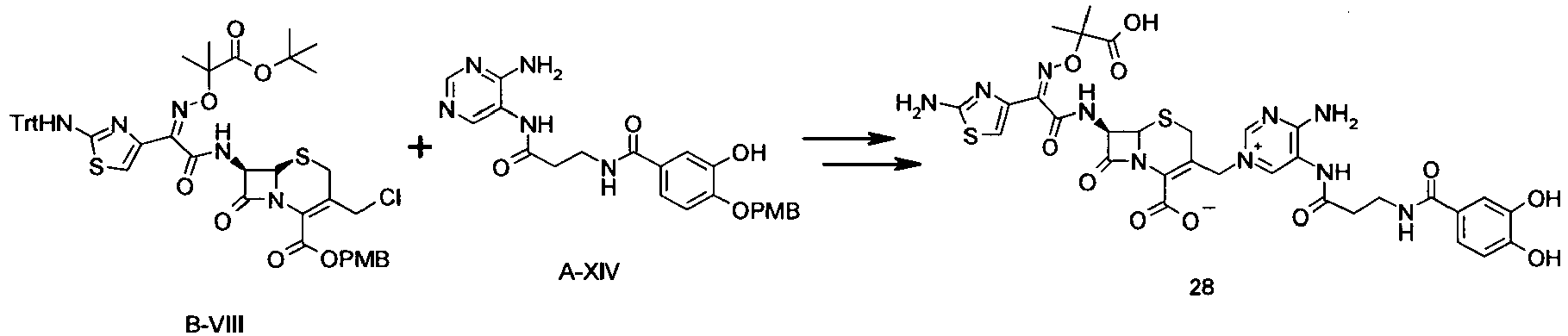
- Compound 28 (17mg, 33%)was prepared by a method similar to Example 1 by using CompoundB-VIII and Compound A-XIV.
1H NMR (600MHz, CD3OD) δ 8.76(s, 1H), 8.66(s, 1H), 7.25(d, J =2.4Hz, 1H), 7.18(dd, J = 2.4Hz, 8.4Hz, 1H), 7.04(s, 1H), 6.77(d, J = 8.4Hz, 1H), 5.95(d, J=5.4Hz, 1H) 5.29 (d, J = 15.6Hz, 1H), 5.21(d, J = 4.8Hz, 1H), 4.94(d, J = 15.6Hz, 1H), 3.69(m, 3H), 3.41(d, J = 18.6Hz, 1H), 2.72(t, J = 6.6Hz, 2H), 1.61(s, 6H) -

- Compound 29 (42mg30%) was prepared by a method similar to Example 1 by using CompoundB-VIII and Compound A-XV.
1H NMR (600MHz, DMSO-d6) δ= 9.62(br, 1H), 9.48(d, J=6.6Hz, 1H), 9.23(s, 1H), 8.43(s, 1H), 8.23(br, 1H), 7.61(s, 1H), 7.37(br, 1H), 6.87(s, 1H), 6.79∼6.74(m, 3H), 6.70(s, 1H), 6.17(br, 1H), 5.91(m, 1H), 5.18(d, J=4.8Hz, 1H), 5.06(br, 2H), 4.25(br, 2H), 4.10(br, 2H), 3.48(br, 2H), 3.34(br, 1H), 3.23(br, 1H), 2.71(s, 3H), 1.42(d, J=6.6Hz, 6H) -

- Compound 30 (12 mg, 14%)was prepared by a method similar to Example 1 by using CompoundB-VIII and Compound A-XVI.
1H NMR (600MHz, DMSO-d6) δ 9.51(br, 1H), 9.46(d, J = 8.4Hz, 1H), 8.35(s, 1H), 8.25(t, J= 4.2Hz, 1H), 8.13(s, 1H), 7.61(s, 1H), 7.35(br, 2H), 7.26(d, J = 6.6Hz, 1H), 7.15(dd, J = 2.4Hz, 7.8Hz, 1H), 6.73(d, J = 8.4Hz, 1H), 6.675(s, 1H), 5.94(br, 1H), 5.86(dd, J = 8.4Hz, 5.4Hz, 1H), 5.15(d, J= 5.4Hz, 5.07(m, 2H), 3.5∼3.34 (m, 4H), 3.18(m , 2H), 1.38(s, 3H), 1.36(s, 3H) -

- Compound 31 (10 mg, 16%) was prepared by a method similar to Example 1 by using CompoundB-VIII and Compound A-XVIII.
1H NMR (600MHz, DMSO-d6) δ 9.49(d, J = 8.4Hz, 1H), 9.09(br, 1H) 8.38(s, 1H), 8.25(br, s) 8.25(t, J = 5.4Hz, 1H), 7.54(s, 1H), 7.34(br, 2H), 7.27(d, J = 1.8Hz, 1H), 7.15(dd, J = 1.8Hz, 6.6Hz, 1H), 6.76(d, J = 7.8Hz, 1H), 6.71(s, 1H), 5.92(dd, J = 4.8Hz, 8.4Hz, 1H), 5.84(br, 1H), 5.19(d, J= 4.8Hz, 5.05(m, 2H), 3.5-3.32 (m, 4H), 3.07(m , 2H), 1.88(m, 2H), 1.42(s, 3H), 1.41(s, 3H) -

- Compound 32 (65 mg, 24%)was prepared by a method similar to Example 1 by using CompoundB-VIII and Compound A-XIX.
1H NMR (600MHz, DMSO-d6+ D2O) δ 8.76(s, 1H), 8.73(s, 1H), 7.30(d, J = 2.4Hz, 1H), 7.25(dd, J = 2.4Hz, 8.4Hz, 1H), 6.83(dd, J = 1.2Hz, 7.8Hz, 6.76(s, 1H), 5.90(4.2Hz, 1H), 5.20 (d, J = 4.8Hz, 1H), 5.14(d, J = 15Hz, 1H), 4.99(d, J = 15Hz, 1H), 4.08(s, 2H), 3.60(dd, J = 18Hz, 59.4Hz, 2H), 1.46(s, 3H), 1.44(s, 3H) -

- Compound 33 (15 mg, 12%)was prepared by a method similar to Example 1 by using CompoundB-VIII and Compound A-XX.
1H NMR (600MHz, DMSO-d6, D2O) δ 8.34 (s, 1H), 8.21(br, s, 1H) 7.77(d, J = 6Hz, 1H), 7.73(s, 1H), 6.81(d, J = 8.4Hz, 1H), 6.67 (s, 1H), 5.77(d, J = 4.2Hz, 1H), 5.10(d, J=4.2Hz, 1H), 5.04∼4.86(m, 2H), 3.55-3.20 (m, 6H), 1.39(s, 3H), 1.37(s, 3H) -

- Compound 34 (10mg, 9%) was prepared by a method similar to Example 1 by using Compound B-I and Compound A-XXI.
1H NMR (600MHz, CD3OD) δ 8.33(s, 1H), 7.83(s, 1H), 7.25(s, 1H), 7.20(d, J = 7.8Hz, 1H), 6.97(s, 1H), 6.79(d, J = 8.4Hz, 1H),5.92(d, J = 4.8Hz, 1H), 5.21- (m, 2H), 4.92(m, 2H), 3.72∼3.67(m, 6H), 1.51(2, J = 7.2Hz, 3H) -

- Compound 35 (49 mg, 31%) was prepared by a method similar to Example 1 by using CompoundB-II and Compound A-XXI.
1H NMR (600MHz, DMSO-d6) δ 9.54(m, 2H) 9.14(s, 1H), 9.06(s, 1H), 8.36(s, 1H), 8.30 (t, J=5.4Hz, 1H), 8.15(s, 1H), 7.75 (s,1H), 7.42(s, 1H), 7.32(s, 1H), 7.19(dd, J = 1.8Hz,7.8Hz, 1H), 6.76(d, J = 7.8Hz, 1H), 5.98(t, J = 5.4Hz, 1H), 5.87(dd, J = 5.4Hz, 7.8Hz, 1H), 5.15(d, J = 4.8Hz, 1H), 5.08(m, 2H), 4.60(q, J = 7.2Hz, 1H), 3.52∼3.20(m, 6H), 1.40(d, J = 6.6Hz, 3H) -

- Compound 36 (12mg, 52%)was prepared by a method similar to Example 1 by using CompoundB-VIII and 4,5-diaminopyrimidine.
1H NMR (600MHz, CD3OD) δ 8.34(d, J = 1.8Hz, 1H), 7.78(d, J = 1.8Hz, 1H), 7.02(s, 1H), 5.99(d, J=4.8Hz, 1H) 5.30∼4.90 (m, , 3H), 3.65(d, J = 18Hz, 1H), 3.34(d, J = 18Hz, 1H), 1.60(s, 6H) -

- Compound 37 (19 mg, 31%)was prepared by a method similar to Example 1 by using CompoundB-II and Compound A-I.
1H NMR (600MHz, CD3OD) δ 8.43(s, 1H), 7.94(s, 1H), 7.04(s, 1H), 5.90(d, J=4.8Hz, 1H), 5.25∼4.8(m, 3H), 3.70(d, J = 18.6Hz, 1H), 3.49(t, J = 6Hz, 1H), 3.30∼3.25(m, 3H), 1.62(s, 6H) -
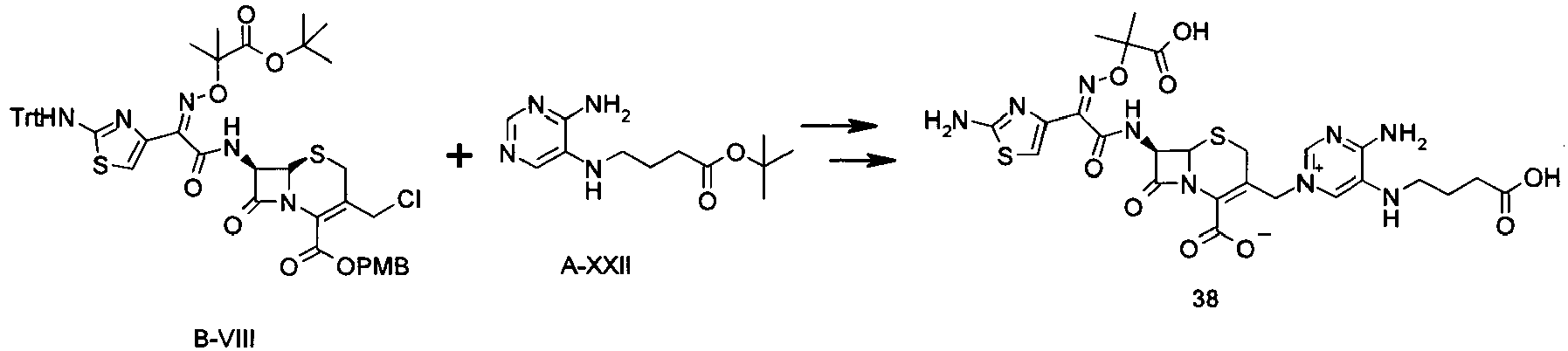
- Compound 38 (7 mg, 9%)was prepared by a method similar to Example 1 by using CompoundB-VIII and Compound A-XXII.
1H NMR (600MHz, CD3OD) δ= 8.36(s, 1H), 7.70(s, 1H), 7.04(s, 1H), 5.98(d, J=4.8Hz, 1H), 5.27∼4.8(m, 3H), 3.70∼3.50(m, 2H), 3.49(m, 2H), 2.45(m, 2H), 1.98(m, 2H), 1.62(s, 6H) -

- Compound 39 (2 mg, 2%)was prepared by a method similar to Example 1 by using CompoundB-VIII and Compound A-XXIII.
1H NMR (600MHz, CD3OD) δ 8.42(d, J = 1.8Hz, 1H), 7.70(d, J = 1.8Hz, 1H), 6.99(s, 1H), 5.92(d, J=4.8Hz, 1H) 5.27∼4.90 (m, , 3H), 3.63(d, J = 18Hz, 1H), 3.34(d, J = 18Hz, 1H), 3.15(d, J = 3.6Hz, 3H), 1. 62 (s, 6H) -

- Compound 40 (12 mg, 18%)was prepared by a method similar to Example 1 by using CompoundB-VIII and Compound A-XXIV.
1H NMR (600MHz, CD3OD) δ 8.41(d, J = 1.8Hz, 1H), 7.98(d, J = 1.8Hz, 1H), 7.03(s, 1H), 5.91(d, J=4.8Hz, 1H), 5.23∼4.90 (m, , 3H), 3.68∼3.37(m, 6H), 1.60(s, 6H) -

- Compound 41 (70 mg, 40%)was prepared by a method similar to Example 1 by using CompoundB-VIII and Compound A-XXVI.
1H NMR (600MHz, DMSO-d6+D2O) δ 8.46(s, 1H), 7.49(s, 1H), 6.74(s, 1H), 5.90(d, J=4.2Hz, 1H), 5.20(d, J=4.8Hz, 1H), 5.10(q, J=15.6Hz, 2H), 3.62∼3.40(m, 6H), 3.03(br, 2H), 2.83(br, 4H), 1.66∼1.59(m, 8H), 1.44(s, 3H), 1.43(s, 3H) -

- Compound 42(6.2 mg, 28%)was prepared by a method similar to Example 8 by using CompoundB-XII and Compound A-XXVII.
1H NMR (600MHz, CD3OD) δ 8.26(s, 1H), 7.41(s, 1H), 7.09(d, J=16.2Hz, 1H), 6.25(m, 1H), 5.91(d, J=4.8Hz, 1H), 5.21(d, J=4.8Hz, 1H), 3.82(d, J=18Hz, 1H), 3.66(d, J=18Hz, 1H), 3.21(br, 2H), 2.99(br, 2H), 1.80(br, 4H), 1.62(s, 3H), 1.61(s, 3H) -

- Compound 43 (38.7 mg, 38%)was prepared by a method similar to Example 8 by using CompoundB-V and Compound A-XXVIII.
1H NMR (600MHz, CD3OD) δ 8.25(s, 1H), 7.04(s, 1H), 6.16(m, 1H), 5.92(d, J=4.8Hz, 1H), 5.22(d, J=4.8Hz, 1H), 4.87(m, 2H), 3.98(s, 2H), 3.83(d, J=18Hz, 1H), 3.68(d, J=18Hz, 1H), 1.63(s, 3H), 1.61(s, 3H) -

- Compound 44 (11.4 mg, 13%)was prepared by a method similar to Example 8 by using CompoundB-V and Compound A-XXIX.
1H NMR (600MHz, CD3OD) δ 8.11(s, 1H), 7.00(s, 1H), 6.76(d, J=16.8Hz, 1H), 6.10(d, J=15.6Hz, 1H), 5.87(br, 1H), 5.20(br, 1H), 4.88(m, 2H), 3.78(d, J=17.4Hz, 1H), 3.67(d, J=16.8Hz, 1H), 3.11(m, 4H), 1.62(s, 3H), 1.60(s, 3H) -

- Compound 45 (30 mg, 30%) was prepared by a method similar to Example 8 by using CompoundB-VCompound A-XXX.

1H NMR (600MHz, CD3OD) δ 8.23(s, 1H), 7.03(d, J=16.8Hz, 1H), 6.98(s, 1H), 6.13(m, 1H), 5.91(d, J=5.4Hz, 1H), 5.21(d, J=4.8Hz, 1H), 4.90(m, 2H), 3.81(d, J=17.4Hz, 1H), 3.66(d, J=17.4Hz, 1H), 3.29 (t, J=6Hz, 2H), 2.93 (t, J=6Hz, 2H), 1.62(s, 3H), 1.60(s, 3H) -
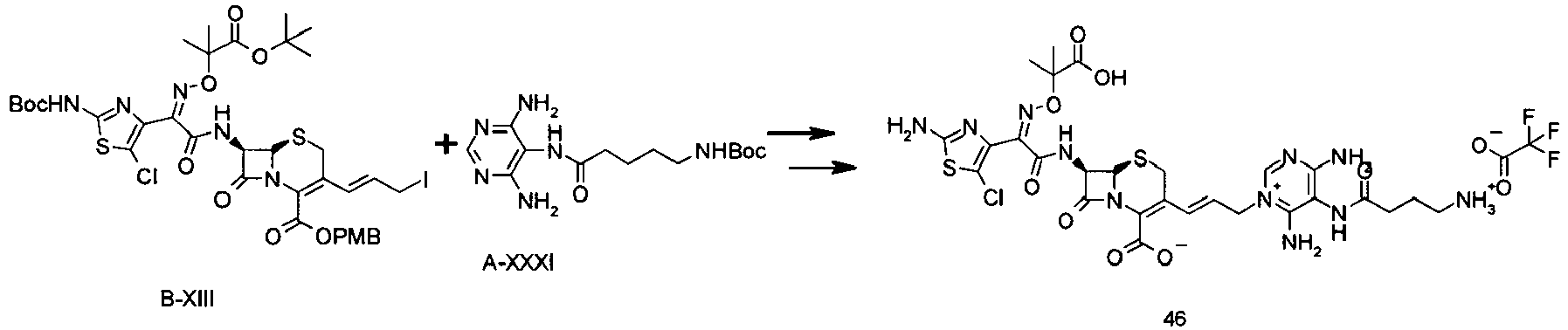
- Compound 46 (20 mg, 18%)was prepared by a method similar to Example 8 by using CompoundB-XIII and Compound A-XXXI.
1H NMR (600 MHz, DMSO d-6) δ 9.48(m, 1H), 8.93(bs, 1H), 8.36(s, 1H), 7.97(bs, 1H), 7.76(bs, 1H), 7.75(bs, 2H), 7.47(bs, 1H), 7.42(s, 1H), 6.92(d, J = 16.2Hz, 1H), 6.08(m, 1H), 5.80(m, 1H), 5.19(d, J = 4.8Hz, 1H), 4.82(m, 2H), 3.80(d, J = 18.0Hz, 1H), 3.55(d, J = 18.0Hz, 1H), 2.83(m, 2H), 2.44(m, 2H), 1.82(m, 2H), 1.48(s, 3H), 1.46(s, 3H) -

- Compound 47 (1mg, 5%)was prepared by a method similar to Example 1 by using CompoundB-V and Compound A-XXXII.
1H NMR (600MHz, CD3OD) δ= 8.37(s, 1H), 7.52(s, 1H), 6.98(s, 1H), 6.73(m, 1H), 6.01(m, 2H), 5.21∼4.90(m, 3H), 3.98(m, 2H), 3.81(m, 2H), 1.58(s, 3H), 1.56(s, 3H) -

- Compound 48 (52 mg, 58%)was prepared by a method similar to Example 1 by using CompoundB-VIII and Compound A-IX.
1H NMR (600MHz, CD3OD) δ 8.89(d, J= 1.8Hz, 1H), 8.72(d, J= 1.8Hz, 1H), 7.07(s, 1H), 5.97(d, J=5.4Hz, 1H), 5.33∼4.8(m, 3H), 3.71(d, J = 18.6Hz, 1H), 3.41(d, J = 18.6Hz, 1H), 3.26∼2.91(m, 4H), 1.62(s, 6H) -

- Compound 49 (8 mg, 9%) was prepared by a method similar to Example 1 by using CompoundB-III and Compound A-I.
H NMR (600 MHz, DMSO d-6) 5 9.54(bs, 1H), 9.06(bs, 1H), 8.44(s, 1H), 8.21(bs, 3H), 7.56(s, 1H), 6.86(d, J = 16.2Hz, 1H), 6.29(bs, 1H), 6.05(m, 1H), 5.76(m, 1H), 5.13(d, J = 4.8Hz, 1H), 4.85(m, 2H), 3.66(d, J = 16.8Hz, 1H), 3.49(d, J = 17.4Hz, 1H), 3.02(m, 4H), 1.47(s, 3H), 1.46(s, 3H) -

- Compound 50 (3.5 mg, 7%)was prepared by a method similar to Example 1 by using CompoundB-V and Compound A-I.
1H NMR (600MHz, CD3OD) δ 8.31(s, 1H), 7.53(s, 1H), 7.05(m, 2H), 6.22(m, 1H), 5.90(d, J = 4.8Hz, 1H), 5.19(d, J = 4.8Hz, 1H), 3.80(d, 17.4Hz 1H), 3.64(d, J = 17.4Hz, 1H), 3.52 (t, J = 6Hz, 2H), 3.24(t, J = 6Hz, 2H) 1.61(s, 3H), 1.59(s, 3H) -

- Compound 51 (48 mg, 60%)was prepared by a method similar to Example 8 by using CompoundB-V and Compound XXXI.
1H NMR (600MHz, CD3OD) δ 8.33(s, 1H), 7.58(s, 1H), 7.11∼7.06(m, 2H), 6.27(m, 1H), 5.92(d, J=4.8Hz, 1H), 5.23(d, J=4.8Hz, 1H), 4.93(m, 2H), 3.84(d, J=18Hz, 1H), 3.68(d, J=18Hz, 1H), 3.57(br, 2H), 3.31(m, 2H), 2.76(s, 3H), 1.64(s, 3H), 1.63(s, 3H) -

- Compound 52 (18 mg, 30%)was prepared by a method similar to Example 8 by using CompoundB-VII and Compound A-I.
1H NMR (600MHz, CD3OD) δ 8.31(s, 1H), 7.54(s, 1H), 7.06(m, 2H), 6.22(m, 1H), 5.91(d, J = 5.4Hz, 1H), 5.19(d, J = 5.4Hz, 1H), 4.80(m, 1H), 3.80(d, 17.4Hz 1H), 3.65(d, J = 17.4Hz, 1H), 3.50 (t, J = 6Hz, 2H), 3.24(t, J = 6Hz, 2H) 1.55(d, J = 6.6Hz, 3H) -

- Compound 53 (30 mg, 33%)was prepared by a method similar to Example 8 by using CompoundB-XII and Compound A-I.
1H NMR (600MHz, DMSO-d6) δ 9.53(d, J=7.8Hz, 1H), 9.11(s, 1H), 8.47(s, 1H), 8.07(s, 1H), 7.87(s, 2H), 7.60(s, 1H), 7.42(s, 1H), 6.91(d, J=16.2Hz, 1H), 6.26(m, 1H), 6.02(br, 1H), 5.84(dd, J=4.8Hz, 4.8Hz, 1H), 5.20(d, J=4.8Hz, 1H), 4.93(m, 2H), 4.63(q, J=7.2Hz, 1H), 3.81(d, J=18Hz, 1H), 3.58(d, J=18Hz, 1H), 3.32(m, 2H), 3.06(br, 2H), 1.43(d, J=7.2Hz, 3H) -

- Compound 54 (29 mg, 30%)was prepared by a method similar to Example 8 by using CompoundB-XIII and Compound A-I.
1H NMR (600 MHz, DMSO d-6) δ 11.77(t, J = 5.4Hz, 1H), 11.04(bs, 1H), 10.91(bs, 1H), 9.45(d, J = 8.4Hz, 1H), 9.00(bs, 1H), 8.42(s, 1H), 8.09(bs, 1H), 7.82(s, 1H), 7.70(s, 1H), 7.57(s, 1H), 7.42(s, 1H), 6.90(d, J = 16.2Hz, 1H), 6.29(m, 1H), 6.05(t, J = 4.8Hz, 1H), 5.82(dd, J 1 = 8.4Hz, J 2 = 5.4Hz, 1H), 5.20(d, J = 5.4Hz, 1H), 4.88(m, 2H), 3.83(d, J = 18.0Hz, 1H), 3.58(m, 3H), 3.29(m, 2H), 1.47(s, 3H), 1.45(s, 3H) -

- Compound 55 (26 mg, 29%)was prepared by a method similar to Example 8 by using CompoundB-XI and Compound A-I.
1H NMR (600 MHz, DMSO d-6) δ 9.54(bs, 1H), 9.06(bs, 1H), 8.44(s, 1H), 8.21(bs, 3H), 7.56(s, 1H), 6.86(d, J = 16.2Hz, 1H), 6.29(bs, 1H), 6.05(m, 1H), 5.76(m, 1H), 5.13(d, J = 4.8Hz, 1H), 4.85(m, 2H), 3.66(d, J = 16.8Hz, 1H), 3.49(d, J = 17.4Hz, 1H), 3.02(m, 4H), 1.47(s, 3H), 1.46(s, 3H) -

- Compound 56 (38 mg, 32%)was prepared by a method similar to Example 8 by using CompoundB-XI and Compound A-XVII.
1H NMR (600 MHz, DMSO d-6) δ 9.48(d, J = 9.0Hz, 1H), 9.04(bs, 1H), 8.42(s, 1H), 8.21(bs, 3H), 7.57(s, 1H), 6.91(d, J = 16.2Hz, 1H), 6.14(m, 2H), 5.76(bs, 1H), 5.14(m, 1H), 4.84(bs, 1H), 3.53(m, 2H), 3.21(m, 2H), 2.90(m, 2H), 1.88(m, 2H), 1.46(s, 3H), 1.46(s, 3H) -

- Compound 57 (30 mg, 25%)was prepared by a method similar to Example 8 by using CompoundB-XIII and Compound A-XVI.
1H NMR (600 MHz, DMSO d-6) δ 9.41(m, 1H), 9.04(bs, 1H), 8.42(s, 1H), 8.22(bs, 2H), 7.58(bs, 1H), 7.42(s, 1H), 6.91(d, J = 15.6Hz, 1H), 6.13(m, 2H), 5.73(m, 1H), 5.13(m, 1H), 4.85(m, 2H), 3.52(m, 2H), 3.22(bs, 2H), 2.89(bs, 2H), 1.87(m, 2H), 1.48(s, 3H), 1.46(s, 3H) -

- Compound 58 (9 mg, 24%)was prepared by a method similar to Example 8 by using CompoundB-XIII and Compound A-XXVII.
1H NMR (600MHz, CD3OD) δ 8.27(s, 1H), 7.41(s, 1H), 7.10(d, J=15.6Hz, 1H), 6.27(m, 1H), 5.90(d, J=4.8Hz, 1H), 5.21(d, J=4.8Hz, 1H), 4.91(m, 2H), 3.85(d, J=118.6Hz, 1H), 3.66(d, J=18Hz, 1H), 3.21(br, 2H), 3.00(br, 2H), 1.80(br, 4H), 1.60(s, 3H), 1.59(s, 3H) -

- Compound 59 (47 mg, 49%)was prepared by a method similar to Example 8 by using CompoundB-V and Compound A-XXXIII.
1H NMR (600MHz, CD3OD) δ 8.65(s, 1H), 8.60(s, 1H), 7.19(d, J=16.2Hz, 1H), 6.97(s, 1H), 6.20(m, 1H), 5.92(d, J=4.8Hz, 1H), 5.21(d, J=4.8Hz, 1H), 4.93∼4.83(m, 2H), 3.98(s, 2H), 3.80(d, J=18Hz, 1H), 3.66(d, J=18Hz, 1H), 1.62(s, 3H), 1.6(s, 3H) -

- Compound 60 (49 mg, 53%)was prepared by a method similar to Example 8 by using CompoundB-V and Compound A-IX.
1H NMR (600MHz, CD3OD) δ 8.63(s, 1H), 8.62(s, 1H), 7.17(d, J=16.2Hz, 1H), 6.97(s, 1H), 6.19(m, 1H), 5.92(d, J=4.8Hz, 1H), 5.22(d, J=5.4Hz, 1H), 4.92∼4.8(m, 2H), 3.80(d, J=18Hz, 1H), 3.66(d, J=17.4Hz, 1H), 3.28(m, 2H), 2.91(t, J=6Hz, 2H), 1.62(s, 3H), 1.60(s, 3H) -

- Compound 61 (6.8 mg, 10%)was prepared by a method similar to Example 8 by using CompoundB-XI and Compound A-IX.
1H NMR (600MHz, CD3OD) δ 8.62(s, 1H), 8.60(s, 1H), 7.23(d, J = 15.6Hz, 1H), 6.22(m, 1H), 5.92(d, J = 4.8Hz, 1H), 5.19(d, J = 4.8Hz, 1H), 4.91(m, 2H), 3.80(d, 17.4Hz 1H), 3.64(d, J = 17.4, 1H), 3.28(m, 2H), 2.90(t, J = 6Hz, 2H), 1.60(s, 3H), 1.58(s, 3H) -

- Compound 62 (11 mg, 13%)was prepared by a method similar to Example 8 by using CompoundB-XIII and Compound A-IX.
1H NMR (600MHz, CD3OD) δ 8.45(s, 1H), 8.43(s, 1H), 7.09(d, J=16.2Hz, 1H), 6.12(m, 1H), 5.87(d, J=4.8 Hz, 1H), 5.17(d, J=5.4Hz, 1H), 4.89(m, 2H), 3.74(d, J=17.4Hz 1H), 3.61(d, J=17.4Hz, 1H), 3.30(m, 2H), 2.90(m, 2H), 1.59(s, 3H), 1.57(s, 3H) -

- Compound 63 (46 mg, 57%)was prepared by a method similar to Example 8 by using CompoundB-V and Compound A-XXVI.
1H NMR (600MHz, CD3OD) δ 8.66(d, J= 1.8Hz, 1H), 8.61(d, J=1.8Hz), 7.18(d, 15.6Hz, 1H), 6.96(s, 1H), 6.19(m, 1H), 5.92(d, J=4.8Hz, 1H), 5.22(d, J=5.4Hz, 1H), 4.91(m, 2H), 3.81(d, J=18Hz, 1H), 3.66(d, J= 18Hz, 1H), 3.04(t, J=7.2Hz, 2H), 2.66(t, J=6.6Hz, 2H), 2.04(m, 2H), 1.62(s, 3H), 1.60(s, 3H) -

- Compound 64 (12 mg, 14%)was prepared by a method similar to Example 8 by using CompoundB-XIII and Compound A-XXVI.
1H NMR (600MHz, CD3OD) δ 8.69(s, 1H), 8.59(s, 1H), 7.20(d, J=16.2Hz, 1H), 6.24 (m, 1H), 5.92(d, J=4.8Hz, 1H), 5.21(d, J=4.8Hz, 1H), 4.93(m, 2H), 3.84(d, J=18Hz, 1H), 3.67(d, J=18Hz, 1H), 3.03(br, 2H), 2.66(br, 2H), 2.03(br, 2H), 1.60(s, 3H), 1.59(s, 3H) -

- Compound 65 (39 mg, 48%)was prepared by a method similar to Example 8 by using CompoundB-XI and Compound A-XXVI.
1H NMR (600MHz, CD3OD) δ 8.65(s, 1H), 8.61(s, 1H), 7.19(d, J=15.6Hz, 1H), 6.22(m, 1H), 5.93(d, J=4.8Hz, 1H), 5.21(d, J=4.8Hz, 1H), 4.92(m, 2H), 3.82(d, J=18Hz, 1H), 3.66(d, J=17.4Hz, 1H), 3.04(t, J=7.2Hz, 2H), 2.66(t, J=6.6Hz, 2H), 2.04(m, 2H), 1.62(s, 3H), 1.60(s, 3H) -

- Compound 66 (30 mg, 32%)was prepared by a method similar to Example 8 by using CompoundB-V and Compound A-XXX.
1H NMR (600MHz, CD3OD) δ 8.23(s, 1H), 7.03(d, J=16.8Hz, 1H), 6.98(s, 1H), 6.13(m, 1H), 5.91(d, J=5.4Hz, 1H), 5.21(d, J=4.8Hz, 1H), 4.90(m, 2H), 3.81(d, J=17.4Hz, 1H), 3.66(d, J=17.4Hz, 1H), 3.29(t, J=6Hz, 2H), 2.93(t, J=6Hz, 2H), 1.62(s, 3H), 1.60(s, 3H) -

- Compound 67 (20 mg, 18%)was prepared by a method similar to Example 8 by using CompoundB-XIII and Compound A-XXXI.
1H NMR (600 MHz, DMSO d-6) δ 9.48(m, 1H), 8.93(bs, 1H), 8.36(s, 1H), 7.97(bs, 1H), 7.76(bs, 1H), 7.75(bs, 2H), 7.47(bs, 1H), 7.42(s, 1H), 6.92(d, J = 16.2Hz, 1H), 6.08 (m, 1H), 5.80 (m, 1H), 5.19(d, J = 4.8Hz, 1H), 4.82(m, 2H), 3.80(d, J = 18.0Hz, 1H), 3.55(d, J = 18.0Hz, 1H), 2.83(m, 2H), 2.44(m, 2H), 1.82(m, 2H), 1.48(s, 3H), 1.46(s, 3H) -

- B-IX Compound (170 mg, 0.182 mmol) and 4,5-diaminopyrimidine (20 mg, 0.182 mmol) were dissolved in N,N-dimethylformamide(1.5 mL) and sodium bromide (37.5 mg, 0.364 mmol) was added. The resulting solution was stirred for 9 hours at room temperature.Potassium iodide (211 mg, 1.27 mmol) and N,N-dimethylformamide(1 mL) were added. At -40°C acetyl chloride (71mg, 0.91 mmol) was added while stirring, and stirred for 5 minutes at the same temperature and further stirred for 1 hour at 0°C. An aqueous solution of sodium thiosulfate pentahydrate dissolved in saline (5 mL) was added to the resulting solution at 0°C. The thus-obtained solid was dissolved in methylene chloride(15 mL) and applied to column chromatography (MC : MeOH = 50 : 1 ∼ 10 : 1) to yield a quaternary salt compound (78 mg (42%)).
- The quaternary salt compound(78 mg, 0.075 mmol) was dissolved in methylene chloride(0.5 mL). Triethylsilane (0.5 mL) and trifluoroacetic acid (1.5 mL) were sequentially added. The resulting solution was stirred for 4 hours at room temperature.Isopropylether (25 mL) was added to the resulting solution, creating a solid. The solid was filtered under reduced pressure to yield Compound 68 (50mg, 99%)(In the middle of the reaction, due to acetyl chloride, acetylation occurred at 5 position of 4,5-diaminopyrimidine).
1H NMR (600MHz, CD3OD) δ 8.79(d, J = 1.8Hz, 1H), 8.70(d, J = 1.8Hz, 1H), 7.08(s, 1H), 6.00(d, J=4.8Hz, 1H) 5.32(d, J = 14.4Hz, 1H), 5.27(d, J = 4.8Hz, 1H), 4.8(d, J = 14.4Hz, 1H), 3.71(d, J = 18.6Hz, 1H), 3.44(d, J = 18Hz, 1H), 1.60(d, J = 1.2Hz, 6H) - To evaluate antibacterial activity of each of the compounds of Examples 1 to 68, in vitro antibacterial activity test was performed.
- The in vitro antibacterial activity was evaluated by measuring MIC90 (ug/mL) of each of the compounds of Examples 1 to 68, which is defined as the lowest concentration of an antibiotic that will inhibit the visible growth of 90% of microorganisms after incubation as compared with a control group to which the antibiotic is not treated. MIC90 values were measured by the broth microdilution method developed by the Clinical and Laboratory Standards Institute (CLSI) (see CLSI M7-A5, Methods for Dilution Antimicrobial Susceptibility Test for Bacteria that Grow Aerobically-Fifth Edition (2000):CLSI, Villanova, PA).
- Ceftazidime (CAZ) represented by Formula B, CXA-101 represented by Formula C, and Doripenem represented by Formula D were used as comparison compounds. The test results are shown in Tables 1 and 2.


- Ceftazidime represented by Formula B is a third-generation cephalosporin antibiotic and is widely used against Pseudomonas aeruginosa.CXA-101 represented by Formula C is a cephalosporin antibiotic which is in phase 2 clinical trials by Cubist Pharmaceuticals, Inc. Doripenem represented by Formula D belongs to a subgroup of cabapenems and is one of the antibiotics that are most widely used to treat drug-resistant Gram-negative infection.
- In vitro antibacterial activity was measured with respect to the following 19 clinical isolates: M. catarrhalis;P.aeruginosa (5 strains); K.pneumoniae (6 strains) ; A.baumannii (3 strains); E.coli (2 strains); A. calcoaceticus; and E.cloacae. Table 1 shows the result.
- Test compounds each (the cephalosporin derivative compounds prepared in Examples 1 to 68) were dissolved in DMSO at the concentration of 10,240 ug/mL, were diluted by two fold with DMSO, and then were diluted by twenty fold with sterilized distilled water. The final concentration in the antibacterial activity test was in the range of 0.0626ug/mL to 128ug/mL, and the final concentration of DMSO used as an adjuvant was 2.5%(V/V).


- As shown in Table 1, the antibacterial activities of the compounds with a siderophore group were significantly greater than those of the compounds without a siderophore group. The antibacterial activities varied depending on the kind of the siderophore group and the site at which the group is introduced. The antibacterial activity was greatly affected by the site to which the group is introduced.
For the Compounds 4, 8, 11, and 26, which exhibited antibacterial activity significantly improved by introduction of a siderophore group, antibacterial activity was then evaluated with regard to the representative drug-resistance Gram-negative bacteria: P.aeruginosa (16 clinical isolates), K.pneumoniae (38 clinical isolates), A.baumannii (6 clinical isolates).The antibacterial activity of the four compounds was compared with that of the comparison compounds, which is shown in Table 2.
The numerical values in Table 2 represent the number of clinical isolates that showed the respective MIC values.<Table 2> Antibacterial Activity on Representative Bacteria (MIC90, ug/mL) P.aeruginosa (N=16) MIC(ug/mL) >16 16 8 4 2 1 0.5 0.25 0.125 0.0625 <0.0625 Ceftazidime 11 1 1 2 1 CXA-101 7 1 4 4 Doripenem 9 5 1 1 Compound 4 3 1 1 2 1 2 5 1 Compound 8 3 1 3 2 2 2 1 2 Compound 11 2 1 2 3 2 2 3 1 Compound 26 3 1 3 2 1 3 2 1 A.baumanni (N=6) MIC(ug/mL) >16 16 8 4 2 1 0.5 0.25 0.125 0.0625 <0.0625 Ceftazidime 6 CXA-101 6 Doripenem 5 1 Compound 4 3 2 1 Compound 8 5 1 Compound 11 5 1 Compound 26 3 2 1 K.pneumomiae (N=38) MIC (ug/mL) >16 16 8 4 2 1 0.5 0.25 0.125 0.0625 <0.0625 Ceftazidime 32 3 1 2 CXA-101 35 1 1 1 Doripenem 2 4 5 6 5 3 6 1 6 Compound 4 26 2 3 2 3 1 1 Compound 8 35 1 1 1 Compound 11 35 1 1 1 Compound 26 22 4 4 1 3 1 1 - As shown in Table 2, the cephalosporin derivatives according to the present invention which have a siderophore group exhibited superior antibacterial spectrum compared with the comparison compounds, Ceftazidime, CXA-101, and Doripenem, and they exhibited excellent activity against, in particular, P. aeruginosa, suggesting that they have a great potential to be used to treat drug-resistance Gram-negative infection.
- Pharmaceutical efficacy of the cephalosporin derivative compounds according to the present invention was evaluated in a whole-body infected mouse model. Tables 3 and 4 show survival rate and ED50values for the two compounds with excellent antibacterial activity with regard to an infected mouse by a drug-sensitive bacteria and a drug-resistant bacteria.
- Test animals: 3 week old male ICR mouse,weight 18∼22g; 5 mice/group.
Lab conditions: Temperature of 23±2°C; humidityof 55±20%. Administration method: Inducing whole-body infection by bacterial solution followed by subcutaneous injection (0.2 mL) after 1 hour and 4 hours.
Test method: Cultured bacteria were diluted with 0.9% NaCl to prepare a bacterial solution having a concentration that is 5 to 10 times of minimal inhibitory concentration (MIC). 0.5 mL of bacterial solution was injected through abdominal cavity to induce whole-body infection. Test compounds were administered in four different amounts, which were designed considering in vitro MIC values of the test bacteria.After 1 hour and 4 hours, the four different amounts of the test compounds were subcutaneously administered. Survival rates were measured for four days and ED50values were calculated according to the Probit method.<Table 3> Efficacy on Infected Mouse by Ceftazidime-sensitive P. aeruginosa Infecting bacteria: P. aeruginosa 1912E (2 x 10⁶CFU/mouse) Ceftazidime Compound 8 Administered amount (mg/kg) 20 10 5 2.5 20 10 5 2.5 Survival rate 100% 100% 80% 40% 100% 100% 80% 60% ED50 (mg/kg) 2.50 1.25 (95% sd) (0.74∼8.49) (0.09∼17.5) <Table 4> Efficacy on Infected Mouse by Ceftazidime-resistant P. aeruginosa Ceftazidime Doripenem Compound 4 Inf ect ing bac Administered amount (mg/kg) 40 20 10 5 40 20 10 5 40 20 10 5 Survival rate 20% 20% 20% 0% 80% 20% 20% 0% 100% 80% 40% 40% ED50 (mg/kg) 640 28 10 (95% sd) (0.12∼3290000) (13.8∼57.8) (3.97∼25.2) teria: P. aeruginosaR1023 (2 x 10⁶CFU/mouse) - For the whole-body infected mice by the drug-sensitive bacteria, pharmaceutical efficacy of Compound 8 was similar to that of the comparison compound, Ceftazidime. For the whole-body infected mice by the drug-resistant bacteria, the pharmaceutical efficacy of Compound 4 was much greater than that of Ceftazidime and greater than that of Doripenem that is known to be the best treating agent against P. aeruginosa.
As shown in the results, the compounds according to the present invention showed superior pharmaceutical efficacy in in vitro and in vivo and maintained it even in case where siderophore is introduced. In case of catechol, a typical siderophore, in vivo pharmaceutical efficacy was reported to be sharply decreased by catechol O-metyl transferase (COMT). On the other hand, the compounds according to the present invention did not show such a decrease. It suggests that the present compounds are capable of being used as a treating agent against drug-resistant bacteria that are known to be difficult to be treated. - For the present compounds with superior pharmaceutical efficacy, PK values were evaluated in a rat model. Table 5 shows the results of two representative compounds.
Test animals: 9 week old SD rat,weight 290∼310g;3 rats/sample time point
Lab conditions: Temperature of 21 ± 2°C; humidity of 50 ± 20%
Administration method: Injecting test compound solution through tail vein (IV)
Test method: Blood samples were taken from jugular vein at a predetermined time period for 24 hours after administration, plasma was separated, and quantified by using LC-MS/MS.<Table 5> Pharmacokinetic Test Results Compound 4 Compound 8 Rat (10 mg/kg) single IV Rat (10 mg/kg) single IV AUC (mg*h/l) 40.28 59.60 AUCnorm (kg*h/l) 4.03 5.46 CL (l/h/kg) 0.25 0.18 Vss (l/kg) 0.20 0.09 Cmax (mg/l) 75.80 196.13 Cmax, norm (kg/l) 7.58 19.61 tmax (h) 0.02 0.02 t1/2 (h) 0.62 0.87 - As shown in the Table above, the cephalosporin derivatives according to the present invention maintained higher concentration in blood and exhibited an excellent pharmacokinetic profile, thereby being able to be used as a promising antibiotic.
Claims (11)
- A cephalosporin derivative represented by Chemical Formula 1, a hydrate thereof, a solvate thereof, or a pharmaceutically acceptable salt thereof:
 wherein X is CR, N, or C substituted by Cl (C-Cl);Y is C1-C2 alkyl, CH(CH3)CO2H, or C(CH3)2CO2H;L is CH2or CH=CHCH2;R1 is NH2, THR11 or NH(CH2)mNR11R12;R2 is NHR21, NH(CH2)nCOOH, NH(CH2)nNR21R22, or NHC(=O)(CH2)nNR21R22; andR3 is hydrogen or NH2,in which R is hydrogen or C1-C3 alkyl;R11 andR21 are independently a group selected from the group consisting of:
 m and n are independently an integer of 1 to 6.
 - The cephalosporin derivative of claim 1, which is represented by Chemical Formula 2, a hydrate thereof, a solvate thereof, or a pharmaceutically acceptable salt thereof:
 wherein X is CR, N, or C substituted by Cl (C-Cl);Y is C1-C2 alkyl, CH(CH3)CO2H, or C(CH3)2CO2H;L is CH2or CH=CHCH2;R1 is NH2, NHR11 or NH(CH2)mNR11R12; andR2 is NHR21, NH(CH2)nNR21R22, or NHC(=O)(CH2)nNR21R22,in which R is hydrogen or C1-C3 alkyl;R11 and R21 are independently a group selected from the group consisting of:
 m and n are independently an integer of 1 to 6.
 - The cephalosporin derivative of claim 2, a hydrate thereof, a solvate thereof, or a pharmaceutically acceptable salt thereof,
wherein X is CR, N, or C substituted by Cl (C-Cl);
Y is CH(CH3)CO2H or C(CH3)2CO2H;
L is CH2 or CH=CHCH2;
R1 is NH2 or NH(CH2)mNH2;
R2 is NHR21, NH(CH2)nNR21, or NHC(=O)(CH2)nNR21; and
R3 is hydrogen,
in which R is hydrogen or C1-C3 alkyl;
R21 is a group selected from the group consisting of:
m and n are independently an integer of 1 to 6. - The cephalosporin derivative of claim 1, which is represented by one of the following chemical formulas, a hydrate thereof, a solvate thereof, or a pharmaceutically acceptable salt thereof:


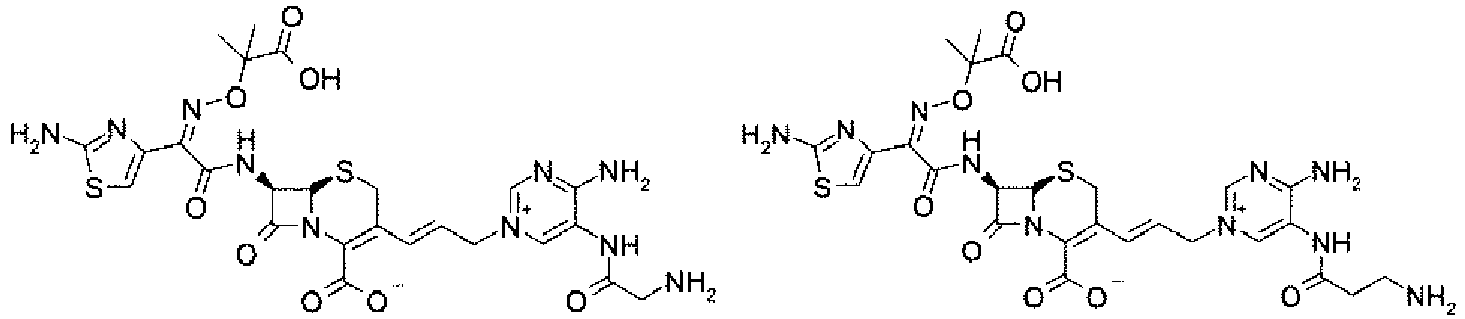


- The cephalosporin derivative of claim 1, which is represented by one of the following chemical formulas, a hydrate thereof, a solvate thereof, or a pharmaceutically acceptable salt thereof:


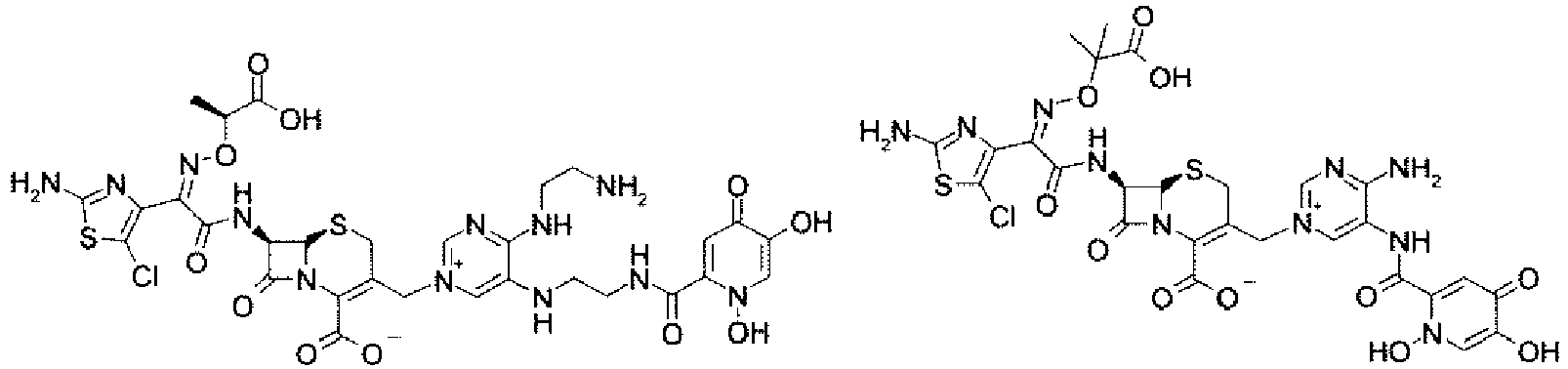


- A pharmaceutical composition comprising the cephalosporin derivative according to any one of claims 1-5, a hydrate thereof, a solvate thereof, or a pharmaceutical salt thereof; and a pharmaceutically acceptable carrier, diluent, adjuvant, or any combination thereof, as an effective ingredient.
- A compound as claimed in any one of claims 1-5, or a pharmaceutically acceptable salt thereof, for use in treating a bacterial infection in a warm-blooded animal, such as man.
- The compound for use of claim 7, wherein the bacterial infection results form a Gram-positive bacterium.
- The compound for use of claim 7, wherein the bacterial infection results form a Gram-negative bacterium.
- The compound for use of claim 8, wherein the Gram-positive bacterium is selected from the group consisting of Staphylococcus, Enterococcus, Streptococcus and acid-fast bacteria.
- The compound for use of claim 9, wherein the Gram-negative bacterium is selected from the group consisting of Pseudomonas aeruginosa, Acinetobacter baumannii, and Klebsiella pneumonia.
Priority Applications (3)
| Application Number | Priority Date | Filing Date | Title |
|---|---|---|---|
| PL12765589T PL2706062T3 (en) | 2011-03-30 | 2012-03-29 | Novel cephalosporin derivative and pharmaceutical composition thereof |
| SI201231355T SI2706062T1 (en) | 2011-03-30 | 2012-03-29 | Novel cephalosporin derivative and pharmaceutical composition thereof |
| HRP20181170TT HRP20181170T1 (en) | 2011-03-30 | 2012-03-29 | A NEW CEPHALOSPORINE DERIVATIVE AND ITS PHARMACEUTICAL PREPARATION |
Applications Claiming Priority (2)
| Application Number | Priority Date | Filing Date | Title |
|---|---|---|---|
| KR1020110028603A KR101719556B1 (en) | 2011-03-30 | 2011-03-30 | Novel cephalosporin derivatives and Pharmaceutical Compositions Comprising the Same |
| PCT/KR2012/002302 WO2012134184A2 (en) | 2011-03-30 | 2012-03-29 | Novel cephalosporin derivative and medical composition containing same |
Publications (3)
| Publication Number | Publication Date |
|---|---|
| EP2706062A2 EP2706062A2 (en) | 2014-03-12 |
| EP2706062A4 EP2706062A4 (en) | 2015-01-21 |
| EP2706062B1 true EP2706062B1 (en) | 2018-05-09 |
Family
ID=46932135
Family Applications (1)
| Application Number | Title | Priority Date | Filing Date |
|---|---|---|---|
| EP12765589.2A Active EP2706062B1 (en) | 2011-03-30 | 2012-03-29 | Novel cephalosporin derivative and pharmaceutical composition thereof |
Country Status (28)
| Country | Link |
|---|---|
| US (2) | US8329684B2 (en) |
| EP (1) | EP2706062B1 (en) |
| JP (1) | JP6144669B2 (en) |
| KR (1) | KR101719556B1 (en) |
| CN (1) | CN103547583B (en) |
| AU (1) | AU2012237063B2 (en) |
| BR (1) | BR112013025275A2 (en) |
| CA (1) | CA2831421C (en) |
| CL (1) | CL2013002820A1 (en) |
| CO (1) | CO6821935A2 (en) |
| CR (1) | CR20130501A (en) |
| CU (1) | CU20130125A7 (en) |
| DK (1) | DK2706062T3 (en) |
| DO (1) | DOP2013000214A (en) |
| EA (1) | EA024709B1 (en) |
| ES (1) | ES2683351T3 (en) |
| HR (1) | HRP20181170T1 (en) |
| HU (1) | HUE039086T2 (en) |
| IL (1) | IL228408A (en) |
| LT (1) | LT2706062T (en) |
| MX (1) | MX359435B (en) |
| PH (1) | PH12013501950A1 (en) |
| PL (1) | PL2706062T3 (en) |
| PT (1) | PT2706062T (en) |
| SG (1) | SG193998A1 (en) |
| SI (1) | SI2706062T1 (en) |
| WO (1) | WO2012134184A2 (en) |
| ZA (1) | ZA201308078B (en) |
Families Citing this family (14)
| Publication number | Priority date | Publication date | Assignee | Title |
|---|---|---|---|---|
| WO2009049086A1 (en) | 2007-10-09 | 2009-04-16 | Larry Sutton | Broad spectrum beta-lactamase inhibitors |
| CA2961489A1 (en) | 2014-09-17 | 2016-03-24 | Glen Robert RENNIE | Sgc stimulators |
| US10059680B2 (en) * | 2014-12-18 | 2018-08-28 | Merck Sharp & Dohme Corp. | Thiadiazolyl-oximinoacetic acid derivative compounds |
| US20160176897A1 (en) | 2014-12-23 | 2016-06-23 | Merck Sharp & Dohme Corp. | 7-aminocephem derivative compounds |
| WO2017096472A1 (en) | 2015-12-10 | 2017-06-15 | Naeja-Rgm Pharmaceuticals Inc. | Cephem compounds, their production and use |
| CN109843896B (en) * | 2016-10-14 | 2022-12-20 | 波尔图大学 | Hydroxycinnamic acid derivatives, methods and uses thereof |
| KR20180093307A (en) * | 2017-02-13 | 2018-08-22 | 주식회사 레고켐 바이오사이언스 | Preparing Method of 4,5-diamino substituted pyrimidine derivatives and Novel Compound for Preparing thereof |
| WO2019145784A2 (en) * | 2018-01-26 | 2019-08-01 | Legochem Biosciences, Inc. | Combination therapies for multi-drug resistant pathogens |
| CN109762791B (en) * | 2018-11-19 | 2021-02-09 | 厦门联合安金生物工程有限公司 | Recombinant adenovirus containing BPI-Fc chimeric gene and application thereof |
| CN111471058A (en) * | 2019-01-23 | 2020-07-31 | 中国医学科学院药物研究所 | Process for the preparation of cefepime analogs |
| US12371441B2 (en) | 2019-09-06 | 2025-07-29 | Ariva Med Gmbh | Siderophore cephalosporin conjugates and uses thereof |
| CN111635377A (en) * | 2020-06-30 | 2020-09-08 | 南京红杉生物科技有限公司 | Thiadiazole compound and synthesis method thereof |
| WO2022235077A1 (en) * | 2021-05-07 | 2022-11-10 | 한국생명공학연구원 | Novel siderophore compound and metal nanoparticle complex using same |
| US12225906B1 (en) | 2024-09-26 | 2025-02-18 | Terry Earl Brady | Pathogenic affinity pathway of infectious or parasitic organisms for nanogram and picogram dosimetry prophylaxis or cure |
Family Cites Families (11)
| Publication number | Priority date | Publication date | Assignee | Title |
|---|---|---|---|---|
| DE3006888A1 (en) * | 1980-02-23 | 1981-09-10 | Hoechst Ag, 6000 Frankfurt | CEPHALOSPORINE DERIVATIVES AND METHOD FOR THEIR PRODUCTION |
| EP0303172A3 (en) * | 1987-08-14 | 1991-05-15 | F. Hoffmann-La Roche Ag | Oxyimino-cephalosporins |
| GB8817653D0 (en) * | 1988-07-25 | 1988-09-01 | Fujisawa Pharmaceutical Co | New cephem compounds & processes for preparation thereof |
| GB9111406D0 (en) * | 1991-05-28 | 1991-07-17 | Fujisawa Pharmaceutical Co | New cephem compounds and processes for preparation thereof |
| US5498777A (en) * | 1994-07-20 | 1996-03-12 | Merck & Co., Inc. | 3-thioheteroaryl cephalosporin compounds, compositions and methods of use |
| TW200305422A (en) * | 2002-03-18 | 2003-11-01 | Shionogi & Co | Broad spectrum cefem compounds |
| ATE388153T1 (en) * | 2003-07-11 | 2008-03-15 | Theravance Inc | CROSS-LINKED GLYCOPEPTIDE CEPHALOSPORIN ANTIBIOTICS |
| CN1922190A (en) * | 2004-03-05 | 2007-02-28 | 盐野义制药株式会社 | 3-pyridylmethyl cephalosporins |
| AU2005202802A1 (en) * | 2004-06-28 | 2006-01-12 | Astellas Pharma Inc. | Cephem compounds |
| CN101230070A (en) * | 2006-12-30 | 2008-07-30 | 黄振华 | Novel anti-infection cephalosporin compounds |
| MX2011004636A (en) * | 2008-10-31 | 2011-06-20 | Shionogi & Co | CEPHAROSPORINS THAT HAVE A CATECOL GROUP. |
-
2011
- 2011-03-30 KR KR1020110028603A patent/KR101719556B1/en not_active Expired - Fee Related
-
2012
- 2012-03-29 SG SG2013072962A patent/SG193998A1/en unknown
- 2012-03-29 PL PL12765589T patent/PL2706062T3/en unknown
- 2012-03-29 SI SI201231355T patent/SI2706062T1/en unknown
- 2012-03-29 WO PCT/KR2012/002302 patent/WO2012134184A2/en not_active Ceased
- 2012-03-29 JP JP2014502466A patent/JP6144669B2/en not_active Expired - Fee Related
- 2012-03-29 PH PH1/2013/501950A patent/PH12013501950A1/en unknown
- 2012-03-29 EP EP12765589.2A patent/EP2706062B1/en active Active
- 2012-03-29 AU AU2012237063A patent/AU2012237063B2/en not_active Ceased
- 2012-03-29 CN CN201280015502.0A patent/CN103547583B/en not_active Expired - Fee Related
- 2012-03-29 PT PT127655892T patent/PT2706062T/en unknown
- 2012-03-29 MX MX2013010961A patent/MX359435B/en active IP Right Grant
- 2012-03-29 CA CA2831421A patent/CA2831421C/en not_active Expired - Fee Related
- 2012-03-29 EA EA201391325A patent/EA024709B1/en not_active IP Right Cessation
- 2012-03-29 LT LTEP12765589.2T patent/LT2706062T/en unknown
- 2012-03-29 ES ES12765589.2T patent/ES2683351T3/en active Active
- 2012-03-29 BR BR112013025275A patent/BR112013025275A2/en not_active Application Discontinuation
- 2012-03-29 HR HRP20181170TT patent/HRP20181170T1/en unknown
- 2012-03-29 DK DK12765589.2T patent/DK2706062T3/en active
- 2012-03-29 HU HUE12765589A patent/HUE039086T2/en unknown
- 2012-05-08 US US13/467,019 patent/US8329684B2/en not_active Expired - Fee Related
- 2012-11-30 US US13/691,221 patent/US9630977B2/en not_active Expired - Fee Related
-
2013
- 2013-09-12 IL IL228408A patent/IL228408A/en active IP Right Grant
- 2013-09-26 CO CO13229094A patent/CO6821935A2/en not_active Application Discontinuation
- 2013-09-27 DO DO2013000214A patent/DOP2013000214A/en unknown
- 2013-09-27 CU CU2013000125A patent/CU20130125A7/en unknown
- 2013-09-30 CL CL2013002820A patent/CL2013002820A1/en unknown
- 2013-09-30 CR CR20130501A patent/CR20130501A/en not_active Application Discontinuation
- 2013-10-30 ZA ZA2013/08078A patent/ZA201308078B/en unknown
Non-Patent Citations (1)
| Title |
|---|
| None * |
Also Published As
Similar Documents
| Publication | Publication Date | Title |
|---|---|---|
| DK2706062T3 (en) | Hitherto unknown cephalosporine derivative and pharmaceutical composition thereof | |
| JP5852562B2 (en) | Novel cephem derivatives | |
| JP4433383B2 (en) | Wide-area cephem compounds | |
| US8809314B1 (en) | Cephalosporin compound | |
| JP4064462B2 (en) | Cephem compound and pharmaceutical containing the compound | |
| JPWO1997037996A1 (en) | Cephem compounds and medicines containing said compounds | |
| JP2625937B2 (en) | Water-soluble antibiotic compositions and water-soluble salts of novel cephem compounds | |
| JP2010013468A (en) | Penem prodrug | |
| US20070219191A1 (en) | 3-Pyridinium Methyl Cephem Compound | |
| JP2023544643A (en) | Bakuchiol derivatives, pharmaceutically acceptable salts thereof, preparation methods and uses thereof | |
| JP5357335B2 (en) | R-7- (3-Aminomethyl-4-methoxyimino-3-methyl-pyrrolidin-1-yl) -1-cyclopropyl-6-fluoro-4-oxo-1,4-dihydro- [1,8] Naphthyridine-3-carboxylic acid L-aspartate, process for producing the same and antibacterial pharmaceutical composition containing the same | |
| KR970004049B1 (en) | Cephalosporin derivatives | |
| JPH0246037B2 (en) | SEFUEMUJUDOTAI | |
| US20030162763A1 (en) | Novel cephalosporin compounds and process for preparing the same | |
| Park et al. | Synthesis and in vitro antibacterial activity of cephalosporins with a pyridinium substituent carrying an isoxazole moiety at the C-3 position | |
| US20030166922A1 (en) | Novel cephalosporin compounds and process for preparing the same | |
| WO1991009860A1 (en) | New carbapenem derivative | |
| KR20020085176A (en) | Novel cephalosporin antibiotics and process for preparing same | |
| JPS6399077A (en) | Compound | |
| KR20020085180A (en) | Novel cephalosporin antibiotics and process for preparing same | |
| JPS63185986A (en) | Novel cephalosporin derivative, production thereof and antimicrobial agent comprising said derivative as active ingredient |
Legal Events
| Date | Code | Title | Description |
|---|---|---|---|
| PUAI | Public reference made under article 153(3) epc to a published international application that has entered the european phase |
Free format text: ORIGINAL CODE: 0009012 |
|
| 17P | Request for examination filed |
Effective date: 20131030 |
|
| AK | Designated contracting states |
Kind code of ref document: A2 Designated state(s): AL AT BE BG CH CY CZ DE DK EE ES FI FR GB GR HR HU IE IS IT LI LT LU LV MC MK MT NL NO PL PT RO RS SE SI SK SM TR |
|
| AX | Request for extension of the european patent |
Extension state: BA ME |
|
| A4 | Supplementary search report drawn up and despatched |
Effective date: 20150105 |
|
| RIC1 | Information provided on ipc code assigned before grant |
Ipc: C07D 501/46 20060101ALI20141212BHEP Ipc: A61K 31/546 20060101ALI20141212BHEP Ipc: C07D 501/24 20060101ALI20141212BHEP Ipc: C07D 501/34 20060101AFI20141212BHEP Ipc: A61P 31/00 20060101ALI20141212BHEP |
|
| 17Q | First examination report despatched |
Effective date: 20151023 |
|
| STAA | Information on the status of an ep patent application or granted ep patent |
Free format text: STATUS: EXAMINATION IS IN PROGRESS |
|
| GRAP | Despatch of communication of intention to grant a patent |
Free format text: ORIGINAL CODE: EPIDOSNIGR1 |
|
| STAA | Information on the status of an ep patent application or granted ep patent |
Free format text: STATUS: GRANT OF PATENT IS INTENDED |
|
| INTG | Intention to grant announced |
Effective date: 20171114 |
|
| GRAS | Grant fee paid |
Free format text: ORIGINAL CODE: EPIDOSNIGR3 |
|
| GRAA | (expected) grant |
Free format text: ORIGINAL CODE: 0009210 |
|
| STAA | Information on the status of an ep patent application or granted ep patent |
Free format text: STATUS: THE PATENT HAS BEEN GRANTED |
|
| AK | Designated contracting states |
Kind code of ref document: B1 Designated state(s): AL AT BE BG CH CY CZ DE DK EE ES FI FR GB GR HR HU IE IS IT LI LT LU LV MC MK MT NL NO PL PT RO RS SE SI SK SM TR |
|
| AX | Request for extension of the european patent |
Extension state: BA ME |
|
| REG | Reference to a national code |
Ref country code: GB Ref legal event code: FG4D |
|
| REG | Reference to a national code |
Ref country code: CH Ref legal event code: EP Ref country code: AT Ref legal event code: REF Ref document number: 997502 Country of ref document: AT Kind code of ref document: T Effective date: 20180515 |
|
| REG | Reference to a national code |
Ref country code: DE Ref legal event code: R096 Ref document number: 602012046193 Country of ref document: DE Ref country code: IE Ref legal event code: FG4D |
|
| REG | Reference to a national code |
Ref country code: HR Ref legal event code: TUEP Ref document number: P20181170 Country of ref document: HR |
|
| REG | Reference to a national code |
Ref country code: RO Ref legal event code: EPE |
|
| REG | Reference to a national code |
Ref country code: DK Ref legal event code: T3 Effective date: 20180731 |
|
| REG | Reference to a national code |
Ref country code: NL Ref legal event code: FP |
|
| REG | Reference to a national code |
Ref country code: SE Ref legal event code: TRGR |
|
| REG | Reference to a national code |
Ref country code: ES Ref legal event code: FG2A Ref document number: 2683351 Country of ref document: ES Kind code of ref document: T3 Effective date: 20180926 |
|
| REG | Reference to a national code |
Ref country code: PT Ref legal event code: SC4A Ref document number: 2706062 Country of ref document: PT Date of ref document: 20180928 Kind code of ref document: T Free format text: AVAILABILITY OF NATIONAL TRANSLATION Effective date: 20180807 |
|
| REG | Reference to a national code |
Ref country code: NO Ref legal event code: T2 Effective date: 20180509 |
|
| PG25 | Lapsed in a contracting state [announced via postgrant information from national office to epo] |
Ref country code: BG Free format text: LAPSE BECAUSE OF FAILURE TO SUBMIT A TRANSLATION OF THE DESCRIPTION OR TO PAY THE FEE WITHIN THE PRESCRIBED TIME-LIMIT Effective date: 20180809 |
|
| REG | Reference to a national code |
Ref country code: HR Ref legal event code: T1PR Ref document number: P20181170 Country of ref document: HR |
|
| PG25 | Lapsed in a contracting state [announced via postgrant information from national office to epo] |
Ref country code: RS Free format text: LAPSE BECAUSE OF FAILURE TO SUBMIT A TRANSLATION OF THE DESCRIPTION OR TO PAY THE FEE WITHIN THE PRESCRIBED TIME-LIMIT Effective date: 20180509 |
|
| REG | Reference to a national code |
Ref country code: HU Ref legal event code: AG4A Ref document number: E039086 Country of ref document: HU |
|
| REG | Reference to a national code |
Ref country code: GR Ref legal event code: EP Ref document number: 20180402243 Country of ref document: GR Effective date: 20190109 |
|
| PG25 | Lapsed in a contracting state [announced via postgrant information from national office to epo] |
Ref country code: EE Free format text: LAPSE BECAUSE OF FAILURE TO SUBMIT A TRANSLATION OF THE DESCRIPTION OR TO PAY THE FEE WITHIN THE PRESCRIBED TIME-LIMIT Effective date: 20180509 |
|
| REG | Reference to a national code |
Ref country code: DE Ref legal event code: R097 Ref document number: 602012046193 Country of ref document: DE |
|
| PG25 | Lapsed in a contracting state [announced via postgrant information from national office to epo] |
Ref country code: SM Free format text: LAPSE BECAUSE OF FAILURE TO SUBMIT A TRANSLATION OF THE DESCRIPTION OR TO PAY THE FEE WITHIN THE PRESCRIBED TIME-LIMIT Effective date: 20180509 |
|
| PLBE | No opposition filed within time limit |
Free format text: ORIGINAL CODE: 0009261 |
|
| STAA | Information on the status of an ep patent application or granted ep patent |
Free format text: STATUS: NO OPPOSITION FILED WITHIN TIME LIMIT |
|
| REG | Reference to a national code |
Ref country code: HR Ref legal event code: ODRP Ref document number: P20181170 Country of ref document: HR Payment date: 20190314 Year of fee payment: 8 |
|
| 26N | No opposition filed |
Effective date: 20190212 |
|
| PGFP | Annual fee paid to national office [announced via postgrant information from national office to epo] |
Ref country code: IE Payment date: 20190327 Year of fee payment: 8 Ref country code: NO Payment date: 20190327 Year of fee payment: 8 Ref country code: LT Payment date: 20190304 Year of fee payment: 8 Ref country code: FR Payment date: 20190325 Year of fee payment: 8 Ref country code: FI Payment date: 20190327 Year of fee payment: 8 Ref country code: PL Payment date: 20190311 Year of fee payment: 8 Ref country code: LU Payment date: 20190327 Year of fee payment: 8 Ref country code: DE Payment date: 20190327 Year of fee payment: 8 Ref country code: IT Payment date: 20190322 Year of fee payment: 8 Ref country code: CZ Payment date: 20190313 Year of fee payment: 8 Ref country code: RO Payment date: 20190308 Year of fee payment: 8 |
|
| PGFP | Annual fee paid to national office [announced via postgrant information from national office to epo] |
Ref country code: HU Payment date: 20190312 Year of fee payment: 8 Ref country code: TR Payment date: 20190321 Year of fee payment: 8 Ref country code: LV Payment date: 20190325 Year of fee payment: 8 Ref country code: HR Payment date: 20190314 Year of fee payment: 8 Ref country code: SE Payment date: 20190326 Year of fee payment: 8 Ref country code: SI Payment date: 20190306 Year of fee payment: 8 Ref country code: AT Payment date: 20190305 Year of fee payment: 8 Ref country code: BE Payment date: 20190327 Year of fee payment: 8 Ref country code: GR Payment date: 20190327 Year of fee payment: 8 Ref country code: NL Payment date: 20190326 Year of fee payment: 8 Ref country code: DK Payment date: 20190327 Year of fee payment: 8 |
|
| PGFP | Annual fee paid to national office [announced via postgrant information from national office to epo] |
Ref country code: SK Payment date: 20190305 Year of fee payment: 8 |
|
| PGFP | Annual fee paid to national office [announced via postgrant information from national office to epo] |
Ref country code: ES Payment date: 20190401 Year of fee payment: 8 Ref country code: PT Payment date: 20190307 Year of fee payment: 8 |
|
| PGFP | Annual fee paid to national office [announced via postgrant information from national office to epo] |
Ref country code: CH Payment date: 20190404 Year of fee payment: 8 |
|
| PG25 | Lapsed in a contracting state [announced via postgrant information from national office to epo] |
Ref country code: MC Free format text: LAPSE BECAUSE OF FAILURE TO SUBMIT A TRANSLATION OF THE DESCRIPTION OR TO PAY THE FEE WITHIN THE PRESCRIBED TIME-LIMIT Effective date: 20180509 |
|
| PGFP | Annual fee paid to national office [announced via postgrant information from national office to epo] |
Ref country code: GB Payment date: 20190404 Year of fee payment: 8 |
|
| PG25 | Lapsed in a contracting state [announced via postgrant information from national office to epo] |
Ref country code: AL Free format text: LAPSE BECAUSE OF FAILURE TO SUBMIT A TRANSLATION OF THE DESCRIPTION OR TO PAY THE FEE WITHIN THE PRESCRIBED TIME-LIMIT Effective date: 20180509 |
|
| PG25 | Lapsed in a contracting state [announced via postgrant information from national office to epo] |
Ref country code: MT Free format text: LAPSE BECAUSE OF NON-PAYMENT OF DUE FEES Effective date: 20190329 |
|
| REG | Reference to a national code |
Ref country code: DE Ref legal event code: R119 Ref document number: 602012046193 Country of ref document: DE |
|
| REG | Reference to a national code |
Ref country code: HR Ref legal event code: PBON Ref document number: P20181170 Country of ref document: HR Effective date: 20200329 Ref country code: FI Ref legal event code: MAE |
|
| REG | Reference to a national code |
Ref country code: NO Ref legal event code: MMEP |
|
| PG25 | Lapsed in a contracting state [announced via postgrant information from national office to epo] |
Ref country code: PT Free format text: LAPSE BECAUSE OF NON-PAYMENT OF DUE FEES Effective date: 20200929 Ref country code: FI Free format text: LAPSE BECAUSE OF NON-PAYMENT OF DUE FEES Effective date: 20200329 Ref country code: RO Free format text: LAPSE BECAUSE OF NON-PAYMENT OF DUE FEES Effective date: 20200329 Ref country code: CZ Free format text: LAPSE BECAUSE OF NON-PAYMENT OF DUE FEES Effective date: 20200329 |
|
| REG | Reference to a national code |
Ref country code: CH Ref legal event code: PL |
|
| REG | Reference to a national code |
Ref country code: DK Ref legal event code: EBP Effective date: 20200331 |
|
| REG | Reference to a national code |
Ref country code: NL Ref legal event code: MM Effective date: 20200401 |
|
| REG | Reference to a national code |
Ref country code: AT Ref legal event code: MM01 Ref document number: 997502 Country of ref document: AT Kind code of ref document: T Effective date: 20200329 |
|
| PG25 | Lapsed in a contracting state [announced via postgrant information from national office to epo] |
Ref country code: LV Free format text: LAPSE BECAUSE OF NON-PAYMENT OF DUE FEES Effective date: 20200329 |
|
| REG | Reference to a national code |
Ref country code: SK Ref legal event code: MM4A Ref document number: E 28136 Country of ref document: SK Effective date: 20200329 |
|
| REG | Reference to a national code |
Ref country code: BE Ref legal event code: MM Effective date: 20200331 |
|
| REG | Reference to a national code |
Ref country code: LT Ref legal event code: MM4D Effective date: 20200329 |
|
| PG25 | Lapsed in a contracting state [announced via postgrant information from national office to epo] |
Ref country code: LU Free format text: LAPSE BECAUSE OF NON-PAYMENT OF DUE FEES Effective date: 20200329 Ref country code: NL Free format text: LAPSE BECAUSE OF NON-PAYMENT OF DUE FEES Effective date: 20200401 |
|
| PG25 | Lapsed in a contracting state [announced via postgrant information from national office to epo] |
Ref country code: HR Free format text: LAPSE BECAUSE OF NON-PAYMENT OF DUE FEES Effective date: 20200329 Ref country code: HU Free format text: LAPSE BECAUSE OF NON-PAYMENT OF DUE FEES Effective date: 20200330 Ref country code: FR Free format text: LAPSE BECAUSE OF NON-PAYMENT OF DUE FEES Effective date: 20200331 Ref country code: LT Free format text: LAPSE BECAUSE OF NON-PAYMENT OF DUE FEES Effective date: 20200329 Ref country code: LI Free format text: LAPSE BECAUSE OF NON-PAYMENT OF DUE FEES Effective date: 20200331 Ref country code: DE Free format text: LAPSE BECAUSE OF NON-PAYMENT OF DUE FEES Effective date: 20201001 Ref country code: CH Free format text: LAPSE BECAUSE OF NON-PAYMENT OF DUE FEES Effective date: 20200331 Ref country code: SE Free format text: LAPSE BECAUSE OF NON-PAYMENT OF DUE FEES Effective date: 20200330 Ref country code: GR Free format text: LAPSE BECAUSE OF NON-PAYMENT OF DUE FEES Effective date: 20201008 Ref country code: NO Free format text: LAPSE BECAUSE OF NON-PAYMENT OF DUE FEES Effective date: 20200331 Ref country code: AT Free format text: LAPSE BECAUSE OF NON-PAYMENT OF DUE FEES Effective date: 20200329 Ref country code: IE Free format text: LAPSE BECAUSE OF NON-PAYMENT OF DUE FEES Effective date: 20200329 |
|
| PG25 | Lapsed in a contracting state [announced via postgrant information from national office to epo] |
Ref country code: BE Free format text: LAPSE BECAUSE OF NON-PAYMENT OF DUE FEES Effective date: 20200331 Ref country code: SK Free format text: LAPSE BECAUSE OF NON-PAYMENT OF DUE FEES Effective date: 20200329 |
|
| GBPC | Gb: european patent ceased through non-payment of renewal fee |
Effective date: 20200329 |
|
| REG | Reference to a national code |
Ref country code: AT Ref legal event code: UEP Ref document number: 997502 Country of ref document: AT Kind code of ref document: T Effective date: 20180509 |
|
| PG25 | Lapsed in a contracting state [announced via postgrant information from national office to epo] |
Ref country code: DK Free format text: LAPSE BECAUSE OF NON-PAYMENT OF DUE FEES Effective date: 20200331 Ref country code: GB Free format text: LAPSE BECAUSE OF NON-PAYMENT OF DUE FEES Effective date: 20200329 |
|
| PG25 | Lapsed in a contracting state [announced via postgrant information from national office to epo] |
Ref country code: CY Free format text: LAPSE BECAUSE OF FAILURE TO SUBMIT A TRANSLATION OF THE DESCRIPTION OR TO PAY THE FEE WITHIN THE PRESCRIBED TIME-LIMIT Effective date: 20180509 |
|
| PG25 | Lapsed in a contracting state [announced via postgrant information from national office to epo] |
Ref country code: IS Free format text: LAPSE BECAUSE OF FAILURE TO SUBMIT A TRANSLATION OF THE DESCRIPTION OR TO PAY THE FEE WITHIN THE PRESCRIBED TIME-LIMIT Effective date: 20180909 |
|
| REG | Reference to a national code |
Ref country code: ES Ref legal event code: FD2A Effective date: 20210812 |
|
| PG25 | Lapsed in a contracting state [announced via postgrant information from national office to epo] |
Ref country code: SI Free format text: LAPSE BECAUSE OF NON-PAYMENT OF DUE FEES Effective date: 20200330 |
|
| REG | Reference to a national code |
Ref country code: SI Ref legal event code: KO00 Effective date: 20210811 |
|
| PG25 | Lapsed in a contracting state [announced via postgrant information from national office to epo] |
Ref country code: IT Free format text: LAPSE BECAUSE OF NON-PAYMENT OF DUE FEES Effective date: 20200329 |
|
| PG25 | Lapsed in a contracting state [announced via postgrant information from national office to epo] |
Ref country code: ES Free format text: LAPSE BECAUSE OF NON-PAYMENT OF DUE FEES Effective date: 20200330 |
|
| PG25 | Lapsed in a contracting state [announced via postgrant information from national office to epo] |
Ref country code: TR Free format text: LAPSE BECAUSE OF NON-PAYMENT OF DUE FEES Effective date: 20200329 Ref country code: MK Free format text: LAPSE BECAUSE OF FAILURE TO SUBMIT A TRANSLATION OF THE DESCRIPTION OR TO PAY THE FEE WITHIN THE PRESCRIBED TIME-LIMIT Effective date: 20180509 |
|
| PG25 | Lapsed in a contracting state [announced via postgrant information from national office to epo] |
Ref country code: PL Free format text: LAPSE BECAUSE OF NON-PAYMENT OF DUE FEES Effective date: 20200329 |