EP2703391A1 - Analogues of porphyrins, their method of preparation and use thereof - Google Patents
Analogues of porphyrins, their method of preparation and use thereof Download PDFInfo
- Publication number
- EP2703391A1 EP2703391A1 EP12306044.4A EP12306044A EP2703391A1 EP 2703391 A1 EP2703391 A1 EP 2703391A1 EP 12306044 A EP12306044 A EP 12306044A EP 2703391 A1 EP2703391 A1 EP 2703391A1
- Authority
- EP
- European Patent Office
- Prior art keywords
- compound
- formula
- aryl
- branched
- linear
- Prior art date
- Legal status (The legal status is an assumption and is not a legal conclusion. Google has not performed a legal analysis and makes no representation as to the accuracy of the status listed.)
- Withdrawn
Links
- 0 CC*C(CC(C(C1)N(CC)C(CC(C(C2)N)NC(CC(C(C3)N)NC(C4)C5NC5C5)C3(CC)N)C2N)N)C1NC4C5N Chemical compound CC*C(CC(C(C1)N(CC)C(CC(C(C2)N)NC(CC(C(C3)N)NC(C4)C5NC5C5)C3(CC)N)C2N)N)C1NC4C5N 0.000 description 1
Images


Classifications
-
- C—CHEMISTRY; METALLURGY
- C07—ORGANIC CHEMISTRY
- C07D—HETEROCYCLIC COMPOUNDS
- C07D257/00—Heterocyclic compounds containing rings having four nitrogen atoms as the only ring hetero atoms
- C07D257/10—Heterocyclic compounds containing rings having four nitrogen atoms as the only ring hetero atoms condensed with carbocyclic rings or ring systems
-
- A—HUMAN NECESSITIES
- A61—MEDICAL OR VETERINARY SCIENCE; HYGIENE
- A61K—PREPARATIONS FOR MEDICAL, DENTAL OR TOILETRY PURPOSES
- A61K41/00—Medicinal preparations obtained by treating materials with wave energy or particle radiation ; Therapies using these preparations
- A61K41/0057—Photodynamic therapy with a photosensitizer, i.e. agent able to produce reactive oxygen species upon exposure to light or radiation, e.g. UV or visible light; photocleavage of nucleic acids with an agent
- A61K41/0071—PDT with porphyrins having exactly 20 ring atoms, i.e. based on the non-expanded tetrapyrrolic ring system, e.g. bacteriochlorin, chlorin-e6, or phthalocyanines
-
- C—CHEMISTRY; METALLURGY
- C07—ORGANIC CHEMISTRY
- C07F—ACYCLIC, CARBOCYCLIC OR HETEROCYCLIC COMPOUNDS CONTAINING ELEMENTS OTHER THAN CARBON, HYDROGEN, HALOGEN, OXYGEN, NITROGEN, SULFUR, SELENIUM OR TELLURIUM
- C07F15/00—Compounds containing elements of Groups 8, 9, 10 or 18 of the Periodic Table
- C07F15/0006—Compounds containing elements of Groups 8, 9, 10 or 18 of the Periodic Table compounds of the platinum group
- C07F15/0086—Platinum compounds
- C07F15/0093—Platinum compounds without a metal-carbon linkage
-
- C—CHEMISTRY; METALLURGY
- C09—DYES; PAINTS; POLISHES; NATURAL RESINS; ADHESIVES; COMPOSITIONS NOT OTHERWISE PROVIDED FOR; APPLICATIONS OF MATERIALS NOT OTHERWISE PROVIDED FOR
- C09B—ORGANIC DYES OR CLOSELY-RELATED COMPOUNDS FOR PRODUCING DYES, e.g. PIGMENTS; MORDANTS; LAKES
- C09B47/00—Porphines; Azaporphines
-
- H—ELECTRICITY
- H01—ELECTRIC ELEMENTS
- H01G—CAPACITORS; CAPACITORS, RECTIFIERS, DETECTORS, SWITCHING DEVICES, LIGHT-SENSITIVE OR TEMPERATURE-SENSITIVE DEVICES OF THE ELECTROLYTIC TYPE
- H01G9/00—Electrolytic capacitors, rectifiers, detectors, switching devices, light-sensitive or temperature-sensitive devices; Processes of their manufacture
- H01G9/20—Light-sensitive devices
- H01G9/2059—Light-sensitive devices comprising an organic dye as the active light absorbing material, e.g. adsorbed on an electrode or dissolved in solution
-
- H—ELECTRICITY
- H10—SEMICONDUCTOR DEVICES; ELECTRIC SOLID-STATE DEVICES NOT OTHERWISE PROVIDED FOR
- H10K—ORGANIC ELECTRIC SOLID-STATE DEVICES
- H10K85/00—Organic materials used in the body or electrodes of devices covered by this subclass
- H10K85/30—Coordination compounds
-
- H—ELECTRICITY
- H10—SEMICONDUCTOR DEVICES; ELECTRIC SOLID-STATE DEVICES NOT OTHERWISE PROVIDED FOR
- H10K—ORGANIC ELECTRIC SOLID-STATE DEVICES
- H10K85/00—Organic materials used in the body or electrodes of devices covered by this subclass
- H10K85/30—Coordination compounds
- H10K85/341—Transition metal complexes, e.g. Ru(II)polypyridine complexes
- H10K85/346—Transition metal complexes, e.g. Ru(II)polypyridine complexes comprising platinum
-
- H—ELECTRICITY
- H10—SEMICONDUCTOR DEVICES; ELECTRIC SOLID-STATE DEVICES NOT OTHERWISE PROVIDED FOR
- H10K—ORGANIC ELECTRIC SOLID-STATE DEVICES
- H10K2102/00—Constructional details relating to the organic devices covered by this subclass
-
- H—ELECTRICITY
- H10—SEMICONDUCTOR DEVICES; ELECTRIC SOLID-STATE DEVICES NOT OTHERWISE PROVIDED FOR
- H10K—ORGANIC ELECTRIC SOLID-STATE DEVICES
- H10K30/00—Organic devices sensitive to infrared radiation, light, electromagnetic radiation of shorter wavelength or corpuscular radiation
-
- H—ELECTRICITY
- H10—SEMICONDUCTOR DEVICES; ELECTRIC SOLID-STATE DEVICES NOT OTHERWISE PROVIDED FOR
- H10K—ORGANIC ELECTRIC SOLID-STATE DEVICES
- H10K30/00—Organic devices sensitive to infrared radiation, light, electromagnetic radiation of shorter wavelength or corpuscular radiation
- H10K30/50—Photovoltaic [PV] devices
-
- H—ELECTRICITY
- H10—SEMICONDUCTOR DEVICES; ELECTRIC SOLID-STATE DEVICES NOT OTHERWISE PROVIDED FOR
- H10K—ORGANIC ELECTRIC SOLID-STATE DEVICES
- H10K30/00—Organic devices sensitive to infrared radiation, light, electromagnetic radiation of shorter wavelength or corpuscular radiation
- H10K30/80—Constructional details
- H10K30/81—Electrodes
-
- Y—GENERAL TAGGING OF NEW TECHNOLOGICAL DEVELOPMENTS; GENERAL TAGGING OF CROSS-SECTIONAL TECHNOLOGIES SPANNING OVER SEVERAL SECTIONS OF THE IPC; TECHNICAL SUBJECTS COVERED BY FORMER USPC CROSS-REFERENCE ART COLLECTIONS [XRACs] AND DIGESTS
- Y02—TECHNOLOGIES OR APPLICATIONS FOR MITIGATION OR ADAPTATION AGAINST CLIMATE CHANGE
- Y02E—REDUCTION OF GREENHOUSE GAS [GHG] EMISSIONS, RELATED TO ENERGY GENERATION, TRANSMISSION OR DISTRIBUTION
- Y02E10/00—Energy generation through renewable energy sources
- Y02E10/50—Photovoltaic [PV] energy
- Y02E10/542—Dye sensitized solar cells
-
- Y—GENERAL TAGGING OF NEW TECHNOLOGICAL DEVELOPMENTS; GENERAL TAGGING OF CROSS-SECTIONAL TECHNOLOGIES SPANNING OVER SEVERAL SECTIONS OF THE IPC; TECHNICAL SUBJECTS COVERED BY FORMER USPC CROSS-REFERENCE ART COLLECTIONS [XRACs] AND DIGESTS
- Y02—TECHNOLOGIES OR APPLICATIONS FOR MITIGATION OR ADAPTATION AGAINST CLIMATE CHANGE
- Y02E—REDUCTION OF GREENHOUSE GAS [GHG] EMISSIONS, RELATED TO ENERGY GENERATION, TRANSMISSION OR DISTRIBUTION
- Y02E10/00—Energy generation through renewable energy sources
- Y02E10/50—Photovoltaic [PV] energy
- Y02E10/549—Organic PV cells
Definitions
- the present invention concerns pyrrol-free analogues of porphyrins, their method of preparation and their use thereof especially in the fields of photonics, organic electronics including photovoltaics, optoelectronics and biology including photodynamic therapies.
- ⁇ -conjugated organic molecules (cyclic and/or linear) are widely used in the field of photonics, organic electronics including photovoltaics, optoelectronics and biology due to their geometrical and electronic structures which give them unique properties.
- the optic and electronic properties of those ⁇ -conjugated organic molecules are linked to a parameter named HOMO-LUMO gap (Eg) which corresponds to the energy difference between the Highest Occupied Molecular Orbital (HOMO) and the Lowest Unoccupied Molecular Orbital (LUMO). This gap should be as low as possible for the above-mentioned applications.
- the molecules presenting a low Eg gap are often molecules of high dimensions. However, those molecules are weakly soluble which could be a huge limitation for the above mentioned applications. It is thus important to find new ⁇ -conjugated molecules that could present a low Eg gap and which could be soluble in organic medium and water.
- Photodynamic therapy is a form of phototherapy using nontoxic light-sensitive compounds that are exposed selectively to light, whereupon they becomes toxic to targeted malignant and other diseased cells, and thus can be used in the treatment of cancer for example.
- Most modern PDT applications involve three key components: a photosensitizer, a light source and oxygen.
- the wavelength of the light source needs to be appropriate for exciting the photosensitizer to produce reactive oxygen species.
- the combination of these three components leads to the chemical destruction of any tissues which have either selectively taken up the photosensitizer or have been locally exposed to light.
- This method has some disadvantages since only cancers accessible to light can be treated such as cancers near the surface of the skin (for example red light only has a penetration of about 1cm in living tissues).
- the photosensitizer used should absorb in the near infrared region (NIR region) as those radiations penetrate more deeply in the skin.
- NIR region near infrared region
- porphyrins are probably the most important and adaptable macrocycles. Their research concerns one of the broadest area ranging from chemistry, materials science, physics, biology, engineering and medicine. Porphyrins are highly conjugated heterocyclic macrocycles composed of four pyrrol subunits interconnected via one-atom bridges forming a 16-membered central ring. These porphyrins present 18 delocalized ⁇ -electrons. However, these porphyrins do not absorb in the NIR region.
- the objective of the present invention is to provide aromatic macrocycles of small dimensions, high symmetry and which are stable over time in various media.
- An other objective of the present invention is to provide such macrocycles which can be easily modified (versatile).
- An other objective is also to provide such macrocycles which can absorb light in a large spectral range and more specifically in NIR region.
- the present invention relates to compound of formula (I): in which :
- compounds of formula (I) according to the invention are bis-zwitterionic compounds in which two positive charges and two negative charges are delocalized.
- Formula (I) comprises especially the following formula: Those formulae shown the delocalisation of the positive charge but it should be understood that the negative charge is also delocalisable in the central ring.
- the invention also relates to compounds of formula (I) in their ionic forms.
- Those compounds in ionic forms can be obtained by reacting the bis-zwitterionic compounds of formula (I) with at least one mole of an acid.
- the acid being preferably chosen among CF 3 COOH or HX, X having the definition given above.
- Those compounds in ionic form can be as follows: wherein Z represents X or CF 3 COO.
- the compounds in ionic form are of formula (Ib).
- the compounds in ionic form can also be obtained by reacting the bis-zwitterionic compounds of formula (I) with at least one mole of a base.
- the base is preferably chosen among strong base, for example base chosen among NEt 3 , NaOtBu, BuLi, NaOH.
- Those compounds in ionic form can be as follows: or wherein W represents Na, NHEt 3 , Li
- the invention also relates to compounds of formula (I) in the form of chelates since Density Functional Theory (DFT) calculation (as shown in the examples) revealed the possible stabilization of high oxidation state metals in the center (metal having a degree of oxidation of 4 which could link covalently with four carbon atoms of the central ring) and/or the metallation of the external parts (metal having a degree of oxidation of 2 which could be linked to the nitrogens at the periphery of the macrocycle.
- DFT Density Functional Theory
- Those compounds in their chelate form can be as following (Ie)-(Ii): Wherein R 1 and R 2 are defined as above, M 1 is chosen among the transition metals having a degree of oxidation of 4 and M 2 is chosen among the transition metals having a degree of oxidation of 2 or lanthanides. M 1 is preferably chosen among vanadium, titanium, iridium and platinum. M 2 is preferably chosen among palladium, nickel, cobalt, zinc, iron, europium, cerium, gadolinium, lanthane.
- L 1 and L 2 identical or different, is a ligand which can give 1 covalent bond or 2 electrons, and/or may be optionally bound together. L 1 and L 2 can form together a group acac (L is O and the L and the two L are bound together), an amine, a phosphine, an aryl, or an halogen.
- the chelation of those metals can enable to improve the Eg gap of the molecules and also to absorb in infrared.
- (R i ) j is such that for each of the j occurrence R i must be identical or different.
- the compounds according to the present invention are surprisingly stable and could be exposed to air for months as a solid or for days in solution in DMSO without detectable changes. Without being bound to any theory, this high stability is not only due to aromatic behavior of the central ring but most likely to the zwitterionic character of the whole molecule.
- the compounds of the invention absorb in all the visible, in UV and in the NIR region, especially between 300 and 1000 nm.
- the inventors have shown that the compounds of the invention absorb radiations around 880 nm which is in the NIR region. This specific range of absorbance especially enables to use those compounds in the field of electronics, photovoltaics, optoelectronics and photodynamic therapies.
- the range of absorption can advantageously be modified by modifying the group R 1 and R 2 and/or by chelating metals.
- the compounds of the invention present a Eg gap comprised between 0,5 and 4 eV, preferably between 1 and 4 eV.
- compound of formula (I) wherein R 1 and R 2 represent H present a Eg gap of 1,4 eV.
- This gap is determined by DFT calculations and by experiments (UV absorption) which is a technique well known by the skilled person.
- the inventors have found that the weak HOMO-LUMO gap can be explained on one hand by the dianionic character of the central cycle and on the other hand by the similarity of the frontier molecular orbitals (HOMO and LUMO) which are totally delocalized.
- the value of this gap is important to determine the possible applications for the molecules. For example in order to be used in optoelectronics or photodynamic therapies, the gap has to be as low as possible.
- the value of the gap should be modified by the modification of the group R 1 and/or R 2 making the compounds of formula (I) highly versatile.
- the value of the gap should also be modified by chelating compound of formula (I) with metal(s) as mentioned previously.
- the compounds of the invention present some electronic properties similar to the compounds disclosed by Qian et al (Chem. Asian. J., 2010, 5, 1006 ).
- the compounds according to the invention can be used in many fields.
- the compounds of the invention could be used in electronics, more specifically in optoelectronics; in the field of photovoltaics; in the field of photonics; in the field of biology, especially in the field of photodynamic therapies.
- the compounds of the invention having low dimensions and a weak Eg gap have different advantages compared to the polymers actually used: there are easy to synthesize, to functionalize (there are versatile), to purify... Since they absorb in all visible and NIR, the compounds of the invention can be used alone in the photovoltaic cells and there is no need of different molecules as mentioned above.
- the compounds of the invention can thus be used as components of solar cells, including organic molecular cells, polymer cells and dye-sensitized solar cells. In those cells the compounds of the inventions serve as charge-transport agents and/or absorbing agents.
- the compounds of the invention contain few atoms and absorb in the NIR region which make them good candidates for being used in photodynamic therapies for the treatment of cancer, including those in deep tissues.
- the compounds of the invention are used as photosensitizers.
- the compounds of the invention are very useful in such an application since they can be modified, by modifying the R 1 and R 2 group or by chelation, which enables to control the absorption range of the light as well as the solubility of the compounds.
- the compounds of the invention could also be used as ligand in coordination chemistry since as mentioned above they can make chelate with metals.
- the invention also concerns a process for the preparation of compounds of formula (I) which comprises the following steps:
- the reducing agent is chosen among SnCl 2 ; H 2 , Pd/C; hydrazine; ammonium formate (NH 4 ,HCO 2 ,Pd/C).
- the leaving group is chosen among halides, triflates (OSO 2 CF 3 ), sulfonate esters such as tosylate or mesylate.
- the leaving group is chosen among halides.
- 1,5-Q 2- 2,4-dinitrobenzene is 1,5-difluoro-2,4-dinitrobenzene.
- step i) is carried out in the presence of a solvent, for example acetonitrile.
- a solvent for example acetonitrile.
- step i) is carried out at low temperature, for example between -10 and 10°C, especially at 0°C, then the temperature is raised to room temperature, then, finally the reaction is carried out under reflux.
- the base is for example diisopropyléthylamine (DEIPA).
- DEIPA diisopropyléthylamine
- the base is chosen among K 2 CO 3 , NEt 3 .
- step iii) the reducing agent is used in large excess.
- the acid is HX, preferably HCl.
- step iii) is carried out at a temperature of around 50-100 °C, for example 70 °C.
- the base is chosen among NaOH, K2CO3, NaHCO3, in particular NaOH.
- Compounds of formula (Ia) and (Ib) are obtained by reacting compounds of formula (I) with at least one mole of an acid.
- Compounds of formula (Ie) to (Ii) are obtained by mixing compounds of formula (I) in solution in a solvent with the metal in solution in a solvent.
- the synthetic accessibility to compounds of the invention is straightforward and highly versatile, as substituents on the peripheric nitrogen atoms are easily introduced and can be easily varied for tuning the properties of the compounds (solubility, geometry, donor/acceptor properties).
- compound (4) is a diprotonated zwitterion that can be formally regarded as a combination of : i) an aromatic ring in which the two negative charges are stabilized by intramolecular delocalization, and ii) four cyanine-type subunits which are mutually connected by two C-C single-type bonds to the ring.
- the molecule is centered on a four-fold axis and the asymmetric unit is composed of one diamino-benzoquinoneimine unit, one disordered molecule of DMSO in general position split on two sites with occupations of 0.8 and 0.2, one partial DMSO in special position (multiplicity 2, occupation 0.25) sharing the same site than a partial water molecule in general position (occupation 0.25) and 2.5 disordered and partial water molecules lying on a four-fold axis and split on 4 sites (multiplicities 4, occupations 0.05, 0.25, 0.2 and 0125 respectively).
- a chloride anion lying on a mirror (multiplicity 2, occupation 0.5) is completing the asymmetric unit.
- PCM-TD-PBE0/6-311++G(2d,2p) calculations on compound (4) were performed to gain insights into the nature of the two first bands.
- the first absorption is predicted at 887 nm and is significantly dipole-allowed (oscillator strength, f, of 0.2).
- the HOMO-LUMO gap computed at the PBE0/6-311G(2d,2p) level is 1.65 eV (for compound (1)) and 2.31 eV (for compound (4)) which can be compared to 3.28 eV for the zinc porphyrin.
Landscapes
- Chemical & Material Sciences (AREA)
- Organic Chemistry (AREA)
- Engineering & Computer Science (AREA)
- Health & Medical Sciences (AREA)
- Materials Engineering (AREA)
- Power Engineering (AREA)
- Life Sciences & Earth Sciences (AREA)
- Inorganic Chemistry (AREA)
- Microelectronics & Electronic Packaging (AREA)
- Molecular Biology (AREA)
- General Health & Medical Sciences (AREA)
- Public Health (AREA)
- Veterinary Medicine (AREA)
- Animal Behavior & Ethology (AREA)
- Epidemiology (AREA)
- Pharmacology & Pharmacy (AREA)
- Medicinal Chemistry (AREA)
- Biochemistry (AREA)
- Crystallography & Structural Chemistry (AREA)
- Organic Low-Molecular-Weight Compounds And Preparation Thereof (AREA)
Abstract
The present invention relates to compound of formula (I), their method of preparation and use thereof in particular in the fields of optoelectronic, photonic, photovoltaics and biology.
Description
- The present invention concerns pyrrol-free analogues of porphyrins, their method of preparation and their use thereof especially in the fields of photonics, organic electronics including photovoltaics, optoelectronics and biology including photodynamic therapies.
- π-conjugated organic molecules (cyclic and/or linear) are widely used in the field of photonics, organic electronics including photovoltaics, optoelectronics and biology due to their geometrical and electronic structures which give them unique properties. The optic and electronic properties of those π-conjugated organic molecules are linked to a parameter named HOMO-LUMO gap (Eg) which corresponds to the energy difference between the Highest Occupied Molecular Orbital (HOMO) and the Lowest Unoccupied Molecular Orbital (LUMO). This gap should be as low as possible for the above-mentioned applications.
- The molecules presenting a low Eg gap are often molecules of high dimensions. However, those molecules are weakly soluble which could be a huge limitation for the above mentioned applications. It is thus important to find new π-conjugated molecules that could present a low Eg gap and which could be soluble in organic medium and water.
- Photodynamic therapy (PDT) is a form of phototherapy using nontoxic light-sensitive compounds that are exposed selectively to light, whereupon they becomes toxic to targeted malignant and other diseased cells, and thus can be used in the treatment of cancer for example. Most modern PDT applications involve three key components: a photosensitizer, a light source and oxygen. The wavelength of the light source needs to be appropriate for exciting the photosensitizer to produce reactive oxygen species. The combination of these three components leads to the chemical destruction of any tissues which have either selectively taken up the photosensitizer or have been locally exposed to light. This method has some disadvantages since only cancers accessible to light can be treated such as cancers near the surface of the skin (for example red light only has a penetration of about 1cm in living tissues). In order to treat other cancers which require a higher penetration into the tissues, the photosensitizer used should absorb in the near infrared region (NIR region) as those radiations penetrate more deeply in the skin.
- Regarding photovoltaic technology, about 50% of the solar energy is in the near infrared region. Thus one of the major limiting factors for organic solar cells is the gap between the spectral absorption of the active layer and the solar emitting spectrum. The organic devices actually use various molecules in order to absorb the major part of the solar energy (from visible to near infrared). The use of a unique organic molecule absorbing on a large scale would enable an improvement in yield and costs.
- Among the π-conjugated molecules, porphyrins are probably the most important and adaptable macrocycles. Their research concerns one of the broadest area ranging from chemistry, materials science, physics, biology, engineering and medicine. Porphyrins are highly conjugated heterocyclic macrocycles composed of four pyrrol subunits interconnected via one-atom bridges forming a 16-membered central ring. These porphyrins present 18 delocalized π-electrons. However, these porphyrins do not absorb in the NIR region.
- Also known from Muranaka et al (JACS, 2012, 134, 190-193) are analogues of hemiporphyrazine which absorb in the NIR region. However, these compounds are not versatile since their modifications are very limited. Indeed, it should be very useful to modify the macrocyclic molecule to modify the Eg gap, control the solubility, the geometry...
- As a consequence there is a need to provide new macrocyclic molecules which are versatile, have small dimensions, have low Eg gap and which can absorb light in the NIR region.
- The objective of the present invention is to provide aromatic macrocycles of small dimensions, high symmetry and which are stable over time in various media.
- An other objective of the present invention is to provide such macrocycles which can be easily modified (versatile).
- An other objective is also to provide such macrocycles which can absorb light in a large spectral range and more specifically in NIR region.
- Other objectives should appear by reading the below description of the invention.
- All these objectives are met by the compounds according to the invention which comprise a central 16-membered ring bearing four nitrogen atoms and 18 π-electron and four 6-membered ring subunits.
- The present invention relates to compound of formula (I):

-

- each R1 and R2 are identical or different and represent:
- a hydrogen atom;
- a group of formula -CH(R3)R4;
- a group of formula -[C(R5)=(CR6)]nR4;
- a group of formula -C(O)R7; or
- a group of formula SO2R8;
- R3 represents a hydrogen atom, an aliphatic chain, linear or branched, having from 1 to 30 carbon atoms;
- R4 represents an aliphatic chain, linear or branched, having from 1 to 10 carbon atoms, H, X, OH, OR3, SH, SR3, CH(O), C(O)OH, CX(O), C(O)OR3, C(O)NHR3, C(O)NH2, NHR3, NRR', an heteroaryl, an aryl, CN, NO2, heterocycle or cycloalkyl, the heteroaryl, aryl, heterocycle or cycloalkyl is optionally substituted by one or more alkyl, linear or branched, having from 1 to 10 members, X, NRR', OR ;
- R5 and R6, identical or different, represent R3, X, OH, OR3, SH, SR3, CH(O), C(O)OH, CX(O), C(O)OR3, C(O)NHR3, C(O)NH2, NRR', an heteroaryl, an aryl, CN, NO2, heterocycle or cycloalkyl, the heteroaryl, aryl, heterocycle or cycloalkyl is optionally substituted by one or more alkyl, linear or branched, having from 1 to 10 members, X, NRR', OR;
- n is an integer from 1 to 10;
- R7 represents CHR3R4, heteroaryl or aryl, the heteroaryl or aryl is optionally substituted by one or more alkyl, linear or branched, having from 1 to 10 members, X, NRR', OR;
- R8 represents heteroaryl or aryl, the heteroaryl or aryl is optionally substituted by an alkyl, linear or branched, having from 1 to 10 members, X, NRR', OR;
- X represents an halogen atom;
- R, R', identical or different, represent a hydrogen atom, an aliphatic chain, linear or branched, having from 1 to 30 carbon atoms, or an aryl, the aryl is optionally substituted by one or more alkyl, linear or branched, having from 1 to 10 members, X, OH, NH2; and the corresponding compound in ionic forms and in their chelated forms with metals.
- Preferably:
- R1 and R2 are H; and/or
- R3 represents an alkyl, linear or branched, having from 1 to 18 carbon atoms; and/or
- R4 represents a group methyl, H, X, OH, OR3, SH, SR3, CH(O), C(O)OH, CX(O), C(O)OR3, C(O)NHR3, C(O)NH2, NH2, NHR3, NRR, an heteroaryl, an aryl, CN, NO2, heterocycle or cycloalkyl, the heteroaryl, aryl, heterocycle or cycloalkyl is optionally substituted by one or more alkyl, linear or branched, having from 1 to 10 members, X, NH2, OH, OR ; and/or
- R5 and R6, identical or different, represent R3, X, OH, OR3, SH, SR3, CH(O), C(O)OH, CX(O), C(O)OR3, C(O)NHR3, C(O)NH2, NRR', an heteroaryl, an aryl, CN, NO2, heterocycle or cycloalkyl, the heteroaryl, aryl, heterocycle or cycloalkyl is optionally substituted by one or more alkyl, linear or branched, having from 1 to 10 members, X, NH2, OH, OR; and/or
- n is an integer from 1 to 10; and/or
- R7 represents R3, heteroaryl or aryl, the heteroaryl or aryl is optionally substituted by one or more alkyl, linear or branched, having from 1 to 10 members, X, NH2, OH, OR; and/or
- R8 represents heteroaryl or aryl, the heteroaryl or aryl is optionally substituted by an alkyl, linear or branched, having from 1 to 10 members, X, NH2, OH, OR; and/or
- X represents an halogen atom; and/or
- R, R', identical or different, represent an aliphatic chain, linear or branched, having from 1 to 6 carbon atoms, or an aryl, the aryl is optionally substituted by one or more alkyl, linear or branched, having from 1 to 10 members, X, OH, NH2.
- It should be understood that compounds of formula (I) according to the invention are bis-zwitterionic compounds in which two positive charges and two negative charges are delocalized.
- It should also be understood that


- As mentioned above, the invention also relates to compounds of formula (I) in their ionic forms. Those compounds in ionic forms can be obtained by reacting the bis-zwitterionic compounds of formula (I) with at least one mole of an acid. The acid being preferably chosen among CF3COOH or HX, X having the definition given above. Those compounds in ionic form can be as follows:

Preferably, the compounds in ionic form are of formula (Ib). - The compounds in ionic form can also be obtained by reacting the bis-zwitterionic compounds of formula (I) with at least one mole of a base. The base is preferably chosen among strong base, for example base chosen among NEt3, NaOtBu, BuLi, NaOH.
Those compounds in ionic form can be as follows:

- As mentioned above, the invention also relates to compounds of formula (I) in the form of chelates since Density Functional Theory (DFT) calculation (as shown in the examples) revealed the possible stabilization of high oxidation state metals in the center (metal having a degree of oxidation of 4 which could link covalently with four carbon atoms of the central ring) and/or the metallation of the external parts (metal having a degree of oxidation of 2 which could be linked to the nitrogens at the periphery of the macrocycle. Those compounds in their chelate form can be as following (Ie)-(Ii):

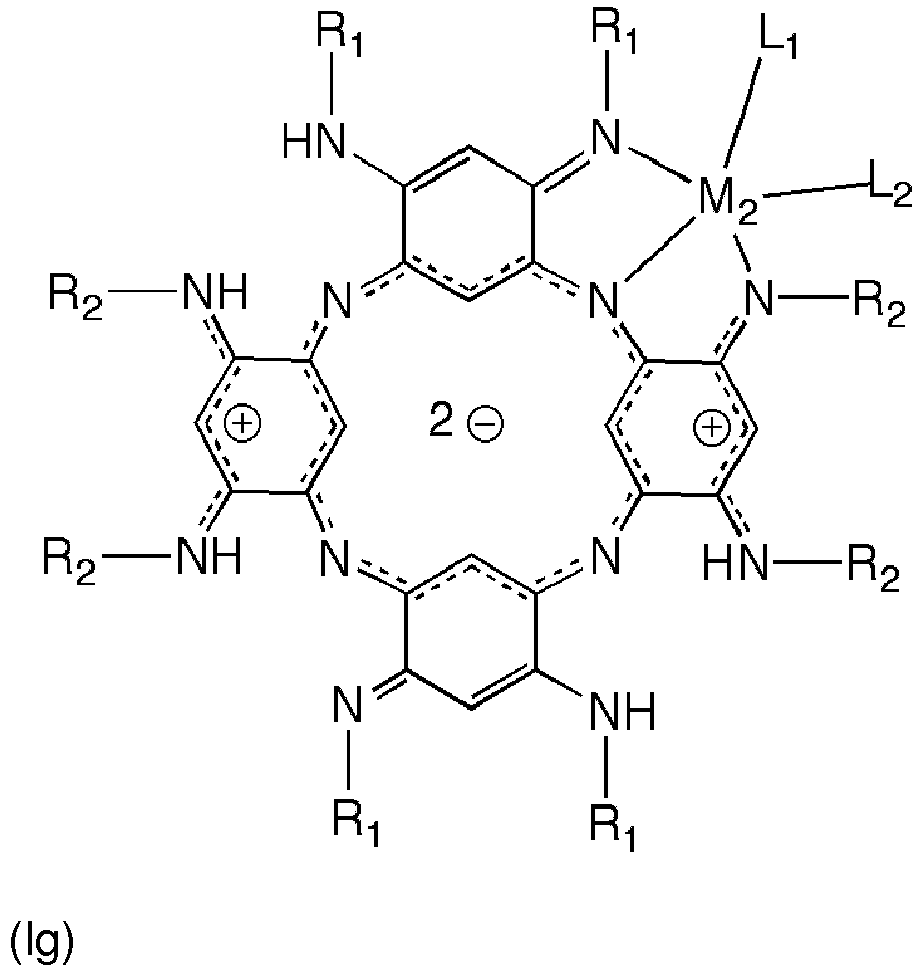


R1 and R2 are defined as above,
M1 is chosen among the transition metals having a degree of oxidation of 4 and M2 is chosen among the transition metals having a degree of oxidation of 2 or lanthanides. M1 is preferably chosen among vanadium, titanium, iridium and platinum. M2 is preferably chosen among palladium, nickel, cobalt, zinc, iron, europium, cerium, gadolinium, lanthane.
L1 and L2, identical or different, is a ligand which can give 1 covalent bond or 2 electrons, and/or may be optionally bound together. L1 and L2 can form together a group acac (L is O and the L and the two L are bound together), an amine, a phosphine, an aryl, or an halogen. - The chelation of those metals can enable to improve the Eg gap of the molecules and also to absorb in infrared.
- According to the present invention, the terms below have the following meanings:
- an aromatic compound contains a set of covalently bound atoms with specific characteristics:
- 1. A delocalized conjugated π system, most commonly an arrangement of alternating single and double bonds
- 2. A structure with all the contributing atoms of the aromatic ring in the same plane
- 3. Contributing atoms arranged in one or more rings
- 4. A number of π delocalized electrons that is 4n' + 2, where n' is an integer from 0 to 4. In the present invention n' is 4;
- a halogen atom corresponds to a fluorine, chlorine, bromine or iodine atom;
- an alkyl group corresponds to a saturated, linear or branched aliphatic group having from 1 to 30 carbon atoms, preferably from 1 to 18 carbon atoms, for example from 1 to 10 carbon atoms.
- a cycloalkyl group corresponds to a cyclic alkyl group comprising from 3 to 6 members. The following examples may be cited: cyclopropyl, cyclobutyl, cyclopentyl, cyclohexyl, etc;
- a heterocycle group is preferably a 5 to 10-membered cycle comprising at least one heteroatom, for example 1, 2 or 3 heteroatoms, preferably chosen among N, S or O;
- an heteroaryl group corresponds to an aromatic heterocycle comprising from 5 to 10 members, preferably 5 or 6 members, preferably including from 1 to 3 heteroatoms preferably chosen among N, S or O;
- an aryl group corresponds to an aromatic cycloalkyl comprising from 6 to 10 members, preferably 6 members;
- a transition metal is an element from
group 3 to group 12 andperiod 4 to period 7, except Lr and Lu, of the periodic table of the element; - a lanthanide is an element of the periodic table having an atomic number from 57 through 71.
- It is understood that (Ri)j is such that for each of the j occurrence Ri must be identical or different.
- The compounds according to the present invention are surprisingly stable and could be exposed to air for months as a solid or for days in solution in DMSO without detectable changes. Without being bound to any theory, this high stability is not only due to aromatic behavior of the central ring but most likely to the zwitterionic character of the whole molecule.
- Advantageously, the compounds of the invention absorb in all the visible, in UV and in the NIR region, especially between 300 and 1000 nm. Especially, the inventors have shown that the compounds of the invention absorb radiations around 880 nm which is in the NIR region. This specific range of absorbance especially enables to use those compounds in the field of electronics, photovoltaics, optoelectronics and photodynamic therapies.
- As mentioned above, the range of absorption can advantageously be modified by modifying the group R1 and R2 and/or by chelating metals.
- Advantageously, the compounds of the invention present a Eg gap comprised between 0,5 and 4 eV, preferably between 1 and 4 eV. For example, compound of formula (I) wherein R1 and R2 represent H present a Eg gap of 1,4 eV. This gap is determined by DFT calculations and by experiments (UV absorption) which is a technique well known by the skilled person.
- Without being bound to any theory, the inventors have found that the weak HOMO-LUMO gap can be explained on one hand by the dianionic character of the central cycle and on the other hand by the similarity of the frontier molecular orbitals (HOMO and LUMO) which are totally delocalized. The value of this gap is important to determine the possible applications for the molecules. For example in order to be used in optoelectronics or photodynamic therapies, the gap has to be as low as possible.
- The value of the gap should be modified by the modification of the group R1 and/or R2 making the compounds of formula (I) highly versatile. The value of the gap should also be modified by chelating compound of formula (I) with metal(s) as mentioned previously.
- The compounds of the invention present some electronic properties similar to the compounds disclosed by Qian et al (Chem. Asian. J., 2010, 5, 1006).
- As a consequence, in view of their specific structural and electronic properties (especially due to their NIR absorbing properties) as well as their specific versatility, the compounds according to the invention can be used in many fields. For examples, the compounds of the invention could be used in electronics, more specifically in optoelectronics; in the field of photovoltaics; in the field of photonics; in the field of biology, especially in the field of photodynamic therapies.
- Especially, when used in photovoltaics, the compounds of the invention having low dimensions and a weak Eg gap have different advantages compared to the polymers actually used: there are easy to synthesize, to functionalize (there are versatile), to purify... Since they absorb in all visible and NIR, the compounds of the invention can be used alone in the photovoltaic cells and there is no need of different molecules as mentioned above. The compounds of the invention can thus be used as components of solar cells, including organic molecular cells, polymer cells and dye-sensitized solar cells. In those cells the compounds of the inventions serve as charge-transport agents and/or absorbing agents.
- As mentioned above, the compounds of the invention contain few atoms and absorb in the NIR region which make them good candidates for being used in photodynamic therapies for the treatment of cancer, including those in deep tissues. In photodynamic therapies, the compounds of the invention are used as photosensitizers. The compounds of the invention are very useful in such an application since they can be modified, by modifying the R1 and R2 group or by chelation, which enables to control the absorption range of the light as well as the solubility of the compounds.
- The compounds of the invention could also be used as ligand in coordination chemistry since as mentioned above they can make chelate with metals.
- The invention also concerns a process for the preparation of compounds of formula (I) which comprises the following steps:
- i) reacting 1,5-Q2-2,4-dinitrobenzene with tetraminobenzene in the presence of a base, Q, identical or different, being a leaving group;
- ii) optionally, when R1 is different from H, reacting the compound obtained in i) with an electrophilic compound comprising the R1 group in the presence of a base;
- iii) reduction of the compound obtained in i) or in ii) in the presence of a reducing agent and an acid;
- iv) optionally, when R2 is different from H, reacting the compound obtained in iv) with electrophilic compound comprising the R2 group in the presence of a base;
- v) neutralization of compound obtained in iii) or iv) with a base to give compound of formula (I).
- Preferably, the reducing agent is chosen among SnCl2; H2, Pd/C; hydrazine; ammonium formate (NH4,HCO2,Pd/C).
- Preferably, the leaving group is chosen among halides, triflates (OSO2CF3), sulfonate esters such as tosylate or mesylate. Preferably the leaving group is chosen among halides. Preferably 1,5-
Q 2-2,4-dinitrobenzene is 1,5-difluoro-2,4-dinitrobenzene. - Preferably, the electrophilic compound is chosen among XCH(R3)R4; TsO-CH(R3)R4, X-[C(R5)=(CR6)]nR4, TsO-[C(R5)=(CR6)]nR4, XCOR7, XSO2R8.
- Preferably, step i) is carried out in the presence of a solvent, for example acetonitrile.
- Preferably step i) is carried out at low temperature, for example between -10 and 10°C, especially at 0°C, then the temperature is raised to room temperature, then, finally the reaction is carried out under reflux.
- Preferably, in step i) the base is for example diisopropyléthylamine (DEIPA). Preferably in steps ii) and iv) the base is chosen among K2CO3, NEt3.
- Preferably, in step iii), the reducing agent is used in large excess.
- Preferably, in step iii) the acid is HX, preferably HCl.
- Preferably, step iii) is carried out at a temperature of around 50-100 °C, for example 70 °C.
- Preferably in step v) the base is chosen among NaOH, K2CO3, NaHCO3, in particular NaOH.
- Compounds of formula (Ia) and (Ib) are obtained by reacting compounds of formula (I) with at least one mole of an acid.
- Compounds of formula (Ic) and (Id) are obtained by reacting compounds of formula (I) with at least one mole of a base.
- Compounds of formula (Ie) to (Ii) are obtained by mixing compounds of formula (I) in solution in a solvent with the metal in solution in a solvent.
- Advantageously, the synthetic accessibility to compounds of the invention is straightforward and highly versatile, as substituents on the peripheric nitrogen atoms are easily introduced and can be easily varied for tuning the properties of the compounds (solubility, geometry, donor/acceptor properties...)
- The following examples describe the synthesis of some compounds according to the invention. These examples are not intended to be limitative and only illustrate the present invention.
-
Figure 1 represents structure of compound (4) (anisotropic displacement parameters at 50%). -
Figure 2 represents the DFT optimized structures for Pt-4. -
Figure 3 represents the DFT optimized structures for a di-cobalt complex -
Figure 4 represents UV-visible-NIR absorption spectrum of compound (4) in DMSO -

- The commercially available 1,5-difluoro-2,4-dinitrobenzene was reacted with tetranitrobenzene in acetonitrile and in the presence of base (DIPEA) under inert atmosphere at 0 °C. The solution was stirred at 0 °C for 2 h, at room temperature for 14 h, and finally under reflux for 5 h. The resulting solid was isolated by filtration and washed with EtOH absolute (abs.) and acetonitrile affording (2) in yield 94%.
1H NMR ((CD3)2SO): δ (ppm) = 9.00 (s, 2H), 8.88 (br s, 4H), 6.53 (s, 2H), 6.07 (s, 2H), 5.70 (s, 2H), 4.98 (br s, 8H). 13C NMR ((CD3)2SO): δ (ppm) = 149.3, 145.3, 128.4, 127.8, 124.6, 110.7, 100.1, 93.5.
Elemental Analysis calculated for C24H20N12O8.2H2O : C 45.00, H 3.78, N 26.24; Found: C 45.56, H 3.31, N 25.71.
MS (ESI) m/z = 605.1 [M+H]+. -

1H NMR ((CD3)2SO): δ (ppm) = 9.27 (bs, 4H), 8.77 (s, 2H), 7.35 (m, 8H), 4.98 (s, 2H). 13C solid NMR: δ (ppm) = 147.3, 135.9, 131.8, 130.2, 126.7, 125.1, 123.7, 98.7. -

1H NMR ((CD3)2SO): δ (ppm) = 8.92 (br s, 7H), 8.61 (br s, 7H), 6.34 (s, 4H), -2.05 (s, 4H). MS (ESI) : 479.21 ([M+H]+). - In order to quantify the aromaticity of compound (1), the nucleus-independent chemical shifts, NCIS(0) and NCIS(1) were calculated at the center of the ring (Chen et al., Chem. Rev., 2005, 105, 3842). The result (-6ppm for both) shows a strongly diatropic value in agreement with an aromatic compound.
-

- Protonation of (1) with HCl furnished the protonated species (4) that could be fully characterized by X-ray analysis.
- An x-ray diffraction study on single crystals of compound (4) confirmed the features deduced from the spectroscopic data. The eight atoms constituting the diamine-benzoquinonediimine moiety do perfectly fit within a plane (the maximum deviation from planarity is equal to 0.034(7) A). The dihedrals around the nitrogens connecting the cycles are close to 160° and the angle between planes of opposite diamine-benzoquinonediimine is 75°. Hence macrocycle (1) adopts a nonplanar saddle conformation due to the repulsion of the internal C-H hydrogens. Consistently, theoretical calculations on compound (4) confirmed that the D2d structure is a true minima of the potential energy surface.
- The bond distances were analyzed in compound (4) according to
figure 1 . Infigure 1 , hydrogen atoms and solvent molecules are omitted for clarity. - The analysis gives the following bond length (Å): N(1)-C(2) = 1.337, C(2)-C(3) = 1.374, C(3)-C(4) = 1.374, C(4)-C(5) = 1.455, C(2)-C(1) = 1.459, N(2)-C(1) = 1.311, C(1)-C(6) = 1.362, C(6)-C(5) = 1.365, C(5)-N(3) = 1.314.
- Examination of the bond distances within the N(1)-C(2)-C(3)-C(4) and N(2)-C(1)-C(6)-C(5)-N(3) moieties in compound (4) reveals a bond equalization due to the delocalization of the negative and positive charges, respectively (
Fig. 1 ). The C(1)-C(2) and C(4)-C(5) distances of 1.459 and 1.455 Å, respectively, that would indicate the lack of delocalization between the aromatic cycle and the external π-subunits of the molecule, as already observed in porphyrins 1 (R = Ph) (Gros et al., J.Porphyrins Phtalocyanines, 1997, 1, 201). As a result, compound (4) is a diprotonated zwitterion that can be formally regarded as a combination of : i) an aromatic ring in which the two negative charges are stabilized by intramolecular delocalization, and ii) four cyanine-type subunits which are mutually connected by two C-C single-type bonds to the ring. - The intensity data were collected at 193 K on a Bruker-Nonius KappaCCD diffractometer using MoKα radiation (λ=0.71073 Å). Data collection was performed with COLLECT (Nonius, 2001), cell refinement and data reduction with DENZO/SCALEPACK (Otwinowski & Minor, 1997). The structure was solved with SIR92 (Altomare et al., 1994) and SHELXL-97 (Sheldrick, 2008) was used for full matrix least squares refinement. Compound (4) crystallizes with disordered DMSO and water solvent molecules as well as with chloride anions. The molecule is centered on a four-fold axis and the asymmetric unit is composed of one diamino-benzoquinoneimine unit, one disordered molecule of DMSO in general position split on two sites with occupations of 0.8 and 0.2, one partial DMSO in special position (
multiplicity 2, occupation 0.25) sharing the same site than a partial water molecule in general position (occupation 0.25) and 2.5 disordered and partial water molecules lying on a four-fold axis and split on 4 sites (multiplicities 4, occupations 0.05, 0.25, 0.2 and 0125 respectively). A chloride anion lying on a mirror (multiplicity 2, occupation 0.5) is completing the asymmetric unit.
The hydrogen atoms on the amines where located experimentally on the Fourier difference map but they were repositioned as well as the other H-atoms on the carbons and refined as rigid groups. The Uiso parameters for the aromatic and amine hydrogens were fixed to 1.2Ueq(parent atom) and those for the methyl fixed to 1.5Ueq(parent atom).
Hence, these two NH2 are engaged into H-bond interactions with the chloride atoms and the oxygen of co-crystallized DMSO molecules. the N1---Cl1, N1---O1i, N2---Cl1ii and N2-- -O1iii distances are equal to 3.167(7) Å, 2.917(14) Å, 3.161(7) Å and 2.910(13) Å respectively and the corresponding D-H---A angles are equal to 178°, 146°, 180°and 146° respectively (symmetry codes: i = 0.5-x, 0.5-y, 0.5-z; ii = y, -x, z; iii = 0.5-y, -0.5+x, 0.5-z). - All simulations have been achieved with Gaussian09 program, applying default procedures, integration grids, algorithms and parameters, except for tighten SCF (10-9 a.u.) and internal forces (10-5 a.u.) convergence thresholds. We have adopted a multistep strategy that is efficient to determine the UV/Vis features of most organic dyes. It proceeds as: 1) the (gas phase) ground-state geometrical parameters have been determined at the PBE0/6-311G(2d,2p) level via a force-minimization process; 2) the vibrational spectrum of each derivatives has been determined analytically at the same level of theory, that is PBE0/6-311G(2d,2p), and it has been checked that all structures correspond to true minima of the potential energy surface; 3) structures have been reoptimized at the same level of theory including the PCM model so to account for environmental effects, 4) the first ten low-lying excited-states have been determined within the vertical TD-DFT approximation using the PBE0/6-311++G(2d,2p) level of approximation; 5) the NMR shieldings of the protons have been computed with he the well-known GIAO scheme with the PBE0 functional and the cc-pVTZ basis set, using TMS computed in the same conditions as reference values; 6) NICS have been computed following the methodology proposed by Schleyer and coworkers, that is rely on the B3LYP/6-311+G(d,p) approach for both structures and NMR shifts. The orbitals represented in this manuscript use a 0.03 a.u. contour threshold.
- The same theoretical methodology was used to evaluate complexes structures based on the compound (4). First, we have replaced the central protons by a single platinum ion (Pt4+) and have been able to locate a true minima of the potential energy surface (no imaginary frequency at the PBE0/6-311G(2d,2p) level, using LanL2DZ pseudopotentials for the heavy ion and selecting a D2d point group) for a compound with the central ion in a nearly square planar environment (
Fig. 2 ). In addition, DFT calculations also demonstrate that complexation might occur on the side of the system, as illustrated by the di-cobalt structure displayed inFigure 3 (true minima at the same level of theory as for Pt structure). - The absorption spectrum of compound (4) (the similar spectrum is obtained for compound (1)) (
figure 4 ) exhibits in DMSO three main bands in the visible at λ = 408, 439 (with shoulder) and 647, and an additional broad absorption in the NIR region (ca. 880 nm). PCM-TD-PBE0/6-311++G(2d,2p) calculations on compound (4) were performed to gain insights into the nature of the two first bands. The first absorption is predicted at 887 nm and is significantly dipole-allowed (oscillator strength, f, of 0.2). - This value is in remarkable agreement with the measurements at 880 nm. It is clearly a highly-delocalized excited-state, with a partial charge-transfer occurring through the σ-like bond (a finding typical of alternating systems)- from the imine to the amine subregions. This enhanced delocalization accounts for its relatively small transition energy. The next significant band is computed at 588 nm (f=0.4) and it corresponds to the strong 647 nm experimental band, the error being in the line of the TD-DFT accuracy. Like the first absorption, this excitation implies a full electronic reorganization, but with no marked CT character. The HOMO-LUMO gap computed at the PBE0/6-311G(2d,2p) level is 1.65 eV (for compound (1)) and 2.31 eV (for compound (4)) which can be compared to 3.28 eV for the zinc porphyrin.
Claims (17)
- Compound of formula (I)

 each R1 and R2 are identical or different and represent:- a hydrogen atom;- a group of formula -CH(R3)R4;- a group of formula -[C(R5)=(CR6)]nR4;- a group of formula -C(O)R7; or- a group of formula SO2R8;R3 represents H, an aliphatic chain, linear or branched, having from 1 to 30 carbon atoms;R4 represents an aliphatic chain, linear or branched, having from 1 to 10 carbon atoms, H, X, OH, OR3, SH, SR3, CH(O), C(O)OH, CX(O), C(O)OR3, C(O)NHR3, C(O)NH2, NHR3, NRR', an heteroaryl, an aryl, CN, NO2, heterocycle or cycloalkyl, the heteroaryl, aryl, heterocycle or cycloalkyl is optionally substituted by one or more alkyl, linear or branched, having from 1 to 10 members, X, NRR', OR ;R5 and R6, identical or different, represent R3, X, OH, OR3, SH, SR3, CH(O), C(O)OH, CX(O), C(O)OR3, C(O)NHR3, C(O)NH2, NRR', an heteroaryl, an aryl, CN, NO2, heterocycle or cycloalkyl, the heteroaryl, aryl, heterocycle or cycloalkyl is optionally substituted by one or more alkyl, linear or branched, having from 1 to 10 members, X, NRR', OR;n is an integer from 1 to 10;R7 represents CHR3R4, heteroaryl or aryl, the heteroaryl or aryl is optionally substituted by one or more alkyl, linear or branched, having from 1 to 10 members, X, NRR', OR;R8 represents heteroaryl or aryl, the heteroaryl or aryl is optionally substituted by an alkyl, linear or branched, having from 1 to 10 members, X, NRR', OR;X represents an halogen atom;R, R', identical or different, represent hydrogen, an aliphatic chain, linear or branched, having from 1 to 30 carbon atoms, or an aryl, the aryl is optionally substituted by one or more alkyl, linear or branched, having from 1 to 10 members, X, OH, NH2; and the corresponding compound in ionic forms and in their chelated forms with metals.
 - Compound according to claim 1, of formula (Ia), (Ib), (Ic), (Id), (Ic') or (Id'):


- Compound according to claim 1, of formula (Ie)-(Ii) :


R1 and R2 are defined as in claim 1,
M1 is chosen among the transition metals having a degree of oxidation of 4 and M2 is chosen among the transition metals having a degree of oxidation of 2 or lanthanides;
L1 and L2, identical or different, is a ligand which can give 1 covalent bond or 2 electrons, and/or may be optionally bound together. - Compound according to anyone of claims 1 to 3, wherein R3 represents an alkyl, linear or branched, having from 1 to 18 carbon atoms.
- Compound according to anyone of claims 1 to 3, wherein R1 and R2 are H.
- Compound according to anyone of claims 1 to 5, having a Eg gap comprised between 1 and 4 eV.
- Compound according to anyone of claims 1 to 6, absorbing in all the visible and in the NIR region.
- Process for the preparation of compounds according to anyone of claims 1 and 4 to 7, comprising the following steps:i) reacting 1,5-Q2-2,4-dinitrobenzene with tetraminobenzene in the presence of a base, Q, identical or different, being a leaving group;ii) optionally, when R1 is different from H, reacting the compound obtained in i) with an electrophilic compound comprising the R1 group in the presence of a base;iii) reduction of the compound obtained in i) or in ii) in the presence of a reducing agent and an acid;iv) optionally, when R2 is different from H, reacting the compound obtained in iv) with electrophilic compound comprising the R2 group in the presence of a base;v) neutralization of compound obtained in iii) or iv) with a base to give compound of formula (I).
- Process according to claim 8, wherein the reducing agent is chosen among SnCl2; H2, Pd/C; hydrazine; ammonium formate (NH4,HCO2,Pd/C).
- Process according to claim 8 or 9, wherein the leaving group is chosen among halides, trifaltes (OSO2CF3), sulfonate esters such as tosylate or mesyltate.
- Process according to claim 8, 9 or 10, wherein the electrophilic compound is chosen among XCH(R3)R4; TsO-CH(R3)R4, X-[C(R5)=(CR6)]nR4, TsO-[C(R5)=(CR6)]nR4, XCOR7, TsOCOR7, XSO2R8.
- Process for the preparation of compound according to claim 2 comprising the reaction of a compound of formula (I) with at least one mole of an acid or with at least one mole of a base.
- Use of compound of formula (I) according to anyone of claims 1 to 7 in electronics, photonics or optoelectronics fields.
- Use of compound of formula (I) according to anyone of claims 1 to 7 in the fields of photovoltaic cells.
- A complex having as ligand a compound of formula (I) according to anyone of claims 1 to 6.
- Compound of formula (I) according to anyone of claims 1 to 7, for its use to treat cancers.
- Compound of formula (I) according to anyone of claims 1 to 7, for its use to treat cancers by photodynamic therapies.
Priority Applications (4)
| Application Number | Priority Date | Filing Date | Title |
|---|---|---|---|
| EP12306044.4A EP2703391A1 (en) | 2012-08-31 | 2012-08-31 | Analogues of porphyrins, their method of preparation and use thereof |
| EP13756159.3A EP2890685A1 (en) | 2012-08-31 | 2013-09-02 | Analogues of porphyrins, their method of preparation and use thereof |
| PCT/EP2013/068111 WO2014033305A1 (en) | 2012-08-31 | 2013-09-02 | Analogues of porphyrins, their method of preparation and use thereof |
| US14/424,255 US9156800B2 (en) | 2012-08-31 | 2013-09-02 | Analogues of porphyrins, their method of preparation and use thereof |
Applications Claiming Priority (1)
| Application Number | Priority Date | Filing Date | Title |
|---|---|---|---|
| EP12306044.4A EP2703391A1 (en) | 2012-08-31 | 2012-08-31 | Analogues of porphyrins, their method of preparation and use thereof |
Publications (1)
| Publication Number | Publication Date |
|---|---|
| EP2703391A1 true EP2703391A1 (en) | 2014-03-05 |
Family
ID=47044925
Family Applications (2)
| Application Number | Title | Priority Date | Filing Date |
|---|---|---|---|
| EP12306044.4A Withdrawn EP2703391A1 (en) | 2012-08-31 | 2012-08-31 | Analogues of porphyrins, their method of preparation and use thereof |
| EP13756159.3A Withdrawn EP2890685A1 (en) | 2012-08-31 | 2013-09-02 | Analogues of porphyrins, their method of preparation and use thereof |
Family Applications After (1)
| Application Number | Title | Priority Date | Filing Date |
|---|---|---|---|
| EP13756159.3A Withdrawn EP2890685A1 (en) | 2012-08-31 | 2013-09-02 | Analogues of porphyrins, their method of preparation and use thereof |
Country Status (3)
| Country | Link |
|---|---|
| US (1) | US9156800B2 (en) |
| EP (2) | EP2703391A1 (en) |
| WO (1) | WO2014033305A1 (en) |
Citations (5)
| Publication number | Priority date | Publication date | Assignee | Title |
|---|---|---|---|---|
| GB989560A (en) * | 1962-07-20 | 1965-04-22 | British Petroleum Co | Polyamines |
| WO2003011286A1 (en) * | 2001-07-30 | 2003-02-13 | The Research Foundation Of State University Of New York | Core modified porphyrins |
| JP2007055946A (en) * | 2005-08-25 | 2007-03-08 | Tokyo Institute Of Technology | Azacalixarene and its production method |
| JP2007214364A (en) * | 2006-02-09 | 2007-08-23 | Bando Chem Ind Ltd | Organic electroluminescence device |
| CN101088992A (en) * | 2007-04-04 | 2007-12-19 | 南昌大学 | Cyclic aromatic amine hole transport material with high glass transition temperature and synthesis method |
Family Cites Families (2)
| Publication number | Priority date | Publication date | Assignee | Title |
|---|---|---|---|---|
| WO2006038823A1 (en) | 2004-10-08 | 2006-04-13 | Massey University | Beta-substituted porphyrins |
| TWI379834B (en) | 2008-11-17 | 2012-12-21 | Univ Nat Chiao Tung | Porphyrin-based photosensitizer dyes for dye-sensitized solar cells |
-
2012
- 2012-08-31 EP EP12306044.4A patent/EP2703391A1/en not_active Withdrawn
-
2013
- 2013-09-02 WO PCT/EP2013/068111 patent/WO2014033305A1/en not_active Ceased
- 2013-09-02 US US14/424,255 patent/US9156800B2/en not_active Expired - Fee Related
- 2013-09-02 EP EP13756159.3A patent/EP2890685A1/en not_active Withdrawn
Patent Citations (5)
| Publication number | Priority date | Publication date | Assignee | Title |
|---|---|---|---|---|
| GB989560A (en) * | 1962-07-20 | 1965-04-22 | British Petroleum Co | Polyamines |
| WO2003011286A1 (en) * | 2001-07-30 | 2003-02-13 | The Research Foundation Of State University Of New York | Core modified porphyrins |
| JP2007055946A (en) * | 2005-08-25 | 2007-03-08 | Tokyo Institute Of Technology | Azacalixarene and its production method |
| JP2007214364A (en) * | 2006-02-09 | 2007-08-23 | Bando Chem Ind Ltd | Organic electroluminescence device |
| CN101088992A (en) * | 2007-04-04 | 2007-12-19 | 南昌大学 | Cyclic aromatic amine hole transport material with high glass transition temperature and synthesis method |
Non-Patent Citations (9)
| Title |
|---|
| A. MURANAKA ET AL.: "[18]/[20]pi Hemiporphyrazine: A Redox-Switchable Near-Infrared Dye", JOURNAL OF THE AMERICAN CHEMICAL SOCIETY, vol. 134, August 2012 (2012-08-01), pages 190 - 193, XP002692031, DOI: 10.1021/ja210410c * |
| DATABASE WPI Week 200772, Derwent World Patents Index; AN 2007-767098, XP002692026 * |
| DATABASE WPI Week 200867, Derwent World Patents Index; AN 2008-L32066, XP002692027 * |
| GANG QIAN ET AL.: "Near-Infrared Organic Compounds and Emerging Applications", CHEMISTRY - AN ASIAN JOURNAL, vol. 5, 2010, pages 1006 - 1029, XP002692030, DOI: 10.1002/asia.200900596 * |
| GROS ET AL., J.PORPHYRINS PHTALOCYANINES, vol. 1, 1997, pages 201 |
| J. L. KATZ ET AL.: "Synthesis of Inherently Chiral Azacalix[4]arenes and Diazadioxacalix[4]arenes", ORGANIC LETTERS, vol. 12, no. 19, 2010, pages 4300 - 4303, XP002692029, ISSN: 1523-7060, DOI: 10.1021/ol1017454 * |
| M. TOUIL ET AL.: "Synthesis and Properties of the Emerging Azacalix[1(4)]arenes", EUROPEAN JOURNAL OF ORGANIC CHEMISTRY, no. 10, 2011, pages 1914 - 1921, XP002692028, ISSN: 1434-193X, DOI: 10.1002/ejoc.201001432 * |
| MURANAKA ET AL., JACS, vol. 134, 2012, pages 190 - 193 |
| QIAN ET AL., CHEM. ASIAN. J., vol. 5, 2010, pages 1006 |
Also Published As
| Publication number | Publication date |
|---|---|
| US20150210653A1 (en) | 2015-07-30 |
| WO2014033305A1 (en) | 2014-03-06 |
| EP2890685A1 (en) | 2015-07-08 |
| US9156800B2 (en) | 2015-10-13 |
Similar Documents
| Publication | Publication Date | Title |
|---|---|---|
| Brothers | Boron complexes of pyrrolyl ligands | |
| Soury et al. | Meso-tetrakis (3, 4, 5-trimethoxyphenyl) porphyrin derivatives: Synthesis, spectroscopic characterizations and adsorption of NO2 | |
| Çakır et al. | Water soluble peripheral and non-peripheral tetrasubstituted zinc phthalocyanines: Synthesis, photochemistry and bovine serum albumin binding behavior | |
| Hannah et al. | Late first-row transition-metal complexes of texaphyrin | |
| Akçay et al. | Synthesis, characterization and spectroscopic studies of novel peripherally tetra-imidazole substituted phthalocyanine and its metal complexes, the computational and experimental studies of the novel phthalonitrile derivative | |
| Mitewa | Coordination properties of the bioligands creatinine and creatine in various reaction media | |
| Viola et al. | Tetra-2, 3-pyrazinoporphyrazines with Peripherally Appended Pyridine Rings. 19. Pentanuclear Octa (2-pyridyl) tetrapyrazinoporphyrazines Carrying Externally Carboranthiolate Groups: Physicochemical Properties and Potentialities as Anticancer Drugs | |
| Cao et al. | Constructing sandwich-type rare earth double-decker complexes with N-confused porphyrinato and phthalocyaninato ligands | |
| Gonell et al. | Pincer-CNC mononuclear, dinuclear and heterodinuclear Au (III) and Pt (II) complexes supported by mono-and poly-N-heterocyclic carbenes: Synthesis and photophysical properties | |
| Çınar et al. | Synthesis and photophysical properties of monomeric and dimeric halogenated aza-BODIPYs | |
| Mayhugh et al. | Pyrrophens: pyrrole-based hexadentate ligands tailor-made for uranyl (UO22+) coordination and molecular recognition | |
| Priola et al. | Bridging solution and solid-state chemistry of dicyanoaurate: the case study of Zn–Au nucleation units | |
| Dar et al. | Recent advances in main group coordination driven porphyrins: a comprehensive review | |
| Semioshkin et al. | Reactions of oxonium derivatives of (B 12 H 12) 2-with phenoles, and synthesis and photochemical properties of a phthalocyanine containing four (B 12 H 12) 2-groups | |
| Ostrowska et al. | Explaining how α-hydroxamate ligands control the formation of Cu (II)-, Ni (II)-, and Zn (II)-containing metallacrowns | |
| Gianferrara et al. | Synthetic strategies towards ruthenium–porphyrin conjugates for anticancer activity | |
| Al-sawah et al. | Novel azaphthalocyanines with efficient anti-corrosion capability: Effect of halogens and heavy metals | |
| Aydogdu et al. | Metallophthalocyanines for PDT applications: a DFT study | |
| Adach et al. | Experimental and theoretical studies on the structure and spectroscopic properties of N-scorpionate complexes obtained from metallic cobalt in a one pot synthesis | |
| Mchiri et al. | New cadmium (II) porphyrin-based coordination dimer: Experimental and theoretic studies | |
| Durmuş et al. | Comparison of photophysicochemical properties of hexaphenoxycyclotriphosphazenyl-substituted metal-free, mono-and bis-lutetium phthalocyanines | |
| Chatterjee et al. | Dual Photoreactive Ternary Ruthenium (II) Terpyridyl Complexes: A Comparative Study on Visible-Light-Induced Single-Step Dissociation of Bidentate Ligands and Generation of Singlet Oxygen | |
| EP2703391A1 (en) | Analogues of porphyrins, their method of preparation and use thereof | |
| Selmi et al. | A comparative structural, spectroscopic, optical and photoluminescence studies by DFT of Fe (II) difluoro (oxalato) borate complex | |
| Başeren et al. | Synthesis and boron interaction of new amino acid containing phthalocyanines and the precursor |
Legal Events
| Date | Code | Title | Description |
|---|---|---|---|
| AK | Designated contracting states |
Kind code of ref document: A1 Designated state(s): AL AT BE BG CH CY CZ DE DK EE ES FI FR GB GR HR HU IE IS IT LI LT LU LV MC MK MT NL NO PL PT RO RS SE SI SK SM TR |
|
| AX | Request for extension of the european patent |
Extension state: BA ME |
|
| PUAI | Public reference made under article 153(3) epc to a published international application that has entered the european phase |
Free format text: ORIGINAL CODE: 0009012 |
|
| STAA | Information on the status of an ep patent application or granted ep patent |
Free format text: STATUS: THE APPLICATION IS DEEMED TO BE WITHDRAWN |
|
| 18D | Application deemed to be withdrawn |
Effective date: 20140906 |