EP2703386A1 - Method for producing diamine compound - Google Patents
Method for producing diamine compound Download PDFInfo
- Publication number
- EP2703386A1 EP2703386A1 EP12775932.2A EP12775932A EP2703386A1 EP 2703386 A1 EP2703386 A1 EP 2703386A1 EP 12775932 A EP12775932 A EP 12775932A EP 2703386 A1 EP2703386 A1 EP 2703386A1
- Authority
- EP
- European Patent Office
- Prior art keywords
- group
- carbon atoms
- mmol
- general formula
- alkyl group
- Prior art date
- Legal status (The legal status is an assumption and is not a legal conclusion. Google has not performed a legal analysis and makes no representation as to the accuracy of the status listed.)
- Granted
Links
- 0 *C(C(*)N*)N Chemical compound *C(C(*)N*)N 0.000 description 6
- BYIANDCTHTWNAJ-UHFFFAOYSA-N CC1=CCC(COCCO)=CC1 Chemical compound CC1=CCC(COCCO)=CC1 BYIANDCTHTWNAJ-UHFFFAOYSA-N 0.000 description 1
- ZIZKKXJVBCTQGB-UHFFFAOYSA-N CC1=CCC=C(COCCO)C1 Chemical compound CC1=CCC=C(COCCO)C1 ZIZKKXJVBCTQGB-UHFFFAOYSA-N 0.000 description 1
Classifications
-
- C—CHEMISTRY; METALLURGY
- C07—ORGANIC CHEMISTRY
- C07C—ACYCLIC OR CARBOCYCLIC COMPOUNDS
- C07C303/00—Preparation of esters or amides of sulfuric acids; Preparation of sulfonic acids or of their esters, halides, anhydrides or amides
- C07C303/36—Preparation of esters or amides of sulfuric acids; Preparation of sulfonic acids or of their esters, halides, anhydrides or amides of amides of sulfonic acids
- C07C303/40—Preparation of esters or amides of sulfuric acids; Preparation of sulfonic acids or of their esters, halides, anhydrides or amides of amides of sulfonic acids by reactions not involving the formation of sulfonamide groups
-
- B—PERFORMING OPERATIONS; TRANSPORTING
- B01—PHYSICAL OR CHEMICAL PROCESSES OR APPARATUS IN GENERAL
- B01J—CHEMICAL OR PHYSICAL PROCESSES, e.g. CATALYSIS OR COLLOID CHEMISTRY; THEIR RELEVANT APPARATUS
- B01J31/00—Catalysts comprising hydrides, coordination complexes or organic compounds
- B01J31/16—Catalysts comprising hydrides, coordination complexes or organic compounds containing coordination complexes
- B01J31/18—Catalysts comprising hydrides, coordination complexes or organic compounds containing coordination complexes containing nitrogen, phosphorus, arsenic or antimony as complexing atoms, e.g. in pyridine ligands, or in resonance therewith, e.g. in isocyanide ligands C=N-R or as complexed central atoms
- B01J31/1805—Catalysts comprising hydrides, coordination complexes or organic compounds containing coordination complexes containing nitrogen, phosphorus, arsenic or antimony as complexing atoms, e.g. in pyridine ligands, or in resonance therewith, e.g. in isocyanide ligands C=N-R or as complexed central atoms the ligands containing nitrogen
-
- B—PERFORMING OPERATIONS; TRANSPORTING
- B01—PHYSICAL OR CHEMICAL PROCESSES OR APPARATUS IN GENERAL
- B01J—CHEMICAL OR PHYSICAL PROCESSES, e.g. CATALYSIS OR COLLOID CHEMISTRY; THEIR RELEVANT APPARATUS
- B01J31/00—Catalysts comprising hydrides, coordination complexes or organic compounds
- B01J31/16—Catalysts comprising hydrides, coordination complexes or organic compounds containing coordination complexes
- B01J31/22—Organic complexes
- B01J31/2265—Carbenes or carbynes, i.e.(image)
-
- C—CHEMISTRY; METALLURGY
- C07—ORGANIC CHEMISTRY
- C07C—ACYCLIC OR CARBOCYCLIC COMPOUNDS
- C07C309/00—Sulfonic acids; Halides, esters, or anhydrides thereof
- C07C309/63—Esters of sulfonic acids
- C07C309/72—Esters of sulfonic acids having sulfur atoms of esterified sulfo groups bound to carbon atoms of six-membered aromatic rings of a carbon skeleton
- C07C309/73—Esters of sulfonic acids having sulfur atoms of esterified sulfo groups bound to carbon atoms of six-membered aromatic rings of a carbon skeleton to carbon atoms of non-condensed six-membered aromatic rings
-
- C—CHEMISTRY; METALLURGY
- C07—ORGANIC CHEMISTRY
- C07C—ACYCLIC OR CARBOCYCLIC COMPOUNDS
- C07C311/00—Amides of sulfonic acids, i.e. compounds having singly-bound oxygen atoms of sulfo groups replaced by nitrogen atoms, not being part of nitro or nitroso groups
- C07C311/01—Sulfonamides having sulfur atoms of sulfonamide groups bound to acyclic carbon atoms
- C07C311/02—Sulfonamides having sulfur atoms of sulfonamide groups bound to acyclic carbon atoms of an acyclic saturated carbon skeleton
- C07C311/03—Sulfonamides having sulfur atoms of sulfonamide groups bound to acyclic carbon atoms of an acyclic saturated carbon skeleton having the nitrogen atoms of the sulfonamide groups bound to hydrogen atoms or to acyclic carbon atoms
- C07C311/05—Sulfonamides having sulfur atoms of sulfonamide groups bound to acyclic carbon atoms of an acyclic saturated carbon skeleton having the nitrogen atoms of the sulfonamide groups bound to hydrogen atoms or to acyclic carbon atoms to acyclic carbon atoms of hydrocarbon radicals substituted by nitrogen atoms, not being part of nitro or nitroso groups
-
- C—CHEMISTRY; METALLURGY
- C07—ORGANIC CHEMISTRY
- C07C—ACYCLIC OR CARBOCYCLIC COMPOUNDS
- C07C311/00—Amides of sulfonic acids, i.e. compounds having singly-bound oxygen atoms of sulfo groups replaced by nitrogen atoms, not being part of nitro or nitroso groups
- C07C311/15—Sulfonamides having sulfur atoms of sulfonamide groups bound to carbon atoms of six-membered aromatic rings
- C07C311/16—Sulfonamides having sulfur atoms of sulfonamide groups bound to carbon atoms of six-membered aromatic rings having the nitrogen atom of at least one of the sulfonamide groups bound to hydrogen atoms or to an acyclic carbon atom
- C07C311/18—Sulfonamides having sulfur atoms of sulfonamide groups bound to carbon atoms of six-membered aromatic rings having the nitrogen atom of at least one of the sulfonamide groups bound to hydrogen atoms or to an acyclic carbon atom to an acyclic carbon atom of a hydrocarbon radical substituted by nitrogen atoms, not being part of nitro or nitroso groups
-
- B—PERFORMING OPERATIONS; TRANSPORTING
- B01—PHYSICAL OR CHEMICAL PROCESSES OR APPARATUS IN GENERAL
- B01J—CHEMICAL OR PHYSICAL PROCESSES, e.g. CATALYSIS OR COLLOID CHEMISTRY; THEIR RELEVANT APPARATUS
- B01J2231/00—Catalytic reactions performed with catalysts classified in B01J31/00
- B01J2231/60—Reduction reactions, e.g. hydrogenation
- B01J2231/64—Reductions in general of organic substrates, e.g. hydride reductions or hydrogenations
-
- B—PERFORMING OPERATIONS; TRANSPORTING
- B01—PHYSICAL OR CHEMICAL PROCESSES OR APPARATUS IN GENERAL
- B01J—CHEMICAL OR PHYSICAL PROCESSES, e.g. CATALYSIS OR COLLOID CHEMISTRY; THEIR RELEVANT APPARATUS
- B01J2531/00—Additional information regarding catalytic systems classified in B01J31/00
- B01J2531/02—Compositional aspects of complexes used, e.g. polynuclearity
- B01J2531/0238—Complexes comprising multidentate ligands, i.e. more than 2 ionic or coordinative bonds from the central metal to the ligand, the latter having at least two donor atoms, e.g. N, O, S, P
- B01J2531/0241—Rigid ligands, e.g. extended sp2-carbon frameworks or geminal di- or trisubstitution
-
- B—PERFORMING OPERATIONS; TRANSPORTING
- B01—PHYSICAL OR CHEMICAL PROCESSES OR APPARATUS IN GENERAL
- B01J—CHEMICAL OR PHYSICAL PROCESSES, e.g. CATALYSIS OR COLLOID CHEMISTRY; THEIR RELEVANT APPARATUS
- B01J2531/00—Additional information regarding catalytic systems classified in B01J31/00
- B01J2531/80—Complexes comprising metals of Group VIII as the central metal
- B01J2531/82—Metals of the platinum group
- B01J2531/821—Ruthenium
-
- C—CHEMISTRY; METALLURGY
- C07—ORGANIC CHEMISTRY
- C07C—ACYCLIC OR CARBOCYCLIC COMPOUNDS
- C07C2601/00—Systems containing only non-condensed rings
- C07C2601/12—Systems containing only non-condensed rings with a six-membered ring
- C07C2601/16—Systems containing only non-condensed rings with a six-membered ring the ring being unsaturated
Definitions
- the present invention relates to a method for producing a diamine compound useful for forming a ruthenium-diamine complex important as an asymmetric reduction catalyst.
- Non Patent Literatures 5, 6, 7, 8, 9, 10, etc. have reported that complexes in which a diamine moiety and an aromatic ring (arene) moiety coordinated to the ruthenium complex are linked by a carbon chain exhibit higher activities than conventional catalysts.
- these complexes have the following problems. Specifically, these complexes are produced through hazardous processes such as the Birch reduction of an alcohol having an aromatic ring, the subsequent conversion to an aldehyde under a low temperature of -80°C, and the subsequent synthesis using pyrophoric NaBH 4 or LiAlH 4 . Moreover, the yields of these complexes are low.
- the present inventors have developed a production method which is performed under mild conditions and hence can be carried out industrially.
- the present invention includes the following contents.
- the present invention provides a method for producing a diamine compound in which a diamine moiety and an arene moiety to be coordinated to a ruthenium complex are linked by a carbon chain.
- the above-described conventional methods for producing a diamine compound have the following problems: the complexity of the synthesis method; the use of the Birch reduction which necessitates the use of toxic ammonia gas and an ultra low-temperature apparatus; the inevitable use of the Swern oxidation which causes problems, in industrial application, associated with the odor of by-produced dimethyl sulfide, the hazardous nature of carbon monoxide, the need for a cryogenic reactor, and the like; low yields in some reactions; and the like.
- the present invention makes it possible to simply and efficiently produce a highly active ruthenium-diamine complex by the production method which uses a novel intermediate obtained by halogenating or sulfonylating an alcohol synthesized by the Diels-Alder reaction.
- a compound represented by the following general formula (1) is produced by reacting a compound represented by the following general formula (2) with a diamine compound represented by the following general formula (3): wherein R 1 represents an alkyl group having 1 to 10 carbon atoms; an alkanesulfonyl group having 1 to 10 carbon atoms and optionally substituted with a halogen atom; an arenesulfonyl group optionally substituted with an alkyl group having 1 to 10 carbon atoms, a halogenated alkyl group having 1 to 10 carbon atoms, or a halogen atom; an alkoxycarbonyl group having 2 to 11 carbon atoms in total; or a benzoyl group optionally substituted with an alkyl group having 1 to 10 carbon atoms, R 2 and R 3 each independently represent an alkyl group having 1 to 10 carbon atoms; a phenyl group optionally substituted with an alkyl group having 1 to 10 carbon atoms, an alkoxy group having 1 to 10
- the alkyl group having 1 to 10 carbon atoms represented by R 1 is a linear or branched alkyl group having 1 to 10 carbon atoms, and preferably having 1 to 5 carbon atoms.
- Specific examples of the alkyl group include a methyl group, an ethyl group, a n-propyl group, an isopropyl group, a n-butyl group, an isobutyl group, a s-butyl group, a t-butyl group, a n-pentyl group, a n-hexyl group, a n-heptyl group, a n-octyl group, a n-nonyl group, a n-decyl group, and the like.
- the alkanesulfonyl group having 1 to 10 carbon atoms represented by R 1 includes a methanesulfonyl group, an ethanesulfonyl group, a propanesulfonyl group, and the like.
- the alkanesulfonyl group is optionally substituted with one or multiple halogen atoms.
- the halogen atom includes chlorine atoms, bromine atoms, fluorine atoms, and the like.
- the alkanesulfonyl group having 1 to 10 carbon atoms and substituted with a halogen atom includes a trifluoromethanesulfonyl group and the like.
- the arenesulfonyl group represented by R 1 includes a benzenesulfonyl group and the like.
- the arenesulfonyl group is optionally substituted with one or multiple alkyl groups having 1 to 10 carbon atoms, halogenated alkyl groups having 1 to 10 carbon atoms, or halogen atoms.
- the alkyl group having 1 to 10 carbon atoms includes those listed as the alkyl group having 1 to 10 carbon atoms represented by R 1 , and the like.
- the halogenated alkyl group having 1 to 10 carbon atoms includes halides (the halogen atom includes a chlorine atom, a bromine atom, a fluorine atom, and the like) of those listed as the alkyl group having 1 to 10 carbon atoms represented by R 1 , and the like.
- the halogen atom includes a chlorine atom, a bromine atom, a fluorine atom, and the like.
- the arenesulfonyl group substituted with an alkyl group having 1 to 10 carbon atoms, a halogenated alkyl group having 1 to 10 carbon atoms, or a halogen atom includes a p-toluenesulfonyl group, a 2,4,6-trimethylbenzenesulfonyl group, a 4-trifluoromethylbenzenesulfonyl group, a pentafluorobenzenesulfonyl group, and the like.
- the alkoxycarbonyl group having 2 to 11 carbon atoms in total represented by R 1 is a linear or branched alkoxycarbonyl group having 2 to 11 carbon atoms in total, and preferably having 2 to 5 carbon atoms in total.
- Specific examples of the alkoxycarbonyl group include a methoxycarbonyl group, an ethoxycarbonyl group, a t-butoxycarbonyl group, and the like.
- the benzoyl group represented by R 1 is optionally substituted with one or multiple alkyl groups having 1 to 10 carbon atoms.
- the alkyl group having 1 to 10 carbon atoms includes those listed as the alkyl group having 1 to 10 carbon atoms represented by R 1 , and the like.
- the benzoyl group optionally substituted with an alkyl group having 1 to 10 carbon atoms includes a benzoyl group, a p-toluoyl group, an o-toluoyl group, and the like.
- the alkyl group having 1 to 10 carbon atoms represented by each of R 2 and R 3 includes those listed as the alkyl group having 1 to 10 carbon atoms represented by R 1 , and the like.
- the phenyl group represented by each of R 2 and R 3 is optionally substituted with one or multiple alkyl groups having 1 to 10 carbon atoms, alkoxy groups having 1 to 10 carbon atoms, or halogen atoms.
- the alkyl group having 1 to 10 carbon atoms includes those listed as the alkyl group having 1 to 10 carbon atoms represented by R 1 , and the like.
- the alkoxy groups having 1 to 10 carbon atoms are each a linear or branched alkoxy group having 1 to 10 carbon atoms, and preferably having 1 to 5 carbon atoms.
- alkoxy group examples include a methoxy group, an ethoxy group, a n-propoxy group, an isopropoxy group, a n-butoxy group, an isobutoxy group, a s-butoxy group, a t-butoxy group, a n-pentyloxy group, a n-hexyloxy group, a n-heptyloxy group, a n-octyloxy group, a n-nonyloxy group, a n-decyloxy group, and the like.
- the halogen atom includes a chlorine atom, a bromine atom, a fluorine atom, and the like.
- the phenyl group substituted with an alkyl group having 1 to 10 carbon atoms, an alkoxy group having 1 to 10 carbon atoms, or a halogen atom includes a 2,4,6-trimethylphenyl group, a 4-methoxyphenyl group, a 2,4,6-trimethoxyphenyl group, a 4-fluorophenyl group, a 2-chlorophenyl group, a 4-chlorophenyl group, a 2,4-dichlorophenyl group, and the like.
- the cycloalkyl group having 3 to 8 carbon atoms represented by each of R 2 and R 3 is a monocyclic, polycyclic, or cross-linked cycloalkyl group having 3 to 8 carbon atoms, and preferably having 5 to 8 carbon atoms.
- Specific examples of the cycloalkyl group having 3 to 8 carbon atoms include a cyclopropyl group, a cyclobutyl group, a cyclopentyl group, a cyclohexyl group, a cycloheptyl group, a cyclooctyl group, and the like.
- cycloalkyl groups are optionally substituted with alkyl groups such as methyl groups, isopropyl groups, and t-butyl groups; or the like.
- R 2 and R 3 together form a linear or branched alkylene group having 2 to 10 carbon atoms, and preferably 3 to 10 carbon atoms, and thus form a preferably 4- to 8-membered, more preferably 5- to 8-membered, cycloalkane ring together with the adjacent carbon atoms.
- Preferred examples of the cycloalkane ring include a cyclopentane ring, a cyclohexane ring, and a cycloheptane ring. These rings may have, as substituents, alkyl groups such as methyl groups, isopropyl groups, and t-butyl groups, and the like.
- the alkyl group having 1 to 10 carbon atoms represented by each of R 10 to R 14 is a linear or branched alkyl group having 1 to 10 carbon atoms, and preferably having 1 to 5 carbon atoms.
- Specific examples of the alkyl group include a methyl group, an ethyl group, a n-propyl group, an isopropyl group, a n-butyl group, an isobutyl group, a s-butyl group, a t-butyl group, a n-pentyl group, a n-hexyl group, a n-heptyl group, a n-octyl group, a n-nonyl group, a n-decyl group, and the like.
- the alkoxy group having 1 to 10 carbon atoms represented by each of R 10 to R 14 is a linear or branched alkoxy group having 1 to 10 carbon atoms, and preferably having 1 to 5 carbon atoms.
- Specific examples of the alkoxy group include a methoxy group, an ethoxy group, a n-propoxy group, an isopropoxy group, a n-butoxy group, an isobutoxy group, a s-butoxy group, a t-butoxy group, a n-pentyloxy group, a n-hexyloxy group, a n-heptyloxy group, a n-octyloxy group, a n-nonyloxy group, a n-decyloxy group, and the like.
- the alkyl groups of the trisubstituted alkylsilyl group represented by each of R 10 to R 14 are alkyl groups having 1 to 10 carbon atoms. Specific examples thereof include methyl groups, ethyl groups, n-propyl groups, isopropyl groups, n-butyl groups, isobutyl groups, s-butyl groups, t-butyl groups, n-pentyl groups, n-hexyl groups, n-heptyl groups, n-octyl groups, n-nonyl groups, n-decyl groups, and the like.
- trisubstituted alkylsilyl group examples include a trimethylsilyl group, a triethylsilyl group, a t-butyldimethylsilyl group, a triisopropylsilyl group, and the like.
- the halogen atom represented by B includes a chlorine atom, a bromine atom, an iodine atom, and the like.
- the alkanesulfonyloxy group represented by B is preferably a linear or branched alkanesulfonyloxy group having 1 to 5 carbon atoms.
- Specific examples of the alkanesulfonyloxy group include a methanesulfonyloxy group, a trifluoromethanesulfonyl group, an ethanesulfonyloxy group, an isopropanesulfonyloxy group, a n-propylsulfonyloxy group, a n-butylsulfonyloxy group, a tert-butylsulfonyloxy group, a n-pentanesulfonyloxy group, and the like.
- the arenesulfonyloxy group represented by B includes a phenylsulfonyloxy group, a naphthylsulfonyloxy group, and the like.
- the arenesulfonyloxy group may have 1 to 3 substituents on the phenyl ring of the phenylsulfonyloxy group or on the naphthalene ring of the naphthylsulfonyloxy group.
- the substituents include linear or branched alkyl groups having 1 to 6 carbon atoms, linear or branched alkoxy groups having 1 to 6 carbon atoms, nitro groups, halogen atoms, and the like.
- phenylsulfonyloxy group include phenylsulfonyloxy, 4-methylphenylsulfonyloxy, 2-methylphenylsulfonyloxy, 4-nitrophenylsulfonyloxy, 4-methoxyphenylsulfonyloxy, 2-nitrophenylsulfonyloxy, 3-chlorophenylsulfonyloxy, and the like.
- Specific examples of the naphthylsulfonyloxy group include ⁇ -naphthylsulfonyloxy and ⁇ -naphthylsulfonyloxy groups, and the like.
- a solvent used for synthesizing the compound represented by the general formula (1) from the compound represented by the general formula (2) and the compound of the general formula (3), which is a diamine compound is preferably an aromatic hydrocarbon such as toluene, xylene, or mesitylene; a halogenated aromatic hydrocarbon such as chlorobenzene; an ether such as 1,4-dioxane; an aprotic polar solvent such as N,N-dimethylformamide or dimethyl sulfoxide, or the like, and is particularly preferably dimethyl sulfoxide, toluene, xylene, or mesitylene.
- the reaction can also be performed in a mixture of an organic solvent with water by using water as another solvent.
- a base used for the reaction is preferably an inorganic base such as sodium hydroxide, sodium hydrogen carbonate, sodium carbonate, potassium hydroxide, potassium hydrogen carbonate, potassium carbonate, lithium hydroxide, lithium hydrogen carbonate, lithium carbonate, cesium carbonate, magnesium hydroxide, magnesium carbonate, calcium hydroxide, or calcium carbonate; or a tertiary organic amine such as trimethylamine, triethylamine, triisopropylamine, tributylamine, or diisopropylethylamine, and is particularly preferably triethylamine or diisopropylethylamine.
- the amount of the base used is 0.2 to 2.0 equivalents, and preferably 1.0 to 1.5 equivalents to the compound represented by the general formula (2).
- the reaction temperature is, for example, 100°C to 200°C, and preferably 100°C to 160°C.
- the reaction time is 30 minutes to 30 hours, and preferably 1 hour to 12 hours, although it varies depending on the reaction substrate used.
- the reaction is preferably performed in an inert gas such as nitrogen gas or argon gas.
- an additive such as sodium iodide, potassium iodide, lithium iodide, sodium bromide, potassium bromide, lithium bromide, potassium chloride, or lithium chloride may be added.
- the additive is preferably potassium iodide or lithium iodide.
- the amount of the additive is 0 to 10 equivalents, and preferably 0.1 to 1 equivalents to the compound represented by the general formula (2).
- the compound represented by the general formula (2) can be synthesized, for example, by a method described in Scheme 2 below. wherein R 10 to R 14 , A 1 , A 2 , A 3 , n 1 , n 2 , and B are the same as described above.
- the alcohol (c) can be synthesized by the Diels-Alder reaction between the diene (a) having substituents and the alkyne (b) having a substituent.
- the reagent used includes metal complexes such as [1,2-bis(diphenylphosphino)ethane]cobalt(II) dibromide, 1,5-cyclooctadiene(naphthalene)rhodium(I) tetrafluoroborate, dichloro(1,4-diaza-1,3-diene)iron(II), and dichlorobis(tri-o-biphenylphosphite)nickel(II).
- a solvent used for the Diels-Alder reaction is not particularly limited, unless the reaction is adversely affected.
- the solvent includes ethers such as diethyl ether, tetrahydrofuran, and dioxane; aromatic hydrocarbons such as toluene and xylene; halogen-containing hydrocarbon solvents such as dichloromethane and 1,2-dichloroethane; aprotic polar solvents such as acetonitrile, ethyl acetate, and acetone; and the like.
- Dichloromethane or tetrahydrofuran is particularly preferable.
- the reaction temperature of the Diels-Alder reaction naturally varies depending on the substrate used, the reaction temperature is in a range of generally -20°C to 100°C, and preferably 10°C to 40°C.
- the reaction time of the Diels-Alder reaction naturally varies depending on the substrate used, the reaction time is generally 30 minutes to 30 hours, and preferably 1 hour to 20 hours.
- the Diels-Alder reaction is preferably performed in an inert gas such as nitrogen or argon.
- the hydroxyl group moiety of the alcohol (c) is converted to a leaving group such as a halogen atom, an alkanesulfonyloxy group, or an arenesulfonyloxy group, and thus the compound represented by the general formula (2) is synthesized.
- the reagent used here for the conversion to the leaving group includes hydrogen chloride, thionyl chloride, sulfuryl chloride, oxalyl chloride, phosphorus trichloride, phosphorus pentachloride, hydrogen bromide, phosphorus tribromide, phosphorus pentabromide, carbon tetrabromide, dimethylbromosulfonium bromide, thionyl bromide, hydrogen iodide, phosphorus triiodide, triphenyl phosphite methiodide, p-toluenesulfonyl chloride, methanesulfonyl chloride, trifluoromethanesulfonyl chloride, trifluoromethanesulfonic anhydride, and the like.
- the reaction solvent includes, but not particularly limited, ethers such as diethyl ether, tetrahydrofuran, and dioxane; aromatic hydrocarbons such as benzene, toluene, and xylene; halogen-containing hydrocarbon solvents such as dichloromethane and 1,2-dichloroethane; aprotic polar solvents such as N,N-dimethylformamide, acetonitrile, and dimethylsulfoxide; alcohols such as methanol, ethanol, and 2-propanol; and the like.
- ethers such as diethyl ether, tetrahydrofuran, and dioxane
- aromatic hydrocarbons such as benzene, toluene, and xylene
- halogen-containing hydrocarbon solvents such as dichloromethane and 1,2-dichloroethane
- aprotic polar solvents such as N,N-dimethylformamide, acetonitrile
- reaction temperature naturally varies depending on the substrate used, the reaction temperature is in a range of generally -30°C to 200°C, and preferably 10°C to 100°C.
- reaction time naturally varies depending on the substrate used, the reaction time is generally 30 minutes to 30 hours, and preferably 1 hour to 20 hours. Note that the reaction is preferably performed in an inert gas such as nitrogen or argon.
- the compound represented by the general formula (2) can also be synthesized, for example, according to Scheme 3. wherein R 10 to R 14 , A 1 , A 2 , A 3 , n 1 , n 2 , and B are the same as described above.
- the hydroxyl group moiety of the alkyne (b) having a substituent is converted to a leaving group such as a halogen atom, an alkanesulfonyloxy group, or an arenesulfonyloxy group.
- the compound represented by the general formula (2) is synthesized by a Diels-Alder reaction of the compound represented by the general formula (e) with the diene (a) having substituents.
- a reagent for the conversion to the leaving group, a solvent, and reaction conditions are the same as described in scheme 2 above.
- a ruthenium-diamine complex (5) can be produced according to the description in Org. Lett. 9 (2007) p. 4659, for example. wherein R 1 to R 3 , R 10 to R 14 , A 1 , A 2 , A 3 , n 1 , and n 2 are the same as described above).
- a solvent used for synthesizing a complex of the general formula (4) from the compound of the general formula (1) and ruthenium(III) chloride or hydrate thereof includes, but not particularly limited, aliphatic alcohols such as 2-propanol, n-butanol, 2-butanol, n-pentanol, 2-pentanol, 3-pentanol, 3-methyl-1-butanol, cyclopentanol, 3-methoxy-1-propanol, 2-methoxyethanol, 2-ethoxyethanol, 2-isopropoxyethanol, n-hexanol, 3-methoxy-1-butanol, 3-methoxy-3-methyl-1-butanol, 2-hexanol, 3-hexanol, cyclohexanol, n-heptanol, 2-heptanol, 3-heptanol, cycloheptanol, n-octanol, 2-octanol, 3-oc
- One of these solvents may be used alone, or two or more thereof may be used as a mixture.
- the boiling point of the solvent can be adjusted in a desired range, so that the reaction temperature can be controlled for a reaction under reflux.
- an alcohol with which a small amount of water is mixed may be used.
- the amount of the compound of the general formula (1) used is 1 to 20 equivalents, preferably 1 to 10 equivalents, and more preferably 1 to 5 equivalents, to the ruthenium atoms.
- the amount of the solvent used is not particularly limited, as long as ruthenium chloride or hydrate thereof can be dissolved therein at the reaction temperature.
- the amount of the solvent is 2 to 50 times volume (i.e., 2 to 50 mL of the solvent relative to 1 g of ruthenium chloride or hydrate thereof), preferably 2 to 30 times volume, and more preferably 5 to 20 times volume of ruthenium chloride or hydrate thereof.
- the reaction temperature varies depending on the solvent used, the reaction temperature is 60°C or above, and preferably 100°C or above, and also 200°C or below, and preferably 160°C or below, from the viewpoint of the reaction efficiency.
- a solvent used for synthesizing the complex of the general formula (5) from the complex of the general formula (4) includes, but not particularly limited, halogenated solvents such as methylene chloride, dichloroethane, chloroform, and trifluoroethanol; aromatic hydrocarbons such as toluene and xylene; ethers such as diisopropyl ether and tetrahydrofuran; alcohols such as methanol, ethanol, 2-propanol, n-butanol, 2-butanol, and n-pentanol; and the like.
- Dichloromethane or isopropanol is particularly preferable.
- One of these solvents may be used alone, or two or more thereof may be used as a mixture.
- the boiling point of the solvent can be adjusted in a desired range, so that the reaction temperature can be controlled for a reaction under reflux.
- an alcohol with which a small amount of water is mixed may be used.
- the base used here includes inorganic bases such as sodium hydroxide, sodium hydrogen carbonate, sodium carbonate, potassium hydroxide, potassium hydrogen carbonate, potassium carbonate, lithium hydroxide, lithium hydrogen carbonate, lithium carbonate, cesium carbonate, magnesium hydroxide, magnesium carbonate, calcium hydroxide, and calcium carbonate; amines such as triethylamine, tripropylamine, tributylamine, pyridine, and triisopropylamine; and the like. Triethylamine is particularly preferable.
- the amount of the base used is 0.2 to 2 equivalents, and preferably 1 to 1.5 equivalents to the ruthenium atoms.
- the reaction time varies depending on the reaction substrate used, the reaction time is 30 minutes to 20 hours, and preferably 1 hour to 12 hours. This reaction is preferably performed in an inert gas such as nitrogen gas or argon gas.
- NMR spectra used for identification of complexes and determination of purities thereof were measured with Mercury Plus 300 4N model apparatus manufactured by Varian Technologies Japan Ltd., or Bruker BioSpin Avance III 500 System.
- Chirasil-DEXCB (0.25 mm ⁇ 25m, 0.25 ⁇ m) (manufactured by Varian, Inc.) or HP-1 (0.32 mm ⁇ 30 m, 0.25 ⁇ m) (manufactured by Agilent Technologies, Inc.) was used.
- HPLC analysis YMC-Pack Pro C18 (250 ⁇ 4.6 mm, 5 ⁇ m, 12 nm) (manufactured by YMC) was used.
- MS measurement JMS-T100GCV manufactured by JEOL Ltd. or LCMS-IT-TOF manufactured by Shimadzu Corporation was used.
- the following NMR spectrum data are those of the major product (1,4 type).
- 1,2-bis(diphenylphosphino)ethane 800 mg, 2.00 mmol
- cobalt bromide 437 mg, 2.00 mmol
- zinc iodide 1.28 g, 4.00 mmol
- zinc 260 mg, 4.00 mmol
- 2,3-dimethyl-1,3-butadiene 9.86 g, 120 mmol
- 5-hexyn-1-ol 9.8 g, 100 mmol
- the tosylates (2.2 g, 6.9 mmol) obtained in Example 17 were dissolved in 10 ml of toluene, and DIPEA (0. 90 g, 6.9 mmol) and (R,R)-TsDPEN (2.53 g, 6. 9 mmol) were added thereto, followed by stirring at 135°C for 27 hours. Water was added thereto, and the resultant layers were separated from each other. The obtained organic layer was washed with water, and then 20% hydrochloric acid was added thereto. After stirring at room temperature for 1 hour, the precipitated crystals were collected by filtration under ice-cooling. Thus, 3.14 g of the target title compounds, diamine hydrochlorides, were obtained as a white solid.
- the diamine hydrochlorides (25.15 g, 45.20 mmol) of Example 18 were dissolved in a mixture solvent of 375 ml of 3-methoxypropanol and 75 ml of water. Ruthenium trichloride ⁇ trihydrate (10.74 g, 41.09 mmol) and sodium hydrogen carbonate (3.45 g, 41.09 mmol) were added thereto, followed by stirring at 120°C for 45 minutes. After 3-methoxypropanol was recovered, 425 ml of MIBK and triethylamine (16.63 g, 164.4 mmol) were added, followed by stirring at 60°C for 1 hour. After washing with 0.3 M hydrochloric acid, crystallization was performed by adding heptane.
Landscapes
- Chemical & Material Sciences (AREA)
- Organic Chemistry (AREA)
- Chemical Kinetics & Catalysis (AREA)
- Inorganic Chemistry (AREA)
- Engineering & Computer Science (AREA)
- Materials Engineering (AREA)
- Organic Low-Molecular-Weight Compounds And Preparation Thereof (AREA)
- Heterocyclic Carbon Compounds Containing A Hetero Ring Having Oxygen Or Sulfur (AREA)
Abstract

Description
- The present invention relates to a method for producing a diamine compound useful for forming a ruthenium-diamine complex important as an asymmetric reduction catalyst.
- Many asymmetric reactions including asymmetric reduction have been developed, and many asymmetric reactions have been reported in which asymmetric metal complexes having optically active phosphine ligands are used. On the other hand, many reports have shown that complexes in which optically active nitrogen compounds are coordinated to transition metals, such as ruthenium, rhodium, and iridium, for example, have excellent performances as catalysts for asymmetric synthesis reactions. Moreover, to enhance the performances of these catalysts, various optically active nitrogen compounds have been developed (Non Patent Literatures 1, 2, 3, 4, etc.). In particular, M. Wills et al. have reported that complexes in which a diamine moiety and an aromatic ring (arene) moiety coordinated to the ruthenium complex are linked by a carbon chain exhibit higher activities than conventional catalysts (Non Patent Literatures 5, 6, 7, 8, 9, 10, etc.).
-
- Non Patent Literature 1: Chem Rev. (1992) p. 1051
- Non Patent Literature 2: J. Am. Chem. Soc. 117 (1995) p. 7562
- Non Patent Literature 3: J. Am. Chem. Soc. 118 (1996) p. 2521
- Non Patent Literature 4: J. Am. Chem. Soc. 118 (1996) p. 4916
- Non Patent Literature 5: J. Am. Chem. Soc. 127 (2005) p. 7318
- Non Patent Literature 6: J. Org. Chem. 71 (2006) p. 7035
- Non Patent Literature 7: Org. Biomol. Chem. 5 (2007) p. 1093
- Non Patent Literature 8: Org. Lett. 9 (2007) p. 4659
- Non Patent Literature 9: J. Organometallic. Chem. 693 (2008) p. 3527
- Non Patent Literature 10: Dalton. Trans. 39 (2010) p. 1395
- However, these complexes have the following problems. Specifically, these complexes are produced through hazardous processes such as the Birch reduction of an alcohol having an aromatic ring, the subsequent conversion to an aldehyde under a low temperature of -80°C, and the subsequent synthesis using pyrophoric NaBH4 or LiAlH4. Moreover, the yields of these complexes are low.
- To solve the above problems, the present inventors have developed a production method which is performed under mild conditions and hence can be carried out industrially.
- Specifically, the present invention includes the following contents.
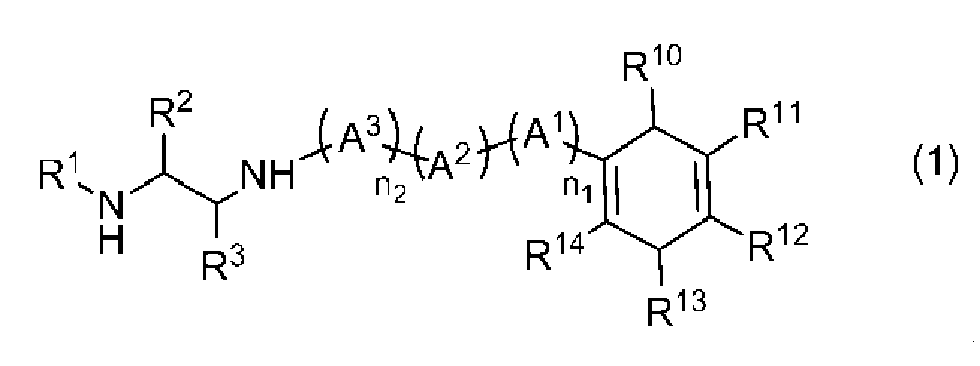
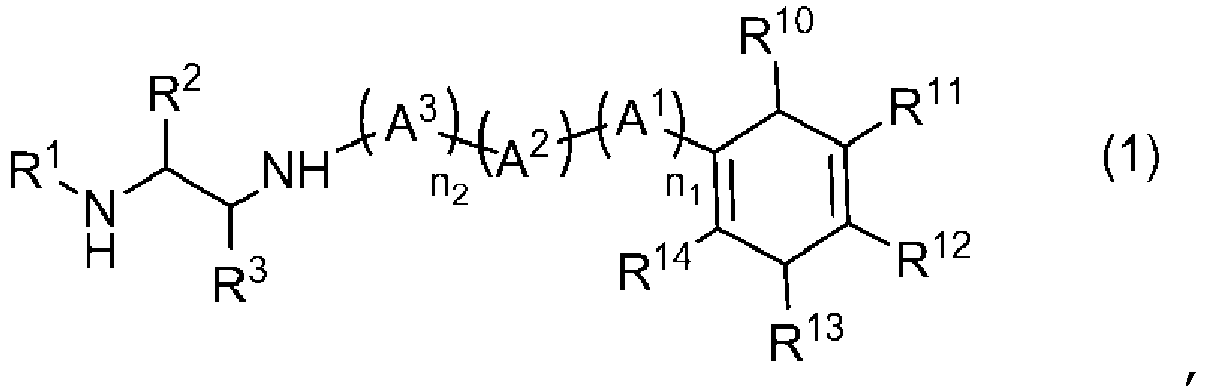
- [1] A method for producing a compound represented by the following general formula (1):
- reacting a compound represented by the following general formula (2):


- reacting a compound represented by the following general formula (2):
- [2] The production method according to [1], wherein
the compound represented by the general formula (2) is reacted with the diamine compound represented by the general formula (3) at a temperature of 100°C to 200°C. - [3] A compound represented by the following general formula (2):

- The present invention provides a method for producing a diamine compound in which a diamine moiety and an arene moiety to be coordinated to a ruthenium complex are linked by a carbon chain. The above-described conventional methods for producing a diamine compound have the following problems: the complexity of the synthesis method; the use of the Birch reduction which necessitates the use of toxic ammonia gas and an ultra low-temperature apparatus; the inevitable use of the Swern oxidation which causes problems, in industrial application, associated with the odor of by-produced dimethyl sulfide, the hazardous nature of carbon monoxide, the need for a cryogenic reactor, and the like; low yields in some reactions; and the like. In contrast, the present invention makes it possible to simply and efficiently produce a highly active ruthenium-diamine complex by the production method which uses a novel intermediate obtained by halogenating or sulfonylating an alcohol synthesized by the Diels-Alder reaction.
- Hereinafter, the present invention will be described in further detail.
- In the present invention, a compound represented by the following general formula (1) is produced by reacting a compound represented by the following general formula (2) with a diamine compound represented by the following general formula (3):


- The alkyl group having 1 to 10 carbon atoms represented by R1 is a linear or branched alkyl group having 1 to 10 carbon atoms, and preferably having 1 to 5 carbon atoms. Specific examples of the alkyl group include a methyl group, an ethyl group, a n-propyl group, an isopropyl group, a n-butyl group, an isobutyl group, a s-butyl group, a t-butyl group, a n-pentyl group, a n-hexyl group, a n-heptyl group, a n-octyl group, a n-nonyl group, a n-decyl group, and the like.
- The alkanesulfonyl group having 1 to 10 carbon atoms represented by R1 includes a methanesulfonyl group, an ethanesulfonyl group, a propanesulfonyl group, and the like. The alkanesulfonyl group is optionally substituted with one or multiple halogen atoms. The halogen atom includes chlorine atoms, bromine atoms, fluorine atoms, and the like. The alkanesulfonyl group having 1 to 10 carbon atoms and substituted with a halogen atom includes a trifluoromethanesulfonyl group and the like.
- The arenesulfonyl group represented by R1 includes a benzenesulfonyl group and the like. The arenesulfonyl group is optionally substituted with one or multiple alkyl groups having 1 to 10 carbon atoms, halogenated alkyl groups having 1 to 10 carbon atoms, or halogen atoms. The alkyl group having 1 to 10 carbon atoms includes those listed as the alkyl group having 1 to 10 carbon atoms represented by R1, and the like. The halogenated alkyl group having 1 to 10 carbon atoms includes halides (the halogen atom includes a chlorine atom, a bromine atom, a fluorine atom, and the like) of those listed as the alkyl group having 1 to 10 carbon atoms represented by R1, and the like. The halogen atom includes a chlorine atom, a bromine atom, a fluorine atom, and the like. The arenesulfonyl group substituted with an alkyl group having 1 to 10 carbon atoms, a halogenated alkyl group having 1 to 10 carbon atoms, or a halogen atom includes a p-toluenesulfonyl group, a 2,4,6-trimethylbenzenesulfonyl group, a 4-trifluoromethylbenzenesulfonyl group, a pentafluorobenzenesulfonyl group, and the like.
- The alkoxycarbonyl group having 2 to 11 carbon atoms in total represented by R1 is a linear or branched alkoxycarbonyl group having 2 to 11 carbon atoms in total, and preferably having 2 to 5 carbon atoms in total. Specific examples of the alkoxycarbonyl group include a methoxycarbonyl group, an ethoxycarbonyl group, a t-butoxycarbonyl group, and the like.
- The benzoyl group represented by R1 is optionally substituted with one or multiple alkyl groups having 1 to 10 carbon atoms. The alkyl group having 1 to 10 carbon atoms includes those listed as the alkyl group having 1 to 10 carbon atoms represented by R1, and the like. The benzoyl group optionally substituted with an alkyl group having 1 to 10 carbon atoms includes a benzoyl group, a p-toluoyl group, an o-toluoyl group, and the like.
- The alkyl group having 1 to 10 carbon atoms represented by each of R2 and R3 includes those listed as the alkyl group having 1 to 10 carbon atoms represented by R1, and the like.
- The phenyl group represented by each of R2 and R3 is optionally substituted with one or multiple alkyl groups having 1 to 10 carbon atoms, alkoxy groups having 1 to 10 carbon atoms, or halogen atoms. The alkyl group having 1 to 10 carbon atoms includes those listed as the alkyl group having 1 to 10 carbon atoms represented by R1, and the like. The alkoxy groups having 1 to 10 carbon atoms are each a linear or branched alkoxy group having 1 to 10 carbon atoms, and preferably having 1 to 5 carbon atoms. Specific examples of the alkoxy group include a methoxy group, an ethoxy group, a n-propoxy group, an isopropoxy group, a n-butoxy group, an isobutoxy group, a s-butoxy group, a t-butoxy group, a n-pentyloxy group, a n-hexyloxy group, a n-heptyloxy group, a n-octyloxy group, a n-nonyloxy group, a n-decyloxy group, and the like. The halogen atom includes a chlorine atom, a bromine atom, a fluorine atom, and the like. The phenyl group substituted with an alkyl group having 1 to 10 carbon atoms, an alkoxy group having 1 to 10 carbon atoms, or a halogen atom includes a 2,4,6-trimethylphenyl group, a 4-methoxyphenyl group, a 2,4,6-trimethoxyphenyl group, a 4-fluorophenyl group, a 2-chlorophenyl group, a 4-chlorophenyl group, a 2,4-dichlorophenyl group, and the like.
- The cycloalkyl group having 3 to 8 carbon atoms represented by each of R2 and R3 is a monocyclic, polycyclic, or cross-linked cycloalkyl group having 3 to 8 carbon atoms, and preferably having 5 to 8 carbon atoms. Specific examples of the cycloalkyl group having 3 to 8 carbon atoms include a cyclopropyl group, a cyclobutyl group, a cyclopentyl group, a cyclohexyl group, a cycloheptyl group, a cyclooctyl group, and the like.
- These cycloalkyl groups are optionally substituted with alkyl groups such as methyl groups, isopropyl groups, and t-butyl groups; or the like.
- Regarding the ring formed by R2 and R3 together, R2 and R3 together form a linear or branched alkylene group having 2 to 10 carbon atoms, and preferably 3 to 10 carbon atoms, and thus form a preferably 4- to 8-membered, more preferably 5- to 8-membered, cycloalkane ring together with the adjacent carbon atoms. Preferred examples of the cycloalkane ring include a cyclopentane ring, a cyclohexane ring, and a cycloheptane ring. These rings may have, as substituents, alkyl groups such as methyl groups, isopropyl groups, and t-butyl groups, and the like.
- The alkyl group having 1 to 10 carbon atoms represented by each of R10 to R14 is a linear or branched alkyl group having 1 to 10 carbon atoms, and preferably having 1 to 5 carbon atoms. Specific examples of the alkyl group include a methyl group, an ethyl group, a n-propyl group, an isopropyl group, a n-butyl group, an isobutyl group, a s-butyl group, a t-butyl group, a n-pentyl group, a n-hexyl group, a n-heptyl group, a n-octyl group, a n-nonyl group, a n-decyl group, and the like.
- The alkoxy group having 1 to 10 carbon atoms represented by each of R10 to R14 is a linear or branched alkoxy group having 1 to 10 carbon atoms, and preferably having 1 to 5 carbon atoms. Specific examples of the alkoxy group include a methoxy group, an ethoxy group, a n-propoxy group, an isopropoxy group, a n-butoxy group, an isobutoxy group, a s-butoxy group, a t-butoxy group, a n-pentyloxy group, a n-hexyloxy group, a n-heptyloxy group, a n-octyloxy group, a n-nonyloxy group, a n-decyloxy group, and the like.
- The alkyl groups of the trisubstituted alkylsilyl group represented by each of R10 to R14 are alkyl groups having 1 to 10 carbon atoms. Specific examples thereof include methyl groups, ethyl groups, n-propyl groups, isopropyl groups, n-butyl groups, isobutyl groups, s-butyl groups, t-butyl groups, n-pentyl groups, n-hexyl groups, n-heptyl groups, n-octyl groups, n-nonyl groups, n-decyl groups, and the like. Specific examples of the trisubstituted alkylsilyl group include a trimethylsilyl group, a triethylsilyl group, a t-butyldimethylsilyl group, a triisopropylsilyl group, and the like.
- The halogen atom represented by B includes a chlorine atom, a bromine atom, an iodine atom, and the like.
- The alkanesulfonyloxy group represented by B is preferably a linear or branched alkanesulfonyloxy group having 1 to 5 carbon atoms. Specific examples of the alkanesulfonyloxy group include a methanesulfonyloxy group, a trifluoromethanesulfonyl group, an ethanesulfonyloxy group, an isopropanesulfonyloxy group, a n-propylsulfonyloxy group, a n-butylsulfonyloxy group, a tert-butylsulfonyloxy group, a n-pentanesulfonyloxy group, and the like.
- The arenesulfonyloxy group represented by B includes a phenylsulfonyloxy group, a naphthylsulfonyloxy group, and the like. The arenesulfonyloxy group may have 1 to 3 substituents on the phenyl ring of the phenylsulfonyloxy group or on the naphthalene ring of the naphthylsulfonyloxy group.
- The substituents include linear or branched alkyl groups having 1 to 6 carbon atoms, linear or branched alkoxy groups having 1 to 6 carbon atoms, nitro groups, halogen atoms, and the like. Specific examples of the phenylsulfonyloxy group include phenylsulfonyloxy, 4-methylphenylsulfonyloxy, 2-methylphenylsulfonyloxy, 4-nitrophenylsulfonyloxy, 4-methoxyphenylsulfonyloxy, 2-nitrophenylsulfonyloxy, 3-chlorophenylsulfonyloxy, and the like. Specific examples of the naphthylsulfonyloxy group include α-naphthylsulfonyloxy and β-naphthylsulfonyloxy groups, and the like.
- Subsequently, description is given of a step of obtaining the compound represented by the general formula (1) by reacting the compound represented by the general formula (2) with the diamine compound represented by the general formula (3) (Scheme 1).


- A solvent used for synthesizing the compound represented by the general formula (1) from the compound represented by the general formula (2) and the compound of the general formula (3), which is a diamine compound, is preferably an aromatic hydrocarbon such as toluene, xylene, or mesitylene; a halogenated aromatic hydrocarbon such as chlorobenzene; an ether such as 1,4-dioxane; an aprotic polar solvent such as N,N-dimethylformamide or dimethyl sulfoxide, or the like, and is particularly preferably dimethyl sulfoxide, toluene, xylene, or mesitylene. In addition, the reaction can also be performed in a mixture of an organic solvent with water by using water as another solvent. Meanwhile, a base used for the reaction is preferably an inorganic base such as sodium hydroxide, sodium hydrogen carbonate, sodium carbonate, potassium hydroxide, potassium hydrogen carbonate, potassium carbonate, lithium hydroxide, lithium hydrogen carbonate, lithium carbonate, cesium carbonate, magnesium hydroxide, magnesium carbonate, calcium hydroxide, or calcium carbonate; or a tertiary organic amine such as trimethylamine, triethylamine, triisopropylamine, tributylamine, or diisopropylethylamine, and is particularly preferably triethylamine or diisopropylethylamine. The amount of the base used is 0.2 to 2.0 equivalents, and preferably 1.0 to 1.5 equivalents to the compound represented by the general formula (2). The reaction temperature is, for example, 100°C to 200°C, and preferably 100°C to 160°C. The reaction time is 30 minutes to 30 hours, and preferably 1 hour to 12 hours, although it varies depending on the reaction substrate used. The reaction is preferably performed in an inert gas such as nitrogen gas or argon gas. Moreover, an additive such as sodium iodide, potassium iodide, lithium iodide, sodium bromide, potassium bromide, lithium bromide, potassium chloride, or lithium chloride may be added. The additive is preferably potassium iodide or lithium iodide. The amount of the additive is 0 to 10 equivalents, and preferably 0.1 to 1 equivalents to the compound represented by the general formula (2).
- The compound represented by the general formula (2) can be synthesized, for example, by a method described in Scheme 2 below.
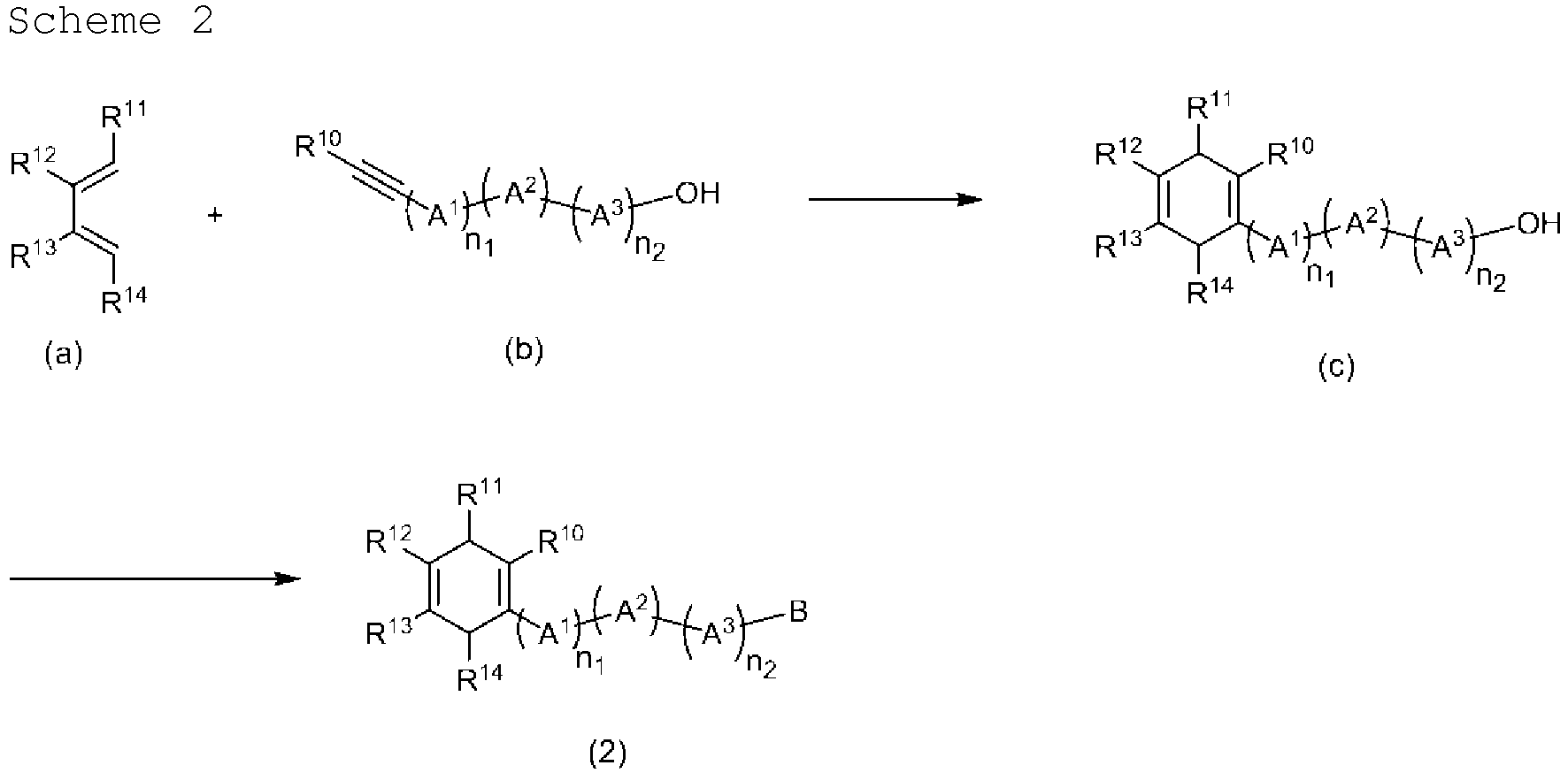
- The alcohol (c) can be synthesized by the Diels-Alder reaction between the diene (a) having substituents and the alkyne (b) having a substituent. The reagent used includes metal complexes such as [1,2-bis(diphenylphosphino)ethane]cobalt(II) dibromide, 1,5-cyclooctadiene(naphthalene)rhodium(I) tetrafluoroborate, dichloro(1,4-diaza-1,3-diene)iron(II), and dichlorobis(tri-o-biphenylphosphite)nickel(II). A solvent used for the Diels-Alder reaction is not particularly limited, unless the reaction is adversely affected. The solvent includes ethers such as diethyl ether, tetrahydrofuran, and dioxane; aromatic hydrocarbons such as toluene and xylene; halogen-containing hydrocarbon solvents such as dichloromethane and 1,2-dichloroethane; aprotic polar solvents such as acetonitrile, ethyl acetate, and acetone; and the like. Dichloromethane or tetrahydrofuran is particularly preferable. Although the reaction temperature of the Diels-Alder reaction naturally varies depending on the substrate used, the reaction temperature is in a range of generally -20°C to 100°C, and preferably 10°C to 40°C. In addition, although the reaction time of the Diels-Alder reaction naturally varies depending on the substrate used, the reaction time is generally 30 minutes to 30 hours, and preferably 1 hour to 20 hours. Note that the Diels-Alder reaction is preferably performed in an inert gas such as nitrogen or argon.
- Next, the hydroxyl group moiety of the alcohol (c) is converted to a leaving group such as a halogen atom, an alkanesulfonyloxy group, or an arenesulfonyloxy group, and thus the compound represented by the general formula (2) is synthesized. The reagent used here for the conversion to the leaving group includes hydrogen chloride, thionyl chloride, sulfuryl chloride, oxalyl chloride, phosphorus trichloride, phosphorus pentachloride, hydrogen bromide, phosphorus tribromide, phosphorus pentabromide, carbon tetrabromide, dimethylbromosulfonium bromide, thionyl bromide, hydrogen iodide, phosphorus triiodide, triphenyl phosphite methiodide, p-toluenesulfonyl chloride, methanesulfonyl chloride, trifluoromethanesulfonyl chloride, trifluoromethanesulfonic anhydride, and the like. The reaction solvent includes, but not particularly limited, ethers such as diethyl ether, tetrahydrofuran, and dioxane; aromatic hydrocarbons such as benzene, toluene, and xylene; halogen-containing hydrocarbon solvents such as dichloromethane and 1,2-dichloroethane; aprotic polar solvents such as N,N-dimethylformamide, acetonitrile, and dimethylsulfoxide; alcohols such as methanol, ethanol, and 2-propanol; and the like. In particular, dichloromethane, tetrahydrofuran, and toluene are preferable. Note that, for some reaction systems, it is preferable to perform the reaction in the presence of a base in an amount of 1 to 2 equivalents to the reaction substrate. Although the reaction temperature naturally varies depending on the substrate used, the reaction temperature is in a range of generally -30°C to 200°C, and preferably 10°C to 100°C. In addition, although the reaction time naturally varies depending on the substrate used, the reaction time is generally 30 minutes to 30 hours, and preferably 1 hour to 20 hours. Note that the reaction is preferably performed in an inert gas such as nitrogen or argon.
- The compound represented by the general formula (2) can also be synthesized, for example, according to Scheme 3.


- As shown in scheme 3, the hydroxyl group moiety of the alkyne (b) having a substituent is converted to a leaving group such as a halogen atom, an alkanesulfonyloxy group, or an arenesulfonyloxy group. After that, the compound represented by the general formula (2) is synthesized by a Diels-Alder reaction of the compound represented by the general formula (e) with the diene (a) having substituents. A reagent for the conversion to the leaving group, a solvent, and reaction conditions are the same as described in scheme 2 above.
- From the compound of the general formula (1), a ruthenium-diamine complex (5) can be produced according to the description in Org. Lett. 9 (2007) p. 4659, for example.

- A solvent used for synthesizing a complex of the general formula (4) from the compound of the general formula (1) and ruthenium(III) chloride or hydrate thereof includes, but not particularly limited, aliphatic alcohols such as 2-propanol, n-butanol, 2-butanol, n-pentanol, 2-pentanol, 3-pentanol, 3-methyl-1-butanol, cyclopentanol, 3-methoxy-1-propanol, 2-methoxyethanol, 2-ethoxyethanol, 2-isopropoxyethanol, n-hexanol, 3-methoxy-1-butanol, 3-methoxy-3-methyl-1-butanol, 2-hexanol, 3-hexanol, cyclohexanol, n-heptanol, 2-heptanol, 3-heptanol, cycloheptanol, n-octanol, 2-octanol, 3-octanol, 4-octanol, and cyclooctanol; aromatic alcohols such as phenol, benzyl alcohol, 1-phenylethanol, 2-phenylethanol, o-cresol, m-cresol, p-cresol, 2-methylbenzyl alcohol, 3-methylbenzyl alcohol, and 4-methylbenzyl alcohol; diols such as ethylene glycol, 1,2-propanediol, 1,3-propanediol, 1,2-butanediol, 1,3-butanediol, 1,4-butanediol, ethylene glycol-n-butyl ether, ethylene glycol-iso-butyl ether, and ethylene glycol-n-hexyl ether; derivatives thereof; and the like. One of these solvents may be used alone, or two or more thereof may be used as a mixture. By using two or more solvents in combination, the boiling point of the solvent can be adjusted in a desired range, so that the reaction temperature can be controlled for a reaction under reflux. For example, an alcohol with which a small amount of water is mixed may be used. The amount of the compound of the general formula (1) used is 1 to 20 equivalents, preferably 1 to 10 equivalents, and more preferably 1 to 5 equivalents, to the ruthenium atoms. The amount of the solvent used is not particularly limited, as long as ruthenium chloride or hydrate thereof can be dissolved therein at the reaction temperature. For example, the amount of the solvent is 2 to 50 times volume (i.e., 2 to 50 mL of the solvent relative to 1 g of ruthenium chloride or hydrate thereof), preferably 2 to 30 times volume, and more preferably 5 to 20 times volume of ruthenium chloride or hydrate thereof. Although the reaction temperature varies depending on the solvent used, the reaction temperature is 60°C or above, and preferably 100°C or above, and also 200°C or below, and preferably 160°C or below, from the viewpoint of the reaction efficiency.
- A solvent used for synthesizing the complex of the general formula (5) from the complex of the general formula (4) includes, but not particularly limited, halogenated solvents such as methylene chloride, dichloroethane, chloroform, and trifluoroethanol; aromatic hydrocarbons such as toluene and xylene; ethers such as diisopropyl ether and tetrahydrofuran; alcohols such as methanol, ethanol, 2-propanol, n-butanol, 2-butanol, and n-pentanol; and the like. Dichloromethane or isopropanol is particularly preferable. One of these solvents may be used alone, or two or more thereof may be used as a mixture. By using two or more solvents in combination, the boiling point of the solvent can be adjusted in a desired range, so that the reaction temperature can be controlled for a reaction under reflux. For example, an alcohol with which a small amount of water is mixed may be used. The base used here includes inorganic bases such as sodium hydroxide, sodium hydrogen carbonate, sodium carbonate, potassium hydroxide, potassium hydrogen carbonate, potassium carbonate, lithium hydroxide, lithium hydrogen carbonate, lithium carbonate, cesium carbonate, magnesium hydroxide, magnesium carbonate, calcium hydroxide, and calcium carbonate; amines such as triethylamine, tripropylamine, tributylamine, pyridine, and triisopropylamine; and the like. Triethylamine is particularly preferable. The amount of the base used is 0.2 to 2 equivalents, and preferably 1 to 1.5 equivalents to the ruthenium atoms. Although the reaction time varies depending on the reaction substrate used, the reaction time is 30 minutes to 20 hours, and preferably 1 hour to 12 hours. This reaction is preferably performed in an inert gas such as nitrogen gas or argon gas.
- Hereinafter, the present invention will be described in detail based on Examples. However, the present invention is not limited to these Examples.
- Note that, in the following Examples and the like, NMR spectra used for identification of complexes and determination of purities thereof were measured with Mercury Plus 300 4N model apparatus manufactured by Varian Technologies Japan Ltd., or Bruker BioSpin Avance III 500 System. For GC analysis, Chirasil-DEXCB (0.25 mm×25m, 0.25 µm) (manufactured by Varian, Inc.) or HP-1 (0.32 mm×30 m, 0.25 µm) (manufactured by Agilent Technologies, Inc.) was used. For HPLC analysis, YMC-Pack Pro C18 (250×4.6 mm, 5 µm, 12 nm) (manufactured by YMC) was used. Meanwhile, for MS measurement, JMS-T100GCV manufactured by JEOL Ltd. or LCMS-IT-TOF manufactured by Shimadzu Corporation was used.
- In addition, the meanings of abbreviations in Examples are as follows.
- THF: tetrahydrofuran
- Msdpen: N-methanesulfonyl-1,2-diphenylethylenediamine
- Tsdpen: N-(p-toluenesulfonyl)-1,2-diphenylethylenediamine o-TFTs-DPEN:
- N-(o-trifluoromethylbenzenesulfonyl)-1,2-diphenylethylenedi amine
- TIPPs-DPEN: N-(2,4,6-triisopropylbenzenesulfonyl)-1,2-diphenylethylened iamine
- DIPEA: diisopropylethylamine
- MIBK: methyl isobutyl ketone
- Production of 4-(4-methylcyclohexa-1,4-dienyl)butan-1-ol and 4-(5-methylcyclohexa-1,4-dienyl)butan-1-ol

- In 45 mL of THF, 1,2-bis(diphenylphosphino) ethane (0.77 g, 1.93 mmol), cobalt bromide (0.41 g, 1.87 mmol), zinc iodide (1.19g, 3.73 mmol), and zinc (0.24 g, 3. 67 mmol) were dissolved, followed by stirring at 70°C for 15 minutes. After cooling to room temperature, isoprene (7.55 g, 110.83 mmol) was added. Then, 5-hexyn-1-ol (8.94 g, 91.09 mmol) was slowly added dropwise with cooling in a water bath. After stirring at 35°C for 1 hour, the solvent was evaporated under reduced pressure, and the obtained residue was purified by silica gel column chromatography (hexane/ethyl acetate=3/1). Thus, 13.34 g of the title compounds, alcohols, were obtained as a colorless oily substance. Yield: 88.1% (isomer ratio: 1,4 type/1,5 type=77/23). Note that the following NMR spectrum data are those of the mixture of the two isomers.
1H-NMR (CDCl3, 300 MHz): δ 5.61-5.57 (m, 2H'), 5.43-5.41 (m, 2H), 3.67-3.63 (m, 2H+2H'), 2.58 (brs, 4H), 2.10 (brs, 4H'), 2.08 (t, J=6.9 Hz, 2H'), 2.00 (t, J=7.2 Hz, 2H), 1.76 (s, 3H'), 1.67 (s, 3H), 1.61-1.43 (m, 5H+5H');
HRMS (ESI) : calcd for C11H19O [M+H]+ 167.1430, found 167.1432 -

- The alcohols (12.19 g, 73.32 mmol, isomer ratio: 1,4 type/1,5 type=77/23) obtained in Example 1, triethylamine (8. 90 g, 87. 98 mmol), and 1-methylimidazole (7.22 g, 87. 98 mmol) were dissolved in 10 mL of toluene. With cooling in an ice-bath, a toluene solution (40 ml) of p-toluenesulfonyl chloride (15.94 g, 83.58 mmol) was slowly added dropwise, followed by stirring at room temperature for 1 hour. Water was added thereto, and the resultant layers were separated from each other. The obtained organic layer was washed with 2 M hydrochloric acid and water. The solvent was evaporated under reduced pressure, and the obtained residue was purified by silica gel column chromatography (hexane/ethyl acetate=20/1→4/1). Thus, 20.25 g of the title compounds, tosylates, were obtained as a colorless oily substance. Yield: 86.2% (isomer ratio: 1,4 type/1,5 type=77/23). Note that the following NMR spectrum data are those of the mixture of the two isomers.
1H-NMR (CDCl3, 300 MHz) : δ7.80-7.77 (m, 2H+2H'), 7.36-7.33 (m, 2H+2H'), 5.58-5.56 (m, 1H'), 5.51-5.49 (m, 1H'), 5.39-5.38 (m, 1H), 5.35-5.34 (m, 1H), 4.05-4.01 (m, 2H+2H'), 2.53 (brs, 4H), 2.45 (s, 3H +3H'), 2.05 (brs, 4H'), 1.99 (t, J=7.4 Hz, 2H'), 1.91 (t, J=7.4 Hz, 2H), 1.76 (s, 3H'), 1.66 (s, 3H), 1.67-1.58 (m, 2H+2H'), 1.49-1.37 (m, 2H+2H');
HRMS (ESI): calcd for C18H24O3SNa [M+Na]+ 343.1338, found 343.1330 -

- The tosylates (10.45 g, 32.61 mmol, isomer ratio: 1,4 type/1,5 type=77/23) obtained in Example 2 were dissolved in 40 ml of toluene, and DIPEA (4.79 g, 32.61 mmol) and (S,S)-TsDPEN (11.95 g, 32.61 mmol) were added thereto, followed by stirring at 135°C for 14 hours. After that, the solvent was evaporated under reduced pressure, and the obtained residue was purified by silica gel column chromatography (hexane/ethyl acetate=2/1). Thus, 9.31 g of the title compounds were obtained as a yellow oily substance. Yield: 55.5% (isomer ratio: 1,4 type/1,5 type=77/23). Note that the following NMR spectrum data are those of the mixture of the two isomers.
1H NMR (CDCl3, 300 MHz) : δ 7.38-7.36 (m, 2H+2H'), 7.14-7.12 (m, 3H+3H'), 7.05-7.00 (m, 5H+5H'), 6.96-6.88 (m, 4H+4H'), 6.30 (brs, 1H+1H'), 5.60-5.58 (m, 1H'), 5.53-5.51 (m, 1H'), 5.41-5.40 (m, 1H), 5.37-5.36 (m, 1H), 4.24-4.22 (m, 1H+1H'), 3.60-3.58 (m, 1H+1H'), 2.55 (brs, 4H), 2.46-2.37 (m, 1H+1H'), 2.34 (s, 3H+3H'), 2.32-2.23 (m, 1H+1H'), 2.01 (brs, 4H'), 2.01-1.88 (m, 2H+2H'), 1.77 (s, 3H'), 1.67 (s, 3H), 1.46-1.28 (m, 5H+5H');
HRMS (ESI): calcd for C32H39N2O2S[M+H]+ 515.2727, found 515.2747 -

- The amides (8.55 g, 16. 61 mmol, isomer ratio: 1,4 type/1,5 type=77/23) obtained in Example 3 were dissolved in 33 ml of toluene. Under ice-cooling, a 1N HCl (methanolic solution) (3.46 g, 33.22 mmol) was added, followed by stirring at room temperature for 20 minutes. After that, the solvent was evaporated under reduced pressure. Thus, 8.85 g of the title compounds, diamine hydrochlorides, were obtained as a white solid. Yield: 96.7% (isomer ratio: 1,4 hype/1,5 type=77/23). 1H-NMR (d6-DMSO, 300 MHz) δ:
9.61 (brs, 1H+1H'), 9.15 (brs, 1H+1H'), 8.85 (d, 1H+1H'), 7.29-6.79 (m, 14H+14H'), 5.55 (m, 1H'), 5.48 (m, 1H'), 5.36 (m, 1H), 5.31 (m, 1H), 4.82 (m, 1H+1H'), 4.54 (m, 1H+1H'), 2.66 (brs, 4H), 2.20 (s, 3H+3H'), 1.99 (brs, 4H'), 1.98-1.90 (m, 2H'), 1.90-1.82 (m, 2H), 1.71(s, 3H'), 1.70-1.52 (m, 2H+2H'), 1.61(s, 3H), 1.38-1.18 (m, 2H+2H');
HRMS (ESI): calcd for C32H39N2O2S [M-Cl]+ 515.2727, found 515.2728 -

- The hydrochlorides (7.42 g, 13.46 mmol, isomer ratio: 1,4 type/1,5 type=77/23) obtained in Example 4 and ruthenium trichloride·trihydrate (3.20 g, 12.25 mmol) were dissolved in a mixture solvent of 110 ml of 3-methoxypropanol and 37 ml of water, followed by stirring at 120°C for 1 hour. The solvent was evaporated under reduced pressure, and diethyl ether was added to the obtained residue, followed by stirring at room temperature for 15 minutes. The precipitated crystals were filtered. Thus, 10.15 g of the title compounds, ruthenium dimers, were obtained. Yield: 52.3%. The following NMR spectrum data are those of the major product (1,4 type).
1H NMR (d6-DMSO, 500 MHz): δ 9.61 (brs, 2H), 9.11 (brs, 2H), 8.78 (d, J=9.1 Hz, 2H), 7.30-6.88 (m, 28H), 6.82-6.81 (m, 8H), 4.83 (m, 2H), 4.56 (m, 2H), 2.71 (brs, 4H), 2.35 (t, J=7.5 Hz, 4H), 2.22 (s, 6H), 2.10 (s, 6H), 1.80-1.60 (m, 4H), 1.60-1.42 (m, 4H);
HRMS (FD) : calcd for C32H35ClN2O2RuS [M/2-2HCl] +· 648.1156, found 648.1182 -

- The ruthenium dimers (9.12 g, 6.32 mmol) obtained in Example 5 were dissolved in 155 ml of 2-propanol, and triethylamine (2.53 g, 25.29 mmol) was added thereto, followed by stirring at 60°C for 1 hour. After that, the solvent was evaporated under reduced pressure, and the obtained residue was purified by silica gel chromatography (chloroform/methanol=20/1). Thus, 6.77 g of the title compounds, ruthenium monomers, were obtained. Yield: 82.6% (the chemical purity based on HPLC was 97.2%). The following NMR spectrum data are those of the major product (1,4 type).
1H NMR (CD2Cl2, 500 MHz): δ 7.17 (d, J=7.9 Hz, 2H), 7.10-7.05 (m, 3H), 6.86 (d, J=7.9 Hz, 2H), 6.82-6.79 (m, 1H), 6.74 (d, J=6.4 Hz, 2H), 6.68 (dd, J=7.9 Hz, 2H), 6.56 (d, J=7.9 Hz, 2H), 6.18 (d, J=5.6 Hz, 1H), 5.55 (d, J=6.3 Hz, 1H), 5.35 (d, J=6.3 Hz, 1H), 5.29 (d, J=5.6 Hz, 1H), 4.73-4.70 (m, 1H), 3.97 (d, J=11.0 Hz, 1H), 3.81 (dd, J=11.0, 12.2 Hz, 1H), 3.52-3.47 (m, 1H), 3.13-3.07 (m, 1H), 2.85-2.81 (m, 1H), 2.75-2.69 (m, 1H), 2.44 (s, 3H), 2.26 (s, 3H), 2.28-2.17 (m, 1H), 2.15-2.04 (m, 1H), 1.96-1.88 (m, 1H), 1.67-1.60 (m, 1H);
HRMS (ESI): calcd for C32H36ClN2O2RuS [M+H]+ 649.1224, found 649.1224 -

- The tosylates (5.11 g, 15.95 mmol) obtained in Example 2 were dissolved in 20 ml of toluene, and DIPEA (2.05 g, 15.95 mmol) and (S, S) -MsDPEN (4. 63 g, 15. 95 mmol) were added thereto, followed by stirring at 135°C for 16 hours. After that, the solvent was evaporated under reduced pressure, and the obtained residue was purified by silica gel column chromatography (hexane/ethyl acetate=2/1). Thus, 5.72 g of the title compounds, diamines, were obtained as a yellow oily substance. Yield: 81.8% (isomer ratio: 1,4 type/1,5 type=77/23). Note that the following NMR spectrum data are those of the mixture of the two isomers.
1H NMR (CDCl3, 300 MHz): δ 7.26-7.19 (m, 10H+10H'), 6.23 (brs, 1H+1H'), 5.59-5.58 (m, 1H'), 5.52-5.51 (m, 1H'), 5.40 (m, 1H), 5.36 (m, 1H), 4.47-4.44 (m, 1H+1H'), 3.75-3.72 (m, 1H+1H'), 2.55 (brs, 4H), 2.46-2.37 (m, 1H+1H'), 2.34 (s, 3H+3H'), 2.32-2.23 (m, 1H+1H'), 2.01 (brs, 4H'), 2.01-1.88 (m, 2H+2H'), 1.77 (s, 3H'), 1.67 (s, 3H), 1.46-1.28 (m, 5H+5H');
HRMS (ESI) : calcd for C26H35N2O2S [M+H]+ 439.2414, found 439.2409 -

- The diamines (5.11 g, 11.65 mmol) obtained in Example 7 were dissolved in 20 ml of toluene. Under ice-cooling, a 1N HCl (methanolic solution) (2.43g, 23. 30 mmol) was added thereto, followed by stirring at room temperature for 20 minutes. After that, the solvent was evaporated under reduced pressure. Thus, 5.14 g of the title compounds, diamine hydrochlorides, were obtained as a white solid. Yield: 92.9% (isomer ratio: 1,4 type/1,5 type=77/23). Note that the following NMR spectrum data are those of the mixture of the two isomers.
1H-NMR (d6-DMSO, 300 MHz) δ: 9.94 (brs, 1H+1H'), 9.08 (brs, 1H+1H'), 8.34 (d, 1H+1H'), 7.39-7.00 (m, 10H+10H'), 5.54 (m, 1H'), 5.47 (m, 1H'), 5.35 (m, 1H), 5.30 (m, 1H), 4.90 (m, 1H+1H'), 4.56 (m, 1H+1H'), 2.72-2.56 (m, 6H+2H'), 2.47 (s, 3H+3H'), 1.98 (brs, 4H'), 1.93 (t, J=6.9 Hz, 2H'), 1.85 (t, J=7.2 Hz, 2H), 1.71 (s, 3H'), 1.70-1.52 (m, 2H+2H'), 1.61 (s, 3H), 1.38-1.18 (m, 2H+2H');
HRMS (ESI): calcd for C26H35N2O2S [M-Cl]+ 439.2414, found 439.2422 -
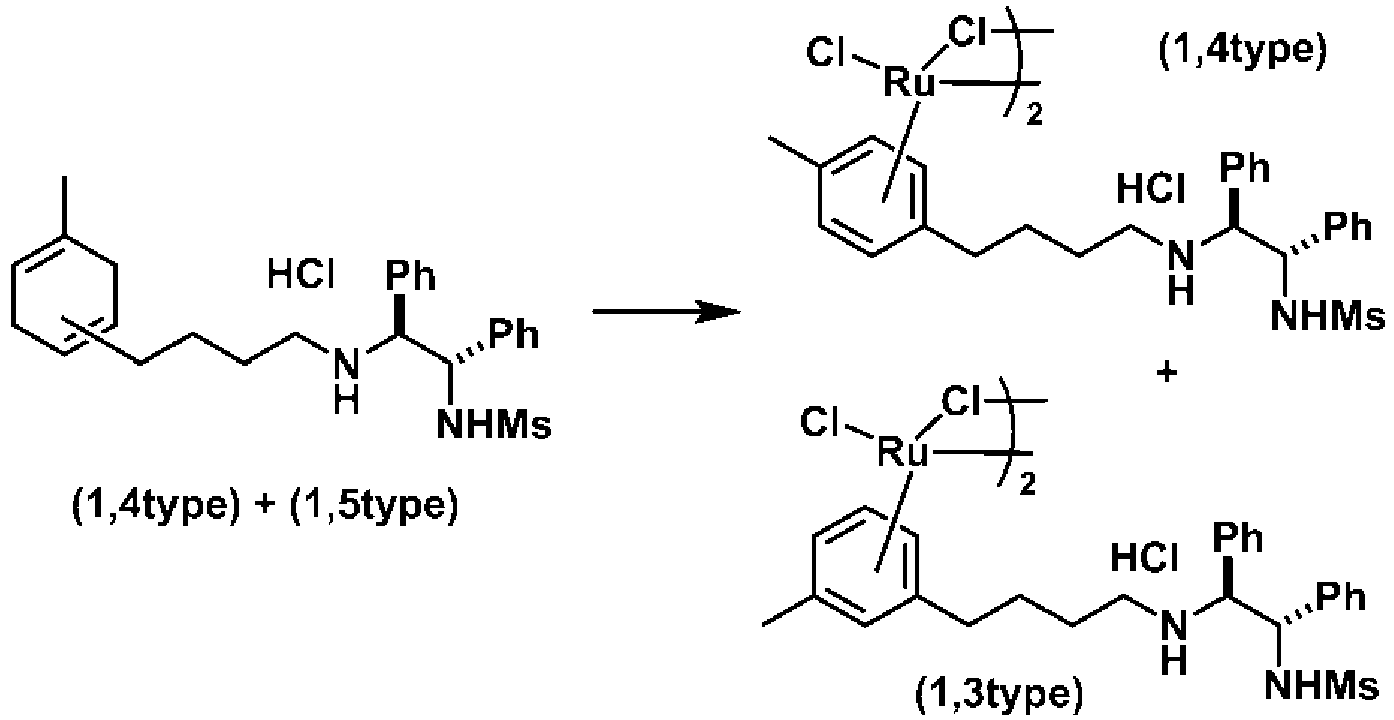
- The diamine hydrochlorides (4.05 g, 8.52 mmol) obtained in Example 8 and ruthenium trichloride·trihydrate (2.03 g, 7.76 mmol) were dissolved in a mixture solvent of 60 ml of 3-methoxypropanol and 19 ml of water, followed by stirring at 120°C for 1 hour. The solvent was evaporated under reduced pressure, and diethyl ether was added to the obtained residue, followed by stirring at room temperature for 15 minutes. The precipitated crystals were filtered. Thus, 5.49 g of the title compounds, ruthenium dimers, were obtained. Yield: 49.9%. The following NMR spectrum data are those of the major product (1,4 type).
1H NMR (d6-DMSO, 500 MHz): δ 9.87 (brs, 2H), 9.04 (brs, 2H), 8.27 (d, J=9.4 Hz, 2H), 7.39-7.01 (m, 20H), 5.76-5.73 (m, 8H), 4.91 (m, 2H), 4.59 (m, 2H), 2.70 (brs, 4H), 2.62 (s, 6H), 2.35 (t, J=7.7 Hz, 4H), 2.09 (s, 6H), 1.80-1.60 (m, 4H), 1.60-1.41 (m, 4H);
HRMS (FD) : calcd for C26H31ClN2O2RuS [M/2-2HCl]+· 572.0841, found 572.0863 -

- The ruthenium dimers (4.49 g, 3.48 mmol) of Example 9 were dissolved in 85 ml of 2-propanol, and triethylamine (1.45 g, 13.92 mmol) was added thereto, followed by stirring at 60°C for 1 hour. After that, the solvent was evaporated under reduced pressure, and the obtained residue was purified by silica gel chromatography (chloroform/methanol=20/1). Thus, 3.38 g of the title compounds, ruthenium monomers, were obtained. Yield: 69.3% (the chemical purity based on HPLC was 98.2%). The following NMR spectrum data are those of the major product (1,4 type).
1H NMR (CD2Cl2, 500 MHz) : δ 7.17-7.13 (m, 3H), 7.10-7.07 (m, 3H), 6.97-6.95 (m, 2H), 6.85-6.83 (m, 2H), 5.84 (d, J=5.5 Hz, 1H), 5.51 (d, J=6.1 Hz, 1H), 5.46 (d, J=6.1 Hz, 1H), 5.38 (d, J=5.5 Hz, 1H), 4.41 (m, 1H), 4.01 (d, J=10.7 Hz, 1H), 3.86 (dd, J=10.7, 12.2 Hz, 1H), 3.43-3.38 (m, 1H), 3.12-3.07 (m, 1H), 2.80-2.71 (m, 2H), 2.47 (s, 3H), 2.37 (s, 3H), 2.25-2.17 (m, 1H), 2.11-2.02 (m, 1H), 1.98-1.90 (m, 1H), 1.77-1.68 (m, 1H);
HRMS (ESI): calcd for C26H32ClN2O2RuS [M+H]+ 573.0911, found 573.0912 -

- In 40 mL of THF, 1,2-bis(diphenylphosphino)ethane (800 mg, 2.00 mmol), cobalt bromide (437 mg, 2.00 mmol), zinc iodide (1.28 g, 4.00 mmol), and zinc (260 mg, 4.00 mmol) were dissolved, followed by stirring at 70°C for 15 minutes. After cooling to room temperature, 2,3-dimethyl-1,3-butadiene (9.86 g, 120 mmol) was added. Then, 5-hexyn-1-ol (9.8 g, 100 mmol) was slowly added dropwise with cooling in a water bath. After stirring at 35°C for 1 hour, the solvent was evaporated under reduced pressure, and the obtained residue was purified by silica gel column chromatography (hexane/ethyl acetate=3/1). Thus, 11.5 g of the title compound, an alcohol, was obtained as a colorless oily substance. Yield: 63.4%.
1H NMR (CDCl3, 300 MHz) : δ 5.56-5.41 (m, 1H), 3.67-3.63 (m, 2H), 2.61-2.48 (m, 2H), 2.11-1.98 (m, 3H), 1.63 (s, 6H), 1.79-1.46 (m, 4H), 1.28 (brs, 1H) -

- In 55 mL of toluene, 4-(4,5-dimethylcyclo-1,4-diene)butan-1-ol (11.0 g, 61.0 mmol), triethylamine (7.40 g, 73.08 mmol), and 1-methylimidazole (6.0 g, 73.0 mmol) were dissolved. With cooling in an ice-bath, a toluene solution (40 ml) of p-toluenesulfonyl chloride (13.9 g, 73.1 mmol) was slowly added dropwise, followed by stirring at room temperature for 1 hour. Water was added thereto, and the resultant layers were separated from each other. The obtained organic layer was washed with 2 M hydrochloric acid and water. The solvent was evaporated under reduced pressure, and the obtained residue was purified by silica gel column chromatography (hexane/ethyl acetate=20/1→4/1). Thus, 16.3 g of the title compound, a tosylate, was obtained. Yield: 80%. 1H NMR (CDCl3, 300 MHz) : δ 7.80-7.77 (d, 2H), 7.36-7.33 (d, 2H), 5.40-5.28 (m, 1H), 4.05-4.00 (m, 2H), 2.53 (brs, 2H), 2.45 (s, 3H), 2.05-1.89 (m, 3H), 1.79-1.74 (m, 3H), 1.67 (s, 6H), 1.60-1.41 (m, 2H)
-

- In 30 ml of toluene, 4-(4,5-dimethylcyclo-1,4-diene)butyl-p-toluenesulfonate (3.3 g, 9.87 mmol) was dissolved, and DIPEA (1.40 g, 10.79 mmol) and (S,S)-TsDPEN(3.3 g, 90.0 mmol) were added thereto, followed by stirring at 130°C for 14 hours. After that, the solvent was evaporated under reduced pressure, and the obtained residue was purified by silica gel column chromatography (hexane/ethyl acetate=2/1). Then, a 1 M methanolic hydrochloric acid solution was added under ice-cooling, followed by stirring at room temperature for 20 minutes. After that, the solvent was evaporated under reduced pressure. Thus, 2.47 g of the title compound, a diamine hydrochloride, was obtained as a white solid. Yield: 44.3%.
1H NMR (DMSO-d6, 300 MHz): δ 9.80 (brs, 1H), 9.22 (brs, 1H), 9.01 (brs, 1H), 7.29-7.21 (m, 7H), 6.99-6.82 (m, 7H), 5.40-5.28 (m, 1H), 4.90-4.84 (m, 1H), 2.63 (brs, 2H), 2.40 (brs, 2H), 2.21 (s, 3H), 1.99-1.89 (m, 2H), 1.75-1.62 (m, 2H), 1.58 (s, 6H), 1.60-1.41 (m, 2H)
HRMS (ESI): calcd for C33H41N2O2S [M-Cl]+ 529.2892, found 529.2892 -

- In a mixture solvent of 35 ml of 2-methoxyethanol and 3.7 ml of water, 4-methyl-N-((1S,2S)-2-(4-(4,5-dimethylcyclohexa-1,4-dienyl) butylamino)-1,2-diphenylethyl)benzenesulfonic acid hydrochloride (1.0 g, 1.77 mmol) and ruthenium trichloride·trihydrate (3.86 mg, 1.45 mmol) were dissolved, followed by stirring at 120°C for 1 hour. The solvent was evaporated under reduced pressure, and diethyl ether was added to the obtained residue, followed by stirring at room temperature for 15 minutes. The precipitated crystals were filtered. Thus, 1.39 g of the title compound, a ruthenium dimer, was obtained. Yield: 82.5%.
1H NMR (DMSO-d6, 300 MHz): δ 9.80 (brs, 1H), 9.22 (brs, 1H), 8.91 (brs, 1H), 7.28-7.19 (m, 7H), 6.98 (d, J=8 Hz, 2H), 6.99-6.82 (m, 7H), 5.40-5.28 (m, 1H), 4.90-4.84 (m, 1H), 2.63 (brs, 2H), 2.40 (brs, 2H), 2.21 (s, 3H), 1.99-1.89 (m, 2H), 1.75-1.62 (m, 2H), 1.58 (s, 6H), 1.60-1.41 (m, 2H) -

- The ruthenium dimer (870 mg, 1.27 mmol) obtained in Example 14 was dissolved in 60 ml of 2-propanol, and triethylamine (514 mg, 5.07 mmol) was added thereto, followed by stirring at 60°C for 1 hour. After that, the solvent was evaporated under reduced pressure, and the obtained residue was purified by silica gel chromatography (chloroform/methanol=20/1). Thus, 500 mg of the title compound, a ruthenium monomer, was obtained. Yield: 42.7%. HRMS (ESI): calcd for C33H38ClN2O2RuS [M+H]+ 663.1381, found 663.1371
-

- In 460 ml of THF, 1, 2-bis (diphenylphosphino) ethane (7.74 g, 0.019 mol), cobalt bromide (4.05 g, 0.019 mol), zinc iodide (11.82g, 0.037 mol), and zinc (2.42 g, 0.037 mol) were dissolved, followed by stirring at 70°C for 15 minutes. After cooling to room temperature, isoprene (74.89g, 1.10mol) was added. Then, an alkyne alcohol (92.70 g, 0.93 mol) was slowly added dropwise with cooling in a water bath. After stirring at 35°C for 1 hour, the solvent was evaporated under reduced pressure, and the obtained crude product was purified by Claisen distillation (101 to 113°C/3 torr). Thus, 106.6 g of the title compounds, diene alcohols, were obtained as a colorless oily substance. Yield: 68.5% (1,4 type/1,5 type=91/9). Note that the following NMR spectrum data are those of the major product (1,4 type). 1H NMR (CDCl3, 300 MHz) : δ 5.71-5.70 (m, 1H), 5.45-5.43 (m, 1H), 3.93 (s, 2H), 3.75-3.70 (m, 2H), 3.52-3.48 (m, 2H), 2.64 (brs, 4H), 2.31 (brs, 1H), 1.68 (s, 3H);
HRMS (ESI) : calcd for C10H17O [M+H]+ 167.1430, found 167.1432 -

- The diene alcohols (100.00 g, 0.59 mol) obtained in Example 16, triethylamine (90.29 g, 0.89 mol), and 1-methylimidazole (73.20 g, 0.89 mol) were dissolved in 400 ml of toluene. With cooling in an ice-bath, a toluene solution (400 ml) of p-toluenesulfonyl chloride (130.33 g, 0.68 mol) was slowly added dropwise, followed by stirring at room temperature for 1 hour. Water was added thereto, and the resultant layers were separated from each other. The obtained organic layer was washed with 15% sulfuric acid, water, and saturated aqueous sodium hydrogen carbonate in this order. The solvent was evaporated under reduced pressure. Thus, 188.01 g of the target title compounds, tosylates, were obtained as a colorless oily substance. Yield: 98.1%. Note that the following NMR spectrum data are those of the major product (1,4 type).
1H NMR (CDCl3, 300 MHz) : δ 7.80 (d, J=8.3 Hz, 2H), 7.33 (d, J=8.3 Hz, 2H), 5.64-5.63 (m, 1H), 5.41-5.40 (m, 1H), 4.18-4.14 (m, 2H), 3.84 (s, 2H), 3.58-3.55 (m, 2H), 2.58 (brs, 4H), 2.44 (s, 3H), 1.67 (s, 3H);
HRMS (ESI) : calcd for C17H23O4S [M+H]+ 323.1312, found 323.1325 -

- The tosylates (2.2 g, 6.9 mmol) obtained in Example 17 were dissolved in 10 ml of toluene, and DIPEA (0. 90 g, 6.9 mmol) and (R,R)-TsDPEN (2.53 g, 6. 9 mmol) were added thereto, followed by stirring at 135°C for 27 hours. Water was added thereto, and the resultant layers were separated from each other. The obtained organic layer was washed with water, and then 20% hydrochloric acid was added thereto. After stirring at room temperature for 1 hour, the precipitated crystals were collected by filtration under ice-cooling. Thus, 3.14 g of the target title compounds, diamine hydrochlorides, were obtained as a white solid. Yield: 82.3%. Note that the following NMR spectrum data are those of the major product (1,4 type). H-NMR (d6-DMSO, 300 MHz) δ:
9.76 (brs, 1H), 8.98-8.80 (m, 2H), 7.30-6.72 (m, 14H), 5.68 (m, 1H), 5.42 (m, 1H), 4.84 (m, 1H), 4.62 (m, 1H), 3.85(s, 2H), 3.61 (m, 2H), 3.06-2.80 (m, 2H), 2.57 (brs, 4H), 2.21 (s, 3H), 1.64(s, 3H);
HRMS (ESI): calcd for C31H37N2O3S [M-Cl]+ 517.2519, found 517.2523 -

- The diamine hydrochlorides (25.15 g, 45.20 mmol) of Example 18 were dissolved in a mixture solvent of 375 ml of 3-methoxypropanol and 75 ml of water. Ruthenium trichloride·trihydrate (10.74 g, 41.09 mmol) and sodium hydrogen carbonate (3.45 g, 41.09 mmol) were added thereto, followed by stirring at 120°C for 45 minutes. After 3-methoxypropanol was recovered, 425 ml of MIBK and triethylamine (16.63 g, 164.4 mmol) were added, followed by stirring at 60°C for 1 hour. After washing with 0.3 M hydrochloric acid, crystallization was performed by adding heptane. The precipitated crystals were collected by filtration. Thus, 22.26 g of the title compounds, ruthenium monomers, were obtained. Yield: 83.3%. Note that the following NMR spectrum data are those of the major product (1,4 type).
1H NMR (CD2Cl2, 500 MHz): δ 7.21 (d, J=8.0 Hz, 2H), 7.17-7.08 (m, 4H), 6.88 (d, J=8.0Hz, 2H), 6.84 (d, J=7.3Hz, 1H), 6.75-6.69 (m, 4H), 6.60 (d, J=7.3 Hz, 2H), 6.05 (brd, J=3.6 Hz, 1H), 5.75 (d, J=6.3 Hz, 1H), 5.62 (d, J=6.3 Hz, 1H), 5.46 (brd, J=3.6 Hz, 1H), 4.96-4.92 (m, 1H), 4.58-4.45 (m, 2H), 3.98-3.91 (m, 4H), 3.60-3.56 (m, 1H), 3.14-3.10 (m, 1H), 2.52 (s, 3H), 2.26 (s, 3H);
HRMS (ESI) : calcd for C31H34ClN2O3RuS [M+H]+ 651.1017, found 651.1008 -

- In 31.6 ml of toluene, 8.07 g (26.1 mmol) of the tosylate obtained in Example 17 was dissolved, and 3.38 g (26.2 mmol) of DIPEA, 10.00 g (23.8 mmol) of (R,R)-o-TFTsDPEN, and 4.34 g (26.2 mmol) of potassium iodide were added thereto, followed by stirring at 135°C for 6 hours. Then, the reaction liquid was concentrated, and purified by silica gel column chromatography. Thus, 10.1 g of a diamine was obtained. Yield: 74.5%. After that, 110 ml of dichloromethane and 65.3 ml of a 1N HCl (methanolic solution) were added to 10.1 g (17.7 mmol) of the diamine, followed by stirring for 0.5 hours. Then, the solvent was removed. Thus, 11.1 g of the target diamine hydrochloride was obtained. Yield: 93.9%.
H-NMR (d6-DMSO, 300 MHz) δ: 1.62 (m, 3H), 2.60 (s, 3H), 2.78-3.12 (m, 2H), 3.52-3.70 (m, 2H), 3.86 (s, 2H), 4.75 (m, 1H), 4.92 (m, 1H), 5.40 (m, 1H), 5.68 (m, 1H), 6.75-7.35 (m, 10H), 7.40 (t, 1H), 7.50 (t, 1H), 7.60 (d, 1H), 7.75 (d, 1H), 8.90 (m, 1H), 8.98 (brd, 1H), 9.92 (brd, 1H);
19F-NMR (d6-DMSO) δ: -57.16
HRMS (ESI) : calcd for C31H33N2O3E3S·HCl [M-Cl]+ 571.2237, found 571.244 -

- In a mixture solvent of 66 ml of 3-methoxypropanol and 22 ml of water, 5.0 g (8.25 mmol) of the diamine hydrochloride produced in Example 20 was dissolved, and 1.79 g (6.86 mmol) of ruthenium trichloride·trihydrate and 0.58 g (6.86 mmol) of sodium hydrogen carbonate were added thereto, followed by stirring at 120°C for 2 hours. After 50 ml of 3-methoxypropanol was recovered, 75 ml of MIBK and 2.78 g (27.45 mmol) of triethylamine were added, followed by stirring at 60°C for 1 hour. After 0.3 M hydrochloric acid was added, the resultant layers were separated from each other. The obtained organic layer was washed twice with water. Approximately 60 ml of the solvent was recovered, and crystallization was performed by adding 85 ml of heptane. The precipitated crystals were collected by filtration, and 4.60 g of the target Ru complex was obtained. Yield: 95.2%.
H-NMR (d6-DMSO, 300 MHz) δ: 2.50 (s, 3H), 3.15-3.20 (m, 1H), 3.70-3.82 (m, 2H), 4.00 (m, 2H), 4.15 (m, 1H), 4.40 (m, 1H), 4.80 (m, 1H), 5.10 (d, 1H), 5.45 (d, 1H), 5.62 (d, 1H), 5.70 (d, 1H), 6.38 (d, 1H), 6.50-7.50 (m, 14H);
19F-NMR (d6-DMSO) δ: -58.45
HRMS (ESI) : calcd for C31H30ClN2O3F3RuS [M+H]+ 705.7034, found 705.0758 -

- In 25 ml of toluene, 6.03 g (18.82 mmol) of the tosylate obtained in Example 17 was dissolved, and 2.43 g (18.82 mmol) of DIPEA and 9.00 g (18.80 mmol) of (S,S)-TIPPsDPEN were added thereto, followed by stirring at 135°C for 13 hours. After that, the solvent was evaporated under reduced pressure, and the obtained residue was purified by silica gel column chromatography (toluene/ethyl acetate=20/1→15/1). Thus, 10.53 g of the title compound was obtained as a colorless oily substance. Yield: 89.0%.
H-NMR (CDCl3, 300 MHz) δ: 1.06 (d, J=6.9 Hz, 3H), 1.21 (d, J=6.9 Hz, 3H), 1.87 (brs, 1H), 1.68 (s, 3H), 2.60 (brs, 4H), 2.71-2.48 (m, 2H), 3.52-3.34 (m, 2H), 3.55 (d, J=8.9 Hz, 1H), 3.77 (s, 2H), 3.95 (septet, J=6.7 Hz, 3H), 4.40 (d, J=8.9Hz, 1H), 5.44 (m, 1H), 5.64 (m, 1H), 6.52 (brs, 1H), 7.28-6.74 (m, 12H);
HRMS (ESI) : calcd for C39H53N2O3S [M+H]+ 629.3771, found 629.3771 -

- In 8 ml of methanol, 2.02 g (3.21 mmol) of the sulfonamide obtained in Example 22 was dissolved, and 0.67 g (6.42 mmol) of a 1N HCl (methanolic solution) was added thereto under ice-cooling, followed by stirring at room temperature for 20 minutes. After that, the solvent was evaporated under reduced pressure, and the obtained residue was dissolved in a mixture solvent of 30 ml of 3-methoxypropanol and 18 ml of water. To this solution, 0.72 g (2.75 mmol) of ruthenium trichloride·trihydrate was added, followed by stirring at 120°C for 1 hour. The solvent was evaporated under reduced pressure, and 35 ml of IPA and 0.72 g (7.15 mmol)of triethylamine were added to the obtained residue, followed by stirring at 60°C for 1 hour. The solvent was evaporated under reduced pressure, and the obtained residue was purified by silica gel column chromatography (chloroform/methanol=97/3→20/1). Thus, 1.28 g of the target Ru complex was obtained. Yield: 52.3%.
H-NMR (CD2Cl2, 300 MHz) δ: 1.0-1.2 (m, 18H), 1.70 (m, 1H), 2.41 (s, 3H), 2.60 (m, 1H), 3.05 (m, 1H), 3.35 (m, 1H), 3.68 (m, 1H), 3.75 (t, 1H), 3.85 (m, 2H), 4.18 (d, 1H), 4.25 (d, 1H), 4.85 (brs, 1H), 5.02 (d, 1H), 5.30 (d, 1H), 5.48 (d, 1H), 5.63 (d, 1H), 6.35 (d, 1H), 6.40-6.70 (m, 10H), 6.90-7.05 (m, 3H); HRMS (ESI): calcd for C39H50N2O3SClRu [M+H]+ 763.2269, found 763.2257 -

- In 175 mL of dichloromethane, 1,2-bis(diphenylphosphino)ethane (1.73 g, 4.40 mmol), cobalt bromide (0. 865 g, 4.00 mmol), and zinc iodide (4.2 g, 13.15 mmol) were dissolved, followed by stirring at 30°C for 30 minutes. Then, 2- (propynyloxy) ethanol (8.94 g, 91.0 mmol) and butadiene (20% by weight toluene solution) (36.8 ml, 136.5 mmol) were added thereto, and then Bu4NBH4 (1.1 g, 4.3 mmol) was added. After stirring at 45°C for 1 hour, the solvent was evaporated under reduced pressure, and the obtained residue was purified by silica gel column chromatography (hexane/ethyl acetate=5/1). Thus, 11.7 g of the title compound, an alcohol, was obtained as a colorless oily substance. Yield: 85.0%.
1H NMR (CDCl3, 300 MHz) : δ 5.80-5.60 (m, 3H), 3.92 (s, 1H), 3.72 (t, 2H), 3.48 (t, 2H), 2.75-2.60 (m, 4H), 2.22 (brs, 1H) -

- In 60 mL of toluene, 2-(cyclohexa-1,4-dienylmethoxy)ethanol (11.0 g, 71.3 mmol), triethylamine (8.66 g, 85.6 mmol), and 1-methylimidazole (7.0 g, 85.6 mmol) were dissolved. With cooling in an ice-bath, a toluene solution (40 ml) of p-toluenesulfonyl chloride (16.3 g, 85.6 mmol) was slowly added dropwise, followed by stirring at room temperature for 1 hour. Water was added thereto, and the resultant layers were separated from each other. The obtained organic layer was washed with 2 M hydrochloric acid and water. The solvent was evaporated under reduced pressure, and the obtained residue was purified by silica gel column chromatography (hexane/ethyl acetate=10/1→3/1). Thus, 21.0 g of the title compound, a tosylate, was obtained. Yield: 96%. 1H NMR (CDCl3, 300 MHz): δ 7.80 (d, 2H), 7.35 (d, 2H), 5.70-5.60 (m, 3H), 4.18 (t, 2H), 3.82 (s, 2H), 3.58 (t, 2H), 2.75-2.50 (m, 4H), 2.43 (s, 3H)
-

- In 30 ml of toluene, 2-(cyclohexa-1,4-dienylmethoxy)ethyl 4-methylbenzenesulfonate (5.0 g, 16.21 mmol) was dissolved, and DIPEA (2.09 g, 16.21 mmol) and (R,R)-TsDPEN (5.94 g, 16.21 mmol) were added thereto, followed by stirring at 130°C for 13 hours. After that, the solvent was evaporated under reduced pressure, and the obtained residue was purified by silica gel column chromatography (hexane/ethyl acetate=2/1). Thus, 7.3 g of the title compound, a diamine, was obtained. Yield: 89.7%.
1H NMR (CD2Cl2, 300 MHz): δ 7.40 (d, 2H), 7.20-6.90 (m, 12H), 6.30 (brs, 1H), 5.80-5.60 (m, 3H), 4.18 (d, 1H), 3.75 (s, 2H), 3.68 (d, 1H), 3.45-3.30 (m, 2H), 2.80-2.65 (m, 2H), 2.65-2.55 (m, 2H), 2.55-2.40 (m, 2H), 2.38 (s, 3H), 1.70 (brs, 1H)
HRMS (ESI) : calcd for C30H35N2O3S [M+H]+ 503.5363, found 503.2383 -

- To N-((1R,2R)-2-(2-(cyclohexa-1,4-dienylmethoxy)ethylamino)-1, 2-diphenylethyl)-4-methylbenzenesulfonamide (6.0 g, 11.1 mmol), 50 ml of 0.5 N HCl (methanolic solution) and 150 ml of methanol were added, followed by stirring at room temperature for 30 minutes. Then, the solvent was removed by an evaporator. To the obtained white solid, ruthenium trichloride·trihydrate (2.52 g, 9.63 mmol) and sodium hydrogen carbonate (0.8 g, 9.6 mmol) were added, and the mixture was dissolved in a mixture solvent of 86 ml of 3-methoxypropanol and 17 ml of water, followed by stirring at 120°C for 1 hour. The solvent was evaporated under reduced pressure, and 97 ml of MIBK and triethylamine (3.9 g, 38.5 mmol) were added to the obtained residue, followed by stirring at 60°C for 1 hour. After that, the solvent was removed under reduced pressure, and the obtained residue was purified by silica gel column chromatography. Thus, 5.28 g of the title compound, a ruthenium monomer, was obtained. Yield: 86.0%.
1H NMR (CD2Cl2, 300 MHz): δ 7.20-6.55 (m, 14H), 6.35 (m, 1H), 5.95 (m, 1H), 5.83-5.78 (m, 3H), 4.80 (d, 1H), 4.40 (d, 1H), 4.35-4.20 (m, 1H), 4.10-4.00 (m, 2H), 3.85-3.75 (m, 2H), 3.45-3.20 (m, 2H), 2.25 (s, 3H)
HRMS (ESI) : calcd for C30H31ClN2O3RuS [M+H]+ 637.0860, found 637.0858 -

- In 24 ml of toluene, 2-(cyclohexa-1,4-dienylmethoxy)ethyl 4-methylbenzenesulfonate (3. 95 g, 12.8 mmol) was dissolved, and DIPEA (1.65 g, 12.8 mmol) and (R,R)-MsDPEN (3.72 g, 12.8 mmol) were added thereto, followed by stirring at 130°C for 23 hours. After that, the solvent was evaporated under reduced pressure, and the obtained residue was purified by silica gel column chromatography (hexane/ethyl acetate=3/1). Thus, 4.6 g of the title compound, a diamine, was obtained. Yield: 56.6%.
1H NMR (CD2Cl2, 300 MHz): δ 7.30-7.18 (m, 10H), 6.08 (brs, 1H), 5.80-5.75 (m, 2H), 5.62-5.58 (m, 1H), 4.45 (m, 1H), 3.85 (d, 1H), 3.75 (s, 2H), 3.45-3.35 (m, 2H), 2.75-2.45 (m, 2H), 2.30 (s, 3H) -

- To N-((1R,2R)-2-(2-(cyclohexa-1,4-dienylmethoxy)ethylamino)-1, 2-diphenylethyl)methanesulfonamide (4.5 g, 9.72 mmol), 45 ml of 0.5 N HCl (methanolic solution) and 120 ml of methanol were added, followed by stirring at room temperature for 30 minutes. Then, the solvent was removed by an evaporator. To the obtained white solid, ruthenium trichloride·trihydrate (2.31 g, 8.83 mmol) and sodium hydrogen carbonate (0.74 g, 8.8 mmol) were added, and the mixture was dissolved in a mixture solvent of 79 ml of 3-methoxypropanol and 16 ml of water, followed by stirring at 120°C for 1 hour. The solvent was evaporated under reduced pressure, and 89 ml of MIBK and triethylamine (3.6 g, 35.3 mmol) were added to the obtained residue, folloed by stirring at 60°C for 1 hour. After that, the solvent was rmoved under reduced pressure, and the obtained residue was purified by silica gel column chromatography. Thus, 3.7 g of the title compound, a ruthenium monomer, was obtained. Yield: 68.0%. 1H NMR (CD2Cl2, 300 MHz): δ 7.20-6.80 (m, 10H), 6.20 (m, 1H), 5.83 (m, 2H), 5.75 (m, 2H), 4.80 (d, 2H), 4.35 (d, 2H), 4.20 (brs, 1H), 4.10-3.90 (m, 2H), 3.80-3.50 (m, 2H), 3.50-3.15 (m, 2H), 2.43 (s, 3H)
HRMS (ESI): calcd for C24H27N2O3RuS [M-Cl]+ 525.0780, found 525.0775 -

- In 3 mL of toluene, 5-hexyn-1-ol (2.73 g, 27.82 mmol), triethylamine (3.38 g, 33.40 mmol), and 1-methylimidazole (2.74 g, 33.37 mmol) were dissolved. With cooling in an ice-bath, a toluene solution (12 ml) of p-toluenesulfonyl chloride (6.36 g, 33.36 mmol) was slowly added dropwise, followed by stirring at room temperature for 1 hour. Water was added thereto, and the resultant layers were separated from each other. The obtained organic layer was washed with 2 M hydrochloric acid, water, and saturated aqueous sodium chloride in this order. The solvent was evaporated under reduced pressure, and the obtained residue was purified by silica gel column chromatography (hexane/ethyl acetate=4/1). Thus, 7.0 g of the title compound, a tosylate, was obtained as a colorless oily substance. Yield: 99.7%.
1H NMR (CDCl3, 300 MHz): δ 7.79 (m, 2H), 7.35 (m, 2H), 4.05 (t, J=6.3 Hz, 2H), 2.45 (s, 3H), 2.17 (dt, J=2.7, 6.9 Hz, 2H), 1.93 (t, J=2.7 Hz, 1H), 1.83-1.74 (m, 2H), 1.62-1.51 (m, 2H); HRMS (ESI) : calcd for C13H17O3S [M+H] + 253. 0893, found 253. 08333 -

- In 15 ml of THF, 1,2-bis(diphenylphosphino) ethane (0.25 g, 0.61 mmol), cobalt bromide (0.13 g, 0.59 mmol), zinc iodide (0.38 g, 1.19 mmol), and zinc (0.08 g, 1.24 mmol) were dissolved, followed by stirring at 70°C for 15 minutes. After cooling to roomtemperature, isoprene (0.95 g, 13.86 mmol) was added. Then, the tosylate (3.00 g, 11.89 mmol) obtained in Example 20 was slowly added dropwise with cooling in a water bath. After stirring at 35°C for 1 hour, the solvent was evaporated under reduced pressure, and the obtained residue was purified by silica gel column chromatography (hexane/ethyl acetate=5/1). Thus, 3.41 g of the title compound, a tosylate, was obtained as a colorless oily substance. Yield: 89.5% (isomer ratio: 1,4 type/1,5 type=73/27). Note that the following NMR spectrum data are those of the mixture of the two isomers.
1H-NMR (CDCl3, 300 MHz) : δ 7.80-7.77 (m, 2H+2H'), 7.36-7.33 (m, 2H+2H'), 5.58-5.56 (m, 1H'), 5.51-5.49 (m, 1H'), 5.39-5.38 (m, 1H), 5.35-5.34 (m, 1H), 4.05-4.01 (m, 2H+2H'), 2.53 (brs, 4H), 2.45 (s, 3H +3H'), 2.05 (brs, 4H'), 1.99 (t, J=7.4 Hz, 2H'), 1.91 (t, J=7.4 Hz, 2H), 1.76 (s, 3H'), 1.66 (s, 3H), 1.67-1.58 (m, 2H+2H'), 1.49-1.37 (m, 2H+2H');
HRMS (ESI): calcd for C18H24O3SNa [M+Na]+ 343.1338, found 343.1342 - In a 25-ml Schlenk tube, 4.5 mg (0.00694 mmol, S/C=1000) of the ruthenium complexes produced in Example 6, acetophenone (0.82 g, 6.86 mmol), and 3.4 ml of a formic acid-triethylamine (5:2) azeotrope were mixed with each other, and a reaction was allowed to proceed at 60°C for 5 hours. GC analysis of the reaction liquid showed that (S) -1-phenylethanol was formed with a conversion of 99.3% and 96.5% ee.
- In a 25-ml Schlenk tube, the ruthenium complexes (4.0 mg, 0.00694 mmol, S/C=1000) produced in Example 10, acetophenone (0.82 g, 6.86 mmol), and 3.4 ml of a formic acid-triethylamine (5:2) azeotrope were mixed with each other, and a reaction was allowed to proceed at 60°C for 5 hours. GC analysis of the reaction liquid showed that (S)-1-phenylethanol was formed with a conversion of 99.4% and 94.8% ee.
- In a 25 ml-Schlenk tube, the ruthenium complex (3.2 mg, 0.005 mmol, S/C=1000) produced in Example 27, acetophenone (0.61 g, 5.0 mmol), and 2.5 ml of a formic acid-triethylamine (5:2) azeotrope were mixed with each other, and a reaction was allowed to proceed at 60°C for 5 hours. GC analysis of the reaction liquid showed that (R) -1-phenylethanol was formed with a conversion 99.7% and 95.3% ee.
- In a 25-ml Schlenk tube, the ruthenium complex (2.8 mg, 0.005 mmol, S/C=1000) produced in Example 29, acetophenone (0.61 g, 5.0 mmol), and 2.5 ml of a formic acid-triethylamine (5:2) azeotrope were mixed with each other, and a reaction was allowed to proceed at 60°C for 5 hours. GC analysis of the reaction liquid showed that (R) -1-phenylethanol was formed with a conversion 100% and 94.8% ee.
Claims (2)
- A method for producing a compound represented by the following general formula (1):
 reacting a compound represented by the following general formula (2):

- The production method according to claim 1, wherein
the reaction of the compound represented by the general formula (2) is reacted with the diamine compound represented by the general formula (3) at a temperature of 100°C to 200°C. Claim 3
A compound represented by the following general formula (2) :
Applications Claiming Priority (2)
| Application Number | Priority Date | Filing Date | Title |
|---|---|---|---|
| JP2011101528 | 2011-04-28 | ||
| PCT/JP2012/061445 WO2012147944A1 (en) | 2011-04-28 | 2012-04-27 | Method for producing diamine compound |
Publications (3)
| Publication Number | Publication Date |
|---|---|
| EP2703386A1 true EP2703386A1 (en) | 2014-03-05 |
| EP2703386A4 EP2703386A4 (en) | 2014-10-08 |
| EP2703386B1 EP2703386B1 (en) | 2019-03-06 |
Family
ID=47072455
Family Applications (1)
| Application Number | Title | Priority Date | Filing Date |
|---|---|---|---|
| EP12775932.2A Active EP2703386B1 (en) | 2011-04-28 | 2012-04-27 | Method for producing diamine compound |
Country Status (6)
| Country | Link |
|---|---|
| US (1) | US9073827B2 (en) |
| EP (1) | EP2703386B1 (en) |
| JP (1) | JPWO2012147944A1 (en) |
| CN (1) | CN103502208B (en) |
| CA (1) | CA2829971A1 (en) |
| WO (1) | WO2012147944A1 (en) |
Cited By (1)
| Publication number | Priority date | Publication date | Assignee | Title |
|---|---|---|---|---|
| EP2706063A4 (en) * | 2011-05-06 | 2015-03-25 | Takasago Perfumery Co Ltd | RUTHENIUM DIAMINE COMPLEX AND PROCESS FOR PRODUCING OPTICALLY ACTIVE COMPOUND |
Families Citing this family (6)
| Publication number | Priority date | Publication date | Assignee | Title |
|---|---|---|---|---|
| CN104024218A (en) * | 2011-10-31 | 2014-09-03 | 高砂香料工业株式会社 | Method for producing optically active beta-hydroxy-alpha-aminocarboxylic acid ester |
| GB201219716D0 (en) | 2012-11-02 | 2012-12-12 | Univ Warwick | Catalyst and process for synthesising the same |
| CN103073492A (en) * | 2013-02-04 | 2013-05-01 | 中国科学院上海有机化学研究所 | Synthesis method of 2-(3-(S)-(3-(2-7-chlorine-2-quinolyl) vinyl) phenyl)-3-hydroxypropyl) benzoate |
| GB201416628D0 (en) * | 2014-09-19 | 2014-11-05 | Johnson Matthey Plc | Complexes and methods for their preparation |
| CN112239420B (en) * | 2019-07-17 | 2023-12-08 | 东莞市东阳光仿制药研发有限公司 | A kind of preparation method of catalyst intermediate |
| CN115209993A (en) * | 2020-03-03 | 2022-10-18 | 高砂香料工业株式会社 | Catalyst comprising activated carbon having ruthenium complex adsorbed thereon and method for producing reduced product using same |
Family Cites Families (6)
| Publication number | Priority date | Publication date | Assignee | Title |
|---|---|---|---|---|
| WO2007147897A1 (en) * | 2006-06-23 | 2007-12-27 | Basf Se | Process for preparing optically active 2-halo-1-phenylethanol derivatives and conversion products thereof |
| JP5006059B2 (en) | 2007-01-29 | 2012-08-22 | エリック エム. カレイラ | Chiral iridium aqua complex and method for producing optically active hydroxy compound using the same |
| EP2062889A1 (en) * | 2007-11-22 | 2009-05-27 | Boehringer Ingelheim Pharma GmbH & Co. KG | Compounds |
| JP4644881B2 (en) | 2008-09-19 | 2011-03-09 | 高砂香料工業株式会社 | Method for producing ruthenium complex |
| US9416100B2 (en) | 2009-03-17 | 2016-08-16 | Johnson Matthey Public Limited Company | Process for hydrogenating ketones in the presence of Ru(II) catalysts |
| CN103080118B (en) | 2010-08-26 | 2016-05-11 | 高砂香料工业株式会社 | Ruthenium-diamine complexe and the method for producing optically active compound |
-
2012
- 2012-04-27 CA CA2829971A patent/CA2829971A1/en not_active Abandoned
- 2012-04-27 WO PCT/JP2012/061445 patent/WO2012147944A1/en not_active Ceased
- 2012-04-27 EP EP12775932.2A patent/EP2703386B1/en active Active
- 2012-04-27 JP JP2013512484A patent/JPWO2012147944A1/en active Pending
- 2012-04-27 CN CN201280020119.4A patent/CN103502208B/en active Active
- 2012-04-27 US US14/111,828 patent/US9073827B2/en active Active
Cited By (1)
| Publication number | Priority date | Publication date | Assignee | Title |
|---|---|---|---|---|
| EP2706063A4 (en) * | 2011-05-06 | 2015-03-25 | Takasago Perfumery Co Ltd | RUTHENIUM DIAMINE COMPLEX AND PROCESS FOR PRODUCING OPTICALLY ACTIVE COMPOUND |
Also Published As
| Publication number | Publication date |
|---|---|
| EP2703386A4 (en) | 2014-10-08 |
| US9073827B2 (en) | 2015-07-07 |
| CA2829971A1 (en) | 2012-11-01 |
| US20140039220A1 (en) | 2014-02-06 |
| EP2703386B1 (en) | 2019-03-06 |
| JPWO2012147944A1 (en) | 2014-07-28 |
| WO2012147944A1 (en) | 2012-11-01 |
| CN103502208A (en) | 2014-01-08 |
| CN103502208B (en) | 2016-01-13 |
Similar Documents
| Publication | Publication Date | Title |
|---|---|---|
| EP2703386B1 (en) | Method for producing diamine compound | |
| JP5718178B2 (en) | Ruthenium-diamine complex and method for producing optically active compound | |
| US8969609B1 (en) | Ruthenium-diamine complex and method for producing optically active compound | |
| EP2773611B1 (en) | Method for producing optically active -hydroxy- -aminocarboxylic acid ester | |
| JPWO2005070875A1 (en) | Method for producing amines | |
| JP2001104795A (en) | Ruthenium catalyst composition | |
| JP6476497B2 (en) | Process for producing optically active compound, and novel metal-diamine complex | |
| US8404879B2 (en) | Ruthenium-diamine complex and methods for producing optically active compounds | |
| CN107141188A (en) | A kind of asymmetric open-loop method of 3- substitutions oxetanes and application | |
| CN114423727B (en) | Method for producing fluorine-containing compound | |
| CN101835745B (en) | Preparation method of disulfonic acid compound, asymmetric Mannich catalyst, preparation method of β-aminocarbonyl derivative and disulfonate | |
| JP6689750B2 (en) | Solid-phase supported ruthenium-diamine complex and method for producing optically active compound | |
| JP2007238540A (en) | Process for producing optically active alcohol compounds | |
| CN103772314A (en) | Preparation method of carbene dipolymer | |
| JP2009215212A (en) | Phosphorus-containing compound and method for producing the same | |
| JP2008222621A (en) | Production of carboxylic acid having asymmetric point at β-position and nucleophile | |
| CN111655708A (en) | 2,3-bisphosphinopyrazine derivative, method for producing the same, transition metal complex, chiral catalyst, and method for producing organoboron compound |
Legal Events
| Date | Code | Title | Description |
|---|---|---|---|
| PUAI | Public reference made under article 153(3) epc to a published international application that has entered the european phase |
Free format text: ORIGINAL CODE: 0009012 |
|
| 17P | Request for examination filed |
Effective date: 20131128 |
|
| AK | Designated contracting states |
Kind code of ref document: A1 Designated state(s): AL AT BE BG CH CY CZ DE DK EE ES FI FR GB GR HR HU IE IS IT LI LT LU LV MC MK MT NL NO PL PT RO RS SE SI SK SM TR |
|
| DAX | Request for extension of the european patent (deleted) | ||
| A4 | Supplementary search report drawn up and despatched |
Effective date: 20140909 |
|
| RIC1 | Information provided on ipc code assigned before grant |
Ipc: C07C 311/05 20060101ALI20140903BHEP Ipc: C07C 311/18 20060101ALI20140903BHEP Ipc: C07C 309/73 20060101ALI20140903BHEP Ipc: C07C 303/40 20060101AFI20140903BHEP |
|
| STAA | Information on the status of an ep patent application or granted ep patent |
Free format text: STATUS: EXAMINATION IS IN PROGRESS |
|
| 17Q | First examination report despatched |
Effective date: 20180308 |
|
| GRAP | Despatch of communication of intention to grant a patent |
Free format text: ORIGINAL CODE: EPIDOSNIGR1 |
|
| STAA | Information on the status of an ep patent application or granted ep patent |
Free format text: STATUS: GRANT OF PATENT IS INTENDED |
|
| INTG | Intention to grant announced |
Effective date: 20180924 |
|
| GRAS | Grant fee paid |
Free format text: ORIGINAL CODE: EPIDOSNIGR3 |
|
| GRAA | (expected) grant |
Free format text: ORIGINAL CODE: 0009210 |
|
| STAA | Information on the status of an ep patent application or granted ep patent |
Free format text: STATUS: THE PATENT HAS BEEN GRANTED |
|
| AK | Designated contracting states |
Kind code of ref document: B1 Designated state(s): AL AT BE BG CH CY CZ DE DK EE ES FI FR GB GR HR HU IE IS IT LI LT LU LV MC MK MT NL NO PL PT RO RS SE SI SK SM TR |
|
| REG | Reference to a national code |
Ref country code: GB Ref legal event code: FG4D |
|
| REG | Reference to a national code |
Ref country code: CH Ref legal event code: EP Ref country code: AT Ref legal event code: REF Ref document number: 1104354 Country of ref document: AT Kind code of ref document: T Effective date: 20190315 |
|
| RAP2 | Party data changed (patent owner data changed or rights of a patent transferred) |
Owner name: TAKASAGO INTERNATIONAL CORPORATION |
|
| RIN2 | Information on inventor provided after grant (corrected) |
Inventor name: TOUGE, TAICHIRO Inventor name: NARA, HIDEKI Inventor name: HAKAMATA, TOMOHIKO |
|
| REG | Reference to a national code |
Ref country code: DE Ref legal event code: R096 Ref document number: 602012057494 Country of ref document: DE |
|
| REG | Reference to a national code |
Ref country code: IE Ref legal event code: FG4D |
|
| REG | Reference to a national code |
Ref country code: CH Ref legal event code: NV Representative=s name: VALIPAT S.A. C/O BOVARD SA NEUCHATEL, CH |
|
| REG | Reference to a national code |
Ref country code: NL Ref legal event code: FP |
|
| REG | Reference to a national code |
Ref country code: LT Ref legal event code: MG4D |
|
| PG25 | Lapsed in a contracting state [announced via postgrant information from national office to epo] |
Ref country code: SE Free format text: LAPSE BECAUSE OF FAILURE TO SUBMIT A TRANSLATION OF THE DESCRIPTION OR TO PAY THE FEE WITHIN THE PRESCRIBED TIME-LIMIT Effective date: 20190306 Ref country code: LT Free format text: LAPSE BECAUSE OF FAILURE TO SUBMIT A TRANSLATION OF THE DESCRIPTION OR TO PAY THE FEE WITHIN THE PRESCRIBED TIME-LIMIT Effective date: 20190306 Ref country code: FI Free format text: LAPSE BECAUSE OF FAILURE TO SUBMIT A TRANSLATION OF THE DESCRIPTION OR TO PAY THE FEE WITHIN THE PRESCRIBED TIME-LIMIT Effective date: 20190306 Ref country code: NO Free format text: LAPSE BECAUSE OF FAILURE TO SUBMIT A TRANSLATION OF THE DESCRIPTION OR TO PAY THE FEE WITHIN THE PRESCRIBED TIME-LIMIT Effective date: 20190606 |
|
| PG25 | Lapsed in a contracting state [announced via postgrant information from national office to epo] |
Ref country code: BG Free format text: LAPSE BECAUSE OF FAILURE TO SUBMIT A TRANSLATION OF THE DESCRIPTION OR TO PAY THE FEE WITHIN THE PRESCRIBED TIME-LIMIT Effective date: 20190606 Ref country code: HR Free format text: LAPSE BECAUSE OF FAILURE TO SUBMIT A TRANSLATION OF THE DESCRIPTION OR TO PAY THE FEE WITHIN THE PRESCRIBED TIME-LIMIT Effective date: 20190306 Ref country code: GR Free format text: LAPSE BECAUSE OF FAILURE TO SUBMIT A TRANSLATION OF THE DESCRIPTION OR TO PAY THE FEE WITHIN THE PRESCRIBED TIME-LIMIT Effective date: 20190607 Ref country code: LV Free format text: LAPSE BECAUSE OF FAILURE TO SUBMIT A TRANSLATION OF THE DESCRIPTION OR TO PAY THE FEE WITHIN THE PRESCRIBED TIME-LIMIT Effective date: 20190306 Ref country code: RS Free format text: LAPSE BECAUSE OF FAILURE TO SUBMIT A TRANSLATION OF THE DESCRIPTION OR TO PAY THE FEE WITHIN THE PRESCRIBED TIME-LIMIT Effective date: 20190306 |
|
| REG | Reference to a national code |
Ref country code: AT Ref legal event code: MK05 Ref document number: 1104354 Country of ref document: AT Kind code of ref document: T Effective date: 20190306 |
|
| PG25 | Lapsed in a contracting state [announced via postgrant information from national office to epo] |
Ref country code: CZ Free format text: LAPSE BECAUSE OF FAILURE TO SUBMIT A TRANSLATION OF THE DESCRIPTION OR TO PAY THE FEE WITHIN THE PRESCRIBED TIME-LIMIT Effective date: 20190306 Ref country code: RO Free format text: LAPSE BECAUSE OF FAILURE TO SUBMIT A TRANSLATION OF THE DESCRIPTION OR TO PAY THE FEE WITHIN THE PRESCRIBED TIME-LIMIT Effective date: 20190306 Ref country code: ES Free format text: LAPSE BECAUSE OF FAILURE TO SUBMIT A TRANSLATION OF THE DESCRIPTION OR TO PAY THE FEE WITHIN THE PRESCRIBED TIME-LIMIT Effective date: 20190306 Ref country code: EE Free format text: LAPSE BECAUSE OF FAILURE TO SUBMIT A TRANSLATION OF THE DESCRIPTION OR TO PAY THE FEE WITHIN THE PRESCRIBED TIME-LIMIT Effective date: 20190306 Ref country code: PT Free format text: LAPSE BECAUSE OF FAILURE TO SUBMIT A TRANSLATION OF THE DESCRIPTION OR TO PAY THE FEE WITHIN THE PRESCRIBED TIME-LIMIT Effective date: 20190706 Ref country code: SK Free format text: LAPSE BECAUSE OF FAILURE TO SUBMIT A TRANSLATION OF THE DESCRIPTION OR TO PAY THE FEE WITHIN THE PRESCRIBED TIME-LIMIT Effective date: 20190306 Ref country code: AL Free format text: LAPSE BECAUSE OF FAILURE TO SUBMIT A TRANSLATION OF THE DESCRIPTION OR TO PAY THE FEE WITHIN THE PRESCRIBED TIME-LIMIT Effective date: 20190306 |
|
| PG25 | Lapsed in a contracting state [announced via postgrant information from national office to epo] |
Ref country code: PL Free format text: LAPSE BECAUSE OF FAILURE TO SUBMIT A TRANSLATION OF THE DESCRIPTION OR TO PAY THE FEE WITHIN THE PRESCRIBED TIME-LIMIT Effective date: 20190306 Ref country code: SM Free format text: LAPSE BECAUSE OF FAILURE TO SUBMIT A TRANSLATION OF THE DESCRIPTION OR TO PAY THE FEE WITHIN THE PRESCRIBED TIME-LIMIT Effective date: 20190306 |
|
| REG | Reference to a national code |
Ref country code: DE Ref legal event code: R097 Ref document number: 602012057494 Country of ref document: DE |
|
| REG | Reference to a national code |
Ref country code: BE Ref legal event code: MM Effective date: 20190430 |
|
| PG25 | Lapsed in a contracting state [announced via postgrant information from national office to epo] |
Ref country code: IS Free format text: LAPSE BECAUSE OF FAILURE TO SUBMIT A TRANSLATION OF THE DESCRIPTION OR TO PAY THE FEE WITHIN THE PRESCRIBED TIME-LIMIT Effective date: 20190706 Ref country code: LU Free format text: LAPSE BECAUSE OF NON-PAYMENT OF DUE FEES Effective date: 20190427 Ref country code: AT Free format text: LAPSE BECAUSE OF FAILURE TO SUBMIT A TRANSLATION OF THE DESCRIPTION OR TO PAY THE FEE WITHIN THE PRESCRIBED TIME-LIMIT Effective date: 20190306 |
|
| PLBE | No opposition filed within time limit |
Free format text: ORIGINAL CODE: 0009261 |
|
| STAA | Information on the status of an ep patent application or granted ep patent |
Free format text: STATUS: NO OPPOSITION FILED WITHIN TIME LIMIT |
|
| PG25 | Lapsed in a contracting state [announced via postgrant information from national office to epo] |
Ref country code: MC Free format text: LAPSE BECAUSE OF FAILURE TO SUBMIT A TRANSLATION OF THE DESCRIPTION OR TO PAY THE FEE WITHIN THE PRESCRIBED TIME-LIMIT Effective date: 20190306 Ref country code: DK Free format text: LAPSE BECAUSE OF FAILURE TO SUBMIT A TRANSLATION OF THE DESCRIPTION OR TO PAY THE FEE WITHIN THE PRESCRIBED TIME-LIMIT Effective date: 20190306 |
|
| 26N | No opposition filed |
Effective date: 20191209 |
|
| PG25 | Lapsed in a contracting state [announced via postgrant information from national office to epo] |
Ref country code: BE Free format text: LAPSE BECAUSE OF NON-PAYMENT OF DUE FEES Effective date: 20190430 Ref country code: SI Free format text: LAPSE BECAUSE OF FAILURE TO SUBMIT A TRANSLATION OF THE DESCRIPTION OR TO PAY THE FEE WITHIN THE PRESCRIBED TIME-LIMIT Effective date: 20190306 |
|
| PG25 | Lapsed in a contracting state [announced via postgrant information from national office to epo] |
Ref country code: TR Free format text: LAPSE BECAUSE OF FAILURE TO SUBMIT A TRANSLATION OF THE DESCRIPTION OR TO PAY THE FEE WITHIN THE PRESCRIBED TIME-LIMIT Effective date: 20190306 |
|
| PG25 | Lapsed in a contracting state [announced via postgrant information from national office to epo] |
Ref country code: CY Free format text: LAPSE BECAUSE OF FAILURE TO SUBMIT A TRANSLATION OF THE DESCRIPTION OR TO PAY THE FEE WITHIN THE PRESCRIBED TIME-LIMIT Effective date: 20190306 |
|
| PG25 | Lapsed in a contracting state [announced via postgrant information from national office to epo] |
Ref country code: MT Free format text: LAPSE BECAUSE OF FAILURE TO SUBMIT A TRANSLATION OF THE DESCRIPTION OR TO PAY THE FEE WITHIN THE PRESCRIBED TIME-LIMIT Effective date: 20190306 Ref country code: HU Free format text: LAPSE BECAUSE OF FAILURE TO SUBMIT A TRANSLATION OF THE DESCRIPTION OR TO PAY THE FEE WITHIN THE PRESCRIBED TIME-LIMIT; INVALID AB INITIO Effective date: 20120427 |
|
| PG25 | Lapsed in a contracting state [announced via postgrant information from national office to epo] |
Ref country code: MK Free format text: LAPSE BECAUSE OF FAILURE TO SUBMIT A TRANSLATION OF THE DESCRIPTION OR TO PAY THE FEE WITHIN THE PRESCRIBED TIME-LIMIT Effective date: 20190306 |
|
| PGFP | Annual fee paid to national office [announced via postgrant information from national office to epo] |
Ref country code: DE Payment date: 20250319 Year of fee payment: 14 |
|
| PGFP | Annual fee paid to national office [announced via postgrant information from national office to epo] |
Ref country code: CH Payment date: 20250501 Year of fee payment: 14 |
|
| PGFP | Annual fee paid to national office [announced via postgrant information from national office to epo] |
Ref country code: GB Payment date: 20260319 Year of fee payment: 15 |
|
| PGFP | Annual fee paid to national office [announced via postgrant information from national office to epo] |
Ref country code: IE Payment date: 20260320 Year of fee payment: 15 |
|
| PGFP | Annual fee paid to national office [announced via postgrant information from national office to epo] |
Ref country code: IT Payment date: 20260319 Year of fee payment: 15 |
|
| PGFP | Annual fee paid to national office [announced via postgrant information from national office to epo] |
Ref country code: NL Payment date: 20260319 Year of fee payment: 15 |
|
| PGFP | Annual fee paid to national office [announced via postgrant information from national office to epo] |
Ref country code: FR Payment date: 20260319 Year of fee payment: 15 |
|
| REG | Reference to a national code |
Ref country code: CH Ref legal event code: U11 Free format text: ST27 STATUS EVENT CODE: U-0-0-U10-U11 (AS PROVIDED BY THE NATIONAL OFFICE) Effective date: 20260501 |