EP2703381A1 - Method for producing five-membered ring-containing compound - Google Patents
Method for producing five-membered ring-containing compound Download PDFInfo
- Publication number
- EP2703381A1 EP2703381A1 EP12777023.8A EP12777023A EP2703381A1 EP 2703381 A1 EP2703381 A1 EP 2703381A1 EP 12777023 A EP12777023 A EP 12777023A EP 2703381 A1 EP2703381 A1 EP 2703381A1
- Authority
- EP
- European Patent Office
- Prior art keywords
- group
- membered ring
- organic solvent
- containing compound
- ring
- Prior art date
- Legal status (The legal status is an assumption and is not a legal conclusion. Google has not performed a legal analysis and makes no representation as to the accuracy of the status listed.)
- Granted
Links
- 150000001875 compounds Chemical class 0.000 title claims abstract description 115
- 238000004519 manufacturing process Methods 0.000 title claims abstract description 39
- 239000000126 substance Substances 0.000 claims abstract description 91
- 239000003960 organic solvent Substances 0.000 claims abstract description 69
- -1 1,4-butanedione compound Chemical class 0.000 claims abstract description 61
- 238000007363 ring formation reaction Methods 0.000 claims abstract description 45
- 238000000034 method Methods 0.000 claims abstract description 27
- 239000003054 catalyst Substances 0.000 claims abstract description 21
- 125000004430 oxygen atom Chemical group O* 0.000 claims abstract description 16
- 150000002828 nitro derivatives Chemical class 0.000 claims abstract description 15
- 229910052799 carbon Inorganic materials 0.000 claims abstract description 7
- RWRDLPDLKQPQOW-UHFFFAOYSA-N Pyrrolidine Chemical group C1CCNC1 RWRDLPDLKQPQOW-UHFFFAOYSA-N 0.000 claims abstract description 5
- IJGRMHOSHXDMSA-UHFFFAOYSA-N nitrogen Substances N#N IJGRMHOSHXDMSA-UHFFFAOYSA-N 0.000 claims abstract description 5
- 229910052757 nitrogen Inorganic materials 0.000 claims abstract description 5
- QJGQUHMNIGDVPM-UHFFFAOYSA-N nitrogen group Chemical group [N] QJGQUHMNIGDVPM-UHFFFAOYSA-N 0.000 claims abstract description 5
- VLKZOEOYAKHREP-UHFFFAOYSA-N n-Hexane Chemical compound CCCCCC VLKZOEOYAKHREP-UHFFFAOYSA-N 0.000 claims description 133
- 150000003147 proline derivatives Chemical group 0.000 claims description 38
- WEVYAHXRMPXWCK-UHFFFAOYSA-N Acetonitrile Chemical group CC#N WEVYAHXRMPXWCK-UHFFFAOYSA-N 0.000 claims description 36
- YXFVVABEGXRONW-UHFFFAOYSA-N Toluene Chemical compound CC1=CC=CC=C1 YXFVVABEGXRONW-UHFFFAOYSA-N 0.000 claims description 33
- 125000000217 alkyl group Chemical group 0.000 claims description 33
- YMWUJEATGCHHMB-UHFFFAOYSA-N Dichloromethane Chemical compound ClCCl YMWUJEATGCHHMB-UHFFFAOYSA-N 0.000 claims description 31
- 239000002253 acid Substances 0.000 claims description 31
- 150000002430 hydrocarbons Chemical group 0.000 claims description 30
- HEDRZPFGACZZDS-UHFFFAOYSA-N Chloroform Chemical compound ClC(Cl)Cl HEDRZPFGACZZDS-UHFFFAOYSA-N 0.000 claims description 26
- RTZKZFJDLAIYFH-UHFFFAOYSA-N Diethyl ether Chemical compound CCOCC RTZKZFJDLAIYFH-UHFFFAOYSA-N 0.000 claims description 25
- LFQSCWFLJHTTHZ-UHFFFAOYSA-N Ethanol Chemical compound CCO LFQSCWFLJHTTHZ-UHFFFAOYSA-N 0.000 claims description 25
- UHOVQNZJYSORNB-UHFFFAOYSA-N Benzene Chemical compound C1=CC=CC=C1 UHOVQNZJYSORNB-UHFFFAOYSA-N 0.000 claims description 21
- 230000009467 reduction Effects 0.000 claims description 21
- 125000000623 heterocyclic group Chemical group 0.000 claims description 20
- 125000004432 carbon atom Chemical group C* 0.000 claims description 19
- 125000006239 protecting group Chemical group 0.000 claims description 19
- 125000003172 aldehyde group Chemical group 0.000 claims description 17
- 125000001424 substituent group Chemical group 0.000 claims description 17
- 239000004215 Carbon black (E152) Substances 0.000 claims description 15
- 229930195733 hydrocarbon Natural products 0.000 claims description 15
- 125000005012 alkyl thioether group Chemical group 0.000 claims description 14
- XLYOFNOQVPJJNP-UHFFFAOYSA-N water Substances O XLYOFNOQVPJJNP-UHFFFAOYSA-N 0.000 claims description 13
- 125000004453 alkoxycarbonyl group Chemical group 0.000 claims description 9
- 125000003178 carboxy group Chemical group [H]OC(*)=O 0.000 claims description 8
- 239000003638 chemical reducing agent Substances 0.000 claims description 8
- 125000004029 hydroxymethyl group Chemical group [H]OC([H])([H])* 0.000 claims description 8
- 125000001997 phenyl group Chemical group [H]C1=C([H])C([H])=C(*)C([H])=C1[H] 0.000 claims description 8
- 125000003342 alkenyl group Chemical group 0.000 claims description 7
- 125000005011 alkyl ether group Chemical group 0.000 claims description 7
- 125000000304 alkynyl group Chemical group 0.000 claims description 7
- 125000000113 cyclohexyl group Chemical group [H]C1([H])C([H])([H])C([H])([H])C([H])(*)C([H])([H])C1([H])[H] 0.000 claims description 7
- 125000004185 ester group Chemical group 0.000 claims description 7
- 229910052736 halogen Inorganic materials 0.000 claims description 7
- 125000001624 naphthyl group Chemical group 0.000 claims description 7
- 125000000094 2-phenylethyl group Chemical group [H]C1=C([H])C([H])=C(C([H])=C1[H])C([H])([H])C([H])([H])* 0.000 claims description 6
- IMNFDUFMRHMDMM-UHFFFAOYSA-N N-Heptane Chemical compound CCCCCCC IMNFDUFMRHMDMM-UHFFFAOYSA-N 0.000 claims description 6
- OFBQJSOFQDEBGM-UHFFFAOYSA-N Pentane Chemical compound CCCCC OFBQJSOFQDEBGM-UHFFFAOYSA-N 0.000 claims description 6
- RSUHWMSTWSSNOW-IBGZPJMESA-N [diphenyl-[(2s)-pyrrolidin-2-yl]methoxy]-trimethylsilane Chemical group C=1C=CC=CC=1C(C=1C=CC=CC=1)(O[Si](C)(C)C)[C@@H]1CCCN1 RSUHWMSTWSSNOW-IBGZPJMESA-N 0.000 claims description 6
- 125000002015 acyclic group Chemical group 0.000 claims description 6
- 239000002635 aromatic organic solvent Substances 0.000 claims description 6
- 150000002367 halogens Chemical class 0.000 claims description 6
- 125000003808 silyl group Chemical group [H][Si]([H])([H])[*] 0.000 claims description 6
- WPYMKLBDIGXBTP-UHFFFAOYSA-N benzoic acid Chemical class OC(=O)C1=CC=CC=C1 WPYMKLBDIGXBTP-UHFFFAOYSA-N 0.000 claims description 5
- 125000002541 furyl group Chemical group 0.000 claims description 5
- 239000012279 sodium borohydride Substances 0.000 claims description 5
- 229910000033 sodium borohydride Inorganic materials 0.000 claims description 5
- QMMFVYPAHWMCMS-UHFFFAOYSA-N Dimethyl sulfide Chemical compound CSC QMMFVYPAHWMCMS-UHFFFAOYSA-N 0.000 claims description 4
- 229910010084 LiAlH4 Inorganic materials 0.000 claims description 4
- 229910020889 NaBH3 Inorganic materials 0.000 claims description 4
- CTQNGGLPUBDAKN-UHFFFAOYSA-N O-Xylene Chemical compound CC1=CC=CC=C1C CTQNGGLPUBDAKN-UHFFFAOYSA-N 0.000 claims description 4
- 125000003545 alkoxy group Chemical group 0.000 claims description 4
- 125000001072 heteroaryl group Chemical group 0.000 claims description 4
- 239000012280 lithium aluminium hydride Substances 0.000 claims description 4
- SCYULBFZEHDVBN-UHFFFAOYSA-N 1,1-Dichloroethane Chemical compound CC(Cl)Cl SCYULBFZEHDVBN-UHFFFAOYSA-N 0.000 claims description 3
- 235000014113 dietary fatty acids Nutrition 0.000 claims description 3
- 239000000194 fatty acid Substances 0.000 claims description 3
- 229930195729 fatty acid Natural products 0.000 claims description 3
- 150000004665 fatty acids Chemical class 0.000 claims description 3
- 125000005843 halogen group Chemical group 0.000 claims description 3
- 125000004435 hydrogen atom Chemical group [H]* 0.000 claims description 3
- 125000005010 perfluoroalkyl group Chemical group 0.000 claims description 3
- 125000003831 tetrazolyl group Chemical group 0.000 claims description 3
- RSUHWMSTWSSNOW-LJQANCHMSA-N [diphenyl-[(2r)-pyrrolidin-2-yl]methoxy]-trimethylsilane Chemical compound C=1C=CC=CC=1C(C=1C=CC=CC=1)(O[Si](C)(C)C)[C@H]1CCCN1 RSUHWMSTWSSNOW-LJQANCHMSA-N 0.000 claims description 2
- 239000008096 xylene Substances 0.000 claims description 2
- 230000003287 optical effect Effects 0.000 abstract description 34
- 239000000543 intermediate Substances 0.000 abstract description 20
- 230000015572 biosynthetic process Effects 0.000 abstract description 10
- 230000000707 stereoselective effect Effects 0.000 abstract description 10
- 230000008569 process Effects 0.000 abstract description 5
- 150000003180 prostaglandins Chemical class 0.000 abstract description 4
- 229940094443 oxytocics prostaglandins Drugs 0.000 abstract 1
- XEKOWRVHYACXOJ-UHFFFAOYSA-N Ethyl acetate Chemical compound CCOC(C)=O XEKOWRVHYACXOJ-UHFFFAOYSA-N 0.000 description 106
- 238000006243 chemical reaction Methods 0.000 description 66
- HEDRZPFGACZZDS-MICDWDOJSA-N Trichloro(2H)methane Chemical compound [2H]C(Cl)(Cl)Cl HEDRZPFGACZZDS-MICDWDOJSA-N 0.000 description 60
- OKKJLVBELUTLKV-UHFFFAOYSA-N Methanol Chemical compound OC OKKJLVBELUTLKV-UHFFFAOYSA-N 0.000 description 40
- 238000004809 thin layer chromatography Methods 0.000 description 38
- 238000005160 1H NMR spectroscopy Methods 0.000 description 36
- 239000000203 mixture Substances 0.000 description 36
- 238000004458 analytical method Methods 0.000 description 35
- 239000002904 solvent Substances 0.000 description 35
- 239000000047 product Substances 0.000 description 32
- WYURNTSHIVDZCO-UHFFFAOYSA-N Tetrahydrofuran Chemical compound C1CCOC1 WYURNTSHIVDZCO-UHFFFAOYSA-N 0.000 description 28
- KFZMGEQAYNKOFK-UHFFFAOYSA-N Isopropanol Chemical compound CC(C)O KFZMGEQAYNKOFK-UHFFFAOYSA-N 0.000 description 27
- 238000006722 reduction reaction Methods 0.000 description 21
- 239000011734 sodium Substances 0.000 description 21
- 239000000243 solution Substances 0.000 description 21
- 238000010511 deprotection reaction Methods 0.000 description 20
- QTBSBXVTEAMEQO-UHFFFAOYSA-N Acetic acid Chemical compound CC(O)=O QTBSBXVTEAMEQO-UHFFFAOYSA-N 0.000 description 18
- 125000002887 hydroxy group Chemical group [H]O* 0.000 description 18
- 238000004566 IR spectroscopy Methods 0.000 description 17
- 238000001644 13C nuclear magnetic resonance spectroscopy Methods 0.000 description 16
- PCSMJKASWLYICJ-UHFFFAOYSA-N Succinic aldehyde Chemical compound O=CCCC=O PCSMJKASWLYICJ-UHFFFAOYSA-N 0.000 description 16
- YLQBMQCUIZJEEH-UHFFFAOYSA-N tetrahydrofuran Natural products C=1C=COC=1 YLQBMQCUIZJEEH-UHFFFAOYSA-N 0.000 description 14
- XXROGKLTLUQVRX-UHFFFAOYSA-N allyl alcohol Chemical compound OCC=C XXROGKLTLUQVRX-UHFFFAOYSA-N 0.000 description 13
- 238000006297 dehydration reaction Methods 0.000 description 13
- 150000002009 diols Chemical class 0.000 description 13
- 239000012156 elution solvent Substances 0.000 description 13
- 230000018044 dehydration Effects 0.000 description 12
- 238000000746 purification Methods 0.000 description 11
- WFDIJRYMOXRFFG-UHFFFAOYSA-N Acetic anhydride Chemical compound CC(=O)OC(C)=O WFDIJRYMOXRFFG-UHFFFAOYSA-N 0.000 description 10
- 238000006842 Henry reaction Methods 0.000 description 9
- 238000004440 column chromatography Methods 0.000 description 9
- 238000010828 elution Methods 0.000 description 9
- 239000007788 liquid Substances 0.000 description 9
- PZYOGBADIJFEOI-UZEXVOJHSA-N (3s,4r)-4-(hydroxymethyl)-2-nitro-3-phenylcyclopentan-1-ol Chemical compound OC[C@@H]1CC(O)C([N+]([O-])=O)[C@@H]1C1=CC=CC=C1 PZYOGBADIJFEOI-UZEXVOJHSA-N 0.000 description 8
- GQHTUMJGOHRCHB-UHFFFAOYSA-N 2,3,4,6,7,8,9,10-octahydropyrimido[1,2-a]azepine Chemical compound C1CCCCN2CCCN=C21 GQHTUMJGOHRCHB-UHFFFAOYSA-N 0.000 description 8
- 0 C[C@](C(C(C1)O)[N+]([O-])=O)[C@]1(*)[Al] Chemical compound C[C@](C(C(C1)O)[N+]([O-])=O)[C@]1(*)[Al] 0.000 description 8
- CSNNHWWHGAXBCP-UHFFFAOYSA-L Magnesium sulfate Chemical compound [Mg+2].[O-][S+2]([O-])([O-])[O-] CSNNHWWHGAXBCP-UHFFFAOYSA-L 0.000 description 8
- FAPWRFPIFSIZLT-UHFFFAOYSA-M Sodium chloride Chemical compound [Na+].[Cl-] FAPWRFPIFSIZLT-UHFFFAOYSA-M 0.000 description 8
- 125000002496 methyl group Chemical group [H]C([H])([H])* 0.000 description 8
- 230000035484 reaction time Effects 0.000 description 8
- RYHBNJHYFVUHQT-UHFFFAOYSA-N 1,4-Dioxane Chemical compound C1COCCO1 RYHBNJHYFVUHQT-UHFFFAOYSA-N 0.000 description 7
- VZSRBBMJRBPUNF-UHFFFAOYSA-N 2-(2,3-dihydro-1H-inden-2-ylamino)-N-[3-oxo-3-(2,4,6,7-tetrahydrotriazolo[4,5-c]pyridin-5-yl)propyl]pyrimidine-5-carboxamide Chemical compound C1C(CC2=CC=CC=C12)NC1=NC=C(C=N1)C(=O)NCCC(N1CC2=C(CC1)NN=N2)=O VZSRBBMJRBPUNF-UHFFFAOYSA-N 0.000 description 7
- VEXZGXHMUGYJMC-UHFFFAOYSA-N Hydrochloric acid Chemical compound Cl VEXZGXHMUGYJMC-UHFFFAOYSA-N 0.000 description 7
- 125000001495 ethyl group Chemical group [H]C([H])([H])C([H])([H])* 0.000 description 7
- 238000005259 measurement Methods 0.000 description 7
- 239000012046 mixed solvent Substances 0.000 description 7
- 125000000449 nitro group Chemical group [O-][N+](*)=O 0.000 description 7
- BTJIUGUIPKRLHP-UHFFFAOYSA-N 4-nitrophenol Chemical compound OC1=CC=C([N+]([O-])=O)C=C1 BTJIUGUIPKRLHP-UHFFFAOYSA-N 0.000 description 6
- CDBYLPFSWZWCQE-UHFFFAOYSA-L Sodium Carbonate Chemical compound [Na+].[Na+].[O-]C([O-])=O CDBYLPFSWZWCQE-UHFFFAOYSA-L 0.000 description 6
- ZMANZCXQSJIPKH-UHFFFAOYSA-N Triethylamine Chemical compound CCN(CC)CC ZMANZCXQSJIPKH-UHFFFAOYSA-N 0.000 description 6
- DTQVDTLACAAQTR-UHFFFAOYSA-N Trifluoroacetic acid Chemical compound OC(=O)C(F)(F)F DTQVDTLACAAQTR-UHFFFAOYSA-N 0.000 description 6
- QYLYALLROJGFMD-GXTWGEPZSA-N [(1r,2s)-3-nitro-2-phenylcyclopent-3-en-1-yl]methyl acetate Chemical compound CC(=O)OC[C@@H]1CC=C([N+]([O-])=O)[C@@H]1C1=CC=CC=C1 QYLYALLROJGFMD-GXTWGEPZSA-N 0.000 description 6
- 239000013543 active substance Substances 0.000 description 6
- 150000001299 aldehydes Chemical class 0.000 description 6
- 239000012300 argon atmosphere Substances 0.000 description 6
- KWGKDLIKAYFUFQ-UHFFFAOYSA-M lithium chloride Chemical compound [Li+].[Cl-] KWGKDLIKAYFUFQ-UHFFFAOYSA-M 0.000 description 6
- BWHMMNNQKKPAPP-UHFFFAOYSA-L potassium carbonate Chemical compound [K+].[K+].[O-]C([O-])=O BWHMMNNQKKPAPP-UHFFFAOYSA-L 0.000 description 6
- 125000001436 propyl group Chemical group [H]C([*])([H])C([H])([H])C([H])([H])[H] 0.000 description 6
- 229920006395 saturated elastomer Polymers 0.000 description 6
- AFCARXCZXQIEQB-UHFFFAOYSA-N N-[3-oxo-3-(2,4,6,7-tetrahydrotriazolo[4,5-c]pyridin-5-yl)propyl]-2-[[3-(trifluoromethoxy)phenyl]methylamino]pyrimidine-5-carboxamide Chemical compound O=C(CCNC(=O)C=1C=NC(=NC=1)NCC1=CC(=CC=C1)OC(F)(F)F)N1CC2=C(CC1)NN=N2 AFCARXCZXQIEQB-UHFFFAOYSA-N 0.000 description 5
- 230000002378 acidificating effect Effects 0.000 description 5
- 238000009835 boiling Methods 0.000 description 5
- 125000000484 butyl group Chemical group [H]C([*])([H])C([H])([H])C([H])([H])C([H])([H])[H] 0.000 description 5
- 125000000524 functional group Chemical group 0.000 description 5
- 150000002500 ions Chemical class 0.000 description 5
- 125000001449 isopropyl group Chemical group [H]C([H])([H])C([H])(*)C([H])([H])[H] 0.000 description 5
- 150000002894 organic compounds Chemical class 0.000 description 5
- 238000003786 synthesis reaction Methods 0.000 description 5
- 125000000999 tert-butyl group Chemical group [H]C([H])([H])C(*)(C([H])([H])[H])C([H])([H])[H] 0.000 description 5
- ROSDSFDQCJNGOL-UHFFFAOYSA-N Dimethylamine Chemical compound CNC ROSDSFDQCJNGOL-UHFFFAOYSA-N 0.000 description 4
- CPELXLSAUQHCOX-UHFFFAOYSA-N Hydrogen bromide Chemical compound Br CPELXLSAUQHCOX-UHFFFAOYSA-N 0.000 description 4
- AFVFQIVMOAPDHO-UHFFFAOYSA-N Methanesulfonic acid Chemical compound CS(O)(=O)=O AFVFQIVMOAPDHO-UHFFFAOYSA-N 0.000 description 4
- JGFZNNIVVJXRND-UHFFFAOYSA-N N,N-Diisopropylethylamine (DIPEA) Chemical compound CCN(C(C)C)C(C)C JGFZNNIVVJXRND-UHFFFAOYSA-N 0.000 description 4
- JUJWROOIHBZHMG-UHFFFAOYSA-N Pyridine Chemical compound C1=CC=NC=C1 JUJWROOIHBZHMG-UHFFFAOYSA-N 0.000 description 4
- UIIMBOGNXHQVGW-UHFFFAOYSA-M Sodium bicarbonate Chemical compound [Na+].OC([O-])=O UIIMBOGNXHQVGW-UHFFFAOYSA-M 0.000 description 4
- QAOWNCQODCNURD-UHFFFAOYSA-N Sulfuric acid Chemical compound OS(O)(=O)=O QAOWNCQODCNURD-UHFFFAOYSA-N 0.000 description 4
- 230000003197 catalytic effect Effects 0.000 description 4
- 125000006165 cyclic alkyl group Chemical group 0.000 description 4
- 230000000694 effects Effects 0.000 description 4
- 230000008030 elimination Effects 0.000 description 4
- 238000003379 elimination reaction Methods 0.000 description 4
- 238000011905 homologation Methods 0.000 description 4
- 238000002955 isolation Methods 0.000 description 4
- 229910052943 magnesium sulfate Inorganic materials 0.000 description 4
- 235000019341 magnesium sulphate Nutrition 0.000 description 4
- 125000001570 methylene group Chemical group [H]C([H])([*:1])[*:2] 0.000 description 4
- 239000012044 organic layer Substances 0.000 description 4
- 239000005416 organic matter Substances 0.000 description 4
- 125000004043 oxo group Chemical group O=* 0.000 description 4
- GMVPRGQOIOIIMI-DWKJAMRDSA-N prostaglandin E1 Chemical compound CCCCC[C@H](O)\C=C\[C@H]1[C@H](O)CC(=O)[C@@H]1CCCCCCC(O)=O GMVPRGQOIOIIMI-DWKJAMRDSA-N 0.000 description 4
- 238000010898 silica gel chromatography Methods 0.000 description 4
- 239000011780 sodium chloride Substances 0.000 description 4
- 239000007858 starting material Substances 0.000 description 4
- 239000000758 substrate Substances 0.000 description 4
- LQZCYXCHWNQBKX-UHFFFAOYSA-N 1-dimethoxyphosphorylheptan-2-one Chemical compound CCCCCC(=O)CP(=O)(OC)OC LQZCYXCHWNQBKX-UHFFFAOYSA-N 0.000 description 3
- KJCVRFUGPWSIIH-UHFFFAOYSA-N 1-naphthol Chemical class C1=CC=C2C(O)=CC=CC2=C1 KJCVRFUGPWSIIH-UHFFFAOYSA-N 0.000 description 3
- ZWEHNKRNPOVVGH-UHFFFAOYSA-N 2-Butanone Chemical compound CCC(C)=O ZWEHNKRNPOVVGH-UHFFFAOYSA-N 0.000 description 3
- CSCPPACGZOOCGX-UHFFFAOYSA-N Acetone Chemical compound CC(C)=O CSCPPACGZOOCGX-UHFFFAOYSA-N 0.000 description 3
- NLXLAEXVIDQMFP-UHFFFAOYSA-N Ammonia chloride Chemical compound [NH4+].[Cl-] NLXLAEXVIDQMFP-UHFFFAOYSA-N 0.000 description 3
- 238000006546 Horner-Wadsworth-Emmons reaction Methods 0.000 description 3
- WMFOQBRAJBCJND-UHFFFAOYSA-M Lithium hydroxide Chemical compound [Li+].[OH-] WMFOQBRAJBCJND-UHFFFAOYSA-M 0.000 description 3
- 238000006957 Michael reaction Methods 0.000 description 3
- ZMXDDKWLCZADIW-UHFFFAOYSA-N N,N-Dimethylformamide Chemical compound CN(C)C=O ZMXDDKWLCZADIW-UHFFFAOYSA-N 0.000 description 3
- KWYUFKZDYYNOTN-UHFFFAOYSA-M Potassium hydroxide Chemical compound [OH-].[K+] KWYUFKZDYYNOTN-UHFFFAOYSA-M 0.000 description 3
- XBDQKXXYIPTUBI-UHFFFAOYSA-M Propionate Chemical compound CCC([O-])=O XBDQKXXYIPTUBI-UHFFFAOYSA-M 0.000 description 3
- VYPSYNLAJGMNEJ-UHFFFAOYSA-N Silicium dioxide Chemical compound O=[Si]=O VYPSYNLAJGMNEJ-UHFFFAOYSA-N 0.000 description 3
- HEMHJVSKTPXQMS-UHFFFAOYSA-M Sodium hydroxide Chemical compound [OH-].[Na+] HEMHJVSKTPXQMS-UHFFFAOYSA-M 0.000 description 3
- KXKVLQRXCPHEJC-UHFFFAOYSA-N acetic acid trimethyl ester Natural products COC(C)=O KXKVLQRXCPHEJC-UHFFFAOYSA-N 0.000 description 3
- PNEYBMLMFCGWSK-UHFFFAOYSA-N aluminium oxide Inorganic materials [O-2].[O-2].[O-2].[Al+3].[Al+3] PNEYBMLMFCGWSK-UHFFFAOYSA-N 0.000 description 3
- 239000007864 aqueous solution Substances 0.000 description 3
- 125000003710 aryl alkyl group Chemical group 0.000 description 3
- 125000001797 benzyl group Chemical group [H]C1=C([H])C([H])=C(C([H])=C1[H])C([H])([H])* 0.000 description 3
- 239000006227 byproduct Substances 0.000 description 3
- 239000007795 chemical reaction product Substances 0.000 description 3
- 239000003153 chemical reaction reagent Substances 0.000 description 3
- KRKNYBCHXYNGOX-UHFFFAOYSA-N citric acid Chemical compound OC(=O)CC(O)(C(O)=O)CC(O)=O KRKNYBCHXYNGOX-UHFFFAOYSA-N 0.000 description 3
- 125000004122 cyclic group Chemical group 0.000 description 3
- 125000001995 cyclobutyl group Chemical group [H]C1([H])C([H])([H])C([H])(*)C1([H])[H] 0.000 description 3
- 125000001511 cyclopentyl group Chemical group [H]C1([H])C([H])([H])C([H])([H])C([H])(*)C1([H])[H] 0.000 description 3
- 125000001559 cyclopropyl group Chemical group [H]C1([H])C([H])([H])C1([H])* 0.000 description 3
- 150000002596 lactones Chemical class 0.000 description 3
- NGQKOINXYPZJQW-UHFFFAOYSA-N methyl 9-nitronon-8-enoate Chemical compound COC(=O)CCCCCCC=C[N+]([O-])=O NGQKOINXYPZJQW-UHFFFAOYSA-N 0.000 description 3
- 239000008194 pharmaceutical composition Substances 0.000 description 3
- 229910000027 potassium carbonate Inorganic materials 0.000 description 3
- 230000002035 prolonged effect Effects 0.000 description 3
- 229910000029 sodium carbonate Inorganic materials 0.000 description 3
- 230000007704 transition Effects 0.000 description 3
- PXGPLTODNUVGFL-BRIYLRKRSA-N (E,Z)-(1R,2R,3R,5S)-7-(3,5-Dihydroxy-2-((3S)-(3-hydroxy-1-octenyl))cyclopentyl)-5-heptenoic acid Chemical compound CCCCC[C@H](O)C=C[C@H]1[C@H](O)C[C@H](O)[C@@H]1CC=CCCCC(O)=O PXGPLTODNUVGFL-BRIYLRKRSA-N 0.000 description 2
- IVSZLXZYQVIEFR-UHFFFAOYSA-N 1,3-Dimethylbenzene Natural products CC1=CC=CC(C)=C1 IVSZLXZYQVIEFR-UHFFFAOYSA-N 0.000 description 2
- UMPSXRYVXUPCOS-UHFFFAOYSA-N 2,3-dichlorophenol Chemical compound OC1=CC=CC(Cl)=C1Cl UMPSXRYVXUPCOS-UHFFFAOYSA-N 0.000 description 2
- LINPIYWFGCPVIE-UHFFFAOYSA-N 2,4,6-trichlorophenol Chemical compound OC1=C(Cl)C=C(Cl)C=C1Cl LINPIYWFGCPVIE-UHFFFAOYSA-N 0.000 description 2
- HFZWRUODUSTPEG-UHFFFAOYSA-N 2,4-dichlorophenol Chemical compound OC1=CC=C(Cl)C=C1Cl HFZWRUODUSTPEG-UHFFFAOYSA-N 0.000 description 2
- HOLHYSJJBXSLMV-UHFFFAOYSA-N 2,6-dichlorophenol Chemical compound OC1=C(Cl)C=CC=C1Cl HOLHYSJJBXSLMV-UHFFFAOYSA-N 0.000 description 2
- CKKOVFGIBXCEIJ-UHFFFAOYSA-N 2,6-difluorophenol Chemical compound OC1=C(F)C=CC=C1F CKKOVFGIBXCEIJ-UHFFFAOYSA-N 0.000 description 2
- FNORUNUDZNWQFF-UHFFFAOYSA-N 2,6-dimethyl-4-nitrophenol Chemical compound CC1=CC([N+]([O-])=O)=CC(C)=C1O FNORUNUDZNWQFF-UHFFFAOYSA-N 0.000 description 2
- CHZCERSEMVWNHL-UHFFFAOYSA-N 2-hydroxybenzonitrile Chemical compound OC1=CC=CC=C1C#N CHZCERSEMVWNHL-UHFFFAOYSA-N 0.000 description 2
- JWAZRIHNYRIHIV-UHFFFAOYSA-N 2-naphthol Chemical compound C1=CC=CC2=CC(O)=CC=C21 JWAZRIHNYRIHIV-UHFFFAOYSA-N 0.000 description 2
- PIAOLBVUVDXHHL-UHFFFAOYSA-N 2-nitroethenylbenzene Chemical compound [O-][N+](=O)C=CC1=CC=CC=C1 PIAOLBVUVDXHHL-UHFFFAOYSA-N 0.000 description 2
- IQUPABOKLQSFBK-UHFFFAOYSA-N 2-nitrophenol Chemical compound OC1=CC=CC=C1[N+]([O-])=O IQUPABOKLQSFBK-UHFFFAOYSA-N 0.000 description 2
- TUAMRELNJMMDMT-UHFFFAOYSA-N 3,5-xylenol Chemical compound CC1=CC(C)=CC(O)=C1 TUAMRELNJMMDMT-UHFFFAOYSA-N 0.000 description 2
- ASHGTJPOSUFTGB-UHFFFAOYSA-N 3-methoxyphenol Chemical compound COC1=CC=CC(O)=C1 ASHGTJPOSUFTGB-UHFFFAOYSA-N 0.000 description 2
- CVNOWLNNPYYEOH-UHFFFAOYSA-N 4-cyanophenol Chemical compound OC1=CC=C(C#N)C=C1 CVNOWLNNPYYEOH-UHFFFAOYSA-N 0.000 description 2
- HBAQYPYDRFILMT-UHFFFAOYSA-N 8-[3-(1-cyclopropylpyrazol-4-yl)-1H-pyrazolo[4,3-d]pyrimidin-5-yl]-3-methyl-3,8-diazabicyclo[3.2.1]octan-2-one Chemical class C1(CC1)N1N=CC(=C1)C1=NNC2=C1N=C(N=C2)N1C2C(N(CC1CC2)C)=O HBAQYPYDRFILMT-UHFFFAOYSA-N 0.000 description 2
- FERIUCNNQQJTOY-UHFFFAOYSA-N Butyric acid Chemical compound CCCC(O)=O FERIUCNNQQJTOY-UHFFFAOYSA-N 0.000 description 2
- MHAJPDPJQMAIIY-UHFFFAOYSA-N Hydrogen peroxide Chemical compound OO MHAJPDPJQMAIIY-UHFFFAOYSA-N 0.000 description 2
- OFOBLEOULBTSOW-UHFFFAOYSA-N Malonic acid Chemical compound OC(=O)CC(O)=O OFOBLEOULBTSOW-UHFFFAOYSA-N 0.000 description 2
- PVNIIMVLHYAWGP-UHFFFAOYSA-N Niacin Chemical compound OC(=O)C1=CC=CN=C1 PVNIIMVLHYAWGP-UHFFFAOYSA-N 0.000 description 2
- URLKBWYHVLBVBO-UHFFFAOYSA-N Para-Xylene Chemical group CC1=CC=C(C)C=C1 URLKBWYHVLBVBO-UHFFFAOYSA-N 0.000 description 2
- ISWSIDIOOBJBQZ-UHFFFAOYSA-N Phenol Chemical compound OC1=CC=CC=C1 ISWSIDIOOBJBQZ-UHFFFAOYSA-N 0.000 description 2
- XBDQKXXYIPTUBI-UHFFFAOYSA-N Propionic acid Chemical compound CCC(O)=O XBDQKXXYIPTUBI-UHFFFAOYSA-N 0.000 description 2
- SKZKKFZAGNVIMN-UHFFFAOYSA-N Salicilamide Chemical compound NC(=O)C1=CC=CC=C1O SKZKKFZAGNVIMN-UHFFFAOYSA-N 0.000 description 2
- 238000007239 Wittig reaction Methods 0.000 description 2
- HCHKCACWOHOZIP-UHFFFAOYSA-N Zinc Chemical compound [Zn] HCHKCACWOHOZIP-UHFFFAOYSA-N 0.000 description 2
- 125000002777 acetyl group Chemical group [H]C([H])([H])C(*)=O 0.000 description 2
- 230000021736 acetylation Effects 0.000 description 2
- 238000006640 acetylation reaction Methods 0.000 description 2
- 238000005904 alkaline hydrolysis reaction Methods 0.000 description 2
- RDOXTESZEPMUJZ-UHFFFAOYSA-N anisole Chemical compound COC1=CC=CC=C1 RDOXTESZEPMUJZ-UHFFFAOYSA-N 0.000 description 2
- GDTBXPJZTBHREO-UHFFFAOYSA-N bromine Chemical compound BrBr GDTBXPJZTBHREO-UHFFFAOYSA-N 0.000 description 2
- 125000004799 bromophenyl group Chemical group 0.000 description 2
- PSEHHVRCDVOTID-VMAIWCPRSA-N chloro-bis[(1r,3r,4s,5r)-4,6,6-trimethyl-3-bicyclo[3.1.1]heptanyl]borane Chemical compound C([C@H]([C@@H]1C)B(Cl)[C@H]2[C@H](C)[C@]3(C[C@@](C2)(C3(C)C)[H])[H])[C@@]2([H])C(C)(C)[C@]1([H])C2 PSEHHVRCDVOTID-VMAIWCPRSA-N 0.000 description 2
- 230000000052 comparative effect Effects 0.000 description 2
- 125000000582 cycloheptyl group Chemical group [H]C1([H])C([H])([H])C([H])([H])C([H])([H])C([H])(*)C([H])([H])C1([H])[H] 0.000 description 2
- 125000006547 cyclononyl group Chemical group [H]C1([H])C([H])([H])C([H])([H])C([H])([H])C([H])([H])C([H])(*)C([H])([H])C([H])([H])C1([H])[H] 0.000 description 2
- 125000000640 cyclooctyl group Chemical group [H]C1([H])C([H])([H])C([H])([H])C([H])([H])C([H])(*)C([H])([H])C([H])([H])C1([H])[H] 0.000 description 2
- ZSWFCLXCOIISFI-UHFFFAOYSA-N cyclopentadiene Chemical compound C1C=CC=C1 ZSWFCLXCOIISFI-UHFFFAOYSA-N 0.000 description 2
- XEYBRNLFEZDVAW-ARSRFYASSA-N dinoprostone Chemical compound CCCCC[C@H](O)\C=C\[C@H]1[C@H](O)CC(=O)[C@@H]1C\C=C/CCCC(O)=O XEYBRNLFEZDVAW-ARSRFYASSA-N 0.000 description 2
- PMMYEEVYMWASQN-UHFFFAOYSA-N dl-hydroxyproline Natural products OC1C[NH2+]C(C([O-])=O)C1 PMMYEEVYMWASQN-UHFFFAOYSA-N 0.000 description 2
- 150000002148 esters Chemical class 0.000 description 2
- MNWFXJYAOYHMED-UHFFFAOYSA-M heptanoate Chemical compound CCCCCCC([O-])=O MNWFXJYAOYHMED-UHFFFAOYSA-M 0.000 description 2
- 238000004128 high performance liquid chromatography Methods 0.000 description 2
- 238000007163 homologation reaction Methods 0.000 description 2
- 229910000042 hydrogen bromide Inorganic materials 0.000 description 2
- 238000007327 hydrogenolysis reaction Methods 0.000 description 2
- 125000002883 imidazolyl group Chemical group 0.000 description 2
- 150000007529 inorganic bases Chemical class 0.000 description 2
- 238000006317 isomerization reaction Methods 0.000 description 2
- RLSSMJSEOOYNOY-UHFFFAOYSA-N m-cresol Chemical compound CC1=CC=CC(O)=C1 RLSSMJSEOOYNOY-UHFFFAOYSA-N 0.000 description 2
- 229910052751 metal Inorganic materials 0.000 description 2
- 239000002184 metal Substances 0.000 description 2
- 229940098779 methanesulfonic acid Drugs 0.000 description 2
- 150000007522 mineralic acids Chemical class 0.000 description 2
- 125000002950 monocyclic group Chemical group 0.000 description 2
- LQNUZADURLCDLV-UHFFFAOYSA-N nitrobenzene Chemical compound [O-][N+](=O)C1=CC=CC=C1 LQNUZADURLCDLV-UHFFFAOYSA-N 0.000 description 2
- 150000007524 organic acids Chemical class 0.000 description 2
- 150000007530 organic bases Chemical class 0.000 description 2
- IWDCLRJOBJJRNH-UHFFFAOYSA-N p-cresol Chemical compound CC1=CC=C(O)C=C1 IWDCLRJOBJJRNH-UHFFFAOYSA-N 0.000 description 2
- 238000000711 polarimetry Methods 0.000 description 2
- 239000002243 precursor Substances 0.000 description 2
- UMJSCPRVCHMLSP-UHFFFAOYSA-N pyridine Natural products COC1=CC=CN=C1 UMJSCPRVCHMLSP-UHFFFAOYSA-N 0.000 description 2
- 125000004076 pyridyl group Chemical group 0.000 description 2
- 229960000581 salicylamide Drugs 0.000 description 2
- 239000000741 silica gel Substances 0.000 description 2
- 229910002027 silica gel Inorganic materials 0.000 description 2
- 229910000030 sodium bicarbonate Inorganic materials 0.000 description 2
- 235000017557 sodium bicarbonate Nutrition 0.000 description 2
- 238000003756 stirring Methods 0.000 description 2
- 125000005931 tert-butyloxycarbonyl group Chemical group [H]C([H])([H])C(OC(*)=O)(C([H])([H])[H])C([H])([H])[H] 0.000 description 2
- FPGGTKZVZWFYPV-UHFFFAOYSA-M tetrabutylammonium fluoride Chemical compound [F-].CCCC[N+](CCCC)(CCCC)CCCC FPGGTKZVZWFYPV-UHFFFAOYSA-M 0.000 description 2
- 125000000335 thiazolyl group Chemical group 0.000 description 2
- VZCYOOQTPOCHFL-UHFFFAOYSA-N trans-butenedioic acid Natural products OC(=O)C=CC(O)=O VZCYOOQTPOCHFL-UHFFFAOYSA-N 0.000 description 2
- IMNIMPAHZVJRPE-UHFFFAOYSA-N triethylenediamine Chemical compound C1CN2CCN1CC2 IMNIMPAHZVJRPE-UHFFFAOYSA-N 0.000 description 2
- 229910052725 zinc Inorganic materials 0.000 description 2
- 239000011701 zinc Substances 0.000 description 2
- PIAOLBVUVDXHHL-VOTSOKGWSA-N β-nitrostyrene Chemical compound [O-][N+](=O)\C=C\C1=CC=CC=C1 PIAOLBVUVDXHHL-VOTSOKGWSA-N 0.000 description 2
- BJBUEDPLEOHJGE-UHFFFAOYSA-N (2R,3S)-3-Hydroxy-2-pyrolidinecarboxylic acid Natural products OC1CCNC1C(O)=O BJBUEDPLEOHJGE-UHFFFAOYSA-N 0.000 description 1
- BYEAHWXPCBROCE-UHFFFAOYSA-N 1,1,1,3,3,3-hexafluoropropan-2-ol Chemical compound FC(F)(F)C(O)C(F)(F)F BYEAHWXPCBROCE-UHFFFAOYSA-N 0.000 description 1
- WSLDOOZREJYCGB-UHFFFAOYSA-N 1,2-Dichloroethane Chemical compound ClCCCl WSLDOOZREJYCGB-UHFFFAOYSA-N 0.000 description 1
- HCSNLBURYKRATD-UHFFFAOYSA-N 1-nitrocyclopentene Chemical class [O-][N+](=O)C1=CCCC1 HCSNLBURYKRATD-UHFFFAOYSA-N 0.000 description 1
- YQTCQNIPQMJNTI-UHFFFAOYSA-N 2,2-dimethylpropan-1-one Chemical group CC(C)(C)[C]=O YQTCQNIPQMJNTI-UHFFFAOYSA-N 0.000 description 1
- UFBJCMHMOXMLKC-UHFFFAOYSA-N 2,4-dinitrophenol Chemical compound OC1=CC=C([N+]([O-])=O)C=C1[N+]([O-])=O UFBJCMHMOXMLKC-UHFFFAOYSA-N 0.000 description 1
- IOHPVZBSOKLVMN-UHFFFAOYSA-N 2-(2-phenylethyl)benzoic acid Chemical compound OC(=O)C1=CC=CC=C1CCC1=CC=CC=C1 IOHPVZBSOKLVMN-UHFFFAOYSA-N 0.000 description 1
- ULOIAOPTGWSNHU-UHFFFAOYSA-N 2-butyl radical Chemical compound C[CH]CC ULOIAOPTGWSNHU-UHFFFAOYSA-N 0.000 description 1
- ISPYQTSUDJAMAB-UHFFFAOYSA-N 2-chlorophenol Chemical compound OC1=CC=CC=C1Cl ISPYQTSUDJAMAB-UHFFFAOYSA-N 0.000 description 1
- 125000004105 2-pyridyl group Chemical group N1=C([*])C([H])=C([H])C([H])=C1[H] 0.000 description 1
- WDNBURPWRNALGP-UHFFFAOYSA-N 3,4-Dichlorophenol Chemical compound OC1=CC=C(Cl)C(Cl)=C1 WDNBURPWRNALGP-UHFFFAOYSA-N 0.000 description 1
- VPOMSPZBQMDLTM-UHFFFAOYSA-N 3,5-dichlorophenol Chemical compound OC1=CC(Cl)=CC(Cl)=C1 VPOMSPZBQMDLTM-UHFFFAOYSA-N 0.000 description 1
- YLZOPXRUQYQQID-UHFFFAOYSA-N 3-(2,4,6,7-tetrahydrotriazolo[4,5-c]pyridin-5-yl)-1-[4-[2-[[3-(trifluoromethoxy)phenyl]methylamino]pyrimidin-5-yl]piperazin-1-yl]propan-1-one Chemical compound N1N=NC=2CN(CCC=21)CCC(=O)N1CCN(CC1)C=1C=NC(=NC=1)NCC1=CC(=CC=C1)OC(F)(F)F YLZOPXRUQYQQID-UHFFFAOYSA-N 0.000 description 1
- NHQDETIJWKXCTC-UHFFFAOYSA-N 3-chloroperbenzoic acid Chemical compound OOC(=O)C1=CC=CC(Cl)=C1 NHQDETIJWKXCTC-UHFFFAOYSA-N 0.000 description 1
- IJFXRHURBJZNAO-UHFFFAOYSA-M 3-hydroxybenzoate Chemical compound OC1=CC=CC(C([O-])=O)=C1 IJFXRHURBJZNAO-UHFFFAOYSA-M 0.000 description 1
- SGHBRHKBCLLVCI-UHFFFAOYSA-N 3-hydroxybenzonitrile Chemical compound OC1=CC=CC(C#N)=C1 SGHBRHKBCLLVCI-UHFFFAOYSA-N 0.000 description 1
- RTZZCYNQPHTPPL-UHFFFAOYSA-N 3-nitrophenol Chemical compound OC1=CC=CC([N+]([O-])=O)=C1 RTZZCYNQPHTPPL-UHFFFAOYSA-N 0.000 description 1
- WXNZTHHGJRFXKQ-UHFFFAOYSA-N 4-chlorophenol Chemical compound OC1=CC=C(Cl)C=C1 WXNZTHHGJRFXKQ-UHFFFAOYSA-N 0.000 description 1
- 125000004217 4-methoxybenzyl group Chemical group [H]C1=C([H])C(=C([H])C([H])=C1OC([H])([H])[H])C([H])([H])* 0.000 description 1
- BOFRXDMCQRTGII-UHFFFAOYSA-N 619-08-9 Chemical compound OC1=CC=C([N+]([O-])=O)C=C1Cl BOFRXDMCQRTGII-UHFFFAOYSA-N 0.000 description 1
- ZCYVEMRRCGMTRW-UHFFFAOYSA-N 7553-56-2 Chemical group [I] ZCYVEMRRCGMTRW-UHFFFAOYSA-N 0.000 description 1
- YZXBAPSDXZZRGB-DOFZRALJSA-M Arachidonate Chemical compound CCCCC\C=C/C\C=C/C\C=C/C\C=C/CCCC([O-])=O YZXBAPSDXZZRGB-DOFZRALJSA-M 0.000 description 1
- 239000005711 Benzoic acid Substances 0.000 description 1
- XDTMQSROBMDMFD-UHFFFAOYSA-N C1CCCCC1 Chemical compound C1CCCCC1 XDTMQSROBMDMFD-UHFFFAOYSA-N 0.000 description 1
- JHTQHOGTBDMULK-UHFFFAOYSA-N CC(C)C1NC1 Chemical compound CC(C)C1NC1 JHTQHOGTBDMULK-UHFFFAOYSA-N 0.000 description 1
- CNRQLBNXSCVRGD-GXTWGEPZSA-N CC(OC[C@H]1[C@@H](C2CCCCC2)C([N+]([O-])=O)=CC1)=O Chemical compound CC(OC[C@H]1[C@@H](C2CCCCC2)C([N+]([O-])=O)=CC1)=O CNRQLBNXSCVRGD-GXTWGEPZSA-N 0.000 description 1
- HNVKIHCMLQFCAO-UHFFFAOYSA-N CC1N(C)C(C)C1 Chemical compound CC1N(C)C(C)C1 HNVKIHCMLQFCAO-UHFFFAOYSA-N 0.000 description 1
- NICUPWLATGWUMZ-UHFFFAOYSA-N CCC1(CC1)C1(C)N(CC)C1 Chemical compound CCC1(CC1)C1(C)N(CC)C1 NICUPWLATGWUMZ-UHFFFAOYSA-N 0.000 description 1
- KZBUYRJDOAKODT-UHFFFAOYSA-N Chlorine Chemical compound ClCl KZBUYRJDOAKODT-UHFFFAOYSA-N 0.000 description 1
- XTHFKEDIFFGKHM-UHFFFAOYSA-N Dimethoxyethane Chemical compound COCCOC XTHFKEDIFFGKHM-UHFFFAOYSA-N 0.000 description 1
- PXGOKWXKJXAPGV-UHFFFAOYSA-N Fluorine Chemical compound FF PXGOKWXKJXAPGV-UHFFFAOYSA-N 0.000 description 1
- 238000006130 Horner-Wadsworth-Emmons olefination reaction Methods 0.000 description 1
- UFHFLCQGNIYNRP-UHFFFAOYSA-N Hydrogen Chemical compound [H][H] UFHFLCQGNIYNRP-UHFFFAOYSA-N 0.000 description 1
- PMMYEEVYMWASQN-DMTCNVIQSA-N Hydroxyproline Chemical compound O[C@H]1CN[C@H](C(O)=O)C1 PMMYEEVYMWASQN-DMTCNVIQSA-N 0.000 description 1
- KDLHZDBZIXYQEI-UHFFFAOYSA-N Palladium Chemical compound [Pd] KDLHZDBZIXYQEI-UHFFFAOYSA-N 0.000 description 1
- 208000004880 Polyuria Diseases 0.000 description 1
- ONIBWKKTOPOVIA-UHFFFAOYSA-N Proline Natural products OC(=O)C1CCCN1 ONIBWKKTOPOVIA-UHFFFAOYSA-N 0.000 description 1
- QOSMNYMQXIVWKY-UHFFFAOYSA-N Propyl levulinate Chemical group CCCOC(=O)CCC(C)=O QOSMNYMQXIVWKY-UHFFFAOYSA-N 0.000 description 1
- LOUPRKONTZGTKE-WZBLMQSHSA-N Quinine Chemical class C([C@H]([C@H](C1)C=C)C2)C[N@@]1[C@@H]2[C@H](O)C1=CC=NC2=CC=C(OC)C=C21 LOUPRKONTZGTKE-WZBLMQSHSA-N 0.000 description 1
- 239000007868 Raney catalyst Substances 0.000 description 1
- NPXOKRUENSOPAO-UHFFFAOYSA-N Raney nickel Chemical compound [Al].[Ni] NPXOKRUENSOPAO-UHFFFAOYSA-N 0.000 description 1
- 229910000564 Raney nickel Inorganic materials 0.000 description 1
- 239000005708 Sodium hypochlorite Substances 0.000 description 1
- KDYFGRWQOYBRFD-UHFFFAOYSA-N Succinic acid Natural products OC(=O)CCC(O)=O KDYFGRWQOYBRFD-UHFFFAOYSA-N 0.000 description 1
- FEWJPZIEWOKRBE-UHFFFAOYSA-N Tartaric acid Natural products [H+].[H+].[O-]C(=O)C(O)C(O)C([O-])=O FEWJPZIEWOKRBE-UHFFFAOYSA-N 0.000 description 1
- 208000036029 Uterine contractions during pregnancy Diseases 0.000 description 1
- OOLKSAWVQXHOLV-JOYOIKCWSA-N [(1r,2r)-2-(furan-2-yl)-3-nitrocyclopent-3-en-1-yl]methyl acetate Chemical compound CC(=O)OC[C@@H]1CC=C([N+]([O-])=O)[C@@H]1C1=CC=CO1 OOLKSAWVQXHOLV-JOYOIKCWSA-N 0.000 description 1
- LGZHVJZMYYQWBT-SMDDNHRTSA-N [(1r,2s)-2-(4-bromophenyl)-3-nitrocyclopent-3-en-1-yl]methyl acetate Chemical compound CC(=O)OC[C@@H]1CC=C([N+]([O-])=O)[C@@H]1C1=CC=C(Br)C=C1 LGZHVJZMYYQWBT-SMDDNHRTSA-N 0.000 description 1
- APEYGYFDQCHVOY-SWLSCSKDSA-N [(1r,2s)-2-(4-methoxyphenyl)-3-nitrocyclopent-3-en-1-yl]methyl acetate Chemical compound C1=CC(OC)=CC=C1[C@H]1C([N+]([O-])=O)=CC[C@H]1COC(C)=O APEYGYFDQCHVOY-SWLSCSKDSA-N 0.000 description 1
- DWUAXVRBGZTBMN-HXUWFJFHSA-N [(2S)-1,2-diphenylpyrrolidin-2-yl]methoxy-trimethylsilane Chemical compound C[Si](C)(C)OC[C@@]1(N(CCC1)C1=CC=CC=C1)C1=CC=CC=C1 DWUAXVRBGZTBMN-HXUWFJFHSA-N 0.000 description 1
- 150000007513 acids Chemical class 0.000 description 1
- 125000002252 acyl group Chemical group 0.000 description 1
- 230000001476 alcoholic effect Effects 0.000 description 1
- 150000001298 alcohols Chemical class 0.000 description 1
- 125000001931 aliphatic group Chemical group 0.000 description 1
- 150000001338 aliphatic hydrocarbons Chemical group 0.000 description 1
- 150000008044 alkali metal hydroxides Chemical class 0.000 description 1
- 229910001860 alkaline earth metal hydroxide Inorganic materials 0.000 description 1
- 150000001408 amides Chemical class 0.000 description 1
- 235000019270 ammonium chloride Nutrition 0.000 description 1
- VZTDIZULWFCMLS-UHFFFAOYSA-N ammonium formate Chemical compound [NH4+].[O-]C=O VZTDIZULWFCMLS-UHFFFAOYSA-N 0.000 description 1
- 229940114078 arachidonate Drugs 0.000 description 1
- 150000004945 aromatic hydrocarbons Chemical group 0.000 description 1
- 230000037007 arousal Effects 0.000 description 1
- 239000012298 atmosphere Substances 0.000 description 1
- RQPZNWPYLFFXCP-UHFFFAOYSA-L barium dihydroxide Chemical compound [OH-].[OH-].[Ba+2] RQPZNWPYLFFXCP-UHFFFAOYSA-L 0.000 description 1
- 229910001863 barium hydroxide Inorganic materials 0.000 description 1
- 230000008901 benefit Effects 0.000 description 1
- 235000010233 benzoic acid Nutrition 0.000 description 1
- 229950011260 betanaphthol Drugs 0.000 description 1
- LPCWKMYWISGVSK-UHFFFAOYSA-N bicyclo[3.2.1]octane Chemical class C1C2CCC1CCC2 LPCWKMYWISGVSK-UHFFFAOYSA-N 0.000 description 1
- 229910052794 bromium Inorganic materials 0.000 description 1
- KDYFGRWQOYBRFD-NUQCWPJISA-N butanedioic acid Chemical compound O[14C](=O)CC[14C](O)=O KDYFGRWQOYBRFD-NUQCWPJISA-N 0.000 description 1
- 125000004369 butenyl group Chemical group C(=CCC)* 0.000 description 1
- 125000004106 butoxy group Chemical group [*]OC([H])([H])C([H])([H])C(C([H])([H])[H])([H])[H] 0.000 description 1
- 125000000480 butynyl group Chemical group [*]C#CC([H])([H])C([H])([H])[H] 0.000 description 1
- AXCZMVOFGPJBDE-UHFFFAOYSA-L calcium dihydroxide Chemical compound [OH-].[OH-].[Ca+2] AXCZMVOFGPJBDE-UHFFFAOYSA-L 0.000 description 1
- 239000000920 calcium hydroxide Substances 0.000 description 1
- 229910001861 calcium hydroxide Inorganic materials 0.000 description 1
- 150000005323 carbonate salts Chemical class 0.000 description 1
- 125000002915 carbonyl group Chemical group [*:2]C([*:1])=O 0.000 description 1
- 239000000460 chlorine Substances 0.000 description 1
- 229910052801 chlorine Inorganic materials 0.000 description 1
- FOCAUTSVDIKZOP-UHFFFAOYSA-N chloroacetic acid Chemical compound OC(=O)CCl FOCAUTSVDIKZOP-UHFFFAOYSA-N 0.000 description 1
- 229940106681 chloroacetic acid Drugs 0.000 description 1
- 238000009833 condensation Methods 0.000 description 1
- 230000005494 condensation Effects 0.000 description 1
- 239000012043 crude product Substances 0.000 description 1
- 125000004093 cyano group Chemical group *C#N 0.000 description 1
- 150000004292 cyclic ethers Chemical class 0.000 description 1
- 125000001047 cyclobutenyl group Chemical group C1(=CCC1)* 0.000 description 1
- 125000000596 cyclohexenyl group Chemical group C1(=CCCCC1)* 0.000 description 1
- 125000002433 cyclopentenyl group Chemical group C1(=CCCC1)* 0.000 description 1
- 125000000298 cyclopropenyl group Chemical group [H]C1=C([H])C1([H])* 0.000 description 1
- 230000003247 decreasing effect Effects 0.000 description 1
- 125000002704 decyl group Chemical group [H]C([H])([H])C([H])([H])C([H])([H])C([H])([H])C([H])([H])C([H])([H])C([H])([H])C([H])([H])C([H])([H])C([H])([H])* 0.000 description 1
- 238000010494 dissociation reaction Methods 0.000 description 1
- 230000005593 dissociations Effects 0.000 description 1
- 238000004090 dissolution Methods 0.000 description 1
- 238000004821 distillation Methods 0.000 description 1
- 230000001882 diuretic effect Effects 0.000 description 1
- 238000000132 electrospray ionisation Methods 0.000 description 1
- 150000002081 enamines Chemical class 0.000 description 1
- 238000006735 epoxidation reaction Methods 0.000 description 1
- 125000001301 ethoxy group Chemical group [H]C([H])([H])C([H])([H])O* 0.000 description 1
- 125000004494 ethyl ester group Chemical group 0.000 description 1
- 125000006351 ethylthiomethyl group Chemical group [H]C([H])([H])C([H])([H])SC([H])([H])* 0.000 description 1
- 125000002534 ethynyl group Chemical group [H]C#C* 0.000 description 1
- 238000000605 extraction Methods 0.000 description 1
- 238000001914 filtration Methods 0.000 description 1
- 229910052731 fluorine Inorganic materials 0.000 description 1
- 239000011737 fluorine Substances 0.000 description 1
- 230000002496 gastric effect Effects 0.000 description 1
- 210000001035 gastrointestinal tract Anatomy 0.000 description 1
- 125000003187 heptyl group Chemical group [H]C([*])([H])C([H])([H])C([H])([H])C([H])([H])C([H])([H])C([H])([H])C([H])([H])[H] 0.000 description 1
- 125000006038 hexenyl group Chemical group 0.000 description 1
- 125000004051 hexyl group Chemical group [H]C([H])([H])C([H])([H])C([H])([H])C([H])([H])C([H])([H])C([H])([H])* 0.000 description 1
- 125000005980 hexynyl group Chemical group 0.000 description 1
- 238000004896 high resolution mass spectrometry Methods 0.000 description 1
- 239000001257 hydrogen Substances 0.000 description 1
- 229910052739 hydrogen Inorganic materials 0.000 description 1
- 229960002591 hydroxyproline Drugs 0.000 description 1
- 230000001077 hypotensive effect Effects 0.000 description 1
- 239000012535 impurity Substances 0.000 description 1
- 230000005764 inhibitory process Effects 0.000 description 1
- 229910052740 iodine Inorganic materials 0.000 description 1
- 125000002510 isobutoxy group Chemical group [H]C([H])([H])C([H])(C([H])([H])[H])C([H])([H])O* 0.000 description 1
- 125000000959 isobutyl group Chemical group [H]C([H])([H])C([H])(C([H])([H])[H])C([H])([H])* 0.000 description 1
- 125000003253 isopropoxy group Chemical group [H]C([H])([H])C([H])(O*)C([H])([H])[H] 0.000 description 1
- 125000005928 isopropyloxycarbonyl group Chemical group [H]C([H])([H])C([H])(OC(*)=O)C([H])([H])[H] 0.000 description 1
- 125000001786 isothiazolyl group Chemical group 0.000 description 1
- 125000000842 isoxazolyl group Chemical group 0.000 description 1
- 150000002576 ketones Chemical class 0.000 description 1
- GPSDUZXPYCFOSQ-UHFFFAOYSA-M m-toluate Chemical compound CC1=CC=CC(C([O-])=O)=C1 GPSDUZXPYCFOSQ-UHFFFAOYSA-M 0.000 description 1
- HCWCAKKEBCNQJP-UHFFFAOYSA-N magnesium orthosilicate Chemical compound [Mg+2].[Mg+2].[O-][Si]([O-])([O-])[O-] HCWCAKKEBCNQJP-UHFFFAOYSA-N 0.000 description 1
- 239000000391 magnesium silicate Substances 0.000 description 1
- 229910052919 magnesium silicate Inorganic materials 0.000 description 1
- 235000019792 magnesium silicate Nutrition 0.000 description 1
- 230000007246 mechanism Effects 0.000 description 1
- 239000002207 metabolite Substances 0.000 description 1
- LULAYUGMBFYYEX-UHFFFAOYSA-N metachloroperbenzoic acid Natural products OC(=O)C1=CC=CC(Cl)=C1 LULAYUGMBFYYEX-UHFFFAOYSA-N 0.000 description 1
- UKVIEHSSVKSQBA-UHFFFAOYSA-N methane;palladium Chemical compound C.[Pd] UKVIEHSSVKSQBA-UHFFFAOYSA-N 0.000 description 1
- RGXZRIFDEMMXKI-UHFFFAOYSA-N methanol;pyrrolidine Chemical class OC.C1CCNC1 RGXZRIFDEMMXKI-UHFFFAOYSA-N 0.000 description 1
- 125000001434 methanylylidene group Chemical group [H]C#[*] 0.000 description 1
- 125000000956 methoxy group Chemical group [H]C([H])([H])O* 0.000 description 1
- UZKWTJUDCOPSNM-UHFFFAOYSA-N methoxybenzene Substances CCCCOC=C UZKWTJUDCOPSNM-UHFFFAOYSA-N 0.000 description 1
- 125000001160 methoxycarbonyl group Chemical group [H]C([H])([H])OC(*)=O 0.000 description 1
- 125000004184 methoxymethyl group Chemical group [H]C([H])([H])OC([H])([H])* 0.000 description 1
- PURLIQBMMJOYRR-LFVNLILESA-N methyl 7-[(1r,5s)-3-hydroxy-2-nitro-5-[(e)-3-oxooct-1-enyl]cyclopentyl]heptanoate Chemical compound CCCCCC(=O)\C=C\[C@@H]1CC(O)C([N+]([O-])=O)[C@@H]1CCCCCCC(=O)OC PURLIQBMMJOYRR-LFVNLILESA-N 0.000 description 1
- 125000004492 methyl ester group Chemical group 0.000 description 1
- 230000004048 modification Effects 0.000 description 1
- 238000012986 modification Methods 0.000 description 1
- 150000002762 monocarboxylic acid derivatives Chemical class 0.000 description 1
- 229960003512 nicotinic acid Drugs 0.000 description 1
- 235000001968 nicotinic acid Nutrition 0.000 description 1
- 239000011664 nicotinic acid Substances 0.000 description 1
- 125000004971 nitroalkyl group Chemical group 0.000 description 1
- 125000001400 nonyl group Chemical group [H]C([*])([H])C([H])([H])C([H])([H])C([H])([H])C([H])([H])C([H])([H])C([H])([H])C([H])([H])C([H])([H])[H] 0.000 description 1
- 230000000269 nucleophilic effect Effects 0.000 description 1
- 238000007344 nucleophilic reaction Methods 0.000 description 1
- 125000002347 octyl group Chemical group [H]C([*])([H])C([H])([H])C([H])([H])C([H])([H])C([H])([H])C([H])([H])C([H])([H])C([H])([H])[H] 0.000 description 1
- 238000005580 one pot reaction Methods 0.000 description 1
- 125000001715 oxadiazolyl group Chemical group 0.000 description 1
- 125000003431 oxalo group Chemical group 0.000 description 1
- 125000002971 oxazolyl group Chemical group 0.000 description 1
- 239000007800 oxidant agent Substances 0.000 description 1
- MUMZUERVLWJKNR-UHFFFAOYSA-N oxoplatinum Chemical compound [Pt]=O MUMZUERVLWJKNR-UHFFFAOYSA-N 0.000 description 1
- NXJCBFBQEVOTOW-UHFFFAOYSA-L palladium(2+);dihydroxide Chemical compound O[Pd]O NXJCBFBQEVOTOW-UHFFFAOYSA-L 0.000 description 1
- RGSFGYAAUTVSQA-UHFFFAOYSA-N pentamethylene Natural products C1CCCC1 RGSFGYAAUTVSQA-UHFFFAOYSA-N 0.000 description 1
- 125000002255 pentenyl group Chemical group C(=CCCC)* 0.000 description 1
- 125000001147 pentyl group Chemical group C(CCCC)* 0.000 description 1
- 125000005981 pentynyl group Chemical group 0.000 description 1
- 230000002572 peristaltic effect Effects 0.000 description 1
- 150000002989 phenols Chemical class 0.000 description 1
- 239000008363 phosphate buffer Substances 0.000 description 1
- UEZVMMHDMIWARA-UHFFFAOYSA-M phosphonate Chemical compound [O-]P(=O)=O UEZVMMHDMIWARA-UHFFFAOYSA-M 0.000 description 1
- 230000001766 physiological effect Effects 0.000 description 1
- 229910003446 platinum oxide Inorganic materials 0.000 description 1
- 230000001737 promoting effect Effects 0.000 description 1
- 125000004368 propenyl group Chemical group C(=CC)* 0.000 description 1
- 125000002572 propoxy group Chemical group [*]OC([H])([H])C(C([H])([H])[H])([H])[H] 0.000 description 1
- 125000004742 propyloxycarbonyl group Chemical group 0.000 description 1
- 125000002568 propynyl group Chemical group [*]C#CC([H])([H])[H] 0.000 description 1
- 125000003226 pyrazolyl group Chemical group 0.000 description 1
- 125000005344 pyridylmethyl group Chemical group [H]C1=C([H])C([H])=C([H])C(=N1)C([H])([H])* 0.000 description 1
- 125000000168 pyrrolyl group Chemical group 0.000 description 1
- 230000036632 reaction speed Effects 0.000 description 1
- 238000001953 recrystallisation Methods 0.000 description 1
- 238000007142 ring opening reaction Methods 0.000 description 1
- 150000003839 salts Chemical class 0.000 description 1
- DCKVNWZUADLDEH-UHFFFAOYSA-N sec-butyl acetate Chemical group CCC(C)OC(C)=O DCKVNWZUADLDEH-UHFFFAOYSA-N 0.000 description 1
- 230000028327 secretion Effects 0.000 description 1
- JVBXVOWTABLYPX-UHFFFAOYSA-L sodium dithionite Chemical compound [Na+].[Na+].[O-]S(=O)S([O-])=O JVBXVOWTABLYPX-UHFFFAOYSA-L 0.000 description 1
- SUKJFIGYRHOWBL-UHFFFAOYSA-N sodium hypochlorite Chemical compound [Na+].Cl[O-] SUKJFIGYRHOWBL-UHFFFAOYSA-N 0.000 description 1
- 125000004213 tert-butoxy group Chemical group [H]C([H])([H])C(O*)(C([H])([H])[H])C([H])([H])[H] 0.000 description 1
- CGNPDYLYRCTDBN-GXSJLCMTSA-N tert-butyl (1r,5r)-5-(acetyloxymethyl)-2-nitrocyclopent-2-ene-1-carboxylate Chemical compound CC(=O)OC[C@@H]1CC=C([N+]([O-])=O)[C@@H]1C(=O)OC(C)(C)C CGNPDYLYRCTDBN-GXSJLCMTSA-N 0.000 description 1
- 125000001981 tert-butyldimethylsilyl group Chemical group [H]C([H])([H])[Si]([H])(C([H])([H])[H])[*]C(C([H])([H])[H])(C([H])([H])[H])C([H])([H])[H] 0.000 description 1
- 125000000037 tert-butyldiphenylsilyl group Chemical group [H]C1=C([H])C([H])=C([H])C([H])=C1[Si]([H])([*]C(C([H])([H])[H])(C([H])([H])[H])C([H])([H])[H])C1=C([H])C([H])=C([H])C([H])=C1[H] 0.000 description 1
- CIHOLLKRGTVIJN-UHFFFAOYSA-N tert‐butyl hydroperoxide Chemical compound CC(C)(C)OO CIHOLLKRGTVIJN-UHFFFAOYSA-N 0.000 description 1
- AFCAKJKUYFLYFK-UHFFFAOYSA-N tetrabutyltin Chemical compound CCCC[Sn](CCCC)(CCCC)CCCC AFCAKJKUYFLYFK-UHFFFAOYSA-N 0.000 description 1
- 125000005302 thiazolylmethyl group Chemical group [H]C1=C([H])N=C(S1)C([H])([H])* 0.000 description 1
- 125000001544 thienyl group Chemical group 0.000 description 1
- 229910000083 tin tetrahydride Inorganic materials 0.000 description 1
- BJBUEDPLEOHJGE-IMJSIDKUSA-N trans-3-hydroxy-L-proline Chemical compound O[C@H]1CC[NH2+][C@@H]1C([O-])=O BJBUEDPLEOHJGE-IMJSIDKUSA-N 0.000 description 1
- 125000001425 triazolyl group Chemical group 0.000 description 1
- 125000001889 triflyl group Chemical group FC(F)(F)S(*)(=O)=O 0.000 description 1
- 125000000025 triisopropylsilyl group Chemical group C(C)(C)[Si](C(C)C)(C(C)C)* 0.000 description 1
- 125000000391 vinyl group Chemical group [H]C([*])=C([H])[H] 0.000 description 1
- 238000005406 washing Methods 0.000 description 1
- 239000003021 water soluble solvent Substances 0.000 description 1
Classifications
-
- C—CHEMISTRY; METALLURGY
- C07—ORGANIC CHEMISTRY
- C07D—HETEROCYCLIC COMPOUNDS
- C07D307/00—Heterocyclic compounds containing five-membered rings having one oxygen atom as the only ring hetero atom
- C07D307/02—Heterocyclic compounds containing five-membered rings having one oxygen atom as the only ring hetero atom not condensed with other rings
- C07D307/34—Heterocyclic compounds containing five-membered rings having one oxygen atom as the only ring hetero atom not condensed with other rings having two or three double bonds between ring members or between ring members and non-ring members
- C07D307/38—Heterocyclic compounds containing five-membered rings having one oxygen atom as the only ring hetero atom not condensed with other rings having two or three double bonds between ring members or between ring members and non-ring members with substituted hydrocarbon radicals attached to ring carbon atoms
- C07D307/40—Radicals substituted by oxygen atoms
- C07D307/42—Singly bound oxygen atoms
- C07D307/45—Oxygen atoms acylated by a cyclopropane containing carboxylic acyl radical, e.g. chrysanthemumates
-
- C—CHEMISTRY; METALLURGY
- C07—ORGANIC CHEMISTRY
- C07C—ACYCLIC OR CARBOCYCLIC COMPOUNDS
- C07C201/00—Preparation of esters of nitric or nitrous acid or of compounds containing nitro or nitroso groups bound to a carbon skeleton
- C07C201/06—Preparation of nitro compounds
- C07C201/12—Preparation of nitro compounds by reactions not involving the formation of nitro groups
-
- C—CHEMISTRY; METALLURGY
- C07—ORGANIC CHEMISTRY
- C07B—GENERAL METHODS OF ORGANIC CHEMISTRY; APPARATUS THEREFOR
- C07B53/00—Asymmetric syntheses
-
- C—CHEMISTRY; METALLURGY
- C07—ORGANIC CHEMISTRY
- C07C—ACYCLIC OR CARBOCYCLIC COMPOUNDS
- C07C205/00—Compounds containing nitro groups bound to a carbon skeleton
- C07C205/05—Compounds containing nitro groups bound to a carbon skeleton having nitro groups bound to carbon atoms of rings other than six-membered aromatic rings
-
- C—CHEMISTRY; METALLURGY
- C07—ORGANIC CHEMISTRY
- C07C—ACYCLIC OR CARBOCYCLIC COMPOUNDS
- C07C67/00—Preparation of carboxylic acid esters
- C07C67/30—Preparation of carboxylic acid esters by modifying the acid moiety of the ester, such modification not being an introduction of an ester group
-
- C—CHEMISTRY; METALLURGY
- C07—ORGANIC CHEMISTRY
- C07C—ACYCLIC OR CARBOCYCLIC COMPOUNDS
- C07C69/00—Esters of carboxylic acids; Esters of carbonic or haloformic acids
- C07C69/66—Esters of carboxylic acids having esterified carboxylic groups bound to acyclic carbon atoms and having any of the groups OH, O—metal, —CHO, keto, ether, acyloxy, groups, groups, or in the acid moiety
- C07C69/73—Esters of carboxylic acids having esterified carboxylic groups bound to acyclic carbon atoms and having any of the groups OH, O—metal, —CHO, keto, ether, acyloxy, groups, groups, or in the acid moiety of unsaturated acids
- C07C69/732—Esters of carboxylic acids having esterified carboxylic groups bound to acyclic carbon atoms and having any of the groups OH, O—metal, —CHO, keto, ether, acyloxy, groups, groups, or in the acid moiety of unsaturated acids of unsaturated hydroxy carboxylic acids
-
- C—CHEMISTRY; METALLURGY
- C07—ORGANIC CHEMISTRY
- C07C—ACYCLIC OR CARBOCYCLIC COMPOUNDS
- C07C69/00—Esters of carboxylic acids; Esters of carbonic or haloformic acids
- C07C69/66—Esters of carboxylic acids having esterified carboxylic groups bound to acyclic carbon atoms and having any of the groups OH, O—metal, —CHO, keto, ether, acyloxy, groups, groups, or in the acid moiety
- C07C69/73—Esters of carboxylic acids having esterified carboxylic groups bound to acyclic carbon atoms and having any of the groups OH, O—metal, —CHO, keto, ether, acyloxy, groups, groups, or in the acid moiety of unsaturated acids
- C07C69/738—Esters of keto-carboxylic acids or aldehydo-carboxylic acids
-
- C—CHEMISTRY; METALLURGY
- C07—ORGANIC CHEMISTRY
- C07D—HETEROCYCLIC COMPOUNDS
- C07D307/00—Heterocyclic compounds containing five-membered rings having one oxygen atom as the only ring hetero atom
- C07D307/02—Heterocyclic compounds containing five-membered rings having one oxygen atom as the only ring hetero atom not condensed with other rings
- C07D307/34—Heterocyclic compounds containing five-membered rings having one oxygen atom as the only ring hetero atom not condensed with other rings having two or three double bonds between ring members or between ring members and non-ring members
- C07D307/38—Heterocyclic compounds containing five-membered rings having one oxygen atom as the only ring hetero atom not condensed with other rings having two or three double bonds between ring members or between ring members and non-ring members with substituted hydrocarbon radicals attached to ring carbon atoms
- C07D307/40—Radicals substituted by oxygen atoms
- C07D307/42—Singly bound oxygen atoms
-
- C—CHEMISTRY; METALLURGY
- C07—ORGANIC CHEMISTRY
- C07C—ACYCLIC OR CARBOCYCLIC COMPOUNDS
- C07C2601/00—Systems containing only non-condensed rings
- C07C2601/06—Systems containing only non-condensed rings with a five-membered ring
- C07C2601/08—Systems containing only non-condensed rings with a five-membered ring the ring being saturated
-
- C—CHEMISTRY; METALLURGY
- C07—ORGANIC CHEMISTRY
- C07C—ACYCLIC OR CARBOCYCLIC COMPOUNDS
- C07C2601/00—Systems containing only non-condensed rings
- C07C2601/12—Systems containing only non-condensed rings with a six-membered ring
- C07C2601/14—The ring being saturated
Definitions
- the present invention relates to a method for stereoselectively producing an asymmetrical five-membered ring-containing compound which is a synthetic intermediate for five-membered ring-containing physiologically active compounds serving as pharmacologically active components of prostaglandin pharmaceutical formulations and the like.
- PGEs including prostaglandin (hereinafter referred to as PG) E 1 and E 2 and PGFs including PGF 2 ⁇ are known as metabolites of the arachidonate cascade.
- PGE 2 is known to have cell protection effect, uterine contraction, pain generation effect, promoting peristaltic movement of gastrointestinal tract, arousal effect, gastric secretion inhibition effect, hypotensive effect, diuretic effect and the like.
- PGs containing a five-membered ring such as PGEs and PGFs are produced through multiple steps using a so-called Corey lactone as a synthetic intermediate for controlling stereoselectivity at the ⁇ side chain group, ⁇ side chain group, hydroxyl group and the like on a five-membered ring, the Corey lactone being a cyclopenta[b]furan-2-one compound which is synthesized from, for example, cyclopentadiene as a starting material through complicated multiple steps including troublesome optical resolution.
- a so-called Corey lactone as a synthetic intermediate for controlling stereoselectivity at the ⁇ side chain group, ⁇ side chain group, hydroxyl group and the like on a five-membered ring
- the Corey lactone being a cyclopenta[b]furan-2-one compound which is synthesized from, for example, cyclopentadiene as a starting material through complicated multiple steps including troublesome optical resolution.
- PGs which are used as pharmacologically active components for pharmaceutical formulations, are required to be produced while controlling undesired potential impurities such as diastereomers and enantiomers.
- Non-Patent Literature 1 discloses stereoselective asymmetrical synthesis of bicyclo[3.2.1]octanes by reacting an active methylene of cyclohexanedione carboxylic acid methyl esters with nitroolefins in the presence of quinine alkaloid catalysts by the Michael-Henry reaction to form five-membered rings de novo.
- This asymmetrical synthesis does not correspond to the production of monocyclic five-membered ring-containing compounds required for production of PGs.
- Patent Literature 1 discloses a method for obtaining a product from the Michael reaction of ⁇ , ⁇ -unsaturated aldehydes and nitroalkanes in the presence of asymmetrical pyrrolidine methanol derivative catalysts. This method does not correspond to the production of cyclic five-membered ring-containing compounds required for production of PGs.
- an object of the present invention is to provide a method that allows convenient production of stereospecific and asymmetrical five-membered ring-containing compounds serving as synthetic intermediates for formation of five-membered rings of PGs and the like, with a high yield and excellent stereoselectivity in terms of diastereoselectivity and enantioselectivity in a short process without requiring troublesome procedures such as optical resolution.
- Another object of the present invention is to provide stereospecific and asymmetrical five-membered ring-containing compounds obtained by the method.
- R 1 may contain a substituent and is selected from a hydrocarbon ring group, a heterocyclic group, a hydrocarbon ring-containing alkyl group, a heterocycle-containing alkyl group, an alkyl group, an alkenyl group, an alkynyl group, an alkyl thioether-containing alkyl group, a heterocyclic group-containing alkyl thioether group, a hydrocarbon ring group-containing alkyl ether group and an alkyloxycarbonyl group;
- a 1 is an aldehyde group or a hydroxymethyl group obtained by reduction thereof; and among the configuration symbols, represents the ⁇ -configuration and represents the ⁇ -configuration, the method including a cyclization step of condensing and cyclizing an ⁇ , ⁇ -uns
- the invention according to claim 2 is the method for producing a five-membered ring-containing compound according to claim 1, further including, after the cyclization step, a reduction step of reducing, with a reducing agent, the A 1 that is the aldehyde group to the hydroxymethyl group.
- the invention according to claim 3 is the method for producing a five-membered ring-containing compound according to claim 1 or 2, wherein the catalyst is a proline derivative represented by the following chemical formula (III): wherein in the formula (III), R 2 is a carboxyl group, a tetrazole group or a -C(R 4 )(R 5 )OR 6 group [wherein R 4 and R 5 respectively and independently may contain a substituent and are selected from a hydrocarbon aromatic ring group, a heteroaromatic ring group and an alkyl group; and R 6 is a hydrogen atom, a silyl group or an alkyl group]; R 3 represents a protective group; n represents a number of 0 to 1; and configuration symbols are the same as above.
- R 2 is a carboxyl group, a tetrazole group or a -C(R 4 )(R 5 )OR 6 group
- R 4 and R 5 respectively and independently may contain a substituent and are selected from
- the invention according to claim 4 is the method for producing a five-membered ring-containing compound according to claim 3, wherein the proline derivative represented by the chemical formula (III) corresponds to: wherein in the formula (IIIa), all symbols are the same as above, and the five-membered ring-containing compound represented by the chemical formula (II) corresponds to: wherein in the formula (IIa), all symbols are the same as above.
- the invention according to claim 5 is described in claim 3 and characterized in that the proline derivative represented by the chemical formula (III) corresponds to: wherein in the formula (IIIb), all symbols are the same as above, and the five-membered ring-containing compound represented by the chemical formula (II) corresponds to: wherein in the formula (IIb), all symbols are the same as above.
- the invention according to claim 6 is the method for producing a five-membered ring-containing compound according to any of 1 to 5, wherein the water-insoluble organic solvent is at least one selected from a halogen-containing organic solvent, an aromatic organic solvent, a hydrocarbon organic solvent and an acyclic ether organic solvent, and the non-oxygen atom-containing water-soluble organic solvent is a nitrile-substituted hydrocarbon organic solvent.
- the water-insoluble organic solvent is at least one selected from a halogen-containing organic solvent, an aromatic organic solvent, a hydrocarbon organic solvent and an acyclic ether organic solvent
- the non-oxygen atom-containing water-soluble organic solvent is a nitrile-substituted hydrocarbon organic solvent.
- the invention according to claim 7 is described in claim 6 and is characterized in that the water-insoluble organic solvent is the halogen-containing organic solvent selected from dichloromethane, dichloroethane and chloroform; the aromatic organic solvent selected from benzene, toluene and xylene; the hydrocarbon organic solvent selected from pentane, hexane and heptane; and/or the acyclic ether organic solvent that is diethyl ether, and the non-oxygen atom-containing water-soluble organic solvent is the nitrile-substituted hydrocarbon organic solvent that is acetonitrile.
- the water-insoluble organic solvent is the halogen-containing organic solvent selected from dichloromethane, dichloroethane and chloroform
- the aromatic organic solvent selected from benzene, toluene and xylene
- the hydrocarbon organic solvent selected from pentane, hexane and heptane
- the invention according to claim 8 is the method for producing a five-membered ring-containing compound according to any of claims 1 to 7, wherein the cyclization step is performed in the presence of both the catalyst and an acid.
- the invention as in claim 9 is the method for producing a five-membered ring-containing compound according to claim 8, wherein the acid has a pKa in water at 25°C of 4 to 10.
- the invention according to claim 10 is the method for producing a five-membered ring-containing compound according to claim 8 or 9, wherein the acid is at least one free acid selected from the group consisting of a fatty acid derivative containing 1 to 3 carbon atoms, an aromatic carboxylic acid derivative, a hydroxyaromatic derivative and a perfluoroalkyl group-containing alcohol.
- the invention according to claim 11 is the method for producing a five-membered ring-containing compound according to any of claims 1 to 10, wherein the substituent in R 1 of the chemical formula (I) is at least one selected from the group consisting of a linear or branched alkoxy group containing 1 to 4 carbon atoms, an ester group and a halogen atom.
- the invention according to claim 12 is the method for producing a five-membered ring-containing compound according to any of claims 1 to 11, wherein the catalyst is (S)-2-(diphenyl((trimethylsilyl)oxy)methyl)pyrrolidine or (R)-2-(diphenyl((trimethylsilyl)oxy)methyl)pyrrolidine.
- the invention according to claim 13 is the method for producing a five-membered ring-containing compound according to claim 2, wherein the reducing agent is at least one selected from the group consisting of NaBH 4 , NaBH 3 CN, B 2 H 6 , BH 3 ⁇ Me 2 S, LiAlH 4 , NaB(O 2 CCH 3 ) 3 H and LiBH(C 2 H 5 ) 3 .
- the reducing agent is at least one selected from the group consisting of NaBH 4 , NaBH 3 CN, B 2 H 6 , BH 3 ⁇ Me 2 S, LiAlH 4 , NaB(O 2 CCH 3 ) 3 H and LiBH(C 2 H 5 ) 3 .
- R 7 may contain a substituent and is selected from a hydrocarbon ring group, a heterocyclic group, a hydrocarbon ring-containing alkyl group, a heterocycle-containing alkyl group, an alkyl group, an alkenyl group, an alkynyl group, an alkyl thioether-containing alkyl group, a heterocyclic group-containing alkyl thioether group, a hydrocarbon ring group-containing alkyl ether group and an alkyloxycarbonyl group;
- a 2 is an aldehyde group or a hydroxymethyl group; and among the configuration symbols, represents the ⁇ -configuration and represents the ⁇ -configuration.
- the invention according to claim 15 is the five-membered ring-containing compound according to claim 14, wherein in the chemical formula (IV), the R 7 may contain a substituent and is selected from a cyclohexyl group, a phenyl group, a naphthyl group, a furyl group, a phenethyl group, a benzyloxy ethyl group and an alkyloxycarbonyl group.
- the invention according to claim 16 is the five-membered ring-containing compound according to claim 14 or 15, wherein in the chemical formula (IV), the R 7 is any of those represented by the following chemical formula (V):
- stereospecific and asymmetrical five-membered ring-containing compounds serving as synthetic intermediates for formation of five-membered rings of PGs can be conveniently produced, with diastereoselectivity and enantioselectivity, from acyclic starting materials in one cyclization step.
- the five-membered ring-containing compounds obtained by this method are highly stereoselective in terms of diastereoselectivity and enantioselectivity and can be obtained with a high yield.
- the method allows direct and stereoselective production of asymmetrical five-membered ring-containing compounds and thus does not require inefficient and troublesome optical resolution which may produce undesired optically active substances.
- This method further allows asymmetrical synthesis of desired five-membered ring-containing compounds with a preferable yield over a wide range from a laboratory scale of the level between 0.1 millimoles to a few millimoles to a plant scale of the level between a few kg to a ton.
- the five-membered ring-containing compound of the present invention is stereospecific and has high optical purity, and thus can be used as a synthetic intermediate for stereoselective production of various five-membered ring-containing physiologically active compounds typified by PGs such as PGE 1 , PGE 2 and PGF 2 ⁇ , which are pharmacologically active components of PG pharmaceutical formulations.
- PGs such as PGE 1 , PGE 2 and PGF 2 ⁇
- the five-membered ring-containing compound can derive desired PGs by homologation of the ⁇ side chain group or ⁇ side chain group or by subsequent functional modification or conversion.
- the method for producing a five-membered ring-containing compound of the present invention is the one obtaining the five-membered ring-containing compound through the cyclization step of condensing and then cyclizing, via the Michael-Henry reaction, a 1,4-butanedione compound (2) and an ⁇ , ⁇ -unsaturated nitro compound (3) in the presence of a catalytic amount of an asymmetrical proline derivative (1) and optionally a catalytic amount of an acid so as to form a five-membered ring in one step and derivatizing to a cyclized five-membered ring-containing compound (7).
- a different five-membered ring-containing compound (9) may be obtained through the reduction step of reducing, with a reducing agent, the cyclized five-membered ring-containing compound (7) after or without isolation to derive a reduced five-membered ring compound (8).
- the cyclized five-membered ring-containing compound (7) may be subjected to, after or without isolation, homologation of the aldehyde group by the Horner-Wadsworth-Emmons reaction or the Wittig reaction. These compounds may be appropriately derived to a PG (10).
- R 1 of the ⁇ , ⁇ -unsaturated nitro compound (3) may contain a substituent which may specifically be:
- the position of the potential substituent on R 1 is not particularly limited.
- R 1 of the ⁇ , ⁇ -unsaturated nitro compound (3) is further preferably a phenyl group, a bromophenyl group, a methoxyphenyl group, a naphthyl group, a furyl group, a phenethyl group, a tert-butoxycarbonyl group, a cyclohexyl group or a methoxybenzyloxyethyl group as shown in the chemical formula (V), and particularly preferably a phenyl group, a bromophenyl group, a methoxyphenyl group or a naphthyl group.
- the 1,4-butanedione compound (2) is exemplified by succinaldehyde; however it may be succinaldehyde containing a substituent.
- Succinaldehyde (CAS (Chemical Abstracts Service) registry number: 638-37-9) may be the one commercially available or may be produced, or prepared upon use if required, according to the well known method such as the method described in U.S. Patent No. 2,920,081 (description).
- the five-membered ring-containing compound represented by the chemical formula (IV) of the present invention may be obtained by the method for producing a five-membered ring-containing compound of the present invention or by a different method.
- the five-membered ring-containing compound represented by the chemical formula (IV) has a stereospecific cyclohexane ring of various physiologically active substances typified by PGs such as PGEs and PGFs, and thus can serve as an intermediate for these physiologically active substances.
- R 7 in the chemical formula (IV) corresponds to R 1 in the chemical formula (II).
- R 7 may contain a substituent, is selected from a hydrocarbon ring group, a heterocyclic group, a hydrocarbon ring-containing alkyl group, a heterocycle-containing alkyl group, an alkyl group, an alkenyl group, an alkynyl group, an alkyl thioether-containing alkyl group, a heterocyclic group-containing alkyl thioether group, a hydrocarbon ring group-containing alkyl ether group and an alkyloxycarbonyl group and is the one exemplified for R 1 as above.
- R 7 is preferably selected from a cyclohexyl group, a phenyl group, a naphthyl group, a furyl group, a phenethyl group, a benzyloxyethyl group and an alkyloxycarbonyl group.
- the proline derivative (1) acts as a catalyst and is used at, relative to the substrate ⁇ , ⁇ -unsaturated nitro compound (3), preferably 1 to 50 mol% and more preferably 10 mol%.
- the proline derivative (1) is exemplified by (S)-diphenylprolinol trimethylsilyl ether; however it is not particularly limited as far as it is an optically active proline derivative and is represented by the chemical formula (1).
- the proline derivative (1) is solely one of enantiomers.
- R 2 is a carboxyl group, a tetrazole group or a -C(R 4 )(R 5 )OR 6 group
- R 4 and R 5 respectively and independently may contain a substituent and are a hydrocarbon aromatic ring group such as a phenyl group and a naphthyl group; a heteroaromatic ring group such as a pyridyl group, an imidazolyl group and a thiazolyl group; or a linear, branched and/or cyclic alkyl group containing 1 to 4 carbon atoms, e.g.
- R 6 is a hydrogen atom; a silyl group such as a trimethoxysilyl group, a triethylsilyl group, a tert-butyldimethylsilyl group, a triisopropylsilyl group and a tert-butyldiphenylsilyl group; or a linear, branched and/or cyclic alkyl group containing 1 to 4 carbon atoms, e.g.
- R 3 represents a protective group such as an alkyl group, an acetyl group and a silyl group; and n represents a number of 0 to 1, preferably an integer of 0 or 1.
- This asymmetrical catalyst, proline derivative (1) can be produced from a starting material of an optically active proline or a derivative thereof (such as 3-hydroxyproline and 4-hydroxyproline) according to, for example, H. Gotoh et al., Angewandte Chemie International Edition, 2006, vol. 45, p. 6853-6856 and H. Gotoh et al., Organic Letters, 2007, vol. 9, p. 2859-2862 .
- R 1 , R 4 , R 5 and R 7 may contain is not particularly limited as far as it does not inhibit the Michael-Henry reaction and may include a linear, branched and/or cyclic alkyl group containing 1 to 4 carbon atoms, e.g. a methyl group, an ethyl group, a propyl group, an isopropyl group, a butyl group, a tert-butyl group, a cyclopropyl group or a cyclobutyl group; a linear or branched alkoxy group containing 1 to 4 carbon atoms, e.g.
- the catalyst is exemplified by an asymmetrical catalyst, proline derivative (1).
- the catalyst may be a compound having a monocyclic or condensed pyrrolidine ring and an optically active ⁇ -carbon relative to the nitrogen on the ring.
- the ⁇ -carbon is preferably linked to a methylene group or a methine group.
- the catalyst may include, in addition to the proline derivative (1), optically active compounds represented by the following chemical formulae and optical isomers thereof. In the formulae, Me indicates methyl, Et indicates ethyl, Pr indicates propyl, Bu indicates butyl, Ph indicates phenyl and Tf indicates trifluoromethylsulfonyl.
- the catalyst is preferably a proline derivative because of the availability of optically active starting materials therefor and liability for functional conversion thereof to desired chiral compounds.
- the cyclization step is preferably carried out in a water-insoluble organic solvent selected from a halogen-containing organic solvent, an aromatic organic solvent and a hydrocarbon organic solvent and/or a non-oxygen atom-containing water-soluble organic solvent that is a nitrile-substituted hydrocarbon organic solvent.
- a water-insoluble organic solvent selected from a halogen-containing organic solvent, an aromatic organic solvent and a hydrocarbon organic solvent and/or a non-oxygen atom-containing water-soluble organic solvent that is a nitrile-substituted hydrocarbon organic solvent.
- the water-insoluble organic solvent may include a halogen-containing organic solvent such as a halogen hydrocarbon exemplified by dichloromethane, dichloroethane or chloroform; an aromatic organic solvent such as benzene, toluene, o-, m- or p-xylene; a hydrocarbon organic solvent such as pentane, hexane or heptane; and an acyclic ether organic solvent such as diethyl ether.
- the non-oxygen atom-containing water-soluble organic solvent may include a non-ethereal and non-alcoholic water-soluble organic solvent which does not contain an oxygen atom such as acetonitrile.
- a five-membered ring-containing compound in which R 1 and the adjacent aldehyde group on the five-membered ring are solely in the cis form can be obtained with diastereoselectivity and with a high yield of over 70% and the optical yield of as high as 95%ee, despite the fact that the active sites for the Michael-Henry reaction in order to form a five-membered ring de novo are less accessible each other due to a large steric hindrance.
- the five-membered ring-containing compound in which R 1 and the aldehyde group are solely in the cis form is obtained because the cyclization in the Henry reaction undergoes through the transition state with the cis configuration and the aldehyde group is not isomerized even after the cyclization.
- the non-oxygen atom-containing water-soluble organic solvent such as acetonitrile can further stabilize the aldehyde group after the cyclization, and thus it is not required to stabilize the aldehyde group by reducing it to a hydroxymethyl group or subsequently protecting the aldehyde group.
- the cyclization step is further preferably carried out in the presence of catalytic amounts of both the proline derivative (1) and an acid.
- the acid is preferably a free acid having the acid dissociation constant (pKa) at 25°C in water of 2.5 to 11, still more preferably 4 to 10.
- the acid may include a fatty acid derivative containing 1 to 4 carbon atoms, e.g. an aliphatic monocarboxylic acid derivative exemplified by acetic acid, n-propionic acid and butyric acid; a haloaliphatic monocarboxylic acid derivative exemplified by trifluoroacetic acid and chloroacetic acid; an aliphatic polycarboxylic acid derivative exemplified by oxalyl acid, d,l-tartaric acid, citric acid, succinic acid, malonic acid and cis-maleic acid; an aromatic carboxylic acid derivative, e.g.
- benzoic acid derivative exemplified by benzoic acid, 3-hydroxybenzoate and 3-methylbenzoate
- a heteroaromatic carboxylic acid derivative exemplified by nicotinic acid
- a hydroxyaromatic derivative e.g.
- a phenol derivative exemplified by phenol, 2,4-dinitrophenol, 2-chloro-4-nitrophenol, 2,4,6-trichlorophenol, 2,6-dichlorophenol, 2,6-difluorophenol, 2,6-dimethyl-4-nitrophenol, 4-nitrophenol, 2-hydroxybenzonitrile, 2-nitrophenol, 2,3-dichlorophenol, 4-cyanophenol, 2,4-dichlorophenol, 2-hydroxy-benzamide, 3,5-dichlorophenol, 3-nitrophenol, 3,4-dichlorophenol, 2-chlorophenol, 3-cyanophenol, 4-chlorophenol, 3-methoxyphenol, 3-methylphenol, 3,5-dimethylphenol and 4-methylphenol; a hydroxynaphthalene derivative exemplified by 1-hydroxynaphthalene and 2-hydroxynaphthalene; and a perfluoroalkyl group-containing alcohol, e.g. 1,1,1,3,3,3-hexafluoro-2-propanol.
- the acid may be a single species or more than one species in combination.
- the acid having pKa of 6 to 8 at 25°C in water is particularly preferable.
- the acid having pKa of 6 to 8 may include, for example, 2,4,6-trichlorophenol, cis-maleic acid, 2,6-dichlorophenol, 2,6-difluorophenol, 2,6-dimethyl-4-nitrophenol, 4-nitrophenol, 2-hydroxybenzonitrile, 2-nitrophenol, 2,3-dichlorophenol, 4-cyanophenol, 2,4-dichlorophenol, 2-hydroxy-benzamide and the like.
- the cyclization step carried out in the presence of catalytic amounts of both the proline derivative (1) and the acid can provide an increased reaction speed, such that the cyclization step can be completed within a reduced time period as 1/3 to 1/24 of the time required for the reaction with the absence of the acid, and can provide an increased yield of the cyclization as well.
- the proline derivative (1) and the acid are preferably present at a molar ratio of 1:1 to 1:2.
- the 1,4-butanedione compound (2) is dehydrated due to the reaction thereof with the proline derivative (1) to produce an enamine (4), which then undergoes the Michael reaction with the ⁇ , ⁇ -unsaturated nitro compound (3), resulting in diastereoselective and enantioselective condensation thereof in the cis configuration to form a zwitter ion (5).
- the cyclization step carried out in the water-insoluble organic solvent having low polarity or the non-oxygen atom-containing water-soluble organic solvent having high polarity facilitates the formation of a bond between active sites and stabilizes the zwitter ion (5) which is the transition state during the Michael-Henry reaction.
- the nucleophilic nitrocarbanion in the zwitter ion (5) cyclizes by nucleophilic reaction with the electrophilic aldehyde group by the intramolecular Henry reaction so as to produce a cyclized five-membered ring-containing compound precursor (6) in which the R 1 group and the group derived from the proline derivative are in the cis configuration.
- Addition of water to the precursor (6) produces the cyclized five-membered ring-containing compound (7) together with the by-product, the proline derivative (1).
- the cyclized five-membered ring-containing compound (7) obtained is a diastereomer mixture in which the nitro group on the ring and a de novo adjacent hydroxyl group are in the relationship of cis/trans.
- the above step carried out in the concomitant presence of the acid further activates the ⁇ , ⁇ -unsaturated nitro compound (3) and facilitates the Michael reaction, resulting in the effects of the further increased yield, improved stereoselectivity and decreased reaction time and the like.
- the cyclized five-membered ring-containing compound (7) which has the aldehyde group is not highly stable and is difficult to be maintained for a prolonged time.
- the cyclized five-membered ring-containing compound (7), after or without isolation, may be subsequently reduced with a reducing agent to derive the reduced five-membered ring compound (8) for a temporary storage.
- the reducing agent which is used for reduction of the cyclized five-membered ring-containing compound (7) to derive the reduced five-membered ring compound (8) is not particularly limited as far as it can reduce the aldehyde group to a hydroxymethyl group without inversion of the configuration, and is particularly preferably NaBH 4 , NaBH 3 CN, B 2 H 6 , BH 3 ⁇ (CH 3 ) 2 S, LiAlH 4 , NaB(O 2 CCH 3 ) 3 H or LiBH(C 2 H 5 ) 3 .
- the hydroxyl group on the ring of the reduced five-membered ring compound (8) may be dehydrated to be derived to a further stable nitrocyclopentene compound and/or a hydroxyl group on an acyclic radical of the reduced five-membered ring compound (8) may be protected with an acyl group, an alkyl group or an aralkyl group to derive an ester or ether compound.
- the treatment with acetic anhydride (Ac 2 O) in the presence of pyridine causes acetylation and simultaneous dehydration to give an acetyl ester, nitrocyclopentene compound (9).
- the cyclized five-membered ring-containing compound (7) and nitrocyclopentene compound (9) can derive PGs having desired physiological activities such as PGEs and PGFs by, as schematically shown in the chemical reaction formula (VII), the homologation reaction such as the Horner-Wadsworth-Emmons reaction, functional conversion reactions of the de novo carbonyl group such as reduction, acetylation and dehydration, as appropriate.
- the PGE (10-a), dehydroxy-PGE (10-b) and PGF ⁇ (10-c) for example, can be derived by the process shown in the following reaction process formula (IX).
- the cyclized five-membered ring-containing compound (7) after or without isolation, may be subjected to the homologation reaction of the aldehyde group by the Horner-Wadsworth-Emmons reaction or the Wittig reaction in one pot to produce a ⁇ side chain group which is then appropriately subjected to functional conversion prior to the ⁇ side chain group formation in order to convert the functional group on the five-membered ring.
- the order of the functional conversions may be permutated.
- the isomerization reaction is well known and is carried out, for example, in an organic solvent (acetonitrile, methanol, ethanol, isopropanol etc.) or a mixed solvent thereof with water, in the presence of an organic base (dimethylamine, triethylamine, 1,4-diazabicyclo[2.2.2]octane (DABCO), 1,8-diazabicyclo[5.4.0]undec-7-ene (DBU)) or an inorganic base (sodium hydrogen carbonate, sodium carbonate, potassium carbonate etc.) at a temperature of 0 to 100°C.
- organic base dimethylamine, triethylamine, 1,4-diazabicyclo[2.2.2]octane (DABCO), 1,8-diazabicyclo[5.4.0]undec-7-ene (DBU)
- an inorganic base sodium hydrogen carbonate, sodium carbonate, potassium carbonate etc.
- Deprotection reaction of the protective group can be carried out according to the following methods.
- Deprotection reaction of a protective group of a hydroxyl or carboxyl group is well known and may include, for example,
- the protective group of a hydroxyl group may include, for example, a methoxymethyl group, a 2-tetrahydropyranyl group, a t-butyldimethylsilyl group, a t-butyldiphenylsilyl group, an acetyl group, a benzyl group, a 4-methoxybenzyl group, a pivaloyl group and the like.
- the protective group of a carboxyl group may include, for example, a methyl group, an ethyl group, a propyl group, an isopropyl group, a t-butyl group and the like.
- the protective group of a hydroxyl or carboxyl group is not particularly limited to those described above as far as it can be readily and selectively eliminated.
- those described in T. W. Greene, Protective Groups in Organic Synthesis 3rd edition, Wiley, New York, (1999 ) may be used.
- a compound represented by the chemical formula (9-iii): wherein R 1-a has the same meaning as above, can be produced by subj ecting the compound represented by the chemical formula (9-ii) to oxo group introduction reaction and optionally to deprotection reaction of a protective group.
- the oxo group introduction reaction is well known and is carried out, for example, in an organic solvent (acetonitrile, tetrahydrofuran, methanol, ethanol, isopropanol etc.) or a mixed solvent thereof with water, in the presence of an organic base (dimethylamine, triethylamine, 1,4-diazabicyclo[2.2.2]octane (DABCO), 1,8-diazabicyclo[5.4.0]undec-7-ene (DBU)) or an inorganic base (sodium hydrogen carbonate, sodium carbonate, potassium carbonate etc.) at a temperature of 0 to 100°C, or in an organic solvent (acetonitrile, methanol, ethanol, isopropanol etc.) or a mixed solvent thereof with water and in an organic acid (acetic acid, trifluoroacetic acid, methanesulfonic acid etc.), an inorganic acid (hydrochloric acid, sulfuric acid etc.) or a
- Deprotection reaction of the protective group can be carried out by the same manner as described above.
- a compound represented as the PGE synthetic intermediate: wherein R 1-a has the same meaning as above can be produced by subj ecting the compound represented by the chemical formula (9-iii) to hydroxyl group introduction reaction and optionally deprotection reaction of a protective group.
- the hydroxyl group introduction reaction is well known and a hydroxyl group can be introduced by, for example, carrying out epoxidation reaction in an organic solvent (benzene, toluene etc.) or a mixed solvent thereof with water, with an oxidizing agent added (sodium hypochlorite, meta-chloroperbenzoic acid, Oxon ® , t-butyl hydroperoxide, hydrogen peroxide etc.) at a temperature of 0 to 40°C and subjecting the obtained epoxidized compound to ring-opening reaction in an organic solvent (acetonitrile, tetrahydrofuran, toluene, methanol, ethanol etc.) or a mixed solvent thereof with water, in the presence of tetrabutyl tin hydride, a metal (zinc etc.) and a salt (sodium dithionite, ammonium chloride etc.) at a temperature of 0 to 100°C.
- an organic solvent benzene,
- Deprotection reaction of the protective group can be carried out by the same manner as described above.
- the PGE (10-a) can be produced by further subjecting the PGE synthetic intermediate to a well known reaction.
- a compound represented as the PGF ⁇ synthetic intermediate: wherein R 1-a has the same meaning as above can be produced by subjecting the compound represented as the PGE synthetic intermediate to reduction reaction and optionally deprotection reaction of a protective group.
- the reduction reaction is well known and can be carried out, for example, in an organic solvent (methanol, ethanol, tetrahydrofuran, benzene, toluene etc.) by adding a reducing agent (sodium borohydride, LiBH(sec-C 4 H 9 ) 3 such as L-Selectride ® , NaBH 3 CN, B 2 H 6 , BH 3 ⁇ (CH 3 ) 2 S, LiAlH 4 , NaB (O 2 CCH 3 ) 3 H, LiBH (C 2 H 5 ) 3 etc.) at a temperature of 0 to 40°C.
- a reducing agent sodium borohydride, LiBH(sec-C 4 H 9 ) 3 such as L-Selectride ® , NaBH 3 CN, B 2 H 6 , BH 3 ⁇ (CH 3 ) 2 S, LiAlH 4 , NaB (O 2 CCH 3 ) 3 H, LiBH (C 2 H 5 ) 3 etc.
- Deprotection reaction of the protective group can be carried out by the same manner as described above.
- the PGF ⁇ (10-c) can be produced by further subjecting the PGF ⁇ synthetic intermediate to a well known reaction.
- a compound represented as the dehydroxy-PGE synthetic intermediate: wherein R 1-a has the same meaning as above can be produced by subj ecting the compound represented by the chemical formula (9-i) to oxo group introduction reaction and optionally deprotection reaction of a protective group.
- the oxo group introduction reaction can be carried out by the same manner as described above.
- Deprotection reaction of the protective group can be carried out by the same manner as described above.
- the dehydroxy-PGE (10-c) can be produced by subjecting the dehydroxy-PGE synthetic intermediate to a well known reaction.
- the nitrocyclopentene compound represented as the nitrocyclopentene compound (9) can derive PGE 1 according to the following reaction process formula (X).
- Pr A and Pr B are the same or different from each other and respectively represent a protective group of the hydroxyl group.
- reaction process formula (X) can be carried out according to the methods described for the reaction process formula (IX) or the methods pursuant thereto.
- reaction products can be purified by means of a conventional purification means, for example, distillation under normal or reduced pressure, high performance liquid chromatography, thin-layer chromatography or column chromatography using silica gel or magnesium silicate as a carrier, or washing and recrystallization and the like. Purification may be carried out after each reaction or after some reactions.
- the proline derivative (1) used is an enantiomeric optically active substance
- the other enantiomer can be obtained.
- the proline derivative (1) is exemplified, when another catalyst which has a pyrrolidine ring and an optically active ⁇ -carbon relative to the nitrogen on the ring is used that is an enantiomeric optically active substance, an enantiomer is enantioselectively obtained.
- reaction solution was cooled to 0°C and added with methanol (0.82 mL) and NaBH 4 (46.5 mg, 1.23 mmol). After stirring at 0°C for 20 minutes, 1 N hydrochloric acid was added to terminate the reaction and the organic matter was extracted with chloroform 5 times. The combined organic layer was washed with a saturated aqueous sodium chloride solution and dried with magnesium sulfate.
- the cyclization step and the reduction step were carried out in the same manner as Example 1-1 except that for the reaction conditions in the cyclization step, the water-insoluble organic solvent used was n-hexane and the conditions used were as shown in the following Table 1 to obtain a desired reduced five-membered ring compound which is a diol, (3S,4R)-4-(hydroxymethyl)-2-nitro-3-phenylcyclopentanol (8a) as a mixture of four diastereomers in which the configurations between the hydroxyl group and the nitro group were varied.
- the water-insoluble organic solvent used was n-hexane and the conditions used were as shown in the following Table 1 to obtain a desired reduced five-membered ring compound which is a diol, (3S,4R)-4-(hydroxymethyl)-2-nitro-3-phenylcyclopentanol (8a) as a mixture of four diastereomers in which the configurations between the hydroxyl group and the nitro group were varied.
- the results are summarized in Table 1.
- the dehydration step was carried out in the same manner as in Example 1-2 to obtain a desired nitrocyclopentene compound which is a hydrated substance, ((1R,2S)-3-nitro-2-phenylcyclopent-3-en-1-yl)methyl acetate (9a) with the yield of 75% and the optical yield of 94%ee.
- the reaction proceeds in a short time and the total yield from the cyclization step and the reduction step is as extremely high as 47 to 71%.
- the yield from the dehydration step is as extremely high as 75% and the single diastereomer product is obtained with a high optical yield of 94 to 95%ee. Therefore it is demonstrated that the present invention can provide excellent stereoselectivity in terms of diastereoselectivity and enantioselectivity in the cyclization step.
- the reaction proceeds in a relatively short time when it is carried out in the water-insoluble organic solvent such as dichloromethane despite the absence of the acid and the total yield from the cyclization step and the reduction step is as extremely high as 52 to 62%.
- the reaction rate tends to be low compared to the rate when the acid is used.
- the products were subjected to the dehydration step as Example 1-2 to similarly obtain a desired nitrocyclopentene compound which is a dehydrated substance, ((1R,2S)-3-nitro-2-phenylcyclopent-3-en-1-yl)methyl acetate (9a).
- reaction when the reaction is carried out in a water-soluble organic solvent such as THF, methanol and dioxane in the absence of the acid, the reaction does not proceed at all even with a prolonged period of time or, if any reaction proceeds, complicated by-products are produced and the five-membered ring-containing compound is obtained with a very low yield of at most a few percent.
- a water-soluble organic solvent such as THF, methanol and dioxane
- Example 4 As apparent from Table 4, the reaction proceeds in a relatively short time when it is carried out in the water-insoluble organic solvent such as dichloromethane and toluene and the total yield from the cyclization step and the reduction step is extremely high.
- the products were subjected to the dehydration step as Example 1-2 to similarly obtain a desired nitrocyclopentene compound which is a dehydrated substance, ((1R,2S)-3-nitro-2-phenylcyclopent-3-en-1-yl)methyl acetate (9a).
- the optical yield after the dehydration step for Example 5 was 91%ee and that for Example 11 was 95%ee and other Examples also had approximately similar values.
- Example 1-1 By the similar manner as in Example 1-1 (Cyclization step and reduction step) except that the reaction conditions used were as shown in Table 5, desired reduced five-membered ring compounds which were diol products (8a to 8i) were obtained respectively as mixtures of four diastereomers in which the configurations between the hydroxyl group and the nitro group were varied. The results are summarized in Table 5. The results of physical and chemical analyses of the obtained mixtures of diastereomers by 1 H NMR and TLC are shown hereinbelow. The results of physical and chemical analyses of (8a) were the same as those obtained before and the results for (8b to 8i) support the chemical structures of 8b to 8i which are mixtures of four diastereomers.
- the compounds obtained in Examples 1 to 21 are useful intermediates to derive PGEs and PGFs.
- reaction solution was cooled to 0°C, added with diisopropylethylamine (1.5 ml, 8.8 mmol) and stirred at 0°C for 30 minutes to obtain the aldehyde (7j)-containing reaction solution without purification.
- the compounds obtained in Examples 22 and 23 are useful intermediates to derive PGEs and PGFs, particularly PGE 1 according to the method described above or well known methods.
- the compounds obtained in Examples 22 and 23 have the inversed configuration of the group corresponding to the ⁇ side chain compared to the natural PGE 1 .
- a proline derivative having an inverted configuration may be optionally used in order to invert the configuration of the group corresponding to the ⁇ side chain as shown in the chemical reaction formula (IX).
- the method for producing a five-membered ring-containing compound and the five-membered ring-containing compounds obtained thereby according to the present invention can be used as synthetic intermediates of various physiologically active substances typified by PGs such as PGEs and PGFs.
Landscapes
- Chemical & Material Sciences (AREA)
- Organic Chemistry (AREA)
- Chemical Kinetics & Catalysis (AREA)
- Organic Low-Molecular-Weight Compounds And Preparation Thereof (AREA)
- Plural Heterocyclic Compounds (AREA)
- Pyrrole Compounds (AREA)
- Low-Molecular Organic Synthesis Reactions Using Catalysts (AREA)
- Heterocyclic Carbon Compounds Containing A Hetero Ring Having Oxygen Or Sulfur (AREA)
Abstract

Description
- The present invention relates to a method for stereoselectively producing an asymmetrical five-membered ring-containing compound which is a synthetic intermediate for five-membered ring-containing physiologically active compounds serving as pharmacologically active components of prostaglandin pharmaceutical formulations and the like.
- PGEs including prostaglandin (hereinafter referred to as PG) E1 and E2 and PGFs including PGF2α are known as metabolites of the arachidonate cascade. For example, PGE2 is known to have cell protection effect, uterine contraction, pain generation effect, promoting peristaltic movement of gastrointestinal tract, arousal effect, gastric secretion inhibition effect, hypotensive effect, diuretic effect and the like.
- PGs containing a five-membered ring such as PGEs and PGFs are produced through multiple steps using a so-called Corey lactone as a synthetic intermediate for controlling stereoselectivity at the α side chain group, ω side chain group, hydroxyl group and the like on a five-membered ring, the Corey lactone being a cyclopenta[b]furan-2-one compound which is synthesized from, for example, cyclopentadiene as a starting material through complicated multiple steps including troublesome optical resolution.
- These PGs, which are used as pharmacologically active components for pharmaceutical formulations, are required to be produced while controlling undesired potential impurities such as diastereomers and enantiomers.
- Therefore, there is a need for producing in good yield an appropriate synthetic intermediate which composes a five-membered ring of PGs in a shorter process than the synthesis process of Corey lactone with excellent stereoselectivity in terms of diastereoselectivity and enantioselectivity.
- Meanwhile Non-Patent Literature 1 discloses stereoselective asymmetrical synthesis of bicyclo[3.2.1]octanes by reacting an active methylene of cyclohexanedione carboxylic acid methyl esters with nitroolefins in the presence of quinine alkaloid catalysts by the Michael-Henry reaction to form five-membered rings de novo. This asymmetrical synthesis does not correspond to the production of monocyclic five-membered ring-containing compounds required for production of PGs.
- Patent Literature 1 discloses a method for obtaining a product from the Michael reaction of α,β-unsaturated aldehydes and nitroalkanes in the presence of asymmetrical pyrrolidine methanol derivative catalysts. This method does not correspond to the production of cyclic five-membered ring-containing compounds required for production of PGs.
- Non-Patent Literature 1: Bin Tan et al., Organic Letters, 2010, vol. 12, p. 2682-2685
- Patent Literature 1: Japanese Patent Application Laid-open No.
2009-91257 - The present invention is achieved in order to solve the above problem. Namely, an object of the present invention is to provide a method that allows convenient production of stereospecific and asymmetrical five-membered ring-containing compounds serving as synthetic intermediates for formation of five-membered rings of PGs and the like, with a high yield and excellent stereoselectivity in terms of diastereoselectivity and enantioselectivity in a short process without requiring troublesome procedures such as optical resolution. Another object of the present invention is to provide stereospecific and asymmetrical five-membered ring-containing compounds obtained by the method.
- The invention according to claim 1 which has been achieved in order to attain the above objects is a method for producing a five-membered ring-containing compound represented by the following chemical formula (II):


represents the α-configuration and

represents the β-configuration,
the method including a cyclization step of condensing and cyclizing an α,β-unsaturated nitro compound represented by the following chemical formula (I):
with a 1,4-butanedione compound, in the presence of a catalyst formed by a compound having a pyrrolidine ring and an optically active α-carbon relative to the nitrogen on the ring, in a water-insoluble organic solvent and/or a non-oxygen atom-containing water-soluble organic solvent. - The invention according to claim 2 is the method for producing a five-membered ring-containing compound according to claim 1, further including, after the cyclization step, a reduction step of reducing, with a reducing agent, the A1 that is the aldehyde group to the hydroxymethyl group.
- The invention according to claim 3 is the method for producing a five-membered ring-containing compound according to claim 1 or 2, wherein the catalyst is a proline derivative represented by the following chemical formula (III):

- The invention according to claim 4 is the method for producing a five-membered ring-containing compound according to claim 3, wherein the proline derivative represented by the chemical formula (III) corresponds to:


- The invention according to claim 5 is described in claim 3 and characterized in that the proline derivative represented by the chemical formula (III) corresponds to:


- The invention according to claim 6 is the method for producing a five-membered ring-containing compound according to any of 1 to 5, wherein the water-insoluble organic solvent is at least one selected from a halogen-containing organic solvent, an aromatic organic solvent, a hydrocarbon organic solvent and an acyclic ether organic solvent, and the non-oxygen atom-containing water-soluble organic solvent is a nitrile-substituted hydrocarbon organic solvent.
- The invention according to claim 7 is described in claim 6 and is characterized in that the water-insoluble organic solvent is the halogen-containing organic solvent selected from dichloromethane, dichloroethane and chloroform; the aromatic organic solvent selected from benzene, toluene and xylene; the hydrocarbon organic solvent selected from pentane, hexane and heptane; and/or the acyclic ether organic solvent that is diethyl ether, and the non-oxygen atom-containing water-soluble organic solvent is the nitrile-substituted hydrocarbon organic solvent that is acetonitrile.
- The invention according to claim 8 is the method for producing a five-membered ring-containing compound according to any of claims 1 to 7, wherein the cyclization step is performed in the presence of both the catalyst and an acid.
- The invention as in claim 9 is the method for producing a five-membered ring-containing compound according to claim 8, wherein the acid has a pKa in water at 25°C of 4 to 10.
- The invention according to claim 10 is the method for producing a five-membered ring-containing compound according to claim 8 or 9, wherein the acid is at least one free acid selected from the group consisting of a fatty acid derivative containing 1 to 3 carbon atoms, an aromatic carboxylic acid derivative, a hydroxyaromatic derivative and a perfluoroalkyl group-containing alcohol.
- The invention according to claim 11 is the method for producing a five-membered ring-containing compound according to any of claims 1 to 10, wherein the substituent in R1 of the chemical formula (I) is at least one selected from the group consisting of a linear or branched alkoxy group containing 1 to 4 carbon atoms, an ester group and a halogen atom.
- The invention according to claim 12 is the method for producing a five-membered ring-containing compound according to any of claims 1 to 11, wherein the catalyst is (S)-2-(diphenyl((trimethylsilyl)oxy)methyl)pyrrolidine or (R)-2-(diphenyl((trimethylsilyl)oxy)methyl)pyrrolidine.
- The invention according to claim 13 is the method for producing a five-membered ring-containing compound according to claim 2, wherein the reducing agent is at least one selected from the group consisting of NaBH4, NaBH3CN, B2H6, BH3·Me2S, LiAlH4, NaB(O2CCH3)3H and LiBH(C2H5)3.
- The invention according to claim 14 which has also been achieved in order to attain the above objects is a five-membered ring-containing compound represented by the following chemical formula (IV):

represents the α-configuration and
represents the β-configuration. - The invention according to claim 15 is the five-membered ring-containing compound according to claim 14, wherein in the chemical formula (IV), the R7 may contain a substituent and is selected from a cyclohexyl group, a phenyl group, a naphthyl group, a furyl group, a phenethyl group, a benzyloxy ethyl group and an alkyloxycarbonyl group.
- The invention according to claim 16 is the five-membered ring-containing compound according to claim 14 or 15, wherein in the chemical formula (IV), the R7 is any of those represented by the following chemical formula (V):
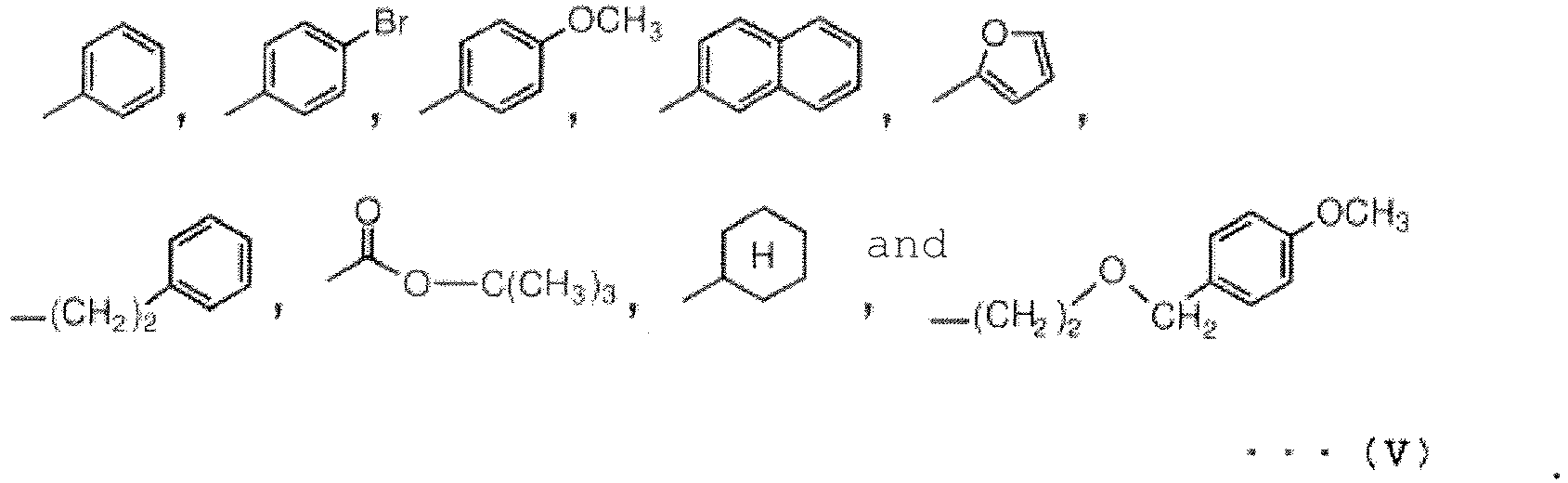
- According to the method for producing a five-membered ring-containing compound of the present invention, stereospecific and asymmetrical five-membered ring-containing compounds serving as synthetic intermediates for formation of five-membered rings of PGs can be conveniently produced, with diastereoselectivity and enantioselectivity, from acyclic starting materials in one cyclization step. The five-membered ring-containing compounds obtained by this method are highly stereoselective in terms of diastereoselectivity and enantioselectivity and can be obtained with a high yield.
- The method allows direct and stereoselective production of asymmetrical five-membered ring-containing compounds and thus does not require inefficient and troublesome optical resolution which may produce undesired optically active substances. This method further allows asymmetrical synthesis of desired five-membered ring-containing compounds with a preferable yield over a wide range from a laboratory scale of the level between 0.1 millimoles to a few millimoles to a plant scale of the level between a few kg to a ton.
- The five-membered ring-containing compound of the present invention is stereospecific and has high optical purity, and thus can be used as a synthetic intermediate for stereoselective production of various five-membered ring-containing physiologically active compounds typified by PGs such as PGE1, PGE2 and PGF2α, which are pharmacologically active components of PG pharmaceutical formulations. The five-membered ring-containing compound can derive desired PGs by homologation of the α side chain group or ω side chain group or by subsequent functional modification or conversion.
- The embodiments of the present invention are hereinafter specifically described. However, the scope of the invention is not limited to these embodiments.
- The preferable embodiments of the present invention are described by referring to the following chemical reaction formulae (VI) and (VII).
- The method for producing a five-membered ring-containing compound of the present invention is the one obtaining the five-membered ring-containing compound through the cyclization step of condensing and then cyclizing, via the Michael-Henry reaction, a 1,4-butanedione compound (2) and an α,β-unsaturated nitro compound (3) in the presence of a catalytic amount of an asymmetrical proline derivative (1) and optionally a catalytic amount of an acid so as to form a five-membered ring in one step and derivatizing to a cyclized five-membered ring-containing compound (7). A different five-membered ring-containing compound (9) may be obtained through the reduction step of reducing, with a reducing agent, the cyclized five-membered ring-containing compound (7) after or without isolation to derive a reduced five-membered ring compound (8). The cyclized five-membered ring-containing compound (7) may be subjected to, after or without isolation, homologation of the aldehyde group by the Horner-Wadsworth-Emmons reaction or the Wittig reaction. These compounds may be appropriately derived to a PG (10).


- In the chemical reaction formula (VI), R1 of the α,β-unsaturated nitro compound (3) may contain a substituent which may specifically be:
- a saturated and/or unsaturated and aliphatic or aromatic hydrocarbon ring group containing 3 to 10 carbon atoms, e.g. a phenyl group, a naphthyl group, a cyclopropyl group, a cyclobutyl group, a cyclopentyl group, a cyclohexyl group, a cycloheptyl group, a cyclooctyl group, a cyclononyl group or a cyclodecyl group;
- a saturated and/or unsaturated heterocyclic group with a five- to six-membered ring such as a heteroaryl or heteroalicyclic group, e.g. a furyl group, an oxazolyl group, an isoxazolyl group, a thiazolyl group, an isothiazolyl group, an oxadiazolyl group, a pyrrolyl group, a triazolyl group, an imidazolyl group, a pyrazolyl group, a thienyl group, a pyridyl group or a morphonyl group;
- a hydrocarbon ring-containing alkyl group which is an alkyl group containing 1 to 4 carbon atoms and the hydrocarbon ring group as described above, e.g. an aralkyl group such as a benzyl group and a phenethyl group or a cycloalkyl-substituted alkyl group;
- a heterocycle-containing alkyl group which is an alkyl group containing 1 to 4 carbon atoms and the heterocyclic group as described above, e.g. a pyridylmethyl group, a pyridylethyl group or a thiazolylmethyl group;
- a linear, branched and/or cyclic alkyl group containing 1 to 10 carbon atoms, e.g. a methyl group, an ethyl group, a propyl group, a butyl group, a pentyl group, a hexyl group, a heptyl group, an octyl group, a nonyl group, a decyl group, a cyclopropyl group, a cyclobutyl group, a cyclopentyl group, a cyclohexyl group, a cycloheptyl group, a cyclooctyl group, a cyclononyl group or a cyclodecyl group;
- a linear, branched and/or cyclic alkenyl group containing 2 to 6 carbon atoms, e.g. a vinyl group, a propenyl group, a butenyl group, a butadienyl group, a pentenyl group, a pentadienyl group, a hexenyl group, a hexadienyl group, a cyclopropenyl group, a cyclobutenyl group, a cyclopentenyl group or a cyclohexenyl group;
- a linear, branched and/or cyclic alkynyl group containing 2 to 6 carbon atoms, e.g. an ethynyl group, a propynyl group, a butynyl group, a butadienyl group, a pentynyl group, a pentadiynyl group, a hexynyl group or a hexadiynyl group;
- an alkyl thioether-containing alkyl group which is an alkyl group containing 1 to 4 carbon atoms and an alkyl thioether group with 1 to 4 carbon atoms, e.g. an ethylthiomethyl group (-CH2-S-CH2CH3), a propylthioethyl group (-(CH2)2-S-(CH2)2CH3) or a butylthiobutyl group (- (CH2)4-S-(CH2)3CH3);
- a heterocycle-containing alkyl thioether group which is the alkyl thioether group as described above containing the heterocyclic group as described above, e.g. a pyridylthioethyl group (-(CH2)2-S-pyridyl group), a pyridylethylthiomethyl group (-CH2-S-(CH2)2-pyridyl group), a thiazolylthioethyl group (-(CH2)2-S-thiazolyl group) or a thiazolylethylthiomethyl group (-CH2-S-(CH2)2-thiazolyl group);
- a hydrocarbon ring-containing alkyl ether group which is an alkyl ether group containing 1 to 4 carbon atoms and the hydrocarbon ring group as described above, e.g. a benzyloxyethyl group, a phenethyloxyethyl group or a benzyloxypropyl group; or
- an alkyloxycarbonyl group containing an alkyloxy of 1 to 4 carbon atoms, e.g. a tert-butoxycarbonyl group, a methoxycarbonyl group, an ethoxylcarbonyl group, a propoxycarbonyl group or an isopropoxycarbonyl group.
- The position of the potential substituent on R1 is not particularly limited.
- Among these, R1 of the α,β-unsaturated nitro compound (3) is further preferably a phenyl group, a bromophenyl group, a methoxyphenyl group, a naphthyl group, a furyl group, a phenethyl group, a tert-butoxycarbonyl group, a cyclohexyl group or a methoxybenzyloxyethyl group as shown in the chemical formula (V), and particularly preferably a phenyl group, a bromophenyl group, a methoxyphenyl group or a naphthyl group.
- In the chemical reaction formula (VI), the 1,4-butanedione compound (2) is exemplified by succinaldehyde; however it may be succinaldehyde containing a substituent. Succinaldehyde (CAS (Chemical Abstracts Service) registry number: 638-37-9) may be the one commercially available or may be produced, or prepared upon use if required, according to the well known method such as the method described in
U.S. Patent No. 2,920,081 (description). - The five-membered ring-containing compound represented by the chemical formula (IV) of the present invention may be obtained by the method for producing a five-membered ring-containing compound of the present invention or by a different method. The five-membered ring-containing compound represented by the chemical formula (IV) has a stereospecific cyclohexane ring of various physiologically active substances typified by PGs such as PGEs and PGFs, and thus can serve as an intermediate for these physiologically active substances.
- R7 in the chemical formula (IV) corresponds to R1 in the chemical formula (II). Specifically, R7, as described above, may contain a substituent, is selected from a hydrocarbon ring group, a heterocyclic group, a hydrocarbon ring-containing alkyl group, a heterocycle-containing alkyl group, an alkyl group, an alkenyl group, an alkynyl group, an alkyl thioether-containing alkyl group, a heterocyclic group-containing alkyl thioether group, a hydrocarbon ring group-containing alkyl ether group and an alkyloxycarbonyl group and is the one exemplified for R1 as above. Among these, R7 is preferably selected from a cyclohexyl group, a phenyl group, a naphthyl group, a furyl group, a phenethyl group, a benzyloxyethyl group and an alkyloxycarbonyl group.
- In the chemical reaction formula (VI), the proline derivative (1) acts as a catalyst and is used at, relative to the substrate α,β-unsaturated nitro compound (3), preferably 1 to 50 mol% and more preferably 10 mol%. In the chemical reaction formula (VI), the proline derivative (1) is exemplified by (S)-diphenylprolinol trimethylsilyl ether; however it is not particularly limited as far as it is an optically active proline derivative and is represented by the chemical formula (1). Preferably, the proline derivative (1) is solely one of enantiomers.
- In the chemical formula (III), R2 is a carboxyl group, a tetrazole group or a -C(R4)(R5)OR6 group [wherein R4 and R5 respectively and independently may contain a substituent and are a hydrocarbon aromatic ring group such as a phenyl group and a naphthyl group; a heteroaromatic ring group such as a pyridyl group, an imidazolyl group and a thiazolyl group; or a linear, branched and/or cyclic alkyl group containing 1 to 4 carbon atoms, e.g. a methyl group, an ethyl group, a propyl group, an isopropyl group, a butyl group or a tert-butyl group; and R6 is a hydrogen atom; a silyl group such as a trimethoxysilyl group, a triethylsilyl group, a tert-butyldimethylsilyl group, a triisopropylsilyl group and a tert-butyldiphenylsilyl group; or a linear, branched and/or cyclic alkyl group containing 1 to 4 carbon atoms, e.g. a methyl group, an ethyl group, a propyl group, an isopropyl group, a butyl group or a tert-butyl group]; R3 represents a protective group such as an alkyl group, an acetyl group and a silyl group; and n represents a number of 0 to 1, preferably an integer of 0 or 1.
- This asymmetrical catalyst, proline derivative (1), can be produced from a starting material of an optically active proline or a derivative thereof (such as 3-hydroxyproline and 4-hydroxyproline) according to, for example, H. Gotoh et al., Angewandte Chemie International Edition, 2006, vol. 45, p. 6853-6856 and H. Gotoh et al., Organic Letters, 2007, vol. 9, p. 2859-2862.
- The substituent which R1, R4, R5 and R7 may contain is not particularly limited as far as it does not inhibit the Michael-Henry reaction and may include a linear, branched and/or cyclic alkyl group containing 1 to 4 carbon atoms, e.g. a methyl group, an ethyl group, a propyl group, an isopropyl group, a butyl group, a tert-butyl group, a cyclopropyl group or a cyclobutyl group; a linear or branched alkoxy group containing 1 to 4 carbon atoms, e.g. a methoxy group, an ethoxy group, a propoxy group, an isopropoxy group, a butoxy group, an isobutoxy group or a tert-butoxy group; a carboxyl group; an aralkyl group such as a benzyl group or a phenethyl group; an ester group such as a methyl ester group, an ethyl ester group, a propyl ester group, an isopropyl ester group, a butyl ester group, an isobutyl ester group or a tert-butyl ester group; a hydroxyl group; a nitro group; a cyano group; and/or a halogen atom such as a fluorine, chlorine, bromine or iodine atom.
- As used herein unless otherwise stated, among the symbols representing bond axes to functional groups from a five-membered ring,
represents the configuration of the bond that projects below the plane of the paper (i.e. α-configuration),
represents the configuration of the bond that projects above the plane of the paper (i.e. β-configuration), and

represents the α-configuration, the β-configuration or the configuration where these configurations are present at certain proportions, as apparent to a person skilled in the art. The compound having a particular configuration indicated in the present invention is, however, not limited to a substantially pure single compound and may be the one which has the configuration predominantly. - The catalyst is exemplified by an asymmetrical catalyst, proline derivative (1). However, the catalyst may be a compound having a monocyclic or condensed pyrrolidine ring and an optically active α-carbon relative to the nitrogen on the ring. The α-carbon is preferably linked to a methylene group or a methine group. More specifically, the catalyst may include, in addition to the proline derivative (1), optically active compounds represented by the following chemical formulae and optical isomers thereof. In the formulae, Me indicates methyl, Et indicates ethyl, Pr indicates propyl, Bu indicates butyl, Ph indicates phenyl and Tf indicates trifluoromethylsulfonyl.



- Among these, the catalyst is preferably a proline derivative because of the availability of optically active starting materials therefor and liability for functional conversion thereof to desired chiral compounds.
- The cyclization step is preferably carried out in a water-insoluble organic solvent selected from a halogen-containing organic solvent, an aromatic organic solvent and a hydrocarbon organic solvent and/or a non-oxygen atom-containing water-soluble organic solvent that is a nitrile-substituted hydrocarbon organic solvent. The water-insoluble organic solvent may include a halogen-containing organic solvent such as a halogen hydrocarbon exemplified by dichloromethane, dichloroethane or chloroform; an aromatic organic solvent such as benzene, toluene, o-, m- or p-xylene; a hydrocarbon organic solvent such as pentane, hexane or heptane; and an acyclic ether organic solvent such as diethyl ether. The non-oxygen atom-containing water-soluble organic solvent may include a non-ethereal and non-alcoholic water-soluble organic solvent which does not contain an oxygen atom such as acetonitrile.
- When the cyclization step is carried out in the water-insoluble organic solvent which has low polarity or the non-oxygen atom-containing water-soluble organic solvent, a five-membered ring-containing compound in which R1 and the adjacent aldehyde group on the five-membered ring are solely in the cis form can be obtained with diastereoselectivity and with a high yield of over 70% and the optical yield of as high as 95%ee, despite the fact that the active sites for the Michael-Henry reaction in order to form a five-membered ring de novo are less accessible each other due to a large steric hindrance. It is inferred that the five-membered ring-containing compound in which R1 and the aldehyde group are solely in the cis form is obtained because the cyclization in the Henry reaction undergoes through the transition state with the cis configuration and the aldehyde group is not isomerized even after the cyclization. Particularly the non-oxygen atom-containing water-soluble organic solvent such as acetonitrile can further stabilize the aldehyde group after the cyclization, and thus it is not required to stabilize the aldehyde group by reducing it to a hydroxymethyl group or subsequently protecting the aldehyde group.
- On the other hand, carrying out the cyclization step in a water-soluble organic solvent having high polarity other than acetonitrile, e.g. in an organic solvent which is arbitrarily water miscible such as tetrahydrofuran (THF), methanol or 1,4-dioxane is not at all practical because even when the reaction time is prolonged, cyclization reaction may not proceed at all, or complicated by-products may result, or the five-membered ring-containing compound may be obtained with a very low yield of as low as a few percent.
- It is inferred that there is a significant difference in the yield according to the difference in nature of the solvents because the water-insoluble organic solvent having low polarity and the water-soluble organic solvent which has high polarity but does not contain an oxygen atom stabilize the transition state during the Michael-Henry reaction in the cyclization step and facilitate the formation of a bond between the active sites.
- The cyclization step is further preferably carried out in the presence of catalytic amounts of both the proline derivative (1) and an acid. The acid is preferably a free acid having the acid dissociation constant (pKa) at 25°C in water of 2.5 to 11, still more preferably 4 to 10.
- The acid may include a fatty acid derivative containing 1 to 4 carbon atoms, e.g. an aliphatic monocarboxylic acid derivative exemplified by acetic acid, n-propionic acid and butyric acid; a haloaliphatic monocarboxylic acid derivative exemplified by trifluoroacetic acid and chloroacetic acid; an aliphatic polycarboxylic acid derivative exemplified by oxalyl acid, d,l-tartaric acid, citric acid, succinic acid, malonic acid and cis-maleic acid; an aromatic carboxylic acid derivative, e.g. a benzoic acid derivative exemplified by benzoic acid, 3-hydroxybenzoate and 3-methylbenzoate; a heteroaromatic carboxylic acid derivative exemplified by nicotinic acid;
a hydroxyaromatic derivative, e.g. a phenol derivative exemplified by phenol, 2,4-dinitrophenol, 2-chloro-4-nitrophenol, 2,4,6-trichlorophenol, 2,6-dichlorophenol, 2,6-difluorophenol, 2,6-dimethyl-4-nitrophenol, 4-nitrophenol, 2-hydroxybenzonitrile, 2-nitrophenol, 2,3-dichlorophenol, 4-cyanophenol, 2,4-dichlorophenol, 2-hydroxy-benzamide, 3,5-dichlorophenol, 3-nitrophenol, 3,4-dichlorophenol, 2-chlorophenol, 3-cyanophenol, 4-chlorophenol, 3-methoxyphenol, 3-methylphenol, 3,5-dimethylphenol and 4-methylphenol; a hydroxynaphthalene derivative exemplified by 1-hydroxynaphthalene and 2-hydroxynaphthalene; and
a perfluoroalkyl group-containing alcohol, e.g. 1,1,1,3,3,3-hexafluoro-2-propanol. - The acid may be a single species or more than one species in combination.
- Among these acids, the acid having pKa of 6 to 8 at 25°C in water is particularly preferable. The acid having pKa of 6 to 8 may include, for example, 2,4,6-trichlorophenol, cis-maleic acid, 2,6-dichlorophenol, 2,6-difluorophenol, 2,6-dimethyl-4-nitrophenol, 4-nitrophenol, 2-hydroxybenzonitrile, 2-nitrophenol, 2,3-dichlorophenol, 4-cyanophenol, 2,4-dichlorophenol, 2-hydroxy-benzamide and the like.
- The cyclization step carried out in the presence of catalytic amounts of both the proline derivative (1) and the acid can provide an increased reaction speed, such that the cyclization step can be completed within a reduced time period as 1/3 to 1/24 of the time required for the reaction with the absence of the acid, and can provide an increased yield of the cyclization as well.
- The proline derivative (1) and the acid are preferably present at a molar ratio of 1:1 to 1:2.
- The reaction mechanism in the cyclization step where the 1,4-butanedione compound (2) and the α,β-unsaturated nitro compound (3) are derived to the cyclized five-membered ring-containing compound (7) using the asymmetrical proline derivative (1) as a catalyst by the Michael-Henry reaction is inferred as below by referring to the chemical reaction formula (VIII).

- The 1,4-butanedione compound (2) is dehydrated due to the reaction thereof with the proline derivative (1) to produce an enamine (4), which then undergoes the Michael reaction with the α,β-unsaturated nitro compound (3), resulting in diastereoselective and enantioselective condensation thereof in the cis configuration to form a zwitter ion (5). The cyclization step carried out in the water-insoluble organic solvent having low polarity or the non-oxygen atom-containing water-soluble organic solvent having high polarity facilitates the formation of a bond between active sites and stabilizes the zwitter ion (5) which is the transition state during the Michael-Henry reaction. This steric benefit results in the conformation that may provide the cis configuration between the R1 group and the group derived from the proline derivative upon cyclization. The nucleophilic nitrocarbanion in the zwitter ion (5) cyclizes by nucleophilic reaction with the electrophilic aldehyde group by the intramolecular Henry reaction so as to produce a cyclized five-membered ring-containing compound precursor (6) in which the R1 group and the group derived from the proline derivative are in the cis configuration. Addition of water to the precursor (6) produces the cyclized five-membered ring-containing compound (7) together with the by-product, the proline derivative (1). The cyclized five-membered ring-containing compound (7) obtained is a diastereomer mixture in which the nitro group on the ring and a de novo adjacent hydroxyl group are in the relationship of cis/trans. The above step carried out in the concomitant presence of the acid further activates the α,β-unsaturated nitro compound (3) and facilitates the Michael reaction, resulting in the effects of the further increased yield, improved stereoselectivity and decreased reaction time and the like.
- The cyclized five-membered ring-containing compound (7) which has the aldehyde group is not highly stable and is difficult to be maintained for a prolonged time. Thus the cyclized five-membered ring-containing compound (7), after or without isolation, may be subsequently reduced with a reducing agent to derive the reduced five-membered ring compound (8) for a temporary storage.
- The reducing agent which is used for reduction of the cyclized five-membered ring-containing compound (7) to derive the reduced five-membered ring compound (8) is not particularly limited as far as it can reduce the aldehyde group to a hydroxymethyl group without inversion of the configuration, and is particularly preferably NaBH4, NaBH3CN, B2H6, BH3·(CH3)2S, LiAlH4, NaB(O2CCH3)3H or LiBH(C2H5)3.
- Optionally, the hydroxyl group on the ring of the reduced five-membered ring compound (8) may be dehydrated to be derived to a further stable nitrocyclopentene compound and/or a hydroxyl group on an acyclic radical of the reduced five-membered ring compound (8) may be protected with an acyl group, an alkyl group or an aralkyl group to derive an ester or ether compound. The treatment with acetic anhydride (Ac2O) in the presence of pyridine causes acetylation and simultaneous dehydration to give an acetyl ester, nitrocyclopentene compound (9). From a mixture of four diastereomers in which the nitro group and the adjacent hydroxyl group on the ring of the reduced five-membered ring compound (8) are in the relationship of cis/trans, a single nitrocyclopentene compound (9) is obtained.
- The cyclized five-membered ring-containing compound (7) and nitrocyclopentene compound (9) can derive PGs having desired physiological activities such as PGEs and PGFs by, as schematically shown in the chemical reaction formula (VII), the homologation reaction such as the Horner-Wadsworth-Emmons reaction, functional conversion reactions of the de novo carbonyl group such as reduction, acetylation and dehydration, as appropriate. The PGE (10-a), dehydroxy-PGE (10-b) and PGFα (10-c), for example, can be derived by the process shown in the following reaction process formula (IX). The cyclized five-membered ring-containing compound (7), after or without isolation, may be subjected to the homologation reaction of the aldehyde group by the Horner-Wadsworth-Emmons reaction or the Wittig reaction in one pot to produce a ω side chain group which is then appropriately subjected to functional conversion prior to the α side chain group formation in order to convert the functional group on the five-membered ring. The order of the functional conversions may be permutated.

- More specifically, in the reaction process formula (IX), a compound represented by the chemical formula (9-ii):

can be produced by subjecting the compound represented by the chemical formula (9-i):
to the isomerization reaction and optionally to deprotection reaction of a protective group in R1-a. - The isomerization reaction is well known and is carried out, for example, in an organic solvent (acetonitrile, methanol, ethanol, isopropanol etc.) or a mixed solvent thereof with water, in the presence of an organic base (dimethylamine, triethylamine, 1,4-diazabicyclo[2.2.2]octane (DABCO), 1,8-diazabicyclo[5.4.0]undec-7-ene (DBU)) or an inorganic base (sodium hydrogen carbonate, sodium carbonate, potassium carbonate etc.) at a temperature of 0 to 100°C.
- Deprotection reaction of the protective group can be carried out according to the following methods.
- Deprotection reaction of a protective group of a hydroxyl or carboxyl group is well known and may include, for example,
- (1) alkaline hydrolysis,
- (2) deprotection reaction under an acidic condition,
- (3) deprotection reaction by hydrogenolysis,
- (4) deprotection reaction of a silyl group
- Specifically, the deprotection reactions are described as follows.
- (1) Deprotection reaction by alkaline hydrolysis is carried out, for example, in an organic solvent (methanol, tetrahydrofuran, dioxane or a mixed solvent thereof), by using an alkali metal hydroxide (sodium hydroxide, potassium hydroxide, lithium hydroxide etc.), an alkaline earth metal hydroxide (barium hydroxide, calcium hydroxide etc.) or a carbonate salt (sodium carbonate, potassium carbonate etc.) or an aqueous solution thereof or a mixture thereof at a temperature of 0 to 40°C.
- (2) Deprotection reaction under an acidic condition is carried out, for example, in an organic solvent (methylene chloride, chloroform, dioxane, ethyl acetate, anisole, methanol, ethanol, isopropyl alcohol etc.) or in the absence of the organic solvent or in an aqueous solution thereof and in an organic acid (acetic acid, trifluoroacetic acid, methanesulfonic acid etc.), an inorganic acid (hydrochloric acid, sulfuric acid etc.) or a mixture thereof (hydrogen bromide / acetic acid etc.) at a temperature of 0 to 100°C.
- (3) Deprotection reaction by hydrogenolysis is carried out, for example, in a solvent (ether-based (tetrahydrofuran, dioxane, dimethoxyethane, diethyl ether etc.), alcohol-based (methanol, ethanol etc.), benzene-based (benzene, toluene etc.), ketone-based (acetone, methyl ethyl ketone, etc.), nitrole-based (acetonitrile etc.), amide-based (dimethylformamide etc.), water, ester-based (ethyl acetate etc.), acetic acid or a mixed solvent of two or more of these), in the presence of a catalyst (palladium-carbon, palladium black, palladium hydroxide, platinum oxide, Raney nickel etc.), in a hydrogen atmosphere or in the presence of ammonium formate under normal or increased pressure at a temperature of 0 to 200°C.
- (4) Deprotection reaction of a silyl group is carried out, for example, in a water-miscible organic solvent (tetrahydrofuran, acetonitrile etc.), by using tetrabutylammonium fluoride at a temperature of 0 to 40°C.
- The protective group of a hydroxyl group may include, for example, a methoxymethyl group, a 2-tetrahydropyranyl group, a t-butyldimethylsilyl group, a t-butyldiphenylsilyl group, an acetyl group, a benzyl group, a 4-methoxybenzyl group, a pivaloyl group and the like.
- The protective group of a carboxyl group may include, for example, a methyl group, an ethyl group, a propyl group, an isopropyl group, a t-butyl group and the like.
- The protective group of a hydroxyl or carboxyl group is not particularly limited to those described above as far as it can be readily and selectively eliminated. For example, those described in T. W. Greene, Protective Groups in Organic Synthesis 3rd edition, Wiley, New York, (1999) may be used.
- A person skilled in the art readily understands that, by using these deprotection reactions according to needs, a compound such as a desired PG synthetic intermediate (10) can be conveniently produced.
- In the reaction process formula (IX), a compound represented by the chemical formula (9-iii):

can be produced by subj ecting the compound represented by the chemical formula (9-ii) to oxo group introduction reaction and optionally to deprotection reaction of a protective group. - The oxo group introduction reaction is well known and is carried out, for example, in an organic solvent (acetonitrile, tetrahydrofuran, methanol, ethanol, isopropanol etc.) or a mixed solvent thereof with water, in the presence of an organic base (dimethylamine, triethylamine, 1,4-diazabicyclo[2.2.2]octane (DABCO), 1,8-diazabicyclo[5.4.0]undec-7-ene (DBU)) or an inorganic base (sodium hydrogen carbonate, sodium carbonate, potassium carbonate etc.) at a temperature of 0 to 100°C, or in an organic solvent (acetonitrile, methanol, ethanol, isopropanol etc.) or a mixed solvent thereof with water and in an organic acid (acetic acid, trifluoroacetic acid, methanesulfonic acid etc.), an inorganic acid (hydrochloric acid, sulfuric acid etc.) or a mixture thereof (hydrogen bromide / acetic acid etc.) at a temperature of 0 to 100°C. Optionally, metal (zinc etc.) may be added.
- Deprotection reaction of the protective group can be carried out by the same manner as described above.
- In the reaction process formula (IX), a compound represented as the PGE synthetic intermediate:

can be produced by subj ecting the compound represented by the chemical formula (9-iii) to hydroxyl group introduction reaction and optionally deprotection reaction of a protective group. - The hydroxyl group introduction reaction is well known and a hydroxyl group can be introduced by, for example, carrying out epoxidation reaction in an organic solvent (benzene, toluene etc.) or a mixed solvent thereof with water, with an oxidizing agent added (sodium hypochlorite, meta-chloroperbenzoic acid, Oxon®, t-butyl hydroperoxide, hydrogen peroxide etc.) at a temperature of 0 to 40°C and subjecting the obtained epoxidized compound to ring-opening reaction in an organic solvent (acetonitrile, tetrahydrofuran, toluene, methanol, ethanol etc.) or a mixed solvent thereof with water, in the presence of tetrabutyl tin hydride, a metal (zinc etc.) and a salt (sodium dithionite, ammonium chloride etc.) at a temperature of 0 to 100°C.
- Deprotection reaction of the protective group can be carried out by the same manner as described above.
- The PGE (10-a) can be produced by further subjecting the PGE synthetic intermediate to a well known reaction.
- In the reaction process formula (IX), a compound represented as the PGFα synthetic intermediate:

can be produced by subjecting the compound represented as the PGE synthetic intermediate to reduction reaction and optionally deprotection reaction of a protective group. - The reduction reaction is well known and can be carried out, for example, in an organic solvent (methanol, ethanol, tetrahydrofuran, benzene, toluene etc.) by adding a reducing agent (sodium borohydride, LiBH(sec-C4H9)3 such as L-Selectride®, NaBH3CN, B2H6, BH3·(CH3)2S, LiAlH4, NaB (O2CCH3)3H, LiBH (C2H5)3 etc.) at a temperature of 0 to 40°C.
- Deprotection reaction of the protective group can be carried out by the same manner as described above.
- The PGFα (10-c) can be produced by further subjecting the PGFα synthetic intermediate to a well known reaction.
- In the reaction process formula (IX), a compound represented as the dehydroxy-PGE synthetic intermediate:

can be produced by subj ecting the compound represented by the chemical formula (9-i) to oxo group introduction reaction and optionally deprotection reaction of a protective group. - The oxo group introduction reaction can be carried out by the same manner as described above.
- Deprotection reaction of the protective group can be carried out by the same manner as described above.
- The dehydroxy-PGE (10-c) can be produced by subjecting the dehydroxy-PGE synthetic intermediate to a well known reaction.
- Among the compounds represented as the nitrocyclopentene compound (9), the nitrocyclopentene compound wherein R1 is (CH2)6COOC2H5, i.e. the compound (9-i-a) can derive PGE1 according to the following reaction process formula (X).
-

- The reactions shown in the reaction process formula (X) can be carried out according to the methods described for the reaction process formula (IX) or the methods pursuant thereto.
- In the reactions described herein, reaction products can be purified by means of a conventional purification means, for example, distillation under normal or reduced pressure, high performance liquid chromatography, thin-layer chromatography or column chromatography using silica gel or magnesium silicate as a carrier, or washing and recrystallization and the like. Purification may be carried out after each reaction or after some reactions.
- When the proline derivative (1) used is an enantiomeric optically active substance, the other enantiomer can be obtained. Although the proline derivative (1) is exemplified, when another catalyst which has a pyrrolidine ring and an optically active α-carbon relative to the nitrogen on the ring is used that is an enantiomeric optically active substance, an enantiomer is enantioselectively obtained.
- Examples of the method for producing a five-membered ring-containing compound to which the present invention is applied and Comparative Examples of the method to which the present invention is not applied are specifically described hereinafter.
- Under an argon atmosphere, to a solution of a nitrostyrene, i.e. (E)-(2-nitrovinyl)benzene (3a) (40.3 mg, 0.41 mmol) as the α,β-unsaturated nitro compound, succinaldehyde (2a) (53. 4 mg, 0.62 mmol) as the 1,4-butanedione compound and p-nitrophenol (5.7 mg, 0.041 mmol) as the acid in CH2Cl2 (0.41 mL) as the water-insoluble organic solvent was added (S)-2-(diphenyl((trimethylsilyl)oxy)methyl)pyrrolidine (1a) (13. 3 mg, 0.041 mmol) as the proline derivative at a room temperature (23°C). The concentration of the substrate, nitrobenzene, in this solution was 1 M. This reaction solution was stirred at the same temperature for 3 hours. The main products were visualized as a diastereomer mixture by silica gel thin-layer chromatography (TLC) with the spots of reaction products (7a) at the Rf values = 0.42, 0.32 and 0.23 (developing solvent: ethyl acetate : hexane = 1:3). After confirming the elimination of the spot of nitrostyrene by TLC, the reaction solution was cooled to 0°C and added with methanol (0.82 mL) and NaBH4 (46.5 mg, 1.23 mmol). After stirring at 0°C for 20 minutes, 1 N hydrochloric acid was added to terminate the reaction and the organic matter was extracted with chloroform 5 times. The combined organic layer was washed with a saturated aqueous sodium chloride solution and dried with magnesium sulfate. Low-boiling organic compounds such as solvents were distilled off under reduced pressure prior to purification of the obtained crude product by silica gel column chromatography (elution solvent: ethyl acetate : hexane = 1:3 → 2:1) to obtain a desired reduced five-membered ring compound which is a diol, (3S,4R)-4-(hydroxymethyl)-2-nitro-3-phenylcyclopentanol (8a) (69.1 mg, 0.29 mmol), as a mixture of four diastereomers in which the configurations between the hydroxyl group and the nitro group were varied (0.37 : 1.00 : 0.98 : 0.46) with the yield of 71%. The results are shown in the following Table 1.
- The results of physical and chemical analyses of the product by 1H nuclear magnetic resonance spectrometry (1H NMR) and TLC are shown hereinbelow. The results of physical and chemical analyses support the chemical structure of 8a which is the mixture of four diastereomers.
1H NMR (CDCl3) δ 2.03-2.10 (1.1H, m), 2.23 (1.9H, dd, J = 8.0, 16.0 Hz), 2.40-2.48 (0.5H, m), 2.48-2.60 (0.5H, m), 3.48-3.56 (1H, m), 3.59-3.71 (1H, m), 3.37-3.48 (0.5H, m), 3.94-4.02 (0.5H, m), 4.62-4.70 (0.15H, m), 4.76 (0.36H, dd, J=5.6, 11.2 Hz), 4.85 (0.36H, dd, J=5.6, 9. 6 Hz), 4. 93 (0.13H, dd, J = 4.4, 10.8 Hz), 7.21-7. 40 (5H, m)
TLC: Rf = 0.25 (36%), 0.31 (36%), 0.44 (15%), 0.55 (13%) (developing solvent: ethyl acetate : hexane = 2:1) (the ratio of diastereomers was determined based on the integrated ratio from 1H NMR) - Under an argon atmosphere, a solution of the mixture of diastereomers (69.1 mg, 0.29 mmol) of the diol obtained from the cyclization step and the reduction step, (3S,4R)-4-(hydroxymethyl)-2-nitro-3-phenylcyclopentanol (8a) (69.1mg, 0.29 mmol), in pyridine (0.58 mL) was cooled to 0°C, added with acetic anhydride (Ac2O, 82.2 µL, 0.87 mmol) and stirred at the same temperature for 6 hours. The solution was further stirred at a room temperature for 12 hours. After addition of a phosphate buffer to terminate the reaction, the organic matter was extracted with ethyl acetate 3 times. The combined organic layer was washed with a saturated aqueous sodium chloride solution and dried with magnesium sulfate. Low-boiling organic compounds such as solvents were distilled off under reduced pressure prior to purification by silica gel column chromatography (elution solvent: ethyl acetate : hexane = 1:10) to obtain a desired nitrocyclopentene compound which is a dehydrated substance, ((1R,2S)-3-nitro-2-phenylcyclopent-3-en-1-yl)methyl acetate (9a) (56.8 mg, 0.22 mmol) with the yield of 75%. The optical yield thereof which was determined by high performance liquid chromatography using a chiral column as the enantiomeric excess was 95%ee. The results are shown in the following Table 2.
- The results of physical and chemical analyses of the product by 1H NMR, 13C NMR, infrared absorption spectrometry (IR), electrospray ionization high-resolution mass spectrometry (HRMS (ESI)), optical rotation measurement, optical purity measurement using a chiral column and Rf measurement by TLC are shown hereinbelow. The results of physical and chemical analyses support the chemical structure of 9a which is a single isomer.
1H NMR (CDCl3) δ 2.06 (3H, s), 2.44 (1H, bdt, J = 4.4, 19.2 Hz), 2.67-2.78 (1H, m), 2.92 (1H, ddt, J=2.8, 8.8, 19.2 Hz, 4.11 (1H, dd, J = 6.8, 11.2 Hz), 4.17-4.20 (1H, m), 4.18 (1H, dd, J = 6.8, 11.2 Hz), 7.05 (2H, dd, J=2.4, 9.2 Hz), 7.11-7.21 (3H, m), 7.28-740 (2H, m);
13C NMR (CDCl3) δ 20.8, 32.5, 46,4, 51.4, 65.8, 126.8 (2C), 127.4, 129.0 (2C), 137.7, 140.7, 153.7, 170.9;
IR (neat) ν 1740, 1510, 1362, 1236, 1036, 755.9, 701.0 cm-1; HRMS (ESI): [M+Na]+ calculated for C13H15NO5Na: 284.0899, found: 284.0886;
[α]D 13+116 (c 0.49, CHCl3);
Optical yield: 95%ee (optical yield was such that when analyzed by high performance liquid column chromatography using a Chiralpak IB column (Daicel Corporation) with an elution solvent (hexane : isopropanol = 80:1) at an elution speed of 1.0 mL/min, the major enantiomer had tR = 18. 1 min and the minor enantiomer had tR = 19.4 min);
TLC: Rf = 0.35 (developing solvent: ethyl acetate : hexane = 1:3) - The cyclization step and the reduction step were carried out in the same manner as Example 1-1 except that for the reaction conditions in the cyclization step, the water-insoluble organic solvent used was n-hexane and the conditions used were as shown in the following Table 1 to obtain a desired reduced five-membered ring compound which is a diol, (3S,4R)-4-(hydroxymethyl)-2-nitro-3-phenylcyclopentanol (8a) as a mixture of four diastereomers in which the configurations between the hydroxyl group and the nitro group were varied. The diastereo ratio which was measured in the same manner as in Example 1-1 was TLC: Rf = 0.25 (15%), 0.31 (34%), 0.44 (35%), 0.55 (16%) (developing solvent: ethyl acetate : hexane = 2:1) (the ratio of diastereomers was determined based on the integrated ratio from 1H NMR). The results are summarized in Table 1. The dehydration step was carried out in the same manner as in Example 1-2 to obtain a desired nitrocyclopentene compound which is a hydrated substance, ((1R,2S)-3-nitro-2-phenylcyclopent-3-en-1-yl)methyl acetate (9a) with the yield of 75% and the optical yield of 94%ee. The results are summarized in Table 2. Similar results of physical and chemical analyses were obtained.
Table 1 
Succinaldehyde (2a) (eq.) Cyclization step Yield (%) Solvent Reaction temp. Reaction time (h) Ex. 1-1 2.5 CH2Cl2 (1 M) Room temp. 3 71 Ex. 2-1 2.5 n-Hexane (1 M) Room temp. 22 47 Table 2 
Product (9) Dehydration step Yield (%) Optical yield (%ee) Ex. 1-2 (9a) 75 95 Ex. 2-2 (9a) 75 94 - As apparent from Table 1, when the cyclization step is carried out in the water-insoluble organic solvent such as dichloromethane (CH2Cl2) or hexane as Examples to which the present invention is applied, the reaction proceeds in a short time and the total yield from the cyclization step and the reduction step is as extremely high as 47 to 71%. As apparent from Table 2 as well, the yield from the dehydration step is as extremely high as 75% and the single diastereomer product is obtained with a high optical yield of 94 to 95%ee. Therefore it is demonstrated that the present invention can provide excellent stereoselectivity in terms of diastereoselectivity and enantioselectivity in the cyclization step.
- By the similar manner as in Example 1-1 (Cyclization step and reduction step) except that, in the cyclization step, p-nitrophenol as the acid was not used and the conditions used for the water-insoluble organic solvent and the reaction time were as shown in Table 3, a desired reduced five-membered ring compound which is a diol, (3S,4R)-4-(hydroxymethyl)-2-nitro-3-phenylcyclopentanol (8a) was similarly obtained as a mixture of four diastereomers in which the configurations between the hydroxyl group and the nitro group were varied. The results are summarized in Table 3. Similar results of physical and chemical analyses were obtained.
- The reactions were carried out in the similar manner as in Example 1-1 (Cyclization step and reduction step) except that, in the cyclization step, p-nitrophenol as the acid was not used, water-soluble cyclic ethers such as THF and dioxane or various oxygen atom-containing water-soluble solvents which are water-soluble alcohols such as methanol were used instead of the water-insoluble organic solvent and the condition used for the reaction time was as shown in Table 3. The results are summarized in Table 3.
Table 3 
Succinaldehyde (2a) (eq.) Cyclization step Total yield from cyclizati on and reduction steps(%) Solvent (substrate conc.) Reaction temp. (°C) Reaction time (h) Ex. 3 2.5 CH2Cl2 (0.3 M) 23 9 62 Ex. 4 2.5 CH2Cl2 (0.15 M) 23 7 52 Comp. Ex. 1 2.5 THF (0.15 M) 23 32 < 10 Comp. Ex. 2 2.5 CH3OH (0.15 M) 23 52 No reaction Comp. Ex. 3 2.5 Dioxane (0.15 M) 23 50 No reaction - As apparent from Table 3, the reaction proceeds in a relatively short time when it is carried out in the water-insoluble organic solvent such as dichloromethane despite the absence of the acid and the total yield from the cyclization step and the reduction step is as extremely high as 52 to 62%. However, the reaction rate tends to be low compared to the rate when the acid is used. The products were subjected to the dehydration step as Example 1-2 to similarly obtain a desired nitrocyclopentene compound which is a dehydrated substance, ((1R,2S)-3-nitro-2-phenylcyclopent-3-en-1-yl)methyl acetate (9a).
- On the other hand, when the reaction is carried out in a water-soluble organic solvent such as THF, methanol and dioxane in the absence of the acid, the reaction does not proceed at all even with a prolonged period of time or, if any reaction proceeds, complicated by-products are produced and the five-membered ring-containing compound is obtained with a very low yield of at most a few percent.
- The reactions were carried out in the same manner as Example 1-1 except that the reaction conditions used were as shown in Table 4. The results are summarized in Table 4.
-
Table 4 
Succinaldehyde (2a) (eq.) Cyclization step Total yield from cyclization and reduction steps (%) Solvent (substrate conc.) Reaction temp. (°C) Reaction time (h) Ex. 5* 2.5 CH2Cl2 (0.3 M) 23 10 60 Ex. 6 1.2 Toluene (0.3 M) 23 48 28 Ex. 7 1.2 Toluene (1 M) 23 48 50 Ex. 8 2.5 Toluene (1 M) 23 2.5 70 Ex. 9 1.2 CH2Cl2 (0.3 M) 23 8 71 Ex. 10 1.2 CH2Cl2 (1 M) 23 1.5 71 Ex. 11 1.5 CH2Cl2 (1 M) 0 2.5 74 Ex. 12 1.5 CH2Cl2 (1 M) 23 2 69 * 
- As apparent from Table 4, the reaction proceeds in a relatively short time when it is carried out in the water-insoluble organic solvent such as dichloromethane and toluene and the total yield from the cyclization step and the reduction step is extremely high. The products were subjected to the dehydration step as Example 1-2 to similarly obtain a desired nitrocyclopentene compound which is a dehydrated substance, ((1R,2S)-3-nitro-2-phenylcyclopent-3-en-1-yl)methyl acetate (9a). The optical yield after the dehydration step for Example 5 was 91%ee and that for Example 11 was 95%ee and other Examples also had approximately similar values.
- By the similar manner as in Example 1-1 (Cyclization step and reduction step) except that the reaction conditions used were as shown in Table 5, desired reduced five-membered ring compounds which were diol products (8a to 8i) were obtained respectively as mixtures of four diastereomers in which the configurations between the hydroxyl group and the nitro group were varied. The results are summarized in Table 5. The results of physical and chemical analyses of the obtained mixtures of diastereomers by 1H NMR and TLC are shown hereinbelow. The results of physical and chemical analyses of (8a) were the same as those obtained before and the results for (8b to 8i) support the chemical structures of 8b to 8i which are mixtures of four diastereomers.
-
Table 5 
Product (8) Cyclization step Reaction temp. (°C) Reaction time (h) Total yield (%) Ex. 13-1 
0 2.5 74 Ex. 13-1'* 
23 3 > 53 Ex. 14-1 
0 → 23 2 70 Ex. 15-1 
0 30 70 Ex. 16-1 
0 35 75 Ex. 17-1 
0 17 65 Ex. 18-1 
0 12 67 Ex. 19-1** 
0 6 82 Ex. 20-1*** 
23 17 49 Ex. 21-1 
23 11 65 * Instead of 
** Instead of
*** Succinaldehyde (2a) (2.5 equivalents) was used - The results of physical and chemical analyses of the mixture of four diastereomers of the diol product (8b)
1H NMR (CDCl3) δ 1.98-2.14 (1.6H, m), 2.24 (1.4H, dt, J = 8.0, 14.0 Hz), 2.34-2.62 (1H, m), 3.42-3.59 (0.4H, m), 3.59-3.77 (1.6H, m), 3.21-3.39 (0.65H, m), 3.94-4.02 (0.35H, m), 4.46-4.53 (0.08H, m), 4.76 (0.1H, t, J = 7.2 Hz), 4.63-4.78 (0.36H, m), 4.78-4.95 (0.46H, m), 6.88 (0.3H, d, J = 9.2 Hz), 7.09 (0.3H, d, J = 9.2 Hz), 7.14 (0.7H, dd, J = 3.0, 8.4 Hz), 7.46 (0.7H, dd, J = 3.0, 8.4 Hz); TLC: Rf = 0.22 (46%), 0,28 (36%), 0.39 (10%), 0,50 (8%) (developing solvent: ethyl acetate : hexane = 2:1) (the ratio of diastereomers was determined based on the integrated ratio from 1H NMR) - The results of physical and chemical analyses of the mixture of four diastereomers of the diol product (8c)
1H NMR (CDCl3) δ 1.33-1.53 (1.1H, m), 1.53-1.79 (1.9H, m), 2.08-2.29 (0.61H, m), 2.30-2.57 (0.39H, m), 3.35-3.73 (3H, m), 3.78 (3H, s), 4.68 (0.48H, dd, J=10.2, 12.4 Hz), 4.72-4.81 (0.1H, m), 4.86 (0.42H, dd, J=5.2, 12.4 Hz), 6.85 (1.6H, dd, J=2.8, 9.6 Hz), 7.11 (1.6H, dd, J = 2.8, 9.6 Hz), 7.19 (0.4H, d, J = 5.6 Hz), 7.40 (0.4H, d, J = 5.6 Hz);
TLC: Rf = 0.21 (48%), 0.27 (42%), 0.35 (5%), 0.48 (5%) (developing solvent: ethyl acetate : hexane = 2:1) (the ratio of diastereomers was determined based on the integrated ratio from 1H NMR) - The results of physical and chemical analyses of the mixture of four diastereomers of the diol product (8d)
1H NMR (CDCl3) δ 1.96 (0.85H, dd, J = 1.6, 11.2 Hz), 2.09 (1.15H, ddd, J=5.6, 9.2, 14.4Hz), 2.27 (1H, dd, J=8.0, 16.0 Hz), 2.44-2.57 (0.55H, m), 2.58-2.71 (0.45H, m), 3.61-3.76 (2H, m), 3.53 (0.56H, dd, J = 5.6, 10.8 Hz), 4.16 (0.44H, dd, J = 7.6, 10.8 Hz), 4.70 (0.25H, t, J = 4.4 Hz), 4.79 (0.29H, dt, J = 5.6, 8.0 Hz), 4.97 (0.23H, dd, J = 5.6, 10.0 Hz), 5.03 (0.23H, dd, J = 4.4, 10.8 Hz), 7.15-7.50 (4.6H, m), 7.62-7.90 (2.4H, m);
TLC: Rf = 0.19 (29%), 0,25 (25%), 0.34 (23%), 0.44 (23%) (developing solvent: ethyl acetate : hexane = 2:1) (the ratio of diastereomers was determined based on the integrated ratio from 1H NMR) - The results of physical and chemical analyses of the mixture of four diastereomers of the diol product (8e)
1H NMR (CDCl3) δ 1.78-1.94 (2H, m), 1.96-2.08 (1H, m), 2.21 (1H, dd, J= 7.6, 14.0 Hz), 2.40-2.48 (0.26H, m), 2.52-2.69 (0.74H, m), 3.67-3.80 (2H, m), 3.62 (1H, dd, J = 5.2, 10.8 Hz), 4.64 (0.18H, m), 4.73 (0.35H, dd, J = 6.4, 14.0 Hz), 4.93 (0.31H, dd, J = 6.4, 10.0 Hz), 5.00 (0.16H, dd, J = 4.4, 10.4 Hz), 6.18 (1H, s), 6.30 (1H, bs), 7.34 (1H, d, J = 6.4 Hz);
TLC: Rf=0.13 (35%), 0.22 (31%), 0.39 (18%), 0.47 (16%) (developing solvent: ethyl acetate : hexane = 1:1) (the ratio of diastereomers was determined based on the integrated ratio from 1H NMR) - The results of physical and chemical analyses of the mixture of four diastereomers of the diol product (8f)
1H NMR (CDCl3) δ 1.58-1.71 (2H, m), 1.71-1.85 (1.16H, m), 1.86-1.98 (0.84H, m), 2.00-2.15 (0.71H, m), 2.18-2.28 (0.29H, m), 2.34-2.47 (0.84H, m), 2.55-2.72 (1.86H, m), 2.90 (0.3H, dt, J = 9,2, 16.0 Hz), 3.10-3.20 (0.13H, m), 3.56 (0.24H, dd, J = 6.4, 10.8 Hz), 3.59-3.71 (2.4H, m), 3.75 (0.36H, dd, J = 5.6, 10.4 Hz), 4.40 (0.24H, dd, J = 1.2, 5.6 Hz), 4.45-4.57 (0.57H, m), 4.64 (0.15H, dd, J = 6.8, 13.2 Hz), 7.10-7.22 (2.9H, m), 7.27-7.33 (2.1H, m);
TLC: Rf=0.21 (32%), 0.29 (27%), 0.39 (25%), 0.48 (16%) (developing solvent: ethyl acetate : hexane = 2:1) (the ratio of diastereomers was determined based on the integrated ratio from 1H NMR) - The results of physical and chemical analyses of the mixture of four diastereomers of the diol product (8g)
1H NMR (CDCl3) δ 1.48 (9H, s), 1.90-2.10 (1.04H, m), 2.28 (0.96H, dt, J = 6.4, 14.8 Hz), 2.41-2.62 (1H, m), 3.33 (0.45H, dd, J = 8.8 Hz), 3.62-3.81 (1.89H, m), 3.86 (0.66H, dd, J = 3.2, 10.0 Hz), 3.37-3.48 (0.5H, m), 3.94-4.02 (0.5H, m), 4.55-4.68 (0.5H, m), 4.98 (0.17H, dd, J = 6.4, 9.2 Hz), 5.05 (0.33H, dd, J = 4.4, 11.2 Hz);
TLC: Rf=0.24 (31%), 0.31 (31%), 0.42 (19%), 0.52 (19%) (developing solvent: ethyl acetate : hexane = 2:1) (the ratio of diastereomers was determined based on the integrated ratio from 1H NMR) - The results of physical and chemical analyses of the mixture of four diastereomers of the diol product (8h) supported the chemical structure thereof.
- The results of physical and chemical analyses of the mixture of four diastereomers of the diol product (8i)
1H NMR (CDCl3) δ 1.50-1.86 (2H, m), 1.87-1.93 (1.4H, m), 1.99 (0.6H, dt, J = 6.8, 13.6 Hz), 2.09-2.28 (1H, m), 2.54 (0.6H, dt, J = 6.8, 13.6 Hz), 2.68-2.78 (0.13H, m), 2.89-3.00 (0.14H, m), 3.10-3.20 (0. 13H, m), 3.45-3.58 (2.2H, m), 3. 60 (1.4H, dd, J = 1.2, 5. 6 Hz), 3.60-3.72 (0.4H, m), 3.80 (3H, s), 4.31-4.51 (1.38H, m), 4.51-4.66 (0.62H, m), 6.85 (2H, dd, J = 3.2, 8.8 Hz), 7.23 (2H, dd, J= 3.2, 8.8 Hz);
TLC: Rf = 0.26, 0.35, 0.53, 0.64 (developing solvent: ethyl acetate : hexane = 2:1) (the ratio of diastereomers was determined based on the integrated ratio from 1H NMR) - By the similar manner as in Example 1-2 (Dehydration step) except that the reaction conditions used were as shown in Table 6, desired nitrocyclopentene compounds which are dehydrated substances (9a to 9i) were obtained respectively as single diastereomer products. The results are summarized in Table 6. The results of physical and chemical analyses of the products by 1H NMR, 13C NMR, IR, HRMS (ESI), optical rotation measurement, optical purity measurement using a chiral column and Rf measurement by TLC are shown hereinbelow. The results of physical and chemical analyses of (9a) were the same as those obtained before and the results for (9b to 9i) support the chemical structures of the single isomers.

Product (9) Yield (%) Optical yield (%ee) Ex. 13-2 
75 95 Ex. 14-2 
76 93 Ex. 15-2 
70 91 Ex. 16-2 
80 95 Ex. 17-2 
58 85 Ex. 18-2 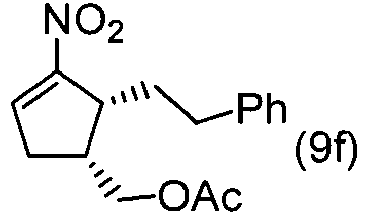
70 94 Ex. 19-2 
65 99 Ex. 20-2 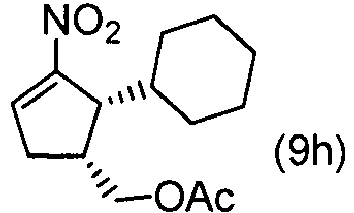
60 97 Ex. 21-2 
71 92 - The results of physical and chemical analyses of the dehydrated product (single isomer of ((1R,2S)-2-(4-bromophenyl)-3-nitrocyclopent-3-en-1-yl)methyl acetate) (9b)
1H NMR (CDCl3) δ 2.04 (3H, s), 2.43 (1H, ddt, J = 2.8, 4.8, 19.2 Hz), 2.67 (1H, m), 2.90 (1H, ddt, J = 2.8, 8.8, 16.4 Hz), 3.79 (1H, dt, J = 7.2, 11.2 Hz), 4.09 (1H, dd, J = 6.8, 11.2 Hz), 4.12-4.16 (1H, m), 4.17 (1H, dd, J = 6.0, 11.2 Hz), 7.05 (2H, dd, J = 2.4, 9.2 Hz), 7.14 (1H, dd, J = 2.8, 4.4 Hz), 7.44 (2H, dd, J = 2.4, 9.2 Hz);
13C NMR (CDCl3) δ 20.7, 32.4, 46,4, 51.0, 65.6, 121.3, 128.5 (2C), 132.1 (2C), 138.0, 139.8, 153.3, 170.8;
IR (neat) v 1739, 1550, 1514, 1488, 1240, 1038, 1010 cm-1;
HRMS (ESI): [M+Na]+ calculated for C14H14NO4BrNa: 362.0004, found: 362.0011;
[α]D 20 +48.2 (c 0.71, CHCl3)
Optical yield: 93%ee (optical yield was such that when analyzed by high performance liquid column chromatography using a Chiralpak IB column (Daicel Corporation) with an elution solvent (hexane : isopropanol = 80:1) at an elution speed of 1.0 mL/min, the major enantiomer had tR = 24.9 min and the minor enantiomer had tR = 28.0 min) ;
TLC: Rf = 0.31 (developing solvent: ethyl acetate : hexane = 1:3) - The results of physical and chemical analyses of the dehydrated product (single isomer of ((1R,2S)-2-(4-methoxyphenyl)-3-nitrocyclopent-3-en-1-yl)methyl acetate) (9c)
1H NMR (CDCl3) δ 2.05 (3H, s), 2.41 (1H, dt, J = 4.8, 19.6 Hz), 2.69 (1H, m), 2.90 (1H, ddt, J = 2.8, 8.8, 16.4 Hz), 3,77 (1H, s), 4.10 (1H, dd, J = 6.4, 11.2 Hz), 4.12-4.15 (1H, m), 4.17 (1H, dd, J = 6.4, 11.2 Hz), 6.85 (2H, dd, J = 2.8, 9.6 Hz), 7.09 (2H, dd, J = 2.8, 9.6 Hz), 7.11 (1H, s);
13C NMR (CDCl3) δ 20.8, 32.4, 46,5, 50.6, 55.2, 65.8, 114.3 (2C), 127.9 (2C), 132.7, 137.3, 153.9, 158. 8, 170.8;
IR (neat) v 1740, 1511, 1361, 1240, 1179, 1034 cm-1;
HRMS (ESI) : [M+Na]+ calculated for C15H17NO5Na: 314.1004, found: 314.0990;
[α]D 20 +85.8 (c 0.67, CHCl3)
Optical yield: 91%ee (optical yield was such that when analyzed by high performance liquid column chromatography using a Chiralpak IB column (Daicel Corporation) with an elution solvent (hexane : isopropanol = 80:1) at an elution speed of 1.0 mL/min, the major enantiomer had tR = 25.5 min and the minor enantiomer had tR = 28.4 min);
TLC: Rf = 0.29 (developing solvent: ethyl acetate : hexane = 1:3) - The results of physical and chemical analyses of the dehydrated product (single isomer of ((1R,2S)-2-(naphthalen-2-yl)-3-nitrocyclopent-3-en-1-yl)methyl acetate) (9d)
1H NMR (CDCl3) δ 20.7 (3H, s), 2.48 (1H, bd, J = 19.2 Hz), 2.74-2.88 (1H, m), 2.98 (1H, ddt, J = 2.8, 8.8, 19.2 Hz), 4.16 (1H, dd, J = 6.8, 11.2 Hz), 4.22 (1H, dd, J = 6.8, 11.2 Hz), 4.36 (1H, bs), 7.21 (1H, s), 7.30 (1H, dd, J = 1.6, 8.4 Hz), 7.41-7.54 (2H, m), 7.54 (1H, s), 7.74-7.89 (3H, m);
13C NMR (CDCl3) δ 20.8, 32.6, 46.4, 51.5, 65.8, 124.8, 125.6, 125. 9, 126.4, 127.7 (2C), 129.0, 132.7, 133.5, 138.0 (2C), 153.6, 170.9; IR (neat) v 1740, 1513, 1359, 1237, 1038, 817.6 cm-1;
HRMS (ESI): [M+Na]+ calculated for C18H17NO4Na: 334.1055, found: 334.1049;
[α]D 18 +889 (c 0.24, CHCl3) ;
Optical yield: 95%ee (optical yield was such that when analyzed by high performance liquid column chromatography using a Chiralpak IB column (Daicel Corporation) with an elution solvent (hexane : isopropanol = 80:1) at an elution speed of 1.0 mL/min, the major enantiomer had tR = 25.9 min and the minor enantiomer had tR = 31.9 min);
TLC: Rf = 0.31 (developing solvent: ethyl acetate : hexane = 1:3) - The results of physical and chemical analyses of the dehydrated product (single isomer of ((1R,2R)-2-(furan-2-yl)-3-nitrocyclopent-3-en-1-yl)methyl acetate) (9e)
1H NMR (CDCl3) δ 20.5 (3H, s), 2.41 (1H, dd, J = 4.4, 14.8 Hz), 2.89 (1H, d, J = 2.0 Hz), 2.80-2.99 (1H, m), 4.08 (1H, dd, J = 4.4, 6.4 Hz), 4.14 (1H, dd, J = 4.4, 6.4 Hz), 4.28 (1H, s), 6.14 (1H, s) 6.28 (1H, s), 7.09 (1H, s), 7.29 (1H, s);
13C NMR (CDCl3) δ 20.8, 32.3, 43.2, 44.6, 65.5, 106.5, 110.5, 138.2, 142.0, 151.4, 152.3, 170.9;
IR (neat) v 1740, 1515, 1361, 1234, 1037, 1011, 737.6 cm-1; HRMS (ESI): [M+Na]+ calculated for C12H13NO5Na: 274.0691, found: 274.0697;
[α]D 21 +43.6 (c 0.46, CHCl3);
Optical yield: 92%ee (optical yield was such that when analyzed by high performance liquid column chromatography using a Chiralpak IB column (Daicel Corporation) with an elution solvent (hexane : isopropanol = 80:1) at an elution speed of 1.0 mL/min, the major enantiomer had tR = 18.2 min and the minor enantiomer had tR = 18.4 min);
TLC: Rf = 0.44 (developing solvent: ethyl acetate : hexane = 1:3) - The results of physical and chemical analyses of the dehydrated product (single isomer of ((1R,2R)-3-nitro-2-phenethylcyclopent-3-en-1-yl)methyl acetate) (9f)
1H NMR (CDCl3) δ 1.72-1.85 (1H, m), 2.04 (3H, s), 2.05-2.18 (2H, m) 2.31 (1H, dd, J = 2.4, 19.6 Hz), 2.57-2.74 (2H, m), 2.81 (1H, ddt, J = 2.8, 8.4, 19.6 Hz), 3.03(1H, dd, J = 2.4, 6.0 Hz), 3.98 (2H, dd, J = 1.6, 7.2 Hz), 6.94 (1H, bs), 7.13-7.21 (3H, m), 7.26 (2H, d, J = 7.6 Hz);
13C NMR (CDCl3) δ 20.8, 20.9, 32.3, 32.8, 33.4, 41.0, 44.9, 66.6, 126.1, 128.3 (2C), 128.5 (2C), 136.8, 141.0, 154.4, 171.0;
IR (neat) v 1741, 1510, 1356, 1236, 1036, 701.0, 439.6 cm-1; HRMS (ESI): [M+Na]+ calculated for C16H19NO4Na: 312.1212, found: 312.1225;
[α]D 20 +7.9 (c 0.95, CHCl3)
Optical yield: 94%ee (optical yield was such that when analyzed by high performance liquid column chromatography using a Chiralpak IB column (Daicel Corporation) with an elution solvent (hexane : isopropanol = 30:1) at an elution speed of 1.0 mL/min, the major enantiomer had tR = 30.7 min and the minor enantiomer had tR = 43.5 min);
TLC: Rf = 0.41 (developing solvent: ethyl acetate : hexane = 1:3) - The results of physical and chemical analyses of the dehydrated product (single isomer of ((1R,5R)-tert-butyl 5-(acetoxymethyl)-2-nitrocyclopent-2-enecarboxylate) (9g)
1H NMR (CDCl3) δ 1. 45 (9H, s), 2.07 (3H, s), 2. 40 (1H, bd, J = 18.4 Hz), 2.80-2.98 (2H, m), 3.75 (1H, bs), 4.13 (2H, dd, J = 5.6, 10.8 Hz), 7.05(1H, s);
13C NMR (CDCl3) δ 20.8, 27.8 (3C), 33.0, 41.4, 51. 8, 65. 6, 82.2, 138.8, 150.3, 170.1, 170.8;
IR (neat) v 1741, 1559, 1521, 1368, 1238, 1154, 1040 cm-1;
HRMS (ESI): [M+Na]+ calculated for C13H19NO6Na: 308.1110, found: 308.1108;
[α]D 21 -15.8 (c 0.30, CHCl3)
Optical yield: 99%ee (optical yield was such that when analyzed by high performance liquid column chromatography using a Chiralpak IB column (Daicel Corporation) with an elution solvent (hexane : isopropanol = 80:1) at an elution speed of 1.0 mL/min, the major enantiomer had tR = 13.3 min and the minor enantiomer had tR = 15.3 min);
TLC: Rf = 0.34 (developing solvent: ethyl acetate : hexane = 1:3) - The results of physical and chemical analyses of the dehydrated product (9h) supported the chemical structure thereof.
- The results of physical and chemical analyses of the dehydrated product (single isomer of ((1R,2R)-2-(2-(4-methoxybenzolyoxy)ethyl)-3-nitrocyclopent-3-e n-1-yl)methyl acetate) (9i)
1H NMR (CDCl3) δ 1.76-1.89 (1H, m), 2.03(3H, s), 2.04-2.10(1H, m), 2.27 (1H, dd, J = 2.4, 18.8 Hz), 2.59-2.68 (1H, m), 2.73 (1H, ddt, J = 2.8, 8.4, 19.2 Hz), 3.10 (1H, m), 3.51 (2H, t, J = 6.0 Hz), 3.79 (3H, s), 3.98 (2H, d, J = 6.8 Hz), 4.38 (2H, s), 6.86 (2H, dd, J = 3.2, 8.8 Hz) 6.90 (1H, s), 7.23 (2H, dd, J = 3.2, 8.8 Hz);
13C NMR (CDCl3) δ 19.2, 30.1, 30.7, 39.7, 42.6, 53.7, 65.8, 66.1, 71.1, 126.1, 128.3 (2C), 128.5 (2C), 136.8, 141.0, 154.4, 171.0; IR (neat) v 1740, 1613, 1513, 1360, 1246, 1094, 1034 cm-1;
HRMS (ESI): [M+Na]+ calculated for C18H23NO6Na: 372.1423, found: 372.1433;
[α]D 20 -10.7 (c 0.26, CHCl3)
Optical yield: 92%ee (optical yield was such that when analyzed by high performance liquid column chromatography using a Chiralpak IB column (Daicel Corporation) with an elution solvent (hexane : isopropanol = 80:1) at an elution speed of 1.0 mL/min, the major enantiomer had tR = 29.7 min and the minor enantiomer had tR = 33.9 min);
TLC: Rf = 0.27 (developing solvent: ethyl acetate : hexane = 1:3) - The compounds obtained in Examples 1 to 21 are useful intermediates to derive PGEs and PGFs.
- As shown in the following chemical reaction formula (XI), the cyclization step and then the homologation step of the obtained intermediate without purification were carried out.

- First, under an argon atmosphere, to a solution of methyl 9-nitro-8-nonenoate (3j) (1.72 g, 8 mmol) as the E-α,β-unsaturated nitroalkene compound and succinaldehyde (2a) (1.03 g, 12 mmol) as the 1,4-butanedione compound in acetonitrile (8 mL) which corresponded to the non-oxygen atom-containing water-soluble organic solvent were added (S)-2-(diphenyl((trimethylsilyl)oxy)methyl)pyrrolidine (1a) (260.4 mg, 0.8 mmol) as the proline derivative and p-nitrophenol (111. 4 mg, 0.8 mmol) as the acid at a room temperature and the mixture was stirred at the same temperature for 16 hours. The main products were visualized as a diastereomer mixture by TLC with the spots of the aldehyde reaction products (7j) at the Rf values = 0.32 to 0.43 (developing solvent: ethyl acetate : hexane = 1:1). After confirming the elimination of the spot of the α,β-unsaturated nitroalkene compound (3j) by TLC, the reaction solution was cooled to 0°C, added with diisopropylethylamine (1.5 ml, 8.8 mmol) and stirred at 0°C for 30 minutes to obtain the aldehyde (7j)-containing reaction solution without purification.
- Meanwhile, under an argon atmosphere, to a solution of a phosphonate, i.e. dimethyl (2-oxoheptyl)phosphonate (10) (3.92 g, 17.6 mmol) in THF (20 mL) was added lithium chloride (746 mg, 17.6 mmol) at a room temperature and the solution was stirred at the same temperature until complete dissolution of lithium chloride. After confirming that lithium chloride was dissolved completely, diisopropylethylamine (3 ml, 17.6 mmol) was added at a room temperature and the solution was stirred at the same temperature for 1 hour to prepare a Horner-Wadsworth-Emmons reagent (HWE reagent) which was used without purification.
- To the aldehyde (7j)-containing reaction solution was then added the prepared HWE reagent at 0°C, and the mixture was brought to a room temperature and stirred for 4 hours. A saturated ammonium chloride aqueous solution was added to terminate the reaction and the organic matter was extracted with ethyl acetate 3 times. The combined organic layer was washed with a saturated aqueous sodium chloride solution and dried with magnesium sulfate. Low-boiling organic compounds such as solvents were distilled off under reduced pressure prior to purification by silica gel column chromatography (elution solvent: ethyl acetate : hexane = 1:5 → 1:3) to obtain a desired enone (11) (2.55 g, 6.4 mmol) as a mixture of four diastereomers (Rf values by TLC =0.29, 0.35 (developing solvent: ethyl acetate : hexane = 1:2)) with the yield of 80%.
- The results of physical and chemical analyses of the diastereomer mixture by 1H NMR, 13C NMR, IR, HRMS (ESI) and Rf measurement by TLC are shown hereinbelow. The results of physical and chemical analyses support the chemical structure of the enone (11).
The results of physical and chemical analyses of the mixture of four diastereomers of the enone (methyl 7-((1R,5S)-3-hydroxy-2-nitro-5-((E)-3-oxooct-1-enyl)cyclopenty l)heptanoate) (11)
1H NMR (CDCl3) δ 0.86 (3H, t, J = 7.6 Hz), 1.20-1.35 (10H, m), 1.48-1.64 (6H, m), 1.92-2.02 (1H, m), 2.02-2.10 (1H, m), 2.25 (2H, t, J=7.6Hz), 2.31-2.42 (1H, m), 2.51 (2H, t, J = 7.6Hz), 2.66-2.78 (1H, m), 3.62 (3H, s), 4.51 (1H, dd, J = 3.6, 7.6 Hz), 4.59-4.66 (1H, m), 6.11 (1H, d, J = 16.0 Hz), 6.56-6.64 (0.16H, m), 6.67 (0.6H, dd, J = 8.8, 16.0 Hz), 6.72-6.84 (0.24H, m)
13C NMR (CDCl3) δ 13.8, 22.4, 23.8, 24.7, 26.8, 28.7, 29.1, 31.4, 32.5, 33.9, 39.4, 40.6, 45.2, 49.4, 51.4, 76.1, 97.6, 130.7, 147.5, 174.2, 200.5;
IR (neat) v 3455, 2931, 2861, 1735, 1666, 1627, 1627, 1550, 1442, 1373, 1249, 1172, 1110, 1064, 987.3, 763.6 cm-1;
HRMS (ESI): [M+Na]+ calculated for C21H35NO6Na: 420.2362, found: 420.2355
TLC: Rf = 0.29, 0.35 (developing solvent: ethyl acetate : hexane = 1:2) - As shown in the following chemical reaction formula (X), the mixture of four diastereomers obtained in Example 22 was subjected to the enone asymmetrical reduction step and the obtained reduced substance without purification was subjected to the dehydration step.

- First, under an argon atmosphere, to a solution of the enone (11) as the mixture of four diastereomers (60 mg, 0.150 mmol) in THF (395 µL) was added (-)-DIP-Chloride ((-)-B-chlorodiisopinocampheylborane; 1.7 M solution in THF, 266 µL, 0.45 mmol) at -20°C and the mixture was stirred at the same temperature for 8 hours. The main products were visualized by TLC at Rf = 0.26, 0.30 (developing solvent: hexane : ethyl acetate = 1:1). After confirming the elimination of the enone (11) by TLC, methanol was added prior to raising the temperature to 0°C. The solution was then added with water, stirred at the same temperature for 30 minutes and added with 1 N HCl prior to the extraction of the organic matter with ethyl acetate for 3 times. The combined organic layer was washed with a saturated aqueous sodium chloride solution and dried with magnesium sulfate. Low-boiling organic compounds such as solvents were distilled off under reduced pressure prior to purification by silica gel column chromatography (elution solvent: ethyl acetate : hexane = 1:10 → 1:1) to obtain a desired allylalcohol (12) (42.6 mg, 0.107 mmol) as a mixture of four diastereomers (Rf by TLC =0.26, 0.30 (ethyl acetate : hexane =1:1)) with the yield of 71%. The diastereo ratio at this time, although it was determined after the following dehydration reaction, was 93.5:6.5.
- The results of physical and chemical analyses of the diastereomer mixture by 1H NMR, 13C NMR, IR, HRMS (ESI) and Rf measurement by TLC are shown hereinbelow. The results of physical and chemical analyses support the chemical structure of the allylalcohol (12).
The results of physical and chemical analyses of the mixture of four diastereomers of the allylalcohol (methyl 7-((1R,5S)-3-hydroxy-5-((S,E)-3-hydroxyoct-1-enyl)-2-nitrocycl opentyl)heptanoate)
1H NMR (CDCl3) δ 0.88 (3H, t, J = 6.8 Hz), 1.20-1.35 (12H, m), 1.41-1.52 (4H, m), 1.52-1.63 (4H, m), 1.86-1.95 (1H, m), 1.95-2.04 (1H, m), 2.21-2.31 (1H, m), 2.28 (2H, t, J = 7.2 Hz), 2.48-2.60 (1H, m), 3.65 (3H, s), 4.03-4.11 (1H, m), 4.48 (1H, dd, J = 3.6, 8.0 Hz), 4.58-4.66 (1H, m), 5.45-5.62 (2H, m)
13C NMR (CDCl3) δ 13.9, 22.5, 24.6, 25.0, 26.3, 28.7, 29.0, 31.7, 32.1, 33.9, 37.3, 39.9, 45.0, 49.6, 51.4, 72.4, 76.2, 97.9, 132.0, 134.8, 174.3;
IR (neat) v 3440, 2931, 2861, 2360, 1735, 1550, 1442, 1373, 1257, 1172, 1110, 1056, 971.9, 863.9, 763.6 cm-1;
HRMS (ESI): [M+Na]+ calculated for C21H37NO6Na: 422.2519, found: 422.2511
Rf = 0.26, 0.30 (developing solvent: ethyl acetate : hexane = 1:1) - Next, under an argon atmosphere, to a solution of the obtained allylalcohol (12) (339 mg, 0.845 mmol) in 1,2-dichloroethane (1.7 ml) was added acidic activated alumina (Sigma-Aldrich, Catalogue No. 199966, 282 mg) prior to raising the temperature to 60°C and stirring at the same temperature. After 12 and 24 hours, 282 mg of acidic activated alumina was added, respectively. The main products were visualized by TLC at Rf = 0.62 (developing solvent: hexane : ethyl acetate = 1:1). After 48 hours and confirming the elimination of the allylalcohol (12) by TLC, acidic activated alumina was removed by filtration through Celite. Low-boiling organic compounds such as solvents were distilled off under reduced pressure to obtain a desired nitroalkene (13) as a diastereomer mixture (290 mg, 0.76 mmol) with the yield of 90%. At this time, the configuration between the side chains corresponding to the α chain and the ω chain from the cyclopentane ring was cis : trans = 6.7:1.
- The results of physical and chemical analyses of the main components obtained by purification of the mixture by 1H NMR, 13C NMR, IR, HRMS (ESI), optical purity and Rf measurement by TLC are shown hereinbelow. The results of physical and chemical analyses support the chemical structure of the nitroalkene (13). The results of physical and chemical analyses of the nitroalkene (methyl
7-((1R,5S)-5-((S,E)-3-hydroxyoct-1-enyl)-2-nitrocyclopent-2-en yl)heptanoate)
1H NMR (CDCl3) δ 0.89 (3H, t, J = 6.8 Hz), 1.20-1.40 (10H, m), 1.42-1.66 (8H, m), 1.67-1.79 (1H, m), 2.26-2.38 (1H, m), 2.29 (2H, t, J = 7.6 Hz), 2.75-2.88 (2H, m), 2.96 (1H, bs), 3.66 (3H, s), 4.01-4.10 (1H, m), 5.51 (1H, dd, J = 6.8, 15.6 Hz), 5.67 (1H, dd, J = 6.8, 15.6 Hz), 6.91 (1H, s);
13C NMR (CDCl3) δ 13.9, 22.5, 24.7, 25.0, 26.0, 28.9, 29.3, 31.3, 31.7, 33.9, 35.8, 37.5, 45.1, 48.4, 51.4, 72.5, 133.1, 133.4, 136.6, 154.7, 174.2;
IR (neat) v 2930, 2857, 1739, 1636, 1550, 1512, 1465, 1-456, 1436, 1354, 1256, 1200, 1172, 972.9, 782.9, 728.9 cm-1;
HRMS (ESI): [M+Na]+ calculated for C21H35NO5Na: 404.2413, found: 404.2423;
Optical yield: 94%ee (optical yield was such that when analyzed by high performance liquid column chromatography using a Chiralpak IC column (Daicel Corporation) with an elution solvent (hexane : isopropanol = 10:1) at an elution speed of 1.0 mL/min, the major enantiomer had tR = 19.3 min and the minor enantiomer had tR = 31.1 min; based on the area ratio, the enantiomeric excess was 94%ee);
Rf = 0.62 (developing solvent: ethyl acetate : hexane = 1:1) - The compounds obtained in Examples 22 and 23 are useful intermediates to derive PGEs and PGFs, particularly PGE1 according to the method described above or well known methods. The compounds obtained in Examples 22 and 23 have the inversed configuration of the group corresponding to the ω side chain compared to the natural PGE1. Alternatively to Example 22, a proline derivative having an inverted configuration may be optionally used in order to invert the configuration of the group corresponding to the α side chain as shown in the chemical reaction formula (IX).
- The method for producing a five-membered ring-containing compound and the five-membered ring-containing compounds obtained thereby according to the present invention can be used as synthetic intermediates of various physiologically active substances typified by PGs such as PGEs and PGFs.
Claims (16)
- A method for producing a five-membered ring-containing compound represented by the following chemical formula (II):


represents the α-configuration and

represents the β-configuration,
the method comprising a cyclization step of condensing and cyclizing an α,β-unsaturated nitro compound represented by the following chemical formula (I):
with a 1,4-butanedione compound, in the presence of a catalyst formed by a compound having a pyrrolidine ring and an optically active α-carbon relative to the nitrogen on the ring, in a water-insoluble organic solvent and/or a non-oxygen atom-containing water-soluble organic solvent. - The method for producing a five-membered ring-containing compound according to claim 1, further comprising, after the cyclization step, a reduction step of reducing, with a reducing agent, the A1 that is the aldehyde group to the hydroxymethyl group.
- The method for producing a five-membered ring-containing compound according to claim 1 or 2, wherein the catalyst is a proline derivative represented by the following chemical formula (III):

- The method for producing a five-membered ring-containing compound according to claim 3, wherein the proline derivative represented by the chemical formula (III) corresponds to:


- The method for producing a five-membered ring-containing compound according to claim 3, wherein the proline derivative represented by the chemical formula (III) corresponds to:


- The method for producing a five-membered ring-containing compound according to any of claims 1 to 5, wherein the water-insoluble organic solvent is at least one selected from a halogen-containing organic solvent, an aromatic organic solvent, a hydrocarbon organic solvent and an acyclic ether organic solvent, and the non-oxygen atom-containing water-soluble organic solvent is a nitrile-substituted hydrocarbon organic solvent.
- The method for producing a five-membered ring-containing compound according to claim 6, wherein the water-insoluble organic solvent is the halogen-containing organic solvent selected from dichloromethane, dichloroethane and chloroform; the aromatic organic solvent selected from benzene, toluene and xylene; the hydrocarbon organic solvent selected from pentane, hexane and heptane; and/or the acyclic ether organic solvent that is diethyl ether, and the non-oxygen atom-containing water-soluble organic solvent is the nitrile-substituted hydrocarbon organic solvent that is acetonitrile.
- The method for producing a five-membered ring-containing compound according to any of claims 1 to 7, wherein the cyclization step is performed in the presence of both the catalyst and an acid.
- The method for producing a five-membered ring-containing compound according to claim 8, wherein the acid has a pKa in water at 25°C of 4 to 10.
- The method for producing a five-membered ring-containing compound according to claim 8 or 9, wherein the acid is at least one free acid selected from the group consisting of a fatty acid derivative containing 1 to 3 carbon atoms, an aromatic carboxylic acid derivative, a hydroxyaromatic derivative and a perfluoroalkyl group-containing alcohol.
- The method for producing a five-membered ring-containing compound according to any of claims 1 to 10, wherein the substituent in R1 of the chemical formula (I) is at least one selected from the group consisting of a linear or branched alkoxy group containing 1 to 4 carbon atoms, an ester group and a halogen atom.
- The method for producing a five-membered ring-containing compound according to any of claims 1 to 11, wherein the catalyst is (S)-2-(diphenyl((trimethylsilyl)oxy)methyl)pyrrolidine or (R)-2-(diphenyl((trimethylsilyl)oxy)methyl)pyrrolidine.
- The method for producing a five-membered ring-containing compound according to claim 2, wherein the reducing agent is at least one selected from the group consisting of NaBH4, NaBH3CN, B2H6, BH3·Me2S, LiAlH4, NaB(O2CCH3)3H and LiBH(C2H5)3.
- A five-membered ring-containing compound represented by the following chemical formula (IV):

represents the α-configuration and
represents the β-configuration. - The five-membered ring-containing compound according to claim 14, wherein in the chemical formula (IV), the R7 may contain a substituent and is selected from a cyclohexyl group, a phenyl group, a naphthyl group, a furyl group, a phenethyl group, a benzyloxy ethyl group and an alkyloxycarbonyl group.
- The five-membered ring-containing compound according to claim 14 or 15, wherein in the chemical formula (IV), the R7 is any of those represented by the following chemical formula (V):

Applications Claiming Priority (2)
| Application Number | Priority Date | Filing Date | Title |
|---|---|---|---|
| JP2011100636 | 2011-04-28 | ||
| PCT/JP2012/061393 WO2012147925A1 (en) | 2011-04-28 | 2012-04-27 | Method for producing five-membered ring-containing compound |
Publications (3)
| Publication Number | Publication Date |
|---|---|
| EP2703381A1 true EP2703381A1 (en) | 2014-03-05 |
| EP2703381A4 EP2703381A4 (en) | 2014-10-08 |
| EP2703381B1 EP2703381B1 (en) | 2015-10-21 |
Family
ID=47072437
Family Applications (1)
| Application Number | Title | Priority Date | Filing Date |
|---|---|---|---|
| EP12777023.8A Not-in-force EP2703381B1 (en) | 2011-04-28 | 2012-04-27 | Method for producing five-membered ring-containing compound |
Country Status (5)
| Country | Link |
|---|---|
| US (1) | US8716500B2 (en) |
| EP (1) | EP2703381B1 (en) |
| JP (1) | JP6003885B2 (en) |
| CN (1) | CN103547558B (en) |
| WO (1) | WO2012147925A1 (en) |
Families Citing this family (3)
| Publication number | Priority date | Publication date | Assignee | Title |
|---|---|---|---|---|
| CN110475763B (en) * | 2017-03-31 | 2023-01-20 | 国际香料和香精公司 | Chemical method for preparing dehydro-hilum warbler |
| WO2021070658A1 (en) * | 2019-10-11 | 2021-04-15 | 国立大学法人東北大学 | Method for producing cyclopentane compound, method for producing lactone compound, method for producing diol compound, and compound |
| CN117924061B (en) * | 2024-01-17 | 2026-03-20 | 北京海步医药科技有限公司 | A method for resolving 3-alkylbicyclo[3.2.0]hept-3-en-6-one |
Family Cites Families (3)
| Publication number | Priority date | Publication date | Assignee | Title |
|---|---|---|---|---|
| US2920081A (en) | 1957-05-08 | 1960-01-05 | Union Carbide Corp | Production of 2, 5-dialkoxy-tetrahydrofuran |
| JP5234901B2 (en) * | 2007-10-04 | 2013-07-10 | 学校法人東京理科大学 | Method for producing asymmetric catalyst Michael reaction product |
| US20100298576A1 (en) * | 2009-05-19 | 2010-11-25 | Guofu Zhong | Asymmetric cyclization processes using unsaturated nitro compounds |
-
2012
- 2012-04-27 EP EP12777023.8A patent/EP2703381B1/en not_active Not-in-force
- 2012-04-27 US US14/113,611 patent/US8716500B2/en active Active
- 2012-04-27 JP JP2013512471A patent/JP6003885B2/en not_active Expired - Fee Related
- 2012-04-27 WO PCT/JP2012/061393 patent/WO2012147925A1/en not_active Ceased
- 2012-04-27 CN CN201280020527.XA patent/CN103547558B/en not_active Expired - Fee Related
Non-Patent Citations (4)
| Title |
|---|
| B-C HONG ET. AL.: "Organocatalyzed Michael-Henry reactions: enantioselective synthesis of cyclopentanecarbaldehydes via the dienamine organocatalysis of a succinaldehyde surrogate.", CHEMICAL COMMUNICATIONS, vol. 48, no. 63, 14 August 2012 (2012-08-14), pages 7790-7792, XP002728702, * |
| BIN TAN ET. AL.: "Facile Domino access to chiral Bicyclo[3.2.1]octanes and Discovery of a New Catalytic Activation Mode", ORGANIC LETTERS, vol. 12, no. 12, 14 May 2010 (2010-05-14), pages 2682-2685, XP002728701, DOI: 10.1021/o/1007795 * |
| See also references of WO2012147925A1 * |
| T. MANDAL ET. AL.: "Synthesis of prolinal dithioacetals as catalysts for the highly stereoselective Michael addition of ketones and aldehydes to beta-nitrostyrenes.", TETRAHEDRON LETTERS, vol. 48, no. 33, 13 August 2007 (2007-08-13), pages 5803-5806, XP025970431, DOI: 10.1016/j.tetlet.2007.06.085 * |
Also Published As
| Publication number | Publication date |
|---|---|
| EP2703381B1 (en) | 2015-10-21 |
| JP6003885B2 (en) | 2016-10-05 |
| CN103547558A (en) | 2014-01-29 |
| US8716500B2 (en) | 2014-05-06 |
| WO2012147925A1 (en) | 2012-11-01 |
| US20140051874A1 (en) | 2014-02-20 |
| JPWO2012147925A1 (en) | 2014-07-28 |
| CN103547558B (en) | 2016-03-16 |
| EP2703381A4 (en) | 2014-10-08 |
Similar Documents
| Publication | Publication Date | Title |
|---|---|---|
| CA2459168C (en) | Method for the preparation of hexahydro-furo[2,3-b]furan-3-ol | |
| TW201002658A (en) | Process for the preparation of prostaglandin analogues and intermediates thereof | |
| JP2022036968A (en) | Production of 3-hydroxy-3,6-dimethylhexahydrobenzofuran-2-one and its derivatives | |
| EP1078921B1 (en) | Novel intermediates and processes for the preparation of optically active octanoic acid derivatives | |
| EP2703381B1 (en) | Method for producing five-membered ring-containing compound | |
| KR100313668B1 (en) | A process for preparing (R)-4-cyano-3-hydroxybutyric acid ester | |
| US6090971A (en) | Resolution process for cyclohexylphenyl glycolic acid | |
| Kim et al. | Stereoselective homocoupling of enolate anion promoted by hypervalent iodine compound | |
| AU766066B2 (en) | Synthesis of optically active cyclohexylphenylglycolic acid and its esters | |
| Seto et al. | Preparation of (±)-2-(2, 3-2H2) jasmonic acid and its methyl ester, methyl (±)-2-(2, 3-2H2) jasmonate | |
| US5380849A (en) | Process for optically pure decahydroisoqiunolines | |
| KR20090008725A (en) | Method for efficiently preparing 3-hydroxy pyrrolidine and derivatives thereof | |
| JP3333184B2 (en) | Process for producing (S) -3,4-epoxybutyrate having optical activity | |
| Elsevier et al. | Stereochemistry of the HCuX2-induced formation of 1-halo-3-phenylpropadienes from 1-phenyl-2-propyn-1-ol and some of its derivatives | |
| JP7609438B2 (en) | Method for producing a cyclopentane compound, a method for producing a lactone compound, a method for producing a diol compound, and a compound | |
| US6355822B1 (en) | Process for selective reduction | |
| Kato et al. | Preparation of Optically Active Tricyclic 1, 4-Dioxepin-5-one Derivatives and Its Application to Asymmetric Aikylation | |
| EP0353917A1 (en) | Precursor of prostaglandin and production thereof | |
| JP3408835B2 (en) | Method for producing E-type prostaglandins | |
| JPH04316538A (en) | Production of optically active 3,5-anti-dihydroxycarboxylic acid ester derivative | |
| JP2002080444A (en) | New optically active compound and method for producing the same | |
| MXPA02007077A (en) | Method for the enantioselective preparation of 3,3 diphenyl 2,3 epoxy propionic acid esters. | |
| León | Development of a Catalytic Enantioselective Assembly of Complex Molecules Containing Embedded Quaternary Stereogenic Centers From Simple Phenol Derivatives and its application to the synthesis of natural products | |
| WO1991009012A1 (en) | Processes for preparing prostaglandins | |
| JPH04316537A (en) | Optically active 3,5-anti-dihydroxycarboxylic acid ester derivative |
Legal Events
| Date | Code | Title | Description |
|---|---|---|---|
| PUAI | Public reference made under article 153(3) epc to a published international application that has entered the european phase |
Free format text: ORIGINAL CODE: 0009012 |
|
| 17P | Request for examination filed |
Effective date: 20131024 |
|
| AK | Designated contracting states |
Kind code of ref document: A1 Designated state(s): AL AT BE BG CH CY CZ DE DK EE ES FI FR GB GR HR HU IE IS IT LI LT LU LV MC MK MT NL NO PL PT RO RS SE SI SK SM TR |
|
| DAX | Request for extension of the european patent (deleted) | ||
| RIC1 | Information provided on ipc code assigned before grant |
Ipc: C07C 205/18 20060101AFI20140825BHEP Ipc: C07B 53/00 20060101ALI20140825BHEP Ipc: C07D 307/42 20060101ALI20140825BHEP Ipc: C07B 61/00 20060101ALI20140825BHEP Ipc: C07C 201/12 20060101ALI20140825BHEP Ipc: C07C 205/44 20060101ALI20140825BHEP |
|
| A4 | Supplementary search report drawn up and despatched |
Effective date: 20140905 |
|
| GRAP | Despatch of communication of intention to grant a patent |
Free format text: ORIGINAL CODE: EPIDOSNIGR1 |
|
| INTG | Intention to grant announced |
Effective date: 20150505 |
|
| GRAS | Grant fee paid |
Free format text: ORIGINAL CODE: EPIDOSNIGR3 |
|
| GRAA | (expected) grant |
Free format text: ORIGINAL CODE: 0009210 |
|
| AK | Designated contracting states |
Kind code of ref document: B1 Designated state(s): AL AT BE BG CH CY CZ DE DK EE ES FI FR GB GR HR HU IE IS IT LI LT LU LV MC MK MT NL NO PL PT RO RS SE SI SK SM TR |
|
| REG | Reference to a national code |
Ref country code: GB Ref legal event code: FG4D Ref country code: NL Ref legal event code: MP Effective date: 20151021 |
|
| REG | Reference to a national code |
Ref country code: CH Ref legal event code: EP |
|
| REG | Reference to a national code |
Ref country code: AT Ref legal event code: REF Ref document number: 756494 Country of ref document: AT Kind code of ref document: T Effective date: 20151115 |
|
| REG | Reference to a national code |
Ref country code: IE Ref legal event code: FG4D |
|
| REG | Reference to a national code |
Ref country code: DE Ref legal event code: R096 Ref document number: 602012011870 Country of ref document: DE |
|
| REG | Reference to a national code |
Ref country code: LT Ref legal event code: MG4D |
|
| REG | Reference to a national code |
Ref country code: FR Ref legal event code: PLFP Year of fee payment: 5 |
|
| REG | Reference to a national code |
Ref country code: AT Ref legal event code: MK05 Ref document number: 756494 Country of ref document: AT Kind code of ref document: T Effective date: 20151021 |
|
| PG25 | Lapsed in a contracting state [announced via postgrant information from national office to epo] |
Ref country code: ES Free format text: LAPSE BECAUSE OF FAILURE TO SUBMIT A TRANSLATION OF THE DESCRIPTION OR TO PAY THE FEE WITHIN THE PRESCRIBED TIME-LIMIT Effective date: 20151021 Ref country code: LT Free format text: LAPSE BECAUSE OF FAILURE TO SUBMIT A TRANSLATION OF THE DESCRIPTION OR TO PAY THE FEE WITHIN THE PRESCRIBED TIME-LIMIT Effective date: 20151021 Ref country code: HR Free format text: LAPSE BECAUSE OF FAILURE TO SUBMIT A TRANSLATION OF THE DESCRIPTION OR TO PAY THE FEE WITHIN THE PRESCRIBED TIME-LIMIT Effective date: 20151021 Ref country code: NO Free format text: LAPSE BECAUSE OF FAILURE TO SUBMIT A TRANSLATION OF THE DESCRIPTION OR TO PAY THE FEE WITHIN THE PRESCRIBED TIME-LIMIT Effective date: 20160121 Ref country code: NL Free format text: LAPSE BECAUSE OF FAILURE TO SUBMIT A TRANSLATION OF THE DESCRIPTION OR TO PAY THE FEE WITHIN THE PRESCRIBED TIME-LIMIT Effective date: 20151021 Ref country code: IT Free format text: LAPSE BECAUSE OF FAILURE TO SUBMIT A TRANSLATION OF THE DESCRIPTION OR TO PAY THE FEE WITHIN THE PRESCRIBED TIME-LIMIT Effective date: 20151021 Ref country code: IS Free format text: LAPSE BECAUSE OF FAILURE TO SUBMIT A TRANSLATION OF THE DESCRIPTION OR TO PAY THE FEE WITHIN THE PRESCRIBED TIME-LIMIT Effective date: 20160221 |
|
| PG25 | Lapsed in a contracting state [announced via postgrant information from national office to epo] |
Ref country code: PL Free format text: LAPSE BECAUSE OF FAILURE TO SUBMIT A TRANSLATION OF THE DESCRIPTION OR TO PAY THE FEE WITHIN THE PRESCRIBED TIME-LIMIT Effective date: 20151021 Ref country code: RS Free format text: LAPSE BECAUSE OF FAILURE TO SUBMIT A TRANSLATION OF THE DESCRIPTION OR TO PAY THE FEE WITHIN THE PRESCRIBED TIME-LIMIT Effective date: 20151021 Ref country code: GR Free format text: LAPSE BECAUSE OF FAILURE TO SUBMIT A TRANSLATION OF THE DESCRIPTION OR TO PAY THE FEE WITHIN THE PRESCRIBED TIME-LIMIT Effective date: 20160122 Ref country code: SE Free format text: LAPSE BECAUSE OF FAILURE TO SUBMIT A TRANSLATION OF THE DESCRIPTION OR TO PAY THE FEE WITHIN THE PRESCRIBED TIME-LIMIT Effective date: 20151021 Ref country code: PT Free format text: LAPSE BECAUSE OF FAILURE TO SUBMIT A TRANSLATION OF THE DESCRIPTION OR TO PAY THE FEE WITHIN THE PRESCRIBED TIME-LIMIT Effective date: 20160222 Ref country code: LV Free format text: LAPSE BECAUSE OF FAILURE TO SUBMIT A TRANSLATION OF THE DESCRIPTION OR TO PAY THE FEE WITHIN THE PRESCRIBED TIME-LIMIT Effective date: 20151021 Ref country code: AT Free format text: LAPSE BECAUSE OF FAILURE TO SUBMIT A TRANSLATION OF THE DESCRIPTION OR TO PAY THE FEE WITHIN THE PRESCRIBED TIME-LIMIT Effective date: 20151021 Ref country code: FI Free format text: LAPSE BECAUSE OF FAILURE TO SUBMIT A TRANSLATION OF THE DESCRIPTION OR TO PAY THE FEE WITHIN THE PRESCRIBED TIME-LIMIT Effective date: 20151021 |
|
| REG | Reference to a national code |
Ref country code: DE Ref legal event code: R097 Ref document number: 602012011870 Country of ref document: DE |
|
| PG25 | Lapsed in a contracting state [announced via postgrant information from national office to epo] |
Ref country code: CZ Free format text: LAPSE BECAUSE OF FAILURE TO SUBMIT A TRANSLATION OF THE DESCRIPTION OR TO PAY THE FEE WITHIN THE PRESCRIBED TIME-LIMIT Effective date: 20151021 |
|
| PLBE | No opposition filed within time limit |
Free format text: ORIGINAL CODE: 0009261 |
|
| STAA | Information on the status of an ep patent application or granted ep patent |
Free format text: STATUS: NO OPPOSITION FILED WITHIN TIME LIMIT |
|
| PG25 | Lapsed in a contracting state [announced via postgrant information from national office to epo] |
Ref country code: SM Free format text: LAPSE BECAUSE OF FAILURE TO SUBMIT A TRANSLATION OF THE DESCRIPTION OR TO PAY THE FEE WITHIN THE PRESCRIBED TIME-LIMIT Effective date: 20151021 Ref country code: SK Free format text: LAPSE BECAUSE OF FAILURE TO SUBMIT A TRANSLATION OF THE DESCRIPTION OR TO PAY THE FEE WITHIN THE PRESCRIBED TIME-LIMIT Effective date: 20151021 Ref country code: BE Free format text: LAPSE BECAUSE OF NON-PAYMENT OF DUE FEES Effective date: 20160430 Ref country code: RO Free format text: LAPSE BECAUSE OF FAILURE TO SUBMIT A TRANSLATION OF THE DESCRIPTION OR TO PAY THE FEE WITHIN THE PRESCRIBED TIME-LIMIT Effective date: 20151021 Ref country code: DK Free format text: LAPSE BECAUSE OF FAILURE TO SUBMIT A TRANSLATION OF THE DESCRIPTION OR TO PAY THE FEE WITHIN THE PRESCRIBED TIME-LIMIT Effective date: 20151021 Ref country code: EE Free format text: LAPSE BECAUSE OF FAILURE TO SUBMIT A TRANSLATION OF THE DESCRIPTION OR TO PAY THE FEE WITHIN THE PRESCRIBED TIME-LIMIT Effective date: 20151021 |
|
| 26N | No opposition filed |
Effective date: 20160722 |
|
| PG25 | Lapsed in a contracting state [announced via postgrant information from national office to epo] |
Ref country code: SI Free format text: LAPSE BECAUSE OF FAILURE TO SUBMIT A TRANSLATION OF THE DESCRIPTION OR TO PAY THE FEE WITHIN THE PRESCRIBED TIME-LIMIT Effective date: 20151021 |
|
| REG | Reference to a national code |
Ref country code: CH Ref legal event code: PL |
|
| PG25 | Lapsed in a contracting state [announced via postgrant information from national office to epo] |
Ref country code: BE Free format text: LAPSE BECAUSE OF FAILURE TO SUBMIT A TRANSLATION OF THE DESCRIPTION OR TO PAY THE FEE WITHIN THE PRESCRIBED TIME-LIMIT Effective date: 20151021 Ref country code: LU Free format text: LAPSE BECAUSE OF FAILURE TO SUBMIT A TRANSLATION OF THE DESCRIPTION OR TO PAY THE FEE WITHIN THE PRESCRIBED TIME-LIMIT Effective date: 20160427 |
|
| REG | Reference to a national code |
Ref country code: IE Ref legal event code: MM4A |
|
| PG25 | Lapsed in a contracting state [announced via postgrant information from national office to epo] |
Ref country code: LI Free format text: LAPSE BECAUSE OF NON-PAYMENT OF DUE FEES Effective date: 20160430 Ref country code: CH Free format text: LAPSE BECAUSE OF NON-PAYMENT OF DUE FEES Effective date: 20160430 |
|
| REG | Reference to a national code |
Ref country code: FR Ref legal event code: PLFP Year of fee payment: 6 |
|
| PG25 | Lapsed in a contracting state [announced via postgrant information from national office to epo] |
Ref country code: IE Free format text: LAPSE BECAUSE OF NON-PAYMENT OF DUE FEES Effective date: 20160427 |
|
| REG | Reference to a national code |
Ref country code: FR Ref legal event code: PLFP Year of fee payment: 7 |
|
| PG25 | Lapsed in a contracting state [announced via postgrant information from national office to epo] |
Ref country code: CY Free format text: LAPSE BECAUSE OF FAILURE TO SUBMIT A TRANSLATION OF THE DESCRIPTION OR TO PAY THE FEE WITHIN THE PRESCRIBED TIME-LIMIT Effective date: 20151021 Ref country code: HU Free format text: LAPSE BECAUSE OF FAILURE TO SUBMIT A TRANSLATION OF THE DESCRIPTION OR TO PAY THE FEE WITHIN THE PRESCRIBED TIME-LIMIT; INVALID AB INITIO Effective date: 20120427 |
|
| PG25 | Lapsed in a contracting state [announced via postgrant information from national office to epo] |
Ref country code: MT Free format text: LAPSE BECAUSE OF NON-PAYMENT OF DUE FEES Effective date: 20160430 Ref country code: TR Free format text: LAPSE BECAUSE OF FAILURE TO SUBMIT A TRANSLATION OF THE DESCRIPTION OR TO PAY THE FEE WITHIN THE PRESCRIBED TIME-LIMIT Effective date: 20151021 Ref country code: MK Free format text: LAPSE BECAUSE OF FAILURE TO SUBMIT A TRANSLATION OF THE DESCRIPTION OR TO PAY THE FEE WITHIN THE PRESCRIBED TIME-LIMIT Effective date: 20151021 Ref country code: MC Free format text: LAPSE BECAUSE OF FAILURE TO SUBMIT A TRANSLATION OF THE DESCRIPTION OR TO PAY THE FEE WITHIN THE PRESCRIBED TIME-LIMIT Effective date: 20151021 |
|
| PG25 | Lapsed in a contracting state [announced via postgrant information from national office to epo] |
Ref country code: BG Free format text: LAPSE BECAUSE OF FAILURE TO SUBMIT A TRANSLATION OF THE DESCRIPTION OR TO PAY THE FEE WITHIN THE PRESCRIBED TIME-LIMIT Effective date: 20151021 |
|
| PG25 | Lapsed in a contracting state [announced via postgrant information from national office to epo] |
Ref country code: AL Free format text: LAPSE BECAUSE OF FAILURE TO SUBMIT A TRANSLATION OF THE DESCRIPTION OR TO PAY THE FEE WITHIN THE PRESCRIBED TIME-LIMIT Effective date: 20151021 |
|
| PGFP | Annual fee paid to national office [announced via postgrant information from national office to epo] |
Ref country code: GB Payment date: 20220303 Year of fee payment: 11 |
|
| PGFP | Annual fee paid to national office [announced via postgrant information from national office to epo] |
Ref country code: FR Payment date: 20220308 Year of fee payment: 11 |
|
| PGFP | Annual fee paid to national office [announced via postgrant information from national office to epo] |
Ref country code: DE Payment date: 20220302 Year of fee payment: 11 |
|
| REG | Reference to a national code |
Ref country code: DE Ref legal event code: R119 Ref document number: 602012011870 Country of ref document: DE |
|
| GBPC | Gb: european patent ceased through non-payment of renewal fee |
Effective date: 20230427 |
|
| PG25 | Lapsed in a contracting state [announced via postgrant information from national office to epo] |
Ref country code: GB Free format text: LAPSE BECAUSE OF NON-PAYMENT OF DUE FEES Effective date: 20230427 |
|
| PG25 | Lapsed in a contracting state [announced via postgrant information from national office to epo] |
Ref country code: GB Free format text: LAPSE BECAUSE OF NON-PAYMENT OF DUE FEES Effective date: 20230427 Ref country code: FR Free format text: LAPSE BECAUSE OF NON-PAYMENT OF DUE FEES Effective date: 20230430 Ref country code: DE Free format text: LAPSE BECAUSE OF NON-PAYMENT OF DUE FEES Effective date: 20231103 |