EP2703331A1 - Traction system using a multi-tendon cable with a deflection angle - Google Patents
Traction system using a multi-tendon cable with a deflection angle Download PDFInfo
- Publication number
- EP2703331A1 EP2703331A1 EP12306050.1A EP12306050A EP2703331A1 EP 2703331 A1 EP2703331 A1 EP 2703331A1 EP 12306050 A EP12306050 A EP 12306050A EP 2703331 A1 EP2703331 A1 EP 2703331A1
- Authority
- EP
- European Patent Office
- Prior art keywords
- tendons
- segment
- segments
- deviator
- traction system
- Prior art date
- Legal status (The legal status is an assumption and is not a legal conclusion. Google has not performed a legal analysis and makes no representation as to the accuracy of the status listed.)
- Granted
Links
Images


Classifications
-
- B—PERFORMING OPERATIONS; TRANSPORTING
- B66—HOISTING; LIFTING; HAULING
- B66C—CRANES; LOAD-ENGAGING ELEMENTS OR DEVICES FOR CRANES, CAPSTANS, WINCHES, OR TACKLES
- B66C13/00—Other constructional features or details
-
- B—PERFORMING OPERATIONS; TRANSPORTING
- B66—HOISTING; LIFTING; HAULING
- B66C—CRANES; LOAD-ENGAGING ELEMENTS OR DEVICES FOR CRANES, CAPSTANS, WINCHES, OR TACKLES
- B66C11/00—Trolleys or crabs, e.g. operating above runways
- B66C11/12—Trolleys or crabs, e.g. operating above runways having hoisting gear adapted to special load-engaging elements and not otherwise provided for
-
- B—PERFORMING OPERATIONS; TRANSPORTING
- B66—HOISTING; LIFTING; HAULING
- B66D—CAPSTANS; WINCHES; TACKLES, e.g. PULLEY BLOCKS; HOISTS
- B66D3/00—Portable or mobile lifting or hauling appliances
- B66D3/18—Power-operated hoists
- B66D3/26—Other details, e.g. housings
Definitions
- the present invention relates to the field of heavy lifting and handling, and more particularly to a traction system using a cable including a plurality of substantially parallel tendons movable for pulling a load.
- the deflection angle of the cable may be constant, or may vary while the load is moving.
- the traction cable When the traction cable is made of parallel tendons, e.g. strands, their arrangement in the cross-section of the cable must be controlled to avoid undesired transverse contact stresses between the tendons which hinder transfer of the traction forces to the load and may damage the tendons.
- a deflection angle of the multi-tendon traction cable is problematic to meet these requirements.
- some of the tendons typically have a larger radius of curvature and these tendons tend to undergo larger tensile forces and to be pressed against the other tendons on the inner side of the curvature.
- Some deflection systems use pulleys to reduce friction efforts. Such a solution may be difficult to implement where the tendons of the cable are arranged in multiple layers. It is incompatible with certain pulling operations, especially when very high traction forces must be applied, for example where a very heavy load (e.g. a ship or a construction work) must be lifted, lowered or dragged, where a structural prestressing or load-bearing cable must be tensioned, etc. Such very high traction forces would require extremely sturdy pulleys and excessive friction and stress would be generated at their axles and bearings.
- An object of the present invention is to provide another solution which is better suited, in particular to pulling operations with very high traction forces applied to multi-tendon cables.
- a traction system comprises a plurality of substantially parallel tendons movable for pulling a load and at least one deviator for guiding the tendons so as to provide an angular deflection of the plurality of tendons.
- the tendons are spaced apart to be arranged according to a pattern in a plane perpendicular to the tendons.
- the deviator includes a support structure and a plurality of segments each having an inner surface facing a convex surface of the support structure, front and rear surfaces and a plurality of channels extending from the front surface to the rear surface.
- the channels are disposed according to the aforesaid pattern in the front and rear surfaces of each segment, each tendon being received in a respective one of the channels. At least some of the segments have their inner surfaces bearing on the convex surface of the support structure in response to tensile forces applied to the tendons.
- the segments having inner surfaces bearing on the convex surface of the support structure form a series of n mutually abutting segments along the tendons, where n is a number greater than 1, and for 1 ⁇ i ⁇ n, the i th segment of the series has its front surface in abutment with the rear surface of the (i-1) th segment of the series.
- the invention is described below in its application to a lifting system without this implying any limitation to other types of application.
- the lifting system is applicable in various configurations, including in marine environments, for example for tilting-up a structure immerged entirely or partially in water.
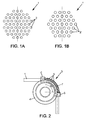
- the cable 1 used in a traction system for heavy lifting or tensioning works includes a plurality of parallel tendons 2 which can be tensioned for pulling a load attached to an end of the cable. Perpendicularly to the cable, the parallel tendons 2 are spaced apart from each other according to a predefined pattern such as that shown in figure 1A or 1B .
- the tendons 2 may consist of strands of metallic wires, such as corrosion-protected steel wires. For example, they consist of 7-wire high tensile strand having a 12 to 18 mm nominal diameter.
- the traction cable 1 consists of 55 parallel strands 2 arranged according to a hexagonal lattice in a pattern having an overall dodecagon shape.
- Figure 1B shows another cable 1 made of 37 parallel strands 2 arranged according to a hexagonal lattice in a pattern having an overall hexagon shape.
- the pattern is bidimensional and made of plural layers, so a deflection angle of the traction cable may cause transverse contact forces between the tendons.
- the tendons 2 are anchored onto a load (not shown), while at the other end, the tendons are held in a pulling system as illustrated in Fig. 6 which may, for example, consist of a multi-strand jack known in the art.
- the invention addresses situations where the traction cable 1 is deflected angularly, e.g. over a barrier or an edge. If, at the point of deflection, the traction cable is simply laid on a saddle, without special provision for keeping the organization of the tendons 2 constituting the cable, the stresses to which the tendons are subjected can be classified as follows:
- the traction system provided by the present invention is adapted to maintaining the organization of the initial pattern of the tendons (as defined at the anchorages at both ends) while obtaining a controllable distribution of the efforts. Thus it avoids the above-mentioned additional loads D-E.
- the deviator 3 comprises deflection segments 5 to guide the tendons 2 of the cable 1 around a support structure 4.
- the segments 5 are placed one after the other along the curved path of the cable 1 around the support structure 4. They distribute the reaction forces from the support structure 4 in a substantially uniform manner.
- the support structure 4 has a convex surface 7 on which the deflection segments 5 are applied.
- the convex surface 7 has a radius of curvature and it receives the segments 5 to guide the cable 1 so that it follows a deflection angle ⁇ from 0° and up to 180°, for example of 90° as indicated in figure 2 .
- the radius of the convex surface 7 of the support structure can vary along deflection angle and/or for various operations, to accommodate the corresponding configuration of tensile and bending stresses in tendons during operation.
- FIG. 3A-B An embodiment of a deflection segment 5 is shown in figures 3A-B . It has respective guide channels 10 for receiving the tendons 2. In the cross-section of the segment 5 perpendicular to the cable 1 ( figure 3A ), the guide channels 10 are arranged in accordance with the 2D pattern of the tendons 2 in the traction cable.
- each individual tendon 2 By inserting each individual tendon 2 into a respective guide channel 10, the parallel tendons remain arranged in their original pattern without distortion.
- the segment 5 may have a generally trapezoidal shape between a front surface 5a and a rear surface 5b having an angle ⁇ i between them as shown in figure 3B .
- a tendon 2 enters its channel 10 perpendicular to the front surface 5a and exits the channel 10 perpendicular to the rear surface 5b, it is deviated by an angle ⁇ i in the individual segment 5.
- the increment ⁇ i of angular deflection of the tendons accommodated by one segment is relatively small, e.g.
- ⁇ i of angular deflection is typically the same for all the segments 5, but it can also vary from one segment to another.
- the trapezoidal shape of the segment 5 further has an inner surface 5c and an opposite outer surface 5d.
- the inner surface 5c which is narrower than the outer surface 5d, is pressed against the convex surface 7 of the support structure 4 under the action of the tensile forces applied to the tendons 2.
- front and rear surfaces 5a, 5b of a deflection segment 5 are not necessarily flat surfaces. They may also be curved convex surfaces, or partly flat and partly curved.
- Abutments 6 are optionally provided at both ends of the 90° curve to restrict movement of the deflection segments 5 along the cable 1.
- the abutments 6 may be attached to the support structure 4. It will be noted that one abutment 6 on the side of the pulling system may be enough to maintain the segments.
- the plurality of deflection segments 5 works as a chain link.
- the number of deflection segments 5 having their inner surfaces 5c bearing on the convex surface 7 of the support structure 4 is also varying for adaptation to the variation of the overall deflection angle ⁇ .
- FIG. 6 and 7A-C Such a pulling configuration is illustrated in figures 6 and 7A-C .
- the support structure 4 of the deviator 3 is attached to an edge of the load 100.
- An end 1a of the traction cable 1 is anchored to the load 100 at another place.
- the pulling system is installed at a fixed location to pull the cable 1 as shown by the arrow F in figures 6 and 7A-C . Equivalently, the pulling system can be installed at the end 1a of the cable shown in figure 6 and a fixed anchorage can be installed at the other end. Traction of the cable 1 tilts the load 100 ( figures 7A-C ) which causes the reduction of the deflection angle ⁇ from ⁇ max to ⁇ min due to the overall geometry.
- the tendons 2 of the traction cable have a rectilinear trajectory. These segments are prevented from sliding too much along the cable by means of the abutments 6.
- the shape of the guide channels 10 in a segment 5 should be such that a tendon 2 can be deviated by the angle ⁇ i , and can also be straight.
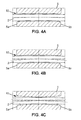
- Different possible shapes are illustrated in figures 4A-C .
- each deflection segment 5 can be formed by a casting process when forming the deflection segment.
- the guide channels are formed by machining.
- a clearance is provided in each channel of deflection segments to allow the tendon to follow either a straight path (segments detached from the support structure) or a curved path with an incremental deflection angle ⁇ i (segments bearing on the support structure).
- the channel 10 has a curved shape with a constant radius of curvature (depending on the radial position of the channel).
- the clearance between the tendon 2 and the inner wall of the channel 10 is sufficient to enable the tendon to follow a straight path through the segment 5.
- the channel 10 has a dihedral shape, with two parts each at 90° - ⁇ i /2 with respect to the symmetry plane of the segment (radial plane of the deviator 3).
- the channel 10 can be machined from both sides of the segment 5 using a drilling tool of varying diameter to have a trumped shape, for example, an overall trumpet shape on both sides.
- the channels 10 preferably have a tapered, e.g. rounded, shape at their ends on the front and rear surfaces 5a, 5b of the segment 5 to avoid damage to a tendon passing through the segment by a sharp edge of the channel 10.
- all tendons may be lubricated at least inside the guide channels 10 of the segments 5 by a lubricant, for example silicon grease.
- An equal load distribution to each tendon of the traction cable can be maintained during the entire pulling process, by means of a load balancing device arranged in the pulling system.
Landscapes
- Engineering & Computer Science (AREA)
- Mechanical Engineering (AREA)
- Devices Affording Protection Of Roads Or Walls For Sound Insulation (AREA)
- Bridges Or Land Bridges (AREA)
Abstract
Description
- The present invention relates to the field of heavy lifting and handling, and more particularly to a traction system using a cable including a plurality of substantially parallel tendons movable for pulling a load.
- In certain configurations, it may be necessary to arrange for some angular deflection of the traction cable, for example for pulling over an obstacle and/or to provide sufficient leverage to carry out the lifting or tensioning operation. Depending on the configuration, the deflection angle of the cable may be constant, or may vary while the load is moving.
- When the traction cable is made of parallel tendons, e.g. strands, their arrangement in the cross-section of the cable must be controlled to avoid undesired transverse contact stresses between the tendons which hinder transfer of the traction forces to the load and may damage the tendons.
- It is also preferable to balance the tensile forces between the multiple tendons. Otherwise one or some of the tendons take up most of the efforts, which is detrimental to the cable capacity and durability.
- A deflection angle of the multi-tendon traction cable is problematic to meet these requirements. Where the cable is deflected, some of the tendons typically have a larger radius of curvature and these tendons tend to undergo larger tensile forces and to be pressed against the other tendons on the inner side of the curvature.
- Some deflection systems use pulleys to reduce friction efforts. Such a solution may be difficult to implement where the tendons of the cable are arranged in multiple layers. It is incompatible with certain pulling operations, especially when very high traction forces must be applied, for example where a very heavy load (e.g. a ship or a construction work) must be lifted, lowered or dragged, where a structural prestressing or load-bearing cable must be tensioned, etc. Such very high traction forces would require extremely sturdy pulleys and excessive friction and stress would be generated at their axles and bearings.
- An object of the present invention is to provide another solution which is better suited, in particular to pulling operations with very high traction forces applied to multi-tendon cables.
- In accordance with the present invention, a traction system comprises a plurality of substantially parallel tendons movable for pulling a load and at least one deviator for guiding the tendons so as to provide an angular deflection of the plurality of tendons. The tendons are spaced apart to be arranged according to a pattern in a plane perpendicular to the tendons. The deviator includes a support structure and a plurality of segments each having an inner surface facing a convex surface of the support structure, front and rear surfaces and a plurality of channels extending from the front surface to the rear surface. The channels are disposed according to the aforesaid pattern in the front and rear surfaces of each segment, each tendon being received in a respective one of the channels. At least some of the segments have their inner surfaces bearing on the convex surface of the support structure in response to tensile forces applied to the tendons.
- Significant deflection angles, from 0° up to 180°, can be realized. The overall deflection angle can vary over time if the pulling configuration requires. Movement of the tendons and the load can take place in both directions, e.g. for lifting and lowering the load. The group of tendons is guided according to their set geometric pattern. The tendons are thus protected from damage.
- In an embodiment, the segments having inner surfaces bearing on the convex surface of the support structure form a series of n mutually abutting segments along the tendons, where n is a number greater than 1, and for 1 < i ≤ n, the ith segment of the series has its front surface in abutment with the rear surface of the (i-1)th segment of the series. Each segment of the deviator accommodating an increment θi of angular deflection of the tendons where i = 1, 2, ..., N is an index for the N segments of the deviator, the above-mentioned series typically has a number n ≤ N of segments such that the angular deflection θ provided by the deviator is between


- Embodiments further include one or more of the following features:
- the deviator further comprises at least one abutment arranged for limiting movement of the segments along the plurality of tendons;
- each segment of the deviator accommodates an increment of angular deflection in a range of 0° to 12° or more, preferably 0° to 5°;
- the shape of each channel of a segment is selected to receive a tendon bent by a predetermined increment of angular deflection, with a clearance sufficient to also accept the tendon extending straight through said channel;
- the channels open to the front and rear surfaces of a segment with rounded edges;
- the channels of a segment have a substantially dihedral profile, with preferably a curved or a trumped shape.
- Further features and advantages of the invention will become apparent in the following detailed description of embodiments which are given by way of non limiting examples with reference to the appended drawings, in which:
-
figures 1A-B show examples of 2D patterns according to which a plurality of parallel spaced apart tendons may be arranged in the cross-section of a traction cable; -
figure 2 illustrates a deviator according to an embodiment of the invention; -
figure 3A is a cross-sectional view, perpendicular to the traction cable, of an exemplary deflection segment of the deviator; -
figure 3B is a lateral view of that deflection segment; -
figure 3C is another cross-sectional view of the deflection segment, along plane A-A shown infigure 3A ; -
figures 4A-C are sectional views of part of a deflection segment showing the shape of a guide channel according to different embodiments of the invention; -
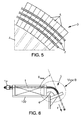
figure 5 is a lateral view of part of a deviator; -
figure 6 illustrates an example of application of the traction system where the deflection angle of the cable varies; -
figure 7A-C are enlarged views of detail B offigure 6 , showing the deviator at different stages with different deflection angles. - The invention is described below in its application to a lifting system without this implying any limitation to other types of application. The lifting system is applicable in various configurations, including in marine environments, for example for tilting-up a structure immerged entirely or partially in water.
- The
cable 1 used in a traction system for heavy lifting or tensioning works includes a plurality ofparallel tendons 2 which can be tensioned for pulling a load attached to an end of the cable. Perpendicularly to the cable, theparallel tendons 2 are spaced apart from each other according to a predefined pattern such as that shown infigure 1A or 1B . Thetendons 2 may consist of strands of metallic wires, such as corrosion-protected steel wires. For example, they consist of 7-wire high tensile strand having a 12 to 18 mm nominal diameter. - In the example of
figure 1A , thetraction cable 1 consists of 55parallel strands 2 arranged according to a hexagonal lattice in a pattern having an overall dodecagon shape.Figure 1B shows anothercable 1 made of 37parallel strands 2 arranged according to a hexagonal lattice in a pattern having an overall hexagon shape. In both cases, the pattern is bidimensional and made of plural layers, so a deflection angle of the traction cable may cause transverse contact forces between the tendons. - At one end of the
cable 1, thetendons 2 are anchored onto a load (not shown), while at the other end, the tendons are held in a pulling system as illustrated inFig. 6 which may, for example, consist of a multi-strand jack known in the art. - The invention addresses situations where the
traction cable 1 is deflected angularly, e.g. over a barrier or an edge. If, at the point of deflection, the traction cable is simply laid on a saddle, without special provision for keeping the organization of thetendons 2 constituting the cable, the stresses to which the tendons are subjected can be classified as follows: - A. Tensile forces associated with lifting and pulling;
- B. Bending moments associated with the curvature;
- C. Radial contact forces and friction of the strands on the saddle;
- D. Radial contact forces and friction between strands;
- E. Changes of tensile forces, contact forces and friction related to collapse of the tendons towards the centre of curvature of the saddle.
- The above stresses A-C are inherent to the lifting configuration. Feasibility tests and qualification of the device allow validating the maximum values of tensile and bending to the cables used. However the above stresses D-E are likely to use a significant portion of the mechanical capacity of the cable, without any control. The safety margins can then be prohibitive in terms of lifting capacity.
- The traction system provided by the present invention is adapted to maintaining the organization of the initial pattern of the tendons (as defined at the anchorages at both ends) while obtaining a controllable distribution of the efforts. Thus it avoids the above-mentioned additional loads D-E.
- It includes a
deviator 3 arranged at the point where the deflection angle is to be applied (figure 2 ). Thedeviator 3 comprisesdeflection segments 5 to guide thetendons 2 of thecable 1 around asupport structure 4. Thesegments 5 are placed one after the other along the curved path of thecable 1 around thesupport structure 4. They distribute the reaction forces from thesupport structure 4 in a substantially uniform manner. - The
support structure 4 has aconvex surface 7 on which thedeflection segments 5 are applied. In the example shown diagrammatically infigure 2 , theconvex surface 7 has a radius of curvature and it receives thesegments 5 to guide thecable 1 so that it follows a deflection angle θ from 0° and up to 180°, for example of 90° as indicated infigure 2 . If required by the lifting/pulling configuration, the radius of theconvex surface 7 of the support structure can vary along deflection angle and/or for various operations, to accommodate the corresponding configuration of tensile and bending stresses in tendons during operation. - An embodiment of a
deflection segment 5 is shown infigures 3A-B . It hasrespective guide channels 10 for receiving thetendons 2. In the cross-section of thesegment 5 perpendicular to the cable 1 (figure 3A ), theguide channels 10 are arranged in accordance with the 2D pattern of thetendons 2 in the traction cable. - By inserting each
individual tendon 2 into arespective guide channel 10, the parallel tendons remain arranged in their original pattern without distortion. - In the plane of the path followed by the
cable 1 around the support structure 4 (figures 2 and3B-C ), thesegment 5 may have a generally trapezoidal shape between afront surface 5a and arear surface 5b having an angle θi between them as shown infigure 3B . Assuming that atendon 2 enters itschannel 10 perpendicular to thefront surface 5a and exits thechannel 10 perpendicular to therear surface 5b, it is deviated by an angle θi in theindividual segment 5. The increment θi of angular deflection of the tendons accommodated by one segment is relatively small, e.g. 0° to 12° or more, preferably 0° to 5°, delimited by the front andrear surfaces deflection segment 5 as shown infigure 3B . The increment θi of angular deflection is typically the same for all thesegments 5, but it can also vary from one segment to another. - The trapezoidal shape of the
segment 5 further has aninner surface 5c and an oppositeouter surface 5d. Theinner surface 5c, which is narrower than theouter surface 5d, is pressed against theconvex surface 7 of thesupport structure 4 under the action of the tensile forces applied to thetendons 2. - It will be noted that the front and
rear surfaces deflection segment 5 are not necessarily flat surfaces. They may also be curved convex surfaces, or partly flat and partly curved. - The embodiment illustrated in
figure 2 shows a simple situation in which a load needs to be pulled with a deflection angle of thecable 1, for example of θ = 90°.Abutments 6 are optionally provided at both ends of the 90° curve to restrict movement of thedeflection segments 5 along thecable 1. Theabutments 6 may be attached to thesupport structure 4. It will be noted that oneabutment 6 on the side of the pulling system may be enough to maintain the segments. - Together with the inserted
tendons 2, the plurality ofdeflection segments 5 works as a chain link. During the lifting or tensioning process, there can be a fixed or a varying deflection angle θ. - In case of a varying deflection angle, the number of
deflection segments 5 having theirinner surfaces 5c bearing on theconvex surface 7 of thesupport structure 4 is also varying for adaptation to the variation of the overall deflection angle θ. - Such a pulling configuration is illustrated in
figures 6 and7A-C . In this example, the deflection angle is reduced from θmax to θmin as the pulling operation proceeds (for example θmax = 50° and θmin = 19°). Thesupport structure 4 of thedeviator 3 is attached to an edge of theload 100. Anend 1a of thetraction cable 1 is anchored to theload 100 at another place. The pulling system is installed at a fixed location to pull thecable 1 as shown by the arrow F infigures 6 and7A-C . Equivalently, the pulling system can be installed at theend 1a of the cable shown infigure 6 and a fixed anchorage can be installed at the other end. Traction of thecable 1 tilts the load 100 (figures 7A-C ) which causes the reduction of the deflection angle θ from θmax to θmin due to the overall geometry. - Initially (θ = θmax,
figures 6 and7A ), theN segments 5 of thedeviator 3 bear against theconvex surface 7 of thesupport structure 4. Each accommodates an increment θi of angular deflection which adds up to
segments 5 are numbered from i = 1 to i = N. - As the pulling operation proceeds (
figures 7B-C ), some of the segments lose contact with theconvex surface 7 of thesupport structure 4. The number n ≥ N ofsegments 5 which remain applied against theconvex surface 7 is the largest integer such that

- In the segments n+1, n+2, ... N that left the
support structure 4, thetendons 2 of the traction cable have a rectilinear trajectory. These segments are prevented from sliding too much along the cable by means of theabutments 6. - Therefore, for configurations with a variable deflection angle, the shape of the
guide channels 10 in asegment 5 should be such that atendon 2 can be deviated by the angle θi, and can also be straight. Different possible shapes are illustrated infigures 4A-C . - The
channels 10 of eachdeflection segment 5 can be formed by a casting process when forming the deflection segment. Preferably though, the guide channels are formed by machining. In all cases, a clearance is provided in each channel of deflection segments to allow the tendon to follow either a straight path (segments detached from the support structure) or a curved path with an incremental deflection angle θi (segments bearing on the support structure). - In the example of
figure 4A , thechannel 10 has a curved shape with a constant radius of curvature (depending on the radial position of the channel). The clearance between thetendon 2 and the inner wall of thechannel 10 is sufficient to enable the tendon to follow a straight path through thesegment 5. - In the example of
figure 4B , thechannel 10 has a dihedral shape, with two parts each at 90° - θi/2 with respect to the symmetry plane of the segment (radial plane of the deviator 3). - Alternatively, as shown in
figure 4C , thechannel 10 can be machined from both sides of thesegment 5 using a drilling tool of varying diameter to have a trumped shape, for example, an overall trumpet shape on both sides. - In all cases, the
channels 10 preferably have a tapered, e.g. rounded, shape at their ends on the front andrear surfaces segment 5 to avoid damage to a tendon passing through the segment by a sharp edge of thechannel 10. - The
deflection segments 5 of the lifting system haveinner surfaces 5a bearing on theconvex surface 7 of thesupport structure 4 form a series of mutually abutting segments i = 1, 2, ..., n along thetendons 2. A segment i = 2, 3, ..., n of the series has itsfront surface 5a in abutment with therear surface 5b of a the preceding segment i-1 of the series. Since eachdeflection segment 5 is smoothly machined, thechannels 10 of the series of mutually abuttingsegments 5 form a continuous conduit for guiding eachtendon 2 inserted within thedeflection segments 5, as illustrated infigure 5 . - To reduce the friction loss occurring within the deviator, all tendons may be lubricated at least inside the
guide channels 10 of thesegments 5 by a lubricant, for example silicon grease. - An equal load distribution to each tendon of the traction cable can be maintained during the entire pulling process, by means of a load balancing device arranged in the pulling system.
- Many modifications and variations of the above-described embodiments are made possible in light of the above teachings without departing from the invention.
Claims (8)
- A traction system, comprising:- a plurality of substantially parallel tendons (2) movable for pulling a load, the tendons being spaced apart according to a pattern in a plane perpendicular to the tendons; and- at least one deviator (3) for guiding the tendons, the deviator providing an angular deflection of the plurality of tendons,wherein the deviator includes a support structure (4) and a plurality of segments (5) each having an inner surface (5c) facing a convex surface (7) of the support structure, front and rear surfaces (5a, 5b) and a plurality of channels (10) extending from the front surface to the rear surface,
wherein the channels are disposed according to said pattern in the front and rear surfaces of each segment, each tendon being received in a respective one of the channels,
wherein at least some of the segments have their inner surfaces bearing on the convex surface of the support structure in response to tensile forces applied to the tendons. - The traction system as claimed in claim 1, wherein said segments (5) having inner surfaces (5c) bearing on the convex surface (7) of the support structure (4) form a series of n mutually abutting segments along the tendons (2) where n is a number greater than 1, and wherein for 1 < i ≤ n, the ith segment of said series has its front surface (5a) in abutment with the rear surface (5b) of the (i-1)th segment of said series.
- The traction system as claimed in claim 2, wherein each segment (5) of the deviator (3) accommodates an increment θi of angular deflection of the tendons where i = 1, 2, ..., N is an index for the N segments of the deviator, and said series has a number n ≤ N of segments such that the angular deflection provided by the deviator is between


- The traction system as claimed in any one of the preceding claims, wherein the deviator (3) further comprises at least one abutment (6) arranged for limiting movement of the segments (5) along the plurality of tendons (2).
- The traction system as claimed in any one of the preceding claims, wherein each segment (5) of the deviator (3) accommodates an increment of angular deflection (θi) in a range of 0° to 12°.
- The traction system as claimed in any one of the preceding claims, wherein the shape of each channel (10) of a segment (5) is selected to receive a tendon bent by a predetermined increment of angular deflection (θi), with a clearance sufficient to also accept the tendon extending straight through said channel.
- The traction system as claimed in any one of the preceding claims, wherein the channels (10) open to the front and rear surfaces (Sa, 5b) of a segment (5) with rounded edges.
- The traction system as claimed in any one of the preceding claims, wherein the channels (10) of a segment (5) have a substantially dihedral profile.
Priority Applications (4)
| Application Number | Priority Date | Filing Date | Title |
|---|---|---|---|
| ES12306050.1T ES2533630T3 (en) | 2012-09-03 | 2012-09-03 | Traction system using a multi-tendon cable with a deflection angle |
| PL12306050T PL2703331T3 (en) | 2012-09-03 | 2012-09-03 | Traction system using a multi-tendon cable with a deflection angle |
| EP12306050.1A EP2703331B1 (en) | 2012-09-03 | 2012-09-03 | Traction system using a multi-tendon cable with a deflection angle |
| US14/016,794 US9708164B2 (en) | 2012-09-03 | 2013-09-03 | Traction system using a multi-tendon cable with a deflection angle |
Applications Claiming Priority (1)
| Application Number | Priority Date | Filing Date | Title |
|---|---|---|---|
| EP12306050.1A EP2703331B1 (en) | 2012-09-03 | 2012-09-03 | Traction system using a multi-tendon cable with a deflection angle |
Publications (2)
| Publication Number | Publication Date |
|---|---|
| EP2703331A1 true EP2703331A1 (en) | 2014-03-05 |
| EP2703331B1 EP2703331B1 (en) | 2014-12-24 |
Family
ID=47143049
Family Applications (1)
| Application Number | Title | Priority Date | Filing Date |
|---|---|---|---|
| EP12306050.1A Active EP2703331B1 (en) | 2012-09-03 | 2012-09-03 | Traction system using a multi-tendon cable with a deflection angle |
Country Status (4)
| Country | Link |
|---|---|
| US (1) | US9708164B2 (en) |
| EP (1) | EP2703331B1 (en) |
| ES (1) | ES2533630T3 (en) |
| PL (1) | PL2703331T3 (en) |
Families Citing this family (4)
| Publication number | Priority date | Publication date | Assignee | Title |
|---|---|---|---|---|
| US12403352B2 (en) | 2022-12-18 | 2025-09-02 | Amp Fit Israel Ltd | Systems and methods for an electronic wall mounted exercise machine |
| IL321570B1 (en) | 2022-12-18 | 2026-04-01 | Amp Fit Israel Ltd | Systems and methods for an electronic wall mounted exercise machine |
| WO2024220590A2 (en) | 2023-04-17 | 2024-10-24 | Ares Tech Inc. | Systems and methods for electronic exercise equipment |
| WO2025126218A1 (en) | 2023-12-15 | 2025-06-19 | Amp Fit Israel Ltd | Exercise equipment |
Citations (5)
| Publication number | Priority date | Publication date | Assignee | Title |
|---|---|---|---|---|
| US4740109A (en) * | 1985-09-24 | 1988-04-26 | Horton Edward E | Multiple tendon compliant tower construction |
| US6007275A (en) * | 1996-02-16 | 1999-12-28 | Petroleum Geo Services As | Method and apparatus for employing stopper chain locking mechanism for tension-leg platform tendons |
| US20090158535A1 (en) * | 2006-04-20 | 2009-06-25 | Gnagi Adrian | Guiding device for strands |
| WO2011076287A1 (en) * | 2009-12-24 | 2011-06-30 | Vsl International Ag | Method and system for equally tensioning multiple strands |
| WO2011116834A1 (en) * | 2010-03-26 | 2011-09-29 | Vsl International Ag | Improvement for a strand guiding device |
Family Cites Families (52)
| Publication number | Priority date | Publication date | Assignee | Title |
|---|---|---|---|---|
| US1453426A (en) * | 1920-11-15 | 1923-05-01 | Westinghouse Electric & Mfg Co | Fairlead or guide for the control cables of aircraft |
| US2762606A (en) * | 1953-12-07 | 1956-09-11 | John F Morse | Cable elbow for remote motion transfer system |
| US2926001A (en) * | 1957-02-07 | 1960-02-23 | Anti Corrosive Metal Products | Anti-friction guide |
| US3279762A (en) * | 1964-03-11 | 1966-10-18 | Otis Elevator Co | Noise abating and traction improving elevator sheave |
| US3401859A (en) * | 1966-01-27 | 1968-09-17 | Gen Dynamics Corp | Low friction wire support for consumable electrode torch |
| US3720291A (en) * | 1970-08-27 | 1973-03-13 | I Ivanov | Apparatus for and method of replacing cables in multicable lifting devices |
| US3707275A (en) * | 1970-09-04 | 1972-12-26 | Carter H Arnold | Hoisting device |
| US3794233A (en) * | 1971-09-30 | 1974-02-26 | M Dykmans | Means and techniques useful in wire gripping devices |
| US3901479A (en) * | 1971-12-13 | 1975-08-26 | Western Gear Corp | Traction type hoist |
| US4068705A (en) * | 1975-01-10 | 1978-01-17 | Southwire Company | Forming apparatus with roller guide tube |
| US4013142A (en) * | 1975-10-07 | 1977-03-22 | Westinghouse Electric Corporation | Elevator system having a drive sheave with rigid but circumferentially compliant cable grooves |
| US4030569A (en) * | 1975-10-07 | 1977-06-21 | Westinghouse Electric Corporation | Traction elevator system having cable groove in drive sheave formed by spaced, elastically deflectable metallic ring members |
| US4205871A (en) * | 1977-08-17 | 1980-06-03 | Nihon Biso Kabushiki Kaisha | Rope traction apparatus |
| FR2511721A1 (en) * | 1981-08-21 | 1983-02-25 | Freyssinet Int Stup | CURVED CONNECTION DEVICE BETWEEN TWO RECTILINE PORTIONS OF A TENSILE CABLE |
| US4480818A (en) * | 1982-09-02 | 1984-11-06 | Schlumberger Technology Corporation | Safety enhancement device for well-logging cable sheave wheels |
| US4628759A (en) * | 1984-02-21 | 1986-12-16 | Nippon Cable System Inc. | Driving device employed in a window regulator |
| US4620615A (en) * | 1985-11-14 | 1986-11-04 | Westinghouse Electric Corp. | Elevator system |
| DE3775669D1 (en) * | 1986-08-29 | 1992-02-13 | Gretag Ag | CABLE GUIDE DEVICE. |
| DE3734953C2 (en) * | 1987-03-13 | 1994-02-24 | Dyckerhoff & Widmann Ag | Spacer for a tension member |
| ES2042271T5 (en) * | 1989-04-12 | 1997-11-01 | Vorspann Technik Gmbh | TENSIONING GROUP OF VARIOUS TENSIONING ELEMENTS SUCH AS LACES, RODS OR WIRES. |
| JPH07109150B2 (en) * | 1989-05-10 | 1995-11-22 | 株式会社テック | Wire drive |
| FR2663975B1 (en) * | 1990-06-29 | 1993-07-09 | Freyssinet Int Stup | IMPROVEMENTS ON BRIDGE BRIDGES AND MORE ESPECIALLY THEIR PYLONES AND BRIDGES. |
| US5186283A (en) * | 1991-09-26 | 1993-02-16 | Otis Elevator Company | Triple-wrap traction arrangement |
| US5921352A (en) * | 1997-09-09 | 1999-07-13 | Otis Elevator Company | Device for enhancing elevator rope traction |
| US6386516B1 (en) * | 1998-02-27 | 2002-05-14 | National-Oilwell L.P. | Sheave block with retractable sheave guards |
| DE19835000C1 (en) * | 1998-08-03 | 2000-05-25 | Svedala Ind Deutschland Gmbh | Rope conveyor for the upward and downward conveyance of conveyed goods |
| CN1220836C (en) * | 1999-04-14 | 2005-09-28 | 阿伦·F·罗德里古兹 | Sealing structure, sealing method and post-tensioning anchored sealing cap |
| US6292967B1 (en) * | 1999-09-14 | 2001-09-25 | Construction Technology Laboratories, Inc. | TMD-damped stay cable and method and TMD |
| US6364062B1 (en) * | 1999-11-08 | 2002-04-02 | Otis Elevator Company | Linear tracking mechanism for elevator rope |
| US6327825B1 (en) * | 2000-04-24 | 2001-12-11 | Charles Pankow Builders Ltd. | Method and apparatus for use in positioning high-strength cables within a precast moment resisting frame |
| US6370753B1 (en) * | 2000-07-24 | 2002-04-16 | Arnco Corporation | Method and apparatus for wrapping and installing cable |
| US6666415B2 (en) * | 2000-12-01 | 2003-12-23 | Kris Edward Hansen | Method, system and apparatus for guiding and supporting an elongated flexible member |
| FI117433B (en) * | 2000-12-08 | 2006-10-13 | Kone Corp | Elevator and elevator drive wheel |
| DE10062227A1 (en) * | 2000-12-13 | 2002-06-20 | Dyckerhoff & Widmann Ag | Method for installing and tensioning a freely tensioned tension member, in particular a stay cable for a stay cable bridge, and anchoring device for carrying out the method |
| CN1283544C (en) * | 2001-02-16 | 2006-11-08 | 富士达株式会社 | Driving mechanism of reciprocating moving body and elevator device using the driving mechanism |
| US6536743B2 (en) * | 2001-05-09 | 2003-03-25 | Dynacon, Inc. | Fixed umbilical cable flotation docking head |
| US6588730B2 (en) * | 2001-07-31 | 2003-07-08 | Bill Hughes | Method and apparatus for use in positioning high-strength cables within a precast, moment resisting frame |
| US6880193B2 (en) * | 2002-04-02 | 2005-04-19 | Figg Bridge Engineers, Inc. | Cable-stay cradle system |
| US20050194578A1 (en) * | 2004-03-03 | 2005-09-08 | Morris David D. | Innerduct guide tube assembly for fiber optic cable |
| DE102004010308B4 (en) * | 2004-03-03 | 2006-07-27 | Greifzug Hebezeugbau Gmbh | Traction sheave hoist for the stage and access system hereby |
| DE202004008621U1 (en) * | 2004-06-01 | 2005-10-06 | Dywidag-Systems International Gmbh | Forming a corrosion-protected tension member in the area of its entry into a structure, in particular a stay cable on the pylon of a cable-stayed bridge |
| US7641177B2 (en) * | 2006-01-17 | 2010-01-05 | The Boeing Company | Force transfer assemblies |
| DE102007017697A1 (en) * | 2007-04-14 | 2008-10-23 | Dywidag-Systems International Gmbh | Tension member for structures and method for its production |
| MX2010002112A (en) * | 2007-08-24 | 2010-03-26 | Heerema Marine Contractors Nl | Axial displacement device, line deployment system, and a method for deploying a line. |
| US8210502B2 (en) * | 2009-06-16 | 2012-07-03 | Weatherford/Lamb, Inc. | Adjustable wireline sheave for hay pulley |
| US8869476B2 (en) * | 2010-03-26 | 2014-10-28 | Vsl International Ag | Sealing arrangement |
| NL2004908C2 (en) * | 2010-06-17 | 2011-12-20 | Itrec Bv | Double drum traction winch. |
| US8931236B2 (en) * | 2010-08-24 | 2015-01-13 | Mark Ronald Sinclair | System for anchoring a load |
| FR2968681B1 (en) * | 2010-12-08 | 2015-05-29 | Soletanche Freyssinet | DEVICE FOR THE DEVIATION OF A STRUCTURED CABLE, SUCH AS A HAUBAN, AND A WORK THUS EQUIPPED |
| CH705481A2 (en) * | 2011-09-12 | 2013-03-15 | Robotic Consulting S A R L | The device pulls wire for electrical wiring. |
| US8640292B1 (en) * | 2012-05-21 | 2014-02-04 | Felix L. Sorkin | Deviator system for use in post-tension segmental concrete construction |
| US9748745B2 (en) * | 2013-09-21 | 2017-08-29 | Young Kwan Yi | Cable pulling roller guide |
-
2012
- 2012-09-03 EP EP12306050.1A patent/EP2703331B1/en active Active
- 2012-09-03 PL PL12306050T patent/PL2703331T3/en unknown
- 2012-09-03 ES ES12306050.1T patent/ES2533630T3/en active Active
-
2013
- 2013-09-03 US US14/016,794 patent/US9708164B2/en not_active Expired - Fee Related
Patent Citations (5)
| Publication number | Priority date | Publication date | Assignee | Title |
|---|---|---|---|---|
| US4740109A (en) * | 1985-09-24 | 1988-04-26 | Horton Edward E | Multiple tendon compliant tower construction |
| US6007275A (en) * | 1996-02-16 | 1999-12-28 | Petroleum Geo Services As | Method and apparatus for employing stopper chain locking mechanism for tension-leg platform tendons |
| US20090158535A1 (en) * | 2006-04-20 | 2009-06-25 | Gnagi Adrian | Guiding device for strands |
| WO2011076287A1 (en) * | 2009-12-24 | 2011-06-30 | Vsl International Ag | Method and system for equally tensioning multiple strands |
| WO2011116834A1 (en) * | 2010-03-26 | 2011-09-29 | Vsl International Ag | Improvement for a strand guiding device |
Also Published As
| Publication number | Publication date |
|---|---|
| EP2703331B1 (en) | 2014-12-24 |
| US9708164B2 (en) | 2017-07-18 |
| PL2703331T3 (en) | 2015-06-30 |
| ES2533630T3 (en) | 2015-04-13 |
| US20140061557A1 (en) | 2014-03-06 |
Similar Documents
| Publication | Publication Date | Title |
|---|---|---|
| EP1153167B2 (en) | Tension member for an elevator | |
| EP1060305B2 (en) | Elevator Systems | |
| EP1592635B1 (en) | Termination device for an aramid-based elevator rope | |
| JP5624921B2 (en) | Elevator tension member | |
| US9617118B2 (en) | Elevator suspension and/or driving assembly having at least one traction surface defined by weave fibers | |
| US9708164B2 (en) | Traction system using a multi-tendon cable with a deflection angle | |
| EP2346770B1 (en) | Traction system for a lift | |
| EP3679275B1 (en) | High reduction belt-driven linear actuator | |
| EP3159296B1 (en) | Rope for elevator and manufacturing method therefor | |
| EP2986550B1 (en) | Load bearing apparatus and method | |
| EP3470356B1 (en) | Compact belt termination assembly | |
| US20240262655A1 (en) | Elevator system belt | |
| US7900306B2 (en) | Guiding device for strands | |
| US11155442B2 (en) | Termination for elevator belt | |
| EP3187451A1 (en) | Method for manufacturing a rope terminal equipment, method for manufacturing a rope terminal arrangement and elevator | |
| EP2771234B1 (en) | Introduction or withdrawal of an elongate member to or from a body | |
| US20180162699A1 (en) | Elevator System Having a Pulley, the Contact Surface of Which Has an Anisotropic Structure | |
| TWI397928B (en) | Support means with mechanically positive connection for connecting several cables | |
| WO2016180485A1 (en) | Cable deviation saddle | |
| DE112016002248T5 (en) | Cable drum system | |
| EP1710194B1 (en) | Cable connecting device | |
| US20240228243A1 (en) | Flexible form factor belt driven block and tackle | |
| CN107531457B (en) | Lift facility | |
| CN117509353A (en) | Suspension device for traction sheave elevator | |
| DE202004013767U1 (en) | Heavy duty drive pulley has longitudinally split drive pulley ring with at least one cable groove ring, and two parts of pulley ring have on radial end faces and adjoining section of inner flanks annular recesses for magnet cage |
Legal Events
| Date | Code | Title | Description |
|---|---|---|---|
| AK | Designated contracting states |
Kind code of ref document: A1 Designated state(s): AL AT BE BG CH CY CZ DE DK EE ES FI FR GB GR HR HU IE IS IT LI LT LU LV MC MK MT NL NO PL PT RO RS SE SI SK SM TR |
|
| AX | Request for extension of the european patent |
Extension state: BA ME |
|
| PUAI | Public reference made under article 153(3) epc to a published international application that has entered the european phase |
Free format text: ORIGINAL CODE: 0009012 |
|
| 17P | Request for examination filed |
Effective date: 20140326 |
|
| RBV | Designated contracting states (corrected) |
Designated state(s): AL AT BE BG CH CY CZ DE DK EE ES FI FR GB GR HR HU IE IS IT LI LT LU LV MC MK MT NL NO PL PT RO RS SE SI SK SM TR |
|
| REG | Reference to a national code |
Ref country code: DE Ref legal event code: R079 Ref document number: 602012004498 Country of ref document: DE Free format text: PREVIOUS MAIN CLASS: B66C0011120000 Ipc: B66C0013000000 |
|
| RIC1 | Information provided on ipc code assigned before grant |
Ipc: B66C 13/00 20060101AFI20140520BHEP Ipc: B66C 11/12 20060101ALI20140520BHEP Ipc: B66D 3/26 20060101ALI20140520BHEP Ipc: B63B 21/04 20060101ALI20140520BHEP |
|
| GRAP | Despatch of communication of intention to grant a patent |
Free format text: ORIGINAL CODE: EPIDOSNIGR1 |
|
| INTG | Intention to grant announced |
Effective date: 20140721 |
|
| GRAS | Grant fee paid |
Free format text: ORIGINAL CODE: EPIDOSNIGR3 |
|
| GRAA | (expected) grant |
Free format text: ORIGINAL CODE: 0009210 |
|
| AK | Designated contracting states |
Kind code of ref document: B1 Designated state(s): AL AT BE BG CH CY CZ DE DK EE ES FI FR GB GR HR HU IE IS IT LI LT LU LV MC MK MT NL NO PL PT RO RS SE SI SK SM TR |
|
| REG | Reference to a national code |
Ref country code: GB Ref legal event code: FG4D |
|
| RAP2 | Party data changed (patent owner data changed or rights of a patent transferred) |
Owner name: SOLETANCHE FREYSSINET |
|
| REG | Reference to a national code |
Ref country code: CH Ref legal event code: EP |
|
| REG | Reference to a national code |
Ref country code: IE Ref legal event code: FG4D |
|
| REG | Reference to a national code |
Ref country code: AT Ref legal event code: REF Ref document number: 703011 Country of ref document: AT Kind code of ref document: T Effective date: 20150115 |
|
| REG | Reference to a national code |
Ref country code: DE Ref legal event code: R096 Ref document number: 602012004498 Country of ref document: DE Effective date: 20150219 |
|
| REG | Reference to a national code |
Ref country code: ES Ref legal event code: FG2A Ref document number: 2533630 Country of ref document: ES Kind code of ref document: T3 Effective date: 20150413 |
|
| REG | Reference to a national code |
Ref country code: NL Ref legal event code: VDEP Effective date: 20141224 |
|
| PG25 | Lapsed in a contracting state [announced via postgrant information from national office to epo] |
Ref country code: NO Free format text: LAPSE BECAUSE OF FAILURE TO SUBMIT A TRANSLATION OF THE DESCRIPTION OR TO PAY THE FEE WITHIN THE PRESCRIBED TIME-LIMIT Effective date: 20150324 Ref country code: FI Free format text: LAPSE BECAUSE OF FAILURE TO SUBMIT A TRANSLATION OF THE DESCRIPTION OR TO PAY THE FEE WITHIN THE PRESCRIBED TIME-LIMIT Effective date: 20141224 Ref country code: LT Free format text: LAPSE BECAUSE OF FAILURE TO SUBMIT A TRANSLATION OF THE DESCRIPTION OR TO PAY THE FEE WITHIN THE PRESCRIBED TIME-LIMIT Effective date: 20141224 |
|
| REG | Reference to a national code |
Ref country code: LT Ref legal event code: MG4D |
|
| PG25 | Lapsed in a contracting state [announced via postgrant information from national office to epo] |
Ref country code: HR Free format text: LAPSE BECAUSE OF FAILURE TO SUBMIT A TRANSLATION OF THE DESCRIPTION OR TO PAY THE FEE WITHIN THE PRESCRIBED TIME-LIMIT Effective date: 20141224 Ref country code: SE Free format text: LAPSE BECAUSE OF FAILURE TO SUBMIT A TRANSLATION OF THE DESCRIPTION OR TO PAY THE FEE WITHIN THE PRESCRIBED TIME-LIMIT Effective date: 20141224 Ref country code: LV Free format text: LAPSE BECAUSE OF FAILURE TO SUBMIT A TRANSLATION OF THE DESCRIPTION OR TO PAY THE FEE WITHIN THE PRESCRIBED TIME-LIMIT Effective date: 20141224 Ref country code: GR Free format text: LAPSE BECAUSE OF FAILURE TO SUBMIT A TRANSLATION OF THE DESCRIPTION OR TO PAY THE FEE WITHIN THE PRESCRIBED TIME-LIMIT Effective date: 20150325 Ref country code: RS Free format text: LAPSE BECAUSE OF FAILURE TO SUBMIT A TRANSLATION OF THE DESCRIPTION OR TO PAY THE FEE WITHIN THE PRESCRIBED TIME-LIMIT Effective date: 20141224 |
|
| PG25 | Lapsed in a contracting state [announced via postgrant information from national office to epo] |
Ref country code: NL Free format text: LAPSE BECAUSE OF FAILURE TO SUBMIT A TRANSLATION OF THE DESCRIPTION OR TO PAY THE FEE WITHIN THE PRESCRIBED TIME-LIMIT Effective date: 20141224 |
|
| REG | Reference to a national code |
Ref country code: PL Ref legal event code: T3 |
|
| PG25 | Lapsed in a contracting state [announced via postgrant information from national office to epo] |
Ref country code: SK Free format text: LAPSE BECAUSE OF FAILURE TO SUBMIT A TRANSLATION OF THE DESCRIPTION OR TO PAY THE FEE WITHIN THE PRESCRIBED TIME-LIMIT Effective date: 20141224 Ref country code: CZ Free format text: LAPSE BECAUSE OF FAILURE TO SUBMIT A TRANSLATION OF THE DESCRIPTION OR TO PAY THE FEE WITHIN THE PRESCRIBED TIME-LIMIT Effective date: 20141224 Ref country code: EE Free format text: LAPSE BECAUSE OF FAILURE TO SUBMIT A TRANSLATION OF THE DESCRIPTION OR TO PAY THE FEE WITHIN THE PRESCRIBED TIME-LIMIT Effective date: 20141224 Ref country code: RO Free format text: LAPSE BECAUSE OF FAILURE TO SUBMIT A TRANSLATION OF THE DESCRIPTION OR TO PAY THE FEE WITHIN THE PRESCRIBED TIME-LIMIT Effective date: 20141224 |
|
| REG | Reference to a national code |
Ref country code: FR Ref legal event code: PLFP Year of fee payment: 4 |
|
| PG25 | Lapsed in a contracting state [announced via postgrant information from national office to epo] |
Ref country code: IS Free format text: LAPSE BECAUSE OF FAILURE TO SUBMIT A TRANSLATION OF THE DESCRIPTION OR TO PAY THE FEE WITHIN THE PRESCRIBED TIME-LIMIT Effective date: 20150424 |
|
| REG | Reference to a national code |
Ref country code: DE Ref legal event code: R097 Ref document number: 602012004498 Country of ref document: DE |
|
| PG25 | Lapsed in a contracting state [announced via postgrant information from national office to epo] |
Ref country code: DK Free format text: LAPSE BECAUSE OF FAILURE TO SUBMIT A TRANSLATION OF THE DESCRIPTION OR TO PAY THE FEE WITHIN THE PRESCRIBED TIME-LIMIT Effective date: 20141224 |
|
| PLBE | No opposition filed within time limit |
Free format text: ORIGINAL CODE: 0009261 |
|
| STAA | Information on the status of an ep patent application or granted ep patent |
Free format text: STATUS: NO OPPOSITION FILED WITHIN TIME LIMIT |
|
| 26N | No opposition filed |
Effective date: 20150925 |
|
| PG25 | Lapsed in a contracting state [announced via postgrant information from national office to epo] |
Ref country code: SI Free format text: LAPSE BECAUSE OF FAILURE TO SUBMIT A TRANSLATION OF THE DESCRIPTION OR TO PAY THE FEE WITHIN THE PRESCRIBED TIME-LIMIT Effective date: 20141224 |
|
| PG25 | Lapsed in a contracting state [announced via postgrant information from national office to epo] |
Ref country code: MC Free format text: LAPSE BECAUSE OF FAILURE TO SUBMIT A TRANSLATION OF THE DESCRIPTION OR TO PAY THE FEE WITHIN THE PRESCRIBED TIME-LIMIT Effective date: 20141224 Ref country code: LU Free format text: LAPSE BECAUSE OF FAILURE TO SUBMIT A TRANSLATION OF THE DESCRIPTION OR TO PAY THE FEE WITHIN THE PRESCRIBED TIME-LIMIT Effective date: 20150903 |
|
| PG25 | Lapsed in a contracting state [announced via postgrant information from national office to epo] |
Ref country code: BE Free format text: LAPSE BECAUSE OF FAILURE TO SUBMIT A TRANSLATION OF THE DESCRIPTION OR TO PAY THE FEE WITHIN THE PRESCRIBED TIME-LIMIT Effective date: 20141224 |
|
| REG | Reference to a national code |
Ref country code: IE Ref legal event code: MM4A |
|
| PG25 | Lapsed in a contracting state [announced via postgrant information from national office to epo] |
Ref country code: IE Free format text: LAPSE BECAUSE OF NON-PAYMENT OF DUE FEES Effective date: 20150903 |
|
| REG | Reference to a national code |
Ref country code: FR Ref legal event code: PLFP Year of fee payment: 5 |
|
| PG25 | Lapsed in a contracting state [announced via postgrant information from national office to epo] |
Ref country code: MT Free format text: LAPSE BECAUSE OF FAILURE TO SUBMIT A TRANSLATION OF THE DESCRIPTION OR TO PAY THE FEE WITHIN THE PRESCRIBED TIME-LIMIT Effective date: 20141224 |
|
| PG25 | Lapsed in a contracting state [announced via postgrant information from national office to epo] |
Ref country code: SM Free format text: LAPSE BECAUSE OF FAILURE TO SUBMIT A TRANSLATION OF THE DESCRIPTION OR TO PAY THE FEE WITHIN THE PRESCRIBED TIME-LIMIT Effective date: 20141224 Ref country code: BG Free format text: LAPSE BECAUSE OF FAILURE TO SUBMIT A TRANSLATION OF THE DESCRIPTION OR TO PAY THE FEE WITHIN THE PRESCRIBED TIME-LIMIT Effective date: 20141224 Ref country code: HU Free format text: LAPSE BECAUSE OF FAILURE TO SUBMIT A TRANSLATION OF THE DESCRIPTION OR TO PAY THE FEE WITHIN THE PRESCRIBED TIME-LIMIT; INVALID AB INITIO Effective date: 20120903 |
|
| PG25 | Lapsed in a contracting state [announced via postgrant information from national office to epo] |
Ref country code: CY Free format text: LAPSE BECAUSE OF FAILURE TO SUBMIT A TRANSLATION OF THE DESCRIPTION OR TO PAY THE FEE WITHIN THE PRESCRIBED TIME-LIMIT Effective date: 20141224 |
|
| REG | Reference to a national code |
Ref country code: FR Ref legal event code: PLFP Year of fee payment: 6 |
|
| REG | Reference to a national code |
Ref country code: AT Ref legal event code: UEP Ref document number: 703011 Country of ref document: AT Kind code of ref document: T Effective date: 20141224 |
|
| PG25 | Lapsed in a contracting state [announced via postgrant information from national office to epo] |
Ref country code: MK Free format text: LAPSE BECAUSE OF FAILURE TO SUBMIT A TRANSLATION OF THE DESCRIPTION OR TO PAY THE FEE WITHIN THE PRESCRIBED TIME-LIMIT Effective date: 20141224 |
|
| PG25 | Lapsed in a contracting state [announced via postgrant information from national office to epo] |
Ref country code: PT Free format text: LAPSE BECAUSE OF FAILURE TO SUBMIT A TRANSLATION OF THE DESCRIPTION OR TO PAY THE FEE WITHIN THE PRESCRIBED TIME-LIMIT Effective date: 20141224 |
|
| REG | Reference to a national code |
Ref country code: FR Ref legal event code: PLFP Year of fee payment: 7 |
|
| PG25 | Lapsed in a contracting state [announced via postgrant information from national office to epo] |
Ref country code: AL Free format text: LAPSE BECAUSE OF FAILURE TO SUBMIT A TRANSLATION OF THE DESCRIPTION OR TO PAY THE FEE WITHIN THE PRESCRIBED TIME-LIMIT Effective date: 20141224 |
|
| P01 | Opt-out of the competence of the unified patent court (upc) registered |
Effective date: 20230526 |
|
| PGFP | Annual fee paid to national office [announced via postgrant information from national office to epo] |
Ref country code: DE Payment date: 20240820 Year of fee payment: 13 |
|
| PGFP | Annual fee paid to national office [announced via postgrant information from national office to epo] |
Ref country code: GB Payment date: 20240820 Year of fee payment: 13 |
|
| PGFP | Annual fee paid to national office [announced via postgrant information from national office to epo] |
Ref country code: FR Payment date: 20240820 Year of fee payment: 13 |
|
| PGFP | Annual fee paid to national office [announced via postgrant information from national office to epo] |
Ref country code: AT Payment date: 20240821 Year of fee payment: 13 |
|
| PGFP | Annual fee paid to national office [announced via postgrant information from national office to epo] |
Ref country code: PL Payment date: 20240821 Year of fee payment: 13 |
|
| PGFP | Annual fee paid to national office [announced via postgrant information from national office to epo] |
Ref country code: IT Payment date: 20240820 Year of fee payment: 13 |
|
| PGFP | Annual fee paid to national office [announced via postgrant information from national office to epo] |
Ref country code: TR Payment date: 20240826 Year of fee payment: 13 |
|
| PGFP | Annual fee paid to national office [announced via postgrant information from national office to epo] |
Ref country code: ES Payment date: 20241001 Year of fee payment: 13 |
|
| PGFP | Annual fee paid to national office [announced via postgrant information from national office to epo] |
Ref country code: CH Payment date: 20241001 Year of fee payment: 13 |
|
| REG | Reference to a national code |
Ref country code: CH Ref legal event code: H13 Free format text: ST27 STATUS EVENT CODE: U-0-0-H10-H13 (AS PROVIDED BY THE NATIONAL OFFICE) Effective date: 20260504 |