EP2702869A1 - Absorbent article for pets - Google Patents
Absorbent article for pets Download PDFInfo
- Publication number
- EP2702869A1 EP2702869A1 EP12763577.9A EP12763577A EP2702869A1 EP 2702869 A1 EP2702869 A1 EP 2702869A1 EP 12763577 A EP12763577 A EP 12763577A EP 2702869 A1 EP2702869 A1 EP 2702869A1
- Authority
- EP
- European Patent Office
- Prior art keywords
- pet
- absorbent article
- pair
- end portion
- surface layer
- Prior art date
- Legal status (The legal status is an assumption and is not a legal conclusion. Google has not performed a legal analysis and makes no representation as to the accuracy of the status listed.)
- Granted
Links
Images




Classifications
-
- A—HUMAN NECESSITIES
- A01—AGRICULTURE; FORESTRY; ANIMAL HUSBANDRY; HUNTING; TRAPPING; FISHING
- A01K—ANIMAL HUSBANDRY; AVICULTURE; APICULTURE; PISCICULTURE; FISHING; REARING OR BREEDING ANIMALS, NOT OTHERWISE PROVIDED FOR; NEW BREEDS OF ANIMALS
- A01K23/00—Manure or urine pouches
-
- A—HUMAN NECESSITIES
- A61—MEDICAL OR VETERINARY SCIENCE; HYGIENE
- A61F—FILTERS IMPLANTABLE INTO BLOOD VESSELS; PROSTHESES; DEVICES PROVIDING PATENCY TO, OR PREVENTING COLLAPSING OF, TUBULAR STRUCTURES OF THE BODY, e.g. STENTS; ORTHOPAEDIC, NURSING OR CONTRACEPTIVE DEVICES; FOMENTATION; TREATMENT OR PROTECTION OF EYES OR EARS; BANDAGES, DRESSINGS OR ABSORBENT PADS; FIRST-AID KITS
- A61F13/00—Bandages or dressings; Absorbent pads
- A61F13/15—Absorbent pads, e.g. sanitary towels, swabs or tampons for external or internal application to the body; Supporting or fastening means therefor; Tampon applicators
-
- A—HUMAN NECESSITIES
- A61—MEDICAL OR VETERINARY SCIENCE; HYGIENE
- A61F—FILTERS IMPLANTABLE INTO BLOOD VESSELS; PROSTHESES; DEVICES PROVIDING PATENCY TO, OR PREVENTING COLLAPSING OF, TUBULAR STRUCTURES OF THE BODY, e.g. STENTS; ORTHOPAEDIC, NURSING OR CONTRACEPTIVE DEVICES; FOMENTATION; TREATMENT OR PROTECTION OF EYES OR EARS; BANDAGES, DRESSINGS OR ABSORBENT PADS; FIRST-AID KITS
- A61F13/00—Bandages or dressings; Absorbent pads
- A61F13/15—Absorbent pads, e.g. sanitary towels, swabs or tampons for external or internal application to the body; Supporting or fastening means therefor; Tampon applicators
- A61F13/56—Supporting or fastening means
- A61F13/62—Mechanical fastening means ; Fabric strip fastener elements, e.g. hook and loop
- A61F13/622—Fabric strip fastener elements, e.g. hook and loop
-
- A—HUMAN NECESSITIES
- A61—MEDICAL OR VETERINARY SCIENCE; HYGIENE
- A61F—FILTERS IMPLANTABLE INTO BLOOD VESSELS; PROSTHESES; DEVICES PROVIDING PATENCY TO, OR PREVENTING COLLAPSING OF, TUBULAR STRUCTURES OF THE BODY, e.g. STENTS; ORTHOPAEDIC, NURSING OR CONTRACEPTIVE DEVICES; FOMENTATION; TREATMENT OR PROTECTION OF EYES OR EARS; BANDAGES, DRESSINGS OR ABSORBENT PADS; FIRST-AID KITS
- A61F13/00—Bandages or dressings; Absorbent pads
- A61F13/15—Absorbent pads, e.g. sanitary towels, swabs or tampons for external or internal application to the body; Supporting or fastening means therefor; Tampon applicators
- A61F2013/15008—Absorbent pads, e.g. sanitary towels, swabs or tampons for external or internal application to the body; Supporting or fastening means therefor; Tampon applicators characterized by the use
- A61F2013/15186—Absorbent pads, e.g. sanitary towels, swabs or tampons for external or internal application to the body; Supporting or fastening means therefor; Tampon applicators characterized by the use for animals
Definitions
- the present invention relates to an absorbent article for a pet, which is used in a state of being wrapped around the waist of a pet such as a dog or a cat.
- a disposable diaper for a pet used for a pet such as a dog or cat has been proposed.
- Such a disposable diaper for a pet catches feces and urine of the pet by covering the anus and the urethral opening positioned in the crotch between the hind legs when worn.
- Some pets have the urethral opening more in front than in the crotch between the hind legs.
- male dogs have the urethral opening more in front than female dogs. If the disposable diaper for a pet is used for pets having the urethral opening more in front than in the crotch between the hind legs, the urethral opening may not be covered by the diaper and urine may leak.
- Patent Document 1 Japanese Unexamined Patent Application Publication No. 2007-20533
- the absorbent article for a pet used in a state of being wrapped around the pet's waist is put on the pet in the following steps, for example.
- a first end portion located on a first end side of the absorbent article for a pet in a longitudinal direction is placed on the pet's back, and the first end portion is held by one hand of a user, thereby keeping the first end portion in close contact with the pet's back.
- a second end portion located on a second end side of the absorbent article for a pet is held by the other hand and wrapped around the pet's body to cover the pet's abdomen.
- the second end portion of the absorbent article for a pet is pulled to bring a side portion of the absorbent article for a pet in a longitudinal direction into close contact with the pet's waist, and in this state, an inner surface of the second end portion of the absorbent article for a pet is engaged with an outer surface of the first end portion.
- the absorbent article for a pet can thus be maintained in a state of being appropriately wrapped around the pet's waist.
- first end portion and the second end portion of the absorbent article for a pet are joined by engaging a hook member provided on the outer surface of the first end portion with a loop member provided on the inner surface of the second end portion, or by arranging an adhesive tape on the outer surface of the first end portion and attaching the inner surface of the second end portion to the adhesive tape.
- the hook member or the adhesive tape is arranged on the outer surface of the first end portion of the absorbent article for a pet
- the pet's hair may become entangled with the hook member or adhesive. If the pet's hair is entangled with the hook member or the adhesive tape, the force of engaging the first end portion with the second end portion of the absorbent article for a pet is weakened. As a result, the pet's hair is damaged.
- an object of the present invention is to provide an absorbent article for a pet, which can reduce entanglement of pet's hair when being worn.
- the present invention relates to an absorbent article for a pet, in which the absorbent article includes: a liquid permeable top surface layer; a liquid impermeable back surface layer; and an absorbent core arranged between the top surface layer and the back surface layer; in which the absorbent article is formed in a rectangular shape having first and second end portions opposed to each other, and a pair of side portions opposed to each other and orthogonal to the first and second end portions, and in which, in a state of being wrapped around a pet's waist, a top surface layer side of the first end portion is arranged to face the pet's body, and the top surface layer side of the second end portion is removably attached to a back surface layer side of the first end portion.
- the absorbent article for a pet further includes: a locking member arranged on the back surface layer side of the first end portion, and formed in a rectangular shape, in which a longitudinal direction of the locking member extends along a width direction of the absorbent article for pet; and a pair of folding-line portions formed in the first end portion, in which a pair of side portions side of the first end portion is bent at the pair of folding-line portions toward the top surface layer side.
- pair of folding-line portions prefferably be formed in the locking member, and to extend along a longitudinal direction of the absorbent article for pet.
- the length between the pair of folding-line portions is larger than the width of the absorbent core.
- the absorbent article for a pet prefferably includes: a pair of side sheets respectively arranged on an outer surface side of the top surface layer in the pair of side portions along a longitudinal direction of the absorbent article for a pet, in which an outer edge is joined to the top surface layer or the back surface layer, and at least a part of an inner edge is a free end; a pair of first elastic members arranged in a stretched state in a vicinity of the inner edge of the pair of side sheets; and a pair of pocket portions formed between an inner surface of the pair of side sheets and an outer surface of the top surface layer.
- the absorbent article for a pet prefferably includes a pair of second elastic members arranged in a stretched state in each of the pair of side portions.
- the locking member prefferably be attached at a separated position within a predetermined distance from a side edge of the first end portion.
- the absorbent article for a pet prefferably includes a rectangular base material arranged in the first end portion, and it is preferable for the pair of folding-line portions to be formed in the base material.
- bending resistance is 60 mm to 200 mm, which is measured with a bending resistance method A (45-degree cantilever method) as defined in L1084 (testing method for flocked fabrics).
- the absorbent article for a pet according to the present invention can, when worn, reduce the entanglement of pet hair.
- an absorbent article for a pet 1 is configured in a rectangular shape with a first end portion 11 and a second end portion 12 facing each other and a pair of side portions 17 facing each other orthogonally to the first end portion 11 and the second end portion 12, the absorbent article for a pet 1 being worn in a state of being wrapped around the pet's waist.
- the absorbent article for a pet 1 is especially preferably used for a pet having the urethral opening located further toward the front than the crotch between the hind legs (such as for a miniature dachshund).
- the absorbent article for a pet 1 includes, as shown in FIGS. 1 to 6 : a top sheet 2 constituting a liquid permeable top surface layer; a back sheet 31 and a waterproof sheet 32 constituting a liquid impermeable back surface layer 3; an absorbent core 4; a pair of side sheets 51, 52; first elastic members 61 and second elastic members 62 as elastic members; a hook tape 7 as a locking member; and a pair of folding-line portions 8 formed in the hook tape 7.
- the top sheet 2 is configured in a rectangular shape.
- the top sheet 2 mainly composes a surface of a side in contact with the pet's body.
- a perforated or non-perforated nonwoven fabric or a porous plastic sheet can be used.
- the back sheet 31 is composed of a nonwoven fabric with which a hook portion 72 (to be described later) can engage.
- the back sheet 31 is configured in a rectangular shape that is wider than, and has substantially the same length as, the top sheet 2, as shown in FIGS. 4 to 6 .
- the back sheet 31 composes a surface of the absorbent article for a pet 1, on a side not in contact with the pet's body.
- the waterproof sheet 32 is configured to be smaller in width than the back sheet 31 and greater in width than the top sheet 2 and is arranged on a top sheet 2 side of the back sheet 31.
- a hydrophobic nonwoven fabric As the back sheet 31 and the waterproof sheet 32, a hydrophobic nonwoven fabric, a liquid impermeable plastic film, a laminated sheet made of the nonwoven fabric and the liquid impermeable plastic film, an SMS nonwoven fabric made by sandwiching a high-water resistance melt-blown nonwoven fabric with a high-strength spun-bond nonwoven fabric, and the like can be used.
- the absorbent core 4 is arranged between the top sheet 2 and the back surface layer 3 that are layered, as shown in FIG. 4 .
- the absorbent core 4 is configured in a rectangular shape smaller in width and length than the top sheet 2 and the back sheet 31.
- the absorbent core 4 is arranged in a substantially central portion in the width direction of the top sheet 2 and the back sheet 31, from a first end side to a second end side in the longitudinal direction.
- fluff pulp and high absorbance polymer wrapped with a core wrapping material such as tissue can be used.
- fluff pulp used in the absorbent core 4 chemical pulp, cellulose fiber, and artificial cellulose fiber such as rayon, acetate, and the like may be cited.
- high absorbance polymer granulous or fibrous polymer of starch, acrylic acid, and amino acid may be cited.
- the pair of side sheets 51, 52 are configured in an elongated rectangular shape as shown in FIG. 2 and arranged on respective side portions along the longitudinal direction of a body side of the top sheet 2.
- the pair of side sheets 51, 52 is configured to have substantially the same length as the top sheet 2 and the back sheet 31.
- outer edges of the pair of side sheets 51, 52 correspond to side edges of the back sheet 31.
- the outer edges of the pair of side sheets 51, 52 are joined to the side edges of the back sheet 31.
- the pair of side sheets 51, 52 include: a front side sheet 51 arranged on a front side of the pet's body when the absorbent article for a pet 1 is put on to the pet; and a rear side sheet 52 arranged on a rear side of the pet's body.
- the inner edge of the front side sheet 51 is joined to the top sheet 2 in the vicinity of the first end portion 11 arranged on a first end side of the absorbent article for a pet 1 in a longitudinal direction LD, and in the vicinity of the second end portion 12 arranged on a second end side, as shown in FIGS. 4 and 6 .
- the inner edge of the front side sheet 51 is a free end in a portion other than the first end portion and the second end portion of the front side sheet 51 in the longitudinal direction LD, as shown in FIG. 4 .
- the inner edge of the rear side sheet 52 is a free end along the overall length of the absorbent article for a pet 1 in the longitudinal direction LD.
- a water repellent or hydrophobic sheet is preferably used. More specifically, various nonwoven fabrics such as spun lace nonwoven fabric, spun bond nonwoven fabric, thermal bond nonwoven fabric, melt-blown nonwoven fabric, needle-punched nonwoven fabric, air-through nonwoven fabric and the like can be used.
- fiber constituting the nonwoven fabric synthetic fiber of olefin, polyester, polyamide and the like such as polyethylene and polypropylene; regenerated fiber such as rayon and cupra; and natural fiber such as cotton can be used.
- the first elastic member 61 is arranged in the vicinity of each inner edge of the front side sheet 51 and the rear side sheet 52, as shown in FIGS. 1 to 3 . More specifically, the first elastic member 61 is sandwiched by the side sheet that is folded back from the inner edge side and fixed to the side sheet by a hotmelt adhesive in an extended state as shown in FIG. 5 . The first elastic member 61 is, in the extended state, greater in length than the absorbent core 4 in the longitudinal direction and is arranged on the front side sheet 51 and the rear side sheet 52 as shown in FIG. 2 and 3 .
- the second elastic members 62 are arranged in each of the pair of side portions along the longitudinal direction LD of the absorbent article for a pet 1, as shown in FIGS. 1 to 3 . More specifically, each second elastic member 62 is arranged between the front side sheet 51 and the back sheet 31, and between the rear side sheet 52 and the back sheet 31, respectively, as shown in FIG. 5 . In addition, the second elastic members 62 are fixed to the side sheets 51, 52 and the back sheet 31 by a hotmelt adhesive.
- the second elastic members 62 are, in the extended state, greater in length than the absorbent core 4 in the longitudinal direction and are arranged on each of the pair of side portions along the longitudinal direction LD of the absorbent article for a pet 1.
- any material that is thin and stretchable can be used, for example: natural rubber such as filiform rubber and flat rubber, or a thermoplastic elastomer such as urethane, ethylene-vinyl acetate copolymer (EVA), PE or the like.
- natural rubber such as filiform rubber and flat rubber
- thermoplastic elastomer such as urethane, ethylene-vinyl acetate copolymer (EVA), PE or the like.
- thermoplastic elastomer polybutadiene, polyisoprene, styrene-butadiene copolymer, styrene-isoprene copolymer, polyurethane, ethylene-vinyl acetate copolymer, ethylene- ⁇ -olefin copolymer and the like that are processed to be filiform or formed in a film and then slitted into thin strips may be cited.
- the hook tape 7 is arranged on an outer surface of the first end portion 11 (a face on the back surface layer 3 side), as shown in FIGS. 1 to 3 .
- the hook tape 7 is configured in a rectangular shape and arranged such that the longitudinal direction of the hook tape 7 is along a width direction WD of the absorbent article for a pet 1.
- the hook tape 7 is attached to a separate position within a predetermined distance L1 from the side edge of the first end portion 11.
- the hook tape 7 has a rectangular shaped base portion 71 and a plurality of hook portions 72 provided on one surface of the base portion 71.
- the hook tape 7 is attached to the back sheet 31 such that the surface, on which the plurality of hook portions 72 are formed, is directed outward.
- the base portion 71 and the plurality of hook portions 72 are integrally formed with a synthetic resin material such as polypropylene.
- the hook tape 7 it is preferable for the hook tape 7 to have predetermined thickness and predetermined bending rigidity.
- the bending rigidity when the hook tape 7 is bent in the longitudinal direction the width direction WD of the absorbent article for a pet 1
- the bending resistance it is preferable for the bending resistance to be 60 mm to 200 mm, when measured with a bending resistance method A (45-degree cantilever method) as defined in L1084 (testing method for flocked fabrics).
- the length W1 of the hook tape 7 in the width direction WD of the absorbent article for a pet 1 is configured to be greater than the length W2 of the absorbent core 4 in the width direction.
- a distance L1 from the edge of the first end portion 11 to the side edge of the hook tape 7 is preferably 5 mm to 50 mm, and is more preferably 10 mm to 30 mm.
- the pet's hair may be caught in the hook tape 7 when the absorbent article for a pet 1 is put on the pet.
- the effective maximum length of the absorbent article for a pet 1 (the length from the second end portion 12 to the hook tape 7) may be shortened to narrow the adjustable range in the lengthwise direction when the absorbent article for a pet 1 is put on the pet.
- Each of a pair of folding-line portions 8 is formed on one end side and another end side of the hook tape 7 in the longitudinal direction thereof, so as to extend in the longitudinal direction LD of the absorbent article for a pet 1.
- the pair of folding-line portions 8 is formed by creasing the hook tape 7, which is configured to be points of folding back from both ends of the hook tape 7 in the longitudinal direction toward the top sheet 2 side.
- the first end portion 11 is configured as shown in FIG. 4 such that both end sides of the absorbent article for a pet 1 in the width direction WD are bent at the pair of folding-line portions 8 and are raised toward the top sheet 2 side.
- length between the pair of folding-line portions 8 is configured to be the same as, or wider than, the length W3 of the absorbent core 4.
- the first elastic member 61 in the extended state is fixed to the front side sheet 51 and the rear side sheet 52 along the longitudinal direction LD of the absorbent article for a pet 1.
- the second elastic members 62 in the extended state are fixed between the side sheets 51, 52 and the back sheet 31, along the longitudinal direction LD of the absorbent article for a pet 1.
- the absorbent article for a pet 1 in a natural state has a solid shape as shown in FIG. 1 , with the first elastic members 61 and the second elastic members 62 being contracted to thereby bring the first end portion 11 and the second end portion 12 close to each other, with the top sheet 2 side constituting an inner surface.
- a pair of waist gather portions 13 that are stretchable in the longitudinal direction LD are thus formed on a pair of side portions along the longitudinal direction LD of the absorbent article for a pet 1 (see FIG. 1 ).
- Free end sides of the front side sheet 51 and the rear side sheet 52 are respectively raised to form a pocket portion 14 between the inner surface of the front side sheet 51 and the outer surface of the top sheet 2, and a pocket portion 15 between the inner surface of the rear side sheet 52 and the outer surface of the top sheet 2 (see FIG. 4 ).
- FIGS. 7 to 9 are diagrams illustrating a process of putting on the absorbent article for a pet according to the first embodiment to a pet.
- FIG. 7 is a diagram illustrating a state where the first end portion 11 is placed on the pet's back; and
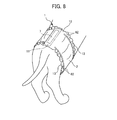
- FIG. 8 is a diagram illustrating a state where the absorbent article for a pet 1 is put on to the pet's waist.
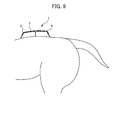
- FIG. 9 is diagram illustrating the state in FIG. 7 viewed from the pet's side portion.
- the first end portion 11 of the absorbent article for a pet 1 is placed on the pet's back, and the vicinity of the first end portion 11 is held by one hand of a user.
- the second end portion 12 of the absorbent article for a pet 1 is held by the other hand and wrapped around the pet's body to cover the pet's abdomen.
- the second end portion 12 of the absorbent article for a pet 1 is pulled to bring the pair of waist gather portions 13 into close contact with the pet's waist.
- the inner surface of the second end portion 12 (a surface on the top sheet 2 side) of the absorbent article for a pet 1 is engaged with the hook tape 7 provided on the outer surface of the first end portion 11 (a surface on the back sheet 31 side).
- the absorbent article for a pet 1 is thus wrapped around the pet's waist.
- the pair of folding-line portions 8 is formed in the hook tape 7 arranged in the first end portion 11. Both end sides of first end portion 11 of the absorbent article for a pet 1 in the width direction WD are bent toward the top sheet 2 side. As a result, in a state where the first end portion 11 of absorbent article for a pet 1 is positioned on the pet's back, as shown in FIGS. 7 and 9 , a gap is formed between the pet's back and the surface on the top sheet 2 side of the absorbent article for a pet 1 (see the arrow in FIGS. 7 and 9 ).
- the hook tape 7, in which the pair of folding-line portions is formed has predetermined bending rigidity.
- the absorbent article for a pet 1 When the absorbent article for a pet 1 is put on the pet by engaging the hook tape 7 with the inner surface of the second end portion 12 (the surface on the top sheet 2 side), the hook tape 7 is depressed by the second end portion 12 and is transformed to be in close contact with the pet's body. As a result, the gap formed between the pet's back and the surface on the top sheet 2 side of the absorbent article for a pet 1 disappears, and the absorbent article for a pet 1 is preferably put on.
- the above-described absorbent article for a pet 1 according to the first embodiment provides the following effects.
- FIG. 10A is a plan view of the absorbent article for a pet 1 according to the second embodiment viewed from the top sheet side; and FIG. 10B is a sectional view taken along the line D-D of FIG. 10A .
- the absorbent article for a pet 1 according to the second embodiment differs from the first embodiment mainly in the configuration of a pair of folding-line portions 8.
- a rectangular base material 9 is arranged in a first end portion 11.
- the base material 9 is configured as a plate made of a synthetic resin material such as polypropylene.
- the base material 9 is arranged on an outer surface of a back sheet 31 of the first end portion 11.
- a hook tape 7 is arranged on an outer surface of the base material 9.
- the base material 9 it is preferable for the base material 9 to have predetermined thickness and predetermined bending rigidity.
- the bending rigidity of the base material 9 being bent in the longitudinal direction it is preferable for the bending resistance to be 60 mm to 200 mm, which is measured with a bending resistance method A (45-degree cantilever method) as defined in L1084 (testing method for flocked fabrics).
- the length of the base material 9 in the width direction WD of the absorbent article for a pet 1 is configured to be greater than the length of the absorbent core 4 in the width direction.
- the pair of folding-line portions 8 is formed in the base material 9. As shown in FIG. 10A , the length between the pair of folding-line portions 8 is configured to be the same or greater than the length of the absorbent core 4.
- the absorbent article for a pet 1 provides the following operational effects, in addition to the above operational effects (3) and (4).
- FIG. 11A is a plan view of the absorbent article for a pet 1 according to the third embodiment viewed from the top sheet side; and FIG. 11B is a sectional view taken along the line E-E of FIG. 11A .
- the absorbent article for a pet 1 according to the third embodiment differs from the first embodiment mainly in a pair of folding-line portions 8 being formed in an absorbent core 4.
- the absorbent core 4 is arranged to extend to a vicinity of a first end portion 11.
- the pair of folding-line portions 8 is formed by creasing the absorbent core 4.
- the length of the hook tape 7 in the width direction WD of the absorbent article for a pet 1 is configured to be smaller than the width of the absorbent core 4.
- the folding-line portions 8 are not formed in the hook tape 7.
- the absorbent article for a pet 1 according to the third embodiment provides the following operational effects, in addition to the above operational effects (4).
- the hook tape 7 is arranged on the outer surface of the first end portion 11, and the pair of folding-line portions 8 is formed in the hook tape 7; however, the present invention is not limited thereto.
- the adhesive tape may be arranged on the outer surface of the first end portion, and a pair of folding-line portions may be formed in the adhesive tape.
- the inner surface of the second end portion may be constituted of a film material that cannot be engaged with the hook member.
- the inner edges of both sides of the front side sheet 51 in the longitudinal direction LD are joined to the top sheet 2, and the inner edges of the rear side sheet 52 are not joined to the top sheet 2; however, the present invention is not limited thereto. In other words, all the inner edges of both sides of the front side sheet and the rear side sheet in the longitudinal direction LD may be joined to the top sheet.
- the back surface layer 3 is constituted of two layers including the back sheet 31 and the waterproof sheet 32; however, the present invention is not limited thereto. In other words, the back surface layer can also be constituted of only the back sheet or the waterproof sheet.
Landscapes
- Health & Medical Sciences (AREA)
- Life Sciences & Earth Sciences (AREA)
- Engineering & Computer Science (AREA)
- Environmental Sciences (AREA)
- Animal Behavior & Ethology (AREA)
- Heart & Thoracic Surgery (AREA)
- Vascular Medicine (AREA)
- Biomedical Technology (AREA)
- Epidemiology (AREA)
- General Health & Medical Sciences (AREA)
- Public Health (AREA)
- Veterinary Medicine (AREA)
- Animal Husbandry (AREA)
- Biodiversity & Conservation Biology (AREA)
- Mechanical Engineering (AREA)
- Housing For Livestock And Birds (AREA)
- Absorbent Articles And Supports Therefor (AREA)
Abstract
Description
- The present invention relates to an absorbent article for a pet, which is used in a state of being wrapped around the waist of a pet such as a dog or a cat.
- Heretofore, a disposable diaper for a pet used for a pet such as a dog or cat has been proposed. Such a disposable diaper for a pet catches feces and urine of the pet by covering the anus and the urethral opening positioned in the crotch between the hind legs when worn.
- Some pets (for example a miniature dachshund) have the urethral opening more in front than in the crotch between the hind legs. In addition, male dogs have the urethral opening more in front than female dogs. If the disposable diaper for a pet is used for pets having the urethral opening more in front than in the crotch between the hind legs, the urethral opening may not be covered by the diaper and urine may leak.
- Given this, an absorbent article for a pet that is configured in a belt-like shape and worn in a state of being wrapped around the pet's waist is proposed (for example see Patent Document 1).
- Such an absorbent article for a pet configured in a belt-like shape can assuredly cover the urethral opening, regardless of position of the urethral opening.
Patent Document 1: Japanese Unexamined Patent Application Publication No.2007-20533 - The absorbent article for a pet used in a state of being wrapped around the pet's waist, as proposed in
Patent Document 1, is put on the pet in the following steps, for example. - First, a first end portion located on a first end side of the absorbent article for a pet in a longitudinal direction is placed on the pet's back, and the first end portion is held by one hand of a user, thereby keeping the first end portion in close contact with the pet's back. Next, in a state where the first end portion is held by one hand, a second end portion located on a second end side of the absorbent article for a pet is held by the other hand and wrapped around the pet's body to cover the pet's abdomen. Then the second end portion of the absorbent article for a pet is pulled to bring a side portion of the absorbent article for a pet in a longitudinal direction into close contact with the pet's waist, and in this state, an inner surface of the second end portion of the absorbent article for a pet is engaged with an outer surface of the first end portion. The absorbent article for a pet can thus be maintained in a state of being appropriately wrapped around the pet's waist.
- Here, the first end portion and the second end portion of the absorbent article for a pet are joined by engaging a hook member provided on the outer surface of the first end portion with a loop member provided on the inner surface of the second end portion, or by arranging an adhesive tape on the outer surface of the first end portion and attaching the inner surface of the second end portion to the adhesive tape.
- However, in a case in which the hook member or the adhesive tape is arranged on the outer surface of the first end portion of the absorbent article for a pet, if a pet moves in a state where the first end portion is held by one hand to be kept in close contact with the pet's back as described above, the pet's hair may become entangled with the hook member or adhesive. If the pet's hair is entangled with the hook member or the adhesive tape, the force of engaging the first end portion with the second end portion of the absorbent article for a pet is weakened. As a result, the pet's hair is damaged.
- Therefore, an object of the present invention is to provide an absorbent article for a pet, which can reduce entanglement of pet's hair when being worn.
- The present invention relates to an absorbent article for a pet, in which the absorbent article includes: a liquid permeable top surface layer; a liquid impermeable back surface layer; and an absorbent core arranged between the top surface layer and the back surface layer; in which the absorbent article is formed in a rectangular shape having first and second end portions opposed to each other, and a pair of side portions opposed to each other and orthogonal to the first and second end portions, and in which, in a state of being wrapped around a pet's waist, a top surface layer side of the first end portion is arranged to face the pet's body, and the top surface layer side of the second end portion is removably attached to a back surface layer side of the first end portion. The absorbent article for a pet further includes: a locking member arranged on the back surface layer side of the first end portion, and formed in a rectangular shape, in which a longitudinal direction of the locking member extends along a width direction of the absorbent article for pet; and a pair of folding-line portions formed in the first end portion, in which a pair of side portions side of the first end portion is bent at the pair of folding-line portions toward the top surface layer side.
- It is preferable for the pair of folding-line portions to be formed in the locking member, and to extend along a longitudinal direction of the absorbent article for pet.
- It is preferable for the length between the pair of folding-line portions to be larger than the width of the absorbent core.
- It is preferable for the absorbent article for a pet to further include: a pair of side sheets respectively arranged on an outer surface side of the top surface layer in the pair of side portions along a longitudinal direction of the absorbent article for a pet, in which an outer edge is joined to the top surface layer or the back surface layer, and at least a part of an inner edge is a free end; a pair of first elastic members arranged in a stretched state in a vicinity of the inner edge of the pair of side sheets; and a pair of pocket portions formed between an inner surface of the pair of side sheets and an outer surface of the top surface layer.
- It is preferable for the absorbent article for a pet to further include a pair of second elastic members arranged in a stretched state in each of the pair of side portions.
- It is preferable for the locking member to be attached at a separated position within a predetermined distance from a side edge of the first end portion.
- It is preferable for the absorbent article for a pet to further include a rectangular base material arranged in the first end portion, and it is preferable for the pair of folding-line portions to be formed in the base material.
- Regarding bending rigidity of the locking member being bent in a longitudinal direction, it is preferable for bending resistance to be 60 mm to 200 mm, which is measured with a bending resistance method A (45-degree cantilever method) as defined in L1084 (testing method for flocked fabrics).
- The absorbent article for a pet according to the present invention can, when worn, reduce the entanglement of pet hair.
-
-
FIG. 1 is a perspective view showing an absorbent article for a pet according to a first embodiment of the present invention; -
FIG. 2 is a plan view of the absorbent article for a pet according to the first embodiment viewed from a top surface layer side; -
FIG. 3 is a plan view of the absorbent article for a pet according to the first embodiment viewed from a back surface layer side; -
FIG. 4 is a cross-sectional view taken along the line A-A ofFIG. 2 ; -
FIG. 5 is a cross-sectional view taken along the line B-B ofFIG. 1 ; -
FIG. 6 is a cross-sectional view taken along the line C-C ofFIG. 2 ; -
FIG. 7 is a diagram illustrating a process of putting the absorbent article for a pet on a pet, in which the first end portion is placed on the pet's back; -
FIG. 8 is a diagram illustrating a state where the absorbent article for a pet is put around the pet's waist; -
FIG. 9 is a diagram illustrating the state inFIG. 7 viewed from the pet's side; -
FIG. 10A is a plan view of the absorbent article for a pet according to a second embodiment viewed from the top surface layer side; -
FIG. 10B is a cross-sectional view taken along the line D-D ofFIG. 10A ; -
FIG. 11A is a plan view of the absorbent article for a pet according to a third embodiment viewed from the top surface layer side; and -
FIG. 11B is a cross-sectional view taken along the line E-E ofFIG. 11A . -
- 1 absorbent article for a pet
- 2 top sheet (top surface layer)
- 3 back surface layer
- 4 absorbent core
- 7 hook tape (locking member)
- 8 folding-line portion
- 9 base material
- 11 first end portion
- 12 second end portion
- 14 pocket portion
- 15 pocket portion
- 17 side portion
- 51 front side sheet (side sheet)
- 52 rear side sheet (side sheet)
- 61 first elastic member (elastic member)
- 62 second elastic member (elastic member)
- Embodiments of the absorbent article for a pet according to the present invention will be described hereinafter with reference to the drawings.
- First, the absorbent article for a pet according to the first embodiment will be described with reference to
FIGS. 1 to 6 . - As shown in
FIGS. 1 and2 , an absorbent article for apet 1 according to the first embodiment is configured in a rectangular shape with afirst end portion 11 and asecond end portion 12 facing each other and a pair ofside portions 17 facing each other orthogonally to thefirst end portion 11 and thesecond end portion 12, the absorbent article for apet 1 being worn in a state of being wrapped around the pet's waist. The absorbent article for apet 1 is especially preferably used for a pet having the urethral opening located further toward the front than the crotch between the hind legs (such as for a miniature dachshund). - The absorbent article for a
pet 1 includes, as shown inFIGS. 1 to 6 : atop sheet 2 constituting a liquid permeable top surface layer; aback sheet 31 and awaterproof sheet 32 constituting a liquid impermeableback surface layer 3; anabsorbent core 4; a pair ofside sheets elastic members 61 and secondelastic members 62 as elastic members; ahook tape 7 as a locking member; and a pair of folding-line portions 8 formed in thehook tape 7. - The
top sheet 2 is configured in a rectangular shape. Thetop sheet 2 mainly composes a surface of a side in contact with the pet's body. As thetop sheet 2, a perforated or non-perforated nonwoven fabric or a porous plastic sheet can be used. In the first embodiment, theback sheet 31 is composed of a nonwoven fabric with which a hook portion 72 (to be described later) can engage. - The
back sheet 31 is configured in a rectangular shape that is wider than, and has substantially the same length as, thetop sheet 2, as shown inFIGS. 4 to 6 . Theback sheet 31 composes a surface of the absorbent article for apet 1, on a side not in contact with the pet's body. - The
waterproof sheet 32 is configured to be smaller in width than theback sheet 31 and greater in width than thetop sheet 2 and is arranged on atop sheet 2 side of theback sheet 31. - As the
back sheet 31 and thewaterproof sheet 32, a hydrophobic nonwoven fabric, a liquid impermeable plastic film, a laminated sheet made of the nonwoven fabric and the liquid impermeable plastic film, an SMS nonwoven fabric made by sandwiching a high-water resistance melt-blown nonwoven fabric with a high-strength spun-bond nonwoven fabric, and the like can be used. - The
absorbent core 4 is arranged between thetop sheet 2 and theback surface layer 3 that are layered, as shown inFIG. 4 . As shown inFIGS. 2 and3 , theabsorbent core 4 is configured in a rectangular shape smaller in width and length than thetop sheet 2 and theback sheet 31. As shown inFIGS. 2 and3 , theabsorbent core 4 is arranged in a substantially central portion in the width direction of thetop sheet 2 and theback sheet 31, from a first end side to a second end side in the longitudinal direction. As theabsorbent core 4, fluff pulp and high absorbance polymer wrapped with a core wrapping material such as tissue can be used. - As the fluff pulp used in the
absorbent core 4, chemical pulp, cellulose fiber, and artificial cellulose fiber such as rayon, acetate, and the like may be cited. As the high absorbance polymer, granulous or fibrous polymer of starch, acrylic acid, and amino acid may be cited. - The pair of
side sheets FIG. 2 and arranged on respective side portions along the longitudinal direction of a body side of thetop sheet 2. The pair ofside sheets top sheet 2 and theback sheet 31. As shown inFIGS. 4 to 6 , outer edges of the pair ofside sheets back sheet 31. The outer edges of the pair ofside sheets back sheet 31. - A part of the inner edges of the pair of
side sheets FIGS. 1 and5 . More specifically, the pair ofside sheets front side sheet 51 arranged on a front side of the pet's body when the absorbent article for apet 1 is put on to the pet; and arear side sheet 52 arranged on a rear side of the pet's body. - The inner edge of the
front side sheet 51 is joined to thetop sheet 2 in the vicinity of thefirst end portion 11 arranged on a first end side of the absorbent article for apet 1 in a longitudinal direction LD, and in the vicinity of thesecond end portion 12 arranged on a second end side, as shown inFIGS. 4 and6 . In addition, the inner edge of thefront side sheet 51 is a free end in a portion other than the first end portion and the second end portion of thefront side sheet 51 in the longitudinal direction LD, as shown inFIG. 4 . - As shown in
FIGS. 4 to 6 , the inner edge of therear side sheet 52 is a free end along the overall length of the absorbent article for apet 1 in the longitudinal direction LD. - As the
side sheets - The first
elastic member 61 is arranged in the vicinity of each inner edge of thefront side sheet 51 and therear side sheet 52, as shown inFIGS. 1 to 3 . More specifically, the firstelastic member 61 is sandwiched by the side sheet that is folded back from the inner edge side and fixed to the side sheet by a hotmelt adhesive in an extended state as shown inFIG. 5 . The firstelastic member 61 is, in the extended state, greater in length than theabsorbent core 4 in the longitudinal direction and is arranged on thefront side sheet 51 and therear side sheet 52 as shown inFIG. 2 and3 . - The second
elastic members 62 are arranged in each of the pair of side portions along the longitudinal direction LD of the absorbent article for apet 1, as shown inFIGS. 1 to 3 . More specifically, each secondelastic member 62 is arranged between thefront side sheet 51 and theback sheet 31, and between therear side sheet 52 and theback sheet 31, respectively, as shown inFIG. 5 . In addition, the secondelastic members 62 are fixed to theside sheets back sheet 31 by a hotmelt adhesive. - The second
elastic members 62 are, in the extended state, greater in length than theabsorbent core 4 in the longitudinal direction and are arranged on each of the pair of side portions along the longitudinal direction LD of the absorbent article for apet 1. - As the first
elastic members 61 and the secondelastic members 62, any material that is thin and stretchable can be used, for example: natural rubber such as filiform rubber and flat rubber, or a thermoplastic elastomer such as urethane, ethylene-vinyl acetate copolymer (EVA), PE or the like. More specifically, as the thermoplastic elastomer, polybutadiene, polyisoprene, styrene-butadiene copolymer, styrene-isoprene copolymer, polyurethane, ethylene-vinyl acetate copolymer, ethylene-α-olefin copolymer and the like that are processed to be filiform or formed in a film and then slitted into thin strips may be cited. - The
hook tape 7 is arranged on an outer surface of the first end portion 11 (a face on theback surface layer 3 side), as shown inFIGS. 1 to 3 . Thehook tape 7 is configured in a rectangular shape and arranged such that the longitudinal direction of thehook tape 7 is along a width direction WD of the absorbent article for apet 1. Thehook tape 7 is attached to a separate position within a predetermined distance L1 from the side edge of thefirst end portion 11. - As shown in
FIG. 4 , thehook tape 7 has a rectangular shapedbase portion 71 and a plurality ofhook portions 72 provided on one surface of thebase portion 71. Thehook tape 7 is attached to theback sheet 31 such that the surface, on which the plurality ofhook portions 72 are formed, is directed outward. - In the
hook tape 7, thebase portion 71 and the plurality ofhook portions 72 are integrally formed with a synthetic resin material such as polypropylene. From a viewpoint of preferably forming the folding-line portion 8 (to be described later), it is preferable for thehook tape 7 to have predetermined thickness and predetermined bending rigidity. With regard to the bending rigidity when thehook tape 7 is bent in the longitudinal direction (the width direction WD of the absorbent article for a pet 1), it is preferable for the bending resistance to be 60 mm to 200 mm, when measured with a bending resistance method A (45-degree cantilever method) as defined in L1084 (testing method for flocked fabrics). - The length W1 of the
hook tape 7 in the width direction WD of the absorbent article for apet 1 is configured to be greater than the length W2 of theabsorbent core 4 in the width direction. - A distance L1 from the edge of the
first end portion 11 to the side edge of thehook tape 7 is preferably 5 mm to 50 mm, and is more preferably 10 mm to 30 mm. - If the distance L1 from the edge of the
first end portion 11 to the side edge of thehook tape 7 is below 5 mm, the pet's hair may be caught in thehook tape 7 when the absorbent article for apet 1 is put on the pet. - If the distance L1 from the edge of the
first end portion 11 to the side edge of thehook tape 7 exceeds 50 mm, length ofpocket portions 14, 15 (to be described later) may not be sufficiently ensured. Moreover, the effective maximum length of the absorbent article for a pet 1 (the length from thesecond end portion 12 to the hook tape 7) may be shortened to narrow the adjustable range in the lengthwise direction when the absorbent article for apet 1 is put on the pet. - Each of a pair of folding-
line portions 8 is formed on one end side and another end side of thehook tape 7 in the longitudinal direction thereof, so as to extend in the longitudinal direction LD of the absorbent article for apet 1. The pair of folding-line portions 8 is formed by creasing thehook tape 7, which is configured to be points of folding back from both ends of thehook tape 7 in the longitudinal direction toward thetop sheet 2 side. In other words, in a case in which the absorbent article for apet 1 is arranged such that theback surface layer 3 side is an under surface, thefirst end portion 11 is configured as shown inFIG. 4 such that both end sides of the absorbent article for apet 1 in the width direction WD are bent at the pair of folding-line portions 8 and are raised toward thetop sheet 2 side. - As shown in
FIG. 2 , length between the pair of folding-line portions 8 is configured to be the same as, or wider than, the length W3 of theabsorbent core 4. - In the above-described absorbent article for a
pet 1, the firstelastic member 61 in the extended state is fixed to thefront side sheet 51 and therear side sheet 52 along the longitudinal direction LD of the absorbent article for apet 1. In addition, the secondelastic members 62 in the extended state are fixed between theside sheets back sheet 31, along the longitudinal direction LD of the absorbent article for apet 1. - Given this, the absorbent article for a
pet 1 in a natural state (without external force applied) has a solid shape as shown inFIG. 1 , with the firstelastic members 61 and the secondelastic members 62 being contracted to thereby bring thefirst end portion 11 and thesecond end portion 12 close to each other, with thetop sheet 2 side constituting an inner surface. A pair of waist gatherportions 13 that are stretchable in the longitudinal direction LD are thus formed on a pair of side portions along the longitudinal direction LD of the absorbent article for a pet 1 (seeFIG. 1 ). Free end sides of thefront side sheet 51 and therear side sheet 52 are respectively raised to form apocket portion 14 between the inner surface of thefront side sheet 51 and the outer surface of thetop sheet 2, and apocket portion 15 between the inner surface of therear side sheet 52 and the outer surface of the top sheet 2 (seeFIG. 4 ). - Next, steps of putting on the absorbent article for a
pet 1 according to the first embodiment to a pet will be described with reference toFIGS. 6 to 8 .FIGS. 7 to 9 are diagrams illustrating a process of putting on the absorbent article for a pet according to the first embodiment to a pet.FIG. 7 is a diagram illustrating a state where thefirst end portion 11 is placed on the pet's back; andFIG. 8 is a diagram illustrating a state where the absorbent article for apet 1 is put on to the pet's waist.FIG. 9 is diagram illustrating the state inFIG. 7 viewed from the pet's side portion. - First, as shown in
FIG. 7 , thefirst end portion 11 of the absorbent article for apet 1 is placed on the pet's back, and the vicinity of thefirst end portion 11 is held by one hand of a user. Next, in a state where the vicinity of thefirst end portion 11 is held by one hand, thesecond end portion 12 of the absorbent article for apet 1 is held by the other hand and wrapped around the pet's body to cover the pet's abdomen. - Subsequently, the
second end portion 12 of the absorbent article for apet 1 is pulled to bring the pair of waist gatherportions 13 into close contact with the pet's waist. - Subsequently, as shown in
FIG. 9 , the inner surface of the second end portion 12 (a surface on thetop sheet 2 side) of the absorbent article for apet 1 is engaged with thehook tape 7 provided on the outer surface of the first end portion 11 (a surface on theback sheet 31 side). The absorbent article for apet 1 is thus wrapped around the pet's waist. - Here, in the first embodiment, the pair of folding-
line portions 8 is formed in thehook tape 7 arranged in thefirst end portion 11. Both end sides offirst end portion 11 of the absorbent article for apet 1 in the width direction WD are bent toward thetop sheet 2 side. As a result, in a state where thefirst end portion 11 of absorbent article for apet 1 is positioned on the pet's back, as shown inFIGS. 7 and9 , a gap is formed between the pet's back and the surface on thetop sheet 2 side of the absorbent article for a pet 1 (see the arrow inFIGS. 7 and9 ). Thehook tape 7, in which the pair of folding-line portions is formed, has predetermined bending rigidity. As a result, when the absorbent article for apet 1 is put on, even if thesecond end portion 12 is pulled from the state where thefirst end portion 11 of the absorbent article for apet 1 is positioned on the pet's back, the gap formed between the pet's back and the surface on thetop sheet 2 side of the absorbent article for apet 1 is maintained. - When the absorbent article for a
pet 1 is put on the pet by engaging thehook tape 7 with the inner surface of the second end portion 12 (the surface on thetop sheet 2 side), thehook tape 7 is depressed by thesecond end portion 12 and is transformed to be in close contact with the pet's body. As a result, the gap formed between the pet's back and the surface on thetop sheet 2 side of the absorbent article for apet 1 disappears, and the absorbent article for apet 1 is preferably put on. - The above-described absorbent article for a
pet 1 according to the first embodiment provides the following effects. - (1) The
rectangular hook tape 7 is provided on theback sheet 31 side of thefirst end portion 11 so as to extend in the width direction WD of the absorbent article for apet 1, and the pair of folding-line portions 8 is formed in thehook tape 7. As a result, both end sides of thefirst end portion 11 of the absorbent article for apet 1 in the width direction WD can be bent at the pair of folding-line portions 8 toward thetop sheet 2 side; therefore, a gap can be formed between the pet's back and the surface on thetop sheet 2 side of the absorbent article for apet 1 in a state where thefirst end portion 11 of the absorbent article for apet 1 is positioned on the pet's back. Therefore, even if the pet moves in a state where thefirst end portion 11 is held by one hand to be in close contact with the pet's back, the pet's hair is less likely to be entangled with thehook tape 7 when the absorbent article for apet 1 is put on. - (2) The absorbent article for a
pet 1 is configured to have a shape contracted in the longitudinal direction in a natural state, by arranging the firstelastic members 61 and the secondelastic members 62 in the side portions along the longitudinal direction LD of the absorbent article for apet 1. Therefore, thesecond end portion 12 needs to be strongly pulled such that the absorbent article for apet 1 in a stretched state is made to preferably fit the pet's waist. Accordingly, the pair of folding-line portions 8 is formed in thehook tape 7 having predetermined bending rigidity. As a result, when the absorbent article for apet 1 is put on, even if thesecond end portion 12 is pulled from the state where thefirst end portion 11 of the absorbent article for apet 1 is positioned on the pet's back, the shape of thefirst end portion 11 bent at the folding-line portions 8 can be maintained, and the gap formed between the pet's back and the surface on thetop sheet 2 side of the absorbent article for apet 1 can be maintained. Therefore, when the absorbent article for apet 1 is put on, the pet's hair is less likely to be entangled with thehook tape 7. - (3) The length W2 between the pair of folding-
line portions 8 is configured to be larger than the width W3 of theabsorbent core 4. As a result, the gap formed between the pet's back and the surface on thetop sheet 2 side of the absorbent article for apet 1 can be made large in the width direction WD of the absorbent article for apet 1. Therefore, entanglement of the pet's hair can be prevented in a wide range of thehook tape 7. - (4) The
hook tape 7 is arranged within the predetermined distance L1 from the edge of thefirst end portion 11. As a result, in a state where thefirst end portion 11 is positioned on the pet's back, even if the pet's hair covers the outer surface of thefirst end portion 11 due to movement or the like of the pet, the pet's hair is less likely to be entangled with thehook tape 7. Therefore, the wearability of the absorbent article for apet 1 can be further improved. - Next, an absorbent article for a
pet 1 according to a second embodiment will be described with reference toFIGS. 10A and10B .FIG. 10A is a plan view of the absorbent article for apet 1 according to the second embodiment viewed from the top sheet side; andFIG. 10B is a sectional view taken along the line D-D ofFIG. 10A . - In the description of the following embodiments, the same constituent features are referred by the same reference numerals and a description thereof is omitted or simplified.
- The absorbent article for a
pet 1 according to the second embodiment differs from the first embodiment mainly in the configuration of a pair of folding-line portions 8. - In the second embodiment, as shown in
FIG. 10B , arectangular base material 9 is arranged in afirst end portion 11. Thebase material 9 is configured as a plate made of a synthetic resin material such as polypropylene. Thebase material 9 is arranged on an outer surface of aback sheet 31 of thefirst end portion 11. Ahook tape 7 is arranged on an outer surface of thebase material 9. - From a viewpoint of preferably forming the folding-
line portions 8, it is preferable for thebase material 9 to have predetermined thickness and predetermined bending rigidity. With regard to the bending rigidity of thebase material 9 being bent in the longitudinal direction (the width direction WD of the absorbent article for a pet 1), it is preferable for the bending resistance to be 60 mm to 200 mm, which is measured with a bending resistance method A (45-degree cantilever method) as defined in L1084 (testing method for flocked fabrics). - The length of the
base material 9 in the width direction WD of the absorbent article for apet 1 is configured to be greater than the length of theabsorbent core 4 in the width direction. - In the second embodiment, the pair of folding-
line portions 8 is formed in thebase material 9. As shown inFIG. 10A , the length between the pair of folding-line portions 8 is configured to be the same or greater than the length of theabsorbent core 4. - The absorbent article for a
pet 1 according to the second embodiment provides the following operational effects, in addition to the above operational effects (3) and (4). - (5) The
base material 9 is arranged on theback sheet 31 side of thefirst end portion 11, and the pair of folding-line portions 8 is formed in thebase material 9. As a result, both end sides of thefirst end portion 11 of the absorbent article for apet 1 in the width direction WD can be bent at the pair of folding-line portions 8 toward thetop sheet 2 side; therefore, a gap can be formed between the pet's back and the surface on thetop sheet 2 side of the absorbent article for apet 1 in a state where thefirst end portion 11 of the absorbent article for apet 1 is positioned on the pet's back. Therefore, even if the pet moves in a state where thefirst end portion 11 is held by one hand to be in close contact with the pet's back, the pet's hair is less likely to be entangled with thehook tape 7 when the absorbent article for apet 1 is put on. - (6) The absorbent article for a
pet 1 is configured to have a shape contracted in the longitudinal direction in a natural state, by arranging the firstelastic members 61 and the secondelastic members 62 in the side portions along the longitudinal direction LD of the absorbent article for apet 1. Therefore, thesecond end portion 12 needs to be strongly pulled such that the absorbent article for apet 1 in a stretched state is made to preferably fit the pet's waist. Accordingly, the pair of folding-line portions 8 is formed in thebase material 9 having predetermined bending rigidity. As a result, when the absorbent article for apet 1 is put on, even if thesecond end portion 12 is pulled from the state where thefirst end portion 11 of the absorbent article for apet 1 is positioned on the pet's back, the shape of thefirst end portion 11 being bent at the folding-line portions 8 can be maintained, and the gap formed between the pet's back and the surface on thetop sheet 2 side of the absorbent article for apet 1 can be maintained. Therefore, when the absorbent article for apet 1 is put on, the pet's hair is less likely to be entangled with thehook tape 7. - Next, an absorbent article for a
pet 1 according to a third embodiment will be described with reference toFIGS. 11A and11B .FIG. 11A is a plan view of the absorbent article for apet 1 according to the third embodiment viewed from the top sheet side; andFIG. 11B is a sectional view taken along the line E-E ofFIG. 11A . - The absorbent article for a
pet 1 according to the third embodiment differs from the first embodiment mainly in a pair of folding-line portions 8 being formed in anabsorbent core 4. - In the third embodiment, as shown in
FIG. 11A , theabsorbent core 4 is arranged to extend to a vicinity of afirst end portion 11. The pair of folding-line portions 8 is formed by creasing theabsorbent core 4. - In the third embodiment, the length of the
hook tape 7 in the width direction WD of the absorbent article for apet 1 is configured to be smaller than the width of theabsorbent core 4. The folding-line portions 8 are not formed in thehook tape 7. - The absorbent article for a
pet 1 according to the third embodiment provides the following operational effects, in addition to the above operational effects (4). - (7) The
absorbent core 4 is arranged to extend to the vicinity of thefirst end portion 11, and the pair of folding-line portions 8 is formed in theabsorbent core 4. As a result, both end sides of thefirst end portion 11 of the absorbent article for apet 1 in the width direction WD can be bent at the pair of folding-line portions 8 toward thetop sheet 2 side; therefore, a gap can be formed between the pet's back and the surface on thetop sheet 2 side of the absorbent article for apet 1 in a state where thefirst end portion 11 of the absorbent article for apet 1 is positioned on the pet's back. Therefore, even if the pet moves in a state where thefirst end portion 11 is held by one hand to be in close contact with the pet's back, the pet's hair is less likely to be entangled with thehook tape 7 when the absorbent article for apet 1 is put on. - (8) The absorbent article for a
pet 1 is configured to have a shape contracted in the longitudinal direction in a natural state, by arranging the firstelastic members 61 and the secondelastic members 62 in the side portions along the longitudinal direction LD of the absorbent article for apet 1. Therefore, thesecond end portion 12 needs to be strongly pulled such that the absorbent article for apet 1 in a stretched state is made to preferably fit the pet's waist. Accordingly, the pair of folding-line portions 8 is formed in theabsorbent core 4 which is thick and has high bending rigidity. As a result, when the absorbent article for apet 1 is put on, even if thesecond end portion 12 is pulled from the state where thefirst end portion 11 of the absorbent article for apet 1 is positioned on the pet's back, the shape of thefirst end portion 11 being bent at the folding-line portions 8 can be maintained, and the gap formed between the pet's back and the surface on thetop sheet 2 side of the absorbent article for apet 1 can be maintained. Therefore, when the absorbent article for apet 1 is put on, the pet's hair is less likely to be entangled with thehook tape 7. - The preferred embodiments of the present invention have been described above; however, the present invention is not limited thereto and can be modified as appropriate.
- For example, in the first embodiment, the
hook tape 7 is arranged on the outer surface of thefirst end portion 11, and the pair of folding-line portions 8 is formed in thehook tape 7; however, the present invention is not limited thereto. In other words, by applying an adhesive to a surface of a sheet-like base material having predetermined bending rigidity to make an adhesive tape, the adhesive tape may be arranged on the outer surface of the first end portion, and a pair of folding-line portions may be formed in the adhesive tape. In this case, the inner surface of the second end portion may be constituted of a film material that cannot be engaged with the hook member. - In each of the above embodiments, the inner edges of both sides of the
front side sheet 51 in the longitudinal direction LD are joined to thetop sheet 2, and the inner edges of therear side sheet 52 are not joined to thetop sheet 2; however, the present invention is not limited thereto. In other words, all the inner edges of both sides of the front side sheet and the rear side sheet in the longitudinal direction LD may be joined to the top sheet. - In each of the above embodiments, the
back surface layer 3 is constituted of two layers including theback sheet 31 and thewaterproof sheet 32; however, the present invention is not limited thereto. In other words, the back surface layer can also be constituted of only the back sheet or the waterproof sheet.
Claims (8)
- An absorbent article for pet, comprising: a liquid permeable top surface layer; a liquid impermeable back surface layer; and an absorbent core positioned between the top surface layer and the back surface layer; wherein the absorbent article is formed in a rectangular shape having first and second end portions opposed to each other, and a pair of side portions opposed to each other and orthogonal to the first and second end portions, and wherein, in a state of being wrapped around a pet's waist, a top surface layer side of the first end portion is arranged to face the pet's body, and the top surface layer side of the second end portion is removably attached to a back surface layer side of the first end portion,
the absorbent article for pet further comprising:a locking member positioned on the back surface layer side of the first end portion, and formed in a rectangular shape, wherein a longitudinal direction of the locking member extends along a width direction of the absorbent article for pet; anda pair of folding-line portions formed in the first end portion, wherein a pair of side portions side of the first end portion is bent at the pair of folding-line portions toward the top surface layer side. - The absorbent article for pet according to claim 1,
wherein
the pair of folding-line portions is formed in the locking member, and extends along a longitudinal direction of the absorbent article for pet. - The absorbent article for pet according to claim 1 or 2, wherein
length between the pair of folding-line portions is configured to be larger than width of the absorbent core. - The absorbent article for pet according to any one of claims 1 to 3, further comprising:a pair of side sheets arranged on an outer surface side of the top surface layer in the pair of side portions along a longitudinal direction of the absorbent article for pet, wherein an outer edge is joined to the top surface layer or the back surface layer, and at least a part of an inner edge is a free end;a pair of first elastic members arranged in a stretched state in a vicinity of the inner edge of the pair of side sheets; anda pair of pocket portions formed between an inner surface of the pair of side sheets and an outer surface of the top surface layer.
- The absorbent article for pet according to any one of claims 1 to 4, further comprising a pair of second elastic members arranged in a stretched state in each of the pair of side portions.
- The absorbent article for pet according to any one of claims 1 to 5, wherein
the locking member is attached at a separated position within a predetermined distance from a side edge of the first end portion. - The absorbent article for pet according to any one of claims 1 to 6, further comprising a rectangular base material arranged in the first end portion, wherein the pair of folding-line portions is formed in the base material.
- The absorbent article for pet according to any one of claims 1 to 7, wherein
bending resistance, with regard to bending rigidity of the locking member being bent in a longitudinal direction, is 60 mm to 200 mm, which is measured with a bending resistance method A (45-degree cantilever method) as defined in L1084 (testing method for flocked fabrics).
Applications Claiming Priority (2)
| Application Number | Priority Date | Filing Date | Title |
|---|---|---|---|
| JP2011075849A JP5650575B2 (en) | 2011-03-30 | 2011-03-30 | Absorbent articles for pets |
| PCT/JP2012/056472 WO2012132890A1 (en) | 2011-03-30 | 2012-03-13 | Absorbent article for pets |
Publications (3)
| Publication Number | Publication Date |
|---|---|
| EP2702869A1 true EP2702869A1 (en) | 2014-03-05 |
| EP2702869A4 EP2702869A4 (en) | 2014-10-15 |
| EP2702869B1 EP2702869B1 (en) | 2016-03-09 |
Family
ID=46930628
Family Applications (1)
| Application Number | Title | Priority Date | Filing Date |
|---|---|---|---|
| EP12763577.9A Active EP2702869B1 (en) | 2011-03-30 | 2012-03-13 | Absorbent article for pets |
Country Status (6)
| Country | Link |
|---|---|
| US (1) | US9113612B2 (en) |
| EP (1) | EP2702869B1 (en) |
| JP (1) | JP5650575B2 (en) |
| CN (1) | CN103476247B (en) |
| CA (1) | CA2831734C (en) |
| WO (1) | WO2012132890A1 (en) |
Families Citing this family (13)
| Publication number | Priority date | Publication date | Assignee | Title |
|---|---|---|---|---|
| EP2713710B1 (en) * | 2011-06-02 | 2015-11-25 | Unicharm Corporation | Absorbent article for pet |
| JP5602973B1 (en) * | 2014-06-06 | 2014-10-08 | ユニ・チャーム株式会社 | Absorbent packaging for pets |
| WO2016152196A1 (en) | 2015-03-23 | 2016-09-29 | 日本電気株式会社 | Monitoring device, monitoring system, monitoring method, and computer-readable storage medium |
| JP5837250B1 (en) * | 2015-05-12 | 2015-12-24 | ユニ・チャーム株式会社 | Absorbent articles for pets |
| JP6478880B2 (en) * | 2015-09-03 | 2019-03-06 | ユニ・チャーム株式会社 | Absorbent articles for pets |
| JP6407126B2 (en) * | 2015-11-02 | 2018-10-17 | ユニ・チャーム株式会社 | Absorbent articles for pets |
| US10517531B2 (en) | 2016-02-08 | 2019-12-31 | Vardas Solutions LLC | Stress management using biofeedback |
| JP6832891B2 (en) * | 2018-06-29 | 2021-02-24 | ユニ・チャーム株式会社 | Absorbent articles for animals |
| CN110651726A (en) * | 2018-06-29 | 2020-01-07 | 尤妮佳股份有限公司 | Absorbent article for animals |
| US20200253507A1 (en) | 2019-02-13 | 2020-08-13 | Vardas Solutions LLC | Measuring user respiration at extremities |
| JP7096200B2 (en) * | 2019-05-20 | 2022-07-05 | ユニ・チャーム株式会社 | How to make pet diapers, pet diaper enclosures and pet diapers |
| JP7697164B2 (en) * | 2021-03-30 | 2025-06-24 | 日本製紙クレシア株式会社 | Absorbent articles for pets |
| JP7113573B1 (en) * | 2022-03-31 | 2022-08-05 | 株式会社コ-チョ- | pet diaper |
Family Cites Families (36)
| Publication number | Priority date | Publication date | Assignee | Title |
|---|---|---|---|---|
| US7012A (en) * | 1850-01-15 | Improvement in mowing-machines | ||
| US3848599A (en) | 1973-10-12 | 1974-11-19 | Kendall & Co | Contourable diaper |
| US4577591A (en) * | 1985-01-14 | 1986-03-25 | Wesseldine Dianne M | Incontinence and protective device for animals |
| BR8506247A (en) * | 1985-12-12 | 1987-06-30 | Johnson & Johnson Sa | DISPOSABLE DIAPER OF ANATOMIC CONFIGURATION |
| US5032120A (en) * | 1989-03-09 | 1991-07-16 | The Procter & Gamble Company | Disposable absorbent article having improved leg cuffs |
| US4996949A (en) * | 1989-11-30 | 1991-03-05 | Lynn Wunderman | Disposable dog diaper |
| JPH065637B2 (en) | 1990-10-05 | 1994-01-19 | 三洋電機株式会社 | Heating cooker |
| JP3141580B2 (en) | 1992-11-05 | 2001-03-05 | 東レ株式会社 | Fluid treatment equipment |
| US5895382A (en) * | 1993-04-26 | 1999-04-20 | Kimberly-Clark Worldwide, Inc. | Foreshortened containment flaps in a disposable absorbent article |
| US5397318A (en) * | 1993-06-10 | 1995-03-14 | The Procter & Gamble Company | Absorbent article having a pocket cuff |
| GB9413956D0 (en) * | 1994-07-11 | 1994-08-31 | Kelly Wanda | R & B pet diapers |
| US5954015A (en) * | 1997-06-02 | 1999-09-21 | Ohta Eizai Co., Ltd. | Disposable diaper for animals and method of manufacture |
| US6371950B1 (en) * | 1997-12-30 | 2002-04-16 | Kimberly-Clark Worldwide, Inc. | Incontinence article for males |
| US6270487B1 (en) * | 1998-05-01 | 2001-08-07 | The Procter & Gamble Company | Absorbent articles having a skin care composition disposed thereon that are at least partially assembled using an oil resistant adhesive |
| US6533765B1 (en) * | 1998-05-01 | 2003-03-18 | The Procter & Gamble Company | Absorbent articles having a lotion resistant adhesive |
| US6248097B1 (en) * | 1998-08-06 | 2001-06-19 | Kimberly-Clark Worldwide, Inc. | Absorbent article with more conformable elastics |
| CN1183890C (en) * | 1999-12-01 | 2005-01-12 | 东洋卫材股份有限公司 | disposable diapers |
| US6797858B2 (en) * | 2001-10-09 | 2004-09-28 | Paragon Trade Brands, Inc. | Padded absorbent article |
| JP3964666B2 (en) * | 2001-12-17 | 2007-08-22 | ユニ・チャーム株式会社 | Disposable wearing items |
| JP3944058B2 (en) * | 2002-11-14 | 2007-07-11 | ユニ・チャームペットケア株式会社 | Urine capture products for pets |
| JP4490080B2 (en) * | 2003-11-25 | 2010-06-23 | ユニ・チャームペットケア株式会社 | Male pet diaper |
| JP4546104B2 (en) * | 2004-01-23 | 2010-09-15 | 大王製紙株式会社 | Absorbent article and inner absorbent article |
| JP2005229915A (en) * | 2004-02-19 | 2005-09-02 | Naoko Sugao | Etiquette diaper for male dog |
| JP2007020533A (en) * | 2005-07-21 | 2007-02-01 | Masaki Watanabe | Urine leakage-preventing belt for pet, urine leakage-preventing sheet and apparatus |
| US20070129702A1 (en) | 2005-10-11 | 2007-06-07 | Gribben Linda S | Reusable and disposable diaper for dogs |
| CN200987318Y (en) * | 2006-08-24 | 2007-12-12 | 浙江省义乌市华美卫生用品有限公司 | Paper unine pouches for cat or dog |
| EA016491B1 (en) * | 2006-12-07 | 2012-05-30 | Юни-Чарм Корпорейшн | Absorbing article |
| CN101513375A (en) * | 2008-02-22 | 2009-08-26 | 孙仲河 | Window type dispensable diaper |
| JP3141580U (en) * | 2008-02-27 | 2008-05-08 | 千鶴 安達 | Diapers for male dogs |
| US20090312730A1 (en) * | 2008-06-17 | 2009-12-17 | Gary Dean Lavon | Absorbent Article Comprising A Folded Web |
| US8192414B2 (en) * | 2008-10-09 | 2012-06-05 | Nancy Jean Solomon | Canine diaper |
| WO2010127063A1 (en) | 2009-05-01 | 2010-11-04 | The Procter & Gamble Company | Absorbent article comprising an activated region |
| US20110209675A1 (en) * | 2010-02-26 | 2011-09-01 | Barbara Esperon | Adjustable Fit Disposable Male Dog Diaper or Post Surgical Protective Wrap |
| JP5924869B2 (en) * | 2011-03-30 | 2016-05-25 | ユニ・チャーム株式会社 | Absorbent articles for pets |
| EP2713710B1 (en) * | 2011-06-02 | 2015-11-25 | Unicharm Corporation | Absorbent article for pet |
| JP5917839B2 (en) * | 2011-06-14 | 2016-05-18 | ユニ・チャーム株式会社 | Absorbent articles for pets |
-
2011
- 2011-03-30 JP JP2011075849A patent/JP5650575B2/en active Active
-
2012
- 2012-03-13 CA CA2831734A patent/CA2831734C/en active Active
- 2012-03-13 WO PCT/JP2012/056472 patent/WO2012132890A1/en not_active Ceased
- 2012-03-13 US US14/007,909 patent/US9113612B2/en active Active
- 2012-03-13 EP EP12763577.9A patent/EP2702869B1/en active Active
- 2012-03-13 CN CN201280018697.4A patent/CN103476247B/en active Active
Also Published As
| Publication number | Publication date |
|---|---|
| CA2831734C (en) | 2018-12-11 |
| EP2702869A4 (en) | 2014-10-15 |
| CN103476247A (en) | 2013-12-25 |
| US20140123913A1 (en) | 2014-05-08 |
| EP2702869B1 (en) | 2016-03-09 |
| JP2012205578A (en) | 2012-10-25 |
| CN103476247B (en) | 2015-05-06 |
| JP5650575B2 (en) | 2015-01-07 |
| US9113612B2 (en) | 2015-08-25 |
| CA2831734A1 (en) | 2012-10-04 |
| WO2012132890A1 (en) | 2012-10-04 |
Similar Documents
| Publication | Publication Date | Title |
|---|---|---|
| EP2702869B1 (en) | Absorbent article for pets | |
| US9265234B2 (en) | Absorbent article for pet | |
| US9462788B2 (en) | Absorbent article for pet | |
| EP2692226B1 (en) | Absorbent article for pets | |
| US9913458B2 (en) | Absorbent article for pet | |
| US9943451B2 (en) | Absorbent article for pet | |
| EP2721924A1 (en) | Absorptive article for pets | |
| US9314000B2 (en) | Absorbent article for pet | |
| EP4595744A1 (en) | Absorbent article for pets |
Legal Events
| Date | Code | Title | Description |
|---|---|---|---|
| PUAI | Public reference made under article 153(3) epc to a published international application that has entered the european phase |
Free format text: ORIGINAL CODE: 0009012 |
|
| 17P | Request for examination filed |
Effective date: 20131024 |
|
| AK | Designated contracting states |
Kind code of ref document: A1 Designated state(s): AL AT BE BG CH CY CZ DE DK EE ES FI FR GB GR HR HU IE IS IT LI LT LU LV MC MK MT NL NO PL PT RO RS SE SI SK SM TR |
|
| DAX | Request for extension of the european patent (deleted) | ||
| A4 | Supplementary search report drawn up and despatched |
Effective date: 20140915 |
|
| RIC1 | Information provided on ipc code assigned before grant |
Ipc: A01K 23/00 20060101AFI20140909BHEP Ipc: A61F 13/15 20060101ALI20140909BHEP |
|
| GRAP | Despatch of communication of intention to grant a patent |
Free format text: ORIGINAL CODE: EPIDOSNIGR1 |
|
| INTG | Intention to grant announced |
Effective date: 20150630 |
|
| GRAP | Despatch of communication of intention to grant a patent |
Free format text: ORIGINAL CODE: EPIDOSNIGR1 |
|
| INTG | Intention to grant announced |
Effective date: 20150923 |
|
| GRAS | Grant fee paid |
Free format text: ORIGINAL CODE: EPIDOSNIGR3 |
|
| GRAA | (expected) grant |
Free format text: ORIGINAL CODE: 0009210 |
|
| AK | Designated contracting states |
Kind code of ref document: B1 Designated state(s): AL AT BE BG CH CY CZ DE DK EE ES FI FR GB GR HR HU IE IS IT LI LT LU LV MC MK MT NL NO PL PT RO RS SE SI SK SM TR |
|
| REG | Reference to a national code |
Ref country code: GB Ref legal event code: FG4D |
|
| REG | Reference to a national code |
Ref country code: AT Ref legal event code: REF Ref document number: 778767 Country of ref document: AT Kind code of ref document: T Effective date: 20160315 Ref country code: CH Ref legal event code: EP |
|
| REG | Reference to a national code |
Ref country code: FR Ref legal event code: PLFP Year of fee payment: 5 |
|
| REG | Reference to a national code |
Ref country code: IE Ref legal event code: FG4D |
|
| REG | Reference to a national code |
Ref country code: DE Ref legal event code: R096 Ref document number: 602012015417 Country of ref document: DE |
|
| REG | Reference to a national code |
Ref country code: LT Ref legal event code: MG4D |
|
| REG | Reference to a national code |
Ref country code: NL Ref legal event code: MP Effective date: 20160309 |
|
| PG25 | Lapsed in a contracting state [announced via postgrant information from national office to epo] |
Ref country code: FI Free format text: LAPSE BECAUSE OF FAILURE TO SUBMIT A TRANSLATION OF THE DESCRIPTION OR TO PAY THE FEE WITHIN THE PRESCRIBED TIME-LIMIT Effective date: 20160309 Ref country code: GR Free format text: LAPSE BECAUSE OF FAILURE TO SUBMIT A TRANSLATION OF THE DESCRIPTION OR TO PAY THE FEE WITHIN THE PRESCRIBED TIME-LIMIT Effective date: 20160610 Ref country code: NO Free format text: LAPSE BECAUSE OF FAILURE TO SUBMIT A TRANSLATION OF THE DESCRIPTION OR TO PAY THE FEE WITHIN THE PRESCRIBED TIME-LIMIT Effective date: 20160609 Ref country code: HR Free format text: LAPSE BECAUSE OF FAILURE TO SUBMIT A TRANSLATION OF THE DESCRIPTION OR TO PAY THE FEE WITHIN THE PRESCRIBED TIME-LIMIT Effective date: 20160309 Ref country code: ES Free format text: LAPSE BECAUSE OF FAILURE TO SUBMIT A TRANSLATION OF THE DESCRIPTION OR TO PAY THE FEE WITHIN THE PRESCRIBED TIME-LIMIT Effective date: 20160309 |
|
| REG | Reference to a national code |
Ref country code: AT Ref legal event code: MK05 Ref document number: 778767 Country of ref document: AT Kind code of ref document: T Effective date: 20160309 |
|
| PG25 | Lapsed in a contracting state [announced via postgrant information from national office to epo] |
Ref country code: LV Free format text: LAPSE BECAUSE OF FAILURE TO SUBMIT A TRANSLATION OF THE DESCRIPTION OR TO PAY THE FEE WITHIN THE PRESCRIBED TIME-LIMIT Effective date: 20160309 Ref country code: SE Free format text: LAPSE BECAUSE OF FAILURE TO SUBMIT A TRANSLATION OF THE DESCRIPTION OR TO PAY THE FEE WITHIN THE PRESCRIBED TIME-LIMIT Effective date: 20160309 Ref country code: LT Free format text: LAPSE BECAUSE OF FAILURE TO SUBMIT A TRANSLATION OF THE DESCRIPTION OR TO PAY THE FEE WITHIN THE PRESCRIBED TIME-LIMIT Effective date: 20160309 Ref country code: NL Free format text: LAPSE BECAUSE OF FAILURE TO SUBMIT A TRANSLATION OF THE DESCRIPTION OR TO PAY THE FEE WITHIN THE PRESCRIBED TIME-LIMIT Effective date: 20160309 Ref country code: PL Free format text: LAPSE BECAUSE OF FAILURE TO SUBMIT A TRANSLATION OF THE DESCRIPTION OR TO PAY THE FEE WITHIN THE PRESCRIBED TIME-LIMIT Effective date: 20160309 Ref country code: BE Free format text: LAPSE BECAUSE OF NON-PAYMENT OF DUE FEES Effective date: 20160331 Ref country code: RS Free format text: LAPSE BECAUSE OF FAILURE TO SUBMIT A TRANSLATION OF THE DESCRIPTION OR TO PAY THE FEE WITHIN THE PRESCRIBED TIME-LIMIT Effective date: 20160309 |
|
| PG25 | Lapsed in a contracting state [announced via postgrant information from national office to epo] |
Ref country code: IS Free format text: LAPSE BECAUSE OF FAILURE TO SUBMIT A TRANSLATION OF THE DESCRIPTION OR TO PAY THE FEE WITHIN THE PRESCRIBED TIME-LIMIT Effective date: 20160709 Ref country code: EE Free format text: LAPSE BECAUSE OF FAILURE TO SUBMIT A TRANSLATION OF THE DESCRIPTION OR TO PAY THE FEE WITHIN THE PRESCRIBED TIME-LIMIT Effective date: 20160309 |
|
| REG | Reference to a national code |
Ref country code: CH Ref legal event code: PL |
|
| PG25 | Lapsed in a contracting state [announced via postgrant information from national office to epo] |
Ref country code: AT Free format text: LAPSE BECAUSE OF FAILURE TO SUBMIT A TRANSLATION OF THE DESCRIPTION OR TO PAY THE FEE WITHIN THE PRESCRIBED TIME-LIMIT Effective date: 20160309 Ref country code: SM Free format text: LAPSE BECAUSE OF FAILURE TO SUBMIT A TRANSLATION OF THE DESCRIPTION OR TO PAY THE FEE WITHIN THE PRESCRIBED TIME-LIMIT Effective date: 20160309 Ref country code: PT Free format text: LAPSE BECAUSE OF FAILURE TO SUBMIT A TRANSLATION OF THE DESCRIPTION OR TO PAY THE FEE WITHIN THE PRESCRIBED TIME-LIMIT Effective date: 20160711 Ref country code: SK Free format text: LAPSE BECAUSE OF FAILURE TO SUBMIT A TRANSLATION OF THE DESCRIPTION OR TO PAY THE FEE WITHIN THE PRESCRIBED TIME-LIMIT Effective date: 20160309 Ref country code: CZ Free format text: LAPSE BECAUSE OF FAILURE TO SUBMIT A TRANSLATION OF THE DESCRIPTION OR TO PAY THE FEE WITHIN THE PRESCRIBED TIME-LIMIT Effective date: 20160309 Ref country code: RO Free format text: LAPSE BECAUSE OF FAILURE TO SUBMIT A TRANSLATION OF THE DESCRIPTION OR TO PAY THE FEE WITHIN THE PRESCRIBED TIME-LIMIT Effective date: 20160309 |
|
| REG | Reference to a national code |
Ref country code: DE Ref legal event code: R097 Ref document number: 602012015417 Country of ref document: DE |
|
| REG | Reference to a national code |
Ref country code: IE Ref legal event code: MM4A |
|
| PG25 | Lapsed in a contracting state [announced via postgrant information from national office to epo] |
Ref country code: IT Free format text: LAPSE BECAUSE OF FAILURE TO SUBMIT A TRANSLATION OF THE DESCRIPTION OR TO PAY THE FEE WITHIN THE PRESCRIBED TIME-LIMIT Effective date: 20160309 Ref country code: BE Free format text: LAPSE BECAUSE OF FAILURE TO SUBMIT A TRANSLATION OF THE DESCRIPTION OR TO PAY THE FEE WITHIN THE PRESCRIBED TIME-LIMIT Effective date: 20160309 |
|
| PLBE | No opposition filed within time limit |
Free format text: ORIGINAL CODE: 0009261 |
|
| STAA | Information on the status of an ep patent application or granted ep patent |
Free format text: STATUS: NO OPPOSITION FILED WITHIN TIME LIMIT |
|
| PG25 | Lapsed in a contracting state [announced via postgrant information from national office to epo] |
Ref country code: LI Free format text: LAPSE BECAUSE OF NON-PAYMENT OF DUE FEES Effective date: 20160331 Ref country code: DK Free format text: LAPSE BECAUSE OF FAILURE TO SUBMIT A TRANSLATION OF THE DESCRIPTION OR TO PAY THE FEE WITHIN THE PRESCRIBED TIME-LIMIT Effective date: 20160309 Ref country code: CH Free format text: LAPSE BECAUSE OF NON-PAYMENT OF DUE FEES Effective date: 20160331 Ref country code: IE Free format text: LAPSE BECAUSE OF NON-PAYMENT OF DUE FEES Effective date: 20160313 |
|
| 26N | No opposition filed |
Effective date: 20161212 |
|
| PG25 | Lapsed in a contracting state [announced via postgrant information from national office to epo] |
Ref country code: BG Free format text: LAPSE BECAUSE OF FAILURE TO SUBMIT A TRANSLATION OF THE DESCRIPTION OR TO PAY THE FEE WITHIN THE PRESCRIBED TIME-LIMIT Effective date: 20160609 |
|
| REG | Reference to a national code |
Ref country code: FR Ref legal event code: PLFP Year of fee payment: 6 |
|
| PG25 | Lapsed in a contracting state [announced via postgrant information from national office to epo] |
Ref country code: SI Free format text: LAPSE BECAUSE OF FAILURE TO SUBMIT A TRANSLATION OF THE DESCRIPTION OR TO PAY THE FEE WITHIN THE PRESCRIBED TIME-LIMIT Effective date: 20160309 |
|
| PG25 | Lapsed in a contracting state [announced via postgrant information from national office to epo] |
Ref country code: MT Free format text: LAPSE BECAUSE OF FAILURE TO SUBMIT A TRANSLATION OF THE DESCRIPTION OR TO PAY THE FEE WITHIN THE PRESCRIBED TIME-LIMIT Effective date: 20160309 |
|
| REG | Reference to a national code |
Ref country code: FR Ref legal event code: PLFP Year of fee payment: 7 |
|
| PG25 | Lapsed in a contracting state [announced via postgrant information from national office to epo] |
Ref country code: HU Free format text: LAPSE BECAUSE OF FAILURE TO SUBMIT A TRANSLATION OF THE DESCRIPTION OR TO PAY THE FEE WITHIN THE PRESCRIBED TIME-LIMIT; INVALID AB INITIO Effective date: 20120313 Ref country code: CY Free format text: LAPSE BECAUSE OF FAILURE TO SUBMIT A TRANSLATION OF THE DESCRIPTION OR TO PAY THE FEE WITHIN THE PRESCRIBED TIME-LIMIT Effective date: 20160309 |
|
| PG25 | Lapsed in a contracting state [announced via postgrant information from national office to epo] |
Ref country code: MK Free format text: LAPSE BECAUSE OF FAILURE TO SUBMIT A TRANSLATION OF THE DESCRIPTION OR TO PAY THE FEE WITHIN THE PRESCRIBED TIME-LIMIT Effective date: 20160309 Ref country code: MT Free format text: LAPSE BECAUSE OF FAILURE TO SUBMIT A TRANSLATION OF THE DESCRIPTION OR TO PAY THE FEE WITHIN THE PRESCRIBED TIME-LIMIT Effective date: 20160331 Ref country code: MC Free format text: LAPSE BECAUSE OF FAILURE TO SUBMIT A TRANSLATION OF THE DESCRIPTION OR TO PAY THE FEE WITHIN THE PRESCRIBED TIME-LIMIT Effective date: 20160309 Ref country code: LU Free format text: LAPSE BECAUSE OF NON-PAYMENT OF DUE FEES Effective date: 20160313 Ref country code: TR Free format text: LAPSE BECAUSE OF FAILURE TO SUBMIT A TRANSLATION OF THE DESCRIPTION OR TO PAY THE FEE WITHIN THE PRESCRIBED TIME-LIMIT Effective date: 20160309 |
|
| PG25 | Lapsed in a contracting state [announced via postgrant information from national office to epo] |
Ref country code: AL Free format text: LAPSE BECAUSE OF FAILURE TO SUBMIT A TRANSLATION OF THE DESCRIPTION OR TO PAY THE FEE WITHIN THE PRESCRIBED TIME-LIMIT Effective date: 20160309 |
|
| PGFP | Annual fee paid to national office [announced via postgrant information from national office to epo] |
Ref country code: GB Payment date: 20260202 Year of fee payment: 15 |
|
| PGFP | Annual fee paid to national office [announced via postgrant information from national office to epo] |
Ref country code: DE Payment date: 20260128 Year of fee payment: 15 |
|
| PGFP | Annual fee paid to national office [announced via postgrant information from national office to epo] |
Ref country code: FR Payment date: 20260209 Year of fee payment: 15 |