EP2700691A1 - Hydrogel-forming material - Google Patents
Hydrogel-forming material Download PDFInfo
- Publication number
- EP2700691A1 EP2700691A1 EP12774725.1A EP12774725A EP2700691A1 EP 2700691 A1 EP2700691 A1 EP 2700691A1 EP 12774725 A EP12774725 A EP 12774725A EP 2700691 A1 EP2700691 A1 EP 2700691A1
- Authority
- EP
- European Patent Office
- Prior art keywords
- group
- gly
- membered ring
- hydrogel
- minutes
- Prior art date
- Legal status (The legal status is an assumption and is not a legal conclusion. Google has not performed a legal analysis and makes no representation as to the accuracy of the status listed.)
- Granted
Links
- 0 *C(C(NC(*)C(NC(*)C(O)=O)=O)=O)NC(*)=O Chemical compound *C(C(NC(*)C(NC(*)C(O)=O)=O)=O)NC(*)=O 0.000 description 2
Classifications
-
- C—CHEMISTRY; METALLURGY
- C07—ORGANIC CHEMISTRY
- C07K—PEPTIDES
- C07K19/00—Hybrid peptides, i.e. peptides covalently bound to nucleic acids, or non-covalently bound protein-protein complexes
-
- C—CHEMISTRY; METALLURGY
- C07—ORGANIC CHEMISTRY
- C07K—PEPTIDES
- C07K5/00—Peptides containing up to four amino acids in a fully defined sequence; Derivatives thereof
- C07K5/04—Peptides containing up to four amino acids in a fully defined sequence; Derivatives thereof containing only normal peptide links
- C07K5/06—Dipeptides
- C07K5/06008—Dipeptides with the first amino acid being neutral
- C07K5/06017—Dipeptides with the first amino acid being neutral and aliphatic
- C07K5/06026—Dipeptides with the first amino acid being neutral and aliphatic the side chain containing 0 or 1 carbon atom, i.e. Gly or Ala
-
- A—HUMAN NECESSITIES
- A61—MEDICAL OR VETERINARY SCIENCE; HYGIENE
- A61K—PREPARATIONS FOR MEDICAL, DENTAL OR TOILETRY PURPOSES
- A61K38/00—Medicinal preparations containing peptides
-
- A—HUMAN NECESSITIES
- A61—MEDICAL OR VETERINARY SCIENCE; HYGIENE
- A61K—PREPARATIONS FOR MEDICAL, DENTAL OR TOILETRY PURPOSES
- A61K47/00—Medicinal preparations characterised by the non-active ingredients used, e.g. carriers or inert additives; Targeting or modifying agents chemically bound to the active ingredient
- A61K47/06—Organic compounds, e.g. natural or synthetic hydrocarbons, polyolefins, mineral oil, petrolatum or ozokerite
- A61K47/08—Organic compounds, e.g. natural or synthetic hydrocarbons, polyolefins, mineral oil, petrolatum or ozokerite containing oxygen, e.g. ethers, acetals, ketones, quinones, aldehydes, peroxides
-
- A—HUMAN NECESSITIES
- A61—MEDICAL OR VETERINARY SCIENCE; HYGIENE
- A61K—PREPARATIONS FOR MEDICAL, DENTAL OR TOILETRY PURPOSES
- A61K47/00—Medicinal preparations characterised by the non-active ingredients used, e.g. carriers or inert additives; Targeting or modifying agents chemically bound to the active ingredient
- A61K47/30—Macromolecular organic or inorganic compounds, e.g. inorganic polyphosphates
- A61K47/42—Proteins; Polypeptides; Degradation products thereof; Derivatives thereof, e.g. albumin, gelatin or zein
-
- A—HUMAN NECESSITIES
- A61—MEDICAL OR VETERINARY SCIENCE; HYGIENE
- A61K—PREPARATIONS FOR MEDICAL, DENTAL OR TOILETRY PURPOSES
- A61K8/00—Cosmetics or similar toiletry preparations
- A61K8/18—Cosmetics or similar toiletry preparations characterised by the composition
- A61K8/19—Cosmetics or similar toiletry preparations characterised by the composition containing inorganic ingredients
- A61K8/24—Phosphorous; Compounds thereof
-
- A—HUMAN NECESSITIES
- A61—MEDICAL OR VETERINARY SCIENCE; HYGIENE
- A61K—PREPARATIONS FOR MEDICAL, DENTAL OR TOILETRY PURPOSES
- A61K8/00—Cosmetics or similar toiletry preparations
- A61K8/18—Cosmetics or similar toiletry preparations characterised by the composition
- A61K8/30—Cosmetics or similar toiletry preparations characterised by the composition containing organic compounds
- A61K8/33—Cosmetics or similar toiletry preparations characterised by the composition containing organic compounds containing oxygen
- A61K8/36—Carboxylic acids; Salts or anhydrides thereof
-
- A—HUMAN NECESSITIES
- A61—MEDICAL OR VETERINARY SCIENCE; HYGIENE
- A61K—PREPARATIONS FOR MEDICAL, DENTAL OR TOILETRY PURPOSES
- A61K8/00—Cosmetics or similar toiletry preparations
- A61K8/18—Cosmetics or similar toiletry preparations characterised by the composition
- A61K8/30—Cosmetics or similar toiletry preparations characterised by the composition containing organic compounds
- A61K8/33—Cosmetics or similar toiletry preparations characterised by the composition containing organic compounds containing oxygen
- A61K8/36—Carboxylic acids; Salts or anhydrides thereof
- A61K8/362—Polycarboxylic acids
-
- A—HUMAN NECESSITIES
- A61—MEDICAL OR VETERINARY SCIENCE; HYGIENE
- A61K—PREPARATIONS FOR MEDICAL, DENTAL OR TOILETRY PURPOSES
- A61K8/00—Cosmetics or similar toiletry preparations
- A61K8/18—Cosmetics or similar toiletry preparations characterised by the composition
- A61K8/30—Cosmetics or similar toiletry preparations characterised by the composition containing organic compounds
- A61K8/33—Cosmetics or similar toiletry preparations characterised by the composition containing organic compounds containing oxygen
- A61K8/36—Carboxylic acids; Salts or anhydrides thereof
- A61K8/365—Hydroxycarboxylic acids; Ketocarboxylic acids
-
- A—HUMAN NECESSITIES
- A61—MEDICAL OR VETERINARY SCIENCE; HYGIENE
- A61K—PREPARATIONS FOR MEDICAL, DENTAL OR TOILETRY PURPOSES
- A61K8/00—Cosmetics or similar toiletry preparations
- A61K8/18—Cosmetics or similar toiletry preparations characterised by the composition
- A61K8/30—Cosmetics or similar toiletry preparations characterised by the composition containing organic compounds
- A61K8/33—Cosmetics or similar toiletry preparations characterised by the composition containing organic compounds containing oxygen
- A61K8/36—Carboxylic acids; Salts or anhydrides thereof
- A61K8/368—Carboxylic acids; Salts or anhydrides thereof with carboxyl groups directly bound to carbon atoms of aromatic rings
-
- A—HUMAN NECESSITIES
- A61—MEDICAL OR VETERINARY SCIENCE; HYGIENE
- A61K—PREPARATIONS FOR MEDICAL, DENTAL OR TOILETRY PURPOSES
- A61K8/00—Cosmetics or similar toiletry preparations
- A61K8/18—Cosmetics or similar toiletry preparations characterised by the composition
- A61K8/30—Cosmetics or similar toiletry preparations characterised by the composition containing organic compounds
- A61K8/64—Proteins; Peptides; Derivatives or degradation products thereof
-
- A—HUMAN NECESSITIES
- A61—MEDICAL OR VETERINARY SCIENCE; HYGIENE
- A61K—PREPARATIONS FOR MEDICAL, DENTAL OR TOILETRY PURPOSES
- A61K9/00—Medicinal preparations characterised by special physical form
- A61K9/06—Ointments; Bases therefor; Other semi-solid forms, e.g. creams, sticks, gels
-
- A—HUMAN NECESSITIES
- A61—MEDICAL OR VETERINARY SCIENCE; HYGIENE
- A61L—METHODS OR APPARATUS FOR STERILISING MATERIALS OR OBJECTS IN GENERAL; DISINFECTION, STERILISATION OR DEODORISATION OF AIR; CHEMICAL ASPECTS OF BANDAGES, DRESSINGS, ABSORBENT PADS OR SURGICAL ARTICLES; MATERIALS FOR BANDAGES, DRESSINGS, ABSORBENT PADS OR SURGICAL ARTICLES
- A61L15/00—Chemical aspects of, or use of materials for, bandages, dressings or absorbent pads
- A61L15/16—Bandages, dressings or absorbent pads for physiological fluids such as urine or blood, e.g. sanitary towels, tampons
- A61L15/22—Bandages, dressings or absorbent pads for physiological fluids such as urine or blood, e.g. sanitary towels, tampons containing macromolecular materials
- A61L15/32—Proteins, polypeptides; Degradation products or derivatives thereof, e.g. albumin, collagen, fibrin, gelatin
-
- A—HUMAN NECESSITIES
- A61—MEDICAL OR VETERINARY SCIENCE; HYGIENE
- A61L—METHODS OR APPARATUS FOR STERILISING MATERIALS OR OBJECTS IN GENERAL; DISINFECTION, STERILISATION OR DEODORISATION OF AIR; CHEMICAL ASPECTS OF BANDAGES, DRESSINGS, ABSORBENT PADS OR SURGICAL ARTICLES; MATERIALS FOR BANDAGES, DRESSINGS, ABSORBENT PADS OR SURGICAL ARTICLES
- A61L31/00—Materials for other surgical articles, e.g. stents, stent-grafts, shunts, surgical drapes, guide wires, materials for adhesion prevention, occluding devices, surgical gloves, tissue fixation devices
- A61L31/04—Macromolecular materials
- A61L31/043—Proteins; Polypeptides; Degradation products thereof
- A61L31/047—Other specific proteins or polypeptides not covered by A61L31/044 - A61L31/046
-
- A—HUMAN NECESSITIES
- A61—MEDICAL OR VETERINARY SCIENCE; HYGIENE
- A61Q—SPECIFIC USE OF COSMETICS OR SIMILAR TOILETRY PREPARATIONS
- A61Q19/00—Preparations for care of the skin
-
- C—CHEMISTRY; METALLURGY
- C07—ORGANIC CHEMISTRY
- C07K—PEPTIDES
- C07K5/00—Peptides containing up to four amino acids in a fully defined sequence; Derivatives thereof
- C07K5/04—Peptides containing up to four amino acids in a fully defined sequence; Derivatives thereof containing only normal peptide links
- C07K5/08—Tripeptides
- C07K5/0802—Tripeptides with the first amino acid being neutral
- C07K5/0804—Tripeptides with the first amino acid being neutral and aliphatic
- C07K5/0806—Tripeptides with the first amino acid being neutral and aliphatic the side chain containing 0 or 1 carbon atoms, i.e. Gly, Ala
-
- C—CHEMISTRY; METALLURGY
- C07—ORGANIC CHEMISTRY
- C07K—PEPTIDES
- C07K5/00—Peptides containing up to four amino acids in a fully defined sequence; Derivatives thereof
- C07K5/04—Peptides containing up to four amino acids in a fully defined sequence; Derivatives thereof containing only normal peptide links
- C07K5/08—Tripeptides
- C07K5/0821—Tripeptides with the first amino acid being heterocyclic, e.g. His, Pro, Trp
-
- C—CHEMISTRY; METALLURGY
- C07—ORGANIC CHEMISTRY
- C07K—PEPTIDES
- C07K5/00—Peptides containing up to four amino acids in a fully defined sequence; Derivatives thereof
- C07K5/04—Peptides containing up to four amino acids in a fully defined sequence; Derivatives thereof containing only normal peptide links
- C07K5/10—Tetrapeptides
- C07K5/1002—Tetrapeptides with the first amino acid being neutral
- C07K5/1005—Tetrapeptides with the first amino acid being neutral and aliphatic
- C07K5/1008—Tetrapeptides with the first amino acid being neutral and aliphatic the side chain containing 0 or 1 carbon atoms, i.e. Gly, Ala
-
- C—CHEMISTRY; METALLURGY
- C07—ORGANIC CHEMISTRY
- C07K—PEPTIDES
- C07K5/00—Peptides containing up to four amino acids in a fully defined sequence; Derivatives thereof
- C07K5/04—Peptides containing up to four amino acids in a fully defined sequence; Derivatives thereof containing only normal peptide links
- C07K5/10—Tetrapeptides
- C07K5/1024—Tetrapeptides with the first amino acid being heterocyclic
-
- A—HUMAN NECESSITIES
- A61—MEDICAL OR VETERINARY SCIENCE; HYGIENE
- A61K—PREPARATIONS FOR MEDICAL, DENTAL OR TOILETRY PURPOSES
- A61K2800/00—Properties of cosmetic compositions or active ingredients thereof or formulation aids used therein and process related aspects
- A61K2800/40—Chemical, physico-chemical or functional or structural properties of particular ingredients
- A61K2800/48—Thickener, Thickening system
Definitions
- the present invention relates to a hydrogel-forming material, specifically, to a hydrogel-forming material from which a hydrogel can be formed with a simple operation; and a hydrogel obtained from the hydrogel-forming material.
- a hydrogel As a material including water as a medium and having high biocompatibility, a hydrogel is used in a wide range of fields, and various kinds of hydrogels including a hydrogel formed of a high molecular weight compound and a hydrogel formed by the self-assembly of a low molecular weight compound have been studied.
- Non-Patent Documents 1 and 2 Most of the low molecular weight hydrogelators are amphipathic compounds including a long-chain alkyl group, which is a hydrophobic moiety, and a hydrophilic moiety.
- Non-Patent Document 3 examples include an amino acid (Non-Patent Document 3), a peptide (Patent Documents 1 and 2), a monosaccharide or a polysaccharide (Non-Patent Documents 4 and 5), and a polyol (Non-Patent Document 6).
- Non-Patent Document 7 a low molecular weight gelator using the fact that a peptide formed of valine is likely to have a ⁇ -sheet structure has also been proposed.
- a low molecular weight hydrogelator that can turn an aqueous alcohol solution or an aqueous organic solvent solution into a gel; or a low molecular weight hydrogelator that cannot turn water alone or an organic solvent alone into a gel but can turn an aqueous alcohol solution or an aqueous organic solvent solution into a gel, has been reported.
- a hydrogel can be formed by heating and stirring the hydrogelator and water serving as a medium under a heating condition of about 100°C to dissolve and disperse the gelator in water; and leaving this solution to stand at room temperature.
- the present invention has been made in consideration of the above-described circumstances, and an object thereof is to provide a hydrogel-forming material from which a hydrogel can be formed with a simpler method and under milder conditions.
- a hydrogel is formed of: a lipid peptide-type gelator formed of a low molecular weight lipid peptide or a pharmaceutically usable salt thereof; and water, by adding a specific organic acid or a specific organic salt thereto as an additive, the hydrogelator can be dissolved and dispersed in water under a relatively mild temperature condition within a short period of time without sealing the system.
- the present invention relates to a hydrogel-forming material comprising: a lipid peptide-type gelator that is formed of at least one selected from compounds of the following formulae (1) to (3): (where R 1 is a C 9-23 aliphatic group; R 2 is a hydrogen atom or a C 1-4 alkyl group which optionally has a C 1-2 branched chain; R 3 is a -(CH 2 ) n -X group; n is a number from 1 to 4; and X is an amino group, a guanidino group, a -CONH 2 group, a 5-membered ring group optionally containing 1 to 3 nitrogen atoms, a 6-membered ring group optionally containing 1 to 3 nitrogen atoms, or a condensed ring group that contains a 5-membered ring and a 6-membered ring optionally containing 1 to 3 nitrogen atoms), (where R 4 is a C 9-23 aliphatic group; R 2 is
- the present invention relates to the hydrogel-forming material according to the first aspect, wherein the additive is an additive including either an organic acid or an organic acid salt which has a pH of 6.5 to 9.3 or a pH of 1.8 to 2.5.
- the present invention relates to the hydrogel-forming material according to the second aspect in which the additive is at least one organic acid selected from a group consisting of acetic acid, lactic acid, succinic acid, tartaric acid, citric acid, trimellitic acid, malic acid, and phosphoric acid, or is at least one organic acid salt selected from a group consisting of an acetate, a lactate, a succinate, a tartrate, a citrate, a trimellitate, a maleate, and a phosphate.
- the additive is at least one organic acid selected from a group consisting of acetic acid, lactic acid, succinic acid, tartaric acid, citric acid, trimellitic acid, malic acid, and phosphoric acid
- the additive is at least one organic acid selected from a group consisting of acetic acid, lactic acid, succinic acid, tartaric acid, citric acid, trimellitic acid, malic acid, and phosphoric acid
- organic acid salt selected from a group consisting
- the present invention relates to a gel which is formed of the hydrogel-forming material according to any one of the first to third aspects.
- stirring is performed under a relatively mild temperature condition of 80°C without sealing the system.
- the gelator can be dissolved and dispersed in water within a relatively short period of time to achieve a solution state; and a hydrogel can be easily obtained.
- the lipid peptide-type gelator included in the hydrogel-forming material according to the present invention is an artificial low molecular weight compound which consists only of a lipid and a peptide and thus is extremely safe.
- a gel can be formed of the gelator by turning water into a gel without using a crosslinking agent and the like which are required for forming, for example, a synthetic polymer gel proposed in the related art. Therefore, a problem of an unreacted crosslinking agent and the like remaining in the obtained hydrogel does not occur.
- a hydrogel can be formed by adding the gelator in only about 1% by mass, so load on the environment or load when the gelator enters a living body is small.
- organic acid or the salt thereof that is included, as the additive, in the hydrogel-forming material according to the present invention is widely used as an additive of food products, cosmetic products, and pharmaceutical products.
- the hydrogel-forming material according to the present invention has high biological safety and, in particular, is very useful for substrates for cell culture, medical materials, cosmetic product materials, and the like, from the viewpoint of high safety required for the above-described applications.
- the gel according to the present invention can be obtained by the addition of a smaller amount of the gelator compared to that of the related art; and thus is highly safe biologically and environmentally.
- the gel obtained from a lipid peptide which is a low molecular weight compound is easily decomposed by soil bacteria and the like, when used in the external environment, for example in the soil; and is easily decomposed by metabolic enzymes when used in a living body. Therefore, load on the environment and a living body is small.
- the present invention relates to a hydrogel-forming material comprising: a lipid peptide-type gelator that is formed of at least one selected from a compound of the following formula (1) and a pharmaceutically usable salt thereof; water; and an additive including either an organic acid or an organic acid salt.
- lipid peptide-type gelator used in the present invention, compounds (lipid peptides) of the following formulae (1) to (3) or pharmaceutically usable salts thereof (low molecular weight compounds having a lipid moiety serving as a hydrophobic moiety and a peptide moiety serving as a hydrophilic moiety) can be used.
- R 1 is a C 9-23 aliphatic group, and is preferably a linear C 11-23 aliphatic group which may have 0 to 2 unsaturated bonds.
- lipid moiety (acyl group) including R 1 and a carbonyl group adjacent to R 1 include a lauroyl group, a dodecylcarbonyl group, a myristoyl group, a tetradecylcarbonyl group, a palmitoyl group, a margaroyl group, an oleoyl group, an elaidoyl group, a linoleoyl group, a stearoyl group, a vaccenoyl group, an octadecylcarbonyl group, an arachidoyl group, an eicosylcarbonyl group, a behenoyl group, an erucanoyl group, a docosylcarbonyl group, a lignoceyl group, and a nervonoyl group.
- a lauroyl group a myristoyl group, a palmitoyl group, a margaroyl group, a stearoyl group, an oleoyl group, an elaidoyl group, and a behenoyl group are preferable.
- R 2 included in the peptide moiety is a hydrogen atom or a C 1-4 alkyl group which may have a C 1-2 branched chain.
- the C 1-4 alkyl group which may have a C 1-2 branched chain is an alkyl group which has a C 1-4 main chain and may have a C 1-2 branched chain. Specific examples thereof include a methyl group, an ethyl group, an n-propyl group, an i-propyl group, an n-butyl group, an i-butyl group, a sec-butyl group, and a tert-butyl group.
- the R 2 is preferably a hydrogen atom or a C 1-3 alkyl group which may have a C 1 branched chain and is more preferably a hydrogen atom.
- the C 1-3 alkyl group which may have a C 1 branched chain is an alkyl group which has a C 1-3 main chain and may have a C 1 branched chain. Specific examples thereof include a methyl group, an ethyl group, an n-propyl group, an i-propyl group, an i-butyl group, and a sec-butyl group. Among these, a methyl group, an i-propyl group, an i-butyl group, or a sec-butyl group is preferable.
- R 3 is a -(CH 2 ) n -X group.
- n is a number from 1 to 4; and
- X is an amino group, a guanidino group, a -CONH 2 group, or a 5-membered or 6-membered ring which may have 1 to 3 nitrogen atoms, or a condensed heterocyclic ring having a 5-membered ring and a 6-membered ring which may have 1 to 3 nitrogen atoms.
- X is preferably an amino group, a guanidino group, a carbamoyl group (-CONH 2 group), a pyrrole group, an imidazole group, a pyrazole group, or an indole group; and is more preferably an imidazole group.
- n is preferably 1 or 2 and is more preferably 1.
- the -(CH 2 ) n group is an aminomethyl group, a 2-aminoethyl group, a 3-aminopropyl group, a 4-aminobutyl group, a carbamoylmethyl group, a 2-carbamoylethyl group, a 3-carbamoylbutyl group, a 2-guanidinoethyl group, a 3-guanidinobutyl group, a pyrrole methyl group, a 4-imidazolemethyl group, a pyrazole methyl group, or a 3-indole methyl group, is more preferably a 4-aminobutyl group, a carbamoylmethyl group, a 2-carbamoylethyl group, a 3-guanidinobutyl group, a 4-imidazole methyl group, or a 3-indole methyl group, and is still more preferably a 4-imidazole methyl group.
- a lipid peptide which is particularly preferable for the lipid peptide-type gelator is the following compound including a lipid moiety and a peptide moiety (amino acid assembly moiety).
- Abbreviations of amino acids are as follows: alanine (Ala), asparagine (Asn), glutamine (Gln), glycine (Gly), histidine (His), isoleucine (Ile), leucine (Leu), lysine (Lys), tryptophan (Trp), and valine (Val).
- Examples of the compound include Lauroyl-Gly-His, lauroyl-Gly-Gln, lauroyl-Gly-Asn, lauroyl-Gly-Trp, lauroyl-Gly-Lys, lauroyl-Ala-His, lauroyl-Ala-Gln, lauroyl-Ala-Asn, laurayl-Ala-Trp, and lauroyl-Ala-Lys; myristoyl-Gly-His, myristoyl-Gly-Gln, myristoyl-Gly-Asn, myristoyl-Gly-Trp, myristoyl-Gly-Lys, mynstoyl-Ala-His, myristoyl-Ala-Gln, myristoyl-Ala-Asn, myristoyl-Ala-Trp, and myristoyl-Ala-Lys; palmitoyl-Gly-Hi
- lauroyl-Gly-His and lauroyl-Ala-His include lauroyl-Gly-His and lauroyl-Ala-His; myristoyl-Gly-His and myristoyl-Ala-His; palmitoyl-Gly-His and palmitoyl-Ala-His; and stearoyl-Gly-His and stearoyl-Ala-His.
- R 4 is a C 9-23 aliphatic group. Preferable examples thereof are the same groups as those of the R 1 .
- R 5 to R 7 each independently are a hydrogen atom, a C 1-4 alkyl group which may have a C 1-2 branched chain, or a -(CH 2 ) n -X group; and at least one of R 5 to R 7 is a -(CH 2 ) n -X group.
- n is a number from 1 to 4; and
- X is an amino group, a guanidino group, a -CONH 2 group, or a 5-membered or 6-membered ring which may have 1 to 3 nitrogen atoms, or a condensed heterocyclic ring having a 5-membered ring and a 6-membered ring which may have 1 to 3 nitrogen atoms.
- Preferable examples of the R 5 to R 7 are the same groups as those of R 2 and R 3 .
- a preferable lipid peptide is the following compound including a lipid moiety and a peptide moiety (amino acid assembly moiety).
- the lipid peptide include myristoyl-Gly-Gly-His, myristoyl-Gly-Gly-Gln, myristoyl-Gly-Gly-Asn, myristoyl-Gly-Gly-Trp, myristoyl-Gly-Gly-Lys, myristoyl-Gly-Ala-His, myristoyl-Gly-Ala-Gln, myristoyl-Gly-Ala-Asn, myristoyl-Gly-Ala-Trp, myristoyl-Gly-Ala-Lys, myristoyl-Ala-Gly-His, myristoyl-Ala-Gly-Gln, myristoyl-Ala-Gly-Asn, myristoyl-Ala-Asn, myristoyl
- most preferable examples thereof include lauroyl-Gly-Gly-His, myristoyl-Gly-Gly-His, palmitoyl-Gly-Gly-His, palmitoyl-Gly-His-Gly, palmitoyl-His-Gly-Gly, and stearoyl-Gly-Gly-His.
- R 8 is a C 9-23 aliphatic group. Preferable examples thereof are the same groups as those of the R 1 .
- R 9 to R 12 each independently are a hydrogen atom, a C 1-4 alkyl group which may have a C 1-2 branched chain, or a -(CH 2 ) n -X group; and at least one of R 9 to R 12 is a -(CH 2 ) n -X group.
- n is a number from 1 to 4; and
- X is an amino group, a guanidino group, a -CONH 2 group, or a 5-membered or 6-membered ring which may have 1 to 3 nitrogen atoms, or a condensed heterocyclic ring having a 5-membered ring and a 6-membered ring which may have 1 to 3 nitrogen atoms.
- Preferable examples of the R 9 to R 12 are the same groups as those of R 2 and R 3 .
- examples of a lipid peptide that is particularly preferable for the lipid peptide-type gelator include lauroyl-Gly-Gly-Gly-His, myristoyl-Gly-Gly-Gly-His, palmitoyl-Gly-Gly-Gly-His, palmitoyl-Gly-Gly-His-Gly, palmitoyl-Gly-His-Gly-Gly, palmitoyl-His-Gly-Gly-Gly, and stearoyl-Gly-Gly-Gly-His.
- the mixing ratio of the lipid peptide-type gelator is, for example, 0.01 % by mass to 30% by mass, preferably 0.05% by mass to 10% by mass, and more preferably 0.1% by mass to 5% by mass with respect to the total mass of the hydrogel-forming material.
- the lipid peptide-type gelator used in the present invention is formed of at least one selected from compounds (lipid peptides) of the following formulae (1) to (3) and pharmaceutically usable salts thereof.
- these compounds may be used singly or in a combination of two or more thereof.
- an organic acid or an organic acid salt which is widely used for food products, cosmetic products, and pharmaceutical products, can be used.
- an organic acid or an organic acid salt which has a pH of 6.5 to 9.3 or a pH of 1.8 to 2.5 can be used.
- the additive according to the present invention is not particularly limited as long as it is an organic acid or an organic acid salt which has the above-described pH range (6.5 to 9.3 or 1.8 to 2.5).
- the organic acid include acetic acid, lactic acid, succinic acid, tartaric acid, citric acid, trimellitic acid, malic acid, and phosphoric acid; and examples of the organic acid salt include an acetate, a lactate, a succinate, a tartrate, a citrate, a trimellitate, a maleate, and a phosphate.
- acetic acid, sodium acetate, and phosphoric acid are preferable from the viewpoint of preparing a hydrogel; and citric acid, trisodium citrate, succinate, disodium succinate, and disodium hydrogen phosphate are preferable from the viewpoints of industrial applicability and versatility.
- additives can be used in the form of an organic acid alone, an organic acid salt alone, a mixed acid of two or more organic acids, and a mixed organic acid salt of two or more organic acid salts.
- organic acid salt examples include sodium salts and potassium salts.
- sodium salts are particularly preferable.
- the mixing ratio of the additive is, for example, 0.01% by mass to 10% by mass, preferably 0.05% by mass to 5% by mass, and more preferably 0.05% by mass to 1% by mass with respect to the total mass of the hydrogel-forming material.
- the gel-forming material according to the present invention comprises a lipid peptide-type gelator that is formed of at least one selected from compounds of the formulae (1) to (3) and pharmaceutically usable salts thereof; water; and an additive.
- the lipid peptide-type gelator in the gel-forming material, by mixing the above-described components and then performing stirring under a temperature condition of about 80°C, the lipid peptide-type gelator can be easily dissolved and dispersed in water, which is a medium.
- the heating and stirring time varies depending on the kinds of the lipid peptide-type gelator and the additive used; and the amounts thereof used; but is normally about 5 minutes to 50 minutes for dissolving and dispersing.
- the gel-forming material in the solution state in which the lipid peptide-type gelator is dissolved and dispersed in water is cooled at room temperature (about 25°C) and is left to stand, thereby obtaining a hydrogel.
- the low molecular weight compound (lipid peptide) of one of the formulae (1) to (3) is put into water and is dissolved and dispersed therein, the peptide moiety of one of the formulae (1) to (3) forms an intermolecular noncovalent bond due to a hydrogen bond.
- the lipid moiety of one of the formulae (1) to (3) self-assembles (also referred to as self-organizes) so as to be hydrophobically packed.
- a fiber is formed.
- the shape of the fiber is not limited, and, for example, may be cylindrical or plate-shaped.
- this fiber When the fiber is formed in water, this fiber forms a three-dimensional network structure. Furthermore, a noncovalent bond is formed between a hydrophilic moiety (peptide moiety) on the fiber surface and the aqueous solvent to cause swelling. As a result, the entire aqueous solution is gelled and thus, a hydrogel is formed.
- a hydrophilic moiety peptide moiety
- the hydrogel-forming material (and the gel obtained from the same) has high biological safety because a low molecular weight gelator formed of natural raw materials such as a fatty acid or an amino acid are used as the gelator; and an organic acid or a salt thereof which is widely used for food products, cosmetic products, or pharmaceutical products is used as the additive.
- the low molecular weight gelator in the hydrogel-forming material according to the present invention, by performing stirring under a mild temperature condition of about 80°C within a short period of time in an open system without sealing the system, the low molecular weight gelator can be easily dissolved and dispersed in water, which is a medium, thereby obtaining a hydrogel.
- the hydrogel-forming material according to the present invention is very useful for industrially producing a hydrogel; and can be used as a material in various fields, for example, a substrate for cell culture, a material for storing biomolecules such as cells or proteins, a material for external use, a medical material, a biochemical material, a cosmetic material, a food material, a contact lens, a paper diaper, an artificial actuator, or an agricultural material for a dry land.
- lipid peptide used as the gelator was synthesized with the following method.
- N-palmitoyl-Gly-His a free form ofN-palmitoyl-Gly-His
- N-palmitoyl-Gly-His obtained in the above-described synthesis example was added in a screw bottle (manufactured by Maruemu Corporation) such that the concentration of N-palmitoyl-Gly-His was 1.0 wt% (w/w) and the concentration of various additives (an organic acid or an organic acid salt) was 1.0 wt% to 0.05 wt% (w/w), and a stirring bar (manufactured by As One Corporation, 4 mm x 10 mm) was put thereinto.
- N-palmitoyl-Gly-His obtained in the above-described synthesis example was added in a screw bottle (manufactured by Maruemu Corporation) such that the concentration of N-palmitoyl-Gly-His was 1.0 wt% (w/w), and a stirring bar (manufactured by As One Corporation, 4 mm x 10 mm) was put thereinto.
- a stirring bar manufactured by As One Corporation, 4 mm x 10 mm
- N-palmitoyl-Gly-His obtained in the above-described synthesis example was added in a screw bottle (manufactured by Maruemu Corporation) such that the concentration of N-palmitoyl-Gly-His was 1.0 wt% (w/w) and the concentration of an additive (sodium ethylenediaminediacetate, sodium ethylenediaminetetraacetate) was 1.0 wt% (w/w), and a stirring bar (manufactured by As One Corporation, 4 mm x 10 mm) was put thereinto.
- the additives (each having a pH that is outside the range of 6.5 to 9.3 or 1.8 to 2.5) are outside the scope of the present invention.
- N-palmitoyl-Gly-His obtained in the above-described synthesis example was added in a screw bottle (manufactured by Maruemu Corporation) such that the concentration of N-palmitoyl-Gly-His was 1.0 wt% (w/w) and the concentration of an additive (sodium dihydrogen phosphate) was 1.0 wt% (w/w), and a stirring bar (manufactured by As One Corporation, 4 mm x 10 mm) was put thereinto.
- the additive having a pH that is out of the range of 6.5 to 9.3 or 1.8 to 2.5) is outside the scope of the present invention.
Landscapes
- Health & Medical Sciences (AREA)
- Life Sciences & Earth Sciences (AREA)
- Chemical & Material Sciences (AREA)
- General Health & Medical Sciences (AREA)
- Organic Chemistry (AREA)
- Animal Behavior & Ethology (AREA)
- Public Health (AREA)
- Veterinary Medicine (AREA)
- Epidemiology (AREA)
- Medicinal Chemistry (AREA)
- Birds (AREA)
- Proteomics, Peptides & Aminoacids (AREA)
- Biochemistry (AREA)
- Genetics & Genomics (AREA)
- Molecular Biology (AREA)
- Biophysics (AREA)
- Emergency Medicine (AREA)
- Pharmacology & Pharmacy (AREA)
- Inorganic Chemistry (AREA)
- Dermatology (AREA)
- Engineering & Computer Science (AREA)
- Hematology (AREA)
- Bioinformatics & Cheminformatics (AREA)
- Heart & Thoracic Surgery (AREA)
- Surgery (AREA)
- Vascular Medicine (AREA)
- Immunology (AREA)
- Materials Engineering (AREA)
- Chemical Kinetics & Catalysis (AREA)
- General Chemical & Material Sciences (AREA)
- Oil, Petroleum & Natural Gas (AREA)
- Medicinal Preparation (AREA)
- Cosmetics (AREA)
- Peptides Or Proteins (AREA)
Abstract

Description
- The present invention relates to a hydrogel-forming material, specifically, to a hydrogel-forming material from which a hydrogel can be formed with a simple operation; and a hydrogel obtained from the hydrogel-forming material.
- As a material including water as a medium and having high biocompatibility, a hydrogel is used in a wide range of fields, and various kinds of hydrogels including a hydrogel formed of a high molecular weight compound and a hydrogel formed by the self-assembly of a low molecular weight compound have been studied.
- Among these, recently, regarding a low molecular weight hydrogelator formed of a low molecular weight compound, the functionality thereof has attracted much attention and the study thereof has been vigorously carried out although it is difficult to elucidate a mechanism for the self-organization of a low molecular weight compound in water; and to make a molecular design. As a result, some low molecular weight hydrogelators have been developed (Non-Patent Documents 1 and 2). Most of the low molecular weight hydrogelators are amphipathic compounds including a long-chain alkyl group, which is a hydrophobic moiety, and a hydrophilic moiety. Examples of the hydrophilic moiety include an amino acid (Non-Patent Document 3), a peptide (Patent Documents 1 and 2), a monosaccharide or a polysaccharide (Non-Patent Documents 4 and 5), and a polyol (Non-Patent Document 6). In addition, a low molecular weight gelator (Non-Patent Document 7) using the fact that a peptide formed of valine is likely to have a β-sheet structure has also been proposed.
- In addition, a low molecular weight hydrogelator that can turn an aqueous alcohol solution or an aqueous organic solvent solution into a gel; or a low molecular weight hydrogelator that cannot turn water alone or an organic solvent alone into a gel but can turn an aqueous alcohol solution or an aqueous organic solvent solution into a gel, has been reported.
- With such a low molecular weight hydrogelator, a hydrogel can be formed by heating and stirring the hydrogelator and water serving as a medium under a heating condition of about 100°C to dissolve and disperse the gelator in water; and leaving this solution to stand at room temperature.
- As described above, for the above-described low molecular weight hydrogelators which have been proposed so far, for example, a high temperature condition of 100°C is required for dissolving the hydrogelator in water serving as a medium during hydrogel formation; and the system is required to be sealed and the heating and stirring time is long during heating and stirring. Therefore, in order to industrially produce a hydrogel, production conditions which are extremely disadvantageous from the viewpoints of both cost and operability are required.
- The present invention has been made in consideration of the above-described circumstances, and an object thereof is to provide a hydrogel-forming material from which a hydrogel can be formed with a simpler method and under milder conditions.
- As a result of thorough investigation for solving the above-described problems, the present inventors have found the following. When a hydrogel is formed of: a lipid peptide-type gelator formed of a low molecular weight lipid peptide or a pharmaceutically usable salt thereof; and water, by adding a specific organic acid or a specific organic salt thereto as an additive, the hydrogelator can be dissolved and dispersed in water under a relatively mild temperature condition within a short period of time without sealing the system. Thus, the inventors completed the present invention.
- That is, according to a first aspect, the present invention relates to a hydrogel-forming material comprising: a lipid peptide-type gelator that is formed of at least one selected from compounds of the following formulae (1) to (3):


- According to a second aspect, the present invention relates to the hydrogel-forming material according to the first aspect, wherein the additive is an additive including either an organic acid or an organic acid salt which has a pH of 6.5 to 9.3 or a pH of 1.8 to 2.5.
- According to a third aspect, the present invention relates to the hydrogel-forming material according to the second aspect in which the additive is at least one organic acid selected from a group consisting of acetic acid, lactic acid, succinic acid, tartaric acid, citric acid, trimellitic acid, malic acid, and phosphoric acid, or is at least one organic acid salt selected from a group consisting of an acetate, a lactate, a succinate, a tartrate, a citrate, a trimellitate, a maleate, and a phosphate.
- According to a fourth aspect, the present invention relates to a gel which is formed of the hydrogel-forming material according to any one of the first to third aspects.
- In the hydrogel-forming material according to the present invention, stirring is performed under a relatively mild temperature condition of 80°C without sealing the system. As a result, the gelator can be dissolved and dispersed in water within a relatively short period of time to achieve a solution state; and a hydrogel can be easily obtained.
- In addition, the lipid peptide-type gelator included in the hydrogel-forming material according to the present invention is an artificial low molecular weight compound which consists only of a lipid and a peptide and thus is extremely safe. In addition, a gel can be formed of the gelator by turning water into a gel without using a crosslinking agent and the like which are required for forming, for example, a synthetic polymer gel proposed in the related art. Therefore, a problem of an unreacted crosslinking agent and the like remaining in the obtained hydrogel does not occur. Furthermore, a hydrogel can be formed by adding the gelator in only about 1% by mass, so load on the environment or load when the gelator enters a living body is small.
- Furthermore, the organic acid or the salt thereof that is included, as the additive, in the hydrogel-forming material according to the present invention is widely used as an additive of food products, cosmetic products, and pharmaceutical products.
- That is, the hydrogel-forming material according to the present invention has high biological safety and, in particular, is very useful for substrates for cell culture, medical materials, cosmetic product materials, and the like, from the viewpoint of high safety required for the above-described applications.
- As described above, the gel according to the present invention can be obtained by the addition of a smaller amount of the gelator compared to that of the related art; and thus is highly safe biologically and environmentally.
- Furthermore, as described above, the gel obtained from a lipid peptide which is a low molecular weight compound is easily decomposed by soil bacteria and the like, when used in the external environment, for example in the soil; and is easily decomposed by metabolic enzymes when used in a living body. Therefore, load on the environment and a living body is small.
- The present invention relates to a hydrogel-forming material comprising: a lipid peptide-type gelator that is formed of at least one selected from a compound of the following formula (1) and a pharmaceutically usable salt thereof; water; and an additive including either an organic acid or an organic acid salt.
- Hereinbelow, each component will be described.
- As the lipid peptide-type gelator used in the present invention, compounds (lipid peptides) of the following formulae (1) to (3) or pharmaceutically usable salts thereof (low molecular weight compounds having a lipid moiety serving as a hydrophobic moiety and a peptide moiety serving as a hydrophilic moiety) can be used.

- In the formula (1), R1 is a C9-23 aliphatic group, and is preferably a linear C11-23 aliphatic group which may have 0 to 2 unsaturated bonds.
- Specific examples of the lipid moiety (acyl group) including R1 and a carbonyl group adjacent to R1 include a lauroyl group, a dodecylcarbonyl group, a myristoyl group, a tetradecylcarbonyl group, a palmitoyl group, a margaroyl group, an oleoyl group, an elaidoyl group, a linoleoyl group, a stearoyl group, a vaccenoyl group, an octadecylcarbonyl group, an arachidoyl group, an eicosylcarbonyl group, a behenoyl group, an erucanoyl group, a docosylcarbonyl group, a lignoceyl group, and a nervonoyl group. Among these, a lauroyl group, a myristoyl group, a palmitoyl group, a margaroyl group, a stearoyl group, an oleoyl group, an elaidoyl group, and a behenoyl group are preferable.
- In the formula (1), R2 included in the peptide moiety is a hydrogen atom or a C1-4 alkyl group which may have a C1-2 branched chain.
- The C1-4 alkyl group which may have a C1-2 branched chain is an alkyl group which has a C1-4 main chain and may have a C1-2 branched chain. Specific examples thereof include a methyl group, an ethyl group, an n-propyl group, an i-propyl group, an n-butyl group, an i-butyl group, a sec-butyl group, and a tert-butyl group.
- The R2 is preferably a hydrogen atom or a C1-3 alkyl group which may have a C1 branched chain and is more preferably a hydrogen atom.
- The C1-3 alkyl group which may have a C1 branched chain is an alkyl group which has a C1-3 main chain and may have a C1 branched chain. Specific examples thereof include a methyl group, an ethyl group, an n-propyl group, an i-propyl group, an i-butyl group, and a sec-butyl group. Among these, a methyl group, an i-propyl group, an i-butyl group, or a sec-butyl group is preferable.
- In the formula (1), R3 is a -(CH2)n-X group. In the -(CH2)n-X group, n is a number from 1 to 4; and X is an amino group, a guanidino group, a -CONH2 group, or a 5-membered or 6-membered ring which may have 1 to 3 nitrogen atoms, or a condensed heterocyclic ring having a 5-membered ring and a 6-membered ring which may have 1 to 3 nitrogen atoms.
- In the -(CH2)n-X group which is the R3, X is preferably an amino group, a guanidino group, a carbamoyl group (-CONH2 group), a pyrrole group, an imidazole group, a pyrazole group, or an indole group; and is more preferably an imidazole group. In addition, in the -(CH2)n-X group, n is preferably 1 or 2 and is more preferably 1.
- Therefore, the -(CH2)n group is an aminomethyl group, a 2-aminoethyl group, a 3-aminopropyl group, a 4-aminobutyl group, a carbamoylmethyl group, a 2-carbamoylethyl group, a 3-carbamoylbutyl group, a 2-guanidinoethyl group, a 3-guanidinobutyl group, a pyrrole methyl group, a 4-imidazolemethyl group, a pyrazole methyl group, or a 3-indole methyl group, is more preferably a 4-aminobutyl group, a carbamoylmethyl group, a 2-carbamoylethyl group, a 3-guanidinobutyl group, a 4-imidazole methyl group, or a 3-indole methyl group, and is still more preferably a 4-imidazole methyl group.
- In the compound of the formula (1), a lipid peptide which is particularly preferable for the lipid peptide-type gelator is the following compound including a lipid moiety and a peptide moiety (amino acid assembly moiety). Abbreviations of amino acids are as follows: alanine (Ala), asparagine (Asn), glutamine (Gln), glycine (Gly), histidine (His), isoleucine (Ile), leucine (Leu), lysine (Lys), tryptophan (Trp), and valine (Val). Examples of the compound include Lauroyl-Gly-His, lauroyl-Gly-Gln, lauroyl-Gly-Asn, lauroyl-Gly-Trp, lauroyl-Gly-Lys, lauroyl-Ala-His, lauroyl-Ala-Gln, lauroyl-Ala-Asn, laurayl-Ala-Trp, and lauroyl-Ala-Lys; myristoyl-Gly-His, myristoyl-Gly-Gln, myristoyl-Gly-Asn, myristoyl-Gly-Trp, myristoyl-Gly-Lys, mynstoyl-Ala-His, myristoyl-Ala-Gln, myristoyl-Ala-Asn, myristoyl-Ala-Trp, and myristoyl-Ala-Lys; palmitoyl-Gly-His, palmitoyl-Gly-Gln, palmitoyl-Gly-Asn, palmitoyl-Gly-Trp, palmitoyl-Gly-Lys, palmitoyl-Ala-His, palmitoyl-Ala-Gln, palmitoyl-Ala-Asn, palmitoyl-Ala-Trp, and palmitoyl-Ala-Lys; and stearoyl-Gly-His, stearoyl-Gly-Gln, stearoyl-Gly-Asn, stearoyl-Gly-Trp, stearoyl-Gly-Lys, stearoyl-Ala-His, stearoyl-Ala-Gln, stearoyl-Ala-Asn, stearoyl-Ala-Trp, and stearoyl-Ala-Lys.
- Among these, most preferable examples thereof include lauroyl-Gly-His and lauroyl-Ala-His; myristoyl-Gly-His and myristoyl-Ala-His; palmitoyl-Gly-His and palmitoyl-Ala-His; and stearoyl-Gly-His and stearoyl-Ala-His.

- In the formula (2), R4 is a C9-23 aliphatic group. Preferable examples thereof are the same groups as those of the R1.
- In the formula (2), R5 to R7 each independently are a hydrogen atom, a C1-4 alkyl group which may have a C1-2 branched chain, or a -(CH2)n-X group; and at least one of R5 to R7 is a -(CH2)n-X group. n is a number from 1 to 4; and X is an amino group, a guanidino group, a -CONH2 group, or a 5-membered or 6-membered ring which may have 1 to 3 nitrogen atoms, or a condensed heterocyclic ring having a 5-membered ring and a 6-membered ring which may have 1 to 3 nitrogen atoms. Preferable examples of the R5 to R7 are the same groups as those of R2 and R3.
- In the compound of the formula (2), a preferable lipid peptide is the following compound including a lipid moiety and a peptide moiety (amino acid assembly moiety). Examples of the lipid peptide include myristoyl-Gly-Gly-His, myristoyl-Gly-Gly-Gln, myristoyl-Gly-Gly-Asn, myristoyl-Gly-Gly-Trp, myristoyl-Gly-Gly-Lys, myristoyl-Gly-Ala-His, myristoyl-Gly-Ala-Gln, myristoyl-Gly-Ala-Asn, myristoyl-Gly-Ala-Trp, myristoyl-Gly-Ala-Lys, myristoyl-Ala-Gly-His, myristoyl-Ala-Gly-Gln, myristoyl-Ala-Gly-Asn, myristoyl-Ala-Gly-Trp, myristoyl-Ala-Gly-Lys, myristoyl-Gly-His-Gly, myristoyl-His-Gly-Gly, palmitoyl-Gly-Gly-His, palmitoyl-Gly-Gly-Gln, palmitoyl-Gly-Gly-Asn, palmitoyl-Gly-Gly-Trp, palmitoyl-Gly-Gly-Lys, palmitoyl-Gly-Ala-His, palmitoyl-Gly-Ala-Gln, palmitoyl-Gly-Ala-Asn, palmitoyl-Gly-Ala-Trp, palmitoyl-Gly-Ala-Lys, palmitoyl-Ala-Gly-His, palmitoyl-Ala-Gly-Gln, palmitoyl-Ala-Gly-Asn, palmitoyl-Ala-Gly-Trp, palmitoyl-Ala-Gly-Lys, and palmitoyl-Gly-His-Gly, and palmitoyl-His-Gly-Gly.
- Among these, most preferable examples thereof include lauroyl-Gly-Gly-His, myristoyl-Gly-Gly-His, palmitoyl-Gly-Gly-His, palmitoyl-Gly-His-Gly, palmitoyl-His-Gly-Gly, and stearoyl-Gly-Gly-His.

- In the formula (3), R8 is a C9-23 aliphatic group. Preferable examples thereof are the same groups as those of the R1.
- In the formula (3), R9 to R12 each independently are a hydrogen atom, a C1-4 alkyl group which may have a C1-2 branched chain, or a -(CH2)n-X group; and at least one of R9 to R12 is a -(CH2)n-X group. n is a number from 1 to 4; and X is an amino group, a guanidino group, a -CONH2 group, or a 5-membered or 6-membered ring which may have 1 to 3 nitrogen atoms, or a condensed heterocyclic ring having a 5-membered ring and a 6-membered ring which may have 1 to 3 nitrogen atoms. Preferable examples of the R9 to R12 are the same groups as those of R2 and R3.
- Therefore, in the compound of the formula (3), examples of a lipid peptide that is particularly preferable for the lipid peptide-type gelator include lauroyl-Gly-Gly-Gly-His, myristoyl-Gly-Gly-Gly-His, palmitoyl-Gly-Gly-Gly-His, palmitoyl-Gly-Gly-His-Gly, palmitoyl-Gly-His-Gly-Gly, palmitoyl-His-Gly-Gly-Gly, and stearoyl-Gly-Gly-Gly-His.
- In the hydrogel-forming material according to the present invention, the mixing ratio of the lipid peptide-type gelator is, for example, 0.01 % by mass to 30% by mass, preferably 0.05% by mass to 10% by mass, and more preferably 0.1% by mass to 5% by mass with respect to the total mass of the hydrogel-forming material.
- The lipid peptide-type gelator used in the present invention is formed of at least one selected from compounds (lipid peptides) of the following formulae (1) to (3) and pharmaceutically usable salts thereof. As the hydrogelator, these compounds may be used singly or in a combination of two or more thereof.
- As the additive used in the present invention, either an organic acid or an organic acid salt, which is widely used for food products, cosmetic products, and pharmaceutical products, can be used.
- Among the additives, in the present invention, either an organic acid or an organic acid salt which has a pH of 6.5 to 9.3 or a pH of 1.8 to 2.5 can be used.
- The additive according to the present invention is not particularly limited as long as it is an organic acid or an organic acid salt which has the above-described pH range (6.5 to 9.3 or 1.8 to 2.5). Examples of the organic acid include acetic acid, lactic acid, succinic acid, tartaric acid, citric acid, trimellitic acid, malic acid, and phosphoric acid; and examples of the organic acid salt include an acetate, a lactate, a succinate, a tartrate, a citrate, a trimellitate, a maleate, and a phosphate. Among these, acetic acid, sodium acetate, and phosphoric acid are preferable from the viewpoint of preparing a hydrogel; and citric acid, trisodium citrate, succinate, disodium succinate, and disodium hydrogen phosphate are preferable from the viewpoints of industrial applicability and versatility.
- These additives can be used in the form of an organic acid alone, an organic acid salt alone, a mixed acid of two or more organic acids, and a mixed organic acid salt of two or more organic acid salts.
- In addition, examples of the organic acid salt include sodium salts and potassium salts. Among these, sodium salts are particularly preferable.
- In the hydrogel-forming material according to the present invention, the mixing ratio of the additive is, for example, 0.01% by mass to 10% by mass, preferably 0.05% by mass to 5% by mass, and more preferably 0.05% by mass to 1% by mass with respect to the total mass of the hydrogel-forming material.
- The gel-forming material according to the present invention comprises a lipid peptide-type gelator that is formed of at least one selected from compounds of the formulae (1) to (3) and pharmaceutically usable salts thereof; water; and an additive.
- In the gel-forming material, by mixing the above-described components and then performing stirring under a temperature condition of about 80°C, the lipid peptide-type gelator can be easily dissolved and dispersed in water, which is a medium.
- At this time, the heating and stirring time varies depending on the kinds of the lipid peptide-type gelator and the additive used; and the amounts thereof used; but is normally about 5 minutes to 50 minutes for dissolving and dispersing.
- The gel-forming material in the solution state in which the lipid peptide-type gelator is dissolved and dispersed in water is cooled at room temperature (about 25°C) and is left to stand, thereby obtaining a hydrogel.
- When the gel-forming material according to the present invention, in particular, the low molecular weight compound (lipid peptide) of one of the formulae (1) to (3) is put into water and is dissolved and dispersed therein, the peptide moiety of one of the formulae (1) to (3) forms an intermolecular noncovalent bond due to a hydrogen bond. Meanwhile, the lipid moiety of one of the formulae (1) to (3) self-assembles (also referred to as self-organizes) so as to be hydrophobically packed. As a result, a fiber is formed. The shape of the fiber is not limited, and, for example, may be cylindrical or plate-shaped.
- When the fiber is formed in water, this fiber forms a three-dimensional network structure. Furthermore, a noncovalent bond is formed between a hydrophilic moiety (peptide moiety) on the fiber surface and the aqueous solvent to cause swelling. As a result, the entire aqueous solution is gelled and thus, a hydrogel is formed.
- As described above, the hydrogel-forming material (and the gel obtained from the same) has high biological safety because a low molecular weight gelator formed of natural raw materials such as a fatty acid or an amino acid are used as the gelator; and an organic acid or a salt thereof which is widely used for food products, cosmetic products, or pharmaceutical products is used as the additive.
- In addition, in the hydrogel-forming material according to the present invention, by performing stirring under a mild temperature condition of about 80°C within a short period of time in an open system without sealing the system, the low molecular weight gelator can be easily dissolved and dispersed in water, which is a medium, thereby obtaining a hydrogel.
- Accordingly, the hydrogel-forming material according to the present invention is very useful for industrially producing a hydrogel; and can be used as a material in various fields, for example, a substrate for cell culture, a material for storing biomolecules such as cells or proteins, a material for external use, a medical material, a biochemical material, a cosmetic material, a food material, a contact lens, a paper diaper, an artificial actuator, or an agricultural material for a dry land.
- Hereinbelow, the present invention will be described in detail referring to Examples and Test Examples. However, the present invention is not limited to these examples.
- In this example, a lipid peptide used as the gelator was synthesized with the following method.
- 14.2 g (91.6 mmol) of histidine, 30.0 g (91.6 mmol) of N-palmitoyl-Gly-methyl, and 300 g of toluene were put into a 500 mL four-necked flask, and 35.3 g (183.2 mmol) of 28% methanol solution of sodium methoxide serving as a base was added thereto, followed by heating to 60°C in an oil bath and stirring for 1 hour. Then, the oil bath was removed, and the solution was allowed to cool to 25°C. This solution was reprecipitated with 600 g of acetone, followed by filtration. The obtained solid matter was dissolved in a mixed solution of 600 g of water and 750 g of methanol. To the solution, 30.5 ml (183.2 mmol) of 6N hydrochloric acid was added to neutralize the solution, and the solid matter was precipitated and separated by filtration. Next, the obtained solid matter was dissolved in a mixed solution of 120 g of tetrahydrofuran and 30 g of water at 60°C; and 150 g of ethyl acetate was added thereto, followed by cooling from 60°C to 30°C. Then, the precipitated solid matter was separated by filtration. Furthermore, the obtained solid matter was dissolved in a mixed solvent of 120 g of tetrahydrofuran and 60 g of acetonitrile. The resultant solution was heated to 60°C, was stirred for 1 hour, was cooled, and was filtered. The obtained solid matter was washed with 120 g of water, followed by filtration and drying under reduced pressure. Thus, 26.9 g (yield: 65%) of white crystals of a free form ofN-palmitoyl-Gly-His (hereinafter, simply referred to as "N-palmitoyl-Gly-His") was obtained.
- N-palmitoyl-Gly-His obtained in the above-described synthesis example was added in a screw bottle (manufactured by Maruemu Corporation) such that the concentration of N-palmitoyl-Gly-His was 1.0 wt% (w/w) and the concentration of various additives (an organic acid or an organic acid salt) was 1.0 wt% to 0.05 wt% (w/w), and a stirring bar (manufactured by As One Corporation, 4 mm x 10 mm) was put thereinto. Next, heating and stirring were performed, with a cap of the screw bottle being open (that is, an open system), in a water bath (NWB-180N, manufactured by Nissinrika K.K.) for 60 minutes at a maximum until a transparent dispersion state was confirmed at 80°C. For the evaluation of solubility, external appearance after heating and stirring was observed by visual inspection, and cases where the external appearance was transparent were evaluated as o; and cases where there were undissolved residues were evaluated as x.
- Next, the solution was allowed to cool at room temperature overnight. For the evaluation of hydrogelation ability, a state in which the fluidity of the solution was lost after overnight cooling, and even when the screw pipe was inverted, the solution did not flow down, was determined as "Gelation (o)". The final composition after the hydrogelation test and the obtained test results are shown in the following tables.
-
Table 1 Composition Ratio wt% (w/w) N-Palmitoyl-Gly-His 1.0 1.0 1.0 1.0 Acetic Acid (pH: 2.6) 1.0 0.5 0.1 0.05 Water Balance Balance Balance Balance Total Amount 100 100 100 100 Below, Test Results Heating and Stirring Time (60 Minutes at Maximum) 20 minutes 20 minutes 20 minutes 20 minutes Evaluation of Solubility ○ ○ ○ ○ Evaluation of Hydrogelation Ability ○ ○ ○ ○ -
Table 2 Composition Ratio wt% (w/w) N-Palmitoyl-Gly-His 1.0 1.0 1.0 1.0 Sodium Acetate (pH: 7.9) 1.0 0.5 0.1 0.05 Water Balance Balance Balance Balance Total Amount 100 100 100 100 Below, Test Results Heating and Stirring Time (60 Minutes at Maximum) 10 minutes 20 minutes 30 minutes 20 minutes Evaluation of Solubility ○ ○ ○ ○ Evaluation of Hydrogelation Ability ○ ○ ○ ○ -
Table 3 Composition Ratio wt% (w/w) N-Palmitoyl-Gly-His 1.0 1.0 1.0 1.0 Phosphoric Acid (pH: 2.2) 1.0 0.5 0.1 0.05 Water Balance Balance Balance Balance Total Amount 100 100 100 100 Below, Test Results Heating and Stirring Time (60 Minutes at Maximum) 20 minutes 30 minutes 40 minutes 60 minutes Evaluation of Solubility ○ ○ ○ ○ Evaluation of Hydrogelation Ability ○ ○ ○ ○ -
Table 4 Composition Ratio wt% (w/w) N-Palmitoyl-Gly-His 1.0 1.0 1.0 1.0 Disodium Hydrogen Phosphate (pH: 9.1) 1.0 0.5 0.1 0.05 Water Balance Balance Balance Balance Total Amount 100 100 100 100 Below, Test Results Heating and Stirring Time (60 Minutes at Maximum) 10 minutes 10 minutes 25 minutes 60 minutes Evaluation of Solubility ○ ○ ○ x Evaluation of Hydrogelation Ability ○ ○ ○ ○ -
Table 5 Composition Ratio wt% (w/w) N-Palmitoyl-Gly-His 1.0 1.0 1.0 1.0 Citric Acid (pH: 2.0) 1.0 0.5 0.1 0.05 Water Balance Balance Balance Balance Total Amount 100 100 100 100 Below, Test Results Heating and Stirring Time (60 Minutes at Maximum) 10 minutes 30 minutes 60 minutes 60 minutes Evaluation of Solubility ○ ○ x x Evaluation of Hydrogelation Ability ○ ○ ○ ○ -
Table 6 Composition Ratio wt% (w/w) N-Palmitoyl-Gly-His 1.0 1.0 1.0 1.0 Trisodium Citrate (pH: 8.1) 1.0 0.5 0.1 0.05 Water Balance Balance Balance Balance Total Amount 100 100 100 100 Below, Test Results Heating and Stirring Time (60 Minutes at Maximum) 8 minutes 15 minutes 30 minutes 50 minutes Evaluation of Solubility ○ ○ ○ ○ Evaluation of Hydrogelation Ability ○ ○ ○ x -
Table 7 Composition Ratio wt% (w/w) N-Palmitoyl-Gly-His 1.0 1.0 1.0 1.0 Succinic Acid (pH: 2.4) 1.0 0.5 0.1 0.05 Water Balance Balance Balance Balance Total Amount 100 100 100 100 Below, Test Results Heating and Stirring Time (60 Minutes at Maximum) 20 minutes 30 minutes 60 minutes 60 minutes Evaluation of Solubility ○ ○ x x Evaluation of Hydrogelation Ability ○ ○ ○ ○ -
Table 8 Composition Ratio wt% (w/w) N-Palmitoyl-Gly-His 1.0 1.0 1.0 1.0 Disodium Succinate (pH: 8.3) 1.0 0.5 0.1 0.05 Water Balance Balance Balance Balance Total Amount 100 100 100 100 Below, Test Results Heating and Stirring Time (60 Minutes at Maximum) 10 minutes 30 minutes 60 minutes 60 minutes Evaluation of Solubility ○ ○ x x Evaluation of Hydrogelation Ability ○ ○ ○ ○ -
Table 9 Composition Ratio wt% (w/w) N-Palmitoyl-Gly-His 1.0 1.0 1.0 1.0 Tartaric Acid (pH: 1.9) 1.0 0.5 0.1 0.05 Water Balance Balance Balance Balance Total Amount 100 100 100 100 Below, Test Results Heating and Stirring Time (60 Minutes at Maximum) 23 minutes 20 minutes 60 minutes 60 minutes Evaluation of Solubility ○ ○ x x Evaluation of Hydrogelation Ability ○ ○ ○ ○ -
Table 10 Composition Ratio wt% (w/w) N-Palmitoyl-Gly-His 1.0 1.0 1.0 1.0 Disodium Tartrate (pH: 8.4) 1.0 0.5 0.1 0.05 Water Balance Balance Balance Balance Total Amount 100 100 100 100 Below, Test Results Heating and Stirring Time (60 Minutes at Maximum) 12 minutes 30 minutes 60 minutes 60 minutes Evaluation of Solubility ○ ○ x x Evaluation of Hydrogelation Ability ○ ○ ○ ○ -
Table 11 Composition Ratio wt% (w/w) N-Palmitoyl-Gly-His 1.0 1.0 1.0 1.0 Lactic Acid (pH: 2.2) 1.0 0.5 0.1 0.05 Water Balance Balance Balance Balance Total Amount 100 100 100 100 Below, Test Results Heating and Stirring Time (60 Minutes at Maximum) 25 minutes 50 minutes 60 minutes 60 minutes Evaluation of Solubility ○ ○ x x Evaluation of Hydrogelation Ability ○ ○ ○ ○ -
Table 12 Composition Ratio wt% (w/w) N-Palmitoyl-Gly-His 1.0 1.0 1.0 1.0 Sodium Lactate (pH: 6.8) 1.0 0.5 0.1 0.05 Water Balance Balance Balance Balance Total Amount 100 100 100 100 Below, Test Results Heating and Stirring Time (60 Minutes at Maximum) 15 minutes 40 minutes 60 minutes 60 minutes Evaluation of Solubility ○ ○ x x Evaluation of Hydrogelation Ability ○ ○ ○ ○ -
Table 13 Composition Ratio wt% (w/w) N-Palmitoyl-Gly-His 1.0 1.0 Trimellitic Acid (pH: 1.9) 1.0 - Trisodium Trimellitate (pH: 8.4) - 1.0 Water Balance Balance Total Amount 100 100 Below, Test Results Heating and Stirring Time (60 Minutes at Maximum) 10 minutes 10 minutes Evaluation of Solubility ○ ○ Evaluation of Hydrogelation Ability ○ ○ - As illustrated in Examples 1 to 14, 0.05% (w/w) or greater of acetic acid, sodium acetate, or phosphoric acid, 0.1% (w/w) or greater of disodium hydrogen phosphate, or trisodium citrate, 0.5% (w/w) or greater of citric acid, succinic acid, disodium succinate, tartaric acid, disodium tartrate, lactic acid, or sodium lactate, and 1.0 wt% (w/w) or greater of trimellitic acid or trisodium trimellitate were added as additives , followed by stirring under a mild temperature condition of 80°C in an open system. As a result, the free form of N- palmitoyl-Gly-His could be easily dissolved in water, which was a medium, so that a transparent liquid could be obtained, and thus, a hydrogel could be obtained.
- N-palmitoyl-Gly-His obtained in the above-described synthesis example was added in a screw bottle (manufactured by Maruemu Corporation) such that the concentration of N-palmitoyl-Gly-His was 1.0 wt% (w/w), and a stirring bar (manufactured by As One Corporation, 4 mm x 10 mm) was put thereinto. Next, heating and stirring were performed, with a cap of the screw bottle being open, in a water bath (NWB-180N, manufactured by Nissinrika K.K.) for 60 minutes at 80°C. After heating and stirring, undissolved residues were observed by visual inspection.
- Then, the solution was allowed to cool at room temperature overnight, and gelation (the state in which the fluidity of the solution was lost; and, even when the screw bottle was inverted, the solution did not flow down) did not occur.
-
Table 14 Composition Ratio wt% (w/w) N-Palmitoyl-Gly-His 1.0 Water Balance Total Amount 100 Below, Test Results Heating and Stirring Time (60 Minutes at Maximum) 60 minutes Evaluation of Solubility x Evaluation of Hydrogelation Ability x - N-palmitoyl-Gly-His obtained in the above-described synthesis example was added in a screw bottle (manufactured by Maruemu Corporation) such that the concentration of N-palmitoyl-Gly-His was 1.0 wt% (w/w) and the concentration of an additive (sodium ethylenediaminediacetate, sodium ethylenediaminetetraacetate) was 1.0 wt% (w/w), and a stirring bar (manufactured by As One Corporation, 4 mm x 10 mm) was put thereinto. The additives (each having a pH that is outside the range of 6.5 to 9.3 or 1.8 to 2.5) are outside the scope of the present invention. Next, heating and stirring were performed, with a cap of the screw bottle being open, in a water bath (NWB-180N, manufactured by Nissinrika K.K.) for 60 minutes at a maximum until a transparent dispersion state was confirmed at 80°C. After heating and stirring, there were no undissolved residues in the solution with sodium ethylenediaminetetraacetate, whereas undissolved residues were observed by visual inspection in the other.
- Next, the solution was allowed to cool at room temperature overnight. In any comparative examples, gelation (the state in which the fluidity of the solution was lost; and, even when the screw bottle was inverted, the solution did not flow down) did not occur after overnight cooling.
-
Table 15 Composition Comparative Example 2 Comparative Example 3 Ratio wt% (w/w) N-Palmitoyl-Gly-His 1.0 1.0 EDTA-2Na (pH: 4.8) 1.0 - EDTA-4Na (pH: 9.5) - 1.0 Water Balance Balance Total Amount 100 100 Below, Test Results Heating and Stirring Time (60 Minutes at Maximum) 60 minutes 4 minutes Evaluation of Solubility x ○ Evaluation of Hydrogelation Ability x x - N-palmitoyl-Gly-His obtained in the above-described synthesis example was added in a screw bottle (manufactured by Maruemu Corporation) such that the concentration of N-palmitoyl-Gly-His was 1.0 wt% (w/w) and the concentration of an additive (sodium dihydrogen phosphate) was 1.0 wt% (w/w), and a stirring bar (manufactured by As One Corporation, 4 mm x 10 mm) was put thereinto. The additive (having a pH that is out of the range of 6.5 to 9.3 or 1.8 to 2.5) is outside the scope of the present invention. Next, heating and stirring were performed, with a cap of the screw bottle being open, in a water bath (NWB-180N, manufactured by Nissinrika K.K.) for 60 minutes at a maximum until a transparent dispersion state was confirmed at 80°C. After heating and stirring, there were no undissolved residues in the solution with sodium ethylenediaminetetraacetate, whereas undissolved residues were observed by visual inspection in the other.
- Next, the solution was allowed to cool at room temperature overnight. In any comparative examples, gelation (the state in which the fluidity of the solution was lost; and, even when the screw bottle was inverted, the solution did not flow down) did not occur after overnight cooling.
-
Table 16 Composition Ratio wt% (w/w) N-Palmitoyl-Gly-His 1.0 1.0 1.0 1.0 Sodium Dihydrogen Phosphate (pH: 4.6) 1.0 0.5 0.1 0.05 Water Balance Balance Balance Balance Total Amount 100 100 100 100 Below, Test Results Heating and Stirring Time (60 Minutes at Maximum) 60 minutes 60 minutes 60 minutes 60 minutes Evaluation of Solubility x x x x Evaluation of Hydrogelation Ability x x x x -
- [Patent Document 1] Pamphlet of International Publication No.
WO 2009/005151 - [Patent Document 2] Pamphlet of International Publication No.
WO 2009/005152 -
- [Non-Patent Document 1] Shinji Matsumoto, Itaru Hamachi, DOJIN NEWS No. 118, 1-16 (2006)
- [Non-Patent Document 2] Lara A. Estroff and Andrew D. Hamilton Chemical Review. 2004, 104, 1201-1217
- [Non-Patent Document 3] Suzuki, Masahiro. Yumoto, Mariko. Mutsumi, Shirai. Hirofusa, Hanabusa, Kenji. Chemistry Letters, 33(11), 1496-1497
- [Non-Patent Document 4] Jong Hwa Jung, Georeg John, Mitsutosish Mausda, Kaname Yoshida, Seiji Shinnkai, and Toshimi Shimizu Langumir 2001, 17, 7229-7232
- [Non-Patent Document 5] I. Hamachi, S. Kiyonaka, S. Shinkai, Tetrahedron Lett., 2001, 42, 6141. I. Hamachi, S. Kiyonaka, S, Shinkai, Chem. Commun., 2000, 1281
- [Non-Patent Document 6] Masahiro Suzuki, Sanae Owa, Hirofusa Shirai and Kenji Hanabusa, Tetrahedron 2007 63 7302-7308
- [Non-Patent Document 7] Yoko Matsuzawa, Katsuyuki Ueki, Masaru Yoshida, Nobuyuki Tamaoki, Tohru Nakamura, Hideki Sakai, and Masahiko Abe, Adv. Funct. Mater. 2007, 17, 1507-1514
Claims (4)
- A hydrogel-forming material comprising:a lipid peptide-type gelator that is formed of at least one selected from compounds of the following formulae (1) to (3):
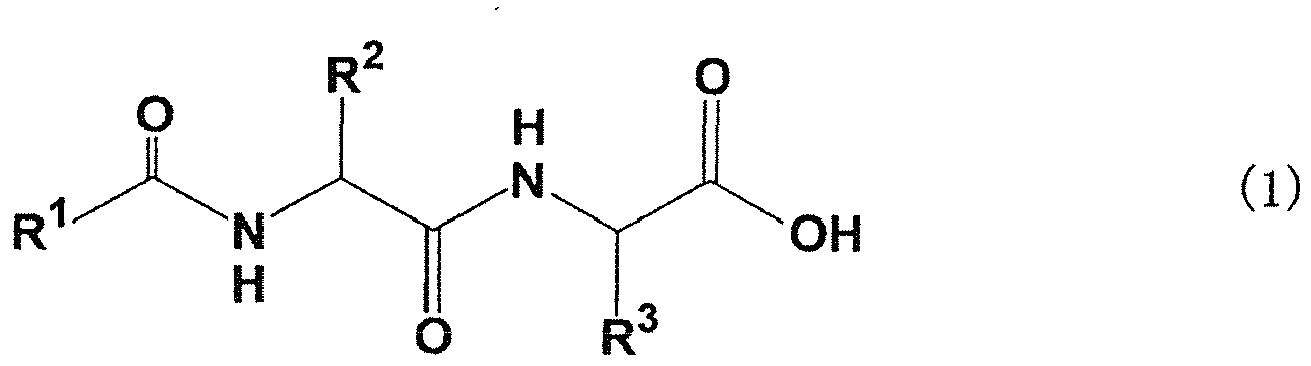

 water; andan additive including either an organic acid or an organic acid salt.
 - The hydrogel-forming material according to claim 1, wherein
the additive is an additive including either an organic acid or an organic acid salt which has a pH of 6.5 to 9.3 or a pH of 1.8 to 2.5. - The hydrogel-forming material according to claim 2, wherein
the additive is at least one organic acid selected from a group consisting of acetic acid, lactic acid, succinic acid, tartaric acid, citric acid, trimellitic acid, malic acid, and phosphoric acid, or is at least one organic acid salt selected from a group consisting of an acetate, a lactate, a succinate, a tartrate, a citrate, a trimellitate, a maleate, and a phosphate. - A gel which is formed of the hydrogel-forming material according to any one of claims 1 to 3.
Applications Claiming Priority (2)
| Application Number | Priority Date | Filing Date | Title |
|---|---|---|---|
| JP2011096048 | 2011-04-22 | ||
| PCT/JP2012/060742 WO2012144609A1 (en) | 2011-04-22 | 2012-04-20 | Hydrogel-forming material |
Publications (3)
| Publication Number | Publication Date |
|---|---|
| EP2700691A1 true EP2700691A1 (en) | 2014-02-26 |
| EP2700691A4 EP2700691A4 (en) | 2014-10-15 |
| EP2700691B1 EP2700691B1 (en) | 2018-11-14 |
Family
ID=47041713
Family Applications (1)
| Application Number | Title | Priority Date | Filing Date |
|---|---|---|---|
| EP12774725.1A Not-in-force EP2700691B1 (en) | 2011-04-22 | 2012-04-20 | Hydrogel-forming material |
Country Status (6)
| Country | Link |
|---|---|
| US (1) | US9328137B2 (en) |
| EP (1) | EP2700691B1 (en) |
| JP (1) | JP5943211B2 (en) |
| KR (1) | KR101963441B1 (en) |
| CN (2) | CN103608421B (en) |
| WO (1) | WO2012144609A1 (en) |
Cited By (2)
| Publication number | Priority date | Publication date | Assignee | Title |
|---|---|---|---|---|
| EP3020388A4 (en) * | 2013-07-09 | 2016-12-07 | Nissan Chemical Ind Ltd | DISPERSION FLUID AND METHOD FOR FORMING HYDROGEL |
| WO2019138355A1 (en) * | 2018-01-11 | 2019-07-18 | 3M Innovative Properties Company | Composition, bacterial repelling coating and method for forming the same, and article having bacterial repelling coating |
Families Citing this family (5)
| Publication number | Priority date | Publication date | Assignee | Title |
|---|---|---|---|---|
| US9872907B2 (en) | 2012-10-03 | 2018-01-23 | Nissan Chemical Industries, Ltd. | Hydrogel-forming material, premix, and hydrogel formation method |
| JP6132107B2 (en) * | 2012-10-03 | 2017-05-24 | 日産化学工業株式会社 | Hydrogel forming material |
| JP6490897B2 (en) * | 2013-12-27 | 2019-03-27 | 株式会社メニコンネクト | Self-assembled peptide gel |
| CN107427440A (en) * | 2015-01-28 | 2017-12-01 | 国立大学法人九州大学 | Moisturizing base material containing lipid peptide type compound |
| CN110204593A (en) * | 2019-05-17 | 2019-09-06 | 高邮市宇航化工机械厂 | A kind of preparation process of bio-pharmaceuticals polypeptide compound |
Family Cites Families (11)
| Publication number | Priority date | Publication date | Assignee | Title |
|---|---|---|---|---|
| DE4206154A1 (en) * | 1992-02-28 | 1993-09-02 | Wella Ag | METHOD FOR OBTAINING APPLE WAX, APPLE WAX AVAILABLE THROUGH THIS METHOD AND APPLE WAXING COSMETIC AGENTS |
| EP1985283A4 (en) * | 2006-01-18 | 2011-08-03 | Next21 Kk | MEDICALLY FORMING GEL FORMING COMPOSITION, COMPOSITION APPLICATION DEVICE AND VEHICLE CONTROLLING MEDICAMENT RELEASE |
| CN101809028B (en) * | 2007-07-05 | 2015-11-25 | 日产化学工业株式会社 | Novel lipid peptide and hydrogel |
| WO2009005152A1 (en) | 2007-07-05 | 2009-01-08 | Nissan Chemical Industries, Ltd. | Novel lipid-tripeptide based hydrogel-forming agent and hydrogel |
| EP2319894B1 (en) * | 2008-08-01 | 2016-10-26 | Nissan Chemical Industries, Ltd. | Novel lipid dipeptide and gel |
| KR101736169B1 (en) * | 2009-03-16 | 2017-05-16 | 닛산 가가쿠 고교 가부시키 가이샤 | Base material for spraying comprising low-molecular gelling agent |
| WO2010147158A1 (en) * | 2009-06-19 | 2010-12-23 | 日産化学工業株式会社 | Gel enclosing a compound by means of low-molecular weight gelling agent |
| JP2011037926A (en) * | 2009-08-06 | 2011-02-24 | Nissan Chem Ind Ltd | Long-chain oxyaminopolyol-based gelator and gel |
| JP5510635B2 (en) * | 2009-09-10 | 2014-06-04 | 日産化学工業株式会社 | Lipid histidine gelling agent |
| CN102596164B (en) * | 2009-10-26 | 2016-08-03 | 日产化学工业株式会社 | Cosmetics, skin external preparations, and medical devices |
| CN103313732B (en) * | 2010-11-12 | 2017-07-25 | 日产化学工业株式会社 | Gel film containing lipid peptide type gelling agent and high-molecular compound |
-
2012
- 2012-04-20 EP EP12774725.1A patent/EP2700691B1/en not_active Not-in-force
- 2012-04-20 KR KR1020137030881A patent/KR101963441B1/en not_active Expired - Fee Related
- 2012-04-20 JP JP2013511061A patent/JP5943211B2/en not_active Expired - Fee Related
- 2012-04-20 CN CN201280030216.1A patent/CN103608421B/en not_active Expired - Fee Related
- 2012-04-20 US US14/113,057 patent/US9328137B2/en active Active
- 2012-04-20 CN CN201610647553.5A patent/CN106176258A/en active Pending
- 2012-04-20 WO PCT/JP2012/060742 patent/WO2012144609A1/en not_active Ceased
Cited By (4)
| Publication number | Priority date | Publication date | Assignee | Title |
|---|---|---|---|---|
| EP3020388A4 (en) * | 2013-07-09 | 2016-12-07 | Nissan Chemical Ind Ltd | DISPERSION FLUID AND METHOD FOR FORMING HYDROGEL |
| US9782331B2 (en) | 2013-07-09 | 2017-10-10 | Nissan Chemical Industries, Ltd. | Dispersion and method for forming hydrogel |
| US10105294B2 (en) | 2013-07-09 | 2018-10-23 | Nissan Chemical Industries, Ltd. | Dispersion and method for forming hydrogel |
| WO2019138355A1 (en) * | 2018-01-11 | 2019-07-18 | 3M Innovative Properties Company | Composition, bacterial repelling coating and method for forming the same, and article having bacterial repelling coating |
Also Published As
| Publication number | Publication date |
|---|---|
| CN106176258A (en) | 2016-12-07 |
| CN103608421A (en) | 2014-02-26 |
| KR20140039200A (en) | 2014-04-01 |
| US9328137B2 (en) | 2016-05-03 |
| JP5943211B2 (en) | 2016-06-29 |
| KR101963441B1 (en) | 2019-03-28 |
| EP2700691B1 (en) | 2018-11-14 |
| CN103608421B (en) | 2016-08-31 |
| JPWO2012144609A1 (en) | 2014-07-28 |
| EP2700691A4 (en) | 2014-10-15 |
| US20140094420A1 (en) | 2014-04-03 |
| WO2012144609A1 (en) | 2012-10-26 |
Similar Documents
| Publication | Publication Date | Title |
|---|---|---|
| EP2700691B1 (en) | Hydrogel-forming material | |
| EP2664321B1 (en) | Medical instrument and preparation comprising a lipid peptide and gum arabic | |
| JP5500071B2 (en) | Novel lipid dipeptides and gels | |
| EP2180027B1 (en) | Novel lipid-tripeptide based hydrogel-forming agent and hydrogel | |
| JP5441693B2 (en) | Novel lipid peptides and hydrogels | |
| JP2011037926A (en) | Long-chain oxyaminopolyol-based gelator and gel | |
| CN117203302A (en) | Complexes, organic salts of amino acids and carboxylic acids, compositions containing them and uses thereof | |
| KR102178661B1 (en) | Hydrogel-forming material | |
| JP5510635B2 (en) | Lipid histidine gelling agent | |
| TWI488650B (en) | Freeze-dried preparation containing l-ascorbyl-2-phosphate-6-fatty acid, and its cosmetics | |
| WO2016088712A1 (en) | Hydrogel-forming material | |
| HK1162318A (en) | Freeze-dried preparation containing l-ascorbyl-2-phosphate-6-fatty acid and its cosmetics |
Legal Events
| Date | Code | Title | Description |
|---|---|---|---|
| PUAI | Public reference made under article 153(3) epc to a published international application that has entered the european phase |
Free format text: ORIGINAL CODE: 0009012 |
|
| 17P | Request for examination filed |
Effective date: 20131107 |
|
| AK | Designated contracting states |
Kind code of ref document: A1 Designated state(s): AL AT BE BG CH CY CZ DE DK EE ES FI FR GB GR HR HU IE IS IT LI LT LU LV MC MK MT NL NO PL PT RO RS SE SI SK SM TR |
|
| DAX | Request for extension of the european patent (deleted) | ||
| A4 | Supplementary search report drawn up and despatched |
Effective date: 20140912 |
|
| RIC1 | Information provided on ipc code assigned before grant |
Ipc: C09K 3/00 20060101AFI20140908BHEP |
|
| STAA | Information on the status of an ep patent application or granted ep patent |
Free format text: STATUS: EXAMINATION IS IN PROGRESS |
|
| 17Q | First examination report despatched |
Effective date: 20170925 |
|
| REG | Reference to a national code |
Ref country code: DE Ref legal event code: R079 Ref document number: 602012053521 Country of ref document: DE Free format text: PREVIOUS MAIN CLASS: C09K0003000000 Ipc: A61K0008368000 |
|
| GRAP | Despatch of communication of intention to grant a patent |
Free format text: ORIGINAL CODE: EPIDOSNIGR1 |
|
| STAA | Information on the status of an ep patent application or granted ep patent |
Free format text: STATUS: GRANT OF PATENT IS INTENDED |
|
| RIC1 | Information provided on ipc code assigned before grant |
Ipc: A61K 47/12 20060101ALI20180613BHEP Ipc: C07K 5/06 20060101ALI20180613BHEP Ipc: A61K 8/368 20060101AFI20180613BHEP |
|
| INTG | Intention to grant announced |
Effective date: 20180706 |
|
| RAP1 | Party data changed (applicant data changed or rights of an application transferred) |
Owner name: NISSAN CHEMICAL CORPORATION |
|
| GRAS | Grant fee paid |
Free format text: ORIGINAL CODE: EPIDOSNIGR3 |
|
| GRAA | (expected) grant |
Free format text: ORIGINAL CODE: 0009210 |
|
| STAA | Information on the status of an ep patent application or granted ep patent |
Free format text: STATUS: THE PATENT HAS BEEN GRANTED |
|
| AK | Designated contracting states |
Kind code of ref document: B1 Designated state(s): AL AT BE BG CH CY CZ DE DK EE ES FI FR GB GR HR HU IE IS IT LI LT LU LV MC MK MT NL NO PL PT RO RS SE SI SK SM TR |
|
| REG | Reference to a national code |
Ref country code: CH Ref legal event code: EP Ref country code: AT Ref legal event code: REF Ref document number: 1063950 Country of ref document: AT Kind code of ref document: T Effective date: 20181115 |
|
| REG | Reference to a national code |
Ref country code: DE Ref legal event code: R096 Ref document number: 602012053521 Country of ref document: DE |
|
| REG | Reference to a national code |
Ref country code: IE Ref legal event code: FG4D |
|
| REG | Reference to a national code |
Ref country code: NL Ref legal event code: MP Effective date: 20181114 |
|
| REG | Reference to a national code |
Ref country code: LT Ref legal event code: MG4D |
|
| REG | Reference to a national code |
Ref country code: AT Ref legal event code: MK05 Ref document number: 1063950 Country of ref document: AT Kind code of ref document: T Effective date: 20181114 |
|
| PG25 | Lapsed in a contracting state [announced via postgrant information from national office to epo] |
Ref country code: LV Free format text: LAPSE BECAUSE OF FAILURE TO SUBMIT A TRANSLATION OF THE DESCRIPTION OR TO PAY THE FEE WITHIN THE PRESCRIBED TIME-LIMIT Effective date: 20181114 Ref country code: ES Free format text: LAPSE BECAUSE OF FAILURE TO SUBMIT A TRANSLATION OF THE DESCRIPTION OR TO PAY THE FEE WITHIN THE PRESCRIBED TIME-LIMIT Effective date: 20181114 Ref country code: LT Free format text: LAPSE BECAUSE OF FAILURE TO SUBMIT A TRANSLATION OF THE DESCRIPTION OR TO PAY THE FEE WITHIN THE PRESCRIBED TIME-LIMIT Effective date: 20181114 Ref country code: BG Free format text: LAPSE BECAUSE OF FAILURE TO SUBMIT A TRANSLATION OF THE DESCRIPTION OR TO PAY THE FEE WITHIN THE PRESCRIBED TIME-LIMIT Effective date: 20190214 Ref country code: HR Free format text: LAPSE BECAUSE OF FAILURE TO SUBMIT A TRANSLATION OF THE DESCRIPTION OR TO PAY THE FEE WITHIN THE PRESCRIBED TIME-LIMIT Effective date: 20181114 Ref country code: FI Free format text: LAPSE BECAUSE OF FAILURE TO SUBMIT A TRANSLATION OF THE DESCRIPTION OR TO PAY THE FEE WITHIN THE PRESCRIBED TIME-LIMIT Effective date: 20181114 Ref country code: IS Free format text: LAPSE BECAUSE OF FAILURE TO SUBMIT A TRANSLATION OF THE DESCRIPTION OR TO PAY THE FEE WITHIN THE PRESCRIBED TIME-LIMIT Effective date: 20190314 Ref country code: NO Free format text: LAPSE BECAUSE OF FAILURE TO SUBMIT A TRANSLATION OF THE DESCRIPTION OR TO PAY THE FEE WITHIN THE PRESCRIBED TIME-LIMIT Effective date: 20190214 Ref country code: AT Free format text: LAPSE BECAUSE OF FAILURE TO SUBMIT A TRANSLATION OF THE DESCRIPTION OR TO PAY THE FEE WITHIN THE PRESCRIBED TIME-LIMIT Effective date: 20181114 |
|
| PG25 | Lapsed in a contracting state [announced via postgrant information from national office to epo] |
Ref country code: GR Free format text: LAPSE BECAUSE OF FAILURE TO SUBMIT A TRANSLATION OF THE DESCRIPTION OR TO PAY THE FEE WITHIN THE PRESCRIBED TIME-LIMIT Effective date: 20190215 Ref country code: RS Free format text: LAPSE BECAUSE OF FAILURE TO SUBMIT A TRANSLATION OF THE DESCRIPTION OR TO PAY THE FEE WITHIN THE PRESCRIBED TIME-LIMIT Effective date: 20181114 Ref country code: NL Free format text: LAPSE BECAUSE OF FAILURE TO SUBMIT A TRANSLATION OF THE DESCRIPTION OR TO PAY THE FEE WITHIN THE PRESCRIBED TIME-LIMIT Effective date: 20181114 Ref country code: PT Free format text: LAPSE BECAUSE OF FAILURE TO SUBMIT A TRANSLATION OF THE DESCRIPTION OR TO PAY THE FEE WITHIN THE PRESCRIBED TIME-LIMIT Effective date: 20190314 Ref country code: AL Free format text: LAPSE BECAUSE OF FAILURE TO SUBMIT A TRANSLATION OF THE DESCRIPTION OR TO PAY THE FEE WITHIN THE PRESCRIBED TIME-LIMIT Effective date: 20181114 Ref country code: SE Free format text: LAPSE BECAUSE OF FAILURE TO SUBMIT A TRANSLATION OF THE DESCRIPTION OR TO PAY THE FEE WITHIN THE PRESCRIBED TIME-LIMIT Effective date: 20181114 |
|
| PG25 | Lapsed in a contracting state [announced via postgrant information from national office to epo] |
Ref country code: DK Free format text: LAPSE BECAUSE OF FAILURE TO SUBMIT A TRANSLATION OF THE DESCRIPTION OR TO PAY THE FEE WITHIN THE PRESCRIBED TIME-LIMIT Effective date: 20181114 Ref country code: IT Free format text: LAPSE BECAUSE OF FAILURE TO SUBMIT A TRANSLATION OF THE DESCRIPTION OR TO PAY THE FEE WITHIN THE PRESCRIBED TIME-LIMIT Effective date: 20181114 Ref country code: CZ Free format text: LAPSE BECAUSE OF FAILURE TO SUBMIT A TRANSLATION OF THE DESCRIPTION OR TO PAY THE FEE WITHIN THE PRESCRIBED TIME-LIMIT Effective date: 20181114 Ref country code: PL Free format text: LAPSE BECAUSE OF FAILURE TO SUBMIT A TRANSLATION OF THE DESCRIPTION OR TO PAY THE FEE WITHIN THE PRESCRIBED TIME-LIMIT Effective date: 20181114 |
|
| REG | Reference to a national code |
Ref country code: DE Ref legal event code: R097 Ref document number: 602012053521 Country of ref document: DE |
|
| PG25 | Lapsed in a contracting state [announced via postgrant information from national office to epo] |
Ref country code: RO Free format text: LAPSE BECAUSE OF FAILURE TO SUBMIT A TRANSLATION OF THE DESCRIPTION OR TO PAY THE FEE WITHIN THE PRESCRIBED TIME-LIMIT Effective date: 20181114 Ref country code: SK Free format text: LAPSE BECAUSE OF FAILURE TO SUBMIT A TRANSLATION OF THE DESCRIPTION OR TO PAY THE FEE WITHIN THE PRESCRIBED TIME-LIMIT Effective date: 20181114 Ref country code: SM Free format text: LAPSE BECAUSE OF FAILURE TO SUBMIT A TRANSLATION OF THE DESCRIPTION OR TO PAY THE FEE WITHIN THE PRESCRIBED TIME-LIMIT Effective date: 20181114 Ref country code: EE Free format text: LAPSE BECAUSE OF FAILURE TO SUBMIT A TRANSLATION OF THE DESCRIPTION OR TO PAY THE FEE WITHIN THE PRESCRIBED TIME-LIMIT Effective date: 20181114 |
|
| PLBE | No opposition filed within time limit |
Free format text: ORIGINAL CODE: 0009261 |
|
| STAA | Information on the status of an ep patent application or granted ep patent |
Free format text: STATUS: NO OPPOSITION FILED WITHIN TIME LIMIT |
|
| 26N | No opposition filed |
Effective date: 20190815 |
|
| PG25 | Lapsed in a contracting state [announced via postgrant information from national office to epo] |
Ref country code: SI Free format text: LAPSE BECAUSE OF FAILURE TO SUBMIT A TRANSLATION OF THE DESCRIPTION OR TO PAY THE FEE WITHIN THE PRESCRIBED TIME-LIMIT Effective date: 20181114 |
|
| REG | Reference to a national code |
Ref country code: DE Ref legal event code: R119 Ref document number: 602012053521 Country of ref document: DE |
|
| REG | Reference to a national code |
Ref country code: CH Ref legal event code: PL |
|
| REG | Reference to a national code |
Ref country code: BE Ref legal event code: MM Effective date: 20190430 |
|
| GBPC | Gb: european patent ceased through non-payment of renewal fee |
Effective date: 20190420 |
|
| PG25 | Lapsed in a contracting state [announced via postgrant information from national office to epo] |
Ref country code: LU Free format text: LAPSE BECAUSE OF NON-PAYMENT OF DUE FEES Effective date: 20190420 Ref country code: MC Free format text: LAPSE BECAUSE OF FAILURE TO SUBMIT A TRANSLATION OF THE DESCRIPTION OR TO PAY THE FEE WITHIN THE PRESCRIBED TIME-LIMIT Effective date: 20181114 |
|
| PG25 | Lapsed in a contracting state [announced via postgrant information from national office to epo] |
Ref country code: GB Free format text: LAPSE BECAUSE OF NON-PAYMENT OF DUE FEES Effective date: 20190420 Ref country code: DE Free format text: LAPSE BECAUSE OF NON-PAYMENT OF DUE FEES Effective date: 20191101 Ref country code: LI Free format text: LAPSE BECAUSE OF NON-PAYMENT OF DUE FEES Effective date: 20190430 Ref country code: CH Free format text: LAPSE BECAUSE OF NON-PAYMENT OF DUE FEES Effective date: 20190430 |
|
| PG25 | Lapsed in a contracting state [announced via postgrant information from national office to epo] |
Ref country code: BE Free format text: LAPSE BECAUSE OF NON-PAYMENT OF DUE FEES Effective date: 20190430 Ref country code: FR Free format text: LAPSE BECAUSE OF NON-PAYMENT OF DUE FEES Effective date: 20190430 |
|
| PG25 | Lapsed in a contracting state [announced via postgrant information from national office to epo] |
Ref country code: TR Free format text: LAPSE BECAUSE OF FAILURE TO SUBMIT A TRANSLATION OF THE DESCRIPTION OR TO PAY THE FEE WITHIN THE PRESCRIBED TIME-LIMIT Effective date: 20181114 |
|
| PG25 | Lapsed in a contracting state [announced via postgrant information from national office to epo] |
Ref country code: IE Free format text: LAPSE BECAUSE OF NON-PAYMENT OF DUE FEES Effective date: 20190420 |
|
| PG25 | Lapsed in a contracting state [announced via postgrant information from national office to epo] |
Ref country code: CY Free format text: LAPSE BECAUSE OF FAILURE TO SUBMIT A TRANSLATION OF THE DESCRIPTION OR TO PAY THE FEE WITHIN THE PRESCRIBED TIME-LIMIT Effective date: 20181114 |
|
| PG25 | Lapsed in a contracting state [announced via postgrant information from national office to epo] |
Ref country code: HU Free format text: LAPSE BECAUSE OF FAILURE TO SUBMIT A TRANSLATION OF THE DESCRIPTION OR TO PAY THE FEE WITHIN THE PRESCRIBED TIME-LIMIT; INVALID AB INITIO Effective date: 20120420 Ref country code: MT Free format text: LAPSE BECAUSE OF FAILURE TO SUBMIT A TRANSLATION OF THE DESCRIPTION OR TO PAY THE FEE WITHIN THE PRESCRIBED TIME-LIMIT Effective date: 20181114 |
|
| PG25 | Lapsed in a contracting state [announced via postgrant information from national office to epo] |
Ref country code: MK Free format text: LAPSE BECAUSE OF FAILURE TO SUBMIT A TRANSLATION OF THE DESCRIPTION OR TO PAY THE FEE WITHIN THE PRESCRIBED TIME-LIMIT Effective date: 20181114 |