EP2698850A1 - Positive active material for rechargeable lithium battery, method for preparing same and rechargeable lithium battery including same - Google Patents
Positive active material for rechargeable lithium battery, method for preparing same and rechargeable lithium battery including same Download PDFInfo
- Publication number
- EP2698850A1 EP2698850A1 EP13160783.0A EP13160783A EP2698850A1 EP 2698850 A1 EP2698850 A1 EP 2698850A1 EP 13160783 A EP13160783 A EP 13160783A EP 2698850 A1 EP2698850 A1 EP 2698850A1
- Authority
- EP
- European Patent Office
- Prior art keywords
- particle
- active material
- positive active
- lithium battery
- element represented
- Prior art date
- Legal status (The legal status is an assumption and is not a legal conclusion. Google has not performed a legal analysis and makes no representation as to the accuracy of the status listed.)
- Granted
Links
Images



Classifications
-
- H—ELECTRICITY
- H01—ELECTRIC ELEMENTS
- H01M—PROCESSES OR MEANS, e.g. BATTERIES, FOR THE DIRECT CONVERSION OF CHEMICAL ENERGY INTO ELECTRICAL ENERGY
- H01M4/00—Electrodes
- H01M4/02—Electrodes composed of, or comprising, active material
- H01M4/36—Selection of substances as active materials, active masses, active liquids
- H01M4/48—Selection of substances as active materials, active masses, active liquids of inorganic oxides or hydroxides
- H01M4/52—Selection of substances as active materials, active masses, active liquids of inorganic oxides or hydroxides of nickel, cobalt or iron
- H01M4/525—Selection of substances as active materials, active masses, active liquids of inorganic oxides or hydroxides of nickel, cobalt or iron of mixed oxides or hydroxides containing iron, cobalt or nickel for inserting or intercalating light metals, e.g. LiNiO2, LiCoO2 or LiCoOxFy
-
- C—CHEMISTRY; METALLURGY
- C01—INORGANIC CHEMISTRY
- C01G—COMPOUNDS CONTAINING METALS NOT COVERED BY SUBCLASSES C01D OR C01F
- C01G45/00—Compounds of manganese
- C01G45/12—Complex oxides containing manganese and at least one other metal element
- C01G45/1221—Manganates or manganites with trivalent manganese, tetravalent manganese or mixtures thereof
- C01G45/1228—Manganates or manganites with trivalent manganese, tetravalent manganese or mixtures thereof of the type (MnO2)-, e.g. LiMnO2 or Li(MxMn1-x)O2
-
- C—CHEMISTRY; METALLURGY
- C01—INORGANIC CHEMISTRY
- C01G—COMPOUNDS CONTAINING METALS NOT COVERED BY SUBCLASSES C01D OR C01F
- C01G51/00—Compounds of cobalt
- C01G51/40—Complex oxides containing cobalt and at least one other metal element
- C01G51/42—Complex oxides containing cobalt and at least one other metal element containing alkali metals, e.g. LiCoO2
- C01G51/44—Complex oxides containing cobalt and at least one other metal element containing alkali metals, e.g. LiCoO2 containing manganese
- C01G51/50—Complex oxides containing cobalt and at least one other metal element containing alkali metals, e.g. LiCoO2 containing manganese of the type (MnO2)n-, e.g. Li(CoxMn1-x)O2 or Li(MyCoxMn1-x-y)O2
-
- C—CHEMISTRY; METALLURGY
- C01—INORGANIC CHEMISTRY
- C01G—COMPOUNDS CONTAINING METALS NOT COVERED BY SUBCLASSES C01D OR C01F
- C01G53/00—Compounds of nickel
- C01G53/40—Complex oxides containing nickel and at least one other metal element
- C01G53/42—Complex oxides containing nickel and at least one other metal element containing alkali metals, e.g. LiNiO2
- C01G53/44—Complex oxides containing nickel and at least one other metal element containing alkali metals, e.g. LiNiO2 containing manganese
- C01G53/50—Complex oxides containing nickel and at least one other metal element containing alkali metals, e.g. LiNiO2 containing manganese of the type (MnO2)n-, e.g. Li(NixMn1-x)O2 or Li(MyNixMn1-x-y)O2
-
- H—ELECTRICITY
- H01—ELECTRIC ELEMENTS
- H01M—PROCESSES OR MEANS, e.g. BATTERIES, FOR THE DIRECT CONVERSION OF CHEMICAL ENERGY INTO ELECTRICAL ENERGY
- H01M10/00—Secondary cells; Manufacture thereof
- H01M10/05—Accumulators with non-aqueous electrolyte
- H01M10/052—Li-accumulators
-
- H—ELECTRICITY
- H01—ELECTRIC ELEMENTS
- H01M—PROCESSES OR MEANS, e.g. BATTERIES, FOR THE DIRECT CONVERSION OF CHEMICAL ENERGY INTO ELECTRICAL ENERGY
- H01M10/00—Secondary cells; Manufacture thereof
- H01M10/05—Accumulators with non-aqueous electrolyte
- H01M10/056—Accumulators with non-aqueous electrolyte characterised by the materials used as electrolytes, e.g. mixed inorganic/organic electrolytes
- H01M10/0564—Accumulators with non-aqueous electrolyte characterised by the materials used as electrolytes, e.g. mixed inorganic/organic electrolytes the electrolyte being constituted of organic materials only
- H01M10/0566—Liquid materials
- H01M10/0569—Liquid materials characterised by the solvents
-
- H—ELECTRICITY
- H01—ELECTRIC ELEMENTS
- H01M—PROCESSES OR MEANS, e.g. BATTERIES, FOR THE DIRECT CONVERSION OF CHEMICAL ENERGY INTO ELECTRICAL ENERGY
- H01M4/00—Electrodes
- H01M4/02—Electrodes composed of, or comprising, active material
- H01M4/13—Electrodes for accumulators with non-aqueous electrolyte, e.g. for lithium-accumulators; Processes of manufacture thereof
- H01M4/131—Electrodes based on mixed oxides or hydroxides, or on mixtures of oxides or hydroxides, e.g. LiCoOx
-
- H—ELECTRICITY
- H01—ELECTRIC ELEMENTS
- H01M—PROCESSES OR MEANS, e.g. BATTERIES, FOR THE DIRECT CONVERSION OF CHEMICAL ENERGY INTO ELECTRICAL ENERGY
- H01M4/00—Electrodes
- H01M4/02—Electrodes composed of, or comprising, active material
- H01M4/13—Electrodes for accumulators with non-aqueous electrolyte, e.g. for lithium-accumulators; Processes of manufacture thereof
- H01M4/139—Processes of manufacture
- H01M4/1391—Processes of manufacture of electrodes based on mixed oxides or hydroxides, or on mixtures of oxides or hydroxides, e.g. LiCoOx
-
- H—ELECTRICITY
- H01—ELECTRIC ELEMENTS
- H01M—PROCESSES OR MEANS, e.g. BATTERIES, FOR THE DIRECT CONVERSION OF CHEMICAL ENERGY INTO ELECTRICAL ENERGY
- H01M4/00—Electrodes
- H01M4/02—Electrodes composed of, or comprising, active material
- H01M4/36—Selection of substances as active materials, active masses, active liquids
- H01M4/362—Composites
- H01M4/366—Composites as layered products
-
- H—ELECTRICITY
- H01—ELECTRIC ELEMENTS
- H01M—PROCESSES OR MEANS, e.g. BATTERIES, FOR THE DIRECT CONVERSION OF CHEMICAL ENERGY INTO ELECTRICAL ENERGY
- H01M4/00—Electrodes
- H01M4/02—Electrodes composed of, or comprising, active material
- H01M4/36—Selection of substances as active materials, active masses, active liquids
- H01M4/48—Selection of substances as active materials, active masses, active liquids of inorganic oxides or hydroxides
- H01M4/50—Selection of substances as active materials, active masses, active liquids of inorganic oxides or hydroxides of manganese
- H01M4/505—Selection of substances as active materials, active masses, active liquids of inorganic oxides or hydroxides of manganese of mixed oxides or hydroxides containing manganese for inserting or intercalating light metals, e.g. LiMn2O4 or LiMn2OxFy
-
- C—CHEMISTRY; METALLURGY
- C01—INORGANIC CHEMISTRY
- C01P—INDEXING SCHEME RELATING TO STRUCTURAL AND PHYSICAL ASPECTS OF SOLID INORGANIC COMPOUNDS
- C01P2002/00—Crystal-structural characteristics
- C01P2002/50—Solid solutions
- C01P2002/52—Solid solutions containing elements as dopants
-
- C—CHEMISTRY; METALLURGY
- C01—INORGANIC CHEMISTRY
- C01P—INDEXING SCHEME RELATING TO STRUCTURAL AND PHYSICAL ASPECTS OF SOLID INORGANIC COMPOUNDS
- C01P2002/00—Crystal-structural characteristics
- C01P2002/50—Solid solutions
- C01P2002/52—Solid solutions containing elements as dopants
- C01P2002/54—Solid solutions containing elements as dopants one element only
-
- C—CHEMISTRY; METALLURGY
- C01—INORGANIC CHEMISTRY
- C01P—INDEXING SCHEME RELATING TO STRUCTURAL AND PHYSICAL ASPECTS OF SOLID INORGANIC COMPOUNDS
- C01P2002/00—Crystal-structural characteristics
- C01P2002/80—Crystal-structural characteristics defined by measured data other than those specified in group C01P2002/70
- C01P2002/85—Crystal-structural characteristics defined by measured data other than those specified in group C01P2002/70 by XPS, EDX or EDAX data
-
- C—CHEMISTRY; METALLURGY
- C01—INORGANIC CHEMISTRY
- C01P—INDEXING SCHEME RELATING TO STRUCTURAL AND PHYSICAL ASPECTS OF SOLID INORGANIC COMPOUNDS
- C01P2004/00—Particle morphology
- C01P2004/01—Particle morphology depicted by an image
- C01P2004/03—Particle morphology depicted by an image obtained by SEM
-
- C—CHEMISTRY; METALLURGY
- C01—INORGANIC CHEMISTRY
- C01P—INDEXING SCHEME RELATING TO STRUCTURAL AND PHYSICAL ASPECTS OF SOLID INORGANIC COMPOUNDS
- C01P2004/00—Particle morphology
- C01P2004/60—Particles characterised by their size
- C01P2004/61—Micrometer sized, i.e. from 1-100 micrometer
-
- C—CHEMISTRY; METALLURGY
- C01—INORGANIC CHEMISTRY
- C01P—INDEXING SCHEME RELATING TO STRUCTURAL AND PHYSICAL ASPECTS OF SOLID INORGANIC COMPOUNDS
- C01P2004/00—Particle morphology
- C01P2004/80—Particles consisting of a mixture of two or more inorganic phases
- C01P2004/82—Particles consisting of a mixture of two or more inorganic phases two phases having the same anion, e.g. both oxidic phases
- C01P2004/84—Particles consisting of a mixture of two or more inorganic phases two phases having the same anion, e.g. both oxidic phases one phase coated with the other
-
- Y—GENERAL TAGGING OF NEW TECHNOLOGICAL DEVELOPMENTS; GENERAL TAGGING OF CROSS-SECTIONAL TECHNOLOGIES SPANNING OVER SEVERAL SECTIONS OF THE IPC; TECHNICAL SUBJECTS COVERED BY FORMER USPC CROSS-REFERENCE ART COLLECTIONS [XRACs] AND DIGESTS
- Y02—TECHNOLOGIES OR APPLICATIONS FOR MITIGATION OR ADAPTATION AGAINST CLIMATE CHANGE
- Y02E—REDUCTION OF GREENHOUSE GAS [GHG] EMISSIONS, RELATED TO ENERGY GENERATION, TRANSMISSION OR DISTRIBUTION
- Y02E60/00—Enabling technologies; Technologies with a potential or indirect contribution to GHG emissions mitigation
- Y02E60/10—Energy storage using batteries
Definitions
- a positive active material for a rechargeable lithium battery, a method of preparing the same, and a rechargeable lithium battery including the same are disclosed.
- batteries for powering these portable electronic devices should be made to have high performance and high capacity.
- Batteries generate electric power using an electrochemical reaction material (referred to hereinafter simply as an "active material") for a positive electrode and a negative electrode.
- Active material an electrochemical reaction material
- Rechargeable lithium batteries generate electrical energy from changes of chemical potential during the intercalation/deintercalation of lithium ions at the positive and negative electrodes.
- Rechargeable lithium batteries use materials that reversibly intercalate or deintercalate lithium ions during charge and discharge reactions for both positive and negative active materials, and include an organic electrolyte or a polymer electrolyte between the positive electrode and the negative electrode.
- lithium composite metal oxides such as LiCoO 2 , LiMn 2 O 4 , LiNiO 2 , LiNi 1-x Co x O 2 (0 ⁇ x ⁇ 1), LiMnO 2 , LiNi 1-x-y Co x MnyO 2 (0 ⁇ x ⁇ 1, 0 ⁇ y ⁇ 1, provided that x+y ⁇ 1), and the like have been researched.
- An aspect of the invention is directed toward a positive active material for a rechargeable lithium battery that is capable of improving capacity and cycle-life characteristics of the rechargeable lithium battery.
- An aspect of the invention is directed toward a method of preparing the positive active material.
- An aspect of the invention is directed toward a rechargeable lithium battery including the positive active material.
- a positive active material including a compound represented by the following Chemical Formula 1 is provided.
- a mole ratio [Me/M] (A) of an element represented by Me to an element represented by M in the following Chemical Formula 1 is 0.05 ⁇ A ⁇ 0.60, and in the entire particle, a mole ratio [Me/M] (B) of an element represented by Me to an element represented by M in the following Chemical Formula 1 is 0.003 ⁇ B ⁇ 0.012.
- the or each element represented by Me has a concentration difference between two positions of less than or equal to about 0.04 wt% (e.g. between any two positions).
- M is one selected from Ni, Mn, Co, and a combination thereof
- Me is one selected from Al, Mg, Ti, Zr, B, Ni, Mn, and a combination thereof, and M is not the same element as Me or does not include the same element as Me.
- A/B is 10 ⁇ A/B ⁇ 100.
- the surface part and the inner part are partitioned by an interface positioned at a constant depth from the surface of the particle towards the center of the particle.
- the surface part is designated as from the surface of the particle to an upper face of the interface, and the inner part is designated as the lower face (e.g. the inside) of the interface to the center of the particle.
- the interface is disposed at the depth of about 3nm to about 10nm from the surface of the particle towards the center of the particle.
- the element represented by Me has a decreasing concentration gradient going from the surface of the particle to the center of the particle.
- the element represented by Me in Chemical Formula 1 has a concentration of about 0.01 wt% to about 0.50 wt%.
- M is Co
- the positive active material has an average particle diameter of about 5 ⁇ m to about 20 ⁇ m.
- a rechargeable lithium battery that includes a positive electrode including the positive active material; a negative electrode including a negative active material; and a non-aqueous electrolyte.
- the negative active material is a material that reversibly intercalates and deintercalates lithium ions, a lithium metal, a lithium metal alloy, a material being capable of doping and dedoping lithium, or a transition metal oxide.
- the non-aqueous electrolyte includes a non-aqueous organic solvent selected from a carbonate-based, ester-based, ether-based, ketone-based, alcohol-based and aprotic solvent, and a combination thereof.
- a method of preparing a positive active material for a rechargeable lithium battery including the compound represented by the following Chemical formula 1 includes mixing a Li raw material, a raw material of an element represented by M (wherein M is one selected from Ni, Mn, Co, and a combination thereof), and a raw material of an element represented by Me 1 (wherein Me 1 is one selected from Al, Mg, Ti, Zr, B, Ni, Mn, and a combination thereof) and firing the same to provide a primary particle of a compound including Li, M, and Me 1 ; and coating the primary particle with a raw material of an element represented by Me 2 (wherein Me 2 is one selected from Al, Mg, Ti, Zr, B, Ni, Mn, and a combination thereof) and firing the same to provide a secondary particle of compound including Li, M, Me 1 and Me 2 .
- M is one selected from Ni, Mn, Co, and a combination thereof
- Me is one selected from Al, Mg, Ti, Zr, B, Ni, Mn, and a combination thereof, and M is not the same element as Me or does not include the same element as Me.
- the rechargeable lithium battery has improved capacity and cycle-life characteristics.
- FIG. 1 is a schematic view showing the structure of a rechargeable lithium battery according to one embodiment of the present invention.
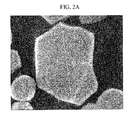
- FIG. 2A is a micrograph of a positive active material particle obtained from Example 2.
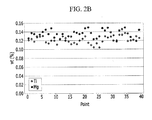
- FIG. 2B is a graph showing a concentration of Ti and Mg depending upon a depth of the positive active material particle obtained from Example 2.
- FIG. 3 is a graph showing a concentration of Ti and Mg depending upon a depth of the positive active material particle obtained from Comparative Example 4.
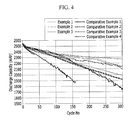
- FIG. 4 is a graph showing capacity according to the cycle of rechargeable lithium cells obtained from Examples 1 to 3 and Comparative Examples 1 to 4 to determine cycle-life characteristics.
- FIG. 5 is a graph showing the average voltage according to the cycle of rechargeable lithium cells obtained from Examples 1 to 3 and Comparative Examples 2 to 4 to determine cycle-life characteristics.
- a positive active material including a compound represented by the following Chemical Formula 1 for a rechargeable lithium battery is provided.
- Chemical Formula 1 Li 1+x M 1-k Me k O 2
- M is one selected from Ni, Mn, Co, and a combination thereof
- Me is one selected from Al, Mg, Ti, Zr, B, Ni, Mn, and a combination thereof, and M is not the same element as Me or does not include the same element as Me.
- the positive active material has a higher concentration of the element represented by Me in the surface part than in the inner part.
- A when the mole ratio [Me/M] of the element represented by Me to the element represented by M in Chemical Formula 1 refers to A in the surface part of a particle of the positive active material, A is 0.05 ⁇ A ⁇ 0.60; and when the mole ratio [Me/M] of the element represented by Me to the element represented by M in Chemical Formula 1 refers to B in the entire particle of the positive active material, B is 0.003 ⁇ B ⁇ 0.012.
- Each element represented by Me is distributed in the inner part of the particle at a relatively uniform concentration.
- a certain one element represented by Me in Chemical Formula 1 has a concentration difference of between set or predetermined two positions of less than or equal to about 0.04 wt%.
- the inner part and the surface part are partitioned by the interface positioned at constant depth from the surface of the particle towards the center of the particle, and the surface part is defined as from the surface of the particle to the interface, and the inner part is defined as the inside from the interface (e.g., from the inner surface of the interface to the center).
- the interface is positioned at a depth of about 3nm to about 10nm from the surface of the particle towards the center thereof.
- the interface has a surface present in the depth of about 5nm from the surface of the particle towards the center.
- the concentration of the surface part of the particle is measured for each element by X-ray Photoelectron Spectroscopy (XPS), so the value of A can be calculated therefrom.
- XPS X-ray Photoelectron Spectroscopy
- ICP-AES Inductively Coupled Plasma - Atomic Emission Spectrometer
- the positive active material has an A/B ratio of 10 ⁇ A/B ⁇ 100.
- A/B is 25 ⁇ A/B ⁇ 70, specifically, 30 ⁇ A/B ⁇ 50.
- a rechargeable lithium battery using the disclosed composition when having a concentration gradient that provides A/B within the ranges disclosed above, has remarkably improved cycle-life characteristics.
- the positive active material includes the element represented by Me in a high concentration in the surface part of the particle and also has a concentration gradient with a decreasing concentration from the surface of the particle going towards the center part of the particle.
- the inner part maintains a set or predetermined level of concentration.
- the element represented by Me in Chemical Formula 1 has a concentration of about 0.01 wt% to about 0.50 wt%, specifically, about 0.05 wt% to about 0.30 wt%.
- the positive active material is a lithium cobalt-based composite oxide in which the element represented by M is Co.
- the positive active material has an average particle diameter of about 5 ⁇ m to about 20 ⁇ m.
- a method of preparing a positive active material for a rechargeable lithium battery includes mixing a raw material of Li, a raw material of element represented by M (wherein M is one selected from Ni, Mn, Co, and a combination thereof), and a raw material of element represented by Me 1 (wherein Me 1 is one selected from Al, Mg, Ti, Zr, B, Ni, Mn, and a combination thereof) and heat treating (firing) the same to provide primary particle of compound including Li, M, and Me 1 ; and coating a raw material of element represented by Me 2 (wherein Me 2 is one selected from Al, Mg, Ti, Zr, B, Ni, Mn, and a combination thereof) on the primary particle and heat treating (firing) the same to provide a secondary particle of compound including Li, M, Me 1 and Me 2 .
- the Li raw material includes lithium phosphate (Li 3 PO 4 ), lithium nitrate (LiNO 3 ), lithium acetate (LiCH 3 COOH), lithium carbonate (Li 2 CO 3 ), lithium hydroxide (LiOH), lithium dihydrogen phosphate (LiH 2 PO 4 ), or a combination thereof, but is not limited thereto.
- the raw material of the element represented by M includes oxide, sulfate, nitrate, acetate, hydroxide, chloride, oxalate, fluoride, carbonate, or a combination of salts thereof of the element represented by M, but is not limited thereto.
- the raw materials represented by Me 1 and Me 2 includes oxide, sulfate, nitrate, acetate, hydroxide, chloride, oxalate, fluoride, carbonate, or a combination of salts thereof of the elements represented by Me 1 and Me 2 , but is not limited thereto.
- a Li raw material, a raw material of element represented by M, and a raw material of an element represented by Me 1 are mixed and fired to provide a primary particle of compound including Li, M, and Me 1 ; and then mixed with a raw material of an element represented by Me 1 (wherein Me 2 is one selected from Al, Mg, Ti, Zr, B, Ni, Mn, and a combination thereof) to increase the concentration thereof (i.e. the concentration of Me) in a surface part of the positive active material particle and fired to provide a secondary particle of compound including Li, M and Me 1 and Me 2 in which the element represented by Me 2 is present in a high concentration in the surface part of the particle.
- Me 1 and Me 2 are the same. However, in other embodiments of the invention Me 1 and Me 2 are different.
- the firing is performed at about 950°C to about 1100°C for about 10 hours to about 30 hours; and during the providing of the secondary particle, the firing is performed at about 600°C to about 1000°C for about 10 hours to about 30 hours.
- a rechargeable lithium battery that includes a positive electrode including the positive active material; a negative electrode including a negative active material; and a non-aqueous electrolyte.
- Rechargeable lithium batteries are classified as lithium ion batteries, lithium ion polymer batteries, and lithium polymer batteries according to the presence of a separator and the kind of electrolyte used in the battery.
- the rechargeable lithium batteries have a variety of shapes and sizes, and include cylindrical, prismatic, coin-type, or pouch-type batteries, and can be thin film batteries or be rather bulky in size. Structures and fabricating methods for lithium ion batteries pertaining to this disclosure are well known in the art.
- FIG. 1 is an exploded perspective view of a rechargeable lithium battery according to one embodiment.
- the rechargeable lithium battery 100 includes a battery cell including a positive electrode 114, a negative electrode 112 facing the positive electrode 114, a separator 113 interposed between the positive electrode 114 and the negative electrode 112, and an electrolyte impregnating the positive electrode 114, negative electrode 112, and separator 113, a battery case 120 housing the battery cell, and a sealing member 140 sealing the battery case 120.
- the rechargeable lithium battery 100 is fabricated by sequentially stacking a negative electrode 112, a separator 113 and a positive electrode 114, spiral-winding them and housing the wound product in the battery case 120.
- the negative electrode includes a current collector and a negative active material layer formed over the current collector.
- the negative active material layer includes a negative active material.
- the negative active material layer includes a material that reversibly intercalates/deintercalates lithium ions, a lithium metal, a lithium metal alloy, a material being capable of doping and dedoping lithium, or a transition metal oxide.
- the material that reversibly intercalates/deintercalates lithium ions includes a carbon material.
- the carbon material is any generally-used carbon-based negative active material in a lithium ion rechargeable battery.
- the carbon material include crystalline carbon, amorphous carbon, and a mixture thereof.
- the crystalline carbon can be non-shaped or sheet, flake, spherical, or fiber shaped natural graphite or artificial graphite.
- the amorphous carbon can be a soft carbon, a hard carbon, mesophase pitch carbide, fired coke, or the like.
- the lithium metal alloy includes lithium and a metal selected from Na, K, Rb, Cs, Fr, Be, Mg, Ca, Sr, Si, Sb, Pb, In, Zn, Ba, Ra, Ge, Al, or Sn.
- the material being capable of doping and dedoping lithium includes Si, SiO x (0 ⁇ x ⁇ 2), a Si-C composite, a Si-Q alloy (wherein Q is an element selected from an alkali metal, an alkaline-earth metal, Group 13 to 16 elements, a transition element, a rare earth element, or a combination thereof, and is not Si), Sn, SnO 2 , a Sn-C composite, a Sn-R alloy (wherein R is selected from an alkali metal, an alkaline-earth metal, Group 13 to 16 elements, a transition element, a rare earth element, or a combination thereof, and is not Sn), and the like.
- At least one of these materials is mixed with SiO 2 .
- the elements Q and R are independently selected from Mg, Ca, Sr, Ba, Ra, Sc, Y, Ti, Zr, Hf, Rf, V, Nb, Ta, Db, Cr, Mo, W, Sg, Tc, Re, Bh, Fe, Pb, Ru, Os, Hs, Rh, Ir, Pd, Pt, Cu, Ag, Au, Zn, Cd, B, Al, Ga, Sn, In, TI, Ge, P, As, Sb, Bi, S, Se, Te, Po, or a combination thereof.
- the transition metal oxide includes vanadium oxide, lithium vanadium oxide, or the like.
- the negative active material layer includes a binder, and optionally a conductive material.
- the binder improves properties of binding negative active material particles with one another and the negative active materials with a current collector.
- the binder includes polyvinylalcohol, carboxylmethylcellulose, hydroxypropylcellulose, polyvinylchloride, carboxylated polyvinylchloride, polyvinylfluoride, an ethylene oxide-containing polymer, polyvinylpyrrolidone, polyurethane, polytetrafluoroethylene, polyvinylidene fluoride, polyethylene, polypropylene, a styrene-butadiene rubber, an acrylated styrene-butadiene rubber, an epoxy resin, nylon, or the like, but is not limited thereto.
- the conductive material is used to provide conductivity to an electrode.
- the conductive material can be any electrically conductive material that is used as a conductive material unless it causes a chemical change.
- Examples of the conductive material include a carbon-based material such as natural graphite, artificial graphite, carbon black, acetylene black, ketjen black, a carbon fiber or the like; a metal-based material of metal powder or metal fiber including copper, nickel, aluminum, silver, or the like; a conductive polymer such as polyphenylene derivatives; or a mixture thereof.
- the current collector can be a copper foil, a nickel foil, a stainless steel foil, a titanium foil, a nickel foam, a copper foam, a polymer substrate coated with a conductive metal, or a combination thereof.
- the positive electrode includes a current collector and a positive active material layer disposed on the current collector.
- the positive active material is the same as described above.
- the positive active material layer includes a binder and a conductive material.
- the binder improves binding properties of the positive active material particles to each other and to a current collector.
- the binder include polyvinylalcohol, carboxylmethylcellulose, hydroxypropylcellulose, diacetylcellulose, polyvinylchloride, carboxylated polyvinylchloride, polyvinylfluoride, an ethylene oxide-containing polymer, polyvinylpyrrolidone, polyurethane, polytetrafluoroethylene, polyvinylidene fluoride, polyethylene, polypropylene, a styrene-butadiene rubber, an acrylated styrene-butadiene rubber, an epoxy resin, nylon, and the like, but are not limited thereto.
- the conductive material is used to provide conductivity to an electrode.
- it includes any suitable electrically conductive material causing no or insignificant chemical change.
- it includes natural graphite, artificial graphite, carbon black, acetylene black, ketjen black, a carbon fiber, a metal powder or a metal fiber or the like such as copper, nickel, aluminum, silver or the like, or conductive material such as polyphenylene derivative or the like, or a mixture of at least two thereof.
- the current collector is Al, but is not limited thereto.
- the negative and positive electrodes are fabricated by a method including mixing the active material, a conductive material, and a binder into an active material composition, and coating the composition on a current collector, respectively.
- the electrode manufacturing method is well known, and thus is not described in detail in the present specification.
- the solvent includes N-methylpyrrolidone and the like, but is not limited thereto.
- the electrolyte includes a non-aqueous organic solvent and a lithium salt.
- the non-aqueous organic solvent serves as a medium for transmitting ions taking part in the electrochemical reaction of a battery.
- the non-aqueous organic solvent includes a carbonate-based, ester-based, ether-based, ketone-based, alcohol-based, or aprotic solvent.
- the carbonate-based solvent includes dimethyl carbonate (DMC), diethyl carbonate (DEC), dipropyl carbonate (DPC), methylpropyl carbonate (MPC), ethylpropyl carbonate (EPC), methylethyl carbonate (MEC), ethylene carbonate (EC), propylene carbonate (PC), butylene carbonate (BC), or the like.
- the ester-based solvent includes methyl acetate, ethyl acetate, n-propyl acetate, methylpropinonate, ethylpropinonate, ⁇ -butyrolactone, decanolide, valerolactone, mevalonolactone, caprolactone, or the like.
- the ether-based solvent includes dibutyl ether, tetraglyme, diglyme, dimethoxyethane, 2-methyltetrahydrofuran, tetrahydrofuran, or the like, and the ketone-based solvent include cyclohexanone, or the like.
- the alcohol-based solvents include ethyl alcohol, isopropyl alcohol, and the like, and the aprotic solvents include nitriles such as R-CN (wherein R is a C2 to C20 linear, branched, or cyclic hydrocarbon group including a double bond, an aromatic ring, or an ether bond), amides such as dimethylformamide, dioxolanes such as 1,3-dioxolane, sulfolanes, or the like.
- R-CN wherein R is a C2 to C20 linear, branched, or cyclic hydrocarbon group including a double bond, an aromatic ring, or an ether bond
- amides such as dimethylformamide
- dioxolanes such as 1,3-dioxolane
- sulfolanes or the like.
- the non-aqueous organic solvent is used singularly or in a mixture.
- the mixture ratio can be controlled in accordance with a desirable battery performance.
- the carbonate-based solvent is prepared by mixing a cyclic carbonate and a linear carbonate.
- the cyclic carbonate and the linear carbonate are mixed together in the volume ratio of about 1:1 to about 1:9. Within this range, performance of electrolyte is improved.
- non-aqueous organic solvent can be further prepared by mixing a carbonate-based solvent with an aromatic hydrocarbon-based solvent.
- the carbonate-based and the aromatic hydrocarbon-based solvents can be mixed together in a volume ratio ranging from about 1:1 to about 30:1.
- the aromatic hydrocarbon-based organic solvent is represented by the following Chemical Formula A.
- R 1 to R 6 are each independently hydrogen, a halogen, a C1 to C10 alkyl group, a C1 to C10 haloalkyl group, or a combination thereof.
- the aromatic hydrocarbon-based organic solvent can include benzene, fluorobenzene, 1,2-difluorobenzene, 1,3-difluorobenzene, 1,4-difluorobenzene, 1,2,3-trifluorobenzene, 1,2,4-trifluorobenzene, chlorobenzene, 1,2-dichlorobenzene, 1,3-dichlorobenzene, 1,4-dichlorobenzene, 1,2,3-trichlorobenzene, 1,2,4-trichlorobenzene, iodobenzene, 1,2-diiodobenzene, 1,3-diiodobenzene, 1,4-diiodobenzene, 1,2,3-triiodobenzene, 1,2,4-triiodobenzene, toluene, fluorotoluene, 1,2-difluorotoluene, 1,3-difluorotol
- the non-aqueous electrolyte further includes vinylene carbonate, or an ethylene carbonate-based compound represented by the following Chemical Formula B to improve cycle-life.
- R 7 and R 8 are independently selected from hydrogen, a halogen, a cyano group (CN), a nitro group (NO 2 ), and a C1 to C5 fluoroalkyl group, provided that at least one of R 7 and R 8 is selected from a halogen, a cyano group (CN), a nitro group (NO 2 ), and a C1 to C5 fluoroalkyl group.
- Examples of the ethylene carbonate-based compound include difluoro ethylenecarbonate, chloroethylene carbonate, dichloroethylene carbonate, bromoethylene carbonate, dibromoethylene carbonate, nitroethylene carbonate, cyanoethylene carbonate, fluoroethylene carbonate, and the like.
- the amount of the vinylene carbonate or the ethylene carbonate-based compound used to improve cycle life are adjusted within an appropriate range.
- the lithium salt is dissolved in an organic solvent, supplies lithium ions in a battery, operates a basic operation of the rechargeable lithium battery, and improves lithium ion transportation between positive and negative electrodes therein.
- the lithium salt include LiPF 6 , LiBF 4 , LiSbF 6 , LiAsF 6 , LiC 4 F 9 SO 3 , LiClO 4 , LiAlO 2 , LiAlCl 4 , LiN(SO 2 C x F 2x+1 )( SO 2 C y F 2y+1 ) (where x and y are natural numbers), LiCl, Lil, LiB(C 2 O 4 ) 2 (lithium bis(oxalato) borate, LiBOB), or a combination thereof, as a supporting electrolytic salt.
- the lithium salt is used in a concentration ranging from 0.1 M to 2.0 M. In one embodiment, when the lithium salt is included at the above concentration range, an electrolyte has excellent performance and lithium ion mobility due to desired electrolyte conductivity and viscosity.
- the separator 113 includes any suitable materials commonly used in the conventional lithium battery that is capable of separating (e.g., electrically insulating) a negative electrode 112 from a positive electrode 114 and provide a transporting passage for lithium ions. In other words, it has a low resistance to ion transport and an excellent impregnation for electrolyte.
- it is selected from glass fiber, polyester, TEFLON (tetrafluoroethylne), polyethylene, polypropylene, polytetrafluoroethylene (PTFE), or a combination thereof. It has a form of a non-woven fabric or a woven fabric.
- a polyolefin-based polymer separator such as polyethylene, polypropylene or the like is mainly used.
- a coated separator including a ceramic component or a polymer material can be used.
- it can have a mono-layered or multi-layered structure.
- LiCoO 2 362 g of Li 2 CO 3 powder, 750 g of Co 3 O 4 powder, 0.4 g of TiO 2 powder, and 2.0 g of MgCO 3 powder were mixed and first fired at 1050°C for 25 hours.
- the fired powder was pulverized and filtered to provide a LiCoO 2 doped with Ti and Mg.
- the obtained LiCoO 2 was mixed with 0.3 g of TiO 2 powder and 1.5 g of MgCO 3 powder in a dry method and fired at 900°C for 20 hours and then secondary fired to provide a LiCoO 2 powder doped and coated with Ti and Mg.
- LiCoO 2 362 g of Li 2 CO 3 powder, 750 g of Co 3 O 4 powder, 1.2 g of TiO 2 powder, and 3.0 g of MgCO 3 powder were mixed and first fired at 1050°C for 25 hours.
- the fired powder was pulverized and filtered to provide a LiCoO 2 doped with Ti and Mg.
- the obtained LiCoO 2 was mixed with 1.0 g of TiO 2 powder and 2.6 g of MgCO 3 powder in a dry method and then secondary fired at 950°C for 20 hours to provide a LiCoO 2 powder doped and coated with Ti and Mg.
- LiCoO 2 362 g of Li 2 CO 3 powder, 750 g of Co 3 O 4 powder, 0.9 g of TiO 2 powder, and 2.5 g of MgCO 3 powder were mixed and first fired at 1050°C for 25 hours.
- the fired powder was pulverized and filtered to provide a LiCoO 2 doped with Ti and Mg.
- the obtained LiCoO 2 was mixed with 0.7 g of TiO 2 powder and 2.3 g of MgCO 3 powder in a dry method and then secondary fired at 900°C for 20 hours to provide a LiCoO 2 powder doped and coated with Ti and Mg.
- Li 2 CO 3 powder and 750 g of Co 3 O 4 powder were uniform mixed and fired at 950°C for 25 hours.
- the fired powder was pulverized and filtered to provide a LiCoO 2 .
- LiCoO 2 362 g of Li 2 CO 3 powder and 750 g of Co 3 O 4 powder were uniform mixed and fired at 950°C for 25 hours. The fired powder was pulverized and filtered to provide a LiCoO 2 . The obtained LiCoO 2 was mixed with 1.65 g of TiO 2 powder and 3.65 g of MgCO 3 powder in a dry method and then secondary fired at 900°C for 20 hours to provide a LiCoO 2 powder doped and coated with Ti and Mg.
- LiCoO 2 362 g of Li 2 CO 3 powder and 750 g of Co 3 O 4 powder were uniform mixed and fired at 950°C for 25 hours. The fired powder was pulverized and filtered to provide a LiCoO 2 . The obtained LiCoO 2 was mixed with 1.65 g of TiO 2 powder and 4.5 g of MgCO 3 powder in a dry method and then secondary fired at 1020°C for 20 hours to provide a LiCoO 2 powder doped and coated with Ti and Mg.
- the positive active materials obtained from Examples 1 to 3 and Comparative Examples 2 to 4 were measured for weight ratios (wt%) of components of Co, Ti, and Mg using an Inductively Coupled Plasma-Atomic Emission Spectrometer (ICP-AES), and each weight ratio was divided by the molecular weight of each component to calculate the molar number of each component.
- A/B was calculated from the results of Table 1 and shown in the following Table 2. Table 2 A/B Example 1 18.7 Example 2 31.8 Example 3 40.1
- the Ar sputtering intensity indicates the intensity capable of sputtering in a level of about 5nm per minute, so it is confirmed that dopant was not in (i.e., does not exist in) the depth of about 0.25 ⁇ m in a direction of from the surface to the center from the results for 3000 seconds.
- FIG. 2A and FIG. 2B show SEM-EDS analysis results. As shown in FIG. 2A , the diameter of the particle was separated by a set or predetermined gap within 40 points, and the concentration (wt%) at each point was analyzed, and the results are shown in FIG. 2B .
- the concentration difference of each Ti and Mg was within about 0.04 wt% at the set or predetermined 2 points in the inner part of the particle (i.e., the inner part inside the interface shown by the dashed line), so it is understood that the concentrations of dopants of Ti and Mg were uniform in the inner part.
- the positive active material obtained from Example 1, a binder of polyvinylidene fluoride, and a conductive material of carbon black were mixed at a weight ratio of 94:3:3 in a N-methylpyrrolidone solvent to provide a slurry of positive active material layer.
- the slurry of positive active material layer was coated on a positive electrode current collector of Al foil to provide a thin plate and dried at about 120°C for 1 hour and pressed to provide a positive electrode including a positive active material layer
- a Li foil was used as a negative active material to provide a negative electrode.
- the obtained positive electrode, the negative electrode, a polyethylene separator having a thickness of 20 ⁇ m, and an electrolyte solution (a mixture of EC (ethylene carbonate) and EMC (ethylmethyl carbonate) and DMC (dimethyl carbonate) (volume ratio of EM:EMC:DMC: 3:3:4) + 1.15 M of LiPF 6 ) were assembled to provide a coin cell.
- a coin cell was fabricated in accordance with the same procedure as in Example 4, except that the positive active material according to Example 2 was used.
- a coin cell was fabricated in accordance with the same procedure as in Example 4, except that the positive active material according to Example 3 was used.
- a coin cell was fabricated in accordance with the same procedure as in Example 4, except that the positive active material according to Comparative Example 1 was used.
- a coin cell was fabricated in accordance with the same procedure as in Example 4, except that the positive active material according to Comparative Example 2 was used.
- a coin cell was fabricated in accordance with the same procedure as in Example 4, except that the positive active material according to Comparative Example 3 was used.
- a coin cell was fabricated in accordance with the same procedure as in Example 4, except that the positive active material according to Comparative Example 4 was used.
- Each rechargeable lithium battery cell obtained from Examples 4 to 6 and Comparative Examples 5 to 8 was charged at a room temperature at cut-off of CC-CV of 0.8 C, 4.2 V, 100 mA and discharged at cut-off of 1.0 C, 3.0 V to set a 1 cycle. It was repeated for 300 cycles to evaluate the cycle-life characteristics.
- FIG. 4 shows the discharge capacity depending upon the number of cycles
- FIG. 5 shows the average voltage depending upon the number of cycles.
Landscapes
- Chemical & Material Sciences (AREA)
- Inorganic Chemistry (AREA)
- Organic Chemistry (AREA)
- Chemical Kinetics & Catalysis (AREA)
- Electrochemistry (AREA)
- General Chemical & Material Sciences (AREA)
- Engineering & Computer Science (AREA)
- Manufacturing & Machinery (AREA)
- Composite Materials (AREA)
- Physics & Mathematics (AREA)
- Condensed Matter Physics & Semiconductors (AREA)
- General Physics & Mathematics (AREA)
- Materials Engineering (AREA)
- Battery Electrode And Active Subsutance (AREA)
- Secondary Cells (AREA)
Abstract
Description
- A positive active material for a rechargeable lithium battery, a method of preparing the same, and a rechargeable lithium battery including the same are disclosed.
- Relating to the trends of down-sizing and making light weight portable electronic devices, batteries for powering these portable electronic devices should be made to have high performance and high capacity.
- Batteries generate electric power using an electrochemical reaction material (referred to hereinafter simply as an "active material") for a positive electrode and a negative electrode. Rechargeable lithium batteries generate electrical energy from changes of chemical potential during the intercalation/deintercalation of lithium ions at the positive and negative electrodes.
- Rechargeable lithium batteries use materials that reversibly intercalate or deintercalate lithium ions during charge and discharge reactions for both positive and negative active materials, and include an organic electrolyte or a polymer electrolyte between the positive electrode and the negative electrode.
- In a positive active material for a rechargeable lithium battery, lithium composite metal oxides such as LiCoO2, LiMn2O4, LiNiO2, LiNi1-xCoxO2 (0<x<1), LiMnO2, LiNi1-x-yCoxMnyO2 (0<x<1, 0<y<1, provided that x+y ≤1), and the like have been researched.
- An aspect of the invention is directed toward a positive active material for a rechargeable lithium battery that is capable of improving capacity and cycle-life characteristics of the rechargeable lithium battery.
- An aspect of the invention is directed toward a method of preparing the positive active material.
- An aspect of the invention is directed toward a rechargeable lithium battery including the positive active material.
- According to one embodiment, a positive active material including a compound represented by the following Chemical Formula 1 is provided.
- In a surface part of a particle of the positive active material, a mole ratio [Me/M] (A) of an element represented by Me to an element represented by M in the following
Chemical Formula 1 is 0.05≤A≤0.60, and in the entire particle, a mole ratio [Me/M] (B) of an element represented by Me to an element represented by M in the followingChemical Formula 1 is 0.003≤B≤0.012. - In an inner part of the particle, the or each element represented by Me has a concentration difference between two positions of less than or equal to about 0.04 wt% (e.g. between any two positions).
[Chemical Formula 1] Li1+xM1-kMekO2
- -0.2≤x≤0.2, 0≤k≤0.05
- M is one selected from Ni, Mn, Co, and a combination thereof,
- Me is one selected from Al, Mg, Ti, Zr, B, Ni, Mn, and a combination thereof, and M is not the same element as Me or does not include the same element as Me.
- In an embodiment of the invention A/B is 10≤A/B≤100.
- The surface part and the inner part are partitioned by an interface positioned at a constant depth from the surface of the particle towards the center of the particle. The surface part is designated as from the surface of the particle to an upper face of the interface, and the inner part is designated as the lower face (e.g. the inside) of the interface to the center of the particle. In embodiments of the invention, the interface is disposed at the depth of about 3nm to about 10nm from the surface of the particle towards the center of the particle.
- The element represented by Me has a decreasing concentration gradient going from the surface of the particle to the center of the particle.
- In embodiments of the invention, in the inner part of the positive active material particle, the element represented by Me in Chemical Formula 1 has a concentration of about 0.01 wt% to about 0.50 wt%.
- In one embodiment, in the above
Chemical Formula 1, M is Co. - In embodiments of the invention, the positive active material has an average particle diameter of about 5 µm to about 20 µm.
- According to another embodiment, there is provided a rechargeable lithium battery that includes a positive electrode including the positive active material; a negative electrode including a negative active material; and a non-aqueous electrolyte.
- In embodiments of the invention, the negative active material is a material that reversibly intercalates and deintercalates lithium ions, a lithium metal, a lithium metal alloy, a material being capable of doping and dedoping lithium, or a transition metal oxide.
- In embodiments of the invention, the non-aqueous electrolyte includes a non-aqueous organic solvent selected from a carbonate-based, ester-based, ether-based, ketone-based, alcohol-based and aprotic solvent, and a combination thereof.
- According to yet another embodiment, a method of preparing a positive active material for a rechargeable lithium battery including the compound represented by the following
Chemical formula 1 is provided that includes mixing a Li raw material, a raw material of an element represented by M (wherein M is one selected from Ni, Mn, Co, and a combination thereof), and a raw material of an element represented by Me1 (wherein Me1 is one selected from Al, Mg, Ti, Zr, B, Ni, Mn, and a combination thereof) and firing the same to provide a primary particle of a compound including Li, M, and Me1; and coating the primary particle with a raw material of an element represented by Me2 (wherein Me2 is one selected from Al, Mg, Ti, Zr, B, Ni, Mn, and a combination thereof) and firing the same to provide a secondary particle of compound including Li, M, Me1 and Me2.
[Chemical Formula 1] Li1+xM1-kMekO2
- -0.2≤x≤0.2, 0<k≤0.05
- M is one selected from Ni, Mn, Co, and a combination thereof,
- Me is one selected from Al, Mg, Ti, Zr, B, Ni, Mn, and a combination thereof, and M is not the same element as Me or does not include the same element as Me.
- In view of the above and according to one embodiment, the rechargeable lithium battery has improved capacity and cycle-life characteristics.
- In an aspect of the invention, there is a positive active material for a rechargeable lithium battery as described in
Claim 1. Embodiments of this aspect are described inClaims 3 to 8. In a further aspect of the invention, there is a rechargeable lithium battery as described inClaim 2. Embodiments of this aspect are described inClaims 3 to 10. In a yet further aspect of the invention, there is a method of preparing a positive active material for a rechargeable lithium battery as described in Claim 11. Embodiments of this aspect are set out in Claims 12 and 13. -
FIG. 1 is a schematic view showing the structure of a rechargeable lithium battery according to one embodiment of the present invention. -
FIG. 2A is a micrograph of a positive active material particle obtained from Example 2. -
FIG. 2B is a graph showing a concentration of Ti and Mg depending upon a depth of the positive active material particle obtained from Example 2. -
FIG. 3 is a graph showing a concentration of Ti and Mg depending upon a depth of the positive active material particle obtained from Comparative Example 4. -
FIG. 4 is a graph showing capacity according to the cycle of rechargeable lithium cells obtained from Examples 1 to 3 and Comparative Examples 1 to 4 to determine cycle-life characteristics. -
FIG. 5 is a graph showing the average voltage according to the cycle of rechargeable lithium cells obtained from Examples 1 to 3 and Comparative Examples 2 to 4 to determine cycle-life characteristics. - Example embodiments of the present invention will hereinafter be described in detail. However, these embodiments are only examples, and the present invention is not limited thereto.
- In each embodiment of the current invention, unless otherwise specified, the terms "comprising" or "comprises" etc, may be replaced with the terms "consists of" or "consists essentially of" etc.
- According to one embodiment, a positive active material including a compound represented by the following Chemical Formula 1 for a rechargeable lithium battery is provided.
[Chemical Formula 1] Li1+xM1-kMekO2
- -0.2≤x≤0.2, 0<k≤0.05
- M is one selected from Ni, Mn, Co, and a combination thereof,
- Me is one selected from Al, Mg, Ti, Zr, B, Ni, Mn, and a combination thereof, and M is not the same element as Me or does not include the same element as Me.
- The positive active material has a higher concentration of the element represented by Me in the surface part than in the inner part. For example, when the mole ratio [Me/M] of the element represented by Me to the element represented by M in
Chemical Formula 1 refers to A in the surface part of a particle of the positive active material, A is 0.05≤A≤0.60; and when the mole ratio [Me/M] of the element represented by Me to the element represented by M inChemical Formula 1 refers to B in the entire particle of the positive active material, B is 0.003≤B≤0.012. - Each element represented by Me is distributed in the inner part of the particle at a relatively uniform concentration. For example, a certain one element represented by Me in
Chemical Formula 1 has a concentration difference of between set or predetermined two positions of less than or equal to about 0.04 wt%. - The inner part and the surface part are partitioned by the interface positioned at constant depth from the surface of the particle towards the center of the particle, and the surface part is defined as from the surface of the particle to the interface, and the inner part is defined as the inside from the interface (e.g., from the inner surface of the interface to the center). The interface is positioned at a depth of about 3nm to about 10nm from the surface of the particle towards the center thereof. For example, the interface has a surface present in the depth of about 5nm from the surface of the particle towards the center.
- In embodiments of the invention, the concentration of the surface part of the particle is measured for each element by X-ray Photoelectron Spectroscopy (XPS), so the value of A can be calculated therefrom.
- In further embodiments of the invention, in order to measure the concentration based on the entirety of one particle, it is measured by Inductively Coupled Plasma - Atomic Emission Spectrometer (ICP-AES), and the value of B can be calculated therefrom.
- In yet further embodiments of the invention, the positive active material has an A/B ratio of 10≤A/B≤100. For example, A/B is 25≤A/B≤70, specifically, 30≤A/B≤50. In one embodiment, when having a concentration gradient that provides A/B within the ranges disclosed above, a rechargeable lithium battery using the disclosed composition has remarkably improved cycle-life characteristics.
- In one embodiment, the positive active material includes the element represented by Me in a high concentration in the surface part of the particle and also has a concentration gradient with a decreasing concentration from the surface of the particle going towards the center part of the particle. In this case, the inner part maintains a set or predetermined level of concentration. For example, in the inner part of the positive active material particle, the element represented by Me in
Chemical Formula 1 has a concentration of about 0.01 wt% to about 0.50 wt%, specifically, about 0.05 wt% to about 0.30 wt%. - According to another embodiment, the positive active material is a lithium cobalt-based composite oxide in which the element represented by M is Co.
- In embodiments of the current invention, the positive active material has an average particle diameter of about 5µm to about 20µm.
- Hereinafter, a method of preparing the positive active material is described.
- According to another embodiment of the present invention, a method of preparing a positive active material for a rechargeable lithium battery is provided that includes mixing a raw material of Li, a raw material of element represented by M (wherein M is one selected from Ni, Mn, Co, and a combination thereof), and a raw material of element represented by Me1 (wherein Me1 is one selected from Al, Mg, Ti, Zr, B, Ni, Mn, and a combination thereof) and heat treating (firing) the same to provide primary particle of compound including Li, M, and Me1; and coating a raw material of element represented by Me2 (wherein Me2 is one selected from Al, Mg, Ti, Zr, B, Ni, Mn, and a combination thereof) on the primary particle and heat treating (firing) the same to provide a secondary particle of compound including Li, M, Me1 and Me2.
- The Li raw material includes lithium phosphate (Li3PO4), lithium nitrate (LiNO3), lithium acetate (LiCH3COOH), lithium carbonate (Li2CO3), lithium hydroxide (LiOH), lithium dihydrogen phosphate (LiH2PO4), or a combination thereof, but is not limited thereto.
- In embodiments of the invention, the raw material of the element represented by M includes oxide, sulfate, nitrate, acetate, hydroxide, chloride, oxalate, fluoride, carbonate, or a combination of salts thereof of the element represented by M, but is not limited thereto.
- In embodiments of the invention, the raw materials represented by Me1 and Me2 includes oxide, sulfate, nitrate, acetate, hydroxide, chloride, oxalate, fluoride, carbonate, or a combination of salts thereof of the elements represented by Me1 and Me2, but is not limited thereto.
- A Li raw material, a raw material of element represented by M, and a raw material of an element represented by Me1 are mixed and fired to provide a primary particle of compound including Li, M, and Me1; and then mixed with a raw material of an element represented by Me1 (wherein Me2 is one selected from Al, Mg, Ti, Zr, B, Ni, Mn, and a combination thereof) to increase the concentration thereof (i.e. the concentration of Me) in a surface part of the positive active material particle and fired to provide a secondary particle of compound including Li, M and Me1 and Me2 in which the element represented by Me2 is present in a high concentration in the surface part of the particle. In embodiments of the invention Me1 and Me2 are the same. However, in other embodiments of the invention Me1 and Me2 are different.
- During the providing of the primary particle, the firing is performed at about 950°C to about 1100°C for about 10 hours to about 30 hours; and during the providing of the secondary particle, the firing is performed at about 600°C to about 1000°C for about 10 hours to about 30 hours.
- According to another embodiment, provided is a rechargeable lithium battery that includes a positive electrode including the positive active material; a negative electrode including a negative active material; and a non-aqueous electrolyte.
- Rechargeable lithium batteries are classified as lithium ion batteries, lithium ion polymer batteries, and lithium polymer batteries according to the presence of a separator and the kind of electrolyte used in the battery. The rechargeable lithium batteries have a variety of shapes and sizes, and include cylindrical, prismatic, coin-type, or pouch-type batteries, and can be thin film batteries or be rather bulky in size. Structures and fabricating methods for lithium ion batteries pertaining to this disclosure are well known in the art.
-
FIG. 1 is an exploded perspective view of a rechargeable lithium battery according to one embodiment. Referring toFIG. 1 , therechargeable lithium battery 100 according to one embodiment includes a battery cell including apositive electrode 114, anegative electrode 112 facing thepositive electrode 114, aseparator 113 interposed between thepositive electrode 114 and thenegative electrode 112, and an electrolyte impregnating thepositive electrode 114,negative electrode 112, andseparator 113, abattery case 120 housing the battery cell, and a sealingmember 140 sealing thebattery case 120. Therechargeable lithium battery 100 is fabricated by sequentially stacking anegative electrode 112, aseparator 113 and apositive electrode 114, spiral-winding them and housing the wound product in thebattery case 120. - The negative electrode includes a current collector and a negative active material layer formed over the current collector. The negative active material layer includes a negative active material.
- The negative active material layer includes a material that reversibly intercalates/deintercalates lithium ions, a lithium metal, a lithium metal alloy, a material being capable of doping and dedoping lithium, or a transition metal oxide.
- The material that reversibly intercalates/deintercalates lithium ions includes a carbon material. In embodiments of the invention, the carbon material is any generally-used carbon-based negative active material in a lithium ion rechargeable battery. Examples of the carbon material include crystalline carbon, amorphous carbon, and a mixture thereof. The crystalline carbon can be non-shaped or sheet, flake, spherical, or fiber shaped natural graphite or artificial graphite. The amorphous carbon can be a soft carbon, a hard carbon, mesophase pitch carbide, fired coke, or the like.
- The lithium metal alloy includes lithium and a metal selected from Na, K, Rb, Cs, Fr, Be, Mg, Ca, Sr, Si, Sb, Pb, In, Zn, Ba, Ra, Ge, Al, or Sn.
- In embodiments of the invention, the material being capable of doping and dedoping lithium includes Si, SiOx (0 < x < 2), a Si-C composite, a Si-Q alloy (wherein Q is an element selected from an alkali metal, an alkaline-earth metal, Group 13 to 16 elements, a transition element, a rare earth element, or a combination thereof, and is not Si), Sn, SnO2, a Sn-C composite, a Sn-R alloy (wherein R is selected from an alkali metal, an alkaline-earth metal, Group 13 to 16 elements, a transition element, a rare earth element, or a combination thereof, and is not Sn), and the like. In embodiments of the invention, at least one of these materials is mixed with SiO2. The elements Q and R are independently selected from Mg, Ca, Sr, Ba, Ra, Sc, Y, Ti, Zr, Hf, Rf, V, Nb, Ta, Db, Cr, Mo, W, Sg, Tc, Re, Bh, Fe, Pb, Ru, Os, Hs, Rh, Ir, Pd, Pt, Cu, Ag, Au, Zn, Cd, B, Al, Ga, Sn, In, TI, Ge, P, As, Sb, Bi, S, Se, Te, Po, or a combination thereof.
- In embodiments of the invention, the transition metal oxide includes vanadium oxide, lithium vanadium oxide, or the like.
- The negative active material layer includes a binder, and optionally a conductive material.
- The binder improves properties of binding negative active material particles with one another and the negative active materials with a current collector. The binder includes polyvinylalcohol, carboxylmethylcellulose, hydroxypropylcellulose, polyvinylchloride, carboxylated polyvinylchloride, polyvinylfluoride, an ethylene oxide-containing polymer, polyvinylpyrrolidone, polyurethane, polytetrafluoroethylene, polyvinylidene fluoride, polyethylene, polypropylene, a styrene-butadiene rubber, an acrylated styrene-butadiene rubber, an epoxy resin, nylon, or the like, but is not limited thereto.
- The conductive material is used to provide conductivity to an electrode. The conductive material can be any electrically conductive material that is used as a conductive material unless it causes a chemical change. Examples of the conductive material include a carbon-based material such as natural graphite, artificial graphite, carbon black, acetylene black, ketjen black, a carbon fiber or the like; a metal-based material of metal powder or metal fiber including copper, nickel, aluminum, silver, or the like; a conductive polymer such as polyphenylene derivatives; or a mixture thereof.
- The current collector can be a copper foil, a nickel foil, a stainless steel foil, a titanium foil, a nickel foam, a copper foam, a polymer substrate coated with a conductive metal, or a combination thereof.
- The positive electrode includes a current collector and a positive active material layer disposed on the current collector.
- The positive active material is the same as described above.
- The positive active material layer includes a binder and a conductive material.
- The binder improves binding properties of the positive active material particles to each other and to a current collector. Examples of the binder include polyvinylalcohol, carboxylmethylcellulose, hydroxypropylcellulose, diacetylcellulose, polyvinylchloride, carboxylated polyvinylchloride, polyvinylfluoride, an ethylene oxide-containing polymer, polyvinylpyrrolidone, polyurethane, polytetrafluoroethylene, polyvinylidene fluoride, polyethylene, polypropylene, a styrene-butadiene rubber, an acrylated styrene-butadiene rubber, an epoxy resin, nylon, and the like, but are not limited thereto.
- The conductive material is used to provide conductivity to an electrode. In the battery including the same, it includes any suitable electrically conductive material causing no or insignificant chemical change. For example, it includes natural graphite, artificial graphite, carbon black, acetylene black, ketjen black, a carbon fiber, a metal powder or a metal fiber or the like such as copper, nickel, aluminum, silver or the like, or conductive material such as polyphenylene derivative or the like, or a mixture of at least two thereof.
- In embodiments of the invention, the current collector is Al, but is not limited thereto.
- The negative and positive electrodes are fabricated by a method including mixing the active material, a conductive material, and a binder into an active material composition, and coating the composition on a current collector, respectively. The electrode manufacturing method is well known, and thus is not described in detail in the present specification. The solvent includes N-methylpyrrolidone and the like, but is not limited thereto.
- The electrolyte includes a non-aqueous organic solvent and a lithium salt.
- The non-aqueous organic solvent serves as a medium for transmitting ions taking part in the electrochemical reaction of a battery.
- The non-aqueous organic solvent includes a carbonate-based, ester-based, ether-based, ketone-based, alcohol-based, or aprotic solvent. The carbonate-based solvent includes dimethyl carbonate (DMC), diethyl carbonate (DEC), dipropyl carbonate (DPC), methylpropyl carbonate (MPC), ethylpropyl carbonate (EPC), methylethyl carbonate (MEC), ethylene carbonate (EC), propylene carbonate (PC), butylene carbonate (BC), or the like. The ester-based solvent includes methyl acetate, ethyl acetate, n-propyl acetate, methylpropinonate, ethylpropinonate, γ-butyrolactone, decanolide, valerolactone, mevalonolactone, caprolactone, or the like. The ether-based solvent includes dibutyl ether, tetraglyme, diglyme, dimethoxyethane, 2-methyltetrahydrofuran, tetrahydrofuran, or the like, and the ketone-based solvent include cyclohexanone, or the like. The alcohol-based solvents include ethyl alcohol, isopropyl alcohol, and the like, and the aprotic solvents include nitriles such as R-CN (wherein R is a C2 to C20 linear, branched, or cyclic hydrocarbon group including a double bond, an aromatic ring, or an ether bond), amides such as dimethylformamide, dioxolanes such as 1,3-dioxolane, sulfolanes, or the like.
- The non-aqueous organic solvent is used singularly or in a mixture. When the organic solvent is used in a mixture, the mixture ratio can be controlled in accordance with a desirable battery performance.
- The carbonate-based solvent is prepared by mixing a cyclic carbonate and a linear carbonate. The cyclic carbonate and the linear carbonate are mixed together in the volume ratio of about 1:1 to about 1:9. Within this range, performance of electrolyte is improved.
- In addition, the non-aqueous organic solvent can be further prepared by mixing a carbonate-based solvent with an aromatic hydrocarbon-based solvent. The carbonate-based and the aromatic hydrocarbon-based solvents can be mixed together in a volume ratio ranging from about 1:1 to about 30:1.
- The aromatic hydrocarbon-based organic solvent is represented by the following Chemical Formula A.


- In Chemical Formula A, R1 to R6 are each independently hydrogen, a halogen, a C1 to C10 alkyl group, a C1 to C10 haloalkyl group, or a combination thereof.
- The aromatic hydrocarbon-based organic solvent can include benzene, fluorobenzene, 1,2-difluorobenzene, 1,3-difluorobenzene, 1,4-difluorobenzene, 1,2,3-trifluorobenzene, 1,2,4-trifluorobenzene, chlorobenzene, 1,2-dichlorobenzene, 1,3-dichlorobenzene, 1,4-dichlorobenzene, 1,2,3-trichlorobenzene, 1,2,4-trichlorobenzene, iodobenzene, 1,2-diiodobenzene, 1,3-diiodobenzene, 1,4-diiodobenzene, 1,2,3-triiodobenzene, 1,2,4-triiodobenzene, toluene, fluorotoluene, 1,2-difluorotoluene, 1,3-difluorotoluene, 1,4-difluorotoluene, 1,2,3-trifluorotoluene, 1,2,4-trifluorotoluene, chlorotoluene, 1,2-dichlorotoluene, 1,3-dichlorotoluene, 1,4-dichlorotoluene, 1,2,3-trichlorotoluene, 1,2,4-trichlorotoluene, iodotoluene, 1,2-diiodotoluene, 1,3-diiodotoluene, 1,4-diiodotoluene, 1,2,3-triiodotoluene, 1,2,4-triiodotoluene, xylene, or a combination thereof.
- In embodiments of the invention, the non-aqueous electrolyte further includes vinylene carbonate, or an ethylene carbonate-based compound represented by the following Chemical Formula B to improve cycle-life.

- In Chemical Formula B, R7 and R8 are independently selected from hydrogen, a halogen, a cyano group (CN), a nitro group (NO2), and a C1 to C5 fluoroalkyl group, provided that at least one of R7 and R8 is selected from a halogen, a cyano group (CN), a nitro group (NO2), and a C1 to C5 fluoroalkyl group.
- Examples of the ethylene carbonate-based compound include difluoro ethylenecarbonate, chloroethylene carbonate, dichloroethylene carbonate, bromoethylene carbonate, dibromoethylene carbonate, nitroethylene carbonate, cyanoethylene carbonate, fluoroethylene carbonate, and the like. The amount of the vinylene carbonate or the ethylene carbonate-based compound used to improve cycle life are adjusted within an appropriate range.
- The lithium salt is dissolved in an organic solvent, supplies lithium ions in a battery, operates a basic operation of the rechargeable lithium battery, and improves lithium ion transportation between positive and negative electrodes therein. Examples of the lithium salt include LiPF6, LiBF4, LiSbF6, LiAsF6, LiC4F9SO3, LiClO4, LiAlO2, LiAlCl4, LiN(SO2CxF2x+1)( SO2CyF2y+1) (where x and y are natural numbers), LiCl, Lil, LiB(C2O4)2 (lithium bis(oxalato) borate, LiBOB), or a combination thereof, as a supporting electrolytic salt. The lithium salt is used in a concentration ranging from 0.1 M to 2.0 M. In one embodiment, when the lithium salt is included at the above concentration range, an electrolyte has excellent performance and lithium ion mobility due to desired electrolyte conductivity and viscosity.
- The
separator 113 includes any suitable materials commonly used in the conventional lithium battery that is capable of separating (e.g., electrically insulating) anegative electrode 112 from apositive electrode 114 and provide a transporting passage for lithium ions. In other words, it has a low resistance to ion transport and an excellent impregnation for electrolyte. For example, it is selected from glass fiber, polyester, TEFLON (tetrafluoroethylne), polyethylene, polypropylene, polytetrafluoroethylene (PTFE), or a combination thereof. It has a form of a non-woven fabric or a woven fabric. For example, for the lithium ion battery, a polyolefin-based polymer separator such as polyethylene, polypropylene or the like is mainly used. In order to ensure the heat resistance or mechanical strength, a coated separator including a ceramic component or a polymer material can be used. Selectively, it can have a mono-layered or multi-layered structure. - The following examples illustrate the present invention in more detail. These examples, however, should not in any sense be interpreted as limiting the scope of the present invention.
- 362 g of Li2CO3 powder, 750 g of Co3O4 powder, 0.4 g of TiO2 powder, and 2.0 g of MgCO3 powder were mixed and first fired at 1050°C for 25 hours. The fired powder was pulverized and filtered to provide a LiCoO2 doped with Ti and Mg. The obtained LiCoO2 was mixed with 0.3 g of TiO2 powder and 1.5 g of MgCO3 powder in a dry method and fired at 900°C for 20 hours and then secondary fired to provide a LiCoO2 powder doped and coated with Ti and Mg.
- 362 g of Li2CO3 powder, 750 g of Co3O4 powder, 1.2 g of TiO2 powder, and 3.0 g of MgCO3 powder were mixed and first fired at 1050°C for 25 hours. The fired powder was pulverized and filtered to provide a LiCoO2 doped with Ti and Mg. The obtained LiCoO2 was mixed with 1.0 g of TiO2 powder and 2.6 g of MgCO3 powder in a dry method and then secondary fired at 950°C for 20 hours to provide a LiCoO2 powder doped and coated with Ti and Mg.
- 362 g of Li2CO3 powder, 750 g of Co3O4 powder, 0.9 g of TiO2 powder, and 2.5 g of MgCO3 powder were mixed and first fired at 1050°C for 25 hours. The fired powder was pulverized and filtered to provide a LiCoO2 doped with Ti and Mg. The obtained LiCoO2 was mixed with 0.7 g of TiO2 powder and 2.3 g of MgCO3 powder in a dry method and then secondary fired at 900°C for 20 hours to provide a LiCoO2 powder doped and coated with Ti and Mg.
- 362 g of Li2CO3 powder and 750 g of Co3O4 powder were uniform mixed and fired at 950°C for 25 hours. The fired powder was pulverized and filtered to provide a LiCoO2.
- 362 g of Li2CO3 powder, 750 g of Co3O4 powder, 1.65 g of TiO2 powder, and 4.85 g of MgCO3 powder were mixed and first fired at 1050°C for 25 hours. The fired powder was pulverized and filtered to provide a LiCoO2 doped with Ti and Mg.
- 362 g of Li2CO3 powder and 750 g of Co3O4 powder were uniform mixed and fired at 950°C for 25 hours. The fired powder was pulverized and filtered to provide a LiCoO2. The obtained LiCoO2 was mixed with 1.65 g of TiO2 powder and 3.65 g of MgCO3 powder in a dry method and then secondary fired at 900°C for 20 hours to provide a LiCoO2 powder doped and coated with Ti and Mg.
- 362 g of Li2CO3 powder and 750 g of Co3O4 powder were uniform mixed and fired at 950°C for 25 hours. The fired powder was pulverized and filtered to provide a LiCoO2. The obtained LiCoO2 was mixed with 1.65 g of TiO2 powder and 4.5 g of MgCO3 powder in a dry method and then secondary fired at 1020°C for 20 hours to provide a LiCoO2 powder doped and coated with Ti and Mg.
- The positive active materials obtained from Examples 1 to 3 and Comparative Examples 2 to 4 were measured for weight ratios (wt%) of components of Co, Ti, and Mg using an Inductively Coupled Plasma-Atomic Emission Spectrometer (ICP-AES), and each weight ratio was divided by the molecular weight of each component to calculate the molar number of each component. Thereby, the ratio (B) of the sum molar number of Ti and Mg to the molar number of Co was calculated as follows:

- Using an X-ray Photoelectron Spectroscopy (XPS), atomic % (at%) of Co, Ti, and Mg components was analyzed on the surface of the particle to calculate the component ratio. Then the ratio (A) was calculated by the following formula:

- The analysis results are shown in the following Table 1.
Table 1 Entire analysis of active material (ICP-AES) wt%] Surface analysis of active material (XPS): [at%] Co Ti Mg Co Ti Mg Example 1 59.2 0.04 0.09 13.8 0.35 0.81 Example 2 58.5 0.122 0.138 14.0 1.4 2.3 Example 3 58.5 0.09 0.187 13.5 1.1 4.1 Comparative Example 2 59.0 0.09 0.12 0 0 0 Comparative Example 3 58.2 0.09 0.09 9.5 7.5 6.5 Comparative Example 4 58.8 0.09 0.12 12.4 0.9 2.1 - A/B was calculated from the results of Table 1 and shown in the following Table 2.
Table 2 A/B Example 1 18.7 Example 2 31.8 Example 3 40.1 - While the surface of positive active material obtained from Comparative Example 4 was sputtered with Ar, the contents (wt%) of Ti and Mg components were XPS analyzed and shown in
FIG. 3 . The Ar sputtering time shown inFIG. 3 is corresponded to the depth from the surface of the particle, so the graph results ofFIG. 3 are considered as the atom concentration (at%) analysis results of Ti and Mg components according to the depth from the surface of the particle to the center. The Ar sputtering intensity indicates the intensity capable of sputtering in a level of about 5nm per minute, so it is confirmed that dopant was not in (i.e., does not exist in) the depth of about 0.25µm in a direction of from the surface to the center from the results for 3000 seconds. - The cross-sectional surface of positive active material obtained from Example 2 was observed using a Scanning Electron Microscope-Energy Dispersive Spectrometer (SEM-EDS), and the concentrations of Ti and Mg of the inner part were analyzed.
FIG. 2A andFIG. 2B show SEM-EDS analysis results. As shown inFIG. 2A , the diameter of the particle was separated by a set or predetermined gap within 40 points, and the concentration (wt%) at each point was analyzed, and the results are shown inFIG. 2B . - From
FIG. 2B , the concentration difference of each Ti and Mg was within about 0.04 wt% at the set or predetermined 2 points in the inner part of the particle (i.e., the inner part inside the interface shown by the dashed line), so it is understood that the concentrations of dopants of Ti and Mg were uniform in the inner part. - The positive active material obtained from Example 1, a binder of polyvinylidene fluoride, and a conductive material of carbon black were mixed at a weight ratio of 94:3:3 in a N-methylpyrrolidone solvent to provide a slurry of positive active material layer. The slurry of positive active material layer was coated on a positive electrode current collector of Al foil to provide a thin plate and dried at about 120°C for 1 hour and pressed to provide a positive electrode including a positive active material layer
- A Li foil was used as a negative active material to provide a negative electrode.
- The obtained positive electrode, the negative electrode, a polyethylene separator having a thickness of 20 µm, and an electrolyte solution (a mixture of EC (ethylene carbonate) and EMC (ethylmethyl carbonate) and DMC (dimethyl carbonate) (volume ratio of EM:EMC:DMC: 3:3:4) + 1.15 M of LiPF6) were assembled to provide a coin cell.
- A coin cell was fabricated in accordance with the same procedure as in Example 4, except that the positive active material according to Example 2 was used.
- A coin cell was fabricated in accordance with the same procedure as in Example 4, except that the positive active material according to Example 3 was used.
- A coin cell was fabricated in accordance with the same procedure as in Example 4, except that the positive active material according to Comparative Example 1 was used.
- A coin cell was fabricated in accordance with the same procedure as in Example 4, except that the positive active material according to Comparative Example 2 was used.
- A coin cell was fabricated in accordance with the same procedure as in Example 4, except that the positive active material according to Comparative Example 3 was used.
- A coin cell was fabricated in accordance with the same procedure as in Example 4, except that the positive active material according to Comparative Example 4 was used.
- Each rechargeable lithium battery cell obtained from Examples 4 to 6 and Comparative Examples 5 to 8 was charged at a room temperature at cut-off of CC-CV of 0.8 C, 4.2 V, 100 mA and discharged at cut-off of 1.0 C, 3.0 V to set a 1 cycle. It was repeated for 300 cycles to evaluate the cycle-life characteristics.
FIG. 4 shows the discharge capacity depending upon the number of cycles, andFIG. 5 shows the average voltage depending upon the number of cycles. - While this invention has been described in connection with what is presently considered to be practical embodiments, it is to be understood that the invention is not limited to the disclosed embodiments, but, on the contrary, is intended to cover various modifications and equivalent arrangements included within the scope of the appended claims, and equivalents thereof.
Claims (13)
- A positive active material for a rechargeable lithium battery, comprising:a compound represented by the following Chemical Formula 1,wherein a surface part of a particle of the positive active material has a mole ratio [Me/M] (A) of an element represented by Me to an element represented by M in the following Chemical Formula 1 of 0.05≤A≤0.60;wherein the entire particle has a mole ratio [Me/M] (B) of the element represented by Me to the element represented by M in the following Chemical Formula 1 of 0.003≤B≤0.012; andwherein the or each element represented by Me has a concentration difference between two positions of less than or equal to about 0.04 wt% in an inner part of the particle,
[Chemical Formula 1] Li1+xM1-kMekO2
wherein, -0.2≤x≤0.2, 0<k≤0.05M is one selected from Ni, Mn, Co, and a combination thereof,Me is one selected from Al, Mg, Ti, Zr, B, Ni, Mn, and a combination thereof,
andM is not the same element as Me or does not comprise the same element as Me. - A rechargeable lithium battery, comprising
a positive electrode comprising a positive active material;
a negative electrode comprising a negative active material; and
a non-aqueous electrolyte,
wherein the positive active material comprises a compound represented by the following Chemical Formula 1,
wherein a surface part of a particle of the positive active material has a mole ratio [Me/M] (A) of element represented by Me to element represented by M in the following Chemical Formula 1 of 0.055≤A≤0.60;
wherein the entire particle has a mole ratio [Me/M] (B) of element represented by Me to the element represented by M in the following Chemical Formula 1 of 0.003≤B≤0.012; and
wherein the or each element represented by Me has a concentration difference of between two positions of less than or equal to about 0.04 wt% in an inner part of the particle,
[Chemical Formula 1] Li1+xM1-kMekO2
wherein, -0.2≤x≤0.2, 0<k≤0.05
M is one selected from Ni, Mn, Co, and a combination thereof,
Me is one selected from Al, Mg, Ti, Zr, B, Ni, Mn, and a combination thereof, and
M is not the same element as Me or does not comprise the same element as Me. - The positive active material of claim 1 or the rechargeable lithium battery of claim 2, wherein A/B is 10≤A/B≤100, optionally wherein A/B is 25≤A/B≤70 or 30≤A/B≤50.
- The positive active material of claim 1 or claim 3 or the rechargeable lithium battery of claims 2 and 3,
wherein the surface part and the inner part are partitioned by an interface positioned in a depth identical from the surface of the particle to the center of the particle;
wherein the surface part is designated as from the surface of the particle to an upper face of the interface, and the inner part is designated as from a lower face of the interface to the center of the particle; and
wherein the interface is positioned in the depth of about 3nm to about 10nm from the surface of the particle to the center of the particle. - The positive active material of claim 1 or claims 3 to 4 or the rechargeable lithium battery of claims 2 to 4, wherein the element represented by Me has a concentration gradient decreasing from the surface of the particle to the center of the particle.
- The positive active material of claim 1 or claims 2 to 5 or the rechargeable lithium battery of claims 2 to 5, wherein the element represented by Me in Chemical Formula 1 has a concentration of about 0.01 wt% to about 0.50 wt% in the inner part of the particle, optionally wherein the element represented by Me in Chemical Formula 1 has a concentration of about 0.05 wt% to about 0.30 wt%.
- The positive active material of claim 1 or claims 2 to 6 or the rechargeable lithium battery of claims 2 to 6, wherein in the above Chemical Formula 1, M is Co.
- The positive active material of claim 1 or claims 2 to 7 or the rechargeable lithium battery of claims 2 to 7, wherein the positive active material has an average particle diameter of about 5µm to about 20µm.
- The rechargeable lithium battery of claims 2 to 8, wherein the negative active material is a material for reversibly intercalating and deintercalating lithium ions, a lithium metal, a lithium metal alloy, a material for doping and dedoping lithium, or a transition metal oxide.
- The rechargeable lithium battery of claims 2 to 9, wherein the non-aqueous electrolyte comprises a non-aqueous organic solvent selected from a carbonate-based, ester-based, ether-based, ketone-based, alcohol-based and aprotic solvent, and a combination thereof.
- A method of preparing a positive active material for a rechargeable lithium battery comprising a compound represented by the following chemical Formula 1 according to claim 1, the method comprising:mixing a Li raw material, a raw material of element represented by M, wherein M is one selected from Ni, Mn, Co, and a combination thereof, and a raw material of element represented by Me1, wherein Me1 is one selected from Al, Mg, Ti, Zr, B, Ni, Mn, and a combination thereof, and firing the same to provide a primary particle of compound comprising Li, M, and Me1; andcoating the primary particle with a raw material of element represented by Me2, wherein Me2 is one selected from Al, Mg, Ti, Zr, B, Ni, Mn, and a combination thereof, and firing the same to provide a secondary particle of compound comprising Li, M and Me1 and Me2,
[Chemical Formula 1] Li1+xM1-kMekO2 -0.2≤x≤0.2, 0<k≤0.05
wherein M is one selected from Ni, Mn, Co, and a combination thereof,
Me is one selected from Al, Mg, Ti, Zr, B, Ni, Mn, and a combination thereof,
and
M is not the same element as Me or does not comprise the same element as Me. - The method of claim 11, wherein the firing to provide the secondary particle comprises mixing the primary particle with the raw material of element represented by Me2 and firing at about 600 to about 1000°C for about 10 hours to about 30 hours.
- The method of claim 11 or claim 12, wherein the firing to provide the primary particle comprises firing at about 950°C to about 1100°C for about 10 hours to about 30 hours.
Applications Claiming Priority (1)
| Application Number | Priority Date | Filing Date | Title |
|---|---|---|---|
| KR1020120089137A KR101666879B1 (en) | 2012-08-14 | 2012-08-14 | Cathode active material for lithium secondary battery, method for preparing cathode active material for lithium secondary battery and lithium secondary battery including cathode active material |
Publications (2)
| Publication Number | Publication Date |
|---|---|
| EP2698850A1 true EP2698850A1 (en) | 2014-02-19 |
| EP2698850B1 EP2698850B1 (en) | 2016-09-14 |
Family
ID=48139693
Family Applications (1)
| Application Number | Title | Priority Date | Filing Date |
|---|---|---|---|
| EP13160783.0A Active EP2698850B1 (en) | 2012-08-14 | 2013-03-25 | Positive active material for rechargeable lithium battery, method for preparing same and rechargeable lithium battery including same |
Country Status (5)
| Country | Link |
|---|---|
| US (1) | US9614225B2 (en) |
| EP (1) | EP2698850B1 (en) |
| JP (1) | JP6214907B2 (en) |
| KR (1) | KR101666879B1 (en) |
| CN (1) | CN103594692B (en) |
Cited By (5)
| Publication number | Priority date | Publication date | Assignee | Title |
|---|---|---|---|---|
| WO2018160023A1 (en) | 2017-02-28 | 2018-09-07 | 주식회사 엘지화학 | Cathode active material for lithium secondary battery, production method therefor, and lithium secondary battery comprising same |
| CN111682200A (en) * | 2020-07-14 | 2020-09-18 | 万华化学集团股份有限公司 | Cathode material for lithium ion battery and preparation method thereof |
| US11094927B2 (en) | 2016-10-12 | 2021-08-17 | Semiconductor Energy Laboratory Co., Ltd. | Positive electrode active material particle and manufacturing method of positive electrode active material particle |
| US11152617B2 (en) | 2017-02-28 | 2021-10-19 | Lg Chem, Ltd. | Positive electrode active material for lithium secondary battery, method of preparing the same, and lithium secondary battery including the positive electrode active material |
| WO2022180147A1 (en) * | 2021-02-25 | 2022-09-01 | Umicore | Lithium nickel-based composite oxide as a positive electrode active material for rechargeable lithium-ion batteries |
Families Citing this family (27)
| Publication number | Priority date | Publication date | Assignee | Title |
|---|---|---|---|---|
| WO2017022222A1 (en) * | 2015-08-06 | 2017-02-09 | パナソニックIpマネジメント株式会社 | Nonaqueous electrolyte secondary battery |
| CN108475784B (en) * | 2016-02-08 | 2021-07-27 | 株式会社村田制作所 | Positive electrode active materials for secondary batteries, positive electrodes for secondary batteries, secondary batteries, battery packs, electric vehicles, power storage systems, power tools, and electronic equipment |
| CN105633398B (en) * | 2016-03-02 | 2017-05-24 | 江门市科恒实业股份有限公司 | Preparation method for power type lithium ion battery positive electrode material with primary-particle-like shape |
| CN116544491A (en) | 2016-07-05 | 2023-08-04 | 株式会社半导体能源研究所 | Lithium ion secondary battery |
| KR102091214B1 (en) * | 2016-09-12 | 2020-03-19 | 주식회사 엘지화학 | Positive Electrode Active Material for Lithium Secondary Battery Comprising High-voltage Lithium Cobalt Oxide Particle and Method of Manufacturing the Same |
| KR102298432B1 (en) * | 2016-09-19 | 2021-09-07 | 한국전자기술연구원 | Cathode active material for lithium secondary battery and method of making the same |
| KR102469162B1 (en) | 2017-05-12 | 2022-11-22 | 가부시키가이샤 한도오따이 에네루기 켄큐쇼 | Positive electrode active material particles |
| KR102656986B1 (en) | 2017-05-19 | 2024-04-11 | 가부시키가이샤 한도오따이 에네루기 켄큐쇼 | Cathode active material, method for producing cathode active material, and secondary battery |
| KR102529616B1 (en) | 2017-06-26 | 2023-05-04 | 가부시키가이샤 한도오따이 에네루기 켄큐쇼 | Method for manufacturing positive electrode active material, and secondary battery |
| EP3699987B1 (en) * | 2017-10-20 | 2025-11-19 | BASF Shanshan Battery Materials Co., Ltd. | Lithium cobalt metal oxide powder and preparation method therefor, and method for measuring content of tricobalt tetroxide |
| JP7240614B2 (en) * | 2017-10-31 | 2023-03-16 | 住友金属鉱山株式会社 | Positive electrode active material for non-aqueous electrolyte secondary battery, manufacturing method thereof, and non-aqueous electrolyte secondary battery using positive electrode active material |
| US11522187B2 (en) * | 2017-12-22 | 2022-12-06 | Umicore | Positive electrode material for rechargeable lithium ion batteries |
| CN109461893B (en) * | 2017-12-29 | 2020-05-26 | 北京当升材料科技股份有限公司 | Novel lithium ion battery anode material and preparation method thereof |
| KR20250048814A (en) | 2018-06-22 | 2025-04-10 | 가부시키가이샤 한도오따이 에네루기 켄큐쇼 | Positive electrode active material, positive electrode, secondary battery, and method of manufacturing positive electrode |
| KR102225892B1 (en) * | 2018-08-22 | 2021-03-11 | 주식회사 에코프로비엠 | Lithium composite oxide, positive electrode active material and lithium secondary battery comprising the same |
| US11078089B2 (en) | 2018-08-22 | 2021-08-03 | Ecopro Bm Co., Ltd. | Lithium composite oxide, positive electrode active material and lithium secondary battery comprising the same |
| EP3613706A3 (en) * | 2018-08-22 | 2020-03-04 | Ecopro Bm Co., Ltd. | Positive electrode active material and lithium secondary battery comprising the same |
| JP6630863B1 (en) | 2019-04-12 | 2020-01-15 | 住友化学株式会社 | Lithium metal composite oxide powder, positive electrode active material for lithium secondary batteries |
| CN112018335B (en) * | 2019-05-28 | 2023-03-14 | 比亚迪股份有限公司 | Composite lithium ion battery anode material, lithium ion battery anode, lithium battery, battery module, battery pack and vehicle |
| CN114375514B (en) | 2019-09-11 | 2024-06-07 | 日本化学工业株式会社 | Positive electrode active material for lithium secondary battery and lithium secondary battery |
| JP7030865B2 (en) * | 2019-09-11 | 2022-03-07 | 日本化学工業株式会社 | Manufacturing method of positive electrode active material for lithium secondary battery |
| JP7664859B2 (en) * | 2020-01-31 | 2025-04-18 | 株式会社半導体エネルギー研究所 | Method for producing positive electrode active material |
| CN111916723B (en) * | 2020-07-14 | 2021-08-17 | 蜂巢能源科技有限公司 | Gradient doped cobalt-free cathode material and preparation method thereof, as well as cathode for lithium ion battery and lithium battery |
| KR102786819B1 (en) | 2021-10-06 | 2025-03-25 | 주식회사 에코프로비엠 | Positive electrode active material and lithium secondary battery comprising the same |
| CN114122385B (en) | 2022-01-26 | 2022-04-26 | 瑞浦能源有限公司 | Low-cobalt ternary cathode material for lithium ion battery, preparation method of low-cobalt ternary cathode material, lithium ion battery cathode piece and lithium ion battery |
| JP2023115769A (en) * | 2022-02-08 | 2023-08-21 | 堺化学工業株式会社 | Method for producing positive electrode active material |
| JP7538170B2 (en) * | 2022-04-26 | 2024-08-21 | 日本化学工業株式会社 | Positive electrode active material for lithium secondary battery, its manufacturing method and lithium secondary battery |
Citations (5)
| Publication number | Priority date | Publication date | Assignee | Title |
|---|---|---|---|---|
| JP2003331841A (en) * | 2002-05-15 | 2003-11-21 | Toyota Central Res & Dev Lab Inc | Positive electrode active material for lithium ion secondary battery, method for producing the same, and lithium ion secondary battery |
| US20050106463A1 (en) * | 2002-03-28 | 2005-05-19 | Mitsubishi Chemical Corporation | Positive-electrode material for lithium secondary battery, secondary battery employing the same, and process for producing positive-electrode material for lithium secondary battery |
| US20080248391A1 (en) * | 2006-06-09 | 2008-10-09 | Agc Seimi Chemical Co., Ltd. | Cathode active material for non-aqueous electrolyte secondary battery and its production method |
| WO2011043296A1 (en) * | 2009-10-05 | 2011-04-14 | 日本化学工業株式会社 | Positive electrode active material for lithium secondary battery, method for manufacturing the same, and lithium secondary battery |
| WO2012011785A2 (en) * | 2010-07-22 | 2012-01-26 | 주식회사 에코프로 | Method for manufacturing anode active material for lithium secondary battery, anode active material for lithium secondary battery manufactured thereby and lithium secondary battery using same |
Family Cites Families (13)
| Publication number | Priority date | Publication date | Assignee | Title |
|---|---|---|---|---|
| JP3045998B2 (en) | 1997-05-15 | 2000-05-29 | エフエムシー・コーポレイション | Interlayer compound and method for producing the same |
| KR100326455B1 (en) * | 1999-03-30 | 2002-02-28 | 김순택 | Positive active material for lithium secondary battery and method of preparing the same |
| KR100326460B1 (en) * | 2000-02-10 | 2002-02-28 | 김순택 | Positive active material for lithium secondary battery and method of preparing same |
| CA2388936C (en) | 2001-06-07 | 2006-07-18 | Kawatetsu Mining Co., Ltd. | Cathode material for use in lithium secondary battery and manufacturing method thereof |
| KR100399642B1 (en) * | 2001-10-24 | 2003-09-29 | 삼성에스디아이 주식회사 | A positive active material for a lithium secondary battery and a method of preparing same |
| JP4655453B2 (en) | 2002-03-28 | 2011-03-23 | 三菱化学株式会社 | Positive electrode material for lithium secondary battery, secondary battery using the same, and method for producing positive electrode material for lithium secondary battery |
| US7364793B2 (en) | 2004-09-24 | 2008-04-29 | Lg Chem, Ltd. | Powdered lithium transition metal oxide having doped interface layer and outer layer and method for preparation of the same |
| US9054374B2 (en) | 2005-05-17 | 2015-06-09 | Sony Corporation | Cathode active material, method of manufacturing the same and battery |
| CN101223660A (en) | 2005-05-17 | 2008-07-16 | 索尼株式会社 | Positive electrode active material, method for producing positive electrode active material, and battery |
| KR100812547B1 (en) | 2007-09-28 | 2008-03-13 | 주식회사 엘 앤 에프 | Cathode active material for lithium secondary battery, preparation method thereof, and lithium secondary battery comprising same |
| JP5300370B2 (en) | 2008-08-13 | 2013-09-25 | 住友金属鉱山株式会社 | Cathode active material for non-aqueous electrolyte secondary battery, method for producing the same, and non-aqueous electrolyte secondary battery |
| KR101653334B1 (en) * | 2009-09-09 | 2016-09-01 | 소니 주식회사 | Positive electrode active material, positive electrode, nonaqueous electrolyte cell, and method of preparing positive electrode active material |
| CN102054985A (en) | 2009-10-27 | 2011-05-11 | 北京当升材料科技股份有限公司 | Lithium manganese oxide material and preparation method thereof |
-
2012
- 2012-08-14 KR KR1020120089137A patent/KR101666879B1/en active Active
- 2012-12-10 US US13/709,852 patent/US9614225B2/en active Active
-
2013
- 2013-02-06 CN CN201310047994.8A patent/CN103594692B/en active Active
- 2013-03-25 EP EP13160783.0A patent/EP2698850B1/en active Active
- 2013-04-17 JP JP2013086312A patent/JP6214907B2/en active Active
Patent Citations (7)
| Publication number | Priority date | Publication date | Assignee | Title |
|---|---|---|---|---|
| US20050106463A1 (en) * | 2002-03-28 | 2005-05-19 | Mitsubishi Chemical Corporation | Positive-electrode material for lithium secondary battery, secondary battery employing the same, and process for producing positive-electrode material for lithium secondary battery |
| JP2003331841A (en) * | 2002-05-15 | 2003-11-21 | Toyota Central Res & Dev Lab Inc | Positive electrode active material for lithium ion secondary battery, method for producing the same, and lithium ion secondary battery |
| US20080248391A1 (en) * | 2006-06-09 | 2008-10-09 | Agc Seimi Chemical Co., Ltd. | Cathode active material for non-aqueous electrolyte secondary battery and its production method |
| WO2011043296A1 (en) * | 2009-10-05 | 2011-04-14 | 日本化学工業株式会社 | Positive electrode active material for lithium secondary battery, method for manufacturing the same, and lithium secondary battery |
| US20120273737A1 (en) * | 2009-10-05 | 2012-11-01 | Nippon Chemical Industrial Co., Ltd. | Positive electrode active material for lithium secondary battery, method for producing the same, and lithium secondary battery |
| WO2012011785A2 (en) * | 2010-07-22 | 2012-01-26 | 주식회사 에코프로 | Method for manufacturing anode active material for lithium secondary battery, anode active material for lithium secondary battery manufactured thereby and lithium secondary battery using same |
| US20130183583A1 (en) * | 2010-07-22 | 2013-07-18 | Ecopro Co Ltd | Method for manufacturing anode active material for lithium secondary battery, anode active material for lithium secondary battery manufactured thereby and lithium secondary battery using same |
Cited By (7)
| Publication number | Priority date | Publication date | Assignee | Title |
|---|---|---|---|---|
| US11094927B2 (en) | 2016-10-12 | 2021-08-17 | Semiconductor Energy Laboratory Co., Ltd. | Positive electrode active material particle and manufacturing method of positive electrode active material particle |
| WO2018160023A1 (en) | 2017-02-28 | 2018-09-07 | 주식회사 엘지화학 | Cathode active material for lithium secondary battery, production method therefor, and lithium secondary battery comprising same |
| US11152617B2 (en) | 2017-02-28 | 2021-10-19 | Lg Chem, Ltd. | Positive electrode active material for lithium secondary battery, method of preparing the same, and lithium secondary battery including the positive electrode active material |
| US11532815B2 (en) | 2017-02-28 | 2022-12-20 | Lg Energy Solution, Ltd. | Positive electrode active material for lithium secondary battery, method of preparing the same, and lithium secondary battery including the positive electrode active material |
| CN111682200A (en) * | 2020-07-14 | 2020-09-18 | 万华化学集团股份有限公司 | Cathode material for lithium ion battery and preparation method thereof |
| WO2022180147A1 (en) * | 2021-02-25 | 2022-09-01 | Umicore | Lithium nickel-based composite oxide as a positive electrode active material for rechargeable lithium-ion batteries |
| WO2022180155A1 (en) * | 2021-02-25 | 2022-09-01 | Umicore | Lithium nickel-based composite oxide as a positive electrode active material for rechargeable lithium-ion batteries |
Also Published As
| Publication number | Publication date |
|---|---|
| JP6214907B2 (en) | 2017-10-18 |
| US20140050993A1 (en) | 2014-02-20 |
| EP2698850B1 (en) | 2016-09-14 |
| CN103594692A (en) | 2014-02-19 |
| US9614225B2 (en) | 2017-04-04 |
| JP2014038828A (en) | 2014-02-27 |
| KR20140022681A (en) | 2014-02-25 |
| CN103594692B (en) | 2017-05-03 |
| KR101666879B1 (en) | 2016-10-17 |
Similar Documents
| Publication | Publication Date | Title |
|---|---|---|
| EP2698850B1 (en) | Positive active material for rechargeable lithium battery, method for preparing same and rechargeable lithium battery including same | |
| US12444767B2 (en) | Negative active material for rechargeable lithium battery, method of preparing the same and rechargeable lithium battery including the same | |
| EP2639854B1 (en) | Separator for lithium secondary battery | |
| EP3451433B1 (en) | Rechargeable lithium battery | |
| EP2698848A1 (en) | Negative active material for rechargeable lithium battery, and negative electrode and rechargeable lithium battery including same | |
| US8642215B2 (en) | Negative active material for rechargeable lithium battery, method of preparing the same and rechargeable lithium battery including the same | |
| EP3249721A1 (en) | Positive electrode for rechargeable lithium battery and rechargeable lithium battery including same | |
| EP2592676A1 (en) | Electrolyte for rechargeable lithium battery, and rechargeable lithium battery including the same | |
| US10096820B2 (en) | Negative active material for rechargeable lithium battery, method preparing the same and rechargeable lithium battery including the same | |
| US9893348B2 (en) | Positive active material for lithium secondary battery and lithium secondary battery | |
| US9123957B2 (en) | Rechargeable lithium battery | |
| US20130164624A1 (en) | Positive active material and method of preparing same and rechargeable lithium battery including same | |
| EP3512011A1 (en) | Cathode active material for lithium secondary battery, method for producing same, and lithium secondary battery comprising same | |
| EP2608295A1 (en) | Positive active material for rechargeable lithium battery, method of preparing the same, and rechargeable lithium battery including the same | |
| US9385375B2 (en) | Positive electrode for rechargeable lithium battery and rechargeable lithium battery including same | |
| US20150207174A1 (en) | Electrolyte and rechargeable lithium battery including same | |
| KR101573421B1 (en) | Positive active material for rechargeable lithium battery, method prepareing the same, and rechargeable lithium battery including the same | |
| US8877382B2 (en) | Method for manufacturing positive active material for rechargeable lithium battery and rechargeable lithium battery using same | |
| US20180026266A1 (en) | Positive Active Material For Lithium Secondary Battery, Method For Producing Same, And Lithium Secondary Battery Comprising Same | |
| EP2395578A1 (en) | Positive active material for rechargeable lithium battery, rechargeable lithium battering using the same and method for manufacturing the same | |
| US9219264B2 (en) | Separator for rechargeable lithium battery and rechargeable lithium battery including the same | |
| US20140178739A1 (en) | Positive electrode for rechargeable lithium battery and rechargeable lithium battery including same | |
| EP2667434B1 (en) | Positive active material and rechargeable lithium battery including same |
Legal Events
| Date | Code | Title | Description |
|---|---|---|---|
| AK | Designated contracting states |
Kind code of ref document: A1 Designated state(s): AL AT BE BG CH CY CZ DE DK EE ES FI FR GB GR HR HU IE IS IT LI LT LU LV MC MK MT NL NO PL PT RO RS SE SI SK SM TR |
|
| AX | Request for extension of the european patent |
Extension state: BA ME |
|
| PUAI | Public reference made under article 153(3) epc to a published international application that has entered the european phase |
Free format text: ORIGINAL CODE: 0009012 |
|
| 17P | Request for examination filed |
Effective date: 20140819 |
|
| RBV | Designated contracting states (corrected) |
Designated state(s): AL AT BE BG CH CY CZ DE DK EE ES FI FR GB GR HR HU IE IS IT LI LT LU LV MC MK MT NL NO PL PT RO RS SE SI SK SM TR |
|
| REG | Reference to a national code |
Ref country code: DE Ref legal event code: R079 Ref document number: 602013011325 Country of ref document: DE Free format text: PREVIOUS MAIN CLASS: H01M0004505000 Ipc: H01M0004360000 |
|
| GRAP | Despatch of communication of intention to grant a patent |
Free format text: ORIGINAL CODE: EPIDOSNIGR1 |
|
| RIC1 | Information provided on ipc code assigned before grant |
Ipc: H01M 4/505 20100101ALI20160222BHEP Ipc: H01M 4/36 20060101AFI20160222BHEP Ipc: C01G 51/00 20060101ALI20160222BHEP Ipc: H01M 10/052 20100101ALN20160222BHEP Ipc: C01G 53/00 20060101ALI20160222BHEP Ipc: C01G 45/12 20060101ALI20160222BHEP Ipc: H01M 4/525 20100101ALI20160222BHEP |
|
| INTG | Intention to grant announced |
Effective date: 20160321 |
|
| RIN1 | Information on inventor provided before grant (corrected) |
Inventor name: PARK, JUNG-JOON |
|
| GRAS | Grant fee paid |
Free format text: ORIGINAL CODE: EPIDOSNIGR3 |
|
| GRAA | (expected) grant |
Free format text: ORIGINAL CODE: 0009210 |
|
| AK | Designated contracting states |
Kind code of ref document: B1 Designated state(s): AL AT BE BG CH CY CZ DE DK EE ES FI FR GB GR HR HU IE IS IT LI LT LU LV MC MK MT NL NO PL PT RO RS SE SI SK SM TR |
|
| REG | Reference to a national code |
Ref country code: GB Ref legal event code: FG4D |
|
| REG | Reference to a national code |
Ref country code: CH Ref legal event code: EP |
|
| REG | Reference to a national code |
Ref country code: IE Ref legal event code: FG4D |
|
| REG | Reference to a national code |
Ref country code: AT Ref legal event code: REF Ref document number: 829858 Country of ref document: AT Kind code of ref document: T Effective date: 20161015 |
|
| REG | Reference to a national code |
Ref country code: DE Ref legal event code: R096 Ref document number: 602013011325 Country of ref document: DE |
|
| REG | Reference to a national code |
Ref country code: LT Ref legal event code: MG4D |
|
| REG | Reference to a national code |
Ref country code: NL Ref legal event code: MP Effective date: 20160914 |
|
| PG25 | Lapsed in a contracting state [announced via postgrant information from national office to epo] |
Ref country code: HR Free format text: LAPSE BECAUSE OF FAILURE TO SUBMIT A TRANSLATION OF THE DESCRIPTION OR TO PAY THE FEE WITHIN THE PRESCRIBED TIME-LIMIT Effective date: 20160914 Ref country code: FI Free format text: LAPSE BECAUSE OF FAILURE TO SUBMIT A TRANSLATION OF THE DESCRIPTION OR TO PAY THE FEE WITHIN THE PRESCRIBED TIME-LIMIT Effective date: 20160914 Ref country code: RS Free format text: LAPSE BECAUSE OF FAILURE TO SUBMIT A TRANSLATION OF THE DESCRIPTION OR TO PAY THE FEE WITHIN THE PRESCRIBED TIME-LIMIT Effective date: 20160914 Ref country code: LT Free format text: LAPSE BECAUSE OF FAILURE TO SUBMIT A TRANSLATION OF THE DESCRIPTION OR TO PAY THE FEE WITHIN THE PRESCRIBED TIME-LIMIT Effective date: 20160914 Ref country code: NO Free format text: LAPSE BECAUSE OF FAILURE TO SUBMIT A TRANSLATION OF THE DESCRIPTION OR TO PAY THE FEE WITHIN THE PRESCRIBED TIME-LIMIT Effective date: 20161214 |
|
| REG | Reference to a national code |
Ref country code: AT Ref legal event code: MK05 Ref document number: 829858 Country of ref document: AT Kind code of ref document: T Effective date: 20160914 |
|
| REG | Reference to a national code |
Ref country code: FR Ref legal event code: PLFP Year of fee payment: 5 |
|
| PG25 | Lapsed in a contracting state [announced via postgrant information from national office to epo] |
Ref country code: LV Free format text: LAPSE BECAUSE OF FAILURE TO SUBMIT A TRANSLATION OF THE DESCRIPTION OR TO PAY THE FEE WITHIN THE PRESCRIBED TIME-LIMIT Effective date: 20160914 Ref country code: GR Free format text: LAPSE BECAUSE OF FAILURE TO SUBMIT A TRANSLATION OF THE DESCRIPTION OR TO PAY THE FEE WITHIN THE PRESCRIBED TIME-LIMIT Effective date: 20161215 Ref country code: NL Free format text: LAPSE BECAUSE OF FAILURE TO SUBMIT A TRANSLATION OF THE DESCRIPTION OR TO PAY THE FEE WITHIN THE PRESCRIBED TIME-LIMIT Effective date: 20160914 Ref country code: SE Free format text: LAPSE BECAUSE OF FAILURE TO SUBMIT A TRANSLATION OF THE DESCRIPTION OR TO PAY THE FEE WITHIN THE PRESCRIBED TIME-LIMIT Effective date: 20160914 |
|
| PG25 | Lapsed in a contracting state [announced via postgrant information from national office to epo] |
Ref country code: RO Free format text: LAPSE BECAUSE OF FAILURE TO SUBMIT A TRANSLATION OF THE DESCRIPTION OR TO PAY THE FEE WITHIN THE PRESCRIBED TIME-LIMIT Effective date: 20160914 Ref country code: EE Free format text: LAPSE BECAUSE OF FAILURE TO SUBMIT A TRANSLATION OF THE DESCRIPTION OR TO PAY THE FEE WITHIN THE PRESCRIBED TIME-LIMIT Effective date: 20160914 |
|
| PG25 | Lapsed in a contracting state [announced via postgrant information from national office to epo] |
Ref country code: SK Free format text: LAPSE BECAUSE OF FAILURE TO SUBMIT A TRANSLATION OF THE DESCRIPTION OR TO PAY THE FEE WITHIN THE PRESCRIBED TIME-LIMIT Effective date: 20160914 Ref country code: PT Free format text: LAPSE BECAUSE OF FAILURE TO SUBMIT A TRANSLATION OF THE DESCRIPTION OR TO PAY THE FEE WITHIN THE PRESCRIBED TIME-LIMIT Effective date: 20170116 Ref country code: ES Free format text: LAPSE BECAUSE OF FAILURE TO SUBMIT A TRANSLATION OF THE DESCRIPTION OR TO PAY THE FEE WITHIN THE PRESCRIBED TIME-LIMIT Effective date: 20160914 Ref country code: BE Free format text: LAPSE BECAUSE OF FAILURE TO SUBMIT A TRANSLATION OF THE DESCRIPTION OR TO PAY THE FEE WITHIN THE PRESCRIBED TIME-LIMIT Effective date: 20160914 Ref country code: SM Free format text: LAPSE BECAUSE OF FAILURE TO SUBMIT A TRANSLATION OF THE DESCRIPTION OR TO PAY THE FEE WITHIN THE PRESCRIBED TIME-LIMIT Effective date: 20160914 Ref country code: IS Free format text: LAPSE BECAUSE OF FAILURE TO SUBMIT A TRANSLATION OF THE DESCRIPTION OR TO PAY THE FEE WITHIN THE PRESCRIBED TIME-LIMIT Effective date: 20170114 Ref country code: PL Free format text: LAPSE BECAUSE OF FAILURE TO SUBMIT A TRANSLATION OF THE DESCRIPTION OR TO PAY THE FEE WITHIN THE PRESCRIBED TIME-LIMIT Effective date: 20160914 Ref country code: CZ Free format text: LAPSE BECAUSE OF FAILURE TO SUBMIT A TRANSLATION OF THE DESCRIPTION OR TO PAY THE FEE WITHIN THE PRESCRIBED TIME-LIMIT Effective date: 20160914 Ref country code: AT Free format text: LAPSE BECAUSE OF FAILURE TO SUBMIT A TRANSLATION OF THE DESCRIPTION OR TO PAY THE FEE WITHIN THE PRESCRIBED TIME-LIMIT Effective date: 20160914 Ref country code: BG Free format text: LAPSE BECAUSE OF FAILURE TO SUBMIT A TRANSLATION OF THE DESCRIPTION OR TO PAY THE FEE WITHIN THE PRESCRIBED TIME-LIMIT Effective date: 20161214 |
|
| REG | Reference to a national code |
Ref country code: DE Ref legal event code: R097 Ref document number: 602013011325 Country of ref document: DE |
|
| PG25 | Lapsed in a contracting state [announced via postgrant information from national office to epo] |
Ref country code: IT Free format text: LAPSE BECAUSE OF FAILURE TO SUBMIT A TRANSLATION OF THE DESCRIPTION OR TO PAY THE FEE WITHIN THE PRESCRIBED TIME-LIMIT Effective date: 20160914 |
|
| PLBE | No opposition filed within time limit |
Free format text: ORIGINAL CODE: 0009261 |
|
| STAA | Information on the status of an ep patent application or granted ep patent |
Free format text: STATUS: NO OPPOSITION FILED WITHIN TIME LIMIT |
|
| PG25 | Lapsed in a contracting state [announced via postgrant information from national office to epo] |
Ref country code: DK Free format text: LAPSE BECAUSE OF FAILURE TO SUBMIT A TRANSLATION OF THE DESCRIPTION OR TO PAY THE FEE WITHIN THE PRESCRIBED TIME-LIMIT Effective date: 20160914 |
|
| 26N | No opposition filed |
Effective date: 20170615 |
|
| REG | Reference to a national code |
Ref country code: CH Ref legal event code: PL |
|
| PG25 | Lapsed in a contracting state [announced via postgrant information from national office to epo] |
Ref country code: SI Free format text: LAPSE BECAUSE OF FAILURE TO SUBMIT A TRANSLATION OF THE DESCRIPTION OR TO PAY THE FEE WITHIN THE PRESCRIBED TIME-LIMIT Effective date: 20160914 Ref country code: MC Free format text: LAPSE BECAUSE OF FAILURE TO SUBMIT A TRANSLATION OF THE DESCRIPTION OR TO PAY THE FEE WITHIN THE PRESCRIBED TIME-LIMIT Effective date: 20160914 |
|
| REG | Reference to a national code |
Ref country code: IE Ref legal event code: MM4A |
|
| PG25 | Lapsed in a contracting state [announced via postgrant information from national office to epo] |
Ref country code: LU Free format text: LAPSE BECAUSE OF NON-PAYMENT OF DUE FEES Effective date: 20170325 |
|
| REG | Reference to a national code |
Ref country code: FR Ref legal event code: PLFP Year of fee payment: 6 |
|
| PG25 | Lapsed in a contracting state [announced via postgrant information from national office to epo] |
Ref country code: LI Free format text: LAPSE BECAUSE OF NON-PAYMENT OF DUE FEES Effective date: 20170331 Ref country code: CH Free format text: LAPSE BECAUSE OF NON-PAYMENT OF DUE FEES Effective date: 20170331 Ref country code: IE Free format text: LAPSE BECAUSE OF NON-PAYMENT OF DUE FEES Effective date: 20170325 |
|
| PG25 | Lapsed in a contracting state [announced via postgrant information from national office to epo] |
Ref country code: MT Free format text: LAPSE BECAUSE OF NON-PAYMENT OF DUE FEES Effective date: 20170325 |
|
| PG25 | Lapsed in a contracting state [announced via postgrant information from national office to epo] |
Ref country code: AL Free format text: LAPSE BECAUSE OF FAILURE TO SUBMIT A TRANSLATION OF THE DESCRIPTION OR TO PAY THE FEE WITHIN THE PRESCRIBED TIME-LIMIT Effective date: 20160914 |
|
| PG25 | Lapsed in a contracting state [announced via postgrant information from national office to epo] |
Ref country code: HU Free format text: LAPSE BECAUSE OF FAILURE TO SUBMIT A TRANSLATION OF THE DESCRIPTION OR TO PAY THE FEE WITHIN THE PRESCRIBED TIME-LIMIT; INVALID AB INITIO Effective date: 20130325 |
|
| PG25 | Lapsed in a contracting state [announced via postgrant information from national office to epo] |
Ref country code: CY Free format text: LAPSE BECAUSE OF NON-PAYMENT OF DUE FEES Effective date: 20160914 |
|
| PG25 | Lapsed in a contracting state [announced via postgrant information from national office to epo] |
Ref country code: MK Free format text: LAPSE BECAUSE OF FAILURE TO SUBMIT A TRANSLATION OF THE DESCRIPTION OR TO PAY THE FEE WITHIN THE PRESCRIBED TIME-LIMIT Effective date: 20160914 |
|
| PG25 | Lapsed in a contracting state [announced via postgrant information from national office to epo] |
Ref country code: TR Free format text: LAPSE BECAUSE OF FAILURE TO SUBMIT A TRANSLATION OF THE DESCRIPTION OR TO PAY THE FEE WITHIN THE PRESCRIBED TIME-LIMIT Effective date: 20160914 |
|
| P01 | Opt-out of the competence of the unified patent court (upc) registered |
Effective date: 20230528 |
|
| PGFP | Annual fee paid to national office [announced via postgrant information from national office to epo] |
Ref country code: GB Payment date: 20260303 Year of fee payment: 14 |
|
| PGFP | Annual fee paid to national office [announced via postgrant information from national office to epo] |
Ref country code: DE Payment date: 20260305 Year of fee payment: 14 |
|
| PGFP | Annual fee paid to national office [announced via postgrant information from national office to epo] |
Ref country code: FR Payment date: 20260309 Year of fee payment: 14 |