EP2693706B1 - Verfahren und vorrichtung zur implementierung von überlappenden mehrfachschutzgruppen - Google Patents
Verfahren und vorrichtung zur implementierung von überlappenden mehrfachschutzgruppen Download PDFInfo
- Publication number
- EP2693706B1 EP2693706B1 EP11862707.4A EP11862707A EP2693706B1 EP 2693706 B1 EP2693706 B1 EP 2693706B1 EP 11862707 A EP11862707 A EP 11862707A EP 2693706 B1 EP2693706 B1 EP 2693706B1
- Authority
- EP
- European Patent Office
- Prior art keywords
- tunnel
- protection
- binary tree
- protection group
- primary
- Prior art date
- Legal status (The legal status is an assumption and is not a legal conclusion. Google has not performed a legal analysis and makes no representation as to the accuracy of the status listed.)
- Active
Links
- 238000000034 method Methods 0.000 title claims description 22
- 235000008694 Humulus lupulus Nutrition 0.000 description 6
- 230000006835 compression Effects 0.000 description 4
- 238000007906 compression Methods 0.000 description 4
- 238000010586 diagram Methods 0.000 description 3
- 230000000694 effects Effects 0.000 description 2
- 238000012986 modification Methods 0.000 description 2
- 230000004048 modification Effects 0.000 description 2
- 230000008569 process Effects 0.000 description 2
- 230000009286 beneficial effect Effects 0.000 description 1
- 238000005516 engineering process Methods 0.000 description 1
- 238000012423 maintenance Methods 0.000 description 1
- 230000006855 networking Effects 0.000 description 1
- 230000004044 response Effects 0.000 description 1
- 238000012546 transfer Methods 0.000 description 1
Images

Classifications
-
- H—ELECTRICITY
- H04—ELECTRIC COMMUNICATION TECHNIQUE
- H04L—TRANSMISSION OF DIGITAL INFORMATION, e.g. TELEGRAPHIC COMMUNICATION
- H04L45/00—Routing or path finding of packets in data switching networks
- H04L45/24—Multipath
-
- H—ELECTRICITY
- H04—ELECTRIC COMMUNICATION TECHNIQUE
- H04L—TRANSMISSION OF DIGITAL INFORMATION, e.g. TELEGRAPHIC COMMUNICATION
- H04L45/00—Routing or path finding of packets in data switching networks
- H04L45/48—Routing tree calculation
-
- H—ELECTRICITY
- H04—ELECTRIC COMMUNICATION TECHNIQUE
- H04L—TRANSMISSION OF DIGITAL INFORMATION, e.g. TELEGRAPHIC COMMUNICATION
- H04L45/00—Routing or path finding of packets in data switching networks
- H04L45/50—Routing or path finding of packets in data switching networks using label swapping, e.g. multi-protocol label switch [MPLS]
Definitions
- the disclosure relates to communications, and particularly to a method and device for implementing Multi-protocol Label Switching Transport Profile (MPLS-TP) tunnel-protected multi-protection overlapped protection groups.
- MPLS-TP Multi-protocol Label Switching Transport Profile
- MPLS-TP is a connection-oriented MPLS-based packet transfer technology defined by the Telecommunication Standardization Sector of the International Telephone Union (ITU-T).
- An MPLS-TP data forwarding plane is a sub-set of the MPLS and data on the MPLS-TP data forwarding plane is forwarded based on an MPLS-TP label.
- MPLS-TP is an application of MPLS in a transport network, in which some complicated functions of an MPLS data forwarding plane are simplified and functions including connection-oriented Operations, Administration and Maintenance (OAM) and protection and restoration are added.
- OFAM Operations, Administration and Maintenance
- the protection and restoration function is mainly implemented by binding a standby tunnel (hereinafter referred to as backup tunnel) to a primary tunnel.
- a standby tunnel hereinafter referred to as backup tunnel
- one primary tunnel may correspond to one backup tunnel.
- a service can be timely switched to the backup tunnel to perform traffic forwarding.
- one primary tunnel generally corresponds to a plurality of backup tunnels in different protection groups or a primary tunnel in a certain protection group may be a primary tunnel in another protection group, which may result in a multi-protection overlapped protection group. In this case, it becomes a problem to be solved urgently of how to perform service switching properly upon detecting failure or normality of a tunnel.
- CN 102143076A discloses a method and device for implementing multi-protection overlapped protection groups.
- the method for implementing the protection groups includes: constructing M binary trees from multiple protection groups in a network according to their respective types, each binary tree comprising a primary tunnel and a backup tunnel, wherein each binary tree has a unique primary tunnel, a first side node of the binary tree includes a primary tunnel at a bottom level and protection groups of the binary tree, and a second side node includes backup tunnels of the protection groups of the binary tree; traversing the M binary trees to find out two binary trees having the same primary tunnel and backup tunnels; performing binary tree adjustment for (M-1) times, so as to implement a multi-protection overlapped protection group; and during each binary tree adjustment, using a root node of the binary tree in which the primary tunnel is located to replace a backup tunnel of another binary tree.
- the disclosure can implement switching of the protection groups conveniently and quickly in the multi-protection overlapping scenario, thereby achieving the effect of multi-protection
- WO 00/28704 A1 discloses a method for compressing a routing table involves constructing a binary tree representation of the routing table. The compression method propagates routing information down to the tree leaves. During this pass, the program assigns every leaf node in the tree an associated next hop or an inherited next hop rom a higher level ancestral node. In a second pass, the compression method migrates prevalent next hops up the tree.
- the compression method eliminates redundant branches in the tree. This top down pass begins at a parent node and selects a next hop from a parent node. The method then examines a child node branching from the parent node to determine whether the selected next hop is an element of next hops for the child node. If it is, the method eliminates the next hops for the child node. After the tree is restructured by the three-pass process, the compression method converts it back to a new routing table.
- the disclosure provides a method and device for implementing a multi-protection overlapped protection group to better solve the problem of protection group switching logic.
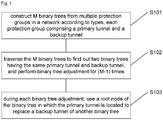
- a method for implementing multi-protection overlapped protection groups of the disclosure includes: Step A: constructing M binary trees from multiple protection groups in a network according to their respective types, each protection group comprising a primary tunnel and a backup tunnel, wherein each binary tree has a unique primary tunnel, a first side node of the binary tree includes a primary tunnel at a bottom level and protection groups of the binary tree, and a second side node includes backup tunnels of the protection groups of the binary tree; Step B: traversing the M binary trees to find out two binary trees in which a primary tunnel of one of the two binary trees is the same as a backup tunnel of the other of the two binary trees, performing each binary tree adjustment by using a root node of the binary tree in which the primary tunnel is located to replace the backup tunnel of the other binary tree; Step C: performing the binary tree adjustment for (M-1) times; wherein the protection groups having the same primary tunnel are classified into a type.
- Step A generating each binary tree may include: constructing N binary tree units from N protection groups having a same primary tunnel, wherein a root node of each binary tree unit is a protection group, a first side node is a primary tunnel of the protection group and a second side node is a backup tunnel of the protection group; setting priorities of the N protection groups from lowest to highest as 1,2isingN and performing binary tree unit combination for (N-1) times; and during each binary tree unit combination, replacing a primary tunnel of a binary tree of which priority is (N-1) with a root node of a binary tree unit of which priority is N.
- Step D of protection group state query may be performed after Step C, including: when a tunnel is detected as invalid or normal, checking, by each protection group of the multi-protection overlapped protection groups, tunnel state information of all leaf nodes at the first side of the protection group, and placing the protection group state as primary valid if there is a normal tunnel; otherwise, checking, by each protection group of the multi-protection overlapped protection groups, tunnel state information of all leaf nodes at a second side of the protection group, and placing the protection group state as backup valid if there is a normal tunnel; otherwise, placing the protection group state as invalid.
- Step E of path selection may be performed after Step D, including: going downwards from the root node of the multi-protection overlapped protection groups, selecting a first side node if the protection group state is primary valid and selecting a second side node if the protection group state is backup valid, until a current valid tunnel is determined.
- the M and N meet M ⁇ 1, N ⁇ 1.
- a device for implementing multi-protection overlapped protection groups of the disclosure includes: a generating module, configured to construct M binary trees from multiple protection groups in a network according to their respective types, each protection group comprising a primary tunnel and a backup tunnel, wherein each binary tree has a unique primary tunnel, a first side node of the binary tree includes a primary tunnel at a bottom level and protection groups of the binary tree, and a second side node includes backup tunnels of the protection groups of the binary tree; a finding module, configured to traverse the M binary trees to find out two binary trees in which a primary tunnel of one of the two binary trees is the same as a backup tunnel of the other of the two binary trees; and an adjusting module configured to, during each binary tree adjustment, use a root node of the binary tree where the primary tunnel locates to replace a backup tunnel of another binary tree and perform the binary tree adjustment for (M-1) times; wherein the protection groups having the same primary tunnel are classified into a type.
- the generating module may include: a constructing sub-module, configured to construct N binary tree units from N protection groups having a same primary tunnel, wherein a root node of each binary tree unit is a protection group, a first side node is a primary tunnel of the protection group and a second side node is a backup tunnel of the protection group; a setting sub-module, configured to set priorities of the N protection groups from lowest to highest as 1,2isingN and perform binary tree unit combination for (N-1) times; and a generating sub-module configured to, during each binary tree unit combination, replace a primary tunnel of a binary tree of which priority is (N-1) with a root node of a binary tree unit of which priority is N.
- the device may further include: a state query module configured, when a tunnel is detected as invalid or normal, to be used by each protection group of the multi-protection overlapped protection groups to check tunnel state information of all leaf nodes at the first side of the protection group, wherein the protection group state is placed as primary valid if there is a normal tunnel; otherwise, to be used by each protection group of the multi-protection overlapped protection groups to check tunnel state information of all leaf nodes at a second side of the protection group, wherein the protection group state is placed as backup valid if there is a normal tunnel; otherwise, the protection group state is placed as invalid.
- a state query module configured, when a tunnel is detected as invalid or normal, to be used by each protection group of the multi-protection overlapped protection groups to check tunnel state information of all leaf nodes at the first side of the protection group, wherein the protection group state is placed as primary valid if there is a normal tunnel; otherwise, to be used by each protection group of the multi-protection overlapped protection groups to check tunnel state information
- the device may further include a path selecting module configured to, go downwards from the root node of the multi-protection overlapped protection groups, select a first side node if the protection group state is primary valid and select a second side node if the protection group state is backup valid, until a current valid tunnel is determined.
- a path selecting module configured to, go downwards from the root node of the multi-protection overlapped protection groups, select a first side node if the protection group state is primary valid and select a second side node if the protection group state is backup valid, until a current valid tunnel is determined.
- the M and N meet M ⁇ 1, N ⁇ 1.
- the beneficial effect of the disclosure lie in that switching logic of the protection groups can be set properly in the multi-protection overlapping scenario so that services can be switched timely, conveniently and quickly.
- Fig. 1 shows a flowchart of a method for implementing a multi-protection overlapped protection group according to an embodiment of the disclosure. As shown in Fig. 1 , the method includes the following steps:
- Step 101 each binary tree is generated individually.
- N binary tree units are constructed from N protection groups having a same primary tunnel, a root node of each binary tree unit is a protection group, a first side node is a primary tunnel of the protection group and a second side node is a backup tunnel of the protection group.
- Priorities of the N protection groups are set from lowest to highest as 1,2 whilN and performing binary tree unit combination for (N-1) times.
- a primary tunnel of a binary tree of which priority is (N-1) is replaced with a root node of a binary tree unit of which priority is N.
- Step 104 of protection group state query may be performed.
- each protection group of the multi-protection overlapped protection groups checks tunnel state information of all leaf nodes at the first side of the protection group, and places the protection group state as primary valid if there is a normal tunnel; otherwise, each protection group of the multi-protection overlapped protection groups checks tunnel state information of all leaf nodes of a second side of the protection group, and places the protection group state as backup valid if there is a normal tunnel; otherwise, places the protection group state as invalid.
- Step 105 of path selection may be performed.
- a first side node is selected if the protection group state is primary valid and a second side node is selected if the protection group state is backup valid, until a current valid tunnel is determined.
- the M and N meet M ⁇ 1, N ⁇ 1.
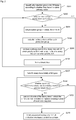
- Fig. 2 shows a flowchart illustrating establishment of multi-protection overlapped protection groups according to an embodiment of the disclosure.
- Step 201 Protection groups having the same primary tunnel are classified into a class, thereby dividing multiple protection groups in a network, each comprising a primary tunnel and a backup tunnel, into M types, where M is larger than or equal to 1.
- Step 202 it is determined whether establishment of M binary trees is completed; if yes, perform Step 207; otherwise, perform Step 203.
- Step 203 in a type in which a protection group relation has not been established, one primary tunnel corresponds to N backup tunnels, i.e., N protection groups with the same primary tunnel in the type are provided; the priorities of the N protection groups are set as 1,2,...N from the lowest to the highest; the lower the priority is, the slower response switching is.
- Step 204 for each protection group in the type, a respective binary tree unit is established.
- a root node of the binary tree unit is the protection group
- a first side node is a primary tunnel of the protection group
- a second side node is a backup tunnel of the protection group, thereby forming N binary tree units of the type
- the first side node and the second side node of each binary tree unit are leaf nodes of the binary tree unit.
- Step 205 the formed N binary tree units are combined, in which a primary tunnel of a binary tree unit of which priority is (N-1) is replaced with a binary tree unit of which priority is N and a primary tunnel of a binary tree unit of which priority is (N-2) is replaced with a binary tree unit of which priority is (N-1), until a primary tunnel of a binary tree unit of which priority is 1 is replaced with a binary tree unit of which priority is 2.
- Step 206 through Step 205, the binary tree units are combined for (N-1) times to form a binary tree of the type finally.
- Step 207 for protection groups of each type, Step 203 to Step 206 are performed so as to construct M binary trees from M types of protection groups finally.
- Step 208 the M binary trees are traversed to determine whether there are two binary trees having the same primary tunnel and backup tunnel; if yes, perform Step 209; otherwise, perform step 210;
- Step 209 a root node of the binary tree in which the primary tunnel is located is used to replace a backup tunnel of another binary tree; in other words, if a primary tunnel of a binary tree is the same as a backup tunnel of another binary tree, a root node of such a binary tree is used to replace a backup tunnel of another binary tree.
- Step 210 the adjustment is finished and multi-protection overlapped protection groups are implemented.
- Step 203 if there is only one protection group in a certain type of protection groups, i.e., N is equal to 1, then a binary tree unit constructed according to the protection group is a binary tree of the type.
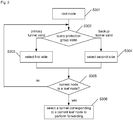
- Fig. 3 shows a flowchart illustrating path selection according to an embodiment of the disclosure.
- Step 301 when a tunnel is monitored to be invalid or normal, each protection group of the multi-protection overlapped protection groups checks tunnel state information of all leaf nodes of a first side of the protection group; the protection group state is that the primary tunnel is valid if a tunnel in a normal state exists; otherwise, each protection group of the multi-protection overlapped protection groups checks tunnel state information of all leaf nodes of a second side of the protection group; the protection group state is that the backup tunnel is valid if a tunnel in a normal state exists; otherwise, the protection group state is invalid.
- Step 302 going downwards from the root node of the multi-protection overlapped protection groups, the protection group state is queried; if the protection group state is primary valid, perform Step 303; if the protection group state is backup valid, perform Step 304.
- Step 303 a first side node is selected.
- Step 304 a second side node is selected.
- Step 305 it is determined whether a current node is a leaf node; if yes, perform Step 306; otherwise, perform Step 302.
- Step 306 a tunnel corresponding to a current leaf node is selected to forward network traffic.
- Fig. 4 shows examples for implementing establishment of the multi-protection overlapped protection group. As shown in Fig. 4 , four tunnels and three protection groups are included. Tunnel 1 and tunnel 2 form protection group 1, tunnel 1 is a primary tunnel and tunnel 2 is a backup tunnel; tunnel 1 and tunnel 3 form protection group 2, tunnel 1 is a primary tunnel and tunnel 3 is a backup tunnel; tunnel 2 and tunnel 4 form protection group 3, tunnel 2 is a primary tunnel and tunnel 4 is a backup tunnel.
- the protection groups are divided into two types depends on whether the protection groups have the same primary tunnel.
- the first type includes protection group 1 and protection group 2 with tunnel 1 as a primary tunnel and the second type includes protection group 3 with tunnel 2 as a primary tunnel.
- each protection group is constructed into a binary tree unit with a root node thereof being the protection group, a first side leaf node being a primary tunnel of the protection group and a second side leaf node being a backup tunnel of the protection group so as to form two binary tree units of the type.
- the two formed binary tree units are combined.
- a primary tunnel of a binary tree whose priority is 1 is replaced with a binary tree unit whose priority is 2 to form a binary tree finally; a root node of the binary tree is protection group 1 with the lowest priority, a first side node comprises the primary tunnel 1 located at the very bottom level and protection group 2 of the binary tree, and a second side node is the backup tunnel 2 of the binary tree protection group 1 and the backup tunnel 3 of protection group 2. Since the second type in the present embodiment only includes protection group 3, a binary tree unit formed by protection group 3 is a binary tree of the second type.
- the two binary trees are traversed to find that the primary tunnel 2 of the second binary tree is the same as the backup tunnel 2 of protection group 1 of the first binary tree.Therefore, the backup tunnel 2 of the first binary tree is replaced by the root node protection group 3 of the second binary tree.
- leaf nodes are tunnel 1, tunnel 3, tunnel 2 and tunnel 4 from left to right in turn and are all normal.
- a first side leaf node tunnel 1 is in a normal state, thus the state of protection group 2 is primary valid; for protection gropu 1, all leaf nodes tunnel 1 and tunnel 3 of a first side are in a normal state, therefore the state of protection group 1 is primary valid.
- the state of protection group 1 is primary valid, then the first side is selected to reach protection group 2; for protection group 2, the state is primary valid, then the first side is selected continuously to reach the leaf node tunnel 1; therefore, network traffic is on tunnel 1.
- the state of protection group 2 is that the backup tunnel is valid; for protection group 1, the first side includes the leaf nodes tunnel 1 and tunnel 3 and the state of tunnel 3 is normal. Therefore, the state of protection group 3 is primary valid.
- the state of protection group 1 is primary valid, then the first side is selected to reach protection group 2; for protection group 2, the state is backup valid, then the second side is selected continuously to reach the leaf node tunnel 3; therefore, network traffic is on tunnel 3.
- the state of protection group 1 is that the backup valid, then the first side is selected to reach protection group 3; for protection group 3, the state is primary valid, then the first side is selected continuously to reach the leaf node tunnel 2; therefore, traffic is on tunnel 2.
- the state of protection group 1 is backup valid, then the second side is selected to reach protection group 3; for protection group 3, the state is backup valid, then the first side is selected to reach the leaf node tunnel 4; therefore, traffic is on tunnel 4.
- Fig. 5 shows a structural diagram of a device for implementing the multi-protection overlapped protection group according to an embodiment of the disclosure.
- the device for implementing the protection groups includes a generating module, a finding module and an adjusting module.
- the generating module is configured to construct M binary trees from multiple protection groups in a network according to their respective types, each protection group comprising a primary tunnel and a backup tunnel.
- Each binary tree has a unique primary tunnel
- a first side node of the binary tree includes a primary tunnel at a bottom level and protection groups of the binary tree
- a second side node includes backup tunnels of the protection group of the binary tree.
- the generating module classifies the protection groups in the network of which the primary tunnel is the same into a type, thus dividing the protection groups in the network into M types, each type for constructing a binary tree, and M binary trees are constructed in total.
- the root node of the binary tree is the protection group of the lowest priority in the type
- the primary tunnel of the binary tree forms the common tunnel of all the protection groups in the binary tree
- the remaining tunnels are the backup tunnels of the binary tree.
- the finding module is configured to traverse the M binary trees to find out two binary trees having a same primary tunnel and backup tunnel respectively, and perform binary tree adjustment for (M-1) times, so as to implement multi-protection overlapped protection groups.
- the adjusting module is configured to, during each binary tree adjustment, use a root node of the binary tree in which the primary tunnel is located to replace a backup tunnel of another binary tree.
- the finding module checks if the backup tunnel of the current binary tree is as same as the primary tunnel of another binary tree, if yes, the adjusting module replaces the backup tunnel of the current binary tree with the root node of the another binary tree.
- the device for implementing the protection groups may further include a state query module and a path selection module.
- the state query module is configured, when a tunnel is detected as invalid or normal, to be used by each protection group of the multi-protection overlapped protection groups to check tunnel state information of all leaf nodes at the first side of the protection group, wherein the protection group state is placed as primary valid if there is a normal tunnel; otherwise, to be used by each protection group of the multi-protection overlapped protection groups to check tunnel state information of all leaf nodes at a second side of the protection group, wherein the protection group state is placed as backup valid if there is a normal tunnel; otherwise, the protection group state is placed as invalid.
- the state query module is configured to determine the state of each protection group so as to perform path selection.
- the path selecting module is configured to, go downwards from the root node of the multi-protection overlapped protection groups, select a first side node if the protection group state is primary valid and select a second side node if the protection group state is backup valid, until a current valid tunnel is determined.
- the generating module includes a constructing sub-module, a setting sub-module and a generating sub-module.
- the constructing sub-module is configured to construct N binary tree units from N protection groups having a same primary tunnel, wherein a root node of each binary tree unit is a protection group, a first side node is a primary tunnel of the protection group and a second side node is a backup tunnel of the protection group;
- the setting sub-module is configured to set priorities of the N protection groups from lowest to highest as 1,2......N and perform binary tree unit combination for (N-1) times;
- the generating sub-module is configured to, during each binary tree unit combination, replace a primary tunnel of a binary tree of which priority is (N-1) with a root node of a binary tree unit of which priority is N.
- the M and N meet M ⁇ 1, N ⁇ 1.
- the disclosure can implement switching logic of protection groups conveniently and quickly in the multi-protection overlapping scenario through setting binary trees for the protection groups and tunnels to which the protection groups belong, thereby achieving the effect of multi-protection.
- the disclosure can set switching logic of protection groups properly in the multi-protection overlapping scenario to implement timely, convenient and quick service switching.
Landscapes
- Engineering & Computer Science (AREA)
- Computer Networks & Wireless Communication (AREA)
- Signal Processing (AREA)
- Data Exchanges In Wide-Area Networks (AREA)
- Detection And Prevention Of Errors In Transmission (AREA)
- Small-Scale Networks (AREA)
Claims (8)
- Verfahren zum Ausführen sich überlappender Schutzgruppen mit Mehrfachschutz, umfassend:Schritt A: Erstellen von M Binärbäumen aus mehreren Schutzgruppen in einem Netzwerk je nach ihrem jeweiligen Typ, wobei jede Schutzgruppe einen primären Tunnel und einen Backup-Tunnel umfasst, wobei jeder Binärbaum einen einzigartigen primären Tunnel aufweist, ein erster Seitenknoten des Binärbaums einen primären Tunnel auf einer untersten Ebene und Schutzgruppen des Binärbaums umfasst und ein zweiter Seitenknoten Backup-Tunnel der Schutzgruppen des Binärbaums umfasst;Schritt B: Überqueren der M Binärbäume, um zwei Binärbäume zu finden, in denen ein primärer Tunnel eines der zwei Binärbäume derselbe ist wie ein Backup-Tunnel des jeweils anderen der zwei Binärbäume, wobei jede Binärbaumeinstellung unter Verwendung eines Wurzelknotens des Binärbaums, in dem sich der primäre Tunnel befindet, durchgeführt wird, um den Backup-Tunnel des anderen Binärbaums zu ersetzen;Schritt C: M-1-maliges Ausführen der Binärbaumeinstellung;wobei die Schutzgruppen mit demselben primären Tunnel als ein Typ eingestuft werden;wobei im Schritt A die Erstellung jedes Binärbaums umfasst:durch einen Wurzelknoten einer Binärbaumeinheit, deren Priorität N ist.Konstruieren von N Binärbaumeinheiten aus N Schutzgruppen mit einem primären Tunnel, wobei ein Wurzelknoten jeder Binärbaumeinheit eine Schutzgruppe ist, ein erster Seitenknoten ein primärer Tunnel der Schutzgruppe ist und ein zweiter Seitenknoten ein Backup-Tunnel der Schutzgruppe ist;Einstellen von Prioritäten der N Schutzgruppen von unterster bis höchste Priorität als 1, 2...N und N-1-maliges Kombinieren von Binärbaumeinheiten; undErsetzen eines primären Tunnels eines Binärbaums, dessen Priorität N-1 ist, bei jedem Kombinieren von Binäurbaumeinheiten
- Verfahren nach Anspruch 1, ferner umfassend einen nach dem Schritt C erfolgenden Schritt D des Abfragens des Zustands einer Schutzgruppe, umfassend:wenn ein Tunnel als ungültig oder normal erkannt wird, Überprüfen der Tunnelzustandsdaten aller Blattknoten auf der ersten Seite der Schutzgruppe durch jede Schutzgruppe der sich überlappenden Schutzgruppen mit Mehrfachschutz, und Festsetzen des Zustands der Schutzgruppe als primär und gültig, wenn ein normaler Tunnel vorhanden ist;sonst: Überprüfen der Tunnelzustandsdaten aller Blattknoten auf einer zweiten Seite der Schutzgruppe durch jede Schutzgruppe der sich überlappenden Schutzgruppen mit Mehrfachschutz, und Festsetzen des Zustands der Schutzgruppe als Backup und gültig, wenn ein normaler Tunnel vorhanden ist;sonst: Festsetzen des Zustands der Schutzgruppe als ungültig.
- Verfahren nach Anspruch 2, ferner umfassend einen nach dem Schritt D erfolgenden Schritt E des Wählens eines Pfads, umfassend:abwärts gehend vom Wurzelknoten der sich überlappenden Schutzgruppen mit Mehrfachschutz, Auswählen eines ersten Seitenknotens, wenn der Zustand der Schutzgruppe primär und gültig ist, und Auswählen eines zweiten Seitenknotens, wenn der Zustand der Schutzgruppe Backup und gültig ist, bis ein aktuell gültiger Tunnel bestimmt wird.
- Verfahren nach einem der Ansprüche 1 - 3, wobei M ≥ 1, N ≥ 1.
- Vorrichtung zum Ausführen sich überlappender Schutzgruppen mit Mehrfachschutz, umfassend:ein Erstellungsmodul, das zum Konstruieren von M Binärbäumen aus mehreren Schutzgruppen in einem Netzwerk je nach ihrem jeweiligen Typ konfiguriert ist, wobei jede Schutzgruppe einen primären Tunnel und einen Backup-Tunnel umfasst, wobei jeder Binärbaum einen einzigartigen primären Tunnel aufweist, ein erster Seitenknoten des Binärbaums einen primären Tunnel auf einer untersten Ebene und Schutzgruppen des Binärbaums umfasst und ein zweiter Seitenknoten Backup-Tunnel der Schutzgruppen des Binärbaums umfasst;ein Suchmodul, das derart konfiguriert ist, dass es die M Binärbäume überquert, um zwei Binärbäume zu finden, in denen ein primärer Tunnel von einem der zwei Binärbäume derselbe ist wie ein Backup-Tunnel des jeweils anderen der zwei Binärbäume; undein Einstellungsmodul, das derart konfiguriert ist, dass es bei jeder Einstellung eines Binärbaums einen Wurzelknoten des Binärbaums verwendet, in dem sich der primäre Tunnel befindet, um einen Backup-Tunnel eines anderen Binärbaums zu ersetzen, und die Einstellung des Binärbaums M-1-mal ausführt;wobei die Schutzgruppen mit demselben primären Tunnel als ein Typ eingestuft werden;wobei das Erstellungsmodul umfasst:ein Konstruktions-Submodul, das zum Konstruieren von N Binärbaumeinheiten aus N Schutzgruppen mit einem primären Tunnel konfiguriert ist, wobei ein Wurzelknoten jeder Binärbaumeinheit eine Schutzgruppe ist, ein erster Seitenknoten ein primärer Tunnel der Schutzgruppe ist und ein zweiter Seitenknoten ein Backup-Tunnel der Schutzgruppe ist;ein Einstellungs-Untermodul, das zum Festlegen von Prioritäten der N Schutzgruppen von unterster bis höchste Priorität als 1, 2,...N und zum N-1-maligen Kombinieren von Binärbaumeinheiten konfiguriert ist;
undein Erstellungs-Submodul, das derart konfiguriert ist, dass es bei jeder Kombination von Binärbaumeinheiten einen primären Tunnel eines Binärbaums, dessen Priorität N-1 ist, durch einen Wurzelknoten einer Binärbaumeinheit, deren Priorität N ist, ersetzt. - Vorrichtung nach Anspruch 5, ferner umfassend:ein Statusabfragemodul, das derart konfiguriert ist, dass, wenn ein Tunnel als ungültig oder normal erkannt wird, es durch jede Schutzgruppe der sich überlappenden Schutzgruppen mit Mehrfachschutz verwendet wird, um die Tunnelzustandsdaten aller Blattknoten auf der ersten Seite der Schutzgruppe zu überprüfen, wobei der Zustand der Schutzgruppe als primär und gültig festgesetzt wird, wenn ein normaler Tunnel vorhanden ist; sonst wird es durch jede Schutzgruppe der sich überlappenden Schutzgruppen mit Mehrfachschutz verwendet, um die Tunnelzustandsdaten aller Blattknoten auf einer zweiten Seite der Schutzgruppe zu überprüfen, wobei der Zustand der Schutzgruppe als Backup und gültig festgesetzt wird, wenn ein normaler Tunnel vorhanden ist; sonst wird der Zustand der Schutzgruppe als ungültig festgesetzt.
- Vorrichtung nach Anspruch 6, ferner umfassend:ein Pfadauswahlmodul, das derart konfiguriert ist, dass es abwärts gehend vom Wurzelknoten der sich überlappenden Schutzgruppen mit Mehrfachschutz, einen erste Seitenknoten auswählt, wenn der Zustand der Schutzgruppe primär und gültig ist, und einen zweiten Seitenknoten auswählt, wenn der Zustand der Schutzgruppe Backup und gültig ist, bis ein aktuell gültiger Tunnel bestimmt wird.
- Vorrichtung nach einem der Ansprüche 5 - 7, wobei M ≥ 1, N ≥ 1.
Applications Claiming Priority (2)
| Application Number | Priority Date | Filing Date | Title |
|---|---|---|---|
| CN201110077167.4A CN102143076B (zh) | 2011-03-29 | 2011-03-29 | 一种多重保护叠加的保护组实现方法和装置 |
| PCT/CN2011/082050 WO2012129907A1 (zh) | 2011-03-29 | 2011-11-10 | 一种多重保护叠加的保护组实现方法和装置 |
Publications (3)
| Publication Number | Publication Date |
|---|---|
| EP2693706A1 EP2693706A1 (de) | 2014-02-05 |
| EP2693706A4 EP2693706A4 (de) | 2014-02-05 |
| EP2693706B1 true EP2693706B1 (de) | 2017-06-14 |
Family
ID=44410311
Family Applications (1)
| Application Number | Title | Priority Date | Filing Date |
|---|---|---|---|
| EP11862707.4A Active EP2693706B1 (de) | 2011-03-29 | 2011-11-10 | Verfahren und vorrichtung zur implementierung von überlappenden mehrfachschutzgruppen |
Country Status (4)
| Country | Link |
|---|---|
| EP (1) | EP2693706B1 (de) |
| CN (1) | CN102143076B (de) |
| BR (1) | BR112013024890B1 (de) |
| WO (1) | WO2012129907A1 (de) |
Families Citing this family (4)
| Publication number | Priority date | Publication date | Assignee | Title |
|---|---|---|---|---|
| CN102143076B (zh) * | 2011-03-29 | 2014-10-22 | 中兴通讯股份有限公司 | 一种多重保护叠加的保护组实现方法和装置 |
| CN108462549B (zh) | 2017-11-22 | 2019-07-09 | 上海欣诺通信技术股份有限公司 | 保护组叠加倒换方法、控制装置及光通信设备 |
| CN109150622B (zh) * | 2018-09-12 | 2021-08-24 | 苏州盛科通信股份有限公司 | 一种在多级aps中部署oam的方法及装置 |
| CN110336743B (zh) * | 2019-06-27 | 2021-12-14 | 烽火通信科技股份有限公司 | 一种保护隧道的合并方法及系统 |
Family Cites Families (5)
| Publication number | Priority date | Publication date | Assignee | Title |
|---|---|---|---|---|
| US6385649B1 (en) * | 1998-11-06 | 2002-05-07 | Microsoft Corporation | Routers and methods for optimal routing table compression |
| CN101242309B (zh) * | 2008-03-19 | 2011-12-07 | 中兴通讯股份有限公司 | 一种故障单处理方法 |
| EP2237529B1 (de) * | 2009-03-30 | 2012-02-01 | Alcatel Lucent | Verfahren zum Aufbau von zwei parallelen Verteilbäumen eines nicht-hierarchischen Netzes |
| CN101621468B (zh) * | 2009-08-14 | 2012-01-04 | 清华大学 | 构造保护隧道路由的方法 |
| CN102143076B (zh) * | 2011-03-29 | 2014-10-22 | 中兴通讯股份有限公司 | 一种多重保护叠加的保护组实现方法和装置 |
-
2011
- 2011-03-29 CN CN201110077167.4A patent/CN102143076B/zh active Active
- 2011-11-10 BR BR112013024890-4A patent/BR112013024890B1/pt active IP Right Grant
- 2011-11-10 EP EP11862707.4A patent/EP2693706B1/de active Active
- 2011-11-10 WO PCT/CN2011/082050 patent/WO2012129907A1/zh not_active Ceased
Non-Patent Citations (1)
| Title |
|---|
| None * |
Also Published As
| Publication number | Publication date |
|---|---|
| BR112013024890B1 (pt) | 2021-02-23 |
| CN102143076A (zh) | 2011-08-03 |
| EP2693706A1 (de) | 2014-02-05 |
| EP2693706A4 (de) | 2014-02-05 |
| CN102143076B (zh) | 2014-10-22 |
| BR112013024890A2 (pt) | 2017-10-31 |
| WO2012129907A1 (zh) | 2012-10-04 |
Similar Documents
| Publication | Publication Date | Title |
|---|---|---|
| US9929938B2 (en) | Hierarchal label distribution and route installation in a loop-free routing topology using routing arcs at multiple hierarchal levels for ring topologies | |
| US9515845B2 (en) | Utility communication method and system | |
| US20100080119A1 (en) | Method for restoring connections in a network | |
| CN112866103B (zh) | 一种面向边缘计算的时间敏感移动前传网络保护方法 | |
| CN104270231B (zh) | 一种实现双节点互联伪线的系统及方法 | |
| US7564780B2 (en) | Time constrained failure recovery in communication networks | |
| EP2693706B1 (de) | Verfahren und vorrichtung zur implementierung von überlappenden mehrfachschutzgruppen | |
| CN103973491A (zh) | 故障处理方法及光层控制网元、ip层控制网元 | |
| CN106789623B (zh) | 基于ospf协议的链路通信保障方法和系统 | |
| CN113141265B (zh) | 跨设备链路聚合方法及设备 | |
| WO2011024187A2 (en) | A protection switching method and system | |
| CN111327535B (zh) | 一种报文转发方法及装置、转发设备 | |
| EP3573288B1 (de) | Verfahren und system zur verarbeitung eines dienstflusses in einem paketnetzwerk | |
| EP2528263B1 (de) | Verfahren zur implementierung der schutzgruppenüberlegung und verfahren und system zum ethernetschutzschaltung | |
| EP3016325B1 (de) | Verfahren und vorrichtung zur verarbeitung von datenweiterleitungen | |
| CN103248568B (zh) | 路由器及其实现支持冗余无编号链路的数据转发方法 | |
| CN103117924A (zh) | 一种保护倒换方法和设备 | |
| CN106533741B (zh) | 基于OpenFlow实现MPLS-TP共享环保护MSRP环网保护系统的方法及装置 | |
| Takouna et al. | Routing schemes for network recovery under link and node failures | |
| CN108023754A (zh) | 一种双归组主备节点协商机制的实现方法及装置 | |
| CN107592252B (zh) | 业务处理方法及装置 | |
| CN102611573B (zh) | 一种缩短抗毁光网络内故障恢复时间的方法 | |
| EP2608464B1 (de) | Verfahren zur bereitstellung von unabhängigen netzwerkfehlerverbindungen in einem mehrschichtigen netzwerk | |
| CN103812781A (zh) | 一种trill网络中组播根节点选择的方法及网络设备 | |
| JP2006203721A (ja) | 故障箇所発見方法および故障箇所発見装置 |
Legal Events
| Date | Code | Title | Description |
|---|---|---|---|
| PUAI | Public reference made under article 153(3) epc to a published international application that has entered the european phase |
Free format text: ORIGINAL CODE: 0009012 |
|
| 17P | Request for examination filed |
Effective date: 20131029 |
|
| A4 | Supplementary search report drawn up and despatched |
Effective date: 20140107 |
|
| AK | Designated contracting states |
Kind code of ref document: A1 Designated state(s): AL AT BE BG CH CY CZ DE DK EE ES FI FR GB GR HR HU IE IS IT LI LT LU LV MC MK MT NL NO PL PT RO RS SE SI SK SM TR |
|
| DAX | Request for extension of the european patent (deleted) | ||
| 17Q | First examination report despatched |
Effective date: 20150331 |
|
| REG | Reference to a national code |
Ref country code: DE Ref legal event code: R079 Ref document number: 602011038815 Country of ref document: DE Free format text: PREVIOUS MAIN CLASS: H04L0012560000 Ipc: H04L0012753000 |
|
| GRAP | Despatch of communication of intention to grant a patent |
Free format text: ORIGINAL CODE: EPIDOSNIGR1 |
|
| RIC1 | Information provided on ipc code assigned before grant |
Ipc: H04L 12/735 20130101ALI20170118BHEP Ipc: H04L 12/707 20130101ALI20170118BHEP Ipc: H04L 12/753 20130101AFI20170118BHEP Ipc: H04L 12/723 20130101ALI20170118BHEP Ipc: H04L 12/703 20130101ALI20170118BHEP |
|
| INTG | Intention to grant announced |
Effective date: 20170202 |
|
| GRAS | Grant fee paid |
Free format text: ORIGINAL CODE: EPIDOSNIGR3 |
|
| GRAA | (expected) grant |
Free format text: ORIGINAL CODE: 0009210 |
|
| AK | Designated contracting states |
Kind code of ref document: B1 Designated state(s): AL AT BE BG CH CY CZ DE DK EE ES FI FR GB GR HR HU IE IS IT LI LT LU LV MC MK MT NL NO PL PT RO RS SE SI SK SM TR |
|
| REG | Reference to a national code |
Ref country code: GB Ref legal event code: FG4D |
|
| REG | Reference to a national code |
Ref country code: CH Ref legal event code: EP Ref country code: AT Ref legal event code: REF Ref document number: 901916 Country of ref document: AT Kind code of ref document: T Effective date: 20170615 |
|
| REG | Reference to a national code |
Ref country code: DE Ref legal event code: R082 Ref document number: 602011038815 Country of ref document: DE Representative=s name: LAVOIX MUNICH, DE |
|
| REG | Reference to a national code |
Ref country code: IE Ref legal event code: FG4D |
|
| REG | Reference to a national code |
Ref country code: DE Ref legal event code: R096 Ref document number: 602011038815 Country of ref document: DE |
|
| REG | Reference to a national code |
Ref country code: NL Ref legal event code: MP Effective date: 20170614 |
|
| REG | Reference to a national code |
Ref country code: LT Ref legal event code: MG4D |
|
| PG25 | Lapsed in a contracting state [announced via postgrant information from national office to epo] |
Ref country code: HR Free format text: LAPSE BECAUSE OF FAILURE TO SUBMIT A TRANSLATION OF THE DESCRIPTION OR TO PAY THE FEE WITHIN THE PRESCRIBED TIME-LIMIT Effective date: 20170614 Ref country code: GR Free format text: LAPSE BECAUSE OF FAILURE TO SUBMIT A TRANSLATION OF THE DESCRIPTION OR TO PAY THE FEE WITHIN THE PRESCRIBED TIME-LIMIT Effective date: 20170915 Ref country code: NO Free format text: LAPSE BECAUSE OF FAILURE TO SUBMIT A TRANSLATION OF THE DESCRIPTION OR TO PAY THE FEE WITHIN THE PRESCRIBED TIME-LIMIT Effective date: 20170914 Ref country code: LT Free format text: LAPSE BECAUSE OF FAILURE TO SUBMIT A TRANSLATION OF THE DESCRIPTION OR TO PAY THE FEE WITHIN THE PRESCRIBED TIME-LIMIT Effective date: 20170614 Ref country code: FI Free format text: LAPSE BECAUSE OF FAILURE TO SUBMIT A TRANSLATION OF THE DESCRIPTION OR TO PAY THE FEE WITHIN THE PRESCRIBED TIME-LIMIT Effective date: 20170614 |
|
| REG | Reference to a national code |
Ref country code: AT Ref legal event code: MK05 Ref document number: 901916 Country of ref document: AT Kind code of ref document: T Effective date: 20170614 |
|
| PG25 | Lapsed in a contracting state [announced via postgrant information from national office to epo] |
Ref country code: NL Free format text: LAPSE BECAUSE OF FAILURE TO SUBMIT A TRANSLATION OF THE DESCRIPTION OR TO PAY THE FEE WITHIN THE PRESCRIBED TIME-LIMIT Effective date: 20170614 Ref country code: BG Free format text: LAPSE BECAUSE OF FAILURE TO SUBMIT A TRANSLATION OF THE DESCRIPTION OR TO PAY THE FEE WITHIN THE PRESCRIBED TIME-LIMIT Effective date: 20170914 Ref country code: LV Free format text: LAPSE BECAUSE OF FAILURE TO SUBMIT A TRANSLATION OF THE DESCRIPTION OR TO PAY THE FEE WITHIN THE PRESCRIBED TIME-LIMIT Effective date: 20170614 Ref country code: SE Free format text: LAPSE BECAUSE OF FAILURE TO SUBMIT A TRANSLATION OF THE DESCRIPTION OR TO PAY THE FEE WITHIN THE PRESCRIBED TIME-LIMIT Effective date: 20170614 Ref country code: RS Free format text: LAPSE BECAUSE OF FAILURE TO SUBMIT A TRANSLATION OF THE DESCRIPTION OR TO PAY THE FEE WITHIN THE PRESCRIBED TIME-LIMIT Effective date: 20170614 |
|
| PG25 | Lapsed in a contracting state [announced via postgrant information from national office to epo] |
Ref country code: SK Free format text: LAPSE BECAUSE OF FAILURE TO SUBMIT A TRANSLATION OF THE DESCRIPTION OR TO PAY THE FEE WITHIN THE PRESCRIBED TIME-LIMIT Effective date: 20170614 Ref country code: EE Free format text: LAPSE BECAUSE OF FAILURE TO SUBMIT A TRANSLATION OF THE DESCRIPTION OR TO PAY THE FEE WITHIN THE PRESCRIBED TIME-LIMIT Effective date: 20170614 Ref country code: CZ Free format text: LAPSE BECAUSE OF FAILURE TO SUBMIT A TRANSLATION OF THE DESCRIPTION OR TO PAY THE FEE WITHIN THE PRESCRIBED TIME-LIMIT Effective date: 20170614 Ref country code: RO Free format text: LAPSE BECAUSE OF FAILURE TO SUBMIT A TRANSLATION OF THE DESCRIPTION OR TO PAY THE FEE WITHIN THE PRESCRIBED TIME-LIMIT Effective date: 20170614 Ref country code: AT Free format text: LAPSE BECAUSE OF FAILURE TO SUBMIT A TRANSLATION OF THE DESCRIPTION OR TO PAY THE FEE WITHIN THE PRESCRIBED TIME-LIMIT Effective date: 20170614 |
|
| PG25 | Lapsed in a contracting state [announced via postgrant information from national office to epo] |
Ref country code: SM Free format text: LAPSE BECAUSE OF FAILURE TO SUBMIT A TRANSLATION OF THE DESCRIPTION OR TO PAY THE FEE WITHIN THE PRESCRIBED TIME-LIMIT Effective date: 20170614 Ref country code: IS Free format text: LAPSE BECAUSE OF FAILURE TO SUBMIT A TRANSLATION OF THE DESCRIPTION OR TO PAY THE FEE WITHIN THE PRESCRIBED TIME-LIMIT Effective date: 20171014 Ref country code: ES Free format text: LAPSE BECAUSE OF FAILURE TO SUBMIT A TRANSLATION OF THE DESCRIPTION OR TO PAY THE FEE WITHIN THE PRESCRIBED TIME-LIMIT Effective date: 20170614 Ref country code: PL Free format text: LAPSE BECAUSE OF FAILURE TO SUBMIT A TRANSLATION OF THE DESCRIPTION OR TO PAY THE FEE WITHIN THE PRESCRIBED TIME-LIMIT Effective date: 20170614 Ref country code: IT Free format text: LAPSE BECAUSE OF FAILURE TO SUBMIT A TRANSLATION OF THE DESCRIPTION OR TO PAY THE FEE WITHIN THE PRESCRIBED TIME-LIMIT Effective date: 20170614 |
|
| REG | Reference to a national code |
Ref country code: DE Ref legal event code: R097 Ref document number: 602011038815 Country of ref document: DE |
|
| PLBE | No opposition filed within time limit |
Free format text: ORIGINAL CODE: 0009261 |
|
| STAA | Information on the status of an ep patent application or granted ep patent |
Free format text: STATUS: NO OPPOSITION FILED WITHIN TIME LIMIT |
|
| PG25 | Lapsed in a contracting state [announced via postgrant information from national office to epo] |
Ref country code: DK Free format text: LAPSE BECAUSE OF FAILURE TO SUBMIT A TRANSLATION OF THE DESCRIPTION OR TO PAY THE FEE WITHIN THE PRESCRIBED TIME-LIMIT Effective date: 20170614 |
|
| 26N | No opposition filed |
Effective date: 20180315 |
|
| PG25 | Lapsed in a contracting state [announced via postgrant information from national office to epo] |
Ref country code: MC Free format text: LAPSE BECAUSE OF FAILURE TO SUBMIT A TRANSLATION OF THE DESCRIPTION OR TO PAY THE FEE WITHIN THE PRESCRIBED TIME-LIMIT Effective date: 20170614 |
|
| GBPC | Gb: european patent ceased through non-payment of renewal fee |
Effective date: 20171110 |
|
| PG25 | Lapsed in a contracting state [announced via postgrant information from national office to epo] |
Ref country code: LI Free format text: LAPSE BECAUSE OF NON-PAYMENT OF DUE FEES Effective date: 20171130 Ref country code: CH Free format text: LAPSE BECAUSE OF NON-PAYMENT OF DUE FEES Effective date: 20171130 |
|
| PG25 | Lapsed in a contracting state [announced via postgrant information from national office to epo] |
Ref country code: SI Free format text: LAPSE BECAUSE OF FAILURE TO SUBMIT A TRANSLATION OF THE DESCRIPTION OR TO PAY THE FEE WITHIN THE PRESCRIBED TIME-LIMIT Effective date: 20170614 Ref country code: LU Free format text: LAPSE BECAUSE OF NON-PAYMENT OF DUE FEES Effective date: 20171110 |
|
| REG | Reference to a national code |
Ref country code: FR Ref legal event code: ST Effective date: 20180731 Ref country code: BE Ref legal event code: MM Effective date: 20171130 |
|
| REG | Reference to a national code |
Ref country code: IE Ref legal event code: MM4A |
|
| PG25 | Lapsed in a contracting state [announced via postgrant information from national office to epo] |
Ref country code: MT Free format text: LAPSE BECAUSE OF NON-PAYMENT OF DUE FEES Effective date: 20171110 |
|
| PG25 | Lapsed in a contracting state [announced via postgrant information from national office to epo] |
Ref country code: FR Free format text: LAPSE BECAUSE OF NON-PAYMENT OF DUE FEES Effective date: 20171130 Ref country code: IE Free format text: LAPSE BECAUSE OF NON-PAYMENT OF DUE FEES Effective date: 20171110 |
|
| PG25 | Lapsed in a contracting state [announced via postgrant information from national office to epo] |
Ref country code: BE Free format text: LAPSE BECAUSE OF NON-PAYMENT OF DUE FEES Effective date: 20171130 Ref country code: GB Free format text: LAPSE BECAUSE OF NON-PAYMENT OF DUE FEES Effective date: 20171110 |
|
| PG25 | Lapsed in a contracting state [announced via postgrant information from national office to epo] |
Ref country code: HU Free format text: LAPSE BECAUSE OF FAILURE TO SUBMIT A TRANSLATION OF THE DESCRIPTION OR TO PAY THE FEE WITHIN THE PRESCRIBED TIME-LIMIT; INVALID AB INITIO Effective date: 20111110 |
|
| PG25 | Lapsed in a contracting state [announced via postgrant information from national office to epo] |
Ref country code: CY Free format text: LAPSE BECAUSE OF NON-PAYMENT OF DUE FEES Effective date: 20170614 |
|
| PG25 | Lapsed in a contracting state [announced via postgrant information from national office to epo] |
Ref country code: MK Free format text: LAPSE BECAUSE OF FAILURE TO SUBMIT A TRANSLATION OF THE DESCRIPTION OR TO PAY THE FEE WITHIN THE PRESCRIBED TIME-LIMIT Effective date: 20170614 |
|
| PG25 | Lapsed in a contracting state [announced via postgrant information from national office to epo] |
Ref country code: TR Free format text: LAPSE BECAUSE OF FAILURE TO SUBMIT A TRANSLATION OF THE DESCRIPTION OR TO PAY THE FEE WITHIN THE PRESCRIBED TIME-LIMIT Effective date: 20170614 |
|
| PG25 | Lapsed in a contracting state [announced via postgrant information from national office to epo] |
Ref country code: PT Free format text: LAPSE BECAUSE OF FAILURE TO SUBMIT A TRANSLATION OF THE DESCRIPTION OR TO PAY THE FEE WITHIN THE PRESCRIBED TIME-LIMIT Effective date: 20170614 |
|
| PG25 | Lapsed in a contracting state [announced via postgrant information from national office to epo] |
Ref country code: AL Free format text: LAPSE BECAUSE OF FAILURE TO SUBMIT A TRANSLATION OF THE DESCRIPTION OR TO PAY THE FEE WITHIN THE PRESCRIBED TIME-LIMIT Effective date: 20170614 |
|
| REG | Reference to a national code |
Ref country code: DE Ref legal event code: R079 Ref document number: 602011038815 Country of ref document: DE Free format text: PREVIOUS MAIN CLASS: H04L0012753000 Ipc: H04L0045480000 |
|
| PGFP | Annual fee paid to national office [announced via postgrant information from national office to epo] |
Ref country code: DE Payment date: 20240925 Year of fee payment: 14 |