EP2693554A2 - Mandrel used in manufacture of jelly roll-type electrode assembly - Google Patents
Mandrel used in manufacture of jelly roll-type electrode assembly Download PDFInfo
- Publication number
- EP2693554A2 EP2693554A2 EP12764493.8A EP12764493A EP2693554A2 EP 2693554 A2 EP2693554 A2 EP 2693554A2 EP 12764493 A EP12764493 A EP 12764493A EP 2693554 A2 EP2693554 A2 EP 2693554A2
- Authority
- EP
- European Patent Office
- Prior art keywords
- mandrel
- main body
- sheet type
- type stack
- body part
- Prior art date
- Legal status (The legal status is an assumption and is not a legal conclusion. Google has not performed a legal analysis and makes no representation as to the accuracy of the status listed.)
- Granted
Links
Images


Classifications
-
- H—ELECTRICITY
- H01—ELECTRIC ELEMENTS
- H01M—PROCESSES OR MEANS, e.g. BATTERIES, FOR THE DIRECT CONVERSION OF CHEMICAL ENERGY INTO ELECTRICAL ENERGY
- H01M4/00—Electrodes
- H01M4/02—Electrodes composed of, or comprising, active material
- H01M4/04—Processes of manufacture in general
-
- H—ELECTRICITY
- H01—ELECTRIC ELEMENTS
- H01M—PROCESSES OR MEANS, e.g. BATTERIES, FOR THE DIRECT CONVERSION OF CHEMICAL ENERGY INTO ELECTRICAL ENERGY
- H01M10/00—Secondary cells; Manufacture thereof
- H01M10/04—Construction or manufacture in general
- H01M10/0404—Machines for assembling batteries
- H01M10/0409—Machines for assembling batteries for cells with wound electrodes
-
- H—ELECTRICITY
- H01—ELECTRIC ELEMENTS
- H01M—PROCESSES OR MEANS, e.g. BATTERIES, FOR THE DIRECT CONVERSION OF CHEMICAL ENERGY INTO ELECTRICAL ENERGY
- H01M10/00—Secondary cells; Manufacture thereof
- H01M10/04—Construction or manufacture in general
- H01M10/0431—Cells with wound or folded electrodes
-
- B—PERFORMING OPERATIONS; TRANSPORTING
- B65—CONVEYING; PACKING; STORING; HANDLING THIN OR FILAMENTARY MATERIAL
- B65H—HANDLING THIN OR FILAMENTARY MATERIAL, e.g. SHEETS, WEBS, CABLES
- B65H18/00—Winding webs
- B65H18/02—Supporting web roll
- B65H18/04—Interior-supporting
-
- H—ELECTRICITY
- H01—ELECTRIC ELEMENTS
- H01M—PROCESSES OR MEANS, e.g. BATTERIES, FOR THE DIRECT CONVERSION OF CHEMICAL ENERGY INTO ELECTRICAL ENERGY
- H01M10/00—Secondary cells; Manufacture thereof
- H01M10/05—Accumulators with non-aqueous electrolyte
- H01M10/058—Construction or manufacture
- H01M10/0587—Construction or manufacture of accumulators having only wound construction elements, i.e. wound positive electrodes, wound negative electrodes and wound separators
-
- Y—GENERAL TAGGING OF NEW TECHNOLOGICAL DEVELOPMENTS; GENERAL TAGGING OF CROSS-SECTIONAL TECHNOLOGIES SPANNING OVER SEVERAL SECTIONS OF THE IPC; TECHNICAL SUBJECTS COVERED BY FORMER USPC CROSS-REFERENCE ART COLLECTIONS [XRACs] AND DIGESTS
- Y02—TECHNOLOGIES OR APPLICATIONS FOR MITIGATION OR ADAPTATION AGAINST CLIMATE CHANGE
- Y02E—REDUCTION OF GREENHOUSE GAS [GHG] EMISSIONS, RELATED TO ENERGY GENERATION, TRANSMISSION OR DISTRIBUTION
- Y02E60/00—Enabling technologies; Technologies with a potential or indirect contribution to GHG emissions mitigation
- Y02E60/10—Energy storage using batteries
-
- Y—GENERAL TAGGING OF NEW TECHNOLOGICAL DEVELOPMENTS; GENERAL TAGGING OF CROSS-SECTIONAL TECHNOLOGIES SPANNING OVER SEVERAL SECTIONS OF THE IPC; TECHNICAL SUBJECTS COVERED BY FORMER USPC CROSS-REFERENCE ART COLLECTIONS [XRACs] AND DIGESTS
- Y02—TECHNOLOGIES OR APPLICATIONS FOR MITIGATION OR ADAPTATION AGAINST CLIMATE CHANGE
- Y02P—CLIMATE CHANGE MITIGATION TECHNOLOGIES IN THE PRODUCTION OR PROCESSING OF GOODS
- Y02P70/00—Climate change mitigation technologies in the production process for final industrial or consumer products
- Y02P70/50—Manufacturing or production processes characterised by the final manufactured product
Definitions
- the present invention relates to a mandrel used to manufacture a jelly roll type electrode assembly, and, more particularly, to a mandrel configured to be used in a winding process for manufacturing a jelly roll type electrode assembly using a long sheet type stack of a cathode/separator/anode structure, wherein the mandrel is oval in a section perpendicular to a rotational central axis of the mandrel and is divided into a first mandrel part located at one side of a central region of the mandrel, in which an end of the sheet type stack is fixedly fitted, and a second mandrel part located at the other side of the central region of the mandrel, and the first mandrel part and the second mandrel part each include a main body part having a region in which the sheet type stack is fitted in an engaged state and an exchange part, detachably mounted to the main body part, having an end of a major axis of the mandrel.
- a secondary battery may be classified as a cylindrical battery having an electrode assembly mounted in a cylindrical metal container, a prismatic battery having an electrode assembly mounted in a prismatic metal container, or a pouch-shaped battery having an electrode assembly mounted in a pouch-shaped case formed of an aluminum laminate sheet.
- the electrode assembly mounted in the battery case is a power generating element, having a cathode/separator/anode stack structure, which can be charged and discharged.
- the electrode assembly may be classified as a jelly roll type electrode assembly configured to have a structure in which a long sheet type cathode and a long sheet type anode, to which active materials are applied, are wound in a state in which a separator is disposed between the cathode and the anode, a stacked type electrode assembly configured to have a structure in which a plurality of cathodes having a predetermined size and a plurality of anodes having a predetermined size are sequentially stacked in a state in which separators are disposed respectively between the cathodes and the anodes, or a stacked/folded type electrode assembly configured to have a structure in which a predetermined number of cathodes and a predetermined number of anodes are sequentially stacked in a state in which separators are disposed respectively between
- a conventional mandrel used to manufacture an electrode assembly is formed in a hexagonal shape 92 or an angled oval shape in vertical section as shown in FIG. 1 . Also, the entirety of the conventional mandrel is made of a single metal.
- the conventional mandrel has the following problems.
- a Y-axis velocity change is greater than an X-axis velocity change, i.e. change of linear velocity at which a sheet type stack, such as an electrode, is wound on a mandrel 90 during rotation of the mandrel 90.
- the linear velocity change at the folded portion of the sheet type stack and the amount of impact applied to the folded portion of the sheet type stack increase residual stress of the sheet type stack.
- stress generated at a subsequent process i.e. a process of compressing the jelly roll electrode assembly
- the folded portion of the sheet type stack is broken, whereby safety of a battery is lowered.
- a mandrel including a first mandrel part and a second mandrel part wherein the first mandrel part and the second mandrel part each include a main body part having a region in which a sheet type stack is fitted in an engaged state and an exchange part, detachably mounted to the main body part, having an end of a major axis of the mandrel so that only the exchange part can be exchanged even when the standard of an electrode assembly is changed, thereby greatly reducing manufacturing cost and time of the electrode assembly.
- a mandrel configured to be used in a winding process for manufacturing a jelly roll type electrode assembly using a long sheet type stack of a cathode/separator/anode structure, wherein the mandrel is oval in a section perpendicular to a rotational central axis of the mandrel and is divided into a first mandrel part located at one side of a central region of the mandrel, in which an end of the sheet type stack is fixedly fitted, and a second mandrel part located at the other side of the central region of the mandrel, and the first mandrel part and the second mandrel part each include a main body part having a region in which the sheet type stack is fitted in an engaged state and an exchange part, detachably mounted to the main body part, having an end of a major axis of the mandrel.
- the first mandrel part and the second mandrel part each may include a main body part having a region in which a sheet type stack is fitted in an engaged state and an exchange part, detachably mounted to the main body part, having an end of a major axis of the mandrel.
- the mandrel according to the present invention may be formed in an oval shape in a section perpendicular to a rotational central axis of the mandrel.
- the mandrel according to the present invention may be divided into a first mandrel part located at one side of the central region of the mandrel, in which the end of the sheet type stack is fixedly fitted, and a second mandrel part located at the other side of the central region of the mandrel. Consequently, it is possible to adjust the distance between the first mandrel part and the second mandrel part, thereby easily adjusting the size of the jelly roll type electrode assembly.
- the main body part may include fastening parts formed at a front region and a rear region with respect to the rotational central axis of the mandrel in a state in which the fastening parts protrude forward and rearward so that the fastening parts can be mounted to a mandrel rotation device.
- the exchange part may be configured to have a semi-oval structure in which a tilt of the outer side of the mandrel is continuously changed from an end of a minor axis of the mandrel to an end of the major axis of the mandrel in the section perpendicular to the rotational central axis of the mandrel, so that wound stress applied from the end of the major axis of the mandrel to the sheet type stack is reduced during constant speed rotation of the mandrel, when the sheet type stack is wound on the mandrel in a state in which an end of the sheet type stack is fitted in the central region of the mandrel.
- the exchange part may be configured to have a semi-oval structure having a gentle curve in which the tilt of the outer side of the mandrel is continuously changed from the end of the minor axis of the mandrel to the end of the major axis of the mandrel in the section perpendicular to the rotational central axis of the mandrel. Consequently, the section of the mandrel is decided through a curve drawn by an oval equation about the rotational central axis of the mandrel, and therefore, linear velocity change is minimized when the sheet type stack is wound on the mandrel, thereby considerably reducing the generation of stress of the sheet type stack.
- the conventional mandrel 90 may be formed in a hexagonal shape 92 in a section perpendicular to a rotational central axis 94 of the mandrel 90 as shown in FIG. 1 . For this reason, rectilinear movement caused when the sheet type stack is wound on the mandrel is controlled by rotary movement of the mandrel having no fixed radius, and the stress of the sheet type stack is not uniform due to difference of force by reduced acceleration generated at that time.
- the amount of correction theoretically calculated with respect to the size to compensate for the change of X-axis velocity Vx of the sheet type stack seems to be represented by a function having a cycle of 180 degrees. Actually, however, a point, at which differential is not possible, having a different tilt angle exists at the point of 180 degrees. The displacement is differentiated to obtain the velocity, and therefore, a point, at which the velocity is instantaneously changed, is generated, which means that acceleration is abruptly changed with the result that impact amount is increased.
- the mandrel according to the present invention may be formed in a gentle semi-oval shape in a section perpendicular to the rotational central axis of the mandrel. Consequently, force change even at the end of the major axis of the mandrel, at which such change is great, is much less than that in the conventional mandrel. As a result, force applied to the folded portion of the sheet type stack is reduced, and therefore, it is possible to reduce wound stress applied to the sheet type stack and, at the same time, to uniformalize overall wound stress applied to the sheet type stack.
- the semi-oval structure of the exchange part is configured so that the length ratio of the major axis to the minor axis of the mandrel is 10 or less in the section perpendicular to the rotational central axis of the mandrel. If the length ratio of the major axis to the minor axis of the mandrel is greater than the above value, the above-mentioned phenomenon is insignificant. Consequently, the present invention is applied to a mandrel in which a relative length range of the minor axis and the major axis satisfies the above conditions.
- the length ratio of the major axis to the minor axis of the mandrel is 1.5 to 10. According to circumstances, the length ratio of the major axis to the minor axis of the mandrel may be 1.5 to 4.
- the main body part may be formed of a metallic material
- the exchange part may be formed of a magnetic material so that the exchange part can be easily coupled to the main body part and can be easily decoupled from the main body part, or is formed of a magnetic material at an interface with the main body part. Consequently, it is possible to improve coupling between the main body part and the exchange part while the sheet type stack is wound on the mandrel.
- the metallic material may representatively include steel use stainless (SUS) and steel kogu dies (SKD); however, the metallic material is not limited thereto.
- the interface between the main body part and the exchange part may be configured to have a structure including a protrusion and a fastening groove, by which coupling force between the main body part and the exchange part is improved. Consequently, the exchange part can be mounted to the main body part in a fitting fashion, and therefore, it is possible to achieve stable fastening and easy exchange.
- the structure including the protrusion and the fastening groove may be configured, for example, so that an interfacial portion of the main body part includes an inverted trapezoidal fastening protrusion protruding toward the exchange part.
- the exchange part may be formed of a metallic material or a plastic material.
- the end of the major axis may be formed of a plastic material.
- Various plastic materials may be used.
- an engineering plastic material which exhibits high wear resistance and high durability based on self lubrication, may be used.
- the engineering plastic material may be selected from a group consisting of, for example, polyamide (PA), polyacetal (POM), polycarbonate (PC), modified polyphenylene oxide (MPPO), polybutylene terephthalate (PBT) and polyether ether ketone (PEEK); however, the engineering plastic material is not limited thereto.
- the exchange part may be configured to have a gentle semi-oval structure in which the tilt of the outer side of the mandrel is continuously changed from the end of the minor axis of the mandrel to the end of the major axis of the mandrel in the section perpendicular to the rotational central axis of the mandrel.
- This may be expressed as a structure in which a region having no tilt change is absent between the end of the minor axis of the mandrel and the end of the major axis of the mandrel.
- the mandrel is formed as a longish shape including the major axis and the minor axis in the section perpendicular to the rotational central axis of the mandrel, and the mandrel is configured to have a structure in which the tilt is continuously and gently changed at the outer side of the mandrel.
- the radius of curvature of the end of the major axis of the mandrel may not be less than 1/3 times the length of the minor axis of the mandrel, and the radius of curvature of the end of the minor axis of the mandrel may not be less than 1.5 times the length of the major axis of the mandrel.
- the radius of curvature of the end of the major axis of the mandrel is 1/3 to 1 times the length of the minor axis of the mandrel, and the radius of curvature of the end of the minor axis of the mandrel is 1.5 to 3 times the length of the major axis of the mandrel.
- a side of the first mandrel part and a corresponding side of the second mandrel part, which face each other on the basis of the rotational central axis of the mandrel, are configured to have a tapered structure in which a side of the mandrel contacting the sheet type stack is not broken when the mandrel is rotated in a state in which the sheet type stack is fitted in the mandrel.
- the angle of the tapered structure is not particularly restricted.
- the angle of the tapered structure may be about 10 to 60 degrees.
- a prismatic lithium secondary battery including a jelly roll type electrode assembly manufactured using the mandrel with the above-stated construction.
- the prismatic lithium secondary battery according to the present invention it is possible to reduce wound stress applied to the sheet type stack from the end of the major axis of the mandrel during a winding process to manufacture the jelly roll type electrode assembly.
- the manufactured jelly roll type electrode assembly is compressed and then mounted in a prismatic metal container, therefore, it is possible to solve a problem that a portion of the electrode assembly is broken and, at the same time, to maintain excellent performance of the prismatic lithium secondary battery and secure safety of the battery during use of the battery.
- the electrode assembly obtained by winding the sheet type stack using the mandrel which is configured to have an oval structure in vertical section, as described above to maintain an appropriate prismatic shape in vertical section as compared with an electrode assembly obtained by winding a sheet type stack using a conventional mandrel, which is configured to have a circular structure in vertical section. Consequently, the present invention is particularly preferable for manufacture of a prismatic secondary battery.
- the mandrel according to the present invention includes a first mandrel part and a second mandrel part wherein the first mandrel part and the second mandrel part each include a main body part having a region in which a sheet type stack is fitted in an engaged state and an exchange part, detachably mounted to the main body part, having an end of a major axis of the mandrel.
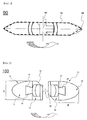
- FIGS. 2 and 3 are sectional views typically showing a mandrel according to an embodiment of the present invention
- FIG. 4 is a perspective view typically showing the mandrel of FIG. 2 .
- a mandrel 100 is oval in a section perpendicular to a rotational central axis 30 of the mandrel 100.
- the mandrel 100 is divided into a first mandrel part 10 located at the left side of the central region of the mandrel 100, in which an end of a sheet type stack (not shown) is fixedly fitted, and a second mandrel part 20 located at the right side of the central region of the mandrel 100.
- the first mandrel part 10 and the second mandrel part 20 each include a main body part 14 having a region in which the sheet type stack is fitted in an engaged state and an exchange part 12, detachably mounted to the main body part 14, having an end of the major axis of the mandrel 100.
- the main body part 14 of the first mandrel part 10 and the main body part 24 of the second mandrel part 20 include fastening parts 60 and 62 formed at the front region and the rear region with respect to the rotational central axis 30 of the mandrel 100 in a state in which the fastening parts 60 and 62 protrude forward and rearward.
- the fastening parts 60 and 62 are mounted to a mandrel rotation device (not shown).
- the exchange part 12 of the first mandrel part 10 and the exchange part 22 of the second mandrel part 20 are configured to have a gentle semi-oval structure in which a tilt of the outer side of the mandrel 100 is continuously changed from an end 52 of the minor axis of the mandrel 100 to an end 54 of the major axis of the mandrel 100 in the section perpendicular to the rotational central axis 30 of the mandrel 100 when the sheet type stack is wound on the mandrel 100 in a state in which an end of the sheet type stack is fitted in the central region of the mandrel 100. Consequently, wound stress applied from the end 54 of the major axis of the mandrel 100 to the sheet type stack is reduced during constant speed rotation of the mandrel 100.
- the semi-oval structure of the exchange parts 12 and 22 is configured so that a length 2d of the major axis of the mandrel 100 is about twice a length h of the minor axis of the mandrel 100 in the section perpendicular to the rotational central axis 30 of the mandrel 100.
- the main body parts 14 and 24 are formed of a metallic material, and the exchange part 12 of the first mandrel part 10 and the exchange part 22 of the second mandrel part 20 are formed of a magnetic material so that the exchange part 12 of the first mandrel part 10 and the exchange part 22 of the second mandrel part 20 can be easily coupled to the main body part 14 of the first mandrel part 10 and the main body part 24 of the second mandrel part 20, respectively, and can be easily decoupled from the main body part 14 of the first mandrel part 10 and the main body part 24 of the second mandrel part 20, respectively.
- only the interfaces between the exchange parts 12 and 22 and the main body parts 14 and 24 may be formed of a magnetic material. That is, the exchange parts 12 and 22 may be formed of a nonmagnetic material, and a magnetic material may be attached only to the interfaces between the exchange parts 12 and 22 and the main body parts 14 and 24.
- the interfaces between the main body parts 14 and 24 and the exchange parts 12 and 22 are configured to have a structure including inverted trapezoidal fastening protrusions 16 and 26 protruding toward the exchange parts 12 and 22 and fastening grooves 17 and 27, by which the coupling force between the main body parts 14 and 24 and the exchange parts 12 and 22 is improved.
- a radius of curvature r of the end 54 of the major axis of the mandrel 100 is approximately half the length D of the minor axis of the mandrel 100, and a radius of curvature R of the end 52 of the minor axis of the mandrel 100 is approximately 1.5 times the length H of the major axis of the mandrel 100.
- a side of the first mandrel part 10 and a corresponding side of the second mandrel part 20, which face each other on the basis of the rotational central axis 30 of the mandrel 100, are configured to have a tapered structure 18.
- main body parts 14 and 24 and the exchange parts 12 and 22 are configured to have a male and female fastening structure.
Landscapes
- Engineering & Computer Science (AREA)
- Manufacturing & Machinery (AREA)
- Chemical & Material Sciences (AREA)
- Chemical Kinetics & Catalysis (AREA)
- Electrochemistry (AREA)
- General Chemical & Material Sciences (AREA)
- Secondary Cells (AREA)
- Battery Electrode And Active Subsutance (AREA)
- Storage Of Web-Like Or Filamentary Materials (AREA)
Abstract
Description
- The present invention relates to a mandrel used to manufacture a jelly roll type electrode assembly, and, more particularly, to a mandrel configured to be used in a winding process for manufacturing a jelly roll type electrode assembly using a long sheet type stack of a cathode/separator/anode structure, wherein the mandrel is oval in a section perpendicular to a rotational central axis of the mandrel and is divided into a first mandrel part located at one side of a central region of the mandrel, in which an end of the sheet type stack is fixedly fitted, and a second mandrel part located at the other side of the central region of the mandrel, and the first mandrel part and the second mandrel part each include a main body part having a region in which the sheet type stack is fitted in an engaged state and an exchange part, detachably mounted to the main body part, having an end of a major axis of the mandrel.
- As mobile devices have been increasingly developed, and the demand for such mobile devices has increased, the demand for secondary batteries has also sharply increased as an energy source for such mobile devices. Among such secondary batteries is a lithium secondary battery having high energy density and high discharge voltage, into which much research has been carried out and which is now commercially and widely used.
- Depending upon the shape of a battery case, a secondary battery may be classified as a cylindrical battery having an electrode assembly mounted in a cylindrical metal container, a prismatic battery having an electrode assembly mounted in a prismatic metal container, or a pouch-shaped battery having an electrode assembly mounted in a pouch-shaped case formed of an aluminum laminate sheet.
- Also, the electrode assembly mounted in the battery case is a power generating element, having a cathode/separator/anode stack structure, which can be charged and discharged. The electrode assembly may be classified as a jelly roll type electrode assembly configured to have a structure in which a long sheet type cathode and a long sheet type anode, to which active materials are applied, are wound in a state in which a separator is disposed between the cathode and the anode, a stacked type electrode assembly configured to have a structure in which a plurality of cathodes having a predetermined size and a plurality of anodes having a predetermined size are sequentially stacked in a state in which separators are disposed respectively between the cathodes and the anodes, or a stacked/folded type electrode assembly configured to have a structure in which a predetermined number of cathodes and a predetermined number of anodes are sequentially stacked in a state in which separators are disposed respectively between the cathodes and the anodes to constitute a unit cell, such as a bi-cell or a full cell, and then unit cells are wound using a separation film. The jelly roll type electrode assembly has advantages in that the jelly roll type electrode assembly is easy to manufacture and has high energy density per unit mass.
- Meanwhile, a conventional mandrel used to manufacture an electrode assembly is formed in a
hexagonal shape 92 or an angled oval shape in vertical section as shown inFIG. 1 . Also, the entirety of the conventional mandrel is made of a single metal. The conventional mandrel has the following problems. - First, a Y-axis velocity change is greater than an X-axis velocity change, i.e. change of linear velocity at which a sheet type stack, such as an electrode, is wound on a
mandrel 90 during rotation of themandrel 90. - Also, force is concentrated upon a folded portion of the sheet type stack contacting an
end 96 of a major axis of themandrel 90, which has the maximum radius of gyration during rotation of themandrel 90, with the result that acceleration when the sheet type stack comes into contact with the mandrel is increased at the folded portion of the sheet type stack, whereby the amount of impact applied to the folded portion of the sheet type stack is increased. - Furthermore, the linear velocity change at the folded portion of the sheet type stack and the amount of impact applied to the folded portion of the sheet type stack increase residual stress of the sheet type stack. When stress generated at a subsequent process, i.e. a process of compressing the jelly roll electrode assembly, is further applied to the folded portion of the sheet type stack, therefore, the folded portion of the sheet type stack is broken, whereby safety of a battery is lowered.
- Consequently, the necessity of a technology for fundamentally solving the above-mentioned problem is very high.
- Therefore, the present invention has been made to solve the above problems and other technical problems that have yet to be resolved.
- Specifically, it is an object of the present invention to provide a mandrel including a first mandrel part and a second mandrel part wherein the first mandrel part and the second mandrel part each include a main body part having a region in which a sheet type stack is fitted in an engaged state and an exchange part, detachably mounted to the main body part, having an end of a major axis of the mandrel so that only the exchange part can be exchanged even when the standard of an electrode assembly is changed, thereby greatly reducing manufacturing cost and time of the electrode assembly.
- In accordance with one aspect of the present invention, the above and other objects can be accomplished by the provision of a mandrel configured to be used in a winding process for manufacturing a jelly roll type electrode assembly using a long sheet type stack of a cathode/separator/anode structure, wherein the mandrel is oval in a section perpendicular to a rotational central axis of the mandrel and is divided into a first mandrel part located at one side of a central region of the mandrel, in which an end of the sheet type stack is fixedly fitted, and a second mandrel part located at the other side of the central region of the mandrel, and the first mandrel part and the second mandrel part each include a main body part having a region in which the sheet type stack is fitted in an engaged state and an exchange part, detachably mounted to the main body part, having an end of a major axis of the mandrel.
- In the mandrel according to the present invention, the first mandrel part and the second mandrel part each may include a main body part having a region in which a sheet type stack is fitted in an engaged state and an exchange part, detachably mounted to the main body part, having an end of a major axis of the mandrel. Even when the standard of an electrode assembly is changed, therefore, it is possible to exchange only the exchange part, thereby greatly reducing mandrel exchange time to 10 minutes or less, which is considerably shorter than the conventional 1 hour.
- Also, the mandrel according to the present invention may be formed in an oval shape in a section perpendicular to a rotational central axis of the mandrel. When the sheet type stack is wound on the mandrel in a state in which the end of the sheet type stack is fitted in the central region of the mandrel, therefore, wound stress applied from the end of the major axis of the mandrel to the sheet type stack is reduced during constant speed rotation of the mandrel.
- In addition, the mandrel according to the present invention may be divided into a first mandrel part located at one side of the central region of the mandrel, in which the end of the sheet type stack is fixedly fitted, and a second mandrel part located at the other side of the central region of the mandrel. Consequently, it is possible to adjust the distance between the first mandrel part and the second mandrel part, thereby easily adjusting the size of the jelly roll type electrode assembly.
- In a preferred example, the main body part may include fastening parts formed at a front region and a rear region with respect to the rotational central axis of the mandrel in a state in which the fastening parts protrude forward and rearward so that the fastening parts can be mounted to a mandrel rotation device.
- Consequently, it is possible to exchange only the exchange part as needed in a state in which the protruding fastening parts are mounted to the mandrel rotation device, which is preferable. When the exchange part is exchanged according to the standard of the electrode assembly, therefore, additional adjustment is not needed, thereby preventing wear of components due to frequent exchange.
- In another preferred example, the exchange part may be configured to have a semi-oval structure in which a tilt of the outer side of the mandrel is continuously changed from an end of a minor axis of the mandrel to an end of the major axis of the mandrel in the section perpendicular to the rotational central axis of the mandrel, so that wound stress applied from the end of the major axis of the mandrel to the sheet type stack is reduced during constant speed rotation of the mandrel, when the sheet type stack is wound on the mandrel in a state in which an end of the sheet type stack is fitted in the central region of the mandrel.
- In the mandrel according to the present invention, therefore, the exchange part may be configured to have a semi-oval structure having a gentle curve in which the tilt of the outer side of the mandrel is continuously changed from the end of the minor axis of the mandrel to the end of the major axis of the mandrel in the section perpendicular to the rotational central axis of the mandrel. Consequently, the section of the mandrel is decided through a curve drawn by an oval equation about the rotational central axis of the mandrel, and therefore, linear velocity change is minimized when the sheet type stack is wound on the mandrel, thereby considerably reducing the generation of stress of the sheet type stack.
- In a concrete example, the
conventional mandrel 90 may be formed in ahexagonal shape 92 in a section perpendicular to a rotationalcentral axis 94 of themandrel 90 as shown inFIG. 1 . For this reason, rectilinear movement caused when the sheet type stack is wound on the mandrel is controlled by rotary movement of the mandrel having no fixed radius, and the stress of the sheet type stack is not uniform due to difference of force by reduced acceleration generated at that time. - For example, the amount of correction theoretically calculated with respect to the size to compensate for the change of X-axis velocity Vx of the sheet type stack seems to be represented by a function having a cycle of 180 degrees. Actually, however, a point, at which differential is not possible, having a different tilt angle exists at the point of 180 degrees. The displacement is differentiated to obtain the velocity, and therefore, a point, at which the velocity is instantaneously changed, is generated, which means that acceleration is abruptly changed with the result that impact amount is increased.
- This is thought to be a phenomenon generated as the mandrel is generally rotated not in an oval section but in a hexagonal section. That is, the X-axis velocity Vx of the sheet type stack generated when the sheet type stack is wound on the mandrel seems to be theoretically proportional to sin θ. Actually, however, the maximum value does not appear when θ = 90 degrees but an angle less than 90 degrees, for example, at an angle θ of about 80 degrees. This is thought to be because the maximum exists at a point tangential to a circle of rotary motion.
- On the other hand, the mandrel according to the present invention may be formed in a gentle semi-oval shape in a section perpendicular to the rotational central axis of the mandrel. Consequently, force change even at the end of the major axis of the mandrel, at which such change is great, is much less than that in the conventional mandrel. As a result, force applied to the folded portion of the sheet type stack is reduced, and therefore, it is possible to reduce wound stress applied to the sheet type stack and, at the same time, to uniformalize overall wound stress applied to the sheet type stack.
- Preferably, the semi-oval structure of the exchange part is configured so that the length ratio of the major axis to the minor axis of the mandrel is 10 or less in the section perpendicular to the rotational central axis of the mandrel. If the length ratio of the major axis to the minor axis of the mandrel is greater than the above value, the above-mentioned phenomenon is insignificant. Consequently, the present invention is applied to a mandrel in which a relative length range of the minor axis and the major axis satisfies the above conditions. Preferably, the length ratio of the major axis to the minor axis of the mandrel is 1.5 to 10. According to circumstances, the length ratio of the major axis to the minor axis of the mandrel may be 1.5 to 4.
- Meanwhile, the main body part may be formed of a metallic material, and the exchange part may be formed of a magnetic material so that the exchange part can be easily coupled to the main body part and can be easily decoupled from the main body part, or is formed of a magnetic material at an interface with the main body part. Consequently, it is possible to improve coupling between the main body part and the exchange part while the sheet type stack is wound on the mandrel.
- The metallic material may representatively include steel use stainless (SUS) and steel kogu dies (SKD); however, the metallic material is not limited thereto.
- According to circumstances, the interface between the main body part and the exchange part may be configured to have a structure including a protrusion and a fastening groove, by which coupling force between the main body part and the exchange part is improved. Consequently, the exchange part can be mounted to the main body part in a fitting fashion, and therefore, it is possible to achieve stable fastening and easy exchange.
- In order to further improve coupling force between the main body part and the exchange part, the structure including the protrusion and the fastening groove may be configured, for example, so that an interfacial portion of the main body part includes an inverted trapezoidal fastening protrusion protruding toward the exchange part.
- Meanwhile, the exchange part may be formed of a metallic material or a plastic material. According to circumstances, the end of the major axis may be formed of a plastic material. Various plastic materials may be used. For example, an engineering plastic material, which exhibits high wear resistance and high durability based on self lubrication, may be used. The engineering plastic material may be selected from a group consisting of, for example, polyamide (PA), polyacetal (POM), polycarbonate (PC), modified polyphenylene oxide (MPPO), polybutylene terephthalate (PBT) and polyether ether ketone (PEEK); however, the engineering plastic material is not limited thereto.
- As previously described, the exchange part may be configured to have a gentle semi-oval structure in which the tilt of the outer side of the mandrel is continuously changed from the end of the minor axis of the mandrel to the end of the major axis of the mandrel in the section perpendicular to the rotational central axis of the mandrel. This may be expressed as a structure in which a region having no tilt change is absent between the end of the minor axis of the mandrel and the end of the major axis of the mandrel. As a result, the mandrel is formed as a longish shape including the major axis and the minor axis in the section perpendicular to the rotational central axis of the mandrel, and the mandrel is configured to have a structure in which the tilt is continuously and gently changed at the outer side of the mandrel.
- In an example, the radius of curvature of the end of the major axis of the mandrel may not be less than 1/3 times the length of the minor axis of the mandrel, and the radius of curvature of the end of the minor axis of the mandrel may not be less than 1.5 times the length of the major axis of the mandrel. Preferably, the radius of curvature of the end of the major axis of the mandrel is 1/3 to 1 times the length of the minor axis of the mandrel, and the radius of curvature of the end of the minor axis of the mandrel is 1.5 to 3 times the length of the major axis of the mandrel.
- Preferably, a side of the first mandrel part and a corresponding side of the second mandrel part, which face each other on the basis of the rotational central axis of the mandrel, are configured to have a tapered structure in which a side of the mandrel contacting the sheet type stack is not broken when the mandrel is rotated in a state in which the sheet type stack is fitted in the mandrel. The angle of the tapered structure is not particularly restricted. For example, the angle of the tapered structure may be about 10 to 60 degrees.
- In accordance with another aspect of the present invention, there is provided a prismatic lithium secondary battery including a jelly roll type electrode assembly manufactured using the mandrel with the above-stated construction.
- After a sheet type stack of a cathode/separator/anode structure is wound on the mandrel, the mandrel is removed. The manufactured jelly roll type electrode assembly is compressed and then mounted in a prismatic metal container. A lithium electrolyte is injected into the electrode assembly, and the electrode assembly is sealed to manufacture a prismatic lithium secondary battery.
- In the prismatic lithium secondary battery according to the present invention, it is possible to reduce wound stress applied to the sheet type stack from the end of the major axis of the mandrel during a winding process to manufacture the jelly roll type electrode assembly. In a case in which the manufactured jelly roll type electrode assembly is compressed and then mounted in a prismatic metal container, therefore, it is possible to solve a problem that a portion of the electrode assembly is broken and, at the same time, to maintain excellent performance of the prismatic lithium secondary battery and secure safety of the battery during use of the battery.
- Also, it is possible for the electrode assembly obtained by winding the sheet type stack using the mandrel, which is configured to have an oval structure in vertical section, as described above to maintain an appropriate prismatic shape in vertical section as compared with an electrode assembly obtained by winding a sheet type stack using a conventional mandrel, which is configured to have a circular structure in vertical section. Consequently, the present invention is particularly preferable for manufacture of a prismatic secondary battery.
- Other components of the battery based on the jelly roll type electrode assembly and a method of manufacturing the same are well known in the art to which the present invention pertains, and therefore, a detailed description thereof will not be given.
- As is apparent from the above description, the mandrel according to the present invention includes a first mandrel part and a second mandrel part wherein the first mandrel part and the second mandrel part each include a main body part having a region in which a sheet type stack is fitted in an engaged state and an exchange part, detachably mounted to the main body part, having an end of a major axis of the mandrel. Even when the standard of an electrode assembly is changed, therefore, it is possible to exchange only the exchange part, thereby greatly reducing manufacturing cost and time of the electrode assembly.
- The above and other objects, features and other advantages of the present invention will be more clearly understood from the following detailed description taken in conjunction with the accompanying drawings, in which:
-
FIG. 1 is a sectional view showing a conventional mandrel; -
FIGS. 2 and3 are sectional views showing a mandrel according to an embodiment of the present invention; and -
FIG. 4 is a perspective view of the mandrel shown inFIG. 2 . - Now, exemplary embodiments of the present invention will be described in detail with reference to the accompanying drawings. It should be noted, however, that the scope of the present invention is not limited by the illustrated embodiments.
-
FIGS. 2 and3 are sectional views typically showing a mandrel according to an embodiment of the present invention, andFIG. 4 is a perspective view typically showing the mandrel ofFIG. 2 . - Referring to these drawings, a
mandrel 100 is oval in a section perpendicular to a rotationalcentral axis 30 of themandrel 100. Themandrel 100 is divided into afirst mandrel part 10 located at the left side of the central region of themandrel 100, in which an end of a sheet type stack (not shown) is fixedly fitted, and asecond mandrel part 20 located at the right side of the central region of themandrel 100. - The
first mandrel part 10 and thesecond mandrel part 20 each include amain body part 14 having a region in which the sheet type stack is fitted in an engaged state and anexchange part 12, detachably mounted to themain body part 14, having an end of the major axis of themandrel 100. - Also, the
main body part 14 of thefirst mandrel part 10 and themain body part 24 of thesecond mandrel part 20 includefastening parts central axis 30 of themandrel 100 in a state in which thefastening parts fastening parts - The
exchange part 12 of thefirst mandrel part 10 and theexchange part 22 of thesecond mandrel part 20 are configured to have a gentle semi-oval structure in which a tilt of the outer side of themandrel 100 is continuously changed from anend 52 of the minor axis of themandrel 100 to anend 54 of the major axis of themandrel 100 in the section perpendicular to the rotationalcentral axis 30 of themandrel 100 when the sheet type stack is wound on themandrel 100 in a state in which an end of the sheet type stack is fitted in the central region of themandrel 100. Consequently, wound stress applied from theend 54 of the major axis of themandrel 100 to the sheet type stack is reduced during constant speed rotation of themandrel 100. - The semi-oval structure of the
exchange parts mandrel 100 is about twice a length h of the minor axis of themandrel 100 in the section perpendicular to the rotationalcentral axis 30 of themandrel 100. - The
main body parts exchange part 12 of thefirst mandrel part 10 and theexchange part 22 of thesecond mandrel part 20 are formed of a magnetic material so that theexchange part 12 of thefirst mandrel part 10 and theexchange part 22 of thesecond mandrel part 20 can be easily coupled to themain body part 14 of thefirst mandrel part 10 and themain body part 24 of thesecond mandrel part 20, respectively, and can be easily decoupled from themain body part 14 of thefirst mandrel part 10 and themain body part 24 of thesecond mandrel part 20, respectively. According to circumstances, only the interfaces between theexchange parts main body parts exchange parts exchange parts main body parts - Also, the interfaces between the
main body parts exchange parts trapezoidal fastening protrusions exchange parts fastening grooves main body parts exchange parts - A radius of curvature r of the
end 54 of the major axis of themandrel 100 is approximately half the length D of the minor axis of themandrel 100, and a radius of curvature R of theend 52 of the minor axis of themandrel 100 is approximately 1.5 times the length H of the major axis of themandrel 100. - Also, a side of the
first mandrel part 10 and a corresponding side of thesecond mandrel part 20, which face each other on the basis of the rotationalcentral axis 30 of themandrel 100, are configured to have a taperedstructure 18. When themandrel 100 is rotated in a state in which the sheet type stack is fitted in themandrel 100, therefore, the side of the mandrel contacting the sheet type stack is not broken. - Meanwhile, the
main body parts exchange parts - Although the exemplary embodiments of the present invention have been disclosed for illustrative purposes, those skilled in the art will appreciate that various modifications, additions and substitutions are possible, without departing from the scope and spirit of the invention as disclosed in the accompanying claims.
Claims (13)
- A mandrel configured to be used in a winding process for manufacturing a jelly roll type electrode assembly using a long sheet type stack of a cathode/separator/anode structure, wherein
the mandrel is oval in a section perpendicular to a rotational central axis of the mandrel and is divided into a first mandrel part located at one side of a central region of the mandrel, in which an end of the sheet type stack is fixedly fitted, and a second mandrel part located at the other side of the central region of the mandrel, and
the first mandrel part and the second mandrel part each comprise a main body part having a region in which the sheet type stack is fitted in an engaged state and an exchange part, detachably mounted to the main body part, having an end of a major axis of the mandrel. - The mandrel according to claim 1, wherein the main body part comprises fastening parts formed at a front region and a rear region with respect to the rotational central axis of the mandrel in a state in which the fastening parts protrude forward and rearward so that the fastening parts can be mounted to a mandrel rotation device.
- The mandrel according to claim 1, wherein the exchange part is configured to have a semi-oval structure in which a tilt of an outer side of the mandrel is continuously changed from an end of a minor axis of the mandrel to an end of the major axis of the mandrel in the section perpendicular to the rotational central axis of the mandrel, so that wound stress applied from the end of the major axis of the mandrel to the sheet type stack is reduced during constant speed rotation of the mandrel, when the sheet type stack is wound on the mandrel in a state in which an end of the sheet type stack is fitted in the central region of the mandrel.
- The mandrel according to claim 3, wherein the semi-oval structure of the exchange part is configured so that the length ratio of the major axis to the minor axis of the mandrel is 10 or less in the section perpendicular to the rotational central axis of the mandrel.
- The mandrel according to claim 4, wherein the semi-oval structure of the exchange part is configured so that the length ratio of the major axis to the minor axis of the mandrel is 1.5 to 10 in the section perpendicular to the rotational central axis of the mandrel.
- The mandrel according to claim 1, wherein the main body part is formed of a metallic material, and the exchange part is formed of a magnetic material so that the exchange part can be easily coupled to the main body part and can be easily decoupled from the main body part, or is formed of a magnetic material at an interface with the main body part.
- The mandrel according to claim 1, wherein an interface between the main body part and the exchange part is configured to have a structure comprising a protrusion and a fastening groove, by which coupling force between the main body part and the exchange part is improved.
- The mandrel according to claim 7, wherein an interfacial portion of the main body part comprises an inverted trapezoidal fastening protrusion protruding toward the exchange part.
- The mandrel according to claim 1, wherein the exchange part is formed of a plastic material, or the end of the major axis is formed of a plastic material.
- The mandrel according to claim 9, wherein the plastic material is an engineering plastic material.
- The mandrel according to claim 3, wherein a radius of curvature of the end of the major axis of the mandrel is not less than 1/3 times a length of the minor axis of the mandrel, and a radius of curvature of the end of the minor axis of the mandrel is not less than 1.5 times a length of the major axis of the mandrel.
- The mandrel according to claim 1, wherein a side of the first mandrel part and a corresponding side of the second mandrel part, which face each other on the basis of the rotational central axis of the mandrel, are configured to have a tapered structure in which a side of the mandrel contacting the sheet type stack is not broken when the mandrel is rotated in a state in which the sheet type stack is fitted in the mandrel.
- A prismatic lithium secondary battery comprising a jelly roll type electrode assembly manufactured using a mandrel according to any one of claims 1 to 12.
Applications Claiming Priority (2)
| Application Number | Priority Date | Filing Date | Title |
|---|---|---|---|
| KR1020110029378A KR101382548B1 (en) | 2011-03-31 | 2011-03-31 | Mandrel for Preparation of Jelly-roll Type Electrode Assembly |
| PCT/KR2012/001518 WO2012134067A2 (en) | 2011-03-31 | 2012-02-29 | Mandrel used in manufacture of jelly roll-type electrode assembly |
Publications (3)
| Publication Number | Publication Date |
|---|---|
| EP2693554A2 true EP2693554A2 (en) | 2014-02-05 |
| EP2693554A4 EP2693554A4 (en) | 2014-10-15 |
| EP2693554B1 EP2693554B1 (en) | 2015-08-26 |
Family
ID=46932041
Family Applications (1)
| Application Number | Title | Priority Date | Filing Date |
|---|---|---|---|
| EP12764493.8A Active EP2693554B1 (en) | 2011-03-31 | 2012-02-29 | Mandrel used in manufacture of jelly roll-type electrode assembly |
Country Status (7)
| Country | Link |
|---|---|
| US (1) | US9444089B2 (en) |
| EP (1) | EP2693554B1 (en) |
| JP (1) | JP5795679B2 (en) |
| KR (1) | KR101382548B1 (en) |
| CN (1) | CN103460484B (en) |
| TW (1) | TWI445228B (en) |
| WO (1) | WO2012134067A2 (en) |
Families Citing this family (8)
| Publication number | Priority date | Publication date | Assignee | Title |
|---|---|---|---|---|
| KR101469219B1 (en) * | 2013-04-29 | 2014-12-09 | 주식회사 제닉 | The auto packing apparatus for sheet mask |
| KR101685745B1 (en) * | 2013-09-30 | 2016-12-12 | 주식회사 엘지화학 | Mandrel clamp |
| KR102197998B1 (en) * | 2014-02-05 | 2021-01-04 | 삼성에스디아이 주식회사 | Rolling device for secondary battery |
| CN116281316A (en) * | 2017-04-17 | 2023-06-23 | 苏州杰锐思智能科技股份有限公司 | A method and device for demolding a winding core |
| CN110482324B (en) * | 2018-05-14 | 2021-04-06 | 深圳市美好创亿医疗科技股份有限公司 | Rubber-coated winding device |
| WO2022065718A1 (en) * | 2020-09-24 | 2022-03-31 | 주식회사 엘지에너지솔루션 | Winding apparatus |
| DE102020213364A1 (en) | 2020-10-22 | 2022-04-28 | Robert Bosch Gesellschaft mit beschränkter Haftung | Battery cell and use of such |
| KR20250019799A (en) * | 2023-08-02 | 2025-02-11 | 이계설 | Core for secondary battery separator film winding |
Family Cites Families (21)
| Publication number | Priority date | Publication date | Assignee | Title |
|---|---|---|---|---|
| JP3296615B2 (en) | 1993-02-26 | 2002-07-02 | 三洋電機株式会社 | Core for cylindrical battery |
| JP3536391B2 (en) | 1994-12-19 | 2004-06-07 | ソニー株式会社 | Wound electrode element body, method of manufacturing the same, and method of manufacturing battery using wound electrode element body |
| JP2902983B2 (en) | 1995-08-24 | 1999-06-07 | 株式会社精研 | Winding shaft of flat type winding element winding device |
| DE69927556T2 (en) * | 1998-07-21 | 2006-06-22 | Matsushita Electric Industrial Co., Ltd., Kadoma | Flat cells |
| JP2000331704A (en) | 1999-05-24 | 2000-11-30 | Toshiba Battery Co Ltd | Manufacturing device for wound electrode |
| JP2001135302A (en) | 1999-11-01 | 2001-05-18 | Ngk Insulators Ltd | Lithium secondary battery and method of producing the same |
| JP4454894B2 (en) | 2001-08-03 | 2010-04-21 | コマツNtc株式会社 | Electrode sheet winder |
| US6670071B2 (en) * | 2002-01-15 | 2003-12-30 | Quallion Llc | Electric storage battery construction and method of manufacture |
| JP3693980B2 (en) | 2002-05-16 | 2005-09-14 | シーケーディ株式会社 | Winding device winding device |
| JP2004127860A (en) * | 2002-09-30 | 2004-04-22 | Kaido Seisakusho:Kk | Insertion core for winding device |
| FR2849283B1 (en) * | 2002-12-23 | 2005-10-28 | Batscap Sa | ARCHITECTURE OF WINDING DEVICE OF ELECTRIC ENERGY STORAGE ASSEMBLY |
| JP2004335380A (en) * | 2003-05-09 | 2004-11-25 | Hitachi Maxell Ltd | Non-aqueous electrolyte battery |
| JP3953022B2 (en) | 2003-10-29 | 2007-08-01 | 松下電器産業株式会社 | Lithium ion secondary battery and method of configuring the same |
| KR100614390B1 (en) * | 2004-09-06 | 2006-08-21 | 삼성에스디아이 주식회사 | Wound electrode assembly, lithium ion secondary battery comprising same and method for manufacturing same |
| JP4600926B2 (en) * | 2005-04-04 | 2010-12-22 | 日立マクセル株式会社 | Winding core and method for producing electrode body using the winding core |
| KR100686825B1 (en) * | 2005-04-25 | 2007-02-26 | 삼성에스디아이 주식회사 | Pole plate winding device for secondary battery |
| KR100670481B1 (en) * | 2005-07-07 | 2007-01-16 | 삼성에스디아이 주식회사 | Winding device for secondary battery |
| JP5263924B2 (en) * | 2007-11-29 | 2013-08-14 | Necエナジーデバイス株式会社 | Lithium ion battery and manufacturing method thereof |
| JP4850202B2 (en) | 2008-04-11 | 2012-01-11 | シーケーディ株式会社 | Winding device |
| CN201623195U (en) * | 2010-03-27 | 2010-11-03 | 王文林 | Power lithium battery threaded pole rotation stopping structure |
| JP2010265118A (en) | 2010-06-17 | 2010-11-25 | Ube Ind Ltd | Winding core |
-
2011
- 2011-03-31 KR KR1020110029378A patent/KR101382548B1/en active Active
-
2012
- 2012-02-29 CN CN201280016440.5A patent/CN103460484B/en active Active
- 2012-02-29 WO PCT/KR2012/001518 patent/WO2012134067A2/en not_active Ceased
- 2012-02-29 JP JP2014502445A patent/JP5795679B2/en active Active
- 2012-02-29 EP EP12764493.8A patent/EP2693554B1/en active Active
- 2012-03-16 TW TW101109078A patent/TWI445228B/en active
-
2013
- 2013-08-06 US US13/959,987 patent/US9444089B2/en active Active
Also Published As
| Publication number | Publication date |
|---|---|
| US20130323556A1 (en) | 2013-12-05 |
| TW201301618A (en) | 2013-01-01 |
| WO2012134067A2 (en) | 2012-10-04 |
| EP2693554B1 (en) | 2015-08-26 |
| US9444089B2 (en) | 2016-09-13 |
| JP2014512077A (en) | 2014-05-19 |
| CN103460484B (en) | 2016-08-31 |
| KR101382548B1 (en) | 2014-04-07 |
| CN103460484A (en) | 2013-12-18 |
| JP5795679B2 (en) | 2015-10-14 |
| EP2693554A4 (en) | 2014-10-15 |
| TWI445228B (en) | 2014-07-11 |
| WO2012134067A3 (en) | 2012-11-22 |
| KR20120111087A (en) | 2012-10-10 |
Similar Documents
| Publication | Publication Date | Title |
|---|---|---|
| US9444089B2 (en) | Mandrel for preparation of jelly-roll type electrode assembly | |
| US9160030B2 (en) | Mandrel for preparation of jelly-roll type electrode assembly | |
| JP4602478B2 (en) | Lithium secondary battery manufacturing method and lithium secondary battery | |
| EP2448042B1 (en) | Nonaqueous electrolyte battery | |
| US9209478B2 (en) | Elongated mandrel for a winding device | |
| US9695004B2 (en) | Removal equipment for an electric conduction plate of electric double layer capacitors battery for electric vehicle | |
| TW202337065A (en) | Longitudinal constraints for energy storage devices | |
| KR101295927B1 (en) | battery | |
| US20230387522A1 (en) | Method of manufacturing secondary battery | |
| KR20250167661A (en) | Battery cells, battery units and electrical devices | |
| CN118825510A (en) | Battery cells, batteries and electrical equipment | |
| KR20140019241A (en) | Rolling member, rolling device for lithium ion secondary battery of using the same, rolling method of using the same | |
| US10312548B2 (en) | Battery and battery manufacturing method | |
| JP2011082093A (en) | Flat type nonaqueous electrolyte secondary battery | |
| CN121642333A (en) | Battery monomer, battery device and power utilization device | |
| CN119315189A (en) | Secondary battery module | |
| KR20140014492A (en) | Rolling device for lithium ion secondary battery |
Legal Events
| Date | Code | Title | Description |
|---|---|---|---|
| PUAI | Public reference made under article 153(3) epc to a published international application that has entered the european phase |
Free format text: ORIGINAL CODE: 0009012 |
|
| 17P | Request for examination filed |
Effective date: 20130828 |
|
| AK | Designated contracting states |
Kind code of ref document: A2 Designated state(s): AL AT BE BG CH CY CZ DE DK EE ES FI FR GB GR HR HU IE IS IT LI LT LU LV MC MK MT NL NO PL PT RO RS SE SI SK SM TR |
|
| DAX | Request for extension of the european patent (deleted) | ||
| RIC1 | Information provided on ipc code assigned before grant |
Ipc: H01M 10/0587 20100101ALN20140828BHEP Ipc: H01M 10/0525 20100101ALN20140828BHEP Ipc: H01M 10/04 20060101AFI20140828BHEP |
|
| A4 | Supplementary search report drawn up and despatched |
Effective date: 20140915 |
|
| 17Q | First examination report despatched |
Effective date: 20150120 |
|
| RIC1 | Information provided on ipc code assigned before grant |
Ipc: H01M 10/0525 20100101ALN20150227BHEP Ipc: H01M 10/0587 20100101ALN20150227BHEP Ipc: H01M 10/04 20060101AFI20150227BHEP |
|
| GRAP | Despatch of communication of intention to grant a patent |
Free format text: ORIGINAL CODE: EPIDOSNIGR1 |
|
| INTG | Intention to grant announced |
Effective date: 20150429 |
|
| GRAS | Grant fee paid |
Free format text: ORIGINAL CODE: EPIDOSNIGR3 |
|
| GRAA | (expected) grant |
Free format text: ORIGINAL CODE: 0009210 |
|
| AK | Designated contracting states |
Kind code of ref document: B1 Designated state(s): AL AT BE BG CH CY CZ DE DK EE ES FI FR GB GR HR HU IE IS IT LI LT LU LV MC MK MT NL NO PL PT RO RS SE SI SK SM TR |
|
| REG | Reference to a national code |
Ref country code: GB Ref legal event code: FG4D |
|
| REG | Reference to a national code |
Ref country code: CH Ref legal event code: EP |
|
| REG | Reference to a national code |
Ref country code: AT Ref legal event code: REF Ref document number: 745657 Country of ref document: AT Kind code of ref document: T Effective date: 20150915 |
|
| REG | Reference to a national code |
Ref country code: IE Ref legal event code: FG4D |
|
| REG | Reference to a national code |
Ref country code: DE Ref legal event code: R096 Ref document number: 602012010075 Country of ref document: DE |
|
| REG | Reference to a national code |
Ref country code: AT Ref legal event code: MK05 Ref document number: 745657 Country of ref document: AT Kind code of ref document: T Effective date: 20150826 |
|
| REG | Reference to a national code |
Ref country code: LT Ref legal event code: MG4D |
|
| PG25 | Lapsed in a contracting state [announced via postgrant information from national office to epo] |
Ref country code: LT Free format text: LAPSE BECAUSE OF FAILURE TO SUBMIT A TRANSLATION OF THE DESCRIPTION OR TO PAY THE FEE WITHIN THE PRESCRIBED TIME-LIMIT Effective date: 20150826 Ref country code: NO Free format text: LAPSE BECAUSE OF FAILURE TO SUBMIT A TRANSLATION OF THE DESCRIPTION OR TO PAY THE FEE WITHIN THE PRESCRIBED TIME-LIMIT Effective date: 20151126 Ref country code: FI Free format text: LAPSE BECAUSE OF FAILURE TO SUBMIT A TRANSLATION OF THE DESCRIPTION OR TO PAY THE FEE WITHIN THE PRESCRIBED TIME-LIMIT Effective date: 20150826 Ref country code: LV Free format text: LAPSE BECAUSE OF FAILURE TO SUBMIT A TRANSLATION OF THE DESCRIPTION OR TO PAY THE FEE WITHIN THE PRESCRIBED TIME-LIMIT Effective date: 20150826 Ref country code: GR Free format text: LAPSE BECAUSE OF FAILURE TO SUBMIT A TRANSLATION OF THE DESCRIPTION OR TO PAY THE FEE WITHIN THE PRESCRIBED TIME-LIMIT Effective date: 20151127 |
|
| REG | Reference to a national code |
Ref country code: NL Ref legal event code: MP Effective date: 20150826 |
|
| REG | Reference to a national code |
Ref country code: FR Ref legal event code: PLFP Year of fee payment: 5 |
|
| PG25 | Lapsed in a contracting state [announced via postgrant information from national office to epo] |
Ref country code: HR Free format text: LAPSE BECAUSE OF FAILURE TO SUBMIT A TRANSLATION OF THE DESCRIPTION OR TO PAY THE FEE WITHIN THE PRESCRIBED TIME-LIMIT Effective date: 20150826 Ref country code: ES Free format text: LAPSE BECAUSE OF FAILURE TO SUBMIT A TRANSLATION OF THE DESCRIPTION OR TO PAY THE FEE WITHIN THE PRESCRIBED TIME-LIMIT Effective date: 20150826 Ref country code: SE Free format text: LAPSE BECAUSE OF FAILURE TO SUBMIT A TRANSLATION OF THE DESCRIPTION OR TO PAY THE FEE WITHIN THE PRESCRIBED TIME-LIMIT Effective date: 20150826 Ref country code: RS Free format text: LAPSE BECAUSE OF FAILURE TO SUBMIT A TRANSLATION OF THE DESCRIPTION OR TO PAY THE FEE WITHIN THE PRESCRIBED TIME-LIMIT Effective date: 20150826 Ref country code: AT Free format text: LAPSE BECAUSE OF FAILURE TO SUBMIT A TRANSLATION OF THE DESCRIPTION OR TO PAY THE FEE WITHIN THE PRESCRIBED TIME-LIMIT Effective date: 20150826 Ref country code: PT Free format text: LAPSE BECAUSE OF FAILURE TO SUBMIT A TRANSLATION OF THE DESCRIPTION OR TO PAY THE FEE WITHIN THE PRESCRIBED TIME-LIMIT Effective date: 20151228 Ref country code: PL Free format text: LAPSE BECAUSE OF FAILURE TO SUBMIT A TRANSLATION OF THE DESCRIPTION OR TO PAY THE FEE WITHIN THE PRESCRIBED TIME-LIMIT Effective date: 20150826 Ref country code: IS Free format text: LAPSE BECAUSE OF FAILURE TO SUBMIT A TRANSLATION OF THE DESCRIPTION OR TO PAY THE FEE WITHIN THE PRESCRIBED TIME-LIMIT Effective date: 20151226 |
|
| PG25 | Lapsed in a contracting state [announced via postgrant information from national office to epo] |
Ref country code: NL Free format text: LAPSE BECAUSE OF FAILURE TO SUBMIT A TRANSLATION OF THE DESCRIPTION OR TO PAY THE FEE WITHIN THE PRESCRIBED TIME-LIMIT Effective date: 20150826 |
|
| PG25 | Lapsed in a contracting state [announced via postgrant information from national office to epo] |
Ref country code: EE Free format text: LAPSE BECAUSE OF FAILURE TO SUBMIT A TRANSLATION OF THE DESCRIPTION OR TO PAY THE FEE WITHIN THE PRESCRIBED TIME-LIMIT Effective date: 20150826 Ref country code: CZ Free format text: LAPSE BECAUSE OF FAILURE TO SUBMIT A TRANSLATION OF THE DESCRIPTION OR TO PAY THE FEE WITHIN THE PRESCRIBED TIME-LIMIT Effective date: 20150826 Ref country code: IT Free format text: LAPSE BECAUSE OF FAILURE TO SUBMIT A TRANSLATION OF THE DESCRIPTION OR TO PAY THE FEE WITHIN THE PRESCRIBED TIME-LIMIT Effective date: 20150826 Ref country code: DK Free format text: LAPSE BECAUSE OF FAILURE TO SUBMIT A TRANSLATION OF THE DESCRIPTION OR TO PAY THE FEE WITHIN THE PRESCRIBED TIME-LIMIT Effective date: 20150826 Ref country code: SK Free format text: LAPSE BECAUSE OF FAILURE TO SUBMIT A TRANSLATION OF THE DESCRIPTION OR TO PAY THE FEE WITHIN THE PRESCRIBED TIME-LIMIT Effective date: 20150826 |
|
| REG | Reference to a national code |
Ref country code: DE Ref legal event code: R097 Ref document number: 602012010075 Country of ref document: DE |
|
| PG25 | Lapsed in a contracting state [announced via postgrant information from national office to epo] |
Ref country code: BE Free format text: LAPSE BECAUSE OF NON-PAYMENT OF DUE FEES Effective date: 20160229 Ref country code: RO Free format text: LAPSE BECAUSE OF FAILURE TO SUBMIT A TRANSLATION OF THE DESCRIPTION OR TO PAY THE FEE WITHIN THE PRESCRIBED TIME-LIMIT Effective date: 20150826 |
|
| PLBE | No opposition filed within time limit |
Free format text: ORIGINAL CODE: 0009261 |
|
| STAA | Information on the status of an ep patent application or granted ep patent |
Free format text: STATUS: NO OPPOSITION FILED WITHIN TIME LIMIT |
|
| 26N | No opposition filed |
Effective date: 20160530 |
|
| PG25 | Lapsed in a contracting state [announced via postgrant information from national office to epo] |
Ref country code: SI Free format text: LAPSE BECAUSE OF FAILURE TO SUBMIT A TRANSLATION OF THE DESCRIPTION OR TO PAY THE FEE WITHIN THE PRESCRIBED TIME-LIMIT Effective date: 20150826 |
|
| PG25 | Lapsed in a contracting state [announced via postgrant information from national office to epo] |
Ref country code: MC Free format text: LAPSE BECAUSE OF FAILURE TO SUBMIT A TRANSLATION OF THE DESCRIPTION OR TO PAY THE FEE WITHIN THE PRESCRIBED TIME-LIMIT Effective date: 20150826 Ref country code: LU Free format text: LAPSE BECAUSE OF FAILURE TO SUBMIT A TRANSLATION OF THE DESCRIPTION OR TO PAY THE FEE WITHIN THE PRESCRIBED TIME-LIMIT Effective date: 20160229 |
|
| REG | Reference to a national code |
Ref country code: CH Ref legal event code: PL |
|
| GBPC | Gb: european patent ceased through non-payment of renewal fee |
Effective date: 20160229 |
|
| PG25 | Lapsed in a contracting state [announced via postgrant information from national office to epo] |
Ref country code: LI Free format text: LAPSE BECAUSE OF NON-PAYMENT OF DUE FEES Effective date: 20160229 Ref country code: CH Free format text: LAPSE BECAUSE OF NON-PAYMENT OF DUE FEES Effective date: 20160229 |
|
| REG | Reference to a national code |
Ref country code: IE Ref legal event code: MM4A |
|
| PG25 | Lapsed in a contracting state [announced via postgrant information from national office to epo] |
Ref country code: BE Free format text: LAPSE BECAUSE OF FAILURE TO SUBMIT A TRANSLATION OF THE DESCRIPTION OR TO PAY THE FEE WITHIN THE PRESCRIBED TIME-LIMIT Effective date: 20150826 |
|
| REG | Reference to a national code |
Ref country code: FR Ref legal event code: PLFP Year of fee payment: 6 |
|
| PG25 | Lapsed in a contracting state [announced via postgrant information from national office to epo] |
Ref country code: IE Free format text: LAPSE BECAUSE OF NON-PAYMENT OF DUE FEES Effective date: 20160229 Ref country code: GB Free format text: LAPSE BECAUSE OF NON-PAYMENT OF DUE FEES Effective date: 20160229 |
|
| PG25 | Lapsed in a contracting state [announced via postgrant information from national office to epo] |
Ref country code: MT Free format text: LAPSE BECAUSE OF FAILURE TO SUBMIT A TRANSLATION OF THE DESCRIPTION OR TO PAY THE FEE WITHIN THE PRESCRIBED TIME-LIMIT Effective date: 20150826 |
|
| REG | Reference to a national code |
Ref country code: FR Ref legal event code: PLFP Year of fee payment: 7 |
|
| PG25 | Lapsed in a contracting state [announced via postgrant information from national office to epo] |
Ref country code: CY Free format text: LAPSE BECAUSE OF FAILURE TO SUBMIT A TRANSLATION OF THE DESCRIPTION OR TO PAY THE FEE WITHIN THE PRESCRIBED TIME-LIMIT Effective date: 20150826 Ref country code: SM Free format text: LAPSE BECAUSE OF FAILURE TO SUBMIT A TRANSLATION OF THE DESCRIPTION OR TO PAY THE FEE WITHIN THE PRESCRIBED TIME-LIMIT Effective date: 20150826 Ref country code: HU Free format text: LAPSE BECAUSE OF FAILURE TO SUBMIT A TRANSLATION OF THE DESCRIPTION OR TO PAY THE FEE WITHIN THE PRESCRIBED TIME-LIMIT; INVALID AB INITIO Effective date: 20120229 |
|
| PG25 | Lapsed in a contracting state [announced via postgrant information from national office to epo] |
Ref country code: MK Free format text: LAPSE BECAUSE OF FAILURE TO SUBMIT A TRANSLATION OF THE DESCRIPTION OR TO PAY THE FEE WITHIN THE PRESCRIBED TIME-LIMIT Effective date: 20150826 Ref country code: TR Free format text: LAPSE BECAUSE OF FAILURE TO SUBMIT A TRANSLATION OF THE DESCRIPTION OR TO PAY THE FEE WITHIN THE PRESCRIBED TIME-LIMIT Effective date: 20150826 Ref country code: MT Free format text: LAPSE BECAUSE OF FAILURE TO SUBMIT A TRANSLATION OF THE DESCRIPTION OR TO PAY THE FEE WITHIN THE PRESCRIBED TIME-LIMIT Effective date: 20160229 |
|
| PG25 | Lapsed in a contracting state [announced via postgrant information from national office to epo] |
Ref country code: BG Free format text: LAPSE BECAUSE OF FAILURE TO SUBMIT A TRANSLATION OF THE DESCRIPTION OR TO PAY THE FEE WITHIN THE PRESCRIBED TIME-LIMIT Effective date: 20150826 |
|
| PG25 | Lapsed in a contracting state [announced via postgrant information from national office to epo] |
Ref country code: AL Free format text: LAPSE BECAUSE OF FAILURE TO SUBMIT A TRANSLATION OF THE DESCRIPTION OR TO PAY THE FEE WITHIN THE PRESCRIBED TIME-LIMIT Effective date: 20150826 |
|
| REG | Reference to a national code |
Ref country code: DE Ref legal event code: R081 Ref document number: 602012010075 Country of ref document: DE Owner name: LG ENERGY SOLUTION LTD., KR Free format text: FORMER OWNER: LG CHEM. LTD., SEOUL, KR Ref country code: DE Ref legal event code: R081 Ref document number: 602012010075 Country of ref document: DE Owner name: LG ENERGY SOLUTION, LTD., KR Free format text: FORMER OWNER: LG CHEM. LTD., SEOUL, KR |
|
| P01 | Opt-out of the competence of the unified patent court (upc) registered |
Effective date: 20230408 |
|
| REG | Reference to a national code |
Ref country code: DE Ref legal event code: R081 Ref document number: 602012010075 Country of ref document: DE Owner name: LG ENERGY SOLUTION, LTD., KR Free format text: FORMER OWNER: LG ENERGY SOLUTION LTD., SEOUL, KR |
|
| PGFP | Annual fee paid to national office [announced via postgrant information from national office to epo] |
Ref country code: DE Payment date: 20260120 Year of fee payment: 15 |
|
| PGFP | Annual fee paid to national office [announced via postgrant information from national office to epo] |
Ref country code: FR Payment date: 20260121 Year of fee payment: 15 |