EP2693078A1 - Friction transmission belt - Google Patents
Friction transmission belt Download PDFInfo
- Publication number
- EP2693078A1 EP2693078A1 EP12764080.3A EP12764080A EP2693078A1 EP 2693078 A1 EP2693078 A1 EP 2693078A1 EP 12764080 A EP12764080 A EP 12764080A EP 2693078 A1 EP2693078 A1 EP 2693078A1
- Authority
- EP
- European Patent Office
- Prior art keywords
- elastomer
- viscosity
- rubber
- viscosity elastomer
- power transmission
- Prior art date
- Legal status (The legal status is an assumption and is not a legal conclusion. Google has not performed a legal analysis and makes no representation as to the accuracy of the status listed.)
- Withdrawn
Links
- JVXRCBGQQCRBGV-ALCCZGGFSA-N C/N=C\C1CCC1 Chemical compound C/N=C\C1CCC1 JVXRCBGQQCRBGV-ALCCZGGFSA-N 0.000 description 1
Images

Classifications
-
- F—MECHANICAL ENGINEERING; LIGHTING; HEATING; WEAPONS; BLASTING
- F16—ENGINEERING ELEMENTS AND UNITS; GENERAL MEASURES FOR PRODUCING AND MAINTAINING EFFECTIVE FUNCTIONING OF MACHINES OR INSTALLATIONS; THERMAL INSULATION IN GENERAL
- F16G—BELTS, CABLES, OR ROPES, PREDOMINANTLY USED FOR DRIVING PURPOSES; CHAINS; FITTINGS PREDOMINANTLY USED THEREFOR
- F16G5/00—V-belts, i.e. belts of tapered cross-section
- F16G5/04—V-belts, i.e. belts of tapered cross-section made of rubber
- F16G5/06—V-belts, i.e. belts of tapered cross-section made of rubber with reinforcement bonded by the rubber
- F16G5/08—V-belts, i.e. belts of tapered cross-section made of rubber with reinforcement bonded by the rubber with textile reinforcement
-
- B—PERFORMING OPERATIONS; TRANSPORTING
- B29—WORKING OF PLASTICS; WORKING OF SUBSTANCES IN A PLASTIC STATE IN GENERAL
- B29D—PRODUCING PARTICULAR ARTICLES FROM PLASTICS OR FROM SUBSTANCES IN A PLASTIC STATE
- B29D29/00—Producing belts or bands
-
- C—CHEMISTRY; METALLURGY
- C08—ORGANIC MACROMOLECULAR COMPOUNDS; THEIR PREPARATION OR CHEMICAL WORKING-UP; COMPOSITIONS BASED THEREON
- C08J—WORKING-UP; GENERAL PROCESSES OF COMPOUNDING; AFTER-TREATMENT NOT COVERED BY SUBCLASSES C08B, C08C, C08F, C08G or C08H
- C08J5/00—Manufacture of articles or shaped materials containing macromolecular substances
- C08J5/04—Reinforcing macromolecular compounds with loose or coherent fibrous material
-
- C—CHEMISTRY; METALLURGY
- C08—ORGANIC MACROMOLECULAR COMPOUNDS; THEIR PREPARATION OR CHEMICAL WORKING-UP; COMPOSITIONS BASED THEREON
- C08J—WORKING-UP; GENERAL PROCESSES OF COMPOUNDING; AFTER-TREATMENT NOT COVERED BY SUBCLASSES C08B, C08C, C08F, C08G or C08H
- C08J5/00—Manufacture of articles or shaped materials containing macromolecular substances
- C08J5/04—Reinforcing macromolecular compounds with loose or coherent fibrous material
- C08J5/06—Reinforcing macromolecular compounds with loose or coherent fibrous material using pretreated fibrous materials
-
- C—CHEMISTRY; METALLURGY
- C08—ORGANIC MACROMOLECULAR COMPOUNDS; THEIR PREPARATION OR CHEMICAL WORKING-UP; COMPOSITIONS BASED THEREON
- C08L—COMPOSITIONS OF MACROMOLECULAR COMPOUNDS
- C08L23/00—Compositions of homopolymers or copolymers of unsaturated aliphatic hydrocarbons having only one carbon-to-carbon double bond; Compositions of derivatives of such polymers
- C08L23/02—Compositions of homopolymers or copolymers of unsaturated aliphatic hydrocarbons having only one carbon-to-carbon double bond; Compositions of derivatives of such polymers not modified by chemical after-treatment
- C08L23/16—Ethylene-propylene or ethylene-propylene-diene copolymers
-
- C—CHEMISTRY; METALLURGY
- C08—ORGANIC MACROMOLECULAR COMPOUNDS; THEIR PREPARATION OR CHEMICAL WORKING-UP; COMPOSITIONS BASED THEREON
- C08L—COMPOSITIONS OF MACROMOLECULAR COMPOUNDS
- C08L77/00—Compositions of polyamides obtained by reactions forming a carboxylic amide link in the main chain; Compositions of derivatives of such polymers
-
- F—MECHANICAL ENGINEERING; LIGHTING; HEATING; WEAPONS; BLASTING
- F16—ENGINEERING ELEMENTS AND UNITS; GENERAL MEASURES FOR PRODUCING AND MAINTAINING EFFECTIVE FUNCTIONING OF MACHINES OR INSTALLATIONS; THERMAL INSULATION IN GENERAL
- F16G—BELTS, CABLES, OR ROPES, PREDOMINANTLY USED FOR DRIVING PURPOSES; CHAINS; FITTINGS PREDOMINANTLY USED THEREFOR
- F16G5/00—V-belts, i.e. belts of tapered cross-section
- F16G5/04—V-belts, i.e. belts of tapered cross-section made of rubber
- F16G5/06—V-belts, i.e. belts of tapered cross-section made of rubber with reinforcement bonded by the rubber
-
- F—MECHANICAL ENGINEERING; LIGHTING; HEATING; WEAPONS; BLASTING
- F16—ENGINEERING ELEMENTS AND UNITS; GENERAL MEASURES FOR PRODUCING AND MAINTAINING EFFECTIVE FUNCTIONING OF MACHINES OR INSTALLATIONS; THERMAL INSULATION IN GENERAL
- F16G—BELTS, CABLES, OR ROPES, PREDOMINANTLY USED FOR DRIVING PURPOSES; CHAINS; FITTINGS PREDOMINANTLY USED THEREFOR
- F16G5/00—V-belts, i.e. belts of tapered cross-section
- F16G5/20—V-belts, i.e. belts of tapered cross-section with a contact surface of special shape, e.g. toothed
-
- C—CHEMISTRY; METALLURGY
- C08—ORGANIC MACROMOLECULAR COMPOUNDS; THEIR PREPARATION OR CHEMICAL WORKING-UP; COMPOSITIONS BASED THEREON
- C08L—COMPOSITIONS OF MACROMOLECULAR COMPOUNDS
- C08L2205/00—Polymer mixtures characterised by other features
- C08L2205/02—Polymer mixtures characterised by other features containing two or more polymers of the same C08L -group
-
- C—CHEMISTRY; METALLURGY
- C08—ORGANIC MACROMOLECULAR COMPOUNDS; THEIR PREPARATION OR CHEMICAL WORKING-UP; COMPOSITIONS BASED THEREON
- C08L—COMPOSITIONS OF MACROMOLECULAR COMPOUNDS
- C08L2205/00—Polymer mixtures characterised by other features
- C08L2205/02—Polymer mixtures characterised by other features containing two or more polymers of the same C08L -group
- C08L2205/025—Polymer mixtures characterised by other features containing two or more polymers of the same C08L -group containing two or more polymers of the same hierarchy C08L, and differing only in parameters such as density, comonomer content, molecular weight, structure
-
- C—CHEMISTRY; METALLURGY
- C08—ORGANIC MACROMOLECULAR COMPOUNDS; THEIR PREPARATION OR CHEMICAL WORKING-UP; COMPOSITIONS BASED THEREON
- C08L—COMPOSITIONS OF MACROMOLECULAR COMPOUNDS
- C08L2205/00—Polymer mixtures characterised by other features
- C08L2205/14—Polymer mixtures characterised by other features containing polymeric additives characterised by shape
- C08L2205/16—Fibres; Fibrils
-
- C—CHEMISTRY; METALLURGY
- C08—ORGANIC MACROMOLECULAR COMPOUNDS; THEIR PREPARATION OR CHEMICAL WORKING-UP; COMPOSITIONS BASED THEREON
- C08L—COMPOSITIONS OF MACROMOLECULAR COMPOUNDS
- C08L77/00—Compositions of polyamides obtained by reactions forming a carboxylic amide link in the main chain; Compositions of derivatives of such polymers
- C08L77/02—Polyamides derived from omega-amino carboxylic acids or from lactams thereof
-
- C—CHEMISTRY; METALLURGY
- C08—ORGANIC MACROMOLECULAR COMPOUNDS; THEIR PREPARATION OR CHEMICAL WORKING-UP; COMPOSITIONS BASED THEREON
- C08L—COMPOSITIONS OF MACROMOLECULAR COMPOUNDS
- C08L77/00—Compositions of polyamides obtained by reactions forming a carboxylic amide link in the main chain; Compositions of derivatives of such polymers
- C08L77/06—Polyamides derived from polyamines and polycarboxylic acids
Definitions
- the present invention relates to a frictional power transmission belt such as a V-ribbed belt used, for example, under high-tension and high-load environments.
- Frictional power transmission belts such as V-ribbed belts have been widely used as belts for transmitting power to auxiliaries in automobile engines and the like, for example. Recently, frictional power transmission belts have been increasingly used under high-tension and high-load environments, because the size reduction of engines has led to reduction in the number of ribs and the width of the belt, and because loads due to driving of auxiliaries have increased. For this reason, frictional power transmission belts are required to have a rubber having a high modulus and high tear resistance performance as an adhesion rubber located around a cord that is a tension member.
- a V-ribbed belt used under a high-load environment in which a short fiber is included in at least a part of an adhesion rubber to provide a high modulus to the adhesion rubber, as disclosed in Patent Document 1.
- a short fiber is included in at least a part of an adhesion rubber to provide a high modulus to the adhesion rubber, as disclosed in Patent Document 1.
- an ordinary nylon or aramid fiber, or a modified nylon microfiber obtained by bonding polyolefin to a nylon fiber is used as the short fiber.
- EPDM is used as a rubber component of the adhesion rubber to improve the heat resistance and durability.
- Patent Document 1 Japanese Patent Application Publication No. 2007-198485
- an object of the present invention is to provide a frictional power transmission belt with which the possibility of cord separation is reduced, while the modulus and tear resistance performance of the adhesion rubber are improved, and further with which the rubber composition of the adhesion rubber can be kneaded appropriately.
- a frictional power transmission belt is a frictional power transmission belt, which is formed from rubber and includes an embedded cord that extends in the longitudinal direction of the belt, wherein at least a part of the rubber surrounding the cord is obtained by vulcanizing a rubber composition that includes a high-viscosity elastomer (a first component) and a low-viscosity elastomer (a second component), and contains a modified nylon microfiber, and the high-viscosity elastomer is at least one elastomer selected from the group consisting of ethylene-propylene copolymers and ethylene-propylene-diene terpolymers, and the low-viscosity elastomer is lower in Mooney viscosity than the high-viscosity elastomer.
- the Mooney viscosity of the low-viscosity elastomer is preferably less than or equal to 10, and the Mooney viscosity of the high-viscosity elastomer is preferably greater than or equal to 50.
- the weight ratio of the high-viscosity elastomer to the low-viscosity elastomer is preferably 95:5 to 50:50.
- the nylon fiber quantity of the modified nylon microfiber is preferably not less than 10 parts by weight relative to 100 parts by weight of the elastomers.
- the modified nylon microfiber is obtained by modification with at least polyolefin and an elastomer, and a specific example thereof is a nylon fiber to which at least polyolefin and an elastomer as a third component are chemically bonded.
- the modified nylon microfiber may be obtained by bonding nylon fiber to a matrix composed of polyolefin, an elastomer and spherical silica with average particle diameter of 1 ⁇ m or less and moisture content of 1000 ppm or less.
- the low-viscosity elastomer is preferably at least one elastomer selected from the group consisting of ethylene-propylene copolymers and ethylene-propylene-diene terpolymers.
- the weight ratio of the high-viscosity elastomer to the low-viscosity elastomer is preferably 70:30 to 50:50.
- the frictional power transmission belt may comprise an adhesion rubber portion which contains the modified nylon microfiber and is formed by vulcanizing the rubber composition.
- the cord is preferably embedded in the adhesion rubber portion.
- the frictional power transmission belt comprises a compression rubber portion provided below the adhesion rubber portion, for example.
- the compression rubber portion includes a short fiber oriented in the width direction of the belt, for example.
- the adhesion rubber portion may be composed of an upper layer constituting the upper side and a lower layer constituting the lower side, which are located across the cord.
- each of the upper layer and lower layer preferably contains the modified nylon microfiber and is formed by vulcanizing the rubber composition.
- the modified nylon microfiber contained in the upper layer is preferably oriented in the width direction of the belt, while the modified nylon microfiber contained in the lower layer is preferably oriented in the longitudinal direction of the belt.
- a method of manufacturing a frictional power transmission belt is a method of manufacturing a frictional power transmission belt which is formed from rubber and includes an embedded cord that extends in the longitudinal direction of the belt, the method comprising: a first step of obtaining a rubber composition by kneading a modified nylon microfiber, a high-viscosity elastomer and a low-viscosity elastomer; and a second step of molding the rubber composition as a rubber adhered to the cord by arranging the rubber composition around the cord followed by vulcanizing, wherein the high-viscosity elastomer is at least one elastomer selected from the group consisting of ethylene-propylene copolymers and ethylene-propylene-diene terpolymers, and the low-viscosity elastomer is lower in Mooney viscosity than the high-viscosity elastomer.
- An adhesion rubber according to the present invention is an adhesion rubber provided to surround a cord that is a tension member of a belt, wherein at least a part of the adhesion rubber is obtained by vulcanizing a rubber composition that includes a high-viscosity elastomer and a low-viscosity elastomer, and contains a modified nylon microfiber, and the high-viscosity elastomer is at least one elastomer selected from the group consisting of ethylene-propylene copolymers and ethylene-propylene-diene terpolymers, and the low-viscosity elastomer is lower in Mooney viscosity than the high-viscosity elastomer.
- a rubber composition according to the present invention comprises a modified nylon microfiber, a high-viscosity elastomer and a low-viscosity elastomer, wherein the high-viscosity elastomer is at least one elastomer selected from the group consisting of ethylene-propylene copolymers and ethylene-propylene-diene terpolymers, and the low-viscosity elastomer is lower in Mooney viscosity than the high-viscosity elastomer.
- the possibility of cord separation is reduced, while the modulus and the tear resistance performance of the adhesion rubber portion are improved, and further the rubber composition of the adhesion rubber can be kneaded appropriately.
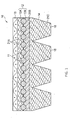
- FIG. 1 is a cross-sectional view showing a V-ribbed belt according to one embodiment of the present invention.
- a V-ribbed belt 10 is an endless frictional power transmission belt formed from rubber, and includes an adhesion rubber portion 12, a compression rubber portion 14 formed on the lower surface of the adhesion rubber portion 12 integrally with the adhesion rubber portion 12, and a fabric 13 attached onto the upper surface of the adhesion rubber portion 12.
- a cord 11 is embedded and is a tension member of the belt.
- the adhesion rubber portion 12 is rubber which surrounds the cord 11 and which is adhered to the cord 11.
- the cord 11 extends in the longitudinal direction of the belt in the adhesion rubber portion 12, while spirally wound.
- the compression rubber portion 14 includes multiple (four in this embodiment) ribs 15 arranged in the width direction. Each of the ribs 15 extends in the longitudinal direction of the belt, and has a width that is tapered toward the lower side of the belt.
- the belt 10 is used to transmit power from the driving side to the driven side by friction transmission achieved by engagement of the compression rubber portion 14 with pulleys.
- the fabric 13 may be subjected to any of various impregnation treatments such as RFL treatment and rubber cement treatment to improve the adhesion with an upper layer 12A.
- the adhesion rubber portion 12 includes an upper layer 12A constituting the upper side of the adhesion rubber portion 12 and a lower layer 12B constituting the lower side thereof, which are located across the cord 11.
- Innumerable pieces of short fibers 21A, 21B are included substantially uniformly in the upper layer 12A and the lower layer 12B, respectively.
- the short fiber 21A in the upper layer 12A is oriented in the width direction of the belt, whereas the short fiber 21B in the lower layer 12B is oriented in the longitudinal direction of the belt.
- the short fibers 21A, 21B are modified nylon microfibers each obtained by modifying a nylon fiber with a polyolefin and an elastomer.
- the modified nylon microfibers are those in which at least a polyolefin and an elastomer as a third component are chemically bonded to a nylon fiber, as will be described later.
- nylon fiber used for the modified nylon microfiber 6-nylon is preferable.
- 6.6-nylon, 6.10-nylon, or the like may also be used.
- polyethylene is preferably used as the polyolefin.
- the polyolefin is not limited to polyethylene, and polypropylene or the like may also be used.
- the nylon fiber in the adhesion rubber portion 12 is such that the fiber length L F thereof is approximately 4000 ⁇ m or less, the fiber diameter D F thereof is approximately 1.5 ⁇ m or less, and the value (L F /D F ) of the aspect ratio of the fiber length L F to the fiber diameter D F is 10 or more.
- the fiber length L F is 1000 ⁇ m or less, the fiber diameter D F is approximately 1.0 ⁇ m or less, and the value (L F /D F ) of the aspect ratio is in the range from 500 to 1000, both inclusive.
- a large fiber diameter D F or a large fiber length L F causes to develop cracks or cord separation, and so that the drive lifetime of the belt tends to decrease.
- the nylon fiber quantity of the modified nylon microfiber in each of the upper layer 12A and the lower layer 12B is not less than 10 parts by weight, and preferably 10 to 15 parts by weight, relative to 100 parts by weight of the elastomers in the corresponding upper layer 12A and lower layer 12B.
- the incorporation of 10 parts by weight or more of the nylon fiber increases the moduli of the upper layer 12A and the lower layer 12B, making it possible to improve the drive lifetime of the belt. Meanwhile, incorporation of the nylon fiber in an amount of 15 parts by weight or more may cause poor dispersion.
- the adhesion rubber portion 12 (the upper layer 12A and the lower layer 12B) is obtained by vulcanizing a rubber composition (adhesion rubber portion rubber composition) containing a high-viscosity elastomer as a first component, a low-viscosity elastomer as a second component, and an elastomer (fiber-containing elastomer) containing a modified nylon microfiber, as a third component.
- the high-viscosity elastomer is an elastomer having a Mooney viscosity which is greater than or equal to 50.
- the low-viscosity elastomer is an elastomer having a Mooney viscosity which is less than or equal to 10, and is lower in Mooney viscosity than the high-viscosity elastomer.
- the Mooney viscosity of the high-viscosity elastomer is preferably 50 to 150.
- the Mooney viscosity in this description refers to a Mooney viscosity (ML 1+4 , 125°C) determined according to JIS K 6300 at 125°C.
- an ethylene-propylene copolymer hereinafter referred to as EPM
- an ethylene-propylene-diene terpolymer hereinafter referred to as EPDM
- Mooney viscosity which is greater than or equal to 50
- the low-viscosity elastomer EPM or EPDM having a Mooney viscosity which is less than or equal to 10, or a mixture thereof is used.
- EPM or EPDM having a Mooney viscosity which is less than or equal to 10
- other ethylene- ⁇ -olefin copolymers such as ethylene-1-octene copolymers may be used, or elastomers other than ethylene- ⁇ -olefin copolymers may also be used.
- EPM or EPDM when EPM or EPDM is used as the low-viscosity elastomer, the resultant V-ribbed belt 10 has further improved durability.
- the weight ratio represented by high-viscosity elastomer: low-viscosity elastomer is set to 95:5 to 50:50.
- Such a weight ratio results in improvement in mixability in kneading steps described later, particularly, in secondary kneading where the kneading temperature is low, and makes it possible to impart a high modulus to the adhesion rubber portion 12.
- the low-viscosity elastomer is EPM, EPDM, or a mixture thereof
- the weight ratio represented by high-viscosity elastomer: low-viscosity elastomer is preferably 70:30 to 50:50, and particularly preferably 65:35 to 55:45. By setting the weight ratio within such a range, the belt lifetime can be further improved.
- the fiber-loaded elastomer contains (a) a polyolefin, (b) an elastomer as a third component, and (c) an ultrafine nylon fiber.
- the components (a) and (b) constitute a matrix.
- the nylon fiber is dispersed in the matrix, and is chemically bonded to the components (a) and (b).
- the chemical bonding of the nylon fiber to the components (a) and (b) is achieved by, for example, a silane coupling agent.
- Such fiber-loaded elastomers are disclosed, for example, in Japanese Patent Application Publication No. H07-278360 and Japanese Patent Application Publication No. H09-59435 .
- the fiber-loaded elastomer may be composed as follows. Specifically, the fiber-loaded elastomer may also contain (d) a spherical silica with an average particle diameter of 1 ⁇ m or less and a moisture content of 1000 ppm or less (hereinafter referred to as a small-particle-diameter spherical silica), in addition to the components (a) to (c); the nylon fiber may be dispersed in a matrix composed of the components (a), (b) and (d); and the nylon fiber may be chemically bonded to the matrix.
- the matrix bonded to the nylon fiber contains the small-particle-diameter spherical silica as described above, the strength of the modified nylon microfiber can be further increased.
- the polyolefin is preferably incorporated in an amount of 1 to 40 parts by weight relative to 100 parts by weight of the elastomers.
- the small-particle-diameter spherical silica is preferably incorporated in an amount of 1 to 50 parts by weight relative to 100 parts by weight of the elastomers.
- the average particle diameter refers to a diameter determined by a laser diffraction/scattering method using a laser diffraction/scattering particle size distribution analyzer LA-750 manufactured by HORIBA, Ltd as follows. Specifically, the concentration of a sample is adjusted by gradually introducing the sample into a chemical bath for determination of the analyzer, so that the light transmission of the sample can be a standard value. After that, the average particle diameter is determined according to automatic measurement of the analyzer. Meanwhile, the moisture content refers to a weight loss determined as follows.
- the elastomer as the third component contained in the fiber-loaded elastomer is preferably smaller in incorporated amount (weight) than the second component, and is preferably EPM, EPDM, or a mixture thereof.
- EPM incorporated amount
- EPDM elastomer which is lower in Mooney viscosity than the high-viscosity elastomer, and higher in Mooney viscosity than the low-viscosity elastomer is used as the elastomer of the third component.
- various additives including a large-particle-diameter silica having a larger average particle diameter than the small-particle-diameter spherical silica, a filler such as carbon black, a vulcanization agent, a vulcanization aid, an antioxidant, a retarder, a metal cross-linking agent, and the like are incorporated into the rubber composition (adhesion rubber portion rubber composition) of the upper layer 12A and the lower layer 12B.
- the rubber compositions used to form the upper layer 12A and the lower layer 12B may have the same constitution, or different constitutions.
- Innumerable pieces of a short fiber 21C are included substantially uniformly in the compression rubber portion 14 to reinforce the compression rubber portion 14.
- the short fiber 21C is oriented in the width direction of the belt. Part of the short fiber 21C is exposed on or protrudes from a surface of the compression rubber portion 14. This makes it possible to reduce the frictional coefficient of the surface of the compression rubber portion 14, and thus reduce the possibility of noise generation during the driving of the belt, and the like.
- an aramid short fiber is used as the short fiber 21C when the belt is used under a high-load environment
- a nylon short fiber is used as the short fiber 21C when it is necessary to sufficiently reduce the possibility of noise generation during the driving of the belt, for example.
- EPM, EPDM, or the like is preferably used as the elastomer of the compression rubber portion 14.
- the rubber composition of the adhesion rubber portion according to this embodiment is prepared as follows. First, the fiber-loaded elastomer and the unvulcanized high-viscosity elastomer and low-viscosity elastomer are introduced together with predetermined additives, into a kneader, and are kneaded at a predetermined heating temperature (for example, 150°C or above) to obtain a uniform mixture (primary kneading). Note that additives such as a vulcanization agent, which vulcanizes the elastomers upon heating to the heating temperature in the primary kneading, are not introduced in the primary kneading.
- a vulcanization agent which vulcanizes the elastomers upon heating to the heating temperature in the primary kneading
- the mixture obtained by kneading in the primary kneading is then cooled to a temperature lower than the vulcanization temperature of the vulcanization agent (for example, 130°C or below), and then the additives such as a vulcanization agent not added in the primary kneading are added, and the mixture is further kneaded to obtain a uniform mixture (secondary kneading).
- the rubber composition of the adhesion rubber portion is obtained.
- the nylon fiber is finely fragmented in advance in the fiber-loaded elastomer.
- the nylon fiber may be finely fragmented in the primary kneading or the secondary kneading to produce the above described fiber diameter D F and fiber length L F .
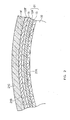
- a method of manufacturing the V-ribbed belt is described by using Fig. 2 .
- a rubber-provided fabric 31 is first prepared in which an unvulcanized rubber layer 12A' is laminated on one surface of the fabric 13 by using an unillustrated calendaring machine. Specifically, while being rolled by rollers of the calendering machine, the rubber composition of the adhesion rubber portion is laminated on the fabric 13 and fed in the rolling direction by the rollers. Thereby, the rubber-provided fabric 31 is obtained.
- the short fiber 21A incorporated in the rubber composition is oriented in the rolling direction (i.e., the feeding direction of the fabric).
- the rubber-provided fabric 31 is wound around the outer periphery of a cylindrical mandrel 30, with the fabric 13 being on the inner side and the rubber layer 12A' being on the outer side.
- the rubber-provided fabric 31 is wound in such a manner that the orientation direction of the short fiber 21A is the same as the axial direction of the mandrel 30.
- the fabric 13 is arranged in such a manner that the feed direction of the fabric 13 in the calendering machine extends along the axial direction of the mandrel 30.
- the cord 11 is spirally wound around the unvulcanized rubber layer 12A' of the rubber-provided fabric 31, and a first rubber sheet 12B' is wound around the cord 11.
- the first rubber sheet 12B' is obtained by rolling the rubber composition of the adhesion rubber portion by calendering or the like, by which the short fiber 21B (modified nylon microfiber) is oriented in the rolling direction.
- the orientation direction of the short fiber 21B is the same as the circumferential direction of the mandrel 30.
- the cord 11 is arranged so as to be sandwiched in the rubber composition of the adhesion rubber portion.
- a second rubber sheet 14' is further wound around the first rubber sheet 12B'.
- the second rubber sheet 14' is obtained by rolling a rubber composition for forming the compression rubber portion 14 by calendering or the like, by which the short fiber 21C is oriented in the rolling direction.
- the orientation direction of the short fiber 21C is the same as the axial direction of the mandrel 30.
- the mandrel 30 is placed into a vulcanization chamber (unillustrated), and heating under pressure is carried out at a predetermined temperature and pressure.
- the fabric 13, the rubber layer 12A' , the cord 11, and the rubber sheets 12B' , 14' are integrated by being vulcanized and molded in such a manner that the cord 11 is embedded between the integrated rubber layer 12A' and rubber sheet 12B'.
- a flat belt-shaped vulcanized sleeve can be obtained.
- the vulcanized sleeve is cut to have a predetermined width, and ground with an unillustrated grinding machine.
- the V-ribbed belt 10 (see Fig. 1 ) in which the ribs 15 are formed, is obtained.
- the rubber layer 12A' and the rubber sheets 12B' , 14' form the upper layer 12A, the lower layer 12B, and the compression rubber portion 14 in the V-ribbed belt 10, respectively.
- the orientation directions of the fibers in the rubber layer 12A' and the rubber sheets 12B', 14' are the same as the axial direction or the circumferential direction of the mandrel 30.
- the orientation directions of the short fibers 21A to 21C in the resultant V-ribbed belt 10 are the same as the width direction or the longitudinal direction of the belt, as described above.
- the low-viscosity elastomer of lower in Mooney viscosity is incorporated into the rubber composition of the adhesion rubber portion in addition to the high-viscosity elastomer.
- the rubber composition of the adhesion rubber portion can be kneaded appropriately.
- the incorporation of the high-viscosity elastomer in a larger amount in the adhesion rubber portion 12 (the upper layer 12A and the lower layer 12B), in combination with the inclusion of a large amount of the modified nylon microfiber improves the modulus and the tear resistance performance of the adhesion rubber portion 12, so that the durability of the belt can be improved.
- the use of the modified nylon microfiber as the short fibers in the adhesion rubber portion 12 having a predetermined constitution improves the adhesion of the rubber with the short fibers 21A, 21B and the adhesion between the cord 11 and the adhesion rubber portion 12. For this reason, cord separation, cracks starting from the short fiber, and the like are effectively prevented, so that the durability of the belt can be further improved.
- the V-ribbed belt may be broken at an early stage by a large stress which acts on the compression rubber portion or the lower layer of the adhesion rubber portion along the longitudinal direction of the belt because of friction with pulleys.
- the cord is shifted in position in the width direction and a pop-out movement in which the cord pops out of a side surface of the belt and results in cord separation, tends to occur in the adhesion rubber portion.
- the short fiber 21B in the lower layer 12B oriented in the longitudinal direction of the belt resists the above-described stress acting along the longitudinal direction of the belt, thereby preventing breakage of the belt.
- the short fiber 21A in the upper layer 12A oriented in the width direction of the belt prevents the shift in position of the cord 11 in the width direction, thereby preventing the cord pop-out and cord separation.
- the V-ribbed belt 10 according to this embodiment has improved durability especially under high-tension and high-load environments, because the short fibers 21A, 21B are oriented in the predetermined directions.
- orientation directions of the short fibers 21A, 21B in the adhesion rubber portion 12 are not limited to the above-described directions.
- the orientation direction of the short fiber 21B in the lower layer 12B may be made to extend along the width direction of the belt as in the case of the upper layer 12A.
- the first rubber sheet 12B' is wound around the mandrel 30 in such a manner that the orientation direction of the short fiber 21B is the same as the axial direction of the mandrel 30 in the above-described manufacturing method.
- the rubber composition of the adhesion rubber portion according to this embodiment may be used as an adhesion rubber of other frictional power transmission belts such as cogged V belts.
- a pelletized fiber-loaded elastomer (nylon fiber content: 25 % by weight) having the constitution shown in Table 1 was prepared, in which a nylon fiber was dispersed in a matrix composed of EPDM, a high-density polyethylene, and a small-particle-diameter spherical silica and the nylon fiber was bonded to the matrix.
- the fiber-loaded elastomer, the high-viscosity elastomer (EPM), the low-viscosity elastomer (EPM), and the additives other than the peroxide vulcanization agent and the retarder shown in Table 2 were kneaded in a closed-type mixer under heating to around 160°C, and a uniform mixture thereof was obtained (the primary kneading). Subsequently, the kneaded mixture was transferred to an open roll, the peroxide vulcanization agent and the retarder were added thereto, and the mixture was kneaded at a temperature around 120°C to obtain a uniformmixture. Thus, the rubber composition of the adhesion rubber portion was obtained.
- the high-viscosity elastomer:low-viscosity elastomer (weight ratio) was 60:40, and the nylon fiber was incorporated in an amount of 11.25 parts by weight relative to 100 parts by weight of the elastomers in the rubber composition of the adhesion rubber portion.
- a V-ribbed belt was manufactured in which the upper layer and the lower layer of the adhesion rubber portion were formed from the rubber composition of the adhesion rubber portion.
- the V-ribbed belt was produced by carrying out vulcanization molding in a vulcanization chamber at 180°C for 25 minutes under pressure.
- the manufactured V-ribbed belt was a 3PK belt with a length of 1040 mm and a width of 10.7 mm.
- the orientation directions of the fibers in the upper layer, the lower layer, and the compression rubber portion were set to be the same as the width direction of the belt, the longitudinal direction of the belt, and the width direction of the belt, respectively, as shown in Fig. 1 .
- a rubber composition used for forming the compression rubber portion was a rubber composition containing EPDM as the elastomer, and an aramid short fiber incorporated in an amount of 6 parts by weight relative to 100 parts by weight of the elastomer. Meanwhile, a woven fabric, which was plain-woven fabric of a nylon fiber and cotton, was used as the fabric, and an aramid cord was used as the cord.
- a rubber composition containing EPDM as the elastomer a rubber composition containing EPDM as the elastomer
- an aramid short fiber incorporated in an amount of 6 parts by weight relative to 100 parts by weight of the elastomer.
- a woven fabric which was plain-woven fabric of a nylon fiber and cotton, was used as the fabric, and an aramid cord was used as the cord.
- Example 2 was carried out in the same manner as that in Example 1, except that the low-viscosity elastomer (EOM) was incorporated into the rubber composition of the adhesion rubber portion as a substitute for the low-viscosity elastomer (EPM), so that the weight ratio represented by the high-viscosity elastomer: low-viscosity elastomer was 90:10, and except for that one change the amounts of the various additives incorporated in Example 1 were adjusted as shown in Table 2.
- EOM low-viscosity elastomer
- EPM low-viscosity elastomer
- Example 3 was carried out in the same manner as that in Example 1, except that the amounts of the high-viscosity elastomer and the low-viscosity elastomer incorporated into the rubber composition of the adhesion rubber portion were changed, so that the weight ratio represented by the high-viscosity elastomer: low-viscosity elastomer was 70:30.
- Example 4 was carried out in the same manner as that in Example 2, except that the orientation direction of the short fiber (modified nylon microfiber) in the lower layer of the adhesion rubber portion was changed to the width direction of the belt.
- Example 5 was carried out in the same manner as that in Example 1, except that the amounts of the fiber-loaded elastomer, the high-viscosity elastomer, and the low-viscosity elastomer incorporated into the rubber composition of the adhesion rubber portion were changed, so that the weight ratio represented by the high-viscosity elastomer: low-viscosity elastomer was 70:30, and the nylon fiber was incorporated in an amount of 5.6 parts by weight relative to 100 parts by weight of the elastomers.
- Comparative Example 1 was carried out in the same manner as that in Example 1, except that no low-viscosity elastomer was incorporated, so that the weight ratio represented by the high-viscosity elastomer: the low-viscosity elastomer was 100:0 in the rubber composition of the adhesion rubber portion.
- the incorporated materials were not successfully kneaded in the secondary kneading where the kneading temperature was low, and a rubber composition of the adhesion rubber portion was not successfully obtained. For this reason, a V-ribbed belt was not successfully manufactured by using the rubber composition of the adhesion rubber portion having the constitution shown in Table 2 in this comparative example.
- Comparative Example 2 was carried out in the same manner as that in Example 1, except that the constitution of the rubber composition of the adhesion rubber portion was changed as shown in Table 2, where the silicone-modified EPDM was used as the elastomer material of the adhesion rubber portion, and no modified nylon microfiber was incorporated.
- Comparative Example 3 was carried out in the same manner as that in Example 1, except that no fiber-loaded elastomer was incorporated into the rubber composition of the adhesion rubber portion, and the incorporated amounts of the high-viscosity elastomer and the low-viscosity elastomer were changed, so that no modified nylon microfiber was included in the adhesion rubber portion, and the weight ratio represented by the high-viscosity elastomer: low-viscosity elastomer was 70:30.
- a vulcanized rubber sample of the rubber composition of the adhesion rubber portion of each of the Examples and Comparative Examples was prepared and evaluated for various physical properties, and a drive test was carried out by using the belt of each of the Examples and Comparative Examples, as shown below. Note, however, that since the rubber composition of the adhesion rubber portion of Example 4 was the same as that of Example 2, the evaluation for physical properties of Example 4 was omitted. In addition, since no rubber composition of an adhesion rubber portion was successfully obtained in Comparative Example 1 as described above, the evaluation for physical properties and the drive test were not carried out on Comparative Example 1.
- the tear strength of a vulcanized rubber sample which was prepared as "the unnicked angle-type test piece," was determined in accordance with JIS K6252. Note that, for each of Examples 1 to 3, and 5, the tear strength was determined both in the case where the short fiber was oriented in the grain direction and in the case where the short fiber was oriented in the cross-grain direction under a normal temperature environment (23°C) and a high-temperature environment (120°C), in this tear test as in the case of the tensile test.
- the belt 50 of each of the Examples and Comparative Examples was wound around a driving pulley 51 having a pulley diameter of 120 mm, a driven pulley 52 having a pulley diameter of 120 mm, and a tensioner pulley 53 having a pulley diameter of 45 mm and being arranged on the tight side of the belt.
- the belt 50 was subjected to reverse bending on the slack side with an idler pulley 54 having a pulley diameter of 85 mm.
- the belt 50 was driven by rotating the driving pulley 51 at 4900 rpm with the maximum tension of 350 N/rib.
- the breakage time at which the belt 50 was broken to the extent that the belt 50 could no longer be driven was regarded as the belt lifetime.
- the time at which an initial breakage was observed in the belt 50 was also determined, and that time was regarded as the initial fracture time. Note that, for each of the Examples and Comparative Examples, an observation was made for the fracture mode in which the belt 50 reached the end of the belt lifetime and for the fracture mode in which the initial breakage occurred.
- Example 1 and Comparative Example 2 were evaluated for durability based on flex crack growth by carrying out the De Mattia test in accordance with JIS K6260 by use of a vulcanized rubber sample obtained from the rubber composition of the adhesion rubber portion.
- each sample which had a nick formed at the center thereof and was then subjected to 25000 bending cycles under an environment of 120°C at a bending angle of 180°, was evaluated based on the following criteria.
- Example 1 was evaluated in terms of durability based on developing flex cracks by subjecting each sample, which had no nick formed therein, to one million bending cycles under a temperature environment of 130°C at a bending angle of 180°. Note that, as for Example 1, both a sample (grain) in which the fiber was oriented in the longitudinal direction of the sample and a sample (cross-grain) in which the fiber was oriented in the width direction were evaluated.
Landscapes
- Engineering & Computer Science (AREA)
- Chemical & Material Sciences (AREA)
- General Engineering & Computer Science (AREA)
- Mechanical Engineering (AREA)
- Materials Engineering (AREA)
- Health & Medical Sciences (AREA)
- Chemical Kinetics & Catalysis (AREA)
- Medicinal Chemistry (AREA)
- Polymers & Plastics (AREA)
- Organic Chemistry (AREA)
- Manufacturing & Machinery (AREA)
- Textile Engineering (AREA)
- Compositions Of Macromolecular Compounds (AREA)
- Reinforced Plastic Materials (AREA)
- Manufacture Of Macromolecular Shaped Articles (AREA)
Abstract
Description
- The present invention relates to a frictional power transmission belt such as a V-ribbed belt used, for example, under high-tension and high-load environments.
- Frictional power transmission belts such as V-ribbed belts have been widely used as belts for transmitting power to auxiliaries in automobile engines and the like, for example. Recently, frictional power transmission belts have been increasingly used under high-tension and high-load environments, because the size reduction of engines has led to reduction in the number of ribs and the width of the belt, and because loads due to driving of auxiliaries have increased. For this reason, frictional power transmission belts are required to have a rubber having a high modulus and high tear resistance performance as an adhesion rubber located around a cord that is a tension member.
- Conventionally, a V-ribbed belt used under a high-load environment is known in which a short fiber is included in at least a part of an adhesion rubber to provide a high modulus to the adhesion rubber, as disclosed in Patent Document 1. Here, an ordinary nylon or aramid fiber, or a modified nylon microfiber obtained by bonding polyolefin to a nylon fiber is used as the short fiber. In addition, for example, EPDM is used as a rubber component of the adhesion rubber to improve the heat resistance and durability.
- Patent Document 1: Japanese Patent Application Publication No.
2007-198485 - When an ordinary nylon or aramid fiber is included in the adhesion rubber, as shown in Patent Document 1, it is difficult to improve the adhesion between the adhesion rubber and the cord, and hence cord separation in which separation occurs at the interface between the cord and the rubber cannot be prevented sufficiently. In addition, when an adhesion rubber having an ordinary constitution using EPDM includes the modified nylon microfiber in a large amount to increase the modulus, there is a problem that the raw material rubber and the modified nylon microfiber cannot be kneaded with each other sufficiently.
- In this respect, an object of the present invention is to provide a frictional power transmission belt with which the possibility of cord separation is reduced, while the modulus and tear resistance performance of the adhesion rubber are improved, and further with which the rubber composition of the adhesion rubber can be kneaded appropriately.
- A frictional power transmission belt according to the present invention is a frictional power transmission belt, which is formed from rubber and includes an embedded cord that extends in the longitudinal direction of the belt, wherein at least a part of the rubber surrounding the cord is obtained by vulcanizing a rubber composition that includes a high-viscosity elastomer (a first component) and a low-viscosity elastomer (a second component), and contains a modified nylon microfiber, and the high-viscosity elastomer is at least one elastomer selected from the group consisting of ethylene-propylene copolymers and ethylene-propylene-diene terpolymers, and the low-viscosity elastomer is lower in Mooney viscosity than the high-viscosity elastomer.
- The Mooney viscosity of the low-viscosity elastomer is preferably less than or equal to 10, and the Mooney viscosity of the high-viscosity elastomer is preferably greater than or equal to 50. In addition, the weight ratio of the high-viscosity elastomer to the low-viscosity elastomer is preferably 95:5 to 50:50.
- In at least a part (rubber composition) of the rubber, the nylon fiber quantity of the modified nylon microfiber is preferably not less than 10 parts by weight relative to 100 parts by weight of the elastomers. For example, the modified nylon microfiber is obtained by modification with at least polyolefin and an elastomer, and a specific example thereof is a nylon fiber to which at least polyolefin and an elastomer as a third component are chemically bonded.
- Further, the modified nylon microfiber may be obtained by bonding nylon fiber to a matrix composed of polyolefin, an elastomer and spherical silica with average particle diameter of 1 µm or less and moisture content of 1000 ppm or less.
- The low-viscosity elastomer is preferably at least one elastomer selected from the group consisting of ethylene-propylene copolymers and ethylene-propylene-diene terpolymers. In this case, the weight ratio of the high-viscosity elastomer to the low-viscosity elastomer is preferably 70:30 to 50:50.
- The frictional power transmission belt may comprise an adhesion rubber portion which contains the modified nylon microfiber and is formed by vulcanizing the rubber composition. In this case, the cord is preferably embedded in the adhesion rubber portion. In addition, the frictional power transmission belt comprises a compression rubber portion provided below the adhesion rubber portion, for example. The compression rubber portion includes a short fiber oriented in the width direction of the belt, for example.
- The adhesion rubber portion may be composed of an upper layer constituting the upper side and a lower layer constituting the lower side, which are located across the cord. In this case, each of the upper layer and lower layer preferably contains the modified nylon microfiber and is formed by vulcanizing the rubber composition. In addition, the modified nylon microfiber contained in the upper layer is preferably oriented in the width direction of the belt, while the modified nylon microfiber contained in the lower layer is preferably oriented in the longitudinal direction of the belt.
- A method of manufacturing a frictional power transmission belt according to the present invention is a method of manufacturing a frictional power transmission belt which is formed from rubber and includes an embedded cord that extends in the longitudinal direction of the belt, the method comprising: a first step of obtaining a rubber composition by kneading a modified nylon microfiber, a high-viscosity elastomer and a low-viscosity elastomer; and a second step of molding the rubber composition as a rubber adhered to the cord by arranging the rubber composition around the cord followed by vulcanizing, wherein the high-viscosity elastomer is at least one elastomer selected from the group consisting of ethylene-propylene copolymers and ethylene-propylene-diene terpolymers, and the low-viscosity elastomer is lower in Mooney viscosity than the high-viscosity elastomer.
- An adhesion rubber according to the present invention is an adhesion rubber provided to surround a cord that is a tension member of a belt, wherein at least a part of the adhesion rubber is obtained by vulcanizing a rubber composition that includes a high-viscosity elastomer and a low-viscosity elastomer, and contains a modified nylon microfiber, and the high-viscosity elastomer is at least one elastomer selected from the group consisting of ethylene-propylene copolymers and ethylene-propylene-diene terpolymers, and the low-viscosity elastomer is lower in Mooney viscosity than the high-viscosity elastomer.
- A rubber composition according to the present invention comprises a modified nylon microfiber, a high-viscosity elastomer and a low-viscosity elastomer, wherein the high-viscosity elastomer is at least one elastomer selected from the group consisting of ethylene-propylene copolymers and ethylene-propylene-diene terpolymers, and the low-viscosity elastomer is lower in Mooney viscosity than the high-viscosity elastomer.
- In the present invention, the possibility of cord separation is reduced, while the modulus and the tear resistance performance of the adhesion rubber portion are improved, and further the rubber composition of the adhesion rubber can be kneaded appropriately.
-
- [
Fig. 1] Fig. 1 is a cross-sectional view of a V-ribbed belt of an embodiment of the present invention. - [
Fig. 2] Fig. 2 is a cross-sectional view showing a method of manufacturing a V-ribbed belt of the embodiment. - [
Fig. 3] Fig. 3 shows a layout in a drive test. -
- 10
- V-ribbed belt (frictional power transmission belt)
- 11
- cord
- 12
- adhesion rubber portion
- 12A
- upper layer
- 12B
- lower layer
- 14
- compression rubber portion
- 15
- rib
- 21A, 21B
- short fiber (modified nylon microfiber)
- Hereinafter, an embodiment of the present invention is described with reference to the drawings.
Fig. 1 is a cross-sectional view showing a V-ribbed belt according to one embodiment of the present invention. A V-ribbedbelt 10 is an endless frictional power transmission belt formed from rubber, and includes anadhesion rubber portion 12, acompression rubber portion 14 formed on the lower surface of theadhesion rubber portion 12 integrally with theadhesion rubber portion 12, and afabric 13 attached onto the upper surface of theadhesion rubber portion 12. - In the
adhesion rubber portion 12, acord 11 is embedded and is a tension member of the belt. Theadhesion rubber portion 12 is rubber which surrounds thecord 11 and which is adhered to thecord 11. Thecord 11 extends in the longitudinal direction of the belt in theadhesion rubber portion 12, while spirally wound. Thecompression rubber portion 14 includes multiple (four in this embodiment)ribs 15 arranged in the width direction. Each of theribs 15 extends in the longitudinal direction of the belt, and has a width that is tapered toward the lower side of the belt. Thebelt 10 is used to transmit power from the driving side to the driven side by friction transmission achieved by engagement of thecompression rubber portion 14 with pulleys. In addition, thefabric 13 may be subjected to any of various impregnation treatments such as RFL treatment and rubber cement treatment to improve the adhesion with anupper layer 12A. - The
adhesion rubber portion 12 includes anupper layer 12A constituting the upper side of theadhesion rubber portion 12 and alower layer 12B constituting the lower side thereof, which are located across thecord 11. Innumerable pieces ofshort fibers upper layer 12A and thelower layer 12B, respectively. Theshort fiber 21A in theupper layer 12A is oriented in the width direction of the belt, whereas theshort fiber 21B in thelower layer 12B is oriented in the longitudinal direction of the belt. Theshort fibers - As the nylon fiber used for the modified nylon microfiber, 6-nylon is preferable. Alternatively, 6.6-nylon, 6.10-nylon, or the like may also be used. Meanwhile, polyethylene is preferably used as the polyolefin. However, the polyolefin is not limited to polyethylene, and polypropylene or the like may also be used.
- The nylon fiber in the
adhesion rubber portion 12 is such that the fiber length LF thereof is approximately 4000 µm or less, the fiber diameter DF thereof is approximately 1.5 µm or less, and the value (LF/DF) of the aspect ratio of the fiber length LF to the fiber diameter DF is 10 or more. Preferably, the fiber length LF is 1000 µm or less, the fiber diameter DF is approximately 1.0 µm or less, and the value (LF/DF) of the aspect ratio is in the range from 500 to 1000, both inclusive. A large fiber diameter DF or a large fiber length LF causes to develop cracks or cord separation, and so that the drive lifetime of the belt tends to decrease. - In addition, the nylon fiber quantity of the modified nylon microfiber in each of the
upper layer 12A and thelower layer 12B is not less than 10 parts by weight, and preferably 10 to 15 parts by weight, relative to 100 parts by weight of the elastomers in the correspondingupper layer 12A andlower layer 12B. The incorporation of 10 parts by weight or more of the nylon fiber increases the moduli of theupper layer 12A and thelower layer 12B, making it possible to improve the drive lifetime of the belt. Meanwhile, incorporation of the nylon fiber in an amount of 15 parts by weight or more may cause poor dispersion. - The adhesion rubber portion 12 (the
upper layer 12A and thelower layer 12B) is obtained by vulcanizing a rubber composition (adhesion rubber portion rubber composition) containing a high-viscosity elastomer as a first component, a low-viscosity elastomer as a second component, and an elastomer (fiber-containing elastomer) containing a modified nylon microfiber, as a third component. The high-viscosity elastomer is an elastomer having a Mooney viscosity which is greater than or equal to 50. The low-viscosity elastomer is an elastomer having a Mooney viscosity which is less than or equal to 10, and is lower in Mooney viscosity than the high-viscosity elastomer. Note that the Mooney viscosity of the high-viscosity elastomer is preferably 50 to 150. In addition, the Mooney viscosity in this description refers to a Mooney viscosity (ML1+4, 125°C) determined according to JIS K 6300 at 125°C. - As the high-viscosity elastomer, an ethylene-propylene copolymer (hereinafter referred to as EPM) or an ethylene-propylene-diene terpolymer (hereinafter referred to as EPDM) having a Mooney viscosity which is greater than or equal to 50, or a mixture thereof is used.
- Meanwhile, as the low-viscosity elastomer, EPM or EPDM having a Mooney viscosity which is less than or equal to 10, or a mixture thereof is used. Alternatively, other ethylene-α-olefin copolymers such as ethylene-1-octene copolymers may be used, or elastomers other than ethylene-α-olefin copolymers may also be used. In this embodiment, when EPM or EPDM is used as the low-viscosity elastomer, the resultant V-ribbed
belt 10 has further improved durability. - In this embodiment, the weight ratio represented by high-viscosity elastomer: low-viscosity elastomer is set to 95:5 to 50:50. Such a weight ratio results in improvement in mixability in kneading steps described later, particularly, in secondary kneading where the kneading temperature is low, and makes it possible to impart a high modulus to the
adhesion rubber portion 12. In addition, when the low-viscosity elastomer is EPM, EPDM, or a mixture thereof, the weight ratio represented by high-viscosity elastomer: low-viscosity elastomer is preferably 70:30 to 50:50, and particularly preferably 65:35 to 55:45. By setting the weight ratio within such a range, the belt lifetime can be further improved. - The fiber-loaded elastomer contains (a) a polyolefin, (b) an elastomer as a third component, and (c) an ultrafine nylon fiber. The components (a) and (b) constitute a matrix. The nylon fiber is dispersed in the matrix, and is chemically bonded to the components (a) and (b). Here, the chemical bonding of the nylon fiber to the components (a) and (b) is achieved by, for example, a silane coupling agent. Such fiber-loaded elastomers are disclosed, for example, in Japanese Patent Application Publication No.
H07-278360 H09-59435 - In addition, the fiber-loaded elastomer may be composed as follows. Specifically, the fiber-loaded elastomer may also contain (d) a spherical silica with an average particle diameter of 1 µm or less and a moisture content of 1000 ppm or less (hereinafter referred to as a small-particle-diameter spherical silica), in addition to the components (a) to (c); the nylon fiber may be dispersed in a matrix composed of the components (a), (b) and (d); and the nylon fiber may be chemically bonded to the matrix. When the matrix bonded to the nylon fiber contains the small-particle-diameter spherical silica as described above, the strength of the modified nylon microfiber can be further increased.
- In the adhesion rubber portion rubber composition, the polyolefin is preferably incorporated in an amount of 1 to 40 parts by weight relative to 100 parts by weight of the elastomers. In addition, the small-particle-diameter spherical silica is preferably incorporated in an amount of 1 to 50 parts by weight relative to 100 parts by weight of the elastomers.
- In this description, the average particle diameter refers to a diameter determined by a laser diffraction/scattering method using a laser diffraction/scattering particle size distribution analyzer LA-750 manufactured by HORIBA, Ltd as follows. Specifically, the concentration of a sample is adjusted by gradually introducing the sample into a chemical bath for determination of the analyzer, so that the light transmission of the sample can be a standard value. After that, the average particle diameter is determined according to automatic measurement of the analyzer. Meanwhile, the moisture content refers to a weight loss determined as follows. Specifically, 10 g of a sample is weighed into a crucible, heated in a dryer set to 105°C for 2 hours, and subsequently cooled in a desiccator for prevention of moisture absorption, and the sample is weighed after the cooling.
- The elastomer as the third component contained in the fiber-loaded elastomer is preferably smaller in incorporated amount (weight) than the second component, and is preferably EPM, EPDM, or a mixture thereof. For example, an elastomer which is lower in Mooney viscosity than the high-viscosity elastomer, and higher in Mooney viscosity than the low-viscosity elastomer is used as the elastomer of the third component.
- Besides the high-viscosity elastomer, the low-viscosity elastomer, and the fiber-loaded elastomer, various additives including a large-particle-diameter silica having a larger average particle diameter than the small-particle-diameter spherical silica, a filler such as carbon black, a vulcanization agent, a vulcanization aid, an antioxidant, a retarder, a metal cross-linking agent, and the like are incorporated into the rubber composition (adhesion rubber portion rubber composition) of the
upper layer 12A and thelower layer 12B. In addition, the rubber compositions used to form theupper layer 12A and thelower layer 12B may have the same constitution, or different constitutions. - Innumerable pieces of a
short fiber 21C are included substantially uniformly in thecompression rubber portion 14 to reinforce thecompression rubber portion 14. Theshort fiber 21C is oriented in the width direction of the belt. Part of theshort fiber 21C is exposed on or protrudes from a surface of thecompression rubber portion 14. This makes it possible to reduce the frictional coefficient of the surface of thecompression rubber portion 14, and thus reduce the possibility of noise generation during the driving of the belt, and the like. To sufficiently reduce the frictional coefficient, a fiber having a larger diameter than theshort fibers short fiber 21C. In addition, an aramid short fiber is used as theshort fiber 21C when the belt is used under a high-load environment, whereas a nylon short fiber is used as theshort fiber 21C when it is necessary to sufficiently reduce the possibility of noise generation during the driving of the belt, for example. Moreover, EPM, EPDM, or the like is preferably used as the elastomer of thecompression rubber portion 14. - The rubber composition of the adhesion rubber portion according to this embodiment is prepared as follows. First, the fiber-loaded elastomer and the unvulcanized high-viscosity elastomer and low-viscosity elastomer are introduced together with predetermined additives, into a kneader, and are kneaded at a predetermined heating temperature (for example, 150°C or above) to obtain a uniform mixture (primary kneading). Note that additives such as a vulcanization agent, which vulcanizes the elastomers upon heating to the heating temperature in the primary kneading, are not introduced in the primary kneading. The mixture obtained by kneading in the primary kneading is then cooled to a temperature lower than the vulcanization temperature of the vulcanization agent (for example, 130°C or below), and then the additives such as a vulcanization agent not added in the primary kneading are added, and the mixture is further kneaded to obtain a uniform mixture (secondary kneading). Thus, the rubber composition of the adhesion rubber portion is obtained. Here, the nylon fiber is finely fragmented in advance in the fiber-loaded elastomer. However, the nylon fiber may be finely fragmented in the primary kneading or the secondary kneading to produce the above described fiber diameter DF and fiber length LF.
- Next, a method of manufacturing the V-ribbed belt is described by using
Fig. 2 . In this manufacturing method, a rubber-provided fabric 31 is first prepared in which anunvulcanized rubber layer 12A' is laminated on one surface of thefabric 13 by using an unillustrated calendaring machine. Specifically, while being rolled by rollers of the calendering machine, the rubber composition of the adhesion rubber portion is laminated on thefabric 13 and fed in the rolling direction by the rollers. Thereby, the rubber-provided fabric 31 is obtained. Here, during the rolling of the rubber composition of the adhesion rubber portion, theshort fiber 21A incorporated in the rubber composition is oriented in the rolling direction (i.e., the feeding direction of the fabric). - Next, the rubber-provided fabric 31 is wound around the outer periphery of a
cylindrical mandrel 30, with thefabric 13 being on the inner side and therubber layer 12A' being on the outer side. In this case, the rubber-provided fabric 31 is wound in such a manner that the orientation direction of theshort fiber 21A is the same as the axial direction of themandrel 30. In other words, thefabric 13 is arranged in such a manner that the feed direction of thefabric 13 in the calendering machine extends along the axial direction of themandrel 30. - The
cord 11 is spirally wound around theunvulcanized rubber layer 12A' of the rubber-provided fabric 31, and afirst rubber sheet 12B' is wound around thecord 11. Thefirst rubber sheet 12B' is obtained by rolling the rubber composition of the adhesion rubber portion by calendering or the like, by which theshort fiber 21B (modified nylon microfiber) is oriented in the rolling direction. On themandrel 30, the orientation direction of theshort fiber 21B is the same as the circumferential direction of themandrel 30. Thus, thecord 11 is arranged so as to be sandwiched in the rubber composition of the adhesion rubber portion. - A second rubber sheet 14' is further wound around the
first rubber sheet 12B'. The second rubber sheet 14' is obtained by rolling a rubber composition for forming thecompression rubber portion 14 by calendering or the like, by which theshort fiber 21C is oriented in the rolling direction. On themandrel 30, the orientation direction of theshort fiber 21C is the same as the axial direction of themandrel 30. - Subsequently, the
mandrel 30 is placed into a vulcanization chamber (unillustrated), and heating under pressure is carried out at a predetermined temperature and pressure. By this pressurized heating, thefabric 13, therubber layer 12A' , thecord 11, and therubber sheets 12B' , 14' are integrated by being vulcanized and molded in such a manner that thecord 11 is embedded between theintegrated rubber layer 12A' andrubber sheet 12B'. Thus, a flat belt-shaped vulcanized sleeve can be obtained. The vulcanized sleeve is cut to have a predetermined width, and ground with an unillustrated grinding machine. Thus, the V-ribbed belt 10 (seeFig. 1 ) in which theribs 15 are formed, is obtained. - Note that the
rubber layer 12A' and therubber sheets 12B' , 14' form theupper layer 12A, thelower layer 12B, and thecompression rubber portion 14 in the V-ribbedbelt 10, respectively. In addition, the orientation directions of the fibers in therubber layer 12A' and therubber sheets 12B', 14' are the same as the axial direction or the circumferential direction of themandrel 30. Hence, the orientation directions of theshort fibers 21A to 21C in the resultant V-ribbedbelt 10 are the same as the width direction or the longitudinal direction of the belt, as described above. - As described above, in this embodiment, the low-viscosity elastomer of lower in Mooney viscosity is incorporated into the rubber composition of the adhesion rubber portion in addition to the high-viscosity elastomer. Hence, even when the nylon fiber is incorporated in a large amount, the rubber composition of the adhesion rubber portion can be kneaded appropriately. Moreover, the incorporation of the high-viscosity elastomer in a larger amount in the adhesion rubber portion 12 (the
upper layer 12A and thelower layer 12B), in combination with the inclusion of a large amount of the modified nylon microfiber, improves the modulus and the tear resistance performance of theadhesion rubber portion 12, so that the durability of the belt can be improved. - In addition, the use of the modified nylon microfiber as the short fibers in the
adhesion rubber portion 12 having a predetermined constitution improves the adhesion of the rubber with theshort fibers cord 11 and theadhesion rubber portion 12. For this reason, cord separation, cracks starting from the short fiber, and the like are effectively prevented, so that the durability of the belt can be further improved. - Moreover, in general, especially when a V-ribbed belt is used under a high tension and a high load, the V-ribbed belt may be broken at an early stage by a large stress which acts on the compression rubber portion or the lower layer of the adhesion rubber portion along the longitudinal direction of the belt because of friction with pulleys. Meanwhile, the cord is shifted in position in the width direction and a pop-out movement in which the cord pops out of a side surface of the belt and results in cord separation, tends to occur in the adhesion rubber portion. In this embodiment, the
short fiber 21B in thelower layer 12B oriented in the longitudinal direction of the belt resists the above-described stress acting along the longitudinal direction of the belt, thereby preventing breakage of the belt. In addition, theshort fiber 21A in theupper layer 12A oriented in the width direction of the belt prevents the shift in position of thecord 11 in the width direction, thereby preventing the cord pop-out and cord separation. In sum, the V-ribbedbelt 10 according to this embodiment has improved durability especially under high-tension and high-load environments, because theshort fibers - Note that, in a case where the V-ribbed
belt 10 is broken because of rib cracking or the like, the belt breakage can be found in advance by visual observation, because cracks or the like occur in the rib before the breakage. On the other hand, cord separation is difficult to find in advance by visual observation because the cord separation occurs inside the belt. Hence, cord separation tends to cause unpredictable transmission failure. Therefore, when belt breakage due to cord separation is prevented as in the case of this embodiment, the possibility of unpredictable transmission failure is reduced. - Note that the orientation directions of the
short fibers adhesion rubber portion 12 are not limited to the above-described directions. For example, the orientation direction of theshort fiber 21B in thelower layer 12B may be made to extend along the width direction of the belt as in the case of theupper layer 12A. In this case, thefirst rubber sheet 12B' is wound around themandrel 30 in such a manner that the orientation direction of theshort fiber 21B is the same as the axial direction of themandrel 30 in the above-described manufacturing method. - Moreover, the rubber composition of the adhesion rubber portion according to this embodiment may be used as an adhesion rubber of other frictional power transmission belts such as cogged V belts.
- Hereinafter, examples are shown as specific examples of the present invention. However, the present invention is not limited to examples shown below.
- First, a pelletized fiber-loaded elastomer (nylon fiber content: 25 % by weight) having the constitution shown in Table 1 was prepared, in which a nylon fiber was dispersed in a matrix composed of EPDM, a high-density polyethylene, and a small-particle-diameter spherical silica and the nylon fiber was bonded to the matrix.
-
[Table 1] Constitution of Fiber-Loaded Elastomer Parts by weight EDPM 100 High-density polyethylene 20 Small-particle-diameter spherical silica 20 Nylon 6 fiber 46.7 - Next, the fiber-loaded elastomer, the high-viscosity elastomer (EPM), the low-viscosity elastomer (EPM), and the additives other than the peroxide vulcanization agent and the retarder shown in Table 2 were kneaded in a closed-type mixer under heating to around 160°C, and a uniform mixture thereof was obtained (the primary kneading). Subsequently, the kneaded mixture was transferred to an open roll, the peroxide vulcanization agent and the retarder were added thereto, and the mixture was kneaded at a temperature around 120°C to obtain a uniformmixture. Thus, the rubber composition of the adhesion rubber portion was obtained. As can be understood from Tables 1 and 2, the high-viscosity elastomer:low-viscosity elastomer (weight ratio) was 60:40, and the nylon fiber was incorporated in an amount of 11.25 parts by weight relative to 100 parts by weight of the elastomers in the rubber composition of the adhesion rubber portion.
- Subsequently, in accordance with the method of the embodiment, a V-ribbed belt was manufactured in which the upper layer and the lower layer of the adhesion rubber portion were formed from the rubber composition of the adhesion rubber portion. The V-ribbed belt was produced by carrying out vulcanization molding in a vulcanization chamber at 180°C for 25 minutes under pressure. The manufactured V-ribbed belt was a 3PK belt with a length of 1040 mm and a width of 10.7 mm. In Example 1, the orientation directions of the fibers in the upper layer, the lower layer, and the compression rubber portion were set to be the same as the width direction of the belt, the longitudinal direction of the belt, and the width direction of the belt, respectively, as shown in
Fig. 1 . Note that a rubber composition used for forming the compression rubber portion was a rubber composition containing EPDM as the elastomer, and an aramid short fiber incorporated in an amount of 6 parts by weight relative to 100 parts by weight of the elastomer. Meanwhile, a woven fabric, which was plain-woven fabric of a nylon fiber and cotton, was used as the fabric, and an aramid cord was used as the cord.[Table 2] Constitutions of Rubber Compositions of Adhesion Rubber Portion Ex. 1 Ex. 2 Ex. 3 Ex. 4 Ex. 5 Comp. Ex. 1 Comp. Ex. 2 Comp. Ex. 3 Elastomers High-viscosity elastomer (EPM) 45.7 68.5 53.2 68.5 61.6 76.1 --- 70 Low-viscosity elastomer (EPM) 30.4 --- 22.8 --- 26.9 --- --- 30 Low-viscosity elastomer (EOM) --- 7.6 --- 7.6 --- --- --- --- Silicone-modified EPDM --- --- --- --- --- --- 100 --- Fiber-loaded elastomer 45 45 45 45 22.5 45 --- --- Additives Large-particle-diameter silica 60 67 60 67 60 60 40 60 Co-crossinking agent 2 2 2 2 2 2 --- 2 Carbon black 3 3 3 3 3 3 5 3 Vulcanization aid (ZnO) 6 6 6 6 6 6 --- 6 Vulcanization aid (zinc stearate) 1.5 1.5 1.5 1.5 1.5 1.5 --- 1.5 Metal cross-linking agent (zinc methacrylate) 14 14 14 14 14 14 4.9 14 Antioxidant 2 2 2 2 2 2 1 2 Peroxide vulcanization agent 3.8 3.8 3.8 3.8 3.8 3.8 6 3.8 Retarder 0.3 0.3 0.3 0.3 0.3 0.3 0.1 0.3 Total 214 221 214 221 204 214 157 193 *1: Each numeric value in Table 2 indicates PHR (parts by weight of each material relative to 100 parts by weight of the elastomers). Meanwhile,
"---" indicates that the material was not incorporated.
*2: The high-viscosity elastomer (EPM) was EPM with a Mooney viscosity of 63 and an ethylene content of 64% (trade name: Keltan 740, manufactured by DSM).
*3: The low-viscosity elastomer (EPM) was EPM with a Mooney viscosity of 2.5 (trade name: Keltan 1200A, manufactured by DSM).
*4: The low-viscosity elastomer (EOM) was an ethylene-1-octene copolymer with a melting point of 110°C and a Mooney viscosity of 2 (trade name: Engage 8407P, manufactured by The Dow Chemical Company).
*5: The silicone-modified EPDM was SEP-1411U (trade name, manufactured by Shin-Etsu Chemical Co., Ltd.) with a Mooney viscosity of 28.8. - Example 2 was carried out in the same manner as that in Example 1, except that the low-viscosity elastomer (EOM) was incorporated into the rubber composition of the adhesion rubber portion as a substitute for the low-viscosity elastomer (EPM), so that the weight ratio represented by the high-viscosity elastomer: low-viscosity elastomer was 90:10, and except for that one change the amounts of the various additives incorporated in Example 1 were adjusted as shown in Table 2.
- Example 3 was carried out in the same manner as that in Example 1, except that the amounts of the high-viscosity elastomer and the low-viscosity elastomer incorporated into the rubber composition of the adhesion rubber portion were changed, so that the weight ratio represented by the high-viscosity elastomer: low-viscosity elastomer was 70:30.
- Example 4 was carried out in the same manner as that in Example 2, except that the orientation direction of the short fiber (modified nylon microfiber) in the lower layer of the adhesion rubber portion was changed to the width direction of the belt.
- Example 5 was carried out in the same manner as that in Example 1, except that the amounts of the fiber-loaded elastomer, the high-viscosity elastomer, and the low-viscosity elastomer incorporated into the rubber composition of the adhesion rubber portion were changed, so that the weight ratio represented by the high-viscosity elastomer: low-viscosity elastomer was 70:30, and the nylon fiber was incorporated in an amount of 5.6 parts by weight relative to 100 parts by weight of the elastomers.
- Comparative Example 1 was carried out in the same manner as that in Example 1, except that no low-viscosity elastomer was incorporated, so that the weight ratio represented by the high-viscosity elastomer: the low-viscosity elastomer was 100:0 in the rubber composition of the adhesion rubber portion. In this comparative example, the incorporated materials were not successfully kneaded in the secondary kneading where the kneading temperature was low, and a rubber composition of the adhesion rubber portion was not successfully obtained. For this reason, a V-ribbed belt was not successfully manufactured by using the rubber composition of the adhesion rubber portion having the constitution shown in Table 2 in this comparative example.
- Comparative Example 2 was carried out in the same manner as that in Example 1, except that the constitution of the rubber composition of the adhesion rubber portion was changed as shown in Table 2, where the silicone-modified EPDM was used as the elastomer material of the adhesion rubber portion, and no modified nylon microfiber was incorporated.
- Comparative Example 3 was carried out in the same manner as that in Example 1, except that no fiber-loaded elastomer was incorporated into the rubber composition of the adhesion rubber portion, and the incorporated amounts of the high-viscosity elastomer and the low-viscosity elastomer were changed, so that no modified nylon microfiber was included in the adhesion rubber portion, and the weight ratio represented by the high-viscosity elastomer: low-viscosity elastomer was 70:30.
- A vulcanized rubber sample of the rubber composition of the adhesion rubber portion of each of the Examples and Comparative Examples was prepared and evaluated for various physical properties, and a drive test was carried out by using the belt of each of the Examples and Comparative Examples, as shown below. Note, however, that since the rubber composition of the adhesion rubber portion of Example 4 was the same as that of Example 2, the evaluation for physical properties of Example 4 was omitted. In addition, since no rubber composition of an adhesion rubber portion was successfully obtained in Comparative Example 1 as described above, the evaluation for physical properties and the drive test were not carried out on Comparative Example 1.
- In accordance with JIS K6251, a vulcanized rubber sample with the dumbbell shape No. 5 was pulled, and stresses (M10 to M200) were determined at elongations of 10% to 200%. Each rubber sample of Examples 1 to 3 and 5 where the short fiber was included was subjected to this test both in the case (grain) where the orientation direction of the short fiber was the same as the pulling direction, and in the case (cross-grain) where the orientation direction of the short fiber was made perpendicular to the pulling direction. In addition, the test was carried out under both a normal temperature environment (23°C) and a high-temperature environment (120°C). Table 3 shows the measurement results.
- The tear strength of a vulcanized rubber sample, which was prepared as "the unnicked angle-type test piece," was determined in accordance with JIS K6252. Note that, for each of Examples 1 to 3, and 5, the tear strength was determined both in the case where the short fiber was oriented in the grain direction and in the case where the short fiber was oriented in the cross-grain direction under a normal temperature environment (23°C) and a high-temperature environment (120°C), in this tear test as in the case of the tensile test.
- As shown in
Fig. 3 , thebelt 50 of each of the Examples and Comparative Examples was wound around a drivingpulley 51 having a pulley diameter of 120 mm, a drivenpulley 52 having a pulley diameter of 120 mm, and atensioner pulley 53 having a pulley diameter of 45 mm and being arranged on the tight side of the belt. Thebelt 50 was subjected to reverse bending on the slack side with anidler pulley 54 having a pulley diameter of 85 mm. Then, in a state where thebelt 50 was stretched by thetensioner pulley 53 with a force of 559 N while a load of 8.8 kW was applied to the drivenpulley 52, thebelt 50 was driven by rotating the drivingpulley 51 at 4900 rpm with the maximum tension of 350 N/rib. In this test, under 100°C ambient temperature conditions, the breakage time at which thebelt 50 was broken to the extent that thebelt 50 could no longer be driven was regarded as the belt lifetime. Meanwhile, the time at which an initial breakage was observed in thebelt 50 was also determined, and that time was regarded as the initial fracture time. Note that, for each of the Examples and Comparative Examples, an observation was made for the fracture mode in which thebelt 50 reached the end of the belt lifetime and for the fracture mode in which the initial breakage occurred. - Example 1 and Comparative Example 2 were evaluated for durability based on flex crack growth by carrying out the De Mattia test in accordance with JIS K6260 by use of a vulcanized rubber sample obtained from the rubber composition of the adhesion rubber portion. In the evaluation of the durability based on flex crack growth, each sample, which had a nick formed at the center thereof and was then subjected to 25000 bending cycles under an environment of 120°C at a bending angle of 180°, was evaluated based on the following criteria. In addition, Example 1 was evaluated in terms of durability based on developing flex cracks by subjecting each sample, which had no nick formed therein, to one million bending cycles under a temperature environment of 130°C at a bending angle of 180°. Note that, as for Example 1, both a sample (grain) in which the fiber was oriented in the longitudinal direction of the sample and a sample (cross-grain) in which the fiber was oriented in the width direction were evaluated.
-
- E: The nick was not widened at all or only barely widened, indicating that the durability based on flex crack growth was excellent.
- G: The nick was widened, but not to an end portion, indicating that the durability based on flex crack growth was good.
- I: The nick was widened to both ends, and the test was discontinued, indicating that the durability based on flex crack growth was insufficient. Note that the number of times at which the test was halted is shown in parentheses.
-
- E: None or almost no cracks occurred, indicating that the durability based on developing flex cracks was excellent.
- I: A large crack occurred, indicating that the durability based on developing flex cracks was insufficient.
- As is apparent from the results shown in Table 3, as for each of Examples 1 to 4 of the present invention, the tensile strength and the tear strength in the grain direction were good, and the drive lifetime of the belt was also good. In addition, it can be understood that the possibility of unpredictable transmission failure is reduced because no cord separation occurred. Moreover, the time from the initial fracture to the final fracture was extended in each of Examples 1 and 3 where the high-viscosity and low-viscosity elastomers were both EPM, the orientation direction of the short fiber in the lower layer was the same as the longitudinal direction of the belt, and the orientation direction of the short fiber in the upper layer was the same as the width direction of the belt. Hence, it can be understood that transmission failure can be found rather easily in each of Examples 1 and 3.
- On the other hand, in each of Comparative Examples 2 and 3 where no short fiber was incorporated into the adhesion rubber portion, the tensile strength and the tear strength were poor, and the durability of the belt was also poor. Moreover, since cord separation occurred in Comparative Examples 2 and 3, it is conceivable that unpredictable transmission failure tends to occur in Comparative Examples 2 and 3. Furthermore, in Example 5 where the short fiber was incorporated, but the incorporated amount thereof was less than 10 parts by weight, the tensile strength and the tear strength were relatively good, but the drive lifetime was at the same level as that of Comparative Example 3 where no short fiber was incorporated, and also cord separation did occur in Example 5. From these results, although the reason has not been clarified, it can be understood that, when a large amount of a nylon fiber is not incorporated into the adhesion rubber, the physical properties are improved to some degree, but the belt lifetime cannot be significantly extended in the present invention.
| Example 1 | Example 2 | Example 3 | Example 4 | Exam ple 5 | Comp. Ex. 2 | Comp. Ex. 3 | |||||||
| Grain | Cross-grain | Grain | Cross-grain | Grain | Cross-grain | Grain | Cross-grain | No short fiber | No short fiber | ||||
| Tensile test (normal temp.) | M10 (MPa) | 10% | 4.12 | 2.87 | 5.50 | 2.75 | 4.30 | 2.94 | - | 2.61 | 2.08 | 1.35 | 1.63 |
| M20 (MPa) | 20% | 5.14 | 3.35 | 7.07 | 3.45 | 5.32 | 3.57 | - | 3.15 | 2.60 | 1.91 | 1.99 | |
| M50 (MPa) | 50% | 7.74 | 4.07 | 10.86 | 4.31 | 7.95 | 4.65 | - | 4.25 | 3.25 | 3.11 | 2.48 | |
| M100 (MPa) | 100% | 11.14 | 5.30 | 14.26 | 6.05 | 10.97 | 6.62 | - | 6.15 | 4.35 | 6.40 | 3.31 | |
| M200 (MPa) | 200% | 14.73 | 8.89 | 17.49 | 10.39 | 14.53 | 10.77 | - | 10.26 | 7.80 | 14.78 | 5.99 | |
| M10 (MPa) | 10% | 1.73 | 1.34 | 2.19 | 1.40 | 1.74 | 1.42 | - | 1.38 | 1.28 | 1.12 | 1.23 | |
| Tensile test (120°C) | M20 (MPa) | 20% | 2.45 | 1.66 | 3.37 | 1.83 | 2.37 | 1.90 | - | 1.83 | 1.68 | 1.72 | 1.59 |
| M50 (MPa) | 50% | 4.12 | 2.19 | 5.98 | 2.51 | 3.90 | 2.71 | - | 2.63 | 2.27 | 2.98 | 2.14 | |
| M100 (MPa) | 100% | 6.28 | 2.76 | 8.57 | 3.42 | 5.94 | 3.75 | - | 3.76 | 3.01 | 5.45 | 2.86 | |
| M200 (MPa) | 200% | 8.35 | 4.12 | 10.34 | 5.55 | 8.23 | 5.89 | - | 5.85 | 4.77 | - | 4.59 | |
| Tear strength-normal temp. (N/mm) | 71.35 | 74.29 | 67.51 | 77.01 | 71.95 | 82.23 | - | 69.28 | 74.00 | 58.57 | 65.02 | ||
| Tear strength-120°C (N/mm) | 39.78 | 38.40 | 32.71 | 35.12 | 35.88 | 38.33 | - | 38.20 | 38.25 | 27.20 | 38.33 | ||
| De Mattia test | Durability based on flex crack growth | E | G | - | - | - | - | - | - | - | I (13000) | - | |
| Durability based on flex cracking development | E | E | - | - | - | - | - | - | - | - | - | ||
| Drive Test | Belt lifetime (hours) | 751.6 | 661.9 | 465.3 | 450.2 | 364 | 281.5 | 367.2 | |||||
| Initial fracture time (hours) | 532.6 | 646.4 | 338 | 450.2 | 338.1 | 148.1 | 286.7 | ||||||
| Initial fracture mode | Rib bottom crack | Rib bottom crack | Many small rib cracks, and rib bottom crack | The same as final fracture mode | Middle and small rib cracks, rib bottom crack, and cord separation | Cord separation | Cord separation | ||||||
| Final fracture mode (at end of belt lifetime) | Cut at rib crack position | Separation between adhesion layer and compression rubber portion | Occurrence of large rib crack, many middle and small rib cracks | Cut at joint of fabric | Rib chipping Rib crack | Belt cut | Cut at cord separation portion | ||||||
| Note that "-" in the table indicates that the item was not determined. |
Claims (15)
- A frictional power transmission belt, which is formed from rubber and includes an embedded cord that extends in the longitudinal direction of the belt, wherein
at least a part of the rubber surrounding the cord is obtained by vulcanizing a rubber composition that includes a high-viscosity elastomer and a low-viscosity elastomer, and contains a modified nylon microfiber, and
the high-viscosity elastomer is at least one elastomer selected from the group consisting of ethylene-propylene copolymers and ethylene-propylene-diene terpolymers, and the low-viscosity elastomer is lower in Mooney viscosity at 125°C than the high-viscosity elastomer. - The frictional power transmission belt according to claim 1, wherein the Mooney viscosity at 125°C of the low-viscosity elastomer is less than or equal to 10.
- The frictional power transmission belt according to claim 1, wherein the Mooney viscosity at 125°C of the high-viscosity elastomer is greater than or equal to 50.
- The frictional power transmission belt according to claim 1, wherein in at least a part of the rubber, the nylon fiber quantity of the modified nylon microfiber is not less than 10 parts by weight relative to 100 parts by weight of the elastomers.
- The frictional power transmission belt according to claim 1, wherein the weight ratio of the high-viscosity elastomer to the low-viscosity elastomer is 95:5 to 50:50.
- The frictional power transmission belt according to claim 1, wherein the low-viscosity elastomer is at least one elastomer selected from the group consisting of ethylene-propylene copolymers and ethylene-propylene-diene terpolymers.
- The frictional power transmission belt according to claim 6, wherein the weight ratio of the high-viscosity elastomer to the low-viscosity elastomer is 70:30 to 50:50.
- The frictional power transmission belt according to claim 1, wherein
the frictional power transmission belt comprises an adhesion rubber portion which contains the modified nylon microfiber and is formed by vulcanizing the rubber composition, and
the cord is embedded in the adhesion rubber portion. - The frictional power transmission belt according to claim 8, wherein the frictional power transmission belt further comprises a compression rubber portion provided below the adhesion rubber portion.
- The frictional power transmission belt according to claim 9, wherein the compression rubber portion includes a short fiber oriented in the width direction of the belt.
- The frictional power transmission belt according to claim 9, wherein
the adhesion rubber portion is composed of an upper layer constituting the upper side and a lower layer constituting the lower side, which are located across the cord,
each of the upper layer and lower layer contains the modified nylon microfiber and is formed by vulcanizing the rubber composition, and
the modified nylon microfiber contained in the upper layer is oriented in the width direction of the belt, while the modified nylon microfiber contained in the lower layer is oriented in the longitudinal direction of the belt. - The frictional power transmission belt according to claim 1, wherein the modified nylon microfiber is obtained by bonding nylon fiber to a matrix composed of polyolefin, an elastomer and spherical silica with average particle diameter of 1 µm or less and moisture content of 1000 ppm or less.
- A method of manufacturing a frictional power transmission belt which is formed from rubber and includes an embedded cord that extends in the longitudinal direction of the belt, the method comprising:a first step of obtaining a rubber composition by kneading a modified nylon microfiber, a high-viscosity elastomer and a low-viscosity elastomer; anda second step of molding the rubber composition as a rubber adhered to the cord by arranging the rubber composition around the cord followed by vulcanizing, whereinthe high-viscosity elastomer is at least one elastomer selected from the group consisting of ethylene-propylene copolymers and ethylene-propylene-diene terpolymers, and the low-viscosity elastomer is lower in Mooney viscosity at 125°C than the high-viscosity elastomer.
- An adhesion rubber provided to surround a cord that is a tension member of a belt, wherein
at least a part of the adhesion rubber is obtained by vulcanizing a rubber composition that includes a high-viscosity elastomer and a low-viscosity elastomer, and contains a modified nylon microfiber, and
the high-viscosity elastomer is at least one elastomer selected from the group consisting of ethylene-propylene copolymers and ethylene-propylene-diene terpolymers, and the low-viscosity elastomer is lower in Mooney viscosity at 125°C than the high-viscosity elastomer. - A rubber composition, comprising a modified nylon microfiber, a high-viscosity elastomer and a low-viscosity elastomer, wherein
the high-viscosity elastomer is at least one elastomer selected from the group consisting of ethylene-propylene copolymers and ethylene-propylene-diene terpolymers, and the low-viscosity elastomer is lower in Mooney viscosity at 125°C than the high-viscosity elastomer.
Applications Claiming Priority (2)
| Application Number | Priority Date | Filing Date | Title |
|---|---|---|---|
| JP2011079953A JP5367006B2 (en) | 2011-03-31 | 2011-03-31 | Friction transmission belt |
| PCT/JP2012/052207 WO2012132537A1 (en) | 2011-03-31 | 2012-02-01 | Friction transmission belt |
Publications (2)
| Publication Number | Publication Date |
|---|---|
| EP2693078A1 true EP2693078A1 (en) | 2014-02-05 |
| EP2693078A4 EP2693078A4 (en) | 2015-07-15 |
Family
ID=46930304
Family Applications (1)
| Application Number | Title | Priority Date | Filing Date |
|---|---|---|---|
| EP12764080.3A Withdrawn EP2693078A4 (en) | 2011-03-31 | 2012-02-01 | Friction transmission belt |
Country Status (11)
| Country | Link |
|---|---|
| US (1) | US9194458B2 (en) |
| EP (1) | EP2693078A4 (en) |
| JP (1) | JP5367006B2 (en) |
| KR (1) | KR20130138735A (en) |
| CN (1) | CN103403390B (en) |
| AU (1) | AU2012235238B2 (en) |
| BR (1) | BR112013024940A2 (en) |
| CA (1) | CA2831267C (en) |
| MX (1) | MX342356B (en) |
| RU (1) | RU2551693C1 (en) |
| WO (1) | WO2012132537A1 (en) |
Cited By (2)
| Publication number | Priority date | Publication date | Assignee | Title |
|---|---|---|---|---|
| EP2952778A1 (en) * | 2014-06-05 | 2015-12-09 | ContiTech Antriebssysteme GmbH | Elastic item, in particular v-ribbed belt |
| CN105593567A (en) * | 2013-09-30 | 2016-05-18 | 阪东化学株式会社 | Flat belt and production method therefor |
Families Citing this family (18)
| Publication number | Priority date | Publication date | Assignee | Title |
|---|---|---|---|---|
| JP2014134210A (en) * | 2013-01-08 | 2014-07-24 | Nitta Ind Corp | Structure for shaft, male member, and female member |
| JP5945562B2 (en) * | 2013-03-28 | 2016-07-05 | 三ツ星ベルト株式会社 | Transmission belt and belt transmission |
| JP6145170B2 (en) * | 2013-09-26 | 2017-06-07 | バンドー化学株式会社 | V-belt and manufacturing method thereof |
| DE102014003564B4 (en) * | 2014-03-13 | 2015-12-17 | Arntz Beteiligungs Gmbh & Co. Kg | V-ribbed belt and method for indicating a state of wear on a V-ribbed belt |
| EP3141513B1 (en) * | 2015-09-08 | 2022-12-07 | Otis Elevator Company | Elevator tension member |
| KR101806632B1 (en) * | 2015-12-04 | 2018-01-11 | 현대자동차주식회사 | Wet paper friction material |
| WO2017110784A1 (en) | 2015-12-21 | 2017-06-29 | 三ツ星ベルト株式会社 | Friction drive belt |
| US20190178339A1 (en) * | 2017-12-13 | 2019-06-13 | Gates Corporation | Toothed power transmission belt with back fabric |
| WO2019160055A1 (en) * | 2018-02-15 | 2019-08-22 | 三ツ星ベルト株式会社 | V-ribbed belt and use thereof |
| JP6626226B2 (en) | 2018-02-15 | 2019-12-25 | 三ツ星ベルト株式会社 | V-ribbed belt and method of using the same |
| CN109335475B (en) * | 2018-07-25 | 2020-08-14 | 宁波伏龙同步带有限公司 | High-temperature-resistant cold-resistant synchronous belt |
| WO2020158629A1 (en) * | 2019-01-28 | 2020-08-06 | 三ツ星ベルト株式会社 | V-ribbed belt and method for producing same |
| CN109897287A (en) * | 2019-01-30 | 2019-06-18 | 盖茨优霓塔传动系统(苏州)有限公司 | Flat-toothed belt |
| JP6746818B1 (en) * | 2019-04-16 | 2020-08-26 | 三ツ星ベルト株式会社 | V-ribbed belt, method for producing the same, and rubber composition |
| JP6950094B2 (en) * | 2019-06-07 | 2021-10-13 | バンドー化学株式会社 | Transmission belt |
| JP7464820B2 (en) * | 2020-02-13 | 2024-04-10 | 横浜ゴム株式会社 | Rubber composition for conveyor belt and conveyor belt |
| CN116348542B (en) * | 2021-07-07 | 2023-12-15 | 阪东化学株式会社 | Crosslinked rubber composition and friction transmission belt using same |
| JP7791406B2 (en) * | 2021-08-26 | 2025-12-24 | 横浜ゴム株式会社 | Rubber composition for conveyor belt and conveyor belt |
Family Cites Families (38)
| Publication number | Priority date | Publication date | Assignee | Title |
|---|---|---|---|---|
| US4047446A (en) * | 1976-06-14 | 1977-09-13 | Dayco Corporation | Endless power transmission belt |
| US4892510A (en) * | 1985-03-04 | 1990-01-09 | Bando Chemical Industries, Ltd. | V-ribbed belt and the method of manufacturing the same |
| JPS63284241A (en) * | 1987-05-15 | 1988-11-21 | Mitsubishi Petrochem Co Ltd | Fiber reinforced resin composition |
| CN2079684U (en) * | 1990-02-27 | 1991-06-26 | 于仲华 | Triangle belt |
| JP3379208B2 (en) | 1994-04-08 | 2003-02-24 | 宇部興産株式会社 | Fiber reinforced elastic body and method for producing the same |
| JPH08303529A (en) * | 1995-05-01 | 1996-11-19 | Bando Chem Ind Ltd | Cogged V-belt |
| JP3154390B2 (en) | 1995-08-25 | 2001-04-09 | 宇部興産株式会社 | Method for producing fiber-reinforced elastic composition |
| CA2190678A1 (en) * | 1995-11-22 | 1997-05-23 | Robert Joseph Noel Bernier | Process for preparing elastomeric compounds from granular elastomers and polymers and articles manufactured therefrom |
| JP3489838B2 (en) * | 1996-03-29 | 2004-01-26 | 日本ゼオン株式会社 | Nitrile group-containing highly saturated copolymer rubber, heat-resistant rubber composition containing the same, and composite of rubber and fiber |
| US6071996A (en) | 1997-08-08 | 2000-06-06 | Bridgestone/Firestone, Inc. | EPDM walkway pad compositions and uses therefor |
| CA2246013C (en) * | 1998-08-21 | 2006-01-10 | Bridgestone/Firestone, Inc. | Epdm walkway pad compositions and uses therefor |
| JP3441987B2 (en) * | 1998-12-04 | 2003-09-02 | ゲイツ・ユニッタ・アジア株式会社 | Toothed belt |
| CA2313421A1 (en) * | 1999-08-26 | 2001-02-26 | The Goodyear Tire & Rubber Company | Power transmission belt |
| ES2278641T3 (en) * | 1999-11-12 | 2007-08-16 | The Gates Corporation | POWER DRIVE BELT WITH TUBULAR TUBULAR CASE. |
| DE10016351C2 (en) * | 2000-04-03 | 2002-09-26 | Contitech Antriebssysteme Gmbh | belts |
| JP3440288B2 (en) * | 2000-04-05 | 2003-08-25 | バンドー化学株式会社 | Friction belt and belt type transmission using the same |
| JP2003014052A (en) * | 2000-06-22 | 2003-01-15 | Mitsuboshi Belting Ltd | Belt for power transmission |
| JP3698625B2 (en) * | 2000-09-08 | 2005-09-21 | バンドー化学株式会社 | Transmission belt |
| US6491598B1 (en) * | 2000-10-09 | 2002-12-10 | The Goodyear Tire & Rubber Company | Power transmission belt |
| US6609990B2 (en) * | 2001-07-18 | 2003-08-26 | The Gates Corporation | Power transmission belt and method |
| DE10236112B4 (en) * | 2001-08-13 | 2017-01-26 | Bando Chemical Industries, Ltd. | Power transmission belt and method for its manufacture |
| ES2269574T3 (en) * | 2002-09-07 | 2007-04-01 | Contitech Antriebssysteme Gmbh | BELT OF TRAPEZOID NERVES AND PROCEDURE FOR MANUFACTURING. |
| US7056250B2 (en) * | 2003-04-14 | 2006-06-06 | The Goodyear Tire & Rubber Company | Power transmission belt containing short high molecular weight polyacrylonitrile fiber |
| RU2321608C1 (en) * | 2004-03-30 | 2008-04-10 | Ниппон Шит Гласс Компани, Лимитед | Cord coating composition, rubber reinforcement cord manufactured with coating obtained from this composition, and rubber product manufactured using indicated cord |
| JP4745789B2 (en) * | 2004-12-27 | 2011-08-10 | 三ツ星ベルト株式会社 | V-ribbed belt and method for manufacturing V-ribbed belt |
| DE112006000935T5 (en) * | 2005-04-15 | 2008-03-06 | Bando Chemical Industries Ltd., Kobe | Driving belt and method of manufacture |
| JP4757041B2 (en) | 2006-01-26 | 2011-08-24 | ゲイツ・ユニッタ・アジア株式会社 | V-ribbed belt |
| JP5016239B2 (en) * | 2006-03-07 | 2012-09-05 | バンドー化学株式会社 | Transmission belt |
| US8197372B2 (en) * | 2006-04-07 | 2012-06-12 | The Gates Corporation | Power transmission belt |
| US9506527B2 (en) * | 2006-04-07 | 2016-11-29 | Gates Corporation | Power transmission belt |
| US7988577B2 (en) * | 2006-07-14 | 2011-08-02 | Bando Chemical Industries, Ltd. | Friction drive belt and method for fabricating the same |
| JP2009019663A (en) | 2007-07-10 | 2009-01-29 | Mitsuboshi Belting Ltd | Power transmission belt |
| JP4989556B2 (en) * | 2008-05-26 | 2012-08-01 | 三ツ星ベルト株式会社 | V-ribbed belt |
| DE102008037561B4 (en) * | 2008-11-18 | 2020-06-18 | Contitech Antriebssysteme Gmbh | Articles, in particular drive belts, with a textile covering and method for producing a drive belt |
| DE102008055530A1 (en) * | 2008-12-16 | 2010-06-17 | Contitech Antriebssysteme Gmbh | Timing belt for driving a camshaft in high-performance engines |
| KR101713186B1 (en) * | 2009-03-26 | 2017-03-07 | 반도 카가쿠 가부시키가이샤 | Flat belt |
| CN102667236B (en) * | 2009-12-14 | 2016-05-18 | 阪东化学株式会社 | friction belt |
| JP5711167B2 (en) * | 2012-02-22 | 2015-04-30 | 三ツ星ベルト株式会社 | Aramid cord and transmission belt |
-
2011
- 2011-03-31 JP JP2011079953A patent/JP5367006B2/en not_active Expired - Fee Related
-
2012
- 2012-02-01 BR BR112013024940A patent/BR112013024940A2/en not_active IP Right Cessation
- 2012-02-01 US US14/005,972 patent/US9194458B2/en not_active Expired - Fee Related
- 2012-02-01 WO PCT/JP2012/052207 patent/WO2012132537A1/en not_active Ceased
- 2012-02-01 AU AU2012235238A patent/AU2012235238B2/en not_active Ceased
- 2012-02-01 KR KR1020137006016A patent/KR20130138735A/en not_active Withdrawn
- 2012-02-01 RU RU2013148542/11A patent/RU2551693C1/en not_active IP Right Cessation
- 2012-02-01 MX MX2013011160A patent/MX342356B/en active IP Right Grant
- 2012-02-01 CA CA2831267A patent/CA2831267C/en not_active Expired - Fee Related
- 2012-02-01 EP EP12764080.3A patent/EP2693078A4/en not_active Withdrawn
- 2012-02-01 CN CN201280005471.0A patent/CN103403390B/en not_active Expired - Fee Related
Cited By (2)
| Publication number | Priority date | Publication date | Assignee | Title |
|---|---|---|---|---|
| CN105593567A (en) * | 2013-09-30 | 2016-05-18 | 阪东化学株式会社 | Flat belt and production method therefor |
| EP2952778A1 (en) * | 2014-06-05 | 2015-12-09 | ContiTech Antriebssysteme GmbH | Elastic item, in particular v-ribbed belt |
Also Published As
| Publication number | Publication date |
|---|---|
| KR20130138735A (en) | 2013-12-19 |
| WO2012132537A1 (en) | 2012-10-04 |
| EP2693078A4 (en) | 2015-07-15 |
| US9194458B2 (en) | 2015-11-24 |
| CN103403390B (en) | 2015-06-10 |
| CN103403390A (en) | 2013-11-20 |
| US20140066244A1 (en) | 2014-03-06 |
| AU2012235238B2 (en) | 2016-05-12 |
| MX2013011160A (en) | 2014-08-22 |
| CA2831267C (en) | 2016-04-05 |
| JP5367006B2 (en) | 2013-12-11 |
| MX342356B (en) | 2016-09-26 |
| CA2831267A1 (en) | 2012-10-04 |
| AU2012235238A1 (en) | 2013-10-17 |
| BR112013024940A2 (en) | 2017-11-14 |
| RU2013148542A (en) | 2015-05-10 |
| RU2551693C1 (en) | 2015-05-27 |
| JP2012215212A (en) | 2012-11-08 |
Similar Documents
| Publication | Publication Date | Title |
|---|---|---|
| US9194458B2 (en) | Friction transmission belt | |
| KR101598509B1 (en) | Friction transmission belt | |
| EP2489899A1 (en) | Toothed belt | |
| EP2175163A1 (en) | Friction transmission belt and automobile ancillary drive belt transmission unit using the same | |
| CN1308390C (en) | Rubber composition for high-load transmission belt and high-load transmission belt using the rubber composition | |
| EP1852464A1 (en) | Elastomeric composition for transmission belt | |
| CN107735596B (en) | CVT belt | |
| EP1469032B1 (en) | Power transmission belt containing short high molecular weight polyacrylonitrile fiber | |
| US20190128372A1 (en) | Friction Transmission Belt | |
| US6866922B2 (en) | Power transmission belt | |
| US6177202B1 (en) | Power transmission belt | |
| EP3444501B1 (en) | Friction transmission belt | |
| CN112513495A (en) | Friction transmission belt | |
| JP3734915B2 (en) | V-belt for transmission | |
| JP2009019663A (en) | Power transmission belt | |
| EP3396201B1 (en) | Friction drive belt | |
| CN101057089B (en) | Transmission belt | |
| EP3444500B1 (en) | Friction transmission belt | |
| EP4035879B1 (en) | Friction transmission belt | |
| JP7532107B2 (en) | Rubber composition, its manufacturing method, and transmission belt | |
| JP4820107B2 (en) | Transmission belt | |
| JP2614547B2 (en) | Power transmission belt | |
| JP5710192B2 (en) | Friction transmission belt | |
| JP2006077785A (en) | Power transmission belt | |
| JP2003322215A (en) | Power transmission belt and method of manufacturing the same |
Legal Events
| Date | Code | Title | Description |
|---|---|---|---|
| PUAI | Public reference made under article 153(3) epc to a published international application that has entered the european phase |
Free format text: ORIGINAL CODE: 0009012 |
|
| 17P | Request for examination filed |
Effective date: 20131021 |
|
| AK | Designated contracting states |
Kind code of ref document: A1 Designated state(s): AL AT BE BG CH CY CZ DE DK EE ES FI FR GB GR HR HU IE IS IT LI LT LU LV MC MK MT NL NO PL PT RO RS SE SI SK SM TR |
|
| DAX | Request for extension of the european patent (deleted) | ||
| RA4 | Supplementary search report drawn up and despatched (corrected) |
Effective date: 20150617 |
|
| RIC1 | Information provided on ipc code assigned before grant |
Ipc: C08L 23/16 20060101ALI20150611BHEP Ipc: C08J 5/06 20060101ALI20150611BHEP Ipc: F16G 5/08 20060101ALI20150611BHEP Ipc: C08J 5/04 20060101ALI20150611BHEP Ipc: C08L 77/00 20060101ALI20150611BHEP Ipc: F16G 5/20 20060101AFI20150611BHEP |
|
| STAA | Information on the status of an ep patent application or granted ep patent |
Free format text: STATUS: THE APPLICATION IS DEEMED TO BE WITHDRAWN |
|
| 18D | Application deemed to be withdrawn |
Effective date: 20180901 |