EP2692724A1 - Chiral 3-hydroxypyrid-4-one derivative, and synthesis and use thereof - Google Patents
Chiral 3-hydroxypyrid-4-one derivative, and synthesis and use thereof Download PDFInfo
- Publication number
- EP2692724A1 EP2692724A1 EP11862562.3A EP11862562A EP2692724A1 EP 2692724 A1 EP2692724 A1 EP 2692724A1 EP 11862562 A EP11862562 A EP 11862562A EP 2692724 A1 EP2692724 A1 EP 2692724A1
- Authority
- EP
- European Patent Office
- Prior art keywords
- alkyl
- hydroxy
- substituted
- methyl
- chiral
- Prior art date
- Legal status (The legal status is an assumption and is not a legal conclusion. Google has not performed a legal analysis and makes no representation as to the accuracy of the status listed.)
- Granted
Links
- 0 *C(CO)N(C=CC1=O)C(*)=C1O Chemical compound *C(CO)N(C=CC1=O)C(*)=C1O 0.000 description 6
- WSWHMUUFFUNNLZ-UHFFFAOYSA-N CC(N(CCCCCNCCC(N(CCCCCNC(CCC(N(CCCCCN)O)=O)=O)O)=O)O)=O Chemical compound CC(N(CCCCCNCCC(N(CCCCCNC(CCC(N(CCCCCN)O)=O)=O)O)=O)O)=O WSWHMUUFFUNNLZ-UHFFFAOYSA-N 0.000 description 1
- FAYRGKKCBATAET-CYBMUJFWSA-N CC(N([C@H](Cc1ccccc1)CO)C=CC1=O)=C1O Chemical compound CC(N([C@H](Cc1ccccc1)CO)C=CC1=O)=C1O FAYRGKKCBATAET-CYBMUJFWSA-N 0.000 description 1
- LQDVCPYRCOKNMV-UHFFFAOYSA-N CC(OC=CC1=O)=C1OCc1ccccc1 Chemical compound CC(OC=CC1=O)=C1OCc1ccccc1 LQDVCPYRCOKNMV-UHFFFAOYSA-N 0.000 description 1
- QEUNHAYEJPIRIA-UHFFFAOYSA-N CCC(N(CCO)C=CC1=O)=C1O Chemical compound CCC(N(CCO)C=CC1=O)=C1O QEUNHAYEJPIRIA-UHFFFAOYSA-N 0.000 description 1
- KNUJYDWETJWSHJ-JTQLQIEISA-N CCC(N([C@@H](CO)C(C)C)C=CC1=O)=C1O Chemical compound CCC(N([C@@H](CO)C(C)C)C=CC1=O)=C1O KNUJYDWETJWSHJ-JTQLQIEISA-N 0.000 description 1
Classifications
-
- C—CHEMISTRY; METALLURGY
- C07—ORGANIC CHEMISTRY
- C07D—HETEROCYCLIC COMPOUNDS
- C07D309/00—Heterocyclic compounds containing six-membered rings having one oxygen atom as the only ring hetero atom, not condensed with other rings
- C07D309/34—Heterocyclic compounds containing six-membered rings having one oxygen atom as the only ring hetero atom, not condensed with other rings having three or more double bonds between ring members or between ring members and non-ring members
- C07D309/36—Heterocyclic compounds containing six-membered rings having one oxygen atom as the only ring hetero atom, not condensed with other rings having three or more double bonds between ring members or between ring members and non-ring members with oxygen atoms directly attached to ring carbon atoms
- C07D309/40—Oxygen atoms attached in positions 3 and 4, e.g. maltol
-
- A—HUMAN NECESSITIES
- A61—MEDICAL OR VETERINARY SCIENCE; HYGIENE
- A61P—SPECIFIC THERAPEUTIC ACTIVITY OF CHEMICAL COMPOUNDS OR MEDICINAL PREPARATIONS
- A61P25/00—Drugs for disorders of the nervous system
-
- A—HUMAN NECESSITIES
- A61—MEDICAL OR VETERINARY SCIENCE; HYGIENE
- A61P—SPECIFIC THERAPEUTIC ACTIVITY OF CHEMICAL COMPOUNDS OR MEDICINAL PREPARATIONS
- A61P25/00—Drugs for disorders of the nervous system
- A61P25/28—Drugs for disorders of the nervous system for treating neurodegenerative disorders of the central nervous system, e.g. nootropic agents, cognition enhancers, drugs for treating Alzheimer's disease or other forms of dementia
-
- A—HUMAN NECESSITIES
- A61—MEDICAL OR VETERINARY SCIENCE; HYGIENE
- A61P—SPECIFIC THERAPEUTIC ACTIVITY OF CHEMICAL COMPOUNDS OR MEDICINAL PREPARATIONS
- A61P35/00—Antineoplastic agents
-
- A—HUMAN NECESSITIES
- A61—MEDICAL OR VETERINARY SCIENCE; HYGIENE
- A61P—SPECIFIC THERAPEUTIC ACTIVITY OF CHEMICAL COMPOUNDS OR MEDICINAL PREPARATIONS
- A61P39/00—General protective or antinoxious agents
- A61P39/04—Chelating agents
-
- A—HUMAN NECESSITIES
- A61—MEDICAL OR VETERINARY SCIENCE; HYGIENE
- A61P—SPECIFIC THERAPEUTIC ACTIVITY OF CHEMICAL COMPOUNDS OR MEDICINAL PREPARATIONS
- A61P7/00—Drugs for disorders of the blood or the extracellular fluid
- A61P7/06—Antianaemics
Definitions
- the present invention relates to the field of drug synthesis and biological effect, purpose of which is to develop brand new Chiral 3-hydroxypyridin-4-one Fe(III) chelators.
- This series of compounds are designed to treat toxicity symptoms caused by excessive accumulation of iron in vivo, such as thalassemia and other diseases dependent on long-term transfusion, as well as the injury due to excessive accumulation of iron in local tissues, which has special medicinal value.
- iron overload disorders formerly known as siderosis Haemorrhagic.
- Excess iron has the following sources: 1) long-term blood transfusion; 2) the gastrointestinal system absorbing excess iron, because stimulated by diseases such as anemia. It is necessary to repeat transfusion for some patients with severe anemia, for example, ⁇ -thalassemia, as well as other anemia requiring transfusion therapy.
- Excessive iron absorption from the gastrointestinal tract usually occurs in hemochromatosis patients and in anemia patients who do not require blood transfusion, such as thalassemia intermedia. If iron overload disease is not treated, it will result in severe tissue damage, especially the liver, heart and endocrine organs, and ultimately lead to death.
- Iron chelators can remove and clear excess iron from such organs, relieve symptoms and reduce the corresponding mortality.
- Desferrioxamine is an effective iron chelator for a long time.
- DFO Desferrioxamine
- the biggest disadvantage regarding DFO and its salts is its poor oral absorption capability. So, administration is achieved with a slow injection method (8 ⁇ 12h/day), patients need to wear a portable drug delivery device during treatment, such as mounting the syringe on a mechanical pressing device. This method is inconvenient, and also expensive, which largely limits the utilization of DFO, especially for thalassemia-prone areas, such as Mediterranean, Middle East, and India &South East Asia, it plays no role in treatment of malaria in world-wide and sickle cell anemia in some African countries, which is a very serious problem to the populations there.
- CP20 A serious limitation of CP20 is that the hydroxyl group at 3' position is vulnerable to glycosylation, which reduces the half-life of this compound (approximately 2 ⁇ 3 h). So it requires a high dosage, which is associated with obvious side effects.
- US Patent No. 6, 465, 604 described a series of 3,5-diphenyl-1,2,4-triazole compounds, wherein including Exjade (commercial name), which has strong affinity to Fe(III), However, its active groups contain two negatively charged oxygen ions and a carboxyl group; it is a tridentate ligand while chelating Fe(III), which forms a Fe-L 2 type complex, possessing three unit negative charges itself, that is bad for their discharge from cells/tissues.
- one of the active groups is a nitrogen atom with a lone pair of electrons
- Exjade may have a negative effect on the balance of Zn(II) in vivo, at the same time because it has two phenolic hydroxyl groups in different positions (forming intramolecular hydrogen bonds structure similar to cis/trans isomerization), it can be complexed to several zinc ions to form high molecular weight polymers complexes, which is not conducive to its discharge from the cells either.
- chiral compounds entering cells via active transport mechanism are usually carried by special transport proteins, their recognition of enantiomers can be different, resulting in different absorption of enantiomers.
- the binding effects of plasma protein and tissues are also somewhat stereoselective, leading to different in vivo distribution of enantiomers; for stereoselective of drug metabolism refers to when the substrate is biotransformated, the pathway and speed of enantiomer metabolism by biological systems can be different.
- One enantiomer may show ascendant metabolism, and therefore it is of great significance to the indicators including drug transformation and in vivo half-life.
- compound IV-b is relatively more lipophilic, and easier to penetrate through cell membranes of various tissues and critical barriers such as the blood-brain barrier and the placental barrier, thus affecting its in vivo distribution.
- increase of hydroxyl groups can affect the intestinal absorption capacity, by introducing a large alkyl group, intestinal absorption of 3-hydroxy-pyridin-4-one derivatives can be enhanced.
- the present invention is directed to provide a series of chiral 3-hydroxypyridin-4-one derivatives and their salts, having the following general formula I :
- the carbon marked with asterisk has chirality.
- Said alkyl represents methyl, ethyl, n-propyl, isopropyl, n-butyl, isobutyl, n-pentyl, n-hexyl or n-heptyl, usually represents methyl, ethyl and n-propyl.
- Said mercapto alkyl refers to a group in which oxygen atom in hydroxy alkyl is substituted by a sulfur atom.
- the halogen alkyl refers to alkyl substituted by a halogen atom, usually chlorine or fluorine, also can be substituted by trifluoro or trichloro halogen substitution site is at the terminal or in the middle of alkyl.
- the alkoxy group refers to a group formed by alkyl and oxygen atom which is covalently linked to the substitution site via an ether linkage, such as methoxyl, oxethyl, n-propoxyl, isopropoxy, n-butoxy, isobutoxy, sec-butoxy, tert-butoxy, n-pentyloxy, isopentyloxy, usually methoxy and oxethyl.
- the alkylthiol group is a group in which the oxygen atom in alkoxy is substituted by sulfur atom.
- haloalkoxy refers to an alkoxy substituted by halogen , generally chlorine or fluorine, may also be substituted by trichloro or trifloro.
- alkoxyacyl refers to "alkyl-O-C(O)-", such as methoxycarbonyl, ethoxycarbonyl, n-propoxycarbonyl, isopropoxycarbonyl, isobutoxycarbonyl, sec-butoxycarbonyl, tert-butoxycarbonyl, n-pentyloxycarbonyl, isopentyloxycarbonyl, generally refers to methoxycarbonyl and ethoxycarbonyl.
- R 3 and R 4 in R 3 R 4 N-C(O)-alkyl are same or different, which can be hydrogen, alkyl, hydroxy alkyl, alkoxy-alkyl, hydroxy alkoxy-alkyl, amino-alkyl, N-alkylamino-alkyl, N,N-dialkylamino-alkyl, N-hydroxyalkylamino-alkyl, N,N-dihydroxyalkylamino-alkyl, or a nitrogen-containing alicyclic ring formed by connecting two terminals of alkyl with a nitrogen atom.
- the heterocyclic alkyl refers to a ring structure containing 3-8 atoms (mainly 5-7 atoms), wherein there is at least one heteroatom, generally oxygen, nitrogen or sulfur atom, i.e. a nitrogen-containing heterocycle refers to a ring structure containing 3-8 atoms (mainly 5-7 atoms), with at least one nitrogen atom; nitrogen-containing heterocycle can also have other hetero atom, such as oxygen, nitrogen or sulfur atom, for example, piperidyl, piperazinyl, morpholinyl or pyrrolidinyl etc.
- the aryl refers to aryl itself, such as a substituted or unsubstituted phenyl or naphthyl, or components of other groups.
- the aryl generally refers to an unsubstituted phenyl or a phenyl group having one to two substituent groups which could be alkyl, alkoxy, hydroxy, nitro, halogen, trifluoromethyl, carboxyl, alkoxy acyl, amino, N-alkylamino, N,N-dialkylamino, aminoacyl, alkylamino acyl, dialkylamino acyl, heterocyclic, aromatic heterocyclic or cyano.
- aryl is an unsubstituted phenyl or naphthyl, or a phenyl substituted by alkyl, alkoxy, hydroxy, halogen, carboxyl, alkloxycarbonyl acyl, N,N-dialkylamino, heterocyclic alkylacyl.
- N-alkylamino is n-propylamino, n-butylamino,isopropylamino, isobutylamino, N-hydroxy-ethylamino, usually methylamino and ethylamino.
- N,N-dialkylamino alkyl substituents may be same or different, so N,N-dialkylamino generally refers to N,N-dimethylamino, N,N-diethylamino, N,N-methylethylamino, N-methyl-N-morpholino-ethylamino, N-methyl-N-hydroxyethylamino or N-methyl-N-aniline.
- the aroyl refers to "aryl-C(O)-", such as benzoyl, toluoyl, naphthoyl or p-methoxy benzoyl.
- the arakyl refers to a strand of alkyl that contains at least one hydrogen atom, typically the hydrogen attached to the terminal carbon is substituted by an aryl , such as benzyl, p -chlorobenzyl, o -fluorobenzyl, phenethyl, p -methylbenzyl, p -dimethylamino benzyl, p -diethylamino benzyl, p -cyanobenzyl or p -pyrrolidinyl benzyl.
- an aryl such as benzyl, p -chlorobenzyl, o -fluorobenzyl, phenethyl, p -methylbenzyl, p -dimethylamino benzyl, p -diethylamino benzyl, p -cyanobenzyl or p -pyrrolidinyl benzyl.
- heterocyclic aryl itself refers to an aromatic ring containing a hetero atom, or component of other groups, such as aromatic heterocycle-acyl; aromatic heterocycle refers to an aromatic ring containing 3-7 atoms (mainly 5-7 atoms), wherein there is at least one heteroatom, such as pyrrolidinyl, imidazolyl, triazolyl, tetrazolyl, oxygen nitrogen cyclopentadienyl , thiazolyl, furanyl, thiophenyl, pyridyl, pyrazinyl, thiazinyl, pyranyl, or pyrimidyl.
- heteroatom such as pyrrolidinyl, imidazolyl, triazolyl, tetrazolyl, oxygen nitrogen cyclopentadienyl , thiazolyl, furanyl, thiophenyl, pyridyl, pyrazinyl, thiazinyl, pyranyl,
- aromatic heterocycle isunsubstituted or substituted, and the term "substituted" means having one or more substituents, usually one or two, such as alkyl, halogen, trifluoromethyl, carboxyl, alkoxycarbonyl acyl, N-alkylamino, N,N-dialkyl amino or pyrrolidinyl alkyl.
- the heterocyclic aralkyl refers to a strand of alkyl with at least one hydrogen atom, generally means the hydrogen atom attached to the terminal carbon atom is substituted by an aromatic heterocycle.
- the aromatic heterocycle has one or more substituents, usually one or two, such as alkyl, halogen, trifluoromethyl, carboxyl, alkoxyacyl, N-alkylamino, N,N-dialkylamino or pyrrolidinyl.
- the present invention also contains corresponding salts formed by compound of formula I and an acid, like strong inorganic acid, typically a mineral acid, such as sulphoacid, phosphoric acid or hydrocholic acid; the acid may be a strong organic acid as well, generally an alkyl carboxylic acid, specifically acetic acid; or the acid can be an saturated or unsaturated dicarboxylic acid , such as tartaric acid, citric acid; also maybe sulfonic acid, generally refers to an alkyl-substituted or unsubstituted phenylsulfonic acids , specifically methyl or p-toluenesulfonic acid.
- an acid like strong inorganic acid, typically a mineral acid, such as sulphoacid, phosphoric acid or hydrocholic acid
- the acid may be a strong organic acid as well, generally an alkyl carboxylic acid, specifically acetic acid
- the acid can be an saturated or unsaturated dicarboxylic acid , such as
- R 1 in formula I is methyl
- compound is shown in formula II: wherein the carbon atom marked with "*" is chiral, R 2 is defined as that in formula I
- Preferred compound of formula II is selected from:
- R 1 in formula I represents ethyl
- compound is shown in formula III: wherein the carbon atom marked with "*" is chiral, R 2 is defined as that in formula I;
- Preferred compound of formula III is selected from:
- the present invention is directed to provide the synthetic method of the described series of chiral 3-hydroxypyridin-4-one derivatives and their salts: reacting methyl (or ethyl) maltol (compound V ) with benzyl chloride (compound VI ) to form a 3'-benzyl protected maltol (compound VII) , then reacting compound VII with different chiral amino alcohols (compound VIII) to get chiral 3-benzyloxypyridin-4-ones (compound IX ), finally, deprotect compound IX in the presence of Pd/C as hydrogenation catalyst to form compound of formula I, the reaction scheme is as follows: and reacting compound of formula I with an inorganic or organic acid to form corresponding salts, and the reaction scheme is as follows:
- HX is an inorganic or organic acid.
- This patent also provides the use of the described series of chiral 3-hydroxypyridin-4-one derivatives and their salts for the production of a medicament for anti-iron overdose.
- the series of chiral 3-hydroxypyridin-4-one derivatives have the ability of chelating and removing overloaded metal ions, especially iron ions in human and animals. They have good oral activity and substantial iron removal activity.
- This patent describes the formulations of the prepared compounds, including liquid form and solid form, such as granule, tablet or capsule.
- the mode of administration of the described compounds is oral or injection.
- Example 23 3-Hydroxy-1-((2 S )-1-hydroxy-3-methyl pentyl-2-)-2-ethyl pyridine-4(1 H )-one hydrochloride, Number: CN436.
- Example 27 3-Hydroxy-1-(1,3-dihydroxy propyl-2-)-2-ethyl pyridine-4(1 H )-one hydrochloride, Number: CN450.
- Homogenization of liver is processed in 4 vol. (w/v) 0.25M acetate buffer.
- the homogenate was heated to 75°C with stirring for 10min. After cooling to 4°C, remove solid protein by centrifugation at 2500 g for 15 min. Treat the supernatant that contains tissue iron protein with half saturated (NH 4 ) 2 SO 4 , while cooling in ice water for 30 min.
- the purity of 59 Fe-ferritin and normal Ferritin (Sigma Chemical Co.) are compared by electrophoresis. Iron concentration of ferritin is tested by colorimetry [ Biochem Mol. Biol Int 35(3): 635-631 ].
- Example 5 Test of biliary excretion of iron in normal rat.
- Wistar rat with previous starve treatment are kept in Nalgene plastic bio-metabolism cage, with sufficient water supply for SD rat. They are anesthetized by pentobarbital sodium (intraperitoneal injection, 50mg/kg), Use PE50 size 22 catheter to insert into bile about 2cm deep, and ligate strong. Then pierce a transculaneous needle through the shoulder area near abdominal incision of rat, and transfer the bile duct cannula out of the skin of rats by this needle. The lead portion of the catheter from the shoulder connects to the rotary shaft of a metal torque transfer pump, which is fixed to the rats' suit. The catheter finally access Gilson trace collector by the liquid shaft on metabolic cages.
- This system allows the rat to move freely in the cage while continuously collect bile samples.
- 24 h urea is also collected with disposable plastic tubes.
- Various Iron (III) chelators are intragastrically administered to the rat, blank group is given same volume water through intragastric administration. Bile samples are collected once every 12 h with one-time disposable plastic tube (Portex Ltd.). A light anesthesia by 2.5 mg/kg fentanyl and 0.08 mg/kg fluanisone (Hypnorm®) is performed while collecting. Concentration of iron is tested by the chromatometry method described above.
- Starved rat was injected 59 Fe-Ferritin via tail vein, in order to label rat liver cells with 59 Fe. After 1 h, each rat is given an iron chelator via intragastric injection. Blank group is administered with water by lavage. Each rat is placed in a metabolic cage, collect urine and feces. All rats are given free access to food after oral administration 1h later, and are free to drink water during the whole experiment. Test ends after 24 h of the tail vein injection of 59 Fe-Ferritin. All rats are killed by the cervical dislocation, then the liver and gastrointestinal system (including its content and feces) are collected for 59 Fe quantification.
- Iron Excretion % Fe Activity intestinal track & feces / 59 Fe Activity intestinal track & feces + 59 Fe Activity liver 59 ⁇ 100 %
- Iron excretion ability of taking chiral 3-hydroxypyridine-4-one orally on rat model (n 5).
- CN436 Chemical number Formula Iron Excretion (%) CP20 11.4 CP102 17.0 CN306 11.9 CN308 6.5 CN206 16 CN408 10.6 CN116 18.7 CN318 8.0 CN416 7.9 CN418 10.6 CN326 12.8 CN128 24.8 CN426 13.1 CN228 22.3 CN336 10.8 CN436 5.8 Note: n represents the number of tested animals for each compound.
- mice Acute toxicity test in mice shows, in vivo toxicity of the series of chiral 3-hydroxypyridin-4-one derivatives described in this patent is low, maximum lethal dose of some compounds was significantly larger than control drug CP20. Therefore, a smaller cure dosage compared to CP20, its toxicity will be much lower than CP20.
Landscapes
- Health & Medical Sciences (AREA)
- Organic Chemistry (AREA)
- Chemical & Material Sciences (AREA)
- Public Health (AREA)
- Veterinary Medicine (AREA)
- Medicinal Chemistry (AREA)
- Nuclear Medicine, Radiotherapy & Molecular Imaging (AREA)
- Chemical Kinetics & Catalysis (AREA)
- Pharmacology & Pharmacy (AREA)
- Life Sciences & Earth Sciences (AREA)
- Animal Behavior & Ethology (AREA)
- General Health & Medical Sciences (AREA)
- General Chemical & Material Sciences (AREA)
- Engineering & Computer Science (AREA)
- Bioinformatics & Cheminformatics (AREA)
- Biomedical Technology (AREA)
- Neurology (AREA)
- Neurosurgery (AREA)
- Toxicology (AREA)
- Diabetes (AREA)
- Hematology (AREA)
- Hospice & Palliative Care (AREA)
- Psychiatry (AREA)
- Pyridine Compounds (AREA)
- Pharmaceuticals Containing Other Organic And Inorganic Compounds (AREA)
Abstract
Description
- The present invention relates to the field of drug synthesis and biological effect, purpose of which is to develop brand new Chiral 3-hydroxypyridin-4-one Fe(III) chelators. This series of compounds are designed to treat toxicity symptoms caused by excessive accumulation of iron in vivo, such as thalassemia and other diseases dependent on long-term transfusion, as well as the injury due to excessive accumulation of iron in local tissues, which has special medicinal value.
- Many diseases in humans and animals are caused by excessive accumulated metals, such as iron. Among such diseases, excess iron is accumulated in various tissues, which is called iron overload disorders, formerly known as siderosis Haemorrhagic. Excess iron has the following sources: 1) long-term blood transfusion; 2) the gastrointestinal system absorbing excess iron, because stimulated by diseases such as anemia. It is necessary to repeat transfusion for some patients with severe anemia, for example, β-thalassemia, as well as other anemia requiring transfusion therapy. Excessive iron absorption from the gastrointestinal tract usually occurs in hemochromatosis patients and in anemia patients who do not require blood transfusion, such as thalassemia intermedia. If iron overload disease is not treated, it will result in severe tissue damage, especially the liver, heart and endocrine organs, and ultimately lead to death. Iron chelators can remove and clear excess iron from such organs, relieve symptoms and reduce the corresponding mortality.
- Desferrioxamine (DFO) is an effective iron chelator for a long time. However, in the treatment of the diseases mentioned above, the biggest disadvantage regarding DFO and its salts is its poor oral absorption capability. So, administration is achieved with a slow injection method (8∼12h/day), patients need to wear a portable drug delivery device during treatment, such as mounting the syringe on a mechanical pressing device. This method is inconvenient, and also expensive, which largely limits the utilization of DFO, especially for thalassemia-prone areas, such as Mediterranean, Middle East, and India &South East Asia, it plays no role in treatment of malaria in world-wide and sickle cell anemia in some African countries, which is a very serious problem to the populations there.

-
UK Patent No. 2, 13, 807 US Patent No. 4, 585, 780 and other scientific research have reported the treatment of iron overload symptoms by using 3-hydroxypyridin-4-one derivatives, especially in some pathological symptoms, such as thalassemia, sickle cell anemia, aplastic anemia in children, and idiopathic hemochromatosis, usually, treatment of the first three diseases includes frequent regular blood transfusion. 3-Hydroxypyridin-4-one derivatives, especially CP20 (commercial named Ferriprox) is employed to treat systemic iron overload disorders, and also to treat certain diseases associated with local iron overload distribution, although such patients do not show symptoms of systemic iron overload, i.e. inhibition free radical mediated reactions caused by excess iron ions in certain neurodegenerative diseases and cancer diseases. A serious limitation of CP20 is that the hydroxyl group at 3' position is vulnerable to glycosylation, which reduces the half-life of this compound (approximately 2∼3 h). So it requires a high dosage, which is associated with obvious side effects.
-
US Patent No. 6, 465, 604 described a series of 3,5-diphenyl-1,2,4-triazole compounds, wherein including Exjade (commercial name), which has strong affinity to Fe(III), However, its active groups contain two negatively charged oxygen ions and a carboxyl group; it is a tridentate ligand while chelating Fe(III), which forms a Fe-L2 type complex, possessing three unit negative charges itself, that is bad for their discharge from cells/tissues. Moreover, one of the active groups is a nitrogen atom with a lone pair of electrons, Exjade may have a negative effect on the balance of Zn(II) in vivo, at the same time because it has two phenolic hydroxyl groups in different positions (forming intramolecular hydrogen bonds structure similar to cis/trans isomerization), it can be complexed to several zinc ions to form high molecular weight polymers complexes, which is not conducive to its discharge from the cells either.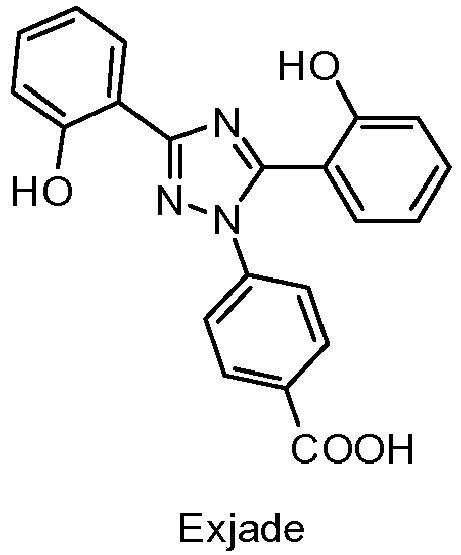
- Absorption, distribution, metabolism and excretion of chiral medicines are largely related to the 3D structures of their chiral centers. For drug absorption, chiral compounds entering cells via active transport mechanism are usually carried by special transport proteins, their recognition of enantiomers can be different, resulting in different absorption of enantiomers. For drug distribution, the binding effects of plasma protein and tissues are also somewhat stereoselective, leading to different in vivo distribution of enantiomers; for stereoselective of drug metabolism refers to when the substrate is biotransformated, the pathway and speed of enantiomer metabolism by biological systems can be different. One enantiomer may show ascendant metabolism, and therefore it is of great significance to the indicators including drug transformation and in vivo half-life. Glomerular filtration, tubular secretion and reabsorption of chiral drugs to clear the chiral drugs, having stereoselectivity, while the glomerular filtration rate is closely related to drug's selectivity to binding plasma protein, so discharge style of enantiomers (urine / feces percentage) and the rate is also different.
- Therefore, the qualitative difference of the interactions of a pair of enantiomers with various binding sites may exist or not, and the quantitive difference may exist (strong or weak), which results in the different activities between enantiomers. Thus the selection of optical enantiomers for medical use, requires a comprehensive study of metabolic activity, toxicology and pharmacokinetic properties etc. Thus the chiral nature of the 3-hydroxypyridin-4-one derivatives described in this patent has an important role on in vivo iron chelation.
- The effectiveness of many oral 3-hydroxy-4-one derivatives drugs are subject to metabolic reaction of the 3-hydroxy moiety, which may be quickly glycosylated (see Reaction I). The hydroxypyridone after glycosylation loses the ability to chelate Fe(III). We can effectively inhibit glycosylation reaction by introducing hydroxyl groups to alkyl substituted residues on the pyridine ring. In addition, the partition coefficient of 3-hydroxy-pyridin-4-one derivatives has a great impact on the in vivo distribution and toxic effects. We have introduced various alkyl groups to the chiral point of the compound, in order to modify their lipophilicity, i.e. a phenyl group connected to the chiral point in compound IV-b while in IV-a it is a methyl group, and thus compound IV-b is relatively more lipophilic, and easier to penetrate through cell membranes of various tissues and critical barriers such as the blood-brain barrier and the placental barrier, thus affecting its in vivo distribution. Thus increase of hydroxyl groups can affect the intestinal absorption capacity, by introducing a large alkyl group, intestinal absorption of 3-hydroxy-pyridin-4-one derivatives can be enhanced.


- The present invention is directed to provide a series of chiral 3-hydroxypyridin-4-one derivatives and their salts, having the following general formula I:

- Wherein, the carbon marked with asterisk has chirality.
- R1 and R2 are same or different, and independently represent alkyl, hydroxy alkyl, mercapto alkyl, haloalkyl, alkoxy, alkylthiol, haloalkoxy, haloalkylthiol, carboxyl alkyl, alkoxyacyl-alkyl, R3R4N-C(O)-alkyl, heterocycloalkyl, substituted or unsubstituted aryl, aroyl, aralkyl, substituted or unsubstituted heterocyclic aryl or heterocyclic aralkyl.
- Said alkyl represents methyl, ethyl, n-propyl, isopropyl, n-butyl, isobutyl, n-pentyl, n-hexyl or n-heptyl, usually represents methyl, ethyl and n-propyl.
- Said hydroxy alkyl is an alkyl substituted by hydroxy, wherenin hydroxyl is at the terminal of alkyl, such as 3-hydroxypropyl; or hydroxyl is in the middle of alkyl, such as 2-hydroxypropyl, 1-hydroxypropyl or 1-hydroxy-2-methylpropyl.
- Said mercapto alkyl refers to a group in which oxygen atom in hydroxy alkyl is substituted by a sulfur atom. The halogen alkyl refers to alkyl substituted by a halogen atom, usually chlorine or fluorine, also can be substituted by trifluoro or trichloro halogen substitution site is at the terminal or in the middle of alkyl.
- The alkoxy group refers to a group formed by alkyl and oxygen atom which is covalently linked to the substitution site via an ether linkage, such as methoxyl, oxethyl, n-propoxyl, isopropoxy, n-butoxy, isobutoxy, sec-butoxy, tert-butoxy, n-pentyloxy, isopentyloxy, usually methoxy and oxethyl.
- The alkylthiol group is a group in which the oxygen atom in alkoxy is substituted by sulfur atom.
- The haloalkoxy refers to an alkoxy substituted by halogen , generally chlorine or fluorine, may also be substituted by trichloro or trifloro.
- The haloalkylthiol refers to a group in which oxygen atom in haloalkoxy is substituted by sulfur atom.
- The carboxyl alkyl refers to an alkyl substituted by carboxyl including, a single carboxyl substitution, or multi-carboxyl substitution, the substitution site is at the terminal or in the middle of the alkyl.
- The alkoxyacyl refers to "alkyl-O-C(O)-", such as methoxycarbonyl, ethoxycarbonyl, n-propoxycarbonyl, isopropoxycarbonyl, isobutoxycarbonyl, sec-butoxycarbonyl, tert-butoxycarbonyl, n-pentyloxycarbonyl, isopentyloxycarbonyl, generally refers to methoxycarbonyl and ethoxycarbonyl.
- R3 and R4 in R3R4N-C(O)-alkyl are same or different, which can be hydrogen, alkyl, hydroxy alkyl, alkoxy-alkyl, hydroxy alkoxy-alkyl, amino-alkyl, N-alkylamino-alkyl, N,N-dialkylamino-alkyl, N-hydroxyalkylamino-alkyl, N,N-dihydroxyalkylamino-alkyl, or a nitrogen-containing alicyclic ring formed by connecting two terminals of alkyl with a nitrogen atom.
- The heterocyclic alkyl refers to a ring structure containing 3-8 atoms (mainly 5-7 atoms), wherein there is at least one heteroatom, generally oxygen, nitrogen or sulfur atom, i.e. a nitrogen-containing heterocycle refers to a ring structure containing 3-8 atoms (mainly 5-7 atoms), with at least one nitrogen atom; nitrogen-containing heterocycle can also have other hetero atom, such as oxygen, nitrogen or sulfur atom, for example, piperidyl, piperazinyl, morpholinyl or pyrrolidinyl etc.
- The aryl refers to aryl itself, such as a substituted or unsubstituted phenyl or naphthyl, or components of other groups. The aryl generally refers to an unsubstituted phenyl or a phenyl group having one to two substituent groups which could be alkyl, alkoxy, hydroxy, nitro, halogen, trifluoromethyl, carboxyl, alkoxy acyl, amino, N-alkylamino, N,N-dialkylamino, aminoacyl, alkylamino acyl, dialkylamino acyl, heterocyclic, aromatic heterocyclic or cyano. Mainly speaking, aryl is an unsubstituted phenyl or naphthyl, or a phenyl substituted by alkyl, alkoxy, hydroxy, halogen, carboxyl, alkloxycarbonyl acyl, N,N-dialkylamino, heterocyclic alkylacyl. N-alkylamino is n-propylamino, n-butylamino,isopropylamino, isobutylamino, N-hydroxy-ethylamino, usually methylamino and ethylamino. For N,N-dialkylamino, alkyl substituents may be same or different, so N,N-dialkylamino generally refers to N,N-dimethylamino, N,N-diethylamino, N,N-methylethylamino, N-methyl-N-morpholino-ethylamino, N-methyl-N-hydroxyethylamino or N-methyl-N-aniline.
- The aroyl refers to "aryl-C(O)-", such as benzoyl, toluoyl, naphthoyl or p-methoxy benzoyl.
- The arakyl refers to a strand of alkyl that contains at least one hydrogen atom, typically the hydrogen attached to the terminal carbon is substituted by an aryl , such as benzyl, p-chlorobenzyl, o-fluorobenzyl, phenethyl, p-methylbenzyl, p-dimethylamino benzyl, p-diethylamino benzyl, p-cyanobenzyl or p-pyrrolidinyl benzyl.
- The heterocyclic aryl itself refers to an aromatic ring containing a hetero atom, or component of other groups, such as aromatic heterocycle-acyl; aromatic heterocycle refers to an aromatic ring containing 3-7 atoms (mainly 5-7 atoms), wherein there is at least one heteroatom, such as pyrrolidinyl, imidazolyl, triazolyl, tetrazolyl, oxygen nitrogen cyclopentadienyl , thiazolyl, furanyl, thiophenyl, pyridyl, pyrazinyl, thiazinyl, pyranyl, or pyrimidyl. The aromatic heterocycle isunsubstituted or substituted, and the term "substituted" means having one or more substituents, usually one or two, such as alkyl, halogen, trifluoromethyl, carboxyl, alkoxycarbonyl acyl, N-alkylamino, N,N-dialkyl amino or pyrrolidinyl alkyl.
- The heterocyclic aralkyl refers to a strand of alkyl with at least one hydrogen atom, generally means the hydrogen atom attached to the terminal carbon atom is substituted by an aromatic heterocycle. The aromatic heterocycle has one or more substituents, usually one or two, such as alkyl, halogen, trifluoromethyl, carboxyl, alkoxyacyl, N-alkylamino, N,N-dialkylamino or pyrrolidinyl.
- The present invention also contains corresponding salts formed by compound of formula I and an acid, like strong inorganic acid, typically a mineral acid, such as sulphoacid, phosphoric acid or hydrocholic acid; the acid may be a strong organic acid as well, generally an alkyl carboxylic acid, specifically acetic acid; or the acid can be an saturated or unsaturated dicarboxylic acid , such as tartaric acid, citric acid; also maybe sulfonic acid, generally refers to an alkyl-substituted or unsubstituted phenylsulfonic acids , specifically methyl or p-toluenesulfonic acid.
- Specially, when R1 in formula I is methyl, and compound is shown in formula II:

- II-a: (S)-3-Hydroxy-1-(1-hydroxy propyl-2-)-2-methyl pyridine-4(1H)-one;
- II-b: (S)-3-Hydroxy-1-(1-hydroxy-3-methyl butyl-2-)-2-methyl pyridine-4(1H)-one;
- II-c: (R)-3-Hydroxy-1-(1-hydroxy-3-phenyl propyl-2-)-2-methyl pyridine-4(1H)-one;
- II-d: (S)-3-Hydroxy-1-(1-hydroxy-3-methyl pentyl-2-)-2-methyl pyridine-4(1H)-one.


- When R1 in formula I represents ethyl, and compound is shown in formula III:

- III-a: (S)-3-Hydroxy-1-(1-hydroxy-3-methyl butyl-2-)-2-ethyl pyridine-4(1H)-one;
- III-b: (S)-3-Hydroxy-1-(1-hydroxypropyl-2-)-2-ethyl pyridine-4(1H)-one;
- III-c: (R)-3-Hydroxy-1-(1-hydroxy-3-phenyl propyl-2-)-2-ethyl pyridine-4(1H)-one.

- On the other hand, the present invention is directed to provide the synthetic method of the described series of chiral 3-hydroxypyridin-4-one derivatives and their salts: reacting methyl (or ethyl) maltol (compound V) with benzyl chloride (compound VI) to form a 3'-benzyl protected maltol (compound VII), then reacting compound VII with different chiral amino alcohols (compound VIII) to get chiral 3-benzyloxypyridin-4-ones (compound IX), finally, deprotect compound IX in the presence of Pd/C as hydrogenation catalyst to form compound of formula I, the reaction scheme is as follows:


- HX is an inorganic or organic acid.
- This patent also provides the use of the described series of chiral 3-hydroxypyridin-4-one derivatives and their salts for the production of a medicament for anti-iron overdose. As showed in the tests: the series of chiral 3-hydroxypyridin-4-one derivatives have the ability of chelating and removing overloaded metal ions, especially iron ions in human and animals. They have good oral activity and substantial iron removal activity.
- This patent describes the formulations of the prepared compounds, including liquid form and solid form, such as granule, tablet or capsule. The mode of administration of the described compounds is oral or injection.
- Advantages of this patent are: optimal designing of 3-hydroxypyridin-4-one derivatives, adding chiral groups to enhance their bioactivity and reduce toxicity. Chiral 3-hydroxypyridin-4-one derivatives described have good bioactivity of chelating and removing overloaded metal ions, especially iron accumulated in human and animals. They also have good oral activity and eminent iron removal activity. the vivo test of rats shows that the iron removal effect is superior to the market available CP20, thus a few of several preferred compounds have high potential to become new generation medicines for treatment of iron overload, specifically thalassemia and other diseases which require long term massive blood transfusion, and tissue damage caused by local iron accumulation, such as iron-mediated tissue lesions in neurodegenerative diseases and onco-diseases, for example, heart, liver etc.
- Following will further illustrated the invention with specific embodiments.
-

- 122.3 g NaOH was dissolved into 278 mL water, then mixed into solution of 390 g maltol and 1160 mL ethanol, and 422 g benzyl chloride was then added under stirring. Keep stirring at 60 °C for 3.5 h after fully mixing. After cooling the reaction system, filter it to remove solid impurities, wash the residues with ethanol, which was then mixed with filtrate and spin-dried. The remaining substances were dissolved by methylene chloride (DCM), then washed with 5% NaOH, finally washed with suitable amount of water. The organic layer was dried by anhydrous Na2SO4, then spin-dried the solvent the yellow oily liquid was obtained. After cooling and recrystallization in ether to get crystals, the yield is 78%, melting point is 56∼57°C.
-

- 122.3 g NaOH was dissolved into 278 mL water, then mixed into solution of 390 g ethyl maltol and 1160 mL ethanol, and 422 g benzyl chloride was then added under stirring. Keep stirring at 60°C for 3.5 h after fully mixing. After cooling the reaction system and filtration to remove solid impurities, wash the residues with ethanol, which was then mixed with filtrate and spin-dried. The resulting chemicals were dissolved by DCM, then washed with 5% NaOH, finally washed with suitable amount of water. The organic layer was dried by anhydrous Na2SO4, spin-dried the solvent to get yellow oily liquid. After cooling and recrystallization in ether, the yield is 83%, melting point is 84∼85°C.
1HNMR (CDCl3) δ 1.0 (t, 3H), 2.55 (q, 2H), 5.13 (s, 2H), 6.3 (d, 1H), 7.35 (s, 5H), 7.6 (d, 1H). -

- 60 g 3-phenyloxy-2-methyl-4H-pyran-one (Example 1) was dissolved into 150 mL n-butanol, then 41.6 g L-alaninol was added. After thoroughly mixing, the solution was refluxed at 118 °C for 36 h. After cooling and filtering, the residue was washed with acetic ester, to obtain white solid, which was then dissolved into 150 mL ethanol and 15 mL water, then introducing H and get rid of benzyl under hydrogenation with 5% Pd/C as catalyst. The solvent was removed under rotary evaporation, the remaining solid was recrystallized with methanol and diethylether. The crude product was then treated with HCl methanol dissolved to get hydrochloride. After recrystallization, 44.30 g white solid was obtained with the yield of 73.8%. specific rotation [α]18 D= +11.57, 1HNMR (DMSO-d6 ) δ 1.43 (d, J=7, 3H), 2.59 (s, 3H), 3.67 (dd, J1=8, J2=12.5, 1H), 3.74 (dd, J1=4, J2=12, 1H), 4.87 (m, 1H), 7.30 (m, 1H), 8.32 (d, J=7.5, 1H).
-

- 60 g 3-phenyloxy-2-methyl-4H-pyran-one (Example 1) was dissolved in 150 mL n-butanol, then 56.1 g L-Valinol was added. After thoroughly mixing, the solution was refluxed at 118°C for 36 h. After cooling and filtration, the product was isolated by silica gel column chromatography with eluent ethanol : ethyl acetate=1:40, after finishing eluting, yellow solid product was obtained after rotary evaporation, which was then dissolved into 150 mL ethanol and 15 mL water, then it was hydrogenated and debenzylated with 5% Pd/C as catalyst, the solvent was removed under rotary evaporation, and the remaining solid was recrystallized with methanol and ether to obtain 17.91 g white solid, the yield is 30.06%, the free alkali's 1HNMR (DMSO-d6 ) δ 0.64 (d, J=6.5, 3H), 1.02 (d, J=6.5, 3H), 2.08 (m, 1H), 2.29 (s, 1H), 3.69 (dd, J=11.5, J2=8), 3.78 (dd, J1=11.5, J2=3.5), 3.88 (m, 1H), 6.18 (d, J=7.5, 1H), 7.64 (d, J=7.5, 1H).
-

- Treated 16 g (S)-3-Hydroxy-1-(1-hydroxy-3-methyl butyl-2-)2-methyl pyridin-4(1H)-one (Example 4) with HCl methanol solution to generate hydrochloride. After recrystallization, 14.93 g white solid was obtained with the yield of 79.6%. specific rotation [α]18 D= -45.48, 1HNMR (DMSO-d6 ): δ 0.64 (d, J=6.5, 3H), 1.09 (d, J=6.5, 3H), 2.23(m, 1H), 2.57 (s, 3H), 3.77 (dd, J1=12, J2=8.5, 1H), 3.89 (dd, J1=12, J2=3.5, 1H), 4.41 (m, 1H), 7.30 (m, 1H), 8.32 (m, 1H).
-

- Treated 1 g (S)-3-Hydroxy-1-(1-hydroxy-3-methyl butyl-2-)2-methyl pyridin-4(1H)-one (Example 4) with H3Cit methanol solution to generate citrate. After recrystallization, 1.08 g white solid was obtained with the yield of 83.3%. 1HNMR (DMSO-d6 ): δ 0.64 (d, J=6.5, 9H), 1.11 (d, J=6.5, 9H), 2.27 (m, 3H), 2.59 (s, 4H), 2.64 (s, 9H), 3.61 (br, 1H), 3.88 (dd, J1=12.5, J2=8, 3H), 4.04 (dd, J1=12.5, J2=4.5, 3H), 4.58 (m, 3H), 7.74 (m, 3H), 8.90 (m, 3H).
-

- 60 g 3-phenyloxy-2-methyl-4H-pyran-one(Example 1) was dissolved in 150 mL n-butanol, then 83.7 g D-phenylalaninol was added in. After thoroughly mixing, the solution was refluxed at 118°C for 36 h. After cooling and filtration, products were purified by silica gel column chromatography with Eluent ethanol: acetic ester=1:40. After Elution, light brown solid was obtained after rotary evaporation, which was then dissolved into 150 mL ethanol and 15 mL water, then it was hydrogenated and debenzylated with 5% Pd/C as catalyst, the solvent was removed under rotary evaporation, the remaining solid was recrystallized with methanol and ether, leading to 25.25 g light yellow solid. The yield was 35.1%. The free alkali's 1HNMR (DMSO-d6 ): δ 2.00 (s, 3H), 2.98 (dd, J1=14, J2=5.5, 1H), 3.11 (dd, J1=14, J2=5, 1H), 3.73 (m, 2H), 4.54 (m, 1H), 6.21 (d, J=7, 1H), 7.17 (m, 5H), 7.87 (d, J=7.5, 1H).
-

- Treated (R)-3-Hydroxy-1-(1-hydroxy-3-phenyl propyl-2-)-2-methyl pyridine-4(1H)-one (Example 7) with HCl methanol solution to generate hydrochloride. Then recrystallization resulted in 18.26 g white solid. The yield was 63.4%. specific rotation [α]18 D= +176.26, 1HNMR (DMSO-d6 ): δ 2.30 (s, 3H), 3.13 (dd, J1=14, J2=5.5, 1H), 3.28 (dd, J1=14, J2=5.5, 1H), 3.87 (m, 2H), 5.08 (m, 1H), 7.20 (m, 5H), 7.48 (m, 1H), 8.62 (m, 1H).
-

- 60 g 3-phenyloxy-2-methyl-4H-pyran-4-one (Example 1) was dissolved in 150 mL n-butanol, then 64.9g L-isoleucinol was added in. After thoroughly mixing, the solution was refluxed at 118°C for 36 h. After cooling and filtration, products were separated by silica gel column chromatography with eluent ethanol: ethyl acetate= 1:40, light yellow solid product was obtained after rotary evaporation; which was then dissolved into 150 mL ethanol and 15 mL water, then it was hydrogenated and debenzylated with 5% Pd/C as catalyst, the solvent was removed under rotary evaporation, the remaining solid was recrystallized with methanol and diethyl ether, leading to 31.5 g white solid,the yield was 50.4%. The free alkali's 1HNMR (DMSO-d6 ): δ 0.75 (t, J=7, 3H), 0.97 (m, 5H), 1.87 (m, 1H), 2.27 (s, 3H), 3.70 (dd, J1=12, J2=8, 1H), 3.78 (dd, J1=12, J2=3, 1H), 3.93 (m, 1H), 6.17 (d, J=7.5, 1H), 7.64 (d, J=7.5, 1H).
-

- Treated 3-Hydroxy-1-((2S)-1-hydroxy-3-methyl pentyl-2-)-2-methyl pyridine-4(1H)-one (Example 9) with HCl methanol solution to get hydrochloride. The following recrystalization resulted in 25.07 g white solid, the yield was 68.5%. specific rotation [α]18 D= -30.36, 1HNMR (DMSO-d6 ) : δ 0.75 (t, J=7.5, 3H), 0.93 (m, 2H), 1.03 (d, J=6.5, 3H), 2.03 (m, 1H), 2.57 (s, 3H), 3.79 (dd, J1=12, J2=8.5, 1H), 3.90 (dd, J1=12, J2=3.5, 1H), 4.49 (m, 1H), 7.47 (m, 1H), 8.38 (m, 1H).
-
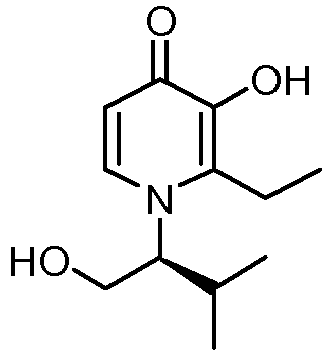
- 63.8 g 3-benzyloxy-2-ethanol-4H-pyran-4-one (Example 2) was dissolved in 150 mL n-butanol, then 56.1 g L-valinol was added in. After thoroughly mixing, the solution was refluxed at 118°C for 36 h. After cooling and filtration, products were purified by silica gel column chromatography with eluent ethanol: ethyl acetate= 1:40, light yellow solid product was obtained after rotary evaporation, which was then dissolved into 150 mL ethanol and 15 mL water, then it was hydrogenated and debenzylated with 5% Pd/C as catalyst. The solvent was removed under rotary evaporation, the residue was recrystallized with methanol and ether, leading to 20.56 g white solid. The yield was 33.1%. The free alkali's 1HNMR (DMSO-d6 ): δ 0.65 (d, J=6.5, 3H), 1.04 (d, J=6, 3H), 1.11 (t, J=7.5, 3H), 2.10 (m, 1H), 2.71 (dq, J1=15, J2=7.5, 1H), 2.81 (dq, J1=15, J2=7.5, 1H), 3.75 (m, 2H), 3.84 (m, 1H), 6.17 (d, J=7.5, 1H), 7.63 (d, J=7.5, 1H).
-

- Treated (S)-3-Hydroxy-1-(1-hydroxy-3-methyl butyl-2-)-2-ethyl pyridine-4(1H)-one (Example 11) with HCl methanol solution to obtain hydrochloride. The recrystalization later resulted in 19.85 g white solid, the yield was 82.7%, specific rotation [α]18 D=-42.31, 1HNMR (DMSO-d6 ): δ 0.65 (d, J=7, 3H), 1.04 (d, J=6, 3H), 1.11 (t, J=7.5, 3H), 2.11 (m, 1H), 2.72 (dq, J1=15, J2=7.5, 1H), 2.83 (dq, J1=15, J2=7.5, 1H), 3.76 (m, 2H), 3.85 (m, 1H), 6.18 (d, J=7.5, 1H), 7.64 (d, J=7.5, 1H).
-

- 63.8 g 3-phenyloxy-2-ethyl-4H-pyran-4-one (Example 2) was dissolved in 150 mL n-butanol, then 41.6 g L-alaninol was added in. After thoroughly mixing, the solution was refluxed at 118°C for 36 h. After cooling and filtration, the residue was washed with ethyl acetate, resulting in white solid, which was then dissolved into 150 mL ethanol and 15 mL water, then it was hydrogenated and debenzylated with 5% Pd/C as catalyst, the solvent was removed under rotary evaporation, the residue was recrystalized with methanol and diethyl ether. The crude product was treated with HCl methanol solution to generate hydrochloride. After recrystallization, 53.21 g white solid was obtained with the yield of 83.4%. specific rotation [α]18 D= +23.73,1HNMR (DMSO-d6 ): δ 1.16 (t, J=7.5, 3H), 1.44 (d, J=6.5, 3H), 3.05 (m, 2H), 3.73 (d, J=6, 2H), 4.84 (m, 1H), 7.47 (m, 1H), 8.41 (m, 1H).
-

- 63.8 g 3-phenyloxy-2-ethyl-4H-pyran-4-one (Example 1) was dissolved in 150 mL n-butanol, then 83.7 g L-phenoanalinol was added in. After thoroughly mixing, the solution was refluxed at 118°C for 36 h. After cooling and filtration, products were separated by silica gel column chromatography with eluent ethanol: ethyl acetate= 1:40. After elution, light brown solid product was obtained after rotary evaporation, which was then dissolved into 150 mL ethanol and 15 mL water, then it was hydrogenated and debenzylated with 5% Pd/C as catalyst, the solvent was removed under rotary evaporation, the remaining solid was recrystallized with methanol and ether, leading to 21.85 g light yellow solid. The yield was 34.3%, specific rotation [α]18 D= +183.48, 1HNMR (DMSO-d6 ): δ 0.88 (t, J=7.5, 3H), 2.63 (dq, J1=15, J2=7.5, 1H), 2.80 (dq, J1=15, J2=7.5, 1H), 3.16 (dd, J1=14, J2=11, 1H), 3.25 (dd, J1=14.5, J2=5, 1H), 3.87 (m, 2H), 4.97 (m, 1H), 7.18 (m, 1H), 7.46 (m, 1H), 8.63 (d, J=7.5, 1H).
-

- 60 g 3-phenyloxy-2-methyl-4H-pyran-4-one (Example 1) was dissolved in 150 mL n-butanol, then 41.6 g D-alaninol was added in. After thoroughly mixing, the solution was refluxed at 118°C for 36 h. After cooling and filtration, the residue was washed with ethyl acetate to get white solid, which was then dissolved into 150 mL ethanol and 15 mL water, then it was hydrogenated and debenzylated with 5% Pd/C as catalyst. The solvent was removed under rotary evaporation, the residue was recrystallized with methanol and ether. The resulting crude product was then treated with HCl methanol solution to generate hydrochloride. After recrystallization, 47.25 g light yellow solid was obtained with the yield of 78.8%. specific rotation [α]18 D= -13.65, 1HNMR (DMSO-d6 ): δ 1.43 (d, J=7, 3H), 2.60 (s, 3H), 3.67 (dd, J1=12, J2=8, 1H), 3.74 (dd, J1=12, J2=4.5, 1H), 4.88 (m, 1H), 7.41 (m, 1H), 8.35 (d, J=7, 1H).
-

- 63.8 g 3-phenyloxy-2-methyl-4H-pyran-4-one (Example 2) was dissolved with 150 mL n-butanol, then 41.6 g D-alaninol was added in. After thoroughly mixing, the solution was refluxed at 118°C for 36 h. After cooling and filtration, the residue was washed with ethyl acetate to get white solid; which was then dissolved into 150 mL ethanol and 15 mL water, then it was hydrogenated and debenzylated with 5% Pd/C as catalyst, the solvent was removed under rotary evaporation, the resulting residue was recrystallized with methanol and diethyl ether. Then crude product was treated with HCl methanol solution to get hydrochloride. After recrystallization, 44.34 g light yellow solid was obtained with the yield of 69.5%. specific rotation [α]18 D= -27.45, 1HNMR (DMSO-d6 ): δ 1.16 (t, J=7.5, 3H), 1.43 (d, J=7, 3H), 3.01 (q, J=7.5, 2H), 3.72 (d, J=6, 2H), 4.78 (m, 1H), 7.14 (m, 1H), 8.27 (d, J=7, 1H).
-
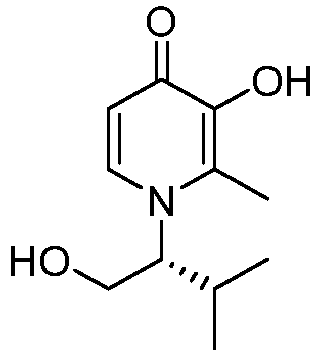
- 60 g 3-benzyloxy-2-methyl-4H-pyran-4-one (Example 1) was dissolved in 150 mL n-butanol, then 56.1 g L-valinol was added in. After thoroughly mixing, the solution was refluxed at 118°C for 36 h. After cooling and filtration, products were separated by silica gel column chromatography with eluent ethanol: ethyl acetate= 1:40. After elution, light yellow solid was obtained after rotary evaporation; which was then dissolved into 150 mL ethanol and 15 mL water, then it was hydrogenated and debenzylated with 5% Pd/C as catalyst, the solvent was removed under rotary evaporation, the remaining solid was recrystallized with methanol and ether, leading to 23.03 g white solid, the yield was 39.3%, the free alkali's 1H NMR (DMSO-d6) : δ 0.64 (d, J=7, 3H), 1.02 (d, J=6.5, 3H), 2.08 (m, 1H), 2.29 (s, 3H), 3.69 (dd, J1=12, J2=8, 1H), 3.78 (dd, J1=11.5, J2=3, 1H), 3.88 (m, 1H), 6.18 (d, J=7.5, 1H), 7.64 (d, J=7.5, 1H).
-
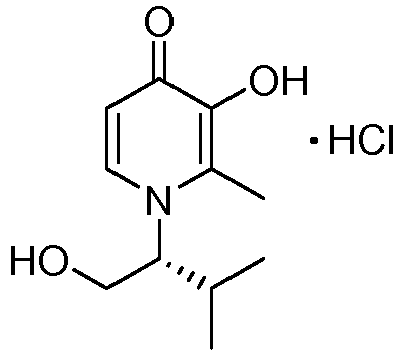
- Treated (R)-3-Hydroxy-1-(1-hydroxy-3-methyl butyl-2-)-2-methyl pyridine-4(1H)-one (Example 17) with HCl methanol solution to form hydrochloride. The recrystallization later resulted in 19.66 g light yellow solid with the yield of 72.8%. specific rotation [α]18 D= +38.79, 1H NMR (DMSO-d6 ): δ 0.64 (d, J7, 3H), 1.08 (d, J=6.5, 3H), 2.23 (m, 1H), 2.58 (s, 3H), 3.77 (dd, J1=12, J2=8.5, 1H), 3.90 (dd, J1=12, J2=7, 1H), 4.42 (m, 1H), 7.40 (m, 1H), 8.35 (d, J=7, 1H).
-

- 63.8 g 3-benzyloxy-2-ethanol-4H-pyran-4-one (Example 2) was dissolved in 150 mL n-butanol, then 56.1 g D-valinol was added in. After thoroughly mixing, the solution was refluxed at 118°Cfor 36 h. After cooling and filtration, products were separated by silica gel column chromatography with eluent ethanol: ethyl acetate= 1:40. After elution, light yellow solid was obtained after rotary evaporation; which was then dissolved into 150 mL ethanol and 15 mL water, then it was hydrogenated and debenzylated with 5% Pd/C as catalyst, the solvent was removed under rotary evaporation, the residue was recrystallized with methanol and ether, leading to 19.62 g light yellow solid, the yield was 31.4%, the free alkali's 1HNMR (DMSO-d6 ): δ 0.65 (d, J=6.5, 3H), 1.04 (d, J=7.5, 3H), 1.11 (t, J=7), 2.11 (m, 1H), 2.71 (dq, J1=14.5, J2=7, 1H), 2.81 (dq, J1=14.5, J2=7, 1H), 3.75 (m, 2H), 3.84 (m, 1H), 6.17 (d, J=7.5, 1H), 7.63 (d, J=7.5, 1H).
-

- Treated (R)-3-Hydroxy-1-(1-hydroxy-3-methyl butyl-2-)-2-ethyl pyridine-4(1H)-one (Example 19) with HCl methanol solution to form hydrochloride. After recrystallization later, 17.26 g light yellow solid was obtained with the yield of 75.7%. specific rotation [α]18 D= +50.71, 1HNMR (DMSO-d6 ): δ 0.64 (d, J=6.5, 3H), 1.10 (d, J=7.5, 3H), 1.17 (t, J=7.5, 3H), 2.25 (m, 1H), 3.04 (m, 2H), 3.82 (dd, J1=12, J2=7.5, 1H), 3.88 (dd, J1=12, J2=3.5, 1H), 4.39 (m, 1H), 7.45 (m, 1H), 8.36 (d, J=7.5, 1H).
-

- 60 g 3-phenyloxy-2-methyl-4H-pyran-4-one (Example 1) was dissolved in 150 mL n-butanol, then 83.7 g L-phenoalaninol was added in. After thoroughly mixing, the solution was refluxed at 118°C for 36 h. After cooling and filtration, products were separated by silica gel column chromatography with eluent ethanol: ethyl acetate= 1:40. After elution, light brown solid product was obtained after rotary evaporation; which was then dissolved into 150 mL ethanol and 15 mL water, then it was hydrogenated and debenzylated with 5% Pd/C as catalyst,the solvent was removed under rotary evaporation, the resulting residue was recrystallized with methanol and ether, leading to 23.25 g white solid, the yield was 38.8%, specific rotation [α]18 D=-162.76, 1HNMR (DMSO-d6 ): δ 2.30 (s, 3H), 3.13 (dd, J1=14, J2=10.5, 1H), 3.28 (dd, J1=14, J2=5, 1H), 3.87 (m, 2H), 5.08 (m, 1H), 7.20 (m, 5H), 7.47 (dd, J1=9, J2=7, 1H), 8.61 (t, J=7.5, 1H).
-

- 63.8 g 3-phenyloxy-2-methyl-4H-pyran-4-one (Example 2) was dissolved in 150 mL n-butanol, then 83.7 g L-phenylalaninol was added in. After thoroughly mixing, the solution was refluxed at 118°C for 36 h. After cooling and filtration, products were separated by silica gel column chromatography with eluent ethanol: ethyl acetate= 1:40, After elution, light brown solid product was obtained after rotary evaporation; which was then dissolved into 150 mL ethanol and 15 mL water, then it was hydrogenated and debenzylated with 5% Pd/C as catalyst, the solvent was removed under rotary evaporation, the resulting residue was recrystallized with methanol and diethyl ether, leading to 16.50 g white solid, the yield was 25.9%. specific rotation [α]18 D= -189.29, 1HNMR (DMSO-d6 ): δ 0.88 (t, J=7.5, 3H), 2.63 (dq, J1=15, J2=7.5, 1H), 2.80 (dq J1=15, J2=7.5, 1H), 3.16 (dd, J1=14, J2=5, 1H), 3.26 (dd, J1=14, J2=5, 1H), 3.88 (m, 2H), 4.97 (m, 1H), 7.18 (m, 5H), 7.5 (m, 1H), 8.65 (m, 1H).
-

- 63.8 g 3-phenyloxy-2-ethyl-4H-pyran-4-one (Example 2) was dissolved in 150 mL n-butanol, then 64.9 g L-isoleucinol was added in. After thoroughly mixing, the solution was refluxed at 118°C for 36 h. After cooling and filtration, products were separated by silica gel column chromatography with eluent ethanol: ethyl acetate= 1:40, after elution, light yellow solid product was obtained after rotary evaporation; which was then dissolved into 150 mL ethanol and 15 mL water, then it was hydrogenated and debenzylated with 5% Pd/C as catalyst, the solvent was removed under rotary evaporation, the resulting residue was recrystallized with methanol and ether, leading to 18.04 g white solid. The yield was 28.3%. specific rotation [α]18 D= -38.29, 1HNMR (DMSO-d6 ): δ 0.77 (t, J=7.5, 3H), 0.90 (m, 2H), 1.05 (d, J=6.5, 3H), 1.16 (t, J=7.5, 3H), 2.00 (m, 1H), 2.96 (dq, J1=15.5, J2=7.5, 1H), 3.08 (dq, J1=15.5, J2=7.5, 1H), 3.83 (dd, J1=12.5, J2=8, 1H), 3.88 (dd, J1=12, J2=4.5, 1H), 4.45 (m, 1H), 7.42 (m, 1H), 8.35 (d, J=7.5, 1H).
-

- 2.46 g 3-phenyloxy-2-methyl-4H-pyran-4-one (Example 1) was dissolved with 8.5 mL n-butanol, then 2.0 g L-leucinol was added in. After thoroughly mixing, the solution was refluxed at 118°C for 36 h, after cooling and filtration, products were separated by silica gel column chromatography with eluent ethanol: ethyl acetate= 1:30. After elution, light brown oily liquid was obtained after rotary evaporation, the solid was then dissolved into 50 mL ethanol and 5 mL water, then it was hydrogenated and debenzylated with 5% Pd/C as catalyst, the solvent was removed under rotary evaporation, the resulting residue was recrystallized with methanol and diethyl ether, leading to 1.24 g white solid. The yield was 50.4%. specific rotation [α]18 D=-15.56.
-

- 2.61 g 3-phenyloxy-2-ethyl-4H-pyran-4-one (Example 2) was dissolved in 8.5 mL n-butanol, then 2.0 g L-leucinol was added in, after thoroughly mixing, the solution was refluxed at 118°C for 36 h, after cooling and filtration, products were separated by silica gel column chromatography with eluent ethanol: ethyl acetater= 1:30. After elution, light brown oily liquid was obtained after rotary evaporation, which was then dissolved into 50 mL ethanol and 5 mL water, then it was hydrogenated and debenzylated with 5% Pd/C as catalyst, the solvent was removed under rotary evaporation, the resulting residue was recrystallized with methanol and ether, leading to 1.25 g light yellow solid, the yield was 48.0%, specific rotation [α]18 D= -14.36.
-

- 12.65 g 3-phenyloxy-2-methyl-4H-pyran-4-one (Example 1) was dissolved in 8.5 mL n-butanol, then 8.0 g D-leucinol was added in, after thoroughly mixing, the solution was refluxed at 118°C for 36 h, after cooling and filtration, products were separated by silica gel column chromatography with eluent ethanol: ethyl acetate= 1:20. After elution, light brown oily liquid was obtained after rotary evaporation, the solid was then dissolved into 50 mL ethanol and 5 mL water, then it was hydrogenated and debenzylated with 5% Pd/C as catalyst, the solvent was removed under rotary evaporation, the resulting residue was recrystallized with methanol and ether, leading to 7.43 g white solid, the yield was 58.8%.
-

- 11.95 g 3-phenyloxy-2-ethyl-4H-pyran-4-one (Example 2) was dissolved in 8.5 mL n-butanol, then 7.09 g D-leucinol was added in, after thoroughly mixing, the solution was refluxed at 118°C for 36 h, after cooling and filtration, products were separated by silica gel column chromatography with eluent ethanol: ethyl acetate= 1:20. After elution, light brown oily liquid was obtained after rotary evaporation, the solid was then dissolved into 50 mL ethanol and 5 mL water, then it was hydrogenated and debenzylated with 5% Pd/C as catalyst, the solvent was removed under rotary evaporation, the resulting residue was recrystallized with methanol and ether, leading to 2.77 g white solid, yield is 43.2%.
- According to methods described by Pippard's research group [Blood 58: 685-692], use 59Fe to label ferritin in rat liver. Isolate 59Fe-labelled ferritin by the method described by Bjorklid and Helgeland. In the preparation process, the rats were injected intraperitoneally with iron dextran, and intravenous administration of red blood cells, in order to keep the plasma transferrin saturated. This method ensures that most of 59Fe (III) is absorbed by the liver, so 59Fe-ferritin with high specific radioactivity can be obtained.
- Performance of one shot intraperitoneal injection of 15mg iron dextran to 350∼400 g rats. After one week, jugular vein cannula is performed and then a 24 h's rest. Then the second day, each rat is given packed red cells (2 mL/100g). After 24 h, each rat is injected via the jugular vein cannula with 200 µCi 59FeCl3 solution (Amersham Life Science). 59FeCl3 (1mCi) is diluted 0.5 mL citrate (50mM, pH 2.5). Each experiment employs 5 rats, total radiation is 1mCi. 24 h after isotopically labeled injection, the livers were removed from rats.
- Homogenization of liver is processed in 4 vol. (w/v) 0.25M acetate buffer. The homogenate was heated to 75°C with stirring for 10min. After cooling to 4°C, remove solid protein by centrifugation at 2500 g for 15 min. Treat the supernatant that contains tissue iron protein with half saturated (NH4)2SO4, while cooling in ice water for 30 min. The precipitate obtained by centrifugation at 3500 g at 4°C for 15 min, is dissolved in 0.25M pH=4.8 acetate buffer. Undissolved precipitate is removed through a Pd-10 column (Sephadex®, G-25M, Pharmacia Biotech). The resulting solution is centrifuged at 100,000 g at 4°C for 2 h. The final precipitate is dissolved in 0.05M pH=7.4 phosphate buffer, and stored at 4°C. The purity of 59Fe-ferritin and normal Ferritin (Sigma Chemical Co.) are compared by electrophoresis. Iron concentration of ferritin is tested by colorimetry [Biochem Mol. Biol Int 35(3): 635-631].
- Separate 100 µL 10M HCl into two parts, stored in plastic containers respectively, of which one has 50 µL 59Fe-Ferritin solution(ctn 1), the other is blank (ctn 2). Two samples are incubated at 37°C overnight, to hydrolyze the iron proteins and release the iron ions. Then dilute each sample with 10 mL deionized water, wherein, 1.7 mL solution is transferred into two other containers (3, bottle 4). Add 300 µL 800mM nitrilotriacetic acid into each containers (bottle 3, bottle 4), let stand at room temperature for 30 min. Then the sample was subjected to ultrafiltration through the porous membrane (Cetricon-30), and then centrifuge at 25°C at 4000g for 60min. Add 1mL filtrate to a container which has 250 µL 120mM Thioglycollic acid and 250 µL 60mM bathophenanthroline disulfite, then add disodium salt. 30 min later, absorbance is tested under 537nm. For concentration of iron ion in the range of 2.5∼50 µM (0.1M HCl as solvent), draw a six-point standard curve through the method described above, it can be used as quantitative reference of iron concentration in ferritin.
- 250∼300 g Wistar rat with previous starve treatment are kept in Nalgene plastic bio-metabolism cage, with sufficient water supply for SD rat. They are anesthetized by pentobarbital sodium (intraperitoneal injection, 50mg/kg), Use PE50 size 22 catheter to insert into bile about 2cm deep, and ligate strong. Then pierce a transculaneous needle through the shoulder area near abdominal incision of rat, and transfer the bile duct cannula out of the skin of rats by this needle. The lead portion of the catheter from the shoulder connects to the rotary shaft of a metal torque transfer pump, which is fixed to the rats' suit. The catheter finally access Gilson trace collector by the liquid shaft on metabolic cages. This system allows the rat to move freely in the cage while continuously collect bile samples. 24 h urea is also collected with disposable plastic tubes. Various Iron (III) chelators are intragastrically administered to the rat, blank group is given same volume water through intragastric administration. Bile samples are collected once every 12 h with one-time disposable plastic tube (Portex Ltd.). A light anesthesia by 2.5 mg/kg fentanyl and 0.08 mg/kg fluanisone (Hypnorm®) is performed while collecting. Concentration of iron is tested by the chromatometry method described above.
- Starved rat was injected 59Fe-Ferritin via tail vein, in order to label rat liver cells with 59Fe. After 1 h, each rat is given an iron chelator via intragastric injection. Blank group is administered with water by lavage. Each rat is placed in a metabolic cage, collect urine and feces. All rats are given free access to food after oral administration 1h later, and are free to drink water during the whole experiment. Test ends after 24 h of the tail vein injection of 59Fe-Ferritin. All rats are killed by the cervical dislocation, then the liver and gastrointestinal system (including its content and feces) are collected for 59Fe quantification. Calculation for iron excretion ability of iron chelators with following formula:

Table 1 Iron excretion ability of taking chiral 3-hydroxypyridine-4-one orally on rat model (n=5). Chemical number Formula Iron Excretion (%) CP20 
11.4 CP102 
17.0 CN306 
11.9 CN308 
6.5 CN206 
16 CN408 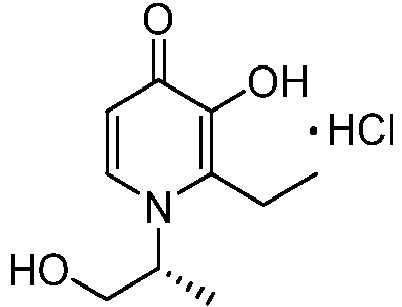
10.6 CN116 
18.7 CN318 
8.0 CN416 
7.9 CN418 
10.6 CN326 
12.8 CN128 
24.8 CN426 
13.1 CN228 
22.3 CN336 
10.8 CN436 
5.8 Note: n represents the number of tested animals for each compound. - In vivo rat test shows, the series of chiral 3-hydroxypyridin-4-one derivatives described in this patent has good iron excretion ability, some preferred compounds have superior iron excretion ability than the market available iron chelator CP20, i.e. the iron excretion ability of CN116, CN206, CN128 and CN228 is several times better than CP20 administered in equimolar amounts.
- Prepare suspension of maximum solubility of each compound with 0.5% CMC-Na. Maximum oral dosage to mice is 0.4 mL/10g. Blank group took the same volume 0.5% CMC-Na solution orally (blank group and test group has 4 mice each, 2 female and 2 male). If test group shows fatality reaction, reduce the dose of drug administered, until there is no fatality. Monitor reaction of animal right after drug administration, including appearance, activities, mental states, appetites, urea/feces and its color, fur, nose, eye, mouth, if there are any abnormal secretions and death situation, give timely autopsy to dead animals. If any obvious pathology of organs is found, perform histopathological inspection. Every inspection should be performed every 30∼60 min in the 1st day, then check once a day, record animal toxicity and death distribution.
Table 2. Maximum dosage of a few 3-hydroxypyridin-4-one derivatives to mice. Compound Number Conc. (g/mL) Volume(mL) Dosage(g/kg) Mole dosage(mmol/kg) CP20 0.06 0.5 1.50 10.7 CP102 0.20 0.4 4.00 21.8 CP106 0.20 0.5 5.00 27.3 CN108 0.10 0.5 2.50 13.6 CN206 0.15 0.5 3.75 19.0 CN208 0.15 0.5 6.25 21.7 - Acute toxicity test in mice shows, in vivo toxicity of the series of chiral 3-hydroxypyridin-4-one derivatives described in this patent is low, maximum lethal dose of some compounds was significantly larger than control drug CP20. Therefore, a smaller cure dosage compared to CP20, its toxicity will be much lower than CP20.
Claims (10)
- A chiral 3-hydroxypyridin-4-one derivative or salts thereof having the following general formula I:
 Wherein, the carbon atom marked with "*" is chiral,R1 and R2 are same or different and independently represent alkyl, hydroxy alkyl, mercapto alkyl, haloalkyl, alkoxy, alkylthiol, haloalkoxy, haloalkylthiol, carboxyl alkyl, alkoxyacyl-alkyl, R3R4N-C(O)-alkyl, heterocycloalkyl , substituted or unsubstituted aryl, aroyl, aralkyl, substituted or unsubstituted heterocyclic aryl or heterocyclic aralkyl.
 - The chiral 3-hydroxypyridin-4-one derivative or salts thereof according to claim 1, wherein,(1) the alkyl represents methyl, ethyl, n-propyl, isopropyl, n-butyl, isobutyl, n-pentyl, n-hexyl or n-heptyl;(2) the hydroxy alkyl is an alkyl substituted by hydroxy, wherein hydroxyl is at the terminal of alkyl or in the middle of alkyl, and comprises 3-hydroxypropyl, 2-hydroxypropyl, 1-hydroxypropyl or 1-hydroxy-2-methylpropyl;(3) the mercapto alkyl refers to a group in which oxygen atom in hydroxy alkyl is substituted by a sulfur atom;(4) the halogen alkyl refers to alkyl substituted by a halogen atom selected from chlorine or fluorine, or substituted by trichloro or trifluoro, and halogen substitution site is at the terminal or in the middle of alkyl;(5) the alkoxy group refers to a group formed by alkyl and oxygen atom which is covalently linked to the substitution site via an ether linkage, and comprises methoxy, oxethyl, n-propoxy, isopropoxy, n-butoxy, isobutoxy, sec-butoxy, tert-butoxy, n-pentyloxy, isopentyloxy.(6) the alkylthiol group is a group in which the oxygen atom in alkoxy is substituted by sulfur atom;(7) the haloalkoxy refers to an alkoxy substituted by a halogen atom selected from chlorine, or fluorine, or substituted by trichloro or trifloro;(8) the haloalkylthiol refers to a group in which oxygen atom in haloalkoxy is substituted by sulfur atom;
the carboxyl alkyl refers to an alkyl substituted by carboxyl including a single carboxyl substitution, or multi-carboxyl substitution, and the substitution site is at the terminal or in the middle of the alkyl;(9) the alkoxyacyl refers to "alkyl-O-C(O)-", and comprises methoxycarbonyl, ethoxycarbonyl, n-propoxycarbonyl, isopropoxycarbonyl, isobutoxycarbonyl, isobutoxycarbonyl, sec-butoxycarbonyl, tert-butoxycarbonyl, n-pentyloxycarbonyl, or isopentyloxycarbonyl;(10) R3 and R4 in R3R4N-C(O)-alkyl are same or different, and represent hydrogen, alkyl, hydroxy alkyl, alkoxy-alkyl, hydroxy alkoxy-alkyl, amino-alkyl, N-alkylamino-alkyl, N,N-dialkylamino-alkyl, N-hydroxyalkylamino-alkyl, N,N-dihydroxyalkylamino-alkyl, or a nitrogen-containing alicyclic ring formed by connecting two terminals of alkyl with a nitrogen atom;(11) the heterocyclic alkyl refers to a ring structure containing 3-8 atoms, wherein there is at least one heteroatom selected from oxygen, nitrogen or sulfur atom.(12) the substituted or unsubstituted aryl refers to an unsubstituted phenyl or a phenyl group having one or two substituent groups which is selected from alkyl, alkoxy, hydroxy, nitro, halogen, trifluoromethyl, carboxyl, alkoxy acyl, amino, N-alkylamino, N,N-dialkylamino, aminoacyl, alkylamino acyl, dialkylamino acyl, heterocyclic, aromatic heterocyclic or cyano;(13) the aroyl refers to "aryl-C(O)-", and comprises benzoyl, toluoyl, naphthoyl or p-methoxy benzoyl;(14) the aralkyl refers to a strand of alkyl that contains at least one hydrogen atom wherein a hydrogen atom attached to the terminal carbon is substituted by an aryl, and comprises benzyl, p-chlorobenzyl, o-fluorobenzyl, phenethyl, p-methylbenzyl, p-dimethylamino benzyl, p-diethylamino benzyl, p-cyanobenzyl or p-pyrrolidinyl benzyl;(15) the heterocyclic aryl refers to an aromatic ring containing a heteroatom, and comprises aromatic heterocycle-alkyl; the aromatic heterocycle refers to an aromatic ring containing 3-7 atoms wherein there is at least one heteroatom, and comprises pyrrolidinyl, imidazolyl, triazolyl, tetrazolyl, oxygen-nitrogen cyclopentadienyl, thiazolyl, furanyl, thiophenyl, pyridyl, pyrazinyl, thiazinyl, pyranyl, or pyrimidyl; the aromatic heterocycle is unsubstituted or substituted, and the term "substituted" means having one or more substituents selected from alkyl, halogen, trifluoromethyl, carboxyl, alkoxyacyl, N-alkylamino, N,N-dialkyl amino or pyrrolidinyl alkyl;(16) the heterocyclic aralkyl refers to a strand of alkyl that contains at least one hydrogen atom wherein a hydrogen atom attached to the terminal carbon atom is substituted by an aromatic heterocycle; and the aromatic heterocycle has one or more substituents selected from alkyl, halogen, trifluoromethyl, carboxyl, alkoxyacyl, N-alkylamino, N,N-dialkylamino or pyrrolidinyl. - The chiral 3-hydroxypyridin-4-one derivative or salts thereof according to claim 2,wherein the aryl is an unsubstituted phenyl or naphthyl, or a phenyl substituted by alkyl, alkoxy, hydroxy, halogen, carboxyl, alkloxyacyl, N,N-dialkylamino or heterocyclic alkylacyl; wherein N-alkylamino is n-propylamino, n-butylamino, isopropylamino, isobutylamino, N-hydroxy-ethylamino; and N,N-dialkylamino has same or different alkyl substituents and comprises N,N-dimethylamino, N,N-diethylamino, N,N-methylethylamino, N-methyl-N-morpholino-ethylamino, N-methyl-N-hydroxyethylamino or N-methyl-N-anilino.
- The chiral 3-hydroxypyridin-4-one derivative or salts thereof according to claim 1, wherein the salts are formed by a compound of formula I and an acid selected from strong inorganic acid, strong organic acid, saturated or unsaturated dicarboxylic acid or sulfonic acid.
- The chiral 3-hydroxypyridin-4-one derivative or salts thereof according to claim 4, wherein the strong inorganic acid is a mineral acid, and comprises sulfonic acid, phosphoric acid or hydrochloric acid; the strong organic acid is an alkyl carboxylic acid, and comprises acetic acid; the saturated or unsaturated dicarboxylic acid comprises tartaric acid, citric acid; the sulfonic acid refers to an alkyl-substituted or unsubstituted phenylsulfonic acid and comprises methyl or p-toluenesulfonic acid.
- The chiral 3-hydroxypyridin-4-one derivative or salts thereof according to claim 1, wherein R1 in formula I is methyl, and compound is shown in formula II:
 II-a: (S)-3-Hydroxy-1-(1-hydroxy propyl-2-)-2-methyl pyridine-4(1H)-one,II-b: (S)-3-Hydroxy-1-(1-hydroxy-3-methyl butyl-2-)-2-methyl pyridine-4(1H)-one,II-c: (R)-3-Hydroxy-1-(1-hydroxy-3-phenyl propyl-2-)-2-methyl pyridine-4(1H)-one,II-d: (S)-3-Hydroxy-1-(1-hydroxy-3-methyl pentyl-2-)-2-methyl pyridine-4(1H)-one.
 - The chiral 3-hydroxypyridin-4-one derivative or salts thereof according to claim 1, wherein R1 in formula I is ethyl, and compound is shown in formula III:
 III-a: (S)-3-Hydroxy-1-(1-hydroxy-3-methyl butyl-2-)-2-ethyl pyridine-4(1H)-one,III-b: (S)-3-Hydroxy-1-(1-hydroxypropyl-2-)-2-ethyl pyridine-4(1H)-one,III-c: (R)-3-Hydroxy-1-(1-hydroxy-3-phenyl propyl-2-)-2-ethyl pyridine-4(1H)-one.
 - The synthetic method for preparing the chiral 3-hydroxypyridin-4-one derivative or salts thereof according to claim 1, wherein said method comprises the following steps: reacting compound V with compound VI, thereby forming compound VII which is benzyl protected at 3 position, then reacting compound VII with compound VIII, thereby forming compound IX, and finally, in the presence of Pd/C catalyst, deprotecting compound IX via a hydrogenation reduction, thereby forming compound of formula I, and the reaction scheme is as follows:


- A use of the chiral 3-hydroxypyridin-4-one derivative or salts thereof according to claim 1 for the production of a medicament for anti-iron overdose.
- The use according to Claim 9, wherein the medicament is formulated into a formulation comprising a liquid preparation or a solid preparation, and the mode of administration is oral administration or administration by injection.
Applications Claiming Priority (2)
| Application Number | Priority Date | Filing Date | Title |
|---|---|---|---|
| CN2011100805257A CN102190644B (en) | 2011-03-31 | 2011-03-31 | Chiral 3-hydroxypyridin-4-one derivatives and their synthesis and use |
| PCT/CN2011/084489 WO2012129942A1 (en) | 2011-03-31 | 2011-12-22 | Chiral 3-hydroxypyrid-4-one derivative, and synthesis and use thereof |
Publications (3)
| Publication Number | Publication Date |
|---|---|
| EP2692724A1 true EP2692724A1 (en) | 2014-02-05 |
| EP2692724A4 EP2692724A4 (en) | 2014-08-27 |
| EP2692724B1 EP2692724B1 (en) | 2016-03-16 |
Family
ID=44599603
Family Applications (1)
| Application Number | Title | Priority Date | Filing Date |
|---|---|---|---|
| EP11862562.3A Active EP2692724B1 (en) | 2011-03-31 | 2011-12-22 | Chiral 3-hydroxypyrid-4-one derivative, and synthesis and use thereof |
Country Status (3)
| Country | Link |
|---|---|
| EP (1) | EP2692724B1 (en) |
| CN (1) | CN102190644B (en) |
| WO (1) | WO2012129942A1 (en) |
Families Citing this family (4)
| Publication number | Priority date | Publication date | Assignee | Title |
|---|---|---|---|---|
| CN102190644B (en) * | 2011-03-31 | 2012-11-21 | 浙江大学 | Chiral 3-hydroxypyridin-4-one derivatives and their synthesis and use |
| CN102603964B (en) * | 2012-01-15 | 2014-03-05 | 浙江工商大学 | Water-soluble polymer iron chelator as well as preparation method and application thereof |
| CN103006449B (en) * | 2012-12-21 | 2014-10-29 | 浙江工商大学 | Tyrosinase inhibitor and preparation method thereof |
| CN117105853A (en) * | 2023-08-28 | 2023-11-24 | 浙江工业大学 | 3-Hydroxypyridine-4(H)-one derivatives and their preparation methods and applications |
Family Cites Families (5)
| Publication number | Priority date | Publication date | Assignee | Title |
|---|---|---|---|---|
| GB213807A (en) | 1923-06-06 | 1924-04-10 | Benjamin Franklin Fitch | Improved means for transferring freight |
| GB8308054D0 (en) | 1983-03-24 | 1983-05-05 | Hider R C | Pharmaceutical compositions |
| GB9216506D0 (en) * | 1992-08-04 | 1992-09-16 | Rice Evans Catherine A | Improvements in or relating to the treatment of sickle cell disease |
| US6465604B2 (en) | 2000-03-21 | 2002-10-15 | Flexsys America L.P. | Pyrimidine derivatives as hardness stabilizers |
| CN102190644B (en) * | 2011-03-31 | 2012-11-21 | 浙江大学 | Chiral 3-hydroxypyridin-4-one derivatives and their synthesis and use |
-
2011
- 2011-03-31 CN CN2011100805257A patent/CN102190644B/en active Active
- 2011-12-22 EP EP11862562.3A patent/EP2692724B1/en active Active
- 2011-12-22 WO PCT/CN2011/084489 patent/WO2012129942A1/en not_active Ceased
Also Published As
| Publication number | Publication date |
|---|---|
| HK1193808A1 (en) | 2014-10-03 |
| EP2692724A4 (en) | 2014-08-27 |
| CN102190644B (en) | 2012-11-21 |
| WO2012129942A1 (en) | 2012-10-04 |
| CN102190644A (en) | 2011-09-21 |
| EP2692724B1 (en) | 2016-03-16 |
Similar Documents
| Publication | Publication Date | Title |
|---|---|---|
| DE60130865T2 (en) | BENZIMIDAZOLE DERIVATIVES AS HUMAN CHYMASE - INHIBITORS | |
| IL91046A (en) | Pharmaceutical and diagnostic compositions containing metal complexes of poly(carboxymethyl)-poly [azabicyclo (x,3,1) alkane] derivatives some new such derivatives and their preparation | |
| EP0662972A1 (en) | 3-,8-substituted deuteroporphyrine derivatives, pharmaceuticals containing them and methods of producing them | |
| KR20060135922A (en) | Pyridyl substituted porphyrin compounds and methods of using the same | |
| CA2078983A1 (en) | Nitrogen macrocyclic ligands, preparation method, complex polymetallic diagnostic composition and therapeutical | |
| EP2692724B1 (en) | Chiral 3-hydroxypyrid-4-one derivative, and synthesis and use thereof | |
| WO2024230646A1 (en) | Deuterated camptothecin compound, and preparation therefor and use thereof | |
| US20170247329A1 (en) | "Fluorinated Derivatives of 3-Hydroxypyridin-4-Ones" | |
| EP1474396B9 (en) | N-substituted3-hydroxy-4-pyridinones and pharmaceuticals containing thereof | |
| FI94132B (en) | Process for the preparation of therapeutically useful 3 - [(5-methyl-2-furanyl) methyl] -N- (4-piperidinyl) -3H-imidazo [4,5-b] pyridin-2-amine-2-hydroxy-1,2 To prepare 3-propanetricarboxylate | |
| FI63575C (en) | FREQUENCY REQUIREMENT FOR THERAPEUTIC USE OF HYDROGEN-INDOLO (2,3-A) QUINOLIZER DERIVATIVES | |
| CN115260107B (en) | An anti-tumor drug prodrug, pharmaceutical composition and application in the field of tumor targeted therapy | |
| HK1193808B (en) | Chiral 3-hydroxypyrid-4-one derivative, and synthesis and use thereof | |
| EP4651950A1 (en) | Compositions useful for modulating splicing | |
| CN112469708A (en) | Compound with neuroprotective effect and preparation method and application thereof | |
| SK695188A3 (en) | Enolether amide 1,1-dioxo-6-chloro-4-hydroxy-2-methyl-n-(2- -pyridyl)-2h-thieno (2,3-e)-1,2-thiazine-3-carboxylic acid, method of its production and pharmaceutical agent | |
| CN118834263B (en) | Compounds containing short amino alcohol chains and metal complexes thereof and applications thereof | |
| US20060293335A1 (en) | Riboflavin derivative and its manufacture and uses | |
| CN116621897A (en) | Scopolamine derivatives and their preparation methods and medicinal uses | |
| CN118557578A (en) | Novel iron death inhibitor and application thereof in treatment of iron overload related diseases | |
| WO2026019950A1 (en) | Compositions useful for modulating splicing | |
| EP0155006A2 (en) | Compounds having antibacterial activity, process for their preparation and pharmaceutical compositions containing them | |
| CN103304561B (en) | One class has the compound of anti thrombotic action | |
| HK1173139B (en) | Fluorinated derivatives of 3-hydroxypyridin-4-ones | |
| JPS63295581A (en) | Benzofuro(3,2-c)quinoline derivative |
Legal Events
| Date | Code | Title | Description |
|---|---|---|---|
| PUAI | Public reference made under article 153(3) epc to a published international application that has entered the european phase |
Free format text: ORIGINAL CODE: 0009012 |
|
| 17P | Request for examination filed |
Effective date: 20131015 |
|
| AK | Designated contracting states |
Kind code of ref document: A1 Designated state(s): AL AT BE BG CH CY CZ DE DK EE ES FI FR GB GR HR HU IE IS IT LI LT LU LV MC MK MT NL NO PL PT RO RS SE SI SK SM TR |
|
| DAX | Request for extension of the european patent (deleted) | ||
| RIC1 | Information provided on ipc code assigned before grant |
Ipc: C07D 309/40 20060101AFI20140717BHEP Ipc: A61P 25/00 20060101ALI20140717BHEP Ipc: A61P 25/28 20060101ALI20140717BHEP Ipc: A61P 39/04 20060101ALI20140717BHEP Ipc: A61K 31/351 20060101ALI20140717BHEP Ipc: A61P 7/06 20060101ALI20140717BHEP Ipc: A61P 35/00 20060101ALI20140717BHEP |
|
| A4 | Supplementary search report drawn up and despatched |
Effective date: 20140730 |
|
| REG | Reference to a national code |
Ref country code: HK Ref legal event code: DE Ref document number: 1193808 Country of ref document: HK |
|
| 17Q | First examination report despatched |
Effective date: 20150413 |
|
| GRAP | Despatch of communication of intention to grant a patent |
Free format text: ORIGINAL CODE: EPIDOSNIGR1 |
|
| INTG | Intention to grant announced |
Effective date: 20150908 |
|
| GRAS | Grant fee paid |
Free format text: ORIGINAL CODE: EPIDOSNIGR3 |
|
| GRAA | (expected) grant |
Free format text: ORIGINAL CODE: 0009210 |
|
| AK | Designated contracting states |
Kind code of ref document: B1 Designated state(s): AL AT BE BG CH CY CZ DE DK EE ES FI FR GB GR HR HU IE IS IT LI LT LU LV MC MK MT NL NO PL PT RO RS SE SI SK SM TR |
|
| REG | Reference to a national code |
Ref country code: GB Ref legal event code: FG4D |
|
| REG | Reference to a national code |
Ref country code: CH Ref legal event code: EP |
|
| REG | Reference to a national code |
Ref country code: IE Ref legal event code: FG4D |
|
| REG | Reference to a national code |
Ref country code: AT Ref legal event code: REF Ref document number: 781101 Country of ref document: AT Kind code of ref document: T Effective date: 20160415 |
|
| REG | Reference to a national code |
Ref country code: DE Ref legal event code: R096 Ref document number: 602011024195 Country of ref document: DE |
|
| REG | Reference to a national code |
Ref country code: NL Ref legal event code: MP Effective date: 20160316 |
|
| REG | Reference to a national code |
Ref country code: LT Ref legal event code: MG4D |
|
| PG25 | Lapsed in a contracting state [announced via postgrant information from national office to epo] |
Ref country code: FI Free format text: LAPSE BECAUSE OF FAILURE TO SUBMIT A TRANSLATION OF THE DESCRIPTION OR TO PAY THE FEE WITHIN THE PRESCRIBED TIME-LIMIT Effective date: 20160316 Ref country code: NO Free format text: LAPSE BECAUSE OF FAILURE TO SUBMIT A TRANSLATION OF THE DESCRIPTION OR TO PAY THE FEE WITHIN THE PRESCRIBED TIME-LIMIT Effective date: 20160616 Ref country code: HR Free format text: LAPSE BECAUSE OF FAILURE TO SUBMIT A TRANSLATION OF THE DESCRIPTION OR TO PAY THE FEE WITHIN THE PRESCRIBED TIME-LIMIT Effective date: 20160316 |
|
| REG | Reference to a national code |
Ref country code: AT Ref legal event code: MK05 Ref document number: 781101 Country of ref document: AT Kind code of ref document: T Effective date: 20160316 |
|
| PG25 | Lapsed in a contracting state [announced via postgrant information from national office to epo] |
Ref country code: SE Free format text: LAPSE BECAUSE OF FAILURE TO SUBMIT A TRANSLATION OF THE DESCRIPTION OR TO PAY THE FEE WITHIN THE PRESCRIBED TIME-LIMIT Effective date: 20160316 Ref country code: RS Free format text: LAPSE BECAUSE OF FAILURE TO SUBMIT A TRANSLATION OF THE DESCRIPTION OR TO PAY THE FEE WITHIN THE PRESCRIBED TIME-LIMIT Effective date: 20160316 Ref country code: NL Free format text: LAPSE BECAUSE OF FAILURE TO SUBMIT A TRANSLATION OF THE DESCRIPTION OR TO PAY THE FEE WITHIN THE PRESCRIBED TIME-LIMIT Effective date: 20160316 Ref country code: LV Free format text: LAPSE BECAUSE OF FAILURE TO SUBMIT A TRANSLATION OF THE DESCRIPTION OR TO PAY THE FEE WITHIN THE PRESCRIBED TIME-LIMIT Effective date: 20160316 Ref country code: LT Free format text: LAPSE BECAUSE OF FAILURE TO SUBMIT A TRANSLATION OF THE DESCRIPTION OR TO PAY THE FEE WITHIN THE PRESCRIBED TIME-LIMIT Effective date: 20160316 |
|
| REG | Reference to a national code |
Ref country code: GR Ref legal event code: EP Ref document number: 20160400750 Country of ref document: GR Effective date: 20160628 |
|
| REG | Reference to a national code |
Ref country code: HK Ref legal event code: GR Ref document number: 1193808 Country of ref document: HK |
|
| PG25 | Lapsed in a contracting state [announced via postgrant information from national office to epo] |
Ref country code: EE Free format text: LAPSE BECAUSE OF FAILURE TO SUBMIT A TRANSLATION OF THE DESCRIPTION OR TO PAY THE FEE WITHIN THE PRESCRIBED TIME-LIMIT Effective date: 20160316 Ref country code: PL Free format text: LAPSE BECAUSE OF FAILURE TO SUBMIT A TRANSLATION OF THE DESCRIPTION OR TO PAY THE FEE WITHIN THE PRESCRIBED TIME-LIMIT Effective date: 20160316 Ref country code: IS Free format text: LAPSE BECAUSE OF FAILURE TO SUBMIT A TRANSLATION OF THE DESCRIPTION OR TO PAY THE FEE WITHIN THE PRESCRIBED TIME-LIMIT Effective date: 20160716 |
|
| PG25 | Lapsed in a contracting state [announced via postgrant information from national office to epo] |
Ref country code: CZ Free format text: LAPSE BECAUSE OF FAILURE TO SUBMIT A TRANSLATION OF THE DESCRIPTION OR TO PAY THE FEE WITHIN THE PRESCRIBED TIME-LIMIT Effective date: 20160316 Ref country code: RO Free format text: LAPSE BECAUSE OF FAILURE TO SUBMIT A TRANSLATION OF THE DESCRIPTION OR TO PAY THE FEE WITHIN THE PRESCRIBED TIME-LIMIT Effective date: 20160316 Ref country code: PT Free format text: LAPSE BECAUSE OF FAILURE TO SUBMIT A TRANSLATION OF THE DESCRIPTION OR TO PAY THE FEE WITHIN THE PRESCRIBED TIME-LIMIT Effective date: 20160718 Ref country code: ES Free format text: LAPSE BECAUSE OF FAILURE TO SUBMIT A TRANSLATION OF THE DESCRIPTION OR TO PAY THE FEE WITHIN THE PRESCRIBED TIME-LIMIT Effective date: 20160316 Ref country code: AT Free format text: LAPSE BECAUSE OF FAILURE TO SUBMIT A TRANSLATION OF THE DESCRIPTION OR TO PAY THE FEE WITHIN THE PRESCRIBED TIME-LIMIT Effective date: 20160316 Ref country code: SK Free format text: LAPSE BECAUSE OF FAILURE TO SUBMIT A TRANSLATION OF THE DESCRIPTION OR TO PAY THE FEE WITHIN THE PRESCRIBED TIME-LIMIT Effective date: 20160316 Ref country code: SM Free format text: LAPSE BECAUSE OF FAILURE TO SUBMIT A TRANSLATION OF THE DESCRIPTION OR TO PAY THE FEE WITHIN THE PRESCRIBED TIME-LIMIT Effective date: 20160316 |
|
| REG | Reference to a national code |
Ref country code: DE Ref legal event code: R097 Ref document number: 602011024195 Country of ref document: DE |
|
| PG25 | Lapsed in a contracting state [announced via postgrant information from national office to epo] |
Ref country code: BE Free format text: LAPSE BECAUSE OF FAILURE TO SUBMIT A TRANSLATION OF THE DESCRIPTION OR TO PAY THE FEE WITHIN THE PRESCRIBED TIME-LIMIT Effective date: 20160316 |
|
| PLBE | No opposition filed within time limit |
Free format text: ORIGINAL CODE: 0009261 |
|
| STAA | Information on the status of an ep patent application or granted ep patent |
Free format text: STATUS: NO OPPOSITION FILED WITHIN TIME LIMIT |
|
| PG25 | Lapsed in a contracting state [announced via postgrant information from national office to epo] |
Ref country code: DK Free format text: LAPSE BECAUSE OF FAILURE TO SUBMIT A TRANSLATION OF THE DESCRIPTION OR TO PAY THE FEE WITHIN THE PRESCRIBED TIME-LIMIT Effective date: 20160316 |
|
| 26N | No opposition filed |
Effective date: 20161219 |
|
| PG25 | Lapsed in a contracting state [announced via postgrant information from national office to epo] |
Ref country code: BG Free format text: LAPSE BECAUSE OF FAILURE TO SUBMIT A TRANSLATION OF THE DESCRIPTION OR TO PAY THE FEE WITHIN THE PRESCRIBED TIME-LIMIT Effective date: 20160616 |
|
| PG25 | Lapsed in a contracting state [announced via postgrant information from national office to epo] |
Ref country code: SI Free format text: LAPSE BECAUSE OF FAILURE TO SUBMIT A TRANSLATION OF THE DESCRIPTION OR TO PAY THE FEE WITHIN THE PRESCRIBED TIME-LIMIT Effective date: 20160316 |
|
| REG | Reference to a national code |
Ref country code: DE Ref legal event code: R119 Ref document number: 602011024195 Country of ref document: DE |
|
| REG | Reference to a national code |
Ref country code: CH Ref legal event code: PL |
|
| PG25 | Lapsed in a contracting state [announced via postgrant information from national office to epo] |
Ref country code: MC Free format text: LAPSE BECAUSE OF FAILURE TO SUBMIT A TRANSLATION OF THE DESCRIPTION OR TO PAY THE FEE WITHIN THE PRESCRIBED TIME-LIMIT Effective date: 20160316 |
|
| REG | Reference to a national code |
Ref country code: FR Ref legal event code: ST Effective date: 20170831 |
|
| REG | Reference to a national code |
Ref country code: IE Ref legal event code: MM4A |
|
| PG25 | Lapsed in a contracting state [announced via postgrant information from national office to epo] |
Ref country code: CH Free format text: LAPSE BECAUSE OF NON-PAYMENT OF DUE FEES Effective date: 20161231 Ref country code: LU Free format text: LAPSE BECAUSE OF NON-PAYMENT OF DUE FEES Effective date: 20161222 Ref country code: FR Free format text: LAPSE BECAUSE OF NON-PAYMENT OF DUE FEES Effective date: 20170102 Ref country code: LI Free format text: LAPSE BECAUSE OF NON-PAYMENT OF DUE FEES Effective date: 20161231 |
|
| PG25 | Lapsed in a contracting state [announced via postgrant information from national office to epo] |
Ref country code: DE Free format text: LAPSE BECAUSE OF NON-PAYMENT OF DUE FEES Effective date: 20170701 Ref country code: IE Free format text: LAPSE BECAUSE OF NON-PAYMENT OF DUE FEES Effective date: 20161222 |
|
| PG25 | Lapsed in a contracting state [announced via postgrant information from national office to epo] |
Ref country code: HU Free format text: LAPSE BECAUSE OF FAILURE TO SUBMIT A TRANSLATION OF THE DESCRIPTION OR TO PAY THE FEE WITHIN THE PRESCRIBED TIME-LIMIT; INVALID AB INITIO Effective date: 20111222 Ref country code: CY Free format text: LAPSE BECAUSE OF FAILURE TO SUBMIT A TRANSLATION OF THE DESCRIPTION OR TO PAY THE FEE WITHIN THE PRESCRIBED TIME-LIMIT Effective date: 20160316 |
|
| PG25 | Lapsed in a contracting state [announced via postgrant information from national office to epo] |
Ref country code: MK Free format text: LAPSE BECAUSE OF FAILURE TO SUBMIT A TRANSLATION OF THE DESCRIPTION OR TO PAY THE FEE WITHIN THE PRESCRIBED TIME-LIMIT Effective date: 20160316 |
|
| PG25 | Lapsed in a contracting state [announced via postgrant information from national office to epo] |
Ref country code: MT Free format text: LAPSE BECAUSE OF NON-PAYMENT OF DUE FEES Effective date: 20161222 |
|
| PG25 | Lapsed in a contracting state [announced via postgrant information from national office to epo] |
Ref country code: TR Free format text: LAPSE BECAUSE OF FAILURE TO SUBMIT A TRANSLATION OF THE DESCRIPTION OR TO PAY THE FEE WITHIN THE PRESCRIBED TIME-LIMIT Effective date: 20160316 Ref country code: AL Free format text: LAPSE BECAUSE OF FAILURE TO SUBMIT A TRANSLATION OF THE DESCRIPTION OR TO PAY THE FEE WITHIN THE PRESCRIBED TIME-LIMIT Effective date: 20160316 |
|
| P01 | Opt-out of the competence of the unified patent court (upc) registered |
Effective date: 20230517 |
|
| PGFP | Annual fee paid to national office [announced via postgrant information from national office to epo] |
Ref country code: GR Payment date: 20241223 Year of fee payment: 14 |
|
| PGFP | Annual fee paid to national office [announced via postgrant information from national office to epo] |
Ref country code: GB Payment date: 20241224 Year of fee payment: 14 |
|
| PGFP | Annual fee paid to national office [announced via postgrant information from national office to epo] |
Ref country code: IT Payment date: 20241227 Year of fee payment: 14 |