EP2690426A1 - Total reflection spectroscopic measurement method - Google Patents
Total reflection spectroscopic measurement method Download PDFInfo
- Publication number
- EP2690426A1 EP2690426A1 EP12760839.6A EP12760839A EP2690426A1 EP 2690426 A1 EP2690426 A1 EP 2690426A1 EP 12760839 A EP12760839 A EP 12760839A EP 2690426 A1 EP2690426 A1 EP 2690426A1
- Authority
- EP
- European Patent Office
- Prior art keywords
- total reflection
- liquid
- reflection surface
- terahertz wave
- terahertz
- Prior art date
- Legal status (The legal status is an assumption and is not a legal conclusion. Google has not performed a legal analysis and makes no representation as to the accuracy of the status listed.)
- Granted
Links
Images


Classifications
-
- G—PHYSICS
- G01—MEASURING; TESTING
- G01J—MEASUREMENT OF INTENSITY, VELOCITY, SPECTRAL CONTENT, POLARISATION, PHASE OR PULSE CHARACTERISTICS OF INFRARED, VISIBLE OR ULTRAVIOLET LIGHT; COLORIMETRY; RADIATION PYROMETRY
- G01J3/00—Spectrometry; Spectrophotometry; Monochromators; Measuring colours
- G01J3/28—Investigating the spectrum
- G01J3/42—Absorption spectrometry; Double beam spectrometry; Flicker spectrometry; Reflection spectrometry
-
- G—PHYSICS
- G01—MEASURING; TESTING
- G01N—INVESTIGATING OR ANALYSING MATERIALS BY DETERMINING THEIR CHEMICAL OR PHYSICAL PROPERTIES
- G01N21/00—Investigating or analysing materials by the use of optical means, i.e. using sub-millimetre waves, infrared, visible or ultraviolet light
- G01N21/17—Systems in which incident light is modified in accordance with the properties of the material investigated
- G01N21/25—Colour; Spectral properties, i.e. comparison of effect of material on the light at two or more different wavelengths or wavelength bands
- G01N21/31—Investigating relative effect of material at wavelengths characteristic of specific elements or molecules, e.g. atomic absorption spectrometry
- G01N21/35—Investigating relative effect of material at wavelengths characteristic of specific elements or molecules, e.g. atomic absorption spectrometry using infrared light
- G01N21/3581—Investigating relative effect of material at wavelengths characteristic of specific elements or molecules, e.g. atomic absorption spectrometry using infrared light using far infrared light; using Terahertz radiation
-
- G—PHYSICS
- G01—MEASURING; TESTING
- G01N—INVESTIGATING OR ANALYSING MATERIALS BY DETERMINING THEIR CHEMICAL OR PHYSICAL PROPERTIES
- G01N21/00—Investigating or analysing materials by the use of optical means, i.e. using sub-millimetre waves, infrared, visible or ultraviolet light
- G01N21/17—Systems in which incident light is modified in accordance with the properties of the material investigated
- G01N21/55—Specular reflectivity
- G01N21/552—Attenuated total reflection
-
- G—PHYSICS
- G01—MEASURING; TESTING
- G01N—INVESTIGATING OR ANALYSING MATERIALS BY DETERMINING THEIR CHEMICAL OR PHYSICAL PROPERTIES
- G01N21/00—Investigating or analysing materials by the use of optical means, i.e. using sub-millimetre waves, infrared, visible or ultraviolet light
- G01N21/17—Systems in which incident light is modified in accordance with the properties of the material investigated
- G01N21/25—Colour; Spectral properties, i.e. comparison of effect of material on the light at two or more different wavelengths or wavelength bands
- G01N21/31—Investigating relative effect of material at wavelengths characteristic of specific elements or molecules, e.g. atomic absorption spectrometry
- G01N21/35—Investigating relative effect of material at wavelengths characteristic of specific elements or molecules, e.g. atomic absorption spectrometry using infrared light
- G01N21/3577—Investigating relative effect of material at wavelengths characteristic of specific elements or molecules, e.g. atomic absorption spectrometry using infrared light for analysing liquids, e.g. polluted water
Definitions
- the present invention relates to a total reflection spectroscopic measurement method using a terahertz wave.
- a total reflection spectroscopic method is one comprising arranging an object to be measured on a total reflection surface of a prism and measuring an optical constant concerning the object according to a terahertz wave totally reflected by the total reflection surface after passing the inside of the prism.
- an evanescent component emitted when the terahertz wave is totally reflected and the object interact with each other, whereby the terahertz wave changes between before and after the total reflection.
- the optical constant concerning the object is measured according to the change occurring in the terahertz wave.
- Patent Literature 1 Japanese Patent Publication No. 3950818
- the total reflection spectroscopic measurement method in accordance with the present invention is a total reflection spectroscopic measurement method comprising arranging an object to be measured on a total reflection surface of a prism and measuring an optical constant concerning the object according to a terahertz wave totally reflected by the total reflection surface after passing the inside of the prism, wherein a liquid incapable of dissolving the object is interposed at least between the total reflection surface and the object.
- This total reflection spectroscopic measurement method interposes a liquid at least between the total reflection surface and the object. Therefore, a force such as an adhesion force, for example, acting between the liquid and the object, can place the object closer to the total reflection surface, thereby stably generating the interaction between the evanescent component and the object. On the other hand, it is unnecessary to press the object physically against the total reflection surface, whereby the prism can be inhibited from being deformed or damaged. Hence, by utilizing the adhesion force and the like, this method can accurately measure the optical constant concerning the object. The liquid used is incapable of dissolving the object and thus does not inhibit the optical constant concerning the object from being measured.
- the optical constant concerning the object is measured while using a terahertz wave totally reflected when only the liquid is arranged on the total reflection surface as a reference terahertz wave.
- This can cancel out influences of absorption of the terahertz wave by the above-mentioned liquid and the like, whereby the optical constant concerning the object can be measured more accurately.
- a liquid incapable of absorbing the terahertz wave is used as the liquid. This inhibits the liquid from absorbing the terahertz wave, whereby the optical constant concerning the object can be measured more accurately.
- a fluorine-based inert liquid is used as the liquid.
- using the fluorine-based inert liquid makes many materials insoluble in the liquid and inhibits the liquid from absorbing the terahertz wave.
- the fluorine-based inert liquid is hard to volatilize and thus prevents volatile components from adversely affecting the surroundings and suppresses environmental load.
- silicone oil is used as the liquid.
- using silicone oil also makes many materials insoluble in the liquid and inhibits the liquid from absorbing the terahertz wave. Silicone oil is hard to volatilize and thus prevents volatile components from adversely affecting the surroundings and suppresses environmental load.
- a ring-shaped enclosure is arranged on the total reflection surface, and the liquid is disposed within the enclosure. This can retain the liquid on the total reflection surface, whereby the liquid can securely be interposed between the total reflection surface and the object.
- the total reflection spectroscopic measurement method in accordance with the present invention can accurately measure optical constants concerning solid objects.
- Fig. 1 is a diagram illustrating a total reflection spectrometer achieving the total reflection spectroscopic measurement method in accordance with the present invention.
- this total reflection spectrometer 1 comprises a laser light source 2 for emitting laser light, an integral prism 3 in which a terahertz-wave generator 32, an internal total reflection prism 31, and a terahertz-wave detector 33 are integrated together, and a detection unit 4 for detecting a terahertz wave.
- the total reflection spectrometer 1 also comprises a controller 5 for controlling operations of the constituents mentioned above, a data analyzer 6 for analyzing data according to an output from the detection unit 4, and a display unit 7 for displaying results of processing in the data analyzer 6.
- the laser light source 2 is a light source for generating a femtosecond pulsed laser.
- the laser light source 2 issues a femtosecond pulsed laser having an average power of 120 mW and a repetition rate of 77 MHz, for example.
- the femtosecond pulsed laser emitted from the laser light source 2 impinges on mirrors 11, 12 in sequence and then is split into two, i.e., pump light 48 and probe light 49, by a beam splitter 13 (see Fig. 2 ).
- a probe light optical path C1 through which the probe light 49 propagates is provided with mirrors 14, 15 and a lens 16, so that the probe light 49 is converged by the lens 16, so as to be made incident on the terahertz-wave detector 33 that will be explained later.
- a pump light optical path C2 through which the pump light 48 propagates is provided with a delay unit 21 and a modulator 22.
- the modulator 22 is a part which switches between transmitting and blocking the pump light 48 by an optical chopper, for example. According to a signal from the controller 5, the modulator 22 modulates the switching between transmitting and blocking the pump light 48 at 1 kHz, for example.
- the internal total reflection prism 31 constituting the integral prism 3 is formed by Si, for example. As illustrated in Fig. 2 , the internal total reflection prism 31 has an entrance surface 31a to which the terahertz-wave generator 32 is integrally secured and an exit surface 31b to which the terahertz-wave detector 33 is integrally secured.
- the upper face of the internal total reflection prism 31 forms a flat total reflection surface 31c to be arranged with an object to be measured 34, from which various optical constants such as refractive index, dielectric constant, and absorption coefficient are measured.
- the object 34 is assumed to be a solid object in such a form as powder or flake.
- a first optical surface 31d for collimating the terahertz wave T generated in the terahertz-wave generator 32 toward the total reflection surface 31 c is provided between the entrance surface 31a and the total reflection surface 31 c.
- a second optical surface 31e for converging the terahertz wave T totally reflected by the total reflection surface 31 c toward the exit surface 31 b is provided between the total reflection surface 31 c and the exit surface 31 b.
- the first and second optical surfaces 31d, 31e are formed by curving the bottom face of the internal total reflection prism 31 into a predetermined form.
- the pulse of terahertz waves generated from these elements is in the order of several picoseconds in general.
- the pump light 48 incident on the terahertz-wave generator 32 if any, is converted into the terahertz wave T by a nonlinear optical effect.
- generated terahertz wave T is totally reflected by the upper face of the internal total reflection prism 31 and made incident on the terahertz-wave detector 33.
- Electrooptical crystals of ZnTe and the like and antenna elements such as optical switches using GaAs, for example, can be employed as the terahertz-wave detector 33.
- the probe light 49 incurs birefringence due to the Pockels effect.
- the amount of birefringence in the probe light 49 is in proportion to the electric field intensity of the terahertz wave T. Therefore, detecting the amount of birefringence of the probe light 49 makes it possible to sense the terahertz wave T.
- thermosetting adhesive is used for securing the terahertz-wave generator 32 and the terahertz-wave detector 33.
- the adhesive used here is transparent at the wavelength of the terahertz wave T and has a refractive index in the middle between each of the respective refractive indexes of the terahertz-wave generator 32 and terahertz-wave detector 33 and the refractive index of the internal total reflection prism 31 or equivalent to any of them.
- a wax transparent at the wavelength of the terahertz wave T may be melted and coagulated in place of the adhesive, or marginal parts of the terahertz-wave generator 32 and terahertz-wave detector 33 may be secured with the adhesive while the terahertz-wave generator 32 and terahertz-wave detector 33 are in direct contact with the entrance surface 31a and exit surface 31b, respectively.
- the detection unit 4 for detecting the terahertz wave T is constituted by a quarter wave plate 41, a polarizer 42, a pair of photodiodes 43, 43, a differential amplifier 44, and a lock-in amplifier 47, for example.
- the probe light 49 reflected by the terahertz-wave detector 33 is guided by the mirror 45 toward the detection unit 4, converged by a lens 46, so as to be transmitted through the quarter wave plate 41, and then separated by the polarizer 42, which is a Wollaston prism or the like, into vertical and horizontal linearly polarized light components.
- the vertical and horizontal linearly polarized light components are converted into their respective electric signals by the pair of photodiodes 43, 43, while the difference therebetween is detected by the differential amplifier 44.
- the output signal from the differential amplifier 44 is amplified by the lock-in amplifier 47 and then fed to the data analyzer 6.
- the differential amplifier 44 outputs a signal having an intensity in proportion to the electric field intensity of the terahertz wave T when the terahertz wave T and the probe light 49 are incident on the terahertz-wave detector 33 at the same time, but no signal when not.
- An evanescent component emitted when the terahertz wave T is reflected by the total reflection surface 31 c of the internal total reflection prism 31 interacts with the object 34 arranged on the total reflection surface 31c of the internal total reflection prism 31, thereby changing the reflectance of the terahertz wave T from that in the case where the object 34 is not in place. Therefore, measuring the change in reflectance of the terahertz wave T can evaluate the spectroscopic characteristic of the object 34.
- the data analyzer 6 is a part which performs data analysis processing of total reflection spectroscopic measurement according to an analysis program exclusively used by the total reflection spectrometer 1, for example, and is physically a computer system having a CPU (central processing unit), a memory, an input device, the display unit 7, and the like.
- the data analyzer 6 executes data analysis processing according to a signal fed from the lock-in amplifier 47 and causes the display unit 7 to display results of analysis.
- Fig. 3 is a flowchart illustrating a procedure of measuring optical constants concerning the object 34. The following explanation will assume a case where the terahertz wave T is incident as p-polarized light on the total reflection surface 31 c of the internal total reflection prism 31.
- the total reflection spectrometer 1 is used for performing reference measurement and sample measurement (steps S01 and S02).
- a terahertz wave T ref totally reflected by the total reflection surface 31c not arranged with the object 34 is measured.
- a sample measurement a terahertz wave T sig totally reflected by the total reflection surface 31c arranged with the object 34 is measured. It is not necessary to perform the reference measurement each time when measuring an optical constant. For example, one reference measurement result may be stored and repeatedly used for optical constant measurements thereafter.
- the terahertz waves T ref and T sig are respectively Fourier-transformed, so as to determine an amplitude R ref and a phase ⁇ ref , and an amplitude R sig and a phase ⁇ sig (step S03).
- n prism be the complex refractive index of the material constituting the internal total reflection prism 31, and n sample be the complex refractive index of the object 34
- the Snell's law is as in the following expression (6), while the square of the complex refractive index of the object 34 is represented by expression (7). Therefore, substituting the expression (5) into the expression (7) can determine the complex refractive index of the object 34, thereby deriving desirable optical constants of the object 34 (step S06).
- n prism sin ⁇ i n sample sin ⁇ sig
- n sample 2 sin 2 ⁇ i ⁇ 1 - 1 - 4 ⁇ sin ⁇ sig ⁇ cos ⁇ sig 2 2 ⁇ sin ⁇ sig ⁇ cos ⁇ sig 2 ⁇ n prism 2
- this embodiment is assumed to measure the solid object 34 in such a form as powder or flake.
- the object 34 and the total reflection surface 31c are placed sufficiently close to each other so that the interaction between the evanescent component of the terahertz wave T and the object 34 is generated stably.
- this embodiment uses a liquid 50 when performing the reference measurement and sample measurement.
- the liquid 50 is required to be incapable of dissolving the object 34 and preferably does not absorb the terahertz wave T.
- Fluorine-based inert liquids, silicone oil, and the like are used as the liquid 50.
- the fluorine-based inert liquids include perfluorocarbon and hydrofluorocarbon. Among these liquids, perfluorocarbon is preferred in particular in terms of insolubility and absorbency.
- the fluorine-based inert liquids and silicone oil are hard to volatilize and thus are preferred not only in that no volatile components adversely affect the surroundings, but also in that their environmental load is low.
- does not absorb the terahertz wave is meant that the absorption coefficient is 20 [cm -1 ] or less, more preferably 10 [cm -1 ] or less, for a terahertz wave within the range of 0.1 [THz] to 10 [THz], for example.
- the total reflection surface 31 c is irradiated with near infrared rays through the same optical path as with the terahertz wave T. Since the total reflection surface 31 c is a sand surface with respect to the near infrared rays as mentioned above, the total reflection surface 31 c irradiated with the near infrared rays through the same optical path as with the terahertz wave T scatters the near infrared rays at a position where the terahertz wave T is totally reflected, thereby indicating the position to be arranged with the liquid 50.
- the near infrared rays used here preferably have a wavelength of 1 ⁇ m to 2 ⁇ m when the internal total reflection prism 31 is formed by Si, for example, in view of their passing through the terahertz-wave generator 32 while being hard to be absorbed by the internal total reflection prism 31.
- the liquid 50 is arranged at thus ascertained position (see Figs. 4(a) and 5(a) ), and the terahertz wave T ref is measured.
- the terahertz wave T sig is measured while the liquid 50 is interposed between the total reflection surface 31c and the object 34.
- the object 34 is put into the liquid 50 arranged on the total reflection surface 31c (see Fig. 4(b) ), for example, so as to be immersed wholly in the liquid 50 (see Fig. 4(c) ).
- This allows a force such as an adhesion force, for example, to act between the liquid 50 and the object 34, thereby placing the object 34 sufficiently close to the total reflection surface 31 c.
- the liquid 50 is applied onto the total reflection surface 31c, and then the object 34 is arranged thereon (see Figs. 5(b) and 5(c) ), for example.
- This allows a force such as an adhesion force, for example, to act between the liquid 50 and the object 34, as in the case of powder, thereby placing the object 34 sufficiently close to the total reflection surface 31c.
- the liquid 50 may be applied to the bottom face of the object 34 beforehand and then arranged on the total reflection surface 31 c.
- the liquid 50 is interposed between the total reflection surface 31c and the object 34 in this embodiment. Therefore, a force such as an adhesion force acting between the liquid 50 and the object 34 can place the object 34 closer to the total reflection surface 31 c, thereby stably generating the interaction between the evanescent component and the object 34.
- the adhesion force or the like can bring powder particles of the object 34 closer to each other, thereby more stably generating the interaction between the evanescent component and the object 34.
- this makes it unnecessary to press the object 34 physically against the total reflection surface 31c, whereby the internal total reflection prism 31 can be inhibited from being deformed or damaged.
- this method can accurately measure optical constants concerning the object 34 by utilizing the adhesion force. Since the liquid 50 incapable of dissolving the object 34 is used, the measurement of the object 34 is not inhibited by the liquid 50.
- Fig. 6(a) is a chart illustrating an example of absorption characteristics of the object 34 measured by this embodiment.
- the object 34 is lactose, while the liquid 50 is perfluorocarbon.
- absorption characteristics A1 and A2 of the object 34 measured at first and second times, respectively exhibit substantially equal tendencies, in which peak values and their corresponding frequencies and the like substantially coincide with each other in particular. That is, the measurement results of absorption characteristics in the object 34 are seen to be stable without fluctuating between measurements.
- Fig. 6(b) is a chart illustrating absorption characteristics of the object 34 measured without the liquid 50 as a comparative example.
- the object 34 is lactose in the comparative example as well.
- absorption characteristics B1 and B2 of the object 34 measured at first and second times, respectively exhibit a peak value at about 1.4 THz as with the absorption characteristics A1 and A2 in the case using the liquid 50.
- the absorption characteristics B1 and B2 also exhibit peak values at other frequencies which greatly differ from each other between the absorption characteristics B1 and B2. That is, the comparative example indicates that the absorption characteristic measurement results of the object 34 greatly fluctuate upon each measurement and thus are unstable.
- the embodiment uses the terahertz wave T ref totally reflected while only the liquid 50 is arranged on the total reflection surface 31 c as a reference terahertz wave, so as to cancel out influences of absorption of the terahertz wave T sig by the liquid 50. Therefore, optical constants concerning the object 34 can be measured more accurately.
- a fluorine-based inert liquid, silicone oil, or the like which does not absorb a terahertz wave inhibits the liquid 50 from absorbing the terahertz wave T sig , whereby optical constants concerning the object 34 can be measured more accurately.
- the liquid 50 may be disposed within a ring-shaped enclosure 51 which is arranged on the total reflection surface 31 c in the reference measurement and sample measurement.
- Fig. 7 illustrates a case where the enclosure 51 is rectangular in a planar view, this is not restrictive.
- the enclosure 51 may have any form such as circles and polygons, for example, as long as a closed region is formed thereby.
- the enclosure 51 is made of silicone rubber, for example.
- Using the enclosure 51 can retain the liquid 50 on the total reflection surface 31c, whereby the liquid 50 can securely be interposed between the total reflection surface 31 c and the object 34.
- the enclosure 51 attaches to the total reflection surface 31 c by autohesion. In this case, the enclosure 51 can easily be removed after completing the measurement.
- the present invention can be utilized for total reflection spectroscopic measurement using a terahertz wave.
Landscapes
- Physics & Mathematics (AREA)
- Spectroscopy & Molecular Physics (AREA)
- General Physics & Mathematics (AREA)
- Health & Medical Sciences (AREA)
- Life Sciences & Earth Sciences (AREA)
- Chemical & Material Sciences (AREA)
- Analytical Chemistry (AREA)
- Biochemistry (AREA)
- General Health & Medical Sciences (AREA)
- Immunology (AREA)
- Pathology (AREA)
- Toxicology (AREA)
- Investigating Or Analysing Materials By Optical Means (AREA)
Abstract
Description
- The present invention relates to a total reflection spectroscopic measurement method using a terahertz wave.
- Conventionally known as a total reflection spectroscopic method is one comprising arranging an object to be measured on a total reflection surface of a prism and measuring an optical constant concerning the object according to a terahertz wave totally reflected by the total reflection surface after passing the inside of the prism. In such a total reflection spectroscopic measurement method, an evanescent component emitted when the terahertz wave is totally reflected and the object interact with each other, whereby the terahertz wave changes between before and after the total reflection. The optical constant concerning the object is measured according to the change occurring in the terahertz wave.
- In order for the evanescent component and the object to interact with each other, it is necessary for the total reflection surface and the object to be located sufficiently close to each other. This is important in particular when measuring optical constants concerning powdery or flaky solid objects. Therefore, a method which totally reflects a terahertz wave by a total reflection surface while pressing the object onto the total reflection surface and the like have conventionally been employed (see, for example, Patent Literature 1).
- Patent Literature 1: Japanese Patent Publication No.
3950818 - Even when a method of pressing the object against the total reflection surface is employed as conventionally done, however, there is a case where a minute gap occurs between the total reflection surface and the object. This minute gap varies for each measurement, whereby the interaction between the evanescent component and the object may fluctuate upon each measurement. When the object is pressed against the total reflection surface with an excessive force in order to eliminate the minute gap, on the other hand, the prism may be deformed or damaged.
- For solving the problem mentioned above, it is an object of the present invention to provide a total reflection spectroscopic measurement method which can accurately measure optical constants concerning solid objects.
- For achieving the above-mentioned object, the total reflection spectroscopic measurement method in accordance with the present invention is a total reflection spectroscopic measurement method comprising arranging an object to be measured on a total reflection surface of a prism and measuring an optical constant concerning the object according to a terahertz wave totally reflected by the total reflection surface after passing the inside of the prism, wherein a liquid incapable of dissolving the object is interposed at least between the total reflection surface and the object.
- This total reflection spectroscopic measurement method interposes a liquid at least between the total reflection surface and the object. Therefore, a force such as an adhesion force, for example, acting between the liquid and the object, can place the object closer to the total reflection surface, thereby stably generating the interaction between the evanescent component and the object. On the other hand, it is unnecessary to press the object physically against the total reflection surface, whereby the prism can be inhibited from being deformed or damaged. Hence, by utilizing the adhesion force and the like, this method can accurately measure the optical constant concerning the object. The liquid used is incapable of dissolving the object and thus does not inhibit the optical constant concerning the object from being measured.
- Preferably, the optical constant concerning the object is measured while using a terahertz wave totally reflected when only the liquid is arranged on the total reflection surface as a reference terahertz wave. This can cancel out influences of absorption of the terahertz wave by the above-mentioned liquid and the like, whereby the optical constant concerning the object can be measured more accurately.
- Preferably, as the liquid, a liquid incapable of absorbing the terahertz wave is used. This inhibits the liquid from absorbing the terahertz wave, whereby the optical constant concerning the object can be measured more accurately.
- Preferably, as the liquid, a fluorine-based inert liquid is used. In this case, using the fluorine-based inert liquid makes many materials insoluble in the liquid and inhibits the liquid from absorbing the terahertz wave. The fluorine-based inert liquid is hard to volatilize and thus prevents volatile components from adversely affecting the surroundings and suppresses environmental load.
- Preferably, silicone oil is used as the liquid. In this case, using silicone oil also makes many materials insoluble in the liquid and inhibits the liquid from absorbing the terahertz wave. Silicone oil is hard to volatilize and thus prevents volatile components from adversely affecting the surroundings and suppresses environmental load.
- Preferably, a ring-shaped enclosure is arranged on the total reflection surface, and the liquid is disposed within the enclosure. This can retain the liquid on the total reflection surface, whereby the liquid can securely be interposed between the total reflection surface and the object.
- The total reflection spectroscopic measurement method in accordance with the present invention can accurately measure optical constants concerning solid objects.
-
-
Fig. 1 is a diagram illustrating a total reflection spectrometer achieving the total reflection spectroscopic measurement method in accordance with the present invention; -
Fig. 2 is a cross-sectional view of an internal total reflection prism used in the total reflection spectrometer illustrated inFig. 1 ; -
Fig. 3 is a flowchart illustrating a procedure of deriving optical constants concerning an object to be measured; -
Fig. 4 is a set of diagrams illustrating a procedure of arranging a powdery object to be measured; -
Fig. 5 is a set of diagrams illustrating a procedure of arranging a flaky object to be measured; -
Fig. 6 is a set of charts illustrating an example of absorption coefficients of objects to be measured; and -
Fig. 7 is a diagram illustrating an example of arranging a liquid within a ring-shaped enclosure arranged on a total reflection surface. - In the following, preferred embodiments of the total reflection spectroscopic measurement method in accordance with the present invention will be explained in detail with reference to the drawings.
-
Fig. 1 is a diagram illustrating a total reflection spectrometer achieving the total reflection spectroscopic measurement method in accordance with the present invention. As illustrated in the drawing, thistotal reflection spectrometer 1 comprises alaser light source 2 for emitting laser light, anintegral prism 3 in which a terahertz-wave generator 32, an internaltotal reflection prism 31, and a terahertz-wave detector 33 are integrated together, and adetection unit 4 for detecting a terahertz wave. Thetotal reflection spectrometer 1 also comprises acontroller 5 for controlling operations of the constituents mentioned above, a data analyzer 6 for analyzing data according to an output from thedetection unit 4, and adisplay unit 7 for displaying results of processing in the data analyzer 6. - The
laser light source 2 is a light source for generating a femtosecond pulsed laser. Thelaser light source 2 issues a femtosecond pulsed laser having an average power of 120 mW and a repetition rate of 77 MHz, for example. The femtosecond pulsed laser emitted from thelaser light source 2 impinges onmirrors pump light 48 andprobe light 49, by a beam splitter 13 (seeFig. 2 ). A probe light optical path C1 through which theprobe light 49 propagates is provided withmirrors lens 16, so that theprobe light 49 is converged by thelens 16, so as to be made incident on the terahertz-wave detector 33 that will be explained later. - On the other hand, a pump light optical path C2 through which the
pump light 48 propagates is provided with adelay unit 21 and amodulator 22. Thedelay unit 21, which is constructed by a pair ofmirrors reflection prism 25 disposed on amovable stage 26, can adjust a delay in thepump light 48 by moving the position of thereflection prism 25 back and forth with respect to the pair ofmirrors modulator 22 is a part which switches between transmitting and blocking thepump light 48 by an optical chopper, for example. According to a signal from thecontroller 5, themodulator 22 modulates the switching between transmitting and blocking thepump light 48 at 1 kHz, for example. - The
pump light 48 propagated through the pump light optical path C2 impinges on amirror 28 and then is converged by alens 27, so as to be made incident on theintegral prism 3. The internaltotal reflection prism 31 constituting theintegral prism 3 is formed by Si, for example. As illustrated inFig. 2 , the internaltotal reflection prism 31 has anentrance surface 31a to which the terahertz-wave generator 32 is integrally secured and anexit surface 31b to which the terahertz-wave detector 33 is integrally secured. The upper face of the internaltotal reflection prism 31 forms a flattotal reflection surface 31c to be arranged with an object to be measured 34, from which various optical constants such as refractive index, dielectric constant, and absorption coefficient are measured. In this embodiment, theobject 34 is assumed to be a solid object in such a form as powder or flake. - The
total refection surface 31c is processed so as to become a mirror surface for a terahertz wave and a sand surface for near infrared rays. Specifically, thetotal reflection surface 31 c is processed such that its surface roughness Ra = 10 µm, for example. As a consequence, thetotal reflection surface 31c irradiated with near infrared rays through the same optical path as with a terahertz wave T scatters the near infrared rays at a position where the terahertz wave T is totally reflected. Visually seeing this scattering can ascertain the position at which the terahertz wave T is totally reflected and a position at which theobject 34 is to be arranged. - A first
optical surface 31d for collimating the terahertz wave T generated in the terahertz-wave generator 32 toward thetotal reflection surface 31 c is provided between theentrance surface 31a and thetotal reflection surface 31 c. A secondoptical surface 31e for converging the terahertz wave T totally reflected by thetotal reflection surface 31 c toward theexit surface 31 b is provided between thetotal reflection surface 31 c and theexit surface 31 b. The first and secondoptical surfaces total reflection prism 31 into a predetermined form. - Nonlinear optical crystals of ZnTe and the like, antenna elements such as optical switches using GaAs, semiconductors such as InAs, and superconductors, for example, can be employed as the terahertz-
wave generator 32. The pulse of terahertz waves generated from these elements is in the order of several picoseconds in general. When a nonlinear optical crystal is used as the terahertz-wave generator 32, the pump light 48 incident on the terahertz-wave generator 32, if any, is converted into the terahertz wave T by a nonlinear optical effect. Thus generated terahertz wave T is totally reflected by the upper face of the internaltotal reflection prism 31 and made incident on the terahertz-wave detector 33. - Electrooptical crystals of ZnTe and the like and antenna elements such as optical switches using GaAs, for example, can be employed as the terahertz-
wave detector 33. When the terahertz wave T and theprobe light 49 are incident on the terahertz-wave detector 33 at the same time in the case where an electrooptical crystal is used as the terahertz-wave detector 33, theprobe light 49 incurs birefringence due to the Pockels effect. The amount of birefringence in theprobe light 49 is in proportion to the electric field intensity of the terahertz wave T. Therefore, detecting the amount of birefringence of theprobe light 49 makes it possible to sense the terahertz wave T. - For example, a thermosetting adhesive is used for securing the terahertz-
wave generator 32 and the terahertz-wave detector 33. Preferably, the adhesive used here is transparent at the wavelength of the terahertz wave T and has a refractive index in the middle between each of the respective refractive indexes of the terahertz-wave generator 32 and terahertz-wave detector 33 and the refractive index of the internaltotal reflection prism 31 or equivalent to any of them. - A wax transparent at the wavelength of the terahertz wave T may be melted and coagulated in place of the adhesive, or marginal parts of the terahertz-
wave generator 32 and terahertz-wave detector 33 may be secured with the adhesive while the terahertz-wave generator 32 and terahertz-wave detector 33 are in direct contact with theentrance surface 31a andexit surface 31b, respectively. - As illustrated in
Fig. 1 , thedetection unit 4 for detecting the terahertz wave T is constituted by aquarter wave plate 41, apolarizer 42, a pair ofphotodiodes differential amplifier 44, and a lock-inamplifier 47, for example. Theprobe light 49 reflected by the terahertz-wave detector 33 is guided by themirror 45 toward thedetection unit 4, converged by alens 46, so as to be transmitted through thequarter wave plate 41, and then separated by thepolarizer 42, which is a Wollaston prism or the like, into vertical and horizontal linearly polarized light components. The vertical and horizontal linearly polarized light components are converted into their respective electric signals by the pair ofphotodiodes differential amplifier 44. The output signal from thedifferential amplifier 44 is amplified by the lock-inamplifier 47 and then fed to the data analyzer 6. - The
differential amplifier 44 outputs a signal having an intensity in proportion to the electric field intensity of the terahertz wave T when the terahertz wave T and theprobe light 49 are incident on the terahertz-wave detector 33 at the same time, but no signal when not. An evanescent component emitted when the terahertz wave T is reflected by thetotal reflection surface 31 c of the internaltotal reflection prism 31 interacts with theobject 34 arranged on thetotal reflection surface 31c of the internaltotal reflection prism 31, thereby changing the reflectance of the terahertz wave T from that in the case where theobject 34 is not in place. Therefore, measuring the change in reflectance of the terahertz wave T can evaluate the spectroscopic characteristic of theobject 34. - The data analyzer 6 is a part which performs data analysis processing of total reflection spectroscopic measurement according to an analysis program exclusively used by the
total reflection spectrometer 1, for example, and is physically a computer system having a CPU (central processing unit), a memory, an input device, thedisplay unit 7, and the like. The data analyzer 6 executes data analysis processing according to a signal fed from the lock-inamplifier 47 and causes thedisplay unit 7 to display results of analysis. -
Fig. 3 is a flowchart illustrating a procedure of measuring optical constants concerning theobject 34. The following explanation will assume a case where the terahertz wave T is incident as p-polarized light on thetotal reflection surface 31 c of the internaltotal reflection prism 31. - First, as illustrated in
Fig. 3 , thetotal reflection spectrometer 1 is used for performing reference measurement and sample measurement (steps S01 and S02). In the reference measurement, a terahertz wave Tref totally reflected by thetotal reflection surface 31c not arranged with theobject 34 is measured. In the sample measurement, a terahertz wave Tsig totally reflected by thetotal reflection surface 31c arranged with theobject 34 is measured. It is not necessary to perform the reference measurement each time when measuring an optical constant. For example, one reference measurement result may be stored and repeatedly used for optical constant measurements thereafter. - Subsequently, the terahertz waves Tref and Tsig are respectively Fourier-transformed, so as to determine an amplitude Rref and a phase Φref, and an amplitude Rsig and a phase Φsig (step S03).
- Next, the ratio P between the amplitudes Rref and Rsig is determined according to expression (1), and the phase difference Δ between the phases Φref and Φsig is determined according to expression (2) (step S04).
[Math. 1]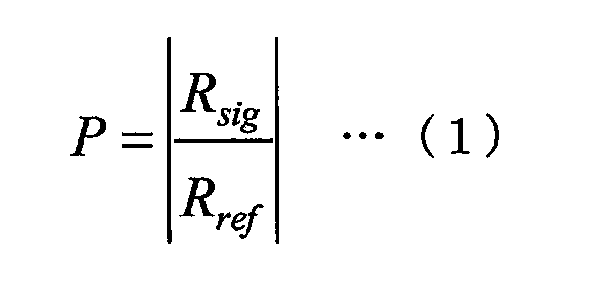
[Math. 2]
Further, using the above-mentioned ratio P and phase difference Δ, a value q is defined as in expression (3) (step S05).
[Math. 3]
- Here, let θi (see
Fig. 2 ) be the angle at which the terahertz wave T is incident on the internaltotal reflection prism 31, and θref and θsig be the respective refraction angles determined by Snell's law in the reference measurement and sample measurement. Further, using the Fresnel equations of reflection, Pe-iΔ in the expression (3) can be represented by the following expression (4):
[Math. 4]
- Substituting the above-mentioned expression (4) into the expression (3) and modifying it yields the following expression (5):
[Math. 5]
- Letting nprism be the complex refractive index of the material constituting the internal
total reflection prism 31, and nsample be the complex refractive index of theobject 34, the Snell's law is as in the following expression (6), while the square of the complex refractive index of theobject 34 is represented by expression (7). Therefore, substituting the expression (5) into the expression (7) can determine the complex refractive index of theobject 34, thereby deriving desirable optical constants of the object 34 (step S06).
[Math. 6]
[Math. 7]
- The reference measurement and sample measurement will now be explained in more detail.
- As mentioned above, this embodiment is assumed to measure the
solid object 34 in such a form as powder or flake. For accurately measuring optical constants concerning thesolid object 34, it is necessary for theobject 34 and thetotal reflection surface 31c to be placed sufficiently close to each other so that the interaction between the evanescent component of the terahertz wave T and theobject 34 is generated stably. - Therefore, a method which totally reflects a terahertz wave by a total reflection surface while pressing the object onto the total reflection surface and the like have conventionally been employed, though there is a case where a minute gap occurs between the total reflection surface and the object even when such a method is used. This minute gap varies for each measurement, whereby the interaction between the evanescent component and the object may fluctuate upon each measurement. When the object is pressed against the total reflection surface with an excessive force in order to eliminate the minute gap, on the other hand, the prism may be deformed or damaged.
- By contrast, this embodiment uses a liquid 50 when performing the reference measurement and sample measurement. The liquid 50 is required to be incapable of dissolving the
object 34 and preferably does not absorb the terahertz wave T. Fluorine-based inert liquids, silicone oil, and the like are used as the liquid 50. Examples of the fluorine-based inert liquids include perfluorocarbon and hydrofluorocarbon. Among these liquids, perfluorocarbon is preferred in particular in terms of insolubility and absorbency. The fluorine-based inert liquids and silicone oil are hard to volatilize and thus are preferred not only in that no volatile components adversely affect the surroundings, but also in that their environmental load is low. Here, by "does not absorb the terahertz wave" is meant that the absorption coefficient is 20 [cm-1] or less, more preferably 10 [cm-1] or less, for a terahertz wave within the range of 0.1 [THz] to 10 [THz], for example. - First, a position to be arranged with the liquid 50 is ascertained in the reference measurement. In this ascertainment, the
total reflection surface 31 c is irradiated with near infrared rays through the same optical path as with the terahertz wave T. Since thetotal reflection surface 31 c is a sand surface with respect to the near infrared rays as mentioned above, thetotal reflection surface 31 c irradiated with the near infrared rays through the same optical path as with the terahertz wave T scatters the near infrared rays at a position where the terahertz wave T is totally reflected, thereby indicating the position to be arranged with the liquid 50. The near infrared rays used here preferably have a wavelength of 1 µm to 2 µm when the internaltotal reflection prism 31 is formed by Si, for example, in view of their passing through the terahertz-wave generator 32 while being hard to be absorbed by the internaltotal reflection prism 31. The liquid 50 is arranged at thus ascertained position (seeFigs. 4(a) and5(a) ), and the terahertz wave Tref is measured. - In the sample measurement, the terahertz wave Tsig is measured while the liquid 50 is interposed between the
total reflection surface 31c and theobject 34. When powdery, theobject 34 is put into the liquid 50 arranged on thetotal reflection surface 31c (seeFig. 4(b) ), for example, so as to be immersed wholly in the liquid 50 (seeFig. 4(c) ). This allows a force such as an adhesion force, for example, to act between the liquid 50 and theobject 34, thereby placing theobject 34 sufficiently close to thetotal reflection surface 31 c. In the case of thepowdery object 34, it is sufficient for theobject 34 and the liquid 50 to be fully mixed with each other; theobject 34 and the liquid 50 may be mixed with each other beforehand and then arranged on thetotal reflection surface 31 c. - When the
object 34 is flaky, the liquid 50 is applied onto thetotal reflection surface 31c, and then theobject 34 is arranged thereon (seeFigs. 5(b) and 5(c) ), for example. This allows a force such as an adhesion force, for example, to act between the liquid 50 and theobject 34, as in the case of powder, thereby placing theobject 34 sufficiently close to thetotal reflection surface 31c. The liquid 50 may be applied to the bottom face of theobject 34 beforehand and then arranged on thetotal reflection surface 31 c. - As explained in the foregoing, the liquid 50 is interposed between the
total reflection surface 31c and theobject 34 in this embodiment. Therefore, a force such as an adhesion force acting between the liquid 50 and theobject 34 can place theobject 34 closer to thetotal reflection surface 31 c, thereby stably generating the interaction between the evanescent component and theobject 34. When theobject 34 is powdery, the adhesion force or the like can bring powder particles of theobject 34 closer to each other, thereby more stably generating the interaction between the evanescent component and theobject 34. On the other hand, this makes it unnecessary to press theobject 34 physically against thetotal reflection surface 31c, whereby the internaltotal reflection prism 31 can be inhibited from being deformed or damaged. Hence, this method can accurately measure optical constants concerning theobject 34 by utilizing the adhesion force. Since the liquid 50 incapable of dissolving theobject 34 is used, the measurement of theobject 34 is not inhibited by the liquid 50. -
Fig. 6(a) is a chart illustrating an example of absorption characteristics of theobject 34 measured by this embodiment. In this example, theobject 34 is lactose, while the liquid 50 is perfluorocarbon. As illustrated inFig. 6(a) , absorption characteristics A1 and A2 of theobject 34 measured at first and second times, respectively, exhibit substantially equal tendencies, in which peak values and their corresponding frequencies and the like substantially coincide with each other in particular. That is, the measurement results of absorption characteristics in theobject 34 are seen to be stable without fluctuating between measurements. -
Fig. 6(b) is a chart illustrating absorption characteristics of theobject 34 measured without the liquid 50 as a comparative example. Theobject 34 is lactose in the comparative example as well. As illustrated inFig. 6(b) , absorption characteristics B1 and B2 of theobject 34 measured at first and second times, respectively, exhibit a peak value at about 1.4 THz as with the absorption characteristics A1 and A2 in the case using the liquid 50. However, the absorption characteristics B1 and B2 also exhibit peak values at other frequencies which greatly differ from each other between the absorption characteristics B1 and B2. That is, the comparative example indicates that the absorption characteristic measurement results of theobject 34 greatly fluctuate upon each measurement and thus are unstable. - The embodiment uses the terahertz wave Tref totally reflected while only the liquid 50 is arranged on the
total reflection surface 31 c as a reference terahertz wave, so as to cancel out influences of absorption of the terahertz wave Tsig by the liquid 50. Therefore, optical constants concerning theobject 34 can be measured more accurately. - Using a fluorine-based inert liquid, silicone oil, or the like which does not absorb a terahertz wave inhibits the liquid 50 from absorbing the terahertz wave Tsig, whereby optical constants concerning the
object 34 can be measured more accurately. - The present invention is not restricted to the preferred embodiment thereof explained in the foregoing.
- For example, as illustrated in
Fig. 7 , the liquid 50 may be disposed within a ring-shapedenclosure 51 which is arranged on thetotal reflection surface 31 c in the reference measurement and sample measurement. ThoughFig. 7 illustrates a case where theenclosure 51 is rectangular in a planar view, this is not restrictive. Theenclosure 51 may have any form such as circles and polygons, for example, as long as a closed region is formed thereby. Theenclosure 51 is made of silicone rubber, for example. Using theenclosure 51 can retain the liquid 50 on thetotal reflection surface 31c, whereby the liquid 50 can securely be interposed between thetotal reflection surface 31 c and theobject 34. Preferably, theenclosure 51 attaches to thetotal reflection surface 31 c by autohesion. In this case, theenclosure 51 can easily be removed after completing the measurement. - The present invention can be utilized for total reflection spectroscopic measurement using a terahertz wave.
- 31...internal total reflection prism; 31c...total reflection surface; 34...object to be measured; 50...liquid; T...terahertz wave; 51... enclosure
Claims (6)
- A total reflection spectroscopic measurement method comprising arranging an object to be measured on a total reflection surface of a prism and measuring an optical constant concerning the object according to a terahertz wave totally reflected by the total reflection surface after passing the inside of the prism;
wherein a liquid incapable of dissolving the object is interposed at least between the total reflection surface and the object. - A total reflection spectroscopic measurement method according to claim 1, wherein the optical constant concerning the object is measured while using a terahertz wave totally reflected when only the liquid is arranged on the total reflection surface as a reference terahertz wave.
- A total reflection spectroscopic measurement method according to claim 1 or 2, wherein, as the liquid, a liquid incapable of absorbing the terahertz wave is used.
- A total reflection spectroscopic measurement method according to claim 3, wherein, as the liquid, a fluorine-based inert liquid is used.
- A total reflection spectroscopic measurement method according to claim 3, wherein silicone oil is used as the liquid.
- A total reflection spectroscopic measurement method according to one of claims 1 to 5, wherein a ring-shaped enclosure is arranged on the total reflection surface, and the liquid is disposed within the enclosure.
Applications Claiming Priority (2)
| Application Number | Priority Date | Filing Date | Title |
|---|---|---|---|
| JP2011063079A JP5723643B2 (en) | 2011-03-22 | 2011-03-22 | Total reflection spectroscopy measurement method |
| PCT/JP2012/054990 WO2012128001A1 (en) | 2011-03-22 | 2012-02-28 | Total reflection spectroscopic measurement method |
Publications (3)
| Publication Number | Publication Date |
|---|---|
| EP2690426A1 true EP2690426A1 (en) | 2014-01-29 |
| EP2690426A4 EP2690426A4 (en) | 2014-09-03 |
| EP2690426B1 EP2690426B1 (en) | 2019-04-24 |
Family
ID=46879160
Family Applications (1)
| Application Number | Title | Priority Date | Filing Date |
|---|---|---|---|
| EP12760839.6A Active EP2690426B1 (en) | 2011-03-22 | 2012-02-28 | Total reflection spectroscopic measurement method |
Country Status (4)
| Country | Link |
|---|---|
| US (1) | US20140008541A1 (en) |
| EP (1) | EP2690426B1 (en) |
| JP (1) | JP5723643B2 (en) |
| WO (1) | WO2012128001A1 (en) |
Cited By (1)
| Publication number | Priority date | Publication date | Assignee | Title |
|---|---|---|---|---|
| CN105928898A (en) * | 2016-04-15 | 2016-09-07 | 中国人民解放军第三军医大学第附属医院 | Rapidly established terahertz attenuation total reflection system based on Dove prism |
Families Citing this family (11)
| Publication number | Priority date | Publication date | Assignee | Title |
|---|---|---|---|---|
| JP5894575B2 (en) * | 2011-03-29 | 2016-03-30 | 浜松ホトニクス株式会社 | Terahertz wave spectrometer |
| US9080913B2 (en) | 2011-03-29 | 2015-07-14 | Hamamatsu Photonics K.K | Terahertz-wave spectrometer and prism member |
| JP5848621B2 (en) * | 2012-01-25 | 2016-01-27 | 浜松ホトニクス株式会社 | Drug evaluation method and drug evaluation apparatus |
| US10298884B2 (en) * | 2014-05-09 | 2019-05-21 | Honeywell International Inc. | System and method of precision remote PTZ control of IP cameras |
| SG11201706777QA (en) * | 2015-02-19 | 2017-09-28 | Premium Genetics (Uk) Ltd | Scanning infrared measurement system |
| CN107271399B (en) * | 2017-07-26 | 2019-08-13 | 中国人民解放军陆军军医大学第一附属医院 | Application and method of fluorine oil as a solvent for reducing water sensitivity of terahertz wave detection of liquid biological samples |
| JP6958858B2 (en) * | 2017-09-22 | 2021-11-02 | 国立研究開発法人理化学研究所 | Medium for cell evaluation using terahertz waves |
| JP2019091973A (en) * | 2017-11-10 | 2019-06-13 | パナソニックIpマネジメント株式会社 | Imaging apparatus |
| DE102019135487A1 (en) * | 2019-12-20 | 2021-06-24 | Helmut Fischer GmbH Institut für Elektronik und Messtechnik | Device for transmitting and / or receiving terahertz radiation and use thereof |
| CN115420702A (en) * | 2022-08-31 | 2022-12-02 | 华太极光光电技术有限公司 | A solid testing method for attenuated total reflection terahertz time-domain spectroscopy system |
| TWI904022B (en) * | 2025-03-10 | 2025-11-01 | 凌巨科技股份有限公司 | Method and display module for simulating combination of display modules using reflection relationships |
Family Cites Families (13)
| Publication number | Priority date | Publication date | Assignee | Title |
|---|---|---|---|---|
| US2689854A (en) * | 1950-05-03 | 1954-09-21 | Pfizer & Co C | Acetopyrrothine and preparation thereof |
| US4964705A (en) * | 1988-11-07 | 1990-10-23 | General Signal Corporation | Unit magnification optical system |
| JP2001070287A (en) * | 1999-09-02 | 2001-03-21 | Shimadzu Corp | Biological measurement device |
| US6833920B2 (en) * | 2000-07-11 | 2004-12-21 | Maven Technologies Llc | Apparatus and method for imaging |
| AT410322B (en) * | 2001-04-05 | 2003-03-25 | Lendl Bernhard Dipl Ing Dr Ins | METHOD FOR PROCESS MONITORING OF BIOTECHNOLOGICAL PROCESSES |
| JP3950818B2 (en) * | 2003-05-29 | 2007-08-01 | アイシン精機株式会社 | Reflective terahertz spectrometer and measurement method |
| US7393143B2 (en) * | 2006-02-21 | 2008-07-01 | Hitachi Cable, Ltd. | Optical connector and connection structure of optical fibers |
| JP5132146B2 (en) * | 2006-03-17 | 2013-01-30 | キヤノン株式会社 | Analysis method, analyzer, and specimen holding member |
| JP2007309858A (en) * | 2006-05-19 | 2007-11-29 | Canon Inc | Sensor device |
| JP5035618B2 (en) * | 2006-12-05 | 2012-09-26 | 独立行政法人理化学研究所 | Detection method and detection apparatus using electromagnetic wave |
| JP4800244B2 (en) * | 2007-03-13 | 2011-10-26 | 浜松ホトニクス株式会社 | Terahertz wave measuring device |
| JP4871176B2 (en) * | 2007-03-13 | 2012-02-08 | 浜松ホトニクス株式会社 | Total reflection terahertz wave measuring device |
| JP5848621B2 (en) * | 2012-01-25 | 2016-01-27 | 浜松ホトニクス株式会社 | Drug evaluation method and drug evaluation apparatus |
-
2011
- 2011-03-22 JP JP2011063079A patent/JP5723643B2/en active Active
-
2012
- 2012-02-28 WO PCT/JP2012/054990 patent/WO2012128001A1/en not_active Ceased
- 2012-02-28 EP EP12760839.6A patent/EP2690426B1/en active Active
- 2012-02-28 US US14/005,863 patent/US20140008541A1/en not_active Abandoned
Cited By (1)
| Publication number | Priority date | Publication date | Assignee | Title |
|---|---|---|---|---|
| CN105928898A (en) * | 2016-04-15 | 2016-09-07 | 中国人民解放军第三军医大学第附属医院 | Rapidly established terahertz attenuation total reflection system based on Dove prism |
Also Published As
| Publication number | Publication date |
|---|---|
| WO2012128001A1 (en) | 2012-09-27 |
| JP2012198135A (en) | 2012-10-18 |
| EP2690426A4 (en) | 2014-09-03 |
| EP2690426B1 (en) | 2019-04-24 |
| US20140008541A1 (en) | 2014-01-09 |
| JP5723643B2 (en) | 2015-05-27 |
Similar Documents
| Publication | Publication Date | Title |
|---|---|---|
| EP2690426B1 (en) | Total reflection spectroscopic measurement method | |
| Naftaly | Terahertz metrology | |
| EP2015054B1 (en) | Terahertz Time-Domain Spectroscopy in Attenuated-Total-Reflection | |
| US8415625B2 (en) | Total reflection terahertz wave measurement device | |
| EP2857827B1 (en) | Terahertz-wave spectroscopic measurement method | |
| JP6238058B2 (en) | Terahertz spectroscopy system | |
| CN107328736A (en) | Ginseng discrimination method and system | |
| EP2693200B1 (en) | Terahertz-wave spectrometer | |
| JP5877942B2 (en) | Total reflection spectrometer | |
| EP2693199B1 (en) | Terahertz-wave spectrometer and prism member | |
| JP5550521B2 (en) | Total reflection spectrometer | |
| JP5566826B2 (en) | Data analysis method in total reflection spectroscopy measurement | |
| Doiron | Electric field measurements from terahertz to mid-infrared | |
| Salzenstein et al. | Estimation of uncertainty on carrier frequency precision in optics and optoelectronic systems | |
| Welsh et al. | Diagonal Mueller matrix measurements based on a single pulse LiDAR polarimeter | |
| Zhou et al. | Impacts of terahertz scattering on the reflection spectrum for explosive detection | |
| Li et al. | Highly precise determination of optical constants in olive oil using terahertz time-domain spectroscopy | |
| Gallot | Ionic contrast terahertz near field imaging | |
| Walker et al. | Quantification of boundary definition using pulsed terahertz radiation for wedged geometries | |
| Johnson | Interferometry in terahertz imaging |
Legal Events
| Date | Code | Title | Description |
|---|---|---|---|
| PUAI | Public reference made under article 153(3) epc to a published international application that has entered the european phase |
Free format text: ORIGINAL CODE: 0009012 |
|
| 17P | Request for examination filed |
Effective date: 20131011 |
|
| AK | Designated contracting states |
Kind code of ref document: A1 Designated state(s): AL AT BE BG CH CY CZ DE DK EE ES FI FR GB GR HR HU IE IS IT LI LT LU LV MC MK MT NL NO PL PT RO RS SE SI SK SM TR |
|
| DAX | Request for extension of the european patent (deleted) | ||
| A4 | Supplementary search report drawn up and despatched |
Effective date: 20140804 |
|
| RIC1 | Information provided on ipc code assigned before grant |
Ipc: G01N 21/27 20060101AFI20140729BHEP Ipc: G01N 21/35 20140101ALI20140729BHEP Ipc: G01J 3/42 20060101ALI20140729BHEP Ipc: G01N 21/55 20140101ALI20140729BHEP |
|
| REG | Reference to a national code |
Ref country code: DE Ref legal event code: R079 Ref document number: 602012059355 Country of ref document: DE Free format text: PREVIOUS MAIN CLASS: G01N0021270000 Ipc: G01N0021358100 |
|
| STAA | Information on the status of an ep patent application or granted ep patent |
Free format text: STATUS: EXAMINATION IS IN PROGRESS |
|
| RIC1 | Information provided on ipc code assigned before grant |
Ipc: G01N 21/552 20140101ALI20170419BHEP Ipc: G01N 21/3581 20140101AFI20170419BHEP |
|
| 17Q | First examination report despatched |
Effective date: 20170509 |
|
| GRAP | Despatch of communication of intention to grant a patent |
Free format text: ORIGINAL CODE: EPIDOSNIGR1 |
|
| STAA | Information on the status of an ep patent application or granted ep patent |
Free format text: STATUS: GRANT OF PATENT IS INTENDED |
|
| INTG | Intention to grant announced |
Effective date: 20181113 |
|
| GRAS | Grant fee paid |
Free format text: ORIGINAL CODE: EPIDOSNIGR3 |
|
| GRAA | (expected) grant |
Free format text: ORIGINAL CODE: 0009210 |
|
| STAA | Information on the status of an ep patent application or granted ep patent |
Free format text: STATUS: THE PATENT HAS BEEN GRANTED |
|
| AK | Designated contracting states |
Kind code of ref document: B1 Designated state(s): AL AT BE BG CH CY CZ DE DK EE ES FI FR GB GR HR HU IE IS IT LI LT LU LV MC MK MT NL NO PL PT RO RS SE SI SK SM TR |
|
| REG | Reference to a national code |
Ref country code: GB Ref legal event code: FG4D |
|
| REG | Reference to a national code |
Ref country code: CH Ref legal event code: EP |
|
| REG | Reference to a national code |
Ref country code: DE Ref legal event code: R096 Ref document number: 602012059355 Country of ref document: DE |
|
| REG | Reference to a national code |
Ref country code: AT Ref legal event code: REF Ref document number: 1124713 Country of ref document: AT Kind code of ref document: T Effective date: 20190515 Ref country code: IE Ref legal event code: FG4D |
|
| REG | Reference to a national code |
Ref country code: NL Ref legal event code: MP Effective date: 20190424 |
|
| REG | Reference to a national code |
Ref country code: LT Ref legal event code: MG4D |
|
| PG25 | Lapsed in a contracting state [announced via postgrant information from national office to epo] |
Ref country code: NL Free format text: LAPSE BECAUSE OF FAILURE TO SUBMIT A TRANSLATION OF THE DESCRIPTION OR TO PAY THE FEE WITHIN THE PRESCRIBED TIME-LIMIT Effective date: 20190424 |
|
| PG25 | Lapsed in a contracting state [announced via postgrant information from national office to epo] |
Ref country code: FI Free format text: LAPSE BECAUSE OF FAILURE TO SUBMIT A TRANSLATION OF THE DESCRIPTION OR TO PAY THE FEE WITHIN THE PRESCRIBED TIME-LIMIT Effective date: 20190424 Ref country code: SE Free format text: LAPSE BECAUSE OF FAILURE TO SUBMIT A TRANSLATION OF THE DESCRIPTION OR TO PAY THE FEE WITHIN THE PRESCRIBED TIME-LIMIT Effective date: 20190424 Ref country code: ES Free format text: LAPSE BECAUSE OF FAILURE TO SUBMIT A TRANSLATION OF THE DESCRIPTION OR TO PAY THE FEE WITHIN THE PRESCRIBED TIME-LIMIT Effective date: 20190424 Ref country code: LT Free format text: LAPSE BECAUSE OF FAILURE TO SUBMIT A TRANSLATION OF THE DESCRIPTION OR TO PAY THE FEE WITHIN THE PRESCRIBED TIME-LIMIT Effective date: 20190424 Ref country code: PT Free format text: LAPSE BECAUSE OF FAILURE TO SUBMIT A TRANSLATION OF THE DESCRIPTION OR TO PAY THE FEE WITHIN THE PRESCRIBED TIME-LIMIT Effective date: 20190824 Ref country code: NO Free format text: LAPSE BECAUSE OF FAILURE TO SUBMIT A TRANSLATION OF THE DESCRIPTION OR TO PAY THE FEE WITHIN THE PRESCRIBED TIME-LIMIT Effective date: 20190724 Ref country code: AL Free format text: LAPSE BECAUSE OF FAILURE TO SUBMIT A TRANSLATION OF THE DESCRIPTION OR TO PAY THE FEE WITHIN THE PRESCRIBED TIME-LIMIT Effective date: 20190424 Ref country code: HR Free format text: LAPSE BECAUSE OF FAILURE TO SUBMIT A TRANSLATION OF THE DESCRIPTION OR TO PAY THE FEE WITHIN THE PRESCRIBED TIME-LIMIT Effective date: 20190424 |
|
| PG25 | Lapsed in a contracting state [announced via postgrant information from national office to epo] |
Ref country code: LV Free format text: LAPSE BECAUSE OF FAILURE TO SUBMIT A TRANSLATION OF THE DESCRIPTION OR TO PAY THE FEE WITHIN THE PRESCRIBED TIME-LIMIT Effective date: 20190424 Ref country code: PL Free format text: LAPSE BECAUSE OF FAILURE TO SUBMIT A TRANSLATION OF THE DESCRIPTION OR TO PAY THE FEE WITHIN THE PRESCRIBED TIME-LIMIT Effective date: 20190424 Ref country code: GR Free format text: LAPSE BECAUSE OF FAILURE TO SUBMIT A TRANSLATION OF THE DESCRIPTION OR TO PAY THE FEE WITHIN THE PRESCRIBED TIME-LIMIT Effective date: 20190725 Ref country code: BG Free format text: LAPSE BECAUSE OF FAILURE TO SUBMIT A TRANSLATION OF THE DESCRIPTION OR TO PAY THE FEE WITHIN THE PRESCRIBED TIME-LIMIT Effective date: 20190724 Ref country code: RS Free format text: LAPSE BECAUSE OF FAILURE TO SUBMIT A TRANSLATION OF THE DESCRIPTION OR TO PAY THE FEE WITHIN THE PRESCRIBED TIME-LIMIT Effective date: 20190424 |
|
| REG | Reference to a national code |
Ref country code: AT Ref legal event code: MK05 Ref document number: 1124713 Country of ref document: AT Kind code of ref document: T Effective date: 20190424 |
|
| PG25 | Lapsed in a contracting state [announced via postgrant information from national office to epo] |
Ref country code: IS Free format text: LAPSE BECAUSE OF FAILURE TO SUBMIT A TRANSLATION OF THE DESCRIPTION OR TO PAY THE FEE WITHIN THE PRESCRIBED TIME-LIMIT Effective date: 20190824 |
|
| REG | Reference to a national code |
Ref country code: DE Ref legal event code: R097 Ref document number: 602012059355 Country of ref document: DE |
|
| PG25 | Lapsed in a contracting state [announced via postgrant information from national office to epo] |
Ref country code: RO Free format text: LAPSE BECAUSE OF FAILURE TO SUBMIT A TRANSLATION OF THE DESCRIPTION OR TO PAY THE FEE WITHIN THE PRESCRIBED TIME-LIMIT Effective date: 20190424 Ref country code: CZ Free format text: LAPSE BECAUSE OF FAILURE TO SUBMIT A TRANSLATION OF THE DESCRIPTION OR TO PAY THE FEE WITHIN THE PRESCRIBED TIME-LIMIT Effective date: 20190424 Ref country code: DK Free format text: LAPSE BECAUSE OF FAILURE TO SUBMIT A TRANSLATION OF THE DESCRIPTION OR TO PAY THE FEE WITHIN THE PRESCRIBED TIME-LIMIT Effective date: 20190424 Ref country code: AT Free format text: LAPSE BECAUSE OF FAILURE TO SUBMIT A TRANSLATION OF THE DESCRIPTION OR TO PAY THE FEE WITHIN THE PRESCRIBED TIME-LIMIT Effective date: 20190424 Ref country code: EE Free format text: LAPSE BECAUSE OF FAILURE TO SUBMIT A TRANSLATION OF THE DESCRIPTION OR TO PAY THE FEE WITHIN THE PRESCRIBED TIME-LIMIT Effective date: 20190424 Ref country code: SK Free format text: LAPSE BECAUSE OF FAILURE TO SUBMIT A TRANSLATION OF THE DESCRIPTION OR TO PAY THE FEE WITHIN THE PRESCRIBED TIME-LIMIT Effective date: 20190424 |
|
| PG25 | Lapsed in a contracting state [announced via postgrant information from national office to epo] |
Ref country code: IT Free format text: LAPSE BECAUSE OF FAILURE TO SUBMIT A TRANSLATION OF THE DESCRIPTION OR TO PAY THE FEE WITHIN THE PRESCRIBED TIME-LIMIT Effective date: 20190424 Ref country code: SM Free format text: LAPSE BECAUSE OF FAILURE TO SUBMIT A TRANSLATION OF THE DESCRIPTION OR TO PAY THE FEE WITHIN THE PRESCRIBED TIME-LIMIT Effective date: 20190424 |
|
| PLBE | No opposition filed within time limit |
Free format text: ORIGINAL CODE: 0009261 |
|
| STAA | Information on the status of an ep patent application or granted ep patent |
Free format text: STATUS: NO OPPOSITION FILED WITHIN TIME LIMIT |
|
| PG25 | Lapsed in a contracting state [announced via postgrant information from national office to epo] |
Ref country code: TR Free format text: LAPSE BECAUSE OF FAILURE TO SUBMIT A TRANSLATION OF THE DESCRIPTION OR TO PAY THE FEE WITHIN THE PRESCRIBED TIME-LIMIT Effective date: 20190424 |
|
| 26N | No opposition filed |
Effective date: 20200127 |
|
| PG25 | Lapsed in a contracting state [announced via postgrant information from national office to epo] |
Ref country code: SI Free format text: LAPSE BECAUSE OF FAILURE TO SUBMIT A TRANSLATION OF THE DESCRIPTION OR TO PAY THE FEE WITHIN THE PRESCRIBED TIME-LIMIT Effective date: 20190424 |
|
| REG | Reference to a national code |
Ref country code: CH Ref legal event code: PL |
|
| REG | Reference to a national code |
Ref country code: BE Ref legal event code: MM Effective date: 20200229 |
|
| PG25 | Lapsed in a contracting state [announced via postgrant information from national office to epo] |
Ref country code: LU Free format text: LAPSE BECAUSE OF NON-PAYMENT OF DUE FEES Effective date: 20200228 Ref country code: MC Free format text: LAPSE BECAUSE OF FAILURE TO SUBMIT A TRANSLATION OF THE DESCRIPTION OR TO PAY THE FEE WITHIN THE PRESCRIBED TIME-LIMIT Effective date: 20190424 |
|
| PG25 | Lapsed in a contracting state [announced via postgrant information from national office to epo] |
Ref country code: CH Free format text: LAPSE BECAUSE OF NON-PAYMENT OF DUE FEES Effective date: 20200229 Ref country code: LI Free format text: LAPSE BECAUSE OF NON-PAYMENT OF DUE FEES Effective date: 20200229 |
|
| PG25 | Lapsed in a contracting state [announced via postgrant information from national office to epo] |
Ref country code: IE Free format text: LAPSE BECAUSE OF NON-PAYMENT OF DUE FEES Effective date: 20200228 |
|
| PG25 | Lapsed in a contracting state [announced via postgrant information from national office to epo] |
Ref country code: BE Free format text: LAPSE BECAUSE OF NON-PAYMENT OF DUE FEES Effective date: 20200229 |
|
| PG25 | Lapsed in a contracting state [announced via postgrant information from national office to epo] |
Ref country code: MT Free format text: LAPSE BECAUSE OF FAILURE TO SUBMIT A TRANSLATION OF THE DESCRIPTION OR TO PAY THE FEE WITHIN THE PRESCRIBED TIME-LIMIT Effective date: 20190424 Ref country code: CY Free format text: LAPSE BECAUSE OF FAILURE TO SUBMIT A TRANSLATION OF THE DESCRIPTION OR TO PAY THE FEE WITHIN THE PRESCRIBED TIME-LIMIT Effective date: 20190424 |
|
| PGFP | Annual fee paid to national office [announced via postgrant information from national office to epo] |
Ref country code: FR Payment date: 20220118 Year of fee payment: 11 |
|
| PG25 | Lapsed in a contracting state [announced via postgrant information from national office to epo] |
Ref country code: MK Free format text: LAPSE BECAUSE OF FAILURE TO SUBMIT A TRANSLATION OF THE DESCRIPTION OR TO PAY THE FEE WITHIN THE PRESCRIBED TIME-LIMIT Effective date: 20190424 |
|
| P01 | Opt-out of the competence of the unified patent court (upc) registered |
Effective date: 20230509 |
|
| PG25 | Lapsed in a contracting state [announced via postgrant information from national office to epo] |
Ref country code: FR Free format text: LAPSE BECAUSE OF NON-PAYMENT OF DUE FEES Effective date: 20230228 |
|
| PGFP | Annual fee paid to national office [announced via postgrant information from national office to epo] |
Ref country code: DE Payment date: 20231229 Year of fee payment: 13 Ref country code: GB Payment date: 20240108 Year of fee payment: 13 |
|
| REG | Reference to a national code |
Ref country code: DE Ref legal event code: R119 Ref document number: 602012059355 Country of ref document: DE |
|
| GBPC | Gb: european patent ceased through non-payment of renewal fee |
Effective date: 20250228 |
|
| PG25 | Lapsed in a contracting state [announced via postgrant information from national office to epo] |
Ref country code: DE Free format text: LAPSE BECAUSE OF NON-PAYMENT OF DUE FEES Effective date: 20250902 |
|
| PG25 | Lapsed in a contracting state [announced via postgrant information from national office to epo] |
Ref country code: GB Free format text: LAPSE BECAUSE OF NON-PAYMENT OF DUE FEES Effective date: 20250228 |