EP2690144A1 - Ink composition and image forming method - Google Patents
Ink composition and image forming method Download PDFInfo
- Publication number
- EP2690144A1 EP2690144A1 EP20120765301 EP12765301A EP2690144A1 EP 2690144 A1 EP2690144 A1 EP 2690144A1 EP 20120765301 EP20120765301 EP 20120765301 EP 12765301 A EP12765301 A EP 12765301A EP 2690144 A1 EP2690144 A1 EP 2690144A1
- Authority
- EP
- European Patent Office
- Prior art keywords
- ink composition
- component
- group
- carbon atoms
- hydrogen atom
- Prior art date
- Legal status (The legal status is an assumption and is not a legal conclusion. Google has not performed a legal analysis and makes no representation as to the accuracy of the status listed.)
- Withdrawn
Links
- 239000000203 mixture Substances 0.000 title claims abstract description 163
- 238000000034 method Methods 0.000 title claims description 38
- 150000001875 compounds Chemical class 0.000 claims abstract description 83
- 125000004432 carbon atom Chemical group C* 0.000 claims abstract description 44
- 125000004435 hydrogen atom Chemical group [H]* 0.000 claims abstract description 41
- 125000000217 alkyl group Chemical group 0.000 claims abstract description 32
- 239000000463 material Substances 0.000 claims abstract description 22
- 238000004040 coloring Methods 0.000 claims abstract description 20
- 125000002723 alicyclic group Chemical group 0.000 claims abstract description 16
- 229920000642 polymer Polymers 0.000 claims description 22
- 125000002947 alkylene group Chemical group 0.000 claims description 14
- 125000000732 arylene group Chemical group 0.000 claims description 13
- 125000002496 methyl group Chemical group [H]C([H])([H])* 0.000 claims description 13
- 229920002554 vinyl polymer Polymers 0.000 claims description 10
- 125000004450 alkenylene group Chemical group 0.000 claims description 7
- 230000001678 irradiating effect Effects 0.000 claims description 4
- NIXOWILDQLNWCW-UHFFFAOYSA-M Acrylate Chemical compound [O-]C(=O)C=C NIXOWILDQLNWCW-UHFFFAOYSA-M 0.000 description 49
- -1 acrylate compound Chemical class 0.000 description 39
- 239000000049 pigment Substances 0.000 description 28
- 238000006116 polymerization reaction Methods 0.000 description 20
- 239000002609 medium Substances 0.000 description 19
- 229960000834 vinyl ether Drugs 0.000 description 19
- HRPVXLWXLXDGHG-UHFFFAOYSA-N Acrylamide Chemical compound NC(=O)C=C HRPVXLWXLXDGHG-UHFFFAOYSA-N 0.000 description 17
- RTZKZFJDLAIYFH-UHFFFAOYSA-N ether Substances CCOCC RTZKZFJDLAIYFH-UHFFFAOYSA-N 0.000 description 17
- 239000002270 dispersing agent Substances 0.000 description 16
- 239000003112 inhibitor Substances 0.000 description 16
- XLYOFNOQVPJJNP-UHFFFAOYSA-N water Substances O XLYOFNOQVPJJNP-UHFFFAOYSA-N 0.000 description 16
- 239000003999 initiator Substances 0.000 description 15
- 229920000915 polyvinyl chloride Polymers 0.000 description 14
- 239000004800 polyvinyl chloride Substances 0.000 description 14
- 230000001235 sensitizing effect Effects 0.000 description 14
- QYKIQEUNHZKYBP-UHFFFAOYSA-N Vinyl ether Chemical compound C=COC=C QYKIQEUNHZKYBP-UHFFFAOYSA-N 0.000 description 11
- 239000002518 antifoaming agent Substances 0.000 description 11
- 238000001816 cooling Methods 0.000 description 9
- 239000012860 organic pigment Substances 0.000 description 9
- CYIGRWUIQAVBFG-UHFFFAOYSA-N 1,2-bis(2-ethenoxyethoxy)ethane Chemical compound C=COCCOCCOCCOC=C CYIGRWUIQAVBFG-UHFFFAOYSA-N 0.000 description 8
- 230000000903 blocking effect Effects 0.000 description 8
- 239000003795 chemical substances by application Substances 0.000 description 8
- SOGAXMICEFXMKE-UHFFFAOYSA-N Butylmethacrylate Chemical compound CCCCOC(=O)C(C)=C SOGAXMICEFXMKE-UHFFFAOYSA-N 0.000 description 6
- 239000002202 Polyethylene glycol Substances 0.000 description 6
- 230000000052 comparative effect Effects 0.000 description 6
- 230000001976 improved effect Effects 0.000 description 6
- 229920001223 polyethylene glycol Polymers 0.000 description 6
- 229920005989 resin Polymers 0.000 description 6
- 239000011347 resin Substances 0.000 description 6
- 125000001424 substituent group Chemical group 0.000 description 6
- 238000012546 transfer Methods 0.000 description 6
- JWYVGKFDLWWQJX-UHFFFAOYSA-N 1-ethenylazepan-2-one Chemical group C=CN1CCCCCC1=O JWYVGKFDLWWQJX-UHFFFAOYSA-N 0.000 description 5
- TXBCBTDQIULDIA-UHFFFAOYSA-N 2-[[3-hydroxy-2,2-bis(hydroxymethyl)propoxy]methyl]-2-(hydroxymethyl)propane-1,3-diol Chemical compound OCC(CO)(CO)COCC(CO)(CO)CO TXBCBTDQIULDIA-UHFFFAOYSA-N 0.000 description 5
- IAYPIBMASNFSPL-UHFFFAOYSA-N Ethylene oxide Chemical compound C1CO1 IAYPIBMASNFSPL-UHFFFAOYSA-N 0.000 description 5
- GOOHAUXETOMSMM-UHFFFAOYSA-N Propylene oxide Chemical compound CC1CO1 GOOHAUXETOMSMM-UHFFFAOYSA-N 0.000 description 5
- IISBACLAFKSPIT-UHFFFAOYSA-N bisphenol A Chemical compound C=1C=C(O)C=CC=1C(C)(C)C1=CC=C(O)C=C1 IISBACLAFKSPIT-UHFFFAOYSA-N 0.000 description 5
- 229920001577 copolymer Polymers 0.000 description 5
- 239000006185 dispersion Substances 0.000 description 5
- 238000011156 evaluation Methods 0.000 description 5
- 230000000704 physical effect Effects 0.000 description 5
- 239000003505 polymerization initiator Substances 0.000 description 5
- 239000002904 solvent Substances 0.000 description 5
- LYCAIKOWRPUZTN-UHFFFAOYSA-N Ethylene glycol Chemical compound OCCO LYCAIKOWRPUZTN-UHFFFAOYSA-N 0.000 description 4
- CERQOIWHTDAKMF-UHFFFAOYSA-N Methacrylic acid Chemical compound CC(=C)C(O)=O CERQOIWHTDAKMF-UHFFFAOYSA-N 0.000 description 4
- ATUOYWHBWRKTHZ-UHFFFAOYSA-N Propane Chemical compound CCC ATUOYWHBWRKTHZ-UHFFFAOYSA-N 0.000 description 4
- PPBRXRYQALVLMV-UHFFFAOYSA-N Styrene Chemical compound C=CC1=CC=CC=C1 PPBRXRYQALVLMV-UHFFFAOYSA-N 0.000 description 4
- ZJCCRDAZUWHFQH-UHFFFAOYSA-N Trimethylolpropane Chemical compound CCC(CO)(CO)CO ZJCCRDAZUWHFQH-UHFFFAOYSA-N 0.000 description 4
- 125000004386 diacrylate group Chemical group 0.000 description 4
- 230000000694 effects Effects 0.000 description 4
- 125000001495 ethyl group Chemical group [H]C([H])([H])C([H])([H])* 0.000 description 4
- 238000010438 heat treatment Methods 0.000 description 4
- 125000001449 isopropyl group Chemical group [H]C([H])([H])C([H])(*)C([H])([H])[H] 0.000 description 4
- 239000000178 monomer Substances 0.000 description 4
- 229920000139 polyethylene terephthalate Polymers 0.000 description 4
- 239000005020 polyethylene terephthalate Substances 0.000 description 4
- 125000000391 vinyl group Chemical group [H]C([*])=C([H])[H] 0.000 description 4
- XDWRKTULOHXYGN-UHFFFAOYSA-N 1,3-bis(ethenoxy)-2,2-bis(ethenoxymethyl)propane Chemical compound C=COCC(COC=C)(COC=C)COC=C XDWRKTULOHXYGN-UHFFFAOYSA-N 0.000 description 3
- CZAVRNDQSIORTH-UHFFFAOYSA-N 1-ethenoxy-2,2-bis(ethenoxymethyl)butane Chemical compound C=COCC(CC)(COC=C)COC=C CZAVRNDQSIORTH-UHFFFAOYSA-N 0.000 description 3
- WMYINDVYGQKYMI-UHFFFAOYSA-N 2-[2,2-bis(hydroxymethyl)butoxymethyl]-2-ethylpropane-1,3-diol Chemical compound CCC(CO)(CO)COCC(CC)(CO)CO WMYINDVYGQKYMI-UHFFFAOYSA-N 0.000 description 3
- FDSUVTROAWLVJA-UHFFFAOYSA-N 2-[[3-hydroxy-2,2-bis(hydroxymethyl)propoxy]methyl]-2-(hydroxymethyl)propane-1,3-diol;prop-2-enoic acid Chemical compound OC(=O)C=C.OC(=O)C=C.OC(=O)C=C.OC(=O)C=C.OC(=O)C=C.OCC(CO)(CO)COCC(CO)(CO)CO FDSUVTROAWLVJA-UHFFFAOYSA-N 0.000 description 3
- RZVINYQDSSQUKO-UHFFFAOYSA-N 2-phenoxyethyl prop-2-enoate Chemical compound C=CC(=O)OCCOC1=CC=CC=C1 RZVINYQDSSQUKO-UHFFFAOYSA-N 0.000 description 3
- NLHHRLWOUZZQLW-UHFFFAOYSA-N Acrylonitrile Chemical compound C=CC#N NLHHRLWOUZZQLW-UHFFFAOYSA-N 0.000 description 3
- 239000004698 Polyethylene Substances 0.000 description 3
- 125000005396 acrylic acid ester group Chemical group 0.000 description 3
- 150000008365 aromatic ketones Chemical class 0.000 description 3
- 230000001588 bifunctional effect Effects 0.000 description 3
- 125000004122 cyclic group Chemical group 0.000 description 3
- 239000000839 emulsion Substances 0.000 description 3
- 150000002148 esters Chemical class 0.000 description 3
- QSHDDOUJBYECFT-UHFFFAOYSA-N mercury Chemical compound [Hg] QSHDDOUJBYECFT-UHFFFAOYSA-N 0.000 description 3
- 229910052753 mercury Inorganic materials 0.000 description 3
- FQPSGWSUVKBHSU-UHFFFAOYSA-N methacrylamide Chemical class CC(=C)C(N)=O FQPSGWSUVKBHSU-UHFFFAOYSA-N 0.000 description 3
- 125000005397 methacrylic acid ester group Chemical group 0.000 description 3
- VLKZOEOYAKHREP-UHFFFAOYSA-N n-Hexane Chemical compound CCCCCC VLKZOEOYAKHREP-UHFFFAOYSA-N 0.000 description 3
- 229920000573 polyethylene Polymers 0.000 description 3
- 239000007787 solid Substances 0.000 description 3
- 150000003440 styrenes Chemical class 0.000 description 3
- 125000000999 tert-butyl group Chemical group [H]C([H])([H])C(*)(C([H])([H])[H])C([H])([H])[H] 0.000 description 3
- 229920001567 vinyl ester resin Polymers 0.000 description 3
- PSGCQDPCAWOCSH-UHFFFAOYSA-N (4,7,7-trimethyl-3-bicyclo[2.2.1]heptanyl) prop-2-enoate Chemical compound C1CC2(C)C(OC(=O)C=C)CC1C2(C)C PSGCQDPCAWOCSH-UHFFFAOYSA-N 0.000 description 2
- YXIWHUQXZSMYRE-UHFFFAOYSA-N 1,3-benzothiazole-2-thiol Chemical compound C1=CC=C2SC(S)=NC2=C1 YXIWHUQXZSMYRE-UHFFFAOYSA-N 0.000 description 2
- MWZJGRDWJVHRDV-UHFFFAOYSA-N 1,4-bis(ethenoxy)butane Chemical compound C=COCCCCOC=C MWZJGRDWJVHRDV-UHFFFAOYSA-N 0.000 description 2
- QJJDJWUCRAPCOL-UHFFFAOYSA-N 1-ethenoxyoctadecane Chemical compound CCCCCCCCCCCCCCCCCCOC=C QJJDJWUCRAPCOL-UHFFFAOYSA-N 0.000 description 2
- FTALTLPZDVFJSS-UHFFFAOYSA-N 2-(2-ethoxyethoxy)ethyl prop-2-enoate Chemical compound CCOCCOCCOC(=O)C=C FTALTLPZDVFJSS-UHFFFAOYSA-N 0.000 description 2
- NIXOWILDQLNWCW-UHFFFAOYSA-N 2-Propenoic acid Natural products OC(=O)C=C NIXOWILDQLNWCW-UHFFFAOYSA-N 0.000 description 2
- OMIGHNLMNHATMP-UHFFFAOYSA-N 2-hydroxyethyl prop-2-enoate Chemical compound OCCOC(=O)C=C OMIGHNLMNHATMP-UHFFFAOYSA-N 0.000 description 2
- LFQSCWFLJHTTHZ-UHFFFAOYSA-N Ethanol Chemical compound CCO LFQSCWFLJHTTHZ-UHFFFAOYSA-N 0.000 description 2
- QIGBRXMKCJKVMJ-UHFFFAOYSA-N Hydroquinone Chemical compound OC1=CC=C(O)C=C1 QIGBRXMKCJKVMJ-UHFFFAOYSA-N 0.000 description 2
- BAPJBEWLBFYGME-UHFFFAOYSA-N Methyl acrylate Chemical compound COC(=O)C=C BAPJBEWLBFYGME-UHFFFAOYSA-N 0.000 description 2
- VVQNEPGJFQJSBK-UHFFFAOYSA-N Methyl methacrylate Chemical compound COC(=O)C(C)=C VVQNEPGJFQJSBK-UHFFFAOYSA-N 0.000 description 2
- 239000004743 Polypropylene Substances 0.000 description 2
- 239000004793 Polystyrene Substances 0.000 description 2
- 238000010521 absorption reaction Methods 0.000 description 2
- 150000003926 acrylamides Chemical class 0.000 description 2
- MWPLVEDNUUSJAV-UHFFFAOYSA-N anthracene Chemical compound C1=CC=CC2=CC3=CC=CC=C3C=C21 MWPLVEDNUUSJAV-UHFFFAOYSA-N 0.000 description 2
- 150000004056 anthraquinones Chemical class 0.000 description 2
- GCTPMLUUWLLESL-UHFFFAOYSA-N benzyl prop-2-enoate Chemical compound C=CC(=O)OCC1=CC=CC=C1 GCTPMLUUWLLESL-UHFFFAOYSA-N 0.000 description 2
- 230000000740 bleeding effect Effects 0.000 description 2
- 125000000484 butyl group Chemical group [H]C([*])([H])C([H])([H])C([H])([H])C([H])([H])[H] 0.000 description 2
- KBLWLMPSVYBVDK-UHFFFAOYSA-N cyclohexyl prop-2-enoate Chemical compound C=CC(=O)OC1CCCCC1 KBLWLMPSVYBVDK-UHFFFAOYSA-N 0.000 description 2
- 239000002612 dispersion medium Substances 0.000 description 2
- FJKIXWOMBXYWOQ-UHFFFAOYSA-N ethenoxyethane Chemical compound CCOC=C FJKIXWOMBXYWOQ-UHFFFAOYSA-N 0.000 description 2
- 230000002349 favourable effect Effects 0.000 description 2
- VOZRXNHHFUQHIL-UHFFFAOYSA-N glycidyl methacrylate Chemical compound CC(=C)C(=O)OCC1CO1 VOZRXNHHFUQHIL-UHFFFAOYSA-N 0.000 description 2
- 229920001519 homopolymer Polymers 0.000 description 2
- WGCNASOHLSPBMP-UHFFFAOYSA-N hydroxyacetaldehyde Natural products OCC=O WGCNASOHLSPBMP-UHFFFAOYSA-N 0.000 description 2
- 230000000977 initiatory effect Effects 0.000 description 2
- 125000000959 isobutyl group Chemical group [H]C([H])([H])C([H])(C([H])([H])[H])C([H])([H])* 0.000 description 2
- 125000005439 maleimidyl group Chemical group C1(C=CC(N1*)=O)=O 0.000 description 2
- 230000007246 mechanism Effects 0.000 description 2
- 229910052751 metal Inorganic materials 0.000 description 2
- 239000002184 metal Substances 0.000 description 2
- YDKNBNOOCSNPNS-UHFFFAOYSA-N methyl 1,3-benzoxazole-2-carboxylate Chemical compound C1=CC=C2OC(C(=O)OC)=NC2=C1 YDKNBNOOCSNPNS-UHFFFAOYSA-N 0.000 description 2
- DAHPIMYBWVSMKQ-UHFFFAOYSA-N n-hydroxy-n-phenylnitrous amide Chemical class O=NN(O)C1=CC=CC=C1 DAHPIMYBWVSMKQ-UHFFFAOYSA-N 0.000 description 2
- 239000003960 organic solvent Substances 0.000 description 2
- 239000002245 particle Substances 0.000 description 2
- WRAQQYDMVSCOTE-UHFFFAOYSA-N phenyl prop-2-enoate Chemical compound C=CC(=O)OC1=CC=CC=C1 WRAQQYDMVSCOTE-UHFFFAOYSA-N 0.000 description 2
- 229920003023 plastic Polymers 0.000 description 2
- 239000004033 plastic Substances 0.000 description 2
- 239000002985 plastic film Substances 0.000 description 2
- 229920006255 plastic film Polymers 0.000 description 2
- 229920000098 polyolefin Polymers 0.000 description 2
- 229920001155 polypropylene Polymers 0.000 description 2
- 229920002223 polystyrene Polymers 0.000 description 2
- FBCQUCJYYPMKRO-UHFFFAOYSA-N prop-2-enyl 2-methylprop-2-enoate Chemical compound CC(=C)C(=O)OCC=C FBCQUCJYYPMKRO-UHFFFAOYSA-N 0.000 description 2
- 239000001294 propane Substances 0.000 description 2
- 125000001436 propyl group Chemical group [H]C([*])([H])C([H])([H])C([H])([H])[H] 0.000 description 2
- BBEAQIROQSPTKN-UHFFFAOYSA-N pyrene Chemical compound C1=CC=C2C=CC3=CC=CC4=CC=C1C2=C43 BBEAQIROQSPTKN-UHFFFAOYSA-N 0.000 description 2
- 125000002914 sec-butyl group Chemical group [H]C([H])([H])C([H])([H])C([H])(*)C([H])([H])[H] 0.000 description 2
- 230000035945 sensitivity Effects 0.000 description 2
- MUTNCGKQJGXKEM-UHFFFAOYSA-N tamibarotene Chemical compound C=1C=C2C(C)(C)CCC(C)(C)C2=CC=1NC(=O)C1=CC=C(C(O)=O)C=C1 MUTNCGKQJGXKEM-UHFFFAOYSA-N 0.000 description 2
- 238000012719 thermal polymerization Methods 0.000 description 2
- LDHQCZJRKDOVOX-UHFFFAOYSA-N trans-crotonic acid Natural products CC=CC(O)=O LDHQCZJRKDOVOX-UHFFFAOYSA-N 0.000 description 2
- PRBBFHSSJFGXJS-UHFFFAOYSA-N (2,2-dimethyl-3-prop-2-enoyloxypropyl) prop-2-enoate;3-hydroxy-2,2-dimethylpropanoic acid Chemical compound OCC(C)(C)C(O)=O.C=CC(=O)OCC(C)(C)COC(=O)C=C PRBBFHSSJFGXJS-UHFFFAOYSA-N 0.000 description 1
- YKZMWXJHPKWFLS-UHFFFAOYSA-N (2-chlorophenyl) 2-methylprop-2-enoate Chemical compound CC(=C)C(=O)OC1=CC=CC=C1Cl YKZMWXJHPKWFLS-UHFFFAOYSA-N 0.000 description 1
- GOUZWCLULXUQSR-UHFFFAOYSA-N (2-chlorophenyl) prop-2-enoate Chemical compound ClC1=CC=CC=C1OC(=O)C=C GOUZWCLULXUQSR-UHFFFAOYSA-N 0.000 description 1
- HHQAGBQXOWLTLL-UHFFFAOYSA-N (2-hydroxy-3-phenoxypropyl) prop-2-enoate Chemical compound C=CC(=O)OCC(O)COC1=CC=CC=C1 HHQAGBQXOWLTLL-UHFFFAOYSA-N 0.000 description 1
- RDJHJYJHQKPTKS-UHFFFAOYSA-N (2-sulfamoylphenyl) 2-methylprop-2-enoate Chemical compound CC(=C)C(=O)OC1=CC=CC=C1S(N)(=O)=O RDJHJYJHQKPTKS-UHFFFAOYSA-N 0.000 description 1
- RPCKQZVEAKXDED-UHFFFAOYSA-N (2-sulfamoylphenyl) prop-2-enoate Chemical compound NS(=O)(=O)C1=CC=CC=C1OC(=O)C=C RPCKQZVEAKXDED-UHFFFAOYSA-N 0.000 description 1
- PVPBBTJXIKFICP-UHFFFAOYSA-N (7-aminophenothiazin-3-ylidene)azanium;chloride Chemical compound [Cl-].C1=CC(=[NH2+])C=C2SC3=CC(N)=CC=C3N=C21 PVPBBTJXIKFICP-UHFFFAOYSA-N 0.000 description 1
- UUGXDEDGRPYWHG-UHFFFAOYSA-N (dimethylamino)methyl 2-methylprop-2-enoate Chemical compound CN(C)COC(=O)C(C)=C UUGXDEDGRPYWHG-UHFFFAOYSA-N 0.000 description 1
- GPHWXFINOWXMDN-UHFFFAOYSA-N 1,1-bis(ethenoxy)hexane Chemical compound CCCCCC(OC=C)OC=C GPHWXFINOWXMDN-UHFFFAOYSA-N 0.000 description 1
- HIYIGPVBMDKPCR-UHFFFAOYSA-N 1,1-bis(ethenoxymethyl)cyclohexane Chemical compound C=COCC1(COC=C)CCCCC1 HIYIGPVBMDKPCR-UHFFFAOYSA-N 0.000 description 1
- CGXVUIBINWTLNT-UHFFFAOYSA-N 1,2,3-tris(ethenoxy)propane Chemical compound C=COCC(OC=C)COC=C CGXVUIBINWTLNT-UHFFFAOYSA-N 0.000 description 1
- BVOMRRWJQOJMPA-UHFFFAOYSA-N 1,2,3-trithiane Chemical compound C1CSSSC1 BVOMRRWJQOJMPA-UHFFFAOYSA-N 0.000 description 1
- SKYXLDSRLNRAPS-UHFFFAOYSA-N 1,2,4-trifluoro-5-methoxybenzene Chemical compound COC1=CC(F)=C(F)C=C1F SKYXLDSRLNRAPS-UHFFFAOYSA-N 0.000 description 1
- ZXHDVRATSGZISC-UHFFFAOYSA-N 1,2-bis(ethenoxy)ethane Chemical compound C=COCCOC=C ZXHDVRATSGZISC-UHFFFAOYSA-N 0.000 description 1
- LXSVCBDMOGLGFA-UHFFFAOYSA-N 1,2-bis(ethenoxy)propane Chemical compound C=COC(C)COC=C LXSVCBDMOGLGFA-UHFFFAOYSA-N 0.000 description 1
- YHMYGUUIMTVXNW-UHFFFAOYSA-N 1,3-dihydrobenzimidazole-2-thione Chemical compound C1=CC=C2NC(S)=NC2=C1 YHMYGUUIMTVXNW-UHFFFAOYSA-N 0.000 description 1
- AZQWKYJCGOJGHM-UHFFFAOYSA-N 1,4-benzoquinone Chemical compound O=C1C=CC(=O)C=C1 AZQWKYJCGOJGHM-UHFFFAOYSA-N 0.000 description 1
- DYUWIMGIHNMKSD-UHFFFAOYSA-N 1-(2-chloroethoxy)-2-ethenoxyethane Chemical compound ClCCOCCOC=C DYUWIMGIHNMKSD-UHFFFAOYSA-N 0.000 description 1
- AYMDJPGTQFHDSA-UHFFFAOYSA-N 1-(2-ethenoxyethoxy)-2-ethoxyethane Chemical compound CCOCCOCCOC=C AYMDJPGTQFHDSA-UHFFFAOYSA-N 0.000 description 1
- UNMYKPSSIFZORM-UHFFFAOYSA-N 1-(2-ethenoxyethoxy)butane Chemical compound CCCCOCCOC=C UNMYKPSSIFZORM-UHFFFAOYSA-N 0.000 description 1
- NQUXRXBRYDZZDL-UHFFFAOYSA-N 1-(2-prop-2-enoyloxyethyl)cyclohexane-1,2-dicarboxylic acid Chemical compound OC(=O)C1CCCCC1(CCOC(=O)C=C)C(O)=O NQUXRXBRYDZZDL-UHFFFAOYSA-N 0.000 description 1
- KLWGMEDURRDUPO-UHFFFAOYSA-N 1-(ethenoxymethyl)-4-methylcyclohexane Chemical compound CC1CCC(COC=C)CC1 KLWGMEDURRDUPO-UHFFFAOYSA-N 0.000 description 1
- ZDQNWDNMNKSMHI-UHFFFAOYSA-N 1-[2-(2-prop-2-enoyloxypropoxy)propoxy]propan-2-yl prop-2-enoate Chemical compound C=CC(=O)OC(C)COC(C)COCC(C)OC(=O)C=C ZDQNWDNMNKSMHI-UHFFFAOYSA-N 0.000 description 1
- DNJRKFKAFWSXSE-UHFFFAOYSA-N 1-chloro-2-ethenoxyethane Chemical compound ClCCOC=C DNJRKFKAFWSXSE-UHFFFAOYSA-N 0.000 description 1
- PNEWSCXZLUPKET-UHFFFAOYSA-N 1-chloro-4-ethenoxybutane Chemical compound ClCCCCOC=C PNEWSCXZLUPKET-UHFFFAOYSA-N 0.000 description 1
- SAMJGBVVQUEMGC-UHFFFAOYSA-N 1-ethenoxy-2-(2-ethenoxyethoxy)ethane Chemical compound C=COCCOCCOC=C SAMJGBVVQUEMGC-UHFFFAOYSA-N 0.000 description 1
- RQJCIXUNHZZFMB-UHFFFAOYSA-N 1-ethenoxy-2-(2-ethenoxypropoxy)propane Chemical compound C=COCC(C)OCC(C)OC=C RQJCIXUNHZZFMB-UHFFFAOYSA-N 0.000 description 1
- HWCLMKDWXUGDKL-UHFFFAOYSA-N 1-ethenoxy-2-ethoxyethane Chemical compound CCOCCOC=C HWCLMKDWXUGDKL-UHFFFAOYSA-N 0.000 description 1
- GXZPMXGRNUXGHN-UHFFFAOYSA-N 1-ethenoxy-2-methoxyethane Chemical compound COCCOC=C GXZPMXGRNUXGHN-UHFFFAOYSA-N 0.000 description 1
- OZCMOJQQLBXBKI-UHFFFAOYSA-N 1-ethenoxy-2-methylpropane Chemical compound CC(C)COC=C OZCMOJQQLBXBKI-UHFFFAOYSA-N 0.000 description 1
- UZKWTJUDCOPSNM-UHFFFAOYSA-N 1-ethenoxybutane Chemical compound CCCCOC=C UZKWTJUDCOPSNM-UHFFFAOYSA-N 0.000 description 1
- LAYAKLSFVAPMEL-UHFFFAOYSA-N 1-ethenoxydodecane Chemical compound CCCCCCCCCCCCOC=C LAYAKLSFVAPMEL-UHFFFAOYSA-N 0.000 description 1
- MIMKRVLJPMYKID-UHFFFAOYSA-N 1-ethenoxynonane Chemical compound CCCCCCCCCOC=C MIMKRVLJPMYKID-UHFFFAOYSA-N 0.000 description 1
- HAVHPQLVZUALTL-UHFFFAOYSA-N 1-ethenoxypropan-2-ol Chemical compound CC(O)COC=C HAVHPQLVZUALTL-UHFFFAOYSA-N 0.000 description 1
- OVGRCEFMXPHEBL-UHFFFAOYSA-N 1-ethenoxypropane Chemical compound CCCOC=C OVGRCEFMXPHEBL-UHFFFAOYSA-N 0.000 description 1
- LMAUULKNZLEMGN-UHFFFAOYSA-N 1-ethyl-3,5-dimethylbenzene Chemical compound CCC1=CC(C)=CC(C)=C1 LMAUULKNZLEMGN-UHFFFAOYSA-N 0.000 description 1
- XLPJNCYCZORXHG-UHFFFAOYSA-N 1-morpholin-4-ylprop-2-en-1-one Chemical compound C=CC(=O)N1CCOCC1 XLPJNCYCZORXHG-UHFFFAOYSA-N 0.000 description 1
- STFXXRRQKFUYEU-UHFFFAOYSA-N 16-methylheptadecyl prop-2-enoate Chemical compound CC(C)CCCCCCCCCCCCCCCOC(=O)C=C STFXXRRQKFUYEU-UHFFFAOYSA-N 0.000 description 1
- HGOUNPXIJSDIKV-UHFFFAOYSA-N 2,2-bis(hydroxymethyl)butyl 2-methylprop-2-enoate Chemical compound CCC(CO)(CO)COC(=O)C(C)=C HGOUNPXIJSDIKV-UHFFFAOYSA-N 0.000 description 1
- SYENVBKSVVOOPS-UHFFFAOYSA-N 2,2-bis(hydroxymethyl)butyl prop-2-enoate Chemical compound CCC(CO)(CO)COC(=O)C=C SYENVBKSVVOOPS-UHFFFAOYSA-N 0.000 description 1
- CISIJYCKDJSTMX-UHFFFAOYSA-N 2,2-dichloroethenylbenzene Chemical compound ClC(Cl)=CC1=CC=CC=C1 CISIJYCKDJSTMX-UHFFFAOYSA-N 0.000 description 1
- PWESSVUYESFKBH-UHFFFAOYSA-N 2,2-dimethoxyethenylbenzene Chemical compound COC(OC)=CC1=CC=CC=C1 PWESSVUYESFKBH-UHFFFAOYSA-N 0.000 description 1
- PUGOMSLRUSTQGV-UHFFFAOYSA-N 2,3-di(prop-2-enoyloxy)propyl prop-2-enoate Chemical class C=CC(=O)OCC(OC(=O)C=C)COC(=O)C=C PUGOMSLRUSTQGV-UHFFFAOYSA-N 0.000 description 1
- STMDPCBYJCIZOD-UHFFFAOYSA-N 2-(2,4-dinitroanilino)-4-methylpentanoic acid Chemical compound CC(C)CC(C(O)=O)NC1=CC=C([N+]([O-])=O)C=C1[N+]([O-])=O STMDPCBYJCIZOD-UHFFFAOYSA-N 0.000 description 1
- WULAHPYSGCVQHM-UHFFFAOYSA-N 2-(2-ethenoxyethoxy)ethanol Chemical compound OCCOCCOC=C WULAHPYSGCVQHM-UHFFFAOYSA-N 0.000 description 1
- SMZOUWXMTYCWNB-UHFFFAOYSA-N 2-(2-methoxy-5-methylphenyl)ethanamine Chemical compound COC1=CC=C(C)C=C1CCN SMZOUWXMTYCWNB-UHFFFAOYSA-N 0.000 description 1
- IEQWWMKDFZUMMU-UHFFFAOYSA-N 2-(2-prop-2-enoyloxyethyl)butanedioic acid Chemical compound OC(=O)CC(C(O)=O)CCOC(=O)C=C IEQWWMKDFZUMMU-UHFFFAOYSA-N 0.000 description 1
- JAHNSTQSQJOJLO-UHFFFAOYSA-N 2-(3-fluorophenyl)-1h-imidazole Chemical compound FC1=CC=CC(C=2NC=CN=2)=C1 JAHNSTQSQJOJLO-UHFFFAOYSA-N 0.000 description 1
- MXLVVOUBPBBRDE-UHFFFAOYSA-N 2-(4-hydroxyphenyl)ethyl 2-methylprop-2-enoate Chemical compound CC(=C)C(=O)OCCC1=CC=C(O)C=C1 MXLVVOUBPBBRDE-UHFFFAOYSA-N 0.000 description 1
- YSUGIEHWIVGUDE-UHFFFAOYSA-N 2-(4-hydroxyphenyl)ethyl prop-2-enoate Chemical compound OC1=CC=C(CCOC(=O)C=C)C=C1 YSUGIEHWIVGUDE-UHFFFAOYSA-N 0.000 description 1
- UIUSRIAANRCPGF-UHFFFAOYSA-N 2-(ethenoxymethyl)oxolane Chemical compound C=COCC1CCCO1 UIUSRIAANRCPGF-UHFFFAOYSA-N 0.000 description 1
- GOXQRTZXKQZDDN-UHFFFAOYSA-N 2-Ethylhexyl acrylate Chemical compound CCCCC(CC)COC(=O)C=C GOXQRTZXKQZDDN-UHFFFAOYSA-N 0.000 description 1
- RFCQDOVPMUSZMN-UHFFFAOYSA-N 2-Naphthalenethiol Chemical compound C1=CC=CC2=CC(S)=CC=C21 RFCQDOVPMUSZMN-UHFFFAOYSA-N 0.000 description 1
- BPSUVCAKLAPDJU-UHFFFAOYSA-N 2-[1-(oxiran-2-ylmethoxy)propan-2-yloxymethyl]oxirane;prop-2-enoic acid Chemical compound OC(=O)C=C.C1OC1COC(C)COCC1CO1 BPSUVCAKLAPDJU-UHFFFAOYSA-N 0.000 description 1
- PTJDGKYFJYEAOK-UHFFFAOYSA-N 2-butoxyethyl prop-2-enoate Chemical compound CCCCOCCOC(=O)C=C PTJDGKYFJYEAOK-UHFFFAOYSA-N 0.000 description 1
- SBYMUDUGTIKLCR-UHFFFAOYSA-N 2-chloroethenylbenzene Chemical compound ClC=CC1=CC=CC=C1 SBYMUDUGTIKLCR-UHFFFAOYSA-N 0.000 description 1
- GPOGMJLHWQHEGF-UHFFFAOYSA-N 2-chloroethyl 2-methylprop-2-enoate Chemical compound CC(=C)C(=O)OCCCl GPOGMJLHWQHEGF-UHFFFAOYSA-N 0.000 description 1
- WHBAYNMEIXUTJV-UHFFFAOYSA-N 2-chloroethyl prop-2-enoate Chemical compound ClCCOC(=O)C=C WHBAYNMEIXUTJV-UHFFFAOYSA-N 0.000 description 1
- MENUHMSZHZBYMK-UHFFFAOYSA-N 2-cyclohexylethenylbenzene Chemical compound C1CCCCC1C=CC1=CC=CC=C1 MENUHMSZHZBYMK-UHFFFAOYSA-N 0.000 description 1
- IELQNQLDZIHBPK-UHFFFAOYSA-N 2-ethenoxy-1-ethoxy-1-methoxyethane Chemical compound CCOC(OC)COC=C IELQNQLDZIHBPK-UHFFFAOYSA-N 0.000 description 1
- PGYJSURPYAAOMM-UHFFFAOYSA-N 2-ethenoxy-2-methylpropane Chemical compound CC(C)(C)OC=C PGYJSURPYAAOMM-UHFFFAOYSA-N 0.000 description 1
- VUIWJRYTWUGOOF-UHFFFAOYSA-N 2-ethenoxyethanol Chemical compound OCCOC=C VUIWJRYTWUGOOF-UHFFFAOYSA-N 0.000 description 1
- OUELSYYMNDBLHV-UHFFFAOYSA-N 2-ethenoxyethylbenzene Chemical compound C=COCCC1=CC=CC=C1 OUELSYYMNDBLHV-UHFFFAOYSA-N 0.000 description 1
- GNUGVECARVKIPH-UHFFFAOYSA-N 2-ethenoxypropane Chemical compound CC(C)OC=C GNUGVECARVKIPH-UHFFFAOYSA-N 0.000 description 1
- WDQMWEYDKDCEHT-UHFFFAOYSA-N 2-ethylhexyl 2-methylprop-2-enoate Chemical compound CCCCC(CC)COC(=O)C(C)=C WDQMWEYDKDCEHT-UHFFFAOYSA-N 0.000 description 1
- KBKNKFIRGXQLDB-UHFFFAOYSA-N 2-fluoroethenylbenzene Chemical compound FC=CC1=CC=CC=C1 KBKNKFIRGXQLDB-UHFFFAOYSA-N 0.000 description 1
- VHSHLMUCYSAUQU-UHFFFAOYSA-N 2-hydroxypropyl methacrylate Chemical compound CC(O)COC(=O)C(C)=C VHSHLMUCYSAUQU-UHFFFAOYSA-N 0.000 description 1
- GWZMWHWAWHPNHN-UHFFFAOYSA-N 2-hydroxypropyl prop-2-enoate Chemical compound CC(O)COC(=O)C=C GWZMWHWAWHPNHN-UHFFFAOYSA-N 0.000 description 1
- OZPOYKXYJOHGCW-UHFFFAOYSA-N 2-iodoethenylbenzene Chemical compound IC=CC1=CC=CC=C1 OZPOYKXYJOHGCW-UHFFFAOYSA-N 0.000 description 1
- FLFWJIBUZQARMD-UHFFFAOYSA-N 2-mercapto-1,3-benzoxazole Chemical compound C1=CC=C2OC(S)=NC2=C1 FLFWJIBUZQARMD-UHFFFAOYSA-N 0.000 description 1
- CTHJQRHPNQEPAB-UHFFFAOYSA-N 2-methoxyethenylbenzene Chemical compound COC=CC1=CC=CC=C1 CTHJQRHPNQEPAB-UHFFFAOYSA-N 0.000 description 1
- HFCUBKYHMMPGBY-UHFFFAOYSA-N 2-methoxyethyl prop-2-enoate Chemical compound COCCOC(=O)C=C HFCUBKYHMMPGBY-UHFFFAOYSA-N 0.000 description 1
- BGPDQWZQYUDVCY-UHFFFAOYSA-N 2-methyl-n-(2-methylphenyl)prop-2-enamide Chemical compound CC(=C)C(=O)NC1=CC=CC=C1C BGPDQWZQYUDVCY-UHFFFAOYSA-N 0.000 description 1
- VXPNHCXCUJEOKI-UHFFFAOYSA-N 2-methyl-n-(2-methylphenyl)sulfonylprop-2-enamide Chemical compound CC(=C)C(=O)NS(=O)(=O)C1=CC=CC=C1C VXPNHCXCUJEOKI-UHFFFAOYSA-N 0.000 description 1
- NGYXHOXRNFKMRL-UHFFFAOYSA-N 2-methyl-n-(2-sulfamoylphenyl)prop-2-enamide Chemical compound CC(=C)C(=O)NC1=CC=CC=C1S(N)(=O)=O NGYXHOXRNFKMRL-UHFFFAOYSA-N 0.000 description 1
- IJSVVICYGLOZHA-UHFFFAOYSA-N 2-methyl-n-phenylprop-2-enamide Chemical compound CC(=C)C(=O)NC1=CC=CC=C1 IJSVVICYGLOZHA-UHFFFAOYSA-N 0.000 description 1
- CCIDRBFZPRURMU-UHFFFAOYSA-N 2-methyl-n-propylprop-2-enamide Chemical compound CCCNC(=O)C(C)=C CCIDRBFZPRURMU-UHFFFAOYSA-N 0.000 description 1
- BTOVVHWKPVSLBI-UHFFFAOYSA-N 2-methylprop-1-enylbenzene Chemical compound CC(C)=CC1=CC=CC=C1 BTOVVHWKPVSLBI-UHFFFAOYSA-N 0.000 description 1
- RUMACXVDVNRZJZ-UHFFFAOYSA-N 2-methylpropyl 2-methylprop-2-enoate Chemical compound CC(C)COC(=O)C(C)=C RUMACXVDVNRZJZ-UHFFFAOYSA-N 0.000 description 1
- CFVWNXQPGQOHRJ-UHFFFAOYSA-N 2-methylpropyl prop-2-enoate Chemical compound CC(C)COC(=O)C=C CFVWNXQPGQOHRJ-UHFFFAOYSA-N 0.000 description 1
- HKADMMFLLPJEAG-UHFFFAOYSA-N 3,3,3-trifluoroprop-1-enylbenzene Chemical compound FC(F)(F)C=CC1=CC=CC=C1 HKADMMFLLPJEAG-UHFFFAOYSA-N 0.000 description 1
- KKAJSJJFBSOMGS-UHFFFAOYSA-N 3,6-diamino-10-methylacridinium chloride Chemical compound [Cl-].C1=C(N)C=C2[N+](C)=C(C=C(N)C=C3)C3=CC2=C1 KKAJSJJFBSOMGS-UHFFFAOYSA-N 0.000 description 1
- QISZCVLALJOROC-UHFFFAOYSA-N 3-(2-hydroxyethyl)-4-(2-prop-2-enoyloxyethyl)phthalic acid Chemical compound OCCC1=C(CCOC(=O)C=C)C=CC(C(O)=O)=C1C(O)=O QISZCVLALJOROC-UHFFFAOYSA-N 0.000 description 1
- UXTGJIIBLZIQPK-UHFFFAOYSA-N 3-(2-prop-2-enoyloxyethyl)phthalic acid Chemical compound OC(=O)C1=CC=CC(CCOC(=O)C=C)=C1C(O)=O UXTGJIIBLZIQPK-UHFFFAOYSA-N 0.000 description 1
- DSSAWHFZNWVJEC-UHFFFAOYSA-N 3-(ethenoxymethyl)heptane Chemical compound CCCCC(CC)COC=C DSSAWHFZNWVJEC-UHFFFAOYSA-N 0.000 description 1
- IWTYTFSSTWXZFU-UHFFFAOYSA-N 3-chloroprop-1-enylbenzene Chemical compound ClCC=CC1=CC=CC=C1 IWTYTFSSTWXZFU-UHFFFAOYSA-N 0.000 description 1
- VCYDIDJFXXIUCY-UHFFFAOYSA-N 3-ethoxyprop-1-enylbenzene Chemical compound CCOCC=CC1=CC=CC=C1 VCYDIDJFXXIUCY-UHFFFAOYSA-N 0.000 description 1
- NPYMXLXNEYZTMQ-UHFFFAOYSA-N 3-methoxybutyl prop-2-enoate Chemical compound COC(C)CCOC(=O)C=C NPYMXLXNEYZTMQ-UHFFFAOYSA-N 0.000 description 1
- ZTHJQCDAHYOPIK-UHFFFAOYSA-N 3-methylbut-2-en-2-ylbenzene Chemical compound CC(C)=C(C)C1=CC=CC=C1 ZTHJQCDAHYOPIK-UHFFFAOYSA-N 0.000 description 1
- ZVYGIPWYVVJFRW-UHFFFAOYSA-N 3-methylbutyl prop-2-enoate Chemical compound CC(C)CCOC(=O)C=C ZVYGIPWYVVJFRW-UHFFFAOYSA-N 0.000 description 1
- IICCLYANAQEHCI-UHFFFAOYSA-N 4,5,6,7-tetrachloro-3',6'-dihydroxy-2',4',5',7'-tetraiodospiro[2-benzofuran-3,9'-xanthene]-1-one Chemical compound O1C(=O)C(C(=C(Cl)C(Cl)=C2Cl)Cl)=C2C21C1=CC(I)=C(O)C(I)=C1OC1=C(I)C(O)=C(I)C=C21 IICCLYANAQEHCI-UHFFFAOYSA-N 0.000 description 1
- BGNGWHSBYQYVRX-UHFFFAOYSA-N 4-(dimethylamino)benzaldehyde Chemical compound CN(C)C1=CC=C(C=O)C=C1 BGNGWHSBYQYVRX-UHFFFAOYSA-N 0.000 description 1
- JLBJTVDPSNHSKJ-UHFFFAOYSA-N 4-Methylstyrene Chemical compound CC1=CC=C(C=C)C=C1 JLBJTVDPSNHSKJ-UHFFFAOYSA-N 0.000 description 1
- FWTBRYBHCBCJEQ-UHFFFAOYSA-N 4-[(4-phenyldiazenylnaphthalen-1-yl)diazenyl]phenol Chemical compound C1=CC(O)=CC=C1N=NC(C1=CC=CC=C11)=CC=C1N=NC1=CC=CC=C1 FWTBRYBHCBCJEQ-UHFFFAOYSA-N 0.000 description 1
- HMBNQNDUEFFFNZ-UHFFFAOYSA-N 4-ethenoxybutan-1-ol Chemical compound OCCCCOC=C HMBNQNDUEFFFNZ-UHFFFAOYSA-N 0.000 description 1
- YGTVWCBFJAVSMS-UHFFFAOYSA-N 5-hydroxypentyl 2-methylprop-2-enoate Chemical compound CC(=C)C(=O)OCCCCCO YGTVWCBFJAVSMS-UHFFFAOYSA-N 0.000 description 1
- INRQKLGGIVSJRR-UHFFFAOYSA-N 5-hydroxypentyl prop-2-enoate Chemical compound OCCCCCOC(=O)C=C INRQKLGGIVSJRR-UHFFFAOYSA-N 0.000 description 1
- JTHZUSWLNCPZLX-UHFFFAOYSA-N 6-fluoro-3-methyl-2h-indazole Chemical compound FC1=CC=C2C(C)=NNC2=C1 JTHZUSWLNCPZLX-UHFFFAOYSA-N 0.000 description 1
- RZVAJINKPMORJF-UHFFFAOYSA-N Acetaminophen Chemical compound CC(=O)NC1=CC=C(O)C=C1 RZVAJINKPMORJF-UHFFFAOYSA-N 0.000 description 1
- 239000004925 Acrylic resin Substances 0.000 description 1
- 229920000178 Acrylic resin Polymers 0.000 description 1
- WVDDGKGOMKODPV-UHFFFAOYSA-N Benzyl alcohol Chemical compound OCC1=CC=CC=C1 WVDDGKGOMKODPV-UHFFFAOYSA-N 0.000 description 1
- LCFVJGUPQDGYKZ-UHFFFAOYSA-N Bisphenol A diglycidyl ether Chemical compound C=1C=C(OCC2OC2)C=CC=1C(C)(C)C(C=C1)=CC=C1OCC1CO1 LCFVJGUPQDGYKZ-UHFFFAOYSA-N 0.000 description 1
- PXKLMJQFEQBVLD-UHFFFAOYSA-N Bisphenol F Natural products C1=CC(O)=CC=C1CC1=CC=C(O)C=C1 PXKLMJQFEQBVLD-UHFFFAOYSA-N 0.000 description 1
- IUCNRNQUSXDOAL-UHFFFAOYSA-N CC(=C)OC(C)=C.CC1COOC(=O)O1 Chemical compound CC(=C)OC(C)=C.CC1COOC(=O)O1 IUCNRNQUSXDOAL-UHFFFAOYSA-N 0.000 description 1
- OKTJSMMVPCPJKN-UHFFFAOYSA-N Carbon Chemical compound [C] OKTJSMMVPCPJKN-UHFFFAOYSA-N 0.000 description 1
- 229920001747 Cellulose diacetate Polymers 0.000 description 1
- DQEFEBPAPFSJLV-UHFFFAOYSA-N Cellulose propionate Chemical compound CCC(=O)OCC1OC(OC(=O)CC)C(OC(=O)CC)C(OC(=O)CC)C1OC1C(OC(=O)CC)C(OC(=O)CC)C(OC(=O)CC)C(COC(=O)CC)O1 DQEFEBPAPFSJLV-UHFFFAOYSA-N 0.000 description 1
- 229920002284 Cellulose triacetate Polymers 0.000 description 1
- RYGMFSIKBFXOCR-UHFFFAOYSA-N Copper Chemical compound [Cu] RYGMFSIKBFXOCR-UHFFFAOYSA-N 0.000 description 1
- 239000004641 Diallyl-phthalate Substances 0.000 description 1
- UDSFAEKRVUSQDD-UHFFFAOYSA-N Dimethyl adipate Chemical compound COC(=O)CCCCC(=O)OC UDSFAEKRVUSQDD-UHFFFAOYSA-N 0.000 description 1
- MUXOBHXGJLMRAB-UHFFFAOYSA-N Dimethyl succinate Chemical compound COC(=O)CCC(=O)OC MUXOBHXGJLMRAB-UHFFFAOYSA-N 0.000 description 1
- JIGUQPWFLRLWPJ-UHFFFAOYSA-N Ethyl acrylate Chemical compound CCOC(=O)C=C JIGUQPWFLRLWPJ-UHFFFAOYSA-N 0.000 description 1
- UFHFLCQGNIYNRP-UHFFFAOYSA-N Hydrogen Chemical compound [H][H] UFHFLCQGNIYNRP-UHFFFAOYSA-N 0.000 description 1
- WOBHKFSMXKNTIM-UHFFFAOYSA-N Hydroxyethyl methacrylate Chemical compound CC(=C)C(=O)OCCO WOBHKFSMXKNTIM-UHFFFAOYSA-N 0.000 description 1
- PEEHTFAAVSWFBL-UHFFFAOYSA-N Maleimide Chemical compound O=C1NC(=O)C=C1 PEEHTFAAVSWFBL-UHFFFAOYSA-N 0.000 description 1
- CNCOEDDPFOAUMB-UHFFFAOYSA-N N-Methylolacrylamide Chemical compound OCNC(=O)C=C CNCOEDDPFOAUMB-UHFFFAOYSA-N 0.000 description 1
- NPKSPKHJBVJUKB-UHFFFAOYSA-N N-phenylglycine Chemical compound OC(=O)CNC1=CC=CC=C1 NPKSPKHJBVJUKB-UHFFFAOYSA-N 0.000 description 1
- 239000000020 Nitrocellulose Substances 0.000 description 1
- IGFHQQFPSIBGKE-UHFFFAOYSA-N Nonylphenol Natural products CCCCCCCCCC1=CC=C(O)C=C1 IGFHQQFPSIBGKE-UHFFFAOYSA-N 0.000 description 1
- 239000004952 Polyamide Substances 0.000 description 1
- OFOBLEOULBTSOW-UHFFFAOYSA-N Propanedioic acid Natural products OC(=O)CC(O)=O OFOBLEOULBTSOW-UHFFFAOYSA-N 0.000 description 1
- KDYFGRWQOYBRFD-UHFFFAOYSA-N Succinic acid Natural products OC(=O)CCC(O)=O KDYFGRWQOYBRFD-UHFFFAOYSA-N 0.000 description 1
- LCXXNKZQVOXMEH-UHFFFAOYSA-N Tetrahydrofurfuryl methacrylate Chemical compound CC(=C)C(=O)OCC1CCCO1 LCXXNKZQVOXMEH-UHFFFAOYSA-N 0.000 description 1
- GSEJCLTVZPLZKY-UHFFFAOYSA-N Triethanolamine Chemical compound OCCN(CCO)CCO GSEJCLTVZPLZKY-UHFFFAOYSA-N 0.000 description 1
- SLGBZMMZGDRARJ-UHFFFAOYSA-N Triphenylene Natural products C1=CC=C2C3=CC=CC=C3C3=CC=CC=C3C2=C1 SLGBZMMZGDRARJ-UHFFFAOYSA-N 0.000 description 1
- XTXRWKRVRITETP-UHFFFAOYSA-N Vinyl acetate Chemical compound CC(=O)OC=C XTXRWKRVRITETP-UHFFFAOYSA-N 0.000 description 1
- HCHKCACWOHOZIP-UHFFFAOYSA-N Zinc Chemical compound [Zn] HCHKCACWOHOZIP-UHFFFAOYSA-N 0.000 description 1
- NNLVGZFZQQXQNW-ADJNRHBOSA-N [(2r,3r,4s,5r,6s)-4,5-diacetyloxy-3-[(2s,3r,4s,5r,6r)-3,4,5-triacetyloxy-6-(acetyloxymethyl)oxan-2-yl]oxy-6-[(2r,3r,4s,5r,6s)-4,5,6-triacetyloxy-2-(acetyloxymethyl)oxan-3-yl]oxyoxan-2-yl]methyl acetate Chemical compound O([C@@H]1O[C@@H]([C@H]([C@H](OC(C)=O)[C@H]1OC(C)=O)O[C@H]1[C@@H]([C@@H](OC(C)=O)[C@H](OC(C)=O)[C@@H](COC(C)=O)O1)OC(C)=O)COC(=O)C)[C@@H]1[C@@H](COC(C)=O)O[C@@H](OC(C)=O)[C@H](OC(C)=O)[C@H]1OC(C)=O NNLVGZFZQQXQNW-ADJNRHBOSA-N 0.000 description 1
- FJWGYAHXMCUOOM-QHOUIDNNSA-N [(2s,3r,4s,5r,6r)-2-[(2r,3r,4s,5r,6s)-4,5-dinitrooxy-2-(nitrooxymethyl)-6-[(2r,3r,4s,5r,6s)-4,5,6-trinitrooxy-2-(nitrooxymethyl)oxan-3-yl]oxyoxan-3-yl]oxy-3,5-dinitrooxy-6-(nitrooxymethyl)oxan-4-yl] nitrate Chemical compound O([C@@H]1O[C@@H]([C@H]([C@H](O[N+]([O-])=O)[C@H]1O[N+]([O-])=O)O[C@H]1[C@@H]([C@@H](O[N+]([O-])=O)[C@H](O[N+]([O-])=O)[C@@H](CO[N+]([O-])=O)O1)O[N+]([O-])=O)CO[N+](=O)[O-])[C@@H]1[C@@H](CO[N+]([O-])=O)O[C@@H](O[N+]([O-])=O)[C@H](O[N+]([O-])=O)[C@H]1O[N+]([O-])=O FJWGYAHXMCUOOM-QHOUIDNNSA-N 0.000 description 1
- YMOONIIMQBGTDU-VOTSOKGWSA-N [(e)-2-bromoethenyl]benzene Chemical compound Br\C=C\C1=CC=CC=C1 YMOONIIMQBGTDU-VOTSOKGWSA-N 0.000 description 1
- MOOIXEMFUKBQLJ-UHFFFAOYSA-N [1-(ethenoxymethyl)cyclohexyl]methanol Chemical compound C=COCC1(CO)CCCCC1 MOOIXEMFUKBQLJ-UHFFFAOYSA-N 0.000 description 1
- HVVWZTWDBSEWIH-UHFFFAOYSA-N [2-(hydroxymethyl)-3-prop-2-enoyloxy-2-(prop-2-enoyloxymethyl)propyl] prop-2-enoate Chemical compound C=CC(=O)OCC(CO)(COC(=O)C=C)COC(=O)C=C HVVWZTWDBSEWIH-UHFFFAOYSA-N 0.000 description 1
- XRMBQHTWUBGQDN-UHFFFAOYSA-N [2-[2,2-bis(prop-2-enoyloxymethyl)butoxymethyl]-2-(prop-2-enoyloxymethyl)butyl] prop-2-enoate Chemical compound C=CC(=O)OCC(COC(=O)C=C)(CC)COCC(CC)(COC(=O)C=C)COC(=O)C=C XRMBQHTWUBGQDN-UHFFFAOYSA-N 0.000 description 1
- APZPSKFMSWZPKL-UHFFFAOYSA-N [3-hydroxy-2,2-bis(hydroxymethyl)propyl] 2-methylprop-2-enoate Chemical compound CC(=C)C(=O)OCC(CO)(CO)CO APZPSKFMSWZPKL-UHFFFAOYSA-N 0.000 description 1
- ZCZFEIZSYJAXKS-UHFFFAOYSA-N [3-hydroxy-2,2-bis(hydroxymethyl)propyl] prop-2-enoate Chemical compound OCC(CO)(CO)COC(=O)C=C ZCZFEIZSYJAXKS-UHFFFAOYSA-N 0.000 description 1
- MPIAGWXWVAHQBB-UHFFFAOYSA-N [3-prop-2-enoyloxy-2-[[3-prop-2-enoyloxy-2,2-bis(prop-2-enoyloxymethyl)propoxy]methyl]-2-(prop-2-enoyloxymethyl)propyl] prop-2-enoate Chemical compound C=CC(=O)OCC(COC(=O)C=C)(COC(=O)C=C)COCC(COC(=O)C=C)(COC(=O)C=C)COC(=O)C=C MPIAGWXWVAHQBB-UHFFFAOYSA-N 0.000 description 1
- FHLPGTXWCFQMIU-UHFFFAOYSA-N [4-[2-(4-prop-2-enoyloxyphenyl)propan-2-yl]phenyl] prop-2-enoate Chemical class C=1C=C(OC(=O)C=C)C=CC=1C(C)(C)C1=CC=C(OC(=O)C=C)C=C1 FHLPGTXWCFQMIU-UHFFFAOYSA-N 0.000 description 1
- DQVUUGHMHQPVSI-UHFFFAOYSA-N [chloro(phenyl)methyl] 2-methylprop-2-enoate Chemical compound CC(=C)C(=O)OC(Cl)C1=CC=CC=C1 DQVUUGHMHQPVSI-UHFFFAOYSA-N 0.000 description 1
- IXJPGVLRLBAGGW-UHFFFAOYSA-N [chloro(phenyl)methyl] prop-2-enoate Chemical compound C=CC(=O)OC(Cl)C1=CC=CC=C1 IXJPGVLRLBAGGW-UHFFFAOYSA-N 0.000 description 1
- CQKFNTMINDWGKB-UHFFFAOYSA-N [methoxy(phenyl)methyl] 2-methylprop-2-enoate Chemical compound CC(=C)C(=O)OC(OC)C1=CC=CC=C1 CQKFNTMINDWGKB-UHFFFAOYSA-N 0.000 description 1
- CXSXCWXUCMJUGI-UHFFFAOYSA-N [methoxy(phenyl)methyl] prop-2-enoate Chemical compound C=CC(=O)OC(OC)C1=CC=CC=C1 CXSXCWXUCMJUGI-UHFFFAOYSA-N 0.000 description 1
- DHKHKXVYLBGOIT-UHFFFAOYSA-N acetaldehyde Diethyl Acetal Natural products CCOC(C)OCC DHKHKXVYLBGOIT-UHFFFAOYSA-N 0.000 description 1
- 150000001241 acetals Chemical class 0.000 description 1
- DPKHZNPWBDQZCN-UHFFFAOYSA-N acridine orange free base Chemical compound C1=CC(N(C)C)=CC2=NC3=CC(N(C)C)=CC=C3C=C21 DPKHZNPWBDQZCN-UHFFFAOYSA-N 0.000 description 1
- 150000001251 acridines Chemical class 0.000 description 1
- 229940023020 acriflavine Drugs 0.000 description 1
- 230000002411 adverse Effects 0.000 description 1
- 229910052782 aluminium Inorganic materials 0.000 description 1
- XAGFODPZIPBFFR-UHFFFAOYSA-N aluminium Chemical compound [Al] XAGFODPZIPBFFR-UHFFFAOYSA-N 0.000 description 1
- 150000001412 amines Chemical class 0.000 description 1
- 150000008064 anhydrides Chemical class 0.000 description 1
- PYKYMHQGRFAEBM-UHFFFAOYSA-N anthraquinone Natural products CCC(=O)c1c(O)c2C(=O)C3C(C=CC=C3O)C(=O)c2cc1CC(=O)OC PYKYMHQGRFAEBM-UHFFFAOYSA-N 0.000 description 1
- 125000003118 aryl group Chemical group 0.000 description 1
- QVGXLLKOCUKJST-UHFFFAOYSA-N atomic oxygen Chemical compound [O] QVGXLLKOCUKJST-UHFFFAOYSA-N 0.000 description 1
- 125000005235 azinium group Chemical group 0.000 description 1
- ZYGHJZDHTFUPRJ-UHFFFAOYSA-N benzo-alpha-pyrone Natural products C1=CC=C2OC(=O)C=CC2=C1 ZYGHJZDHTFUPRJ-UHFFFAOYSA-N 0.000 description 1
- DZBUGLKDJFMEHC-UHFFFAOYSA-N benzoquinolinylidene Natural products C1=CC=CC2=CC3=CC=CC=C3N=C21 DZBUGLKDJFMEHC-UHFFFAOYSA-N 0.000 description 1
- AOJOEFVRHOZDFN-UHFFFAOYSA-N benzyl 2-methylprop-2-enoate Chemical compound CC(=C)C(=O)OCC1=CC=CC=C1 AOJOEFVRHOZDFN-UHFFFAOYSA-N 0.000 description 1
- 230000005250 beta ray Effects 0.000 description 1
- QUDWYFHPNIMBFC-UHFFFAOYSA-N bis(prop-2-enyl) benzene-1,2-dicarboxylate Chemical compound C=CCOC(=O)C1=CC=CC=C1C(=O)OCC=C QUDWYFHPNIMBFC-UHFFFAOYSA-N 0.000 description 1
- 150000001642 boronic acid derivatives Chemical class 0.000 description 1
- MPMBRWOOISTHJV-UHFFFAOYSA-N but-1-enylbenzene Chemical compound CCC=CC1=CC=CC=C1 MPMBRWOOISTHJV-UHFFFAOYSA-N 0.000 description 1
- CQEYYJKEWSMYFG-UHFFFAOYSA-N butyl acrylate Chemical compound CCCCOC(=O)C=C CQEYYJKEWSMYFG-UHFFFAOYSA-N 0.000 description 1
- 229910052799 carbon Inorganic materials 0.000 description 1
- 150000001721 carbon Chemical group 0.000 description 1
- 150000001733 carboxylic acid esters Chemical class 0.000 description 1
- 150000001735 carboxylic acids Chemical class 0.000 description 1
- 125000002091 cationic group Chemical group 0.000 description 1
- 229920006217 cellulose acetate butyrate Polymers 0.000 description 1
- 229920001727 cellulose butyrate Polymers 0.000 description 1
- 229920006218 cellulose propionate Polymers 0.000 description 1
- WBYWAXJHAXSJNI-UHFFFAOYSA-N cinnamic acid Chemical compound OC(=O)C=CC1=CC=CC=C1 WBYWAXJHAXSJNI-UHFFFAOYSA-N 0.000 description 1
- WJSDHUCWMSHDCR-UHFFFAOYSA-N cinnamyl acetate Chemical compound CC(=O)OCC=CC1=CC=CC=C1 WJSDHUCWMSHDCR-UHFFFAOYSA-N 0.000 description 1
- FCSHDIVRCWTZOX-DVTGEIKXSA-N clobetasol Chemical compound C1CC2=CC(=O)C=C[C@]2(C)[C@]2(F)[C@@H]1[C@@H]1C[C@H](C)[C@@](C(=O)CCl)(O)[C@@]1(C)C[C@@H]2O FCSHDIVRCWTZOX-DVTGEIKXSA-N 0.000 description 1
- 239000000084 colloidal system Substances 0.000 description 1
- 229940125904 compound 1 Drugs 0.000 description 1
- 229940125782 compound 2 Drugs 0.000 description 1
- 229910052802 copper Inorganic materials 0.000 description 1
- 239000010949 copper Substances 0.000 description 1
- VVOLVFOSOPJKED-UHFFFAOYSA-N copper phthalocyanine Chemical compound [Cu].N=1C2=NC(C3=CC=CC=C33)=NC3=NC(C3=CC=CC=C33)=NC3=NC(C3=CC=CC=C33)=NC3=NC=1C1=CC=CC=C12 VVOLVFOSOPJKED-UHFFFAOYSA-N 0.000 description 1
- 235000001671 coumarin Nutrition 0.000 description 1
- AFYCEAFSNDLKSX-UHFFFAOYSA-N coumarin 460 Chemical compound CC1=CC(=O)OC2=CC(N(CC)CC)=CC=C21 AFYCEAFSNDLKSX-UHFFFAOYSA-N 0.000 description 1
- 150000004775 coumarins Chemical class 0.000 description 1
- 238000004132 cross linking Methods 0.000 description 1
- LDHQCZJRKDOVOX-NSCUHMNNSA-N crotonic acid Chemical compound C\C=C\C(O)=O LDHQCZJRKDOVOX-NSCUHMNNSA-N 0.000 description 1
- OIWOHHBRDFKZNC-UHFFFAOYSA-N cyclohexyl 2-methylprop-2-enoate Chemical compound CC(=C)C(=O)OC1CCCCC1 OIWOHHBRDFKZNC-UHFFFAOYSA-N 0.000 description 1
- LXCYSACZTOKNNS-UHFFFAOYSA-N diethoxy(oxo)phosphanium Chemical compound CCO[P+](=O)OCC LXCYSACZTOKNNS-UHFFFAOYSA-N 0.000 description 1
- XTDYIOOONNVFMA-UHFFFAOYSA-N dimethyl pentanedioate Chemical compound COC(=O)CCCC(=O)OC XTDYIOOONNVFMA-UHFFFAOYSA-N 0.000 description 1
- 150000002019 disulfides Chemical class 0.000 description 1
- GMSCBRSQMRDRCD-UHFFFAOYSA-N dodecyl 2-methylprop-2-enoate Chemical compound CCCCCCCCCCCCOC(=O)C(C)=C GMSCBRSQMRDRCD-UHFFFAOYSA-N 0.000 description 1
- 229920001971 elastomer Polymers 0.000 description 1
- 238000010894 electron beam technology Methods 0.000 description 1
- 230000007613 environmental effect Effects 0.000 description 1
- YQGOJNYOYNNSMM-UHFFFAOYSA-N eosin Chemical compound [Na+].OC(=O)C1=CC=CC=C1C1=C2C=C(Br)C(=O)C(Br)=C2OC2=C(Br)C(O)=C(Br)C=C21 YQGOJNYOYNNSMM-UHFFFAOYSA-N 0.000 description 1
- IINNWAYUJNWZRM-UHFFFAOYSA-L erythrosin B Chemical compound [Na+].[Na+].[O-]C(=O)C1=CC=CC=C1C1=C2C=C(I)C(=O)C(I)=C2OC2=C(I)C([O-])=C(I)C=C21 IINNWAYUJNWZRM-UHFFFAOYSA-L 0.000 description 1
- AZDCYKCDXXPQIK-UHFFFAOYSA-N ethenoxymethylbenzene Chemical compound C=COCC1=CC=CC=C1 AZDCYKCDXXPQIK-UHFFFAOYSA-N 0.000 description 1
- BIUZXWXXSCLGNK-UHFFFAOYSA-N ethenoxymethylcyclohexane Chemical compound C=COCC1CCCCC1 BIUZXWXXSCLGNK-UHFFFAOYSA-N 0.000 description 1
- MEGHWIAOTJPCHQ-UHFFFAOYSA-N ethenyl butanoate Chemical compound CCCC(=O)OC=C MEGHWIAOTJPCHQ-UHFFFAOYSA-N 0.000 description 1
- SUPCQIBBMFXVTL-UHFFFAOYSA-N ethyl 2-methylprop-2-enoate Chemical compound CCOC(=O)C(C)=C SUPCQIBBMFXVTL-UHFFFAOYSA-N 0.000 description 1
- FKIRSCKRJJUCNI-UHFFFAOYSA-N ethyl 7-bromo-1h-indole-2-carboxylate Chemical compound C1=CC(Br)=C2NC(C(=O)OCC)=CC2=C1 FKIRSCKRJJUCNI-UHFFFAOYSA-N 0.000 description 1
- STVZJERGLQHEKB-UHFFFAOYSA-N ethylene glycol dimethacrylate Chemical compound CC(=C)C(=O)OCCOC(=O)C(C)=C STVZJERGLQHEKB-UHFFFAOYSA-N 0.000 description 1
- 230000005281 excited state Effects 0.000 description 1
- 238000001914 filtration Methods 0.000 description 1
- GVEPBJHOBDJJJI-UHFFFAOYSA-N fluoranthrene Natural products C1=CC(C2=CC=CC=C22)=C3C2=CC=CC3=C1 GVEPBJHOBDJJJI-UHFFFAOYSA-N 0.000 description 1
- GNBHRKFJIUUOQI-UHFFFAOYSA-N fluorescein Chemical compound O1C(=O)C2=CC=CC=C2C21C1=CC=C(O)C=C1OC1=CC(O)=CC=C21 GNBHRKFJIUUOQI-UHFFFAOYSA-N 0.000 description 1
- DWXAVNJYFLGAEF-UHFFFAOYSA-N furan-2-ylmethyl 2-methylprop-2-enoate Chemical compound CC(=C)C(=O)OCC1=CC=CO1 DWXAVNJYFLGAEF-UHFFFAOYSA-N 0.000 description 1
- 239000007789 gas Substances 0.000 description 1
- 239000001056 green pigment Substances 0.000 description 1
- 229910052736 halogen Inorganic materials 0.000 description 1
- 150000002391 heterocyclic compounds Chemical class 0.000 description 1
- 229910052739 hydrogen Inorganic materials 0.000 description 1
- 239000001257 hydrogen Substances 0.000 description 1
- 230000005764 inhibitory process Effects 0.000 description 1
- 238000007641 inkjet printing Methods 0.000 description 1
- LDHQCZJRKDOVOX-IHWYPQMZSA-N isocrotonic acid Chemical compound C\C=C/C(O)=O LDHQCZJRKDOVOX-IHWYPQMZSA-N 0.000 description 1
- PBOSTUDLECTMNL-UHFFFAOYSA-N lauryl acrylate Chemical compound CCCCCCCCCCCCOC(=O)C=C PBOSTUDLECTMNL-UHFFFAOYSA-N 0.000 description 1
- 239000007788 liquid Substances 0.000 description 1
- VZCYOOQTPOCHFL-UPHRSURJSA-N maleic acid Chemical compound OC(=O)\C=C/C(O)=O VZCYOOQTPOCHFL-UPHRSURJSA-N 0.000 description 1
- 239000011976 maleic acid Substances 0.000 description 1
- FPYJFEHAWHCUMM-UHFFFAOYSA-N maleic anhydride Chemical compound O=C1OC(=O)C=C1 FPYJFEHAWHCUMM-UHFFFAOYSA-N 0.000 description 1
- 239000006224 matting agent Substances 0.000 description 1
- 238000005259 measurement Methods 0.000 description 1
- DZVCFNFOPIZQKX-LTHRDKTGSA-M merocyanine Chemical compound [Na+].O=C1N(CCCC)C(=O)N(CCCC)C(=O)C1=C\C=C\C=C/1N(CCCS([O-])(=O)=O)C2=CC=CC=C2O\1 DZVCFNFOPIZQKX-LTHRDKTGSA-M 0.000 description 1
- 150000002736 metal compounds Chemical class 0.000 description 1
- 229910001507 metal halide Inorganic materials 0.000 description 1
- 150000005309 metal halides Chemical class 0.000 description 1
- 150000002739 metals Chemical class 0.000 description 1
- XJRBAMWJDBPFIM-UHFFFAOYSA-N methyl vinyl ether Chemical compound COC=C XJRBAMWJDBPFIM-UHFFFAOYSA-N 0.000 description 1
- LUCXVPAZUDVVBT-UHFFFAOYSA-N methyl-[3-(2-methylphenoxy)-3-phenylpropyl]azanium;chloride Chemical compound Cl.C=1C=CC=CC=1C(CCNC)OC1=CC=CC=C1C LUCXVPAZUDVVBT-UHFFFAOYSA-N 0.000 description 1
- GDOPTJXRTPNYNR-UHFFFAOYSA-N methyl-cyclopentane Natural products CC1CCCC1 GDOPTJXRTPNYNR-UHFFFAOYSA-N 0.000 description 1
- CXKWCBBOMKCUKX-UHFFFAOYSA-M methylene blue Chemical compound [Cl-].C1=CC(N(C)C)=CC2=[S+]C3=CC(N(C)C)=CC=C3N=C21 CXKWCBBOMKCUKX-UHFFFAOYSA-M 0.000 description 1
- LVHBHZANLOWSRM-UHFFFAOYSA-N methylenebutanedioic acid Natural products OC(=O)CC(=C)C(O)=O LVHBHZANLOWSRM-UHFFFAOYSA-N 0.000 description 1
- 229960000907 methylthioninium chloride Drugs 0.000 description 1
- LGCYBCHJTSUDRE-UHFFFAOYSA-N n,2-dimethyl-n-phenylprop-2-enamide Chemical compound CC(=C)C(=O)N(C)C1=CC=CC=C1 LGCYBCHJTSUDRE-UHFFFAOYSA-N 0.000 description 1
- WFKDPJRCBCBQNT-UHFFFAOYSA-N n,2-dimethylprop-2-enamide Chemical compound CNC(=O)C(C)=C WFKDPJRCBCBQNT-UHFFFAOYSA-N 0.000 description 1
- QRWZCJXEAOZAAW-UHFFFAOYSA-N n,n,2-trimethylprop-2-enamide Chemical compound CN(C)C(=O)C(C)=C QRWZCJXEAOZAAW-UHFFFAOYSA-N 0.000 description 1
- BZFWSDQZPYVFHP-UHFFFAOYSA-N n,n-dimethyl-4-methylsulfanylaniline Chemical compound CSC1=CC=C(N(C)C)C=C1 BZFWSDQZPYVFHP-UHFFFAOYSA-N 0.000 description 1
- 229940088644 n,n-dimethylacrylamide Drugs 0.000 description 1
- YLGYACDQVQQZSW-UHFFFAOYSA-N n,n-dimethylprop-2-enamide Chemical compound CN(C)C(=O)C=C YLGYACDQVQQZSW-UHFFFAOYSA-N 0.000 description 1
- BSCJIBOZTKGXQP-UHFFFAOYSA-N n-(2-hydroxyethyl)-2-methylprop-2-enamide Chemical compound CC(=C)C(=O)NCCO BSCJIBOZTKGXQP-UHFFFAOYSA-N 0.000 description 1
- UUORTJUPDJJXST-UHFFFAOYSA-N n-(2-hydroxyethyl)prop-2-enamide Chemical compound OCCNC(=O)C=C UUORTJUPDJJXST-UHFFFAOYSA-N 0.000 description 1
- OMNKZBIFPJNNIO-UHFFFAOYSA-N n-(2-methyl-4-oxopentan-2-yl)prop-2-enamide Chemical compound CC(=O)CC(C)(C)NC(=O)C=C OMNKZBIFPJNNIO-UHFFFAOYSA-N 0.000 description 1
- RULNGIPWAOXQFQ-UHFFFAOYSA-N n-(2-methylphenyl)prop-2-enamide Chemical compound CC1=CC=CC=C1NC(=O)C=C RULNGIPWAOXQFQ-UHFFFAOYSA-N 0.000 description 1
- HRYBIIIEFYMJOM-UHFFFAOYSA-N n-(2-methylphenyl)sulfonylprop-2-enamide Chemical compound CC1=CC=CC=C1S(=O)(=O)NC(=O)C=C HRYBIIIEFYMJOM-UHFFFAOYSA-N 0.000 description 1
- KFAUOAKHHDYZPL-UHFFFAOYSA-N n-(2-sulfamoylphenyl)prop-2-enamide Chemical compound NS(=O)(=O)C1=CC=CC=C1NC(=O)C=C KFAUOAKHHDYZPL-UHFFFAOYSA-N 0.000 description 1
- XZSZONUJSGDIFI-UHFFFAOYSA-N n-(4-hydroxyphenyl)-2-methylprop-2-enamide Chemical compound CC(=C)C(=O)NC1=CC=C(O)C=C1 XZSZONUJSGDIFI-UHFFFAOYSA-N 0.000 description 1
- POVITWJTUUJBNK-UHFFFAOYSA-N n-(4-hydroxyphenyl)prop-2-enamide Chemical compound OC1=CC=C(NC(=O)C=C)C=C1 POVITWJTUUJBNK-UHFFFAOYSA-N 0.000 description 1
- NQAWGTOHYUGFGZ-UHFFFAOYSA-N n-(benzenesulfonyl)-2-methylprop-2-enamide Chemical compound CC(=C)C(=O)NS(=O)(=O)C1=CC=CC=C1 NQAWGTOHYUGFGZ-UHFFFAOYSA-N 0.000 description 1
- RFXLKFXZQNHLFW-UHFFFAOYSA-N n-(benzenesulfonyl)prop-2-enamide Chemical compound C=CC(=O)NS(=O)(=O)C1=CC=CC=C1 RFXLKFXZQNHLFW-UHFFFAOYSA-N 0.000 description 1
- CEBFLGHPYLIZSC-UHFFFAOYSA-N n-benzyl-2-methylprop-2-enamide Chemical compound CC(=C)C(=O)NCC1=CC=CC=C1 CEBFLGHPYLIZSC-UHFFFAOYSA-N 0.000 description 1
- OHLHOLGYGRKZMU-UHFFFAOYSA-N n-benzylprop-2-enamide Chemical compound C=CC(=O)NCC1=CC=CC=C1 OHLHOLGYGRKZMU-UHFFFAOYSA-N 0.000 description 1
- VQGWOOIHSXNRPW-UHFFFAOYSA-N n-butyl-2-methylprop-2-enamide Chemical compound CCCCNC(=O)C(C)=C VQGWOOIHSXNRPW-UHFFFAOYSA-N 0.000 description 1
- YRVUCYWJQFRCOB-UHFFFAOYSA-N n-butylprop-2-enamide Chemical compound CCCCNC(=O)C=C YRVUCYWJQFRCOB-UHFFFAOYSA-N 0.000 description 1
- ZQXSMRAEXCEDJD-UHFFFAOYSA-N n-ethenylformamide Chemical compound C=CNC=O ZQXSMRAEXCEDJD-UHFFFAOYSA-N 0.000 description 1
- ZIWDVJPPVMGJGR-UHFFFAOYSA-N n-ethyl-2-methylprop-2-enamide Chemical compound CCNC(=O)C(C)=C ZIWDVJPPVMGJGR-UHFFFAOYSA-N 0.000 description 1
- SWPMNMYLORDLJE-UHFFFAOYSA-N n-ethylprop-2-enamide Chemical compound CCNC(=O)C=C SWPMNMYLORDLJE-UHFFFAOYSA-N 0.000 description 1
- IZXGMKHVTNJFAA-UHFFFAOYSA-N n-methyl-n-phenylprop-2-enamide Chemical compound C=CC(=O)N(C)C1=CC=CC=C1 IZXGMKHVTNJFAA-UHFFFAOYSA-N 0.000 description 1
- YPHQUSNPXDGUHL-UHFFFAOYSA-N n-methylprop-2-enamide Chemical compound CNC(=O)C=C YPHQUSNPXDGUHL-UHFFFAOYSA-N 0.000 description 1
- BPCNEKWROYSOLT-UHFFFAOYSA-N n-phenylprop-2-enamide Chemical compound C=CC(=O)NC1=CC=CC=C1 BPCNEKWROYSOLT-UHFFFAOYSA-N 0.000 description 1
- WDFKEEALECCKTJ-UHFFFAOYSA-N n-propylprop-2-enamide Chemical compound CCCNC(=O)C=C WDFKEEALECCKTJ-UHFFFAOYSA-N 0.000 description 1
- 229920001220 nitrocellulos Polymers 0.000 description 1
- SNQQPOLDUKLAAF-UHFFFAOYSA-N nonylphenol Chemical compound CCCCCCCCCC1=CC=CC=C1O SNQQPOLDUKLAAF-UHFFFAOYSA-N 0.000 description 1
- 229920002601 oligoester Polymers 0.000 description 1
- 150000001451 organic peroxides Chemical class 0.000 description 1
- RPQRDASANLAFCM-UHFFFAOYSA-N oxiran-2-ylmethyl prop-2-enoate Chemical compound C=CC(=O)OCC1CO1 RPQRDASANLAFCM-UHFFFAOYSA-N 0.000 description 1
- 229910052760 oxygen Inorganic materials 0.000 description 1
- 239000001301 oxygen Substances 0.000 description 1
- NWVVVBRKAWDGAB-UHFFFAOYSA-N p-methoxyphenol Chemical compound COC1=CC=C(O)C=C1 NWVVVBRKAWDGAB-UHFFFAOYSA-N 0.000 description 1
- 239000003973 paint Substances 0.000 description 1
- FZUGPQWGEGAKET-UHFFFAOYSA-N parbenate Chemical compound CCOC(=O)C1=CC=C(N(C)C)C=C1 FZUGPQWGEGAKET-UHFFFAOYSA-N 0.000 description 1
- KHMYONNPZWOTKW-UHFFFAOYSA-N pent-1-enylbenzene Chemical compound CCCC=CC1=CC=CC=C1 KHMYONNPZWOTKW-UHFFFAOYSA-N 0.000 description 1
- GYDSPAVLTMAXHT-UHFFFAOYSA-N pentyl 2-methylprop-2-enoate Chemical compound CCCCCOC(=O)C(C)=C GYDSPAVLTMAXHT-UHFFFAOYSA-N 0.000 description 1
- ULDDEWDFUNBUCM-UHFFFAOYSA-N pentyl prop-2-enoate Chemical compound CCCCCOC(=O)C=C ULDDEWDFUNBUCM-UHFFFAOYSA-N 0.000 description 1
- PNJWIWWMYCMZRO-UHFFFAOYSA-N pent‐4‐en‐2‐one Natural products CC(=O)CC=C PNJWIWWMYCMZRO-UHFFFAOYSA-N 0.000 description 1
- 125000002080 perylenyl group Chemical group C1(=CC=C2C=CC=C3C4=CC=CC5=CC=CC(C1=C23)=C45)* 0.000 description 1
- CSHWQDPOILHKBI-UHFFFAOYSA-N peryrene Natural products C1=CC(C2=CC=CC=3C2=C2C=CC=3)=C3C2=CC=CC3=C1 CSHWQDPOILHKBI-UHFFFAOYSA-N 0.000 description 1
- QIWKUEJZZCOPFV-UHFFFAOYSA-N phenyl 2-methylprop-2-enoate Chemical compound CC(=C)C(=O)OC1=CC=CC=C1 QIWKUEJZZCOPFV-UHFFFAOYSA-N 0.000 description 1
- 150000003018 phosphorus compounds Chemical class 0.000 description 1
- 229940110337 pigment blue 1 Drugs 0.000 description 1
- FSDNTQSJGHSJBG-UHFFFAOYSA-N piperidine-4-carbonitrile Chemical compound N#CC1CCNCC1 FSDNTQSJGHSJBG-UHFFFAOYSA-N 0.000 description 1
- 229920003192 poly(bis maleimide) Polymers 0.000 description 1
- 229920002647 polyamide Polymers 0.000 description 1
- 229920000515 polycarbonate Polymers 0.000 description 1
- 239000004417 polycarbonate Substances 0.000 description 1
- 229920001225 polyester resin Polymers 0.000 description 1
- 239000004645 polyester resin Substances 0.000 description 1
- 229920000570 polyether Polymers 0.000 description 1
- 230000000379 polymerizing effect Effects 0.000 description 1
- 229920005650 polypropylene glycol diacrylate Polymers 0.000 description 1
- 229920005651 polypropylene glycol dimethacrylate Polymers 0.000 description 1
- 229920002635 polyurethane Polymers 0.000 description 1
- 239000004814 polyurethane Substances 0.000 description 1
- 229920005749 polyurethane resin Polymers 0.000 description 1
- 238000007639 printing Methods 0.000 description 1
- 230000001737 promoting effect Effects 0.000 description 1
- KCTAWXVAICEBSD-UHFFFAOYSA-N prop-2-enoyloxy prop-2-eneperoxoate Chemical compound C=CC(=O)OOOC(=O)C=C KCTAWXVAICEBSD-UHFFFAOYSA-N 0.000 description 1
- QTECDUFMBMSHKR-UHFFFAOYSA-N prop-2-enyl prop-2-enoate Chemical compound C=CCOC(=O)C=C QTECDUFMBMSHKR-UHFFFAOYSA-N 0.000 description 1
- NHARPDSAXCBDDR-UHFFFAOYSA-N propyl 2-methylprop-2-enoate Chemical compound CCCOC(=O)C(C)=C NHARPDSAXCBDDR-UHFFFAOYSA-N 0.000 description 1
- PNXMTCDJUBJHQJ-UHFFFAOYSA-N propyl prop-2-enoate Chemical compound CCCOC(=O)C=C PNXMTCDJUBJHQJ-UHFFFAOYSA-N 0.000 description 1
- RUOJZAUFBMNUDX-UHFFFAOYSA-N propylene carbonate Chemical compound CC1COC(=O)O1 RUOJZAUFBMNUDX-UHFFFAOYSA-N 0.000 description 1
- 239000007870 radical polymerization initiator Substances 0.000 description 1
- 238000011160 research Methods 0.000 description 1
- PYWVYCXTNDRMGF-UHFFFAOYSA-N rhodamine B Chemical compound [Cl-].C=12C=CC(=[N+](CC)CC)C=C2OC2=CC(N(CC)CC)=CC=C2C=1C1=CC=CC=C1C(O)=O PYWVYCXTNDRMGF-UHFFFAOYSA-N 0.000 description 1
- 229940043267 rhodamine b Drugs 0.000 description 1
- 229940081623 rose bengal Drugs 0.000 description 1
- 229930187593 rose bengal Natural products 0.000 description 1
- STRXNPAVPKGJQR-UHFFFAOYSA-N rose bengal A Natural products O1C(=O)C(C(=CC=C2Cl)Cl)=C2C21C1=CC(I)=C(O)C(I)=C1OC1=C(I)C(O)=C(I)C=C21 STRXNPAVPKGJQR-UHFFFAOYSA-N 0.000 description 1
- 239000005060 rubber Substances 0.000 description 1
- 150000003839 salts Chemical class 0.000 description 1
- 239000004576 sand Substances 0.000 description 1
- RSVDRWTUCMTKBV-UHFFFAOYSA-N sbb057044 Chemical compound C12CC=CC2C2CC(OCCOC(=O)C=C)C1C2 RSVDRWTUCMTKBV-UHFFFAOYSA-N 0.000 description 1
- 239000004065 semiconductor Substances 0.000 description 1
- 241000894007 species Species 0.000 description 1
- 230000000087 stabilizing effect Effects 0.000 description 1
- 239000000126 substance Substances 0.000 description 1
- 238000006467 substitution reaction Methods 0.000 description 1
- 125000000446 sulfanediyl group Chemical group *S* 0.000 description 1
- 150000003464 sulfur compounds Chemical class 0.000 description 1
- 239000004094 surface-active agent Substances 0.000 description 1
- SJMYWORNLPSJQO-UHFFFAOYSA-N tert-butyl 2-methylprop-2-enoate Chemical compound CC(=C)C(=O)OC(C)(C)C SJMYWORNLPSJQO-UHFFFAOYSA-N 0.000 description 1
- ISXSCDLOGDJUNJ-UHFFFAOYSA-N tert-butyl prop-2-enoate Chemical compound CC(C)(C)OC(=O)C=C ISXSCDLOGDJUNJ-UHFFFAOYSA-N 0.000 description 1
- 238000012360 testing method Methods 0.000 description 1
- 150000004897 thiazines Chemical class 0.000 description 1
- 150000003568 thioethers Chemical class 0.000 description 1
- 150000003573 thiols Chemical class 0.000 description 1
- 229950003937 tolonium Drugs 0.000 description 1
- HNONEKILPDHFOL-UHFFFAOYSA-M tolonium chloride Chemical compound [Cl-].C1=C(C)C(N)=CC2=[S+]C3=CC(N(C)C)=CC=C3N=C21 HNONEKILPDHFOL-UHFFFAOYSA-M 0.000 description 1
- VZCYOOQTPOCHFL-UHFFFAOYSA-N trans-butenedioic acid Natural products OC(=O)C=CC(O)=O VZCYOOQTPOCHFL-UHFFFAOYSA-N 0.000 description 1
- PWBHRVGYSMBMIO-UHFFFAOYSA-M tributylstannanylium;acetate Chemical compound CCCC[Sn](CCCC)(CCCC)OC(C)=O PWBHRVGYSMBMIO-UHFFFAOYSA-M 0.000 description 1
- XOALFFJGWSCQEO-UHFFFAOYSA-N tridecyl prop-2-enoate Chemical compound CCCCCCCCCCCCCOC(=O)C=C XOALFFJGWSCQEO-UHFFFAOYSA-N 0.000 description 1
- QXJQHYBHAIHNGG-UHFFFAOYSA-N trimethylolethane Chemical compound OCC(C)(CO)CO QXJQHYBHAIHNGG-UHFFFAOYSA-N 0.000 description 1
- 125000005580 triphenylene group Chemical group 0.000 description 1
- GRPURDFRFHUDSP-UHFFFAOYSA-N tris(prop-2-enyl) benzene-1,2,4-tricarboxylate Chemical compound C=CCOC(=O)C1=CC=C(C(=O)OCC=C)C(C(=O)OCC=C)=C1 GRPURDFRFHUDSP-UHFFFAOYSA-N 0.000 description 1
- 229920006305 unsaturated polyester Polymers 0.000 description 1
- KOZCZZVUFDCZGG-UHFFFAOYSA-N vinyl benzoate Chemical compound C=COC(=O)C1=CC=CC=C1 KOZCZZVUFDCZGG-UHFFFAOYSA-N 0.000 description 1
- 239000001993 wax Substances 0.000 description 1
- 150000003732 xanthenes Chemical class 0.000 description 1
- 239000001052 yellow pigment Substances 0.000 description 1
- 229910052725 zinc Inorganic materials 0.000 description 1
- 239000011701 zinc Substances 0.000 description 1
- INRGAWUQFOBNKL-UHFFFAOYSA-N {4-[(Vinyloxy)methyl]cyclohexyl}methanol Chemical compound OCC1CCC(COC=C)CC1 INRGAWUQFOBNKL-UHFFFAOYSA-N 0.000 description 1
Classifications
-
- C—CHEMISTRY; METALLURGY
- C09—DYES; PAINTS; POLISHES; NATURAL RESINS; ADHESIVES; COMPOSITIONS NOT OTHERWISE PROVIDED FOR; APPLICATIONS OF MATERIALS NOT OTHERWISE PROVIDED FOR
- C09D—COATING COMPOSITIONS, e.g. PAINTS, VARNISHES OR LACQUERS; FILLING PASTES; CHEMICAL PAINT OR INK REMOVERS; INKS; CORRECTING FLUIDS; WOODSTAINS; PASTES OR SOLIDS FOR COLOURING OR PRINTING; USE OF MATERIALS THEREFOR
- C09D11/00—Inks
- C09D11/30—Inkjet printing inks
-
- C—CHEMISTRY; METALLURGY
- C09—DYES; PAINTS; POLISHES; NATURAL RESINS; ADHESIVES; COMPOSITIONS NOT OTHERWISE PROVIDED FOR; APPLICATIONS OF MATERIALS NOT OTHERWISE PROVIDED FOR
- C09D—COATING COMPOSITIONS, e.g. PAINTS, VARNISHES OR LACQUERS; FILLING PASTES; CHEMICAL PAINT OR INK REMOVERS; INKS; CORRECTING FLUIDS; WOODSTAINS; PASTES OR SOLIDS FOR COLOURING OR PRINTING; USE OF MATERIALS THEREFOR
- C09D11/00—Inks
- C09D11/02—Printing inks
- C09D11/10—Printing inks based on artificial resins
- C09D11/101—Inks specially adapted for printing processes involving curing by wave energy or particle radiation, e.g. with UV-curing following the printing
-
- C—CHEMISTRY; METALLURGY
- C09—DYES; PAINTS; POLISHES; NATURAL RESINS; ADHESIVES; COMPOSITIONS NOT OTHERWISE PROVIDED FOR; APPLICATIONS OF MATERIALS NOT OTHERWISE PROVIDED FOR
- C09D—COATING COMPOSITIONS, e.g. PAINTS, VARNISHES OR LACQUERS; FILLING PASTES; CHEMICAL PAINT OR INK REMOVERS; INKS; CORRECTING FLUIDS; WOODSTAINS; PASTES OR SOLIDS FOR COLOURING OR PRINTING; USE OF MATERIALS THEREFOR
- C09D11/00—Inks
- C09D11/30—Inkjet printing inks
- C09D11/32—Inkjet printing inks characterised by colouring agents
- C09D11/322—Pigment inks
-
- B—PERFORMING OPERATIONS; TRANSPORTING
- B41—PRINTING; LINING MACHINES; TYPEWRITERS; STAMPS
- B41M—PRINTING, DUPLICATING, MARKING, OR COPYING PROCESSES; COLOUR PRINTING
- B41M7/00—After-treatment of prints, e.g. heating, irradiating, setting of the ink, protection of the printed stock
- B41M7/0081—After-treatment of prints, e.g. heating, irradiating, setting of the ink, protection of the printed stock using electromagnetic radiation or waves, e.g. ultraviolet radiation, electron beams
Definitions
- the invention relates to an ink composition and an image forming method.
- Examples of an image recording method for forming an image on a recording medium such as paper based on image data signals include inkjet systems.
- an ink composition that can be cured by irradiation of active energy rays such as UV rays and used as an ink composition for inkjet recording (i.e., an active energy ray-curable ink composition)
- an ink composition which is cured at a high sensitivity and can form an image with high quality is demanded.
- an active energy ray-curable ink composition As for an active energy ray-curable ink composition, an ink composition used in combination with a polymerizable monomer and a photopolymerization initiator is suggested, for example (for example, see, Japanese Patent Application Laid-Open (JP-A) No. 5-214280 ).
- an active energy ray-curable inkjet ink-absorbing layer composition including polyfunctional (meth) acrylate and at least two maleimide skeletons in a molecule thereof is disclosed.
- the invention has been made in view of the above problems, and an object of the invention is to achieve the followings.
- an object of the invention is to provide an ink composition which is favorable for inkjet recording and which has and excellent jetting property at the time of forming an image and an excellent blocking resistance of an image to be formed, and an image forming method.
- an ink composition which is favorable for inkjet recording and which has an excellent jetting property at the time of forming an image and an excellent blocking resistance of an imageto be formed and an image forming method can be provided.
- the ink composition of the invention includes (component A) a compound having a group represented by the following Formula (1), (component B1) a monofunctional polymerizable compound, and (component C) a coloring material.
- component A a compound having a group represented by the following Formula (1)
- component B1 a monofunctional polymerizable compound
- component C a coloring material.
- R a and R b each independently represent a hydrogen atom or an alkyl group having 1 to 4 carbon atoms, and R a and R b may be bonded to each other to form a 4- to 6-membered alicyclic structure, and R a and R b do not represent a hydrogen atom at the same time.
- * represents a bonding site).
- the ink composition of the invention includes a compound having a group represented by the following Formula (1) as an essential component.
- R a and R b each independently represent a hydrogen atom or an alkyl group having 1 to 4 carbon atoms, and R a and R b may be bonded to each other to form a 4- to 6-membered alicyclic structure, and R a and R b do not represent a hydrogen atom at the same time.
- * represents a bonding site).
- R a and R b each independently represent a hydrogen atom or an alkyl group having 1 to 4 carbon atoms, and R a and R b do not represent a hydrogen atom at the same time.
- R a and R b may be simultaneously an alkyl group, or one of them may be an alkyl group. However, it is preferable that R a and R b are simultaneously an alkyl group.
- R a and R b are an alkyl group having 1 to 4 carbon atoms
- an alkyl group having 1 to 2 carbon atoms i.e., methyl group and ethyl group
- an alkyl group having 1 carbon atom i.e., methyl group
- Those groups may have a linear structure or a branched structure. Specific examples thereof include a methyl group, an ethyl group, a propyl group, an isopropyl group, a butyl group, an isobutyl group, a sec-butyl group, and a t-butyl group.
- R a and R b may be bonded to each other to form a 4- to 6-membered alicyclic structure, and when an alicyclic structure is formed, it is preferable to form a 5- to 6-membered alicyclic structure and it is more preferable to form a 6-membered alicyclic structure.
- the (component A) in the invention is preferably water soluble or water dispersible and more preferably water soluble. Specifically, 1 g of the (component A) is preferably dissolved or dispersed in an emulsion state, in 30 ml of water, is more preferably dissolved or dispersed, in an emulsion state in 20 ml of water, and is particularly preferably dissolved or dispersed in an emulsion state, in 10 ml of water.
- Z represents a single bond, -COO-* or -CONR d -*, and R d represents a hydrogen atom or an alkyl group having 1 to 4 carbon atoms.
- * represents a bonding site with X.
- X represents a group selected from the group consisting of an alkylene group, an arylene group, an aralkylene group, and an alkenylene group).
- R a and R b are an alkyl group having 1 to 4 carbon atoms
- the alkyl group has the same definitions as those exemplified for R a and R b in Formula (1) described above (including the preferred range).
- R c represents a hydrogen atom or a methyl group.
- R c is preferably a methyl group.
- Z represents a single bond, -COO-* or -CONR d -*, and R d represents a hydrogen atom or an alkyl group having 1 to 4 carbon atoms.
- * represents a bonding site with X.
- Z is preferably -COO-*.
- R d represents a hydrogen atom or an alkyl group having 1 to 4 carbon atoms.
- the alkyl group having 1 to 4 carbon atoms may have a linear structure or a branched structure. Specific examples thereof include a methyl group, an ethyl group, a propyl group, an isopropyl group, a butyl group, an isobutyl group, a sec-butyl group, and a t-butyl group.
- R d is preferably a hydrogen atom or an alkyl group having 1 to 2 carbon atoms, that is, a methyl group or an ethyl group, and particularly preferably a hydrogen atom.
- R d may have a substituent group or may have no substituent group, but it is preferable that R d does not have a substituent group.
- X represents a group selected from the group consisting of an alkylene group, an arylene group, an aralkylene group, and an alkenylene group.
- X is preferably a group selected from the group consisting of an alkylene group, an arylene group, and an aralkylene group, more preferably an alkylene group having 1 to 12 carbon atoms, an arylene group having 6 to 14 carbon atoms, and an aralkylene group having 7 to 20 carbon atoms, and particularly preferably an alkylene group having 1 to 12 carbon atoms.
- Those groups may have a substituent group or may have no substituent group, and may have an ether bond, an ester bond, an amide bond, or a urethane bond.
- the (component A) includes the compound represented by Formula (11)
- preferred examples of the (component A) include the following compounds (11-1) to (11-17), but the invention is not limited to these.
- the (component A) is a polymer compound having a weight average molecular weight of more than 5,000
- the (component A) is preferably a polymer formed by polymerizing a compound represented by Formula (11), and the (component A) may be either a homopolymer or a copolymer formed with a compound other than Formula (11).
- the polymer may have a linear shape, a branched shape, or a block structure.
- the (component A) is a copolymer formed with a compound other than Formula (11)
- examples of other compound include well-known monomers such as acrylic acid esters, methacrylic acid esters, acrylamides, methacrylamides, vinyl esters, styrenes, acrylonitrile, maleic anhydride, and maleic acid imide.
- acrylic acid esters include methyl acrylate, ethyl acrylate, (n- or i-)propyl acrylate, n-butyl acrylate, isobutyl acrylate, sec-butyl acrylate, t-butyl acrylate, amyl acrylate, 2-ethylhexyl acrylate, dodecyl acrylate, chloroethyl acrylate, 2-hydroxyethyl acrylate, 2-hydroxypropyl acrylate, 5-hydroxypentyl acrylate, cyclohexyl acrylate, allyl acrylate, trimethylol propane monoacrylate, pentaerythritol monoacrylate, glycidyl acrylate, benzyl acrylate, methoxybenzyl acrylate, chlorobenzyl acrylate, 2-(p-hydroxyphenyl)ethyl acrylate, furfuryl acrylate, tetrahydrofurfuryl
- methacrylic acid esters examples include methyl methacrylate, ethyl methacrylate, (n- or i-)propyl methacrylate, n-butyl methacrylate, isobutyl methacrylate, sec-butyl methacrylate, t-butyl methacrylate, amyl methacrylate, 2-ethylhexyl methacrylate, dodecyl methacrylate, chloroethyl methacrylate, 2-hydroxyethyl methacrylate, 2-hydroxypropyl methacrylate, 5-hydroxypentyl methacrylate, cyclohexyl methacrylate, allyl methacrylate, trimethylol propane monomethacrylate, pentaerythritol monomethacrylate, glycidyl methacrylate, methoxybenzyl methacrylate, chlorobenzyl methacrylate, 2-(p-hydroxyphenyl)ethyl methacrylate
- acrylamides include acrylamide, N-methyl acrylamide, N-ethyl acrylamide, N-propyl acrylamide, N-butyl acrylamide, N-benzyl acrylamide, N-hydroxyethyl acrylamide, N-phenyl acrylamide, N-tolyl acrylamide, N-(p-hydroxyphenyl)acrylamide, N-(sulfamoylphenyl)acrylamide, N-(phenylsulfonyl)acrylamide, N-(tolylsulfonyl)acrylamide, N,N-dimethyl acrylamide, N-methyl-N-phenyl acrylamide, and N-hydroxyethyl-N-methyl acrylamide.
- vinyl esters examples include vinyl acetate, vinyl butyrate, and vinyl benzoate.
- styrenes examples include styrene, methyl styrene, dimethyl styrene, trimethyl styrene, ethyl styrene, propyl styrene, cyclohexyl styrene, chloromethyl styrene, trifluoromethyl styrene, ethoxymethyl styrene, acetoxymethyl styrene, methoxy styrene, dimethoxy styrene, chloro styrene, dichloro styrene, bromo styrene, iodo styrene, fluoro styrene, and carboxy styrene.
- the (component A) is a polymer compound having a weight average molecular weight of more than 5,000
- the (component A) is particularly preferably a polymer including a repeating unit represented by the following Formula (1a).
- R a and R b each independently represent a hydrogen atom or an alkyl group having 1 to 4 carbon atoms, and R a and R b may be bonded to each other to form a 4- to 6-membered alicyclic structure, and R a and R b do not represent a hydrogen atom at the same time.
- R c represents a hydrogen atom or a methyl group.
- Z represents a single bond, -COO-* or -CONR d -*, and R d represents a hydrogen atom or an alkyl group having 1 to 4 carbon atoms.
- * represents a bonding site with X.
- X represents a group selected from the group consisting of an alkylene group, an arylene group, an aralkylene group, and an alkenylene group).
- R a , R b , and R c have the same definitions as those exemplified for R a , R b , and R c in Formula (1) described above (including the preferred range), respectively.
- X and Z have the same definitions as those exemplified with X and Z in Formula (11) described above (including the preferred range), respectively.
- the (component A) includes the repeating unit represented by Formula (1a)
- preferred examples of the (component A) include a polymer including the following repeating units (1a-1) to (1a-13), but the invention is not limited to these.
- the (component A) in the invention in a case of the (component A) is a polymer include the following polymers. (weight average molecular weight: 14,000) (weight average molecular weight: 18,000) (weight average molecular weight: 19,000)
- the content of the (component A) in the ink composition of the invention is preferably from 0.1 to 20% by mass, more preferably from 1 to 15% by mass, and particularly preferably from 2 to 12% by mass, with respect to the ink composition.
- the ink composition of the invention includes (component B1) a monofunctional polymerizable compound as an essential component.
- the monofunctional polymerizable compound used in the ink composition of the invention is not particularly limited as long as it is a polymerizable compound having one polymerizable group.
- the monofunctional polymerizable compound used in the ink composition of the invention may be either a radical-polymerizable compound or a cationic polymerizable compound.
- a radical-polymerizable compound is preferable, and examples thereof include a radical-polymerizable compound having an ethylenically unsaturated bond. More specifically, it is enough that a compound includes, in a molecule thereof, at least one ethylenically unsaturated bond that is radically polymerizable.
- Examples of the monofunctional polymerizable compound having an ethylenically unsaturated bond that is radically polymerizable include unsaturated carboxylic acids such as acrylic acid, methacrylic acid, itaconic acid, crotonic acid, isocrotonic acid, and maleic acid, unsaturated carboxylic acid esters and salts thereof; anhydrides having an ethylenically unsaturated group; acrylonitrile; and styrene.
- unsaturated carboxylic acids such as acrylic acid, methacrylic acid, itaconic acid, crotonic acid, isocrotonic acid, and maleic acid, unsaturated carboxylic acid esters and salts thereof; anhydrides having an ethylenically unsaturated group; acrylonitrile; and styrene.
- macromonomers such as various unsaturated polyesters, unsaturated polyethers, unsaturated polyamides, and unsaturated polyurethanes.
- the monofunctional compound include a (meth)acrylate compound such as 2-hydroxyethyl acrylate, butoxyethyl acrylate, carbitol acrylate, cyclohexyl acrylate, tetrahydrofurfuryl acrylate, benzyl acrylate, tridecyl acrylate, 2-phenoxyethyl acrylate, N-methylol acrylamide, diacetone acrylamide, epoxyacrylate, isobornyl acrylate, dicyclopentenyl acrylate, dicyclopentenyloxyethyl acrylate, dicyclopentanyl acrylate, 2-hydroxy-3-phenoxypropyl acrylate, 2-acryloyloxyethylphthalic acid, methoxy-polyethylene glycol acrylate, 2-acryloyloxyethyl-2-hydroxyethylphthalic acid, cyclic trimethylol propane formal acrylate, 2-(2-ethoxyethoxy)ethyl acrylate, 2-
- preferred examples thereof also include a monofunctional vinyl ether compound.
- the monofunctional vinyl ether compound include methyl vinyl ether, ethyl vinyl ether, n-propyl vinyl ether, isopropyl vinyl ether, n-butyl vinyl ether, isobutyl vinyl ether, t-butyl vinyl ether, n-octadecyl vinyl ether, 2-ethylhexyl vinyl ether, n-nonyl vinyl ether, dodecyl vinyl ether, octadecyl vinyl ether, cyclohexyl vinyl ether, cyclohexylmethyl vinyl ether, 4-methylcyclohexylmethyl vinyl ether, benzyl vinyl ether, dicyclopentenyl vinyl ether, 2-dicyclopentenoxyethyl vinyl ether, methoxyethyl vinyl ether, ethoxyethyl vinyl ether, butoxyethyl vinyl ether, meth
- preferred examples thereof also include an N-vinyl compound such as N-vinyl lactams or N-vinyl formamide.
- N-vinyl compound such as N-vinyl lactams or N-vinyl formamide.
- Preferred examples of the N-vinyl compound are represented by the following formula.
- m represents an integer of from 1 to 5 and m is preferably an integer of from 2 to 4, m is more preferably 2 or 4, and it is particularly preferablethat m is 4, namely, m is N-vinyl caprolactam.
- the monofunctional polymerizable compound in the invention is preferably an N-vinyl compound.
- a molecular weight of the (component B1) monofunctional polymerizable compound is preferably from 130 to 3000, and more preferably from 130 to 500.
- the content of the (component B1) monofunctional polymerizable compound in the ink composition of the invention is preferably from 5% by mass to 90% by mass, more preferably from 20% by mass to 85% by mass, and particularly preferably from 35% by mass to 80% by mass, with respect to the ink composition.
- the radically polymerizable-polyfunctional compound examples include an acrylate compound such as bis(4-acryloxypolyethoxyphenyl)propane, tripropylene glycol diacrylate, polyethylene glycol diacrylate, polypropylene glycol diacrylate, dipentaerythritol tetraacrylate, trimethylol propane (PO modified) triacrylate, oligoester acrylate, hydroxypivalic acid neopentyl glycol diacrylate, tetramethylol methane triacrylate, dimethylol tricyclodecane diacrylate, modified glycerin triacrylate, bisphenol A diglycidyl ether acrylic acid adduct, modified bisphenol A diacrylate, PO adduct diacrylate of bisphenol A, EO adduct diacrylate of bisphenol A, dipentaerythritol hexaacrylate, propylene glycol diglycidyl ether acrylic acid adduct, or ditrimethyl
- examples thereof also include an allyl compound such as diallyl phthalate or triallyl trimellitate.
- PO represents propylene oxide
- EO represents ethylene oxide
- Examples thereof also include polyfunctional vinyl ether.
- the polyfunctional vinyl ether include divinyl ethers such as ethylene glycol divinyl ether, diethylene glycol divinyl ether, triethylene glycol divinyl ether, polyethylene glycol divinyl ether, propylene glycol divinyl ether, dipropylene glycol divinyl ether, butylene glycol divinyl ether, butanediol divinyl ether, hexanediol divinyl ether, cyclohexane dimethanol divinyl ether, bisphenol A alkylene oxide divinyl ether, and bisphenol F alkylene oxide divinyl ether; and polyfunctional vinyl ethers such as trimethylol ethane trivinyl ether, trimethylol propane trivinyl ether, ditrimethylol propane tetravinyl ether, glycerin trivinyl ether, pentaerythritol tetravinyl ether,
- active energy ray-curable polymerizable compounds that are used in the polymerizable compound described in publications of JP-A No. 7-159983 , Japanese Patent Application Publication (JP-B) No. 7-31399 , JP-A No. 8-224982 , JP-A No. 10-863 , JP-A No. 9-134011 , or Japanese Patent Application National Publication (Laid-Open) No. 2004-514014 are known, and these may also be used in the ink composition of the invention.
- a molecular weight of the polyfunctional polymerizable compound is preferably from 130 to 3000, and more preferably from 130 to 500.
- the content of the polyfunctional polymerizable compound in the ink composition is preferably 75% by mass or less, more preferably from 0.1 % by mass to 60% by mass, and particularly preferably from 0.5% by mass to 50% by mass, with respect to the ink composition.
- a total content of the (component B1) and the (component B2), which may be included if required, in the ink composition of the invention is preferably from 50% by mass to 90% by mass, more preferably from 60% by mass to 85% by mass, and particularly preferably from 65% by mass to 80% by mass, with respect to the ink composition.
- the content of the (component B1) the monofunctional polymerizable compound with respect to all polymerizable compounds in the ink composition of the invention is preferably from 50 to 99.5% by mass, more preferably from 55 to 98% by mass, and particularly preferably from 60 to 95% by mass.
- the ink composition for inkjet recording according to the invention includes (component C) a coloring material.
- the coloring material which may be used in the invention is preferably a coloring material that is formed from an organic pigment.
- organic pigment which may be used in the invention, for example, the organic pigments of the following numbers that are described in Color Index may be used.
- red or magenta pigment examples include Pigment Red 3, 5, 19, 22, 31, 38, 43, 48:1, 48:2, 48:3, 48:4, 48:5, 49:1, 53:1, 57:1, 57:2, 58:4, 63:1, 81, 81:1, 81:2, 81:3, 81:4, 88, 104, 108, 112, 122, 123, 144, 146, 149, 166, 168, 169, 170, 177, 178, 179, 184, 185, 208, 216, 226, and 257, Pigment Violet 3, 19, 23, 29, 30, 37, 50, and 88, and Pigment Orange 13, 16, 20, and 36.
- Examples of a blue or cyan pigment include Pigment Blue 1, 15, 15:1, 15:2, 15:3, 15:4, 15:6, 16, 17-1, 22, 27, 28, 29, 36, and 60.
- Examples of a green pigment include Pigment Green 7, 26, 36, and 50.
- a dispersant when dispersing an organic pigment.
- types of the dispersant are not particularly limited, it is preferable to use a polymer dispersant.
- the polymer dispersant include SOLSPERSE series manufactured by Noveon and AJISPER series manufactured by Ajinomoto Fine-Techno Co., Inc.
- a dispersion aid a synergist may be used according to the type of pigment.
- the dispersant and dispersion aid are added preferably in an amount of from 1 to 50 parts by mass with respect to 100 parts by mass of the coloring material.
- the coloring material that is formed from an organic pigment may be mixed by direct addition together with each component when the ink composition of the invention is prepared. However,for improving a dispersion property, the coloring material that is formed frm an organic pigment is added in advance to a dispersion medium such as a solvent, a specific heterocyclic compound in the invention, or other polymerizable compound which may be used in combination if necessary, dispersed or dissolved homogeneously, and then mixed.
- a dispersion medium such as a solvent, a specific heterocyclic compound in the invention, or other polymerizable compound which may be used in combination if necessary, dispersed or dissolved homogeneously, and then mixed.
- One type or two or more types of the coloring material that is formed from an organic pigment may be suitably selected and used depending on purpose of use of the ink composition.
- the coloring material, dispersant, and dispersion medium are selected and dispersion condition and filtration condition are set such that the average particle diameter of the coloring material particles is preferably from 0.005 to 0.5 ⁇ m, more preferably from 0.01 to 0.45 ⁇ m, and still more preferably from 0.015 to 0.4 ⁇ m.
- the content of the coloring material that is formed from an organic pigment in the ink composition of the invention is suitably selected depending of purpose of use of the ink composition. However, considering physical properties and coloring property of the composition, generally, it is preferably from 0.5 to 10% by mass, and more preferably from 1 to 8% by mass, with respect to the total mass of the ink composition.
- the ink composition of the invention may include a polymerization inhibitor when necessary, although it is not necessarily required to include a polymerization initiator in addition to the essential components described above.
- the polymerization initiator can be any one of a thermal polymerization initiator and a photopolymerization initiator. However, a photopolymerization initiator is preferable.
- a known photopolymerization initiator may be suitably selected and used, depending on the type of a polymerizable compound used in combination and purpose of use of the ink composition.
- photopolymerization initiator examples include aromatic ketones, acyl phosphine oxide compounds, aromatic onium salt compound, organic peroxides, thio compounds, hexaaryl biimidazole compounds, ketooxime ester compounds, borate compounds, azinium compounds, metallocene compounds, active ester compounds, compounds having a carbon-halogen bond, and alkylamine compounds.
- the photopolymerization initiator when a photopolymerization initiator is used, the photopolymerization initiator may be used singly or two or more thereof may be used in combination. From the viewpoint of the effect, it is preferable to use two or more radical polymerization initiators in combination. From the viewpoint of curability of the ink composition, aromatic ketones and acyl phosphine oxide compounds are preferable, as a photopolymerization initiator. In addition, when two or more photopolymerization initiators are used in combination, for example, preferred examples of the combination include a combination of aromatic ketones and acyl phosphine oxide compounds.
- the content of the photopolymerization initiator is preferably 5% by mass or less, more preferably 3% by mass or less, and still more preferably 1% by mass or less, with respect to the total mass of the ink composition.
- a sensitizing pigment may be added to the ink composition of the invention, for a purpose of promoting a photoreaction by irradiation of active energy ray.
- the sensitizing pigment absorbs specific active energy ray to be in an electronically- excited state.
- the sensitizing pigment which is in an electronically-excited state contacts the polymerization initiator to cause an action such as an energy transfer or the like, as a result of which, a photoreaction is promoted.
- Preferred examples of the sensitizing pigment include those that belong to the following compounds and that have an absorption wavelength in a region of from 350 nm to 450 nm.
- Examples thereof include polynuclear aromatics (for example, anthracene, pyrene, perylene, and triphenylene), thioxantones (for example, isopropyl thioxantones), xanthenes (for example, fluorescein, eosin, erythrosin, rhodamine B, and rose bengal), cyanines (for example, thiacarbocyanine and oxacarbocyanine), merocyanines (for example, merocyanine and carbomerocyanine), thiazines (for example, thionine, methylene blue, and toluidine blue), acridines (for example, acridine orange, chloroflavine, and acriflavine), anthraquinones (for example, anthraquinone), squaryliums (for example, squarylium), and coumarins (for example, 7-diethylamino-4
- the ink composition of the invention may also include a co-sensitizer.
- the co-sensitizer has a function that sensitivity of a sensitizing pigment to active energy ray is further improved, the polymerization inhibition of a polymerizable compound by oxygen is suppressed, or the like.
- co-sensitizer examples include amines, for example, compounds such as those described in " Journal of Polymer Science" vol. 10, p 3173 (1972), written by M. R. Sander et al., JP-B No. 44-20189 , JP-A No. 51-82102 , JP-A No. 52-134692 , JP-A No. 59-138205 , JP-A No. 60-84305 , JP-A No. 62-18537 , JP-A No. 64-33104 , and Research Disclosure No. 33825.
- Specific examples of the co-sensitizer include triethanolamine, p-dimethylamino benzoic acid ethyl ester, p-formyl dimethylaniline, and p-methylthiodimethylaniline.
- co-sensitizer examples include thiols and sulfides, such as thiol compounds as those described in JP-A No. 53-702 , JP-B No. 55-500806 , and JP-A No. 5-142772 and disulfide compounds described in JP-A No. 56-75643 .
- Specific examples thereof include 2-mercaptobenzothiazole, 2-mercaptobenzoxazole, 2-mercaptobenzoimidazole, 2-mercapto-4(3H)-quinazoline, and ⁇ -mercaptonaphthalene.
- the ink composition of the invention may further include other various components, if necessary.
- examples of other various components include a polymerization inhibitor and a solvent.
- the polymerization inhibitor may be added from the viewpoint of increasing the preservability.
- the ink composition of the invention is preferably heated within a range of from 40 to 60°C, the viscosity is reduced, and then the ink composition of the invention is jetted, and a polymerization inhibitor is preferably added in order to prevent clogging of the head due to the thermal polymerization. It is preferred that the polymerization inhibitor is added in an amount of from 200 to 20,000 ppm with respect to the total amount of the ink composition of the invention.
- the polymerization inhibitor include hydroquinone, benzoquinone, p-methoxyphenol, TEMPO, TEMPOL, and N-nitrosophenylhydroxylamine salt represented by cupferron Al.
- the ink composition of the invention may include a solvent, if necessary.
- the solvent which may be used in the invention include an organic solvent and water.
- Preferable examples of the preferably used solvent include propylene carbonate, dimethyl succinate, dimethyl glutarate, dimethyl adipate and mixtures thereof.
- Amount of the organic solvent is, for example, within a range of from 0.1 to 5% by mass, and preferably from 0.1 to 3% by mass, with respect to the total amount of the ink composition of the invention.
- a known compound may be added to the ink composition of the invention, if necessary.
- a surfactant, a leveling addition agent, a matting agent; and a polyester resin, a polyurethane resin, a vinyl resin, an acrylic resin, a rubber resin, and waxes for adjusting the physical property of a film, and an antifoaming agent may be suitably selected and added.
- a tackifier which does not inhibit the polymerization is added to improve the adhesiveness onto the recording medium such as polyolefin or PET.
- specific examples thereof include tacky polymers having a high molecular weight described in JP-A No.
- pages 5 to 6 for example, a copolymer formed from an ester of (meth)acrylic acid and alcohol including an alkyl group having 1 to 20 carbon atoms, an ester of (meth)acrylic acid and alicyclic alcohol having 3 to 14 carbon atoms, and an ester of (meth)acrylic acid and aromatic alcohol having 6 to 14 carbon atoms), and low molecular weight-tackiness-imparting resins having a polymerizable unsaturated bond.
- the present inventors have found that the effect of the invention is obtained by the ink composition of the invention which includs the (component A), the (component B1), and the (component C) described above. Although the mechanism is not indentified, the present inventors assumed as follows.
- the (component A) promotes curing of the composition as a cross-linking compound at the same time as the (component A) functions as an initiator, and thus uniformity of the composition after curing is improved and the blocking resistance is improved. Further, it is thought that, by having a substituent group such as an alkyl group or the like on a reactive double bond of the maleimide structure represented by Formula (1), the curing property is suitably controlled during jetting of the ink composition so that physical properties of the cured film is improved, and thus the blocking resistance and jetting property are improved accordingly.
- the mechanisms described above are only an assumption, and the invention is not limited to these.
- the viscosity of the ink composition of the invention at a temperature when jetting is preferably from 5 to 30 mPa ⁇ s, and more preferably from 7 to 25 mPa ⁇ s, in view of the jetting property.
- the viscosity of the ink composition of the invention at a room temperature is preferably from 6 to 30 mPa ⁇ s, and more preferably from 8 to 25 mPa ⁇ s.
- the viscosity of the ink composition is measured, for example, under the condition at 25°C using VISCOMETER TV-22 (manufactured by TOKI SANGYO Co., Ltd.).
- a compositional ratio of the ink composition of the invention is suitably adjusted such that the viscosity of the ink composition is within the above range.
- Surface tension of the ink composition of the invention at 25°C is preferably from 17 to 35 mN/m, and more preferably from 20 to 32 mN/m.
- the surface tension is preferably 20 mN/m or more from the viewpoint of bleeding and permeation, and preferably 32 mN/m or less from the viewpoint of wettability.
- the surface tension is measured under the condition at 25°C using AUTOMATIC SURFACE TENSIOMETER CBVP-Z (manufactured by Kyowa Interface Science Co., Ltd.), for example.
- the image forming method of the invention includes an ink application process of applying the ink composition onto a recording medium, and an irradiation process of irradiating the applied ink composition with an active energy ray.
- the ink application process in the invention is not particularly limited as long as it is a process in which the ink composition is applied onto a recording medium.
- An inkjet recording device used for the image forming method of the invention is not particularly limited, and a known inkjet recording device which can achieve the intended resolution may be arbitraily selected and used. That is, as long as the inkjet recording device is any known inkjet recording device including commercially avairable products, the application of the ink composition onto a recording medium in the image forming method of the invention can be performed.
- Examples of the inkjet recording device that can be used in the invention include a device having an ink supply system, a temperature sensor, and a heating part.
- the ink supply system includes, for example, a main tank containing the ink composition of the invention, a supply tube, an ink supply tank immediately before an inkjet head, a filter, and a piezo type inkjet head.
- the piezo type inkjet head may be operated such that the piezo type inkjet head jets multiplesiz dots of preferably from 1 to 100 pl, and more preferably from 8 to 30 pl, with a resolution of preferably from 320 x 320 to 4,000 x 4,000 dpi, more preferably from 400 x 400 to 1,600 xx 1,600 dpi, and even more preferably 720 x 720 dpi.
- the dpi referred herein means the number of dots per 2.54 cm.
- the ink composition of the invention to be jetted preferably has a constant temperature. Therefore, the inkjet recording device preferably includes a part for stabilizing the temperature of the ink composition.
- a section to be controlled to have a constant temperature includes all of the tubes and the members, from an ink tank (an intermediate tank, if any) to a nozzle jetting face. That is, the section from the ink supply tank to the inkjet head may be insulated and heated.
- the method for controlling temperature is not particularly limited. However, for example, it is preferred that plural temperature sensors be placed on respective tube parts, and controlling of heating is performed according to the flow rate of the ink composition and the environmental temperature.
- the temperature sensor can be placed near the ink supply tank and the inkjet head nozzle.
- the head unit to be heated is preferably thermally blocked or insulated such that the device itself is not influenced by the temperature of the external air. In order to reduce the time for starting up the printer required for heating, or reduce the loss of thermal energy, it is preferred that the head unit be thermally insulated from other units, and the heat capacity of the entire heating unit be reduced.
- the temperature of the ink composition at jetting is preferably constant.
- the control range of the temperature of the ink composition is preferably ⁇ 5°C of the set temperature, more preferably ⁇ 2°C of the set temperature, and even more preferably ⁇ 1°C of the set temperature.
- the recording medium is not particularly limited, and a known recording medium as a support or a recording material may be used.
- the recording medium include paper, paper laminated with plastics (for example, polyethylene, polypropylene, and polystyrene), a metal plate (for example, aluminum, zinc, and copper), a plastic film (for example, polyvinyl chloride resin, cellulose diacetate, cellulose triacetate, cellulose propionate, cellulose butyrate, cellulose acetate butyrate, cellulose nitrate, polyethylene terephthalate, polyethylene, polystyrene, polypropylene, polycarbonate, and polyvinyl acetal), and paper or a plastic film, laminated with or deposited with any of the above-described metals.
- plastics for example, polyethylene, polypropylene, and polystyrene
- a metal plate for example, aluminum, zinc, and copper
- a plastic film for example, polyvinyl chloride resin, cellulose diacetate,
- the ink composition of the invention can be preferable used for an unabsorbent recording medium as a recording medium, and among them, a plastic base material such as polyvinyl chloride, polyethylene terephthalate, or polyethylene is preferred, a polyvinyl chloride resin base material is more preferred, and a polyvinyl chloride resin sheet or film is even more preferred.
- a plastic base material such as polyvinyl chloride, polyethylene terephthalate, or polyethylene is preferred
- a polyvinyl chloride resin base material is more preferred
- a polyvinyl chloride resin sheet or film is even more preferred.
- the irradiation process in the image forming method of the invention is described.
- the irradiation process in the invention is not particularly limited as long as it is a process of irradiating the ink composition applied onto the above-described recording medium with an active energy ray.
- the peak wavelength of the UV ray may vary depending on the absorption characteristics of the sensitizing pigment that is used as necessary, however, is preferably from 200 to 405 nm, more preferably from 250 to 405 nm, and even more preferably from 250 to 390 nm, for example.
- the output of the UV ray is preferably 2,000 mJ/cm 2 or less, more preferably from 10 mJ/cm 2 to 2,000 mJ/cm 2 , even more preferably from 20 mJ/cm 2 to 1,000 mJ/cm 2 , and particularly preferably from 50 mJ/cm 2 to 800 mJ/cm 2 .
- the UV ray is applied such that the irradiation of the exposed surface is from 10 mW/cm 2 to 2,000 mW/cm 2 , and preferably from 20 mW/cm 2 to 1,000 mW/cm 2 , for example.
- the UV ray source that is commonly used is a mercury lamp, a gas/solid laser, and the like, and a mercury lamp and a metal halide lamp are widely known. Substitution with a GaN semiconductor ultraviolet emitting device is industrially and environmentally very useful, and LEDs (UV-LEDs) and LDs (UV-LDs) are expected as UV ray sources, because they have a compact size, a long life, a high efficiency, and provide a low cost.
- the ink composition of the invention is irradiated with the UV ray for a period of, for example, from 0.01 seconds to 120 seconds, and preferably from 0.1 seconds to 90 seconds.
- the obtained magenta color-ink composition was applied onto polyvinyl chloride sheet (AVERY (R) 400, manufactured by Avery Dennison Japan K.K.) as a recording medium using an inkjet recording device (LUXEL JET UV350GTW, manufactured by Fujifilm Corporation) having a piezo type inkjet head,at a quality mode without using an UV lamp to form a solid image.
- the composition was irradiated with light of a low-pressure mercury lamp (UVO-CLEANER MODEL 42, manufactured by JELIGHT COMPANY), thereby curing the ink and obtaining printed matter.
- An unprinted recording medium was prepared, and then the recording medium to which the ink composition was applied and the unprinted recording medium were superposed on each other. Breaking of a film on the printed surface or presence or absence of transfer to a base surface was evaluated at the time of peeling after a certain period of time.
- the printed matter used for blocking test those exposed with light exposure energy of about 2,000 mJ/cm 2 were used. Further, storing the printed matter was performed for 48 hours (stored in an incubator at 45°C) in a condition in which even load (1.5 kg/cm 2 ) of a weight was applied to entire printed matter in which the printed surface and the base surface was superposed on each other. After 48 hours, the printed surface and the base surface were detached from each other, and evaluation was made with the naked eye according to the following criteria.
- A No occurrence of dot omission or ink scattering, or occurrence in less than 1 region.
- D Occurrence of dot omission or ink scattering in 6 or more regions.
- Example 2 The obtained yellow color-ink composition of Example 2 was jetted to a polyvinyl chloride sheet and cured, in the same manner as in Example 1. Then, it was evaluated in the same manner as in Example 1. The results are shown in the Table 1.
- Components described below were stirred by a high speed water cooling type agitator to obtain a black color-ink composition.
- Example 3 The obtained black color-ink composition of Example 3 was jetted to a polyvinyl chloride sheet and cured, in the same manner as in Example 1. Then, it was evaluated in the same manner as in Example 1. The results are shown in the Table 1.
- Example 4 The obtained yellow color-ink composition of Example 4 was jetted to a polyvinyl chloride sheet and cured, in the same manner as in Example 1. Then, it was evaluated in the same manner as in Example 1. The results are shown in the Table 1.
- Example 5 The obtained yellow color-ink composition of Example 5 was jetted to a polyvinyl chloride sheet and cured, in the same manner as in Example 1. Then, it was evaluated in the same manner as in Example 1. The results are shown in the Table 1.
- the obtained yellow color-ink composition was jetted to a polyvinyl chloride sheet and cured, in the same manner as in Example 1. Then, it was evaluated in the same manner as in Example 1. The results are shown in the Table 1.
- ⁇ 1,6-bismaleimide hexane (Comparative Compound 2, manufactured by Tokyo Chemical Industry Co., Ltd., structure shown below) 6.5 parts ⁇ monofunctional acrylate ((component B1), manufactured by Sartomer, SR531, (cyclic trimethylol propane formal acrylate)) 10.5 parts ⁇ monofunctional acrylate ((component B1), manufactured by Sartomer, SR339, (2-phenoxyethyl acrylate)) 36.5 parts ⁇ monofunctional acrylate ((component B1), manufactured by Sartomer, SR506, (isobornyl acrylate)) 23.7 parts ⁇ bifunctional acrylate ((component B2), manufactured by Sartomer, SR508, (dipropylene glycol diacrylate)) 4.0 parts ⁇ N-vinyl caprolactam 14.0 parts ((component B1), V-CAP, manufactured by ISP Japan) ⁇ SOLSPERSE 32000 (dispersant, manufactured by Noveon) 1.2 parts ⁇
- the obtained blue color-ink composition was jetted to a polyvinyl chloride sheet and cured, in the same manner as in Example 1. Then, it was evaluated in the same manner as in Example 1. The results are shown in the Table 1.
Landscapes
- Chemical & Material Sciences (AREA)
- Life Sciences & Earth Sciences (AREA)
- Engineering & Computer Science (AREA)
- Materials Engineering (AREA)
- Wood Science & Technology (AREA)
- Organic Chemistry (AREA)
- Ink Jet Recording Methods And Recording Media Thereof (AREA)
- Inks, Pencil-Leads, Or Crayons (AREA)
- Ink Jet (AREA)
Abstract

Description
- The invention relates to an ink composition and an image forming method.
- Examples of an image recording method for forming an image on a recording medium such as paper based on image data signals include inkjet systems.
- As an ink composition that can be cured by irradiation of active energy rays such as UV rays and used as an ink composition for inkjet recording (i.e., an active energy ray-curable ink composition), an ink composition which is cured at a high sensitivity and can form an image with high quality is demanded.
- As for an active energy ray-curable ink composition, an ink composition used in combination with a polymerizable monomer and a photopolymerization initiator is suggested, for example (for example, see, Japanese Patent Application Laid-Open (JP-A) No.
5-214280 - Furthermore, in
JP-A No. 2000-211249 - However,
JP-A No. 5-214280 - Furthermore,
JP-A No. 2000-211249 - The invention has been made in view of the above problems, and an object of the invention is to achieve the followings.
- That is, an object of the invention is to provide an ink composition which is favorable for inkjet recording and which has and excellent jetting property at the time of forming an image and an excellent blocking resistance of an image to be formed, and an image forming method.
- Accordingly, the means for solving the above problems are as follows.
- <1> An ink composition comprising:
- (component A) a compound having a group represented by the following Formula (1);
- (component B1) a monofunctional polymerizable compound; and
- (component C) a coloring material:

- <2> The ink composition according to <1>, further comprising (component B2) a polyfunctional polymerizable compound.
- <3> The ink composition according to <2>, wherein a total content of the (component B1) and the (component B2) in the ink composition is from 50% by mass to 90% by mass with respect to the ink composition.
- <4> The ink composition according to <2> or <3>, wherein a content of the (component B1) monofunctional polymerizable compound is from 50% by mass to 99.5% by mass with respect to a total content of the (component B1) monofunctional polymerizable compound and the (component B2) polyfunctional polymerizable compound.
- <5> The ink composition according to any one of <1> to <4>, wherein a content of the (component A) in the ink composition is from 0.1 % by mass to 20% by mass with respect to the ink composition.
- <6> The ink composition according to <5>, wherein a content of the (component A) in the ink composition is from 1% by mass to 15% by mass with respect to the ink composition.
- <7> The ink composition according to any one of <1> to <6>, wherein the (component A) is a compound represented by the following Formula (11):

- <8> The ink composition according to <7>, wherein X in Formula (11) is an alkylene group having 1 to 12 carbon atoms, an arylene group having 6 to 14 carbon atoms, or an aralkylene group having 7 to 20 carbon atoms.
- <9> The ink composition according to any one of <1> to <6>, wherein the (component A) is a polymer including a repeating unit represented by the following Formula (1a):

- <10> The ink composition according to <9>, wherein X in Formula (1a) is an alkylene group having 1 to 12 carbon atoms, an arylene group having 6 to 14 carbon atoms, or an aralkylene group having 7 to 20 carbon atoms.
- <11> The ink composition according to any one of <1> to <10>, comprising an N-vinyl compound as the (component B1) monofunctional polymerizable compound.
- <12> The ink composition according to <11>, wherein the N-vinyl compound is represented by the following Formula (V):

- <13> The ink composition according to any one of <1> to <12>, being an ink composition for inkjet recording.
- <14> An image forming method comprising:
- an ink application process of applying the ink composition according to any one of <1> to <13> onto a recording medium; and
- an irradiation process of irradiating the applied ink composition with an active energy ray.
- <15> The image forming method according to <14>, wherein the process of applying the ink composition is performed according to an inkjet method.
- According to the invention, an ink composition which is favorable for inkjet recording and which has an excellent jetting property at the time of forming an image and an excellent blocking resistance of an imageto be formed and an image forming method can be provided.
- The ink composition of the invention includes (component A) a compound having a group represented by the following Formula (1), (component B1) a monofunctional polymerizable compound, and (component C) a coloring material. Hereinbelow, the ink composition of the invention is explained in order.

- In the present specification, the numbers before and after "-" or "to" in a range represents using "-" or "to" are included in that range as the minimum and maximum values
- Hereinbelow, the ink composition of the invention is explained in greater detail.
- [(Component A) compound having a group represented by Formula (1)]
- The ink composition of the invention includes a compound having a group represented by the following Formula (1) as an essential component.

- In Formula (1), Ra and Rb each independently represent a hydrogen atom or an alkyl group having 1 to 4 carbon atoms, and Ra and Rb do not represent a hydrogen atom at the same time. Ra and Rb may be simultaneously an alkyl group, or one of them may be an alkyl group. However, it is preferable that Ra and Rb are simultaneously an alkyl group.
- In Formula (1), when Ra and Rb are an alkyl group having 1 to 4 carbon atoms, an alkyl group having 1 to 2 carbon atoms (i.e., methyl group and ethyl group) is preferable, and an alkyl group having 1 carbon atom (i.e., methyl group) is particularly preferable. Those groups may have a linear structure or a branched structure. Specific examples thereof include a methyl group, an ethyl group, a propyl group, an isopropyl group, a butyl group, an isobutyl group, a sec-butyl group, and a t-butyl group. Ra and Rb may be bonded to each other to form a 4- to 6-membered alicyclic structure, and when an alicyclic structure is formed, it is preferable to form a 5- to 6-membered alicyclic structure and it is more preferable to form a 6-membered alicyclic structure.
- The (component A) in the invention is preferably water soluble or water dispersible and more preferably water soluble. Specifically, 1 g of the (component A) is preferably dissolved or dispersed in an emulsion state, in 30 ml of water, is more preferably dissolved or dispersed, in an emulsion state in 20 ml of water, and is particularly preferably dissolved or dispersed in an emulsion state, in 10 ml of water.
- Specific examples of the group represented by Formula (1) in the (component A) in the invention are described below. However, it is evident that the invention is not limited to these.


- The (component A) may be a low molecular compound having a molecular weight of about 200 to about 2,000 or a polymer compound having a weight average molecular weight of more than 5,000. The (component A) may contain both the low molecular compound and the polymer compound, but the (component A) is preferably a polymer compound having a molecular weight of more than 5,000.
- When the (component A) is a low molecular compound having a molecular weight of about 200 to about 2,000 it is preferably a compound represented by the following Formula (11).

- In Formula (11), when Ra and Rb are an alkyl group having 1 to 4 carbon atoms, the alkyl group has the same definitions as those exemplified for Ra and Rb in Formula (1) described above (including the preferred range).
- In Formula (11), Rc represents a hydrogen atom or a methyl group. Rc is preferably a methyl group.
- In Formula (11), Z represents a single bond, -COO-* or -CONRd-*, and Rd represents a hydrogen atom or an alkyl group having 1 to 4 carbon atoms. * represents a bonding site with X. Z is preferably -COO-*.
- Further, Rd represents a hydrogen atom or an alkyl group having 1 to 4 carbon atoms. The alkyl group having 1 to 4 carbon atoms may have a linear structure or a branched structure. Specific examples thereof include a methyl group, an ethyl group, a propyl group, an isopropyl group, a butyl group, an isobutyl group, a sec-butyl group, and a t-butyl group. Rd is preferably a hydrogen atom or an alkyl group having 1 to 2 carbon atoms, that is, a methyl group or an ethyl group, and particularly preferably a hydrogen atom. Rd may have a substituent group or may have no substituent group, but it is preferable that Rd does not have a substituent group.
- In Formula (11), X represents a group selected from the group consisting of an alkylene group, an arylene group, an aralkylene group, and an alkenylene group. X is preferably a group selected from the group consisting of an alkylene group, an arylene group, and an aralkylene group, more preferably an alkylene group having 1 to 12 carbon atoms, an arylene group having 6 to 14 carbon atoms, and an aralkylene group having 7 to 20 carbon atoms, and particularly preferably an alkylene group having 1 to 12 carbon atoms. Those groups may have a substituent group or may have no substituent group, and may have an ether bond, an ester bond, an amide bond, or a urethane bond.
- When the (component A) includes the compound represented by Formula (11), preferred examples of the (component A) include the following compounds (11-1) to (11-17), but the invention is not limited to these.

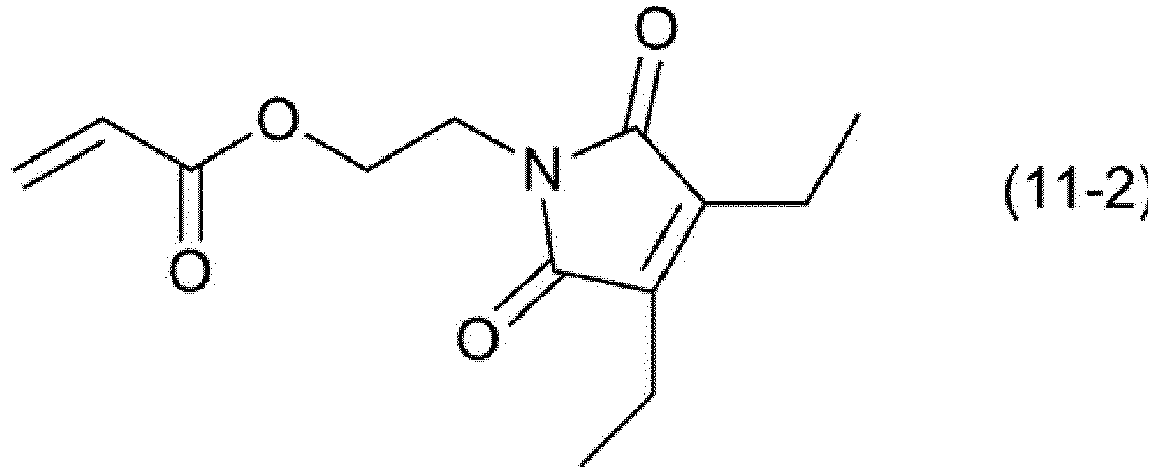


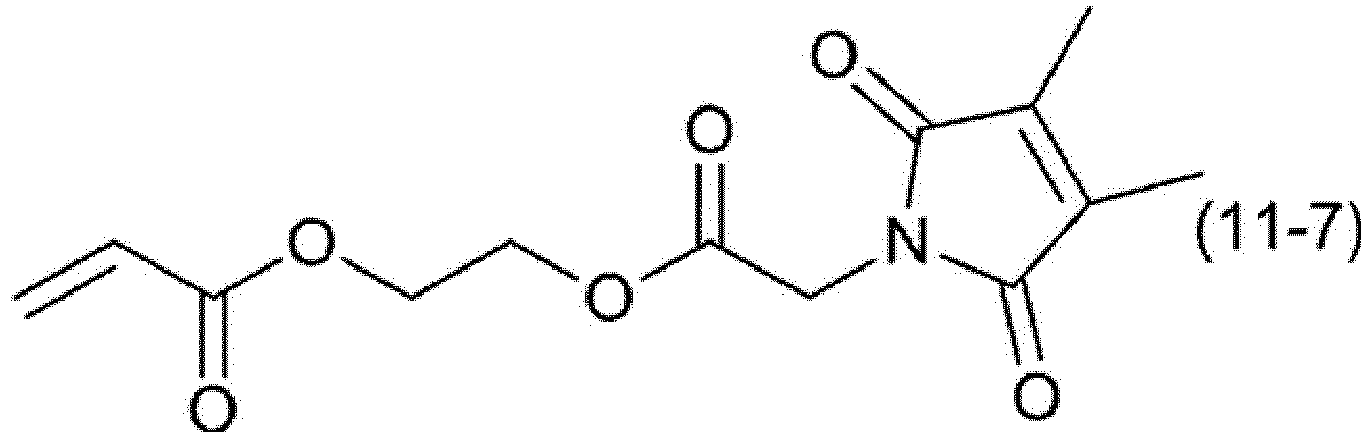


- When the (component A) is a polymer compound having a weight average molecular weight of more than 5,000, the (component A) is preferably a polymer formed by polymerizing a compound represented by Formula (11), and the (component A) may be either a homopolymer or a copolymer formed with a compound other than Formula (11). In addition, the polymer may have a linear shape, a branched shape, or a block structure. When the (component A) is a copolymer formed with a compound other than Formula (11), examples of other compound include well-known monomers such as acrylic acid esters, methacrylic acid esters, acrylamides, methacrylamides, vinyl esters, styrenes, acrylonitrile, maleic anhydride, and maleic acid imide.
- Examples of acrylic acid esters include methyl acrylate, ethyl acrylate, (n- or i-)propyl acrylate, n-butyl acrylate, isobutyl acrylate, sec-butyl acrylate, t-butyl acrylate, amyl acrylate, 2-ethylhexyl acrylate, dodecyl acrylate, chloroethyl acrylate, 2-hydroxyethyl acrylate, 2-hydroxypropyl acrylate, 5-hydroxypentyl acrylate, cyclohexyl acrylate, allyl acrylate, trimethylol propane monoacrylate, pentaerythritol monoacrylate, glycidyl acrylate, benzyl acrylate, methoxybenzyl acrylate, chlorobenzyl acrylate, 2-(p-hydroxyphenyl)ethyl acrylate, furfuryl acrylate, tetrahydrofurfuryl acrylate, phenyl acrylate, chlorophenyl acrylate, and sulfamoylphenyl acrylate.
- Examples of methacrylic acid esters include methyl methacrylate, ethyl methacrylate, (n- or i-)propyl methacrylate, n-butyl methacrylate, isobutyl methacrylate, sec-butyl methacrylate, t-butyl methacrylate, amyl methacrylate, 2-ethylhexyl methacrylate, dodecyl methacrylate, chloroethyl methacrylate, 2-hydroxyethyl methacrylate, 2-hydroxypropyl methacrylate, 5-hydroxypentyl methacrylate, cyclohexyl methacrylate, allyl methacrylate, trimethylol propane monomethacrylate, pentaerythritol monomethacrylate, glycidyl methacrylate, methoxybenzyl methacrylate, chlorobenzyl methacrylate, 2-(p-hydroxyphenyl)ethyl methacrylate, furfuryl methacrylate, tetrahydrofurfuryl methacrylate, phenyl methacrylate, chlorophenyl methacrylate, and sulfamoylphenyl methacrylate.
- Examples of acrylamides include acrylamide, N-methyl acrylamide, N-ethyl acrylamide, N-propyl acrylamide, N-butyl acrylamide, N-benzyl acrylamide, N-hydroxyethyl acrylamide, N-phenyl acrylamide, N-tolyl acrylamide, N-(p-hydroxyphenyl)acrylamide, N-(sulfamoylphenyl)acrylamide, N-(phenylsulfonyl)acrylamide, N-(tolylsulfonyl)acrylamide, N,N-dimethyl acrylamide, N-methyl-N-phenyl acrylamide, and N-hydroxyethyl-N-methyl acrylamide.
- Examples of methacrylamides include methacrylamide, N-methyl methacrylamide, N-ethyl methacrylamide, N-propyl methacrylamide, N-butyl methacrylamide, N-benzyl methacrylamide, N-hydroxyethyl methacrylamide, N-phenyl methacrylamide, N-tolyl methacrylamide, N-(p-hydroxyphenyl)methacrylamide, N-(sulfamoylphenyl)methacrylamide, N-(phenylsulfonyl)methacrylamide, N-(tolylsulfonyl)methacrylamide, N,N-dimethyl methacrylamide, N-methyl-N-phenyl methacrylamide, and N-hydroxyethyl-N-methyl methacrylamide.
- Examples of vinyl esters include vinyl acetate, vinyl butyrate, and vinyl benzoate.
- Examples of styrenes include styrene, methyl styrene, dimethyl styrene, trimethyl styrene, ethyl styrene, propyl styrene, cyclohexyl styrene, chloromethyl styrene, trifluoromethyl styrene, ethoxymethyl styrene, acetoxymethyl styrene, methoxy styrene, dimethoxy styrene, chloro styrene, dichloro styrene, bromo styrene, iodo styrene, fluoro styrene, and carboxy styrene.
- Of those monomers, when the (component A) is a copolymer, it is preferable to form a copolymer with acrylic acid esters, methacrylic acid esters, vinyl esters, styrenes, or acrylonitrile.
- When the (component A) is a polymer compound having a weight average molecular weight of more than 5,000, the (component A) is particularly preferably a polymer including a repeating unit represented by the following Formula (1a).

- In Formula (1a), Ra, Rb, and Rc have the same definitions as those exemplified for Ra, Rb, and Rc in Formula (1) described above (including the preferred range), respectively.
- In Formula (1a), X and Z have the same definitions as those exemplified with X and Z in Formula (11) described above (including the preferred range), respectively.
- When the (component A) includes the repeating unit represented by Formula (1a), preferred examples of the (component A) include a polymer including the following repeating units (1a-1) to (1a-13), but the invention is not limited to these.


- Preferred examples the (component A) in the invention in a case of the (component A) is a polymer include the following polymers.
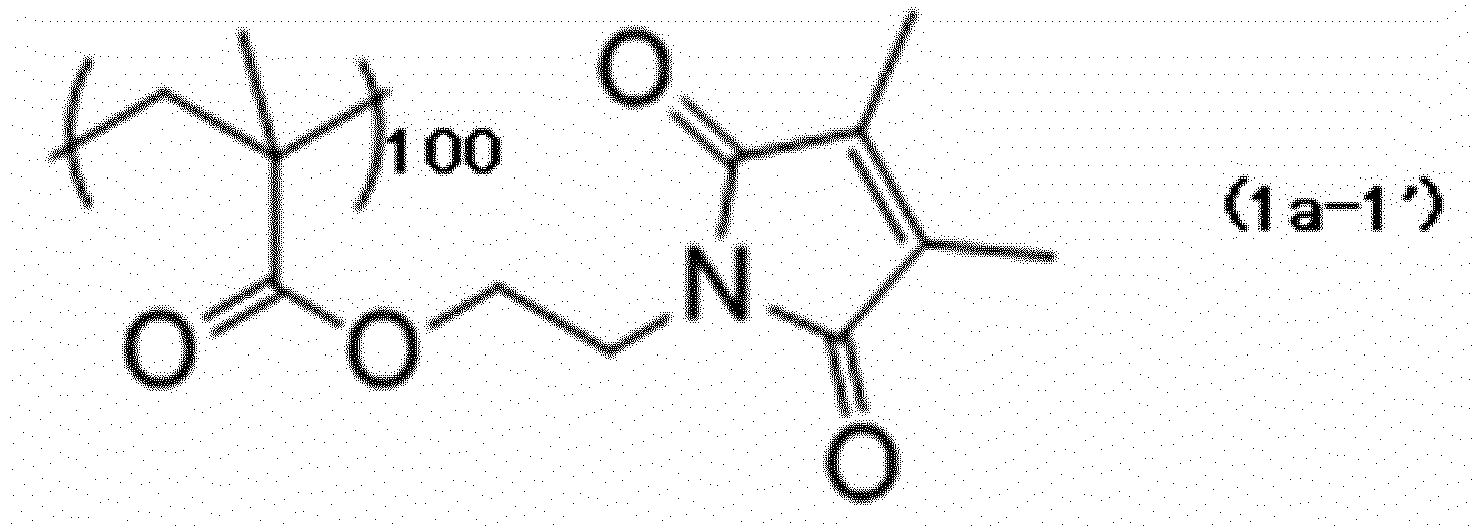


- The content of the (component A) in the ink composition of the invention is preferably from 0.1 to 20% by mass, more preferably from 1 to 15% by mass, and particularly preferably from 2 to 12% by mass, with respect to the ink composition.
- The ink composition of the invention includes (component B1) a monofunctional polymerizable compound as an essential component. The monofunctional polymerizable compound used in the ink composition of the invention is not particularly limited as long as it is a polymerizable compound having one polymerizable group.
- The monofunctional polymerizable compound used in the ink composition of the invention may be either a radical-polymerizable compound or a cationic polymerizable compound. However, a radical-polymerizable compound is preferable, and examples thereof include a radical-polymerizable compound having an ethylenically unsaturated bond. More specifically, it is enough that a compound includes, in a molecule thereof, at least one ethylenically unsaturated bond that is radically polymerizable.
- Examples of the monofunctional polymerizable compound having an ethylenically unsaturated bond that is radically polymerizable include unsaturated carboxylic acids such as acrylic acid, methacrylic acid, itaconic acid, crotonic acid, isocrotonic acid, and maleic acid, unsaturated carboxylic acid esters and salts thereof; anhydrides having an ethylenically unsaturated group; acrylonitrile; and styrene.
- Further examples thereof include macromonomers such as various unsaturated polyesters, unsaturated polyethers, unsaturated polyamides, and unsaturated polyurethanes.
- Preferred examples of the monofunctional compound include a (meth)acrylate compound such as 2-hydroxyethyl acrylate, butoxyethyl acrylate, carbitol acrylate, cyclohexyl acrylate, tetrahydrofurfuryl acrylate, benzyl acrylate, tridecyl acrylate, 2-phenoxyethyl acrylate, N-methylol acrylamide, diacetone acrylamide, epoxyacrylate, isobornyl acrylate, dicyclopentenyl acrylate, dicyclopentenyloxyethyl acrylate, dicyclopentanyl acrylate, 2-hydroxy-3-phenoxypropyl acrylate, 2-acryloyloxyethylphthalic acid, methoxy-polyethylene glycol acrylate, 2-acryloyloxyethyl-2-hydroxyethylphthalic acid, cyclic trimethylol propane formal acrylate, 2-(2-ethoxyethoxy)ethyl acrylate, 2-methoxyethyl acrylate, 3-methoxybutyl acrylate, ethoxylated phenyl acrylate, 2-acryloyloxyethyl succinic acid, nonylphenol EO adduct acrylate, phenoxy-polyethylene glycol acrylate, 2-acryloyloxyethylhexahydrophthalic acid, lactone modified acrylate, stearyl acrylate, isoamyl acrylate, isomyristyl acrylate, isostearyl acrylate, or lactone modified acrylate;
a methacrylate compound such as methyl methacrylate, n-butyl methacrylate, allyl methacrylate, glycidyl methacrylate, benzyl methacrylate, or dimethylaminomethyl methacrylate;
an allyl compound such as allylglycidyl ether; and
a (meth)acrylamide compound such as (meth)acrylamide, N-methyl (meth)acrylamide, N-ethyl (meth)acrylamide, N-propyl (meth)acrylamide, N-isopropyl (meth)acrylamide, N-butyl (meth)acrylamide, N-sec-butyl (meth)acrylamide, N-tert-butyl (meth)acrylamide, N-cyclohexyl (meth)acrylamide, N-phenyl (meth)acrylamide, N,N-dimethyl (meth)acrylamide, 1-(meth)acryloylpyrrolidine, N-methylol (meth)acrylamide, N-methoxyethyl (meth)acrylamide, N-2-hydroxyethyl (meth)acrylamide, N-[3-dimethylaminopropyl](meth)acrylamide, N-1,1-dimethyl-3-oxobutyl (meth)acrylamide, or 4-acryloyl morpholine. - Furthermore, preferred examples thereof also include a monofunctional vinyl ether compound. Specific examples of the monofunctional vinyl ether compound include methyl vinyl ether, ethyl vinyl ether, n-propyl vinyl ether, isopropyl vinyl ether, n-butyl vinyl ether, isobutyl vinyl ether, t-butyl vinyl ether, n-octadecyl vinyl ether, 2-ethylhexyl vinyl ether, n-nonyl vinyl ether, dodecyl vinyl ether, octadecyl vinyl ether, cyclohexyl vinyl ether, cyclohexylmethyl vinyl ether, 4-methylcyclohexylmethyl vinyl ether, benzyl vinyl ether, dicyclopentenyl vinyl ether, 2-dicyclopentenoxyethyl vinyl ether, methoxyethyl vinyl ether, ethoxyethyl vinyl ether, butoxyethyl vinyl ether, methoxyethoxyethyl vinyl ether, ethoxyethoxyethyl vinyl ether, methoxypolyethylene glycol vinyl ether, tetrahydrofurfuryl vinyl ether, 2-hydroxyethyl vinyl ether, 2-hydroxypropyl vinyl ether, 4-hydroxybutyl vinyl ether, 4-hydroxymethyl cyclohexylmethyl vinyl ether, diethylene glycol monovinyl ether, polyethylene glycol vinyl ether, chloroethyl vinyl ether, chlorobutyl vinyl ether, chloroethoxyethyl vinyl ether, phenylethyl vinyl ether, phenoxypolyethylene glycol vinyl ether, cyclohexane dimethanol monovinyl ether, and isopropenyl ether-O-propylene carbonate.
- Furthermore, preferred examples thereof also include an N-vinyl compound such as N-vinyl lactams or N-vinyl formamide. Preferred examples of the N-vinyl compound are represented by the following formula.

- In the above formula, m represents an integer of from 1 to 5 and m is preferably an integer of from 2 to 4, m is more preferably 2 or 4, and it is particularly preferablethat m is 4, namely, m is N-vinyl caprolactam.
- Of those described above, the monofunctional polymerizable compound in the invention is preferably an N-vinyl compound.
- In the invention, a molecular weight of the (component B1) monofunctional polymerizable compound is preferably from 130 to 3000, and more preferably from 130 to 500.
- The content of the (component B1) monofunctional polymerizable compound in the ink composition of the invention is preferably from 5% by mass to 90% by mass, more preferably from 20% by mass to 85% by mass, and particularly preferably from 35% by mass to 80% by mass, with respect to the ink composition.
- It is preferable that the ink composition of the invention further includes a polyfunctional polymerizable compound. The polyfunctional polymerizable compound which may be used in the ink composition of the invention is not particularly limited as long as it is a polymerizable compound having at least two polymerizable groups.
- Examples of the radically polymerizable-polyfunctional compound include an acrylate compound such as bis(4-acryloxypolyethoxyphenyl)propane, tripropylene glycol diacrylate, polyethylene glycol diacrylate, polypropylene glycol diacrylate, dipentaerythritol tetraacrylate, trimethylol propane (PO modified) triacrylate, oligoester acrylate, hydroxypivalic acid neopentyl glycol diacrylate, tetramethylol methane triacrylate, dimethylol tricyclodecane diacrylate, modified glycerin triacrylate, bisphenol A diglycidyl ether acrylic acid adduct, modified bisphenol A diacrylate, PO adduct diacrylate of bisphenol A, EO adduct diacrylate of bisphenol A, dipentaerythritol hexaacrylate, propylene glycol diglycidyl ether acrylic acid adduct, or ditrimethylol propane tetraacrylate; and
- a methacrylate compound such as polyethylene glycol dimethacrylate or polypropylene glycol dimethacrylate 2,2-bis(4-methacryloxypolyethoxyphenyl)propane.
- Further, examples thereof also include an allyl compound such as diallyl phthalate or triallyl trimellitate.
- PO represents propylene oxide and EO represents ethylene oxide.
- Examples thereof also include polyfunctional vinyl ether. Examples of the polyfunctional vinyl ether include divinyl ethers such as ethylene glycol divinyl ether, diethylene glycol divinyl ether, triethylene glycol divinyl ether, polyethylene glycol divinyl ether, propylene glycol divinyl ether, dipropylene glycol divinyl ether, butylene glycol divinyl ether, butanediol divinyl ether, hexanediol divinyl ether, cyclohexane dimethanol divinyl ether, bisphenol A alkylene oxide divinyl ether, and bisphenol F alkylene oxide divinyl ether; and
polyfunctional vinyl ethers such as trimethylol ethane trivinyl ether, trimethylol propane trivinyl ether, ditrimethylol propane tetravinyl ether, glycerin trivinyl ether, pentaerythritol tetravinyl ether, dipentaerythritol pentavinyl ether, dipentaerythritol hexavinyl ether, ethylene oxide added trimethylol propane trivinyl ether, propylene oxide added trimethylol propane trivinyl ether, ethylene oxide added ditrimethylol propane tetravinyl ether, propylene oxide added ditrimethylol propane tetravinyl ether, ethylene oxide added pentaerythritol tetravinyl ether, propylene oxide added pentaerythritol tetravinyl ether, ethylene oxide added dipentaerythritol hexavinyl ether, and propylene oxide added dipentaerythritol hexavinyl ether. - Further, as a polyfunctional polymerizable compound that is radically polymerizable, active energy ray-curable polymerizable compounds that are used in the polymerizable compound described in publications of
JP-A No. 7-159983 7-31399 JP-A No. 8-224982 JP-A No. 10-863 JP-A No. 9-134011 2004-514014 - A molecular weight of the polyfunctional polymerizable compound is preferably from 130 to 3000, and more preferably from 130 to 500.
- The content of the polyfunctional polymerizable compound in the ink composition is preferably 75% by mass or less, more preferably from 0.1 % by mass to 60% by mass, and particularly preferably from 0.5% by mass to 50% by mass, with respect to the ink composition.
- A total content of the (component B1) and the (component B2), which may be included if required, in the ink composition of the invention is preferably from 50% by mass to 90% by mass, more preferably from 60% by mass to 85% by mass, and particularly preferably from 65% by mass to 80% by mass, with respect to the ink composition.
- The content of the (component B1) the monofunctional polymerizable compound with respect to all polymerizable compounds in the ink composition of the invention (a total content of the (component B1) the monofunctional polymerizable compound and the (component B2) polyfunctional polymerizable compound, which may be included if required) is preferably from 50 to 99.5% by mass, more preferably from 55 to 98% by mass, and particularly preferably from 60 to 95% by mass.
- The ink composition for inkjet recording according to the invention includes (component C) a coloring material.
- The coloring material which may be used in the invention is preferably a coloring material that is formed from an organic pigment.
- As the organic pigment which may be used in the invention, for example, the organic pigments of the following numbers that are described in Color Index may be used.
- Examples of a red or magenta pigment include Pigment Red 3, 5, 19, 22, 31, 38, 43, 48:1, 48:2, 48:3, 48:4, 48:5, 49:1, 53:1, 57:1, 57:2, 58:4, 63:1, 81, 81:1, 81:2, 81:3, 81:4, 88, 104, 108, 112, 122, 123, 144, 146, 149, 166, 168, 169, 170, 177, 178, 179, 184, 185, 208, 216, 226, and 257, Pigment Violet 3, 19, 23, 29, 30, 37, 50, and 88, and Pigment Orange 13, 16, 20, and 36.
- Examples of a blue or cyan pigment include Pigment Blue 1, 15, 15:1, 15:2, 15:3, 15:4, 15:6, 16, 17-1, 22, 27, 28, 29, 36, and 60.
- Examples of a green pigment include Pigment Green 7, 26, 36, and 50.
- Examples of a yellow pigment include Pigment Yellow 1, 3, 12, 13, 14, 17, 34, 35, 37, 55, 74, 81, 83, 93, 94, 95, 97, 108, 109, 110, 120, 137, 138, 139, 153, 154, 155, 157, 166, 167, 168, 180, 185, 193, and 213.
- Examples of a black pigment include Pigment Black 7, 28, and 26.
- The pigments may be appropriately selected and used depending on the purpose.
- The coloring material which may be used in the invention is preferably subjected to a dispersion treatment after added into the ink composition of the invention such that the coloring material is suitably dispersed in the corresponding ink. For dispersing the coloring material that is formed from an organic pigment, various dispersers such as a ball mill, a sand mill, an attritor, a roll mill, an agitator, a Henschel mixer, a colloid mill, an ultrasonic homogenizer, a pearl mill, a wet jet mill, and a paint shaker can be used, for example.
- Further, it is also possible to add a dispersant when dispersing an organic pigment. Although types of the dispersant are not particularly limited, it is preferable to use a polymer dispersant. Examples of the polymer dispersant include SOLSPERSE series manufactured by Noveon and AJISPER series manufactured by Ajinomoto Fine-Techno Co., Inc. As a dispersion aid, a synergist may be used according to the type of pigment. In the invention, the dispersant and dispersion aid are added preferably in an amount of from 1 to 50 parts by mass with respect to 100 parts by mass of the coloring material.
- The coloring material that is formed from an organic pigment may be mixed by direct addition together with each component when the ink composition of the invention is prepared. However,for improving a dispersion property, the coloring material that is formed frm an organic pigment is added in advance to a dispersion medium such as a solvent, a specific heterocyclic compound in the invention, or other polymerizable compound which may be used in combination if necessary, dispersed or dissolved homogeneously, and then mixed.
- One type or two or more types of the coloring material that is formed from an organic pigment may be suitably selected and used depending on purpose of use of the ink composition.
- When a coloring material such as pigment, which is present in a solid state, is used in the ink composition of the invention, the coloring material, dispersant, and dispersion medium are selected and dispersion condition and filtration condition are set such that the average particle diameter of the coloring material particles is preferably from 0.005 to 0.5 µm, more preferably from 0.01 to 0.45 µm, and still more preferably from 0.015 to 0.4 µm.
- The content of the coloring material that is formed from an organic pigment in the ink composition of the invention is suitably selected depending of purpose of use of the ink composition. However, considering physical properties and coloring property of the composition, generally, it is preferably from 0.5 to 10% by mass, and more preferably from 1 to 8% by mass, with respect to the total mass of the ink composition.
- In addition to the essential components described above, the ink composition of the invention may also include other components for improving physical properties or the like within the range that the effect of the invention is not adversely affected.
- Hereinbelow, these optional components are described.
- The ink composition of the invention may include a polymerization inhibitor when necessary, although it is not necessarily required to include a polymerization initiator in addition to the essential components described above. The polymerization initiator can be any one of a thermal polymerization initiator and a photopolymerization initiator. However, a photopolymerization initiator is preferable.
- As for the photopolymerization initiator, a known photopolymerization initiator may be suitably selected and used, depending on the type of a polymerizable compound used in combination and purpose of use of the ink composition.
- The photopolymerization initiator used in the ink composition of the invention is a compound which absorbs external energy (light) and generates a polymerization initiating species. As the photopolymerization initiator, a known compound can be used. In the photopolymerization initiator, the light for initiating polymerization indicates active energy ray, that is, y ray, β ray, electronic beam, ultraviolet ray, visible ray, and infrared ray, and preferably ultraviolet ray.
- Examples of the photopolymerization initiator which may be preferably used in the invention include aromatic ketones, acyl phosphine oxide compounds, aromatic onium salt compound, organic peroxides, thio compounds, hexaaryl biimidazole compounds, ketooxime ester compounds, borate compounds, azinium compounds, metallocene compounds, active ester compounds, compounds having a carbon-halogen bond, and alkylamine compounds.
- In the invention, when a photopolymerization initiator is used, the photopolymerization initiator may be used singly or two or more thereof may be used in combination. From the viewpoint of the effect, it is preferable to use two or more radical polymerization initiators in combination. From the viewpoint of curability of the ink composition, aromatic ketones and acyl phosphine oxide compounds are preferable, as a photopolymerization initiator. In addition, when two or more photopolymerization initiators are used in combination, for example, preferred examples of the combination include a combination of aromatic ketones and acyl phosphine oxide compounds.
- In the invention, the content of the photopolymerization initiator is preferably 5% by mass or less, more preferably 3% by mass or less, and still more preferably 1% by mass or less, with respect to the total mass of the ink composition.
- A sensitizing pigment may be added to the ink composition of the invention, for a purpose of promoting a photoreaction by irradiation of active energy ray. The sensitizing pigment absorbs specific active energy ray to be in an electronically- excited state. The sensitizing pigment which is in an electronically-excited state contacts the polymerization initiator to cause an action such as an energy transfer or the like, as a result of which, a photoreaction is promoted.
- Preferred examples of the sensitizing pigment include those that belong to the following compounds and that have an absorption wavelength in a region of from 350 nm to 450 nm.
- Examples thereof include polynuclear aromatics (for example, anthracene, pyrene, perylene, and triphenylene), thioxantones (for example, isopropyl thioxantones), xanthenes (for example, fluorescein, eosin, erythrosin, rhodamine B, and rose bengal), cyanines (for example, thiacarbocyanine and oxacarbocyanine), merocyanines (for example, merocyanine and carbomerocyanine), thiazines (for example, thionine, methylene blue, and toluidine blue), acridines (for example, acridine orange, chloroflavine, and acriflavine), anthraquinones (for example, anthraquinone), squaryliums (for example, squarylium), and coumarins (for example, 7-diethylamino-4-methyl coumarin), and preferred examples thereof include thioxantones and merocyanines.
- The ink composition of the invention may also include a co-sensitizer. In the invention, the co-sensitizer has a function that sensitivity of a sensitizing pigment to active energy ray is further improved, the polymerization inhibition of a polymerizable compound by oxygen is suppressed, or the like.
- Examples of the co-sensitizer include amines, for example, compounds such as those described in "Journal of Polymer Science" vol. 10, p 3173 (1972), written by M. R. Sander et al.,
JP-B No. 44-20189 JP-A No. 51-82102 JP-A No. 52-134692 JP-A No. 59-138205 JP-A No. 60-84305 JP-A No. 62-18537 JP-A No. 64-33104 - Other examples of the co-sensitizer include thiols and sulfides, such as thiol compounds as those described in
JP-A No. 53-702 JP-B No. 55-500806 JP-A No. 5-142772 JP-A No. 56-75643 - Further, other examples of the co-sensitizer include amino acid compounds (such as N-phenyl glycine), organic metal compounds as those described in
JP-B No. 48-42965 JP-B No. 55-34414 JP-A No. 6-308727 JP-A No. 6-250387 JP-A No. 8-65779 - The ink composition of the invention may further include other various components, if necessary. Examples of other various components include a polymerization inhibitor and a solvent.
- The polymerization inhibitor may be added from the viewpoint of increasing the preservability. Moreover, the ink composition of the invention is preferably heated within a range of from 40 to 60°C, the viscosity is reduced, and then the ink composition of the invention is jetted, and a polymerization inhibitor is preferably added in order to prevent clogging of the head due to the thermal polymerization. It is preferred that the polymerization inhibitor is added in an amount of from 200 to 20,000 ppm with respect to the total amount of the ink composition of the invention. Examples of the polymerization inhibitor include hydroquinone, benzoquinone, p-methoxyphenol, TEMPO, TEMPOL, and N-nitrosophenylhydroxylamine salt represented by cupferron Al.
- The ink composition of the invention may include a solvent, if necessary. Examples of the solvent which may be used in the invention include an organic solvent and water. Preferable examples of the preferably used solvent include propylene carbonate, dimethyl succinate, dimethyl glutarate, dimethyl adipate and mixtures thereof.
- Amount of the organic solvent is, for example, within a range of from 0.1 to 5% by mass, and preferably from 0.1 to 3% by mass, with respect to the total amount of the ink composition of the invention.
- In addition to those described above, a known compound may be added to the ink composition of the invention, if necessary. For example, a surfactant, a leveling addition agent, a matting agent; and a polyester resin, a polyurethane resin, a vinyl resin, an acrylic resin, a rubber resin, and waxes for adjusting the physical property of a film, and an antifoaming agent may be suitably selected and added. Furthermore, it is also preferable that a tackifier which does not inhibit the polymerization is added to improve the adhesiveness onto the recording medium such as polyolefin or PET. Specific examples thereof include tacky polymers having a high molecular weight described in
JP-A No. 2001-49200 - The present inventors have found that the effect of the invention is obtained by the ink composition of the invention which includs the (component A), the (component B1), and the (component C) described above. Although the mechanism is not indentified, the present inventors assumed as follows.
- That is, it is thought that the (component A) promotes curing of the composition as a cross-linking compound at the same time as the (component A) functions as an initiator, and thus uniformity of the composition after curing is improved and the blocking resistance is improved. Further, it is thought that, by having a substituent group such as an alkyl group or the like on a reactive double bond of the maleimide structure represented by Formula (1), the curing property is suitably controlled during jetting of the ink composition so that physical properties of the cured film is improved, and thus the blocking resistance and jetting property are improved accordingly. However, the mechanisms described above are only an assumption, and the invention is not limited to these.
- Preferred physical properties of the ink composition of the invention are described.
- The viscosity of the ink composition of the invention at a temperature when jetting (for example, from 20 to 60°C, and preferably from 25 to 50°C) is preferably from 5 to 30 mPa·s, and more preferably from 7 to 25 mPa·s, in view of the jetting property. For example, the viscosity of the ink composition of the invention at a room temperature (for example, from 25 to 30°C) is preferably from 6 to 30 mPa·s, and more preferably from 8 to 25 mPa·s. The viscosity of the ink composition is measured, for example, under the condition at 25°C using VISCOMETER TV-22 (manufactured by TOKI SANGYO Co., Ltd.).
- It is preferable that a compositional ratio of the ink composition of the invention is suitably adjusted such that the viscosity of the ink composition is within the above range.
- By setting the viscosity high at room temperature, ink permeation into a recording medium is avoided even when a porous recording medium is used, and thus uncured monomer can be reduced and malodor can be suppressed. In addition, as ink bleeding at the time of jetting of liquid ink droplets is prevented, as a result of which, the image quality is improved.
- Surface tension of the ink composition of the invention at 25°C is preferably from 17 to 35 mN/m, and more preferably from 20 to 32 mN/m. When recording is performed on various recording media such as polyolefin, PET, coated paper, and non-coated paper, the surface tension is preferably 20 mN/m or more from the viewpoint of bleeding and permeation, and preferably 32 mN/m or less from the viewpoint of wettability. The surface tension is measured under the condition at 25°C using AUTOMATIC SURFACE TENSIOMETER CBVP-Z (manufactured by Kyowa Interface Science Co., Ltd.), for example.
- The image forming method of the invention includes an ink application process of applying the ink composition onto a recording medium, and an irradiation process of irradiating the applied ink composition with an active energy ray.
- Hereinbelow, the ink application process in the image forming method in the invention is further described. The ink application process in the invention is not particularly limited as long as it is a process in which the ink composition is applied onto a recording medium.
- An inkjet recording device used for the image forming method of the invention is not particularly limited, and a known inkjet recording device which can achieve the intended resolution may be arbitraily selected and used. That is, as long as the inkjet recording device is any known inkjet recording device including commercially avairable products, the application of the ink composition onto a recording medium in the image forming method of the invention can be performed.
- Examples of the inkjet recording device that can be used in the invention include a device having an ink supply system, a temperature sensor, and a heating part.
- The ink supply system includes, for example, a main tank containing the ink composition of the invention, a supply tube, an ink supply tank immediately before an inkjet head, a filter, and a piezo type inkjet head. The piezo type inkjet head may be operated such that the piezo type inkjet head jets multiplesiz dots of preferably from 1 to 100 pl, and more preferably from 8 to 30 pl, with a resolution of preferably from 320 x 320 to 4,000 x 4,000 dpi, more preferably from 400 x 400 to 1,600 xx 1,600 dpi, and even more preferably 720 x 720 dpi. The dpi referred herein means the number of dots per 2.54 cm.
- The ink composition of the invention to be jetted preferably has a constant temperature. Therefore, the inkjet recording device preferably includes a part for stabilizing the temperature of the ink composition. A section to be controlled to have a constant temperature includes all of the tubes and the members, from an ink tank (an intermediate tank, if any) to a nozzle jetting face. That is, the section from the ink supply tank to the inkjet head may be insulated and heated.
- The method for controlling temperature is not particularly limited. However, for example, it is preferred that plural temperature sensors be placed on respective tube parts, and controlling of heating is performed according to the flow rate of the ink composition and the environmental temperature. The temperature sensor can be placed near the ink supply tank and the inkjet head nozzle. The head unit to be heated is preferably thermally blocked or insulated such that the device itself is not influenced by the temperature of the external air. In order to reduce the time for starting up the printer required for heating, or reduce the loss of thermal energy, it is preferred that the head unit be thermally insulated from other units, and the heat capacity of the entire heating unit be reduced.
- The temperature of the ink composition at jetting is preferably constant. The control range of the temperature of the ink composition is preferably ±5°C of the set temperature, more preferably ±2°C of the set temperature, and even more preferably ±1°C of the set temperature.
- In the invention, the recording medium is not particularly limited, and a known recording medium as a support or a recording material may be used. Examples of the recording medium include paper, paper laminated with plastics (for example, polyethylene, polypropylene, and polystyrene), a metal plate (for example, aluminum, zinc, and copper), a plastic film (for example, polyvinyl chloride resin, cellulose diacetate, cellulose triacetate, cellulose propionate, cellulose butyrate, cellulose acetate butyrate, cellulose nitrate, polyethylene terephthalate, polyethylene, polystyrene, polypropylene, polycarbonate, and polyvinyl acetal), and paper or a plastic film, laminated with or deposited with any of the above-described metals. Since the ink composition of the invention has excellent adhesion, the ink composition of the invention can be preferable used for an unabsorbent recording medium as a recording medium, and among them, a plastic base material such as polyvinyl chloride, polyethylene terephthalate, or polyethylene is preferred, a polyvinyl chloride resin base material is more preferred, and a polyvinyl chloride resin sheet or film is even more preferred.
- Hereinbelow, the irradiation process in the image forming method of the invention is described. The irradiation process in the invention is not particularly limited as long as it is a process of irradiating the ink composition applied onto the above-described recording medium with an active energy ray.
- Examples of the active energy ray that may be used in the irradiation process include an ultraviolet ray (hereinafter, may be referred to as UV ray), visible light, and an electron beam, and UV ray is preferably used.
- The peak wavelength of the UV ray may vary depending on the absorption characteristics of the sensitizing pigment that is used as necessary, however, is preferably from 200 to 405 nm, more preferably from 250 to 405 nm, and even more preferably from 250 to 390 nm, for example.
- The output of the UV ray is preferably 2,000 mJ/cm2 or less, more preferably from 10 mJ/cm2 to 2,000 mJ/cm2, even more preferably from 20 mJ/cm2 to 1,000 mJ/cm2, and particularly preferably from 50 mJ/cm2 to 800 mJ/cm2.
- In addition, it is suitable that the UV ray is applied such that the irradiation of the exposed surface is from 10 mW/cm2 to 2,000 mW/cm2, and preferably from 20 mW/cm2 to 1,000 mW/cm2, for example.
- The UV ray source that is commonly used is a mercury lamp, a gas/solid laser, and the like, and a mercury lamp and a metal halide lamp are widely known. Substitution with a GaN semiconductor ultraviolet emitting device is industrially and environmentally very useful, and LEDs (UV-LEDs) and LDs (UV-LDs) are expected as UV ray sources, because they have a compact size, a long life, a high efficiency, and provide a low cost.
- It is suitable that the ink composition of the invention is irradiated with the UV ray for a period of, for example, from 0.01 seconds to 120 seconds, and preferably from 0.1 seconds to 90 seconds.
- The irradiation conditions and basic irradiation method are described in
JP-A No. 60-132767 - Hereinafter, the present invention is more specifically described with reference to examples, but the present invention is not limited to these examples. Unless specifically otherwise noted, "parts" are all based on "parts by mass."
- Components described below were stirred by a high-speed water cooling type agitator to obtain a magenta color-ink composition.
- (Magenta color-ink composition)
· compound (11-14) ((component A), structure shown below) 6.4 parts · monofunctional acrylate ((component B1), manufactured by Sartomer, SR531, (cyclic trimethylol propane formal acrylate)) 13 parts · monofunctional acrylate ((component B1), manufactured by Sartomer, SR339, (2-phenoxyethyl acrylate)) 34 parts · N-vinyl caprolactam 15.0 parts ((component B1), V-CAP, manufactured by ISP Japan) · bifunctional acrylate ((component B2), manufactured by Sartomer, SR9045, (alkoxylated neopentyl glycol diacrylate)) 20.7 parts · polyfunctional acrylate ((component B2), manufactured by Sartomer, SR399, (dipentaerythritol pentaacrylate)) 1 part · RAPI-CURE DVE-3 ((component B2), vinyl ether compound, manufactured by ISP Europe)) 4 parts · SOLSPERSE 32000 (dispersant, manufactured by Noveon) 1.2 parts · CINZUASIA MAZENTA RT-355D 3.6 parts ((component C), pigment, manufactured by BASF Japan) · FIRSTCURE ST-1 (polymerization inhibitor, manufactured by Chem First) 0.05 parts · DAROCUR ITX 1 part (sensitizing agent, manufactured by BASF Japan) · BYK 307 (antifoaming agent, manufactured by BYK Chemie) 0.05 parts 
- The obtained magenta color-ink composition was applied onto polyvinyl chloride sheet (AVERY (R) 400, manufactured by Avery Dennison Japan K.K.) as a recording medium using an inkjet recording device (LUXEL JET UV350GTW, manufactured by Fujifilm Corporation) having a piezo type inkjet head,at a quality mode without using an UV lamp to form a solid image. After jetting the ink composition, the composition was irradiated with light of a low-pressure mercury lamp (UVO-CLEANER MODEL 42, manufactured by JELIGHT COMPANY), thereby curing the ink and obtaining printed matter.
- Thereafter, the evaluation was made according to the following criteria. The obtained evaluation results are shown in the Table 1.
- An unprinted recording medium was prepared, and then the recording medium to which the ink composition was applied and the unprinted recording medium were superposed on each other. Breaking of a film on the printed surface or presence or absence of transfer to a base surface was evaluated at the time of peeling after a certain period of time.
- Further, as for the printed matter used for blocking test, those exposed with light exposure energy of about 2,000 mJ/cm2 were used. Further, storing the printed matter was performed for 48 hours (stored in an incubator at 45°C) in a condition in which even load (1.5 kg/cm2) of a weight was applied to entire printed matter in which the printed surface and the base surface was superposed on each other. After 48 hours, the printed surface and the base surface were detached from each other, and evaluation was made with the naked eye according to the following criteria.
- 3: There was no film breaking or the like on the printed surface and no ink transfer to the base surface.
- 2: Film breaking or internal film rupture was observed in part of the printed surface, or ink transfer was observed in part of the base surface (here, the term "part" means an area of less than 50% in the whole area)
- 1: Film breaking or internal film rupture was observed all over the printed surface, or ink transfer was observed all over the base surface (here, the term "part" means an area of 50% or more in the whole area)
- After the obtained ink composition was stored for 4 weeks at 45°C and for 1 week at -15°C, recording on a recording medium was performed using the inkjet recording device having a piezo type inkjet nozzle. Presence or absence of dot omission and ink scattering were observed with the naked eye after continuous printing for 1 hour at room temperature, and average value obtained by repeating the measurement for three times was evaluated according to the following criteria. The results are shown in the following Table 1. "A" and "B" are recognized as practically admissible level and "C" and "D" are recognized as practically problematic level.
- A: No occurrence of dot omission or ink scattering, or occurrence in less than 1 region.
- B: Occurrence of dot omission or ink scattering in 1 region or more but less than 2 regions.
- C: Occurrence of dot omission or ink scattering in 2 regions or more but less than 6 regions.
- D: Occurrence of dot omission or ink scattering in 6 or more regions.
- Components described below were stirred by a high speed water cooling type agitator to obtain a yellow color-ink composition.
- (Yellow color-ink composition)
· polymer (1a-2') ((component A), structure shown below) 5.9 parts · monofunctional acrylate ((component B1), manufactured by Sartomer, SR531) 22 parts · monofunctional acrylate ((component B1), manufactured by Sartomer, SR339) 41 parts · monofunctional acrylate ((component B1), manufactured by Sartomer, SR489) 21 parts · polyfunctional acrylate ((component B2), manufactured by Sartomer, SR399, (dipentaerythritol pentaacrylate)) 1.0 part · RAPI-CURE DVE-3 4.0 parts ((component B2), vinyl ether compound, manufactured by ISP Europe) · SOLSPERSE 32000 (dispersant, manufactured by Noveon) 0.4 parts · CROMOPHTAL YELLOW LA 3.6 parts ((component C), pigment, manufactured by BASF Japan) · FIRSTCURE ST-1 (polymerization inhibitor, manufactured by Chem First) 0.05 parts · DAROCUR ITX 1.0 part (sensitizing agent, manufactured by BASF Japan) · BYK 307 (antifoaming agent, manufactured by BYK Chemie) 0.05 parts 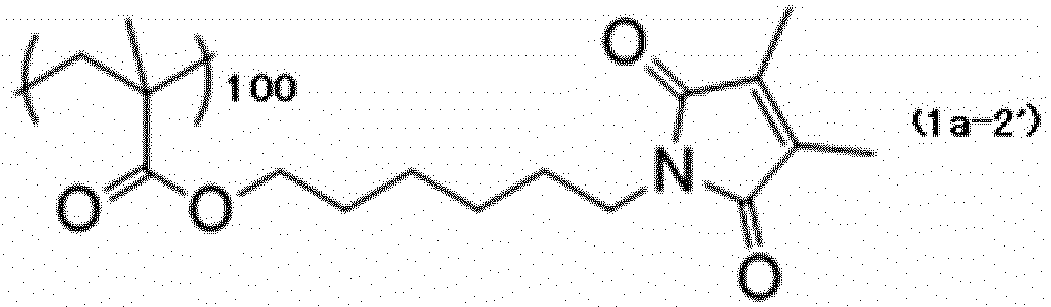
(weight average molecular weight: 18,000) - The obtained yellow color-ink composition of Example 2 was jetted to a polyvinyl chloride sheet and cured, in the same manner as in Example 1. Then, it was evaluated in the same manner as in Example 1. The results are shown in the Table 1.
- Components described below were stirred by a high speed water cooling type agitator to obtain a black color-ink composition.
- (Black color-ink composition)
· polymer (1a-2') (structure shown below) 6.3 parts (weight average molecular weight: 18,000, structure shown below) · monofunctional acrylate ((component B1), manufactured by Sartomer, SR531) 14 parts · N-vinyl caprolactam 15.0 parts ((component B1), V-CAP, manufactured by ISP Japan) · monofunctional acrylate ((component B1), manufactured by Sartomer, CD420) 39.0 parts · polyfunctional acrylate ((component B2), manufactured by Sartomer, SR9045) 18.6 parts · polyfunctional acrylate ((component B2), manufactured by Sartomer, SR399) 3 parts · SOLSPERSE 32000 (dispersant, manufactured by Noveon) 1.2 parts · MICROLITH BLACK C-K 2.6 parts ((component C), pigment, manufactured by BASF Japan) · FIRSTCURE ST-1 (polymerization inhibitor, manufactured by Chem First) 0.05 parts · DAROCUR ITX 0.2 parts (sensitizing agent, manufactured by BASF Japan) · BYK 307 (antifoaming agent, manufactured by BYK Chemie) 0.05 parts 
(weight average molecular weight: 18,000) - The obtained black color-ink composition of Example 3 was jetted to a polyvinyl chloride sheet and cured, in the same manner as in Example 1. Then, it was evaluated in the same manner as in Example 1. The results are shown in the Table 1.
- Components described below were stirred by a high speed water cooling type agitator to obtain a yellow color-ink composition.
- (Yellow color-ink composition)
· polymer (1a-2') 5.9 parts · monofunctional acrylate ((component B1), manufactured by Sartomer, SR531) 22 parts · monofunctional acrylate ((component B1), manufactured by Sartomer, SR339) 42 parts · monofunctional acrylate ((component B1), manufactured by Sartomer, SR489) 21 parts · polyfunctional acrylate ((component B2), manufactured by Sartomer, SR399) 1 part · RAPI-CURE DVE-3 4.0 parts ((component B2), vinyl ether compound, manufactured by ISP Europe) · SOLSPERSE 32000 (dispersant, manufactured by Noveon) 0.4 parts · CROMOPHTAL Yellow LA 3.6 parts ((component C), pigment, manufactured by BASF Japan) · FIRSTCURE ST-1 (polymerization inhibitor, manufactured by Chem First) 0.05 parts · BYK 307 (antifoaming agent, manufactured by BYK Chemie) 0.05 parts - The obtained yellow color-ink composition of Example 4 was jetted to a polyvinyl chloride sheet and cured, in the same manner as in Example 1. Then, it was evaluated in the same manner as in Example 1. The results are shown in the Table 1.
- Components described below were stirred by a high speed water cooling type agitator to obtain a yellow color-ink composition.
- (Yellow color-ink composition)
· polymer (1a-2') 2.0 parts · monofunctional acrylate ((component B1), manufactured by Sartomer, SR531) 26 parts · monofunctional acrylate ((component B1), manufactured by Sartomer, SR339) 42 parts · monofunctional acrylate ((component B1), manufactured by Sartomer, SR489) 21 parts · polyfunctional acrylate ((component B2), manufactured by Sartomer, SR399) 0.9 parts · RAPI-CURE DVE-3 4.0 parts ((component B2), vinyl ether compound, manufactured by ISP Europe) · SOLSPERSE 32000 (dispersant, manufactured by Noveon) 0.4 parts · CROMOPHTAL YELLOW LA 3.6 parts ((component C), pigment, manufactured by BASF Japan) · FIRSTCURE ST-1 (polymerization inhibitor, manufactured by Chem First) 0.05 parts · BYK 307 (antifoaming agent, manufactured by BYK Chemie) 0.05 parts - The obtained yellow color-ink composition of Example 5 was jetted to a polyvinyl chloride sheet and cured, in the same manner as in Example 1. Then, it was evaluated in the same manner as in Example 1. The results are shown in the Table 1.
- Components described below were stirred by a high speed water cooling type agitator to obtain a yellow color-ink composition.
- (Yellow color-ink composition)
· polymer (1a-2') 14.5 parts · monofunctional acrylate ((component B1), manufactured by Sartomer, SR531) 22 parts · monofunctional acrylate ((component B1), manufactured by Sartomer, SR339) 40 parts · monofunctional acrylate ((component B1), manufactured by Sartomer, SR489) 19.4 parts · SOLSPERSE 32000 (dispersant, manufactured by Noveon) 0.4 parts · CROMOPHTAL YELLOW LA 3.6 parts ((component C), pigment, manufactured by BASF Japan) · FIRSTCURE ST-1 (polymerization inhibitor, manufactured by Chem First) 0.05 parts · BYK 307 (antifoaming agent, manufactured by BYK Chemie) 0.05 parts - The obtained yellow color-ink composition of Example 6 was jetted to a polyvinyl chloride sheet and cured, in the same manner as in Example 1. Then, it was evaluated in the same manner as in Example 1. The results are shown in the Table 1.
- Components described below were stirred by a high speed water cooling type agitator to obtain a magenta color-ink composition.
- (Magenta color-ink composition)
· compound (11-9) ((component A), structure shown below) 6.4 parts · monofunctional acrylate ((component B1), manufactured by Sartomer, SR531) 13.0 parts · monofunctional acrylate ((component B1), manufactured by Sartomer, SR339) 34.0 parts · N-vinyl caprolactam 15.0 parts ((component B1), V-CAP, manufactured by ISP Japan) · bifunctional acrylate ((component B2), manufactured by Sartomer, SR9045, (alkoxylated neopentyl glycol diacrylate)) 20.7 parts · polyfunctional acrylate ((component B2), manufactured by Sartomer, SR399, (dipentaerythritol pentaacrylate)) 1.0 part · RAPI-CURE DVE-3 4.0 parts ((component B2), vinyl ether compound, manufactured by ISP Europe) · SOLSPERSE 32000 (dispersant, manufactured by Noveon) 1.2 parts · CINQUASIA MAZENTA RT-355D 3.6 parts ((component C), pigment, manufactured by BASF Japan) · FIRSTCURE ST-1 (polymerization inhibitor, manufactured by Chem First) 0.05 parts · DAROCUR ITX 1.0 part (sensitizing agent, manufactured by BASF Japan) · BYK 307 (antifoaming agent, manufactured by BYK Chemie) 0.05 parts 
- The obtained magenta color-ink composition of Example 7 was jetted to a polyvinyl chloride sheet and cured, in the same manner as in Example 1. Then, it was evaluated in the same manner as in Example 1. The results are shown in the Table 1.
- Components described below were stirred by a high speed water cooling type agitator to obtain a yellow color-ink composition.
- (Yellow color-ink composition)
· Comparative compound 1 (homopolymer of butyl methacrylate (structure shown below)) 5.9 parts (weight average molecular weight: 20,000) · monofunctional acrylate ((component B1), manufactured by Sartomer, SR531) 22.0 parts · monofunctional acrylate ((component B1), manufactured by Sartomer, SR339) 41.0 parts · monofunctional acrylate ((component B1), manufactured by Sartomer, CD420) 21.0 parts · polyfunctional acrylate ((component B2), manufactured by Sartomer, SR399) 1.0 part · RAPI-CURE DVE-3 4.0 parts ((component B2), vinyl ether compound, manufactured by ISP Europe) · SOLSPERSE 32000 (dispersant, manufactured by Noveon) 0.4 parts · CROMOPHTAL YELLOW LA 3.6 parts ((component C), pigment manufactured by BASF Japan) · FIRSTCURE ST-1 (polymerization inhibitor, manufactured by Chem First) 0.05 parts · DAROCUR ITX 1.0 part (sensitizing agent, manufactured by BASF Japan) ·BYK 307 (antifoaming agent, manufactured by BYK Chemie) 0.05 parts 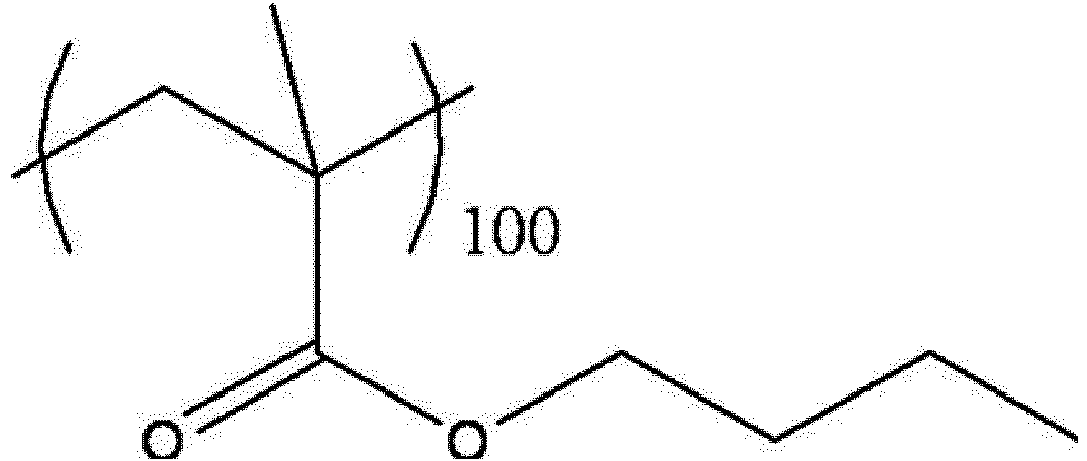
- The obtained yellow color-ink composition of Comparative example 1 was jetted to a polyvinyl chloride sheet and cured, in the same manner as in Example 1. Then, it was evaluated in the same manner as in Example 1. The results are shown in the Table 1.
- Components described below were stirred by a high speed water cooling type agitator to obtain a yellow color-ink composition.
- (Yellow color-ink composition)
· monofunctional acrylate ((component B1), manufactured by Sartomer, SR531) 22.0 parts · monofunctional acrylate ((component B1), manufactured by Sartomer, SR339) 41.0 parts · monofunctional acrylate ((component B1), manufactured by Sartomer, CD420) 21.0 parts · polyfunctional acrylate ((component B2), manufactured by Sartomer, SR399) 6.9 parts · RAPI-CURE DVE-3 4.0 parts ((component B2), vinyl ether compound, manufactured by ISP Europe) · SOLSPERSE 32000 (dispersant, manufactured by Noveon) 0.4 parts · CROMOPHTAL YELLOW LA 3.6 parts ((component C), pigment, manufactured by BASF Japan) · FIRSTCURE ST-1 (polymerization inhibitor, manufactured by Chem First) 0.05 parts · DAROCUR ITX (sensitizing agent, manufactured by BASF Japan) 1.0 part · BYK 307 (antifoaming agent, manufactured by BYK Chemie) 0.05 parts - The obtained yellow color-ink composition was jetted to a polyvinyl chloride sheet and cured, in the same manner as in Example 1. Then, it was evaluated in the same manner as in Example 1. The results are shown in the Table 1.
-
· 1,6-bismaleimide hexane (Comparative Compound 2, manufactured by Tokyo Chemical Industry Co., Ltd., structure shown below) 6.5 parts · monofunctional acrylate ((component B1), manufactured by Sartomer, SR531, (cyclic trimethylol propane formal acrylate)) 10.5 parts · monofunctional acrylate ((component B1), manufactured by Sartomer, SR339, (2-phenoxyethyl acrylate)) 36.5 parts · monofunctional acrylate ((component B1), manufactured by Sartomer, SR506, (isobornyl acrylate)) 23.7 parts · bifunctional acrylate ((component B2), manufactured by Sartomer, SR508, (dipropylene glycol diacrylate)) 4.0 parts · N-vinyl caprolactam 14.0 parts ((component B1), V-CAP, manufactured by ISP Japan) · SOLSPERSE 32000 (dispersant, manufactured by Noveon) 1.2 parts · IRGALITE BLUE GLVO 3.0 parts ((component C), pigment, manufactured by BASF Japan) · FIRSTCURE ST-1 (polymerization inhibitor, manufactured by Chem First) 0.05 parts · DAROCUR ITX 0.5 parts (sensitizing agent, manufactured by BASF Japan) · BYK 307 (antifoaming agent manufactured by BYK Chemie) 0.05 parts 
- The obtained blue color-ink composition was jetted to a polyvinyl chloride sheet and cured, in the same manner as in Example 1. Then, it was evaluated in the same manner as in Example 1. The results are shown in the Table 1.

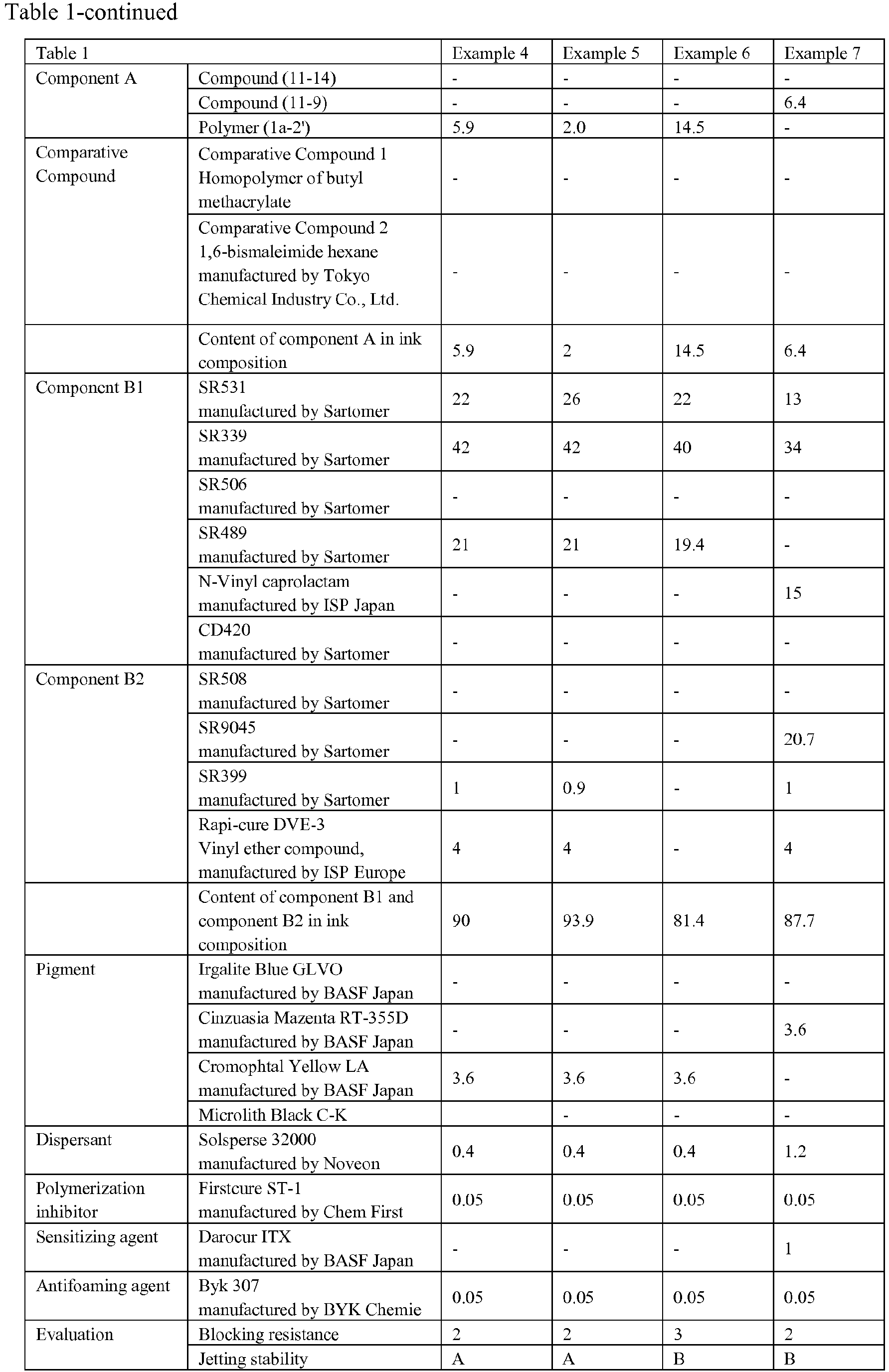


- Disclosure of Japanese Patent Application No.
2011-068835 - All publications, patent applications, and technical standards mentioned in this specification are herein incorporated by reference to the same extent as if each individual publication, patent application, or technical standard was specifically and individually indicated to be incorporated by reference.
Claims (15)
- An ink composition comprising:(component A) a compound having a group represented by the following Formula (1);(component B1) a monofunctional polymerizable compound; and(component C) a coloring material:

- The ink composition according to claim 1, further comprising (component B2) a polyfunctional polymerizable compound.
- The ink composition according to claim 2, wherein a total content of the (component B1) and the (component B2) in the ink composition is from 50% by mass to 90% by mass with respect to the ink composition.
- The ink composition according to claim 2 or 3, wherein a content of the (component B1) monofunctional polymerizable compound is from 50% by mass to 99.5% by mass with respect to a total content of the (component B1) monofunctional polymerizable compound and the (component B2) polyfunctional polymerizable compound.
- The ink composition according to any one of claims 1 to 4, wherein a content of the (component A) in the ink composition is from 0.1 % by mass to 20% by mass with respect to the ink composition.
- The ink composition according to claim 5, wherein a content of the (component A) in the ink composition is from 1% by mass to 15% by mass with respect to the ink composition.
- The ink composition according to any one of claims 1 to 6, wherein the (component A) is a compound represented by the following Formula (11):

- The ink composition according to claim 7, wherein X in Formula (11) is an alkylene group having 1 to 12 carbon atoms, an arylene group having 6 to 14 carbon atoms, or an aralkylene group having 7 to 20 carbon atoms.
- The ink composition according to any one of claims 1 to 6, wherein the (component A) is a polymer including a repeating unit represented by the following Formula (1a):
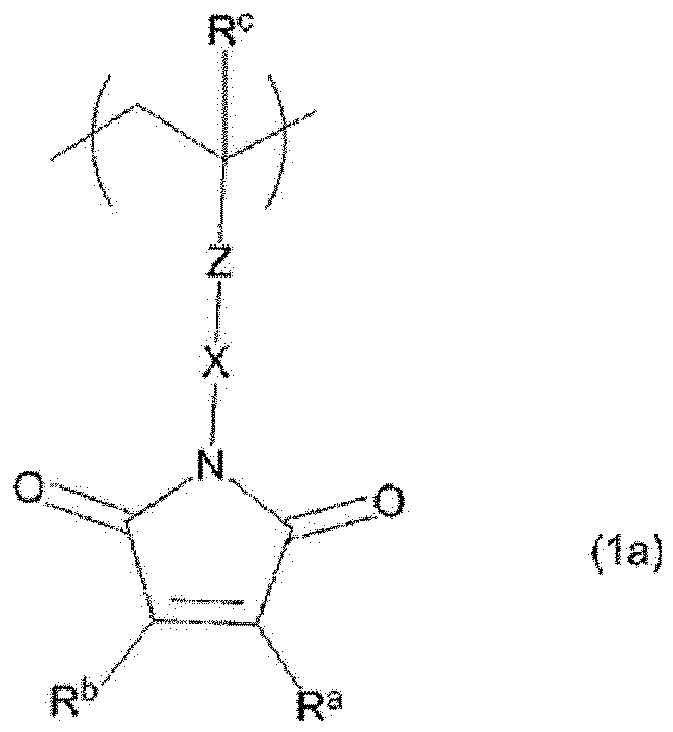
- The ink composition according to claim 9, wherein X in Formula (1a) is an alkylene group having 1 to 12 carbon atoms, an arylene group having 6 to 14 carbon atoms, or an aralkylene group having 7 to 20 carbon atoms.
- The ink composition according to any one of claims 1 to 10, comprising an N-vinyl compound as the (component B1) monofunctional polymerizable compound.
- The ink composition according to claim 11, wherein the N-vinyl compound is represented by the following Formula (V):

- The ink composition according to any one of claims 1 to 12, being an ink composition for inkjet recording.
- An image forming method comprising:an ink application process of applying the ink composition according to any one of claims 1 to 13 onto a recording medium; andan irradiation process of irradiating the applied ink composition with an active energy ray.
- The image forming method according to claim 14, wherein the process of applying the ink composition is performed according to an inkjet method.
Applications Claiming Priority (2)
| Application Number | Priority Date | Filing Date | Title |
|---|---|---|---|
| JP2011068835A JP2012201830A (en) | 2011-03-25 | 2011-03-25 | Ink composition and image forming method |
| PCT/JP2012/056593 WO2012132909A1 (en) | 2011-03-25 | 2012-03-14 | Ink composition and image forming method |
Publications (2)
| Publication Number | Publication Date |
|---|---|
| EP2690144A1 true EP2690144A1 (en) | 2014-01-29 |
| EP2690144A4 EP2690144A4 (en) | 2015-09-02 |
Family
ID=46930646
Family Applications (1)
| Application Number | Title | Priority Date | Filing Date |
|---|---|---|---|
| EP12765301.2A Withdrawn EP2690144A4 (en) | 2011-03-25 | 2012-03-14 | Ink composition and image forming method |
Country Status (5)
| Country | Link |
|---|---|
| US (1) | US20140015906A1 (en) |
| EP (1) | EP2690144A4 (en) |
| JP (1) | JP2012201830A (en) |
| CN (1) | CN103429676B (en) |
| WO (1) | WO2012132909A1 (en) |
Cited By (1)
| Publication number | Priority date | Publication date | Assignee | Title |
|---|---|---|---|---|
| EP2979886A4 (en) * | 2013-03-26 | 2017-02-01 | Fujifilm Corporation | Inkjet recording method, printing substance, and ink set |
Families Citing this family (6)
| Publication number | Priority date | Publication date | Assignee | Title |
|---|---|---|---|---|
| JP5857710B2 (en) * | 2011-12-14 | 2016-02-10 | コニカミノルタ株式会社 | Active energy ray curable ink jet ink and ink jet recording method using the same |
| JP6093978B2 (en) * | 2013-01-25 | 2017-03-15 | 株式会社フジシール | Method for producing printed plastic film, ink, and printed plastic film |
| JP2014169379A (en) * | 2013-03-04 | 2014-09-18 | Fujifilm Corp | Method for manufacturing decorative sheet, decorative sheet, decorative sheet molding, method for manufacturing an in-mold molding, and in-mold molding |
| CN103289479B (en) * | 2013-07-01 | 2014-07-09 | 国家电网公司 | A cable printing ink |
| GB201408467D0 (en) | 2014-05-13 | 2014-06-25 | Sericol Ltd | Inks |
| CN119101389B (en) * | 2024-08-31 | 2025-10-21 | 合肥辉示科技有限公司 | Application of light-curing material in safety indication or metal flaw detection and method for safety indication and metal flaw detection |
Family Cites Families (51)
| Publication number | Priority date | Publication date | Assignee | Title |
|---|---|---|---|---|
| JPS4420189B1 (en) | 1965-06-03 | 1969-08-30 | ||
| US3547651A (en) | 1968-04-02 | 1970-12-15 | Du Pont | Photopolymerizable compositions containing organometal compounds |
| US3844790A (en) | 1972-06-02 | 1974-10-29 | Du Pont | Photopolymerizable compositions with improved resistance to oxygen inhibition |
| DE2458345C3 (en) | 1974-12-10 | 1979-08-23 | Basf Ag, 6700 Ludwigshafen | Coatings and printing inks curable by UV light |
| ZA757987B (en) | 1975-12-23 | 1976-12-29 | Dynachem Corp | Adhesion promoters for polymerizable films |
| JPS5928203B2 (en) | 1976-05-04 | 1984-07-11 | 富士写真フイルム株式会社 | Photopolymerizable composition |
| US4197173A (en) | 1978-10-19 | 1980-04-08 | General Electric Company | Photocurable polyene-polythiol-siloxane-polyester composition for coating |
| DE2944866A1 (en) | 1979-11-07 | 1981-05-21 | Hoechst Ag, 6000 Frankfurt | PHOTOPOLYMERIZABLE MIXTURE AND PHOTOPOLYMERIZABLE COPY MATERIAL MADE THEREOF |
| US4348530A (en) * | 1980-02-05 | 1982-09-07 | Ciba-Geigy Corporation | Thioxanthonecarboxylic acids, esters, thioesters and amides with reactive functional groups |
| US4416975A (en) * | 1981-02-04 | 1983-11-22 | Ciba-Geigy Corporation | Photopolymerization process employing compounds containing acryloyl groups and maleimide groups |
| DE3471595D1 (en) | 1983-01-20 | 1988-07-07 | Ciba Geigy Ag | Electron-beam curing method for coatings |
| DE3331157A1 (en) | 1983-08-30 | 1985-03-14 | Basf Ag, 6700 Ludwigshafen | PHOTOPOLYMERIZABLE MIXTURES CONTAINING TERTIA AMINES AS PHOTO ACTIVATORS |
| JPS60132767A (en) | 1983-12-21 | 1985-07-15 | Seikosha Co Ltd | Inkjet printer |
| JPH0731399B2 (en) | 1984-12-21 | 1995-04-10 | 三菱化学株式会社 | Photopolymerizable composition |
| GB2180358B (en) | 1985-07-16 | 1989-10-04 | Mead Corp | Photosensitive microcapsules and their use on imaging sheets |
| GB8714865D0 (en) | 1987-06-25 | 1987-07-29 | Ciba Geigy Ag | Photopolymerizable composition iii |
| GB9123070D0 (en) | 1991-10-30 | 1991-12-18 | Domino Printing Sciences Plc | Ink |
| US5346975A (en) * | 1991-09-20 | 1994-09-13 | Fuji Photo Film Co., Ltd. | Light-sensitive composition |
| JPH05142772A (en) | 1991-11-26 | 1993-06-11 | Fuji Photo Film Co Ltd | Photopolymerizable composition |
| JPH06250387A (en) | 1993-03-01 | 1994-09-09 | Sumitomo Chem Co Ltd | Process for producing quinonediazide sulfonate and radiation-sensitive resin composition containing quinonediazide sulfonate obtained by the process |
| JP3112771B2 (en) | 1993-04-19 | 2000-11-27 | 富士写真フイルム株式会社 | Photopolymerizable composition |
| JP3223222B2 (en) | 1993-12-03 | 2001-10-29 | 富士写真フイルム株式会社 | Photosensitive printing plate |
| JPH0865779A (en) | 1994-08-15 | 1996-03-08 | Matsushita Electric Ind Co Ltd | Cell receiver |
| JPH08224982A (en) | 1995-02-22 | 1996-09-03 | Konica Corp | Transfer foil and id card using the same |
| JP3847381B2 (en) | 1995-09-08 | 2006-11-22 | コニカミノルタホールディングス株式会社 | Photosensitive composition, photosensitive lithographic printing plate and image forming method using the same |
| JP3498279B2 (en) | 1996-06-12 | 2004-02-16 | コニカミノルタホールディングス株式会社 | Thermal transfer sheet and image element formed using the same |
| JP2000211249A (en) | 1998-11-16 | 2000-08-02 | Dainippon Ink & Chem Inc | Active energy ray-curable inkjet ink receiving layer composition and information recording medium having a receiving layer cured from the composition |
| WO2000020517A2 (en) * | 1999-01-19 | 2000-04-13 | Dsm N.V. | Radiation-curable compositions comprising maleimide compounds and method for producing a substrate with a cured layer |
| JP4825992B2 (en) | 1999-08-11 | 2011-11-30 | 綜研化学株式会社 | Acrylic pressure-sensitive adhesive composition, method for producing pressure-sensitive adhesive tape using the composition, and pressure-sensitive adhesive tape |
| JP2001064327A (en) * | 1999-08-25 | 2001-03-13 | Toagosei Co Ltd | Actinic-radiation-curing resin composition comprising novel maleimide compound |
| JP2001172336A (en) * | 1999-12-16 | 2001-06-26 | Toagosei Co Ltd | Activated energy ray-curing type resin composition |
| AU2002230607B2 (en) | 2000-11-09 | 2006-06-29 | 3M Innovative Properties Company | Weather resistant, ink jettable, radiation curable, fluid compositions particularly suitable for outdoor applications |
| JP5258237B2 (en) * | 2006-09-14 | 2013-08-07 | 富士フイルム株式会社 | Ink composition, inkjet recording method, lithographic printing plate production method, and lithographic printing plate |
| JP2009013269A (en) * | 2007-07-04 | 2009-01-22 | Canon Inc | Active energy ray-curable liquid composition and liquid cartridge |
| JP5236238B2 (en) * | 2007-09-28 | 2013-07-17 | 富士フイルム株式会社 | White ink composition for inkjet recording |
| JP5227560B2 (en) * | 2007-09-28 | 2013-07-03 | 富士フイルム株式会社 | Ink composition, inkjet recording method, printed matter, and method for producing molded printed matter |
| JP5383225B2 (en) * | 2008-02-06 | 2014-01-08 | 富士フイルム株式会社 | Ink composition, ink jet recording method, and printed matter |
| JP5254632B2 (en) * | 2008-02-07 | 2013-08-07 | 富士フイルム株式会社 | Ink composition, inkjet recording method, printed matter, and molded printed matter |
| JP5202273B2 (en) * | 2008-12-15 | 2013-06-05 | 株式会社ニトムズ | Adhesive tape roll |
| JP2010136977A (en) * | 2008-12-15 | 2010-06-24 | Toshiba Corp | Bed for medical diagnosis and x-ray diagnostic apparatus including the same |
| JP5617248B2 (en) * | 2009-01-20 | 2014-11-05 | Jnc株式会社 | Inkjet ink |
| JP2011068835A (en) | 2009-09-28 | 2011-04-07 | Mitsubishi Gas Chemical Co Inc | Gas barrier coated film |
| JP5611858B2 (en) * | 2010-02-25 | 2014-10-22 | 富士フイルム株式会社 | Ink composition and image forming method |
| US9175180B2 (en) * | 2010-06-16 | 2015-11-03 | Konica Minolta, Inc. | Inkjet ink and inkjet image formation method using same |
| WO2011158593A1 (en) * | 2010-06-16 | 2011-12-22 | コニカミノルタホールディングス株式会社 | Photocurable ink jet ink, method for forming image, maleimide derivative and photocurable composition |
| JP5680353B2 (en) * | 2010-08-24 | 2015-03-04 | 富士フイルム株式会社 | Aqueous ink composition, inkjet recording method, and inkjet print |
| JP5570926B2 (en) * | 2010-09-27 | 2014-08-13 | 富士フイルム株式会社 | Ink composition and inkjet recording method |
| JP5631664B2 (en) * | 2010-08-27 | 2014-11-26 | 富士フイルム株式会社 | Ink composition for ink jet recording, ink jet recording method, and ink jet printed matter |
| EP2423277A3 (en) * | 2010-08-27 | 2012-05-09 | Fujifilm Corporation | Ink composition for inkjet recording, inkjet recording method and inkjet printed article |
| JP5579542B2 (en) * | 2010-08-31 | 2014-08-27 | 富士フイルム株式会社 | Ink composition, image forming method, and printed matter |
| JP5699504B2 (en) * | 2010-09-21 | 2015-04-15 | Jnc株式会社 | Photocurable ink composition for inkjet |
-
2011
- 2011-03-25 JP JP2011068835A patent/JP2012201830A/en active Pending
-
2012
- 2012-03-14 WO PCT/JP2012/056593 patent/WO2012132909A1/en not_active Ceased
- 2012-03-14 EP EP12765301.2A patent/EP2690144A4/en not_active Withdrawn
- 2012-03-14 CN CN201280013436.3A patent/CN103429676B/en not_active Expired - Fee Related
-
2013
- 2013-09-17 US US14/029,649 patent/US20140015906A1/en not_active Abandoned
Cited By (1)
| Publication number | Priority date | Publication date | Assignee | Title |
|---|---|---|---|---|
| EP2979886A4 (en) * | 2013-03-26 | 2017-02-01 | Fujifilm Corporation | Inkjet recording method, printing substance, and ink set |
Also Published As
| Publication number | Publication date |
|---|---|
| CN103429676B (en) | 2016-01-13 |
| WO2012132909A1 (en) | 2012-10-04 |
| JP2012201830A (en) | 2012-10-22 |
| US20140015906A1 (en) | 2014-01-16 |
| CN103429676A (en) | 2013-12-04 |
| EP2690144A4 (en) | 2015-09-02 |
Similar Documents
| Publication | Publication Date | Title |
|---|---|---|
| EP1927477B1 (en) | Ink composition for inkjet-recording and method for inkjet-recording | |
| EP2467438B1 (en) | Printing ink | |
| EP2053102B1 (en) | Radiation curable inkjet fluids and inks improved for photoyellowing | |
| EP2070998B1 (en) | Inkjet recording ink composition and inkjet recording method | |
| EP2690144A1 (en) | Ink composition and image forming method | |
| US8092869B2 (en) | Ink composition for ink jet recording and method for ink jet recording | |
| EP2760947B1 (en) | Inkjet ink composition and inkjet recording method | |
| JP2009191183A (en) | Ink composition, inkjet recording method, and printed matter | |
| EP2159272B1 (en) | Ink composition and inkjet recording method | |
| JP2008214395A (en) | Ink composition for ink jet recording and ink jet recording method | |
| CN105400290B (en) | Polymerizable composition, ink composition, inkjet recording method, and recorded matter | |
| JP5554262B2 (en) | Active energy ray-curable ink composition and image forming method | |
| JP2008189887A (en) | Ink composition for ink jet recording and ink jet recording method | |
| JP5241211B2 (en) | Ink composition and inkjet recording method | |
| JP2006241194A (en) | Ink composition, method for forming image and printed material by using the same | |
| JP2012180391A (en) | Active energy ray curable ink composition and image forming method | |
| EP1956058B1 (en) | Ink composition for inkjet-recording and method for inkjet-recording | |
| JP5030562B2 (en) | Ink jet ink composition and ink jet recording method | |
| EP2203530B1 (en) | A radiation curable printing ink | |
| JP5224698B2 (en) | Ink composition for ink jet recording and ink jet recording method | |
| ES2385616T3 (en) | Novel radiation curable compositions | |
| JP2008195882A (en) | Ink composition for ink jet recording and ink jet recording method |
Legal Events
| Date | Code | Title | Description |
|---|---|---|---|
| PUAI | Public reference made under article 153(3) epc to a published international application that has entered the european phase |
Free format text: ORIGINAL CODE: 0009012 |
|
| 17P | Request for examination filed |
Effective date: 20130925 |
|
| AK | Designated contracting states |
Kind code of ref document: A1 Designated state(s): AL AT BE BG CH CY CZ DE DK EE ES FI FR GB GR HR HU IE IS IT LI LT LU LV MC MK MT NL NO PL PT RO RS SE SI SK SM TR |
|
| DAX | Request for extension of the european patent (deleted) | ||
| RIC1 | Information provided on ipc code assigned before grant |
Ipc: C09D 11/101 20140101ALI20150327BHEP Ipc: B41M 5/00 20060101ALI20150327BHEP Ipc: B41J 2/01 20060101ALI20150327BHEP Ipc: C09D 11/00 20140101AFI20150327BHEP Ipc: C09D 11/322 20140101ALI20150327BHEP Ipc: B41M 7/00 20060101ALI20150327BHEP Ipc: C09D 11/30 20140101ALI20150327BHEP |
|
| RIC1 | Information provided on ipc code assigned before grant |
Ipc: B41J 2/01 20060101ALI20150723BHEP Ipc: B41M 7/00 20060101ALI20150723BHEP Ipc: C09D 11/00 20140101AFI20150723BHEP Ipc: C09D 11/101 20140101ALI20150723BHEP Ipc: C09D 11/30 20140101ALI20150723BHEP Ipc: C09D 11/322 20140101ALI20150723BHEP Ipc: B41M 5/00 20060101ALI20150723BHEP |
|
| RA4 | Supplementary search report drawn up and despatched (corrected) |
Effective date: 20150803 |
|
| RIC1 | Information provided on ipc code assigned before grant |
Ipc: B41M 5/00 20060101ALI20150728BHEP Ipc: C09D 11/30 20140101ALI20150728BHEP Ipc: B41M 7/00 20060101ALI20150728BHEP Ipc: B41J 2/01 20060101ALI20150728BHEP Ipc: C09D 11/322 20140101ALI20150728BHEP Ipc: C09D 11/101 20140101ALI20150728BHEP Ipc: C09D 11/00 20140101AFI20150728BHEP |
|
| STAA | Information on the status of an ep patent application or granted ep patent |
Free format text: STATUS: THE APPLICATION HAS BEEN WITHDRAWN |
|
| 18W | Application withdrawn |
Effective date: 20160602 |