EP2688966B1 - A chemical mechanical polishing (cmp) composition comprising two types of corrosion inhibitors - Google Patents
A chemical mechanical polishing (cmp) composition comprising two types of corrosion inhibitors Download PDFInfo
- Publication number
- EP2688966B1 EP2688966B1 EP12760432.0A EP12760432A EP2688966B1 EP 2688966 B1 EP2688966 B1 EP 2688966B1 EP 12760432 A EP12760432 A EP 12760432A EP 2688966 B1 EP2688966 B1 EP 2688966B1
- Authority
- EP
- European Patent Office
- Prior art keywords
- cmp
- particles
- cmp composition
- polishing
- ynyloxy
- Prior art date
- Legal status (The legal status is an assumption and is not a legal conclusion. Google has not performed a legal analysis and makes no representation as to the accuracy of the status listed.)
- Active
Links
Images

Classifications
-
- C—CHEMISTRY; METALLURGY
- C09—DYES; PAINTS; POLISHES; NATURAL RESINS; ADHESIVES; COMPOSITIONS NOT OTHERWISE PROVIDED FOR; APPLICATIONS OF MATERIALS NOT OTHERWISE PROVIDED FOR
- C09K—MATERIALS FOR MISCELLANEOUS APPLICATIONS, NOT PROVIDED FOR ELSEWHERE
- C09K3/00—Materials not provided for elsewhere
- C09K3/14—Anti-slip materials; Abrasives
-
- H—ELECTRICITY
- H10—SEMICONDUCTOR DEVICES; ELECTRIC SOLID-STATE DEVICES NOT OTHERWISE PROVIDED FOR
- H10P—GENERIC PROCESSES OR APPARATUS FOR THE MANUFACTURE OR TREATMENT OF DEVICES COVERED BY CLASS H10
- H10P52/00—Grinding, lapping or polishing of wafers, substrates or parts of devices
- H10P52/40—Chemomechanical polishing [CMP]
- H10P52/403—Chemomechanical polishing [CMP] of conductive or resistive materials
-
- C—CHEMISTRY; METALLURGY
- C09—DYES; PAINTS; POLISHES; NATURAL RESINS; ADHESIVES; COMPOSITIONS NOT OTHERWISE PROVIDED FOR; APPLICATIONS OF MATERIALS NOT OTHERWISE PROVIDED FOR
- C09G—POLISHING COMPOSITIONS; SKI WAXES
- C09G1/00—Polishing compositions
- C09G1/02—Polishing compositions containing abrasives or grinding agents
-
- C—CHEMISTRY; METALLURGY
- C09—DYES; PAINTS; POLISHES; NATURAL RESINS; ADHESIVES; COMPOSITIONS NOT OTHERWISE PROVIDED FOR; APPLICATIONS OF MATERIALS NOT OTHERWISE PROVIDED FOR
- C09G—POLISHING COMPOSITIONS; SKI WAXES
- C09G1/00—Polishing compositions
- C09G1/04—Aqueous dispersions
-
- H—ELECTRICITY
- H10—SEMICONDUCTOR DEVICES; ELECTRIC SOLID-STATE DEVICES NOT OTHERWISE PROVIDED FOR
- H10P—GENERIC PROCESSES OR APPARATUS FOR THE MANUFACTURE OR TREATMENT OF DEVICES COVERED BY CLASS H10
- H10P52/00—Grinding, lapping or polishing of wafers, substrates or parts of devices
-
- H—ELECTRICITY
- H10—SEMICONDUCTOR DEVICES; ELECTRIC SOLID-STATE DEVICES NOT OTHERWISE PROVIDED FOR
- H10P—GENERIC PROCESSES OR APPARATUS FOR THE MANUFACTURE OR TREATMENT OF DEVICES COVERED BY CLASS H10
- H10P52/00—Grinding, lapping or polishing of wafers, substrates or parts of devices
- H10P52/40—Chemomechanical polishing [CMP]
- H10P52/402—Chemomechanical polishing [CMP] of semiconductor materials
-
- H—ELECTRICITY
- H10—SEMICONDUCTOR DEVICES; ELECTRIC SOLID-STATE DEVICES NOT OTHERWISE PROVIDED FOR
- H10P—GENERIC PROCESSES OR APPARATUS FOR THE MANUFACTURE OR TREATMENT OF DEVICES COVERED BY CLASS H10
- H10P54/00—Cutting or separating of wafers, substrates or parts of devices
-
- H—ELECTRICITY
- H10—SEMICONDUCTOR DEVICES; ELECTRIC SOLID-STATE DEVICES NOT OTHERWISE PROVIDED FOR
- H10P—GENERIC PROCESSES OR APPARATUS FOR THE MANUFACTURE OR TREATMENT OF DEVICES COVERED BY CLASS H10
- H10P95/00—Generic processes or apparatus for manufacture or treatments not covered by the other groups of this subclass
- H10P95/60—Mechanical treatments, e.g. by ultrasounds
-
- C—CHEMISTRY; METALLURGY
- C09—DYES; PAINTS; POLISHES; NATURAL RESINS; ADHESIVES; COMPOSITIONS NOT OTHERWISE PROVIDED FOR; APPLICATIONS OF MATERIALS NOT OTHERWISE PROVIDED FOR
- C09K—MATERIALS FOR MISCELLANEOUS APPLICATIONS, NOT PROVIDED FOR ELSEWHERE
- C09K3/00—Materials not provided for elsewhere
- C09K3/14—Anti-slip materials; Abrasives
- C09K3/1454—Abrasive powders, suspensions and pastes for polishing
- C09K3/1463—Aqueous liquid suspensions
Definitions
- This invention essentially relates to a chemical mechanical polishing (CMP) composition and its use in polishing substrates of the semiconductor industry.
- the CMP composition according to the invention comprises two types of corrosion inhibitors and shows an improved polishing performance.
- CMP chemical mechanical polishing
- CMP is employed to planarize metal and/or oxide surfaces.
- CMP utilizes the interplay of chemical and mechanical action to achieve the planarity of the to-be-polished surfaces.
- Chemical action is provided by a chemical composition, also referred to as CMP composition or CMP slurry.
- Mechanical action is usually carried out by a polishing pad which is typically pressed onto the to-be-polished surface and mounted on a moving platen. The movement of the platen is usually linear, rotational or orbital.
- a rotating wafer holder brings the to-be-polished wafer in contact with a polishing pad.
- the CMP composition is usually applied between the to-be-polished wafer and the polishing pad.
- CMP compositions which in general comprise two corrosion inhibitors are known and described, for instance, in the following references:
- CMP compositions comprising acetylene or acetylene-containing compounds are known and described, for instance, in the following references:
- One of the objects of the present invention was to provide a CMP composition which shows an improved polishing performance, such as the reduction of erosion and dishing effects, and particularly the combination of high material removal rate (MRR), low hot static etch rates of the to-be-polished metal surfaces (metal-hSER) and low cold static etch rates of the to-be-polished metal surfaces (metal-cSER), low hot metal ion static etch rates with regard to the to-be-polished metal surfaces (metal-hMSER), high ratio of MRR to metal-hSER, high ratio of MRR to metal-cSER, and high ratio of MRR to metal-hMSER.
- a further object was to provide a CMP composition which is particularly appropriate and adopted for the CMP of copper-containing layers in a multilevel structure.
- the CMP composition has a pH in the range of from 3 to 7.
- the above-mentioned objects of the invention are achieved by a process for the manufacture of a semiconductor device comprising the polishing of a metal-containing substrate in the presence of said CMP composition.
- CMP composition (P) for polishing substrates which are used in the semiconductor industry has been found, which fulfills the objects of the invention.
- a semiconductor device can be manufactured by a process which comprises the CMP of a substrate in the presence of the CMP compositions (P).
- said process comprises the CMP of a metal-containing substrate, that is a substrate comprising metal in the form of elements, alloys, or compounds such as metal nitrides or oxides.
- Said process comprises more preferably the CMP of a metal layer of said substrate, most preferably the CMP of a copper layer of said substrate, and for example the CMP of a copper layer of a substrate comprising copper and tantalum.
- the CMP composition (P) is used for polishing any substrate used in the semiconductor industry, preferably for polishing a metal-containing substrate, more preferably for polishing a metal layer of a said substrate, most preferably for polishing a copper layer of said substrate, and for example for polishing a copper layer of a substrate comprising copper and tantalum.
- the CMP composition contains inorganic particles, organic particles, or a mixture or composite thereof (A).
- (A) can be
- a composite is a composite particle comprising two or more types of particles in such a way that they are mechanically, chemically or in another way bound to each other.
- An example for a composite is a core-shell particle comprising one type of particle in the outer sphere (shell) and another type of particle in the inner sphere (core).
- the particles (A) can be contained in varying amounts.
- the amount of (A) is not more than 10 wt.%, more preferably not more than 4 wt.%, most preferably not more than 2 wt.%, for example not more than 1 wt.%, based on the total weight of the corresponding composition.
- the amount of (A) is at least 0.005 wt.%, more preferably at least 0.01 wt.%, most preferably at least 0.05 wt.%, for example at least 0.1 wt.%, based on the total weight of the corresponding composition.
- the particles (A) can be contained in varying particle size distributions.
- the particle size distributions of the particles (A) can be monomodal or multimodal. In case of multimodal particle size distributions, bimodal is often preferred. In order to have an easily reproducible property profile and easily reproducible conditions during the CMP process of the invention, a monomodal particle size distribution is preferred for (A). It is most preferred for (A) to have a monomodal particle size distribution.
- the mean particle size of the particles (A) can vary within a wide range.
- the mean particle size is the d 50 value of the particle size distribution of (A) in the aqueous medium (D) and can be determined using dynamic light scattering techniques. Then, the d 50 values are calculated under the assumption that particles are essentially spherical.
- the width of the mean particle size distribution is the distance (given in units of the x-axis) between the two intersection points, where the particle size distribution curve crosses the 50% height of the relative particle counts, wherein the height of the maximal particle counts is standardized as 100% height.
- the mean particle size of the particles (A) is in the range of from 5 to 500 nm, more preferably in the range of from 5 to 250 nm, most preferably in the range of from 50 to 150 nm, and in particular in the range of from 90 to 130 nm, as measured with dynamic light scattering techniques using instruments such as High Performance Particle Sizer (HPPS) from Malvern Instruments, Ltd. or Horiba LB550.
- HPPS High Performance Particle Sizer
- the particles (A) can be of various shapes. Thereby, the particles (A) may be of one or essentially only one type of shape. However, it is also possible that the particles (A) have different shapes. For instance, two types of differently shaped particles (A) may be present.
- (A) can have the shape of cubes, cubes with chamfered edges, octahedrons, icosahedrons, nodules or spheres with or without protrusions or indentations. Preferably, they are spherical with no or only very few protrusions or indentations.
- particles (A) is not particularly limited.
- (A) may be of the same chemical nature or a mixture or composite of particles of different chemical nature.
- particles (A) of the same chemical nature are preferred.
- (A) can be
- Particles (A) are preferably inorganic particles. Among them, oxides and carbides of metals or metalloids are preferred. More preferably, particles (A) are alumina, ceria, copper oxide, iron oxide, nickel oxide, manganese oxide, silica, silicon nitride, silicon carbide, tin oxide, titania, titanium carbide, tungsten oxide, yttrium oxide, zirconia, or mixtures or composites thereof. Most preferably, particles (A) are alumina, ceria, silica, titania, zirconia, or mixtures or composites thereof. In particular, (A) are silica. For example, (A) are colloidal silica. Generally, colloidal silica are fine amorphous, nonporous, and typically spherical silica particles.
- polymer particles are preferred.
- Polymer particles can be homo- or copolymers.
- the latter may for example be block-copolymers, or statistical copolymers.
- the homo- or copolymers may have various structures, for instance linear, branched, comb-like, dendrimeric, entangled or cross-linked.
- the polymer particles may be obtained according to the anionic, cationic, controlled radical, free radical mechanism and by the process of suspension or emulsion polymerisation.
- the polymer particles are at least one of the polystyrenes, polyesters, alkyd resins, polyurethanes, polylactones, polycarbonates, poylacrylates, polymethacrylates, polyethers, poly(N-alkylacrylamide)s, poly(methyl vinyl ether)s, or copolymers comprising at least one of vinylaromatic compounds, acrylates, methacrylates, maleic anhydride acrylamides, methacrylamides, acrylic acid, or methacrylic acid as monomeric units, or mixtures or composites thereof.
- polymer particles with a cross-linked structure are preferred.
- (A) are organic particles, or a mixture or composite of inorganic and organic particles
- melamine particles are preferred.
- (A) are a mixture of inorganic and organic particles
- (A) is preferably a mixture of inorganic particles and melamine particles
- (A) is more preferably a mixture of inorganic particles selected from the group consisting of alumina, ceria, silica, titania, zirconia, or mixtures or composites thereof, on the one hand and melamine particles on the other hand
- (A) is most preferably a mixture of silica particles and melamine particles.
- the CMP composition (P) comprises at least one type of N-heterocyclic compound as corrosion inhibitor (B).
- corrosion inhibitors are used in metal CMP compositions, particularly in copper CMP compositions, to reduce the static etch rate while preserving the high material removal rate during the polishing process.
- (P) comprises one type or a mixture of two types of N-heterocyclic compound (B). More preferably, (P) comprises only one type of N-heterocyclic compound (B).
- (B) can be contained in varying amounts.
- the amount of (B) is not more than 4 wt.%, more preferably not more than 1 wt.%, most preferably not more than 0.5 wt.%, for example not more than 0.2 wt.%, based on the total weight of the corresponding composition.
- the amount of (B) is at least 0.0005 wt.%, more preferably at least 0.005 wt.%, most preferably at least 0.01 wt.%, for example at least 0.05 wt.%, based on the total weight of the corresponding composition.
- (B) can be any N-heterocyclic compound.
- (B) is a pyrrole, imidazole, pyrazole, triazole, tetrazole, pyridine, pyridazine, pyrimidine, pyrazine, triazine, thiazole, thiadiazole, thiazine or a derivative thereof.
- (B) is an imidazole, pyrazole, triazole, tetrazole, or a derivative thereof.
- (B) is a triazole or its derivative.
- (B) is 1,2,3-triazole, 1,2,4-triazole, benzotriazole, or tolyltriazole.
- (B) can be a substituted or unsubstituted N-heterocyclic compound.
- the substituents are preferably halogen atoms, hydroxyl, alkoxy, thiol, amino, imino, nitro, carboxy, alkylcarboxy, sulfonyl, alkyl, aryl, alkylaryl, or arylalkyl groups, more preferably halogen atoms, hydroxyl, alkyl, aryl, alkylaryl, or arylalkyl groups, most preferably alkyl, aryl or alkylaryl groups.
- the solubility of (B) in an aqueous medium can vary within a wide range.
- the solubility of (B) in water at pH 7 at 25°C under atmospheric pressure is preferably at least 0.2 g/L, more preferably at least 1 g/L, most preferably at least 3 g/L, for example at least 6 g/L.
- Said solubility can be determined by evaporating the solvent and measuring the remaining mass in the saturated solution.
- the CMP composition (P) comprises at least one type of a further corrosion inhibitor (C) which is (C1) a (prop-2-ynyloxy)-substituted alcohol
- (C) can be contained in varying amounts.
- the amount of (C) is not more than 10 wt.%, more preferably not more than 5 wt.%, most preferably not more than 2 wt.%, for example not more than 0.8 wt.%, based on the total weight of the corresponding composition.
- the amount of (C) is at least 0.001 wt.%, more preferably at least 0.01 wt.%, most preferably at least 0.05 wt.%, for example at least 0.1 wt.%, based on the total weight of the corresponding composition.
- (C1) can be a substituted or unsubstituted compound.
- the substituents are preferably halogen atoms, hydroxyl, alkoxy, thiol, amino, imino, nitro, carboxy, alkylcarboxy, sulfonyl, alkyl, aryl, alkylaryl, or arylalkyl groups, more preferably halogen atoms, hydroxyl, alkyl, aryl, alkylaryl, or arylalkyl groups, most preferably alkyl, aryl or alkylaryl groups.
- the solubility of (B) in an aqueous medium can vary within a wide range.
- the solubility of (B) in water at pH 7 at 25°C under atmospheric pressure is preferably at least 0.2 g/L, more preferably at least 1 g/L, most preferably at least 3 g/L, for example at least 6 g/L.
- Said solubility can be determined by evaporating the solvent and measuring the remaining mass in the saturated solution.
- (C1) is a (prop-2-ynyloxy)-substituted alcohol, preferably a (prop-2-ynyloxy)-substituted C 1 -C 15 alcohol, particularly a (prop-2-ynyloxy)-substituted C 2 -C 8 alcohol, and for example 2-(prop-2-ynyloxy)ethanol, 2-(prop-2-ynyloxy)propanol, 2-(prop-2-ynyloxy)butanol, or 2-(prop-2-ynyloxy)pentanol.
- the CMP compositions (P) comprise at least one oxidizing agent (D), preferably one oxidizing agent.
- the oxidizing agent is a compound which is capable of oxidizing the to-be-polished substrate or one of its layers.
- (D) is a per-type oxidizer. More preferably, (D) is a peroxide, persulfate, perchlorate, perbromate, periodate, permanganate, or a derivative thereof. Most preferably, (D) is a peroxide or persulfate. Particularly, (D) is a peroxide.
- (D) is hydrogen peroxide.
- (D) can be contained in varying amounts.
- the amount of (D) is not more than 20 wt.%, more preferably not more than 10 wt.%, most preferably not more than 5 wt.%, for example not more than 2 wt.%, based on the total weight of the corresponding composition.
- the amount of (D) is at least 0.05 wt.%, more preferably at least 0.1 wt.%, most preferably at least 0.5 wt.%, for example at least 1 wt.%, based on the total weight of the corresponding composition.
- the CMP compositions (P) comprise at least one complexing agent (E), for example one complexing agent.
- the complexing agent is a compound which is capable of complexing the ions of the to-be-polished substrate or of one of its layers.
- (E) is a carboxylic acid having at least two COOH groups, an N-containing carboxylic acid, N-containing sulfonic acid, N-containing sulfuric acid, N-containing phosphonic acid, N-containing phosphoric acid, or a salt thereof. More preferably, (E) is a carboxylic acid having at least two COOH groups, an N-containing carboxylic acid, or a salt thereof. Most preferably, (E) is an amino acid, or a salt thereof. For example, (E) is glycine, serine, alanine, hystidine, or a salt thereof.
- (E) can be contained in varying amounts.
- the amount of (E) is not more than 20 wt.%, more preferably not more than 10 wt.%, most preferably not more than 5 wt.%, for example not more than 2 wt.%, based on the total weight of the corresponding composition.
- the amount of (E) is at least 0.001 wt.%, more preferably at least 0.01 wt.%, most preferably at least 0.08 wt.%, for example at least 0.5 wt.%, based on the total weight of the corresponding composition.
- the CMP compositions (P) contain an aqueous medium (F).
- F can be of one type or a mixture of different types of aqueous media.
- the aqueous medium (F) can be any medium which contains water.
- the aqueous medium (F) is a mixture of water and an organic solvent miscible with water (e.g. an alcohol, preferably a C 1 to C 3 alcohol, or an alkylene glycol derivative). More preferably, the aqueous medium (F) is water. Most preferably, aqueous medium (F) is de-ionized water.
- the amount of (F) is (100-x) % by weight of the CMP composition.
- the properties of the CMP compositions (P), such as stability and polishing performance, may depend on the pH of the corresponding composition.
- the pH value of the compositions used or according to the invention respectively is in the range of from 3 to 10, more preferably from 4.5 to 8, and most preferably from 5.5 to 7.
- the CMP compositions used or according to the invention respectively may also contain, if necessary, various other additives, including but not limited to pH adjusting agents, stabilizers, surfactants etc.
- Said other additives are for instance those commonly employed in CMP compositions and thus known to the person skilled in the art. Such addition can for example stabilize the dispersion, or improve the polishing performance, or the selectivity between different layers.
- said additive can be contained in varying amounts.
- the amount of said additive is not more than 10 wt.%, more preferably not more than 1 wt.%, most preferably not more than 0.1 wt.%, for example not more than 0.01 wt.%, based on the total weight of the corresponding composition.
- the amount of said additive is at least 0.0001 wt.%, more preferably at least 0.001 wt.%, most preferably at least 0.01 wt.%, for example at least 0.1 wt.%, based on the total weight of the corresponding composition.
- the CMP composition (P) comprises:
- Processes for preparing CMP compositions are generally known. These processes may be applied to the preparation of the CMP composition of the invention. This can be carried out by dispersing or dissolving the above-described components (A) and (B) in the aqueous medium (C), preferably water, and optionally by adjusting the pH value through adding an acid, a base, a buffer or an pH adjusting agent.
- the customary and standard mixing processes and mixing apparatuses such as agitated vessels, high shear impellers, ultrasonic mixers, homogenizer nozzles or counterflow mixers, can be used.
- the CMP compositions (P) are preferably prepared by dispersing the particles (A), dispersing and/or dissolving the components (B), (C), (D) and (E) in the aqueous medium (F).
- the polishing process is generally known and can be carried out with the processes and the equipment under the conditions customarily used for the CMP in the fabrication of wafers with integrated circuits. There is no restriction on the equipment with which the polishing process can be carried out.
- typical equipment for the CMP process consists of a rotating platen which is covered with a polishing pad. Also orbital polishers have been used.
- the wafer is mounted on a carrier or chuck.
- the side of the wafer being processed is facing the polishing pad (single side polishing process).
- a retaining ring secures the wafer in the horizontal position.
- the larger diameter platen is also generally horizontally positioned and presents a surface parallel to that of the wafer to be polished.
- the polishing pad on the platen contacts the wafer surface during the planarization process.
- the wafer is pressed onto the polishing pad.
- Both the carrier and the platen are usually caused to rotate around their respective shafts extending perpendicular from the carrier and the platen.
- the rotating carrier shaft may remain fixed in position relative to the rotating platen or may oscillate horizontally relative to the platen.
- the direction of rotation of the carrier is typically, though not necessarily, the same as that of the platen.
- the speeds of rotation for the carrier and the platen are generally, though not necessarily, set at different values.
- the CMP composition of the invention is usually applied onto the polishing pad as a continuous stream or in dropwise fashion. Customarily, the temperature of the platen is set at temperatures of from 10 to 70°C.
- the load on the wafer can be applied by a flat plate made of steel for example, covered with a soft pad that is often called backing film. If more advanced equipment is being used a flexible membrane that is loaded with air or nitrogen pressure presses the wafer onto the pad. Such a membrane carrier is preferred for low down force processes when a hard polishing pad is used, because the down pressure distribution on the wafer is more uniform compared to that of a carrier with a hard platen design. Carriers with the option to control the pressure distribution on the wafer may also be used according to the invention. They are usually designed with a number of different chambers that can be loaded independently from each other.
- wafers with integrated circuits comprising a metal layer can be obtained which have an excellent functionality.
- the CMP compositions (P) of the invention can be used in the CMP process as ready-to-use slurry, they have a long shelf-life and show a stable particle size distribution over long time. Thus, they are easy to handle and to store. They show an excellent polishing performance, particularly with regard to material removal rate (MRR), static etch rates (SER), and selectivity.
- MRR material removal rate
- SER static etch rates
- selectivity selectivity
- the pH value is measured with a pH electrode (Schott, blue line, pH 0-14 / -5...100 °C / 3 mol/L sodium chloride).
- Cu-cSER cold static etch rate of a copper layer
- Cu-hSER hot static etch rate of a copper layer
- Cu-hCSER hot copper ion static etch rate with regard to a copper layer
- Cu-hCSER hot copper ion static etch rate with regard to a copper layer
- the pad is conditioned by several sweeps, before a new type of CMP composition is used for CMP.
- For the determination of removal rates at least 3 wafers are polished and the data obtained from these experiments are averaged.
- the CMP composition is stirred in the local supply station.
- the difference of weight can be converted into the difference of film thickness since the density (8.94 g/cm3 for copper) and the surface area of the polished material are known. Dividing the difference of film thickness by the polishing time provides the values of the material removal rate.
- Silica particles used as particles (A) are of NexSilTM (Nyacol) type.
- NexSilTM 85K are potassium-stabilized colloidal silica having a typical particle size of 50 nm and a typical surface area of 55 m 2 /g.
- NexSilTM 5 are sodium-stabilized colloidal silica having a typical particle size of 6 nm and a typical surface area of 450 m 2 /g.
- Melamine particles used as particles (A) are formed in the solution by adding melamine into the slurry.
- the particles usually have a broad size distribution but are not limited to a large size distributon.
- the melamine can either be milled or mixed into the aqueous medium by dissolution methods known to a person skilled of the art.
- Example 5 Compositions of the invention and Comparative Examples V1 to V4 (comparative compositions)
- Example 7 Comparative Example V3 Comparative Example V4 Particles
- A NexSilTM 85K 0.2 wt. % NexSilTM 85K 0.001 wt.% NexSilTM 85K 0.001 wt.% NexSilTM 85K 0.001 wt.%
- Strong corrosion inhibitor G
- Weak corrosion inhibitor H
- Complexing agent D
- Glycine 0.5 wt.% Glycine 0.5 wt.%
- Glycine 0.5 wt.% Glycine 0.5 wt.%
- the other rhombs in Figure 1 represent reference compositions (R2a) comprising 0.2 wt.% NexSilTM 85K, 0.5 wt.% glycine, 1 wt.% H 2 O 2 and different concentrations of 1,2,4-triazole having a pH of 6, wherein the concentration of 1,2,4-triazole is specified on the x1 axis.
- the triangles in Figure 1 represent reference compositions (R2b) comprising 0.2 wt.% NexSilTM 85K, 0.5 wt.% glycine, 1 wt.% H 2 O 2 and different concentrations of benzotriazole having a pH of 6, wherein the concentration of benzotriazole is specified on the x1 axis.
- the circles in Figure 1 represents reference compositions (R2c) comprising 0.2 wt.% NexSilTM 85K, 0.5 wt.% glycine, 1 wt.% H 2 O 2 and different concentrations of tolyltriazole having a pH of 6, wherein the concentration of tolyltriazole is specified on the x1 axis.
- the squares in Figure 1 represent reference compositions (R2d) comprising 0.2 wt.% NexSilTM 85K, 0.5 wt.% glycine, 1 wt.% H 2 O 2 and different concentrations of 2-(prop-2-ynyloxy)propanol having a pH of 6, wherein the concentration of 2-(prop-2-ynyloxy)propanol is specified on the x1 axis.
Landscapes
- Chemical & Material Sciences (AREA)
- Organic Chemistry (AREA)
- Dispersion Chemistry (AREA)
- Engineering & Computer Science (AREA)
- Materials Engineering (AREA)
- Mechanical Treatment Of Semiconductor (AREA)
- Finish Polishing, Edge Sharpening, And Grinding By Specific Grinding Devices (AREA)
Description
- This invention essentially relates to a chemical mechanical polishing (CMP) composition and its use in polishing substrates of the semiconductor industry. The CMP composition according to the invention comprises two types of corrosion inhibitors and shows an improved polishing performance.
- In the semiconductor industry, chemical mechanical polishing (abbreviated as CMP) is a well-known technology applied in fabricating advanced photonic, microelectromechanical, and microelectronic materials and devices, such as semiconductor wafers.
- During the fabrication of materials and devices used in the semiconductor industry, CMP is employed to planarize metal and/or oxide surfaces. CMP utilizes the interplay of chemical and mechanical action to achieve the planarity of the to-be-polished surfaces. Chemical action is provided by a chemical composition, also referred to as CMP composition or CMP slurry. Mechanical action is usually carried out by a polishing pad which is typically pressed onto the to-be-polished surface and mounted on a moving platen. The movement of the platen is usually linear, rotational or orbital.
- In a typical CMP process step, a rotating wafer holder brings the to-be-polished wafer in contact with a polishing pad. The CMP composition is usually applied between the to-be-polished wafer and the polishing pad.
- In the state of the art, CMP compositions which in general comprise two corrosion inhibitors are known and described, for instance, in the following references:
-
US 2009/0090888 A1 discloses a CMP composition comprising (a) a polishing abrasive, (b) an oxidizing agent, (c) an accelerating compound, (d) an inhibitor, (e) a co-inhibitor, and (f) a solvent as remaining part. The inhibitor can be an imidazoline-based or a triazole-based compound. The co-inhibitor can be an amine carboxylate or its salt, for example sarcosine. - In the state of the art, CMP compositions comprising acetylene or acetylene-containing compounds are known and described, for instance, in the following references:
-
US 7 311 855 B2 discloses a CMP slurry comprising cerium oxide particles, an organic compound having an acetylene bond and water. This organic compound can be represented by the formula R1-C≡C-R2, wherein R1 is a hydrogen atom or a substituted or unsubstituted alkyl group of 1 to 5 carbon atoms; and R2 is substituted or unsubstituted alkyl group of 4 to 10 carbon atoms. Furthermore, said organic compound can be represented by the formula
- wherein R3 to R6 are each independently a hydrogen atom or a substituted or unsubstituted alkyl group of 1 to 5 carbon atoms; R7 and R8 are each independently a substituted or unsubstituted alkylene group of 1 to 5 carbon atoms, and "m" and "n" are each independently 0 or a positive number.
-
EP 1 279 708 A1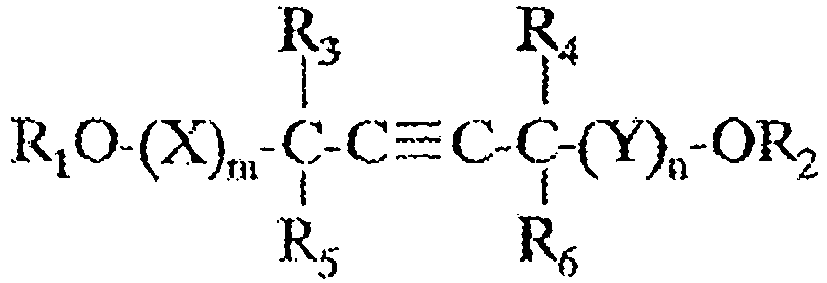
- wherein each R1 to R6 is H or a C1-10 alkyl group, each X and Y is an ethylene-oxy group or a propylene-oxy group, and each of m and n is a positive number of from 1 to 20, (c) at least one polishing accelerating compound, (d) at least one anticorrosive, (e) hydrogen peroxide, and (f) water.
-
US 2007/0293049 A1 discloses a slurry for the CMP of Cu film comprising peroxosulfuric acid, a basic amino acid, a complexing agent, a surfactant and colloidal silica. The surfactant can be acetylene glycol, ethylene oxide adducts thereof and acetylene alcohol. -
US 7 138 073 B2 discloses a slurry for the CMP of Cu comprising a first complexing agent, a second complexing agent, an oxidizing agent, a polishing rate promoting agent, polishing particles and a surfactant containing potassium dodecylbenzenesulfonate and acetylene diol-based non-ionic surfactant. -
US 7 419 910 B2 discloses a CMP slurry comprising a Cu oxidizing agent, a complexing agent forming a Cu organic complex, a non-ionic surfactant, an inorganic particle, and a resin particle. The non-ionic surfactant can be an acetylene diol-based non-ionic surfactant. -
JP 2001/323253 A -
US 2008/127573 A discloses a polishing composition comprising deionized water, abrasive particles, a pH-adjusting agent, a water-soluble thickener, an acetylene surfactant, and a heterocyclic amine. According to one embodiment, the acetylene surfactant comprises an acetylene alcohol represented by the formula R1R2(OH)CC≡CH, wherein R1 and R2 are each independently (OCH2CH2)nOCH2CH3 in which n is from 0 to 10. According to another embodiment, the acetylene surfactant comprises an acetylene glycol represented by the formula R1R2(OH)CC≡CC(OH)R1R2, wherein R1 and R2 are each independently (OCH2CH2)nOCH2CH3 in which n is from 0 to 10. - In the state of the art, CMP compositions comprising amide-containing carboxylic acids or comprising alkanolamines are known and described, for instance, in the following references:
-
JP 2009/272601 A 
- wherein R1 to R4 are (optionally substituted) monovalent organic groups, amino, H or hydroxy; X1, X2 are optionally substituted divalent organic group; and p, q = 0 or 1. The additive can be succinamic acid, maleamic acid, asparagine, glutamine, carboxylic acid, amino acid, and amphoteric surfactant.
-
KR 2007/0047020 A -
US 6 114 249 A discloses a CMP composition comprising colloidal silica and triethanolamine for polishing multiple material substrates, such as silicon wafers containing silicon oxide where a thin underlayer of silicon nitride is used as a stop layer. -
US 6 063 306 A discloses a CMP composition comprising (a) an abrasive, (b) an oxidizing agent, and (c) an organic amino compound selected from long chain alkylamines, alcoholamines and mixtures thereof. The alcoholamine is preferably triethanolamine. - One of the objects of the present invention was to provide a CMP composition which shows an improved polishing performance, such as the reduction of erosion and dishing effects, and particularly the combination of high material removal rate (MRR), low hot static etch rates of the to-be-polished metal surfaces (metal-hSER) and low cold static etch rates of the to-be-polished metal surfaces (metal-cSER), low hot metal ion static etch rates with regard to the to-be-polished metal surfaces (metal-hMSER), high ratio of MRR to metal-hSER, high ratio of MRR to metal-cSER, and high ratio of MRR to metal-hMSER. In addition, a further object was to provide a CMP composition which is particularly appropriate and adopted for the CMP of copper-containing layers in a multilevel structure.
- Furthermore, a respective CMP process was to be provided.
- Accordingly, a CMP composition (P) was found which comprises
- (A) inorganic particles, organic particles, or a mixture or composite thereof,
- (B) at least one type of N-heterocyclic compound as corrosion inhibitor,
- (C) at least one type of a further corrosion inhibitor which is:
- (C1) a (prop-2-ynyloxy)-substituted alcohol
- (D) at least one type of an oxidizing agent,
- (E) at least one type of a complexing agent, and
- (F) an aqueous medium.
- Wherein the CMP composition has a pH in the range of from 3 to 7.
- Moreover, the above-mentioned objects of the invention are achieved by a process for the manufacture of a semiconductor device comprising the polishing of a metal-containing substrate in the presence of said CMP composition.
- In addition, the use of CMP composition (P) for polishing substrates which are used in the semiconductor industry has been found, which fulfills the objects of the invention.
- Preferred embodiments are explained in the claims and the specification. It is understood that combinations of preferred embodiments are within the scope of the present invention.
- A semiconductor device can be manufactured by a process which comprises the CMP of a substrate in the presence of the CMP compositions (P). Preferably, said process comprises the CMP of a metal-containing substrate, that is a substrate comprising metal in the form of elements, alloys, or compounds such as metal nitrides or oxides. Said process comprises more preferably the CMP of a metal layer of said substrate, most preferably the CMP of a copper layer of said substrate, and for example the CMP of a copper layer of a substrate comprising copper and tantalum.
- The CMP composition (P) is used for polishing any substrate used in the semiconductor industry, preferably for polishing a metal-containing substrate, more preferably for polishing a metal layer of a said substrate, most preferably for polishing a copper layer of said substrate, and for example for polishing a copper layer of a substrate comprising copper and tantalum.
- According to the invention, the CMP composition contains inorganic particles, organic particles, or a mixture or composite thereof (A). (A) can be
- of one type of inorganic particles,
- a mixture or composite of different types of inorganic particles,
- of one type of organic particles,
- a mixture or composite of different types of organic particles, or
- a mixture or composite of one or more types of inorganic particles and one or more types of organic particles.
- A composite is a composite particle comprising two or more types of particles in such a way that they are mechanically, chemically or in another way bound to each other. An example for a composite is a core-shell particle comprising one type of particle in the outer sphere (shell) and another type of particle in the inner sphere (core).
- Generally, the particles (A) can be contained in varying amounts. Preferably, the amount of (A) is not more than 10 wt.%, more preferably not more than 4 wt.%, most preferably not more than 2 wt.%, for example not more than 1 wt.%, based on the total weight of the corresponding composition. Preferably, the amount of (A) is at least 0.005 wt.%, more preferably at least 0.01 wt.%, most preferably at least 0.05 wt.%, for example at least 0.1 wt.%, based on the total weight of the corresponding composition.
- Generally, the particles (A) can be contained in varying particle size distributions. The particle size distributions of the particles (A) can be monomodal or multimodal. In case of multimodal particle size distributions, bimodal is often preferred. In order to have an easily reproducible property profile and easily reproducible conditions during the CMP process of the invention, a monomodal particle size distribution is preferred for (A). It is most preferred for (A) to have a monomodal particle size distribution.
- The mean particle size of the particles (A) can vary within a wide range. The mean particle size is the d50 value of the particle size distribution of (A) in the aqueous medium (D) and can be determined using dynamic light scattering techniques. Then, the d50 values are calculated under the assumption that particles are essentially spherical. The width of the mean particle size distribution is the distance (given in units of the x-axis) between the two intersection points, where the particle size distribution curve crosses the 50% height of the relative particle counts, wherein the height of the maximal particle counts is standardized as 100% height.
- Preferably, the mean particle size of the particles (A) is in the range of from 5 to 500 nm, more preferably in the range of from 5 to 250 nm, most preferably in the range of from 50 to 150 nm, and in particular in the range of from 90 to 130 nm, as measured with dynamic light scattering techniques using instruments such as High Performance Particle Sizer (HPPS) from Malvern Instruments, Ltd. or Horiba LB550.
- The particles (A) can be of various shapes. Thereby, the particles (A) may be of one or essentially only one type of shape. However, it is also possible that the particles (A) have different shapes. For instance, two types of differently shaped particles (A) may be present. For example, (A) can have the shape of cubes, cubes with chamfered edges, octahedrons, icosahedrons, nodules or spheres with or without protrusions or indentations. Preferably, they are spherical with no or only very few protrusions or indentations.
- The chemical nature of particles (A) is not particularly limited. (A) may be of the same chemical nature or a mixture or composite of particles of different chemical nature. As a rule, particles (A) of the same chemical nature are preferred. Generally, (A) can be
- inorganic particles such as a metal, a metal oxide or carbide, including a metalloid, a metalloid oxide or carbide, or
- organic particles such as polymer particles,
- a mixture or composite of inorganic and organic particles.
- Particles (A) are preferably inorganic particles. Among them, oxides and carbides of metals or metalloids are preferred. More preferably, particles (A) are alumina, ceria, copper oxide, iron oxide, nickel oxide, manganese oxide, silica, silicon nitride, silicon carbide, tin oxide, titania, titanium carbide, tungsten oxide, yttrium oxide, zirconia, or mixtures or composites thereof. Most preferably, particles (A) are alumina, ceria, silica, titania, zirconia, or mixtures or composites thereof. In particular, (A) are silica. For example, (A) are colloidal silica. Generally, colloidal silica are fine amorphous, nonporous, and typically spherical silica particles.
- In another embodiment in which (A) are organic particles, or a mixture or composite of inorganic and organic particles, polymer particles are preferred. Polymer particles can be homo- or copolymers. The latter may for example be block-copolymers, or statistical copolymers. The homo- or copolymers may have various structures, for instance linear, branched, comb-like, dendrimeric, entangled or cross-linked. The polymer particles may be obtained according to the anionic, cationic, controlled radical, free radical mechanism and by the process of suspension or emulsion polymerisation. Preferably, the polymer particles are at least one of the polystyrenes, polyesters, alkyd resins, polyurethanes, polylactones, polycarbonates, poylacrylates, polymethacrylates, polyethers, poly(N-alkylacrylamide)s, poly(methyl vinyl ether)s, or copolymers comprising at least one of vinylaromatic compounds, acrylates, methacrylates, maleic anhydride acrylamides, methacrylamides, acrylic acid, or methacrylic acid as monomeric units, or mixtures or composites thereof. Among them, polymer particles with a cross-linked structure are preferred.
- In another embodiment in which (A) are organic particles, or a mixture or composite of inorganic and organic particles, melamine particles are preferred.
- In another embodiment in which (A) are a mixture of inorganic and organic particles, (A) is preferably a mixture of inorganic particles and melamine particles, (A) is more preferably a mixture of inorganic particles selected from the group consisting of alumina, ceria, silica, titania, zirconia, or mixtures or composites thereof, on the one hand and melamine particles on the other hand, and (A) is most preferably a mixture of silica particles and melamine particles.
- According to the invention, the CMP composition (P) comprises at least one type of N-heterocyclic compound as corrosion inhibitor (B). Typically, corrosion inhibitors are used in metal CMP compositions, particularly in copper CMP compositions, to reduce the static etch rate while preserving the high material removal rate during the polishing process.
- Preferably, (P) comprises one type or a mixture of two types of N-heterocyclic compound (B). More preferably, (P) comprises only one type of N-heterocyclic compound (B).
- In general, (B) can be contained in varying amounts. Preferably, the amount of (B) is not more than 4 wt.%, more preferably not more than 1 wt.%, most preferably not more than 0.5 wt.%, for example not more than 0.2 wt.%, based on the total weight of the corresponding composition. Preferably, the amount of (B) is at least 0.0005 wt.%, more preferably at least 0.005 wt.%, most preferably at least 0.01 wt.%, for example at least 0.05 wt.%, based on the total weight of the corresponding composition.
- Generally, (B) can be any N-heterocyclic compound. Preferably, (B) is a pyrrole, imidazole, pyrazole, triazole, tetrazole, pyridine, pyridazine, pyrimidine, pyrazine, triazine, thiazole, thiadiazole, thiazine or a derivative thereof. More preferably, (B) is an imidazole, pyrazole, triazole, tetrazole, or a derivative thereof. Most preferably, (B) is a triazole or its derivative. For example, (B) is 1,2,3-triazole, 1,2,4-triazole, benzotriazole, or tolyltriazole.
- Generally, (B) can be a substituted or unsubstituted N-heterocyclic compound. In the embodiment in which (B) is a substituted N-heterocyclic compound, the substituents are preferably halogen atoms, hydroxyl, alkoxy, thiol, amino, imino, nitro, carboxy, alkylcarboxy, sulfonyl, alkyl, aryl, alkylaryl, or arylalkyl groups, more preferably halogen atoms, hydroxyl, alkyl, aryl, alkylaryl, or arylalkyl groups, most preferably alkyl, aryl or alkylaryl groups.
- In general, the solubility of (B) in an aqueous medium can vary within a wide range. The solubility of (B) in water at pH 7 at 25°C under atmospheric pressure is preferably at least 0.2 g/L, more preferably at least 1 g/L, most preferably at least 3 g/L, for example at least 6 g/L. Said solubility can be determined by evaporating the solvent and measuring the remaining mass in the saturated solution.
- According to the invention, the CMP composition (P) comprises at least one type of a further corrosion inhibitor (C) which is (C1) a (prop-2-ynyloxy)-substituted alcohol
- In general, (C) can be contained in varying amounts. Preferably, the amount of (C) is not more than 10 wt.%, more preferably not more than 5 wt.%, most preferably not more than 2 wt.%, for example not more than 0.8 wt.%, based on the total weight of the corresponding composition. Preferably, the amount of (C) is at least 0.001 wt.%, more preferably at least 0.01 wt.%, most preferably at least 0.05 wt.%, for example at least 0.1 wt.%, based on the total weight of the corresponding composition.
- Generally, (C1), can be a substituted or unsubstituted compound. In the embodiment in which (C1), is a substituted compound, the substituents are preferably halogen atoms, hydroxyl, alkoxy, thiol, amino, imino, nitro, carboxy, alkylcarboxy, sulfonyl, alkyl, aryl, alkylaryl, or arylalkyl groups, more preferably halogen atoms, hydroxyl, alkyl, aryl, alkylaryl, or arylalkyl groups, most preferably alkyl, aryl or alkylaryl groups.
- In general, the solubility of (B) in an aqueous medium can vary within a wide range. The solubility of (B) in water at pH 7 at 25°C under atmospheric pressure is preferably at least 0.2 g/L, more preferably at least 1 g/L, most preferably at least 3 g/L, for example at least 6 g/L. Said solubility can be determined by evaporating the solvent and measuring the remaining mass in the saturated solution.
- In the invention (C1) is a (prop-2-ynyloxy)-substituted alcohol, preferably a (prop-2-ynyloxy)-substituted C1-C15 alcohol, particularly a (prop-2-ynyloxy)-substituted C2-C8 alcohol, and for example 2-(prop-2-ynyloxy)ethanol, 2-(prop-2-ynyloxy)propanol, 2-(prop-2-ynyloxy)butanol, or 2-(prop-2-ynyloxy)pentanol.
- According to the invention, the CMP compositions (P) comprise at least one oxidizing agent (D), preferably one oxidizing agent. In general, the oxidizing agent is a compound which is capable of oxidizing the to-be-polished substrate or one of its layers. Preferably, (D) is a per-type oxidizer. More preferably, (D) is a peroxide, persulfate, perchlorate, perbromate, periodate, permanganate, or a derivative thereof. Most preferably, (D) is a peroxide or persulfate. Particularly, (D) is a peroxide. For example, (D) is hydrogen peroxide.
- In general, (D) can be contained in varying amounts. Preferably, the amount of (D) is not more than 20 wt.%, more preferably not more than 10 wt.%, most preferably not more than 5 wt.%, for example not more than 2 wt.%, based on the total weight of the corresponding composition. Preferably, the amount of (D) is at least 0.05 wt.%, more preferably at least 0.1 wt.%, most preferably at least 0.5 wt.%, for example at least 1 wt.%, based on the total weight of the corresponding composition.
- According to the invention, the CMP compositions (P) comprise at least one complexing agent (E), for example one complexing agent. In general, the complexing agent is a compound which is capable of complexing the ions of the to-be-polished substrate or of one of its layers. Preferably, (E) is a carboxylic acid having at least two COOH groups, an N-containing carboxylic acid, N-containing sulfonic acid, N-containing sulfuric acid, N-containing phosphonic acid, N-containing phosphoric acid, or a salt thereof. More preferably, (E) is a carboxylic acid having at least two COOH groups, an N-containing carboxylic acid, or a salt thereof. Most preferably, (E) is an amino acid, or a salt thereof. For example, (E) is glycine, serine, alanine, hystidine, or a salt thereof.
- In general, (E) can be contained in varying amounts. Preferably, the amount of (E) is not more than 20 wt.%, more preferably not more than 10 wt.%, most preferably not more than 5 wt.%, for example not more than 2 wt.%, based on the total weight of the corresponding composition. Preferably, the amount of (E) is at least 0.001 wt.%, more preferably at least 0.01 wt.%, most preferably at least 0.08 wt.%, for example at least 0.5 wt.%, based on the total weight of the corresponding composition.
- According to the invention, the CMP compositions (P) contain an aqueous medium (F). (F) can be of one type or a mixture of different types of aqueous media.
- In general, the aqueous medium (F) can be any medium which contains water. Preferably, the aqueous medium (F) is a mixture of water and an organic solvent miscible with water (e.g. an alcohol, preferably a C1 to C3 alcohol, or an alkylene glycol derivative). More preferably, the aqueous medium (F) is water. Most preferably, aqueous medium (F) is de-ionized water.
- If the amounts of the components other than (F) are in total x % by weight of the CMP composition, then the amount of (F) is (100-x) % by weight of the CMP composition.
- The properties of the CMP compositions (P), such as stability and polishing performance, may depend on the pH of the corresponding composition. Preferably, the pH value of the compositions used or according to the invention respectively is in the range of from 3 to 10, more preferably from 4.5 to 8, and most preferably from 5.5 to 7.
- The CMP compositions used or according to the invention respectively may also contain, if necessary, various other additives, including but not limited to pH adjusting agents, stabilizers, surfactants etc. Said other additives are for instance those commonly employed in CMP compositions and thus known to the person skilled in the art. Such addition can for example stabilize the dispersion, or improve the polishing performance, or the selectivity between different layers.
- If present, said additive can be contained in varying amounts. Preferably, the amount of said additive is not more than 10 wt.%, more preferably not more than 1 wt.%, most preferably not more than 0.1 wt.%, for example not more than 0.01 wt.%, based on the total weight of the corresponding composition. Preferably, the amount of said additive is at least 0.0001 wt.%, more preferably at least 0.001 wt.%, most preferably at least 0.01 wt.%, for example at least 0.1 wt.%, based on the total weight of the corresponding composition.
- For the embodiment below, all concentration ranges or concentration specifications in wt.% (percent by weight) are based on the total weight of the corresponding composition, unless stated otherwise.
- According to a further embodiment, the CMP composition (P) comprises:
- (A) silica particles, in a concentration of from 0.01 to 2 wt.%,
- (B) 1,2,3-triazole, 1,2,4-triazole, benzotriazole, or tolyltriazole as corrosion inhibitor, in a concentration of from 0.005 to 1 wt.%,
- (C) a further corrosion inhibitor which is
- (C1) a (prop-2-ynyloxy)-substituted alcohol
in a concentration of from 0.01 to 5 wt.%,
- (C1) a (prop-2-ynyloxy)-substituted alcohol
- (D) a peroxide as oxidizing agent, in a concentration of from 0.05 to 10 wt.%,
- (E) a carboxylic acid having at least two COOH groups, an N-containing carboxylic acid, or a salt thereof as complexing agent in a concentration of 0.01 to 5 wt.%, and
- (F) an aqueous medium.
- Processes for preparing CMP compositions are generally known. These processes may be applied to the preparation of the CMP composition of the invention. This can be carried out by dispersing or dissolving the above-described components (A) and (B) in the aqueous medium (C), preferably water, and optionally by adjusting the pH value through adding an acid, a base, a buffer or an pH adjusting agent. For this purpose the customary and standard mixing processes and mixing apparatuses such as agitated vessels, high shear impellers, ultrasonic mixers, homogenizer nozzles or counterflow mixers, can be used.
- The CMP compositions (P) are preferably prepared by dispersing the particles (A), dispersing and/or dissolving the components (B), (C), (D) and (E) in the aqueous medium (F).
- The polishing process is generally known and can be carried out with the processes and the equipment under the conditions customarily used for the CMP in the fabrication of wafers with integrated circuits. There is no restriction on the equipment with which the polishing process can be carried out.
- As is known in the art, typical equipment for the CMP process consists of a rotating platen which is covered with a polishing pad. Also orbital polishers have been used. The wafer is mounted on a carrier or chuck. The side of the wafer being processed is facing the polishing pad (single side polishing process). A retaining ring secures the wafer in the horizontal position.
- Below the carrier, the larger diameter platen is also generally horizontally positioned and presents a surface parallel to that of the wafer to be polished. The polishing pad on the platen contacts the wafer surface during the planarization process.
- To produce material loss, the wafer is pressed onto the polishing pad. Both the carrier and the platen are usually caused to rotate around their respective shafts extending perpendicular from the carrier and the platen. The rotating carrier shaft may remain fixed in position relative to the rotating platen or may oscillate horizontally relative to the platen. The direction of rotation of the carrier is typically, though not necessarily, the same as that of the platen. The speeds of rotation for the carrier and the platen are generally, though not necessarily, set at different values. During the CMP process of the invention the CMP composition of the invention is usually applied onto the polishing pad as a continuous stream or in dropwise fashion. Customarily, the temperature of the platen is set at temperatures of from 10 to 70°C.
- The load on the wafer can be applied by a flat plate made of steel for example, covered with a soft pad that is often called backing film. If more advanced equipment is being used a flexible membrane that is loaded with air or nitrogen pressure presses the wafer onto the pad. Such a membrane carrier is preferred for low down force processes when a hard polishing pad is used, because the down pressure distribution on the wafer is more uniform compared to that of a carrier with a hard platen design. Carriers with the option to control the pressure distribution on the wafer may also be used according to the invention. They are usually designed with a number of different chambers that can be loaded independently from each other.
- For further details reference is made to
WO 2004/063301 A1 , in particular page 16, paragraph [0036] to page 18, paragraph [0040] in conjunction with the figure 2. - By way of the CMP process of the invention and/or using the CMP compositions (P) of the invention, wafers with integrated circuits comprising a metal layer can be obtained which have an excellent functionality.
- The CMP compositions (P) of the invention can be used in the CMP process as ready-to-use slurry, they have a long shelf-life and show a stable particle size distribution over long time. Thus, they are easy to handle and to store. They show an excellent polishing performance, particularly with regard to material removal rate (MRR), static etch rates (SER), and selectivity. For example the combination of a high MRR, low metal-hSER, low metal-cSER, low metal-hMSER, high ratio of MRR to metal-hSER, high ratio of MRR to metal-cSER, high ratio of MRR to metal-hMSER can be obtained when a substrate comprising a copper layer is polished. Since the amounts of its components are held down to a minimum, the CMP compositions (P) can be used in a cost-effective way.
- The pH value is measured with a pH electrode (Schott, blue line, pH 0-14 / -5...100 °C / 3 mol/L sodium chloride).
- The metal-hSER is determined by dipping 1x1 inch [= 2.54 x 2.54 cm] metal coupon into the corresponding composition for 5 minutes at 60°C and measuring the loss of mass before and after the dipping.
The metal-cSER is determined by dipping 1x1 inch [= 2.54 x 2.54 cm] metal coupon into the corresponding composition for 5 minutes at 25°C and measuring the loss of mass before and after the dipping. - The metal-hMSER is determined by dipping 1x1 inch [= 2.54 x 2.54 cm] metal coupon into the corresponding composition for 5 minutes at 60°C and measuring the loss of mass before and after the dipping, after adding 500 ppm of metal salt, for example metal nitrate, to imitate the metal ions released in the polishing process.
- Cu-cSER (cold static etch rate of a copper layer) is determined by dipping 1x1 inch [= 2.54 x 2.54 cm] copper coupon into the corresponding composition for 5 minutes at 25°C and measuring the loss of mass before and after the dipping.
- Cu-hSER (hot static etch rate of a copper layer) is determined by dipping 1x1 inch [= 2.54 x 2.54 cm] copper coupon into the corresponding composition for 5 minutes at 60°C and measuring the loss of mass before and after the dipping.
- Cu-hCSER (hot copper ion static etch rate with regard to a copper layer) is determined by dipping 1x1 inch [= 2.54 x 2.54 cm] copper coupon into the corresponding composition for 5 minutes at 60°C and measuring the loss of mass before and after the dipping, after adding 500 ppm of Cu(NO3)2 to imitate the copper ions released in the polishing process.
- First Trends of formulations were evaluated on 2 inch [= 5.08 cm] copper level using Bühler table polishers. For further evaluation and confirmation a 200 mm Strasbaugh 6EC polisher was used (polishing time was 60s).
- For the evaluation on benchtop following parameters were chosen:
- Powerpro 5000 Bühler. DF = 40 N, Table speed 150 rpm, Platen speed 150 rpm, slurry flow 200 ml/ min, 20 s conditioning, 1 min polishing time, IC1000 pad, diamond conditioner (3M) .
- The pad is conditioned by several sweeps, before a new type of CMP composition is used for CMP. For the determination of removal rates at least 3 wafers are polished and the data obtained from these experiments are averaged.
- The CMP composition is stirred in the local supply station.
- The material removal rates (MRR) for 2 inch [= 5.08 cm] discs polished by the CMP composition are determined by difference of weight of the coated wafers before and after CMP, using a Sartorius LA310 S scale. The difference of weight can be converted into the difference of film thickness since the density (8.94 g/cm3 for copper) and the surface area of the polished material are known. Dividing the difference of film thickness by the polishing time provides the values of the material removal rate.
- Silica particles used as particles (A) are of NexSil™ (Nyacol) type. NexSil™ 85K are potassium-stabilized colloidal silica having a typical particle size of 50 nm and a typical surface area of 55 m2/g. NexSil™ 5 are sodium-stabilized colloidal silica having a typical particle size of 6 nm and a typical surface area of 450 m2/g.
- Melamine particles used as particles (A) are formed in the solution by adding melamine into the slurry. The particles usually have a broad size distribution but are not limited to a large size distributon. The melamine can either be milled or mixed into the aqueous medium by dissolution methods known to a person skilled of the art.
- Further corrosion inhibitors (C):
- 2-(prop-2-ynyloxy)propanol
- 2-(prop-2-ynyloxy)pentanol
- 2-butyne-1,4-diol
- FC1 = salt or adduct of triethanolamine (2,2',2"-nitrilotris(ethanol)) and 4-[(2-ethylhexyl)amino]-4-oxoisocrotonic acid
- FC2 = salt or adduct of triethanolamine (2,2',2"-nitrilotris(ethanol)) and 2-[[(2-ethylhexyl)methylamino]carbonyl]-benzoic acid
- An aqueous dispersion containing the components as listed in Table 1 and 2 was prepared, furnishing the CMP compositions (P) of the examples 1 to 6 and the comparative examples V1 to V2. For all these examples, the pH was adjusted to 6 with KOH or HNO3.
- An aqueous dispersion containing the components as listed in Table 2 was prepared, furnishing CMP compositions of the examples 7 to 8 and the comparative examples V3 to V4. For all these examples, the pH was adjusted to 6 with KOH or HNO3. Data for the polishing performance of the CMP compositions (P) of the examples 1 to 6 and of the comparative examples V1 to V2 are given in the Table 1.
- Data for the polishing performance of the CMP compositions of the examples 7 to 8 and of the comparative examples V3 to V4 are given in the Table 2.
Table 1: Compositions of the examples 1 to 6 and of the comparative examples V1 to V2, and Cu-cSER, Cu-hSER, Cu-hCSER data as well as their material removal rates (MRR) and dishing data in the copper CMP process using these compositions, wherein the aqueous medium (F) is de-ionized water (MRR measured on 2 inch [= 5.08 cm] copper discs with Powerpro 5000 Bühler polisher, dishing measured on 8 inch [= 20.32 cm] copper discs with Strasbaugh 6EC polisher) Reference Example 1 Reference Example 2 Reference Example 3 Comparative Example V1 Particles (A) Melamine 0.3 wt. %, and NexSil™ 5 0.08 wt. % Melamine 0.3 wt. %, and NexSil™ 5 0.08 wt. % Melamine 0.3 wt. %, and NexSil™ 5 0.08 wt. % Melamine 0.3 wt. %, and NexSil™ 5 0.08 wt. % Corrosion inhibitor (B) Benzotriazole 0.07 wt.% Benzotriazole 0.07 wt.% Benzotriazole 0.07 wt.% Benzotriazole 0.07 wt.% Further corrosion inhibitor (C) FC2 0.005 wt.% 2-Butyne-1,4-diol 0.1 wt.% FC2 0.01 wt.% - Complexing agent (D) Glycine 0.6 wt.%, and chloride 0.02 wt.% (added as potassium chloride) Glycine 0.6 wt.%, and chloride 0.02 wt.% (added as potassium chloride) Glycine 0.6 wt.%, and Chloride 0.02 wt.% (added as potassium chloride) Glycine 0.6 wt.%, and chloride 0.02 wt.% (added as potassium chloride) Oxidizing agent (E) H2O2 3 wt.% H2O2 3 wt.% H2O2 3 wt.% H2O2 3 wt.% pH 5 5 5 5 MRR in A/min 9392 11140 8799 10897 cSER in Å/min 21 36 26 47 hSER in Å/min 107 126 79 206 Cu-hCSER in Å/min - - - - Reference Example 4 Example 5 Reference Example 6 Comparative Example V2 Particles (A) Melamine 0.3 wt.%, and NexSil™ 5 0.05 wt.% Melamine 0.3 wt.%, and NexSil™ 5 0.05 wt.% Melamine 0.3 wt.%, and NexSil™ 5 0.05 wt.% Melamine 0.3 wt.%, and NexSil™ 5 0.05 wt.% Corrosion inhibitor (B) tolyltriazole 0.04 wt.% tolyltriazole 0.04 wt.% tolyltriazole 0.04 wt.% tolyltriazole 0.04 wt.% Further corrosion inhibitor (C) 2-Butyne-1,4-diol 0.005 wt.% 2-(prop-2-ynyloxy)propanol 0.01 wt.% FC2 0.005 wt.% - Complexing agent (D) Glutamic acid 0.6 wt.%, and chloride 0.02 wt.% (added as potassium chloride) Glutamic acid 0.6 wt.%, and chloride 0.02 wt.% (added as potassium chloride) Glutamic acid 0.6 wt.%, and chloride 0.02 wt.% (added as potassium chloride) Glutamic acid 0.6 wt.%, and chloride 0.02 wt.% (added as potassium chloride) Oxidizing agent (E) H2O2 3 wt.% H2O2 3 wt.% H2O2 3 wt.% H2O2 3 wt.% pH 5.6 5.6 5.6 5.6 MRR in Å/min 2873 2712 5112 1496 cSER in Å/min -5 -2 -2 2 hSER in Å/min 9 7 29 85 Cu-hCSER in Å/min - - - - Dishing Die 1 20s Overpolish in Å - 375 - 720 Dishing Die 3 10s Overpolish in Å - 525 - 800 Dishing Die 3 30s Overpolish in Å - 612 - 960 Table 2: Compositions of the examples 7 to 8 and of the comparative examples V3 to V4, Cu-cSER, Cu-hSER, Cu-hCSER, pH values and material removal rates (MRR) in the copper CMP process using these compositions, wherein the aqueous medium (F) is de-ionized water. Example 7 Example 8 Comparative Example V3 Comparative Example V4 Particles (A) NexSil™ 85K 0.2 wt. % NexSil™ 85K 0.001 wt.% NexSil™ 85K 0.001 wt.% NexSil™ 85K 0.001 wt.% Strong corrosion inhibitor (G) tolyltriazole 0.005 wt.% tolyltriazole 0.01 wt.% tolyltriazole 0.005 wt.% tolyltriazole 0.01 wt.% Weak corrosion inhibitor (H) 2-(prop-2-ynyloxy)propanol 0.02 wt.% 2-(prop-2-ynyloxy)propanol 0.04 wt.% - - Complexing agent (D) Glycine 0.5 wt.% Glycine 0.5 wt.% Glycine 0.5 wt.% Glycine 0.5 wt.% Oxidizing agent (E) H2O2 1 wt. % H2O2 1 wt.% H2O2 1 wt. % H2O2 1 wt.% PH 6 6 6 6 MRR in Å/min 5671 5602 4732 2421 cSER in Å/min - - - - hSER in Å/min 195 67 709 263 Cu-hCSER in Å/min 20 20 - - - These examples of the CMP compositions of the invention improve the polishing performance
-
Figure 1 shows the Cu-hSER of different reference compositions:- y1 = Cu-hSER in Å/min,
- x1 = concentration of the corrosion inhibitor in the reference composition,
- The rhomb in
Figure 1 located on the y1 axis, which is linked to (R1 a) through an arrow, represent the reference composition (R1 a) comprising 0.2 wt.% NexSil™ 85K, 0.5 wt.% glycine, 1 wt.% H2O2 and having a pH of 6. - The other rhombs in
Figure 1 represent reference compositions (R2a) comprising 0.2 wt.% NexSil™ 85K, 0.5 wt.% glycine, 1 wt.% H2O2 and different concentrations of 1,2,4-triazole having a pH of 6, wherein the concentration of 1,2,4-triazole is specified on the x1 axis. - The triangles in
Figure 1 represent reference compositions (R2b) comprising 0.2 wt.% NexSil™ 85K, 0.5 wt.% glycine, 1 wt.% H2O2 and different concentrations of benzotriazole having a pH of 6, wherein the concentration of benzotriazole is specified on the x1 axis. - The circles in
Figure 1 represents reference compositions (R2c) comprising 0.2 wt.% NexSil™ 85K, 0.5 wt.% glycine, 1 wt.% H2O2 and different concentrations of tolyltriazole having a pH of 6, wherein the concentration of tolyltriazole is specified on the x1 axis. - The squares in
Figure 1 represent reference compositions (R2d) comprising 0.2 wt.% NexSil™ 85K, 0.5 wt.% glycine, 1 wt.% H2O2 and different concentrations of 2-(prop-2-ynyloxy)propanol having a pH of 6, wherein the concentration of 2-(prop-2-ynyloxy)propanol is specified on the x1 axis.
Claims (9)
- A chemical-mechanical polishing ("CMP") composition (P) comprising(A) inorganic particles, organic particles, or a mixture or composite thereof,(B) at least one type of N-heterocyclic compound as corrosion inhibitor,(C) at least one type of a further corrosion inhibitor which is(C1) a (prop-2-ynyloxy)-substituted alcohol,(D) at least one type of an oxidizing agent,(E) at least one type of a complexing agent, and(F) an aqueous medium
wherein the CMP composition has a pH in the range of from 3 to 7. - A CMP composition according to claim 1, wherein (B) is an imidazole, pyrazole, triazole, tetrazole, or a derivative thereof.
- A CMP composition according to claim 2, wherein (B) is a triazole or its derivative.
- A CMP composition according to anyone of the claims 1 to 3, wherein (C1) is 2-(prop-2-ynyloxy)ethanol, 2-(prop-2-ynyloxy)propanol, 2-(prop-2-ynyloxy)butanol, or 2-(prop-2-ynyloxy)pentanol.
- A CMP composition according to anyone of the claims 1 to 4, wherein (A) are silica particles.
- A CMP composition according to anyone of the claims 1 to 5, wherein (D) is a peroxo compound.
- A CMP composition according to anyone of the claims 1 to 6, wherein (E) is a carboxylic acid having at least two COOH groups, N-containing carboxylic acid, N-containing sulfonic acid, N-containing sulfuric acid, N-containing phosphonic acid, N-containing phosphoric acid, or a salt thereof.
- A process for the manufacture of semiconductor devices comprising the chemical-mechanical polishing of a metal-containing substrate in the presence of a CMP composition as defined in anyone of the claims 1 to 7.
- Use of a CMP composition as defined in anyone of the claims 1 to 7 for polishing any substrate used in the semiconductor industry.
Priority Applications (1)
| Application Number | Priority Date | Filing Date | Title |
|---|---|---|---|
| EP12760432.0A EP2688966B1 (en) | 2011-03-22 | 2012-03-19 | A chemical mechanical polishing (cmp) composition comprising two types of corrosion inhibitors |
Applications Claiming Priority (4)
| Application Number | Priority Date | Filing Date | Title |
|---|---|---|---|
| US201161466010P | 2011-03-22 | 2011-03-22 | |
| EP20110159095 EP2502969A1 (en) | 2011-03-22 | 2011-03-22 | A chemical mechanical polishing (cmp) composition comprising two types of corrosion inhibitors |
| EP12760432.0A EP2688966B1 (en) | 2011-03-22 | 2012-03-19 | A chemical mechanical polishing (cmp) composition comprising two types of corrosion inhibitors |
| PCT/IB2012/051293 WO2012127399A1 (en) | 2011-03-22 | 2012-03-19 | A chemical mechanical polishing (cmp) composition comprising two types of corrosion inhibitors |
Publications (3)
| Publication Number | Publication Date |
|---|---|
| EP2688966A1 EP2688966A1 (en) | 2014-01-29 |
| EP2688966A4 EP2688966A4 (en) | 2014-11-12 |
| EP2688966B1 true EP2688966B1 (en) | 2016-03-09 |
Family
ID=44315172
Family Applications (2)
| Application Number | Title | Priority Date | Filing Date |
|---|---|---|---|
| EP20110159095 Withdrawn EP2502969A1 (en) | 2011-03-22 | 2011-03-22 | A chemical mechanical polishing (cmp) composition comprising two types of corrosion inhibitors |
| EP12760432.0A Active EP2688966B1 (en) | 2011-03-22 | 2012-03-19 | A chemical mechanical polishing (cmp) composition comprising two types of corrosion inhibitors |
Family Applications Before (1)
| Application Number | Title | Priority Date | Filing Date |
|---|---|---|---|
| EP20110159095 Withdrawn EP2502969A1 (en) | 2011-03-22 | 2011-03-22 | A chemical mechanical polishing (cmp) composition comprising two types of corrosion inhibitors |
Country Status (4)
| Country | Link |
|---|---|
| US (1) | US9263296B2 (en) |
| EP (2) | EP2502969A1 (en) |
| KR (1) | KR101946782B1 (en) |
| WO (1) | WO2012127399A1 (en) |
Families Citing this family (9)
| Publication number | Priority date | Publication date | Assignee | Title |
|---|---|---|---|---|
| KR102477843B1 (en) * | 2014-10-21 | 2022-12-16 | 씨엠씨 머티리얼즈, 인코포레이티드 | Corrosion inhibitors and related compositions and methods |
| US9944828B2 (en) | 2014-10-21 | 2018-04-17 | Cabot Microelectronics Corporation | Slurry for chemical mechanical polishing of cobalt |
| EP3210238B1 (en) | 2014-10-21 | 2019-06-26 | Cabot Microelectronics Corporation | Cobalt polishing accelerators |
| CN107075310B (en) | 2014-10-21 | 2019-04-02 | 嘉柏微电子材料股份公司 | Cobalt Sag Control Agent |
| KR102586317B1 (en) * | 2014-12-22 | 2023-10-06 | 바스프 에스이 | Use of a chemical mechanical polishing (cmp) composition for polishing of cobalt and/or cobalt alloy comprising substrates |
| TWI775722B (en) * | 2014-12-22 | 2022-09-01 | 德商巴斯夫歐洲公司 | Use of a chemical mechanical polishing (cmp) composition for polishing of cobalt and/or cobalt alloy comprising substrates |
| CN108251056A (en) * | 2016-12-29 | 2018-07-06 | 圣戈本陶瓷及塑料股份有限公司 | Abrasive grains, fixed abrasive article and the method for forming the fixation abrasive article |
| US11043396B2 (en) * | 2018-07-31 | 2021-06-22 | Taiwan Semiconductor Manufacturing Company, Ltd. | Chemical mechanical polish slurry and method of manufacture |
| KR102851126B1 (en) * | 2022-01-19 | 2025-08-28 | 삼성에스디아이 주식회사 | Diazo based compound, cmp slurry composition comprising the same and polishing method using the same |
Family Cites Families (28)
| Publication number | Priority date | Publication date | Assignee | Title |
|---|---|---|---|---|
| US6114249A (en) | 1998-03-10 | 2000-09-05 | International Business Machines Corporation | Chemical mechanical polishing of multiple material substrates and slurry having improved selectivity |
| US6063306A (en) | 1998-06-26 | 2000-05-16 | Cabot Corporation | Chemical mechanical polishing slurry useful for copper/tantalum substrate |
| JP2001323253A (en) | 2000-05-12 | 2001-11-22 | Kao Corp | Composition for polishing a magnetic disk substrate |
| JP3402365B2 (en) * | 2000-06-28 | 2003-05-06 | 日本電気株式会社 | Anticorrosive |
| US20020068454A1 (en) | 2000-12-01 | 2002-06-06 | Applied Materials, Inc. | Method and composition for the removal of residual materials during substrate planarization |
| SG144688A1 (en) | 2001-07-23 | 2008-08-28 | Fujimi Inc | Polishing composition and polishing method employing it |
| CN100386850C (en) * | 2001-10-31 | 2008-05-07 | 日立化成工业株式会社 | Polishing liquid and polishing method |
| JP3692067B2 (en) | 2001-11-30 | 2005-09-07 | 株式会社東芝 | Polishing slurry for copper CMP and method of manufacturing semiconductor device using the same |
| TWI256971B (en) | 2002-08-09 | 2006-06-21 | Hitachi Chemical Co Ltd | CMP abrasive and method for polishing substrate |
| US20040175942A1 (en) | 2003-01-03 | 2004-09-09 | Chang Song Y. | Composition and method used for chemical mechanical planarization of metals |
| US20050056810A1 (en) * | 2003-09-17 | 2005-03-17 | Jinru Bian | Polishing composition for semiconductor wafers |
| US7485162B2 (en) | 2003-09-30 | 2009-02-03 | Fujimi Incorporated | Polishing composition |
| JP3892846B2 (en) | 2003-11-27 | 2007-03-14 | 株式会社東芝 | CMP slurry, polishing method, and semiconductor device manufacturing method |
| KR101128983B1 (en) | 2005-11-01 | 2012-03-23 | 삼성코닝정밀소재 주식회사 | Chemical mechanical polishing composition for metal circuit |
| KR20070088245A (en) * | 2006-02-24 | 2007-08-29 | 후지필름 가부시키가이샤 | Polishing liquid for metal |
| JP2008004621A (en) | 2006-06-20 | 2008-01-10 | Toshiba Corp | Slurry for Cu film CMP, polishing method, and manufacturing method of semiconductor device |
| KR100725803B1 (en) | 2006-12-05 | 2007-06-08 | 제일모직주식회사 | Slurry composition for final polishing of silicon wafer and final polishing method for silicon wafer using same |
| US20090032765A1 (en) * | 2007-08-03 | 2009-02-05 | Jinru Bian | Selective barrier polishing slurry |
| JP5178121B2 (en) | 2007-09-28 | 2013-04-10 | 富士フイルム株式会社 | Polishing liquid and polishing method |
| US7931714B2 (en) | 2007-10-08 | 2011-04-26 | Uwiz Technology Co., Ltd. | Composition useful to chemical mechanical planarization of metal |
| JP2009272601A (en) | 2008-04-09 | 2009-11-19 | Hitachi Chem Co Ltd | Abrasive, substrate polishing method using same, and solution and slurry for use in this method |
| TWI454561B (en) * | 2008-12-30 | 2014-10-01 | Uwiz Technology Co Ltd | A polishing composition for planarizing the metal layer |
| WO2010127937A1 (en) | 2009-05-06 | 2010-11-11 | Basf Se | An aqueous metal polishing agent comprising a polymeric abrasiv containing pendant functional groups and its use in a cmp process |
| EP2427522B1 (en) | 2009-05-06 | 2017-03-01 | Basf Se | An aqueous polishing agent comprising solid polymer particles and two complexing agents and its use in a process for polishing patterned and unstructured metal surfaces |
| US9028708B2 (en) | 2009-11-30 | 2015-05-12 | Basf Se | Process for removing a bulk material layer from a substrate and a chemical mechanical polishing agent suitable for this process |
| WO2011101755A1 (en) | 2010-02-22 | 2011-08-25 | Basf Se | Chemical-mechanical planarization of substrates containing copper, ruthenium, and tantalum layers |
| JP6004943B2 (en) | 2010-02-24 | 2016-10-12 | ビーエーエスエフ ソシエタス・ヨーロピアBasf Se | Aqueous abrasives and graft copolymers and their use in polishing processes for patterned and unstructured metal surfaces |
| WO2012127398A1 (en) | 2011-03-22 | 2012-09-27 | Basf Se | A chemical mechanical polishing (cmp) composition comprising a polymeric polyamine |
-
2011
- 2011-03-22 EP EP20110159095 patent/EP2502969A1/en not_active Withdrawn
-
2012
- 2012-03-19 WO PCT/IB2012/051293 patent/WO2012127399A1/en not_active Ceased
- 2012-03-19 EP EP12760432.0A patent/EP2688966B1/en active Active
- 2012-03-19 KR KR1020137027824A patent/KR101946782B1/en active Active
- 2012-03-19 US US14/006,744 patent/US9263296B2/en active Active
Also Published As
| Publication number | Publication date |
|---|---|
| KR20140020294A (en) | 2014-02-18 |
| EP2502969A1 (en) | 2012-09-26 |
| EP2688966A1 (en) | 2014-01-29 |
| EP2688966A4 (en) | 2014-11-12 |
| WO2012127399A1 (en) | 2012-09-27 |
| US9263296B2 (en) | 2016-02-16 |
| KR101946782B1 (en) | 2019-02-12 |
| US20150118845A1 (en) | 2015-04-30 |
Similar Documents
| Publication | Publication Date | Title |
|---|---|---|
| US11168239B2 (en) | Chemical-mechanical polishing composition comprising benzotriazole derivatives as corrosion inhibitors | |
| US9263296B2 (en) | Chemical mechanical polishing (CMP) composition comprising two types of corrosion inhibitors | |
| EP2614123B1 (en) | Aqueous polishing composition and process for chemically mechanically polishing substrate materials for electrical, mechanical and optical devices | |
| JP4075985B2 (en) | Polishing composition and polishing method using the same | |
| CN103764775B (en) | Chemical Mechanical Polishing (CMP) Compositions Comprising Glycosides | |
| US10407594B2 (en) | Chemical mechanical polishing (CMP) composition comprising a polymeric polyamine | |
| CN104412316B (en) | Chemically mechanical polishing (CMP) composition of aromatic compounds comprising nonionic surfactant and containing at least one acid groups | |
| US9777192B2 (en) | Chemical mechanical polishing (CMP) composition comprising a protein | |
| US20140011362A1 (en) | Chemical mechanical polishing (cmp) composition comprising a non-ionic surfactant and an aromatic compound comprising at least one acid group | |
| TWI589654B (en) | Chemical mechanical polishing (CMP) composition comprising a nonionic surfactant and a carbonate | |
| US9416298B2 (en) | Process for the manufacture of semiconductor devices comprising the chemical mechanical polishing (CMP) of III-V material in the presence of a CMP composition comprising a specific non-ionic surfactant | |
| EP2847785A1 (en) | Process for manufacture of semiconductor devices | |
| EP2662885A1 (en) | A process for the manufacture of semiconductor devices comprising the chemical mechanical polishing (cmp) of iii-v material in the presence of a cmp composition comprising a compound containing an n-heterocycle | |
| US8927429B2 (en) | Chemical mechanical polishing (CMP) composition comprising a specific heteropolyacid | |
| TWI548727B (en) | A chemical mechanical polishing (cmp) composition comprising two types of corrosion inhibitors | |
| EP2502970B1 (en) | A chemical mechanical polishing (cmp) composition comprising a polymeric polyamine | |
| EP2666833A1 (en) | A process for the manufacture of semiconductor devices comprising the chemical mechanical polishing (cmp) of iii-v material in the presence of a cmp composition comprising a specific non-ionic surfactant |
Legal Events
| Date | Code | Title | Description |
|---|---|---|---|
| PUAI | Public reference made under article 153(3) epc to a published international application that has entered the european phase |
Free format text: ORIGINAL CODE: 0009012 |
|
| 17P | Request for examination filed |
Effective date: 20131022 |
|
| AK | Designated contracting states |
Kind code of ref document: A1 Designated state(s): AL AT BE BG CH CY CZ DE DK EE ES FI FR GB GR HR HU IE IS IT LI LT LU LV MC MK MT NL NO PL PT RO RS SE SI SK SM TR |
|
| DAX | Request for extension of the european patent (deleted) | ||
| A4 | Supplementary search report drawn up and despatched |
Effective date: 20141013 |
|
| RIC1 | Information provided on ipc code assigned before grant |
Ipc: C09G 1/02 20060101AFI20141007BHEP Ipc: H01L 21/321 20060101ALI20141007BHEP |
|
| RIC1 | Information provided on ipc code assigned before grant |
Ipc: H01L 21/321 20060101ALI20150605BHEP Ipc: C09G 1/02 20060101AFI20150605BHEP |
|
| GRAP | Despatch of communication of intention to grant a patent |
Free format text: ORIGINAL CODE: EPIDOSNIGR1 |
|
| INTG | Intention to grant announced |
Effective date: 20150814 |
|
| GRAS | Grant fee paid |
Free format text: ORIGINAL CODE: EPIDOSNIGR3 |
|
| GRAA | (expected) grant |
Free format text: ORIGINAL CODE: 0009210 |
|
| AK | Designated contracting states |
Kind code of ref document: B1 Designated state(s): AL AT BE BG CH CY CZ DE DK EE ES FI FR GB GR HR HU IE IS IT LI LT LU LV MC MK MT NL NO PL PT RO RS SE SI SK SM TR |
|
| REG | Reference to a national code |
Ref country code: GB Ref legal event code: FG4D |
|
| REG | Reference to a national code |
Ref country code: AT Ref legal event code: REF Ref document number: 779523 Country of ref document: AT Kind code of ref document: T Effective date: 20160315 Ref country code: CH Ref legal event code: EP |
|
| REG | Reference to a national code |
Ref country code: FR Ref legal event code: PLFP Year of fee payment: 5 |
|
| REG | Reference to a national code |
Ref country code: IE Ref legal event code: FG4D |
|
| REG | Reference to a national code |
Ref country code: DE Ref legal event code: R096 Ref document number: 602012015414 Country of ref document: DE |
|
| REG | Reference to a national code |
Ref country code: LT Ref legal event code: MG4D |
|
| REG | Reference to a national code |
Ref country code: NL Ref legal event code: MP Effective date: 20160309 |
|
| PG25 | Lapsed in a contracting state [announced via postgrant information from national office to epo] |
Ref country code: GR Free format text: LAPSE BECAUSE OF FAILURE TO SUBMIT A TRANSLATION OF THE DESCRIPTION OR TO PAY THE FEE WITHIN THE PRESCRIBED TIME-LIMIT Effective date: 20160610 Ref country code: ES Free format text: LAPSE BECAUSE OF FAILURE TO SUBMIT A TRANSLATION OF THE DESCRIPTION OR TO PAY THE FEE WITHIN THE PRESCRIBED TIME-LIMIT Effective date: 20160309 Ref country code: HR Free format text: LAPSE BECAUSE OF FAILURE TO SUBMIT A TRANSLATION OF THE DESCRIPTION OR TO PAY THE FEE WITHIN THE PRESCRIBED TIME-LIMIT Effective date: 20160309 Ref country code: FI Free format text: LAPSE BECAUSE OF FAILURE TO SUBMIT A TRANSLATION OF THE DESCRIPTION OR TO PAY THE FEE WITHIN THE PRESCRIBED TIME-LIMIT Effective date: 20160309 Ref country code: NO Free format text: LAPSE BECAUSE OF FAILURE TO SUBMIT A TRANSLATION OF THE DESCRIPTION OR TO PAY THE FEE WITHIN THE PRESCRIBED TIME-LIMIT Effective date: 20160609 |
|
| REG | Reference to a national code |
Ref country code: AT Ref legal event code: MK05 Ref document number: 779523 Country of ref document: AT Kind code of ref document: T Effective date: 20160309 |
|
| PG25 | Lapsed in a contracting state [announced via postgrant information from national office to epo] |
Ref country code: BE Free format text: LAPSE BECAUSE OF NON-PAYMENT OF DUE FEES Effective date: 20160331 Ref country code: SE Free format text: LAPSE BECAUSE OF FAILURE TO SUBMIT A TRANSLATION OF THE DESCRIPTION OR TO PAY THE FEE WITHIN THE PRESCRIBED TIME-LIMIT Effective date: 20160309 Ref country code: NL Free format text: LAPSE BECAUSE OF FAILURE TO SUBMIT A TRANSLATION OF THE DESCRIPTION OR TO PAY THE FEE WITHIN THE PRESCRIBED TIME-LIMIT Effective date: 20160309 Ref country code: RS Free format text: LAPSE BECAUSE OF FAILURE TO SUBMIT A TRANSLATION OF THE DESCRIPTION OR TO PAY THE FEE WITHIN THE PRESCRIBED TIME-LIMIT Effective date: 20160309 Ref country code: LV Free format text: LAPSE BECAUSE OF FAILURE TO SUBMIT A TRANSLATION OF THE DESCRIPTION OR TO PAY THE FEE WITHIN THE PRESCRIBED TIME-LIMIT Effective date: 20160309 Ref country code: LT Free format text: LAPSE BECAUSE OF FAILURE TO SUBMIT A TRANSLATION OF THE DESCRIPTION OR TO PAY THE FEE WITHIN THE PRESCRIBED TIME-LIMIT Effective date: 20160309 Ref country code: PL Free format text: LAPSE BECAUSE OF FAILURE TO SUBMIT A TRANSLATION OF THE DESCRIPTION OR TO PAY THE FEE WITHIN THE PRESCRIBED TIME-LIMIT Effective date: 20160309 |
|
| PG25 | Lapsed in a contracting state [announced via postgrant information from national office to epo] |
Ref country code: EE Free format text: LAPSE BECAUSE OF FAILURE TO SUBMIT A TRANSLATION OF THE DESCRIPTION OR TO PAY THE FEE WITHIN THE PRESCRIBED TIME-LIMIT Effective date: 20160309 Ref country code: IS Free format text: LAPSE BECAUSE OF FAILURE TO SUBMIT A TRANSLATION OF THE DESCRIPTION OR TO PAY THE FEE WITHIN THE PRESCRIBED TIME-LIMIT Effective date: 20160709 |
|
| REG | Reference to a national code |
Ref country code: CH Ref legal event code: PL |
|
| PG25 | Lapsed in a contracting state [announced via postgrant information from national office to epo] |
Ref country code: SM Free format text: LAPSE BECAUSE OF FAILURE TO SUBMIT A TRANSLATION OF THE DESCRIPTION OR TO PAY THE FEE WITHIN THE PRESCRIBED TIME-LIMIT Effective date: 20160309 Ref country code: CZ Free format text: LAPSE BECAUSE OF FAILURE TO SUBMIT A TRANSLATION OF THE DESCRIPTION OR TO PAY THE FEE WITHIN THE PRESCRIBED TIME-LIMIT Effective date: 20160309 Ref country code: SK Free format text: LAPSE BECAUSE OF FAILURE TO SUBMIT A TRANSLATION OF THE DESCRIPTION OR TO PAY THE FEE WITHIN THE PRESCRIBED TIME-LIMIT Effective date: 20160309 Ref country code: AT Free format text: LAPSE BECAUSE OF FAILURE TO SUBMIT A TRANSLATION OF THE DESCRIPTION OR TO PAY THE FEE WITHIN THE PRESCRIBED TIME-LIMIT Effective date: 20160309 Ref country code: PT Free format text: LAPSE BECAUSE OF FAILURE TO SUBMIT A TRANSLATION OF THE DESCRIPTION OR TO PAY THE FEE WITHIN THE PRESCRIBED TIME-LIMIT Effective date: 20160711 Ref country code: RO Free format text: LAPSE BECAUSE OF FAILURE TO SUBMIT A TRANSLATION OF THE DESCRIPTION OR TO PAY THE FEE WITHIN THE PRESCRIBED TIME-LIMIT Effective date: 20160309 |
|
| REG | Reference to a national code |
Ref country code: DE Ref legal event code: R097 Ref document number: 602012015414 Country of ref document: DE |
|
| PG25 | Lapsed in a contracting state [announced via postgrant information from national office to epo] |
Ref country code: BE Free format text: LAPSE BECAUSE OF FAILURE TO SUBMIT A TRANSLATION OF THE DESCRIPTION OR TO PAY THE FEE WITHIN THE PRESCRIBED TIME-LIMIT Effective date: 20160309 Ref country code: IT Free format text: LAPSE BECAUSE OF FAILURE TO SUBMIT A TRANSLATION OF THE DESCRIPTION OR TO PAY THE FEE WITHIN THE PRESCRIBED TIME-LIMIT Effective date: 20160309 |
|
| PLBE | No opposition filed within time limit |
Free format text: ORIGINAL CODE: 0009261 |
|
| STAA | Information on the status of an ep patent application or granted ep patent |
Free format text: STATUS: NO OPPOSITION FILED WITHIN TIME LIMIT |
|
| PG25 | Lapsed in a contracting state [announced via postgrant information from national office to epo] |
Ref country code: CH Free format text: LAPSE BECAUSE OF NON-PAYMENT OF DUE FEES Effective date: 20160331 Ref country code: LI Free format text: LAPSE BECAUSE OF NON-PAYMENT OF DUE FEES Effective date: 20160331 Ref country code: DK Free format text: LAPSE BECAUSE OF FAILURE TO SUBMIT A TRANSLATION OF THE DESCRIPTION OR TO PAY THE FEE WITHIN THE PRESCRIBED TIME-LIMIT Effective date: 20160309 |
|
| 26N | No opposition filed |
Effective date: 20161212 |
|
| PG25 | Lapsed in a contracting state [announced via postgrant information from national office to epo] |
Ref country code: BG Free format text: LAPSE BECAUSE OF FAILURE TO SUBMIT A TRANSLATION OF THE DESCRIPTION OR TO PAY THE FEE WITHIN THE PRESCRIBED TIME-LIMIT Effective date: 20160609 |
|
| REG | Reference to a national code |
Ref country code: FR Ref legal event code: PLFP Year of fee payment: 6 |
|
| PG25 | Lapsed in a contracting state [announced via postgrant information from national office to epo] |
Ref country code: SI Free format text: LAPSE BECAUSE OF FAILURE TO SUBMIT A TRANSLATION OF THE DESCRIPTION OR TO PAY THE FEE WITHIN THE PRESCRIBED TIME-LIMIT Effective date: 20160309 |
|
| PG25 | Lapsed in a contracting state [announced via postgrant information from national office to epo] |
Ref country code: MT Free format text: LAPSE BECAUSE OF FAILURE TO SUBMIT A TRANSLATION OF THE DESCRIPTION OR TO PAY THE FEE WITHIN THE PRESCRIBED TIME-LIMIT Effective date: 20160309 |
|
| REG | Reference to a national code |
Ref country code: FR Ref legal event code: PLFP Year of fee payment: 7 |
|
| PG25 | Lapsed in a contracting state [announced via postgrant information from national office to epo] |
Ref country code: HU Free format text: LAPSE BECAUSE OF FAILURE TO SUBMIT A TRANSLATION OF THE DESCRIPTION OR TO PAY THE FEE WITHIN THE PRESCRIBED TIME-LIMIT; INVALID AB INITIO Effective date: 20120319 Ref country code: CY Free format text: LAPSE BECAUSE OF FAILURE TO SUBMIT A TRANSLATION OF THE DESCRIPTION OR TO PAY THE FEE WITHIN THE PRESCRIBED TIME-LIMIT Effective date: 20160309 |
|
| PG25 | Lapsed in a contracting state [announced via postgrant information from national office to epo] |
Ref country code: LU Free format text: LAPSE BECAUSE OF NON-PAYMENT OF DUE FEES Effective date: 20160319 Ref country code: MC Free format text: LAPSE BECAUSE OF FAILURE TO SUBMIT A TRANSLATION OF THE DESCRIPTION OR TO PAY THE FEE WITHIN THE PRESCRIBED TIME-LIMIT Effective date: 20160309 Ref country code: MK Free format text: LAPSE BECAUSE OF FAILURE TO SUBMIT A TRANSLATION OF THE DESCRIPTION OR TO PAY THE FEE WITHIN THE PRESCRIBED TIME-LIMIT Effective date: 20160309 Ref country code: TR Free format text: LAPSE BECAUSE OF FAILURE TO SUBMIT A TRANSLATION OF THE DESCRIPTION OR TO PAY THE FEE WITHIN THE PRESCRIBED TIME-LIMIT Effective date: 20160309 Ref country code: MT Free format text: LAPSE BECAUSE OF FAILURE TO SUBMIT A TRANSLATION OF THE DESCRIPTION OR TO PAY THE FEE WITHIN THE PRESCRIBED TIME-LIMIT Effective date: 20160331 |
|
| PG25 | Lapsed in a contracting state [announced via postgrant information from national office to epo] |
Ref country code: AL Free format text: LAPSE BECAUSE OF FAILURE TO SUBMIT A TRANSLATION OF THE DESCRIPTION OR TO PAY THE FEE WITHIN THE PRESCRIBED TIME-LIMIT Effective date: 20160309 |
|
| PGFP | Annual fee paid to national office [announced via postgrant information from national office to epo] |
Ref country code: GB Payment date: 20220322 Year of fee payment: 11 |
|
| GBPC | Gb: european patent ceased through non-payment of renewal fee |
Effective date: 20230319 |
|
| PG25 | Lapsed in a contracting state [announced via postgrant information from national office to epo] |
Ref country code: GB Free format text: LAPSE BECAUSE OF NON-PAYMENT OF DUE FEES Effective date: 20230319 |
|
| PG25 | Lapsed in a contracting state [announced via postgrant information from national office to epo] |
Ref country code: GB Free format text: LAPSE BECAUSE OF NON-PAYMENT OF DUE FEES Effective date: 20230319 |
|
| PGFP | Annual fee paid to national office [announced via postgrant information from national office to epo] |
Ref country code: IE Payment date: 20260318 Year of fee payment: 15 Ref country code: DE Payment date: 20260320 Year of fee payment: 15 |
|
| PGFP | Annual fee paid to national office [announced via postgrant information from national office to epo] |
Ref country code: FR Payment date: 20260323 Year of fee payment: 15 |