EP2687626A2 - Graphene fiber and method for manufacturing same - Google Patents
Graphene fiber and method for manufacturing same Download PDFInfo
- Publication number
- EP2687626A2 EP2687626A2 EP12757510.8A EP12757510A EP2687626A2 EP 2687626 A2 EP2687626 A2 EP 2687626A2 EP 12757510 A EP12757510 A EP 12757510A EP 2687626 A2 EP2687626 A2 EP 2687626A2
- Authority
- EP
- European Patent Office
- Prior art keywords
- graphene
- fiber
- graphene fiber
- polymer
- present
- Prior art date
- Legal status (The legal status is an assumption and is not a legal conclusion. Google has not performed a legal analysis and makes no representation as to the accuracy of the status listed.)
- Granted
Links
Images
Classifications
-
- C—CHEMISTRY; METALLURGY
- C01—INORGANIC CHEMISTRY
- C01B—NON-METALLIC ELEMENTS; COMPOUNDS THEREOF; METALLOIDS OR COMPOUNDS THEREOF NOT COVERED BY SUBCLASS C01C
- C01B32/00—Carbon; Compounds thereof
- C01B32/15—Nano-sized carbon materials
- C01B32/182—Graphene
- C01B32/194—After-treatment
-
- D—TEXTILES; PAPER
- D01—NATURAL OR MAN-MADE THREADS OR FIBRES; SPINNING
- D01F—CHEMICAL FEATURES IN THE MANUFACTURE OF ARTIFICIAL FILAMENTS, THREADS, FIBRES, BRISTLES OR RIBBONS; APPARATUS SPECIALLY ADAPTED FOR THE MANUFACTURE OF CARBON FILAMENTS
- D01F9/00—Artificial filaments or the like of other substances; Manufacture thereof; Apparatus specially adapted for the manufacture of carbon filaments
- D01F9/08—Artificial filaments or the like of other substances; Manufacture thereof; Apparatus specially adapted for the manufacture of carbon filaments of inorganic material
- D01F9/12—Carbon filaments; Apparatus specially adapted for the manufacture thereof
-
- D—TEXTILES; PAPER
- D01—NATURAL OR MAN-MADE THREADS OR FIBRES; SPINNING
- D01D—MECHANICAL METHODS OR APPARATUS IN THE MANUFACTURE OF ARTIFICIAL FILAMENTS, THREADS, FIBRES, BRISTLES OR RIBBONS
- D01D1/00—Treatment of filament-forming or like material
- D01D1/02—Preparation of spinning solutions
-
- D—TEXTILES; PAPER
- D01—NATURAL OR MAN-MADE THREADS OR FIBRES; SPINNING
- D01D—MECHANICAL METHODS OR APPARATUS IN THE MANUFACTURE OF ARTIFICIAL FILAMENTS, THREADS, FIBRES, BRISTLES OR RIBBONS
- D01D1/00—Treatment of filament-forming or like material
- D01D1/06—Feeding liquid to the spinning head
-
- D—TEXTILES; PAPER
- D01—NATURAL OR MAN-MADE THREADS OR FIBRES; SPINNING
- D01D—MECHANICAL METHODS OR APPARATUS IN THE MANUFACTURE OF ARTIFICIAL FILAMENTS, THREADS, FIBRES, BRISTLES OR RIBBONS
- D01D5/00—Formation of filaments, threads, or the like
- D01D5/06—Wet spinning methods
-
- D—TEXTILES; PAPER
- D01—NATURAL OR MAN-MADE THREADS OR FIBRES; SPINNING
- D01D—MECHANICAL METHODS OR APPARATUS IN THE MANUFACTURE OF ARTIFICIAL FILAMENTS, THREADS, FIBRES, BRISTLES OR RIBBONS
- D01D5/00—Formation of filaments, threads, or the like
- D01D5/24—Formation of filaments, threads, or the like with a hollow structure; Spinnerette packs therefor
- D01D5/247—Discontinuous hollow structure or microporous structure
-
- D—TEXTILES; PAPER
- D01—NATURAL OR MAN-MADE THREADS OR FIBRES; SPINNING
- D01F—CHEMICAL FEATURES IN THE MANUFACTURE OF ARTIFICIAL FILAMENTS, THREADS, FIBRES, BRISTLES OR RIBBONS; APPARATUS SPECIALLY ADAPTED FOR THE MANUFACTURE OF CARBON FILAMENTS
- D01F1/00—General methods for the manufacture of artificial filaments or the like
- D01F1/02—Addition of substances to the spinning solution or to the melt
- D01F1/09—Addition of substances to the spinning solution or to the melt for making electroconductive or anti-static filaments
-
- D—TEXTILES; PAPER
- D01—NATURAL OR MAN-MADE THREADS OR FIBRES; SPINNING
- D01F—CHEMICAL FEATURES IN THE MANUFACTURE OF ARTIFICIAL FILAMENTS, THREADS, FIBRES, BRISTLES OR RIBBONS; APPARATUS SPECIALLY ADAPTED FOR THE MANUFACTURE OF CARBON FILAMENTS
- D01F6/00—Monocomponent artificial filaments or the like of synthetic polymers; Manufacture thereof
- D01F6/02—Monocomponent artificial filaments or the like of synthetic polymers; Manufacture thereof from homopolymers obtained by reactions only involving carbon-to-carbon unsaturated bonds
- D01F6/14—Monocomponent artificial filaments or the like of synthetic polymers; Manufacture thereof from homopolymers obtained by reactions only involving carbon-to-carbon unsaturated bonds from polymers of unsaturated alcohols, e.g. polyvinyl alcohol, or of their acetals or ketals
-
- D—TEXTILES; PAPER
- D01—NATURAL OR MAN-MADE THREADS OR FIBRES; SPINNING
- D01F—CHEMICAL FEATURES IN THE MANUFACTURE OF ARTIFICIAL FILAMENTS, THREADS, FIBRES, BRISTLES OR RIBBONS; APPARATUS SPECIALLY ADAPTED FOR THE MANUFACTURE OF CARBON FILAMENTS
- D01F6/00—Monocomponent artificial filaments or the like of synthetic polymers; Manufacture thereof
- D01F6/02—Monocomponent artificial filaments or the like of synthetic polymers; Manufacture thereof from homopolymers obtained by reactions only involving carbon-to-carbon unsaturated bonds
- D01F6/16—Monocomponent artificial filaments or the like of synthetic polymers; Manufacture thereof from homopolymers obtained by reactions only involving carbon-to-carbon unsaturated bonds from polymers of unsaturated carboxylic acids or unsaturated organic esters, e.g. polyacrylic esters, polyvinyl acetate
-
- B—PERFORMING OPERATIONS; TRANSPORTING
- B82—NANOTECHNOLOGY
- B82Y—SPECIFIC USES OR APPLICATIONS OF NANOSTRUCTURES; MEASUREMENT OR ANALYSIS OF NANOSTRUCTURES; MANUFACTURE OR TREATMENT OF NANOSTRUCTURES
- B82Y30/00—Nanotechnology for materials or surface science, e.g. nanocomposites
-
- B—PERFORMING OPERATIONS; TRANSPORTING
- B82—NANOTECHNOLOGY
- B82Y—SPECIFIC USES OR APPLICATIONS OF NANOSTRUCTURES; MEASUREMENT OR ANALYSIS OF NANOSTRUCTURES; MANUFACTURE OR TREATMENT OF NANOSTRUCTURES
- B82Y40/00—Manufacture or treatment of nanostructures
-
- Y—GENERAL TAGGING OF NEW TECHNOLOGICAL DEVELOPMENTS; GENERAL TAGGING OF CROSS-SECTIONAL TECHNOLOGIES SPANNING OVER SEVERAL SECTIONS OF THE IPC; TECHNICAL SUBJECTS COVERED BY FORMER USPC CROSS-REFERENCE ART COLLECTIONS [XRACs] AND DIGESTS
- Y10—TECHNICAL SUBJECTS COVERED BY FORMER USPC
- Y10T—TECHNICAL SUBJECTS COVERED BY FORMER US CLASSIFICATION
- Y10T428/00—Stock material or miscellaneous articles
- Y10T428/29—Coated or structually defined flake, particle, cell, strand, strand portion, rod, filament, macroscopic fiber or mass thereof
- Y10T428/2913—Rod, strand, filament or fiber
- Y10T428/2918—Rod, strand, filament or fiber including free carbon or carbide or therewith [not as steel]
Definitions
- the present invention relates to a method for producing a graphene fiber and a graphene fiber produced by the method. More specifically, the present invention relates to a porous graphene fiber including graphene whose wrinkled structure is maintained to achieve excellent mechanical and electrochemical properties, and a method for producing the graphene fiber.
- Graphene is a two-dimensional nanostructure of covalently bonded carbon atoms and exhibits outstanding mechanical, electrical, and thermal properties.
- Graphene flakes consist of single or several graphene sheets exfoliated from graphite.
- Graphene flakes have been reconstituted into bulky structures that have a modulus of elasticity exceeding that of flexible graphite while possessing high strength.
- a major challenge for graphene structures with high strength and toughness is to maintain the inherent active surface of graphene by preventing restacking of graphene tending to form close-packed layer structures.
- Single-layer graphene or a graphene flake has a wrinkled structure due to high area-to-thickness ratio thereof, but a graphene paper or composite including a large amount of graphene usually has a dense layer structure similar to graphite.
- the dense layered structure of graphene is an obstacle in achieving maximum mechanical properties owing to the short length of graphene that reduces the van der Waals force and tensile strength between graphene layers (by 1% or less).
- the dense layered structure of graphene composites limits application thereof to energy and hydrogen storage media. For these reasons, there is a need to improve the porosity, mechanical properties and electrochemical properties of graphene structures.
- a method for producing a graphene fiber including a) dispersing graphene and a surfactant in a solvent to prepare a dispersion, b) incorporating the dispersion into a polymer solution, wet spinning the resulting solution, followed by drying to produce a composite fiber, and c) annealing the composite fiber or treating the composite fiber with a strong acid to remove the polymer.
- the graphene is preferably chemically reduced graphene or graphene oxide, more preferably reduced graphene with acid functional groups.
- the chemically reduced graphene may be prepared by reducing an aqueous dispersion of graphene with hydrazine at 90 to 100 °C for 1 to 24 hours.
- the annealing is preferably performed at a temperature of 300 to 1000 °C.
- the strong acid used to remove the polymer may be hydrochloric acid, sulfuric acid, a piranha solution consisting of a mixture of sulfuric acid and hydrogen peroxide, or a superacid consisting of a mixture of sulfuric acid and oleum.
- the strong acid is preferably 30 to 40 wt% hydrochloric acid.
- the surfactant used to disperse the graphene is preferably selected from sodium dodecyl benzene sulfonate (SDBS), sodium dodecyl sulfonate (SDS), Triton X-100, and cetyltrimethylammonium bromide (CTAB).
- SDBS sodium dodecyl benzene sulfonate
- SDS sodium dodecyl sulfonate
- CTAB cetyltrimethylammonium bromide
- the surfactant is more preferably sodium dodecyl benzene sulfonate (SDBS).
- the polymer used in the method of the present invention is preferably selected from polyvinyl alcohol (PVA), poly(methyl methacrylate) (PMMA), and a mixture thereof.
- the contents of the graphene and the polymer in the graphene composite fiber are from 20 to 90% by weight and from 10 to 80% by weight, respectively. Within these ranges, the wrinkled structure of the graphene can be maintained.
- the present invention also provides a porous graphene fiber including graphene whose wrinkled structure is maintained even when a polymer is removed from a graphene composite fiber.
- the porous graphene fiber of the present invention has an electrical conductivity of 10 to 100 S/cm, an electrochemical capacitance of 100 to 300 F/g, and a porosity of 1000 to 2000 m 2 /g.
- the length of the graphene is preferably from 100 to 1000 nm
- the diameter of the graphene composite fiber is typically from 30 to 100 ⁇ m, which may be controlled by the diameter of a syringe tip used during wet spinning, and the diameter of the porous graphene fiber after the polymer removal is typically from 15 to 50 ⁇ m.
- the porous graphene fiber of the present invention may be formed into knot and spring structures due to flexibility thereof, and several strands thereof may also be woven into a fabric.
- porous graphene fiber of the present invention can be utilized in a supercapacitor or an energy or hydrogen storage medium due to excellent electrical and mechanical properties and high porosity thereof.
- the graphene fiber of the present invention which includes graphene whose wrinkled structure is maintained, exhibits far superior mechanical and electrochemical properties to conventional graphene papers, graphene composite films, and flexible graphite.
- the graphene fiber of the present invention can be formed into knot or spring structures due to flexibility thereof and can also be woven into a fabric. Therefore, the graphene fiber of the present invention is applicable to a wide variety of fields.
- the wrinkled structure of graphene makes the graphene fiber of the present invention porous. This enables utilization of the graphene fiber of the present invention in energy and hydrogen storage media, etc.
- porous graphene fiber of the present invention can be mass-produced in a simple and economical manner and its length can be extended to tens of meters in a continuous process. Therefore, the porous graphene fiber of the present invention is ideally suited to industrial applications.
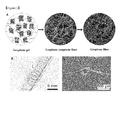
- FIG. 1 is a conceptual diagram showing the procedure for producing a fiber composed of graphene flakes having directivity and wrinkles according to the present invention. According to the method of the present invention, graphene can be prevented from restacking in the individual steps of producing a fiber from a graphene solution in order to maintain a wrinkled structure.
- a graphene fiber is produced by the following procedure. First, a graphene/DMF solution is prepared. The DMF is exchanged with distilled water by sonication and centrifugation, and the graphene is well dispersed in distilled water with the help of a surfactant to prepare a graphene solution. The graphene solution is incorporated into a coagulation bath containing polyvinyl alcohol (PVA). The graphene solution incorporated into the polymer is changed to a graphene gel-fiber by an assembly process through hydrophobic interaction between the graphene flakes surrounded by the PVA chains replacing the surfactant bonded to the graphene flakes. The graphene gel-fiber is washed with distilled water to remove excess PVA.
- PVA polyvinyl alcohol
- the wrinkled structure of the graphene flakes can be maintained because the magnitudes of the hydrostatic forces in the x, y, and z directions are equal. Then, the graphene gel-fiber is suspended vertically and dried in air. As a result, a graphene-based composite fiber having a wrinkled structure is formed.
- the polymer is removed from the composite fiber, leaving a porous fiber composed of graphene alone.
- the composite fiber is annealed at 300 to 1000 °C to volatilize the polymer or is treated with an acidic solution to remove the polymer.
- RCCG was dispersed in dimethylformamide (DMF) in the presence of an appropriate amount of triethylamine to obtain a stable graphene dispersion.
- DMF dimethylformamide
- Several grams of RCCG was obtained by reducing an aqueous dispersion of CCG with excess hydrazine at 95 °C over 2 h in accordance with previously reported methods ( Li, D., Muller, M. B., Gilje, S., Kaner, R. B. & Wallace, G. G. Processable aqueous dispersions of graphene nanosheets. Nature Nanotech. 3, 101 (2008 )).
- the graphene aggregated in the aqueous solution.
- the graphene aggregates were acidified with dilute sulfuric acid under vigorous stirring to a pH of 2 or less, and transferred to a sintered funnel. The aggregates were washed with a large amount of Milli-Q water on the funnel until the pH reached about 7. The filtered material was dried under vacuum at 70 °C for 48 h to obtain RCCG as a solid. The dried RCCG powder was dissolved in DMF to prepare a 0.47-0.5 mglmL RCCG/DMF solution. The length of the graphene flakes was about 400 nm, as measured using a Zetasizer. The particle size and zeta potential remained stable for several months. The dispersion was filtered under vacuum to obtain a paper having a resistance of 30-40 ⁇ /sq.
- the solvent (DMF) of the graphene flake dispersion was exchanged with distilled water by centrifugation.
- the G/F aqueous solution was mixed with sodium dodecyl benzene sulfonate (SDBS) by ultrasonication.
- SDBS sodium dodecyl benzene sulfonate
- the graphene/PVA was annealed at 600 °C to remove the PVA, leaving behind a porous fiber composed of graphene alone.
- the diameter of the graphene fiber was 28 ⁇ m.
- the graphene fiber was sufficiently flexible and thus could be wound on a glass tube having a small diameter of 6.5 mm without mechanical damage, unlike graphene papers tending to be brittle ( FIG. 1B ).
- Complete knots of the graphene fiber were difficult to form, but the formation of sufficiently strong, flexible, small diameter knots of the graphene fiber was possible ( FIG. 1C ). Difficulty in the formation of complete knots was due to the small length of the graphene flakes and the frictional force of the rough surface of the graphene fiber composed of the graphene flakes ( FIG. 2B ).
- Several strands of the graphene fiber can also be woven into a fabric.
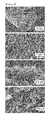
- FIG. 2 shows SEM images of the surface and cross-sectional morphologies of the graphene fiber obtained by removing the PVA from the graphene/PVA composite fiber. After annealing at 600 °C for 1 h or treatment with 37% hydrochloric acid for 24 h, the graphene fiber had a rough surface because of the wrinkled graphene flakes.
- FIG 2B The wrinkled graphene flakes were aligned along the axis of the fiber ( FIG. 2C ) and were formed into highly porous petals ( FIG. 2D ).
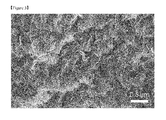
- the cross section of the graphene fiber can be specifically seen in FIG. 3 , too. This image demonstrates the formation of graphene flakes without serious restacking.
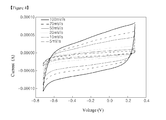
- FIG. 4 shows cyclic voltammograms of the graphene fiber at different scan rates (solution: 1 M H 2 SO 4 , reference electrode: Ag/AgCl).
- the electrical conductivity and electrochemical capacitance of the graphene fiber were 10-100 S/cm and 100-200 F/g, respectively. Accordingly, the graphene fiber is expected to find application in supercapacitors.
- the graphene fiber of the present invention has outstanding mechanical and electrochemical properties and high electrical conductivity.
- the graphene fiber of the present invention is highly porous due to wrinkled structure thereof. Therefore, the graphene fiber of the present invention can be used as an electrode for a supercapacitor, a fuel cell, or a battery as an energy storage medium.
- the graphene fiber of the present invention can also be used to develop a hydrogen storage medium.
- the graphene fiber of the present invention can be formed into knot and spring structures due to flexibility thereof and can also be woven into a fabric.
- the porous graphene fiber of the present invention can be mass-produced in a simple and economical manner and its length can be extended to tens of meters in a continuous process.
Landscapes
- Engineering & Computer Science (AREA)
- Textile Engineering (AREA)
- Chemical & Material Sciences (AREA)
- Chemical Kinetics & Catalysis (AREA)
- General Chemical & Material Sciences (AREA)
- Mechanical Engineering (AREA)
- Organic Chemistry (AREA)
- Manufacturing & Machinery (AREA)
- Nanotechnology (AREA)
- Inorganic Chemistry (AREA)
- Materials Engineering (AREA)
- Inorganic Fibers (AREA)
- Carbon And Carbon Compounds (AREA)
Abstract
Description
- The present invention relates to a method for producing a graphene fiber and a graphene fiber produced by the method. More specifically, the present invention relates to a porous graphene fiber including graphene whose wrinkled structure is maintained to achieve excellent mechanical and electrochemical properties, and a method for producing the graphene fiber.
- Graphene is a two-dimensional nanostructure of covalently bonded carbon atoms and exhibits outstanding mechanical, electrical, and thermal properties. Graphene flakes consist of single or several graphene sheets exfoliated from graphite. Graphene flakes have been reconstituted into bulky structures that have a modulus of elasticity exceeding that of flexible graphite while possessing high strength.
- A major challenge for graphene structures with high strength and toughness is to maintain the inherent active surface of graphene by preventing restacking of graphene tending to form close-packed layer structures. Single-layer graphene or a graphene flake has a wrinkled structure due to high area-to-thickness ratio thereof, but a graphene paper or composite including a large amount of graphene usually has a dense layer structure similar to graphite. The dense layered structure of graphene is an obstacle in achieving maximum mechanical properties owing to the short length of graphene that reduces the van der Waals force and tensile strength between graphene layers (by 1% or less).
- There are some reports on complexes including less than 1% of graphene whose wrinkled structure is maintained. However, there is no report regarding the development of composite fibers including graphene alone or at a considerable concentration while maintaining the wrinkled structure of graphene.
- The dense layered structure of graphene composites limits application thereof to energy and hydrogen storage media. For these reasons, there is a need to improve the porosity, mechanical properties and electrochemical properties of graphene structures.
- It is an object of the present invention to provide a porous graphene fiber that is flexible and has excellent mechanical and electrochemical properties, and a method for producing the graphene fiber.
- According to an aspect of the present invention, there is provided a method for producing a graphene fiber, including a) dispersing graphene and a surfactant in a solvent to prepare a dispersion, b) incorporating the dispersion into a polymer solution, wet spinning the resulting solution, followed by drying to produce a composite fiber, and c) annealing the composite fiber or treating the composite fiber with a strong acid to remove the polymer.
- In one embodiment of the present invention, the graphene is preferably chemically reduced graphene or graphene oxide, more preferably reduced graphene with acid functional groups.
- In one embodiment of the present invention, the chemically reduced graphene may be prepared by reducing an aqueous dispersion of graphene with hydrazine at 90 to 100 °C for 1 to 24 hours.
- In one embodiment of the present invention, the annealing is preferably performed at a temperature of 300 to 1000 °C.
- In one embodiment of the present invention, the strong acid used to remove the polymer may be hydrochloric acid, sulfuric acid, a piranha solution consisting of a mixture of sulfuric acid and hydrogen peroxide, or a superacid consisting of a mixture of sulfuric acid and oleum. The strong acid is preferably 30 to 40 wt% hydrochloric acid.
- In one embodiment of the present invention, the surfactant used to disperse the graphene is preferably selected from sodium dodecyl benzene sulfonate (SDBS), sodium dodecyl sulfonate (SDS), Triton X-100, and cetyltrimethylammonium bromide (CTAB). The surfactant is more preferably sodium dodecyl benzene sulfonate (SDBS).
- The polymer used in the method of the present invention is preferably selected from polyvinyl alcohol (PVA), poly(methyl methacrylate) (PMMA), and a mixture thereof.
- In one embodiment of the present invention, the contents of the graphene and the polymer in the graphene composite fiber are from 20 to 90% by weight and from 10 to 80% by weight, respectively. Within these ranges, the wrinkled structure of the graphene can be maintained.
- The present invention also provides a porous graphene fiber including graphene whose wrinkled structure is maintained even when a polymer is removed from a graphene composite fiber. The porous graphene fiber of the present invention has an electrical conductivity of 10 to 100 S/cm, an electrochemical capacitance of 100 to 300 F/g, and a porosity of 1000 to 2000 m2/g. The length of the graphene is preferably from 100 to 1000 nm, the diameter of the graphene composite fiber is typically from 30 to 100 µm, which may be controlled by the diameter of a syringe tip used during wet spinning, and the diameter of the porous graphene fiber after the polymer removal is typically from 15 to 50 µm.
- The porous graphene fiber of the present invention may be formed into knot and spring structures due to flexibility thereof, and several strands thereof may also be woven into a fabric.
- The porous graphene fiber of the present invention can be utilized in a supercapacitor or an energy or hydrogen storage medium due to excellent electrical and mechanical properties and high porosity thereof.
- The graphene fiber of the present invention, which includes graphene whose wrinkled structure is maintained, exhibits far superior mechanical and electrochemical properties to conventional graphene papers, graphene composite films, and flexible graphite.
- For effective current collection, graphene electrodes for supercapacitors, fuel cells, and batteries as conventional energy storage media have been used in combination with highly electrically conductive metals. In contrast, high electrical conductivity of the porous graphene fiber according to the present invention eliminates the need for a separate metal electrode.
- In addition, the graphene fiber of the present invention can be formed into knot or spring structures due to flexibility thereof and can also be woven into a fabric. Therefore, the graphene fiber of the present invention is applicable to a wide variety of fields. The wrinkled structure of graphene makes the graphene fiber of the present invention porous. This enables utilization of the graphene fiber of the present invention in energy and hydrogen storage media, etc.
- Furthermore, the porous graphene fiber of the present invention can be mass-produced in a simple and economical manner and its length can be extended to tens of meters in a continuous process. Therefore, the porous graphene fiber of the present invention is ideally suited to industrial applications.
-
-
FIG. 1 is a conceptual diagram showing the procedure for producing a fiber composed of graphene flakes having directivity and wrinkles according to the present invention. -
FIG. 2 shows SEM images of the surface and cross-sectional morphologies of a graphene fiber having a wrinkled structure according to the present invention. -
FIG. 3 is a SEM image showing the cross section of a graphene fiber from which PVA was removed by annealing a graphene/PVA fiber at 600 °C. -
FIG. 4 shows cyclic voltammograms of a graphene fiber of the present invention at different scan rates. - The present invention will now be described in more detail with reference to exemplary embodiments thereof.
-
FIG. 1 is a conceptual diagram showing the procedure for producing a fiber composed of graphene flakes having directivity and wrinkles according to the present invention. According to the method of the present invention, graphene can be prevented from restacking in the individual steps of producing a fiber from a graphene solution in order to maintain a wrinkled structure. - First, chemically converted graphene flakes (RCCGFs) with functional groups such as COOH groups are dispersed in dimethylformamide (DMF). An electrostatic repulsive force induced by the functional groups allows stable maintenance of the dispersion state of the graphene for at least 3 months without serious aggregation of the graphene. In this case, the following relationship is satisfied:

where FR, FG, and FV.D.W. represent the electrostatic repulsive force, the force of gravity, and the van der Waals force between the graphene flakes, respectively. The relations of forces in the graphene solution during the overall fiber production procedure are as follows. - 1. The chemically converted graphene is well dispersed in DMF under the following condition:

- 2. For a wet spinning solution, when DMF is exchanged with distilled water by centrifugation:

- 3. The step of sufficiently dispersing graphene in distilled water with the help of SDBS as a surfactant:

This condition may be varied with increasing time when a large amount of graphene is loaded, and as a result, the graphene may aggregate. - 4. During wet spinning, PVA chains replace SDBS and the wrinkled graphene surrounded by the PVA chains is aligned in a graphene fiber by a shear force induced by a shear flow.
- 5. After wet spinning, a graphene gel in the solution undergoes a hydrostatic force. The hydrostatic force does not greatly affect restacking of the graphene.
- 6. Drying
- Gravimetric force is applied during drying, but stacking occurs only in the axial direction, thus maintaining the wrinkled structure of the graphene.
- Since hydrophobic interaction between graphene flakes is necessary for fiber production during wet spinning, the degree of reduction of the chemically converted graphene flakes is of importance. In other words, hydrophilicity of graphene flakes or somewhat less reduced graphene flakes impedes sufficient hydrophobic interaction between the graphene flakes, making the formation of a gel-fiber difficult.
- Accordingly, appropriate reduction of graphene is essential for the preparation of a stable dispersion and the production of an assembly by wet spinning. The atomic fractions of carbon and oxygen in the reduced graphene flakes (RCCGF) determined from XPS data are 88.05% and 9.75%, respectively.
- According to the method of the present invention, a graphene fiber is produced by the following procedure. First, a graphene/DMF solution is prepared. The DMF is exchanged with distilled water by sonication and centrifugation, and the graphene is well dispersed in distilled water with the help of a surfactant to prepare a graphene solution. The graphene solution is incorporated into a coagulation bath containing polyvinyl alcohol (PVA). The graphene solution incorporated into the polymer is changed to a graphene gel-fiber by an assembly process through hydrophobic interaction between the graphene flakes surrounded by the PVA chains replacing the surfactant bonded to the graphene flakes. The graphene gel-fiber is washed with distilled water to remove excess PVA.
- Although hydrostatic forces are applied to the graphene gel-fiber in the PVA solution and distilled water, the wrinkled structure of the graphene flakes can be maintained because the magnitudes of the hydrostatic forces in the x, y, and z directions are equal. Then, the graphene gel-fiber is suspended vertically and dried in air. As a result, a graphene-based composite fiber having a wrinkled structure is formed.
- Finally, the polymer is removed from the composite fiber, leaving a porous fiber composed of graphene alone. Specifically, the composite fiber is annealed at 300 to 1000 °C to volatilize the polymer or is treated with an acidic solution to remove the polymer.
- The present invention will be explained in detail with reference to the following examples and accompanying drawings. However, these examples are provided to assist in further understanding of the invention and are not to be construed as limiting the scope of the invention.
- In accordance with the method illustrated in
FIG. 1 , RCCG was dispersed in dimethylformamide (DMF) in the presence of an appropriate amount of triethylamine to obtain a stable graphene dispersion. Several grams of RCCG was obtained by reducing an aqueous dispersion of CCG with excess hydrazine at 95 °C over 2 h in accordance with previously reported methods (Li, D., Muller, M. B., Gilje, S., Kaner, R. B. & Wallace, G. G. Processable aqueous dispersions of graphene nanosheets. Nature Nanotech. 3, 101 (2008)). As a result of the reduction reaction, the graphene aggregated in the aqueous solution. The graphene aggregates were acidified with dilute sulfuric acid under vigorous stirring to a pH of 2 or less, and transferred to a sintered funnel. The aggregates were washed with a large amount of Milli-Q water on the funnel until the pH reached about 7. The filtered material was dried under vacuum at 70 °C for 48 h to obtain RCCG as a solid. The dried RCCG powder was dissolved in DMF to prepare a 0.47-0.5 mglmL RCCG/DMF solution. The length of the graphene flakes was about 400 nm, as measured using a Zetasizer. The particle size and zeta potential remained stable for several months. The dispersion was filtered under vacuum to obtain a paper having a resistance of 30-40 Ω/sq. - The solvent (DMF) of the graphene flake dispersion was exchanged with distilled water by centrifugation. The G/F aqueous solution was mixed with sodium dodecyl benzene sulfonate (SDBS) by ultrasonication.
- The graphene dispersion was slowly injected into a coagulation bath containing PVA (molecular weight = 89,000-124,000, degree of hydrolysis = ∼99%) through a syringe (26 gauge) and wet spun to continuously produce a uniform graphene/PVA fiber.
- The graphene/PVA was annealed at 600 °C to remove the PVA, leaving behind a porous fiber composed of graphene alone. The diameter of the graphene fiber was 28 µm.
- The graphene fiber was sufficiently flexible and thus could be wound on a glass tube having a small diameter of 6.5 mm without mechanical damage, unlike graphene papers tending to be brittle (
FIG. 1B ). Complete knots of the graphene fiber were difficult to form, but the formation of sufficiently strong, flexible, small diameter knots of the graphene fiber was possible (FIG. 1C ). Difficulty in the formation of complete knots was due to the small length of the graphene flakes and the frictional force of the rough surface of the graphene fiber composed of the graphene flakes (FIG. 2B ). Several strands of the graphene fiber can also be woven into a fabric. -
FIG. 2 shows SEM images of the surface and cross-sectional morphologies of the graphene fiber obtained by removing the PVA from the graphene/PVA composite fiber. After annealing at 600 °C for 1 h or treatment with 37% hydrochloric acid for 24 h, the graphene fiber had a rough surface because of the wrinkled graphene flakes. (FIG 2B ) The wrinkled graphene flakes were aligned along the axis of the fiber (FIG. 2C ) and were formed into highly porous petals (FIG. 2D ). - The cross section of the graphene fiber can be specifically seen in
FIG. 3 , too. This image demonstrates the formation of graphene flakes without serious restacking. -
FIG. 4 shows cyclic voltammograms of the graphene fiber at different scan rates (solution: 1 M H2SO4, reference electrode: Ag/AgCl). The electrical conductivity and electrochemical capacitance of the graphene fiber were 10-100 S/cm and 100-200 F/g, respectively. Accordingly, the graphene fiber is expected to find application in supercapacitors. - As is apparent from the foregoing, the graphene fiber of the present invention has outstanding mechanical and electrochemical properties and high electrical conductivity. The graphene fiber of the present invention is highly porous due to wrinkled structure thereof. Therefore, the graphene fiber of the present invention can be used as an electrode for a supercapacitor, a fuel cell, or a battery as an energy storage medium. The graphene fiber of the present invention can also be used to develop a hydrogen storage medium. In addition, the graphene fiber of the present invention can be formed into knot and spring structures due to flexibility thereof and can also be woven into a fabric. The porous graphene fiber of the present invention can be mass-produced in a simple and economical manner and its length can be extended to tens of meters in a continuous process.
Claims (17)
- A method for producing a graphene fiber, comprisinga) dispersing graphene and a surfactant in a solvent to prepare a dispersion,b) incorporating the dispersion into a polymer solution, wet spinning the resulting solution, followed by drying to produce a composite fiber, andc) annealing the composite fiber or treating the composite fiber with a strong acid to remove the polymer.
- The method according to claim 1, wherein the graphene is chemically reduced graphene or graphene oxide.
- The method according to claim 2, wherein the chemically reduced graphene is prepared by reducing an aqueous dispersion of graphene with hydrazine at 90 to 100 °C for 1 to 24 hours.
- The method according to claim 1, wherein the annealing is performed at a temperature of 300 to 1000 °C.
- The method according to claim 1, wherein the strong acid is selected from hydrochloric acid, sulfuric acid, a piranha solution consisting of a mixture of sulfuric acid and hydrogen peroxide, a mixture of sulfuric acid and oleum, and mixtures thereof.
- The method according to claim 1, wherein the graphene is 100 to 1000 nm in length.
- The method according to claim 1, wherein the surfactant is selected from sodium dodecyl benzene sulfonate (SDBS), sodium dodecyl sulfonate (SDS), Triton X-100, and cetyltrimethylammonium bromide (CTAB).
- The method according to claim 1, wherein the polymer is selected from polyvinyl alcohol (PVA) and poly(methyl methacrylate) (PMMA).
- The method according to claim 1, wherein the contents of the graphene and the polymer in the graphene composite fiber are from 20 to 90% by weight and from 10 to 80% by weight, respectively.
- A porous graphene fiber comprising graphene whose wrinkled structure is maintained.
- The graphene fiber according to claim 10, wherein the graphene fiber has an electrical conductivity of 10 to 100 S/cm.
- The graphene fiber according to claim 10, wherein the graphene fiber has an electrochemical capacitance of 100 to 300 F/g.
- The graphene fiber according to claim 10, wherein the graphene fiber has a porosity of 1000 to 2000 m2/g.
- The graphene fiber according to claim 10, wherein the graphene fiber is flexible.
- The graphene fiber according to claim 10, wherein the porous graphene fiber is capable of being formed into knot and spring structures and being woven into a fabric.
- A supercapacitor comprising the graphene fiber according to claim 10.
- An energy or hydrogen storage medium comprising the graphene fiber according to claim 10.
Applications Claiming Priority (2)
| Application Number | Priority Date | Filing Date | Title |
|---|---|---|---|
| KR1020110022832A KR101193970B1 (en) | 2011-03-15 | 2011-03-15 | Graphene fiber and method for preparing the same |
| PCT/KR2012/001718 WO2012124934A2 (en) | 2011-03-15 | 2012-03-09 | Graphene fiber and method for manufacturing same |
Publications (3)
| Publication Number | Publication Date |
|---|---|
| EP2687626A2 true EP2687626A2 (en) | 2014-01-22 |
| EP2687626A4 EP2687626A4 (en) | 2014-09-24 |
| EP2687626B1 EP2687626B1 (en) | 2020-09-09 |
Family
ID=46831175
Family Applications (1)
| Application Number | Title | Priority Date | Filing Date |
|---|---|---|---|
| EP12757510.8A Active EP2687626B1 (en) | 2011-03-15 | 2012-03-09 | Graphene fiber and method for manufacturing same |
Country Status (4)
| Country | Link |
|---|---|
| US (2) | US20140004344A1 (en) |
| EP (1) | EP2687626B1 (en) |
| KR (1) | KR101193970B1 (en) |
| WO (1) | WO2012124934A2 (en) |
Cited By (12)
| Publication number | Priority date | Publication date | Assignee | Title |
|---|---|---|---|---|
| CN104232108A (en) * | 2014-09-10 | 2014-12-24 | 浙江碳谷上希材料科技有限公司 | Preparation method of pure inorganic composite membrane based on graphene |
| EP2837716A4 (en) * | 2013-04-10 | 2015-06-03 | Huawei Tech Co Ltd | GRAPHENE FIBER AND PROCESS FOR PREPARING THE SAME |
| CN105088415A (en) * | 2015-06-15 | 2015-11-25 | 中国科学技术大学 | Graphene oxide solution for wet spinning and preparation method thereof, graphene fiber and preparation method of graphene fiber |
| CN105256408A (en) * | 2015-11-29 | 2016-01-20 | 南京新月材料科技有限公司 | Graphene oxide fibers and preparation method thereof |
| CN106149084A (en) * | 2016-06-23 | 2016-11-23 | 常州第六元素材料科技股份有限公司 | A kind of Graphene, UHMWPE composite fibre and its preparation method and application |
| CN107142593A (en) * | 2017-05-16 | 2017-09-08 | 江苏恒源丝绸集团有限公司 | The preparation method of anti bacteria natural silk fabric |
| CN108221370A (en) * | 2018-01-23 | 2018-06-29 | 浙江大学 | A kind of compound alkene fiber of the highly conductive graphite of ambient stable and preparation method thereof |
| CN109680366A (en) * | 2017-10-19 | 2019-04-26 | 中国科学院上海硅酸盐研究所 | A kind of overlength graphene fiber and preparation method thereof |
| JP2019513914A (en) * | 2016-04-12 | 2019-05-30 | グリーン ナノテク ラブズ,エルエルシー | Method of manufacturing intelligent graphene nanomaterials and use for ultra-light machines and vehicles |
| CN110629325A (en) * | 2019-09-30 | 2019-12-31 | 华中科技大学 | A multi-element doped graphene fiber, its preparation and application |
| US10683590B2 (en) | 2015-07-16 | 2020-06-16 | Rensselaer Polytechnic Institute | Graphene fiber and method of manufacturing same |
| CN111334899A (en) * | 2020-05-11 | 2020-06-26 | 北京石墨烯研究院 | Graphene fiber and preparation method thereof |
Families Citing this family (34)
| Publication number | Priority date | Publication date | Assignee | Title |
|---|---|---|---|---|
| KR101195490B1 (en) * | 2011-03-15 | 2012-10-29 | 한양대학교 산학협력단 | Graphene composite fiber and the method for preparing the fiber |
| US9413075B2 (en) * | 2012-06-14 | 2016-08-09 | Globalfoundries Inc. | Graphene based structures and methods for broadband electromagnetic radiation absorption at the microwave and terahertz frequencies |
| US9174413B2 (en) | 2012-06-14 | 2015-11-03 | International Business Machines Corporation | Graphene based structures and methods for shielding electromagnetic radiation |
| CN103541043A (en) * | 2013-08-01 | 2014-01-29 | 华为技术有限公司 | Preparation method of electric graphene composite fiber |
| CN103466608B (en) * | 2013-09-11 | 2015-09-02 | 中南大学 | A kind of ball milling preparation method of Graphene |
| WO2015061327A1 (en) | 2013-10-21 | 2015-04-30 | The Penn State Research Foundation | Method for preparing graphene oxide films and fibers |
| CN103741264A (en) * | 2013-11-14 | 2014-04-23 | 南京新月材料科技有限公司 | Method for preparing graphene fibers through self-assembly of large lamellar graphene oxide |
| JP2015199261A (en) * | 2014-04-08 | 2015-11-12 | ブラザー工業株式会社 | Liquid discharge device |
| CN104362002B (en) * | 2014-09-23 | 2017-10-03 | 浙江碳谷上希材料科技有限公司 | A kind of graphene aquagel membrane electrode with orientation texture |
| KR101695370B1 (en) | 2015-03-30 | 2017-01-12 | 주식회사 파이버엔텍 | Process Of Producing Electroconductive Bicomponent Fiber |
| TWI621744B (en) | 2015-10-20 | 2018-04-21 | 聚泰環保材料科技股份有限公司 | Method for preparing graphene blended natural cellulose spunbonded non-woven fabric |
| TWI596245B (en) | 2015-10-20 | 2017-08-21 | 聚隆纖維股份有限公司 | Method for preparing graphene blended natural cellulose fiber |
| TWI588089B (en) | 2015-10-20 | 2017-06-21 | Acelon Chem & Fiber Corp | Method for preparing graphene blended natural cellulose meltblown nonwoven fabric |
| KR101801458B1 (en) * | 2016-03-03 | 2017-12-20 | 한양대학교 산학협력단 | fibrous electrode and supercapacitor comprising the same |
| US11649566B2 (en) | 2016-04-11 | 2023-05-16 | Iucf-Hyu (Industry-University Cooperation Foundation Hanyang University) | Graphene fiber and method of manufacturing the same |
| CN109072484B (en) * | 2016-04-11 | 2021-06-04 | 汉阳大学校产学协力团 | Graphene fiber and preparation method thereof |
| WO2017179900A1 (en) * | 2016-04-11 | 2017-10-19 | 한양대학교 산학협력단 | Graphene fiber and manufacturing method therefor |
| JP7190735B2 (en) | 2016-04-13 | 2022-12-16 | グリーン ナノテク ラブズ,エルエルシー | A low-cost and rapid method for mass production of graphene and graphene oxide using carbon-rich natural materials |
| KR101894899B1 (en) | 2017-02-10 | 2018-09-04 | 한국과학기술원 | Carbon Hybrid Fiber having High Crystalline Conducting Polymer Shell and method of manufacturing the same |
| US20180240609A1 (en) | 2017-02-17 | 2018-08-23 | Aict | High performance nano/micro composite fiber capable of storing electrical energy and method for fabricating thereof |
| CN107205310B (en) * | 2017-06-29 | 2019-12-24 | 惠科股份有限公司 | A circuit board and display device |
| CN107504893B (en) * | 2017-09-06 | 2020-02-14 | 南京理工大学 | High-sensitivity reticular graphene/elastomer strain sensor and preparation method thereof |
| KR102529541B1 (en) * | 2018-03-20 | 2023-05-04 | 아톰 드레드즈 코퍼레이션 | High Strength Graphene Fiber and Manufacturing Method Thereof |
| WO2019208997A1 (en) * | 2018-04-26 | 2019-10-31 | 한양대학교 산학협력단 | Composite fibers including graphene fibers having coating film formed thereon, and method for preparing same |
| KR102148359B1 (en) | 2018-12-07 | 2020-10-14 | 한국과학기술원 | polymer-graphene liquid crystal fiber and a carbon fiber produced by the same and method for manufacturing the sames |
| US10875773B2 (en) * | 2019-04-11 | 2020-12-29 | Cornell University | Method for storage or transportation of graphene oxide |
| WO2020221361A1 (en) * | 2019-04-30 | 2020-11-05 | 青岛大学 | Preparation method for graphene oxide fiber, and fiber obtained thereby |
| CN110219167A (en) * | 2019-06-24 | 2019-09-10 | 北京绿能嘉业新能源有限公司 | The preparation method of graphene fiber, electrothermic kang warm plate and preparation method thereof |
| KR102197591B1 (en) | 2019-09-25 | 2021-01-05 | 한국재료연구원 | Composite fiber, strain sensor comprising same, and method for manufacturing same |
| CN111663327A (en) * | 2020-06-05 | 2020-09-15 | 西安工程大学 | Preparation method of polyacrylic acid based graphene core-shell structure composite fiber |
| US12104286B2 (en) | 2020-06-25 | 2024-10-01 | Nicholas L. Ciparro | Methods of forming a nanocomposite fiber and related mixture and nanocomposite fibers |
| CN113470986B (en) * | 2021-07-19 | 2022-04-12 | 重庆文理学院 | A kind of flexible linear supercapacitor and preparation method thereof |
| CN113860735B (en) * | 2021-10-14 | 2023-02-10 | 广东欧文莱陶瓷有限公司 | Acid-resistant alkali-resistant digital protection glaze |
| CN118668361A (en) * | 2024-06-20 | 2024-09-20 | 东莞易昌塑胶布业有限公司 | Screen cloth with far infrared function and preparation method thereof |
Family Cites Families (12)
| Publication number | Priority date | Publication date | Assignee | Title |
|---|---|---|---|---|
| US4915925A (en) * | 1985-02-11 | 1990-04-10 | Chung Deborah D L | Exfoliated graphite fibers and associated method |
| TW200508431A (en) * | 2003-08-26 | 2005-03-01 | Showa Denko Kk | Crimped carbon fiber and production method thereof |
| US7658901B2 (en) * | 2005-10-14 | 2010-02-09 | The Trustees Of Princeton University | Thermally exfoliated graphite oxide |
| WO2008048295A2 (en) * | 2005-11-18 | 2008-04-24 | Northwestern University | Stable dispersions of polymer-coated graphitic nanoplatelets |
| US7566410B2 (en) | 2006-01-11 | 2009-07-28 | Nanotek Instruments, Inc. | Highly conductive nano-scaled graphene plate nanocomposites |
| US7875219B2 (en) * | 2007-10-04 | 2011-01-25 | Nanotek Instruments, Inc. | Process for producing nano-scaled graphene platelet nanocomposite electrodes for supercapacitors |
| US7923491B2 (en) * | 2008-08-08 | 2011-04-12 | Exxonmobil Chemical Patents Inc. | Graphite nanocomposites |
| WO2010096665A1 (en) * | 2009-02-19 | 2010-08-26 | William Marsh Rice University | Dissolution of graphite, graphite oxide and graphene nanoribbons in superacid solutions and manipulation thereof |
| KR101074027B1 (en) * | 2009-03-03 | 2011-10-17 | 한국과학기술연구원 | Graphene composite nanofiber and the preparation method thereof |
| US8315039B2 (en) * | 2009-12-28 | 2012-11-20 | Nanotek Instruments, Inc. | Spacer-modified nano graphene electrodes for supercapacitors |
| EP2535903B1 (en) * | 2010-02-09 | 2018-12-05 | Graphene Square Inc. | Method for manufacturing a graphene fiber |
| US9053870B2 (en) * | 2010-08-02 | 2015-06-09 | Nanotek Instruments, Inc. | Supercapacitor with a meso-porous nano graphene electrode |
-
2011
- 2011-03-15 KR KR1020110022832A patent/KR101193970B1/en active Active
-
2012
- 2012-03-09 EP EP12757510.8A patent/EP2687626B1/en active Active
- 2012-03-09 US US14/004,829 patent/US20140004344A1/en not_active Abandoned
- 2012-03-09 WO PCT/KR2012/001718 patent/WO2012124934A2/en not_active Ceased
-
2016
- 2016-07-07 US US15/204,580 patent/US10106420B2/en active Active
Cited By (17)
| Publication number | Priority date | Publication date | Assignee | Title |
|---|---|---|---|---|
| US10145029B2 (en) | 2013-04-10 | 2018-12-04 | Huawei Technologies Co., Ltd. | Graphene fiber and prepartion method thereof |
| EP2837716A4 (en) * | 2013-04-10 | 2015-06-03 | Huawei Tech Co Ltd | GRAPHENE FIBER AND PROCESS FOR PREPARING THE SAME |
| CN104232108B (en) * | 2014-09-10 | 2016-03-09 | 浙江碳谷上希材料科技有限公司 | A kind of preparation method of the pure inorganic substances compound membrane based on Graphene |
| CN104232108A (en) * | 2014-09-10 | 2014-12-24 | 浙江碳谷上希材料科技有限公司 | Preparation method of pure inorganic composite membrane based on graphene |
| CN105088415A (en) * | 2015-06-15 | 2015-11-25 | 中国科学技术大学 | Graphene oxide solution for wet spinning and preparation method thereof, graphene fiber and preparation method of graphene fiber |
| US10683590B2 (en) | 2015-07-16 | 2020-06-16 | Rensselaer Polytechnic Institute | Graphene fiber and method of manufacturing same |
| CN105256408A (en) * | 2015-11-29 | 2016-01-20 | 南京新月材料科技有限公司 | Graphene oxide fibers and preparation method thereof |
| EP3442904A4 (en) * | 2016-04-12 | 2019-12-25 | Green Nanotech Labs, LLC | METHODS OF MANUFACTURING INTELLIGENT GRAPHENE NANOMATERIALS AND USE IN MACHINE AND VERY LIGHT VEHICLES |
| JP2019513914A (en) * | 2016-04-12 | 2019-05-30 | グリーン ナノテク ラブズ,エルエルシー | Method of manufacturing intelligent graphene nanomaterials and use for ultra-light machines and vehicles |
| CN106149084A (en) * | 2016-06-23 | 2016-11-23 | 常州第六元素材料科技股份有限公司 | A kind of Graphene, UHMWPE composite fibre and its preparation method and application |
| CN107142593A (en) * | 2017-05-16 | 2017-09-08 | 江苏恒源丝绸集团有限公司 | The preparation method of anti bacteria natural silk fabric |
| CN109680366A (en) * | 2017-10-19 | 2019-04-26 | 中国科学院上海硅酸盐研究所 | A kind of overlength graphene fiber and preparation method thereof |
| CN109680366B (en) * | 2017-10-19 | 2021-05-25 | 中国科学院上海硅酸盐研究所 | A kind of ultra-long graphene fiber and preparation method thereof |
| CN108221370B (en) * | 2018-01-23 | 2020-04-14 | 长兴德烯科技有限公司 | A kind of environment-stable high-conductivity graphene composite fiber and preparation method thereof |
| CN108221370A (en) * | 2018-01-23 | 2018-06-29 | 浙江大学 | A kind of compound alkene fiber of the highly conductive graphite of ambient stable and preparation method thereof |
| CN110629325A (en) * | 2019-09-30 | 2019-12-31 | 华中科技大学 | A multi-element doped graphene fiber, its preparation and application |
| CN111334899A (en) * | 2020-05-11 | 2020-06-26 | 北京石墨烯研究院 | Graphene fiber and preparation method thereof |
Also Published As
| Publication number | Publication date |
|---|---|
| KR101193970B1 (en) | 2012-10-24 |
| EP2687626A4 (en) | 2014-09-24 |
| WO2012124934A2 (en) | 2012-09-20 |
| KR20120107026A (en) | 2012-09-28 |
| EP2687626B1 (en) | 2020-09-09 |
| WO2012124934A3 (en) | 2012-12-27 |
| US20140004344A1 (en) | 2014-01-02 |
| US20160318767A1 (en) | 2016-11-03 |
| US10106420B2 (en) | 2018-10-23 |
Similar Documents
| Publication | Publication Date | Title |
|---|---|---|
| US10106420B2 (en) | Method for manufacturing graphene fiber | |
| EP2687624B1 (en) | Graphene conjugate fiber and method for manufacturing same | |
| US7938996B2 (en) | Polymer-free carbon nanotube assemblies (fibers, ropes, ribbons, films) | |
| US9284193B2 (en) | Method for preparing graphene oxide films and fibers | |
| EP2698457B1 (en) | Hybrid polymer composite fiber including graphene and carbon nanotube, and method for manufacturing same | |
| CA2747728C (en) | Exfoliated carbon nanotubes, methods for production thereof and products obtained therefrom | |
| CN109576822B (en) | Method for preparing single-walled carbon nanotube fiber and composite fiber thereof | |
| Cruz-Silva et al. | Super-stretchable graphene oxide macroscopic fibers with outstanding knotability fabricated by dry film scrolling | |
| US11697734B2 (en) | Electrospun collagen-graphene-polymer composite nanofibers for supercapacitors | |
| CA2924489C (en) | High carbon nanotube content fluids | |
| Niu et al. | Facile fabrication of flexible, bendable and knittable electrode with PANI in the well-defined porous rEGO/GP fiber for solid state supercapacitors | |
| Bang et al. | Effects of pH on electrospun PVA/acid-treated MWNT composite nanofibers | |
| Lay et al. | Combined effect of carbon nanotubes and polypyrrole on the electrical properties of cellulose-nanopaper | |
| Cao et al. | Assembly of nanowires into macroscopic one-dimensional fibers in liquid state | |
| Liu et al. | The formation of uniform graphene-polyaniline hybrids using a completely miscible cosolvent that have an excellent electrochemical performance | |
| Moharana et al. | Graphene-based polymer composites: Physical and chemical properties | |
| Liu et al. | Glassy carbon nanofibers from electrospun cellulose nanofiber | |
| Chae et al. | Carbon nanotube-enabled materials | |
| Miomandre et al. | Electrochemical synthesis of polypyrrole nanowires on carbon nanotube-coated carbon fibers | |
| Mishra et al. | Polymer Graphene-Based Nanofibers and Their Application for Batteries | |
| Capps | Carbon nanotube fibers and ribbons produced by a novel wet-spinning process | |
| Haghighi Poudeh | Design and manufacturing of dimensionally controlled graphene based hybrid structures by core-shell electrospinning for energy storage systems | |
| Das | Dispersion and rheology of stabilized graphene colloids and gels |
Legal Events
| Date | Code | Title | Description |
|---|---|---|---|
| PUAI | Public reference made under article 153(3) epc to a published international application that has entered the european phase |
Free format text: ORIGINAL CODE: 0009012 |
|
| 17P | Request for examination filed |
Effective date: 20130927 |
|
| AK | Designated contracting states |
Kind code of ref document: A2 Designated state(s): AL AT BE BG CH CY CZ DE DK EE ES FI FR GB GR HR HU IE IS IT LI LT LU LV MC MK MT NL NO PL PT RO RS SE SI SK SM TR |
|
| DAX | Request for extension of the european patent (deleted) | ||
| A4 | Supplementary search report drawn up and despatched |
Effective date: 20140827 |
|
| RIC1 | Information provided on ipc code assigned before grant |
Ipc: C01B 31/04 20060101ALI20140821BHEP Ipc: D01F 9/12 20060101AFI20140821BHEP Ipc: B82Y 30/00 20110101ALI20140821BHEP Ipc: D01D 5/06 20060101ALI20140821BHEP Ipc: D01F 1/09 20060101ALI20140821BHEP Ipc: C08J 5/00 20060101ALI20140821BHEP Ipc: D01D 5/247 20060101ALI20140821BHEP |
|
| STAA | Information on the status of an ep patent application or granted ep patent |
Free format text: STATUS: EXAMINATION IS IN PROGRESS |
|
| 17Q | First examination report despatched |
Effective date: 20180406 |
|
| GRAJ | Information related to disapproval of communication of intention to grant by the applicant or resumption of examination proceedings by the epo deleted |
Free format text: ORIGINAL CODE: EPIDOSDIGR1 |
|
| STAA | Information on the status of an ep patent application or granted ep patent |
Free format text: STATUS: GRANT OF PATENT IS INTENDED |
|
| RIC1 | Information provided on ipc code assigned before grant |
Ipc: D01F 9/12 20060101AFI20200329BHEP Ipc: D01D 1/02 20060101ALI20200329BHEP Ipc: D01D 5/06 20060101ALI20200329BHEP Ipc: C08J 5/00 20060101ALI20200329BHEP Ipc: B82Y 30/00 20110101ALI20200329BHEP Ipc: D01D 5/247 20060101ALI20200329BHEP Ipc: D01F 1/09 20060101ALI20200329BHEP |
|
| GRAP | Despatch of communication of intention to grant a patent |
Free format text: ORIGINAL CODE: EPIDOSNIGR1 |
|
| INTG | Intention to grant announced |
Effective date: 20200511 |
|
| GRAS | Grant fee paid |
Free format text: ORIGINAL CODE: EPIDOSNIGR3 |
|
| GRAA | (expected) grant |
Free format text: ORIGINAL CODE: 0009210 |
|
| STAA | Information on the status of an ep patent application or granted ep patent |
Free format text: STATUS: THE PATENT HAS BEEN GRANTED |
|
| AK | Designated contracting states |
Kind code of ref document: B1 Designated state(s): AL AT BE BG CH CY CZ DE DK EE ES FI FR GB GR HR HU IE IS IT LI LT LU LV MC MK MT NL NO PL PT RO RS SE SI SK SM TR |
|
| REG | Reference to a national code |
Ref country code: GB Ref legal event code: FG4D |
|
| REG | Reference to a national code |
Ref country code: AT Ref legal event code: REF Ref document number: 1311679 Country of ref document: AT Kind code of ref document: T Effective date: 20200915 Ref country code: CH Ref legal event code: EP |
|
| REG | Reference to a national code |
Ref country code: DE Ref legal event code: R096 Ref document number: 602012072235 Country of ref document: DE |
|
| REG | Reference to a national code |
Ref country code: IE Ref legal event code: FG4D |
|
| REG | Reference to a national code |
Ref country code: LT Ref legal event code: MG4D |
|
| PG25 | Lapsed in a contracting state [announced via postgrant information from national office to epo] |
Ref country code: HR Free format text: LAPSE BECAUSE OF FAILURE TO SUBMIT A TRANSLATION OF THE DESCRIPTION OR TO PAY THE FEE WITHIN THE PRESCRIBED TIME-LIMIT Effective date: 20200909 Ref country code: LT Free format text: LAPSE BECAUSE OF FAILURE TO SUBMIT A TRANSLATION OF THE DESCRIPTION OR TO PAY THE FEE WITHIN THE PRESCRIBED TIME-LIMIT Effective date: 20200909 Ref country code: NO Free format text: LAPSE BECAUSE OF FAILURE TO SUBMIT A TRANSLATION OF THE DESCRIPTION OR TO PAY THE FEE WITHIN THE PRESCRIBED TIME-LIMIT Effective date: 20201209 Ref country code: GR Free format text: LAPSE BECAUSE OF FAILURE TO SUBMIT A TRANSLATION OF THE DESCRIPTION OR TO PAY THE FEE WITHIN THE PRESCRIBED TIME-LIMIT Effective date: 20201210 Ref country code: BG Free format text: LAPSE BECAUSE OF FAILURE TO SUBMIT A TRANSLATION OF THE DESCRIPTION OR TO PAY THE FEE WITHIN THE PRESCRIBED TIME-LIMIT Effective date: 20201209 Ref country code: FI Free format text: LAPSE BECAUSE OF FAILURE TO SUBMIT A TRANSLATION OF THE DESCRIPTION OR TO PAY THE FEE WITHIN THE PRESCRIBED TIME-LIMIT Effective date: 20200909 Ref country code: SE Free format text: LAPSE BECAUSE OF FAILURE TO SUBMIT A TRANSLATION OF THE DESCRIPTION OR TO PAY THE FEE WITHIN THE PRESCRIBED TIME-LIMIT Effective date: 20200909 |
|
| REG | Reference to a national code |
Ref country code: AT Ref legal event code: MK05 Ref document number: 1311679 Country of ref document: AT Kind code of ref document: T Effective date: 20200909 |
|
| REG | Reference to a national code |
Ref country code: NL Ref legal event code: MP Effective date: 20200909 |
|
| PG25 | Lapsed in a contracting state [announced via postgrant information from national office to epo] |
Ref country code: LV Free format text: LAPSE BECAUSE OF FAILURE TO SUBMIT A TRANSLATION OF THE DESCRIPTION OR TO PAY THE FEE WITHIN THE PRESCRIBED TIME-LIMIT Effective date: 20200909 Ref country code: PL Free format text: LAPSE BECAUSE OF FAILURE TO SUBMIT A TRANSLATION OF THE DESCRIPTION OR TO PAY THE FEE WITHIN THE PRESCRIBED TIME-LIMIT Effective date: 20200909 Ref country code: RS Free format text: LAPSE BECAUSE OF FAILURE TO SUBMIT A TRANSLATION OF THE DESCRIPTION OR TO PAY THE FEE WITHIN THE PRESCRIBED TIME-LIMIT Effective date: 20200909 |
|
| PG25 | Lapsed in a contracting state [announced via postgrant information from national office to epo] |
Ref country code: CZ Free format text: LAPSE BECAUSE OF FAILURE TO SUBMIT A TRANSLATION OF THE DESCRIPTION OR TO PAY THE FEE WITHIN THE PRESCRIBED TIME-LIMIT Effective date: 20200909 Ref country code: EE Free format text: LAPSE BECAUSE OF FAILURE TO SUBMIT A TRANSLATION OF THE DESCRIPTION OR TO PAY THE FEE WITHIN THE PRESCRIBED TIME-LIMIT Effective date: 20200909 Ref country code: SM Free format text: LAPSE BECAUSE OF FAILURE TO SUBMIT A TRANSLATION OF THE DESCRIPTION OR TO PAY THE FEE WITHIN THE PRESCRIBED TIME-LIMIT Effective date: 20200909 Ref country code: RO Free format text: LAPSE BECAUSE OF FAILURE TO SUBMIT A TRANSLATION OF THE DESCRIPTION OR TO PAY THE FEE WITHIN THE PRESCRIBED TIME-LIMIT Effective date: 20200909 Ref country code: PT Free format text: LAPSE BECAUSE OF FAILURE TO SUBMIT A TRANSLATION OF THE DESCRIPTION OR TO PAY THE FEE WITHIN THE PRESCRIBED TIME-LIMIT Effective date: 20210111 Ref country code: NL Free format text: LAPSE BECAUSE OF FAILURE TO SUBMIT A TRANSLATION OF THE DESCRIPTION OR TO PAY THE FEE WITHIN THE PRESCRIBED TIME-LIMIT Effective date: 20200909 |
|
| PG25 | Lapsed in a contracting state [announced via postgrant information from national office to epo] |
Ref country code: IS Free format text: LAPSE BECAUSE OF FAILURE TO SUBMIT A TRANSLATION OF THE DESCRIPTION OR TO PAY THE FEE WITHIN THE PRESCRIBED TIME-LIMIT Effective date: 20210109 Ref country code: AL Free format text: LAPSE BECAUSE OF FAILURE TO SUBMIT A TRANSLATION OF THE DESCRIPTION OR TO PAY THE FEE WITHIN THE PRESCRIBED TIME-LIMIT Effective date: 20200909 Ref country code: AT Free format text: LAPSE BECAUSE OF FAILURE TO SUBMIT A TRANSLATION OF THE DESCRIPTION OR TO PAY THE FEE WITHIN THE PRESCRIBED TIME-LIMIT Effective date: 20200909 Ref country code: ES Free format text: LAPSE BECAUSE OF FAILURE TO SUBMIT A TRANSLATION OF THE DESCRIPTION OR TO PAY THE FEE WITHIN THE PRESCRIBED TIME-LIMIT Effective date: 20200909 |
|
| REG | Reference to a national code |
Ref country code: DE Ref legal event code: R097 Ref document number: 602012072235 Country of ref document: DE |
|
| PG25 | Lapsed in a contracting state [announced via postgrant information from national office to epo] |
Ref country code: SK Free format text: LAPSE BECAUSE OF FAILURE TO SUBMIT A TRANSLATION OF THE DESCRIPTION OR TO PAY THE FEE WITHIN THE PRESCRIBED TIME-LIMIT Effective date: 20200909 |
|
| PLBE | No opposition filed within time limit |
Free format text: ORIGINAL CODE: 0009261 |
|
| STAA | Information on the status of an ep patent application or granted ep patent |
Free format text: STATUS: NO OPPOSITION FILED WITHIN TIME LIMIT |
|
| 26N | No opposition filed |
Effective date: 20210610 |
|
| PG25 | Lapsed in a contracting state [announced via postgrant information from national office to epo] |
Ref country code: SI Free format text: LAPSE BECAUSE OF FAILURE TO SUBMIT A TRANSLATION OF THE DESCRIPTION OR TO PAY THE FEE WITHIN THE PRESCRIBED TIME-LIMIT Effective date: 20200909 Ref country code: DK Free format text: LAPSE BECAUSE OF FAILURE TO SUBMIT A TRANSLATION OF THE DESCRIPTION OR TO PAY THE FEE WITHIN THE PRESCRIBED TIME-LIMIT Effective date: 20200909 |
|
| PG25 | Lapsed in a contracting state [announced via postgrant information from national office to epo] |
Ref country code: MC Free format text: LAPSE BECAUSE OF FAILURE TO SUBMIT A TRANSLATION OF THE DESCRIPTION OR TO PAY THE FEE WITHIN THE PRESCRIBED TIME-LIMIT Effective date: 20200909 Ref country code: IT Free format text: LAPSE BECAUSE OF FAILURE TO SUBMIT A TRANSLATION OF THE DESCRIPTION OR TO PAY THE FEE WITHIN THE PRESCRIBED TIME-LIMIT Effective date: 20200909 |
|
| REG | Reference to a national code |
Ref country code: CH Ref legal event code: PL |
|
| GBPC | Gb: european patent ceased through non-payment of renewal fee |
Effective date: 20210309 |
|
| REG | Reference to a national code |
Ref country code: BE Ref legal event code: MM Effective date: 20210331 |
|
| PG25 | Lapsed in a contracting state [announced via postgrant information from national office to epo] |
Ref country code: CH Free format text: LAPSE BECAUSE OF NON-PAYMENT OF DUE FEES Effective date: 20210331 Ref country code: LI Free format text: LAPSE BECAUSE OF NON-PAYMENT OF DUE FEES Effective date: 20210331 Ref country code: LU Free format text: LAPSE BECAUSE OF NON-PAYMENT OF DUE FEES Effective date: 20210309 Ref country code: GB Free format text: LAPSE BECAUSE OF NON-PAYMENT OF DUE FEES Effective date: 20210309 Ref country code: IE Free format text: LAPSE BECAUSE OF NON-PAYMENT OF DUE FEES Effective date: 20210309 |
|
| PG25 | Lapsed in a contracting state [announced via postgrant information from national office to epo] |
Ref country code: BE Free format text: LAPSE BECAUSE OF NON-PAYMENT OF DUE FEES Effective date: 20210331 |
|
| PG25 | Lapsed in a contracting state [announced via postgrant information from national office to epo] |
Ref country code: HU Free format text: LAPSE BECAUSE OF FAILURE TO SUBMIT A TRANSLATION OF THE DESCRIPTION OR TO PAY THE FEE WITHIN THE PRESCRIBED TIME-LIMIT; INVALID AB INITIO Effective date: 20120309 Ref country code: CY Free format text: LAPSE BECAUSE OF FAILURE TO SUBMIT A TRANSLATION OF THE DESCRIPTION OR TO PAY THE FEE WITHIN THE PRESCRIBED TIME-LIMIT Effective date: 20200909 |
|
| PG25 | Lapsed in a contracting state [announced via postgrant information from national office to epo] |
Ref country code: MK Free format text: LAPSE BECAUSE OF FAILURE TO SUBMIT A TRANSLATION OF THE DESCRIPTION OR TO PAY THE FEE WITHIN THE PRESCRIBED TIME-LIMIT Effective date: 20200909 |
|
| PG25 | Lapsed in a contracting state [announced via postgrant information from national office to epo] |
Ref country code: MT Free format text: LAPSE BECAUSE OF FAILURE TO SUBMIT A TRANSLATION OF THE DESCRIPTION OR TO PAY THE FEE WITHIN THE PRESCRIBED TIME-LIMIT Effective date: 20200909 |
|
| PGFP | Annual fee paid to national office [announced via postgrant information from national office to epo] |
Ref country code: FR Payment date: 20241224 Year of fee payment: 14 |
|
| PGFP | Annual fee paid to national office [announced via postgrant information from national office to epo] |
Ref country code: DE Payment date: 20241223 Year of fee payment: 14 |
|
| PG25 | Lapsed in a contracting state [announced via postgrant information from national office to epo] |
Ref country code: TR Free format text: LAPSE BECAUSE OF FAILURE TO SUBMIT A TRANSLATION OF THE DESCRIPTION OR TO PAY THE FEE WITHIN THE PRESCRIBED TIME-LIMIT Effective date: 20200909 |