EP2687568A1 - Adhesive, adhesive tape, and display device - Google Patents
Adhesive, adhesive tape, and display device Download PDFInfo
- Publication number
- EP2687568A1 EP2687568A1 EP13160058.7A EP13160058A EP2687568A1 EP 2687568 A1 EP2687568 A1 EP 2687568A1 EP 13160058 A EP13160058 A EP 13160058A EP 2687568 A1 EP2687568 A1 EP 2687568A1
- Authority
- EP
- European Patent Office
- Prior art keywords
- acrylate
- adhesive
- parts
- monomer
- weight
- Prior art date
- Legal status (The legal status is an assumption and is not a legal conclusion. Google has not performed a legal analysis and makes no representation as to the accuracy of the status listed.)
- Granted
Links
Images







Classifications
-
- C—CHEMISTRY; METALLURGY
- C09—DYES; PAINTS; POLISHES; NATURAL RESINS; ADHESIVES; COMPOSITIONS NOT OTHERWISE PROVIDED FOR; APPLICATIONS OF MATERIALS NOT OTHERWISE PROVIDED FOR
- C09J—ADHESIVES; NON-MECHANICAL ASPECTS OF ADHESIVE PROCESSES IN GENERAL; ADHESIVE PROCESSES NOT PROVIDED FOR ELSEWHERE; USE OF MATERIALS AS ADHESIVES
- C09J133/00—Adhesives based on homopolymers or copolymers of compounds having one or more unsaturated aliphatic radicals, each having only one carbon-to-carbon double bond, and at least one being terminated by only one carboxyl radical, or of salts, anhydrides, esters, amides, imides, or nitriles thereof; Adhesives based on derivatives of such polymers
- C09J133/04—Homopolymers or copolymers of esters
- C09J133/06—Homopolymers or copolymers of esters of esters containing only carbon, hydrogen and oxygen, the oxygen atom being present only as part of the carboxyl radical
- C09J133/08—Homopolymers or copolymers of acrylic acid esters
-
- C—CHEMISTRY; METALLURGY
- C09—DYES; PAINTS; POLISHES; NATURAL RESINS; ADHESIVES; COMPOSITIONS NOT OTHERWISE PROVIDED FOR; APPLICATIONS OF MATERIALS NOT OTHERWISE PROVIDED FOR
- C09J—ADHESIVES; NON-MECHANICAL ASPECTS OF ADHESIVE PROCESSES IN GENERAL; ADHESIVE PROCESSES NOT PROVIDED FOR ELSEWHERE; USE OF MATERIALS AS ADHESIVES
- C09J133/00—Adhesives based on homopolymers or copolymers of compounds having one or more unsaturated aliphatic radicals, each having only one carbon-to-carbon double bond, and at least one being terminated by only one carboxyl radical, or of salts, anhydrides, esters, amides, imides, or nitriles thereof; Adhesives based on derivatives of such polymers
- C09J133/04—Homopolymers or copolymers of esters
-
- C—CHEMISTRY; METALLURGY
- C09—DYES; PAINTS; POLISHES; NATURAL RESINS; ADHESIVES; COMPOSITIONS NOT OTHERWISE PROVIDED FOR; APPLICATIONS OF MATERIALS NOT OTHERWISE PROVIDED FOR
- C09J—ADHESIVES; NON-MECHANICAL ASPECTS OF ADHESIVE PROCESSES IN GENERAL; ADHESIVE PROCESSES NOT PROVIDED FOR ELSEWHERE; USE OF MATERIALS AS ADHESIVES
- C09J133/00—Adhesives based on homopolymers or copolymers of compounds having one or more unsaturated aliphatic radicals, each having only one carbon-to-carbon double bond, and at least one being terminated by only one carboxyl radical, or of salts, anhydrides, esters, amides, imides, or nitriles thereof; Adhesives based on derivatives of such polymers
- C09J133/02—Homopolymers or copolymers of acids; Metal or ammonium salts thereof
-
- C—CHEMISTRY; METALLURGY
- C09—DYES; PAINTS; POLISHES; NATURAL RESINS; ADHESIVES; COMPOSITIONS NOT OTHERWISE PROVIDED FOR; APPLICATIONS OF MATERIALS NOT OTHERWISE PROVIDED FOR
- C09J—ADHESIVES; NON-MECHANICAL ASPECTS OF ADHESIVE PROCESSES IN GENERAL; ADHESIVE PROCESSES NOT PROVIDED FOR ELSEWHERE; USE OF MATERIALS AS ADHESIVES
- C09J4/00—Adhesives based on organic non-macromolecular compounds having at least one polymerisable carbon-to-carbon unsaturated bond ; adhesives, based on monomers of macromolecular compounds of groups C09J183/00 - C09J183/16
-
- C—CHEMISTRY; METALLURGY
- C09—DYES; PAINTS; POLISHES; NATURAL RESINS; ADHESIVES; COMPOSITIONS NOT OTHERWISE PROVIDED FOR; APPLICATIONS OF MATERIALS NOT OTHERWISE PROVIDED FOR
- C09J—ADHESIVES; NON-MECHANICAL ASPECTS OF ADHESIVE PROCESSES IN GENERAL; ADHESIVE PROCESSES NOT PROVIDED FOR ELSEWHERE; USE OF MATERIALS AS ADHESIVES
- C09J7/00—Adhesives in the form of films or foils
- C09J7/20—Adhesives in the form of films or foils characterised by their carriers
- C09J7/22—Plastics; Metallised plastics
-
- C—CHEMISTRY; METALLURGY
- C09—DYES; PAINTS; POLISHES; NATURAL RESINS; ADHESIVES; COMPOSITIONS NOT OTHERWISE PROVIDED FOR; APPLICATIONS OF MATERIALS NOT OTHERWISE PROVIDED FOR
- C09J—ADHESIVES; NON-MECHANICAL ASPECTS OF ADHESIVE PROCESSES IN GENERAL; ADHESIVE PROCESSES NOT PROVIDED FOR ELSEWHERE; USE OF MATERIALS AS ADHESIVES
- C09J7/00—Adhesives in the form of films or foils
- C09J7/30—Adhesives in the form of films or foils characterised by the adhesive composition
- C09J7/38—Pressure-sensitive adhesives [PSA]
-
- C—CHEMISTRY; METALLURGY
- C09—DYES; PAINTS; POLISHES; NATURAL RESINS; ADHESIVES; COMPOSITIONS NOT OTHERWISE PROVIDED FOR; APPLICATIONS OF MATERIALS NOT OTHERWISE PROVIDED FOR
- C09J—ADHESIVES; NON-MECHANICAL ASPECTS OF ADHESIVE PROCESSES IN GENERAL; ADHESIVE PROCESSES NOT PROVIDED FOR ELSEWHERE; USE OF MATERIALS AS ADHESIVES
- C09J7/00—Adhesives in the form of films or foils
- C09J7/30—Adhesives in the form of films or foils characterised by the adhesive composition
- C09J7/38—Pressure-sensitive adhesives [PSA]
- C09J7/381—Pressure-sensitive adhesives [PSA] based on macromolecular compounds obtained by reactions involving only carbon-to-carbon unsaturated bonds
- C09J7/385—Acrylic polymers
-
- G—PHYSICS
- G02—OPTICS
- G02F—OPTICAL DEVICES OR ARRANGEMENTS FOR THE CONTROL OF LIGHT BY MODIFICATION OF THE OPTICAL PROPERTIES OF THE MEDIA OF THE ELEMENTS INVOLVED THEREIN; NON-LINEAR OPTICS; FREQUENCY-CHANGING OF LIGHT; OPTICAL LOGIC ELEMENTS; OPTICAL ANALOGUE/DIGITAL CONVERTERS
- G02F1/00—Devices or arrangements for the control of the intensity, colour, phase, polarisation or direction of light arriving from an independent light source, e.g. switching, gating or modulating; Non-linear optics
- G02F1/01—Devices or arrangements for the control of the intensity, colour, phase, polarisation or direction of light arriving from an independent light source, e.g. switching, gating or modulating; Non-linear optics for the control of the intensity, phase, polarisation or colour
- G02F1/13—Devices or arrangements for the control of the intensity, colour, phase, polarisation or direction of light arriving from an independent light source, e.g. switching, gating or modulating; Non-linear optics for the control of the intensity, phase, polarisation or colour based on liquid crystals, e.g. single liquid crystal display cells
- G02F1/1306—Details
- G02F1/1309—Repairing; Testing
-
- G—PHYSICS
- G02—OPTICS
- G02F—OPTICAL DEVICES OR ARRANGEMENTS FOR THE CONTROL OF LIGHT BY MODIFICATION OF THE OPTICAL PROPERTIES OF THE MEDIA OF THE ELEMENTS INVOLVED THEREIN; NON-LINEAR OPTICS; FREQUENCY-CHANGING OF LIGHT; OPTICAL LOGIC ELEMENTS; OPTICAL ANALOGUE/DIGITAL CONVERTERS
- G02F1/00—Devices or arrangements for the control of the intensity, colour, phase, polarisation or direction of light arriving from an independent light source, e.g. switching, gating or modulating; Non-linear optics
- G02F1/01—Devices or arrangements for the control of the intensity, colour, phase, polarisation or direction of light arriving from an independent light source, e.g. switching, gating or modulating; Non-linear optics for the control of the intensity, phase, polarisation or colour
- G02F1/13—Devices or arrangements for the control of the intensity, colour, phase, polarisation or direction of light arriving from an independent light source, e.g. switching, gating or modulating; Non-linear optics for the control of the intensity, phase, polarisation or colour based on liquid crystals, e.g. single liquid crystal display cells
- G02F1/1313—Devices or arrangements for the control of the intensity, colour, phase, polarisation or direction of light arriving from an independent light source, e.g. switching, gating or modulating; Non-linear optics for the control of the intensity, phase, polarisation or colour based on liquid crystals, e.g. single liquid crystal display cells specially adapted for a particular application
-
- C—CHEMISTRY; METALLURGY
- C08—ORGANIC MACROMOLECULAR COMPOUNDS; THEIR PREPARATION OR CHEMICAL WORKING-UP; COMPOSITIONS BASED THEREON
- C08K—Use of inorganic or non-macromolecular organic substances as compounding ingredients
- C08K5/00—Use of organic ingredients
- C08K5/04—Oxygen-containing compounds
- C08K5/15—Heterocyclic compounds having oxygen in the ring
- C08K5/151—Heterocyclic compounds having oxygen in the ring having one oxygen atom in the ring
- C08K5/1515—Three-membered rings
-
- C—CHEMISTRY; METALLURGY
- C08—ORGANIC MACROMOLECULAR COMPOUNDS; THEIR PREPARATION OR CHEMICAL WORKING-UP; COMPOSITIONS BASED THEREON
- C08K—Use of inorganic or non-macromolecular organic substances as compounding ingredients
- C08K5/00—Use of organic ingredients
- C08K5/16—Nitrogen-containing compounds
- C08K5/17—Amines; Quaternary ammonium compounds
- C08K5/18—Amines; Quaternary ammonium compounds with aromatically bound amino groups
-
- C—CHEMISTRY; METALLURGY
- C09—DYES; PAINTS; POLISHES; NATURAL RESINS; ADHESIVES; COMPOSITIONS NOT OTHERWISE PROVIDED FOR; APPLICATIONS OF MATERIALS NOT OTHERWISE PROVIDED FOR
- C09J—ADHESIVES; NON-MECHANICAL ASPECTS OF ADHESIVE PROCESSES IN GENERAL; ADHESIVE PROCESSES NOT PROVIDED FOR ELSEWHERE; USE OF MATERIALS AS ADHESIVES
- C09J2203/00—Applications of adhesives in processes or use of adhesives in the form of films or foils
- C09J2203/318—Applications of adhesives in processes or use of adhesives in the form of films or foils for the production of liquid crystal displays
-
- C—CHEMISTRY; METALLURGY
- C09—DYES; PAINTS; POLISHES; NATURAL RESINS; ADHESIVES; COMPOSITIONS NOT OTHERWISE PROVIDED FOR; APPLICATIONS OF MATERIALS NOT OTHERWISE PROVIDED FOR
- C09J—ADHESIVES; NON-MECHANICAL ASPECTS OF ADHESIVE PROCESSES IN GENERAL; ADHESIVE PROCESSES NOT PROVIDED FOR ELSEWHERE; USE OF MATERIALS AS ADHESIVES
- C09J2301/00—Additional features of adhesives in the form of films or foils
- C09J2301/40—Additional features of adhesives in the form of films or foils characterized by the presence of essential components
- C09J2301/408—Additional features of adhesives in the form of films or foils characterized by the presence of essential components additives as essential feature of the adhesive layer
-
- C—CHEMISTRY; METALLURGY
- C09—DYES; PAINTS; POLISHES; NATURAL RESINS; ADHESIVES; COMPOSITIONS NOT OTHERWISE PROVIDED FOR; APPLICATIONS OF MATERIALS NOT OTHERWISE PROVIDED FOR
- C09J—ADHESIVES; NON-MECHANICAL ASPECTS OF ADHESIVE PROCESSES IN GENERAL; ADHESIVE PROCESSES NOT PROVIDED FOR ELSEWHERE; USE OF MATERIALS AS ADHESIVES
- C09J2433/00—Presence of (meth)acrylic polymer
-
- C—CHEMISTRY; METALLURGY
- C09—DYES; PAINTS; POLISHES; NATURAL RESINS; ADHESIVES; COMPOSITIONS NOT OTHERWISE PROVIDED FOR; APPLICATIONS OF MATERIALS NOT OTHERWISE PROVIDED FOR
- C09J—ADHESIVES; NON-MECHANICAL ASPECTS OF ADHESIVE PROCESSES IN GENERAL; ADHESIVE PROCESSES NOT PROVIDED FOR ELSEWHERE; USE OF MATERIALS AS ADHESIVES
- C09J7/00—Adhesives in the form of films or foils
- C09J7/10—Adhesives in the form of films or foils without carriers
-
- Y—GENERAL TAGGING OF NEW TECHNOLOGICAL DEVELOPMENTS; GENERAL TAGGING OF CROSS-SECTIONAL TECHNOLOGIES SPANNING OVER SEVERAL SECTIONS OF THE IPC; TECHNICAL SUBJECTS COVERED BY FORMER USPC CROSS-REFERENCE ART COLLECTIONS [XRACs] AND DIGESTS
- Y10—TECHNICAL SUBJECTS COVERED BY FORMER USPC
- Y10T—TECHNICAL SUBJECTS COVERED BY FORMER US CLASSIFICATION
- Y10T428/00—Stock material or miscellaneous articles
- Y10T428/24—Structurally defined web or sheet [e.g., overall dimension, etc.]
- Y10T428/24479—Structurally defined web or sheet [e.g., overall dimension, etc.] including variation in thickness
- Y10T428/24612—Composite web or sheet
-
- Y—GENERAL TAGGING OF NEW TECHNOLOGICAL DEVELOPMENTS; GENERAL TAGGING OF CROSS-SECTIONAL TECHNOLOGIES SPANNING OVER SEVERAL SECTIONS OF THE IPC; TECHNICAL SUBJECTS COVERED BY FORMER USPC CROSS-REFERENCE ART COLLECTIONS [XRACs] AND DIGESTS
- Y10—TECHNICAL SUBJECTS COVERED BY FORMER USPC
- Y10T—TECHNICAL SUBJECTS COVERED BY FORMER US CLASSIFICATION
- Y10T428/00—Stock material or miscellaneous articles
- Y10T428/24—Structurally defined web or sheet [e.g., overall dimension, etc.]
- Y10T428/24942—Structurally defined web or sheet [e.g., overall dimension, etc.] including components having same physical characteristic in differing degree
- Y10T428/2495—Thickness [relative or absolute]
- Y10T428/24959—Thickness [relative or absolute] of adhesive layers
-
- Y—GENERAL TAGGING OF NEW TECHNOLOGICAL DEVELOPMENTS; GENERAL TAGGING OF CROSS-SECTIONAL TECHNOLOGIES SPANNING OVER SEVERAL SECTIONS OF THE IPC; TECHNICAL SUBJECTS COVERED BY FORMER USPC CROSS-REFERENCE ART COLLECTIONS [XRACs] AND DIGESTS
- Y10—TECHNICAL SUBJECTS COVERED BY FORMER USPC
- Y10T—TECHNICAL SUBJECTS COVERED BY FORMER US CLASSIFICATION
- Y10T428/00—Stock material or miscellaneous articles
- Y10T428/28—Web or sheet containing structurally defined element or component and having an adhesive outermost layer
- Y10T428/2848—Three or more layers
-
- Y—GENERAL TAGGING OF NEW TECHNOLOGICAL DEVELOPMENTS; GENERAL TAGGING OF CROSS-SECTIONAL TECHNOLOGIES SPANNING OVER SEVERAL SECTIONS OF THE IPC; TECHNICAL SUBJECTS COVERED BY FORMER USPC CROSS-REFERENCE ART COLLECTIONS [XRACs] AND DIGESTS
- Y10—TECHNICAL SUBJECTS COVERED BY FORMER USPC
- Y10T—TECHNICAL SUBJECTS COVERED BY FORMER US CLASSIFICATION
- Y10T428/00—Stock material or miscellaneous articles
- Y10T428/28—Web or sheet containing structurally defined element or component and having an adhesive outermost layer
- Y10T428/2852—Adhesive compositions
- Y10T428/2878—Adhesive compositions including addition polymer from unsaturated monomer
- Y10T428/2891—Adhesive compositions including addition polymer from unsaturated monomer including addition polymer from alpha-beta unsaturated carboxylic acid [e.g., acrylic acid, methacrylic acid, etc.] Or derivative thereof
Definitions
- Embodiments relate to an adhesive, an adhesive tape, and a display device.
- Embodiments are directed to an adhesive including an acrylic copolymer synthesized from a composition including a solution polymerizable acryl-based monomer, a vinyl-based monomer that is copolymerizable with the solution polymerizable acryl-based monomer, a ⁇ -carboxylethyl acrylate monomer, and a reaction initiator, and a compound including at least three epoxy functional groups.
- the ⁇ -carboxylethyl acrylate monomer may include a compound represented by Chemical Formula 1:
- n may be an integer ranging from 1 to 12.
- the ⁇ -carboxylethyl acrylate monomer may include a first ⁇ -carboxylethyl acrylate monomer represented by Chemical Formula 1 and a second ⁇ -carboxylethyl acrylate monomer represented by Chemical Formula 1, and the first and second ⁇ -carboxylethyl acrylate monomers may have different values for n.
- the compound including at least three epoxy functional groups may include a triglycidyl p-aminophenol, an N,N,N',N'-tetraglycidyl-m-xylenediamine compound represented by Chemical Formula 2, a compound represented by Chemical Formula 3, or a combination thereof:
- the ⁇ -carboxylethyl acrylate monomer may be included in an amount of about 1 to about 10 parts by weight based on 100 parts by weight of a total amount of monomers.
- the compound including at least three epoxy functional groups may be included in an amount of about 0.1 to about 10 parts by weight based on 100 parts by weight of a total amount of monomers.
- the solution polymerizable acryl-based monomer may be included in an amount of about 70 to about 90 parts by weight based on 100 parts by weight of a total amount of monomers
- the vinyl-based monomer may be included in an amount of about 1 to about 10 parts by weight based on 100 parts by weight of a total amount of monomers
- the reaction initiator may be included in an amount of about 0.1 to about 5 parts by weight based on 100 parts by weight of a total amount of monomers.
- the solution polymerizable acryl-based monomer may include 2-ethylhexyl acrylate, 2-methylbutyl acrylate, isooctyl acrylate, lauryl acrylate, n-butyl acrylate, n-hexyl acrylate, n-octyl acrylate, n-decyl acrylate, isodecyl acrylate, or a combination thereof.
- the vinyl-based monomer may include vinyl acetate, ethyl acrylate, methyl methacrylate, styrene, (meth)acrylic acid, hydroxyl ethyl acrylate, (meth)acrylamide, N-methyl acrylamide, N-ethyl acrylamide, N-hydroxyethyl acrylamide, diacetone acrylamide, N,N-dimethyl acrylamide, N,N-diethyl acrylamide, N-ethyl-N-aminoethyl acrylamide, N-ethyl-N-hydroxyethyl acrylamide, N,N-dihydroxyethyl acrylamide, t-butyl acrylamide, N,N-dimethylaminoethyl acrylamide, N-octyl acrylamide, itaconic acid, crotonic acid, maleic acid, fumaric acid, 2,2-(diethoxy)ethyl acrylate, 2-hydroxyethy
- the composition may further include a heat resistance-improving monomer, a cross-linking monomer, and/or an elasticity-controlling monomer.
- the heat resistance-improving monomer may be included in an amount of about 0.5 to about 10 parts by weight based on 100 parts by weight of a total amount of monomers.
- the cross-linking monomer may be included in an amount of about 1 to about 15 parts by weight based on 100 parts by weight of a total amount of monomers,
- the elasticity-controlling monomer may be included in an amount of about 0.5 to about 15 parts by weight based on 100 parts by weight of a total amount of monomers.
- the acryl-based copolymer may have a weight average molecular weight of about 400,000 to about 1,500,000.
- Embodiments are also directed to an adhesive tape including an adhesive layer including the adhesive.
- the adhesive tape may further include a substrate layer, a printing layer, or a combination thereof beneath or on the adhesive layer.
- the adhesive layer may have an embossed surface.
- the adhesive layer may have a thickness ranging from about 3 ⁇ m to about 85 ⁇ m, and the adhesive tape may have a total thickness ranging from about 20 ⁇ m to about 100 ⁇ m.
- the adhesive layer may have a peeling strength of greater than or equal to about 500 gf.
- the adhesive layer may have an initial adhesive strength of greater than or equal to about 100 gf under a pressure condition of about 100 gf/1 sec, and greater than or equal to about 300 gf under a pressure condition of about 500 gf/3 sec.
- Embodiments are also directed to a display device, including a display panel, and the adhesive tape on one side of the display panel.
- the adhesive tape may be positioned on a rear side of the display panel.
- the display device may be an organic light emitting diode (OLED) display.
- OLED organic light emitting diode
- FIGS. 1, 2, and 3 illustrate cross-sectional views of stacked structures of an adhesive tape according to an embodiment
- FIG. 4 illustrates a top plan view of an adhesive layer having an embossed surface
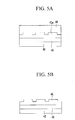
- FIG. 5A illustrates a cross-sectional view of an adhesive layer in an adhesive tape during a method of forming an embossed surface on an adhesive layer in accordance with an embodiment
- FIG. 5B illustrates a cross-sectional view of an adhesive tape with an embossed surface after being fabricated as illustrated in FIG. 5A ,
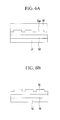
- FIG. 6A illustrates a cross-sectional view of an adhesive layer in an adhesive tape during a method of forming an embossed surface on an adhesive layer in accordance with an embodiment
- FIG. 6B illustrates a cross-sectional view of an adhesive tape with an embossed surface after being fabricated as illustrated in FIG. 6A ,
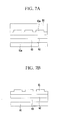
- FIG. 7A illustrates a cross-sectional view of an adhesive layer in an adhesive tape during a method of forming an embossed surface on an adhesive layer in accordance with an embodiment
- FIG. 7B illustrates a cross-sectional view of an adhesive tape with an embossed surface after being fabricated as illustrated in FIG. 7A ,
- FIG. 8 illustrates an exploded view of an organic light emitting diode (OLED) display according to an embodiment
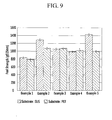
- FIG. 9 illustrates a graph of peeling strengths of the adhesive tapes according to Examples 1 to 5,
- FIG. 10 illustrates a graph of initial adhesive strengths of the adhesive tapes according to Examples 1 to 4,
- FIG. 11 illustrates a graph of holding strength of the adhesive tapes according to Examples 2 to 4,
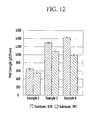
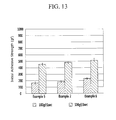
- FIGS. 12 , 13 , and 14 respectively illustrate adhesive strength, initial adhesive strength, and holding strength of the adhesive tapes according to Examples 5, 2, and 6, and
- FIGS. 15 , 16 , and 17 respectively illustrate adhesive strength, initial adhesive strength, and holding strength of the adhesive tape according to Example 7.
- spatially relative terms such as “beneath,” “below,” “lower,” “above,” “upper” and the like, may be used herein for ease of description to describe one element or feature's relationship to another element(s) or feature(s) as illustrated in the figures. It will be understood that the spatially relative terms are intended to encompass different orientations in addition to the orientation depicted in the figures. Thus, the term “below” in respect of two particular components can encompass both of above and below dependent on the orientation of the object containing the two components.
- the present invention provides an adhesive including an acrylic copolymer comprising a solution polymerizable acryl-based monomer, a vinyl-based monomer that is copolymerizable with the solution polymerizable acryl-based monomer, and a ⁇ -carboxylethyl acrylate monomer, and a compound including at least three epoxy functional groups.
- An adhesive according to an embodiment may include an acrylic copolymer synthesized from a composition including a solution-polymerizable acryl-based monomer, a vinyl-based monomer that is copolymerizable with the solution-polymerizable acryl-based monomer, a ⁇ -carboxylethyl acrylate monomer, and a reaction initiator, and a compound including at least three epoxy functional groups.
- the solution polymerizable acryl-based monomer and adhesive may include, for example, 2-ethylhexyl acrylate, 2-methylbutyl acrylate, isooctyl acrylate, lauryl acrylate, n-butyl acrylate, n-hexyl acrylate, n-octyl acrylate, n-decyl acrylate, isodecyl acrylate, or a combination thereof, but is not limited thereto.
- the solution polymerizable acryl-based monomer may be included in an amount of about 70 to about 90 parts by weight based on 100 parts by weight of the total monomers, optionally about 75 to about 87 parts and about 80 to about 85 parts.
- the vinyl-based monomer may include, for example, vinyl acetate, ethyl acrylate, methyl methacrylate, styrene, (meth)acrylic acid, hydroxyl ethyl acrylate, (meth)acrylamide, N-methyl acrylamide, N-ethyl acrylamide, N-hydroxyethyl acrylamide, diacetone acrylamide, N,N-dimethyl acrylamide, N,N-diethyl acrylamide, N-ethyl-N-aminoethyl acrylamide, N-ethyl-N-hydroxyethyl acrylamide, N,N-dihydroxyethyl acrylamide, N-t-butyl acrylamide, N,N-dimethylaminoethyl acrylamide, N-octyl acrylamide, itaconic acid, crotonic acid, maleic acid, fumaric acid, 2,2-(diethoxy)ethyl acrylate,
- the vinyl-based monomer may be included in an amount of about 1 to about 10 parts by weight based on 100 parts by weight of the total monomers, optionally about 4 to about 9 parts and about 5 to about 7 parts.
- the ⁇ -carboxylethyl acrylate monomer may be a compound represented by the following Chemical Formula 1.
- n may be an integer ranging from about 1 to about 12, and, for example, 2 to 6.
- the ⁇ -carboxylethyl acrylate monomer may include two different kinds of compounds represented by the above Chemical Formula 1, where the two different kinds of compounds have at least two different n values.
- the composition includes a ⁇ -carboxylethyl acrylate monomer, which may improve the composition's adhesion to a subject desired to be adhered to and may form an effective cross-linking structure.
- the ⁇ -carboxylethyl acrylate monomer represented by the above Chemical Formula 1 may include a chain-shaped carboxyl group repeatedly including an ester group, and thus may improve adhesive strength.
- the ⁇ -carboxylethyl acrylate monomer may be included in an amount of about 1 to about 10 parts by weight based on 100 parts by weight of the total monomers, optionally about 2 to about 8 parts and about 4 to about 6 parts.
- the reaction initiator may be, for example, a thermal initiator, a photoinitiator, or a combination thereof.
- the thermal initiator may be decomposed by heat and may form a radical, which may initiate a synthesis reaction.
- the thermal initiator may be, for example, benzoyl peroxide, acetyl peroxide, dilauryl peroxide, hydrogen peroxide, potassium persulfonate, or a combination thereof, but is not limited thereto.
- the reaction initiator may be included in an amount of about 0.1 to about 5 parts by weight based on 100 parts by weight of the total monomers, optionally about 0.2 to about 2 parts and about 0.25 to about 1 parts.
- the composition may include one or more additives depending on the purpose of an adhesive.
- the composition may further include, for example, a heat resistance-improving monomer, a cross-linking monomer, and/or an elasticity-controlling monomer.
- the heat resistance-improving monomer may be an additive for improving heat resistance of the adhesive, and may include, for example, itaconic acid, crotonic acid, maleic acid, fumaric acid, or a combination thereof, but is not limited thereto.
- the cross-linking monomer may be an additive for improving a polymerization degree, and may include, for example, acrylic acid, glycidylmethacrylate, or a combination thereof, but is not limited thereto.
- the elasticity-controlling monomer may be an additive for improving the elasticity of the adhesive, and may include, for example, 2-hydroxy ethylacetate, 2-methylbutyl acrylate, isooctyl acrylate, lauryl acrylate, n-butyl acrylate, n-hexyl acrylate, n-octyl acrylate, n-decyl acrylate, isodecyl acrylate, or a combination thereof, but is not limited thereto.
- the heat resistance-improving monomer may be included in an amount of about 0.5 to 10 parts by weight based on 100 parts by weight of the total monomers, optionally about 1 to 10 parts and about 0.75 to about 3 parts.
- the cross-linking monomer may be included in an amount of about 1 to 15 parts by weight based on 100 parts by weight of the total monomers, optionally about 1 to 10 parts and about 1.5 to about 5 parts.
- the elasticity-controlling monomer may be included in an amount of about 0.5 to 15 parts by weight based on 100 parts by weight of the total monomers, optionally about 1 to 10 parts and about 0.75 to about 3 parts.
- the additive may include, for example, a processibility assistant, an anti-oxidizing agent, a stabilizer, a filler, a leveling agent, an antifoaming agent, a UV absorber, an antistatic agent, or a combination thereof, but is not limited thereto.
- the composition may be prepared into an acrylic copolymer through polymerization.
- the acrylic copolymer may have a weight average molecular weight ranging from about 400,000 to about 1,500,000, optionally about 500,000 to about 1,500,000.
- the compound including at least three epoxy functional groups may be a suitable compound having at least three epoxy functional groups, optionally 3 to 8 epoxy functional groups and 3 to 5 epoxy functional groups, and may be, for example, triglycidyl p-aminophenol, an N,N,N',N'-tetraglycidyl-m-xylenediamine compound represented by the following Chemical Formula 2, a compound represented by the following Chemical Formula 3, or a combination thereof.
- the adhesive may include the compound including at least three epoxy functional groups, and thus may improve internal agglomerative strength.
- the compound including at least three epoxy functional groups may be included in an amount of about 0.1 to 10 parts by weight based on 100 parts by weight of the total monomers of the composition, optionally about 0.25 to 7 parts and about 0.5 to about 5 parts.
- the adhesive may be a pressure sensitive adhesive (PSA) and may form an adhesive layer, e.g., after being applied and cured.
- PSA pressure sensitive adhesive
- FIGS. 1, 2, and 3 illustrate cross-sectional views of stacked structures of an adhesive tape according to an embodiment.
- an adhesive tape 10 may include a substrate layer 12, an adhesive layer 11 formed one side of the substrate layer 12, and a printing layer 13 formed on the other side of the substrate layer 12.
- the printing layer 13 may be formed on top.
- the adhesive tape may be non-glossy black.
- an adhesive tape 20 may include a substrate layer 22, a printing layer 23 formed on one side of the substrate layer 22, and an adhesive layer 21 formed on the other side of the printing layer 23.
- the substrate layer 22 may be formed on top.
- the adhesive tape 20 may be glossy black.
- an adhesive tape 30 may include a substrate layer 32, a printing layer 33 formed on one side of the substrate layer 32, and an adhesive layer 31 positioned on both sides thereof.
- an adhesive layer 31 may be formed on both side of the printed substrate layer 32, such that it can be used as a double-sided tape.
- the substrate layers 12, 22, and 32 may be clear films and may be formed of, for example, a thermoplastic or thermal-curing resin such as, e.g., polycarbonate (PC), polymethylmethacrylate (PMMA), polystyrene (PS), or a copolymer thereof, polyethylene terephthalate (PET), polyethylene naphthalate (PEN), polyethersulfone (PES), or a copolymer thereof, an inorganic layer such as glass, or other suitable substrates.
- a thermoplastic or thermal-curing resin such as, e.g., polycarbonate (PC), polymethylmethacrylate (PMMA), polystyrene (PS), or a copolymer thereof, polyethylene terephthalate (PET), polyethylene naphthalate (PEN), polyethersulfone (PES), or a copolymer thereof, an inorganic layer such as glass, or other suitable substrates.
- a thermoplastic or thermal-curing resin such as,
- the printing layers 13, 23, and 33 may apply a black color around the substrate layers 12, 22, and 32 and/or print a logo, mark, and the like on one side of the substrate layers 12, 22, and 32.
- the printing layers 13, 23, and 33 may be black as aforementioned.
- the adhesive layers 11, 21, and 31 may be formed by applying the aforementioned adhesive.
- the adhesive layers 11, 21, and 31 may have a thickness ranging from about 3 ⁇ m to about 85 ⁇ m, and thus adhesive strength and internal agglomerative strength may be further reinforced.
- the adhesive tapes 10, 20, and 30 may have an entire thickness ranging from about 20 ⁇ m to about 100 ⁇ m.
- the adhesive layers 11, 21, and 31 are illustrated as having a flat surface, but they are not limited thereto, and may have an embossed surface having a plurality of recess portions and/or a plurality of convex portions.
- FIG. 4 illustrates a top plan view of an adhesive layer having an embossed surface.
- an adhesive layer 41 may have a plurality of convex portions A repeatedly arranged in a predetermined pattern.
- the pattern illustrated in FIG. 4 is given only by way of example.
- FIG. 5A illustrates a cross-sectional view of an adhesive layer in an adhesive tape during a method of forming an embossed surface on an adhesive layer in accordance with an embodiment
- FIG. 5B illustrates a cross-sectional view of an adhesive tape with an embossed surface after being fabricated as illustrated in FIG. 5A
- an adhesive 41a may be applied on a mold 50 having a predetermined negatively-carved pattern, and then may be dried and cured.
- a substrate 42 and a printing layer 43 may be sequentially formed on the adhesive 41 a and matured at a predetermined temperature (the adhesive layer 41a may also be dried and/or cured after the substrate 42 and printing layer 43 are formed thereon).
- the mold 50 may be removed, and the adhesive tape may have the adhesive layer 41 having an embossed surface as illustrated in FIG. 5B .
- FIG. 6A illustrates a cross-sectional view of an adhesive layer in an adhesive tape during a method of forming an embossed surface on an adhesive layer in accordance with an embodiment
- FIG. 6B illustrates a cross-sectional view of an adhesive tape with an embossed surface after being fabricated as illustrated in FIG. 6A
- an adhesive 51a may be applied on a mold 50 having a predetermined negatively-carved pattern, and then may be dried and cured.
- a substrate 52 including the printing layer 53 may be laminated on the adhesive 51a, and then the laminated product may be matured at a predetermined temperature (the adhesive layer 51a may also be dried and/or cured after the substrate 52 and printing layer 53 are formed thereon).
- the mold 50 may be removed, and the adhesive tape may have the adhesive layer 51 having an embossed surface as illustrated in FIG. 6B .
- FIG. 7A illustrates a cross-sectional view of an adhesive layer in an adhesive tape during a method of forming an embossed surface on an adhesive layer in accordance with an embodiment
- FIG. 7B illustrates a cross-sectional view of an adhesive tape with an embossed surface after being fabricated as illustrated in FIG. 7A
- an adhesive 61a may be applied on a mold 50 having a predetermined negatively-carved pattern, and then may be dried and cured.
- a substrate 62 having a printing layer 63 may be laminated on the adhesive 61a, and another adhesive 61a may be applied thereon (the adhesive layer 61a may also be dried and/or cured after the substrate 62 and printing layer 63 are formed thereon).
- the product having the adhesive 61a applied on both sides may be matured at a predetermined temperature, and the mold 50 may be removed, and the adhesive tape may have the adhesive layer 51 having an embossed surface as illustrated in FIG. 7B .
- the adhesive layer 61 is illustrated as having only one embossed surface but may have an embossed surface on both sides thereof.
- the mold is negatively carved, but the mold may be either negatively carved or positively carved to form an embossed surface on the adhesive layer.
- the adhesive layer may have an embossed surface, and thus may allow for removal of vapors when applied to a display panel, a substrate, or the like, thereby further improving adhesive strength.
- the adhesive tape may be applied to a display device.
- the display device may be, for example, a liquid crystal display (LCD), a plasma display device, an organic light emitting diode (OLED) display, a field emission display, and an electrophoretic display, but is not limited thereto.
- LCD liquid crystal display
- OLED organic light emitting diode
- electrophoretic display but is not limited thereto.
- the display device may include a display panel expressing an image, and the adhesive tape may be disposed on the rear side of the display panel.
- the display device may be, for example, an organic light emitting diode (OLED) display.
- OLED organic light emitting diode
- FIG. 8 illustrates an exploded view of an organic light emitting diode (OLED) display according to an embodiment.
- a display device 100 may include a display panel 104, an adhesive tape 103 positioned on the rear side of the display panel 105, a flexible circuit board 102 positioned on the rear side of the adhesive tape 103, a window 106 positioned on the front side of the display panel 104, and an adhesive 105 adhering the window 106 to the display panel 104.
- the display panel 104 may include a substrate, a thin film transistor, an organic emission layer, and the like formed on the substrate.
- the flexible printed circuit (FPC) 102 may be adhered to an adhesive tape 103 through a tape flexible printed circuit (tape FPC).
- the window 106 may formed of glass or plastic, and may have a stacked structure of a plurality of layers.
- the adhesive 105 may be a clear adhesive tape (OCA) adhering the display panel 104 to the window 106.
- the flexible circuit board 102 may be bent (not shown) and disposed on the side of the display panel 104.
- the adhesive tape 103 may include the adhesive discussed above, and may have an improved reinforced adhesive strength and internal agglomerative strength, and may prevent the display panel 104 from being detached or delaminated therefrom despite tension consistently applied thereto by the flexible printed circuit (FPC) 102.
- 2-ethylhexyl acrylate (2-EHA), ⁇ -carboxylethyl acrylate, vinyl acetate, itaconic acid, acrylic acid, and 2-hydroxyethyl acrylate in a monomer ratio in the following Table 1 were put into a 500 ml 4-necked flask, and a mixed solvent prepared by mixing toluene, ethyl acetate, and methanol was added thereto in a solvent ratio as shown in the following Table 1.
- 0.3 parts by weight of benzoyl peroxide as a thermal initiator was added thereto based on 100 parts by weight of the total monomers.
- the adhesive was coated to be 10 ⁇ m thick on a PET substrate, dried at 80 °C, and matured at 50 °C to perform a cross-linking reaction, thereby fabricating an adhesive tape.
- the adhesive As measured using gel permeation chromatography, the adhesive has a number average molecular weight (Mn) of 140,000, a weight average molecular weight (Mw) of 470,000, and a polydispersity index (PI) of 3.36.
- An adhesive tape was fabricated according to the same method as Example 1, except for using 1 part by weight of an epoxy-based hardener represented by the above Chemical Formula 2 based on 100 parts by weight of the total monomers.
- An adhesive tape was fabricated according to the same method as Example 1, except for using 2 parts by weight of an epoxy-based hardener represented by the above Chemical Formula 2 based on 100 parts by weight of the total monomers.
- An adhesive tape was fabricated according to the same method as Example 1, except for using 5 parts by weight of an epoxy-based hardener represented by the above Chemical Formula 2 based on 100 parts by weight of the total monomers.
- An adhesive tape was fabricated according to the same method as Example 2, except for coating the adhesive to be 5 ⁇ m thick on a PET substrate.
- An adhesive tape was fabricated according to the same method as Example 2 except for coating the adhesive to be 15 ⁇ m thick on a PET substrate.
- An adhesive tape was fabricated according to the same method as Example 2, except for coating the adhesive to be 10 ⁇ m thick on a PET substrate and pressing the coated substrate using a negatively-carved mold to form an adhesive layer having a plurality of convex portions thereon (i.e., an embossed surface).
- the adhesive tapes according to Examples 1 to 5 were evaluated regarding adhesive strength.
- the adhesive strength was evaluated for 180° peeling strength by attaching a 25 mm-wide adhesive tape on the respective surfaces of a stainless steel (SUS304) and a PET substrate and rolling a 2 kg rubber roller thereon.
- the peeling strength was measured at 180° under constant temperature and humidity conditions of 25 °C and relative humidity of 50 % using a property analyzer (Texture Analyzer, Stable Micro Systems, TA-XT2i) at a cross-head speed of 300 mm/min.
- FIG. 9 illustrates a graph of peeling strengths of the adhesive tapes according to Examples 1 to 5.
- the adhesive tapes according to Examples 1 to 4 have peeling strength of greater than or equal to about 500 gf when attached to a stainless steel and PET substrate.
- the adhesive tapes according to Examples 1 to 4 were evaluated regarding initial adhesive strength.
- the initial adhesive strength was evaluated by measuring a force to peel off the adhesive tapes at a speed of 60 mm/min after applying 100 gf for one second and another force to peel off the adhesive tapes at a speed of 60 mm/min after applying 500 gf for 3 seconds using a property analyzer (Texture Analyzer, Stable Micro Systems, TA-XT2i).
- the adhesive tapes were evaluated to be appropriate when they had an initial adhesive strength of greater than or equal to about 100 gf under a pressure condition of 100 gf/1 sec and greater than or equal to about 500 gf/3 sec under a pressure condition of 300 gf.
- FIG. 10 illustrates a graph of initial adhesive strengths of the adhesive tapes according to Examples 1 to 4.
- the adhesive tapes according to Examples 1 to 4 have initial adhesive strengths of greater than or equal to about 100 gf under a pressure condition of 100 gf/1 sec, and greater than or equal to about 300 gf under a pressure condition of 500 gf/3 sec.
- the adhesive tapes according to Examples 2 to 4 were evaluated regarding holding strength.
- the holding strength was measured by hanging weights of 0.5, 1, and 2 kg with the adhesive tape under a condition of 85 °C and measuring how long it takes for the weight to fall.
- the adhesive tapes had a holding strength of greater than or equal to about 2000 minutes, the adhesive tapes were evaluated to be appropriate.
- FIG. 11 illustrates a graph of holding strength of the adhesive tapes according to Examples 2 to 4.
- the adhesive tapes according to Examples 2 to 4 have holding strength of greater than or equal to about 2000 minutes.
- the adhesive tapes were evaluated regarding adhesive strength, initial adhesive strength, and holding strength depending on thickness of an adhesive layer.
- the adhesive tapes according to Examples 5, 2, and 6 respectively include 5 ⁇ m, 10 ⁇ m, and 15 ⁇ m thick adhesive layers formed of the same adhesive.
- the adhesive strength, initial adhesive strength, and holding strength of the adhesive tapes according to Examples 5, 2, and 6 were evaluated according to the same method as Evaluations 1 to 3.
- FIGS. 12 , 13 , and 14 illustrate graphs of adhesive strength, initial adhesive strength, and holding strength of the adhesive tapes according to Examples 5, 2, and 6.
- the adhesive tapes according to Example 5, 2, and 6 have a peeling strength of greater than or equal to about 500 gf regardless of the thickness of the adhesive layers.
- the adhesive tapes according to Example 5, 2, and 6 have an initial adhesive strength of greater than or equal to about 100 gf under the pressure condition of 100 gf/1 sec and greater than or equal to about 300 gf under the pressure condition of 500 gf/3 sec, regardless of the thickness of the adhesive layers. Notably, higher adhesive strength was observed for the thicker adhesive layers.
- the adhesive tapes according to Examples 5, 2, and 6 have a holding strength of greater than or equal to about 2000 minutes regardless of the thickness of the adhesive layers.
- the adhesive tape according to Example 7 was evaluated regarding adhesive strength, initial adhesive strength, and holding strength.
- the adhesive strength, initial adhesive strength, and holding strength were evaluated according to the same methods as Evaluations 1 to 3, except that the portion of the adhesive tape according to Example 7 having convex portions (i.e., the embossed surface) was measured separately from the portion of the adhesive tape according to Example 7 that lacks convex portions (i.e., non-embossed surface).
- FIGS. 15 , 16 , and 17 illustrate graphs of adhesive strength, initial adhesive strength, and holding strength of the adhesive tape according to Example 7.
- the adhesive tape according to Example 7 has a peeling strength of greater than or equal to about 500 gf regardless of convex portions and non-convex portions on the surface.
- the adhesive tape according to Example 7 has an initial adhesive strength of greater than or equal to about 100 gf under a pressure condition of 100 gf/1 sec and an initial adhesive strength of greater than or equal to about of 300 gf under a pressure condition of 500 gf/3 sec, regardless of convex portions and non-convex portions on the surface.
- the adhesive tape according to Example 7 has a holding strength of greater than or equal to about 2000 minutes regardless of convex portions and non-convex portions on the surface.
- a display device may include a liquid crystal display (LCD), a plasma display panel (PDP), an organic light emitting diode device (OLED), a field effect display (FED), an electrophoretic display device, and so on.
- the display device may include a display panel expressing an image, a rear-side adhesive tape disposed on the rear side of the display panel, a flexible printed circuit (FPC) positioned on the rear side of the display panel and controlling operation of the display panel and supplying the display panel with electricity, and a flexible printed circuit board (FPCB) electrically connecting the display panel to the flexible printed circuit (FPC).
- LCD liquid crystal display
- PDP plasma display panel
- OLED organic light emitting diode device
- FED field effect display
- electrophoretic display device and so on.
- the display device may include a display panel expressing an image, a rear-side adhesive tape disposed on the rear side of the display panel, a flexible printed circuit (FPC) positioned on the rear side of the display panel and controlling operation of the
- the foregoing conditions may be avoided by using the adhesive/adhesive tape disclosed herein, which may have excellent adhesive strength and internal agglomerative strength, and thus may substantially prevent the adhesive layer from being detached or delaminated, even under conditions of consistent bending tension.
Landscapes
- Chemical & Material Sciences (AREA)
- Organic Chemistry (AREA)
- Physics & Mathematics (AREA)
- Nonlinear Science (AREA)
- Crystallography & Structural Chemistry (AREA)
- General Physics & Mathematics (AREA)
- Optics & Photonics (AREA)
- Chemical Kinetics & Catalysis (AREA)
- Adhesive Tapes (AREA)
- Adhesives Or Adhesive Processes (AREA)
Abstract
Description
- Embodiments relate to an adhesive, an adhesive tape, and a display device.
- Embodiments are directed to an adhesive including an acrylic copolymer synthesized from a composition including a solution polymerizable acryl-based monomer, a vinyl-based monomer that is copolymerizable with the solution polymerizable acryl-based monomer, a β-carboxylethyl acrylate monomer, and a reaction initiator, and a compound including at least three epoxy functional groups.
- The β-carboxylethyl acrylate monomer may include a compound represented by Chemical Formula 1:
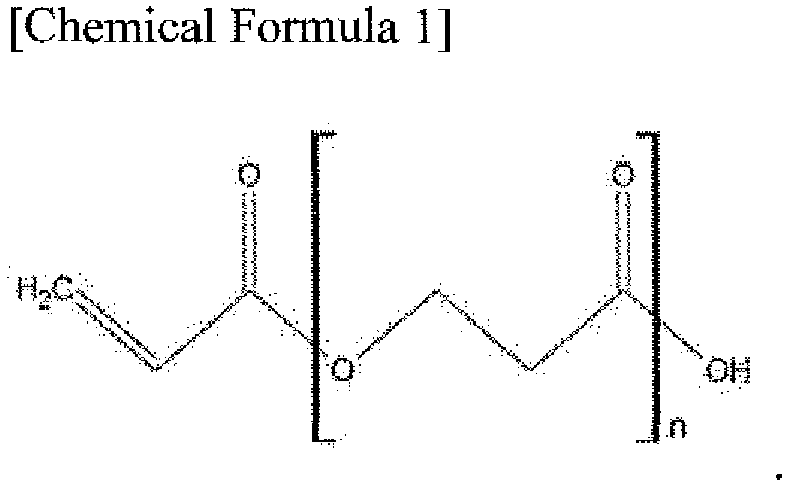
- In Chemical Formula 1, n may be an integer ranging from 1 to 12.
- The β-carboxylethyl acrylate monomer may include a first β-carboxylethyl acrylate monomer represented by Chemical Formula 1 and a second β-carboxylethyl acrylate monomer represented by Chemical Formula 1, and the first and second β-carboxylethyl acrylate monomers may have different values for n.
- The compound including at least three epoxy functional groups may include a triglycidyl p-aminophenol, an N,N,N',N'-tetraglycidyl-m-xylenediamine compound represented by Chemical Formula 2, a compound represented by Chemical Formula 3, or a combination thereof:


- The β-carboxylethyl acrylate monomer may be included in an amount of about 1 to about 10 parts by weight based on 100 parts by weight of a total amount of monomers.
- The compound including at least three epoxy functional groups may be included in an amount of about 0.1 to about 10 parts by weight based on 100 parts by weight of a total amount of monomers.
- The solution polymerizable acryl-based monomer may be included in an amount of about 70 to about 90 parts by weight based on 100 parts by weight of a total amount of monomers, the vinyl-based monomer may be included in an amount of about 1 to about 10 parts by weight based on 100 parts by weight of a total amount of monomers, and the reaction initiator may be included in an amount of about 0.1 to about 5 parts by weight based on 100 parts by weight of a total amount of monomers.
- The solution polymerizable acryl-based monomer may include 2-ethylhexyl acrylate, 2-methylbutyl acrylate, isooctyl acrylate, lauryl acrylate, n-butyl acrylate, n-hexyl acrylate, n-octyl acrylate, n-decyl acrylate, isodecyl acrylate, or a combination thereof.
- The vinyl-based monomer may include vinyl acetate, ethyl acrylate, methyl methacrylate, styrene, (meth)acrylic acid, hydroxyl ethyl acrylate, (meth)acrylamide, N-methyl acrylamide, N-ethyl acrylamide, N-hydroxyethyl acrylamide, diacetone acrylamide, N,N-dimethyl acrylamide, N,N-diethyl acrylamide, N-ethyl-N-aminoethyl acrylamide, N-ethyl-N-hydroxyethyl acrylamide, N,N-dihydroxyethyl acrylamide, t-butyl acrylamide, N,N-dimethylaminoethyl acrylamide, N-octyl acrylamide, itaconic acid, crotonic acid, maleic acid, fumaric acid, 2,2-(diethoxy)ethyl acrylate, 2-hydroxyethyl (meth)acrylate, 3-hydroxypropyl (meth)acrylate, methyl (meth)acrylate, isobonyl acrylate, 2-(phenoxy)ethyl (meth)acrylate, biphenylyl acrylate, t-butylphenyl acrylate, cyclohexyl acrylate, dimethyladamantyl acrylate, 2-naphthyl acrylate, phenyl acrylate, N-vinyl formamide, N-vinyl acetamide, N-vinyl pyrrolidone, or a combination thereof.
- The composition may further include a heat resistance-improving monomer, a cross-linking monomer, and/or an elasticity-controlling monomer. The heat resistance-improving monomer may be included in an amount of about 0.5 to about 10 parts by weight based on 100 parts by weight of a total amount of monomers. The cross-linking monomer may be included in an amount of about 1 to about 15 parts by weight based on 100 parts by weight of a total amount of monomers, The elasticity-controlling monomer may be included in an amount of about 0.5 to about 15 parts by weight based on 100 parts by weight of a total amount of monomers.
- The acryl-based copolymer may have a weight average molecular weight of about 400,000 to about 1,500,000.
- Embodiments are also directed to an adhesive tape including an adhesive layer including the adhesive.
- The adhesive tape may further include a substrate layer, a printing layer, or a combination thereof beneath or on the adhesive layer.
- The adhesive layer may have an embossed surface.
- The adhesive layer may have a thickness ranging from about 3 µm to about 85 µm, and the adhesive tape may have a total thickness ranging from about 20 µm to about 100 µm.
- The adhesive layer may have a peeling strength of greater than or equal to about 500 gf.
- The adhesive layer may have an initial adhesive strength of greater than or equal to about 100 gf under a pressure condition of about 100 gf/1 sec, and greater than or equal to about 300 gf under a pressure condition of about 500 gf/3 sec.
- Embodiments are also directed to a display device, including a display panel, and the adhesive tape on one side of the display panel.
- The adhesive tape may be positioned on a rear side of the display panel.
- The display device may be an organic light emitting diode (OLED) display.
- Features will become apparent to those of skill in the art by describing in detail embodiments with reference to the attached drawings in which:
-
FIGS. 1, 2, and 3 illustrate cross-sectional views of stacked structures of an adhesive tape according to an embodiment, -
FIG. 4 illustrates a top plan view of an adhesive layer having an embossed surface, -
FIG. 5A illustrates a cross-sectional view of an adhesive layer in an adhesive tape during a method of forming an embossed surface on an adhesive layer in accordance with an embodiment, -
FIG. 5B illustrates a cross-sectional view of an adhesive tape with an embossed surface after being fabricated as illustrated inFIG. 5A , -
FIG. 6A illustrates a cross-sectional view of an adhesive layer in an adhesive tape during a method of forming an embossed surface on an adhesive layer in accordance with an embodiment, -
FIG. 6B illustrates a cross-sectional view of an adhesive tape with an embossed surface after being fabricated as illustrated inFIG. 6A , -
FIG. 7A illustrates a cross-sectional view of an adhesive layer in an adhesive tape during a method of forming an embossed surface on an adhesive layer in accordance with an embodiment, -
FIG. 7B illustrates a cross-sectional view of an adhesive tape with an embossed surface after being fabricated as illustrated inFIG. 7A , -
FIG. 8 illustrates an exploded view of an organic light emitting diode (OLED) display according to an embodiment, -
FIG. 9 illustrates a graph of peeling strengths of the adhesive tapes according to Examples 1 to 5, -
FIG. 10 illustrates a graph of initial adhesive strengths of the adhesive tapes according to Examples 1 to 4, -
FIG. 11 illustrates a graph of holding strength of the adhesive tapes according to Examples 2 to 4, -
FIGS. 12 ,13 , and14 respectively illustrate adhesive strength, initial adhesive strength, and holding strength of the adhesive tapes according to Examples 5, 2, and 6, and -
FIGS. 15 ,16 , and17 respectively illustrate adhesive strength, initial adhesive strength, and holding strength of the adhesive tape according to Example 7. - Example embodiments will now be described more fully hereinafter with reference to the accompanying drawings; however, they may be embodied in different forms and should not be construed as limited to the embodiments set forth herein. Rather, these embodiments are provided so that this disclosure will be thorough and complete, and will fully convey implementations to those skilled in the art. As those skilled in the art would realize, the described embodiments may be modified in various different ways, all without departing from the scope of this disclosure.
- In the drawing figures, the dimensions of layers and regions may be exaggerated for clarity of illustration. It will also be understood that when a layer or element is referred to as being "on" another layer or element, it can be directly on the other layer or element, or intervening layers or elements may also be present. Further, it will be understood that when a layer or element is referred to as being "under" another layer or element, it can be directly under, and one or more intervening layers or elements may also be present. In addition, it will also be understood that when a layer or element is referred to as being "between" two layers or elements, it can be the only layer or element between the two layers or elements, or one or more intervening layers or elements may also be present. Like reference numerals refer to like layers or elements throughout.
- Spatially relative terms, such as "beneath," "below," "lower," "above," "upper" and the like, may be used herein for ease of description to describe one element or feature's relationship to another element(s) or feature(s) as illustrated in the figures. It will be understood that the spatially relative terms are intended to encompass different orientations in addition to the orientation depicted in the figures. Thus, the term "below" in respect of two particular components can encompass both of above and below dependent on the orientation of the object containing the two components.
- The present invention provides an adhesive including an acrylic copolymer comprising a solution polymerizable acryl-based monomer, a vinyl-based monomer that is copolymerizable with the solution polymerizable acryl-based monomer, and a β-carboxylethyl acrylate monomer, and a compound including at least three epoxy functional groups. An adhesive according to an embodiment may include an acrylic copolymer synthesized from a composition including a solution-polymerizable acryl-based monomer, a vinyl-based monomer that is copolymerizable with the solution-polymerizable acryl-based monomer, a β-carboxylethyl acrylate monomer, and a reaction initiator, and a compound including at least three epoxy functional groups.
- The solution polymerizable acryl-based monomer and adhesive, and may include, for example, 2-ethylhexyl acrylate, 2-methylbutyl acrylate, isooctyl acrylate, lauryl acrylate, n-butyl acrylate, n-hexyl acrylate, n-octyl acrylate, n-decyl acrylate, isodecyl acrylate, or a combination thereof, but is not limited thereto.
- The solution polymerizable acryl-based monomer may be included in an amount of about 70 to about 90 parts by weight based on 100 parts by weight of the total monomers, optionally about 75 to about 87 parts and about 80 to about 85 parts.
- The vinyl-based monomer may include, for example, vinyl acetate, ethyl acrylate, methyl methacrylate, styrene, (meth)acrylic acid, hydroxyl ethyl acrylate, (meth)acrylamide, N-methyl acrylamide, N-ethyl acrylamide, N-hydroxyethyl acrylamide, diacetone acrylamide, N,N-dimethyl acrylamide, N,N-diethyl acrylamide, N-ethyl-N-aminoethyl acrylamide, N-ethyl-N-hydroxyethyl acrylamide, N,N-dihydroxyethyl acrylamide, N-t-butyl acrylamide, N,N-dimethylaminoethyl acrylamide, N-octyl acrylamide, itaconic acid, crotonic acid, maleic acid, fumaric acid, 2,2-(diethoxy)ethyl acrylate, 2-hydroxyethyl (meth)acrylate, 3-hydroxypropyl (meth)acrylate, methyl (meth)acrylate, isobonyl acrylate, 2-(phenoxy)ethyl (meth)acrylate, biphenylyl acrylate, t-butylphenyl acrylate, cyclohexyl acrylate, dimethyladamantyl acrylate, 2-naphthyl acrylate, phenyl acrylate, N-vinyl formamide, N-vinyl acetamide, N-vinyl pyrrolidone, or a combination thereof, but is not limited thereto.
- The vinyl-based monomer may be included in an amount of about 1 to about 10 parts by weight based on 100 parts by weight of the total monomers, optionally about 4 to about 9 parts and about 5 to about 7 parts.
- The β-carboxylethyl acrylate monomer may be a compound represented by the following
Chemical Formula 1. -


- In
Chemical Formula 1, n may be an integer ranging from about 1 to about 12, and, for example, 2 to 6. - The β-carboxylethyl acrylate monomer may include two different kinds of compounds represented by the above
Chemical Formula 1, where the two different kinds of compounds have at least two different n values. - The composition includes a β-carboxylethyl acrylate monomer, which may improve the composition's adhesion to a subject desired to be adhered to and may form an effective cross-linking structure. In particular, the β-carboxylethyl acrylate monomer represented by the above
Chemical Formula 1 may include a chain-shaped carboxyl group repeatedly including an ester group, and thus may improve adhesive strength. - The β-carboxylethyl acrylate monomer may be included in an amount of about 1 to about 10 parts by weight based on 100 parts by weight of the total monomers, optionally about 2 to about 8 parts and about 4 to about 6 parts.
- The reaction initiator may be, for example, a thermal initiator, a photoinitiator, or a combination thereof. The thermal initiator may be decomposed by heat and may form a radical, which may initiate a synthesis reaction. The thermal initiator may be, for example, benzoyl peroxide, acetyl peroxide, dilauryl peroxide, hydrogen peroxide, potassium persulfonate, or a combination thereof, but is not limited thereto.
- The reaction initiator may be included in an amount of about 0.1 to about 5 parts by weight based on 100 parts by weight of the total monomers, optionally about 0.2 to about 2 parts and about 0.25 to about 1 parts.
- The composition may include one or more additives depending on the purpose of an adhesive.
- The composition may further include, for example, a heat resistance-improving monomer, a cross-linking monomer, and/or an elasticity-controlling monomer. The heat resistance-improving monomer may be an additive for improving heat resistance of the adhesive, and may include, for example, itaconic acid, crotonic acid, maleic acid, fumaric acid, or a combination thereof, but is not limited thereto. The cross-linking monomer may be an additive for improving a polymerization degree, and may include, for example, acrylic acid, glycidylmethacrylate, or a combination thereof, but is not limited thereto. The elasticity-controlling monomer may be an additive for improving the elasticity of the adhesive, and may include, for example, 2-hydroxy ethylacetate, 2-methylbutyl acrylate, isooctyl acrylate, lauryl acrylate, n-butyl acrylate, n-hexyl acrylate, n-octyl acrylate, n-decyl acrylate, isodecyl acrylate, or a combination thereof, but is not limited thereto.
- The heat resistance-improving monomer may be included in an amount of about 0.5 to 10 parts by weight based on 100 parts by weight of the total monomers, optionally about 1 to 10 parts and about 0.75 to about 3 parts. The cross-linking monomer may be included in an amount of about 1 to 15 parts by weight based on 100 parts by weight of the total monomers, optionally about 1 to 10 parts and about 1.5 to about 5 parts. The elasticity-controlling monomer may be included in an amount of about 0.5 to 15 parts by weight based on 100 parts by weight of the total monomers, optionally about 1 to 10 parts and about 0.75 to about 3 parts.
- Other than the aforementioned monomers, the additive may include, for example, a processibility assistant, an anti-oxidizing agent, a stabilizer, a filler, a leveling agent, an antifoaming agent, a UV absorber, an antistatic agent, or a combination thereof, but is not limited thereto.
- The composition may be prepared into an acrylic copolymer through polymerization. The acrylic copolymer may have a weight average molecular weight ranging from about 400,000 to about 1,500,000, optionally about 500,000 to about 1,500,000.
- The compound including at least three epoxy functional groups may be a suitable compound having at least three epoxy functional groups, optionally 3 to 8 epoxy functional groups and 3 to 5 epoxy functional groups, and may be, for example, triglycidyl p-aminophenol, an N,N,N',N'-tetraglycidyl-m-xylenediamine compound represented by the following
Chemical Formula 2, a compound represented by the followingChemical Formula 3, or a combination thereof.

- The adhesive may include the compound including at least three epoxy functional groups, and thus may improve internal agglomerative strength.
- The compound including at least three epoxy functional groups may be included in an amount of about 0.1 to 10 parts by weight based on 100 parts by weight of the total monomers of the composition, optionally about 0.25 to 7 parts and about 0.5 to about 5 parts.
- The adhesive may be a pressure sensitive adhesive (PSA) and may form an adhesive layer, e.g., after being applied and cured.
- Hereinafter, an adhesive tape including an adhesive layer including the adhesive as described above will be described with reference to the drawings.
-
FIGS. 1, 2, and 3 illustrate cross-sectional views of stacked structures of an adhesive tape according to an embodiment. - Referring to
FIG. 1 , anadhesive tape 10 according to an embodiment may include asubstrate layer 12, anadhesive layer 11 formed one side of thesubstrate layer 12, and aprinting layer 13 formed on the other side of thesubstrate layer 12. InFIG. 1 , theprinting layer 13 may be formed on top. When theprinting layer 13 is black, the adhesive tape may be non-glossy black. - Referring to
FIG. 2 , anadhesive tape 20 according to another embodiment may include asubstrate layer 22, aprinting layer 23 formed on one side of thesubstrate layer 22, and an adhesive layer 21 formed on the other side of theprinting layer 23. InFIG. 2 , thesubstrate layer 22 may be formed on top. When theprinting layer 23 is black, theadhesive tape 20 may be glossy black. - Referring to
FIG. 3 , anadhesive tape 30 according to another embodiment may include a substrate layer 32, a printing layer 33 formed on one side of the substrate layer 32, and anadhesive layer 31 positioned on both sides thereof. InFIG. 3 , anadhesive layer 31 may be formed on both side of the printed substrate layer 32, such that it can be used as a double-sided tape. - The substrate layers 12, 22, and 32 may be clear films and may be formed of, for example, a thermoplastic or thermal-curing resin such as, e.g., polycarbonate (PC), polymethylmethacrylate (PMMA), polystyrene (PS), or a copolymer thereof, polyethylene terephthalate (PET), polyethylene naphthalate (PEN), polyethersulfone (PES), or a copolymer thereof, an inorganic layer such as glass, or other suitable substrates.
- The printing layers 13, 23, and 33 may apply a black color around the substrate layers 12, 22, and 32 and/or print a logo, mark, and the like on one side of the substrate layers 12, 22, and 32. The printing layers 13, 23, and 33 may be black as aforementioned.
- The adhesive layers 11, 21, and 31 may be formed by applying the aforementioned adhesive. The adhesive layers 11, 21, and 31 may have a thickness ranging from about 3 µm to about 85 µm, and thus adhesive strength and internal agglomerative strength may be further reinforced.
- The
adhesive tapes - In
FIGS. 1 to 3 , theadhesive layers -
FIG. 4 illustrates a top plan view of an adhesive layer having an embossed surface. Referring toFIG. 4 , anadhesive layer 41 may have a plurality of convex portions A repeatedly arranged in a predetermined pattern. The pattern illustrated inFIG. 4 is given only by way of example. -
FIG. 5A illustrates a cross-sectional view of an adhesive layer in an adhesive tape during a method of forming an embossed surface on an adhesive layer in accordance with an embodiment, andFIG. 5B illustrates a cross-sectional view of an adhesive tape with an embossed surface after being fabricated as illustrated inFIG. 5A . Referring toFIG. 5A , an adhesive 41a may be applied on amold 50 having a predetermined negatively-carved pattern, and then may be dried and cured. Next, asubstrate 42 and aprinting layer 43 may be sequentially formed on the adhesive 41 a and matured at a predetermined temperature (theadhesive layer 41a may also be dried and/or cured after thesubstrate 42 andprinting layer 43 are formed thereon). Then, themold 50 may be removed, and the adhesive tape may have theadhesive layer 41 having an embossed surface as illustrated inFIG. 5B . -
FIG. 6A illustrates a cross-sectional view of an adhesive layer in an adhesive tape during a method of forming an embossed surface on an adhesive layer in accordance with an embodiment, andFIG. 6B illustrates a cross-sectional view of an adhesive tape with an embossed surface after being fabricated as illustrated inFIG. 6A . Referring toFIG. 6A , an adhesive 51a may be applied on amold 50 having a predetermined negatively-carved pattern, and then may be dried and cured. Next, asubstrate 52 including theprinting layer 53 may be laminated on the adhesive 51a, and then the laminated product may be matured at a predetermined temperature (theadhesive layer 51a may also be dried and/or cured after thesubstrate 52 andprinting layer 53 are formed thereon). Then, themold 50 may be removed, and the adhesive tape may have theadhesive layer 51 having an embossed surface as illustrated inFIG. 6B . -
FIG. 7A illustrates a cross-sectional view of an adhesive layer in an adhesive tape during a method of forming an embossed surface on an adhesive layer in accordance with an embodiment, andFIG. 7B illustrates a cross-sectional view of an adhesive tape with an embossed surface after being fabricated as illustrated inFIG. 7A . Referring toFIG. 7A , an adhesive 61a may be applied on amold 50 having a predetermined negatively-carved pattern, and then may be dried and cured. Next, asubstrate 62 having aprinting layer 63 may be laminated on the adhesive 61a, and another adhesive 61a may be applied thereon (theadhesive layer 61a may also be dried and/or cured after thesubstrate 62 andprinting layer 63 are formed thereon). Then, the product having the adhesive 61a applied on both sides may be matured at a predetermined temperature, and themold 50 may be removed, and the adhesive tape may have theadhesive layer 51 having an embossed surface as illustrated inFIG. 7B . In the drawing, theadhesive layer 61 is illustrated as having only one embossed surface but may have an embossed surface on both sides thereof. - In addition, the drawings illustrate that the mold is negatively carved, but the mold may be either negatively carved or positively carved to form an embossed surface on the adhesive layer.
- The adhesive layer may have an embossed surface, and thus may allow for removal of vapors when applied to a display panel, a substrate, or the like, thereby further improving adhesive strength.
- The adhesive tape may be applied to a display device.
- The display device may be, for example, a liquid crystal display (LCD), a plasma display device, an organic light emitting diode (OLED) display, a field emission display, and an electrophoretic display, but is not limited thereto.
- The display device may include a display panel expressing an image, and the adhesive tape may be disposed on the rear side of the display panel.
- The display device may be, for example, an organic light emitting diode (OLED) display.
-
FIG. 8 illustrates an exploded view of an organic light emitting diode (OLED) display according to an embodiment. - Referring to
FIG. 8 , adisplay device 100 according to an embodiment may include adisplay panel 104, anadhesive tape 103 positioned on the rear side of thedisplay panel 105, aflexible circuit board 102 positioned on the rear side of theadhesive tape 103, awindow 106 positioned on the front side of thedisplay panel 104, and an adhesive 105 adhering thewindow 106 to thedisplay panel 104. - The
display panel 104 may include a substrate, a thin film transistor, an organic emission layer, and the like formed on the substrate. The flexible printed circuit (FPC) 102 may be adhered to anadhesive tape 103 through a tape flexible printed circuit (tape FPC). Thewindow 106 may formed of glass or plastic, and may have a stacked structure of a plurality of layers. The adhesive 105 may be a clear adhesive tape (OCA) adhering thedisplay panel 104 to thewindow 106. - The
flexible circuit board 102 may be bent (not shown) and disposed on the side of thedisplay panel 104. As aforementioned, theadhesive tape 103 may include the adhesive discussed above, and may have an improved reinforced adhesive strength and internal agglomerative strength, and may prevent thedisplay panel 104 from being detached or delaminated therefrom despite tension consistently applied thereto by the flexible printed circuit (FPC) 102. - Hereinafter, non-limiting embodiments are discussed in greater detail.
- Example 1
- 2-ethylhexyl acrylate (2-EHA), β-carboxylethyl acrylate, vinyl acetate, itaconic acid, acrylic acid, and 2-hydroxyethyl acrylate in a monomer ratio in the following Table 1 were put into a 500 ml 4-necked flask, and a mixed solvent prepared by mixing toluene, ethyl acetate, and methanol was added thereto in a solvent ratio as shown in the following Table 1. Herein, 0.3 parts by weight of benzoyl peroxide as a thermal initiator was added thereto based on 100 parts by weight of the total monomers.
(Table 1) Component Amount based on Monomers and Solvents (wt%) Amount based on Monomers (wt%) Monomer 2-ethylhexylacrylate 34 85 β- carboxylethyl acrylate 2 5 vinyl acetate 2.4 6 itaconic acid 0.4 1 acrylic acid 0.8 2 2-hydroxyethyl acetate 0.4 1 Sum of monomers 40 100 Solvent toluene 24 ethyl acetate 30 methanol 6 Sum of solvent 60 Thermal initiator benzoyl peroxide 0.3 parts by weight based on 100 parts of Monomers - Next, the mixture was reacted at 60°C for 3 hours, thus preparing an adhesive including an acrylic copolymer.
- Then, 0.5 parts by weight of an N,N,N',N'-tetraglycidyl-m-xylenediamine compound represented by the following Chemical Formula 2 (ETRAD-X, Mitsubishi Gas Chemical Company, INC., Mw=360.5) as an epoxy-based hardener was added to the acrylic copolymer based on 100 parts by weight of the total monomers, thereby preparing an adhesive.
-


- Then, the adhesive was coated to be 10 µm thick on a PET substrate, dried at 80 °C, and matured at 50 °C to perform a cross-linking reaction, thereby fabricating an adhesive tape.
- As measured using gel permeation chromatography, the adhesive has a number average molecular weight (Mn) of 140,000, a weight average molecular weight (Mw) of 470,000, and a polydispersity index (PI) of 3.36.
- Example 2
- An adhesive tape was fabricated according to the same method as Example 1, except for using 1 part by weight of an epoxy-based hardener represented by the above
Chemical Formula 2 based on 100 parts by weight of the total monomers. - Example 3
- An adhesive tape was fabricated according to the same method as Example 1, except for using 2 parts by weight of an epoxy-based hardener represented by the above
Chemical Formula 2 based on 100 parts by weight of the total monomers. - Example 4
- An adhesive tape was fabricated according to the same method as Example 1, except for using 5 parts by weight of an epoxy-based hardener represented by the above
Chemical Formula 2 based on 100 parts by weight of the total monomers. - Example 5
- An adhesive tape was fabricated according to the same method as Example 2, except for coating the adhesive to be 5 µm thick on a PET substrate.
- Example 6
- An adhesive tape was fabricated according to the same method as Example 2 except for coating the adhesive to be 15 µm thick on a PET substrate.
- Example 7
- An adhesive tape was fabricated according to the same method as Example 2, except for coating the adhesive to be 10 µm thick on a PET substrate and pressing the coated substrate using a negatively-carved mold to form an adhesive layer having a plurality of convex portions thereon (i.e., an embossed surface).
-
Evaluation 1 - The adhesive tapes according to Examples 1 to 5 were evaluated regarding adhesive strength.
- The adhesive strength was evaluated for 180° peeling strength by attaching a 25 mm-wide adhesive tape on the respective surfaces of a stainless steel (SUS304) and a PET substrate and rolling a 2 kg rubber roller thereon. The peeling strength was measured at 180° under constant temperature and humidity conditions of 25 °C and relative humidity of 50 % using a property analyzer (Texture Analyzer, Stable Micro Systems, TA-XT2i) at a cross-head speed of 300 mm/min.
- When an adhesive tape had a peeling strength of greater than or equal to about 500 gf, the adhesive tape was considered to be appropriate.
-
FIG. 9 illustrates a graph of peeling strengths of the adhesive tapes according to Examples 1 to 5. - Referring to
FIG. 9 , the adhesive tapes according to Examples 1 to 4 have peeling strength of greater than or equal to about 500 gf when attached to a stainless steel and PET substrate. -
Evaluation 2 - The adhesive tapes according to Examples 1 to 4 were evaluated regarding initial adhesive strength.
- The initial adhesive strength was evaluated by measuring a force to peel off the adhesive tapes at a speed of 60 mm/min after applying 100 gf for one second and another force to peel off the adhesive tapes at a speed of 60 mm/min after applying 500 gf for 3 seconds using a property analyzer (Texture Analyzer, Stable Micro Systems, TA-XT2i).
- The adhesive tapes were evaluated to be appropriate when they had an initial adhesive strength of greater than or equal to about 100 gf under a pressure condition of 100 gf/1 sec and greater than or equal to about 500 gf/3 sec under a pressure condition of 300 gf.
-
FIG. 10 illustrates a graph of initial adhesive strengths of the adhesive tapes according to Examples 1 to 4. - Referring to
FIG. 10 , the adhesive tapes according to Examples 1 to 4 have initial adhesive strengths of greater than or equal to about 100 gf under a pressure condition of 100 gf/1 sec, and greater than or equal to about 300 gf under a pressure condition of 500 gf/3 sec. -
Evaluation 3 - The adhesive tapes according to Examples 2 to 4 were evaluated regarding holding strength.
- The holding strength was measured by hanging weights of 0.5, 1, and 2 kg with the adhesive tape under a condition of 85 °C and measuring how long it takes for the weight to fall.
- When the adhesive tapes had a holding strength of greater than or equal to about 2000 minutes, the adhesive tapes were evaluated to be appropriate.
-
FIG. 11 illustrates a graph of holding strength of the adhesive tapes according to Examples 2 to 4. - Referring to
FIG. 11 , the adhesive tapes according to Examples 2 to 4 have holding strength of greater than or equal to about 2000 minutes. -
Evaluation 4 - The adhesive tapes were evaluated regarding adhesive strength, initial adhesive strength, and holding strength depending on thickness of an adhesive layer.
- The adhesive tapes according to Examples 5, 2, and 6 respectively include 5 µm, 10 µm, and 15 µm thick adhesive layers formed of the same adhesive. The adhesive strength, initial adhesive strength, and holding strength of the adhesive tapes according to Examples 5, 2, and 6 were evaluated according to the same method as
Evaluations 1 to 3. -
FIGS. 12 ,13 , and14 illustrate graphs of adhesive strength, initial adhesive strength, and holding strength of the adhesive tapes according to Examples 5, 2, and 6. - Referring to
FIG. 12 , the adhesive tapes according to Example 5, 2, and 6 have a peeling strength of greater than or equal to about 500 gf regardless of the thickness of the adhesive layers. - Referring to
FIG. 13 , the adhesive tapes according to Example 5, 2, and 6 have an initial adhesive strength of greater than or equal to about 100 gf under the pressure condition of 100 gf/1 sec and greater than or equal to about 300 gf under the pressure condition of 500 gf/3 sec, regardless of the thickness of the adhesive layers. Notably, higher adhesive strength was observed for the thicker adhesive layers. - Referring to
FIG. 14 , the adhesive tapes according to Examples 5, 2, and 6 have a holding strength of greater than or equal to about 2000 minutes regardless of the thickness of the adhesive layers. -
Evaluation 5 - The adhesive tape according to Example 7 was evaluated regarding adhesive strength, initial adhesive strength, and holding strength.
- The adhesive strength, initial adhesive strength, and holding strength were evaluated according to the same methods as
Evaluations 1 to 3, except that the portion of the adhesive tape according to Example 7 having convex portions (i.e., the embossed surface) was measured separately from the portion of the adhesive tape according to Example 7 that lacks convex portions (i.e., non-embossed surface). -
FIGS. 15 ,16 , and17 illustrate graphs of adhesive strength, initial adhesive strength, and holding strength of the adhesive tape according to Example 7. - Referring to
FIG. 15 , the adhesive tape according to Example 7 has a peeling strength of greater than or equal to about 500 gf regardless of convex portions and non-convex portions on the surface. - Referring to
FIG. 16 , the adhesive tape according to Example 7 has an initial adhesive strength of greater than or equal to about 100 gf under a pressure condition of 100 gf/1 sec and an initial adhesive strength of greater than or equal to about of 300 gf under a pressure condition of 500 gf/3 sec, regardless of convex portions and non-convex portions on the surface. - Referring
FIG. 17 , the adhesive tape according to Example 7 has a holding strength of greater than or equal to about 2000 minutes regardless of convex portions and non-convex portions on the surface. - By way of summary and review, a display device may include a liquid crystal display (LCD), a plasma display panel (PDP), an organic light emitting diode device (OLED), a field effect display (FED), an electrophoretic display device, and so on. The display device may include a display panel expressing an image, a rear-side adhesive tape disposed on the rear side of the display panel, a flexible printed circuit (FPC) positioned on the rear side of the display panel and controlling operation of the display panel and supplying the display panel with electricity, and a flexible printed circuit board (FPCB) electrically connecting the display panel to the flexible printed circuit (FPC). However, there may be a consistent bending tension applied to the flexible printed circuit (FPC), e.g., if the flexible printed circuit (FPC) is bent on the side of the display panel. This consistent bending tension may cause the display panel to separate from the rear-side adhesive tape.
- The foregoing conditions may be avoided by using the adhesive/adhesive tape disclosed herein, which may have excellent adhesive strength and internal agglomerative strength, and thus may substantially prevent the adhesive layer from being detached or delaminated, even under conditions of consistent bending tension.
- Example embodiments have been disclosed herein, and although specific terms are employed, they are used and are to be interpreted in a generic and descriptive sense only and not for purpose of limitation. In some instances, as would be apparent to one of ordinary skill in the art as of the filing of the present application, features, characteristics, and/or elements described in connection with a particular embodiment may be used singly or in combination with features, characteristics, and/or elements described in connection with other embodiments unless otherwise specifically indicated. Accordingly, it will be understood by those of skill in the art that various changes in form and details may be made without departing from the spirit and scope of the present invention as set forth in the following claims.
Claims (15)
- An adhesive, comprising:an acrylic copolymer synthesized from a composition including:a solution polymerizable acryl-based monomer,a vinyl-based monomer that is copolymerizable with the solution polymerizable acryl-based monomer,a β-carboxylethyl acrylate monomer, anda reaction initiator; anda compound including at least three epoxy functional groups.
- The adhesive as claimed in claim 1, wherein the β-carboxylethyl acrylate monomer includes a compound represented by Chemical Formula 1:

n is an integer ranging from about 1 to about 12, optionally wherein the β-carboxylethyl acrylate monomer includes a first β-carboxylethyl acrylate monomer represented by Chemical Formula 1 and a second β-carboxylethyl acrylate monomer represented by Chemical Formula 1, and the first and second β-carboxylethyl acrylate monomers have different values for n. - The adhesive as claimed in claim 1 or claim 2, wherein the compound including at least three epoxy functional groups includes a triglycidyl p-aminophenol, an N,N,N',N'-tetraglycidyl-m-xylenediamine compound represented by Chemical Formula 2, a compound represented by Chemical Formula 3, or a combination thereof:


- The adhesive as claimed in any of claims 1 to 3, wherein the β-carboxylethyl acrylate monomer is included in an amount of about 1 to about 10 parts by weight based on 100 parts by weight of a total amount of monomers.
- The adhesive as claimed in any of claims 1 to 4, wherein the compound including at least three epoxy functional groups is included in an amount of about 0.1 to about 10 parts by weight based on 100 parts by weight of a total amount of monomers.
- The adhesive as claimed in any of claims 1 to 5, wherein:the solution polymerizable acryl-based monomer is included in an amount of about 70 to about 90 parts by weight based on 100 parts by weight of a total amount of monomers, andthe vinyl-based monomer is included in an amount of about 1 to about 10 parts by weight based on 100 parts by weight of a total amount of monomers
- The adhesive as claimed in any of claims 1 to 6, wherein the solution polymerizable acryl-based monomer includes 2-ethylhexyl acrylate, 2-methylbutyl acrylate, isooctyl acrylate, lauryl acrylate, n-butyl acrylate, n-hexyl acrylate, n-octyl acrylate, n-decyl acrylate, isodecyl acrylate, or a combination thereof.
- The adhesive as claimed in any of claims 1 to 7, wherein the vinyl-based monomer includes vinyl acetate, ethyl acrylate, methyl methacrylate, styrene, (meth)acrylic acid, hydroxyl ethyl acrylate, (meth)acrylamide, N-methyl acrylamide, N-ethyl acrylamide, N-hydroxyethyl acrylamide, diacetone acrylamide, N,N-dimethyl acrylamide, N,N-diethyl acrylamide, N-ethyl-N-aminoethyl acrylamide, N-ethyl-N-hydroxyethyl acrylamide, N,N-dihydroxyethyl acrylamide, t-butyl acrylamide, N,N-dimethylaminoethyl acrylamide, N-octyl acrylamide, itaconic acid, crotonic acid, maleic acid, fumaric acid, 2,2-(diethoxy)ethyl acrylate, 2-hydroxyethyl (meth)acrylate, 3-hydroxypropyl (meth)acrylate, methyl (meth)acrylate, isobonyl acrylate, 2-(phenoxy)ethyl (meth)acrylate, biphenylyl acrylate, t-butylphenyl acrylate, cyclohexyl acrylate, dimethyladamantyl acrylate, 2-naphthyl acrylate, phenyl acrylate, N-vinyl formamide, N-vinyl acetamide, N-vinyl pyrrolidone, or a combination thereof.
- The adhesive as claimed in any of claims 1 to 8, wherein:the composition further includes a heat resistance-improving monomer, a cross-linking monomer, and an elasticity-controlling monomer,the heat resistance-improving monomer is included in an amount of about 0.5 to about 10 parts by weight based on 100 parts by weight of a total amount of monomers,the cross-linking monomer is included in an amount of about 1 to about 15 parts by weight based on 100 parts by weight of a total amount of monomers, andthe elasticity-controlling monomer is included in an amount of about 0.5 to about 15 parts by weight based on 100 parts by weight of a total amount of monomers.
- The adhesive as claimed in any of claims 1 to 9, wherein the acryl-based copolymer has a weight average molecular weight of about 400,000 to about 1,500,000.
- An adhesive tape, comprising an adhesive layer including the adhesive as claimed in any of claims 1 to 10.
- The adhesive tape as claimed in claim 11, further comprising a substrate layer, a printing layer, or a combination thereof beneath or on the adhesive layer, optionally wherein the adhesive layer has an embossed surface.
- The adhesive tape as claimed in claim 11 or claim 12, wherein the adhesive layer has a thickness ranging from about 3 µm to about 85 µm, and the adhesive tape has a total thickness ranging from about 20 µm to about 100 µm.
- A display device, comprising:a display panel; andthe adhesive tape as claimed in any of claims 11 to 13 on one side of the display panel, optionally wherein the display device is an organic light emitting diode (OLED) display.
- The display device as claimed in claim 14, wherein the adhesive tape is positioned on a rear side of the display panel.
Applications Claiming Priority (1)
| Application Number | Priority Date | Filing Date | Title |
|---|---|---|---|
| KR1020120077335A KR101322872B1 (en) | 2012-07-16 | 2012-07-16 | Adhesive, adhesive tape and display device |
Publications (2)
| Publication Number | Publication Date |
|---|---|
| EP2687568A1 true EP2687568A1 (en) | 2014-01-22 |
| EP2687568B1 EP2687568B1 (en) | 2018-05-16 |
Family
ID=48039999
Family Applications (1)
| Application Number | Title | Priority Date | Filing Date |
|---|---|---|---|
| EP13160058.7A Active EP2687568B1 (en) | 2012-07-16 | 2013-03-19 | Adhesive, adhesive tape, and display device |
Country Status (5)
| Country | Link |
|---|---|
| US (1) | US9453149B2 (en) |
| EP (1) | EP2687568B1 (en) |
| KR (1) | KR101322872B1 (en) |
| CN (1) | CN103540275B (en) |
| TW (1) | TWI476263B (en) |
Families Citing this family (8)
| Publication number | Priority date | Publication date | Assignee | Title |
|---|---|---|---|---|
| KR101647619B1 (en) * | 2014-07-04 | 2016-08-11 | (주)시그마소재 | Adhesives of coating plate for LCD Alignment layer and manufacturing process thereof |
| KR102307244B1 (en) * | 2014-12-02 | 2021-10-01 | 삼성디스플레이 주식회사 | Display device |
| KR102619466B1 (en) * | 2016-06-13 | 2024-01-02 | 삼성전자주식회사 | method for manufacturing fan-out panel level package and carrier tape film used the same |
| WO2019113780A1 (en) * | 2017-12-12 | 2019-06-20 | Avery Dennison Corporation | Ultra-removable and solvent resistant pressure-sensitive adhesives |
| JP7275650B2 (en) * | 2018-03-02 | 2023-05-18 | 三菱ケミカル株式会社 | Adhesive composition for difficult-to-adhere adherends, adhesive for difficult-to-adhere adherends, and adhesive tape for difficult-to-adhere adherends |
| KR102708167B1 (en) * | 2018-10-05 | 2024-09-23 | 삼성디스플레이 주식회사 | Adhesive member and display divice including of the same |
| KR102840198B1 (en) | 2019-09-30 | 2025-08-01 | 삼성전자주식회사 | Semiconductor devices |
| KR20250158458A (en) * | 2024-04-30 | 2025-11-06 | 삼성에스디아이 주식회사 | Elastic pad for all-solid-state battery, all-solid-state battery containing the same, and method for manufacturing the same |
Citations (6)
| Publication number | Priority date | Publication date | Assignee | Title |
|---|---|---|---|---|
| US4965117A (en) * | 1986-11-07 | 1990-10-23 | The B. F. Goodrich Company | Adhesive composition, process, and product |
| JP2000008013A (en) * | 1998-06-19 | 2000-01-11 | Nichiban Co Ltd | Pressure sensitive adhesive composition |
| KR20080024258A (en) * | 2006-09-13 | 2008-03-18 | 주식회사 엘지화학 | Adhesive composition for optical filter and optical filter and plasma display panel using same |
| US20090250109A1 (en) * | 2008-03-31 | 2009-10-08 | Toyo Ink Manufacturing Co., Ltd | Acrylic pressure sensitive adhesive composition, double coated adhesive sheet, and photovoltaic device |
| KR20100094062A (en) * | 2009-02-18 | 2010-08-26 | 도레이첨단소재 주식회사 | Composition for adhesives comprising acrylate copolymers modified by vinylic-monomer having functional group and non carrier film using the same |
| KR20120012706A (en) * | 2010-08-03 | 2012-02-10 | 서울대학교산학협력단 | Acrylic adhesive with improved refractive index and manufacturing method thereof |
Family Cites Families (18)
| Publication number | Priority date | Publication date | Assignee | Title |
|---|---|---|---|---|
| US4359564A (en) * | 1980-03-14 | 1982-11-16 | Rohm & Haas Co. | Addition polymer of oligomeric polyesters of acrylic acid |
| US5194550A (en) * | 1988-06-17 | 1993-03-16 | The Dow Chemical Company | Acrylate-based adhesive polymer |
| JPH0819391B2 (en) * | 1992-11-30 | 1996-02-28 | 日東電工株式会社 | Pressure-sensitive adhesives and their adhesive sheets |
| JPH06306336A (en) | 1993-04-22 | 1994-11-01 | Sekisui Chem Co Ltd | Double-sided adhesive tape manufacturing method |
| US5397614A (en) | 1993-07-16 | 1995-03-14 | Minnesota Mining And Manufacturing Company | Pressure sensitive adhesive composition which is water dispersible under alkaline pH conditions |
| JP3730787B2 (en) * | 2000-02-14 | 2006-01-05 | 積水化学工業株式会社 | Photocurable composition, photocurable composition manufacturing method, photocurable adhesive sheet, photocurable adhesive sheet manufacturing method, and bonding method |
| JP4230080B2 (en) * | 2000-02-18 | 2009-02-25 | リンテック株式会社 | Wafer sticking adhesive sheet |
| US6353066B1 (en) * | 2001-02-09 | 2002-03-05 | Fina Technology, Inc. | Method for producing copolymers in the presence of a chain transfer agent |
| KR100542426B1 (en) * | 2002-09-12 | 2006-01-16 | 주식회사지엠피 | Laminated laminate sheet with adhesive layer laminated |
| US7070051B2 (en) * | 2004-03-26 | 2006-07-04 | Atrion Medical Products, Inc. | Needle counter device including troughs of cohesive material |
| CN101166802B (en) | 2005-03-03 | 2013-01-02 | 3M创新有限公司 | Thermosettable adhesive tape, articles and methods |
| TW200636032A (en) * | 2005-04-13 | 2006-10-16 | Lg Chemical Ltd | Acrylic adhesive composition having excellent impact resistance, optical film using the adhesive composition, and liquid crystal display comprising the optical film |
| US9555602B2 (en) | 2006-03-10 | 2017-01-31 | 3M Innovative Properties Company | Method for preparing microstructured laminating adhesive articles |
| KR101000565B1 (en) | 2007-02-02 | 2010-12-14 | 주식회사 엘지화학 | Adhesive composition, optical filter and plasma display panel display device using same |
| KR101012140B1 (en) | 2009-03-06 | 2011-02-07 | 서울대학교산학협력단 | Manufacturing method of acrylic pressure sensitive adhesive for electrical and electronic equipment |
| JP2010263041A (en) * | 2009-05-01 | 2010-11-18 | Nitto Denko Corp | Dicing tape with die attach film and method for manufacturing semiconductor device |
| JP4677058B2 (en) * | 2009-06-09 | 2011-04-27 | 松本油脂製薬株式会社 | Thermally expansible microspheres, production method and use thereof |
| KR101309810B1 (en) * | 2010-09-02 | 2013-09-23 | 제일모직주식회사 | Acrylic Adhesive Composition |
-
2012
- 2012-07-16 KR KR1020120077335A patent/KR101322872B1/en active Active
-
2013
- 2013-01-14 US US13/740,618 patent/US9453149B2/en active Active
- 2013-02-05 TW TW102104293A patent/TWI476263B/en active
- 2013-03-19 EP EP13160058.7A patent/EP2687568B1/en active Active
- 2013-05-15 CN CN201310179601.9A patent/CN103540275B/en active Active
Patent Citations (6)
| Publication number | Priority date | Publication date | Assignee | Title |
|---|---|---|---|---|
| US4965117A (en) * | 1986-11-07 | 1990-10-23 | The B. F. Goodrich Company | Adhesive composition, process, and product |
| JP2000008013A (en) * | 1998-06-19 | 2000-01-11 | Nichiban Co Ltd | Pressure sensitive adhesive composition |
| KR20080024258A (en) * | 2006-09-13 | 2008-03-18 | 주식회사 엘지화학 | Adhesive composition for optical filter and optical filter and plasma display panel using same |
| US20090250109A1 (en) * | 2008-03-31 | 2009-10-08 | Toyo Ink Manufacturing Co., Ltd | Acrylic pressure sensitive adhesive composition, double coated adhesive sheet, and photovoltaic device |
| KR20100094062A (en) * | 2009-02-18 | 2010-08-26 | 도레이첨단소재 주식회사 | Composition for adhesives comprising acrylate copolymers modified by vinylic-monomer having functional group and non carrier film using the same |
| KR20120012706A (en) * | 2010-08-03 | 2012-02-10 | 서울대학교산학협력단 | Acrylic adhesive with improved refractive index and manufacturing method thereof |
Also Published As
| Publication number | Publication date |
|---|---|
| US9453149B2 (en) | 2016-09-27 |
| TW201404849A (en) | 2014-02-01 |
| KR101322872B1 (en) | 2013-10-29 |
| US20140017451A1 (en) | 2014-01-16 |
| CN103540275A (en) | 2014-01-29 |
| TWI476263B (en) | 2015-03-11 |
| CN103540275B (en) | 2016-06-29 |
| EP2687568B1 (en) | 2018-05-16 |
Similar Documents
| Publication | Publication Date | Title |
|---|---|---|
| EP2687568B1 (en) | Adhesive, adhesive tape, and display device | |
| CN102232102B (en) | Acrylic pressure-sensitive adhesive sheet, acrylic pressure-sensitive adhesive sheet manufacturing method, and laminated construction | |
| JP6067964B2 (en) | Radiation curable adhesive sheet | |
| KR102008181B1 (en) | Adhesive composition, adhesive film, and image display device | |
| US20190077999A1 (en) | Pressure-sensitive adhesive sheet | |
| JP5015648B2 (en) | Optical pressure-sensitive adhesive composition and optical functional film | |
| US20090087629A1 (en) | Indium-tin-oxide compatible optically clear adhesive | |
| JP6005060B2 (en) | Double-sided adhesive tape with improved reworkability | |
| KR101943705B1 (en) | Adhesive film, optical member comprising the same and optical display apparatus comprising the same | |
| WO2013181133A1 (en) | An adhesive article | |
| JP2013522393A (en) | Optical pressure-sensitive adhesive sheet | |
| CN104109502B (en) | Clear adhesive piece light thermosetting composition uses its adhesive sheet and its purposes | |
| KR102513258B1 (en) | Adhesive agent and adhesive sheet | |
| JP2013006892A (en) | Optical double-sided pressure-sensitive adhesive sheet | |
| KR20190082196A (en) | Method for producing laminate | |
| JP4555921B2 (en) | Acrylic-based blister-resistant adhesive resin composition, transfer-film-like adhesive using the same, blister-resistant adhesive sheet and uses thereof | |
| JP2013163781A (en) | Double-sided pressure-sensitive adhesive tape | |
| US20140017466A1 (en) | Double-sided adhesive tape having improved reworkability | |
| CN110551255A (en) | acrylate-based flexible assembly layer, preparation method thereof and laminate | |
| JP2020015782A (en) | Adhesive and adhesive sheet | |
| US12203010B2 (en) | Transparent solvent-based acrylic pressure-sensitive adhesive agent and adhesive film | |
| CN104640948A (en) | Double-sided adhesive sheet for electronic components | |
| KR102266557B1 (en) | Adhesive composition for decoration sheet, film for display back cover and display back cover | |
| JP6989277B2 (en) | Adhesives, articles containing the adhesives, and how to use them | |
| WO2025204581A1 (en) | Pressure-sensitive adhesive composition |
Legal Events
| Date | Code | Title | Description |
|---|---|---|---|
| PUAI | Public reference made under article 153(3) epc to a published international application that has entered the european phase |
Free format text: ORIGINAL CODE: 0009012 |
|
| 17P | Request for examination filed |
Effective date: 20130319 |
|
| AK | Designated contracting states |
Kind code of ref document: A1 Designated state(s): AL AT BE BG CH CY CZ DE DK EE ES FI FR GB GR HR HU IE IS IT LI LT LU LV MC MK MT NL NO PL PT RO RS SE SI SK SM TR |
|
| AX | Request for extension of the european patent |
Extension state: BA ME |
|
| RBV | Designated contracting states (corrected) |
Designated state(s): AL AT BE BG CH CY CZ DE DK EE ES FI FR GB GR HR HU IE IS IT LI LT LU LV MC MK MT NL NO PL PT RO RS SE SI SK SM TR |
|
| RAP1 | Party data changed (applicant data changed or rights of an application transferred) |
Owner name: SAMSUNG DISPLAY CO., LTD. |
|
| 17Q | First examination report despatched |
Effective date: 20160712 |
|
| STAA | Information on the status of an ep patent application or granted ep patent |
Free format text: STATUS: EXAMINATION IS IN PROGRESS |
|
| RIC1 | Information provided on ipc code assigned before grant |
Ipc: C09J 133/08 20060101ALI20170906BHEP Ipc: C09J 7/02 20060101AFI20170906BHEP Ipc: C09J 7/00 20060101ALI20170906BHEP |
|
| GRAP | Despatch of communication of intention to grant a patent |
Free format text: ORIGINAL CODE: EPIDOSNIGR1 |
|
| STAA | Information on the status of an ep patent application or granted ep patent |
Free format text: STATUS: GRANT OF PATENT IS INTENDED |
|
| INTG | Intention to grant announced |
Effective date: 20171026 |
|
| GRAS | Grant fee paid |
Free format text: ORIGINAL CODE: EPIDOSNIGR3 |
|
| GRAJ | Information related to disapproval of communication of intention to grant by the applicant or resumption of examination proceedings by the epo deleted |
Free format text: ORIGINAL CODE: EPIDOSDIGR1 |
|
| GRAL | Information related to payment of fee for publishing/printing deleted |
Free format text: ORIGINAL CODE: EPIDOSDIGR3 |
|
| STAA | Information on the status of an ep patent application or granted ep patent |
Free format text: STATUS: EXAMINATION IS IN PROGRESS |
|
| REG | Reference to a national code |
Ref country code: DE Ref legal event code: R079 Ref document number: 602013037431 Country of ref document: DE Free format text: PREVIOUS MAIN CLASS: C09J0007020000 Ipc: C09J0007380000 |
|
| GRAR | Information related to intention to grant a patent recorded |
Free format text: ORIGINAL CODE: EPIDOSNIGR71 |
|
| STAA | Information on the status of an ep patent application or granted ep patent |
Free format text: STATUS: GRANT OF PATENT IS INTENDED |
|
| INTC | Intention to grant announced (deleted) | ||
| GRAA | (expected) grant |
Free format text: ORIGINAL CODE: 0009210 |
|
| STAA | Information on the status of an ep patent application or granted ep patent |
Free format text: STATUS: THE PATENT HAS BEEN GRANTED |
|
| RIC1 | Information provided on ipc code assigned before grant |
Ipc: C09J 7/10 20180101ALI20180314BHEP Ipc: C09J 7/38 20180101AFI20180314BHEP Ipc: C09J 7/22 20180101ALI20180314BHEP |
|
| AK | Designated contracting states |
Kind code of ref document: B1 Designated state(s): AL AT BE BG CH CY CZ DE DK EE ES FI FR GB GR HR HU IE IS IT LI LT LU LV MC MK MT NL NO PL PT RO RS SE SI SK SM TR |
|
| INTG | Intention to grant announced |
Effective date: 20180409 |
|
| REG | Reference to a national code |
Ref country code: GB Ref legal event code: FG4D |
|
| REG | Reference to a national code |
Ref country code: CH Ref legal event code: EP |
|
| REG | Reference to a national code |
Ref country code: IE Ref legal event code: FG4D |
|
| REG | Reference to a national code |
Ref country code: DE Ref legal event code: R096 Ref document number: 602013037431 Country of ref document: DE |
|
| REG | Reference to a national code |
Ref country code: AT Ref legal event code: REF Ref document number: 999544 Country of ref document: AT Kind code of ref document: T Effective date: 20180615 |
|
| REG | Reference to a national code |
Ref country code: NL Ref legal event code: FP |
|
| REG | Reference to a national code |
Ref country code: LT Ref legal event code: MG4D |
|
| PG25 | Lapsed in a contracting state [announced via postgrant information from national office to epo] |
Ref country code: ES Free format text: LAPSE BECAUSE OF FAILURE TO SUBMIT A TRANSLATION OF THE DESCRIPTION OR TO PAY THE FEE WITHIN THE PRESCRIBED TIME-LIMIT Effective date: 20180516 Ref country code: SE Free format text: LAPSE BECAUSE OF FAILURE TO SUBMIT A TRANSLATION OF THE DESCRIPTION OR TO PAY THE FEE WITHIN THE PRESCRIBED TIME-LIMIT Effective date: 20180516 Ref country code: NO Free format text: LAPSE BECAUSE OF FAILURE TO SUBMIT A TRANSLATION OF THE DESCRIPTION OR TO PAY THE FEE WITHIN THE PRESCRIBED TIME-LIMIT Effective date: 20180816 Ref country code: LT Free format text: LAPSE BECAUSE OF FAILURE TO SUBMIT A TRANSLATION OF THE DESCRIPTION OR TO PAY THE FEE WITHIN THE PRESCRIBED TIME-LIMIT Effective date: 20180516 Ref country code: FI Free format text: LAPSE BECAUSE OF FAILURE TO SUBMIT A TRANSLATION OF THE DESCRIPTION OR TO PAY THE FEE WITHIN THE PRESCRIBED TIME-LIMIT Effective date: 20180516 Ref country code: BG Free format text: LAPSE BECAUSE OF FAILURE TO SUBMIT A TRANSLATION OF THE DESCRIPTION OR TO PAY THE FEE WITHIN THE PRESCRIBED TIME-LIMIT Effective date: 20180816 |
|
| PG25 | Lapsed in a contracting state [announced via postgrant information from national office to epo] |
Ref country code: RS Free format text: LAPSE BECAUSE OF FAILURE TO SUBMIT A TRANSLATION OF THE DESCRIPTION OR TO PAY THE FEE WITHIN THE PRESCRIBED TIME-LIMIT Effective date: 20180516 Ref country code: LV Free format text: LAPSE BECAUSE OF FAILURE TO SUBMIT A TRANSLATION OF THE DESCRIPTION OR TO PAY THE FEE WITHIN THE PRESCRIBED TIME-LIMIT Effective date: 20180516 Ref country code: HR Free format text: LAPSE BECAUSE OF FAILURE TO SUBMIT A TRANSLATION OF THE DESCRIPTION OR TO PAY THE FEE WITHIN THE PRESCRIBED TIME-LIMIT Effective date: 20180516 Ref country code: GR Free format text: LAPSE BECAUSE OF FAILURE TO SUBMIT A TRANSLATION OF THE DESCRIPTION OR TO PAY THE FEE WITHIN THE PRESCRIBED TIME-LIMIT Effective date: 20180817 |
|
| REG | Reference to a national code |
Ref country code: AT Ref legal event code: MK05 Ref document number: 999544 Country of ref document: AT Kind code of ref document: T Effective date: 20180516 |
|
| PG25 | Lapsed in a contracting state [announced via postgrant information from national office to epo] |
Ref country code: SK Free format text: LAPSE BECAUSE OF FAILURE TO SUBMIT A TRANSLATION OF THE DESCRIPTION OR TO PAY THE FEE WITHIN THE PRESCRIBED TIME-LIMIT Effective date: 20180516 Ref country code: RO Free format text: LAPSE BECAUSE OF FAILURE TO SUBMIT A TRANSLATION OF THE DESCRIPTION OR TO PAY THE FEE WITHIN THE PRESCRIBED TIME-LIMIT Effective date: 20180516 Ref country code: EE Free format text: LAPSE BECAUSE OF FAILURE TO SUBMIT A TRANSLATION OF THE DESCRIPTION OR TO PAY THE FEE WITHIN THE PRESCRIBED TIME-LIMIT Effective date: 20180516 Ref country code: DK Free format text: LAPSE BECAUSE OF FAILURE TO SUBMIT A TRANSLATION OF THE DESCRIPTION OR TO PAY THE FEE WITHIN THE PRESCRIBED TIME-LIMIT Effective date: 20180516 Ref country code: AT Free format text: LAPSE BECAUSE OF FAILURE TO SUBMIT A TRANSLATION OF THE DESCRIPTION OR TO PAY THE FEE WITHIN THE PRESCRIBED TIME-LIMIT Effective date: 20180516 Ref country code: PL Free format text: LAPSE BECAUSE OF FAILURE TO SUBMIT A TRANSLATION OF THE DESCRIPTION OR TO PAY THE FEE WITHIN THE PRESCRIBED TIME-LIMIT Effective date: 20180516 Ref country code: CZ Free format text: LAPSE BECAUSE OF FAILURE TO SUBMIT A TRANSLATION OF THE DESCRIPTION OR TO PAY THE FEE WITHIN THE PRESCRIBED TIME-LIMIT Effective date: 20180516 |
|
| REG | Reference to a national code |
Ref country code: DE Ref legal event code: R097 Ref document number: 602013037431 Country of ref document: DE |
|
| PG25 | Lapsed in a contracting state [announced via postgrant information from national office to epo] |
Ref country code: SM Free format text: LAPSE BECAUSE OF FAILURE TO SUBMIT A TRANSLATION OF THE DESCRIPTION OR TO PAY THE FEE WITHIN THE PRESCRIBED TIME-LIMIT Effective date: 20180516 Ref country code: IT Free format text: LAPSE BECAUSE OF FAILURE TO SUBMIT A TRANSLATION OF THE DESCRIPTION OR TO PAY THE FEE WITHIN THE PRESCRIBED TIME-LIMIT Effective date: 20180516 |
|
| PLBE | No opposition filed within time limit |
Free format text: ORIGINAL CODE: 0009261 |
|
| STAA | Information on the status of an ep patent application or granted ep patent |
Free format text: STATUS: NO OPPOSITION FILED WITHIN TIME LIMIT |
|
| 26N | No opposition filed |
Effective date: 20190219 |
|
| PG25 | Lapsed in a contracting state [announced via postgrant information from national office to epo] |
Ref country code: SI Free format text: LAPSE BECAUSE OF FAILURE TO SUBMIT A TRANSLATION OF THE DESCRIPTION OR TO PAY THE FEE WITHIN THE PRESCRIBED TIME-LIMIT Effective date: 20180516 |
|
| PG25 | Lapsed in a contracting state [announced via postgrant information from national office to epo] |
Ref country code: MC Free format text: LAPSE BECAUSE OF FAILURE TO SUBMIT A TRANSLATION OF THE DESCRIPTION OR TO PAY THE FEE WITHIN THE PRESCRIBED TIME-LIMIT Effective date: 20180516 |
|
| REG | Reference to a national code |
Ref country code: CH Ref legal event code: PL |
|
| PG25 | Lapsed in a contracting state [announced via postgrant information from national office to epo] |
Ref country code: AL Free format text: LAPSE BECAUSE OF FAILURE TO SUBMIT A TRANSLATION OF THE DESCRIPTION OR TO PAY THE FEE WITHIN THE PRESCRIBED TIME-LIMIT Effective date: 20180516 Ref country code: LU Free format text: LAPSE BECAUSE OF NON-PAYMENT OF DUE FEES Effective date: 20190319 |
|
| REG | Reference to a national code |
Ref country code: BE Ref legal event code: MM Effective date: 20190331 |
|
| PG25 | Lapsed in a contracting state [announced via postgrant information from national office to epo] |
Ref country code: IE Free format text: LAPSE BECAUSE OF NON-PAYMENT OF DUE FEES Effective date: 20190319 Ref country code: LI Free format text: LAPSE BECAUSE OF NON-PAYMENT OF DUE FEES Effective date: 20190331 Ref country code: CH Free format text: LAPSE BECAUSE OF NON-PAYMENT OF DUE FEES Effective date: 20190331 |
|
| PG25 | Lapsed in a contracting state [announced via postgrant information from national office to epo] |
Ref country code: BE Free format text: LAPSE BECAUSE OF NON-PAYMENT OF DUE FEES Effective date: 20190331 |
|
| PG25 | Lapsed in a contracting state [announced via postgrant information from national office to epo] |
Ref country code: TR Free format text: LAPSE BECAUSE OF FAILURE TO SUBMIT A TRANSLATION OF THE DESCRIPTION OR TO PAY THE FEE WITHIN THE PRESCRIBED TIME-LIMIT Effective date: 20180516 |
|
| PG25 | Lapsed in a contracting state [announced via postgrant information from national office to epo] |
Ref country code: MT Free format text: LAPSE BECAUSE OF NON-PAYMENT OF DUE FEES Effective date: 20190319 Ref country code: PT Free format text: LAPSE BECAUSE OF FAILURE TO SUBMIT A TRANSLATION OF THE DESCRIPTION OR TO PAY THE FEE WITHIN THE PRESCRIBED TIME-LIMIT Effective date: 20180917 |
|
| PG25 | Lapsed in a contracting state [announced via postgrant information from national office to epo] |
Ref country code: CY Free format text: LAPSE BECAUSE OF FAILURE TO SUBMIT A TRANSLATION OF THE DESCRIPTION OR TO PAY THE FEE WITHIN THE PRESCRIBED TIME-LIMIT Effective date: 20180516 |
|
| PG25 | Lapsed in a contracting state [announced via postgrant information from national office to epo] |
Ref country code: IS Free format text: LAPSE BECAUSE OF FAILURE TO SUBMIT A TRANSLATION OF THE DESCRIPTION OR TO PAY THE FEE WITHIN THE PRESCRIBED TIME-LIMIT Effective date: 20180916 |
|
| PG25 | Lapsed in a contracting state [announced via postgrant information from national office to epo] |
Ref country code: HU Free format text: LAPSE BECAUSE OF FAILURE TO SUBMIT A TRANSLATION OF THE DESCRIPTION OR TO PAY THE FEE WITHIN THE PRESCRIBED TIME-LIMIT; INVALID AB INITIO Effective date: 20130319 |
|
| PG25 | Lapsed in a contracting state [announced via postgrant information from national office to epo] |
Ref country code: MK Free format text: LAPSE BECAUSE OF FAILURE TO SUBMIT A TRANSLATION OF THE DESCRIPTION OR TO PAY THE FEE WITHIN THE PRESCRIBED TIME-LIMIT Effective date: 20180516 |
|
| P01 | Opt-out of the competence of the unified patent court (upc) registered |
Effective date: 20230515 |
|
| PGFP | Annual fee paid to national office [announced via postgrant information from national office to epo] |
Ref country code: NL Payment date: 20260220 Year of fee payment: 14 |
|
| PGFP | Annual fee paid to national office [announced via postgrant information from national office to epo] |
Ref country code: GB Payment date: 20260224 Year of fee payment: 14 |
|
| PGFP | Annual fee paid to national office [announced via postgrant information from national office to epo] |
Ref country code: DE Payment date: 20260220 Year of fee payment: 14 |
|
| PGFP | Annual fee paid to national office [announced via postgrant information from national office to epo] |
Ref country code: FR Payment date: 20260224 Year of fee payment: 14 |