EP2685732A1 - Stereoscopic pictures generation - Google Patents
Stereoscopic pictures generation Download PDFInfo
- Publication number
- EP2685732A1 EP2685732A1 EP12305843.0A EP12305843A EP2685732A1 EP 2685732 A1 EP2685732 A1 EP 2685732A1 EP 12305843 A EP12305843 A EP 12305843A EP 2685732 A1 EP2685732 A1 EP 2685732A1
- Authority
- EP
- European Patent Office
- Prior art keywords
- pictures
- user
- screen
- generating
- stereoscopic pictures
- Prior art date
- Legal status (The legal status is an assumption and is not a legal conclusion. Google has not performed a legal analysis and makes no representation as to the accuracy of the status listed.)
- Withdrawn
Links
Images

Classifications
-
- H—ELECTRICITY
- H04—ELECTRIC COMMUNICATION TECHNIQUE
- H04N—PICTORIAL COMMUNICATION, e.g. TELEVISION
- H04N13/00—Stereoscopic video systems; Multi-view video systems; Details thereof
- H04N13/30—Image reproducers
- H04N13/366—Image reproducers using viewer tracking
- H04N13/368—Image reproducers using viewer tracking for two or more viewers
-
- H—ELECTRICITY
- H04—ELECTRIC COMMUNICATION TECHNIQUE
- H04N—PICTORIAL COMMUNICATION, e.g. TELEVISION
- H04N13/00—Stereoscopic video systems; Multi-view video systems; Details thereof
- H04N13/10—Processing, recording or transmission of stereoscopic or multi-view image signals
- H04N13/106—Processing image signals
- H04N13/128—Adjusting depth or disparity
-
- H—ELECTRICITY
- H04—ELECTRIC COMMUNICATION TECHNIQUE
- H04N—PICTORIAL COMMUNICATION, e.g. TELEVISION
- H04N13/00—Stereoscopic video systems; Multi-view video systems; Details thereof
- H04N13/20—Image signal generators
- H04N13/204—Image signal generators using stereoscopic image cameras
- H04N13/239—Image signal generators using stereoscopic image cameras using two two-dimensional [2D] image sensors having a relative position equal to or related to the interocular distance
-
- H—ELECTRICITY
- H04—ELECTRIC COMMUNICATION TECHNIQUE
- H04N—PICTORIAL COMMUNICATION, e.g. TELEVISION
- H04N13/00—Stereoscopic video systems; Multi-view video systems; Details thereof
- H04N13/30—Image reproducers
- H04N13/302—Image reproducers for viewing without the aid of special glasses, i.e. using autostereoscopic displays
-
- H—ELECTRICITY
- H04—ELECTRIC COMMUNICATION TECHNIQUE
- H04N—PICTORIAL COMMUNICATION, e.g. TELEVISION
- H04N13/00—Stereoscopic video systems; Multi-view video systems; Details thereof
- H04N13/30—Image reproducers
- H04N13/332—Displays for viewing with the aid of special glasses or head-mounted displays [HMD]
-
- H—ELECTRICITY
- H04—ELECTRIC COMMUNICATION TECHNIQUE
- H04N—PICTORIAL COMMUNICATION, e.g. TELEVISION
- H04N13/00—Stereoscopic video systems; Multi-view video systems; Details thereof
- H04N13/30—Image reproducers
- H04N13/366—Image reproducers using viewer tracking
- H04N13/371—Image reproducers using viewer tracking for tracking viewers with different interocular distances; for tracking rotational head movements around the vertical axis
-
- H—ELECTRICITY
- H04—ELECTRIC COMMUNICATION TECHNIQUE
- H04N—PICTORIAL COMMUNICATION, e.g. TELEVISION
- H04N13/00—Stereoscopic video systems; Multi-view video systems; Details thereof
- H04N13/30—Image reproducers
- H04N13/366—Image reproducers using viewer tracking
- H04N13/373—Image reproducers using viewer tracking for tracking forward-backward translational head movements, i.e. longitudinal movements
Definitions
- the invention relates to a generation of stereoscopic pictures.
- Stereoscopic pictures generating system may present the drawback of not being optimized for the user of said system.
- One object of the invention is to provide stereoscopic pictures generating system and method that do not present the drawbacks mentioned hereinabove.
- one object of the invention is to provide stereoscopic pictures generating system and method enabling 3D information content to be viewed while limiting visual fatigue and discomfort for the user of said system.
- the invention proposes a stereoscopic pictures generating method comprising:
- right and left stereoscopic pictures are generating based on at least one user related parameter so that said user views the information content under conditions that are best adapted to the user's physiology. Consequently, the physiological fatigue is minimized.
- the at least one user related parameter may comprise the interpupillary distance of the user in intermediary vision, and/or the distance between the user and the screen.
- the screen may be designed to display right and left videos, each video comprising a set of pictures, the providing step being repeated several times during right and left videos generation.
- the providing step may comprise an obtaining operation during which the at least one user related parameter is obtained from a device storing the user related parameter.
- the providing step may comprise a measurement operation during which the at least one user related parameter is measured.
- the measurement operation is performed by using right and left cameras embedded in a binocular viewing device designed to be worn by the user.
- the measurement operation is performed by using a camera embedded in the screen.
- the pictures parameter may comprise a distance to be set between two cameras embedded in the screen and designed to provide the right and left pictures, and/or a display positioning of the right picture on the screen and a display positioning of the left picture on the screen.
- the providing step comprises a first providing operation during which at least one first user related parameter is provided, and a second providing operation during which at least one second user related parameter is provided.
- the determining step comprises a first determining operation during which a first distance to be set between two cameras embedded in a screen facing the second user is determined based on the first user related parameter, and a second determining operation during which a second distance to be set between two cameras embedded in a screen facing the first user is determined based on the second user related parameter.
- the generating step comprises a first generating operation during which right and left stereoscopic pictures are generating based on the first distance, the right and left stereoscopic pictures being to be displayed on the screen facing the first user, a second generating operation during which right and left stereoscopic pictures are generating based on the second distance, the right and left stereoscopic pictures being to be displayed on the screen facing the second user.
- the invention also relates to a computer program product comprising one or more stored sequences of instructions that are accessible to a processor and which, when executed by the processor, causes the processor to carry out steps of the method.
- the invention also relates to a computer readable medium carrying one or more sequences of instructions of the computer program product.
- the invention also relates to a stereoscopic pictures generating system comprising:
- Embodiments of the present invention may include apparatuses for performing the operations herein.
- This apparatus may be specially constructed for the desired purposes, or it may comprise a general purpose computer or Digital Signal Processor ("DSP") selectively activated or reconfigured by a computer program stored in the computer.
- DSP Digital Signal Processor
- Such a computer program may be stored in a computer readable storage medium, such as, but is not limited to, any type of disk including floppy disks, optical disks, CD-ROMs, magnetic-optical disks, read-only memories (ROMs), random access memories (RAMs) electrically programmable read-only memories (EPROMs), electrically erasable and programmable read only memories (EEPROMs), magnetic or optical cards, or any other type of media suitable for storing electronic instructions, and capable of being coupled to a computer system bus.
- a computer readable storage medium such as, but is not limited to, any type of disk including floppy disks, optical disks, CD-ROMs, magnetic-optical disks, read-only memories (ROMs), random access memories (RAMs) electrically programmable read-only memories (EPROMs), electrically erasable and programmable read only memories (EEPROMs), magnetic or optical cards, or any other type of media suitable for storing electronic instructions, and capable of being coupled to a computer system bus.
- Figure 1 shows a user U, a binocular viewing device 7, a screen 5, and a stereoscopic pictures generating system 1 according to some embodiments of the invention.
- the screen 5 is designed to perform stereoscopic display, for example active stereoscopic display (shutter), passive stereoscopic display (polarization), autostereoscopic display, or other.
- stereoscopic display for example active stereoscopic display (shutter), passive stereoscopic display (polarization), autostereoscopic display, or other.
- the system 1 comprises providing means 2 configured to provide at least one user related parameter.
- the at least one user related parameter may comprise the interpupillary distance of the user U in intermediary vision.
- the interpupillary distance is defined in the standard ISO 13666:1998.
- the providing means 2 are configured to obtain the at least one user related parameter from a measurement.
- the measurement may be performed by using right and left cameras 6 L and 6 R embedded in the binocular viewing device 7, which is designed to be worn by the user U. This measurement may thus be performed without the use of cameras embedded in the screen 5.
- the measurement is then transmitted from the binocular viewing device 7 to the providing means 2 by means of any type of connection, for example a wireless connection.
- the measurement may be performed by using a camera 8 L or 8 R embedded in the screen 5 and two benchmarks provided on the binocular viewing device 7. Arrows F 1,L and F 1,R are symbolizing such a measurement performed by camera 8 L . Similarly, arrows F 2,L and F 2,R are symbolizing such a measurement performed by camera 8 R . This measurement may be performed with the use of a single camera embedded in the screen 5. The measurement is then transmitted from the screen 5 to the stereoscopic pictures generating system 1 by means of any type of connection, for example a wireless connection, as symbolized by arrows F M,1 and F M,2 .
- any type of connection for example a wireless connection, as symbolized by arrows F M,1 and F M,2 .
- the measurement may be performed by using two camera 8 L and 8 R embedded in the screen 5, as symbolized by arrows F 3,L and F 3,R .
- This measurement may be performed without the use of a binocular viewing device 7.
- the measurement is then transmitted from the screen 5 to the stereoscopic pictures generating system 1 by means of any type of connection, for example a wireless connection, as symbolized by arrows F M,1 and F M,2 .
- the at least one user related parameter may further or instead comprise the distance between the user U and the screen 5 facing the user U, that is to say the image display distance.
- the at least one user related parameter may further or instead comprise an eyes orientation of the user U. Such a measurement may be performed by using one or two camera(s) 8 L , 8 R embedded in the screen 5.
- the measurement may be performed periodically, for instance during right and left videos generation. It is thus possible to obtain a current position of the user U, for instance when the user U is playing a videogame.
- the providing means 2 are configured to obtain the at least one user related parameter from a device storing the user related parameter.
- the device storing the user related parameter may be embedded in the system 1 or may be a remote device configured to communicate with the system 1.
- the system 1 further comprises determining means 3 configured to receive the at least one user related parameter, as symbolized by arrow F UP , and to determine a pictures parameter based on the at least one user related parameter.
- the determining means 3 may be configured to determine a distance to be set between the two cameras 8 L , 8 R .
- the determining means 3 may further or instead be configured to determine a display positioning of a right picture on the screen 5 and a display positioning of a left picture on the screen 5.
- the system 1 further comprises generating means 4 configured to receive the pictures parameter, as symbolized by arrow Fpp, and to generate right and left stereoscopic pictures based on the pictures parameter.
- the generating means 4 when the generating means 4 are configured to generate the right and left pictures based on a determined right and left display positioning, the right and left pictures may be generated by setting picture margins based on the determined right and left display positioning.
- the generating means 4 When the generating means 4 are configured to generate the right and left pictures based on a distance to be set between the two cameras 8 L , 8 R , the generating means 4 may transmit a command signal to the screen 5 to set the positions of the two cameras 8 L , 8 R .
- the generated right and left stereoscopic pictures are displayed on a screen.
- the screen displaying the right and left pictures is the screen 5 facing the user U associated to the user related parameter.
- the generated pictures are transmitted from the generating means 4 to the screen 5, as symbolized by arrows F P,L and F P,R .
- the display may thus be set as a function of the morphology of the user U and/or the position of the user U relative to the screen 5, for example when the user U is playing a videogame or watching a movie.
- the screen displaying the right and left pictures is a second screen facing a second user.
- the pictures generation may thus be adapted as a function of a second user, for example when the user U and the second user are handling a videoconference.
- the stereoscopic pictures generating method comprises:
- the stereoscopic pictures generating method may be implemented by the stereoscopic pictures generating system 1 disclosed above.
- At least one user related parameter is provided.
- the providing step S1 may comprise a measurement operation during which the user related parameter is measured, or an obtaining operation during which the at least one user related parameter is obtained from a device storing the user related parameter.
- the user related parameter is measured during a first implementation of the method and then is stored to be reused.
- a pictures parameter is determined based on the at least one user related parameter provided in step S1.
- the pictures parameter may comprise, for instance, a distance to be set between two cameras 8 L and 8 R embedded in the screen 5, and/or a display positioning of the right picture on the screen 5 and a display positioning of the left picture on the screen 5.
- right and left stereoscopic pictures are generating based on the pictures parameter.
- the right and left stereoscopic pictures are transmitted to a screen to be displayed.
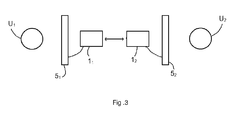
- Figure 3 represents an example embodiment where a first user U 1 and a second user U 2 are handling a videoconference.
- the first user U 1 is facing a first screen 5 1 and the second user U 2 is facing a second screen 5 2 .
- a first stereoscopic pictures generating system 1 1 is connected to the first screen 5 1
- a second stereoscopic pictures generating system 1 2 is connected to the second screen 5 2 .
- the connections may be wireless connections.
- the first stereoscopic pictures generating system 1 1 and the second stereoscopic pictures generating system 1 2 are configured to communicate with one another, for instance by using the Internet.
- the right and left videos showing the first user U 1 are provided from right and left cameras embedded in the first screen 5 1 .
- the right and left videos showing the second user U 2 are provided from right and left cameras embedded in the second screen 5 2 .
- the first right and left videos are thus displayed on the second screen 5 2 while the second right and left videos are displayed and the first screen 5 1 .
- the providing step S1 comprises a first providing operation during which at least one first user U 1 related parameter is provided.
- the first user related parameter comprises the interpupillary distance of the first user U 1 in intermediary vision.
- the first providing operation may be performed by the providing means of the first stereoscopic pictures generating system 1 1 .
- the providing step S1 comprises a second providing operation during which at least one second user U 2 related parameter is provided.
- the second user related parameter comprises the interpupillary distance of the second user U 2 in intermediary vision.
- the second providing operation may be performed by the providing means of the second stereoscopic pictures generating system 12 .
- the determining step S2 comprises a first determining operation during which a first pictures parameter is determined based on the first user related parameter.
- the first picture parameter comprises a first distance to be set between the two cameras embedded in the second screen 5 2 .
- the first determining operation may be performed by the determining means of the first stereoscopic pictures generating system 1 1 . In that case the first pictures parameter is then transmitted to the second stereoscopic pictures generating system 1 2 .
- the first user related parameter may be transmitted to the second stereoscopic pictures generating system 1 2 and the first determining operation may be performed by the determining means of the second stereoscopic pictures generating system 1 2 .
- the determining step S2 comprises a second determining operation during which a second pictures parameter is determined based on the second user related parameter.
- the second picture parameter comprises a second distance to be set between the two cameras embedded in the first screen 5 1 .
- the second determining operation may be performed by the determining means of the second stereoscopic pictures generating system 1 2 . In that case the second pictures parameter is then transmitted to the first stereoscopic pictures generating system 1 1 .
- the second user related parameter may be transmitted to the first stereoscopic pictures generating system 1 1 and the second determining operation may be performed by the determining means of the first stereoscopic pictures generating system 1 1 .
- the generating step S3 comprises a first generating operation during which first right and left stereoscopic pictures are generating.
- the first right and left pictures are provided from the two cameras embedded in the first screen 5 1 , the distance between the two cameras being set according to the second pictures parameter.
- the first generating operation may be performed by the generating means of the first stereoscopic pictures generating system 1 1 .
- the first right and left pictures are then transmitted to the second screen 5 2 , and displayed on the second screen 5 2 .
- the distance between the two cameras embedded in the first screen 5 1 has been set as a function of the interpupillary distance of the second user U 2 , the first right and left pictures are specifically adapted to the second user.
- the generating step S3 comprises a second generating operation during which second right and left stereoscopic pictures are generating.
- the second right and left pictures are provided from the two cameras embedded in the second screen 5 2 , the distance between the two cameras being set according to the first pictures parameter.
- the second generating operation may be performed by the generating means of the second stereoscopic pictures generating system 1 2 .
- the second right and left pictures are then transmitted to the first screen 5 1 , and displayed on the first screen 5 1 .
- the distance between the two cameras embedded in the second screen 5 2 has been set as a function of the interpupillary distance of the first user U 1 , the first right and left pictures are specifically adapted to the first user.
Landscapes
- Engineering & Computer Science (AREA)
- Multimedia (AREA)
- Signal Processing (AREA)
- Testing, Inspecting, Measuring Of Stereoscopic Televisions And Televisions (AREA)
- Image Analysis (AREA)
Abstract
A stereoscopic pictures generating method comprising:
- a providing step during which at least one user related parameter is provided,
- a determining step during which a pictures parameter is determined based on the at least one user related parameter, and
- a generating step during which right and left stereoscopic pictures are generating based on the pictures parameter, the right and left stereoscopic pictures being to be displayed on a screen.
- a providing step during which at least one user related parameter is provided,
- a determining step during which a pictures parameter is determined based on the at least one user related parameter, and
- a generating step during which right and left stereoscopic pictures are generating based on the pictures parameter, the right and left stereoscopic pictures being to be displayed on a screen.
Description
- The invention relates to a generation of stereoscopic pictures.
- The discussion of the background of the invention herein is included to explain the context of the invention. This is not to be taken as an admission that any of the material referred to was published, known or part of the common general knowledge at the priority date of any of the claims.
- Stereoscopic pictures generating system may present the drawback of not being optimized for the user of said system.
- Consequently, it can quickly give rise to the user suffering dizziness and nausea.
- One object of the invention is to provide stereoscopic pictures generating system and method that do not present the drawbacks mentioned hereinabove.
- In particular, one object of the invention is to provide stereoscopic pictures generating system and method enabling 3D information content to be viewed while limiting visual fatigue and discomfort for the user of said system.
- To this end, the invention proposes a stereoscopic pictures generating method comprising:
- a providing step during which at least one user related parameter is provided,
- a determining step during which a pictures parameter is determined based on the at least one user related parameter, and
- a generating step during which right and left stereoscopic pictures are generating based on the pictures parameter, the right and left stereoscopic pictures being to be displayed on a screen.
- Thus, right and left stereoscopic pictures are generating based on at least one user related parameter so that said user views the information content under conditions that are best adapted to the user's physiology. Consequently, the physiological fatigue is minimized.
- The at least one user related parameter may comprise the interpupillary distance of the user in intermediary vision, and/or the distance between the user and the screen.
- The screen may be designed to display right and left videos, each video comprising a set of pictures, the providing step being repeated several times during right and left videos generation.
- The providing step may comprise an obtaining operation during which the at least one user related parameter is obtained from a device storing the user related parameter.
- Alternatively, the providing step may comprise a measurement operation during which the at least one user related parameter is measured.
- In some embodiments, the measurement operation is performed by using right and left cameras embedded in a binocular viewing device designed to be worn by the user.
- In other embodiments, the measurement operation is performed by using a camera embedded in the screen.
- The pictures parameter may comprise a distance to be set between two cameras embedded in the screen and designed to provide the right and left pictures, and/or a display positioning of the right picture on the screen and a display positioning of the left picture on the screen.
- In some embodiments of the invention, for instance in case of videoconference, the providing step comprises a first providing operation during which at least one first user related parameter is provided, and a second providing operation during which at least one second user related parameter is provided.
- In these embodiments of the invention, the determining step comprises a first determining operation during which a first distance to be set between two cameras embedded in a screen facing the second user is determined based on the first user related parameter, and a second determining operation during which a second distance to be set between two cameras embedded in a screen facing the first user is determined based on the second user related parameter.
- Moreover, in these embodiments of the invention, the generating step comprises a first generating operation during which right and left stereoscopic pictures are generating based on the first distance, the right and left stereoscopic pictures being to be displayed on the screen facing the first user, a second generating operation during which right and left stereoscopic pictures are generating based on the second distance, the right and left stereoscopic pictures being to be displayed on the screen facing the second user.
- The invention also relates to a computer program product comprising one or more stored sequences of instructions that are accessible to a processor and which, when executed by the processor, causes the processor to carry out steps of the method.
- The invention also relates to a computer readable medium carrying one or more sequences of instructions of the computer program product.
- The invention also relates to a stereoscopic pictures generating system comprising:
- providing means configured to provide at least one user related parameter,
- determining means configured to determine a pictures parameter based on the at least one user related parameter, and
- generating means configured to generate right and left stereoscopic pictures based on the pictures parameter, the right and left stereoscopic pictures being to be displayed on a screen.
- Unless specifically stated otherwise, as apparent from the following discussions, it is appreciated that throughout the specification discussions utilizing terms such as "computing", "calculating", "generating", or the like, refer to the action and/or processes of a computer or computing system, or similar electronic computing device, that manipulate and/or transform data represented as physical, such as electronic, quantities within the computing system's registers and/or memories into other data similarly represented as physical quantities within the computing system's memories, registers or other such information storage, transmission or display devices.
- Embodiments of the present invention may include apparatuses for performing the operations herein. This apparatus may be specially constructed for the desired purposes, or it may comprise a general purpose computer or Digital Signal Processor ("DSP") selectively activated or reconfigured by a computer program stored in the computer. Such a computer program may be stored in a computer readable storage medium, such as, but is not limited to, any type of disk including floppy disks, optical disks, CD-ROMs, magnetic-optical disks, read-only memories (ROMs), random access memories (RAMs) electrically programmable read-only memories (EPROMs), electrically erasable and programmable read only memories (EEPROMs), magnetic or optical cards, or any other type of media suitable for storing electronic instructions, and capable of being coupled to a computer system bus.
- The processes and displays presented herein are not inherently related to any particular computer or other apparatus. Various general purpose systems may be used with programs in accordance with the teachings herein, or it may prove convenient to construct a more specialized apparatus to perform the desired method. The desired structure for a variety of these systems will appear from the description below. In addition, embodiments of the present invention are not described with reference to any particular programming language. It will be appreciated that a variety of programming languages may be used to implement the teachings of the inventions as described herein.
- Non limiting embodiments of the invention will now be described with reference to the accompanying drawing wherein:
- o
Figure 1 is a schematic block diagram representing a user, a binocular viewing device, a screen, and a stereoscopic pictures generating system according to some embodiments of the invention, - o
Figure 2 is a flow chart showing steps of a stereoscopic pictures generating method according to some embodiments of the invention, and - o
Figure 3 is a schematic block diagram showing two users handling a videoconference using two stereoscopic pictures generating systems. - Elements in the figures are illustrated for simplicity and clarity and have not necessarily been drawn to scale. For example, the dimensions of some of the elements in the figure may be exaggerated relative to other elements to help improve the understanding of the embodiments of the present invention.
-
Figure 1 shows a user U, a binocular viewing device 7, ascreen 5, and a stereoscopicpictures generating system 1 according to some embodiments of the invention. - The
screen 5 is designed to perform stereoscopic display, for example active stereoscopic display (shutter), passive stereoscopic display (polarization), autostereoscopic display, or other. - The
system 1 comprises providingmeans 2 configured to provide at least one user related parameter. - For instance, the at least one user related parameter may comprise the interpupillary distance of the user U in intermediary vision. The interpupillary distance is defined in the standard ISO 13666:1998.
- According to some embodiments of the invention, the providing
means 2 are configured to obtain the at least one user related parameter from a measurement. - The measurement may be performed by using right and left cameras 6L and 6R embedded in the binocular viewing device 7, which is designed to be worn by the user U. This measurement may thus be performed without the use of cameras embedded in the
screen 5. The measurement is then transmitted from the binocular viewing device 7 to the providingmeans 2 by means of any type of connection, for example a wireless connection. - Alternatively, the measurement may be performed by using a camera 8L or 8R embedded in the
screen 5 and two benchmarks provided on the binocular viewing device 7. Arrows F1,L and F1,R are symbolizing such a measurement performed by camera 8L. Similarly, arrows F2,L and F2,R are symbolizing such a measurement performed by camera 8R. This measurement may be performed with the use of a single camera embedded in thescreen 5. The measurement is then transmitted from thescreen 5 to the stereoscopicpictures generating system 1 by means of any type of connection, for example a wireless connection, as symbolized by arrows FM,1 and FM,2. - Alternatively, the measurement may be performed by using two camera 8L and 8R embedded in the
screen 5, as symbolized by arrows F3,L and F3,R. This measurement may be performed without the use of a binocular viewing device 7. The measurement is then transmitted from thescreen 5 to the stereoscopicpictures generating system 1 by means of any type of connection, for example a wireless connection, as symbolized by arrows FM,1 and FM,2. - The at least one user related parameter may further or instead comprise the distance between the user U and the
screen 5 facing the user U, that is to say the image display distance. The at least one user related parameter may further or instead comprise an eyes orientation of the user U. Such a measurement may be performed by using one or two camera(s) 8L, 8R embedded in thescreen 5. - The measurement may be performed periodically, for instance during right and left videos generation. It is thus possible to obtain a current position of the user U, for instance when the user U is playing a videogame.
- According to other embodiments of the invention, the providing
means 2 are configured to obtain the at least one user related parameter from a device storing the user related parameter. The device storing the user related parameter may be embedded in thesystem 1 or may be a remote device configured to communicate with thesystem 1. - The
system 1 further comprises determiningmeans 3 configured to receive the at least one user related parameter, as symbolized by arrow FUP, and to determine a pictures parameter based on the at least one user related parameter. - For instance, when two cameras 8L, 8R are embedded in the
screen 5, the determiningmeans 3 may be configured to determine a distance to be set between the two cameras 8L, 8R. - The determining means 3 may further or instead be configured to determine a display positioning of a right picture on the
screen 5 and a display positioning of a left picture on thescreen 5. - The
system 1 further comprises generating means 4 configured to receive the pictures parameter, as symbolized by arrow Fpp, and to generate right and left stereoscopic pictures based on the pictures parameter. - For instance, when the generating means 4 are configured to generate the right and left pictures based on a determined right and left display positioning, the right and left pictures may be generated by setting picture margins based on the determined right and left display positioning.
- When the generating means 4 are configured to generate the right and left pictures based on a distance to be set between the two cameras 8L, 8R, the generating means 4 may transmit a command signal to the
screen 5 to set the positions of the two cameras 8L, 8R. - Then, the generated right and left stereoscopic pictures are displayed on a screen.
- In some embodiments of the invention, the screen displaying the right and left pictures is the
screen 5 facing the user U associated to the user related parameter. In these embodiments of the invention, the generated pictures are transmitted from the generating means 4 to thescreen 5, as symbolized by arrows FP,L and FP,R. The display may thus be set as a function of the morphology of the user U and/or the position of the user U relative to thescreen 5, for example when the user U is playing a videogame or watching a movie. - According to other embodiments of the invention, the screen displaying the right and left pictures is a second screen facing a second user. The pictures generation may thus be adapted as a function of a second user, for example when the user U and the second user are handling a videoconference.
- According to an embodiment of the invention illustrated on
figure 2 , the stereoscopic pictures generating method according to the invention comprises: - a providing step S1,
- a determining step S2, and
- a generating step S3.
- The stereoscopic pictures generating method may be implemented by the stereoscopic
pictures generating system 1 disclosed above. - During the providing step S1 at least one user related parameter is provided.
- The providing step S1 may comprise a measurement operation during which the user related parameter is measured, or an obtaining operation during which the at least one user related parameter is obtained from a device storing the user related parameter.
- For instance, the user related parameter is measured during a first implementation of the method and then is stored to be reused.
- During the determining step S2 a pictures parameter is determined based on the at least one user related parameter provided in step S1.
- The pictures parameter may comprise, for instance, a distance to be set between two cameras 8L and 8R embedded in the
screen 5, and/or a display positioning of the right picture on thescreen 5 and a display positioning of the left picture on thescreen 5. - During the generating step S3 right and left stereoscopic pictures are generating based on the pictures parameter.
- Then, the right and left stereoscopic pictures are transmitted to a screen to be displayed.
-
Figure 3 represents an example embodiment where a first user U1 and a second user U2 are handling a videoconference. - The first user U1 is facing a
first screen 51 and the second user U2 is facing asecond screen 52. A first stereoscopicpictures generating system 11 is connected to the first screen 51 A second stereoscopicpictures generating system 12 is connected to thesecond screen 52. The connections may be wireless connections. The first stereoscopicpictures generating system 11 and the second stereoscopicpictures generating system 12 are configured to communicate with one another, for instance by using the Internet. - The right and left videos showing the first user U1, called first right and left videos, are provided from right and left cameras embedded in the
first screen 51. The right and left videos showing the second user U2, called second right and left videos, are provided from right and left cameras embedded in thesecond screen 52. The first right and left videos are thus displayed on thesecond screen 52 while the second right and left videos are displayed and thefirst screen 51. - In this example embodiment, the providing step S1 comprises a first providing operation during which at least one first user U1 related parameter is provided. The first user related parameter comprises the interpupillary distance of the first user U1 in intermediary vision. The first providing operation may be performed by the providing means of the first stereoscopic
pictures generating system 11. - Moreover, the providing step S1 comprises a second providing operation during which at least one second user U2 related parameter is provided. The second user related parameter comprises the interpupillary distance of the second user U2 in intermediary vision. The second providing operation may be performed by the providing means of the second stereoscopic
pictures generating system 12. - The determining step S2 comprises a first determining operation during which a first pictures parameter is determined based on the first user related parameter. The first picture parameter comprises a first distance to be set between the two cameras embedded in the
second screen 52. The first determining operation may be performed by the determining means of the first stereoscopicpictures generating system 11. In that case the first pictures parameter is then transmitted to the second stereoscopicpictures generating system 12. Alternatively, the first user related parameter may be transmitted to the second stereoscopicpictures generating system 12 and the first determining operation may be performed by the determining means of the second stereoscopicpictures generating system 12. - Moreover, the determining step S2 comprises a second determining operation during which a second pictures parameter is determined based on the second user related parameter. The second picture parameter comprises a second distance to be set between the two cameras embedded in the
first screen 51. The second determining operation may be performed by the determining means of the second stereoscopicpictures generating system 12. In that case the second pictures parameter is then transmitted to the first stereoscopicpictures generating system 11. Alternatively, the second user related parameter may be transmitted to the first stereoscopicpictures generating system 11 and the second determining operation may be performed by the determining means of the first stereoscopicpictures generating system 11. - The generating step S3 comprises a first generating operation during which first right and left stereoscopic pictures are generating. The first right and left pictures are provided from the two cameras embedded in the
first screen 51, the distance between the two cameras being set according to the second pictures parameter. The first generating operation may be performed by the generating means of the first stereoscopicpictures generating system 11. The first right and left pictures are then transmitted to thesecond screen 52, and displayed on thesecond screen 52. As the distance between the two cameras embedded in thefirst screen 51 has been set as a function of the interpupillary distance of the second user U2, the first right and left pictures are specifically adapted to the second user. - Moreover, the generating step S3 comprises a second generating operation during which second right and left stereoscopic pictures are generating. The second right and left pictures are provided from the two cameras embedded in the
second screen 52, the distance between the two cameras being set according to the first pictures parameter. The second generating operation may be performed by the generating means of the second stereoscopicpictures generating system 12. The second right and left pictures are then transmitted to thefirst screen 51, and displayed on thefirst screen 51. As the distance between the two cameras embedded in thesecond screen 52 has been set as a function of the interpupillary distance of the first user U1, the first right and left pictures are specifically adapted to the first user. - The invention has been described above with the aid of embodiments without limitation of the general inventive concept.
Claims (14)
- A stereoscopic pictures generating method comprising:- a providing step during which at least one user related parameter is provided,- a determining step during which a pictures parameter is determined based on the at least one user related parameter, and- a generating step during which right and left stereoscopic pictures are generating based on the pictures parameter, the right and left stereoscopic pictures being to be displayed on a screen.
- The stereoscopic pictures generating method according to claim 1, wherein the at least one user related parameter comprises the interpupillary distance of the user in intermediary vision.
- The stereoscopic pictures generating method according to claim 1 or 2, wherein the at least one user related parameter comprises the distance between the user and the screen.
- The stereoscopic pictures generating method according to one of claims 1 to 3, wherein the screen is designed to display right and left videos, each video comprising a set of pictures, the providing step being repeated several times during right and left videos generation.
- The stereoscopic pictures generating method according to one of claims 1 to 4, wherein the providing step comprises an obtaining operation during which the at least one user related parameter is obtained from a device storing the user related parameter.
- The stereoscopic pictures generating method according to one of claims 1 to 4, wherein the providing step comprises a measurement operation during which the at least one user related parameter is measured.
- The stereoscopic pictures generating method according to claim 6, wherein the measurement operation is performed by using right and left cameras embedded in a binocular viewing device designed to be worn by the user.
- The stereoscopic pictures generating method according to claim 6, wherein the measurement operation is performed by using a camera embedded in the screen.
- The stereoscopic pictures generating method according to one of claims 1 to 8, wherein the pictures parameter comprises a distance to be set between two cameras embedded in the screen and designed to provide the right and left pictures.
- The stereoscopic pictures generating method according to one of claims 1 to 9, wherein the pictures parameter comprises a display positioning of the right picture on the screen and a display positioning of the left picture on the screen.
- The stereoscopic pictures generating method according to one of claims 1 to 10, wherein:- the providing step comprises:o a first providing operation during which at least one first user related parameter is provided, ando a second providing operation during which at least one second user related parameter is provided,- the determining step comprises:o a first determining operation during which a first distance to be set between two cameras embedded in a screen facing the second user is determined based on the first user related parameter,o a second determining operation during which a second distance to be set between two cameras embedded in a screen facing the first user is determined based on the second user related parameter,- the generating step comprises:o a first generating operation during which right and left stereoscopic pictures are generating based on the first distance, the right and left stereoscopic pictures being to be displayed on the screen facing the first user,o a second generating operation during which right and left stereoscopic pictures are generating based on the second distance, the right and left stereoscopic pictures being to be displayed on the screen facing the second user.
- A computer program product comprising one or more stored sequences of instructions that are accessible to a processor and which, when executed by the processor, causes the processor to carry out the steps of any of claims 1 to 11.
- A computer readable medium carrying one or more sequences of instructions of the computer program product of claim 12.
- A stereoscopic pictures generating system comprising:- providing means configured to provide at least one user related parameter,- determining means configured to determine a pictures parameter based on the at least one user related parameter, and- generating means configured to generate right and left stereoscopic pictures based on the pictures parameter, the right and left stereoscopic pictures being to be displayed on a screen.
Priority Applications (6)
| Application Number | Priority Date | Filing Date | Title |
|---|---|---|---|
| EP12305843.0A EP2685732A1 (en) | 2012-07-12 | 2012-07-12 | Stereoscopic pictures generation |
| US14/414,352 US20150215610A1 (en) | 2012-07-12 | 2013-07-09 | Stereoscopic pictures generation |
| CN201380036982.3A CN104471933B (en) | 2012-07-12 | 2013-07-09 | Stereotome generates |
| PCT/EP2013/064505 WO2014009378A1 (en) | 2012-07-12 | 2013-07-09 | Stereoscopic pictures generation |
| EP13744989.8A EP2873242B1 (en) | 2012-07-12 | 2013-07-09 | Stereoscopic pictures generation |
| IL236634A IL236634A (en) | 2012-07-12 | 2015-01-11 | Stereoscopic pictures generation |
Applications Claiming Priority (1)
| Application Number | Priority Date | Filing Date | Title |
|---|---|---|---|
| EP12305843.0A EP2685732A1 (en) | 2012-07-12 | 2012-07-12 | Stereoscopic pictures generation |
Publications (1)
| Publication Number | Publication Date |
|---|---|
| EP2685732A1 true EP2685732A1 (en) | 2014-01-15 |
Family
ID=48915989
Family Applications (2)
| Application Number | Title | Priority Date | Filing Date |
|---|---|---|---|
| EP12305843.0A Withdrawn EP2685732A1 (en) | 2012-07-12 | 2012-07-12 | Stereoscopic pictures generation |
| EP13744989.8A Not-in-force EP2873242B1 (en) | 2012-07-12 | 2013-07-09 | Stereoscopic pictures generation |
Family Applications After (1)
| Application Number | Title | Priority Date | Filing Date |
|---|---|---|---|
| EP13744989.8A Not-in-force EP2873242B1 (en) | 2012-07-12 | 2013-07-09 | Stereoscopic pictures generation |
Country Status (5)
| Country | Link |
|---|---|
| US (1) | US20150215610A1 (en) |
| EP (2) | EP2685732A1 (en) |
| CN (1) | CN104471933B (en) |
| IL (1) | IL236634A (en) |
| WO (1) | WO2014009378A1 (en) |
Families Citing this family (1)
| Publication number | Priority date | Publication date | Assignee | Title |
|---|---|---|---|---|
| WO2016191950A1 (en) * | 2015-05-29 | 2016-12-08 | 深圳市柔宇科技有限公司 | Display adjustment method and head-mounted display device |
Citations (5)
| Publication number | Priority date | Publication date | Assignee | Title |
|---|---|---|---|---|
| JPH07129095A (en) * | 1993-11-02 | 1995-05-19 | Shin Sangyo Souzou Center:Kk | Three-dimensional image information terminal device |
| US20040233275A1 (en) * | 2003-03-20 | 2004-11-25 | Seijiro Tomita | Stereoscopic image picking up and display system |
| US20080024597A1 (en) * | 2006-07-27 | 2008-01-31 | Electronics And Telecommunications Research Institute | Face-mounted display apparatus for mixed reality environment |
| US20100007582A1 (en) * | 2007-04-03 | 2010-01-14 | Sony Computer Entertainment America Inc. | Display viewing system and methods for optimizing display view based on active tracking |
| US20110304616A1 (en) * | 2010-06-10 | 2011-12-15 | Ham Jung Hyun | Liquid crystal display device and method for driving the same |
Family Cites Families (14)
| Publication number | Priority date | Publication date | Assignee | Title |
|---|---|---|---|---|
| US5175616A (en) * | 1989-08-04 | 1992-12-29 | Her Majesty The Queen In Right Of Canada, As Represented By The Minister Of National Defence Of Canada | Stereoscopic video-graphic coordinate specification system |
| EP0641132B1 (en) * | 1993-08-26 | 1999-04-14 | Matsushita Electric Industrial Co., Ltd. | Stereoscopic image pickup apparatus |
| DE19836681B4 (en) * | 1997-09-19 | 2008-03-27 | Carl Zeiss Ag | Stereoscopic recording and playback system |
| US7626569B2 (en) * | 2004-10-25 | 2009-12-01 | Graphics Properties Holdings, Inc. | Movable audio/video communication interface system |
| US20100103244A1 (en) * | 2007-03-30 | 2010-04-29 | Nxp, B.V. | device for and method of processing image data representative of an object |
| CN101291415B (en) * | 2008-05-30 | 2010-07-21 | 华为终端有限公司 | Method, apparatus and system for three-dimensional video communication |
| KR20100003913A (en) * | 2008-07-02 | 2010-01-12 | 삼성전자주식회사 | Method and apparatus for communication using 3-dimensional image display |
| US8477175B2 (en) * | 2009-03-09 | 2013-07-02 | Cisco Technology, Inc. | System and method for providing three dimensional imaging in a network environment |
| WO2011071478A1 (en) * | 2009-12-07 | 2011-06-16 | Hewlett-Packard Development Company, L.P. | 3d video conference |
| WO2011080666A1 (en) * | 2009-12-30 | 2011-07-07 | Koninklijke Philips Electronics N.V. | Dynamic ablation device |
| US8488870B2 (en) * | 2010-06-25 | 2013-07-16 | Qualcomm Incorporated | Multi-resolution, multi-window disparity estimation in 3D video processing |
| US8823769B2 (en) * | 2011-01-05 | 2014-09-02 | Ricoh Company, Ltd. | Three-dimensional video conferencing system with eye contact |
| NZ621683A (en) * | 2011-08-30 | 2016-05-27 | Ericsson Telefon Ab L M | Receiver-side adjustment of stereoscopic images |
| TWI446250B (en) * | 2011-12-05 | 2014-07-21 | Wistron Corp | Portable optical touch system and operating method thereof |
-
2012
- 2012-07-12 EP EP12305843.0A patent/EP2685732A1/en not_active Withdrawn
-
2013
- 2013-07-09 EP EP13744989.8A patent/EP2873242B1/en not_active Not-in-force
- 2013-07-09 WO PCT/EP2013/064505 patent/WO2014009378A1/en not_active Ceased
- 2013-07-09 CN CN201380036982.3A patent/CN104471933B/en not_active Expired - Fee Related
- 2013-07-09 US US14/414,352 patent/US20150215610A1/en not_active Abandoned
-
2015
- 2015-01-11 IL IL236634A patent/IL236634A/en active IP Right Grant
Patent Citations (5)
| Publication number | Priority date | Publication date | Assignee | Title |
|---|---|---|---|---|
| JPH07129095A (en) * | 1993-11-02 | 1995-05-19 | Shin Sangyo Souzou Center:Kk | Three-dimensional image information terminal device |
| US20040233275A1 (en) * | 2003-03-20 | 2004-11-25 | Seijiro Tomita | Stereoscopic image picking up and display system |
| US20080024597A1 (en) * | 2006-07-27 | 2008-01-31 | Electronics And Telecommunications Research Institute | Face-mounted display apparatus for mixed reality environment |
| US20100007582A1 (en) * | 2007-04-03 | 2010-01-14 | Sony Computer Entertainment America Inc. | Display viewing system and methods for optimizing display view based on active tracking |
| US20110304616A1 (en) * | 2010-06-10 | 2011-12-15 | Ham Jung Hyun | Liquid crystal display device and method for driving the same |
Non-Patent Citations (2)
| Title |
|---|
| ANONYMOUS, SPIE, PO BOX 10 BELLINGHAM WA 98227-0010, USA, 23 January 2011 (2011-01-23), XP040552890 * |
| STEPTOE W ET AL: "Eye Tracking for Avatar Eye Gaze Control During Object-Focused Multiparty Interaction in Immersive Collaborative Virtual Environments", VIRTUAL REALITY CONFERENCE, 2009. VR 2009. IEEE, IEEE, PISCATAWAY, NJ, USA, 14 March 2009 (2009-03-14), pages 83 - 90, XP031465453, ISBN: 978-1-4244-3943-0 * |
Also Published As
| Publication number | Publication date |
|---|---|
| IL236634A (en) | 2017-12-31 |
| IL236634A0 (en) | 2015-02-26 |
| US20150215610A1 (en) | 2015-07-30 |
| EP2873242A1 (en) | 2015-05-20 |
| CN104471933A (en) | 2015-03-25 |
| EP2873242B1 (en) | 2020-10-21 |
| CN104471933B (en) | 2017-12-01 |
| WO2014009378A1 (en) | 2014-01-16 |
Similar Documents
| Publication | Publication Date | Title |
|---|---|---|
| JP4689639B2 (en) | Image processing system | |
| US9307228B2 (en) | Depth of field maintaining apparatus, 3D display system and display method | |
| CN106251403B (en) | A kind of methods, devices and systems of virtual three-dimensional Scene realization | |
| CN101783967B (en) | Signal processing device, image display device, signal processing method, and computer program | |
| CN114910052B (en) | A camera-based distance measurement method, control method, device and electronic equipment | |
| CN109743626B (en) | An image display method, image processing method and related equipment | |
| CN110036647A (en) | Method and apparatus for managing the thumbnail of three-dimensional content | |
| US20130010069A1 (en) | Method, system and computer program product for wirelessly connecting a device to a network | |
| JP2022046260A5 (en) | Image processing device, image processing method, recording medium and program | |
| KR20130085784A (en) | Display device and control method thereof | |
| CN108833877A (en) | Image processing method and device, computer installation and readable storage medium storing program for executing | |
| CN110278432B (en) | Naked eye 3D display screen 3D parameter manual calibration method and electronic equipment | |
| US20240340403A1 (en) | Head mount display, information processing apparatus, and information processing method | |
| CN111147883A (en) | Live broadcast method, apparatus, head mounted display device and readable storage medium | |
| EP2873242B1 (en) | Stereoscopic pictures generation | |
| CN103609104A (en) | Interactive user interface for stereoscopic effect adjustment | |
| CN109922326B (en) | Method, device, medium and equipment for determining resolution of naked eye 3D video image | |
| EP2885912B1 (en) | Pictures positioning on display elements | |
| JP6031016B2 (en) | Video display device and video display program | |
| KR101373611B1 (en) | System and method for sharing 3d video with glasses type camera/display apparatuses | |
| KR101347744B1 (en) | Image processing apparatus and method | |
| JP5604173B2 (en) | Playback device, display device, recording device, and storage medium | |
| CN116193246A (en) | Prompt method and device for shooting video, electronic equipment and storage medium | |
| CN118433467A (en) | Video display method, device, electronic device and storage medium | |
| JP2020098944A (en) | Video generating device, video generating method and video generation program |
Legal Events
| Date | Code | Title | Description |
|---|---|---|---|
| PUAI | Public reference made under article 153(3) epc to a published international application that has entered the european phase |
Free format text: ORIGINAL CODE: 0009012 |
|
| AK | Designated contracting states |
Kind code of ref document: A1 Designated state(s): AL AT BE BG CH CY CZ DE DK EE ES FI FR GB GR HR HU IE IS IT LI LT LU LV MC MK MT NL NO PL PT RO RS SE SI SK SM TR |
|
| AX | Request for extension of the european patent |
Extension state: BA ME |
|
| STAA | Information on the status of an ep patent application or granted ep patent |
Free format text: STATUS: THE APPLICATION IS DEEMED TO BE WITHDRAWN |
|
| 18D | Application deemed to be withdrawn |
Effective date: 20140716 |