EP2685552A1 - Organic dye material and dye-sensitized solar cell using same - Google Patents
Organic dye material and dye-sensitized solar cell using same Download PDFInfo
- Publication number
- EP2685552A1 EP2685552A1 EP12755311.3A EP12755311A EP2685552A1 EP 2685552 A1 EP2685552 A1 EP 2685552A1 EP 12755311 A EP12755311 A EP 12755311A EP 2685552 A1 EP2685552 A1 EP 2685552A1
- Authority
- EP
- European Patent Office
- Prior art keywords
- group
- substituted
- unsubstituted
- oxide
- site
- Prior art date
- Legal status (The legal status is an assumption and is not a legal conclusion. Google has not performed a legal analysis and makes no representation as to the accuracy of the status listed.)
- Withdrawn
Links
- 239000000463 material Substances 0.000 title claims description 22
- -1 polyethylenedioxy group Polymers 0.000 claims description 149
- 150000001875 compounds Chemical class 0.000 claims description 97
- 125000001424 substituent group Chemical group 0.000 claims description 50
- 125000000217 alkyl group Chemical group 0.000 claims description 49
- 125000003118 aryl group Chemical group 0.000 claims description 47
- 125000003545 alkoxy group Chemical group 0.000 claims description 39
- 125000003277 amino group Chemical group 0.000 claims description 38
- ZOXJGFHDIHLPTG-UHFFFAOYSA-N Boron Chemical compound [B] ZOXJGFHDIHLPTG-UHFFFAOYSA-N 0.000 claims description 33
- IJGRMHOSHXDMSA-UHFFFAOYSA-N Atomic nitrogen Chemical compound N#N IJGRMHOSHXDMSA-UHFFFAOYSA-N 0.000 claims description 28
- 229910052796 boron Inorganic materials 0.000 claims description 28
- 125000001072 heteroaryl group Chemical group 0.000 claims description 28
- 125000003808 silyl group Chemical group [H][Si]([H])([H])[*] 0.000 claims description 28
- 239000000126 substance Substances 0.000 claims description 28
- 125000003342 alkenyl group Chemical group 0.000 claims description 27
- RAXXELZNTBOGNW-UHFFFAOYSA-N imidazole Natural products C1=CNC=N1 RAXXELZNTBOGNW-UHFFFAOYSA-N 0.000 claims description 26
- 125000006850 spacer group Chemical group 0.000 claims description 26
- 125000000304 alkynyl group Chemical group 0.000 claims description 25
- 125000002887 hydroxy group Chemical group [H]O* 0.000 claims description 25
- 238000000034 method Methods 0.000 claims description 25
- 125000000449 nitro group Chemical group [O-][N+](*)=O 0.000 claims description 24
- 229910052799 carbon Inorganic materials 0.000 claims description 23
- UHOVQNZJYSORNB-UHFFFAOYSA-N monobenzene Natural products C1=CC=CC=C1 UHOVQNZJYSORNB-UHFFFAOYSA-N 0.000 claims description 20
- 229910052757 nitrogen Inorganic materials 0.000 claims description 20
- 125000003178 carboxy group Chemical group [H]OC(*)=O 0.000 claims description 18
- 125000005842 heteroatom Chemical group 0.000 claims description 17
- 239000004065 semiconductor Substances 0.000 claims description 17
- BHEPBYXIRTUNPN-UHFFFAOYSA-N hydridophosphorus(.) (triplet) Chemical compound [PH] BHEPBYXIRTUNPN-UHFFFAOYSA-N 0.000 claims description 16
- OKTJSMMVPCPJKN-UHFFFAOYSA-N Carbon Chemical compound [C] OKTJSMMVPCPJKN-UHFFFAOYSA-N 0.000 claims description 15
- 125000004435 hydrogen atom Chemical class [H]* 0.000 claims description 15
- MWPLVEDNUUSJAV-UHFFFAOYSA-N anthracene Chemical class C1=CC=CC2=CC3=CC=CC=C3C=C21 MWPLVEDNUUSJAV-UHFFFAOYSA-N 0.000 claims description 14
- IOJUPLGTWVMSFF-UHFFFAOYSA-N benzothiazole Chemical class C1=CC=C2SC=NC2=C1 IOJUPLGTWVMSFF-UHFFFAOYSA-N 0.000 claims description 14
- 125000004093 cyano group Chemical group *C#N 0.000 claims description 14
- 229910052736 halogen Inorganic materials 0.000 claims description 14
- 150000002367 halogens Chemical class 0.000 claims description 14
- 125000005010 perfluoroalkyl group Chemical group 0.000 claims description 14
- 229910044991 metal oxide Inorganic materials 0.000 claims description 13
- 150000004706 metal oxides Chemical class 0.000 claims description 13
- JUJWROOIHBZHMG-UHFFFAOYSA-N pyridine Substances C1=CC=NC=C1 JUJWROOIHBZHMG-UHFFFAOYSA-N 0.000 claims description 13
- 229920003026 Acene Polymers 0.000 claims description 12
- SMWDFEZZVXVKRB-UHFFFAOYSA-N anhydrous quinoline Natural products N1=CC=CC2=CC=CC=C21 SMWDFEZZVXVKRB-UHFFFAOYSA-N 0.000 claims description 12
- 125000002102 aryl alkyloxo group Chemical group 0.000 claims description 12
- AWJUIBRHMBBTKR-UHFFFAOYSA-N iso-quinoline Natural products C1=NC=CC2=CC=CC=C21 AWJUIBRHMBBTKR-UHFFFAOYSA-N 0.000 claims description 12
- FNQJDLTXOVEEFB-UHFFFAOYSA-N 1,2,3-benzothiadiazole Chemical class C1=CC=C2SN=NC2=C1 FNQJDLTXOVEEFB-UHFFFAOYSA-N 0.000 claims description 11
- 239000005964 Acibenzolar-S-methyl Substances 0.000 claims description 11
- 125000005620 boronic acid group Chemical group 0.000 claims description 11
- 230000008878 coupling Effects 0.000 claims description 11
- 238000010168 coupling process Methods 0.000 claims description 11
- 238000005859 coupling reaction Methods 0.000 claims description 11
- QJGQUHMNIGDVPM-UHFFFAOYSA-N nitrogen group Chemical group [N] QJGQUHMNIGDVPM-UHFFFAOYSA-N 0.000 claims description 11
- UMJSCPRVCHMLSP-UHFFFAOYSA-N pyridine Natural products COC1=CC=CN=C1 UMJSCPRVCHMLSP-UHFFFAOYSA-N 0.000 claims description 11
- 125000004469 siloxy group Chemical group [SiH3]O* 0.000 claims description 11
- 125000000542 sulfonic acid group Chemical group 0.000 claims description 11
- NEAQRZUHTPSBBM-UHFFFAOYSA-N 2-hydroxy-3,3-dimethyl-7-nitro-4h-isoquinolin-1-one Chemical compound C1=C([N+]([O-])=O)C=C2C(=O)N(O)C(C)(C)CC2=C1 NEAQRZUHTPSBBM-UHFFFAOYSA-N 0.000 claims description 10
- 239000002253 acid Substances 0.000 claims description 10
- 125000004414 alkyl thio group Chemical group 0.000 claims description 10
- 125000000852 azido group Chemical group *N=[N+]=[N-] 0.000 claims description 10
- 150000001555 benzenes Chemical class 0.000 claims description 10
- NLCKLZIHJQEMCU-UHFFFAOYSA-N cyano prop-2-enoate Chemical group C=CC(=O)OC#N NLCKLZIHJQEMCU-UHFFFAOYSA-N 0.000 claims description 10
- 125000000753 cycloalkyl group Chemical group 0.000 claims description 10
- 239000001257 hydrogen Substances 0.000 claims description 10
- 229910052739 hydrogen Inorganic materials 0.000 claims description 10
- 150000002460 imidazoles Chemical class 0.000 claims description 10
- 150000002537 isoquinolines Chemical class 0.000 claims description 10
- 150000002916 oxazoles Chemical class 0.000 claims description 10
- 150000003217 pyrazoles Chemical class 0.000 claims description 10
- 150000004892 pyridazines Chemical class 0.000 claims description 10
- 150000003222 pyridines Chemical class 0.000 claims description 10
- 150000003230 pyrimidines Chemical class 0.000 claims description 10
- 150000003248 quinolines Chemical class 0.000 claims description 10
- 125000000472 sulfonyl group Chemical group *S(*)(=O)=O 0.000 claims description 10
- 150000003557 thiazoles Chemical class 0.000 claims description 10
- 125000003396 thiol group Chemical group [H]S* 0.000 claims description 10
- FZWLAAWBMGSTSO-UHFFFAOYSA-N Thiazole Chemical compound C1=CSC=N1 FZWLAAWBMGSTSO-UHFFFAOYSA-N 0.000 claims description 9
- 125000002252 acyl group Chemical group 0.000 claims description 9
- 125000004429 atom Chemical group 0.000 claims description 8
- OHZAHWOAMVVGEL-UHFFFAOYSA-N 2,2'-bithiophene Chemical group C1=CSC(C=2SC=CC=2)=C1 OHZAHWOAMVVGEL-UHFFFAOYSA-N 0.000 claims description 6
- 125000005605 benzo group Chemical group 0.000 claims description 6
- 239000000470 constituent Substances 0.000 claims description 6
- ZUOUZKKEUPVFJK-UHFFFAOYSA-N diphenyl Chemical group C1=CC=CC=C1C1=CC=CC=C1 ZUOUZKKEUPVFJK-UHFFFAOYSA-N 0.000 claims description 6
- 125000000524 functional group Chemical group 0.000 claims description 6
- 125000005259 triarylamine group Chemical group 0.000 claims description 6
- 125000002915 carbonyl group Chemical group [*:2]C([*:1])=O 0.000 claims description 5
- 229920001651 Cyanoacrylate Chemical group 0.000 claims description 4
- MWCLLHOVUTZFKS-UHFFFAOYSA-N Methyl cyanoacrylate Chemical group COC(=O)C(=C)C#N MWCLLHOVUTZFKS-UHFFFAOYSA-N 0.000 claims description 4
- 150000001721 carbon Chemical group 0.000 claims description 4
- 125000003983 fluorenyl group Chemical class C1(=CC=CC=2C3=CC=CC=C3CC12)* 0.000 claims 4
- 125000000609 carbazolyl group Chemical class C1(=CC=CC=2C3=CC=CC=C3NC12)* 0.000 claims 2
- VLKZOEOYAKHREP-UHFFFAOYSA-N n-Hexane Chemical compound CCCCCC VLKZOEOYAKHREP-UHFFFAOYSA-N 0.000 description 210
- YMWUJEATGCHHMB-UHFFFAOYSA-N Dichloromethane Chemical compound ClCCl YMWUJEATGCHHMB-UHFFFAOYSA-N 0.000 description 126
- 239000000243 solution Substances 0.000 description 119
- YXFVVABEGXRONW-UHFFFAOYSA-N Toluene Chemical compound CC1=CC=CC=C1 YXFVVABEGXRONW-UHFFFAOYSA-N 0.000 description 117
- 239000002904 solvent Substances 0.000 description 104
- HEDRZPFGACZZDS-MICDWDOJSA-N Trichloro(2H)methane Chemical compound [2H]C(Cl)(Cl)Cl HEDRZPFGACZZDS-MICDWDOJSA-N 0.000 description 78
- 239000012044 organic layer Substances 0.000 description 67
- 239000010410 layer Substances 0.000 description 58
- 238000003756 stirring Methods 0.000 description 52
- 239000000203 mixture Substances 0.000 description 47
- 239000000975 dye Substances 0.000 description 46
- 238000005160 1H NMR spectroscopy Methods 0.000 description 44
- RTZKZFJDLAIYFH-UHFFFAOYSA-N ether Substances CCOCC RTZKZFJDLAIYFH-UHFFFAOYSA-N 0.000 description 42
- HEDRZPFGACZZDS-UHFFFAOYSA-N Chloroform Chemical compound ClC(Cl)Cl HEDRZPFGACZZDS-UHFFFAOYSA-N 0.000 description 34
- 239000007832 Na2SO4 Substances 0.000 description 33
- PMZURENOXWZQFD-UHFFFAOYSA-L Sodium Sulfate Chemical compound [Na+].[Na+].[O-]S([O-])(=O)=O PMZURENOXWZQFD-UHFFFAOYSA-L 0.000 description 33
- 229910052938 sodium sulfate Inorganic materials 0.000 description 33
- 239000007787 solid Substances 0.000 description 33
- XLYOFNOQVPJJNP-UHFFFAOYSA-N water Substances O XLYOFNOQVPJJNP-UHFFFAOYSA-N 0.000 description 32
- 230000015572 biosynthetic process Effects 0.000 description 31
- 238000003786 synthesis reaction Methods 0.000 description 31
- OKKJLVBELUTLKV-UHFFFAOYSA-N Methanol Chemical compound OC OKKJLVBELUTLKV-UHFFFAOYSA-N 0.000 description 30
- 125000004432 carbon atom Chemical group C* 0.000 description 29
- 238000010898 silica gel chromatography Methods 0.000 description 28
- IAZDPXIOMUYVGZ-WFGJKAKNSA-N Dimethyl sulfoxide Chemical compound [2H]C([2H])([2H])S(=O)C([2H])([2H])[2H] IAZDPXIOMUYVGZ-WFGJKAKNSA-N 0.000 description 26
- 239000000758 substrate Substances 0.000 description 25
- DLEDOFVPSDKWEF-UHFFFAOYSA-N lithium butane Chemical compound [Li+].CCC[CH2-] DLEDOFVPSDKWEF-UHFFFAOYSA-N 0.000 description 24
- MZRVEZGGRBJDDB-UHFFFAOYSA-N n-Butyllithium Substances [Li]CCCC MZRVEZGGRBJDDB-UHFFFAOYSA-N 0.000 description 24
- 238000006243 chemical reaction Methods 0.000 description 22
- XEKOWRVHYACXOJ-UHFFFAOYSA-N Ethyl acetate Chemical compound CCOC(C)=O XEKOWRVHYACXOJ-UHFFFAOYSA-N 0.000 description 21
- KDLHZDBZIXYQEI-UHFFFAOYSA-N Palladium Chemical compound [Pd] KDLHZDBZIXYQEI-UHFFFAOYSA-N 0.000 description 20
- 239000010408 film Substances 0.000 description 20
- 229920006395 saturated elastomer Polymers 0.000 description 20
- GWEVSGVZZGPLCZ-UHFFFAOYSA-N Titan oxide Chemical compound O=[Ti]=O GWEVSGVZZGPLCZ-UHFFFAOYSA-N 0.000 description 18
- FAPWRFPIFSIZLT-UHFFFAOYSA-M Sodium chloride Chemical compound [Na+].[Cl-] FAPWRFPIFSIZLT-UHFFFAOYSA-M 0.000 description 17
- 239000011541 reaction mixture Substances 0.000 description 16
- 125000004051 hexyl group Chemical group [H]C([H])([H])C([H])([H])C([H])([H])C([H])([H])C([H])([H])C([H])([H])* 0.000 description 15
- NLXLAEXVIDQMFP-UHFFFAOYSA-N Ammonia chloride Chemical compound [NH4+].[Cl-] NLXLAEXVIDQMFP-UHFFFAOYSA-N 0.000 description 14
- 238000010992 reflux Methods 0.000 description 14
- WEVYAHXRMPXWCK-UHFFFAOYSA-N Acetonitrile Chemical compound CC#N WEVYAHXRMPXWCK-UHFFFAOYSA-N 0.000 description 12
- LFQSCWFLJHTTHZ-UHFFFAOYSA-N Ethanol Chemical compound CCO LFQSCWFLJHTTHZ-UHFFFAOYSA-N 0.000 description 12
- 125000003368 amide group Chemical group 0.000 description 12
- 125000004185 ester group Chemical group 0.000 description 12
- 239000011737 fluorine Substances 0.000 description 12
- 229910052731 fluorine Inorganic materials 0.000 description 12
- 239000007788 liquid Substances 0.000 description 12
- UHOVQNZJYSORNB-MZWXYZOWSA-N benzene-d6 Chemical compound [2H]C1=C([2H])C([2H])=C([2H])C([2H])=C1[2H] UHOVQNZJYSORNB-MZWXYZOWSA-N 0.000 description 11
- 238000004768 lowest unoccupied molecular orbital Methods 0.000 description 11
- 229940126214 compound 3 Drugs 0.000 description 10
- 125000005843 halogen group Chemical group 0.000 description 10
- 125000002496 methyl group Chemical group [H]C([H])([H])* 0.000 description 10
- OGIDPMRJRNCKJF-UHFFFAOYSA-N titanium oxide Inorganic materials [Ti]=O OGIDPMRJRNCKJF-UHFFFAOYSA-N 0.000 description 10
- WKBOTKDWSSQWDR-UHFFFAOYSA-N Bromine atom Chemical compound [Br] WKBOTKDWSSQWDR-UHFFFAOYSA-N 0.000 description 9
- IAZDPXIOMUYVGZ-UHFFFAOYSA-N Dimethylsulphoxide Chemical compound CS(C)=O IAZDPXIOMUYVGZ-UHFFFAOYSA-N 0.000 description 9
- YCKRFDGAMUMZLT-UHFFFAOYSA-N Fluorine atom Chemical compound [F] YCKRFDGAMUMZLT-UHFFFAOYSA-N 0.000 description 9
- 239000000460 chlorine Substances 0.000 description 9
- 229910052801 chlorine Inorganic materials 0.000 description 9
- 238000001816 cooling Methods 0.000 description 9
- 125000001997 phenyl group Chemical group [H]C1=C([H])C([H])=C(*)C([H])=C1[H] 0.000 description 9
- 238000001644 13C nuclear magnetic resonance spectroscopy Methods 0.000 description 8
- MCSXGCZMEPXKIW-UHFFFAOYSA-N 3-hydroxy-4-[(4-methyl-2-nitrophenyl)diazenyl]-N-(3-nitrophenyl)naphthalene-2-carboxamide Chemical compound Cc1ccc(N=Nc2c(O)c(cc3ccccc23)C(=O)Nc2cccc(c2)[N+]([O-])=O)c(c1)[N+]([O-])=O MCSXGCZMEPXKIW-UHFFFAOYSA-N 0.000 description 8
- YSHMQTRICHYLGF-UHFFFAOYSA-N 4-tert-butylpyridine Chemical compound CC(C)(C)C1=CC=NC=C1 YSHMQTRICHYLGF-UHFFFAOYSA-N 0.000 description 8
- XKRFYHLGVUSROY-UHFFFAOYSA-N Argon Chemical compound [Ar] XKRFYHLGVUSROY-UHFFFAOYSA-N 0.000 description 8
- OFBQJSOFQDEBGM-UHFFFAOYSA-N Pentane Chemical compound CCCCC OFBQJSOFQDEBGM-UHFFFAOYSA-N 0.000 description 8
- VYPSYNLAJGMNEJ-UHFFFAOYSA-N Silicium dioxide Chemical compound O=[Si]=O VYPSYNLAJGMNEJ-UHFFFAOYSA-N 0.000 description 8
- 238000006880 cross-coupling reaction Methods 0.000 description 8
- 125000002534 ethynyl group Chemical group [H]C#C* 0.000 description 8
- 150000002220 fluorenes Chemical class 0.000 description 8
- 238000010438 heat treatment Methods 0.000 description 8
- 239000011780 sodium chloride Substances 0.000 description 8
- RIOQSEWOXXDEQQ-UHFFFAOYSA-N triphenylphosphine Chemical compound C1=CC=CC=C1P(C=1C=CC=CC=1)C1=CC=CC=C1 RIOQSEWOXXDEQQ-UHFFFAOYSA-N 0.000 description 8
- 125000000391 vinyl group Chemical group [H]C([*])=C([H])[H] 0.000 description 8
- 238000000862 absorption spectrum Methods 0.000 description 7
- 125000001495 ethyl group Chemical group [H]C([H])([H])C([H])([H])* 0.000 description 7
- 238000004770 highest occupied molecular orbital Methods 0.000 description 7
- 229910052751 metal Inorganic materials 0.000 description 7
- 239000002184 metal Substances 0.000 description 7
- 125000004123 n-propyl group Chemical group [H]C([H])([H])C([H])([H])C([H])([H])* 0.000 description 7
- VNFWTIYUKDMAOP-UHFFFAOYSA-N sphos Chemical group COC1=CC=CC(OC)=C1C1=CC=CC=C1P(C1CCCCC1)C1CCCCC1 VNFWTIYUKDMAOP-UHFFFAOYSA-N 0.000 description 7
- 238000012360 testing method Methods 0.000 description 7
- 230000007704 transition Effects 0.000 description 7
- IOQORVDNYPOZPL-VQTJNVASSA-N (5S,6R)-5-(4-chlorophenyl)-6-cyclopropyl-3-[6-methoxy-5-(4-methylimidazol-1-yl)pyridin-2-yl]-5,6-dihydro-2H-1,2,4-oxadiazine Chemical compound ClC1=CC=C(C=C1)[C@@H]1NC(=NO[C@@H]1C1CC1)C1=NC(=C(C=C1)N1C=NC(=C1)C)OC IOQORVDNYPOZPL-VQTJNVASSA-N 0.000 description 6
- CSCPPACGZOOCGX-UHFFFAOYSA-N Acetone Chemical compound CC(C)=O CSCPPACGZOOCGX-UHFFFAOYSA-N 0.000 description 6
- CURLTUGMZLYLDI-UHFFFAOYSA-N Carbon dioxide Chemical compound O=C=O CURLTUGMZLYLDI-UHFFFAOYSA-N 0.000 description 6
- ZAMOUSCENKQFHK-UHFFFAOYSA-N Chlorine atom Chemical compound [Cl] ZAMOUSCENKQFHK-UHFFFAOYSA-N 0.000 description 6
- LYCAIKOWRPUZTN-UHFFFAOYSA-N Ethylene glycol Chemical compound OCCO LYCAIKOWRPUZTN-UHFFFAOYSA-N 0.000 description 6
- VEXZGXHMUGYJMC-UHFFFAOYSA-N Hydrochloric acid Chemical compound Cl VEXZGXHMUGYJMC-UHFFFAOYSA-N 0.000 description 6
- PXHVJJICTQNCMI-UHFFFAOYSA-N Nickel Chemical compound [Ni] PXHVJJICTQNCMI-UHFFFAOYSA-N 0.000 description 6
- GCTFWCDSFPMHHS-UHFFFAOYSA-M Tributyltin chloride Chemical compound CCCC[Sn](Cl)(CCCC)CCCC GCTFWCDSFPMHHS-UHFFFAOYSA-M 0.000 description 6
- ZMANZCXQSJIPKH-UHFFFAOYSA-N Triethylamine Chemical compound CCN(CC)CC ZMANZCXQSJIPKH-UHFFFAOYSA-N 0.000 description 6
- 239000012300 argon atmosphere Substances 0.000 description 6
- GDTBXPJZTBHREO-UHFFFAOYSA-N bromine Substances BrBr GDTBXPJZTBHREO-UHFFFAOYSA-N 0.000 description 6
- 229910052794 bromium Inorganic materials 0.000 description 6
- 235000011089 carbon dioxide Nutrition 0.000 description 6
- 229940126540 compound 41 Drugs 0.000 description 6
- 125000000113 cyclohexyl group Chemical group [H]C1([H])C([H])([H])C([H])([H])C([H])(*)C([H])([H])C1([H])[H] 0.000 description 6
- 125000001511 cyclopentyl group Chemical group [H]C1([H])C([H])([H])C([H])([H])C([H])(*)C1([H])[H] 0.000 description 6
- 239000011521 glass Substances 0.000 description 6
- 238000002347 injection Methods 0.000 description 6
- 239000007924 injection Substances 0.000 description 6
- 238000004519 manufacturing process Methods 0.000 description 6
- BASFCYQUMIYNBI-UHFFFAOYSA-N platinum Chemical compound [Pt] BASFCYQUMIYNBI-UHFFFAOYSA-N 0.000 description 6
- 125000000999 tert-butyl group Chemical group [H]C([H])([H])C(*)(C([H])([H])[H])C([H])([H])[H] 0.000 description 6
- LWIHDJKSTIGBAC-UHFFFAOYSA-K tripotassium phosphate Chemical compound [K+].[K+].[K+].[O-]P([O-])([O-])=O LWIHDJKSTIGBAC-UHFFFAOYSA-K 0.000 description 6
- 238000004607 11B NMR spectroscopy Methods 0.000 description 5
- 238000004293 19F NMR spectroscopy Methods 0.000 description 5
- PAYRUJLWNCNPSJ-UHFFFAOYSA-N Aniline Chemical compound NC1=CC=CC=C1 PAYRUJLWNCNPSJ-UHFFFAOYSA-N 0.000 description 5
- YTPLMLYBLZKORZ-UHFFFAOYSA-N Thiophene Chemical compound C=1C=CSC=1 YTPLMLYBLZKORZ-UHFFFAOYSA-N 0.000 description 5
- XLOMVQKBTHCTTD-UHFFFAOYSA-N Zinc monoxide Chemical compound [Zn]=O XLOMVQKBTHCTTD-UHFFFAOYSA-N 0.000 description 5
- LNUFLCYMSVYYNW-ZPJMAFJPSA-N [(2r,3r,4s,5r,6r)-2-[(2r,3r,4s,5r,6r)-6-[(2r,3r,4s,5r,6r)-6-[(2r,3r,4s,5r,6r)-6-[[(3s,5s,8r,9s,10s,13r,14s,17r)-10,13-dimethyl-17-[(2r)-6-methylheptan-2-yl]-2,3,4,5,6,7,8,9,11,12,14,15,16,17-tetradecahydro-1h-cyclopenta[a]phenanthren-3-yl]oxy]-4,5-disulfo Chemical compound O([C@@H]1[C@@H](COS(O)(=O)=O)O[C@@H]([C@@H]([C@H]1OS(O)(=O)=O)OS(O)(=O)=O)O[C@@H]1[C@@H](COS(O)(=O)=O)O[C@@H]([C@@H]([C@H]1OS(O)(=O)=O)OS(O)(=O)=O)O[C@@H]1[C@@H](COS(O)(=O)=O)O[C@H]([C@@H]([C@H]1OS(O)(=O)=O)OS(O)(=O)=O)O[C@@H]1C[C@@H]2CC[C@H]3[C@@H]4CC[C@@H]([C@]4(CC[C@@H]3[C@@]2(C)CC1)C)[C@H](C)CCCC(C)C)[C@H]1O[C@H](COS(O)(=O)=O)[C@@H](OS(O)(=O)=O)[C@H](OS(O)(=O)=O)[C@H]1OS(O)(=O)=O LNUFLCYMSVYYNW-ZPJMAFJPSA-N 0.000 description 5
- PNEYBMLMFCGWSK-UHFFFAOYSA-N aluminium oxide Inorganic materials [O-2].[O-2].[O-2].[Al+3].[Al+3] PNEYBMLMFCGWSK-UHFFFAOYSA-N 0.000 description 5
- 238000004440 column chromatography Methods 0.000 description 5
- 125000004122 cyclic group Chemical group 0.000 description 5
- 239000003792 electrolyte Substances 0.000 description 5
- 238000002474 experimental method Methods 0.000 description 5
- 125000000959 isobutyl group Chemical group [H]C([H])([H])C([H])(C([H])([H])[H])C([H])([H])* 0.000 description 5
- 125000001449 isopropyl group Chemical group [H]C([H])([H])C([H])(*)C([H])([H])[H] 0.000 description 5
- 239000011777 magnesium Substances 0.000 description 5
- 238000005259 measurement Methods 0.000 description 5
- 238000006263 metalation reaction Methods 0.000 description 5
- 125000004108 n-butyl group Chemical group [H]C([H])([H])C([H])([H])C([H])([H])C([H])([H])* 0.000 description 5
- 125000001147 pentyl group Chemical group C(CCCC)* 0.000 description 5
- 238000002360 preparation method Methods 0.000 description 5
- 125000002914 sec-butyl group Chemical group [H]C([H])([H])C([H])([H])C([H])(*)C([H])([H])[H] 0.000 description 5
- 125000001544 thienyl group Chemical group 0.000 description 5
- XOLBLPGZBRYERU-UHFFFAOYSA-N tin dioxide Chemical compound O=[Sn]=O XOLBLPGZBRYERU-UHFFFAOYSA-N 0.000 description 5
- 238000012546 transfer Methods 0.000 description 5
- IWZSHWBGHQBIML-ZGGLMWTQSA-N (3S,8S,10R,13S,14S,17S)-17-isoquinolin-7-yl-N,N,10,13-tetramethyl-2,3,4,7,8,9,11,12,14,15,16,17-dodecahydro-1H-cyclopenta[a]phenanthren-3-amine Chemical compound CN(C)[C@H]1CC[C@]2(C)C3CC[C@@]4(C)[C@@H](CC[C@@H]4c4ccc5ccncc5c4)[C@@H]3CC=C2C1 IWZSHWBGHQBIML-ZGGLMWTQSA-N 0.000 description 4
- ZCYVEMRRCGMTRW-UHFFFAOYSA-N 7553-56-2 Chemical compound [I] ZCYVEMRRCGMTRW-UHFFFAOYSA-N 0.000 description 4
- NQRYJNQNLNOLGT-UHFFFAOYSA-N Piperidine Chemical compound C1CCNCC1 NQRYJNQNLNOLGT-UHFFFAOYSA-N 0.000 description 4
- 239000012327 Ruthenium complex Substances 0.000 description 4
- WREOTYWODABZMH-DTZQCDIJSA-N [[(2r,3s,4r,5r)-3,4-dihydroxy-5-[2-oxo-4-(2-phenylethoxyamino)pyrimidin-1-yl]oxolan-2-yl]methoxy-hydroxyphosphoryl] phosphono hydrogen phosphate Chemical compound O[C@@H]1[C@H](O)[C@@H](COP(O)(=O)OP(O)(=O)OP(O)(O)=O)O[C@H]1N(C=C\1)C(=O)NC/1=N\OCCC1=CC=CC=C1 WREOTYWODABZMH-DTZQCDIJSA-N 0.000 description 4
- 125000005428 anthryl group Chemical group [H]C1=C([H])C([H])=C2C([H])=C3C(*)=C([H])C([H])=C([H])C3=C([H])C2=C1[H] 0.000 description 4
- 229910052786 argon Inorganic materials 0.000 description 4
- 239000012298 atmosphere Substances 0.000 description 4
- GRADOOOISCPIDG-UHFFFAOYSA-N buta-1,3-diyne Chemical group [C]#CC#C GRADOOOISCPIDG-UHFFFAOYSA-N 0.000 description 4
- 150000001716 carbazoles Chemical class 0.000 description 4
- 229940125758 compound 15 Drugs 0.000 description 4
- 125000006165 cyclic alkyl group Chemical group 0.000 description 4
- 239000007789 gas Substances 0.000 description 4
- 229910003437 indium oxide Inorganic materials 0.000 description 4
- PJXISJQVUVHSOJ-UHFFFAOYSA-N indium(iii) oxide Chemical compound [O-2].[O-2].[O-2].[In+3].[In+3] PJXISJQVUVHSOJ-UHFFFAOYSA-N 0.000 description 4
- 230000005764 inhibitory process Effects 0.000 description 4
- 229910052740 iodine Inorganic materials 0.000 description 4
- 239000011630 iodine Substances 0.000 description 4
- 125000004491 isohexyl group Chemical group C(CCC(C)C)* 0.000 description 4
- HSZCZNFXUDYRKD-UHFFFAOYSA-M lithium iodide Chemical compound [Li+].[I-] HSZCZNFXUDYRKD-UHFFFAOYSA-M 0.000 description 4
- UBJFKNSINUCEAL-UHFFFAOYSA-N lithium;2-methylpropane Chemical compound [Li+].C[C-](C)C UBJFKNSINUCEAL-UHFFFAOYSA-N 0.000 description 4
- 238000002844 melting Methods 0.000 description 4
- 230000008018 melting Effects 0.000 description 4
- 125000000956 methoxy group Chemical group [H]C([H])([H])O* 0.000 description 4
- 125000001624 naphthyl group Chemical group 0.000 description 4
- 125000005561 phenanthryl group Chemical group 0.000 description 4
- 229920005989 resin Polymers 0.000 description 4
- 239000011347 resin Substances 0.000 description 4
- 150000003839 salts Chemical class 0.000 description 4
- 239000000741 silica gel Substances 0.000 description 4
- 229910002027 silica gel Inorganic materials 0.000 description 4
- 238000001179 sorption measurement Methods 0.000 description 4
- 125000003944 tolyl group Chemical group 0.000 description 4
- 125000002023 trifluoromethyl group Chemical group FC(F)(F)* 0.000 description 4
- WRECIMRULFAWHA-UHFFFAOYSA-N trimethyl borate Chemical compound COB(OC)OC WRECIMRULFAWHA-UHFFFAOYSA-N 0.000 description 4
- 229910000404 tripotassium phosphate Inorganic materials 0.000 description 4
- WWTBZEKOSBFBEM-SPWPXUSOSA-N (2s)-2-[[2-benzyl-3-[hydroxy-[(1r)-2-phenyl-1-(phenylmethoxycarbonylamino)ethyl]phosphoryl]propanoyl]amino]-3-(1h-indol-3-yl)propanoic acid Chemical compound N([C@@H](CC=1C2=CC=CC=C2NC=1)C(=O)O)C(=O)C(CP(O)(=O)[C@H](CC=1C=CC=CC=1)NC(=O)OCC=1C=CC=CC=1)CC1=CC=CC=C1 WWTBZEKOSBFBEM-SPWPXUSOSA-N 0.000 description 3
- MPDDTAJMJCESGV-CTUHWIOQSA-M (3r,5r)-7-[2-(4-fluorophenyl)-5-[methyl-[(1r)-1-phenylethyl]carbamoyl]-4-propan-2-ylpyrazol-3-yl]-3,5-dihydroxyheptanoate Chemical compound C1([C@@H](C)N(C)C(=O)C2=NN(C(CC[C@@H](O)C[C@@H](O)CC([O-])=O)=C2C(C)C)C=2C=CC(F)=CC=2)=CC=CC=C1 MPDDTAJMJCESGV-CTUHWIOQSA-M 0.000 description 3
- 125000003903 2-propenyl group Chemical group [H]C([*])([H])C([H])=C([H])[H] 0.000 description 3
- ISMDILRWKSYCOD-GNKBHMEESA-N C(C1=CC=CC=C1)[C@@H]1NC(OCCCCCCCCCCCNC([C@@H](NC(C[C@@H]1O)=O)C(C)C)=O)=O Chemical compound C(C1=CC=CC=C1)[C@@H]1NC(OCCCCCCCCCCCNC([C@@H](NC(C[C@@H]1O)=O)C(C)C)=O)=O ISMDILRWKSYCOD-GNKBHMEESA-N 0.000 description 3
- KZBUYRJDOAKODT-UHFFFAOYSA-N Chlorine Chemical compound ClCl KZBUYRJDOAKODT-UHFFFAOYSA-N 0.000 description 3
- 229940126639 Compound 33 Drugs 0.000 description 3
- RYGMFSIKBFXOCR-UHFFFAOYSA-N Copper Chemical compound [Cu] RYGMFSIKBFXOCR-UHFFFAOYSA-N 0.000 description 3
- SNRUBQQJIBEYMU-UHFFFAOYSA-N Dodecane Chemical group CCCCCCCCCCCC SNRUBQQJIBEYMU-UHFFFAOYSA-N 0.000 description 3
- PXGOKWXKJXAPGV-UHFFFAOYSA-N Fluorine Chemical compound FF PXGOKWXKJXAPGV-UHFFFAOYSA-N 0.000 description 3
- FYYHWMGAXLPEAU-UHFFFAOYSA-N Magnesium Chemical compound [Mg] FYYHWMGAXLPEAU-UHFFFAOYSA-N 0.000 description 3
- DKGAVHZHDRPRBM-UHFFFAOYSA-N Tert-Butanol Chemical compound CC(C)(C)O DKGAVHZHDRPRBM-UHFFFAOYSA-N 0.000 description 3
- RTAQQCXQSZGOHL-UHFFFAOYSA-N Titanium Chemical compound [Ti] RTAQQCXQSZGOHL-UHFFFAOYSA-N 0.000 description 3
- 238000002835 absorbance Methods 0.000 description 3
- 235000019270 ammonium chloride Nutrition 0.000 description 3
- 125000001204 arachidyl group Chemical group [H]C([*])([H])C([H])([H])C([H])([H])C([H])([H])C([H])([H])C([H])([H])C([H])([H])C([H])([H])C([H])([H])C([H])([H])C([H])([H])C([H])([H])C([H])([H])C([H])([H])C([H])([H])C([H])([H])C([H])([H])C([H])([H])C([H])([H])C([H])([H])[H] 0.000 description 3
- 125000004104 aryloxy group Chemical group 0.000 description 3
- 229940126208 compound 22 Drugs 0.000 description 3
- 230000021615 conjugation Effects 0.000 description 3
- 229910052802 copper Inorganic materials 0.000 description 3
- 239000010949 copper Substances 0.000 description 3
- 125000002704 decyl group Chemical group [H]C([H])([H])C([H])([H])C([H])([H])C([H])([H])C([H])([H])C([H])([H])C([H])([H])C([H])([H])C([H])([H])C([H])([H])* 0.000 description 3
- 125000003438 dodecyl group Chemical group [H]C([H])([H])C([H])([H])C([H])([H])C([H])([H])C([H])([H])C([H])([H])C([H])([H])C([H])([H])C([H])([H])C([H])([H])C([H])([H])C([H])([H])* 0.000 description 3
- 230000000694 effects Effects 0.000 description 3
- 125000006575 electron-withdrawing group Chemical group 0.000 description 3
- 238000001914 filtration Methods 0.000 description 3
- 125000002541 furyl group Chemical group 0.000 description 3
- 238000002190 incident photon conversion efficiency spectrum Methods 0.000 description 3
- 230000031700 light absorption Effects 0.000 description 3
- 229910052749 magnesium Inorganic materials 0.000 description 3
- 125000002950 monocyclic group Chemical group 0.000 description 3
- 229910052759 nickel Inorganic materials 0.000 description 3
- 238000010534 nucleophilic substitution reaction Methods 0.000 description 3
- 125000002347 octyl group Chemical group [H]C([*])([H])C([H])([H])C([H])([H])C([H])([H])C([H])([H])C([H])([H])C([H])([H])C([H])([H])[H] 0.000 description 3
- 229910052697 platinum Inorganic materials 0.000 description 3
- 125000004076 pyridyl group Chemical group 0.000 description 3
- 238000000926 separation method Methods 0.000 description 3
- VJYJJHQEVLEOFL-UHFFFAOYSA-N thieno[3,2-b]thiophene Chemical compound S1C=CC2=C1C=CS2 VJYJJHQEVLEOFL-UHFFFAOYSA-N 0.000 description 3
- 239000010409 thin film Substances 0.000 description 3
- GLQWRXYOTXRDNH-UHFFFAOYSA-N thiophen-2-amine Chemical compound NC1=CC=CS1 GLQWRXYOTXRDNH-UHFFFAOYSA-N 0.000 description 3
- 229930192474 thiophene Natural products 0.000 description 3
- 229910001887 tin oxide Inorganic materials 0.000 description 3
- 229910052719 titanium Inorganic materials 0.000 description 3
- 239000010936 titanium Substances 0.000 description 3
- 125000005023 xylyl group Chemical group 0.000 description 3
- ASGMFNBUXDJWJJ-JLCFBVMHSA-N (1R,3R)-3-[[3-bromo-1-[4-(5-methyl-1,3,4-thiadiazol-2-yl)phenyl]pyrazolo[3,4-d]pyrimidin-6-yl]amino]-N,1-dimethylcyclopentane-1-carboxamide Chemical compound BrC1=NN(C2=NC(=NC=C21)N[C@H]1C[C@@](CC1)(C(=O)NC)C)C1=CC=C(C=C1)C=1SC(=NN=1)C ASGMFNBUXDJWJJ-JLCFBVMHSA-N 0.000 description 2
- UAOUIVVJBYDFKD-XKCDOFEDSA-N (1R,9R,10S,11R,12R,15S,18S,21R)-10,11,21-trihydroxy-8,8-dimethyl-14-methylidene-4-(prop-2-enylamino)-20-oxa-5-thia-3-azahexacyclo[9.7.2.112,15.01,9.02,6.012,18]henicosa-2(6),3-dien-13-one Chemical compound C([C@@H]1[C@@H](O)[C@@]23C(C1=C)=O)C[C@H]2[C@]12C(N=C(NCC=C)S4)=C4CC(C)(C)[C@H]1[C@H](O)[C@]3(O)OC2 UAOUIVVJBYDFKD-XKCDOFEDSA-N 0.000 description 2
- AOSZTAHDEDLTLQ-AZKQZHLXSA-N (1S,2S,4R,8S,9S,11S,12R,13S,19S)-6-[(3-chlorophenyl)methyl]-12,19-difluoro-11-hydroxy-8-(2-hydroxyacetyl)-9,13-dimethyl-6-azapentacyclo[10.8.0.02,9.04,8.013,18]icosa-14,17-dien-16-one Chemical compound C([C@@H]1C[C@H]2[C@H]3[C@]([C@]4(C=CC(=O)C=C4[C@@H](F)C3)C)(F)[C@@H](O)C[C@@]2([C@@]1(C1)C(=O)CO)C)N1CC1=CC=CC(Cl)=C1 AOSZTAHDEDLTLQ-AZKQZHLXSA-N 0.000 description 2
- SZUVGFMDDVSKSI-WIFOCOSTSA-N (1s,2s,3s,5r)-1-(carboxymethyl)-3,5-bis[(4-phenoxyphenyl)methyl-propylcarbamoyl]cyclopentane-1,2-dicarboxylic acid Chemical compound O=C([C@@H]1[C@@H]([C@](CC(O)=O)([C@H](C(=O)N(CCC)CC=2C=CC(OC=3C=CC=CC=3)=CC=2)C1)C(O)=O)C(O)=O)N(CCC)CC(C=C1)=CC=C1OC1=CC=CC=C1 SZUVGFMDDVSKSI-WIFOCOSTSA-N 0.000 description 2
- GHYOCDFICYLMRF-UTIIJYGPSA-N (2S,3R)-N-[(2S)-3-(cyclopenten-1-yl)-1-[(2R)-2-methyloxiran-2-yl]-1-oxopropan-2-yl]-3-hydroxy-3-(4-methoxyphenyl)-2-[[(2S)-2-[(2-morpholin-4-ylacetyl)amino]propanoyl]amino]propanamide Chemical compound C1(=CCCC1)C[C@@H](C(=O)[C@@]1(OC1)C)NC([C@H]([C@@H](C1=CC=C(C=C1)OC)O)NC([C@H](C)NC(CN1CCOCC1)=O)=O)=O GHYOCDFICYLMRF-UTIIJYGPSA-N 0.000 description 2
- IUSARDYWEPUTPN-OZBXUNDUSA-N (2r)-n-[(2s,3r)-4-[[(4s)-6-(2,2-dimethylpropyl)spiro[3,4-dihydropyrano[2,3-b]pyridine-2,1'-cyclobutane]-4-yl]amino]-3-hydroxy-1-[3-(1,3-thiazol-2-yl)phenyl]butan-2-yl]-2-methoxypropanamide Chemical compound C([C@H](NC(=O)[C@@H](C)OC)[C@H](O)CN[C@@H]1C2=CC(CC(C)(C)C)=CN=C2OC2(CCC2)C1)C(C=1)=CC=CC=1C1=NC=CS1 IUSARDYWEPUTPN-OZBXUNDUSA-N 0.000 description 2
- YJLIKUSWRSEPSM-WGQQHEPDSA-N (2r,3r,4s,5r)-2-[6-amino-8-[(4-phenylphenyl)methylamino]purin-9-yl]-5-(hydroxymethyl)oxolane-3,4-diol Chemical compound C=1C=C(C=2C=CC=CC=2)C=CC=1CNC1=NC=2C(N)=NC=NC=2N1[C@@H]1O[C@H](CO)[C@@H](O)[C@H]1O YJLIKUSWRSEPSM-WGQQHEPDSA-N 0.000 description 2
- STBLNCCBQMHSRC-BATDWUPUSA-N (2s)-n-[(3s,4s)-5-acetyl-7-cyano-4-methyl-1-[(2-methylnaphthalen-1-yl)methyl]-2-oxo-3,4-dihydro-1,5-benzodiazepin-3-yl]-2-(methylamino)propanamide Chemical compound O=C1[C@@H](NC(=O)[C@H](C)NC)[C@H](C)N(C(C)=O)C2=CC(C#N)=CC=C2N1CC1=C(C)C=CC2=CC=CC=C12 STBLNCCBQMHSRC-BATDWUPUSA-N 0.000 description 2
- UDQTXCHQKHIQMH-KYGLGHNPSA-N (3ar,5s,6s,7r,7ar)-5-(difluoromethyl)-2-(ethylamino)-5,6,7,7a-tetrahydro-3ah-pyrano[3,2-d][1,3]thiazole-6,7-diol Chemical compound S1C(NCC)=N[C@H]2[C@@H]1O[C@H](C(F)F)[C@@H](O)[C@@H]2O UDQTXCHQKHIQMH-KYGLGHNPSA-N 0.000 description 2
- HUWSZNZAROKDRZ-RRLWZMAJSA-N (3r,4r)-3-azaniumyl-5-[[(2s,3r)-1-[(2s)-2,3-dicarboxypyrrolidin-1-yl]-3-methyl-1-oxopentan-2-yl]amino]-5-oxo-4-sulfanylpentane-1-sulfonate Chemical compound OS(=O)(=O)CC[C@@H](N)[C@@H](S)C(=O)N[C@@H]([C@H](C)CC)C(=O)N1CCC(C(O)=O)[C@H]1C(O)=O HUWSZNZAROKDRZ-RRLWZMAJSA-N 0.000 description 2
- FZQXMGLQANXZRP-UHFFFAOYSA-N 1-(3,4-dimethoxyphenyl)-3-(3-imidazol-1-ylpropyl)thiourea Chemical compound C1=C(OC)C(OC)=CC=C1NC(=S)NCCCN1C=NC=C1 FZQXMGLQANXZRP-UHFFFAOYSA-N 0.000 description 2
- WZZBNLYBHUDSHF-DHLKQENFSA-N 1-[(3s,4s)-4-[8-(2-chloro-4-pyrimidin-2-yloxyphenyl)-7-fluoro-2-methylimidazo[4,5-c]quinolin-1-yl]-3-fluoropiperidin-1-yl]-2-hydroxyethanone Chemical compound CC1=NC2=CN=C3C=C(F)C(C=4C(=CC(OC=5N=CC=CN=5)=CC=4)Cl)=CC3=C2N1[C@H]1CCN(C(=O)CO)C[C@@H]1F WZZBNLYBHUDSHF-DHLKQENFSA-N 0.000 description 2
- ONBQEOIKXPHGMB-VBSBHUPXSA-N 1-[2-[(2s,3r,4s,5r)-3,4-dihydroxy-5-(hydroxymethyl)oxolan-2-yl]oxy-4,6-dihydroxyphenyl]-3-(4-hydroxyphenyl)propan-1-one Chemical compound O[C@@H]1[C@H](O)[C@@H](CO)O[C@H]1OC1=CC(O)=CC(O)=C1C(=O)CCC1=CC=C(O)C=C1 ONBQEOIKXPHGMB-VBSBHUPXSA-N 0.000 description 2
- UNILWMWFPHPYOR-KXEYIPSPSA-M 1-[6-[2-[3-[3-[3-[2-[2-[3-[[2-[2-[[(2r)-1-[[2-[[(2r)-1-[3-[2-[2-[3-[[2-(2-amino-2-oxoethoxy)acetyl]amino]propoxy]ethoxy]ethoxy]propylamino]-3-hydroxy-1-oxopropan-2-yl]amino]-2-oxoethyl]amino]-3-[(2r)-2,3-di(hexadecanoyloxy)propyl]sulfanyl-1-oxopropan-2-yl Chemical compound O=C1C(SCCC(=O)NCCCOCCOCCOCCCNC(=O)COCC(=O)N[C@@H](CSC[C@@H](COC(=O)CCCCCCCCCCCCCCC)OC(=O)CCCCCCCCCCCCCCC)C(=O)NCC(=O)N[C@H](CO)C(=O)NCCCOCCOCCOCCCNC(=O)COCC(N)=O)CC(=O)N1CCNC(=O)CCCCCN\1C2=CC=C(S([O-])(=O)=O)C=C2CC/1=C/C=C/C=C/C1=[N+](CC)C2=CC=C(S([O-])(=O)=O)C=C2C1 UNILWMWFPHPYOR-KXEYIPSPSA-M 0.000 description 2
- FCEHBMOGCRZNNI-UHFFFAOYSA-N 1-benzothiophene Chemical compound C1=CC=C2SC=CC2=C1 FCEHBMOGCRZNNI-UHFFFAOYSA-N 0.000 description 2
- 125000004973 1-butenyl group Chemical group C(=CCC)* 0.000 description 2
- PYRKKGOKRMZEIT-UHFFFAOYSA-N 2-[6-(2-cyclopropylethoxy)-9-(2-hydroxy-2-methylpropyl)-1h-phenanthro[9,10-d]imidazol-2-yl]-5-fluorobenzene-1,3-dicarbonitrile Chemical compound C1=C2C3=CC(CC(C)(O)C)=CC=C3C=3NC(C=4C(=CC(F)=CC=4C#N)C#N)=NC=3C2=CC=C1OCCC1CC1 PYRKKGOKRMZEIT-UHFFFAOYSA-N 0.000 description 2
- YSUIQYOGTINQIN-UZFYAQMZSA-N 2-amino-9-[(1S,6R,8R,9S,10R,15R,17R,18R)-8-(6-aminopurin-9-yl)-9,18-difluoro-3,12-dihydroxy-3,12-bis(sulfanylidene)-2,4,7,11,13,16-hexaoxa-3lambda5,12lambda5-diphosphatricyclo[13.2.1.06,10]octadecan-17-yl]-1H-purin-6-one Chemical compound NC1=NC2=C(N=CN2[C@@H]2O[C@@H]3COP(S)(=O)O[C@@H]4[C@@H](COP(S)(=O)O[C@@H]2[C@@H]3F)O[C@H]([C@H]4F)N2C=NC3=C2N=CN=C3N)C(=O)N1 YSUIQYOGTINQIN-UZFYAQMZSA-N 0.000 description 2
- NPRYCHLHHVWLQZ-TURQNECASA-N 2-amino-9-[(2R,3S,4S,5R)-4-fluoro-3-hydroxy-5-(hydroxymethyl)oxolan-2-yl]-7-prop-2-ynylpurin-8-one Chemical compound NC1=NC=C2N(C(N(C2=N1)[C@@H]1O[C@@H]([C@H]([C@H]1O)F)CO)=O)CC#C NPRYCHLHHVWLQZ-TURQNECASA-N 0.000 description 2
- 125000001494 2-propynyl group Chemical group [H]C#CC([H])([H])* 0.000 description 2
- UJMINHAMXHQWTL-UHFFFAOYSA-N 3,9-dithia-7-phosphatricyclo[6.3.0.02,6]undeca-1,5,7,10-tetraene Chemical compound C1=CSC2=PC3=CCSC3=C21 UJMINHAMXHQWTL-UHFFFAOYSA-N 0.000 description 2
- QBWKPGNFQQJGFY-QLFBSQMISA-N 3-[(1r)-1-[(2r,6s)-2,6-dimethylmorpholin-4-yl]ethyl]-n-[6-methyl-3-(1h-pyrazol-4-yl)imidazo[1,2-a]pyrazin-8-yl]-1,2-thiazol-5-amine Chemical compound N1([C@H](C)C2=NSC(NC=3C4=NC=C(N4C=C(C)N=3)C3=CNN=C3)=C2)C[C@H](C)O[C@H](C)C1 QBWKPGNFQQJGFY-QLFBSQMISA-N 0.000 description 2
- PRGHPYJUUWHUQC-UHFFFAOYSA-N 3-hexyl-2-thiophen-2-ylthiophene Chemical compound C1=CSC(C=2SC=CC=2)=C1CCCCCC PRGHPYJUUWHUQC-UHFFFAOYSA-N 0.000 description 2
- LROTWWMWOIYUQL-UHFFFAOYSA-N 5-(3-hexylthiophen-2-yl)-2,3-dihydrothieno[3,4-b][1,4]dioxine Chemical compound C1=CSC(C2=C3OCCOC3=CS2)=C1CCCCCC LROTWWMWOIYUQL-UHFFFAOYSA-N 0.000 description 2
- IGDNJMOBPOHHRN-UHFFFAOYSA-N 5h-benzo[b]phosphindole Chemical compound C1=CC=C2C3=CC=CC=C3PC2=C1 IGDNJMOBPOHHRN-UHFFFAOYSA-N 0.000 description 2
- PLAZXGNBGZYJSA-UHFFFAOYSA-N 9-ethylcarbazole Chemical compound C1=CC=C2N(CC)C3=CC=CC=C3C2=C1 PLAZXGNBGZYJSA-UHFFFAOYSA-N 0.000 description 2
- UJOBWOGCFQCDNV-UHFFFAOYSA-N 9H-carbazole Chemical compound C1=CC=C2C3=CC=CC=C3NC2=C1 UJOBWOGCFQCDNV-UHFFFAOYSA-N 0.000 description 2
- 0 C*(*)=N*C1C(C2)C2C(CCB(*)*)CCC**1 Chemical compound C*(*)=N*C1C(C2)C2C(CCB(*)*)CCC**1 0.000 description 2
- 229940126657 Compound 17 Drugs 0.000 description 2
- 229940127007 Compound 39 Drugs 0.000 description 2
- UEXCJVNBTNXOEH-UHFFFAOYSA-N Ethynylbenzene Chemical group C#CC1=CC=CC=C1 UEXCJVNBTNXOEH-UHFFFAOYSA-N 0.000 description 2
- YLQBMQCUIZJEEH-UHFFFAOYSA-N Furan Chemical compound C=1C=COC=1 YLQBMQCUIZJEEH-UHFFFAOYSA-N 0.000 description 2
- SIKJAQJRHWYJAI-UHFFFAOYSA-N Indole Chemical compound C1=CC=C2NC=CC2=C1 SIKJAQJRHWYJAI-UHFFFAOYSA-N 0.000 description 2
- UQSXHKLRYXJYBZ-UHFFFAOYSA-N Iron oxide Chemical compound [Fe]=O UQSXHKLRYXJYBZ-UHFFFAOYSA-N 0.000 description 2
- OFOBLEOULBTSOW-UHFFFAOYSA-N Malonic acid Chemical compound OC(=O)CC(O)=O OFOBLEOULBTSOW-UHFFFAOYSA-N 0.000 description 2
- OUSFTKFNBAZUKL-UHFFFAOYSA-N N-(5-{[(5-tert-butyl-1,3-oxazol-2-yl)methyl]sulfanyl}-1,3-thiazol-2-yl)piperidine-4-carboxamide Chemical compound O1C(C(C)(C)C)=CN=C1CSC(S1)=CN=C1NC(=O)C1CCNCC1 OUSFTKFNBAZUKL-UHFFFAOYSA-N 0.000 description 2
- UFWIBTONFRDIAS-UHFFFAOYSA-N Naphthalene Chemical compound C1=CC=CC2=CC=CC=C21 UFWIBTONFRDIAS-UHFFFAOYSA-N 0.000 description 2
- ZCQWOFVYLHDMMC-UHFFFAOYSA-N Oxazole Chemical compound C1=COC=N1 ZCQWOFVYLHDMMC-UHFFFAOYSA-N 0.000 description 2
- 229920003171 Poly (ethylene oxide) Polymers 0.000 description 2
- 239000004642 Polyimide Substances 0.000 description 2
- KYQCOXFCLRTKLS-UHFFFAOYSA-N Pyrazine Chemical compound C1=CN=CC=N1 KYQCOXFCLRTKLS-UHFFFAOYSA-N 0.000 description 2
- CZPWVGJYEJSRLH-UHFFFAOYSA-N Pyrimidine Chemical compound C1=CN=CN=C1 CZPWVGJYEJSRLH-UHFFFAOYSA-N 0.000 description 2
- KAESVJOAVNADME-UHFFFAOYSA-N Pyrrole Chemical compound C=1C=CNC=1 KAESVJOAVNADME-UHFFFAOYSA-N 0.000 description 2
- BQCADISMDOOEFD-UHFFFAOYSA-N Silver Chemical compound [Ag] BQCADISMDOOEFD-UHFFFAOYSA-N 0.000 description 2
- CDBYLPFSWZWCQE-UHFFFAOYSA-L Sodium Carbonate Chemical compound [Na+].[Na+].[O-]C([O-])=O CDBYLPFSWZWCQE-UHFFFAOYSA-L 0.000 description 2
- LJOOWESTVASNOG-UFJKPHDISA-N [(1s,3r,4ar,7s,8s,8as)-3-hydroxy-8-[2-[(4r)-4-hydroxy-6-oxooxan-2-yl]ethyl]-7-methyl-1,2,3,4,4a,7,8,8a-octahydronaphthalen-1-yl] (2s)-2-methylbutanoate Chemical compound C([C@H]1[C@@H](C)C=C[C@H]2C[C@@H](O)C[C@@H]([C@H]12)OC(=O)[C@@H](C)CC)CC1C[C@@H](O)CC(=O)O1 LJOOWESTVASNOG-UFJKPHDISA-N 0.000 description 2
- SPXSEZMVRJLHQG-XMMPIXPASA-N [(2R)-1-[[4-[(3-phenylmethoxyphenoxy)methyl]phenyl]methyl]pyrrolidin-2-yl]methanol Chemical compound C(C1=CC=CC=C1)OC=1C=C(OCC2=CC=C(CN3[C@H](CCC3)CO)C=C2)C=CC=1 SPXSEZMVRJLHQG-XMMPIXPASA-N 0.000 description 2
- PSLUFJFHTBIXMW-WYEYVKMPSA-N [(3r,4ar,5s,6s,6as,10s,10ar,10bs)-3-ethenyl-10,10b-dihydroxy-3,4a,7,7,10a-pentamethyl-1-oxo-6-(2-pyridin-2-ylethylcarbamoyloxy)-5,6,6a,8,9,10-hexahydro-2h-benzo[f]chromen-5-yl] acetate Chemical compound O([C@@H]1[C@@H]([C@]2(O[C@](C)(CC(=O)[C@]2(O)[C@@]2(C)[C@@H](O)CCC(C)(C)[C@@H]21)C=C)C)OC(=O)C)C(=O)NCCC1=CC=CC=N1 PSLUFJFHTBIXMW-WYEYVKMPSA-N 0.000 description 2
- 238000010521 absorption reaction Methods 0.000 description 2
- 229910052782 aluminium Inorganic materials 0.000 description 2
- XAGFODPZIPBFFR-UHFFFAOYSA-N aluminium Chemical compound [Al] XAGFODPZIPBFFR-UHFFFAOYSA-N 0.000 description 2
- 238000004873 anchoring Methods 0.000 description 2
- WMWLMWRWZQELOS-UHFFFAOYSA-N bismuth(iii) oxide Chemical compound O=[Bi]O[Bi]=O WMWLMWRWZQELOS-UHFFFAOYSA-N 0.000 description 2
- ILAHWRKJUDSMFH-UHFFFAOYSA-N boron tribromide Chemical compound BrB(Br)Br ILAHWRKJUDSMFH-UHFFFAOYSA-N 0.000 description 2
- 229940125797 compound 12 Drugs 0.000 description 2
- 229940126543 compound 14 Drugs 0.000 description 2
- 229940126142 compound 16 Drugs 0.000 description 2
- 229940125782 compound 2 Drugs 0.000 description 2
- 229940125846 compound 25 Drugs 0.000 description 2
- 229940127204 compound 29 Drugs 0.000 description 2
- 229940125878 compound 36 Drugs 0.000 description 2
- 229940125807 compound 37 Drugs 0.000 description 2
- 229940125936 compound 42 Drugs 0.000 description 2
- 229940127271 compound 49 Drugs 0.000 description 2
- 229940126545 compound 53 Drugs 0.000 description 2
- 239000004020 conductor Substances 0.000 description 2
- MLIREBYILWEBDM-UHFFFAOYSA-N cyanoacetic acid Chemical compound OC(=O)CC#N MLIREBYILWEBDM-UHFFFAOYSA-N 0.000 description 2
- 125000003678 cyclohexadienyl group Chemical group C1(=CC=CCC1)* 0.000 description 2
- 125000000596 cyclohexenyl group Chemical group C1(=CCCCC1)* 0.000 description 2
- 238000000151 deposition Methods 0.000 description 2
- TXCDCPKCNAJMEE-UHFFFAOYSA-N dibenzofuran Chemical compound C1=CC=C2C3=CC=CC=C3OC2=C1 TXCDCPKCNAJMEE-UHFFFAOYSA-N 0.000 description 2
- IYYZUPMFVPLQIF-UHFFFAOYSA-N dibenzothiophene Chemical compound C1=CC=C2C3=CC=CC=C3SC2=C1 IYYZUPMFVPLQIF-UHFFFAOYSA-N 0.000 description 2
- QDOXWKRWXJOMAK-UHFFFAOYSA-N dichromium trioxide Chemical compound O=[Cr]O[Cr]=O QDOXWKRWXJOMAK-UHFFFAOYSA-N 0.000 description 2
- QXYJCZRRLLQGCR-UHFFFAOYSA-N dioxomolybdenum Chemical compound O=[Mo]=O QXYJCZRRLLQGCR-UHFFFAOYSA-N 0.000 description 2
- HKNRNTYTYUWGLN-UHFFFAOYSA-N dithieno[3,2-a:2',3'-d]thiophene Chemical compound C1=CSC2=C1SC1=C2C=CS1 HKNRNTYTYUWGLN-UHFFFAOYSA-N 0.000 description 2
- 238000001035 drying Methods 0.000 description 2
- 239000008151 electrolyte solution Substances 0.000 description 2
- 150000002148 esters Chemical group 0.000 description 2
- 239000010419 fine particle Substances 0.000 description 2
- NIHNNTQXNPWCJQ-UHFFFAOYSA-N fluorene Chemical compound C1=CC=C2CC3=CC=CC=C3C2=C1 NIHNNTQXNPWCJQ-UHFFFAOYSA-N 0.000 description 2
- 239000011245 gel electrolyte Substances 0.000 description 2
- 125000003104 hexanoyl group Chemical group O=C([*])C([H])([H])C([H])([H])C([H])([H])C([H])([H])C([H])([H])[H] 0.000 description 2
- 125000006038 hexenyl group Chemical group 0.000 description 2
- 125000003707 hexyloxy group Chemical group [H]C([H])([H])C([H])([H])C([H])([H])C([H])([H])C([H])([H])C([H])([H])O* 0.000 description 2
- 238000009815 homocoupling reaction Methods 0.000 description 2
- 150000002430 hydrocarbons Chemical group 0.000 description 2
- 229910010272 inorganic material Inorganic materials 0.000 description 2
- 239000011147 inorganic material Substances 0.000 description 2
- 239000011810 insulating material Substances 0.000 description 2
- 150000004694 iodide salts Chemical class 0.000 description 2
- 239000011244 liquid electrolyte Substances 0.000 description 2
- 230000001404 mediated effect Effects 0.000 description 2
- 239000011259 mixed solution Substances 0.000 description 2
- DYGBNAYFDZEYBA-UHFFFAOYSA-N n-(cyclopropylmethyl)-2-[4-(4-methoxybenzoyl)piperidin-1-yl]-n-[(4-oxo-1,5,7,8-tetrahydropyrano[4,3-d]pyrimidin-2-yl)methyl]acetamide Chemical compound C1=CC(OC)=CC=C1C(=O)C1CCN(CC(=O)N(CC2CC2)CC=2NC(=O)C=3COCCC=3N=2)CC1 DYGBNAYFDZEYBA-UHFFFAOYSA-N 0.000 description 2
- 125000005246 nonafluorobutyl group Chemical group FC(F)(F)C(F)(F)C(F)(F)C(F)(F)* 0.000 description 2
- 125000004365 octenyl group Chemical group C(=CCCCCCC)* 0.000 description 2
- 229910052760 oxygen Inorganic materials 0.000 description 2
- 239000001301 oxygen Substances 0.000 description 2
- IVDFJHOHABJVEH-UHFFFAOYSA-N pinacol Chemical group CC(C)(O)C(C)(C)O IVDFJHOHABJVEH-UHFFFAOYSA-N 0.000 description 2
- 239000004417 polycarbonate Substances 0.000 description 2
- 229920001721 polyimide Polymers 0.000 description 2
- 229920000642 polymer Polymers 0.000 description 2
- RUOJZAUFBMNUDX-UHFFFAOYSA-N propylene carbonate Chemical compound CC1COC(=O)O1 RUOJZAUFBMNUDX-UHFFFAOYSA-N 0.000 description 2
- BBEAQIROQSPTKN-UHFFFAOYSA-N pyrene Chemical compound C1=CC=C2C=CC3=CC=CC4=CC=C1C2=C43 BBEAQIROQSPTKN-UHFFFAOYSA-N 0.000 description 2
- PBMFSQRYOILNGV-UHFFFAOYSA-N pyridazine Chemical compound C1=CC=NN=C1 PBMFSQRYOILNGV-UHFFFAOYSA-N 0.000 description 2
- 150000003242 quaternary ammonium salts Chemical class 0.000 description 2
- 230000006798 recombination Effects 0.000 description 2
- 238000005215 recombination Methods 0.000 description 2
- 239000000565 sealant Substances 0.000 description 2
- 229910052709 silver Inorganic materials 0.000 description 2
- 239000004332 silver Substances 0.000 description 2
- GEHJYWRUCIMESM-UHFFFAOYSA-L sodium sulfite Chemical compound [Na+].[Na+].[O-]S([O-])=O GEHJYWRUCIMESM-UHFFFAOYSA-L 0.000 description 2
- 239000007784 solid electrolyte Substances 0.000 description 2
- 229910001220 stainless steel Inorganic materials 0.000 description 2
- 239000010935 stainless steel Substances 0.000 description 2
- 125000005504 styryl group Chemical group 0.000 description 2
- 229910052717 sulfur Inorganic materials 0.000 description 2
- FPGGTKZVZWFYPV-UHFFFAOYSA-M tetrabutylammonium fluoride Chemical compound [F-].CCCC[N+](CCCC)(CCCC)CCCC FPGGTKZVZWFYPV-UHFFFAOYSA-M 0.000 description 2
- 125000000335 thiazolyl group Chemical group 0.000 description 2
- 239000004408 titanium dioxide Substances 0.000 description 2
- 125000000025 triisopropylsilyl group Chemical group C(C)(C)[Si](C(C)C)(C(C)C)* 0.000 description 2
- DLQYXUGCCKQSRJ-UHFFFAOYSA-N tris(furan-2-yl)phosphane Chemical compound C1=COC(P(C=2OC=CC=2)C=2OC=CC=2)=C1 DLQYXUGCCKQSRJ-UHFFFAOYSA-N 0.000 description 2
- 239000011787 zinc oxide Substances 0.000 description 2
- VIJSPAIQWVPKQZ-BLECARSGSA-N (2s)-2-[[(2s)-2-[[(2s)-2-[[(2s)-2-[[(2s)-2-[[(2s)-2-acetamido-5-(diaminomethylideneamino)pentanoyl]amino]-4-methylpentanoyl]amino]-4,4-dimethylpentanoyl]amino]-4-methylpentanoyl]amino]propanoyl]amino]-5-(diaminomethylideneamino)pentanoic acid Chemical compound NC(=N)NCCC[C@@H](C(O)=O)NC(=O)[C@H](C)NC(=O)[C@H](CC(C)C)NC(=O)[C@H](CC(C)(C)C)NC(=O)[C@H](CC(C)C)NC(=O)[C@H](CCCNC(N)=N)NC(C)=O VIJSPAIQWVPKQZ-BLECARSGSA-N 0.000 description 1
- ITOFPJRDSCGOSA-KZLRUDJFSA-N (2s)-2-[[(4r)-4-[(3r,5r,8r,9s,10s,13r,14s,17r)-3-hydroxy-10,13-dimethyl-2,3,4,5,6,7,8,9,11,12,14,15,16,17-tetradecahydro-1h-cyclopenta[a]phenanthren-17-yl]pentanoyl]amino]-3-(1h-indol-3-yl)propanoic acid Chemical compound C([C@H]1CC2)[C@H](O)CC[C@]1(C)[C@@H](CC[C@]13C)[C@@H]2[C@@H]3CC[C@@H]1[C@H](C)CCC(=O)N[C@H](C(O)=O)CC1=CNC2=CC=CC=C12 ITOFPJRDSCGOSA-KZLRUDJFSA-N 0.000 description 1
- QFLWZFQWSBQYPS-AWRAUJHKSA-N (3S)-3-[[(2S)-2-[[(2S)-2-[5-[(3aS,6aR)-2-oxo-1,3,3a,4,6,6a-hexahydrothieno[3,4-d]imidazol-4-yl]pentanoylamino]-3-methylbutanoyl]amino]-3-(4-hydroxyphenyl)propanoyl]amino]-4-[1-bis(4-chlorophenoxy)phosphorylbutylamino]-4-oxobutanoic acid Chemical compound CCCC(NC(=O)[C@H](CC(O)=O)NC(=O)[C@H](Cc1ccc(O)cc1)NC(=O)[C@@H](NC(=O)CCCCC1SC[C@@H]2NC(=O)N[C@H]12)C(C)C)P(=O)(Oc1ccc(Cl)cc1)Oc1ccc(Cl)cc1 QFLWZFQWSBQYPS-AWRAUJHKSA-N 0.000 description 1
- YQOLEILXOBUDMU-KRWDZBQOSA-N (4R)-5-[(6-bromo-3-methyl-2-pyrrolidin-1-ylquinoline-4-carbonyl)amino]-4-(2-chlorophenyl)pentanoic acid Chemical compound CC1=C(C2=C(C=CC(=C2)Br)N=C1N3CCCC3)C(=O)NC[C@H](CCC(=O)O)C4=CC=CC=C4Cl YQOLEILXOBUDMU-KRWDZBQOSA-N 0.000 description 1
- ZYECOAILUNWEAL-NUDFZHEQSA-N (4z)-4-[[2-methoxy-5-(phenylcarbamoyl)phenyl]hydrazinylidene]-n-(3-nitrophenyl)-3-oxonaphthalene-2-carboxamide Chemical compound COC1=CC=C(C(=O)NC=2C=CC=CC=2)C=C1N\N=C(C1=CC=CC=C1C=1)/C(=O)C=1C(=O)NC1=CC=CC([N+]([O-])=O)=C1 ZYECOAILUNWEAL-NUDFZHEQSA-N 0.000 description 1
- ZYZCALPXKGUGJI-DDVDASKDSA-M (e,3r,5s)-7-[3-(4-fluorophenyl)-2-phenyl-5-propan-2-ylimidazol-4-yl]-3,5-dihydroxyhept-6-enoate Chemical compound C=1C=C(F)C=CC=1N1C(\C=C\[C@@H](O)C[C@@H](O)CC([O-])=O)=C(C(C)C)N=C1C1=CC=CC=C1 ZYZCALPXKGUGJI-DDVDASKDSA-M 0.000 description 1
- CIISBYKBBMFLEZ-UHFFFAOYSA-N 1,2-oxazolidine Chemical class C1CNOC1 CIISBYKBBMFLEZ-UHFFFAOYSA-N 0.000 description 1
- CZSRXHJVZUBEGW-UHFFFAOYSA-N 1,2-thiazolidine Chemical class C1CNSC1 CZSRXHJVZUBEGW-UHFFFAOYSA-N 0.000 description 1
- XJDDLMJULQGRLU-UHFFFAOYSA-N 1,3-dioxane-4,6-dione Chemical group O=C1CC(=O)OCO1 XJDDLMJULQGRLU-UHFFFAOYSA-N 0.000 description 1
- KQZLRWGGWXJPOS-NLFPWZOASA-N 1-[(1R)-1-(2,4-dichlorophenyl)ethyl]-6-[(4S,5R)-4-[(2S)-2-(hydroxymethyl)pyrrolidin-1-yl]-5-methylcyclohexen-1-yl]pyrazolo[3,4-b]pyrazine-3-carbonitrile Chemical compound ClC1=C(C=CC(=C1)Cl)[C@@H](C)N1N=C(C=2C1=NC(=CN=2)C1=CC[C@@H]([C@@H](C1)C)N1[C@@H](CCC1)CO)C#N KQZLRWGGWXJPOS-NLFPWZOASA-N 0.000 description 1
- FRJNKYGTHPUSJR-UHFFFAOYSA-N 1-benzothiophene 1,1-dioxide Chemical compound C1=CC=C2S(=O)(=O)C=CC2=C1 FRJNKYGTHPUSJR-UHFFFAOYSA-N 0.000 description 1
- CSVCVIHEBDJTCJ-UHFFFAOYSA-N 1-bromo-3,5-bis(trifluoromethyl)benzene Chemical compound FC(F)(F)C1=CC(Br)=CC(C(F)(F)F)=C1 CSVCVIHEBDJTCJ-UHFFFAOYSA-N 0.000 description 1
- XLQSXGGDTHANLN-UHFFFAOYSA-N 1-bromo-4-(trifluoromethyl)benzene Chemical compound FC(F)(F)C1=CC=C(Br)C=C1 XLQSXGGDTHANLN-UHFFFAOYSA-N 0.000 description 1
- DJMUYABFXCIYSC-UHFFFAOYSA-N 1H-phosphole Chemical compound C=1C=CPC=1 DJMUYABFXCIYSC-UHFFFAOYSA-N 0.000 description 1
- AELZBFQHFNMGJS-UHFFFAOYSA-N 1h-1-benzosilole Chemical compound C1=CC=C2[SiH2]C=CC2=C1 AELZBFQHFNMGJS-UHFFFAOYSA-N 0.000 description 1
- KHGHGZPESHUYCR-UHFFFAOYSA-N 1h-phosphindole Chemical compound C1=CC=C2PC=CC2=C1 KHGHGZPESHUYCR-UHFFFAOYSA-N 0.000 description 1
- YQTCQNIPQMJNTI-UHFFFAOYSA-N 2,2-dimethylpropan-1-one Chemical group CC(C)(C)[C]=O YQTCQNIPQMJNTI-UHFFFAOYSA-N 0.000 description 1
- SZTSOGYCXBVMMT-UHFFFAOYSA-N 2,4-dimethyl-1-propylimidazole;hydroiodide Chemical compound [I-].CCC[NH+]1C=C(C)N=C1C SZTSOGYCXBVMMT-UHFFFAOYSA-N 0.000 description 1
- FXPLCAKVOYHAJA-UHFFFAOYSA-N 2-(4-carboxypyridin-2-yl)pyridine-4-carboxylic acid Chemical compound OC(=O)C1=CC=NC(C=2N=CC=C(C=2)C(O)=O)=C1 FXPLCAKVOYHAJA-UHFFFAOYSA-N 0.000 description 1
- TVTJUIAKQFIXCE-HUKYDQBMSA-N 2-amino-9-[(2R,3S,4S,5R)-4-fluoro-3-hydroxy-5-(hydroxymethyl)oxolan-2-yl]-7-prop-2-ynyl-1H-purine-6,8-dione Chemical compound NC=1NC(C=2N(C(N(C=2N=1)[C@@H]1O[C@@H]([C@H]([C@H]1O)F)CO)=O)CC#C)=O TVTJUIAKQFIXCE-HUKYDQBMSA-N 0.000 description 1
- HNNUBQWDWJNURV-UHFFFAOYSA-N 2-bromoethynyl-tri(propan-2-yl)silane Chemical compound CC(C)[Si](C(C)C)(C(C)C)C#CBr HNNUBQWDWJNURV-UHFFFAOYSA-N 0.000 description 1
- LFOIDLOIBZFWDO-UHFFFAOYSA-N 2-methoxy-6-[6-methoxy-4-[(3-phenylmethoxyphenyl)methoxy]-1-benzofuran-2-yl]imidazo[2,1-b][1,3,4]thiadiazole Chemical compound N1=C2SC(OC)=NN2C=C1C(OC1=CC(OC)=C2)=CC1=C2OCC(C=1)=CC=CC=1OCC1=CC=CC=C1 LFOIDLOIBZFWDO-UHFFFAOYSA-N 0.000 description 1
- SFPQDYSOPQHZAQ-UHFFFAOYSA-N 2-methoxypropanenitrile Chemical compound COC(C)C#N SFPQDYSOPQHZAQ-UHFFFAOYSA-N 0.000 description 1
- WYYSNSBGOPSWEI-UHFFFAOYSA-N 3-hexoxy-2-(3-hexoxythiophen-2-yl)thiophene Chemical compound C1=CSC(C2=C(C=CS2)OCCCCCC)=C1OCCCCCC WYYSNSBGOPSWEI-UHFFFAOYSA-N 0.000 description 1
- ICCACINGDUJORB-UHFFFAOYSA-N 3-hexoxy-2-thiophen-2-ylthiophene Chemical compound C1=CSC(C=2SC=CC=2)=C1OCCCCCC ICCACINGDUJORB-UHFFFAOYSA-N 0.000 description 1
- SMDJJAMEECTULM-UHFFFAOYSA-N 3-hexoxy-3-(3-hexoxythiophen-2-yl)-2-(4-hexoxy-2H-thiophen-5-ylidene)thiophene Chemical compound CCCCCCOC1=CCSC1=C1C(C2=C(C=CS2)OCCCCCC)(OCCCCCC)C=CS1 SMDJJAMEECTULM-UHFFFAOYSA-N 0.000 description 1
- RQHMOXZEVWCNMG-UHFFFAOYSA-N 3-hexyl-2-(3-hexylthiophen-2-yl)thiophene Chemical compound C1=CSC(C2=C(C=CS2)CCCCCC)=C1CCCCCC RQHMOXZEVWCNMG-UHFFFAOYSA-N 0.000 description 1
- BFZZNZHNNCSKHW-UHFFFAOYSA-N 3-hexyl-3-(3-hexylthiophen-2-yl)-2-(4-hexyl-2H-thiophen-5-ylidene)thiophene Chemical compound CCCCCCC1=CCSC1=C1C(C2=C(C=CS2)CCCCCC)(CCCCCC)C=CS1 BFZZNZHNNCSKHW-UHFFFAOYSA-N 0.000 description 1
- UQRONKZLYKUEMO-UHFFFAOYSA-N 4-methyl-1-(2,4,6-trimethylphenyl)pent-4-en-2-one Chemical group CC(=C)CC(=O)Cc1c(C)cc(C)cc1C UQRONKZLYKUEMO-UHFFFAOYSA-N 0.000 description 1
- 125000004199 4-trifluoromethylphenyl group Chemical group [H]C1=C([H])C(=C([H])C([H])=C1*)C(F)(F)F 0.000 description 1
- BKYWEUVIGUEMFX-UHFFFAOYSA-N 4h-dithieno[3,2-a:2',3'-d]pyrrole Chemical compound S1C=CC2=C1NC1=C2SC=C1 BKYWEUVIGUEMFX-UHFFFAOYSA-N 0.000 description 1
- VHHPBXAPTFWZEF-UHFFFAOYSA-N 5-bromobenzo[b][1]benzoborole Chemical compound C1=CC=C2B(Br)C3=CC=CC=C3C2=C1 VHHPBXAPTFWZEF-UHFFFAOYSA-N 0.000 description 1
- RLDBDAOMSNYJTG-UHFFFAOYSA-N 9-(9h-fluoren-1-yl)carbazole Chemical compound C12=CC=CC=C2C2=CC=CC=C2N1C1=C2CC3=CC=CC=C3C2=CC=C1 RLDBDAOMSNYJTG-UHFFFAOYSA-N 0.000 description 1
- VIJYEGDOKCKUOL-UHFFFAOYSA-N 9-phenylcarbazole Chemical compound C1=CC=CC=C1N1C2=CC=CC=C2C2=CC=CC=C21 VIJYEGDOKCKUOL-UHFFFAOYSA-N 0.000 description 1
- 229910015845 BBr3 Inorganic materials 0.000 description 1
- QYZOKWLTSOHTJI-UHFFFAOYSA-N C1=CC=C2P(=O)C=CC2=C1 Chemical compound C1=CC=C2P(=O)C=CC2=C1 QYZOKWLTSOHTJI-UHFFFAOYSA-N 0.000 description 1
- MYMOFIZGZYHOMD-UHFFFAOYSA-N Dioxygen Chemical compound O=O MYMOFIZGZYHOMD-UHFFFAOYSA-N 0.000 description 1
- KMTRUDSVKNLOMY-UHFFFAOYSA-N Ethylene carbonate Chemical compound O=C1OCCO1 KMTRUDSVKNLOMY-UHFFFAOYSA-N 0.000 description 1
- 229910005540 GaP Inorganic materials 0.000 description 1
- 239000007818 Grignard reagent Substances 0.000 description 1
- 101000578940 Homo sapiens PDZ domain-containing protein MAGIX Proteins 0.000 description 1
- HBBGRARXTFLTSG-UHFFFAOYSA-N Lithium ion Chemical group [Li+] HBBGRARXTFLTSG-UHFFFAOYSA-N 0.000 description 1
- OPFJDXRVMFKJJO-ZHHKINOHSA-N N-{[3-(2-benzamido-4-methyl-1,3-thiazol-5-yl)-pyrazol-5-yl]carbonyl}-G-dR-G-dD-dD-dD-NH2 Chemical compound S1C(C=2NN=C(C=2)C(=O)NCC(=O)N[C@H](CCCN=C(N)N)C(=O)NCC(=O)N[C@H](CC(O)=O)C(=O)N[C@H](CC(O)=O)C(=O)N[C@H](CC(O)=O)C(N)=O)=C(C)N=C1NC(=O)C1=CC=CC=C1 OPFJDXRVMFKJJO-ZHHKINOHSA-N 0.000 description 1
- COGFELMKDSTKHZ-UHFFFAOYSA-N O=P1C=CC=C1 Chemical compound O=P1C=CC=C1 COGFELMKDSTKHZ-UHFFFAOYSA-N 0.000 description 1
- 102100028326 PDZ domain-containing protein MAGIX Human genes 0.000 description 1
- 239000002033 PVDF binder Substances 0.000 description 1
- PCNDJXKNXGMECE-UHFFFAOYSA-N Phenazine Natural products C1=CC=CC2=NC3=CC=CC=C3N=C21 PCNDJXKNXGMECE-UHFFFAOYSA-N 0.000 description 1
- 239000004698 Polyethylene Substances 0.000 description 1
- 239000004372 Polyvinyl alcohol Substances 0.000 description 1
- WTKZEGDFNFYCGP-UHFFFAOYSA-N Pyrazole Chemical compound C=1C=NNC=1 WTKZEGDFNFYCGP-UHFFFAOYSA-N 0.000 description 1
- RWRDLPDLKQPQOW-UHFFFAOYSA-N Pyrrolidine Chemical class C1CCNC1 RWRDLPDLKQPQOW-UHFFFAOYSA-N 0.000 description 1
- KJTLSVCANCCWHF-UHFFFAOYSA-N Ruthenium Chemical compound [Ru] KJTLSVCANCCWHF-UHFFFAOYSA-N 0.000 description 1
- XUIMIQQOPSSXEZ-UHFFFAOYSA-N Silicon Chemical compound [Si] XUIMIQQOPSSXEZ-UHFFFAOYSA-N 0.000 description 1
- 229920002125 Sokalan® Polymers 0.000 description 1
- NINIDFKCEFEMDL-UHFFFAOYSA-N Sulfur Chemical compound [S] NINIDFKCEFEMDL-UHFFFAOYSA-N 0.000 description 1
- IPMRFNJFZBOIKO-UHFFFAOYSA-M [Br-].FC(F)(F)C1=CC=C([Mg+])C=C1 Chemical compound [Br-].FC(F)(F)C1=CC=C([Mg+])C=C1 IPMRFNJFZBOIKO-UHFFFAOYSA-M 0.000 description 1
- ZPUGFZPCSRCLTF-UHFFFAOYSA-M [Cl-].[Mg+]C#CC1=CC=CC=C1 Chemical compound [Cl-].[Mg+]C#CC1=CC=CC=C1 ZPUGFZPCSRCLTF-UHFFFAOYSA-M 0.000 description 1
- SMNRFWMNPDABKZ-WVALLCKVSA-N [[(2R,3S,4R,5S)-5-(2,6-dioxo-3H-pyridin-3-yl)-3,4-dihydroxyoxolan-2-yl]methoxy-hydroxyphosphoryl] [[[(2R,3S,4S,5R,6R)-4-fluoro-3,5-dihydroxy-6-(hydroxymethyl)oxan-2-yl]oxy-hydroxyphosphoryl]oxy-hydroxyphosphoryl] hydrogen phosphate Chemical compound OC[C@H]1O[C@H](OP(O)(=O)OP(O)(=O)OP(O)(=O)OP(O)(=O)OC[C@H]2O[C@H]([C@H](O)[C@@H]2O)C2C=CC(=O)NC2=O)[C@H](O)[C@@H](F)[C@@H]1O SMNRFWMNPDABKZ-WVALLCKVSA-N 0.000 description 1
- 125000002777 acetyl group Chemical group [H]C([H])([H])C(*)=O 0.000 description 1
- 150000001298 alcohols Chemical class 0.000 description 1
- 125000001931 aliphatic group Chemical group 0.000 description 1
- 125000005257 alkyl acyl group Chemical group 0.000 description 1
- 125000005742 alkyl ethenyl group Chemical group 0.000 description 1
- 239000000956 alloy Substances 0.000 description 1
- 229910045601 alloy Inorganic materials 0.000 description 1
- HSFWRNGVRCDJHI-UHFFFAOYSA-N alpha-acetylene Natural products C#C HSFWRNGVRCDJHI-UHFFFAOYSA-N 0.000 description 1
- 238000004458 analytical method Methods 0.000 description 1
- 125000005251 aryl acyl group Chemical group 0.000 description 1
- 125000005110 aryl thio group Chemical group 0.000 description 1
- XRWSZZJLZRKHHD-WVWIJVSJSA-N asunaprevir Chemical compound O=C([C@@H]1C[C@H](CN1C(=O)[C@@H](NC(=O)OC(C)(C)C)C(C)(C)C)OC1=NC=C(C2=CC=C(Cl)C=C21)OC)N[C@]1(C(=O)NS(=O)(=O)C2CC2)C[C@H]1C=C XRWSZZJLZRKHHD-WVWIJVSJSA-N 0.000 description 1
- QVGXLLKOCUKJST-UHFFFAOYSA-N atomic oxygen Chemical compound [O] QVGXLLKOCUKJST-UHFFFAOYSA-N 0.000 description 1
- RFRXIWQYSOIBDI-UHFFFAOYSA-N benzarone Chemical compound CCC=1OC2=CC=CC=C2C=1C(=O)C1=CC=C(O)C=C1 RFRXIWQYSOIBDI-UHFFFAOYSA-N 0.000 description 1
- KGNDCEVUMONOKF-UGPLYTSKSA-N benzyl n-[(2r)-1-[(2s,4r)-2-[[(2s)-6-amino-1-(1,3-benzoxazol-2-yl)-1,1-dihydroxyhexan-2-yl]carbamoyl]-4-[(4-methylphenyl)methoxy]pyrrolidin-1-yl]-1-oxo-4-phenylbutan-2-yl]carbamate Chemical compound C1=CC(C)=CC=C1CO[C@H]1CN(C(=O)[C@@H](CCC=2C=CC=CC=2)NC(=O)OCC=2C=CC=CC=2)[C@H](C(=O)N[C@@H](CCCCN)C(O)(O)C=2OC3=CC=CC=C3N=2)C1 KGNDCEVUMONOKF-UGPLYTSKSA-N 0.000 description 1
- 230000005540 biological transmission Effects 0.000 description 1
- 239000005388 borosilicate glass Substances 0.000 description 1
- 125000004106 butoxy group Chemical group [*]OC([H])([H])C([H])([H])C(C([H])([H])[H])([H])[H] 0.000 description 1
- 239000006227 byproduct Substances 0.000 description 1
- 238000001460 carbon-13 nuclear magnetic resonance spectrum Methods 0.000 description 1
- 239000003054 catalyst Substances 0.000 description 1
- 239000000919 ceramic Substances 0.000 description 1
- JEZFASCUIZYYEV-UHFFFAOYSA-N chloro(triethoxy)silane Chemical compound CCO[Si](Cl)(OCC)OCC JEZFASCUIZYYEV-UHFFFAOYSA-N 0.000 description 1
- NPCGBGCBMXKWIH-UHFFFAOYSA-N chloro-bis(2,3,4,5,6-pentafluorophenyl)borane Chemical compound FC1=C(F)C(F)=C(F)C(F)=C1B(Cl)C1=C(F)C(F)=C(F)C(F)=C1F NPCGBGCBMXKWIH-UHFFFAOYSA-N 0.000 description 1
- QGDIEHWZVZLTDW-UHFFFAOYSA-N chloro-bis[4-(trifluoromethyl)phenyl]borane Chemical compound C1=CC(C(F)(F)F)=CC=C1B(Cl)C1=CC=C(C(F)(F)F)C=C1 QGDIEHWZVZLTDW-UHFFFAOYSA-N 0.000 description 1
- 239000011248 coating agent Substances 0.000 description 1
- 238000000576 coating method Methods 0.000 description 1
- IVMYJDGYRUAWML-UHFFFAOYSA-N cobalt(II) oxide Inorganic materials [Co]=O IVMYJDGYRUAWML-UHFFFAOYSA-N 0.000 description 1
- 229940125904 compound 1 Drugs 0.000 description 1
- 229940125773 compound 10 Drugs 0.000 description 1
- 229940125810 compound 20 Drugs 0.000 description 1
- 229940126086 compound 21 Drugs 0.000 description 1
- 229940125833 compound 23 Drugs 0.000 description 1
- 229940125961 compound 24 Drugs 0.000 description 1
- 229940125851 compound 27 Drugs 0.000 description 1
- 229940125877 compound 31 Drugs 0.000 description 1
- 229940127573 compound 38 Drugs 0.000 description 1
- 229940125844 compound 46 Drugs 0.000 description 1
- 229940125898 compound 5 Drugs 0.000 description 1
- 150000004699 copper complex Chemical class 0.000 description 1
- 239000012043 crude product Substances 0.000 description 1
- 125000003493 decenyl group Chemical group [H]C([*])=C([H])C([H])([H])C([H])([H])C([H])([H])C([H])([H])C([H])([H])C([H])([H])C([H])([H])C([H])([H])[H] 0.000 description 1
- 125000006612 decyloxy group Chemical group 0.000 description 1
- 125000005070 decynyl group Chemical group [H]C([H])([H])C([H])([H])C([H])([H])C([H])([H])C([H])([H])C([H])([H])C([H])([H])C([H])([H])C#C* 0.000 description 1
- 230000007547 defect Effects 0.000 description 1
- 238000013461 design Methods 0.000 description 1
- 238000011161 development Methods 0.000 description 1
- IKJFYINYNJYDTA-UHFFFAOYSA-N dibenzothiophene sulfone Chemical compound C1=CC=C2S(=O)(=O)C3=CC=CC=C3C2=C1 IKJFYINYNJYDTA-UHFFFAOYSA-N 0.000 description 1
- 125000004915 dibutylamino group Chemical group C(CCC)N(CCCC)* 0.000 description 1
- LGTLXDJOAJDFLR-UHFFFAOYSA-N diethyl chlorophosphate Chemical compound CCOP(Cl)(=O)OCC LGTLXDJOAJDFLR-UHFFFAOYSA-N 0.000 description 1
- 125000001664 diethylamino group Chemical group [H]C([H])([H])C([H])([H])N(*)C([H])([H])C([H])([H])[H] 0.000 description 1
- 125000002147 dimethylamino group Chemical group [H]C([H])([H])N(*)C([H])([H])[H] 0.000 description 1
- ZRSDQBKGDNPFLT-UHFFFAOYSA-N ethanol;oxolane Chemical compound CCO.C1CCOC1 ZRSDQBKGDNPFLT-UHFFFAOYSA-N 0.000 description 1
- 150000002170 ethers Chemical class 0.000 description 1
- 125000001301 ethoxy group Chemical group [H]C([H])([H])C([H])([H])O* 0.000 description 1
- 125000004705 ethylthio group Chemical group C(C)S* 0.000 description 1
- GVEPBJHOBDJJJI-UHFFFAOYSA-N fluoranthrene Natural products C1=CC(C2=CC=CC=C22)=C3C2=CC=CC3=C1 GVEPBJHOBDJJJI-UHFFFAOYSA-N 0.000 description 1
- YLQWCDOCJODRMT-UHFFFAOYSA-N fluoren-9-one Chemical compound C1=CC=C2C(=O)C3=CC=CC=C3C2=C1 YLQWCDOCJODRMT-UHFFFAOYSA-N 0.000 description 1
- 150000004795 grignard reagents Chemical class 0.000 description 1
- 230000026030 halogenation Effects 0.000 description 1
- 238000005658 halogenation reaction Methods 0.000 description 1
- 125000006343 heptafluoro propyl group Chemical group 0.000 description 1
- 125000005980 hexynyl group Chemical group 0.000 description 1
- 230000005525 hole transport Effects 0.000 description 1
- 125000004356 hydroxy functional group Chemical group O* 0.000 description 1
- 150000004693 imidazolium salts Chemical class 0.000 description 1
- 125000002883 imidazolyl group Chemical group 0.000 description 1
- PZOUSPYUWWUPPK-UHFFFAOYSA-N indole Natural products CC1=CC=CC2=C1C=CN2 PZOUSPYUWWUPPK-UHFFFAOYSA-N 0.000 description 1
- RKJUIXBNRJVNHR-UHFFFAOYSA-N indolenine Natural products C1=CC=C2CC=NC2=C1 RKJUIXBNRJVNHR-UHFFFAOYSA-N 0.000 description 1
- 125000001041 indolyl group Chemical group 0.000 description 1
- 230000001939 inductive effect Effects 0.000 description 1
- PNDPGZBMCMUPRI-UHFFFAOYSA-N iodine Chemical compound II PNDPGZBMCMUPRI-UHFFFAOYSA-N 0.000 description 1
- 229920000554 ionomer Polymers 0.000 description 1
- 125000005956 isoquinolyl group Chemical group 0.000 description 1
- 125000000842 isoxazolyl group Chemical group 0.000 description 1
- ZLVXBBHTMQJRSX-VMGNSXQWSA-N jdtic Chemical compound C1([C@]2(C)CCN(C[C@@H]2C)C[C@H](C(C)C)NC(=O)[C@@H]2NCC3=CC(O)=CC=C3C2)=CC=CC(O)=C1 ZLVXBBHTMQJRSX-VMGNSXQWSA-N 0.000 description 1
- 150000002576 ketones Chemical class 0.000 description 1
- 238000010030 laminating Methods 0.000 description 1
- 229910001416 lithium ion Inorganic materials 0.000 description 1
- 229910003002 lithium salt Inorganic materials 0.000 description 1
- 159000000002 lithium salts Chemical class 0.000 description 1
- 230000004807 localization Effects 0.000 description 1
- 229920002521 macromolecule Polymers 0.000 description 1
- OTCKOJUMXQWKQG-UHFFFAOYSA-L magnesium bromide Chemical compound [Mg+2].[Br-].[Br-] OTCKOJUMXQWKQG-UHFFFAOYSA-L 0.000 description 1
- 229910001623 magnesium bromide Inorganic materials 0.000 description 1
- SHAKXLPGFQFNJG-UHFFFAOYSA-M magnesium;1,3-bis(trifluoromethyl)benzene-5-ide;bromide Chemical compound [Mg+2].[Br-].FC(F)(F)C1=C[C-]=CC(C(F)(F)F)=C1 SHAKXLPGFQFNJG-UHFFFAOYSA-M 0.000 description 1
- CQRPUKWAZPZXTO-UHFFFAOYSA-M magnesium;2-methylpropane;chloride Chemical compound [Mg+2].[Cl-].C[C-](C)C CQRPUKWAZPZXTO-UHFFFAOYSA-M 0.000 description 1
- 238000000691 measurement method Methods 0.000 description 1
- QSHDDOUJBYECFT-UHFFFAOYSA-N mercury Chemical compound [Hg] QSHDDOUJBYECFT-UHFFFAOYSA-N 0.000 description 1
- 229910052753 mercury Inorganic materials 0.000 description 1
- 150000002739 metals Chemical class 0.000 description 1
- 125000002816 methylsulfanyl group Chemical group [H]C([H])([H])S[*] 0.000 description 1
- 239000012046 mixed solvent Substances 0.000 description 1
- 238000002156 mixing Methods 0.000 description 1
- BVSRQQLDLMFUCZ-UHFFFAOYSA-N n,n-diphenylthiophen-2-amine Chemical compound C1=CSC(N(C=2C=CC=CC=2)C=2C=CC=CC=2)=C1 BVSRQQLDLMFUCZ-UHFFFAOYSA-N 0.000 description 1
- IOMMMLWIABWRKL-WUTDNEBXSA-N nazartinib Chemical compound C1N(C(=O)/C=C/CN(C)C)CCCC[C@H]1N1C2=C(Cl)C=CC=C2N=C1NC(=O)C1=CC=NC(C)=C1 IOMMMLWIABWRKL-WUTDNEBXSA-N 0.000 description 1
- GNRSAWUEBMWBQH-UHFFFAOYSA-N nickel(II) oxide Inorganic materials [Ni]=O GNRSAWUEBMWBQH-UHFFFAOYSA-N 0.000 description 1
- 125000005447 octyloxy group Chemical group [H]C([H])([H])C([H])([H])C([H])([H])C([H])([H])C([H])([H])C([H])([H])C([H])([H])C([H])([H])O* 0.000 description 1
- 125000005069 octynyl group Chemical group [H]C([H])([H])C([H])([H])C([H])([H])C([H])([H])C([H])([H])C([H])([H])C#C* 0.000 description 1
- PIDFDZJZLOTZTM-KHVQSSSXSA-N ombitasvir Chemical compound COC(=O)N[C@@H](C(C)C)C(=O)N1CCC[C@H]1C(=O)NC1=CC=C([C@H]2N([C@@H](CC2)C=2C=CC(NC(=O)[C@H]3N(CCC3)C(=O)[C@@H](NC(=O)OC)C(C)C)=CC=2)C=2C=CC(=CC=2)C(C)(C)C)C=C1 PIDFDZJZLOTZTM-KHVQSSSXSA-N 0.000 description 1
- 239000011368 organic material Substances 0.000 description 1
- 239000012074 organic phase Substances 0.000 description 1
- 125000002971 oxazolyl group Chemical group 0.000 description 1
- 229910052763 palladium Inorganic materials 0.000 description 1
- SLIUAWYAILUBJU-UHFFFAOYSA-N pentacene Chemical compound C1=CC=CC2=CC3=CC4=CC5=CC=CC=C5C=C4C=C3C=C21 SLIUAWYAILUBJU-UHFFFAOYSA-N 0.000 description 1
- 125000006340 pentafluoro ethyl group Chemical group FC(F)(F)C(F)(F)* 0.000 description 1
- 125000002080 perylenyl group Chemical group C1(=CC=C2C=CC=C3C4=CC=CC5=CC=CC(C1=C23)=C45)* 0.000 description 1
- CSHWQDPOILHKBI-UHFFFAOYSA-N peryrene Natural products C1=CC(C2=CC=CC=3C2=C2C=CC=3)=C3C2=CC=CC3=C1 CSHWQDPOILHKBI-UHFFFAOYSA-N 0.000 description 1
- 125000001484 phenothiazinyl group Chemical group C1(=CC=CC=2SC3=CC=CC=C3NC12)* 0.000 description 1
- 125000000951 phenoxy group Chemical group [H]C1=C([H])C([H])=C(O*)C([H])=C1[H] 0.000 description 1
- 125000004437 phosphorous atom Chemical group 0.000 description 1
- 229910052698 phosphorus Inorganic materials 0.000 description 1
- LFGREXWGYUGZLY-UHFFFAOYSA-N phosphoryl Chemical group [P]=O LFGREXWGYUGZLY-UHFFFAOYSA-N 0.000 description 1
- 229920003207 poly(ethylene-2,6-naphthalate) Polymers 0.000 description 1
- 229920002401 polyacrylamide Polymers 0.000 description 1
- 239000004584 polyacrylic acid Substances 0.000 description 1
- 229920002239 polyacrylonitrile Polymers 0.000 description 1
- 229920000515 polycarbonate Polymers 0.000 description 1
- 229920000573 polyethylene Polymers 0.000 description 1
- 239000011112 polyethylene naphthalate Substances 0.000 description 1
- 229920000139 polyethylene terephthalate Polymers 0.000 description 1
- 239000005020 polyethylene terephthalate Substances 0.000 description 1
- 229920002451 polyvinyl alcohol Polymers 0.000 description 1
- 239000004800 polyvinyl chloride Substances 0.000 description 1
- 229920000915 polyvinyl chloride Polymers 0.000 description 1
- 229920002981 polyvinylidene fluoride Polymers 0.000 description 1
- 229910000160 potassium phosphate Inorganic materials 0.000 description 1
- 235000011009 potassium phosphates Nutrition 0.000 description 1
- 239000010970 precious metal Substances 0.000 description 1
- 239000002243 precursor Substances 0.000 description 1
- 238000007639 printing Methods 0.000 description 1
- 125000001501 propionyl group Chemical group O=C([*])C([H])([H])C([H])([H])[H] 0.000 description 1
- 125000002572 propoxy group Chemical group [*]OC([H])([H])C(C([H])([H])[H])([H])[H] 0.000 description 1
- 238000000425 proton nuclear magnetic resonance spectrum Methods 0.000 description 1
- 125000003373 pyrazinyl group Chemical group 0.000 description 1
- USPWKWBDZOARPV-UHFFFAOYSA-N pyrazolidine Chemical class C1CNNC1 USPWKWBDZOARPV-UHFFFAOYSA-N 0.000 description 1
- 125000003226 pyrazolyl group Chemical group 0.000 description 1
- 125000005581 pyrene group Chemical group 0.000 description 1
- 125000002098 pyridazinyl group Chemical group 0.000 description 1
- 125000000714 pyrimidinyl group Chemical group 0.000 description 1
- 125000005493 quinolyl group Chemical group 0.000 description 1
- 238000001953 recrystallisation Methods 0.000 description 1
- 238000011160 research Methods 0.000 description 1
- 229910052707 ruthenium Inorganic materials 0.000 description 1
- YAYGSLOSTXKUBW-UHFFFAOYSA-N ruthenium(2+) Chemical compound [Ru+2] YAYGSLOSTXKUBW-UHFFFAOYSA-N 0.000 description 1
- 238000012216 screening Methods 0.000 description 1
- 238000007789 sealing Methods 0.000 description 1
- 238000001338 self-assembly Methods 0.000 description 1
- 229910052710 silicon Inorganic materials 0.000 description 1
- 239000010703 silicon Substances 0.000 description 1
- AKHNMLFCWUSKQB-UHFFFAOYSA-L sodium thiosulfate Chemical compound [Na+].[Na+].[O-]S([O-])(=O)=S AKHNMLFCWUSKQB-UHFFFAOYSA-L 0.000 description 1
- 238000001228 spectrum Methods 0.000 description 1
- 239000011593 sulfur Substances 0.000 description 1
- 125000004434 sulfur atom Chemical group 0.000 description 1
- 230000002194 synthesizing effect Effects 0.000 description 1
- PCCVSPMFGIFTHU-UHFFFAOYSA-N tetracyanoquinodimethane Chemical class N#CC(C#N)=C1C=CC(=C(C#N)C#N)C=C1 PCCVSPMFGIFTHU-UHFFFAOYSA-N 0.000 description 1
- UWHCKJMYHZGTIT-UHFFFAOYSA-N tetraethylene glycol Chemical group OCCOCCOCCOCCO UWHCKJMYHZGTIT-UHFFFAOYSA-N 0.000 description 1
- GKXDJYKZFZVASJ-UHFFFAOYSA-M tetrapropylazanium;iodide Chemical compound [I-].CCC[N+](CCC)(CCC)CCC GKXDJYKZFZVASJ-UHFFFAOYSA-M 0.000 description 1
- 125000004627 thianthrenyl group Chemical group C1(=CC=CC=2SC3=CC=CC=C3SC12)* 0.000 description 1
- ONCNIMLKGZSAJT-UHFFFAOYSA-N thieno[3,2-b]furan Chemical compound S1C=CC2=C1C=CO2 ONCNIMLKGZSAJT-UHFFFAOYSA-N 0.000 description 1
- UMHFSEWKWORSLP-UHFFFAOYSA-N thiophene 1,1-dioxide Chemical compound O=S1(=O)C=CC=C1 UMHFSEWKWORSLP-UHFFFAOYSA-N 0.000 description 1
- 150000003577 thiophenes Chemical class 0.000 description 1
- 150000003606 tin compounds Chemical class 0.000 description 1
- 125000004665 trialkylsilyl group Chemical group 0.000 description 1
- 125000005106 triarylsilyl group Chemical group 0.000 description 1
- PWYVVBKROXXHEB-UHFFFAOYSA-M trimethyl-[3-(1-methyl-2,3,4,5-tetraphenylsilol-1-yl)propyl]azanium;iodide Chemical compound [I-].C[N+](C)(C)CCC[Si]1(C)C(C=2C=CC=CC=2)=C(C=2C=CC=CC=2)C(C=2C=CC=CC=2)=C1C1=CC=CC=C1 PWYVVBKROXXHEB-UHFFFAOYSA-M 0.000 description 1
- 125000000026 trimethylsilyl group Chemical group [H]C([H])([H])[Si]([*])(C([H])([H])[H])C([H])([H])[H] 0.000 description 1
- CWMFRHBXRUITQE-UHFFFAOYSA-N trimethylsilylacetylene Chemical group C[Si](C)(C)C#C CWMFRHBXRUITQE-UHFFFAOYSA-N 0.000 description 1
- ODHXBMXNKOYIBV-UHFFFAOYSA-N triphenylamine Chemical compound C1=CC=CC=C1N(C=1C=CC=CC=1)C1=CC=CC=C1 ODHXBMXNKOYIBV-UHFFFAOYSA-N 0.000 description 1
- 229920002554 vinyl polymer Polymers 0.000 description 1
Images


Classifications
-
- H—ELECTRICITY
- H01—ELECTRIC ELEMENTS
- H01G—CAPACITORS; CAPACITORS, RECTIFIERS, DETECTORS, SWITCHING DEVICES, LIGHT-SENSITIVE OR TEMPERATURE-SENSITIVE DEVICES OF THE ELECTROLYTIC TYPE
- H01G9/00—Electrolytic capacitors, rectifiers, detectors, switching devices, light-sensitive or temperature-sensitive devices; Processes of their manufacture
- H01G9/20—Light-sensitive devices
- H01G9/2059—Light-sensitive devices comprising an organic dye as the active light absorbing material, e.g. adsorbed on an electrode or dissolved in solution
-
- C—CHEMISTRY; METALLURGY
- C07—ORGANIC CHEMISTRY
- C07F—ACYCLIC, CARBOCYCLIC OR HETEROCYCLIC COMPOUNDS CONTAINING ELEMENTS OTHER THAN CARBON, HYDROGEN, HALOGEN, OXYGEN, NITROGEN, SULFUR, SELENIUM OR TELLURIUM
- C07F5/00—Compounds containing elements of Groups 3 or 13 of the Periodic Table
- C07F5/02—Boron compounds
-
- C—CHEMISTRY; METALLURGY
- C07—ORGANIC CHEMISTRY
- C07F—ACYCLIC, CARBOCYCLIC OR HETEROCYCLIC COMPOUNDS CONTAINING ELEMENTS OTHER THAN CARBON, HYDROGEN, HALOGEN, OXYGEN, NITROGEN, SULFUR, SELENIUM OR TELLURIUM
- C07F5/00—Compounds containing elements of Groups 3 or 13 of the Periodic Table
- C07F5/02—Boron compounds
- C07F5/025—Boronic and borinic acid compounds
-
- C—CHEMISTRY; METALLURGY
- C09—DYES; PAINTS; POLISHES; NATURAL RESINS; ADHESIVES; COMPOSITIONS NOT OTHERWISE PROVIDED FOR; APPLICATIONS OF MATERIALS NOT OTHERWISE PROVIDED FOR
- C09B—ORGANIC DYES OR CLOSELY-RELATED COMPOUNDS FOR PRODUCING DYES, e.g. PIGMENTS; MORDANTS; LAKES
- C09B57/00—Other synthetic dyes of known constitution
-
- C—CHEMISTRY; METALLURGY
- C09—DYES; PAINTS; POLISHES; NATURAL RESINS; ADHESIVES; COMPOSITIONS NOT OTHERWISE PROVIDED FOR; APPLICATIONS OF MATERIALS NOT OTHERWISE PROVIDED FOR
- C09B—ORGANIC DYES OR CLOSELY-RELATED COMPOUNDS FOR PRODUCING DYES, e.g. PIGMENTS; MORDANTS; LAKES
- C09B57/00—Other synthetic dyes of known constitution
- C09B57/008—Triarylamine dyes containing no other chromophores
-
- C—CHEMISTRY; METALLURGY
- C09—DYES; PAINTS; POLISHES; NATURAL RESINS; ADHESIVES; COMPOSITIONS NOT OTHERWISE PROVIDED FOR; APPLICATIONS OF MATERIALS NOT OTHERWISE PROVIDED FOR
- C09B—ORGANIC DYES OR CLOSELY-RELATED COMPOUNDS FOR PRODUCING DYES, e.g. PIGMENTS; MORDANTS; LAKES
- C09B57/00—Other synthetic dyes of known constitution
- C09B57/10—Metal complexes of organic compounds not being dyes in uncomplexed form
-
- H—ELECTRICITY
- H01—ELECTRIC ELEMENTS
- H01M—PROCESSES OR MEANS, e.g. BATTERIES, FOR THE DIRECT CONVERSION OF CHEMICAL ENERGY INTO ELECTRICAL ENERGY
- H01M14/00—Electrochemical current or voltage generators not provided for in groups H01M6/00 - H01M12/00; Manufacture thereof
- H01M14/005—Photoelectrochemical storage cells
-
- H—ELECTRICITY
- H10—SEMICONDUCTOR DEVICES; ELECTRIC SOLID-STATE DEVICES NOT OTHERWISE PROVIDED FOR
- H10K—ORGANIC ELECTRIC SOLID-STATE DEVICES
- H10K85/00—Organic materials used in the body or electrodes of devices covered by this subclass
- H10K85/30—Coordination compounds
- H10K85/321—Metal complexes comprising a group IIIA element, e.g. Tris (8-hydroxyquinoline) gallium [Gaq3]
- H10K85/322—Metal complexes comprising a group IIIA element, e.g. Tris (8-hydroxyquinoline) gallium [Gaq3] comprising boron
-
- H—ELECTRICITY
- H01—ELECTRIC ELEMENTS
- H01G—CAPACITORS; CAPACITORS, RECTIFIERS, DETECTORS, SWITCHING DEVICES, LIGHT-SENSITIVE OR TEMPERATURE-SENSITIVE DEVICES OF THE ELECTROLYTIC TYPE
- H01G9/00—Electrolytic capacitors, rectifiers, detectors, switching devices, light-sensitive or temperature-sensitive devices; Processes of their manufacture
- H01G9/20—Light-sensitive devices
- H01G9/2027—Light-sensitive devices comprising an oxide semiconductor electrode
- H01G9/2031—Light-sensitive devices comprising an oxide semiconductor electrode comprising titanium oxide, e.g. TiO2
-
- H—ELECTRICITY
- H10—SEMICONDUCTOR DEVICES; ELECTRIC SOLID-STATE DEVICES NOT OTHERWISE PROVIDED FOR
- H10K—ORGANIC ELECTRIC SOLID-STATE DEVICES
- H10K85/00—Organic materials used in the body or electrodes of devices covered by this subclass
- H10K85/60—Organic compounds having low molecular weight
- H10K85/631—Amine compounds having at least two aryl rest on at least one amine-nitrogen atom, e.g. triphenylamine
- H10K85/636—Amine compounds having at least two aryl rest on at least one amine-nitrogen atom, e.g. triphenylamine comprising heteroaromatic hydrocarbons as substituents on the nitrogen atom
-
- H—ELECTRICITY
- H10—SEMICONDUCTOR DEVICES; ELECTRIC SOLID-STATE DEVICES NOT OTHERWISE PROVIDED FOR
- H10K—ORGANIC ELECTRIC SOLID-STATE DEVICES
- H10K85/00—Organic materials used in the body or electrodes of devices covered by this subclass
- H10K85/60—Organic compounds having low molecular weight
- H10K85/649—Aromatic compounds comprising a hetero atom
- H10K85/656—Aromatic compounds comprising a hetero atom comprising two or more different heteroatoms per ring
-
- Y—GENERAL TAGGING OF NEW TECHNOLOGICAL DEVELOPMENTS; GENERAL TAGGING OF CROSS-SECTIONAL TECHNOLOGIES SPANNING OVER SEVERAL SECTIONS OF THE IPC; TECHNICAL SUBJECTS COVERED BY FORMER USPC CROSS-REFERENCE ART COLLECTIONS [XRACs] AND DIGESTS
- Y02—TECHNOLOGIES OR APPLICATIONS FOR MITIGATION OR ADAPTATION AGAINST CLIMATE CHANGE
- Y02E—REDUCTION OF GREENHOUSE GAS [GHG] EMISSIONS, RELATED TO ENERGY GENERATION, TRANSMISSION OR DISTRIBUTION
- Y02E10/00—Energy generation through renewable energy sources
- Y02E10/50—Photovoltaic [PV] energy
- Y02E10/542—Dye sensitized solar cells
-
- Y—GENERAL TAGGING OF NEW TECHNOLOGICAL DEVELOPMENTS; GENERAL TAGGING OF CROSS-SECTIONAL TECHNOLOGIES SPANNING OVER SEVERAL SECTIONS OF THE IPC; TECHNICAL SUBJECTS COVERED BY FORMER USPC CROSS-REFERENCE ART COLLECTIONS [XRACs] AND DIGESTS
- Y02—TECHNOLOGIES OR APPLICATIONS FOR MITIGATION OR ADAPTATION AGAINST CLIMATE CHANGE
- Y02E—REDUCTION OF GREENHOUSE GAS [GHG] EMISSIONS, RELATED TO ENERGY GENERATION, TRANSMISSION OR DISTRIBUTION
- Y02E10/00—Energy generation through renewable energy sources
- Y02E10/50—Photovoltaic [PV] energy
- Y02E10/549—Organic PV cells
Definitions
- the present invention relates to an organic dye materials and dye-sensitized solar cells using the same.
- the most important strategy for realizing high photoelectric conversion efficiency is to allow light of a long wavelength to be absorbed by a compound serving as an organic dye material.
- this compound it is important that this compound have a suitable HOMO energy level (HOMO level) and LUMO energy level (LUMO level).
- NPL 1 Amaresh Mishra, Markus K.R. Fischer, and Peter Bauerle, Angew. Chem. Int. Ed., 2009, 48, 2474-2499
- the main object of the present invention is to provide an inexpensive and high-performance dye compound that does not use an expensive precious metal and does not require the use of a strong electron-withdrawing group.
- the inventors of the present invention contrived the following matters as concepts for the molecular design of a novel organic dye material having high photoelectric conversion efficiency.
- ⁇ - ⁇ * transitions are further shifted to the long wavelength region as a result thereof.
- the inventors of the present invention found that the above-mentioned problems can be solved by introducing a boron substituent into a heteroatom-containing ⁇ electron-based backbone containing a double bond between carbon and the heteroatom to obtain a compound in which a backbone having a coordination bond between boron and a heteroatom in a molecule thereof is used as a ⁇ electron-accepting backbone. Additional extensive studies were conducted based on this finding, thereby leading to completion of the present invention.
- the present invention provides the compound indicated below.
- Ar 1 and Ar 2 respectively and independently represent one type selected from the group consisting of substituted or unsubstituted benzene, substituted or unsubstituted heterole, substituted or unsubstituted heterole oxide, substituted or unsubstituted benzoheterole, substituted or unsubstituted benzoheterole oxide, substituted or unsubstituted dibenzoheterole, substituted or unsubstituted dibenzoheterole oxide, substituted or unsubstituted fluorene derivative, substituted or unsubstituted dithienoheterole, substituted or unsubstituted dithienoheterole oxide, substituted or unsubstituted thienoheterole, substituted or unsubstituted thienoheterole oxide, substituted or unsubstituted benzodiheterole, substituted or unsubstituted benzodiheterole oxide, substituted or
- R 1 and R 2 respectively and independently represent one type selected from the group consisting of carbon, nitrogen and phosphorous, at least one of these is nitrogen or phosphorous having a coordination bond to boron, and R 1 represents nitrogen or phosphorous in formula (2b),
- dotted-line arrows represent bonds that may be coordination bonds
- R 3 represents a carbon atom bonded to the anchor site A
- X, X 1 and X 2 respectively and independently represent one type selected from the group consisting of a hydrogen, halogen, substituted or unsubstituted alkyl group, substituted or unsubstituted aryl group, substituted or unsubstituted heteroaryl group, substituted or unsubstituted alkenyl group, substituted or unsubstituted alkynyl group, substituted or unsubstituted amino group, substituted or unsubstituted alkoxy group, substituted or unsubstituted arylalkoxy group and hydroxyl group, or a substituted or unsubstituted 2,2'-biphenyl group or substituted or unsubstituted 2,2'-bithienyl group obtained by bonding of X 1 and X 2 , and
- A represents a group capable of bonding to a semiconductor electrode that bonds on Ar 1 on the end of the acceptor site T, and is one type selected from the group consisting of a carboxyl group, boronic acid group, phosphoryl group, sulfonic acid group, sulfonyl group, hydroxyl group, hydroxamic acid group, alkoxy group, nitro group, amino group, mercapto group, silyl group, siloxy group, azido group and cyanoacrylate group; and an alkoxy group, alkyl group, alkenyl group, alkynyl group, cycloalkyl group, aryl group, heteroaryl group and dioxocyclobutenyl group having at least one functional group selected from the group consisting of a carboxyl group, boronic acid group, phosphoryl group, sulfonic acid group, sulfonyl group, hydroxyl group, hydroxamic acid group, alkoxy group, nitro group, amino group,
- R 1 and R 2 respectively and independently represent one type selected from the group consisting of carbon, nitrogen and phosphorous, at least one of these is nitrogen or phosphorous having a coordination bond to boron, and R 1 represents nitrogen or phosphorous in formula (2b),
- dotted-line arrows represent bonds that may be coordination bonds
- R 3 represents a carbon atom bonded to the anchor site A
- X, X 1 and X 2 respectively and independently represent one type selected from the group consisting of a hydrogen, halogen, substituted or unsubstituted alkyl group, substituted or unsubstituted aryl group, substituted or unsubstituted heteroaryl group, substituted or unsubstituted alkenyl group, substituted or unsubstituted alkynyl group, substituted or unsubstituted amino group, substituted or unsubstituted alkoxy group, substituted or unsubstituted arylalkoxy group and hydroxyl group, or a substituted or unsubstituted 2,2'-biphenyl group or substituted or unsubstituted 2,2'-bithienyl group obtained by bonding of X 1 and X 2 , and
- A represents a group capable of bonding to a semiconductor electrode and bonding on Ar 1 on the end of the acceptor site T, and is one type selected from the group consisting of a carboxyl group, boronic acid group, phosphoryl group, sulfonic acid group, sulfonyl group, hydroxyl group, hydroxamic acid group, alkoxy group, nitro group, amino group, mercapto group, silyl group, siloxy group, azido group and cyanoacrylate group; and an alkoxy group, alkyl group, alkenyl group, alkynyl group, cycloalkyl group, aryl group, heteroaryl group and dioxocyclobutenyl group having at least one functional group selected from the group consisting of a carboxyl group, boronic acid group, phosphoryl group, sulfonic acid group, sulfonyl group, hydroxyl group, hydroxamic acid group, alkoxy group, nitro group, amino group,
- the novel compound of the present invention is able to precisely control the expansion of ⁇ orbitals ant ⁇ * orbitals and energy levels by introducing a heteroatom-containing ⁇ electron-based backbone having an intramolecular coordination bond.
- a ⁇ -conjugated backbone can be constructed that has both light absorption efficiency, for which orbital expansion is important, and charge separation, for which orbital localization is important, and this can be expected to improve photoelectric conversion efficiency when used as a dye-sensitized material of a solar cell.
- a dye can be obtained that has absorbance not only in the visible light region ( ⁇ - ⁇ * transition), but also in the near-infrared region (intramolecular charge transfer transition), thereby making it possible to efficiently capture solar energy.
- the dye of the present invention is a dye for a dye-sensitized solar cell, namely an organic dye material.
- This dye is a compound that has an anchor site A capable of bonding to a semiconductor electrode of an organic solar cell, and an acceptor site T that bonds to the anchor site and has a ⁇ -conjugated backbone having a boron-containing substituent represented by the formula: -B(-X 1 )(-X 2 ) (wherein X 1 and X 2 independently represent substituents), the ⁇ -conjugated backbone having as a constituent atom thereof a heteroatom that forms a double bond with carbon in the end region on the side of the anchor backbone and is coordinate-bonded to boron of the boron-containing substituent.
- This compound may hereinafter simply be referred to as the compound of the present invention.
- This compound has a lower LUMO level in comparison with compounds simply having a double bond between carbon and a heteroatom, since the heteroatom is coordinate-bonded to boron. In addition, since this coordination bond improves the planarity of the ⁇ -conjugated backbone, this compound has more preferable properties as an organic dye material for a dye-sensitized solar cell.
- the LUMO level of the compound can be further adjusted while maintaining expansion of the ⁇ * orbitals in the ⁇ -conjugated backbone.
- the LUMO level can be lowered further.
- this substituent also functions as a coat between molecules and from electrolyte.
- the ⁇ -conjugated backbone of this compound has as a constituent atom thereof a heteroatom that forms a double bond with carbon in the end region on the side of the anchor backbone and is coordinate-bonded to boron of the boron-containing substituent.
- HOMO is present in this region while a positive charge is isolated from the anchor backbone, or, in other words, is present at a distance from the electrode (anode). Consequently, charge is separated in this compound resulting in less susceptibility to the occurrence of charge reconsolidation.
- the compound of the present invention can lower the LUMO level without using a group that attracts electrons by an inductive effect in the manner of a cyanoacrylate group. Therefore, it has a high degree of freedom for selection of the anchor site that bonds to titanium oxide.
- this compound has preferable properties as a dye for a dye-sensitized solar cell even in the case of only being composed of an acceptor site T and an anchor site A in the case of having a ⁇ -conjugated backbone of adequate expansion, it preferably has a donor site having an electron-donating backbone, either directly or through a spacer site having ⁇ -conjugated backbone, at a location away from the anchor site A.
- Groups, sites, units, and the like in this compound are suitably selected based on the main criteria of the compound having a suitable HOMO energy level (HOMO level) and LUMO energy level (LUMO level). Namely, preferable groups, sites, units and the like may differ according to other groups, sites, units and the like.
- HOMO level HOMO energy level
- LUMO level LUMO energy level
- the compound of the present invention is preferably a compound represented by the following general formula (1) that has an acceptor site T and an anchor site A.
- A-T (1) The following provides a detailed explanation of this compound.
- T is composed of one or more partial structures represented by the following chemical formula (2a) or (2b) that have an intramolecular coordination bond to boron, and in the case the number of the partial structures is two or more, adjacent partial structures are independent for each linkage and may be coupled directly based on any coupling scheme selected from Ar 1 -Ar 2 , Ar 1 -Ar 1 and Ar 2 -Ar 2 .
- Ar 1 and Ar 2 respectively and independently represent one type selected from the group consisting of substituted or unsubstituted benzene, substituted or unsubstituted heterole, substituted or unsubstituted heterole oxide, substituted or unsubstituted benzoheterole, substituted or unsubstituted benzoheterole oxide, substituted or unsubstituted dibenzoheterole, substituted or unsubstituted dibenzoheterole oxide, substituted or unsubstituted fluorene derivative, substituted or unsubstituted dithienoheterole, substituted or unsubstituted dithienoheterole oxide, substituted or unsubstituted thienoheterole, substituted or unsubstituted thienoheterole oxide, substituted or unsubstituted benzodiheterole, substituted or unsubstituted
- heterole examples include thiophene, pyrrole, furan, phosphole and silole.
- heterole oxide examples include thiophene 1,1-dioxide and phosphole 1-oxide.
- benzoheterole examples include benzothiophene, indole, benzofuran, benzophosphole and benzosilole.
- benzoheterole oxide examples include benzothiophene 1,1-dioxide and benzophosphole 1-oxide.
- dibenzoheterole examples include dibenzothiophene, dibenzofuran, carbazole, dibenzophosphole and dibenzosilole.
- dibenzoheterole oxide examples include dibenzothiophene 5,5-dioxide and dibenzophosphole 5-oxide.
- fluorene derivative examples include fluorene, 9,9-dialkylfluorene, 9,9-diarylfluorene and 9-fluorenone.
- dithienoheterole examples include dithienothiophene, dithienopyrrole, dithienofuran, dithienophosphole and dithienosilole.
- dithienoheterole oxide examples include dithienothiophene 4,4-dioxide and dithienophosphole 4-oxide.
- thienoheterole examples include thienothiophene, thienopyrrole, thienofuran, thienophosphole and thienosilole.
- thienoheterole oxide examples include thienothiophene 1,1-dioxide and thienothiophene 1,1,4,4-tetraoxide.
- benzodiheterole examples include benzobithiophene, benzobifuran, benzobipyrrole, benzobiphosphole and benzobisilole.
- benzodiheterole oxide examples include benzobithiophene 5,5-dioxide.
- acene examples include naphthalene, anthracene, pentacene, pyrene, perylene and perylenebisimide.
- substituents in Ar 1 and Ar 2 having substituents include an alkyl group, alkoxy group, alkylthio group, aryl group, heteroaryl group, polyethylenedioxy group, perfluoroalkyl group, cyano group, amino group, silyl group, nitro group, halogen and acyl group.
- alkyl groups include linear, branched and cyclic alkyl groups having 1 to 20 carbon atoms. Specific examples thereof include alkyl groups having 1 to 20 carbon atoms such as a methyl, ethyl, n -propyl, isopropyl, n -butyl, isobutyl, sec -butyl, tert -butyl, pentyl, cyclopentyl, hexyl, cyclohexyl, isohexyl, 2-ethylhexyl, octyl, decyl, dodecyl or icosyl group. Among these, a hexyl group or 2-ethylhexyl group is preferable, and a hexyl group is particularly preferable.
- alkoxy group examples include linear, branched and cyclic alkoxy groups having 1 to 20 carbon atoms. Specific examples thereof include alkoxy groups such as a methoxy group, ethoxy group, propoxy group, butoxy group, hexyloxy group, octyloxy group, decyloxy group, dodecyloxy group, icosyloxy group, ethylhexyloxy group or ethylenedioxy group. Among these, a hexyloxy group, ethylhexyloxy group or ethylenedioxy group is preferable.
- alkylthio group examples include linear, branched and cyclic alkylthio groups having 1 to 20 carbon atoms. Specific examples thereof include alkylthio groups such as a methylthio group, ethylthio group, propylthio group, butylthio group, hexylthio group, octylthio group, decylthio group, dodecylthio group, icosylthio group, ethylhexylthio group or ethylenedithio group. Among these, a hexylthio group or ethylhexylthio group is preferable.
- aryl group examples include monocyclic aryl groups and aryl groups having two or more rings, and specific examples thereof include phenyl, tolyl, xylyl, naphthyl, anthryl and phenanthryl groups.
- heteroaryl group examples include heteroaryl groups containing an oxygen, nitrogen and/or sulfur atom in the ring thereof, and specific examples thereof include furyl, thienyl, imidazolyl, pyrazolyl, isoxazolyl, pyridyl, pyrazinyl, pyrimidinyl, pyridazinyl, indolyl, quinolyl, isoquinolyl and thiazolyl groups.
- polyethylenedioxy group examples include a tetraethylene glycol group.
- perfluoroalkyl group examples include linear or cyclic perfluoroalkyl groups having 1 to 20 carbon atoms. Specific examples thereof include perfluoroalkyl groups such as a trifluoromethyl group, pentafluoroethyl group, heptafluoropropyl group, nonafluorobutyl group or octafluorobutyl group. Among these, a trifluoromethyl group, nonafluorobutyl group or octafluorobutyl group is preferable.
- silyl group examples include trialkylsilyl groups and triarylsilyl groups. Specific examples thereof include silyl groups such as a trimethylsilyl group, triisopropylsilyl group, dimethylbutylsilyl group or triphenylsilyl group. Among these, a triisopropylsilyl group or dimethylbutylsilyl group is preferable.
- halogen examples include fluorine, chlorine and bromine. Fluorine is preferable.
- acyl group examples include alkylacyl groups and arylacyl groups. Specific examples thereof include acyl groups such as an acetyl group, propionyl group, pivaloyl group, hexanoyl group, 3,5-bis( tert -butyl)phenylacyl group or 3,5-bis(trifluoromethyl)phenylacyl group. Among these, a hexanoyl group or 3,5-bis(trifluoromethyl)phenylacyl group is preferable.
- substituents on Ar 1 and Ar 2 may mutually bond to form a ring with adjacent atoms.
- substituents on Ar 1 and Ar 2 may form a 5- to 8-membered cyclic hydrocarbon, condensed hydrocarbon ring or hetero ring, and may have 1 to 4 substituents such as an alkyl group (such as an alkyl group having 4 to 6 carbon atoms), halogen atom (such as fluorine, chlorine or bromine), carboxyl group, ester group, amide group or optionally protected hydroxyl group on the ring.
- Ar 1 and Ar 2 may be the same, they are preferably different.
- a particularly preferable combination of Ar 1 and Ar 2 is that having a highly electron-accepting backbone such as thiazole, pyridine, pyrazine, pyrimidine, pyridazine, imidazole, oxazole or benzothiazole for Ar 1 and in which Ar 1 has a backbone having higher electron-accepting properties than Ar 2 , and is particularly preferably a combination of thiazole for Ar 1 and thiophene for Ar 2 .
- R 1 and R 2 respectively and independently represent one type selected from the group consisting of carbon, nitrogen and phosphorous. At least one of these is nitrogen or phosphorous having a coordination bond to boron.
- R 1 and R 2 may be the same other than in the case of being carbon atoms, they are preferably different, and particularly preferably consist of the combination of carbon and nitrogen.
- R 1 is nitrogen or phosphorous in formula (2b).
- the dotted-line arrows can represent coordination bonds.
- R 1 and R 2 are nitrogen or phosphorous
- the dotted-line arrows represent coordination bonds
- the dotted-line arrows represent ordinary covalent bonds.
- R 3 represents carbon and bonds to the anchor site A.
- X, X 1 and X 2 respectively and independently represent one type selected from the group consisting of a hydrogen, halogen, substituted or unsubstituted alkyl group, substituted or unsubstituted aryl group, substituted or unsubstituted heteroaryl group, substituted or unsubstituted alkenyl group, substituted or unsubstituted alkynyl group, substituted or unsubstituted amino group, substituted or unsubstituted alkoxy group, substituted or unsubstituted arylalkoxy group and hydroxyl group, or a substituted or unsubstituted 2,2'-biphenyl group or substituted or unsubstituted 2,2'-bithienyl group obtained by bonding of X 1 and X 2 .
- halogen examples include fluorine, chlorine and bromine. Fluorine is preferable.
- alkyl group examples include linear, branched and cyclic alkyl groups having 1 to 20 carbon atoms. Specific examples thereof include alkyl groups having 1 to 20 carbon atoms such as a methyl, ethyl, n -propyl, isopropyl, n-butyl, isobutyl, sec -butyl, tert -butyl, pentyl, cyclopentyl, hexyl, cyclohexyl, isohexyl, 2-ethylhexyl, octyl, decyl, dodecyl or icosyl group.
- alkyl groups having 1 to 20 carbon atoms such as a methyl, ethyl, n -propyl, isopropyl, n-butyl, isobutyl, sec -butyl, tert -butyl, pentyl, cyclopentyl, hexyl
- a hexyl group or 2-ethylhexyl group is preferable, and a hexyl group is particularly preferable.
- the alkyl group may have one or more (and preferably, 1 to 3) substituents selected from the group consisting of, for example, a halogen atom (such as fluorine, chlorine or bromine), carboxyl group, ester group, amide group and optionally protected hydroxyl group.
- aryl group and heteroaryl group examples include monocyclic aryl and heteroaryl groups as well as aryl and heteroaryl groups having two or more rings, and specific examples thereof include phenyl, naphthyl, anthryl, phenanthryl, thienyl, thiazolyl, furyl, pyridyl and oxazolyl groups.
- the aryl group and the heteroaryl group may each have one or more (and preferably, 1 to 5) substituents selected from the group consisting of, for example, an alkyl group (such as an alkyl group having 1 to 20 carbon atoms), perfluoroalkyl group, halogen atom (such as fluorine, chlorine or bromine), carboxyl group, ester group, amide group and optionally protected hydroxyl group.
- substituents selected from the group consisting of, for example, an alkyl group (such as an alkyl group having 1 to 20 carbon atoms), perfluoroalkyl group, halogen atom (such as fluorine, chlorine or bromine), carboxyl group, ester group, amide group and optionally protected hydroxyl group.
- Specific examples include a 2,4,6-trimethylphenyl group (mesityl group), 4-perfluoroalkylphenyl group, 3,5-difluoroalkylphenyl group, 2,6-perfluoroalkylphenyl group, 2,6-dimethyl-4-perfluoroalkylphenyl group and 2,4,6-triperfluoroalkylphenyl group.
- alkenyl group examples include linear, branched and cyclic alkenyl groups having 2 to 20 carbon atoms, and specific examples thereof include vinyl, allyl, 1-butenyl, hexenyl, octenyl, decenyl and icosenyl groups.
- the alkenyl group may have one or more (and preferably, 1 to 5) substituents selected from the group consisting of an alkyl group (such as an alkyl group having 1 to 20 carbon atoms), aryl group, silyl group, cyano group, nitro group, perfluoroalkyl group, halogen atom (such as a fluorine, chlorine or bromine atom), carboxyl group, ester group, amide group and optionally protected hydroxyl group.
- an alkyl group such as an alkyl group having 1 to 20 carbon atoms
- aryl group such as an alkyl group having 1 to 20 carbon atoms
- silyl group such as an alkyl group having 1 to 20 carbon atoms
- cyano group such as an alkyl group having 1 to 20 carbon atoms
- nitro group such as an alkyl group having 1 to 20 carbon atoms
- perfluoroalkyl group such as a fluorine, chlorine or bromine atom
- examples include an alkylethenyl group, arylethenyl group, silylethenyl group, arylethenyl group, cyanoethenyl group, nitroethenyl group, perfluoroalkylethenyl group, carboxyethenyl group and ester group-substituted ethenyl group. More specifically, examples include trimethylsilylethenyl, triisopropylsilylethenyl, methylbutylsilylethenyl and phenylethenyl groups.
- a 1-butenyl group, hexenyl group, octenyl group, trimethylsilylethenyl group, triisopropylsilylethenyl group, methylbutylsilylethenyl group or phenylethenyl group is preferable, and a phenylethenyl group is particularly preferable.
- alkynyl group examples include linear or branched alkynyl groups, and specific examples thereof include ethynyl, n -propargyl, 3,3-dimethyl-1-butynyl, hexynyl, octynyl, decynyl and icosynyl groups.
- the alkynyl group may also have one or more (and preferably, 1 to 5) substituents selected from the group consisting of an alkyl group (such as an alkyl group having 1 to 20 carbon atoms), aryl group, silyl group, cyano group, nitro group, perfluoroalkyl group, halogen atom (such as a fluorine, chlorine or bromine atom), carboxyl group, ester group, amide group and optionally protected hydroxyl group.
- an alkyl group such as an alkyl group having 1 to 20 carbon atoms
- aryl group such as an alkyl group having 1 to 20 carbon atoms
- silyl group such as an alkyl group having 1 to 20 carbon atoms
- cyano group such as an alkyl group having 1 to 20 carbon atoms
- nitro group such as an alkyl group having 1 to 20 carbon atoms
- perfluoroalkyl group such as a fluorine, chlorine or bromine atom
- examples include an alkylethynyl group, silylethynyl group, arylethynyl group, cyanoethynyl group, nitroethynyl group, perfluoroalkylethynyl group, carboxyethynyl group and ester group-substituted ethynyl group. More specifically, examples include trimethylsilylethynyl, triisopropylsilylethynyl, methylbutylsilylethynyl and phenylethynyl groups.
- a 3,3-dimethyl-2-butynyl group, triisopropylsilylethynyl group or phenylethynyl group is preferable, and a phenylethynyl group is particularly preferable.
- alkoxy group examples include linear, branched and cyclic alkoxy groups having 1, to 20 carbon atoms. Specific examples thereof include alkoxy groups having 1 to 20 carbon atoms such as a methyl, ethyl, n -propyl, isopropyl, n -butyl, isobutyl, sec -butyl, tert -butyl, pentyl, cyclopentyl, hexyl, cyclohexyl, isohexyl, 2-ethylhexyl, octyl, decyl, dodecyl or icosyl group, pinacolyl groups and 2,2-dimethyl-1,3-dioxy groups.
- a methyl group, hexyl group, 2-ethylhexyl group, pinacolyl group or 2,2-dimethyl-1,3-dioxy group is preferable, and a hexyl group or pinacolyl group is particularly preferable.
- aryl group in the arylalkoxy group examples include monocyclic aryl groups and aryl groups having two or more rings, and specific examples thereof include phenyl, tolyl, xylyl, naphthyl, anthryl and phenanthryl groups.
- the aryl group may also have one or more (and preferably, 1 to 3) substituents selected from the group consisting of, for example, an alkyl group (such as an alkyl group having 1 to 20 carbon atoms), halogen atom (such as a fluorine, chlorine or bromine atom), carboxyl group, ester group, amide group and optionally protected hydroxyl group.
- substituents in the substituted pyrene group, substituted 2,2'-biphenyl group and substituted 2,2'-bithienyl group include an alkyl group, aryl group, heteroaryl group, perfluoroalkyl group and fluorine.
- alkyl group, aryl group and heteroaryl group are the same as the definitions for those substituents in the above-mentioned Ar 1 and Ar 2 .
- the compound of the present invention represented by general formula (1) has the superior characteristic of allowing precise adjustment of the ⁇ * orbitals of a ⁇ -conjugated backbone by suitably selecting and changing X 1 and X 2 . Namely, by selecting a suitable electron-withdrawing group for X 1 and X 2 without forcibly causing a decrease in LUMO level by introducing a strongly electron-withdrawing anchor, LUMO level can be lowered by a desired degree while maintaining expansion of the ⁇ * orbitals of Ar 1 and Ar 2 .
- X 1 and X 2 may be different, they are preferably the same, and are preferably tolyl groups, mesityl groups, 4-perfluoroalkylphenyl groups, 3,5-diperfluoroalkylphenyl groups, 2,6-perfluoroalkylphenyl groups, 2,6-dimethyl-4-perfluoroalkylphenyl groups or 2,4,6-triperfluoroalkylphenyl groups, and particularly preferably mesityl groups, 4-trifluoromethylphenyl groups, 3,5-bis(trifluoromethyl)phenyl groups, 2,6-dimethyl-4-nonafluorobutylphenyl groups or 2,3,4,5,6-pentafluorophenyl groups.
- alkyl group examples include alkyl group, alkoxy group, alkylthio group, aryl group, heteroaryl group, polyethylenedioxy group, perfluoroalkyl group, cyano group, amino group, silyl group, nitro group, halogen and acyl group are the same as those listed as examples of the substituents on Ar 1 and Ar 2 .
- adjacent backbones represented by the above-mentioned chemical formula (2a) or (2b) can be independently coupled directly in 2 to 10 units based on any coupling scheme selected from Ar 1 -Ar 2 , Ar 1 -Ar 1 and Ar 2 -Ar 2 .
- the anchor site A bound on the terminal Ar 1 of the above-mentioned acceptor site T in the above-mentioned chemical formula (2a) and bound to R 3 in chemical formula (2b) is a group capable of bonding to a semiconductor electrode, and examples thereof include one type selected from the group consisting of a carboxyl group, boronic acid group, phosphoryl group, sulfonic acid group, sulfonyl group, hydroxyl group, hydroxamic acid group, alkoxy group, nitro group, amino group, mercapto group, silyl group, siloxy group, azido group and cyanoacrylate group; and an alkoxy group, alkyl group, alkenyl group, alkynyl group, cycloalkyl group, aryl group, heteroaryl group and dioxocyclobutenyl group having at least one functional group selected from the group consisting of a carboxyl group, boronic acid group, phosphoryl group, sulfonic acid group,
- Examples of an alkyl group in the alkoxy group include linear, branched and cyclic alkyl groups having 1 to 6 carbon atoms. Specific examples thereof include alkyl groups having 1 to 6 carbon atoms such as a methyl, ethyl, n -propyl, isopropyl, n -butyl, isobutyl, sec-butyl, tert -butyl, pentyl, cyclopentyl, hexyl or cyclohexyl group.
- the alkyl group may also have a substituent such as a cyano group, nitro group, ester group, amide group or silyl group.
- the alkyl group may also have an ether bond in the manner of ethylene glycol.
- a methyl, ethyl, n-propyl or hexyl group is preferable, and a methyl group is particularly preferable.
- alkyl group examples include linear, branched and cyclic alkyl groups having 1 to 6 carbon atoms, and specific examples thereof include alkyl groups having 1 to 6 carbon atoms such as a methyl, ethyl, n -propyl , isopropyl, n -butyl, isobutyl, sec-butyl, tert -butyl, pentyl, cyclopentyl, hexyl, cyclohexyl or isohexyl group.
- the alkyl group may also have a substituent such as a cyano group, nitro group, ester group, amide group or silyl group.
- the alkyl group may have an ether bond in the manner of ethylene glycol.
- a methyl, ethyl, n -propyl or hexyl group is preferable, and a methyl group is particularly preferable.
- alkenyl group examples include alkenyl groups having 2 to 8 carbon atoms, and specific examples thereof include alkenyl groups having 2 to 8 carbon atoms such as a vinyl group, allyl group, butadienyl group, hexatrienyl group, octatetraenyl group, cyclohexenyl group or cyclohexadienyl group.
- the alkenyl group may also have a substituent such as a cyano group, nitro group, ester group, amide group or silyl group.
- a vinyl group or butadienyl group is preferable, and a vinyl group is particularly preferable.
- alkynyl group examples include alkynyl groups having 2 to 6 carbon atoms, and specific examples thereof include an ethynyl group, propargyl group, butadiynyl group or hexatriynyl group.
- the alkynyl group may also have a substituent such as a cyano group, nitro group, ester group, amide group or silyl group.
- an ethynyl group or butadiynyl group is preferable, and an ethynyl group is particularly preferable.
- cycloalkyl group examples include a cyclopentyl group and cyclohexyl group.
- aryl group examples include monocyclic aryl groups and aryl groups having two or more rings, and specific examples thereof include phenyl, tolyl, styryl, xylyl, naphthyl, anthryl and phenanthryl groups.
- the aryl group may also have a substituent such as a cyano group, nitro group, ester group, amide group or silyl group.
- a phenyl group or styryl group is preferable.
- heteroaryl group examples include aryl groups having a single ring or two or more rings containing a nitrogen, oxygen, sulfur or phosphorous atom as a heteroatom, and specific examples thereof include pyridyl, furyl, thienyl, thienyl 1,1-dioxide, phorphoryl, phosphoryl 1-oxide, thiazole, oxazole, benzothiadiazole, imidazole, pyrazole, pyrimidine, pyridazine, quinoline, isoquinoline and pyrrolopyrrole-1,4-dione.
- silyl group examples include those having a substituent selected from the group consisting of a hydroxyl group, alkyl group, alkenyl group, alkynyl group, cycloalkyl group, aryl group, heteroaryl group, alkoxy group and aryloxy group, and specific examples thereof include a triethoxysilyl group, trihydroxysilyl group, ethoxydiethylsilyl group, diethoxyethylsilyl group, ethoxydiphenylsilyl group, propoxydipropylsilyl group, dipropoxypropylsilyl group and propoxydiphenylsilyl group.
- siloxy group examples include those having a substituent selected from the group consisting of a hydroxyl group, alkyl group, alkenyl group, alkynyl group, cycloalkyl group, aryl group, heteroaryl group, alkoxy group and aryloxy group, and specific examples thereof include a trihydroxysiloxy group, trimethylsiloxy group, triisopropylsiloxy group, triethoxysiloxy group, ethoxydiethylsiloxy group, diethoxyethylsiloxy group and ethoxydiphenylsiloxy group.
- R p independently represents a hydroxyl group, alkyl group, alkoxy group, phenyl group or phenoxy group
- the anchor site A can be suitably selected from the viewpoints of improving charge injection efficiency to a semiconductor electrode and improving chemical adsorption strength to an electrode.
- anchor site A More preferable examples of the anchor site A include the groups indicated below.
- the compound represented by the above-mentioned formula (1) can also contain a donor site D having an electron-donating backbone at the above-mentioned acceptor site T on the end on the opposite side from the anchor site A.
- Examples of the above-mentioned donor site D include at least one type selected from the group consisting of a triarylamine derivative, carbazole derivative, substituted or unsubstituted aryl group, substituted or unsubstituted amino group, substituted or unsubstituted arylalkoxy group and substituted or unsubstituted arylthioalkoxy group.
- triarylamine derivative examples include triphenylamine, dinaphthylphenylamine, bis(4-alkylphenyl)phenylamine, bis(4-alkoxyphenyl)phenylamine, bis(9,9-dimethylfluore-2-yl)phenylamine, diphenylthienylamine, bis(4-alkylphenyl)thienylamine, bis(4-alkoxyphenyl)thienylamine and bis(9,9-dimethylfluore-2-yl)thienylamine, or more preferably, bis(4-alkylphenyl)phenylamine or bis(4-alkoxyphenyl)phenylamine.
- carbazole derivative examples include 9-alkylcarbazoles and 9-arylcarbazoles. Specific examples thereof include 9-ethylcarbazole, 9-phenylcarbazole and 9-fluorenylcarbazole, or more preferably, 9-ethylcarbazole.
- Examples of the substituted or unsubstituted aryl group include a phenyl group, 4-alkoxyphenyl group, 4-tetraethylene glycoxyphenyl group, 3,4,5-trialkoxyphenyl group, dimethylaminophenyl group, diethylaminophenyl group, pyrrolodylphenyl group, thienyl group, alkylthienyl group, alkoxythienyl group, ethylenedioxythienyl group, phenothiazinyl group and thianthrenyl group.
- alkyl groups of the alkylthienyl group and alkoxy groups of the alkoxythienyl group are the same as the alkyl groups and alkoxy groups listed as examples of substituents on the above-mentioned Ar 1 and Ar 2 .
- a plurality of these aryl groups may be linked.
- a diethylaminophenyl group, 3,4,5-trialkoxyphenyl group or ethylenedioxythienyl group is preferable.
- Examples of the substituted or unsubstituted amino group include a dimethylamino group, diethylamino group, dibutylamino group and pyrrolidyl group.
- a pyrrolidyl group is preferable.
- Examples of the substituted or unsubstituted arylalkoxy group include aryloxy groups having for the aryl group a phenyl group, 4-alkoxyphenyl group, 4-hexyloxyphenyloxy group, 4-tetraethylene glycoxyphenyl group, 3,4,5-trialkoxyphenyl group, dimethylaminophenyl group, diethylaminophenyl group or pyrrolidylphenyl group.
- a 4-hexyloxyphenyloxy group is preferable.
- Examples of the substituted or unsubstituted arylthioalkoxy group include arylthio groups having for the aryl group a phenyl group, 4-alkoxyphenyl group, 4-hexyloxyphenylthio group, 4-tetraethylene glycoxyphenyl group, 3,4,5-trialkoxyphenyl group, dimethylaminophenyl group, diethylaminophenyl group or pyrrolidylphenyl group.
- a 4-hexyloxyphenylthio group is preferable.
- the donor site D can be suitably selected from the viewpoints of light absorption efficiency, and inhibition of charge separation and charge reconsolidation.
- a combination of units is preferably selected so that each unit has the HOMO at the donor site D by selecting a backbone having the highest electron-donating properties among each unit of the molecule for the donor site D.
- a bis(4-hexylphenyl)aminophenyl group is selected particularly preferably for molecules having a substituted or unsubstituted thiophene.
- the compound represented by the above-mentioned formula (1) can also contain a spacer site Q having a ⁇ -conjugated backbone between the acceptor site T and the above-mentioned donor site D.
- the ⁇ conjugation can be expanded by coupling a ⁇ -conjugated backbone to the acceptor site T having an electron-accepting backbone resulting from intramolecular coordination bond, thereby demonstrating a more prominent long wavelength shift. Namely, light absorbance efficiency can be expected to be improved when using as a dye-sensitized material for a solar cell.
- Examples of the above-mentioned spacer site Q include at least one type selected from the group consisting of an alkenyl group, alkynyl group, substituted or unsubstituted benzene, substituted or unsubstituted heterole, substituted or unsubstituted heterole oxide, substituted or unsubstituted benzoheterole, substituted or unsubstituted benzoheterole oxide, substituted or unsubstituted dibenzoheterole, substituted or unsubstituted dibenzoheterole oxide, substituted or unsubstituted fluorene derivative, substituted or unsubstituted dithienoheterole, substituted or unsubstituted dithienoheterole oxide, substituted or unsubstituted thienoheterole, substituted or unsubstituted thienoheterole oxide, substituted or unsubstituted benzodiheterole, substitute
- alkenyl group examples include alkenyl groups having 2 to 8 carbon atoms, and examples thereof include alkenyl groups having 2 to 8 carbon atoms such as a vinyl group, allyl group, butadienyl group, hexatrienyl group, octatetraenyl group, cyclohexenyl group or cyclohexadienyl group.
- a vinyl group or butadienyl group is preferable, and a vinyl group is particularly preferable.
- alkynyl group examples include alkynyl groups having 2 to 6 carbon atoms, and specific examples thereof include an ethynyl group, propargyl group, butadiynyl group or hexatriynyl group. An ethynyl group or butadiynyl group is preferable, and an ethynyl group is particularly preferable.
- heterole, heterole oxide, benzoheterole, benzoheterole oxide, dibenzoheterole, dibenzoheterole oxide, fluorene derivative, dithienoheterole, dithienoheterole oxide, thienoheterole, thienoheterole oxide, benzodiheterole, benzodiheterole oxide and acene are the same as those of the aforementioned Ar 1 and Ar 2 .
- groups able to be substituted on the above-mentioned Q are the same as groups able to be substituted on the above-mentioned Ar 1 and Ar 2 .
- the above-mentioned spacer site Q may also be that in which two or more groups independently selected from the above-mentioned choices are bonded.
- Cases in which the backbone on the side of the donor site (D) has higher electron-donating properties than the backbone on the side of the acceptor site (T) are more preferable, and examples thereof include 3-hexylbithiophene and 3,4-ethylenedioxy-3'-hexyl-2,2'-bithiophene.
- the spacer site Q is able to bond on the terminal Ar 2 in the above-mentioned general formula (1).
- substituents on the above-mentioned spacer site Q may mutually bond to form a ring with adjacent atoms.
- substituents on Q may form a 5- to 8-membered cyclic hydrocarbon, condensed hydrocarbon ring or hetero ring, and may have 1 to 4 substituents such as an alkyl group (such as an alkyl group having 1 to 4 carbon atoms), halogen atom (such as fluorine, chlorine or bromine), carboxyl group, ester group, amide group or optionally protected hydroxyl group on the ring.
- the compound of the present invention can be produced according to the method indicated below or method conforming thereto.
- the compound represented by the above-mentioned general formula (1) can be produced by, for example, introducing the anchor site A onto the end of the acceptor site T.
- the compound represented by chemical formula (2a) of the acceptor site T can be produced according to, for example, the method indicated below.
- the acceptor site T obtained by directly coupling 2 to 10 units of adjacent backbones represented by the above-mentioned chemical formula (2a)
- the acceptor site T can be produced using a method consisting of synthesizing a precursor in which Ar 1 and Ar 2 backbones are preliminarily coupled by cross-coupling and the like followed by introducing a boron substituent
- it can also be produced using any of the following methods of (a) to (c) by utilizing a synthesis intermediate represented by chemical formula (3a) indicated below.
- the acceptor site T in the above-mentioned general formula (1) contains a donor site D having an electron-donating backbone
- the donor site D and Ar 2 are coupled by a cross-coupling reaction using Pd and the like or by a nucleophilic substitution reaction mediated by metalation prior to introducing the above-mentioned anchor site A.
- the acceptor site T is introduced into the spacer site Q of the resulting conjugant using a cross-coupling reaction using Pd and the like, and finally the anchor site A is introduced onto the end of the acceptor site T.
- the anchor site A may be preliminarily introduced into the acceptor site, followed by carrying out coupling with the donor site D and the like.
- a compound represented by chemical formula (2b) of the acceptor site T can be produced according to, for example, a method that conforms to the production method of the compound represented by chemical formula (2a).
- reaction conditions used in the production method of the compound of the present invention may be suitably determined based on common general technical knowledge of a person with ordinary skill in the art.
- the present invention provides a photovoltaic method comprising exposing to light the compound previously described in detail.
- the compound previously described in detail can be used as a dye for a dye-sensitized solar cell in the generation of solar power.
- the dye is contained along with a metal oxide in a light-absorbing layer in a dye-sensitized solar cell comprising: a first electrode, the light-absorbing layer formed on one side of the first electrode, a second electrode arranged in opposition to the first electrode on which the light-absorbing layer is formed, and a charge transport material positioned between the first electrode and the second electrode.
- the following provides an exemplary explanation of a dye-sensitized solar cell that uses the compound represented by the above-mentioned general formula (1) of the present invention as a dye for a dye-sensitized solar cell.
- An electrically conductive substrate is used for the first electrode, because it is a support for the light-absorbing layer and has the function of extracting current from the light-absorbing layer.
- the first electrode is composed of a transparent conductive layer having translucency that allows the transmission of light imparted for photoelectric conversion.
- the transparent conductive layer examples include a tin-doped indium oxide (ITO) film, impurity-doped indium oxide (In 2 O 3 ) film, impurity-doped zinc oxide (ZnO) film, fluorine-doped tin dioxide film, and laminated films obtained by laminating these films.
- ITO tin-doped indium oxide
- In 2 O 3 impurity-doped indium oxide
- ZnO impurity-doped zinc oxide
- fluorine-doped tin dioxide film examples include a tin-doped indium oxide (ITO) film, impurity-doped indium oxide (In 2 O 3 ) film, impurity-doped zinc oxide (ZnO) film, fluorine-doped tin dioxide film, and laminated films obtained by laminating these films.
- the transparent conductive layer is obtained by using a known deposition method corresponding to the material to be molded.
- the transparent conductive layer may be coated with a translucent covering as necessary in order to protect it from the outside.
- the translucent covering examples include resin sheets made of fluororesin, polyvinyl chloride resin or polyimide and the like, inorganic sheets such as white-board glass or soda glass, and hybrid sheets obtained by combining these materials.
- the light-absorbing layer contains a metal oxide and a dye composed of the compound represented by the above-mentioned general formula (1) of the present application.
- the dye is preferably adsorbed onto the surface of the metal oxide. Photoelectric conversion is able to be carried out as a result of the dye absorbing light and the excited electrons being transferred to the metal oxide.
- metal oxide examples include n-type semiconductors selected from the group consisting of titanium oxide, tin oxide and zinc oxide. Photoelectric conversion efficiency can be enhanced by using an oxide having semiconductivity. Titanium oxide is particularly preferable from the viewpoint of having fewer lattice defects in comparison with other metal oxides.
- the above-mentioned metal oxide is preferably porous in order to adsorb as much dye as possible.
- the dye of the invention of the present application can be adsorbed onto the metal oxide using a method indicated below.
- a method can be used in which a conductive substrate on which the metal oxide is formed is immersed in a solution in which the dye has been dissolved, or a method can be used in which, after having sealed the periphery of a conductive substrate on which the metal oxide has been formed with a sealant and the like, a solution in which the dye has been dissolved is injected through sealant injection openings, and the solution is allowed to circulate in the sealed interior to allow the dye to be adsorbed onto the metal oxide.
- the temperature and pressure used in the adsorption method and it can be carried out at normal temperature and pressure.
- the solvent provided it dissolves the dye, and a known solvent can be used, such as alcohols, ketones, ethers or nitrogen-containing compounds.
- the charge transport material has the function of transporting charge. Examples of charge transport materials that can be used include conductors, semiconductors and electrolytes.
- the charge transport material functions as a positive hole transport material that accepts positive holes from the dye in the light-absorbing layer and transfers them.
- Examples of the conductors and semiconductors include compound semiconductors containing monovalent copper such as CuI, CuInSe 2 or CuS, as well as GaP, NiO, CoO, FeO, Bi 2 O 3 , MoO 2 and Cr 2 O 3 .
- a semiconductor containing monovalent copper is preferable, and CuI is more preferable.
- electrolytes examples include liquid electrolytes, solid electrolytes, gel electrolytes and molten salts.
- liquid electrolytes examples include those obtained by dissolving a quaternary ammonium salt or lithium salt in a solvent such as propylene carbonate or acetonitrile, and those obtained by dissolving tetrapropylammonium iodide, lithium iodide or iodine in a solvent such as methoxypropionitrile.
- solid electrolytes include those having a sulfone imidazolium salt, tetracyanoquinodimethane salt or dicyanoquinodiimine salt in a polymer chain such as that of polyethylene oxide or polyethylene.
- gel electrolytes examples include those polymerized by mixing a host-polymer such as polyethylene oxide, polyacrylonitrile, polyvinylidene fluoride, polyvinyl alcohol, polyacrylic acid or polyacrylamide with acetonitrile, ethylene carbonate, propylene carbonate or a mixture thereof.
- a host-polymer such as polyethylene oxide, polyacrylonitrile, polyvinylidene fluoride, polyvinyl alcohol, polyacrylic acid or polyacrylamide with acetonitrile, ethylene carbonate, propylene carbonate or a mixture thereof.
- Molten salts of iodides can be used for the molten salts.
- iodides such as imidazolium salts, quaternary ammonium salts, isoxazolidinium salts, isothiazolidinium salts, pyrazolidinium salts, pyrrolidinium salts or pyridinium salts.
- the second electrode is arranged in opposition to the first electrode, and since it has electrical conductivity allowing the exchange of charge with the above-mentioned charge transport material, an electrically conductive substrate is used.
- Examples of the electrically conductive substrate include a metal substrate, a substrate containing an electrically conductive member, and an insulating substrate having an electrically conductive film formed on the surface thereof.
- a known material used in the art can be used for the metal substrate, and examples thereof include metals such as platinum, titanium, stainless steel, aluminum, silver or nickel and alloys thereof.
- Examples of the substrate in a substrate containing an electrically conductive member include an insulating material such as an organic resin material or inorganic material. Specific examples thereof include organic materials such as polyethylene terephthalate, polyethylene naphthalate, polyimide or polycarbonate, and inorganic materials such as blue-board glass, soda glass, borosilicate glass or ceramics.
- examples of electrically conductive members contained in the substrate include fine particles and fine lines of metal composed of materials of the above-mentioned metal substrates, and fine particles and fine lines of carbon.
- Examples of insulating substrates having the electrically conductive film formed on the surface thereof include those obtained by forming an electrically conductive film on insulating materials similar to those described above by CVC and the like.
- Examples of the electrically conductive film include metal thin films, transparent electrically conductive films, electrically conductive films composed of aluminum-doped zinc oxide, and laminated electrically conductive film layers obtained by interposing an ITO layer between a pair of titanium layers.
- metal thin films examples include those composed of titanium, stainless steel, aluminum, silver, copper or nickel.
- transparent electrically conductive films examples include ITO (tin-doped indium oxide) and FTO (fluorine-doped tin oxide).
- BBr 3 (500 ⁇ L, 5.3 mmol) was dropped into a toluene (2.5 mL) solution of Compound 1 (1.73 g, 5.3 mmol) at room temperature followed by sealing and stirring for 12 hours at 100°C. After cooling to 50°C, pressure was reduced and the solvent was distilled off. The temperature was gradually raised to 100°C under reduced pressure to remove the by-product tin compound. After cooling to room temperature, the resulting Compound 2 as a pale yellow solid was used as is in the next reaction.
- the organic layer was separated and the aqueous layer was extracted three times with dichloromethane.
- the organic phase was sequentially washed with water and saturated aqueous sodium chloride solution in that order followed by drying with anhydrous Na 2 SO 4 , filtering and distilling off the solvent under reduced pressure.
- Titania paste (Solaronix SA, Ti-NanoxideT/SP Titania Paste) was coated onto an electrically conductive substrate (surface resistance: 10 ⁇ /, 15 mm x 25 mm, glass substrate with fluorine-doped tin oxide film) using a known screening printing method, and after repeating a procedure consisting of drying for 3 minutes at 120°C ten times, the electrically conductive substrate was baked for 30 minutes at 500°C to form a porous titanium oxide film having a thickness of 18 ⁇ m to 20 ⁇ m.
- a counter electrode was fabricated by depositing platinum at a film thickness of about 1 nm on an ITO glass substrate having two electrolyte injection holes having a diameter of about 0.7 mm.
- a frame-type ionomer resin having a thickness of about 30 ⁇ m was adhered as a spacer on the electrically conductive substrate having a light-absorbing layer obtained in (1) above, and the counter electrode was adhered thereon.
- an electrolyte solution obtained by dissolving 0.1 M lithium iodide, 0.025 M iodine, 0.6 M DMPII (dimethylpropylimidazolium iodide) and 0.5 M TBP (4-tert-butylpyridine) in acetonitrile was prepared, and this electrolyte solution was injected inside through the above-mentioned electrolyte injection holes to fabricate a dye-sensitized solar cell.
- UV-visible absorption spectrum was similarly measured for the above-mentioned electrically conductive substrate having a light-absorbing layer obtained in (1) of Experiment Example 1.
- UV-visible absorption spectrum was similarly measured for the above-mentioned porous titanium oxide film adhered with dye obtained in (1) of Experiment Example 1. The results are shown in Fig. 4 .
- Photoelectric conversion efficiency was measured according to the method indicated below using the CEP25TF Spectrometer for the above-mentioned dye-sensitized solar cell obtained in Experiment Example 1.
- the dye-sensitized solar cells were measured using a method in compliance with the measuring method of output power for silicon crystalline solar cells described in JIS C8913:1998.
- An Air Mass Filter equivalent to AM 1.5 G was combined with a 300 W Solar Simulator (Yamashita Denso Corp.
- IPCE incident photon-to-current conversion efficiency
- IPCE spectrum was also measured for a light-absorbing layer using N719 in the same manner as the above-mentioned Test Example 2 for comparison.
- a trough was observed in the vicinity of 480 nm in the case of the dye-sensitized solar cell fabricated from an acetone solution.
- the dye-sensitized solar cells fabricated from THF solution and a mixed solution of THF and ethanol demonstrated high incident photon-to-current conversion efficiency (IPCE) corresponding to the absorption wavelength of Compound 19, and IPCE spectra greater than 90% were obtained in the region from 410 nm to 550 nm.
- IPCE incident photon-to-current conversion efficiency
- Dye-sensitized solar cells were fabricated that were obtained by not adding TBP (4- tert -butylpyridine), or by adding TBP at concentrations of 0.1 M, 0.3 M and 0.5 M, to a dye-sensitized solar cell having a light-absorbing layer adsorbed thereon by immersing a thin film of titanium dioxide into the THF solution of Compound 19 obtained in Example 1 in the same manner as described in Test Example 1. Measurements were carried out in the same manner as Test Example 2 using these dye-sensitized solar cells, and a study was made of the effects of the addition of TBP on open voltage (V oc ) and short-circuit current (I sc ).
Landscapes
- Chemical & Material Sciences (AREA)
- Organic Chemistry (AREA)
- Engineering & Computer Science (AREA)
- Power Engineering (AREA)
- Materials Engineering (AREA)
- Microelectronics & Electronic Packaging (AREA)
- Chemical Kinetics & Catalysis (AREA)
- Electrochemistry (AREA)
- General Chemical & Material Sciences (AREA)
- Inorganic Chemistry (AREA)
- Hybrid Cells (AREA)
- Photovoltaic Devices (AREA)
- Low-Molecular Organic Synthesis Reactions Using Catalysts (AREA)
Abstract
Description
- The present invention relates to an organic dye materials and dye-sensitized solar cells using the same.
- Research is being actively conducted on organic dye-sensitized solar cells for use as next-generation solar cells. Although photoelectric conversion efficiency of 11% has been achieved thus far using ruthenium complex dyes, it will be necessary to realize even higher levels of photoelectric conversion efficiency in order to achieve practical application, and since the ruthenium complex uses ruthenium, which is a member of the platinum family and therefore expensive, the development of a dye that offers both low cost and high performance is sought.
- On the other hand, although organic dyes that do not use a ruthenium complex exist, nearly all such dyes that have been reported thus far are obtained by introducing a strong electron-withdrawing group, such as a cyanoacrylate group, into a conventional electron-donating dye to serve as an anchoring unit for anchoring to titanium dioxide.
- The most important strategy for realizing high photoelectric conversion efficiency is to allow light of a long wavelength to be absorbed by a compound serving as an organic dye material. Here, it is important that this compound have a suitable HOMO energy level (HOMO level) and LUMO energy level (LUMO level).
- However, in the case of conventional organic dyes not using a ruthenium complex as described above, since long-wavelength absorbance is realized by forcibly lowering LUMO level as a result of introducing a strong electron-withdrawing cyanoacrylate group into an electron-donating backbone, the introduction of this unit is essential for obtaining high photoelectric conversion efficiency. Thus, it has been difficult to examine other functional groups for use as anchor units in an attempt to improve charge injection efficiency while also improving the stability of dye adsorption.
- NPL 1: Amaresh Mishra, Markus K.R. Fischer, and Peter Bauerle, Angew. Chem. Int. Ed., 2009, 48, 2474-2499
- With the foregoing in mind, the main object of the present invention is to provide an inexpensive and high-performance dye compound that does not use an expensive precious metal and does not require the use of a strong electron-withdrawing group.
- The inventors of the present invention contrived the following matters as concepts for the molecular design of a novel organic dye material having high photoelectric conversion efficiency.
- The following are realized as a result thereof.
- (a) Absorption of sunlight not only in the visible light region, but also in the near-infrared region
- (b) Inhibition of charge recombination due to rapid charge transfer
- The following are realized as a result thereof.
- (a) High light absorption efficiency
- (b) High charge separation efficiency
- π-π* transitions are further shifted to the long wavelength region as a result thereof.
- The following are realized as a result thereof.
- (a) Realization of improved charge injection efficiency
- (b) Realization of long lifetimes of dye and device by improving adsorption ability of compound to titanium oxide
- The following are realized as a result thereof.
- (a) Inhibition of self-assembly
- (b) Inhibition of charge recombination
- As a result of conducting extensive studies to achieve the above-mentioned objectives, the inventors of the present invention found that the above-mentioned problems can be solved by introducing a boron substituent into a heteroatom-containing π electron-based backbone containing a double bond between carbon and the heteroatom to obtain a compound in which a backbone having a coordination bond between boron and a heteroatom in a molecule thereof is used as a π electron-accepting backbone. Additional extensive studies were conducted based on this finding, thereby leading to completion of the present invention.
- Namely, the present invention provides the compound indicated below.
- 1. A dye for a dye-sensitized solar cell, comprising: a compound having an anchor site A capable of bonding to a semiconductor electrode of an organic solar cell, and an acceptor site T bonding to the anchor side and having a π-conjugated backbone that has a boron-containing substituent represented by the formula: -B(-X1)(-X2) (wherein X1 and X2 independently represent substituents), the π-conjugated backbone having as a constituent atom thereof a heteroatom that forms a double bond with carbon in the end region on the side of the anchor backbone and is coordinate-bonded to the boron of the boron-containing substituent.
- 2. The dye described in 1, wherein the compound is a compound having an acceptor site T and an anchor site A represented by the following general formula (1):
A-T (1)
(wherein T is composed of one or more partial structures represented by the following chemical formula (2a) or (2b) and having an intramolecular coordination bond to boron, and in the case where the number of the partial structures is two or more, adjacent partial structures are independent in each linkage and may be coupled directly based on any coupling scheme selected from Ar1-Ar2, Ar1-Ar1 and Ar2-Ar2, - (wherein Ar1 and Ar2 respectively and independently represent one type selected from the group consisting of substituted or unsubstituted benzene, substituted or unsubstituted heterole, substituted or unsubstituted heterole oxide, substituted or unsubstituted benzoheterole, substituted or unsubstituted benzoheterole oxide, substituted or unsubstituted dibenzoheterole, substituted or unsubstituted dibenzoheterole oxide, substituted or unsubstituted fluorene derivative, substituted or unsubstituted dithienoheterole, substituted or unsubstituted dithienoheterole oxide, substituted or unsubstituted thienoheterole, substituted or unsubstituted thienoheterole oxide, substituted or unsubstituted benzodiheterole, substituted or unsubstituted benzodiheterole oxide, substituted or unsubstituted acene, substituted or unsubstituted thiazole, substituted or unsubstituted benzothiazole, substituted or unsubstituted benzo(bis)thiazole, substituted or unsubstituted oxazole, substituted or unsubstituted benzothiadiazole, substituted or unsubstituted imidazole, substituted or unsubstituted pyrazole, substituted or unsubstituted pyridine, substituted or unsubstituted pyrimidine, substituted or unsubstituted pyridazine, substituted or unsubstituted quinoline and substituted or unsubstituted isoquinoline, and substituents on Ar1 and Ar2 may also bond to form a ring in formula (2a),
- R1 and R2 respectively and independently represent one type selected from the group consisting of carbon, nitrogen and phosphorous, at least one of these is nitrogen or phosphorous having a coordination bond to boron, and R1 represents nitrogen or phosphorous in formula (2b),
- dotted-line arrows represent bonds that may be coordination bonds,
- R3 represents a carbon atom bonded to the anchor site A,
- X, X1 and X2 respectively and independently represent one type selected from the group consisting of a hydrogen, halogen, substituted or unsubstituted alkyl group, substituted or unsubstituted aryl group, substituted or unsubstituted heteroaryl group, substituted or unsubstituted alkenyl group, substituted or unsubstituted alkynyl group, substituted or unsubstituted amino group, substituted or unsubstituted alkoxy group, substituted or unsubstituted arylalkoxy group and hydroxyl group, or a substituted or unsubstituted 2,2'-biphenyl group or substituted or unsubstituted 2,2'-bithienyl group obtained by bonding of X1 and X2, and
- E represents one type selected from the group consisting of a direct bond, -CR=CR-, =CR-, >C=O, =N-, -NR-, -O-, -S-, -PR-, =P- and -P(O)R-, wherein R independently represents at the time of each appearance at least one type selected from the group consisting of a hydrogen, alkyl group, alkoxy group, alkylthio group, aryl group, heteroaryl group, polyethylenedioxy group, perfluoroalkyl group, cyano group, amino group, silyl group, nitro group, halogen and acyl group) ; and,
- A represents a group capable of bonding to a semiconductor electrode that bonds on Ar1 on the end of the acceptor site T, and is one type selected from the group consisting of a carboxyl group, boronic acid group, phosphoryl group, sulfonic acid group, sulfonyl group, hydroxyl group, hydroxamic acid group, alkoxy group, nitro group, amino group, mercapto group, silyl group, siloxy group, azido group and cyanoacrylate group; and an alkoxy group, alkyl group, alkenyl group, alkynyl group, cycloalkyl group, aryl group, heteroaryl group and dioxocyclobutenyl group having at least one functional group selected from the group consisting of a carboxyl group, boronic acid group, phosphoryl group, sulfonic acid group, sulfonyl group, hydroxyl group, hydroxamic acid group, alkoxy group, nitro group, amino group, mercapto group, silyl group, siloxy group, azido group and cyanoacrylate group).
- 3. The dye described in 1 or 2, wherein the acceptor site T in formula (1) contains a donor site D having an electron-donating backbone on the end on the opposite site to the anchor site A.
- 4. The dye described in 3, wherein the donor site D is at least one type selected from the group consisting of a triarylamine derivative, carbazole derivative, substituted or unsubstituted aryl group, substituted or unsubstituted amino group, substituted or unsubstituted arylalkoxy group and substituted or unsubstituted arylthioalkoxy group.
- 5. The dye described in 3 or 4, wherein the acceptor site T in formula (1) contains a spacer site Q having a π-conjugated backbone between the acceptor site T and the donor site D.
- 6. The dye described in 5, wherein the spacer site Q is at least one type selected from the group consisting of an alkenyl group, alkynyl group, substituted or unsubstituted benzene, substituted or unsubstituted heterole, substituted or unsubstituted heterole oxide, substituted or unsubstituted benzoheterole, substituted or unsubstituted benzoheterole oxide, substituted or unsubstituted dibenzoheterole, substituted or unsubstituted dibenzoheterole oxide, substituted or unsubstituted fluorene derivative, substituted or unsubstituted dithienoheterole, substituted or unsubstituted dithienoheterole oxide, substituted or unsubstituted thienoheterole, substituted or unsubstituted thienoheterole oxide, substituted or unsubstituted benzodiheterole, substituted or unsubstituted benzodiheterole oxide, substituted or unsubstituted acene, substituted or unsubstituted thiazole, substituted or unsubstituted oxazole, substituted or unsubstituted benzothiadiazole, substituted or unsubstituted imidazole, substituted or unsubstituted pyrazole, substituted or unsubstituted pyridine, substituted or unsubstituted pyrimidine, substituted or unsubstituted pyridazine, substituted or unsubstituted quinoline and substituted or unsubstituted isoquinoline, or substituents on Q may bond to form a ring.
- 7. A photovoltaic method comprising exposing to light a compound having an anchor backbone capable of bonding to a semiconductor electrode of an organic solar cell, and a π-conjugated backbone that bonds to the anchor backbone and contains one or more boron atoms as constituent atoms thereof, this π-conjugated backbone containing an intramolecular coordination bond to boron in the end region on the side of the anchor backbone.
- 8. A compound having an acceptor site T and an anchor site A represented by the following general formula (1):
A-T (1)
(wherein T is composed of one or more partial structures represented by the following chemical formula (2a) or (2b) and having an intramolecular coordination bond to boron, and in the case where the number of the partial structures is two or more, adjacent partial structures are independent in each linkage and may be coupled directly based on any coupling scheme selected from Ar1-Ar2, Ar1-Ar1 and Ar2-Ar2. - R1 and R2 respectively and independently represent one type selected from the group consisting of carbon, nitrogen and phosphorous, at least one of these is nitrogen or phosphorous having a coordination bond to boron, and R1 represents nitrogen or phosphorous in formula (2b),
- dotted-line arrows represent bonds that may be coordination bonds,
- R3 represents a carbon atom bonded to the anchor site A,
- X, X1 and X2 respectively and independently represent one type selected from the group consisting of a hydrogen, halogen, substituted or unsubstituted alkyl group, substituted or unsubstituted aryl group, substituted or unsubstituted heteroaryl group, substituted or unsubstituted alkenyl group, substituted or unsubstituted alkynyl group, substituted or unsubstituted amino group, substituted or unsubstituted alkoxy group, substituted or unsubstituted arylalkoxy group and hydroxyl group, or a substituted or unsubstituted 2,2'-biphenyl group or substituted or unsubstituted 2,2'-bithienyl group obtained by bonding of X1 and X2, and
- E represents one type selected from the group consisting of a direct bond, -CR=CR-, =CR-, >C=O, =N-, -NR-, -O-, -S-, -PR-, =P- and -P(O)R-, wherein R independently represents at the time of each appearance at least one type selected from the group consisting of a hydrogen, alkyl group, alkoxy group, alkylthio group, aryl group, heteroaryl group, polyethylenedioxy group, perfluoroalkyl group, cyano group, amino group, silyl group, nitro group, halogen and acyl group); and,
- A represents a group capable of bonding to a semiconductor electrode and bonding on Ar1 on the end of the acceptor site T, and is one type selected from the group consisting of a carboxyl group, boronic acid group, phosphoryl group, sulfonic acid group, sulfonyl group, hydroxyl group, hydroxamic acid group, alkoxy group, nitro group, amino group, mercapto group, silyl group, siloxy group, azido group and cyanoacrylate group; and an alkoxy group, alkyl group, alkenyl group, alkynyl group, cycloalkyl group, aryl group, heteroaryl group and dioxocyclobutenyl group having at least one functional group selected from the group consisting of a carboxyl group, boronic acid group, phosphoryl group, sulfonic acid group, sulfonyl group, hydroxyl group, hydroxamic acid group, alkoxy group, nitro group, amino group, mercapto group, silyl group, siloxy group, azido group and cyanoacrylate group).
- 9. The compound described in 8, wherein the acceptor site T in formula (1) contains a donor site D having an electron-donating backbone on the end on the opposite site to the anchor site A.
- 10. The compound described in 9, wherein the donor site D is at least one type selected from the group consisting of a triarylamine derivative, carbazole derivative, substituted or unsubstituted aryl group, substituted or unsubstituted amino group, substituted or unsubstituted arylalkoxy group and substituted or unsubstituted arylthioalkoxy group.
- 11. The compound described in 9 or 10, wherein the acceptor site T in formula (1) contains a spacer site Q having a π-conjugated backbone between the acceptor site T and the donor site D.
- 12. The compound described in 11, wherein the spacer site Q is at least one type selected from the group consisting of an alkenyl group, alkynyl group, substituted or unsubstituted benzene, substituted or unsubstituted heterole, substituted or unsubstituted heterole oxide, substituted or unsubstituted benzoheterole, substituted or unsubstituted benzoheterole oxide, substituted or unsubstituted dibenzoheterole, substituted or unsubstituted dibenzoheterole oxide, substituted or unsubstituted fluorene derivative, substituted or unsubstituted dithienoheterole, substituted or unsubstituted dithienoheterole oxide, substituted or unsubstituted thienoheterole, substituted or unsubstituted thienoheterole oxide, substituted or unsubstituted benzodiheterole, substituted or unsubstituted benzodiheterole oxide, substituted or unsubstituted acene, substituted or unsubstituted thiazole, substituted or unsubstituted oxazole, substituted or unsubstituted benzothiadiazole, substituted or unsubstituted imidazole, substituted or unsubstituted pyrazole, substituted or unsubstituted pyridine, substituted or unsubstituted pyrimidine, substituted or unsubstituted pyridazine, substituted or unsubstituted quinoline and substituted or unsubstituted isoquinoline, or substituents on Q may bond to form a ring.
- 13. A dye composed of any of the compounds described in 8 to 12.
- 14. A dye-sensitized solar cell, comprising:
- a first electrode,
- a light-absorbing layer formed on one side of the first electrode,
- a second electrode arranged opposite the first electrode on which the light-absorbing layer is formed, and
- a charge transport material positioned between the first electrode and the second electrode, wherein
- the light-absorbing layer contains a metal oxide and the dye described in 13.
- The novel compound of the present invention is able to precisely control the expansion of π orbitals ant π* orbitals and energy levels by introducing a heteroatom-containing π electron-based backbone having an intramolecular coordination bond. As a result, a π-conjugated backbone can be constructed that has both light absorption efficiency, for which orbital expansion is important, and charge separation, for which orbital localization is important, and this can be expected to improve photoelectric conversion efficiency when used as a dye-sensitized material of a solar cell.
- In addition, by combining π-π* transition by an acceptor site and spacer site with intramolecular charge transfer transition by a donor site, a dye can be obtained that has absorbance not only in the visible light region (π-π* transition), but also in the near-infrared region (intramolecular charge transfer transition), thereby making it possible to efficiently capture solar energy.
- The following provides a detailed explanation of the present invention.
- The dye of the present invention is a dye for a dye-sensitized solar cell, namely an organic dye material.
- This dye is a compound that has an anchor site A capable of bonding to a semiconductor electrode of an organic solar cell, and an acceptor site T that bonds to the anchor site and has a π-conjugated backbone having a boron-containing substituent represented by the formula: -B(-X1)(-X2) (wherein X1 and X2 independently represent substituents), the π-conjugated backbone having as a constituent atom thereof a heteroatom that forms a double bond with carbon in the end region on the side of the anchor backbone and is coordinate-bonded to boron of the boron-containing substituent.
- This compound may hereinafter simply be referred to as the compound of the present invention.
- This compound has a lower LUMO level in comparison with compounds simply having a double bond between carbon and a heteroatom, since the heteroatom is coordinate-bonded to boron. In addition, since this coordination bond improves the planarity of the π-conjugated backbone, this compound has more preferable properties as an organic dye material for a dye-sensitized solar cell.
- By selecting a substituent having suitable electron-withdrawing properties for the substituent represented by X1 and the substituent represented by X2 in the boron-containing substituent, the LUMO level of the compound can be further adjusted while maintaining expansion of the π* orbitals in the π-conjugated backbone. Here, if a substituent is selected having higher electron-withdrawing properties, the LUMO level can be lowered further. In addition, this substituent also functions as a coat between molecules and from electrolyte.
- The π-conjugated backbone of this compound has as a constituent atom thereof a heteroatom that forms a double bond with carbon in the end region on the side of the anchor backbone and is coordinate-bonded to boron of the boron-containing substituent. As a result, HOMO is present in this region while a positive charge is isolated from the anchor backbone, or, in other words, is present at a distance from the electrode (anode). Consequently, charge is separated in this compound resulting in less susceptibility to the occurrence of charge reconsolidation.
- On the other hand, due to the presence of the heteroatom coordinate-bonded to boron in this compound, π orbitals and π* orbitals have gradation. Here, since HOMO, π orbitals and π* orbitals are overlapping in this compound, oscillator strength is large.
- Unlike the compound widely used as an anchor site in a dye for a dye-sensitized solar cell, the compound of the present invention can lower the LUMO level without using a group that attracts electrons by an inductive effect in the manner of a cyanoacrylate group. Therefore, it has a high degree of freedom for selection of the anchor site that bonds to titanium oxide.
- Although this compound has preferable properties as a dye for a dye-sensitized solar cell even in the case of only being composed of an acceptor site T and an anchor site A in the case of having a π-conjugated backbone of adequate expansion, it preferably has a donor site having an electron-donating backbone, either directly or through a spacer site having π-conjugated backbone, at a location away from the anchor site A.
- Groups, sites, units, and the like in this compound are suitably selected based on the main criteria of the compound having a suitable HOMO energy level (HOMO level) and LUMO energy level (LUMO level). Namely, preferable groups, sites, units and the like may differ according to other groups, sites, units and the like.
- The compound of the present invention is preferably a compound represented by the following general formula (1) that has an acceptor site T and an anchor site A.
A-T (1)
The following provides a detailed explanation of this compound. - Here, T is composed of one or more partial structures represented by the following chemical formula (2a) or (2b) that have an intramolecular coordination bond to boron, and in the case the number of the partial structures is two or more, adjacent partial structures are independent for each linkage and may be coupled directly based on any coupling scheme selected from Ar1-Ar2, Ar1-Ar1 and Ar2-Ar2.

- In the above-mentioned chemical formula (2a) or (2b), Ar1 and Ar2 respectively and independently represent one type selected from the group consisting of substituted or unsubstituted benzene, substituted or unsubstituted heterole, substituted or unsubstituted heterole oxide, substituted or unsubstituted benzoheterole, substituted or unsubstituted benzoheterole oxide, substituted or unsubstituted dibenzoheterole, substituted or unsubstituted dibenzoheterole oxide, substituted or unsubstituted fluorene derivative, substituted or unsubstituted dithienoheterole, substituted or unsubstituted dithienoheterole oxide, substituted or unsubstituted thienoheterole, substituted or unsubstituted thienoheterole oxide, substituted or unsubstituted benzodiheterole, substituted or unsubstituted benzodiheterole oxide, substituted or unsubstituted acene, substituted or unsubstituted thiazole, substituted or unsubstituted benzothiazole, substituted or unsubstituted benzo(bis)thiazole, substituted or unsubstituted oxazole, substituted or unsubstituted benzothiadiazole, substituted or unsubstituted imidazole, substituted or unsubstituted pyrazole, substituted or unsubstituted pyridine, substituted or unsubstituted pyrimidine, substituted or unsubstituted pyridazine, substituted or unsubstituted quinoline and substituted or unsubstituted isoquinoline. In addition, substituents on Ar1 and Ar2 may also bond to form a ring in formula (2a).
- Examples of the heterole include thiophene, pyrrole, furan, phosphole and silole.
- Examples of the heterole oxide include
thiophene 1,1-dioxide and phosphole 1-oxide. - Examples of the benzoheterole include benzothiophene, indole, benzofuran, benzophosphole and benzosilole.
- Examples of the benzoheterole oxide include
benzothiophene 1,1-dioxide and benzophosphole 1-oxide. - Examples of the dibenzoheterole include dibenzothiophene, dibenzofuran, carbazole, dibenzophosphole and dibenzosilole.
- Examples of the dibenzoheterole oxide include dibenzothiophene 5,5-dioxide and dibenzophosphole 5-oxide.
- Examples of the fluorene derivative include fluorene, 9,9-dialkylfluorene, 9,9-diarylfluorene and 9-fluorenone.
- Examples of the dithienoheterole include dithienothiophene, dithienopyrrole, dithienofuran, dithienophosphole and dithienosilole.
- Examples of the dithienoheterole oxide include
dithienothiophene 4,4-dioxide and dithienophosphole 4-oxide. - Examples of the thienoheterole include thienothiophene, thienopyrrole, thienofuran, thienophosphole and thienosilole.
- Examples of the thienoheterole oxide include
thienothiophene 1,1-dioxide andthienothiophene - Examples of the benzodiheterole include benzobithiophene, benzobifuran, benzobipyrrole, benzobiphosphole and benzobisilole.
- Examples of the benzodiheterole oxide include benzobithiophene 5,5-dioxide.
- Examples of the acene include naphthalene, anthracene, pentacene, pyrene, perylene and perylenebisimide.
- Examples of substituents in Ar1 and Ar2 having substituents include an alkyl group, alkoxy group, alkylthio group, aryl group, heteroaryl group, polyethylenedioxy group, perfluoroalkyl group, cyano group, amino group, silyl group, nitro group, halogen and acyl group.
- Examples of the alkyl groups include linear, branched and cyclic alkyl groups having 1 to 20 carbon atoms. Specific examples thereof include alkyl groups having 1 to 20 carbon atoms such as a methyl, ethyl, n-propyl, isopropyl, n-butyl, isobutyl, sec-butyl, tert-butyl, pentyl, cyclopentyl, hexyl, cyclohexyl, isohexyl, 2-ethylhexyl, octyl, decyl, dodecyl or icosyl group. Among these, a hexyl group or 2-ethylhexyl group is preferable, and a hexyl group is particularly preferable.
- Examples of the alkoxy group include linear, branched and cyclic alkoxy groups having 1 to 20 carbon atoms. Specific examples thereof include alkoxy groups such as a methoxy group, ethoxy group, propoxy group, butoxy group, hexyloxy group, octyloxy group, decyloxy group, dodecyloxy group, icosyloxy group, ethylhexyloxy group or ethylenedioxy group. Among these, a hexyloxy group, ethylhexyloxy group or ethylenedioxy group is preferable.
- Examples of the alkylthio group include linear, branched and cyclic alkylthio groups having 1 to 20 carbon atoms. Specific examples thereof include alkylthio groups such as a methylthio group, ethylthio group, propylthio group, butylthio group, hexylthio group, octylthio group, decylthio group, dodecylthio group, icosylthio group, ethylhexylthio group or ethylenedithio group. Among these, a hexylthio group or ethylhexylthio group is preferable.
- Examples of the aryl group include monocyclic aryl groups and aryl groups having two or more rings, and specific examples thereof include phenyl, tolyl, xylyl, naphthyl, anthryl and phenanthryl groups.
- Examples of the heteroaryl group include heteroaryl groups containing an oxygen, nitrogen and/or sulfur atom in the ring thereof, and specific examples thereof include furyl, thienyl, imidazolyl, pyrazolyl, isoxazolyl, pyridyl, pyrazinyl, pyrimidinyl, pyridazinyl, indolyl, quinolyl, isoquinolyl and thiazolyl groups.
- Examples of the polyethylenedioxy group include a tetraethylene glycol group.
- Examples of the perfluoroalkyl group include linear or cyclic perfluoroalkyl groups having 1 to 20 carbon atoms. Specific examples thereof include perfluoroalkyl groups such as a trifluoromethyl group, pentafluoroethyl group, heptafluoropropyl group, nonafluorobutyl group or octafluorobutyl group. Among these, a trifluoromethyl group, nonafluorobutyl group or octafluorobutyl group is preferable.
- Examples of the silyl group include trialkylsilyl groups and triarylsilyl groups. Specific examples thereof include silyl groups such as a trimethylsilyl group, triisopropylsilyl group, dimethylbutylsilyl group or triphenylsilyl group. Among these, a triisopropylsilyl group or dimethylbutylsilyl group is preferable.
- Examples of the halogen include fluorine, chlorine and bromine. Fluorine is preferable.
- Examples of the acyl group include alkylacyl groups and arylacyl groups. Specific examples thereof include acyl groups such as an acetyl group, propionyl group, pivaloyl group, hexanoyl group, 3,5-bis(tert-butyl)phenylacyl group or 3,5-bis(trifluoromethyl)phenylacyl group. Among these, a hexanoyl group or 3,5-bis(trifluoromethyl)phenylacyl group is preferable.
- In addition, substituents on Ar1 and Ar2 may mutually bond to form a ring with adjacent atoms. For example, substituents on Ar1 and Ar2 may form a 5- to 8-membered cyclic hydrocarbon, condensed hydrocarbon ring or hetero ring, and may have 1 to 4 substituents such as an alkyl group (such as an alkyl group having 4 to 6 carbon atoms), halogen atom (such as fluorine, chlorine or bromine), carboxyl group, ester group, amide group or optionally protected hydroxyl group on the ring.
- Although Ar1 and Ar2 may be the same, they are preferably different. A particularly preferable combination of Ar1 and Ar2 is that having a highly electron-accepting backbone such as thiazole, pyridine, pyrazine, pyrimidine, pyridazine, imidazole, oxazole or benzothiazole for Ar1 and in which Ar1 has a backbone having higher electron-accepting properties than Ar2, and is particularly preferably a combination of thiazole for Ar1 and thiophene for Ar2.
- In the above-mentioned chemical formula (2a) or (2b), R1 and R2 respectively and independently represent one type selected from the group consisting of carbon, nitrogen and phosphorous. At least one of these is nitrogen or phosphorous having a coordination bond to boron.
- Although R1 and R2 may be the same other than in the case of being carbon atoms, they are preferably different, and particularly preferably consist of the combination of carbon and nitrogen.
- R1 is nitrogen or phosphorous in formula (2b).
- The dotted-line arrows can represent coordination bonds. In the case in which R1 and R2 are nitrogen or phosphorous, the dotted-line arrows represent coordination bonds, and in the case in which they are carbon, the dotted-line arrows represent ordinary covalent bonds.
- R3 represents carbon and bonds to the anchor site A.
- In the above-mentioned chemical formula (2a) or (2b), X, X1 and X2 respectively and independently represent one type selected from the group consisting of a hydrogen, halogen, substituted or unsubstituted alkyl group, substituted or unsubstituted aryl group, substituted or unsubstituted heteroaryl group, substituted or unsubstituted alkenyl group, substituted or unsubstituted alkynyl group, substituted or unsubstituted amino group, substituted or unsubstituted alkoxy group, substituted or unsubstituted arylalkoxy group and hydroxyl group, or a substituted or unsubstituted 2,2'-biphenyl group or substituted or unsubstituted 2,2'-bithienyl group obtained by bonding of X1 and X2.
- Examples of the halogen include fluorine, chlorine and bromine. Fluorine is preferable.
- Examples of the alkyl group include linear, branched and cyclic alkyl groups having 1 to 20 carbon atoms. Specific examples thereof include alkyl groups having 1 to 20 carbon atoms such as a methyl, ethyl, n-propyl, isopropyl, n-butyl, isobutyl, sec-butyl, tert-butyl, pentyl, cyclopentyl, hexyl, cyclohexyl, isohexyl, 2-ethylhexyl, octyl, decyl, dodecyl or icosyl group. Among these, a hexyl group or 2-ethylhexyl group is preferable, and a hexyl group is particularly preferable. The alkyl group may have one or more (and preferably, 1 to 3) substituents selected from the group consisting of, for example, a halogen atom (such as fluorine, chlorine or bromine), carboxyl group, ester group, amide group and optionally protected hydroxyl group.
- Examples of the aryl group and heteroaryl group include monocyclic aryl and heteroaryl groups as well as aryl and heteroaryl groups having two or more rings, and specific examples thereof include phenyl, naphthyl, anthryl, phenanthryl, thienyl, thiazolyl, furyl, pyridyl and oxazolyl groups. The aryl group and the heteroaryl group may each have one or more (and preferably, 1 to 5) substituents selected from the group consisting of, for example, an alkyl group (such as an alkyl group having 1 to 20 carbon atoms), perfluoroalkyl group, halogen atom (such as fluorine, chlorine or bromine), carboxyl group, ester group, amide group and optionally protected hydroxyl group. Specific examples include a 2,4,6-trimethylphenyl group (mesityl group), 4-perfluoroalkylphenyl group, 3,5-difluoroalkylphenyl group, 2,6-perfluoroalkylphenyl group, 2,6-dimethyl-4-perfluoroalkylphenyl group and 2,4,6-triperfluoroalkylphenyl group.
- Examples of the alkenyl group include linear, branched and cyclic alkenyl groups having 2 to 20 carbon atoms, and specific examples thereof include vinyl, allyl, 1-butenyl, hexenyl, octenyl, decenyl and icosenyl groups. The alkenyl group may have one or more (and preferably, 1 to 5) substituents selected from the group consisting of an alkyl group (such as an alkyl group having 1 to 20 carbon atoms), aryl group, silyl group, cyano group, nitro group, perfluoroalkyl group, halogen atom (such as a fluorine, chlorine or bromine atom), carboxyl group, ester group, amide group and optionally protected hydroxyl group. Specific examples include an alkylethenyl group, arylethenyl group, silylethenyl group, arylethenyl group, cyanoethenyl group, nitroethenyl group, perfluoroalkylethenyl group, carboxyethenyl group and ester group-substituted ethenyl group. More specifically, examples include trimethylsilylethenyl, triisopropylsilylethenyl, methylbutylsilylethenyl and phenylethenyl groups. Among these, a 1-butenyl group, hexenyl group, octenyl group, trimethylsilylethenyl group, triisopropylsilylethenyl group, methylbutylsilylethenyl group or phenylethenyl group is preferable, and a phenylethenyl group is particularly preferable.
- Examples of the alkynyl group include linear or branched alkynyl groups, and specific examples thereof include ethynyl, n-propargyl, 3,3-dimethyl-1-butynyl, hexynyl, octynyl, decynyl and icosynyl groups. The alkynyl group may also have one or more (and preferably, 1 to 5) substituents selected from the group consisting of an alkyl group (such as an alkyl group having 1 to 20 carbon atoms), aryl group, silyl group, cyano group, nitro group, perfluoroalkyl group, halogen atom (such as a fluorine, chlorine or bromine atom), carboxyl group, ester group, amide group and optionally protected hydroxyl group. Specific examples include an alkylethynyl group, silylethynyl group, arylethynyl group, cyanoethynyl group, nitroethynyl group, perfluoroalkylethynyl group, carboxyethynyl group and ester group-substituted ethynyl group. More specifically, examples include trimethylsilylethynyl, triisopropylsilylethynyl, methylbutylsilylethynyl and phenylethynyl groups. Among these, a 3,3-dimethyl-2-butynyl group, triisopropylsilylethynyl group or phenylethynyl group is preferable, and a phenylethynyl group is particularly preferable.
- Examples of the alkoxy group include linear, branched and cyclic alkoxy groups having 1, to 20 carbon atoms. Specific examples thereof include alkoxy groups having 1 to 20 carbon atoms such as a methyl, ethyl, n-propyl, isopropyl, n-butyl, isobutyl, sec-butyl, tert-butyl, pentyl, cyclopentyl, hexyl, cyclohexyl, isohexyl, 2-ethylhexyl, octyl, decyl, dodecyl or icosyl group, pinacolyl groups and 2,2-dimethyl-1,3-dioxy groups. Among these, a methyl group, hexyl group, 2-ethylhexyl group, pinacolyl group or 2,2-dimethyl-1,3-dioxy group is preferable, and a hexyl group or pinacolyl group is particularly preferable.
- Examples of the aryl group in the arylalkoxy group include monocyclic aryl groups and aryl groups having two or more rings, and specific examples thereof include phenyl, tolyl, xylyl, naphthyl, anthryl and phenanthryl groups. The aryl group may also have one or more (and preferably, 1 to 3) substituents selected from the group consisting of, for example, an alkyl group (such as an alkyl group having 1 to 20 carbon atoms), halogen atom (such as a fluorine, chlorine or bromine atom), carboxyl group, ester group, amide group and optionally protected hydroxyl group.
- Examples of substituents in the substituted pyrene group, substituted 2,2'-biphenyl group and substituted 2,2'-bithienyl group include an alkyl group, aryl group, heteroaryl group, perfluoroalkyl group and fluorine.
- The definitions for the alkyl group, aryl group and heteroaryl group are the same as the definitions for those substituents in the above-mentioned Ar1 and Ar2.
- The compound of the present invention represented by general formula (1) has the superior characteristic of allowing precise adjustment of the π* orbitals of a π-conjugated backbone by suitably selecting and changing X1 and X2. Namely, by selecting a suitable electron-withdrawing group for X1 and X2 without forcibly causing a decrease in LUMO level by introducing a strongly electron-withdrawing anchor, LUMO level can be lowered by a desired degree while maintaining expansion of the π* orbitals of Ar1 and Ar2.
- Although X1 and X2 may be different, they are preferably the same, and are preferably tolyl groups, mesityl groups, 4-perfluoroalkylphenyl groups, 3,5-diperfluoroalkylphenyl groups, 2,6-perfluoroalkylphenyl groups, 2,6-dimethyl-4-perfluoroalkylphenyl groups or 2,4,6-triperfluoroalkylphenyl groups, and particularly preferably mesityl groups, 4-trifluoromethylphenyl groups, 3,5-bis(trifluoromethyl)phenyl groups, 2,6-dimethyl-4-nonafluorobutylphenyl groups or 2,3,4,5,6-pentafluorophenyl groups.
- In the above-mentioned chemical formula (2a) or (2b), E represents one type selected from the group consisting of a direct bond, -CR=CR-, =CR-, >C=O, =N-, -NR-, -O-, -S-, -PR-, =P- and -P(O)R-, wherein R independently represents at the time of each appearance at least one type selected from the group consisting of a hydrogen, alkyl group, alkoxy group, alkylthio group, aryl group, heteroaryl group, polyethylenedioxy group, perfluoroalkyl group, cyano group, amino group, silyl group, nitro group, halogen and acyl group. E is preferably a direct bond, =CH- or =N-.
- Examples of the alkyl group, alkoxy group, alkylthio group, aryl group, heteroaryl group, polyethylenedioxy group, perfluoroalkyl group, cyano group, amino group, silyl group, nitro group, halogen and acyl group are the same as those listed as examples of the substituents on Ar1 and Ar2.
- E is preferably a direct bond or the case in which conjugation of π orbitals of Ar1 and Ar2 are expanded with C, N and P, and is particularly preferably a direct bond, =CR- or =N-.
- In addition, adjacent backbones represented by the above-mentioned chemical formula (2a) or (2b) can be independently coupled directly in 2 to 10 units based on any coupling scheme selected from Ar1-Ar2, Ar1-Ar1 and Ar2-Ar2. Preferably, there are 1 to 3 units of the backbone represented by the above-mentioned chemical formula (2a), and particularly preferably 1 unit of the backbone represented by chemical formula (2a).
- The anchor site A bound on the terminal Ar1 of the above-mentioned acceptor site T in the above-mentioned chemical formula (2a) and bound to R3 in chemical formula (2b) is a group capable of bonding to a semiconductor electrode, and examples thereof include one type selected from the group consisting of a carboxyl group, boronic acid group, phosphoryl group, sulfonic acid group, sulfonyl group, hydroxyl group, hydroxamic acid group, alkoxy group, nitro group, amino group, mercapto group, silyl group, siloxy group, azido group and cyanoacrylate group; and an alkoxy group, alkyl group, alkenyl group, alkynyl group, cycloalkyl group, aryl group, heteroaryl group and dioxocyclobutenyl group having at least one functional group selected from the group consisting of a carboxyl group, boronic acid group, phosphoryl group, sulfonic acid group, sulfonyl group, hydroxyl group, hydroxamic acid group, alkoxy group, nitro group, amino group, mercapto group, silyl group, siloxy group, azido group and cyanoacrylate group.
- Examples of an alkyl group in the alkoxy group include linear, branched and cyclic alkyl groups having 1 to 6 carbon atoms. Specific examples thereof include alkyl groups having 1 to 6 carbon atoms such as a methyl, ethyl, n-propyl, isopropyl, n-butyl, isobutyl, sec-butyl, tert-butyl, pentyl, cyclopentyl, hexyl or cyclohexyl group. In addition, the alkyl group may also have a substituent such as a cyano group, nitro group, ester group, amide group or silyl group. Furthermore, the alkyl group may also have an ether bond in the manner of ethylene glycol. Among these, a methyl, ethyl, n-propyl or hexyl group is preferable, and a methyl group is particularly preferable.
- Examples of the alkyl group include linear, branched and cyclic alkyl groups having 1 to 6 carbon atoms, and specific examples thereof include alkyl groups having 1 to 6 carbon atoms such as a methyl, ethyl, n -propyl , isopropyl, n-butyl, isobutyl, sec-butyl, tert-butyl, pentyl, cyclopentyl, hexyl, cyclohexyl or isohexyl group. In addition, the alkyl group may also have a substituent such as a cyano group, nitro group, ester group, amide group or silyl group. Furthermore, the alkyl group may have an ether bond in the manner of ethylene glycol. Among these, a methyl, ethyl, n-propyl or hexyl group is preferable, and a methyl group is particularly preferable.
- Examples of the alkenyl group include alkenyl groups having 2 to 8 carbon atoms, and specific examples thereof include alkenyl groups having 2 to 8 carbon atoms such as a vinyl group, allyl group, butadienyl group, hexatrienyl group, octatetraenyl group, cyclohexenyl group or cyclohexadienyl group. In addition, the alkenyl group may also have a substituent such as a cyano group, nitro group, ester group, amide group or silyl group. Among these, a vinyl group or butadienyl group is preferable, and a vinyl group is particularly preferable.
- Examples of the alkynyl group include alkynyl groups having 2 to 6 carbon atoms, and specific examples thereof include an ethynyl group, propargyl group, butadiynyl group or hexatriynyl group. In addition, the alkynyl group may also have a substituent such as a cyano group, nitro group, ester group, amide group or silyl group. Among these, an ethynyl group or butadiynyl group is preferable, and an ethynyl group is particularly preferable.
- Examples of the cycloalkyl group include a cyclopentyl group and cyclohexyl group.
- Examples of the aryl group include monocyclic aryl groups and aryl groups having two or more rings, and specific examples thereof include phenyl, tolyl, styryl, xylyl, naphthyl, anthryl and phenanthryl groups. In addition, the aryl group may also have a substituent such as a cyano group, nitro group, ester group, amide group or silyl group. A phenyl group or styryl group is preferable.
- Examples of the heteroaryl group include aryl groups having a single ring or two or more rings containing a nitrogen, oxygen, sulfur or phosphorous atom as a heteroatom, and specific examples thereof include pyridyl, furyl, thienyl,
thienyl 1,1-dioxide, phorphoryl, phosphoryl 1-oxide, thiazole, oxazole, benzothiadiazole, imidazole, pyrazole, pyrimidine, pyridazine, quinoline, isoquinoline and pyrrolopyrrole-1,4-dione. - Examples of the silyl group include those having a substituent selected from the group consisting of a hydroxyl group, alkyl group, alkenyl group, alkynyl group, cycloalkyl group, aryl group, heteroaryl group, alkoxy group and aryloxy group, and specific examples thereof include a triethoxysilyl group, trihydroxysilyl group, ethoxydiethylsilyl group, diethoxyethylsilyl group, ethoxydiphenylsilyl group, propoxydipropylsilyl group, dipropoxypropylsilyl group and propoxydiphenylsilyl group.
- Examples of the siloxy group include those having a substituent selected from the group consisting of a hydroxyl group, alkyl group, alkenyl group, alkynyl group, cycloalkyl group, aryl group, heteroaryl group, alkoxy group and aryloxy group, and specific examples thereof include a trihydroxysiloxy group, trimethylsiloxy group, triisopropylsiloxy group, triethoxysiloxy group, ethoxydiethylsiloxy group, diethoxyethylsiloxy group and ethoxydiphenylsiloxy group.
- Examples of the phosphoryl group include groups represented by general formula -P(=O)(Rp)2 (wherein Rp independently represents a hydroxyl group, alkyl group, alkoxy group, phenyl group or phenoxy group), and specific examples thereof include a -P(=O)(OH)2 group, hydroxy(methoxy)phorphoryl group, methoxy(phenyl)phosphoryl group, dimethoxyphosphoryl group, ethoxy(hydroxy)phosphoryl group, diethoxyphosphoryl group, ethoxy(phenyl)phosphoryl group, hydroxy(propoxy)phosphoryl group, dipropoxyphosphoryl group, phenyl(propoxy)phosphoryl group, hydroxy(phenoxy)phosphoryl group, diphenoxyphosphoryl group and phenoxy(phenyl)phosphoryl group.
- The anchor site A can be suitably selected from the viewpoints of improving charge injection efficiency to a semiconductor electrode and improving chemical adsorption strength to an electrode.
- The anchor site A is preferably a carboxyl group, cyanoacrylate group, methylene malonate group (2,2-dicarboxyvinyl group), silyl group (such as a trihydroxysilyl group or triethoxysilyl group), phosphoryl group (such as a -P(=O)(OH)2 group), dioxocyclobutenyl group, boronic acid group or sulfonic acid group.
- More preferable examples of the anchor site A include the groups indicated below.


- In addition, the compound represented by the above-mentioned formula (1) can also contain a donor site D having an electron-donating backbone at the above-mentioned acceptor site T on the end on the opposite side from the anchor site A.
- Examples of the above-mentioned donor site D include at least one type selected from the group consisting of a triarylamine derivative, carbazole derivative, substituted or unsubstituted aryl group, substituted or unsubstituted amino group, substituted or unsubstituted arylalkoxy group and substituted or unsubstituted arylthioalkoxy group.
- Examples of the triarylamine derivative include triphenylamine, dinaphthylphenylamine, bis(4-alkylphenyl)phenylamine, bis(4-alkoxyphenyl)phenylamine, bis(9,9-dimethylfluore-2-yl)phenylamine, diphenylthienylamine, bis(4-alkylphenyl)thienylamine, bis(4-alkoxyphenyl)thienylamine and bis(9,9-dimethylfluore-2-yl)thienylamine, or more preferably, bis(4-alkylphenyl)phenylamine or bis(4-alkoxyphenyl)phenylamine.
- Examples of the carbazole derivative include 9-alkylcarbazoles and 9-arylcarbazoles. Specific examples thereof include 9-ethylcarbazole, 9-phenylcarbazole and 9-fluorenylcarbazole, or more preferably, 9-ethylcarbazole.
- Examples of the substituted or unsubstituted aryl group include a phenyl group, 4-alkoxyphenyl group, 4-tetraethylene glycoxyphenyl group, 3,4,5-trialkoxyphenyl group, dimethylaminophenyl group, diethylaminophenyl group, pyrrolodylphenyl group, thienyl group, alkylthienyl group, alkoxythienyl group, ethylenedioxythienyl group, phenothiazinyl group and thianthrenyl group. Examples of alkyl groups of the alkylthienyl group and alkoxy groups of the alkoxythienyl group are the same as the alkyl groups and alkoxy groups listed as examples of substituents on the above-mentioned Ar1 and Ar2. In addition, a plurality of these aryl groups may be linked. A diethylaminophenyl group, 3,4,5-trialkoxyphenyl group or ethylenedioxythienyl group is preferable.
- Examples of the substituted or unsubstituted amino group include a dimethylamino group, diethylamino group, dibutylamino group and pyrrolidyl group. A pyrrolidyl group is preferable.
- Examples of the substituted or unsubstituted arylalkoxy group include aryloxy groups having for the aryl group a phenyl group, 4-alkoxyphenyl group, 4-hexyloxyphenyloxy group, 4-tetraethylene glycoxyphenyl group, 3,4,5-trialkoxyphenyl group, dimethylaminophenyl group, diethylaminophenyl group or pyrrolidylphenyl group. A 4-hexyloxyphenyloxy group is preferable.
- Examples of the substituted or unsubstituted arylthioalkoxy group include arylthio groups having for the aryl group a phenyl group, 4-alkoxyphenyl group, 4-hexyloxyphenylthio group, 4-tetraethylene glycoxyphenyl group, 3,4,5-trialkoxyphenyl group, dimethylaminophenyl group, diethylaminophenyl group or pyrrolidylphenyl group. A 4-hexyloxyphenylthio group is preferable.
- The donor site D can be suitably selected from the viewpoints of light absorption efficiency, and inhibition of charge separation and charge reconsolidation.
- A combination of units is preferably selected so that each unit has the HOMO at the donor site D by selecting a backbone having the highest electron-donating properties among each unit of the molecule for the donor site D. A bis(4-hexylphenyl)aminophenyl group is selected particularly preferably for molecules having a substituted or unsubstituted thiophene.
- Moreover, the compound represented by the above-mentioned formula (1) can also contain a spacer site Q having a π-conjugated backbone between the acceptor site T and the above-mentioned donor site D. The π conjugation can be expanded by coupling a π-conjugated backbone to the acceptor site T having an electron-accepting backbone resulting from intramolecular coordination bond, thereby demonstrating a more prominent long wavelength shift. Namely, light absorbance efficiency can be expected to be improved when using as a dye-sensitized material for a solar cell.
- Examples of the above-mentioned spacer site Q include at least one type selected from the group consisting of an alkenyl group, alkynyl group, substituted or unsubstituted benzene, substituted or unsubstituted heterole, substituted or unsubstituted heterole oxide, substituted or unsubstituted benzoheterole, substituted or unsubstituted benzoheterole oxide, substituted or unsubstituted dibenzoheterole, substituted or unsubstituted dibenzoheterole oxide, substituted or unsubstituted fluorene derivative, substituted or unsubstituted dithienoheterole, substituted or unsubstituted dithienoheterole oxide, substituted or unsubstituted thienoheterole, substituted or unsubstituted thienoheterole oxide, substituted or unsubstituted benzodiheterole, substituted or unsubstituted benzodiheterole oxide, substituted or unsubstituted acene, substituted or unsubstituted thiazole, substituted or unsubstituted benzothiazole, substituted or unsubstituted benzo(bis)thiazole, substituted or unsubstituted oxazole, substituted or unsubstituted benzothiadiazole, substituted or unsubstituted imidazole, substituted or unsubstituted pyrazole, substituted or unsubstituted pyridine, substituted or unsubstituted pyrimidine, substituted or unsubstituted pyridazine, substituted or unsubstituted quinoline and substituted or unsubstituted isoquinoline.
- Examples of the alkenyl group include alkenyl groups having 2 to 8 carbon atoms, and examples thereof include alkenyl groups having 2 to 8 carbon atoms such as a vinyl group, allyl group, butadienyl group, hexatrienyl group, octatetraenyl group, cyclohexenyl group or cyclohexadienyl group. A vinyl group or butadienyl group is preferable, and a vinyl group is particularly preferable.
- Examples of the alkynyl group include alkynyl groups having 2 to 6 carbon atoms, and specific examples thereof include an ethynyl group, propargyl group, butadiynyl group or hexatriynyl group. An ethynyl group or butadiynyl group is preferable, and an ethynyl group is particularly preferable.
- Examples of the heterole, heterole oxide, benzoheterole, benzoheterole oxide, dibenzoheterole, dibenzoheterole oxide, fluorene derivative, dithienoheterole, dithienoheterole oxide, thienoheterole, thienoheterole oxide, benzodiheterole, benzodiheterole oxide and acene are the same as those of the aforementioned Ar1 and Ar2.
- In addition, groups able to be substituted on the above-mentioned Q are the same as groups able to be substituted on the above-mentioned Ar1 and Ar2.
- In addition, the above-mentioned spacer site Q may also be that in which two or more groups independently selected from the above-mentioned choices are bonded.
- Although one or more of the same or different backbones described above can be selected for the spacer site Q, cases in which a plurality thereof is combined are preferable. Examples thereof include 3,3'-dihexylbithiophene, 3,3',3''-trihexylterthiophene, 3-hexylbithiophene, 3,3'-dihexyloxybithiophene, 3,3',3''-trihexyloxyterthiophene, 3-hexyloxybithiophene and 3,4-ethylenedioxy-3'-hexyl-2,2'-bithiophene. Cases in which the backbone on the side of the donor site (D) has higher electron-donating properties than the backbone on the side of the acceptor site (T) are more preferable, and examples thereof include 3-hexylbithiophene and 3,4-ethylenedioxy-3'-hexyl-2,2'-bithiophene.
- The spacer site Q is able to bond on the terminal Ar2 in the above-mentioned general formula (1).
- In addition, substituents on the above-mentioned spacer site Q may mutually bond to form a ring with adjacent atoms. For example, substituents on Q may form a 5- to 8-membered cyclic hydrocarbon, condensed hydrocarbon ring or hetero ring, and may have 1 to 4 substituents such as an alkyl group (such as an alkyl group having 1 to 4 carbon atoms), halogen atom (such as fluorine, chlorine or bromine), carboxyl group, ester group, amide group or optionally protected hydroxyl group on the ring.
- The compound of the present invention can be produced according to the method indicated below or method conforming thereto.
- The compound represented by the above-mentioned general formula (1) can be produced by, for example, introducing the anchor site A onto the end of the acceptor site T.
- The compound represented by chemical formula (2a) of the acceptor site T can be produced according to, for example, the method indicated below.
- (1) Ar1 and Ar2 are coupled by a cross-coupling reaction to synthesize a heteroatom-containing π-conjugated coupling compound.
- (2) Continuing, a boron substituent is introduced by going through metalation of a heteroatom-containing ring.
Alternatively, the compound can be produced by carrying out (3) below instead of the above-mentioned (2). - (3) The heteroatom-containing π-conjugated coupling compound obtained according to (1) is converted to a pinacol form or methoxy form as a substituent on boron according to the method indicated in (2), and a Grignard reagent and the like of the X1 and X2 desired to be introduced thereto is allowed to react by using resulting pinacol form or methoxy form as a synthesis intermediate.
- Various X1 and X2 can be easily introduced in the reaction of (3).
- In addition, although the acceptor site T, obtained by directly coupling 2 to 10 units of adjacent backbones represented by the above-mentioned chemical formula (2a), can be produced using a method consisting of synthesizing a precursor in which Ar1 and Ar2 backbones are preliminarily coupled by cross-coupling and the like followed by introducing a boron substituent, it can also be produced using any of the following methods of (a) to (c) by utilizing a synthesis intermediate represented by chemical formula (3a) indicated below.

-
- (a) Method consisting of cross-coupling a compound in which X3 is a halogen atom and X4 is a hydrogen atom in the compound represented by chemical formula (3a) with a compound in which X3 is a halogen atom and X4 is a metalated group such as a trialkylstannyl group using a palladium catalyst.
- (b) Method consisting of oxidatively homo-coupling compounds in which X3 is a hydrogen atom and X4 is a lithium ion in the compound represented by general formula (3a) using a copper complex.
- (c) Method consisting of oxidatively homo-coupling compounds in which X3 is a halogen atom and X4 is a hydrogen atom in the compound represented by general formula (3a) using a nickel complex.
- After having synthesized the acceptor site T as described above, subjecting at least one hydrogen atom on the terminal Ar1 in chemical formula (2a) or a hydrogen atom on R3 in chemical formula (2b) to 1),2) or 3), obtain a compound represented by general formula (1) having an anchor site A by substituting with a group capable of bonding to a semiconductor electrode as previously described. That is,
- 1) carrying out metalation and then a nucleophilic substitution reaction,
- 2) carrying out metalation and then a cross-coupling reaction using Pd and the like, and
- 3) carrying out halogenation and then a cross-coupling reaction and the like using Pd and the like.
- In addition, in the case in which the acceptor site T in the above-mentioned general formula (1) contains a donor site D having an electron-donating backbone, the donor site D and Ar2 are coupled by a cross-coupling reaction using Pd and the like or by a nucleophilic substitution reaction mediated by metalation prior to introducing the above-mentioned anchor site A.
- Moreover, in the case of containing a spacer site Q between the acceptor site T and the donor site D in the above-mentioned general formula (1), after having first coupled the donor site D and the spacer site Q using a cross-coupling reaction using Pd and the like or a nucleophilic substitution reaction mediated by metalation, the acceptor site T is introduced into the spacer site Q of the resulting conjugant using a cross-coupling reaction using Pd and the like, and finally the anchor site A is introduced onto the end of the acceptor site T.
- Alternatively, the anchor site A may be preliminarily introduced into the acceptor site, followed by carrying out coupling with the donor site D and the like.
- A compound represented by chemical formula (2b) of the acceptor site T can be produced according to, for example, a method that conforms to the production method of the compound represented by chemical formula (2a).
- These reaction conditions used in the production method of the compound of the present invention may be suitably determined based on common general technical knowledge of a person with ordinary skill in the art.
- The present invention provides a photovoltaic method comprising exposing to light the compound previously described in detail. Namely, the compound previously described in detail can be used as a dye for a dye-sensitized solar cell in the generation of solar power.
- The dye is contained along with a metal oxide in a light-absorbing layer in a dye-sensitized solar cell comprising: a first electrode, the light-absorbing layer formed on one side of the first electrode, a second electrode arranged in opposition to the first electrode on which the light-absorbing layer is formed, and a charge transport material positioned between the first electrode and the second electrode.
- The following provides an exemplary explanation of a dye-sensitized solar cell that uses the compound represented by the above-mentioned general formula (1) of the present invention as a dye for a dye-sensitized solar cell.
- An electrically conductive substrate is used for the first electrode, because it is a support for the light-absorbing layer and has the function of extracting current from the light-absorbing layer. The first electrode is composed of a transparent conductive layer having translucency that allows the transmission of light imparted for photoelectric conversion.
- Examples of the transparent conductive layer include a tin-doped indium oxide (ITO) film, impurity-doped indium oxide (In2O3) film, impurity-doped zinc oxide (ZnO) film, fluorine-doped tin dioxide film, and laminated films obtained by laminating these films.
- The transparent conductive layer is obtained by using a known deposition method corresponding to the material to be molded.
- In addition, the transparent conductive layer may be coated with a translucent covering as necessary in order to protect it from the outside.
- Examples of the translucent covering include resin sheets made of fluororesin, polyvinyl chloride resin or polyimide and the like, inorganic sheets such as white-board glass or soda glass, and hybrid sheets obtained by combining these materials.
- The light-absorbing layer contains a metal oxide and a dye composed of the compound represented by the above-mentioned general formula (1) of the present application. The dye is preferably adsorbed onto the surface of the metal oxide. Photoelectric conversion is able to be carried out as a result of the dye absorbing light and the excited electrons being transferred to the metal oxide.
- Examples of the metal oxide include n-type semiconductors selected from the group consisting of titanium oxide, tin oxide and zinc oxide. Photoelectric conversion efficiency can be enhanced by using an oxide having semiconductivity. Titanium oxide is particularly preferable from the viewpoint of having fewer lattice defects in comparison with other metal oxides.
- In addition, the above-mentioned metal oxide is preferably porous in order to adsorb as much dye as possible.
- The dye of the invention of the present application can be adsorbed onto the metal oxide using a method indicated below. For example, a method can be used in which a conductive substrate on which the metal oxide is formed is immersed in a solution in which the dye has been dissolved, or a method can be used in which, after having sealed the periphery of a conductive substrate on which the metal oxide has been formed with a sealant and the like, a solution in which the dye has been dissolved is injected through sealant injection openings, and the solution is allowed to circulate in the sealed interior to allow the dye to be adsorbed onto the metal oxide. There are no particular limitations on the temperature and pressure used in the adsorption method, and it can be carried out at normal temperature and pressure. In addition, there are also no particular limitations on the solvent provided it dissolves the dye, and a known solvent can be used, such as alcohols, ketones, ethers or nitrogen-containing compounds.
- The charge transport material has the function of transporting charge. Examples of charge transport materials that can be used include conductors, semiconductors and electrolytes. The charge transport material functions as a positive hole transport material that accepts positive holes from the dye in the light-absorbing layer and transfers them.
- Examples of the conductors and semiconductors include compound semiconductors containing monovalent copper such as CuI, CuInSe2 or CuS, as well as GaP, NiO, CoO, FeO, Bi2O3, MoO2 and Cr2O3. A semiconductor containing monovalent copper is preferable, and CuI is more preferable.
- In addition, examples of the electrolytes include liquid electrolytes, solid electrolytes, gel electrolytes and molten salts.
- Examples of liquid electrolytes that can be used include those obtained by dissolving a quaternary ammonium salt or lithium salt in a solvent such as propylene carbonate or acetonitrile, and those obtained by dissolving tetrapropylammonium iodide, lithium iodide or iodine in a solvent such as methoxypropionitrile.
- Examples of solid electrolytes include those having a sulfone imidazolium salt, tetracyanoquinodimethane salt or dicyanoquinodiimine salt in a polymer chain such as that of polyethylene oxide or polyethylene.
- Examples of gel electrolytes include those polymerized by mixing a host-polymer such as polyethylene oxide, polyacrylonitrile, polyvinylidene fluoride, polyvinyl alcohol, polyacrylic acid or polyacrylamide with acetonitrile, ethylene carbonate, propylene carbonate or a mixture thereof.
- Molten salts of iodides can be used for the molten salts. Examples thereof include iodides such as imidazolium salts, quaternary ammonium salts, isoxazolidinium salts, isothiazolidinium salts, pyrazolidinium salts, pyrrolidinium salts or pyridinium salts.
- The second electrode is arranged in opposition to the first electrode, and since it has electrical conductivity allowing the exchange of charge with the above-mentioned charge transport material, an electrically conductive substrate is used.
- Examples of the electrically conductive substrate include a metal substrate, a substrate containing an electrically conductive member, and an insulating substrate having an electrically conductive film formed on the surface thereof.
- A known material used in the art can be used for the metal substrate, and examples thereof include metals such as platinum, titanium, stainless steel, aluminum, silver or nickel and alloys thereof.
- Examples of the substrate in a substrate containing an electrically conductive member include an insulating material such as an organic resin material or inorganic material. Specific examples thereof include organic materials such as polyethylene terephthalate, polyethylene naphthalate, polyimide or polycarbonate, and inorganic materials such as blue-board glass, soda glass, borosilicate glass or ceramics.
- In addition, examples of electrically conductive members contained in the substrate include fine particles and fine lines of metal composed of materials of the above-mentioned metal substrates, and fine particles and fine lines of carbon.
- Examples of insulating substrates having the electrically conductive film formed on the surface thereof include those obtained by forming an electrically conductive film on insulating materials similar to those described above by CVC and the like.
- Examples of the electrically conductive film include metal thin films, transparent electrically conductive films, electrically conductive films composed of aluminum-doped zinc oxide, and laminated electrically conductive film layers obtained by interposing an ITO layer between a pair of titanium layers.
- Examples of the metal thin films include those composed of titanium, stainless steel, aluminum, silver, copper or nickel.
- Examples of the transparent electrically conductive films include ITO (tin-doped indium oxide) and FTO (fluorine-doped tin oxide).
- Although the following provides a more detailed explanation of the present invention by indicating examples and the like thereof, the present invention is not limited thereto.
- The following indicates methods used to measure the various performance values indicated below.
<1H-NMR and 13C-NMR>
1H-NMR and 13C-NMR spectra were measured using theMercury 300 manufactured by Varian Corp. - Measurements were carried out using the Micro Corder JM10 manufactured by J-Science Lab Co., Ltd.
-

- BBr3 (500 µL, 5.3 mmol) was dropped into a toluene (2.5 mL) solution of Compound 1 (1.73 g, 5.3 mmol) at room temperature followed by sealing and stirring for 12 hours at 100°C. After cooling to 50°C, pressure was reduced and the solvent was distilled off. The temperature was gradually raised to 100°C under reduced pressure to remove the by-product tin compound. After cooling to room temperature, the resulting
Compound 2 as a pale yellow solid was used as is in the next reaction. - 1H-NMR (270 MHz, CDCl3) δ8.08 (d. JHH=7.8 Hz, 4H), 7.10 (d, JHH=7.8 Hz, 4H), 2.15 (s, 6H)

- A hexane solution of n-BuLi (1.60M, 3.6mL, 5.8mmol) was dropped into a hexane (60 mL) solution of Compound 3 (1.45 g, 5.8 mmol). After stirring for 1 hour, the reaction mixture was dropped into a hexane (60 mL) solution of
Compound 2 followed by stirring for 12 hours at room temperature. After adding water, the organic layer was separated and the aqueous layer was washed with dichloromethane. The organic layer was dried over anhydrous Na2SO4 and filtered following by distilling off the solvent under reduced pressure. The mixture was then purified by silica gel column chromatography (developing solvent: hexane:dichloromethane = 1:1) and recrystallization (dichloromethane) to obtain Compound 4 (1.46 g, 4.1 mmol) in a yield of 77% as a pale yellow solid. - 1H-NMR (270 MHz, CDCl3) δ7.78 (d, JHH=3.6 Hz, 1H), 7.60 (d, JHH=4.0 Hz, 1H), 7.33 (d, JHH=4.0 Hz, 1H), 7.21 (d, JHH=3.6 Hz, 1H), 7.15 (d, JHH=7.9 Hz, 4H), 7.02 (d, JHH=7.9 Hz, 4H), 2.28 (s, 6H)
-
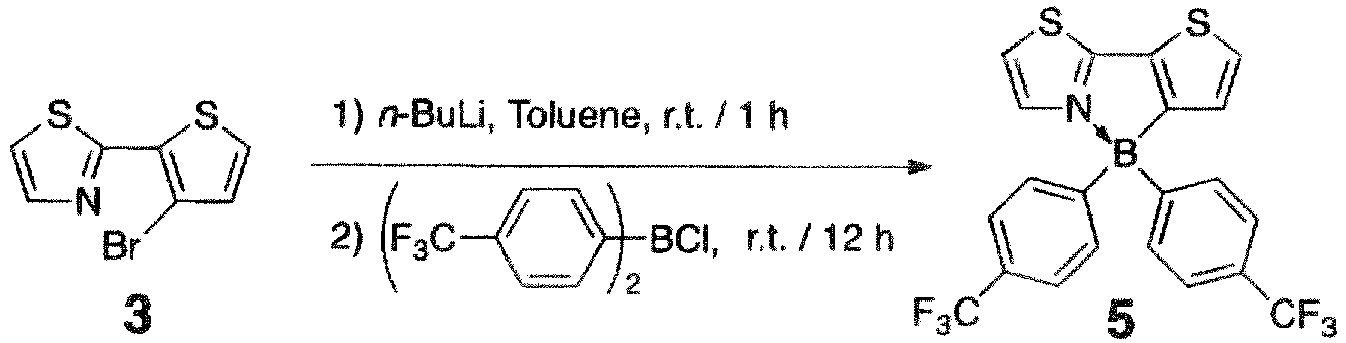
- A hexane solution of n-BuLi (1.60M, 1.3mL, 2.0 mmol) was dropped into a toluene (4 mL) solution of Compound 3 (887 mg, 2.0 mmol) at room temperature. After stirring for 1 hour, the reaction mixture was dropped into a toluene (4 mL) solution of chlorobis(4-(trifluoromethyl)phenyl)borane at room temperature followed by stirring for 12 hours. The reaction mixture was passed through Celite and the solvent was distilled off under reduced pressure. The solvent was distilled off by passing through a silica gel short column (developing solvent: toluene). The mixture was then purified by chloroform GPC to obtain Compound 5 (414 mg, 0.89 mmol) in a yield of 44% as a pale yellow solid.
- 1H-NMR (400 MHz, CDCl3) δ7.75 (d, JHH=3.6 Hz, 1H), 7.69 (d, JHH=4.4 Hz, 1H), 7.44 (d, JHH=7.6 Hz, 4H), 7.32 (d, JHH=4.4 Hz, 1H), 7.31 (d, JHH=3.6 Hz, 1H), 7.30 (d, JHH=7.6 Hz, 4H)
-

- A hexane solution of n-BuLi (1. 60 M, 2.5 ml, 4.0 mmol) was dropped into a toluene (4 mL) solution of Compound 3 (989 mg, 4.0 mmol) at room temperature. After stirring for 1 hour, the reaction mixture was dropped into a toluene (2 mL) solution of chlorobis(pentafluorophenyl)borane at room temperature followed by stirring for 12 hours. After adding a saturated aqueous NHCl4 solution, the organic layer was separated and the aqueous layer was extracted with toluene. The organic layer was dried over anhydrous Na2SO4 and filtered followed by distilling off the solvent under reduced pressure. The mixture was then purified by silica gel column chromatography (developing solvent: hexane:toluene = 1:1) to obtain Compound 6 (438 mg, 0.86 mmol) in a yield of 21% as a pale yellow solid.
- 1H-NMR (400 MHz, CDCl3) δ7.99 (d, JHH=3.6 Hz, 1H), 7.64 (d, JHH=4.8 Hz, 1H), 7.41 (d, JHH=4.8 Hz, 1H), 7.24 (d, JHH=3.6 Hz, 1H)
-

- A hexane solution of n-BuLi (1.60 M, 0.7 mL, 1.1 mmol) was dropped into a hexane (10 mL) solution of Compound 3 (251 mg, 1.0 mmol) at room temperature. After stirring for 1 hour, the reaction mixture was dropped into a toluene (5 mL) solution of 5-bromo-5H-dibenzo[b,d]borole at room temperature followed by stirring for 12 hours. After distilling off the solvent under reduced pressure, dichloromethane was added followed by passing through Celite. After distilling off the solvent under reduced pressure and passing through a silica gel short column (developing solvent: toluene), the mixture was purified by chloroform GPC to obtain Compound 7 (152 mg, 0.46 mmol) in a yield of 45% as a pale yellow solid.
- 1H-NMR (270 MHz, CDCl3) δ7.73 (d, JHH=5.6 Hz, 2H), 7.58 (d, JHH=3.3 Hz, 1H), 7.27 (t, JHH=5.6 Hz, 2H), 7.14 (d, JHH=2.7 7 Hz, 1H), 7.07 (d, JHH=2.7 Hz, 1H), 7.02 (d, JHH=5.6 Hz, 2H), 6.98 (d, JHH=3.3 Hz, 1H), 6.90 (d, JHH=5.6 Hz, 2H)
-

- A hexane solution of n-BuLi (1.60 M, 625 µL, 1.0 mmol) was dropped into an Et2O (10 mL) solution of Compound 3 (247 mg, 1.0 mmol) after having cooled to -78°C. After stirring for 1 hour at -78°C, i-PrOBpin (224 µL, 1.1 mmol) was added followed by slowly raising the temperature to room temperature. After adding a saturated aqueous NH4Cl solution, the organic layer was separated and the aqueous layer was extracted with Et2O. The organic layer was dried over anhydrous Na2SO4 and filtered followed by distilling off the solvent under reduced pressure. The precipitated pale yellow solid was washed with a small amount of hexane to obtain Compound 8 (250 mg, 0.85 mmol) in a yield of 78%.
- 1H-NMR (300 MHz, CDCl3) δ7.78 (d, JHH=3.3 Hz, 1H), 7.35 (s, 2H), 7.34 (d, JHH=3.3 Hz, 1H), 1.38 (s, 12H)
-

- A hexane solution of n-BuLi (1.60 M, 500 µL, 0.80 mmol) was dropped into an Et2O (5 mL) solution of Compound 3 (197 mg, 0.80 mmol) after having cooled to -78°C. After stirring for 1 hour at -78°C, trimethyl borate (89 µL, 0.80 mmol) was added followed by slowly raising the temperature of the reaction mixture to room temperature. After distilling off the solvent, 5 mL of a THF solution of triisopropylsilylethynyl magnesium bromide (obtained by adding 2-bromoethynyl-triisopropylsilane (1.25 g, 4.8 mmol) and THF to magnesium tuning (139 mg, 5. 7 mmol), prepared at the time of use) were added followed by refluxing for 13 hours. After adding water (5 mL), the organic layer was separated and the aqueous layer was extracted three times with dichloromethane. The organic layer was dried over anhydrous Na2SO4 and filtered followed by distilling off the solvent under reduced pressure. The mixture was then purified by toluene GPC to obtain Compound 9 (25.6 mg, 47.4 µmol) in a yield of 6% as a pale yellow solid.
- 1H-NMR (300 MHz, benzene-d6) δ7.45 (d, JHH=3.3 Hz, 1H), 7.30 (d, JHH=4.8 Hz, 1H), 6.89 (d, JHH=4.8 Hz, 1H), 5.66 (d, JHH=3.6 Hz, 1H), 1.23 (d, JHH=6.3 Hz, 36H), 1.16 (d, JHH=6.3 Hz, 6H)
- Synthesis Example 7 (Synthesis of Acceptor Site T)

- A hexane solution of n-BuLi (1.60 M, 507 µL, 0.81 mmol) was dropped into an Et2O (5 mL) solution of Compound 3 (200 mg, 0.81 mmol) after having cooled to -78°C. After stirring for 1 hour at -78°C, trimethyl borate (91 µL, 0.81 mmol) was added followed by slowing raising the temperature of the reaction mixture to room temperature. After distilling off the solvent, 5 mL of a THF solution of phenylethynyl magnesium chloride (obtained by adding a THF solution of t-butyl magnesium chloride (1.7M, 1.19mL, 2.03 mmol) to a THF solution of phenylacetylene (223 µL, 2.03 mmol), prepared at the time of use) were added followed by refluxing for 16 hours. After adding water (5 mL), the organic layer was separated and the aqueous layer was washed three times with dichloromethane. The organic layer was dried over anhydrous Na2SO4 and filtered followed by distilling off the solvent under reduced pressure. The crude product was re-dissolved in dichloromethane and filtered by passing through a silica gel short column. After distilling off the solvent, the solid was washed with hexane to obtain Compound 10 (64.1 mg, 0.169 mmol) in a yield of 21% as a pale yellow solid.
- 1H-NMR (300 MHz, CDCl3) δ8.02 (d, JHH=3.6 Hz, 1H), 7.66 (d, JHH=4.8 Hz, 1H), 7.46 (d, JHH=4.8 Hz, 1H), 7.43-7.40 (m, 4H), 7.28 (d, JHH=3.6 Hz, 1H), 7.22-7.20 (m, overlapped, 6H)
-

- A hexane solution of n-BuLi (1.60 M, 1.25 mL, 2.00 mmol) was dropped into an Et2O (10 mL) solution of Compound 3 (493 mg, 2.00 mmol) after having cooled to -78°C. After stirring for 1 hour at -78°C, trimethyl borate (223 µL, 2.00 mmol) was added followed by slowly raising the temperature of the reaction mixture to room temperature. 10 mL of an Et2O solution of 3,5-bis(trifluoromethyl)phenyl magnesium bromide (obtained by adding 3,5-bis(trifluoromethyl)bromobenzene (1.72 mL, 10.0 mmol) and Et2O to magnesium tuning (245 mg, 10.1 mmol), prepared at the time of use) were added to this solution followed by refluxing the mixture for 90 hours. After adding saturated aqueous ammonium chloride solution, the organic layer was separated and the aqueous layer was extracted three times with dichloromethane. The organic layer was dried over anhydrous Mg2SO4 and filtered followed by distilling off the solvent under reduced pressure. The mixture was then purified by silica gel column chromatography (developing solvent: hexane:dichloromethane = 2:1) to obtain Compound 11 (944 mg, 1.57 mmol) in a yield of 78% as a pale yellow solid (melting point: 170-171°C).
- 1H-NMR (600 MHz, CDCl3) δ7.77 (d, JHH=4.6 Hz, 1H), 7.72 (d, JHH=3.7 Hz, 1H), 7.71 (s, 2H), 7.57 (s, 4H), 7.41 (d, JHH=3.7 Hz, 1H), 7.31 (d, JHH=4.6 Hz, 1H)
- 13C-NMR (150 MHz, CDCl3) δ176.58, 168.48, 149.57, 135.87, 134.01, 132.26, 132.23 (q, JCF=3.9 Hz), 130.57 (q, JCF=32.3 Hz), 128.84, 123.80 (q, JCF=272.7 Hz), 120.54 (sept, JCF=3.9 Hz) 119.02
- 11B-NMR (192 MHz, CDCl3) δ0.30
- 19F-NMR (565 MHz, CDCl3) δ-63.17
- Anal. Calcd. for C23H10BF12NS2: C: 45.79, H: 1.67, N: 2.32, Found: C: 46.09, H: 1.62, N: 2.47
-

- A hexane solution of n-BuLi (1.60 M, 1.91 mL, 3.05 mmol) was dropped into an Et2O (31 mL) solution of Compound 3 (750 mg, 3.05 mmol) after having cooled to -78°C. After stirring for 1 hour at -78°C, trimethyl borate (340 µL, 3.05 mmol) was added followed by slowly raising the temperature of the reaction mixture to room temperature. 30 mL of an Et2O solution of p-trifluoromethylphenyl magnesium bromide (obtained by adding p-trifluoromethylbromobenzene (2.14 mL, 15.3 mmol) and Et2O to magnesium tuning (233 mg, 15.3 mmol), prepared at the time of use) were added to this solution followed by refluxing the mixture for 90 hours. After adding saturated aqueous ammonium chloride solution, the organic layer was separated and the aqueous layer was extracted three times with dichloromethane. The organic layer was dried over anhydrous Mg2SO4 and filtered followed by distilling off the solvent under reduced pressure. The mixture was then purified by silica gel column chromatography (developing solvent: hexane:dichloromethane = 3:1) to obtain Compound 12 (982 mg, 2.10 mmol) in a yield of 69% as a pale yellow solid (melting point: 174-175°C).
- 1H-NMR (600 MHz, CDCl3) δ7.76 (d, JHH=3.6 Hz, 1H), 7.69 (d, JHH=4.6 Hz, 1H), 7.46 (d, JHH=7.7 Hz. 4H), 7.33 (d, JHH=4.6 Hz, 1H), 7.32 (d, JHH=7.7 Hz, 4H), 7.30 (d, JHH=3.6 Hz, 1H)
- 13C-NMR (150 MHz, CDCl3) δ178.56, 167.73, 152.33, 134.73, 134.62, 132.79, 131.69, 129.18, 128.19 (q, JCF=32.1 Hz), 124.64 (q, JCF=271.8 Hz), 124.18 (q, JCF=3.8 Hz), 117.96
- 11B-NMR (192 MHz, CDCl3) δ0-99
- 19F-NMR (565 MHz, CDCl3) δ-62.83
- Anal. Calcd. for C23H10BF12NS2: C: 53.98, H: 2.59, N: 3.00, Found: C: 54.18, H: 2.53, N: 3.13
-

- Compound 13 (2.68 g, 5.12 mmol) and Compound 14 (2.36 g, 5.13 mmol) shown in the reaction formula above, Pd2(dba)3·CHCl3 (53.5 mg, 0.052 mmol), 2-dicyclohexylphosphino-2',6'-dimethoxybiphenyl (S-Phos) (42.7 mg, 0.104 mmol) and K3PO4 (3.19 g, 15.0 mmol) were dissolved in degassed toluene (50 mL) and water (5 mL) in an argon gas atmosphere followed by refluxing while heating for 80 hours. After allowing to cool on standing to room temperature, the reaction mixture was extracted with toluene. The organic layer was dried over anhydrous Na2SO4 and filtered followed by distilling off the solvent under reduced pressure. The mixture was purified by silica gel column chromatography (developing solvent: hexane:toluene = 3:1) to obtain Compound 15 (3.15 g, 4.03 mmol) in a yield of 79% as a viscous yellow liquid.
- 1H-NMR (300 MHz , CDCl3) δ7.23 (d, JHH=8.7 Hz, 2H), 7.13 (d, JHH=5.4 Hz), 7.08 (d, JHH=9.0 Hz, 4H), 6.95 (s, 1H), 6.93 (d, JHH=8.7 Hz, 2H), 6.92 (d, JHH=5.4 Hz, 1H), 6.83 (d, JHH=9.0 Hz, 4H), 3.93 (t, JHH=6.6 Hz, 4H), 2.77 (t, JHH=7.8 Hz, 2H) 2.63 (t, JHH=7.8 Hz, 2H), 1.78 (m, 4H), 1.62 (m, 4H), 1.46 (m, 4H), 1.33 (m, 20H), 0.88 (m, 12H)
- 13C-NMR (75 MHz, CDCl3) δ155.57, 148.02, 140.42, 139.07, 138.05, 138.01, 133.20, 131.05, 129.98, 129.58, 128.27, 126.81, 125.85, 123.10, 119.68, 115.23, 68.21, 31.66, 31.59, 30.95, 30.70, 29.30, 29.24, 29.21, 28.78, 25.74, 22.60, 14.10, 14.04 (five peaks for the carbon atoms of hexyl groups are not observed due to overlapping)
- Anal. Calcd. for C50H67NO2S2: C: 77.17, H: 8.68, N: 1.80,
Found: C: 77.03, H: 8.73, N: 1.95 -

- A hexane solution of n-BuLi (1.60 M, 784 µL, 1.25 mmol) was dropped into a THF (5 mL) solution of Compound 15 (976 mg, 1.25 mmol) after having cooled to -78°C. After stirring for 1 hour at -78°C, i-PrOBpin (282 µL, 1.38 mmol) was added followed by slowly raising the temperature to room temperature. After distilling off the solvent under reduced pressure, hexane was added followed by filtering by passing through Celite. The solvent was distilled off under reduced pressure, and the resulting Compound 16 was used as is in the next reaction.

- Compound 16 obtained in the above-mentioned reaction, Compound 17 (677 mg, 1.25 mmol) obtained according to the method described in
WO 2006/070817 , Pd2(dba)3·CHCl3(13.0 mg, 12.6 µmol), S-Phos (10.4 mg, 25.3 µmol) and K3PO4 (799 mg, 3.76 mmol) were dissolved in degassed toluene (5 mL) and water (1.25 mL) in an argon gas atmosphere, and heated under reflux for 22 hours. After allowing to cool on standing to room temperature, the organic layer was separated and the aqueous layer was extracted with toluene. The organic layer was dried over anhydrous Na2SO4 and filtered followed by distilling off the solvent under reduced pressure. The mixture was purified by silica gel column chromatography (developing solvent: hexane:dichloromethane = 2:1) to obtain Compound 18 (1.15 g, 0.96 mmol) in a yield of 77% as a red solid. - 1H-NMR (300 MHz, CDCl3) δ7.66 (d, JHH=3.9 Hz, 1H), 7.25 (s, 1H), 7.22 (d, JHH=8.7 Hz, 2H), 7.09 (d, JHH=8.7 Hz, 4H), 7.04 (s, 1H), 7.10 (d, JHH=3.9 Hz, 1H), 6.98 (s, 1H), 6.93 (d, JHH=8.7 Hz, 2H), 6.84 (d, JHH=8.7 Hz, 4H), 6.66 (s, 4H), 3.94 (t, JHH=6.6 Hz, 4H), 2.74 (t, JHH=7.8 Hz, 2H), 2.63 (t, JHH=7.8 Hz, 2H), 2.19 (s, 6H), 1.88 (s, 12H), 1.82-1.75 (m, 4H), 1.67-1.56 (m, 4H), 1.51-1.41 (m, 4H), 1.36-1.28 (m, 20H), 0.93-0.86 (m, 12H)
- 13C-NMR (75 MHz, CDCl3) δ184.31, 166.15, 155.60, 148.12, 145.94, 142.98, 140.34,140.10, 139.74, 138.48, 138.23, 137.20, 134.09, 133.88, 132.63, 131.79, 129.54, 129.50, 128.36, 127.92, 127.49, 126.84, 126.61, 125.60, 119.59, 116.07, 115.23, 68.19, 31.63, 31.58, 30.93, 30.45, 29.42, 29.28, 29.20, 28.76, 25.73, 24.31, 22.60, 20.73, 14.10, 14.04 (five peaks for the carbon atoms of hexyl groups are not observed due to overlapping)
- Anal. Calcd. for C75H91BN2S2O4 : C: 75.60, H: 7.70, N: 2.35, Found: C: 75.47, H: 7.76, N: 2.42
-

- A pentane solution of t-BuLi (1.55 M, 65 µL, 0.1 mmol) was dropped into a THF (4 mL) solution of Compound 18 (119 mg, 0.10 mmol) after having cooled to -78°C. After stirring for 1 hour at -78°C, an excess of dry ice was added followed by slowly raising the temperature to room temperature. After adding saturated aqueous NH4Cl solution, the organic layer was separated and the aqueous layer was extracted three times with diethyl ether. The organic layer was dried over anhydrous Na2SO4 and filtered followed by distilling off the solvent under reduced pressure. The mixture was purified by silica gel column chromatography (developing solvent: toluene:methanol = 10:1) and PTLC (developing solvent: dichloromethane:methanol = 50:11) to obtain Compound 19 (93.0 mg, 0.075 mmol) in a yield of 75% as a dark red solid.
- 1H-NMR (300 MHz, DMSO-d6) δ7.47 (s, 1H), 7.35 (s, 1H), 7.24 (d, JHH=8.4 Hz, 2H), 7.20 (s, 1H), 7.12 (s, 1H), 7.06 (d, JHH=9.0 Hz, 4H), 6.92 (d, JHH=9.0 Hz, 4H), 6.77 (d, JHH=8.4 Hz, 2H), 6.57 (s, 4H), 3.93 (t, JHH=6.3 Hz, 4H), 2.72 (m, 2H), 2.57 (m, 2H), 2.10 (s, 6H), 1.81 (s, 12H), 1.74-1.65 (m, 4H), 1.61-1.58 (m, 4H), 1.43-1.38 (m, 4H), 1.32-1.22 (m, 20H), 0.90-0.83 (m, 12H)
-

- A hexane solution of n-BuLi (1. 54 M, 316 µL , 0.49 mmol) was dropped into a THF (5 mL) solution of Compound 18 (527 mg, 0.44 mmol) after having cooled to -78°C. After stirring for 1 hour at -78°C, diethylchlorophosphate (76 µL, 0.53 mmol) was added followed by slowly raising the temperature of the reaction mixture to room temperature. After adding water, the organic layer was separated and the aqueous layer was extracted three times with toluene. The organic layer was washed with water, dried over anhydrous Na2SO4 and filtered followed by distilling off the solvent under reduced pressure. The mixture was purified by silica gel column chromatography (developing solvent: toluene:ethyl acetate = 1:10) to obtain Compound 20 (418 mg, 0.31 mmol) in a yield of 72% as a red solid.
- 1H-NMR (300 MHz, benzene-d6) δ8.32 (d, JHH=5.1 Hz, 1H), 7.64 (s, 1H), 7.41 (d, JHH=9.0 Hz, 2H), 7.15-7.09 (overlapped, 7H), 6.97 (s, 1H), 6.80 (d, JHH=9.0 Hz, 4H), 6.76 (s, 4H), 3.72 (m, 4H), 3.63 (t, JHH=6.3 Hz, 4H), 2.70 (m, 4H), 2.19 (s, 12H), 2.15(s, 6H), 1.65-1.52 (m, 8H), 1.38-1.16 (m, overlapped, 24H), 0.90-0.82 (t, overlapped, 18H)
-

- A hexane solution of n-BuLi (1.60 M, 129 µL, 0.21 mmol) was dropped into a THF (3 mL) solution of Compound 18 (204 mg, 0.17 mmol) after having cooled to -78°C. After stirring for 1 hour at -78°C, the reaction mixture was dropped into a THF (2 mL) solution of triethoxychlorosilane (134 µL, 0.68 mmol) followed by slowly raising the temperature to room temperature. After distilling off the solvent under reduced pressure, dry hexane was added followed by filtering by passing through Celite. After distilling off the solvent, the mixture was purified by toluene GPC to obtain Compound 21 (61.2 mg, 45 µmol) in a yield of 26% as a red solid.
- 1H-NMR (300 MHz, benzene-d6) δ8.13 (s, 1H), 7.71 (s, 1H), 7.43 (d, JHH=8.7 Hz, 2H), 7.18-7.10 (overlapped, 7H), 7.00 (s, 1H), 6.817 (d, JHH=8.7 Hz, 4H), 6.816 (s, 4H), 3.68-3.61 (m, overlapped, 10H), 2.72 (m, 4H), 2.26 (s, 12H), 2.19 (s, 6H), 1.67-1.52 (m, 8H), 1.38-1.16 (m, overlapped, 24H), 1.03 (t, JHH=6.9 Hz, 9H), 0.90-0.85 (t, overlapped, 12H)
-

- After dissolving Compound 18 obtained in (2) of Example 1 (238 mg, 0.20 mmol) in THF (4 mL) and cooling to -78°C, a pentane solution of t-BuLi (1.55 M, 129 µL, 0.2 mmol) was dropped in. After stirring for 1 hour at -78°C, DMF (15 µL, 0.20 mmol) was added followed by slowly raising the temperature to room temperature. After adding a saturated aqueous NH4Cl solution, the organic layer was separated and the aqueous layer was extracted three times with diethyl ether. The organic layer was dried over anhydrous Na2SO4 and filtered followed by distilling off the solvent under reduced pressure. The mixture was purified by silica gel column chromatography (developing solvent: hexane:toluene = 1:3) to obtain Compound 22 (158 mg, 0.13 mmol) in a yield of 65% as a dark red solid.
- 1H-NMR (300 MHz, CDCl3) δ9.81 (s, 1H), 8.15 (s, 1H), 7.29 (s, 1H), 7.22 (d, JHH=8.7 Hz, 2H), 7.12 (s, 1H), 7.09 (d, JHH=9.0 Hz, 4H), 7.00 (s, 1H), 6.92 (d, JHH=8.7 Hz, 2H), 6.84 (d, JHH=9.0 Hz, 4H), 6.69 (s, 4H), 3.93 (t, JHH=6.6 Hz, 4H), 2.75 (t, JHH=7.8 Hz, 2H), 2.63 (t, JHH=7.8 Hz, 2H), 2.20 (s, 6H), 1.90 (s, 12H), 1.82-1.73 (m, 4H), 1.64-1.60 (m, 4H), 1.48-1.44 (m, 4H), 1.33-1.22 (m, 20H), 0.93-0.86 (m, 12H)

- Compound 22 (58.4 mg, 0.048 mmol) was dissolved in chloroform (2 mL) followed by dropping in cyanoacetic acid (8.1 mg, 0.096 mmol) and piperidine (9.5 µL, 0.096 mmol) and refluxing while heating for 60 hours. After adding saturated aqueous NH4Cl solution, the organic layer was separated and the aqueous layer was extracted three times with diethyl ether. The organic layer was dried over anhydrous Na2SO4 and filtered followed by distilling off the solvent under reduced pressure. The mixture was purified by PTLC (developing solvent: dichloromethane: methanol = 6:1) to obtain Compound 23 (42.5 mg, 0.033 mmol) in a yield of 69% as a black solid.
- 1H-NMR (300 MHz, DMSO-d6) δ8.48 (s, 1H), 8.30 (s, 1H), 7.43 (s, 1H), 7.26 (s, 1H), 7.23 (d, JHH=9.0 Hz, 2H), 7.14 (s, 1H), 7.06 (d, JHH=9.0 Hz, 4H), 6.91 (d, JHH=9.0 Hz, 4H), 6.76 (d, JHH=9.0 Hz, 2H), 6.57 (s, 4H), 3.93 (t, JHH=6.3 Hz, 4H), 2.73 (m, 2H), 2.59 (m, 2H), 2.10 (s, 6H), 1.81 (s, 12H), 1.74-1.67 (m, 4H), 1.62-1.53 (m, 4H), 1.43-1.35 (m, 4H), 1.33-1.22 (m, 20H), 0.90-0.82 (m, 12H)
-

- Malonic acid (31.0 mg, 0.30 mmol) and piperidine (48 µL, 0.49 mmol) were added to a chloroform (1 mL) solution of Compound 22 (120 mg, 0.098 mmol) at room temperature followed by refluxing the mixture for 14 hours. After lowering the temperature to room temperature, 2 M aqueous hydrochloric acid solution (3 mL) was added. The organic layer was separated and the aqueous layer was extracted three times with diethyl ether. The organic layer was washed with water, dried over anhydrous Na2SO4 and filtered followed by distilling off the solvent under reduced pressure. The mixture was purified by PTLC (developing solvent: dichloromethane :methanol = 8:1) to obtain Compound 24 (102 mg, 0.078 mmol) in a yield of 80% as a deep red solid.
- 1H-NMR (300 MHz, DMSO-d6) δ8.42 (s, 1H), 8.30 (s, 1H),7.40 (s, 1H), 7.24 (d, JHH=9.0 Hz, 2H), 7.22 (s, 1H), 7.13 (s, 1H), 7.06 (d, JHH=9.0 Hz, 4H), 6.92 (d, JHH=9.0 Hz, 4H), 6.76 (d, JHH=9.0 Hz, 2H), 6. 55 (s, 4H), 3.93 (t, JHH=6.3 Hz, 4H), 2. 73 (m, 2H), 2.59 (m, 2H), 2.10 (s, 6H), 1.81 (s, 12H), 1.74-1.65 (m, 4H), 1.62-1.52 (m, 4H), 1.45-1.35 (m, 4H), 1.33-1.18 (m, overlapped, 20H), 0.90-0.82 (t, overlapped, 12H)
-

- Compound 13 (2.89 g, 5.5 mol), trimethylsilylacetylene (3.8 mL, 27 mmol), Pd2(dba)3·CHCl3 (93 mg, 0.09 mmol), S-Phos (148 mg, 0.36 mmol) and CuI (68.6 mg, 0.36 mmol) were dissolved in degassed toluene (36 mL) and triethylamine (4 mL) in an argon gas atmosphere followed by refluxing while heating for 20 hours. After allowing to cool on standing to room temperature, saturated aqueous NH4Cl solution was added. The organic layer was separated and the aqueous layer was extracted three times with diethyl ether. The organic layer was dried over anhydrous Na2SO4 and filtered followed by distilling off the solvent under reduced pressure. After dispersing in a solvent (hexane: toluene = 5:1) and passing through a silica gel pad, the solvent was distilled off and the resulting viscous yellow liquid containing Compound 25 was used as is in the next reaction.

- A THF solution (1.0 M, 10 mL, 10 mmol) of tetrabutylammonium fluoride was added to Compound 25 (2.78 g, 5.1 mmol) followed by stirring for 4 hours at room temperature. The solvent was distilled off under reduced pressure and the mixture was purified by silica gel column chromatography (developing solvent: hexane:dichloromethane = 3:1) to obtain Compound 26 (1.21 g, 2.6 mmol) in a yield of 50% as a viscous yellow liquid.
- 1H-NMR (300 MHz, C6D6) δ7.38 (d, JHH=7.2 Hz, 2H), 7.01 (d, JHH=7.2 Hz, 4H), 6.89 (d, JHH=7.2 Hz, 2H), 6.75 (d, JHH=7.2 Hz, 4H), 3.61 (t, JHH=6.3 Hz, 4H), 2.77 (s, 1H), 1.62-1.57 (m, 4H), 1.35-1.30 (m, 4H), 1.24-1.17 (m, 8H), 0.86 (t, JHH=6.6 Hz, 6H)
-

- Compound 26 (649 mg, 1.38 mmol), Compound 27 (591 mg, 1.42 mmol), Pd(PPh)4 (62 mg, 0.054 mmol) and CuI (68.6 mg, 0.36 mmol) were dissolved under argon atmosphere in degassed toluene (9 mL) and triethylamine (3 mL) followed by refluxing while heating for 26 hours. After allowing to cool on standing to room temperature, saturated aqueous NH4Cl solution was added. The organic layer was separated and the aqueous layer was extracted three times with toluene. The organic layer was dried over anhydrous Na2SO4 and filtered followed by distilling off the solvent under reduced pressure. The mixture was purified by silica gel column chromatography (developing solvent: hexane:dichloromethane = 3:1) and toluene GPC to obtain Compound 28 (272 mg, 0.34 mmol) in a yield of 25% as a viscous yellow liquid.
- 1H-NMR (300 MHz, C6D6) δ7.41 (d, JHH=8.7 Hz, 2H), 7.11 (d, JHH=5.1 Hz, 1H), 7.04 (d, JHH=9.0 Hz, 4H) 7.01 (s, 1H), 6.96 (d, JHH=8.7 Hz, 2H), 6.77 (d, JHH=9.0 Hz, 4H), 6.68 (d, JHH=5.1 Hz, 1H), 3.62 (t, JHH=6.3 Hz, 4H), 2.81-2.71 (m, 4H), 1.64-1.55 (m, 8H), 1.38-1.13 (m, 24H), 0.89-0.82 (m, 12H)
-

- A THF (3 mL) solution of Compound 28 (243 mg, 0.30 mmol) was cooled to -78°C followed by dropping in a hexane solution of n-BuLi (1.60 M, 199 µl, 0.32 mmol). After stirring for 1 hour at -78°C, i-PrOBpin (68 µL, 0.33 mmol) was added following slowly raising the temperature to room temperature. The resulting Compound 29 was used as is in the next reaction.

- Compound 17 (163 mg, 0.30 mmol), Pd2(dba)3·CHCl3 (3.2 mg, 3.1 µmol), S-Phos (5.3 mg, 12.9 µmol) and K3PO4 (205 mg, 0.97 mmol) were dissolved in a THF (3 mL) solution of Compound 29 followed by refluxing while heating for 20 hours. After allowing to cool on standing to room temperature, saturated aqueous NH4Cl solution (3 mL) was added. The organic layer was separated and the aqueous layer was extracted three times with toluene. The organic layer was dried over anhydrous Na2SO4 and filtered followed by distilling off the solvent under reduced pressure. The mixture was purified by silica gel column chromatography (developing solvent: hexane:toluene = 1:1) to obtain Compound 30 (286 mg, 0.24 mmol) in a yield of 78% as a red solid.
- 1H-NMR (300 MHz, C6D6 δ7.64 (s, 1H). 7.42 (d, JHH=8.7 Hz, 2H), 7.22 (d, JHH=3.6 Hz, 1H), 7.04 (d, JHH=8.17 Hz, 4H), 6.97 (d, JHH=8.7 Hz, 2H). 6.94 (s, 1H), 6.90 (s, 1H), 6.82 (s, 4H), 6.77 (d, JHH=8.7 Hz, 4H), 5.64 (d, JHH=3.6 Hz, 1H), 3.61 (t, JHH=6.3 Hz, 4H), 2.76 (m, 2H), 2.62 (m, 2H), 2.20 (s, 6H), 2.17 (s, 12H), 1.65-1.42 (m, 8H), 1.35-1.17 (m, 24H), 0.89-0.84 (m, 12H)
-

- A THF (2.4 mL) solution of Compound 30 (71.2 mg, 58.6 µmol) was cooled to -78°C followed by dropping in a pentane solution of t-BuLi (1.55 M, 38 µl, 59 µmol). After stirring for 1 hour at -78°C, an excess amount of dry ice was added followed by slowly raising the temperature to room temperature. After adding a saturated aqueous NH4Cl solution, the organic layer was separated and the aqueous layer was extracted three times with diethyl ether. The organic layer was dried over anhydrous Na2SO4 and filtered followed by distilling off the solvent under reduced pressure. The mixture was purified by silica gel column chromatography (developing solvent: dichloromethane:methanol = 10:1) and PTLC (developing solvent: dichloromethane:methanol = 20:3) to obtain Compound 31 (46.6 mg, 37 µmol) in a yield of 63% as a dark red solid.
- 1H-NMR (300 MHz, DMSO-d6) δ7.51 (s, 1H), 7.31 (s, 1H), 7.25 (d, JHH=8.1 Hz, 2H), 7.21 (s, 1H), 7.09 (s, 1H), 7.04 (d, JHH=8.4 Hz, 4H), 6.90 (d, JHH=8.4 Hz, 4H), 6.65 (d, JHH=8.1 Hz, 2H), 6.56 (s, 4H), 3.91 (t, JHH=6.3 Hz, 4H), 2.75-2.61 (m, 4H), 2.09 (s, 6H), 1.80 (s, 12H), 1.70-1.63 (m, 4H), 1.62-1.55 (m, 4H), 1.43-1.20 (m, 24H), 0.90-0.80 (m, 12H)
-

- A THF (1 mL) solution of Compound 12 (91.0 mg, 0.195 mmol) was cooled to -78°C followed by dropping in a hexane solution of n-BuLi (1.60 M, 268 µl, 0.428 mmol). After stirring for 1 hour at -78°C, iodine (514 mg, 0.473 mmol) was added followed by slowly raising the temperature of the reaction mixture to room temperature. After adding aqueous Na2SO3 solution, the organic layer was separated and the aqueous layer was extracted three times with dichloromethane. The organic layer was dried over anhydrous Na2SO4 and filtered followed by distilling off the solvent under reduced pressure. The mixture was purified by silica gel column chromatography (developing solvent: hexane:dichloromethane = 2:1) to obtain Compound 32 (138 mg, 0.192 mmol) in a yield of 98% as a pale yellow solid (melting point: 210-212°C).
- 1H-NMR (600 MHz, CDCl3) δ7.74 (s, 1H), 7.49 (s, 1H), 7.48 (d, JHH=7.7 Hz, 4H), 7.27 (s, JHH=7.7 Hz, 4H)
- 13C-NMR (150 MHz, CDCl3) δ179.68, 169.71, 151.04, 140.67, 138.91, 136.62, 132.78, 128.58 (q, JCF=31.8 Hz), 124.52 (q, JCF=271.6 Hz), 124.37 (q, JCF=3.8 Hz), 87.28, 66.22
- 11B-NMR (192 MHz, CDCl3) δ1.28
- 19F-NMR (565 MHz, CDCl3) δ-62.88
- Anal. Calcd. for C21H10BF6NS2: C: 35.08, H: 1.40, N: 1.95, Found: C: 35.24, H: 1.36, N: 2.21

- A THF (13.5 mL) solution of Compound 32 (1.00 g, 1.39 mmol) was cooled to -78°C followed by dropping in a hexane solution of n-BuLi (1.59 M, 875 µl, 1.39 mmol). After stirring for 1 hour at -78°C, an excess amount of dry ice was added followed by slowly raising the temperature to room temperature. After adding 2 M aqueous hydrochloric acid solution (10 mL), the organic layer was separated and the aqueous layer was extracted three times with dichloromethane. The organic layer was washed with water, dried over anhydrous Na2SO4 and filtered followed by distilling off the solvent under reduced pressure. The mixture was purified by silica gel column chromatography (developing solvent:
- dichloromethane→dichloromethane: methanol = 10:1) to obtain Compound 33 (733 mg, 0.081 mmol) in a yield of 83% as a yellow solid (melting point: 235-237°C (decomposed)).
- 1H-NMR (600 MHz, DMSO-d6) δ14.17 (br s, 1H), 8.87 (s, 1H), 7.70 (s, 1H), 7.49 (d, JHH=7.7 Hz, 4H), 7.38 (d, JHH=7.7 Hz, 4H)
- 13C-NMR (150 MHz, DMSO-d6) δ180.37, 168.43, 161.22, 152.50, 139.47, 138.12, 137.10, 132.96, 130.55, 126.59 (q, JCF=31.4Hz), 124.70 (q, JCF=271.5 Hz), 123.88 (q, JCF=3.9 Hz), 93.67
- 11B-NMR (192 MHz, DMSO-d6) δ0.13
- 19F-NMR (565 MHz, DMSO-d6) δ-61.30
- Anal. Calcd. for C22H11BF6INO2S2: C: 41.47, H: 1.74, N: 2.20, Found: C: 41.67, H: 1.73, N: 2.34
-

- A THF (4 mL) solution of Compound 15 (321 mg, 0.412 mmol) was cooled to -78°C followed by dropping in a hexane solution of n-BuLi (1. 60 M, 258 µl, 0.412 mmol). After stirring for 1 hour at -78°C, tributyltin chloride (112 µL, 0.412 mmol) was added followed by slowly raising the temperature of the reaction mixture to room temperature. Compound 33 (265 mg, 0.416 mmol), Pd2(dba)3·CHCl3 (8.42 mg, 8.13 µmol) and trifurylphosphine (7.71 mg, 33.2 µmol) were added to this mixture followed by refluxing while heating for 22 hours. After adding 1 M aqueous hydrochloric acid solution (5 mL), the organic layer was separated and the aqueous layer was extracted three times with diethyl ether. The organic layer was washed with water, dried over anhydrous Na2SO4 and filtered followed by distilling off the solvent under reduced pressure. The mixture was purified by silica gel column chromatography (developing solvent: dichloromethane) and PTLC (developing solvent: dichloromethane:methanol = 10:1) to obtain Compound 34 (114 mg, 0.088 mmol) in a yield of 21% as a deep red solid.
- 1H-NMR (600 MHz , DMSO-d6) δ8.42 (s, 1H), 7.60 (s, 1H), 7.49 (d, JHH=8.0 Hz, 4H), 7.43 (d, JHH=8.0 Hz, 4H), 7.42 (s, 1H), 7.22 (d, JHH=8.7 Hz, 2H), 7.09 (s, 1H), 7.04 (d, JHH=8.9 Hz, 4H), 6.89 (d, JHH=8.9 Hz, 4H), 6.78 (d, JHH=8.7 Hz, 2H), 3.94 (t, JHH=6.5 Hz, 4H), 2.74 (m, 2H), 2.60 (m, 2H), 1.72-1.67 (m, 4H), 1.65-1.60 (m, 2H), 1.59-1.54 (m, 2H), 1.43-1.38 (m, 4H), 1.37-1.20 (m, overlapped, 20H), 0.87 (t, JHH=7.1 Hz, 6H), 0.83 (t, JHH=7.1 Hz, 3H), 0.82 (t, JHH=7.1 Hz, 3H)
- 13C-NMR (150 MHz, DMSO-d6) δ179.09, 167.31, 160.33, 155.38, 152.83, 147.93, 146.72, 139.99, 139.36, 137.99, 137.88, 135.94, 132.74, 132.58, 132.53, 131.32, 131.03, 130.27, 129.08, 128.83, 128.54, 126.78, 126.34 (q, JCF=31.3 Hz), 124.85, 124.45 (q, JCF=271.5 Hz), 124.18, 123.55 (q, JCF=3.8 Hz), 118.34, 115.42, 67.58, 30.65, 30.64, 30.63, 29.70, 29.38, 28.51, 28.43, 28.18, 28.05, 27.81, 24.86, 21.68, 21.64, 21.61, 13.48, 13.47 (one aliphatic signal is not observed due to overlapping)
- 11B-NMR (192 MHz, DMSO-d6) δ-0.18
- 19F-NMR (565 MHz, DMSO-d6) δ-61.37
- HRMS(FAB) : 1286.4758 (M+)
- Calcd. for C72H77BF6N2O4S4: 1286.4763
-

- An Et2O (25 mL) solution of Compound 35 (1.45 g, 2.47 mmol) was cooled to -78°C followed by dropping in a pentane solution of t-BuLi (1.55 M, 1.75 mL, 2.71 mmol). After stirring for 1.5 hours at -78°C, iodine (759 mg, 2.99 mmol) was added followed by slowly raising the temperature of the reaction mixture to room temperature. After adding aqueous Na2SO3 solution, the organic layer was separated and the aqueous layer was extracted three times with diethyl ether. The organic layer was dried over anhydrous Na2SO4 and filtered followed by distilling off the solvent under reduced pressure. The mixture was purified by silica gel column chromatography (developing solvent: hexane:dichloromethane = 1:1) to obtain Compound 36 (1.46 g, 2.052 mmol) in a yield of 83% as a viscous yellow liquid.
- 1H-NMR (300 MHz, benzene-d6) δ7.67 (d, JHH=8.4 Hz, 2H), 7.11 (d, JHH=8.4 Hz, 2H), 7.10 (d, JHH=8.7 Hz, 4H), 6.79 (d, JHH=8.7 Hz, 4H), 3.63 (t, JHH=6.3 Hz, 4H), 3.30-3.21 (m, 4H), 1.63-1.56 (m, 4H), 1.38-1.27 (m, 4H), 1.25-1.16 (m, 8H), 0.87 (t, JHH=6.3 Hz, 6H)

- Compound 36 (533 mg, 0.75 mmol), Compound 14 (417 mg, 0.91 mmol), Pd2(dba)3·CHCl3 (7.8 mg, 7.5 µmol), S-Phos (12.3 mg, 30 µmol) and potassium phosphate (481 mg, 2.27 mmol) were dissolved in degassed toluene (10 mL) and water (2.5 mL) in an argon gas atmosphere followed by refluxing while heating for 66 hours. After cooling to room temperature, water was added to the mixture followed by extracting three times with toluene. The organic layer was dried over anhydrous Na2SO4 and filtered followed by distilling off the solvent under reduced pressure. The mixture was purified by silica gel column chromatography (developing solution: toluene) and toluene GPC to obtain Compound 37 (461 mg, 0.50 mmol) in a yield of 67% as a viscous red liquid.
- 1H-NMR (300 MHz, benzene-d6) δ7.84 (d, JHH=9.0 Hz, 2H), 7.19-7.09 (overlapped, 8H), 6.80 (d, JHH=8.7 Hz, 4H), 6.79 (s, 1H), 6.74 (d, JHH=5.1 Hz, 1H), 3.64 (t, JHH=6.3 Hz, 4H), 3.44-3.37 (m, 4H), 2.90 (t, JHH=7.8 Hz, 2H), 2.83 (t, JHH=7.8 Hz, 2H), 1.70-1.56 (m, 8H), 1.389-1.27 (m, 8H), 1.25-1.16 (m, 16H), 0.89-0.83 (t, overlapped, 12H)
-

- A THF (3 mL) solution of Compound 37 (81.4 mg, 88.6 µmol) was cooled to -78°C followed by dropping in a hexane solution of n-BuLi (1.60 M, 55 µl, 88 µmol). After stirring for 1 hour at -78°C, tributyltin chloride (24 µL, 89 µmol) was added followed by slowly raising the temperature of the reaction mixture to room temperature. Compound 33 (57.4 mg, 90.1 µmol), Pd2(dba)3·CHCl3 (0.95 mg, 0.92 µmol) and trifurylphosphine (0.91 mg, 3.9 µmol) were added followed by refluxing while heating for 18 hours. After adding saturated aqueous ammonium chloride solution (5 mL), the organic layer was separated and the aqueous layer was extracted three times with diethyl ether. The organic layer was washed with water, dried over anhydrous Na2SO4 and filtered followed by distilling off the solvent under reduced pressure. The mixture was purified by silica gel column chromatography (developing solvent: toluene:methanol = 10:1) and PTLC (developing solvent: toluene:methanol = 10:1) to obtain Compound 38 (36.0 mg, 25.2 µmol) in a yield of 28% as a deep red solid.
- 1H-NMR (300 MHz, DMSO-d6) δ8.74 (s, 1H), 7.68 (s, 1H), 7.53-7.43 (overlapped, 11H), 7.11 (s, 1H), 6.99 (d, JHH=8.7 Hz, 4H), 6.89 (d, JHH=8.7 Hz, 4H), 6.78 (d, JHH=8.7 Hz, 2H), 4.34 (br s, 4H), 3.92 (t, JHH=6.3 Hz, 4H), 2.73 (m, 2H), 2.60 (m, 2H), 1.71-1.52 (m, 8H), 1.43-1.10 (m, 24H), 0.95-0.85 (t, overlapped, 12H)
-
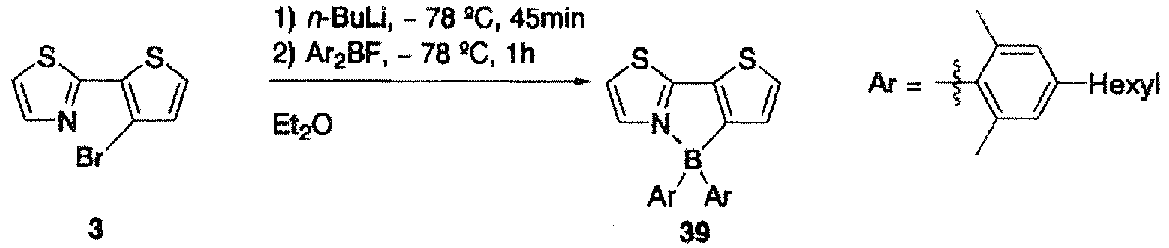
- An Et2O (80 mL) solution of Compound 3 (3.98 g, 16.2 mmol) was cooled to -78°C followed by dropping in a hexane solution of n-BuLi (1.54 M, 10.4 mL, 16.0 mmol). After stirring for 45 minutes at -78°C, an Et2O (20 mL) solution of Ar2BF (6.54 g, 16.0 mmol) (Ar = 2,4-dimethyl-4-hexylfluorenyl synthesized in accordance with a known method (Non-Patent Document: Macromolecules, 2007, 40, 3898)) was dropped in followed by stirring for 1 hour. After adding water, the temperature was slowly raised to room temperature. The organic layer was separated and the aqueous layer was extracted three times with dichloromethane. The organic phase was sequentially washed with water and saturated aqueous sodium chloride solution in that order followed by drying with anhydrous Na2SO4, filtering and distilling off the solvent under reduced pressure. The mixture was purified by silica gel column chromatography (developing solvent: hexane:dichloromethane = 2:1, Rf = 0.48) to obtain Compound 39 (4.37 g. 7.87 mmol) in a yield of 49% as a pale yellow solid.
- 1H-NMR (300 MHz, CDCl3) δ7.78 (d, JHH=3.6 Hz, 1H), 7.70 (d, JHH=3.6 Hz, 1H), 7.46 (d, JHH=4.8 Hz, 1H), 7.24 (d, JHH=4.8 Hz, 1H), 7.04 (d, JHH=3.6 Hz, 1H), 6.62 (s, 4H), 2.42 (t, JHH=8.1 Hz, 4H), 1.84 (s, 12H), 1.47-1.60 (m, 4H), 1.23-1.36 (m, 12H), 0.87 (t, JHH=6.6 Hz, 6H)

- A THF (40 mL) solution of Compound 39 (4.40 g, 7.92 mmol) was cooled to -78°C followed by dropping in a hexane solution of n-BuLi (1.58 M, 10.5 mL, 16.6 mmol). After stirring for 1 hour at -78°C, iodine (5.06 g, 19.9 mmol) was added followed by stirring for 1.5 hours while slowly raising the temperature to room temperature. After adding water and aqueous Na2S2O3 solution, the organic layer was removed and the aqueous layer was extracted with dichloromethane. The organic layer was sequentially washed with water and saturated aqueous sodium chloride solution in that order, dried over anhydrous Na2SO4 and filtered followed by distilling off the solvent under reduced pressure. The mixture was purified by silica gel column chromatography (developing solvent: hexane:dichloromethane = 3:1, Rf = 0.33) to obtain Compound 40 (5.97 g, 7.39 mmol) in a yield of 93% as a pale yellow solid.
- 1H-NMR (300 MHz, CDCl3) δ7.65 (s, 1H), 7.36 (s, 1H), 6.64 (s, 4H), 2.44 (t, JHH=8.0 Hz, 4H), 1.83 (s, 12H), 1.49-1.61 (m, 4H), 1.23-1.35 (m, 12H), 0.88 (t, JHH=6.9 Hz, 6H)

- A THF (90 mL) solution of Compound 40 (5.97 g, 7.39 mmol) was cooled to -78°C followed by dropping in a hexane solution of n-BuLi (1.58 M, 4.70 mL, 7.43 mmol). After stirring for 50 minutes at -78°C, excess water was added followed by stirring for 2 hours while slowly raising the temperature to room temperature. The organic layer was removed and the aqueous layer was extracted with hexane. The organic layer was sequentially washed with water and saturated aqueous sodium chloride solution in that order, dried over anhydrous Na2SO4 and filtered followed by distilling off the solvent under reduced pressure. The mixture was purified by silica gel column chromatography (developing solvent: hexane:dichloromethane = 1:1, Rf = 0.51) to obtain Compound 41 (3.41 g, 7.39 mmol) in a yield of 68% as a pale yellow solid.
- 1H-NMR (300 MHz, CDCl3) δ7.70 (d, JHH=3.6 Hz, 1H), 7.40 (s, 1H), 7.05 (d, JHH=3.6 Hz, 1H), 6.62 (s, 4H), 2.43 (t, JHH=8.1 Hz, 4H), 1.82 (s, 12H), 1.48-1.61 (m, 4H), 1.23-1.37 (m, 12H), 0.87 (t, JHH=6.8 Hz, 6H)
-

- A THF (15 mL) solution of Compound 15 (1.13 g, 1.45 mmol) was cooled to -78°C followed by dropping in a hexane solution of n-BuLi (1.58M, 1.0 mL, 1.58 mmol). After stirring for 1 hour at -78°C, tributyltin chloride (0.45 mL, 1.65 mmol) was added followed by stirring for 45 minutes while slowly raising the temperature to room temperature. After adding water, the organic layer was removed and the aqueous layer was extracted with hexane. The organic layer was sequentially washed with water and saturated aqueous sodium chloride solution in that order, dried over anhydrous Na2SO4 and filtered followed by distilling off the solvent under reduced pressure. The mixture was purified by alumina column chromatography (developing solvent: hexane:ethyl acetate = 40:1, Rf = 0.56) to obtain Compound 42 (1.41 g, 1.32 mmol) in a yield of 91% as a viscous yellow liquid.
- 1H-NMR (300 MHz, CDCl3) δ7.23 (d, JHH=8.4 Hz, 2H), 7.08 (d, JHH=8.9 Hz, 4H), 6.95 (s, 1H), 6.94 (s, 1H), 6.92 (d, JHH=8.4 Hz, 2H), 3.93 (t, JHH=6.6 Hz, 4H), 2.79 (t, JHH=8.1Hz, 2H), 2.63 (t, JHH=8.1 Hz, 2H), 1.78 (quint, JHH=6.6 Hz, 4H), 1.51-1.70 (m, 10H), 1.21-1.50 (m, 30H), 1.10 (t, JHH=7.8 Hz, 6H), 0.82-0.93 (m, 21H)

- Compound 41 (900 mg, 1.32 mmol), Compound 42 (1.41 g, 1.32 mmol), Pd2(dba)3·CHCl3 (34.6 mg, 0.334 mmol) and PPh3 (68.9 mg, 0.262 mmol) were dissolved in degassed anhydrous toluene (8 mL) in an argon atmosphere followed by stirring for 25 hours at 110°C. After cooling to room temperature and distilling off the solvent under reduced pressure, the mixture was purified by silica gel column chromatography (developing solvent: hexane:ethyl acetate = 20:1, Rf = 0.36) to obtain Compound 43 (1.46 g, 1.10 mmol) in a yield of 83% as a viscous red liquid.
- 1H-NMR (300 MHz, CDCl3) δ7.67 (d, JHH=3.7 Hz, 1H), 7.23 (d, JHH=8.6 Hz, 2H), 7.08 (d, JHH=8.9 Hz, 4H), 7.04 (s, 1H), 7.01 (d, JHH=3.7 Hz, 1H), 6.97 (s, 1H), 6.96 (d, JHH=8.6 Hz, 2H), 6.83 (d, JHH=8.9 Hz, 2H), 3.93 (t, JHH=6.6 Hz, 4H), 2.74 (t, JHH=8.1 Hz, 2H), 2.63 (t, JHH=8.1Hz, 2H), 2.43 (t, JHH=8.1 Hz, 2H), 1.87 (s, 12H), 1.78 (quint, JHH=6.6 Hz, 4H), 1.57-1.68 (m, 4H), 1.23-1.53 (m, 40H), 0.83-0.96 (m, 18H)

- A THF (6 mL) solution of Compound 43 (789 mg, 0.592 mmol) was cooled to -78°C followed by dropping in a hexane solution of n-BuLi (1.58 M, 0.40 mL, 0.63 mmol). After stirring for 45 minutes while holding the temperature at -78°C, tributyltin chloride (0.20 mL, 0.74 mmol) was added followed by stirring for 1 hour while slowly raising the temperature to room temperature. After adding water, the organic layer was removed and the aqueous layer was extracted with hexane. The combined organic layer was sequentially washed with water, saturated sodium chloride and aqueous sodium chloride solution in that order, dried over anhydrous Na2SO4 and filtered followed by distilling off the solvent under reduced pressure. The mixture was purified by alumina column chromatography (developing solvent: hexane:dichloromethane = 10:1→5:1, Rf = 0.43 (hexane: dichloromethane =5:1)) to obtain Compound 44 (686 mg, 0.423 mmol) in a yield of 72% as a viscous red liquid.
- 1H-NMR (300 MHz, CDCl3) δ7.52 (s, 1H), 7.23 (d, JHH=8.6 Hz, 2H), 7.08 (d, JHH=8.9 Hz, 4H), 7.02 (s, 1H), 6.97 (s, 1H), 6.92 (d, JHH=8.6 Hz, 2H), 6.83 (d, JHH=8.9 Hz, 2H), 3.93 (t, JHH=6.6 Hz, 4H), 2.74 (t, JHH=8.1 Hz, 2H), 2.63 (t, JHH=8.1 Hz, 2H), 2.43 (t, JHH=8.1 Hz, 2H), 1.87 (s, 12H), 1.78 (quint, JHH=6.6 Hz, 4H), 1.57-1.68 (m, 10H), 1.20-1.53 (m, 46H), 1.12 (t, JHH=7.8 Hz, 6H), 0.81-0.99 (m, 27H)

- Compound 41 (287 mg, 0.421 mmol), Compound 44 (686 mg, 0.423 mmol), Pd2(dba)3·CHCl3 (10.8 mg, 10.4 µmol) and PPh3 (23.2 mg, 88 µmol) were dissolved in degassed anhydrous toluene (4 mL) in an argon atmosphere followed by stirring for 9.5 hours at 110°C. After cooling to room temperature and distilling off the solvent under reduced pressure, the mixture was purified by silica gel column chromatography (developing solvent: hexane: dichloromethane = 2 : 1 , Rf = 0.25) and chloroform GPC to obtain Compound 45 (664 mg, 0.352 mmol) in a yield of 83% as a deep red solid.
- 1H-NMR (300 MHz, CDCl3) δ7.72 (d, JHH=3.7 Hz, 1H), 7.69 (s, 1H), 7.23 (d, JHH=8.6 Hz, 2H), 7.09 (d, JHH=3.7 Hz, 1H), 7.08 (d, JHH=8.9 Hz, 4H), 7.05 (s, 1H), 6.98 (s, 1H), 6.92 (d, JHH=8.6 Hz, 2H), 6.84 (d, JHH=8.9 Hz, 2H), 6.65 (s, 4H), 6.64 (s, 4H), 3.93 (t, JHH=6.6 Hz, 4H), 2.74 (t, JHH=8.1 Hz, 2H), 2.63 (t, JHH=8.1 Hz, 2H), 2.43 (t, JHH=8.1 Hz, 8H), 1.90 (s, 12H), 1.84 (s, 12H), 1.78 (quint, JHH=6.6 Hz, 4H), 1.57-1.68 (m, 4H), 1.23-1.53 (m, 56H), 0.82-0.95 (m, 24H)
-

- A THF (2 mL) solution of Compound 45 (289 mg, 0.153 mmol) was cooled to -78°C followed by dropping in a THF solution of LDA (0.606 M, 0.38 mL, 0.23 mmol). After stirring for 50 minutes at -78°C, dry ice (1.0 g, 23 mmol) was added followed by stirring for 3.5 hours while slowly raising the temperature to room temperature. After adding water, the organic layer was removed and the aqueous layer was extracted with hexane. The organic layer was dried over anhydrous Na2SO4 and filtered followed by distilling off the solvent under reduced pressure. The mixture was purified by silica gel column chromatography (developing solvent: hexane:ethyl acetate:ethanol = 5:1:1, Rf = 0.18) to obtain Compound 46 (176 mg, 91.2 µmol) in a yield of 60% as a deep red solid.
- 1H-NMR (300 MHz, CDCl3/DMSO = 1/1) δ7.85 (brs, 1H), 7.67 (s, 1H), 7.21 (s, 1H), 7.17 (s, 1H), 7.16 (d, JHH=8.6 Hz, 2H), 7.10 (s, 1H), 7.03 (d, JHH=8.9 Hz, 4H), 6.97 (s, 1H), 6.84 (d, JHH=8.6 Hz, 2H), 6.81 (d, JHH=8.9 Hz, 4H), 6.57 (s, 4H), 6.53 (s, 4H), 3.90 (t, JHH=6.6 Hz, 4H), 2.71 (m, 2H), 2.58 (m, 2H), 2.36 (m, 8H), 1.85 (s, 12H), 1.78 (s, 12H), 1.73 (quint, JHH=6.6 Hz, 4H), 1.54-1.65 (m, 4H), 1.17-1.53 (m, 56H), 0.77-0.94 (m, 24H)
-

- Compound 41 (1.36 g, 1.99 mmol), Compound 47 (1.16 g, 2.03 mmol), Pd2(dba)3·CHCl3 (52 mg, 50 µmol), S-Phos (83 mg, 0.20 mmol) and K3PO4 (1.23 g, 5.80 mmol) were dissolved in degassed THF (10 mL) and water (5 mL) in an argon atmosphere followed by stirring for 7.5 hours at 80°C. After cooling to room temperature, the organic layer was removed and the aqueous layer was extracted with hexane. The combined organic layer was sequentially washed with water and saturated aqueous sodium chloride solution in that order, dried over anhydrous Na2SO4 and filtered followed by distilling off the solvent under reduced pressure. The mixture was purified by silica gel column chromatography (developing solvent: hexane:dichloromethane = 3:1→2:1, Rf = 0.23) (hexane:dichloromethane = 3:1) to obtain Compound 48 (1.97 g, 1.93 mmol) in a yield of 97% as a viscous orange liquid.
- 1H-NMR (300 MHz, CDCl3) δ7.65 (d, JHH=3.7 Hz, 1H), 7.38 (d, JHH=8.6 Hz, 2H), 7.31 (s, 1H), 7.04 (d, JHH=8.9 Hz, 4H), 6.97 (d, JHH=3.7 Hz, 1H), 6.86 (d, JHH=8.6 Hz, 2H), 6.82 (d, JHH=8.9 Hz, 4H), 6.62 (s, 4H), 3.93 (t, JHH=6.6 Hz, 4H), 2.42 (t, JHH=8.1 Hz, 2H), 1.87 (s, 12H), 1.77 (quint, JHH=6.6 Hz, 4H), 1.41-1.52 (m, 4H), 1.23-1.39 (m, 24H), 0.91 (t, JHH=6.8 Hz, 6H), 0.87 (t,
- JHH=6.8 Hz, 6H)

- A THF (15 mL) solution of Compound 48 (1.19 g, 1.19 mmol) was cooled to -78°C followed by dropping in a hexane solution of n-BuLi (1.58 M, 1.0 mL, 1.58 mmol). After stirring for 1 hour at -78°C, tributyltin chloride (0.45 mL, 1.65 mmol) was added followed by stirring for 40 minutes while slowly raising the temperature to room temperature. After adding water, the organic layer was removed and the aqueous layer was extracted with hexane. The organic layer was sequentially washed with water and saturated aqueous sodium chloride solution in that order, dried over anhydrous Na2SO4 and filtered followed by distilling off the solvent under reduced pressure. The mixture was purified by alumina column chromatography (developing solvent: hexane:ethyl acetate = 40:1, Rf = 0.46) to obtain Compound 49 (1.32 g, 1.02 mmol) in a yield of 86% as a viscous orange liquid.
- 1H-NMR (300 MHz, CDCl3) δ7.50 (s, 1H), δ7.38 (d, JHH=8.6 Hz, 2H), 7.31 (s, 1H), 7.04 (d, JHH=8.9 Hz, 4H), 6.86 (d, JHH=8.6 Hz, 2H), > 6.82 (d, JHH=8.9 Hz, 4H), 6.62 (s, 4H), 3.93 (t, JHH=6.6 Hz, 4H), 2.42 (t, JHH=8.1 Hz, 2H), 1.87 (s, 12H), 1.77 (quint, JHH=5.6 Hz, 4H), 1.41-1.52 (m, 10H), 1.22-1.39 (m, 30H), 1.11 (t, JHH=7.8 Hz, 6H), 0.83-0.96 (m, 21H)

- Compound 41 (698 mg, 1.02 mmol), Compound 49 (1.32 g, 1.02 mmol), Pd2(dba)3·CHCl3 (27.2 mg, 26.3 µmol) and PPh3 (53.8 mg, 0.205 mmol) were dissolved in degassed anhydrous toluene (6 mL) in an argon atmosphere followed by stirring for 25 hours at 110°C. After cooling to room temperature, the solvent was distilled off under reduced pressure. The mixture was purified by silica gel column chromatography (developing solvent: hexane:ethyl acetate = 20:1, Rf = 0.26) to obtain Compound 50 (1.28 g, 0.825 mmol) in a yield of 81% as a deep red solid.
- 1H-NMR (300 MHz, CDCl3) δ7.71 (d, JHH=3.7 Hz, 1H), 7.67 (s, 1H), 7.38 (d, JHH=8.6 Hz, 2H), 7.30 (s, 1H), 7.20 (s, 1H), 7.08 (d, JHH=3.7 Hz, 1H), 7.04 (d, JHH=8.9 Hz, 4H), 6.85 (d, JHH=8.6 Hz, 2H), 6.82 (d, JHH=8.9 Hz, 4H), 6.64 (s, 8H), 3.93 (t, JHH=6.6 Hz, 4H), 2.43 (t, JHH=8.1 Hz, 8H), 1.90 (s, 12H), 1.84 (s, 12H), 1.77 (quint, JHH=6.6 Hz, 4H), 1.41-1.52 (m, 8H), 1.23-1.39 (m, 36H), 0.83-0.96 (m, 18H)
-

- A THF (2 mL) solution of Compound 50 (369 mg, 0.238 mmol) was cooled to -78°C followed by dropping in a THF solution of LDA (0.606 M, 0.50 mL, 0.30 mmol). After stirring for 40 minutes at -78°C, dry ice (1.14 g, 26 mmol) was added followed by stirring for 1 hour while slowly raising the temperature to room temperature. After adding water, the organic layer was removed and the aqueous layer was extracted with hexane. The organic layer was dried over anhydrous Na2SO4 and filtered followed by distilling off the solvent under reduced pressure. The mixture was purified by PTLC (developing solvent: hexane:ethyl acetate:ethanol = 5:1:1, Rf = 0.20) to obtain Compound 51 (204 mg, 0.128 mmol) in a yield of 54% as a deep red solid.
- 1H-NMR (300 MHz, CDCl3/DMSO = 1/1) δ7.79 (brs, 1H), 7.72 (s, 1H), 7.42 (d, JHH=8.6 Hz, 2H), 7.26 (s, 2H), 7.02 (d, JHH=8.9 Hz, 4H), 6.85 (d, JHH=8.9 Hz, 4H), 6.78 (d, JHH=8.6 Hz, 2H), 6.56 (s, 4H), 6.55 (s, 4H), 3.93 (t, JHH=6.6 Hz, 4H), 2.37 (m, 8H), 1.86 (s, 12H), 1.79 (s, 12H), 1.73 (quint, JHH=6.6 Hz, 4H), 1.41-1.52 (m, 8H), 1.23-1.39 (m, 36H), 0.83-0.96 (m, 18H)
-

- A THF (2.5 mL) solution of Compound 50 (369 mg, 0.238 mmol) was cooled to -78°C followed by dropping in a hexane solution of n-BuLi (1.58 M, 0.20 mL, 0.136 mmol). After stirring for 45 minutes while holding the temperature at -78°C, tributyltin chloride (0.10 mL, 0.368 mmol) was added followed by stirring for 30 minutes while slowly raising the temperature to room temperature. After adding water, the organic layer was removed and the aqueous layer was extracted with hexane. The organic layer was sequentially washed with water and saturated aqueous sodium chloride solution in that order, dried over anhydrous Na2SO4 and filtered followed by distilling off the solvent under reduced pressure. The mixture was purified by alumina column chromatography (developing solvent: hexane:dichloromethane = 10:1→5:1, Rf = 0.38 (hexane: dichloromethane = 5:1)) to obtain Compound 52 (317 mg, 0.172 mmol) in a yield of 72% as a viscous red liquid.
- 1H-NMR (300 MHz, CDCl3) δ7.65 (s, 1H), 7.54 (s, 1H), 7.37 (d, JHH=8.6 Hz, 2H), 7.30 (s, 1H), 7.19 (s, 1H), 7.04 (d, JHH=8.9 Hz, 4H), 6.85 (d, JHH=8.6 Hz, 2H), 6.82 (d, JHH=8.9 Hz, 4H), 6.64 (s, 8H), 3.93 (t, JHH=6.6 Hz, 4H), 2.43 (t, JHH=8.1 Hz, 8H), 1.90 (s, 12H), 1.83 (s, 12H), 1.77 (quint, JHH=6.6 Hz, 4H), 1.41-1.52 (m, 14H), 1.23-1.39 (m, 42H), 1.12 (t, JHH=7.8 Hz, 6H), 0.83-0.96 (m, 27H)

- Compound 41 (117 mg, 0.172 mmol), Compound 52 (317 mg, 0.172 mmol), Pd2(dba)3·CHCl3 (4.8 mg, 4.6 µmol) and PPh3 (9.4 mg, 36 µmol) were dissolved in degassed anhydrous toluene (2 mL) in an argon atmosphere followed by stirring for 9.5 hours at 110°C. After cooling to room temperature, the solvent was distilled off under reduced pressure. The mixture was purified by alumina column chromatography (developing solvent: hexane:dichloromethane = 4:1, Rf = 0.18) and toluene GPC to obtain Compound 53 (216 mg, 0.103 mmol) in a yield of 60% as a deep red solid.
- 1H-NMR (300 MHz, CDCl3) δ7.73 (d, JHH=3.7 Hz, 1H), 7.71 (s, 1H), 7.68 (s, 1H), 7.37 (d, JHH=8.6 Hz, 2H), 7.30 (s, 1H), 7.22 (s, 1H), 7.17 (s, 1H), 7.11 (d, JHH=3.7 Hz, 1H), 7.04 (d, JHH=8.9 Hz, 4H), 6.85 (d, JHH=8.6 Hz, 2H), 6.82 (d, JHH=8.9 Hz, 4H), 6.64 (s, 4H), 6.64 (s, 8H), 3.93 (t, JHH=6.6 Hz, 4H), 2.43 (t, JHH=8.1 Hz, 12H), 1.90 (s, 12H), 1.87 (s, 12H), 1.83 (s, 12H), 1.77 (quint, JHH=6.6 Hz, 4H), 1.41-1.52 (m, 12H), 1.23-1.39 (m, 48H), 0.83-0.96 (m, 24H)
-

- A THF (2 mL) solution of Compound 53 (216 mg, 0.103 mmol) was cooled to -78°C followed by dropping in a THF solution of LDA (0.606 M, 0.25 mL, 0.15 mmol). After stirring for 1 hour at - -78°C, dry ice (1.1 g, 25 mmol) was added followed by stirring for 1.5 hours while slowly raising the temperature to room temperature. After adding water, the organic layer was removed and the aqueous layer was extracted with hexane. The organic layer dried over anhydrous Na2SO4 and filtered followed by distilling off the solvent under reduced pressure. The mixture was purified by silica gel column chromatography (developing solvent: dichloromethane:ethanol = 1:0→10:1→4:1, Rf = 0.10 (dichloromethane:ethanol= 10:1)) to obtain Compound 54 (18 mg, 8.37 µmol) in a yield of 8% as a deep red-violet solid.
- 1H-NMR (300 MHz, CDCl3/DMSO = 1/1) δ7.98 (brs, 1H), 7.72 (s, 1H), 7.66 (s, 1H), 7.35 (d, JHH=8.6 Hz, 2H), 7.23 (s, 1H), 7.23 (s, 1H), 7.18 (s, 1H), 7.00 (d, JHH=8.9 Hz, 4H), 6.80 (d, JHH=8.9 Hz, 4H), 6.78 (d, JHH=8.6 Hz, 2H), 6.56 (s, 4H), 6.55 (s, 8H), 3.90 (t, JHH=6.6 Hz, 4H), 2.36 (t, JHH=6.9 Hz, 12H), 1.84 (s, 12H), 1.82 (s, 12H), 1.78 (s, 12H), 1.72 (quint, JHH=6.6 Hz, 4H), 1.41-1.52 (m, 12H), 1.23-1.39 (m, 48H), 0.78-0.92 (m, 24H)
- Titania paste (Solaronix SA, Ti-NanoxideT/SP Titania Paste) was coated onto an electrically conductive substrate (surface resistance: 10 Ω/, 15 mm x 25 mm, glass substrate with fluorine-doped tin oxide film) using a known screening printing method, and after repeating a procedure consisting of drying for 3 minutes at 120°C ten times, the electrically conductive substrate was baked for 30 minutes at 500°C to form a porous titanium oxide film having a thickness of 18 µm to 20 µm.
- Next, after immersing the above-mentioned electrically conductive substrate having the porous titanium oxide film formed thereon in a solution obtained by respectively dissolving Compound 19 obtained in Example 1 in THF, 1/4 THF-ethanol mixture or acetone solvent to a concentration of 100 µM for 10 hours at 30°C, the substrate was washed with the solvent respectively used for each solution at room temperature to obtain an electrically conductive substrate having a light-absorbing layer.
- A counter electrode was fabricated by depositing platinum at a film thickness of about 1 nm on an ITO glass substrate having two electrolyte injection holes having a diameter of about 0.7 mm.
- A frame-type ionomer resin having a thickness of about 30 µm was adhered as a spacer on the electrically conductive substrate having a light-absorbing layer obtained in (1) above, and the counter electrode was adhered thereon. Next, an electrolyte solution obtained by dissolving 0.1 M lithium iodide, 0.025 M iodine, 0.6 M DMPII (dimethylpropylimidazolium iodide) and 0.5 M TBP (4-tert-butylpyridine) in acetonitrile was prepared, and this electrolyte solution was injected inside through the above-mentioned electrolyte injection holes to fabricate a dye-sensitized solar cell.
- Compounds 19, 23 and 31 obtained in the above-mentioned Examples 1, 4 and 6 were respectively dissolved in THF to obtain 5 x 10⁻⁵ M solutions, followed by measurement of their UV-visible absorption spectra using the UV-Vis Shimadzu UV-3150 PC. The results are shown in
Figs. 1 to 3 . - In addition, the UV-visible absorption spectrum was similarly measured for the above-mentioned electrically conductive substrate having a light-absorbing layer obtained in (1) of Experiment Example 1. For comparison, the UV-visible absorption spectrum was similarly measured for the above-mentioned porous titanium oxide film adhered with dye obtained in (1) of Experiment Example 1. The results are shown in
Fig. 4 . - Photoelectric conversion efficiency was measured according to the method indicated below using the CEP25TF Spectrometer for the above-mentioned dye-sensitized solar cell obtained in Experiment Example 1.
- For comparison, after immersing the above-mentioned electrically conductive substrate having the porous titanium oxide film formed thereon in a saturated 1:1 tert-butyl alcohol and acetonitrile mixed solution of a known dye in the form of bis-tetrabutylammonium cis-bis(isothiocyanato)bis(2,2'-bipyridyl-4,4'-dicarboxylat o) ruthenium(II) (to be referred to as N719) for 20 hours at 30°C, the substrate was washed with the mixed solvent used at room temperature, and the resulting light-absorbing layer was also measured in the same manner.
- The dye-sensitized solar cells were measured using a method in compliance with the measuring method of output power for silicon crystalline solar cells described in JIS C8913:1998. An Air Mass Filter equivalent to AM 1.5 G was combined with a 300 W Solar Simulator (Yamashita Denso Corp. , Model YSS-80) for use as a measurement light source by adjusting to an intensity of 100 mW/cm2 with a secondary reference Si solar cell, and I-V curve characteristics were measured using a potentiostat (Hokuto Denko Corp., Model HSV-100) while radiating light onto a test sample of the dye-sensitized solar cell followed by calculating open voltage (Voc), short-circuit current (Isc) and fill factor (FF) obtained from measurement of I-V curve characteristics. Short-circuit current density (Jsc) and photoelectric conversion efficiency (η) were then calculated using the following
Equations 

[Table 1] Solvent Voc/V Jsc/mA cm-2 FF η/% THF 0.712 11.1 0.720 5.68 Ethanol/THF (4/1) 0.736 12.2 0.667 5.99 Acetone 0.724 5.73 0.618 2.57 N719 (comparison) 0.736 18.2 0.606 8.11 Voc: open voltage, Jsc: short-circuit current, FF: fill factor (curve factor), η: photoelectric conversion efficiency - The incident photon-to-current conversion efficiency (IPCE) spectrum of the dye-sensitized solar cell obtained in Experiment Example 1 above was measured over a range from 300 nm to 900 nm using the CEP25TF Spectrometer.
- In addition, IPCE spectrum was also measured for a light-absorbing layer using N719 in the same manner as the above-mentioned Test Example 2 for comparison.
- As shown in
Fig. 5 , a trough was observed in the vicinity of 480 nm in the case of the dye-sensitized solar cell fabricated from an acetone solution. In addition, the dye-sensitized solar cells fabricated from THF solution and a mixed solution of THF and ethanol demonstrated high incident photon-to-current conversion efficiency (IPCE) corresponding to the absorption wavelength of Compound 19, and IPCE spectra greater than 90% were obtained in the region from 410 nm to 550 nm. - Dye-sensitized solar cells were fabricated that were obtained by not adding TBP (4-tert-butylpyridine), or by adding TBP at concentrations of 0.1 M, 0.3 M and 0.5 M, to a dye-sensitized solar cell having a light-absorbing layer adsorbed thereon by immersing a thin film of titanium dioxide into the THF solution of Compound 19 obtained in Example 1 in the same manner as described in Test Example 1. Measurements were carried out in the same manner as Test Example 2 using these dye-sensitized solar cells, and a study was made of the effects of the addition of TBP on open voltage (Voc) and short-circuit current (Isc).
- As shown in
Fig. 6 , as the added amount of TBP increased from 0.1 M to 0.3 M to 0.5 M, open voltage and short-circuit current were determined to increase. -
-
Fig. 1 indicates the ultraviolet-visible absorption spectrum of a compound obtained in Example 1 of the present application in THF solution; -
Fig. 2 indicates the ultraviolet-visible absorption spectrum of a compound obtained in Example 4 of the present application in THF solution; -
Fig. 3 indicates the ultraviolet-visible absorption spectrum of a compound obtained in Example 6 of the present application in THF solution; -
Fig. 4 indicates the ultraviolet-visible absorption spectrum of a compound obtained in Example 1 of the present application while adhered to titanium oxide, and the type of solvent described in the drawing indicates the solvent used when adsorbing on the titanium oxide; -
Fig. 5 indicates the IPCE spectrum of a dye-sensitized solar cell that uses a compound obtained in Example 1 of the present application for the dye; and -
Fig. 6 indicates the effect of adding TBP on I-V characteristics of a dye-sensitized solar cell that uses a compound obtained in Example 1 of the present application for the dye.


Claims (14)
- A dye for a dye-sensitized solar cell, comprising:a compound having an anchor site A capable of bonding to a semiconductor electrode of an organic solar cell, and an acceptor site T bonding to the anchor site and having aπ-conjugated backbone that has a boron-containing substituent represented by the formula: -B(X1)(-X2) (wherein X1 and X2 independently represent substituents), the π-conjugated backbone having as a constituent atom thereof a heteroatom that forms a double bond with carbon in the end region on the side of the anchor backbone and is coordinate-bonded to the boron of the boron-containing substituent.
- The dye according to claim 1, wherein the compound is a compound having an acceptor site T and an anchor site A represented by the following general formula (1):
A-T (1)
(wherein T is composed of one or more partial structures represented by the following chemical formula (2a) or (2b) and having an intramolecular coordination bond to boron, and in the case where the number of the partial structures is two or more, adjacent partial structures are independent in each linkage and may be coupled directly based on any coupling scheme selected from Ar1-Ar2, Ar1-Ar1 and Ar2-Ar2,
R1 and R2 respectively and independently represent one type selected from the group consisting of carbon, nitrogen and phosphorous, at least one of these is nitrogen or phosphorous having a coordination bond to boron, and R1 represents nitrogen or phosphorous in formula (2b),
dotted-line arrows represent bonds that may be coordination bonds,
R3 represents a carbon atom bonded to the anchor site A, X, X1 and X2 respectively and independently represent one type selected from the group consisting of a hydrogen, halogen, substituted or unsubstituted alkyl group, substituted or unsubstituted aryl group, substituted or unsubstituted heteroaryl group, substituted or unsubstituted alkenyl group, substituted or unsubstituted alkynyl group, substituted or unsubstituted amino group, substituted or unsubstituted alkoxy group, substituted or unsubstituted arylalkoxy group and hydroxyl group, or a substituted or unsubstituted 2,2'-biphenyl group or substituted or unsubstituted 2,2'-bithienyl group obtained by bonding of X1 and X2, and
E represents one type selected from the group consisting of a direct bond, -CR=CR-, =CR-, >C=O, =N-, -NR-, -O- , -S- , -PR-, =P- and -P(O)R-, wherein R independently represents at the time of each appearance at least one type selected from the group consisting of a hydrogen, alkyl group, alkoxy group, alkylthio group, aryl group, heteroaryl group, polyethylenedioxy group, perfluoroalkyl group, cyano group, amino group, silyl group, nitro group, halogen and acyl group); and,
A represents a group capable of bonding to a semiconductor electrode that bonds on Ar1 on the end of the acceptor site T, and is one type selected from the group consisting of a carboxyl group, boronic acid group, phosphoryl group, sulfonic acid group, sulfonyl group, hydroxyl group, hydroxamic acid group, alkoxy group, nitro group, amino group, mercapto group, silyl group, siloxy group, azido group and cyanoacrylate group; and an alkoxy group, alkyl group, alkenyl group, alkynyl group, cycloalkyl group, aryl group, heteroaryl group and dioxocyclobutenyl group having at least one functional group selected from the group consisting of a carboxyl group, boronic acid group, phosphoryl group, sulfonic acid group, sulfonyl group, hydroxyl group, hydroxamic acid group, alkoxy group, nitro group, amino group, mercapto group, silyl group, siloxy group, azido group and cyanoacrylate group). - The dye according to claim 1 or 2, wherein the acceptor site T in formula (1) contains a donor site D having an electron-donating backbone on the end on the opposite site to the anchor site A.
- The dye according to claim 3, wherein the donor site D is at least one type selected from the group consisting of a triarylamine derivative, carbazole derivative, substituted or unsubstituted aryl group, substituted or unsubstituted amino group, substituted or unsubstituted arylalkoxy group and substituted or unsubstituted arylthioalkoxy group.
- The dye according to claim 3 or 4, wherein the acceptor site T in formula (1) contains a spacer site Q having a π-conjugated backbone between the acceptor site T and the donor site D.
- The dye according to claim 5, wherein the spacer site Q is at least one type selected from the group consisting of an alkenyl group, alkynyl group, substituted or unsubstituted benzene, substituted or unsubstituted heterole, substituted or unsubstituted heterole oxide, substituted or unsubstituted benzoheterole, substituted or unsubstituted benzoheterole oxide, substituted or unsubstituted dibenzoheterole, substituted or unsubstituted dibenzoheterole oxide, substituted or unsubstituted fluorene derivative, substituted or unsubstituted dithienoheterole, substituted or unsubstituted dithienoheterole oxide, substituted or unsubstituted thienoheterole, substituted or unsubstituted thienoheterole oxide, substituted or unsubstituted benzodiheterole, substituted or unsubstituted benzodiheterole oxide, substituted or unsubstituted acene, substituted or unsubstituted thiazole, substituted or unsubstituted oxazole, substituted or unsubstituted benzothiadiazole, substituted or unsubstituted imidazole, substituted or unsubstituted pyrazole, substituted or unsubstituted pyridine, substituted or unsubstituted pyrimidine, substituted or unsubstituted pyridazine, substituted or unsubstituted quinoline and substituted or unsubstituted isoquinoline, or substituents on Q may bond to form a ring.
- A photovoltaic method comprising exposing to light a compound having an anchor backbone capable of bonding to a semiconductor electrode of an organic solar cell, and a π-conjugated backbone that bonds to the anchor backbone and contains one or more boron atoms as constituent atoms thereof, this π-conjugated backbone containing an intramolecular coordination bond to boron in the end region on the side of the anchor backbone.
- A compound having an acceptor site T and an anchor site A represented by the following general formula (1):
A-T (1)
(wherein T is composed of one or more partial structures represented by the following chemical formula (2a) or (2b) and having an intramolecular coordination bond to boron, and in the case where the number of the partial structures is two or more, adjacent partial structures are independent in each linkage and may be coupled directly based on any coupling scheme selected from Ar1-Ar2, Ar1-Ar1 and Ar2-Ar2,
R1 and R2 respectively and independently represent one type selected from the group consisting of carbon, nitrogen and phosphorous, at least one of these is nitrogen or phosphorous having a coordination bond to boron, and R1 represents nitrogen or phosphorous in formula (2b),
dotted-line arrows represent bonds that may be coordination bonds,
R3 represents a carbon atom bonded to the anchor site A,
X, X1 and X2 respectively and independently represent one type selected from the group consisting of a hydrogen, halogen, substituted or unsubstituted alkyl group, substituted or unsubstituted aryl group, substituted or unsubstituted heteroaryl group, substituted or unsubstituted alkenyl group, substituted or unsubstituted alkynyl group, substituted or unsubstituted amino group, substituted or unsubstituted alkoxy group, substituted or unsubstituted arylalkoxy group and hydroxyl group, or a substituted or unsubstituted 2,2'-biphenyl group or substituted or unsubstituted 2,2'-bithienyl group obtained by bonding of X1 and X2, and
E represents one type selected from the group consisting of a direct bond, -CR=CR-, =CR-, >C=O, =N-, -NR-, -O-, -S-, -PR-, =P- and -P(O)R-, wherein R independently represents at the time of each appearance at least one type selected from the group consisting of a hydrogen, alkyl group, alkoxy group, alkylthio group, aryl group, heteroaryl group, polyethylenedioxy group, perfluoroalkyl group, cyano group, amino group, silyl group, nitro group, halogen and acyl group); and,
A represents a group capable of bonding to a semiconductor electrode and bonding on Ar1 on the end of the acceptor site T, and is one type selected from the group consisting of a carboxyl group, boronic acid group, phosphoryl group, sulfonic acid group, sulfonyl group, hydroxyl group, hydroxamic acid group, alkoxy group, nitro group, amino group, mercapto group, silyl group, siloxy group, azido group and cyanoacrylate group; and an alkoxy group, alkyl group, alkenyl group, alkynyl group, cycloalkyl group, aryl group, heteroaryl group and dioxocyclobutenyl group having at least one functional group selected from the group consisting of a carboxyl group, boronic acid group, phosphoryl group, sulfonic acid group, sulfonyl group, hydroxyl group, hydroxamic acid group, alkoxy group, nitro group, amino group, mercapto group, silyl group, siloxy group, azido group and cyanoacrylate group). - The compound according to claim 8, wherein the acceptor site T in formula (1) contains a donor site D having an electron-donating backbone on the end on the opposite site to the anchor site A.
- The compound according to claim 9, wherein the donor site D is at least one type selected from the group consisting of a triarylamine derivative, carbazole derivative, substituted or unsubstituted aryl group, substituted or unsubstituted amino group, substituted or unsubstituted arylalkoxy group and substituted or unsubstituted arylthioalkoxy group.
- The compound according to claim 9 or 10, wherein the acceptor site T in formula (1) contains a spacer site Q having a π-conjugated backbone between the acceptor site T and the donor site D.
- The compound according to claim 11, wherein the spacer site Q is at least one type selected from the group consisting of an alkenyl group, alkynyl group, substituted or unsubstituted benzene, substituted or unsubstituted heterole, substituted or unsubstituted heterole oxide, substituted or unsubstituted benzoheterole, substituted or unsubstituted benzoheterole oxide, substituted or unsubstituted dibenzoheterole, substituted or unsubstituted dibenzoheterole oxide, substituted or unsubstituted fluorene derivative, substituted or unsubstituted dithienoheterole, substituted or unsubstituted dithienoheterole oxide, substituted or unsubstituted thienoheterole, substituted or unsubstituted thienoheterole oxide, substituted or unsubstituted benzodiheterole, substituted or unsubstituted benzodiheterole oxide, substituted or unsubstituted acene, substituted or unsubstituted thiazole, substituted or unsubstituted oxazole, substituted or unsubstituted benzothiadiazole, substituted or unsubstituted imidazole, substituted or unsubstituted pyrazole, substituted or unsubstituted pyridine, substituted or unsubstituted pyrimidine, substituted or unsubstituted pyridazine, substituted or unsubstituted quinoline and substituted or unsubstituted isoquinoline, or substituents on Q may bond to form a ring.
- A dye composed of any of the compounds according to claims 8 to 12.
- A dye-sensitized solar cell, comprising:a first electrode,a light-absorbing layer formed on one side of the first electrode,a second electrode arranged opposite the first electrode on which the light-absorbing layer is formed, anda charge transport material positioned between the first electrode and the second electrode, whereinthe light-absorbing layer contains a metal oxide and the dye according to claim 13.
Applications Claiming Priority (2)
| Application Number | Priority Date | Filing Date | Title |
|---|---|---|---|
| JP2011053597 | 2011-03-10 | ||
| PCT/JP2012/056205 WO2012121397A1 (en) | 2011-03-10 | 2012-03-09 | Organic dye material and dye-sensitized solar cell using same |
Publications (2)
| Publication Number | Publication Date |
|---|---|
| EP2685552A1 true EP2685552A1 (en) | 2014-01-15 |
| EP2685552A4 EP2685552A4 (en) | 2014-09-24 |
Family
ID=46798348
Family Applications (1)
| Application Number | Title | Priority Date | Filing Date |
|---|---|---|---|
| EP12755311.3A Withdrawn EP2685552A4 (en) | 2011-03-10 | 2012-03-09 | ORGANIC DYE COLORING DYE MATERIAL USING THE SAME |
Country Status (5)
| Country | Link |
|---|---|
| US (1) | US20140020761A1 (en) |
| EP (1) | EP2685552A4 (en) |
| JP (1) | JPWO2012121397A1 (en) |
| CN (1) | CN103534868B (en) |
| WO (1) | WO2012121397A1 (en) |
Families Citing this family (7)
| Publication number | Priority date | Publication date | Assignee | Title |
|---|---|---|---|---|
| WO2014136915A1 (en) * | 2013-03-06 | 2014-09-12 | 国立大学法人京都大学 | Organic dye material and dye-sensitized solar cell using same |
| KR101488223B1 (en) * | 2013-07-26 | 2015-01-30 | 연세대학교 산학협력단 | Method of manufacturing dye-sensitized solar cell having light absorption increase means and the solar cell |
| US10389671B2 (en) * | 2013-09-12 | 2019-08-20 | W.W. Frainger, Inc. | System and method for providing personalized messaging |
| KR101924945B1 (en) * | 2015-08-28 | 2018-12-04 | 이화여자대학교 산학협력단 | Boron-containing organic semiconductor compound and producing method of the same |
| CN105542131B (en) * | 2016-01-29 | 2018-06-19 | 中国科学院长春应用化学研究所 | Boracic conjugated polymer and preparation method and application |
| JP2019135274A (en) * | 2016-06-08 | 2019-08-15 | 綜研化学株式会社 | Boron-containing polymer compound and application thereof |
| CN113121302B (en) * | 2021-03-30 | 2022-11-11 | 苏州大学 | Monodisperse polymer with main chain containing fluorene-diacetylene structure and preparation method and application thereof |
Family Cites Families (2)
| Publication number | Priority date | Publication date | Assignee | Title |
|---|---|---|---|---|
| WO2006070817A1 (en) | 2004-12-28 | 2006-07-06 | Nagoya Industrial Science Research Institute | ORGANOBORON π-ELECTRON-SYSTEM COMPOUNDS AND INTERMEDIATE THEREFOR |
| JP5481689B2 (en) * | 2008-08-26 | 2014-04-23 | アクアス株式会社 | Ion measurement optode and ion concentration measurement method using the same |
-
2012
- 2012-03-09 JP JP2013503639A patent/JPWO2012121397A1/en active Pending
- 2012-03-09 EP EP12755311.3A patent/EP2685552A4/en not_active Withdrawn
- 2012-03-09 US US14/003,888 patent/US20140020761A1/en not_active Abandoned
- 2012-03-09 CN CN201280012413.0A patent/CN103534868B/en not_active Expired - Fee Related
- 2012-03-09 WO PCT/JP2012/056205 patent/WO2012121397A1/en not_active Ceased
Non-Patent Citations (2)
| Title |
|---|
| See also references of WO2012121397A1 * |
| SULE ERTEN-ELA ET AL: "A Panchromatic Boradiazaindacene (BODIPY) Sensitizer for Dye-Sensitized Solar Cells", ORGANIC LETTERS, vol. 10, no. 15, 1 August 2008 (2008-08-01), pages 3299-3302, XP055041749, ISSN: 1523-7060, DOI: 10.1021/ol8010612 * |
Also Published As
| Publication number | Publication date |
|---|---|
| JPWO2012121397A1 (en) | 2014-07-17 |
| CN103534868B (en) | 2016-08-24 |
| US20140020761A1 (en) | 2014-01-23 |
| WO2012121397A1 (en) | 2012-09-13 |
| CN103534868A (en) | 2014-01-22 |
| EP2685552A4 (en) | 2014-09-24 |
Similar Documents
| Publication | Publication Date | Title |
|---|---|---|
| KR101018734B1 (en) | Photosensitive dye | |
| Mao et al. | Highly efficient light-harvesting boradiazaindacene sensitizers for dye-sensitized solar cells featuring phenothiazine donor antenna | |
| Lin et al. | 2, 1, 3-Benzothiadiazole-containing donor–acceptor–acceptor dyes for dye-sensitized solar cells | |
| EP2685552A1 (en) | Organic dye material and dye-sensitized solar cell using same | |
| Tian et al. | Low-cost dyes based on methylthiophene for high-performance dye-sensitized solar cells | |
| Baldoli et al. | Benzodithiophene based organic dyes for DSSC: Effect of alkyl chain substitution on dye efficiency | |
| Duan et al. | A new class of organic dyes containing β-substituted 2, 2′-bithiophenene unit as a π-linker for dye-sensitized solar cells: Structural modification for understanding relationship of structure and photovoltaic performances | |
| Mizuno et al. | (Dibenzoylmethanato) boron Difluoride Derivatives Containing Triphenylamine Moieties: A New Type of Electron‐Donor/π‐Acceptor System for Dye‐Sensitized Solar Cells | |
| Wang et al. | Dithienopyrrolobenzothiadiazole-based metal-free organic dyes with double anchors and thiophene spacers for efficient dye-sensitized solar cells | |
| Lyu et al. | Molecular engineering of ruthenium-diacetylide organometallic complexes towards efficient green dye for DSSC | |
| Cao et al. | New D–π–A organic dyes containing a tert-butyl-capped indolo [3, 2, 1-jk] carbazole donor with bithiophene unit as π-linker for dye-sensitized solar cells | |
| Perez-Tejada et al. | Organic sensitizers bearing a trialkylsilyl ether group for liquid dye sensitized solar cells | |
| Lai et al. | Multi-carbazole derivatives: new dyes for highly efficient dye-sensitized solar cells | |
| Massin et al. | Molecular engineering of carbazole-fluorene sensitizers for high open-circuit voltage DSSCs: Synthesis and performance comparison with iodine and cobalt electrolytes | |
| Keerthi et al. | Architectural influence of carbazole push–pull–pull dyes on dye sensitized solar cells | |
| KR101982945B1 (en) | Photoelectric conversion element, dye-sensitized solar cell, metal complex dye, dye solution, and terpyridine compound or esterification product thereof | |
| Tamilavan et al. | Synthesis of triphenylamine-based thiophene-(N-aryl) pyrrole-thiophene dyes for dye-sensitized solar cell applications | |
| WO2013008951A1 (en) | Organic dye, dye-sensitized metal oxide semiconductor electrode and dye-sensitized solar cell | |
| Bosiak et al. | Highly efficient benzodifuran based ruthenium sensitizers for thin-film dye-sensitized solar cells | |
| Gupta et al. | N-Alkyl-and N-aryl-dithieno [3, 2-b: 2′, 3′-d] pyrrole-containing organic dyes for efficient dye-sensitized solar cells | |
| KR101791161B1 (en) | Organic Dye and Dye-Sensitized Solar Cell | |
| KR101808982B1 (en) | Photoelectric conversion element, dye-sensitized solar cell, metal-complex pigment, pigment solution, and terpyridine compound or esterified terpyridine compound | |
| Duan et al. | New organic dyes containing tert-butyl-capped N-arylcarbazole moiety for dye-sensitized solar cells | |
| Houarner-Rassin et al. | Improved efficiency of a thiophene linked ruthenium polypyridine complex for dry dye-sensitized solar cells | |
| Wu et al. | π–π and p–π conjugation, which is more efficient for intermolecular charge transfer in starburst triarylamine donors of platinum acetylide sensitizers? |
Legal Events
| Date | Code | Title | Description |
|---|---|---|---|
| PUAI | Public reference made under article 153(3) epc to a published international application that has entered the european phase |
Free format text: ORIGINAL CODE: 0009012 |
|
| 17P | Request for examination filed |
Effective date: 20131009 |
|
| AK | Designated contracting states |
Kind code of ref document: A1 Designated state(s): AL AT BE BG CH CY CZ DE DK EE ES FI FR GB GR HR HU IE IS IT LI LT LU LV MC MK MT NL NO PL PT RO RS SE SI SK SM TR |
|
| RIN1 | Information on inventor provided before grant (corrected) |
Inventor name: WAKAMIYA, ATSUSHI Inventor name: TANIGUCHI, TAKUHIRO Inventor name: MURATA, YASUJIRO Inventor name: DY, JOANNE TING Inventor name: SEGAWA, HIROSHI |
|
| DAX | Request for extension of the european patent (deleted) | ||
| A4 | Supplementary search report drawn up and despatched |
Effective date: 20140821 |
|
| RIC1 | Information provided on ipc code assigned before grant |
Ipc: C09B 57/00 20060101ALI20140815BHEP Ipc: H01L 51/00 20060101ALI20140815BHEP Ipc: H01G 9/20 20060101AFI20140815BHEP |
|
| 17Q | First examination report despatched |
Effective date: 20160627 |
|
| STAA | Information on the status of an ep patent application or granted ep patent |
Free format text: STATUS: THE APPLICATION IS DEEMED TO BE WITHDRAWN |
|
| 18D | Application deemed to be withdrawn |
Effective date: 20161108 |