EP2685413A1 - Portable terminal and optimized priority order generation method - Google Patents
Portable terminal and optimized priority order generation method Download PDFInfo
- Publication number
- EP2685413A1 EP2685413A1 EP12837346.1A EP12837346A EP2685413A1 EP 2685413 A1 EP2685413 A1 EP 2685413A1 EP 12837346 A EP12837346 A EP 12837346A EP 2685413 A1 EP2685413 A1 EP 2685413A1
- Authority
- EP
- European Patent Office
- Prior art keywords
- portable terminal
- section
- priorities
- services
- priority
- Prior art date
- Legal status (The legal status is an assumption and is not a legal conclusion. Google has not performed a legal analysis and makes no representation as to the accuracy of the status listed.)
- Withdrawn
Links
Images





Classifications
-
- G—PHYSICS
- G06—COMPUTING OR CALCULATING; COUNTING
- G06Q—INFORMATION AND COMMUNICATION TECHNOLOGY [ICT] SPECIALLY ADAPTED FOR ADMINISTRATIVE, COMMERCIAL, FINANCIAL, MANAGERIAL OR SUPERVISORY PURPOSES; SYSTEMS OR METHODS SPECIALLY ADAPTED FOR ADMINISTRATIVE, COMMERCIAL, FINANCIAL, MANAGERIAL OR SUPERVISORY PURPOSES, NOT OTHERWISE PROVIDED FOR
- G06Q20/00—Payment architectures, schemes or protocols
- G06Q20/30—Payment architectures, schemes or protocols characterised by the use of specific devices or networks
- G06Q20/34—Payment architectures, schemes or protocols characterised by the use of specific devices or networks using cards, e.g. integrated circuit [IC] cards or magnetic cards
- G06Q20/353—Payments by cards read by M-devices
-
- G—PHYSICS
- G06—COMPUTING OR CALCULATING; COUNTING
- G06Q—INFORMATION AND COMMUNICATION TECHNOLOGY [ICT] SPECIALLY ADAPTED FOR ADMINISTRATIVE, COMMERCIAL, FINANCIAL, MANAGERIAL OR SUPERVISORY PURPOSES; SYSTEMS OR METHODS SPECIALLY ADAPTED FOR ADMINISTRATIVE, COMMERCIAL, FINANCIAL, MANAGERIAL OR SUPERVISORY PURPOSES, NOT OTHERWISE PROVIDED FOR
- G06Q20/00—Payment architectures, schemes or protocols
- G06Q20/22—Payment schemes or models
- G06Q20/227—Payment schemes or models characterised in that multiple accounts are available, e.g. to the payer
-
- G—PHYSICS
- G06—COMPUTING OR CALCULATING; COUNTING
- G06Q—INFORMATION AND COMMUNICATION TECHNOLOGY [ICT] SPECIALLY ADAPTED FOR ADMINISTRATIVE, COMMERCIAL, FINANCIAL, MANAGERIAL OR SUPERVISORY PURPOSES; SYSTEMS OR METHODS SPECIALLY ADAPTED FOR ADMINISTRATIVE, COMMERCIAL, FINANCIAL, MANAGERIAL OR SUPERVISORY PURPOSES, NOT OTHERWISE PROVIDED FOR
- G06Q20/00—Payment architectures, schemes or protocols
- G06Q20/30—Payment architectures, schemes or protocols characterised by the use of specific devices or networks
- G06Q20/32—Payment architectures, schemes or protocols characterised by the use of specific devices or networks using wireless devices
- G06Q20/322—Aspects of commerce using mobile devices [M-devices]
- G06Q20/3226—Use of secure elements separate from M-devices
-
- G—PHYSICS
- G06—COMPUTING OR CALCULATING; COUNTING
- G06Q—INFORMATION AND COMMUNICATION TECHNOLOGY [ICT] SPECIALLY ADAPTED FOR ADMINISTRATIVE, COMMERCIAL, FINANCIAL, MANAGERIAL OR SUPERVISORY PURPOSES; SYSTEMS OR METHODS SPECIALLY ADAPTED FOR ADMINISTRATIVE, COMMERCIAL, FINANCIAL, MANAGERIAL OR SUPERVISORY PURPOSES, NOT OTHERWISE PROVIDED FOR
- G06Q20/00—Payment architectures, schemes or protocols
- G06Q20/30—Payment architectures, schemes or protocols characterised by the use of specific devices or networks
- G06Q20/32—Payment architectures, schemes or protocols characterised by the use of specific devices or networks using wireless devices
- G06Q20/322—Aspects of commerce using mobile devices [M-devices]
- G06Q20/3227—Aspects of commerce using mobile devices [M-devices] using secure elements embedded in M-devices
-
- G—PHYSICS
- G06—COMPUTING OR CALCULATING; COUNTING
- G06Q—INFORMATION AND COMMUNICATION TECHNOLOGY [ICT] SPECIALLY ADAPTED FOR ADMINISTRATIVE, COMMERCIAL, FINANCIAL, MANAGERIAL OR SUPERVISORY PURPOSES; SYSTEMS OR METHODS SPECIALLY ADAPTED FOR ADMINISTRATIVE, COMMERCIAL, FINANCIAL, MANAGERIAL OR SUPERVISORY PURPOSES, NOT OTHERWISE PROVIDED FOR
- G06Q20/00—Payment architectures, schemes or protocols
- G06Q20/38—Payment protocols; Details thereof
- G06Q20/40—Authorisation, e.g. identification of payer or payee, verification of customer or shop credentials; Review and approval of payers, e.g. check credit lines or negative lists
- G06Q20/405—Establishing or using transaction specific rules
-
- G—PHYSICS
- G06—COMPUTING OR CALCULATING; COUNTING
- G06Q—INFORMATION AND COMMUNICATION TECHNOLOGY [ICT] SPECIALLY ADAPTED FOR ADMINISTRATIVE, COMMERCIAL, FINANCIAL, MANAGERIAL OR SUPERVISORY PURPOSES; SYSTEMS OR METHODS SPECIALLY ADAPTED FOR ADMINISTRATIVE, COMMERCIAL, FINANCIAL, MANAGERIAL OR SUPERVISORY PURPOSES, NOT OTHERWISE PROVIDED FOR
- G06Q30/00—Commerce
- G06Q30/06—Buying, selling or leasing transactions
-
- G—PHYSICS
- G06—COMPUTING OR CALCULATING; COUNTING
- G06Q—INFORMATION AND COMMUNICATION TECHNOLOGY [ICT] SPECIALLY ADAPTED FOR ADMINISTRATIVE, COMMERCIAL, FINANCIAL, MANAGERIAL OR SUPERVISORY PURPOSES; SYSTEMS OR METHODS SPECIALLY ADAPTED FOR ADMINISTRATIVE, COMMERCIAL, FINANCIAL, MANAGERIAL OR SUPERVISORY PURPOSES, NOT OTHERWISE PROVIDED FOR
- G06Q40/00—Finance; Insurance; Tax strategies; Processing of corporate or income taxes
- G06Q40/02—Banking, e.g. interest calculation or account maintenance
Definitions
- the present invention relates to a portable terminal that generates priorities used when payment is performed with services (electronic money applications) in secure elements in the portable terminal and to an optimum priority generation method.
- an IC chip in a portable terminal includes the electronic money applications of a plurality of electronic money business operators, so that various types of electronic money can be used in one portable terminal.
- the user uses electronic money, for example, as described below.
- the user brings the portable terminal close to the reader/writer of an electronic money terminal installed in the accounting area of a shop.
- the electronic money terminal accesses the IC chip through an operation by the shop assistant in charge of accounting and searches for electronic money applications in the IC chip.
- Service codes for identifying applications are set in the applications installed in the IC chip.
- the electronic money terminal reads service codes through a process called a service search and recognizes the electronic money applications installed in the IC chip.
- the electronic money terminal When a single electronic money application is installed in the IC chip, the electronic money terminal performs payment using this application. When a plurality of electronic money applications are installed in the IC chip, the electronic money terminal displays these applications on the display device to ask for an instruction for specifying the application to be used. That is, the shop assistant in charge of accounting asks the user, for example, "Either the electronic money of company A or the electronic money of company B are available. Which do you select?". Then, the user answers, for example, "I use company A". The shop assistant in charge of accounting operates the electronic money terminal to process payment with electronic money of company A using the electronic money application of company A. In this case, a problem with a conventional electronic money terminal is that the user may find it difficult to select which electronic money to use for payment.
- a payment apparatus in patent literature 1 searches for an electronic money applications in an IC chip disposed in a portable terminal or IC card to grasp individual electronic money applications, sets priorities used to perform payment using the electronic money applications, and sequentially accesses the electronic money applications installed in the IC chip according to the priorities so that the total of payment reaches the entire amount. If the user sets the priorities in advance and stores them in the IC chip, the payment apparatus reads the user-specified priorities, sequentially accesses the electronic money applications according to the priorities, and performs payment.
- Patent literature 1 Japanese Patent Application Laid Open No. 2009-176065
- the user since the remaining amount of electronic money was recorded in the IC chip in a portable terminal, when changing model of the portable terminal, the user needed to move the electronic money service stored in the IC chip in the old portable terminal to the IC chip in a new portable terminal. In this case, it was necessary for the user to move the electronic money service through an operation at the distributor shop of the portable terminal or through individual procedures at a retail store, railroad company, etc.
- some telecommunications carriers adopt a system for recording data in the SIM card so that data such as the remaining amount of electronic money can be easily moved to a new portable terminal during changing of the model. Accordingly, the user can move electronic money only by replacing the SIM card, thereby making the change of model easier.
- NFC Near Field Communication
- Type A and Type B are international standards of non-contact IC cards, FeliCa, and some IC tags.
- a secure element (secure area having the core section of an IC chip including security, encryption functions, key management functions, etc., referred to below as SE) may be incorporated in a built-in chip of a portable terminal (built-in SE), may be incorporated in a SIM card or UIM card, or may be incorporated in an external card memory. Accordingly, it is considered that a certain portable terminal has a plurality of SEs, for example, in a built-in SE and a SE in a SIM card.
- a payment apparatus disclosed in patent literature laccesses a predetermined SE (for example, the built-in SE) in a portable terminal and performs payment by accessing electronic money applications according to the priorities set for the SE, so the electronic money applications in the SE (for example, the SE in a SIM card) that were not accessed are not used.
- a problem is that the user can use only the electronic money applications in the predetermined SE, thereby compromising the user's convenience.
- the present invention addresses the problem with the object of providing a portable terminal that can centrally determine the payment priorities of all services (electronic money applications) in the portable terminal.
- a portable terminal having a total of two or more SEs in either or both of removable media and the portable terminal, includes a base-band section and a radio frequency section.
- the base-band section includes a card search section, a priority storing section, and an optimum priority generation section.
- the radio frequency section includes an optimum priority storing section.
- the card search section searches the removable media connected to the portable terminal.
- the priority storing section stores priorities that centrally control all services in the two or more SEs.
- the optimum priority generation section excludes priorities of services in removable media that are not searched for from the stored priorities, rearranges priories of services that are not excluded from highest to lowest, and generates the rearranged priorities as optimum priorities.
- the optimum priority storing section stores the generated optimum priorities.
- the portable terminal according to the present invention can centrally determine the payment priorities of all services (electronic money applications) in the portable terminal.
- SE secure element
- a removable medium is a recording medium that can be easily removed from the main body.
- media in general SIM card, UIM card, card memory, etc.
- removable media media in general (SIM card, UIM card, card memory, etc.) that can be attached to or detached from a portable terminal.
- Fig. 1 is a diagram illustrating a portable terminal having a SE in each of a portable terminal, a UIM card, and card memories. It is assumed that the user has one of portable terminals 10, 10', 20, 30, and 40 described in one of the embodiments in this specification and that the user has a UIM card 2, a card memory 3, a card memory 4, a card memory 5 as detachable removable media with the SE function in the portable terminals 10, 10', 20, 30, and 40.
- the portable terminals 10, 10', 20, 30, and 40 have a built-in SE 11, which contains four services (with application identifiers of AA ... AAA, BB ... BBB, CC ... CCC, and DD ... DDD) in the example shown in Fig. 1 .
- application identifiers of AA ... AAA, BB ... BBB, and CC ... CCC are given priorities in the built-in SE 11, the service to which an application identifier of DD ... DDD is given falls outside the management of priority setting and a priority, which is described later, is not given.
- the UIM card 2 contains two services (with application identifiers of EE ... EEE and FF ... FFF) shown in Fig. 1 and priorities are given to the two services.
- the card memory 3 contains two services (with application identifiers of GG ... GGG and HH ... HHH) shown in Fig. 1 .
- an application identifier of GG ... GGG is given a priority
- the service to which an application identifier of HH ... HHH is given falls outside the management of priority setting and a priority, which is described later, is not given.
- the card memory 4 contains one service (with an application identifier of II ... III) shown in Fig. 1 and is given a priority.
- the card memory 5 contains one service (with an application identifier of JJ ... JJJ) shown in Fig. 1 and is given a priority.
- the built-in SE 11 is not removed from the portable terminals 10, 10', 20, 30, and 40.
- the UIM card 2 is always attached to the portable terminals 10, 10', 20, 30, and 40 in most cases.
- the portable terminals 10, 10', 20, 30, and 40 has only one card slot for a card memory, so the user selects only one of the card memories 3, 4, and 5 and attaches it to the portable terminals 10, 10', 20, 30, and 40.
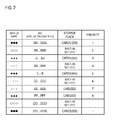
- Fig. 2 is a diagram illustrating priorities stored by a priority storing section 14b included in portable terminals according to all embodiments.
- the priority storing section 14b stores priorities that centrally manage all services in the built-in SE of the portable terminal owned by the user and services in the removable media with the SE function.
- the priorities in priority storing section 14b may be consistent with the priority of each service in the SE.
- Each priority in the SE may be given when, for example, a service is installed. As shown in, for example, Fig.
- priorities stored in the priority storing section 14b can be represented as a list of a service name, AID (application identifier), storage place, and priority.
- Priorities stored in the priority storing section 14b target the removable media that is currently attached by the user, removable media that is not currently attached, but owned by the user, and the built-in SE.
- the card 3 with an AID of GG ... GGG has the first priority
- the built-in SE 11 with an AID of BB ... BBB has the second priority
- the card 5 with an AID of JJ ... JJJ has the third priority, and so on.
- the service with an AID of DD ... DDD and the service with an AID of HH ... HHH are given no priority.
- Priorities as shown in Fig. 2 may be arbitrarily set by the user using base-band sections 34 and 44 etc. described later or may be automatically set by the portable terminals 10, 10', 20, 30, and 40.
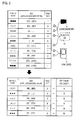
- Fig. 3 is a diagram illustrating optimum priorities generated by the optimum priority generation section 14c included in the portable terminals according to all embodiments.
- the optimum priority generation section 14c is present in base-band sections 14, 14', 24, 34, and 44 of the portable terminals 10, 10', 20, 30, and 40, respectively.
- the optimum priority storing section 12a is present in radio frequency sections 12, 12, 22, 12, and 22 of the portable terminals 10, 10', 20, 30, and 40, respectively.
- the optimum priority generation section 14c extracts the priorities of services in the removable media and the built-in SE connected to the portable terminal from priorities (first to eighth priorities) that centrally control all services in the built-in SE 11, the UIM card 2, the card memories 3, 4, and 5 stored in the priority storing section 14b (that is, the services in the removable media not connected to the portable terminal are excluded).
- the UIM card 2 and the card memory 5 are connected to the portable terminals 10, 10', 20, 30, and 40. Accordingly, the services (with AIDs of EE ... EEE and FF ... FFF) in the UIM card 2, the service (with an AID of JJ ... JJJ) in the card memory 5, and the services (with AIDs of AA ... AAA, BB ... BBB, and CC ... CCC) in the built-in SE 11 are extracted. That is, the services with the second, third, fourth, sixth, seventh, and eighth priorities are extracted. Then, the optimum priority generation section 14c rearranges the extracted services from highest to lowest and newly assigns optimum priorities beginning with the first one (SS14c).
- the optimum priorities generated in this way are stored in the optimum priority storing section 12a, which is also present in the radio frequency section 12 (SS12a).
- the optimum priority generation section 14c generates optimum priorities and stores them in the optimum priority storing section 12a in the radio frequency section 12 (22), so that a reader/writer reads the stored optimum priorities and can execute payment for the services that the reader/writer supports in decreasing order of priorities.
- the base-band sections 34 and 44 included in the portable terminals 30 and 40 according to the third and fourth embodiments of the present invention have structures required for the user to manually set priorities.
- the base-band sections 34 and 44 include a control section 34a, a service search section 34b, a service list storing section 34c, a display section 34d, and a rearranging section 34e.
- a "service search mode" which is one of the specific operation of the base-band section 34 and 44, will be described with reference to Fig. 4.
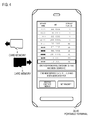
- FIG. 4 is a diagram illustrating a service search screen displayed by a display section 34d included in portable terminals 30 and 40 according to third and fourth embodiments.
- the "service search mode" is executed as described below. Only when the service list storing section 34c of the portable terminals 30 and 40 do not store a service list yet, the control section 34a displays "Do you search the terminal and removable media for services? (Yes/No)" on the display screen of the portable terminals 30 and 40 by controlling the display section 34d. When the user clicks the position corresponding to "Yes" by pressing the touch panel of the portable terminals 30 and 40, the portable terminals 30 and 40 enter the service search mode.
- the control section 34a outputs a card search signal to a card search section 14a' (24a), which will be described later, in response to a user input "Yes (card search command)" from the touch panel (N in SS34a-2, Y in SS34a-1).
- the card search section 14a' (24a) searches removable media connected to the portable terminals 30 and 40 (SS14a' (SS24a)).
- Fig. 4 indicates the moment at which the user makes a change from the card memory 4, which was connected just before the state shown in the figure, to the card memory 5.
- a card search signal is output from the control section 34a, and the card search section 14a' (24a) that received the card search signal newly searches the card memory 5 (with an ID of 555). For example, as shown in Fig.
- the display section 34d may display "ONE NEW REMOVABLE MEDIUM (ID: 555) HAS BEEN SEARCHED" for the card memory 5 (with an ID of 555) newly searched by the card search section 14a' (24a).
- the service search section 34b searches the removable media and SEs in the portable terminal for services (SS34b).
- service * * * (with an AID of JJ ... JJJ) in the newly inserted card memory 5 is newly searched for.
- the display section 34d may display "ONE NEW SERVICE (AID: JJ ... JJJ) HAS BEEN SEARCHED FOR" for service * * * searched for by the service search section 34b.
- the service list storing section 34c stores a list of searched services as a service list (SS34c).
- Fig. 4 indicates the moment at which the user makes a change from the card memory 4, which was connected just before, to the card memory 5. Accordingly, service ⁇ (with an AID of II ... III), which has been already searched for and stored as a service in the card memory 4, are not searched for during another search after a change from the card memory 4 to the card memory 5. Even in this case, the service list storing section 34c retains, in a service list, the services (such as service ⁇ ), having been already searched for and stored, that have not been searched for during another search.
- the services in the cards, connected to the portable terminals 30 and 40 in the past, that have been searched for by the service search section 34b are accumulated in sequence in the service list storing section 34c.
- the display section 34d displays a list of services for which priorities can be set of a list of stored services (SS34d).
- SS34d a list of stored services
- a service list displayed by the display section 34d includes all the services in the built-in SE 11 (with an ID of 111), the UIM card 2 (with an ID of 222), the card memory 3 (with an ID of 333), the card memory 4 (with an ID of 444), and the card memory 5 (with an ID of 555) for which priorities can be set (in Fig. 4 , these services are displayed on an upper part of the display screen of the portable terminals 30 and 40). As shown in Fig. 4 , the last searched service (service ⁇ in the card memory 5) may be surrounded by a thick line so that the user can easily recognize.
- the control section 34a outputs a card search signal to the card search section 14a' (24a) (N in SS34a-2, Y in SS34a-1).
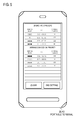
- Fig. 5 is a diagram illustrating a priority setting screen displayed by the display section 34d included in portable terminals 30 and 40 according to the third and fourth embodiments.
- the "priority setting mode" is executed as described below.
- First, of the service list described above, only the services for which priorities can be set are displayed in the "Searched services" field of the display screen of the portable terminals 30 and 40.
- the "Searched services” field appears in an upper part of the display screen of the portable terminals 30 and 40.
- Fig. 5 the "Searched services” field appears in an upper part of the display screen of the portable terminals 30 and 40.
- the display section 34d displays the "Arrange based on priority” field below the “Searched services” field.
- the user can set the priorities by dragging and dropping services in the “Searched services” field to the position corresponding to the desired priority in the "Arrange based on priority” field.
- the user ends the "priority setting mode" by, for example, clicking the "END SETTING” icon in a lower part of the display screen of the portable terminals 30 and 40.
- the user's depression of the "End setting” icon is input to the control section 34a as a priority setting command.
- the control section 34a When receiving the priority setting command, the control section 34a outputs a priority setting signal to the rearranging section 34e (N in SS34a-1, Y in SS34a-2).
- the priority setting signal reports the order of services rearranged by the user.
- the rearranging section 34e rearranges the services in a service list stored in the service list storing section 34c according to the priority setting signal and sets the rearranged order as priorities (SS34e).
- the rearranging section 34e may reset the priority for each SE held by each SE from highest to lowest, concurrently with the setting of priorities.
- the priority storing section 14b stores the priorities set by the rearranging section 34e (SS14b).
- the display section 34d of the base-band section 34 displays the items required for the user to manually set priorities on the display screen of the portable terminals 30 and 40 and the priority storing section 14b stores the priories manually set by the user, so the user's desired priorities can be easily set.
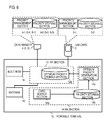
- Fig. 6 is a block diagram showing the structure of the portable terminal 10 according to this embodiment.
- Fig. 7 is a flowchart showing the operation of the portable terminal 10 according to this embodiment.
- the portable terminal 10 according to this embodiment includes the built-in SE 11, the radio frequency section 12, the base-band section 14, and an antenna 16 and is connected to removable media such as card memories and UIM cards.
- the portable terminal 10 is connected to the card memory 4 and the UIM card 2 for simplicity, but the removable media that can be connected to the portable terminal 10 according to this embodiment are not limited by this figure (this is the same as in all embodiments and modifications to be described later).
- the base-band section 14 includes a card search section 14a, the priority storing section 14b, and the optimum priority generation section 14c.
- the radio frequency section 12 includes the optimum priority storing section 12a.
- the UIM card 2 incorporates a priority management section 2-1 and a priority storing section 2-2.
- the card memory 4 (3, 5) includes a priority management section 4-1 (3-1, 5-1) and a priority storing section 4-2 (3-2, 5-2).
- the card search section 14a searches (SS 14a) removable media connected to the portable terminal 10 when the portable terminal 10 is powered on (S10).
- the priority storing section 14b stores priorities that centrally control all services in two or more SEs in advance.
- the optimum priority generation section 14c excludes the priorities of the services in the removable media that are not searched from the stored priorities, rearranges the priorities of the services that are not excluded from highest to lowest, and generates the rearranged priorities as optimum priorities (SS14c).
- the optimum priority storing section 12a stores the generated optimum priorities (SS12a).
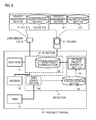
- the card search section 14a searches (SS 14a) removable media connected to the portable terminal 10 when the portable terminal 10 is powered on (S10) in the first embodiment, but the operation start conditions of the card search section 14a are not limited to this, and the card search section 14a may start operation each time a certain time elapses. Accordingly, a portable terminal 10' according to a first modification that includes a timer 17 for managing the operation start conditions of the card search section 14a will be described with reference to Figs. 8 and 9 .
- Fig. 8 is a block diagram showing the structure of the portable terminal 10' according to this modification.
- Fig. 9 is a flowchart showing the operation of the portable terminal 10' according to this modification.
- the portable terminal 10' according to this modification is different from the portable terminal 10 according to the first embodiment in that the card search section 14a of the base-band section 14 in the portable terminal 10 according to the first embodiment is changed to the card search section 14a' of the base-band section 14' in the portable terminal 10' according to this modification and that the portable terminal 10 according to the first embodiment does not include the timer 17 included in the portable terminal 10' according to this modification. Accordingly, the components of the portable terminal 10' according to this modification that have the same reference numbers as in the portable terminal 10 according to the first embodiment have the same functions, so the components are not described below.
- the timer 17 included in the portable terminal 10' manages the operation start condition of the card search section 14a'. More specifically, the timer 17 outputs a card search signal to the card search section 14a' each time a predetermined time elapses (S17). When receiving the card search signal from the timer 17, the card search section 14a' searches the removable media connected to the portable terminal 10'(SS14a'). The subsequent processes are the same as in the portable terminal 10 according to the first embodiment.
- the priority storing section 14b stores priorities that centrally control all services in two or more SEs in advance, so the payment priorities of all services (electronic money applications) in the portable terminal 10 (10') can be centrally determined.
- the optimum priority generation section 14c excludes the services in the removable media that are not searched according to the stored priorities when generating optimum priorities, the reader/writer does not access the services in the removable media that are not searched for, in error.
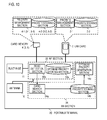
- Fig. 10 is a block diagram showing the structure of the portable terminal 20 according to this embodiment.
- Fig. 11 is a flowchart showing the operation of the portable terminal 20 according to this embodiment.
- the portable terminal 20 according to this embodiment includes the built-in SE 11, the radio frequency section 22, the base-band section 24, and an antenna 16 and is connected to removable media such as card memories and UIM cards.
- the base-band section 24 includes a card search section 24a, the priority storing section 14b, and the optimum priority generation section 14c.
- the radio frequency section 22 includes the optimum priority storing section 12a and a read detection section 22b.
- the portable terminal 20 according to this embodiment is different from the portable terminal 10 according to the first embodiment in that the radio frequency section 12 in the portable terminal 10 according to the first embodiment is changed to the radio frequency section 22 in the portable terminal 20 according to this embodiment, that the card search section 14a in the portable terminal 10 according to the first embodiment is changed to the card search section 24a in the portable terminal 20 according to this embodiment, and that the corresponding radio frequency section in the portable terminal 10 according to the first embodiment does not include the read detection section 22b included in the radio frequency section 22 in the portable terminal 20 according to this embodiment. Accordingly, the components of the portable terminal 20 according to this embodiment that have the same reference numbers as in the portable terminal 10 according to the first embodiment have the same functions, so the components are not described below.
- the read detection section 22b detects electromagnetic waves from the reader/writer and outputs the card search signal (SS22b).
- the card search section 24a searches the removable media connected to the portable terminal 20 (SS24a). The subsequent processes are the same as in the portable terminal 10 according to the first embodiment.
- the portable terminal 20 lets the read detection section 22b detect electromagnetic waves from the reader/writer and outputs the card search signal in addition of effects of the portable terminal 10 according to the first embodiment, so the card search section 24a can search removable media just before a payment process. Accordingly, the payment process can be performed based on optimum priorities even when a removable medium is replaced after power-on.
- Fig. 12 is a block diagram showing the structure of the portable terminal 30 according to this embodiment.
- Fig. 13 is a flowchart showing the operation of the portable terminal 30 according to this embodiment.
- the portable terminal 30 according to this embodiment includes the built-in SE 11, the radio frequency section 12, the base-band section 34, the antenna 16, and the timer 17 and is connected to removable media such as card memories and UIM cards.
- the base-band section 34 includes the card search section 14a', the priority storing section 14b, the optimum priority generation section 14c, the control section 34a, the service search section 34b, the service list storing section 34c, the display section 34d, and the rearranging section 34e.
- the radio frequency section 12 includes the optimum priority storing section 12a.
- the portable terminal 30 according to this embodiment is different from the portable terminal 10' according to the first modification in that the base-band section 14' of the portable terminal 10' according to the first modification does not include the control section 34a, the service search section 34b, the service list storing section 34c, the display section 34d, and the rearranging section 34e of the base-band section 34 included in the portable terminal 30 according to this embodiment. Accordingly, the components of the portable terminal 30 according to this embodiment that have the same reference numbers as in the portable terminal 10' according to this modification have the same functions, so the components are not described below.
- the control section 34a receives the user input.
- the control section 34a When the user input is a card search command, the control section 34a outputs the card search signal (N in SS34a-2, Y in SS34a-1).
- the control section 34a When the user input is a priority setting command, the control section 34a outputs the priority setting signal (N in SS34a-1, Y in SS34a-2).
- the card search section 14a' searches the removable media connected to the portable terminal 30 (SS14a').
- the service search section 34b searches for services in the searched removable media and the SEs in the portable terminal (SS34b).
- the service list storing section 34c stores a list of searched services as a service list (SS34c). If a service that was searched for and stored is not searched for in another search, the service list storing section 34c retains the service in the service list.
- the display section 34d displays the stored service list on the display screen (SS34d).
- the rearranging section 34e rearranges the services in the stored service list according to the priority setting signal and sets the rearranged order as priorities (SS34e).
- the priority storing section 14b stores the set priorities (SS14b).
- the base-band section 34 sets priorities that centrally control all services in the two or more SEs so that the priorities appropriately satisfy the user's needs in addition of effects of the portable terminal 10' according to the first modification.
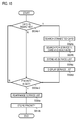
- Fig. 14 is a block diagram showing the structure of the portable terminal 40 according to this embodiment.
- Fig. 15 is a flowchart showing the operation of the portable terminal 40 according to this embodiment.
- the portable terminal 40 according to this embodiment includes the built-in SE 11, the radio frequency section 22, a base-band section 44, and the antenna 16 and is connected to removable media such as card memories and UIM cards.
- the base-band section 44 includes the card search section 24a, the priority storing section 14b, the optimum priority generation section 14c, the control section 34a, the service search section 34b, the service list storing section 34c, the display section 34d, and the rearranging section 34e.
- the radio frequency section 22 includes the optimum priority storing section 12a and the read detection section 22b.
- the portable terminal 40 according to this embodiment is different from the portable terminal 20 according to the second embodiment in that the portable terminal 20 according to the second embodiment does not include the control section 34a, the service search section 34b, the service list storing section 34c, the display section 34d, and the rearranging section 34e of the base-band section 44 included in the portable terminal 40 according to this embodiment.
- the base-band section 44 sets priorities that centrally control all services in the two or more SEs, so that the priorities appropriately satisfy the user's needs in addition of effects of the portable terminal 20 according to the second embodiment.
- the portable terminal according to the present invention is not limited to the above purpose and is effective even when, for example, a single removable medium is used by two portable terminals.
- the portable terminal according to the present invention is effective when, for example, the user (referred to as user A) has two portable phones (referred to as portable terminal A and portable terminal B) and attaches a removable medium (referred to as removable medium 1) to portable terminal A or portable terminal B as necessary.
- user A should have set the priorities for the target services in all SEs of portable terminal A according to the present invention including the services in removable medium 1.
- the priorities in the SE in a removable medium are recorded in the SE, so even when the removable medium is attached to portable terminal B in turn, its priority is retained.
- portable terminal B is a portable terminal according to the present invention, the optimum priority is determined in the portable terminal. Even when portable terminal B is not a portable terminal according to the present invention, if the removable medium is specified as one SE in the portable terminal, non-contact communication based on priorities in the SE can be performed.
- a program describing the processes can be recorded in a computer-readable recording medium.
- the computer-readable recording medium may be any recording medium such as, for example, a magnetic recording device, optical disc, magnetic optical disc, or semiconductor memory.
- the delivery of the program is performed by, for example, selling, transferring, leasing portable recording media such as a DVD or CD-ROM containing the program.
- the program may be stored in the storage device of a server computer and may be transferred by sending it from a server computer to another computer via a network.
- the computer that executes such a program first stores the program recorded in the portable recording medium or the program sent from the server computer in its storage device. During execution of the process, the computer reads the program stored in its recording medium and executes the process according to the read program. In another example of execution, the computer may read the program directly from the portable recording medium and may execute the process according to the program. Alternatively, the computer may execute the process according to the program each time the server computer sends the program to the computer. Alternatively, the above process may be executed using so-called ASP (Application Service Provider) services in which the process is achieved by instructing execution and obtaining results without sending the program from the server computer to this computer.
- the program in this example includes program-like information (such as data, not a direct instruction for a computer, that defines processing by the computer), used for processing by an electronic calculator.
- this apparatus is configured by execution of a predetermined program in a computer in this example, at least a part of the process may be achieved by hardware.
Landscapes
- Business, Economics & Management (AREA)
- Engineering & Computer Science (AREA)
- Accounting & Taxation (AREA)
- Strategic Management (AREA)
- Physics & Mathematics (AREA)
- General Business, Economics & Management (AREA)
- General Physics & Mathematics (AREA)
- Theoretical Computer Science (AREA)
- Finance (AREA)
- Computer Networks & Wireless Communication (AREA)
- Development Economics (AREA)
- Economics (AREA)
- Marketing (AREA)
- Microelectronics & Electronic Packaging (AREA)
- Computer Security & Cryptography (AREA)
- Technology Law (AREA)
- Telephone Function (AREA)
- Information Retrieval, Db Structures And Fs Structures Therefor (AREA)
- Financial Or Insurance-Related Operations Such As Payment And Settlement (AREA)
Abstract
A portable terminal that can centrally determine payment priorities for all services in a portable terminal is provided. This portable terminal 10 has a total of two or more secure elements (referred to below as SEs) in either of both of a removable media and the portable terminal. The portable terminal 10 includes a base-band section 14 having a card search section 14a that searches the removable media connected to the portable terminal 10, a priority storing section 14b that stores priorities that centrally control all services in the two or more SEs, an optimum priority generation section 14c that excludes the priorities of the services in the removable media that are not searched for from the stored priorities, rearranges the priories of services that are not excluded from highest to lowest, and generates the rearranged priorities as optimum priorities, and a radio frequency section 12 having an optimum priority storing section 12a that stores the generated optimum priorities.
Description
- The present invention relates to a portable terminal that generates priorities used when payment is performed with services (electronic money applications) in secure elements in the portable terminal and to an optimum priority generation method.
- Recently, an IC chip in a portable terminal includes the electronic money applications of a plurality of electronic money business operators, so that various types of electronic money can be used in one portable terminal. When an IC chip in a portable terminal includes a plurality of electronic money applications, the user uses electronic money, for example, as described below. First, the user brings the portable terminal close to the reader/writer of an electronic money terminal installed in the accounting area of a shop. Next, the electronic money terminal accesses the IC chip through an operation by the shop assistant in charge of accounting and searches for electronic money applications in the IC chip. Service codes for identifying applications are set in the applications installed in the IC chip. The electronic money terminal reads service codes through a process called a service search and recognizes the electronic money applications installed in the IC chip. When a single electronic money application is installed in the IC chip, the electronic money terminal performs payment using this application. When a plurality of electronic money applications are installed in the IC chip, the electronic money terminal displays these applications on the display device to ask for an instruction for specifying the application to be used. That is, the shop assistant in charge of accounting asks the user, for example, "Either the electronic money of company A or the electronic money of company B are available. Which do you select?". Then, the user answers, for example, "I use company A". The shop assistant in charge of accounting operates the electronic money terminal to process payment with electronic money of company A using the electronic money application of company A. In this case, a problem with a conventional electronic money terminal is that the user may find it difficult to select which electronic money to use for payment.
- On the other hand, a payment apparatus (electronic money terminal) in
patent literature 1 searches for an electronic money applications in an IC chip disposed in a portable terminal or IC card to grasp individual electronic money applications, sets priorities used to perform payment using the electronic money applications, and sequentially accesses the electronic money applications installed in the IC chip according to the priorities so that the total of payment reaches the entire amount. If the user sets the priorities in advance and stores them in the IC chip, the payment apparatus reads the user-specified priorities, sequentially accesses the electronic money applications according to the priorities, and performs payment. - [Patent literature 1] Japanese Patent Application Laid Open No.
2009-176065 - Conventionally, since the remaining amount of electronic money was recorded in the IC chip in a portable terminal, when changing model of the portable terminal, the user needed to move the electronic money service stored in the IC chip in the old portable terminal to the IC chip in a new portable terminal. In this case, it was necessary for the user to move the electronic money service through an operation at the distributor shop of the portable terminal or through individual procedures at a retail store, railroad company, etc. On the other hand, some telecommunications carriers adopt a system for recording data in the SIM card so that data such as the remaining amount of electronic money can be easily moved to a new portable terminal during changing of the model. Accordingly, the user can move electronic money only by replacing the SIM card, thereby making the change of model easier. A change in the recording system will be made together with switching to NFC (Near Field Communication), which is a future standard for electronic money. NFC is a technology for incorporating a non-contact IC chip in a portable terminal to reader/writer. NFC conforms to Type A and Type B, which are international standards of non-contact IC cards, FeliCa, and some IC tags.
- In response to this situation, in an NFC-compliant portable terminal, a secure element (secure area having the core section of an IC chip including security, encryption functions, key management functions, etc., referred to below as SE) may be incorporated in a built-in chip of a portable terminal (built-in SE), may be incorporated in a SIM card or UIM card, or may be incorporated in an external card memory. Accordingly, it is considered that a certain portable terminal has a plurality of SEs, for example, in a built-in SE and a SE in a SIM card.
- In this case, a payment apparatus disclosed in patent literature laccesses a predetermined SE (for example, the built-in SE) in a portable terminal and performs payment by accessing electronic money applications according to the priorities set for the SE, so the electronic money applications in the SE (for example, the SE in a SIM card) that were not accessed are not used. Accordingly, a problem is that the user can use only the electronic money applications in the predetermined SE, thereby compromising the user's convenience. Accordingly, the present invention addresses the problem with the object of providing a portable terminal that can centrally determine the payment priorities of all services (electronic money applications) in the portable terminal.
- A portable terminal according to the present invention, having a total of two or more SEs in either or both of removable media and the portable terminal, includes a base-band section and a radio frequency section. The base-band section includes a card search section, a priority storing section, and an optimum priority generation section. The radio frequency section includes an optimum priority storing section.
- The card search section searches the removable media connected to the portable terminal. The priority storing section stores priorities that centrally control all services in the two or more SEs. The optimum priority generation section excludes priorities of services in removable media that are not searched for from the stored priorities, rearranges priories of services that are not excluded from highest to lowest, and generates the rearranged priorities as optimum priorities. The optimum priority storing section stores the generated optimum priorities.
- The portable terminal according to the present invention can centrally determine the payment priorities of all services (electronic money applications) in the portable terminal.
-
-
Fig. 1 is a diagram illustrating a portable terminal having a SE in each of a portable terminal, a UIM card, and card memories. -
Fig. 2 is a diagram illustrating priorities stored by a priority storing section included in portable terminals according to all embodiments. -
Fig. 3 is a diagram illustrating an optimum priority generated by an optimum priority generation section included in the portable terminals according to all embodiments. -
Fig. 4 is a diagram illustrating a service search screen displayed by a display section included in portable terminals according to third and fourth embodiments. -
Fig. 5 is a diagram illustrating a priority setting screen displayed by the display section included in portable terminals according to the third and fourth embodiments. -
Fig. 6 is a block diagram showing the structure of a portable terminal according to a first embodiment. -
Fig. 7 is a flowchart showing the operation of the portable terminal according to the first embodiment. -
Fig. 8 is a block diagram showing the structure of a portable terminal according to a first modification. -
Fig. 9 is a flowchart showing the operation of the portable terminal according to the first modification. -
Fig. 10 is a block diagram showing the structure of a portable terminal according to a second embodiment. -
Fig. 11 is a flowchart showing the operation of the portable terminal according to the second embodiment. -
Fig. 12 is a block diagram showing the structure of a portable terminal according to a third embodiment. -
Fig. 13 is a flowchart showing the operation of the portable terminal according to the third embodiment. -
Fig. 14 is a block diagram showing the structure of a portable terminal according to a fourth embodiment. -
Fig. 15 is a flowchart showing the operation of the portable terminal according to the fourth embodiment. - Embodiments according to the present invention will be described below. The components with the same function are given the same reference number to omit duplicated description.
- In this specification, when a secure element (SE) is incorporated in a built-in chip of a portable terminal, the SE is called a built-in SE, which is distinguished from a SE in a removable medium.
- Generally, a removable medium is a recording medium that can be easily removed from the main body. However, in this specification, media in general (SIM card, UIM card, card memory, etc.) that can be attached to or detached from a portable terminal are called removable media.
- Applications in general concerning electronic money are called services in this specification.
- Next, it is assumed that the user has a plurality of removable media with the SE function and a portable terminal with a built-in SE. In this case, the services included in the SEs will be specifically described with reference to
Fig. 1. Fig. 1 is a diagram illustrating a portable terminal having a SE in each of a portable terminal, a UIM card, and card memories. It is assumed that the user has one ofportable terminals UIM card 2, acard memory 3, acard memory 4, acard memory 5 as detachable removable media with the SE function in theportable terminals portable terminals SE 11, which contains four services (with application identifiers of AA ... AAA, BB ... BBB, CC ... CCC, and DD ... DDD) in the example shown inFig. 1 . Although application identifiers of AA ... AAA, BB ... BBB, and CC ... CCC are given priorities in the built-inSE 11, the service to which an application identifier of DD ... DDD is given falls outside the management of priority setting and a priority, which is described later, is not given. TheUIM card 2 contains two services (with application identifiers of EE ... EEE and FF ... FFF) shown inFig. 1 and priorities are given to the two services. Thecard memory 3 contains two services (with application identifiers of GG ... GGG and HH ... HHH) shown inFig. 1 . Although an application identifier of GG ... GGG is given a priority, the service to which an application identifier of HH ... HHH is given falls outside the management of priority setting and a priority, which is described later, is not given. Thecard memory 4 contains one service (with an application identifier of II ... III) shown inFig. 1 and is given a priority. Thecard memory 5 contains one service (with an application identifier of JJ ... JJJ) shown inFig. 1 and is given a priority. The built-inSE 11 is not removed from theportable terminals UIM card 2 is always attached to theportable terminals portable terminals card memories portable terminals - Next, priorities stored by the
priority storing section 14b included in theportable terminals Fig. 1 with reference toFig. 2. Fig. 2 is a diagram illustrating priorities stored by apriority storing section 14b included in portable terminals according to all embodiments. Thepriority storing section 14b stores priorities that centrally manage all services in the built-in SE of the portable terminal owned by the user and services in the removable media with the SE function. The priorities inpriority storing section 14b may be consistent with the priority of each service in the SE. Each priority in the SE may be given when, for example, a service is installed. As shown in, for example,Fig. 2 , priorities stored in thepriority storing section 14b can be represented as a list of a service name, AID (application identifier), storage place, and priority. Priorities stored in thepriority storing section 14b target the removable media that is currently attached by the user, removable media that is not currently attached, but owned by the user, and the built-in SE. In the example inFig. 2 , thecard 3 with an AID of GG ... GGG has the first priority, the built-inSE 11 with an AID of BB ... BBB has the second priority, and thecard 5 with an AID of JJ ... JJJ has the third priority, and so on. The service with an AID of DD ... DDD and the service with an AID of HH ... HHH are given no priority. Priorities as shown inFig. 2 may be arbitrarily set by the user using base-band sections portable terminals - Next, the operation of the optimum
priority generation section 14c and the optimumpriority storing section 12a included in theportable terminals Fig. 1 with reference toFig. 3. Fig. 3 is a diagram illustrating optimum priorities generated by the optimumpriority generation section 14c included in the portable terminals according to all embodiments. - The optimum
priority generation section 14c is present in base-band sections portable terminals priority storing section 12a is present inradio frequency sections portable terminals priority generation section 14c extracts the priorities of services in the removable media and the built-in SE connected to the portable terminal from priorities (first to eighth priorities) that centrally control all services in the built-inSE 11, theUIM card 2, thecard memories priority storing section 14b (that is, the services in the removable media not connected to the portable terminal are excluded). In this case, it is assumed that theUIM card 2 and thecard memory 5 are connected to theportable terminals UIM card 2, the service (with an AID of JJ ... JJJ) in thecard memory 5, and the services (with AIDs of AA ... AAA, BB ... BBB, and CC ... CCC) in the built-inSE 11 are extracted. That is, the services with the second, third, fourth, sixth, seventh, and eighth priorities are extracted. Then, the optimumpriority generation section 14c rearranges the extracted services from highest to lowest and newly assigns optimum priorities beginning with the first one (SS14c). The optimum priorities generated in this way are stored in the optimumpriority storing section 12a, which is also present in the radio frequency section 12 (SS12a). As described above, the optimumpriority generation section 14c generates optimum priorities and stores them in the optimumpriority storing section 12a in the radio frequency section 12 (22), so that a reader/writer reads the stored optimum priorities and can execute payment for the services that the reader/writer supports in decreasing order of priorities. - Next, the operation of the base-
band sections portable terminals Fig. 1 . The base-band sections portable terminals band sections control section 34a, aservice search section 34b, a servicelist storing section 34c, adisplay section 34d, and arearranging section 34e. A "service search mode", which is one of the specific operation of the base-band section Fig. 4. Fig. 4 is a diagram illustrating a service search screen displayed by adisplay section 34d included inportable terminals list storing section 34c of theportable terminals control section 34a displays "Do you search the terminal and removable media for services? (Yes/No)" on the display screen of theportable terminals display section 34d. When the user clicks the position corresponding to "Yes" by pressing the touch panel of theportable terminals portable terminals control section 34a outputs a card search signal to acard search section 14a' (24a), which will be described later, in response to a user input "Yes (card search command)" from the touch panel (N in SS34a-2, Y in SS34a-1). When receiving the card search signal from thecontrol section 34a (N in SS34a-2, Y in SS34a-1), thecard search section 14a' (24a) searches removable media connected to theportable terminals 30 and 40 (SS14a' (SS24a)). The example inFig. 4 assumes that theUIM card 2 is always connected to theportable terminals card memories portable terminals Fig. 4 indicates the moment at which the user makes a change from thecard memory 4, which was connected just before the state shown in the figure, to thecard memory 5. When the user input (card search command) is issued in this case, a card search signal is output from thecontrol section 34a, and thecard search section 14a' (24a) that received the card search signal newly searches the card memory 5 (with an ID of 555). For example, as shown inFig. 4 , thedisplay section 34d may display "ONE NEW REMOVABLE MEDIUM (ID: 555) HAS BEEN SEARCHED" for the card memory 5 (with an ID of 555) newly searched by thecard search section 14a' (24a). Next, theservice search section 34b searches the removable media and SEs in the portable terminal for services (SS34b). In the example inFig. 4 , service * * * (with an AID of JJ ... JJJ) in the newly insertedcard memory 5 is newly searched for. In this case, thedisplay section 34d may display "ONE NEW SERVICE (AID: JJ ... JJJ) HAS BEEN SEARCHED FOR" for service * * * searched for by theservice search section 34b. Next, the servicelist storing section 34c stores a list of searched services as a service list (SS34c).Fig. 4 indicates the moment at which the user makes a change from thecard memory 4, which was connected just before, to thecard memory 5. Accordingly, service ◆◆◆ (with an AID of II ... III), which has been already searched for and stored as a service in thecard memory 4, are not searched for during another search after a change from thecard memory 4 to thecard memory 5. Even in this case, the servicelist storing section 34c retains, in a service list, the services (such as service ◆◆◆), having been already searched for and stored, that have not been searched for during another search. As described above, the services in the cards, connected to theportable terminals service search section 34b are accumulated in sequence in the servicelist storing section 34c. Next, thedisplay section 34d displays a list of services for which priorities can be set of a list of stored services (SS34d). The example inFig. 4 assumes that theUIM card 2 is always connected, thecard memories list storing section 34c in sequence. Upon completion of a service search after insertion of thecard memory 5, a service list displayed by thedisplay section 34d includes all the services in the built-in SE 11 (with an ID of 111), the UIM card 2 (with an ID of 222), the card memory 3 (with an ID of 333), the card memory 4 (with an ID of 444), and the card memory 5 (with an ID of 555) for which priorities can be set (inFig. 4 , these services are displayed on an upper part of the display screen of theportable terminals 30 and 40). As shown inFig. 4 , the last searched service (service ★★★ in the card memory 5) may be surrounded by a thick line so that the user can easily recognize. If the user has removable media for which a service search has not been executed, the user only needs to click the part of the touch panel corresponding to the "SEARCH ANOTHER MEDIUM" icon displayed by thedisplay section 34d after connecting the removable media to theportable terminals control section 34a outputs a card search signal to thecard search section 14a' (24a) (N in SS34a-2, Y in SS34a-1). After making theportable terminals portable terminals - The priority setting mode, which is one of specific operation of the base-
band sections Fig. 5. Fig. 5 is a diagram illustrating a priority setting screen displayed by thedisplay section 34d included inportable terminals portable terminals Fig. 5 , the "Searched services" field appears in an upper part of the display screen of theportable terminals Fig. 5 , thedisplay section 34d displays the "Arrange based on priority" field below the "Searched services" field. The user can set the priorities by dragging and dropping services in the "Searched services" field to the position corresponding to the desired priority in the "Arrange based on priority" field. After setting the priorities, the user ends the "priority setting mode" by, for example, clicking the "END SETTING" icon in a lower part of the display screen of theportable terminals control section 34a as a priority setting command. When receiving the priority setting command, thecontrol section 34a outputs a priority setting signal to therearranging section 34e (N in SS34a-1, Y in SS34a-2). The priority setting signal reports the order of services rearranged by the user. When receiving the priority setting signal from thecontrol section 34a, therearranging section 34e rearranges the services in a service list stored in the servicelist storing section 34c according to the priority setting signal and sets the rearranged order as priorities (SS34e). At this time, therearranging section 34e may reset the priority for each SE held by each SE from highest to lowest, concurrently with the setting of priorities. Thepriority storing section 14b stores the priorities set by therearranging section 34e (SS14b). As described above, thedisplay section 34d of the base-band section 34 displays the items required for the user to manually set priorities on the display screen of theportable terminals priority storing section 14b stores the priories manually set by the user, so the user's desired priorities can be easily set. - Assuming the above description, a portable terminal according to the first embodiment will be described with reference to
Figs. 6 and7 .Fig. 6 is a block diagram showing the structure of theportable terminal 10 according to this embodiment.Fig. 7 is a flowchart showing the operation of theportable terminal 10 according to this embodiment. Theportable terminal 10 according to this embodiment includes the built-inSE 11, theradio frequency section 12, the base-band section 14, and anantenna 16 and is connected to removable media such as card memories and UIM cards. InFig. 6 , theportable terminal 10 is connected to thecard memory 4 and theUIM card 2 for simplicity, but the removable media that can be connected to theportable terminal 10 according to this embodiment are not limited by this figure (this is the same as in all embodiments and modifications to be described later). The base-band section 14 includes acard search section 14a, thepriority storing section 14b, and the optimumpriority generation section 14c. Theradio frequency section 12 includes the optimumpriority storing section 12a. TheUIM card 2 incorporates a priority management section 2-1 and a priority storing section 2-2. Similarly, the card memory 4 (3, 5) includes a priority management section 4-1 (3-1, 5-1) and a priority storing section 4-2 (3-2, 5-2). - The
card search section 14a searches (SS 14a) removable media connected to theportable terminal 10 when theportable terminal 10 is powered on (S10). Thepriority storing section 14b stores priorities that centrally control all services in two or more SEs in advance. The optimumpriority generation section 14c excludes the priorities of the services in the removable media that are not searched from the stored priorities, rearranges the priorities of the services that are not excluded from highest to lowest, and generates the rearranged priorities as optimum priorities (SS14c). The optimumpriority storing section 12a stores the generated optimum priorities (SS12a). - The
card search section 14a searches (SS 14a) removable media connected to theportable terminal 10 when theportable terminal 10 is powered on (S10) in the first embodiment, but the operation start conditions of thecard search section 14a are not limited to this, and thecard search section 14a may start operation each time a certain time elapses. Accordingly, a portable terminal 10' according to a first modification that includes atimer 17 for managing the operation start conditions of thecard search section 14a will be described with reference toFigs. 8 and9 .Fig. 8 is a block diagram showing the structure of the portable terminal 10' according to this modification.Fig. 9 is a flowchart showing the operation of the portable terminal 10' according to this modification. The portable terminal 10' according to this modification is different from theportable terminal 10 according to the first embodiment in that thecard search section 14a of the base-band section 14 in theportable terminal 10 according to the first embodiment is changed to thecard search section 14a' of the base-band section 14' in the portable terminal 10' according to this modification and that theportable terminal 10 according to the first embodiment does not include thetimer 17 included in the portable terminal 10' according to this modification.
Accordingly, the components of the portable terminal 10' according to this modification that have the same reference numbers as in theportable terminal 10 according to the first embodiment have the same functions, so the components are not described below. - The
timer 17 included in the portable terminal 10' according to this modification manages the operation start condition of thecard search section 14a'. More specifically, thetimer 17 outputs a card search signal to thecard search section 14a' each time a predetermined time elapses (S17). When receiving the card search signal from thetimer 17, thecard search section 14a' searches the removable media connected to the portable terminal 10'(SS14a'). The subsequent processes are the same as in theportable terminal 10 according to the first embodiment. - As described above, in the
portable terminal 10 according to the first embodiment and the portable terminal 10' according to the first modification, thepriority storing section 14b stores priorities that centrally control all services in two or more SEs in advance, so the payment priorities of all services (electronic money applications) in the portable terminal 10 (10') can be centrally determined. In addition, since the optimumpriority generation section 14c excludes the services in the removable media that are not searched according to the stored priorities when generating optimum priorities, the reader/writer does not access the services in the removable media that are not searched for, in error. - Next, a portable terminal according to a second embodiment for appropriately controlling the removable media search timing of the
card search section 14a will be described with reference toFigs. 10 and11 .Fig. 10 is a block diagram showing the structure of theportable terminal 20 according to this embodiment.Fig. 11 is a flowchart showing the operation of theportable terminal 20 according to this embodiment. Theportable terminal 20 according to this embodiment includes the built-inSE 11, theradio frequency section 22, the base-band section 24, and anantenna 16 and is connected to removable media such as card memories and UIM cards. The base-band section 24 includes acard search section 24a, thepriority storing section 14b, and the optimumpriority generation section 14c. Theradio frequency section 22 includes the optimumpriority storing section 12a and aread detection section 22b. Theportable terminal 20 according to this embodiment is different from theportable terminal 10 according to the first embodiment in that theradio frequency section 12 in theportable terminal 10 according to the first embodiment is changed to theradio frequency section 22 in theportable terminal 20 according to this embodiment, that thecard search section 14a in theportable terminal 10 according to the first embodiment is changed to thecard search section 24a in theportable terminal 20 according to this embodiment, and that the corresponding radio frequency section in theportable terminal 10 according to the first embodiment does not include theread detection section 22b included in theradio frequency section 22 in theportable terminal 20 according to this embodiment. Accordingly, the components of theportable terminal 20 according to this embodiment that have the same reference numbers as in theportable terminal 10 according to the first embodiment have the same functions, so the components are not described below. - The
read detection section 22b detects electromagnetic waves from the reader/writer and outputs the card search signal (SS22b). When receiving the card search signal, thecard search section 24a searches the removable media connected to the portable terminal 20 (SS24a). The subsequent processes are the same as in theportable terminal 10 according to the first embodiment. - As described above, the
portable terminal 20 according to this embodiment lets the readdetection section 22b detect electromagnetic waves from the reader/writer and outputs the card search signal in addition of effects of theportable terminal 10 according to the first embodiment, so thecard search section 24a can search removable media just before a payment process. Accordingly, the payment process can be performed based on optimum priorities even when a removable medium is replaced after power-on. - Next, a portable terminal according to a third embodiment, based on the portable terminal 10' according to the first modification, which sets priorities that centrally control all services in the SEs based on the user input, will be described with reference to
Figs. 12 and13 .Fig. 12 is a block diagram showing the structure of theportable terminal 30 according to this embodiment.Fig. 13 is a flowchart showing the operation of theportable terminal 30 according to this embodiment. Theportable terminal 30 according to this embodiment includes the built-inSE 11, theradio frequency section 12, the base-band section 34, theantenna 16, and thetimer 17 and is connected to removable media such as card memories and UIM cards. The base-band section 34 includes thecard search section 14a', thepriority storing section 14b, the optimumpriority generation section 14c, thecontrol section 34a, theservice search section 34b, the servicelist storing section 34c, thedisplay section 34d, and therearranging section 34e. Theradio frequency section 12 includes the optimumpriority storing section 12a. Theportable terminal 30 according to this embodiment is different from the portable terminal 10' according to the first modification in that the base-band section 14' of the portable terminal 10' according to the first modification does not include thecontrol section 34a, theservice search section 34b, the servicelist storing section 34c, thedisplay section 34d, and therearranging section 34e of the base-band section 34 included in theportable terminal 30 according to this embodiment. Accordingly, the components of theportable terminal 30 according to this embodiment that have the same reference numbers as in the portable terminal 10' according to this modification have the same functions, so the components are not described below. - Setting of priorities in the
portable terminal 30 will be described below. Thecontrol section 34a receives the user input. When the user input is a card search command, thecontrol section 34a outputs the card search signal (N in SS34a-2, Y in SS34a-1). When the user input is a priority setting command, thecontrol section 34a outputs the priority setting signal (N in SS34a-1, Y in SS34a-2). When receiving the card search signal from thecontrol section 34a (N in SS34a-2, Y in SS34a-1), thecard search section 14a' searches the removable media connected to the portable terminal 30 (SS14a'). Theservice search section 34b searches for services in the searched removable media and the SEs in the portable terminal (SS34b). The servicelist storing section 34c stores a list of searched services as a service list (SS34c). If a service that was searched for and stored is not searched for in another search, the servicelist storing section 34c retains the service in the service list. Next, thedisplay section 34d displays the stored service list on the display screen (SS34d). When receiving the priority setting signal from thecontrol section 34a (N in SS34a-1, Y in SS34a-2), therearranging section 34e rearranges the services in the stored service list according to the priority setting signal and sets the rearranged order as priorities (SS34e). Thepriority storing section 14b stores the set priorities (SS14b). - As described above, in the
portable terminal 30 according to this embodiment, the base-band section 34 sets priorities that centrally control all services in the two or more SEs so that the priorities appropriately satisfy the user's needs in addition of effects of the portable terminal 10' according to the first modification. - Next, a portable terminal according to a fourth embodiment, based on the
portable terminal 20 according to the second embodiment, which sets priorities that centrally control all services in the SEs based on the user input, will be described with reference toFigs. 14 and15 .Fig. 14 is a block diagram showing the structure of theportable terminal 40 according to this embodiment.Fig. 15 is a flowchart showing the operation of theportable terminal 40 according to this embodiment. Theportable terminal 40 according to this embodiment includes the built-inSE 11, theradio frequency section 22, a base-band section 44, and theantenna 16 and is connected to removable media such as card memories and UIM cards. The base-band section 44 includes thecard search section 24a, thepriority storing section 14b, the optimumpriority generation section 14c, thecontrol section 34a, theservice search section 34b, the servicelist storing section 34c, thedisplay section 34d, and therearranging section 34e. Theradio frequency section 22 includes the optimumpriority storing section 12a and theread detection section 22b. Theportable terminal 40 according to this embodiment is different from theportable terminal 20 according to the second embodiment in that theportable terminal 20 according to the second embodiment does not include thecontrol section 34a, theservice search section 34b, the servicelist storing section 34c, thedisplay section 34d, and therearranging section 34e of the base-band section 44 included in theportable terminal 40 according to this embodiment. Accordingly, refer to the description of the second embodiment for the processes of the same components as in theportable terminal 20. Refer to the description of the third embodiment for the processes of the same components (thecontrol section 34a, theservice search section 34b, the servicelist storing section 34c, thedisplay section 34d, and therearranging section 34e) as in theportable terminal 30. - As described above, in the
portable terminal 40 according to this embodiment, the base-band section 44 sets priorities that centrally control all services in the two or more SEs, so that the priorities appropriately satisfy the user's needs in addition of effects of theportable terminal 20 according to the second embodiment. - This specification shows examples in which, even when the user has two or more removable media for one portable terminal and some of the removable media are attached to the portable terminal and some of them are not attached to it, the services in the removable media not attached to it are excluded so that payment of electronic money can be performed based on the user's desired priorities. However, the portable terminal according to the present invention is not limited to the above purpose and is effective even when, for example, a single removable medium is used by two portable terminals. The portable terminal according to the present invention is effective when, for example, the user (referred to as user A) has two portable phones (referred to as portable terminal A and portable terminal B) and attaches a removable medium (referred to as removable medium 1) to portable terminal A or portable terminal B as necessary. In this case, user A should have set the priorities for the target services in all SEs of portable terminal A according to the present invention including the services in
removable medium 1. The priorities in the SE in a removable medium are recorded in the SE, so even when the removable medium is attached to portable terminal B in turn, its priority is retained. When portable terminal B is a portable terminal according to the present invention, the optimum priority is determined in the portable terminal. Even when portable terminal B is not a portable terminal according to the present invention, if the removable medium is specified as one SE in the portable terminal, non-contact communication based on priorities in the SE can be performed. - The above processes may be executed chronologically according to the order of description or may be executed concurrently or individually depending on the processing power of the device that performs the processes or as necessary. Alternatively, it will be clear that the processes may be otherwise executed without departing from the spirit and scope of the invention.
- When the above structure is achieved by a computer, the processes by the functions of the individual devices are described in a program. Execution of the program in the computer achieves the above processes on the computer.
- A program describing the processes can be recorded in a computer-readable recording medium. The computer-readable recording medium may be any recording medium such as, for example, a magnetic recording device, optical disc, magnetic optical disc, or semiconductor memory.
- The delivery of the program is performed by, for example, selling, transferring, leasing portable recording media such as a DVD or CD-ROM containing the program. The program may be stored in the storage device of a server computer and may be transferred by sending it from a server computer to another computer via a network.
- For example, the computer that executes such a program first stores the program recorded in the portable recording medium or the program sent from the server computer in its storage device. During execution of the process, the computer reads the program stored in its recording medium and executes the process according to the read program. In another example of execution, the computer may read the program directly from the portable recording medium and may execute the process according to the program. Alternatively, the computer may execute the process according to the program each time the server computer sends the program to the computer. Alternatively, the above process may be executed using so-called ASP (Application Service Provider) services in which the process is achieved by instructing execution and obtaining results without sending the program from the server computer to this computer. The program in this example includes program-like information (such as data, not a direct instruction for a computer, that defines processing by the computer), used for processing by an electronic calculator.
- Although this apparatus is configured by execution of a predetermined program in a computer in this example, at least a part of the process may be achieved by hardware.
Claims (9)
- A portable terminal that has a total of two or more secure elements in either or both of removable media and a portable terminal, the portable terminal comprising:a base-band section including
a card search section for searching the removable media connected to the portable terminal,
a priority storing section for storing priorities that centrally control all services in the two or more secure elements, and
an optimum priority generation section that excludes priorities of services in removable media that are not searched from the stored priorities, rearranges priories of services that are not excluded from highest to lowest, and generates the rearranged priorities as optimum priorities; anda radio frequency section that has an optimum priority storing section for storing the generated optimum priorities. - The portable terminal according to claim 1, wherein
the radio frequency section further includes a read detection section for detecting electromagnetic waves from a reader/writer and outputting a card search signal and
the card search section searches removable media connected to the portable terminal when receiving the card search signal. - The portable terminal according to claim 2, wherein
the base-band section sets priorities that centrally control all services in the two or more secure elements based on a user input and
the priority storing section stores the set priorities. - The portable terminal according to claim 3, wherein the base-band section further includes
a control section for outputting the card search signal when the user input is a card search command and outputting a priority setting signal when the user input is a priority setting command,
a service search section for searching for services in the searched removable media or the secure elements in the portable terminal,
a service list storing section for storing a list of the searched services as a service list,
a display section for displaying the stored service list on a display screen, and
a rearranging section for rearranging the searched services in the stored service list based on the priority setting signal when receiving the priority setting signal and setting priorities of the rearranged services,
wherein the service list storing section, when the searched and stored services are not searched for during another search, retains the services that are not searched for in the service list. - An optimum priority generation method using a portable terminal that has a total of two or more secure elements in either or both of removable media and a portable terminal, the method comprising:a base-band step including
a card search sub-step for searching removable media connected to the portable terminal,
a priority storing sub-step for storing priorities that centrally control all services in the two or more secure elements, and
an optimum priority generation sub-step for excluding priorities of services in removable media that are not searched for from the stored priorities, rearranging priorities of services that are not excluded from highest to lowest, and generating the rearranged priorities as optimum priorities anda radio frequency step including an optimum priority storing sub-step for storing the generated optimum priorities. - The optimum priority generation method according to claim 5, wherein
the radio frequency step further includes a read detection sub-step for detecting electromagnetic waves from a reader/writer and outputting a card search signal and
the card search sub-step searches removable media connected to the portable terminal when receiving the card search signal. - The optimum priority generation method according to claim 6, wherein
the base-band step sets priorities that centrally control all services in the two or more secure elements based on a user input and
the priority storing sub-step stores the set priorities. - The optimum priority generation method according to claim 7, wherein the base-band step further includes
a control sub-step for outputting the card search signal when the user input is a card search command and outputting a priority setting signal when the user input is a priority setting command,
a service search sub-step for searching for services in the searched removable media and the secure elements in in the portable terminal,
a service list storing sub-step for storing a list of the searched services as a service list,
a display sub-step for displaying the stored service list on a display screen, and
a rearranging sub-step for rearranging the searched services in the stored service list based on the priority setting signal when receiving the priority setting signal and setting priorities of the rearranged services,
wherein the service list storing sub-step, when the searched and stored services are not searched for during another search, retains the services that are not searched for in the service list. - A portable-terminal-readable recording medium that stores a program for executing the optimum priority generation method according to any one of claims 5 to 8.
Applications Claiming Priority (2)
| Application Number | Priority Date | Filing Date | Title |
|---|---|---|---|
| JP2011209129A JP2013069238A (en) | 2011-09-26 | 2011-09-26 | Portable terminal, method for generating optimized priority order, and program |
| PCT/JP2012/074534 WO2013047504A1 (en) | 2011-09-26 | 2012-09-25 | Portable terminal and optimized priority order generation method |
Publications (1)
| Publication Number | Publication Date |
|---|---|
| EP2685413A1 true EP2685413A1 (en) | 2014-01-15 |
Family
ID=47995536
Family Applications (1)
| Application Number | Title | Priority Date | Filing Date |
|---|---|---|---|
| EP12837346.1A Withdrawn EP2685413A1 (en) | 2011-09-26 | 2012-09-25 | Portable terminal and optimized priority order generation method |
Country Status (4)
| Country | Link |
|---|---|
| US (1) | US20140054376A1 (en) |
| EP (1) | EP2685413A1 (en) |
| JP (1) | JP2013069238A (en) |
| WO (1) | WO2013047504A1 (en) |
Families Citing this family (7)
| Publication number | Priority date | Publication date | Assignee | Title |
|---|---|---|---|---|
| CN104240085A (en) * | 2013-06-07 | 2014-12-24 | 中兴通讯股份有限公司 | Mobile terminal and mobile payment safety verification method and device |
| KR101533885B1 (en) * | 2013-10-15 | 2015-07-03 | 주식회사 엘지유플러스 | Termial providing near field communication service and method for operating terminal |
| SG10201506662XA (en) * | 2015-03-03 | 2016-10-28 | Mastercard Asia Pacific Pte Ltd | Method For Enabling A Communication Link Between A Mobile Terminal And A Receiving Terminal |
| SG10201506661UA (en) * | 2015-03-03 | 2016-10-28 | Mastercard Asia Pacific Pte Ltd | Method For Standardising Communication Between A Plurality Of Redemption Applications |
| CN109214794A (en) * | 2018-08-31 | 2019-01-15 | 浙江口碑网络技术有限公司 | A kind of processing of payment data and method of payment and device, electronics and storage equipment |
| CN109522034A (en) * | 2018-09-27 | 2019-03-26 | 努比亚技术有限公司 | A kind of optimizing application method, terminal and computer readable storage medium |
| JP7707069B2 (en) * | 2019-11-07 | 2025-07-14 | フェリカネットワークス株式会社 | Information processing device, information processing method, information processing system, and program |
Family Cites Families (10)
| Publication number | Priority date | Publication date | Assignee | Title |
|---|---|---|---|---|
| US5842125A (en) * | 1995-11-30 | 1998-11-24 | Amsc Subsidiary Corporation | Network control center for satellite communication system |
| JP2002099847A (en) * | 2000-09-25 | 2002-04-05 | Toshiba Tec Corp | Multifunctional IC card, payment device, payment method, and storage medium |
| US20070197261A1 (en) * | 2004-03-19 | 2007-08-23 | Humbel Roger M | Mobile Telephone All In One Remote Key Or Software Regulating Card For Radio Bicycle Locks, Cars, Houses, And Rfid Tags, With Authorisation And Payment Function |
| US12260396B2 (en) * | 2010-01-08 | 2025-03-25 | Blackhawk Network, Inc. | System for payment via electronic wallet |
| JP4403433B2 (en) * | 2007-08-23 | 2010-01-27 | ソニー株式会社 | Electronic wallet device, communication method and program |
| JP5311612B2 (en) * | 2008-01-24 | 2013-10-09 | 楽天株式会社 | Payment device, payment method and payment program, and access device, access method and access program |
| JP5669167B2 (en) * | 2008-03-11 | 2015-02-12 | 日本電気株式会社 | Information processing system, portable terminal, information processing method and program |
| JP2012039257A (en) * | 2010-08-04 | 2012-02-23 | Sony Corp | Portable terminal, information processing method and computer program |
| EP2466976B1 (en) * | 2010-12-15 | 2017-09-27 | OCT Circuit Technologies International Limited | IP-based paging for DSDS |
| US9390414B2 (en) * | 2011-09-18 | 2016-07-12 | Google Inc. | One-click offline buying |
-
2011
- 2011-09-26 JP JP2011209129A patent/JP2013069238A/en active Pending
-
2012
- 2012-09-25 US US14/113,719 patent/US20140054376A1/en not_active Abandoned
- 2012-09-25 EP EP12837346.1A patent/EP2685413A1/en not_active Withdrawn
- 2012-09-25 WO PCT/JP2012/074534 patent/WO2013047504A1/en not_active Ceased
Non-Patent Citations (1)
| Title |
|---|
| See references of WO2013047504A1 * |
Also Published As
| Publication number | Publication date |
|---|---|
| WO2013047504A1 (en) | 2013-04-04 |
| JP2013069238A (en) | 2013-04-18 |
| US20140054376A1 (en) | 2014-02-27 |
Similar Documents
| Publication | Publication Date | Title |
|---|---|---|
| EP2685413A1 (en) | Portable terminal and optimized priority order generation method | |
| US9600816B2 (en) | Method and system for executing a NFC transaction supporting multiple applications and multiples instances of a same application | |
| US6961587B1 (en) | Storage media | |
| CN103310537B (en) | A kind of many application identifications access method, smart card and POS | |
| US9852419B2 (en) | Systems and methods for providing near field communications | |
| US20140176306A1 (en) | Near-field-communication (nfc) enabled mobile device and operation method thereof | |
| EP2377291B1 (en) | Portable mobile communication device and method of controlling near field communication | |
| AU2008298677A1 (en) | Wirelessly executing financial transactions | |
| CN104901991B (en) | Virtual resource transfer method, device and system | |
| CN107251069A (en) | A near-field communication payment method and terminal | |
| EP2461640A1 (en) | Method and integrated circuit card for managing the database by interacting with the mobile equipment | |
| CN101252729A (en) | Method for enhancing payment chip functions with SIM card | |
| KR102105498B1 (en) | Nfc device comprising configurable notification means | |
| KR101455155B1 (en) | Method for Mobile Payment Card Priority Auto-Setting in Multi-SE and Mobile Device using the same | |
| US20160283922A1 (en) | Information processing device, information processing method, information processing program, and storage medium storing information processing program | |
| CN103258173A (en) | Wearable device, write-in system and write-in method for card | |
| KR20150019956A (en) | Terminal and service device for providing card clause agreement and issue, electronic wallet system comprising the same, control method thereof and computer readable medium having computer program recorded therefor | |
| US9870217B2 (en) | Toolkit event configuration of applets on a card computing device with installation parameters | |
| EP2993596A1 (en) | Method and apparatus for index processing | |
| CN102541639B (en) | CPU (Central Processing Unit) card data processing method, CPU card data processing system and CPU card | |
| CN102955951A (en) | Radio frequency card area configuration method, radio frequency card read-write method, radio frequency card and cross-area utilization system for radio frequency card | |
| US20030162559A1 (en) | Mobile communications terminal, information transmitting system and information receiving method | |
| CN103679439A (en) | Payment method based on mobile communication equipment, mobile communication equipment and smart card | |
| US12248831B2 (en) | System and method for facilitating presentation of smart card data to users | |
| KR101397175B1 (en) | Method for providing usercustomized point of sale service |
Legal Events
| Date | Code | Title | Description |
|---|---|---|---|
| PUAI | Public reference made under article 153(3) epc to a published international application that has entered the european phase |
Free format text: ORIGINAL CODE: 0009012 |
|
| 17P | Request for examination filed |
Effective date: 20131010 |
|
| AK | Designated contracting states |
Kind code of ref document: A1 Designated state(s): AL AT BE BG CH CY CZ DE DK EE ES FI FR GB GR HR HU IE IS IT LI LT LU LV MC MK MT NL NO PL PT RO RS SE SI SK SM TR |
|
| STAA | Information on the status of an ep patent application or granted ep patent |
Free format text: STATUS: THE APPLICATION HAS BEEN WITHDRAWN |
|
| 18W | Application withdrawn |
Effective date: 20140530 |