EP2685220A2 - Self-powered sensor system - Google Patents
Self-powered sensor system Download PDFInfo
- Publication number
- EP2685220A2 EP2685220A2 EP13175314.7A EP13175314A EP2685220A2 EP 2685220 A2 EP2685220 A2 EP 2685220A2 EP 13175314 A EP13175314 A EP 13175314A EP 2685220 A2 EP2685220 A2 EP 2685220A2
- Authority
- EP
- European Patent Office
- Prior art keywords
- signal
- self
- sensor system
- power
- powered sensor
- Prior art date
- Legal status (The legal status is an assumption and is not a legal conclusion. Google has not performed a legal analysis and makes no representation as to the accuracy of the status listed.)
- Withdrawn
Links
Images


Classifications
-
- G—PHYSICS
- G01—MEASURING; TESTING
- G01H—MEASUREMENT OF MECHANICAL VIBRATIONS OR ULTRASONIC, SONIC OR INFRASONIC WAVES
- G01H11/00—Measuring mechanical vibrations or ultrasonic, sonic or infrasonic waves by detecting changes in electric or magnetic properties
- G01H11/06—Measuring mechanical vibrations or ultrasonic, sonic or infrasonic waves by detecting changes in electric or magnetic properties by electric means
-
- G—PHYSICS
- G01—MEASURING; TESTING
- G01D—MEASURING NOT SPECIALLY ADAPTED FOR A SPECIFIC VARIABLE; ARRANGEMENTS FOR MEASURING TWO OR MORE VARIABLES NOT COVERED IN A SINGLE OTHER SUBCLASS; TARIFF METERING APPARATUS; MEASURING OR TESTING NOT OTHERWISE PROVIDED FOR
- G01D3/00—Indicating or recording apparatus with provision for the special purposes referred to in the subgroups
- G01D3/08—Indicating or recording apparatus with provision for the special purposes referred to in the subgroups with provision for safeguarding the apparatus, e.g. against abnormal operation, against breakdown
-
- B—PERFORMING OPERATIONS; TRANSPORTING
- B60—VEHICLES IN GENERAL
- B60C—VEHICLE TYRES; TYRE INFLATION; TYRE CHANGING; CONNECTING VALVES TO INFLATABLE ELASTIC BODIES IN GENERAL; DEVICES OR ARRANGEMENTS RELATED TO TYRES
- B60C23/00—Devices for measuring, signalling, controlling, or distributing tyre pressure or temperature, specially adapted for mounting on vehicles; Arrangement of tyre inflating devices on vehicles, e.g. of pumps or of tanks; Tyre cooling arrangements
- B60C23/02—Signalling devices actuated by tyre pressure
- B60C23/04—Signalling devices actuated by tyre pressure mounted on the wheel or tyre
- B60C23/0408—Signalling devices actuated by tyre pressure mounted on the wheel or tyre transmitting the signals by non-mechanical means from the wheel or tyre to a vehicle body mounted receiver
- B60C23/041—Means for supplying power to the signal- transmitting means on the wheel
-
- B—PERFORMING OPERATIONS; TRANSPORTING
- B60—VEHICLES IN GENERAL
- B60C—VEHICLE TYRES; TYRE INFLATION; TYRE CHANGING; CONNECTING VALVES TO INFLATABLE ELASTIC BODIES IN GENERAL; DEVICES OR ARRANGEMENTS RELATED TO TYRES
- B60C23/00—Devices for measuring, signalling, controlling, or distributing tyre pressure or temperature, specially adapted for mounting on vehicles; Arrangement of tyre inflating devices on vehicles, e.g. of pumps or of tanks; Tyre cooling arrangements
- B60C23/02—Signalling devices actuated by tyre pressure
- B60C23/04—Signalling devices actuated by tyre pressure mounted on the wheel or tyre
- B60C23/0408—Signalling devices actuated by tyre pressure mounted on the wheel or tyre transmitting the signals by non-mechanical means from the wheel or tyre to a vehicle body mounted receiver
- B60C23/041—Means for supplying power to the signal- transmitting means on the wheel
- B60C23/0411—Piezoelectric generators
Definitions
- the present invention relates in general to the field of sensor systems and more specifically to self-powered sensor systems.
- Self-powered sensor systems become steadily standard components in our environment for use in monitoring applications and they become smaller, cheaper and more sophisticated.
- Wide-scale deployment of this kind of systems and applications depends primarily on its ability to operate for long periods of time and it is considered that, for the intended application lifetimes, this object is not reached when using batteries, due to size limitations and the need to recharge.
- environmental issues are of great importance for battery powered systems. Therefore, in order to improve system autonomy and lifetime, effort is ongoing to replace batteries with small and long lasting power sources like energy harvesters.
- Energy harvesting or energy scavenging is the process of converting unused ambient energy into electrical power.
- Energy harvesting devices come in various forms, and can provide electrical power by means of vibration, thermal, photovoltaic and radiofrequency conversions.
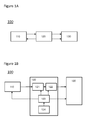
- FIG. 1A A general block diagram of an exemplary and generally known self-powered sensor system 100 is presented in Figure 1A . It comprises a sensor unit 110 a power and control unit 120 and a display and/or communication unit 130.
- the sensor unit 110 comprises, for example, at least one sensor device which converts a physical quantity or physical state into a signal, which is provided to the power and control unit 120 for evaluation and further process.
- the power and control unit 120 generally comprises, as shown in Figure 1B , an Analog-to-Digital Converter (ADC) 121, a microprocessor or microcontroller 122, a power management module 123 and a power supply module 124.
- the power supply module 124 may comprise a battery and/or an energy harvesting device and is intended to provide enough electrical power for the operation of the entire sensor system 100.
- the power management module 123 is in charge of regulating and distributing the electrical power generated by the power supply module 124 to all the system modules and units, so that system operation is performed as expected.
- the ADC 121 converts the sensor unit output signal to a digital format to be be processed by the microprocessor or microcontroller 122, which is in charge of performing algorithmic operations intended for system operation control and providing the necessary digital outputs to the display and/or communication unit 130.
- the display and/or communication unit 130 comprises means for displaying the data received from microprocessor or microcontroller 122 and/or transceiver means for transmitting and/or receiving information related to the self-powered sensor system 100.
- a self-powered sensor system comprising: an autonomous sensor unit including at least one energy harvester which converts an induced vibration into one electrical signal; a power management unit comprising analogue signal processing circuitry configured for extracting and generating, from the one electrical signal, at least one digital output signal indicative of a physical state being sensed and at least one electrical power signal; and at least one user unit comprising electronic circuitry being powered by said at least one electrical power signal and receiving said at least one digital output signal provided by said power management unit.
- one autonomous sensor unit e. g. an energy harvester, which does not need electrical power to generate at least one electrical signal
- analogue signal processing circuitry which can extract and generate, from a single electrical signal received from an energy harvester, at least one digital output signal indicative of a certain sensed physical state and at least one electrical power signal that can be used to power at least part of the additional electronic circuitry needed for the operation of the self-powered sensor system
- the energy consumption, the manufacturing costs and/or the implementation area of the self-powered sensor system can be advantageously reduced.
- the self-powered sensor system comprises at least one autonomous sensor unit, which avoids the need to implement, as different entities or units, a sensor for sensing a certain physical state and an energy supply for providing power to the system circuitry.
- the self-powered sensor system according to an embodiment of the invention, combines in one single non-powered entity, e.g. the autonomous sensor unit, the sensing and the power supply functionality.
- the autonomous sensor unit according to one embodiment of the invention includes at least one vibration energy harvester, which may comprise electrostatic, piezoelectric and/or electromagnetic transduction capabilities. Vibration energy harvesters are of specific interest for environments where sinusoidal or repetitive shocks are present and can convert an induced vibration into an electrical signal.
- a power management unit comprising analogue signal processing circuitry is advantageously combined with a vibration energy harvester in order to extract and generate at least one digital output signal indicative of a sensed physical state and at least one electrical power signal which can be used by other units of the system, in the following referred to as user units.
- the user units could be, but are not limited to, one or more of a display unit, a communications unit, a digital control unit, a battery or at least another sensor unit.
- the self-powered sensor unit according to an embodiment of the invention has embedded own analogue intelligence and therefore does not require, for extracting certain physical sensed states, the use of ADCs, microprocessors or microcontrollers, memories or algorithms, which would increase energy consumption, implementation area and system complexity. Therefore, by decreasing the number of complex components or units needed for performing the sensing, processing and/or power supply functionality the self-powered sensor unit according to an embodiment of the invention reduces size, maintenance problems, costs and increases robustness and reliability of the system. As a result, the life-time and autonomy of such self-powered sensor systems according to the invention is increased. Furthermore, processing time may be improved.
- the analogue signal processing circuitry unit further provides at least one power control signal for indicating to one or more user units when the power is available for operation. Therefore, the power management unit can advantageously indicate to the one or more user units the time point when the optimum electrical power signal its present for use and/or control the use of power by the one or more user units.
- the analogue signal processing circuitry is configured for generating a first and a second electrical power signal with different regulated voltage outputs and a corresponding first and second power control signal for indicating to one or more user units when each of the electrical power signals is available for operation. Therefore, the power management unit can further advantageously operate and generate, from a single rectified input DC voltage, two supply voltages to one or more user units.
- the analogue signal processing circuitry is configured for generating the second electrical power signal with a regulated voltage higher than the regulated voltage of the first electrical power signal and for providing the first electrical power signal to the one or more user units for a longer period of time than the second electrical power signal. Therefore, the power management unit can further advantageously operate and generate, from a single rectified input DC voltage, two supply voltages, with different characteristics and values, to one or more user units.
- the analogue signal processing circuitry is configured for extracting and generating, from said received at least one electrical signal, a first digital output signal representing a detected number of mechanical shocks. Therefore, the power management unit can advantageously extract and generate, using a low power analogue signal processing circuitry, a digital representation of a feature being sensed by the harvester, namely a number of mechanical shocks. According to still another embodiment of the invention, the first digital output signal representing a detected number of mechanical shocks is calculated based on that scaled forward current copy generated by the analogue signal processing circuitry. Therefore, further power can be reduced.
- the analogue signal processing circuitry is configured for extracting and generating, from said received at least one electrical signal, a second digital output signal representing a detected harvested energy. Therefore, the power management unit can advantageously extract and generate, using a low power analogue signal processing circuitry, a digital representation of a feature being sensed by the harvester, namely a representation of the harvested energy.
- the analogue signal processing circuitry comprises a single bridge rectifier which receives the at least one electrical signal, so that the analogue signal processing circuitry advantageously further reduces the use of rectifier components in order to operate and reduce energy consumption.
- the invention also relates to an electronic system or network, a machine or part thereof, a tire or a wheel or a means of transport comprising a self-powered sensor system according to any embodiment herein claimed.
- Figures 1A, 1B show a block diagram of a known exemplary self-powered sensor system.
- Figures 2A, 2B show a block diagram of a first and a second exemplary embodiment of a self-powered monitoring system according to the invention.
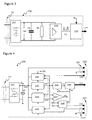
- Figure 3 illustrates a block diagram of an exemplary embodiment of a first analog processing circuit, in the power management unit of Figure 2B , designed for shock detection.
- Figure 4 illustrates a block diagram of an exemplary embodiment of a second analog circuit, in the power management unit of Figure 2B , designed for voltage regulation and harvested energy detection.
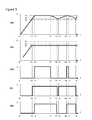
- Figure 5 shows time graphs of the output electrical power signals and power control signals provided by the power management unit according to an embodiment of the invention.
- Figure 6 shows the power output of a vibration energy harvester in a particular application environment according to an embodiment of the invention.
- Figure 2A shows a block diagram of a general embodiment of a self-powered monitoring system 200 according to the invention, comprising an autonomous sensor unit 210, a power management unit 220 and one or more user units 250, which is/are represented in the figure as a single general block.
- the autonomous sensor unit 210 generates and provides an electrical signal 02 to the power management unit 220, which, from that received electrical signal, extracts and generates at least one digital output signal 07 indicative of a_certain sensed or detected physical state and at least one electrical power signal 08 intended, for example, for powering the user unit 250.
- the power management unit 220 may further generate at least one power control signal 09 to indicate the user unit 250 when the power is available for operation and/or ready for use.
- the user unit 250 which may be, for example, one or more of a display unit, a communications unit, a digital control unit, a battery or at least another sensor unit, receives and uses at least one of the outputs generated by the power management unit 220, either for powering its electronic circuitry during a certain period of time or using the one or more digital output signals for further processing or operation.
- a user unit 250 may use at least one digital output signal 07 indicative of a sensed physical state and at least one electrical power signal 08 for its operation.
- a user unit 250 may use at least one power control signal 09 for its operation.
- the self-powered sensor system 200 advantageously combines in one single non-powered entity, the autonomous sensor unit 210, the sensing and the power supply functionality.
- the autonomous sensor unit 210 according to one embodiment of the invention includes at least one vibration energy harvester, which may comprise electrostatic, piezoelectric and/or electromagnetic transduction capabilities.
- vibration energy harvester An example of a vibration energy harvester is disclosed, for example in the paper " Shock induced energy harvesting with MEMS harvester for automotive applications", R.Elfrink, S.Matova, C.de Nooijer, M.Jambunathan, M.Goedbloed, J.van de Molengraft, V.Pop, R.J.M.Vullers, M.Renaud and R.van Schaijk, IEEE 2011, IEDM11-677 to 680 .
- the power management unit 220 comprises analogue signal processing circuitry and is advantageously combined with a vibration energy harvester in order to extract and generate, from the electrical signal provided by the energy harvester, at least one digital output representing a certain sensed physical state such as, for example, but not limited to, vibration, rotation, speed, shocks, force, and/or power and at least one electrical power signal which can be used by one or more user units 250.
- the power management unit 220 advantageously converts an irregular energy flow from the energy harvester into a regulated power signal and at least this condition may be signaled to the user unit 250 by means of a power control signal 09. Alternatively, the received irregular energy flow may be, in some cases, used directly by the user unit 250 for operation purposes.
- a user unit 250 may be a communications unit, which receives at least one digital output signal 07 representing a certain physical state, for example, but not limited to, vibration, rotation, speed, shocks, force, and/or power and then transmits such signal, and/or other state representations derived from that received digital output signal representation, via wired or wireless communication means.
- Figure 2B shows a block diagram of another embodiment of a self-powered monitoring system 200 according to the invention, comprising an autonomous sensor unit 210, a power management unit 220 and one or more user units 250, which are represented in the figure as a general single block.
- an autonomous sensor unit 210 described in Figure 2A
- such unit generates and provides, also according to the description above, at least one electrical signal 02 to the power management unit 220.
- the power management unit 220 comprises a first analogue signal processing circuit 230 configured for extracting and generating, from the received electrical signal 02, a first digital output signal 071 representing a detected number of shocks.
- the power management unit 220 further comprises a second analogue signal processing circuit 240 configured for extracting and generating, from the received electrical signal 02, a second digital output signal 072 representing a detected harvested energy.
- the power management unit 220 further comprises analogue signal processing circuitry for generating a first and a second electrical power signal 081, 082 with different regulated voltage outputs and generating a corresponding first and second power control signal 091, 092 for indicating to one or more user units 250 when each of the electrical power signals is available for operation.
- analogue signal processing circuitry of the power management unit 220 has been split in two different circuits 230, 240, those circuits may be implemented as a single analogue circuit providing all the above referenced outputs.
- FIG 3 shows a block diagram of an exemplary embodiment of the first analogue signal processing circuit 230 in the power management unit 220 illustrated in Figure 2 B.
- the first analogue signal processing circuit 230 according to an embodiment of the invention is designed for detecting mechanical shocks, a shock being a sudden acceleration or deceleration.
- the first analogue signal processing circuit 230 according to an embodiment of the invention comprises an active bridge rectifier circuit 231, a capacitor CX, a resistor RX, a shock sensing circuit 232 and a counter circuit 233. which is enabled during a certain period of time TX.
- the active bridge rectifier circuit 231 includes current controlled active diodes which provide a scaled forward current copy AIF of a charge current IF (shown in Figure 4 ).
- the scaled current copy AIF is a copy proportional to the charge current IF, said proportion being defined by a constant substantially smaller than one in order to enable low power consumption by the first analogue signal processing circuit 230.
- the scaled forward current copy AIF charges an RC network CX, RX, which define a time constant TX.
- the shock sensing circuit 232 includes a peak detector and a comparator, and a pulsed output 03 to the counter circuit 233.
- the counter circuit 233 provides a first digital output signal 071, by means, for example of a plurality of bits, representing a detected number of shocks. It shall be understood that from the detected shock information, for example, shock frequency and number of shocks, further useful characteristics may be also extracted, for example, speed or distance information, by means of further processing calculations.
- the first analogue signal processing circuit 230 allows extracting shock information from an energy harvester while an energy storage capacitor CE (shown in Figure 4 ) is charging.
- FIG. 4 shows a block diagram of an exemplary embodiment of the second analogue signal processing circuit 240 in the power management unit 220 illustrated in Figure 2 B.
- the second analogue signal processing circuit 240 according to an embodiment of the invention is designed for providing voltage regulation and harvested energy detection.
- the second analogue signal processing circuit 240 according to an embodiment of the invention comprises an active bridge rectifier circuit 241, an energy storage capacitor CE being charged by a charge current IF, a shunt regulator circuit 242, a voltage reference circuit 243, a voltage attenuator circuit 244, a low dropout regulator circuit 245, a relaxation oscillator circuit 246, a comparator 247, a logic circuit 248 and a power counter circuit 249.
- the active bridge rectifier circuit 241 converts alternating current energy, from a vibration energy harvester, into direct current (DC) energy, represented in the figure as an input DC voltage VCE.
- the voltage reference circuit 243 provides a constant DC electrical output signal as reference voltage VR having a constant reference voltage to ground.
- the voltage attenuator circuit 244 provides two linear attenuated output voltages KV1, KV2, derived from the input DC voltage VCE, with attenuation factors K1 and K2.
- the shunt regulator circuit 242 functions as an ideal clamp, so that if the input DC voltage VCE is lower than a certain threshold voltage the input current is zero.
- the input voltage is never allowed to be larger than threshold voltage, and, in that case, the shunt regulator circuit 242 clamps the input voltage to the threshold and shunts all input current to ground.
- the shunt regulator circuit 242 activates a second power control signal 092 when it is in clamp mode.
- the low dropout regulator circuit 245 is a linear series voltage regulator that provides a first electrical power signal 081, which is a regulated DC output voltage signal, when the input DC voltage VCE is larger than said regulated DC output voltage signal.
- the relaxation oscillator circuit 246 provides a clock signal output CLK, with a constant frequency, when its enable input EN is active.
- the power counter circuit 249 counts the periods of the clock signal output CLK during a certain time when its enable input EN is active.
- the power counter circuit 249 provides a second digital output signal 072, by means, for example of a plurality of bits, representing a detected harvested energy.
- the comparator 247 provides a startup detection indication signal SD when the input DC voltage VCE has reached a certain minimal threshold voltage.
- the logic circuit 248 generates an enable output signal EN in a time slot after the startup detection indication signal SD becomes active and until the second power control signal 092 becomes active and generates a first power control signal 091 in the time slot after the second power control signal 092 becomes active and until the startup detection indication signal SD is deactivated.
- the second analogue signal processing circuit 240 also provides a second electrical power signal 082, which is the input DC voltage VCE shunted by the shunt regulator circuit 242.
- the second analogue signal processing circuit 240 operates on a single rectified input DC voltage VCE to provide two energy aware intermittent supply voltages to users, referred to as a first and a second electrical power signal 081, 082.
- the second analogue signal processing circuit 240 senses the harvested energy during intermittent periods, represented by a digital output signal, referred as the second digital output signal 072.
- a shunt regulator circuit 242 and a low dropout regulator circuit 245 are used to provide regulated supply voltages.
- a low power reference voltage VR provides an accurate reference for generating a startup detection indication signal SD, the shunt regulator circuit output voltage and the low dropout regulator circuit regulated output voltage.
- the startup detection indication signal SD and a second power control signal 092 are used to provide the enabling time slot for the relaxation oscillator circuit 246 and the power counter circuit 249.
- the shunted output voltage, referred to as the second electrical power signal 082 may be supplied to an auxiliary user unit.
- the first and the second power control signals 091, 092 indicate that respectively the first and the second electrical power signals 081, 082 are in regulation and can be used.
- the power management unit 220 provides the first electrical power signal 081 and the first power control signal 091 to a first or main user unit 251 and the second electrical power signal 082 and the second power control signal 092 to a second or auxiliary user unit 252.
- the power management unit 220 comprises a single active bridge rectifier circuit, which is used by both the first and the second analogue signal processing circuit 230, 240, an the analogue signal processing circuitry is configured for, from that single active bridge rectifier circuit, generating both the charge current IF and the scaled forward current copy AIF of that charge current IF.
- analogue signal processing circuitry deal with digital-like signals and logic digital-like circuits, they do not deal with bits of information and follow digital bit instructions, as could be the case with a microcontroller, for generating a digital-like or digital compatible signal.
- Figure 5 illustrates an exemplary representation of the time graphs of the output electrical power signals 081, 082 and power control signals 091, 092 provided by the second analogue signal processing circuit 240 of Figure 4 .
- the second analogue signal processing circuit 240 also generates, for example, a startup detection indication signal SD for internal operation control of the power management unit 220.
- the timing diagram of Figure 5 shows the relations when the rectified input DC voltage VCE (shown in Figure 4 ) changes, that is, when, after a period of rest, the energy harvester is exposed again, at a certain initial time T0, to mechanical vibration of its sensing and harvesting mechanism. This may happen, for example, when the self-powered sensor system according to an embodiment of the invention is used to extract information from a certain machine, apparatus or part thereof, which has been at a rest or standby state during a certain period of time and said machine, apparatus or part thereof starts inducing a vibration in the energy harvester.
- the self-powered sensor system according to an embodiment of the invention is used to extract information from a tire or a wheel, once the tire or wheel has been at rest during a certain period of time and at a certain point such tire or wheel changes state and starts inducing a vibration in the energy harvester.
- the self-powered sensor system according to an embodiment of the invention starts harvesting energy and the rectified input DC voltage VCE rises up to a first voltage threshold V1 and the low dropout regulator circuit 245 starts regulating.
- the analogue circuit Short after the rectified input DC voltage VCE passes a second voltage threshold V2, for example when a second linear attenuated output voltage KV2 equals the reference voltage VR, at a first time point T1, the analogue circuit activates the startup detection indication signal SD and an enable signal EN so that the power counter circuit 249 counts pulses of the clock signal output CLK.
- the power counter circuit 249 counts pulses until the voltage reaches a third voltage threshold V3, for example when a first linear attenuated output voltage KV1 equals the reference voltage VR, at a second time point T2.
- the power counter circuit 249 provides, at the second time point T2, a digital output signal or value, referred in Figure 4 as the second digital output signal 072, representing the time passed between the second and the third voltage thresholds V2, V3, thus providing an indication of the harvested power. Also according to an embodiment of the invention, the power counter circuit 249 provides a digital output value signal which is proportional to the inverse of the harvested energy. Also at the second time point T2, the shunt regulator circuit 242 starts limiting the voltage and the first and second power control signal 091, 092 are activated to indicate to the main and/or the auxiliary user unit 251, 252 that they are allowed to use the corresponding output electrical power signals 081, 082 for powering their electronic circuitry and thereby start or resume operation.
- the rectified input DC voltage VCE may be caused to decrease, for example when the used power is higher than the average harvested power.
- an indication is provided, for example by deactivating the second power control signal 092, to the auxiliary user unit 252 that it shall stop using the second electrical power signal 082.
- the rectified input DC voltage VCE when the rectified input DC voltage VCE further decreases in voltage, to for example, approximately the second voltage threshold V2 minus a little hysteresis, at a fourth time point T4, an indication is provided, for example by deactivating the first power control signal 091, to the main user unit 251 that it shall stop using the first electrical power signal 081.
- the rectified input DC voltage VCE raises again until the second voltage threshold V2 is again reached at a fifth time point T5.
- the power counter circuit 249 is reset and starts counting pulses again until the voltage reaches the third voltage threshold V3 at a sixth time point T6.
- the power counter circuit 249 provides, at the sixth time point T6, a digital output signal or value representing the time passed between the second and the third voltage thresholds V2, V3, thus providing an indication of the harvested power.
- the indication of the harvested power is updated every intermittent power cycle, which depends on the harvested power, the value of the energy storage capacitor CE and the used power.
- the time graph following the sixth time point T6 can be understood from what has been explained above for the time between the second time point T2 and the fourth time point T4.
- FIG. 6 shows the power output of a vibration energy harvester in a particular application environment according to an embodiment of the invention.
- the self-powered sensor system according to an embodiment of the invention may be used in an application environment intended to extract and monitor, from the detected information about the harvested energy, the load applied on a vehicle tire or wheel.
- the figure shows that the power output of an energy harvester is a function of the load applied on the tire or wheel.
- the energy harvester was mounted inside a car tire and the power output of the harvester was monitored while driving at a constant speed of 60 km/h. This experiment was repeated while increasing the load Force Fz on the wheel from 2410 to 7240 Newton. This load is applied on the wheel in the direction of the road surface, mimicking an increase in vehicle mass.
- the results of these experiments showed that the load has a positive correlation with the power output, and it is therefore demonstrated that the power output can be used as an indication of the load of the vehicle, when the other conditions, e.g. vehicle speed, remain unchanged.
- the self-powered sensor system may be used, but not limited to, for example, in biopotential acquisition systems, power management systems, transport means or machine monitoring and/or control applications. Examples of some of such applications are machine or engine monitoring and control systems, failure mechanism monitoring and control or intelligent tire monitoring and control systems, and control or machine failure. Other industrial applications could include those where, for example, monitoring and/or control of the vibrations of machinery or equipment is required for research, tolerance or maintenance.
- monitoring and control system applications can benefit from the self-powered sensor system according to an embodiment of the invention that consumes only nanowatts of power.
- an example of an application that can greatly benefit from the use of a the self-powered sensor system according to an embodiment of the invention are so called intelligent tire systems used in the automotive industry to monitor, for example, road, tire and/or wheel conditions.
- the intelligent tire electronics comprising a self-powered sensor system according to an embodiment of the invention can be located inside a transport means wheel.
- the self-powered sensor system according to an embodiment of the invention may be mounted on the wheel rim or in the wheel arches.
- the self-powered sensor system according to an embodiment of the invention can be mounted inside a tire so that specific tire parameters can be captured.
- the components of a self-powered sensor system can be integrated on a substrate, for example, in a single substrate, and either in flexible, e.g. foil, or rigid, e.g. silicon, form.
- the components may also be implemented as discrete electronic components mounted on a Printed Circuit Board.
Landscapes
- Engineering & Computer Science (AREA)
- Mechanical Engineering (AREA)
- Physics & Mathematics (AREA)
- General Physics & Mathematics (AREA)
- Arrangements For Transmission Of Measured Signals (AREA)
Abstract
Description
- The present invention relates in general to the field of sensor systems and more specifically to self-powered sensor systems.
- Self-powered sensor systems become steadily standard components in our environment for use in monitoring applications and they become smaller, cheaper and more sophisticated. Wide-scale deployment of this kind of systems and applications depends primarily on its ability to operate for long periods of time and it is considered that, for the intended application lifetimes, this object is not reached when using batteries, due to size limitations and the need to recharge. Furthermore, environmental issues are of great importance for battery powered systems. Therefore, in order to improve system autonomy and lifetime, effort is ongoing to replace batteries with small and long lasting power sources like energy harvesters.
- Energy harvesting or energy scavenging is the process of converting unused ambient energy into electrical power. Energy harvesting devices come in various forms, and can provide electrical power by means of vibration, thermal, photovoltaic and radiofrequency conversions.
- A general block diagram of an exemplary and generally known self-powered
sensor system 100 is presented inFigure 1A . It comprises a sensor unit 110 a power andcontrol unit 120 and a display and/orcommunication unit 130. Thesensor unit 110 comprises, for example, at least one sensor device which converts a physical quantity or physical state into a signal, which is provided to the power andcontrol unit 120 for evaluation and further process. The power andcontrol unit 120 generally comprises, as shown inFigure 1B , an Analog-to-Digital Converter (ADC) 121, a microprocessor ormicrocontroller 122, apower management module 123 and apower supply module 124. Thepower supply module 124 may comprise a battery and/or an energy harvesting device and is intended to provide enough electrical power for the operation of theentire sensor system 100. Thepower management module 123 is in charge of regulating and distributing the electrical power generated by thepower supply module 124 to all the system modules and units, so that system operation is performed as expected. The ADC 121 converts the sensor unit output signal to a digital format to be be processed by the microprocessor ormicrocontroller 122, which is in charge of performing algorithmic operations intended for system operation control and providing the necessary digital outputs to the display and/orcommunication unit 130. The display and/orcommunication unit 130 comprises means for displaying the data received from microprocessor ormicrocontroller 122 and/or transceiver means for transmitting and/or receiving information related to the self-poweredsensor system 100. - A problem with the current state of the art self-powered sensor systems as described above is the still high power consumption, manufacturing costs and large implementation area needed.
- It is an object of the present invention to provide an improved self-powered sensor system, which reduces manufacturing costs, implementation area and/or system power consumption.
- According to one embodiment of the invention, there is provided a self-powered sensor system comprising: an autonomous sensor unit including at least one energy harvester which converts an induced vibration into one electrical signal; a power management unit comprising analogue signal processing circuitry configured for extracting and generating, from the one electrical signal, at least one digital output signal indicative of a physical state being sensed and at least one electrical power signal; and at least one user unit comprising electronic circuitry being powered by said at least one electrical power signal and receiving said at least one digital output signal provided by said power management unit.
- According to an embodiment of the invention, by providing one autonomous sensor unit, e. g. an energy harvester, which does not need electrical power to generate at least one electrical signal and by providing analogue signal processing circuitry which can extract and generate, from a single electrical signal received from an energy harvester, at least one digital output signal indicative of a certain sensed physical state and at least one electrical power signal that can be used to power at least part of the additional electronic circuitry needed for the operation of the self-powered sensor system, the energy consumption, the manufacturing costs and/or the implementation area of the self-powered sensor system can be advantageously reduced. The self-powered sensor system, according to an embodiment of the invention, comprises at least one autonomous sensor unit, which avoids the need to implement, as different entities or units, a sensor for sensing a certain physical state and an energy supply for providing power to the system circuitry. The self-powered sensor system, according to an embodiment of the invention, combines in one single non-powered entity, e.g. the autonomous sensor unit, the sensing and the power supply functionality. The autonomous sensor unit, according to one embodiment of the invention includes at least one vibration energy harvester, which may comprise electrostatic, piezoelectric and/or electromagnetic transduction capabilities. Vibration energy harvesters are of specific interest for environments where sinusoidal or repetitive shocks are present and can convert an induced vibration into an electrical signal. Also according to an embodiment of the invention, a power management unit comprising analogue signal processing circuitry is advantageously combined with a vibration energy harvester in order to extract and generate at least one digital output signal indicative of a sensed physical state and at least one electrical power signal which can be used by other units of the system, in the following referred to as user units. The user units could be, but are not limited to, one or more of a display unit, a communications unit, a digital control unit, a battery or at least another sensor unit. Additionally and advantageously, the self-powered sensor unit according to an embodiment of the invention has embedded own analogue intelligence and therefore does not require, for extracting certain physical sensed states, the use of ADCs, microprocessors or microcontrollers, memories or algorithms, which would increase energy consumption, implementation area and system complexity. Therefore, by decreasing the number of complex components or units needed for performing the sensing, processing and/or power supply functionality the self-powered sensor unit according to an embodiment of the invention reduces size, maintenance problems, costs and increases robustness and reliability of the system. As a result, the life-time and autonomy of such self-powered sensor systems according to the invention is increased. Furthermore, processing time may be improved.
- According to another embodiment of the invention the analogue signal processing circuitry unit further provides at least one power control signal for indicating to one or more user units when the power is available for operation. Therefore, the power management unit can advantageously indicate to the one or more user units the time point when the optimum electrical power signal its present for use and/or control the use of power by the one or more user units.
- According to still another embodiment of the invention, the analogue signal processing circuitry is configured for generating a first and a second electrical power signal with different regulated voltage outputs and a corresponding first and second power control signal for indicating to one or more user units when each of the electrical power signals is available for operation. Therefore, the power management unit can further advantageously operate and generate, from a single rectified input DC voltage, two supply voltages to one or more user units.
- According to still another embodiment of the invention, the analogue signal processing circuitry is configured for generating the second electrical power signal with a regulated voltage higher than the regulated voltage of the first electrical power signal and for providing the first electrical power signal to the one or more user units for a longer period of time than the second electrical power signal. Therefore, the power management unit can further advantageously operate and generate, from a single rectified input DC voltage, two supply voltages, with different characteristics and values, to one or more user units.
- According to still another embodiment of the invention, the analogue signal processing circuitry is configured for extracting and generating, from said received at least one electrical signal, a first digital output signal representing a detected number of mechanical shocks. Therefore, the power management unit can advantageously extract and generate, using a low power analogue signal processing circuitry, a digital representation of a feature being sensed by the harvester, namely a number of mechanical shocks. According to still another embodiment of the invention, the first digital output signal representing a detected number of mechanical shocks is calculated based on that scaled forward current copy generated by the analogue signal processing circuitry. Therefore, further power can be reduced.
- According to still another embodiment of the invention, the analogue signal processing circuitry is configured for extracting and generating, from said received at least one electrical signal, a second digital output signal representing a detected harvested energy. Therefore, the power management unit can advantageously extract and generate, using a low power analogue signal processing circuitry, a digital representation of a feature being sensed by the harvester, namely a representation of the harvested energy.
- According to still another embodiment of the invention, the analogue signal processing circuitry comprises a single bridge rectifier which receives the at least one electrical signal, so that the analogue signal processing circuitry advantageously further reduces the use of rectifier components in order to operate and reduce energy consumption.
- The invention also relates to an electronic system or network, a machine or part thereof, a tire or a wheel or a means of transport comprising a self-powered sensor system according to any embodiment herein claimed.
- Certain objects and advantages of various inventive aspects have been described above. It is to be understood that not necessarily all such objects or advantages may be achieved in accordance with any particular embodiment of the invention. Those skilled in the art will recognize that the invention may be embodied or carried out in a manner that achieves or optimizes one advantage or group of advantages without necessarily achieving other objects or advantages as may be taught or suggested herein.
- The accompanying drawings illustrate one or more exemplary embodiment(s) of the present invention and, together with the description, further serve to explain the principles of the invention and to enable a persona skilled in the art to make and use the invention.
-
Figures 1A, 1B show a block diagram of a known exemplary self-powered sensor system. -
Figures 2A, 2B show a block diagram of a first and a second exemplary embodiment of a self-powered monitoring system according to the invention. -
Figure 3 illustrates a block diagram of an exemplary embodiment of a first analog processing circuit, in the power management unit ofFigure 2B , designed for shock detection. -
Figure 4 illustrates a block diagram of an exemplary embodiment of a second analog circuit, in the power management unit ofFigure 2B , designed for voltage regulation and harvested energy detection. -
Figure 5 shows time graphs of the output electrical power signals and power control signals provided by the power management unit according to an embodiment of the invention. -
Figure 6 shows the power output of a vibration energy harvester in a particular application environment according to an embodiment of the invention. - In the following, it should be appreciated that in the description of exemplary embodiments of the invention, various features of the invention are sometimes grouped together in a single embodiment, figure, or description thereof for the purpose of streamlining the disclosure and aiding in the understanding of one or more of the various inventive aspects. This is however not to be interpreted as the invention requiring more features than the ones expressly recited in each claim, with each claim standing on its own as a separate embodiment of this invention.
- Furthermore, while some embodiments described herein include some but not other features included in other embodiments, combinations of features of different embodiments are meant to be within the scope of the invention, and form different embodiments, as would be understood by those skilled in the art.
- In the description of the embodiments, numerous specific details are set forth. However, it is understood that embodiments of the invention may be practiced without these non-essential specific details. In other instances, well-known methods, structures and techniques have not been shown in detail in order not to obscure the understanding of this description.
-
Figure 2A shows a block diagram of a general embodiment of a self-poweredmonitoring system 200 according to the invention, comprising anautonomous sensor unit 210, apower management unit 220 and one ormore user units 250, which is/are represented in the figure as a single general block. Theautonomous sensor unit 210 generates and provides anelectrical signal 02 to thepower management unit 220, which, from that received electrical signal, extracts and generates at least onedigital output signal 07 indicative of a_certain sensed or detected physical state and at least oneelectrical power signal 08 intended, for example, for powering theuser unit 250. Advantageously, thepower management unit 220 may further generate at least onepower control signal 09 to indicate theuser unit 250 when the power is available for operation and/or ready for use. Theuser unit 250, which may be, for example, one or more of a display unit, a communications unit, a digital control unit, a battery or at least another sensor unit, receives and uses at least one of the outputs generated by thepower management unit 220, either for powering its electronic circuitry during a certain period of time or using the one or more digital output signals for further processing or operation. Advantageously, auser unit 250 may use at least onedigital output signal 07 indicative of a sensed physical state and at least oneelectrical power signal 08 for its operation. Furthermore, auser unit 250 may use at least onepower control signal 09 for its operation. - The self-powered
sensor system 200 according to an embodiment of the invention advantageously combines in one single non-powered entity, theautonomous sensor unit 210, the sensing and the power supply functionality. Theautonomous sensor unit 210 according to one embodiment of the invention includes at least one vibration energy harvester, which may comprise electrostatic, piezoelectric and/or electromagnetic transduction capabilities. An example of a vibration energy harvester is disclosed, for example in the paper " Shock induced energy harvesting with MEMS harvester for automotive applications", R.Elfrink, S.Matova, C.de Nooijer, M.Jambunathan, M.Goedbloed, J.van de Molengraft, V.Pop, R.J.M.Vullers, M.Renaud and R.van Schaijk, IEEE 2011, IEDM11-677 to 680. - Also according to an embodiment of the invention, the
power management unit 220 comprises analogue signal processing circuitry and is advantageously combined with a vibration energy harvester in order to extract and generate, from the electrical signal provided by the energy harvester, at least one digital output representing a certain sensed physical state such as, for example, but not limited to, vibration, rotation, speed, shocks, force, and/or power and at least one electrical power signal which can be used by one ormore user units 250. In an embodiment thepower management unit 220 advantageously converts an irregular energy flow from the energy harvester into a regulated power signal and at least this condition may be signaled to theuser unit 250 by means of apower control signal 09. Alternatively, the received irregular energy flow may be, in some cases, used directly by theuser unit 250 for operation purposes. The analogue signal processing circuitry of thepower management unit 220 advantageously extracts and detects one or more specific states of interest from a single electrical signal generated by at least one energy harvester. According, for example, to a possible embodiment of the invention, auser unit 250 may be a communications unit, which receives at least onedigital output signal 07 representing a certain physical state, for example, but not limited to, vibration, rotation, speed, shocks, force, and/or power and then transmits such signal, and/or other state representations derived from that received digital output signal representation, via wired or wireless communication means. -
Figure 2B shows a block diagram of another embodiment of a self-poweredmonitoring system 200 according to the invention, comprising anautonomous sensor unit 210, apower management unit 220 and one ormore user units 250, which are represented in the figure as a general single block. Similarly to theautonomous sensor unit 210 described inFigure 2A , such unit generates and provides, also according to the description above, at least oneelectrical signal 02 to thepower management unit 220. Thepower management unit 220 comprises a first analoguesignal processing circuit 230 configured for extracting and generating, from the receivedelectrical signal 02, a firstdigital output signal 071 representing a detected number of shocks. Thepower management unit 220 further comprises a second analoguesignal processing circuit 240 configured for extracting and generating, from the receivedelectrical signal 02, a seconddigital output signal 072 representing a detected harvested energy. Thepower management unit 220 further comprises analogue signal processing circuitry for generating a first and a secondelectrical power signal power control signal more user units 250 when each of the electrical power signals is available for operation. It shall be understood that, although, for the sake of simplification and clarity, the analogue signal processing circuitry of thepower management unit 220 has been split in twodifferent circuits -
Figure 3 shows a block diagram of an exemplary embodiment of the first analoguesignal processing circuit 230 in thepower management unit 220 illustrated inFigure 2 B. The first analoguesignal processing circuit 230 according to an embodiment of the invention is designed for detecting mechanical shocks, a shock being a sudden acceleration or deceleration. The first analoguesignal processing circuit 230 according to an embodiment of the invention comprises an activebridge rectifier circuit 231, a capacitor CX, a resistor RX, ashock sensing circuit 232 and acounter circuit 233. which is enabled during a certain period of time TX. - The active
bridge rectifier circuit 231 includes current controlled active diodes which provide a scaled forward current copy AIF of a charge current IF (shown inFigure 4 ). The scaled current copy AIF is a copy proportional to the charge current IF, said proportion being defined by a constant substantially smaller than one in order to enable low power consumption by the first analoguesignal processing circuit 230. The scaled forward current copy AIF charges an RC network CX, RX, which define a time constant TX. Theshock sensing circuit 232 includes a peak detector and a comparator, and apulsed output 03 to thecounter circuit 233. The time constant TX, wherein TX = RX x CX, should be chosen such that the best detectable shape is obtained. Thecounter circuit 233 provides a firstdigital output signal 071, by means, for example of a plurality of bits, representing a detected number of shocks. It shall be understood that from the detected shock information, for example, shock frequency and number of shocks, further useful characteristics may be also extracted, for example, speed or distance information, by means of further processing calculations. The first analoguesignal processing circuit 230 allows extracting shock information from an energy harvester while an energy storage capacitor CE (shown inFigure 4 ) is charging. -
Figure 4 shows a block diagram of an exemplary embodiment of the second analoguesignal processing circuit 240 in thepower management unit 220 illustrated inFigure 2 B. The second analoguesignal processing circuit 240 according to an embodiment of the invention is designed for providing voltage regulation and harvested energy detection. The second analoguesignal processing circuit 240 according to an embodiment of the invention comprises an activebridge rectifier circuit 241, an energy storage capacitor CE being charged by a charge current IF, ashunt regulator circuit 242, avoltage reference circuit 243, avoltage attenuator circuit 244, a lowdropout regulator circuit 245, arelaxation oscillator circuit 246, acomparator 247, alogic circuit 248 and apower counter circuit 249. - The active
bridge rectifier circuit 241 converts alternating current energy, from a vibration energy harvester, into direct current (DC) energy, represented in the figure as an input DC voltage VCE. Thevoltage reference circuit 243 provides a constant DC electrical output signal as reference voltage VR having a constant reference voltage to ground. Thevoltage attenuator circuit 244 provides two linear attenuated output voltages KV1, KV2, derived from the input DC voltage VCE, with attenuation factors K1 and K2. Theshunt regulator circuit 242 functions as an ideal clamp, so that if the input DC voltage VCE is lower than a certain threshold voltage the input current is zero. The input voltage is never allowed to be larger than threshold voltage, and, in that case, theshunt regulator circuit 242 clamps the input voltage to the threshold and shunts all input current to ground. Theshunt regulator circuit 242 activates a secondpower control signal 092 when it is in clamp mode. The lowdropout regulator circuit 245 is a linear series voltage regulator that provides a firstelectrical power signal 081, which is a regulated DC output voltage signal, when the input DC voltage VCE is larger than said regulated DC output voltage signal. Therelaxation oscillator circuit 246 provides a clock signal output CLK, with a constant frequency, when its enable input EN is active. Thepower counter circuit 249 counts the periods of the clock signal output CLK during a certain time when its enable input EN is active. Thepower counter circuit 249 provides a seconddigital output signal 072, by means, for example of a plurality of bits, representing a detected harvested energy. Thecomparator 247 provides a startup detection indication signal SD when the input DC voltage VCE has reached a certain minimal threshold voltage. Thelogic circuit 248 generates an enable output signal EN in a time slot after the startup detection indication signal SD becomes active and until the secondpower control signal 092 becomes active and generates a firstpower control signal 091 in the time slot after the secondpower control signal 092 becomes active and until the startup detection indication signal SD is deactivated. The second analoguesignal processing circuit 240 also provides a secondelectrical power signal 082, which is the input DC voltage VCE shunted by theshunt regulator circuit 242. - Advantageously, the second analogue
signal processing circuit 240, according to an embodiment of the invention, operates on a single rectified input DC voltage VCE to provide two energy aware intermittent supply voltages to users, referred to as a first and a secondelectrical power signal signal processing circuit 240 senses the harvested energy during intermittent periods, represented by a digital output signal, referred as the seconddigital output signal 072. - A
shunt regulator circuit 242 and a lowdropout regulator circuit 245 are used to provide regulated supply voltages. A low power reference voltage VR provides an accurate reference for generating a startup detection indication signal SD, the shunt regulator circuit output voltage and the low dropout regulator circuit regulated output voltage. The startup detection indication signal SD and a secondpower control signal 092 are used to provide the enabling time slot for therelaxation oscillator circuit 246 and thepower counter circuit 249. The shunted output voltage, referred to as the secondelectrical power signal 082 may be supplied to an auxiliary user unit. The first and the second power control signals 091, 092 indicate that respectively the first and the second electrical power signals 081, 082 are in regulation and can be used. - According to one embodiment of the invention, the
power management unit 220 provides the firstelectrical power signal 081 and the firstpower control signal 091 to a first ormain user unit 251 and the secondelectrical power signal 082 and the secondpower control signal 092 to a second orauxiliary user unit 252. - According to one embodiment of the invention, the
power management unit 220 comprises a single active bridge rectifier circuit, which is used by both the first and the second analoguesignal processing circuit - It shall be understood that although some elements of the analogue signal processing circuitry according to an embodiment of the invention deal with digital-like signals and logic digital-like circuits, they do not deal with bits of information and follow digital bit instructions, as could be the case with a microcontroller, for generating a digital-like or digital compatible signal.
-
Figure 5 illustrates an exemplary representation of the time graphs of the output electrical power signals 081, 082 and power control signals 091, 092 provided by the second analoguesignal processing circuit 240 ofFigure 4 . According to an embodiment of the invention, the second analoguesignal processing circuit 240 also generates, for example, a startup detection indication signal SD for internal operation control of thepower management unit 220. - The timing diagram of
Figure 5 shows the relations when the rectified input DC voltage VCE (shown inFigure 4 ) changes, that is, when, after a period of rest, the energy harvester is exposed again, at a certain initial time T0, to mechanical vibration of its sensing and harvesting mechanism. This may happen, for example, when the self-powered sensor system according to an embodiment of the invention is used to extract information from a certain machine, apparatus or part thereof, which has been at a rest or standby state during a certain period of time and said machine, apparatus or part thereof starts inducing a vibration in the energy harvester. This may also happen, for example, when the self-powered sensor system according to an embodiment of the invention is used to extract information from a tire or a wheel, once the tire or wheel has been at rest during a certain period of time and at a certain point such tire or wheel changes state and starts inducing a vibration in the energy harvester. At that point, the self-powered sensor system according to an embodiment of the invention starts harvesting energy and the rectified input DC voltage VCE rises up to a first voltage threshold V1 and the lowdropout regulator circuit 245 starts regulating. Short after the rectified input DC voltage VCE passes a second voltage threshold V2, for example when a second linear attenuated output voltage KV2 equals the reference voltage VR, at a first time point T1, the analogue circuit activates the startup detection indication signal SD and an enable signal EN so that thepower counter circuit 249 counts pulses of the clock signal output CLK. Thepower counter circuit 249 counts pulses until the voltage reaches a third voltage threshold V3, for example when a first linear attenuated output voltage KV1 equals the reference voltage VR, at a second time point T2. According to an embodiment of the invention, thepower counter circuit 249 provides, at the second time point T2, a digital output signal or value, referred inFigure 4 as the seconddigital output signal 072, representing the time passed between the second and the third voltage thresholds V2, V3, thus providing an indication of the harvested power. Also according to an embodiment of the invention, thepower counter circuit 249 provides a digital output value signal which is proportional to the inverse of the harvested energy. Also at the second time point T2, theshunt regulator circuit 242 starts limiting the voltage and the first and secondpower control signal auxiliary user unit power control signal 092, to theauxiliary user unit 252 that it shall stop using the secondelectrical power signal 082. Also according to an embodiment of the invention, when the rectified input DC voltage VCE further decreases in voltage, to for example, approximately the second voltage threshold V2 minus a little hysteresis, at a fourth time point T4, an indication is provided, for example by deactivating the firstpower control signal 091, to themain user unit 251 that it shall stop using the firstelectrical power signal 081. As a result the rectified input DC voltage VCE raises again until the second voltage threshold V2 is again reached at a fifth time point T5. According to an embodiment of the invention, at the fifth time point T5 thepower counter circuit 249 is reset and starts counting pulses again until the voltage reaches the third voltage threshold V3 at a sixth time point T6. Thepower counter circuit 249 provides, at the sixth time point T6, a digital output signal or value representing the time passed between the second and the third voltage thresholds V2, V3, thus providing an indication of the harvested power. The indication of the harvested power is updated every intermittent power cycle, which depends on the harvested power, the value of the energy storage capacitor CE and the used power. The time graph following the sixth time point T6 can be understood from what has been explained above for the time between the second time point T2 and the fourth time point T4. It shall be understood that the above described embodiments do not imply the essentiality to connect two different user units to the power management unit, and that a person skilled in the art can derive other embodiments from the ones herein explained, for example, connecting just one user unit to the power management unit according to the invention or connecting just one user unit to the two electrical power signals or modifying the internal control signals so that the digital representation of the detected harvested power is provided with a different indication, for example, an accumulated value, a peak value, and integral, etc. -
Figure 6 shows the power output of a vibration energy harvester in a particular application environment according to an embodiment of the invention. The self-powered sensor system according to an embodiment of the invention may be used in an application environment intended to extract and monitor, from the detected information about the harvested energy, the load applied on a vehicle tire or wheel. The figure shows that the power output of an energy harvester is a function of the load applied on the tire or wheel. In this specific case, the energy harvester was mounted inside a car tire and the power output of the harvester was monitored while driving at a constant speed of 60 km/h. This experiment was repeated while increasing the load Force Fz on the wheel from 2410 to 7240 Newton. This load is applied on the wheel in the direction of the road surface, mimicking an increase in vehicle mass. The results of these experiments showed that the load has a positive correlation with the power output, and it is therefore demonstrated that the power output can be used as an indication of the load of the vehicle, when the other conditions, e.g. vehicle speed, remain unchanged. - The self-powered sensor system according to any of the embodiments herein described may be used, but not limited to, for example, in biopotential acquisition systems, power management systems, transport means or machine monitoring and/or control applications. Examples of some of such applications are machine or engine monitoring and control systems, failure mechanism monitoring and control or intelligent tire monitoring and control systems, and control or machine failure. Other industrial applications could include those where, for example, monitoring and/or control of the vibrations of machinery or equipment is required for research, tolerance or maintenance. Advantageously, such monitoring and control system applications can benefit from the self-powered sensor system according to an embodiment of the invention that consumes only nanowatts of power. An example of an application that can greatly benefit from the use of a the self-powered sensor system according to an embodiment of the invention are so called intelligent tire systems used in the automotive industry to monitor, for example, road, tire and/or wheel conditions. In a particular application example, the intelligent tire electronics comprising a self-powered sensor system according to an embodiment of the invention can be located inside a transport means wheel. In another particular application environment the self-powered sensor system according to an embodiment of the invention may be mounted on the wheel rim or in the wheel arches. In some application environments, the self-powered sensor system according to an embodiment of the invention can be mounted inside a tire so that specific tire parameters can be captured. It is understood that other locations for mounting the self-powered sensor system according to an embodiment of the invention are not excluded and may be similarly used for applications that benefit from the embodiments herein described. In general, other characteristics of the harvester output signal can be used for extracting vehicle and tire specific information, e.g. peak value, amplitude, integral, width of the signal. Moreover, mathematical formulae and algorithms may be used, based on physical models, empirical relations, and/or state estimation techniques.
- The components of a self-powered sensor system according to an embodiment of the invention can be integrated on a substrate, for example, in a single substrate, and either in flexible, e.g. foil, or rigid, e.g. silicon, form. The components may also be implemented as discrete electronic components mounted on a Printed Circuit Board.
Claims (12)
- A self-powered sensor system (200) comprising: an autonomous sensor unit (210) including at least one energy harvester which converts an induced vibration into at least one electrical signal (02); a power management unit (220) comprising analogue signal processing circuitry (230, 240), said analogue signal processing circuitry being configured for extracting and generating, from said received at least one electrical signal (02), at least one digital output signal (07) indicative of a sensed physical state and at least one electrical power signal (08); and at least one user unit (250) comprising electronic circuitry being powered by said at least one electrical power signal (08) and/or receiving said at least one digital output signal (07) provided by said power management unit (220).
- A self-powered sensor system (200) according to claim 1 wherein the analogue signal processing circuitry (230, 240) further provides at least one power control signal (09) for indicating to one or more user units (250) when the power is available for operation.
- A self-powered sensor system (200) according to claim 2 wherein the analogue signal processing circuitry (230, 240) is configured for generating a first and a second electrical power signal (081, 082) with different regulated voltage outputs and a corresponding first and second power control signal (091, 092) for indicating to one or more user units (250) when each of the electrical power signals (081, 082) is available for operation.
- A self-powered sensor system (200) according to claim 3 wherein the analogue signal processing circuitry (230, 240) is configured for generating the second electrical power signal (082) with a regulated voltage higher than the regulated voltage of the first electrical power signal (081) and for providing the first electrical power signal (081) to the one or more user units (250) for a longer period of time (T2 to T4) than the second electrical power signal (082).
- A self-powered sensor system (200) according to any of the preceding claims wherein the analogue signal processing circuitry (230, 240) is configured for extracting and generating, from said received at least one electrical signal (02), a first digital output signal (071) representing a detected number of mechanical shocks.
- A self-powered sensor system (200) according to claim 5 wherein the analogue signal processing circuitry (230, 240) is configured for generating a scaled forward current copy (AIF) of a charge current (IF), said scaled forward current copy (AIF) being proportional to said charge current (IF) by a constant substantially smaller than one and the analogue signal processing circuitry (230, 240) is further configured for generating the first digital output signal (071) representing a detected number of mechanical shocks, based on that scaled forward current copy (AIF).
- A self-powered sensor system (200) according to any of the preceding claims wherein the analogue signal processing circuitry (230, 240) is configured for extracting and generating, from said received at least one electrical signal (02), a second digital output signal (072) representing a detected harvested energy.
- A self-powered sensor system (200) according to any of claims 5 to 7 wherein the analogue signal processing circuitry (230, 240) comprises a single bridge rectifier (231, 241) which receives said at least one electrical signal (02).
- An electronic or network system comprising a self-powered sensor system (200) according to any of claims 1 to 8.
- A machine or part thereof comprising a self-powered sensor system (200) according to any of claims 1 to 8.
- A tire or wheel comprising a self-powered sensor system (200) according to any of claims 1 to 8.
- A means of transport comprising a self-powered sensor system (200) according to any of claims 1 to 8.
Priority Applications (1)
| Application Number | Priority Date | Filing Date | Title |
|---|---|---|---|
| EP13175314.7A EP2685220A3 (en) | 2012-07-10 | 2013-07-05 | Self-powered sensor system |
Applications Claiming Priority (2)
| Application Number | Priority Date | Filing Date | Title |
|---|---|---|---|
| EP12175723 | 2012-07-10 | ||
| EP13175314.7A EP2685220A3 (en) | 2012-07-10 | 2013-07-05 | Self-powered sensor system |
Publications (2)
| Publication Number | Publication Date |
|---|---|
| EP2685220A2 true EP2685220A2 (en) | 2014-01-15 |
| EP2685220A3 EP2685220A3 (en) | 2017-08-02 |
Family
ID=46754257
Family Applications (1)
| Application Number | Title | Priority Date | Filing Date |
|---|---|---|---|
| EP13175314.7A Withdrawn EP2685220A3 (en) | 2012-07-10 | 2013-07-05 | Self-powered sensor system |
Country Status (2)
| Country | Link |
|---|---|
| US (1) | US20140013851A1 (en) |
| EP (1) | EP2685220A3 (en) |
Cited By (4)
| Publication number | Priority date | Publication date | Assignee | Title |
|---|---|---|---|---|
| WO2017117247A1 (en) * | 2015-12-28 | 2017-07-06 | Case Western Reserve University | Energy-harvesting sensor system and method therefor |
| WO2018089171A1 (en) * | 2016-11-11 | 2018-05-17 | Qualcomm Incorporated | Self-powered clock input buffer |
| EP3333655A1 (en) * | 2016-12-07 | 2018-06-13 | Sick Ag | Programmable logic controller |
| GB2615642A (en) * | 2021-12-20 | 2023-08-16 | Prevayl Innovations Ltd | Device comprising a sensor and method performed by the same |
Families Citing this family (6)
| Publication number | Priority date | Publication date | Assignee | Title |
|---|---|---|---|---|
| SG11201707001XA (en) * | 2015-02-26 | 2017-09-28 | Agency Science Tech & Res | A self-powered acceleration sensing device |
| DE102016210989A1 (en) * | 2016-06-20 | 2017-07-27 | Continental Automotive Gmbh | Sensor module with energy recovery and control module for vehicles and vehicle |
| DE102019100105A1 (en) | 2019-01-04 | 2020-07-09 | Enocean Gmbh | Device for recording the activity of people or the state of infrastructures or objects influenced by people |
| FR3107007B1 (en) * | 2020-02-07 | 2025-03-14 | Continental Automotive | Method for controlling an electronic valve for a motor vehicle tire and associated device |
| CN111786448A (en) * | 2020-07-06 | 2020-10-16 | 苏州微著设备诊断技术有限公司 | Signal energy collecting circuit of magnetoelectric wheel speed sensor |
| CN116243012A (en) * | 2021-12-07 | 2023-06-09 | 大陆汽车电子(连云港)有限公司 | A self-powered wireless wheel speed sensor |
Family Cites Families (26)
| Publication number | Priority date | Publication date | Assignee | Title |
|---|---|---|---|---|
| US3713127A (en) * | 1970-10-16 | 1973-01-23 | Trodyne Corp | Acoustic emission crack monitor |
| US4112317A (en) * | 1977-05-05 | 1978-09-05 | The United States Of America As Represented By The Secretary Of The Army | Pulse amplitude and width detection system |
| EP0778942B1 (en) * | 1994-08-31 | 2002-02-27 | Honeywell Inc. | Remote self-powered structure monitor |
| US5677558A (en) * | 1995-03-03 | 1997-10-14 | Analog Devices, Inc. | Low dropout linear regulator |
| US6809462B2 (en) * | 2000-04-05 | 2004-10-26 | Sri International | Electroactive polymer sensors |
| US6259372B1 (en) * | 1999-01-22 | 2001-07-10 | Eaton Corporation | Self-powered wireless transducer |
| US6731103B1 (en) * | 2001-11-20 | 2004-05-04 | National Semiconductor Corporation | Peak detector circuit |
| US6563726B1 (en) * | 2001-11-21 | 2003-05-13 | Hewlett-Packard Company | Synchronous bridge rectifier |
| US6911914B2 (en) * | 2002-03-29 | 2005-06-28 | General Electric Company | Method and apparatus for detecting hot rail car surfaces |
| GB0323906D0 (en) * | 2003-10-11 | 2003-11-12 | Bandara Palitha | Instrument for measuring the tension in a textile yarn using non-contact sensing |
| US20050087019A1 (en) * | 2003-10-24 | 2005-04-28 | Face Bradbury R. | Self-powered vibration monitoring system |
| US20050285569A1 (en) * | 2004-06-28 | 2005-12-29 | Samantha Rao | Power conversion system and method |
| EP2108971A1 (en) * | 2008-04-11 | 2009-10-14 | Stichting IMEC Nederland | Autonomous system with estimation of remaining run-time by indirect measurement |
| DE102009001617A1 (en) * | 2009-03-17 | 2010-09-23 | Robert Bosch Gmbh | Sensor module for a vehicle safety system and method for operating such a sensor module |
| US8571835B2 (en) * | 2009-06-02 | 2013-10-29 | New Jersey Institute Of Technology | Vibration powered impact recorder (VPIR) |
| DE102009047247A1 (en) * | 2009-11-27 | 2011-09-08 | Hahn-Schickard-Gesellschaft für angewandte Forschung e.V. | A load condition determiner, load assembly, power supply circuit, and method for determining a load condition of an electrical power source |
| GB201000346D0 (en) * | 2010-01-11 | 2010-02-24 | Jogia Paresh | Headphones |
| US8310109B2 (en) * | 2010-01-28 | 2012-11-13 | Texas Instruments Incorporated | Power management DC-DC converter and method for induction energy harvester |
| US20110248846A1 (en) * | 2010-04-13 | 2011-10-13 | Green SHM Systems, Inc, Incorporated | Wireless Sensing Module and Method of Operation |
| US8797146B2 (en) * | 2010-04-27 | 2014-08-05 | Apple Inc. | Autonomous battery-free microwave frequency communication system |
| DE102010018904A1 (en) * | 2010-04-30 | 2010-12-16 | Daimler Ag | Sensor device for monitoring component of motor vehicle, aircraft or production machine, has energy converter that is fitted at component to be monitored, where energy converter converts vibrations of component in electronic signal |
| EP2402721B1 (en) * | 2010-07-02 | 2016-08-10 | Stichting IMEC Nederland | Power management system for wireless autonomous transducer solutions |
| SG10201602432QA (en) * | 2010-12-29 | 2016-05-30 | Proteus Digital Health Inc | Wireless Energy Sources For Integrated Circuits |
| GB2491550A (en) * | 2011-01-17 | 2012-12-12 | Radiant Res Ltd | A hybrid power control system using dynamic power regulation to increase the dimming dynamic range and power control of solid-state illumination systems |
| EP2508364B1 (en) * | 2011-04-06 | 2015-02-18 | Stichting IMEC Nederland | Improvements in or relating to micro-power systems for a self-powered monitoring sensor |
| US8664931B2 (en) * | 2011-06-13 | 2014-03-04 | Perpetua Power Source Technologies, Inc. | Self-optimizing energy harvester using generator having a variable source voltage |
-
2013
- 2013-07-05 EP EP13175314.7A patent/EP2685220A3/en not_active Withdrawn
- 2013-07-09 US US13/937,932 patent/US20140013851A1/en not_active Abandoned
Cited By (7)
| Publication number | Priority date | Publication date | Assignee | Title |
|---|---|---|---|---|
| WO2017117247A1 (en) * | 2015-12-28 | 2017-07-06 | Case Western Reserve University | Energy-harvesting sensor system and method therefor |
| US11223300B2 (en) | 2015-12-28 | 2022-01-11 | Case Western Reserve University | Energy-harvesting sensor system and method therefor |
| WO2018089171A1 (en) * | 2016-11-11 | 2018-05-17 | Qualcomm Incorporated | Self-powered clock input buffer |
| US10615712B2 (en) | 2016-11-11 | 2020-04-07 | Qualcomm Incorporated | Self-powered clock input buffer |
| EP3333655A1 (en) * | 2016-12-07 | 2018-06-13 | Sick Ag | Programmable logic controller |
| US10509384B2 (en) | 2016-12-07 | 2019-12-17 | Sick Ag | Programmable logic controller |
| GB2615642A (en) * | 2021-12-20 | 2023-08-16 | Prevayl Innovations Ltd | Device comprising a sensor and method performed by the same |
Also Published As
| Publication number | Publication date |
|---|---|
| US20140013851A1 (en) | 2014-01-16 |
| EP2685220A3 (en) | 2017-08-02 |
Similar Documents
| Publication | Publication Date | Title |
|---|---|---|
| EP2685220A2 (en) | Self-powered sensor system | |
| US10866161B2 (en) | Road surface condition estimation apparatus | |
| US10086842B2 (en) | Road surface condition estimation device | |
| JP5399924B2 (en) | Capacitive load release method | |
| US10099699B2 (en) | Road surface condition estimation device | |
| EP3041128A1 (en) | Environmental power generation device | |
| US10605780B2 (en) | Road surface condition estimation device | |
| US10597009B2 (en) | Road surface condition estimation device | |
| JP2006069526A5 (en) | ||
| WO2014141690A1 (en) | Tire device | |
| JP6372214B2 (en) | Tire condition detection device | |
| CN113162456A (en) | Friction nanometer generator, vibration frequency monitoring system and vibration frequency monitoring method | |
| KR101956809B1 (en) | Speed sensor device for vehicle, abs device including the same, and their operation methods | |
| US9567028B2 (en) | Vehicle deceleration warning light | |
| JP6499036B2 (en) | Power storage device and wireless system | |
| JP4911313B2 (en) | Data transmission device | |
| US10044261B2 (en) | Power supply device | |
| SE0000641D0 (en) | Method and device for recharging a battery | |
| US10137743B2 (en) | Method and device for operating a tire pressure monitoring device | |
| CN114982132B (en) | Pilot control signal processing device | |
| JP6119330B6 (en) | Tire equipment | |
| KR200494017Y1 (en) | Complementary power supply capable of detecting engine start by output voltage of main battery | |
| EP3266090A1 (en) | Energy storage system charger wake-up |
Legal Events
| Date | Code | Title | Description |
|---|---|---|---|
| PUAI | Public reference made under article 153(3) epc to a published international application that has entered the european phase |
Free format text: ORIGINAL CODE: 0009012 |
|
| AK | Designated contracting states |
Kind code of ref document: A2 Designated state(s): AL AT BE BG CH CY CZ DE DK EE ES FI FR GB GR HR HU IE IS IT LI LT LU LV MC MK MT NL NO PL PT RO RS SE SI SK SM TR |
|
| AX | Request for extension of the european patent |
Extension state: BA ME |
|
| PUAL | Search report despatched |
Free format text: ORIGINAL CODE: 0009013 |
|
| AK | Designated contracting states |
Kind code of ref document: A3 Designated state(s): AL AT BE BG CH CY CZ DE DK EE ES FI FR GB GR HR HU IE IS IT LI LT LU LV MC MK MT NL NO PL PT RO RS SE SI SK SM TR |
|
| AX | Request for extension of the european patent |
Extension state: BA ME |
|
| RIC1 | Information provided on ipc code assigned before grant |
Ipc: G01D 3/08 20060101AFI20170628BHEP Ipc: B60C 23/04 20060101ALN20170628BHEP Ipc: G01H 11/06 20060101ALI20170628BHEP Ipc: H02N 2/18 20060101ALN20170628BHEP |
|
| STAA | Information on the status of an ep patent application or granted ep patent |
Free format text: STATUS: THE APPLICATION IS DEEMED TO BE WITHDRAWN |
|
| 18D | Application deemed to be withdrawn |
Effective date: 20180203 |