EP2684887A1 - New process for preparing arylboranes by arylation of organoboron compounds - Google Patents
New process for preparing arylboranes by arylation of organoboron compounds Download PDFInfo
- Publication number
- EP2684887A1 EP2684887A1 EP12305854.7A EP12305854A EP2684887A1 EP 2684887 A1 EP2684887 A1 EP 2684887A1 EP 12305854 A EP12305854 A EP 12305854A EP 2684887 A1 EP2684887 A1 EP 2684887A1
- Authority
- EP
- European Patent Office
- Prior art keywords
- carbon atoms
- group
- salt
- possibly
- compound
- Prior art date
- Legal status (The legal status is an assumption and is not a legal conclusion. Google has not performed a legal analysis and makes no representation as to the accuracy of the status listed.)
- Granted
Links
- 150000001875 compounds Chemical class 0.000 title claims abstract description 151
- 238000006254 arylation reaction Methods 0.000 title claims abstract description 49
- 238000004519 manufacturing process Methods 0.000 title description 2
- 150000003839 salts Chemical class 0.000 claims abstract description 131
- 238000000034 method Methods 0.000 claims abstract description 94
- 230000003213 activating effect Effects 0.000 claims abstract description 83
- 125000003118 aryl group Chemical group 0.000 claims abstract description 79
- 239000003795 chemical substances by application Substances 0.000 claims abstract description 75
- 238000002360 preparation method Methods 0.000 claims abstract description 75
- 230000008569 process Effects 0.000 claims abstract description 49
- 239000002904 solvent Substances 0.000 claims abstract description 43
- 239000012429 reaction media Substances 0.000 claims abstract description 42
- 238000000746 purification Methods 0.000 claims abstract description 21
- 238000011084 recovery Methods 0.000 claims abstract description 20
- 125000004432 carbon atom Chemical group C* 0.000 claims description 325
- 125000000217 alkyl group Chemical group 0.000 claims description 147
- WEVYAHXRMPXWCK-UHFFFAOYSA-N Acetonitrile Chemical compound CC#N WEVYAHXRMPXWCK-UHFFFAOYSA-N 0.000 claims description 98
- IVDFJHOHABJVEH-UHFFFAOYSA-N pinacol Chemical compound CC(C)(O)C(C)(C)O IVDFJHOHABJVEH-UHFFFAOYSA-N 0.000 claims description 96
- -1 1,1,5,5-tetramethylpentylene Chemical group 0.000 claims description 80
- 125000003545 alkoxy group Chemical group 0.000 claims description 73
- 229910052799 carbon Inorganic materials 0.000 claims description 64
- 229910052736 halogen Inorganic materials 0.000 claims description 54
- YCIMNLLNPGFGHC-UHFFFAOYSA-N catechol Chemical compound OC1=CC=CC=C1O YCIMNLLNPGFGHC-UHFFFAOYSA-N 0.000 claims description 48
- ZOXJGFHDIHLPTG-UHFFFAOYSA-N Boron Chemical group [B] ZOXJGFHDIHLPTG-UHFFFAOYSA-N 0.000 claims description 43
- 229910052796 boron Inorganic materials 0.000 claims description 43
- SECXISVLQFMRJM-UHFFFAOYSA-N N-Methylpyrrolidone Chemical compound CN1CCCC1=O SECXISVLQFMRJM-UHFFFAOYSA-N 0.000 claims description 40
- 150000002367 halogens Chemical class 0.000 claims description 40
- 125000000753 cycloalkyl group Chemical group 0.000 claims description 35
- 229910052757 nitrogen Inorganic materials 0.000 claims description 34
- OKKJLVBELUTLKV-UHFFFAOYSA-N Methanol Chemical compound OC OKKJLVBELUTLKV-UHFFFAOYSA-N 0.000 claims description 30
- WYURNTSHIVDZCO-UHFFFAOYSA-N Tetrahydrofuran Chemical compound C1CCOC1 WYURNTSHIVDZCO-UHFFFAOYSA-N 0.000 claims description 30
- 125000002496 methyl group Chemical group [H]C([H])([H])* 0.000 claims description 30
- 125000005843 halogen group Chemical group 0.000 claims description 29
- 125000004433 nitrogen atom Chemical group N* 0.000 claims description 28
- UFXPFCDHJCIVDO-UHFFFAOYSA-N [di(propan-2-yl)amino]boron Chemical compound CC(C)N([B])C(C)C UFXPFCDHJCIVDO-UHFFFAOYSA-N 0.000 claims description 27
- 125000001570 methylene group Chemical group [H]C([H])([*:1])[*:2] 0.000 claims description 27
- 125000001997 phenyl group Chemical group [H]C1=C([H])C([H])=C(*)C([H])=C1[H] 0.000 claims description 27
- 125000002947 alkylene group Chemical group 0.000 claims description 26
- KTWOOEGAPBSYNW-UHFFFAOYSA-N ferrocene Chemical compound [Fe+2].C=1C=C[CH-]C=1.C=1C=C[CH-]C=1 KTWOOEGAPBSYNW-UHFFFAOYSA-N 0.000 claims description 26
- 239000000203 mixture Substances 0.000 claims description 25
- 125000001797 benzyl group Chemical group [H]C1=C([H])C([H])=C(C([H])=C1[H])C([H])([H])* 0.000 claims description 24
- MKNXBRLZBFVUPV-UHFFFAOYSA-L cyclopenta-1,3-diene;dichlorotitanium Chemical compound Cl[Ti]Cl.C=1C=C[CH-]C=1.C=1C=C[CH-]C=1 MKNXBRLZBFVUPV-UHFFFAOYSA-L 0.000 claims description 24
- 125000001424 substituent group Chemical group 0.000 claims description 23
- MOILFCKRQFQVFS-BDNRQGISSA-N (1r,3s,4r,5r)-4,6,6-trimethylbicyclo[3.1.1]heptane-3,4-diol Chemical compound C1[C@@H]2C(C)(C)[C@H]1C[C@H](O)[C@@]2(O)C MOILFCKRQFQVFS-BDNRQGISSA-N 0.000 claims description 22
- SVTBMSDMJJWYQN-UHFFFAOYSA-N 2-methylpentane-2,4-diol Chemical compound CC(O)CC(C)(C)O SVTBMSDMJJWYQN-UHFFFAOYSA-N 0.000 claims description 22
- LYCAIKOWRPUZTN-UHFFFAOYSA-N Ethylene glycol Chemical compound OCCO LYCAIKOWRPUZTN-UHFFFAOYSA-N 0.000 claims description 22
- YPFDHNVEDLHUCE-UHFFFAOYSA-N propane-1,3-diol Chemical compound OCCCO YPFDHNVEDLHUCE-UHFFFAOYSA-N 0.000 claims description 22
- 239000000243 solution Substances 0.000 claims description 22
- PAYRUJLWNCNPSJ-UHFFFAOYSA-N Aniline Chemical compound NC1=CC=CC=C1 PAYRUJLWNCNPSJ-UHFFFAOYSA-N 0.000 claims description 21
- 125000001072 heteroaryl group Chemical group 0.000 claims description 21
- 239000001257 hydrogen Substances 0.000 claims description 19
- 229910052739 hydrogen Inorganic materials 0.000 claims description 19
- YLQBMQCUIZJEEH-UHFFFAOYSA-N Furan Chemical compound C=1C=COC=1 YLQBMQCUIZJEEH-UHFFFAOYSA-N 0.000 claims description 18
- KDLHZDBZIXYQEI-UHFFFAOYSA-N Palladium Chemical compound [Pd] KDLHZDBZIXYQEI-UHFFFAOYSA-N 0.000 claims description 18
- 125000003277 amino group Chemical group 0.000 claims description 17
- 150000002148 esters Chemical class 0.000 claims description 16
- 229910052723 transition metal Inorganic materials 0.000 claims description 16
- 150000003624 transition metals Chemical class 0.000 claims description 16
- TVJORGWKNPGCDW-UHFFFAOYSA-N aminoboron Chemical compound N[B] TVJORGWKNPGCDW-UHFFFAOYSA-N 0.000 claims description 15
- PESYEWKSBIWTAK-UHFFFAOYSA-N cyclopenta-1,3-diene;titanium(2+) Chemical compound [Ti+2].C=1C=C[CH-]C=1.C=1C=C[CH-]C=1 PESYEWKSBIWTAK-UHFFFAOYSA-N 0.000 claims description 15
- 238000005809 transesterification reaction Methods 0.000 claims description 15
- 239000003153 chemical reaction reagent Substances 0.000 claims description 14
- 238000007254 oxidation reaction Methods 0.000 claims description 14
- 125000004430 oxygen atom Chemical group O* 0.000 claims description 14
- 230000003647 oxidation Effects 0.000 claims description 13
- 239000002798 polar solvent Substances 0.000 claims description 13
- XEKOWRVHYACXOJ-UHFFFAOYSA-N Ethyl acetate Chemical compound CCOC(C)=O XEKOWRVHYACXOJ-UHFFFAOYSA-N 0.000 claims description 12
- UFHFLCQGNIYNRP-UHFFFAOYSA-N Hydrogen Chemical compound [H][H] UFHFLCQGNIYNRP-UHFFFAOYSA-N 0.000 claims description 12
- 125000003668 acetyloxy group Chemical group [H]C([H])([H])C(=O)O[*] 0.000 claims description 12
- IDEOPBXRUBNYBN-UHFFFAOYSA-N 2-methylbutane-2,3-diol Chemical compound CC(O)C(C)(C)O IDEOPBXRUBNYBN-UHFFFAOYSA-N 0.000 claims description 11
- FXHOOIRPVKKKFG-UHFFFAOYSA-N N,N-Dimethylacetamide Chemical compound CN(C)C(C)=O FXHOOIRPVKKKFG-UHFFFAOYSA-N 0.000 claims description 11
- 150000002009 diols Chemical class 0.000 claims description 11
- IHPDTPWNFBQHEB-UHFFFAOYSA-N hydrobenzoin Chemical compound C=1C=CC=CC=1C(O)C(O)C1=CC=CC=C1 IHPDTPWNFBQHEB-UHFFFAOYSA-N 0.000 claims description 11
- 229910010068 TiCl2 Inorganic materials 0.000 claims description 10
- 238000006140 methanolysis reaction Methods 0.000 claims description 10
- LZPWAYBEOJRFAX-UHFFFAOYSA-N 4,4,5,5-tetramethyl-1,3,2$l^{2}-dioxaborolane Chemical compound CC1(C)O[B]OC1(C)C LZPWAYBEOJRFAX-UHFFFAOYSA-N 0.000 claims description 9
- CSCPPACGZOOCGX-UHFFFAOYSA-N Acetone Chemical compound CC(C)=O CSCPPACGZOOCGX-UHFFFAOYSA-N 0.000 claims description 9
- RAXXELZNTBOGNW-UHFFFAOYSA-N imidazole Natural products C1=CNC=N1 RAXXELZNTBOGNW-UHFFFAOYSA-N 0.000 claims description 9
- 229910052763 palladium Inorganic materials 0.000 claims description 9
- OZAIFHULBGXAKX-UHFFFAOYSA-N 2-(2-cyanopropan-2-yldiazenyl)-2-methylpropanenitrile Chemical compound N#CC(C)(C)N=NC(C)(C)C#N OZAIFHULBGXAKX-UHFFFAOYSA-N 0.000 claims description 8
- BZLVMXJERCGZMT-UHFFFAOYSA-N Methyl tert-butyl ether Chemical compound COC(C)(C)C BZLVMXJERCGZMT-UHFFFAOYSA-N 0.000 claims description 8
- 229910007928 ZrCl2 Inorganic materials 0.000 claims description 8
- YBYIRNPNPLQARY-UHFFFAOYSA-N 1H-indene Natural products C1=CC=C2CC=CC2=C1 YBYIRNPNPLQARY-UHFFFAOYSA-N 0.000 claims description 7
- 125000002777 acetyl group Chemical class [H]C([H])([H])C(*)=O 0.000 claims description 7
- 229910052786 argon Inorganic materials 0.000 claims description 7
- 125000001309 chloro group Chemical group Cl* 0.000 claims description 7
- 125000003454 indenyl group Chemical group C1(C=CC2=CC=CC=C12)* 0.000 claims description 7
- FCEHBMOGCRZNNI-UHFFFAOYSA-N 1-benzothiophene Chemical compound C1=CC=C2SC=CC2=C1 FCEHBMOGCRZNNI-UHFFFAOYSA-N 0.000 claims description 6
- KYQCOXFCLRTKLS-UHFFFAOYSA-N Pyrazine Chemical compound C1=CN=CC=N1 KYQCOXFCLRTKLS-UHFFFAOYSA-N 0.000 claims description 6
- JUJWROOIHBZHMG-UHFFFAOYSA-N Pyridine Chemical compound C1=CC=NC=C1 JUJWROOIHBZHMG-UHFFFAOYSA-N 0.000 claims description 6
- YTPLMLYBLZKORZ-UHFFFAOYSA-N Thiophene Chemical compound C=1C=CSC=1 YTPLMLYBLZKORZ-UHFFFAOYSA-N 0.000 claims description 6
- DHKHKXVYLBGOIT-UHFFFAOYSA-N acetaldehyde Diethyl Acetal Natural products CCOC(C)OCC DHKHKXVYLBGOIT-UHFFFAOYSA-N 0.000 claims description 6
- 238000006136 alcoholysis reaction Methods 0.000 claims description 6
- 229920001577 copolymer Chemical group 0.000 claims description 6
- AWJUIBRHMBBTKR-UHFFFAOYSA-N isoquinoline Chemical compound C1=NC=CC2=CC=CC=C21 AWJUIBRHMBBTKR-UHFFFAOYSA-N 0.000 claims description 6
- 229910052751 metal Inorganic materials 0.000 claims description 6
- 150000003254 radicals Chemical class 0.000 claims description 6
- 150000003555 thioacetals Chemical class 0.000 claims description 6
- 150000001450 anions Chemical class 0.000 claims description 5
- WTEOIRVLGSZEPR-UHFFFAOYSA-N boron trifluoride Chemical group FB(F)F WTEOIRVLGSZEPR-UHFFFAOYSA-N 0.000 claims description 5
- 125000004122 cyclic group Chemical group 0.000 claims description 5
- 239000002184 metal Substances 0.000 claims description 5
- 238000002156 mixing Methods 0.000 claims description 5
- RYHBNJHYFVUHQT-UHFFFAOYSA-N 1,4-Dioxane Chemical compound C1COCCO1 RYHBNJHYFVUHQT-UHFFFAOYSA-N 0.000 claims description 4
- XWSGEVNYFYKXCP-UHFFFAOYSA-N 2-[carboxymethyl(methyl)amino]acetic acid Chemical compound OC(=O)CN(C)CC(O)=O XWSGEVNYFYKXCP-UHFFFAOYSA-N 0.000 claims description 4
- NKPKVNRBHXOADG-UHFFFAOYSA-N 4,6,11-trioxa-1-aza-5-borabicyclo[3.3.3]undecane Chemical compound C1COB2OCCN1CCO2 NKPKVNRBHXOADG-UHFFFAOYSA-N 0.000 claims description 4
- LFQSCWFLJHTTHZ-UHFFFAOYSA-N Ethanol Chemical compound CCO LFQSCWFLJHTTHZ-UHFFFAOYSA-N 0.000 claims description 4
- YIVJZNGAASQVEM-UHFFFAOYSA-N Lauroyl peroxide Chemical compound CCCCCCCCCCCC(=O)OOC(=O)CCCCCCCCCCC YIVJZNGAASQVEM-UHFFFAOYSA-N 0.000 claims description 4
- 241001139947 Mida Species 0.000 claims description 4
- 229910010062 TiCl3 Inorganic materials 0.000 claims description 4
- KYIKRXIYLAGAKQ-UHFFFAOYSA-N abcn Chemical compound C1CCCCC1(C#N)N=NC1(C#N)CCCCC1 KYIKRXIYLAGAKQ-UHFFFAOYSA-N 0.000 claims description 4
- 150000001543 aryl boronic acids Chemical class 0.000 claims description 4
- KVNRLNFWIYMESJ-UHFFFAOYSA-N butyronitrile Chemical compound CCCC#N KVNRLNFWIYMESJ-UHFFFAOYSA-N 0.000 claims description 4
- QOXHZZQZTIGPEV-UHFFFAOYSA-K cyclopenta-1,3-diene;titanium(4+);trichloride Chemical compound Cl[Ti+](Cl)Cl.C=1C=C[CH-]C=1 QOXHZZQZTIGPEV-UHFFFAOYSA-K 0.000 claims description 4
- IDASTKMEQGPVRR-UHFFFAOYSA-N cyclopenta-1,3-diene;zirconium(2+) Chemical compound [Zr+2].C=1C=C[CH-]C=1.C=1C=C[CH-]C=1 IDASTKMEQGPVRR-UHFFFAOYSA-N 0.000 claims description 4
- 125000000058 cyclopentadienyl group Chemical group C1(=CC=CC1)* 0.000 claims description 4
- IJGRMHOSHXDMSA-UHFFFAOYSA-O diazynium Chemical group [NH+]#N IJGRMHOSHXDMSA-UHFFFAOYSA-O 0.000 claims description 4
- 229940093499 ethyl acetate Drugs 0.000 claims description 4
- 235000019439 ethyl acetate Nutrition 0.000 claims description 4
- 125000005842 heteroatom Chemical group 0.000 claims description 4
- 238000002347 injection Methods 0.000 claims description 4
- 239000007924 injection Substances 0.000 claims description 4
- JMMWKPVZQRWMSS-UHFFFAOYSA-N isopropanol acetate Natural products CC(C)OC(C)=O JMMWKPVZQRWMSS-UHFFFAOYSA-N 0.000 claims description 4
- 229940011051 isopropyl acetate Drugs 0.000 claims description 4
- 125000001449 isopropyl group Chemical group [H]C([H])([H])C([H])(*)C([H])([H])[H] 0.000 claims description 4
- GWYFCOCPABKNJV-UHFFFAOYSA-N isovaleric acid Chemical compound CC(C)CC(O)=O GWYFCOCPABKNJV-UHFFFAOYSA-N 0.000 claims description 4
- 229910052760 oxygen Inorganic materials 0.000 claims description 4
- FVSKHRXBFJPNKK-UHFFFAOYSA-N propionitrile Chemical compound CCC#N FVSKHRXBFJPNKK-UHFFFAOYSA-N 0.000 claims description 4
- 229910052717 sulfur Inorganic materials 0.000 claims description 4
- YONPGGFAJWQGJC-UHFFFAOYSA-K titanium(iii) chloride Chemical compound Cl[Ti](Cl)Cl YONPGGFAJWQGJC-UHFFFAOYSA-K 0.000 claims description 4
- 150000008648 triflates Chemical class 0.000 claims description 4
- QAUCEEIOCLCCFG-UHFFFAOYSA-N trihydroxy borate Chemical group OOB(OO)OO QAUCEEIOCLCCFG-UHFFFAOYSA-N 0.000 claims description 4
- 125000000391 vinyl group Chemical group [H]C([*])=C([H])[H] 0.000 claims description 4
- IYWJIYWFPADQAN-LNTINUHCSA-N (z)-4-hydroxypent-3-en-2-one;ruthenium Chemical compound [Ru].C\C(O)=C\C(C)=O.C\C(O)=C\C(C)=O.C\C(O)=C\C(C)=O IYWJIYWFPADQAN-LNTINUHCSA-N 0.000 claims description 3
- POILWHVDKZOXJZ-ARJAWSKDSA-M (z)-4-oxopent-2-en-2-olate Chemical compound C\C([O-])=C\C(C)=O POILWHVDKZOXJZ-ARJAWSKDSA-M 0.000 claims description 3
- IANQTJSKSUMEQM-UHFFFAOYSA-N 1-benzofuran Chemical compound C1=CC=C2OC=CC2=C1 IANQTJSKSUMEQM-UHFFFAOYSA-N 0.000 claims description 3
- DFPSKSUPYBRMPF-UHFFFAOYSA-N 2-(hydroxymethyl)-2-methylpropane-1,3-diol Chemical compound OCC(C)(CO)CO.OCC(C)(CO)CO DFPSKSUPYBRMPF-UHFFFAOYSA-N 0.000 claims description 3
- 125000003903 2-propenyl group Chemical group [H]C([*])([H])C([H])=C([H])[H] 0.000 claims description 3
- VHMICKWLTGFITH-UHFFFAOYSA-N 2H-isoindole Chemical compound C1=CC=CC2=CNC=C21 VHMICKWLTGFITH-UHFFFAOYSA-N 0.000 claims description 3
- FEHHTXXTDPMDIO-UHFFFAOYSA-N 6-[2-[(6-hydroxycyclohexa-2,4-dien-1-ylidene)methylideneamino]ethyliminomethylidene]cyclohexa-2,4-dien-1-ol Chemical compound OC1C=CC=CC1=C=NCCN=C=C1C(O)C=CC=C1 FEHHTXXTDPMDIO-UHFFFAOYSA-N 0.000 claims description 3
- CPELXLSAUQHCOX-UHFFFAOYSA-M Bromide Chemical compound [Br-] CPELXLSAUQHCOX-UHFFFAOYSA-M 0.000 claims description 3
- VEXZGXHMUGYJMC-UHFFFAOYSA-M Chloride anion Chemical compound [Cl-] VEXZGXHMUGYJMC-UHFFFAOYSA-M 0.000 claims description 3
- KWYHDKDOAIKMQN-UHFFFAOYSA-N N,N,N',N'-tetramethylethylenediamine Chemical group CN(C)CCN(C)C KWYHDKDOAIKMQN-UHFFFAOYSA-N 0.000 claims description 3
- ZCQWOFVYLHDMMC-UHFFFAOYSA-N Oxazole Chemical compound C1=COC=N1 ZCQWOFVYLHDMMC-UHFFFAOYSA-N 0.000 claims description 3
- PCNDJXKNXGMECE-UHFFFAOYSA-N Phenazine Natural products C1=CC=CC2=NC3=CC=CC=C3N=C21 PCNDJXKNXGMECE-UHFFFAOYSA-N 0.000 claims description 3
- WTKZEGDFNFYCGP-UHFFFAOYSA-N Pyrazole Chemical compound C=1C=NNC=1 WTKZEGDFNFYCGP-UHFFFAOYSA-N 0.000 claims description 3
- 239000012327 Ruthenium complex Substances 0.000 claims description 3
- XSTXAVWGXDQKEL-UHFFFAOYSA-N Trichloroethylene Chemical compound ClC=C(Cl)Cl XSTXAVWGXDQKEL-UHFFFAOYSA-N 0.000 claims description 3
- DTQVDTLACAAQTR-UHFFFAOYSA-M Trifluoroacetate Chemical compound [O-]C(=O)C(F)(F)F DTQVDTLACAAQTR-UHFFFAOYSA-M 0.000 claims description 3
- CUJRVFIICFDLGR-UHFFFAOYSA-N acetylacetonate Chemical compound CC(=O)[CH-]C(C)=O CUJRVFIICFDLGR-UHFFFAOYSA-N 0.000 claims description 3
- 125000003172 aldehyde group Chemical group 0.000 claims description 3
- 150000003973 alkyl amines Chemical class 0.000 claims description 3
- 125000005210 alkyl ammonium group Chemical group 0.000 claims description 3
- 125000005599 alkyl carboxylate group Chemical group 0.000 claims description 3
- 150000008051 alkyl sulfates Chemical class 0.000 claims description 3
- 229940045714 alkyl sulfonate alkylating agent Drugs 0.000 claims description 3
- 150000008052 alkyl sulfonates Chemical class 0.000 claims description 3
- 125000004414 alkyl thio group Chemical group 0.000 claims description 3
- TWKVUTXHANJYGH-UHFFFAOYSA-L allyl palladium chloride Chemical compound Cl[Pd]CC=C.Cl[Pd]CC=C TWKVUTXHANJYGH-UHFFFAOYSA-L 0.000 claims description 3
- 125000002178 anthracenyl group Chemical group C1(=CC=CC2=CC3=CC=CC=C3C=C12)* 0.000 claims description 3
- 125000005228 aryl sulfonate group Chemical group 0.000 claims description 3
- 125000006267 biphenyl group Chemical group 0.000 claims description 3
- 125000003178 carboxy group Chemical group [H]OC(*)=O 0.000 claims description 3
- ILZSSCVGGYJLOG-UHFFFAOYSA-N cobaltocene Chemical compound [Co+2].C=1C=C[CH-]C=1.C=1C=C[CH-]C=1 ILZSSCVGGYJLOG-UHFFFAOYSA-N 0.000 claims description 3
- 239000010949 copper Substances 0.000 claims description 3
- SOTUWEOJXIEJOQ-UHFFFAOYSA-N copper 2-[2-[(2-hydroxyphenyl)methylideneamino]ethyliminomethyl]phenol Chemical compound [Cu].C(C=1C(O)=CC=CC1)=NCCN=CC=1C(O)=CC=CC1 SOTUWEOJXIEJOQ-UHFFFAOYSA-N 0.000 claims description 3
- 150000004699 copper complex Chemical class 0.000 claims description 3
- KZPXREABEBSAQM-UHFFFAOYSA-N cyclopenta-1,3-diene;nickel(2+) Chemical compound [Ni+2].C=1C=C[CH-]C=1.C=1C=C[CH-]C=1 KZPXREABEBSAQM-UHFFFAOYSA-N 0.000 claims description 3
- 125000004185 ester group Chemical group 0.000 claims description 3
- 125000004435 hydrogen atom Chemical group [H]* 0.000 claims description 3
- XMBWDFGMSWQBCA-UHFFFAOYSA-N hydrogen iodide Chemical compound I XMBWDFGMSWQBCA-UHFFFAOYSA-N 0.000 claims description 3
- 230000007062 hydrolysis Effects 0.000 claims description 3
- 238000006460 hydrolysis reaction Methods 0.000 claims description 3
- 239000003999 initiator Substances 0.000 claims description 3
- NJTGANWAUPEOAX-UHFFFAOYSA-N molport-023-220-454 Chemical compound OCC(O)CO.OCC(O)CO NJTGANWAUPEOAX-UHFFFAOYSA-N 0.000 claims description 3
- 150000002940 palladium Chemical class 0.000 claims description 3
- YJVFFLUZDVXJQI-UHFFFAOYSA-L palladium(ii) acetate Chemical compound [Pd+2].CC([O-])=O.CC([O-])=O YJVFFLUZDVXJQI-UHFFFAOYSA-L 0.000 claims description 3
- JKDRQYIYVJVOPF-FDGPNNRMSA-L palladium(ii) acetylacetonate Chemical compound [Pd+2].C\C([O-])=C\C(C)=O.C\C([O-])=C\C(C)=O JKDRQYIYVJVOPF-FDGPNNRMSA-L 0.000 claims description 3
- XDASSWBZWFFNPX-UHFFFAOYSA-N palladium(ii) cyanide Chemical compound [Pd+2].N#[C-].N#[C-] XDASSWBZWFFNPX-UHFFFAOYSA-N 0.000 claims description 3
- 125000001792 phenanthrenyl group Chemical group C1(=CC=CC=2C3=CC=CC=C3C=CC12)* 0.000 claims description 3
- 125000002924 primary amino group Chemical group [H]N([H])* 0.000 claims description 3
- UMJSCPRVCHMLSP-UHFFFAOYSA-N pyridine Natural products COC1=CC=CN=C1 UMJSCPRVCHMLSP-UHFFFAOYSA-N 0.000 claims description 3
- FZHCFNGSGGGXEH-UHFFFAOYSA-N ruthenocene Chemical compound [Ru+2].C=1C=C[CH-]C=1.C=1C=C[CH-]C=1 FZHCFNGSGGGXEH-UHFFFAOYSA-N 0.000 claims description 3
- 229930192474 thiophene Natural products 0.000 claims description 3
- 125000004665 trialkylsilyl group Chemical group 0.000 claims description 3
- UAQFYIRWWLYXDV-UHFFFAOYSA-N N-boranyl-N-propan-2-ylpropan-2-amine Chemical class CC(C)N(B)C(C)C UAQFYIRWWLYXDV-UHFFFAOYSA-N 0.000 claims description 2
- 238000001514 detection method Methods 0.000 claims description 2
- 238000005580 one pot reaction Methods 0.000 claims description 2
- 229910052727 yttrium Inorganic materials 0.000 claims description 2
- 125000002887 hydroxy group Chemical group [H]O* 0.000 claims 17
- KGBXLFKZBHKPEV-UHFFFAOYSA-N boric acid Chemical group OB(O)O KGBXLFKZBHKPEV-UHFFFAOYSA-N 0.000 claims 1
- 239000013256 coordination polymer Substances 0.000 claims 1
- HEDRZPFGACZZDS-MICDWDOJSA-N Trichloro(2H)methane Chemical compound [2H]C(Cl)(Cl)Cl HEDRZPFGACZZDS-MICDWDOJSA-N 0.000 description 156
- 230000015572 biosynthetic process Effects 0.000 description 37
- 125000004356 hydroxy functional group Chemical group O* 0.000 description 34
- 238000003786 synthesis reaction Methods 0.000 description 34
- 239000003921 oil Substances 0.000 description 29
- 238000004607 11B NMR spectroscopy Methods 0.000 description 27
- 238000001644 13C nuclear magnetic resonance spectroscopy Methods 0.000 description 27
- 238000005160 1H NMR spectroscopy Methods 0.000 description 27
- RTZKZFJDLAIYFH-UHFFFAOYSA-N Diethyl ether Chemical compound CCOCC RTZKZFJDLAIYFH-UHFFFAOYSA-N 0.000 description 23
- 238000002330 electrospray ionisation mass spectrometry Methods 0.000 description 22
- XEEYBQQBJWHFJM-UHFFFAOYSA-N iron Substances [Fe] XEEYBQQBJWHFJM-UHFFFAOYSA-N 0.000 description 19
- 238000006243 chemical reaction Methods 0.000 description 15
- YXFVVABEGXRONW-UHFFFAOYSA-N Toluene Chemical compound CC1=CC=CC=C1 YXFVVABEGXRONW-UHFFFAOYSA-N 0.000 description 14
- VFIKPDSQDNROGM-UHFFFAOYSA-N 2-(4-methoxyphenyl)-4,4,5,5-tetramethyl-1,3,2-dioxaborolane Chemical compound C1=CC(OC)=CC=C1B1OC(C)(C)C(C)(C)O1 VFIKPDSQDNROGM-UHFFFAOYSA-N 0.000 description 13
- YMWUJEATGCHHMB-UHFFFAOYSA-N Dichloromethane Chemical compound ClCCl YMWUJEATGCHHMB-UHFFFAOYSA-N 0.000 description 12
- HSHFNMSHDHAHDN-UHFFFAOYSA-N 2-(3-iodophenyl)-4,4,5,5-tetramethyl-1,3,2-dioxaborolane Chemical compound O1C(C)(C)C(C)(C)OB1C1=CC=CC(I)=C1 HSHFNMSHDHAHDN-UHFFFAOYSA-N 0.000 description 11
- XKRFYHLGVUSROY-UHFFFAOYSA-N Argon Chemical compound [Ar] XKRFYHLGVUSROY-UHFFFAOYSA-N 0.000 description 10
- 239000000047 product Substances 0.000 description 9
- 0 *c1ccc(Cc(cc2)ccc2N)cc1 Chemical compound *c1ccc(Cc(cc2)ccc2N)cc1 0.000 description 8
- 150000001448 anilines Chemical class 0.000 description 8
- 230000000694 effects Effects 0.000 description 7
- 239000007832 Na2SO4 Substances 0.000 description 6
- PMZURENOXWZQFD-UHFFFAOYSA-L Sodium Sulfate Chemical compound [Na+].[Na+].[O-]S([O-])(=O)=O PMZURENOXWZQFD-UHFFFAOYSA-L 0.000 description 6
- ORTQZVOHEJQUHG-UHFFFAOYSA-L copper(II) chloride Chemical compound Cl[Cu]Cl ORTQZVOHEJQUHG-UHFFFAOYSA-L 0.000 description 6
- UAOMVDZJSHZZME-UHFFFAOYSA-N diisopropylamine Chemical compound CC(C)NC(C)C UAOMVDZJSHZZME-UHFFFAOYSA-N 0.000 description 6
- 229910052938 sodium sulfate Inorganic materials 0.000 description 6
- 239000010936 titanium Substances 0.000 description 6
- XLYOFNOQVPJJNP-UHFFFAOYSA-N water Substances O XLYOFNOQVPJJNP-UHFFFAOYSA-N 0.000 description 6
- GKSSEDDAXXEPCP-UHFFFAOYSA-N 4,4,5,5-tetramethyl-2-(4-methylphenyl)-1,3,2-dioxaborolane Chemical compound C1=CC(C)=CC=C1B1OC(C)(C)C(C)(C)O1 GKSSEDDAXXEPCP-UHFFFAOYSA-N 0.000 description 5
- KZMGYPLQYOPHEL-UHFFFAOYSA-N Boron trifluoride etherate Chemical compound FB(F)F.CCOCC KZMGYPLQYOPHEL-UHFFFAOYSA-N 0.000 description 5
- PEDCQBHIVMGVHV-UHFFFAOYSA-N Glycerine Chemical compound OCC(O)CO PEDCQBHIVMGVHV-UHFFFAOYSA-N 0.000 description 5
- VYPSYNLAJGMNEJ-UHFFFAOYSA-N Silicium dioxide Chemical compound O=[Si]=O VYPSYNLAJGMNEJ-UHFFFAOYSA-N 0.000 description 5
- 230000004913 activation Effects 0.000 description 5
- 229910000085 borane Inorganic materials 0.000 description 5
- 238000006795 borylation reaction Methods 0.000 description 5
- 239000012954 diazonium Substances 0.000 description 5
- PXHVJJICTQNCMI-UHFFFAOYSA-N nickel Substances [Ni] PXHVJJICTQNCMI-UHFFFAOYSA-N 0.000 description 5
- 230000009467 reduction Effects 0.000 description 5
- 239000000126 substance Substances 0.000 description 5
- UORVGPXVDQYIDP-UHFFFAOYSA-N trihydridoboron Substances B UORVGPXVDQYIDP-UHFFFAOYSA-N 0.000 description 5
- DTAZBCNEXKOLPE-UHFFFAOYSA-N 2-(3,4-dichlorophenyl)-4,4,5,5-tetramethyl-1,3,2-dioxaborolane Chemical compound O1C(C)(C)C(C)(C)OB1C1=CC=C(Cl)C(Cl)=C1 DTAZBCNEXKOLPE-UHFFFAOYSA-N 0.000 description 4
- HKSNHZBPIBSVGI-UHFFFAOYSA-N 2-(3,5-dichlorophenyl)-4,4,5,5-tetramethyl-1,3,2-dioxaborolane Chemical compound O1C(C)(C)C(C)(C)OB1C1=CC(Cl)=CC(Cl)=C1 HKSNHZBPIBSVGI-UHFFFAOYSA-N 0.000 description 4
- IJGRMHOSHXDMSA-UHFFFAOYSA-N Atomic nitrogen Chemical compound N#N IJGRMHOSHXDMSA-UHFFFAOYSA-N 0.000 description 4
- 229910021592 Copper(II) chloride Inorganic materials 0.000 description 4
- ZADPBFCGQRWHPN-UHFFFAOYSA-N boronic acid Chemical compound OBO ZADPBFCGQRWHPN-UHFFFAOYSA-N 0.000 description 4
- 239000000543 intermediate Substances 0.000 description 4
- VNWKTOKETHGBQD-UHFFFAOYSA-N methane Chemical compound C VNWKTOKETHGBQD-UHFFFAOYSA-N 0.000 description 4
- 125000000956 methoxy group Chemical group [H]C([H])([H])O* 0.000 description 4
- 239000012074 organic phase Substances 0.000 description 4
- 229920001343 polytetrafluoroethylene Polymers 0.000 description 4
- 239000004810 polytetrafluoroethylene Substances 0.000 description 4
- 239000000741 silica gel Substances 0.000 description 4
- 229910002027 silica gel Inorganic materials 0.000 description 4
- LPXPTNMVRIOKMN-UHFFFAOYSA-M sodium nitrite Chemical compound [Na+].[O-]N=O LPXPTNMVRIOKMN-UHFFFAOYSA-M 0.000 description 4
- CDVCBWQNFHAZRD-UHFFFAOYSA-N 2-(2-chlorophenyl)-4,4,5,5-tetramethyl-1,3,2-dioxaborolane Chemical compound O1C(C)(C)C(C)(C)OB1C1=CC=CC=C1Cl CDVCBWQNFHAZRD-UHFFFAOYSA-N 0.000 description 3
- VWBPPYBBVMPZOZ-UHFFFAOYSA-N 2-(3-fluorophenyl)-4,4,5,5-tetramethyl-1,3,2-dioxaborolane Chemical compound O1C(C)(C)C(C)(C)OB1C1=CC=CC(F)=C1 VWBPPYBBVMPZOZ-UHFFFAOYSA-N 0.000 description 3
- DMKREZLZDOSDQU-UHFFFAOYSA-N 2-(3-methoxyphenyl)-4,4,5,5-tetramethyl-1,3,2-dioxaborolane Chemical compound COC1=CC=CC(B2OC(C)(C)C(C)(C)O2)=C1 DMKREZLZDOSDQU-UHFFFAOYSA-N 0.000 description 3
- AZCNDGAXOZWQPV-UHFFFAOYSA-N 2-(4-bromophenyl)-4,4,5,5-tetramethyl-1,3,2-dioxaborolane Chemical compound O1C(C)(C)C(C)(C)OB1C1=CC=C(Br)C=C1 AZCNDGAXOZWQPV-UHFFFAOYSA-N 0.000 description 3
- GGMXSSNJKVWXMD-UHFFFAOYSA-N 2-[3,5-bis(trifluoromethyl)phenyl]-4,4,5,5-tetramethyl-1,3,2-dioxaborolane Chemical compound O1C(C)(C)C(C)(C)OB1C1=CC(C(F)(F)F)=CC(C(F)(F)F)=C1 GGMXSSNJKVWXMD-UHFFFAOYSA-N 0.000 description 3
- DGUVYVUSWYNPNM-UHFFFAOYSA-N 4,4,5,5-tetramethyl-2-(2-methyl-3-nitrophenyl)-1,3,2-dioxaborolane Chemical compound C1=CC=C([N+]([O-])=O)C(C)=C1B1OC(C)(C)C(C)(C)O1 DGUVYVUSWYNPNM-UHFFFAOYSA-N 0.000 description 3
- SEARINNLCHQTJH-UHFFFAOYSA-N 4,4,5,5-tetramethyl-2-(3,4,5-trimethoxyphenyl)-1,3,2-dioxaborolane Chemical compound COC1=C(OC)C(OC)=CC(B2OC(C)(C)C(C)(C)O2)=C1 SEARINNLCHQTJH-UHFFFAOYSA-N 0.000 description 3
- GJNOCGLTCQPYAC-UHFFFAOYSA-N 4,4,5,5-tetramethyl-2-[3-(trifluoromethyl)phenyl]-1,3,2-dioxaborolane Chemical compound O1C(C)(C)C(C)(C)OB1C1=CC=CC(C(F)(F)F)=C1 GJNOCGLTCQPYAC-UHFFFAOYSA-N 0.000 description 3
- KKLCYBZPQDOFQK-UHFFFAOYSA-N 4,4,5,5-tetramethyl-2-phenyl-1,3,2-dioxaborolane Chemical compound O1C(C)(C)C(C)(C)OB1C1=CC=CC=C1 KKLCYBZPQDOFQK-UHFFFAOYSA-N 0.000 description 3
- HOPDTPGXBZCBNP-UHFFFAOYSA-N 4-(4,4,5,5-tetramethyl-1,3,2-dioxaborolan-2-yl)benzonitrile Chemical compound O1C(C)(C)C(C)(C)OB1C1=CC=C(C#N)C=C1 HOPDTPGXBZCBNP-UHFFFAOYSA-N 0.000 description 3
- 239000000654 additive Substances 0.000 description 3
- 230000000996 additive effect Effects 0.000 description 3
- 150000001412 amines Chemical class 0.000 description 3
- 239000007864 aqueous solution Substances 0.000 description 3
- 230000008901 benefit Effects 0.000 description 3
- KKAXNAVSOBXHTE-UHFFFAOYSA-N boranamine Chemical class NB KKAXNAVSOBXHTE-UHFFFAOYSA-N 0.000 description 3
- 150000001642 boronic acid derivatives Chemical group 0.000 description 3
- 239000000460 chlorine Chemical group 0.000 description 3
- 230000002860 competitive effect Effects 0.000 description 3
- 238000004821 distillation Methods 0.000 description 3
- 238000002290 gas chromatography-mass spectrometry Methods 0.000 description 3
- 238000011065 in-situ storage Methods 0.000 description 3
- 229910052742 iron Inorganic materials 0.000 description 3
- OWFXIOWLTKNBAP-UHFFFAOYSA-N isoamyl nitrite Chemical compound CC(C)CCON=O OWFXIOWLTKNBAP-UHFFFAOYSA-N 0.000 description 3
- 238000007086 side reaction Methods 0.000 description 3
- 238000004809 thin layer chromatography Methods 0.000 description 3
- RKMGAJGJIURJSJ-UHFFFAOYSA-N 2,2,6,6-tetramethylpiperidine Chemical compound CC1(C)CCCC(C)(C)N1 RKMGAJGJIURJSJ-UHFFFAOYSA-N 0.000 description 2
- BQVWGVYJHSRHSD-UHFFFAOYSA-N 2-(2-bromophenyl)-4,4,5,5-tetramethyl-1,3,2-dioxaborolane Chemical compound O1C(C)(C)C(C)(C)OB1C1=CC=CC=C1Br BQVWGVYJHSRHSD-UHFFFAOYSA-N 0.000 description 2
- RZYXBJMVAFMMLQ-UHFFFAOYSA-N 2-(2-fluorophenyl)-4,4,5,5-tetramethyl-1,3,2-dioxaborolane Chemical compound O1C(C)(C)C(C)(C)OB1C1=CC=CC=C1F RZYXBJMVAFMMLQ-UHFFFAOYSA-N 0.000 description 2
- ASDFSWMHZSWXPO-UHFFFAOYSA-N 2-(2-methoxyphenyl)-4,4,5,5-tetramethyl-1,3,2-dioxaborolane Chemical compound COC1=CC=CC=C1B1OC(C)(C)C(C)(C)O1 ASDFSWMHZSWXPO-UHFFFAOYSA-N 0.000 description 2
- FHCWGLQDAMYXJS-UHFFFAOYSA-N 2-(3-bromophenyl)-4,4,5,5-tetramethyl-1,3,2-dioxaborolane Chemical compound O1C(C)(C)C(C)(C)OB1C1=CC=CC(Br)=C1 FHCWGLQDAMYXJS-UHFFFAOYSA-N 0.000 description 2
- NYARTXMDWRAVIX-UHFFFAOYSA-N 2-(4-chlorophenyl)-4,4,5,5-tetramethyl-1,3,2-dioxaborolane Chemical compound O1C(C)(C)C(C)(C)OB1C1=CC=C(Cl)C=C1 NYARTXMDWRAVIX-UHFFFAOYSA-N 0.000 description 2
- SBWKQMCGTSWDPE-UHFFFAOYSA-N 2-(4-fluorophenyl)-4,4,5,5-tetramethyl-1,3,2-dioxaborolane Chemical compound O1C(C)(C)C(C)(C)OB1C1=CC=C(F)C=C1 SBWKQMCGTSWDPE-UHFFFAOYSA-N 0.000 description 2
- ACCWXFPZHMACEN-UHFFFAOYSA-N 2-(4-iodophenyl)-4,4,5,5-tetramethyl-1,3,2-dioxaborolane Chemical compound O1C(C)(C)C(C)(C)OB1C1=CC=C(I)C=C1 ACCWXFPZHMACEN-UHFFFAOYSA-N 0.000 description 2
- VEUMANXWQDHAJV-UHFFFAOYSA-N 2-[2-[(2-hydroxyphenyl)methylideneamino]ethyliminomethyl]phenol Chemical compound OC1=CC=CC=C1C=NCCN=CC1=CC=CC=C1O VEUMANXWQDHAJV-UHFFFAOYSA-N 0.000 description 2
- LUWACRUAJXZANC-UHFFFAOYSA-N 4,4,5,5-tetramethyl-2-(4-nitrophenyl)-1,3,2-dioxaborolane Chemical compound O1C(C)(C)C(C)(C)OB1C1=CC=C([N+]([O-])=O)C=C1 LUWACRUAJXZANC-UHFFFAOYSA-N 0.000 description 2
- 229910015900 BF3 Inorganic materials 0.000 description 2
- MQGJGTDQTHYZJJ-UHFFFAOYSA-N CCCN(Bc(cc1)ccc1[N+]([O-])=O)CCC Chemical compound CCCN(Bc(cc1)ccc1[N+]([O-])=O)CCC MQGJGTDQTHYZJJ-UHFFFAOYSA-N 0.000 description 2
- LJDATUJZWMPFGM-UHFFFAOYSA-N CCCN(Bc(cc1OC)cc(OC)c1OC)CCC Chemical compound CCCN(Bc(cc1OC)cc(OC)c1OC)CCC LJDATUJZWMPFGM-UHFFFAOYSA-N 0.000 description 2
- 229910004039 HBF4 Inorganic materials 0.000 description 2
- IMNFDUFMRHMDMM-UHFFFAOYSA-N N-Heptane Chemical compound CCCCCCC IMNFDUFMRHMDMM-UHFFFAOYSA-N 0.000 description 2
- 238000005481 NMR spectroscopy Methods 0.000 description 2
- 238000006069 Suzuki reaction reaction Methods 0.000 description 2
- RTAQQCXQSZGOHL-UHFFFAOYSA-N Titanium Chemical compound [Ti] RTAQQCXQSZGOHL-UHFFFAOYSA-N 0.000 description 2
- 239000012298 atmosphere Substances 0.000 description 2
- 125000005621 boronate group Chemical group 0.000 description 2
- 125000005620 boronic acid group Chemical class 0.000 description 2
- QARVLSVVCXYDNA-UHFFFAOYSA-N bromobenzene Chemical compound BrC1=CC=CC=C1 QARVLSVVCXYDNA-UHFFFAOYSA-N 0.000 description 2
- 239000013626 chemical specie Substances 0.000 description 2
- 150000001989 diazonium salts Chemical class 0.000 description 2
- 229940043279 diisopropylamine Drugs 0.000 description 2
- 239000003814 drug Substances 0.000 description 2
- ZSWFCLXCOIISFI-UHFFFAOYSA-N endo-cyclopentadiene Natural products C1C=CC=C1 ZSWFCLXCOIISFI-UHFFFAOYSA-N 0.000 description 2
- 235000011187 glycerol Nutrition 0.000 description 2
- 150000004694 iodide salts Chemical class 0.000 description 2
- 239000003446 ligand Substances 0.000 description 2
- QFUIZDLZUZDWJH-UHFFFAOYSA-N n-(1-phenylethyl)propan-2-amine Chemical compound CC(C)NC(C)C1=CC=CC=C1 QFUIZDLZUZDWJH-UHFFFAOYSA-N 0.000 description 2
- 239000012044 organic layer Substances 0.000 description 2
- 125000002524 organometallic group Chemical group 0.000 description 2
- 239000002244 precipitate Substances 0.000 description 2
- 239000011541 reaction mixture Substances 0.000 description 2
- 239000012279 sodium borohydride Substances 0.000 description 2
- 229910000033 sodium borohydride Inorganic materials 0.000 description 2
- 239000000725 suspension Substances 0.000 description 2
- 229910052719 titanium Inorganic materials 0.000 description 2
- 230000009466 transformation Effects 0.000 description 2
- 239000003039 volatile agent Substances 0.000 description 2
- 229910018861 (C5H5)2Fe Inorganic materials 0.000 description 1
- 238000004293 19F NMR spectroscopy Methods 0.000 description 1
- ZTJSDOIEEVQMON-UHFFFAOYSA-N 2-(1-methoxycyclohexa-2,4-dien-1-yl)-4,4,5,5-tetramethyl-1,3,2-dioxaborolane Chemical compound O1C(C)(C)C(C)(C)OB1C1(OC)CC=CC=C1 ZTJSDOIEEVQMON-UHFFFAOYSA-N 0.000 description 1
- CHQKHVZXPNHWEA-UHFFFAOYSA-N 2-(3-chlorophenyl)-4,4,5,5-tetramethyl-1,3,2-dioxaborolane Chemical compound O1C(C)(C)C(C)(C)OB1C1=CC=CC(Cl)=C1 CHQKHVZXPNHWEA-UHFFFAOYSA-N 0.000 description 1
- 238000004679 31P NMR spectroscopy Methods 0.000 description 1
- ZCYVEMRRCGMTRW-UHFFFAOYSA-N 7553-56-2 Chemical group [I] ZCYVEMRRCGMTRW-UHFFFAOYSA-N 0.000 description 1
- 229910015444 B(OH)3 Inorganic materials 0.000 description 1
- ZGDXOKQBGJPZHY-UHFFFAOYSA-N BNC(C)(C)C(C)C1=CC=CC=C1 Chemical compound BNC(C)(C)C(C)C1=CC=CC=C1 ZGDXOKQBGJPZHY-UHFFFAOYSA-N 0.000 description 1
- WKBOTKDWSSQWDR-UHFFFAOYSA-N Bromine atom Chemical group [Br] WKBOTKDWSSQWDR-UHFFFAOYSA-N 0.000 description 1
- RNWZHAYXPNJTNX-UHFFFAOYSA-N CC(C)(C(C)(C)O1)OB1[AlH2] Chemical compound CC(C)(C(C)(C)O1)OB1[AlH2] RNWZHAYXPNJTNX-UHFFFAOYSA-N 0.000 description 1
- IJGXBXLYXZQVTR-UHFFFAOYSA-N CCCN(Bc(cc1)ccc1OC)CCC Chemical compound CCCN(Bc(cc1)ccc1OC)CCC IJGXBXLYXZQVTR-UHFFFAOYSA-N 0.000 description 1
- MURLFFHDLFNUBK-UHFFFAOYSA-N CCCN(Bc1cccc(OC)c1)CCC Chemical compound CCCN(Bc1cccc(OC)c1)CCC MURLFFHDLFNUBK-UHFFFAOYSA-N 0.000 description 1
- QJPJQTDYNZXKQF-UHFFFAOYSA-N COc(cc1)ccc1Br Chemical compound COc(cc1)ccc1Br QJPJQTDYNZXKQF-UHFFFAOYSA-N 0.000 description 1
- XBPCUCUWBYBCDP-UHFFFAOYSA-N Dicyclohexylamine Chemical compound C1CCCCC1NC1CCCCC1 XBPCUCUWBYBCDP-UHFFFAOYSA-N 0.000 description 1
- CWYNVVGOOAEACU-UHFFFAOYSA-N Fe2+ Chemical compound [Fe+2] CWYNVVGOOAEACU-UHFFFAOYSA-N 0.000 description 1
- PXGOKWXKJXAPGV-UHFFFAOYSA-N Fluorine Chemical group FF PXGOKWXKJXAPGV-UHFFFAOYSA-N 0.000 description 1
- RRJZCACJJKZDNV-UHFFFAOYSA-N Methyldiazonium ion Chemical compound C[N+]#N RRJZCACJJKZDNV-UHFFFAOYSA-N 0.000 description 1
- HZVDYSVTUQSGSN-UHFFFAOYSA-N N-boranyl-N-cyclohexylcyclohexanamine Chemical compound C1CCCCC1N(B)C1CCCCC1 HZVDYSVTUQSGSN-UHFFFAOYSA-N 0.000 description 1
- KJTLSVCANCCWHF-UHFFFAOYSA-N Ruthenium Chemical compound [Ru] KJTLSVCANCCWHF-UHFFFAOYSA-N 0.000 description 1
- QAOWNCQODCNURD-UHFFFAOYSA-N Sulfuric acid Chemical compound OS(O)(=O)=O QAOWNCQODCNURD-UHFFFAOYSA-N 0.000 description 1
- LCKIEQZJEYYRIY-UHFFFAOYSA-N Titanium ion Chemical compound [Ti+4] LCKIEQZJEYYRIY-UHFFFAOYSA-N 0.000 description 1
- QCWXUUIWCKQGHC-UHFFFAOYSA-N Zirconium Chemical compound [Zr] QCWXUUIWCKQGHC-UHFFFAOYSA-N 0.000 description 1
- YDFYYPUGWPMWGL-UHFFFAOYSA-N [B]N1C(C)(C)CCCC1(C)C Chemical compound [B]N1C(C)(C)CCCC1(C)C YDFYYPUGWPMWGL-UHFFFAOYSA-N 0.000 description 1
- 239000002253 acid Substances 0.000 description 1
- 230000002378 acidificating effect Effects 0.000 description 1
- 239000012300 argon atmosphere Substances 0.000 description 1
- 150000001499 aryl bromides Chemical class 0.000 description 1
- YCOXTKKNXUZSKD-UHFFFAOYSA-N as-o-xylenol Natural products CC1=CC=C(O)C=C1C YCOXTKKNXUZSKD-UHFFFAOYSA-N 0.000 description 1
- UHOVQNZJYSORNB-UHFFFAOYSA-N benzene Substances C1=CC=CC=C1 UHOVQNZJYSORNB-UHFFFAOYSA-N 0.000 description 1
- RWCCWEUUXYIKHB-UHFFFAOYSA-N benzophenone Chemical compound C=1C=CC=CC=1C(=O)C1=CC=CC=C1 RWCCWEUUXYIKHB-UHFFFAOYSA-N 0.000 description 1
- 239000012965 benzophenone Substances 0.000 description 1
- 150000001638 boron Chemical class 0.000 description 1
- GDTBXPJZTBHREO-UHFFFAOYSA-N bromine Substances BrBr GDTBXPJZTBHREO-UHFFFAOYSA-N 0.000 description 1
- 229910052794 bromium Inorganic materials 0.000 description 1
- 150000001649 bromium compounds Chemical class 0.000 description 1
- 230000005587 bubbling Effects 0.000 description 1
- 239000006227 byproduct Substances 0.000 description 1
- 239000003054 catalyst Substances 0.000 description 1
- 238000006555 catalytic reaction Methods 0.000 description 1
- ZDQWVKDDJDIVAL-UHFFFAOYSA-N catecholborane Chemical compound C1=CC=C2O[B]OC2=C1 ZDQWVKDDJDIVAL-UHFFFAOYSA-N 0.000 description 1
- 230000008859 change Effects 0.000 description 1
- 229910052801 chlorine Chemical group 0.000 description 1
- 229910017052 cobalt Inorganic materials 0.000 description 1
- 239000010941 cobalt Substances 0.000 description 1
- GUTLYIVDDKVIGB-UHFFFAOYSA-N cobalt atom Chemical compound [Co] GUTLYIVDDKVIGB-UHFFFAOYSA-N 0.000 description 1
- 239000012230 colorless oil Substances 0.000 description 1
- 238000006482 condensation reaction Methods 0.000 description 1
- 230000008878 coupling Effects 0.000 description 1
- 239000007822 coupling agent Substances 0.000 description 1
- 238000010168 coupling process Methods 0.000 description 1
- 238000005859 coupling reaction Methods 0.000 description 1
- 238000006880 cross-coupling reaction Methods 0.000 description 1
- 125000000113 cyclohexyl group Chemical group [H]C1([H])C([H])([H])C([H])([H])C([H])(*)C([H])([H])C1([H])[H] 0.000 description 1
- QIGBZGQZFNVXIS-UHFFFAOYSA-N cyclopenta-1,3-diene zirconium(2+) hydrochloride Chemical compound Cl.[Zr+2].C=1C=C[CH-]C=1.C=1C=C[CH-]C=1 QIGBZGQZFNVXIS-UHFFFAOYSA-N 0.000 description 1
- 230000007423 decrease Effects 0.000 description 1
- 230000003247 decreasing effect Effects 0.000 description 1
- 238000006356 dehydrogenation reaction Methods 0.000 description 1
- ZBCBWPMODOFKDW-UHFFFAOYSA-N diethanolamine Chemical compound OCCNCCO ZBCBWPMODOFKDW-UHFFFAOYSA-N 0.000 description 1
- IJKVHSBPTUYDLN-UHFFFAOYSA-N dihydroxy(oxo)silane Chemical compound O[Si](O)=O IJKVHSBPTUYDLN-UHFFFAOYSA-N 0.000 description 1
- 125000006575 electron-withdrawing group Chemical group 0.000 description 1
- 238000001914 filtration Methods 0.000 description 1
- 239000012467 final product Substances 0.000 description 1
- 238000003818 flash chromatography Methods 0.000 description 1
- 229910052731 fluorine Inorganic materials 0.000 description 1
- 239000011737 fluorine Substances 0.000 description 1
- 125000000524 functional group Chemical group 0.000 description 1
- 238000007306 functionalization reaction Methods 0.000 description 1
- 238000004817 gas chromatography Methods 0.000 description 1
- 238000010438 heat treatment Methods 0.000 description 1
- 229910052740 iodine Chemical group 0.000 description 1
- 239000011630 iodine Chemical group 0.000 description 1
- SNHMUERNLJLMHN-UHFFFAOYSA-N iodobenzene Chemical compound IC1=CC=CC=C1 SNHMUERNLJLMHN-UHFFFAOYSA-N 0.000 description 1
- 229910052741 iridium Inorganic materials 0.000 description 1
- GKOZUEZYRPOHIO-UHFFFAOYSA-N iridium atom Chemical compound [Ir] GKOZUEZYRPOHIO-UHFFFAOYSA-N 0.000 description 1
- 238000002955 isolation Methods 0.000 description 1
- 239000007788 liquid Substances 0.000 description 1
- 230000014759 maintenance of location Effects 0.000 description 1
- 238000001819 mass spectrum Methods 0.000 description 1
- 239000000463 material Substances 0.000 description 1
- 238000005259 measurement Methods 0.000 description 1
- 125000006178 methyl benzyl group Chemical group 0.000 description 1
- 230000004048 modification Effects 0.000 description 1
- 238000012986 modification Methods 0.000 description 1
- 125000004108 n-butyl group Chemical group [H]C([H])([H])C([H])([H])C([H])([H])C([H])([H])* 0.000 description 1
- 229910052759 nickel Inorganic materials 0.000 description 1
- 150000002900 organolithium compounds Chemical class 0.000 description 1
- 125000002734 organomagnesium group Chemical group 0.000 description 1
- BHAAPTBBJKJZER-UHFFFAOYSA-N p-anisidine Chemical compound COC1=CC=C(N)C=C1 BHAAPTBBJKJZER-UHFFFAOYSA-N 0.000 description 1
- HXITXNWTGFUOAU-UHFFFAOYSA-N phenylboronic acid Chemical compound OB(O)C1=CC=CC=C1 HXITXNWTGFUOAU-UHFFFAOYSA-N 0.000 description 1
- 239000000843 powder Substances 0.000 description 1
- 238000001556 precipitation Methods 0.000 description 1
- 238000011160 research Methods 0.000 description 1
- 229910052707 ruthenium Inorganic materials 0.000 description 1
- 239000004576 sand Substances 0.000 description 1
- 239000012047 saturated solution Substances 0.000 description 1
- 239000007787 solid Substances 0.000 description 1
- 125000003944 tolyl group Chemical group 0.000 description 1
- 231100000331 toxic Toxicity 0.000 description 1
- 230000002588 toxic effect Effects 0.000 description 1
- 125000006168 tricyclic group Chemical group 0.000 description 1
- QXJQHYBHAIHNGG-UHFFFAOYSA-N trimethylolethane Chemical compound OCC(C)(CO)CO QXJQHYBHAIHNGG-UHFFFAOYSA-N 0.000 description 1
- 229910052726 zirconium Inorganic materials 0.000 description 1
- 150000003755 zirconium compounds Chemical class 0.000 description 1
Images

Classifications
-
- C—CHEMISTRY; METALLURGY
- C07—ORGANIC CHEMISTRY
- C07F—ACYCLIC, CARBOCYCLIC OR HETEROCYCLIC COMPOUNDS CONTAINING ELEMENTS OTHER THAN CARBON, HYDROGEN, HALOGEN, OXYGEN, NITROGEN, SULFUR, SELENIUM OR TELLURIUM
- C07F5/00—Compounds containing elements of Groups 3 or 13 of the Periodic Table
- C07F5/02—Boron compounds
- C07F5/04—Esters of boric acids
-
- C—CHEMISTRY; METALLURGY
- C07—ORGANIC CHEMISTRY
- C07F—ACYCLIC, CARBOCYCLIC OR HETEROCYCLIC COMPOUNDS CONTAINING ELEMENTS OTHER THAN CARBON, HYDROGEN, HALOGEN, OXYGEN, NITROGEN, SULFUR, SELENIUM OR TELLURIUM
- C07F5/00—Compounds containing elements of Groups 3 or 13 of the Periodic Table
- C07F5/02—Boron compounds
-
- C—CHEMISTRY; METALLURGY
- C07—ORGANIC CHEMISTRY
- C07F—ACYCLIC, CARBOCYCLIC OR HETEROCYCLIC COMPOUNDS CONTAINING ELEMENTS OTHER THAN CARBON, HYDROGEN, HALOGEN, OXYGEN, NITROGEN, SULFUR, SELENIUM OR TELLURIUM
- C07F5/00—Compounds containing elements of Groups 3 or 13 of the Periodic Table
- C07F5/02—Boron compounds
- C07F5/027—Organoboranes and organoborohydrides
Definitions
- the present invention relates to a new process for preparing arylboranes by arylation of organoboron compounds.
- Boronic acids and esters are often prepared by a condensation reaction between an organomagnesium or an organolithium compound and a trialkylborate. This reaction requires specific conditions, in particular low temperatures, is not general and often expensive: it is thus difficult to implement it on an industrial scale. They are intermediates in a wide variety of research and industrial applications, for instance, in the synthesis of pharmaceuticals via cross-coupling reactions ( N. Miyaura, A. Suzuki, Chem. Rev., 1995, 95, 2457 ). A simple synthetic methodology allowing for the direct attachment of aromatics to boron is thus an important challenge.
- Iridium activation is, for instance, described in : EP 1 500 659 ; T. M. Boller, J. M. Murphy, M. Hapke, T. Ishiyama, N. Miyaura, J. F. Hartwig, J. Am. Chem. Soc. 2005, 127, 14263-14278 ; J. F. Hartwig, K. S. Cook, M. Hapke, C. D. Incarvito, Y. Fan, C. E. Webster, M. B. Hall, J. Am. Chem. Soc. 2005, 127, 2538-2552 ; J. M. Murphy, X.
- Aminoboranes such as diisopropylaminoborane iPr 2 N-BH 2 have been used since 2003 as borylation agents in palladium catalysed transformation of aryl bromides, iodides and triflates, by Vaultier et al : US 7 179 940 ; L. Euzenat, D. Horhant, Y. Ribourdouille, C. Duriez, G. Alcaraz, M. Vaultier, Chem. Commun. 2003, 2280-2281 ; L. Euzenat, D. Horhant, C. Brielles, G. Alcaraz, M. Vaultier, J. Organomet. Chem. 2005, 690, 2721-2724 ; L.
- One of the aims of the invention is to provide a new process for the preparation of arylboranes by arylation of a B-H bond.
- Another aim of the invention is to provide a new access to aminoarylboranes and to arylboronates under mild conditions.
- Another aim of the invention is to provide organoboron compounds which can be used as intermediates for the synthesis of various organoboron compounds by appropriate functionalization.
- Another aim of the invention is to provide a process which can be implemented in a flow reactor with good yields.
- the invention relates to the use of an arenediazonium salt or a heteroarenediazonium salt, and an organoboron compound containing at least one boron-hydrogen bond, in the absence of base, for the implementation of a process involving an arylation reaction leading to an arylborane compound.
- a B-H bond can be arylated without using any additive. If there is an additive, its amount is less than 5%.
- the process can be in particular implemented without the presence of a base, and without the presence of an acid, provided that the solvent is appropriate.
- base designates a substance, other than an aminoborane, that can accept a proton.
- Arenediazonium salt designates a compound containing an aromatic ring substituted by a diazonium -N 2 + group, in the form of a salt.
- the aromatic ring may be a heteroaromatic ring.
- Organicboron compound or “organoborane” refers to a compound containing a boron atom.
- Arylation reaction means that the B-H bond of the organoborane is replaced by a B-Ar bond, wherein Ar is the aromatic ring or, possibly, the heteroaromatic ring, brought to the boron by the arenediazonium salt, possibly by the heteroarenediazonium salt.
- the arylation reaction is thus responsible for the creation of a B-Ar compound, designated by the term "arylborane”.
- organoboron reagent contains 2 B-H bonds, only one is replaced by an aryl or heteroaryl group.
- N 2 is a leaving group, which released from the arenediazonium salt, is found to be an accurate measurement of the arylborane formation.
- the invention relates to the use of an arenediazonium salt or a heteroarenediazonium salt, for the preparation of an arylborane, wherein the aryl group Ar has from 6 to 26 carbon atoms, the aryl group being possibly a heteroaryl group containing one or several heteroatom(s) chosen among O, N or S, and having from 4 to 26 carbon atoms, in particular said arylborane being :
- the invention relates to the use of activating means or not, wherein the activating means are chosen among activating agents, preferably a complex of a transition metal or a salt of a transition metal or a salt of a transition metal complex or radical generating means, preferably by light irradiation or a radical initiator.
- activating agents preferably a complex of a transition metal or a salt of a transition metal or a salt of a transition metal complex or radical generating means, preferably by light irradiation or a radical initiator.
- Activating means designates activation by means of a chemical species or a physical parameter, such as exposure to light, in particular to UV-light.
- Activating agent designates a chemical species able to catalyse the arylation reaction or able to be modified in the reaction medium to give in situ the catalyst of the arylation reaction. This activating agent can be considered as an additive. Its molar percentage is less than 5%.
- the activating agents used in the process of the invention generally contain a transition metal. They are provided in the form of a complex wherein ligands and/or anions are bound to the metal.
- the invention relates to the use of an aprotic polar solvent, in particular chosen among acetonitrile, propionitrile, butyronitrile, ethylacetate, isopropylacetate, dioxane, dimethylacetamide (DMAc), acetone, N-methyl-2-pyrrolidone (NMP), 2-methoxy-2-methylpropane (MTBE) or tetrahydrofuran (THF), or a mixture thereof, in particular acetonitrile.
- an aprotic polar solvent in particular chosen among acetonitrile, propionitrile, butyronitrile, ethylacetate, isopropylacetate, dioxane, dimethylacetamide (DMAc), acetone, N-methyl-2-pyrrolidone (NMP), 2-methoxy-2-methylpropane (MTBE) or tetrahydrofuran (THF), or a mixture thereof, in particular acetonitrile.
- the arylation reaction is advantageously performed in an aprotic polar solvent due to the high solubility of the arenediazonium salts in such a solvent.
- the arylation reaction proceeds faster than the competitive reduction of the arenediazonium salts into the corresponding anilines.
- Aprotic polar solvents such as acetonitrile, propionitrile, butyronitrile, ethylacetate, isopropylacetate, dioxane, dimethylacetamide (DMAc), acetone, N-methyl-2-pyrrolidone (NMP), 2-methoxy-2-methylpropane (MTBE) or tetrahydrofuran (THF), or a mixture thereof, are therefore preferred, in particular acetonitrile.
- reaction is unsuccessful in an apolar solvent such as toluene or heptane, most likely due to the poor solubility of the arenediazonium salts in such a solvent.
- apolar solvent such as toluene or heptane
- the invention relates to the use of an arenediazonium salt or a heteroarenediazonium salt of the formula Ar-N 2 A, wherein
- the preferred anion is the tetrafluoroborate anion.
- Arenediazonium tetrafluoroborate salts are either synthesized in situ from cheap and readily available anilines, or they can be isolated and stored.
- the aromatic ring can be mono, di or trisubstituted, in ortho, meta or para position(s).
- the arylation reaction works with arenediazonium salts wherein aryl group bears donating groups and with arenediazonium salts wherein aryl group bears withdrawing groups.
- arenediazonium salts have been used :
- the aromatic ring can possibly be substituted by a borylated group, wherein boron is a B(III) or a B(IV).
- the invention relates to the use of an organoboron compound to be arylated containing at least one boron-hydrogen bond and being an organoborane of the general following formula I wherein
- the invention relates to the use of an organoboron compound of type I containing two boron-hydrogen bonds and being an aminoborane of general formula II wherein R 1 and R 2 have the above mentioned meanings.
- the invention relates to the use of the organoboron compound of type I containing one boron-hydrogen bond and being a dialkoxyborane (boronic ester) of general formula III wherein R 8 and R 8a have the above mentioned meanings.
- the invention relates to the use of an activating agent to perform the arylation reaction, the activating agent containing a transition metal belonging, in particular, to the group IV, VIII, IX, X or XI, being in particular a metallocene or a salt thereof chosen among:
- a “metallocene” is a compound containing a metal center in the oxidation state (II), and typically two cyclopentadienyl anions (Cp - , C 5 H 5 - ), the resulting formula being (C 5 H 5 ) 2 M.
- a metallocene forms a sandwich structure as represented in the scheme below:
- the two pentagons are the cyclopentadienyl anions with circles inside them indicating they are aromatically stabilized.
- Cp may be replaced by Cp*, which is 1,2,3,4,5-pentamethylcyclopentadienyl group.
- the complex of a transition metal is preferably an iron, titanium or zirconium compound stabilized by ligands, preferably Cp or a derivative of Cp, such as Cp*, mentioned above.
- the metallocenes preferably used are: Cp 2 Fe, Cp 2 TiCl 2 or Cp 2 ZrHCl.
- the Cp group may be substituted by one or several alkyl groups, such as methyl, n-Butyl, by an acetyl group or by a vinyl group, for instance.
- the present invention relates to a new process for the preparation of an arylborane compound containing at least one B-H bond, by arylation of a B-H bond, which comprises:
- base does not include “aminoborane”.
- reaction medium designates the mixture containing the arenediazonium or heteroarenediazonium salt, the organoboron compound and the solvent.
- the organoboron compound contains one or two B-H bond(s). One hydrogen bound to the boron is replaced by the aryl or heteroaryl group. This is represented in the equation below: B——H ⁇ B——Ar
- the process for the preparation of an arylborane compound containing at least one B-H bond, by arylation of a B-H bond comprises:
- an activating agent preferably a metallocene, as mentioned above.
- the invention relates to the preparation of an arylborane compound, wherein the aryl group Ar has from 6 to 26 carbon atoms, the aryl group being possibly a heteroaryl group containing one or several heteroatom(s) chosen among O, N or S, and having from 4 to 26 carbon atoms, in particular said arylborane being:
- the process of the present invention comprises a step of contacting an arenediazonium salt or a heteroarenediazonium salt of formula Ar-N 2 A, wherein
- the process particularly relates to the preparation of an aminoarylborane compound and comprises:
- aminoarylboranes of formula V correspond to the preferred type of arylboranes available using the process of the invention. Their general preparation is represented in the above equation 1.
- the yield in aminoboranes is at least of 90%.
- Compounds II A , II B , II C and II D can then undergo an arylation reaction with an arenediazonium salt or a heteroarenediazonium salt, in a reaction medium containing a solvent, preferably acetonitrile, at room temperature, in the absence of base, with or without an activating means.
- a solvent preferably acetonitrile
- Compound V D can be chiral when the (methylbenzyl)(isopropyl)amine used to prepare II D is in its chiral form.
- the process of the present invention relates to the preparation of a diisopropylaminoarylborane compound and comprises:
- the yields are higher with hindered amines.
- the compound II A is advantageously used in the process.
- the process of the present invention relates to the preparation of a diisopropylaminoarylborane compound which comprises:
- the arylation reaction is carried out under mild conditions, even without any activating agent. However, the use of a small amount of activating agent (1% or even less than 1%), might increase the yield in aminoarylboranes.
- RT means "room temperature” i.e. 18-20°C.
- step (2) involving a functional change at the boron atom.
- the process of the present invention relates to the preparation of a dialkoxyarylborane compound and comprises:
- Compounds III A , III B and III C can be submitted to an arylation reaction with an arenediazonium salt or a heteroarenediazonium salt, in a reaction medium containing a solvent, preferably acetonitrile, at room temperature, in the absence of base, preferably with an activating means.
- a solvent preferably acetonitrile
- the process of the present invention relates to the preparation of an arylpinacolborane compound and comprises:
- the process of the present invention relates to the preparation of an arylpinacolborane compound and comprises:
- the activation means are radical generating means, in particular light irradiation, preferably ultraviolet light irradiation(UV), at a wavelength comprised from 180 nm to 400 nm, preferably comprised from 200 nm to 400 nm, in particular equal to about 254 nm, or a radical initiator, chosen among azobisisobutyronitrile (AIBN), 1,1'-azobiscyclohexanecarbonitrile (ABCN), dilauroyl peroxide (DLP).
- AIBN azobisisobutyronitrile
- ABCN 1,1'-azobiscyclohexanecarbonitrile
- DLP dilauroyl peroxide
- the solvent is aprotic and polar, in particular chosen among acetonitrile, propionitrile, butyronitrile, ethylacetate, isopropylacetate, dioxane, dimethylacetamide (DMAc), acetone, N-methyl-2-pyrrolidone (NMP), 2-methoxy-2-methylpropane (MTBE) or tetrahydrofuran (THF), or a mixture thereof, in particular acetonitrile.
- acetonitrile acetonitrile
- propionitrile propionitrile
- butyronitrile ethylacetate
- isopropylacetate dioxane
- DMAc dimethylacetamide
- NMP N-methyl-2-pyrrolidone
- MTBE 2-methoxy-2-methylpropane
- THF tetrahydrofuran
- the mixture can be acetonitrile/NMP 95/5, THF/NMP 95/5.
- the step of contacting an arenediazonium salt or a heteroarenediazonium salt with an aminoborane is performed in an aprotic polar solvent, preferably acetonitrile, at a temperature comprised from 10 °C to 60 °C, in particular comprised from 18 °C to 30°C, preferably equal to about 20 °C, during a time ranging from 1 h to 3 h, preferably 2,5 h, for the preparation of an aminoarylborane.
- an aprotic polar solvent preferably acetonitrile
- An advantage of the process of the invention is that it is carried out at room temperature, in very mild conditions.
- the step of mixing an arenediazonium salt or a heteroareneazonium salt with an aminoborane is performed in an aprotic polar solvent, preferably acetonitrile, in the presence of an activating agent containing a transition metal, said activating agent being preferably chosen among metallocenes, in particular ferrocenes, titanocenes, or zirconocenes, preferably Cp 2 Fe, Cp 2 TiCl 2 or Cp 2 ZrHCl, with a molar percentage relative to the metal comprised from 0,001 % to 5 %, in particular comprised from 0,001 % to 1 %, preferably equal to about 0,001 %, or about 0,01 %, or about 0,1 % or about 1 %, at a temperature comprised between 10 °C to 60°C, in particular comprised between 18 °C to 30 °C, preferably equal to about 20 °C, during a time ranging from 1 h to 3 h, preferably 2,5 h
- Another embodiment of the process relates to a step of contacting an arenediazonium salt or a heteroarenediazonium salt with a dialkoxyborane performed in an aprotic polar solvent, preferably acetonitrile, at a temperature comprised between 20 °C to 50 °C, in particular comprised between 20 °C to 30 °C, preferably equal to about 25 °C, during a time ranging from 2 h to 4 h, preferably 2,5 h, for the preparation of an dialkoxyarylborane.
- an aprotic polar solvent preferably acetonitrile
- the step of mixing an arenediazonium salt or a heteroareneazonium salt with an alkoxyborane is performed in an aprotic polar solvent, preferably acetonitrile, in the presence of an activating agent containing a transition metal, said activating agent being chosen among metallocenes, in particular ferrocenes, titanocenes, or zirconocenes, preferably Cp 2 Fe, Cp 2 TiCl 2 or Cp 2 ZrHCl, with a molar percentage relative to the metal comprised from 0,001 % to 5 %, in particular comprised from 0,001 % to 1 %, preferably equal to about 0,001 %, or about 0,01 %, or about 0,1 % or about 1 %, at a temperature comprised between 20 °C to 50 °C, in particular comprised between 20 °C to 30 °C, preferably equal to about 25 °C, during a time ranging from 2 h to 4 h,
- the process of the invention comprises a step of preparation of an arenediazonium salt or of a heteroarenediazonium salt of formula Ar-N 2 A, in situ.
- anilines are commercially available.
- the choice of an arenediazonium salt is thus very large.
- the following equation represents the oxidation reaction of an aniline with an alkylnitrite, preferably isoamylnitrite in the presence of trifluoroborane etherate, i,e, Et 2 O-BF 3 , to give a suspension or a solution of an arenediazonium tetrafluoroborate which can be used directly in the arylation reaction in the presence or not in presence of an activating agent:
- the aryl group is substituted or not, as mentioned above.
- the reaction is performed with NaNO 2 and HBF 4 .
- the process of the invention comprises a step (2) of recovery and purification of the aminoarylborane obtained at step (1).
- the aminoarylborane can be isolated and purified by a bulb to bulb distillation.
- the process of the invention comprises after step (1) or (2), a step (3) of treatment of the arylborane obtained at step (1) or (2), into an arylborane which is different from the one obtained at step (1) or (2), said treatment being in particular an alcoholysis, preferably with a first alcohol, in particular methanol, said alcoholysis possibly followed
- the boronic esters are prepared according to a tandem arylation/functional modification on the boron atom, this treatment consisting in a methanolysis followed by a transesterification.
- the boronic acids are prepared by the same way as the boronic esters replacing the transesterification by an hydrolysis.
- the boronic esters can be prepared in one step, by arylation of a boronate, or in two steps, via an aminoarylborane, the latter way being preferred.
- the process of the present invention relates particularly to the preparation of the diisopropylaminoarylboranes of formulas represented below, said diisopropylaminoboranes being isolated and purified, or not:
- the process of the present invention relates to the preparation of the arylpinacolboranes of following formula VI A wherein Ar has the above mentioned meanings, said arylpinacolboranes being recovered and purified, and being in particular whererin -B(pin) represents:
- the process of the invention comprises:
- step (1) being the arylation reaction followed by a step (2) of methanolysis with further transesterification
- step (2) leads to stable arylboronates, with most yields comprised in the 65-90% yield range with an activating agent containing iron.
- No real trend could be determined between electron donating or withdrawing groups.
- Methyl and methoxy groups led to 47 to 87% isolated yield whereas reaction on arenediazonium salts bearing electron withdrawing groups afforded the corresponding arylboronates in 55-91% yield (compounds VI A6 to VI A10 ).
- Fluorine and chlorine substituted arylboronates were obtained in 61-71% yield (compounds VI A12 to VI A19 ).
- the process of the invention comprises:
- the process of the invention comprises:
- Using a tubular reactor is particularly advantageous because the method can be used on industrial scale ( figure 1 ).
- One of the advantages is to work with low concentrations of reagents, thus decreasing the undesirable side reactions, and resulting in a constant final product quality and a low cost of working.
- the process comprises a step of detection of an aniline possibly substituted by the same substituents as the ones of the arenediazonium salt.
- a competitive reaction of reduction of the arenediazonium or heteroarenediazonium salt may occur, resulting in the formation of the corresponding aniline, in a molar percentage varying from 0 to 3 percent.
- Figure 1 represents a flow arylation reaction between diisopropylaminoborane and an aryldiazonium salt catalysed by ferrocene on a scheme showing the tubular system used in the process (see example 1).
- R1 represents a pre-reactor
- R2 represents a reactor
- T represents a T device
- "d" represents a syringe
- GC-MS analysis were performed with a HP 6890 series GC-system equipped with a J&W Scientific DB-1701 capillary column, a HP 5973 mass selective detector (EI) using the following method : 70°C for 1 min then 20°C.min -1 until 230 °C then 6 min at 230 °C. 1H, 11B, 13C, 19F and 31P NMR were recorded on 300 MHz Avance I and 400 MHz Avance II spectrometers. The chemical shifts ( ⁇ ) and coupling constants ( J ) are expressed in ppm and Hertz respectively.
- Pinacol and pinacolborane were purchased from Sigma-Aldrich. Pinacol was distilled before use. Anilines were used without further purification. Diisopropylaminoborane was prepared as described in literature. All catalytic reactions were carried out under argon atmosphere unless specified. All chemicals were stored under argon. Acetonitrile was distilled over CaH 2 . Silica gel (230-400 mesh) purchased from Merck was used for flash chromatography. Analytical TLC silica gel 60 F254 were used. Ferrocene is Cp 2 Fe.
- the amine-borane complex was refluxed at 210 °C with a sand bath in the presence of a bubbling device to observe the formation of hydrogen. After the completion of the dehydrogenation (about 1h30), a distillation apparatus was installed and the aminoborane was distillated under argon to give a 51g of colorless liquid (90 % yield).
- the reactor was then submerged in a water bath at the desired temperature (0, 25, 40 °C).
- the system was purged with distillated acetonitrile and the ferrocene and the aminoborane ways were purged with the reagents themselves (10 -2 M and 2M respectively) before use. Then, the desired volume of arenediazonium salt was injected (using a 1M solution in acetonitrile) at the desired rate, followed by acetonitrile when the injection was over. The injections of aminoborane and ferrocene, were not stopped during all the process and were performed with the same rate as the arenediazonium salt. The crude was collected into a round-bottomed flask, charged with a magnetical stirrer and 10 ml of anhydrous methanol. After completion of the process (i.e.
- Example 3 General procedure D for the synthesis of the arylpinacolboronates by arylation of diisopropylaminoborane, catalysed by ferrocene (1%), followed by methanolysis and transesterification
- phenyl-4,4,5,5-tetramethyl-1,3,2-dioxaborolane were obtained following the general procedure D according to example 3, using 192 mg of benzenedizaonium tetrafluoroborate as a pale yellow oil, with an isolated yield of 62%.
- Example 30 solvent, mixture containing 5% NMP
- Compound VI A4 was prepared according to example 3, in the absence of ferrocene, or in the presence of various amounts of ferrocene. The isolated yields are:
- Example 33 Synthesis of the arylpinacolboronates by arylation of diisopropylaminoborane, catalysed by a titanocene (1%), followed by methanolysis and transesterification
- Compound VI A4 was prepared according to example 3, in the absence of titanocene, or the presence of various amounts of titanocene Cp 2 TiCl 2 .
- the isolated yields are:
- Example 36 Synthesis of the arylpinacolboronates by arylation of diisopropylaminoborane, catalysed by Schwarzt's reagent Cp 2 ZrHCl (1%), followed by methanolysis and transesterification
- Example 39 yields in compounds VI A prepared by arylation of diisopropylaminoborane, without activating agent
- Example 40 General procedure E for the synthesis of the arylpinacolboronates directly by arylation of pinacolborane, catalysed by ferrocene (1%)
- Example 41 General procedure for the tandem diazotation/arylation sequence of anilines to aryl boronates
- Example 42 isolation and purification of the aminoarylboranes prepare by arylation reaction
- Example 43 percentage of the aniline compounds produced by side reaction of reduction of diazonium salt
- anilines have the following formula, wherein the position(s) of the substituent(s) is (are) indicated by a number, reported in the table 4, as well as their nature : table 4 Substituent(s) on the aryl group Position/nature Percentage of aniline as byproduct % 2-l 1 3-l 2 4-l 3 2-Cl 0 3-Cl 0,6 4-Cl 1 3NO 2 2 2-F 0,2 3-F 0,6 4-F 1 2-Br 1,2 3-Br 0,9 4-Br 0,8 4-CH3 0,05 2-OMe 1 3-OMe 0,4 4-OMe 0,05 H 0,2 3,5-di Cl 3 3,4-di Cl 2 3-CF3 0 4-CN 3
Landscapes
- Chemical & Material Sciences (AREA)
- Organic Chemistry (AREA)
- Organic Low-Molecular-Weight Compounds And Preparation Thereof (AREA)
- Low-Molecular Organic Synthesis Reactions Using Catalysts (AREA)
Abstract
Description
- The present invention relates to a new process for preparing arylboranes by arylation of organoboron compounds.
- Boronic acids and esters are often prepared by a condensation reaction between an organomagnesium or an organolithium compound and a trialkylborate. This reaction requires specific conditions, in particular low temperatures, is not general and often expensive: it is thus difficult to implement it on an industrial scale. They are intermediates in a wide variety of research and industrial applications, for instance, in the synthesis of pharmaceuticals via cross-coupling reactions (N. Miyaura, A. Suzuki, Chem. Rev., 1995, 95, 2457). A simple synthetic methodology allowing for the direct attachment of aromatics to boron is thus an important challenge.
- Methods avoiding the use of organometallics have been recently developed, using palladium activation of carbon-halide bond (Miyaura borylation) or iridium activation of Aryl-H (Hartwig borylation). Palladium activation is, for instance, described in : T. Ishiyama, M. Murata, N. Miyaura, J Org Chem 1995, 60, 7508-7510 ; T. Ishiyama, Y. Itoh, T. Kitano, N. Miyaura, Tetrahedron Letters 1997, 38, 3447-3450 ; T. Ishiyama, K. Ishida, N. Miyaura, Tetrahedron 2001, 57, 9813-9816 ; T. Ishiyama, N. Miyaura, Journal of Organometallic Chemistry 2000, 611, 392-402. Iridium activation is, for instance, described in :
EP 1 500 659 ; T. M. Boller, J. M. Murphy, M. Hapke, T. Ishiyama, N. Miyaura, J. F. Hartwig, J. Am. Chem. Soc. 2005, 127, 14263-14278 ; J. F. Hartwig, K. S. Cook, M. Hapke, C. D. Incarvito, Y. Fan, C. E. Webster, M. B. Hall, J. Am. Chem. Soc. 2005, 127, 2538-2552 ; J. M. Murphy, X. Liao, J. F. Hartwig, J. Am. Chem. Soc. 2007 ; J. M. Murphy, C. C. Tzschucke, J. F. Hartwig, Org. Lett. 2007, 9, 757-760 ; I. A. I. Mkhalid, J. H. Barnard, T. B. Marder, J. M. Murphy, J. F. Hartwig, Chemical Reviews 2009, 110, 890-931. Both methods use traditional pinacolborane or pinacolatodiboron as boron source, and are tolerant towards functional groups. But it is noteworthy that both methods use rather expensive complexes of transition metals, possibly toxic, half of the boron material being lost in the case of pinacolatodiboron. Their use in the last steps of a pharmaceuticals manufactoring must therefore be avoided. - Aminoboranes such as diisopropylaminoborane iPr2N-BH2 have been used since 2003 as borylation agents in palladium catalysed transformation of aryl bromides, iodides and triflates, by Vaultier et al :
US 7 179 940 ; L. Euzenat, D. Horhant, Y. Ribourdouille, C. Duriez, G. Alcaraz, M. Vaultier, Chem. Commun. 2003, 2280-2281 ; L. Euzenat, D. Horhant, C. Brielles, G. Alcaraz, M. Vaultier, J. Organomet. Chem. 2005, 690, 2721-2724 ; L. Marciasini, N. Richy, M. Vaultier, M. Pucheault, Chem. Comm. 2012, 48 . Diisopropylaminoborane is stable, easily prepared, handled and stored. Besides, arenediazonium salts, stable in the form of tetrafluoroborates, are easily available from corresponding anilines and have additionally successfully been used for metal-catalysed borylation reaction using pinacolatodiboron as coupling agents (D. M. Willis, R. M. Strongin, Tetrahedron Letters 2000, 41, 8683-8686; J. Zhang, X. Wang, H. Yu, J. Ye, Synlett 2012, 9, 1394-1396). - Up to now, there is no simple process of arylation of a B-H bond involving mild conditions and low cost reagents.
- One of the aims of the invention is to provide a new process for the preparation of arylboranes by arylation of a B-H bond.
- Another aim of the invention is to provide a new access to aminoarylboranes and to arylboronates under mild conditions.
- Another aim of the invention is to provide organoboron compounds which can be used as intermediates for the synthesis of various organoboron compounds by appropriate functionalization.
- Another aim of the invention is to provide a process which can be implemented in a flow reactor with good yields.
- The invention relates to the use of an arenediazonium salt or a heteroarenediazonium salt, and an organoboron compound containing at least one boron-hydrogen bond, in the absence of base,
for the implementation of a process involving an arylation reaction leading to an arylborane compound. - The inventors have unexpectedly found that a B-H bond can be arylated without using any additive. If there is an additive, its amount is less than 5%. The process can be in particular implemented without the presence of a base, and without the presence of an acid, provided that the solvent is appropriate. The term "base" designates a substance, other than an aminoborane, that can accept a proton.
- "Arenediazonium salt" designates a compound containing an aromatic ring substituted by a diazonium -N2 + group, in the form of a salt. The aromatic ring may be a heteroaromatic ring. "Organoboron compound" or "organoborane" refers to a compound containing a boron atom.
- "Arylation reaction" means that the B-H bond of the organoborane is replaced by a B-Ar bond, wherein Ar is the aromatic ring or, possibly, the heteroaromatic ring, brought to the boron by the arenediazonium salt, possibly by the heteroarenediazonium salt. The arylation reaction is thus responsible for the creation of a B-Ar compound, designated by the term "arylborane".
- If the organoboron reagent contains 2 B-H bonds, only one is replaced by an aryl or heteroaryl group.
- In this reaction, N2 is a leaving group, which released from the arenediazonium salt, is found to be an accurate measurement of the arylborane formation.
- According to an embodiment, the invention relates to the use of an arenediazonium salt or a heteroarenediazonium salt, for the preparation of an arylborane, wherein the aryl group Ar has from 6 to 26 carbon atoms, the aryl group being possibly a heteroaryl group containing one or several heteroatom(s) chosen among O, N or S, and having from 4 to 26 carbon atoms, in particular said arylborane being :
- ■ an aminoarylborane of following formula

- linear alkyls having from 1 to 20 carbon atoms, branched alkyls having from 3 to 20 carbon atoms or cycloalkyls having 3 to 20 carbon atoms,
- phenyls possibly substituted on the aromatic ring by halogen(s), hydroxy, alkoxy, alkyl groups having from 1 to 10 carbon atoms,
- benzyls having from 7 to 20 carbon atoms, wherein
- the aromatic ring is possibly substituted by halogen(s), hydroxy, alkoxy, alkyl groups having from 1 to 10 carbon atoms,
- and/or the carbon atom of the methylene group linked to the nitrogen atom, is possibly substituted by an alkyl group having from 1 to 10 carbon atoms, in particular by a methyl group, said carbon atom being possibly chiral,
- ■ a dialkoxyarylborane (arylboronic ester) of following formula

- a linear alkyl having from 1 to 20 carbon atoms,
- a branched alkyl having from 3 to 20 carbon atoms,
- a cycloalkyl having from 3 to 20 carbon atoms, possibly substituted by one or several halogen atom(s),
- a phenyl possibly substituted by halogen(s), hydroxy, alkoxy groups having from 1 to 5 carbon atoms,
- a benzyl having from 7 to 20 carbon atoms, wherein
- the aromatic ring is possibly substituted by halogen(s), hydroxy, alkoxy, alkyl groups having from 1 to 10 carbon atoms,
- and/or the carbon atom of the methylene group linked to the nitrogen atom, is possibly substituted by an alkyl group having from 1 to 10 carbon atoms, in particular by a methyl group, said carbon atom being possibly chiral,
- or an acetoxy group having from 1 to 20 carbon atoms,
- ■ an alkoxyaminoarylborane of following formula

- the amino group is a -NR1R2 group, R1 and R2 having the above mentioned meanings,
- the alkoxy group is a -OR8 group, R8 having the above mentioned meanings,
- ■ a diaminoarylborane of following formula

said arylborane being in particular an aminoarylborane or a cyclic diaminoarylborane.
"Aryl group Ar" designates an aromatic group such as a phenyl group, for instance. "Heteroaryl group" means that the aromatic ring contains one or several heteroatom(s) chosen among O, N or S.
The arylation reaction, performed in the invention, provides access to several categories of arylboranes. - ■ "Aminoarylborane" designates an organoboron compound in which the boron atom is at the oxidation state (III) and is bonded to one H, to one amino group and to one aryl group, possibly a heteroaryl group.
The preferred arylboranes reagents are aminoarylboranes wherein the nitrogen of the amino group is hindered at its α position, the amino group having the meanings mentioned above and being in particular a group chosen among:- diisopropylamino :

- N,N-dicyclohexylamino :

- 2,2,6,6-tetramethylpiperidino :

- [(methylbenzyl)(isopropyl)]amino, possibly chiral or racemic :

- diisopropylamino :
- ■ "Dialkoxyarylborane (arylboronic ester)" designates an organoboron compound in which the boron atom is at the oxidation state (III) and is bonded to 2 alkoxy groups and to one aryl group, possibly one heteroaryl group.
In the formula :

- ■ "Alkoxyaminoarylborane " designates an organoboron compound in which the boron atom is at the oxidation state (III) and is bonded to one alkoxy group, to one amino group, and to one aryl group, possibly one heteroaryl group.
- ■ "Diaminoarylborane" designates an organoboron compound in which the boron atom is at the oxidation state (III) and is bonded to two amino groups, and to one aryl group, possibly one heteroaryl group.
- According to an embodiment, the invention relates to the use of activating means or not, wherein the activating means are chosen among activating agents, preferably a complex of a transition metal or a salt of a transition metal or a salt of a transition metal complex or radical generating means, preferably by light irradiation or a radical initiator.
- The arylation reaction occurs with activating means, but also without activating means, which was unexpected.
- "Activating means" designates activation by means of a chemical species or a physical parameter, such as exposure to light, in particular to UV-light.
- "Activating agent" designates a chemical species able to catalyse the arylation reaction or able to be modified in the reaction medium to give in situ the catalyst of the arylation reaction. This activating agent can be considered as an additive. Its molar percentage is less than 5%.
- The activating agents used in the process of the invention generally contain a transition metal. They are provided in the form of a complex wherein ligands and/or anions are bound to the metal.
- The use of an activating agent is not absolutely necessary in most cases, but it increases the yield in arylborane.
- The invention relates to the use of an aprotic polar solvent, in particular chosen among acetonitrile, propionitrile, butyronitrile, ethylacetate, isopropylacetate, dioxane, dimethylacetamide (DMAc), acetone, N-methyl-2-pyrrolidone (NMP), 2-methoxy-2-methylpropane (MTBE) or tetrahydrofuran (THF), or a mixture thereof, in particular acetonitrile.
- The arylation reaction is advantageously performed in an aprotic polar solvent due to the high solubility of the arenediazonium salts in such a solvent. The arylation reaction proceeds faster than the competitive reduction of the arenediazonium salts into the corresponding anilines. Aprotic polar solvents such as acetonitrile, propionitrile, butyronitrile, ethylacetate, isopropylacetate, dioxane, dimethylacetamide (DMAc), acetone, N-methyl-2-pyrrolidone (NMP), 2-methoxy-2-methylpropane (MTBE) or tetrahydrofuran (THF), or a mixture thereof, are therefore preferred, in particular acetonitrile.
- The reaction is unsuccessful in an apolar solvent such as toluene or heptane, most likely due to the poor solubility of the arenediazonium salts in such a solvent.
- According to a particular embodiment, the invention relates to the use of an arenediazonium salt or a heteroarenediazonium salt of the formula Ar-N2A,
wherein - ■ A represents an anion chosen among chloride, bromide, iodide, hexafluorophosphate, bistrifluoromethylsulfonylamidure, alkylsulfonates, arylsulfonates, alkylsulfates, alkylcarboxylates, trifluoroacetate, triflates or tetrafluoroborate, preferably the tetrafluoroborate anion,
- ■ Ar is chosen among the aromatic groups including:
- ■ an aryl group, preferably a phenyl, a naphtalenyl, an anthracenyl, a phenanthrenyl, a biphenyl group, said aryl group being possibly mono or polysubstituted, in particular di or trisubstituted, the substituents, identical or different, being chosen independently of one another,
- ■ a heteroaryl group, preferably pyridine, pyrazine, imidazole, pyrazole, oxazole, isoquinoline, thiophene, benzothiophene, furane, benzofurane, isoindole, optionnally carrying at least one substituent,
said substituent(s) carried by the aryl or by the heteroaryl group, being chosen among- □ - F, -Cl, -Br or -I,
- □ -SO2-NH2, or a salt thereof, -SO2-R9,
- □ -NO2,
- □ -CF3,
- □ -CN,
- □ -R10, a linear alkyl having from 1 to 20 carbon atoms, a branched alkyl having from 3 to 20 carbon atoms or a cycloalkyl having from 3 to 20 carbon atoms,
- □ an alkoxy group -OR11,
- □ -OSitBuPh2 of following formula

- □ -OSitBuMe2 of following formula

- □ an alkylthio group -SR12,
- □ a carboxylic group -COOH, or an ester group -COOR13, or an amido group -CO-NH2 or a salt thereof, -CO-NR14R14a,
- □ a keto group -CO-R15, possibly protected as an acetal or thioacetal,
- □ an amino group -NR16R16a or a salt thereof,
- □ an aldehyde group possibly protected as an acetal or thioacetal,
- □ a trialkylsilyl group -SiR17 3,
- □ a benzyl group having from 7 to 20 carbon atoms, wherein
- the aromatic ring is possibly substituted by halogen(s), hydroxy, alkoxy, alkyl groups having from 1 to 10 carbon atoms, or by an amino or a diazonium group,
- and/or the carbon atom of the methylene group linked to the nitrogen atom, is possibly substituted by an alkyl group having from 1 to 10 carbon atoms, in particular by a methyl group, said carbon atom being possibly chiral,
- □ a borylated group in which boron is a B(III) boron atom (oxidation state III), said group being in particular a dialkoxyboryl group of formula

R18 and R18a, identical or different, represent :- linear alkyls having from 1 to 20 carbon atoms,
- branched alkyls having from 3 to 20 carbon atoms,
- cycloalkyls having from 3 to 20 carbon atoms, possibly substituted by one or several halogen atom(s),
- phenyls possibly substituted by halogen(s), hydroxy, alkoxy groups having from 1 to 5 carbon atoms,
- benzyls having from 7 to 20 carbon atoms, wherein
- the aromatic ring is possibly substituted by halogen(s), hydroxy, alkoxy, alkyl groups having from 1 to 10 carbon atoms,
- and/or the carbon atom of the methylene group linked to the nitrogen atom, is possibly substituted by an alkyl group having from 1 to 10 carbon atoms, in particular by a methyl group, said carbon atom being possibly chiral,
- or acetoxy groups having from 1 to 20 carbon atoms, the alkoxy groups -OR18 and -OR18a being in particular connected by a 2 to 4 carbons chain and possibly forming a ring including the boron atom and the two oxygen atoms, the ring being therefore a 5 to 7 membered ring originated from a diol chosen among ethane-1,2-diol, propane-1,3-diol, 2,3-dimethylbutane-2,3-diol (pinacol), pinanediol, 2-methylbutane-2,3-diol, 1,2-diphenylethane-1,2-diol, 2-methylpentane-2,4-diol, 1,2-dihydroxybenzene (catechol), in particular pinacol or pinanediol,
- □ a borylated group in which boron is a B(IV) boron atom (oxidation state IV), being in particular :
- ■ a trifluoroborate group,
- ■ a trihydroxyborate group,
- ■ a trialkoxyborate group, -B(ORa)3, wherein Ra is an alkyl group having from 1 to 10 carbon atoms, (ORa)3 possibly forming two rings between the three oxygen atoms, originating from a triol chosen among 1,2,3-propane triol (glycerol) or 1,1,1-tris(hydroxymethyl)ethane (2-(hydroxymethyl)-2-methyl-1,3-propanediol),
- ■ a boratrane generated from an aminodiol containing from 3 to 20 carbon atoms, said aminodiol forming, with the boron atom, rings of 5 or 6 members and aminodiol being a N,N-bis(hydroxyalkyl)alkylamine of the formula HO-Rb-NRc-Rb'-OH,
wherein
Rb and Rb', identical or different, are linear alkylene groups having 2 or 3 carbon atoms, or branched alkylene groups having from 3 to 5 carbon atoms,
Rc is a hydrogen atom or an alkyl group having 1 to 4 carbon atoms, - ■ a MIDA borate group originated from 2,2'-(méthylazanediyl)diacetic acid and having the following formula

- □ a combination of the above,
- • R10 and R17 represent linear alkyls having from 1 to 20 carbon atoms, branched alkyls having from 3 to 20 carbon atoms or cycloalkyls having 3 to 20 carbon atoms,
- • R9, R11, R12, R13, R14, R14a R15 R16 and R16a represent linear alkyls having from 1 to 20 carbon atoms, branched alkyls having from 3 to 20 carbon atoms or cycloalkyls having 3 to 20 carbon atoms, possibly substituted by one or several halogen atom(s), or phenyls possibly substituted by halogen(s), hydroxy, alkoxy groups having from 1 to 5 carbon atoms, or benzyls having from 7 to 20 carbon atoms, wherein the aromatic ring is possibly substituted by halogen(s), hydroxy, alkoxy, alkyl groups having from 1 to 10 carbon atoms, and/or the carbon atom of the methylene group linked to the nitrogen atom, is possibly substituted by an alkyl group having from 1 to 10 carbon atoms, in particular by a methyl group, said carbon atom being possibly chiral.
- The preferred anion is the tetrafluoroborate anion. Arenediazonium tetrafluoroborate salts are either synthesized in situ from cheap and readily available anilines, or they can be isolated and stored.The aromatic ring can be mono, di or trisubstituted, in ortho, meta or para position(s). The arylation reaction works with arenediazonium salts wherein aryl group bears donating groups and with arenediazonium salts wherein aryl group bears withdrawing groups. Thus, the following arenediazonium salts have been used :


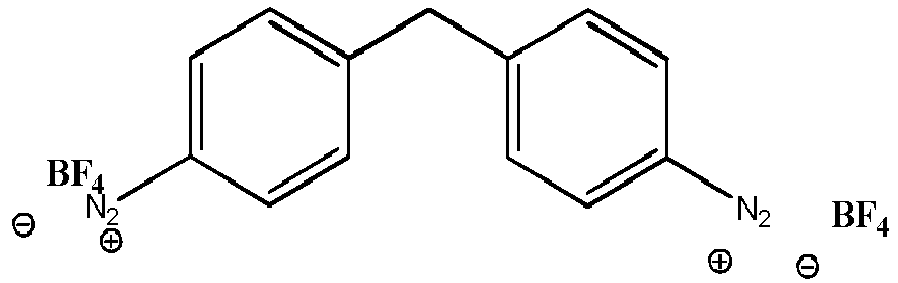
- The aromatic ring can possibly be substituted by a borylated group, wherein boron is a B(III) or a B(IV).
- • Among the borylated groups where boron atom is in oxidation state III, the following groups are preferably chosen:

- • among the borylated groups where boron atom is in oxidation state IV, the following groups are preferably chosen :
- ■ a trifluoroborate group -BF3 -,
- ■ a trihydroxyborate group -B(OH)3 -,
- ■ a trialkoxyborate group, preferably chosen among the following tricyclic groups:


- ■ a boratrane group, preferably derived from the diethanolamine, of the following formula:

- ■ a MIDA borate group originated from 2,2'-(methylazanediyl)diacetic acid, usable as an intermediate in Suzuki coupling reactions, and having the following formula :
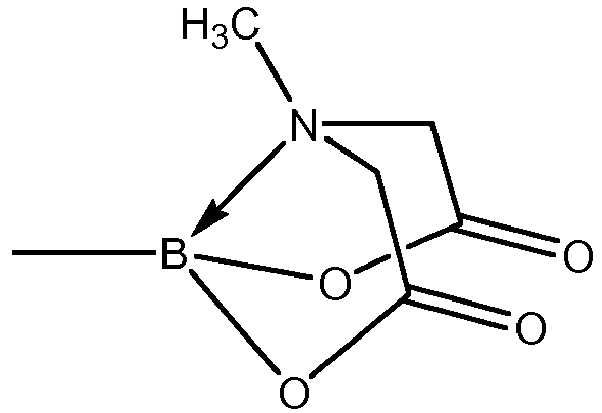
- According to a particular embodiment, the invention relates to the use of an organoboron compound to be arylated containing at least one boron-hydrogen bond and being an organoborane of the general following formula I

- ■ X represents:
- □ -H,
- □ -NR1R2 ,
- □ -R7,
- □ -OR8,
- R1 and R2, identical or different, represent:
- linear alkyls having from 1 to 20 carbon atoms, branched alkyls having from 3 to 20 carbon atoms or cycloalkyls having 3 to 20 carbon atoms,
- benzyls having from 7 to 20 carbon atoms, wherein
- the aromatic ring is possibly substituted by halogen(s), hydroxy, alkoxy, alkyl groups having from 1 to 10 carbon atoms,
- and/or the carbon atom of the methylene group linked to the nitrogen atom, is possibly substituted by an alkyl group having from 1 to 10 carbon atoms, in particular by a methyl group, said carbon atom being possibly chiral,
- phenyls possibly substituted on the aromatic ring by halogen(s), hydroxy, alkoxy groups having from 1 to 5 carbon atoms,
- R7 represents a linear alkyl having from 1 to 20 carbon atoms, a branched alkyl having from 3 to 20 carbon atoms or a cycloalkyl having from 3 to 20 carbon atoms,
- R8 represents:
- a linear alkyl having from 1 to 20 carbon atoms,
- a branched alkyl having from 3 to 20 carbon atoms,
- a cycloalkyl having from 3 to 20 carbon atoms, possibly substituted by one or several halogen atom(s),
- a phenyl possibly substituted by halogen(s), hydroxy, alkoxy groups having from 1 to 5 carbon atoms,
- a benzyl having from 7 to 20 carbon atoms, wherein
- the aromatic ring is possibly substituted by halogen(s), hydroxy, alkoxy, alkyl groups having from 1 to 10 carbon atoms,
- and/or the carbon atom of the methylene group linked to the nitrogen atom, is possibly substituted by an alkyl group having from 1 to 10 carbon atoms, in particular by a methyl group, said carbon atom being possibly chiral,
- or an acetoxy group having from 1 to 20 carbon atoms,
- ■ Y represents:
- □ -H,
- □ -NR1aR2a,
- □ -R7a,
- □ -OR8a,
wherein- R1a and R2a, identical or different, represent:
- linear alkyls having from 1 to 20 carbon atoms, branched alkyls having from 3 to 20 carbon atoms or cycloalkyls having from 3 to 20 carbon atoms,
- benzyls having from 7 to 20 carbon atoms, wherein
- the aromatic ring is possibly substituted by halogen(s), hydroxy, alkoxy, alkyl groups having from 1 to 10 carbon atoms,
- and/or the carbon atom of the methylene group linked to the nitrogen atom, is possibly substituted by an alkyl group having from 1 to 10 carbon atoms, in particular by a methyl group, said carbon atom being possibly chiral,
- phenyls possibly substituted on the aromatic ring by halogen(s), hydroxy, alkoxy groups having from 1 to 5 carbon atoms,
- R7a represents a linear alkyl having from 1 to 20 carbon atoms, a branched alkyl having from 3 to 20 carbon atoms or a cycloalkyl having from 3 to 20 carbon atoms,
- R8a represents:
- a linear alkyl having from 1 to 20 carbon atoms,
- a branched alkyl having from 3 to 20 carbon atoms,
- a cycloalkyl having from 3 to 20 carbon atoms, possibly substituted by one or several halogen atom(s),
- a phenyl possibly substituted by halogen(s), hydroxy, alkoxy groups having from 1 to 5 carbon atoms,
- a benzyl having from 7 to 20 carbon atoms, wherein
- the aromatic ring is possibly substituted by halogen(s), hydroxy, alkoxy, alkyl groups having from 1 to 10 carbon atoms,
- and/or the carbon atom of the methylene group linked to the nitrogen atom, is possibly substituted by an alkyl group having from 1 to 10 carbon atoms, in particular by a methyl group, said carbon atom being possibly chiral,
- or an acetoxy group having from 1 to 20 carbon atoms,
and if X=-OR8 and Y=-OR8a, then the alkoxy groups -OR8 and -OR8a are in particular connected by a 2 to 4 carbons chain and possibly form a ring including the boron atom and the two oxygen atoms, the ring being therefore a 5 to 7 membered ring originated from a diol chosen among ethane-1,2-diol, propane-1,3-diol, 2,3-dimethylbutane-2,3-diol (pinacol), pinanediol, 2-methylbutane-2,3-diol, 1,2-diphenylethane-1,2-diol, 2-methylpentane-2,4-diol, 1,2-dihydroxybenzene (catechol), in particular pinacol or pinanediol.
- R1a and R2a, identical or different, represent:
- According to a particular embodiment, the invention relates to the use of an organoboron compound of type I containing two boron-hydrogen bonds and being an aminoborane of general formula II

R1 and R2 have the above mentioned meanings. - According to a particular advantageous embodiment, the invention relates to the use of the organoboron compound of type I containing one boron-hydrogen bond and being a dialkoxyborane (boronic ester) of general formula III

R8 and R8a have the above mentioned meanings. - According to a particular embodiment, the invention relates to the use of an activating agent to perform the arylation reaction, the activating agent containing a transition metal belonging, in particular, to the group IV, VIII, IX, X or XI, being in particular a metallocene or a salt thereof chosen among:
- a titanocene, in particular (tBuCp)2TiCl2, CpTiCl3, Cp2TiCl2, Cp*2TiCl2, Cp*TiCl3, Cp2Ti(CO)2, TiCp2, preferably Cp2TiCl2,
wherein- tBu is a tertiobutyl group,
- Cp is a cyclopentadienyl group, optionally substituted by a halogen, an alkyl group having 1 to 10 carbon atoms, an aromatic or heteroaromatic group having 5 to 12 carbon atoms, a vinyl group having 2 to 10 carbon atoms, an allyl group having 3 to 10 carbon atoms, an alkylammonium salt having from 1 to 10 carbon atoms,
- Cp* is a 1,2,3,4,5-pentamethylcyclopentadienyl group,
- a zirconocene, in particular (indenyl)2ZrCl2, Cp2ZrHCl (Schwartz's reagent), (tBuCp)2ZrCl2, preferably Cp2ZrHCl,
wherein indenyl is a benzocyclopentadienyl group, - a ferrocene, in particular Cp2Fe, BrCpFeCp, Cp*2Fe, AcCpFeCp, n-BuCpFeCp, , t-BuCpFeCp, vinylCpFeCp, preferably Cp2Fe,
- a ruthenocene, in particular Cp2Ru, Cp*2Ru, or a ruthenium complex, in particular Ru(acac)3, wherein acac represents acetylacetonate,
- a cobaltocene, in particular Cp2Co, [Cp2Co]PF6 (cobaltocenium hexafluorophosphate), Cp*2Co,
- a nickelocene, in particular Cp2Ni, Cp*2Ni,
- a copper complex, in particular [Cu(OH)tmeda]2, Cu(salen),
wherein- tmeda represents tetramethylethylenediamine,
- salen represents 2,2'-ethylenebis(nitrilomethylidene)diphenol,
- a palladium complex, in particular Pd(acac)2 (palladium diacetylacetonate), (CH2=CH-CH2PdCl)2 (allylpalladium chloride), or a palladium salt in particular Pd(OAc)2, Pd(CN)2,
the activating agent being preferably chosen among metallocenes, in particular ferrocenes, titanocenes, or zirconocenes, preferably Cp2Fe, Cp2TiCl2 or Cp2ZrHCl. - A "metallocene" is a compound containing a metal center in the oxidation state (II), and typically two cyclopentadienyl anions (Cp-, C5H5 -), the resulting formula being (C5H5)2M.
- A metallocene forms a sandwich structure as represented in the scheme below:

- In this scheme, the two pentagons are the cyclopentadienyl anions with circles inside them indicating they are aromatically stabilized.
- By substituting the cyclopentadienyl group, this parent metallocene gives rise to analogues. For instance, Cp may be replaced by Cp*, which is 1,2,3,4,5-pentamethylcyclopentadienyl group.
- The complex of a transition metal is preferably an iron, titanium or zirconium compound stabilized by ligands, preferably Cp or a derivative of Cp, such as Cp*, mentioned above. The metallocenes preferably used are: Cp2Fe, Cp2TiCl2 or Cp2ZrHCl.
- Cp2Fe is the "ferrocene", (C5H5)2Fe, systematically named bis(η5-cyclopentadienyl)iron(II). It is represented below:

- The Cp group may be substituted by one or several alkyl groups, such as methyl, n-Butyl, by an acetyl group or by a vinyl group, for instance.
- Cp2TiCl2, dichloridobis(η5- cyclopentadienyl) titanium(IV), is called titanocene dichloride, of formula (η5-C5H5)2TiCl2 represented below:

- Schwartz's reagent (chloridobis(η5-cyclopentadienyl)hydridozirconium) is the common name for (C5H5)2ZrHCl, or Cp2ZrHCl, sometimes described as zirconocene hydrochloride. It is represented below:
- The present invention relates to a new process for the preparation of an arylborane compound containing at least one B-H bond, by arylation of a B-H bond, which comprises:
- (1) a step of contacting an arenediazonium salt or a heteroarenediazonium salt with an organoboron compound containing at least one B-H bond, in a reaction medium containing a solvent, in the absence of base,
for the preparation of an arylborane compound, - (2) a possible step of recovery
and purification of said arylborane compound obtained at the step (1). - The term "base" does not include "aminoborane".
- The "reaction medium" designates the mixture containing the arenediazonium or heteroarenediazonium salt, the organoboron compound and the solvent. The organoboron compound contains one or two B-H bond(s). One hydrogen bound to the boron is replaced by the aryl or heteroaryl group. This is represented in the equation below:
B——H → B——Ar
- After arylation reaction, there is a "possible step of recovery" which means that, depending on the nature of the obtained product at the step (1), the product can be isolated or purified, or can be modified i.e, refunctionalized at the boron atom, to give a more stable compound.
- According to an embodiment, the process for the preparation of an arylborane compound containing at least one B-H bond, by arylation of a B-H bond, comprises:
- (1) a step of contacting an arenediazonium salt or a heteroarenediazonium salt with an organoboron compound containing at least one B-H bond, in a reaction medium containing a solvent, in the absence of base,
in the presence of an activating agent,
said activating agent containing a transition metal belonging, in particular, to the group IV, VIII, IX, X or XI, being in particular a metallocene or a salt thereof chosen among:- a titanocene, in particular (tBuCp)2TiCl2, CpTiCl3, Cp2TiCl2, Cp*2TiCl2, Cp*TiCl3, Cp2Ti(CO)2, TiCp2, preferably Cp2TiCl2,
wherein- tBu is a tertiobutyl group,
- Cp is a cyclopentadienyl group, optionally substituted by a halogen, an alkyl group having 1 to 10 carbon atoms, an aromatic or heteroaromatic group having 5 to 12 carbon atoms, a vinyl group having 2 to 10 carbon atoms, an allyl group having 3 to 10 carbon atoms, an alkylammonium salt having from 1 to 10 carbon atoms,
- Cp* is a 1,2,3,4,5-pentamethylcyclopentadienyl group,
- a zirconocene, in particular (indenyl)2ZrCl2, Cp2ZrHCl (Schwartz's reagent), (tBuCp)2ZrCl2, preferably Cp2ZrHCl,
wherein indenyl is a benzocyclopentadienyl group, - a ferrocene, in particular Cp2Fe, BrCpFeCp, Cp*2Fe, AcCpFeCp, n-BuCpFeCp, , t-BuCpFeCp, vinylCpFeCp, preferably Cp2Fe,
- a ruthenocene, in particular Cp2Ru, Cp*2Ru, or a ruthenium complex, in particular Ru(acac)3, wherein acac represents acetylacetonate,
- a cobaltocene, in particular Cp2Co, [Cp2Co]PF6 (cobaltocenium hexafluorophosphate), Cp*2Co,
- a nickelocene, in particular Cp2Ni, Cp*2Ni,
- a copper complex, in particular[Cu(OH)tmeda]2, Cu(salen),
wherein- tmeda represents tetramethylethylenediamine,
- salen represents 2,2'-ethylenebis(nitrilomethylidene)diphenol,
- a palladium complex, in particular Pd(acac)2 (palladium diacetylacetonate), (CH2=CH-CH2PdCl)2 (allylpalladium chloride), or a palladium salt in particular Pd(OAc)2, Pd(CN)2,
for the preparation of an arylborane compound, - a titanocene, in particular (tBuCp)2TiCl2, CpTiCl3, Cp2TiCl2, Cp*2TiCl2, Cp*TiCl3, Cp2Ti(CO)2, TiCp2, preferably Cp2TiCl2,
- (2) a possible step of recovery and purification of said arylborane compound obtained at the step (1).
- In the reaction medium mentioned above, there is possibly an activating agent, preferably a metallocene, as mentioned above.

- The invention relates to the preparation of an arylborane compound, wherein the aryl group Ar has from 6 to 26 carbon atoms,
the aryl group being possibly a heteroaryl group containing one or several heteroatom(s) chosen among O, N or S, and having from 4 to 26 carbon atoms, in particular said arylborane being: - ■ an aminoarylborane of following formula

- linear alkyls having from 1 to 20 carbon atoms, branched alkyls having from 3 to 20 carbon atoms or cycloalkyls having from 3 to 20 carbon atoms,
- benzyls having from 7 to 20 carbon atoms, wherein
- the aromatic ring is possibly substituted by halogen(s), hydroxy, alkoxy, alkyl groups having from 1 to 10 carbon atoms,
- and/or the carbon atom of the methylene group linked to the nitrogen atom, is possibly substituted by an alkyl group having from 1 to 10 carbon atoms, in particular by a methyl group, said carbon atom being possibly chiral,
- phenyls possibly substituted on the aromatic ring by halogen(s), hydroxy, alkoxy groups having from 1 to 5 carbon atoms,
- R1 and R2 possibly forming an alkylene group corresponding to the formula -CR3R4-(CH2)n-CR5R6, in which n is ranging from 0 to 4, and the R3 to R6 substituents are chosen, independently of one another, from hydrogen and alkyl groups having from 1 to 20 carbon atoms in particular said alkylene being 1,1,5,5-tetramethylpentylene,
- ■ a dialkoxyarylborane (arylboronic ester) of following formula

- a linear alkyl having from 1 to 20 carbon atoms,
- a branched alkyl having from 3 to 20 carbon atoms,
- a cycloalkyl having from 3 to 20 carbon atoms, possibly substituted by one or several halogen atom(s),
- a phenyl possibly substituted by halogen(s), hydroxy, alkoxy groups having from 1 to 5 carbon atoms,
- a benzyl having from 7 to 20 carbon atoms, wherein
- the aromatic ring is possibly substituted by halogen(s), hydroxy, alkoxy, alkyl groups having from 1 to 10 carbon atoms,
- and/or the carbon atom of the methylene group linked to the nitrogen atom, is possibly substituted by an alkyl group having from 1 to 10 carbon atoms, in particular by a methyl group, said carbon atom being possibly chiral,
- or an acetoxy group having from 1 to 20 carbon atoms,
- ■ an alkoxyaminoarylborane of following formula

- the amino group is a -NR1R2 group, R1 and R2 having the above mentioned meanings,
- the alkoxy group is a -OR8 group, R8 having the above mentioned meanings,
- ■ a diaminoarylborane of following formula

said arylborane being in particular an aminoarylborane or a cyclic diaminoarylborane. - The process of the present invention comprises a step of contacting an arenediazonium salt or a heteroarenediazonium salt of formula Ar-N2A,
wherein - ■ A represents an anion chosen among chloride, bromide, iodide, hexafluorophosphate, bistrifluoromethylsulfonylamidure, alkylsulfonates, arylsulfonates, alkylsulfates, alkylcarboxylates, trifluoroacetate, triflates or tetrafluoroborate, preferably the tetrafluoroborate anion,
- ■ Ar is chosen among the aromatic groups including:
- ■ an aryl group, preferably a phenyl, a naphtalenyl, an anthracenyl, a phenanthrenyl, a biphenyl group, said aryl group being possibly mono or polysubstituted, in particular di or trisubstituted, the substituents, identical or different, being chosen independently of one another,
- ■ a heteroaryl group, preferably pyridine, pyrazine, imidazole, pyrazole, oxazole, isoquinoline, thiophene, benzothiophene, furane, benzofurane, isoindole, optionnally carrying at least one substituent,
said substituent(s) carried by the aryl or by the heteroaryl group, being chosen among- □ -F, -Cl, -Br or -I,
- □ -SO2-NH2, or a salt thereof, -SO2-R9,
- □ -NO2,
- □ -CF3,
- □ -CN,
- □ -R10, a linear alkyl having from 1 to 20 carbon atoms, branched alkyl having from 3 to 20 carbon atoms or cycloalkyl having from 3 to 20 carbon atoms,
- □ an alkoxy group -OR11,
- □ -OSitBuPh2 of following formula

- □ -OSitBuMe2 of following formula

- □ an alkylthio group -SR12,
- □ a carboxylic group -COOH, or an ester group -COOR13, or an amido group -CO-NH2 or a salt thereof, -CO-NR14R14a,
- □ a keto group -CO-R15, possibly protected as an acetal or thioacetal,
- □ an amino group -NR16R16a or a salt thereof,
- □ an aldehyde group possibly protected as an acetal or thioacetal,
- □ a trialkylsilyl group -SiR17 3,
- □ a benzyl group having from 7 to 20 carbon atoms, wherein
- the aromatic ring is possibly substituted by halogen(s), hydroxy, alkoxy, alkyl groups having from 1 to 10 carbon atoms, or by an amino or a diazonium group,
- and/or the carbon atom of the methylene group linked to the nitrogen atom, is possibly substituted by an alkyl group having from 1 to 10 carbon atoms, in particular by a methyl group, said carbon atom being possibly chiral,
- □ a borylated group in which boron is a B(III) boron atom (oxidation state III), said group being in particular a dialkoxyboryl group of formula

R18 and R18a, identical or different, represent:- linear alkyls having from 1 to 20 carbon atoms,
- branched alkyls having from 3 to 20 carbon atoms,
- cycloalkyls having from 3 to 20 carbon atoms, possibly substituted by one or several halogen atom(s),
- phenyls possibly substituted by halogen(s), hydroxy, alkoxy groups having from 1 to 5 carbon atoms,
- benzyls having from 7 to 20 carbon atoms, wherein
- the aromatic ring is possibly substituted by halogen(s), hydroxy, alkoxy, alkyl groups having from 1 to 10 carbon atoms,
- and/or the carbon atom of the methylene group linked to the nitrogen atom, is possibly substituted by an alkyl group having from 1 to 10 carbon atoms, in particular by a methyl group, said carbon atom being possibly chiral,
- or acetoxy groups having from 1 to 20 carbon atoms,
the alkoxy groups -OR18 and -OR18a being in particular connected by a 2 to 4 carbons chain and possibly forming a ring including the boron atom and the two oxygen atoms, the ring being therefore a 5 to 7 membered ring originated from a diol chosen among ethane-1,2-diol, propane-1,3-diol, 2,3-dimethylbutane-2,3-diol (pinacol), pinanediol, 2-methylbutane-2,3-diol, 1,2-diphenylethane-1,2-diol, 2-methylpentane-2,4-diol, 1,2-dihydroxybenzene (catechol), in particular pinacol or pinanediol,- □ a borylated group in which boron is a B(IV) boron atom (oxidation state IV), being in particular:
- ■ a trifluoroborate group,
- ■ a trihydroxyborate group,
- ■ a trialkoxyborate group, -B(ORa)3, wherein Ra is an alkyl group having from 1 to 10 carbon atoms, (ORa)3 possibly forming two rings between the three oxygen atoms, originating from a triol chosen among 1,2,3-propane triol (glycerol) or 1,1,1-tris(hydroxymethyl)ethane (2-(hydroxymethyl)-2-methyl-1,3-propanediol),
- ■ a boratrane generated from an aminodiol containing from 3 to 20 carbon atoms, said aminodiol forming, with the boron atom, rings of 5 or 6 members and aminodiol being a N,N-bis(hydroxyalkyl)alkylamine of the formula HO-Rb-NRc-Rb'-OH,
wherein
Rb and Rb', identical or different, are linear alkylene groups having 2 or 3 carbon atoms, or branched alkylene groups having from 3 to 5 carbon atoms,
Rc is a hydrogen atom or an alkyl group having 1 to 4 carbon atoms, - ■ a MIDA borate group originated from 2,2'-(méthylazanediyl)diacetic acid and having the following formula

- □ a combination of the above,
wherein
- □ a combination of the above,
- • R10 and R17 represent linear alkyls having from 1 to 20 carbon atoms, branched alkyls having from 3 to 20 carbon atoms or cycloalkyls having 3 to 20 carbon atoms,
- • R9, R11, R12, R13, R14, R14a R15, R16 and R16a represent linear alkyls having from 1 to 20 carbon atoms, branched alkyls having from 3 to 20 carbon atoms or cycloalkyls having 3 to 20 carbon atoms, possibly substituted by one or several halogen atom(s), or phenyls possibly substituted by halogen(s), hydroxy, alkoxy groups having from 1 to 5 carbon atoms, or benzyls having from 7 to 20 carbon atoms, wherein the aromatic ring is possibly substituted by halogen(s), hydroxy, alkoxy, alkyl groups having from 1 to 10 carbon atoms, and/or the carbon atom of the methylene group linked to the nitrogen atom, is possibly substituted by an alkyl group having from 1 to 10 carbon atoms, in particular by a methyl group, said carbon atom being possibly chiral,
with an organoboron compound to be arylated containing at least one boron-hydrogen bond and having the general following formula I
- ■ X represents:
- □ -H,
- □ -NR1R2,
- □ -R7,
- □ -OR 8,
wherein- R1 and R2, identical or different, represent:
- linear alkyls having from 1 to 20 carbon atoms, branched alkyls having from 3 to 20 carbon atoms or cycloalkyls having 3 to 20 carbon atoms,
- benzyls having from 7 to 20 carbon atoms, wherein
- the aromatic ring is possibly substituted by halogen(s), hydroxy, alkoxy, alkyl groups having from 1 to 10 carbon atoms,
- and/or the carbon atom of the methylene group linked to the nitrogen atom, is possibly substituted by an alkyl group having from 1 to 10 carbon atoms, in particular by a methyl group, said carbon atom being possibly chiral,
- phenyls possibly substituted on the aromatic ring by halogen(s), hydroxy, alkoxy groups having from 1 to 5 carbon atoms,
- R7 represents a linear alkyl having from 1 to 20 carbon atoms, a branched alkyl having from 3 to 20 carbon atoms or a cycloalkyl having from 3 to 20 carbon atoms,
- R8 represents:
- a linear alkyl having from 1 to 20 carbon atoms,
- a branched alkyl having from 3 to 20 carbon atoms,
- a cycloalkyl having from 3 to 20 carbon atoms, possibly substituted by one or several halogen atom(s),
- a phenyl possibly substituted by halogen(s), hydroxy, alkoxy groups having from 1 to 5 carbon atoms,
- a benzyl having from 7 to 20 carbon atoms, wherein
- the aromatic ring is possibly substituted by halogen(s), hydroxy, alkoxy, alkyl groups having from 1 to 10 carbon atoms,
- and/or the carbon atom of the methylene group linked to the nitrogen atom, is possibly substituted by an alkyl group having from 1 to 10 carbon atoms, in particular by a methyl group, said carbon atom being possibly chiral,
- or an acetoxy group having from 1 to 20 carbon atoms,
- R1 and R2, identical or different, represent:
- ■ Y represents:
- □ -H,
- □ -NR1aR2a,
- □ -R7a,
- □ -OR8a,
wherein- R1a and R2a, identical or different, represent:
- linear alkyls having from 1 to 20 carbon atoms, branched alkyls having from 3 to 20 carbon atoms or cycloalkyls having from 3 to 20 carbon atoms,
- benzyls having from 7 to 20 carbon atoms, wherein
- the aromatic ring is possibly substituted by halogen(s), hydroxy, alkoxy, alkyl groups having from 1 to 10 carbon atoms,
- and/or the carbon atom of the methylene group linked to the nitrogen atom, is possibly substituted by an alkyl group having from 1 to 10 carbon atoms, in particular by a methyl group, said carbon atom being possibly chiral,
- phenyls possibly substituted on the aromatic ring by halogen(s), hydroxy, alkoxy groups having from 1 to 5 carbon atoms,
- R7a represents a linear alkyl having from 1 to 20 carbon atoms, a branched alkyl having from 3 to 20 carbon atoms or a cycloalkyl having from 3 to 20 carbon atoms,
- R8a represents:
- a linear alkyl having from 1 to 20 carbon atoms,
- a branched alkyl having from 3 to 20 carbon atoms,
- a cycloalkyl having from 3 to 20 carbon atoms, possibly substituted by one or several halogen atom(s),
- a phenyl possibly substituted by halogen(s), hydroxy, alkoxy groups having from 1 to 5 carbon atoms,
- a benzyl having from 7 to 20 carbon atoms, wherein
- the aromatic ring is possibly substituted by halogen(s), hydroxy, alkoxy, alkyl groups having from 1 to 10 carbon atoms,
- and/or the carbon atom of the methylene group linked to the nitrogen atom, is possibly substituted by an alkyl group having from 1 to 10 carbon atoms, in particular by a methyl group, said carbon atom being possibly chiral,
- or an acetoxy group having from 1 to 20 carbon atoms,
and if X=-OR8 and Y=-OR8a, then the alkoxy groups -OR8 and -OR8a are in particular connected by a 2 to 4 carbons chain and possibly form a ring including the boron atom and the two oxygen atoms, the ring being therefore a 5 to 7 membered ring originated from a diol chosen among ethane-1,2-diol, propane-1,3-diol, 2,3-dimethylbutane-2,3-diol (pinacol), pinanediol, 2-methylbutane-2,3-diol, 1,2-diphenylethane-1,2-diol, 2-methylpentane-2,4-diol, 1,2-dihydroxybenzene (catechol), in particular pinacol or pinanediol,
for the preparation of an arylborane or a heteroarylborane of following formula IV
- R1a and R2a, identical or different, represent:

X, Y and Ar have the above mentioned meanings.
The 4 following equations represent the preparation of the 4 types of arylboranes available by the process of the invention: - ■ preparation of an aminoarylborane:

- ■ preparation of an dialkoxyarylborane (arylboronic ester):

- ■ preparation of an alkoxyaminoarylborane:

- ■ preparation of an diaminoarylborane:

- A has the above mentioned meanings.
- The process particularly relates to the preparation of an aminoarylborane compound and comprises:
- (1) a step of contacting an arenediazonium salt or a heteroarenediazonium salt with an aminoborane of following formula II

for the preparation of an aminoarylborane compound of formula V,
- (2) a possible step of recovery and purification of the aminoarylborane compound of formula V from the reaction medium.
- The aminoarylboranes of formula V correspond to the preferred type of arylboranes available using the process of the invention. Their general preparation is represented in the above equation 1.
- Compounds of formula II are easily available. An amine R1R2NH is reacted with NaBH4 in an acidic medium, under an inert atmosphere, to give an amine-borane complex of formula R1R2NH.BH3, subsequently concentrated under vacuum and isolated. The aminoborane R1R2N-BH2 is then obtained by heating the amine-borane complex, which results in a deshydrogenation, and the crude amonborane obtained is distilled to give the pure aminoborane which can be stored under an inert atmosphere of nitrogen or argon.
- The aminoboranes thus obtained are represented below.
- ■ diisopropylaminoborane, R1=R2 = iPr,

- ■ N,N-dicyclohexylaminoborane, R1=R2 = cyclohexyl,

- ■ "R1 and R2 possibly forming an alkylene group corresponding to the formula - CR3R4-(CH2)n-CR5R6, in which n is ranging from 0 to 4, and the R3 to R6 substituents are chosen, independently of one another, among hydrogen and alkyl groups having from 1 to 20 carbon atoms, in particular said alkylene being 1,1,5,5-tetramethylpentylene" corresponds to the case of the 2,2,6,6-tetramethylpiperidinoborane,

- ■ the case R1≠R2 corresponds, in particular, to [(methylbenzyl)(isopropyl)]aminoborane, R1=iPr, R2=methylbenzyl,

- The yield in aminoboranes is at least of 90%.
- Compounds IIA, IIB, IIC and IID can then undergo an arylation reaction with an arenediazonium salt or a heteroarenediazonium salt, in a reaction medium containing a solvent, preferably acetonitrile, at room temperature, in the absence of base, with or without an activating means. The following equations describe the preparation of the aminoarylboranes of the general formula V, the aryl group having the above mentioned meanings.


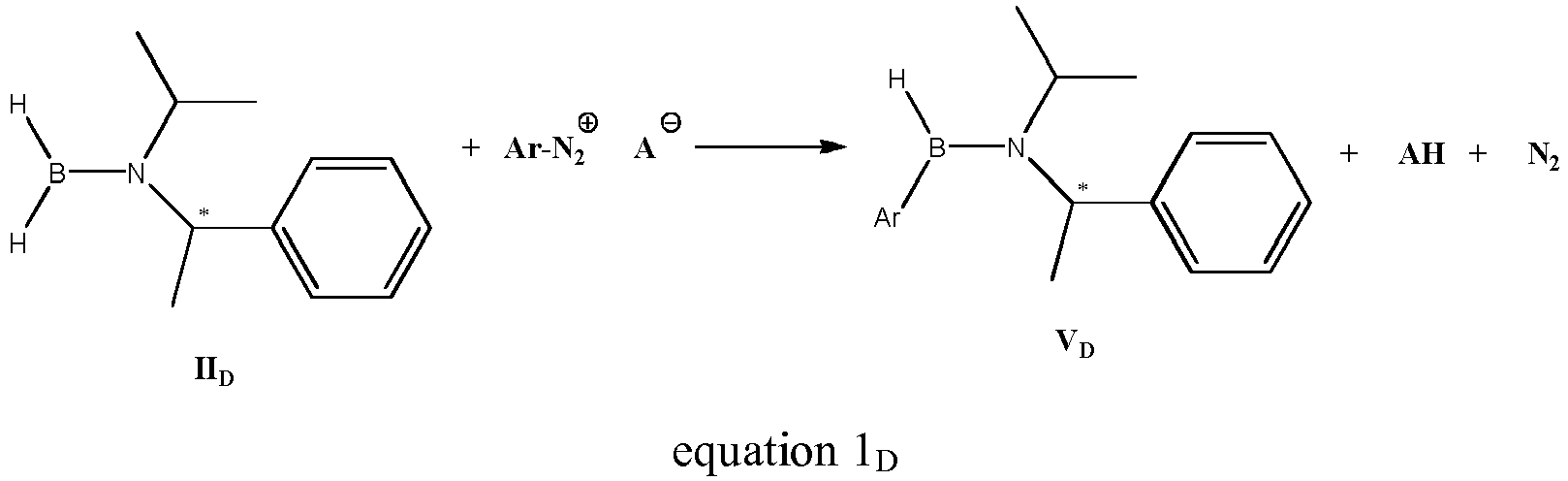
- Compound VD can be chiral when the (methylbenzyl)(isopropyl)amine used to prepare IID is in its chiral form.
- A has the above mentioned meanings.
- According to a particularly advantageous embodiment, the process of the present invention relates to the preparation of a diisopropylaminoarylborane compound and comprises:
- (1) a step of contacting an arenediazonium salt or a heteroarenediazonium salt with the diisopropylaminoborane of following formula IIA

for the preparation of a diisopropylaminoarylborane compound of formula VA,
- (2) a possible step of recovery and purification of the diisopropylaminoarylborane compound of formula VA from the reaction medium.
- The effect of the relative hindrance at the nitrogen atom in compounds II and therefore close to the boron atom, is to increase the chemioselectivity in favour of the arylation reaction. The yields are higher with hindered amines.
- The compound IIA is advantageously used in the process.
- According to a particularly advantageous embodiment, the process of the present invention relates to the preparation of a diisopropylaminoarylborane compound which comprises:
- (1) a step of contacting an arenediazonium salt or a heteroarenediazonium salt with the diisopropylaminoborane of following formula IIA

in the presence of an activating agent preferably chosen among metallocenes, in particular ferrocenes, titanocenes, or zirconocenes, preferably Cp2Fe, Cp2TiCl2 or Cp2ZrHCl,
for the preparation of a diisopropylaminoarylborane compound of formula VA,
- (2) a possible step of recovery and purification of the diisopropylaminoarylborane compound of formula VA from the reaction medium.
- The arylation reaction is carried out under mild conditions, even without any activating agent. However, the use of a small amount of activating agent (1% or even less than 1%), might increase the yield in aminoarylboranes.
- The scheme below represents the reaction between diisopropylaminoborane and 4-methoxybenzenediazonium tetrafluoroborate,
- in the absence of activating agent (a),
- with ferrocene (b),
- with titanocene (c),
- and with Schwartz's reagent (d).
- The yields are indicated.




- "RT" means "room temperature" i.e. 18-20°C.
- The product is isolated and purified or is submitted to a further reaction, step (2) involving a functional change at the boron atom.
- According to another embodiment, the process of the present invention relates to the preparation of a dialkoxyarylborane compound and comprises:
- (1) a step of contacting an arenediazonium salt or a heteroarenediazonium salt with a dialkoxyborane of following formula III

for the preparation of a dialkoxyarylborane compound of formula VI,
R8, R8a and Ar have the above mentioned meanings, - (2) a possible step of recovery and purification of the dialkoxyarylborane compound of formula VII from the reaction medium.
- Boronic esters are extensively used as chemical building blocks and as intermediates, particularly in the Suzuki coupling. They are thus interesting compounds.
- The compounds of formula III

- Compounds IIIA, IIIB and IIIC can be submitted to an arylation reaction with an arenediazonium salt or a heteroarenediazonium salt, in a reaction medium containing a solvent, preferably acetonitrile, at room temperature, in the absence of base, preferably with an activating means.
- The following equations described the preparation of the dialkoxyarylboranes (boronic esters) of the general formula VI, the aryl group having the above mentioned meanings; the reagents IIIA (pinacolborane), IIIB and IIIC (catecholborane) are commercially available or easy to prepare.


- According to a particular embodiment, the process of the present invention relates to the preparation of an arylpinacolborane compound and comprises:
- (1) a step of contacting an arenediazonium salt or a heteroarenediazonium salt with the pinacolborane of following formula IIIA

for the preparation of an arylpinacolborane compound of formula VIA,
- (2) a possible step of recovery and purification of the arylpinacolborane compound of formula VIA from the reaction medium.
- According to a particularly advantageous embodiment, the process of the present invention relates to the preparation of an arylpinacolborane compound and comprises:
- (1) a step of contacting an arenediazonium salt or a heteroarenediazonium salt with the pinacolborane of following formula IIIA

in the presence of an activating agent preferably chosen among metallocenes, in particular ferrocenes, titanocenes, or zirconocenes, preferably Cp2Fe, Cp2TiCl2 or Cp2ZrHCl,
for the preparation of an arylpinacolborane compound of formula VIA,
- (2) a possible step of recovery and purification of the arylpinacolborane compound of formula VIA from the reaction medium.
- The use of an activating agent might increase the yield.
- According to a particular embodiment, the activation means are radical generating means, in particular light irradiation, preferably ultraviolet light irradiation(UV), at a wavelength comprised from 180 nm to 400 nm, preferably comprised from 200 nm to 400 nm, in particular equal to about 254 nm,
or a radical initiator, chosen among azobisisobutyronitrile (AIBN), 1,1'-azobiscyclohexanecarbonitrile (ABCN), dilauroyl peroxide (DLP). - According to a particular embodiment, the solvent is aprotic and polar, in particular chosen among acetonitrile, propionitrile, butyronitrile, ethylacetate, isopropylacetate, dioxane, dimethylacetamide (DMAc), acetone, N-methyl-2-pyrrolidone (NMP), 2-methoxy-2-methylpropane (MTBE) or tetrahydrofuran (THF), or a mixture thereof,
in particular acetonitrile. - The use of a polar solvent increases the arylation reaction rate, the chimioselectivity and therefore the yields in arylboranes. The use of an apolar solvent decreases the yields because it promotes the side reaction of reduction of the arenediazonium salt into the corresponding aniline.
- For instance, the arylation reaction of diisopropylaminoborane with 4-methoxybenzenediazonium tetrafluoroborate, in the presence of Cp2Fe, gives 2-(4-methoxyphenyl)-4,4,5,5-tetramethyl-1,3,2-dioxaborolane with a 22% yield in THF. The yield is 87% if the solvent is acetonitrile. But there is no arylborane obtained in an apolar solvent, such as toluene.
- The use of a mixture containing an aprotic polar solvent and NMP may increase the arylation reaction rate and, thus, the yield in arylborane.
- The mixture can be acetonitrile/NMP 95/5, THF/NMP 95/5.
- For instance, the arylation reaction of diisopropylaminoborane with 4-methylbenzenediazonium tetrafluoroborate, in the presence of Cp*2TiCl2, gives 2-(4-methylphenyl)-4,4,5,5-tetramethyl-1,3,2-dioxaborolane with a 50% yield in THF. The yield increases to 74% in a mixture of THF+5% NMP.
- Particularly, the step of contacting an arenediazonium salt or a heteroarenediazonium salt with an aminoborane is performed in an aprotic polar solvent, preferably acetonitrile,
at a temperature comprised from 10 °C to 60 °C, in particular comprised from 18 °C to 30°C, preferably equal to about 20 °C, during a time ranging from 1 h to 3 h, preferably 2,5 h,
for the preparation of an aminoarylborane. - An advantage of the process of the invention is that it is carried out at room temperature, in very mild conditions.
- Advantageously, the step of mixing an arenediazonium salt or a heteroareneazonium salt with an aminoborane is performed in an aprotic polar solvent, preferably acetonitrile,
in the presence of an activating agent containing a transition metal, said activating agent being preferably chosen among metallocenes, in particular ferrocenes, titanocenes, or zirconocenes, preferably Cp2Fe, Cp2TiCl2 or Cp2ZrHCl,
with a molar percentage relative to the metal comprised from 0,001 % to 5 %, in particular comprised from 0,001 % to 1 %, preferably equal to about 0,001 %, or about 0,01 %, or about 0,1 % or about 1 %,
at a temperature comprised between 10 °C to 60°C, in particular comprised between 18 °C to 30 °C, preferably equal to about 20 °C, during a time ranging from 1 h to 3 h, preferably 2,5 h,
for the preparation of an aminoarylborane compound. - Another embodiment of the process relates to a step of contacting an arenediazonium salt or a heteroarenediazonium salt with a dialkoxyborane performed in an aprotic polar solvent, preferably acetonitrile,
at a temperature comprised between 20 °C to 50 °C, in particular comprised between 20 °C to 30 °C, preferably equal to about 25 °C, during a time ranging from 2 h to 4 h, preferably 2,5 h,
for the preparation of an dialkoxyarylborane. - According to a particularly advantageous embodiment, the step of mixing an arenediazonium salt or a heteroareneazonium salt with an alkoxyborane is performed in an aprotic polar solvent, preferably acetonitrile,
in the presence of an activating agent containing a transition metal, said activating agent being chosen among metallocenes, in particular ferrocenes, titanocenes, or zirconocenes, preferably Cp2Fe, Cp2TiCl2 or Cp2ZrHCl,
with a molar percentage relative to the metal comprised from 0,001 % to 5 %, in particular comprised from 0,001 % to 1 %, preferably equal to about 0,001 %, or about 0,01 %, or about 0,1 % or about 1 %,
at a temperature comprised between 20 °C to 50 °C, in particular comprised between 20 °C to 30 °C, preferably equal to about 25 °C, during a time ranging from 2 h to 4 h, preferably 2,5 h,
for the preparation of a dialkoxyarylborane compound. - According to a particular embodiment, the process of the invention comprises a step of preparation of an arenediazonium salt or of a heteroarenediazonium salt of formula Ar-N2A, in situ.
- The anilines are commercially available. The choice of an arenediazonium salt is thus very large. The following equation represents the oxidation reaction of an aniline with an alkylnitrite, preferably isoamylnitrite in the presence of trifluoroborane etherate, i,e, Et2O-BF3, to give a suspension or a solution of an arenediazonium tetrafluoroborate which can be used directly in the arylation reaction in the presence or not in presence of an activating agent:
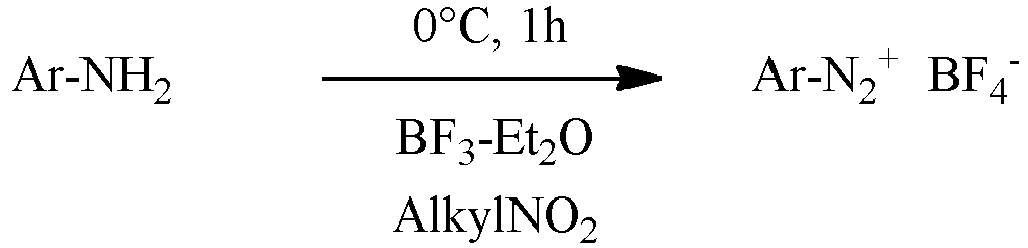
- The aryl group is substituted or not, as mentioned above.
- If the arenediazonium salt is isolated, the reaction is performed with NaNO2 and HBF4.
- According to a particular embodiment, the process of the invention comprises a step (2) of recovery and purification of the aminoarylborane obtained at step (1).
- The aminoarylborane can be isolated and purified by a bulb to bulb distillation.
- According to a particular embodiment, the process of the invention comprises after step (1) or (2), a step (3) of treatment of the arylborane obtained at step (1) or (2), into an arylborane which is different from the one obtained at step (1) or (2),
said treatment being in particular an alcoholysis, preferably with a first alcohol, in particular methanol, said alcoholysis possibly followed - by a transesterification with a second alcohol, preferably a diol chosen among ethane-1,2-diol, propane-1,3-diol, 2,3-dimethylbutane-2,3-diol (pinacol), pinanediol, 2-methylbutane-2,3-diol, 1,2-diphenylethane-1,2-diol, 2-methylpentane-2,4-diol, 1,2-dihydroxybenzene (catechol), in particular pinacol or pinanediol,
for the preparation of an arylboronic ester of the following formula VI
in particular for the preparation of a cyclic aryldialkoxyborane,
preferably for the preparation of an arylpinacolborane of the following formula VIA
- or by a hydrolysis in order to obtain an arylboronic acid of formula VII

- Thus, the boronic esters are prepared according to a tandem arylation/functional modification on the boron atom, this treatment consisting in a methanolysis followed by a transesterification.
- The boronic acids are prepared by the same way as the boronic esters replacing the transesterification by an hydrolysis.
- The boronic esters can be prepared in one step, by arylation of a boronate, or in two steps, via an aminoarylborane, the latter way being preferred.
- The process of the present invention relates particularly to the preparation of the diisopropylaminoarylboranes of formulas represented below,
said diisopropylaminoboranes being isolated and purified, or not:


- In another embodiment, the process of the present invention relates to the preparation of the arylpinacolboranes of following formula VIA

said arylpinacolboranes being recovered and purified, and being in particular

- In a particular embodiment, the process of the invention comprises:
- (1) a step of contacting an arenediazonium salt or a heteroarenediazonium salt with the diisopropylaminoborane of following formula IIA

for the preparation of a diisopropylaminoarylborane compound of formula VA,
- (2) a possible step of recovery and purification from the reaction medium, of the diisopropylaminoarylborane compound of formula VA obtained at step (1),
- (3) a step of treatment of the aminoarylborane of formula VA obtained at step (1) or (2) said treatment being in particular an alcoholysis, preferably with methanol, followed by a transesterification with pinacol,
for the preparation of an arylpinacolborane having one of the following formulae:


- A two step procedure, step (1) being the arylation reaction followed by a step (2) of methanolysis with further transesterification, leads to stable arylboronates, with most yields comprised in the 65-90% yield range with an activating agent containing iron. No real trend could be determined between electron donating or withdrawing groups. Methyl and methoxy groups (compounds VIA1 to VIA5) led to 47 to 87% isolated yield whereas reaction on arenediazonium salts bearing electron withdrawing groups afforded the corresponding arylboronates in 55-91% yield (compounds VIA6 to VIA10). Fluorine and chlorine substituted arylboronates were obtained in 61-71% yield (compounds VIA12 to VIA19). One advantage of this method is the compatibility with bromides and iodides. Few methods allow to synthesize selectively bromine or iodine substituted boron derivatives. In the process of the invention, the selectivity is very good as no reaction is observed when iodobenzene or bromobenzene are placed in the same reaction conditions. Hence, bromo- and iodo-susbtitued pinacol benzeneboronate were isolated in 65-74% yield (compounds VIA21 to VIA24). But the reaction on 4-benzoyl substituted arenediazonium salts lead to benzophenone resulting from the competitive direct reduction of the C-N into C-H bond (compound VIA21). Bis boronates were also synthesized in good yield considering that the resulting product arose from 6 consecutive reactions with an average of 91 % yield per transformation (compound VIA26).
- In a particular embodiment, the process of the invention comprises:
- (1) a step of contacting an arenediazonium salt or a heteroarenediazonium salt with an organoboron compound in a reaction medium containing a solvent, in the absence of base, for the preparation of an aminoarylborane of formula V which is not isolated (2) a step of treatment of V obtained at step (1) by methanolysis, followed by a transesterification with pinacol,
- In a particularly advantageous embodiment, the process of the invention comprises:
- (1) a step of contacting an arenediazonium salt or a heteroarenediazonium salt with an organoboron compound containing at least one B-H bond, in a reaction medium containing a solvent, in the absence of base,
in the presence of an activating agent, under continuous flow conditions,
in a tubular system including 2 tubings, wrapped in a circular-like form,- one tubing being a prereactor R1, in which a solution of the arenediazonium salt or of the heteroarenediazonium salt and a solution of the activating agent, in acetonitrile, are injected to be mixed, at a temperature comprised between 10 °C to 60 °C, in particular comprised between 20 °C to 30 °C, preferably equal to about 25 °C,
- the second tubing being a reactor R2, in which the mixture containing the arenediazonium salt or the heteroarenediazonium salt and the activating agent is injected, as well as a solution of diisopropylaminoborane in acetonitrile, at the temperature of R1,
- (2) a step of collection of the crude at the outlet of the reactor R2, the crude being possibly methanolysed to give a boronic ester, which is possibly transesterified, in particular with pinacol, to give an arylpinacolborane, or hydrolysed to give an arylboronic acid.
- Using a tubular reactor is particularly advantageous because the method can be used on industrial scale (
figure 1 ). One of the advantages is to work with low concentrations of reagents, thus decreasing the undesirable side reactions, and resulting in a constant final product quality and a low cost of working. - According to an embodiment, the process comprises a step of detection of an aniline possibly substituted by the same substituents as the ones of the arenediazonium salt.
- Beside the arylation reaction, a competitive reaction of reduction of the arenediazonium or heteroarenediazonium salt may occur, resulting in the formation of the corresponding aniline, in a molar percentage varying from 0 to 3 percent.
-
Figure 1 represents a flow arylation reaction between diisopropylaminoborane and an aryldiazonium salt catalysed by ferrocene on a scheme showing the tubular system used in the process (see example 1). - R1 represents a pre-reactor, R2 represents a reactor, T represents a T device and "d" represents a syringe.
- GC-MS analysis were performed with a HP 6890 series GC-system equipped with a J&W Scientific DB-1701 capillary column, a HP 5973 mass selective detector (EI) using the following method : 70°C for 1 min then 20°C.min-1 until 230 °C then 6 min at 230 °C. 1H, 11B, 13C, 19F and 31P NMR were recorded on 300 MHz Avance I and 400 MHz Avance II spectrometers. The chemical shifts (δ) and coupling constants (J) are expressed in ppm and Hertz respectively.
- Pinacol and pinacolborane were purchased from Sigma-Aldrich. Pinacol was distilled before use. Anilines were used without further purification. Diisopropylaminoborane was prepared as described in literature. All catalytic reactions were carried out under argon atmosphere unless specified. All chemicals were stored under argon. Acetonitrile was distilled over CaH2. Silica gel (230-400 mesh) purchased from Merck was used for flash chromatography. Analytical TLC silica gel 60 F254 were used.
Ferrocene is Cp2Fe. -
- NMR: nuclear magnetic resonance, and to describe the multiplicities: s = singlet, d =doublet, m = multiplet.
- TLC: thin layer chromatography
- GC-MS: gas chromatography - mass spectrum
- tR: retention time
- wt: weight
- PTFE: polytetrafluoroethylene
- i.d.: internal diameter
- M: mol/L
- DMAc: dimethylacetamide
- NMP: N-methyl-2-pyrrolidone
- Cp*: 1,2,3,4,5-pentamethylcyclopentadienyl group.
- To a suspension of aniline in water is added, at 0°C, HBF4 (50% wt in water) and the mixture is stirred 10min at 0°C. A saturated solution of NaNO2 in water is then slowly added and the resulting mixture is stirred for 1h at 0°C. The precipitate is collected by filtration, washed successively with cold water, cold Et2O/MeOH 70/30 and Et2O. The crude diazonium salt is purified by Et2O precipitation from a saturated acetone solution, the solid is then triturated with Et2O and dried under vacuum to afford pure arene diazonium salt or heteroarenediazonium salt.
- To a solution of aniline (1 mmol) in 3 ml of distillated acetonitrile, at 0°C, is added boron trifluoride etherate (1.5 mmol 0.4 ml) and the solution is stirred for 5 minutes. Isoamyl nitrite (1.2 mmol, 0.2 ml) is then slowly added and the solution is stirred for 15 minutes. Diisopropylamino borane (4 mmol, 0.6 ml) is then slowly added and the mixture is allowed to be stirred at room temperature for 3 hours. The reaction is then quenched, at 0°C, by the slow addition of 2 ml of distillated methanol and stirred 1 hour at room temperature. The mixture is concentrated under vacuum and a solution of pinacol (1.3 mmol, 153 mg) in 2 ml of diethyl ether is added and the mixture is stirred 4 hours at room temperature. 10 ml of diethyl ether is then added and the crude is washed three time with 6 ml of a aqueous solution of copper chloride (50 g/L). The organic phase is then filtered and died over Na2SO4 and concentrated under vacuum to afford pure aryl boronate.
-

- 113 mg of 2-(4-methoxy-phenyl)-4,4,5,5-tetramethyl-1,3,2-dioxaborolane were obtained following the general procedure B using 123 mg of 4-methoxyaniline as a pale yellow oil, yield: 52.5%.

- 1H NMR (300 MHz, CDCl3) δ 7.75 (d, J= 8.7 Hz, 2H) 6.90 (d, J= 8.7 Hz, 2H) 3.83 (s, 3H) 1.33 (s, 12H)
11B NMR (100 MHz, CDCl3) δ 31.05
13C NMR (75 MHz, CDCl3) δ
MS (EI) tR= 9.05 min; m/z: 234 (M+., 100%) - To a stirred solution of diisopropylamine (70.6 mL, 0.5 mol, 1 eq) in THF (200 mL) were added at 0 °C 20.4 mL of H2SO4 (0.75 mol, 0.5 eq). A white precipitate appears immediately. After 15 min at 0 °C, were carefully added 28.4 g of NaBH4 (0.75 mol, 1.1 eq) in powder. The mixture was allowed to warm to room temperature and stirred for 3h. The crude was concentrated under vacuum and the residue was taken with toluene, washed with water (4 x 100 mL). The organic phase was dried over Na2SO4 and concentrated under reduced pressure to give the amine-borane complex as a colorless oil. The amine-borane complex was refluxed at 210 °C with a sand bath in the presence of a bubbling device to observe the formation of hydrogen. After the completion of the dehydrogenation (about 1h30), a distillation apparatus was installed and the aminoborane was distillated under argon to give a 51g of colorless liquid (90 % yield).
- A 10 m segment of PTFE tubing (0.81 mm i.d., 5 ml total volume) was wrapped in a circular-like form to favoring mixing and reactor heat (R2, see
figure 1 ). The reactor was then submerged in a water bath at the desired temperature (0, 25, 40 °C). A pre-reactor of 60cm (R1), built in the same manner in order to mix the arenediazonium salt with the ferrocene, was heated at the R2 reactor temperature. The syringes d were fixed on syringe pumps and connected to a T device with PTFE tubing (d = 23cm). The T and the reactors were connected directly. The system was purged with distillated acetonitrile and the ferrocene and the aminoborane ways were purged with the reagents themselves (10-2 M and 2M respectively) before use. Then, the desired volume of arenediazonium salt was injected (using a 1M solution in acetonitrile) at the desired rate, followed by acetonitrile when the injection was over. The injections of aminoborane and ferrocene, were not stopped during all the process and were performed with the same rate as the arenediazonium salt. The crude was collected into a round-bottomed flask, charged with a magnetical stirrer and 10 ml of anhydrous methanol. After completion of the process (i.e. the collection), the crude was concentrated under vacuum and pinacol (2 eq) in diethyl ether was then added. The mixture was stirred 4h at room temperature and then washed with 4x10 ml of a aqueous solution of CuCl2 (50g/L). The organic phase was dried over Na2SO4, filtered and concentrated under reduced pressure. The resulting oil was dissolved in CH2Cl2 and filtered over a pad of silica gel, eluted with CH2Cl2 to afford the corresponding boronate. - In a dried tube reactor under argon as described in example 2, the arenediazonium salt (1 mmol) and the ferrocene (10µmol, 1.8mg) were dissolved in 2mL of anhydrous CH3CN. Diisopropylaminoborane (2mmol, 226mg) was then added to the solution and the mixture was stirred for 2h30 at room temperature. The reaction mixture was quenched by a slow addition of anhydrous MeOH at 0°C (2mL) and stirred for an additional hour at room temperature. After removal of all the volatiles, 1.3eq of pinacol was added in Et2O (2mL), the mixture was stirred 4h at room temperature. The crude mixture was washed with a 50g/L CuCl2 solution (2 x 5mL). The organic layer were separated, dried over Na2SO4, filtered and concentrated to dryness. The resulted oil was dissolved with CH2Cl2 and filtered of a pad of silica gel, eluting with CH2Cl2 to afford the corresponding boronate.
-

- 175 mg of 2-(4-methylphenyl)-4,4,5,5-tetramethyl-1,3,2-dioxaborolane were obtained following the general procedure D according to example 3, using 206 mg of 4-methylbenzenediazonium tetrafluoroborate as a pale yellow oil, with an 80% isolated yield. 1H NMR (300 MHz, CDCl3) : δ 7.71 (d, J = 7.9 Hz, 2H) 7.19 (d, J = 7.6 Hz, 2H) 2.37 (s, 3H) 1.34 (s, 12H)
11B NMR (100 MHz, CDCl3) δ 31.39
13C NMR (75 MHz, CDCl3) δ 141.55; 134.94; 128.66; 83.76; 24.99; 21.88
MS (EI) tR= 7.95 min; m/z: 218 (M+., 100%) -

- 161 mg of 2-(1-methoxyphenyl)-4,4,5,5-tetramethyl-1,3,2-dioxaborolane were obtained following the general procedure D according to example 3, using 222 mg of 2-methoxybenzenediazonium tetrafluoroborate as a pale yellow oil, with an isolated yield of 69%.
1H NMR (300 MHz, CDCl3) δ 7.67 (dd, J = 7.3, 1.8 Hz, 1H), 7.39 (ddd, J = 8.5, 7.5, 1.9 Hz, 1H), 6.94 (t, J = 7.3 Hz, 1H), 6.86 (d, J = 8.4 Hz, 1H), 3.83 (s, 3H), 1.36 (s, 12H)
11B NMR (100 MHz, CDCl3) δ 31.09
13C NMR (75 MHz, CDCl3) δ 136.69, 132.43, 120.21, 110.51, 83.45, 55.84, 24.84 -
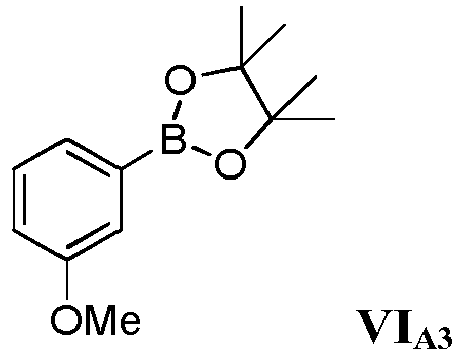
- 134 mg of 2-(3-methoxyphenyl)-4,4,5,5-tetramethyl-1,3,2-dioxaborolane were obtained following the general procedure D according to example 3, using 222 mg of 3-methoxybenzenediazonium tetrafluoroborate as a pale yellow oil, with an isolated yield of 57%.
1H NMR (300 MHz, CDCl3) δ 7.40 (d, J = 7.2 Hz, 1H) 7.36 - 7.31 (m, 1H) 7.28 (d, J = 7.3 Hz, 1H) 7.01 (ddd, J = 8.2, 2.8, 1.1 Hz, 1H) 3.83 (s, 3H) 1.35 (s, 12H)
11B NMR (100 MHz, CDCl3) δ 31.37
13C NMR (75 MHz, CDCl3) δ 159.20, 129.07, 127.33, 118.88, 118.05, 83.97, 55.39, 25.00.
MS (EI) tR= 8.90 min; m/z: 234 (M+·, 100%) -

- 204 mg of 2-(4-methoxyphenyl)-4,4,5,5-tetramethyl-1,3,2-dioxaborolane were obtained following the general procedure D according to example 3, using 222 mg of 4-methoxybenzenediazonium tetrafluoroborate as a pale yellow oil, with an isolated yield of 87%.
1H NMR (300 MHz, CDCl3) δ 7.75 (d, J = 8.7 Hz, 2H) 6.90 (d, J = 8.7 Hz, 2H) 3.83 (s, 3H) 1.33 (s, 12H)
11B NMR (100 MHz, CDCl3) δ 31.05
13C NMR (75 MHz, CDCl3) δ
MS (EI) tR= 9.05 min; m/z: 234 (M+ ˙, 100%) -

- 139 mg of 2-(3,4,5-trimethoxyphenyl)-4,4,5,5-tetramethyl-1,3,2-dioxaborolane were obtained following the general procedure D according to example 3, using 284 mg of 3,4,5-trimethoxybenzenediazonium tetrafluoroborate as a pale yellow oil with an isolated yield of 47%.
1H NMR (300 MHz, CDCl3) δ 7.04 (s, 2H) 3.90 (s, 6H) 3.87 (s, 3H) 1.34 (s, 12H)
11B NMR (100 MHz, CDCl3) δ 32.00
13C NMR (75 MHz, CDCl3) δ 153.07; 141.08; 111.52; 84.02; 60.93; 56.32; 25.00
MS (EI) tR= 11.65 min; m/z: 296 (M+ ˙, 100%) -

- 176 mg of 2-(3-iodophenyl)-4,4,5,5-tetramethyl-1,3,2-dioxaborolane were obtained following the general procedure D according to example 3, using 237 mg of 4-nitrobenzenediazonium tetrafluoroborate as a pale yellow oil, with an isolated yield of 71%.
1H NMR (300 MHz, CDCl3) δ 8.19 (d, J = 8.7 Hz, 2H) 7.96 (d, J = 8.7 Hz, 2H) 1.37 (s, 12H)
11B NMR (100 MHz, CDCl3) δ 30.87
13C NMR (75 MHz, CDCl3) δ 135.80; 122.56; 84.78; 25.02
MS (EI) tR= 10.31 min; m/z: 249 (M+ ˙, 100%) -

- 171 mg of 2-(3-trifluoromethylphenyl)-4,4,5,5-tetramethyl-1,3,2-dioxaborolane were obtained following the general procedure D according to example 3, using 260 mg of 3-trifluoromethylbenzenediazonium tetrafluoroborate as a pale yellow oil.
1H NMR (300 MHz, CDCl3) δ 7.97 (d, J = 7.4 Hz, 1H) 7.70 (d, J = 7.9 Hz, 1H) 7.48 (t, J = 7.6 Hz, 1H) 1.36 (s, 12H)
11B NMR (100 MHz, CDCl3) δ 30.48
13C NMR (75 MHz, CDCl3) δ 138.12; 128.16; 127.94; 118.30; 84.43; 25.02
MS (EI) tR= 7.02 min; m/z: 272 (M+˙, 100%) -
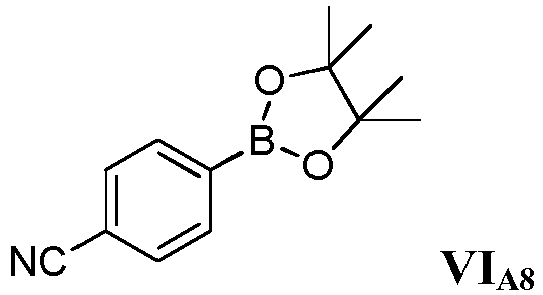
- 127 mg of 2-(4-cyanophenyl)-4,4,5,5-tetramethyl-1,3,2-dioxaborolane were obtained following the general procedure D according to example 3, using 217 mg of 4-cyanobenzenediazonium tetrafluoroborate as a pale yellow oil, with an isolated yield 55%. 1H NMR (300 MHz, CDCl3) δ 7.88 (d, J = 8.1 Hz, 1H) 7.64 (d, J = 8.2 Hz, 1H) 1.35 (s, 12H) 11B NMR (100 MHz, CDCl3) δ 30.37
13C NMR (75 MHz, CDCl3) δ
MS (EI) tR = 9.52 min; m/z: 229 (M+., 100%) -

- 220 mg of 2-(3,5-ditrifluoromethylphenyl)-4,4,5,5-tetramethyl-1,3,2-dioxaborolane were obtained following the general procedure D according to example 3, using 328 mg of 3-5-ditrifluoromethylbenzenediazonium tetrafluoroborate as a pale yellow oil, with an isolated yield of 65%.
1H NMR (300 MHz, CDCl3) δ 8.23 (s, 2H) 7.94 (s, 1H) 1.37 (s, 12H)
11B NMR (100 MHz, CDCl3) δ 30.21
13C NMR (75 MHz, CDCl3) δ 134.79; 131.29; 130.85; 125.47; 124.87; 121.85; 85.01; 25.01 MS (EI) tR= 6.33 min; m/z: 340 (M+˙, 100%) -

- 214 mg of 2-(2-methyl-3-nitrophenyl)-4,4,5,5-tetramethyl-1,3,2-dioxaborolane were obtained following the general procedure D according to example 3, using 251 mg of 2-methyl-3-nitrobenzenediazonium tetrafluoroborate as a pale yellow oil, with an isolated yield of 91 %. 1H NMR (300 MHz, CDCl3) δ 7.94 (dd, J = 7.4, 1.2 Hz, 1H), 7.80 (dd, J = 8.1, 1.3 Hz, 1H), 7.30 (d, J = 7.6 Hz, 1H), 2.67 (s, 3H), 1.36 (s, 12H)
11B NMR (100 MHz, CDCl3) δ 31.55
13C NMR (75 MHz, CDCl3) δ 139.77, 138.27, 126.26, 125.88, 84.38, 24.99, 18.01.
MS (EI) tR= 10.99 min; m/z: 263 (M+., 100%) -

- 127 mg of phenyl-4,4,5,5-tetramethyl-1,3,2-dioxaborolane were obtained following the general procedure D according to example 3, using 192 mg of benzenedizaonium tetrafluoroborate as a pale yellow oil, with an isolated yield of 62%.
1H NMR (300 MHz, CDCl3) δ 7.81 (dd, J = 8.0, 1.4 Hz, 2H) 7.49 (m, 2H) 7.39 (m, 2H)
11B NMR (100 MHz, CDCl3) δ 31.10
13C NMR (75 MHz, CDCl3) δ 134.86; 131.39; 127.84; 83.90; 25.01
MS (EI) tR= 7.22 min; m/z: 204 (M+˙, 100%) -

- 135 mg of 2-(2-fluorophenyl)-4,4,5,5-tetramethyl-1,3,2-dioxaborolane were obtained following the general procedure D according to example 3, using 210 mg of 2-fluorobenzenediazonium tetrafluoroborate as a pale yellow oil, with an isolated yield of 61%. 1H NMR (300 MHz, CDCl3) δ 7.78 - 7.70 (m, 1H), 7.49 - 7.38 (m, 1H), 7.14 (t, J = 7.4 Hz, 1H), 7.03 (t, J = 8.9 Hz, 1H)
11B NMR (100 MHz, CDCl3) δ 29.92
13C NMR (75 MHz, CDCl3) δ 169.01, 165.68, 137.01, 136.90, 133.44, 133.32, 123.73, 123.69, 115.54, 115.23, 84.03, 24.97 -

- 156 mg of 2-(3-fluorophenyl)-4,4,5,5-tetramethyl-1,3,2-dioxaborolane were obtained following the general procedure D according to example 3, using 210 mg of 3-fluorobenzenediazonium tetrafluoroborate as a pale yellow oil, with an isolated yield of 70%. 1H NMR (300 MHz, CDCl3) δ 7.57 (d, J = 7.3 Hz, 1H) 7.48 (dd, J = 9.2, 2.7 Hz, 1H) 7.40 - 7.29 (m, 1H) 7.13 (dddd, J = 9.2, 8.3, 2.8, 1.1 Hz, 1H) 1.35 (s, 12H)
11B NMR (100 MHz, CDCl3) δ 30.83
13C NMR (75 MHz, CDCl3) δ 130.45; 129.64; 129.55; 121.24; 120.98; 118.43; 118.15; 84.24; 25.01
MS (EI) tR = 7.17 min; m/z: 222 (M+·, 100%) -

- 135 mg of 2-(3-iodophenyl)-4,4,5,5-tetramethyl-1,3,2-dioxaborolane were obtained following the general procedure D according to example 3, using 210 mg of 4-fluorobenzenediazonium tetrafluoroborate as a pale yellow oil, with an isolated yield of 61 %.
1H NMR (300 MHz, CDCl3) δ 7.80 (dd, J = 8.6, 6.3 Hz, 1H), 7.09 - 6.99 (m, 1H), 1.34 (s, 12H)
11B NMR (100 MHz, CDCl3) δ 30.26
13C NMR (75 MHz, CDCl3) δ 166.91, 163.59, 137.18, 137.07, 115.11, 114.84, 84.05, 25.01.
MS (EI) tR = 7.07min; m/z: 222 (M+., 100%) -

- 118 mg of 2-(2-chlorophenyl)-4,4,5,5-tetramethyl-1,3,2-dioxaborolane were obtained following the general procedure D according to example 3, using 226 mg of 2-chlorobenzenediazonium tetrafluoroborate as a pale yellow oil, with an isolated yield of 49%. 1H NMR (300 MHz, CDCl3) δ 7.72 (d, J = 6.9 Hz, 1H) 7.39 (m, 2H) 7.28 (m, 1H) 1.4 (s, 12H)
11B NMR (100 MHz, CDCl3) δ 31.17
13C NMR (75 MHz, CDCl3) δ 139.68; 136.54; 131.97; 129.52; 125.94; 84.28; 24.94
MS (EI) tR = 8.56 min; m/z: 238.5 (M+., 100%) -

- 143 mg of 2-(3-iodophenyl)-4,4,5,5-tetramethyl-1,3,2-dioxaborolane were obtained following the general procedure D according to example 3, using 226 mg of 3-chlorobenzenediazonium tetrafluoroborate as a pale yellow oil, with an isolated yield of 70%.
1H NMR (300 MHz, CDCl3) δ 7.78 (s, 1H) 7.67 (d, J = 7.3 Hz, 1H) 7.42 (d, J = 8.1 Hz, 1H) 7.30 (t, J = 7.7 Hz, 1H)
11B NMR (100 MHz, CDCl3) δ 30.40
13C NMR (75 MHz, CDCl3) δ 134.7; 134.18; 132.79; 131.40; 129.32; 84.29; 25
MS (EI) tR = 8.43 min; m/z: 238.5 (M+., 100%) -

- 170 mg of 2-(3-iodophenyl)-4,4,5,5-tetramethyl-1,3,2-dioxaborolane were obtained following the general procedure D according to example 3, using 226 mg of 4-chlorobenzenediazonium tetrafluoroborate as a pale yellow oil, with an isolated yield of 71%.
1H NMR (300 MHz, CDCl3) δ 7.73 (d, J = 8.4 Hz, 2H) 7.34 (d, J = 8.4 Hz, 2H) 1.34 (s, 12H)
11B NMR (100 MHz, CDCl3) δ 30.93
13C NMR (75 MHz, CDCl3) δ 136.27; 128.16; 84.17; 25.02
MS (EI) tR = 8.37 min; m/z: 338.5 (M+., 100%) -

- 179 mg of 2-(3,5-dichlorophenyl)-4,4,5,5-tetramethyl-1,3,2-dioxaborolane were obtained following the general procedure D according to example 3, using 261 mg of 3,5-dichlorobenzenediazonium tetrafluoroborate as a pale yellow oil, with an isolated yield of 66%.
1H NMR (300 MHz, CDCl3) δ 7.25 (s, 2H) 7.44 (s, 1H) 1.34 (s, 12H)
11B NMR (100 MHz, CDCl3) δ 29.94
13C NMR (75 MHz, CDCl3) δ 134.88; 132.85; 131.23; 84.67; 24.99
MS (EI) tR = 9.27 min; m/z: 273 (M+., 100%) -

- 187 mg of 2-(3,4-dichlorophenyl)-4,4,5,5-tetramethyl-1,3,2-dioxaborolane were obtained following the general procedure D according to example 3, using 261 mg of 3,4-dichlorobenzenediazonium tetrafluoroborate as a pale yellow oil, with an isolated yield of 68%.
- 1H NMR (300 MHz, CDCl3) δ 7.68 (d, J = 6.9 Hz, 1H) 7.35 (m, 2H) 7.23 (m, 1H) 1.37 (s, 12H)
11B NMR (100 MHz, CDCl3) δ 31.17
13C NMR (75 MHz, CDCl3) δ 136.71; 135.66; 133.90; 132.43; 130.16; 84.5; 25
MS (EI) tR = 9.57 min; m/z: 273 (M+., 100%) -

- 210 mg of 2-(3-iodophenyl)-4,4,5,5-tetramethyl-1,3,2-dioxaborolane were obtained following the general procedure D according to example 3, using 271 mg of 2-bromobenzenediazonium tetrafluoroborate as a pale yellow oil, with an isolated yield of 74%.
1H NMR (300 MHz, CDCl3) δ 7.61 (dd, J = 6.8, 2.3 Hz, 1H) 7.54 (dd, J = 7.1, 1.9 Hz, 1H) 7.26 (m, 2H) 1.38 (s, 12H)
11B NMR (100 MHz, CDCl3) δ 31.23
13C NMR (75 MHz, CDCl3) δ 136.36, 132.63, 131.82, 128.02, 126.26, 84.30, 24.81.
MS (EI) tR = 9.10 min; m/z: 283 (M+., 100%) -

- 204 mg of 2-(3-iodophenyl)-4,4,5,5-tetramethyl-1,3,2-dioxaborolane were obtained following the general procedure D according to example 3, using 271 mg of 3-bromobenzenediazonium tetrafluoroborate as a pale yellow oil, with an isolated yield of 72%.
1H NMR (300 MHz, CDCl3) δ 7.75 (d, J = 7.3 Hz, 1H) 7.62 (ddd, J = 8.0, 2.0, 1.1 Hz, 1H) 7.27 (d, J = 7.7 Hz,1H) 1.38 (s, 12H)
11B NMR (100 MHz, CDCl3) δ 30.65
13C NMR (75 MHz, CDCl3) δ 137.63, 134.32, 133.23, 129.63, 122.60, 84.31, 25.01.
MS (EI) tR = 9.03 min; m/z: 283 (M+., 100%) -

- 184 mg of 2-(3-iodophenyl)-4,4,5,5-tetramethyl-1,3,2-dioxaborolane were obtained following the general procedure D according to example 3, using 271 mg of 4-bromobenzenediazonium tetrafluoroborate as a pale yellow oil, with an isolated yield of 65%.
1H NMR (300 MHz, CDCl3) δ 7.66 (d, J = 8.2 Hz, 1H), 7.50 (d, J = 8.2 Hz, 1H), 1.34 (s, 12H) 11B NMR (100 MHz, CDCl3) δ 31.04
13C NMR (75 MHz, CDCl3) δ
MS (EI) tR = 8.99 min; m/z: 283 (M+., 100%) -

- 230 mg of 2-(3-iodophenyl)-4,4,5,5-tetramethyl-1,3,2-dioxaborolane were obtained following the general procedure D according to example 3, using 318mg of 3-iodobenzenediazonium tetrafluoroborate as a pale yellow oil, with an isolated yield of 70%.
1H NMR (300 MHz, CDCl3) δ 8.14 (s, 1H) 7.74-7.80 (m, 2H) 7.11 (t, J = 7.6 Hz, 1H) 1.34 (s, 12H)
11B NMR (100 MHz, CDCl3) δ 30.2
13C NMR (75 MHz, CDCl3) δ 25.0; 31.1; 84.3; 94.4; 129.8; 133.8; 140.2; 143.6
GC-MS (EI) tR = 9.80 min; m/z: 330 (M+., 100%) -

- 244 mg of 2-(3-iodophenyl)-4,4,5,5-tetramethyl-1,3,2-dioxaborolane were obtained following the general procedure D according to example 3, using 318mg of 4-iodobenzenediazonium tetrafluoroborate as a pale yellow oil, with an isolated yield of 74%.
1H NMR (300 MHz, CDCl3) δ 7.75 (d, J = 8.7 Hz, 1H) 6.90 (d, J = 8.7 Hz, 1H) 3.83 (s, 3H) 1.33 (s, 12H)
11B NMR (100 MHz, CDCl3) δ 31.02
13C NMR (75 MHz, CDCl3) δ 139.48; 137.06; 136.42; 98.95; 84.18; 25.00
MS (EI) tR = 9.80 min; m/z: 330 (M+., 100%) -

- 234 mg of bis(4'-(3,3,4,4-tetramethyl-2,5,1-dioxaboryl)phenyl)methane were obtained following the general procedure D according to example 3, using 396 mg of bis(4'-benzene)methanediazonium tetrafluoroborate as a pale yellow oil, with an isolated yield of 56%.
1H NMR (300 MHz, CDCl3) δ 7.80 (d, J = 8.0 Hz, 4H) 7.25 (d, J = 8.0 Hz, 4H) 4.07 (s, 2H) 1.40 (s, 24H)
11B NMR (100 MHz, CDCl3) δ 31.35
13C NMR (75 MHz, CDCl3) δ 144.24, 135.15, 130.13, 129.05, 128.56, 126.22, 115.49, 83.82, 42.45, 24.99. - 2-(4-methoxyphenyl)-4,4,5,5-tetramethyl-1,3,2-dioxaborolane, compound VIA4 ,

- VIA4 was isolated with a:
- ■ 81 % yield when the solvent of the arylation reaction was DMAc,
- ■ 71 % yield when the solvent of the arylation reaction was NMP,
- ■ 87 % yield when the solvent of the arylation reaction was acetonitrile,
- ■ 0 % yield when the solvent is toluene.
- 2-(4-methylphenyl)-4,4,5,5-tetramethyl-1,3,2-dioxaborolane, compound VIA1,

- VIA1 was isolated with a:
- ■ 50 % yield with acetonitrile/NMP 95/5,
- ■ 74 % yield with THF/NMP 95/5, compared to 50% in pure THF,
- ■ 61 % yield with toluene /NMP 95/5.
- 2-(4-methoxyphenyl)-4,4,5,5-tetramethyl-1,3,2-dioxaborolane, compound VIA4 ,

- VIA4 was isolated with a :
- ■ 87 % yield with Cp2Fe as activating agent,
- ■ 72 % yield with AcCpFeCp as activating agent,
- ■ 77 % yield with n-BuCpFeCp as activating agent,
- ■ 51 % yield with as BrCpFeCp activating agent,
- ■ 65 % yield with as t-BuCpFeCp activating agent,
- ■ 65 % yield with vinylCpFeCp as activating agent.
- Compound VIA4 was prepared according to example 3, in the absence of ferrocene, or in the presence of various amounts of ferrocene. The isolated yields are:
- ■ 61 % yield without ferrocene,
- ■ 79 % yield with 1% of ferrocene,
- ■ 77 % yield with 0.1 % of ferrocene,
- ■ 74 % yield with 0.01 % of ferrocene,
- ■ 75 % yield with 0.001 % of ferrocene.
- Compounds VIA1 to VIA22 , VIA24 and VIA26 were prepared using the procedure D (example 3), by replacing the ferrocene (1%) by the titanocene Cp2TiCl2 (1%). The yields are shown in the table 1.
table I compound Yield (%)[a] compound Product Yield (%) [a] VIA1 
67 VIA14 
52 VIA2 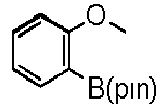
56 VIA15 
57 VIA3 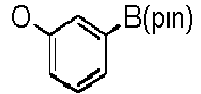
37 VIA16 
78 VIA4 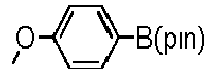
72 VIA17 
65 VIA5 
43 VIA18 
68 VIA6 
54 VIA19 
72 VIA7 
61 VIA20 
62 VIA8 
56 VIA21 
68 VIA9 
61 VIA22 
52 VIA10 
63 VIA11 
41 VIA24 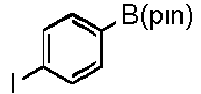
75 VIA12 
42 VIA13 
66 VIA26 
56 [a] isolated yield - 2-(4-methoxyphenyl)-4,4,5,5-tetramethyl-1,3,2-dioxaborolane, compound VIA4 ,

- VIA4 was isolated with a:
- ■ 56 % yield with Cp2Ti as activating agent,
- ■ 60 % yield with Cp2Ti(CO)2 as activating agent,
- ■ 61 % yield with (tBuCp)2TiCl2 as activating agent,
- ■ 62 % yield with CpTiCl3 as activating agent,
- ■ 72 % yield with Cp2TiCl2 as activating agent,
- ■ 67 % yield with Cp*TiCl3 as activating agent,
- ■ 61 % yield with Cp*2TiCl2 as activating agent.
- Compound VIA4 was prepared according to example 3, in the absence of titanocene, or the presence of various amounts of titanocene Cp2TiCl2. The isolated yields are:
- ■ 61 % yield without titanocene,
- ■ 71 % yield with 1% of titanocene,
- ■ 72 % yield with 0.1 % of titanocene,
- ■ 69 % yield with 0.01 % of titanocene,
- ■ 71 % yield with 0.001 % of titanocene.
- Compounds VIA1 to VIA26 were prepared using the procedure D (example 3), by replacing the ferrocene (1%) by Schwartz's reagent Cp2ZrHCl (1%). Compounds VIA1 to VIA26 were thus prepared. The yields are shown in the table 2.
table 2 compound Yield (%)[a] compound Product Yield (%)[a] VIA1 
69 VIA14 
57 VIA2 
48 VIA15 
52 VIA3 
38 VIA16 
73 VIA4 
55 VIA17 
64 VIA5 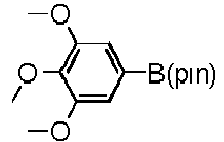
36 VIA18 
69 VIA6 
63 VIA19 
70 VIA7 
57 VIA20 
57 VIA8 
53 VIA21 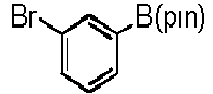
65 VIA9 
65 VIA22 
57 VIA10 
58 VIA23 
70 VIA11 
49 VIA24 
79 VIA12 
51 VIA13 
64 VIA26 
52 [a] isolated yield - 2-(4-methoxyphenyl)-4,4,5,5-tetramethyl-1,3,2-dioxaborolane, compound VIA4 ,

- VIA4 was isolated with a:
- ■ 75 % yield with (indenyl)2ZrCl2 as activating agent,
- ■ 68 % yield with (tBuCp)2ZrCl2 as activating agent,
- ■ 68 % yield with Cp2Zr Cl2 as activating agent,
- ■ 74 % yield with Cp2 ZrHCl as activating agent.
- 2-(4-methoxyphenyl)-4,4,5,5-tetramethyl-1,3,2-dioxaborolane, compound VIA4 ,

- VIA4 was isolated with a:
- ■ 61 % yield with [Cp2Co]PF6 as activating agent,
- ■ 69 % yield with Cp2Co as activating agent,
- ■ 76 % yield with Cp2Ni as activating agent,
- ● 74 % yield with Cp2Ru as activating agent.
- Compounds VIA1 to VIA26 were prepared using the procedure D (example 3) without any activating agent. The yields are shown in the table 3.
table 3 compound Yield (%)[a] compound Product Yield (%)[a] VIA1 
59 VIA14 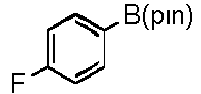
40 VIA2 
38 VIA15 
47 VIA3 
44 VIA16 
71 VIA4 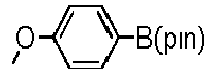
62 VIA17 
62 VIA5 
43 VIA18 
70 VIA6 
63 VIA19 
69 VIA7 
63 VIA20 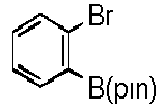
38 VIA8 
56 VIA21 
68 VIA9 
56 VIA22 
63 VIA10 
66 VIA23 
69 VIA11 
48 VIA24 
79 VIA12 
50 VIA13 
63 VIA26 
60 [a] isolated yield - In a dried tube reactor under argon (see example 2), were dissolved the 4-methoxybenzene diazonium tetrafluoroborate salt (1 mmol, 222mg) and ferrocene (10µmol, 1.8mg) in 2mL of anhydrous CH3CN. Pinacolborane (2mmol 256mg) was then added to the solution and stirred for 2h30 at room temperature. The reaction mixture was quenched by a slow addition of anhydrous MeOH at 0°C (2mL) and stirred for an additional hour at room temperature. After removal of all the volatiles, the crude mixture was taken in diethyl ether and washed with a 50g/L CuCl2 solution (2 x 5mL). The organic layer were separated, dried over Na2SO4, filtered and concentrated in vacuo. The resulted oil was dissolved with CH2Cl2 and filtered of a pad of silica gel, eluted with CH2Cl2 to afford the corresponding boronate in 3% yield.
- To a solution of aniline (1 mmol) in 3 ml of freshly distilled acetonitrile, at 0°C, was added boron trifluoride etherate (1.5 mmol 0.4 ml) and the solution stirred for 5 minutes. Isoamyl nitrite (1.2 mmol, 0.2 ml) was then slowly added and the solution stirred for 15 minutes. Diisopropylaminoborane (4 mmol, 0.6 ml) was then slowly added and the mixture was stirred at room temperature for 3 hours. The reaction was then quenched, at 0°C, by the slow addition of 2 ml of distillated methanol and stirred 1 hour at room temperature. The mixture was concentrated under vacuum and a solution of pinacol (1.3 mmol, 153 mg) in 2 ml of diethyl ether was added and the mixture stirred for 4 hours at room temperature. 10 ml of diethyl ether were then added and the crude washed three times with 6 ml of an aqueous solution of copper chloride CuCl2 (50 g/L). The organic phase was then filtered and dried over Na2SO4 and concentrated under vacuum to afford pure arylboronate.
- After reaction, the product was isolated by bulb to bulb distillation.
- The anilines have the following formula, wherein the position(s) of the substituent(s) is (are) indicated by a number, reported in the table 4, as well as their nature :

table 4 Substituent(s) on the aryl group Position/nature Percentage of aniline as byproduct % 2-l 1 3-l 2 4-l 3 2- Cl 0 3- Cl 0,6 4-Cl 1 3NO2 2 2- F 0,2 3- F 0,6 4-F 1 2-Br 1,2 3- Br 0,9 4- Br 0,8 4- CH3 0,05 2-OMe 1 3- OMe 0,4 4- OMe 0,05 H 0,2 3,5-di Cl 3 3,4-di Cl 2 3- CF3 0 4-CN 3

steps (1) and (2) being performed according to a one-pot synthesis.
Claims (15)
- Use of an arenediazonium salt or a heteroarenediazonium salt and of an organoboron compound containing at least one boron-hydrogen bond, in the absence of base,
for the implementation of a process involving an arylation reaction leading to an arylborane compound. - Process for the preparation of an arylborane compound containing at least one B-H bond, by arylation of a B-H bond, which comprises:(1) a step of contacting an arenediazonium salt or a heteroarenediazonium salt with an organoboron compound containing at least one B-H bond, in a reaction medium containing a solvent, in the absence of base,
for the preparation of an arylborane compound,(2) a possible step of recovery
and purification of said arylborane compound obtained at the step (1). - Process according to claim 2, for the preparation of an arylborane compound, wherein the aryl group Ar has from 6 to 26 carbon atoms,
the aryl group being possibly a heteroaryl group containing one or several heteroatom(s) chosen among O, N or S, and having from 4 to 26 carbon atoms,
in particular said arylborane being:■ an aminoarylborane of following formula ● linear alkyls having from 1 to 20 carbon atoms, branched alkyls having from 3 to 20 carbon atoms or cycloalkyls having from 3 to 20 carbon atoms,● benzyls having from 7 to 20 carbon atoms, wherein- the aromatic ring is possibly substituted by halogen(s), hydroxy, alkoxy, alkyl groups having from 1 to 10 carbon atoms,- and/or the carbon atom of the methylene group linked to the nitrogen atom, is possibly substituted by an alkyl group having from 1 to 10 carbon atoms, in particular by a methyl group, said carbon atom being possibly chiral,● phenyls possibly substituted on the aromatic ring by halogen(s), hydroxy, alkoxy groups having from 1 to 5 carbon atoms,● R1 and R2 possibly forming an alkylene group corresponding to the formula -CR3R4-(CH2)n-CR5R6, in which n is ranging from 0 to 4, and the R3 to R6 substituents are chosen, independently of one another, from hydrogen and alkyl groups having from 1 to 20 carbon atoms in particular said alkylene being 1,1,5,5-tetramethylpentylene,■ a dialkoxyarylborane (arylboronic ester) of following formula
 - a linear alkyl having from 1 to 20 carbon atoms,- a branched alkyl having from 3 to 20 carbon atoms,- a cycloalkyl having from 3 to 20 carbon atoms, possibly substituted by one or several halogen atom(s),- a phenyl possibly substituted by halogen(s), hydroxy, alkoxy groups having from 1 to 5 carbon atoms,- a benzyl having from 7 to 20 carbon atoms, wherein- the aromatic ring is possibly substituted by halogen(s), hydroxy, alkoxy, alkyl groups having from 1 to 10 carbon atoms,- and/or the carbon atom of the methylene group linked to the nitrogen atom, is possibly substituted by an alkyl group having from 1 to 10 carbon atoms, in particular by a methyl group, said carbon atom being possibly chiral,- or an acetoxy group having from 1 to 20 carbon atoms,the alkoxy groups -OR8 and -OR8a being in particular connected by a 2 to 4 carbons chain and possibly forming a 5 or 6 membered ring including the boron atom and the two oxygen atoms, the ring being therefore a 5 to 7 membered ring originated from a diol chosen among ethane-1,2-diol, propane-1,3-diol, 2,3-dimethylbutane-2,3-diol (pinacol), pinanediol, 2-methylbutane-2,3-diol, 1,2-diphenylethane-1,2-diol, 2-methylpentane-2,4-diol, 1,2-dihydroxybenzene (catechol), in particular pinacol or pinanediol,■ an alkoxyaminoarylborane of following formula
 ● the amino group is a -NR1R2 group, R1 and R2 having the above mentioned meanings,● the alkoxy group is a -OR8 group, R8 having the above mentioned meanings,■ a diaminoarylborane of following formula
said arylborane being in particular an aminoarylborane or a cyclic diaminoarylborane. - Process according to anyone of claims 2 or 3, comprising a step of contacting an arenediazonium salt or a heteroarenediazonium salt of formula Ar-N2A,
wherein■ A represents an anion chosen among chloride, bromide, iodide, hexafluorophosphate, bistrifluoromethylsulfonylamidure, alkylsulfonates, arylsulfonates, alkylsulfates, alkylcarboxylates, trifluoroacetate, triflates or tetrafluoroborate, preferably the tetrafluoroborate anion,■ Ar is chosen among the aromatic groups including:■ an aryl group, preferably a phenyl, a naphtalenyl, an anthracenyl, a phenanthrenyl, a biphenyl group, said aryl group being possibly mono or polysubstituted, in particular di or trisubstituted, the substituents, identical or different, being chosen independently of one another,■ a heteroaryl group, preferably pyridine, pyrazine, imidazole, pyrazole, oxazole, isoquinoline, thiophene, benzothiophene, furane, benzofurane, isoindole, optionnally carrying at least one substituent,wherein
said substituent(s) carried by the aryl or by the heteroaryl group, being chosen among□ - F, -Cl, -Br or -I,□ -SO2-NH2, or a salt thereof, -SO2-R9,□ -NO2,□ -CF3,□ -CN,□ -R10, a linear alkyl having from 1 to 20 carbon atoms, branched alkyl having from 3 to 20 carbon atoms or cycloalkyl having from 3 to 20 carbon atoms,□ an alkoxy group -OR11,□ -OSitBuPh2 of following formula □ -OSitBuMe2 of following formula
 □ an alkylthio group -SR12,□ a carboxylic group -COOH, or an ester group -COOR13, or an amido group -CO-NH2 or a salt thereof, -CO-NR14R14a,□ a keto group -CO-R15, possibly protected as an acetal or thioacetal,□ an amino group -NR16R16a or a salt thereof,□ an aldehyde group possibly protected as an acetal or thioacetal,□ a trialkylsilyl group -SiR17 3,□ a benzyl group having from 7 to 20 carbon atoms, wherein- the aromatic ring is possibly substituted by halogen(s), hydroxy, alkoxy, alkyl groups having from 1 to 10 carbon atoms, or by an amino or a diazonium group,- and/or the carbon atom of the methylene group linked to the nitrogen atom, is possibly substituted by an alkyl group having from 1 to 10 carbon atoms, in particular by a methyl group, said carbon atom being possibly chiral,□ a borylated group in which boron is a B(III) boron atom (oxidation state III), said group being in particular a dialkoxyboryl group of formula
R 18 and R18a, identical or different, represent:- linear alkyls having from 1 to 20 carbon atoms,- branched alkyls having from 3 to 20 carbon atoms,- cycloalkyls having from 3 to 20 carbon atoms, possibly substituted by one or several halogen atom(s),- phenyls possibly substituted by halogen(s), hydroxy, alkoxy groups having from 1 to 5 carbon atoms,- benzyls having from 7 to 20 carbon atoms, wherein- the aromatic ring is possibly substituted by halogen(s), hydroxy, alkoxy, alkyl groups having from 1 to 10 carbon atoms,- and/or the carbon atom of the methylene group linked to the nitrogen atom, is possibly substituted by an alkyl group having from 1 to 10 carbon atoms, in particular by a methyl group, said carbon atom being possibly chiral,- or acetoxy groups having from 1 to 20 carbon atoms,
the alkoxy groups -OR18 and -OR18a being in particular connected by a 2 to 4 carbons chain and possibly forming a ring including the boron atom and the two oxygen atoms, the ring being therefore a 5 to 7 membered ring originated from a diol chosen among ethane-1,2-diol, propane-1,3-diol, 2,3-dimethylbutane-2,3-diol (pinacol), pinanediol, 2-methylbutane-2,3-diol, 1,2-diphenylethane-1,2-diol, 2-methylpentane-2,4-diol, 1,2-dihydroxybenzene (catechol), in particular pinacol or pinanediol,□ a borylated group in which boron is a B(IV) boron atom (oxidation state IV), being in particular:■ a trifluoroborate group,■ a trihydroxyborate group,■ a trialkoxyborate group, -B(ORa)3, wherein Ra is an alkyl group having from 1 to 10 carbon atoms, (ORa)3 possibly forming two rings between the three oxygen atoms, originating from a triol chosen among 1,2,3-propane triol (glycerol) or 1,1,1-tris(hydroxymethyl)ethane (2-(hydroxymethyl)-2-methyl-1,3-propanediol),■ a boratrane generated from an aminodiol containing from 3 to 20 carbon atoms, said aminodiol forming, with the boron atom, rings of 5 or 6 members and aminodiol being a N,N-bis(hydroxyalkyl)alkylamine of the formula HO-Rb-NRc-Rb'-OH,
wherein
Rb and Rb' identical or different, are linear alkylene groups having 2 or 3 carbon atoms, or branched alkylene groups having from 3 to 5 carbon atoms,
Rc is a hydrogen atom or an alkyl group having 1 to 4 carbon atoms,■ a MIDA borate group originated from 2,2'-(methylazanediyl)diacetic acid and having the following formula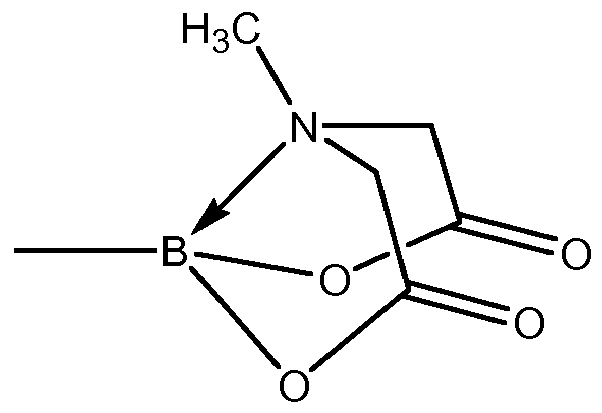 □ a combination of the above,wherein• R10 and R17 represent linear alkyls having from 1 to 20 carbon atoms, branched alkyls having from 3 to 20 carbon atoms or cycloalkyls having 3 to 20 carbon atoms,• R9, R11 R12, R13, R14, R14a, R15, R16 and R16a represent linear alkyls having from 1 to 20 carbon atoms, branched alkyls having from 3 to 20 carbon atoms or cycloalkyls having 3 to 20 carbon atoms, possibly substituted by one or several halogen atom(s), or phenyls possibly substituted by halogen(s), hydroxy, alkoxy groups having from 1 to 5 carbon atoms, or benzyls having from 7 to 20 carbon atoms, wherein the aromatic ring is possibly substituted by halogen(s), hydroxy, alkoxy, alkyl groups having from 1 to 10 carbon atoms, and/or the carbon atom of the methylene group linked to the nitrogen atom, is possibly substituted by an alkyl group having from 1 to 10 carbon atoms, in particular by a methyl group, said carbon atom being possibly chiral,with an organoboron compound to be arylated containing at least one boron-hydrogen bond and having the general following formula I
 ■ X represents:□ -H,□ -NR1R2,□ -R7,□ -OR8,
wherein• R1 and R2, identical or different, represent :- linear alkyls having from 1 to 20 carbon atoms, branched alkyls having from 3 to 20 carbon atoms or cycloalkyls having 3 to 20 carbon atoms,- benzyls having from 7 to 20 carbon atoms, wherein- the aromatic ring is possibly substituted by halogen(s), hydroxy, alkoxy, alkyl groups having from 1 to 10 carbon atoms,- and/or the carbon atom of the methylene group linked to the nitrogen atom, is possibly substituted by an alkyl group having from 1 to 10 carbon atoms, in particular by a methyl group, said carbon atom being possibly chiral,- phenyls possibly substituted on the aromatic ring by halogen(s), hydroxy, alkoxy groups having from 1 to 5 carbon atoms,R1 and R2 possibly forming an alkylene group corresponding to the formula -CR3R4-(CH2)n-CR5R6, in which n is ranging from 0 to 4, and the R3 to R6 substituents are chosen, independently of one another, among hydrogen and alkyl groups having from 1 to 20 carbon atoms in particular said alkylene being 1,1,5,5-tetramethylpentylene,• R7 represents a linear alkyl having from 1 to 20 carbon atoms, a branched alkyl having from 3 to 20 carbon atoms or a cycloalkyl having from 3 to 20 carbon atoms,• R8 represents:- a linear alkyl having from 1 to 20 carbon atoms,- a branched alkyl having from 3 to 20 carbon atoms,- a cycloalkyl having from 3 to 20 carbon atoms, possibly substituted by one or several halogen atom(s),- a phenyl possibly substituted by halogen(s), hydroxy, alkoxy groups having from 1 to 5 carbon atoms,- a benzyl having from 7 to 20 carbon atoms, wherein- the aromatic ring is possibly substituted by halogen(s), hydroxy, alkoxy, alkyl groups having from 1 to 10 carbon atoms,- and/or the carbon atom of the methylene group linked to the nitrogen atom, is possibly substituted by an alkyl group having from 1 to 10 carbon atoms, in particular by a methyl group, said carbon atom being possibly chiral,- or an acetoxy group having from 1 to 20 carbon atoms,■ Y represents:X and Y being independently chosen, provided that if X=H then Y≠H,□ -H,□ -NR1aR2a,□ -R7a,□ -OR8a,
wherein• R1a and R2a, identical or different, represent:- linear alkyls having from 1 to 20 carbon atoms, branched alkyls having from 3 to 20 carbon atoms or cycloalkyls having from 3 to 20 carbon atoms,- benzyls having from 7 to 20 carbon atoms, wherein- the aromatic ring is possibly substituted by halogen(s), hydroxy, alkoxy, alkyl groups having from 1 to 10 carbon atoms,- and/or the carbon atom of the methylene group linked to the nitrogen atom, is possibly substituted by an alkyl group having from 1 to 10 carbon atoms, in particular by a methyl group, said carbon atom being possibly chiral,- phenyls possibly substituted on the aromatic ring by halogen(s), hydroxy, alkoxy groups having from 1 to 5 carbon atoms,R1a and R2a possibly forming an alkylene group corresponding to the formula -CR3aR4a-(CH2)n-CR5aR6a, in which n is ranging from 0 to 4, and the R3a to R6a substituents are chosen, independently of one another, among hydrogen and alkyl groups having from 1 to 20 carbon atoms in particular said alkylene being 1,1,5,5-tetramethylpentylene,• R7a represents a linear alkyl having from 1 to 20 carbon atoms, a branched alkyl having from 3 to 20 carbon atoms or a cycloalkyl having from 3 to 20 carbon atoms,• R8a represents:- a linear alkyl having from 1 to 20 carbon atoms,- a branched alkyl having from 3 to 20 carbon atoms,- a cycloalkyl having from 3 to 20 carbon atoms, possibly substituted by one or several halogen atom(s),- a phenyl possibly substituted by halogen(s), hydroxy, alkoxy groups having from 1 to 5 carbon atoms,- a benzyl having from 7 to 20 carbon atoms, wherein- the aromatic ring is possibly substituted by halogen(s), hydroxy, alkoxy, alkyl groups having from 1 to 10 carbon atoms,- and/or the carbon atom of the methylene group linked to the nitrogen atom, is possibly substituted by an alkyl group having from 1 to 10 carbon atoms, in particular by a methyl group, said carbon atom being possibly chiral,- or an acetoxy group having from 1 to 20 carbon atoms,
and if X=-OR8 and Y=-OR8a, then the alkoxy groups -OR8 and -OR8a are in particular connected by a 2 to 4 carbons chain and possibly form a ring including the boron atom and the two oxygen atoms, the ring being therefore a 5 to 7 membered ring originated from a diol chosen among ethane-1,2-diol, propane-1,3-diol, 2,3-dimethylbutane-2,3-diol (pinacol), pinanediol, 2-methylbutane-2,3-diol, 1,2-diphenylethane-1,2-diol, 2-methylpentane-2,4-diol, 1,2-dihydroxybenzene (catechol), in particular pinacol or pinanediol,
for the preparation of an arylborane or a heteroarylborane of following formula IV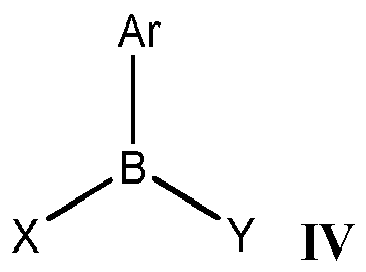
X, Y and Ar have the above mentioned meanings. - Process according to anyone of claims 2 to 4, wherein the arylation reaction is activated by activating means or not, wherein the activating means are chosen among• an activating agent, preferably a complex of a transition metal or a salt of a transition metal or a salt of a transition metal complex, containing a transition metal belonging, in particular, to the group IV, VIII, IX, X or XI, being in particular a metallocene or a salt thereof chosen among:• a titanocene, in particular (tBuCp)2TiCl2, CpTiCl3, Cp2TiCl2, CP*2TiCl2, Cp*TiCl3, Cp2Ti(CO)2, TiCp2, preferably Cp2TiCl2,
wherein- tBu is a tertiobutyl group,- Cp is a cyclopentadienyl group, optionally substituted by a halogen, an alkyl group having 1 to 10 carbon atoms, an aromatic or heteroaromatic group having 5 to 12 carbon atoms, a vinyl group having 2 to 10 carbon atoms, an allyl group having 3 to 10 carbon atoms, an alkylammonium salt having from 1 to 10 carbon atoms,- Cp* is a 1,2,3,4,5-pentamethylcyclopentadienyl group,• a zirconocene, in particular (indenyl)2ZrCl2, Cp2ZrHCl (Schwartz's reagent), (tBuCp)2ZrCl2, preferably Cp2ZrHCl,
wherein indenyl is a benzocyclopentadienyl group,• a ferrocene, in particular Cp2Fe, BrCpFeCp, Cp*2Fe, AcCpFeCp, n-BuCpFeCp, t-BuCpFeCp, vinylCpFeCp, preferably Cp2Fe,• a ruthenocene, in particular Cp2Ru, Cp*2Ru, or a ruthenium complex, in particular Ru(acac)3, wherein acac represents acetylacetonate,• a cobaltocene, in particular Cp2Co, [Cp2Co]PF6 (cobaltocenium hexafluorophosphate), Cp*2Co,• a nickelocene, in particular Cp2Ni, Cp*2Ni,• a copper complex, in particular[Cu(OH)tmeda]2, Cu(salen),
wherein- tmeda represents tetramethylethylenediamine,- salen represents 2,2'-ethylenebis(nitrilomethylidene)diphenol,• a palladium complex, in particular Pd(acac)2 (palladium diacetylacetonate), (CH2=CH-CH2PdCl)2 (allylpalladium chloride), a palladium salt in particular Pd(OAc)2, Pd(CN)2,
the activating agent being preferably chosen among metallocenes, in particular ferrocenes, titanocenes, or zirconocenes, preferably Cp2Fe, Cp2TiCl2 or Cp2ZrHCl,• or radical generating means, preferably by light irradiation, preferably ultraviolet light irradiation (UV), at a wavelength comprised from 180 nm to 400 nm, preferably comprised from 200 nm to 400 nm, in particular equal to about 254 nm, or a radical initiator chosen among azobisisobutyronitrile (AIBN), 1,1'-azobiscyclohexanecarbonitrile (ABCN), dilauroyl peroxide (DLP). - Process according to anyone of claims 2 to 5, wherein the solvent is aprotic and polar, in particular chosen among acetonitrile, propionitrile, butyronitrile, ethylacetate, isopropylacetate, dioxane, dimethylacetamide (DMAc), acetone, N-methyl-2-pyrrolidone (NMP), 2-methoxy-2-methylpropane (MTBE) or tetrahydrofuran (THF), or a mixture thereof, in particular acetonitrile.
- Process according to anyone of claims 2 to 6, for the preparation of an aminoarylborane compound which comprises:(1) a step of contacting an arenediazonium salt or a heteroarenediazonium salt with an aminoborane of following formula II

for the preparation of an aminoarylborane compound of formula V,
R1 and R2 being preferably isopropyl groups,(2) a possible step of recovery and purification of the aminoarylborane compound of formula V from the reaction medium,■ in particular for the preparation of a diisopropylaminoarylborane compound which comprises:(1) a step of contacting an arenediazonium salt or a heteroarenediazonium salt with the diisopropylaminoborane of following formula IIA
for the preparation of a diisopropylaminoarylborane compound of formula VA, (2) a possible step of recovery and purification of the diisopropylaminoarylborane compound of formula VA from the reaction medium,■ in particular for the preparation of a diisopropylaminoarylborane compound which comprises:(1) a step of contacting an arenediazonium salt or a heteroarenediazonium salt with the diisopropylaminoborane of following formula IIA
for the preparation of a diisopropylaminoarylborane compound of formula VA, (2) a possible step of recovery and purification of the diisopropylaminoarylborane compound of formula VA from the reaction medium.
 - Process according to anyone of claims 2 to 6, for the preparation of a dialkoxyarylborane compound which comprises:(1) a step of contacting an arenediazonium salt or a heteroarenediazonium salt with a dialkoxyborane of following formula III

in a reaction medium containing a solvent, in the absence of base, for the preparation of a dialkoxyarylborane compound of formula VI, (2) a possible step of recovery and purification of the dialkoxyarylborane compound of formula VI from the reaction medium,■ in particular for the preparation of an arylpinacolborane compound which comprises:(1) a step of contacting an arenediazonium salt or a heteroarenediazonium salt with the pinacolborane of following formula IIIA
for the preparation of an arylpinacolborane compound of formula VIA , (2) a possible step of recovery and purification of the arylpinacolborane compound of formula VIA from the reaction medium,■ in particular for the preparation of an arylpinacolborane compound which comprises:(1) a step of contacting an arenediazonium salt or a heteroarenediazonium salt with the pinacolborane of following formula IIIA
in the presence of an activating agent preferably chosen among metallocenes, in particular ferrocenes, titanocenes, or zirconocenes, preferably Cp2Fe, Cp2TiCl2 or Cp2ZrHCl,
for the preparation of an arylpinacolborane compound of formula VIA , (2) a possible step of recovery and purification of the arylpinacolborane compound of formula VIA from the reaction medium.
 - Process according to claim 7, wherein the step of contacting an arenediazonium salt or a heteroarenediazonium salt with an aminoborane is performed in an aprotic polar solvent, preferably acetonitrile,
at a temperature comprised from 10 °C to 60 °C, in particular comprised from 18 °C to 30 °C, preferably equal to about 20 °C, during a time ranging from 1 h to 3 h, preferably 2,5 h,
for the preparation of an aminoarylborane,
or wherein the step of mixing an arenediazonium salt or a heteroareneazonium salt with an aminoborane is performed in an aprotic polar solvent, preferably acetonitrile,
in the presence of an activating agent containing a transition metal, said activating agent being preferably chosen among metallocenes, in particular ferrocenes, titanocenes, or zirconocenes, preferably Cp2Fe, Cp2TiCl2 or Cp2ZrHCl,
with a molar percentage relative to the metal comprised from 0,001 % to 5 %, in particular comprised from 0,001 % to 1 %, preferably equal to about 0,001 %, or about 0,01 %, or about 0,1 % or about 1 %,
at a temperature comprised between 10 °C to 60 °C, in particular comprised between 18 °C to 30 °C, preferably equal to about 20 °C, during a time ranging from 1 h to 3 h, preferably 2,5 h,
for the preparation of an aminoarylborane compound. - Process according to claim 8, wherein the step of contacting an arenediazonium salt or a heteroarenediazonium salt with a dialkoxyborane is performed in an aprotic polar solvent, preferably acetonitrile,
at a temperature comprised between 20 °C to 50 °C, in particular comprised between 20 °C to 30 °C, preferably equal to about 25 °C, during a time ranging from 2 h to 4 h, preferably 2,5 h,
for the preparation of an dialkoxyarylborane,
or wherein the step of mixing an arenediazonium salt or a heteroareneazonium salt with an alkoxyborane is performed in an aprotic polar solvent, preferably acetonitrile,
in the presence of an activating agent containing a transition metal, said activating agent being chosen among metallocenes, in particular ferrocenes, titanocenes, or zirconocenes, preferably Cp2Fe, Cp2TiCl2 or Cp2ZrHCl,
with a molar percentage relative to the metal comprised from 0,001 % to 5 %, in particular comprised from 0,001 % to 1 %, preferably equal to about 0,001 %, or about 0,01 %, or about 0,1 % or about 1 %,
at a temperature comprised between 20 °C to 50 °C, in particular comprised between 20 °C to 30 °C, preferably equal to about 25 °C, during a time ranging from 2 h to 4 h, preferably 2,5 h,
for the preparation of a dialkoxyarylborane compound. - Process according to anyone of claims 2 to 7 or 9, comprising after step (1) or (2), a step (3) of treatment of the aminoarylborane obtained at step (1) or (2), into an arylborane which is different from the one obtained at step (1) or (2),
said treatment being in particular an alcoholysis, preferably with a first alcohol, in particular methanol, said alcoholysis possibly followed• by a transesterification with a second alcohol, preferably a diol chosen among ethane-1,2-diol, propane-1,3-diol, 2,3-dimethylbutane-2,3-diol (pinacol), pinanediol, 2-methylbutane-2,3-diol, 1,2-diphenylethane-1,2-diol, 2-methylpentane-2,4-diol, 1,2-dihydroxybenzene (catechol), in particular pinacol or pinanediol,
for the preparation of an arylboronic ester of the following formula VI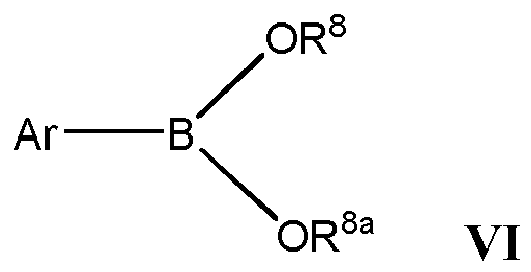
in particular for the preparation of a cyclic aryldialkoxyborane,
preferably for the preparation of an arylpinacolborane of the following formula VIA • or by a hydrolysis in order to obtain an arylboronic acid of formula VIIwherein Ar has the above mentioned meanings.
- Process according to anyone of claims 2 to 7 or 9,
for the preparation of the diisopropylaminoarylboranes of formulae represented below, said diisopropylaminoboranes being isolated and purified, or not:


- Process according to claim 12,
which comprises:(1) a step of contacting an arenediazonium salt or a heteroarenediazonium salt with the diisopropylaminoborane of following formula IIA
in the presence of 0,1 % Cp2Fe as activating agent,
for the preparation of a diisopropylaminoarylborane compound of formula VA,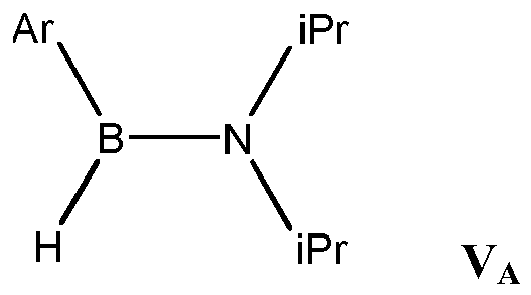 (2) a possible step of recovery and purification from the reaction medium, of the diisopropylaminoarylborane compound of formula VA obtained at step (1),(3) a step of treatment of the aminoarylborane of formula VA obtained at step (1) or (2) said treatment being in particular an alcoholysis, preferably with methanol, followed by a transesterification with pinacol,
for the preparation of an arylpinacolborane having one of the following formulae: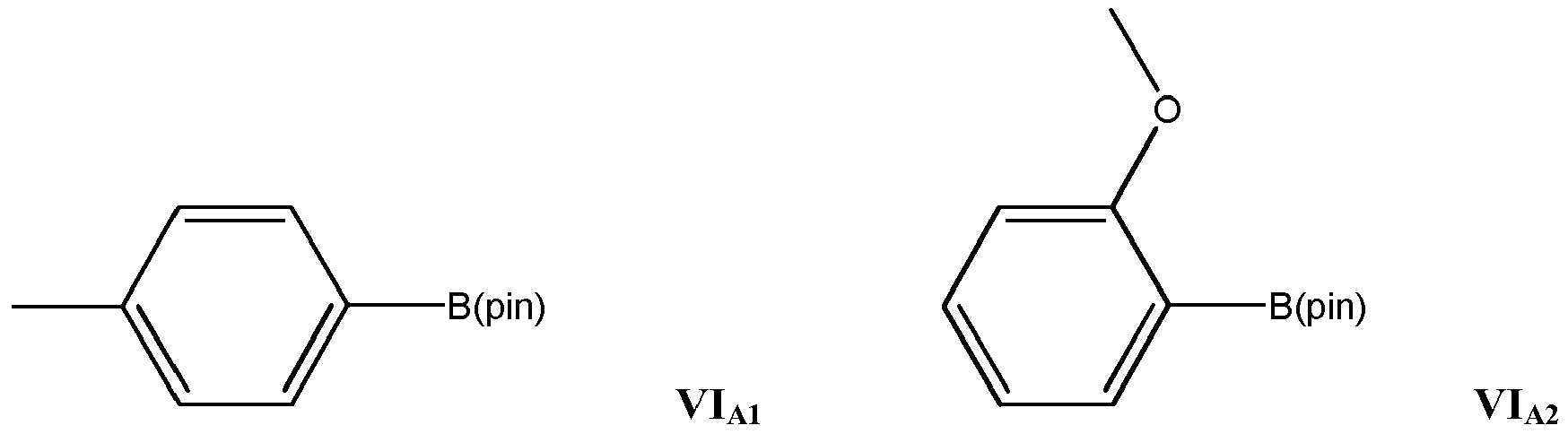


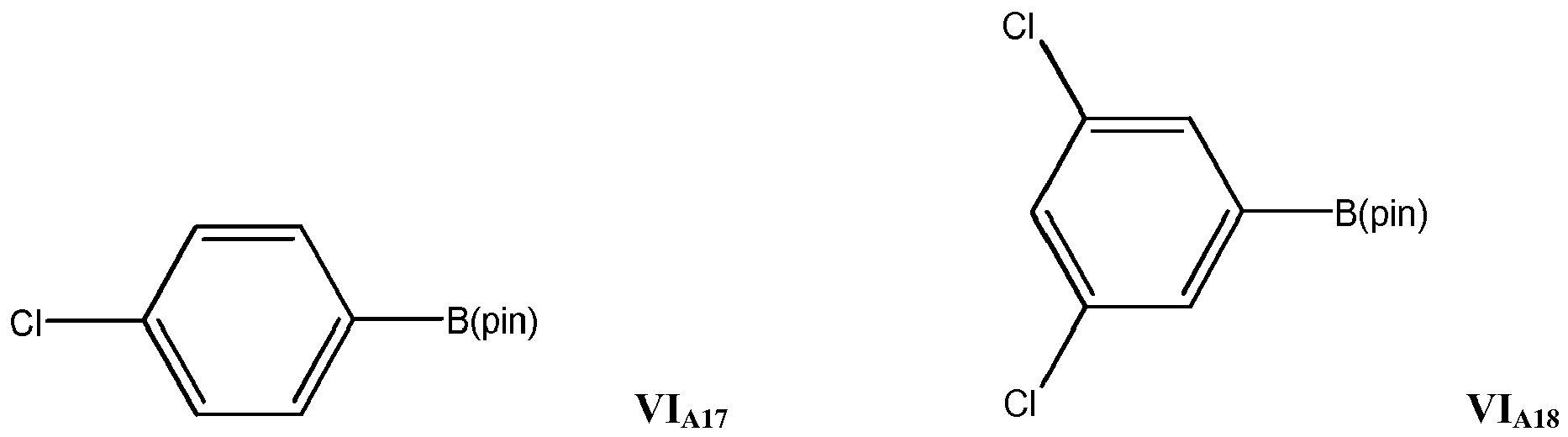


- Process according to anyone of claims 2 to 13, comprising:(1) a step of contacting an arenediazonium salt or a heteroarenediazonium salt with an organoboron compound in a reaction medium containing a solvent, in the absence of base, for the preparation of an aminoarylborane of formula V which is not isolated,(2) a step of treatment of V obtained at step (1) by methanolysis, followed by a transesterification with pinacol,
for the preparation of an arylpinacolborane of formula VIA,
steps (1) and (2) being performed according to a one-pot synthesis,
in particular comprising:(1) a step of contacting an arenediazonium salt or a heteroarenediazonium salt with an organoboron compound containing at least one B-H bond, in a reaction medium containing a solvent, in the absence of base,
in the presence of an activating agent, under continuous flow conditions,
in a tubular system including 2 tubings, wrapped in a circular-like form,- one tubing being a prereactor R1, in which a solution of the arenediazonium salt or of the heteroarenediazonium salt and a solution of the activating agent, in acetonitrile, are injected to be mixed, at a temperature comprised between 10 °C to 60 °C, in particular comprised between 20 °C to 30 °C, preferably equal to about 25 °C,- the second tubing being a reactor R2, in which the mixture containing the arenediazonium salt or the heteroarenediazonium salt and the activating agent is injected, as well as a solution of diisopropylaminoborane in acetonitrile, at the temperature of 1,the two injections being performed under contineous flow conditions and with the same rate,(2) a step of collection of the crude at the outlet of the reactor R2,
the crude being possibly methanolysed to give a boronic ester, which is possibly transesterified, in particular with pinacol, to give an arylpinacolborane, or hydrolysed to give an arylboronic acid. - Process according to anyone of claims 2 to 14, comprising a step of detection of an aniline possibly substituted by the same substituents as the ones of the arenediazonium salt.
Priority Applications (7)
| Application Number | Priority Date | Filing Date | Title |
|---|---|---|---|
| EP12305854.7A EP2684887B1 (en) | 2012-07-13 | 2012-07-13 | New process for preparing arylboranes by arylation of organoboron compounds |
| US14/413,495 US20150191493A1 (en) | 2012-07-13 | 2013-06-27 | New process for preparing arylboranes by arylation of organoboron compounds |
| CA2877043A CA2877043A1 (en) | 2012-07-13 | 2013-06-27 | New process for preparing arylboranes by arylation of organoboron compounds |
| JP2015520890A JP2015525751A (en) | 2012-07-13 | 2013-06-27 | A new process for the preparation of arylboranes by arylation of organoboron compounds |
| AU2013289429A AU2013289429A1 (en) | 2012-07-13 | 2013-06-27 | New process for preparing arylboranes by arylation of organoboron compounds |
| PCT/EP2013/063572 WO2014009169A1 (en) | 2012-07-13 | 2013-06-27 | New process for preparing arylboranes by arylation of organoboron compounds |
| EP13732493.5A EP2872519A1 (en) | 2012-07-13 | 2013-06-27 | New process for preparing arylboranes by arylation of organoboron compounds |
Applications Claiming Priority (1)
| Application Number | Priority Date | Filing Date | Title |
|---|---|---|---|
| EP12305854.7A EP2684887B1 (en) | 2012-07-13 | 2012-07-13 | New process for preparing arylboranes by arylation of organoboron compounds |
Publications (2)
| Publication Number | Publication Date |
|---|---|
| EP2684887A1 true EP2684887A1 (en) | 2014-01-15 |
| EP2684887B1 EP2684887B1 (en) | 2015-06-17 |
Family
ID=48703516
Family Applications (2)
| Application Number | Title | Priority Date | Filing Date |
|---|---|---|---|
| EP12305854.7A Not-in-force EP2684887B1 (en) | 2012-07-13 | 2012-07-13 | New process for preparing arylboranes by arylation of organoboron compounds |
| EP13732493.5A Withdrawn EP2872519A1 (en) | 2012-07-13 | 2013-06-27 | New process for preparing arylboranes by arylation of organoboron compounds |
Family Applications After (1)
| Application Number | Title | Priority Date | Filing Date |
|---|---|---|---|
| EP13732493.5A Withdrawn EP2872519A1 (en) | 2012-07-13 | 2013-06-27 | New process for preparing arylboranes by arylation of organoboron compounds |
Country Status (6)
| Country | Link |
|---|---|
| US (1) | US20150191493A1 (en) |
| EP (2) | EP2684887B1 (en) |
| JP (1) | JP2015525751A (en) |
| AU (1) | AU2013289429A1 (en) |
| CA (1) | CA2877043A1 (en) |
| WO (1) | WO2014009169A1 (en) |
Cited By (5)
| Publication number | Priority date | Publication date | Assignee | Title |
|---|---|---|---|---|
| CN104045661A (en) * | 2014-05-07 | 2014-09-17 | 陕西师范大学 | Method for preparation of aryl boronic acid and aryl borate by alcohol-promoted boronation reaction of aromatic amine |
| EP2881398A1 (en) * | 2013-12-04 | 2015-06-10 | Université de Bordeaux I | Method for preparing aminoarylborane compounds or derivatives thereof |
| US9790239B1 (en) | 2016-05-26 | 2017-10-17 | International Business Machines Corporation | Polyboroaminals |
| US11605535B2 (en) | 2015-03-31 | 2023-03-14 | Versum Materials Us, Llc | Boron-containing compounds, compositions, and methods for the deposition of a boron containing films |
| CN117413150A (en) * | 2021-04-29 | 2024-01-16 | 维谛公司 | Pumped refrigerant systems and related methods for cold starting pumped refrigerant systems |
Families Citing this family (3)
| Publication number | Priority date | Publication date | Assignee | Title |
|---|---|---|---|---|
| TW201625354A (en) * | 2014-06-16 | 2016-07-16 | 陶氏農業科學公司 | Methods for producing borylated arenes |
| CN113234099B (en) * | 2021-05-21 | 2024-03-01 | 合肥工业大学 | Photochemical synthesis method of alkyl borate compound |
| CN115160098B (en) * | 2022-07-21 | 2023-06-06 | 中国科学院兰州化学物理研究所 | Oxygen-containing compound deoxidization methylation method |
Citations (2)
| Publication number | Priority date | Publication date | Assignee | Title |
|---|---|---|---|---|
| EP1500659A1 (en) | 2000-03-01 | 2005-01-26 | Shell Internationale Researchmaatschappij B.V. | Selective, catalytic, thermal functionalization of secondary or aromatic C-H bonds in cyclic hydrocarbons |
| US7179940B2 (en) | 2001-12-21 | 2007-02-20 | Centre National De La Recherche Scientifique | (Aryl)(amino) borane compounds, method for preparing same |
-
2012
- 2012-07-13 EP EP12305854.7A patent/EP2684887B1/en not_active Not-in-force
-
2013
- 2013-06-27 US US14/413,495 patent/US20150191493A1/en not_active Abandoned
- 2013-06-27 JP JP2015520890A patent/JP2015525751A/en not_active Withdrawn
- 2013-06-27 CA CA2877043A patent/CA2877043A1/en not_active Abandoned
- 2013-06-27 AU AU2013289429A patent/AU2013289429A1/en not_active Abandoned
- 2013-06-27 EP EP13732493.5A patent/EP2872519A1/en not_active Withdrawn
- 2013-06-27 WO PCT/EP2013/063572 patent/WO2014009169A1/en not_active Ceased
Patent Citations (2)
| Publication number | Priority date | Publication date | Assignee | Title |
|---|---|---|---|---|
| EP1500659A1 (en) | 2000-03-01 | 2005-01-26 | Shell Internationale Researchmaatschappij B.V. | Selective, catalytic, thermal functionalization of secondary or aromatic C-H bonds in cyclic hydrocarbons |
| US7179940B2 (en) | 2001-12-21 | 2007-02-20 | Centre National De La Recherche Scientifique | (Aryl)(amino) borane compounds, method for preparing same |
Non-Patent Citations (18)
| Title |
|---|
| 1. A. I. MKHALID; J. H. BARNARD; T. B. MARDER; J. M. MURPHY; J. F. HARTWIG, CHEMICAL REVIEWS, vol. 110, 2009, pages 890 - 931 |
| D. M. WILLIS; R. M. STRONGIN, TETRAHEDRON LETTERS, vol. 41, 2000, pages 8683 - 8686 |
| IBRAHEEM A I MKHALID ET AL: "C-H activation for the construction of C-B bonds", CHEMICAL REVIEWS, AMERICAN CHEMICAL SOCIETY, US, vol. 110, no. 2, 1 January 2010 (2010-01-01), pages 890 - 931, XP002640883, ISSN: 0009-2665, [retrieved on 20091222], DOI: 10.1021/CR900206P * |
| J. F. HARTWIG; K. S. COOK; M. HAPKE; C. D. INCARVITO; Y. FAN; C. E. WEBSTER; M. B. HALL, J. AM. CHEM. SOC., vol. 127, 2005, pages 2538 - 2552 |
| J. M. MURPHY; C. C. TZSCHUCKE; J. F. HARTWIG, ORG. LETT., vol. 9, 2007, pages 757 - 760 |
| J. M. MURPHY; X. LIAO; J. F. HARTWIG, J. AM. CHEM. SOC., 2007 |
| J. ZHANG; X. WANG; H. YU; J. YE, SYNLETT, vol. 9, 2012, pages 1394 - 1396 |
| L. EUZENAT; D. HORHANT; C. BRIELLES; G. ALCARAZ; M. VAULTIER, J. ORGANOMET. CHEM., vol. 690, 2005, pages 2721 - 2724 |
| L. EUZENAT; D. HORHANT; Y. RIBOURDOUILLE; C. DURIEZ; G. ALCARAZ; M. VAULTIER, CHEM. COMMUN., 2003, pages 2280 - 2281 |
| L. MARCIASINI; N. RICHY; M. VAULTIER; M. PUCHEAULT, CHEM. COMM., 2012, pages 48 |
| N. MIYAURA; A. SUZUKI, CHEM. REV., vol. 95, 1995, pages 2457 |
| T. ISHIYAMA; K. ISHIDA; N. MIYAURA, TETRAHEDRON, vol. 57, 2001, pages 9813 - 9816 |
| T. ISHIYAMA; M. MURATA; N. MIYAURA, J ORG CHEM, vol. 60, 1995, pages 7508 - 7510 |
| T. ISHIYAMA; N. MIYAURA, JOURNAL OF ORGANOMETALLIC CHEMISTRY, vol. 611, 2000, pages 392 - 402 |
| T. ISHIYAMA; Y. ITOH; T. KITANO; N. MIYAURA, TETRAHEDRON LETTERS, vol. 38, 1997, pages 3447 - 3450 |
| T. M. BOLLER; J. M. MURPHY; M. HAPKE; T. ISHIYAMA; N. MIYAURA; J. F. HARTWIG, J. AM. CHEM. SOC., vol. 127, 2005, pages 14263 - 14278 |
| WILLIS D M ET AL: "Palladium-catalyzed borylation of aryldiazonium tetrafluoroborate salts. A new synthesis of arylboronic esters", TETRAHEDRON LETTERS, ELSEVIER, AMSTERDAM, NL, vol. 41, no. 45, 4 November 2000 (2000-11-04), pages 8683 - 8686, XP004236058, ISSN: 0040-4039, DOI: 10.1016/S0040-4039(00)01573-2 * |
| YANG H ET AL: "Cyclic amide bioisosterism: Strategic application to the design and synthesis of HCV NS5B polymerase inhibitors", BIOORGANIC & MEDICINAL CHEMISTRY LETTERS, PERGAMON, ELSEVIER SCIENCE, GB, vol. 20, no. 15, 1 August 2010 (2010-08-01), pages 4614 - 4619, XP027263633, ISSN: 0960-894X, [retrieved on 20100608] * |
Cited By (6)
| Publication number | Priority date | Publication date | Assignee | Title |
|---|---|---|---|---|
| EP2881398A1 (en) * | 2013-12-04 | 2015-06-10 | Université de Bordeaux I | Method for preparing aminoarylborane compounds or derivatives thereof |
| WO2015082592A3 (en) * | 2013-12-04 | 2015-08-06 | Universite de Bordeaux | Method for preparing aminoarylborane compounds or derivatives thereof |
| CN104045661A (en) * | 2014-05-07 | 2014-09-17 | 陕西师范大学 | Method for preparation of aryl boronic acid and aryl borate by alcohol-promoted boronation reaction of aromatic amine |
| US11605535B2 (en) | 2015-03-31 | 2023-03-14 | Versum Materials Us, Llc | Boron-containing compounds, compositions, and methods for the deposition of a boron containing films |
| US9790239B1 (en) | 2016-05-26 | 2017-10-17 | International Business Machines Corporation | Polyboroaminals |
| CN117413150A (en) * | 2021-04-29 | 2024-01-16 | 维谛公司 | Pumped refrigerant systems and related methods for cold starting pumped refrigerant systems |
Also Published As
| Publication number | Publication date |
|---|---|
| US20150191493A1 (en) | 2015-07-09 |
| AU2013289429A1 (en) | 2015-01-22 |
| EP2872519A1 (en) | 2015-05-20 |
| EP2684887B1 (en) | 2015-06-17 |
| JP2015525751A (en) | 2015-09-07 |
| CA2877043A1 (en) | 2014-01-16 |
| WO2014009169A1 (en) | 2014-01-16 |
Similar Documents
| Publication | Publication Date | Title |
|---|---|---|
| EP2684887B1 (en) | New process for preparing arylboranes by arylation of organoboron compounds | |
| Bernskoetter et al. | Investigations of Iridium-Mediated Reversible C− H Bond Cleavage: Characterization of a 16-Electron Iridium (III) Methyl Hydride Complex | |
| Segawa et al. | Chemistry of boryllithium: synthesis, structure, and reactivity | |
| Crimmin et al. | Calcium-catalyzed intermolecular hydrophosphination | |
| Curran et al. | Synthesis and reactions of N‐heterocyclic carbene boranes | |
| McBee et al. | Mechanistic studies of the hydroamination of norbornene with electrophilic platinum complexes: the role of proton transfer | |
| Fan et al. | AN-Phosphinoamidinato NHC-Diborene Catalyst for Hydroboration | |
| Basalov et al. | Divalent heteroleptic ytterbium complexes–effective catalysts for intermolecular styrene hydrophosphination and hydroamination | |
| Rosorius et al. | Electronic control of frustrated Lewis pair behavior: chemistry of a geminal alkylidene-bridged per-pentafluorophenylated P/B pair | |
| Shaffer et al. | Palladium (II) 3-iminophosphine complexes as intermolecular hydroamination catalysts for the formation of imines and enamines | |
| Chen et al. | Unusual Si–H bond activation and formation of cationic scandium amide complexes from a mono (amidinate)-ligated scandium bis (silylamide) complex and their performance in isoprene polymerization | |
| Dubé et al. | Dinuclear complexes of Di-, Tri-, and Mixed-Valent samarium supported by the Calix-tetrapyrrole ligand | |
| Scheideman et al. | Amine-directed hydroboration: Scope and limitations | |
| Hill et al. | Electrophilic methylplatinum complexes: First structure of a hydroxytris (pentafluorophenyl) borate complex | |
| Sharma et al. | Organoactinides promote the dimerization of aldehydes: Scope, kinetics, thermodynamics, and calculation studies | |
| Jana et al. | Dehydrogenation of LGeH by a Lewis N-heterocyclic carbene borane pair under the formation of L′ Ge and its reactions with B (C6F5) 3 and trimethylsilyl diazomethane: An unprecedented rearrangement of a diazocompound to an isonitrile | |
| Hughes et al. | Iridium and rhodium complexes containing fluorinated phenyl ligands and their transformation to η2-benzyne complexes, including the parent benzyne complex IrCp*(PMe3)(C6H4) | |
| Shima et al. | Tetra-, penta-, and hexanuclear yttrium hydride clusters from half-sandwich bis (aminobenzyl) complexes containing various cyclopentadienyl ligands | |
| Wyss et al. | Bonding and reactivity of a dicopper (I) μ-boryl cation | |
| Sakamoto et al. | Illuminating stannylation | |
| Tai et al. | Subtle reactivities of boron and aluminum complexes with amino-linked N-heterocyclic carbene ligation | |
| Boubekeur et al. | Nitrogen-assisted ortho lithiation: one-pot synthesis of new classes of bidentate and tetradentate mixed P∼ N ligands | |
| Watson et al. | Diphosphine Isomerization and C− H and P− C Bond Cleavage Reactivity in the Triosmium Cluster Os3 (CO) 10 (bpcd): Kinetic and Isotope Data for Reversible Ortho Metalation and X-ray Structures of the Bridging and Chelating Isomers of Os3 (CO) 10 (bpcd) and the Benzyne-Substituted Cluster HOs3 (CO) 8 (μ3-C6H4)[μ2, η1-PPhC C (PPh2) C (O) CH2C (O)] | |
| Thomas et al. | Comparative Studies with Zwitterionic Platinum (II) Bis (pyrazolyl) borate and 2, 2 ‘-Bipyridylborate Complexes | |
| Klein et al. | New mechanism for the intermolecular hydroamination of alkynes: Catalysis by dinuclear ruthenium complexes with a rigid dicyclopentadienyl ligand |
Legal Events
| Date | Code | Title | Description |
|---|---|---|---|
| PUAI | Public reference made under article 153(3) epc to a published international application that has entered the european phase |
Free format text: ORIGINAL CODE: 0009012 |
|
| AK | Designated contracting states |
Kind code of ref document: A1 Designated state(s): AL AT BE BG CH CY CZ DE DK EE ES FI FR GB GR HR HU IE IS IT LI LT LU LV MC MK MT NL NO PL PT RO RS SE SI SK SM TR |
|
| AX | Request for extension of the european patent |
Extension state: BA ME |
|
| 17P | Request for examination filed |
Effective date: 20140624 |
|
| RBV | Designated contracting states (corrected) |
Designated state(s): AL AT BE BG CH CY CZ DE DK EE ES FI FR GB GR HR HU IE IS IT LI LT LU LV MC MK MT NL NO PL PT RO RS SE SI SK SM TR |
|
| GRAP | Despatch of communication of intention to grant a patent |
Free format text: ORIGINAL CODE: EPIDOSNIGR1 |
|
| INTG | Intention to grant announced |
Effective date: 20141112 |
|
| RIN1 | Information on inventor provided before grant (corrected) |
Inventor name: VAULTIER, MICHEL Inventor name: PUCHEAULT, MATHIEU JONATHAN DAMIEN Inventor name: MARCIASINI, LUDOVIC DANIEL ALAIN |
|
| GRAS | Grant fee paid |
Free format text: ORIGINAL CODE: EPIDOSNIGR3 |
|
| GRAA | (expected) grant |
Free format text: ORIGINAL CODE: 0009210 |
|
| RAP1 | Party data changed (applicant data changed or rights of an application transferred) |
Owner name: UNIVERSITE DE BORDEAUX Owner name: CENTRE NATIONAL DE LA RECHERCHE SCIENTIFIQUE |
|
| AK | Designated contracting states |
Kind code of ref document: B1 Designated state(s): AL AT BE BG CH CY CZ DE DK EE ES FI FR GB GR HR HU IE IS IT LI LT LU LV MC MK MT NL NO PL PT RO RS SE SI SK SM TR |
|
| REG | Reference to a national code |
Ref country code: GB Ref legal event code: FG4D |
|
| REG | Reference to a national code |
Ref country code: FR Ref legal event code: PLFP Year of fee payment: 4 |
|
| REG | Reference to a national code |
Ref country code: CH Ref legal event code: EP |
|
| REG | Reference to a national code |
Ref country code: AT Ref legal event code: REF Ref document number: 731869 Country of ref document: AT Kind code of ref document: T Effective date: 20150715 |
|
| REG | Reference to a national code |
Ref country code: IE Ref legal event code: FG4D |
|
| REG | Reference to a national code |
Ref country code: DE Ref legal event code: R096 Ref document number: 602012008019 Country of ref document: DE |
|
| PG25 | Lapsed in a contracting state [announced via postgrant information from national office to epo] |
Ref country code: LT Free format text: LAPSE BECAUSE OF FAILURE TO SUBMIT A TRANSLATION OF THE DESCRIPTION OR TO PAY THE FEE WITHIN THE PRESCRIBED TIME-LIMIT Effective date: 20150617 Ref country code: HR Free format text: LAPSE BECAUSE OF FAILURE TO SUBMIT A TRANSLATION OF THE DESCRIPTION OR TO PAY THE FEE WITHIN THE PRESCRIBED TIME-LIMIT Effective date: 20150617 Ref country code: FI Free format text: LAPSE BECAUSE OF FAILURE TO SUBMIT A TRANSLATION OF THE DESCRIPTION OR TO PAY THE FEE WITHIN THE PRESCRIBED TIME-LIMIT Effective date: 20150617 Ref country code: NO Free format text: LAPSE BECAUSE OF FAILURE TO SUBMIT A TRANSLATION OF THE DESCRIPTION OR TO PAY THE FEE WITHIN THE PRESCRIBED TIME-LIMIT Effective date: 20150917 |
|
| PGFP | Annual fee paid to national office [announced via postgrant information from national office to epo] |
Ref country code: DE Payment date: 20150629 Year of fee payment: 4 |
|
| REG | Reference to a national code |
Ref country code: AT Ref legal event code: MK05 Ref document number: 731869 Country of ref document: AT Kind code of ref document: T Effective date: 20150617 |
|
| REG | Reference to a national code |
Ref country code: LT Ref legal event code: MG4D Ref country code: NL Ref legal event code: MP Effective date: 20150617 |
|
| PG25 | Lapsed in a contracting state [announced via postgrant information from national office to epo] |
Ref country code: LV Free format text: LAPSE BECAUSE OF FAILURE TO SUBMIT A TRANSLATION OF THE DESCRIPTION OR TO PAY THE FEE WITHIN THE PRESCRIBED TIME-LIMIT Effective date: 20150617 Ref country code: RS Free format text: LAPSE BECAUSE OF FAILURE TO SUBMIT A TRANSLATION OF THE DESCRIPTION OR TO PAY THE FEE WITHIN THE PRESCRIBED TIME-LIMIT Effective date: 20150617 Ref country code: BG Free format text: LAPSE BECAUSE OF FAILURE TO SUBMIT A TRANSLATION OF THE DESCRIPTION OR TO PAY THE FEE WITHIN THE PRESCRIBED TIME-LIMIT Effective date: 20150917 Ref country code: GR Free format text: LAPSE BECAUSE OF FAILURE TO SUBMIT A TRANSLATION OF THE DESCRIPTION OR TO PAY THE FEE WITHIN THE PRESCRIBED TIME-LIMIT Effective date: 20150918 |
|
| PGFP | Annual fee paid to national office [announced via postgrant information from national office to epo] |
Ref country code: FR Payment date: 20150626 Year of fee payment: 4 |
|
| PG25 | Lapsed in a contracting state [announced via postgrant information from national office to epo] |
Ref country code: EE Free format text: LAPSE BECAUSE OF FAILURE TO SUBMIT A TRANSLATION OF THE DESCRIPTION OR TO PAY THE FEE WITHIN THE PRESCRIBED TIME-LIMIT Effective date: 20150617 |
|
| PG25 | Lapsed in a contracting state [announced via postgrant information from national office to epo] |
Ref country code: AT Free format text: LAPSE BECAUSE OF FAILURE TO SUBMIT A TRANSLATION OF THE DESCRIPTION OR TO PAY THE FEE WITHIN THE PRESCRIBED TIME-LIMIT Effective date: 20150617 Ref country code: PT Free format text: LAPSE BECAUSE OF FAILURE TO SUBMIT A TRANSLATION OF THE DESCRIPTION OR TO PAY THE FEE WITHIN THE PRESCRIBED TIME-LIMIT Effective date: 20151019 Ref country code: IS Free format text: LAPSE BECAUSE OF FAILURE TO SUBMIT A TRANSLATION OF THE DESCRIPTION OR TO PAY THE FEE WITHIN THE PRESCRIBED TIME-LIMIT Effective date: 20151017 Ref country code: SK Free format text: LAPSE BECAUSE OF FAILURE TO SUBMIT A TRANSLATION OF THE DESCRIPTION OR TO PAY THE FEE WITHIN THE PRESCRIBED TIME-LIMIT Effective date: 20150617 Ref country code: CZ Free format text: LAPSE BECAUSE OF FAILURE TO SUBMIT A TRANSLATION OF THE DESCRIPTION OR TO PAY THE FEE WITHIN THE PRESCRIBED TIME-LIMIT Effective date: 20150617 Ref country code: ES Free format text: LAPSE BECAUSE OF FAILURE TO SUBMIT A TRANSLATION OF THE DESCRIPTION OR TO PAY THE FEE WITHIN THE PRESCRIBED TIME-LIMIT Effective date: 20150617 Ref country code: PL Free format text: LAPSE BECAUSE OF FAILURE TO SUBMIT A TRANSLATION OF THE DESCRIPTION OR TO PAY THE FEE WITHIN THE PRESCRIBED TIME-LIMIT Effective date: 20150617 Ref country code: RO Free format text: LAPSE BECAUSE OF NON-PAYMENT OF DUE FEES Effective date: 20150617 |
|
| REG | Reference to a national code |
Ref country code: CH Ref legal event code: PL |
|
| REG | Reference to a national code |
Ref country code: DE Ref legal event code: R097 Ref document number: 602012008019 Country of ref document: DE |
|
| PG25 | Lapsed in a contracting state [announced via postgrant information from national office to epo] |
Ref country code: MC Free format text: LAPSE BECAUSE OF FAILURE TO SUBMIT A TRANSLATION OF THE DESCRIPTION OR TO PAY THE FEE WITHIN THE PRESCRIBED TIME-LIMIT Effective date: 20150617 |
|
| REG | Reference to a national code |
Ref country code: IE Ref legal event code: MM4A |
|
| PLBE | No opposition filed within time limit |
Free format text: ORIGINAL CODE: 0009261 |
|
| STAA | Information on the status of an ep patent application or granted ep patent |
Free format text: STATUS: NO OPPOSITION FILED WITHIN TIME LIMIT |
|
| PG25 | Lapsed in a contracting state [announced via postgrant information from national office to epo] |
Ref country code: LI Free format text: LAPSE BECAUSE OF NON-PAYMENT OF DUE FEES Effective date: 20150731 Ref country code: DK Free format text: LAPSE BECAUSE OF FAILURE TO SUBMIT A TRANSLATION OF THE DESCRIPTION OR TO PAY THE FEE WITHIN THE PRESCRIBED TIME-LIMIT Effective date: 20150617 Ref country code: CH Free format text: LAPSE BECAUSE OF NON-PAYMENT OF DUE FEES Effective date: 20150731 Ref country code: IT Free format text: LAPSE BECAUSE OF FAILURE TO SUBMIT A TRANSLATION OF THE DESCRIPTION OR TO PAY THE FEE WITHIN THE PRESCRIBED TIME-LIMIT Effective date: 20150617 |
|
| 26N | No opposition filed |
Effective date: 20160318 |
|
| PG25 | Lapsed in a contracting state [announced via postgrant information from national office to epo] |
Ref country code: IE Free format text: LAPSE BECAUSE OF NON-PAYMENT OF DUE FEES Effective date: 20150713 |
|
| PG25 | Lapsed in a contracting state [announced via postgrant information from national office to epo] |
Ref country code: SI Free format text: LAPSE BECAUSE OF FAILURE TO SUBMIT A TRANSLATION OF THE DESCRIPTION OR TO PAY THE FEE WITHIN THE PRESCRIBED TIME-LIMIT Effective date: 20150617 |
|
| PG25 | Lapsed in a contracting state [announced via postgrant information from national office to epo] |
Ref country code: BE Free format text: LAPSE BECAUSE OF FAILURE TO SUBMIT A TRANSLATION OF THE DESCRIPTION OR TO PAY THE FEE WITHIN THE PRESCRIBED TIME-LIMIT Effective date: 20150617 |
|
| REG | Reference to a national code |
Ref country code: DE Ref legal event code: R119 Ref document number: 602012008019 Country of ref document: DE |
|
| GBPC | Gb: european patent ceased through non-payment of renewal fee |
Effective date: 20160713 |
|
| PG25 | Lapsed in a contracting state [announced via postgrant information from national office to epo] |
Ref country code: MT Free format text: LAPSE BECAUSE OF FAILURE TO SUBMIT A TRANSLATION OF THE DESCRIPTION OR TO PAY THE FEE WITHIN THE PRESCRIBED TIME-LIMIT Effective date: 20150617 |
|
| PG25 | Lapsed in a contracting state [announced via postgrant information from national office to epo] |
Ref country code: FR Free format text: LAPSE BECAUSE OF NON-PAYMENT OF DUE FEES Effective date: 20160801 Ref country code: DE Free format text: LAPSE BECAUSE OF NON-PAYMENT OF DUE FEES Effective date: 20170201 |
|
| REG | Reference to a national code |
Ref country code: FR Ref legal event code: ST Effective date: 20170331 |
|
| PG25 | Lapsed in a contracting state [announced via postgrant information from national office to epo] |
Ref country code: GB Free format text: LAPSE BECAUSE OF NON-PAYMENT OF DUE FEES Effective date: 20160713 Ref country code: HU Free format text: LAPSE BECAUSE OF FAILURE TO SUBMIT A TRANSLATION OF THE DESCRIPTION OR TO PAY THE FEE WITHIN THE PRESCRIBED TIME-LIMIT; INVALID AB INITIO Effective date: 20120713 Ref country code: SM Free format text: LAPSE BECAUSE OF FAILURE TO SUBMIT A TRANSLATION OF THE DESCRIPTION OR TO PAY THE FEE WITHIN THE PRESCRIBED TIME-LIMIT Effective date: 20150617 |
|
| PG25 | Lapsed in a contracting state [announced via postgrant information from national office to epo] |
Ref country code: NL Free format text: LAPSE BECAUSE OF FAILURE TO SUBMIT A TRANSLATION OF THE DESCRIPTION OR TO PAY THE FEE WITHIN THE PRESCRIBED TIME-LIMIT Effective date: 20150617 Ref country code: SE Free format text: LAPSE BECAUSE OF FAILURE TO SUBMIT A TRANSLATION OF THE DESCRIPTION OR TO PAY THE FEE WITHIN THE PRESCRIBED TIME-LIMIT Effective date: 20150617 Ref country code: CY Free format text: LAPSE BECAUSE OF FAILURE TO SUBMIT A TRANSLATION OF THE DESCRIPTION OR TO PAY THE FEE WITHIN THE PRESCRIBED TIME-LIMIT Effective date: 20150617 |
|
| PG25 | Lapsed in a contracting state [announced via postgrant information from national office to epo] |
Ref country code: LU Free format text: LAPSE BECAUSE OF NON-PAYMENT OF DUE FEES Effective date: 20150713 |
|
| PG25 | Lapsed in a contracting state [announced via postgrant information from national office to epo] |
Ref country code: TR Free format text: LAPSE BECAUSE OF FAILURE TO SUBMIT A TRANSLATION OF THE DESCRIPTION OR TO PAY THE FEE WITHIN THE PRESCRIBED TIME-LIMIT Effective date: 20150617 Ref country code: MK Free format text: LAPSE BECAUSE OF FAILURE TO SUBMIT A TRANSLATION OF THE DESCRIPTION OR TO PAY THE FEE WITHIN THE PRESCRIBED TIME-LIMIT Effective date: 20150617 |
|
| PG25 | Lapsed in a contracting state [announced via postgrant information from national office to epo] |
Ref country code: AL Free format text: LAPSE BECAUSE OF FAILURE TO SUBMIT A TRANSLATION OF THE DESCRIPTION OR TO PAY THE FEE WITHIN THE PRESCRIBED TIME-LIMIT Effective date: 20150617 |