EP2680349A1 - Secondary cell negative electrode, secondary cell, slurry composition for negative electrode, and method of producing secondary cell negative electrode - Google Patents
Secondary cell negative electrode, secondary cell, slurry composition for negative electrode, and method of producing secondary cell negative electrode Download PDFInfo
- Publication number
- EP2680349A1 EP2680349A1 EP12749342.7A EP12749342A EP2680349A1 EP 2680349 A1 EP2680349 A1 EP 2680349A1 EP 12749342 A EP12749342 A EP 12749342A EP 2680349 A1 EP2680349 A1 EP 2680349A1
- Authority
- EP
- European Patent Office
- Prior art keywords
- negative electrode
- active material
- water
- secondary battery
- electrode active
- Prior art date
- Legal status (The legal status is an assumption and is not a legal conclusion. Google has not performed a legal analysis and makes no representation as to the accuracy of the status listed.)
- Withdrawn
Links
- 239000000203 mixture Substances 0.000 title claims description 92
- 239000002002 slurry Substances 0.000 title claims description 81
- 238000000034 method Methods 0.000 title claims description 47
- 239000000178 monomer Substances 0.000 claims abstract description 196
- 239000007773 negative electrode material Substances 0.000 claims abstract description 138
- 229920003169 water-soluble polymer Polymers 0.000 claims abstract description 121
- 239000011230 binding agent Substances 0.000 claims abstract description 99
- CERQOIWHTDAKMF-UHFFFAOYSA-N Methacrylic acid Chemical compound CC(=C)C(O)=O CERQOIWHTDAKMF-UHFFFAOYSA-N 0.000 claims abstract description 79
- 229910052731 fluorine Inorganic materials 0.000 claims abstract description 35
- YCKRFDGAMUMZLT-UHFFFAOYSA-N Fluorine atom Chemical compound [F] YCKRFDGAMUMZLT-UHFFFAOYSA-N 0.000 claims abstract description 33
- 239000011737 fluorine Substances 0.000 claims abstract description 33
- 229920001577 copolymer Polymers 0.000 claims abstract description 9
- 150000001735 carboxylic acids Chemical class 0.000 claims abstract 4
- 229920000642 polymer Polymers 0.000 claims description 71
- 238000004519 manufacturing process Methods 0.000 claims description 69
- XLYOFNOQVPJJNP-UHFFFAOYSA-N water Substances O XLYOFNOQVPJJNP-UHFFFAOYSA-N 0.000 claims description 42
- 239000008151 electrolyte solution Substances 0.000 claims description 35
- 229910052744 lithium Inorganic materials 0.000 claims description 28
- WHXSMMKQMYFTQS-UHFFFAOYSA-N Lithium Chemical compound [Li] WHXSMMKQMYFTQS-UHFFFAOYSA-N 0.000 claims description 25
- 150000001993 dienes Chemical class 0.000 claims description 24
- 125000001931 aliphatic group Chemical group 0.000 claims description 23
- 229910052751 metal Inorganic materials 0.000 claims description 22
- 239000002184 metal Substances 0.000 claims description 21
- 229920002554 vinyl polymer Polymers 0.000 claims description 21
- 238000001035 drying Methods 0.000 claims description 20
- 239000007864 aqueous solution Substances 0.000 claims description 15
- 150000001875 compounds Chemical class 0.000 claims description 6
- 150000002763 monocarboxylic acids Chemical class 0.000 claims description 6
- 241000894007 species Species 0.000 description 73
- 239000010410 layer Substances 0.000 description 67
- 238000011156 evaluation Methods 0.000 description 48
- 239000002245 particle Substances 0.000 description 43
- 150000001732 carboxylic acid derivatives Chemical class 0.000 description 42
- HBBGRARXTFLTSG-UHFFFAOYSA-N Lithium ion Chemical compound [Li+] HBBGRARXTFLTSG-UHFFFAOYSA-N 0.000 description 38
- 229910001416 lithium ion Inorganic materials 0.000 description 38
- 238000006116 polymerization reaction Methods 0.000 description 37
- -1 ethylene, propylene, vinyl Chemical group 0.000 description 32
- 238000007599 discharging Methods 0.000 description 30
- 239000007774 positive electrode material Substances 0.000 description 29
- 239000000243 solution Substances 0.000 description 25
- 239000011149 active material Substances 0.000 description 19
- 239000006185 dispersion Substances 0.000 description 18
- 239000000463 material Substances 0.000 description 18
- 239000003795 chemical substances by application Substances 0.000 description 17
- 238000003860 storage Methods 0.000 description 17
- 239000007787 solid Substances 0.000 description 16
- 239000002904 solvent Substances 0.000 description 16
- 230000008961 swelling Effects 0.000 description 15
- 238000010438 heat treatment Methods 0.000 description 14
- 229910052710 silicon Inorganic materials 0.000 description 14
- OKTJSMMVPCPJKN-UHFFFAOYSA-N Carbon Chemical compound [C] OKTJSMMVPCPJKN-UHFFFAOYSA-N 0.000 description 13
- JIGUQPWFLRLWPJ-UHFFFAOYSA-N Ethyl acrylate Chemical compound CCOC(=O)C=C JIGUQPWFLRLWPJ-UHFFFAOYSA-N 0.000 description 13
- 239000000654 additive Substances 0.000 description 13
- 239000003125 aqueous solvent Substances 0.000 description 13
- 239000007772 electrode material Substances 0.000 description 13
- PNJWIWWMYCMZRO-UHFFFAOYSA-N pent‐4‐en‐2‐one Natural products CC(=O)CC=C PNJWIWWMYCMZRO-UHFFFAOYSA-N 0.000 description 13
- 235000010980 cellulose Nutrition 0.000 description 12
- 229920002678 cellulose Polymers 0.000 description 12
- 239000001913 cellulose Substances 0.000 description 12
- XEEYBQQBJWHFJM-UHFFFAOYSA-N iron Substances [Fe] XEEYBQQBJWHFJM-UHFFFAOYSA-N 0.000 description 12
- 230000000996 additive effect Effects 0.000 description 11
- 230000000052 comparative effect Effects 0.000 description 11
- 239000010936 titanium Substances 0.000 description 11
- 239000004034 viscosity adjusting agent Substances 0.000 description 11
- KAKZBPTYRLMSJV-UHFFFAOYSA-N Butadiene Chemical compound C=CC=C KAKZBPTYRLMSJV-UHFFFAOYSA-N 0.000 description 10
- XUIMIQQOPSSXEZ-UHFFFAOYSA-N Silicon Chemical compound [Si] XUIMIQQOPSSXEZ-UHFFFAOYSA-N 0.000 description 10
- PPBRXRYQALVLMV-UHFFFAOYSA-N Styrene Chemical compound C=CC1=CC=CC=C1 PPBRXRYQALVLMV-UHFFFAOYSA-N 0.000 description 10
- 238000006243 chemical reaction Methods 0.000 description 10
- 229920005615 natural polymer Polymers 0.000 description 10
- 230000009467 reduction Effects 0.000 description 10
- 239000010703 silicon Substances 0.000 description 10
- NIXOWILDQLNWCW-UHFFFAOYSA-M Acrylate Chemical compound [O-]C(=O)C=C NIXOWILDQLNWCW-UHFFFAOYSA-M 0.000 description 9
- 229910052782 aluminium Inorganic materials 0.000 description 9
- 229910052799 carbon Inorganic materials 0.000 description 9
- 230000000694 effects Effects 0.000 description 9
- 238000002156 mixing Methods 0.000 description 9
- 239000003505 polymerization initiator Substances 0.000 description 9
- 229910052719 titanium Inorganic materials 0.000 description 9
- NLHHRLWOUZZQLW-UHFFFAOYSA-N Acrylonitrile Chemical compound C=CC#N NLHHRLWOUZZQLW-UHFFFAOYSA-N 0.000 description 8
- 229920002134 Carboxymethyl cellulose Polymers 0.000 description 8
- RYGMFSIKBFXOCR-UHFFFAOYSA-N Copper Chemical compound [Cu] RYGMFSIKBFXOCR-UHFFFAOYSA-N 0.000 description 8
- WYURNTSHIVDZCO-UHFFFAOYSA-N Tetrahydrofuran Chemical compound C1CCOC1 WYURNTSHIVDZCO-UHFFFAOYSA-N 0.000 description 8
- 229910021383 artificial graphite Inorganic materials 0.000 description 8
- 239000003575 carbonaceous material Substances 0.000 description 8
- 230000007423 decrease Effects 0.000 description 8
- LYCAIKOWRPUZTN-UHFFFAOYSA-N ethylene glycol Natural products OCCO LYCAIKOWRPUZTN-UHFFFAOYSA-N 0.000 description 8
- 229910052742 iron Inorganic materials 0.000 description 8
- 229910044991 metal oxide Inorganic materials 0.000 description 8
- 150000004706 metal oxides Chemical class 0.000 description 8
- 229910052814 silicon oxide Inorganic materials 0.000 description 8
- 229920000049 Carbon (fiber) Polymers 0.000 description 7
- 239000004354 Hydroxyethyl cellulose Substances 0.000 description 7
- 229920000663 Hydroxyethyl cellulose Polymers 0.000 description 7
- 239000004917 carbon fiber Substances 0.000 description 7
- 235000010948 carboxy methyl cellulose Nutrition 0.000 description 7
- 239000001768 carboxy methyl cellulose Substances 0.000 description 7
- 239000008112 carboxymethyl-cellulose Substances 0.000 description 7
- 239000011247 coating layer Substances 0.000 description 7
- 229910052802 copper Inorganic materials 0.000 description 7
- 239000010949 copper Substances 0.000 description 7
- 235000019447 hydroxyethyl cellulose Nutrition 0.000 description 7
- 230000006872 improvement Effects 0.000 description 7
- 239000011135 tin Substances 0.000 description 7
- AFFZTFNQQHNSEG-UHFFFAOYSA-N trifluoromethyl 2-methylprop-2-enoate Chemical compound CC(=C)C(=O)OC(F)(F)F AFFZTFNQQHNSEG-UHFFFAOYSA-N 0.000 description 7
- SMZOUWXMTYCWNB-UHFFFAOYSA-N 2-(2-methoxy-5-methylphenyl)ethanamine Chemical compound COC1=CC=C(C)C=C1CCN SMZOUWXMTYCWNB-UHFFFAOYSA-N 0.000 description 6
- NIXOWILDQLNWCW-UHFFFAOYSA-N 2-Propenoic acid Natural products OC(=O)C=C NIXOWILDQLNWCW-UHFFFAOYSA-N 0.000 description 6
- WEVYAHXRMPXWCK-UHFFFAOYSA-N Acetonitrile Chemical compound CC#N WEVYAHXRMPXWCK-UHFFFAOYSA-N 0.000 description 6
- HEMHJVSKTPXQMS-UHFFFAOYSA-M Sodium hydroxide Chemical compound [OH-].[Na+] HEMHJVSKTPXQMS-UHFFFAOYSA-M 0.000 description 6
- XAGFODPZIPBFFR-UHFFFAOYSA-N aluminium Chemical compound [Al] XAGFODPZIPBFFR-UHFFFAOYSA-N 0.000 description 6
- 230000008859 change Effects 0.000 description 6
- 230000008602 contraction Effects 0.000 description 6
- 239000011889 copper foil Substances 0.000 description 6
- 239000003995 emulsifying agent Substances 0.000 description 6
- 230000009477 glass transition Effects 0.000 description 6
- 150000002500 ions Chemical class 0.000 description 6
- 239000007788 liquid Substances 0.000 description 6
- PXHVJJICTQNCMI-UHFFFAOYSA-N nickel Substances [Ni] PXHVJJICTQNCMI-UHFFFAOYSA-N 0.000 description 6
- 238000005498 polishing Methods 0.000 description 6
- 229920000058 polyacrylate Polymers 0.000 description 6
- 239000004094 surface-active agent Substances 0.000 description 6
- VZCYOOQTPOCHFL-UHFFFAOYSA-N trans-butenedioic acid Natural products OC(=O)C=CC(O)=O VZCYOOQTPOCHFL-UHFFFAOYSA-N 0.000 description 6
- YEJRWHAVMIAJKC-UHFFFAOYSA-N 4-Butyrolactone Chemical compound O=C1CCCO1 YEJRWHAVMIAJKC-UHFFFAOYSA-N 0.000 description 5
- LFQSCWFLJHTTHZ-UHFFFAOYSA-N Ethanol Chemical compound CCO LFQSCWFLJHTTHZ-UHFFFAOYSA-N 0.000 description 5
- KFZMGEQAYNKOFK-UHFFFAOYSA-N Isopropanol Chemical compound CC(C)O KFZMGEQAYNKOFK-UHFFFAOYSA-N 0.000 description 5
- GWEVSGVZZGPLCZ-UHFFFAOYSA-N Titan oxide Chemical compound O=[Ti]=O GWEVSGVZZGPLCZ-UHFFFAOYSA-N 0.000 description 5
- 150000001252 acrylic acid derivatives Chemical class 0.000 description 5
- 125000000217 alkyl group Chemical group 0.000 description 5
- 238000000354 decomposition reaction Methods 0.000 description 5
- 150000001991 dicarboxylic acids Chemical class 0.000 description 5
- 239000002270 dispersing agent Substances 0.000 description 5
- 239000010419 fine particle Substances 0.000 description 5
- 229910010272 inorganic material Inorganic materials 0.000 description 5
- 239000002931 mesocarbon microbead Substances 0.000 description 5
- 239000011302 mesophase pitch Substances 0.000 description 5
- 229910052759 nickel Inorganic materials 0.000 description 5
- USHAGKDGDHPEEY-UHFFFAOYSA-L potassium persulfate Chemical compound [K+].[K+].[O-]S(=O)(=O)OOS([O-])(=O)=O USHAGKDGDHPEEY-UHFFFAOYSA-L 0.000 description 5
- 239000011241 protective layer Substances 0.000 description 5
- 230000002829 reductive effect Effects 0.000 description 5
- 229910052718 tin Inorganic materials 0.000 description 5
- 229910052723 transition metal Inorganic materials 0.000 description 5
- MYRTYDVEIRVNKP-UHFFFAOYSA-N 1,2-Divinylbenzene Chemical compound C=CC1=CC=CC=C1C=C MYRTYDVEIRVNKP-UHFFFAOYSA-N 0.000 description 4
- SDGKUVSVPIIUCF-UHFFFAOYSA-N 2,6-dimethylpiperidine Chemical compound CC1CCCC(C)N1 SDGKUVSVPIIUCF-UHFFFAOYSA-N 0.000 description 4
- GOXQRTZXKQZDDN-UHFFFAOYSA-N 2-Ethylhexyl acrylate Chemical compound CCCCC(CC)COC(=O)C=C GOXQRTZXKQZDDN-UHFFFAOYSA-N 0.000 description 4
- OIFBSDVPJOWBCH-UHFFFAOYSA-N Diethyl carbonate Chemical compound CCOC(=O)OCC OIFBSDVPJOWBCH-UHFFFAOYSA-N 0.000 description 4
- KMTRUDSVKNLOMY-UHFFFAOYSA-N Ethylene carbonate Chemical compound O=C1OCCO1 KMTRUDSVKNLOMY-UHFFFAOYSA-N 0.000 description 4
- VZCYOOQTPOCHFL-OWOJBTEDSA-N Fumaric acid Chemical compound OC(=O)\C=C\C(O)=O VZCYOOQTPOCHFL-OWOJBTEDSA-N 0.000 description 4
- 229910000733 Li alloy Inorganic materials 0.000 description 4
- BAPJBEWLBFYGME-UHFFFAOYSA-N Methyl acrylate Chemical compound COC(=O)C=C BAPJBEWLBFYGME-UHFFFAOYSA-N 0.000 description 4
- VYPSYNLAJGMNEJ-UHFFFAOYSA-N Silicium dioxide Chemical compound O=[Si]=O VYPSYNLAJGMNEJ-UHFFFAOYSA-N 0.000 description 4
- RTAQQCXQSZGOHL-UHFFFAOYSA-N Titanium Chemical compound [Ti] RTAQQCXQSZGOHL-UHFFFAOYSA-N 0.000 description 4
- 229910045601 alloy Inorganic materials 0.000 description 4
- 239000000956 alloy Substances 0.000 description 4
- 125000003178 carboxy group Chemical group [H]OC(*)=O 0.000 description 4
- 239000002131 composite material Substances 0.000 description 4
- GVGUFUZHNYFZLC-UHFFFAOYSA-N dodecyl benzenesulfonate;sodium Chemical compound [Na].CCCCCCCCCCCCOS(=O)(=O)C1=CC=CC=C1 GVGUFUZHNYFZLC-UHFFFAOYSA-N 0.000 description 4
- 235000019441 ethanol Nutrition 0.000 description 4
- 238000006266 etherification reaction Methods 0.000 description 4
- 239000007770 graphite material Substances 0.000 description 4
- 150000002484 inorganic compounds Chemical class 0.000 description 4
- 239000001989 lithium alloy Substances 0.000 description 4
- 239000011572 manganese Substances 0.000 description 4
- 150000002739 metals Chemical class 0.000 description 4
- LVHBHZANLOWSRM-UHFFFAOYSA-N methylenebutanedioic acid Natural products OC(=O)CC(=C)C(O)=O LVHBHZANLOWSRM-UHFFFAOYSA-N 0.000 description 4
- 150000002894 organic compounds Chemical class 0.000 description 4
- 229920002239 polyacrylonitrile Polymers 0.000 description 4
- 239000002994 raw material Substances 0.000 description 4
- 230000002787 reinforcement Effects 0.000 description 4
- 229940080264 sodium dodecylbenzenesulfonate Drugs 0.000 description 4
- 238000006467 substitution reaction Methods 0.000 description 4
- 239000003115 supporting electrolyte Substances 0.000 description 4
- YLQBMQCUIZJEEH-UHFFFAOYSA-N tetrahydrofuran Natural products C=1C=COC=1 YLQBMQCUIZJEEH-UHFFFAOYSA-N 0.000 description 4
- VAYTZRYEBVHVLE-UHFFFAOYSA-N 1,3-dioxol-2-one Chemical compound O=C1OC=CO1 VAYTZRYEBVHVLE-UHFFFAOYSA-N 0.000 description 3
- JAHNSTQSQJOJLO-UHFFFAOYSA-N 2-(3-fluorophenyl)-1h-imidazole Chemical compound FC1=CC=CC(C=2NC=CN=2)=C1 JAHNSTQSQJOJLO-UHFFFAOYSA-N 0.000 description 3
- HRPVXLWXLXDGHG-UHFFFAOYSA-N Acrylamide Chemical compound NC(=O)C=C HRPVXLWXLXDGHG-UHFFFAOYSA-N 0.000 description 3
- QGZKDVFQNNGYKY-UHFFFAOYSA-N Ammonia Chemical compound N QGZKDVFQNNGYKY-UHFFFAOYSA-N 0.000 description 3
- VHUUQVKOLVNVRT-UHFFFAOYSA-N Ammonium hydroxide Chemical compound [NH4+].[OH-] VHUUQVKOLVNVRT-UHFFFAOYSA-N 0.000 description 3
- 229920000298 Cellophane Polymers 0.000 description 3
- 241000196324 Embryophyta Species 0.000 description 3
- XEKOWRVHYACXOJ-UHFFFAOYSA-N Ethyl acetate Chemical compound CCOC(C)=O XEKOWRVHYACXOJ-UHFFFAOYSA-N 0.000 description 3
- 229910001290 LiPF6 Inorganic materials 0.000 description 3
- WMFOQBRAJBCJND-UHFFFAOYSA-M Lithium hydroxide Chemical compound [Li+].[OH-] WMFOQBRAJBCJND-UHFFFAOYSA-M 0.000 description 3
- OKKJLVBELUTLKV-UHFFFAOYSA-N Methanol Chemical compound OC OKKJLVBELUTLKV-UHFFFAOYSA-N 0.000 description 3
- VVQNEPGJFQJSBK-UHFFFAOYSA-N Methyl methacrylate Chemical compound COC(=O)C(C)=C VVQNEPGJFQJSBK-UHFFFAOYSA-N 0.000 description 3
- GYCMBHHDWRMZGG-UHFFFAOYSA-N Methylacrylonitrile Chemical compound CC(=C)C#N GYCMBHHDWRMZGG-UHFFFAOYSA-N 0.000 description 3
- ZMXDDKWLCZADIW-UHFFFAOYSA-N N,N-Dimethylformamide Chemical compound CN(C)C=O ZMXDDKWLCZADIW-UHFFFAOYSA-N 0.000 description 3
- SECXISVLQFMRJM-UHFFFAOYSA-N N-Methylpyrrolidone Chemical compound CN1CCCC1=O SECXISVLQFMRJM-UHFFFAOYSA-N 0.000 description 3
- 229920000459 Nitrile rubber Polymers 0.000 description 3
- 239000002033 PVDF binder Substances 0.000 description 3
- 229920003171 Poly (ethylene oxide) Polymers 0.000 description 3
- UCKMPCXJQFINFW-UHFFFAOYSA-N Sulphide Chemical compound [S-2] UCKMPCXJQFINFW-UHFFFAOYSA-N 0.000 description 3
- ATJFFYVFTNAWJD-UHFFFAOYSA-N Tin Chemical compound [Sn] ATJFFYVFTNAWJD-UHFFFAOYSA-N 0.000 description 3
- YXFVVABEGXRONW-UHFFFAOYSA-N Toluene Chemical compound CC1=CC=CC=C1 YXFVVABEGXRONW-UHFFFAOYSA-N 0.000 description 3
- 235000011114 ammonium hydroxide Nutrition 0.000 description 3
- 230000015572 biosynthetic process Effects 0.000 description 3
- 239000002134 carbon nanofiber Substances 0.000 description 3
- 239000002388 carbon-based active material Substances 0.000 description 3
- 125000002091 cationic group Chemical group 0.000 description 3
- 229910052804 chromium Inorganic materials 0.000 description 3
- 239000011883 electrode binding agent Substances 0.000 description 3
- 239000003792 electrolyte Substances 0.000 description 3
- 238000010556 emulsion polymerization method Methods 0.000 description 3
- 238000007720 emulsion polymerization reaction Methods 0.000 description 3
- 230000007613 environmental effect Effects 0.000 description 3
- 150000002170 ethers Chemical class 0.000 description 3
- JBTWLSYIZRCDFO-UHFFFAOYSA-N ethyl methyl carbonate Chemical compound CCOC(=O)OC JBTWLSYIZRCDFO-UHFFFAOYSA-N 0.000 description 3
- 125000001153 fluoro group Chemical group F* 0.000 description 3
- 238000005227 gel permeation chromatography Methods 0.000 description 3
- 150000004676 glycans Chemical class 0.000 description 3
- 229910021469 graphitizable carbon Inorganic materials 0.000 description 3
- 150000002430 hydrocarbons Chemical class 0.000 description 3
- 230000001771 impaired effect Effects 0.000 description 3
- 239000011256 inorganic filler Substances 0.000 description 3
- 238000009830 intercalation Methods 0.000 description 3
- 229910003002 lithium salt Inorganic materials 0.000 description 3
- 159000000002 lithium salts Chemical class 0.000 description 3
- VZCYOOQTPOCHFL-UPHRSURJSA-N maleic acid Chemical compound OC(=O)\C=C/C(O)=O VZCYOOQTPOCHFL-UPHRSURJSA-N 0.000 description 3
- 238000005259 measurement Methods 0.000 description 3
- 244000005700 microbiome Species 0.000 description 3
- 230000004048 modification Effects 0.000 description 3
- 238000012986 modification Methods 0.000 description 3
- 150000004767 nitrides Chemical class 0.000 description 3
- 229920001282 polysaccharide Polymers 0.000 description 3
- 239000005017 polysaccharide Substances 0.000 description 3
- 229920002981 polyvinylidene fluoride Polymers 0.000 description 3
- RUOJZAUFBMNUDX-UHFFFAOYSA-N propylene carbonate Chemical compound CC1COC(=O)O1 RUOJZAUFBMNUDX-UHFFFAOYSA-N 0.000 description 3
- 229920005989 resin Polymers 0.000 description 3
- 239000011347 resin Substances 0.000 description 3
- 229910021332 silicide Inorganic materials 0.000 description 3
- FVBUAEGBCNSCDD-UHFFFAOYSA-N silicide(4-) Chemical compound [Si-4] FVBUAEGBCNSCDD-UHFFFAOYSA-N 0.000 description 3
- 229910052708 sodium Inorganic materials 0.000 description 3
- 239000011734 sodium Substances 0.000 description 3
- 238000001179 sorption measurement Methods 0.000 description 3
- 229920003048 styrene butadiene rubber Polymers 0.000 description 3
- 239000000126 substance Substances 0.000 description 3
- 230000002522 swelling effect Effects 0.000 description 3
- 238000012360 testing method Methods 0.000 description 3
- LDHQCZJRKDOVOX-UHFFFAOYSA-N trans-crotonic acid Natural products CC=CC(O)=O LDHQCZJRKDOVOX-UHFFFAOYSA-N 0.000 description 3
- 150000003624 transition metals Chemical class 0.000 description 3
- 229910052725 zinc Inorganic materials 0.000 description 3
- ZZXUZKXVROWEIF-UHFFFAOYSA-N 1,2-butylene carbonate Chemical compound CCC1COC(=O)O1 ZZXUZKXVROWEIF-UHFFFAOYSA-N 0.000 description 2
- WNXJIVFYUVYPPR-UHFFFAOYSA-N 1,3-dioxolane Chemical compound C1COCO1 WNXJIVFYUVYPPR-UHFFFAOYSA-N 0.000 description 2
- UZKWTJUDCOPSNM-UHFFFAOYSA-N 1-ethenoxybutane Chemical compound CCCCOC=C UZKWTJUDCOPSNM-UHFFFAOYSA-N 0.000 description 2
- JLIDVCMBCGBIEY-UHFFFAOYSA-N 1-penten-3-one Chemical compound CCC(=O)C=C JLIDVCMBCGBIEY-UHFFFAOYSA-N 0.000 description 2
- SDJHPPZKZZWAKF-UHFFFAOYSA-N 2,3-dimethylbuta-1,3-diene Chemical compound CC(=C)C(C)=C SDJHPPZKZZWAKF-UHFFFAOYSA-N 0.000 description 2
- OEPOKWHJYJXUGD-UHFFFAOYSA-N 2-(3-phenylmethoxyphenyl)-1,3-thiazole-4-carbaldehyde Chemical compound O=CC1=CSC(C=2C=C(OCC=3C=CC=CC=3)C=CC=2)=N1 OEPOKWHJYJXUGD-UHFFFAOYSA-N 0.000 description 2
- HZAXFHJVJLSVMW-UHFFFAOYSA-N 2-Aminoethan-1-ol Chemical compound NCCO HZAXFHJVJLSVMW-UHFFFAOYSA-N 0.000 description 2
- ZWEHNKRNPOVVGH-UHFFFAOYSA-N 2-Butanone Chemical compound CCC(C)=O ZWEHNKRNPOVVGH-UHFFFAOYSA-N 0.000 description 2
- XNWFRZJHXBZDAG-UHFFFAOYSA-N 2-METHOXYETHANOL Chemical compound COCCO XNWFRZJHXBZDAG-UHFFFAOYSA-N 0.000 description 2
- XFCMNSHQOZQILR-UHFFFAOYSA-N 2-[2-(2-methylprop-2-enoyloxy)ethoxy]ethyl 2-methylprop-2-enoate Chemical compound CC(=C)C(=O)OCCOCCOC(=O)C(C)=C XFCMNSHQOZQILR-UHFFFAOYSA-N 0.000 description 2
- OMIGHNLMNHATMP-UHFFFAOYSA-N 2-hydroxyethyl prop-2-enoate Chemical compound OCCOC(=O)C=C OMIGHNLMNHATMP-UHFFFAOYSA-N 0.000 description 2
- QCAHUFWKIQLBNB-UHFFFAOYSA-N 3-(3-methoxypropoxy)propan-1-ol Chemical compound COCCCOCCCO QCAHUFWKIQLBNB-UHFFFAOYSA-N 0.000 description 2
- NLXLAEXVIDQMFP-UHFFFAOYSA-N Ammonia chloride Chemical compound [NH4+].[Cl-] NLXLAEXVIDQMFP-UHFFFAOYSA-N 0.000 description 2
- SOGAXMICEFXMKE-UHFFFAOYSA-N Butylmethacrylate Chemical compound CCCCOC(=O)C(C)=C SOGAXMICEFXMKE-UHFFFAOYSA-N 0.000 description 2
- 229910001558 CF3SO3Li Inorganic materials 0.000 description 2
- VEXZGXHMUGYJMC-UHFFFAOYSA-M Chloride anion Chemical compound [Cl-] VEXZGXHMUGYJMC-UHFFFAOYSA-M 0.000 description 2
- RGSFGYAAUTVSQA-UHFFFAOYSA-N Cyclopentane Chemical compound C1CCCC1 RGSFGYAAUTVSQA-UHFFFAOYSA-N 0.000 description 2
- XTHFKEDIFFGKHM-UHFFFAOYSA-N Dimethoxyethane Chemical compound COCCOC XTHFKEDIFFGKHM-UHFFFAOYSA-N 0.000 description 2
- IAZDPXIOMUYVGZ-UHFFFAOYSA-N Dimethylsulphoxide Chemical compound CS(C)=O IAZDPXIOMUYVGZ-UHFFFAOYSA-N 0.000 description 2
- 239000001856 Ethyl cellulose Substances 0.000 description 2
- ZZSNKZQZMQGXPY-UHFFFAOYSA-N Ethyl cellulose Chemical compound CCOCC1OC(OC)C(OCC)C(OCC)C1OC1C(O)C(O)C(OC)C(CO)O1 ZZSNKZQZMQGXPY-UHFFFAOYSA-N 0.000 description 2
- RRHGJUQNOFWUDK-UHFFFAOYSA-N Isoprene Chemical compound CC(=C)C=C RRHGJUQNOFWUDK-UHFFFAOYSA-N 0.000 description 2
- CNCOEDDPFOAUMB-UHFFFAOYSA-N N-Methylolacrylamide Chemical compound OCNC(=O)C=C CNCOEDDPFOAUMB-UHFFFAOYSA-N 0.000 description 2
- 239000004698 Polyethylene Substances 0.000 description 2
- 239000004743 Polypropylene Substances 0.000 description 2
- OFOBLEOULBTSOW-UHFFFAOYSA-N Propanedioic acid Natural products OC(=O)CC(O)=O OFOBLEOULBTSOW-UHFFFAOYSA-N 0.000 description 2
- BZHJMEDXRYGGRV-UHFFFAOYSA-N Vinyl chloride Chemical compound ClC=C BZHJMEDXRYGGRV-UHFFFAOYSA-N 0.000 description 2
- 239000002253 acid Substances 0.000 description 2
- 150000008065 acid anhydrides Chemical class 0.000 description 2
- 150000001298 alcohols Chemical class 0.000 description 2
- 229910052783 alkali metal Inorganic materials 0.000 description 2
- 150000001340 alkali metals Chemical class 0.000 description 2
- 239000012670 alkaline solution Substances 0.000 description 2
- 150000001336 alkenes Chemical class 0.000 description 2
- 229920013820 alkyl cellulose Polymers 0.000 description 2
- XYLMUPLGERFSHI-UHFFFAOYSA-N alpha-Methylstyrene Chemical compound CC(=C)C1=CC=CC=C1 XYLMUPLGERFSHI-UHFFFAOYSA-N 0.000 description 2
- 150000001408 amides Chemical class 0.000 description 2
- 150000003863 ammonium salts Chemical class 0.000 description 2
- 229920006321 anionic cellulose Polymers 0.000 description 2
- 125000000129 anionic group Chemical group 0.000 description 2
- 238000009835 boiling Methods 0.000 description 2
- FUSUHKVFWTUUBE-UHFFFAOYSA-N buten-2-one Chemical compound CC(=O)C=C FUSUHKVFWTUUBE-UHFFFAOYSA-N 0.000 description 2
- CQEYYJKEWSMYFG-UHFFFAOYSA-N butyl acrylate Chemical compound CCCCOC(=O)C=C CQEYYJKEWSMYFG-UHFFFAOYSA-N 0.000 description 2
- 239000011651 chromium Substances 0.000 description 2
- 150000004696 coordination complex Chemical class 0.000 description 2
- 239000012792 core layer Substances 0.000 description 2
- LDHQCZJRKDOVOX-NSCUHMNNSA-N crotonic acid Chemical compound C\C=C\C(O)=O LDHQCZJRKDOVOX-NSCUHMNNSA-N 0.000 description 2
- 230000001186 cumulative effect Effects 0.000 description 2
- JHIVVAPYMSGYDF-UHFFFAOYSA-N cyclohexanone Chemical compound O=C1CCCCC1 JHIVVAPYMSGYDF-UHFFFAOYSA-N 0.000 description 2
- 238000009831 deintercalation Methods 0.000 description 2
- 238000011161 development Methods 0.000 description 2
- SWXVUIWOUIDPGS-UHFFFAOYSA-N diacetone alcohol Chemical compound CC(=O)CC(C)(C)O SWXVUIWOUIDPGS-UHFFFAOYSA-N 0.000 description 2
- 238000009792 diffusion process Methods 0.000 description 2
- IEJIGPNLZYLLBP-UHFFFAOYSA-N dimethyl carbonate Chemical compound COC(=O)OC IEJIGPNLZYLLBP-UHFFFAOYSA-N 0.000 description 2
- 150000002148 esters Chemical class 0.000 description 2
- FJKIXWOMBXYWOQ-UHFFFAOYSA-N ethenoxyethane Chemical compound CCOC=C FJKIXWOMBXYWOQ-UHFFFAOYSA-N 0.000 description 2
- UIWXSTHGICQLQT-UHFFFAOYSA-N ethenyl propanoate Chemical compound CCC(=O)OC=C UIWXSTHGICQLQT-UHFFFAOYSA-N 0.000 description 2
- SUPCQIBBMFXVTL-UHFFFAOYSA-N ethyl 2-methylprop-2-enoate Chemical compound CCOC(=O)C(C)=C SUPCQIBBMFXVTL-UHFFFAOYSA-N 0.000 description 2
- 235000019325 ethyl cellulose Nutrition 0.000 description 2
- 229920001249 ethyl cellulose Polymers 0.000 description 2
- 235000010944 ethyl methyl cellulose Nutrition 0.000 description 2
- 230000002349 favourable effect Effects 0.000 description 2
- 239000000835 fiber Substances 0.000 description 2
- 239000001530 fumaric acid Substances 0.000 description 2
- 229910052733 gallium Inorganic materials 0.000 description 2
- 229910002804 graphite Inorganic materials 0.000 description 2
- 239000010439 graphite Substances 0.000 description 2
- AMWRITDGCCNYAT-UHFFFAOYSA-L hydroxy(oxo)manganese;manganese Chemical compound [Mn].O[Mn]=O.O[Mn]=O AMWRITDGCCNYAT-UHFFFAOYSA-L 0.000 description 2
- 125000002768 hydroxyalkyl group Chemical group 0.000 description 2
- 235000010979 hydroxypropyl methyl cellulose Nutrition 0.000 description 2
- 239000001866 hydroxypropyl methyl cellulose Substances 0.000 description 2
- 229920003088 hydroxypropyl methyl cellulose Polymers 0.000 description 2
- UFVKGYZPFZQRLF-UHFFFAOYSA-N hydroxypropyl methyl cellulose Chemical compound OC1C(O)C(OC)OC(CO)C1OC1C(O)C(O)C(OC2C(C(O)C(OC3C(C(O)C(O)C(CO)O3)O)C(CO)O2)O)C(CO)O1 UFVKGYZPFZQRLF-UHFFFAOYSA-N 0.000 description 2
- 229910003475 inorganic filler Inorganic materials 0.000 description 2
- 230000002687 intercalation Effects 0.000 description 2
- 150000002576 ketones Chemical class 0.000 description 2
- 238000007561 laser diffraction method Methods 0.000 description 2
- 229910052745 lead Inorganic materials 0.000 description 2
- MHCFAGZWMAWTNR-UHFFFAOYSA-M lithium perchlorate Chemical compound [Li+].[O-]Cl(=O)(=O)=O MHCFAGZWMAWTNR-UHFFFAOYSA-M 0.000 description 2
- 229910001486 lithium perchlorate Inorganic materials 0.000 description 2
- SWAIALBIBWIKKQ-UHFFFAOYSA-N lithium titanium Chemical compound [Li].[Ti] SWAIALBIBWIKKQ-UHFFFAOYSA-N 0.000 description 2
- 229910052749 magnesium Inorganic materials 0.000 description 2
- 239000011777 magnesium Substances 0.000 description 2
- 239000011976 maleic acid Substances 0.000 description 2
- 229910052748 manganese Inorganic materials 0.000 description 2
- NUJOXMJBOLGQSY-UHFFFAOYSA-N manganese dioxide Chemical compound O=[Mn]=O NUJOXMJBOLGQSY-UHFFFAOYSA-N 0.000 description 2
- FQPSGWSUVKBHSU-UHFFFAOYSA-N methacrylamide Chemical compound CC(=C)C(N)=O FQPSGWSUVKBHSU-UHFFFAOYSA-N 0.000 description 2
- 229920000609 methyl cellulose Polymers 0.000 description 2
- TZIHFWKZFHZASV-UHFFFAOYSA-N methyl formate Chemical compound COC=O TZIHFWKZFHZASV-UHFFFAOYSA-N 0.000 description 2
- 235000010981 methylcellulose Nutrition 0.000 description 2
- 239000001923 methylcellulose Substances 0.000 description 2
- 229920003087 methylethyl cellulose Polymers 0.000 description 2
- 229910052750 molybdenum Inorganic materials 0.000 description 2
- JKQOBWVOAYFWKG-UHFFFAOYSA-N molybdenum trioxide Chemical compound O=[Mo](=O)=O JKQOBWVOAYFWKG-UHFFFAOYSA-N 0.000 description 2
- 229910021470 non-graphitizable carbon Inorganic materials 0.000 description 2
- JRZJOMJEPLMPRA-UHFFFAOYSA-N olefin Natural products CCCCCCCC=C JRZJOMJEPLMPRA-UHFFFAOYSA-N 0.000 description 2
- 238000010979 pH adjustment Methods 0.000 description 2
- 239000011295 pitch Substances 0.000 description 2
- BASFCYQUMIYNBI-UHFFFAOYSA-N platinum Chemical compound [Pt] BASFCYQUMIYNBI-UHFFFAOYSA-N 0.000 description 2
- 229920000573 polyethylene Polymers 0.000 description 2
- 239000005518 polymer electrolyte Substances 0.000 description 2
- 229920001155 polypropylene Polymers 0.000 description 2
- 229920001343 polytetrafluoroethylene Polymers 0.000 description 2
- 239000004810 polytetrafluoroethylene Substances 0.000 description 2
- 239000011148 porous material Substances 0.000 description 2
- 229910052700 potassium Inorganic materials 0.000 description 2
- 239000000843 powder Substances 0.000 description 2
- HJWLCRVIBGQPNF-UHFFFAOYSA-N prop-2-enylbenzene Chemical compound C=CCC1=CC=CC=C1 HJWLCRVIBGQPNF-UHFFFAOYSA-N 0.000 description 2
- 230000001681 protective effect Effects 0.000 description 2
- 238000010526 radical polymerization reaction Methods 0.000 description 2
- 230000004044 response Effects 0.000 description 2
- 239000011369 resultant mixture Substances 0.000 description 2
- 238000005096 rolling process Methods 0.000 description 2
- 238000007789 sealing Methods 0.000 description 2
- 238000000926 separation method Methods 0.000 description 2
- HBMJWWWQQXIZIP-UHFFFAOYSA-N silicon carbide Chemical compound [Si+]#[C-] HBMJWWWQQXIZIP-UHFFFAOYSA-N 0.000 description 2
- VWDWKYIASSYTQR-UHFFFAOYSA-N sodium nitrate Chemical compound [Na+].[O-][N+]([O-])=O VWDWKYIASSYTQR-UHFFFAOYSA-N 0.000 description 2
- 159000000000 sodium salts Chemical class 0.000 description 2
- 229910052596 spinel Inorganic materials 0.000 description 2
- 239000011029 spinel Substances 0.000 description 2
- 229910052712 strontium Inorganic materials 0.000 description 2
- 230000001629 suppression Effects 0.000 description 2
- 229910000314 transition metal oxide Inorganic materials 0.000 description 2
- 229910052720 vanadium Inorganic materials 0.000 description 2
- 239000011701 zinc Substances 0.000 description 2
- LNAZSHAWQACDHT-XIYTZBAFSA-N (2r,3r,4s,5r,6s)-4,5-dimethoxy-2-(methoxymethyl)-3-[(2s,3r,4s,5r,6r)-3,4,5-trimethoxy-6-(methoxymethyl)oxan-2-yl]oxy-6-[(2r,3r,4s,5r,6r)-4,5,6-trimethoxy-2-(methoxymethyl)oxan-3-yl]oxyoxane Chemical compound CO[C@@H]1[C@@H](OC)[C@H](OC)[C@@H](COC)O[C@H]1O[C@H]1[C@H](OC)[C@@H](OC)[C@H](O[C@H]2[C@@H]([C@@H](OC)[C@H](OC)O[C@@H]2COC)OC)O[C@@H]1COC LNAZSHAWQACDHT-XIYTZBAFSA-N 0.000 description 1
- DDKMFQGAZVMXQV-UHFFFAOYSA-N (3-chloro-2-hydroxypropyl) 2-methylprop-2-enoate Chemical compound CC(=C)C(=O)OCC(O)CCl DDKMFQGAZVMXQV-UHFFFAOYSA-N 0.000 description 1
- VIFLZVISSMOXOP-NSCUHMNNSA-N (e)-2-chloro-3-methoxyprop-2-enoic acid Chemical compound CO\C=C(\Cl)C(O)=O VIFLZVISSMOXOP-NSCUHMNNSA-N 0.000 description 1
- ZQHJVIHCDHJVII-OWOJBTEDSA-N (e)-2-chlorobut-2-enedioic acid Chemical compound OC(=O)\C=C(\Cl)C(O)=O ZQHJVIHCDHJVII-OWOJBTEDSA-N 0.000 description 1
- OISKHJXTRQPMQT-OWOJBTEDSA-N (e)-2-fluorobut-2-enedioic acid Chemical compound OC(=O)\C=C(\F)C(O)=O OISKHJXTRQPMQT-OWOJBTEDSA-N 0.000 description 1
- XLYMOEINVGRTEX-ONEGZZNKSA-N (e)-4-ethoxy-4-oxobut-2-enoic acid Chemical compound CCOC(=O)\C=C\C(O)=O XLYMOEINVGRTEX-ONEGZZNKSA-N 0.000 description 1
- PNNFEYPWPCDLOC-UPHRSURJSA-N (z)-2,3-dichlorobut-2-enedioic acid Chemical compound OC(=O)C(\Cl)=C(\Cl)C(O)=O PNNFEYPWPCDLOC-UPHRSURJSA-N 0.000 description 1
- CQNPSIAJXGEDQS-VURMDHGXSA-N (z)-2-phenylbut-2-enedioic acid Chemical compound OC(=O)\C=C(/C(O)=O)C1=CC=CC=C1 CQNPSIAJXGEDQS-VURMDHGXSA-N 0.000 description 1
- MAIIXYUYRNFKPL-UPHRSURJSA-N (z)-4-(2-hydroxyethoxy)-4-oxobut-2-enoic acid Chemical compound OCCOC(=O)\C=C/C(O)=O MAIIXYUYRNFKPL-UPHRSURJSA-N 0.000 description 1
- VPTNWGPGDXUKCY-KHPPLWFESA-N (z)-4-decoxy-4-oxobut-2-enoic acid Chemical compound CCCCCCCCCCOC(=O)\C=C/C(O)=O VPTNWGPGDXUKCY-KHPPLWFESA-N 0.000 description 1
- IIPCXIGUIPAGQB-SEYXRHQNSA-N (z)-4-dodecoxy-4-oxobut-2-enoic acid Chemical compound CCCCCCCCCCCCOC(=O)\C=C/C(O)=O IIPCXIGUIPAGQB-SEYXRHQNSA-N 0.000 description 1
- ZUWTZMUABDXFJW-KTKRTIGZSA-N (z)-4-nonoxy-4-oxobut-2-enoic acid Chemical compound CCCCCCCCCOC(=O)\C=C/C(O)=O ZUWTZMUABDXFJW-KTKRTIGZSA-N 0.000 description 1
- JVJVAVWMGAQRFN-UHFFFAOYSA-N 1,1,2,2,3,3,4,4,5,5,6,6,7,7,8,8,8-heptadecafluorooctyl 2-methylprop-2-enoate Chemical compound CC(=C)C(=O)OC(F)(F)C(F)(F)C(F)(F)C(F)(F)C(F)(F)C(F)(F)C(F)(F)C(F)(F)F JVJVAVWMGAQRFN-UHFFFAOYSA-N 0.000 description 1
- BEQKKZICTDFVMG-UHFFFAOYSA-N 1,2,3,4,6-pentaoxepane-5,7-dione Chemical compound O=C1OOOOC(=O)O1 BEQKKZICTDFVMG-UHFFFAOYSA-N 0.000 description 1
- LZDKZFUFMNSQCJ-UHFFFAOYSA-N 1,2-diethoxyethane Chemical compound CCOCCOCC LZDKZFUFMNSQCJ-UHFFFAOYSA-N 0.000 description 1
- OSSNTDFYBPYIEC-UHFFFAOYSA-N 1-ethenylimidazole Chemical compound C=CN1C=CN=C1 OSSNTDFYBPYIEC-UHFFFAOYSA-N 0.000 description 1
- OYLCUJRJCUXQBQ-UHFFFAOYSA-N 1-hepten-3-one Chemical compound CCCCC(=O)C=C OYLCUJRJCUXQBQ-UHFFFAOYSA-N 0.000 description 1
- ARXJGSRGQADJSQ-UHFFFAOYSA-N 1-methoxypropan-2-ol Chemical compound COCC(C)O ARXJGSRGQADJSQ-UHFFFAOYSA-N 0.000 description 1
- UKIODLUVOCRHMM-PLNGDYQASA-N 1-o-methyl 4-o-prop-2-enyl (z)-but-2-enedioate Chemical compound COC(=O)\C=C/C(=O)OCC=C UKIODLUVOCRHMM-PLNGDYQASA-N 0.000 description 1
- CZKPBCHPLNOUSJ-UHFFFAOYSA-N 1-octadecoxyperoxyoctadecane Chemical compound CCCCCCCCCCCCCCCCCCOOOCCCCCCCCCCCCCCCCCC CZKPBCHPLNOUSJ-UHFFFAOYSA-N 0.000 description 1
- IGGDKDTUCAWDAN-UHFFFAOYSA-N 1-vinylnaphthalene Chemical compound C1=CC=C2C(C=C)=CC=CC2=C1 IGGDKDTUCAWDAN-UHFFFAOYSA-N 0.000 description 1
- 125000004206 2,2,2-trifluoroethyl group Chemical group [H]C([H])(*)C(F)(F)F 0.000 description 1
- RPZANUYHRMRTTE-UHFFFAOYSA-N 2,3,4-trimethoxy-6-(methoxymethyl)-5-[3,4,5-trimethoxy-6-(methoxymethyl)oxan-2-yl]oxyoxane;1-[[3,4,5-tris(2-hydroxybutoxy)-6-[4,5,6-tris(2-hydroxybutoxy)-2-(2-hydroxybutoxymethyl)oxan-3-yl]oxyoxan-2-yl]methoxy]butan-2-ol Chemical compound COC1C(OC)C(OC)C(COC)OC1OC1C(OC)C(OC)C(OC)OC1COC.CCC(O)COC1C(OCC(O)CC)C(OCC(O)CC)C(COCC(O)CC)OC1OC1C(OCC(O)CC)C(OCC(O)CC)C(OCC(O)CC)OC1COCC(O)CC RPZANUYHRMRTTE-UHFFFAOYSA-N 0.000 description 1
- MFGALGYVFGDXIX-UHFFFAOYSA-N 2,3-Dimethylmaleic anhydride Chemical compound CC1=C(C)C(=O)OC1=O MFGALGYVFGDXIX-UHFFFAOYSA-N 0.000 description 1
- OZAIFHULBGXAKX-UHFFFAOYSA-N 2-(2-cyanopropan-2-yldiazenyl)-2-methylpropanenitrile Chemical compound N#CC(C)(C)N=NC(C)(C)C#N OZAIFHULBGXAKX-UHFFFAOYSA-N 0.000 description 1
- BDLXTDLGTWNUFM-UHFFFAOYSA-N 2-[(2-methylpropan-2-yl)oxy]ethanol Chemical compound CC(C)(C)OCCO BDLXTDLGTWNUFM-UHFFFAOYSA-N 0.000 description 1
- COBPKKZHLDDMTB-UHFFFAOYSA-N 2-[2-(2-butoxyethoxy)ethoxy]ethanol Chemical compound CCCCOCCOCCOCCO COBPKKZHLDDMTB-UHFFFAOYSA-N 0.000 description 1
- CFVZILWIXKITDD-UHFFFAOYSA-N 2-acetyloxyprop-2-enoic acid Chemical compound CC(=O)OC(=C)C(O)=O CFVZILWIXKITDD-UHFFFAOYSA-N 0.000 description 1
- POAOYUHQDCAZBD-UHFFFAOYSA-N 2-butoxyethanol Chemical compound CCCCOCCO POAOYUHQDCAZBD-UHFFFAOYSA-N 0.000 description 1
- SBYMUDUGTIKLCR-UHFFFAOYSA-N 2-chloroethenylbenzene Chemical compound ClC=CC1=CC=CC=C1 SBYMUDUGTIKLCR-UHFFFAOYSA-N 0.000 description 1
- OYUNTGBISCIYPW-UHFFFAOYSA-N 2-chloroprop-2-enenitrile Chemical compound ClC(=C)C#N OYUNTGBISCIYPW-UHFFFAOYSA-N 0.000 description 1
- XUDBVJCTLZTSDC-UHFFFAOYSA-N 2-ethenylbenzoic acid Chemical compound OC(=O)C1=CC=CC=C1C=C XUDBVJCTLZTSDC-UHFFFAOYSA-N 0.000 description 1
- ZNQVEEAIQZEUHB-UHFFFAOYSA-N 2-ethoxyethanol Chemical compound CCOCCO ZNQVEEAIQZEUHB-UHFFFAOYSA-N 0.000 description 1
- WROUWQQRXUBECT-UHFFFAOYSA-N 2-ethylacrylic acid Chemical compound CCC(=C)C(O)=O WROUWQQRXUBECT-UHFFFAOYSA-N 0.000 description 1
- WDQMWEYDKDCEHT-UHFFFAOYSA-N 2-ethylhexyl 2-methylprop-2-enoate Chemical compound CCCCC(CC)COC(=O)C(C)=C WDQMWEYDKDCEHT-UHFFFAOYSA-N 0.000 description 1
- IEVADDDOVGMCSI-UHFFFAOYSA-N 2-hydroxybutyl 2-methylprop-2-enoate Chemical compound CCC(O)COC(=O)C(C)=C IEVADDDOVGMCSI-UHFFFAOYSA-N 0.000 description 1
- KXGFMDJXCMQABM-UHFFFAOYSA-N 2-methoxy-6-methylphenol Chemical compound [CH]OC1=CC=CC([CH])=C1O KXGFMDJXCMQABM-UHFFFAOYSA-N 0.000 description 1
- TVONJMOVBKMLOM-UHFFFAOYSA-N 2-methylidenebutanenitrile Chemical compound CCC(=C)C#N TVONJMOVBKMLOM-UHFFFAOYSA-N 0.000 description 1
- XVTXLKJBAYGTJS-UHFFFAOYSA-N 2-methylpenta-1,4-dien-3-one Chemical compound CC(=C)C(=O)C=C XVTXLKJBAYGTJS-UHFFFAOYSA-N 0.000 description 1
- AUZRCMMVHXRSGT-UHFFFAOYSA-N 2-methylpropane-1-sulfonic acid;prop-2-enamide Chemical compound NC(=O)C=C.CC(C)CS(O)(=O)=O AUZRCMMVHXRSGT-UHFFFAOYSA-N 0.000 description 1
- YEYKMVJDLWJFOA-UHFFFAOYSA-N 2-propoxyethanol Chemical compound CCCOCCO YEYKMVJDLWJFOA-UHFFFAOYSA-N 0.000 description 1
- KGIGUEBEKRSTEW-UHFFFAOYSA-N 2-vinylpyridine Chemical compound C=CC1=CC=CC=N1 KGIGUEBEKRSTEW-UHFFFAOYSA-N 0.000 description 1
- DXIJHCSGLOHNES-UHFFFAOYSA-N 3,3-dimethylbut-1-enylbenzene Chemical compound CC(C)(C)C=CC1=CC=CC=C1 DXIJHCSGLOHNES-UHFFFAOYSA-N 0.000 description 1
- IWTYTFSSTWXZFU-UHFFFAOYSA-N 3-chloroprop-1-enylbenzene Chemical compound ClCC=CC1=CC=CC=C1 IWTYTFSSTWXZFU-UHFFFAOYSA-N 0.000 description 1
- GNSFRPWPOGYVLO-UHFFFAOYSA-N 3-hydroxypropyl 2-methylprop-2-enoate Chemical compound CC(=C)C(=O)OCCCO GNSFRPWPOGYVLO-UHFFFAOYSA-N 0.000 description 1
- QZPSOSOOLFHYRR-UHFFFAOYSA-N 3-hydroxypropyl prop-2-enoate Chemical compound OCCCOC(=O)C=C QZPSOSOOLFHYRR-UHFFFAOYSA-N 0.000 description 1
- MFKRHJVUCZRDTF-UHFFFAOYSA-N 3-methoxy-3-methylbutan-1-ol Chemical compound COC(C)(C)CCO MFKRHJVUCZRDTF-UHFFFAOYSA-N 0.000 description 1
- AYKYXWQEBUNJCN-UHFFFAOYSA-N 3-methylfuran-2,5-dione Chemical compound CC1=CC(=O)OC1=O AYKYXWQEBUNJCN-UHFFFAOYSA-N 0.000 description 1
- DBCAQXHNJOFNGC-UHFFFAOYSA-N 4-bromo-1,1,1-trifluorobutane Chemical compound FC(F)(F)CCCBr DBCAQXHNJOFNGC-UHFFFAOYSA-N 0.000 description 1
- NDWUBGAGUCISDV-UHFFFAOYSA-N 4-hydroxybutyl prop-2-enoate Chemical compound OCCCCOC(=O)C=C NDWUBGAGUCISDV-UHFFFAOYSA-N 0.000 description 1
- GCTWZXLKCMVCKS-NSCUHMNNSA-N 4-o-(2-hydroxyethyl) 1-o-methyl (e)-but-2-enedioate Chemical compound COC(=O)\C=C\C(=O)OCCO GCTWZXLKCMVCKS-NSCUHMNNSA-N 0.000 description 1
- JTHZUSWLNCPZLX-UHFFFAOYSA-N 6-fluoro-3-methyl-2h-indazole Chemical compound FC1=CC=C2C(C)=NNC2=C1 JTHZUSWLNCPZLX-UHFFFAOYSA-N 0.000 description 1
- 244000215068 Acacia senegal Species 0.000 description 1
- 244000058084 Aegle marmelos Species 0.000 description 1
- 235000003930 Aegle marmelos Nutrition 0.000 description 1
- 229920001817 Agar Polymers 0.000 description 1
- 102000009027 Albumins Human genes 0.000 description 1
- 108010088751 Albumins Proteins 0.000 description 1
- QGZKDVFQNNGYKY-UHFFFAOYSA-O Ammonium Chemical group [NH4+] QGZKDVFQNNGYKY-UHFFFAOYSA-O 0.000 description 1
- 241000416162 Astragalus gummifer Species 0.000 description 1
- 238000004438 BET method Methods 0.000 description 1
- DKPFZGUDAPQIHT-UHFFFAOYSA-N Butyl acetate Natural products CCCCOC(C)=O DKPFZGUDAPQIHT-UHFFFAOYSA-N 0.000 description 1
- 239000004215 Carbon black (E152) Substances 0.000 description 1
- 102000011632 Caseins Human genes 0.000 description 1
- 108010076119 Caseins Proteins 0.000 description 1
- 102000008186 Collagen Human genes 0.000 description 1
- 108010035532 Collagen Proteins 0.000 description 1
- 229910020680 Co—Ni—Mn Inorganic materials 0.000 description 1
- 241000195493 Cryptophyta Species 0.000 description 1
- 229910018029 Cu2V2O3 Inorganic materials 0.000 description 1
- XDTMQSROBMDMFD-UHFFFAOYSA-N Cyclohexane Chemical compound C1CCCCC1 XDTMQSROBMDMFD-UHFFFAOYSA-N 0.000 description 1
- 235000017788 Cydonia oblonga Nutrition 0.000 description 1
- 229920002307 Dextran Polymers 0.000 description 1
- IEPRKVQEAMIZSS-UHFFFAOYSA-N Di-Et ester-Fumaric acid Natural products CCOC(=O)C=CC(=O)OCC IEPRKVQEAMIZSS-UHFFFAOYSA-N 0.000 description 1
- IEPRKVQEAMIZSS-WAYWQWQTSA-N Diethyl maleate Chemical compound CCOC(=O)\C=C/C(=O)OCC IEPRKVQEAMIZSS-WAYWQWQTSA-N 0.000 description 1
- VGGSQFUCUMXWEO-UHFFFAOYSA-N Ethene Chemical compound C=C VGGSQFUCUMXWEO-UHFFFAOYSA-N 0.000 description 1
- 239000005977 Ethylene Substances 0.000 description 1
- 229910016861 F9SO3 Inorganic materials 0.000 description 1
- 108010010803 Gelatin Proteins 0.000 description 1
- 239000004378 Glycyrrhizin Substances 0.000 description 1
- 229920002907 Guar gum Polymers 0.000 description 1
- 229920000084 Gum arabic Polymers 0.000 description 1
- 229920000569 Gum karaya Polymers 0.000 description 1
- WOBHKFSMXKNTIM-UHFFFAOYSA-N Hydroxyethyl methacrylate Chemical compound CC(=C)C(=O)OCCO WOBHKFSMXKNTIM-UHFFFAOYSA-N 0.000 description 1
- 229920001479 Hydroxyethyl methyl cellulose Polymers 0.000 description 1
- 229920002153 Hydroxypropyl cellulose Polymers 0.000 description 1
- DGAQECJNVWCQMB-PUAWFVPOSA-M Ilexoside XXIX Chemical compound C[C@@H]1CC[C@@]2(CC[C@@]3(C(=CC[C@H]4[C@]3(CC[C@@H]5[C@@]4(CC[C@@H](C5(C)C)OS(=O)(=O)[O-])C)C)[C@@H]2[C@]1(C)O)C)C(=O)O[C@H]6[C@@H]([C@H]([C@@H]([C@H](O6)CO)O)O)O.[Na+] DGAQECJNVWCQMB-PUAWFVPOSA-M 0.000 description 1
- YIVJZNGAASQVEM-UHFFFAOYSA-N Lauroyl peroxide Chemical compound CCCCCCCCCCCC(=O)OOC(=O)CCCCCCCCCCC YIVJZNGAASQVEM-UHFFFAOYSA-N 0.000 description 1
- 229910011537 Li1Ti2O4 Inorganic materials 0.000 description 1
- 229910011427 Li4/3Mn5/3O4 Inorganic materials 0.000 description 1
- 229910011469 Li4/3Ti5/3O4 Inorganic materials 0.000 description 1
- 229910011486 Li4/5Ti11/5O4 Inorganic materials 0.000 description 1
- 229910052493 LiFePO4 Inorganic materials 0.000 description 1
- 229910012573 LiSiO Inorganic materials 0.000 description 1
- 229910012404 LiSnO Inorganic materials 0.000 description 1
- 229910002097 Lithium manganese(III,IV) oxide Inorganic materials 0.000 description 1
- 229910016051 LixMPO4 Inorganic materials 0.000 description 1
- 229910015695 LixMnyMzO4 Inorganic materials 0.000 description 1
- 229910014739 LixTiyMzO4 Inorganic materials 0.000 description 1
- 229920000161 Locust bean gum Polymers 0.000 description 1
- 229920000168 Microcrystalline cellulose Polymers 0.000 description 1
- WHNWPMSKXPGLAX-UHFFFAOYSA-N N-Vinyl-2-pyrrolidone Chemical compound C=CN1CCCC1=O WHNWPMSKXPGLAX-UHFFFAOYSA-N 0.000 description 1
- 229910018058 Ni-Co-Al Inorganic materials 0.000 description 1
- 229910018102 Ni-Mn-Al Inorganic materials 0.000 description 1
- 229910018144 Ni—Co—Al Inorganic materials 0.000 description 1
- 229910018548 Ni—Mn—Al Inorganic materials 0.000 description 1
- CTQNGGLPUBDAKN-UHFFFAOYSA-N O-Xylene Chemical compound CC1=CC=CC=C1C CTQNGGLPUBDAKN-UHFFFAOYSA-N 0.000 description 1
- MHQJUHSHQGQVTM-HNENSFHCSA-N Octadecyl fumarate Chemical compound CCCCCCCCCCCCCCCCCCOC(=O)\C=C/C(O)=O MHQJUHSHQGQVTM-HNENSFHCSA-N 0.000 description 1
- 240000007594 Oryza sativa Species 0.000 description 1
- 235000007164 Oryza sativa Nutrition 0.000 description 1
- 241000199919 Phaeophyceae Species 0.000 description 1
- 239000004793 Polystyrene Substances 0.000 description 1
- 239000004372 Polyvinyl alcohol Substances 0.000 description 1
- KWYUFKZDYYNOTN-UHFFFAOYSA-M Potassium hydroxide Chemical compound [OH-].[K+] KWYUFKZDYYNOTN-UHFFFAOYSA-M 0.000 description 1
- 239000004373 Pullulan Substances 0.000 description 1
- 229920001218 Pullulan Polymers 0.000 description 1
- 229910002790 Si2N2O Inorganic materials 0.000 description 1
- 229910052581 Si3N4 Inorganic materials 0.000 description 1
- 229910006854 SnOx Inorganic materials 0.000 description 1
- 229920002125 Sokalan® Polymers 0.000 description 1
- 244000061456 Solanum tuberosum Species 0.000 description 1
- 235000002595 Solanum tuberosum Nutrition 0.000 description 1
- 229920002472 Starch Polymers 0.000 description 1
- 229910000831 Steel Inorganic materials 0.000 description 1
- 241000934878 Sterculia Species 0.000 description 1
- 239000002174 Styrene-butadiene Substances 0.000 description 1
- QAOWNCQODCNURD-UHFFFAOYSA-L Sulfate Chemical compound [O-]S([O-])(=O)=O QAOWNCQODCNURD-UHFFFAOYSA-L 0.000 description 1
- NINIDFKCEFEMDL-UHFFFAOYSA-N Sulfur Chemical compound [S] NINIDFKCEFEMDL-UHFFFAOYSA-N 0.000 description 1
- 229910003092 TiS2 Inorganic materials 0.000 description 1
- 229910010322 TiS3 Inorganic materials 0.000 description 1
- 229920001615 Tragacanth Polymers 0.000 description 1
- DAKWPKUUDNSNPN-UHFFFAOYSA-N Trimethylolpropane triacrylate Chemical compound C=CC(=O)OCC(CC)(COC(=O)C=C)COC(=O)C=C DAKWPKUUDNSNPN-UHFFFAOYSA-N 0.000 description 1
- 235000021307 Triticum Nutrition 0.000 description 1
- 244000098338 Triticum aestivum Species 0.000 description 1
- XTXRWKRVRITETP-UHFFFAOYSA-N Vinyl acetate Chemical compound CC(=O)OC=C XTXRWKRVRITETP-UHFFFAOYSA-N 0.000 description 1
- QYKIQEUNHZKYBP-UHFFFAOYSA-N Vinyl ether Chemical compound C=COC=C QYKIQEUNHZKYBP-UHFFFAOYSA-N 0.000 description 1
- 240000008042 Zea mays Species 0.000 description 1
- 235000005824 Zea mays ssp. parviglumis Nutrition 0.000 description 1
- 235000002017 Zea mays subsp mays Nutrition 0.000 description 1
- XHCLAFWTIXFWPH-UHFFFAOYSA-N [O-2].[O-2].[O-2].[O-2].[O-2].[V+5].[V+5] Chemical compound [O-2].[O-2].[O-2].[O-2].[O-2].[V+5].[V+5] XHCLAFWTIXFWPH-UHFFFAOYSA-N 0.000 description 1
- 238000010521 absorption reaction Methods 0.000 description 1
- 235000010489 acacia gum Nutrition 0.000 description 1
- 239000000205 acacia gum Substances 0.000 description 1
- 239000006230 acetylene black Substances 0.000 description 1
- CGBYBGVMDAPUIH-UHFFFAOYSA-N acide dimethylmaleique Natural products OC(=O)C(C)=C(C)C(O)=O CGBYBGVMDAPUIH-UHFFFAOYSA-N 0.000 description 1
- 230000002378 acidificating effect Effects 0.000 description 1
- 229920000800 acrylic rubber Polymers 0.000 description 1
- 239000000853 adhesive Substances 0.000 description 1
- 230000001070 adhesive effect Effects 0.000 description 1
- 239000008272 agar Substances 0.000 description 1
- 229940023476 agar Drugs 0.000 description 1
- 235000010419 agar Nutrition 0.000 description 1
- 150000008044 alkali metal hydroxides Chemical class 0.000 description 1
- 229910052784 alkaline earth metal Inorganic materials 0.000 description 1
- 150000001342 alkaline earth metals Chemical class 0.000 description 1
- 125000005250 alkyl acrylate group Chemical group 0.000 description 1
- 125000005910 alkyl carbonate group Chemical group 0.000 description 1
- HSFWRNGVRCDJHI-UHFFFAOYSA-N alpha-acetylene Natural products C#C HSFWRNGVRCDJHI-UHFFFAOYSA-N 0.000 description 1
- PNEYBMLMFCGWSK-UHFFFAOYSA-N aluminium oxide Inorganic materials [O-2].[O-2].[O-2].[Al+3].[Al+3] PNEYBMLMFCGWSK-UHFFFAOYSA-N 0.000 description 1
- 150000001412 amines Chemical class 0.000 description 1
- 229910021529 ammonia Inorganic materials 0.000 description 1
- 235000019270 ammonium chloride Nutrition 0.000 description 1
- 150000003868 ammonium compounds Chemical class 0.000 description 1
- ROOXNKNUYICQNP-UHFFFAOYSA-N ammonium peroxydisulfate Substances [NH4+].[NH4+].[O-]S(=O)(=O)OOS([O-])(=O)=O ROOXNKNUYICQNP-UHFFFAOYSA-N 0.000 description 1
- VAZSKTXWXKYQJF-UHFFFAOYSA-N ammonium persulfate Chemical compound [NH4+].[NH4+].[O-]S(=O)OOS([O-])=O VAZSKTXWXKYQJF-UHFFFAOYSA-N 0.000 description 1
- 229910001870 ammonium persulfate Inorganic materials 0.000 description 1
- 150000008064 anhydrides Chemical class 0.000 description 1
- 229910052787 antimony Inorganic materials 0.000 description 1
- 239000004760 aramid Substances 0.000 description 1
- 150000004945 aromatic hydrocarbons Chemical class 0.000 description 1
- 229920003235 aromatic polyamide Polymers 0.000 description 1
- 125000003710 aryl alkyl group Chemical group 0.000 description 1
- 125000003118 aryl group Chemical group 0.000 description 1
- 125000004429 atom Chemical group 0.000 description 1
- 239000012752 auxiliary agent Substances 0.000 description 1
- 229910052788 barium Inorganic materials 0.000 description 1
- 239000003637 basic solution Substances 0.000 description 1
- 125000000051 benzyloxy group Chemical group [H]C1=C([H])C([H])=C(C([H])=C1[H])C([H])([H])O* 0.000 description 1
- WQZGKKKJIJFFOK-VFUOTHLCSA-N beta-D-glucose Chemical group OC[C@H]1O[C@@H](O)[C@H](O)[C@@H](O)[C@@H]1O WQZGKKKJIJFFOK-VFUOTHLCSA-N 0.000 description 1
- SMPWDQQFZPIOGD-UPHRSURJSA-N bis(2-hydroxyethyl) (z)-but-2-enedioate Chemical compound OCCOC(=O)\C=C/C(=O)OCCO SMPWDQQFZPIOGD-UPHRSURJSA-N 0.000 description 1
- 230000000903 blocking effect Effects 0.000 description 1
- 229910052796 boron Inorganic materials 0.000 description 1
- 238000012662 bulk polymerization Methods 0.000 description 1
- 229910052792 caesium Inorganic materials 0.000 description 1
- 238000001354 calcination Methods 0.000 description 1
- 229910052791 calcium Inorganic materials 0.000 description 1
- 239000011575 calcium Substances 0.000 description 1
- AXCZMVOFGPJBDE-UHFFFAOYSA-L calcium dihydroxide Chemical compound [OH-].[OH-].[Ca+2] AXCZMVOFGPJBDE-UHFFFAOYSA-L 0.000 description 1
- 125000004432 carbon atom Chemical group C* 0.000 description 1
- 239000006229 carbon black Substances 0.000 description 1
- 239000011203 carbon fibre reinforced carbon Substances 0.000 description 1
- 239000002041 carbon nanotube Substances 0.000 description 1
- 229910021393 carbon nanotube Inorganic materials 0.000 description 1
- 239000007833 carbon precursor Substances 0.000 description 1
- 238000003763 carbonization Methods 0.000 description 1
- 150000001733 carboxylic acid esters Chemical class 0.000 description 1
- 125000002057 carboxymethyl group Chemical group [H]OC(=O)C([H])([H])[*] 0.000 description 1
- 235000010418 carrageenan Nutrition 0.000 description 1
- 239000000679 carrageenan Substances 0.000 description 1
- 229920001525 carrageenan Polymers 0.000 description 1
- 229940113118 carrageenan Drugs 0.000 description 1
- 239000005018 casein Substances 0.000 description 1
- BECPQYXYKAMYBN-UHFFFAOYSA-N casein, tech. Chemical compound NCCCCC(C(O)=O)N=C(O)C(CC(O)=O)N=C(O)C(CCC(O)=N)N=C(O)C(CC(C)C)N=C(O)C(CCC(O)=O)N=C(O)C(CC(O)=O)N=C(O)C(CCC(O)=O)N=C(O)C(C(C)O)N=C(O)C(CCC(O)=N)N=C(O)C(CCC(O)=N)N=C(O)C(CCC(O)=N)N=C(O)C(CCC(O)=O)N=C(O)C(CCC(O)=O)N=C(O)C(COP(O)(O)=O)N=C(O)C(CCC(O)=N)N=C(O)C(N)CC1=CC=CC=C1 BECPQYXYKAMYBN-UHFFFAOYSA-N 0.000 description 1
- 235000021240 caseins Nutrition 0.000 description 1
- 239000003054 catalyst Substances 0.000 description 1
- 230000003197 catalytic effect Effects 0.000 description 1
- 230000001413 cellular effect Effects 0.000 description 1
- 229920003174 cellulose-based polymer Polymers 0.000 description 1
- 239000000919 ceramic Substances 0.000 description 1
- YACLQRRMGMJLJV-UHFFFAOYSA-N chloroprene Chemical compound ClC(=C)C=C YACLQRRMGMJLJV-UHFFFAOYSA-N 0.000 description 1
- OOCCDEMITAIZTP-UHFFFAOYSA-N cinnamyl alcohol Chemical compound OCC=CC1=CC=CC=C1 OOCCDEMITAIZTP-UHFFFAOYSA-N 0.000 description 1
- HNEGQIOMVPPMNR-IHWYPQMZSA-N citraconic acid Chemical compound OC(=O)C(/C)=C\C(O)=O HNEGQIOMVPPMNR-IHWYPQMZSA-N 0.000 description 1
- 239000003245 coal Substances 0.000 description 1
- 238000004581 coalescence Methods 0.000 description 1
- 239000011248 coating agent Substances 0.000 description 1
- 238000000576 coating method Methods 0.000 description 1
- 229910000428 cobalt oxide Inorganic materials 0.000 description 1
- IVMYJDGYRUAWML-UHFFFAOYSA-N cobalt(ii) oxide Chemical compound [Co]=O IVMYJDGYRUAWML-UHFFFAOYSA-N 0.000 description 1
- 239000000571 coke Substances 0.000 description 1
- 229920001436 collagen Polymers 0.000 description 1
- 239000000084 colloidal system Substances 0.000 description 1
- 238000007796 conventional method Methods 0.000 description 1
- 239000011258 core-shell material Substances 0.000 description 1
- 235000005822 corn Nutrition 0.000 description 1
- 238000005336 cracking Methods 0.000 description 1
- 239000003431 cross linking reagent Substances 0.000 description 1
- 239000013078 crystal Substances 0.000 description 1
- GTBGXKPAKVYEKJ-UHFFFAOYSA-N decyl 2-methylprop-2-enoate Chemical compound CCCCCCCCCCOC(=O)C(C)=C GTBGXKPAKVYEKJ-UHFFFAOYSA-N 0.000 description 1
- FWLDHHJLVGRRHD-UHFFFAOYSA-N decyl prop-2-enoate Chemical compound CCCCCCCCCCOC(=O)C=C FWLDHHJLVGRRHD-UHFFFAOYSA-N 0.000 description 1
- 230000006735 deficit Effects 0.000 description 1
- 238000009795 derivation Methods 0.000 description 1
- IEPRKVQEAMIZSS-AATRIKPKSA-N diethyl fumarate Chemical compound CCOC(=O)\C=C\C(=O)OCC IEPRKVQEAMIZSS-AATRIKPKSA-N 0.000 description 1
- HPNMFZURTQLUMO-UHFFFAOYSA-N diethylamine Chemical compound CCNCC HPNMFZURTQLUMO-UHFFFAOYSA-N 0.000 description 1
- 229940028356 diethylene glycol monobutyl ether Drugs 0.000 description 1
- QHGJSLXSVXVKHZ-UHFFFAOYSA-N dilithium;dioxido(dioxo)manganese Chemical compound [Li+].[Li+].[O-][Mn]([O-])(=O)=O QHGJSLXSVXVKHZ-UHFFFAOYSA-N 0.000 description 1
- ZWWQRMFIZFPUAA-UHFFFAOYSA-N dimethyl 2-methylidenebutanedioate Chemical compound COC(=O)CC(=C)C(=O)OC ZWWQRMFIZFPUAA-UHFFFAOYSA-N 0.000 description 1
- LDCRTTXIJACKKU-ONEGZZNKSA-N dimethyl fumarate Chemical compound COC(=O)\C=C\C(=O)OC LDCRTTXIJACKKU-ONEGZZNKSA-N 0.000 description 1
- 229960004419 dimethyl fumarate Drugs 0.000 description 1
- LDCRTTXIJACKKU-ARJAWSKDSA-N dimethyl maleate Chemical compound COC(=O)\C=C/C(=O)OC LDCRTTXIJACKKU-ARJAWSKDSA-N 0.000 description 1
- GQOKIYDTHHZSCJ-UHFFFAOYSA-M dimethyl-bis(prop-2-enyl)azanium;chloride Chemical compound [Cl-].C=CC[N+](C)(C)CC=C GQOKIYDTHHZSCJ-UHFFFAOYSA-M 0.000 description 1
- CGBYBGVMDAPUIH-ARJAWSKDSA-N dimethylmaleic acid Chemical compound OC(=O)C(/C)=C(/C)C(O)=O CGBYBGVMDAPUIH-ARJAWSKDSA-N 0.000 description 1
- WTIFDVLCDRBEJK-VAWYXSNFSA-N diphenyl (e)-but-2-enedioate Chemical compound C=1C=CC=CC=1OC(=O)/C=C/C(=O)OC1=CC=CC=C1 WTIFDVLCDRBEJK-VAWYXSNFSA-N 0.000 description 1
- 238000007598 dipping method Methods 0.000 description 1
- 238000010494 dissociation reaction Methods 0.000 description 1
- 230000005593 dissociations Effects 0.000 description 1
- 238000004821 distillation Methods 0.000 description 1
- 238000009826 distribution Methods 0.000 description 1
- 238000007606 doctor blade method Methods 0.000 description 1
- GMSCBRSQMRDRCD-UHFFFAOYSA-N dodecyl 2-methylprop-2-enoate Chemical compound CCCCCCCCCCCCOC(=O)C(C)=C GMSCBRSQMRDRCD-UHFFFAOYSA-N 0.000 description 1
- 239000011267 electrode slurry Substances 0.000 description 1
- 238000005868 electrolysis reaction Methods 0.000 description 1
- 238000010894 electron beam technology Methods 0.000 description 1
- 229910001651 emery Inorganic materials 0.000 description 1
- 239000000839 emulsion Substances 0.000 description 1
- 230000002708 enhancing effect Effects 0.000 description 1
- 229940031098 ethanolamine Drugs 0.000 description 1
- MEGHWIAOTJPCHQ-UHFFFAOYSA-N ethenyl butanoate Chemical compound CCCC(=O)OC=C MEGHWIAOTJPCHQ-UHFFFAOYSA-N 0.000 description 1
- STVZJERGLQHEKB-UHFFFAOYSA-N ethylene glycol dimethacrylate Substances CC(=C)C(=O)OCCOC(=O)C(C)=C STVZJERGLQHEKB-UHFFFAOYSA-N 0.000 description 1
- 125000005290 ethynyloxy group Chemical group C(#C)O* 0.000 description 1
- 230000001747 exhibiting effect Effects 0.000 description 1
- 239000000284 extract Substances 0.000 description 1
- 238000001125 extrusion Methods 0.000 description 1
- 238000000855 fermentation Methods 0.000 description 1
- 230000004151 fermentation Effects 0.000 description 1
- 238000010304 firing Methods 0.000 description 1
- 125000004216 fluoromethyl group Chemical group [H]C([H])(F)* 0.000 description 1
- 238000005187 foaming Methods 0.000 description 1
- 238000010528 free radical solution polymerization reaction Methods 0.000 description 1
- XLYMOEINVGRTEX-UHFFFAOYSA-N fumaric acid monoethyl ester Natural products CCOC(=O)C=CC(O)=O XLYMOEINVGRTEX-UHFFFAOYSA-N 0.000 description 1
- NKHAVTQWNUWKEO-UHFFFAOYSA-N fumaric acid monomethyl ester Natural products COC(=O)C=CC(O)=O NKHAVTQWNUWKEO-UHFFFAOYSA-N 0.000 description 1
- 229910021485 fumed silica Inorganic materials 0.000 description 1
- XPFVYQJUAUNWIW-UHFFFAOYSA-N furfuryl alcohol Chemical compound OCC1=CC=CO1 XPFVYQJUAUNWIW-UHFFFAOYSA-N 0.000 description 1
- 239000000499 gel Substances 0.000 description 1
- 239000008273 gelatin Substances 0.000 description 1
- 229920000159 gelatin Polymers 0.000 description 1
- 235000019322 gelatine Nutrition 0.000 description 1
- 235000011852 gelatine desserts Nutrition 0.000 description 1
- 229910052732 germanium Inorganic materials 0.000 description 1
- 239000011521 glass Substances 0.000 description 1
- VOZRXNHHFUQHIL-UHFFFAOYSA-N glycidyl methacrylate Chemical compound CC(=C)C(=O)OCC1CO1 VOZRXNHHFUQHIL-UHFFFAOYSA-N 0.000 description 1
- LPLVUJXQOOQHMX-UHFFFAOYSA-N glycyrrhetinic acid glycoside Natural products C1CC(C2C(C3(CCC4(C)CCC(C)(CC4C3=CC2=O)C(O)=O)C)(C)CC2)(C)C2C(C)(C)C1OC1OC(C(O)=O)C(O)C(O)C1OC1OC(C(O)=O)C(O)C(O)C1O LPLVUJXQOOQHMX-UHFFFAOYSA-N 0.000 description 1
- 229960004949 glycyrrhizic acid Drugs 0.000 description 1
- UYRUBYNTXSDKQT-UHFFFAOYSA-N glycyrrhizic acid Natural products CC1(C)C(CCC2(C)C1CCC3(C)C2C(=O)C=C4C5CC(C)(CCC5(C)CCC34C)C(=O)O)OC6OC(C(O)C(O)C6OC7OC(O)C(O)C(O)C7C(=O)O)C(=O)O UYRUBYNTXSDKQT-UHFFFAOYSA-N 0.000 description 1
- 235000019410 glycyrrhizin Nutrition 0.000 description 1
- LPLVUJXQOOQHMX-QWBHMCJMSA-N glycyrrhizinic acid Chemical compound O([C@@H]1[C@@H](O)[C@H](O)[C@H](O[C@@H]1O[C@@H]1C([C@H]2[C@]([C@@H]3[C@@]([C@@]4(CC[C@@]5(C)CC[C@@](C)(C[C@H]5C4=CC3=O)C(O)=O)C)(C)CC2)(C)CC1)(C)C)C(O)=O)[C@@H]1O[C@H](C(O)=O)[C@@H](O)[C@H](O)[C@H]1O LPLVUJXQOOQHMX-QWBHMCJMSA-N 0.000 description 1
- PCHJSUWPFVWCPO-UHFFFAOYSA-N gold Chemical compound [Au] PCHJSUWPFVWCPO-UHFFFAOYSA-N 0.000 description 1
- 229910052737 gold Inorganic materials 0.000 description 1
- 239000010931 gold Substances 0.000 description 1
- 238000005087 graphitization Methods 0.000 description 1
- 235000010417 guar gum Nutrition 0.000 description 1
- 239000000665 guar gum Substances 0.000 description 1
- 229960002154 guar gum Drugs 0.000 description 1
- 125000005843 halogen group Chemical group 0.000 description 1
- 229910021385 hard carbon Inorganic materials 0.000 description 1
- DMEGYFMYUHOHGS-UHFFFAOYSA-N heptamethylene Natural products C1CCCCCC1 DMEGYFMYUHOHGS-UHFFFAOYSA-N 0.000 description 1
- MDNFYIAABKQDML-UHFFFAOYSA-N heptyl 2-methylprop-2-enoate Chemical compound CCCCCCCOC(=O)C(C)=C MDNFYIAABKQDML-UHFFFAOYSA-N 0.000 description 1
- SCFQUKBBGYTJNC-UHFFFAOYSA-N heptyl prop-2-enoate Chemical compound CCCCCCCOC(=O)C=C SCFQUKBBGYTJNC-UHFFFAOYSA-N 0.000 description 1
- 125000000623 heterocyclic group Chemical group 0.000 description 1
- CNFQJGLKUZBUBD-TXHUMJEOSA-N hexa-1,5-diene;(3e)-hexa-1,3-diene;(4e)-hexa-1,4-diene Chemical class CC\C=C\C=C.C\C=C\CC=C.C=CCCC=C CNFQJGLKUZBUBD-TXHUMJEOSA-N 0.000 description 1
- FUZZWVXGSFPDMH-UHFFFAOYSA-N hexanoic acid Chemical compound CCCCCC(O)=O FUZZWVXGSFPDMH-UHFFFAOYSA-N 0.000 description 1
- LNCPIMCVTKXXOY-UHFFFAOYSA-N hexyl 2-methylprop-2-enoate Chemical compound CCCCCCOC(=O)C(C)=C LNCPIMCVTKXXOY-UHFFFAOYSA-N 0.000 description 1
- LNMQRPPRQDGUDR-UHFFFAOYSA-N hexyl prop-2-enoate Chemical compound CCCCCCOC(=O)C=C LNMQRPPRQDGUDR-UHFFFAOYSA-N 0.000 description 1
- 229920001519 homopolymer Polymers 0.000 description 1
- 238000004050 hot filament vapor deposition Methods 0.000 description 1
- 229930195733 hydrocarbon Natural products 0.000 description 1
- 125000004435 hydrogen atom Chemical group [H]* 0.000 description 1
- XLYOFNOQVPJJNP-UHFFFAOYSA-M hydroxide Chemical compound [OH-] XLYOFNOQVPJJNP-UHFFFAOYSA-M 0.000 description 1
- 229920013821 hydroxy alkyl cellulose Polymers 0.000 description 1
- 125000002887 hydroxy group Chemical group [H]O* 0.000 description 1
- WGCNASOHLSPBMP-UHFFFAOYSA-N hydroxyacetaldehyde Natural products OCC=O WGCNASOHLSPBMP-UHFFFAOYSA-N 0.000 description 1
- 235000010977 hydroxypropyl cellulose Nutrition 0.000 description 1
- 239000001863 hydroxypropyl cellulose Substances 0.000 description 1
- 229910052738 indium Inorganic materials 0.000 description 1
- 229910003480 inorganic solid Inorganic materials 0.000 description 1
- LDHQCZJRKDOVOX-IHWYPQMZSA-N isocrotonic acid Chemical compound C\C=C/C(O)=O LDHQCZJRKDOVOX-IHWYPQMZSA-N 0.000 description 1
- 235000010494 karaya gum Nutrition 0.000 description 1
- 239000000231 karaya gum Substances 0.000 description 1
- 229940039371 karaya gum Drugs 0.000 description 1
- 239000003273 ketjen black Substances 0.000 description 1
- 239000004816 latex Substances 0.000 description 1
- 229920000126 latex Polymers 0.000 description 1
- PBOSTUDLECTMNL-UHFFFAOYSA-N lauryl acrylate Chemical compound CCCCCCCCCCCCOC(=O)C=C PBOSTUDLECTMNL-UHFFFAOYSA-N 0.000 description 1
- 230000000670 limiting effect Effects 0.000 description 1
- 229910001547 lithium hexafluoroantimonate(V) Inorganic materials 0.000 description 1
- 229910001540 lithium hexafluoroarsenate(V) Inorganic materials 0.000 description 1
- 229910021445 lithium manganese complex oxide Inorganic materials 0.000 description 1
- 229910001386 lithium phosphate Inorganic materials 0.000 description 1
- GLNWILHOFOBOFD-UHFFFAOYSA-N lithium sulfide Chemical compound [Li+].[Li+].[S-2] GLNWILHOFOBOFD-UHFFFAOYSA-N 0.000 description 1
- 229910001537 lithium tetrachloroaluminate Inorganic materials 0.000 description 1
- 229910001496 lithium tetrafluoroborate Inorganic materials 0.000 description 1
- 235000010420 locust bean gum Nutrition 0.000 description 1
- 239000000711 locust bean gum Substances 0.000 description 1
- 230000007774 longterm Effects 0.000 description 1
- 229920002521 macromolecule Polymers 0.000 description 1
- VTHJTEIRLNZDEV-UHFFFAOYSA-L magnesium dihydroxide Chemical compound [OH-].[OH-].[Mg+2] VTHJTEIRLNZDEV-UHFFFAOYSA-L 0.000 description 1
- 239000000347 magnesium hydroxide Substances 0.000 description 1
- 229910001862 magnesium hydroxide Inorganic materials 0.000 description 1
- 150000002688 maleic acid derivatives Chemical class 0.000 description 1
- FPYJFEHAWHCUMM-UHFFFAOYSA-N maleic anhydride Chemical compound O=C1OC(=O)C=C1 FPYJFEHAWHCUMM-UHFFFAOYSA-N 0.000 description 1
- 239000012528 membrane Substances 0.000 description 1
- 229910052987 metal hydride Inorganic materials 0.000 description 1
- 239000007769 metal material Substances 0.000 description 1
- MPHUYCIKFIKENX-UHFFFAOYSA-N methyl 2-ethenylbenzoate Chemical compound COC(=O)C1=CC=CC=C1C=C MPHUYCIKFIKENX-UHFFFAOYSA-N 0.000 description 1
- 125000002496 methyl group Chemical group [H]C([H])([H])* 0.000 description 1
- XJRBAMWJDBPFIM-UHFFFAOYSA-N methyl vinyl ether Chemical compound COC=C XJRBAMWJDBPFIM-UHFFFAOYSA-N 0.000 description 1
- 235000019813 microcrystalline cellulose Nutrition 0.000 description 1
- 239000008108 microcrystalline cellulose Substances 0.000 description 1
- 229940016286 microcrystalline cellulose Drugs 0.000 description 1
- 229910003465 moissanite Inorganic materials 0.000 description 1
- 229910052961 molybdenite Inorganic materials 0.000 description 1
- CWQXQMHSOZUFJS-UHFFFAOYSA-N molybdenum disulfide Chemical compound S=[Mo]=S CWQXQMHSOZUFJS-UHFFFAOYSA-N 0.000 description 1
- 229910052982 molybdenum disulfide Inorganic materials 0.000 description 1
- 150000002762 monocarboxylic acid derivatives Chemical class 0.000 description 1
- 229940074369 monoethyl fumarate Drugs 0.000 description 1
- NKHAVTQWNUWKEO-NSCUHMNNSA-N monomethyl fumarate Chemical compound COC(=O)\C=C\C(O)=O NKHAVTQWNUWKEO-NSCUHMNNSA-N 0.000 description 1
- 229940005650 monomethyl fumarate Drugs 0.000 description 1
- 229940088644 n,n-dimethylacrylamide Drugs 0.000 description 1
- YLGYACDQVQQZSW-UHFFFAOYSA-N n,n-dimethylprop-2-enamide Chemical compound CN(C)C(=O)C=C YLGYACDQVQQZSW-UHFFFAOYSA-N 0.000 description 1
- DNTMQTKDNSEIFO-UHFFFAOYSA-N n-(hydroxymethyl)-2-methylprop-2-enamide Chemical compound CC(=C)C(=O)NCO DNTMQTKDNSEIFO-UHFFFAOYSA-N 0.000 description 1
- 239000002105 nanoparticle Substances 0.000 description 1
- 229910021382 natural graphite Inorganic materials 0.000 description 1
- 229910000480 nickel oxide Inorganic materials 0.000 description 1
- 229910052758 niobium Inorganic materials 0.000 description 1
- 239000010955 niobium Substances 0.000 description 1
- 229910000484 niobium oxide Inorganic materials 0.000 description 1
- URLJKFSTXLNXLG-UHFFFAOYSA-N niobium(5+);oxygen(2-) Chemical compound [O-2].[O-2].[O-2].[O-2].[O-2].[Nb+5].[Nb+5] URLJKFSTXLNXLG-UHFFFAOYSA-N 0.000 description 1
- 229910052757 nitrogen Inorganic materials 0.000 description 1
- IJGRMHOSHXDMSA-UHFFFAOYSA-N nitrogen Substances N#N IJGRMHOSHXDMSA-UHFFFAOYSA-N 0.000 description 1
- HILCQVNWWOARMT-UHFFFAOYSA-N non-1-en-3-one Chemical compound CCCCCCC(=O)C=C HILCQVNWWOARMT-UHFFFAOYSA-N 0.000 description 1
- LKEDKQWWISEKSW-UHFFFAOYSA-N nonyl 2-methylprop-2-enoate Chemical compound CCCCCCCCCOC(=O)C(C)=C LKEDKQWWISEKSW-UHFFFAOYSA-N 0.000 description 1
- MDYPDLBFDATSCF-UHFFFAOYSA-N nonyl prop-2-enoate Chemical compound CCCCCCCCCOC(=O)C=C MDYPDLBFDATSCF-UHFFFAOYSA-N 0.000 description 1
- HMZGPNHSPWNGEP-UHFFFAOYSA-N octadecyl 2-methylprop-2-enoate Chemical compound CCCCCCCCCCCCCCCCCCOC(=O)C(C)=C HMZGPNHSPWNGEP-UHFFFAOYSA-N 0.000 description 1
- NZIDBRBFGPQCRY-UHFFFAOYSA-N octyl 2-methylprop-2-enoate Chemical compound CCCCCCCCOC(=O)C(C)=C NZIDBRBFGPQCRY-UHFFFAOYSA-N 0.000 description 1
- 229940065472 octyl acrylate Drugs 0.000 description 1
- ANISOHQJBAQUQP-UHFFFAOYSA-N octyl prop-2-enoate Chemical compound CCCCCCCCOC(=O)C=C ANISOHQJBAQUQP-UHFFFAOYSA-N 0.000 description 1
- 239000010450 olivine Substances 0.000 description 1
- 229910052609 olivine Inorganic materials 0.000 description 1
- 239000012766 organic filler Substances 0.000 description 1
- 150000001451 organic peroxides Chemical class 0.000 description 1
- JCGNDDUYTRNOFT-UHFFFAOYSA-N oxolane-2,4-dione Chemical compound O=C1COC(=O)C1 JCGNDDUYTRNOFT-UHFFFAOYSA-N 0.000 description 1
- GNRSAWUEBMWBQH-UHFFFAOYSA-N oxonickel Chemical compound [Ni]=O GNRSAWUEBMWBQH-UHFFFAOYSA-N 0.000 description 1
- 230000036961 partial effect Effects 0.000 description 1
- 235000010987 pectin Nutrition 0.000 description 1
- 239000001814 pectin Substances 0.000 description 1
- 229920001277 pectin Polymers 0.000 description 1
- 229960000292 pectin Drugs 0.000 description 1
- UCUUFSAXZMGPGH-UHFFFAOYSA-N penta-1,4-dien-3-one Chemical compound C=CC(=O)C=C UCUUFSAXZMGPGH-UHFFFAOYSA-N 0.000 description 1
- PMJHHCWVYXUKFD-UHFFFAOYSA-N pentadiene group Chemical class C=CC=CC PMJHHCWVYXUKFD-UHFFFAOYSA-N 0.000 description 1
- GYDSPAVLTMAXHT-UHFFFAOYSA-N pentyl 2-methylprop-2-enoate Chemical compound CCCCCOC(=O)C(C)=C GYDSPAVLTMAXHT-UHFFFAOYSA-N 0.000 description 1
- ULDDEWDFUNBUCM-UHFFFAOYSA-N pentyl prop-2-enoate Chemical compound CCCCCOC(=O)C=C ULDDEWDFUNBUCM-UHFFFAOYSA-N 0.000 description 1
- 125000005010 perfluoroalkyl group Chemical group 0.000 description 1
- 125000005007 perfluorooctyl group Chemical group FC(C(C(C(C(C(C(C(F)(F)F)(F)F)(F)F)(F)F)(F)F)(F)F)(F)F)(F)* 0.000 description 1
- 239000003208 petroleum Substances 0.000 description 1
- 229920001568 phenolic resin Polymers 0.000 description 1
- 239000005011 phenolic resin Substances 0.000 description 1
- 229910052698 phosphorus Inorganic materials 0.000 description 1
- 229910052697 platinum Inorganic materials 0.000 description 1
- 229920001495 poly(sodium acrylate) polymer Polymers 0.000 description 1
- 229920005569 poly(vinylidene fluoride-co-hexafluoropropylene) Polymers 0.000 description 1
- 229920001197 polyacetylene Polymers 0.000 description 1
- 239000004584 polyacrylic acid Substances 0.000 description 1
- 229920006254 polymer film Polymers 0.000 description 1
- 239000002861 polymer material Substances 0.000 description 1
- 229920000098 polyolefin Polymers 0.000 description 1
- 229920001296 polysiloxane Polymers 0.000 description 1
- 229920002223 polystyrene Polymers 0.000 description 1
- 229920002451 polyvinyl alcohol Polymers 0.000 description 1
- 238000002360 preparation method Methods 0.000 description 1
- 239000011164 primary particle Substances 0.000 description 1
- 230000008569 process Effects 0.000 description 1
- ARJOQCYCJMAIFR-UHFFFAOYSA-N prop-2-enoyl prop-2-enoate Chemical compound C=CC(=O)OC(=O)C=C ARJOQCYCJMAIFR-UHFFFAOYSA-N 0.000 description 1
- BDERNNFJNOPAEC-UHFFFAOYSA-N propan-1-ol Chemical compound CCCO BDERNNFJNOPAEC-UHFFFAOYSA-N 0.000 description 1
- BOQSSGDQNWEFSX-UHFFFAOYSA-N propan-2-yl 2-methylprop-2-enoate Chemical compound CC(C)OC(=O)C(C)=C BOQSSGDQNWEFSX-UHFFFAOYSA-N 0.000 description 1
- LYBIZMNPXTXVMV-UHFFFAOYSA-N propan-2-yl prop-2-enoate Chemical compound CC(C)OC(=O)C=C LYBIZMNPXTXVMV-UHFFFAOYSA-N 0.000 description 1
- BWJUFXUULUEGMA-UHFFFAOYSA-N propan-2-yl propan-2-yloxycarbonyloxy carbonate Chemical compound CC(C)OC(=O)OOC(=O)OC(C)C BWJUFXUULUEGMA-UHFFFAOYSA-N 0.000 description 1
- FVSKHRXBFJPNKK-UHFFFAOYSA-N propionitrile Chemical compound CCC#N FVSKHRXBFJPNKK-UHFFFAOYSA-N 0.000 description 1
- NHARPDSAXCBDDR-UHFFFAOYSA-N propyl 2-methylprop-2-enoate Chemical compound CCCOC(=O)C(C)=C NHARPDSAXCBDDR-UHFFFAOYSA-N 0.000 description 1
- PNXMTCDJUBJHQJ-UHFFFAOYSA-N propyl prop-2-enoate Chemical compound CCCOC(=O)C=C PNXMTCDJUBJHQJ-UHFFFAOYSA-N 0.000 description 1
- QQONPFPTGQHPMA-UHFFFAOYSA-N propylene Natural products CC=C QQONPFPTGQHPMA-UHFFFAOYSA-N 0.000 description 1
- 125000004805 propylene group Chemical group [H]C([H])([H])C([H])([*:1])C([H])([H])[*:2] 0.000 description 1
- 235000018102 proteins Nutrition 0.000 description 1
- 108090000623 proteins and genes Proteins 0.000 description 1
- 102000004169 proteins and genes Human genes 0.000 description 1
- 235000019423 pullulan Nutrition 0.000 description 1
- 230000005855 radiation Effects 0.000 description 1
- 239000012744 reinforcing agent Substances 0.000 description 1
- 239000012779 reinforcing material Substances 0.000 description 1
- 230000027756 respiratory electron transport chain Effects 0.000 description 1
- 230000002441 reversible effect Effects 0.000 description 1
- 235000009566 rice Nutrition 0.000 description 1
- 238000007788 roughening Methods 0.000 description 1
- 229910052701 rubidium Inorganic materials 0.000 description 1
- 150000003839 salts Chemical class 0.000 description 1
- 239000004576 sand Substances 0.000 description 1
- 229910010271 silicon carbide Inorganic materials 0.000 description 1
- 229910052709 silver Inorganic materials 0.000 description 1
- 239000002356 single layer Substances 0.000 description 1
- 239000004317 sodium nitrate Substances 0.000 description 1
- 235000010344 sodium nitrate Nutrition 0.000 description 1
- NNMHYFLPFNGQFZ-UHFFFAOYSA-M sodium polyacrylate Chemical compound [Na+].[O-]C(=O)C=C NNMHYFLPFNGQFZ-UHFFFAOYSA-M 0.000 description 1
- 239000007784 solid electrolyte Substances 0.000 description 1
- 238000009987 spinning Methods 0.000 description 1
- 239000010935 stainless steel Substances 0.000 description 1
- 229910001220 stainless steel Inorganic materials 0.000 description 1
- 239000008107 starch Substances 0.000 description 1
- 235000019698 starch Nutrition 0.000 description 1
- 239000010959 steel Substances 0.000 description 1
- 238000003756 stirring Methods 0.000 description 1
- 239000004575 stone Substances 0.000 description 1
- 239000000758 substrate Substances 0.000 description 1
- HXJUTPCZVOIRIF-UHFFFAOYSA-N sulfolane Chemical compound O=S1(=O)CCCC1 HXJUTPCZVOIRIF-UHFFFAOYSA-N 0.000 description 1
- 229910052717 sulfur Inorganic materials 0.000 description 1
- 239000011593 sulfur Substances 0.000 description 1
- 238000010558 suspension polymerization method Methods 0.000 description 1
- 229910052715 tantalum Inorganic materials 0.000 description 1
- GUVRBAGPIYLISA-UHFFFAOYSA-N tantalum atom Chemical compound [Ta] GUVRBAGPIYLISA-UHFFFAOYSA-N 0.000 description 1
- 239000011271 tar pitch Substances 0.000 description 1
- OPQYOFWUFGEMRZ-UHFFFAOYSA-N tert-butyl 2,2-dimethylpropaneperoxoate Chemical compound CC(C)(C)OOC(=O)C(C)(C)C OPQYOFWUFGEMRZ-UHFFFAOYSA-N 0.000 description 1
- SJMYWORNLPSJQO-UHFFFAOYSA-N tert-butyl 2-methylprop-2-enoate Chemical compound CC(=C)C(=O)OC(C)(C)C SJMYWORNLPSJQO-UHFFFAOYSA-N 0.000 description 1
- ISXSCDLOGDJUNJ-UHFFFAOYSA-N tert-butyl prop-2-enoate Chemical compound CC(C)(C)OC(=O)C=C ISXSCDLOGDJUNJ-UHFFFAOYSA-N 0.000 description 1
- ATZHWSYYKQKSSY-UHFFFAOYSA-N tetradecyl 2-methylprop-2-enoate Chemical compound CCCCCCCCCCCCCCOC(=O)C(C)=C ATZHWSYYKQKSSY-UHFFFAOYSA-N 0.000 description 1
- XZHNPVKXBNDGJD-UHFFFAOYSA-N tetradecyl prop-2-enoate Chemical compound CCCCCCCCCCCCCCOC(=O)C=C XZHNPVKXBNDGJD-UHFFFAOYSA-N 0.000 description 1
- 239000002562 thickening agent Substances 0.000 description 1
- XOLBLPGZBRYERU-UHFFFAOYSA-N tin dioxide Chemical compound O=[Sn]=O XOLBLPGZBRYERU-UHFFFAOYSA-N 0.000 description 1
- 229910001887 tin oxide Inorganic materials 0.000 description 1
- OGIDPMRJRNCKJF-UHFFFAOYSA-N titanium oxide Inorganic materials [Ti]=O OGIDPMRJRNCKJF-UHFFFAOYSA-N 0.000 description 1
- 238000004627 transmission electron microscopy Methods 0.000 description 1
- 125000002023 trifluoromethyl group Chemical group FC(F)(F)* 0.000 description 1
- ZESXUEKAXSBANL-UHFFFAOYSA-N trifluoromethyl prop-2-enoate Chemical compound FC(F)(F)OC(=O)C=C ZESXUEKAXSBANL-UHFFFAOYSA-N 0.000 description 1
- BHZCMUVGYXEBMY-UHFFFAOYSA-N trilithium;azanide Chemical compound [Li+].[Li+].[Li+].[NH2-] BHZCMUVGYXEBMY-UHFFFAOYSA-N 0.000 description 1
- 238000001291 vacuum drying Methods 0.000 description 1
- 229910001935 vanadium oxide Inorganic materials 0.000 description 1
- 239000012808 vapor phase Substances 0.000 description 1
- 238000001947 vapour-phase growth Methods 0.000 description 1
- KOZCZZVUFDCZGG-UHFFFAOYSA-N vinyl benzoate Chemical compound C=COC(=O)C1=CC=CC=C1 KOZCZZVUFDCZGG-UHFFFAOYSA-N 0.000 description 1
- 229920001567 vinyl ester resin Polymers 0.000 description 1
- 125000000391 vinyl group Chemical group [H]C([*])=C([H])[H] 0.000 description 1
- 229920003176 water-insoluble polymer Polymers 0.000 description 1
- 238000004804 winding Methods 0.000 description 1
- 229920001285 xanthan gum Polymers 0.000 description 1
- 235000010493 xanthan gum Nutrition 0.000 description 1
- 239000000230 xanthan gum Substances 0.000 description 1
- 229940082509 xanthan gum Drugs 0.000 description 1
- 239000008096 xylene Substances 0.000 description 1
- UHVMMEOXYDMDKI-JKYCWFKZSA-L zinc;1-(5-cyanopyridin-2-yl)-3-[(1s,2s)-2-(6-fluoro-2-hydroxy-3-propanoylphenyl)cyclopropyl]urea;diacetate Chemical compound [Zn+2].CC([O-])=O.CC([O-])=O.CCC(=O)C1=CC=C(F)C([C@H]2[C@H](C2)NC(=O)NC=2N=CC(=CC=2)C#N)=C1O UHVMMEOXYDMDKI-JKYCWFKZSA-L 0.000 description 1
- PAPBSGBWRJIAAV-UHFFFAOYSA-N ε-Caprolactone Chemical compound O=C1CCCCCO1 PAPBSGBWRJIAAV-UHFFFAOYSA-N 0.000 description 1
Classifications
-
- H—ELECTRICITY
- H01—ELECTRIC ELEMENTS
- H01M—PROCESSES OR MEANS, e.g. BATTERIES, FOR THE DIRECT CONVERSION OF CHEMICAL ENERGY INTO ELECTRICAL ENERGY
- H01M4/00—Electrodes
- H01M4/02—Electrodes composed of, or comprising, active material
- H01M4/62—Selection of inactive substances as ingredients for active masses, e.g. binders, fillers
- H01M4/621—Binders
- H01M4/622—Binders being polymers
- H01M4/623—Binders being polymers fluorinated polymers
-
- H—ELECTRICITY
- H01—ELECTRIC ELEMENTS
- H01M—PROCESSES OR MEANS, e.g. BATTERIES, FOR THE DIRECT CONVERSION OF CHEMICAL ENERGY INTO ELECTRICAL ENERGY
- H01M4/00—Electrodes
- H01M4/02—Electrodes composed of, or comprising, active material
- H01M4/62—Selection of inactive substances as ingredients for active masses, e.g. binders, fillers
-
- H—ELECTRICITY
- H01—ELECTRIC ELEMENTS
- H01M—PROCESSES OR MEANS, e.g. BATTERIES, FOR THE DIRECT CONVERSION OF CHEMICAL ENERGY INTO ELECTRICAL ENERGY
- H01M10/00—Secondary cells; Manufacture thereof
- H01M10/05—Accumulators with non-aqueous electrolyte
- H01M10/052—Li-accumulators
-
- H—ELECTRICITY
- H01—ELECTRIC ELEMENTS
- H01M—PROCESSES OR MEANS, e.g. BATTERIES, FOR THE DIRECT CONVERSION OF CHEMICAL ENERGY INTO ELECTRICAL ENERGY
- H01M4/00—Electrodes
- H01M4/02—Electrodes composed of, or comprising, active material
- H01M4/04—Processes of manufacture in general
- H01M4/0402—Methods of deposition of the material
- H01M4/0404—Methods of deposition of the material by coating on electrode collectors
-
- H—ELECTRICITY
- H01—ELECTRIC ELEMENTS
- H01M—PROCESSES OR MEANS, e.g. BATTERIES, FOR THE DIRECT CONVERSION OF CHEMICAL ENERGY INTO ELECTRICAL ENERGY
- H01M4/00—Electrodes
- H01M4/02—Electrodes composed of, or comprising, active material
- H01M4/13—Electrodes for accumulators with non-aqueous electrolyte, e.g. for lithium-accumulators; Processes of manufacture thereof
- H01M4/134—Electrodes based on metals, Si or alloys
-
- H—ELECTRICITY
- H01—ELECTRIC ELEMENTS
- H01M—PROCESSES OR MEANS, e.g. BATTERIES, FOR THE DIRECT CONVERSION OF CHEMICAL ENERGY INTO ELECTRICAL ENERGY
- H01M4/00—Electrodes
- H01M4/02—Electrodes composed of, or comprising, active material
- H01M4/13—Electrodes for accumulators with non-aqueous electrolyte, e.g. for lithium-accumulators; Processes of manufacture thereof
- H01M4/139—Processes of manufacture
- H01M4/1395—Processes of manufacture of electrodes based on metals, Si or alloys
-
- H—ELECTRICITY
- H01—ELECTRIC ELEMENTS
- H01M—PROCESSES OR MEANS, e.g. BATTERIES, FOR THE DIRECT CONVERSION OF CHEMICAL ENERGY INTO ELECTRICAL ENERGY
- H01M4/00—Electrodes
- H01M4/02—Electrodes composed of, or comprising, active material
- H01M4/62—Selection of inactive substances as ingredients for active masses, e.g. binders, fillers
- H01M4/621—Binders
- H01M4/622—Binders being polymers
-
- H—ELECTRICITY
- H01—ELECTRIC ELEMENTS
- H01M—PROCESSES OR MEANS, e.g. BATTERIES, FOR THE DIRECT CONVERSION OF CHEMICAL ENERGY INTO ELECTRICAL ENERGY
- H01M4/00—Electrodes
- H01M4/86—Inert electrodes with catalytic activity, e.g. for fuel cells
- H01M4/88—Processes of manufacture
- H01M4/8825—Methods for deposition of the catalytic active composition
- H01M4/8828—Coating with slurry or ink
-
- H—ELECTRICITY
- H01—ELECTRIC ELEMENTS
- H01M—PROCESSES OR MEANS, e.g. BATTERIES, FOR THE DIRECT CONVERSION OF CHEMICAL ENERGY INTO ELECTRICAL ENERGY
- H01M10/00—Secondary cells; Manufacture thereof
- H01M10/05—Accumulators with non-aqueous electrolyte
- H01M10/052—Li-accumulators
- H01M10/0525—Rocking-chair batteries, i.e. batteries with lithium insertion or intercalation in both electrodes; Lithium-ion batteries
-
- Y—GENERAL TAGGING OF NEW TECHNOLOGICAL DEVELOPMENTS; GENERAL TAGGING OF CROSS-SECTIONAL TECHNOLOGIES SPANNING OVER SEVERAL SECTIONS OF THE IPC; TECHNICAL SUBJECTS COVERED BY FORMER USPC CROSS-REFERENCE ART COLLECTIONS [XRACs] AND DIGESTS
- Y02—TECHNOLOGIES OR APPLICATIONS FOR MITIGATION OR ADAPTATION AGAINST CLIMATE CHANGE
- Y02E—REDUCTION OF GREENHOUSE GAS [GHG] EMISSIONS, RELATED TO ENERGY GENERATION, TRANSMISSION OR DISTRIBUTION
- Y02E60/00—Enabling technologies; Technologies with a potential or indirect contribution to GHG emissions mitigation
- Y02E60/10—Energy storage using batteries
-
- Y—GENERAL TAGGING OF NEW TECHNOLOGICAL DEVELOPMENTS; GENERAL TAGGING OF CROSS-SECTIONAL TECHNOLOGIES SPANNING OVER SEVERAL SECTIONS OF THE IPC; TECHNICAL SUBJECTS COVERED BY FORMER USPC CROSS-REFERENCE ART COLLECTIONS [XRACs] AND DIGESTS
- Y02—TECHNOLOGIES OR APPLICATIONS FOR MITIGATION OR ADAPTATION AGAINST CLIMATE CHANGE
- Y02E—REDUCTION OF GREENHOUSE GAS [GHG] EMISSIONS, RELATED TO ENERGY GENERATION, TRANSMISSION OR DISTRIBUTION
- Y02E60/00—Enabling technologies; Technologies with a potential or indirect contribution to GHG emissions mitigation
- Y02E60/30—Hydrogen technology
- Y02E60/50—Fuel cells
Definitions
- the present invention relates to a secondary battery negative electrode provided in a secondary battery such as a lithium ion secondary battery, a slurry composition for a negative electrode for producing the secondary battery negative electrode, a method for producing the secondary battery negative electrode, and a secondary battery having the secondary battery negative electrode.
- a secondary battery such as a lithium ion secondary battery, a slurry composition for a negative electrode for producing the secondary battery negative electrode, a method for producing the secondary battery negative electrode, and a secondary battery having the secondary battery negative electrode.
- handheld terminal devices such as laptop computers, cellular phones, and PDA (Personal Digital Assistant) are being remarkably widespread.
- a secondary battery used as a power source for these handheld terminal devices e.g., a nickel-metal hydride secondary battery and a lithium ion secondary battery are often used.
- the handheld terminal devices are required to have a comfortable portability, and therefore such devices are rapidly becoming more compact, thin and lightweight with better performance.
- the handheld terminal devices are now being used in a wide variety of situations.
- the secondary battery is also required to be more compact, thin and lightweight with better performance.
- the electrode is usually produced by mixing an electrode active material and, if necessary, an electroconducting agent such as electroconductive carbon, with a liquid composition in which a polymer serving as a binder (binding agent) is dispersed or dissolved in a solvent such as water or an organic liquid to prepare a slurry, then applying the slurry onto a current collector, and drying the slurry.
- an electroconducting agent such as electroconductive carbon
- Electrodes in addition to the studies on the electrode active material and the current collector themselves, there have also been made studies on the binder for effecting binding of, e.g., the electrode active material to the current collector, and a variety of additives (see, e.g., Patent Literatures 1 to 4).
- Patent Literatures 1 and 2 disclose slurries for negative electrodes of non-aqueous secondary batteries.
- the slurry in these Literatures contains a binder composed of a carbonaceous active material, a water-dispersed emulsion resin, and a water-soluble polymer.
- a binder composed of a carbonaceous active material, a water-dispersed emulsion resin, and a water-soluble polymer.
- the water-soluble polymer polyvinyl alcohol, carboxymethyl cellulose, sodium polyacrylate, etc. are described.
- Patent Literature 3 discloses a binder for an electrode of a secondary battery.
- the binder in this Literature consists of a copolymer latex obtained by emulsion polymerization of monomers composed of 0.02 to 13 wt% of a fluorine-containing unsaturated monomer, 10 to 38 wt% of an aliphatic conjugated diene monomer, 0.1 to 10 wt% of an ethylenically unsaturated carboxylic acid monomer, and 49 to 88.88 wt% of a monomer copolymerizable with the aforementioned monomers.
- This Patent Literature states that thereby high mixing stability, high blocking resistance, high anti-powder falling property, and high binding strength are obtained.
- Patent Literature 4 discloses a binder for an electrode of a secondary battery.
- the binder in this Literature is composed of a polymer including a monomer unit derived from a fluorine atom-containing monomer such as a fluorinated alkyl (meth)acrylate.
- the Literature also discloses that a cellulose-based polymer, a polyacrylate, etc. may be added in order to improve application capability and charging-discharging property.
- This Patent Literature states that thereby an electrode which can persistently exert high bonding property with an active material can be obtained.
- particles of an electrode active material contained in a negative electrode may expand or contract during charging and discharging. When such expansion and contraction are repeated, the negative electrode may gradually swell, and this may cause deformation of the secondary battery. Therefore, there is a demand for the development of a technique that can suppress such swelling of the negative electrode.
- the present invention has been created in view of the foregoing problems. It is an object of the present invention to provide a negative electrode for a secondary battery that can embody a secondary battery in which swelling of the negative electrode upon charging and discharging can be suppressed and the capacity of the battery is less likely to decrease even after the battery is stored in a high-temperature environment. It is also an object to provide a slurry composition for a negative electrode that can be used for producing the negative electrode for a secondary battery, to provide a method for producing the negative electrode for a secondary battery, and to provide a secondary battery including the negative electrode for a secondary battery.
- an electrode active material layer of a negative electrode for a secondary battery includes a water-soluble polymer containing an ethylenically unsaturated carboxylic acid monomer unit, a (meth)acrylic acid ester monomer unit, and a fluorine-containing (meth)acrylic acid ester monomer unit in a specific ratio, the swelling of the negative electrode upon charging and discharging can be suppressed and the capacity becomes less likely to decrease even after storage in a high-temperature environment.
- the present invention has been completed. That is, according to the present invention, the following (1) to (10) is provided.
- the negative electrode for a secondary battery of the present invention can realize a secondary battery in which swelling of the negative electrode upon charging and discharging can be suppressed and a reduction in capacity is less likely to occur even after storage in a high-temperature environment.
- swelling of the negative electrode upon charging and discharging is suppressed, and reduction in capacity is less likely to occur even after storage in a high-temperature environment.
- the slurry composition for a negative electrode of the present invention the negative electrode for a secondary battery of the present invention can be produced.
- the method for producing the negative electrode for a secondary battery of the present invention the negative electrode for a secondary battery of the present invention can be produced.
- (meth)acryl- means “acryl-" or "methacryl-”.
- a "positive electrode active material” means an electrode active material for a positive electrode
- a "negative electrode active material” means an electrode active material for a negative electrode.
- a "positive electrode active material layer” means an electrode active material layer provided in a positive electrode
- a “negative electrode active material layer” means an electrode active material layer provided in a negative electrode.
- the negative electrode for a secondary battery of the present invention contains a negative electrode active material, a binder, and a water-soluble polymer.
- the negative electrode of the present invention includes a current collector and a negative electrode active material layer formed on the surface of the current collector, and the negative electrode active material layer contains the aforementioned negative electrode active material, binder, and water-soluble polymer.
- the negative electrode active material is an electrode active material for a negative electrode and is a substance that donates or accepts an electron in a negative electrode of a secondary battery.
- a material that can store and release lithium is usually used as the negative electrode active material.
- the material that can store and release lithium may include a metal active material, a carbon active material, and an active material obtained by combining these materials.
- the metal active material is an active material including a metal and is usually an active material containing in its structure an element capable of being intercalated (or doped) with lithium and having a theoretical electric capacitance per unit weight of 500 mAh/g or larger when the active material is intercalated with lithium.
- the upper limit of the theoretical electronic capacitance is not particularly limited, and may be, e.g., 5,000 mAh/g or lower.
- Examples of the metal active material for use may include: lithium metal, elemental metal capable of forming a lithium alloy, an alloy thereof, and an oxide, a sulfide, a nitride, a silicide, a carbide, and a phosphide thereof.
- Examples of the elemental metal capable of forming a lithium alloy may include elemental metals such as Ag, Al, Ba, Bi, Cu, Ga, Ge, In, Ni, P, Pb, Sb, Si, Sn, Sr, Zn, and Ti.
- Examples of the alloy of elemental metal capable of forming a lithium alloy may include compounds containing the aforementioned elemental metals. Among them, silicon (Si), tin (Sn), lead (Pb), and titanium (Ti) are preferable, and silicon, tin, and titanium are more preferable. Therefore, elemental metal of silicon (Si), tin (Sn), or titanium (Ti), an alloy containing any of these elemental metals, or a compound of any of these metals is preferable.
- the metal active material may further contain one or more non-metallic elements.
- non-metallic elements examples thereof may include SiC, SiO x C y (0 ⁇ x ⁇ 3, 0 ⁇ y ⁇ 5), Si 3 N 4 , Si 2 N 2 O, SiO x (0 ⁇ x ⁇ 2), SnO x (0 ⁇ x ⁇ 2), LiSiO, and LiSnO.
- SiO x C y that can be intercalated and deintercalated (i.e., dedoped) with lithium at a low electric potential is preferable.
- SiO x C y may be obtained by, e.g., calcining a polymer material containing silicon.
- SiO x C y in a range of 0.8 ⁇ x ⁇ 3 and 0.8 ⁇ y ⁇ 4 is preferably used in view of the balance between the capacity and cycle property.
- Examples of the oxide, the sulfide, the nitride, the silicide, the carbide and the phosphide of lithium metal, elemental metal capable of forming a lithium alloy and an alloy thereof may include an oxide, a sulfide, a nitride, a silicide, a carbide, and a phosphide of the element capable of intercalating lithium.
- an oxide is particularly preferable.
- a lithium-containing metal complex oxide containing an oxide such as tin oxide, manganese oxide, titanium oxide, niobium oxide, and vanadium oxide, and a metal element selected from the group consisting of Si, Sn, Pb, and Ti atoms is used.
- lithium-containing metal complex oxides may include a lithium-titanium complex oxide represented by Li x Ti y M z O 4 (wherein 0.8 ⁇ x ⁇ 1.5, 0.8 ⁇ y ⁇ 2.3 , 0.8 ⁇ z ⁇ 1.6, and M is an element selected from the group consisting of Na, K, Co, Al, Fe, Ti, Mg, Cr, Ga, Cu, Zn, and Nb), and a lithium-manganese complex oxide represented by Li x Mn y M z O 4 (x, y, z, and M are the same as the definitions in the lithium-titanium complex oxide).
- Li 4/3 Ti 5/3 O 4 , Li 1 Ti 2 O 4 , Li 4/5 Ti 11/5 O 4 , and Li 4/3 Mn 5/3 O 4 are preferable.
- an active material containing silicon is preferable.
- Use of the active material containing silicon can increase electric capacity of the secondary battery.
- the active material containing silicon greatly expands and contracts during charging and discharging (by a factor of, e.g., about 5).
- reduction in battery performance due to expansion and contraction of the active material containing silicon can be prevented by the water-soluble polymer according to the present invention.
- the active materials containing silicon SiO x , SiC, and SiO x C y are preferable, and SiO x C y is more preferable.
- active materials including a combination of Si and C intercalation and deintercalation of Li in and from Si (silicon) may occur at a high electric potential, and intercalation and deintercalation of C (carbon) in and from Li may occur at a low electric potential. Therefore, expansion and contraction are suppressed as compared to those in other metal active materials, so that the charging-discharging cycle property of the secondary battery can be improved.
- the carbon active material is an active material having carbon main skeleton that is capable of being intercalated with lithium, and examples thereof may include carbonaceous materials and graphite materials.
- the carbonaceous material is generally a carbon material having a low degree of graphitization (low crystallinity) and obtained by subjecting a carbon precursor to heat treatment at 2,000°C or lower for carbonization.
- the lower limit of the heat treatment is not particularly limited and may be, e.g., 500°C or higher.
- Examples of the carbonaceous material may include graphitizable carbon whose carbon structure easily varies depending on the heat treatment temperature, and non-graphitizable carbon having a structure close to an amorphous structure that is typified by glass carbon.
- Examples of the graphitizable carbon may include a carbon material that is produced with a raw material that is tar pitch obtained from petroleum or coal. Specific examples thereof may include cokes, meso-carbon microbeads (MCMB), mesophase pitch carbon fibers, and pyrolytic vapor-grown carbon fibers.
- MCMBs are carbon fine particles obtained by separating and extracting mesophase spherules that have been formed in the course of heating pitch materials at about 400°C.
- the mesophase pitch carbon fibers are carbon fibers produced with a raw material mesophase pitch that has been obtained by growth and coalescence of the mesophase spherules.
- the pyrolytic vapor-grown carbon fibers are carbon fibers obtained by (1) a method of thermally decomposing acrylic polymer fibers, (2) a method of spinning and then thermally decomposing pitches, or (3) a catalytic vapor-phase growth (catalytic CVD) method in which hydrocarbon is thermally decomposed in a vapor phase using nanoparticles of, e.g., iron as a catalyst.
- a catalytic vapor-phase growth catalytic CVD
- non-graphitizable carbon may include a calcined product of phenolic resin, polyacrylonitrile carbon fibers, quasi-isotropic carbon, a calcined product of furfuryl alcohol resin (PFA), and hard carbon.
- PFA furfuryl alcohol resin
- the graphite material is a graphite material that is obtained by heat-treating graphitizable carbon at 2,000°C or higher and has a high crystallinity that is close to the crystallinity of graphite.
- the upper limit of the heat treatment temperature is not particularly limited, and may be, e.g., 5,000°C or lower.
- Examples of the graphite material may include natural graphite and artificial graphite.
- Typical examples of the artificial graphite may include artificial graphite obtained by heat treatment at 2,800°C or higher, graphitized MCMB obtained by heat treatment of MCMB at 2,000°C or higher, and graphitized mesophase pitch carbon fibers obtained by heat treatment of mesophase pitch carbon fibers at 2,000°C or higher.
- the carbonaceous material is preferable.
- resistance of the secondary battery can be reduced, and a secondary battery having excellent input and output property can be produced.
- one species thereof may be solely used, or two or more species thereof may be used in combination at any ratio.
- the negative electrode active material is in a form of granular particles.
- the particles have a spherical shape, an electrode having a higher density can be formed in the formation of the electrode.
- the volume average particle diameter of particles of the negative electrode active material is appropriately selected in view of the balance between other components of the secondary battery.
- the volume average particle diameter is usually 0.1 ⁇ m or larger, preferably 1 ⁇ m or larger, and more preferably 5 ⁇ m or larger, and usually 100 ⁇ m or smaller, preferably 50 ⁇ m or smaller, and more preferably 20 ⁇ m or smaller.
- the 50% volume cumulative particle diameter of particles of the negative electrode active material is usually 1 ⁇ m or larger and preferably 15 ⁇ m or larger, and usually 50 ⁇ m or smaller and preferably 30 ⁇ m or smaller.
- the 50% volume cumulative particle diameter may be calculated as a particle diameter at which the accumulated volume calculated in a particle diameter distribution measured by the laser diffraction method from a small particle diameter side is 50%.
- the tap density of the negative electrode active material is not particularly limited. A material having tap density of 0.6 g/cm 3 or more may be suitably used.
- the specific surface area of the negative electrode active material is usually 2 m 2 /g or larger, preferably 3 m 2 /g or larger, and more preferably 5 m 2 /g or larger, and usually 20 m 2 /g or smaller, preferably 15 m 2 /g or smaller, and more preferably 10 m 2 /g or smaller.
- the specific surface area of the negative electrode active material may be measured by, e.g., a BET method.
- the binder is a component for binding the electrode active material in the negative electrode to the surface of the current collector.
- the binder binds the negative electrode active material, so that the negative electrode active material is prevented from being separated from the negative electrode active material layer.
- the binder also binds particles other than the negative electrode active material that are contained in the negative electrode active material layer and plays a role in maintaining the strength of the negative electrode active material layer.
- the binder it is preferable to use a material having high ability to hold the negative electrode active material and high adhesion property to the current collector
- a polymer is usually used.
- the polymer may be a homopolymer or a copolymer.
- the polymer as the binder is preferably a polymer containing an aliphatic conjugated diene monomer unit.
- the aliphatic conjugated diene monomer unit is a flexible repeating unit having a low rigidity. Therefore, when a polymer containing the aliphatic conjugated diene monomer unit is used as the binder, sufficient adhesion property between the negative electrode active material layer and the current collector can be obtained.
- the aliphatic conjugated diene monomer unit is a repeating unit obtained by polymerization of an aliphatic conjugated diene monomer.
- the aliphatic conjugated diene monomer may include 1,3-butadiene, 2-methyl-1,3-butadiene, 2,3-dimethyl-1,3-butadiene, 2-chloro-1,3-butadiene, substituted straight-chain conjugated pentadienes, and substituted branched-chain conjugated hexadienes. Among them, 1,3-butadiene is preferable.
- the aliphatic conjugated diene monomer one species thereof may be solely used, or two or more species thereof may be used in combination at any ratio. Therefore, the polymer as the binder may contain solely one species of the aliphatic conjugated diene monomer unit, or two or more species thereof in combination at any ratio.
- the ratio of the aliphatic conjugated diene monomer unit is usually 20 parts by weight or more and preferably 30 parts by weight or more, and usually 70 parts by weight or less, preferably 60 parts by weight or less, and more preferably 55 parts by weight or less.
- the ratio of the aliphatic conjugated diene monomer unit is set to be equal to or more than the lower limit of the aforementioned range, flexibility of the negative electrode can be improved.
- the ratio is set to be equal to or less than the upper limit, sufficient adhesion property between the negative electrode active material layer and the current collector can be obtained, and resistance of the electrode against the electrolytic solution can be improved.
- the polymer as the binder contains an aromatic vinyl monomer unit.
- the aromatic vinyl monomer unit is stable and can reduce the solubility of the polymer containing the aromatic vinyl monomer unit in an electrolytic solution, to thereby stabilize the negative electrode active material layer.
- the aromatic vinyl monomer unit is a repeating unit obtained by polymerization of an aromatic vinyl monomer.
- the aromatic vinyl monomer may include styrene, ⁇ -methylstyrene, vinyltoluene, and divinylbenzene. Among them, styrene is preferable.
- the polymer as the binder preferably contains an aliphatic conjugated diene monomer unit such as butadiene is also taken into consideration, it is preferable that the polymer as the binder is a polymer containing an aliphatic conjugated diene monomer unit and an aromatic vinyl monomer unit and is preferably, e.g., a styrene-butadiene copolymer.
- the aromatic vinyl monomer one species thereof may be solely used, or two or more species thereof may be used in combination at any ratio. Therefore, the polymer as the binder may contain solely one species of the aromatic vinyl monomer, or two or more species thereof in combination at any ratio.
- the polymer as the binder may contain an unreacted aliphatic conjugated diene monomer and an unreacted aromatic vinyl monomer as residual monomers.
- the amount of the unreacted aliphatic conjugated diene monomer contained in the polymer as the binder is preferably 50 ppm or less and more preferably 10 ppm or less, and the amount of the unreacted aromatic vinyl monomer contained in the polymer as the binder is preferably 1,000 ppm or less and more preferably 200 ppm or less.
- the ratio of the aromatic vinyl monomer unit is usually 30 parts by weight or more and preferably 35 parts by weight or more, and usually 79.5 parts by weight or less and preferably 69 parts by weight or less.
- the ratio of the aromatic vinyl monomer unit is set to be equal to or larger than the lower limit of the aforementioned range, resistance of the negative electrode for the secondary battery of the present invention against the electrolytic solution can be improved.
- the ratio is set to be equal to or lower than the upper limit, sufficient adhesion property between the negative electrode active material layer and the current collector can be obtained after the slurry composition for a negative electrode according to the present invention is applied onto the current collector.
- the polymer as the binder contains an ethylenically unsaturated carboxylic acid monomer unit.
- the ethylenically unsaturated carboxylic acid monomer unit is a repeating unit that has a carboxyl group (-COOH group) that enhances adsorption ability to the negative electrode active material and to the current collector, and that has high strength. Therefore, separation of the negative electrode active material from the negative electrode active material layer can thereby be stably prevented, and strength of the negative electrode can thereby be improved.
- the ethylenically unsaturated carboxylic acid monomer unit is a repeating unit obtained by polymerization of an ethylenically unsaturated carboxylic acid monomer.
- the ethylenically unsaturated carboxylic acid monomer may include monocarboxylic acids and dicarboxylic acids such as acrylic acid, methacrylic acid, crotonic acid, maleic acid, fumaric acid, and itaconic acid and anhydrides thereof. Among them, it is preferable to use monomers selected from the group consisting of acrylic acid, methacrylic acid, and itaconic acid solely or in combination from the viewpoint of stability of the slurry composition for a negative electrode of the present invention.
- the polymer as the binder may contain solely one species of the ethylenically unsaturated carboxylic acid monomer unit, or two or more species thereof in combination at any ratio.
- the ratio of the ethylenically unsaturated carboxylic acid monomer unit is usually 0.5 parts by weight or more, preferably 1 part by weight or more, and more preferably 2 parts by weight or more, and usually 10 parts by weight or less, preferably 8 parts by weight or less, and more preferably 7 parts by weight or less.
- the ratio of the ethylenically unsaturated carboxylic acid monomer unit is set to be equal to or more than the lower limit of the range, stability of the slurry composition for a negative electrode of the present invention can be enhanced.
- it is set to be equal to or less than the upper limit excessive increase in viscosity of the slurry for a negative electrode of the present invention can be prevented, and the slurry can be easily handled.
- the polymer as the binder may contain an optional repeating unit other than the aforementioned repeating units, so long as the effects of the present invention are not significantly impaired.
- the monomer corresponding to the aforementioned optional repeating unit may include a vinyl cyanide monomer, an unsaturated carboxylic acid alkyl ester monomer, an unsaturated monomer having a hydroxyalkyl group, and an unsaturated carboxylic acid amide monomer.
- One species of them may be solely used, or two or more species thereof may be used in combination at any ratio.
- Examples of the vinyl cyanide monomer may include acrylonitrile, methacrylonitrile, ⁇ -chloroacrylonitrile, and ⁇ -ethylacrylonitrile. Among them, acrylonitrile and methacrylonitrile are preferable. One species of them may be solely used, or two or more species thereof may be used in combination at any ratio.
- Examples of the unsaturated carboxylic acid alkyl ester monomer may include methyl acrylate, methyl methacrylate, ethyl acrylate, ethyl methacrylate, butyl acrylate, glycidyl methacrylate, dimethyl fumarate, diethyl fumarate, dimethyl maleate, diethyl maleate, dimethyl itaconate, monomethyl fumarate, monoethyl fumarate, and 2-ethylhexyl acrylate.
- methyl methacrylate is preferable.
- One species of them may be solely used, or two or more species thereof may be used in combination at any ratio.
- Examples of the unsaturated monomer having a hydroxyalkyl group may include ⁇ -hydroxyethyl acrylate, ⁇ -hydroxyethyl methacrylate, hydroxypropyl acrylate, hydroxypropyl methacrylate, hydroxybutyl acrylate, hydroxybutyl methacrylate, 3-chloro-2-hydroxypropyl methacrylate, di-(ethylene glycol) maleate, di-(ethylene glycol) itaconate, 2-hydroxyethyl maleate, bis(2-hydroxyethyl) maleate, and 2-hydroxyethylmethyl fumarate.
- ⁇ -hydroxyethyl acrylate is preferable.
- One species of them may be solely used, or two or more species thereof may be used in combination at any ratio.
- Examples of the unsaturated carboxylic acid amide monomer may include acrylamide, methacrylamide, N-methylol acrylamide, N-methylol methacrylamide, and N,N-dimethyl acrylamide. Among them, acrylamide and methacrylamide are preferable. One species of them may be solely used, or two or more species thereof may be used in combination at any ratio.
- a monomer used for general emulsion polymerization such as ethylene, propylene, vinyl acetate, vinyl propionate, vinyl chloride, or vinylidene chloride may be used for the polymer as the binder.
- One species of them may be solely used, or two or more species thereof may be used in combination at any ratio.
- the weight average molecular weight of the polymer as the binder is preferably 10,000 or larger and more preferably 20,000 or larger, and preferably 1,000,000 or smaller and more preferably 500,000 or smaller.
- the weight average molecular weight of the polymer as the binder may be determined as a polystyrene equivalent value by gel permeation chromatography (GPC) using tetrahydrofuran as a developing solvent.
- the glass transition temperature of the binder is preferably -75°C or higher, more preferably -55°C or higher, and particularly preferably -35°C or higher, and usually 40°C or lower, preferably 30°C or lower, more preferably 20°C or lower, and particularly preferably 15°C or lower.
- properties such as the flexibility, bonding property, and winding property of the negative electrode, and the adhesion property between the negative electrode active material layer and the current collector are highly balanced, and such a binder is therefore preferable.
- the binder is a water-insoluble polymer. Therefore, in the slurry composition for a negative electrode of the present invention, the binder is not dissolved but is dispersed in the form of particles in water which is a solvent. That a polymer is water-insoluble means that when 0.5 g of the polymer is dissolved in 100 g of water at 25°C, the insoluble amount is 90 wt% or more. That a polymer is water-soluble means that when 0.5 g of the polymer is dissolved in 100 g of water at 25°C, the insoluble amount is less than 0.5 wt%.
- the number average particle diameter of particles of the binder is preferably 50 nm or larger and more preferably 70 nm or larger, and preferably 500 nm or smaller and more preferably 400 nm or smaller.
- the number average particle diameter of the binder is within the aforementioned range, the strength and flexibility of the negative electrode to be obtained can be made favorable.
- the presence of the particles may be easily measured by, e.g., the transmission electron microscopy method, the Coulter counter method, and the laser diffraction method.
- the binder is produced by, e.g., polymerization of a monomer composition containing the aforementioned monomers in an aqueous solvent.
- the ratio of each monomer in the monomer composition is usually the same as the ratio of each of the repeating units (such as the aliphatic conjugated diene monomer unit, the aromatic vinyl monomer unit, and the ethylenically unsaturated carboxylic acid monomer unit) in the polymer as the binder.
- the aqueous solvent is not especially limited as long as the particles of the binder can be dispersed therein.
- the aqueous solvent is usually selected from aqueous solvents having a boiling point at normal pressure of usually 80°C or higher and preferably 100°C or higher, and usually 350°C or lower and preferably 300°C or lower.
- Examples of the aqueous solvents may be as follows. In the following examples, numeral in parentheses after a solvent name denotes a boiling point (unit: °C) at normal pressure, which is a value calculated by rounding fractions off or down to the nearest whole number.
- aqueous solvent may include water (100); ketones such as diacetone alcohol (169) and ⁇ -butyrolactone (204); alcohols such as ethyl alcohol (78), isopropyl alcohol (82), and normal propyl alcohol (97); glycol ethers such as propylene glycol monomethyl ether (120), methyl cellosolve (124), ethyl cellosolve (136), ethylene glycol tert-butyl ether (152), butyl cellosolve (171), 3-methoxy-3-methyl-1-butanol (174), ethylene glycol monopropyl ether (150), diethylene glycol monobutyl ether (230), triethylene glycol monobutyl ether (271), and dipropylene glycol monomethyl ether (188); and ethers such as 1,3-dioxolane (75), 1,4-dioxolane (101), and tetrahydrofuran (66).
- ketones such as diacetone alcohol (169) and
- water is particularly preferable since it is non-flammable and a dispersion of the particles of the binder is easily obtainable.
- an aqueous solvents other than water among the aforementioned solvents may be mixed within a range in which the dispersed state of the particles of the binder can be secured.
- the polymerization method is not particularly limited. For example, any method of a solution polymerization method, a suspension polymerization method, a bulk polymerization method, and an emulsion polymerization method may be used. As the polymerization method, any method of ion polymerization, radical polymerization, and living radical polymerization may be used.
- the emulsion polymerization method is particularly preferable because of its ability to easily produce a polymer having a high molecular weight, and from the viewpoint of manufacturing efficiency in terms of, e.g., that re-dispersion treatment is unnecessary since the obtained polymer as it is may be in a dispersion state in water, and the polymer as it is may be subjected to the production of the slurry composition for a negative electrode of the present invention.
- the emulsion polymerization method is usually performed in accordance with a conventional method.
- a method described in " Jikken Kagaku Kouza (Course of Experimental Chemistry)", vol. 28 (published by Maruzen Publishing Co., Ltd., and edited by The Chemical Society of Japan ) is performed.
- This method is a method in which water, additives such as a dispersing agent, an emulsifier and a crosslinking agent, a polymerization initiator, and monomers are placed in a hermetically sealed vessel equipped with a stirrer and a heating device so that the mixture has a predetermined composition; the composition in the vessel is stirred to emulsify the monomers and the like in water; and the temperature is increased while the components are stirred, so as to initiate polymerization.
- the method may be a method in which the composition is emulsified and then placed in a hermetically sealed vessel, and the reaction is initiated in a similar manner.
- polymerization initiator may include organic peroxides such as lauroyl peroxide, diisopropyl peroxydicarbonate, di-2-ethylhexyl peroxydicarbonate, t-butyl peroxypivalate, and 3,3,5-trimethyl hexanoyl peroxide; azo compounds such as ⁇ , ⁇ '-azobisisobutyronitrile; ammonium persulfate; and potassium persulfate.
- organic peroxides such as lauroyl peroxide, diisopropyl peroxydicarbonate, di-2-ethylhexyl peroxydicarbonate, t-butyl peroxypivalate, and 3,3,5-trimethyl hexanoyl peroxide
- azo compounds such as ⁇ , ⁇ '-azobisisobutyronitrile
- ammonium persulfate and potassium persulfate.
- one species thereof may be solely used, or two or more species
- the emulsifier, the dispersing agent, the polymerization initiator, etc. are those generally used in these polymerization methods. Usually the using amount thereof is set to general using amount. In the polymerization, seed polymerization using seed particles may be performed.
- Polymerization temperature and polymerization time may be optionally set depending on, e.g., the polymerization method and species of polymerization initiator. Usually, the polymerization temperature is about 30°C or higher and the polymerization time is about 0.5 hours to 30 hours.
- an additive such as amines may be used as an auxiliary agent for polymerization.
- the aqueous dispersion solution of the particles of the particles of the binder thus obtained by these methods may be subjected to pH adjustment to be in a range of usually 5 to 10, and preferably 5 to 9 by, e.g., mixing the solution with an aqueous basic solution containing, e.g., a hydroxide of an alkali metal (for example, Li, Na, K, Rb, and Cs), ammonia, an inorganic ammonium compound (for example, NH4Cl), or an organic amine compound (for example, ethanol amine and diethyl amine).
- an alkali metal hydroxide for example, Li, Na, K, Rb, and Cs
- ammonia for example, an inorganic ammonium compound
- NH4Cl an inorganic ammonium compound
- organic amine compound for example, ethanol amine and diethyl amine
- the particles of the binder may be complex polymer particles of two or more species of polymers.
- the complex polymer particles may be obtained by a method in which one or more species of monomer component is polymerized through a conventional procedure, followed by polymerization of one or more other species of monomer component, wherein the polymerization is performed in accordance with a conventional procedure (two-step polymerization method).
- the monomers are thus polymerized in a stepwise procedure, particles having a core-shell structure that has a core layer present in the inside of the particles and a shell layer coating the core layer can be obtained.
- the amount of the binder is usually 0.3 part by weight or more, and preferably 0.5 part by weight or more, and usually 8 parts by weight or less, preferably 4 parts by weight or less, and more preferably 2 parts by weight or less, relative to 100 parts by weight of the negative electrode active material.
- amount of the binder is set within the aforementioned range, viscosity of the slurry composition for a negative electrode of the present invention is adequately adjusted, and the slurry can be smoothly applied onto the current collector.
- resistance of the negative electrode of the present invention is thereby kept at a low level, and sufficient adhesion strength between the current collector and the negative electrode active material layer is obtained. Therefore, separation of the binder from the negative electrode active material layer can be suppressed in the step of pressurization treatment of the negative electrode active material layer.
- the water-soluble polymer according to the present invention contains an ethylenically unsaturated carboxylic acid monomer unit, a (meth)acrylic acid ester monomer unit, and a fluorine-containing (meth)acrylic acid ester monomer unit in a specific composition ratio.
- the negative electrode of the present invention contains the water-soluble polymer, it can realize a secondary battery in which swelling of the negative electrode upon charging and discharging is suppressed and a reduction in capacity during storage in a high-temperature environment is less likely to occur.
- the slurry composition for a negative electrode of the present invention exerts good application capability when it is applied onto a current collector.
- the negative electrode active material layer exerts good adhesion property onto the current collector, and the secondary battery of the present invention usually exerts good high-temperature cycle property and low-temperature output property. It is not clear why such excellent effects are obtained. However, according to the studies by the present inventor, it is assumed that this is based on the following reasons.
- the ethylenically unsaturated carboxylic acid monomer unit includes a carboxyl group. Therefore, solubility of the water-soluble polymer according to the present invention in water can be improved, and adsorption of the water-soluble polymer according to the present invention onto the negative electrode active material can be facilitated. Further, since the (meth)acrylic acid ester monomer unit has high strength, it can stabilize the molecules of the water-soluble polymer according to the present invention.
- the polymer contains the fluorine-containing (meth)acrylic acid ester monomer unit
- water swellability of the water-soluble polymer according to the present invention (the degree of swelling of the water-soluble polymer caused by absorption of water when the water-soluble polymer is immersed in water) is improved, and the water-soluble polymer can be elastically deformed. It is assumed that the combination of these functions brings about the aforementioned effects.
- the water-soluble polymer when the negative electrode active material expands or contracts in the negative electrode, the water-soluble polymer is capable of being elastically deformed in response to the expansion or contraction of the negative electrode active material, so that swelling of the negative electrode during charging and discharging can be suppressed.
- the binder after the repetition of expansion and contraction of the negative electrode active material, the binder can no longer adhere to the negative electrode active material.
- a gap may be formed in the negative electrode active material or between the negative electrode active material and the electroconducting agent, and the electrical connection between the negative electrode active material and the electroconducting agent in the negative electrode may be impaired.
- the electric capacity of the secondary battery may be reduced.
- the water-soluble polymer is capable of being elastically deformed in response to the expansion or contraction of the negative electrode active material, the formation of the gap can be suppressed, and the electrical contact can be maintained. Therefore, the cycle property can be improved.
- the water-soluble polymer is adsorbed on the surface of the negative electrode active material and covers the negative electrode active material to thereby form a protective layer.
- This protective layer can suppress decomposition of the electrolytic solution in a high-temperature environment and decomposition of the electrolytic solution during charging and discharging.
- air bubbles are formed around the negative electrode active material. The air bubbles inhibit electron transfer, and may cause reduction in the electric capacity of the secondary battery.
- the decomposition of the electrolytic solution can be suppressed by the water-soluble polymer, reduction in electric capacity can be suppressed, and therefore high-temperature storage property and high-temperature cycle property can be improved.
- the protective layer formed of the water-soluble polymer according to the present invention has higher ion conductivity than that of a protective layer formed of a conventional additive such as carboxymethyl cellulose (appropriately referred to hereinbelow as "CMC"). It is assumed that this is because the water-soluble polymer according to the present invention is swellable with an electrolytic solution (when the water-soluble polymer is immersed in the electrolytic solution, the water-soluble polymer absorbs the electrolytic solution and swells therewith). Because of its high ion conductivity, diffusion resistance (resistance that impedes ion diffusion) decreases. Therefore, the secondary battery of the present invention has high output property and particularly is excellent in low-temperature output property. Even though the water-soluble polymer is swellable with the electrolytic solution, the degree of swelling is such that the solvent for the electrolytic solution cannot easily pass through the protective film. Therefore, the aforementioned effect of suppressing decomposition of the electrolytic solution is sufficiently achieved.
- CMC carboxymethyl cellulose
- the water-soluble polymer according to the present invention has high solubility in water and can easily be adsorbed on the negative electrode active material. Therefore, in the entirety of the slurry composition for a negative electrode of the present invention, the water-soluble polymer covers the surfaces of the particles of the negative electrode active material, so that the dispersibility of the particles of the negative electrode active material can be improved. In the slurry composition for a negative electrode of the present invention, the dispersibility of the particles of the negative electrode active material is improved also by the electrostatic repulsion of the carboxyl groups that the water-soluble polymer has.
- the negative electrode active material are less likely to form lumps during application of the slurry composition for a negative electrode, so that a coating layer having a uniform thickness and a uniform composition can be easily formed.
- the negative electrode active material layer obtained from the coating layer that has been formed in this manner the negative electrode active material is well dispersed, so that electric capacity of the secondary battery can be improved.
- the water-soluble polymer according to the present invention is highly flexible and soft, it can easily adhere to the surface of the current collector and the surface of the negative electrode active material with no gap therebetween. Therefore, the water-soluble polymer strengthens binding of the binder to the current collector and to the negative electrode active material, whereby the adhesive power can be improved. Accordingly, it can improve adhesion property of the negative electrode active material layer to the current collector.
- the ethylenically unsaturated carboxylic acid monomer unit is a repeating unit obtained by polymerization of an ethylenically unsaturated carboxylic acid monomer.
- the ethylenically unsaturated carboxylic acid monomer may include ethylenically unsaturated monocarboxylic acids and derivatives thereof, as well as ethylenically unsaturated dicarboxylic acids and acid anhydrides thereof, and derivatives thereof.
- Examples of the ethylenically unsaturated monocarboxylic acids may include acrylic acid, methacrylic acid, and crotonic acid.
- Examples of the derivatives of the ethylenically unsaturated monocarboxylic acids may include 2-ethylacrylic acid, isocrotonic acid, ⁇ -acetoxyacrylic acid, ⁇ -trans-aryloxyacrylic acid, ⁇ -chloro- ⁇ -E-methoxyacrylic acid, and ⁇ -diaminoacrylic acid.
- Examples of the ethylenically unsaturated dicarboxylic acids may include maleic acid, fumaric acid, and itaconic acid.
- Examples of the acid anhydrides of the ethylenically unsaturated dicarboxylic acids may include maleic anhydride, acrylic anhydride, methylmaleic anhydride, and dimethylmaleic anhydride.
- Examples of the derivatives of the ethylenically unsaturated dicarboxylic acids may include: a methylallyl maleate such as methyl maleic acid, dimethylmaleic acid, phenylmaleic acid, chloromaleic acid, dichloromaleic acid, and fluoromaleic acid; and a maleic acid esters such as diphenyl maleate, nonyl maleate, decyl maleate, dodecyl maleate, octadecyl maleate, and fluoroalkyl maleate.
- ethylenically unsaturated monocarboxylic acids such as acrylic acid and methacrylic acid are preferable. This is because dispersibility of the obtained water-soluble polymer in water can be further improved.
- the ethylenically unsaturated carboxylic acid monomer one species thereof may be solely used, or two or more species thereof may be used in combination at any ratio. Therefore, the water-soluble polymer according to the present invention may contain solely one species of the ethylenically unsaturated carboxylic acid monomer unit, or two or more species thereof in combination at any ratio.
- the ratio of the ethylenically unsaturated carboxylic acid monomer unit is usually 15 wt% or more, preferably 20 wt% or more, and more preferably 25 wt% or more, and usually 50 wt% or less, preferably 45 wt% or less, and more preferably 40 wt% or less.
- the amount of the ethylenically unsaturated carboxylic acid monomer unit is set to be equal to or larger than the lower limit of the aforementioned range, adsorption ability of the water-soluble polymer to the negative electrode active material is improved, so that dispersibility of the negative electrode active material and its adhesion property to the current collector can be improved.
- the amount is set to be equal to or lower than the upper limit, flexibility of the water-soluble polymer can be improved. Therefore, flexibility of the negative electrode can be improved, and chipping and cracking of the negative electrode can be prevented, so that its durability can be improved.
- the (meth)acrylic acid ester monomer unit is a repeating unit obtained by polymerization of a (meth)acrylic acid ester monomer.
- a (meth)acrylic acid ester monomer containing fluorine is referred to as a fluorine-containing (meth)acrylic acid ester monomer and is distinguished from the (meth)acrylic acid ester monomer.
- Examples of the (meth)acrylic acid ester monomer may include alkyl acrylates such as methyl acrylate, ethyl acrylate, n-propyl acrylate, isopropyl acrylate, n-butyl acrylate, t-butyl acrylate, pentyl acrylate, hexyl acrylate, heptyl acrylate, octyl acrylate, 2-ethylhexyl acrylate, nonyl acrylate, decyl acrylate, lauryl acrylate, n-tetradecyl acrylate, and stearyl acrylate; and alkyl methacrylates such as methyl methacrylate, ethyl methacrylate, n-propyl methacrylate, isopropyl methacrylate, n-butyl methacrylate, t-butyl methacrylate, pentyl methacrylate, hexy
- the water-soluble polymer according to the present invention may contain solely one species of the (meth)acrylic acid ester monomer unit, or two or more species thereof in combination at any ratio.
- the ratio of the (meth)acrylic acid ester monomer unit is usually 30 wt% or more, preferably 35 wt% or more, and more preferably 40 wt% or more, and usually 70 wt% or less.
- the amount of the (meth)acrylic acid ester monomer unit is set to be equal to or larger than the lower limit of the aforementioned range, adhesion property of the negative electrode active material to the current collector can be improved.
- the amount is set to be equal to or lower than the upper limit of the aforementioned range, flexibility of the negative electrode can be improved.
- the fluorine-containing (meth)acrylic acid ester monomer unit is a repeating unit obtained by polymerization of the fluorine-containing (meth)acrylic acid ester monomer.
- Examples of the fluorine-containing (meth)acrylic acid ester monomer may include a monomer represented by the following formula (I).
- R 1 represents a hydrogen atom or a methyl group.
- R 2 represents a hydrocarbon group containing a fluorine atom.
- the number of carbon atoms in the hydrocarbon group is usually one or more and is usually 18 or less.
- the number of fluorine atoms contained in R 2 may be one and may be two or more.
- Examples of the fluorine-containing (meth)acrylic acid ester monomer represented by the formula (I) may include fluorinated alkyl (meth)acrylates, fluorinated aryl (meth)acrylates, and fluorinated aralkyl (meth)acrylates. Among them, fluorinated alkyl (meth)acrylates are preferable.
- Such monomers may include perfluoroalkyl (meth)acrylates such as trifluoromethyl (meth)acrylate, 2,2,2-trifluoroethyl (meth)acrylate, ⁇ -(perfluorooctyl)ethyl (meth)acrylate, 2,2,3,3-tetrafluoropropyl (meth)acrylate, 2,2,3,4,4,4-hexafluorobutyl (meth)acrylate, 1H,1H,9H-perfluoro-1-nonyl (meth)acrylate, 1H,1H,11H-perfluoroundecyl (meth)acrylate, perfluorooctyl (meth)acrylate, and 3[4[1-trifluoromethyl-2,2-bis[bis(trifluoromethyl)fluoromethyl]ethynyloxy]benzoxy]2-hydroxypropyl (meth)acrylate.
- perfluoroalkyl (meth)acrylates such
- the fluorine-containing (meth)acrylic acid ester monomer one species thereof may be solely used, or two or more species thereof may be used in combination at any ratio. Therefore, the water-soluble polymer according to the present invention may contain solely one species of the fluorine-containing (meth)acrylic acid ester monomer unit, or two or more species thereof in combination at any ratio.
- the ratio of the fluorine-containing (meth)acrylic acid ester monomer unit is usually 0.5 wt% or more and preferably 1 wt% or more, and usually 10 wt% or less and preferably 5 wt% or less.
- the amount of the fluorine-containing (meth)acrylic acid ester monomer unit is set to be equal to or larger than the lower limit of the aforementioned range, low-temperature output property of the secondary battery can be improved.
- the amount is set to be equal to or lower than the upper limit, the water-soluble polymer is prevented from becoming excessively soft, so that reduction in the durability of the negative electrode can be prevented.
- the water-soluble polymer according to the present invention may contain a repeating unit other than the aforementioned ethylenically unsaturated carboxylic acid monomer unit, (meth)acrylic acid ester monomer unit and fluorine-containing (meth)acrylic acid ester monomer unit, so long as the effects of the present invention are not significantly impaired.
- a repeating unit is a repeating unit obtained by polymerization of a monomer copolymerizable with the ethylenically unsaturated carboxylic acid monomer, the (meth)acrylic acid ester monomer, or the fluorine-containing (meth)acrylic acid ester monomer.
- Examples of such a copolymerizable monomer may include: a carboxylic acid ester monomer having two or more carbon-carbon double bonds such as ethylene glycol dimethacrylate, diethylene glycol dimethacrylate, and trimethylolpropane triacrylate; a styrene-based monomer such as styrene, chlorostyrene, vinyltoluene, t-butylstyrene, vinylbenzoic acid, methyl vinylbenzoate, vinylnaphthalene, chloromethylstyrene, hydroxymethylstyrene, ⁇ -methylstyrene, and divinylbenzene; an amide-based monomer such as acrylamide, N-methylolacrylamide, and acrylamide-2-methylpropane sulfonic acid; an ⁇ , ⁇ -unsaturated nitrile compound monomer such as acrylonitrile and methacrylonitrile; an olefin monomer such as ethylene and
- the water-soluble polymer according to the present invention may contain solely one species of the repeating unit other than the ethylenically unsaturated carboxylic acid monomer unit, the (meth)acrylic acid ester monomer unit and the fluorine-containing (meth)acrylic acid ester monomer unit, or two or more species thereof in combination at any ratio.
- the ratio of the repeating unit other than the ethylenically unsaturated carboxylic acid monomer unit, the (meth)acrylic acid ester monomer unit and the fluorine-containing (meth)acrylic acid ester monomer unit is preferably 0 wt% to 10 wt% and more preferably 0 wt% to 5 wt%.
- the weight average molecular weight of the water-soluble polymer is usually smaller than that of the polymer as the binder, and is preferably 100 or larger, more preferably 500 or larger, and particularly preferably 1,000 or larger, and preferably 500,000 or smaller, more preferably 250,000 or smaller, and particularly preferably 100,000 or smaller.
- the weight average molecular weight of the water-soluble polymer is set to be equal to or larger than the lower limit of the aforementioned range, the strength of the water-soluble polymer can be increased, and a stable protective layer covering the negative electrode active material can be formed, which may result in improvement in, e.g., the dispersibility of the negative electrode active material and the high-temperature storage property of the secondary battery.
- the water-soluble polymer can be made soft, which enables, e.g., suppression of swelling of the negative electrode and improvement in the adhesion property of the negative electrode active material layer to the current collector.
- the weight average molecular weight of the water-soluble polymer may be determined as a polyethylene oxide equivalent value by GPC using, as a developing solvent, a solution obtained by dissolving 0.85 g/ml of sodium nitrate in a 10 vol% aqueous acetonitrile solution.
- the glass transition temperature of the water-soluble polymer is usually 0°C or higher and preferably 5°C or higher, and usually 100°C or lower and preferably 50°C or lower. When the glass transition temperature of the water-soluble polymer is set to be within the aforementioned range, both adhesion property and flexibility of the negative electrode can be achieved.
- the glass transition temperature of the water-soluble polymer is adjustable by combining a variety of monomers.
- the viscosity of the water-soluble polymer is usually 0.1 mPa ⁇ s or higher, preferably 1 mPa ⁇ s or higher, and more preferably 10 mPa ⁇ s or higher, and usually 20,000 mPa ⁇ s or lower, preferably 10,000 mPa ⁇ s or lower, and more preferably 5,000 mPa ⁇ s or lower, when the measurement is performed for a 1wt% aqueous solution.
- the viscosity is set to be equal to or higher than the lower limit of the aforementioned range, the strength of the water-soluble polymer can be increased, and the durability of the negative electrode can thereby be improved.
- the viscosity is set to be equal to or lower than the upper limit, good application capability of the slurry composition for a negative electrode can be achieved, and the adhesion strength between the current collector and the negative electrode active material layer can be improved.
- the viscosity is adjustable by, e.g., changing the molecular weight of the water-soluble polymer.
- the aforementioned viscosity is a value measured using an E type viscometer at 25°C and a rotation speed of 60 rpm.
- the production may be performed by, e.g., polymerization of a monomer composition containing the aforementioned ethylenically unsaturated carboxylic acid monomer, (meth)acrylic acid ester monomer and fluorine-containing (meth)acrylic acid ester monomer in an aqueous solvent.
- the aqueous solvent and the polymerization method may be the same as those for, e.g., the production of the binder.
- an aqueous solution in which the water-soluble polymer is dissolved in the aqueous solvent is usually obtained.
- the water-soluble polymer may be taken out of the aqueous solution thus obtained.
- the water-soluble polymer in the state of being dissolved in the aqueous solvent is used for producing the slurry composition for a negative electrode, and the slurry composition for a negative electrode is used for producing the negative electrode.
- the aforementioned aqueous solution containing the water-soluble polymer in the aqueous solvent is usually acidic. Therefore, if necessary, the aqueous solution may be alkalified to pH 7 - pH 13. This can improve handling capability of the aqueous solution and can improve the application capability of the slurry composition for a negative electrode.
- Examples of the method of alkalization to pH 7 - pH 13 may include a method including mixing: an aqueous alkali metal solution such as an aqueous lithium hydroxide solution, an aqueous sodium hydroxide solution, or an aqueous potassium hydroxide solution; an aqueous alkaline earth metal solution such as an aqueous calcium hydroxide solution or an aqueous magnesium hydroxide solution; or an aqueous alkaline solution such as an aqueous ammonia solution.
- an aqueous alkali metal solution such as an aqueous lithium hydroxide solution, an aqueous sodium hydroxide solution, or an aqueous potassium hydroxide solution
- an aqueous alkaline earth metal solution such as an aqueous calcium hydroxide solution or an aqueous magnesium hydroxide solution
- an aqueous alkaline solution such as an aqueous ammonia solution.
- the aqueous alkaline solution one species thereof may be solely used, or two
- the amount of the water-soluble polymer is usually smaller than the amount of the binder.
- the amount of the water-soluble polymer relative to 100 parts by weight of the negative electrode active material is preferably 0.1 parts by weight or more, more preferably 0.5 parts by weight or more, and particularly preferably 1 part by weight or more, and is preferably 10 parts by weight or less and more preferably 5 parts by weight or less.
- the amount of the water-soluble polymer is set to be within the aforementioned range, the aforementioned effects such as: suppression of swelling of the negative electrode upon charging and discharging; improvement in the high-temperature storage property, high-temperature cycle property, and low-temperature output property of the secondary battery; improvement in the application capability of the slurry composition for a negative electrode onto the current collector; and improvement in the adhesion property of the negative electrode active material layer to the current collector can be stably achieved.
- the negative electrode active material layer may contain optional components other than the aforementioned negative electrode active material, binder and water-soluble polymer.
- the optional components may include a viscosity modifier, an electroconducting agent, a reinforcing material, a leveling agent, and an electrolytic solution additive.
- the optional components are not particularly limited so long as these does not affect the battery reaction.
- One species of these components may be solely used, or two or more species thereof may be used in combination at any ratio.
- the viscosity modifier is a component used for controlling the viscosity of the slurry composition for a negative electrode of the present invention to thereby improve the dispersibility and application capability of the slurry composition for a negative electrode.
- the viscosity modifier contained in the slurry composition for a negative electrode usually remains in the negative electrode active material layer.
- a water-soluble polysaccharide is preferably used.
- the polysaccharide may include a natural polymer and a cellulose-based semisynthetic polymer.
- the viscosity modifier one species thereof may be solely used, or two or more species thereof may be used in combination at any ratio.
- Examples of the natural polymer may include polysaccharides and proteins that are derived from a plant or an animal. In some cases, examples thereof may also include natural polymers that have been subjected to fermentation by microorganism and natural polymers that have been subjected to heat treatment. These natural polymers may be classified into a plant-derived natural polymer, an animal-derived natural polymer, and a microorganism-derived polymer.
- Examples of the plant-derived natural polymer may include gum arabic, gum tragacanth, galactan, guar gum, carob gum, karaya gum, carrageenan, pectin, agar, quince seed (marmelo), algae colloid (brown algae extract), starch (derived from rice, corn, potato, and wheat), and glycyrrhizin.
- Examples of the animal-derived natural polymer may include collagen, casein, albumin, and gelatin.
- Examples of the microorganism-derived natural polymer may include xanthan gum, dextran, succinoglucan, and pullulan.
- the cellulose-based semisynthetic polymers may be classified into nonioic, anionic, and cationic cellulose-based semisynthetic polymers.
- nonioic cellulose-based semisynthetic polymer may include an alkyl cellulose such as methyl cellulose, methyl ethyl cellulose, ethyl cellulose, and microcrystalline cellulose; and a hydroxyalkyl cellulose such as hydroxyethyl cellulose, hydroxybutyl methyl cellulose, hydroxypropyl cellulose, hydroxypropyl methyl cellulose, hydroxyethyl methyl cellulose, hydroxypropyl methyl cellulose stearoxy ether, carboxylmethyl hydroxyethyl cellulose, alkyl hydroxyethyl cellulose, and nonoxynyl hydroxyethyl cellulose.
- alkyl cellulose such as methyl cellulose, methyl ethyl cellulose, ethyl cellulose, and microcrystalline cellulose
- a hydroxyalkyl cellulose such as hydroxyethyl cellulose, hydroxybutyl methyl cellulose, hydroxypropyl cellulose, hydroxypropyl methyl
- anionic cellulose-based semisynthetic polymer may include alkyl cellulose obtained by substitution of the aforementioned nonioic cellulose-based semisynthetic polymers with a variety of derivation groups, and a sodium salt and an ammonium salt thereof. Specific examples thereof may include sodium cellulose sulfate, methyl cellulose, methyl ethyl cellulose, ethyl cellulose, carboxymethyl cellulose (CMC), and salts thereof.
- Examples of the cationic cellulose-based semisynthetic polymer may include low-nitrogen hydroxyethyl cellulose dimethyl diallylammonium chloride (polyquaternium-4), O-[2-hydroxy-3-(trimethylammonio)propyl]hydroxyethyl cellulose chloride (polyquaternium-10), and O-[2-hydroxy-3-(lauryldimethylammonio)propyl]hydroxyethyl cellulose chloride (polyquaternium-24).
- the cellulose-based semisynthetic polymer, and a sodium salt and an ammonium salt thereof are preferable since they may have a cationic property, an anionic property, or both.
- the anionic cellulose-based semisynthetic polymer is particularly preferable from the viewpoint of dispersibility of the negative electrode active material.
- the etherification degree of the cellulose-based semisynthetic polymer is preferably 0.5 or more, and more preferably 0.6 or more, and preferably 1.0 or less, and more preferably 0.8 or less.
- the etherification degree herein means the degree of substitution of (three) hydroxyl group(s) to form a substitution such as a carboxymethyl group per anhydrous glucose unit in cellulose. Theoretically, the etherification degree may be a value of 0 to 3.
- the cellulose-based semisynthetic polymer exhibits an excellent dispersibility by being adsorbed on the surface of the negative electrode active material and being compatible with water. Therefore, it is possible to finely disperse the negative electrode active material at the primary particle level.
- the average polymerization degree of the viscosity modifier that is calculated from the limiting viscosity measured with an Ubbelohde viscometer is preferably 500 or more, and more preferably 1,000 or more, and preferably 2,500 or less, more preferably 2,000 or less, and particularly preferably 1,500 or less.
- the average polymerization degree of the viscosity modifier may affect the flowability of the slurry composition for a negative electrode of the present invention, the film uniformity of the negative electrode active material layer, and processes in the steps.
- the average polymerization degree is set within the aforementioned range, stability of the slurry composition for a negative electrode of the present invention over the lapse of time can be improved, and application free of generation of aggregates and uneven thickness can be achieved.
- the amount of the viscosity modifier is preferably 0 parts by weight or more and preferably 0.5 parts by weight or less relative to 100 parts by weight of the negative electrode active material.
- the amount of the viscosity modifier is set within the aforementioned range, the viscosity of the slurry composition for a negative electrode of the present invention can be adjusted within a range suitable for handling.
- the electroconducting agent is a component that improves the electrical contact of the negative electrode active material segments.
- discharge rate property of the secondary battery of the present invention can be improved.
- Examples of the electroconducting agent for use may include electroconductive carbon such as acetylene black, Ketjen black, carbon black, graphite, vapor grown carbon fibers, and carbon nanotubes.
- electroconductive carbon such as acetylene black, Ketjen black, carbon black, graphite, vapor grown carbon fibers, and carbon nanotubes.
- one species thereof may be solely used, or two or more species thereof may be used in combination at any ratio.
- the amount of the electroconducting agent is preferably 1 to 20 parts by weight, and more preferably 1 to 10 parts by weight, relative to 100 parts by weight of the negative electrode active material.
- the reinforcement material a variety of inorganic or organic fillers in a spherical shape, a plate shape, a rod shape, or a fiber shape may be used.
- Use of the reinforcement material can impart toughness and flexibility to the negative electrode, whereby a secondary battery exhibiting excellent long-term cycle property can be realized.
- the amount of the reinforcement material is usually 0.01 parts by weight or more, and preferably 1 part by weight or more, and usually 20 parts by weight or less, and preferably 10 parts by weight or less, relative to 100 parts by weight of the negative electrode active material.
- the amount of the reinforcing agent is set to be within the aforementioned range, the secondary battery can have a high capacity and high load property.
- the leveling agent may include surfactants such as an alkyl-based surfactant, a silicone-based surfactant, a fluorine-based surfactant, and a metal-based surfactant.
- surfactants such as an alkyl-based surfactant, a silicone-based surfactant, a fluorine-based surfactant, and a metal-based surfactant.
- Use of the leveling agent can prevent cissing that otherwise occurs during application of the slurry for a negative electrode, and can also improve the smoothness of a negative electrode.
- the amount of the leveling agent is preferably 0.01 parts by weight to 10 parts by weight relative to 100 parts by weight of the negative electrode active material.
- the amount of the leveling agent falls within the aforementioned range, the negative electrode can be produced with high smoothness at high productivity, and excellent battery property can be obtained.
- the surfactant is contained, dispersibility of the negative electrode active material etc. in the slurry composition for a negative electrode can be improved. Further, smoothness of the negative electrode thus obtained can be improved.
- Examples of the electrolytic solution additive may include vinylene carbonate.
- Use of the electrolytic solution additive can, e.g., suppress the decomposition of electrolytic solution.
- the amount of the electrolytic solution additive is preferably 0.01 parts by weight to 10 parts by weight relative to 100 parts by weight of the negative electrode active material. When the amount of the electrolytic solution additive is set within the aforementioned range, a secondary battery having excellent cycle property and high-temperature property can be realized.
- the negative electrode active material layer may contain nano-fine particles of, e.g., fumed silica and fumed alumina.
- nano-fine particles When the nano-fine particles are mixed, the thixotropy of the slurry composition for a negative electrode can be controlled. Therefore, the leveling property of the negative electrode thus obtained can be improved.
- the amount of the nano-fine particles is preferably 0.01 parts by weight to 10 parts by weight relative to 100 parts by weight of the negative electrode active material. When the amount of the nano-fine particles falls within the aforementioned range, the stability and productivity of the slurry composition for a negative electrode can be improved, and high battery property can be achieved.
- the negative electrode of the present invention comprises the negative electrode active material layer including the aforementioned negative electrode active material, binder and water-soluble polymer, and other components that may be used if necessary.
- This negative electrode active material layer is usually provided on a surface of the current collector.
- the negative electrode active material layer may be provided on at least one side of the current collector, and preferably on both sides of the collector.
- the current collector for the negative electrode is not particularly limited as long as it is formed from a material having electroconductivity and electrochemical durability.
- a metal material is preferable since it has heat resistance.
- the material of the current collector for the negative electrode may include iron, copper, aluminum, nickel, stainless steel, titanium, tantalum, gold, and platinum.
- copper is particularly preferable.
- one species thereof may be solely used, or two or more species thereof may be used in combination at any ratio.
- the shape of the current collector is not particularly limited.
- the collector preferably has a sheet shape with a thickness of about 0.001 mm to 0.5 mm. It is preferable that the current collector is roughened in advance of use for enhancing the adhesion strength of the current collector with the electrode active material.
- the roughening method may include a mechanical polishing method, an electrolysis polishing method, and a chemical polishing method.
- polishing paper to which polishing agent particles are fixed e.g., polishing paper to which polishing agent particles are fixed, a grind stone, an emery wheel, and a wire brush having steel wire are usually used.
- an intermediate layer may be formed on the surface of the current collector.
- the negative electrode active material layer is usually provided on the surface of the current collector.
- the thickness of the negative electrode active material layer is usually 5 ⁇ m or more and preferably 30 ⁇ m or more, and usually 300 ⁇ m or less and preferably 250 ⁇ m or less. When the thickness of the negative electrode active material layer falls within the aforementioned range, the load property and cycle property can be improved.
- the content of the negative electrode active material in the negative electrode active material layer is preferably 85 wt% or more and more preferably 88 wt% or more and preferably 99 wt% or less and more preferably 97 wt% or less.
- the content of the negative electrode active material is set within the aforementioned range, a negative electrode that enables high capacity as well as flexibility and bonding power can be realized.
- the negative electrode may be produced by a production method including preparing the slurry composition for a negative electrode of the present invention, applying the slurry composition for a negative electrode onto the surface of the current collector, and drying the slurry composition.
- the slurry composition for a negative electrode of the present invention is a composition in a slurry state containing the negative electrode active material, the binder, the water-soluble polymer, and water. If necessary, the slurry composition for a negative electrode of the present invention may further contain a component other than the negative electrode active material, the binder, the water-soluble polymer, and water.
- the amount of the negative electrode active material, the binder, the water-soluble polymer, and the component that may be contained if necessary are usually the same as the amount of those contained in the negative electrode active material layer.
- a part of the water-soluble polymer is usually dissolved in water.
- the slurry composition for a negative electrode of the present invention has good application capability when it is applied onto the current collector.
- water functions as a solvent or a dispersant and allows the negative electrode active material to be dispersed therein, the binder to be dispersed in the form of particles, and the water-soluble polymer to be dissolved therein.
- a combination of water and a liquid other than water may be used as the solvent. It is preferable to combine water with a liquid that can dissolve the binder and the water-soluble polymer, because thereby the binder and the water-soluble polymer is adsorbed on the surface of the negative electrode, whereby the dispersion of the negative electrode active material is stabilized.
- the species of liquid combined with water is selected from the viewpoint of drying rate and environmental factor.
- Preferable examples thereof may include: cyclic aliphatic hydrocarbons such as cyclopentane and cyclohexane; aromatic hydrocarbons such as toluene and xylene; ketones such as ethyl methyl ketone and cyclohexanone; esters such as ethyl acetate, butyl acetate, ⁇ -butyrolactone, and ⁇ -caprolactone; acylonitriles such as acetonitrile and propionitrile; ethers such as tetrahydrofuran and ethylene glycol diethyl ether; alcohols such as methanol, ethanol, isopropanol, ethylene glycol, and ethylene glycol monomethyl ether; amides such as N-methylpyrrolidone, and N,N-dimethylformamide. Among them, N-methylpyrrolidone (NMP
- the amounts of water and the aforementioned liquid are adjusted such that the viscosity of the slurry composition for a negative electrode of the present invention is set to a viscosity suitable for application.
- the amount is adjusted such that the concentration of the solids in the slurry composition for a negative electrode of the present invention is preferably 30 wt% or more and more preferably 40 wt% or more and is preferably 90 wt% or less and more preferably 80 wt% or less.
- the slurry composition for a negative electrode of the present invention may be produced by mixing the aforementioned negative electrode active material, binder, water-soluble polymer and water, and, if necessary, other components for use.
- the mixing method may include, but not particularly limited to, methods using a stirring type mixer, a shaking type mixer, or a rotation type mixer. Additional examples thereof may include methods using a dispersion kneader such as a homogenizer, a ball mill, a sand mill, a roll mill, a planetary mixer, or a planetary kneader.
- the negative electrode of the present invention may be produced by applying the slurry composition for a negative electrode of the present invention onto a surface of a current collector and drying the slurry to form a negative electrode active material layer on the surface of the current collector.
- the method for applying the slurry composition for a negative electrode of the present invention onto the surface of a current collector is not particularly limited. Examples thereof may include a doctor blade method, a dipping method, a reverse roll method, a direct roll method, a gravure method, an extrusion method, and a brush application method.
- drying method may include drying by warm air, hot air, or low humid air, vacuum drying, and drying methods by irradiation with (far) infrared radiation or electron beam.
- the drying time is usually 5 minutes to 30 minutes, and the drying temperature is usually 40°C to 180°C.
- the negative electrode active material layer is subjected to pressurizing treatment using, e.g., die press or roll press, if necessary.
- the pressurizing treatment can decrease the porosity of the negative electrode active material layer.
- the porosity is preferably 5% or higher and more preferably 7% or higher and is preferably 30% or lower and more preferably 20% or lower.
- the porosity is set to be equal to or higher than the lower limit of the aforementioned range, a high volume capacity can be easily obtained, and the negative electrode active material layer becomes less likely to be separated from the current collector.
- the porosity is set to be equal to or lower than the upper limit, high charging efficiency and high discharging efficiency can be obtained.
- the negative electrode active material layer contains a curable polymer
- the secondary battery of the present invention includes the negative electrode of the present invention.
- the secondary battery of the present invention includes a positive electrode, a negative electrode, an electrolytic solution, and a separator, and the negative electrode is the negative electrode of the present invention. Since the secondary battery of the present invention includes the negative electrode of the present invention, swelling of the negative electrode upon charging and discharging can be suppressed, and reduction in capacity after storage in a high-temperature environment is less likely to occur.
- the high-temperature cycle property and low-temperature output property of the secondary battery of the present invention can be improved, and the adhesion property of the negative electrode active material layer to the current collector can also be improved.
- the positive electrode usually includes a current collector and a positive electrode active material layer that is formed on the surface of the current collector and contains a positive electrode active material and a binder for a positive electrode.
- the current collector of the positive electrode is not particularly limited as long as it is formed from a material having electroconductivity and electrochemical durability.
- As the current collector of the positive electrode current collectors used for the negative electrode of the present invention may be used. In particular, aluminum is particularly preferable.
- the secondary battery of the present invention is, e.g., a lithium ion secondary battery
- a material that can be intercalated and deintercalated with lithium ions is used as the positive electrode active material.
- Such positive electrode active materials are classified into materials formed of an inorganic compound and materials formed of an organic compound.
- Examples of the positive electrode active material formed of an inorganic compound may include transition metal oxides, transition metal sulfides, and lithium-containing complex metal oxides of lithium and transition metal.
- Examples of the transition metals may include Ti, V, Cr, Mn, Fe, Co, Ni, Cu, and Mo.
- transition metal oxides may include MnO, MnO 2 , V 2 O 5 , V 6 O 13 , TiO 2 , Cu 2 V 2 O 3 , amorphous V 2 OP 2 O 5, MoO 3 , V 2 O 5 , and V 6 O 13 .
- MnO, V 2 O 5 , V 6 O 13 , and TiO 2 are preferable in terms of cycle stability and a capacity.
- the transition metal sulfides may include TiS 2 , TiS 3 , amorphous MoS 2 , and FeS.
- Examples of the lithium-containing complex metal oxides may include a lithium-containing complex metal oxide having a layered structure, a lithium-containing complex metal oxide having a spinel structure, and a lithium-containing complex metal oxide having an olivine-type structure.
- Examples of the lithium-containing complex metal oxides having a layered structure may include a lithium-containing cobalt oxide (LiCoO 2 ), a lithium-containing nickel oxide (LiNiO 2 ), a Co-Ni-Mn lithium complex oxide, a Ni-Mn-Al lithium complex oxide, and a Ni-Co-Al lithium complex oxide.
- lithium-containing complex metal oxides having a spinel structure may include lithium manganate (LiMn 2 O 4 ) and Li[Mn 3/2 M 1/2 O 4 obtained by substituting part of Mn with another transition metal (wherein M is Cr, Fe, Co, Ni, Cu, etc.).
- lithium-containing complex metal oxides having an olivine-type structure may include an olivine-type lithium phosphate compound represented by Li x MPO 4 (wherein M represents at least one selected from the group consisting of Mn, Fe, Co, Ni, Cu, Mg, Zn, V, Ca, Sr, Ba, Ti, Al, Si, B, and Mo, and X represents a number satisfying 0 ⁇ X ⁇ 2).
- Examples of the positive electrode active material formed of an organic compound may include electroconductive polymers such as polyacetylene and polyp-phenylene.
- a positive electrode active material formed of a composite material that is a combination of an inorganic compound and an organic compound may also be used.
- an iron-containing oxide may be subjected to reduction-firing in the presence of a carbon source material to produce a composite material coated with a carbon material, and this composite material may be used as the positive electrode active material.
- An iron-containing oxide tends to have poor electroconductivity.
- it may be used as a high performance positive electrode active material by forming such a composite material.
- those obtained by partial element substitution of the aforementioned compound may also be used as a positive electrode active material.
- a mixture of the inorganic compound and the organic compound may also be used as the positive electrode active material.
- the positive electrode active material one species thereof may be solely used, or two or more species thereof may be used in combination at any ratio.
- the volume average particle diameter of the particles of the positive electrode active material is usually 1 ⁇ m or larger and preferably 2 ⁇ m or larger, and usually 50 ⁇ m or smaller and preferably 30 ⁇ m or smaller.
- the volume average particle diameter of the particles of the positive electrode active material is set to be within the aforementioned range, the amount of the binder used for preparing the positive electrode active material layer can be reduced, and a reduction in capacity of the secondary battery can be suppressed.
- a positive electrode slurry composition containing the positive electrode active material and the binder is usually prepared. The viscosity of the slurry composition for a positive electrode can be easily adjusted to a proper viscosity for facilitating application, and a uniform positive electrode can thereby be obtained.
- the content of the positive electrode active material in the positive electrode active material layer is preferably 90 wt% or more and more preferably 95 wt% or more, and preferably 99.9 wt% or less and more preferably 99 wt% or less.
- the secondary battery can have a high capacity, and the flexibility of the positive electrode and the bonding property of the positive electrode active material layer with the current collector can be enhanced.
- a resin such as polyethylene, polytetrafluoroethylene (PTFE), polyvinylidene fluoride (PVDF), a tetrafluoroethylene-hexafluoropropylene copolymer (FEP), a polyacrylic acid derivative, and a polyacrylonitrile derivative; or a soft polymer such as an acryl soft polymer, a diene soft polymer, an olefin soft polymer, and a vinyl soft polymer may be used.
- PTFE polytetrafluoroethylene
- PVDF polyvinylidene fluoride
- FEP tetrafluoroethylene-hexafluoropropylene copolymer
- a soft polymer such as an acryl soft polymer, a diene soft polymer, an olefin soft polymer, and a vinyl soft polymer
- the positive electrode active material layer may contain a component other than the positive electrode active material and the binder.
- a component other than the positive electrode active material and the binder examples thereof may include a viscosity modifier, a electroconducting agent, a reinforcement material, a leveling agent, and an electrolytic solution additive.
- a viscosity modifier e.g., a viscosity modifier, a electroconducting agent, a reinforcement material, a leveling agent, and an electrolytic solution additive.
- One species of these components may be solely used, or two or more species thereof may be used in combination at any ratio.
- the thickness of the positive electrode active material layer is usually 5 ⁇ m or more and preferably 10 ⁇ m or more, and usually 300 ⁇ m or less and preferably 250 ⁇ m or less. When the thickness of the positive electrode active material layer falls within the aforementioned range, high properties of both load property and energy density can be realized.
- the positive electrode may be produced by, e.g., the same procedure as the aforementioned procedure for producing the negative electrode.
- a solution prepared by dissolving a lithium salt serving as a supporting electrolyte in a non-aqueous solvent may be used.
- the lithium salt may include lithium salts such as LiPF 6 , LiAsF 6 , LiBF 4 , LiSbF 6 , LiAlCl 4 , LiClO 4 , CF 3 SO 3 Li, C 4 F 9 SO 3 Li, CF 3 COOLi, (CF 3 CO) 2 NLi, (CF 3 SO 2 ) 2 NLi, and (C 2 F 5 SO 2 )NLi.
- LiPF6, LiClO4, and CF3SO3Li which are highly soluble in a solvent and shows a high dissociation degree is suitably used.
- One species of them may be solely used, or two or more species thereof may be used in combination at any ratio.
- the amount of the supporting electrolyte is usually 1 wt% or more and preferably 5 wt% or more, and usually 30 wt% or less and preferably 20 wt% or less, relative to the electrolytic solution.
- the amount of the supporting electrolyte is too small or too large, the ion conductivity may possibly decrease, and the charging property and discharging property of the secondary battery may possibly decrease.
- the solvent used for the electrolytic solution is not particularly limited as long as the supporting electrolyte can be dissolved therein.
- the solvent for use may include: alkyl carbonates such as dimethyl carbonate (DMC), ethylene carbonate (EC), diethyl carbonate (DEC), propylene carbonate (PC), butylene carbonate (BC), and methyl ethyl carbonate (MEC); esters such as y-butyrolactone and methyl formate; ethers such as 1,2-dimethoxyethane and tetrahydrofuran; and sulfur-containing compounds such as sulfolane and dimethyl sulfoxide.
- DMC dimethyl carbonate
- EC ethylene carbonate
- DEC diethyl carbonate
- PC propylene carbonate
- BC butylene carbonate
- MEC methyl ethyl carbonate
- esters such as y-butyrolactone and methyl formate
- ethers such as 1,2-dimethoxyethane and
- dimethyl carbonate, ethylene carbonate, propylene carbonate, diethyl carbonate, and methyl ethyl carbonate are preferable because of its tendency to give high ion conductivity and its wide range of usable temperature.
- the solvent one species thereof may be solely used, or two or more species thereof may be used in combination at any ratio.
- the electrolytic solution may further contain an additive.
- an additive a carbonate compound such as vinylene carbonate (VC) is preferable.
- VC vinylene carbonate
- one species thereof may be solely used, or two or more species thereof may be used in combination at any ratio.
- electrolytic solution other than the aforementioned electrolytic solutions may include: a gelled polymeric electrolyte obtained by impregnating a polymeric electrolyte such as polyethylene oxide and polyacrylonitrile with an electrolytic solution; and an inorganic solid electrolyte such as lithium sulfide, LiI, and Li 3 N.
- a porous substrate having pore portions is usually used.
- the separator may include (a) a porous separator having pore portions, (b) a porous separator having a polymer coating layer formed on its one side or both sides, and (c) a porous separator having formed thereon a resin coating layer including inorganic ceramic powders.
- Examples thereof may include: polypropylene-based, polyethylene-based, polyolefin-based, and aramid-based porous separators; polymer films for a solid polymer electrolyte or a gel polymer electrolyte that are made of polyvinylidene fluoride, polyethylene oxide, polyacrylonitrile, or a polyvinylidene fluoride hexafluoropropylene copolymer; a separator coated with a gelled polymer coating layer; and a separator coated with a porous membrane layer formed of an inorganic filler and a dispersing agent for the inorganic filler.
- the method for producing the secondary battery of the present invention is not particularly limited.
- the negative electrode and positive electrode are stacked with the separator interposed therebetween, and the resulting article is then wound or folded in conformity with the shape of the battery and then put in a battery container.
- the electrolytic solution is poured into the battery container, and the container is sealed.
- expanded metal; an over-current protective element such as a fuse and a PTC element; and a lead plate may be put into the container to prevent an increase in the pressure inside the battery, and to prevent overcharging and overdischarging.
- the shape of the battery may be any of a laminated cell shape, a coin shape, a button shape, a sheet shape, a cylindrical shape, a rectangular shape, and a flat shape.
- Each of negative electrodes produced in Examples and Comparative Examples was cut into a rectangular shape of 100 mm long and 10 mm wide to prepare a test piece.
- the surface of the negative electrode active material layer of the test piece was affixed to cellophane tape with the surface of the negative electrode active material layer facing downward.
- As the cellophane tape the one defined in JIS Z1522 was used.
- the cellophane tape was secured to a test table in advance. Then one end of the current collector was pulled vertically upward at a pulling rate of 50 mm/min to peel it, and stress at this time was measured. This measurement was repeated three times, and the average of the measurement results was calculated. This average value was taken as peel strength. Larger peel strength is indicative of strong binding strength of the negative electrode active material layer to the current collector, i.e., great adhesion strength.
- Each of the slurry compositions for a negative electrode produced in the Examples and Comparative Examples was applied onto a 20 ⁇ m-thick copper foil as a current collector so that the film thickness after drying was about 150 ⁇ m, and then dried.
- the drying was performed by conveying the copper foil through an oven at 60 °C at a rate of 0.5 m/min over 2 minutes. Then heat treatment was performed at 120°C for 2 minutes to obtain a negative electrode.
- the negative electrode thus obtained was cut into a size of 10 ⁇ 10 cm, and the number of pinholes having a diameter of 0.1 mm or larger was visually measured. Small number of pinholes is indicative of better application capability.
- Each of the laminated-type cell lithium ion secondary batteries produced in the Examples and Comparative Examples was left stand for 24 hours. Then a charging-discharging operation was performed at 4.2 V and a charging-discharging rate of 0.1 C to measure an initial capacity C 0 . Then charging-discharging was repeated in an environment at 60°C, and a capacity C 2 after 100 cycles was measured.
- the cell of the lithium ion secondary battery was disassembled, and the thickness d1 of the electrode plate of the negative electrode was measured.
- the thickness of the electrode plate of the negative electrode before the production of the cell of the lithium ion secondary battery was defined as d0, and the swelling ratio of the electrode plate of the negative electrode (d1 - d0)/d0 was calculated. Low value of this ratio is indicative of high swelling property of the electrode plate.
- Each of the laminated-type cell lithium ion secondary batteries produced in the Examples and Comparative Examples was left stand for 24 hours, and a charging-discharging operation was performed at 4.2 V and a charging-discharging rate of 0.1 C. Then a charging-discharging operation was performed in an environment at -25°C, and a voltage V 10 10 seconds after the onset of discharging was measured.
- an aqueous dispersion containing a binder composed of styrene-butadiene rubber (appropriately referred to hereinbelow as "SBR").
- SBR styrene-butadiene rubber
- a 5% aqueous sodium hydroxide solution was added for adjusting its pH to 8, and then unreacted monomers were removed by distillation under heating and reduced pressure. Then the resultant mixture was cooled to 30°C or lower to thereby obtain an aqueous dispersion containing the desired binder.
- the weight average molecular weight of the binder thus obtained was measured and found to be 1,500,000.
- the aforementioned aqueous solution containing the water-soluble polymer was diluted with water to adjust the concentration to 5%.
- a planetary mixer equipped with a disper 50 parts of SiOC (volume average particle diameter: 12 ⁇ m) as the negative electrode active material, 50 parts of artificial graphite (volume average particle diameter: 24.5 ⁇ m) having a specific surface area of 4 m 2 /g, and 1 part in terms of solids of the aforementioned 5% aqueous water-soluble polymer solution were placed.
- the concentration of the solids was adjusted to 55% with ion-exchanged water, and then mixing was performed at 25°C for 60 minutes. Then the concentration of the solids was adjusted to 52% with ion-exchanged water, and mixing was further performed at 25°C for 15 minutes to thereby obtain a solution mixture.
- the aforementioned slurry composition for a negative electrode was applied onto a 20 ⁇ m-thick copper foil as a current collector using a comma coater so that the film thickness after drying was about 150 ⁇ m, and then dried.
- the drying was performed by conveying the copper foil through an oven at 60°C at a rate of 0.5 m/min over 2 minutes. Then heat treatment was performed at 120°C for 2 minutes to thereby obtain a raw material for a negative electrode.
- the raw material for a negative electrode was rolled using a roll press to obtain a negative electrode with a negative electrode active material layer having a thickness of 80 ⁇ m.
- the adhesion strength of the obtained negative electrode was evaluated in the aforementioned manner. The results are shown in Table 1.
- a water dispersion containing 40% of an acrylate polymer having a glass transition temperature Tg of -40°C and a number average particle diameter of 0.20 ⁇ m was prepared as a binder for a positive electrode.
- the aforementioned acrylate polymer was a copolymer obtained by emulsion polymerization of a monomer mixture containing 78 wt% of 2-ethylhexyl acrylate, 20 wt% of acrylonitrile, and 2 wt% of methacrylic acid.
- LiFePO 4 having a volume average particle diameter of 0.5 ⁇ m and an olivine crystal structure and as the positive electrode active material
- 5 parts in terms of solids of the aforementioned water dispersion containing 40% of the acrylate polymer and as the binder were mixed. Then ion-exchanged water was added thereto such that the total concentration of solids was 40%, and the components were mixed using a planetary mixer to thereby prepare a slurry composition for a positive electrode.
- the aforementioned slurry composition for a positive electrode was applied onto a 20 ⁇ m-thick copper foil as a current collector using a comma coater so that the film thickness after drying was about 200 ⁇ m, and then dried.
- the drying was performed by conveying the copper foil through an oven at 60°C at a rate of 0.5 m/min over 2 minutes. Then heat treatment was performed at 120°C for 2 minutes to thereby obtain a positive electrode.
- a single-layer polypropylene separator (width: 65 mm, length: 500 mm, thickness: 25 ⁇ m, produced by dry method, porosity: 55%) was cut into a disc shape with a diameter of 18 mm.
- An aluminum exterior package was prepared as the exterior of the battery.
- the aforementioned positive electrode was disposed such that the surface of the current collector was in contact with the aluminum exterior package.
- the separator was disposed on the surface of the positive electrode active material layer of the positive electrode.
- the aforementioned negative electrode was disposed on the separator such that the surface of the negative electrode active material layer faced the separator.
- heat sealing was performed at 150°C to close the aluminum exterior, whereby a lithium ion secondary battery was produced.
- NBR nitrile-butadiene rubber
- each Example realized a secondary battery in which swelling of the negative electrode upon charging and discharging can be suppressed, and the capacity is less likely to decrease even after storage in a high-temperature environment. Further, high-temperature cycle property can be improved. Thus a secondary battery having high durability was realized.
- a polymer containing fluorine was added to an electrode mainly for the purpose of improving adhesion property of the electrode active materials and improving rate property.
- the aforementioned effects i.e., the ability to suppress swelling and the ability to improve the high-temperature storage property and high-temperature cycle property, are different effects from those that have been studied in prior art.
- the peel strength is high, and therefore it can be seen that the adhesion property of the negative electrode active material layer to the current collector is high.
- the number of pinholes formed is small, and therefore it can be seen that the application capability of the slurry composition for a negative electrode are good.
- the low-temperature output property is high, and therefore it can be seen that the secondary battery having high-power was realized. Accordingly, the secondary battery obtained in the present invention is a secondary battery having high practical performance.
Landscapes
- Chemical & Material Sciences (AREA)
- Chemical Kinetics & Catalysis (AREA)
- Electrochemistry (AREA)
- General Chemical & Material Sciences (AREA)
- Engineering & Computer Science (AREA)
- Manufacturing & Machinery (AREA)
- Materials Engineering (AREA)
- Battery Electrode And Active Subsutance (AREA)
Abstract
In a negative electrode for a secondary battery including a negative electrode active material, a binder, and a water-soluble polymer, a copolymer containing 15 wt% to 50 wt% of an ethylenically unsaturated carboxylic acid monomer unit, 30 wt% to 70 wt% of a (meth)acrylic acid ester monomer unit, and 0.5 wt% to 10 wt% of a fluorine-containing (meth)acrylic acid ester monomer unit is used as the water-soluble polymer.
Description
- The present invention relates to a secondary battery negative electrode provided in a secondary battery such as a lithium ion secondary battery, a slurry composition for a negative electrode for producing the secondary battery negative electrode, a method for producing the secondary battery negative electrode, and a secondary battery having the secondary battery negative electrode.
- In recent years, handheld terminal devices such as laptop computers, cellular phones, and PDA (Personal Digital Assistant) are being remarkably widespread. As a secondary battery used as a power source for these handheld terminal devices, e.g., a nickel-metal hydride secondary battery and a lithium ion secondary battery are often used. The handheld terminal devices are required to have a comfortable portability, and therefore such devices are rapidly becoming more compact, thin and lightweight with better performance. As a result, the handheld terminal devices are now being used in a wide variety of situations. Like the handheld terminal devices, the secondary battery is also required to be more compact, thin and lightweight with better performance.
- For improving the performance of the secondary battery, there have been studied modification of the electrode, the electrolytic solution, and other members of the battery. Among them, the electrode is usually produced by mixing an electrode active material and, if necessary, an electroconducting agent such as electroconductive carbon, with a liquid composition in which a polymer serving as a binder (binding agent) is dispersed or dissolved in a solvent such as water or an organic liquid to prepare a slurry, then applying the slurry onto a current collector, and drying the slurry. As to electrodes, in addition to the studies on the electrode active material and the current collector themselves, there have also been made studies on the binder for effecting binding of, e.g., the electrode active material to the current collector, and a variety of additives (see, e.g., Patent Literatures 1 to 4).
- For example, Patent Literatures 1 and 2 disclose slurries for negative electrodes of non-aqueous secondary batteries. The slurry in these Literatures contains a binder composed of a carbonaceous active material, a water-dispersed emulsion resin, and a water-soluble polymer. As the water-soluble polymer, polyvinyl alcohol, carboxymethyl cellulose, sodium polyacrylate, etc. are described. These Patent Literatures state that thereby coating layer strength and coating layer density of the batteries are improved.
- Patent Literature 3 discloses a binder for an electrode of a secondary battery. The binder in this Literature consists of a copolymer latex obtained by emulsion polymerization of monomers composed of 0.02 to 13 wt% of a fluorine-containing unsaturated monomer, 10 to 38 wt% of an aliphatic conjugated diene monomer, 0.1 to 10 wt% of an ethylenically unsaturated carboxylic acid monomer, and 49 to 88.88 wt% of a monomer copolymerizable with the aforementioned monomers. This Patent Literature states that thereby high mixing stability, high blocking resistance, high anti-powder falling property, and high binding strength are obtained.
- Patent Literature 4 discloses a binder for an electrode of a secondary battery. The binder in this Literature is composed of a polymer including a monomer unit derived from a fluorine atom-containing monomer such as a fluorinated alkyl (meth)acrylate. The Literature also discloses that a cellulose-based polymer, a polyacrylate, etc. may be added in order to improve application capability and charging-discharging property. This Patent Literature states that thereby an electrode which can persistently exert high bonding property with an active material can be obtained.
-
- Patent Literature 1: Japanese Patent Application Laid-Open No.
2003-308841 A - Patent Literature 2: Japanese Patent Application Laid-Open No.
2003-217573 A - Patent Literature 3: Japanese Patent Application Laid-Open No.
2010-146870 A - Patent Literature 4: Japanese Patent Application Laid-Open No.
2002-42819 A - In a secondary battery, particles of an electrode active material contained in a negative electrode may expand or contract during charging and discharging. When such expansion and contraction are repeated, the negative electrode may gradually swell, and this may cause deformation of the secondary battery. Therefore, there is a demand for the development of a technique that can suppress such swelling of the negative electrode.
- In addition, some conventional secondary batteries cause capacity decreases after storage in a high temperature environment of, e.g., 60°C. Therefore, there is also a demand for the development of a technique that can suppress the reduction in capacity of the secondary battery even after the secondary battery is stored in a high temperature environment.
- The present invention has been created in view of the foregoing problems. It is an object of the present invention to provide a negative electrode for a secondary battery that can embody a secondary battery in which swelling of the negative electrode upon charging and discharging can be suppressed and the capacity of the battery is less likely to decrease even after the battery is stored in a high-temperature environment. It is also an object to provide a slurry composition for a negative electrode that can be used for producing the negative electrode for a secondary battery, to provide a method for producing the negative electrode for a secondary battery, and to provide a secondary battery including the negative electrode for a secondary battery.
- In order to solve the foregoing problems, the present inventor has conducted extensive studies and found out that, when an electrode active material layer of a negative electrode for a secondary battery includes a water-soluble polymer containing an ethylenically unsaturated carboxylic acid monomer unit, a (meth)acrylic acid ester monomer unit, and a fluorine-containing (meth)acrylic acid ester monomer unit in a specific ratio, the swelling of the negative electrode upon charging and discharging can be suppressed and the capacity becomes less likely to decrease even after storage in a high-temperature environment. Thus the present invention has been completed.
That is, according to the present invention, the following (1) to (10) is provided. -
- (1) A negative electrode for a secondary battery, comprising a negative electrode active material, a binder, and a water-soluble polymer, wherein
the water-soluble polymer is a copolymer containing 15 wt% to 50 wt% of an ethylenically unsaturated carboxylic acid monomer unit, 30 wt% to 70 wt% of a (meth)acrylic acid ester monomer unit, and 0.5 wt% to 10 wt% of a fluorine-containing (meth)acrylic acid ester monomer unit. - (2) The negative electrode for a secondary battery according to (1), wherein the negative electrode active material contains a metal, and the negative electrode active material is capable of storing and releasing lithium.
- (3) The negative electrode for a secondary battery according to (1) or (2), wherein the negative electrode active material is a compound containing Si.
- (4) The negative electrode for a secondary battery according to any one of (1) to (3), wherein the binder is a polymer containing an aliphatic conjugated diene monomer unit.
- (5) The negative electrode for a secondary battery according to any one of (1) to (4), wherein the binder is a polymer containing an aliphatic conjugated diene monomer unit and an aromatic vinyl monomer unit.
- (6) The negative electrode for a secondary battery according to any one of (1) to (5), wherein the ethylenically unsaturated carboxylic acid monomer in the water-soluble polymer is an ethylenically unsaturated monocarboxylic acid monomer.
- (7) The negative electrode for a secondary battery according to any one of (1) to (6), wherein a viscosity of a 1wt% aqueous solution of the water-soluble polymer is 0.1 mPa·s to 20,000 mPa·s.
- (8) A secondary battery comprising a positive electrode, a negative electrode, an electrolytic solution, and a separator, wherein
the negative electrode is the negative electrode for a secondary battery according to any one of (1) to (7). - (9) A slurry composition for a negative electrode, comprising a negative electrode active material, a binder, a water-soluble polymer, and water, wherein
the water-soluble polymer is a copolymer containing 15 wt% to 50 wt% of an ethylenically unsaturated carboxylic acid monomer unit, 30 wt% to 70 wt% of a (meth)acrylic acid ester monomer unit, and 0.5 wt% to 10 wt% of a fluorine-containing (meth)acrylic acid ester monomer unit. - (10) A method for producing a negative electrode for a secondary battery, the method comprising: applying the slurry composition for a negative electrode according to (9) onto a surface of a current collector; and drying the slurry composition.
- The negative electrode for a secondary battery of the present invention can realize a secondary battery in which swelling of the negative electrode upon charging and discharging can be suppressed and a reduction in capacity is less likely to occur even after storage in a high-temperature environment.
In the secondary battery of the present invention, swelling of the negative electrode upon charging and discharging is suppressed, and reduction in capacity is less likely to occur even after storage in a high-temperature environment.
With the slurry composition for a negative electrode of the present invention, the negative electrode for a secondary battery of the present invention can be produced.
With the method for producing the negative electrode for a secondary battery of the present invention, the negative electrode for a secondary battery of the present invention can be produced. - The present invention will be described hereinbelow in detail by way of embodiments and exemplifications. However, the present invention is not limited to the following embodiments and exemplifications and may be implemented with any modifications without departing from the scope of claims and equivalents thereto. In the present description, "(meth)acryl-" means "acryl-" or "methacryl-". A "positive electrode active material" means an electrode active material for a positive electrode, and a "negative electrode active material" means an electrode active material for a negative electrode. A "positive electrode active material layer" means an electrode active material layer provided in a positive electrode, and a "negative electrode active material layer" means an electrode active material layer provided in a negative electrode.
- The negative electrode for a secondary battery of the present invention (appropriately referred to hereinbelow as the "negative electrode of the present invention") contains a negative electrode active material, a binder, and a water-soluble polymer. Usually, the negative electrode of the present invention includes a current collector and a negative electrode active material layer formed on the surface of the current collector, and the negative electrode active material layer contains the aforementioned negative electrode active material, binder, and water-soluble polymer.
- The negative electrode active material is an electrode active material for a negative electrode and is a substance that donates or accepts an electron in a negative electrode of a secondary battery.
For example, when the secondary battery of the present invention is a lithium ion secondary battery, a material that can store and release lithium is usually used as the negative electrode active material. Examples of the material that can store and release lithium may include a metal active material, a carbon active material, and an active material obtained by combining these materials. - The metal active material is an active material including a metal and is usually an active material containing in its structure an element capable of being intercalated (or doped) with lithium and having a theoretical electric capacitance per unit weight of 500 mAh/g or larger when the active material is intercalated with lithium. The upper limit of the theoretical electronic capacitance is not particularly limited, and may be, e.g., 5,000 mAh/g or lower. Examples of the metal active material for use may include: lithium metal, elemental metal capable of forming a lithium alloy, an alloy thereof, and an oxide, a sulfide, a nitride, a silicide, a carbide, and a phosphide thereof.
- Examples of the elemental metal capable of forming a lithium alloy may include elemental metals such as Ag, Al, Ba, Bi, Cu, Ga, Ge, In, Ni, P, Pb, Sb, Si, Sn, Sr, Zn, and Ti. Examples of the alloy of elemental metal capable of forming a lithium alloy may include compounds containing the aforementioned elemental metals. Among them, silicon (Si), tin (Sn), lead (Pb), and titanium (Ti) are preferable, and silicon, tin, and titanium are more preferable. Therefore, elemental metal of silicon (Si), tin (Sn), or titanium (Ti), an alloy containing any of these elemental metals, or a compound of any of these metals is preferable.
- The metal active material may further contain one or more non-metallic elements. Examples thereof may include SiC, SiOxCy (0 < x ≤ 3, 0 < y ≤ 5), Si3N4, Si2N2O, SiOx (0 < x ≤ 2), SnOx (0 < x ≤ 2), LiSiO, and LiSnO. Among them, SiOxCy that can be intercalated and deintercalated (i.e., dedoped) with lithium at a low electric potential is preferable. SiOxCy may be obtained by, e.g., calcining a polymer material containing silicon. Particularly, SiOxCy in a range of 0.8 ≤ x ≤ 3 and 0.8 ≤ y ≤ 4 is preferably used in view of the balance between the capacity and cycle property.
- Examples of the oxide, the sulfide, the nitride, the silicide, the carbide and the phosphide of lithium metal, elemental metal capable of forming a lithium alloy and an alloy thereof may include an oxide, a sulfide, a nitride, a silicide, a carbide, and a phosphide of the element capable of intercalating lithium. Among them, an oxide is particularly preferable. For example, a lithium-containing metal complex oxide containing an oxide such as tin oxide, manganese oxide, titanium oxide, niobium oxide, and vanadium oxide, and a metal element selected from the group consisting of Si, Sn, Pb, and Ti atoms is used.
- Further examples of the lithium-containing metal complex oxides may include a lithium-titanium complex oxide represented by LixTiyMzO4 (wherein 0.8 ≤ x ≤ 1.5, 0.8 ≤ y ≤ 2.3 , 0.8 ≤ z ≤ 1.6, and M is an element selected from the group consisting of Na, K, Co, Al, Fe, Ti, Mg, Cr, Ga, Cu, Zn, and Nb), and a lithium-manganese complex oxide represented by LixMnyMzO4 (x, y, z, and M are the same as the definitions in the lithium-titanium complex oxide). Among them, Li4/3Ti5/3O4, Li1Ti2O4, Li4/5Ti11/5O4, and Li4/3Mn5/3O4 are preferable.
- Among these metal active materials, an active material containing silicon is preferable. Use of the active material containing silicon can increase electric capacity of the secondary battery. In general, the active material containing silicon greatly expands and contracts during charging and discharging (by a factor of, e.g., about 5). However, in the negative electrode of the present invention, reduction in battery performance due to expansion and contraction of the active material containing silicon can be prevented by the water-soluble polymer according to the present invention.
- Among the active materials containing silicon, SiOx, SiC, and SiOxCy are preferable, and SiOxCy is more preferable. In such active materials including a combination of Si and C, intercalation and deintercalation of Li in and from Si (silicon) may occur at a high electric potential, and intercalation and deintercalation of C (carbon) in and from Li may occur at a low electric potential. Therefore, expansion and contraction are suppressed as compared to those in other metal active materials, so that the charging-discharging cycle property of the secondary battery can be improved.
- The carbon active material is an active material having carbon main skeleton that is capable of being intercalated with lithium, and examples thereof may include carbonaceous materials and graphite materials.
The carbonaceous material is generally a carbon material having a low degree of graphitization (low crystallinity) and obtained by subjecting a carbon precursor to heat treatment at 2,000°C or lower for carbonization. The lower limit of the heat treatment is not particularly limited and may be, e.g., 500°C or higher. - Examples of the carbonaceous material may include graphitizable carbon whose carbon structure easily varies depending on the heat treatment temperature, and non-graphitizable carbon having a structure close to an amorphous structure that is typified by glass carbon.
- Examples of the graphitizable carbon may include a carbon material that is produced with a raw material that is tar pitch obtained from petroleum or coal. Specific examples thereof may include cokes, meso-carbon microbeads (MCMB), mesophase pitch carbon fibers, and pyrolytic vapor-grown carbon fibers. MCMBs are carbon fine particles obtained by separating and extracting mesophase spherules that have been formed in the course of heating pitch materials at about 400°C. The mesophase pitch carbon fibers are carbon fibers produced with a raw material mesophase pitch that has been obtained by growth and coalescence of the mesophase spherules. The pyrolytic vapor-grown carbon fibers are carbon fibers obtained by (1) a method of thermally decomposing acrylic polymer fibers, (2) a method of spinning and then thermally decomposing pitches, or (3) a catalytic vapor-phase growth (catalytic CVD) method in which hydrocarbon is thermally decomposed in a vapor phase using nanoparticles of, e.g., iron as a catalyst.
- Examples of the non-graphitizable carbon may include a calcined product of phenolic resin, polyacrylonitrile carbon fibers, quasi-isotropic carbon, a calcined product of furfuryl alcohol resin (PFA), and hard carbon.
- The graphite material is a graphite material that is obtained by heat-treating graphitizable carbon at 2,000°C or higher and has a high crystallinity that is close to the crystallinity of graphite. The upper limit of the heat treatment temperature is not particularly limited, and may be, e.g., 5,000°C or lower.
- Examples of the graphite material may include natural graphite and artificial graphite. Typical examples of the artificial graphite may include artificial graphite obtained by heat treatment at 2,800°C or higher, graphitized MCMB obtained by heat treatment of MCMB at 2,000°C or higher, and graphitized mesophase pitch carbon fibers obtained by heat treatment of mesophase pitch carbon fibers at 2,000°C or higher.
- Among the aforementioned carbon active materials, the carbonaceous material is preferable. When the carbonaceous material is used, resistance of the secondary battery can be reduced, and a secondary battery having excellent input and output property can be produced.
- As the negative electrode active material, one species thereof may be solely used, or two or more species thereof may be used in combination at any ratio.
- It is preferable that the negative electrode active material is in a form of granular particles. When the particles have a spherical shape, an electrode having a higher density can be formed in the formation of the electrode.
- The volume average particle diameter of particles of the negative electrode active material is appropriately selected in view of the balance between other components of the secondary battery. The volume average particle diameter is usually 0.1 µm or larger, preferably 1 µm or larger, and more preferably 5 µm or larger, and usually 100 µm or smaller, preferably 50 µm or smaller, and more preferably 20 µm or smaller.
- From the viewpoint of improvement in battery properties such as initial efficiency, load property, and cycle property, the 50% volume cumulative particle diameter of particles of the negative electrode active material is usually 1 µm or larger and preferably 15 µm or larger, and usually 50 µm or smaller and preferably 30 µm or smaller. The 50% volume cumulative particle diameter may be calculated as a particle diameter at which the accumulated volume calculated in a particle diameter distribution measured by the laser diffraction method from a small particle diameter side is 50%.
- The tap density of the negative electrode active material is not particularly limited. A material having tap density of 0.6 g/cm3 or more may be suitably used.
- From the viewpoint of improvement in power density, the specific surface area of the negative electrode active material is usually 2 m2/g or larger, preferably 3 m2/g or larger, and more preferably 5 m2/g or larger, and usually 20 m2/g or smaller, preferably 15 m2/g or smaller, and more preferably 10 m2/g or smaller. The specific surface area of the negative electrode active material may be measured by, e.g., a BET method.
- The binder is a component for binding the electrode active material in the negative electrode to the surface of the current collector. In the negative electrode of the present invention, the binder binds the negative electrode active material, so that the negative electrode active material is prevented from being separated from the negative electrode active material layer. Usually, the binder also binds particles other than the negative electrode active material that are contained in the negative electrode active material layer and plays a role in maintaining the strength of the negative electrode active material layer.
- As the binder, it is preferable to use a material having high ability to hold the negative electrode active material and high adhesion property to the current collector As the binder, a polymer is usually used. In this case, the polymer may be a homopolymer or a copolymer. Particularly, the polymer as the binder is preferably a polymer containing an aliphatic conjugated diene monomer unit. The aliphatic conjugated diene monomer unit is a flexible repeating unit having a low rigidity. Therefore, when a polymer containing the aliphatic conjugated diene monomer unit is used as the binder, sufficient adhesion property between the negative electrode active material layer and the current collector can be obtained.
- The aliphatic conjugated diene monomer unit is a repeating unit obtained by polymerization of an aliphatic conjugated diene monomer. Examples of the aliphatic conjugated diene monomer may include 1,3-butadiene, 2-methyl-1,3-butadiene, 2,3-dimethyl-1,3-butadiene, 2-chloro-1,3-butadiene, substituted straight-chain conjugated pentadienes, and substituted branched-chain conjugated hexadienes. Among them, 1,3-butadiene is preferable.
As the aliphatic conjugated diene monomer, one species thereof may be solely used, or two or more species thereof may be used in combination at any ratio. Therefore, the polymer as the binder may contain solely one species of the aliphatic conjugated diene monomer unit, or two or more species thereof in combination at any ratio. - In 100 parts by weight of the polymer as the binder, the ratio of the aliphatic conjugated diene monomer unit is usually 20 parts by weight or more and preferably 30 parts by weight or more, and usually 70 parts by weight or less, preferably 60 parts by weight or less, and more preferably 55 parts by weight or less. When the ratio of the aliphatic conjugated diene monomer unit is set to be equal to or more than the lower limit of the aforementioned range, flexibility of the negative electrode can be improved. When the ratio is set to be equal to or less than the upper limit, sufficient adhesion property between the negative electrode active material layer and the current collector can be obtained, and resistance of the electrode against the electrolytic solution can be improved.
- It is preferable that the polymer as the binder contains an aromatic vinyl monomer unit. The aromatic vinyl monomer unit is stable and can reduce the solubility of the polymer containing the aromatic vinyl monomer unit in an electrolytic solution, to thereby stabilize the negative electrode active material layer.
- The aromatic vinyl monomer unit is a repeating unit obtained by polymerization of an aromatic vinyl monomer. Examples of the aromatic vinyl monomer may include styrene, α-methylstyrene, vinyltoluene, and divinylbenzene. Among them, styrene is preferable. When the fact that the polymer as the binder preferably contains an aliphatic conjugated diene monomer unit such as butadiene is also taken into consideration, it is preferable that the polymer as the binder is a polymer containing an aliphatic conjugated diene monomer unit and an aromatic vinyl monomer unit and is preferably, e.g., a styrene-butadiene copolymer.
As the aromatic vinyl monomer, one species thereof may be solely used, or two or more species thereof may be used in combination at any ratio. Therefore, the polymer as the binder may contain solely one species of the aromatic vinyl monomer, or two or more species thereof in combination at any ratio. - When the aromatic vinyl monomer is used, the polymer as the binder may contain an unreacted aliphatic conjugated diene monomer and an unreacted aromatic vinyl monomer as residual monomers. In this a case, the amount of the unreacted aliphatic conjugated diene monomer contained in the polymer as the binder is preferably 50 ppm or less and more preferably 10 ppm or less, and the amount of the unreacted aromatic vinyl monomer contained in the polymer as the binder is preferably 1,000 ppm or less and more preferably 200 ppm or less. In the production of a negative electrode by applying the slurry composition for a negative electrode of the present invention onto the surface of the current collector and drying the slurry, when the amount of the aliphatic conjugated diene monomer contained in the polymer as the binder is set within the aforementioned range, roughing of the surface of the negative electrode due to foaming can be prevented and environmental impact caused by odor can be prevented. Further, when the amount of the aromatic vinyl monomer contained in the polymer as the binder is set within the aforementioned range, environmental load that might be caused depending on drying conditions and surface roughing of the negative electrode can be suppressed. In addition, resistance of the polymer as the binder against the electrolytic solution can be enhanced.
- In 100 parts by weight of the polymer as the binder, the ratio of the aromatic vinyl monomer unit is usually 30 parts by weight or more and preferably 35 parts by weight or more, and usually 79.5 parts by weight or less and preferably 69 parts by weight or less. When the ratio of the aromatic vinyl monomer unit is set to be equal to or larger than the lower limit of the aforementioned range, resistance of the negative electrode for the secondary battery of the present invention against the electrolytic solution can be improved. When the ratio is set to be equal to or lower than the upper limit, sufficient adhesion property between the negative electrode active material layer and the current collector can be obtained after the slurry composition for a negative electrode according to the present invention is applied onto the current collector.
- It is preferable that the polymer as the binder contains an ethylenically unsaturated carboxylic acid monomer unit. The ethylenically unsaturated carboxylic acid monomer unit is a repeating unit that has a carboxyl group (-COOH group) that enhances adsorption ability to the negative electrode active material and to the current collector, and that has high strength. Therefore, separation of the negative electrode active material from the negative electrode active material layer can thereby be stably prevented, and strength of the negative electrode can thereby be improved.
- The ethylenically unsaturated carboxylic acid monomer unit is a repeating unit obtained by polymerization of an ethylenically unsaturated carboxylic acid monomer. Examples of the ethylenically unsaturated carboxylic acid monomer may include monocarboxylic acids and dicarboxylic acids such as acrylic acid, methacrylic acid, crotonic acid, maleic acid, fumaric acid, and itaconic acid and anhydrides thereof. Among them, it is preferable to use monomers selected from the group consisting of acrylic acid, methacrylic acid, and itaconic acid solely or in combination from the viewpoint of stability of the slurry composition for a negative electrode of the present invention.
As the ethylenically unsaturated carboxylic acid monomer, one species thereof may be solely used, or two or more species thereof may be used in combination at any ratio. Therefore, the polymer as the binder may contain solely one species of the ethylenically unsaturated carboxylic acid monomer unit, or two or more species thereof in combination at any ratio. - In 100 parts by weight of the polymer as the binder, the ratio of the ethylenically unsaturated carboxylic acid monomer unit is usually 0.5 parts by weight or more, preferably 1 part by weight or more, and more preferably 2 parts by weight or more, and usually 10 parts by weight or less, preferably 8 parts by weight or less, and more preferably 7 parts by weight or less. When the ratio of the ethylenically unsaturated carboxylic acid monomer unit is set to be equal to or more than the lower limit of the range, stability of the slurry composition for a negative electrode of the present invention can be enhanced. When it is set to be equal to or less than the upper limit, excessive increase in viscosity of the slurry for a negative electrode of the present invention can be prevented, and the slurry can be easily handled.
- The polymer as the binder may contain an optional repeating unit other than the aforementioned repeating units, so long as the effects of the present invention are not significantly impaired. Examples of the monomer corresponding to the aforementioned optional repeating unit may include a vinyl cyanide monomer, an unsaturated carboxylic acid alkyl ester monomer, an unsaturated monomer having a hydroxyalkyl group, and an unsaturated carboxylic acid amide monomer. One species of them may be solely used, or two or more species thereof may be used in combination at any ratio.
- Examples of the vinyl cyanide monomer may include acrylonitrile, methacrylonitrile, α-chloroacrylonitrile, and α-ethylacrylonitrile. Among them, acrylonitrile and methacrylonitrile are preferable. One species of them may be solely used, or two or more species thereof may be used in combination at any ratio.
- Examples of the unsaturated carboxylic acid alkyl ester monomer may include methyl acrylate, methyl methacrylate, ethyl acrylate, ethyl methacrylate, butyl acrylate, glycidyl methacrylate, dimethyl fumarate, diethyl fumarate, dimethyl maleate, diethyl maleate, dimethyl itaconate, monomethyl fumarate, monoethyl fumarate, and 2-ethylhexyl acrylate. Among them, methyl methacrylate is preferable. One species of them may be solely used, or two or more species thereof may be used in combination at any ratio.
- Examples of the unsaturated monomer having a hydroxyalkyl group may include β-hydroxyethyl acrylate, β-hydroxyethyl methacrylate, hydroxypropyl acrylate, hydroxypropyl methacrylate, hydroxybutyl acrylate, hydroxybutyl methacrylate, 3-chloro-2-hydroxypropyl methacrylate, di-(ethylene glycol) maleate, di-(ethylene glycol) itaconate, 2-hydroxyethyl maleate, bis(2-hydroxyethyl) maleate, and 2-hydroxyethylmethyl fumarate. Among them, β-hydroxyethyl acrylate is preferable. One species of them may be solely used, or two or more species thereof may be used in combination at any ratio.
- Examples of the unsaturated carboxylic acid amide monomer may include acrylamide, methacrylamide, N-methylol acrylamide, N-methylol methacrylamide, and N,N-dimethyl acrylamide. Among them, acrylamide and methacrylamide are preferable. One species of them may be solely used, or two or more species thereof may be used in combination at any ratio.
- Moreover, a monomer used for general emulsion polymerization such as ethylene, propylene, vinyl acetate, vinyl propionate, vinyl chloride, or vinylidene chloride may be used for the polymer as the binder. One species of them may be solely used, or two or more species thereof may be used in combination at any ratio.
- The weight average molecular weight of the polymer as the binder is preferably 10,000 or larger and more preferably 20,000 or larger, and preferably 1,000,000 or smaller and more preferably 500,000 or smaller. When the weight average molecular weight of the polymer as the binder is within the aforementioned range, strength of the negative electrode of the present invention and dispersibility of the negative electrode active material can easily be set in a favorable state. The weight average molecular weight of the polymer as the binder may be determined as a polystyrene equivalent value by gel permeation chromatography (GPC) using tetrahydrofuran as a developing solvent.
- The glass transition temperature of the binder is preferably -75°C or higher, more preferably -55°C or higher, and particularly preferably -35°C or higher, and usually 40°C or lower, preferably 30°C or lower, more preferably 20°C or lower, and particularly preferably 15°C or lower. When the glass transition temperature of the binder falls within the aforementioned range, properties such as the flexibility, bonding property, and winding property of the negative electrode, and the adhesion property between the negative electrode active material layer and the current collector are highly balanced, and such a binder is therefore preferable.
- Usually, the binder is a water-insoluble polymer. Therefore, in the slurry composition for a negative electrode of the present invention, the binder is not dissolved but is dispersed in the form of particles in water which is a solvent. That a polymer is water-insoluble means that when 0.5 g of the polymer is dissolved in 100 g of water at 25°C, the insoluble amount is 90 wt% or more. That a polymer is water-soluble means that when 0.5 g of the polymer is dissolved in 100 g of water at 25°C, the insoluble amount is less than 0.5 wt%.
- When the binder is present in the form of particles, the number average particle diameter of particles of the binder is preferably 50 nm or larger and more preferably 70 nm or larger, and preferably 500 nm or smaller and more preferably 400 nm or smaller. When the number average particle diameter of the binder is within the aforementioned range, the strength and flexibility of the negative electrode to be obtained can be made favorable. The presence of the particles may be easily measured by, e.g., the transmission electron microscopy method, the Coulter counter method, and the laser diffraction method.
- The binder is produced by, e.g., polymerization of a monomer composition containing the aforementioned monomers in an aqueous solvent.
The ratio of each monomer in the monomer composition is usually the same as the ratio of each of the repeating units (such as the aliphatic conjugated diene monomer unit, the aromatic vinyl monomer unit, and the ethylenically unsaturated carboxylic acid monomer unit) in the polymer as the binder. - The aqueous solvent is not especially limited as long as the particles of the binder can be dispersed therein. The aqueous solvent is usually selected from aqueous solvents having a boiling point at normal pressure of usually 80°C or higher and preferably 100°C or higher, and usually 350°C or lower and preferably 300°C or lower. Examples of the aqueous solvents may be as follows. In the following examples, numeral in parentheses after a solvent name denotes a boiling point (unit: °C) at normal pressure, which is a value calculated by rounding fractions off or down to the nearest whole number.
- Examples of the aqueous solvent may include water (100); ketones such as diacetone alcohol (169) and γ-butyrolactone (204); alcohols such as ethyl alcohol (78), isopropyl alcohol (82), and normal propyl alcohol (97); glycol ethers such as propylene glycol monomethyl ether (120), methyl cellosolve (124), ethyl cellosolve (136), ethylene glycol tert-butyl ether (152), butyl cellosolve (171), 3-methoxy-3-methyl-1-butanol (174), ethylene glycol monopropyl ether (150), diethylene glycol monobutyl ether (230), triethylene glycol monobutyl ether (271), and dipropylene glycol monomethyl ether (188); and ethers such as 1,3-dioxolane (75), 1,4-dioxolane (101), and tetrahydrofuran (66). Among them, water is particularly preferable since it is non-flammable and a dispersion of the particles of the binder is easily obtainable. With water that is used as a main solvent, an aqueous solvents other than water among the aforementioned solvents may be mixed within a range in which the dispersed state of the particles of the binder can be secured.
- The polymerization method is not particularly limited. For example, any method of a solution polymerization method, a suspension polymerization method, a bulk polymerization method, and an emulsion polymerization method may be used. As the polymerization method, any method of ion polymerization, radical polymerization, and living radical polymerization may be used. Among them, the emulsion polymerization method is particularly preferable because of its ability to easily produce a polymer having a high molecular weight, and from the viewpoint of manufacturing efficiency in terms of, e.g., that re-dispersion treatment is unnecessary since the obtained polymer as it is may be in a dispersion state in water, and the polymer as it is may be subjected to the production of the slurry composition for a negative electrode of the present invention.
- The emulsion polymerization method is usually performed in accordance with a conventional method. For example, a method described in "Jikken Kagaku Kouza (Course of Experimental Chemistry)", vol. 28 (published by Maruzen Publishing Co., Ltd., and edited by The Chemical Society of Japan) is performed. This method is a method in which water, additives such as a dispersing agent, an emulsifier and a crosslinking agent, a polymerization initiator, and monomers are placed in a hermetically sealed vessel equipped with a stirrer and a heating device so that the mixture has a predetermined composition; the composition in the vessel is stirred to emulsify the monomers and the like in water; and the temperature is increased while the components are stirred, so as to initiate polymerization. Alternatively, the method may be a method in which the composition is emulsified and then placed in a hermetically sealed vessel, and the reaction is initiated in a similar manner.
- Examples of the polymerization initiator may include organic peroxides such as lauroyl peroxide, diisopropyl peroxydicarbonate, di-2-ethylhexyl peroxydicarbonate, t-butyl peroxypivalate, and 3,3,5-trimethyl hexanoyl peroxide; azo compounds such as α,α'-azobisisobutyronitrile; ammonium persulfate; and potassium persulfate. As the polymerization initiator, one species thereof may be solely used, or two or more species thereof may be used in combination at any ratio.
- The emulsifier, the dispersing agent, the polymerization initiator, etc. are those generally used in these polymerization methods. Usually the using amount thereof is set to general using amount. In the polymerization, seed polymerization using seed particles may be performed.
- Polymerization temperature and polymerization time may be optionally set depending on, e.g., the polymerization method and species of polymerization initiator. Usually, the polymerization temperature is about 30°C or higher and the polymerization time is about 0.5 hours to 30 hours.
As an auxiliary agent for polymerization, an additive such as amines may be used. - The aqueous dispersion solution of the particles of the particles of the binder thus obtained by these methods may be subjected to pH adjustment to be in a range of usually 5 to 10, and preferably 5 to 9 by, e.g., mixing the solution with an aqueous basic solution containing, e.g., a hydroxide of an alkali metal (for example, Li, Na, K, Rb, and Cs), ammonia, an inorganic ammonium compound (for example, NH4Cl), or an organic amine compound (for example, ethanol amine and diethyl amine). In particular, the pH adjustment using an alkali metal hydroxide is preferable since thereby bonding property (peel strength) between the current collector and the negative electrode active material can be enhanced.
- The particles of the binder may be complex polymer particles of two or more species of polymers. The complex polymer particles may be obtained by a method in which one or more species of monomer component is polymerized through a conventional procedure, followed by polymerization of one or more other species of monomer component, wherein the polymerization is performed in accordance with a conventional procedure (two-step polymerization method). When the monomers are thus polymerized in a stepwise procedure, particles having a core-shell structure that has a core layer present in the inside of the particles and a shell layer coating the core layer can be obtained.
- The amount of the binder is usually 0.3 part by weight or more, and preferably 0.5 part by weight or more, and usually 8 parts by weight or less, preferably 4 parts by weight or less, and more preferably 2 parts by weight or less, relative to 100 parts by weight of the negative electrode active material. When the amount of the binder is set within the aforementioned range, viscosity of the slurry composition for a negative electrode of the present invention is adequately adjusted, and the slurry can be smoothly applied onto the current collector. In addition, resistance of the negative electrode of the present invention is thereby kept at a low level, and sufficient adhesion strength between the current collector and the negative electrode active material layer is obtained. Therefore, separation of the binder from the negative electrode active material layer can be suppressed in the step of pressurization treatment of the negative electrode active material layer.
- The water-soluble polymer according to the present invention contains an ethylenically unsaturated carboxylic acid monomer unit, a (meth)acrylic acid ester monomer unit, and a fluorine-containing (meth)acrylic acid ester monomer unit in a specific composition ratio. When the negative electrode of the present invention contains the water-soluble polymer, it can realize a secondary battery in which swelling of the negative electrode upon charging and discharging is suppressed and a reduction in capacity during storage in a high-temperature environment is less likely to occur. As a result of using the water-soluble polymer of the present invention, the slurry composition for a negative electrode of the present invention exerts good application capability when it is applied onto a current collector. In addition, the negative electrode active material layer exerts good adhesion property onto the current collector, and the secondary battery of the present invention usually exerts good high-temperature cycle property and low-temperature output property.
It is not clear why such excellent effects are obtained. However, according to the studies by the present inventor, it is assumed that this is based on the following reasons. - Among the repeating units contained in the water-soluble polymer according to the present invention, the ethylenically unsaturated carboxylic acid monomer unit includes a carboxyl group. Therefore, solubility of the water-soluble polymer according to the present invention in water can be improved, and adsorption of the water-soluble polymer according to the present invention onto the negative electrode active material can be facilitated. Further, since the (meth)acrylic acid ester monomer unit has high strength, it can stabilize the molecules of the water-soluble polymer according to the present invention. Further, since the polymer contains the fluorine-containing (meth)acrylic acid ester monomer unit, water swellability of the water-soluble polymer according to the present invention (the degree of swelling of the water-soluble polymer caused by absorption of water when the water-soluble polymer is immersed in water) is improved, and the water-soluble polymer can be elastically deformed. It is assumed that the combination of these functions brings about the aforementioned effects.
- More specifically, when the negative electrode active material expands or contracts in the negative electrode, the water-soluble polymer is capable of being elastically deformed in response to the expansion or contraction of the negative electrode active material, so that swelling of the negative electrode during charging and discharging can be suppressed.
- In the prior art, after the repetition of expansion and contraction of the negative electrode active material, the binder can no longer adhere to the negative electrode active material. In this case, a gap may be formed in the negative electrode active material or between the negative electrode active material and the electroconducting agent, and the electrical connection between the negative electrode active material and the electroconducting agent in the negative electrode may be impaired. When such impairment of the electrical contact occurs, the electric capacity of the secondary battery may be reduced. However, when the water-soluble polymer is capable of being elastically deformed in response to the expansion or contraction of the negative electrode active material, the formation of the gap can be suppressed, and the electrical contact can be maintained. Therefore, the cycle property can be improved.
- In the negative electrode, the water-soluble polymer is adsorbed on the surface of the negative electrode active material and covers the negative electrode active material to thereby form a protective layer. This protective layer can suppress decomposition of the electrolytic solution in a high-temperature environment and decomposition of the electrolytic solution during charging and discharging. When the electrolytic solution is decomposed, air bubbles are formed around the negative electrode active material. The air bubbles inhibit electron transfer, and may cause reduction in the electric capacity of the secondary battery. However, when the decomposition of the electrolytic solution can be suppressed by the water-soluble polymer, reduction in electric capacity can be suppressed, and therefore high-temperature storage property and high-temperature cycle property can be improved.
- The protective layer formed of the water-soluble polymer according to the present invention has higher ion conductivity than that of a protective layer formed of a conventional additive such as carboxymethyl cellulose (appropriately referred to hereinbelow as "CMC"). It is assumed that this is because the water-soluble polymer according to the present invention is swellable with an electrolytic solution (when the water-soluble polymer is immersed in the electrolytic solution, the water-soluble polymer absorbs the electrolytic solution and swells therewith). Because of its high ion conductivity, diffusion resistance (resistance that impedes ion diffusion) decreases. Therefore, the secondary battery of the present invention has high output property and particularly is excellent in low-temperature output property. Even though the water-soluble polymer is swellable with the electrolytic solution, the degree of swelling is such that the solvent for the electrolytic solution cannot easily pass through the protective film. Therefore, the aforementioned effect of suppressing decomposition of the electrolytic solution is sufficiently achieved.
- The water-soluble polymer according to the present invention has high solubility in water and can easily be adsorbed on the negative electrode active material. Therefore, in the entirety of the slurry composition for a negative electrode of the present invention, the water-soluble polymer covers the surfaces of the particles of the negative electrode active material, so that the dispersibility of the particles of the negative electrode active material can be improved. In the slurry composition for a negative electrode of the present invention, the dispersibility of the particles of the negative electrode active material is improved also by the electrostatic repulsion of the carboxyl groups that the water-soluble polymer has. Therefore, the negative electrode active material are less likely to form lumps during application of the slurry composition for a negative electrode, so that a coating layer having a uniform thickness and a uniform composition can be easily formed. In the negative electrode active material layer obtained from the coating layer that has been formed in this manner, the negative electrode active material is well dispersed, so that electric capacity of the secondary battery can be improved.
- Since the water-soluble polymer according to the present invention is highly flexible and soft, it can easily adhere to the surface of the current collector and the surface of the negative electrode active material with no gap therebetween. Therefore, the water-soluble polymer strengthens binding of the binder to the current collector and to the negative electrode active material, whereby the adhesive power can be improved. Accordingly, it can improve adhesion property of the negative electrode active material layer to the current collector.
- The ethylenically unsaturated carboxylic acid monomer unit is a repeating unit obtained by polymerization of an ethylenically unsaturated carboxylic acid monomer.
Examples of the ethylenically unsaturated carboxylic acid monomer may include ethylenically unsaturated monocarboxylic acids and derivatives thereof, as well as ethylenically unsaturated dicarboxylic acids and acid anhydrides thereof, and derivatives thereof. Examples of the ethylenically unsaturated monocarboxylic acids may include acrylic acid, methacrylic acid, and crotonic acid. Examples of the derivatives of the ethylenically unsaturated monocarboxylic acids may include 2-ethylacrylic acid, isocrotonic acid, α-acetoxyacrylic acid, β-trans-aryloxyacrylic acid, α-chloro-β-E-methoxyacrylic acid, and β-diaminoacrylic acid. Examples of the ethylenically unsaturated dicarboxylic acids may include maleic acid, fumaric acid, and itaconic acid. Examples of the acid anhydrides of the ethylenically unsaturated dicarboxylic acids may include maleic anhydride, acrylic anhydride, methylmaleic anhydride, and dimethylmaleic anhydride. Examples of the derivatives of the ethylenically unsaturated dicarboxylic acids may include: a methylallyl maleate such as methyl maleic acid, dimethylmaleic acid, phenylmaleic acid, chloromaleic acid, dichloromaleic acid, and fluoromaleic acid; and a maleic acid esters such as diphenyl maleate, nonyl maleate, decyl maleate, dodecyl maleate, octadecyl maleate, and fluoroalkyl maleate. Among them, ethylenically unsaturated monocarboxylic acids such as acrylic acid and methacrylic acid are preferable. This is because dispersibility of the obtained water-soluble polymer in water can be further improved. - As the ethylenically unsaturated carboxylic acid monomer, one species thereof may be solely used, or two or more species thereof may be used in combination at any ratio. Therefore, the water-soluble polymer according to the present invention may contain solely one species of the ethylenically unsaturated carboxylic acid monomer unit, or two or more species thereof in combination at any ratio.
- In the water-soluble polymer according to the present invention, the ratio of the ethylenically unsaturated carboxylic acid monomer unit is usually 15 wt% or more, preferably 20 wt% or more, and more preferably 25 wt% or more, and usually 50 wt% or less, preferably 45 wt% or less, and more preferably 40 wt% or less. When the amount of the ethylenically unsaturated carboxylic acid monomer unit is set to be equal to or larger than the lower limit of the aforementioned range, adsorption ability of the water-soluble polymer to the negative electrode active material is improved, so that dispersibility of the negative electrode active material and its adhesion property to the current collector can be improved. When the amount is set to be equal to or lower than the upper limit, flexibility of the water-soluble polymer can be improved. Therefore, flexibility of the negative electrode can be improved, and chipping and cracking of the negative electrode can be prevented, so that its durability can be improved.
- The (meth)acrylic acid ester monomer unit is a repeating unit obtained by polymerization of a (meth)acrylic acid ester monomer. However, a (meth)acrylic acid ester monomer containing fluorine is referred to as a fluorine-containing (meth)acrylic acid ester monomer and is distinguished from the (meth)acrylic acid ester monomer.
- Examples of the (meth)acrylic acid ester monomer may include alkyl acrylates such as methyl acrylate, ethyl acrylate, n-propyl acrylate, isopropyl acrylate, n-butyl acrylate, t-butyl acrylate, pentyl acrylate, hexyl acrylate, heptyl acrylate, octyl acrylate, 2-ethylhexyl acrylate, nonyl acrylate, decyl acrylate, lauryl acrylate, n-tetradecyl acrylate, and stearyl acrylate; and alkyl methacrylates such as methyl methacrylate, ethyl methacrylate, n-propyl methacrylate, isopropyl methacrylate, n-butyl methacrylate, t-butyl methacrylate, pentyl methacrylate, hexyl methacrylate, heptyl methacrylate, octyl methacrylate, 2-ethylhexyl methacrylate, nonyl methacrylate, decyl methacrylate, lauryl methacrylate, n-tetradecyl methacrylate, and stearyl methacrylate.
- As the (meth)acrylic acid ester monomer, one species thereof may be solely used, or two or more species thereof may be used in combination at any ratio. Therefore, the water-soluble polymer according to the present invention may contain solely one species of the (meth)acrylic acid ester monomer unit, or two or more species thereof in combination at any ratio.
- In the water-soluble polymer according to the present invention, the ratio of the (meth)acrylic acid ester monomer unit is usually 30 wt% or more, preferably 35 wt% or more, and more preferably 40 wt% or more, and usually 70 wt% or less. When the amount of the (meth)acrylic acid ester monomer unit is set to be equal to or larger than the lower limit of the aforementioned range, adhesion property of the negative electrode active material to the current collector can be improved. When the amount is set to be equal to or lower than the upper limit of the aforementioned range, flexibility of the negative electrode can be improved.
- The fluorine-containing (meth)acrylic acid ester monomer unit is a repeating unit obtained by polymerization of the fluorine-containing (meth)acrylic acid ester monomer.
Examples of the fluorine-containing (meth)acrylic acid ester monomer may include a monomer represented by the following formula (I). -

- In the aforementioned formula (I), R1 represents a hydrogen atom or a methyl group.
In the aforementioned formula (I), R2 represents a hydrocarbon group containing a fluorine atom. The number of carbon atoms in the hydrocarbon group is usually one or more and is usually 18 or less. The number of fluorine atoms contained in R2 may be one and may be two or more. - Examples of the fluorine-containing (meth)acrylic acid ester monomer represented by the formula (I) may include fluorinated alkyl (meth)acrylates, fluorinated aryl (meth)acrylates, and fluorinated aralkyl (meth)acrylates. Among them, fluorinated alkyl (meth)acrylates are preferable. Specific examples of such monomers may include perfluoroalkyl (meth)acrylates such as trifluoromethyl (meth)acrylate, 2,2,2-trifluoroethyl (meth)acrylate, β-(perfluorooctyl)ethyl (meth)acrylate, 2,2,3,3-tetrafluoropropyl (meth)acrylate, 2,2,3,4,4,4-hexafluorobutyl (meth)acrylate, 1H,1H,9H-perfluoro-1-nonyl (meth)acrylate, 1H,1H,11H-perfluoroundecyl (meth)acrylate, perfluorooctyl (meth)acrylate, and 3[4[1-trifluoromethyl-2,2-bis[bis(trifluoromethyl)fluoromethyl]ethynyloxy]benzoxy]2-hydroxypropyl (meth)acrylate.
- As the fluorine-containing (meth)acrylic acid ester monomer, one species thereof may be solely used, or two or more species thereof may be used in combination at any ratio. Therefore, the water-soluble polymer according to the present invention may contain solely one species of the fluorine-containing (meth)acrylic acid ester monomer unit, or two or more species thereof in combination at any ratio.
- In the water-soluble polymer according to the present invention, the ratio of the fluorine-containing (meth)acrylic acid ester monomer unit is usually 0.5 wt% or more and preferably 1 wt% or more, and usually 10 wt% or less and preferably 5 wt% or less. When the amount of the fluorine-containing (meth)acrylic acid ester monomer unit is set to be equal to or larger than the lower limit of the aforementioned range, low-temperature output property of the secondary battery can be improved. When the amount is set to be equal to or lower than the upper limit, the water-soluble polymer is prevented from becoming excessively soft, so that reduction in the durability of the negative electrode can be prevented.
- The water-soluble polymer according to the present invention may contain a repeating unit other than the aforementioned ethylenically unsaturated carboxylic acid monomer unit, (meth)acrylic acid ester monomer unit and fluorine-containing (meth)acrylic acid ester monomer unit, so long as the effects of the present invention are not significantly impaired. Such a repeating unit is a repeating unit obtained by polymerization of a monomer copolymerizable with the ethylenically unsaturated carboxylic acid monomer, the (meth)acrylic acid ester monomer, or the fluorine-containing (meth)acrylic acid ester monomer.
- Examples of such a copolymerizable monomer may include: a carboxylic acid ester monomer having two or more carbon-carbon double bonds such as ethylene glycol dimethacrylate, diethylene glycol dimethacrylate, and trimethylolpropane triacrylate; a styrene-based monomer such as styrene, chlorostyrene, vinyltoluene, t-butylstyrene, vinylbenzoic acid, methyl vinylbenzoate, vinylnaphthalene, chloromethylstyrene, hydroxymethylstyrene, α-methylstyrene, and divinylbenzene; an amide-based monomer such as acrylamide, N-methylolacrylamide, and acrylamide-2-methylpropane sulfonic acid; an α,β-unsaturated nitrile compound monomer such as acrylonitrile and methacrylonitrile; an olefin monomer such as ethylene and propylene; a halogen atom-containing monomer such as vinyl chloride and vinylidene chloride; a vinyl ester monomer such as vinyl acetate, vinyl propionate, vinyl butyrate, and vinyl benzoate; a vinyl ether monomer such as methyl vinyl ether, ethyl vinyl ether, and butyl vinyl ether; a vinyl ketone monomer such as methyl vinyl ketone, ethyl vinyl ketone, butyl vinyl ketone, hexyl vinyl ketone, and isopropenyl vinyl ketone; and a heterocycle-containing vinyl compound monomer such as N-vinylpyrrolidone, vinylpyridine, and vinylimidazole.
- As the aforementioned copolymerizable monomer, one species thereof may be solely used, or two or more species thereof may be used in combination at any ratio. Therefore, the water-soluble polymer according to the present invention may contain solely one species of the repeating unit other than the ethylenically unsaturated carboxylic acid monomer unit, the (meth)acrylic acid ester monomer unit and the fluorine-containing (meth)acrylic acid ester monomer unit, or two or more species thereof in combination at any ratio.
- In the water-soluble polymer according to the present invention, the ratio of the repeating unit other than the ethylenically unsaturated carboxylic acid monomer unit, the (meth)acrylic acid ester monomer unit and the fluorine-containing (meth)acrylic acid ester monomer unit is preferably 0 wt% to 10 wt% and more preferably 0 wt% to 5 wt%.
- The weight average molecular weight of the water-soluble polymer is usually smaller than that of the polymer as the binder, and is preferably 100 or larger, more preferably 500 or larger, and particularly preferably 1,000 or larger, and preferably 500,000 or smaller, more preferably 250,000 or smaller, and particularly preferably 100,000 or smaller. When the weight average molecular weight of the water-soluble polymer is set to be equal to or larger than the lower limit of the aforementioned range, the strength of the water-soluble polymer can be increased, and a stable protective layer covering the negative electrode active material can be formed, which may result in improvement in, e.g., the dispersibility of the negative electrode active material and the high-temperature storage property of the secondary battery. When the weight average molecular weight is set to be equal to or smaller than the upper limit of the aforementioned range, the water-soluble polymer can be made soft, which enables, e.g., suppression of swelling of the negative electrode and improvement in the adhesion property of the negative electrode active material layer to the current collector. The weight average molecular weight of the water-soluble polymer may be determined as a polyethylene oxide equivalent value by GPC using, as a developing solvent, a solution obtained by dissolving 0.85 g/ml of sodium nitrate in a 10 vol% aqueous acetonitrile solution.
- The glass transition temperature of the water-soluble polymer is usually 0°C or higher and preferably 5°C or higher, and usually 100°C or lower and preferably 50°C or lower. When the glass transition temperature of the water-soluble polymer is set to be within the aforementioned range, both adhesion property and flexibility of the negative electrode can be achieved. The glass transition temperature of the water-soluble polymer is adjustable by combining a variety of monomers.
- The viscosity of the water-soluble polymer is usually 0.1 mPa·s or higher, preferably 1 mPa·s or higher, and more preferably 10 mPa·s or higher, and usually 20,000 mPa·s or lower, preferably 10,000 mPa·s or lower, and more preferably 5,000 mPa·s or lower, when the measurement is performed for a 1wt% aqueous solution. When the viscosity is set to be equal to or higher than the lower limit of the aforementioned range, the strength of the water-soluble polymer can be increased, and the durability of the negative electrode can thereby be improved. When the viscosity is set to be equal to or lower than the upper limit, good application capability of the slurry composition for a negative electrode can be achieved, and the adhesion strength between the current collector and the negative electrode active material layer can be improved. The viscosity is adjustable by, e.g., changing the molecular weight of the water-soluble polymer. The aforementioned viscosity is a value measured using an E type viscometer at 25°C and a rotation speed of 60 rpm.
- Regarding the production method for the water-soluble polymer, the production may be performed by, e.g., polymerization of a monomer composition containing the aforementioned ethylenically unsaturated carboxylic acid monomer, (meth)acrylic acid ester monomer and fluorine-containing (meth)acrylic acid ester monomer in an aqueous solvent. The aqueous solvent and the polymerization method may be the same as those for, e.g., the production of the binder. In this manner, an aqueous solution in which the water-soluble polymer is dissolved in the aqueous solvent is usually obtained. The water-soluble polymer may be taken out of the aqueous solution thus obtained. However, usually, the water-soluble polymer in the state of being dissolved in the aqueous solvent is used for producing the slurry composition for a negative electrode, and the slurry composition for a negative electrode is used for producing the negative electrode.
- The aforementioned aqueous solution containing the water-soluble polymer in the aqueous solvent is usually acidic. Therefore, if necessary, the aqueous solution may be alkalified to pH 7 - pH 13. This can improve handling capability of the aqueous solution and can improve the application capability of the slurry composition for a negative electrode. Examples of the method of alkalization to pH 7 - pH 13 may include a method including mixing: an aqueous alkali metal solution such as an aqueous lithium hydroxide solution, an aqueous sodium hydroxide solution, or an aqueous potassium hydroxide solution; an aqueous alkaline earth metal solution such as an aqueous calcium hydroxide solution or an aqueous magnesium hydroxide solution; or an aqueous alkaline solution such as an aqueous ammonia solution. As the aqueous alkaline solution, one species thereof may be solely used, or two or more species thereof may be used in combination at any ratio.
- The amount of the water-soluble polymer is usually smaller than the amount of the binder. The amount of the water-soluble polymer relative to 100 parts by weight of the negative electrode active material is preferably 0.1 parts by weight or more, more preferably 0.5 parts by weight or more, and particularly preferably 1 part by weight or more, and is preferably 10 parts by weight or less and more preferably 5 parts by weight or less. When the amount of the water-soluble polymer is set to be within the aforementioned range, the aforementioned effects such as: suppression of swelling of the negative electrode upon charging and discharging; improvement in the high-temperature storage property, high-temperature cycle property, and low-temperature output property of the secondary battery; improvement in the application capability of the slurry composition for a negative electrode onto the current collector; and improvement in the adhesion property of the negative electrode active material layer to the current collector can be stably achieved.
- In the negative electrode of the present invention, the negative electrode active material layer may contain optional components other than the aforementioned negative electrode active material, binder and water-soluble polymer. Examples of the optional components may include a viscosity modifier, an electroconducting agent, a reinforcing material, a leveling agent, and an electrolytic solution additive. The optional components are not particularly limited so long as these does not affect the battery reaction. One species of these components may be solely used, or two or more species thereof may be used in combination at any ratio.
- The viscosity modifier is a component used for controlling the viscosity of the slurry composition for a negative electrode of the present invention to thereby improve the dispersibility and application capability of the slurry composition for a negative electrode. The viscosity modifier contained in the slurry composition for a negative electrode usually remains in the negative electrode active material layer.
- As the viscosity modifier, a water-soluble polysaccharide is preferably used. Examples of the polysaccharide may include a natural polymer and a cellulose-based semisynthetic polymer. As the viscosity modifier, one species thereof may be solely used, or two or more species thereof may be used in combination at any ratio.
- Examples of the natural polymer may include polysaccharides and proteins that are derived from a plant or an animal. In some cases, examples thereof may also include natural polymers that have been subjected to fermentation by microorganism and natural polymers that have been subjected to heat treatment. These natural polymers may be classified into a plant-derived natural polymer, an animal-derived natural polymer, and a microorganism-derived polymer.
- Examples of the plant-derived natural polymer may include gum arabic, gum tragacanth, galactan, guar gum, carob gum, karaya gum, carrageenan, pectin, agar, quince seed (marmelo), algae colloid (brown algae extract), starch (derived from rice, corn, potato, and wheat), and glycyrrhizin. Examples of the animal-derived natural polymer may include collagen, casein, albumin, and gelatin. Examples of the microorganism-derived natural polymer may include xanthan gum, dextran, succinoglucan, and pullulan.
- The cellulose-based semisynthetic polymers may be classified into nonioic, anionic, and cationic cellulose-based semisynthetic polymers.
- Examples of the nonioic cellulose-based semisynthetic polymer may include an alkyl cellulose such as methyl cellulose, methyl ethyl cellulose, ethyl cellulose, and microcrystalline cellulose; and a hydroxyalkyl cellulose such as hydroxyethyl cellulose, hydroxybutyl methyl cellulose, hydroxypropyl cellulose, hydroxypropyl methyl cellulose, hydroxyethyl methyl cellulose, hydroxypropyl methyl cellulose stearoxy ether, carboxylmethyl hydroxyethyl cellulose, alkyl hydroxyethyl cellulose, and nonoxynyl hydroxyethyl cellulose.
- Examples of the anionic cellulose-based semisynthetic polymer may include alkyl cellulose obtained by substitution of the aforementioned nonioic cellulose-based semisynthetic polymers with a variety of derivation groups, and a sodium salt and an ammonium salt thereof. Specific examples thereof may include sodium cellulose sulfate, methyl cellulose, methyl ethyl cellulose, ethyl cellulose, carboxymethyl cellulose (CMC), and salts thereof.
- Examples of the cationic cellulose-based semisynthetic polymer may include low-nitrogen hydroxyethyl cellulose dimethyl diallylammonium chloride (polyquaternium-4), O-[2-hydroxy-3-(trimethylammonio)propyl]hydroxyethyl cellulose chloride (polyquaternium-10), and O-[2-hydroxy-3-(lauryldimethylammonio)propyl]hydroxyethyl cellulose chloride (polyquaternium-24).
- Among them, the cellulose-based semisynthetic polymer, and a sodium salt and an ammonium salt thereof are preferable since they may have a cationic property, an anionic property, or both. In particular, the anionic cellulose-based semisynthetic polymer is particularly preferable from the viewpoint of dispersibility of the negative electrode active material.
- The etherification degree of the cellulose-based semisynthetic polymer is preferably 0.5 or more, and more preferably 0.6 or more, and preferably 1.0 or less, and more preferably 0.8 or less. The etherification degree herein means the degree of substitution of (three) hydroxyl group(s) to form a substitution such as a carboxymethyl group per anhydrous glucose unit in cellulose. Theoretically, the etherification degree may be a value of 0 to 3. When the etherification degree falls within the aforementioned range, the cellulose-based semisynthetic polymer exhibits an excellent dispersibility by being adsorbed on the surface of the negative electrode active material and being compatible with water. Therefore, it is possible to finely disperse the negative electrode active material at the primary particle level.
- When a macromolecule (including a polymer) is used as a viscosity modifier, the average polymerization degree of the viscosity modifier that is calculated from the limiting viscosity measured with an Ubbelohde viscometer is preferably 500 or more, and more preferably 1,000 or more, and preferably 2,500 or less, more preferably 2,000 or less, and particularly preferably 1,500 or less. The average polymerization degree of the viscosity modifier may affect the flowability of the slurry composition for a negative electrode of the present invention, the film uniformity of the negative electrode active material layer, and processes in the steps. When the average polymerization degree is set within the aforementioned range, stability of the slurry composition for a negative electrode of the present invention over the lapse of time can be improved, and application free of generation of aggregates and uneven thickness can be achieved.
- The amount of the viscosity modifier is preferably 0 parts by weight or more and preferably 0.5 parts by weight or less relative to 100 parts by weight of the negative electrode active material. When the amount of the viscosity modifier is set within the aforementioned range, the viscosity of the slurry composition for a negative electrode of the present invention can be adjusted within a range suitable for handling.
- The electroconducting agent is a component that improves the electrical contact of the negative electrode active material segments. When the negative electrode active material layer contains the electroconducting agent, discharge rate property of the secondary battery of the present invention can be improved.
- Examples of the electroconducting agent for use may include electroconductive carbon such as acetylene black, Ketjen black, carbon black, graphite, vapor grown carbon fibers, and carbon nanotubes. As the electroconducting agent, one species thereof may be solely used, or two or more species thereof may be used in combination at any ratio.
- The amount of the electroconducting agent is preferably 1 to 20 parts by weight, and more preferably 1 to 10 parts by weight, relative to 100 parts by weight of the negative electrode active material.
- As the reinforcement material, a variety of inorganic or organic fillers in a spherical shape, a plate shape, a rod shape, or a fiber shape may be used. Use of the reinforcement material can impart toughness and flexibility to the negative electrode, whereby a secondary battery exhibiting excellent long-term cycle property can be realized.
- The amount of the reinforcement material is usually 0.01 parts by weight or more, and preferably 1 part by weight or more, and usually 20 parts by weight or less, and preferably 10 parts by weight or less, relative to 100 parts by weight of the negative electrode active material. When the amount of the reinforcing agent is set to be within the aforementioned range, the secondary battery can have a high capacity and high load property.
- Examples of the leveling agent may include surfactants such as an alkyl-based surfactant, a silicone-based surfactant, a fluorine-based surfactant, and a metal-based surfactant. Use of the leveling agent can prevent cissing that otherwise occurs during application of the slurry for a negative electrode, and can also improve the smoothness of a negative electrode.
- The amount of the leveling agent is preferably 0.01 parts by weight to 10 parts by weight relative to 100 parts by weight of the negative electrode active material. When the amount of the leveling agent falls within the aforementioned range, the negative electrode can be produced with high smoothness at high productivity, and excellent battery property can be obtained. When the surfactant is contained, dispersibility of the negative electrode active material etc. in the slurry composition for a negative electrode can be improved. Further, smoothness of the negative electrode thus obtained can be improved.
- Examples of the electrolytic solution additive may include vinylene carbonate. Use of the electrolytic solution additive can, e.g., suppress the decomposition of electrolytic solution.
The amount of the electrolytic solution additive is preferably 0.01 parts by weight to 10 parts by weight relative to 100 parts by weight of the negative electrode active material. When the amount of the electrolytic solution additive is set within the aforementioned range, a secondary battery having excellent cycle property and high-temperature property can be realized. - The negative electrode active material layer may contain nano-fine particles of, e.g., fumed silica and fumed alumina. When the nano-fine particles are mixed, the thixotropy of the slurry composition for a negative electrode can be controlled. Therefore, the leveling property of the negative electrode thus obtained can be improved.
The amount of the nano-fine particles is preferably 0.01 parts by weight to 10 parts by weight relative to 100 parts by weight of the negative electrode active material. When the amount of the nano-fine particles falls within the aforementioned range, the stability and productivity of the slurry composition for a negative electrode can be improved, and high battery property can be achieved. - The negative electrode of the present invention comprises the negative electrode active material layer including the aforementioned negative electrode active material, binder and water-soluble polymer, and other components that may be used if necessary. This negative electrode active material layer is usually provided on a surface of the current collector. In this case, the negative electrode active material layer may be provided on at least one side of the current collector, and preferably on both sides of the collector.
- The current collector for the negative electrode is not particularly limited as long as it is formed from a material having electroconductivity and electrochemical durability. A metal material is preferable since it has heat resistance. Examples of the material of the current collector for the negative electrode may include iron, copper, aluminum, nickel, stainless steel, titanium, tantalum, gold, and platinum. Among them, as the current collector for the negative electrode of a secondary battery, copper is particularly preferable. As the aforementioned material, one species thereof may be solely used, or two or more species thereof may be used in combination at any ratio.
- The shape of the current collector is not particularly limited. The collector preferably has a sheet shape with a thickness of about 0.001 mm to 0.5 mm.
It is preferable that the current collector is roughened in advance of use for enhancing the adhesion strength of the current collector with the electrode active material. Examples of the roughening method may include a mechanical polishing method, an electrolysis polishing method, and a chemical polishing method. In the mechanical polishing method, e.g., polishing paper to which polishing agent particles are fixed, a grind stone, an emery wheel, and a wire brush having steel wire are usually used. Further, in order to improve the adhesion strength and electroconductivity of the negative electrode active material layer, an intermediate layer may be formed on the surface of the current collector. - The negative electrode active material layer is usually provided on the surface of the current collector.
The thickness of the negative electrode active material layer is usually 5 µm or more and preferably 30 µm or more, and usually 300 µm or less and preferably 250 µm or less. When the thickness of the negative electrode active material layer falls within the aforementioned range, the load property and cycle property can be improved. - The content of the negative electrode active material in the negative electrode active material layer is preferably 85 wt% or more and more preferably 88 wt% or more and preferably 99 wt% or less and more preferably 97 wt% or less. When the content of the negative electrode active material is set within the aforementioned range, a negative electrode that enables high capacity as well as flexibility and bonding power can be realized.
- No particular limitation is imposed on the method for producing the negative electrode for the secondary battery of the present invention (appropriately referred to hereinbelow as a "method for producing the negative electrode of the present invention"). For example, the negative electrode may be produced by a production method including preparing the slurry composition for a negative electrode of the present invention, applying the slurry composition for a negative electrode onto the surface of the current collector, and drying the slurry composition.
- The slurry composition for a negative electrode of the present invention is a composition in a slurry state containing the negative electrode active material, the binder, the water-soluble polymer, and water. If necessary, the slurry composition for a negative electrode of the present invention may further contain a component other than the negative electrode active material, the binder, the water-soluble polymer, and water. The amount of the negative electrode active material, the binder, the water-soluble polymer, and the component that may be contained if necessary are usually the same as the amount of those contained in the negative electrode active material layer. In the slurry composition for a negative electrode of the present invention, a part of the water-soluble polymer is usually dissolved in water. However, another part of the water-soluble polymer is usually adsorbed on the surface of the negative electrode active material. As a result, the negative electrode active material is coated with a stable layer of the water-soluble polymer, so that the dispersibility of the negative electrode active material in the solvent is improved. Accordingly, the slurry composition for a negative electrode of the present invention has good application capability when it is applied onto the current collector.
- In the slurry composition for a negative electrode, water functions as a solvent or a dispersant and allows the negative electrode active material to be dispersed therein, the binder to be dispersed in the form of particles, and the water-soluble polymer to be dissolved therein. In this case, a combination of water and a liquid other than water may be used as the solvent. It is preferable to combine water with a liquid that can dissolve the binder and the water-soluble polymer, because thereby the binder and the water-soluble polymer is adsorbed on the surface of the negative electrode, whereby the dispersion of the negative electrode active material is stabilized.
- Preferably, the species of liquid combined with water is selected from the viewpoint of drying rate and environmental factor. Preferable examples thereof may include: cyclic aliphatic hydrocarbons such as cyclopentane and cyclohexane; aromatic hydrocarbons such as toluene and xylene; ketones such as ethyl methyl ketone and cyclohexanone; esters such as ethyl acetate, butyl acetate, γ-butyrolactone, and ε-caprolactone; acylonitriles such as acetonitrile and propionitrile; ethers such as tetrahydrofuran and ethylene glycol diethyl ether; alcohols such as methanol, ethanol, isopropanol, ethylene glycol, and ethylene glycol monomethyl ether; amides such as N-methylpyrrolidone, and N,N-dimethylformamide. Among them, N-methylpyrrolidone (NMP) is preferable. One species of them may be solely used, or two or more species thereof may be used in combination at any ratio.
- It is preferable that the amounts of water and the aforementioned liquid are adjusted such that the viscosity of the slurry composition for a negative electrode of the present invention is set to a viscosity suitable for application. Specifically, the amount is adjusted such that the concentration of the solids in the slurry composition for a negative electrode of the present invention is preferably 30 wt% or more and more preferably 40 wt% or more and is preferably 90 wt% or less and more preferably 80 wt% or less.
- The slurry composition for a negative electrode of the present invention may be produced by mixing the aforementioned negative electrode active material, binder, water-soluble polymer and water, and, if necessary, other components for use. Examples of the mixing method may include, but not particularly limited to, methods using a stirring type mixer, a shaking type mixer, or a rotation type mixer. Additional examples thereof may include methods using a dispersion kneader such as a homogenizer, a ball mill, a sand mill, a roll mill, a planetary mixer, or a planetary kneader.
- The negative electrode of the present invention may be produced by applying the slurry composition for a negative electrode of the present invention onto a surface of a current collector and drying the slurry to form a negative electrode active material layer on the surface of the current collector.
- The method for applying the slurry composition for a negative electrode of the present invention onto the surface of a current collector is not particularly limited. Examples thereof may include a doctor blade method, a dipping method, a reverse roll method, a direct roll method, a gravure method, an extrusion method, and a brush application method.
- Examples of the drying method may include drying by warm air, hot air, or low humid air, vacuum drying, and drying methods by irradiation with (far) infrared radiation or electron beam. The drying time is usually 5 minutes to 30 minutes, and the drying temperature is usually 40°C to 180°C.
- It is preferable that, after the application of the slurry composition for a negative electrode onto the surface of the collector and drying of the slurry, the negative electrode active material layer is subjected to pressurizing treatment using, e.g., die press or roll press, if necessary. The pressurizing treatment can decrease the porosity of the negative electrode active material layer. The porosity is preferably 5% or higher and more preferably 7% or higher and is preferably 30% or lower and more preferably 20% or lower. When the porosity is set to be equal to or higher than the lower limit of the aforementioned range, a high volume capacity can be easily obtained, and the negative electrode active material layer becomes less likely to be separated from the current collector. When the porosity is set to be equal to or lower than the upper limit, high charging efficiency and high discharging efficiency can be obtained.
- When the negative electrode active material layer contains a curable polymer, it is preferable that the polymer is cured after the formation of the negative electrode active material layer.
- The secondary battery of the present invention includes the negative electrode of the present invention. Usually, the secondary battery of the present invention includes a positive electrode, a negative electrode, an electrolytic solution, and a separator, and the negative electrode is the negative electrode of the present invention.
Since the secondary battery of the present invention includes the negative electrode of the present invention, swelling of the negative electrode upon charging and discharging can be suppressed, and reduction in capacity after storage in a high-temperature environment is less likely to occur. In addition, usually, the high-temperature cycle property and low-temperature output property of the secondary battery of the present invention can be improved, and the adhesion property of the negative electrode active material layer to the current collector can also be improved. - The positive electrode usually includes a current collector and a positive electrode active material layer that is formed on the surface of the current collector and contains a positive electrode active material and a binder for a positive electrode.
- The current collector of the positive electrode is not particularly limited as long as it is formed from a material having electroconductivity and electrochemical durability. As the current collector of the positive electrode, current collectors used for the negative electrode of the present invention may be used. In particular, aluminum is particularly preferable.
- When the secondary battery of the present invention is, e.g., a lithium ion secondary battery, a material that can be intercalated and deintercalated with lithium ions is used as the positive electrode active material. Such positive electrode active materials are classified into materials formed of an inorganic compound and materials formed of an organic compound.
- Examples of the positive electrode active material formed of an inorganic compound may include transition metal oxides, transition metal sulfides, and lithium-containing complex metal oxides of lithium and transition metal.
Examples of the transition metals may include Ti, V, Cr, Mn, Fe, Co, Ni, Cu, and Mo. - Examples of the transition metal oxides may include MnO, MnO2, V2O5, V6O13, TiO2, Cu2V2O3, amorphous V2OP2O5, MoO3, V2O5, and V6O13. Among them, MnO, V2O5, V6O13, and TiO2 are preferable in terms of cycle stability and a capacity.
Examples of the transition metal sulfides may include TiS2, TiS3, amorphous MoS2, and FeS. - Examples of the lithium-containing complex metal oxides may include a lithium-containing complex metal oxide having a layered structure, a lithium-containing complex metal oxide having a spinel structure, and a lithium-containing complex metal oxide having an olivine-type structure.
Examples of the lithium-containing complex metal oxides having a layered structure may include a lithium-containing cobalt oxide (LiCoO2), a lithium-containing nickel oxide (LiNiO2), a Co-Ni-Mn lithium complex oxide, a Ni-Mn-Al lithium complex oxide, and a Ni-Co-Al lithium complex oxide.
Examples of the lithium-containing complex metal oxides having a spinel structure may include lithium manganate (LiMn2O4) and Li[Mn3/2M1/2O4 obtained by substituting part of Mn with another transition metal (wherein M is Cr, Fe, Co, Ni, Cu, etc.).
Examples of the lithium-containing complex metal oxides having an olivine-type structure may include an olivine-type lithium phosphate compound represented by LixMPO4 (wherein M represents at least one selected from the group consisting of Mn, Fe, Co, Ni, Cu, Mg, Zn, V, Ca, Sr, Ba, Ti, Al, Si, B, and Mo, and X represents a number satisfying 0 ≤ X ≤ 2). - Examples of the positive electrode active material formed of an organic compound may include electroconductive polymers such as polyacetylene and polyp-phenylene.
- Further, a positive electrode active material formed of a composite material that is a combination of an inorganic compound and an organic compound may also be used. For example, an iron-containing oxide may be subjected to reduction-firing in the presence of a carbon source material to produce a composite material coated with a carbon material, and this composite material may be used as the positive electrode active material. An iron-containing oxide tends to have poor electroconductivity. However, it may be used as a high performance positive electrode active material by forming such a composite material.
Further, those obtained by partial element substitution of the aforementioned compound may also be used as a positive electrode active material. In addition, a mixture of the inorganic compound and the organic compound may also be used as the positive electrode active material.
As the positive electrode active material, one species thereof may be solely used, or two or more species thereof may be used in combination at any ratio. - The volume average particle diameter of the particles of the positive electrode active material is usually 1 µm or larger and preferably 2 µm or larger, and usually 50µm or smaller and preferably 30 µm or smaller. When the volume average particle diameter of the particles of the positive electrode active material is set to be within the aforementioned range, the amount of the binder used for preparing the positive electrode active material layer can be reduced, and a reduction in capacity of the secondary battery can be suppressed. For forming the positive electrode active material layer, a positive electrode slurry composition containing the positive electrode active material and the binder is usually prepared. The viscosity of the slurry composition for a positive electrode can be easily adjusted to a proper viscosity for facilitating application, and a uniform positive electrode can thereby be obtained.
- The content of the positive electrode active material in the positive electrode active material layer is preferably 90 wt% or more and more preferably 95 wt% or more, and preferably 99.9 wt% or less and more preferably 99 wt% or less. When the content of the positive electrode active material is set within the aforementioned range, the secondary battery can have a high capacity, and the flexibility of the positive electrode and the bonding property of the positive electrode active material layer with the current collector can be enhanced.
- As the binder for the positive electrode, a resin such as polyethylene, polytetrafluoroethylene (PTFE), polyvinylidene fluoride (PVDF), a tetrafluoroethylene-hexafluoropropylene copolymer (FEP), a polyacrylic acid derivative, and a polyacrylonitrile derivative; or a soft polymer such as an acryl soft polymer, a diene soft polymer, an olefin soft polymer, and a vinyl soft polymer may be used. As the binder, one species thereof may be solely used, or two or more species thereof may be used in combination at any ratio.
- If necessary, the positive electrode active material layer may contain a component other than the positive electrode active material and the binder.
Examples thereof may include a viscosity modifier, a electroconducting agent, a reinforcement material, a leveling agent, and an electrolytic solution additive. One species of these components may be solely used, or two or more species thereof may be used in combination at any ratio. - The thickness of the positive electrode active material layer is usually 5 µm or more and preferably 10 µm or more, and usually 300 µm or less and preferably 250 µm or less. When the thickness of the positive electrode active material layer falls within the aforementioned range, high properties of both load property and energy density can be realized.
- The positive electrode may be produced by, e.g., the same procedure as the aforementioned procedure for producing the negative electrode.
- As the electrolytic solution, a solution prepared by dissolving a lithium salt serving as a supporting electrolyte in a non-aqueous solvent may be used. Examples of the lithium salt may include lithium salts such as LiPF6, LiAsF6, LiBF4, LiSbF6, LiAlCl4, LiClO4, CF3SO3Li, C4F9SO3Li, CF3COOLi, (CF3CO)2NLi, (CF3SO2)2NLi, and (C2F5SO2)NLi. In particular, LiPF6, LiClO4, and CF3SO3Li, which are highly soluble in a solvent and shows a high dissociation degree is suitably used. One species of them may be solely used, or two or more species thereof may be used in combination at any ratio.
- The amount of the supporting electrolyte is usually 1 wt% or more and preferably 5 wt% or more, and usually 30 wt% or less and preferably 20 wt% or less, relative to the electrolytic solution. When the amount of the supporting electrolyte is too small or too large, the ion conductivity may possibly decrease, and the charging property and discharging property of the secondary battery may possibly decrease.
- The solvent used for the electrolytic solution is not particularly limited as long as the supporting electrolyte can be dissolved therein. Examples of the solvent for use may include: alkyl carbonates such as dimethyl carbonate (DMC), ethylene carbonate (EC), diethyl carbonate (DEC), propylene carbonate (PC), butylene carbonate (BC), and methyl ethyl carbonate (MEC); esters such as y-butyrolactone and methyl formate; ethers such as 1,2-dimethoxyethane and tetrahydrofuran; and sulfur-containing compounds such as sulfolane and dimethyl sulfoxide. Particularly, dimethyl carbonate, ethylene carbonate, propylene carbonate, diethyl carbonate, and methyl ethyl carbonate are preferable because of its tendency to give high ion conductivity and its wide range of usable temperature. As the solvent, one species thereof may be solely used, or two or more species thereof may be used in combination at any ratio.
- If necessary, the electrolytic solution may further contain an additive. As the additive, a carbonate compound such as vinylene carbonate (VC) is preferable. As the additive, one species thereof may be solely used, or two or more species thereof may be used in combination at any ratio.
- Examples of electrolytic solution other than the aforementioned electrolytic solutions may include: a gelled polymeric electrolyte obtained by impregnating a polymeric electrolyte such as polyethylene oxide and polyacrylonitrile with an electrolytic solution; and an inorganic solid electrolyte such as lithium sulfide, LiI, and Li3N.
- As the separator, a porous substrate having pore portions is usually used. Examples of the separator may include (a) a porous separator having pore portions, (b) a porous separator having a polymer coating layer formed on its one side or both sides, and (c) a porous separator having formed thereon a resin coating layer including inorganic ceramic powders. Examples thereof may include: polypropylene-based, polyethylene-based, polyolefin-based, and aramid-based porous separators; polymer films for a solid polymer electrolyte or a gel polymer electrolyte that are made of polyvinylidene fluoride, polyethylene oxide, polyacrylonitrile, or a polyvinylidene fluoride hexafluoropropylene copolymer; a separator coated with a gelled polymer coating layer; and a separator coated with a porous membrane layer formed of an inorganic filler and a dispersing agent for the inorganic filler.
- The method for producing the secondary battery of the present invention is not particularly limited. For example, the negative electrode and positive electrode are stacked with the separator interposed therebetween, and the resulting article is then wound or folded in conformity with the shape of the battery and then put in a battery container. Subsequently, the electrolytic solution is poured into the battery container, and the container is sealed. If necessary, expanded metal; an over-current protective element such as a fuse and a PTC element; and a lead plate may be put into the container to prevent an increase in the pressure inside the battery, and to prevent overcharging and overdischarging. The shape of the battery may be any of a laminated cell shape, a coin shape, a button shape, a sheet shape, a cylindrical shape, a rectangular shape, and a flat shape.
- The present invention will be specifically described hereinbelow by way of Examples. However, the present invention is not limited to the following Examples and may be implemented with any modifications without departing from the scope of the claims and equivalents thereto. In the following description for the Examples, "part" and "%" representing an amount are based on weight, unless otherwise specified. Unless otherwise specified, abbreviation "MAA" represents methacrylic acid, and abbreviation "AA" represents acrylic acid. The operations that will be described hereinbelow were performed under the conditions of room temperature and normal pressure, unless otherwise specified..
- Each of negative electrodes produced in Examples and Comparative Examples was cut into a rectangular shape of 100 mm long and 10 mm wide to prepare a test piece. The surface of the negative electrode active material layer of the test piece was affixed to cellophane tape with the surface of the negative electrode active material layer facing downward. As the cellophane tape, the one defined in JIS Z1522 was used. The cellophane tape was secured to a test table in advance. Then one end of the current collector was pulled vertically upward at a pulling rate of 50 mm/min to peel it, and stress at this time was measured. This measurement was repeated three times, and the average of the measurement results was calculated. This average value was taken as peel strength. Larger peel strength is indicative of strong binding strength of the negative electrode active material layer to the current collector, i.e., great adhesion strength.
- Each of the slurry compositions for a negative electrode produced in the Examples and Comparative Examples was applied onto a 20 µm-thick copper foil as a current collector so that the film thickness after drying was about 150 µm, and then dried. The drying was performed by conveying the copper foil through an oven at 60 °C at a rate of 0.5 m/min over 2 minutes. Then heat treatment was performed at 120°C for 2 minutes to obtain a negative electrode. The negative electrode thus obtained was cut into a size of 10 × 10 cm, and the number of pinholes having a diameter of 0.1 mm or larger was visually measured. Small number of pinholes is indicative of better application capability.
- Each of laminated-type cell lithium ion secondary batteries produced in the Examples and Comparative Examples was left stand for 24 hours. Then a charging-discharging operation was performed at 4.2 V and a charging-discharging rate of 0.1 C to measure an initial capacity C0. Then the battery was charged to 4.2 V and stored at 60°C for 7 days. Then a charging-discharging operation was performed at 4.2 V and a charging-discharging rate of 0.1 C to measure a capacity C1 after storage at high temperature. The high temperature storage property were evaluated using a capacity change rate ΔCS represented by ΔCS = C1/C0 × 100 (%). High value of the capacity change rate ΔCS is indicative of high high-temperature storage property.
- Each of the laminated-type cell lithium ion secondary batteries produced in the Examples and Comparative Examples was left stand for 24 hours. Then a charging-discharging operation was performed at 4.2 V and a charging-discharging rate of 0.1 C to measure an initial capacity C0. Then charging-discharging was repeated in an environment at 60°C, and a capacity C2 after 100 cycles was measured. The high temperature cycle property was evaluated using a capacity change rate ΔCC represented by ΔCC = C2/C0 × 100(%). High value of the capacity change rate ΔCC is indicative of high high-temperature cycle property.
- After the evaluation of the aforementioned "(1) High-temperature storage property", the cell of the lithium ion secondary battery was disassembled, and the thickness d1 of the electrode plate of the negative electrode was measured. The thickness of the electrode plate of the negative electrode before the production of the cell of the lithium ion secondary battery was defined as d0, and the swelling ratio of the electrode plate of the negative electrode (d1 - d0)/d0 was calculated. Low value of this ratio is indicative of high swelling property of the electrode plate.
- Each of the laminated-type cell lithium ion secondary batteries produced in the Examples and Comparative Examples was left stand for 24 hours, and a charging-discharging operation was performed at 4.2 V and a charging-discharging rate of 0.1 C. Then a charging-discharging operation was performed in an environment at -25°C, and a voltage V10 10 seconds after the onset of discharging was measured. The low-temperature output property was evaluated using a voltage change ΔV represented by ΔV = 4.2 V - V10. Low value of the voltage change ΔV is indicative of high low-temperature output property.
- With each of water-soluble polymers produced in the Examples and Comparative Examples, 10% ammonia water, and ion-exchanged water, a 1% aqueous water-soluble polymer solution was prepared. The viscosity of the aqueous solution thus prepared was measured using a B-type viscometer.
- In a 5 MPa pressure-resistant container equipped with a stirrer, 67.5 parts of ethyl acrylate as the (meth)acrylic acid ester monomer, 30 parts of methacrylic acid as the ethylenically unsaturated carboxylic acid monomer, 2.5 parts of trifluoromethyl methacrylate as the fluorine-containing (meth)acrylic acid ester monomer, 1.0 part of sodium dodecylbenzenesulfonate as an emulsifier, 150 parts of ion-exchanged water, and 0.5 parts of potassium persulfate as a polymerization initiator were placed and sufficiently stirred. Then the mixture was warmed to 60°C to initiate polymerization. When the polymerization conversion ratio reached 96%, the mixture was cooled to terminate the reaction, whereby an aqueous solution containing a water-soluble polymer was obtained. To the aqueous solution containing the water-soluble polymer thus obtained, 10% ammonia water was added for adjusting the pH to 8, whereby an aqueous solution containing the desired water-soluble polymer was obtained. The weight average molecular weight of the water-soluble polymer thus obtained was measured and found to be 128,000.
Using the aqueous solution containing the water-soluble polymer thus obtained, a 1% aqueous water-soluble polymer solution was prepared in the aforementioned manner, and the viscosity of the aqueous solution thus prepared was measured. The results are shown in Table 1. - In a 5 MPa pressure-resistant container equipped with a stirrer, 33 parts of 1,3-butadiene as the aliphatic conjugated diene monomer, 1.5 parts of methacrylic acid as the ethylenically unsaturated carboxylic acid monomer, 65.5 parts of styrene as the aromatic vinyl monomer, 4 parts of sodium dodecylbenzenesulfonate as an emulsifier, 150 parts of ion-exchanged water, and 0.5 parts of potassium persulfate as a polymerization initiator were placed and sufficiently stirred. Then the mixture was warmed to 50°C to initiate polymerization. When the polymerization conversion ratio reached 96%, the mixture was cooled to terminate the reaction, whereby an aqueous dispersion containing a binder composed of styrene-butadiene rubber (appropriately referred to hereinbelow as "SBR"). To the aqueous dispersion containing the binder thus obtained, a 5% aqueous sodium hydroxide solution was added for adjusting its pH to 8, and then unreacted monomers were removed by distillation under heating and reduced pressure. Then the resultant mixture was cooled to 30°C or lower to thereby obtain an aqueous dispersion containing the desired binder. The weight average molecular weight of the binder thus obtained was measured and found to be 1,500,000.
- The aforementioned aqueous solution containing the water-soluble polymer was diluted with water to adjust the concentration to 5%.
In a planetary mixer equipped with a disper, 50 parts of SiOC (volume average particle diameter: 12 µm) as the negative electrode active material, 50 parts of artificial graphite (volume average particle diameter: 24.5 µm) having a specific surface area of 4 m2/g, and 1 part in terms of solids of the aforementioned 5% aqueous water-soluble polymer solution were placed. The concentration of the solids was adjusted to 55% with ion-exchanged water, and then mixing was performed at 25°C for 60 minutes. Then the concentration of the solids was adjusted to 52% with ion-exchanged water, and mixing was further performed at 25°C for 15 minutes to thereby obtain a solution mixture. - To the aforementioned solution mixture, 1 part in terms of solids of the aforementioned aqueous dispersion containing the binder and ion-exchanged water were added for adjusting the final concentration of the solids to 42%, and mixing was further performed for 10 minutes. The resultant mixture was subjected to defoaming under reduced pressure to thereby obtain a slurry composition for a negative electrode having high flowability.
The application capability of the slurry composition for a negative electrode thus obtained were evaluated in the aforementioned manner. The results are shown in Table 1. - The aforementioned slurry composition for a negative electrode was applied onto a 20 µm-thick copper foil as a current collector using a comma coater so that the film thickness after drying was about 150 µm, and then dried. The drying was performed by conveying the copper foil through an oven at 60°C at a rate of 0.5 m/min over 2 minutes. Then heat treatment was performed at 120°C for 2 minutes to thereby obtain a raw material for a negative electrode. The raw material for a negative electrode was rolled using a roll press to obtain a negative electrode with a negative electrode active material layer having a thickness of 80 µm.
The adhesion strength of the obtained negative electrode was evaluated in the aforementioned manner. The results are shown in Table 1. - A water dispersion containing 40% of an acrylate polymer having a glass transition temperature Tg of -40°C and a number average particle diameter of 0.20 µm was prepared as a binder for a positive electrode. The aforementioned acrylate polymer was a copolymer obtained by emulsion polymerization of a monomer mixture containing 78 wt% of 2-ethylhexyl acrylate, 20 wt% of acrylonitrile, and 2 wt% of methacrylic acid.
- 100 parts of LiFePO4 having a volume average particle diameter of 0.5 µm and an olivine crystal structure and as the positive electrode active material, 1 part in terms of solids of a 1% aqueous carboxymethyl cellulose solution ("BSH-12", manufactured by DAI-ICHI KOGYO SEIYAKU Co., Ltd.) as a dispersing agent, and 5 parts in terms of solids of the aforementioned water dispersion containing 40% of the acrylate polymer and as the binder were mixed. Then ion-exchanged water was added thereto such that the total concentration of solids was 40%, and the components were mixed using a planetary mixer to thereby prepare a slurry composition for a positive electrode.
- The aforementioned slurry composition for a positive electrode was applied onto a 20 µm-thick copper foil as a current collector using a comma coater so that the film thickness after drying was about 200 µm, and then dried. The drying was performed by conveying the copper foil through an oven at 60°C at a rate of 0.5 m/min over 2 minutes. Then heat treatment was performed at 120°C for 2 minutes to thereby obtain a positive electrode.
- A single-layer polypropylene separator (width: 65 mm, length: 500 mm, thickness: 25 µm, produced by dry method, porosity: 55%) was cut into a disc shape with a diameter of 18 mm.
- An aluminum exterior package was prepared as the exterior of the battery. The aforementioned positive electrode was disposed such that the surface of the current collector was in contact with the aluminum exterior package. The separator was disposed on the surface of the positive electrode active material layer of the positive electrode. Then the aforementioned negative electrode was disposed on the separator such that the surface of the negative electrode active material layer faced the separator. An electrolytic solution (solvent: EC/DEC = 1/2, electrolyte: LiPF6 with a concentration of 1 M) was poured such that air did not remain therein. For sealing the opening of the aluminum package, heat sealing was performed at 150°C to close the aluminum exterior, whereby a lithium ion secondary battery was produced.
For the battery thus obtained, durability was evaluated as to its high-temperature storage property, high-temperature cycle property, and swelling property of the electrode plate in the aforementioned manner. Further, low-temperature output property was also evaluated. The results are shown in Table 1. The capacity of the obtained lithium ion secondary battery when it was first charged and discharged at 4.2 V and a charging-discharging rate of 0.1 C (initial capacity) was 50 mAh. - In a 5 MPa pressure-resistant container equipped with a stirrer, 33 parts of 1,3-butadiene as the aliphatic conjugated diene monomer, 1.5 parts of methacrylic acid as the ethylenically unsaturated carboxylic acid monomer, 65.5 parts of acrylonitrile, 4 parts of sodium dodecylbenzenesulfonate as an emulsifier, 150 parts of ion-exchanged water, and 0.5 parts of potassium persulfate as a polymerization initiator were placed and sufficiently stirred. Then the mixture was warmed to 50°C to initiate polymerization. When the polymerization conversion rate reached 96%, the mixture was cooled to terminate the reaction, whereby an aqueous dispersion containing a binder composed of nitrile-butadiene rubber (appropriately referred to hereinbelow as "NBR") was obtained. The weight average molecular weight of the binder thus obtained was measured and found to be 1,380,000.
- Production of a lithium ion secondary battery and evaluation on each evaluation item were performed in the same manner as in Example 1 except that, in the production of the slurry composition for the negative electrode, the aforementioned aqueous dispersion containing the binder composed of NBR was used in place of the aqueous dispersion containing the binder used in Example 1. The results are shown in Table 1.
- In a 5 MPa pressure-resistant container equipped with a stirrer, 76 parts of 2-ethylhexyl acrylate as the acrylic ester, 4 parts of methacrylic acid as the ethylenically unsaturated carboxylic acid monomer, 20 parts of acrylonitrile, 4 parts of sodium dodecylbenzenesulfonate as an emulsifier, 150 parts of ion-exchanged water, and 0.5 parts of potassium persulfate as a polymerization initiator were placed and sufficiently stirred. Then the mixture was warmed to 50°C to initiate polymerization. When the polymerization conversion rate reached 96%, the mixture was cooled to terminate the reaction, whereby an aqueous dispersion containing a binder composed of acrylic rubber (appropriately referred to hereinbelow as "ACR") was obtained. The weight average molecular weight of the binder thus obtained was measured and found to be 1,280,000.
- Production of a lithium ion secondary battery and evaluation on each evaluation item were performed in the same manner as in Example 1 except that, in the production of the slurry composition for the negative electrode, the aforementioned aqueous dispersion containing the binder composed of ACR was used in place of the aqueous dispersion containing the binder used in Example 1. The results are shown in Table 1.
- Production of a lithium ion secondary battery and evaluation on each evaluation item were performed in the same manner as in Example 1 except that, in the production of the water-soluble polymer, the amount of methacrylic acid as the ethylenically unsaturated carboxylic acid monomer was changed to 20 parts and the amount of ethyl acrylate as the (meth)acrylic acid ester monomer was changed to 77.5 parts. The results are shown in Table 1.
- Production of a lithium ion secondary battery and evaluation on each evaluation item were performed in the same manner as in Example 1 except that, in the production of the water-soluble polymer, the amount of methacrylic acid as the ethylenically unsaturated carboxylic acid monomer was changed to 25 parts and the amount of ethyl acrylate as the (meth)acrylic acid ester monomer was changed to 72.5 parts. The results are shown in Table 1.
- Production of a lithium ion secondary battery and evaluation on each evaluation item were performed in the same manner as in Example 1 except that, in the production of the water-soluble polymer, the amount of methacrylic acid as the ethylenically unsaturated carboxylic acid monomer was changed to 40 parts and the amount of ethyl acrylate as the (meth)acrylic acid ester monomer was changed to 57.5 parts. The results are shown in Table 2.
- Production of a lithium ion secondary battery and evaluation on each evaluation item were performed in the same manner as in Example 1 except that, in the production of the water-soluble polymer, the amount of methacrylic acid as the ethylenically unsaturated carboxylic acid monomer was changed to 45 parts and the amount of ethyl acrylate as the (meth)acrylic acid ester monomer was changed to 52.5 parts. The results are shown in Table 2.
- Production of a lithium ion secondary battery and evaluation on each evaluation item were performed in the same manner as in Example 1 except that, in the production of the water-soluble polymer, the amount of ethyl acrylate as the (meth)acrylic acid ester monomer was changed to 69 parts and the amount of trifluoromethyl methacrylate as the fluorine-containing (meth)acrylic acid ester monomer was changed to 1 part. The results are shown in Table 2.
- Production of a lithium ion secondary battery and evaluation on each evaluation item were performed in the same manner as in Example 1 except that, in the production of the water-soluble polymer, the amount of ethyl acrylate as the (meth)acrylic acid ester monomer was changed to 65 parts and the amount of trifluoromethyl methacrylate as the fluorine-containing (meth)acrylic acid ester monomer was changed to 5 parts. The results are shown in Table 2.
- Production of a lithium ion secondary battery and evaluation on each evaluation item were performed in the same manner as in Example 1 except that, in the production of the water-soluble polymer, the amount of ethyl acrylate as the (meth)acrylic acid ester monomer was changed to 61 parts and the amount of trifluoromethyl methacrylate as the fluorine-containing (meth)acrylic acid ester monomer was changed to 9 parts. The results are shown in Table 2.
- Production of a lithium ion secondary battery and evaluation on each evaluation item were performed in the same manner as in Example 1 except that, in the production of the water-soluble polymer, trifluoromethyl acrylate was used as the fluorine-containing (meth)acrylic acid ester monomer in place of trifluoromethyl methacrylate. The results are shown in Table 3.
- Production of a lithium ion secondary battery and evaluation on each evaluation item were performed in the same manner as in Example 1 except that, in the production of the water-soluble polymer, perfluorooctyl methacrylate was used as the fluorine-containing (meth)acrylic acid ester monomer in place of trifluoromethyl methacrylate. The results are shown in Table 3.
- Production of a lithium ion secondary battery and evaluation on each evaluation item were performed in the same manner as in Example 1 except that, in the production of the slurry composition for a negative electrode, the amount of the aqueous water-soluble polymer solution in terms of solids was changed to 0.7 parts. The results are shown in Table 3.
- Production of a lithium ion secondary battery and evaluation on each evaluation item were performed in the same manner as in Example 1 except that, in the production of the slurry composition for a negative electrode, the amount of the aqueous water-soluble polymer solution in terms of solids was changed to 0.5 parts. The results are shown in Table 3.
- Production of a lithium ion secondary battery and evaluation on each evaluation item were performed in the same manner as in Example 1 except that, in the production of the slurry composition for a negative electrode, artificial graphite was not used as the negative electrode active material but 100 parts of SiOC was used instead. The results are shown in Table 3. The capacity of the lithium ion secondary battery when it was first charged and discharged at 4.2 V and a charging-discharging rate of 0.1 C (initial capacity) was 70 mAh.
- Production of a lithium ion secondary battery and evaluation on each evaluation item were performed in the same manner as in Example 1 except that, in the production of the slurry composition for a negative electrode, SiOC was not used as the negative electrode active material but 100 parts of artificial graphite was used instead. The results are shown in Table 4. The capacity of the lithium ion secondary battery when it was first charged and discharged at 4.2 V and a charging-discharging rate of 0.1 C (initial capacity) was 34.8 mAh.
- Production of a lithium ion secondary battery and evaluation on each evaluation item were performed in the same manner as in Example 1 except that, in the production of the slurry composition for a negative electrode, 20 parts of SiOC and 80 parts of artificial graphite were used as the negative electrode active material. The results are shown in Table 4.
- Production of a lithium ion secondary battery and evaluation on each evaluation item were performed in the same manner as in Example 1 except that, in the production of the water-soluble polymer, acrylic acid was used as the ethylenically unsaturated carboxylic acid monomer in place of methacrylic acid. The results are shown in Table 4.
- Production of a lithium ion secondary battery and evaluation on each evaluation item were performed in the same manner as in Example 1 except that, in the production of the slurry composition for a negative electrode, addition of a combination of 0.5 parts in terms of solids of the aqueous water-soluble polymer solution and 0.5 parts of carboxymethyl cellulose that is a cellulose-based thickener was performed in place of addition of 1 part in terms of solids of the aqueous water-soluble polymer solution. The results are shown in Table 4.
- Production of a lithium ion secondary battery and evaluation on each evaluation item were performed in the same manner as in Example 1 except that, in the production of the slurry composition for a negative electrode, addition of 1 part of carboxymethyl cellulose was performed in place of addition of 1 part in terms of solids of the aqueous water-soluble polymer solution. The results are shown in Table 5.
- Production of a lithium ion secondary battery and evaluation on each evaluation item were performed in the same manner as in Example 1 except that, in the production of the water-soluble polymer, the amount of ethyl acrylate as the (meth)acrylic acid ester monomer was changed to 70 parts and trifluoromethyl methacrylate as the fluorine-containing (meth)acrylic acid ester monomer was not used. The results are shown in Table 5.
- Production of a lithium ion secondary battery and evaluation on each evaluation item were performed in the same manner as in Example 1 except that, in the production of the water-soluble polymer, the amount of methacrylic acid as the ethylenically unsaturated carboxylic acid monomer was changed to 10 parts and the amount of ethyl acrylate as the (meth)acrylic acid ester monomer was changed to 87.5 parts. The results are shown in Table 5.
- Production of a lithium ion secondary battery and evaluation on each evaluation item were performed in the same manner as in Example 1 except that, in the production of the water-soluble polymer, the amount of methacrylic acid as the ethylenically unsaturated carboxylic acid monomer was changed to 60 parts and the amount of ethyl acrylate as the (meth)acrylic acid ester monomer was changed to 37.5 parts. The results are shown in Table 5.
- Production of a lithium ion secondary battery and evaluation on each evaluation item were performed in the same manner as in Example 1 except that, in the production of the slurry composition for a negative electrode, SiOC was not used as the negative electrode active material but 100 parts of artificial graphite was used instead, and addition of 1 part of carboxymethyl cellulose was performed in place of addition of 1 part in terms of solids of the aqueous water-soluble polymer solution. The results are shown in Table 5.
-
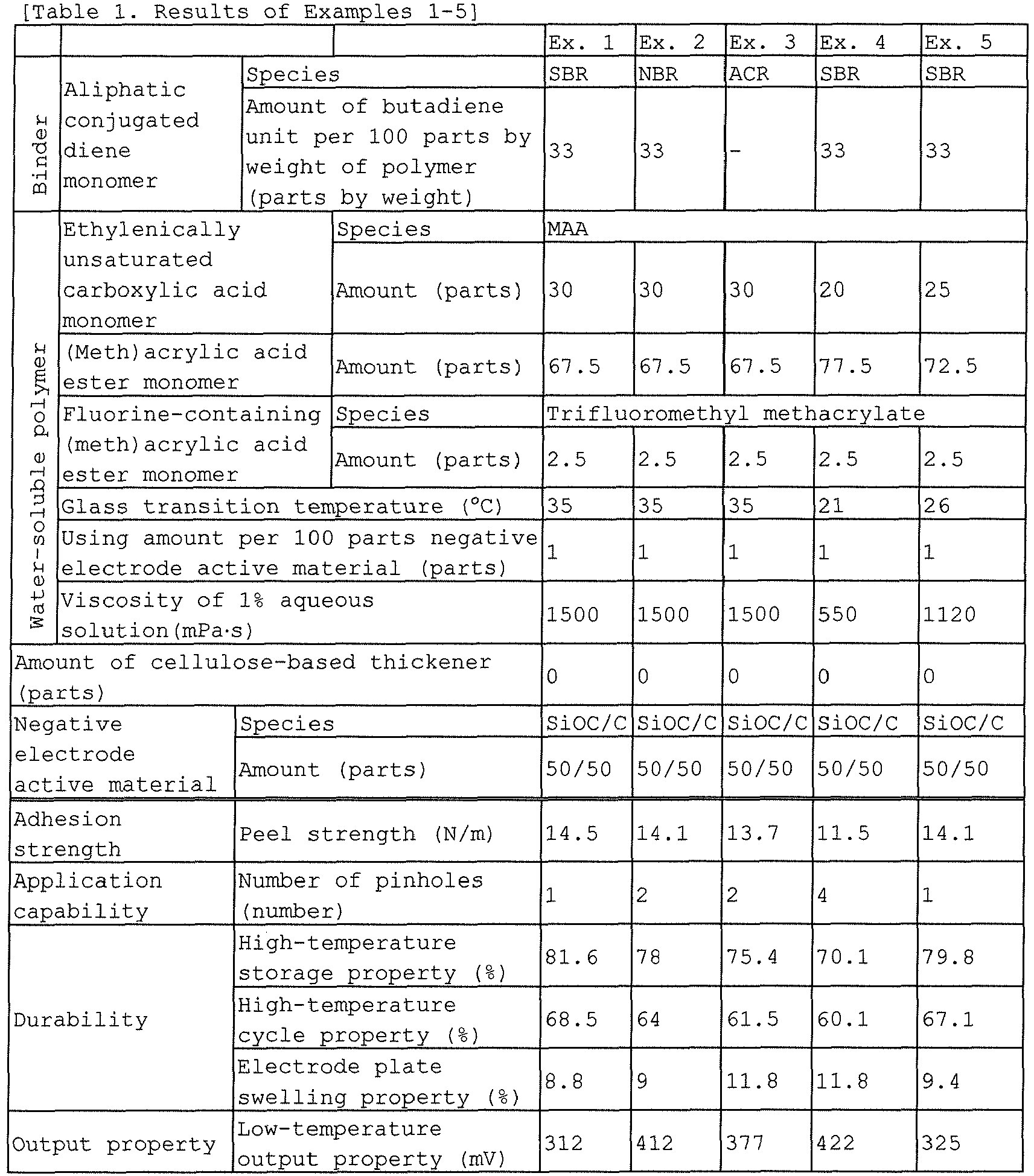
-

-

-

-

- As can be seen from Tables 1 to 5, each Example realized a secondary battery in which swelling of the negative electrode upon charging and discharging can be suppressed, and the capacity is less likely to decrease even after storage in a high-temperature environment. Further, high-temperature cycle property can be improved. Thus a secondary battery having high durability was realized. In the secondary batteries that have been studied in prior art, a polymer containing fluorine was added to an electrode mainly for the purpose of improving adhesion property of the electrode active materials and improving rate property. In view of this fact, the aforementioned effects, i.e., the ability to suppress swelling and the ability to improve the high-temperature storage property and high-temperature cycle property, are different effects from those that have been studied in prior art.
- In each Example, the peel strength is high, and therefore it can be seen that the adhesion property of the negative electrode active material layer to the current collector is high. In each Example, the number of pinholes formed is small, and therefore it can be seen that the application capability of the slurry composition for a negative electrode are good. In each Example, the low-temperature output property is high, and therefore it can be seen that the secondary battery having high-power was realized.
Accordingly, the secondary battery obtained in the present invention is a secondary battery having high practical performance.
Claims (10)
- A negative electrode for a secondary battery, comprising a negative electrode active material, a binder, and a water-soluble polymer, wherein
the water-soluble polymer is a copolymer containing 15 wt% to 50 wt% of an ethylenically unsaturated carboxylic acid monomer unit, 30 wt% to 70 wt% of a (meth)acrylic acid ester monomer unit, and 0.5 wt% to 10 wt% of a fluorine-containing (meth)acrylic acid ester monomer unit. - The negative electrode for a secondary battery according to claim 1, wherein the negative electrode active material contains a metal, and the negative electrode active material is capable of storing and releasing lithium.
- The negative electrode for a secondary battery according to claim 1 or 2, wherein the negative electrode active material is a compound containing Si.
- The negative electrode for a secondary battery according to any one of claims 1 to 3, wherein the binder is a polymer containing an aliphatic conjugated diene monomer unit.
- The negative electrode for a secondary battery according to any one of claims 1 to 4, wherein the binder is a polymer containing an aliphatic conjugated diene monomer unit and an aromatic vinyl monomer unit.
- The negative electrode for a secondary battery according to any one of claims 1 to 5, wherein the ethylenically unsaturated carboxylic acid monomer in the water-soluble polymer is an ethylenically unsaturated monocarboxylic acid monomer.
- The negative electrode for a secondary battery according to any one of claims 1 to 6, wherein a viscosity of a 1wt% aqueous solution of the water-soluble polymer is 0.1 mPa·s to 20,000 mPa·s.
- A secondary battery comprising a positive electrode, a negative electrode, an electrolytic solution, and a separator, wherein
the negative electrode is the negative electrode for a secondary battery according to any one of claims 1 to 7. - A slurry composition for a negative electrode, comprising a negative electrode active material, a binder, a water-soluble polymer, and water, wherein
the water-soluble polymer is a copolymer containing 15 wt% to 50 wt% of an ethylenically unsaturated carboxylic acid monomer unit, 30 wt% to 70 wt% of a (meth)acrylic acid ester monomer unit, and 0.5 wt% to 10 wt% of a fluorine-containing (meth)acrylic acid ester monomer unit. - A method for producing a negative electrode for a secondary battery, the method comprising: applying the slurry composition for a negative electrode according to claim 9 onto a surface of a current collector; and drying the slurry composition.
Applications Claiming Priority (2)
| Application Number | Priority Date | Filing Date | Title |
|---|---|---|---|
| JP2011037644 | 2011-02-23 | ||
| PCT/JP2012/054109 WO2012115096A1 (en) | 2011-02-23 | 2012-02-21 | Secondary cell negative electrode, secondary cell, slurry composition for negative electrode, and method of producing secondary cell negative electrode |
Publications (1)
| Publication Number | Publication Date |
|---|---|
| EP2680349A1 true EP2680349A1 (en) | 2014-01-01 |
Family
ID=46720873
Family Applications (1)
| Application Number | Title | Priority Date | Filing Date |
|---|---|---|---|
| EP12749342.7A Withdrawn EP2680349A1 (en) | 2011-02-23 | 2012-02-21 | Secondary cell negative electrode, secondary cell, slurry composition for negative electrode, and method of producing secondary cell negative electrode |
Country Status (6)
| Country | Link |
|---|---|
| US (1) | US20130330622A1 (en) |
| EP (1) | EP2680349A1 (en) |
| JP (1) | JPWO2012115096A1 (en) |
| KR (1) | KR20140018882A (en) |
| CN (1) | CN103384932A (en) |
| WO (1) | WO2012115096A1 (en) |
Cited By (9)
| Publication number | Priority date | Publication date | Assignee | Title |
|---|---|---|---|---|
| US10249879B2 (en) | 2014-05-14 | 2019-04-02 | Zeon Corporation | Binder composition for secondary battery electrode-use, slurry composition for secondary battery electrode-use, electrode for secondary battery-use and production method therefor, and secondary battery |
| US10290873B2 (en) | 2014-09-05 | 2019-05-14 | Zeon Corporation | Binder composition for secondary battery electrode, slurry composition for secondary battery electrode, electrode for secondary battery, and secondary battery |
| US10388930B2 (en) | 2014-06-26 | 2019-08-20 | Zeon Corporation | Laminate for non-aqueous secondary battery, method of manufacturing the same, and non-aqueous secondary battery |
| US10468713B2 (en) | 2014-12-26 | 2019-11-05 | Zeon Corporation | Binder composition for non-aqueous secondary battery positive electrode, composition for non-aqueous secondary battery positive electrode, positive electrode for non-aqueous secondary battery, and non-aqueous secondary battery, and methods for producing composition for non-aqueous secondary battery positive electrode, positive electrode for non-aqueous secondary battery, and non-aqueous secondary battery |
| US10529989B2 (en) | 2014-08-11 | 2020-01-07 | Zeon Corporation | Binder composition for secondary battery electrode, slurry composition for secondary battery electrode, electrode for secondary battery, and secondary battery |
| WO2020131200A1 (en) * | 2018-12-20 | 2020-06-25 | Ppg Industries Ohio, Inc. | Battery electrode coatings applied by waterborne electrodeposition |
| US11482696B2 (en) | 2020-02-26 | 2022-10-25 | Ppg Industries Ohio, Inc. | Method of coating an electrical current collector and electrodes resulting therefrom |
| US11552297B2 (en) | 2014-06-04 | 2023-01-10 | Zeon Corporation | Binder composition for lithium ion secondary battery electrode-use, slurry composition for lithium ion secondary battery electrode-use, electrode for lithium ion secondary battery-use, and lithium ion secondary battery |
| WO2024028544A1 (en) | 2022-08-03 | 2024-02-08 | Coatex | Anode composition containing anionic binder |
Families Citing this family (138)
| Publication number | Priority date | Publication date | Assignee | Title |
|---|---|---|---|---|
| EP2752927B1 (en) * | 2011-08-30 | 2017-02-22 | Zeon Corporation | Binder composition for secondary battery negative electrode, negative electrode for secondary battery, negative electrode slurry composition, manufacturing method, and secondary battery |
| ES2935606T3 (en) | 2011-12-08 | 2023-03-08 | Sarepta Therapeutics Inc | Oligonucleotide Analogs Targeting Human LMNA |
| JP5970183B2 (en) * | 2011-12-21 | 2016-08-17 | 東洋化学株式会社 | Electrode binder |
| JP6064986B2 (en) * | 2012-02-23 | 2017-01-25 | 日本ゼオン株式会社 | Porous membrane for secondary battery, electrode for secondary battery, separator for secondary battery, and secondary battery |
| WO2013147007A1 (en) * | 2012-03-30 | 2013-10-03 | 日本ゼオン株式会社 | Slurry composition for secondary battery negative electrode |
| CN104272508A (en) * | 2012-08-09 | 2015-01-07 | 日本瑞翁株式会社 | Negative electrode for secondary cell, secondary cell, slurry composition, and manufacturing method |
| JP6048070B2 (en) * | 2012-10-29 | 2016-12-21 | 日本ゼオン株式会社 | Slurry composition for negative electrode of lithium ion secondary battery and method for producing the same, negative electrode for lithium ion secondary battery, and lithium ion secondary battery |
| JP6020209B2 (en) * | 2013-01-28 | 2016-11-02 | 日本ゼオン株式会社 | Method for producing slurry composition for secondary battery negative electrode |
| JP6191471B2 (en) * | 2013-01-28 | 2017-09-06 | 日本ゼオン株式会社 | Binder composition for lithium ion secondary battery, production method thereof, slurry composition for lithium ion secondary battery, electrode for lithium ion secondary battery, and lithium ion secondary battery |
| US20140242452A1 (en) * | 2013-02-27 | 2014-08-28 | GM Global Technology Operations LLC | Lithium ion battery |
| CN105027338B (en) * | 2013-03-15 | 2017-03-15 | 日本瑞翁株式会社 | Secondary cell adhesive composition, secondary cell paste compound, secondary battery cathode and secondary cell |
| WO2014148064A1 (en) | 2013-03-22 | 2014-09-25 | 日本ゼオン株式会社 | Slurry composition for negative electrode for lithium-ion secondary battery, negative electrode for lithium-ion secondary battery, and lithium-ion secondary battery |
| KR101702257B1 (en) * | 2013-03-26 | 2017-02-03 | 닛산 지도우샤 가부시키가이샤 | Non-aqueous electrolyte secondary battery |
| EP3001487B1 (en) * | 2013-05-23 | 2017-10-18 | LG Chem, Ltd. | Binder for secondary battery, and secondary battery including the same |
| CN105190968B (en) * | 2013-05-29 | 2018-07-24 | 日本瑞翁株式会社 | Binder for electrochemical element electrode, particle composite for electrochemical element electrode, electrochemical element electrode, electrochemical element, and manufacturing method of electrochemical element electrode |
| JP6412689B2 (en) * | 2013-12-09 | 2018-10-24 | 三星エスディアイ株式会社Samsung SDI Co., Ltd. | Lithium ion secondary battery negative electrode water based slurry (slurry), lithium ion secondary battery negative electrode active material layer, and lithium ion secondary battery |
| JP6459977B2 (en) * | 2013-12-26 | 2019-01-30 | 日本ゼオン株式会社 | Slurry composition for negative electrode of lithium ion secondary battery, negative electrode for lithium ion secondary battery and lithium ion secondary battery |
| WO2015098008A1 (en) * | 2013-12-26 | 2015-07-02 | 日本ゼオン株式会社 | Binder composition for negative electrode of lithium ion secondary cell, slurry composition for negative electrode of lithium ion secondary cell, negative electrode for lithium ion secondary cell, and lithium ion secondary cell |
| WO2015137041A1 (en) * | 2014-03-12 | 2015-09-17 | 三洋化成工業株式会社 | Coated negative-electrode active material for use in lithium-ion battery, slurry for use in lithium-ion battery, negative electrode for use in lithium-ion battery, lithium-ion battery, and method for manufacturing coated negative-electrode active material for use in lithium-ion battery |
| WO2015146649A1 (en) * | 2014-03-24 | 2015-10-01 | 昭和電工株式会社 | Slurry for positive electrode of lithium ion secondary cell, positive electrode obtained using said slurry, method for manufacturing said positive electrode, lithium ion secondary cell formed using said positive electrode, and method for manufacturing said cell |
| TWI575014B (en) * | 2014-04-08 | 2017-03-21 | 奇美實業股份有限公司 | Resin for negative electrode of lithium battery, resin composition, slurry, negative electrode and lithium battery |
| KR20160061167A (en) * | 2014-11-21 | 2016-05-31 | 삼성에스디아이 주식회사 | Electrod coated with inorganic layer, manufacturing method thereof and rechargeable battery therewith |
| JP6528497B2 (en) * | 2015-03-24 | 2019-06-12 | 日本ゼオン株式会社 | Binder composition for lithium ion secondary battery silicon-based negative electrode and slurry composition for lithium ion secondary battery silicon-based negative electrode |
| US10312522B2 (en) | 2015-03-27 | 2019-06-04 | Zeon Corporation | Binder composition for lithium ion secondary battery positive electrode, slurry composition for lithium ion secondary battery positive electrode, positive electrode for lithium ion secondary battery and lithium ion secondary battery |
| US20180102542A1 (en) * | 2015-04-22 | 2018-04-12 | Toagosei Co., Ltd. | Binder for nonaqueous electrolyte secondary battery electrode, and use thereof |
| KR101833615B1 (en) * | 2015-04-29 | 2018-02-28 | 주식회사 엘지화학 | Negative electrode active material and negative electrode comprising the same |
| CN107534131B (en) | 2015-06-08 | 2021-02-26 | 日本瑞翁株式会社 | Slurry composition for secondary battery negative electrode, negative electrode for secondary battery, and secondary battery |
| HUE056779T2 (en) | 2015-06-29 | 2022-03-28 | Zeon Corp | Binder composition for secondary battery electrode, slurry composition for secondary battery electrode, electrode for secondary battery, and secondary battery |
| PL3324468T3 (en) | 2015-07-14 | 2021-11-02 | Zeon Corporation | Binder composition for secondary battery electrode, conductive material paste composition for secondary battery electrode, slurry composition for secondary battery electrode, electrode for secondary battery, and secondary battery |
| KR101698745B1 (en) * | 2015-08-03 | 2017-01-23 | 주식회사 한솔케미칼 | Core-shell structured binders for use of anode materials of lithium ion secondary battery and method for preparing using the same, and slurry comprising said binders |
| EP3358659B1 (en) | 2015-09-30 | 2020-10-21 | Zeon Corporation | Non-aqueous secondary battery electrode binder composition, non-aqueous secondary battery electrode slurry composition, non-aqueous secondary battery electrode, and non-aqueous secondary battery |
| WO2017056467A1 (en) | 2015-09-30 | 2017-04-06 | 日本ゼオン株式会社 | Binder composition for non-aqueous secondary cell electrode, slurry composition for non-aqueous secondary cell electrode, non-aqueous secondary cell electrode, and non-aqueous secondary cell |
| US10593948B2 (en) | 2015-09-30 | 2020-03-17 | Zeon Corporation | Binder composition for non-aqueous secondary battery electrode, slurry composition for non-aqueous secondary battery electrode, electrode for non-aqueous secondary battery, and non-aqueous secondary battery |
| US11784313B2 (en) | 2015-09-30 | 2023-10-10 | Zeon Corporation | Conductive material paste composition for secondary battery electrode, slurry composition for secondary battery electrode, undercoating layer-equipped current collector for secondary battery electrode, electrode for secondary battery, and secondary battery |
| KR102823305B1 (en) | 2015-10-28 | 2025-06-19 | 니폰 제온 가부시키가이샤 | Composition for adhesive layer of non-aqueous secondary battery, adhesive layer for non-aqueous secondary battery, separator with adhesive layer attached for non-aqueous secondary battery, electrode with adhesive layer attached for non-aqueous secondary battery, and non-aqueous secondary battery and method for manufacturing same |
| WO2017094250A1 (en) * | 2015-11-30 | 2017-06-08 | 日本ゼオン株式会社 | Composition for adhesive layer of non-aqueous secondary battery, adhesive layer for non-aqueous secondary battery, and non-aqueous secondary battery |
| US10720647B2 (en) | 2016-01-29 | 2020-07-21 | Zeon Corporation | Binder composition for non-aqueous secondary battery electrode, slurry composition for non-aqueous secondary battery electrode, electrode for non-aqueous secondary battery, and non- aqueous secondary battery |
| WO2017141791A1 (en) | 2016-02-17 | 2017-08-24 | 日本ゼオン株式会社 | Binder composition for nonaqueous secondary battery electrodes, slurry composition for nonaqueous secondary battery electrodes, electrode for nonaqueous secondary batteries, and nonaqueous secondary battery |
| CN108780891B (en) | 2016-03-03 | 2023-10-20 | 日本瑞翁株式会社 | Binder composition, conductive material paste composition, slurry composition, electrode and secondary battery for non-aqueous secondary battery electrodes |
| CN108701833B (en) | 2016-03-10 | 2022-02-01 | 日本瑞翁株式会社 | Binder for nonaqueous secondary battery electrode, slurry for nonaqueous secondary battery electrode, electrode for nonaqueous secondary battery, and nonaqueous secondary battery |
| JP6911837B2 (en) | 2016-03-28 | 2021-07-28 | 日本ゼオン株式会社 | Binder composition for electrochemical element electrodes, slurry composition for electrochemical element electrodes, electrodes for electrochemical elements, and electrochemical elements |
| WO2017195784A1 (en) | 2016-05-13 | 2017-11-16 | 日本ゼオン株式会社 | Binder particle aggregate for electrochemical element electrode, slurry composition for electrochemical element electrode, method for manufacturing these, electrode for electrochemical element, and electrochemical element |
| KR102369487B1 (en) | 2016-06-29 | 2022-03-02 | 니폰 제온 가부시키가이샤 | Binder composition for a non-aqueous secondary battery electrode, a slurry composition for a non-aqueous secondary battery electrode, an electrode for a non-aqueous secondary battery, and a non-aqueous secondary battery |
| WO2018003707A1 (en) * | 2016-06-29 | 2018-01-04 | 日本ゼオン株式会社 | Binder composition for nonaqueous secondary battery electrodes, slurry composition for nonaqueous secondary battery electrodes, nonaqueous secondary battery electrode, and nonaqueous secondary battery |
| CN106129330B (en) * | 2016-08-29 | 2019-08-20 | 深圳市沃特玛电池有限公司 | A kind of positive plate of iron phosphate lithium battery and preparation method thereof, ferric phosphate lithium cell |
| EP3518327B1 (en) | 2016-09-20 | 2023-10-04 | Zeon Corporation | Slurry composition for non-aqueous secondary battery positive electrode, positive electrode for non-aqueous secondary battery, and non-aqueous secondary battery |
| WO2018096975A1 (en) | 2016-11-24 | 2018-05-31 | 日本ゼオン株式会社 | Composition for nonaqueous secondary battery functional layers, functional layer for nonaqueous secondary batteries, and nonaqueous secondary battery |
| EP3565033A4 (en) | 2016-12-28 | 2020-08-05 | Zeon Corporation | SUSPENSION COMPOSITION FOR NEGATIVE ELECTRODE OF ANYDROUS SECONDARY CELL AND METHOD FOR MANUFACTURING THEREOF, NEGATIVE ELECTRODE FOR ANYHEROUS SECONDARY CELL AND WATERLESS SECONDARY CELL |
| KR102573533B1 (en) | 2017-03-08 | 2023-08-31 | 니폰 제온 가부시키가이샤 | Binder composition for non-aqueous secondary battery functional layer, slurry composition for non-aqueous secondary battery functional layer, functional layer for non-aqueous secondary battery, separator with functional layer for non-aqueous secondary battery, non-aqueous secondary battery and manufacturing method thereof |
| KR102555891B1 (en) | 2017-03-13 | 2023-07-14 | 니폰 제온 가부시키가이샤 | Binder composition for nonaqueous secondary battery electrode, slurry composition for nonaqueous secondary battery electrode, nonaqueous secondary battery electrode, nonaqueous secondary battery negative electrode and nonaqueous secondary battery, and manufacturing method of nonaqueous secondary battery electrode |
| KR102647091B1 (en) | 2017-03-13 | 2024-03-12 | 니폰 제온 가부시키가이샤 | Conductive material dispersion liquid for electrochemical device electrodes, slurry composition for electrochemical device electrodes and method for producing the same, electrodes for electrochemical devices, and electrochemical devices |
| JP6394728B1 (en) | 2017-03-23 | 2018-09-26 | 日本ゼオン株式会社 | Non-aqueous secondary battery positive electrode binder composition, non-aqueous secondary battery positive electrode composition, non-aqueous secondary battery positive electrode and non-aqueous secondary battery |
| CN110402510B (en) * | 2017-03-24 | 2022-07-08 | 日本瑞翁株式会社 | Binder composition for nonaqueous secondary battery and slurry composition for nonaqueous secondary battery |
| CN110462898B (en) | 2017-03-28 | 2022-08-23 | 日本瑞翁株式会社 | Binder composition for nonaqueous secondary battery electrode, slurry composition, nonaqueous secondary battery, electrode, and method for producing electrode |
| US11430973B2 (en) * | 2017-04-21 | 2022-08-30 | Sanyo Chemical Industries, Ltd. | Adhesive for lithium-ion electrode, electrode for lithium-ion battery and method for manufacturing electrode for lithium-ion battery |
| KR102335525B1 (en) | 2017-05-18 | 2021-12-03 | 현대자동차주식회사 | Manufacturing Method for Membrane Electrode Assembly for hydrogen fuel cell, Membrane Electrode Assembly using the same |
| US11374223B2 (en) * | 2017-06-30 | 2022-06-28 | Ppg Industries Ohio, Inc. | Slurry composition including binder containing reaction product of epoxy functional polymer and acid functional polymer for lithium ion electrical storage devices |
| EP3660953A4 (en) * | 2017-07-28 | 2021-04-21 | Zeon Corporation | ELECTRODE FOR ELECTROCHEMICAL ELEMENT AS WELL AS A METHOD FOR MANUFACTURING THE SAME, AND ELECTROCHEMICAL ELEMENT |
| CN111033833B (en) | 2017-08-29 | 2023-04-04 | 日本瑞翁株式会社 | Binder composition for nonaqueous secondary battery electrode, slurry composition for nonaqueous secondary battery electrode, electrode for nonaqueous secondary battery, and nonaqueous secondary battery |
| WO2019044166A1 (en) | 2017-08-30 | 2019-03-07 | 日本ゼオン株式会社 | Binder composition for non-aqueous secondary battery electrodes, slurry composition for non-aqueous secondary battery electrodes, non-aqueous secondary battery electrode, and non-aqueous secondary battery |
| EP3683868A4 (en) | 2017-09-15 | 2021-06-16 | Zeon Corporation | Slurry composition for electrochemical element electrodes, electrode for electrochemical elements, electrochemical element, and method for producing slurry composition for electrochemical element electrodes |
| KR20200060394A (en) | 2017-09-28 | 2020-05-29 | 니폰 제온 가부시키가이샤 | Binder composition for secondary battery, slurry composition for secondary battery, functional layer for secondary battery, electrode layer for secondary battery and secondary battery |
| WO2019065471A1 (en) | 2017-09-28 | 2019-04-04 | 日本ゼオン株式会社 | Electrochemical-element binder composition, electrochemical-element slurry composition, electrochemical-element functional layer, and electrochemical element |
| JP7342704B2 (en) | 2017-09-28 | 2023-09-12 | 日本ゼオン株式会社 | Composition for nonaqueous secondary battery functional layer, functional layer for nonaqueous secondary battery, and nonaqueous secondary battery |
| CN111108629B (en) | 2017-09-28 | 2022-07-19 | 日本瑞翁株式会社 | Composition for functional layer of nonaqueous secondary battery, functional layer for nonaqueous secondary battery, and nonaqueous secondary battery |
| EP3690983B1 (en) | 2017-09-28 | 2025-09-24 | Zeon Corporation | Composition for non-aqueous secondary battery functional layer, functional layer for non-aqueous secondary battery, non-aqueous secondary battery component, and non-aqueous secondary battery |
| US11777147B2 (en) | 2017-11-01 | 2023-10-03 | Nec Corporation | Lithium ion secondary battery |
| EP3734695A4 (en) | 2017-12-27 | 2021-11-17 | Zeon Corporation | NON-AQUEOUS COMPOSITION OF FUNCTIONAL SECONDARY BATTERY LAYERS, NON-AQUEOUS SECONDARY BATTERY ELEMENT, LAMINATE PRODUCTION PROCESS FOR NON-AQUEOUS SECONDARY BATTERIES, AND NON-AQUEOUS SECONDARY BATTERY |
| EP3734697A4 (en) | 2017-12-27 | 2021-12-15 | Zeon Corporation | COMPOSITION FOR FUNCTIONAL LAYERS OF A WATER-FREE SECONDARY BATTERY, BATTERY ELEMENT FOR WATER-FREE SECONDARY BATTERIES, METHOD FOR MANUFACTURING A LAMINATE FOR WATER-FREE SECONDARY BATTERIES AND WATER-FREE SECONDARY BATTERIES |
| CN111656564B (en) | 2018-02-07 | 2022-12-06 | 日本瑞翁株式会社 | Binder composition for electrochemical element, slurry composition for electrochemical element, functional layer for electrochemical element, and electrochemical element |
| US11996562B2 (en) | 2018-02-19 | 2024-05-28 | Zeon Corporation | Binder composition for non-aqueous secondary battery electrode, slurry composition for non-aqueous secondary battery electrode, electrode for non-aqueous secondary battery, and non-aqueous secondary battery |
| US20190221886A1 (en) | 2018-03-22 | 2019-07-18 | Fmc Lithium Usa Corp. | Solid-state battery |
| US12341199B2 (en) | 2018-03-22 | 2025-06-24 | Livent USA Corp. | Printed lithium foil and film |
| JP7400712B2 (en) | 2018-03-23 | 2023-12-19 | 日本ゼオン株式会社 | Binder composition for non-aqueous secondary battery electrodes, conductive material paste composition for non-aqueous secondary battery electrodes, slurry composition for non-aqueous secondary battery electrodes, electrodes for non-aqueous secondary batteries, and non-aqueous secondary batteries |
| WO2019181660A1 (en) | 2018-03-23 | 2019-09-26 | 日本ゼオン株式会社 | Binder composition for non-aqueous secondary battery electrode, conductive material paste composition for non-aqueous secondary battery electrode, slurry composition for non-aqueous secondary battery electrode, non-aqueous secondary battery electrode, and non-aqueous secondary battery |
| US20200411870A1 (en) | 2018-03-27 | 2020-12-31 | Zeon Corporation | Binder composition for secondary battery, slurry composition for secondary battery functional layer, secondary battery member, secondary battery, and method of producing slurry composition for secondary battery negative electrode |
| EP3787078A4 (en) | 2018-04-26 | 2022-01-19 | Zeon Corporation | Binder composition for electricity storage devices, slurry composition for electricity storage device electrodes, electrode for electricity storage devices, and electricity storage device |
| KR102860686B1 (en) | 2018-05-17 | 2025-09-15 | 니폰 제온 가부시키가이샤 | Slurry for non-aqueous secondary batteries, separator for non-aqueous secondary batteries, electrode for non-aqueous secondary batteries, laminate for non-aqueous secondary batteries, and non-aqueous secondary batteries |
| US12212002B2 (en) | 2018-06-29 | 2025-01-28 | Zeon Corporation | Binder composition for electrochemical device electrode, slurry composition for electrochemical device electrode, electrode for electrochemical device, and electrochemical device |
| JP7359145B2 (en) | 2018-06-29 | 2023-10-11 | 日本ゼオン株式会社 | Binder composition for non-aqueous secondary battery electrodes, slurry composition for non-aqueous secondary battery electrodes and manufacturing method thereof, electrode for non-aqueous secondary batteries, and non-aqueous secondary battery |
| KR102802120B1 (en) | 2018-06-29 | 2025-04-28 | 니폰 제온 가부시키가이샤 | Binder composition for non-aqueous secondary battery electrode, slurry composition for non-aqueous secondary battery electrode and method for producing same, electrode for non-aqueous secondary battery, and non-aqueous secondary battery |
| WO2020022343A1 (en) | 2018-07-24 | 2020-01-30 | 日本ゼオン株式会社 | Slurry for nonaqueous secondary battery and method of manufacturing same, battery member for nonaqueous secondary battery and method of manufacturing same, and nonaqueous secondary battery |
| US12095113B2 (en) | 2018-08-07 | 2024-09-17 | Zeon Corporation | Composition for non-aqueous secondary battery functional layer and method of producing same, functional layer for non-aqueous secondary battery, non- aqueous secondary battery member, and non-aqueous secondary battery |
| WO2020045246A1 (en) | 2018-08-29 | 2020-03-05 | 日本ゼオン株式会社 | Composition for nonaqueous secondary battery adhesive layer, battery member for nonaqueous secondary battery and manufacturing method of said battery member for nonaqueous secondary battery, as well as manufacturing method for laminate for nonaqeuous secondary battery, and manufacturing method for nonaqueous secondary battery |
| EP3859820A4 (en) | 2018-09-27 | 2022-06-15 | Zeon Corporation | SLURRY FOR NON-AQUEOUS RECHARGEABLE BATTERY ADHESIVE LAYER, BATTERY ELEMENT FOR NON-AQUEOUS RECHARGEABLE BATTERY WITH ADHESIVE LAYER, METHOD FOR MAKING LAMINATE FOR NON-AQUEOUS RECHARGEABLE BATTERY, AND METHOD FOR MAKING NON-AQUEOUS RECHARGEABLE BATTERY |
| CN112868133B (en) | 2018-10-31 | 2023-03-21 | 日本瑞翁株式会社 | Composition for functional layer of nonaqueous secondary battery, functional layer for nonaqueous secondary battery, separator, and nonaqueous secondary battery |
| EP3922653A4 (en) * | 2019-02-06 | 2022-07-27 | Denka Company Limited | Composition, slurry for positive electrode, and battery |
| WO2020196111A1 (en) | 2019-03-28 | 2020-10-01 | 日本ゼオン株式会社 | Slurry composition for nonaqueous secondary battery negative electrodes, negative electrode for nonaqueous secondary batteries, and nonaqueous secondary battery |
| KR20210142120A (en) * | 2019-03-29 | 2021-11-24 | 제이에스알 가부시끼가이샤 | Binder for all-solid secondary battery, binder composition for all-solid secondary battery, slurry for all-solid secondary battery, solid electrolyte sheet for all-solid secondary battery and manufacturing method thereof, and all-solid secondary battery and manufacturing method thereof |
| WO2020213721A1 (en) | 2019-04-18 | 2020-10-22 | 日本ゼオン株式会社 | Binder composition for non-aqueous secondary cell electrode, slurry composition for non-aqueous secondary cell positive electrode, positive electrode for non-aqueous secondary cell, and non-aqueous secondary cell |
| US20220190340A1 (en) | 2019-04-18 | 2022-06-16 | Zeon Corporation | Binder composition for non-aqueous secondary battery electrode, slurry composition for non-aqueous secondary battery positive electrode, positive electrode for non-aqueous secondary battery, and non-aqueous secondary battery |
| JP7325707B2 (en) * | 2019-07-30 | 2023-08-15 | 株式会社大阪ソーダ | Binder composition, binder, electrode material, electrode and power storage device |
| CN114097117B (en) | 2019-07-31 | 2024-09-27 | 日本瑞翁株式会社 | Binder composition for heat-resistant layer of non-aqueous secondary battery, slurry composition for heat-resistant layer of non-aqueous secondary battery, heat-resistant layer for non-aqueous secondary battery, and non-aqueous secondary battery |
| US11699791B2 (en) * | 2019-08-16 | 2023-07-11 | Sk On Co., Ltd. | Binder for secondary battery and secondary battery including the same |
| KR20220054787A (en) | 2019-08-30 | 2022-05-03 | 니폰 제온 가부시키가이샤 | A binder composition for a heat-resistant layer of a non-aqueous secondary battery, a slurry composition for a heat-resistant layer of a non-aqueous secondary battery, a heat-resistant layer for a non-aqueous secondary battery, and a non-aqueous secondary battery |
| WO2021039673A1 (en) | 2019-08-30 | 2021-03-04 | 日本ゼオン株式会社 | Binder composition for heat-resistant layer of non-aqueous secondary battery, slurry composition for heat-resistant layer of non-aqueous secondary battery, heat-resistant layer of non-aqueous secondary battery, and non-aqueous secondary battery |
| CN114175383B (en) | 2019-09-27 | 2024-09-27 | 日本瑞翁株式会社 | Slurry composition for heat-resistant layer of non-aqueous secondary battery, heat-resistant layer for non-aqueous secondary battery, and non-aqueous secondary battery |
| US20220336815A1 (en) | 2019-09-30 | 2022-10-20 | Zeon Corporation | Binder composition for secondary battery, slurry composition for secondary battery electrode, electrode for secondary battery, and secondary battery |
| CN112825277B (en) * | 2019-11-20 | 2023-02-03 | 珠海冠宇电池股份有限公司 | A polymer-based positive temperature coefficient thermistor composite material and its preparation method and application |
| CN110931793B (en) * | 2019-11-21 | 2022-06-14 | 合肥国轩高科动力能源有限公司 | Negative electrode binder and preparation method of silicon-based negative electrode plate containing same |
| CN114830380B (en) | 2019-12-27 | 2024-10-11 | 日本瑞翁株式会社 | Binder composition for non-aqueous secondary battery electrode, slurry composition for non-aqueous secondary battery electrode, electrode for non-aqueous secondary battery, and non-aqueous secondary battery |
| JP7216344B2 (en) | 2020-01-31 | 2023-02-01 | 東洋インキScホールディングス株式会社 | Dispersants, conductive material dispersions, and slurries for electrode films |
| WO2021200350A1 (en) | 2020-03-31 | 2021-10-07 | 日本ゼオン株式会社 | Binder composition for non-aqueous secondary battery, slurry composition for non-aqueous secondary battery electrode, electrode for non-aqueous secondary battery, and non-aqueous secondary battery |
| JP6911987B1 (en) | 2020-08-31 | 2021-07-28 | 日本ゼオン株式会社 | Dispersant composition for electrochemical elements, conductive material dispersion for electrochemical elements, slurry for electrochemical element electrodes, electrodes for electrochemical elements and electrochemical elements |
| JP6870769B1 (en) | 2020-08-31 | 2021-05-12 | 日本ゼオン株式会社 | Conductive material dispersion for electrochemical elements, slurry composition for electrochemical element electrodes and manufacturing method thereof, electrodes for electrochemical elements, and electrochemical elements |
| JP6927393B1 (en) | 2020-08-31 | 2021-08-25 | 日本ゼオン株式会社 | Binder composition for electrochemical element, conductive material dispersion for electrochemical element, slurry composition for electrochemical element electrode, electrode for electrochemical element and electrochemical element |
| JP6870772B1 (en) | 2020-08-31 | 2021-05-12 | 日本ゼオン株式会社 | Binder composition for electrochemical element, conductive material dispersion for electrochemical element, slurry for electrochemical element electrode, electrode for electrochemical element and electrochemical element |
| JP6911985B1 (en) | 2020-08-31 | 2021-07-28 | 日本ゼオン株式会社 | Dispersant composition for electrochemical element, conductive material dispersion for electrochemical element, slurry composition for electrochemical element electrode and its manufacturing method, electrode for electrochemical element, and electrochemical element |
| KR20230049653A (en) * | 2020-09-30 | 2023-04-13 | 후지필름 와코 준야쿠 가부시키가이샤 | Binder composition for secondary batteries, composition for electrodes, electrode sheets and secondary batteries, and methods for producing these electrode sheets and secondary batteries |
| US11824196B2 (en) | 2020-10-14 | 2023-11-21 | Samsung Sdi Co., Ltd. | Negative electrode slurry, negative electrode, and rechargeable battery |
| EP4254562A4 (en) | 2020-11-30 | 2025-03-26 | Zeon Corporation | BINDER COMPOSITION FOR POSITIVE ELECTRODE OF NONAQUEOUS SECONDARY BATTERY, ELECTRICAL CONDUCTOR FOR POSITIVE ELECTRODE OF NONAQUEOUS SECONDARY BATTERY, SLURRY COMPOSITION FOR POSITIVE ELECTRODE OF NONAQUEOUS SECONDARY BATTERY, POSITIVE ELECTRODE FOR NONAQUEOUS SECONDARY BATTERY, AND NONAQUEOUS SECONDARY BATTERY |
| EP4253435A4 (en) | 2020-11-30 | 2025-04-02 | Zeon Corporation | BINDER COMPOSITION FOR ELECTRODES OF NONAQUEOUS LITHIUM ION SECONDARY BATTERIES, PRODUCTION METHOD THEREOF, BINDER SOLUTION FOR ELECTRODES OF NONAQUEOUS LITHIUM ION SECONDARY BATTERIES, SUSPENSION COMPOSITION FOR ELECTRODES OF NONAQUEOUS LITHIUM ION SECONDARY BATTERIES, ELECTRODE FOR NONAQUEOUS LITHIUM ION SECONDARY BATTERIES, AND NONAQUEOUS LITHIUM ION SECONDARY BATTERY |
| CN112919533A (en) * | 2021-01-14 | 2021-06-08 | 华南理工大学 | Nitrogen-doped carbon-coated phosphorus-doped titanium dioxide material and preparation method and application thereof |
| CN116802912A (en) | 2021-02-03 | 2023-09-22 | 日本瑞翁株式会社 | Slurry composition for heat-resistant layer of nonaqueous secondary battery, heat-resistant layer for nonaqueous secondary battery, separator with heat-resistant layer for nonaqueous secondary battery, and nonaqueous secondary battery |
| US20240120617A1 (en) * | 2021-03-30 | 2024-04-11 | Zeon Corporation | Composition for non-aqueous secondary battery adhesive layer, adhesive layer for non-aqueous secondary battery and method for producing the same, laminate for non-aqueous secondary battery and method for producing the same, and non-aqueous secondary battery |
| WO2022230908A1 (en) | 2021-04-28 | 2022-11-03 | 日本ゼオン株式会社 | Composition for nonaqueous secondary battery adhesive layer, nonaqueous secondary battery adhesive layer and method for producing same, laminate for nonaqueous secondary battery and method for producing same, and nonaqueous secondary battery |
| KR20240004328A (en) | 2021-04-28 | 2024-01-11 | 니폰 제온 가부시키가이샤 | Laminate for non-aqueous secondary battery, adhesive composition, and non-aqueous secondary battery |
| KR20240008905A (en) | 2021-05-14 | 2024-01-19 | 알케마 인코포레이티드 | Water-based binder composition and applications thereof |
| US12479981B2 (en) | 2021-06-30 | 2025-11-25 | Zeon Corporation | Binder composition for electrochemical device, conductive material dispersion liquid for electrochemical device, slurry for electrochemical device electrode, electrode for electrochemical device, and electrochemical device |
| KR20240028336A (en) | 2021-06-30 | 2024-03-05 | 니폰 제온 가부시키가이샤 | Binder composition for electrochemical devices, conductive material dispersion for electrochemical devices, slurry for electrochemical device electrodes, electrodes for electrochemical devices, and electrochemical devices |
| EP4379835A4 (en) | 2021-07-30 | 2026-01-07 | Zeon Corp | Multi-layer body for waterless secondary batteries, method for producing a multi-layer body for waterless secondary batteries and waterless secondary battery |
| JPWO2023032717A1 (en) | 2021-08-31 | 2023-03-09 | ||
| CN117642920A (en) | 2021-08-31 | 2024-03-01 | 日本瑞翁株式会社 | Composition for adhesive layer of non-aqueous secondary battery, adhesive layer for non-aqueous secondary battery and manufacturing method thereof, laminate for non-aqueous secondary battery and manufacturing method thereof, and non-aqueous secondary battery |
| US20240421430A1 (en) | 2021-10-28 | 2024-12-19 | Zeon Corporation | Slurry composition for non-aqueous secondary battery functional layer, separator for non-aqueous secondary battery, and non-aqueous secondary battery |
| US20240421310A1 (en) | 2021-10-29 | 2024-12-19 | Zeon Corporation | Binder composition for non-aqueous secondary battery negative electrode, slurry composition for non-aqueous secondary battery negative electrode, negative electrode for non-aqueous secondary battery, and non-aqueous secondary battery |
| WO2023162609A1 (en) | 2022-02-28 | 2023-08-31 | 日本ゼオン株式会社 | Binder composition for nonaqueous secondary battery positive electrode, conductive material dispersion for nonaqueous secondary battery positive electrode, slurry composition for nonaqueous secondary battery positive electrode, nonaqueous secondary battery positive electrode, and nonaqueous secondary battery |
| WO2023162835A1 (en) | 2022-02-28 | 2023-08-31 | 日本ゼオン株式会社 | Composition for electrochemical elements, method for producing same, binder composition for electrochemical elements, conductive material dispersion liquid for electrochemical elements, slurry for electrochemical element electrodes, electrode for electrochemical elements, and electrochemical element |
| WO2024004724A1 (en) | 2022-06-27 | 2024-01-04 | 日本ゼオン株式会社 | Binder composition for electrochemical element, conductive material dispersion for electrochemical element, slurry for electrochemical element electrode, electrode for electrochemical element, and electrochemical element |
| CN115332546B (en) * | 2022-07-15 | 2025-09-30 | 中盐金坛盐化有限责任公司 | A water-soluble organic polymer flow battery negative electrode polymer material and preparation method thereof |
| CN119096379A (en) | 2022-08-15 | 2024-12-06 | 株式会社钟化 | Binders for Lithium-ion Battery Electrodes |
| WO2024204220A1 (en) | 2023-03-31 | 2024-10-03 | 日本ゼオン株式会社 | Binder composition for non-aqueous secondary battery electrode, slurry composition for non-aqueous secondary battery electrode, electrode for non-aqueous secondary battery, and non-aqueous secondary battery |
| CN119133372B (en) * | 2023-06-12 | 2026-01-13 | 宁德时代新能源科技股份有限公司 | Negative electrode plate, preparation method thereof, secondary battery and power utilization device |
| WO2025033173A1 (en) | 2023-08-08 | 2025-02-13 | 日本ゼオン株式会社 | Binder composition for nonaqueous secondary battery electrodes, slurry composition for nonaqueous secondary battery electrodes, electrode for nonaqueous secondary batteries, and nonaqueous secondary battery |
| CN120981930A (en) | 2023-08-30 | 2025-11-18 | 日本瑞翁株式会社 | Dispersant compositions for electrochemical components, conductive material dispersions for electrochemical components, slurries for electrodes of electrochemical components, electrodes for electrochemical components, and electrochemical components. |
| WO2025259696A1 (en) * | 2024-06-10 | 2025-12-18 | Enevate Corporation | Si-based anode with engineered silicon-based materials |
| CN118630215A (en) * | 2024-06-28 | 2024-09-10 | 厦门海辰储能科技股份有限公司 | Negative electrode sheet and preparation method thereof, battery, energy storage device and electrical equipment |
| CN119029207A (en) * | 2024-10-16 | 2024-11-26 | 宁德时代新能源科技股份有限公司 | Lithium ion secondary battery and electric device |
| CN121885618A (en) * | 2024-10-16 | 2026-04-17 | 宁德时代新能源科技股份有限公司 | Sodium ion secondary battery, positive electrode slurry of sodium ion secondary battery and electricity utilization device |
Family Cites Families (11)
| Publication number | Priority date | Publication date | Assignee | Title |
|---|---|---|---|---|
| TW519777B (en) * | 1999-10-18 | 2003-02-01 | Zeon Corp | The binder composition for the secondary battery electrode of lithium ion and its utilization |
| JP4682401B2 (en) | 2000-07-31 | 2011-05-11 | 日本ゼオン株式会社 | Secondary battery electrode binder, secondary battery electrode and secondary battery |
| JP2002231251A (en) * | 2001-02-06 | 2002-08-16 | Nippon Zeon Co Ltd | Binder composition for lithium ion secondary battery electrode and lithium ion secondary battery |
| JP2003217573A (en) | 2002-01-22 | 2003-07-31 | Hitachi Powdered Metals Co Ltd | Slurry for forming negative electrode film of non- aqueous secondary battery and control method of slurry |
| JP2003308841A (en) | 2002-04-16 | 2003-10-31 | Hitachi Powdered Metals Co Ltd | Slurry for forming negative electrode coating film of nonaqueous secondary battery |
| JP4748438B2 (en) * | 2004-07-29 | 2011-08-17 | 日立化成工業株式会社 | Binder resin solution for lithium battery electrode and electrode and battery manufactured from this solution and active material |
| CN101023543B (en) * | 2004-09-22 | 2010-08-18 | 日立化成工业株式会社 | Adhesive resin composition for non-aqueous electrolyte energy device electrode, nonaqueous electrolyte energy device electrode, and nonaqueous electrolyte energy device |
| JP5227169B2 (en) * | 2006-04-26 | 2013-07-03 | 三井化学株式会社 | Binder for electrochemical cell electrode |
| KR20090125782A (en) * | 2007-03-30 | 2009-12-07 | 제온 코포레이션 | Binder for Secondary Battery Electrodes, Secondary Battery Electrodes and Secondary Batteries |
| JP2010146870A (en) * | 2008-12-19 | 2010-07-01 | Nippon A&L Inc | Binder for secondary-battery electrode |
| TW201043672A (en) * | 2009-03-30 | 2010-12-16 | Jsr Corp | Composition for electrochemical-device electrode binder, electrode slurry for electrochemical device, and electrode for electrochemical device |
-
2012
- 2012-02-21 WO PCT/JP2012/054109 patent/WO2012115096A1/en not_active Ceased
- 2012-02-21 KR KR1020137022065A patent/KR20140018882A/en not_active Withdrawn
- 2012-02-21 JP JP2013501067A patent/JPWO2012115096A1/en active Pending
- 2012-02-21 CN CN2012800099618A patent/CN103384932A/en active Pending
- 2012-02-21 US US14/001,030 patent/US20130330622A1/en not_active Abandoned
- 2012-02-21 EP EP12749342.7A patent/EP2680349A1/en not_active Withdrawn
Cited By (12)
| Publication number | Priority date | Publication date | Assignee | Title |
|---|---|---|---|---|
| US10249879B2 (en) | 2014-05-14 | 2019-04-02 | Zeon Corporation | Binder composition for secondary battery electrode-use, slurry composition for secondary battery electrode-use, electrode for secondary battery-use and production method therefor, and secondary battery |
| US11552297B2 (en) | 2014-06-04 | 2023-01-10 | Zeon Corporation | Binder composition for lithium ion secondary battery electrode-use, slurry composition for lithium ion secondary battery electrode-use, electrode for lithium ion secondary battery-use, and lithium ion secondary battery |
| US10388930B2 (en) | 2014-06-26 | 2019-08-20 | Zeon Corporation | Laminate for non-aqueous secondary battery, method of manufacturing the same, and non-aqueous secondary battery |
| US10529989B2 (en) | 2014-08-11 | 2020-01-07 | Zeon Corporation | Binder composition for secondary battery electrode, slurry composition for secondary battery electrode, electrode for secondary battery, and secondary battery |
| US10290873B2 (en) | 2014-09-05 | 2019-05-14 | Zeon Corporation | Binder composition for secondary battery electrode, slurry composition for secondary battery electrode, electrode for secondary battery, and secondary battery |
| US10468713B2 (en) | 2014-12-26 | 2019-11-05 | Zeon Corporation | Binder composition for non-aqueous secondary battery positive electrode, composition for non-aqueous secondary battery positive electrode, positive electrode for non-aqueous secondary battery, and non-aqueous secondary battery, and methods for producing composition for non-aqueous secondary battery positive electrode, positive electrode for non-aqueous secondary battery, and non-aqueous secondary battery |
| WO2020131200A1 (en) * | 2018-12-20 | 2020-06-25 | Ppg Industries Ohio, Inc. | Battery electrode coatings applied by waterborne electrodeposition |
| CN113474494A (en) * | 2018-12-20 | 2021-10-01 | Ppg工业俄亥俄公司 | Battery electrode coating applied by aqueous electrodeposition |
| US11469407B2 (en) | 2018-12-20 | 2022-10-11 | Ppg Industries Ohio, Inc. | Battery electrode coatings applied by waterborne electrodeposition |
| AU2019406113B2 (en) * | 2018-12-20 | 2022-12-01 | Ppg Industries Ohio, Inc. | Battery electrode coatings applied by waterborne electrodeposition |
| US11482696B2 (en) | 2020-02-26 | 2022-10-25 | Ppg Industries Ohio, Inc. | Method of coating an electrical current collector and electrodes resulting therefrom |
| WO2024028544A1 (en) | 2022-08-03 | 2024-02-08 | Coatex | Anode composition containing anionic binder |
Also Published As
| Publication number | Publication date |
|---|---|
| WO2012115096A1 (en) | 2012-08-30 |
| KR20140018882A (en) | 2014-02-13 |
| US20130330622A1 (en) | 2013-12-12 |
| CN103384932A (en) | 2013-11-06 |
| JPWO2012115096A1 (en) | 2014-07-07 |
Similar Documents
| Publication | Publication Date | Title |
|---|---|---|
| EP2680349A1 (en) | Secondary cell negative electrode, secondary cell, slurry composition for negative electrode, and method of producing secondary cell negative electrode | |
| US9203091B2 (en) | Slurry for secondary battery negative electrodes, secondary battery negative electrode and manufacturing method thereof, and secondary battery | |
| US10224549B2 (en) | Binder composition for secondary battery negative electrode, negative electrode for secondary battery, negative electrode slurry composition, manufacturing method, and secondary battery | |
| JP7184076B2 (en) | Carbon nanotube dispersion, slurry for secondary battery electrode, method for producing slurry for secondary battery electrode, electrode for secondary battery, and secondary battery | |
| JP5761197B2 (en) | Secondary battery negative electrode binder composition, secondary battery negative electrode slurry composition, secondary battery negative electrode, secondary battery, and method for producing secondary battery negative electrode binder composition | |
| JP5987471B2 (en) | Secondary battery negative electrode, secondary battery, negative electrode slurry composition, and method for producing secondary battery negative electrode | |
| JP5708301B2 (en) | Secondary battery negative electrode, secondary battery, negative electrode slurry composition, and method for producing secondary battery negative electrode | |
| JP5673545B2 (en) | Lithium ion secondary battery negative electrode and lithium ion secondary battery | |
| KR102339491B1 (en) | Binder composition for electrochemical element electrode, slurry composition for electrochemical element electrode, electrode for electrochemical element, and electrochemical element | |
| JP7276326B2 (en) | Binder composition for electricity storage device, slurry composition for electricity storage device electrode, electrode for electricity storage device, and electricity storage device | |
| JP6645430B2 (en) | Binder composition for secondary battery electrode, slurry composition for secondary battery electrode, electrode for secondary battery, and secondary battery | |
| WO2014148064A1 (en) | Slurry composition for negative electrode for lithium-ion secondary battery, negative electrode for lithium-ion secondary battery, and lithium-ion secondary battery | |
| KR20150044839A (en) | Negative electrode for secondary cell, secondary cell, slurry composition, and manufacturing method | |
| JP7327398B2 (en) | Binder composition for electrochemical element electrode, slurry composition for electrochemical element electrode, electrode for electrochemical element, and electrochemical element | |
| KR102369485B1 (en) | Binder composition for secondary battery electrodes, slurry composition for secondary battery electrodes, electrode for secondary batteries, production method therefor, and secondary battery | |
| JP6111895B2 (en) | Slurry composition for negative electrode of lithium ion secondary battery, negative electrode for secondary battery and secondary battery | |
| WO2019181871A1 (en) | Secondary battery binder composition, secondary battery electrode conductive paste, secondary battery electrode slurry composition, method for producing secondary battery electrode slurry composition, secondary battery electrode, and secondary battery | |
| US20180151866A1 (en) | Slurry composition for secondary battery negative electrode, negative electrode for secondary battery, and secondary battery | |
| WO2015115089A1 (en) | Slurry composition for lithium ion secondary battery electrodes, electrode for lithium ion secondary batteries, and lithium ion secondary battery | |
| JP6115468B2 (en) | Secondary battery negative electrode binder composition, secondary battery negative electrode slurry composition, secondary battery negative electrode and secondary battery | |
| JP7192774B2 (en) | Electrochemical element electrode slurry composition, electrochemical element electrode, electrochemical element, and method for producing slurry composition for electrochemical element electrode |
Legal Events
| Date | Code | Title | Description |
|---|---|---|---|
| PUAI | Public reference made under article 153(3) epc to a published international application that has entered the european phase |
Free format text: ORIGINAL CODE: 0009012 |
|
| 17P | Request for examination filed |
Effective date: 20130919 |
|
| AK | Designated contracting states |
Kind code of ref document: A1 Designated state(s): AL AT BE BG CH CY CZ DE DK EE ES FI FR GB GR HR HU IE IS IT LI LT LU LV MC MK MT NL NO PL PT RO RS SE SI SK SM TR |
|
| DAX | Request for extension of the european patent (deleted) | ||
| STAA | Information on the status of an ep patent application or granted ep patent |
Free format text: STATUS: THE APPLICATION IS DEEMED TO BE WITHDRAWN |
|
| 18D | Application deemed to be withdrawn |
Effective date: 20160901 |