EP2677115B1 - Prognostisches Flussversicherungsbeurteilungsverfahren und -system - Google Patents
Prognostisches Flussversicherungsbeurteilungsverfahren und -system Download PDFInfo
- Publication number
- EP2677115B1 EP2677115B1 EP12305731.7A EP12305731A EP2677115B1 EP 2677115 B1 EP2677115 B1 EP 2677115B1 EP 12305731 A EP12305731 A EP 12305731A EP 2677115 B1 EP2677115 B1 EP 2677115B1
- Authority
- EP
- European Patent Office
- Prior art keywords
- flow
- flow line
- main flow
- module
- predictive
- Prior art date
- Legal status (The legal status is an assumption and is not a legal conclusion. Google has not performed a legal analysis and makes no representation as to the accuracy of the status listed.)
- Active
Links
Images

Classifications
-
- E—FIXED CONSTRUCTIONS
- E21—EARTH OR ROCK DRILLING; MINING
- E21B—EARTH OR ROCK DRILLING; OBTAINING OIL, GAS, WATER, SOLUBLE OR MELTABLE MATERIALS OR A SLURRY OF MINERALS FROM WELLS
- E21B41/00—Equipment or details not covered by groups E21B15/00 - E21B40/00
- E21B41/02—Equipment or details not covered by groups E21B15/00 - E21B40/00 in situ inhibition of corrosion in boreholes or wells
-
- E—FIXED CONSTRUCTIONS
- E21—EARTH OR ROCK DRILLING; MINING
- E21B—EARTH OR ROCK DRILLING; OBTAINING OIL, GAS, WATER, SOLUBLE OR MELTABLE MATERIALS OR A SLURRY OF MINERALS FROM WELLS
- E21B37/00—Methods or apparatus for cleaning boreholes or wells
- E21B37/06—Methods or apparatus for cleaning boreholes or wells using chemical means for preventing or limiting, e.g. eliminating, the deposition of paraffins or like substances
-
- E—FIXED CONSTRUCTIONS
- E21—EARTH OR ROCK DRILLING; MINING
- E21B—EARTH OR ROCK DRILLING; OBTAINING OIL, GAS, WATER, SOLUBLE OR MELTABLE MATERIALS OR A SLURRY OF MINERALS FROM WELLS
- E21B43/00—Methods or apparatus for obtaining oil, gas, water, soluble or meltable materials or a slurry of minerals from wells
- E21B43/01—Methods or apparatus for obtaining oil, gas, water, soluble or meltable materials or a slurry of minerals from wells specially adapted for obtaining from underwater installations
-
- E—FIXED CONSTRUCTIONS
- E21—EARTH OR ROCK DRILLING; MINING
- E21B—EARTH OR ROCK DRILLING; OBTAINING OIL, GAS, WATER, SOLUBLE OR MELTABLE MATERIALS OR A SLURRY OF MINERALS FROM WELLS
- E21B49/00—Testing the nature of borehole walls; Formation testing; Methods or apparatus for obtaining samples of soil or well fluids, specially adapted to earth drilling or wells
- E21B49/08—Obtaining fluid samples or testing fluids, in boreholes or wells
Definitions
- An aspect of the invention relates to a predictive flow assurance assessment method.
- the invention further relates to a predictive flow assurance assessment system.
- Such a predictive flow assurance assessment method and system find a particular, though non exclusive, application in the field of exploitation of oilfield reservoirs in harsh environment comprising low temperature conditions, or important variation of temperature and/or pressure in different parts of an oilfield production installation.
- harsh environments may be found with respect to oilfield exploitation applications in arctic region, in deep sea zone, etc...
- the document US 5 937 894 describes a method for producing and/or transporting by pipeline, from a location such as a reservoir to a point of destination, a multi-phase fluid susceptible to the formation of hydrates under given thermodynamic conditions.
- a location such as a reservoir to a point of destination
- a multi-phase fluid susceptible to the formation of hydrates under given thermodynamic conditions During production and/or transportation, at least one relationship is determined between at least two physical parameters associated with hydrate formation, such as the pressure P, the temperature T and/or a parameter associated with the composition of the fluid or the composition of the fluid itself, the said relationship defining at least one range within which hydrates form.
- At least one of the physical parameters is measured and, using the relationship and/or the established formation range and a processing and control device, at least one of the physical parameters is adjusted in order to bring and/or maintain the fluid outside the hydrate formation range.
- Such a method for preventing the formation of hydrates in a multi-phase fluid used a theoretical or experimental model in order to determine the hydrate formation range. This may not be satisfactory for the following reasons: the theoretical or experimental model may be uncorrelated with the actual conditions under which the multiphase fluid mixture is flowing into the main flow line; and it is a static evaluation of the transition that would cause a flow issue when occurring in the main flow line.
- the document SU 1 308 995 describes a system for automatically introducing a hydrate formation inhibitor into a flow of natural gas. It comprises a main gas pipeline 1 to which a main pipeline 2 is routed for supplying a hydrate formation inhibitor which is pumped into the main gas pipeline 1 by a pump unit 3. A two position shutoff valve 4 is mounted in the main pipeline 2. A main takeoff pipeline 5 having a calibration section 6 is connected to the main pipeline 1, with a gas pressure regulator 8 being mounted on the outlet channel 7 of said calibration section. The outlet channel 7 of the main takeoff pipeline 5 is in communication with a main gas pipeline 9 for a gas which is intended for internal use.
- the calibration section 6 is equipped with a heat exchanger 10 and an automatic temperature regulator for the gas at the section 6, which automatic temperature regulator comprises a temperature sensor 11, a regulator 12 and an actuator 13.
- the input of the regulator 12 is connected to the output of a gas temperature sensor 14 in the main gas pipeline 1 via a constant subtraction unit 15.
- the unit 15 is designed for the operation of subtracting a constant corresponding to a temperature of 2-3oC from the magnitude of the output signal of the temperature sensor 14.
- a sensor 16 for sensing the presence of hydrates is also mounted in the calibration section 6, the output 17 of said sensor being connected to the control input of the shutoff valve 4 and to the control input of a second shutoff valve 19, which is mounted in a main pipeline 20 for supplying inhibitor into the main takeoff pipeline 5, via a control device 18.
- the document US 2010/059221 describes a subsea apparatus and a method for sampling and analysing fluid from a subsea fluid flowline proximate a subsea well, wherein the apparatus comprises at least one housing located in close proximity to said subsea fluid flowline; at least one fluid sampling device located in the housing in fluid communication with a said subsea fluid flowline for obtaining a sample of fluid from the subsea fluid flowline; at least one fluid processing apparatus located in the housing in fluid communication with said subsea fluid flowline for receiving and processing a portion of the fluid flowing through said fluid flowline or in fluid communication with the fluid sampling device, for processing the sample of fluid obtained from the subsea fluid flowline for analysis, while keeping the sample of fluid at subsea conditions; a fluid analysis device located in the housing, the fluid analysis device being in fluid communication with the fluid processing device and/or with the fluid sampling device, the fluid analysis device being used for analysing said sample of fluid or the processed sample of fluid to generate data relating to a plurality
- a predictive flow assurance assessment method comprising:
- the actual parameter and the control parameter may be chosen among the group of parameters comprising a temperature, a pressure, a density, a viscosity, and a quantity of a given compound in the multiphase fluid mixture.
- the flow issue in the main flow line may be chosen among the group of flow issues comprising a solid compound deposition or precipitation causing a restriction or obstruction of the main flow line, a corrosion by a chemically active compound causing a weakening or leaking of the main flow line, a solid particles production causing an erosion or plugging of the main flow line, and an ice formation causing a clogging of the main flow line.
- the flow issue preventing step may comprise adjusting the actual parameter related to the multiphase fluid mixture flowing in the main flow line until the difference is not below the given threshold.
- the flow issue preventing step may comprise heating the multiphase fluid mixture flowing in the main flow line.
- the flow issue preventing step may comprise injecting a chemical inhibitor product into the multiphase fluid mixture flowing in the main flow line.
- a predictive flow assurance assessment system comprising:
- sampling means, the conditioning module and the second measuring module may be integrated in a micro-analysis module.
- the flow issue preventing module may comprise a plurality of injection modules and a heating module.
- the flow issue preventing module may be positioned upstream of the sampling means of the micro-analysis module.
- the conditioning module may comprise a solid particles filter and an emulsion breaker, a phase separator for separating at least one phase sample from the multiphase fluid mixture, and at least one phase purification membrane.
- the conditioning module may comprise at least one control parameter modification element associated with the at least one phase sample.
- the second measuring module may comprise at least one sensor chosen among the group of sensors comprising a hydrogen sulphide H2S sensor, a carbon dioxide CO2 sensor, a density D sensor, a viscosity vr sensor, an infrared spectrometer iR, a pH sensor, a conductivity pr sensor, an ultrasonic transducer, an optical sensor for detecting ice formation, a platinum sonde for measuring temperature, and a combination of the above.
- sensors comprising a hydrogen sulphide H2S sensor, a carbon dioxide CO2 sensor, a density D sensor, a viscosity vr sensor, an infrared spectrometer iR, a pH sensor, a conductivity pr sensor, an ultrasonic transducer, an optical sensor for detecting ice formation, a platinum sonde for measuring temperature, and a combination of the above.
- the predictive flow assurance assessment can be based on actual and representative flow issue occurrence range rather than, as proposed in the prior art, theoretical or experimental model uncorrelated with the actual conditions under which the multiphase fluid mixture is flowing into the main flow line. Further, this enables proposing a dynamic evaluation of the transition that would cause a flow issue when occurring in the main flow line rather than a static evaluation as proposed in the prior art.
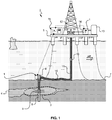
- offshore and subsea oil equipments 2 are positioned above a hydrocarbon-bearing and producing zone 3 of a hydrocarbon geological formation 4.
- the offshore and subsea oil equipments 2 may comprise a floating vessel or semisubmersible platform 5 located at the surface and a subsea well equipment 6 located on a seabed level 7.
- FIG. 1 depicts a well at a stage where it is producing hydrocarbon, e.g. oil and/or gas.
- the well bore is shown as comprising substantially vertical portion 8. However, it may also comprise horizontal or deviated portion (not shown).
- a producing section 9 of the well typically comprises perforations, production packers and production tubings at a depth corresponding to the hydrocarbon-bearing and producing zone 3 (i.e. a reservoir of the hydrocarbon geological formation 4).
- a multiphase fluid mixture 10 flows out of the hydrocarbon-bearing and producing zone 3, through the producing section 9, out of the well at the seabed level 7 through the subsea well equipment 6, along the seabed level 7 through a subsea flow line 16, and then towards the surface through a riser/production tubing 11 and then a well head 12.
- the well head 12 is coupled to surface production arrangement 13 by a surface flow line 14.
- the surface production arrangement 13 may comprise various elements coupled together.
- the surface production arrangement 13 comprises a pressure reducer, a pumping arrangement, a separator, a burner, a tank etc... (not shown in details).
- one or more predictive flow assurance assessment system(s) 1 may be coupled at various locations of the flow line between the hydrocarbon-bearing and producing zone 3 and the surface production arrangement 13.
- the predictive flow assurance assessment system 1 may be coupled to the flow line 11 at the level of the subsea well equipment 6, or at the level of the surface flow line 14, or any other position between the seabed level 7 and the floating vessel or semisubmersible platform 5.
- the fluid mixture 10 is a multiphase fluid mixture.
- multiphase fluid mixture has a broad meaning in the oilfield domain of application. It is intended to comprise a broad range of hydrocarbon effluent compositions. Generally, it may be a mixture comprising a plurality of fluid fractions (water, oil, gas) and a plurality of constituting elements (water, various hydrocarbon molecules, impurities, H 2 S, sand, etc). In term of fluid fractions, the composition of the mixture may vary in important proportion, for example from heavy oil and high water cut to high gas fraction. It may also be a mixture comprising a single phase in specific conditions, wherein the components constituting said phase may be separated. As examples, such conditions may be above the bubble point, or in non-isobaric or/and non-isothermal conditions. In such conditions, the single phase becomes biphasic and drops heavy components.
- the predictive flow assurance assessment system 1 may be located where or close to a place where, in particular, temperature/pressure may vary to a great extent and where flow issues may occur.
- temperature/pressure may vary to a great extent and where flow issues may occur.
- the large temperature and pressure drops from downhole/underground conditions typically temperatures from 50 to 200°C and pressures up to 2.000 bars
- sea floor conditions temperatures approximately a few degrees only above 0°C
- Such conditions may cause flow assurance issues in subsea flow line and surface flow line, for example:
- a processing arrangement 15 is coupled to the predictive flow assurance assessment system 1. Further, it may also be coupled to other sensors at the surface or subsea or downhole (not shown). Furthermore, it may also be coupled to active completion devices like valves (not shown).
- the processing arrangement 15 may be positioned at the floating vessel or semisubmersible platform 5 located at the surface, or, alternatively, in the subsea well equipment 6 at the seabed level 7.
- the processing arrangement 15 may comprise a computer. It may be managed by an operator located on the floating vessel or semisubmersible platform 5. It may also be managed at a distance when the floating vessel or semisubmersible platform 5 is provided with a communication means, e.g. a satellite link (not shown) to transmit data to and receive instructions from an operator's office.
- the processing arrangement 15 may implement part of the predictive flow assurance assessment method.
- the processing arrangement 15 may also gather various measurements provided by various sensors related to the hydrocarbon-bearing and producing zone 3 and to the multiphase fluid mixture 10 at various locations of the well. From these measurements, the processing arrangement 15 may determine various information related to the multiphase fluid mixture 10, for example the total flow rate, the flow rates of the individual phases of the multiphase fluid mixture, the density of the multiphase fluid mixture, the temperature, the pressure and other parameters.
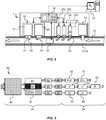
- FIG. 2 schematically shows an embodiment of the predictive flow assurance assessment system 1.
- the predictive flow assurance assessment system 1 comprises a first measuring module 20, a sampling means 21, a micro-analysis module 22, a discarding means 25, a flow issue preventing module 26 and a processing module 32.
- the micro-analysis module 22 may comprise a conditioning module 23 and a second measuring module 24.
- the flow issue preventing module 26 comprises a plurality of injection modules, for example 27A, 27B and 27C, and a heating module 31.
- the heating module 31 comprises means for heating the multiphase fluid mixture.
- Each injection module comprises a container 28 and a valve 29.
- Each container (for example 28) is filled in with a chemical product (for example 30).
- the chemical product filled in the container of the injection module 27A, 27B and 27C may be:
- the first measuring module 20 measures at least one actual parameter related to a multiphase fluid mixture 10 flowing in a main flow line 11 or 14.
- the first measuring module 20 may comprise a Venturi type multiphase flowmeter that measures pressure, temperature, and total flow rate of the multiphase fluid mixture. It may also be combined with a fraction meter, for example a gamma densitometer.
- a gamma densitometer comprising a gamma ray source and a gamma ray detector. The gamma densitometer measures absorption of the gamma ray by each phase of the multiphase fluid mixture and estimates a density of the multiphase fluid mixture and a fractional flow rate for each phase.
- the sampling means 21 may comprise an inlet port and suction means.
- the suction means may be a pump or a Venturi restriction positioned downstream the inlet port so as to induce a suction effect of a sample part 60 of the multiphase fluid mixture 10 flowing in the main flow line 11 or 14.
- the suction effect may also be induced by other kind of arrangement, e.g. a V-cone, or an orifice plate.
- the processing module 32 comprises a processor and memory.
- the processing module 32 is coupled to the micro-analysis module 22, the flow issue preventing module 26 and the first measuring module 20. Further, it may be coupled to the processing arrangement 15.
- the flow issue preventing module 26 may be placed upstream of the sampling means 21 of the micro-analysis module 22, so that the effect of the flow issue preventing module, e.g. heating or injection of chemical product on the flow conditions may be continuously monitored.
- the micro-analysis module 22, the flow issue preventing module 26 and the processing module 32 form a feedback loop that enables optimizing the flow issues prevention strategy.
- FIG. 3 schematically shows an embodiment of a micro-analysis module 22 of the predictive flow assurance assessment system embodiment depicted in FIG. 2 .
- the conditioning module 23 may comprise a solid particles filter and an emulsion breaker 40, a phase separator 41, a gas purification membrane 42, an oil purification membrane 43 and a water purification membrane 44.
- the solid particles filter enables filtering out the sand present in the multiphase fluid mixture sample.
- the emulsion breaker enables providing an emulsion free multiphase fluid mixture.
- the conditioning module 23 further comprises multiple control parameter modification elements 45, 46 and 47 associated with each phase sample, e.g. gas 61, oil 62 and water 63, respectively.
- control parameter modification elements 45, 46 or 47 may comprise a Pelletier module or a cooler supplied with sea water in a controlled manner in order to control the temperature of each phase, and/or a pump in order to control the pressure of each phase.
- the second measuring module 24 may comprise:
- control parameter modification elements 45, 46 or 47 enables modifying at least one control parameter of the phase sample 61, 62 and 63 until a transition detected by the various sensors of the second measuring module 24 appears.
- the predictive flow assurance assessment system 1 is used to monitor continuously, in real-time or near real-time, and in-situ some properties representative of the actual multiphase fluid mixture 10 flowing in the main flow line 11 or 14, and also to control the flow issue prevention operation.
- FIG. 4 schematically illustrates the principle of operation of the embodiment of the predictive flow assurance assessment system 1 depicted in FIGS. 2 and 3 .
- a first step S1 at least one actual parameter related to the multiphase fluid mixture 10 flowing in the main flow line 11 or 14 is measured. Such a measurement may be performed on a continuous, real-time or near real-time basis.
- a fluid sample 60 is taken from the multiphase fluid mixture 10 flowing in the main flow line 11 or 14.
- a third step S3 at least one control parameter of the fluid sample 60 is modified. Such a transition would cause a flow issue when occurring in the main flow line.
- a fourth step S4 the transition of the sample is detected.
- a corresponding transition value associated with the at least one control parameter is determined accordingly.
- the step S3 is repeated until a transition appears by successively modifying the at least one control parameter by a given delta ( ⁇ Par ).
- a difference between the at least one actual parameter and the at least one transition value is calculated. This difference is representative of a margin relatively to a similar transition appearance in the main flow line causing a flow issue in the main flow line 11 or 14.
- a sixth step S6 the sample is discarded.
- the sample may be returned back to the main flow line 11 or 14.
- a seventh step S7 it is decided based on the calculated difference compared to a given threshold whether a flow issue preventing step may or may be not implemented. Potential problems of flow issue inside the main flow line are therefore anticipated before they happen and corrective actions can be effectively implemented.
- the second step S2 may be implemented once again.
- the second step S2 may be implemented after a given delay.
- the second step S2 may be implemented in a continuous manner.
- a flow issue preventing step may be implemented.
- a prevention level may be defined based on the value of said difference, or the nature of control parameter.
- various prevention levels for example a first level (Level 1), a second level (Level 2), a third level (Level 3), etc... may be implemented based on the control parameter that is actually taken under consideration.
- the first level may comprise heating the multiphase fluid mixture
- the second level may comprise injecting an appropriate chemical product
- the third level may comprise a combination of the hereinbefore mentioned actions.
- Other prevention levels may be defined, for example controlling various chokes (not shown) of the installation in order to modify the pressure within the main flow line. This may be implemented through the processing arrangement 15 at the surface.
- the second step S2 is repeated.
- the effect of flow issue prevention can be directly monitored.
- This provides an increased safety margin after the preventing step(s) is(are) implemented.
- the risks of flow interruption are avoided, at least greatly reduced.
- the type and quantity of chemical products to be injected are optimized. This results in a very cost effective way of preventing flow issues.
- embodiments of the present invention are not limited to offshore hydrocarbon wells and can also be used with onshore hydrocarbon wells. Furthermore, although some embodiments have drawings showing a vertical well bore, said embodiments may also apply to a horizontal or deviated well bore. All the embodiments of the present invention are equally applicable to cased and uncased borehole (open hole).
- FIGS. show different functional entities as different blocks, this by no means excludes implementations in which a single entity carries out several functions, or in which several entities carry out a single function.
- the drawings are very diagrammatic.
- the functions of the various elements shown in the FIGS., including any functional blocks, may be provided through the use of dedicated hardware as well as hardware capable of executing software in association with appropriate software.
- the functions may be provided by a single dedicated processor, by a single shared processor, or by a plurality of individual processors, some of which may be shared.
- explicit use of the term "entity” should not be construed to refer exclusively to hardware capable of executing software, and may implicitly include, without limitation, digital signal processor (DSP) hardware, processor, application specific integrated circuit (ASIC), field programmable gate array (FPGA), read only memory (ROM) for storing software, random access memory (RAM), and non volatile storage.
- DSP digital signal processor
- ASIC application specific integrated circuit
- FPGA field programmable gate array
- ROM read only memory
- RAM random access memory
- non volatile storage non volatile storage.
- Other hardware conventional and/or custom, may also be included.
- the method and system of the present disclosure may be applied in various industries, for example the oilfield industry, the chemical industry, the aerospace industry, etc...
Landscapes
- Geology (AREA)
- Life Sciences & Earth Sciences (AREA)
- Engineering & Computer Science (AREA)
- Mining & Mineral Resources (AREA)
- Geochemistry & Mineralogy (AREA)
- Fluid Mechanics (AREA)
- Environmental & Geological Engineering (AREA)
- General Life Sciences & Earth Sciences (AREA)
- Physics & Mathematics (AREA)
- Chemical & Material Sciences (AREA)
- Chemical Kinetics & Catalysis (AREA)
- General Chemical & Material Sciences (AREA)
- Physical Or Chemical Processes And Apparatus (AREA)
- Investigating Or Analysing Biological Materials (AREA)
- Investigating Or Analysing Materials By Optical Means (AREA)
- Investigating Or Analyzing Materials By The Use Of Ultrasonic Waves (AREA)
- Automatic Analysis And Handling Materials Therefor (AREA)
Claims (13)
- Vorhersageverfahren zur Strömungssicherstellungsabschätzung umfassend- Messen (S1) wenigstens eines Ist-Parameters, der mit einer in einer Hauptströmungsleitung (11, 14) strömenden mehrphasigen Fluidmischung (10) in Beziehung steht, und- Entnehmen (S2) einer Probe (60) von der in der Hauptströmungsleitung (11, 14) strömenden mehrphasigen Fluidmischung (10),- Abändern (S3) wenigstens eines Überwachungsparameters der Probe (60), bis ein Umschlag auftritt, wobei der Umschlag bei Auftreten in der Hauptströmungsleitung (11, 14) ein Strömungsproblem verursachen würde,- Detektieren (S4) des Umschlags der Probe (60) und Bestimmen eines zugehörigen Umschlagswerts, der mit dem wenigstens einen Überwachungsparameter verknüpft ist,dadurch gekennzeichnet, dass das Verfahren weiterhin umfasst- Berechnen (S5) einer Differenz zwischen dem wenigstens einen Ist-Parameter und dem wenigstens einen Umschlagwert, wobei die Differenz für einen Spielraum bezeichnend ist, der für einen ähnlichen Umschlagsauftritt in der Hauptströmungsleitung mit Verursachen eines Strömungsproblems in der Hauptströmungsleitung bezeichnend ist, und- Einrichten (S8, S9) eines Strömungsproblemverhinderungsschritts, falls der Unterschied einen vorgegebenen Schwellwert (S7) übersteigt.
- Vorhersageverfahren zur Strömungssicherstellungsabschätzung nach Anspruch 1, wobei der Ist-Parameter und der Überwachungsparameter aus der Gruppe von Parametern umfassend eine Temperatur, einen Druck, eine Dichte, eine Viskosität und eine Menge eines bestimmten Bestandteils in der mehrphasigen Fluidmischung ausgewählt sind.
- Vorhersageverfahren zur Strömungssicherstellungsabschätzung nach Anspruch 1 oder 2, bei dem das Strömungsproblem in der Hauptströmungsleitung (11, 14) aus der Gruppe von Strömungsproblemen umfassend eine eine Verengung oder einen Verschluss der Hauptströmungsleitung verursachende Ablagerung oder Ausfällen eines festen Bestandteils, eine eine Schwächung oder eine Leckbildung der Hauptströmungsleitung verursachende Korrosion durch einen chemisch aktiven Bestandteil, eine eine Erosion oder ein Verstopfen der Hauptströmungsleitung verursachendes Erzeugen von festen Teilchen und ein ein Blockieren der Hauptströmungsleitung verursachendes Bilden von Eis ausgewählt ist.
- Vorhersageverfahren zur Strömungssicherstellungsabschätzung nach einem der voranstehenden Ansprüche, bei dem der Strömungsproblemverhinderungsschritt ein Einstellen des mit der in der Hauptströmungsleitung (11, 14) strömenden mehrphasigen Fluidmischung (10) in Beziehung stehenden Ist-Parameters, bis die Differenz nicht unterhalb des vorgegebenen Schwellwerts ist, umfasst.
- Vorhersageverfahren zur Strömungssicherstellungsabschätzung nach einem der vorangehenden Ansprüche, bei dem der Strömungsproblemverhinderungsschritt ein Erwärmen der in der Hauptströmungsleitung (11, 14) strömenden mehrphasigen Fluidmischung (10) umfasst.
- Vorhersageverfahren zur Strömungssicherstellungsabschätzung nach einem der vorangehenden Ansprüche, bei dem der Strömungsproblemverhinderungsschritt ein Einspritzen eines chemischen Hemmprodukts (30) in die in der Hauptströmungsleitung (11, 14) strömende mehrphasige Fluidmischung (10) umfasst.
- Vorhersageanordnung (1) zur Strömungssicherstellungsabschätzung mit- einem ersten Messmodul (20) zum Messen eines mit einer in einer Hauptströmungsleitung (11, 14) strömenden mehrphasigen Fluidmischung (10) in Beziehung stehenden Ist-Parameters,- einem Probenentnahmemittel (21) zum Entnehmen einer Probe (60) aus der in der Hauptströmungsleitung (11, 14) strömenden mehrphasigen Fluidmischung (10), wobei die Anordnung (1) dadurch gekennzeichnet ist, dass sie weiterhin- ein Konditioniermodul (23), um wenigstens einen Überwachungsparameter der Probe (60) zu verändern, bis ein Umschlag auftritt, wobei der Umschlag bei Auftreten in der Hauptströmungsleitung (11, 14) ein Strömungsproblem verursachen würde,- ein zweites Messmodul (24), um den Umschlag der Probe (60) festzustellen und einen zugehörigen Umschlagswert zu bestimmen, der mit wenigstens einem Überwachungsparameter verknüpft ist,- ein Strömungsproblemverhinderungsmodul (26) zum Einrichten eines Strömungsproblemverhinderungsschritts bei Empfang eines Befehls von einem Verarbeitungsmodul (32) umfasst,dadurch gekennzeichnet, dass die Anordnung (1) weiterhin- ein Verarbeitungsmodul (32), das dazu eingerichtet ist, eine Differenz zwischen dem wenigstens einen Ist-Parameter und dem wenigstens einen Übergangswert zu berechnen, wobei die Differenz für einen Spielraum bezeichnend ist, bei dem das Auftreten eines Umschlags in der Hauptströmungsleitung (11, 14) ein Strömungsproblem in der Hauptströmungsleitung (11, 14) verursacht, umfasst.
- Vorhersageverfahren zur Strömungssicherstellungsabschätzung nach Anspruch 7, bei dem das Probeentnahmemittel (21), das Konditioniermodul (23) und das zweite Messmodul (24) in einem Mikroanalysemodul (22) integriert sind.
- Vorhersageanordnung zur Strömungssicherstellungsabschätzung nach Anspruch 7 oder 8, bei dem das Strömungsproblemverhinderungsmodul (26) eine Anzahl von Einspritzmodulen (27A, 27B, 27C) und ein Erwärmungsmodul (31) aufweist.
- Vorhersageanordnung zur Strömungssicherstellungsabschätzung nach einem der Ansprüche 7 bis 9, bei dem das Strömungsproblemverhinderungsmodul (26) stromaufwärts des Probeentnahmemittels (21) des Mikroanalysemoduls (22) angeordnet ist.
- Vorhersageanordnung zur Strömungssicherstellungsabschätzung nach einem der Ansprüche 7 bis 10, bei dem das Konditioniermodul (23) einen Feststofffilter und einen Emulsionsbrecher (40), einen Phasentrenner (41) zum Abtrennen wenigstens einer Phasenprobe (61, 62, 63) von der mehrphasigen Fluidmischung (10) und wenigstens eine Phasenreinigungsmembran (42, 43, 44) aufweist.
- Vorhersageanordnung zur Strömungssicherstellungsabschätzung nach einem der Ansprüche 7 bis 11, bei dem das Konditioniermodul (23) wenigstens ein Überwachungsparametermodifizierelement (45, 46, 47) aufweist, das wenigstens einer Phasenprobe (61, 62, 63) zugeordnet ist.
- Vorhersageanordnung zur Strömungssicherstellungsabschätzung nach einem der Ansprüche 7 bis 12, bei dem das zweite Messmodul (24) wenigstens einen Sensor umfasst, der aus der Gruppe von Sensoren aufweisend einen Schwefelwasserstoff-H2S-Sensor (50), einen Kohlendioxid-CO2-Sensor (51), einen Dichte-D-Sensor (52), einen Viskositäts-vr-Sensor (53), ein Infrarotspektrometer iR (54), einen pH-Sensor (55), einen Leitfähigkeits-pr-Sensor (56), einen Ultraschallwandler, einen optischen Sensor zum Erfassen einer Eisbildung, eine Platinsonde zum Messen einer Temperatur oder eine Kombination davon ausgewählt ist.
Priority Applications (4)
| Application Number | Priority Date | Filing Date | Title |
|---|---|---|---|
| EP12305731.7A EP2677115B1 (de) | 2012-06-22 | 2012-06-22 | Prognostisches Flussversicherungsbeurteilungsverfahren und -system |
| MX2013006977A MX354804B (es) | 2012-06-22 | 2013-06-18 | Método y sistema de evaluación de aseguramiento de flujo predictivo. |
| PCT/EP2013/063000 WO2013190093A2 (en) | 2012-06-22 | 2013-06-21 | A predictive flow assurance assessment method and system |
| US14/410,043 US9777555B2 (en) | 2012-06-22 | 2013-06-21 | Predictive flow assurance assessment method and system |
Applications Claiming Priority (1)
| Application Number | Priority Date | Filing Date | Title |
|---|---|---|---|
| EP12305731.7A EP2677115B1 (de) | 2012-06-22 | 2012-06-22 | Prognostisches Flussversicherungsbeurteilungsverfahren und -system |
Publications (2)
| Publication Number | Publication Date |
|---|---|
| EP2677115A1 EP2677115A1 (de) | 2013-12-25 |
| EP2677115B1 true EP2677115B1 (de) | 2019-01-02 |
Family
ID=48746448
Family Applications (1)
| Application Number | Title | Priority Date | Filing Date |
|---|---|---|---|
| EP12305731.7A Active EP2677115B1 (de) | 2012-06-22 | 2012-06-22 | Prognostisches Flussversicherungsbeurteilungsverfahren und -system |
Country Status (4)
| Country | Link |
|---|---|
| US (1) | US9777555B2 (de) |
| EP (1) | EP2677115B1 (de) |
| MX (1) | MX354804B (de) |
| WO (1) | WO2013190093A2 (de) |
Families Citing this family (18)
| Publication number | Priority date | Publication date | Assignee | Title |
|---|---|---|---|---|
| WO2014205395A1 (en) | 2013-06-20 | 2014-12-24 | The Regents Of The University Of Michigan | Microdischarge-based transducer |
| WO2015069164A1 (en) * | 2013-11-08 | 2015-05-14 | Telefonaktiebolaget L M Ericsson (Publ) | Handling of transport conditions |
| WO2015142949A1 (en) | 2014-03-17 | 2015-09-24 | The Regents Of The University Of Michigan | Packaged microsystems |
| WO2016014796A2 (en) | 2014-07-23 | 2016-01-28 | Baker Hughes Incorporated | System and method for downhole inorganic scale monitoring and intervention in a production well |
| BR112017001353B1 (pt) | 2014-07-23 | 2022-02-22 | Baker Hughes Incorporated | Aparelho e método para monitorar escala orgânica de fundo de poço e intervir em um poço de produção |
| WO2016067222A1 (en) * | 2014-10-28 | 2016-05-06 | Onesubsea Ip Uk Limited | Additive management system |
| US9562430B1 (en) | 2015-10-05 | 2017-02-07 | Baker Hughes Incorporated | Chemiresistive sensors for downhole tools |
| US10983499B2 (en) | 2016-04-20 | 2021-04-20 | Baker Hughes, A Ge Company, Llc | Drilling fluid pH monitoring and control |
| US20190003290A1 (en) * | 2017-07-03 | 2019-01-03 | Exmar Offshore Company | Techniques for improved oil recovery |
| CN109025906A (zh) * | 2018-08-02 | 2018-12-18 | 中国石油天然气股份有限公司 | 一种定量加药箱及一种定量加药车 |
| GB201907388D0 (en) | 2019-05-24 | 2019-07-10 | Resman As | Method and apparatus for quantitative multi-phase downhole surveillance |
| US11885219B2 (en) | 2020-03-23 | 2024-01-30 | Cameron International Corporation | Chemical injection system for a resource extraction system |
| CN111737914B (zh) * | 2020-06-16 | 2023-10-24 | 中国石油天然气股份有限公司 | 油井掺水流量的测量方法及装置、电子设备和存储介质 |
| US12221863B2 (en) * | 2020-07-01 | 2025-02-11 | Baker Hughes Oilfield Operations Llc | Filtration of fluids using conformable porous shape memory media |
| EP4229273A4 (de) * | 2020-10-14 | 2024-12-25 | Cameron Technologies Limited | Echtzeit-massstabsniederschlagsvorhersage sowie steuerungssysteme und -verfahren |
| US20230160297A1 (en) * | 2021-11-25 | 2023-05-25 | Petróleo Brasileiro S.A. - Petrobras | System for monitoring real- time flow assurance occurrences |
| EP4581237A4 (de) * | 2022-09-02 | 2025-11-26 | Services Petroliers Schlumberger | Avatar für kohlenwasserstofffluss |
| CN115789525B (zh) * | 2022-11-18 | 2024-09-24 | 中海石油(中国)有限公司 | 一种多相混输管道水合物抑制剂加注优化决策方法和系统 |
Family Cites Families (5)
| Publication number | Priority date | Publication date | Assignee | Title |
|---|---|---|---|---|
| SU1308995A1 (ru) * | 1985-12-17 | 1987-05-07 | Специальное проектно-конструкторское бюро "Промавтоматика" | Устройство дл ввода ингибитора гидратообразовани в поток газа |
| US5016712A (en) * | 1990-03-06 | 1991-05-21 | Mobil Oil Corporation | Method and apparatus for locating solvent injection apparatus within a natural gas wellbore |
| FR2737279B1 (fr) | 1995-07-27 | 1997-09-19 | Inst Francais Du Petrole | Systeme et procede pour transporter un fluide susceptible de former des hydrates |
| ATE491862T1 (de) | 2007-12-27 | 2011-01-15 | Prad Res & Dev Nv | Echtzeitmessung von eigenschaften von reservoirfluiden |
| GB2460668B (en) * | 2008-06-04 | 2012-08-01 | Schlumberger Holdings | Subsea fluid sampling and analysis |
-
2012
- 2012-06-22 EP EP12305731.7A patent/EP2677115B1/de active Active
-
2013
- 2013-06-18 MX MX2013006977A patent/MX354804B/es active IP Right Grant
- 2013-06-21 US US14/410,043 patent/US9777555B2/en active Active
- 2013-06-21 WO PCT/EP2013/063000 patent/WO2013190093A2/en not_active Ceased
Non-Patent Citations (1)
| Title |
|---|
| None * |
Also Published As
| Publication number | Publication date |
|---|---|
| WO2013190093A2 (en) | 2013-12-27 |
| MX354804B (es) | 2018-03-22 |
| MX2013006977A (es) | 2013-12-23 |
| WO2013190093A3 (en) | 2014-06-19 |
| EP2677115A1 (de) | 2013-12-25 |
| US9777555B2 (en) | 2017-10-03 |
| US20160186533A1 (en) | 2016-06-30 |
Similar Documents
| Publication | Publication Date | Title |
|---|---|---|
| EP2677115B1 (de) | Prognostisches Flussversicherungsbeurteilungsverfahren und -system | |
| US9347310B2 (en) | Multiphase flowmeter for subsea applications | |
| EP2446116B1 (de) | Vorrichtung und verfahren zur detektion und quantifizierung des leckverlusts in einem rohr | |
| EP3365528B1 (de) | Verfahren und system zur bestimmung der produktionsrate von flüssigkeiten in einem erdgasbohrloch | |
| CA2874592C (en) | Dual differential pressure multiphase flow meter | |
| Sakurai et al. | Issues and challenges with controlling large drawdown in the first offshore methane-hydrate production test | |
| Cayeux et al. | Precise gain and loss detection using a transient hydraulic model of the return flow to the pit | |
| US11504648B2 (en) | Well clean-up monitoring technique | |
| US20180051549A1 (en) | Erosion management system | |
| US11846178B2 (en) | Flow measurement | |
| US10989039B2 (en) | Production of hydrocarbons with test separator | |
| EP1828727B1 (de) | Verfahren zur bestimmung eines phasenvolumens eines mehrphasen-mediums in einer pipeline mit hilfe eines tracers | |
| EP4127398B1 (de) | Chemisches injektionssystem für ein ressourcenextraktionssystem | |
| US11512557B2 (en) | Integrated system and method for automated monitoring and control of sand-prone well | |
| Shumakov et al. | Five Years' Experience Using Coriolis Separators in North Sea Well Testing | |
| Dejia et al. | Production logging application in Fuling shale gas play in China | |
| Harper et al. | Determination of H2S Partial Pressures and Fugacities in Flowing Streams for a More Accurate Assessment of Integrity Threat in Sour Systems | |
| Vielliard et al. | Real-Time Subsea Hydrate Management in the World's Longest Subsea Tieback | |
| Abili et al. | Synergy of fluid sampling and subsea processing, key to maximising offshore asset recovery | |
| Tonkonog et al. | Experience of Application of Different Multiphase Metering Technologies for Cold Production and High Viscosity Oil Systems | |
| Sinha et al. | Estimating Water-Gas Ratio in Producing Gas Wells Through Multi-Fidelity Data Assimilation by Integrating Wellbore Physics and Data-Driven Reservoir Models | |
| Tosic et al. | Multiphase well-rate measurements applied to reservoir analysis | |
| Hall | Subsea liquid sampling using flow-through technique |
Legal Events
| Date | Code | Title | Description |
|---|---|---|---|
| PUAI | Public reference made under article 153(3) epc to a published international application that has entered the european phase |
Free format text: ORIGINAL CODE: 0009012 |
|
| AK | Designated contracting states |
Kind code of ref document: A1 Designated state(s): AL AT BE BG CH CY CZ DE DK EE ES FI FR GB GR HR HU IE IS IT LI LT LU LV MC MK MT NL NO PL PT RO RS SE SI SK SM TR |
|
| AX | Request for extension of the european patent |
Extension state: BA ME |
|
| 17P | Request for examination filed |
Effective date: 20140625 |
|
| RBV | Designated contracting states (corrected) |
Designated state(s): AL AT BE BG CH CY CZ DE DK EE ES FI FR GB GR HR HU IE IS IT LI LT LU LV MC MK MT NL NO PL PT RO RS SE SI SK SM TR |
|
| GRAP | Despatch of communication of intention to grant a patent |
Free format text: ORIGINAL CODE: EPIDOSNIGR1 |
|
| STAA | Information on the status of an ep patent application or granted ep patent |
Free format text: STATUS: GRANT OF PATENT IS INTENDED |
|
| INTG | Intention to grant announced |
Effective date: 20180718 |
|
| GRAS | Grant fee paid |
Free format text: ORIGINAL CODE: EPIDOSNIGR3 |
|
| GRAA | (expected) grant |
Free format text: ORIGINAL CODE: 0009210 |
|
| STAA | Information on the status of an ep patent application or granted ep patent |
Free format text: STATUS: THE PATENT HAS BEEN GRANTED |
|
| AK | Designated contracting states |
Kind code of ref document: B1 Designated state(s): AL AT BE BG CH CY CZ DE DK EE ES FI FR GB GR HR HU IE IS IT LI LT LU LV MC MK MT NL NO PL PT RO RS SE SI SK SM TR |
|
| REG | Reference to a national code |
Ref country code: GB Ref legal event code: FG4D |
|
| REG | Reference to a national code |
Ref country code: CH Ref legal event code: EP Ref country code: AT Ref legal event code: REF Ref document number: 1084613 Country of ref document: AT Kind code of ref document: T Effective date: 20190115 |
|
| REG | Reference to a national code |
Ref country code: IE Ref legal event code: FG4D |
|
| REG | Reference to a national code |
Ref country code: DE Ref legal event code: R096 Ref document number: 602012055378 Country of ref document: DE |
|
| REG | Reference to a national code |
Ref country code: NO Ref legal event code: T2 Effective date: 20190102 |
|
| REG | Reference to a national code |
Ref country code: NL Ref legal event code: MP Effective date: 20190102 |
|
| REG | Reference to a national code |
Ref country code: LT Ref legal event code: MG4D |
|
| REG | Reference to a national code |
Ref country code: AT Ref legal event code: MK05 Ref document number: 1084613 Country of ref document: AT Kind code of ref document: T Effective date: 20190102 |
|
| PG25 | Lapsed in a contracting state [announced via postgrant information from national office to epo] |
Ref country code: NL Free format text: LAPSE BECAUSE OF FAILURE TO SUBMIT A TRANSLATION OF THE DESCRIPTION OR TO PAY THE FEE WITHIN THE PRESCRIBED TIME-LIMIT Effective date: 20190102 |
|
| PG25 | Lapsed in a contracting state [announced via postgrant information from national office to epo] |
Ref country code: PT Free format text: LAPSE BECAUSE OF FAILURE TO SUBMIT A TRANSLATION OF THE DESCRIPTION OR TO PAY THE FEE WITHIN THE PRESCRIBED TIME-LIMIT Effective date: 20190502 Ref country code: ES Free format text: LAPSE BECAUSE OF FAILURE TO SUBMIT A TRANSLATION OF THE DESCRIPTION OR TO PAY THE FEE WITHIN THE PRESCRIBED TIME-LIMIT Effective date: 20190102 Ref country code: SE Free format text: LAPSE BECAUSE OF FAILURE TO SUBMIT A TRANSLATION OF THE DESCRIPTION OR TO PAY THE FEE WITHIN THE PRESCRIBED TIME-LIMIT Effective date: 20190102 Ref country code: FI Free format text: LAPSE BECAUSE OF FAILURE TO SUBMIT A TRANSLATION OF THE DESCRIPTION OR TO PAY THE FEE WITHIN THE PRESCRIBED TIME-LIMIT Effective date: 20190102 Ref country code: PL Free format text: LAPSE BECAUSE OF FAILURE TO SUBMIT A TRANSLATION OF THE DESCRIPTION OR TO PAY THE FEE WITHIN THE PRESCRIBED TIME-LIMIT Effective date: 20190102 Ref country code: LT Free format text: LAPSE BECAUSE OF FAILURE TO SUBMIT A TRANSLATION OF THE DESCRIPTION OR TO PAY THE FEE WITHIN THE PRESCRIBED TIME-LIMIT Effective date: 20190102 |
|
| PG25 | Lapsed in a contracting state [announced via postgrant information from national office to epo] |
Ref country code: BG Free format text: LAPSE BECAUSE OF FAILURE TO SUBMIT A TRANSLATION OF THE DESCRIPTION OR TO PAY THE FEE WITHIN THE PRESCRIBED TIME-LIMIT Effective date: 20190402 Ref country code: GR Free format text: LAPSE BECAUSE OF FAILURE TO SUBMIT A TRANSLATION OF THE DESCRIPTION OR TO PAY THE FEE WITHIN THE PRESCRIBED TIME-LIMIT Effective date: 20190403 Ref country code: IS Free format text: LAPSE BECAUSE OF FAILURE TO SUBMIT A TRANSLATION OF THE DESCRIPTION OR TO PAY THE FEE WITHIN THE PRESCRIBED TIME-LIMIT Effective date: 20190502 Ref country code: HR Free format text: LAPSE BECAUSE OF FAILURE TO SUBMIT A TRANSLATION OF THE DESCRIPTION OR TO PAY THE FEE WITHIN THE PRESCRIBED TIME-LIMIT Effective date: 20190102 Ref country code: LV Free format text: LAPSE BECAUSE OF FAILURE TO SUBMIT A TRANSLATION OF THE DESCRIPTION OR TO PAY THE FEE WITHIN THE PRESCRIBED TIME-LIMIT Effective date: 20190102 Ref country code: RS Free format text: LAPSE BECAUSE OF FAILURE TO SUBMIT A TRANSLATION OF THE DESCRIPTION OR TO PAY THE FEE WITHIN THE PRESCRIBED TIME-LIMIT Effective date: 20190102 |
|
| REG | Reference to a national code |
Ref country code: DE Ref legal event code: R097 Ref document number: 602012055378 Country of ref document: DE |
|
| PG25 | Lapsed in a contracting state [announced via postgrant information from national office to epo] |
Ref country code: RO Free format text: LAPSE BECAUSE OF FAILURE TO SUBMIT A TRANSLATION OF THE DESCRIPTION OR TO PAY THE FEE WITHIN THE PRESCRIBED TIME-LIMIT Effective date: 20190102 Ref country code: IT Free format text: LAPSE BECAUSE OF FAILURE TO SUBMIT A TRANSLATION OF THE DESCRIPTION OR TO PAY THE FEE WITHIN THE PRESCRIBED TIME-LIMIT Effective date: 20190102 Ref country code: CZ Free format text: LAPSE BECAUSE OF FAILURE TO SUBMIT A TRANSLATION OF THE DESCRIPTION OR TO PAY THE FEE WITHIN THE PRESCRIBED TIME-LIMIT Effective date: 20190102 Ref country code: EE Free format text: LAPSE BECAUSE OF FAILURE TO SUBMIT A TRANSLATION OF THE DESCRIPTION OR TO PAY THE FEE WITHIN THE PRESCRIBED TIME-LIMIT Effective date: 20190102 Ref country code: AT Free format text: LAPSE BECAUSE OF FAILURE TO SUBMIT A TRANSLATION OF THE DESCRIPTION OR TO PAY THE FEE WITHIN THE PRESCRIBED TIME-LIMIT Effective date: 20190102 Ref country code: DK Free format text: LAPSE BECAUSE OF FAILURE TO SUBMIT A TRANSLATION OF THE DESCRIPTION OR TO PAY THE FEE WITHIN THE PRESCRIBED TIME-LIMIT Effective date: 20190102 Ref country code: AL Free format text: LAPSE BECAUSE OF FAILURE TO SUBMIT A TRANSLATION OF THE DESCRIPTION OR TO PAY THE FEE WITHIN THE PRESCRIBED TIME-LIMIT Effective date: 20190102 Ref country code: SK Free format text: LAPSE BECAUSE OF FAILURE TO SUBMIT A TRANSLATION OF THE DESCRIPTION OR TO PAY THE FEE WITHIN THE PRESCRIBED TIME-LIMIT Effective date: 20190102 |
|
| PLBE | No opposition filed within time limit |
Free format text: ORIGINAL CODE: 0009261 |
|
| STAA | Information on the status of an ep patent application or granted ep patent |
Free format text: STATUS: NO OPPOSITION FILED WITHIN TIME LIMIT |
|
| PG25 | Lapsed in a contracting state [announced via postgrant information from national office to epo] |
Ref country code: SM Free format text: LAPSE BECAUSE OF FAILURE TO SUBMIT A TRANSLATION OF THE DESCRIPTION OR TO PAY THE FEE WITHIN THE PRESCRIBED TIME-LIMIT Effective date: 20190102 |
|
| 26N | No opposition filed |
Effective date: 20191003 |
|
| REG | Reference to a national code |
Ref country code: DE Ref legal event code: R119 Ref document number: 602012055378 Country of ref document: DE |
|
| PG25 | Lapsed in a contracting state [announced via postgrant information from national office to epo] |
Ref country code: MC Free format text: LAPSE BECAUSE OF FAILURE TO SUBMIT A TRANSLATION OF THE DESCRIPTION OR TO PAY THE FEE WITHIN THE PRESCRIBED TIME-LIMIT Effective date: 20190102 |
|
| REG | Reference to a national code |
Ref country code: CH Ref legal event code: PL |
|
| PG25 | Lapsed in a contracting state [announced via postgrant information from national office to epo] |
Ref country code: SI Free format text: LAPSE BECAUSE OF FAILURE TO SUBMIT A TRANSLATION OF THE DESCRIPTION OR TO PAY THE FEE WITHIN THE PRESCRIBED TIME-LIMIT Effective date: 20190102 |
|
| REG | Reference to a national code |
Ref country code: BE Ref legal event code: MM Effective date: 20190630 |
|
| PG25 | Lapsed in a contracting state [announced via postgrant information from national office to epo] |
Ref country code: TR Free format text: LAPSE BECAUSE OF FAILURE TO SUBMIT A TRANSLATION OF THE DESCRIPTION OR TO PAY THE FEE WITHIN THE PRESCRIBED TIME-LIMIT Effective date: 20190102 |
|
| PG25 | Lapsed in a contracting state [announced via postgrant information from national office to epo] |
Ref country code: IE Free format text: LAPSE BECAUSE OF NON-PAYMENT OF DUE FEES Effective date: 20190622 Ref country code: DE Free format text: LAPSE BECAUSE OF NON-PAYMENT OF DUE FEES Effective date: 20200101 |
|
| PG25 | Lapsed in a contracting state [announced via postgrant information from national office to epo] |
Ref country code: LU Free format text: LAPSE BECAUSE OF NON-PAYMENT OF DUE FEES Effective date: 20190622 Ref country code: BE Free format text: LAPSE BECAUSE OF NON-PAYMENT OF DUE FEES Effective date: 20190630 Ref country code: CH Free format text: LAPSE BECAUSE OF NON-PAYMENT OF DUE FEES Effective date: 20190630 Ref country code: LI Free format text: LAPSE BECAUSE OF NON-PAYMENT OF DUE FEES Effective date: 20190630 |
|
| PG25 | Lapsed in a contracting state [announced via postgrant information from national office to epo] |
Ref country code: CY Free format text: LAPSE BECAUSE OF FAILURE TO SUBMIT A TRANSLATION OF THE DESCRIPTION OR TO PAY THE FEE WITHIN THE PRESCRIBED TIME-LIMIT Effective date: 20190102 |
|
| PG25 | Lapsed in a contracting state [announced via postgrant information from national office to epo] |
Ref country code: HU Free format text: LAPSE BECAUSE OF FAILURE TO SUBMIT A TRANSLATION OF THE DESCRIPTION OR TO PAY THE FEE WITHIN THE PRESCRIBED TIME-LIMIT; INVALID AB INITIO Effective date: 20120622 Ref country code: MT Free format text: LAPSE BECAUSE OF FAILURE TO SUBMIT A TRANSLATION OF THE DESCRIPTION OR TO PAY THE FEE WITHIN THE PRESCRIBED TIME-LIMIT Effective date: 20190102 |
|
| PG25 | Lapsed in a contracting state [announced via postgrant information from national office to epo] |
Ref country code: MK Free format text: LAPSE BECAUSE OF FAILURE TO SUBMIT A TRANSLATION OF THE DESCRIPTION OR TO PAY THE FEE WITHIN THE PRESCRIBED TIME-LIMIT Effective date: 20190102 |
|
| PGFP | Annual fee paid to national office [announced via postgrant information from national office to epo] |
Ref country code: GB Payment date: 20240626 Year of fee payment: 13 |
|
| PGFP | Annual fee paid to national office [announced via postgrant information from national office to epo] |
Ref country code: NO Payment date: 20240627 Year of fee payment: 13 |
|
| PGFP | Annual fee paid to national office [announced via postgrant information from national office to epo] |
Ref country code: FR Payment date: 20250527 Year of fee payment: 14 |