EP2669802B1 - Erleichterung der Kommunikation zwischen Unternehmenssoftwareanwendungen - Google Patents
Erleichterung der Kommunikation zwischen Unternehmenssoftwareanwendungen Download PDFInfo
- Publication number
- EP2669802B1 EP2669802B1 EP13002746.9A EP13002746A EP2669802B1 EP 2669802 B1 EP2669802 B1 EP 2669802B1 EP 13002746 A EP13002746 A EP 13002746A EP 2669802 B1 EP2669802 B1 EP 2669802B1
- Authority
- EP
- European Patent Office
- Prior art keywords
- message
- software application
- destination
- enterprise software
- computers
- Prior art date
- Legal status (The legal status is an assumption and is not a legal conclusion. Google has not performed a legal analysis and makes no representation as to the accuracy of the status listed.)
- Active
Links
Images


Classifications
-
- G—PHYSICS
- G06—COMPUTING OR CALCULATING; COUNTING
- G06F—ELECTRIC DIGITAL DATA PROCESSING
- G06F9/00—Arrangements for program control, e.g. control units
- G06F9/06—Arrangements for program control, e.g. control units using stored programs, i.e. using an internal store of processing equipment to receive or retain programs
- G06F9/46—Multiprogramming arrangements
- G06F9/54—Interprogram communication
- G06F9/541—Interprogram communication via adapters, e.g. between incompatible applications
Definitions
- This disclosure relates to communication between enterprise software applications.
- Enterprise software applications that operate within a company's intranet can communicate with enterprise software applications of other companies and entities via the Internet.
- enterprise software applications can communicate via an exchange system. Some enterprise software applications send messages to the exchange system using a particular message protocol for use with the exchange system.
- WO 2007/064876 discloses a system and method for processing messages in a gateway. Accordingly, a gateway message is received at the gateway, the gateway message including a gateway message header and a payload.
- the gateway message header includes a unique message identifier block, a target block identifying where the gateway message is going, and a history block providing a log of what has happened to the gateway message.
- Each block in the gateway message header is processed by the gateway in accordance with a message type, the processing including determining a target application for receiving the payload. The payload is provided to the determined target application.
- WO 2008/040085 (Waratek Pty Limited) discloses a network protocol in which the network switch reports failure to transmit a message or packet to the source computer of a multiple computer system. The destination computer is then instructed by the source computer to reinitialize the relevant memory locations.
- a transaction identifier (TID) is used to identify a source computer sending a stream of updating data for a specific memory location.
- WO 2007/149742 (Liquid Computing Corporation) discloses a method for inter-computer packet transport in multi-process and multicomputer environments that includes acknowledgments of received packets. A bit-mapped message is used for selective acknowledgments by which individual messages may be selected for retransmission.
- one aspect of the subject matter described in this specification can be embodied in methods that include the actions of receiving, from a sending enterprise software application executing on one or more local computers, a request to send an outbound message to a destination enterprise software application executing on one or more destination computers, the request specifying a message payload and a message protocol, the message protocol specifying a message format for messages to send to an exchange system that translates messages between enterprise software applications; reading configuration data, stored by the one or more local computers, for the sending enterprise software application and the destination enterprise software application; building the outbound message at the one of more local computers, including building a message header using the configuration data and including the message header and the message payload in the outbound message; and sending the outbound message to the destination enterprise software application.
- inventions of this aspect include corresponding systems, apparatus, and computer programs, configured to perform the actions of the methods, encoded on computer storage devices.
- a system of one or more computers can be configured to perform particular actions by virtue of having software, firmware, hardware, or a combination of them installed on the system that in operation causes or cause the system to perform the actions.
- One or more computer programs can be configured to perform particular actions by virtue of including instructions that, when executed by data processing apparatus, cause the apparatus to perform the actions.
- the configuration data includes technical addressing information, and wherein building the outbound message includes building the message header using the technical addressing information, and wherein the technical addressing information specifies one or more of: a connection scheme, a network address for the one or more destination computers, a network port for the one or more destination computers, a network path for the one or more destination computers, and a timeout value.
- the configuration data includes authentication data, and wherein building the outbound message includes building the message header using the authentication data.
- the authentication data specifies an authentication method and data specific to the authentication method.
- the configuration data includes logical addressing information, and wherein building the outbound message includes building the message header using the logical addressing information, and wherein the logical addressing information specifies a logical receiver party name for the destination enterprise software application.
- the logical addressing information specifies a logical sender party name for the local enterprise software application.
- the logical addressing information specifies a sender service or a receiver service or both.
- the configuration data includes a mapping of interface names
- building the outbound message includes mapping an internal interface name for the local enterprise software application to an external interface name for the destination enterprise software application using the mapping of interface names, and wherein building the outbound message includes building the message header using the external interface name.
- Entities e.g., small and medium sized enterprises
- Applications on the hosted system can communicate with other system using a message protocol.
- the message protocol specifies a message format for an exchange system.
- the hosted system need not use an exchange system, so the cost and complexity of the hosted system can be reduced compared to systems including an exchange system.
- Other entities using on-premise computer systems can also reduce cost and complexity of communication by avoiding the use of an exchange system.
- This specification describes systems, methods, apparatus, and computer-readable media for point-to-point connectivity for enterprise software applications.
- Some enterprise software systems communicate using a message protocol designed for use with an exchange system. Those systems require the exchange system to communicate using that message protocol.
- a local system can build a message formatted in accordance with the message protocol, even without an exchange system. The local system stores configuration data and uses the configuration data to build the message.
- FIG. 1 is a schematic diagram of a local system 102 configured to build messages according to a message protocol.
- the local system can be implemented as a system of one or more computers.
- the local system can host one or more applications 104a-c.
- the applications can be enterprise software applications.
- the applications can perform actions for customer relationship management (CRM), enterprise resource planning (ERP), human resource management (HRM), content management (CM), and so on.
- CRM customer relationship management
- ERP enterprise resource planning
- HRM human resource management
- CM content management
- the local system can host the applications using a software delivery model in which applications and data are centrally hosted.
- a user on a user device 106 can access the local system over a data communications network 108, e.g., the Internet. This is useful, for example, because the user does not need to purchase and physically house computing devices to execute the applications.
- the local system 102 can communicate over the network 108 with a destination system 110 of one or more computers.
- the destination system can execute one or more enterprise software applications.
- the destination system communicates via an exchange system 112 with one or more other system 114.
- the exchange system is a system of one or more computers.
- the exchange system provides a central repository of information and facilitates translation and exchange of information across different and possibly incompatible software platforms.
- the exchange system can centrally store information usable by various parties accessing the system.
- the exchange system can also facilitate exchanging information between platforms that are otherwise unable to exchange data due to formatting and translation incompatibilities.
- the exchange system can convert documents and other data between different formats.
- the destination system and the other systems communicate with the exchange system using a particular message protocol for use with the exchange system. Because of this, it is useful for the local system to communicate with the destination system using that particular message protocol. However, some entities, e.g., small and midsize enterprises, prefer to host applications on the local system to avoid the cost and technical complexity of having an exchange system. Therefore, it is useful for the local system to build messages according to the message protocol without using the exchange system.
- the local system includes a point-to-point (P2P) connectivity module 116.
- the P2P connectivity module is configured to build messages that are formatted according to the message protocol. After building messages, the local system can send the messages to the destination system, and the messages need not pass through the exchange system. The local system can also send messages to the other systems via the exchange system.
- the P2P connectivity module manages connection data, e.g., Transmission Control Protocol (TCP) connection data, for multiple other systems.
- TCP Transmission Control Protocol
- the P2P connectivity module builds messages using configuration data stored in a configuration data repository 118 of the local system.
- the configuration data includes various types of information useful for translation and exchange of data across different and possibly incompatible software platforms.
- the configuration data can include specific configuration data for the applications hosted on the local system.
- the P2P connectivity module can also process received messages from the destination system or other systems that are formatted according to the protocol.
- the module translates information in received messages and strips away information from received messages as appropriate before passing received messages to hosted applications on the local system.
- FIG. 2 is a flow diagram of an example method 200 for building a message.
- the method can be performed by a system of one or more computers.
- the local system 102 of FIG. 1 can perform the method using the P2P connectivity module.
- the method will be described with respect to a module that performs the method.
- the module receives a request to send an outbound message (step 202).
- the request is from a sending enterprise software application, and the request specifies a destination enterprise software application.
- the request specifies a message payload and a message protocol.
- the message protocol specifies a message format for messages to send to an exchange system, e.g., as described above with reference to FIG. 1 .
- the module reads configuration data, stored locally, for the sending enterprise software application and the destination enterprise software application (step 204).
- the configuration data can include one or more of technical addressing information, authentication data, logical addressing information, and a mapping of interface names.
- Technical addressing information can specify one or more of: a connection scheme, a network address for the one or more destination computers, a network port for the one or more destination computers, a network path for the one or more destination computers, and a timeout value.
- Authentication data can specify an authentication method and data specific to the authentication method. The authentication data is specific to the destination enterprise software application.
- Logical addressing information can specify one or more of: a logical receiver party name for the destination enterprise software application, a logical sender party name for the local enterprise software application, and a sender service or a receiver service or both.
- a mapping of interface names specifies a mapping between internal interface names for local enterprise software application and external interface names for the destination enterprise software application.
- An interface name is an identifier used to access a certain application component.
- the module builds the outbound message (step 206).
- the outbound message is a valid message formatted according to the message protocol.
- the module uses the configuration data and the message payload.
- the module builds a message header using the configuration data and includes the message header and the message payload in the outbound message.
- the module sends the outbound message (step 208).
- the module can communicate with the destination system according to the technical and logical addressing information specified by the configuration data, e.g., by managing a TCP connection between the sending enterprise software application and the destination enterprise software application.
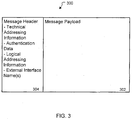
- FIG. 3 is a conceptual diagram of an example message 300 formatted for an enterprise software application protocol and for point-to-point connectivity.
- the message includes a message payload 302.
- the message payload is provided by a sending enterprise software application.
- the message also includes a message header 304.
- the message header can include technical addressing information, authentication data, logical addressing information, and one or more external interface names, as discussed above with reference to FIG. 2 .
- the header can include other data as appropriate.
- Embodiments of the subject matter and the operations described in this specification can be implemented in digital electronic circuitry, or in computer software, firmware, or hardware, including the structures disclosed in this specification and their structural equivalents, or in combinations of one or more of them.
- Embodiments of the subject matter described in this specification can be implemented as one or more computer programs, i.e., one or more modules of computer program instructions, encoded on computer storage medium for execution by, or to control the operation of, data processing apparatus.
- the program instructions can be encoded on an artificially-generated propagated signal, e.g., a machine-generated electrical, optical, or electromagnetic signal, that is generated to encode information for transmission to suitable receiver apparatus for execution by a data processing apparatus.
- a computer storage medium can be, or be included in, a computer-readable storage device, a computer-readable storage substrate, a random or serial access memory array or device, or a combination of one or more of them.
- a computer storage medium is not a propagated signal, a computer storage medium can be a source or destination of computer program instructions encoded in an artificially-generated propagated signal.
- the computer storage medium can also be, or be included in, one or more separate physical components or media (e.g., multiple CDs, disks, or other storage devices).
- the operations described in this specification can be implemented as operations performed by a data processing apparatus on data stored on one or more computer-readable storage devices or received from other sources.
- the term "data processing apparatus” encompasses all kinds of apparatus, devices, and machines for processing data, including by way of example a programmable processor, a computer, a system on a chip, or multiple ones, or combinations, of the foregoing
- the apparatus can include special purpose logic circuitry, e.g., an FPGA (field programmable gate array) or an ASIC (application-specific integrated circuit).
- the apparatus can also include, in addition to hardware, code that creates an execution environment for the computer program in question, e.g., code that constitutes processor firmware, a protocol stack, a database management system, an operating system, a cross-platform runtime environment, a virtual machine, or a combination of one or more of them.
- the apparatus and execution environment can realize various different computing model infrastructures, such as web services, distributed computing and grid computing infrastructures.
- a computer program (also known as a program, software, software application, script, or code) can be written in any form of programming language, including compiled or interpreted languages, declarative or procedural languages, and it can be deployed in any form, including as a stand-alone program or as a module, component, subroutine, object, or other unit suitable for use in a computing environment.
- a computer program may, but need not, correspond to a file in a file system.
- a program can be stored in a portion of a file that holds other programs or data (e.g., one or more scripts stored in a markup language document), in a single file dedicated to the program in question, or in multiple coordinated files (e.g., files that store one or more modules, sub-programs, or portions of code).
- a computer program can be deployed to be executed on one computer or on multiple computers that are located at one site or distributed across multiple sites and interconnected by a communication network.
- the processes and logic flows described in this specification can be performed by one or more programmable processors executing one or more computer programs to perform actions by operating on input data and generating output.
- the processes and logic flows can also be performed by, and apparatus can also be implemented as, special purpose logic circuitry, e.g., an FPGA (field programmable gate array) or an ASIC (application-specific integrated circuit).
- processors suitable for the execution of a computer program include, by way of example, both general and special purpose microprocessors, and any one or more processors of any kind of digital computer.
- a processor will receive instructions and data from a read-only memory or a random access memory or both.
- the essential elements of a computer are a processor for performing actions in accordance with instructions and one or more memory devices for storing instructions and data.
- a computer will also include, or be operatively coupled to receive data from or transfer data to, or both, one or more mass storage devices for storing data, e.g., magnetic, magneto-optical disks, or optical disks.
- mass storage devices for storing data, e.g., magnetic, magneto-optical disks, or optical disks.
- a computer need not have such devices.
- a computer can be embedded in another device, e.g., a mobile telephone, a personal digital assistant (PDA), a mobile audio or video player, a game console, a Global Positioning System (GPS) receiver, or a portable storage device (e.g., a universal serial bus (USB) flash drive), to name just a few.
- Devices suitable for storing computer program instructions and data include all forms of non-volatile memory, media and memory devices, including by way of example semiconductor memory devices, e.g., EPROM, EEPROM, and flash memory devices; magnetic disks, e.g., internal hard disks or removable disks; magneto-optical disks; and CD-ROM and DVD-ROM disks.
- the processor and the memory can be supplemented by, or incorporated in, special purpose logic circuitry.
- a computer having a display device, e.g., a CRT (cathode ray tube) or LCD (liquid crystal display) monitor, for displaying information to the user and a keyboard and a pointing device, e.g., a mouse or a trackball, by which the user can provide input to the computer.
- a display device e.g., a CRT (cathode ray tube) or LCD (liquid crystal display) monitor
- keyboard and a pointing device e.g., a mouse or a trackball
- Other kinds of devices can be used to provide for interaction with a user as well; for example, feedback provided to the user can be any form of sensory feedback, e.g., visual feedback, auditory feedback, or tactile feedback; and input from the user can be received in any form, including acoustic, speech, or tactile input.
- a computer can interact with a user by sending documents to and receiving documents from a device that is used by the user; for example, by sending web pages to a
- Embodiments of the subject matter described in this specification can be implemented in a computing system that includes a back-end component, e.g., as a data server, or that includes a middleware component, e.g., an application server, or that includes a front-end component, e.g., a client computer having a graphical user interface or a Web browser through which a user can interact with an implementation of the subject matter described in this specification, or any combination of one or more such back-end, middleware, or front-end components.
- the components of the system can be interconnected by any form or medium of digital data communication, e.g., a communication network.
- Examples of communication networks include a local area network (“LAN”) and a wide area network (“WAN”), an inter-network (e.g., the Internet), and peer-to-peer networks (e.g., ad hoc peer-to-peer networks).
- LAN local area network
- WAN wide area network
- inter-network e.g., the Internet
- peer-to-peer networks e.g., ad hoc peer-to-peer networks.
- the computing system can include clients and servers.
- a client and server are generally remote from each other and typically interact through a communication network. The relationship of client and server arises by virtue of computer programs running on the respective computers and having a client-server relationship to each other.
- a server transmits data (e.g., an HTML page) to a client device (e.g., for purposes of displaying data to and receiving user input from a user interacting with the client device).
- client device e.g., for purposes of displaying data to and receiving user input from a user interacting with the client device.
- Data generated at the client device e.g., a result of the user interaction
Landscapes
- Engineering & Computer Science (AREA)
- Software Systems (AREA)
- Theoretical Computer Science (AREA)
- Physics & Mathematics (AREA)
- General Engineering & Computer Science (AREA)
- General Physics & Mathematics (AREA)
- Data Exchanges In Wide-Area Networks (AREA)
- Computer And Data Communications (AREA)
Claims (10)
- Verfahren, das von einem oder mehreren Computern ausgeführt wird, wobei das Verfahren umfasst:Empfangen (202), von einer sendenden Unternehmenssoftwareanwendung (104), die auf einem oder mehreren lokalen Computern (102) ausgeführt wird, einer Anfrage zum Senden einer abgehenden Nachricht (300) an eine Zielunternehmenssoftwareanwendung, die auf einem oder mehreren Zielcomputern (110) ausgeführt wird, wobei die Anfrage eine Nachrichtennutzlast (302) und ein Nachrichtenprotokoll spezifiziert, wobei das Nachrichtenprotokoll ein Nachrichtenformat für Nachrichten spezifiziert, die an ein Tausch- bzw. Vermittlungssystem (112) zu senden sind, das Nachrichten zwischen Unternehmenssoftwareanwendungen übersetzt, wobei das Vermittlungssystem (112) ein System aus einem oder mehreren Computern ist, das Daten zwischen unterschiedlichen Formaten umwandelt;Lesen (204) von Konfigurationsdaten (118), die von einem oder mehreren lokalen Computern (102) gespeichert werden, für die sendende Unternehmenssoftwareanwendung (104) und die Zielunternehmenssoftwareanwendung, wobei die Konfigurationsdaten (118) ein Mapping von Schnittstellennamen sowie technische Adressierungsinformationen und logische Adressierungsinformationen enthalten, wobei die Konfigurationsdaten Authentifizierungsdaten, die ein Authentifizierungsverfahren spezifizieren, und Authentifizierungsdaten enthalten, die für die Zielsöftwareanwendung spezifisch sind;Erstellen (206) der abgehenden Nachricht (300) an dem einen der mehreren lokalen Computer (102) gemäß dem Nachrichtenprotokoll, einschließlich:- Mappen eines internen Schnittstellennamens für die sendende Unternehmenssoftwareanwendung (104) auf einen externen Schnittstellennamen für die Zielunternehmenssoftwareanwendung unter Verwendung des Mappings von Schnittstellennamen;- Erstellen eines Nachrichtenkopfs (304) unter Verwendung der Konfigurationsdaten (118) und des externen Schnittstellennamens und Einbeziehen bzw. Einfügen des Nachrichtenkopfs (304) und der Nachrichtennutzlast (302) in die abgehende Nachricht (300); undSenden (208) der abgehenden Nachricht (300) an die Zielunternehmenssoftwareanwendung;Senden einer anderen bzw. weiteren Nachricht von der Zielunternehmenssoftwareanwendung an das Vermittlungssystem (112) unter Verwendung des Nachrichtenprotokolls, wobei die andere Nachricht einen Nachrichtenkopf (304) und eine Nachrichtennutzlast (302) enthält, wobei der Nachrichtenkopf (304) technische Adressierungsinformationen, Authentifizierungsdaten, logische Adressierungsinformationen und einen oder mehrere externe Schnittstellennamen enthält;Senden der anderen Nachricht von dem Vermittlungssystem (112) an ein anderes bzw. weiteres System (114).
- Verfahren nach Anspruch 1, wobei die technischen Adressierungsinformationen eines oder mehrere spezifizieren: ein Verbindungsschema, eine Netzwerkadresse für den einen oder mehreren Zielcomputer (110), einen Netzwerkport für den einen oder mehreren Zielcomputer (110), einen Netzwerkpfad für den einen oder die mehreren Zielcomputer (110) und einen Timeout-Wert.
- Verfahren nach Anspruch 1 oder 2, wobei die logischen Adressierungsinformationen einen logischen Empfängerparteinamen für die Zielunternehmenssoftwareanwendung spezifizieren.
- Verfahren nach Anspruch 3, wobei die logischen Adressierungsinformationen einen logischen Senderparteinamen für die sendende Unternehmenssoftwareanwendung (102) spezifizieren;
wobei die logischen Adressierungsinformationen einen Senderdienst oder einen Empfängerdienst oder beides spezifizieren können. - Computerspeichermedium, das mit einem Computerprogramm codiert ist, wobei das Programm Anweisungen umfasst, die, wenn sie von einem oder mehreren Computern ausgeführt werden, den einen oder die mehreren Computer veranlassen, Operationen nach einem der vorhergehenden Ansprüche durchzuführen.
- System aus einem oder mehreren Computern, das zum Durchführen von Operationen konfiguriert ist, die umfassen:Empfangen, von einer sendenden Unternehmenssoftwareanwendung (104), die auf einem oder mehreren lokalen Computern (102) ausgeführt wird, einer Anfrage zum Senden einer abgehenden Nachricht (300) an eine Zielunternehmenssoftwareanwendung, die auf einem oder mehreren Zielcomputern (110) ausgeführt wird, wobei die Anfrage eine Nachrichtennutzlast (302) und ein Nachrichtenprotokoll spezifiziert, wobei das Nachrichtenprotokoll ein Nachrichtenformat für Nachrichten spezifiziert, die an ein Tausch- bzw. Vermittlungssystem (112) zu senden sind, das Nachrichten zwischen Unternehmenssoftwareanwendungen übersetzt, wobei das Vermittlungssystem (112) ein System aus einem oder mehreren Computern ist, das Daten zwischen unterschiedlichen Formaten umwandelt;Lesen von Konfigurationsdaten (118), die von einem oder mehreren lokalen Computern (102) gespeichert werden, für die sendende Unternehmenssoftwareanwendung (104) und die Zielunternehmenssoftwareanwendung, wobei die Konfigurationsdaten (118) ein Mapping von Schnittstellennamen sowie technische Adressierungsinformationen und logische Adressierungsinformationen enthalten, wobei die Konfigurationsdaten Authentifizierungsdaten, die ein Authentifizierungsverfahren spezifizieren, und Authentifizierungsdaten enthalten, die für die Zielsoftwareanwendung spezifisch sind;Erstellen der abgehenden Nachricht (300) an dem einen der mehreren lokalen Computer (102) gemäß dem Nachrichtenprotokoll, einschließlich:- Mappen eines internen Schnittstellennamens für die sendende Unternehmenssoftwareanwendung (104) auf einen externen Schnittstellennamen für die Zielunternehmenssoftwareanwendung unter Verwendung des Mappings von Schnittstellennamen;- Erstellen eines Nachrichtenkopfs (304) unter Verwendung der Konfigurationsdaten (118) und des externen Schnittstellennamens und Einbeziehen bzw. Einfügen des Nachrichtenkopfs (304) und der Nachrichtennutzlast (302) in die abgehende Nachricht (300); undSenden der abgehenden Nachricht (300) an die Zielunternehmenssoftwareanwendung;Senden einer anderen bzw. weiteren Nachricht von der Zielunternehmenssoftwareanwendung an das Vermittlungssystem (112) unter Verwendung des Nachrichtenprotokolls, wobei die andere Nachricht einen Nachrichtenkopf (304) und eine Nachrichtennutzlast (302) enthält, wobei der Nachrichtenkopf (304) technische Adressierungsinformationen, Authentifizierungsdaten, logische Adressierungsinformationen und einen oder mehrere externe Schnittstellennamen enthält;Senden der anderen Nachricht von dem Vermittlungssystem (112) an ein anderes bzw. weiteres System (114).
- System nach Anspruch 6, wobei die technischen Adressierungsinformationen eines oder mehrere spezifizieren: ein Verbindungsschema, eine Netzwerkadresse für den einen oder mehreren Zielcomputer (110), einen Netzwerkport für den einen oder mehreren Zielcomputer (110), einen Netzwerkpfad für den einen oder die mehreren Zielcomputer (110) und einen Timeout-Wert.
- System nach Anspruch 6 oder 7, wobei die logischen Adressierungsinformationen einen logischen Empfängerparteinamen für die Zielunternehmenssoftwareanwendung spezifizieren.
- System nach Anspruch 8, wobei die logischen Adressierungsinformationen einen logischen Senderparteinamen für die sendende Unternehmenssoftwareanwendung (102) spezifizieren.
- System nach Anspruch 8 oder 9, wobei die logischen Adressierungsinformationen einen Senderdienst oder einen Empfängerdienst oder beides spezifizieren.
Applications Claiming Priority (1)
| Application Number | Priority Date | Filing Date | Title |
|---|---|---|---|
| US13/484,483 US8954602B2 (en) | 2012-05-31 | 2012-05-31 | Facilitating communication between enterprise software applications |
Publications (2)
| Publication Number | Publication Date |
|---|---|
| EP2669802A1 EP2669802A1 (de) | 2013-12-04 |
| EP2669802B1 true EP2669802B1 (de) | 2019-07-03 |
Family
ID=48576685
Family Applications (1)
| Application Number | Title | Priority Date | Filing Date |
|---|---|---|---|
| EP13002746.9A Active EP2669802B1 (de) | 2012-05-31 | 2013-05-27 | Erleichterung der Kommunikation zwischen Unternehmenssoftwareanwendungen |
Country Status (2)
| Country | Link |
|---|---|
| US (1) | US8954602B2 (de) |
| EP (1) | EP2669802B1 (de) |
Families Citing this family (21)
| Publication number | Priority date | Publication date | Assignee | Title |
|---|---|---|---|---|
| US9582561B2 (en) | 2013-07-16 | 2017-02-28 | Sap Se | Size-based data synchronization |
| US10536327B2 (en) | 2015-12-16 | 2020-01-14 | Sap Se | Providing a landscape and statistics service to a mobile communications device |
| US10038710B2 (en) | 2015-12-22 | 2018-07-31 | Sap Se | Efficient identification of log events in enterprise threat detection |
| US10075462B2 (en) * | 2015-12-22 | 2018-09-11 | Sap Se | System and user context in enterprise threat detection |
| US10536476B2 (en) | 2016-07-21 | 2020-01-14 | Sap Se | Realtime triggering framework |
| US10482241B2 (en) | 2016-08-24 | 2019-11-19 | Sap Se | Visualization of data distributed in multiple dimensions |
| US10542016B2 (en) | 2016-08-31 | 2020-01-21 | Sap Se | Location enrichment in enterprise threat detection |
| US10673879B2 (en) | 2016-09-23 | 2020-06-02 | Sap Se | Snapshot of a forensic investigation for enterprise threat detection |
| US10630705B2 (en) | 2016-09-23 | 2020-04-21 | Sap Se | Real-time push API for log events in enterprise threat detection |
| US10534908B2 (en) | 2016-12-06 | 2020-01-14 | Sap Se | Alerts based on entities in security information and event management products |
| US10530792B2 (en) | 2016-12-15 | 2020-01-07 | Sap Se | Using frequency analysis in enterprise threat detection to detect intrusions in a computer system |
| US10534907B2 (en) | 2016-12-15 | 2020-01-14 | Sap Se | Providing semantic connectivity between a java application server and enterprise threat detection system using a J2EE data |
| US11470094B2 (en) | 2016-12-16 | 2022-10-11 | Sap Se | Bi-directional content replication logic for enterprise threat detection |
| US10552605B2 (en) | 2016-12-16 | 2020-02-04 | Sap Se | Anomaly detection in enterprise threat detection |
| US10764306B2 (en) | 2016-12-19 | 2020-09-01 | Sap Se | Distributing cloud-computing platform content to enterprise threat detection systems |
| US10530794B2 (en) | 2017-06-30 | 2020-01-07 | Sap Se | Pattern creation in enterprise threat detection |
| US10102379B1 (en) | 2017-06-30 | 2018-10-16 | Sap Se | Real-time evaluation of impact- and state-of-compromise due to vulnerabilities described in enterprise threat detection security notes |
| US10986111B2 (en) | 2017-12-19 | 2021-04-20 | Sap Se | Displaying a series of events along a time axis in enterprise threat detection |
| US10681064B2 (en) | 2017-12-19 | 2020-06-09 | Sap Se | Analysis of complex relationships among information technology security-relevant entities using a network graph |
| US10826926B2 (en) | 2018-07-17 | 2020-11-03 | Sap Se | Pattern creation based on an attack path |
| US10841161B2 (en) | 2018-08-02 | 2020-11-17 | Sap Se | Real-time configuration check framework |
Citations (1)
| Publication number | Priority date | Publication date | Assignee | Title |
|---|---|---|---|---|
| WO2007149742A2 (en) * | 2006-06-19 | 2007-12-27 | Liquid Computing Corporation | Methods and systems for reliable data transmission using selective retransmission |
Family Cites Families (30)
| Publication number | Priority date | Publication date | Assignee | Title |
|---|---|---|---|---|
| US7224687B2 (en) * | 2002-02-28 | 2007-05-29 | Lucent Technologies Inc. | Method and apparatus for voice over IP network address translation |
| US7373424B2 (en) | 2002-03-28 | 2008-05-13 | Sap Ag | Exactly once protocol for message-based collaboration |
| US7171432B2 (en) | 2002-08-29 | 2007-01-30 | Sap Aktiengesellschaft | Phased upgrade of a computing environment |
| US7263698B2 (en) | 2002-08-29 | 2007-08-28 | Sap Aktiengesellschaft | Phased upgrade of a computing environment |
| US7370007B2 (en) | 2002-11-18 | 2008-05-06 | Sap Aktiengesellschaft | Catalog search agent |
| US7689709B2 (en) | 2002-12-13 | 2010-03-30 | Sap Ag | Native format tunneling |
| EP1469407A1 (de) | 2003-04-17 | 2004-10-20 | Sap Ag | Verfahren und System zum Erzeugen einer automatischen Authorisierung |
| JP5290518B2 (ja) | 2003-05-16 | 2013-09-18 | エスアーペー アーゲー | メッセージ交換基盤のためのビジネスプロセス管理システムおよび方法 |
| US7380205B2 (en) | 2003-10-28 | 2008-05-27 | Sap Ag | Maintenance of XML documents |
| US7680945B2 (en) | 2004-03-31 | 2010-03-16 | Sap Ag | Messaging protocol in enterprise applications |
| US8793325B2 (en) | 2004-07-26 | 2014-07-29 | Sap Ag | Time and event controlled message processing |
| US7573901B2 (en) | 2004-08-04 | 2009-08-11 | Sap Ag | Hub-based messaging system |
| US7624092B2 (en) | 2004-11-19 | 2009-11-24 | Sap Aktiengesellschaft | Concept-based content architecture |
| EP1955471A4 (de) * | 2005-12-01 | 2009-03-11 | Firestar Software Inc | System und verfahren zum austausch von informationen in austauschanwendungen |
| US7849445B2 (en) | 2005-12-20 | 2010-12-07 | Sap Ag | Remote user interface for external connections |
| US8396749B2 (en) | 2006-03-30 | 2013-03-12 | Sap Ag | Providing customer relationship management application as enterprise services |
| US7940409B2 (en) | 2006-05-09 | 2011-05-10 | Sap Ag | Data exchange in an exchange infrastructure |
| EP2076874A4 (de) | 2006-05-13 | 2011-03-09 | Sap Ag | Von einem geschäftsobjektmodell abgeleiteter konsistenter satz von schnittstellen |
| US8116309B2 (en) | 2006-08-11 | 2012-02-14 | PSIMAST, Inc | Enhanced Ethernet protocol for shortened data frames within a constrained neighborhood based on unique ID |
| WO2008040085A1 (en) | 2006-10-05 | 2008-04-10 | Waratek Pty Limited | Network protocol for network communications |
| US7792975B1 (en) * | 2007-03-12 | 2010-09-07 | Cisco Technology, Inc. | Application session management in networking devices |
| US7587386B2 (en) | 2007-05-14 | 2009-09-08 | Sap Ag | Translating case-sensitive technical identfiers |
| US7971209B2 (en) | 2007-05-18 | 2011-06-28 | Sap Ag | Shortcut in reliable communication |
| US20100070556A1 (en) | 2008-09-18 | 2010-03-18 | Sap Ag | Architectural Design for Data Migration Application Software |
| US20100082497A1 (en) | 2008-09-18 | 2010-04-01 | Sap Ag | Providing Foundation Application as Enterprise Services |
| US9141446B2 (en) | 2008-10-24 | 2015-09-22 | Sap Se | Maintenance of message serialization in multi-queue messaging environments |
| US8661103B2 (en) | 2008-12-18 | 2014-02-25 | Sap Ag | Business application address determination |
| US20100161821A1 (en) * | 2008-12-18 | 2010-06-24 | Slamkovic Richard D | Midleware broker |
| US20110307295A1 (en) | 2010-06-15 | 2011-12-15 | Sap Ag | Managing Consistent Interfaces for Campaign and Price Specification Template Business Objects Across Heterogeneous Systems |
| US8943221B2 (en) * | 2010-12-16 | 2015-01-27 | Openet Telecom Ltd. | Methods, systems and devices for pipeline processing |
-
2012
- 2012-05-31 US US13/484,483 patent/US8954602B2/en active Active
-
2013
- 2013-05-27 EP EP13002746.9A patent/EP2669802B1/de active Active
Patent Citations (1)
| Publication number | Priority date | Publication date | Assignee | Title |
|---|---|---|---|---|
| WO2007149742A2 (en) * | 2006-06-19 | 2007-12-27 | Liquid Computing Corporation | Methods and systems for reliable data transmission using selective retransmission |
Also Published As
| Publication number | Publication date |
|---|---|
| US20130325921A1 (en) | 2013-12-05 |
| EP2669802A1 (de) | 2013-12-04 |
| US8954602B2 (en) | 2015-02-10 |
Similar Documents
| Publication | Publication Date | Title |
|---|---|---|
| US8954602B2 (en) | Facilitating communication between enterprise software applications | |
| US8843646B2 (en) | Multi-desktop interaction using nested remote desktop sessions | |
| CN108449418A (zh) | 一种混合云平台管理系统及方法 | |
| CN102882710A (zh) | 跨机器的事件日志关联 | |
| CN110417783B (zh) | 一种基于物联网的数据传输方法、装置、储存介质及终端 | |
| US8838691B2 (en) | Data de-duplication in service oriented architecture and web services environment | |
| WO2013024342A1 (en) | Method for flow control and for reliable communication in a collaborative environment | |
| CN103414579A (zh) | 一种适用于云计算的跨平台监控系统及其监控方法 | |
| US12088685B2 (en) | Platform for multi-stream sampling and visualization | |
| CN116915827A (zh) | 物联网边缘网关的数据传输方法、装置、电子设备及介质 | |
| WO2015017482A1 (en) | Messaging over http protocol for data exchange | |
| CN103973641A (zh) | 管理不同网站的会话的方法及装置 | |
| CN106657291A (zh) | 数据传输方法、系统及电子设备 | |
| US20180336222A1 (en) | Methods and systems for migrating public folders to online mailboxes | |
| US11347594B2 (en) | Inter-processor communications fault handling in high performance computing networks | |
| US20130223445A1 (en) | Stateful NAT64 Function in a Distributed Architecture | |
| Chopra et al. | Bungie: Improving fault tolerance via extensible application-level protocols | |
| JP2016535908A (ja) | eメールのウェブクライアント通知の待ち行列化方法 | |
| US8510473B1 (en) | Converting message character sets for a queue manager | |
| US20090323682A1 (en) | Method for Identifying the Transmission Control Protocol Stack of a Connection | |
| US20120124430A1 (en) | Mechanism to Prevent Escaped Associations in Multi-Association RPC Based Protocols | |
| US20120185558A1 (en) | Data storage management | |
| CN114915668B (zh) | 全连接端口扫描方法及扫描器、系统、电子设备和介质 | |
| US9172607B2 (en) | Transmitting of configuration items within a network | |
| Barghash et al. | Traditional vs. Modern Data Paths: A Comprehensive Survey |
Legal Events
| Date | Code | Title | Description |
|---|---|---|---|
| PUAI | Public reference made under article 153(3) epc to a published international application that has entered the european phase |
Free format text: ORIGINAL CODE: 0009012 |
|
| AK | Designated contracting states |
Kind code of ref document: A1 Designated state(s): AL AT BE BG CH CY CZ DE DK EE ES FI FR GB GR HR HU IE IS IT LI LT LU LV MC MK MT NL NO PL PT RO RS SE SI SK SM TR |
|
| AX | Request for extension of the european patent |
Extension state: BA ME |
|
| 17P | Request for examination filed |
Effective date: 20140604 |
|
| RBV | Designated contracting states (corrected) |
Designated state(s): AL AT BE BG CH CY CZ DE DK EE ES FI FR GB GR HR HU IE IS IT LI LT LU LV MC MK MT NL NO PL PT RO RS SE SI SK SM TR |
|
| RAP1 | Party data changed (applicant data changed or rights of an application transferred) |
Owner name: SAP SE |
|
| STAA | Information on the status of an ep patent application or granted ep patent |
Free format text: STATUS: EXAMINATION IS IN PROGRESS |
|
| 17Q | First examination report despatched |
Effective date: 20161116 |
|
| GRAP | Despatch of communication of intention to grant a patent |
Free format text: ORIGINAL CODE: EPIDOSNIGR1 |
|
| STAA | Information on the status of an ep patent application or granted ep patent |
Free format text: STATUS: GRANT OF PATENT IS INTENDED |
|
| INTG | Intention to grant announced |
Effective date: 20190122 |
|
| GRAS | Grant fee paid |
Free format text: ORIGINAL CODE: EPIDOSNIGR3 |
|
| GRAA | (expected) grant |
Free format text: ORIGINAL CODE: 0009210 |
|
| STAA | Information on the status of an ep patent application or granted ep patent |
Free format text: STATUS: THE PATENT HAS BEEN GRANTED |
|
| AK | Designated contracting states |
Kind code of ref document: B1 Designated state(s): AL AT BE BG CH CY CZ DE DK EE ES FI FR GB GR HR HU IE IS IT LI LT LU LV MC MK MT NL NO PL PT RO RS SE SI SK SM TR |
|
| REG | Reference to a national code |
Ref country code: GB Ref legal event code: FG4D |
|
| REG | Reference to a national code |
Ref country code: CH Ref legal event code: EP Ref country code: AT Ref legal event code: REF Ref document number: 1151816 Country of ref document: AT Kind code of ref document: T Effective date: 20190715 |
|
| REG | Reference to a national code |
Ref country code: IE Ref legal event code: FG4D |
|
| REG | Reference to a national code |
Ref country code: DE Ref legal event code: R096 Ref document number: 602013057291 Country of ref document: DE |
|
| REG | Reference to a national code |
Ref country code: NL Ref legal event code: MP Effective date: 20190703 |
|
| REG | Reference to a national code |
Ref country code: LT Ref legal event code: MG4D |
|
| REG | Reference to a national code |
Ref country code: AT Ref legal event code: MK05 Ref document number: 1151816 Country of ref document: AT Kind code of ref document: T Effective date: 20190703 |
|
| PG25 | Lapsed in a contracting state [announced via postgrant information from national office to epo] |
Ref country code: FI Free format text: LAPSE BECAUSE OF FAILURE TO SUBMIT A TRANSLATION OF THE DESCRIPTION OR TO PAY THE FEE WITHIN THE PRESCRIBED TIME-LIMIT Effective date: 20190703 Ref country code: SE Free format text: LAPSE BECAUSE OF FAILURE TO SUBMIT A TRANSLATION OF THE DESCRIPTION OR TO PAY THE FEE WITHIN THE PRESCRIBED TIME-LIMIT Effective date: 20190703 Ref country code: NO Free format text: LAPSE BECAUSE OF FAILURE TO SUBMIT A TRANSLATION OF THE DESCRIPTION OR TO PAY THE FEE WITHIN THE PRESCRIBED TIME-LIMIT Effective date: 20191003 Ref country code: NL Free format text: LAPSE BECAUSE OF FAILURE TO SUBMIT A TRANSLATION OF THE DESCRIPTION OR TO PAY THE FEE WITHIN THE PRESCRIBED TIME-LIMIT Effective date: 20190703 Ref country code: BG Free format text: LAPSE BECAUSE OF FAILURE TO SUBMIT A TRANSLATION OF THE DESCRIPTION OR TO PAY THE FEE WITHIN THE PRESCRIBED TIME-LIMIT Effective date: 20191003 Ref country code: HR Free format text: LAPSE BECAUSE OF FAILURE TO SUBMIT A TRANSLATION OF THE DESCRIPTION OR TO PAY THE FEE WITHIN THE PRESCRIBED TIME-LIMIT Effective date: 20190703 Ref country code: AT Free format text: LAPSE BECAUSE OF FAILURE TO SUBMIT A TRANSLATION OF THE DESCRIPTION OR TO PAY THE FEE WITHIN THE PRESCRIBED TIME-LIMIT Effective date: 20190703 Ref country code: CZ Free format text: LAPSE BECAUSE OF FAILURE TO SUBMIT A TRANSLATION OF THE DESCRIPTION OR TO PAY THE FEE WITHIN THE PRESCRIBED TIME-LIMIT Effective date: 20190703 Ref country code: PT Free format text: LAPSE BECAUSE OF FAILURE TO SUBMIT A TRANSLATION OF THE DESCRIPTION OR TO PAY THE FEE WITHIN THE PRESCRIBED TIME-LIMIT Effective date: 20191104 Ref country code: LT Free format text: LAPSE BECAUSE OF FAILURE TO SUBMIT A TRANSLATION OF THE DESCRIPTION OR TO PAY THE FEE WITHIN THE PRESCRIBED TIME-LIMIT Effective date: 20190703 |
|
| PG25 | Lapsed in a contracting state [announced via postgrant information from national office to epo] |
Ref country code: AL Free format text: LAPSE BECAUSE OF FAILURE TO SUBMIT A TRANSLATION OF THE DESCRIPTION OR TO PAY THE FEE WITHIN THE PRESCRIBED TIME-LIMIT Effective date: 20190703 Ref country code: LV Free format text: LAPSE BECAUSE OF FAILURE TO SUBMIT A TRANSLATION OF THE DESCRIPTION OR TO PAY THE FEE WITHIN THE PRESCRIBED TIME-LIMIT Effective date: 20190703 Ref country code: GR Free format text: LAPSE BECAUSE OF FAILURE TO SUBMIT A TRANSLATION OF THE DESCRIPTION OR TO PAY THE FEE WITHIN THE PRESCRIBED TIME-LIMIT Effective date: 20191004 Ref country code: ES Free format text: LAPSE BECAUSE OF FAILURE TO SUBMIT A TRANSLATION OF THE DESCRIPTION OR TO PAY THE FEE WITHIN THE PRESCRIBED TIME-LIMIT Effective date: 20190703 Ref country code: RS Free format text: LAPSE BECAUSE OF FAILURE TO SUBMIT A TRANSLATION OF THE DESCRIPTION OR TO PAY THE FEE WITHIN THE PRESCRIBED TIME-LIMIT Effective date: 20190703 Ref country code: IS Free format text: LAPSE BECAUSE OF FAILURE TO SUBMIT A TRANSLATION OF THE DESCRIPTION OR TO PAY THE FEE WITHIN THE PRESCRIBED TIME-LIMIT Effective date: 20191103 |
|
| PG25 | Lapsed in a contracting state [announced via postgrant information from national office to epo] |
Ref country code: TR Free format text: LAPSE BECAUSE OF FAILURE TO SUBMIT A TRANSLATION OF THE DESCRIPTION OR TO PAY THE FEE WITHIN THE PRESCRIBED TIME-LIMIT Effective date: 20190703 |
|
| PG25 | Lapsed in a contracting state [announced via postgrant information from national office to epo] |
Ref country code: RO Free format text: LAPSE BECAUSE OF FAILURE TO SUBMIT A TRANSLATION OF THE DESCRIPTION OR TO PAY THE FEE WITHIN THE PRESCRIBED TIME-LIMIT Effective date: 20190703 Ref country code: PL Free format text: LAPSE BECAUSE OF FAILURE TO SUBMIT A TRANSLATION OF THE DESCRIPTION OR TO PAY THE FEE WITHIN THE PRESCRIBED TIME-LIMIT Effective date: 20190703 Ref country code: DK Free format text: LAPSE BECAUSE OF FAILURE TO SUBMIT A TRANSLATION OF THE DESCRIPTION OR TO PAY THE FEE WITHIN THE PRESCRIBED TIME-LIMIT Effective date: 20190703 Ref country code: EE Free format text: LAPSE BECAUSE OF FAILURE TO SUBMIT A TRANSLATION OF THE DESCRIPTION OR TO PAY THE FEE WITHIN THE PRESCRIBED TIME-LIMIT Effective date: 20190703 Ref country code: IT Free format text: LAPSE BECAUSE OF FAILURE TO SUBMIT A TRANSLATION OF THE DESCRIPTION OR TO PAY THE FEE WITHIN THE PRESCRIBED TIME-LIMIT Effective date: 20190703 |
|
| PG25 | Lapsed in a contracting state [announced via postgrant information from national office to epo] |
Ref country code: SM Free format text: LAPSE BECAUSE OF FAILURE TO SUBMIT A TRANSLATION OF THE DESCRIPTION OR TO PAY THE FEE WITHIN THE PRESCRIBED TIME-LIMIT Effective date: 20190703 Ref country code: IS Free format text: LAPSE BECAUSE OF FAILURE TO SUBMIT A TRANSLATION OF THE DESCRIPTION OR TO PAY THE FEE WITHIN THE PRESCRIBED TIME-LIMIT Effective date: 20200224 Ref country code: SK Free format text: LAPSE BECAUSE OF FAILURE TO SUBMIT A TRANSLATION OF THE DESCRIPTION OR TO PAY THE FEE WITHIN THE PRESCRIBED TIME-LIMIT Effective date: 20190703 |
|
| REG | Reference to a national code |
Ref country code: DE Ref legal event code: R097 Ref document number: 602013057291 Country of ref document: DE |
|
| PLBE | No opposition filed within time limit |
Free format text: ORIGINAL CODE: 0009261 |
|
| STAA | Information on the status of an ep patent application or granted ep patent |
Free format text: STATUS: NO OPPOSITION FILED WITHIN TIME LIMIT |
|
| PG2D | Information on lapse in contracting state deleted |
Ref country code: IS |
|
| 26N | No opposition filed |
Effective date: 20200603 |
|
| PG25 | Lapsed in a contracting state [announced via postgrant information from national office to epo] |
Ref country code: SI Free format text: LAPSE BECAUSE OF FAILURE TO SUBMIT A TRANSLATION OF THE DESCRIPTION OR TO PAY THE FEE WITHIN THE PRESCRIBED TIME-LIMIT Effective date: 20190703 |
|
| PG25 | Lapsed in a contracting state [announced via postgrant information from national office to epo] |
Ref country code: LI Free format text: LAPSE BECAUSE OF NON-PAYMENT OF DUE FEES Effective date: 20200531 Ref country code: MC Free format text: LAPSE BECAUSE OF FAILURE TO SUBMIT A TRANSLATION OF THE DESCRIPTION OR TO PAY THE FEE WITHIN THE PRESCRIBED TIME-LIMIT Effective date: 20190703 Ref country code: CH Free format text: LAPSE BECAUSE OF NON-PAYMENT OF DUE FEES Effective date: 20200531 |
|
| REG | Reference to a national code |
Ref country code: BE Ref legal event code: MM Effective date: 20200531 |
|
| PG25 | Lapsed in a contracting state [announced via postgrant information from national office to epo] |
Ref country code: LU Free format text: LAPSE BECAUSE OF NON-PAYMENT OF DUE FEES Effective date: 20200527 |
|
| PG25 | Lapsed in a contracting state [announced via postgrant information from national office to epo] |
Ref country code: IE Free format text: LAPSE BECAUSE OF NON-PAYMENT OF DUE FEES Effective date: 20200527 |
|
| PG25 | Lapsed in a contracting state [announced via postgrant information from national office to epo] |
Ref country code: BE Free format text: LAPSE BECAUSE OF NON-PAYMENT OF DUE FEES Effective date: 20200531 |
|
| PG25 | Lapsed in a contracting state [announced via postgrant information from national office to epo] |
Ref country code: MT Free format text: LAPSE BECAUSE OF FAILURE TO SUBMIT A TRANSLATION OF THE DESCRIPTION OR TO PAY THE FEE WITHIN THE PRESCRIBED TIME-LIMIT Effective date: 20190703 Ref country code: CY Free format text: LAPSE BECAUSE OF FAILURE TO SUBMIT A TRANSLATION OF THE DESCRIPTION OR TO PAY THE FEE WITHIN THE PRESCRIBED TIME-LIMIT Effective date: 20190703 |
|
| PG25 | Lapsed in a contracting state [announced via postgrant information from national office to epo] |
Ref country code: MK Free format text: LAPSE BECAUSE OF FAILURE TO SUBMIT A TRANSLATION OF THE DESCRIPTION OR TO PAY THE FEE WITHIN THE PRESCRIBED TIME-LIMIT Effective date: 20190703 |
|
| PGFP | Annual fee paid to national office [announced via postgrant information from national office to epo] |
Ref country code: DE Payment date: 20250521 Year of fee payment: 13 |
|
| PGFP | Annual fee paid to national office [announced via postgrant information from national office to epo] |
Ref country code: GB Payment date: 20250521 Year of fee payment: 13 |
|
| PGFP | Annual fee paid to national office [announced via postgrant information from national office to epo] |
Ref country code: FR Payment date: 20250528 Year of fee payment: 13 |