EP2666774A1 - Beta-lactamase Inhibitors - Google Patents
Beta-lactamase Inhibitors Download PDFInfo
- Publication number
- EP2666774A1 EP2666774A1 EP13180969.1A EP13180969A EP2666774A1 EP 2666774 A1 EP2666774 A1 EP 2666774A1 EP 13180969 A EP13180969 A EP 13180969A EP 2666774 A1 EP2666774 A1 EP 2666774A1
- Authority
- EP
- European Patent Office
- Prior art keywords
- oxo
- diazabicyclo
- sulfooxy
- alkyl
- octane
- Prior art date
- Legal status (The legal status is an assumption and is not a legal conclusion. Google has not performed a legal analysis and makes no representation as to the accuracy of the status listed.)
- Granted
Links
- 0 CC1C*(C)CCC1 Chemical compound CC1C*(C)CCC1 0.000 description 11
- CZYUGTLMFHDODF-UHFFFAOYSA-N CC(C)(C)OC(N(CC1)CCC1NC)=O Chemical compound CC(C)(C)OC(N(CC1)CCC1NC)=O CZYUGTLMFHDODF-UHFFFAOYSA-N 0.000 description 1
- UWWZMHWHRBGMIT-UHFFFAOYSA-N CC(C)(C)OC(N(CC12)CC1C2N)=O Chemical compound CC(C)(C)OC(N(CC12)CC1C2N)=O UWWZMHWHRBGMIT-UHFFFAOYSA-N 0.000 description 1
- ZQRYPCAUVKVMLZ-JAMMHHFISA-N CC(C)(C)OC(N(CCC1N)C[C@@H]1F)=O Chemical compound CC(C)(C)OC(N(CCC1N)C[C@@H]1F)=O ZQRYPCAUVKVMLZ-JAMMHHFISA-N 0.000 description 1
- XRNLYXKYODGLMI-JGVFFNPUSA-N CC(C)(C)OC(N(CC[C@H]1O)C[C@@H]1F)=O Chemical compound CC(C)(C)OC(N(CC[C@H]1O)C[C@@H]1F)=O XRNLYXKYODGLMI-JGVFFNPUSA-N 0.000 description 1
- DXQXHFOCKKIWJL-RQJHMYQMSA-N CC(C)(C)OC(N(C[C@@H]1N)C[C@H]1F)=O Chemical compound CC(C)(C)OC(N(C[C@@H]1N)C[C@H]1F)=O DXQXHFOCKKIWJL-RQJHMYQMSA-N 0.000 description 1
- YFYSPIRFZKBBAU-UHFFFAOYSA-N CC(C)(C)OC(N1CCC(C)(CO)CC1)=O Chemical compound CC(C)(C)OC(N1CCC(C)(CO)CC1)=O YFYSPIRFZKBBAU-UHFFFAOYSA-N 0.000 description 1
- KLKBCNDBOVRQIJ-UHFFFAOYSA-N CC(C)(C)OC(N1CCC(CN)CC1)=O Chemical compound CC(C)(C)OC(N1CCC(CN)CC1)=O KLKBCNDBOVRQIJ-UHFFFAOYSA-N 0.000 description 1
- YYTTWCYIKQDAMJ-SECBINFHSA-N CC(C)(C)OC(N1C[C@@H](CN)OCCC1)=O Chemical compound CC(C)(C)OC(N1C[C@@H](CN)OCCC1)=O YYTTWCYIKQDAMJ-SECBINFHSA-N 0.000 description 1
- LSOZALWRNWQPLK-UHFFFAOYSA-N CC(C)(C)OC(NCc1cccc(N)c1)=O Chemical compound CC(C)(C)OC(NCc1cccc(N)c1)=O LSOZALWRNWQPLK-UHFFFAOYSA-N 0.000 description 1
- DQQJBEAXSOOCPG-ZETCQYMHSA-N CC(C)(C)OC(N[C@@H]1CNCC1)=O Chemical compound CC(C)(C)OC(N[C@@H]1CNCC1)=O DQQJBEAXSOOCPG-ZETCQYMHSA-N 0.000 description 1
- MTPRHQQOYZNUAJ-LLVKDONJSA-N CC[C@H](CN)NOCc1ccccc1 Chemical compound CC[C@H](CN)NOCc1ccccc1 MTPRHQQOYZNUAJ-LLVKDONJSA-N 0.000 description 1
- JPBRHMIVZVUWCZ-UHFFFAOYSA-N Nc(nc1)ccc1N1CCCC1 Chemical compound Nc(nc1)ccc1N1CCCC1 JPBRHMIVZVUWCZ-UHFFFAOYSA-N 0.000 description 1
- LSXSQYJTUZWNEJ-CGAIIQECSA-N O=C([C@H](CCC(C1)N2OCc3ccccc3)N1C2=O)NC(CC1)CCN1C(OCc1ccccc1)=O Chemical compound O=C([C@H](CCC(C1)N2OCc3ccccc3)N1C2=O)NC(CC1)CCN1C(OCc1ccccc1)=O LSXSQYJTUZWNEJ-CGAIIQECSA-N 0.000 description 1
- VXJQUHLXVNQOPU-UHFFFAOYSA-N O=CNC(CC1)CCN1OC(c1ccccc1)=O Chemical compound O=CNC(CC1)CCN1OC(c1ccccc1)=O VXJQUHLXVNQOPU-UHFFFAOYSA-N 0.000 description 1
Images


Classifications
-
- A—HUMAN NECESSITIES
- A61—MEDICAL OR VETERINARY SCIENCE; HYGIENE
- A61K—PREPARATIONS FOR MEDICAL, DENTAL OR TOILETRY PURPOSES
- A61K31/00—Medicinal preparations containing organic active ingredients
- A61K31/33—Heterocyclic compounds
- A61K31/395—Heterocyclic compounds having nitrogen as a ring hetero atom, e.g. guanethidine or rifamycins
- A61K31/435—Heterocyclic compounds having nitrogen as a ring hetero atom, e.g. guanethidine or rifamycins having six-membered rings with one nitrogen as the only ring hetero atom
- A61K31/46—8-Azabicyclo [3.2.1] octane; Derivatives thereof, e.g. atropine, cocaine
-
- C—CHEMISTRY; METALLURGY
- C07—ORGANIC CHEMISTRY
- C07D—HETEROCYCLIC COMPOUNDS
- C07D471/00—Heterocyclic compounds containing nitrogen atoms as the only ring hetero atoms in the condensed system, at least one ring being a six-membered ring with one nitrogen atom, not provided for by groups C07D451/00 - C07D463/00
- C07D471/02—Heterocyclic compounds containing nitrogen atoms as the only ring hetero atoms in the condensed system, at least one ring being a six-membered ring with one nitrogen atom, not provided for by groups C07D451/00 - C07D463/00 in which the condensed system contains two hetero rings
- C07D471/08—Bridged systems
-
- A—HUMAN NECESSITIES
- A61—MEDICAL OR VETERINARY SCIENCE; HYGIENE
- A61K—PREPARATIONS FOR MEDICAL, DENTAL OR TOILETRY PURPOSES
- A61K31/00—Medicinal preparations containing organic active ingredients
- A61K31/185—Acids; Anhydrides, halides or salts thereof, e.g. sulfur acids, imidic, hydrazonic or hydroximic acids
- A61K31/19—Carboxylic acids, e.g. valproic acid
- A61K31/195—Carboxylic acids, e.g. valproic acid having an amino group
- A61K31/197—Carboxylic acids, e.g. valproic acid having an amino group the amino and the carboxyl groups being attached to the same acyclic carbon chain, e.g. gamma-aminobutyric acid [GABA], beta-alanine, epsilon-aminocaproic acid or pantothenic acid
- A61K31/198—Alpha-amino acids, e.g. alanine or edetic acid [EDTA]
-
- A—HUMAN NECESSITIES
- A61—MEDICAL OR VETERINARY SCIENCE; HYGIENE
- A61K—PREPARATIONS FOR MEDICAL, DENTAL OR TOILETRY PURPOSES
- A61K31/00—Medicinal preparations containing organic active ingredients
- A61K31/33—Heterocyclic compounds
- A61K31/395—Heterocyclic compounds having nitrogen as a ring hetero atom, e.g. guanethidine or rifamycins
- A61K31/40—Heterocyclic compounds having nitrogen as a ring hetero atom, e.g. guanethidine or rifamycins having five-membered rings with one nitrogen as the only ring hetero atom, e.g. sulpiride, succinimide, tolmetin, buflomedil
- A61K31/407—Heterocyclic compounds having nitrogen as a ring hetero atom, e.g. guanethidine or rifamycins having five-membered rings with one nitrogen as the only ring hetero atom, e.g. sulpiride, succinimide, tolmetin, buflomedil condensed with other heterocyclic ring systems, e.g. ketorolac, physostigmine
-
- A—HUMAN NECESSITIES
- A61—MEDICAL OR VETERINARY SCIENCE; HYGIENE
- A61K—PREPARATIONS FOR MEDICAL, DENTAL OR TOILETRY PURPOSES
- A61K31/00—Medicinal preparations containing organic active ingredients
- A61K31/33—Heterocyclic compounds
- A61K31/395—Heterocyclic compounds having nitrogen as a ring hetero atom, e.g. guanethidine or rifamycins
- A61K31/435—Heterocyclic compounds having nitrogen as a ring hetero atom, e.g. guanethidine or rifamycins having six-membered rings with one nitrogen as the only ring hetero atom
- A61K31/4353—Heterocyclic compounds having nitrogen as a ring hetero atom, e.g. guanethidine or rifamycins having six-membered rings with one nitrogen as the only ring hetero atom ortho- or peri-condensed with heterocyclic ring systems
- A61K31/437—Heterocyclic compounds having nitrogen as a ring hetero atom, e.g. guanethidine or rifamycins having six-membered rings with one nitrogen as the only ring hetero atom ortho- or peri-condensed with heterocyclic ring systems the heterocyclic ring system containing a five-membered ring having nitrogen as a ring hetero atom, e.g. indolizine, beta-carboline
-
- A—HUMAN NECESSITIES
- A61—MEDICAL OR VETERINARY SCIENCE; HYGIENE
- A61P—SPECIFIC THERAPEUTIC ACTIVITY OF CHEMICAL COMPOUNDS OR MEDICINAL PREPARATIONS
- A61P31/00—Antiinfectives, i.e. antibiotics, antiseptics, chemotherapeutics
-
- A—HUMAN NECESSITIES
- A61—MEDICAL OR VETERINARY SCIENCE; HYGIENE
- A61P—SPECIFIC THERAPEUTIC ACTIVITY OF CHEMICAL COMPOUNDS OR MEDICINAL PREPARATIONS
- A61P31/00—Antiinfectives, i.e. antibiotics, antiseptics, chemotherapeutics
- A61P31/04—Antibacterial agents
-
- A—HUMAN NECESSITIES
- A61—MEDICAL OR VETERINARY SCIENCE; HYGIENE
- A61P—SPECIFIC THERAPEUTIC ACTIVITY OF CHEMICAL COMPOUNDS OR MEDICINAL PREPARATIONS
- A61P43/00—Drugs for specific purposes, not provided for in groups A61P1/00-A61P41/00
-
- A—HUMAN NECESSITIES
- A61—MEDICAL OR VETERINARY SCIENCE; HYGIENE
- A61P—SPECIFIC THERAPEUTIC ACTIVITY OF CHEMICAL COMPOUNDS OR MEDICINAL PREPARATIONS
- A61P9/00—Drugs for disorders of the cardiovascular system
-
- C—CHEMISTRY; METALLURGY
- C07—ORGANIC CHEMISTRY
- C07D—HETEROCYCLIC COMPOUNDS
- C07D211/00—Heterocyclic compounds containing hydrogenated pyridine rings, not condensed with other rings
- C07D211/04—Heterocyclic compounds containing hydrogenated pyridine rings, not condensed with other rings with only hydrogen or carbon atoms directly attached to the ring nitrogen atom
- C07D211/06—Heterocyclic compounds containing hydrogenated pyridine rings, not condensed with other rings with only hydrogen or carbon atoms directly attached to the ring nitrogen atom having no double bonds between ring members or between ring members and non-ring members
- C07D211/36—Heterocyclic compounds containing hydrogenated pyridine rings, not condensed with other rings with only hydrogen or carbon atoms directly attached to the ring nitrogen atom having no double bonds between ring members or between ring members and non-ring members with hetero atoms or with carbon atoms having three bonds to hetero atoms with at the most one bond to halogen, e.g. ester or nitrile radicals, directly attached to ring carbon atoms
- C07D211/56—Nitrogen atoms
- C07D211/58—Nitrogen atoms attached in position 4
-
- C—CHEMISTRY; METALLURGY
- C07—ORGANIC CHEMISTRY
- C07D—HETEROCYCLIC COMPOUNDS
- C07D211/00—Heterocyclic compounds containing hydrogenated pyridine rings, not condensed with other rings
- C07D211/04—Heterocyclic compounds containing hydrogenated pyridine rings, not condensed with other rings with only hydrogen or carbon atoms directly attached to the ring nitrogen atom
- C07D211/06—Heterocyclic compounds containing hydrogenated pyridine rings, not condensed with other rings with only hydrogen or carbon atoms directly attached to the ring nitrogen atom having no double bonds between ring members or between ring members and non-ring members
- C07D211/36—Heterocyclic compounds containing hydrogenated pyridine rings, not condensed with other rings with only hydrogen or carbon atoms directly attached to the ring nitrogen atom having no double bonds between ring members or between ring members and non-ring members with hetero atoms or with carbon atoms having three bonds to hetero atoms with at the most one bond to halogen, e.g. ester or nitrile radicals, directly attached to ring carbon atoms
- C07D211/60—Carbon atoms having three bonds to hetero atoms with at the most one bond to halogen, e.g. ester or nitrile radicals
-
- C—CHEMISTRY; METALLURGY
- C07—ORGANIC CHEMISTRY
- C07D—HETEROCYCLIC COMPOUNDS
- C07D211/00—Heterocyclic compounds containing hydrogenated pyridine rings, not condensed with other rings
- C07D211/04—Heterocyclic compounds containing hydrogenated pyridine rings, not condensed with other rings with only hydrogen or carbon atoms directly attached to the ring nitrogen atom
- C07D211/68—Heterocyclic compounds containing hydrogenated pyridine rings, not condensed with other rings with only hydrogen or carbon atoms directly attached to the ring nitrogen atom having one double bond between ring members or between a ring member and a non-ring member
- C07D211/72—Heterocyclic compounds containing hydrogenated pyridine rings, not condensed with other rings with only hydrogen or carbon atoms directly attached to the ring nitrogen atom having one double bond between ring members or between a ring member and a non-ring member with hetero atoms or with carbon atoms having three bonds to hetero atoms, with at the most one bond to halogen, directly attached to ring carbon atoms
- C07D211/78—Carbon atoms having three bonds to hetero atoms with at the most one bond to halogen
-
- C—CHEMISTRY; METALLURGY
- C07—ORGANIC CHEMISTRY
- C07D—HETEROCYCLIC COMPOUNDS
- C07D487/00—Heterocyclic compounds containing nitrogen atoms as the only ring hetero atoms in the condensed system, not provided for by groups C07D451/00 - C07D477/00
- C07D487/02—Heterocyclic compounds containing nitrogen atoms as the only ring hetero atoms in the condensed system, not provided for by groups C07D451/00 - C07D477/00 in which the condensed system contains two hetero rings
- C07D487/08—Bridged systems
-
- C—CHEMISTRY; METALLURGY
- C07—ORGANIC CHEMISTRY
- C07D—HETEROCYCLIC COMPOUNDS
- C07D519/00—Heterocyclic compounds containing more than one system of two or more relevant hetero rings condensed among themselves or condensed with a common carbocyclic ring system not provided for in groups C07D453/00 or C07D455/00
-
- A—HUMAN NECESSITIES
- A61—MEDICAL OR VETERINARY SCIENCE; HYGIENE
- A61K—PREPARATIONS FOR MEDICAL, DENTAL OR TOILETRY PURPOSES
- A61K2300/00—Mixtures or combinations of active ingredients, wherein at least one active ingredient is fully defined in groups A61K31/00 - A61K41/00
-
- C—CHEMISTRY; METALLURGY
- C07—ORGANIC CHEMISTRY
- C07B—GENERAL METHODS OF ORGANIC CHEMISTRY; APPARATUS THEREFOR
- C07B2200/00—Indexing scheme relating to specific properties of organic compounds
- C07B2200/13—Crystalline forms, e.g. polymorphs
Definitions
- This invention relates to novel beta-lactamase inhibitors and their use against bacterial antibiotic resistance. More particularly, the invention relates to compositions and methods for overcoming bacterial antibiotic resistance.
- Clavulanic acid which is a metabolite of Streptomyces clavuligerus, and two semi-synthetic inhibitors, sulbactam and tazobactam are presently available semi-synthetic or natural product ⁇ -lactamase inhibitors.
- US5698577 , US5510343 , US6472406 and Hubhelen et al., J. Med. Chem. 1998, 41: 3961 and Livermore et al., J. Med. Chem. 1997, 40: 335-343 disclose certain synthetic ⁇ -lactamase inhibitors.
- the present invention is directed to certain diazabicyclic carboxamide and caboxylate compounds which are beta-lactamase inhibitors.
- the compounds and their pharmaceutically acceptable salts are useful in combination with beta-lactam antibiotics for the treatment of bacterial infections, particularly anti-biotic resistant bacterial infections. More particularly, the present invention includes compounds of Formula I: and pharmaceutically acceptable salts thereof, wherein:
- Compounds of Formula I inhibit ⁇ -lactamases and synergize the antibacterial effects of ⁇ -lactam antibiotics (e.g., imipenem, ceftazidime and piperacillin) against microorganisms normally resistant to ⁇ -lactam antibiotics as a result of the presence of the ⁇ -lactamases.
- ⁇ -lactam antibiotics e.g., imipenem, ceftazidime and piperacillin
- the compounds of the present invention are effective against class A and class C ⁇ -lactamases and their combination with a beta-lactam antibiotic, such as imipenem, ceftazidine or piperacillin, can provide for effective treatment of bacterial infections caused by class A and class C ⁇ -lactamase producing microorganisms.
- the present invention includes combinations of a compound of Formula I with a ⁇ -lactam antibiotic suitable for use against against class C ⁇ -lactamase producing bacteria such as Pseudomonas spp. and against class A ⁇ -lactamase producing bacteria such as Klebsiella spp.
- the invention also includes compositions comprising a compound of Formula I or its pharmaceutically acceptable salt, and a pharmaceutically acceptable carrier.
- the invention further includes methods for treating bacterial infections and inhibiting bacterial growth by use of a compound of Formula I or its salt or a combination or composition containing the compound or its salt.
- the present invention includes compounds of Formula I, wherein the compounds are beta-lactamase inhibitors suitable for use in combination with beta-lactam antibiotics for the treatment of bacterial infections.
- ⁇ -lactamase inhibitor refers to a compound which is capable of inhibiting ⁇ -lactamase activity. Inhibiting ⁇ -lactamase activity means inhibiting the activity of a class A, C, or D ⁇ -lactamase. For antimicrobial applications inhibition at a 50% inhibitory concentration is preferably achieved at or below about 100 micrograms/mL, or at or below about 50 micrograms/mL, or at or below about 25 micrograms/mL.
- class A", “class C”, and “class D” ⁇ -lactamases are understood by those skilled in the art and are described in Waley, The Chemistry of ⁇ -lactamase, Page Ed., Chapman & Hall, London, (1992) 198-228 .
- ⁇ -lactamase denotes a protein capable of inactivating a ⁇ -lactam antibiotic.
- the ⁇ -lactamase can be an enzyme which catalyzes the hydrolysis of the ⁇ -lactam ring of a ⁇ -lactam antibiotic.
- microbial ⁇ -lactamases are microbial ⁇ -lactamases.
- the ⁇ -lactamase can be, for example, a serine ⁇ -lactamase.
- ⁇ -Lactamases of interest include those disclosed in, e.g., Waley, The Chemistry of ⁇ -lactamase, Page Ed., Chapman & Hall, London, (1992) 198-228 .
- ⁇ -Lactamases of particular interest herein include a class C ⁇ -lactamase of Pseudomonas aeruginosa or of Enterobacter cloacae P99 (hereinafter P99 ⁇ -lactamase) and class A beta-lactamase of Klebsiella spp.
- antibiotic refers to a compound or composition which decreases the viability of a microorganism, or which inhibits the growth or proliferation of a microorganism.
- the phrase "inhibits the growth or proliferation” means increasing the generation time (i.e., the time required for the bacterial cell to divide or for the population to double) by at least about 2-fold.
- Preferred antibiotics are those which can increase the generation time by at least about 10-fold or more (e.g., at least about 100-fold or even indefinitely, as in total cell death).
- an antibiotic is further intended to include an antimicrobial, bacteriostatic, or bactericidal agent. Examples of antibiotics suitable for use with respect to the present invention include penicillins, cephalosporins and carbapenems.
- ⁇ -lactam antibiotic refers to a compound with antibiotic properties that contains a ⁇ -lactam functionality.
- Non-limiting examples of ⁇ -lactam antibiotics useful with respect to the invention include penicillins, cephalosporins, penems, carbapenems, and monobactams.
- a first embodiment of the present invention is a compound of Formula I (alternatively referred to herein as “Compound I”) as originally defined (i.e., as defined in the Summary of the Invention above), or a pharmaceutically acceptable salt thereof; and provided that:
- a second embodiment of the present invention is a compound of Formula I as originally defined, or a pharmaceutically acceptable salt thereof; and provided that:
- a third embodiment of the present invention is a compound of Formula I, or a pharmaceutically acceptable salt thereof; wherein:
- a fourth embodiment of the present invention is a compound of Formula I as defined in Embodiment E3, or a pharmaceutically acceptable salt thereof; and provided that:
- a fifth embodiment of the present invention is a compound of Formula I as defined in Embodiment E3, or a pharmaceutically acceptable salt thereof; and provided that:
- a sixth embodiment of the present invention is a compound of Formula I, or a pharmaceutically acceptable salt thereof, wherein bond "a" is a single bond; X is -CH 2 - or -CH 2 CH 2 -; and all other variables are as originally defined or as defined in any of the foregoing embodiments.
- a seventh embodiment of the present invention is a compound of Formula I, or a pharmaceutically acceptable salt thereof, wherein bond "a" is a single bond; X is -CH 2 -; and all other variables are as originally defined or as defined in any of the foregoing embodiments.
- An eighth embodiment of the present invention is a compound of Formula I, or a pharmaceutically acceptable salt thereof, wherein bond "a" is a single bond; X is -CH 2 CH 2 -; and all other variables are as originally defined or as defined in any of the foregoing embodiments.
- a ninth embodiment of the present invention is a compound of Formula I, or a pharmaceutically acceptable salt thereof, wherein R 1 is C(O)N(R 3 )R 4 ; and all other variables are as originally defined or as defined in any one of the preceding embodiments.
- R 1 is C(O)NH(R 4 ).
- a tenth embodiment of the present invention is a compound of Formula I, or a pharmaceutically acceptable salt thereof, wherein R 2 is OSO 3 M; and all other variables are as originally defined or as defined in any of the preceding embodiments.
- An eleventh embodiment of the present invention is a compound of Formula I, or a pharmaceutically acceptable salt thereof, wherein R 2 is OSO 3 H; and all other variables are as originally defined or as defined in any of the preceding embodiments.
- a twelfth embodiment of the present invention is a compound of Formula I, or a pharmaceutically acceptable salt thereof, wherein R 3 is: (1) C 1-4 alkyl substituted with a total of from 1 to 4 substituents selected from the group consisting of (i) zero to 2 N(R A )R B , (ii) zero to 2 RC, and (iii) zero to 1 of AryA, HetA, or HetB, (2) CycA, (3) HetA, (4) AryA, or (5) HetB; and all other variables are as originally defined or as defined in any of the preceding embodiments.
- a thirteenth embodiment of the present invention is a compound of Formula I, or a pharmaceutically acceptable salt thereof, wherein R 3 is (CH2)2-3N(R A )R B , (CH 2 ) 1-3 -AryA, (CH 2 ) 1-3 -HetA, (CH 2 ) 1-3 -HetB, CycA, HetA, AryA, or HetB; and all other variables are as originally defined or as defined in any of the preceding embodiments.
- a fourteenth embodiment of the present invention is a compound of Formula I, or a pharmaceutically acceptable salt thereof, wherein R 3 is HetA, CH 2 -HetA, CH 2 CH 2 -HetA, CH(CH 3 )-HetA, or CH(CH 2 OH)-HetA; and all other variables are as originally defined or as defined in any of the preceding embodiments.
- a first sub-embodiment of Embodiment E14 is a compound of Formula I, or a pharmaceutically acceptable salt thereof, wherein R 1 is C(O)N(R 3 )R 4 ; R 3 is as defined above in Embodiment E14; and all other variables are as defined above in Embodiment E14.
- a fifteenth embodiment of the present invention is a compound of Formula I, or a pharmaceutically acceptable salt thereof, wherein R 3 is R 3 is HetA, CH 2 -HetA, or CH 2 CH 2 -HetA; and all other variables are as originally defined or as defined in any of the preceding embodiments.
- a first sub-embodiment of Embodiment E15 is a compound of Formula I, or a pharmaceutically acceptable salt thereof, wherein R 1 is C(O)N(R 3 )R 4 ; R 3 is as defined above in Embodiment E15; and all other variables are as defined above in Embodiment E15.
- a sixteenth embodiment of the present invention is a compound of Formula I, or a pharmaceutically acceptable salt thereof, wherein R 3 is R 3 is HetA or CH 2 -HetA; and all other variables are as originally defined or as defined in any of the preceding embodiments.
- a first sub-embodiment of Embodiment E16 is a compound of Formula I, or a pharmaceutically acceptable salt thereof, wherein R 1 is C(O)N(R 3 )R 4 ; R 3 is as defined above in Embodiment E16; and all other variables are as defined above in Embodiment E16.
- a seventeenth embodiment of the present invention is a compound of Formula I, or a pharmaceutically acceptable salt thereof, wherein R 3 is HetA; and all other variables are as originally defined or as defined in any of the preceding embodiments.
- a first sub-embodiment of Embodiment E17 is a compound of Formula I, or a pharmaceutically acceptable salt thereof, wherein R 1 is C(O)N(R 3 )R 4 ; R 3 is as defined above in Embodiment E17; and all other variables are as defined above in Embodiment E17.
- T is H.
- a twenty-first embodiment of the present invention is a compound of Formula I, or a pharmaceutically acceptable salt thereof, wherein HetA is an optionally fused, saturated heterocyclic ring selected from the group consisting of azetidinyl, pyrrolidinyl, oxopyrrolidinyl (e.g., 2-oxopyrrolidinyl), piperidinyl, piperazinyl, tetrahydropyranyl, tetrahydrothiopyranyl, morpholinyl, 1,1-dioxidotetrahydrothiopyranyl, azepanyl, oxazepanyl, azocanyl, and azabicyclo[3.1.0]cyclohexyl, wherein the heterocyclic is optionally substituted with 1 or 2 (CH 2 ) n N(R A )R B and optionally substituted with 1 or 2 (CH 2 ) n R C ; and all other variables
- a first sub-embodiment of Embodiment E21 is a compound of Formula I, or a pharmaceutically acceptable salt thereof, wherein R 3 is HetA, and HetA and all other variables are as defined above in Embodiment E21.
- a second sub-embodiment of Embodiment E21 is a compound of Formula I, or a pharmaceutically acceptable salt thereof, wherein R 1 is C(O)N(R 3 )R 4 ; R 3 is HetA; and HetA and all other variables are as defined above in Embodiment E21.
- HetA is optionally mono-substituted with (CH 2 ) n N(R A )R B and optionally substituted with 1 or 2 (CH 2 ) n R C .
- a twenty-second embodiment of the present invention is a compound of Formula I, or a pharmaceutically acceptable salt thereof, wherein HetA is a saturated heterocyclic ring selected from the group consisting of pyrrolidinyl, piperidinyl, azepanyl, and azocanyl; wherein the heterocyclic is optionally substituted with 1 or 2 (CH 2 ) n N(R A )R B and optionally substituted with 1 or 2 (CH 2 ) n R C ; and all other variables are as originally defined or as defined in any of the preceding embodiments.
- HetA is a saturated heterocyclic ring selected from the group consisting of pyrrolidinyl, piperidinyl, azepanyl, and azocanyl
- the heterocyclic is optionally substituted with 1 or 2 (CH 2 ) n N(R A )R B and optionally substituted with 1 or 2 (CH 2 ) n R C ; and all other variables are as originally defined or as defined
- a first sub-embodiment of Embodiment E22 is a compound of Formula I, or a pharmaceutically acceptable salt thereof, wherein R 3 is HetA; and HetA and all other variables are as defined above in Embodiment E22.
- a second sub-embodiment of Embodiment E22 is a compound of Formula I, or a pharmaceutically acceptable salt thereof, wherein R 1 is C(O)N(R 3 )R 4 ; R 3 is HetA; and HetA and all other variables are as defined above in Embodiment E22.
- HetA is optionally mono-substituted with (CH 2 ) n N(R A )R B and optionally substituted with 1 or 2 (CH 2 ) n R C .
- R 3 is HetA; and HetA is as defined above in Embodiment E21.
- R 1 is C(O)N(R 3 )R 4 ;
- R 3 is HetA; and HetA is as defined above in Embodiment E22.
- HetA is optionally mono-substituted with (CH 2 ) n N(R A )R B and optionally substituted with 1 or 2 (CH 2 ) n R C .
- a twenty-fourth embodiment of the present invention is a compound of Formula I, or a pharmaceutically acceptable salt thereof, wherein HetA is a heterocyclic ring as defined in either Embodiment E21 or E22; the heterocyclic ring in HetA is optionally substituted with halogen, C 1-3 alkyl, O-C 1-3 alkyl, NH 2 , N(H)-C 1-3 alkyl, N(-C 1-3 alkyl) 2 , CH 2 NH 2 , CH 2 N(H)-C 1-3 alkyl, CH 2 N(-C 1-3 alkyl) 2 , or piperidinyl; and all other variables are as originally defined or as defined in any of the preceding embodiments.
- R 3 is HetA; and HetA is as defined above in Embodiment E24.
- R 1 is C(O)N(R 3 )R 4 ;
- R 3 is HetA; and HetA is as defined above in Embodiment E24.
- a twenty-fifth embodiment of the present invention is a compound of Formula I, or a pharmaceutically acceptable salt thereof, wherein HetA is a heterocyclic ring as defined in either Embodiment E21 or E22; the heterocyclic ring in HetA is optionally substituted with F, CH 3 , OCH 3 , NH 2 , N(H)CH 3 , N(CH 3 ) 2 , CH 2 NH 2 , CH 2 N(H)CH 3 , CH 2 N(CH 3 ) 2 , or piperidinyl; and all other variables are as originally defined or as defined in any of the preceding embodiments.
- R 3 is HetA; and HetA is as defined above in Embodiment E25.
- R 1 is C(O)N(R 3 )R 4 ;
- R 3 is HetA; and HetA is as defined above in Embodiment E25.
- a twenty-sixth embodiment of the present invention is a compound of Formula I, or a pharmaceutically acceptable salt thereof, wherein HetA is a heterocyclic ring selected from the group consisting of azetidinyl, pyrrolidinyl, pyrazolidinyl, piperidinyl, piperazinyl, azepanyl, oxazepanyl, oxazolidinyl, isoxazolidinyl, morpholinyl, and tetrahydropyranyl, wherein the heterocyclic ring is optionally substituted with 1 or 2 substituents each of which is independently C 1-3 alkyl, CH 2 NH 2 , CH 2 N(H)-C 1-3 alkyl, CH 2 N(-C 1-3 alkyl) 2 , O-C 1-3 alkyl, Cl, Br, F, NH 2 , N(H)-C 1-3 alkyl, N(-C 1 - 3 alkyl
- a first sub-embodiment of Embodiment E26 is a compound of Formula I, or a pharmaceutically acceptable salt thereof, wherein R 3 is HetA, CH 2 -HetA, CH 2 CH 2 -HetA; and HetA and all other variables are as defined above in Embodiment E26.
- a second sub-embodiment of Embodiment E26 is a compound of Formula I, or a pharmaceutically acceptable salt thereof, wherein R 1 is C(O)OR3; R 3 is HetA, CH 2 -HetA, CH 2 CH 2 -HetA; and HetA and all other variables are as defined above in Embodiment E26.
- R 2 is OSO 3 H.
- a twenty-seventh embodiment of the present invention is a compound of Formula I, or a pharmaceutically acceptable salt thereof, wherein HetA is a heterocyclic ring selected from the group consisting of azetidinyl, pyrrolidinyl, pyrazolidinyl, piperidinyl, piperazinyl, azepanyl, oxazepanyl, oxazolidinyl, isoxazolidinyl, morpholinyl, and tetrahydropyranyl, wherein the heterocyclic ring is optionally substituted with 1 or 2 substituents each of which is independently CH 3 , CH 2 NH 2 , CH 2 N(H)CH 3 , CH 2 N(CH 3 ) 2 , OCH 3 , Cl, Br, F, NH 2 , N(H)CH 3 , N(CH 3 ) 2 , C(O)NH 2 , C(O)N(H)CH 3 ,
- a first sub-embodiment of Embodiment E27 is a compound of Formula I, or a pharmaceutically acceptable salt thereof, wherein R 3 is HetA, CH 2 -HetA, CH 2 CH 2 -HetA; and HetA and all other variables are as defined above in Embodiment E27.
- a second sub-embodiment of Embodiment E27 is a compound of Formula I, or a pharmaceutically acceptable salt thereof, wherein R 1 is C(O)OR3; R 3 is HetA, CH 2 -HetA, CH 2 CH 2 -HetA; and HetA and all other variables are as defined above in Embodiment E27.
- R 2 is OSO 3 H.
- a twenty-eighth embodiment of the present invention is a compound of Formula I, or a pharmaceutically acceptable salt thereof, wherein AryA is phenyl which is optionally substituted with 1 or 2 substituents each of which is independently C 1-3 alkyl, CH 2 NH 2 , CH 2 N(H)-C 1-3 alkyl, CH 2 N(-C 1-3 alkyl) 2 , O-C 1-3 alkyl, Cl, Br, F, NH 2 , N(H)-C 1-3 alkyl, N(-C 1-3 alkyl) 2 , C(O)NH 2 , C(O)N(H)-C 1-3 alkyl, C(O)N(-C 1-3 alkyl) 2 , C(O)-C 1-3 alkyl, C(O)O-C 1-3 alkyl, OC(O)-C 1-3 alkyl, S(O) 2 -C 1-3 alkyl, S(O) 2 NH 2 , CH 2 N(H)-
- a first sub-embodiment of Embodiment E28 is a compound of Formula I, or a pharmaceutically acceptable salt thereof, wherein R 3 is AryA; and AryA and all other variables are as defined above in Embodiment E28.
- a second sub-embodiment of Embodiment E28 is a compound of Formula I, or a pharmaceutically acceptable salt thereof, wherein R 1 is C(O)OR3; R 3 is AryA; and AryA and all other variables are as defined above in Embodiment E28.
- R 2 is OSO 3 H.
- a twenty-ninth embodiment of the present invention is a compound of Formula I, or a pharmaceutically acceptable salt thereof, wherein AryA is phenyl which is optionally substituted with 1 or 2 substituents each of which is independently CH 3 , CH 2 NH 2 , CH 2 N(H)CH 3 , CH 2 N(CH 3 ) 2 , OCH 3 , Cl, Br, F, NH 2 , N(H)CH 3 , N(CH 3 ) 2 , C(O)NH 2 , C(O)N(H)CH 3 , C(O)N(CH 3 ) 2 , C(O)CH 3 , C(O)OCH 3 , OC(O)CH 3 , S(O) 2 CH 3 , S(O) 2 NH 2 , S(O) 2 N(H)CH 3 , or S(O) 2 N(CH 3 ) 2 , pyrrolidinyl, piperidinyl, morpholinyl, piperidinyl,
- a first sub-embodiment of Embodiment E29 is a compound of Formula I, or a pharmaceutically acceptable salt thereof, wherein R 3 is AryA; and AryA and all other variables are as defined above in Embodiment E29.
- a second sub-embodiment of Embodiment E29 is a compound of Formula I, or a pharmaceutically acceptable salt thereof, wherein R 1 is C(O)OR 3 ; R 3 is AryA; and AryA and all other variables are as defined above in Embodiment E29.
- R 2 is OSO 3 H.
- a thirtieth embodiment of the present invention is a compound of Formula I, or a pharmaceutically acceptable salt thereof, wherein R 3 is HetB; and all other variables are as originally defined or as defined in any of the preceding embodiments.
- a first sub-embodiment of Embodiment E30 is a compound of Formula I, or a pharmaceutically acceptable salt thereof, wherein R 1 is C(O)N(R 3 )R 4 ; R 3 is as defined above in Embodiment E30; and all other variables are as defined above in Embodiment E30.
- U is ortho to the pyridinyl N.
- U is H, NH(C 1-4 alkyl), N(C 1-4 alkyl) 2 , or O-C 1-4 alky.
- a thirty-fourth embodiment of the present invention is a compound of Formula I, or a pharmaceutically acceptable salt thereof, wherein HetB is a heteroaromatic selected from the group consisting of pyrrolyl, pyrazolyl, imidazolyl, pyridyl, pyrimidinyl, thiazolyl, piperidothiazolyl, pyrrolidothiazolyl, piperidopyridyl, and pyrrolidopyridyl, wherein the heteroaromatic ring is optionally substituted with 1 or 2 (CH 2 ) n N(R A )R B and optionally substituted with 1 or 2 (CH 2 ) n R C groups; and all other variables are as originally defined or as defined in any of the preceding embodiments.
- HetB is a heteroaromatic selected from the group consisting of pyrrolyl, pyrazolyl, imidazolyl, pyridyl, pyrimidinyl, thiazolyl
- a first sub-embodiment of Embodiment E34 is a compound of Formula I, or a pharmaceutically acceptable salt thereof, wherein R 3 is HetB; and HetB and all other variables are as defined above in Embodiment E34.
- a second sub-embodiment of Embodiment E34 is a compound of Formula I, or a pharmaceutically acceptable salt thereof, wherein R 1 is C(O)N(R 3 )R 4 ; R 3 is HetB; and HetB and all other variables are as defined above in Embodiment E34.
- the heteroaromatic in HetB is optionally mono-substituted with (CH 2 ) n N(R A )R B and optionally substituted with 1 or 2 (CH 2 ) n R C .
- the heteroaromatic ring in HetB is optionally monosubstituted with NH 2 , N(H)-C 1-3 alkyl, N(-C 1-3 alkyl) 2 , CH 2 NH 2 , CH 2 N(H)-C 1-3 alkyl, or CH 2 N(-C 1-3 alkyl) 2 ; and is optionally substituted with 1 or 2 substituents each of which is independently C 1-3 alkyl, pyrrolidinyl, piperidinyl, piperazinyl, morpholinyl, or thiomorpholinyl.
- the heteroaromatic ring in HetB is optionally monosubstituted with NH 2 , N(H)CH 3 , N(CH 3 ) 2 , CH 2 NH 2 , CH 2 N(H)CH 3 , or CH 2 N(CH 3 ) 2 ; and is optionally substituted with 1 or 2 substituents each of which is independently CH 3 , pyrrolidinyl, piperidinyl, piperazinyl, morpholinyl, or thiomorpholinyl.
- R 2 is OSO 3 H.
- a thirty-fifth embodiment of the present invention is a compound of Formula I, or a pharmaceutically acceptable salt thereof, wherein R 3 is AryA; and all other variables are as originally defined or as defined in any of the preceding embodiments.
- a first sub-embodiment of Embodiment E35 is a compound of Formula I, or a pharmaceutically acceptable salt thereof, wherein R 1 is C(O)N(R 3 )R 4 ; R 3 is AryA; and AryA and all other variables are as defined above in Embodiment E35.
- R 2 is OSO 3 H.
- a thirty-sixth embodiment of the present invention is a compound of Formula I, or a pharmaceutically acceptable salt thereof, wherein AryA is phenyl which is optionally substituted with 1 or 2 substituents each of which is independently C 1-3 alkyl, CH 2 NH 2 , CH 2 N(H)-C 1-3 alkyl, CH 2 N(-C 1-3 alkyl) 2 , O-C 1-3 alkyl, Cl, Br, F, NH 2 , N(H)-C 1-3 alkyl, N(-C 1-3 alkyl) 2 , C(O)NH 2 , C(O)N(H)-C 1-3 alkyl, C(O)N(-C 1-3 alkyl) 2 , C(O)-C 1-3 alkyl, C(O)O-C 1-3 alkyl, OC(O)-C 1-3 alkyl, S(O) 2 -C 1-3 alkyl, S(O) 2 NH 2 , CH 2 N(H)-
- a first sub-embodiment of Embodiment E36 is a compound of Formula I, or a pharmaceutically acceptable salt thereof, wherein R 3 is AryA; and AryA and all other variables are as defined above in Embodiment E36.
- a second sub-embodiment of Embodiment E36 is a compound of Formula I, or a pharmaceutically acceptable salt thereof, wherein R 1 is C(O)N(R 3 )R 4 ; R 3 is AryA; and AryA and all other variables are as defined above in Embodiment E36.
- R 2 is OSO 3 H.
- a thirty-seventh embodiment of the present invention is a compound of Formula I, or a pharmaceutically acceptable salt thereof, wherein AryA is phenyl which is optionally substituted with 1 or 2 substituents each of which is independently CH 3 , CH 2 NH 2 , CH 2 N(H)CH 3 , CH 2 N(CH 3 ) 2 , OCH 3 , Cl, Br, F, NH 2 , N(H)CH 3 , N(CH 3 ) 2 , C(O)NH 2 , C(O)N(H)CH 3 , C(O)N(CH 3 ) 2 , C(O)CH 3 , C(O)OCH 3 , OC(O)CH 3 , S(O) 2 CH 3 , S(O) 2 NH 2 , S(O) 2 N(H)CH 3 , or S(O) 2 N(CH 3 ) 2 , pyrrolidinyl, piperidinyl, morpholinyl, piperidinyl,
- a first sub-embodiment of Embodiment E37 is a compound of Formula I, or a pharmaceutically acceptable salt thereof, wherein R 3 is AryA; and AryA and all other variables are as defined above in Embodiment E37.
- a second sub-embodiment of Embodiment E37 is a compound of Formula I, or a pharmaceutically acceptable salt thereof, wherein R 1 is C(O)N(R 3 )R 4 ; R 3 is AryA; and AryA and all other variables are as defined above in Embodiment E37.
- R 2 is OSO 3 H.
- a thirty-eighth embodiment of the present invention is a compound of Formula I, or a pharmaceutically acceptable salt thereof, wherein AryA is phenyl which is optionally substituted with 1 or 2 substituents each of which is independently CH 3 , CH 2 NH 2 , CH 2 N(H)CH 3 , CH 2 N(CH 32 , OCH 3 , Cl, Br, F, NH 2 , N(H)CH 3 , N(CH 3 ) 2 , C(O)NH 2 , C(O)N(H)CH 3 , C(O)N(CH 3 ) 2 , C(O)CH 3 , C(O)OCH 3 , OC(O)CH 3 , S(O) 2 CH 3 , S(O) 2 NH 2 , S(O) 2 N(H)CH 3 , S(O) 2 N(CH 3 ) 2 , pyrrolidinyl, piperidinyl, morpholinyl, CH 2
- a first sub-embodiment of Embodiment E38 is a compound of Formula I, or a pharmaceutically acceptable salt thereof, wherein R 3 is AryA; and AryA and all other variables are as defined above in Embodiment E38.
- a second sub-embodiment of Embodiment E38 is a compound of Formula I, or a pharmaceutically acceptable salt thereof, wherein R 1 is C(O)N(R 3 )R 4 ; R 3 is AryA; and AryA and all other variables are as defined above in Embodiment E37.
- R 2 is OSO 3 H.
- a thirty-ninth embodiment of the present invention is a compound of Formula I, or a pharmaceutically acceptable salt thereof, wherein R 1 is C(O)N(R 3 )R 4 ; R 3 and R 4 together with the N atom to which they are both attached form a heterocyclyl selected from the group consisting of: and wherein the ring is optionally substituted with 1 or 2 substitutents each of which is independently C 1-3 alkyl, CF 3 , CH 2 OH, CH 2 O-C 1-3 alkyl, CH 2 OCF 3 , CH 2 NH 2 , CH 2 N(H)-C 1-3 alkyl, CH 2 N(-C 1-3 alkyl) 2 , O-C 1-3 alkyl, OCF 3 , oxo, Cl, Br, F, NH 2 , N(H)-C 1-3 alkyl, N(-C 1-3 alkyl) 2 , C(O)NH 2 , C(O)N(H)-
- a fortieth embodiment of the present invention is a compound of Formula I, or a pharmaceutically acceptable salt thereof, wherein R 1 is C(O)N(R 3 )R 4 ; R 3 and R 4 together with the N atom to which they are both attached form a heterocyclyl selected from the group consisting of: and wherein the ring is optionally substituted with 1 or 2 substitutents each of which is independently CH 3 , CF 3 , CH 2 OH, CH 2 OCH 3 , CH 2 OCF 3 , CH 2 NH 2 , CH 2 N(H)CH 3 , CH 2 N(CH 3 ) 2 , OCH 3 , OCF 3 , oxo, Cl, Br, F, NH 2 , N(H)CH 3 , N(CH 3 ) 2 , C(O)NH 2 , C(O)N(H)CH 3 , C(O)N(CH 3 ) 2 , C(O)CH 3 , C(O)CH 3 , C(O
- a forty-first embodiment of the present invention is a compound of Formula I, or a pharmaceutically acceptable salt thereof, wherein R 3 is AryB; and all other variables are as originally defined or as defined in any of the preceding embodiments.
- a first sub-embodiment of Embodiment E41 is a compound of Formula I, or a pharmaceutically acceptable salt thereof, wherein R 1 is C(O)N(R 3 )R 4 ; R 3 is AryB; and AryB and all other variables are as defined above in Embodiment E41.
- R 2 is OSO 3 H.
- a forty-second embodiment of the present invention is a compound of Formula I, or a pharmaceutically acceptable salt thereof, wherein R 3 is AryB;
- AryB is a bicyclic ring selected from the group consisting of 1,2,3,4-tetrahydroquinolinyl, 1,2,3,4-tetrahydroisoquinolinyl, 2,3-dihydro-1H-isoindolyl and 2,3-dihydro-1H-indolyl, wherein the bicyclic ring is optionally substituted with 1 or 2 substituents each of which is independently C 1-3 alkyl, CH 2 NH 2 , CH 2 N(H)-C 1-3 alkyl, CH 2 N(-C 1-3 alkyl) 2 , O-C 1-3 alkyl, Cl, Br, F, NH 2 , N(H)-C 1-3 alkyl, N(-C 1-3 alkyl) 2 , C(O)NH 2 , C(O)
- a first sub-embodiment of Embodiment E42 is a compound of Formula I, or a pharmaceutically acceptable salt thereof, wherein R 3 is AryB; and AryB and all other variables are as defined above in Embodiment E42.
- a second sub-embodiment of Embodiment E42 is a compound of Formula I, or a pharmaceutically acceptable salt thereof, wherein R 1 is C(O)N(R 3 )R 4 ; R 3 is AryB; and AryB and all other variables are as defined above in Embodiment E42.
- R 2 is OSO 3 H.
- a forty-third embodiment of the present invention is a compound of Formula I, or a pharmaceutically acceptable salt thereof, wherein R 3 is AryB;
- AryB is a bicyclic ring selected from the group consisting of 1,2,3,4-tetrahydroquinolinyl, 1,2,3,4-tetrahydroisoquinolinyl, 2,3-dihydro-1H-isoindolyl and 2,3-dihydro-1H-indolyl, wherein the bicyclic ring is optionally substituted with 1 or 2 substituents each of which is independently CH 3 , CH 2 NH 2 , CH 2 N(H)CH 3 , CH 2 N(CH 3 ) 2 , OCH 3 , Cl, Br, F, NH 2 , N(H)CH 3 , N(CH 3 ) 2 , C(O)NH 2 , C(O)N(H)CH 3 , C(O)N(CH 3 ) 2 , C(C(C(O)
- a first sub-embodiment of Embodiment E43 is a compound of Formula I, or a pharmaceutically acceptable salt thereof, wherein R 3 is AryB, and AryB and all other variables are as defined above in Embodiment E43.
- a second sub-embodiment of Embodiment E43 is a compound of Formula I, or a pharmaceutically acceptable salt thereof, wherein R 1 is C(O)N(R 3 )R 4 ; R 3 is AryB, and AryB and all other variables are as defined above in Embodiment E43.
- R 2 is OSO 3 H.
- a forty-fourth embodiment of the present invention is a compound of Formula I, or a pharmaceutically acceptable salt thereof, wherein R 4 is H or C 1-4 alkyl optionally substituted with N(R A )R B ; and all other variables are as originally defined or as defined in any of the preceding embodiments. In an aspect of this embodiment, R 4 is H or C 1-4 alkyl.
- a forty-fifth embodiment of the present invention is a compound of Formula I, or a pharmaceutically acceptable salt thereof, wherein R 4 is H, C 1-3 alkyl, or (CH 2 ) 2 - 3 N(R A )R B ; and all other variables are as originally defined or as defined in any of the preceding embodiments.
- R 4 is H or C 1-3 alkyl.
- a forty-sixth embodiment of the present invention is a compound of Formula I, or a pharmaceutically acceptable salt thereof, wherein R 4 is H or methyl; and all other variables are as originally defined or as defined in any of the preceding embodiments.
- a forty-seventh embodiment of the present invention is a compound of Formula I, or a pharmaceutically acceptable salt thereof, wherein R 4 is H; and all other variables are as originally defined or as defined in any of the preceding embodiments.
- a forty-eighth embodiment of the present invention is a compound of Formula I, or a pharmaceutically acceptable salt thereof, wherein each R A is independently H or C 1-4 alkyl; each R B is independently H or C 1-4 alkyl; and all other variables are as originally defined or as defined in any of the preceding embodiments.
- a forty-ninth embodiment of the present invention is a compound of Formula I, or a pharmaceutically acceptable salt thereof, wherein each R A is independently H or C 1-3 alkyl; each R B is independently H or C 1-3 alkyl; and all other variables are as originally defined or as defined in any of the preceding embodiments.
- a fiftieth embodiment of the present invention is a compound of Formula I, or a pharmaceutically acceptable salt thereof, wherein each R A is independently H or CH 3 ; each R B is independently H or CH 3 ; and all other variables are as originally defined or as defined in any of the preceding embodiments.
- a fifty-third embodiment of the present invention is a compound of Formula I, or a pharmaceutically acceptable salt thereof, wherein each R C is independently C 1-3 alkyl, O-C 1-3 alkyl, Cl, Br, F, C(O)NH 2 , C(O)N(H)-C 1-3 alkyl, C(O)N(-C 1-3 alkyl) 2 , C(O)-C 1-3 alkyl, C(O)O-C 1-3 alkyl, OC(O)-C 1-3 alkyl, S(O) 2 -C 1-3 alkyl, S(O) 2 NH 2 , S(O) 2 N(H)-C 1-3 alkyl, S(O) 2 N(-C 1-3 alkyl) 2 , pyrrolidinyl, piperidinyl, morpholinyl, CH 2 -pyrrolidinyl, CH 2 -piperidinyl, or CH 2 -morpholinyl; and all
- a fifty-fourth embodiment of the present invention is a compound of Formula I, or a pharmaceutically acceptable salt thereof, wherein each R C is independently CH 3 , OCH 3 , Cl, Br, F, C(O)NH 2 , C(O)N(H)CH 3 , C(O)N(CH 3 ) 2 , C(O)CH 3 , C(O)OCH 3 , OC(O)CH 3 , S(O) 2 CH 3 , S(O) 2 NH 2 , S(O) 2 N(H)CH 3 , or S(O) 2 N(CH 3 ) 2 , pyrrolidinyl, piperidinyl, morpholinyl, CH 2 -pyrrolidinyl, CH 2 -piperidinyl, or CH 2 -morpholinyl; and all other variables are as originally defined or as defined in any of the preceding embodiments.
- Embodiment E9 i.e., R 1 is C(O)N(R 3 )R 4
- the proviso can be adjusted to read as follows (wherein provisos A, B C and F do not apply) - and provided that:
- the proviso based on Embodiment E1 is: and provided that AryA is not unsubstituted phenyl, phenyl substituted with 1 or 2 of NH2, N(H)-C 1-3 alkyl and N(-C 1-3 alkyl) 2 , or phenyl substituted with 1 or 2 of C(O)NH 2 , C(O)N(H)-C 1-3 alkyl and C(O)N(-C 1-3 alkyl) 2 .
- a first class of compounds of the present invention includes compounds of Formula I and pharmaceutically acceptable salts thereof, wherein R 1 is C(O)N(R 3 )R 4 ; R 3 is HetA; and all other variables are as originally defined.
- R 4 is H.
- a first sub-class of the first class includes the compounds of Formula I and pharmaceutically acceptable salts thereof, wherein R 1 is C(O)N(R 3 )R 4 ; R3 is HetA; and HetA is a saturated heterocyclic ring selected from the group consisting of pyrrolidinyl, piperidinyl, azepanyl, and azocanyl, wherein the saturated heterocyclic is optionally monosubstituted with N(R A )R B and optionally substituted with 1 or 2 (CH 2 ) n R C ; and all other variables are as originally defined.
- R 4 is H.
- R 4 is H.
- a third sub-class of the first class includes the compounds of Formula I selected from the group consisting of: and pharmaceutically acceptable salts thereof ; wherein T is H or (CH 2 ) 2-3 R C ; and R C and R 2 are each independently as originally defined or as defined in any of the preceding embodiments.
- T is H.
- R 2 is OSO 3 H or SO 3 H.
- T is H and R 2 is OSO 3 H or SO 3 H.
- T is H and R 2 is OSO 3 H.
- R 2 is OSO 3 H.
- a second class of compounds of the present invention includes compounds of Formula I and pharmaceutically acceptable salts thereof, wherein R 1 is C(O)N(R 3 )R 4 ; R 3 is HetB; and all other variables are as originally defined.
- R 4 is H.
- a first sub-class of the second class includes the compounds of Formula I and pharmaceutically acceptable salts thereof, wherein R 1 is C(O)N(R 3 )R 4 ; R 3 is HetB; and HetB is a heteroaromatic ring selected from the group consisting of pyrrolyl, pyrazolyl, imidazolyl, pyridyl, and pyrimidinyl, wherein the heteroaromatic ring is optionally monosubstituted with (CH 2 ) n N(R A )R B and optionally substituted with 1 or 2 (CH 2 ) n RC groups; and all other variables are as originally defined.
- R 4 is H.
- R 4 is H.
- a third sub-class of the second class includes the compounds of Formula I and pharmaceutically acceptable salts thereof, wherein R 1 is C(O)N(R 3 )R 4 ; R 3 is HetB; and HetB is pyridyl which is optionally monosubstituted with N(R A )R B and optionally substituted with 1 or 2 R C groups.
- R 4 is H.
- N(R A )R B is NH(C 1-4 alkyl) or N(C 1-4 alkyl) 2 and R C is O-C 1-4 alkyl.
- R 2 is OSO 3 H or SO 3 H. In still another aspect of this sub-class, R 2 is OSO 3 H. In still another aspect of this sub-class, N(R A )R B is NH(C 1-4 alkyl) or N(C 1-4 alkyl) 2 ; R C is O-C 1-4 alkyl; and R 2 is OSO 3 H or SO 3 H.
- Other aspects of this sub-class include compounds of formula B1a, B1b, and B1c and their pharmaceutically acceptable salts, wherein R C , R 2 , R A and R B are each independently as defined in any of the preceding embodiments; i.e., each unique combination of these variables constitutes a different aspect.
- a third class of compounds of the present invention includes compounds of Formula I selected from the group consisting of: and pharmaceutically acceptable salts thereof; wherein T is H, C 1-3 alkyl, pyrrolidin-3-yl, piperidin-4-yl, (CH 2 ) 2-3 -O-C 1-3 alkyl, (CH2)2-30H, (CH 2 ) 2-3 F, (CH 2 ) 2-3 -piperidinyl, (CH 2 ) 2-3 -pyrrolidinyl; and T' is H, Cl, Br, F, C 1-3 alkyl, O-C 1-3 alkyl, OH, NH 2 , N(H)-C 1-3 alkyl, or N(-C 1-3 alkyl) 2 ; and R 2 is as originally defined.
- a first sub-class of the third class includes the compounds of of formula (A1) to (A20) and their pharmaceutically acceptable salts; wherein R 2 is OSO 3 H; and all other variables are as originally defined in Class C1.
- a second sub-class of the third class includes the compounds of of formula (A1) to (A20) and their pharmaceutically acceptable salts; wherein T is H, CH 3 , pyrrolidin-3-yl, piperidin-4-yl, (CH 2 ) 2-3 OCH 3 , (CH 2 ) 2-3 OH, (CH 2 ) 2-3 F, (CH2)2-3-piperidinyl, (CH 2 ) 2-3 -pyrrolidinyl; T' is H, F, O-C 1-3 alkyl, OH, NH 2 , N(H)CH 3 , N(CH 3 ) 2 ; and ; and R 2 is as originally defined. In an aspect of this sub-class, R 2 is OSO 3 H.
- a third sub-class of the third class includes the compounds of of formula (A1) to (A20) and their pharmaceutically acceptable salts; wherein T is H; T' is H, F, OCH 3 , or OH; and R 2 is OSO 3 H.
- a fourth class of compounds of the present invention includes compounds of Formula I selected from the group consisting of: and pharmaceutically acceptable salts thereof; wherein V, V', V", Y, Y' and Z are each independently selected from the group consisting of H, CH 3 , pyrrolidinyl, piperidinyl, piperazinyl, morpholinyl, thiomorpholinyl, CH 2 -pyrrolidinyl, CH 2 -piperidinyl, CH 2 -piperazinyl, CH 2 -morpholinyl, CH 2 -thiomorpholinyl, NH 2 , N(H)CH 3 , N(CH 3 ) 2 , CH 2 NH 2 , CH 2 N(H)CH 3 and CH 2 N(CH 3 ) 2 ; with the proviso that:
- a first sub-class of the fourth class includes the compounds of of formula (B1) to (B9) and their pharmaceutically acceptable salts; wherein at least two of V, V' and V" are H; and R 2 is OSO 3 H.
- Another embodiment of the present invention is a compound selected from the group consisting of the title compounds of Examples 1 to 117 (or, alternatively, Compounds 1 to 117) and pharmaceutically acceptable salts thereof.
- Another embodiment of the present invention is a compound selected from the group consisting of the title compounds of Examples 1 to 13 (i.e., Compounds 1 to 13) and pharmaceutically acceptable salts thereof.
- Another embodiment of the present invention is a compound selected from the group consisting of compounds 1, 2, 4 and 6-9 and pharmaceutically acceptable salts thereof.
- Still another embodiment of the present invention is (2S,5R)-7-oxo-N-piperidin-4-yl-6-(sulfooxy)-1,6-diazabicyclo[3.2.1]octane-2-carboxamide (i.e., the compound of Example 1 or alternatively Compound 1) or a pharmaceutically acceptable salt thereof.
- Still another embodiment of the present invention is (2S,5R)-N-[4-(aminomethyl)phenyl]-7-oxo-6-(sulfooxy)-1,6-diazabicyclo[3.2.1]octane-2-carboxamide (i.e., the compound of Example 9, or alternatively Compound 9) or a pharmaceutically acceptable salt thereof.
- Still another embodiment of the present invention is (2S,5R)-7-oxo-N-[(3R)-pyrrolidin-3-yl]-6-(sulfooxy)-1,6-diazabicyclo[3.2.1]octane-2-carboxamide (i.e., the compound of Example 14, or Compound 14) or a pharmaceutically acceptable salt thereof.
- Another embodiment of the present invention is Compound 1 in the form of a crystalline monohydrate.
- the crystalline monohydrate has the XRPD pattern shown in Figure 1 and the DSC curve shown in Figure 2 .
- the crystalline monohydrate can be prepared as described in Part A in Example 1D.
- the crystalline monohydrate is characterized by an X-ray powder diffraction pattern obtained using copper K ⁇ radiation (i.e., the radiation source is a combination of Cu K ⁇ 1 and K ⁇ 2 radiation) which comprises 2 ⁇ values (i.e., reflections at 2 ⁇ values) in degrees of about 15.6, 17.4 and 20.4.
- the term "about" is understood to modify each of the 2 ⁇ values.
- the crystalline monohydrate is characterized by an X-ray powder diffraction pattern obtained using copper K ⁇ radiation which comprises 2 ⁇ values in degrees of about 15.6, 17.4, 20.4, 24.0, 26.3 and 29.3.
- the crystalline monohydrate is characterized by an X-ray powder diffraction pattern obtained using copper K ⁇ radiation which comprises 2 ⁇ values in degrees of about 13.5, 15.5, 15.6, 17.4, 18.7, 19.7, 20.4, 21.7, 22.6, 24.0, 24.3, 25.9, 26.3, 26.6, 27.0, 27.5, 29.3, 30.0, 31.3, 32.4, 32.9, 33.1, 34.0, 34.7, 35.5 and 38.9.
- the crystalline monohydrate of Compound 1 is characterized by the PDF trace derived from its X-ray diffraction pattern shown in Figure 1 .
- the PDF trace provides a fingerprint of the inter-atomic distances that define the crystalline monohydrate.
- a PDF trace can be obtained in the manner described in WO 2005/082050 .
- the crystalline monohydrate is characterized by the parts of the PDF trace corresponding to the 2 ⁇ values in degrees of about 15.6, 17.4 and 20.4 in the XRPD.
- the crystalline monohydrate is characterized by the parts of the PDF trace corresponding to the 2 ⁇ values in degrees of about 15.6, 17.4, 20.4, 24.0, 26.3 and 29.3 in the XRPD.
- the crystalline monohydrate is characterized by the parts of the PDF trace corresponding to the 2 ⁇ values in degrees of about 13.5, 15.5, 15.6, 17.4, 18.7, 19.7, 20.4, 21.7, 22.6, 24.0, 24.3, 25.9, 26.3, 26.6, 27.0, 27.5, 29.3, 30.0, 31.3, 32.4, 32.9, 33.1, 34.0, 34.7, 35.5 and 38.9 in the XRPD.
- the term "about”, when modifying the quantity (e.g., kg, L, or equivalents) of a substance or composition, or the value of a physical property, or the value of a parameter characterizing a process step (e.g., the temperature at which a process step is conducted), or the like refers to variation in the numerical quantity that can occur, for example, through typical measuring, handling and sampling procedures involved in the preparation, characterization and/or use of the substance or composition; through inadvertent error in these procedures; through differences in the manufacture, source, or purity of the ingredients employed to make or use the compositions or carry out the procedures; and the like.
- the term "about” typically means the value ⁇ 0.1.
- Another embodiment of the present invention is a compound of Formula I, or a pharmaceutically acceptable salt thereof, as originally defined or as defined in any of the foregoing embodiments, sub-embodiments, aspects, classes or sub-classes, wherein the compound or its salt is in a substantially pure form.
- substantially pure means suitably at least about 60 wt.%, typically at least about 70 wt.%, preferably at least about 80 wt.%, more preferably at least about 90 wt.% (e.g., from about 90 wt.% to about 99 wt.%), even more preferably at least about 95 wt.% (e.g., from about 95 wt.% to about 99 wt.%, or from about 98 wt.% to 100 wt.%), and most preferably at least about 99 wt.% (e.g., 100 wt.%) of a product containing a compound of Formula I or its salt (e.g., the product isolated from a reaction mixture affording the compound or salt) consists of the compound or salt.
- a product containing a compound of Formula I or its salt e.g., the product isolated from a reaction mixture affording the compound or salt
- the level of purity of the compounds and salts can be determined using a standard method of analysis such as thin layer chromatography, gel electrophoresis, high performance liquid chromatography, and/or mass spectrometry. If more than one method of analysis is employed and the methods provide experimentally significant differences in the level of purity determined, then the method providing the highest level of purity governs.
- a compound or salt of 100% purity is one which is free of detectable impurities as determined by a standard method of analysis.
- a substantially pure compound can be either a substantially pure mixture of the stereoisomers or a substantially pure individual diastereomer or enantiomer.
- the present invention also includes a compound of Formula I, or a pharmaceutically acceptable salt thereof, (i) for use in, (ii) for use as a medicament for, or (iii) for use in the preparation (or manufacture) of a medicament for treating bacterial infection.
- the compounds of the present invention can optionally be employed in combination with one or more ⁇ -lactam antibiotics and/or one or more DHP inhibitors.
- Additional embodiments of the invention include the pharmaceutical compositions, combinations and methods set forth in (a)-(t) above and the uses set forth in the preceding paragraph, wherein the compound of the present invention employed therein is a compound of one of the embodiments, sub-embodiments, classes or sub-classes described above.
- the compound may optionally be used in the form of a pharmaceutically acceptable salt in these embodiments.
- Additional embodiments of the present invention include each of the pharmaceutical compositions, combinations, methods and uses set forth in the preceding paragraphs, wherein the compound of the present invention or its salt employed therein is substantially pure.
- alkyl refers to a monovalent straight or branched chain, saturated aliphatic hydrocarbon radical having a number of carbon atoms in the specified range.
- C 1-8 alkyl refers to any of the octyl, heptyl, hexyl and pentyl alkyl isomers as well as n-, iso-, sec- and t-butyl, n- and iso- propyl, ethyl and methyl.
- C 1-6 alkyl refers to any of the hexyl and pentyl alkyl isomers as well as n-, iso-, sec- and t-butyl, n- and iso- propyl, ethyl and methyl.
- C 1-4 alkyl refers to n-, iso-, sec- and t-butyl, n- and isopropyl, ethyl and methyl.
- haloalkyl refers to an alkyl group as defined above in which one or more of the hydrogen atoms has been replaced with a halogen (i.e., F, Cl, Br and/or I).
- a halogen i.e., F, Cl, Br and/or I.
- C 1-6 haloalkyl or “C 1 -C 6 haloalkyl” refers to a C 1 to C 6 linear or branched alkyl group as defined above with one or more halogen substituents.
- fluoroalkyl has an analogous meaning except that the halogen substituents are restricted to fluoro.
- Suitable fluoroalkyls include the series (CH 2 ) 0-4 CF 3 (i.e., trifluoromethyl, 2,2,2-trifluoroethyl, 3,3,3-trifluoro-n-propyl, etc.).
- halogen refers to fluorine, chlorine, bromine and iodine (alternatively referred to as fluoro, chloro, bromo, and iodo).
- cycloalkyl refers to any monovalent monocyclic ring of an alkane having a number of carbon atoms in the specified range.
- C 4-9 cycloalkyl (or “C 4 -C 9 cycloalkyl”) refers to cyclobutyl, cyclopentyl, cyclohexyl, cycloheptyl, cyclooctyl, and cyclononyl
- C 4-7 cycloalkyl refers to cyclobutyl, cyclopentyl, cyclohexyl, and cycloheptyl.
- C(O) refers to carbonyl.
- S(O) 2 and “SO 2 " each refer to sulfonyl.
- S(O) refers to sulfinyl.
- substituted refers to single and multiple substitution by a named substituent to the extent such single and multiple substitution (including multiple substitution at the same site) is chemically allowed. Unless expressly stated to the contrary, substitution by a named substituent is permitted on any atom in a ring (e.g., cycloalkyl, phenyl, a heteroaromatic ring, or a saturated heterocyclic ring) provided such ring substitution is chemically allowed and results in a stable compound. It is understood, however, that the degree of substitution can be qualified.
- the expression “optionally substituted with a total of from 1 to 4 substituents selected from zero to 2 N(R A )R B and zero to 2 RC” means that there can optionally be 4 substituents in total with a maximum of 2 N(R A )R B substituents and a maximum of 2 RC groups.
- the expression “AryA is neither unsubstituted phenyl nor phenyl substituted with 1 or 2 N(R A )R B means AryA is not phenyl, phenyl monosubstituted with N(R A )R B , or phenyl di-substituted with N(R A )R B , and otherwise AryA is as elsewhere defined.
- HetA is defined herein to be a 4- to 9-membered saturated or mono-unsaturated heterocyclic ring containing from 1 to 3 heteroatoms independently selected from N, O and S, wherein the ring is optionally fused with a C 3-7 cycloalkyl.
- Suitable mono-unsaturated heterocyclic rings include, for example, rings corresponding to the saturated rings set forth in the preceding sentence except that they contain a double bond (e.g., a carbon-carbon double bond).
- Saturated heterocycli rings fused with a cycloalkyl suitable for use as HetA include, for example, HetB is defined herein to be an optionally substituted heteroaromatic ring containing from 1 to 4 heteroatoms selected from 1 to 3 N atoms, zero or 1 O atom, and zero or 1 S atom, wherein the heteroaromatic ring is optionally fused with a 5- to 7-membered, saturated heterocyclic ring containing 1 or 2 heteroatoms independently selected from N, O and S, wherein any ring S is optionally oxidized to S(O) or S(O) 2 and either 1 or 2 non-fused ring carbons are optionally oxidized to C(O).
- Heteroaromatic rings suitable for use as HetB include, for example, pyridyl (also referred to as pyridinyl), pyrrolyl, pyrazinyl, pyrimidinyl, pyridazinyl, triazinyl, imidazolyl, pyrazolyl, triazolyl, oxazolyl, isooxazolyl, oxadiazolyl, oxatriazolyl, thiazolyl, isothiazolyl, and thiadiazolyl.
- Fused rings suitable for use as HetB include, for example,
- any of the various cyclic rings and ring systems described herein may be attached to the rest of the compound at any ring atom (i.e., any carbon atom or any heteroatom) provided that a stable compound results.
- a heteroaromatic ring described as containing from “1 to 4 heteroatoms” means the ring can contain 1, 2, 3 or 4 heteroatoms. It is also to be understood that any range cited herein includes within its scope all of the sub-ranges within that range.
- a heterocyclic ring described as containing from “1 to 4 heteroatoms” is intended to include as aspects thereof, heterocyclic rings containing 2 to 4 heteroatoms, 3 or 4 heteroatoms, 1 to 3 heteroatoms, 2 or 3 heteroatoms, 1 or 2 heteroatoms, 1 heteroatom, 2 heteroatoms, 3 heteroatoms, and 4 heteroatoms.
- any variable e.g., R A or R B
- its definition on each occurrence is independent of its definition at every other occurrence. Also, combinations of substituents and/or variables are permissible only if such combinations result in stable compounds.
- a “stable” compound is a compound which can be prepared and isolated and whose structure and properties remain or can be caused to remain essentially unchanged for a period of time sufficient to allow use of the compound for the purposes described herein (e.g., therapeutic administration to a subject).
- the compounds of the present invention are limited to stable compounds embraced by Formula I.
- the compounds of the present invention have at least two asymmetric centers and can have one or more additional centers as a result of the presence of certain substituents and/or substituent patterns. Accordingly, compounds of the invention can occur as mixtures of stereoisomers, or as individual diastereomers, or enantiomers. All isomeric forms of these compounds, whether individually or in mixtures, are within the scope of the present invention.
- compound refers to the free compound and, to the extent they are stable, any hydrate or solvate thereof.
- a hydrate is the compound complexed with water
- a solvate is the compound complexed with an organic solvent.
- the compounds of the present invention can be employed in the form of pharmaceutically acceptable salts.
- pharmaceutically acceptable salt refers to a salt which possesses the effectiveness of the parent compound and which is not biologically or otherwise undesirable (e.g., is neither toxic nor otherwise deleterious to the recipient thereof).
- a suitable pharmaceutically acceptable salt is a salt formed by treating the compound of the invention (e.g., a compound of Formula I) with one molar equivalent of a mild base (e.g., sodium carbonate, sodium bicarbonate, potassium bicarbonate, or sodium acetate).
- a mild base e.g., sodium carbonate, sodium bicarbonate, potassium bicarbonate, or sodium acetate
- M is a cation, such as Na + in the event of treatment with a sodium base.
- the compound of the invention contains two or more internal bases which are capable of being protonated (e.g., R 1 contains two or more basic nitrogens)
- R 1 contains two or more basic nitrogens
- the present invention includes all such forms of the compound. While these compounds can be in the form of an internal salt (i.e., a zwitterion), they are considered herein compounds of the invention, not pharmaceutically acceptable salts thereof.
- a pharmaceutically acceptable salt is a salt formed by treatment of the compound with a suitable amount of an acid (e.g., hydrochloric acid, trifluoroacetic acid, methanesulfonic acid, or the like) such that the internal base is protonated by the acid with the positive charge of the protonated base balanced by a negative counterion (e.g., chloride, trifluoride, methanesulfonate, or the like).
- an acid e.g., hydrochloric acid, trifluoroacetic acid, methanesulfonic acid, or the like
- a negative counterion e.g., chloride, trifluoride, methanesulfonate, or the like
- another pharmaceutically acceptable salt is a salt formed by treatment of the compound with a suitable amount of acid such that one of the internal bases is protonated by the sulfonic acid group present in the molecule (i.e., R 2 has a negative charge) and the other is protonated by the acid with the positive charge of the protonated base balanced by a suitable negative counterion.
- sufficient acid e.g., sulfuric acid, HCl, methanesolufonic acid, or TFA
- the precise nature and type of pharmaceutically acceptable salt which can be obtained will depend upon the nature of the specific compound being treated (e.g., the presence or absence of basic nitrogens in R 1 ) and the treatment conditions employed; e.g., it will depend upon the choice and amount of the acid or base with which the compound is treated, the pH of the treating media, the amount and choice of buffer (if any), and the like. It is understood that the present invention encompasses all types and forms of pharmaceutically acceptable salts of the compounds of the present invention.
- the present invention includes pharmaceutical compositions comprising a compound of Formula I of the present invention, optionally one or more other active components (e.g., a ⁇ -lactam antibiotic), and a pharmaceutically acceptable carrier.
- active components e.g., a ⁇ -lactam antibiotic
- pharmaceutically acceptable carrier is meant that the ingredients of the pharmaceutical composition must be compatible with each other, do not interfere with the effectiveness of the active ingredient(s), and are not deleterious (e.g., toxic) to the recipient thereof.
- compositions according to the invention may, in addition to the inhibitor, contain diluents, fillers, salts, buffers, stabilizers, solubilizers, and other materials well known in the art.
- the present invention includes a method for treating a bacterial infection which comprises administering to a subject in need of such treatment a therapeutically effective amount of a compound of Formula I, or a pharmaceutically acceptable salt thereof, optionally in combination with a beta-lactam antibiotic and/or a DHP inhibitor.
- subject or, alternatively, “patient” as used herein refers to an animal, preferably a mammal, most preferably a human, who has been the object of treatment, observation or experiment.
- administration and variants thereof (e.g., “administering" a compound) in reference to a compound of Formula I mean providing the compound, or a pharmaceutically acceptable salt thereof, to the individual in need of treatment.
- a compound or a salt thereof is provided in combination with one or more other active agents (e.g., a carbapenem antibiotic or a DHP inhibitor or both)
- active agents e.g., a carbapenem antibiotic or a DHP inhibitor or both
- “administration” and its variants are each understood to include provision of the compound or its salt and the other agents at the same time or at different times.
- the agents of a combination are administered at the same time, they can be administered together in a single composition or they can be administered separately.
- a "combination" of active agents can be a single composition containing all of the active agents or multiple compositions each containing one or more of the active agents.
- a combination can be either a single composition comprising both agents or two separate compositions each comprising one of the agents; in the case of three active agents a combination can be either a single composition comprising all three agents, three separate compositions each comprising one of the agents, or two compositions one of which comprises two of the agents and the other comprises the third agent; and so forth.
- compositions and combinations of the present invention are suitably administered in effective amounts.
- effective amount means that amount of active compound or pharmaceutical agent that elicits the biological or medicinal response in a tissue, system, animal or human that is being sought by a researcher, veterinarian, medical doctor or other clinician.
- the effective amount is a "therapeutically effective amount” for the alleviation of the symptoms of the disease or condition being treated (e.g., the healing of conditions associated with bacterial infection, and/or bacterial drug resistance).
- the effective amount is a "prophylactically effective amount” for prophylaxis of the symptoms of the disease or condition being prevented.
- the term also includes herein the amount of active compound sufficient to inhibit ⁇ -lactamase and thereby elicit the response being sought (i.e., an "inhibition effective amount").
- an “inhibition effective amount” When the active compound (i.e., active ingredient) is administered as the salt, references to the amount of active ingredient are to the free acid or free base form of the compound.
- compositions of the present invention are suitably parenteral, oral, sublingual, transdermal, topical, intranasal, intratracheal, or intrarectal, wherein the composition is suitably formulated for administration by the selected route using formulation methods well known in the art, including, for example, the methods for preparing and administering formulations described in chapters 39, 41, 42, 44 and 45 in Remington - The Science and Practice of Pharmacy, 21st edition, 2006 .
- compounds of the invention are administered intravenously in a hospital setting.
- administration is oral in the form of a tablet or capsule or the like.
- a therapeutic composition When administered systemically, a therapeutic composition is suitably administered at a sufficient dosage to attain a blood level of inhibitor of at least about 1 microgram/mL, preferably about 10 micrograms/mL, and more preferably about 25 micrograms/mL. For localized administration, much lower concentrations than this may be effective, and much higher concentrations may be tolerated.
- Intravenous administration of a compound of the invention can be conducted by reconstituting a powdered form of the compound with an acceptable solvent.
- suitable solvents include, for example, saline solutions (e.g., 0.9% Sodium Chloride Injection) and sterile water (e.g., Sterile Water for Injection, Bacteriostatic Water for Injection with methylparaben and propylparaben, or Bacteriostatic Water for Injection with 0.9% benzyl alcohol).
- the powdered form of the compound can be obtained by gamma-irradiation of the compound or by lyophilization of a solution of the compound, after which the powder can be stored (e.g., in a sealed vial) at or below room temperature until it is reconstituted.
- the concentration of the compound in the reconstituted IV solution can be, for example, in a range of from about 0.1 mg/mL to about 20 mg/mL.
- the present invention also includes a method for inhibiting bacterial growth which comprises administering to a bacterial cell culture, or to a bacterially infected cell culture, tissue, or organism, an inhibition effective amount of a compound of Formula I.
- Additional embodiments of the invention include the bacterial growth inhibiting method just described, wherein the compound of the present invention employed therein is a compound of one of the embodiments, sub-embodiments or classes described above.
- the compound may optionally be used in the form of a pharmaceutically acceptable salt in these embodiments.
- the method can involve administration of a compound of Formula I to an experimental cell culture in vitro to prevent the growth of ⁇ -lactam resistant bacteria.
- the method can alternatively involve administration of a compound of Formula I to an animal, including a human, to prevent the growth of ⁇ -lactam resistant bacteria in vivo.
- the compound of Formula I is typically co-administered with a ⁇ -lactam antibiotic.
- Compounds of the invention can be employed for the treatment, prophylaxis or inhibition of bacterial growth or infections due to bacteria that are resistant to ⁇ -lactam antibiotics. More particularly, the bacteria can be ⁇ -lactamase positive strains that are highly resistant to ⁇ -lactam antibiotics.
- the terms "slightly resistant” and “highly resistant” are well-understood by those of ordinary skill in the art (see, e.g., Payne et al., Antimicrobial Agents and Chemotherapy 38:767-772 (1994 ); Hanaki et al., Antimicrobial Agents and Chemotherapy 30:11.20-11.26 (1995 )).
- bacterial strains which are highly resistant to imipenem are those against which the MIC of imipenem is >16 ⁇ g/mL, and bacterial strains which are slightly resistant to imipenem are those against which the MIC of imipenem is >4 ⁇ g/mL.
- Compounds of the invention can be used in combination with antibiotic agents for the treatment of infections caused by Class C- ⁇ -lactamase producing strains, in addition to those infections which are subsumed within the antibacterial spectrum of the antibiotic agent.
- Class C- ⁇ -lactamase producing bacteria are Pseudomonas aeruginosa, Enterobacter cloacae, Klebsiella pneumoniae, Escherichia coli and Acinetobacter baumannii .
- a compound of Formula I in admixture or conjunction with a carbapenem, penicillin, cephalosporin, or other ⁇ -lactam antibiotic, or a prodrug thereof. It is advantageous to use a compound of Formula I in combination with one or more ⁇ -lactam antibiotics because of the class C ⁇ -lactamase inhibitory properties of the compounds.
- the compound of Formula I and the ⁇ -lactam antibiotic can be administered separately (at the same time or as different times) or in the form of a single composition containing both active ingredients.
- Carbapenems, penicillins, cephalosporins and other ⁇ -lactam antibiotics suitable for use in the present invention include both those known to show instability to or to be otherwise susceptible to class C- ⁇ -lactamases and also known to have a degree of resistance to class C ⁇ -lactamase.
- a dehydropeptidase (DHP) inhibitor can also be combined.
- DHP dehydropeptidase
- Many carbapenems are susceptible to attack by a renal enzyme known as DHP. This attack or degradation may reduce the efficacy of the carbapenem antibacterial agent.
- Inhibitors of DHP and their use with carbapenems are disclosed in, e.g., US4539208 , US4616038 , US4880793 and US5071843 .
- a preferred DHP inhibitor is 7-(L-2-amino-2-carboxyethylthio)-2-(2,2-dimethylcyclopropanecarboxamide)-2-heptenoic acid or a pharmaceutically acceptable salt thereof.
- Carbapenems suitable for co-administration with compounds of the present invention include imipenem, meropenem, biapenem, (4R, 5S, 6S)-3-[3S, 5S)-5-(3-carboxyphenyl-carbamoyl)pyrrolidin-3-ylthio]-6-(1R)-1-hydroxyethyl]-4-methyl-7-oxo-1-azabicyclo[3.2.0]hept-2-ene-2-carboxylic acid, (1S, 5R, 6S)-2-(4-(2-(((carbamoylmethyl)-1,4-diazoniabicyclo[2.2.2]oct-1-yl)-ethyl(1,8-naphthosultam)methyl)-6-[1(R)-hydroxyethyl]-1-methylcarbapen-2-em-3-carboxylate chloride, BMS181139 ([4R-[4alpha,5beta,6bet
- Penicillins suitable for co-administration with compounds of the present invention include benzylpenicillin, phenoxymethylpenicillin, carbenicillin, azidocillin, propicillin, ampicillin, amoxicillin, epicillin, ticarcillin, cyclacillin, pirbenicillin, azlocillin, mezlocillin, sulbenicillin, piperacillin, and other known penicillins.
- the penicillins may be used in the form of pro-drugs thereof; for example as in vivo hydrolysable esters, for example the acetoxymethyl, pivaloyloxymethyl, ⁇ -ethoxycarbonyloxy-ethyl and phthalidyl esters of ampicillin, benzylpenicillin and amoxicillin; as aldehyde or ketone adducts of penicillins containing a 6- ⁇ -aminoacetamido side chain (for example hetacillin, metampicillin and analogous derivatives of amoxicillin); and as esters of carbenicillin and ticarcillin, for example the phenyl and indanyl ⁇ -esters.
- esters for example the phenyl and indanyl ⁇ -esters.
- Cephalosporins suitable for co-administration with compound of the present invention include cefatrizine, cephaloridine, cephalothin, cefazolin, cephalexin, cephacetrile, cephapirin, cephamandole nafate, cephradine, 4-hydroxycephalexin, cephaloglycin, cefoperazone, cefsulodin, ceftazidime, cefuroxime, cefmetazole, cefotaxime, ceftriaxone, and other known cephalosporins, all of which may be used in the form of pro-drugs thereof.
- ⁇ -Lactam antibiotics other than penicillins and cephalosporins that may be co-administered with compounds of the present invention include aztreonam, latamoxef (Moxalactam-trade mark), and other known ⁇ -lactam antibiotics such as carbapenems like imipenem, meropenem or (4R, 5S, 6S)-3-[(3S,5S)-5-(3-carboxyphenylcarbamoyl)pyrrolidin-3-ylthio]-6-(1R)-1-hydroxyethyl]-4-methyl-7-oxo-1-azabicyclo[3.2.0]hept-2-ene-2-carboxylic acid, all of which may be used in the form of pro-drugs thereof.
- aztreonam latamoxef (Moxalactam-trade mark)
- other known ⁇ -lactam antibiotics such as carbapenems like imipenem, meropen
- the antibiotic co-administered with a compound of the present invention is selected from the group consisting of imipenem, meropenem and (4R, 5S, 6S)-3-[(3S,5S)-5-(3-carboxyphenylcarbamoyl)pyrrolidin-3-ylthio]-6-(1R)-1-hydroxyethyl]-4-methyl-7-oxo-1-azabicyclo[3.2.0]hept-2-ene-2-carboxylic acid.
- the antibiotic co-administered with a compound of the present invention is selected from the group of penicillins consisting of ampicillin, amoxicillin, carbenicillin, piperacillin, azlocillin, mezlocillin, and ticarcillin.
- penicillins can optionally be used in the form of their pharmaceutically acceptable salts, for example their sodium salts.
- Ampicillin or amoxicillin can alternatively be employed in the form of fine particles of the zwitterionic form (generally as ampicillin trihydrate or amoxicillin trihydrate) for use in an injectable or infusable suspension.
- the penicillin co-administered with a compound of the present invention is amoxicillin, optionally in the form of its sodium salt or the trihydrate.
- the antibiotic co-administered with a compound of the present invention is selected from the group of cephalosporins consisting of cefotaxime, ceftriaxone and ceftazidime, which are optionally used in the form of their pharmaceutically acceptable salts, for example their sodium salts.
- the combination of the compound of the invention and the antibiotic can provide a a synergistic effect.
- the terms "synergistic effect” and “synergy” indicate that the effect produced when two or more drugs are co-administered is greater than would be predicted based on the effect produced when the compounds are administered individually. While not wishing to be bound by theory, it is believed that the compounds of the present invention are ⁇ -lactamase inhibitors that act to prevent degradation of ⁇ -lactam antibiotics, thereby enhancing their efficacy and producing a synergistic effect.
- acac acetylacetonate
- AIBN 2,2-azobisisobutyronitrile
- BLI beta-lactamase inhibitor
- Bn benzyl
- BOC (or Boc) t-butyloxycarbonyl
- BOC-ON 2-(tert-butoxycarbonyloxyamino)-2-phenyl acetonitrile
- BOC-OSN N-tert-butoxycarbonyloxy)succinimide
- BOP benzotriazol-1-yloxy)tris(dimethylamino)phosphonium hexafluorophosphate
- BSA bovine serum albumin
- CBZ (or Cbz) carbobenzoxy (alternatively, benzyloxycarbonyl)
- COD cyclooctadieneyl
- DBU 1,8-diazabicyclo[5.4.0]undec-7-ene
- DCC dicyclohexy
- the compounds of the present invention can be readily prepared according to the following reaction schemes and examples, or modifications thereof, using readily available starting materials, reagents and conventional synthesis procedures including, for example, procedures described in US7112592 . In these reactions, it is also possible to make use of variants which are themselves known to those of ordinary skill in this art, but are not mentioned in greater detail. Furthermore, other methods for preparing compounds of the invention will be readily apparent to the person of ordinary skill in the art in light of the following reaction schemes and examples. Unless otherwise indicated, all variables are as defined above.
- Carboxamide compounds of the present invention in which a is a single bond and X is (CH 2 ) 1-3 can be prepared as depicted in Scheme 1:
- the bicyclic intermediate A can be obtained as described in US 7112592 or via routine modifications thereof.
- the side chain can be attached by the reaction of acid A with amine B (wherein if necessary the amine incorporates a protective group) under standard amide formation conditions known in the art.
- amine B wherein if necessary the amine incorporates a protective group
- solvent e.g., a haloalkane such as dry dichloromethane or chloroform
- solvent e.g., a haloalkane such as dry dichloromethane or chloroform
- the resulting reaction mixture can then be stirred at room temperature until the reaction is complete (e.g., in about 8 to 24 hours), and then the reaction mixture can be concentrated under vacuum and the residue purified using column chromatography on silica gel or HPLC to afford the amide C.
- Deprotection of the benzylic ether protecting group to afford intermediate hydroxylactam D can be accomplished by hydrogenation or, in some cases, by acid-catalyzed hydrolysis.
- benzylic ether e.g., an alcohol such methanol or ethanol, an alkyl acetate such as EtOAc, or an ether such as THF
- a suitable solvent e.g., an alcohol such methanol or ethanol, an alkyl acetate such as EtOAc, or an ether such as THF
- reaction is complete e.g., about 1 to 24 hours
- suitable monitoring technique such as TLC or HPLC.
- hydroxy lactam D can be isolated using conventional techniques.
- the reaction mixture can be filtered and the filtrate concentrated to provide a crude hydroxylactam D which in many cases can be employed directly in the next step without further purification.
- the crude hydroxylactam D can be purified by column chromatography on silica gel or by HPLC to afford pure hydroxylactam D.
- Sulfation of intermediate D to afford the sulfate E can be accomplished using a sulfating reagent in an appropriate solvent.
- sulfur trioxide pyridine complex (2-10 equivalents) can be added to a solution of hydroxylactam D in an aprotic solvent (e.g., a tertiary amide such as pyridine, DMF, or DMAC) at room temperature.
- the resulting mixture can be stirred at room temperature until the reaction is complete (e.g., about 4 to 24 hours) as monitored by HPLC or LC/MS.
- a purified reaction product can be obtained using conventional techniques such as by filtering the reaction mixture, concentrating the filtrate in vacuo, suspending the concentrate in a saturated aqueous potassium dihydrogenphosphate solution, washing the aqueous solution with a suitable organic solvent (e.g., EtOAc), adding excess tetrabutylammonium hydrogen sulfate to the aqueous layer, extracting the mixture with organic solvent(e.g., EtOAc 4X), combining the organic layers, drying the combined organics over sodium sulfate, and concentrating in vacuo to afford the tetrabutylammonium salt of intermediate E.
- a suitable organic solvent e.g., EtOAc
- the product of the sulfation reaction is a compound of Formula I of the present invention.
- a protective group e.g., a benzyl amine or ether, BOC amine, or a CBZ amine
- the group can be removed using a technique known in the art to afford the compound of formula I.
- compounds of Formula I containing an amino group in the side chain e.g. R3 is aminoalkyl
- the amino group is generally protected to avoid undesired side reactions during the synthesis. Protection can suitably be accomplished through the use of BOC, CBZ, or a similar protective group.
- Ester G is obtained by reacting bicyclic urea intermediate A with side chain alcohol F (wherein if necessary the alcohol incorporates a protective group) in the presence of an esterifying reagent (e.g., 1-2 equivalents of DCC or EDC) in the presence of a catalyst (e.g., 0.05-0.25 equivalents of DMAP) in an aprotic solvent (e.g., an ether such as diethyl ether or THF or a haloalkane such as dichloromethane) at a temperature ranging from about 0°C to 35°C until the reaction is complete (e.g., about 1-24 hours) as monitored by TLC or HPLC.
- Intermediate G can then be converted to a compound of the present invention by a synthetic sequence (debenzylation, sulfation, and side chain deprotection (
- protected amino acid J can be coupled with amine B (1-2 molar equivalents) in solvent (e.g., a haloalkane such as dry dichloromethane or chloroform) with stirring at room temperature while sequentially adding triethylamine (1-2 equivalents), HOBT (1-2 equivalents), and EDC (1-2 equivalents) under nitrogen.
- solvent e.g., a haloalkane such as dry dichloromethane or chloroform
- triethylamine 1-2 equivalents
- HOBT 1-2 equivalents
- EDC 1-2 equivalents
- the resulting reaction mixture can then be stirred at room temperature until the reaction is complete (e.g., in about 8 to 24 hours) and the intermediate amide recovered using known techniques (e.g., concentrating the reaction mixture under vacuum purifying the residue using column chromatography on silica gel or HPLC).
- the BOC protective group can then be removed using methods well known in the art to afford an amine which can be reductively aminated with aldehyde L by reaction with a reducing agent such as sodium cyanoborohydride (1-3 molar equivalents) or the like at a temperature from 0°C to room temperature in an alcohol solvent such as methanol, ethanol, or the like.
- a reducing agent such as sodium cyanoborohydride (1-3 molar equivalents) or the like
- the reaction mixture can be stirred until the reaction is complete (e.g., in about 1 to 24 hours), followed by recovering of amine K using known techniques (e.g., concentrating the reaction mixture under vacuum and purifying the residue via chromatography).
- Amine K can then be acylated with M in the presence of a strong base such as DBU ( ⁇ 1 equivalent) or the like in an aromatic hydrocarbon solvent such as benzene, toluene, or the like to afford an intermediate urea which is recovered using known techniques (e.g., washing the reaction mixture with aqueous acid, concentrating the washed mixture under vacuum, and purifying the residue via chromatography).
- a strong base such as DBU ( ⁇ 1 equivalent) or the like
- an aromatic hydrocarbon solvent such as benzene, toluene, or the like
- the acetate protective group can then be removed using well known techniques and the resulting primary hydroxy group can be activated by reaction with ⁇ 1 to 1.5 equivalents of tosyl chloride, triflic anhydride, or the like in a non-nucleophilic solvent (e.g., dichloromethane, ether, benzene, etc.) at low temperature (e.g., from 0°C to 25°C).
- a non-nucleophilic solvent e.g., dichloromethane, ether, benzene, etc.
- the activated hydroxyl can then be treated with a non-nucleophilic base such as DBU, potassium t-butoxide, t-butyllithium, or the like at low temperature (e.g., from 0°C to 25°C) to afford cyclized intermediate Q, which can be recovered and purified using standard work-up procedures.
- a non-nucleophilic base such as DBU, potassium t-butoxide, t-butyllithium, or the like
- low temperature e.g., from 0°C to 25°C
- Olefin metathesis techniques well known to those skilled in the arts can be used to cyclize the di-olefin intermediate Q .
- Q can be treated with a catalytic amount (0.05 to 0.25 equivalents) of a Grubbs olefin methathesis catalyst in a suitable solvent (e.g., benzene, toluene, tetrahydrofuran, or the like) at about 25°C to afford a cyclohexene product, after which the protective group PG on the hydroxylactam can be removed using well known techniques, and the resulting hydroxylactam sulfated to afford the sulfate.
- a suitable solvent e.g., benzene, toluene, tetrahydrofuran, or the like
- a solution of hydroxylactam in an aprotic solvent e.g., a tertiary amide such as pyridine, DMF, or DMAC
- an aprotic solvent e.g., a tertiary amide such as pyridine, DMF, or DMAC
- a sulfur trioxide pyridine complex (2-10 equivalents) at about 25°C
- the product of the sulfation reaction is a compound of Formula I of the present invention.
- a protective group is incorporated in the amide side chain (e.g., a benzyl amine or ether, BOC amine, or a CBZ amine)
- the group can be removed using a technique known in the art to afford the compound of Formula I.
- the beta-gamma olefin in compound T can be isomerized into conjugation with the side chain amide carbonyl by treating T with a non-nucleophilic base (e.g., potassium t-butoxide, sodium hydride, or the like) in a non-nucleophilic solvent (e.g., t-butanol, tetrahydrofuran, ether, or the like at 0°C to 25°C.
- a non-nucleophilic base e.g., potassium t-butoxide, sodium hydride, or the like
- a non-nucleophilic solvent e.g., t-butanol, tetrahydrofuran, ether, or the like at 0°C to 25°C.
- the olefin can be isomerized into conjugation under acidic conditions using an an acid such as trifluoromethanesulfonic acid or the like or an acidic ion exchange resin in a non-nucleophilic solvent (e.g., t-butanol, tetrahydrofuran, ether, or the like) at 0°C to 25°C.
- a non-nucleophilic solvent e.g., t-butanol, tetrahydrofuran, ether, or the like
- the present invention also includes a process (alternatively referred to as Process P) for preparing a compound of Formula P-II: which comprises:
- Compound P-II is an intermediate useful in the synthesis of certain compounds of the present invention.
- the amine protective group PG can be a carbamate (i.e., a protective group of formula in which R is optionally substituted alkyl, allyl, optionally substituted benzyl, or the like) or a benzylamine (i.e., a protective group of formula in which Ar is optionally substituted phenyl).
- Suitable carbamate and benzylamine protective groups and methods for their formation and cleavage are described in Protective Groups in Organic Chemistry, ed. J.F.W. McOmie, Plenum Press, 1973 and in T.W. Greene & P.G.M.
- P G is t-butyloxycarbonyl (Boc), allyloxycarbonyl (Alloc), benzyloxycarbonyl (Cbz), p-methoxybenzyloxycarbonyl, p-nitrobenzyloxycarbonyl, p-bromobenzyloxycarbonyl, p-chlorobenzyloxycarbonyl, 2,4-dichlorobenzyloxycarbonyl, or benzyl.
- P G is Cbz.
- Compound P-II include the following: (1) R U and RV are both CH 3 or both phenyl; (2a) T' is H or F; (2b) T' is H; (3a) R 4 is H or CH 3 ; (3b) R 4 is H.
- R U and RV are both CH 3 or both phenyl; (2a) T' is H or F; (2b) T' is H; (3a) R 4 is H or CH 3 ; (3b) R 4 is H.
- Step A involves the intramolecular insertion of NH using a ketosulfoxonium ylide to form a cyclic product.
- the ylide chemistry employed in Step A provides a safety benefit with respect to alternative methods that employ diazomethane (an explosion hazard) to generate a diazoketone which can then be used in a cyclization.
- Step A can also provide a high yield.
- the yield of Step A using a catalytic amount of [Ir(COD)Cl] 2 can be 85% or higher.
- Step A is conducted in an organic solvent.
- Suitable solvents include toluene, dichloromethane, DCE, DMF, THF, chlorobenzene, 1,2-dichlorobenzene, cyclopentylmethyl ether, acetonitrile, IPAc, nitromethane, trifluoromethylbenzene, methyl ethyl ketone, DME, and 2-MeTHF.
- a preferred solvent is toluene.
- the cyclization in Step A is conducted in the presence of an Ir, Rh, or Ru catalyst.
- Suitable catalysts include [Ir(COD)Cl] 2 , RuCl 2 (PPh 3 ) 3 , Ru(DMSO) 4 Cl 2 , [RuCl 2 (cymene)] 2 , [RuI 2 (cymene)] 2 , (cyclopentadienyl)Ru(PPh 3 ) 2 , (indene)RuCl(PPh 3 ) 2 , Rh 2 (OAc) 4 , Rh2(TFA)4, (COD) 2 IrBF 4 , IrCl(CO)(PPh 3 ) 2 , IrCl(CO) 3 , Ir(COD)(acac), Ir(CO) 2 (acac), (methylcyclopentadienyl)(COD)Ir, or ((cyclohexyl) 3 P) 3 (COD)Ir(pyridine).
- a class of suitable catalysts consists of [Ir(COD)Cl] 2 , RuCl 2 (PPh 3 ) 3 , Ru(DMSO) 4 Cl 2 , [RuCl 2 (cymene)] 2 , [RuI 2 (cymene)] 2 , (cyclopentadienyl)Ru(PPh 3 ) 2 , (indene)RuCl(PPh 3 ) 2 , Rh 2 (OAc) 4 , Rh 2 (TFA) 4 .
- a preferred catalyst is [Ir(COD)Cl] 2 .
- the catalyst is typically employed in an amount in a range of from about 0.25 to 5 mole percent based on the amount of Compound P-I, and is more typically employed in an amount in a range of from about 0.5 to about 2 mole percent.
- the reaction in Step A can suitably be conducted at a temperature in a range of from about 50°C to about 130°C and is typically conducted at a temperature in a range of from about 70°C to about 110°C.
- Step B is conducted in an organic solvent.
- Suitable solvents include toluene, dichloromethane, THF, isopropyl alcohol, and acetonitrile.
- Preferred solvents are toluene and THF.
- Suitable reducing agents in Step B include LiBH 4 , NaBH 4 , KBH 4 , (Me4N)BH4, LiAlH(O-t-Bu) 3 , LiBH(OEt) 3 , and Al(O-i-Pr) 3 /IPA.
- a class of suitable reducing agents consists of LiBH 4 , NaBH 4 , and KBH 4 .
- Preferred reducing agents include LiBH 4 and NaBH 4 .
- the reducing agent is typically employed in an amount in a range of from about 1 to about 2 equivalents per equivalent of Compound P-IIa, and is more typically employed in an amount in a range of from about 1 to about 1.3 equivalents.
- the reaction in Step B can suitably be conducted at a temperature in a range of from about -20°C to about 40°C and is typically conducted at a temperature in a range of from about -15°C to about 0°C.
- Step C is conducted in an organic solvent.
- Suitable solvents include dichloromethane, THF, ethyl acetate, and MTBE.
- a preferred solvent is dichloromethane.
- Exemplary sulfonyl halides suitable for use in Step C include methanesulfonyl chloride, chloromethanesulfonyl chloride, dichloromethanesulfonyl chloride, benzenesufonyl chloride, p-trifluoromethylbenzenesulfonyl chloride, p-toluenesulfonyl chloride, p-bromobenzenesulfonyl chloride, p-fluorobenzenesulfonyl chloride, and p-methoxybenzenesulfonyl chloride.
- a class of suitable sulfonyl halides consists of chloromethanesulfonyl chloride, p-trifluoromethylbenzenesulfonyl chloride and p-bromobenzenesulfonyl chloride.
- a preferred sulfonyl halide is p-trifluoromethylbenzenesulfonyl chloride.
- the sulfonyl halide is typically employed in an amount in a range of from about 1 to about 2 equivalents per equivalent of Compound P-III, and is more typically employed in an amount in a range of from about 1 to about 1.5 equivalents (e.g., about 1.3 equivalents).
- the tertiary amine in Step C is suitably a tri-C 1-4 alkylamine.
- a class of suitable amines consists of TEA, DIPEA, and diethylisopropylamine.
- DIPEA is a preferred base.
- the base is typically employed in an amount in a range of from about 1 to about 3 equivalents per equivalent of Compound P-III, and is more typically employed in an amount in a range of from about 1.1 to about 2 equivalents (e.g., about 1.8 equivalents).
- the reaction in Step C can suitably be conducted at a temperature in a range of from about 0°C to about 40°C and is typically conducted at a temperature in a range of from about 10°C to about 25°C.
- Process P comprises Steps A, B, and C as just described above wherein P G is Cbz, to obtain Compound P-IV, and further comprises:
- Step D is conducted in an organic solvent.
- Suitable solvents include DMAC, DMF, NMP, THF and DME.
- a preferred solvent is NMP.
- Suitable bases in Step D include Li t-butoxide, Na t-butoxide, K t-butoxide, cesium carbonate, KHMDS, and NaHMDS.
- a class of suitable bases consists of Li t-butoxide, Na t-butoxide and K t-butoxide.
- a preferred base is K t-butoxide.
- the base is typically employed in an amount in a range of from about 1 to about 2 equivalents per equivalent of Compound P-IV, and is more typically employed in an amount in a range of from about 1 to about 1.5 equivalents (e.g., about 1.3 equivalents).
- N-Boc-O-benzylhydroxylamine is typically employed in Step D in an amount in a range of from about 1 to about 2 equivalents per equivalent of Compound P-IV, and is more typically employed in an amount in a range of from about 1 to about 1.5 equivalents (e.g., about 1.3 equivalents).
- the reaction in Step D can suitably be conducted at a temperature in a range of from about 30°C to about 60°C and is typically conducted at a temperature in a range of from about 35°C to about 45°C.
- Step E is conducted in an organic solvent.
- Suitable solvents include DCM and acetonitrile.
- Suitable acids in Step E include sulfonic acids.
- Suitable acids in Step E include methanesulfonic acid, trifluoromethane sulfonic acid, chloromethanesulfonic acid, benzenesulfonic acid, p-toluenesulfonic acid, p-bromobenzenesulfonic acid, p-methoxybenzenesulfonic acid, and p-trifluoromethylbenzenesulfonic acid.
- a class of suitable acids consists of p-toluenesulfonic acid and methanesulfonic acid.
- a preferred acid is methanesulfonic acid.
- the acid is typically employed in an amount in a range of from about 1 to about 6 equivalents per equivalent of Compound P-V, and is more typically employed in an amount in a range of from about 3 to about 5 equivalents.
- the reaction in Step E can suitably be conducted at a temperature in a range of from about 25°C to about 60°C and is typically conducted at a temperature in a range of from about 30°C to about 40°C.
- Process P comprises Steps A, B, C, D and E as just described above wherein P G is Cbz, to obtain Compound P-VI, and further comprises:
- Step F is conducted in an organic solvent.
- Suitable solvents include DCM and acetonitrile.
- a preferred solvent is DCM.
- Suitable acids include in Step F include hydrochloric acid, sulfuric acid, trifluoroacetic acid, and phosphoric acid.
- a preferred acid is phosphoric acid.
- the acid is typically employed in an amount in a range of from about 1 to about 6 equivalents per equivalent of Compound P-VI, and is more typically employed in an amount in a range of from about 3 to about 5 equivalents (e.g., about 3.2 equivalents).
- the tertiary amine in Step F is suitably a tri-C 1-4 alkylamine.
- a class of suitable amines consists of TEA, DIPEA, and diethylisopropylamine.
- DIPEA is a preferred base.
- the base is typically employed in an amount in a range of from about 1 to about 6 equivalents per equivalent of Compound P-VI, and is more typically employed in an amount in a range of from about 3 to about 5 equivalents (e.g., about 3.2 equivalents).
- triphosgene, diphosgene, or phosgene is typically employed in Step F in an amount in a range of from about 0.5 to 1 equivalents per equivalent of Compound P-VI, and is more typically employed in an amount in a range of from about 0.7 to about 1 equivalent (e.g., about 0.8 equivalent).
- Triphosgene is preferred over diphosgene and phosgene.
- the contacting of Compound P-VI with triphosgene, diphosgene, or phosgene in Step F can suitably be conducted at a temperature in a range of from about -15°C to about 0°C and is typically conducted at a temperature in a range of from about 35°C to about 45°C.
- the subsequent addition and reaction with the acid can suitably be conducted at a temperature in a range of from about 0°C to about 25°C.
- Step G is conducted in an organic solvent.
- Suitable solvents include ethyl acetate, DMAC, t-butanol, and THF.
- a preferred solvent is THF.
- Suitable Boc-producing agents in Step G include di-t-butyl carbonate, t-butylchloroformate, BOC-ON and BOC-OSN.
- a preferred agent is d-t-butyl carbonate.
- the agent is typically employed in an amount in a range of from about 0.9 to about 3 equivalents per equivalent of Compound P-VII, and is more typically employed in an amount in a range of from about 0.9 to 1.5 equivalents (e.g., from about 0.95 to about 1.1 equivalents).
- the source of hydrogen in Step G is typically hydrogen gas, optionally in admixture with a carrier gas that is chemically inert under the reaction conditions employed in Step G (e.g., nitrogen or a noble gas such as helium or argon).
- a carrier gas that is chemically inert under the reaction conditions employed in Step G (e.g., nitrogen or a noble gas such as helium or argon).
- the pressure is not a critical aspect in Step G, although atmospheric and superatmospheric pressures tend to be expedient.
- the pressure typically is at least about 2 psig (about 115 kPa).
- the hydrogen source can alternatively be a hydrogen-transfer molecule such as ammonium formate, cyclohexene, or cyclohexadiene.
- the uptake of hydrogen is not a critical process parameter, although at least a stoichiometric amount of hydrogen gas or other hydrogen source is typically employed.
- the hydrogenolysis catalyst comprises a supported or unsupported Group 8 metal or a supported or unsupported compound, salt or complex of a Group 8 metal.
- the catalyst typically employed in Step G is supported or unsupported Pd metal or a supported or unsupported Pd compound, salt or complex.
- Suitable catalyst supports include carbon, silica, alumina, silicon carbide, aluminum fluoride, and calcium fluoride.
- a class of suitable catalysts consists of Pd black (i.e., fine metallic palladium particles), Pd(OH) 2 , and Pd/C (i.e., palladium on a carbon support). Pd/C is a preferred hydrogenolysis catalyst.
- the catalyst is typically employed in an amount in a range of from about 5 to about 20 wt.% relative to the amount of Compound VI, and is more typically employed in an amount in a range of from about 5 to about 15 wt.% (e.g., about 10 wt.%).
- the reaction in Step G can suitably be conducted at a temperature in a range of from about 10°C to about 50°C and is typically conducted at a temperature in a range of from about 15°C to about 30°C.
- a sub-embodiment of Process P comprises Step A as just described wherein the compound of Formula P-II is Compound p-2 : wherein Step A comprises:
- Step A Another sub-embodiment of Process P comprises Step A as just described in the preceding sub-embodiment to obtain Compound p-2, and further comprises:
- Process P comprises Steps A, B and C as just described in the preceding sub-embodiment to obtain Compound p-4, and further comprises:
- Process P comprises Steps A, B, C, D and E as just described in the preceding sub-embodiment to obtain Compound p-6, and further comprises:
- Steps A to F in Process P leading to Compound P-VIII and its embodiments are applicable to Steps A to F set forth in the preceding sub-embodiments leading to Compound p-8 , except where express limitations are placed upon one or more of these variables in the sub-embodiments.
- the sub-embodiment of Process P describing the preparation of Compound p-2 from Compound p-1 restricts the catalyst employed in Step A to a specific group of Ir, Ru and Rh catalysts. Accordingly, the broader disclosure of suitable catalysts provided for in Process P as originally set forth above does not apply to this sub-embodiment.
- the organic solvent employed in any of Steps A to G can be any organic substance which under the reaction conditions employed in the step of interest is in the liquid phase, is chemically inert, and will dissolve, suspend, and/or disperse the reactants and any reagents so as to bring the reactants and reagents into contact and to permit the reaction to proceed. Similar considerations apply to the choice of bases, catalysts, and other reagents employed in the process steps.
- each of the steps can be conducted at any temperature at which the reaction forming the desired product can detectably proceed.
- the reactants, catalysts and reagents in a given step can be employed in any amounts which result in the formation of at least some of the desired product.
- a high conversion (e.g., at least about 60% and preferably higher) of starting materials in combination with a high yield (e.g., at least about 50% and preferably higher) of desired products is typically the objective in each step, and the choice of solvents, agents, catalysts, reaction amounts, temperatures, etc. that can provide relatively good conversions and yields of product are preferred, and the choices that can provide optimal conversions and yields are more preferred.
- the particular solvents, agents, catalysts, reaction amounts, reaction temperatures, etc. described above with respect to Process P and its embodiments and sub-embodiments can provide good to optimum conversions and yields.
- the present invention also includes a compound selected from the group consisting of: wherein:
- the present invention also includes a compound selected from the group consisting of: wherein R ⁇ is methyl, chloromethyl, phenyl, 4-bromophenyl, 4-trifluoromethylphenyl, or 4-methylphenyl.
- reaction mixture was diluted with ethyl acetate and washed with dilute aqueous HCl, water, saurated sodium bicarbonate and brine, dried over magnesium sulfate, filtered and concentrated under vacuum to afford the title compound as a clear oil.
- Step 7 2-Allyl 1-tert-butyl (2S,4R)-4- ⁇ (benzyloxy)[(trichloromethoxy)carbonyl]amino ⁇ -pyrrolidine-1,2-dicarboxylate
- Step 8 Allyl (4R,6S)-3-(benzyloxy)-2-oxo-1,3-diazabicyclo[2.2.1]heptane-6-carboxylate
- Step 1 tert-butyl 4-( ⁇ [(2S,5R)-6-(benzyloxy)-7-oxo-1,6-diazabicyclo[3.2.1]oct-2-yl]carbonyl ⁇ amino)piperidine-1-carboxylate
- Step 2 tert-Butyl 4-( ⁇ [(2S,5R)-6-hydroxy-7-oxo-1,6-diazabicyclo[3.2.1]oct-2-yl]carbonyl ⁇ amino)piperidine-1-carboxylate
- Step 3 N,N,N-Tributylbutan-1-aminium[( ⁇ (2S,5R)-7-oxo-2-[(piperidin-4-ylamino)carbonyl]-1,6-diazabicyclo[3.2.1]oct-6-yl ⁇ oxy)sulfonyl]oxidanide
- the solid was washed with ether (2X to afford the title compound contaminated with tetrabutylammonium hydrogen sulfate and pyridine.
- the solid was triturated with acetonitrile (2X) and the white solid was collected by centrifugation to afford the title compound as a white solid.
- Step 1 tert-butyl 4-( ⁇ [(2S,5R)-6-(benzyloxy)-7-oxo-1,6-diazabicyclo[3.2.1]oct-2-yl]carbonyl ⁇ amino)piperidine-1-carboxylate:
- reaction mixture was concentrated under vacuum and purified by silica gel chromatography on an Isco Combiflash (40 g silica gel, 40 mL/min, 254 nM, 15% to 100% EtOAc/hexane over 14 column volumes then 100% EtOAc for 4 column volumes; title compuond eluted at 65% ethyl acetate/hexane) to afford the title compound as a pale orange solid.
- Step 2 tert-butyl 4-( ⁇ [(2S,5R)-6-hydroxy-7-oxo-1,6-diazabicyclo[3.2.1]oct-2-yl]carbonyl ⁇ amino)piperidine-1-carboxylate:
- Step 3 tert-butyl-4-( ⁇ [(2S,5R)-7-oxo-6-(sulfooxy)-1,6-diazabicyclo[3.2.1]oct-2-yl]carbonyl ⁇ amino)piperidine-1-carboxylate:
- step 2 To a solution of the product of step 2 (1.455 g, 3.95 mmol; theoretical yield of step 2) in dry pyridine (30 mL) was added sulfur trioxide pyridine complex (3.2 g, 20.11 mmol) at room temperature under nitrogen. The resulting thick mixture was stirred over the weekend. The reaction was filtered and the white insoluble solids were washed well with dichloromethane. The filtrate was concentrated in vacuo. The residue was further azeotroped with toluene to remove excess pyridine to afford the title compound which was used without purification in the next step.
- step 3 To a mixture of the product of step 3 (1.772 g, 3.95 mmol; theoretical yield of step 3) in dry dichloromethane (30 ml) at 0°C under nitrogen was slowly added trifluoroacetic acid (6.1 ml, 79 mmol). Immediately the reaction became a solution. After 1 hour, additional trifluoroacetic acid (8 ml) was added to the reaction. The reaction was stirred at 0°C until judged complete by LC-MS analysis then concentrated in vacuo. The residue was triturated with ether (3X) to remove excess TFA and organic impurities.
- Step 1 Benzyl 4-[(tert-butoxycarbonyl)amino]piperidine-1-carboxylate
- Step 3 Benzyl 4- ⁇ [1-(tert-butoxycarbonyl)-5-oxo-L-prolyl]amino ⁇ piperidine-1-carboxylate
- 2-Hydroxypyridine-N-oxide (811 g, 7.3 mol), L-pyroglutamic acid (9.43 kg, 73 mol), benzyl 4-aminopiperidine-1-carboxylate (17.1 kg in dichloromethane, volume 120 L, 73 mol) and dichloromethane (80 kg) were mixed together and aged at 20°C for 10 minutes to form a thick slurry.
- 1-(3-Dimethylaminopropyl)-3-ethylcarbodiimide hydrochloride (16.8 kg, 87.6 mol) was added in portions to the slurry, while keeping temperature at ⁇ 30°C.
- the slurry was then aged at 25°C for 30 minutes, after which 1M hydrochloric acid (94 kg, 85.5 mol) was added. The phases were left to settle overnight and then separated, and the organic phase was then washed with 2M sodium carbonate (109 kg) and then solvent switched to acetonitrile, final volume 50L. Toluene (88.2 kg) was added and the batch cooled to 0 °C. Di-tert-butyl dicarbonate (18.32 kg, 83.95 mol) and 4-dimethylaminopyridine (223 g, 1.83 mol) were added to the batch and the solution was warmed to 25 °C and aged overnight. The batch was then concentrated by distillation to a volume of 80 L.
- 1M hydrochloric acid 94 kg, 85.5 mol
- Step 4 Benzyl 4-( ⁇ N-(tert-butoxycarbonyl)-6-[dimethyl(oxido)- ⁇ 4 -sulfanylidene]-5-oxo-L-norleucyl ⁇ amino)piperidine-1-carboxylate
- Potassium tert-butoxide (9.58 kg, 85.38 mol) was added in three portions to a solution of trimethyl sulfoxonium iodide (18.79 kg, 85.38 mol) in DMF (115 kg) at 15-25°C.
- the suspension was aged at 20-25°C for one hour, followed by addition of the starting material benzyl 4- ⁇ [1-(tert-butoxycarbonyl)-5-oxo-L-prolyl]amino ⁇ piperidine-1-carboxylate (27.17 kg, 60.99 mol) in four portions over 30 minutes, then aged for 30 minutes at 20 °C.
- Step 5 Tert-butyl (2S)-2-[( ⁇ 1-[(benzyloxy)carbonyl]piperidin-4-yl ⁇ amino)carbonyl]-5-oxopiperidine-1-carboxylate
- Iridium cyclooctadiene chloride dimer (336.3 g, 0.502 mol) in toluene (318 kg) was deoxygenated by degassing using 3 vacuum degas cycles followed by subsurface sparging with nitrogen for 30 minutes, after which the solution was warmed to 105 °C.
- a solution of the ylide starting material (27.0 kg, 50.22 mol) in DMF (128 kg) at 25 °C was deoxygenated by degassing using 3 vacuum degas cycles followed by subsurface sparging with nitrogen for 30 minutes. The degassed solution was then added to the hot catalyst solution over 30 minutes, while keeping temperature of the reaction mixture above 102°C.
- the reaction mixture was aged at 105 °C for 40 minutes, and then cooled to 20°C.
- the organic reaction mixture was washed twice with 5 wt % lithium chloride solution (81 L x 2) then with water (81 L).
- the organic and aqueous phases were separated, and then toluene was removed from the organic phase by distillation in vacuo to a volume of 130 L and the distilled phase stored refrigerated then used directly in the next step.
- Step 6 tert-butyl (2S,5S)-2-[( ⁇ 1-[(benzyloxy)carbonyl]piperidin-4-yl ⁇ amino)carbonyl]-5-hydroxypiperidine-1-carboxylate
- Lithium borohydride solution (22.2 kg of 4.1 M solution in THF, 101.9 mol) was diluted with THF (290 kg), after which methanol (3.26 kg) was added at 20°C and the solution aged for 30 minutes before cooling to -4°C.
- a solution of the ketone in toluene (46.8 kg in - 4 mL/g solution in toluene, 101.9 mol) was added to the aged borohydride solution while maintaining the reaction temperature at ⁇ 0 °C.
- the reaction was quenched with a solution of acetic acid (30.6 kg, 509.5 mol, dissolved in 183 kg methanol), while keeping the temperature at ⁇ 20°C.
- the quenched reaction mixture was then aged at 20°C for 1 hour, after which it was concentrated in vacuo to a volume of 184 L.
- Methanol 203 kg was added, and the batch distilled in vacuo to a volume of 184 L.
- Isopropanol (294 kg) was added and the batch was distilled in vacuo to a volume of 184 L, keeping the internal temperature at ⁇ 30 °C.
- Seed (5 g) was added (note: crystallization will occur without the use of seed, but the use of seed is preferred as it typically provides a more consistent product and a better yield), and the batch was aged for 1 hour to form a seedbed. Water (560 kg) was then added over -60 minutes, followed by the addition of isopropanol (111 kg).
- Step 7 Tert -butyl (2S,5S)-2-[( ⁇ 1-[(benzyloxy)carbonyl]piperidin-4-yl ⁇ amino)carbonyl]-5-( ⁇ [4-(trifluoromethyl)phenyl]sulfonyl ⁇ oxy)piperidine-1-carboxylate
- the alcohol starting material (26.6 kg, 57.7 mol) was dissolved in dichloromethane (120 kg) and passed through a cartridge of activated carbon. N, N-dimethylaminopyridine (1.06 kg, 8.66 mol) and TEA (11.1 kg,109.63 mol) were added to the alcohol solution, followed by the addition of 4-trifluoromethylbenzenesulfonyl chloride (18.0 kg, 73.6 mol) as a solution in dichloromethane (30 kg) over 20 minutes at a temperature of ⁇ 25°C. The batch was then aged for 3 hours, after which water (110 kg) was added, while keeping temperature ⁇ 25°C.
- the phases were separated and the organic phase was washed twice with water (80 kg x 2), then with aqueous HCl (15 L of 37wt% concentrated.HCl in water (80 kg)).
- the organic layer was diluted with dichloromethane (75 kg) and distilled in vacuo to 72 L.
- MTBE 157 kg was then added and the batch was distilled in vacuo to 170 L to crystallize the product.
- the slurry was aged for 1 hour and then heptane (58 kg) was added over a period of ⁇ 20 minutes and the slurry was aged at 20°C for 18 hours.
- Step 8 Benzyl 4-[( ⁇ (2S,5R)-5-[(benzyloxy)amino]piperidin-2-yl ⁇ carbonyl)amino]piperidine-1-carboxylate
- N-Boc-O-benzylhydroxylamine (8.65 g, 38.7 mmol, as a solution in DMAC volume 38 mL) was added to a solution of potassium tert-butoxide (4.35 g, 38.7 mmol) in DMAC (80 mL), while maintaining the temperature between 18°C and 25°C. The solution was aged for 30 minutes after which time it became a slurry. The sulfonate starting material (20 g, 29.9 mmol) dissolved in DMAC (40 mL) was added to the slurry over 15 minutes at 20°C, and the resulting mixture was heated to 40°C for 3.5 hours and then left at 20°C overnight.
- p-Toluenesulfonic acid (4 g, 1 equiv. based on product assay) was added as a solution in acetonitrile (40mL) at 40°C to crystallize the product.
- MTBE 45 mL was then added and the slurry was cooled 20°C, aged at 20°C for 1 hour, and then filtered to give the title product as a mono-tosylate crystalline salt (9.8 g, 53 %).
- Step 9 Benzyl 4-( ⁇ [(2S,5R)-6-(benzyloxy)-7-oxo-1,6-diazabicyclo[3.2.1]oct-2-yl]carbonyl ⁇ amino)piperidine-1-carboxylate
- DIPEA 5.25 kg, 40.58 mol
- Triphosgene (3.01 kg, 10.14 mol) was added in four portions, while keeping the temperature at ⁇ 10°C.
- a dilute phosphoric acid solution (4.97 kg 85 wt % phosphoric acid in 32 kg water) was added, and the batch aged at 20°C overnight.
- the phases were separated and the organic phase was washed with 5 wt % NaHCO 3 (26 kg) and water (25 kg).
- the organic phase was then distilled at atmospheric pressure to 30 L. Ethanol (77 kg) was then added, followed by the addition of seed (10 g).
- Step 10 tert-Butyl 4-( ⁇ [(2S,5R)-6-hydroxy-7-oxo-1,6-diazabicyclo[3.2.1]oct-2-yl]carbonyl ⁇ amino)piperidine-1-carboxylate
- the solution was filtered through solka flok to remove the catalyst and the filter cake was washed with THF.
- the filtrate and washes were then solvent switched by vacuum distillation to EtOAc to a volume of 10 L.
- EtOAc was used during the solvent switch and the THF level after a constant volume distillation (10 L at a maximum temperature of 20°C) was determined by proton NMR to be - 4 mol % THF:EtOAc.
- the resulting EtOAc slurry was aged at room temperature for 1 hour, after which hexanes (4 L) was added over 1 hour at room temperature.
- the slurry was aged for an additional 1 hour after which the supernatant concentration was measured (target: - 6 mg/g).
- the solids were then filtered and washed with 60 % EtOAc/hexanes solution (3 x 3 L) and dried under vacuum and N 2 at room temperature to afford the title product (80% isolated yield).
- Step 11 The sulfate tetrabutylammonium salt
- the flask was placed in an ice bath and K 2 HPO 4 (2.20 kg) was added over 4 minutes, followed by a water rinse (1 L). Bu 4 NHSO 4 (2.90 kg) was then added over 10 minutes followed by additional water (4 L). The biphasic mixture was stirred for 30 minutes, after which the bottom organic layer was transferred to a 100-L extractor via an in-line filter. The aqueous layer remaining in the flask was rinsed with additional DCM (2 x 4 L), and then also transferred to the extractor. A small amount of aqueous layer ( ⁇ 2 L) had also been transferred, and the two layers were separated. The organic layer was returned to the extractor and washed with water (1 x 6 L); pH was 4.5.
- the organic layer was separated and charged to a new flask via an in-line filter.
- the mixture was solvent-switched to 2,2,2-trifluoroethanol by vacuum distillation (34 L final volume) and used as is in the next step.
- Water content by Karl-Fisher titration was 1900 ppm.
- Step 12 (2S,5R)-7-Oxo-N-piperidin-4-yl-6-(sulfooxy)-1,6-diazabicyclo[3.2.1]octane-2-carboxamide
- the reaction flask was rinsed with additional DCM (5 L) and the suspension also transferred to the extractor.
- the reaction mixture was warmed to 18.5 °C and de-pyrogenated water (12 L) was added to solubilize all the solids.
- the final pH was 4.5.
- the organic layer was separated, and the aqueous layer was washed with DCM (2 x 16 L). Assay of the aqueous layer showed 2.38 kg (83.8 %)
- the crystalline slurry can alternatively be isolated by evaporative removal which, because the crystalline hydrate is soluble in water (about 55 g/mL at room temperature), can result in a higher yield.
- Drying can dehydrate the crystals, and thus drying methods employing vacuums and/or high temperatures should generally not be used. Controlling the relative humidity of the drying environment can minimize or avoid dehydration.
- the crystals can be dried using a nitrogen steam with a controlled moisture content (e.g., in a range of from about 40% to about 70% relative humidity) to avoid dehydration.
- the crystalline hydrate can also be obtained by slurrying in a mixture of isopropyl alcohol and water and using any of the isolation procedures set forth above.
- the ratio of isopropyl alcohol to water is suitably about 7:1 by volume.
- An XRPD pattern of a crystalline monohydrate prepared in accordance with the method described in Part A was generated on a Philips Panalytical X'Pert Pro X-ray powder diffractometer with a PW3040/60 console using a continuous scan from 4 to 40 degrees 2 ⁇ . Copper K-Alpha 1 (K ⁇ 1) and K-Alpha 2 (K ⁇ 2) radiation was used as the source. The experiment was conducted with the sample at room temperature and open to the atmosphere. The XRPD pattern is shown in Figure 1 . 2 ⁇ values and the corresponding d-spacings in the XRPD pattern include the following: Table 1 - XRPD of crystalline monohydrate Peak No.
- Crystalline monohydrate prepared in accordance with the method described in Part A was analyzed with a TA Instruments DSC Q 1000 differential scanning calorimeter (DSC) at a heating rate of 10°C/minute from 25°C to 350°C in an open aluminum pan in a nitrogen atmosphere.
- the DSC curve (see Figure 2 ) exhibited an endotherm due to water loss with an onset temperature of 22.5°C and enthalpy change of 186 J/g. Decomposition is observed above 270°C.
- thermogravimetric analysis of crystalline monohydrate prepared in accordance with the method described in Part A was performed with a TA Instruments TGA Q 500 under nitrogen at a heating rate of 10°C/minute from 25°C to 300°C.
- the TGA showed a weight loss of 4.9 wt.% up to 100°C followed by decomposition above 270°C.
- the 4.9 wt.% loss corresponds to the loss of 1 mole of water per mole of the compound which is consistent with a monohydrate.
- Step 1 tert-Butyl (4S)-4-( ⁇ [(2S,5R)-6-(benzyloxy)-7-oxo-1,6-diazabicyclo[3.2.1]oct-2-yl]carbonyl ⁇ amino)azepane-1-carboxylate
- reaction mixture was concentrated under vacuum and the residue was purified by HPLC on a 30X100 mm Waters Sunfire column eluted with 15% to 100% CH 3 CN + 0.05% TFA/water + 0.05% TFA over 15 minutes to afford the title compound as a white solid after lyophilization.
- Step 2 tert-Butyl (4S)-4-( ⁇ [(2S,5R)-6-hydroxy-7-oxo-1,6-diazabicyclo[3.2.1]oct-2-yl]carbonyl ⁇ amino)azepane-1-carboxylate
- Step 3 N,N,N-Tributylbutan-1-aminium ⁇ [((2S,5R)-2- ⁇ [(4S)-azepan-4-ylamino]carbonyl ⁇ -7-oxo-1,6-diazabicyclo[3.2.1]oct-6-yl)oxy]sulfonyl ⁇ oxidanide
- Step 4 (2S,5R)-N-[(4S)-Azepan-4-yl]-7-oxo-6-(sulfooxy)-1,6-diazabicyclo[3.2.1]octane-2-carboxamide:
- Step 1 tert-Butyl (3R)-3-( ⁇ [(2S,5R)-6-(benzyloxy)-7-oxo-1,6-diazabicyclo[3.2.1]oct-2-y]carbonyl ⁇ amino)pyrrolidine-1-carboxylate
- reaction mixture was concentrated under vacuum and the residue was purified by HPLC on a 30 x 100 mm Waters Sunfire column eluted with 15% to 100% CH3CN + 0.05% TFA/water + 0.05% TFA over 15 minutes to afford the title compound.
- Step 2 tert-Butyl (3R)-3-( ⁇ [(2S,5R)-6-hydroxy-7-oxo-1,6-diazabicyclo[3.2.1]oct-2-yl]carbonyl ⁇ amino)pyrrolidine-1-carboxylate
- Step 3 N,N-Dibutylbutan-1-aminium ( ⁇ [(2S,5R)-2-( ⁇ [(3R)-1-(tert-butoxycarbonyl)pyrrolidin-3-yl]amino ⁇ carbonyl)-7-oxo-1,6-diazabicyclo[3.2.1]oct-6-yl]oxy ⁇ sulfonyl)oxidanide
- Step 4 (2S,5R)-7-Oxo-n-[(3R)-pyrrolidin-3-yl]-6-(sulfooxy)-1,6-diazabicyclo[3.2.1]-octane-2-carboxamide:
- reaction mixture was concentrated under vacuum and the residue was purified by HPLC on a Phenomenex Synergi Polar-RP 80A column to give impure product which was further purified on a Waters Sunfire column to afford the title compound as a white solid after lyophilization.
- Step 1 tert-butyl [4-( ⁇ [(2S,5R)-6-(benzyloxy)-7-oxo-1,6-diazabicyclo[3.2.1]oct-2-yl]carbonyl ⁇ amino)benzyl]carbamate
- Step 2 tert-butyl [4-( ⁇ [(2S,5R)-6-hydroxy-7-oxo-1,6-diazabicyclo[3.2.1]oct-2-yl]carbonyl ⁇ amino)benzyl]carbamate
- Step 3 tert-butyl [4-( ⁇ [(2S,5R)-7-oxo-6-(sulfooxy)-1,6-diazabicyclo[3.2.1]oct-2-yl]carbonyl ⁇ amino)benzyl]carbamate
- step 2 To a solution of the product of step 2 (28.9 mg, 0.074 mmol) in dry pyridine (1 mL) was added sulfur trioxide pyridine complex (60.3 mg, 0.379 mmol) at room temperature under nitrogen. The mixture was stirred at room temperature overnight. LC-MS analysis showed reaction approximately 50% complete. Additional sulfur trioxide pyridine complex (64.4 mg) was added to the reaction mixture and stirring continued at room temperature. After 7 hours, LC-MS analysis showed mostly product. The reaction mixture was filtered and the insoluble solids were washed well with dichloromethane. The filtrate was concentrated under vacuum and the residue was azeotroped with toluene to remove excess pyridine. The crude title compound thus obtained was used without further purification in the next reaction.
- step 3 To a mixture of the product of step 3 (34.8 mg, 0.074 mmol) in dry dichloromethane (3 mL) at 0°C under nitrogen was added trifluoroacetic acid (1.0 mL, 13 mmol). All solids dissolved immediately upon addition of trifluoroacetic acid, the solution was stirred for 1.5 ours at which time LC-MS analysis showed reaction complete. The reaction was concentrated under vacuum and the residue was triturated with ether to remove excess trifluoroacetic acid and organic impurities. The resulting sticky solid was dried under vacuum and stored in the freezer overnight. The crude product was purified by HPLC on a Phenomenex Synergi Polar-RP 80A column to afford the impure title compound as a white solid after lyophilization.
- Step 1 tert-Butyl 4-[( ⁇ (2S,5R)-7-oxo-6-[(phenoxycarbonothioyl)oxy]-1,6-diazabicyclo[3.2.1]oct-2-yl ⁇ carbonyl)amino]piperidine-1-carboxylate
- Step 2 tert-Butyl 4-( ⁇ [(2S,5R)-7-oxo-1,6-diazabicyclo[3.2.1]oct-2-yl]carbonyl ⁇ amino)-piperidine-1-carboxylate
- AIBN (0.1 eq.) is added to a solution of tert-butyl 4-[( ⁇ (2S,5R)-7-oxo-6-[(phenoxycarbonothioyl)oxy]-1,6-diazabicyclo[3.2.1]oct-2-yl ⁇ carbonyl)amino]piperidine-1-carboxylate in dry benzene and the resulting mixture is heated to reflux.
- a solution of tributyltin hydride (1.25 eq.) in benzene is added over a period of one hour and the resulting mixture is refluxed for an additional 3 hours.
- the reaction mixture is concentrated under vacuum and the residue is purified by silica gel chromatography to afford the title compound.
- step 2 The product of step 2 is sulfated according to the procedure of Step 3 of Example 1 to afford the title compound.
- Step 4 (2S,5R)-7-oxo-2-[(piperidin-4-ylamino)carbonyl]-1,6-diazabicyclo[3.2.1]octane-6-sulfonic acid
- Step 1 tert-butyl (3S)-3-( ⁇ [(2S,5R)-6-(benzyloxy)-7-oxo-1,6-diazabicyclo[3.2.1]oct-2-yl]carbonyl ⁇ amino)pyrrolidine-1-carboxylate
- reaction mixture was then concentrated under vacuum and the residue was purified by HPLC on a 30x100 mm Waters Sunfire column eluted with 15% to 100% CH 3 CN + 0.05% TFA / water + 0.05% TFA over 15 minutes to afford the title compound as a white solid.
- Step 2 tert-butyl (3S)-3-( ⁇ [(2S,5R)-6-hydroxy-7-oxo-1,6-diazabicyclo[3.2.1]oct-2-yl]carbonyl ⁇ amino)pyrrolidine-1-carboxylate
- Step 3 tert-butyl3-( ⁇ [(2S,5R)-7-oxo-6-(sulfooxy)-1,6-diazabicyclo[3.2.1]oct-2-yl]carbonyl ⁇ amino)pyrrolidine-1-carboxylate
- Step 2 To a solution of the product of Step 2 (1.11 g, 3.15 mmol, theoretical yield of Step 2) in pyridine (10 mL) was added sulfur trioxide pyridine complex (2.51 g, 15.75 mmol). The mixture was stirred at room temperature under nitrogen overnight. Dichloromethane was added and the mixture was filtered. The collected solid was washed with dichloromethane (4X) and the combined filtrates were concentrated under vacuum. The residue was used without purification in the next step.
- Step 4 (2S,5R)-7-oxo-N-[(3S)-pyrrolidin-3-yl]-6-(sulfooxy)-1,6-diazabicyclo[3.2.1]-octane-2-carboxamide:
- Step 1 tert-butyl-(3R,4S)-4-( ⁇ [(2S,5R)-6-(benzyloxy)-7-oxo-1,6-diazabicyclo[3.2.1]oct-2-yl]carbonyl ⁇ amino)-3-fluoropiperidine-1-carboxylate
- Step 2 tert-butyl-(3R,4S)-4-( ⁇ [(2S,5R)-6-hydroxy-7-oxo-1,6-diazabicyclo[3.2.1]oct-2-yl]carbonyl ⁇ amino)-3-fluoropiperidine-1-carboxylate
- Step 3 tert-butyl-(3R,4S)-4-( ⁇ [(2S,5R)-7-oxo-6-(sulfooxy)-1,6-diazabicyclo[3.2.1]oct-2-yl]carbonyl ⁇ amino)-3-fluoropiperidine-1-carboxylate
- Step 1 tert-butyl-6-( ⁇ [(2S,5R)-6-(benzyloxy)-7-oxo-1,6-diazabicyclo[3.2.1]oct-2-yl]carbonyl ⁇ amino)-3,4-dihydroisoquinoline-2(1H)-carboxylate
- reaction mixture was then heated to 50°C for 45 minutes then the reaction product was concentrated in vacuo. Attempts to dissolve the reaction product in eluant (2:1:1 CH 3 CN/DMSO/water) for HPLC were unsuccessful, so it was partitioned between aqueous layer and dichloromethane. The organic layer was collected, dried over sodium sulfate, concentrated in vacuo and set aside for separate purfication.
- the aqueous layer was also collected and purified by HPLC (30X100 mm Waters Sunfire column; 5 micron; 35 mL/min.; 210 nM; 15% to 100% CH3CN + 0.05% TFA / water + 0.05% TFA over 15 minutes; the title compound eluted at 80% CH 3 CN + 0.05% TFA / water + 0.05% TFA). Fractions containing the title compound were lyophilized overnight to afford the title compound as a white sticky solid. The organic layer from partitioning the crude product was purified by preparative TLC (1000 micron silica gel plate eluted with 50% ethyl acetate/hexane) to afford the title compound. Both batches of the title compound were combined and used without further purification in the next step.
- Step 2 tert-butyl-6-( ⁇ [(2S,5R)-6-hydroxy-7-oxo-1,6-diazabicyclo[3.2.1]oct-2-yl]carbonyl ⁇ amino)-3,4-dihydroisoquinoline-2(1H)-carboxylate
- Step 3 tert-butyl-6-( ⁇ [(2S,5R)-7-oxo-6-sulfooxy-1,6-diazabicyclo[3.2.1]oct-2-yl]carbonyl ⁇ amino)-3,4-dihydroisoquinoline-2(1H)-carboxylate
- reaction mixture was heated to 50°C for 1 hour then purified on the mass directed HPLC (30x100 mm Waters Sunfire column; 5 micron; 50 ml/min; acetonitrile/water with 0.1% TFA over 15 min). Fractions containing the title compound were concentrated under vacuum then lyophilized overnight to afford the title compound as a yellow solid.
- Step 2 6-( ⁇ [(2S,5R)-6-(benzyloxy)-7-oxo-1,6-diazabicyclo[3.2.1]oct-2-yl]carbonyl ⁇ amino)-3',6'-dihydro-3,4'-bipyridine-1'(2'H)-carboxylate
- reaction mixture was degassed then placed briefly in a preheated 70°C oil bath then cooled to room temperature and filtered. The filtrate was concentrated under vacuum and the residue was purified by column chromatography on silica gel eluted with ethyl acetate/hexane (0-50% over 1500 mL then 50-100% over 750 mL) to afford the title compound as a yellow oil.
- Step 3 4-[6-( ⁇ [(2S,5R)-6-hydroxy-7-oxo-1,6-diazabicyclo[3.2.1]oct-2-yl]carbonyl ⁇ amino)pyridin-3-yl]piperidine-1-carboxylate
- Step 4 4-[6-( ⁇ [(2S,5R)-7-oxo-6-(sulfooxy)-1,6-diazabicyclo[3.2.1]oct-2-yl] carbonyl ⁇ amino)pyridin-3-yl]piperidine-1-carboxylate
- N-(3-dimethylaminopropyl)-N'-ethylcarbodiimide hydrochloride (109 mg, 0.57 mmol) and 4-dimethylaminopyridine (69.6 mg, 0.57 mmol) were added sequentially to a solution of (2S,5R)-6-(phenylmethoxy)-7-oxo-1,6-diazabicyclo[3.2.1]octane-2-carboxylic acid (105 mg, 0.38 mmol) in dry dichloromethane at room temperature.
- Step 3 [1-(tert-butoxycarbonyl)piperidin-4-yl]methyl(2S,5R)-7-oxo-6-(sulfooxy)-1,6-diazabicyclo[3.2.1 ]octane-2-carboxylate
- Step 4 piperidin-4-ylmethyl(2S,5R)-7-oxo-6-(sulfooxy)-1,6-diazabicyclo[3.2.1]octane-2-carboxylate
- Example Amine Product 19A & 19B Isoated diastereomers (Diastereomer 1 and Diastereomer 2) of: [The diastereomers eluted from an HPLC column (Phenomenex Synergi Polar RP80A 250x21.2 mm 10micron column gradient eluted 35 mL/min with 0% to 40% methanol/water over 15 minutes; detecting at 210 nM).
- the first diastereomer (Diastereomer 1) eluted at 15% methanol/water, and the second diastereomer (Diastereomer 2) eluted at 18% methanol/water.
- the absolute stereochemistry of the two diastereomers has not been determined.
- Example 6 The procedure set forth in Example 6 was used to prepare the compounds of Examples 57-77 and 80-90, wherein the indicated amine starting material was substituted for 4-aminopyridine in Step 1.
- the procedure set forth in Example 17 was used to prepare the compounds of Examples 78 and 79, wherein the indicated pyridine starting material was substituted for 2-amino-5-bromopyridine in Step 1.
- Example 18 The procedure set forth in Example 18 was used to prepare the following compounds, wherein the indicated alcohol starting material was substituted for tert-butyl 4-(hydroxymethyl)piperidine-1-carboxylate in Step 1.
- Example Amine Product 91 (4S)-azepan-4-yl(2S,SR)-7-oxo-6-(sulfooxy)-1,6-diazabicyclo[3.2.1]octane-2-carboxylate 92 (4R)-azepan-4-yl(2S,5R)-7-oxo-6-(sulfooxy)-1,6-diazabicyclo[3.2.1]octane-2-carboxylate 93 piperidin-4-yl(2S,5R)-7-oxo-6-(sulfooxy)-1,6-diazabicyclo[3.2.1]octane-2-carboxylate 94 (3R)-pyrrolidin-3-yl(2S,5R)-7-o
- the Class C enzyme activities were measured in the presence of the test inhibitor in spectrophotometric assay against the commercially available substrate, nitrocefin.
- the enzyme AmpC ( P. aeruginosa. ), and the substrate, were dissolved in 100mM KH 2 PO 4 buffer (pH 7).
- the buffer also contains 0.005% BSA.
- the test inhibitor was dissolved in DMSO and diluted 1:20 in the assay, resulting in a final concentration range of 50 ⁇ M to 0.0002 ⁇ M.
- the test inhibitor was incubated with the beta-lactamase enzyme for 40 minutes at ambient temperature, the substrate solution was added, and the incubation continued for another 40 minutes.
- the spectrophotometric reaction was quenched by the addition of 2.5N acetic acid and the absorbance at 492 nm was measured.
- the IC 50 value was determined from semi logarithmic plots of enzyme inhibition versus inhibitor concentration, with a curve generated using a 4-parameter fit.
- Class A enzyme acitivities were measured using the same test protocol set forth above for Class C enzymes except that the enzyme KPC-2 ( K. pneumoniae ) replaced AmpC.
- Representative compounds of the present invention exhibit inhibition of Class C and Class A ⁇ -lactamases in this assay.
- the compounds of Examples 1, 2, 4 and 6-9 were tested in this assay and were found to have the IC 50 values shown in Table 2.
- Table 3 contains assay data for other exemplified compounds.
- the assay determines the concentration of a ⁇ -lactamase inhibitor required to reduce the MIC of a ⁇ -lactam antibiotic by one-half, one-quarter, one-eighth, one-sixteenth and one-thirty-second against strains of bacteria normally resistant to the antibiotic in question. This is accomplished by titrating the BLI in a serial dilution across a microtiter plate while at the same time titrating the antibiotic in a serial dilution down the microtiter plate and then inoculating the plate with the bacterial strain in question and allowing the bacteria to grow up overnight.
- Each well in this microplate checkerboard contains a different combination of concentrations of the inhibitor and the antibiotic allowing a full determination of any synergy between the two.
- Trypticase soy roth (BBLTM) was prepared as directed on the bottle.
- Synergy may be expressed as a ratio of the minimum inhibitory concentration (MIC) of an antibiotic tested in the absence of a ⁇ -lactamase inhibitor to the MIC of the same antibiotic tested in the presence of the ⁇ -lactamase inhibitor.
- a ratio of one (1) indicates that the ⁇ -lactamase inhibitor has no effect on antibiotic potency.
- a ratio greater than one (1) indicates that the ⁇ -lactamase inhibitor produces a synergistic effect when co-administered with the antibiotic agent.
- the preferred ⁇ -lactamase inhibitors of the present invention exhibit a synergy ratio of at least about 2, more preferred compounds exhibit a ratio of at least about 4, still more preferably at least about 8, and most preferred at least about 16.
- the synergy effect may be expressed as a factor, again, utilizing a concentration of the BLI to lower the MIC of the antibiotic.
- the MIC of the antibiotic is 20 ⁇ g/mL and a 1.5 ⁇ M concentration of BLI lowers the MIC to 5 ⁇ g/mL
- the synergy effect is four fold or "4X synergy" at 1.5 ⁇ M of BLI.
- Representative compounds of the present invention display a synergy effect.
- the compounds of Examples 1, 2, 4 and 6-9 were determined to have 2X synergy concentrations in a range of from about 100 ⁇ M or less.
- the synergy concentrations for Examples 1, 2, 4 and 6-9 against P. aeruginosa strain CL5701 and Klebsiella pneumoniae strain CL6569 are shown in Table 2.
- Table 2. Biological Data Example R (* indicates point of attachment) P.a. AmpC IC 50 (nM) 2X / 4X / 8X Synergy CL5701 ( ⁇ M) 1 K.p.
- AmpC IC 50 Plan to delete the entries shown in blue 1A 347 210 465 2 361 245 69 6 341 54 6 7 371 8 11 8 384 16 16 14 333 355 110 15 365 130 49 16 395 19 14 17 424 28 6 18 362 10 180 19a 347 480 64 19b 347 240 480 20 319 17 1,000 21 333 4,300 29,100 22 361 225 520 23 361 240 500 24 365 90 110 25 365 270 20 26 377 290 120 27 396 150 9.5 28 348 660 740 29 349 250 2,500 30 349 520 2,250 31 351 190 150 32 351 710 19 33 430 21 620 34 430 280 45 35 379 150 13 36 379 130 18 37 351 120 40 38 347 120 250 39 361 190 530 40 361 77 30 41 391 320 700 42 379 110 100 43 379 100 15 44 375 45 11 45 375 150 180 46 376 96 42 47 345 10,000 720 48 361
Landscapes
- Chemical & Material Sciences (AREA)
- Organic Chemistry (AREA)
- Health & Medical Sciences (AREA)
- Animal Behavior & Ethology (AREA)
- Veterinary Medicine (AREA)
- Public Health (AREA)
- Medicinal Chemistry (AREA)
- General Health & Medical Sciences (AREA)
- Pharmacology & Pharmacy (AREA)
- Life Sciences & Earth Sciences (AREA)
- Epidemiology (AREA)
- Nuclear Medicine, Radiotherapy & Molecular Imaging (AREA)
- General Chemical & Material Sciences (AREA)
- Chemical Kinetics & Catalysis (AREA)
- Bioinformatics & Cheminformatics (AREA)
- Engineering & Computer Science (AREA)
- Communicable Diseases (AREA)
- Oncology (AREA)
- Emergency Medicine (AREA)
- Heart & Thoracic Surgery (AREA)
- Cardiology (AREA)
- Pharmaceuticals Containing Other Organic And Inorganic Compounds (AREA)
- Nitrogen Condensed Heterocyclic Rings (AREA)
- Medicines That Contain Protein Lipid Enzymes And Other Medicines (AREA)
- Nitrogen And Oxygen Or Sulfur-Condensed Heterocyclic Ring Systems (AREA)
- Pyrrole Compounds (AREA)
- Preparation Of Compounds By Using Micro-Organisms (AREA)
- Immobilizing And Processing Of Enzymes And Microorganisms (AREA)
Abstract
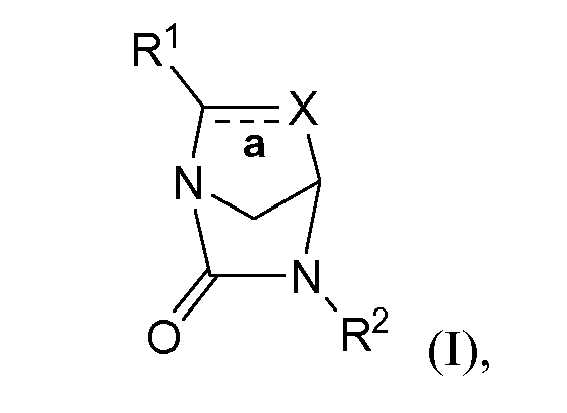
Description
- This application claims the benefit of
U.S. Provisional Application No. 61/011,533 (filed January 18, 2008 - This invention relates to novel beta-lactamase inhibitors and their use against bacterial antibiotic resistance. More particularly, the invention relates to compositions and methods for overcoming bacterial antibiotic resistance.
- Bacterial antibiotic resistance has become one of the most serious threats to modem health care. Cohen, Science 1992, 257: 1051-1055 discloses that infections caused by resistant bacteria frequently result in longer hospital stays, higher mortality and increased cost of treatment. Neu, Science 1992, 257: 1064-1073 discloses that the need for new antibiotics will continue to escalate because bacteria have a remarkable ability to develop resistance to new agents rendering them quickly ineffective. Anderson, Nature America 1999, 5: 147-149 refers to the spread of antibiotic resistance as a pandemic and asserts that a solution to the growing public health threat will require an interdisciplinary approach.
- The present crisis has prompted various efforts to elucidate the mechanisms responsible for bacterial resistance, Coulton et al., Progress in Medicinal Chemistry 1994, 31: 297-349 teaches that the widespread use of penicillins and cephalosporins has resulted in the emergence of β-lactamases, a family of bacterial enzymes that catalyze the hydrolysis of the β-lactam ring common to numerous presently used antibiotics. More recently, Dudley, Pharmacotherapy 1995, 15: 9S-14S has disclosed that resistance mediated by β-lactamases is a critical aspect at the core of the development of bacterial antibiotic resistance. Clavulanic acid, which is a metabolite of Streptomyces clavuligerus, and two semi-synthetic inhibitors, sulbactam and tazobactam are presently available semi-synthetic or natural product β-lactamase inhibitors.
US5698577 ,US5510343 ,US6472406 and Hubschwerlen et al., J. Med. Chem. 1998, 41: 3961 and Livermore et al., J. Med. Chem. 1997, 40: 335-343, disclose certain synthetic β-lactamase inhibitors. - Other references of interest are:
-
US 2003/0199541 A1 discloses certain azabicyclic compounds including certain 7-oxo-6-diazabicyclic[3.2.1]octane-2-carboxamides and their use as anti-bacterial agents. -
US 2004/0157826 A1 discloses certain heterobicyclic compounds including certain diazepine carboxamide and diazepine carboxylate derivatives and their use as anti-bacterials and β-lactamase inhibitors. -
WO 2008/039420 A2 discloses certain 7-oxo-2,6-diazabicyclo[3.2.0]heptane-6-sulfooxy-2-carboxamides and their use of beta-lactamse inhibitors. - Poole, Cell. Mol. Life Sci. 2004, 61: 2200-2223, provides a review of the resistance of bacterial pathogens to β-lactam antibiotics and approaches for overcoming resistance.
- The currently available β-lactamase inhibitors are insufficient to counter the constantly increasing diversity of β-lactamases. There is, therefore, a need for new β-lactamase inhibitors.
- The present invention is directed to certain diazabicyclic carboxamide and caboxylate compounds which are beta-lactamase inhibitors. The compounds and their pharmaceutically acceptable salts, are useful in combination with beta-lactam antibiotics for the treatment of bacterial infections, particularly anti-biotic resistant bacterial infections. More particularly, the present invention includes compounds of Formula I:

- the bond identified as "a" is a single bond or a double bond;
- when bond a is a single bond, X is:
- (1) CH2,
- (2) CH2CH2,
- (3) CH2CH2CH2,
- (4) CH=CH,
- (5) CH2-CH=CH, or
- (6) CH=CH-CH2;
- when bond a is a double bond, X is:
- (1) CH,
- (2) CH-CH2, or
- (3) CH-CH=CH;
- R1 is:
- (1) C(O)N(R3)R4,
- (2) C(O)OR3, or
- (3) C(O)OR5;
- R2 is SO3M, OSO3M, SO2NH2, PO3M, OPO3M, CH2CO2M, CF2CO2M, or CF3;
- M is H or a pharmaceutically acceptable cation;
- R3 is:
- (1) C1-8 alkyl substituted with a total of from 1 to 4 substituents selected from the group consisting of (i) zero to 2 N(RA)RB, (ii) zero to 2 RC, and (iii) zero to 1 of AryA, HetA, or HetB,
- (2) CycA,
- (3) HetA,
- (4) AryA,
- (5) HetB, or
- (6) AryB;
- R4 is H or C1-8 alkyl optionally substituted with N(RA)RB;
- or alternatively, when R1 is C(O)N(R3)R4, R3 and R4 together with the N atom to which they are both attached form a 4- to 9-membered, saturated monocyclic ring optionally containing 1 heteroatom in addition to the nitrogen attached to R3 and R4 selected from N, O, and S, where the S is optionally oxidized to S(O) or S(O)2; wherein the monocyclic ring is optionally fused to, bridged with, or spiro to a 4- to 7-membered, saturated heterocyclic ring containing from 1 to 3 heteroatoms independently selected from N, O and S, where the S is optionally oxidized to S(O) or S(O)2, to form a bicyclic ring system, wherein the monocyclic ring or the bicyclic ring system so formed is optionally substituted with 1 or 2 substituents each of which is independently: (1) C1-6 alkyl, (2) C1-6 fluoroalkyl, (3) (CH2)1-2G wherein G is OH, O-C1-6 alkyl, O-C1-6 fluoroalkyl, N(RA)RB, C(O)N(RA)RB, C(O)RA, CO2RA, or SO2RA, (4) O-C1-6 alkyl, (5) O-C1-6 fluoroalkyl, (6) OH, (7) oxo, (8) halogen, (9) N(RA)RB, (10) C(O)N(RA)RB, (11) C(O)RA, (12) C(O)-C1-6 fluoroalkyl, (13) C(O)ORA, or (14) S(O)2RA;
- R5 is C1-8 alkyl substituted with 1 or 2 substituents each of which is independently N(RA)C(O)-AryA;
- CycA is C4-9 cycloalkyl which is optionally substituted with a total of from 1 to 4 substituents selected from zero to 2 (CH2)nN(RA)RB and zero to 2 (CH2)nRC;
- HetA is a 4- to 9-membered saturated or mono-unsaturated heterocyclic ring containing from 1 to 3 heteroatoms independently selected from N, O and S, wherein any ring S is optionally oxidized to S(O) or S(O)2 and either 1 or 2 ring carbons are optionally oxidized to C(O); wherein the ring is optionally fused with a C3-7 cycloalkyl; and wherein the optionally fused, saturated or mono-unsaturated heterocyclic ring is optionally substituted with a total of from 1 to 4 substituents selected from zero to 2 (CH2)nN(RA)RB and zero to 2 (CH2)nRC;
- AryA is phenyl which is optionally substituted with a total of from 1 to 4 substituents selected from zero to 2 (CH2)nN(RA)RB and zero to 2 (CH2)nRC;
- HetB is a 5- or 6-membered heteroaromatic ring containing from 1 to 4 heteroatoms selected from 1 to 3 N atoms, zero or 1 O atom, and zero or 1 S atom; wherein the heteroaromatic ring is optionally fused with a 5- to 7-membered, saturated heterocyclic ring containing 1 or 2 heteroatoms independently selected from N, O and S, wherein any ring S is optionally oxidized to S(O) or S(O)2 and either 1 or 2 non-fused ring carbons are optionally oxidized to C(O); and wherein the optionally fused heteroaromatic ring is optionally substituted with a total of from 1 to 4 substituents selected from zero to 2 (CH2)nN(RA)RB and zero to 2 (CH2)nRC;
- AryB is a bicyclic ring system which is phenyl fused with a 5- to 7-membered saturated heterocyclic ring containing from 1 to 3 heteroatoms independently selected from N, O and S, wherein any ring S is optionally oxidized to S(O) or S(O)2, and wherein the bicyclic ring system is optionally substituted with a total of from 1 to 4 substituents selected from zero to 2 (CH2)nN(RA)RB and zero to 2 (CH2)nRC;
- each n is independently an integer which is 0, 1, 2, or 3;
- each RA is independently H or C1-8 alkyl;
- each RB is independently H or C1-8 alkyl;
- each RC is independently C1-6 alkyl, OH, O-C1-8 alkyl, OC(O)-C1-8 alkyl, C(=NH)NH2, NH-C(=NH)NH2, halogen, CN, C(O)RA, C(O)ORA, C(O)N(RA)RB, SO2RA, SO2N(RA)RB, pyridyl, pyrrolidinyl, piperidinyl, piperazinyl, morpholinyl, or thiomorpholinyl;
- and provided that:
- (A) when R1 is C(O)OR3 and R3 is AryA, then AryA is not (i) unsubstituted phenyl, (ii) phenyl substituted with NH2, (iii) phenyl substituted with OH, (iii) phenyl substituted with O-C1-6 alkyl, (iv) phenyl substituted with one or more halogens, or (v) phenyl substituted with C1-6 alkyl;
- (B) when R1 is C(O)OR3 and R3 is C1-6 alkyl substituted with HetB, then HetB is not pyridyl;
- (C) when R1 is C(O)OR3 and R3 is CH2-AryA or CH2CH2-AryA, then AryA is not (i) unsubstituted phenyl, (ii) phenyl substituted with NH2, OH, O-C1-6 alkyl, or C1-6 alkyl, or (iii) phenyl substituted with one or more halogens;
- (D) when R1 is C(O)N(R3)R4, R3 is AryA, CH2-AryA or CH2CH2-AryA, and R4 is H or C1-6 alkyl, then AryA is not unsubstituted phenyl, phenyl substituted with N(CH3)2, or phenyl substituted with C(O)NH2;
- (E) when R1 is C(O)N(R3)R4, R3 is C1-6 alkyl substituted with HetB, and R4 is H or C1-6 alkyl, then HetB is not pyridyl; and
- (F) when R1 is C(O)OR3 and R3 is C1-6 alkyl substituted with RC, then RC is not C(O)NH2.
- Compounds of Formula I inhibit β-lactamases and synergize the antibacterial effects of β-lactam antibiotics (e.g., imipenem, ceftazidime and piperacillin) against microorganisms normally resistant to β-lactam antibiotics as a result of the presence of the β-lactamases. The compounds of the present invention are effective against class A and class C β-lactamases and their combination with a beta-lactam antibiotic, such as imipenem, ceftazidine or piperacillin, can provide for effective treatment of bacterial infections caused by class A and class C β-lactamase producing microorganisms. Accordingly, the present invention includes combinations of a compound of Formula I with a β-lactam antibiotic suitable for use against against class C β-lactamase producing bacteria such as Pseudomonas spp. and against class A β-lactamase producing bacteria such as Klebsiella spp. The invention also includes compositions comprising a compound of Formula I or its pharmaceutically acceptable salt, and a pharmaceutically acceptable carrier. The invention further includes methods for treating bacterial infections and inhibiting bacterial growth by use of a compound of Formula I or its salt or a combination or composition containing the compound or its salt.
- Embodiments, sub-embodiments, aspects and features of the present invention are either further described in or will be apparent from the ensuing description, examples and appended claims.
-
-
Figure 1 is the X-ray powder diffraction pattern for the crystalline monohydrate described in Example 1D. -
Figure 2 is the DSC curve for the crystalline monohydrate described in Example 1D. - As noted above the present invention includes compounds of Formula I, wherein the compounds are beta-lactamase inhibitors suitable for use in combination with beta-lactam antibiotics for the treatment of bacterial infections.
- The term "β-lactamase inhibitor" refers to a compound which is capable of inhibiting β-lactamase activity. Inhibiting β-lactamase activity means inhibiting the activity of a class A, C, or D β-lactamase. For antimicrobial applications inhibition at a 50% inhibitory concentration is preferably achieved at or below about 100 micrograms/mL, or at or below about 50 micrograms/mL, or at or below about 25 micrograms/mL. The terms "class A", "class C", and "class D" β-lactamases are understood by those skilled in the art and are described in Waley, The Chemistry of β-lactamase, Page Ed., Chapman & Hall, London, (1992) 198-228.
- The term "β-lactamase" denotes a protein capable of inactivating a β-lactam antibiotic. The β-lactamase can be an enzyme which catalyzes the hydrolysis of the β-lactam ring of a β-lactam antibiotic. Of particular interest herein are microbial β-lactamases. The β-lactamase can be, for example, a serine β-lactamase. β-Lactamases of interest include those disclosed in, e.g., Waley, The Chemistry of β-lactamase, Page Ed., Chapman & Hall, London, (1992) 198-228. β-Lactamases of particular interest herein include a class C β-lactamase of Pseudomonas aeruginosa or of Enterobacter cloacae P99 (hereinafter P99 β-lactamase) and class A beta-lactamase of Klebsiella spp.
- The term "antibiotic" refers to a compound or composition which decreases the viability of a microorganism, or which inhibits the growth or proliferation of a microorganism. The phrase "inhibits the growth or proliferation" means increasing the generation time (i.e., the time required for the bacterial cell to divide or for the population to double) by at least about 2-fold. Preferred antibiotics are those which can increase the generation time by at least about 10-fold or more (e.g., at least about 100-fold or even indefinitely, as in total cell death). As used in this disclosure, an antibiotic is further intended to include an antimicrobial, bacteriostatic, or bactericidal agent. Examples of antibiotics suitable for use with respect to the present invention include penicillins, cephalosporins and carbapenems.
- The term "β-lactam antibiotic" refers to a compound with antibiotic properties that contains a β-lactam functionality. Non-limiting examples of β-lactam antibiotics useful with respect to the invention include penicillins, cephalosporins, penems, carbapenems, and monobactams.
- A first embodiment of the present invention (alternatively referred to herein as "Embodiment E1") is a compound of Formula I (alternatively referred to herein as "Compound I") as originally defined (i.e., as defined in the Summary of the Invention above), or a pharmaceutically acceptable salt thereof; and provided that:
- (A) when R1 is C(O)OR3, then R3 is not AryA;
- (B) when R1 is C(O)OR3, then R3 is not C1-8 alkyl substituted with HetB;
- (C) when R1 is C(O)OR3, then R3 is not C1-8 alkyl substituted with AryA;
- (D) when R1 is C(O)N(R3)R4, R3 is AryA or C1-8 alkyl substituted with AryA, and R4 is H or C1-8 alkyl, then AryA is not unsubstituted phenyl, phenyl substituted with 1 or 2 N(RA)RB, or phenyl substituted with 1 or 2 C(O)N(RA)RB;
- (E) when R1 is C(O)N(R3)R4 and R4 is H or C1-8 alkyl, then R3 is not C1-8 alkyl substituted with HetB; and
- (F) when R1 is C(O)OR3 and R3 is C1-8 alkyl substituted with RC, then RC is not C(O)N(RA)RB.
- A second embodiment of the present invention (Embodiment E2) is a compound of Formula I as originally defined, or a pharmaceutically acceptable salt thereof; and provided that:
- (A) when R1 is C(O)OR3, then R3 is not AryA;
- (B) when R1 is C(O)OR3, then R3 is not C1-8 alkyl substituted with HetB;
- (C) when R1 is C(O)OR3, then R3 is not C1-8 alkyl substituted with AryA;
- (D) when R1 is C(O)N(R3)R4, then R3 is not AryA or C1-8 alkyl substituted with AryA;
- (E) when R1 is C(O)N(R3)R4, then R3 is not C1-8 alkyl substituted with HetB; and
- (F) when R1 is C(O)OR3, then R3 is not C1-8 alkyl substituted with RC.
- A third embodiment of the present invention (Embodiment E3) is a compound of Formula I, or a pharmaceutically acceptable salt thereof; wherein:
- R1 is:
- (1) C(O)N(R3)R4, or
- (2) C(O)OR3;
- R3 is:
- (1) C1-8 alkyl substituted with a total of from 1 to 4 substituents selected from the group consisting of (i) zero to 2 N(RA)RB, (ii) zero to 2 RC, and (iii) zero to 1 of AryA, HetA, or HetB,
- (2) CycA,
- (3) HetA,
- (4) AryA, or
- (5) HetB;
R4 is H or C1-8 alkyl optionally substituted with N(RA)RB;
HetA is a 4- to 9-membered saturated heterocyclic ring containing from 1 to 3 heteroatoms independently selected from N, O and S, wherein the saturated heterocyclic ring is optionally substituted with a total of from 1 to 4 substituents selected from zero to 2 (CH2)nN(RA)RB and zero to 2 (CH2)nRC;
each RC is independently C1-6 alkyl, OH, O-C1-8 alkyl, C(=NH)NH2, NH-C(=NH)NH2, halogen, CN, pyridyl, pyrrolidinyl, or piperidinyl; and
all other variables are as originally defined; and provided that:- (A) when R1 is C(O)OR3 and R3 is AryA, then AryA is not (i) unsubstituted phenyl, (ii) phenyl substituted with NH2, (iii) phenyl substituted with OH, (iii) phenyl substituted with O-C1-6 alkyl, (iv) phenyl substituted with one or more halogens; or (v) phenyl substituted with C1-6 alkyl;
- (B) when R1 is C(O)OR3 and R3 is C1-6 alkyl substituted with HetB, then HetB is not pyridyl;
- (C) when R1 is C(O)OR3 and R3 is CH2-AryA or CH2CH2-AryA, then AryA is not (i) unsubstituted phenyl, (ii) phenyl substituted with NH2, OH, O-C1-6 alkyl, or C1-6 alkyl, or (iii) phenyl substituted with one or more halogens;
- (D) when R1 is C(O)N(R3)R4, R3 is AryA, CH2-AryA or CH2CH2-AryA, and R4 is H or C1-6 alkyl, then AryA is neither unsubstituted phenyl nor phenyl substituted with N(CH3)2; and
- (E) when R1 is C(O)N(R3)R4, R3 is C1-6 alkyl substituted with HetB, and R4 is H or C1-6 alkyl, then HetB is not pyridyl.
- A fourth embodiment of the present invention (Embodiment E4) is a compound of Formula I as defined in Embodiment E3, or a pharmaceutically acceptable salt thereof; and provided that:
- (A) when R1 is C(O)OR3, then R3 is not AryA;
- (B) when R1 is C(O)OR3, then R3 is not C1-6 alkyl substituted with HetB;
- (C) when R1 is C(O)OR3, then R3 is not C1-6 alkyl substituted with AryA;
- (D) when R1 is C(O)N(R3)R4, then R3 is not AryA or C1-6 alkyl substituted with AryA; and
- (E) when R1 is C(O)N(R3)R4, then R3 is not C1-6 alkyl substituted with HetB.
- A fifth embodiment of the present invention (Embodiment E5) is a compound of Formula I as defined in Embodiment E3, or a pharmaceutically acceptable salt thereof; and provided that:
- (A) when R1 is C(O)OR3, then R3 is not AryA;
- (B) when R1 is C(O)OR3, then R3 is not C1-6 alkyl substituted with HetB;
- (C) when R1 is C(O)OR3, then R3 is not C1-6 alkyl substituted with AryA;
- (D) when R1 is C(O)N(R3)R4, then R3 is not AryA or C1-6 alkyl substituted with AryA; and
- (E) when R1 is C(O)N(R3)R4, then R3 is not C1-6 alkyl substituted with HetB.
- A sixth embodiment of the present invention (Embodiment E6) is a compound of Formula I, or a pharmaceutically acceptable salt thereof, wherein bond "a" is a single bond; X is -CH2- or -CH2CH2-; and all other variables are as originally defined or as defined in any of the foregoing embodiments.
- A seventh embodiment of the present invention (Embodiment E7) is a compound of Formula I, or a pharmaceutically acceptable salt thereof, wherein bond "a" is a single bond; X is -CH2-; and all other variables are as originally defined or as defined in any of the foregoing embodiments.
- An eighth embodiment of the present invention (Embodiment E8) is a compound of Formula I, or a pharmaceutically acceptable salt thereof, wherein bond "a" is a single bond; X is -CH2CH2-; and all other variables are as originally defined or as defined in any of the foregoing embodiments.
- A ninth embodiment of the present invention (Embodiment E9) is a compound of Formula I, or a pharmaceutically acceptable salt thereof, wherein R1 is C(O)N(R3)R4; and all other variables are as originally defined or as defined in any one of the preceding embodiments. In an aspect of this embodiment, R1 is C(O)NH(R4).
- A tenth embodiment of the present invention (Embodiment E10) is a compound of Formula I, or a pharmaceutically acceptable salt thereof, wherein R2 is OSO3M; and all other variables are as originally defined or as defined in any of the preceding embodiments.
- An eleventh embodiment of the present invention (Embodiment E11) is a compound of Formula I, or a pharmaceutically acceptable salt thereof, wherein R2 is OSO3H; and all other variables are as originally defined or as defined in any of the preceding embodiments.
- A twelfth embodiment of the present invention (Embodiment E12) is a compound of Formula I, or a pharmaceutically acceptable salt thereof, wherein R3 is: (1) C1-4 alkyl substituted with a total of from 1 to 4 substituents selected from the group consisting of (i) zero to 2 N(RA)RB, (ii) zero to 2 RC, and (iii) zero to 1 of AryA, HetA, or HetB, (2) CycA, (3) HetA, (4) AryA, or (5) HetB; and all other variables are as originally defined or as defined in any of the preceding embodiments.
- A thirteenth embodiment of the present invention (Embodiment E13) is a compound of Formula I, or a pharmaceutically acceptable salt thereof, wherein R3 is (CH2)2-3N(RA)RB, (CH2)1-3-AryA, (CH2)1-3-HetA, (CH2)1-3-HetB, CycA, HetA, AryA, or HetB; and all other variables are as originally defined or as defined in any of the preceding embodiments.
- A fourteenth embodiment of the present invention (Embodiment E14) is a compound of Formula I, or a pharmaceutically acceptable salt thereof, wherein R3 is HetA, CH2-HetA, CH2CH2-HetA, CH(CH3)-HetA, or CH(CH2OH)-HetA; and all other variables are as originally defined or as defined in any of the preceding embodiments. A first sub-embodiment of Embodiment E14 is a compound of Formula I, or a pharmaceutically acceptable salt thereof, wherein R1 is C(O)N(R3)R4; R3 is as defined above in Embodiment E14; and all other variables are as defined above in Embodiment E14.
- A fifteenth embodiment of the present invention (Embodiment E15) is a compound of Formula I, or a pharmaceutically acceptable salt thereof, wherein R3 is R3 is HetA, CH2-HetA, or CH2CH2-HetA; and all other variables are as originally defined or as defined in any of the preceding embodiments. A first sub-embodiment of Embodiment E15 is a compound of Formula I, or a pharmaceutically acceptable salt thereof, wherein R1 is C(O)N(R3)R4; R3 is as defined above in Embodiment E15; and all other variables are as defined above in Embodiment E15.
- A sixteenth embodiment of the present invention (Embodiment E16) is a compound of Formula I, or a pharmaceutically acceptable salt thereof, wherein R3 is R3 is HetA or CH2-HetA; and all other variables are as originally defined or as defined in any of the preceding embodiments. A first sub-embodiment of Embodiment E16 is a compound of Formula I, or a pharmaceutically acceptable salt thereof, wherein R1 is C(O)N(R3)R4; R3 is as defined above in Embodiment E16; and all other variables are as defined above in Embodiment E16.
- A seventeenth embodiment of the present invention (Embodiment E17) is a compound of Formula I, or a pharmaceutically acceptable salt thereof, wherein R3 is HetA; and all other variables are as originally defined or as defined in any of the preceding embodiments. A first sub-embodiment of Embodiment E17 is a compound of Formula I, or a pharmaceutically acceptable salt thereof, wherein R1 is C(O)N(R3)R4; R3 is as defined above in Embodiment E17; and all other variables are as defined above in Embodiment E17.
- An eighteenth embodiment of the present invention (Embodiment E18) is a compound of Formula I, or a pharmaceutically acceptable salt thereof, wherein R3 is HetA; HetA is a saturated heterocyclic selected from the group consisting of pyrrolidinyl, piperidinyl, azepanyl, and azocanyl; wherein the saturated heterocyclic is optionally substituted with N(RA)RB and optionally substituted with 1 or 2 (CH2)nRC; each RC is independently C1-6 alkyl, OH, O-C1-8 alkyl, C(=NH)NH2, NH-C(=NH)NH2, halogen, CN, pyridyl, pyrrolidinyl, or piperidinyl; and all other variables are as originally defined or as defined in any of the preceding embodiments.
- A nineteenth embodiment of the present invention (Embodiment E19) is a compound of Formula I, or a pharmaceutically acceptable salt thereof, wherein R3 is HetA; HetA is:

- A twentieth embodiment of the present invention (Embodiment E20) is a compound of Formula I, or a pharmaceutically acceptable salt thereof, wherein R3 is HetA; HetA is:

- A twenty-first embodiment of the present invention (Embodiment E21) is a compound of Formula I, or a pharmaceutically acceptable salt thereof, wherein HetA is an optionally fused, saturated heterocyclic ring selected from the group consisting of azetidinyl, pyrrolidinyl, oxopyrrolidinyl (e.g., 2-oxopyrrolidinyl), piperidinyl, piperazinyl, tetrahydropyranyl, tetrahydrothiopyranyl, morpholinyl, 1,1-dioxidotetrahydrothiopyranyl, azepanyl, oxazepanyl, azocanyl, and azabicyclo[3.1.0]cyclohexyl, wherein the heterocyclic is optionally substituted with 1 or 2 (CH2)nN(RA)RB and optionally substituted with 1 or 2 (CH2)nRC; and all other variables are as originally defined or as defined in any of the preceding embodiments. A first sub-embodiment of Embodiment E21 is a compound of Formula I, or a pharmaceutically acceptable salt thereof, wherein R3 is HetA, and HetA and all other variables are as defined above in Embodiment E21. A second sub-embodiment of Embodiment E21 is a compound of Formula I, or a pharmaceutically acceptable salt thereof, wherein R1 is C(O)N(R3)R4; R3 is HetA; and HetA and all other variables are as defined above in Embodiment E21. In an aspect of this embodiment and its sub-embodiments, HetA is optionally mono-substituted with (CH2)nN(RA)RB and optionally substituted with 1 or 2 (CH2)nRC.
- A twenty-second embodiment of the present invention (Embodiment E22) is a compound of Formula I, or a pharmaceutically acceptable salt thereof, wherein HetA is a saturated heterocyclic ring selected from the group consisting of pyrrolidinyl, piperidinyl, azepanyl, and azocanyl; wherein the heterocyclic is optionally substituted with 1 or 2 (CH2)nN(RA)RB and optionally substituted with 1 or 2 (CH2)nRC; and all other variables are as originally defined or as defined in any of the preceding embodiments. A first sub-embodiment of Embodiment E22 is a compound of Formula I, or a pharmaceutically acceptable salt thereof, wherein R3 is HetA; and HetA and all other variables are as defined above in Embodiment E22. A second sub-embodiment of Embodiment E22 is a compound of Formula I, or a pharmaceutically acceptable salt thereof, wherein R1 is C(O)N(R3)R4; R3 is HetA; and HetA and all other variables are as defined above in Embodiment E22. In an aspect of this embodiment and its sub-embodiments, HetA is optionally mono-substituted with (CH2)nN(RA)RB and optionally substituted with 1 or 2 (CH2)nRC.
- A twenty-third embodiment of the present invention (Embodiment E23) is a compound of Formula I, or a pharmaceutically acceptable salt thereof, wherein HetA is as defined in either Embodiment E21 or E22; each RC is independently OH, O-C1-4 alkyl, C(=NH)NH2, NH-C(=NH)NH2, Cl, Br, F, or CN; and all other variables are as originally defined or as defined in any of the preceding embodiments. In a first sub-embodiment R3 is HetA; and HetA is as defined above in Embodiment E21. In a second sub-embodiment, R1 is C(O)N(R3)R4; R3 is HetA; and HetA is as defined above in Embodiment E22. In an aspect of this embodiment and its sub-embodiments, HetA is optionally mono-substituted with (CH2)nN(RA)RB and optionally substituted with 1 or 2 (CH2)nRC.
- A twenty-fourth embodiment of the present invention (Embodiment E24) is a compound of Formula I, or a pharmaceutically acceptable salt thereof, wherein HetA is a heterocyclic ring as defined in either Embodiment E21 or E22; the heterocyclic ring in HetA is optionally substituted with halogen, C1-3 alkyl, O-C1-3 alkyl, NH2, N(H)-C1-3 alkyl, N(-C1-3 alkyl)2, CH2NH2, CH2N(H)-C1-3 alkyl, CH2N(-C1-3 alkyl)2, or piperidinyl; and all other variables are as originally defined or as defined in any of the preceding embodiments. In a first sub-embodiment R3 is HetA; and HetA is as defined above in Embodiment E24. In a second sub-embodiment, R1 is C(O)N(R3)R4; R3 is HetA; and HetA is as defined above in Embodiment E24.
- A twenty-fifth embodiment of the present invention (Embodiment E25) is a compound of Formula I, or a pharmaceutically acceptable salt thereof, wherein HetA is a heterocyclic ring as defined in either Embodiment E21 or E22; the heterocyclic ring in HetA is optionally substituted with F, CH3, OCH3, NH2, N(H)CH3, N(CH3)2, CH2NH2, CH2N(H)CH3, CH2N(CH3)2, or piperidinyl; and all other variables are as originally defined or as defined in any of the preceding embodiments. In a first sub-embodiment R3 is HetA; and HetA is as defined above in Embodiment E25. In a second sub-embodiment, R1 is C(O)N(R3)R4; R3 is HetA; and HetA is as defined above in Embodiment E25.
- A twenty-sixth embodiment of the present invention (Embodiment E26) is a compound of Formula I, or a pharmaceutically acceptable salt thereof, wherein HetA is a heterocyclic ring selected from the group consisting of azetidinyl, pyrrolidinyl, pyrazolidinyl, piperidinyl, piperazinyl, azepanyl, oxazepanyl, oxazolidinyl, isoxazolidinyl, morpholinyl, and tetrahydropyranyl, wherein the heterocyclic ring is optionally substituted with 1 or 2 substituents each of which is independently C1-3 alkyl, CH2NH2, CH2N(H)-C1-3 alkyl, CH2N(-C1-3 alkyl)2, O-C1-3 alkyl, Cl, Br, F, NH2, N(H)-C1-3 alkyl, N(-C1-3 alkyl)2, C(O)NH2, C(O)N(H)-C1-3 alkyl, C(O)N(-C1-3 alkyl)2, C(O)-C1-3 alkyl, C(O)O-C1-3 alkyl, OC(O)-C1-3 alkyl, S(O)2-C1-3 alkyl, S(O)2NH2, S(O)2N(H)-C1-3 alkyl, or S(O)2N(-C1-3 alkyl)2; and all other variables are as originally defined or as defined in any of the preceding embodiments. A first sub-embodiment of Embodiment E26 is a compound of Formula I, or a pharmaceutically acceptable salt thereof, wherein R3 is HetA, CH2-HetA, CH2CH2-HetA; and HetA and all other variables are as defined above in Embodiment E26. A second sub-embodiment of Embodiment E26 is a compound of Formula I, or a pharmaceutically acceptable salt thereof, wherein R1 is C(O)OR3; R3 is HetA, CH2-HetA, CH2CH2-HetA; and HetA and all other variables are as defined above in Embodiment E26. In an aspect of this embodiment and its sub-embodiments, R2 is OSO3H.
- A twenty-seventh embodiment of the present invention (Embodiment E27) is a compound of Formula I, or a pharmaceutically acceptable salt thereof, wherein HetA is a heterocyclic ring selected from the group consisting of azetidinyl, pyrrolidinyl, pyrazolidinyl, piperidinyl, piperazinyl, azepanyl, oxazepanyl, oxazolidinyl, isoxazolidinyl, morpholinyl, and tetrahydropyranyl, wherein the heterocyclic ring is optionally substituted with 1 or 2 substituents each of which is independently CH3, CH2NH2, CH2N(H)CH3, CH2N(CH3)2, OCH3, Cl, Br, F, NH2, N(H)CH3, N(CH3)2, C(O)NH2, C(O)N(H)CH3, C(O)N(CH3)2, C(O)CH3, C(O)OCH3, OC(O)CH3, S(O)2CH3, S(O)2NH2, S(O)2N(H)CH3, or S(O)2N(CH3)2; and all other variables are as originally defined or as defined in any of the preceding embodiments. A first sub-embodiment of Embodiment E27 is a compound of Formula I, or a pharmaceutically acceptable salt thereof, wherein R3 is HetA, CH2-HetA, CH2CH2-HetA; and HetA and all other variables are as defined above in Embodiment E27. A second sub-embodiment of Embodiment E27 is a compound of Formula I, or a pharmaceutically acceptable salt thereof, wherein R1 is C(O)OR3; R3 is HetA, CH2-HetA, CH2CH2-HetA; and HetA and all other variables are as defined above in Embodiment E27. In an aspect of this embodiment and its sub-embodiments, R2 is OSO3H.
- A twenty-eighth embodiment of the present invention (Embodiment E28) is a compound of Formula I, or a pharmaceutically acceptable salt thereof, wherein AryA is phenyl which is optionally substituted with 1 or 2 substituents each of which is independently C1-3 alkyl, CH2NH2, CH2N(H)-C1-3 alkyl, CH2N(-C1-3 alkyl)2, O-C1-3 alkyl, Cl, Br, F, NH2, N(H)-C1-3 alkyl, N(-C1-3 alkyl)2, C(O)NH2, C(O)N(H)-C1-3 alkyl, C(O)N(-C1-3 alkyl)2, C(O)-C1-3 alkyl, C(O)O-C1-3 alkyl, OC(O)-C1-3 alkyl, S(O)2-C1-3 alkyl, S(O)2NH2, S(O)2N(H)-C1-3 alkyl, S(O)2N(-C1-3 alkyl)2, pyrrolidinyl, piperidinyl, morpholinyl, CH2-pyrrolidinyl, CH2-piperidinyl, or CH2-morpholinyl; and all other variables are as originally defined or as defined in any of the preceding embodiments. A first sub-embodiment of Embodiment E28 is a compound of Formula I, or a pharmaceutically acceptable salt thereof, wherein R3 is AryA; and AryA and all other variables are as defined above in Embodiment E28. A second sub-embodiment of Embodiment E28 is a compound of Formula I, or a pharmaceutically acceptable salt thereof, wherein R1 is C(O)OR3; R3 is AryA; and AryA and all other variables are as defined above in Embodiment E28. In an aspect of this embodiment and its sub-embodiments, R2 is OSO3H.
- A twenty-ninth embodiment of the present invention (Embodiment E29) is a compound of Formula I, or a pharmaceutically acceptable salt thereof, wherein AryA is phenyl which is optionally substituted with 1 or 2 substituents each of which is independently CH3, CH2NH2, CH2N(H)CH3, CH2N(CH3)2, OCH3, Cl, Br, F, NH2, N(H)CH3, N(CH3)2, C(O)NH2, C(O)N(H)CH3, C(O)N(CH3)2, C(O)CH3, C(O)OCH3, OC(O)CH3, S(O)2CH3, S(O)2NH2, S(O)2N(H)CH3, or S(O)2N(CH3)2, pyrrolidinyl, piperidinyl, morpholinyl, CH2-pyrrolidinyl, CH2-piperidinyl, or CH2-morpholinyl; and all other variables are as originally defined or as defined in any of the preceding embodiments. A first sub-embodiment of Embodiment E29 is a compound of Formula I, or a pharmaceutically acceptable salt thereof, wherein R3 is AryA; and AryA and all other variables are as defined above in Embodiment E29. A second sub-embodiment of Embodiment E29 is a compound of Formula I, or a pharmaceutically acceptable salt thereof, wherein R1 is C(O)OR3; R3 is AryA; and AryA and all other variables are as defined above in Embodiment E29. In an aspect of this embodiment and its sub-embodiments, R2 is OSO3H.
- A thirtieth embodiment of the present invention (Embodiment E30) is a compound of Formula I, or a pharmaceutically acceptable salt thereof, wherein R3 is HetB; and all other variables are as originally defined or as defined in any of the preceding embodiments. A first sub-embodiment of Embodiment E30 is a compound of Formula I, or a pharmaceutically acceptable salt thereof, wherein R1 is C(O)N(R3)R4; R3 is as defined above in Embodiment E30; and all other variables are as defined above in Embodiment E30.
- A thirty-first embodiment of the present invention (Embodiment E31) is a compound of Formula I, or a pharmaceutically acceptable salt thereof, wherein R3 is HetB; HetB is a heteroaromatic ring selected from the group consisting of pyrrolyl, pyrazolyl, imidazolyl, pyridyl, and pyrimidinyl, wherein the heteroaromatic ring is optionally monosubstituted with (CH2)nN(RA)RB and optionally substituted with 1 or 2 (CH2)nRC groups; each RC is independently C1-6 alkyl, OH, O-C1-8 alkyl, C(=NH)NH2, NH-C(=NH)NH2, halogen, CN, pyridyl, pyrrolidinyl, or piperidinyl; and all other variables are as originally defined or as defined in any of the preceding embodiments.
- A thirty-second embodiment of the present invention (Embodiment E32) is a compound of Formula I, or a pharmaceutically acceptable salt thereof, wherein R3 is HetB; HetB is pyridyl which is optionally monosubstituted with N(RA)RB and optionally substituted with 1 or 2 RC groups; each RC is independently C1-6 alkyl, OH, O-C1-8 alkyl, C(=NH)NH2, NH-C(=NH)NH2, halogen, CN, pyridyl, pyrrolidinyl, or piperidinyl; and all other variables are as originally defined or as defined in any of the preceding embodiments.
- A thirty-third embodiment of the present invention (Embodiment E33) is a compound of Formula I, or a pharmaceutically acceptable salt thereof, wherein R3 is HetB; HetB is:

- A thirty-fourth embodiment of the present invention (Embodiment E34) is a compound of Formula I, or a pharmaceutically acceptable salt thereof, wherein HetB is a heteroaromatic selected from the group consisting of pyrrolyl, pyrazolyl, imidazolyl, pyridyl, pyrimidinyl, thiazolyl, piperidothiazolyl, pyrrolidothiazolyl, piperidopyridyl, and pyrrolidopyridyl, wherein the heteroaromatic ring is optionally substituted with 1 or 2 (CH2)nN(RA)RB and optionally substituted with 1 or 2 (CH2)nRC groups; and all other variables are as originally defined or as defined in any of the preceding embodiments. A first sub-embodiment of Embodiment E34 is a compound of Formula I, or a pharmaceutically acceptable salt thereof, wherein R3 is HetB; and HetB and all other variables are as defined above in Embodiment E34. A second sub-embodiment of Embodiment E34 is a compound of Formula I, or a pharmaceutically acceptable salt thereof, wherein R1 is C(O)N(R3)R4; R3 is HetB; and HetB and all other variables are as defined above in Embodiment E34. In an aspect of this embodiment and its sub-embodiments, the heteroaromatic in HetB is optionally mono-substituted with (CH2)nN(RA)RB and optionally substituted with 1 or 2 (CH2)nRC. In another aspect of this embodiment and its sub-embodiments, the heteroaromatic ring in HetB is optionally monosubstituted with NH2, N(H)-C1-3 alkyl, N(-C1-3 alkyl)2, CH2NH2, CH2N(H)-C1-3 alkyl, or CH2N(-C1-3 alkyl)2; and is optionally substituted with 1 or 2 substituents each of which is independently C1-3 alkyl, pyrrolidinyl, piperidinyl, piperazinyl, morpholinyl, or thiomorpholinyl. In still another aspect of this embodiment and its sub-embodiments, the heteroaromatic ring in HetB is optionally monosubstituted with NH2, N(H)CH3, N(CH3)2, CH2NH2, CH2N(H)CH3, or CH2N(CH3)2; and is optionally substituted with 1 or 2 substituents each of which is independently CH3, pyrrolidinyl, piperidinyl, piperazinyl, morpholinyl, or thiomorpholinyl. In still another aspect of this embodiment and its sub-embodiments, R2 is OSO3H.
- A thirty-fifth embodiment of the present invention (Embodiment E35) is a compound of Formula I, or a pharmaceutically acceptable salt thereof, wherein R3 is AryA; and all other variables are as originally defined or as defined in any of the preceding embodiments. A first sub-embodiment of Embodiment E35 is a compound of Formula I, or a pharmaceutically acceptable salt thereof, wherein R1 is C(O)N(R3)R4; R3 is AryA; and AryA and all other variables are as defined above in Embodiment E35. In an aspect of this embodiment and its sub-embodiment, R2 is OSO3H.
- A thirty-sixth embodiment of the present invention (Embodiment E36) is a compound of Formula I, or a pharmaceutically acceptable salt thereof, wherein AryA is phenyl which is optionally substituted with 1 or 2 substituents each of which is independently C1-3 alkyl, CH2NH2, CH2N(H)-C1-3 alkyl, CH2N(-C1-3 alkyl)2, O-C1-3 alkyl, Cl, Br, F, NH2, N(H)-C1-3 alkyl, N(-C1-3 alkyl)2, C(O)NH2, C(O)N(H)-C1-3 alkyl, C(O)N(-C1-3 alkyl)2, C(O)-C1-3 alkyl, C(O)O-C1-3 alkyl, OC(O)-C1-3 alkyl, S(O)2-C1-3 alkyl, S(O)2NH2, S(O)2N(H)-C1-3 alkyl, S(O)2N(-C1-3 alkyl)2, pyrrolidinyl, piperidinyl, morpholinyl, CH2-pyrrolidinyl, CH2-piperidinyl, or CH2-morpholinyl; and all other variables are as originally defined or as defined in any of the preceding embodiments. A first sub-embodiment of Embodiment E36 is a compound of Formula I, or a pharmaceutically acceptable salt thereof, wherein R3 is AryA; and AryA and all other variables are as defined above in Embodiment E36. A second sub-embodiment of Embodiment E36 is a compound of Formula I, or a pharmaceutically acceptable salt thereof, wherein R1 is C(O)N(R3)R4; R3 is AryA; and AryA and all other variables are as defined above in Embodiment E36. In an aspect of this embodiment and its sub-embodiments, R2 is OSO3H.
- A thirty-seventh embodiment of the present invention (Embodiment E37) is a compound of Formula I, or a pharmaceutically acceptable salt thereof, wherein AryA is phenyl which is optionally substituted with 1 or 2 substituents each of which is independently CH3, CH2NH2, CH2N(H)CH3, CH2N(CH3)2, OCH3, Cl, Br, F, NH2, N(H)CH3, N(CH3)2, C(O)NH2, C(O)N(H)CH3, C(O)N(CH3)2, C(O)CH3, C(O)OCH3, OC(O)CH3, S(O)2CH3, S(O)2NH2, S(O)2N(H)CH3, or S(O)2N(CH3)2, pyrrolidinyl, piperidinyl, morpholinyl, CH2-pyrrolidinyl, CH2-piperidinyl, or CH2-morpholinyl; and all other variables are as originally defined or as defined in any of the preceding embodiments. A first sub-embodiment of Embodiment E37 is a compound of Formula I, or a pharmaceutically acceptable salt thereof, wherein R3 is AryA; and AryA and all other variables are as defined above in Embodiment E37. A second sub-embodiment of Embodiment E37 is a compound of Formula I, or a pharmaceutically acceptable salt thereof, wherein R1 is C(O)N(R3)R4; R3 is AryA; and AryA and all other variables are as defined above in Embodiment E37. In an aspect of this embodiment and its sub-embodiments, R2 is OSO3H.
- A thirty-eighth embodiment of the present invention (Embodiment E38) is a compound of Formula I, or a pharmaceutically acceptable salt thereof, wherein AryA is phenyl which is optionally substituted with 1 or 2 substituents each of which is independently CH3, CH2NH2, CH2N(H)CH3, CH2N(CH32, OCH3, Cl, Br, F, NH2, N(H)CH3, N(CH3)2, C(O)NH2, C(O)N(H)CH3, C(O)N(CH3)2, C(O)CH3, C(O)OCH3, OC(O)CH3, S(O)2CH3, S(O)2NH2, S(O)2N(H)CH3, S(O)2N(CH3)2, pyrrolidinyl, piperidinyl, morpholinyl, CH2-pyrrolidinyl, CH2-piperidinyl, or CH2-morpholinyl; and all other variables are as originally defined or as defined in any of the preceding embodiments. A first sub-embodiment of Embodiment E38 is a compound of Formula I, or a pharmaceutically acceptable salt thereof, wherein R3 is AryA; and AryA and all other variables are as defined above in Embodiment E38. A second sub-embodiment of Embodiment E38 is a compound of Formula I, or a pharmaceutically acceptable salt thereof, wherein R1 is C(O)N(R3)R4; R3 is AryA; and AryA and all other variables are as defined above in Embodiment E37. In an aspect of this embodiment and its sub-embodiments, R2 is OSO3H.
- A thirty-ninth embodiment of the present invention (Embodiment E39) is a compound of Formula I, or a pharmaceutically acceptable salt thereof, wherein R1 is C(O)N(R3)R4; R3 and R4 together with the N atom to which they are both attached form a heterocyclyl selected from the group consisting of:


- A fortieth embodiment of the present invention (Embodiment E40) is a compound of Formula I, or a pharmaceutically acceptable salt thereof, wherein R1 is C(O)N(R3)R4; R3 and R4 together with the N atom to which they are both attached form a heterocyclyl selected from the group consisting of:

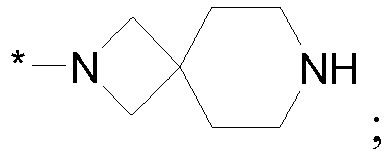
- A forty-first embodiment of the present invention (Embodiment E41) is a compound of Formula I, or a pharmaceutically acceptable salt thereof, wherein R3 is AryB; and all other variables are as originally defined or as defined in any of the preceding embodiments. A first sub-embodiment of Embodiment E41 is a compound of Formula I, or a pharmaceutically acceptable salt thereof, wherein R1 is C(O)N(R3)R4; R3 is AryB; and AryB and all other variables are as defined above in Embodiment E41. In an aspect of this embodiment and its sub-embodiment, R2 is OSO3H.
- A forty-second embodiment of the present invention (Embodiment E42) is a compound of Formula I, or a pharmaceutically acceptable salt thereof, wherein R3 is AryB; AryB is a bicyclic ring selected from the group consisting of 1,2,3,4-tetrahydroquinolinyl, 1,2,3,4-tetrahydroisoquinolinyl, 2,3-dihydro-1H-isoindolyl and 2,3-dihydro-1H-indolyl, wherein the bicyclic ring is optionally substituted with 1 or 2 substituents each of which is independently C1-3 alkyl, CH2NH2, CH2N(H)-C1-3 alkyl, CH2N(-C1-3 alkyl)2, O-C1-3 alkyl, Cl, Br, F, NH2, N(H)-C1-3 alkyl, N(-C1-3 alkyl)2, C(O)NH2, C(O)N(H)-C1-3 alkyl, C(O)N(-C1-3 alkyl)2, C(O)-C1-3 alkyl, C(O)O-C1-3 alkyl, OC(O)-C1-3 alkyl, S(O)2-C1-3 alkyl, S(O)2NH2, S(O)2N(H)-C1-3 alkyl, S(O)2N(-C1-3 alkyl)2, pyrrolidinyl, piperidinyl, morpholinyl, CH2-pyrrolidinyl, CH2-piperidinyl, or CH2-morpholinyl; and all other variables are as originally defined or as defined in any of the preceding embodiments. A first sub-embodiment of Embodiment E42 is a compound of Formula I, or a pharmaceutically acceptable salt thereof, wherein R3 is AryB; and AryB and all other variables are as defined above in Embodiment E42. A second sub-embodiment of Embodiment E42 is a compound of Formula I, or a pharmaceutically acceptable salt thereof, wherein R1 is C(O)N(R3)R4; R3 is AryB; and AryB and all other variables are as defined above in Embodiment E42. In an aspect of this embodiment and its sub-embodiments, R2 is OSO3H.
- A forty-third embodiment of the present invention (Embodiment E43) is a compound of Formula I, or a pharmaceutically acceptable salt thereof, wherein R3 is AryB; AryB is a bicyclic ring selected from the group consisting of 1,2,3,4-tetrahydroquinolinyl, 1,2,3,4-tetrahydroisoquinolinyl, 2,3-dihydro-1H-isoindolyl and 2,3-dihydro-1H-indolyl, wherein the bicyclic ring is optionally substituted with 1 or 2 substituents each of which is independently CH3, CH2NH2, CH2N(H)CH3, CH2N(CH3)2, OCH3, Cl, Br, F, NH2, N(H)CH3, N(CH3)2, C(O)NH2, C(O)N(H)CH3, C(O)N(CH3)2, C(O)CH3, C(O)OCH3, OC(O)CH3, S(O)2CH3, S(O)2NH2, S(O)2N(H)CH3, or S(O)2N(CH3)2, pyrrolidinyl, piperidinyl, morpholinyl, CH2-pyrrolidinyl, CH2-piperidinyl, or CH2-morpholinyl; and all other variables are as originally defined or as defined in any of the preceding embodiments. A first sub-embodiment of Embodiment E43 is a compound of Formula I, or a pharmaceutically acceptable salt thereof, wherein R3 is AryB, and AryB and all other variables are as defined above in Embodiment E43. A second sub-embodiment of Embodiment E43 is a compound of Formula I, or a pharmaceutically acceptable salt thereof, wherein R1 is C(O)N(R3)R4; R3 is AryB, and AryB and all other variables are as defined above in Embodiment E43. In an aspect of this embodiment and its sub-embodiments, R2 is OSO3H.
- A forty-fourth embodiment of the present invention (Embodiment E44) is a compound of Formula I, or a pharmaceutically acceptable salt thereof, wherein R4 is H or C1-4 alkyl optionally substituted with N(RA)RB; and all other variables are as originally defined or as defined in any of the preceding embodiments. In an aspect of this embodiment, R4 is H or C1-4 alkyl.
- A forty-fifth embodiment of the present invention (Embodiment E45) is a compound of Formula I, or a pharmaceutically acceptable salt thereof, wherein R4 is H, C1-3 alkyl, or (CH2)2-3N(RA)RB; and all other variables are as originally defined or as defined in any of the preceding embodiments. In an aspect of this embodiment, R4 is H or C1-3 alkyl.
- A forty-sixth embodiment of the present invention (Embodiment E46) is a compound of Formula I, or a pharmaceutically acceptable salt thereof, wherein R4 is H or methyl; and all other variables are as originally defined or as defined in any of the preceding embodiments.
- A forty-seventh embodiment of the present invention (Embodiment E47) is a compound of Formula I, or a pharmaceutically acceptable salt thereof, wherein R4 is H; and all other variables are as originally defined or as defined in any of the preceding embodiments.
- A forty-eighth embodiment of the present invention (Embodiment E48) is a compound of Formula I, or a pharmaceutically acceptable salt thereof, wherein each RA is independently H or C1-4 alkyl; each RB is independently H or C1-4 alkyl; and all other variables are as originally defined or as defined in any of the preceding embodiments.
- A forty-ninth embodiment of the present invention (Embodiment E49) is a compound of Formula I, or a pharmaceutically acceptable salt thereof, wherein each RA is independently H or C1-3 alkyl; each RB is independently H or C1-3 alkyl; and all other variables are as originally defined or as defined in any of the preceding embodiments.
- A fiftieth embodiment of the present invention (Embodiment E50) is a compound of Formula I, or a pharmaceutically acceptable salt thereof, wherein each RA is independently H or CH3; each RB is independently H or CH3; and all other variables are as originally defined or as defined in any of the preceding embodiments.
- A fifty-first embodiment of the present invention (Embodiment E51) is a compound of Formula I, or a pharmaceutically acceptable salt thereof, wherein each RC is independently C1-4 alkyl, OH, O-C1-4 alkyl, C(=NH)NH2, NH-C(=NH)NH2, halogen, CN, pyridyl, pyrrolidinyl, or piperidinyl; and all other variables are as originally defined or as defined in any of the preceding embodiments.
- A fifty-second embodiment of the present invention (Embodiment E52) is a compound of Formula I, or a pharmaceutically acceptable salt thereof, wherein each RC is independently OH, O-C1-4 alkyl, C(=NH)NH2, NH-C(=NH)NH2, Cl, Br, F, or CN; and all other variables are as originally defined or as defined in any of the preceding embodiments.
- A fifty-third embodiment of the present invention (Embodiment E53) is a compound of Formula I, or a pharmaceutically acceptable salt thereof, wherein each RC is independently C1-3 alkyl, O-C1-3 alkyl, Cl, Br, F, C(O)NH2, C(O)N(H)-C1-3 alkyl, C(O)N(-C1-3 alkyl)2, C(O)-C1-3 alkyl, C(O)O-C1-3 alkyl, OC(O)-C1-3 alkyl, S(O)2-C1-3 alkyl, S(O)2NH2, S(O)2N(H)-C1-3 alkyl, S(O)2N(-C1-3 alkyl)2, pyrrolidinyl, piperidinyl, morpholinyl, CH2-pyrrolidinyl, CH2-piperidinyl, or CH2-morpholinyl; and all other variables are as originally defined or as defined in any of the preceding embodiments.
- A fifty-fourth embodiment of the present invention (Embodiment E54) is a compound of Formula I, or a pharmaceutically acceptable salt thereof, wherein each RC is independently CH3, OCH3, Cl, Br, F, C(O)NH2, C(O)N(H)CH3, C(O)N(CH3)2, C(O)CH3, C(O)OCH3, OC(O)CH3, S(O)2CH3, S(O)2NH2, S(O)2N(H)CH3, or S(O)2N(CH3)2, pyrrolidinyl, piperidinyl, morpholinyl, CH2-pyrrolidinyl, CH2-piperidinyl, or CH2-morpholinyl; and all other variables are as originally defined or as defined in any of the preceding embodiments.
- Unless it is expressly stated to the contrary or otherwise is clear from the context, the provisos A to F set forth in the definition of Compound I in the Summary of the Invention apply to the preceding and subsequent embodiments herein. It is clear from the context, for example, that when any one of Embodiments E 17 to E120 is incorporated into the definition of Compound I as originally defined, none of the provisos applies. Furthermore, to the extent any embodiment refers back to and incorporates Embodiment E1 or Embodiment E2 it includes the provisos A to F set forth therein, to the extent any of them applies. It is further understood that the definitions of variables in the provisos can be customized to reflect the definitions of variables in the embodiments being incorporated therein. For example, when Embodiment E9 (i.e., R1 is C(O)N(R3)R4) is incorporated into Embodiment E1, the proviso can be adjusted to read as follows (wherein provisos A, B C and F do not apply) - and provided that:
- (D) when R3 is AryA or C1-6 alkyl substituted with AryA, and R4 is H or C1-6 alkyl, then AryA is neither unsubstituted phenyl nor phenyl substituted with 1 or 2 N(RA)RB; and
- (E) when R4 is H or C1-6 alkyl, then R3 is not C1-6 alkyl substituted with HetB.
- As still another example, when the compound is as defined in the second sub-embodiment of Embodiment E36 (i.e., R1 is C(O)N(R3)R4; R3 is AryA; and AryA and all other variables are as defined above in Embodiment E36), then it is understood that the following applies: and provided that AryA is not unsubstituted phenyl, phenyl substituted with N(CH3)2, or phenyl substituted with C(O)NH2. It is further understood that the optional provisos set forth in Embodiments E1 and E2, suitably customized, can alternatively be applied. The proviso based on Embodiment E1, for example, is: and provided that AryA is not unsubstituted phenyl, phenyl substituted with 1 or 2 of NH2, N(H)-C1-3 alkyl and N(-C1-3 alkyl)2, or phenyl substituted with 1 or 2 of C(O)NH2, C(O)N(H)-C1-3 alkyl and C(O)N(-C1-3 alkyl)2.
- A first class of compounds of the present invention (alternatively referred to herein as "Class C1") includes compounds of Formula I and pharmaceutically acceptable salts thereof, wherein R1 is C(O)N(R3)R4; R3 is HetA; and all other variables are as originally defined. In an aspect of this class, R4 is H.
- A first sub-class of the first class (alternatively referred to herein as "Sub-class C1-S1") includes the compounds of Formula I and pharmaceutically acceptable salts thereof, wherein R1 is C(O)N(R3)R4; R3 is HetA; and HetA is a saturated heterocyclic ring selected from the group consisting of pyrrolidinyl, piperidinyl, azepanyl, and azocanyl, wherein the saturated heterocyclic is optionally monosubstituted with N(RA)RB and optionally substituted with 1 or 2 (CH2)nRC; and all other variables are as originally defined. In an aspect of this sub-class, R4 is H.
- A second sub-class of the first class (Sub-class C1-S2) includes the compounds of Formula I and pharmaceutically acceptable salts thereof, wherein all variables are exactly as defined in Subclass C1-S1, except that each RC is independently OH, O-C1-4 alkyl, C(=NH)NH2, NH-C(=NH)NH2, Cl, Br, F, or CN. In an aspect of this sub-class, R4 is H.
- A third sub-class of the first class (Sub-class C1-S3) includes the compounds of Formula I selected from the group consisting of:

- A second class of compounds of the present invention (Class C2) includes compounds of Formula I and pharmaceutically acceptable salts thereof, wherein R1 is C(O)N(R3)R4; R3 is HetB; and all other variables are as originally defined. In an aspect of this class, R4 is H.
- A first sub-class of the second class (Sub-class C2-S1) includes the compounds of Formula I and pharmaceutically acceptable salts thereof, wherein R1 is C(O)N(R3)R4; R3 is HetB; and HetB is a heteroaromatic ring selected from the group consisting of pyrrolyl, pyrazolyl, imidazolyl, pyridyl, and pyrimidinyl, wherein the heteroaromatic ring is optionally monosubstituted with (CH2)nN(RA)RB and optionally substituted with 1 or 2 (CH2)nRC groups; and all other variables are as originally defined. In an aspect of this sub-class, R4 is H.
- A second sub-class of the second class (Sub-class C2-S2) includes the compounds of Formula I and pharmaceutically acceptable salts thereof, wherein all variables are exactly as defined in Subclass C2-S 1, except that each RC is independently OH, O-C1-4 alkyl, C(=NH)NH2, NH-C(=NH)NH2, Cl, Br, F, or CN. In an aspect of this sub-class, R4 is H.
- A third sub-class of the second class (Sub-class C2-S3) includes the compounds of Formula I and pharmaceutically acceptable salts thereof, wherein R1 is C(O)N(R3)R4; R3 is HetB; and HetB is pyridyl which is optionally monosubstituted with N(RA)RB and optionally substituted with 1 or 2 RC groups. In an aspect of this sub-class, R4 is H.
- A fourth sub-class of the second class (Sub-class C2-S4) includes the compounds of Formula I and pharmaceutically acceptable salts thereof, wherein all variables are exactly as defined in Subclass C2-S3, except that each RC is independently OH, O-C1-4 alkyl, C(=NH)NH2, NH-C(=NH)NH2, Cl, Br, F, or CN. In an aspect of this sub-class, R4 is H. In still another aspect of this sub-class, each RC is independently C1-6 alkyl, OH, O-C1-8 alkyl, C(=NH)NH2, NH-C(=NH)NH2, halogen, CN, pyridyl, pyrrolidinyl, or piperidinyl.
- A fifth sub-class of the second class (Sub-class C2-S5) includes the compounds of Formula I selected from the group consisting of:
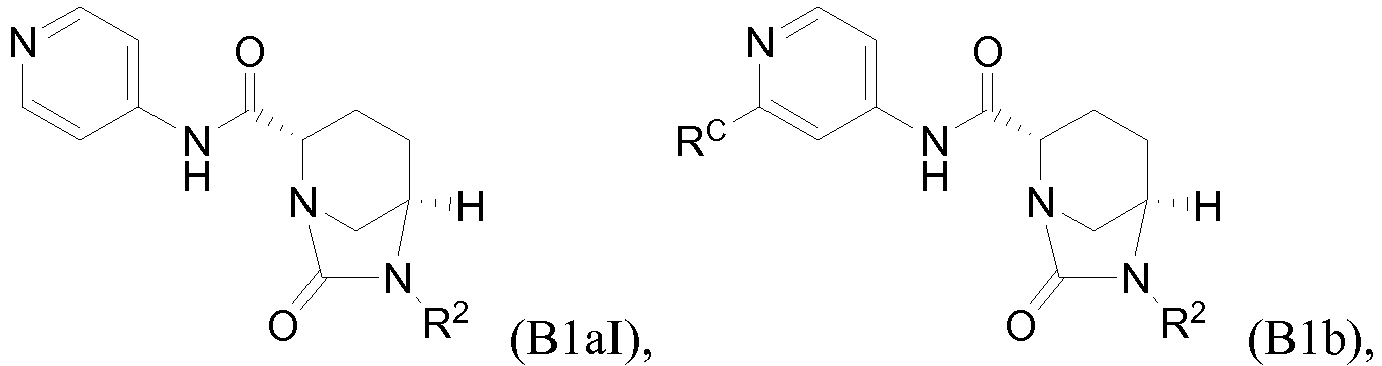

- A third class of compounds of the present invention (Class C3) includes compounds of Formula I selected from the group consisting of:


wherein T is H, C1-3 alkyl, pyrrolidin-3-yl, piperidin-4-yl, (CH2)2-3-O-C1-3 alkyl, (CH2)2-30H, (CH2)2-3F, (CH2)2-3-piperidinyl, (CH2)2-3-pyrrolidinyl; and T' is H, Cl, Br, F, C1-3 alkyl, O-C1-3 alkyl, OH, NH2, N(H)-C1-3 alkyl, or N(-C1-3 alkyl)2; and R2 is as originally defined. - A first sub-class of the third class (Sub-class C3-S1) includes the compounds of of formula (A1) to (A20) and their pharmaceutically acceptable salts; wherein R2 is OSO3H; and all other variables are as originally defined in Class C1.
- A second sub-class of the third class (Sub-class C3-S2) includes the compounds of of formula (A1) to (A20) and their pharmaceutically acceptable salts; wherein T is H, CH3, pyrrolidin-3-yl, piperidin-4-yl, (CH2)2-3OCH3, (CH2)2-3OH, (CH2)2-3F, (CH2)2-3-piperidinyl, (CH2)2-3-pyrrolidinyl; T' is H, F, O-C1-3 alkyl, OH, NH2, N(H)CH3, N(CH3)2; and ; and R2 is as originally defined. In an aspect of this sub-class, R2 is OSO3H.
- A third sub-class of the third class (Sub-class C3-S3) includes the compounds of of formula (A1) to (A20) and their pharmaceutically acceptable salts; wherein T is H; T' is H, F, OCH3, or OH; and R2 is OSO3H.
- A fourth class of compounds of the present invention (Class C4) includes compounds of Formula I selected from the group consisting of:


wherein V, V', V", Y, Y' and Z are each independently selected from the group consisting of H, CH3, pyrrolidinyl, piperidinyl, piperazinyl, morpholinyl, thiomorpholinyl, CH2-pyrrolidinyl, CH2-piperidinyl, CH2-piperazinyl, CH2-morpholinyl, CH2-thiomorpholinyl, NH2, N(H)CH3, N(CH3)2, CH2NH2, CH2N(H)CH3 and CH2N(CH3)2; with the proviso that: - (i) at least one of V, V' and V" is H; and
- (ii) at least one of Y and Y' is H.
- A first sub-class of the fourth class (Sub-class C4-S1) includes the compounds of of formula (B1) to (B9) and their pharmaceutically acceptable salts; wherein at least two of V, V' and V" are H; and R2 is OSO3H.
- Another embodiment of the present invention is a compound selected from the group consisting of the title compounds of Examples 1 to 117 (or, alternatively, Compounds 1 to 117) and pharmaceutically acceptable salts thereof.
- Another embodiment of the present invention is a compound selected from the group consisting of the title compounds of Examples 1 to 13 (i.e., Compounds 1 to 13) and pharmaceutically acceptable salts thereof.
- Another embodiment of the present invention is a compound selected from the group consisting of
compounds 1, 2, 4 and 6-9 and pharmaceutically acceptable salts thereof. - Another embodiment of the present invention is a compound selected from the group consisting of:
- (2S,5R)-7-oxo-N-piperidin-4-yl-6-(sulfooxy)-1,6-diazabicyclo[3.2.1]octane-2-carboxamide;
- (2S,5R)-N-[4-(aminomethyl)phenyl]-7-oxo-6-(sulfooxy)-1,6-diazabicyclo[3.2.1]octane-2-carboxamide;
- (2S,5R)-7-oxo-N-[(3R)-pyrrolidin-3-yl]-6-(sulfooxy)-1,6-diazabicyclo[3.2.1]octane-2-carboxamide;
- (2S,5R)-7-oxo-6-(sulfooxy)-N-(1,2,3,4-tetrahydroisoquinolin-6-yl)-1,6-diazabicyclo[3.2.1]octane-2-carboxamide;
- (2S,5R)-7-oxo-N-(5-piperidin-4-ylpyridin-2-yl)-6-(sulfooxy)-1,6-diazabicyclo[3.2.1]octane-2-carboxamide;
- piperidin-4-ylmethyl(2S,5R)-7-oxo-6-(sulfooxy)-1,6-diazabicyclo[3.2.1]octane-2-carboxylate; and pharmaceutically acceptable salts thereof.
- Still another embodiment of the present invention is (2S,5R)-7-oxo-N-piperidin-4-yl-6-(sulfooxy)-1,6-diazabicyclo[3.2.1]octane-2-carboxamide (i.e., the compound of Example 1 or alternatively Compound 1) or a pharmaceutically acceptable salt thereof.
- Still another embodiment of the present invention is (2S,5R)-N-[4-(aminomethyl)phenyl]-7-oxo-6-(sulfooxy)-1,6-diazabicyclo[3.2.1]octane-2-carboxamide (i.e., the compound of Example 9, or alternatively Compound 9) or a pharmaceutically acceptable salt thereof.
- Still another embodiment of the present invention is (2S,5R)-7-oxo-N-[(3R)-pyrrolidin-3-yl]-6-(sulfooxy)-1,6-diazabicyclo[3.2.1]octane-2-carboxamide (i.e., the compound of Example 14, or Compound 14) or a pharmaceutically acceptable salt thereof.
- Another embodiment of the present invention is Compound 1 in the form of a crystalline monohydrate. The crystalline monohydrate has the XRPD pattern shown in
Figure 1 and the DSC curve shown inFigure 2 . The crystalline monohydrate can be prepared as described in Part A in Example 1D. In one embodiment, the crystalline monohydrate is characterized by an X-ray powder diffraction pattern obtained using copper Kα radiation (i.e., the radiation source is a combination of Cu Kα1 and Kα2 radiation) which comprises 2Θ values (i.e., reflections at 2Θ values) in degrees of about 15.6, 17.4 and 20.4. In this embodiment, and any analogous embodiments which follow, the term "about" is understood to modify each of the 2Θ values. In another embodiment, the crystalline monohydrate is characterized by an X-ray powder diffraction pattern obtained using copper Kα radiation which comprises 2Θ values in degrees of about 15.6, 17.4, 20.4, 24.0, 26.3 and 29.3. In still another embodiment the crystalline monohydrate is characterized by an X-ray powder diffraction pattern obtained using copper Kα radiation which comprises 2Θ values in degrees of about 13.5, 15.5, 15.6, 17.4, 18.7, 19.7, 20.4, 21.7, 22.6, 24.0, 24.3, 25.9, 26.3, 26.6, 27.0, 27.5, 29.3, 30.0, 31.3, 32.4, 32.9, 33.1, 34.0, 34.7, 35.5 and 38.9. - In still another embodiment, the crystalline monohydrate of Compound 1 is characterized by the PDF trace derived from its X-ray diffraction pattern shown in
Figure 1 . The PDF trace provides a fingerprint of the inter-atomic distances that define the crystalline monohydrate. A PDF trace can be obtained in the manner described inWO 2005/082050 . In one aspect of this embodiment, the crystalline monohydrate is characterized by the parts of the PDF trace corresponding to the 2Θ values in degrees of about 15.6, 17.4 and 20.4 in the XRPD. In another aspect of this embodiment, the crystalline monohydrate is characterized by the parts of the PDF trace corresponding to the 2Θ values in degrees of about 15.6, 17.4, 20.4, 24.0, 26.3 and 29.3 in the XRPD. In still another aspect of this embodiment, the crystalline monohydrate is characterized by the parts of the PDF trace corresponding to the 2Θ values in degrees of about 13.5, 15.5, 15.6, 17.4, 18.7, 19.7, 20.4, 21.7, 22.6, 24.0, 24.3, 25.9, 26.3, 26.6, 27.0, 27.5, 29.3, 30.0, 31.3, 32.4, 32.9, 33.1, 34.0, 34.7, 35.5 and 38.9 in the XRPD. - The term "about", when modifying the quantity (e.g., kg, L, or equivalents) of a substance or composition, or the value of a physical property, or the value of a parameter characterizing a process step (e.g., the temperature at which a process step is conducted), or the like refers to variation in the numerical quantity that can occur, for example, through typical measuring, handling and sampling procedures involved in the preparation, characterization and/or use of the substance or composition; through inadvertent error in these procedures; through differences in the manufacture, source, or purity of the ingredients employed to make or use the compositions or carry out the procedures; and the like. In the particular case of the 2Θ values in degrees in an XRPD described herein, the term "about" typically means the value ± 0.1.
- Another embodiment of the present invention is a compound of Formula I, or a pharmaceutically acceptable salt thereof, as originally defined or as defined in any of the foregoing embodiments, sub-embodiments, aspects, classes or sub-classes, wherein the compound or its salt is in a substantially pure form. As used herein "substantially pure" means suitably at least about 60 wt.%, typically at least about 70 wt.%, preferably at least about 80 wt.%, more preferably at least about 90 wt.% (e.g., from about 90 wt.% to about 99 wt.%), even more preferably at least about 95 wt.% (e.g., from about 95 wt.% to about 99 wt.%, or from about 98 wt.% to 100 wt.%), and most preferably at least about 99 wt.% (e.g., 100 wt.%) of a product containing a compound of Formula I or its salt (e.g., the product isolated from a reaction mixture affording the compound or salt) consists of the compound or salt. The level of purity of the compounds and salts can be determined using a standard method of analysis such as thin layer chromatography, gel electrophoresis, high performance liquid chromatography, and/or mass spectrometry. If more than one method of analysis is employed and the methods provide experimentally significant differences in the level of purity determined, then the method providing the highest level of purity governs. A compound or salt of 100% purity is one which is free of detectable impurities as determined by a standard method of analysis. With respect to a compound of the invention which has one or more asymmetric centers and can occur as mixtures of stereoisomers, a substantially pure compound can be either a substantially pure mixture of the stereoisomers or a substantially pure individual diastereomer or enantiomer.
- Other embodiments of the present invention include the following:
- (a) A pharmaceutical composition comprising an effective amount of a compound of Formula I as defined above, or a pharmaceutically acceptable salt thereof, and a pharmaceutically acceptable carrier.
- (b) The pharmaceutical composition of (a), further comprising an effective amount of a β-lactam antibiotic.
- (c) The pharmaceutical composition of (b), wherein the beta-lactam antibiotic is selected from the group consisting of imipenem, ertapenem, meropenem, doripenem, biapenem, panipenem, ticarcillin, ampicillin, amoxicillin, carbenicillin, piperacillin, azlocillin, mezlocillin, ticarcillin, cefoperazone, cefotaxime, ceftriaxone, and ceftazidime.
- (d) The pharmaceutical composition of (b), wherein the β-lactam antibiotic is imipenem.
- (e) The pharmaceutical composition of (b), wherein the β-lactam antibiotic is ceftazidime.
- (f) The pharmaceutical composition of (b), wherein the β-lactam antibiotic is piperacillin.
- (g) The pharmaceutical composition of (a), further comprising effective amounts of a β-lactam antibiotic and a DHP inhibitor.
- (h) The pharmaceutical composition of (g), wherein the beta-lactam antibiotic is imipenem, and the DHP inhibitor is cilastatin or a pharmaceutically acceptable salt thereof.
- (i) A combination of effective amounts of a compound of Formula I as defined above, or a pharmaceutically acceptable salt thereof, and a β-lactam antibiotic.
- (j) The combination of (i), wherein the beta-lactam antibiotic is selected from the group consisting of imipenem, ertapenem, meropenem, doripenem, biapenem, panipenem, ticarcillin, ampicillin, amoxicillin, carbenicillin, piperacillin, azlocillin, mezlocillin, ticarcillin, cefoperazone, cefotaxime, ceftriaxone, and ceftazidime.
- (k) The combination of (i), wherein the β-lactam antibiotic is imipenem.
- (l) The combination of (i), wherein the β-lactam antibiotic is ceftazidime.
- (m) The combination of (i), wherein the β-lactam antibiotic is piperacillin.
- (n) A combination of effective amounts of a compound of Formula I as defined above, or a pharmaceutically acceptable salt thereof, a β-lactam antibiotic and a DHP inhibitor.
- (o) The combination of (n), wherein the beta-lactam antibiotic is imipenem, and the DHP inhibitor is cilastatin or a pharmaceutically acceptable salt thereof.
- (p) A method for treating a bacterial infection which comprises administering to a subject in need of such treatment a therapeutically effective amount of a compound of Formula I, or a pharmaceutically acceptable salt thereof, optionally in combination with an effective amount of a beta-lactam antibiotic.
- (q) A method for treating a bacterial infection which comprises administering to a subject in need of such treatment a therapeutically effective amount of a compound of Formula I, or a pharmaceutically acceptable salt thereof, in combination with effective amounts of a beta-lactam antibiotic and a DHP inhibitor.
- (r) A method for treating a bacterial infection which comprises administering to a subject in need of such treatment a therapeutically effective amount of the composition of (a), (b), (c), (d), (e), (f), (g) and (h).
- (s) A method for treating a bacterial infection which comprises administering to a subject in need of such treatment a therapeutically effective amount of the combination (i), (j), (k), (l), (m), (n) and (o).
- (t) The method of treating a bacterial infection as set forth in (p), (q), (r), or (s), wherein the bacterial infection is due to Pseudomonas spp. or Klebsiella spp.
- The present invention also includes a compound of Formula I, or a pharmaceutically acceptable salt thereof, (i) for use in, (ii) for use as a medicament for, or (iii) for use in the preparation (or manufacture) of a medicament for treating bacterial infection. In these uses, the compounds of the present invention can optionally be employed in combination with one or more β-lactam antibiotics and/or one or more DHP inhibitors.
- Additional embodiments of the invention include the pharmaceutical compositions, combinations and methods set forth in (a)-(t) above and the uses set forth in the preceding paragraph, wherein the compound of the present invention employed therein is a compound of one of the embodiments, sub-embodiments, classes or sub-classes described above. The compound may optionally be used in the form of a pharmaceutically acceptable salt in these embodiments.
- Additional embodiments of the present invention include each of the pharmaceutical compositions, combinations, methods and uses set forth in the preceding paragraphs, wherein the compound of the present invention or its salt employed therein is substantially pure. With respect to a pharmaceutical composition comprising a compound of Formula I or its salt and a pharmaceutically acceptable carrier and optionally one or more excipients, it is understood that the term "substantially pure" is in reference to a compound of Formula I or its salt per se; i.e., the purity of the active ingredient in the composition.
- As used herein, the term "alkyl" refers to a monovalent straight or branched chain, saturated aliphatic hydrocarbon radical having a number of carbon atoms in the specified range. Thus, for example, "C1-8 alkyl" (or "C1-C8 alkyl") refers to any of the octyl, heptyl, hexyl and pentyl alkyl isomers as well as n-, iso-, sec- and t-butyl, n- and iso- propyl, ethyl and methyl. As another example, "C1-6 alkyl" (or "C1-C6 alkyl") refers to any of the hexyl and pentyl alkyl isomers as well as n-, iso-, sec- and t-butyl, n- and iso- propyl, ethyl and methyl. As another example, "C1-4 alkyl" refers to n-, iso-, sec- and t-butyl, n- and isopropyl, ethyl and methyl.
- The term "haloalkyl" refers to an alkyl group as defined above in which one or more of the hydrogen atoms has been replaced with a halogen (i.e., F, Cl, Br and/or I). Thus, for example, "C1-6 haloalkyl" (or "C1-C6 haloalkyl") refers to a C1 to C6 linear or branched alkyl group as defined above with one or more halogen substituents. The term "fluoroalkyl" has an analogous meaning except that the halogen substituents are restricted to fluoro. Suitable fluoroalkyls include the series (CH2)0-4CF3 (i.e., trifluoromethyl, 2,2,2-trifluoroethyl, 3,3,3-trifluoro-n-propyl, etc.).
- The term "halogen" (or "halo") refers to fluorine, chlorine, bromine and iodine (alternatively referred to as fluoro, chloro, bromo, and iodo).
- The term "cycloalkyl" refers to any monovalent monocyclic ring of an alkane having a number of carbon atoms in the specified range. Thus, for example, "C4-9 cycloalkyl" (or "C4-C9 cycloalkyl") refers to cyclobutyl, cyclopentyl, cyclohexyl, cycloheptyl, cyclooctyl, and cyclononyl, and "C4-7 cycloalkyl" refers to cyclobutyl, cyclopentyl, cyclohexyl, and cycloheptyl.
- The term "C(O)" refers to carbonyl. The terms "S(O)2" and "SO2" each refer to sulfonyl. The term "S(O)" refers to sulfinyl.
- The symbol "*" at the end of a bond refers to the point of attachment of a functional group or other chemical moiety to the rest of the molecule of which it is a part.
- Unless expressly limited, the term "substituted" refers to single and multiple substitution by a named substituent to the extent such single and multiple substitution (including multiple substitution at the same site) is chemically allowed. Unless expressly stated to the contrary, substitution by a named substituent is permitted on any atom in a ring (e.g., cycloalkyl, phenyl, a heteroaromatic ring, or a saturated heterocyclic ring) provided such ring substitution is chemically allowed and results in a stable compound. It is understood, however, that the degree of substitution can be qualified. For example, the expression "optionally substituted with a total of from 1 to 4 substituents selected from zero to 2 N(RA)RB and zero to 2 RC" means that there can optionally be 4 substituents in total with a maximum of 2 N(RA)RB substituents and a maximum of 2 RC groups. As another example, the expression "AryA is neither unsubstituted phenyl nor phenyl substituted with 1 or 2 N(RA)RB" means AryA is not phenyl, phenyl monosubstituted with N(RA)RB, or phenyl di-substituted with N(RA)RB, and otherwise AryA is as elsewhere defined.
- HetA is defined herein to be a 4- to 9-membered saturated or mono-unsaturated heterocyclic ring containing from 1 to 3 heteroatoms independently selected from N, O and S, wherein the ring is optionally fused with a C3-7 cycloalkyl. Saturated heterocyclic rings suitable for use as HetA include, for example, azetidinyl, piperidinyl, morpholinyl, thiomorpholinyl, thiazolidinyl, isothiazolidinyl, oxazolidinyl, isoxazolidinyl, pyrrolidinyl, imidazolidinyl, piperazinyl, tetrahydrofuranyl, tetrahydrothienyl, pyrazolidinyl, hexahydropyrimidinyl, thiazinanyl, thiazepanyl, azepanyl, diazepanyl, azocanyl (= octahydroazocinyl), azonanyl (= octahydro-1H-azoninyl), tetrahydropyranyl, tetrahydrothiopyranyl, and dioxanyl. Suitable mono-unsaturated heterocyclic rings include, for example, rings corresponding to the saturated rings set forth in the preceding sentence except that they contain a double bond (e.g., a carbon-carbon double bond). Saturated heterocycli rings fused with a cycloalkyl suitable for use as HetA include, for example,


- Unless expressly stated to the contrary in a particular context, any of the various cyclic rings and ring systems described herein may be attached to the rest of the compound at any ring atom (i.e., any carbon atom or any heteroatom) provided that a stable compound results.
- Unless expressly stated to the contrary, all ranges cited herein are inclusive. For example, a heteroaromatic ring described as containing from "1 to 4 heteroatoms" means the ring can contain 1, 2, 3 or 4 heteroatoms. It is also to be understood that any range cited herein includes within its scope all of the sub-ranges within that range. Thus, for example, a heterocyclic ring described as containing from "1 to 4 heteroatoms" is intended to include as aspects thereof, heterocyclic rings containing 2 to 4 heteroatoms, 3 or 4 heteroatoms, 1 to 3 heteroatoms, 2 or 3 heteroatoms, 1 or 2 heteroatoms, 1 heteroatom, 2 heteroatoms, 3 heteroatoms, and 4 heteroatoms.
- When any variable (e.g., RA or RB) occurs more than one time in any constituent or in Formula I or in any other formula depicting and describing compounds of the present invention, its definition on each occurrence is independent of its definition at every other occurrence. Also, combinations of substituents and/or variables are permissible only if such combinations result in stable compounds.
- A "stable" compound is a compound which can be prepared and isolated and whose structure and properties remain or can be caused to remain essentially unchanged for a period of time sufficient to allow use of the compound for the purposes described herein (e.g., therapeutic administration to a subject). The compounds of the present invention are limited to stable compounds embraced by Formula I.
- The compounds of the present invention have at least two asymmetric centers and can have one or more additional centers as a result of the presence of certain substituents and/or substituent patterns. Accordingly, compounds of the invention can occur as mixtures of stereoisomers, or as individual diastereomers, or enantiomers. All isomeric forms of these compounds, whether individually or in mixtures, are within the scope of the present invention.
- The term "compound" refers to the free compound and, to the extent they are stable, any hydrate or solvate thereof. A hydrate is the compound complexed with water, and a solvate is the compound complexed with an organic solvent.
- As indicated above, the compounds of the present invention can be employed in the form of pharmaceutically acceptable salts. The term "pharmaceutically acceptable salt" refers to a salt which possesses the effectiveness of the parent compound and which is not biologically or otherwise undesirable (e.g., is neither toxic nor otherwise deleterious to the recipient thereof). A suitable pharmaceutically acceptable salt is a salt formed by treating the compound of the invention (e.g., a compound of Formula I) with one molar equivalent of a mild base (e.g., sodium carbonate, sodium bicarbonate, potassium bicarbonate, or sodium acetate). In this case, M is a cation, such as Na+ in the event of treatment with a sodium base.
- When M is H (e.g., R2 is OSO3H) and the compound of the invention contains an internal base which is capable of being protonated (e.g., R1 contains a basic nitrogen), it is understood that the compound might exist in a form in which the internal base is completely protonated by M = H such that R2 possesses a negative charge (e.g., R2 = OSO3-) and the internal base has a positive charge, or is partially protonated such that R2 possesses a partial negative charge, or is not protonated. Similarly, when M is H and the compound of the invention contains two or more internal bases which are capable of being protonated (e.g., R1 contains two or more basic nitrogens), it is understood that the compound might exist in a form in which one or another of the internal bases is completely protonated by M = H or that two or more of the internal bases are each sufficiently protonated such that R2 possesses a negative charge, or that one or more of the bases is partially protonated such that R2 possesses a partial negative charge, or that none of the bases is protonated. The present invention includes all such forms of the compound. While these compounds can be in the form of an internal salt (i.e., a zwitterion), they are considered herein compounds of the invention, not pharmaceutically acceptable salts thereof.
- On the other hand, for a compound of the invention which contains an internal base (e.g., R1 contains a basic nitrogen), a pharmaceutically acceptable salt is a salt formed by treatment of the compound with a suitable amount of an acid (e.g., hydrochloric acid, trifluoroacetic acid, methanesulfonic acid, or the like) such that the internal base is protonated by the acid with the positive charge of the protonated base balanced by a negative counterion (e.g., chloride, trifluoride, methanesulfonate, or the like). For compounds of the invention containing two internal bases (e.g., R1 contains two basic nitrogens), another pharmaceutically acceptable salt is a salt formed by treatment of the compound with a suitable amount of acid such that one of the internal bases is protonated by the sulfonic acid group present in the molecule (i.e., R2 has a negative charge) and the other is protonated by the acid with the positive charge of the protonated base balanced by a suitable negative counterion. Still another pharmaceutically acceptable salt for compounds of the invention containing two internal bases can be obtained by treating the compound with sufficient acid (e.g., sulfuric acid, HCl, methanesolufonic acid, or TFA) such that the sulfonic acid group present in the molecule remains protonated (i.e., M = H) and the internal bases are protonated and have associated therewith a suitable negative counterion (e.g., sulfonate). As is clear from the foregoing, the precise nature and type of pharmaceutically acceptable salt which can be obtained will depend upon the nature of the specific compound being treated (e.g., the presence or absence of basic nitrogens in R1) and the treatment conditions employed; e.g., it will depend upon the choice and amount of the acid or base with which the compound is treated, the pH of the treating media, the amount and choice of buffer (if any), and the like. It is understood that the present invention encompasses all types and forms of pharmaceutically acceptable salts of the compounds of the present invention.
- As set forth above, the present invention includes pharmaceutical compositions comprising a compound of Formula I of the present invention, optionally one or more other active components (e.g., a β-lactam antibiotic), and a pharmaceutically acceptable carrier. The characteristics of the carrier will depend on the route of administration. By "pharmaceutically acceptable" is meant that the ingredients of the pharmaceutical composition must be compatible with each other, do not interfere with the effectiveness of the active ingredient(s), and are not deleterious (e.g., toxic) to the recipient thereof. Thus, compositions according to the invention may, in addition to the inhibitor, contain diluents, fillers, salts, buffers, stabilizers, solubilizers, and other materials well known in the art.
- Also as set forth above, the present invention includes a method for treating a bacterial infection which comprises administering to a subject in need of such treatment a therapeutically effective amount of a compound of Formula I, or a pharmaceutically acceptable salt thereof, optionally in combination with a beta-lactam antibiotic and/or a DHP inhibitor. The term "subject" (or, alternatively, "patient") as used herein refers to an animal, preferably a mammal, most preferably a human, who has been the object of treatment, observation or experiment. The term "administration" and variants thereof (e.g., "administering" a compound) in reference to a compound of Formula I mean providing the compound, or a pharmaceutically acceptable salt thereof, to the individual in need of treatment. When a compound or a salt thereof is provided in combination with one or more other active agents (e.g., a carbapenem antibiotic or a DHP inhibitor or both), "administration" and its variants are each understood to include provision of the compound or its salt and the other agents at the same time or at different times. When the agents of a combination are administered at the same time, they can be administered together in a single composition or they can be administered separately. It is understood that a "combination" of active agents can be a single composition containing all of the active agents or multiple compositions each containing one or more of the active agents. In the case of two active agents a combination can be either a single composition comprising both agents or two separate compositions each comprising one of the agents; in the case of three active agents a combination can be either a single composition comprising all three agents, three separate compositions each comprising one of the agents, or two compositions one of which comprises two of the agents and the other comprises the third agent; and so forth.
- The compositions and combinations of the present invention are suitably administered in effective amounts. The term "effective amount" as used herein means that amount of active compound or pharmaceutical agent that elicits the biological or medicinal response in a tissue, system, animal or human that is being sought by a researcher, veterinarian, medical doctor or other clinician. In one embodiment, the effective amount is a "therapeutically effective amount" for the alleviation of the symptoms of the disease or condition being treated (e.g., the healing of conditions associated with bacterial infection, and/or bacterial drug resistance). In another embodiment, the effective amount is a "prophylactically effective amount" for prophylaxis of the symptoms of the disease or condition being prevented. The term also includes herein the amount of active compound sufficient to inhibit β-lactamase and thereby elicit the response being sought (i.e., an "inhibition effective amount"). When the active compound (i.e., active ingredient) is administered as the salt, references to the amount of active ingredient are to the free acid or free base form of the compound.
- The administration of a composition of the present invention is suitably parenteral, oral, sublingual, transdermal, topical, intranasal, intratracheal, or intrarectal, wherein the composition is suitably formulated for administration by the selected route using formulation methods well known in the art, including, for example, the methods for preparing and administering formulations described in chapters 39, 41, 42, 44 and 45 in Remington - The Science and Practice of Pharmacy, 21st edition, 2006. In one embodiment, compounds of the invention are administered intravenously in a hospital setting. In another embodiment, administration is oral in the form of a tablet or capsule or the like. When administered systemically, a therapeutic composition is suitably administered at a sufficient dosage to attain a blood level of inhibitor of at least about 1 microgram/mL, preferably about 10 micrograms/mL, and more preferably about 25 micrograms/mL. For localized administration, much lower concentrations than this may be effective, and much higher concentrations may be tolerated.
- Intravenous administration of a compound of the invention can be conducted by reconstituting a powdered form of the compound with an acceptable solvent. Suitable solvents include, for example, saline solutions (e.g., 0.9% Sodium Chloride Injection) and sterile water (e.g., Sterile Water for Injection, Bacteriostatic Water for Injection with methylparaben and propylparaben, or Bacteriostatic Water for Injection with 0.9% benzyl alcohol). The powdered form of the compound can be obtained by gamma-irradiation of the compound or by lyophilization of a solution of the compound, after which the powder can be stored (e.g., in a sealed vial) at or below room temperature until it is reconstituted. The concentration of the compound in the reconstituted IV solution can be, for example, in a range of from about 0.1 mg/mL to about 20 mg/mL.
- The present invention also includes a method for inhibiting bacterial growth which comprises administering to a bacterial cell culture, or to a bacterially infected cell culture, tissue, or organism, an inhibition effective amount of a compound of Formula I. Additional embodiments of the invention include the bacterial growth inhibiting method just described, wherein the compound of the present invention employed therein is a compound of one of the embodiments, sub-embodiments or classes described above. The compound may optionally be used in the form of a pharmaceutically acceptable salt in these embodiments. The method can involve administration of a compound of Formula I to an experimental cell culture in vitro to prevent the growth of β-lactam resistant bacteria. The method can alternatively involve administration of a compound of Formula I to an animal, including a human, to prevent the growth of β-lactam resistant bacteria in vivo. In these cases the compound of Formula I is typically co-administered with a β-lactam antibiotic.
- Compounds of the invention can be employed for the treatment, prophylaxis or inhibition of bacterial growth or infections due to bacteria that are resistant to β-lactam antibiotics. More particularly, the bacteria can be β-lactamase positive strains that are highly resistant to β-lactam antibiotics. The terms "slightly resistant" and "highly resistant" are well-understood by those of ordinary skill in the art (see, e.g., Payne et al., Antimicrobial Agents and Chemotherapy 38:767-772 (1994); Hanaki et al., Antimicrobial Agents and Chemotherapy 30:11.20-11.26 (1995)). For the purposes of this invention, bacterial strains which are highly resistant to imipenem are those against which the MIC of imipenem is >16 µg/mL, and bacterial strains which are slightly resistant to imipenem are those against which the MIC of imipenem is >4 µg/mL.
- Compounds of the invention can be used in combination with antibiotic agents for the treatment of infections caused by Class C-β-lactamase producing strains, in addition to those infections which are subsumed within the antibacterial spectrum of the antibiotic agent. Examples of class C-β-lactamase producing bacteria are Pseudomonas aeruginosa, Enterobacter cloacae, Klebsiella pneumoniae, Escherichia coli and Acinetobacter baumannii.
- It is generally advantageous to use a compound of Formula I in admixture or conjunction with a carbapenem, penicillin, cephalosporin, or other β-lactam antibiotic, or a prodrug thereof. It is advantageous to use a compound of Formula I in combination with one or more β-lactam antibiotics because of the class C β-lactamase inhibitory properties of the compounds. As already noted, the compound of Formula I and the β-lactam antibiotic can be administered separately (at the same time or as different times) or in the form of a single composition containing both active ingredients.
- Carbapenems, penicillins, cephalosporins and other β-lactam antibiotics suitable for use in the present invention include both those known to show instability to or to be otherwise susceptible to class C-β-lactamases and also known to have a degree of resistance to class C β-lactamase.
- When the compounds of Formula I are combined with a carbapenem antibiotic, a dehydropeptidase (DHP) inhibitor can also be combined. Many carbapenems are susceptible to attack by a renal enzyme known as DHP. This attack or degradation may reduce the efficacy of the carbapenem antibacterial agent. Inhibitors of DHP and their use with carbapenems are disclosed in, e.g.,
US4539208 ,US4616038 ,US4880793 andUS5071843 . A preferred DHP inhibitor is 7-(L-2-amino-2-carboxyethylthio)-2-(2,2-dimethylcyclopropanecarboxamide)-2-heptenoic acid or a pharmaceutically acceptable salt thereof. - Carbapenems suitable for co-administration with compounds of the present invention include imipenem, meropenem, biapenem, (4R, 5S, 6S)-3-[3S, 5S)-5-(3-carboxyphenyl-carbamoyl)pyrrolidin-3-ylthio]-6-(1R)-1-hydroxyethyl]-4-methyl-7-oxo-1-azabicyclo[3.2.0]hept-2-ene-2-carboxylic acid, (1S, 5R, 6S)-2-(4-(2-(((carbamoylmethyl)-1,4-diazoniabicyclo[2.2.2]oct-1-yl)-ethyl(1,8-naphthosultam)methyl)-6-[1(R)-hydroxyethyl]-1-methylcarbapen-2-em-3-carboxylate chloride, BMS181139 ([4R-[4alpha,5beta,6beta(R*)]]-4-[2-[(aminoiminomethyl)amino] ethyl]-3-[(2-cyanoethyl)thio]-6-(1-hydroxyethyl)-7-oxo-1-azabicyclo[3.2.0]hept-2-ene-2-carboxylic acid), BO2727 ([4R-3[3S*,5S*(R*)], 4alpha,5beta,6beta(R*)]]-6-(1-hydroxyethyl)-3-[[5-[1-hydroxy-3-(methylamino)propyl]-3-pyrrolidinyl]thio]-4-methyl-7-oxo-1-azabicyclo[3.2.0] hept-2-ene-2-carboxylic acid monohydrochloride), E1010 ((1R, 5S, 6S)-6-[1(R)-hydroxymethyl]-2-[2(S)-[1(R)-hydroxy-1-[pyrrolidin-3(R)-yl] methyl]pyrrolidin-4(S)-ylsulfanyl]-1-methyl-1-carba-2-penem-3-carboxylic acid hydrochloride) and S4661 ((1R,5S,6S)-2-[(3S,5S)-5-(sulfamoylaminomethyl) pyrrolidin-3-yl]thio-6-[(1R)-1-hydroxyethyl]-1-methylcarbapen-2-em-3-carboxylic acid), (1S,5R,6S)-1-methyl-2-{7-[4-(aminocarbonylmethyl)-1,4-diazoniabicyclo(2.2.2)octan-1yl]-methyl-fluoren-9-on-3-yl}-6-(1R-hydroxyethyl)-carbapen-2-em-3 carboxylate chloride.
- Penicillins suitable for co-administration with compounds of the present invention include benzylpenicillin, phenoxymethylpenicillin, carbenicillin, azidocillin, propicillin, ampicillin, amoxicillin, epicillin, ticarcillin, cyclacillin, pirbenicillin, azlocillin, mezlocillin, sulbenicillin, piperacillin, and other known penicillins. The penicillins may be used in the form of pro-drugs thereof; for example as in vivo hydrolysable esters, for example the acetoxymethyl, pivaloyloxymethyl, α-ethoxycarbonyloxy-ethyl and phthalidyl esters of ampicillin, benzylpenicillin and amoxicillin; as aldehyde or ketone adducts of penicillins containing a 6-α-aminoacetamido side chain (for example hetacillin, metampicillin and analogous derivatives of amoxicillin); and as esters of carbenicillin and ticarcillin, for example the phenyl and indanyl α-esters.
- Cephalosporins suitable for co-administration with compound of the present invention include cefatrizine, cephaloridine, cephalothin, cefazolin, cephalexin, cephacetrile, cephapirin, cephamandole nafate, cephradine, 4-hydroxycephalexin, cephaloglycin, cefoperazone, cefsulodin, ceftazidime, cefuroxime, cefmetazole, cefotaxime, ceftriaxone, and other known cephalosporins, all of which may be used in the form of pro-drugs thereof.
- β-Lactam antibiotics other than penicillins and cephalosporins that may be co-administered with compounds of the present invention include aztreonam, latamoxef (Moxalactam-trade mark), and other known β-lactam antibiotics such as carbapenems like imipenem, meropenem or (4R, 5S, 6S)-3-[(3S,5S)-5-(3-carboxyphenylcarbamoyl)pyrrolidin-3-ylthio]-6-(1R)-1-hydroxyethyl]-4-methyl-7-oxo-1-azabicyclo[3.2.0]hept-2-ene-2-carboxylic acid, all of which may be used in the form of pro-drugs thereof.
- In one embodiment, the antibiotic co-administered with a compound of the present invention is selected from the group consisting of imipenem, meropenem and (4R, 5S, 6S)-3-[(3S,5S)-5-(3-carboxyphenylcarbamoyl)pyrrolidin-3-ylthio]-6-(1R)-1-hydroxyethyl]-4-methyl-7-oxo-1-azabicyclo[3.2.0]hept-2-ene-2-carboxylic acid.
- In another embodiment, the antibiotic co-administered with a compound of the present invention is selected from the group of penicillins consisting of ampicillin, amoxicillin, carbenicillin, piperacillin, azlocillin, mezlocillin, and ticarcillin. Such penicillins can optionally be used in the form of their pharmaceutically acceptable salts, for example their sodium salts. Ampicillin or amoxicillin can alternatively be employed in the form of fine particles of the zwitterionic form (generally as ampicillin trihydrate or amoxicillin trihydrate) for use in an injectable or infusable suspension. In an aspect of this embodiment, the penicillin co-administered with a compound of the present invention is amoxicillin, optionally in the form of its sodium salt or the trihydrate.
- In another embodiment, the antibiotic co-administered with a compound of the present invention is selected from the group of cephalosporins consisting of cefotaxime, ceftriaxone and ceftazidime, which are optionally used in the form of their pharmaceutically acceptable salts, for example their sodium salts.
- When co-administered with a β-lactam antibiotic, the combination of the compound of the invention and the antibiotic can provide a a synergistic effect. The terms "synergistic effect" and "synergy" indicate that the effect produced when two or more drugs are co-administered is greater than would be predicted based on the effect produced when the compounds are administered individually. While not wishing to be bound by theory, it is believed that the compounds of the present invention are β-lactamase inhibitors that act to prevent degradation of β-lactam antibiotics, thereby enhancing their efficacy and producing a synergistic effect.
- Abbreviations employed herein include the following: acac = acetylacetonate; AIBN = 2,2-azobisisobutyronitrile; BLI = beta-lactamase inhibitor; Bn = benzyl; BOC (or Boc) = t-butyloxycarbonyl; BOC-ON = 2-(tert-butoxycarbonyloxyamino)-2-phenyl acetonitrile; BOC-OSN = N-tert-butoxycarbonyloxy)succinimide; BOP = benzotriazol-1-yloxy)tris(dimethylamino)phosphonium hexafluorophosphate; BSA = bovine serum albumin; CBZ (or Cbz) = carbobenzoxy (alternatively, benzyloxycarbonyl); COD = cyclooctadieneyl; DBU = 1,8-diazabicyclo[5.4.0]undec-7-ene; DCC = dicyclohexyl carbodiimide; DCE = 1,2-dichloroethane; DCM = dichloromethane; DIPEA = diisopropylethylamine (or Hunig's base); DMAC = N,N-dimethylacetamide; DMAP = 4-dimethylaminopyridine N,N-dimethylaminopyridine; DME = 1,2-dimethoxyethane; DMF = N,N-dimethylformamide; DMSO = dimethyl sulfoxide; EDC = 1-ethyl-3-(3-dimethylaminopropyl) carbodiimide; DSC = differential scanning calorimetry; Et = ethyl; EtOAc = ethyl acetate; HMDS = hexamethyldisilazide; HOBT = 1-hydroxy benzotriazole; HOPO = 2-hydroxypyridine-N-oxide; HPLC = high-performance liquid chromatography; IPA = isopropyl alcohol; IPAc = isopropyl acetate; i-Pr = isopropyl; LC/MS = liquid chromatography/mass spectrometry; Me = methyl; MHBII = Mueller Hinton Broth type II; MIC = minimum inhibitory concentration; MSA = methanesulfonic acid; NMP = N-methyl pyrrolidinone; PG = protective group; Ph = phenyl; TEA = triethylamine; TFA = trifluoroacetic acid; TFE =2,2,2-trifluoroethaonol; THF = tetrahydrofuran; TLC = thin layer chromatography; TSB = trypticase soy broth; TsOH = p-toluenesulfonic acid; XRPD = X-ray powder diffraction.
- The compounds of the present invention can be readily prepared according to the following reaction schemes and examples, or modifications thereof, using readily available starting materials, reagents and conventional synthesis procedures including, for example, procedures described in
US7112592 . In these reactions, it is also possible to make use of variants which are themselves known to those of ordinary skill in this art, but are not mentioned in greater detail. Furthermore, other methods for preparing compounds of the invention will be readily apparent to the person of ordinary skill in the art in light of the following reaction schemes and examples. Unless otherwise indicated, all variables are as defined above. - Carboxamide compounds of the present invention in which a is a single bond and X is (CH2)1-3 can be prepared as depicted in Scheme 1:
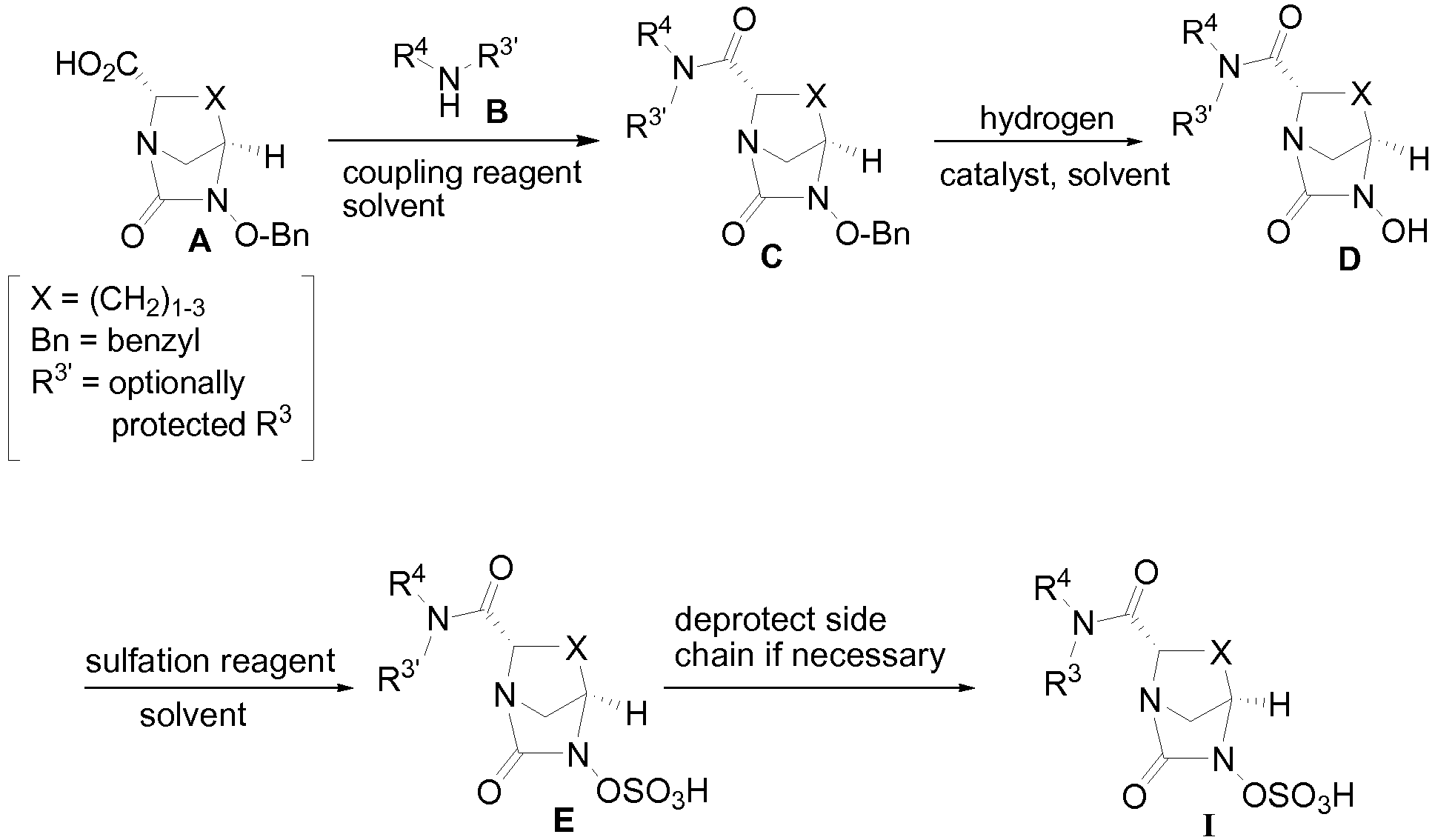
- The bicyclic intermediate A can be obtained as described in
US 7112592 or via routine modifications thereof. The side chain can be attached by the reaction of acid A with amine B (wherein if necessary the amine incorporates a protective group) under standard amide formation conditions known in the art. For example, a solution of acid A and amine B (1-2 molar equivalents) in solvent (e.g., a haloalkane such as dry dichloromethane or chloroform) can be stirred at room temperature while sequentially adding triethylamine (1-2 equivalents), HOBT (1-2 equivalents), and EDC (1-2 equivalents) at room temperature under nitrogen. The resulting reaction mixture can then be stirred at room temperature until the reaction is complete (e.g., in about 8 to 24 hours), and then the reaction mixture can be concentrated under vacuum and the residue purified using column chromatography on silica gel or HPLC to afford the amide C. Deprotection of the benzylic ether protecting group to afford intermediate hydroxylactam D can be accomplished by hydrogenation or, in some cases, by acid-catalyzed hydrolysis. For example, palladium on carbon (0.05-0.5 eq) can be added to a solution of the benzylic ether in a suitable solvent (e.g., an alcohol such methanol or ethanol, an alkyl acetate such as EtOAc, or an ether such as THF) and the resulting mixture stirred under hydrogen (1-3 atmospheres) until reaction is complete (e.g., about 1 to 24 hours) as determined by a suitable monitoring technique such as TLC or HPLC. Upon completion, hydroxy lactam D can be isolated using conventional techniques. For example, the reaction mixture can be filtered and the filtrate concentrated to provide a crude hydroxylactam D which in many cases can be employed directly in the next step without further purification. If further purification is necessary or desired, the crude hydroxylactam D can be purified by column chromatography on silica gel or by HPLC to afford pure hydroxylactam D. Sulfation of intermediate D to afford the sulfate E can be accomplished using a sulfating reagent in an appropriate solvent. Thus, sulfur trioxide pyridine complex (2-10 equivalents) can be added to a solution of hydroxylactam D in an aprotic solvent (e.g., a tertiary amide such as pyridine, DMF, or DMAC) at room temperature. The resulting mixture can be stirred at room temperature until the reaction is complete (e.g., about 4 to 24 hours) as monitored by HPLC or LC/MS. Additional sulfur trioxide pyridine complex can be added as necessary to drive the reaction to completion. A purified reaction product can be obtained using conventional techniques such as by filtering the reaction mixture, concentrating the filtrate in vacuo, suspending the concentrate in a saturated aqueous potassium dihydrogenphosphate solution, washing the aqueous solution with a suitable organic solvent (e.g., EtOAc), adding excess tetrabutylammonium hydrogen sulfate to the aqueous layer, extracting the mixture with organic solvent(e.g., EtOAc 4X), combining the organic layers, drying the combined organics over sodium sulfate, and concentrating in vacuo to afford the tetrabutylammonium salt of intermediate E. In cases where there is no protective group in the side chain, the product of the sulfation reaction is a compound of Formula I of the present invention. When a protective group is incorporated in the amide side chain (e.g., a benzyl amine or ether, BOC amine, or a CBZ amine), the group can be removed using a technique known in the art to afford the compound of formula I. More particularly, in compounds of Formula I containing an amino group in the side chain (e.g. R3 is aminoalkyl), the amino group is generally protected to avoid undesired side reactions during the synthesis. Protection can suitably be accomplished through the use of BOC, CBZ, or a similar protective group. - Carboxylate compounds of the present invention in which a is a single bond and X is (CH2)1-3 can be prepared as depicted in Scheme 2:

Scheme 2, ester G is obtained by reacting bicyclic urea intermediate A with side chain alcohol F (wherein if necessary the alcohol incorporates a protective group) in the presence of an esterifying reagent (e.g., 1-2 equivalents of DCC or EDC) in the presence of a catalyst (e.g., 0.05-0.25 equivalents of DMAP) in an aprotic solvent (e.g., an ether such as diethyl ether or THF or a haloalkane such as dichloromethane) at a temperature ranging from about 0°C to 35°C until the reaction is complete (e.g., about 1-24 hours) as monitored by TLC or HPLC. Intermediate G can then be converted to a compound of the present invention by a synthetic sequence (debenzylation, sulfation, and side chain deprotection (if necessary)) analogous to the one outlined in Scheme 1 for the synthesis of amide analogs. - Carboxamide compounds of the present invention in which a is a single bond and X is CH=CH (see T below) and those in which a is a double bond and X is CH2 (see W below) can be prepared as depicted in Scheme 3:

- As shown in Scheme 3, protected amino acid J can be coupled with amine B (1-2 molar equivalents) in solvent (e.g., a haloalkane such as dry dichloromethane or chloroform) with stirring at room temperature while sequentially adding triethylamine (1-2 equivalents), HOBT (1-2 equivalents), and EDC (1-2 equivalents) under nitrogen. The resulting reaction mixture can then be stirred at room temperature until the reaction is complete (e.g., in about 8 to 24 hours) and the intermediate amide recovered using known techniques (e.g., concentrating the reaction mixture under vacuum purifying the residue using column chromatography on silica gel or HPLC). The BOC protective group can then be removed using methods well known in the art to afford an amine which can be reductively aminated with aldehyde L by reaction with a reducing agent such as sodium cyanoborohydride (1-3 molar equivalents) or the like at a temperature from 0°C to room temperature in an alcohol solvent such as methanol, ethanol, or the like. The reaction mixture can be stirred until the reaction is complete (e.g., in about 1 to 24 hours), followed by recovering of amine K using known techniques (e.g., concentrating the reaction mixture under vacuum and purifying the residue via chromatography). Amine K can then be acylated with M in the presence of a strong base such as DBU (~ 1 equivalent) or the like in an aromatic hydrocarbon solvent such as benzene, toluene, or the like to afford an intermediate urea which is recovered using known techniques (e.g., washing the reaction mixture with aqueous acid, concentrating the washed mixture under vacuum, and purifying the residue via chromatography). The acetate protective group can then be removed using well known techniques and the resulting primary hydroxy group can be activated by reaction with ~1 to 1.5 equivalents of tosyl chloride, triflic anhydride, or the like in a non-nucleophilic solvent (e.g., dichloromethane, ether, benzene, etc.) at low temperature (e.g., from 0°C to 25°C). The activated hydroxyl can then be treated with a non-nucleophilic base such as DBU, potassium t-butoxide, t-butyllithium, or the like at low temperature (e.g., from 0°C to 25°C) to afford cyclized intermediate Q, which can be recovered and purified using standard work-up procedures. Olefin metathesis techniques well known to those skilled in the arts can be used to cyclize the di-olefin intermediate Q. Thus, for example, Q can be treated with a catalytic amount (0.05 to 0.25 equivalents) of a Grubbs olefin methathesis catalyst in a suitable solvent (e.g., benzene, toluene, tetrahydrofuran, or the like) at about 25°C to afford a cyclohexene product, after which the protective group PG on the hydroxylactam can be removed using well known techniques, and the resulting hydroxylactam sulfated to afford the sulfate. For example, a solution of hydroxylactam in an aprotic solvent (e.g., a tertiary amide such as pyridine, DMF, or DMAC) can be treated with a sulfur trioxide pyridine complex (2-10 equivalents) at about 25°C to afford the desired product which can be recovered and purified using standard techniques to afford T. In cases where there is no protective group in the side chain, the product of the sulfation reaction is a compound of Formula I of the present invention. When a protective group is incorporated in the amide side chain (e.g., a benzyl amine or ether, BOC amine, or a CBZ amine), the group can be removed using a technique known in the art to afford the compound of Formula I. The beta-gamma olefin in compound T can be isomerized into conjugation with the side chain amide carbonyl by treating T with a non-nucleophilic base (e.g., potassium t-butoxide, sodium hydride, or the like) in a non-nucleophilic solvent (e.g., t-butanol, tetrahydrofuran, ether, or the like at 0°C to 25°C. Alternatively, the olefin can be isomerized into conjugation under acidic conditions using an an acid such as trifluoromethanesulfonic acid or the like or an acidic ion exchange resin in a non-nucleophilic solvent (e.g., t-butanol, tetrahydrofuran, ether, or the like) at 0°C to 25°C. The resulting olefin isomer W can be recovered and isolated using standard work-up techniques.
- Generally speaking, when a chemical group in a compound is referred to herein as "protected" or is said to incorporate a "protective group", this means that the chemical group is employed in a modified form to preclude undesired side reactions at the protected site. Protective groups suitable for use in the preparation of compounds of the present invention and techniques for adding and removing such protective groups are well known in the art and include those described in Protective Groups in Organic Chemistry, ed. J.F.W. McOmie, Plenum Press, 1973 and in T.W. Greene & P.G.M. Wuts, Protective Groups in Organic Synthesis, John Wiley & Sons, 3rd edition, 1999, and 2nd edition, 1991, the disclosures of which are herein incorporated by reference in their entireties.
- The present invention also includes a process (alternatively referred to as Process P) for preparing a compound of Formula P-II:

- (A) contacting a ketosulfoxonium ylide of Formula P-I:

wherein:- PG is an amine protective group selected from the group consisting of carbamates and benzylamines;
- RU is CH3 or phenyl;
- RV is CH3 or phenyl;
- R4 is H or C1-4 alkyl;
- T' is H, Cl, Br, F, C1-3 alkyl, O-C1-3 alkyl, OH, NH2, N(H)-C1-3 alkyl, or N(-C1-3 alkyl)2; p is zero, 1 or 2; q is zero, 1, or 2; and p + q = zero, 1, 2, or 3.
- Compound P-II is an intermediate useful in the synthesis of certain compounds of the present invention. The amine protective group PG can be a carbamate (i.e., a protective group of formula


- Other embodiments of Compound P-II include the following: (1) RU and RV are both CH3 or both phenyl; (2a) T' is H or F; (2b) T' is H; (3a) R4 is H or CH3; (3b) R4 is H. One or more of these embodiments (1) to (3) can be combined with each other and/or with the embodiments described above for PG, wherein each such combination is a separate embodiment of Compound P-II.
- Step A involves the intramolecular insertion of NH using a ketosulfoxonium ylide to form a cyclic product. The ylide chemistry employed in Step A provides a safety benefit with respect to alternative methods that employ diazomethane (an explosion hazard) to generate a diazoketone which can then be used in a cyclization. Step A can also provide a high yield. For example, the yield of Step A using a catalytic amount of [Ir(COD)Cl]2 can be 85% or higher.
- Step A is conducted in an organic solvent. Suitable solvents include toluene, dichloromethane, DCE, DMF, THF, chlorobenzene, 1,2-dichlorobenzene, cyclopentylmethyl ether, acetonitrile, IPAc, nitromethane, trifluoromethylbenzene, methyl ethyl ketone, DME, and 2-MeTHF. A preferred solvent is toluene.
- The cyclization in Step A is conducted in the presence of an Ir, Rh, or Ru catalyst. Suitable catalysts include [Ir(COD)Cl]2, RuCl2(PPh3)3, Ru(DMSO)4Cl2, [RuCl2(cymene)]2, [RuI2(cymene)]2, (cyclopentadienyl)Ru(PPh3)2, (indene)RuCl(PPh3)2, Rh2(OAc)4, Rh2(TFA)4, (COD)2IrBF4, IrCl(CO)(PPh3)2, IrCl(CO)3, Ir(COD)(acac), Ir(CO)2(acac), (methylcyclopentadienyl)(COD)Ir, or ((cyclohexyl)3P)3(COD)Ir(pyridine). A class of suitable catalysts consists of [Ir(COD)Cl]2, RuCl2(PPh3)3, Ru(DMSO)4Cl2, [RuCl2(cymene)]2, [RuI2(cymene)]2, (cyclopentadienyl)Ru(PPh3)2, (indene)RuCl(PPh3)2, Rh2(OAc)4, Rh2(TFA)4. A preferred catalyst is [Ir(COD)Cl]2. The catalyst is typically employed in an amount in a range of from about 0.25 to 5 mole percent based on the amount of Compound P-I, and is more typically employed in an amount in a range of from about 0.5 to about 2 mole percent.
- The reaction in Step A can suitably be conducted at a temperature in a range of from about 50°C to about 130°C and is typically conducted at a temperature in a range of from about 70°C to about 110°C.
- An embodiment of Process P comprises Step A as just described above wherein PG is Cbz, to obtain Compound P-IIa (= Compound P-II in which PG is replaced with Cbz), and further comprises:
- (B) treating Compound P-IIa with a reducing agent to obtain a compound of Formula P-III:

- (C) contacting Compound P-III with a sulfonyl halide of formula R^-SO2W in the presence of a tertiary amine base to obtain a compound of Formula P-IV:

- Step B is conducted in an organic solvent. Suitable solvents include toluene, dichloromethane, THF, isopropyl alcohol, and acetonitrile. Preferred solvents are toluene and THF.
- Suitable reducing agents in Step B include LiBH4, NaBH4, KBH4, (Me4N)BH4, LiAlH(O-t-Bu)3, LiBH(OEt)3, and Al(O-i-Pr)3/IPA. A class of suitable reducing agents consists of LiBH4, NaBH4, and KBH4. Preferred reducing agents include LiBH4 and NaBH4. The reducing agent is typically employed in an amount in a range of from about 1 to about 2 equivalents per equivalent of Compound P-IIa, and is more typically employed in an amount in a range of from about 1 to about 1.3 equivalents.
- The reaction in Step B can suitably be conducted at a temperature in a range of from about -20°C to about 40°C and is typically conducted at a temperature in a range of from about -15°C to about 0°C.
- Step C is conducted in an organic solvent. Suitable solvents include dichloromethane, THF, ethyl acetate, and MTBE. A preferred solvent is dichloromethane.
- Exemplary sulfonyl halides suitable for use in Step C include methanesulfonyl chloride, chloromethanesulfonyl chloride, dichloromethanesulfonyl chloride, benzenesufonyl chloride, p-trifluoromethylbenzenesulfonyl chloride, p-toluenesulfonyl chloride, p-bromobenzenesulfonyl chloride, p-fluorobenzenesulfonyl chloride, and p-methoxybenzenesulfonyl chloride. A class of suitable sulfonyl halides consists of chloromethanesulfonyl chloride, p-trifluoromethylbenzenesulfonyl chloride and p-bromobenzenesulfonyl chloride. A preferred sulfonyl halide is p-trifluoromethylbenzenesulfonyl chloride. The sulfonyl halide is typically employed in an amount in a range of from about 1 to about 2 equivalents per equivalent of Compound P-III, and is more typically employed in an amount in a range of from about 1 to about 1.5 equivalents (e.g., about 1.3 equivalents).
- The tertiary amine in Step C is suitably a tri-C1-4 alkylamine. A class of suitable amines consists of TEA, DIPEA, and diethylisopropylamine. DIPEA is a preferred base. The base is typically employed in an amount in a range of from about 1 to about 3 equivalents per equivalent of Compound P-III, and is more typically employed in an amount in a range of from about 1.1 to about 2 equivalents (e.g., about 1.8 equivalents).
- The reaction in Step C can suitably be conducted at a temperature in a range of from about 0°C to about 40°C and is typically conducted at a temperature in a range of from about 10°C to about 25°C.
- Another embodiment of Process P comprises Steps A, B, and C as just described above wherein PG is Cbz, to obtain Compound P-IV, and further comprises:
- (D) contacting Compound P-IV with N-Boc-O-benzylhydroxylamine in the presence of a base to obtain a compound of Formula P-V:

- (E) treating Compound P-V with an acid to obtain a compound of Formula P-VI:

- Step D is conducted in an organic solvent. Suitable solvents include DMAC, DMF, NMP, THF and DME. A preferred solvent is NMP.
- Suitable bases in Step D include Li t-butoxide, Na t-butoxide, K t-butoxide, cesium carbonate, KHMDS, and NaHMDS. A class of suitable bases consists of Li t-butoxide, Na t-butoxide and K t-butoxide. A preferred base is K t-butoxide. The base is typically employed in an amount in a range of from about 1 to about 2 equivalents per equivalent of Compound P-IV, and is more typically employed in an amount in a range of from about 1 to about 1.5 equivalents (e.g., about 1.3 equivalents).
- The N-Boc-O-benzylhydroxylamine is typically employed in Step D in an amount in a range of from about 1 to about 2 equivalents per equivalent of Compound P-IV, and is more typically employed in an amount in a range of from about 1 to about 1.5 equivalents (e.g., about 1.3 equivalents).
- The reaction in Step D can suitably be conducted at a temperature in a range of from about 30°C to about 60°C and is typically conducted at a temperature in a range of from about 35°C to about 45°C.
- Step E is conducted in an organic solvent. Suitable solvents include DCM and acetonitrile.
- Suitable acids in Step E include sulfonic acids. Suitable acids in Step E include methanesulfonic acid, trifluoromethane sulfonic acid, chloromethanesulfonic acid, benzenesulfonic acid, p-toluenesulfonic acid, p-bromobenzenesulfonic acid, p-methoxybenzenesulfonic acid, and p-trifluoromethylbenzenesulfonic acid. A class of suitable acids consists of p-toluenesulfonic acid and methanesulfonic acid. A preferred acid is methanesulfonic acid. The acid is typically employed in an amount in a range of from about 1 to about 6 equivalents per equivalent of Compound P-V, and is more typically employed in an amount in a range of from about 3 to about 5 equivalents.
- The reaction in Step E can suitably be conducted at a temperature in a range of from about 25°C to about 60°C and is typically conducted at a temperature in a range of from about 30°C to about 40°C.
- Another embodiment of Process P comprises Steps A, B, C, D and E as just described above wherein PG is Cbz, to obtain Compound P-VI, and further comprises:
- (F) contacting Compound P-VI with phosgene, diphosgene or triphosgene in the presence of a tertiary amine base, and then adding an aqueous solution of acid to obtain a compound of Formula P-VII:

- (G) contacting Compound P-VII with a source of hydrogen in the presence of a hydrogenolysis catalyst and in the presence of a Boc-producing agent to obtain a compound of Formula P-VIII:

- Step F is conducted in an organic solvent. Suitable solvents include DCM and acetonitrile. A preferred solvent is DCM.
- Suitable acids include in Step F include hydrochloric acid, sulfuric acid, trifluoroacetic acid, and phosphoric acid. A preferred acid is phosphoric acid. The acid is typically employed in an amount in a range of from about 1 to about 6 equivalents per equivalent of Compound P-VI, and is more typically employed in an amount in a range of from about 3 to about 5 equivalents (e.g., about 3.2 equivalents).
- The tertiary amine in Step F is suitably a tri-C1-4 alkylamine. A class of suitable amines consists of TEA, DIPEA, and diethylisopropylamine. DIPEA is a preferred base. The base is typically employed in an amount in a range of from about 1 to about 6 equivalents per equivalent of Compound P-VI, and is more typically employed in an amount in a range of from about 3 to about 5 equivalents (e.g., about 3.2 equivalents).
- The triphosgene, diphosgene, or phosgene is typically employed in Step F in an amount in a range of from about 0.5 to 1 equivalents per equivalent of Compound P-VI, and is more typically employed in an amount in a range of from about 0.7 to about 1 equivalent (e.g., about 0.8 equivalent). Triphosgene is preferred over diphosgene and phosgene.
- The contacting of Compound P-VI with triphosgene, diphosgene, or phosgene in Step F can suitably be conducted at a temperature in a range of from about -15°C to about 0°C and is typically conducted at a temperature in a range of from about 35°C to about 45°C. The subsequent addition and reaction with the acid can suitably be conducted at a temperature in a range of from about 0°C to about 25°C.
- Step G is conducted in an organic solvent. Suitable solvents include ethyl acetate, DMAC, t-butanol, and THF. A preferred solvent is THF.
- Suitable Boc-producing agents in Step G include di-t-butyl carbonate, t-butylchloroformate, BOC-ON and BOC-OSN. A preferred agent is d-t-butyl carbonate. The agent is typically employed in an amount in a range of from about 0.9 to about 3 equivalents per equivalent of Compound P-VII, and is more typically employed in an amount in a range of from about 0.9 to 1.5 equivalents (e.g., from about 0.95 to about 1.1 equivalents).
- The source of hydrogen in Step G is typically hydrogen gas, optionally in admixture with a carrier gas that is chemically inert under the reaction conditions employed in Step G (e.g., nitrogen or a noble gas such as helium or argon). The pressure is not a critical aspect in Step G, although atmospheric and superatmospheric pressures tend to be expedient. The pressure typically is at least about 2 psig (about 115 kPa). The hydrogen source can alternatively be a hydrogen-transfer molecule such as ammonium formate, cyclohexene, or cyclohexadiene.
- The uptake of hydrogen is not a critical process parameter, although at least a stoichiometric amount of hydrogen gas or other hydrogen source is typically employed.
- The hydrogenolysis catalyst comprises a supported or
unsupported Group 8 metal or a supported or unsupported compound, salt or complex of aGroup 8 metal. The catalyst typically employed in Step G is supported or unsupported Pd metal or a supported or unsupported Pd compound, salt or complex. Suitable catalyst supports include carbon, silica, alumina, silicon carbide, aluminum fluoride, and calcium fluoride. A class of suitable catalysts consists of Pd black (i.e., fine metallic palladium particles), Pd(OH)2, and Pd/C (i.e., palladium on a carbon support). Pd/C is a preferred hydrogenolysis catalyst. The catalyst is typically employed in an amount in a range of from about 5 to about 20 wt.% relative to the amount of Compound VI, and is more typically employed in an amount in a range of from about 5 to about 15 wt.% (e.g., about 10 wt.%). - The reaction in Step G can suitably be conducted at a temperature in a range of from about 10°C to about 50°C and is typically conducted at a temperature in a range of from about 15°C to about 30°C.
- A sub-embodiment of Process P comprises Step A as just described wherein the compound of Formula P-II is Compound p-2:

- (A) contacting ketosulfoxonium ylide p-1:

- Another sub-embodiment of Process P comprises Step A as just described in the preceding sub-embodiment to obtain Compound p-2, and further comprises:
- (B) treating Compound p-2 with a reducing agent selected from the group consisting of Li borohydride, Na borohydride and K borohydride, to obtain Compound p-3:
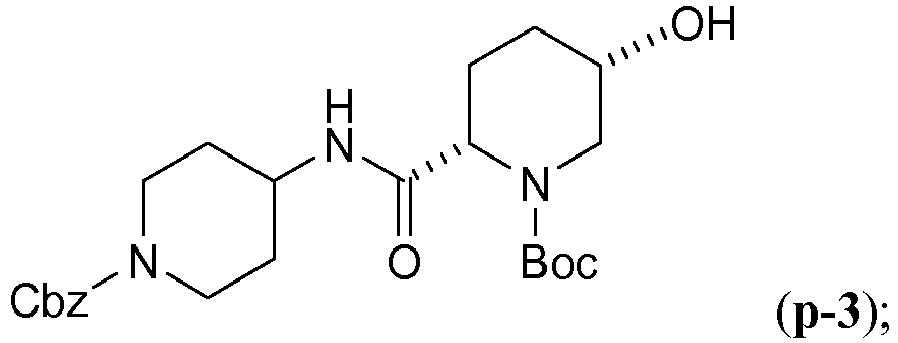
- (C) contacting Compound p-3 with a sulfonyl halide of formula R^-SO2W in the presence of a tri-C1-4 alkylamine base to obtain a compound of Formula p-4:

R^ is methyl, chloromethyl, phenyl, 4-bromophenyl, 4-trifluoromethylphenyl, or 4-methylphenyl. - Another sub-embodiment of Process P comprises Steps A, B and C as just described in the preceding sub-embodiment to obtain Compound p-4, and further comprises:
- (D) contacting Compound p-4 with N-Boc-O-benzylhydroxylamine in the presence of a a base selected from the group consisting of Li t-butoxide, Na t-butoxide, K t-butoxide and K amyloxide to obtain Compound p-5:

- (E) treating Compound p-5 with an acid selected from the group consisting of methanesulfonic acid, chloromethanesulfonic acid, p-toluenesulfonic acid and benzenesulfonic acid to obtain a compound of Formula p-6:

- Another sub-embodiment of Process P comprises Steps A, B, C, D and E as just described in the preceding sub-embodiment to obtain Compound p-6, and further comprises:
- (F) contacting Compound p-6 with triphosgene in the presence of a tri-C1-4 alkylamine base, and then adding an aqueous solution of phosphoric acid to obtain Compound p-7:

- (G) contacting Compound p-7 with hydrogen in the presence of a Pd catalyst and a Boc-producing agent selected from the group consisting of di-t-butylcarbonate and BOC-ON to obtain Compound p-8:

- The solvents, agents, catalysts, reaction amounts, reaction temperatures, etc. described above for Steps A to F in Process P leading to Compound P-VIII and its embodiments are applicable to Steps A to F set forth in the preceding sub-embodiments leading to Compound p-8, except where express limitations are placed upon one or more of these variables in the sub-embodiments. For example, the sub-embodiment of Process P describing the preparation of Compound p-2 from Compound p-1 restricts the catalyst employed in Step A to a specific group of Ir, Ru and Rh catalysts. Accordingly, the broader disclosure of suitable catalysts provided for in Process P as originally set forth above does not apply to this sub-embodiment.
- It is to be understood that the solvents, agents, catalysts, reaction amounts, reaction temperatures, etc. described above with respect to Process P and its embodiments and sub-embodiments are intended only to illustrate, not limit, the scope of the process. For example, the organic solvent employed in any of Steps A to G can be any organic substance which under the reaction conditions employed in the step of interest is in the liquid phase, is chemically inert, and will dissolve, suspend, and/or disperse the reactants and any reagents so as to bring the reactants and reagents into contact and to permit the reaction to proceed. Similar considerations apply to the choice of bases, catalysts, and other reagents employed in the process steps. Furthermore, each of the steps can be conducted at any temperature at which the reaction forming the desired product can detectably proceed. The reactants, catalysts and reagents in a given step can be employed in any amounts which result in the formation of at least some of the desired product. Of course, a high conversion (e.g., at least about 60% and preferably higher) of starting materials in combination with a high yield (e.g., at least about 50% and preferably higher) of desired products is typically the objective in each step, and the choice of solvents, agents, catalysts, reaction amounts, temperatures, etc. that can provide relatively good conversions and yields of product are preferred, and the choices that can provide optimal conversions and yields are more preferred. The particular solvents, agents, catalysts, reaction amounts, reaction temperatures, etc. described above with respect to Process P and its embodiments and sub-embodiments can provide good to optimum conversions and yields.
- The present invention also includes a compound selected from the group consisting of:


- PG is an amine protective group selected from the group consisting of carbamates and benzylamines;
- RU is CH3 or phenyl;
- RV is CH3 or phenyl;
- R4 is H or C1-4 alkyl;
- T' is H, Cl, Br, F, C1-3 alkyl, O-C1-3 alkyl, OH, NH2, N(H)-C1-3 alkyl, or N(-C1-3 alkyl)2;
- p is zero, 1 or 2; q is zero, 1, or 2; p + q = zero, 1, 2, or 3; and
- R^ is:
- (1) phenyl optionally substituted with from 1 to 3 substituents each of which is independently C1-4 alkyl, C1-4 halo alkyl, O-C1-4 alkyl, O-C1-4 halo alkyl, Cl, Br, F, or NO2;
- (2) C1-4 alkyl; or
- (3) C1-4 haloalkyl.
- The present invention also includes a compound selected from the group consisting of:


- The following examples serve only to illustrate the invention and its practice. The examples are not to be construed as limitations on the scope or spirit of the invention.
-


- Di-tert-butyl dicarbonate (0.532 mL, 2.291 mmol) was added to a solution of cis-4-hydroxy-L-proline (265 mg, 2.02 mmol) in DMF (5 mL) and aqueous sodium hydroxide (2 mL, 2 mmol). The reaction mixture was stirred at room temperature overnight. Allyl bromide (0.18 mL, 2.08 mmol) was added and the resulting mixture was stirred at room temperature overnight. The reaction mixture was diluted with ethyl acetate and washed with dilute aqueous HCl, water, saurated sodium bicarbonate and brine, dried over magnesium sulfate, filtered and concentrated under vacuum to afford the title compound as a clear oil.
- Hydrochloric acid (4.2 M solution in dioxane, 5 mL, 21 mmol) was added to a solution of 2-allyl 1-tert-butyl (2S,4S)-4-hydroxypyrrolidine-1,2-dicarboxylate (1.05 g, 4.87 mmol) in dichloromethane (20 mL). The resulting mixture was stirred at room temperature for 4 hours then concentrated under vacuum to afford the title compound.
- THF (18 mL) was added to allyl (4S)-4-hydroxy-L-prolinate - hydrochloride salt (1.011 g, 4.87 mmol). The resulting suspension was cooled to 0°C and triethylamine (3.0 mL, 21.5 mmol) was added followed by trifluoroacetic anhydride (2 mL, 14.2 mmol). The resulting mixture was stirred at 0°C for 30 minutes then water was added. The resulting solution was stirred at room temperature for 30 minutes then diluted with ethyl acetate and washed with 1N HCl solution, water, dilute sodium bicarbonate solution, dried over magnesium sulfate, filtered and concentrated under vacuum. In order to hydrolyze any trifluoroacetate ester that may have formed as a by-product, the residue was taken up in tetrahydrofuran (11.5 mL) and water (11.5 mL). The resulting cloudy solution was stirred at room temperature for 7 hours. The resulting clear solution was diluted with ethyl acetate and washed with 5% sodium bicarbonate solution and brine, then dried over magnesium sulfate, filtered concentrated under vacuum to afford crude product. The crude product was purified by silica gel chromatography to afford the title compound as a pale tan oil.
- A solution of allyl (4S)-4-hydroxy-1-(trifluoroacetyl)-L-prolinate (844 mg, 3.16 mmol) in acetonitrile (16 mL) was cooled to -10°C and 2,6-lutidine (0.62 mL, 5.32 mmol) was added followed by trifluoromethanesulfonic anhydride (0.85 mL, 5.15 mmol). After addition, the temperature was allowed to warm to 0°C. The reaction mixture was stirred at 0°C for 1 hour then O-benzylhydroxylamine (1 mL, 8.67 mmol) was added followed by 2,6-lutidine (0.62 mL, 5.32 mmol). The reaction mixture was allowed to warm to room temperature overnight. The reaction mixture was then diluted with ethyl acetate and washed with 5% sodium bicarbonate solution and brine, dried over magnesium sulfate, filtered and concentrated under vacuum. The tan oil residue (2.57 g) was chromatographed on silica gel eluted initially with 95:5 dichloromethane:ethyl acetate and finally with 80:20 dichloromethane:ethyl acetate to afford the title compound as a pale yellow solid.
- A solution of allyl (4R)-4-[(benzyloxy)amino]-1-(trifluoroacetyl)-L-prolinate (1.19 g, 3.20 mmol) in methanol (9.5 mL) was added slowly to a solution of sodium borohydride (312 mg, 8.25 mmol) in methanol (9.5 mL) at -10°C. The reaction mixture was allowed to warm to 0°C slowly then stirred at 0°C for 3 hours. Additional sodium borohydride (0.29 g, 7.67 mmol) was added at 0°C and the reaction mixture was stirred at 0°C for three hours then silica gel (to pre-absorb the crude product for chromatography) was added and the solvent removed under vacuum. The residue was chromatographed on silica gel eluted with 15:9:1 dichloromethane:ethyl acetate:methanol to afford the title compound as a colorless oil.
- A solution of allyl (4R)-4-[(benzyloxy)amino]-L-prolinate (1.2 g, 4.34 mmol) in dichloromethane (29 mL) was added to di-tert-butyl dicarbonate (1.1 mL, 4.34 mmol) and the resulting mixture was stirred at room temperature overnight. The reaction mixture was concentrated under vacuum and the residue was chromatographed on silica gel eluted with hexane then with 4:1 hexane: ethyl acetate to afford the title compound as a clear gum.
- Diphosgene (0.1 mL, 0.804 mmol) was added slowly to a solution of 2-allyl 1-tert-butyl (2S,4R)-4-[(benzyloxy)amino]pyrrolidine-1,2-dicarboxylate (261 mg, 0.745 mmol) and triethylamine (0.13 mL, 0.933 mmol) in dichloromethane (4 mL) at 0°C. The reaction mixture was stirred at 0°C for 4 hours then allowed to stand at room temperature overnight. The reaction mixture was chromatographed on silica gel eluted first with hexane then with 4:1 hexane:ethyl acetate to afford the title compound as a clear gum.
- Hydrochloric acid (4.2 M solution in dioxane, 16 mL, 70.4 mmol) was added to 2-allyl 1-tert-butyl (2S,4R)-4- {(benzyloxy)[(trichloromethoxy)carbonyl]amino}-pyrrolidine-1,2-dicarboxylate (80 mg, 1.49 mmol). The resulting mixture was stirred at room temperature overnight then the solvent was removed under vacuum. Dichloromethane (82 mL) was added to the residue followed by triethylamine (0.62 mL, 4.45 mmol). The resulting mixture was stirred at room temperature overnight then the solvent was removed under vacuum. The residue was chromatographed on silica gel (ISCO chromatography system) using a gradient from hexane for 2 minutes to 7:3 hexane:ethyl acetate over 6 minutes, hold for 3 minutes and go to 100% EtOAc over 8 minutes to afford the title compound as a clear oil.
- Sodium 2-ethylhexanoate (0.5 M in ethyl acetate, 2.5 mL, 1.25 mmol) was added to a solution of allyl (4R,6S)-3-(benzyloxy)-2-oxo-1,3-diazabicyclo[2.2.1]heptane-6-carboxylate (459 mg, 1.52 mmol), 1,1'-bis(diphenyl-phosphino)ferrocene-palladium(II)dichloride dichloromethane complex (116 mg, 0.14 mmol) in tetrahydrofuran (7.6 mL). The reaction mixture was stirred at room temperature for 2 hours (precipitate formed). Acetone (37 mL) was added. The resulting mixture was stirred at room temperature for 2 hours and the mixture was centrifuged. The solid was collected and washed with acetone and ether and dried under vacuum to afford the title compound as a tan solid. LC-MS (positive ionization) m/e 363 (M+H)
-

- To a solution of (2S,5R)-6-(phenylmethoxy)-7-oxo-1,6-diazabicyclo[3.2.1]octane-2-carboxylic acid (0.141 g, 0.509 mmol) (note: this intermediate is disclosed in
US 7,112,592 Example 32b) in dry dichloromethane (3 mL) was added 4-amino-1-BOC-piperidine (0.1532 g, 0.765 mmol), triethylamine (0.16 mL, 1.148 mmol), HOBT (0.1145 g, 0.748 mmol), and EDC (0.1455 g, 0.759 mmol) sequentially at room temperature under nitrogen. The reaction was stirred at room temperature overnight. The reaction mixture was concentrated under vacuum and the residue was purified by HPLC (30X100 mm Waters Sunfire column; 5 micron; 35 mL/minute; 210 nM; 15% to 100% CH3CN + 0.05% TFA/water + 0.05% TFA over 15 minutes; desired product elutes at 50% CH3CN + 0.05% TFA/water + 0.05% TFA) to afford the title compound. - Palladium on carbon (30.5 mg; 10% Pd/C) was added to a solution of tert-butyl 4-({[(2S,5R)-6-(benzyloxy)-7-oxo-1,6-diazabicyclo[3.2.1]oct-2-yl]carbonyl}amino)piperidine-1-carboxylate (151 mg, 0.33 mmol) in methanol (3 mL), and the resulting mixture was stirred under hydrogen (balloon) for 3 hours. TLC analysis showed the reaction was complete. The reaction mixture was filtered through a microfilter and the filtrate was concentrated under vacuum to afford the title compound as a yellow oil.
- To a solution of tert-butyl 4-({[(2S,5R)-6-hydroxy-7-oxo-1,6-diazabicyclo[3.2.1]oct-2-yl]carbonyl}amino)piperidine-1-carboxylate (36 mg, 0.098 mmol) in pyridine (0.5 mL) was added sulfur trioxide pyridine complex (70 mg, 0.440 mmol). The mixture was stirred at room temperature under nitrogen overnight. LC/MS analysis showed incomplete reaction. The reaction was filtered and the solids were washed with dry pyridine and dichloromethane. The filtrate was collected and concentrated under vacuum. The residue was redissolved in dry pyridine (0.75 mL) and sulfur trioxide pyridine complex (31 mg) was added followed by activated 4A molecular sieves. The reaction was stirred for 4 hours but there was little change by LC/MS. The reaction was filtered and the sieves were washed with dichloromethane. The filtrate was concentrated in vacuo and suspended in saturated aqueous potassium dihydrogen phosphate solution. The resulting mixture was washed with ethyl acetate. The aqueous layer was collected and tetrabutylammonium hydrogen sulfate (0.034 mg, 0.098 mmol) was added. The mixture was stirred for 10 minutes then extracted with EtOAc (4X). The organic layers were combined, dried over sodium sulfate, and concentrated in vacuo to afford the title compound as a yellow oil.
- Step 4: (2S,5R)-7-Oxo-N-piperidin-4-yl-6-(sulfooxy)-1,6-diazabicyclo[3.2.1]octane-2-carboxamide:
- To a solution of N,N,N-tributylbutan-1-aminium [({(2S,5R)-7-oxo-2-[(piperidin-4-ylamino)carbonyl]-1,6-diazabicyclo[3.2.1]oct-6-yl}oxy)sulfonyl]oxidanide (22.4 mg, 0.050 mmol) in anhydrous dichloromethane (2 mL) at 0°C under nitrogen was added trifluoroacetic acid (0.1 mL, 1.298 mmol) dropwise. The reaction mixture was stirred for 1 hour then concentrated under vacuum. Ether was added to the residue and the resulting white precipitate was collected by centrifugation. The solid was washed with ether (2X to afford the title compound contaminated with tetrabutylammonium hydrogen sulfate and pyridine. The solid was triturated with acetonitrile (2X) and the white solid was collected by centrifugation to afford the title compound as a white solid. LC-MS (negative ionization) m/e 347 (M-H); LC-MS (positive ionization) m/e 349 (M+H), 381 (M+Na); 1H NMR (600 MHz, D2O; unreferenced) (δ, ppm) 4.19 (1H, br d, J = 2.5 Hz), 3.98-4.06 (2H, m), 3.47 (2H, br d, J = 13 Hz), 3.31 (1H, br d, J = 12 Hz), 3.12 (2H, br dd, J = 13, 3 Hz), 3.06 (1H, d, J = 12 Hz), 2.04-2.21 (m, 4H), 1.87-1.95 (1H, m), 1.72-1.83 (m, 3H).
-

- To a solution of (2S,5R)-6-(phenylmethoxy)-7-oxo-1,6-diazabicyclo[3.2.1]octane-2-carboxylic acid (1.484 g, 5.37 mmol) in dry dichloromethane (60 ml) was added triethylamine (1.88 ml, 13.49 mmol), 2-chloro-1-methylpyridinium iodide (1.60 g, 6.26 mmol), and 4-amino-1-BOC-piperidine (1.30 g, 6.49 mmol) sequentially at room temperature under nitrogen. The reaction was then heated to 50°C for 1 hour. The reaction mixture was concentrated under vacuum and purified by silica gel chromatography on an Isco Combiflash (40 g silica gel, 40 mL/min, 254 nM, 15% to 100% EtOAc/hexane over 14 column volumes then 100% EtOAc for 4 column volumes; title compuond eluted at 65% ethyl acetate/hexane) to afford the title compound as a pale orange solid.
- Palladium on carbon (394 mg; 10% Pd/C) was added to a solution of the product of step 1 (1.81 g, 3.95 mmol) in methanol (50.6 mL) and the resulting mixture was stirred under hydrogen (balloon) overnight. LC/MS analysis indicated the reaction was not complete. Acetic acid (6 drops) and additional catalyst (159 mg of 10% Pd/C) were added to the reaction and the resulting mixture was stirred under hydrogen (balloon) for an additional 90 minutes. Additional catalyst (0.2085 g of 10% Pd/C) was added to the reaction and stirring under hydrogen was continued for an additional 2.5 hours at which time the reaction was judged complete by LC-MS analysis. The reaction was filtered through a celite pad and the collected solid was washed well wtih MeOH. The filtrate was concentrated under vacuum to afford the title compound as a colorless oil which was used without purification in the next step.
- To a solution of the product of step 2 (1.455 g, 3.95 mmol; theoretical yield of step 2) in dry pyridine (30 mL) was added sulfur trioxide pyridine complex (3.2 g, 20.11 mmol) at room temperature under nitrogen. The resulting thick mixture was stirred over the weekend. The reaction was filtered and the white insoluble solids were washed well with dichloromethane. The filtrate was concentrated in vacuo. The residue was further azeotroped with toluene to remove excess pyridine to afford the title compound which was used without purification in the next step.
- To a mixture of the product of step 3 (1.772 g, 3.95 mmol; theoretical yield of step 3) in dry dichloromethane (30 ml) at 0°C under nitrogen was slowly added trifluoroacetic acid (6.1 ml, 79 mmol). Immediately the reaction became a solution. After 1 hour, additional trifluoroacetic acid (8 ml) was added to the reaction. The reaction was stirred at 0°C until judged complete by LC-MS analysis then concentrated in vacuo. The residue was triturated with ether (3X) to remove excess TFA and organic impurities. The resulting white insoluble solid was collected via centrifugation, dried in vacuo, then purified by preparative HPLC (250X21.2 mm Phenomenex Synergi Polar-RP 80A column; 10 micron; 35 mL/min.; 210 nM; 0% to 30% methanol/water over 15 minutes; title compound eluted at 10% methanol/water). Fractions containing the title compound were combined and lyophilized overnight to afford the title compound as a white solid. LC-MS (negative ionization mode) m/e 347 (M-H).
-

- 4-(N-BOC amino) piperidine (17 kg, 84.88 mol) was dissolved in DCM (90 kg), triethylamine (10.14 kg, 100.16 mol) was added, and the resulting solution was cooled to 0-5°C. Benzyl chloroformate (16.51 kg, 96.76 mol) was added over 45 minutes while keeping the temperature at < 25°C, after which the solution was aged for 30 minutes at 20°C. 2 M HCl (61 kg, 118.13 mol) was then added over 10 minutes while keeping the temperature at <25°C. The mixture was agitated for 10 minutes and then the agitation was stopped and the phases were allowed to separate.. The phases were then separated from each other, and the organic phase was distilled in vacuo to a volume of 35 L. Isopropyl acetate (89 kg) was then added, and the batch was concentrated by vacuum distillation at less than 35°C to a volume of ~ 50 L to crystallize the title product. Heptane (47 kg) was then added over 10 minutes, and the resulting slurry cooled to and aged at 20°C for 20 minutes, after which the aged slurry was filtered, washed with heptane (17 kg), and dried by N2 sweep on the filter to give the title product as a white solid (24.7 kg, 87 %). 1H NMR (CDCl3) 7.33 (5H, m), 5.13 (2H, s), 4.47 (1H, m), 4.11 (2 H, m), 3.61 (1 H, m), 2.93 (2H, m), 1.94 (2H, m), 1.45 (9H, s) and 1.30 (2H. m).
-

- 4-(N-BOC amino)-CBz piperidine (24.4 kg 73.42 mol), THF (65 kg) and 5 M HCl (23.0 kg, 110.13 mol) were combined and heated to 30 -35 °C for -2 hours, and then at 55°C overnight. After cooling the reaction mixture to 10°C, dichloromethane (97 kg) and 10M NaOH (7.97 kg, 145.12 mol) were added, while keeping the temperature at < 25°C. The phases were separated and the organic phase was washed with 25 wt % NaCl solution (27.5 kg). The washed organic phase was distilled at atmospheric pressure to a volume of 70 L. Dichloromethane (162 kg) was then added, and the mixture was concentrated by distillation to a volume of 120L to give the title product as a solution in DCM (17.2 kg. 100%.). 1H NMR (CDCl3) 7.33 (5H, m), 5.14 (2H, s), 4.14 (2 H, br s), 2.87 (3H, m), 1.83 (2H, m), 1.66 (3H, m) and 1.28 (2H, m).
-

- 2-Hydroxypyridine-N-oxide (811 g, 7.3 mol), L-pyroglutamic acid (9.43 kg, 73 mol), benzyl 4-aminopiperidine-1-carboxylate (17.1 kg in dichloromethane, volume 120 L, 73 mol) and dichloromethane (80 kg) were mixed together and aged at 20°C for 10 minutes to form a thick slurry. 1-(3-Dimethylaminopropyl)-3-ethylcarbodiimide hydrochloride (16.8 kg, 87.6 mol) was added in portions to the slurry, while keeping temperature at <30°C. The slurry was then aged at 25°C for 30 minutes, after which 1M hydrochloric acid (94 kg, 85.5 mol) was added. The phases were left to settle overnight and then separated, and the organic phase was then washed with 2M sodium carbonate (109 kg) and then solvent switched to acetonitrile, final volume 50L. Toluene (88.2 kg) was added and the batch cooled to 0 °C. Di-tert-butyl dicarbonate (18.32 kg, 83.95 mol) and 4-dimethylaminopyridine (223 g, 1.83 mol) were added to the batch and the solution was warmed to 25 °C and aged overnight. The batch was then concentrated by distillation to a volume of 80 L. Additional toluene (88.2 kg) was added and the batch further concentrated to 50 L. Isopropyl acetate (30 kg) was added and the resulting slurry was aged for 10 minutes. Heptane (70 kg) was then added dropwise to the slurry over 30 minutes, and the slurry was aged for 30 minutes then filtered, washed with isopropyl acetate/heptane (22.5 kg/17.4 kg), and then dried in vacuo at 55°C to afford the title product as a white solid (27.5 kg, 95.5 wt %, 82 %). 1HNMR(CDCl3) 7.33 (5H, m), 6.19 (1H, m), 5.13 (2H, s), 4.48 (1H, dd), 4.15 (2H, m), 3.97 (1H, m), 2.95 (2H, m), 2.73 (1H, d tr), 4.65 (1H, m), 2.61 (1H, m), 2.18 (2H, m), 1.45 (9H, s) and 1.30 (2H. m).
-

- Potassium tert-butoxide (9.58 kg, 85.38 mol) was added in three portions to a solution of trimethyl sulfoxonium iodide (18.79 kg, 85.38 mol) in DMF (115 kg) at 15-25°C. The suspension was aged at 20-25°C for one hour, followed by addition of the starting material benzyl 4-{[1-(tert-butoxycarbonyl)-5-oxo-L-prolyl]amino}piperidine-1-carboxylate (27.17 kg, 60.99 mol) in four portions over 30 minutes, then aged for 30 minutes at 20 °C. Water (54 kg) and seed material (10 g) were added (note: crystallization will occur without the use of seed, but the use of seed is preferred as it typically provides a more consistent product and a better yield), and the suspension was aged at 20 °C for 30 minutess. 10% NaCl solution (543 kg) was added over 1 hour while keeping the temperature at below 25 °C. The slurry was then cooled to 3°C over 1 hour and aged overnight at 3°C, after which the slurry was filtered, washed three times with water (136 L, 82 L, 82 L), and dried under vacuum at 55°C, to afford the title product as a yellow solid (32.8 kg, 83 %). 1H NMR (CDCl3) 7.49 (1H, br s), 7.33 (5H, m), 5.83 (1H, br s), 5.13 (2H, s), 4.48 (1H, s), 4.08 (3H, m), 3.96 (1H, m), 3.45 (3H, s), 3.41 (3H, s), 3.03 (2H, m), 2.41 (1H, m), 2.24 (1H, m), 1.94 (4H, m), 1.68 (5H, s) and 1.44 (12H, s).
-

- Iridium cyclooctadiene chloride dimer (336.3 g, 0.502 mol) in toluene (318 kg) was deoxygenated by degassing using 3 vacuum degas cycles followed by subsurface sparging with nitrogen for 30 minutes, after which the solution was warmed to 105 °C. A solution of the ylide starting material (27.0 kg, 50.22 mol) in DMF (128 kg) at 25 °C was deoxygenated by degassing using 3 vacuum degas cycles followed by subsurface sparging with nitrogen for 30 minutes. The degassed solution was then added to the hot catalyst solution over 30 minutes, while keeping temperature of the reaction mixture above 102°C. The reaction mixture was aged at 105 °C for 40 minutes, and then cooled to 20°C. The organic reaction mixture was washed twice with 5 wt % lithium chloride solution (81 L x 2) then with water (81 L). The organic and aqueous phases were separated, and then toluene was removed from the organic phase by distillation in vacuo to a volume of 130 L and the distilled phase stored refrigerated then used directly in the next step.
-

- Lithium borohydride solution (22.2 kg of 4.1 M solution in THF, 101.9 mol) was diluted with THF (290 kg), after which methanol (3.26 kg) was added at 20°C and the solution aged for 30 minutes before cooling to -4°C. A solution of the ketone in toluene (46.8 kg in - 4 mL/g solution in toluene, 101.9 mol) was added to the aged borohydride solution while maintaining the reaction temperature at < 0 °C. The reaction was quenched with a solution of acetic acid (30.6 kg, 509.5 mol, dissolved in 183 kg methanol), while keeping the temperature at < 20°C. The quenched reaction mixture was then aged at 20°C for 1 hour, after which it was concentrated in vacuo to a volume of 184 L. Methanol (203 kg) was added, and the batch distilled in vacuo to a volume of 184 L. Isopropanol (294 kg) was added and the batch was distilled in vacuo to a volume of 184 L, keeping the internal temperature at ~30 °C. Seed (5 g) was added (note: crystallization will occur without the use of seed, but the use of seed is preferred as it typically provides a more consistent product and a better yield), and the batch was aged for 1 hour to form a seedbed. Water (560 kg) was then added over -60 minutes, followed by the addition of isopropanol (111 kg). The slurry was filtered, washed three times with MTBE (30 kg, 35 kg, 5 kg), and then dried in vacuo at 55°C to provide the title product (26.74 kg, 57 % yield from ylide). 1H NMR (CDCl3) 7.33 (5H, m), 6.17 (1H, br s), 5.13 (2H, s), 4.61 (1H, m), 4.11 (3H, m), 3.94 (1H, m), 3.64 (1H, m), 2.98 (2H, m), 2.59 (1H, dd), 2.33 (1H, m), 1.94 (4H, m), 1.71 (1H, m), 1.63 (2H, m), 1.48 (9H, s) and 1.35 (2H, m).
-

- The alcohol starting material (26.6 kg, 57.7 mol) was dissolved in dichloromethane (120 kg) and passed through a cartridge of activated carbon. N, N-dimethylaminopyridine (1.06 kg, 8.66 mol) and TEA (11.1 kg,109.63 mol) were added to the alcohol solution, followed by the addition of 4-trifluoromethylbenzenesulfonyl chloride (18.0 kg, 73.6 mol) as a solution in dichloromethane (30 kg) over 20 minutes at a temperature of < 25°C. The batch was then aged for 3 hours, after which water (110 kg) was added, while keeping temperature < 25°C. The phases were separated and the organic phase was washed twice with water (80 kg x 2), then with aqueous HCl (15 L of 37wt% concentrated.HCl in water (80 kg)). The organic layer was diluted with dichloromethane (75 kg) and distilled in vacuo to 72 L. MTBE (157 kg) was then added and the batch was distilled in vacuo to 170 L to crystallize the product. The slurry was aged for 1 hour and then heptane (58 kg) was added over a period of ~20 minutes and the slurry was aged at 20°C for 18 hours. The aged slurry was then filtered, washed with heptane (20 kg) and MTBE (40 kg) and dried on the filter using a stream of nitrogen for 24 hours to give the title product (38.3 kg, 98%). 1H NMR (CDCl3) 8.20 (2H, d), 7.85 (2H, d), 7.33 (5H, m), 6.09 (1H, br s), 5.13 (2H. s), 4.59 (1H, m), 4.46 (1H, m), 4.10 (3H, m), 3.91 (1H, m), 2.96 (2H, m), 2.75 (1H, m), 2.33 (1H, m), 1.58 (1H, m), 1.48 (9H, s) and 1.35 (2H, m).
-

- N-Boc-O-benzylhydroxylamine (8.65 g, 38.7 mmol, as a solution in DMAC volume 38 mL) was added to a solution of potassium tert-butoxide (4.35 g, 38.7 mmol) in DMAC (80 mL), while maintaining the temperature between 18°C and 25°C. The solution was aged for 30 minutes after which time it became a slurry. The sulfonate starting material (20 g, 29.9 mmol) dissolved in DMAC (40 mL) was added to the slurry over 15 minutes at 20°C, and the resulting mixture was heated to 40°C for 3.5 hours and then left at 20°C overnight. Water (350 mL) was added to the mixture while maintaining the temperature at < 30°C. DCM (350 mL) was then added, and the phases separated. The organic phase was washed three times with water (350 mL x 3). The washed organic phase was then distilled under atmospheric pressure to a volume of 90 mL, after which methanesulfonic acid (10 mL) was added and the solution heated to 35-40 °C for 8 hours. The solution was then cooled to 20°C and 2N NaOH (200 mL) added, followed by addition of DCM (90 mL). The phases were separated, and the organic phase was washed with water (90 mL), and then solvent switched at atmospheric pressure to acetonitrile, volume 50mL. p-Toluenesulfonic acid (4 g, 1 equiv. based on product assay) was added as a solution in acetonitrile (40mL) at 40°C to crystallize the product. MTBE (45 mL) was then added and the slurry was cooled 20°C, aged at 20°C for 1 hour, and then filtered to give the title product as a mono-tosylate crystalline salt (9.8 g, 53 %). 1H NMR (CDCl3) 7.75 (1H, br s), 7.59 (2H, d), 7.36 (5H, m), 7.20 (3H, m), 7.14 (2H, d), 6.98 (2H, d), 5.30 (1H, m), 5.10 (2H, m), 4.37 (2H, s), 3.88 (3H, m), 3.61 (2H, m), 3.23 (2H, m), 2.22 (3H, s), 1.65 (1H, m), 1.26 (5H, m) and 1.21 (3H, m).
-

- Benzyl 4-[({(2S,5R)-5-[(benzyloxy)amino]piperidin-2-yl}carbonyl)amino]piperidine-1-carboxylate in the form of a tosylate salt (8.1 kg, 12.68 mol) was slurried in dichloromethane (108 kg), after which 5 wt % NaHCO3 (42 kg, 25.36 mol) was added and the resulting biphasic mixture was stirred vigorously for 30 minutes. The phases were separated, and the organic phase was washed with water (40.5 kg). The organic phase was then distilled at atmospheric pressure to - 20 L, followed by the addition of DCM (108 kg). DIPEA (5.25 kg, 40.58 mol) was then added and the batch cooled to 0-5°C. Triphosgene (3.01 kg, 10.14 mol) was added in four portions, while keeping the temperature at <10°C. After 30 minutes, a dilute phosphoric acid solution (4.97 kg 85 wt % phosphoric acid in 32 kg water) was added, and the batch aged at 20°C overnight. The phases were separated and the organic phase was washed with 5 wt % NaHCO3 (26 kg) and water (25 kg). The organic phase was then distilled at atmospheric pressure to 30 L. Ethanol (77 kg) was then added, followed by the addition of seed (10 g). (Note: Crystallization will occur without the use of seed, but the use of seed is preferred as it typically provides a more consistent product and a better yield.) The slurry was distilled in vacuo to a volume of 33 L, then heptane (55 kg) was added dropwise. The slurry was then cooled to 0°C, filtered, washed with 3:1 heptane:ethanol (30 L), and dried on the filter under nitrogen stream to give the title product (5.90 kg, 94 %). 1H NMR (CDCl3) 7.35 (10 H, m), 6.57 (1H, d), 5.14 (2H, s), 5.07 (1H, d), 4.92 (1H, d), 4.13 (2H, m), 3.95 (1H, m), 3.89 (1H, d), 3.31 (1H, s), 2.99 (3H, m), 2.65 (1H, d), 2.38 (1H, m), 1.94 (4H, m), 1.62 (2H, m) and 1.34 (2H, m).
-

- Benzyl 4-({[(2R,5S)-6-(benzyloxy)-7-oxo-1,6-diazabicyclo[3.2.1]oct-2-yl]carbonyl}amino)piperidine-1-carboxylate starting material (1.9 kg @ 97 wt %) and Boc2O (0.776 kg) were charged to a glass bottle, and the solids were dissolved in THF (15 L). The solution was then charged to a hydrogenation reactor along with Pd(OH)2 (184.3 g) and another portion of THF (10.8 L). The reaction was carried out at 45 psig H2, 23 °C for 5 hours. After the reaction was complete as determined by HPLC analysis, the solution was filtered through solka flok to remove the catalyst and the filter cake was washed with THF. The filtrate and washes were then solvent switched by vacuum distillation to EtOAc to a volume of 10 L. Approximately 30 L EtOAc was used during the solvent switch and the THF level after a constant volume distillation (10 L at a maximum temperature of 20°C) was determined by proton NMR to be - 4 mol % THF:EtOAc. The resulting EtOAc slurry was aged at room temperature for 1 hour, after which hexanes (4 L) was added over 1 hour at room temperature. The slurry was aged for an additional 1 hour after which the supernatant concentration was measured (target: - 6 mg/g). The solids were then filtered and washed with 60 % EtOAc/hexanes solution (3 x 3 L) and dried under vacuum and N2 at room temperature to afford the title product (80% isolated yield). 1H NMR (400 MHz, CDCl3): 8.60 (br s, 1H), 6.67 (d, J = 8.2 Hz, 1H), 4.12 - 4.00 (m, 2H), 4.00-3.91 (m, 1H), 3.89(d,J=7.8Hz,1H), 3.81-3.76(m,1H), 3.19(dt,J=11.2, 2.9 Hz, 1 H), 2.90(t, J= 11.9 Hz, 2H) 2.82 (d, J= 11.3 Hz, 1H), 2.45 (dd, J= 15.0, 6.7 Hz, 1H), 2.21-2.11 (m, 1H), 2.02-1.85 (m, 3H), 1.80-1.69 (m, 1H), 1.48 (s, 9H), 1.44-1.30 (m, 2H)
-

- tert-Butyl 4-({[(2S,5R)-6-hydroxy-7-oxo-1,6-diazabicyclo[3.2.1]oct-2-yl]carbonyl}amino)piperidine-1-carboxylate, (3.0 kg), THF (30 L), 2-picoline (1.61 L) and pyridine-SO3 complex (4.54 kg) were charged to a flask under nitrogen. No exotherm was observed. The heterogeneous mixture was allowed to stir overnight (~15 h). DCM (8 L) was then added and the mixture was concentrated by vacuum distillation, removing ~30 L of THF/DCM. Additional DCM (28 L) was added, followed by the addition of water (20 L). The flask was placed in an ice bath and K2HPO4 (2.20 kg) was added over 4 minutes, followed by a water rinse (1 L). Bu4NHSO4 (2.90 kg) was then added over 10 minutes followed by additional water (4 L). The biphasic mixture was stirred for 30 minutes, after which the bottom organic layer was transferred to a 100-L extractor via an in-line filter. The aqueous layer remaining in the flask was rinsed with additional DCM (2 x 4 L), and then also transferred to the extractor. A small amount of aqueous layer (∼2 L) had also been transferred, and the two layers were separated. The organic layer was returned to the extractor and washed with water (1 x 6 L); pH was 4.5. The organic layer was separated and charged to a new flask via an in-line filter. The mixture was solvent-switched to 2,2,2-trifluoroethanol by vacuum distillation (34 L final volume) and used as is in the next step. Water content by Karl-Fisher titration was 1900 ppm.
- In a smaller-scale experiment using the same procedure, evaporation of the solvent gave a solid from which 1H NMR data were collected. 1H NMR (400 MHz, CDCl3): 6.65 (d, J = 8.4 Hz, 1H), 4.37-4.32 (m, 1H), 4.18-4.00 (m, 2H), 4.00-3.89 (m,1H), 3.87(d, J= 7.7 Hz, 1H), 3.36-3.27 (m, 9H), 2.95-2.79 (m, 2H), 2.75(d, J= 11.4 Hz, 1H), 2.42(dd, J= 15.0, 6.9 Hz, 1H) 2.24-2.11(m, 2H), 1.96-1.81 (m, 3H), 1.74-1.60 (m, 8H), 1.47(s, 9H), 1.46 (m, 8H), 1.39 (m, 2H),1.01 (t, J=7.3, 12H)
-

- The solution of Bu4N+-OSO3 salt in TFE (34 L) was used as received from the prior step with an assumed yield of 100%. The reaction mixture was cooled in an ice bath, and HBF4·Et2O (1.57 L) was added via addition funnel over 11 minutes between 18°C and 22°C. The resulting white slurry was allowed to stir overnight (12 hours). TFE (~15 L) was removed by vacuum distillation. DCM (15 L) was then added. To a 100-L extractor was charged pyrogen-free water (35 L) and NaHCO3 (274 g), and the solution was cooled to 13°C. The reaction mixture was transferred by vacuum into the extractor with temperature of 11-13°C. The reaction flask was rinsed with additional DCM (5 L) and the suspension also transferred to the extractor. The reaction mixture was warmed to 18.5 °C and de-pyrogenated water (12 L) was added to solubilize all the solids. The final pH was 4.5. The organic layer was separated, and the aqueous layer was washed with DCM (2 x 16 L). Assay of the aqueous layer showed 2.38 kg (83.8 %)
- The aqueous layer was charged to a clean flask. The solution was concentrated by vacuum distillation followed by azeotropic distillation with IPA. At this time, 1H NMR analysis of the IPA:H2O ratio indicated the presence of 13.4 L of water and 24.6 L of IPA. IPA (22 L) was added. The white crystalline solid was filtered and washed with 7:1 IPA:de-pyrogenated water (16 L) and dried under vacuum and nitrogen at room temperature to afford the title product in the form of a crystalline channel hydrate, 1.5 wt% water. (Yield = 1.715 kg, 57.4% over Steps 11 and 12). 1H NMR (400 MHz, DMSO-d6 ): 8.3 (br s, 2H), 8.21(d, J= 7.8 Hz, 1H), 4.01(s, 1H), 3.97-3.85 (m, 1H), 3.75 (d, J = 6.5 Hz, 1H) 3.28(dd, J = 12.9, 2.5 Hz, 2H) 3.05-2.93(m, 4H), 2.08-1.97(m, 1H), 1.95-1.79(m, 3H), 1.75-1.59(m, 4H)
- Amorphous (2S,5R)-7-oxo-N-piperidin-4-yl-6-(sulfooxy)-1,6-diazabicyclo[3.2.1]octane-2-carboxamide (1 g) and deionized water (5 mL) were added to a glass vial, and the resulting slurry was stirred at room temperature until XRPD monitoring (see Part B) indicated that conversion to a different form was complete. The crystalline solid was then collected by gravity filtration and dried at room temperature.
- The crystalline slurry can alternatively be isolated by evaporative removal which, because the crystalline hydrate is soluble in water (about 55 g/mL at room temperature), can result in a higher yield.
- Drying can dehydrate the crystals, and thus drying methods employing vacuums and/or high temperatures should generally not be used. Controlling the relative humidity of the drying environment can minimize or avoid dehydration. For example, the crystals can be dried using a nitrogen steam with a controlled moisture content (e.g., in a range of from about 40% to about 70% relative humidity) to avoid dehydration.
- The crystalline hydrate can also be obtained by slurrying in a mixture of isopropyl alcohol and water and using any of the isolation procedures set forth above. The ratio of isopropyl alcohol to water is suitably about 7:1 by volume.
- An XRPD pattern of a crystalline monohydrate prepared in accordance with the method described in Part A was generated on a Philips Panalytical X'Pert Pro X-ray powder diffractometer with a PW3040/60 console using a continuous scan from 4 to 40 degrees 2Θ. Copper K-Alpha 1 (Kα1) and K-Alpha 2 (Kα2) radiation was used as the source. The experiment was conducted with the sample at room temperature and open to the atmosphere. The XRPD pattern is shown in
Figure 1 . 2Θ values and the corresponding d-spacings in the XRPD pattern include the following:Table 1 - XRPD of crystalline monohydrate Peak No. d-spacing (Å) 2 Theta 1 6.5 13.5 2 5.7 15.5 3 5.6 15.6 4 5.1 17.4 5 4.7 18.7 6 4.5 19.7 7 4.4 20.4 8 4.1 21.7 9 3.8 22.6 10 3.7 24.0 11 3.6 24.3 12 3.4 25.9 13 3.3 26.3 14 3.3 26.6 15 3.2 27.0 16 3.2 27.5 17 3.0 29.3 18 2.9 30.0 19 2.8 31.3 20 2.7 32.4 21 2.7 32.9 22 2.6 33.1 23 2.6 34.0 24 2.5 34.7 25 2.5 35.5 26 2.3 38.9 - Crystalline monohydrate prepared in accordance with the method described in Part A was analyzed with a TA Instruments DSC Q 1000 differential scanning calorimeter (DSC) at a heating rate of 10°C/minute from 25°C to 350°C in an open aluminum pan in a nitrogen atmosphere. The DSC curve (see
Figure 2 ) exhibited an endotherm due to water loss with an onset temperature of 22.5°C and enthalpy change of 186 J/g. Decomposition is observed above 270°C. - A thermogravimetric analysis (TGA) of crystalline monohydrate prepared in accordance with the method described in Part A was performed with a TA Instruments TGA Q 500 under nitrogen at a heating rate of 10°C/minute from 25°C to 300°C. The TGA showed a weight loss of 4.9 wt.% up to 100°C followed by decomposition above 270°C. The 4.9 wt.% loss corresponds to the loss of 1 mole of water per mole of the compound which is consistent with a monohydrate.
-


- To a solution of (2S,5R)-6-(phenylmethoxy)-7-oxo-1,6-diazabicyclo[3.2.1]octane-2-carboxylic acid (51.7 mg, 0.187 mmol) in dry dichloromethane (2 mL) was added a solution of tert-butyl (4S)-4-aminoazepane-1-carboxylate (69 mg, 0.275 mmol), triethylamine (0.090 mL, 0.646 mmol), HOBT (42.5 mg, 0.278 mmol), and EDC (54.7 mg, 0.285 mmol) sequentially at room temperature under nitrogen. The reaction was stirred at room temperature overnight. The reaction mixture was concentrated under vacuum and the residue was purified by HPLC on a 30X100 mm Waters Sunfire column eluted with 15% to 100% CH3CN + 0.05% TFA/water + 0.05% TFA over 15 minutes to afford the title compound as a white solid after lyophilization.
- Palladium on carbon (11.8 mg; 10% Pd/C) was added to a solution of tert-butyl (4S)-4-({[(2S,5R)-6-(benzyloxy)-7-oxo-1,6-diazabicyclo[3.2.1]oct-2-yl]carbonyl}amino)azepane-1-carboxylate (49.7 mg, 0.33 mmol) in methanol (1.5 mL) and the resulting mixture was stirred under hydrogen (balloon) for 3 hours. TLC analysis showed the reaction was complete. The reaction mixture was filtered through a microfilter and the filtrate was concentrated under vacuum to afford the impure title compound as a white foam (44.8 mg) which was used without purification in the next step.
- To a solution of impure tert-butyl (4S)-4-({[(2S,5R)-6-hydroxy-7-oxo-1,6-diazabicyclo[3.2.1]oct-2-yl]carbonyl}amino)azepane-1-carboxylate (40.2 mg, 0.105 mmol) in pyridine (1 mL) was added sulfur trioxide pyridine complex (42.1 mg, 0.265 mmol). The mixture was stirred at room temperature under nitrogen overnight. LC/MS analysis showed incomplete reaction.). Additional pyridine was added followed by additional sulfur trioxide pyridine complex (40 mg). The resulting mixture was stirred at room temperature for five hours. The reaction was filtered and the solids were washed with dichloromethane. The filtrate was concentrated in vacuo and suspended in saturated aqueous potassium dihydrogenphosphate solution. The resulting mixture was extracted with ethyl acetate. The aqueous layer was collected and tetrabutylammonium hydrogen sulfate (0.036 mg, 0.105 mmol) was added. The mixture was stirred for 10 minutes then extracted with EtOAc (4X). The organic layers were combined, dried over sodium sulfate, and concentrated in vacuo to afford the title compound as a colorless oil.
- To a solution of N,N,N-tributylbutan-1-aminium {[((2S,5R)-2-{[(4S)-azepan-4-ylamino]carbonyl}-7-oxo-1,6-diazabicyclo[3.2.1]oct-6-yl)oxy]sulfonyl}oxidanide (30.9 mg, 0.067 mmol) in anhydrous dichloromethane (7 mL) at 0°C under nitrogen was added trifluoroacetic acid (0.5 mL, 6.5 mmol) dropwise. The reaction mixture was stirred for two hours then concentrated under vacuum. Ether was added to the residue and the resulting white precipitate was collected by centrifugation. The precipitate was purified by HPLC on a Phenomenex Synergy Polar-RP 80A column and lyophilized to afford the title compound as a white solid. LC-MS (negative ionization) m/e 361 (M-H); LC-MS (positive ionization) m/e 385 (M+Na); 1H NMR (600 MHz, D2O; unreferenced) (δ, ppm) 4.17 (1H, br d, J = 3 Hz), 3.96-4.03 (2H, m), 3.27-3.38 (3H, m), 3.15-3.22 (2H, m), 3.02 (1H, d, J = 12 Hz), 1.62-2.18 (m, 12H).
-

- By substituting tert-butyl (4R)-4-aminoazepane-1-carboxylate for tert-butyl (4S)-4-aminoazepane-1-carboxylate in the procedure of Example 2, the title compound can be prepared.
-

- To a solution of (2S,SR)-6-(phenylmethoxy)-7-oxo-1,6-diazabicyclo[3.2.1]octane-2-carboxylic acid (53 mg, 0.192 mmol) in dry dichloromethane (2 mL) was added a solution of tert-butyl (3R)-3-aminopyrrolidine-1-carboxylate (55 mg, 0.288 mmol), triethylamine (0.061 mL, 0.441 mmol), HOBT (44.1 mg, 0.288 mmol), and EDC (55.2 mg, 0.288 mmol) sequentially at room temperature under nitrogen. The reaction was stirred at room temperature for six hours. The reaction mixture was concentrated under vacuum and the residue was purified by HPLC on a 30 x 100 mm Waters Sunfire column eluted with 15% to 100% CH3CN + 0.05% TFA/water + 0.05% TFA over 15 minutes to afford the title compound.
- Palladium on carbon (9.18 mg; 10% Pd/C) was added to a solution of tert-butyl (3R)-3-({[(2S,5R)-6-(benzyloxy)-7-oxo-1,6-diazabicyclo[3.2.1]oct-2-yl]carbonyl}amino)pyrrolidine-1-carboxylate (38 mg, 0.085 mmol) in methanol (2 mL) and the resulting mixture was stirred under hydrogen (balloon) for 3 hours. TLC analysis showed the reaction was complete. The reaction mixture was filtered through a microfilter and the filtrate was concentrated under vacuum to afford the impure title compound as an oil.
- To a solution oftert-butyl (3R)-3-({[(2S,5R)-6-hydroxy-7-oxo-1,6-diazabicyclo[3.2.1]oct-2-yl]carbonyl}amino)pyrrolidine-1-carboxylate (30 mg, 0.085 mmol) in pyridine (1 mL) was added sulfur trioxide pyridine complex (53.9 mg, 0.339 mmol) and 4A molecular sieves. The mixture was stirred at room temperature under nitrogen overnight. LC/MS analysis showed incomplete reaction. The reaction mixture was filtered and the filtrate was concentrated under vacuum. The residue was chromatographed on HPLC to recover unreacted starting material which was resubjected to the reaction conditions. The combined product was suspended in saturated aqueous potassium dihydrogenphosphate solution. The resulting mixture was washed with ethyl acetate. The aqueous layer was collected and tetrabutylammonium hydrogen sulfate was added. The mixture was stirred for 10 minutes then extracted with EtOAc (4X). The organic layers were combined, dried over sodium sulfate, and concentrated in vacuo to afford the title compound as a colorless oil.
- To a solution of N,N-dibutylbutan-1-aminium ({[(2S,5R)-2-({[(3R)-1-(tert-butoxycarbonyl)pyrrolidin-3-yl]amino}carbonyl)-7-oxo-1,6-diazabicyclo[3.2.1]oct-6-yl]oxy}sulfonyl)oxidanide (2 mg, 0.046 mmol) in anhydrous dichloromethane (0.5 mL) at 0°C under nitrogen was added trifluoroacetic acid (0.525 mL, 0.046 mmol) dropwise. The reaction mixture was stirred for two hours then concentrated under vacuum. Ether was added to the residue and the resulting white precipitate was collected by centrifugation. The purified by HPLC on a Phenomenex Synergy Polar-RP 80A column and lyophilized to afford the title compound as a white solid. LC-MS (negative ionization) m/e 333 (M-H); LC-MS (positive ionization) m/e 336 (M+H); 1H NMR (600 MHz, D2O; unreferenced) (δ, ppm) 4.50-4.54 (1H, m), 4.20 (1H, dd, J = 3, 6 Hz), 4.03 (1H, br d, H = 7 Hz), 3.54 (1H, dd, J = 7, 13 Hz), 3.40-3.48 (1H, m), 3.30-3.35 (2H, m), 3.24 (1H, dd, J = 5, 13 Hz), 3.07 (1H, d, J = 12 Hz), 2.31-2.37 (1H, m), 2.15-2.20 (1H, m), 2.00-2.10 (2H, m), 1.88-1.98 (1H, m), 1.76-1.84 (1H, m).
-

- By substituting tert-butyl 5-aminoazocane-1-carboxylate for 4-amino-1-BOC-piperidine in the procedure of Example 1, the title compound can be prepared.
-

- To a solution of (2S,5R)-6-(phenylmethoxy)-7-oxo-1,6-diazabicyclo[3.2.1]octane-2-carboxylic acid (51.5 mg, 0.186 mmol) in dry dichloromethane (5 mL) was added triethylamine (0.065 mL, 0.466 mmol), 2-chloro-1-methylpyridinium iodide (63.4 mg, 0.248 mmol), and 4-aminopyridine (19.2 mg, 0.204 mmol) sequentially at room temperature under nitrogen. The reaction was then heated to 50°C for 1.5 hours. LC/MS showed reaction complete. The reaction mixture was concentrated and purified by HPLC on a 30 x 100 mm Waters Sunfire column to afford the title compound as an orange solid after lyophilization.
- Palladium on carbon (13.2 mg; 10% Pd/C) was added to a solution of (2S,5R)-6-(benzyloxy)-7-oxo-N-pyridin-4-yl-1,6-diazabicyclo[3.2.1]octane-2-carboxamide (52.7 mg, 0.15 mmol; combined product of two runs) in methanol (1.5 mL) and the resulting mixture was stirred under hydrogen (balloon) for 5 hours. TLC and HPLC analysis showed a small amount of starting material remaining. Additional catalyst (5.6 mg) was added and the resulting mixture was stirred under hydrogen (balloon) for an additional 1 hour. The reaction mixture was filtered through a microfilter and the filtrate was concentrated under vacuum to afford the title compound as a colorless oil.
- To a solution of (2S,5R)-6-hydroxy-7-oxo-N-pyridin-4-yl-1,6-diazabicyclo[3.2.1]octane-2-carboxamide (9.2 mg, 0.035 mmol) in dry pyridine (0.5 mL) was added dried 4A molecular sieves and sulfur trioxide pyridine complex (22 mg, 0.138 mmol) at room temperature under nitrogen. The mixture was stirred for four hours. The reaction mixture was filtered and the solids washed with dichloromethane, acetonitrile, and methanol. The filtrate was concentrated under vacuum and the residue was triturated with ethyl acetate. The residue was dried under vacuum, dissolved in saturated sodium dihydrogen phosphate and purified by HPLC on a Phenomenex Synergi Polar-RP 80A column to afford the title compound as a white solid after lyophilization. LC-MS (negative ionization) m/e 341 (M-H); LC-MS (positive ionization) m/e 343 (M+H); 1H NMR (600 MHz, D2O; unreferenced) (δ, ppm) 8.57 (2H, br s), 8.15 (2H, br s), 4.27 (1H, br d, J = 7 Hz), 4.20 (1H, br s), 3.33 (1H, d, J = 12 Hz), 3.10 (1H, d, J = 12 Hz), 2.28-2.32 (1H, m), 2.08-2.11 (1H, m), 1.93-1.98 (1H, m), 1.83-1.88 (1H, m).
-

- To a solution of (2S,5R)-6-(phenylmethoxy)-7-oxo-1,6-diazabicyclo[3.2.1]octane-2-carboxylic acid (38.9 mg, 0.141 mmol) in dry dichloromethane (2 mL) was added triethylamine (0.049 mL, 0.352 mmol), 2-chloro-1-methylpyridinium iodide (53.3 mg, 0.209 mmol), and 2-methoxy-4-aminopyridine (20.2 mg, 0.163 mmol) sequentially at room temperature under nitrogen. The reaction was then heated to 50°C for 1.5 hours. LC/MS showed reaction complete. The reaction mixture was concentrated and purified by HPLC on a 30 x 100 mm Waters Sunfire column to afford the title compound as an orange solid after lyophilization.
- Palladium on carbon (13.4 mg; 10% Pd/C) was added to a solution of (2S,5R)-6-(benzyloxy)-N-(2-methoxypyridin-4-yl)-7-oxo-1,6-diazabicyclo[3.2.1]octane-2-carboxamide (43.6 mg, 0.114 mmol) in methanol (1 mL) and the resulting mixture was stirred under hydrogen (balloon) overnight. HPLC analysis showed reaction complete. The reaction mixture was filtered through a microfilter and the filtrate was concentrated under vacuum to afford the title compound as an impure colorless oil.
- To a solution of (2S,5R)-6-hydroxy-N-(2-methoxypyridin-4-yl)-7-oxo-1,6-diazabicyclo[3.2.1]octane-2-carboxamide (33 mg, 0.114 mmol) in dry pyridine (1 mL) was added sulfur trioxide pyridine complex (111 mg, 0.696 mmol) at room temperature under nitrogen. The mixture was stirred for four hours. The reaction mixture was filtered and the solids washed with dichloromethane, acetonitrile, and methanol. The filtrate was concentrated under vacuum and the residue was triturated with ethyl acetate then dried under vacuum, dissolved in saturated sodium dihydrogen phosphate and purified by HPLC on a Phenomenex Synergi Polar-RP 80A column to give a white solid which was further purified on a Waters Sunfire column to give a white solid which was further purified by HPLC on a Phenomenex Synergi Polar-RP 80A column to afford the title compound as a white solid after lyophilization. LC-MS (negative ionization) m/e 371 (M-H); LC-MS (positive ionization) m/e 373 (M+H); 1H NMR (600 MHz, D2O; unreferenced) (δ, ppm) 8.10 (1H, br d, J = 6 Hz), 7.59 (1H, s), 7.41 (1H, d, J = 6 Hz), 4.26 (1H, br d, J = 7 Hz), 4.23 (1H, br s), 4.07 (3H, s), 3.36 (1H, d, J = 12 Hz), 3.12 (1H, d, J = 12 Hz), 2.29-2.33 (1H, m), 2.10-2.14 (1H, m), 1.93-1.99 (1H, m), 1.84-1.90 (1H, m).
-

- To a solution of (2S,5R)-6-(phenylmethoxy)-7-oxo-1,6-diazabicyclo[3.2.1]octane-2-carboxylic acid (37.3 mg, 0.135 mmol) in dry dichloromethane (2.5 mL) was added triethylamine (0.047 mL, 0.338 mmol), 2-chloro-1-methylpyridinium iodide (38.3 mg, 0.15 mmol), and 2-dimethylamino-4-aminopyridine (21.7 mg, 0.158 mmol) sequentially at room temperature under nitrogen. The reaction was then heated to 50°C for 1.5 hours. LC/MS showed reaction complete. The reaction mixture was concentrated and purified by HPLC on a 30X100 mm Waters Sunfire column to afford the title compound as an off-white solid after lyophilization.
- Palladium on carbon (10.4 mg; 10% Pd/C) was added to a solution of (2S,5R)-6-(benzyloxy)-N-[2-(dimethylamino)pyridin-4-yl]-7-oxo-1,6-diazabicyclo[3.2.1]octane-2-carboxamide (47.8 mg, 0.121 mmol) in methanol (2 mL) and the resulting mixture was stirred under hydrogen (balloon) overnight. HPLC analysis showed reaction complete. The reaction mixture was filtered through a microfilter and the filtrate was concentrated under vacuum to afford the title compound as a colorless oil which was used in the next step without further purification.
- To a solution of (2S,5R)-N-[2-(dimethylamino)pyridin-4-yl]-6-hydroxy-7-oxo-1,6-diazabicyclo[3.2.1]octane-2-carboxamide (37 mg, 0.121 mmol) in drypyridine (1.5 mL) was added sulfur trioxide pyridine complex (92 mg, 0.578 mmol) at room temperature under nitrogen. The mixture was stirred for seven hours. NMR analysis of an aliquot showed incomplete reaction. Additional pyridine (2 mL) and sulfur trioxide pyridine complex (60 mg) were added and the resulting mixture was stirred at room temperature under nitrogen. The reaction mixture was concentrated under vacuum and the residue was purified by HPLC on a Phenomenex Synergi Polar-RP 80A column to give impure product which was further purified on a Waters Sunfire column to afford the title compound as a white solid after lyophilization. LC-MS (negative ionization) m/e 384 (M-H); LC-MS (positive ionization) m/e 386 (M+H); 1H NMR (600 MHz, D2O; unreferenced) (δ, ppm) 7.77 (1H, br d, J = 6 Hz), 7.41 (1H, s), 6.94 (1H, d, J = 6 Hz), 4.23 (2H, br s), 3.36 (1H, d, J = 12 Hz), 3.18 (6H, s), 3.11 (1H, d, J = 12 Hz), 2.29-2.32 (1H, m), 2.10-2.14 (1H, m), 1.93-1.99 (1H, m), 1.84-1.90 (1H, m).
-


- To a solution of (2S,5R)-6-(phenylmethoxy)-7-oxo-1,6-diazabicyclo[3.2.1]octane-2-carboxylic acid (29.9 mg, 0.108 mmol) in dry dichloromethane (3 mL) was added triethylamine (0.038 mL, 0.271 mmol), 2-chloro-1-methylpyridinium iodide (41.0 mg, 0.160 mmol), and 4-(N-BOC-aminomethyl)aniline (30.6 mg, 0.138 mmol) sequentially at room temperature under nitrogen. The reaction was then heated to 60°C for 2 hours. LC/MS showed no starting material remaining. The reaction mixture was concentrated and purified by HPLC on a Waters Sunfire column to afford the title compound.
- Palladium on carbon (7.8 mg; 10% Pd/C) was added to a solution of the product of step 1 (35 mg, 0.073 mmol) in methanol (2 mL), and the resulting mixture was stirred under hydrogen (balloon) overnight. LC-MS analysis showed the reaction was complete. The reaction mixture was filtered through a microfilter and the filtrate was concentrated under vacuum which was azeotroped from toluene to afford the title compound as a white solid.
- To a solution of the product of step 2 (28.9 mg, 0.074 mmol) in dry pyridine (1 mL) was added sulfur trioxide pyridine complex (60.3 mg, 0.379 mmol) at room temperature under nitrogen. The mixture was stirred at room temperature overnight. LC-MS analysis showed reaction approximately 50% complete. Additional sulfur trioxide pyridine complex (64.4 mg) was added to the reaction mixture and stirring continued at room temperature. After 7 hours, LC-MS analysis showed mostly product. The reaction mixture was filtered and the insoluble solids were washed well with dichloromethane. The filtrate was concentrated under vacuum and the residue was azeotroped with toluene to remove excess pyridine. The crude title compound thus obtained was used without further purification in the next reaction.
- To a mixture of the product of step 3 (34.8 mg, 0.074 mmol) in dry dichloromethane (3 mL) at 0°C under nitrogen was added trifluoroacetic acid (1.0 mL, 13 mmol). All solids dissolved immediately upon addition of trifluoroacetic acid, the solution was stirred for 1.5 ours at which time LC-MS analysis showed reaction complete. The reaction was concentrated under vacuum and the residue was triturated with ether to remove excess trifluoroacetic acid and organic impurities. The resulting sticky solid was dried under vacuum and stored in the freezer overnight. The crude product was purified by HPLC on a Phenomenex Synergi Polar-RP 80A column to afford the impure title compound as a white solid after lyophilization. The solid was triturated with acetonitrile (3X) to afford the pure title compound as a white solid. LC-MS (negative ionization) m/e 369 (M-H); LC-MS (positive ionization) m/e 354 (M+H-NH3); 1H NMR (600 MHz, D2O; unreferenced) (δ, ppm) 7.53 (2H, d, J = 8.5 Hz), 7.46 (2H, d, J = 8.5 Hz), 4.23 (2H, br s), 4.11 (2H, s), 3.39 (1H, d, J = 12 Hz), 3.18 (1H, d, J = 12 Hz), 2.27-2.31 (1H, m), 2.09-2.14 (1H, m), 1.90-2.00 (1H, m), 1.813-1.89 (1H, m).
-

- A solution phenyl chlorothionocarbonate (1.25 eq.) in dichloromethane is added to a solution of pyridine (1.25 eq.), 4-dimethylaminopyridine (0.1 eq.) and tert-butyl 4-({[(2S,5R)-6-hydroxy-7-oxo-1,6-diazabicyclo[3.2.1]oct-2-yl]carbonyl}amino)piperidine-1-carboxylate (see Example 1, Step 2) in dichloromethane. The resulting mixture is stirred at room temperature overnight then cooled in an ice bath and quenched by addition of water. The layers are separated and the aqueous layer is extracted with dichloromethane. The combined organic layers are dried over sodium sulfate, filtered, and concentrated under vacuum. The residue is purified by silica gel chromatography to afford the title compound.
- AIBN (0.1 eq.) is added to a solution of tert-butyl 4-[({(2S,5R)-7-oxo-6-[(phenoxycarbonothioyl)oxy]-1,6-diazabicyclo[3.2.1]oct-2-yl}carbonyl)amino]piperidine-1-carboxylate in dry benzene and the resulting mixture is heated to reflux. A solution of tributyltin hydride (1.25 eq.) in benzene is added over a period of one hour and the resulting mixture is refluxed for an additional 3 hours. The reaction mixture is concentrated under vacuum and the residue is purified by silica gel chromatography to afford the title compound.
- The product of
step 2 is sulfated according to the procedure of Step 3 of Example 1 to afford the title compound. - (2S,5R)-2-({[1-(tert-Butoxycarbonyl)piperidin-4-yl]amino}carbonyl)-7-oxo-1,6-diazabicyclo[3.2.1]octane-6-sulfonic acid is deprotected according to the procedure of Step 4 of Example 1 to afford the title compound.
-


- By substituting (4R,6S)-3-(benzyloxy)-2-oxo-1,3-diazabicyclo[2.2.1]heptane-6-carboxylic acid for (2S,5R)-6-(phenylmethoxy)-7-oxo-1,6-diazabicyclo[3.2.1]octane-2-carboxylic acid in the procedure of Example 1, the title compound can be prepared.
-
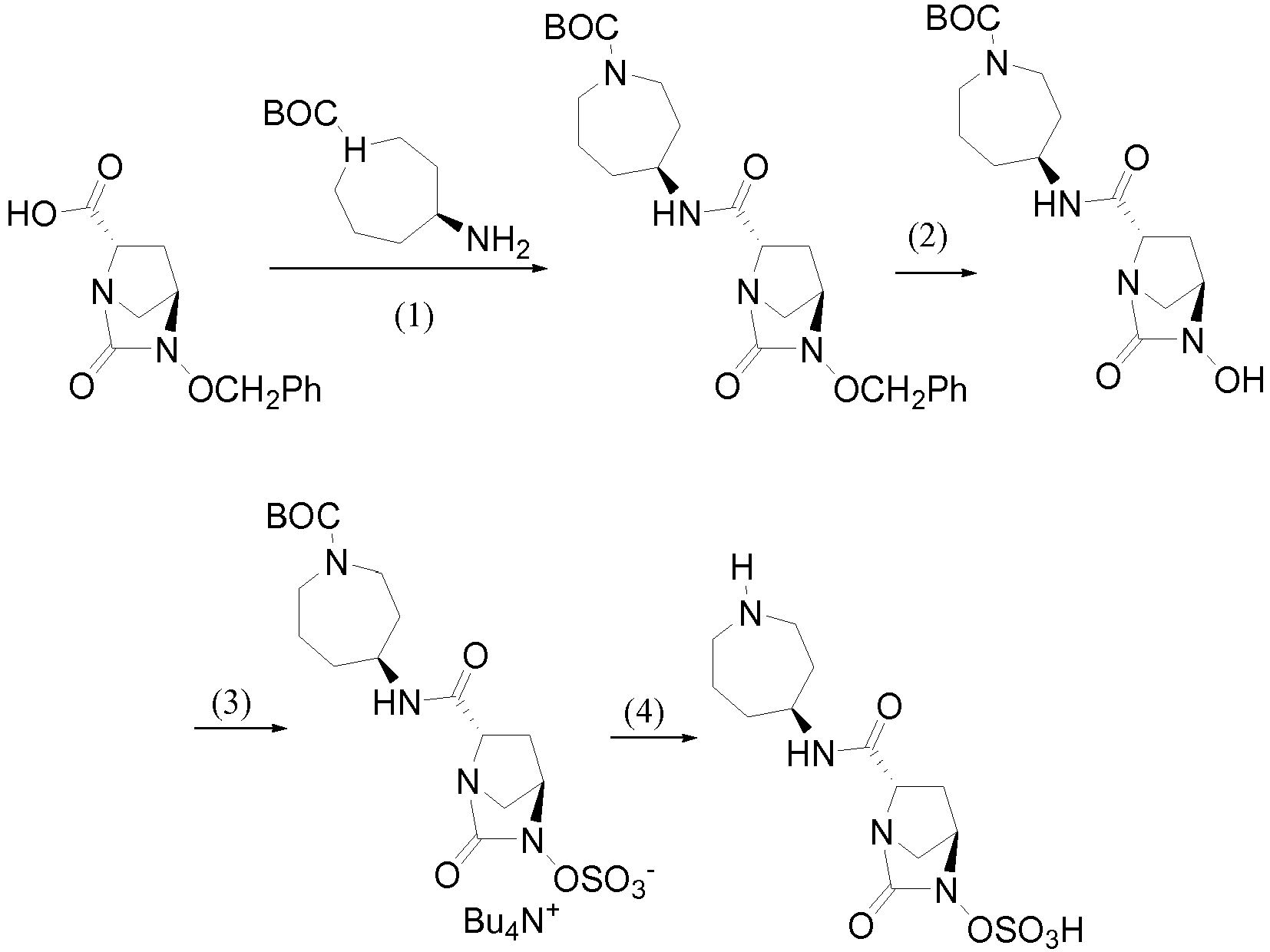
- By substituting (4R,6S)-3-(benzyloxy)-2-oxo-1,3-diazabicyclo[2.2.1]heptane-6-carboxylic acid for (2S,5R)-6-(phenylmethoxy)-7-oxo-1,6-diazabicyclo[3.2.1]octane-2-carboxylic acid in the procedure of Example 2, the title compound can be prepared.
-

- By substituting (4R,6S)-3-(benzyloxy)-2-oxo-1,3-diazabicyclo[2.2.1]heptane-6-carboxylic acid for (2S,5R)-6-(phenylmethoxy)-7-oxo-1,6-diazabicyclo[3.2.1]octane-2-carboxylic acid in the procedure of Example 6, the title compound can be prepared.
-

- To a solution of (2S,5R)-6-(phenylmethoxy)-7-oxo-1,6-diazabicyclo[3.2.1]octane-2-carboxylic acid (1 g, 3.62 mmol) in dry dichloromethane (30 mL) was added dimethylaminopyridine (884 mgL, 7.24 mmol), EDC (1.388 g, 7.24 mmol), and tert-butyl (3S)-3-aminopyrrolidine-1-carboxylate (742 mg, 3.98 mmol) sequentially at room temperature under nitrogen. The reaction mixture was stirred at room temperature over the weekend. The reaction mixture was then concentrated under vacuum and the residue was purified by HPLC on a 30x100 mm Waters Sunfire column eluted with 15% to 100% CH3CN + 0.05% TFA / water + 0.05% TFA over 15 minutes to afford the title compound as a white solid.
- Palladium on carbon (335 mg; 10% Pd/C) was added to a solution of the product of Step 1 (1.4 g, 3.15 mmol) in methanol (30 mL) and the resulting mixture was stirred under hydrogen (balloon) for 1 hour. LC-MS analysis showed the reaction was complete. The reaction mixture was filtered and the filtrate was concentrated under vacuum to afford the title compound as an oil which was used without purification in the next step.
- To a solution of the product of Step 2 (1.11 g, 3.15 mmol, theoretical yield of Step 2) in pyridine (10 mL) was added sulfur trioxide pyridine complex (2.51 g, 15.75 mmol). The mixture was stirred at room temperature under nitrogen overnight. Dichloromethane was added and the mixture was filtered. The collected solid was washed with dichloromethane (4X) and the combined filtrates were concentrated under vacuum. The residue was used without purification in the next step.
- To a solution of the product of Step 3 (1.37 g, 3.15 mmol, theoretical yield of step 3) in anhydrous dichloromethane (5 mL) at 0°C under nitrogen was added TFA (2 mL, 26 mmol) dropwise. The reaction mixture was stirred for two hours then concentrated under vacuum. Ether was added to the residue and the resulting white precipitate was collected by centrifugation (ether trituration repeated two more times). The resulting solid was purified by HPLC on a Phenomenex Synergy Polar-RP 80A column eluted with methanol/water and lyophilized to afford the title compound as a white solid. LC-MS (negative ionization mode) m/e 333 (M-H). LC-MS (positive ionization) m/e 335 (M+H), 357 (M+Na); 1H NMR (600 MHz, D2O; unreferenced) (δ, ppm) 4.51 (1H, m), 4.16 (1H, br d, J = 2.6 Hz), 3.99 (1H, d, J = 7 Hz), 3.54 (1H, dd, J = 7, 13 Hz), 3.40-3.50 (1H, m), 3.30-3.40 (1H, m), 3.20-3.30 (2H, m), 3.02 (1H, d, J = 12 Hz), 2.30-2.40 (1H, m), 2.10-2.20 (1H, m), 2.00-2.10 (2H, m), 1.83-1.93 (1H, m), 1.72-1.80 (1H, m).
-
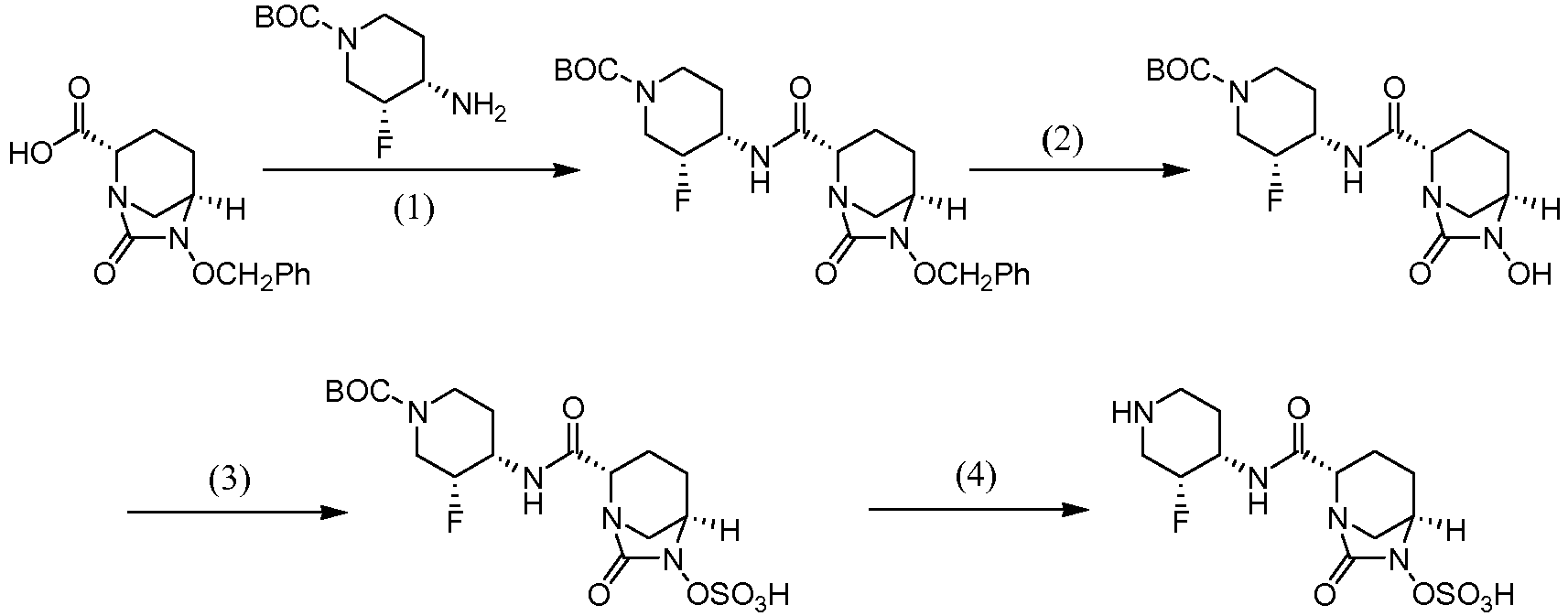
- To a solution of (2S,5R)-6-(phenylmethoxy)-7-oxo-1,6-diazabicyclo[3.2.1]octane-2-carboxylic acid (2.108 g, 7.63 mmol) in anhydrous dimethylformamide (15 mL) was added BOP (4.05 g, 9.15 mmol) and the resulting mixture was stirred at room temperature under nitrogen for 5 minutes. Diisopropyl ethyl amine (2.66 mL, 15.26 mmol) was then added followed by a solution oftert-butyl (3R,4S)-4-amino-3-fluoropiperidine-1-carboxylate (1.665 g, 7.63 mmol) in 20 mL of dichloromethane. The resulting solution was stirred at room temperature under nitrogen for 2 hours then concentrated under vacuum and the residue partitioned between ethyl acetate and water. The aqueous layer was washed twice with ethyl acetate. The organic layer was washed with brine, dried over sodium sulfate, and concentrated under vacuum. The residue was purified via silica gel flash chromatography (Isco Combiflash apparatus - 120 g silica gel, 80 mL/min, 254 nM, 0% to 100% EtOAc/hexane over 6 column volumes then 100% EtOAc for 9 column volumes; title compound eluted at 100% EtOAc). Fractions containing pure title compound were collected and concentrated in vacuo to give a tan solid. Fractions containing impure product were also collected and repurified by HPLC (30X100 mm Sunfire column, 5 microns, 35 mL/min, 10% to 100% CH3CN + 0.1% TFA / water + 0.1% TFA over 15 min.; title compound eluted at 70% CH3CN + 0.1% TFA). Fractions containing pure product were combined and concentrated in vacuo. The resulting aqueous residue was then extracted with ethyl acetate. The organic layer was collected and dried over magnesium sulfate. Concentration in vacuo gave a white solid which was combined with the material isolated from silica gel chromatography to afford the title compound.
- To a solution of the product of Step 1 (3.0175 g, 6.33 mmol) in methanol (80 mL) and ethyl acetate (20 mL), was added 10% palladium on carbon (0.73 g, 6.86 mmol) and the reaction mixture was stirred under an atmosphere of hydrogen (balloon) overnight. LC/MS analysis showed reaction was complete. The reaction mixture was filtered through a microfilter and the collected solid was washed well with methanol. The filtrate was concentrated under vacuum and azeotroped with toluene to afford the title compound as a yellow foam which was used directly in the next step without purification
- To a solution of the product of Step 2 (2.59 g, 6.7 mmol, theoretical yield of Step 2) in pyridine (30 mL) was added sulfur trioxide pyridine complex (5.40 g, 34 mmol). The mixture was stirred at room temperature under nitrogen for 3 hours then additional sulfur trioxide pyridine complex (5.40 g, 34 mmol) was added and the reaction mixture was stirred at room temperature overnight. Dichloromethane was then added and the mixture was filtered. The collected solid was washed thoroughly with dichloromethane and the combined filtrates were concentrated under vacuum to afford the crude title compound. The residue was used without purification in the next step.
- To a solution of the product of Step 3 (3.13 g, 6.7 mmol, theoretical yield of Step 3) in anhydrous dichloromethane (50 mL) at 0°C under nitrogen was added trifluoroacetic acid (10 mL, 130 mmol) dropwise. The reaction mixture was allowed to warm to room temperature then stirred for two hours. Additional trifluoroacetic acid (6 mL, 78 mmol) was added and the reaction mixture was stirred at room temperature for an additional 3 hours then concentrated under vacuum. Ether was added to the residue and the resulting white precipitate was collected by centrifugation (ether trituration repeated two more times). The resulting solid was purified by HPLC on a Phenomenex Synergy Polar-RP 80A column eluted with methanol/water and lyophilized to afford the title compound as a cream colored solid which contained ~6% pyridine by NMR. This impure product was triturated and sonicated twice with acetonitrile (solid isolated by centrifugation) to afford the title compound as a white solid. LC-MS (negative ionization mode) m/e 365 (M-H).
-
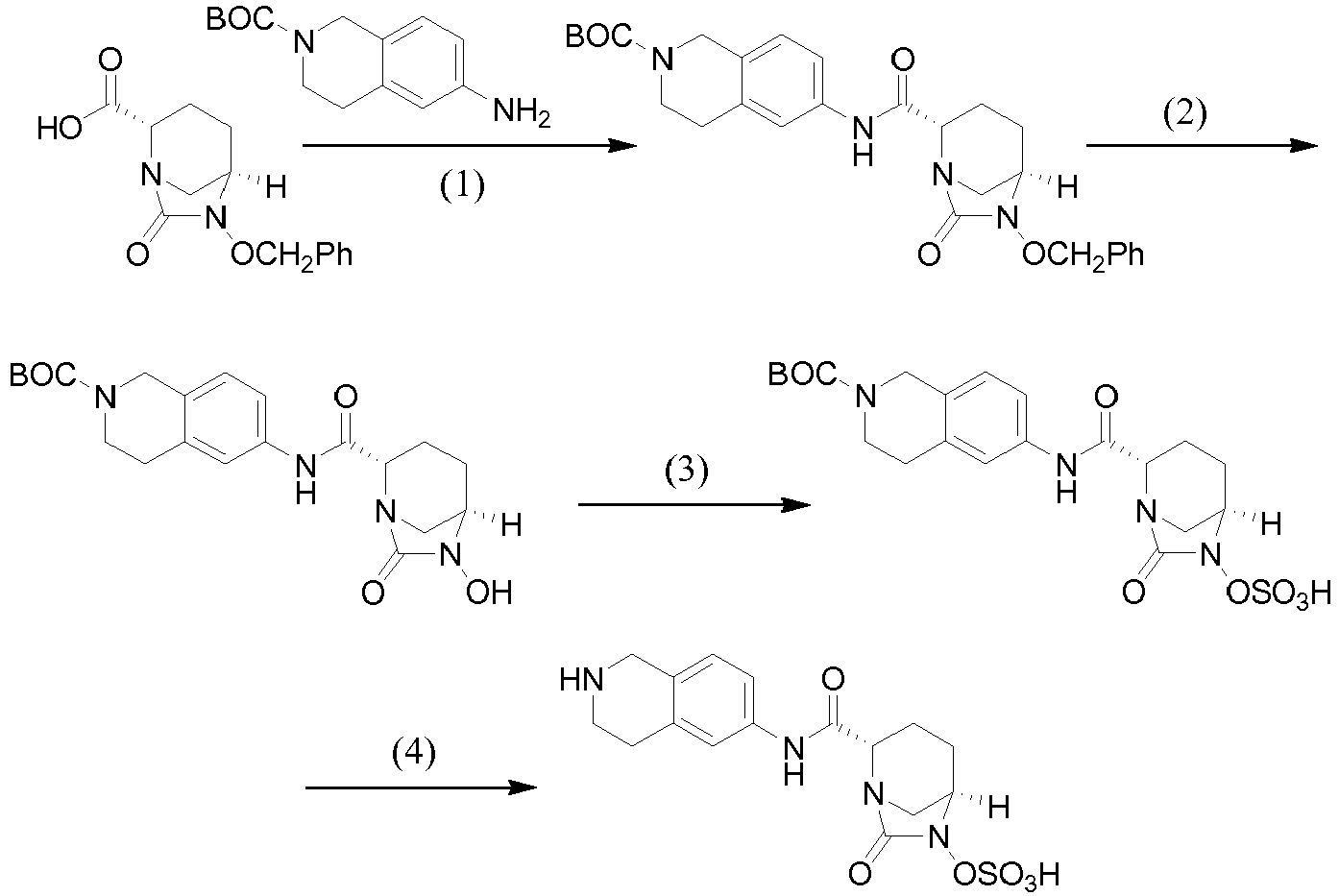
- To a solution of (2S,5R)-6-(phenylmethoxy)-7-oxo-1,6-diazabicyclo[3.2.1]octane-2-carboxylic acid (53.3 mg, 0.193 mmol) in dry dichloromethane (2 mL) was added triethylamine (0.067 mL, 0.482 mmol), 2-chloro-1-methylpyridinium iodide (58.7 mg, 0.230 mmol), and 6-amino-2-N-BOC-1,2,3,4-tetrahydro-isoquinoline (54.8 mg, 0.221 mmol) sequentially at room temperature under nitrogen. The reaction mixture was then heated to 50°C for 45 minutes then the reaction product was concentrated in vacuo. Attempts to dissolve the reaction product in eluant (2:1:1 CH3CN/DMSO/water) for HPLC were unsuccessful, so it was partitioned between aqueous layer and dichloromethane. The organic layer was collected, dried over sodium sulfate, concentrated in vacuo and set aside for separate purfication. The aqueous layer was also collected and purified by HPLC (30X100 mm Waters Sunfire column; 5 micron; 35 mL/min.; 210 nM; 15% to 100% CH3CN + 0.05% TFA / water + 0.05% TFA over 15 minutes; the title compound eluted at 80% CH3CN + 0.05% TFA / water + 0.05% TFA). Fractions containing the title compound were lyophilized overnight to afford the title compound as a white sticky solid. The organic layer from partitioning the crude product was purified by preparative TLC (1000 micron silica gel plate eluted with 50% ethyl acetate/hexane) to afford the title compound. Both batches of the title compound were combined and used without further purification in the next step.
- To a solution of the product of Step 1 (79.6 mg, 0.157 mmol) in methanol (4 mL) and ethyl acetate (2 mL), was added 10% palladium on carbon (18 mg) and the reaction mixture was stirred under an atmosphere of hydrogen (balloon) overnight. LC/MS analysis showed the reaction was not quite complete so an additional 10% palladium on carbon (10 mg) was added and the reaction mixture was stirred under an atmosphere of hydrogen (balloon) for an additional 6 hours. The reaction mixture was filtered through a microfilter and the collected solid was washed well with methanol. The filtrate was concentrated under vacuum and azeotroped with toluene to afford the title compound as a light brown oil which was used directly in the next step without purification
- To a solution of the product of Step 2 (64.6 mg, 0.155 mmol) in pyridine (1.5 mL) was added sulfur trioxide pyridine complex (129.5 mg, 0.814 mmol). The mixture was stirred at room temperature under nitrogen over the weekend. Dichloromethane was then added and the mixture was filtered. The collected solid was washed thoroughly with dichloromethane and the combined filtrates were concentrated under vacuum to afford the crude title compound. The residue was used without purification in the next step.
- To a solution of the product of Step 3 (77 mg, 0.155 mmol, theoretical yield of Step 3) in anhydrous dichloromethane (3 mL) at 0°C under nitrogen was added trifluoroacetic acid (1 mL, 13 mmol) dropwise. The reaction mixture was stirred for one hour then concentrated under vacuum. Ether was added to the residue and the resulting white precipitate was collected by centrifugation (ether trituration repeated two more times). The resulting solid was purified by HPLC on a Phenomenex Synergy Polar-RP 80A column eluted with methanol/water and lyophilized to afford the title compound as a white solid. LC-MS (negative ionization mode) m/e 395 (M-H).
-

- To a solution of (2S,5R)-6-(phenylmethoxy)-7-oxo-1,6-diazabicyclo[3.2.1]octane-2-carboxylic acid (0.400 g, 1.448 mmol) in dry dichloromethane (17.66 mL) was added triethylamine (0.504 ml, 3.62 mmol), 2-chloro-1-methylpyridinium iodide (0.433 g, 1.694 mmol), and 2-amino-5-bromopyridine (0.311 g, 1.795 mmol) sequentially at room temperature under nitrogen. The reaction mixture was heated to 50°C for 1 hour then purified on the mass directed HPLC (30x100 mm Waters Sunfire column; 5 micron; 50 ml/min; acetonitrile/water with 0.1% TFA over 15 min). Fractions containing the title compound were concentrated under vacuum then lyophilized overnight to afford the title compound as a yellow solid.
- tert-Butyl-4-(4,4,5,5-tetramethyl-1,3,2-dioxaborolan-2-yl)-3,6-dihydropyridine-1(2H)-carboxylate (215 mg, 0.696 mmol) was added to the product of Step 1 (150 mg, 0.348 mmol) in a reaction vial then bis(triphenylphosphine)palladium(II) dichloride (24 mg, 0.035 mmol) was added followed by 1M aqueous sodium carbonate (0.869 mL, 0.869 mmol) and acetonitrile (0.899 mL). The reaction mixture was degassed then placed briefly in a preheated 70°C oil bath then cooled to room temperature and filtered. The filtrate was concentrated under vacuum and the residue was purified by column chromatography on silica gel eluted with ethyl acetate/hexane (0-50% over 1500 mL then 50-100% over 750 mL) to afford the title compound as a yellow oil.
- To a mixture of the product of Step 2 (50 mg, 0.094 mmol) in ethyl acetate (6 ml) was added 10% palladium on carbon (9.97 mg). The reaction mixture was stirred under an atmosphere of hydrogen (balloon) overnight then filtered. The filtrate was concentrated under vacuum to afford the title compound as a colorless oil which was used without purification in the next step.
- To a solution of the product of Step 3 (30 mg, 0.067 mmol) in dry pyridine (1.5 ml) was added pyridine sulfur trioxide (53.6 mg, 0.337 mmol) at room temperature, in the dark, under nitrogen. The reaction mixture was stirred over the weekend then filtered (collected solid was washed well with dichloromethane). The filtrate was concentrated under vacuum to afford the title compound as a colorless oil which was used without purification in the next step.
- To a solution of the product of Step 4 (35 mg, 0.067 mmol; theoretical yield of step 4) in dry dichloromethane (3 mL) was added trifluoroacetic acid (0.00513 mL, 0.067 mmol) at 0°C under nitrogen. The reaction mixture was stirred for 30 minutes then concentrated under vacuum. The residue was triturated with ether to remove excess trifluoroacetic acid and organic-soluble impurities. The resulting solid was dried, dissolved in water, and purified by prep HPLC on a Phenomenex Synergy Polar-RP 80A column eluted with methanol/water and lyophilized to afford the title compound. LC-MS (negative ionization mode) m/e 424 (M-H).
-

- N-(3-dimethylaminopropyl)-N'-ethylcarbodiimide hydrochloride (109 mg, 0.57 mmol) and 4-dimethylaminopyridine (69.6 mg, 0.57 mmol) were added sequentially to a solution of (2S,5R)-6-(phenylmethoxy)-7-oxo-1,6-diazabicyclo[3.2.1]octane-2-carboxylic acid (105 mg, 0.38 mmol) in dry dichloromethane at room temperature. tert-Butyl 4-(hydroxymethyl)piperidine-1-carboxylate (123 mg, 0.57 mmol) was then added and the reaction mixture was stirred at room temperature overnight, and then concentrated under vacuum. The residue was purified by preparative HPLC to afford the title compound.
- To a mixture of the product of Step 1 (100 mg, 0.211 mmol) in methanol was added 10% palladium on carbon (6.74 mg). The reaction mixture was stirred under an atmosphere of hydrogen (balloon) overnight then filtered. The filtrate was concentrated under vacuum to afford the title compound which was used without purification in the next step.
- To a solution of the product of Step 2 (50 mg, 0.13 mmol) in dry pyridine (1 mL) was added pyridine sulfur trioxide (104 mg, 0.652 mmol) at room temperature under nitrogen. The reaction mixture was stirred overnight then filtered (collected solid was washed well with dichloromethane). The filtrate was concentrated under vacuum to afford the title compound which was used without purification in the next step.
- TFA was added to the product of Step 3 at 0°C under nitrogen. The reaction mixture was stirred for 1 hour then concentrated under vacuum. The residue was triturated with ether to remove excess trifluoroacetic acid and organic-soluble impurities. The resulting solid was dried, dissolved in water, and purified by preparative HPLC on a Phenomenex Synergy Polar-RP 80A column eluted with methanol/water and lyophilized to afford the title compound. LC-MS (negative ionization mode) m/e 362 (M-H).
- The procedure set forth in Example 1A was used to prepare the following compounds, wherein the indicated amine starting material was substituted for 4-amino-1-BOC-piperidine in Step 1.
Example Amine Product 19A & 19B 
Isoated diastereomers (Diastereomer 1 and Diastereomer 2) of: 
[The diastereomers eluted from an HPLC column (Phenomenex Synergi Polar RP80A 250x21.2 mm 10micron column gradient eluted 35 mL/min with 0% to 40% methanol/water over 15 minutes; detecting at 210 nM). The first diastereomer (Diastereomer 1) eluted at 15% methanol/water, and the second diastereomer (Diastereomer 2) eluted at 18% methanol/water. The absolute stereochemistry of the two diastereomers has not been determined. One of the diastereomers is (2S,5R)-7-oxo-N-[(3R)-piperidin-3-yl]-6-(sulfooxy)-1,6-diaza-bicyclo[3.2.1]octane-2-carboxamide and the other is the corresponding (3S)-isomer.] 20 

(2S,5R)-7-oxo-N-azetidin-3-yl-6-(sulfooxy)-1,6-diaza-bicyclo [3.2.1]octane-2-carboxamide 21 

(2S,5R)-7-oxo-N-[(3R)-pyrrolidin-3-yl]-6-(sulfooxy)-1,6-diaza-bicyclo[3.2.1]octane-2-carboxamide 22 

(2S,5R)-7-oxo-N-[(4R)-azepan-4-yl]-6-(sulfooxy)-1,6-diaza-bicyclo [3.2.1]octane-2-carboxamide 23 

(2S,5R)-7-oxo-N-[1-methylpiperidin-4-yl]-6-(sulfooxy)-1,6-diaza-bicyclo[3.2.1]octane-2-carboxamide 24 

Mixture of (2S,5R)-7-oxo-N-[(3S,4S)-3-fluoropiperidin-4-yl]-6-(sulfooxy)-1,6-diaza-bicyclo[3.2.1]octane-2-carboxamide and its 3R,4R diastereomer 25 

(2S,5R)-7-oxo-N-[(3S,4R)-3-fluoropiperidin-4-yl]-6-(sulfooxy)-1,6-diaza-bicyclo[3.2.1]octane-2-carboxamide 26 

(2S,5R)-7-oxo-N-[1,1-dioxidotetrahydro-2H-thiopyran-4-yl]-6-(sulfooxy)-1,6-diaza-bicyclo[3.2.1]octane-2-carboxamide 27 

(2S,5R)-N-(I, I -dioxidotetrahydro-2H-thiopyran-4-yl)-7-oxo-6-(sulfooxy)- 1,6-diazabicyclo[3.2.1]octane-2-carboxamide 28 

(2S,5R)-N-[(3R,4R)-4-aminopyrrolidin-3-yl]-7-oxo-6-(sulfooxy)-1,6-diazabicyclo[3.2.1]octane-2-carboxamide 29 
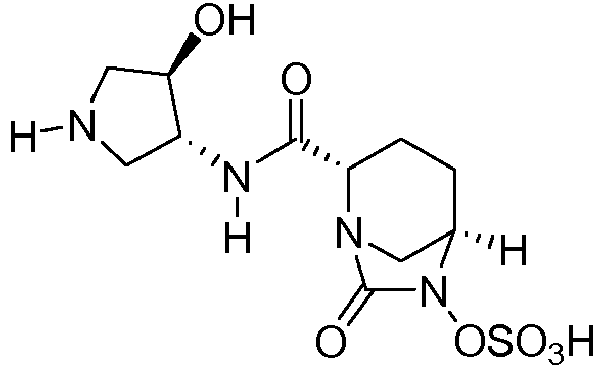
(2S,SR)-N-[(3R,4R)-4-hydroxypyrrolidin-3-yl]-7-oxo-6-(sulfooxy)-1,6-diazabicyclo[3.2.1]octane-2-carboxamide 30 

(2S,5R)-N-[(3R,4S)-4-hydroxypyrrolidin-3-yl]-7-oxo-6-(sulfooxy)-1,6-diazabicyclo[3.2.1]octane-2-carboxamide 31 

(2S,5R)-N-[(3R,4S)-4-fluoropyrrolidin-3-yl]-7-oxo-6-(sulfooxy)-1,6-diazabicyclo[3.2.1]octane-2-carboxamide 32 

(2S,5R)-N-[(3S,4R)-4-fluoropyrrolidin-3-yl]-7-oxo-6-(sulfooxy)-1,6-diazabicyclo[3.2.1]octane-2-carboxamide 33 

(2S,5R)-7-oxo-N-[(3S)-1-piperidin-4-yl-2-oxopyrrolidin-3-yl]-6-(sulfooxy)-1,6-diazabicyclo[3.2.1]octane-2-carboxamide 34 

(2S,5R)-7-oxo-N-[(3R)-1-piperidin-4-yl-2-oxopyrrolidin-3-yl]-6-(sulfooxy)-1,6-diazabicyclo[3.2.1]octane-2-carboxamide 35 
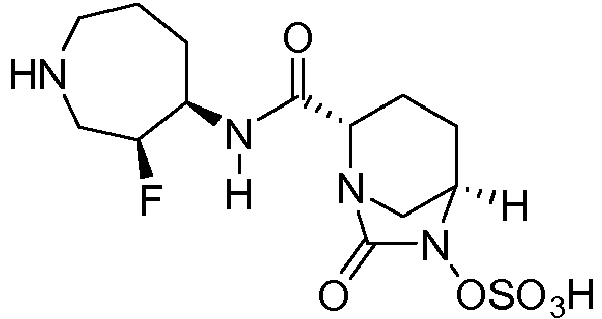
(2S,5R)-N-[(3S,4R)-3-fluoroazepan-4-yl]-7-oxo-6-(sulfooxy)-1,6-diazabicyclo[3.2.1]octane-2-carboxamide 36 

(2S,5R)-N-[(3R,4S)-3-fluoroazepan-4-yl]-7-oxo-6-(sulfooxy)-1,6-diazabicyclo[3.2.1]octane-2-carboxamide 37 

(2S,5R)-N-[(3-fluoroazetidin-3-yl)methyl]-7-oxo-6-(sulfooxy)-1,6-diazabicyclo[3.2.1]octane-2-carboxamide 38 
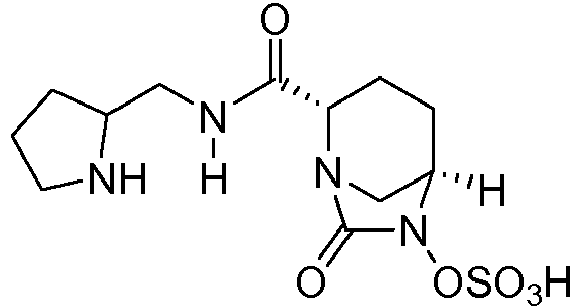
(2S,5R)-7-oxo-N-(pyrrolidin-2-ylmethyl)-6-(sulfooxy)-1,6-diazabicyclo[3.2.1]octane-2-carboxamide 39 

(2S,5R)-7-oxo-N-(piperidin-2-ylmethyl)-6-(sulfooxy)-1,6-diazabicyclo[3.2.1]octane-2-carboxamide 40 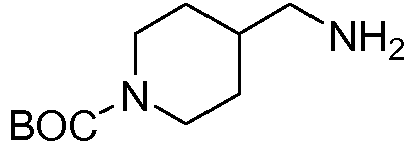

(2S,5R)-7-oxo-N-(piperidin-4-ylmethyl)-6-(sulfooxy)-1,6-diazabicyclo[3.2.1]octane-2-carboxamide 41 

(2S,5R)-N-(2-hydroxy-1-piperidin-4-ylethyl)-7-oxo-6-(sulfooxy)-1,6-diazabicyclo[3.2.1]octane-2-carboxamide 42 

(2S,5R)-N-[(2S)-1,4-oxazepan-2-ylmethyl]-7-oxo-6-(sulfooxy)-1,6-diazabicyclo[3.2.1]octane-2-carboxamide 43 

(2S,5R)-N-[(2R)-1,4-oxazepan-2-ylmethyl]-7-oxo-6-(sulfooxy)-1,6-diazabicyclo[3.2.1]octane-2-carboxamide 44 

(2S,5R)-7-oxo-N-(2-piperidin-4-ylethyl)-6-(sulfooxy)-1,6-diazabicyclo[3.2.1]octane-2-carboxamide 45 

(2S,5R)-7-oxo-N-(2-piperidin-1-ylethyl)-6-(sulfooxy)-1,6-diazabicyclo[3.2.1]octane-2-carboxamide 46 

(2S,5R)-7-oxo-N-(2-piperazin-1-ylethyl)-6-(sulfooxy)-1,6-diazabicyclo[3.2.1]octane-2-carboxamide 47 

(2S,5R)-N-3-azabicyclo[3.1.0]hex-6-yl-7-oxo-6-(sulfooxy)-1,6-diazabicyclo[3.2.1]octane-2-carboxamide 48 

(2S,5R)-N-methyl-7-oxo-N-piperidin-4-yl-6-(sulfooxy)-1,6-diazabicyclo[3.2.1]octane-2-carboxamide 49 

(2S,5R)-2- {[2-(aminomethyl)piperidin-1-yl]carbonyl}-6-(sulfooxy)-1,6-diazabicyclo[3.2.1]octan-7-one 50 

(2S,5R)-2-[(4-aminopiperidin-1-yl)carbonyl]-6-(sulfooxy)-1,6-diazabicyclo[3.2.1]octan-7-one 51 

(2S,5R)-2-(piperazin-1-ylcarbonyl)-6-(sulfooxy)-1,6-diazabicyclo[3.2.1] octan-7-one 52 

(2S,5R)-2-(2,7-diazaspiro[3.5]non-2-ylcarbonyl)-6-(sulfooxy)-1,6-diazabicyclo[3.2.1]octan-7-one 53 

(2S,5R)-2-(hexahydropyrrolo[3,4-c]pyrrol-2(1H)-ylcarbonyl)-6-(sulfooxy) -1,6-diazabicyclo[3.2.1]octan-7-one 54 

(2S,5R)-2- {[(3R)-3-aminopyrrolidin-1-yl]carbonyl}-6-(sulfooxy)-1,6-diazabicyclo[3.2.1]octan-7-one 55 

(2S,5R)-2-{[(3S)-3-ammopyrrolidin-1-yl]carbonyl}-6-(sulfooxy)-1,6-diazabicyclo[3.2.1]octan-7-one 56 
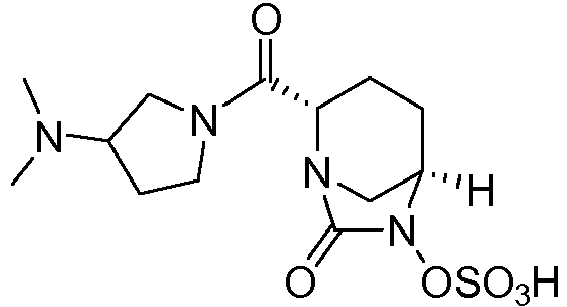
(2S,5R)-2- {[3-(dimethylamino)pyrrolidin-1-yl]-carb-onyl} -6-(sulfooxy)-1,6-diazabicyclo[3.2.1]octan-7-one - The procedure set forth in Example 6 was used to prepare the compounds of Examples 57-77 and 80-90, wherein the indicated amine starting material was substituted for 4-aminopyridine in Step 1. The procedure set forth in Example 17 was used to prepare the compounds of Examples 78 and 79, wherein the indicated pyridine starting material was substituted for 2-amino-5-bromopyridine in Step 1.
Example Amine Product 57 

(2S,5R)-N-[4-(aminomethyl)phenyl]-7-oxo-6-(sulfooxy)-1,6-diazabicyclo[3,2,1]octane-2-carboxamide 58 

(2S,5R)-N-[3-(aminomethyl)phenyl]-7-oxo-6-(sulfooxy)-1,6-diazabicyclo[3,2,1]octane-2-carboxamide 59 

(2S,5R)-N-[2-(aminomethyl)phenyl]-7-oxo-6-(sulfooxy)-1,6-diazabicyclo[3,2,1]octane-2-carboxamide 60 

(2S,5R)-N-{4-[(methylamino)methyl]phenyl}-7-oxo-6-(sulfooxy)-1,6-diazabicyclo[3.2.1]octane-2-carboxamide 61 

(2S,5R)-N- {3-[(methylamino)methyl]phenyl}-7-oxo-6-(sulfooxy)-1,6-diazabicyclo[3.2.1]octane-2-carboxamide 62 

(2S,5R)-N- {4-[(dimethylamino)methyl]phenyl}-7-oxo-6-(sulfooxy)-1,6-diazabicyclo[3.2.1]octane-2-carboxamide 63 

(2S,5R)-N- {4-[(pyrrolidinyl)methyl]phenyl}-7-oxo-6-(sulfooxy)-1,6-diazabicyclo[3.2.1]octane-2-carboxamide 64 
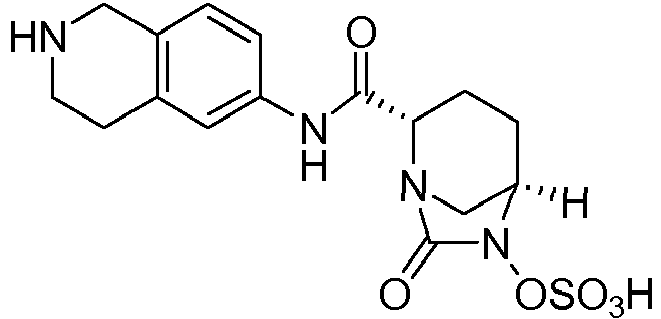
(2S,5R)-7-oxo-6-(sulfooxy)-N-(1,2,3,4-tetrahydroisoquinolin-6-yl)-1,6-diazabicyclo-[3.2.1]octane-2-carboxamide 65 

(2S,5R)-N-(2,3-dihydro-1H-isoindol-5-yl)-7-oxo-6-(sulfooxy)-1,6-diazabicyclo[3.2.1]octane-2-carboxamide 66 

(2S,5R)-N-(2,3-dihydro-1H-indol-5-yl)-7-oxo-6-(sulfooxy)-1,6-diazabicyclo[3.2.1]octane-2-carboxamide 67 

4-({[(2S,5R)-7-oxo-6-(sulfooxy)-1,6-diazabicyclo-[3.2. 1]oct-2-yl]carbonyl}amino)benzoic acid 68 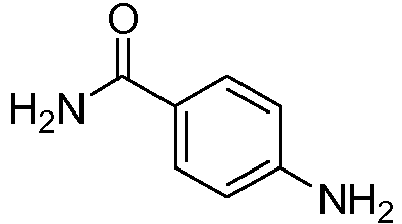
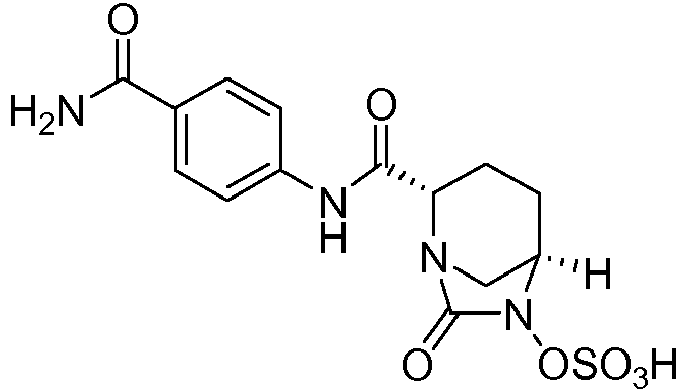
(2S,5R)-N-[4-(aminocarbonyl)phenyl]-7-oxo-6-(sulfooxy)-1,6-diazabicyclo[3.2.1]octane-2-carboxamide 69 

(2S,5R)-N-[4-(aminosulfonyl)phenyl]-7-oxo-6-(sulfooxy)-1,6-diazabicyclo[3.2.1]octane-2-carboxamide 70 

(2S,5R)-N-[3-(aminocarbonyl)phenyl]-7-oxo-6-(sulfooxy)-1,6-diazabicyclo[3.2.1]octane-2-carboxamide 71 

(2S,5R)-7-oxo-N-pyridin-3-yl-6-(sulfooxy)-1,6-diazabicyclo[3.2.1]octane-2-carboxamide 72 

(2S,5R)-7-oxo-N-pyridin-2-yl-6-(sulfooxy)-1,6-diazabicyclo[3.2.1]octane-2-carboxamide 73 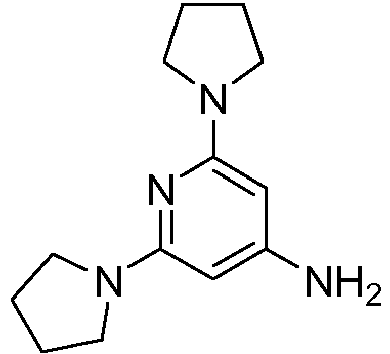

(2S,5R)-N-(2,6-dipyrrolidin-1-ylpyridin-4-yl)-7-oxo-6-(sulfooxy)-1,6-diazabicyclo[3.2.1]octane-2-carboxamide 74 

(2S,5R)-N-(6-aminopyridin-2-yl)-7-oxo-6-(sulfooxy)-1,6-diazabicyclo[3.2.1]octane-2-carboxamide 75 

(2S,5R)-N-[4-(dimethylamino)pyridin-2-yl]-7-oxo-6-(sulfooxy)-1,6-diazabicyclo[3.2.1]octane-2-carboxamide 76 

(2S,5R)-N-[4-(aminomethyl)pyridin-2-yl]-7-oxo-6-(sulfooxy)-1,6-diazabicyclo[3.2.1]octane-2-carboxamide 77 

(2S,5R)-N-[5-(aminomethyl)pyridin-2-yl]-7-oxo-6-(sulfooxy)-1,6-diazabicyclo[3.2.1]octane-2-carboxamide 78 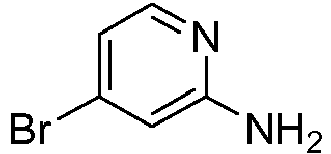

79 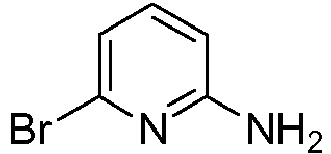

(2S,5R)-N-(6-piperidin-4-ylpyridin-2-yl)-7-oxo-6-(sulfooxy)-1,6-diazabicyclo[3.2.1]octane-2-carboxamide 80 

(2S,5R)-N-(5-piperazin-1-ylpyridin-2-yl)-7-oxo-6-(sulfooxy)-1,6-diazabicyclo[3.2.1]octane-2-carboxamide 81 

(2S,5R)-N-(5-morpholin-4-ylpyridin-2-yl)-7-oxo-6-(sulfooxy)-1,6-diazabicyclo[3.2.1]octane-2-carboxamide 82 

(2S,5R)-N-(5-pyrrolidin-1-yl-pyridin-2-yl)-7-oxo-6-(sulfooxy)-1,6-diazabicyclo[3.2.1]octane-2-carboxamide 83 

(2S,5R)-7-oxo-N-pyrazin-2-yl-6-(sulfooxy)-1,6-diazabicyclo[3.2.1]octane-2-carboxamide 84 

(2S,5R)-7-oxo-N-pyrimidin-4-yl-6-(sulfooxy)-1,6-diazabicyclo[3.2.1]octane-2-carboxamide 85 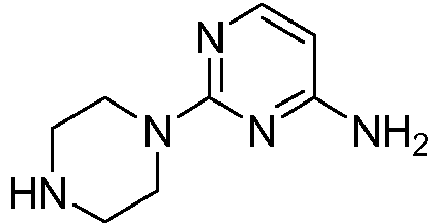
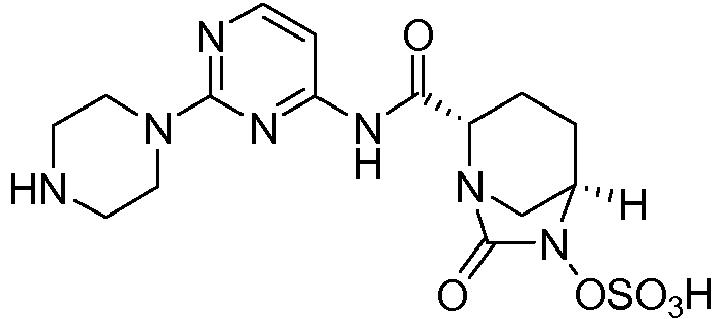
(2S,5R)-7-oxo-N-(2-piperazin-1-ylpyrimidin-4-yl)-6-(sulfooxy)-1,6-diazabicyclo[3.2.1]octane-2-carboxamide 86 

(2S,5R)-N-(1-methyl-1H-imidazol-2-yl)-7-oxo-6-(sulfooxy)-1,6-diazabicyclo[3.2.1]octane-2-carboxamide 87 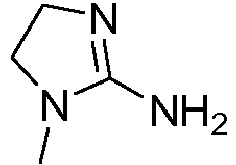

(2S,5R)-N-(1-methyl-4,5-dihydro-1H-imidazol-2-yl)-7-oxo-6-(sulfooxy)-1, 6-diazabicyclo[3.2.1]octane-2-carboxamide 88 
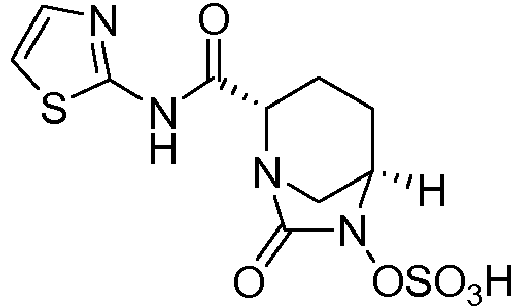
(2S,5R)-7-oxo-6-(sulfooxy)-N-1,3-thiazol-2-yl-1,6-diazabicyclo[3.2.1]octane-2-carboxamide 89 

(2S,5R)-7-oxo-6-(sulfooxy)-N-(4,5,6,7-tetrahydro[1,3]thiazolo[5,4-c]pyridin-2-yl)-1,6-diazabicyclo[3.2.1]octane-2-carboxamide 90 

(2S,5R)-N-(6,7-dihydro-5H-pyrrolo[3,4-b]pyridin-2-yl)-7-oxo-6-(sulfooxy)-1,6-diazabicyclo[3.2.1]octane-2-carboxamide - The procedure set forth in Example 18 was used to prepare the following compounds, wherein the indicated alcohol starting material was substituted for tert-butyl 4-(hydroxymethyl)piperidine-1-carboxylate in Step 1.
Example Amine Product 91 

(4S)-azepan-4-yl(2S,SR)-7-oxo-6-(sulfooxy)-1,6-diazabicyclo[3.2.1]octane-2-carboxylate 92 

(4R)-azepan-4-yl(2S,5R)-7-oxo-6-(sulfooxy)-1,6-diazabicyclo[3.2.1]octane-2-carboxylate 93 

piperidin-4-yl(2S,5R)-7-oxo-6-(sulfooxy)-1,6-diazabicyclo[3.2.1]octane-2-carboxylate 94 

(3R)-pyrrolidin-3-yl(2S,5R)-7-oxo-6-(sulfooxy)-1,6-diazabicyclo[3.2.1]octane-2-carboxylate 95 

(3S)-pyrrolidin-3-yl(2S,5R)-7-oxo-6-(sulfooxy)-1,6-diazabicyclo[3.2.1]octane-2-carboxylate 96 

azetidin-3-yl(2S,5R)-7-oxo-6-(sulfooxy)-1,6-diazabicyclo[3.2.1]octane-2-carboxylate 97 

(3S,4R)-3-fluoropiperidin-4-yl(25,5R)-7-oxo-6-(sulfooxy)-1,6-diazabicyclo[3.2.1]octane-2-carboxylate 98 

(3R,4S)-3-fluoropiperidin-4-yl(2S,5R)-7-oxo-6-(sulfooxy)-1,6-diazabicyclo[3.2.1]octane-2-carboxylate 99 

(3R,4R)-3-fluoropiperidin-4-yl(2S,5R)-7-oxo-6-(sulfooxy)-1,6-diazabicyclo[3.2.1]octane-2-carboxylate 100 

(3S,4S)-3-fluoropiperidin-4-yl(2S,5R)-7-oxo-6-(sulfooxy)-1,6-diazabicyclo[3.2.1]octane-2-carboxylate 101 

(3S,4S)-4-fluoropiperidin-3-yl(2S,5R)-7-oxo-6-(sulfooxy)-1,6-diazabicyclo[3.2.1]octane-2-carboxylate 102 

(3S,4R)-4-fluoropiperidin-3-yl(2S,5R)-7-oxo-6-(sulfooxy)-1,6-diazabicyclo[3.2.1]octane-2-carboxylate 103 

(3R,4S)-4-fluoropyrrolidin-3-yl(2S,5R)-7-oxo-6-(sulfooxy)-1,6-diazabicyclo[3.2.1]octane-2-carboxylate 104 

(3S,4R)-4-fluoropyrrolidin-3-yl(2S,5R)-7-oxo-6-(sulfooxy)-1,6-diazabicyclo[3.2.1]octane-2-carboxylate 105 

(3R,4R)-4-fluoropyrrolidin-3-yl(2S,5R)-7-oxo-6-(sulfooxy)-1,6-diazabicyclo[3.2.1]octane-2-carboxylate 106 

(3S,4S)-4-fluoropyrrolidin-3-yl(2S,5R)-7-oxo-6-(sulfooxy)-1,6-diazabicyclo[3.2.1]octane-2-carboxylate 107 

(4S)-isoxazolidin-4-yl(2S,5R)-7-oxo-6-(sulfooxy)-1,6-diazabicyclo[3.2.1]octane-2-carboxylate 108 

(4R)-isoxazolidin-4-yl(2S,5R)-7-oxo-6-(sulfooxy)-1,6-diazabicyclo[3.2.1]octane-2-carboxylate 109 

pyrazolidin-4-yl(2S,5R)-7-oxo-6-(sulfooxy)-1,6-diazabicyclo[3.2.1]octane-2-carboxylate 110 

2-aminoethyl(2S,5R)-7-oxo-6-(sulfooxy)-1,6-diazabicyclo[3.2.1]octane-2-carboxylate 111 

2-piperidin-1-ylethyl(2S,5R)-7-oxo-6-(sulfooxy)-1,6-diazabicyclo[3.2.1]octane-2-carboxylate 112 
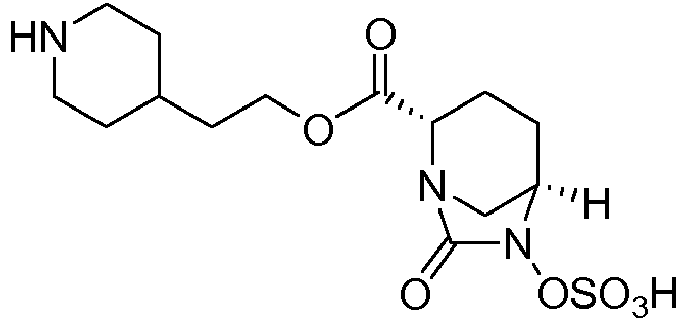
2-piperidin-4-ylethyl(2S,5R)-7-oxo-6-(sulfooxy)-1,6-diazabicyclo[3.2.1]octane-2-carboxylate 113 

(4-methylpiperidin-4-yl)methyl(2S,5R)-7-oxo-6-(sulfooxy)-1,6-diazabicyclo[3.2.1]octane-2-carboxylate 114 

1,4-oxazepan-2-ylmethyl(2S,5R)-7-oxo-6-(sulfooxy)-1,6-diazabicyclo[3,2,1]octane-2-carboxylate 115 

4-(aminomethyl)phenyl(2S,5R)-7-oxo-6-(sulfooxy)-1,6-diazabicyclo[3.2.1]octane-2-carboxylate 116 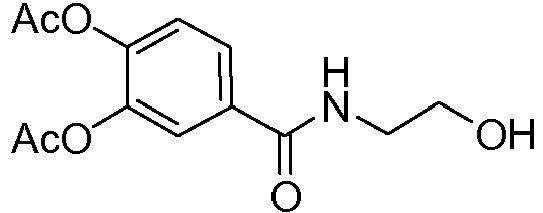

2-{[3,4-bis(acetyloxy)benzoyl]amino}ethyl(2S,5R)-7-oxo-6-(sulfooxy)-1,6-diazabicyclo[3.2.1]octane-2-carboxylate 117 

2-{[3,4-bis(acetyloxy)benzoyl]amino}-1-{{[3,4-bis(acetyloxy)benzoyl]amino}methyl)ethyl(2S,5R)-7-oxo-6-(sulfooxy)-1,6-diazabicyclo[3.2.1]octane-2-carboxylate - The Class C enzyme activities were measured in the presence of the test inhibitor in spectrophotometric assay against the commercially available substrate, nitrocefin. The enzyme AmpC (P. aeruginosa.), and the substrate, were dissolved in 100mM KH2PO4 buffer (pH 7). The buffer also contains 0.005% BSA. The test inhibitor was dissolved in DMSO and diluted 1:20 in the assay, resulting in a final concentration range of 50 µM to 0.0002 µM. In a 96-well microplate, the test inhibitor was incubated with the beta-lactamase enzyme for 40 minutes at ambient temperature, the substrate solution was added, and the incubation continued for another 40 minutes. The spectrophotometric reaction was quenched by the addition of 2.5N acetic acid and the absorbance at 492 nm was measured. The IC50 value was determined from semi logarithmic plots of enzyme inhibition versus inhibitor concentration, with a curve generated using a 4-parameter fit.
- The Class A enzyme acitivities were measured using the same test protocol set forth above for Class C enzymes except that the enzyme KPC-2 (K. pneumoniae) replaced AmpC.
- Representative compounds of the present invention exhibit inhibition of Class C and Class A β-lactamases in this assay. For example, the compounds of Examples 1, 2, 4 and 6-9 were tested in this assay and were found to have the IC50 values shown in Table 2. Table 3 contains assay data for other exemplified compounds.
- The assay determines the concentration of a β-lactamase inhibitor required to reduce the MIC of a β-lactam antibiotic by one-half, one-quarter, one-eighth, one-sixteenth and one-thirty-second against strains of bacteria normally resistant to the antibiotic in question. This is accomplished by titrating the BLI in a serial dilution across a microtiter plate while at the same time titrating the antibiotic in a serial dilution down the microtiter plate and then inoculating the plate with the bacterial strain in question and allowing the bacteria to grow up overnight. Each well in this microplate checkerboard contains a different combination of concentrations of the inhibitor and the antibiotic allowing a full determination of any synergy between the two.
-
- CL 5701 (Pseudomonas aeruginosa; Pa AmpC)/Imipenem
- MB 2646 (Enterobacter cloacae; P99)/Ceftazidime
- CL 5513 (Klebsiella pneumoniae; SHV-5)/Ceftazidime
- CL 6188 (Acinetobacter baumanii; Oxa40)/Imipenem
- CL 6569 (Klebsiella pneumoniae; KPC-2)/ Imipenem
- CL 5761 (Klebsiella pneumoniae; KPC-3)/ Imipenem
- CLB 21648 (Acinetobacter baumaniii; Ab AmpC)/Imipenem
-
- 1. All wells in rows B-H of
MIC 2000 microtiter plates are filled with 100 µL of MHBII + 1% DMSO. - 2. All wells in row A of
MIC 2000 microtiter plates are filled with 100 µL of 2X MHBII + 2% DMSO. - 3. 100 µL of 4X the final antibiotic concentration wanted is added to well A1 of the
MIC 2000 plates. - 4. 100 µL of 2X the final antibiotic concentration wanted is added to wells A2-A12 of the
MIC 2000 plates. - 5. 100 µL is serially diluted from row A to row G of each
MIC 2000 plate. - 6. 100 µL is removed from each well in row G of each
MIC 2000 plate. - 7. 100 µL of 2X the final inhibitor concentration wanted (in MHBII + 1% DMSO) is added to all wells in column 1 of the microtiter plates.
- 8. 100 µL is serially diluted from column 1 to column 11 of each
MIC 2000 plate. - 9. 100 µL is removed from each well in column 11 of each
MIC 2000 plate. - 10. Plates are then inoculated with an overnight growth (in TSB) of the strain to be tested using an
MIC 2000 inoculator. - 11. Plates are left at 37°C for about 20 hours and scored for growth by eye.
-
MHBII + 1% DMSO MHBII cation adjusted (BBL™) 4.4 g DMSO 2.0 mL Distilled water 198.0 mL 2X MHBII + 2% DMSO MHBII cation adjusted (BBL™) 8.8 g DMSO 4.0 mL Distilled water 196.0 mL 1.02X MHBII MHBII cation adjusted (BBL™) 4.4 g Distilled water 198.0 mL 1.1 X MHBII+ 1% DMSO MHBII cation adjusted (BBL™) 4.4 g DMSO 2.0 mL Distilled water 178.0 mL TSB - Trypticase soy roth (BBL™) was prepared as directed on the bottle.
- Synergy may be expressed as a ratio of the minimum inhibitory concentration (MIC) of an antibiotic tested in the absence of a β-lactamase inhibitor to the MIC of the same antibiotic tested in the presence of the β-lactamase inhibitor. A ratio of one (1) indicates that the β-lactamase inhibitor has no effect on antibiotic potency. A ratio greater than one (1) indicates that the β-lactamase inhibitor produces a synergistic effect when co-administered with the antibiotic agent. The preferred β-lactamase inhibitors of the present invention exhibit a synergy ratio of at least about 2, more preferred compounds exhibit a ratio of at least about 4, still more preferably at least about 8, and most preferred at least about 16. Alternatively, the synergy effect may be expressed as a factor, again, utilizing a concentration of the BLI to lower the MIC of the antibiotic. Thus, if the MIC of the antibiotic is 20 µg/mL and a 1.5 µM concentration of BLI lowers the MIC to 5 µg/mL, the synergy effect is four fold or "4X synergy" at 1.5 µM of BLI.
- Representative compounds of the present invention display a synergy effect. For example, the compounds of Examples 1, 2, 4 and 6-9 were determined to have 2X synergy concentrations in a range of from about 100 µM or less. The synergy concentrations for Examples 1, 2, 4 and 6-9 against P. aeruginosa strain CL5701 and Klebsiella pneumoniae strain CL6569 are shown in Table 2.
Table 2. Biological Data 
Example R (* indicates point of attachment) P.a. AmpC IC50 (nM) 2X / 4X / 8X Synergy CL5701 (µM)1 K.p. KPC-2 IC50 (nM) 16X / 32X / 64X Synergy CL6569 (µM)2 1 
465 0.2 / 3.12 / 6.25 208 6.25 / 12.5 / 12.5 2 
69 3.12 / 6.25 / 6.25 245 6.25 / 12.5 / 25 4 
29,000 100 / 100 / >100 4,400 50 / 100 / 100 6 
6 12.5 / 25 / 100 54 50 / 50 / >100 7 
1.1 50 / 100 / >100 8 25 / 50 / >100 8 
1.6 12.5 / 100 / >100 1.6 25 / 25 / 50 9 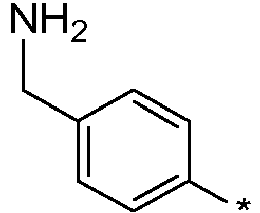
20 0.78 / 3.12 / 6.25 72 6.25 / 6.25 / 12.5 Sulbactam ------ 17,000 54 / >150 / >300 33,000 >500/>500/>500 1. These are the concentrations for 2X, 4X and 8X with imipenem against P. aeruginosa strain CL5701. For example, a 6.25 µM concentration of the compound of Example 1 reduces the MIC of imipenem versus P. aeruginosa strain CL5701 by a factor of 8 (8X synergy).
2. These are the concentrations for 16X, 32X and 64X with imipenem against K. pneumoniae strain CL6569. For example, a 12.5 µM concentration of the compound of Example 1 reduces the MIC of imipenem versus K. pneumoniae strain CL6569 versus by a factor of 64 (64X synergy). - It appears that the data in Table 3 were generated in the same manner using the same enzymes as in Table 2 (Table 2 is unchanged from the provisional filing). I plan to DELETE the entries in Table 3 for Exs. 2, 6, 7 and 8 because this data duplicates the data in Table 2. HOWEVER, the entry in Table 2 for Ex. 7 is "1.1" NOT "11" as shown in Table 3. Also, the entries in Table 2 for Ex. 8 are both "1.6", not "16" as shown in Table 3. Please clarify these differences.
- Is the data shown for Ex. 1A data generated in a separate run, or is it supposed to be the same as for Ex. 1? Note "208" in Table 2 vs. "210" in Table 3 - why different? I propose to delete the entry for Example 1A from Table 3 as it's essentially the same as the entry in Table 2 for Example 1.
- You don't want to include synergy data for these compouds? It would be helpful to include it, at least for some of the examples (could put in a separate table). Recommend we include it for Ex. 14, since this is a likely backup candidate.
- We have a comparison to sulbactam in Table 2. How does MK-8712 compare to this? Is it worth including 8712 comparative data? Any other structurally similar known compounds that you may have run a comparison?
Table 3 - Biological Data Example No. M-H (m/e)1 K.p. KPC-2 IC50 (nM) P.a. AmpC IC50 (nM) Plan to delete the entries shown in blue 1A 347 210 465 2 361 245 69 6 341 54 6 7 371 8 11 8 384 16 16 14 333 355 110 15 365 130 49 16 395 19 14 17 424 28 6 18 362 10 180 19a 347 480 64 19b 347 240 480 20 319 17 1,000 21 333 4,300 29,100 22 361 225 520 23 361 240 500 24 365 90 110 25 365 270 20 26 377 290 120 27 396 150 9.5 28 348 660 740 29 349 250 2,500 30 349 520 2,250 31 351 190 150 32 351 710 19 33 430 21 620 34 430 280 45 35 379 150 13 36 379 130 18 37 351 120 40 38 347 120 250 39 361 190 530 40 361 77 30 41 391 320 700 42 379 110 100 43 379 100 15 44 375 45 11 45 375 150 180 46 376 96 42 47 345 10,000 720 48 361 2,500 290 49 361 780 7,500 50 347 8 820 51 333 520 2,200 52 373 1,000 590 53 359 33 1,000 54 333 3,200 840 55 333 1,500 1,400 56 361 1,600 270 57 369 72 20 58 369 104 34 59 369 109 292 60 383 56 18 61 383 78 22 62 397 54 18 63 423 85 22 64 395 19 14 65 381 60 16 66 381 41 56 67 384 10 11 68 383 30 7 69 419 22 7 70 383 26 3 71 341 42 37 72 341 36 1.2 73 478 130 515 74 356 11 8 75 384 410 3 76 370 1,300 2 77 370 42 3 78 424 470 0.8 79 424 24 270 80 425 15 2 81 427 17 5 82 410 10 4 83 342 58 6 84 342 55 0.8 85 426 20 260 86 344 135 240 87 346 840 200 88 347 36 1.8 89 402 39 10 90 382 NA NA 91 362 6 83 92 362 6,400 33,000 93 348 9 170 94 334 40 3,000 95 334 21 210 96 320 18 600 97 366 26 49 98 366 9 46 99 366 8 40 100 366 4 33 101 366 15 81 102 366 4 76 103 352 3 39 104 352 24 38 105 352 13 200 106 352 10 200 107 336 11 39 108 336 11 62 109 335 62 700 110 308 30 610 111 376 20 1,200 112 376 13 165 113 376 8 36 114 378 11 340 115 370 2 24 116 528 70 440 117 777 12 61 1. Values obtained via LC-MS (negative ion mode). - While the foregoing specification teaches the principles of the present invention, with examples provided for the purpose of illustration, the practice of the invention encompasses all of the usual variations, adaptations and/or modifications that come within the scope of the following claims. All publications, patents and patent applications cited herein are incorporated by reference in their entireties into the disclosure, wherein in the case of any inconsistencies, the present disclosure will prevail.
Claims (20)
- A combination of a compound of Formula I:
 X is:(1) CH2,(2) CH2CH2, or(3) CH2CH2CH2;R1 is C(O)N(R3)R4,R2 is SO3M, OSO3M, SO2NH2, PO3M, OPO3M, CH2CO2M, CF2CO2M, or CF3;M is H or a pharmaceutically acceptable cation;R3 is Het A;R4 is H or C1-8 alkyl optionally substituted with N(RA)RB;or alternatively R3 and R4 together with the N atom to which they are both attached form a 4- to 9-membered, saturated monocyclic ring optionally containing 1 heteroatom in addition to the nitrogen attached to R3 and R4 selected from N, O, and S, where the S is optionally oxidized to S(O) or S(O)2; wherein the monocyclic ring is optionally fused to, bridged with, or spiro to a 4- to 7-membered, saturated heterocyclic ring containing from 1 to 3 heteroatoms independently selected from N, O and S, where the S is optionally oxidized to S(O) or S(O)2, to form a bicyclic ring system, wherein the monocyclic ring or the bicyclic ring system so formed is optionally substituted with 1 or 2 substituents each of which is independently: (1) C1-6 alkyl, (2) C1-6 fluoroalkyl, (3) (CH2)1-2G wherein G is OH, O-C1-6 alkyl, O-C1-6 fluoroalkyl, N(RA)RB, C(O)N(RA)RB, C(O)RA, CO2RA, or SO2RA, (4) O-C1-6 alkyl, (5) O-C1-6 fluoroalkyl, (6) OH, (7) oxo, (8) halogen, (9) N(RA)RB, (10) C(O)N(RA)RB, (11) C(O)RA, (12) C(O)-C1-6 fluoroalkyl, (13) C(O)ORA, or (14) S(O)2RA;HetA is a 4- to 9-membered saturated or mono-unsaturated heterocyclic ring containing from 1 to 3 heteroatoms independently selected from N, O and S, wherein any ring S is optionally oxidized to S(O) or S(O)2 and either 1 or 2 ring carbons are optionally oxidized to C(O); wherein the ring is optionally fused with a C3-7 cycloalkyl; and wherein the optionally fused, saturated or mono-unsaturated heterocyclic ring is optionally substituted with a total of from 1 to 4 substituents selected from zero to 2 (CH2)nN(RA)RB and zero to 2 (CH2)nRC;each n is independently an integer which is 0, 1, 2, or 3;each RA is independently H or C1-8 alkyl;each RB is independently H or C1-8 alkyl;each RC is independently C1-6 alkyl, OH, O-C1-8 alkyl, OC(O)-C1-8 alkyl, C(=NH)NH2, NH-C(=NH)NH2, halogen, CN, C(O)RA, C(O)ORA, C(O)N(RA)RB, SO2RA, SO2N(RA)RB, pyridyl, pyrrolidinyl, piperidinyl, piperazinyl, morpholinyl, or thiomorpholinyl;and a carbapenem antibiotic.
 - The combination of claim 1 wherein the carbapenem antibiotic is imipenem.
- The combination of claim 1 or 2 which further comprises a DHP inhibitor.
- The combination of claim 4 wherein the DHP inhibitor is 7-(L-2-amino-2-carboxyethylthio)-2-(2,2-dimethylcyclopropanecarboxamide)-2-heptenoic acid or a pharmaceutically acceptable salt thereof.
- The combination according to any preceding claim wherein X is -CH2- or -CH2CH2-.
- The combination according to any preceding claim wherein R2 is OSO3M.
- The combination according to claim 6 wherein R2 is OSO3H.
- The combination according to any preceding claim wherein HetA is a saturated heterocycle selected from pyrrolidinyl, piperidinyl, azepanyl and azocanyl; optionally substituted with N(RA)RB and optionally substituted with 1 or 2 (CH2)nRC; each Rc is independently C1-6 alkyl, C(=NH)NH2, NH-C(=NH2)NH2, halogen, CN, pyridyl, pyrrolidinyl or piperidinyl.
- The combination according to any preceding claim wherein HetA is:


- The combination according to any preceding claim wherein HetA is an optionally fused, saturated heterocyclic ring selected from the group consisting of azetidinyl, pyrrolidinyl, oxopyrrolidinyl, piperidinyl, piperazinyl, tetrahydropyranyl, tetrahydrothiopyranyl, morpholinyl, 1,1-dioxidotetrahydrothiopyranyl, azepanyl, oxazepanyl, azocanyl, and azabicyclo[3.1.0]cyclohexyl, wherein the heterocyclic is optionally substituted with 1 or 2 (CH2)nN(RA)RB and optionally substituted with 1 or 2 (CH2)nRC.
- The combination according to any preceding claim wherein HetA is a heterocyclic ring selected from azetidinyl, pyrrolidinyl, pyrazolidinyl, piperidinyl, piperazinyl, azepanyl, oxazepanyl, oxazolidinyl, isoxazolidinyl, morpholinyl, and tetrahydropyranyl, wherein the heterocyclic ring is optionally substituted with 1 or 2 substituents each of which is independently CH3, CH2NH2, CH2N(H)CH3, CH2N(CH3)2, OCH3, Cl, Br, F, NH2, N(H)CH3, N(CH3)2, C(O)NH2, C(O)N(H)CH3, C(O)N(CH3)2, C(O)CH3, C(O)OCH3, OC(O)CH3, S(O)2CH3, S(O)2NH2, S(O)2N(H)CH3, or S(O)2N(CH3)2.
- The combination according to claim 11 which is a compound selected from the group consisting of:
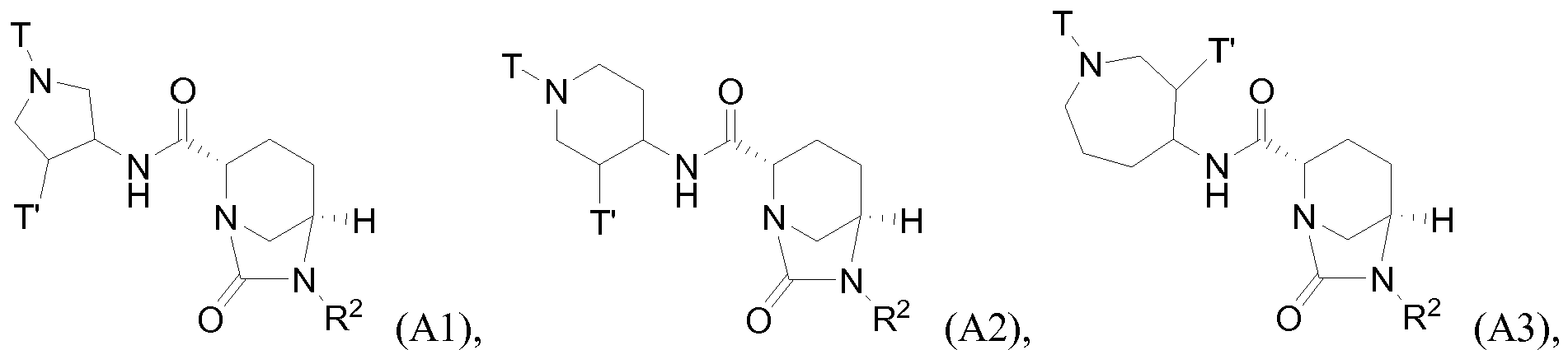


- The combination according to claim 12 wherein T is H, CH3, pyrrolidin-3-yl, piperidin-4-yl, (CH2)2-3OCH3, (CH2)2-3OH, (CH2)2-3F, (CH2)2-3-piperidinyl, (CH2)2-3-pyrrolidinyl; and T' is H, F, O-C1-3 alkyl, OH, NH2, N(H)CH3, N(CH3)2.
- The combination according to any one of claims 1 to 7 wherein R3 and R4 together with the N atom to which they are both attached form a heterocyclyl selected from the group consisting of:


- The combination according to any one of claims 1 to 4, which is a compound selected from the group consisting of:(2S,5R)-7-oxo-N-piperidin-4-yl-6-(sulfooxy)-1,6-diazabicyclo[3.2.1]octane-2-carboxamide;(2S,SR)-N-[(4S)-azepan-4-yl]-7-oxo-6-(sulfooxy)-1,6-diazabicyclo[3.2.1]octane-2-carboxamide;(2S,5R)-N-[(4R)-azepan-4-yl]-7-oxo-6-(sulfooxy)-1,6-diazabicyclo[3.2.1]-octane-2-carboxamide;(2S,5R)-7-oxo-N-[(3R)-pyrrolidin-3-yl]-6-(sulfooxy)-1,6-diazabicyclo[3.2.1]-octane-2-carboxamide;(2S,5R)-7-oxo-N-[(3S)-pyrrolidin-3-yl]-6-(sulfooxy)-1,6-diazabicyclo[3.2.1]-octane-2-carboxamide;(2S,5R)-N-azocan-5-yl-7-oxo-6-(sulfooxy)-1,6-diazabicyclo[3.2.1]octane-2-carboxamide;(2S,SR)-7-oxo-2-[(piperidin-4-ylamino)carbonyl]-1,6-diazabicyclo[3.2.1]octane-6-sulfonic acid;(4R,6S)-2-oxo-N-piperidin-4-yl-3-(sulfooxy)-1,3-diazabicyclo[2.2.1]-heptane-6-carboxamide;(4R,6S)-2-oxo-N-[(4S)-azepan-4-yl]-3-(sulfooxy)-1,3-diazabicyclo[2.2.1]-heptane-6-carboxamide; andpharmaceutically acceptable salts thereof.
- The combination according to any one of claims 1 to 4, which is a compound selected from the group consisting of:(2S,SR)-7-oxo-N-[(3R)-pyrrolidin-3-yl]-6-(sulfooxy)-1,6-diazabicyclo[3.2.1]octane-2-carboxamide;(2S,5R)-N-[(3R,4S)-3-fluoropiperidin-4-yl]-7-oxo-6-(sulfooxy)-1,6-diazabicyclo[3.2.1]octane-2-carboxamide;Diastereomer 1 of (2S,SR)-7-oxo-N-[(3)-piperidin-3-yl]-6-(sulfooxy)-1,6-diaza-bicyclo[3.2.1]octane-2-carboxamide;Diastereomer 2 of (2S,5R)-7-oxo-N-[(3)-piperidin-3-yl]-6-(sulfooxy)-1,6-diaza-bicyclo[3.2.1]octane-2-carboxamide;(2S,SR)-7-oxo-N-azetidin-3-yl-6-(sulfooxy)-1,6-diaza-bicyclo[3.2.1]octane-2-carboxamide;(2S,5R)-7-oxo-N-[(3R)-pyrrolidin-3-yl]-6-(sulfooxy)-1,6-diaza-bicyclo[3.2.1]octane-2-carboxamide;(2S,5R)-7-oxo-N-[(4R)-azepan-4-yl]-6-(sulfooxy)-1,6-diaza-bicyclo[3.2.1]octane-2-carboxamide;(2S,5R)-7-oxo-N-[1-methylpiperidin-4-yl]-6-(sulfooxy)-1,6-diazabicyclo[3.2.1]octane-2-carboxamide;(2S,5R)-7-oxo-N-[(3S,4S)-3-fluoropiperidin-4-yl]-6-(sulfooxy)-1,6-diazabicyclo[3.2.1]octane-2-carboxamide or its 3R,4R diastereomer or a mixture thereof;(2S,5R)-7-oxo-N-[(3S,4R)-3-fluoropiperidin-4-yl]-6-(sulfooxy)-1,6-diazabicyclo[3.2.1]octane-2-carboxamide;(2S,5R)-7-oxo-N-[(3S,4R)-3-methoxypiperidin-4-yl]-6-(sulfooxy)-1,6-diazabicyclo[3.2.1]octane-2-carboxamide;(2S,5R)-N-(1,1-dioxidotetrahydro-2H-thiopyran-4-yl)-7-oxo-6-(sulfooxy)-1,6-diazabicyclo[3.2.1]octane-2-carboxamide;(2S,SR)-N-[(3R,4R)-4-aminopyrrolidin-3-yl]-7-oxo-6-(sulfooxy)-1,6-diazabicyclo[3.2.1]octane-2-carboxamide;(2S,SR)-N-[(3R,4R)-4-hydroxypyrrolidin-3-yl]-7-oxo-6-(sulfooxy)-1,6-diazabicyclo[3.2.1]octane-2-carboxamide;(2S,5R)-N-[(3R,4S)-4-hydroxypyrrolidin-3-yl]-7-oxo-6-(sulfooxy)-1,6-diazabicyclo[3.2.1]octane-2-carboxamide;(2S,SR)-N-[(3R,4S)-4-fluoropyrrolidin-3-yl]-7-oxo-6-(sulfooxy)-1,6-diazabicyclo[3.2.1]octane-2-carboxamide;(2S,SR)-N-[(3S,4R)-4-fluoropyrrolidin-3-yl]-7-oxo-6-(sulfooxy)-1,6-diazabicyclo[3.2.1]octane-2-carboxamide;(2S,SR)-7-oxo-N-[(3S)-1-piperidin-4-yl-2-oxopyrrolidin-3-yl]-6-(sulfooxy)-1,6-diazabicyclo[3.2.1]octane-2-carboxamide;(2S,5R)-7-oxo-N-[(3R)-1-piperidin-4-yl-2-oxopyrrolidin-3-yl]-6-(sulfooxy)-1,6-diazabicyclo[3.2.1]octane-2-carboxamide;(2S,5R)-N-[(3S,4R)-3-fluoroazepan-4-yl]-7-oxo-6-(sulfooxy)-1,6-diazabicyclo[3.2.1]octane-2-carboxamide;(2S,5R)-N-[(3R,4S)-3-fluoroazepan-4-yl]-7-oxo-6-(sulfooxy)-1,6-diazabicyclo[3.2.1]octane-2-carboxamide;(2S,5R)-N-3-azabicyclo[3.1.0]hex-6-yl-7-oxo-6-(sulfooxy)-1,6-diazabicyclo[3.2.1]octane-2-carboxamide;(2S,5R)-N-methyl-7-oxo-N-piperidin-4-yl-6-(sulfooxy)-1,6-diazabicyclo[3.2.1]octane-2-carboxamide;(2S,5R)-2-{[2-(aminomethyl)piperidin-1-yl]carbonyl}-6-(sulfooxy)-1,6-diazabicyclo[3.2.1]octan-7-one;(2S,5R)-2-[(4-aminopiperidin-1-yl)carbonyl]-6-(sulfooxy)-1,6-diazabicyclo[3.2.1]octan-7-one;(2S,5R)-2-(piperazin-1-ylcarbonyl)-6-(sulfooxy)-1,6-diazabicyclo[3.2.1]octan-7-one;(2S,5R)-2-(2,7-diazaspiro[3.5]non-2-ylcarbonyl)-6-(sulfooxy)-1,6-diazabicyclo[3.2.1]octan-7-one;(2S,5R)-2-(hexahydropyrrolo[3,4-c]pyrrol-2(1H)-ylcarbonyl)-6-(sulfooxy) -1,6-diazabicyclo[3.2.1]octan-7-one;(2S,5R)-2-{[(3R)-3-aminopyrrolidin-1-yl]carbonyl}-6-(sulfooxy)-1,6-diazabicyclo[3.2.1]octan-7-one;(2S,5R)-2-{[(3S)-3-aminopyrrolidin-1-yl]carbonyl}-6-(sulfooxy)-1,6-diazabicyclo[3.2.1]octan-7-one;(2S,5R)-2-{[3-(dimethylamino)pyrrolidin-1-yl]-carb-onyl}-6-(sulfooxy)-1,6-diazabicyclo[3.2.1]octan-7-one;pharmaceutically acceptable salts thereof.
- The combination according to claim 1, 2, 3 or 4 which is a compound selected from the group consisting of:(2S,5R)-7-oxo-N-piperidin-4-yl-6-(sulfooxy)-1,6-diazabicyclo[3.2.1] o ctane-2-carboxamide;(2S,5R)-7-oxo-N-[(3R)-pyrrolidin-3-yl]-6-(sulfooxy)-1,6-diazabicyclo[3.2.1]octane-2-carboxamide andpharmaceutically acceptable salts thereof.
- The combination according to claim 17, which is (2S,5R)-7-oxo-N-piperidin-4-yl-6-(sulfooxy)-1,6-diazabicyclo[3.2.1]octane-2-carboxamide or a pharmaceutically acceptable salt thereof.
- The combination according to claim 1, 2, 3 or 4 which is (2S,5R)-7-oxo-N-[(3S)-pyrrolidin-3-yl]-6-(sulfooxy)-1,6-diazabicyclo[3.2.1]octane-2-carboxamide or a pharmaceutically acceptable salt thereof.
- The combination according to claim 1, 2, 3 or 4 which is (2S,5R)-7-oxo-N-piperidin-4-yl-6-(sulfooxy)-1,6-diazabicyclo[3.2.1]octane-2-carboxamide in the form of a crystalline monohydrate.
Priority Applications (4)
| Application Number | Priority Date | Filing Date | Title |
|---|---|---|---|
| SI200931147T SI2666774T1 (en) | 2008-01-18 | 2009-01-15 | Beta-lactamase Inhibitors |
| PL13180969T PL2666774T3 (en) | 2008-01-18 | 2009-01-15 | Beta-lactamase Inhibitors |
| HRP20150269TT HRP20150269T1 (en) | 2008-01-18 | 2015-03-10 | INHIBITOR BETA-LACTAMASE |
| CY20151100288T CY1116243T1 (en) | 2008-01-18 | 2015-03-23 | Beta-lactamase inhibitor |
Applications Claiming Priority (2)
| Application Number | Priority Date | Filing Date | Title |
|---|---|---|---|
| US1153308P | 2008-01-18 | 2008-01-18 | |
| EP09701487.2A EP2231667B1 (en) | 2008-01-18 | 2009-01-15 | Beta-lactamase inhibitors |
Related Parent Applications (2)
| Application Number | Title | Priority Date | Filing Date |
|---|---|---|---|
| EP09701487.2A Division EP2231667B1 (en) | 2008-01-18 | 2009-01-15 | Beta-lactamase inhibitors |
| EP09701487.2 Division | 2009-01-15 |
Publications (2)
| Publication Number | Publication Date |
|---|---|
| EP2666774A1 true EP2666774A1 (en) | 2013-11-27 |
| EP2666774B1 EP2666774B1 (en) | 2015-01-07 |
Family
ID=40642204
Family Applications (2)
| Application Number | Title | Priority Date | Filing Date |
|---|---|---|---|
| EP09701487.2A Active EP2231667B1 (en) | 2008-01-18 | 2009-01-15 | Beta-lactamase inhibitors |
| EP13180969.1A Active EP2666774B1 (en) | 2008-01-18 | 2009-01-15 | Beta-lactamase Inhibitors |
Family Applications Before (1)
| Application Number | Title | Priority Date | Filing Date |
|---|---|---|---|
| EP09701487.2A Active EP2231667B1 (en) | 2008-01-18 | 2009-01-15 | Beta-lactamase inhibitors |
Country Status (38)
| Country | Link |
|---|---|
| US (2) | US8487093B2 (en) |
| EP (2) | EP2231667B1 (en) |
| JP (3) | JP5038509B2 (en) |
| KR (2) | KR101800610B1 (en) |
| CN (2) | CN101918407B (en) |
| AU (1) | AU2009206119C1 (en) |
| BR (1) | BRPI0906871B1 (en) |
| CA (1) | CA2712783C (en) |
| CO (1) | CO6331438A2 (en) |
| CR (1) | CR11626A (en) |
| CY (5) | CY1114900T1 (en) |
| DK (2) | DK2231667T3 (en) |
| DO (1) | DOP2010000218A (en) |
| EC (2) | ECSP10010345A (en) |
| ES (2) | ES2533826T3 (en) |
| FR (3) | FR20C1032I2 (en) |
| HN (1) | HN2010001395A (en) |
| HR (2) | HRP20131123T1 (en) |
| HU (2) | HUS000504I2 (en) |
| IL (1) | IL206395A (en) |
| LT (3) | LTPA2020517I1 (en) |
| LU (1) | LUC00165I2 (en) |
| MA (1) | MA32025B1 (en) |
| ME (1) | ME02089B (en) |
| MX (1) | MX2010007823A (en) |
| MY (1) | MY162532A (en) |
| NI (1) | NI201000115A (en) |
| NL (3) | NL301051I2 (en) |
| NO (3) | NO2020022I1 (en) |
| NZ (1) | NZ586861A (en) |
| PL (2) | PL2231667T3 (en) |
| PT (2) | PT2666774E (en) |
| RS (2) | RS53862B1 (en) |
| RU (1) | RU2445314C9 (en) |
| SI (2) | SI2666774T1 (en) |
| UA (1) | UA101966C2 (en) |
| WO (1) | WO2009091856A2 (en) |
| ZA (1) | ZA201005333B (en) |
Families Citing this family (107)
| Publication number | Priority date | Publication date | Assignee | Title |
|---|---|---|---|---|
| ES2533826T3 (en) * | 2008-01-18 | 2015-04-15 | Merck Sharp & Dohme Corp. | Beta-lactamase inhibitors |
| RS60310B1 (en) | 2010-08-10 | 2020-07-31 | Rempex Pharmaceuticals Inc | Cyclic boronic acid ester derivatives, method for the preparation and therapeutic uses thereof |
| SI2657234T1 (en) | 2010-12-22 | 2017-06-30 | Meiji Seika Pharma Co., Ltd. | Optically-active diazabicyclooctane derivative and method for manufacturing same |
| US8772490B2 (en) * | 2010-12-22 | 2014-07-08 | Meiji Seika Pharma Co., Ltd. | Optically active diazabicyclooctane derivatives and process for preparing the same |
| KR102143660B1 (en) * | 2011-06-17 | 2020-08-11 | 화이자 안티-인펙티브스 에이비 | Process for preparing heterocyclic compounds including trans-7-oxo-6-(sulphooxy)-1,6-diazabicyclo[3,2,1]octane-2-carboxamide and salts thereof |
| RU2578370C2 (en) * | 2011-08-27 | 2016-03-27 | Вокхардт Лимитед | 1,6-diazabicyclo[3,2,1]octan-7-one derivatives and using them for treating bacterial infections |
| MX340533B (en) * | 2011-08-30 | 2016-07-13 | Wockhardt Ltd | 1,6- diazabicyclo [3,2,1] octan- 7 - one derivatives and their use in the treatment of bacterial infections. |
| US9012491B2 (en) | 2011-08-31 | 2015-04-21 | Rempex Pharmaceuticals, Inc. | Heterocyclic boronic acid ester derivatives and therapeutic uses thereof |
| US9505761B2 (en) | 2011-12-02 | 2016-11-29 | Fedora Pharmaceuticals Inc. | Bicyclic compounds and their use as antibacterial agents and beta-lactamase inhibitors |
| US8796257B2 (en) | 2011-12-02 | 2014-08-05 | Naeja Pharmaceutical Inc. | Bicyclic compounds and their use as antibacterial agents and β-lactamase inhibitors |
| CN104159587A (en) * | 2012-01-06 | 2014-11-19 | 南佛罗里达大学 | Compositions, methods of use, and methods of treatment |
| US8969570B2 (en) | 2012-03-30 | 2015-03-03 | Cubist Pharmaceuticals, Inc. | Beta-lactamase inhibitors |
| US8916709B2 (en) | 2012-03-30 | 2014-12-23 | Cubist Pharmaceuticals, Inc. | 1,2,4-oxadiazole and 1,2,4-thiadiazole β-lactamase inhibitors |
| KR20150003777A (en) | 2012-03-30 | 2015-01-09 | 큐비스트 파마슈티컬즈 인코포레이티드 | ISOXAZOLE β-LACTAMASE INHIBITORS |
| TW201343645A (en) | 2012-03-30 | 2013-11-01 | Cubist Pharm Inc | 1,3,4-oxadiazole and 1,3,4-thiadiazole β-lactamase inhibitors |
| AR090539A1 (en) * | 2012-04-02 | 2014-11-19 | Astrazeneca Ab | INHIBITING COMPOUNDS OF B LACTAMASA |
| SG11201407295YA (en) | 2012-05-08 | 2014-12-30 | Codexis Inc | Biocatalysts and methods for hydroxylation of chemical compounds |
| US9156858B2 (en) | 2012-05-23 | 2015-10-13 | Rempex Pharmaceuticals, Inc. | Boronic acid derivatives and therapeutic uses thereof |
| RU2693898C2 (en) | 2012-05-30 | 2019-07-05 | Мейдзи Сейка Фарма Ко., Лтд. | Novel beta-lactamase inhibitor and method for production thereof |
| US10561675B2 (en) | 2012-06-06 | 2020-02-18 | Rempex Pharmaceuticals, Inc. | Cyclic boronic acid ester derivatives and therapeutic uses thereof |
| BR112015003592B1 (en) * | 2012-08-25 | 2020-04-14 | Wockhardt Ltd | 1,6-diazabicyclo [3,2,1] octan-7-one derivatives and their use in the treatment of bacterial infections |
| JPWO2014069351A1 (en) * | 2012-11-01 | 2016-09-08 | 株式会社カネカ | Method for producing optically active bicyclic urea compound |
| CN105026407B (en) | 2012-12-07 | 2017-09-08 | 维纳拓尔斯制药公司 | β-lactamase inhibitors |
| UA111925C2 (en) * | 2012-12-11 | 2016-06-24 | Федора Фармасьютікалз Інк. | BICYCLIC COMPOUNDS AND THEIR USE AS ANTIBACTERIAL AGENTS AND β-LACTAMASE INHIBITORS |
| US9241947B2 (en) | 2013-01-04 | 2016-01-26 | Rempex Pharmaceuticals, Inc. | Boronic acid derivatives and therapeutic uses thereof |
| US9101638B2 (en) | 2013-01-04 | 2015-08-11 | Rempex Pharmaceuticals, Inc. | Boronic acid derivatives and therapeutic uses thereof |
| KR20150103269A (en) | 2013-01-04 | 2015-09-09 | 렘펙스 파머수티클스 인코퍼레이티드 | Boronic acid derivatives and therapeutic uses thereof |
| KR20150103270A (en) | 2013-01-04 | 2015-09-09 | 렘펙스 파머수티클스 인코퍼레이티드 | Boronic acid derivatives and therapeutic uses thereof |
| EP2943204B1 (en) | 2013-01-10 | 2019-03-13 | Venatorx Pharmaceuticals Inc | Beta-lactamase inhibitors |
| WO2014135931A1 (en) * | 2013-03-08 | 2014-09-12 | Wockhardt Limited | A process for preparation of (2s, 5r)-7-oxo-6-sulphooxy-2-[((3r)-piperidine-3-carbonyl)-hydrazino carbonyl]-1,6-diaza-bicyclo [3.2.1]- octane |
| KR101774132B1 (en) | 2013-03-08 | 2017-09-01 | 욱크하르트 리미티드 | A process for preparation of (2s, 5r)-7-oxo-6-sulphooxy-2-[((3r)-piperidine-3-carbonyl)-hydrazino carbonyl]-1,6-diaza-bicyclo[3.2.1]-octane |
| BR112015021186A2 (en) | 2013-03-08 | 2017-07-18 | Wockhardt Ltd | process for the preparation of (2s, 5r) -7-oxo-6-sulfoxy-2 - [((3r) -pyrrolidine-3-carbonyl) hydrazino carbonyl] -1,6-diaza-bicyclo [3.2.1] octane |
| AU2013399862B2 (en) * | 2013-03-08 | 2016-07-14 | Wockhardt Limited | A process for preparation of (2S, 5R)- sulfuric acid mono-{[(4-aminopiperidin-4-yl) carbonyl]-7-oxo-1,6-diaza-bicyclo[3.2.1]-oct-6-yl} ester |
| CN108191864A (en) | 2013-03-08 | 2018-06-22 | 沃克哈特有限公司 | The method for preparing oxo sulfonyloxy [(piperidinyl carbonyl)-Hydrazinocarbonyl] diaza-double-octane |
| CA2904089C (en) * | 2013-03-08 | 2017-05-02 | Wockhardt Limited | A process for sodium salt of (2s, 5r)-2-carboxamido-7-oxo-6-sulfooxy -1,6-diaza-bicyclo[3.2.1]octane |
| WO2014151958A1 (en) | 2013-03-14 | 2014-09-25 | VenatoRx Pharmaceuticals, Inc. | Beta-lactamase inhibitors |
| US9120795B2 (en) | 2013-03-14 | 2015-09-01 | Cubist Pharmaceuticals, Inc. | Crystalline form of a β-lactamase inhibitor |
| AU2014278556B2 (en) | 2013-06-10 | 2018-07-19 | Merck Sharp & Dohme Llc | Preparation of tert-butyl 4-((1R,2S,5R)-6- (benzyloxy)-7-oxo-1,6-diazabicyclo[3.2.1]octane-2- carboxamido)piperidine-1-carboxylate |
| DK3050883T3 (en) | 2013-09-24 | 2020-05-25 | Meiji Seika Pharma Co Ltd | PROCEDURE FOR THE PREPARATION OF DIAZABICYCLOOCTAND DERIVATIVES AND INTERMEDIATES |
| US9120796B2 (en) | 2013-10-02 | 2015-09-01 | Cubist Pharmaceuticals, Inc. | B-lactamase inhibitor picoline salt |
| EP3613740A1 (en) * | 2013-10-08 | 2020-02-26 | Meiji Seika Pharma Co., Ltd. | Preparation of a diazabicyclooctane derivative |
| WO2015079329A2 (en) * | 2013-11-26 | 2015-06-04 | Wockhardt Limited | A process for preparation of (2s, 5r)-7-oxo-n-[(2s)-pyrrolidin-2-yl-methyloxy]-6-(sulfooxy)-1,6-diazabicyclo[3.2.1]octane-2-carboxamide |
| MX373444B (en) | 2014-03-24 | 2020-04-30 | Novartis Ag | ORGANIC MONOBACTAM COMPOUNDS FOR THE TREATMENT OF BACTERIAL INFECTIONS. |
| IN2014MU01196A (en) * | 2014-03-29 | 2015-10-02 | Wockhardt Ltd | |
| IN2014MU01195A (en) * | 2014-03-29 | 2015-10-02 | Wockhardt Ltd | |
| EP3139930B1 (en) | 2014-05-05 | 2024-08-14 | Melinta Therapeutics, Inc. | Salts and polymorphs of cyclic boronic acid ester derivatives and therapeutic uses thereof |
| SI3140310T1 (en) | 2014-05-05 | 2020-01-31 | Rempex Pharmaceuticals, Inc. | Synthesis of boronate salts and uses thereof |
| WO2015179308A1 (en) | 2014-05-19 | 2015-11-26 | Rempex Pharmaceuticals, Inc. | Boronic acid derivatives and therapeutic uses thereof |
| PT3154989T (en) | 2014-06-11 | 2021-05-18 | Venatorx Pharmaceuticals Inc | BETA-LACTAMASE INHIBITORS |
| US9511142B2 (en) | 2014-06-11 | 2016-12-06 | VenatoRx Pharmaceuticals, Inc. | Beta-lactamase inhibitors |
| EA201692301A1 (en) | 2014-07-01 | 2017-06-30 | Ремпекс Фармасьютикалз, Инк. | DERIVATIVES OF BORONIC ACID AND THEIR THERAPEUTIC APPLICATION |
| KR102542392B1 (en) * | 2014-11-17 | 2023-06-09 | 엔타시스 테라퓨틱스 리미티드 | Combination therapy for treatment of resistant bacterial infections |
| WO2016081297A1 (en) | 2014-11-18 | 2016-05-26 | Rempex Pharmaceuticals, Inc. | Cyclic boronic acid ester derivatives and therapeutic uses thereof |
| ES2812848T3 (en) | 2014-12-02 | 2021-03-18 | Merck Sharp & Dohme | Process for the preparation of tert-butyl 4 - ((2S, 5R) -6- (benzyloxy) -7-oxo-1,6-diazabicyclo [3.2.1] octane-2-carboxamido) piperidine-1-carboxylate and analogues of the same |
| RU2732129C2 (en) | 2014-12-05 | 2020-09-11 | Мейдзи Сейка Фарма Ко., Лтд. | Method of producing crystals of a diazabicyclooctane derivative and a stable lyophilized preparation |
| US20180051041A1 (en) | 2015-03-17 | 2018-02-22 | Rempex Pharmaceuticals, Inc. | Boronic acid derivatives and therapeutic uses thereof |
| TW201639853A (en) * | 2015-03-31 | 2016-11-16 | 木塔比利斯公司 | Heterocyclic compounds and their use in preventing or treating bacterial infections |
| CA2983674A1 (en) * | 2015-05-07 | 2016-11-10 | Mutabilis | Heterocyclic compounds and their use in preventing or treating bacterial infections |
| CN108472284A (en) | 2015-09-11 | 2018-08-31 | 维纳拓尔斯制药公司 | β-lactamase inhibitors |
| EP3281942A4 (en) * | 2015-09-16 | 2018-08-15 | Xuanzhu Pharma Co., Ltd. | B-lactamase inhibitor and application thereof |
| CA3000087A1 (en) | 2015-10-02 | 2017-04-06 | Legochem Biosciences, Inc. | Compositions and methods for inhibiting beta-lactamase |
| WO2017100537A1 (en) | 2015-12-10 | 2017-06-15 | VenatoRx Pharmaceuticals, Inc. | Beta-lactamase inhibitors |
| US10501464B2 (en) * | 2015-12-11 | 2019-12-10 | Wockhardt Limited | 7-oxo-6-(sulfooxy)-1,6-diazabicyclo[3.2.1]octane-2-carboxamide containing compounds and their use in treating bacterial infections |
| WO2017136254A1 (en) | 2016-02-04 | 2017-08-10 | Merck Sharp & Dohme Corp. | Methods of preparing hydroxylamine derivatives useful in the preparation of anti-infective agents |
| WO2017167218A1 (en) * | 2016-03-31 | 2017-10-05 | 山东轩竹医药科技有限公司 | Antibacterial composition and use thereof |
| WO2017213758A1 (en) | 2016-06-09 | 2017-12-14 | Codexis, Inc. | Biocatalysts and methods for hydroxylation of chemical compounds |
| ES2894251T3 (en) | 2016-06-30 | 2022-02-14 | Qpex Biopharma Inc | Boronic acid derivatives and therapeutic uses thereof |
| EP3494121B1 (en) | 2016-08-04 | 2021-10-06 | Venatorx Pharmaceuticals, Inc. | Boron-containing compounds |
| CN114591223B (en) * | 2016-09-16 | 2025-01-24 | 恩塔西斯治疗有限公司 | β-lactamase inhibitor compounds |
| US10464937B2 (en) * | 2016-09-19 | 2019-11-05 | Merck Sharp & Dohme Corp. | Process for preparing beta-lactamase inhibitor hydroxylurea intermediates |
| JOP20190061A1 (en) * | 2016-09-28 | 2019-03-26 | Novartis Ag | Beta-lactamase inhibitors |
| CN108078982B (en) * | 2016-11-21 | 2020-02-07 | 天津大学 | Use of proline derivatives in preparation of β -lactamase inhibitor |
| MA47743A (en) | 2017-03-06 | 2020-01-15 | Venatorx Pharmaceuticals Inc | SOLID FORMS AND COMBINATION COMPOSITIONS INCLUDING A BETA-LACTAMASE INHIBITOR AND THEIR USES |
| CN108619141B (en) * | 2017-03-16 | 2021-09-10 | 山东轩竹医药科技有限公司 | Antibacterial composition and application thereof |
| NZ758200A (en) | 2017-05-08 | 2025-12-19 | Entasis Therapeutics Inc | Compounds and methods for treating bacterial infections |
| US10085999B1 (en) * | 2017-05-10 | 2018-10-02 | Arixa Pharmaceuticals, Inc. | Beta-lactamase inhibitors and uses thereof |
| EP3630783A4 (en) | 2017-05-26 | 2021-03-03 | Venatorx Pharmaceuticals, Inc. | PENICILLIN BINDING PROTEIN INHIBITORS |
| US11332485B2 (en) | 2017-05-26 | 2022-05-17 | VenatoRx Pharmaceuticals, Inc. | Penicillin-binding protein inhibitors |
| ES2946917T3 (en) | 2017-07-21 | 2023-07-27 | Antabio Sas | Chemical compounds |
| CN109568323B (en) * | 2017-09-29 | 2022-09-30 | 吉林四环制药有限公司 | Antibacterial composition and use thereof |
| MX2020003495A (en) | 2017-10-11 | 2020-09-18 | Qpex Biopharma Inc | Boronic acid derivatives and synthesis thereof. |
| JP6974614B2 (en) | 2017-12-01 | 2021-12-01 | チールー ファーマシューティカル カンパニー、リミテッド | Crystal form of β-lactamase inhibitor and its production method |
| CN109956941B (en) * | 2017-12-25 | 2020-08-04 | 新发药业有限公司 | Simple preparation method of abamectin |
| KR102769880B1 (en) * | 2018-01-25 | 2025-02-20 | 쑤저우 시노벤트 파마슈티칼즈 씨오., 엘티디. | β-lactamase inhibitors and uses thereof |
| US12016868B2 (en) | 2018-04-20 | 2024-06-25 | Qpex Biopharma, Inc. | Boronic acid derivatives and therapeutic uses thereof |
| EP3572411A1 (en) | 2018-05-21 | 2019-11-27 | Antabio SAS | Thiazole derivatives as metallo-beta-lactamase inhibitors |
| EP3802551A4 (en) | 2018-05-25 | 2022-03-02 | Venatorx Pharmaceuticals, Inc. | PENICILLIN BINDING PROTEIN INHIBITORS |
| SG11202101255UA (en) * | 2018-08-09 | 2021-03-30 | Antabio Sas | Diazabicyclooctanones as inhibitors of serine beta-lactamases |
| EP3670512A1 (en) * | 2018-12-18 | 2020-06-24 | Antabio SAS | Diazabicyclooctanones as inhibitors of serine beta-lactamases |
| US11905286B2 (en) | 2018-08-09 | 2024-02-20 | Antabio Sas | Diazabicyclooctanones as inhibitors of serine beta-lactamases |
| CN119707784A (en) | 2018-09-21 | 2025-03-28 | 株式会社Api | Preparation method of amino acid derivatives |
| ES2991492T3 (en) * | 2018-10-01 | 2024-12-03 | Arixa Pharmaceuticals Inc | Relebactam derivatives and their uses |
| CN111072660B (en) * | 2018-10-22 | 2021-05-18 | 新发药业有限公司 | Simple preparation method of rilibatan |
| CN113382713A (en) | 2018-11-29 | 2021-09-10 | 维纳拓尔斯制药公司 | Combination composition comprising a beta-lactamase inhibitor and use thereof |
| AU2020237440B2 (en) | 2019-03-12 | 2022-10-20 | Arixa Pharmaceuticals, Inc. | Crystalline form of an avibactam derivative |
| CN114206851B (en) | 2019-04-26 | 2025-02-11 | 默沙东有限责任公司 | Preparation method of intermediate for preparing (2S,5R)-7-oxo-N-piperidin-4-yl-6-(sulfate)-1,6-diazabicyclo[3.2.1]octane-2-carboxamide |
| JP7647110B2 (en) * | 2020-01-22 | 2025-03-18 | 日油株式会社 | Polyetherester Compounds |
| BR112022022367A2 (en) | 2020-05-05 | 2023-01-10 | Qpex Biopharma Inc | BORONIC ACID DERIVATIVES AND SYNTHESIS, POLYMORPHIC FORMS AND THERAPEUTIC USES THEREOF |
| EP4146650B1 (en) | 2020-09-01 | 2026-01-21 | Ningxia Academy of Agriculture and Forestry Sciences | Beta-lactamase inhibitors and their preparation |
| WO2022047790A1 (en) * | 2020-09-07 | 2022-03-10 | Ningxia Academy Of Agriculture And Forestry Sciences | Amidine substituted bicyclic compounds, their preparation, their use as antibacterial agents and beta-lactamase inhibitors |
| CN111943950B (en) * | 2020-09-10 | 2022-03-29 | 山东安信制药有限公司 | Preparation method of rilibatan |
| US12410166B2 (en) | 2021-05-07 | 2025-09-09 | Ningxia Academy Of Agriculture And Forestry Sciences | Sulfonylamidine substituted compounds and their use as beta-lactamase inhibitors |
| US11814385B2 (en) | 2021-06-25 | 2023-11-14 | University Of South Florida | Small molecule inhibitors targeting Clostridioides difficile sporulation |
| US20250302846A1 (en) * | 2022-05-11 | 2025-10-02 | The Regents Of The University Of Colorado A Body Corporate | Antibiotic composition and methods of use thereof |
| CN117384169B (en) * | 2022-07-05 | 2025-10-17 | 福安药业集团重庆三禾兴医药科技有限公司 | Thiazole amine-diazabicyclo octanone conjugated derivative and application thereof |
| GB202306826D0 (en) | 2023-05-09 | 2023-06-21 | Adjutec Pharma As | Therapy |
| GB202306833D0 (en) | 2023-05-09 | 2023-06-21 | Adjutec Pharma As | Therapy |
Citations (11)
| Publication number | Priority date | Publication date | Assignee | Title |
|---|---|---|---|---|
| US4539208A (en) | 1980-09-17 | 1985-09-03 | Merck & Co., Inc. | Combination of thienamycin-type antibiotics with dipeptidase inhibitors |
| US4616038A (en) | 1978-07-24 | 1986-10-07 | Merck & Co., Inc. | Combination of thienamycin-type antibiotics with dipeptidase inhibitors |
| US4880793A (en) | 1978-07-24 | 1989-11-14 | Merck & Co., Inc. | Combination of thienamycin-type antibiotics with dipeptidase inhibitors |
| US5071843A (en) | 1978-07-24 | 1991-12-10 | Merck & Co., Inc. | Combination of 2-substituted carbapenems with dipeptidase inhibitors |
| US5510343A (en) | 1991-04-11 | 1996-04-23 | Hoffmann-La Roche Inc. | Bicyclic and tricyclic β-lactams |
| WO2002010172A1 (en) * | 2000-08-01 | 2002-02-07 | Aventis Pharma Sa | Azabicyclic compounds, preparation thereof and use as medicines, in particular as antibacterial agents |
| US6472406B1 (en) | 1999-07-06 | 2002-10-29 | Methylgene, Inc. | Sulfonamidomethyl phosphonate inhibitors of beta-lactamase |
| US20040157826A1 (en) | 2002-12-06 | 2004-08-12 | Aventis Pharma S.A. | Novel heterocyclic compounds, their preparation and their use as medicaments, in particular as antibacterials and beta-lactamase inhibitors |
| US20050020572A1 (en) * | 2002-01-28 | 2005-01-27 | Aventis Pharma S.A. | Heterocyclic compounds as inhibitors of beta-lactamases |
| WO2005082050A2 (en) | 2004-02-24 | 2005-09-09 | Ssci, Inc. | Analysis and screening of solid forms using the atomic pair distribution function |
| WO2008039420A2 (en) | 2006-09-27 | 2008-04-03 | Merck & Co., Inc. | Novel inhibitors of beta-lactamase |
Family Cites Families (16)
| Publication number | Priority date | Publication date | Assignee | Title |
|---|---|---|---|---|
| HUT74682A (en) | 1993-12-29 | 1997-01-28 | Pfizer | Diazabicyclic neurokinin antagonists and pharmaceutical compositions containing them |
| JP3199300B2 (en) * | 1994-05-09 | 2001-08-13 | 三共株式会社 | 1-methylcarbapenem derivative |
| JP2965922B2 (en) * | 1995-12-21 | 1999-10-18 | 三共株式会社 | 1-methylcarbapenem derivative |
| EP0882728B1 (en) | 1995-12-21 | 2002-09-04 | Sankyo Company Limited | 1-methylcarbapenem derivatives |
| JP2955276B2 (en) * | 1997-06-19 | 1999-10-04 | 三共株式会社 | Antibacterial agent containing 1-methylcarbapenem derivative |
| JP4490517B2 (en) * | 1998-03-19 | 2010-06-30 | 富山化学工業株式会社 | 5-deoxy-5-alkanoylamino-β-D-alofuranosyluronic acid derivatives or salts thereof, antifungal agents containing them and chitin synthase inhibitors |
| MXPA02001394A (en) | 1999-08-10 | 2002-08-12 | British Biotech Pharm | Antibacterial agents. |
| JP2002212182A (en) * | 2000-11-16 | 2002-07-31 | Sankyo Co Ltd | 1-methylcarbapenem derivative |
| HUP0303204A3 (en) | 2000-11-16 | 2010-04-28 | Sankyo Co | 1-methylcarbapenem derivatives and pharmaceutical compositions containing them |
| FR2825705B1 (en) | 2001-06-08 | 2005-05-20 | Aventis Pharma Sa | NOVEL HETEROCYCLIC COMPOUNDS, THEIR PREPARATION AND THEIR USE AS MEDICAMENTS, IN PARTICULAR AS ANTI-BACTERIANS |
| JP2004043438A (en) * | 2002-05-15 | 2004-02-12 | Sankyo Co Ltd | Medicine containing 1-methylcarbapenem derivative |
| CA2531728A1 (en) | 2003-07-09 | 2005-02-03 | Paratek Pharmaceuticals, Inc. | Substituted tetracycline compounds |
| US6984652B2 (en) * | 2003-09-05 | 2006-01-10 | Warner-Lambert Company Llc | Gyrase inhibitors |
| WO2005033129A1 (en) | 2003-10-01 | 2005-04-14 | Bayer Healthcare Ag | Antibacterial amide macrocycles |
| CA2783572C (en) * | 2005-12-07 | 2016-08-09 | Basilea Pharmaceutica Ag | Useful combinations of monobactam antibiotics with beta-lactamase inhibitors |
| ES2533826T3 (en) * | 2008-01-18 | 2015-04-15 | Merck Sharp & Dohme Corp. | Beta-lactamase inhibitors |
-
2009
- 2009-01-15 ES ES13180969.1T patent/ES2533826T3/en active Active
- 2009-01-15 KR KR1020167021668A patent/KR101800610B1/en active Active
- 2009-01-15 CN CN200980102425.0A patent/CN101918407B/en active Active
- 2009-01-15 CN CN201210277503.4A patent/CN102827067B/en active Active
- 2009-01-15 KR KR1020107015963A patent/KR101648728B1/en active Active
- 2009-01-15 EP EP09701487.2A patent/EP2231667B1/en active Active
- 2009-01-15 WO PCT/US2009/031047 patent/WO2009091856A2/en not_active Ceased
- 2009-01-15 MY MYPI2010003255A patent/MY162532A/en unknown
- 2009-01-15 RU RU2010134425/04A patent/RU2445314C9/en active
- 2009-01-15 US US12/812,763 patent/US8487093B2/en active Active
- 2009-01-15 DK DK09701487.2T patent/DK2231667T3/en active
- 2009-01-15 PT PT131809691T patent/PT2666774E/en unknown
- 2009-01-15 SI SI200931147T patent/SI2666774T1/en unknown
- 2009-01-15 DK DK13180969.1T patent/DK2666774T3/en active
- 2009-01-15 UA UAA201010164A patent/UA101966C2/en unknown
- 2009-01-15 HR HRP20131123AT patent/HRP20131123T1/en unknown
- 2009-01-15 CA CA2712783A patent/CA2712783C/en active Active
- 2009-01-15 NZ NZ586861A patent/NZ586861A/en unknown
- 2009-01-15 SI SI200930777T patent/SI2231667T1/en unknown
- 2009-01-15 RS RS20150154A patent/RS53862B1/en unknown
- 2009-01-15 ME MEP-2013-511A patent/ME02089B/en unknown
- 2009-01-15 RS RS20130511A patent/RS53052B/en unknown
- 2009-01-15 BR BRPI0906871-6A patent/BRPI0906871B1/en active IP Right Grant
- 2009-01-15 JP JP2010543219A patent/JP5038509B2/en active Active
- 2009-01-15 MX MX2010007823A patent/MX2010007823A/en active IP Right Grant
- 2009-01-15 AU AU2009206119A patent/AU2009206119C1/en active Active
- 2009-01-15 PT PT97014872T patent/PT2231667E/en unknown
- 2009-01-15 ES ES09701487T patent/ES2433744T3/en active Active
- 2009-01-15 PL PL09701487T patent/PL2231667T3/en unknown
- 2009-01-15 EP EP13180969.1A patent/EP2666774B1/en active Active
- 2009-01-15 PL PL13180969T patent/PL2666774T3/en unknown
-
2010
- 2010-06-15 IL IL206395A patent/IL206395A/en active IP Right Grant
- 2010-06-30 NI NI201000115A patent/NI201000115A/en unknown
- 2010-07-12 HN HN2010001395A patent/HN2010001395A/en unknown
- 2010-07-15 EC EC2010010345A patent/ECSP10010345A/en unknown
- 2010-07-16 DO DO2010000218A patent/DOP2010000218A/en unknown
- 2010-07-16 MA MA33026A patent/MA32025B1/en unknown
- 2010-07-21 CO CO10088709A patent/CO6331438A2/en active IP Right Grant
- 2010-07-27 ZA ZA2010/05333A patent/ZA201005333B/en unknown
- 2010-08-10 CR CR11626A patent/CR11626A/en unknown
- 2010-10-26 EC EC2010010568A patent/ECSP10010568A/en unknown
-
2011
- 2011-05-26 JP JP2011118249A patent/JP5597164B2/en active Active
-
2012
- 2012-05-22 JP JP2012116243A patent/JP5422020B2/en active Active
-
2013
- 2013-06-06 US US13/911,549 patent/US20130274475A1/en not_active Abandoned
- 2013-12-03 CY CY20131101079T patent/CY1114900T1/en unknown
-
2015
- 2015-03-10 HR HRP20150269TT patent/HRP20150269T1/en unknown
- 2015-03-23 CY CY20151100288T patent/CY1116243T1/en unknown
-
2020
- 2020-06-25 NL NL301051C patent/NL301051I2/en unknown
- 2020-06-25 NL NL301052C patent/NL301052I2/en unknown
- 2020-06-25 NL NL301050C patent/NL301050I2/en unknown
- 2020-06-30 LU LU00165C patent/LUC00165I2/fr unknown
- 2020-07-03 LT LTPA2020517C patent/LTPA2020517I1/en unknown
- 2020-07-03 LT LTPA2020518C patent/LTC2666774I2/en unknown
- 2020-07-03 LT LTPA2020516C patent/LTC2231667I2/en unknown
- 2020-07-09 HU HUS2000024C patent/HUS000504I2/en unknown
- 2020-07-09 HU HUS2000023C patent/HUS2000023I1/en unknown
- 2020-07-10 FR FR20C1032C patent/FR20C1032I2/en active Active
- 2020-07-10 FR FR20C1031C patent/FR20C1031I2/en active Active
- 2020-07-10 FR FR20C1030C patent/FR20C1030I2/en active Active
- 2020-07-15 CY CY2020024C patent/CY2020024I2/en unknown
- 2020-07-15 CY CY2020025C patent/CY2020025I2/en unknown
- 2020-07-15 CY CY2020023C patent/CY2020023I2/en unknown
- 2020-08-10 NO NO2020022C patent/NO2020022I1/en unknown
- 2020-08-10 NO NO2020023C patent/NO2020023I1/en unknown
- 2020-08-10 NO NO2020024C patent/NO2020024I1/en unknown
Patent Citations (14)
| Publication number | Priority date | Publication date | Assignee | Title |
|---|---|---|---|---|
| US4616038A (en) | 1978-07-24 | 1986-10-07 | Merck & Co., Inc. | Combination of thienamycin-type antibiotics with dipeptidase inhibitors |
| US4880793A (en) | 1978-07-24 | 1989-11-14 | Merck & Co., Inc. | Combination of thienamycin-type antibiotics with dipeptidase inhibitors |
| US5071843A (en) | 1978-07-24 | 1991-12-10 | Merck & Co., Inc. | Combination of 2-substituted carbapenems with dipeptidase inhibitors |
| US4539208A (en) | 1980-09-17 | 1985-09-03 | Merck & Co., Inc. | Combination of thienamycin-type antibiotics with dipeptidase inhibitors |
| US5510343A (en) | 1991-04-11 | 1996-04-23 | Hoffmann-La Roche Inc. | Bicyclic and tricyclic β-lactams |
| US5698577A (en) | 1991-04-11 | 1997-12-16 | Hoffmann-La Roche Inc. | Compositions of bicyclic β-lactams and uses thereof |
| US6472406B1 (en) | 1999-07-06 | 2002-10-29 | Methylgene, Inc. | Sulfonamidomethyl phosphonate inhibitors of beta-lactamase |
| WO2002010172A1 (en) * | 2000-08-01 | 2002-02-07 | Aventis Pharma Sa | Azabicyclic compounds, preparation thereof and use as medicines, in particular as antibacterial agents |
| US20030199541A1 (en) | 2000-08-01 | 2003-10-23 | Maxime Lampilas | Azabicyclic compounds, preparation thereof and use as medicines, in particular as antibacterial agents |
| US7112592B2 (en) | 2000-08-01 | 2006-09-26 | Aventis Pharma S.A. | Azabicyclic compounds, preparation thereof and use as medicines, in particular as antibacterial agents |
| US20050020572A1 (en) * | 2002-01-28 | 2005-01-27 | Aventis Pharma S.A. | Heterocyclic compounds as inhibitors of beta-lactamases |
| US20040157826A1 (en) | 2002-12-06 | 2004-08-12 | Aventis Pharma S.A. | Novel heterocyclic compounds, their preparation and their use as medicaments, in particular as antibacterials and beta-lactamase inhibitors |
| WO2005082050A2 (en) | 2004-02-24 | 2005-09-09 | Ssci, Inc. | Analysis and screening of solid forms using the atomic pair distribution function |
| WO2008039420A2 (en) | 2006-09-27 | 2008-04-03 | Merck & Co., Inc. | Novel inhibitors of beta-lactamase |
Non-Patent Citations (15)
| Title |
|---|
| "Protective Groups in Organic Chemistry", 1973, PLENUM PRESS |
| "Remington - The Science and Practice of Pharmacy", 2006 |
| ANDERSON, NATURE AMERICA, vol. 5, 1999, pages 147 - 149 |
| BONNEFOY ALAIN ET AL: "In vitro activity of AVE1330A, an innovative broad-spectrum non-.beta.-lactam .beta.-lactamase inhibitor", 1 January 2004, JOURNAL OF ANTIMICROBIAL CHEMOTHERAPY, OXFORD UNIVERSITY PRESS, GB, PAGE(S) 410 - 417, ISSN: 0305-7453, XP002475045 * |
| COHEN, SCIENCE, vol. 257, 1992, pages 1051 - 1055 |
| COULTON ET AL., PROGRESS IN MEDICINAL CHEMISTRY, vol. 11, 1994, pages 297 - 349 |
| DUDLEY, PHARMACOTHERAPY, vol. 15, 1995, pages 9S - 14S |
| HANAKI ET AL., ANTIMICROBIAL AGENTS AND CHEMOTHERAPY, vol. 30, 1995, pages 11.20 - 11.26 |
| HUBSCHWERLEN ET AL., J. MED. CHEM., vol. 41, 1998, pages 3961 |
| J.F.W. MCOMIE: "Protective Groups in Organic Chemistry", 1973, PLENUM PRESS |
| LIVERMORE ET AL., J. MED. CHEM., vol. 40, 1997, pages 335 - 343 |
| NEU, SCIENCE, vol. 257, 1992, pages 1064 - 1073 |
| PAYNE ET AL., ANTIMICROBIAL AGENTS AND CHEMOTHERAPY, vol. 38, 1994, pages 767 - 772 |
| POOLE, CELL. MOL. LIFE SCI., vol. 61, 2004, pages 2200 - 2223 |
| T.W. GREENE; P.G.M. WUTS: "Protective Groups in Organic Synthesis", JOHN WILEY & SONS |
Also Published As
Similar Documents
| Publication | Publication Date | Title |
|---|---|---|
| US8487093B2 (en) | β-lactamase inhibitors | |
| AU2012396338B2 (en) | New bicyclic compounds and their use as antibacterial agents and beta-lactamase inhibitors | |
| EP0307141A2 (en) | Oxazoles and thiazoles for the treatment of senile dementia | |
| HK1143809B (en) | Beta-lactamase inhibitors | |
| HK1186180B (en) | Beta-lactamase inhibitors | |
| US11207312B2 (en) | Metallo-beta-lactamase inhibitors and methods of use thereof | |
| EP0356193B1 (en) | Amino-substituted bridged azabicyclic quinolone carboxylic acids and esters |
Legal Events
| Date | Code | Title | Description |
|---|---|---|---|
| PUAI | Public reference made under article 153(3) epc to a published international application that has entered the european phase |
Free format text: ORIGINAL CODE: 0009012 |
|
| AC | Divisional application: reference to earlier application |
Ref document number: 2231667 Country of ref document: EP Kind code of ref document: P |
|
| AK | Designated contracting states |
Kind code of ref document: A1 Designated state(s): AT BE BG CH CY CZ DE DK EE ES FI FR GB GR HR HU IE IS IT LI LT LU LV MC MK MT NL NO PL PT RO SE SI SK TR |
|
| AX | Request for extension of the european patent |
Extension state: RS |
|
| REG | Reference to a national code |
Ref country code: HK Ref legal event code: DE Ref document number: 1186180 Country of ref document: HK |
|
| 17P | Request for examination filed |
Effective date: 20140527 |
|
| RAX | Requested extension states of the european patent have changed |
Extension state: RS Payment date: 20140527 |
|
| RBV | Designated contracting states (corrected) |
Designated state(s): AT BE BG CH CY CZ DE DK EE ES FI FR GB GR HR HU IE IS IT LI LT LU LV MC MK MT NL NO PL PT RO SE SI SK TR |
|
| GRAP | Despatch of communication of intention to grant a patent |
Free format text: ORIGINAL CODE: EPIDOSNIGR1 |
|
| INTG | Intention to grant announced |
Effective date: 20140718 |
|
| GRAS | Grant fee paid |
Free format text: ORIGINAL CODE: EPIDOSNIGR3 |
|
| GRAA | (expected) grant |
Free format text: ORIGINAL CODE: 0009210 |
|
| AC | Divisional application: reference to earlier application |
Ref document number: 2231667 Country of ref document: EP Kind code of ref document: P |
|
| AK | Designated contracting states |
Kind code of ref document: B1 Designated state(s): AT BE BG CH CY CZ DE DK EE ES FI FR GB GR HR HU IE IS IT LI LT LU LV MC MK MT NL NO PL PT RO SE SI SK TR |
|
| AX | Request for extension of the european patent |
Extension state: RS |
|
| REG | Reference to a national code |
Ref country code: GB Ref legal event code: FG4D |
|
| REG | Reference to a national code |
Ref country code: CH Ref legal event code: EP |
|
| REG | Reference to a national code |
Ref country code: IE Ref legal event code: FG4D |
|
| REG | Reference to a national code |
Ref country code: AT Ref legal event code: REF Ref document number: 705624 Country of ref document: AT Kind code of ref document: T Effective date: 20150215 |
|
| REG | Reference to a national code |
Ref country code: DE Ref legal event code: R096 Ref document number: 602009028919 Country of ref document: DE Effective date: 20150226 |
|
| REG | Reference to a national code |
Ref country code: CH Ref legal event code: NV Representative=s name: MARKS AND CLERK (LUXEMBOURG) LLP, CH |
|
| REG | Reference to a national code |
Ref country code: HR Ref legal event code: TUEP Ref document number: P20150269 Country of ref document: HR |
|
| REG | Reference to a national code |
Ref country code: DK Ref legal event code: T3 Effective date: 20150319 |
|
| REG | Reference to a national code |
Ref country code: NL Ref legal event code: T3 |
|
| REG | Reference to a national code |
Ref country code: RO Ref legal event code: EPE |
|
| REG | Reference to a national code |
Ref country code: SE Ref legal event code: TRGR |
|
| REG | Reference to a national code |
Ref country code: PT Ref legal event code: SC4A Free format text: AVAILABILITY OF NATIONAL TRANSLATION Effective date: 20150324 |
|
| REG | Reference to a national code |
Ref country code: ES Ref legal event code: FG2A Ref document number: 2533826 Country of ref document: ES Kind code of ref document: T3 Effective date: 20150415 |
|
| REG | Reference to a national code |
Ref country code: HR Ref legal event code: T1PR Ref document number: P20150269 Country of ref document: HR |
|
| REG | Reference to a national code |
Ref country code: EE Ref legal event code: FG4A Ref document number: E010395 Country of ref document: EE Effective date: 20150325 |
|
| REG | Reference to a national code |
Ref country code: GR Ref legal event code: EP Ref document number: 20150400690 Country of ref document: GR Effective date: 20150421 |
|
| REG | Reference to a national code |
Ref country code: NO Ref legal event code: T2 Effective date: 20150107 |
|
| REG | Reference to a national code |
Ref country code: PL Ref legal event code: T3 |
|
| REG | Reference to a national code |
Ref country code: SK Ref legal event code: T3 Ref document number: E 18473 Country of ref document: SK |
|
| REG | Reference to a national code |
Ref country code: HK Ref legal event code: GR Ref document number: 1186180 Country of ref document: HK |
|
| REG | Reference to a national code |
Ref country code: DE Ref legal event code: R097 Ref document number: 602009028919 Country of ref document: DE |
|
| PG25 | Lapsed in a contracting state [announced via postgrant information from national office to epo] |
Ref country code: MC Free format text: LAPSE BECAUSE OF FAILURE TO SUBMIT A TRANSLATION OF THE DESCRIPTION OR TO PAY THE FEE WITHIN THE PRESCRIBED TIME-LIMIT Effective date: 20150107 |
|
| PLBE | No opposition filed within time limit |
Free format text: ORIGINAL CODE: 0009261 |
|
| STAA | Information on the status of an ep patent application or granted ep patent |
Free format text: STATUS: NO OPPOSITION FILED WITHIN TIME LIMIT |
|
| REG | Reference to a national code |
Ref country code: HU Ref legal event code: AG4A Ref document number: E024668 Country of ref document: HU |
|
| 26N | No opposition filed |
Effective date: 20151008 |
|
| REG | Reference to a national code |
Ref country code: FR Ref legal event code: PLFP Year of fee payment: 8 |
|
| REG | Reference to a national code |
Ref country code: AT Ref legal event code: UEP Ref document number: 705624 Country of ref document: AT Kind code of ref document: T Effective date: 20150107 |
|
| REG | Reference to a national code |
Ref country code: FR Ref legal event code: PLFP Year of fee payment: 9 |
|
| REG | Reference to a national code |
Ref country code: FR Ref legal event code: PLFP Year of fee payment: 10 |
|
| REG | Reference to a national code |
Ref country code: HR Ref legal event code: ODRP Ref document number: P20150269 Country of ref document: HR Payment date: 20181224 Year of fee payment: 11 |
|
| REG | Reference to a national code |
Ref country code: HR Ref legal event code: ODRP Ref document number: P20150269 Country of ref document: HR Payment date: 20200108 Year of fee payment: 12 |
|
| REG | Reference to a national code |
Ref country code: NL Ref legal event code: SPCF Free format text: PRODUCT NAME: RELEBACTAM, DESGEWENST IN DE VORM VAN HET MONOHYDRAAT, IMIPENEM EN CILASTATINE, DESGEWENST IN DE VORM VAN HET NATRIUMZOUT; REGISTRATION NO/DATE: EU/1/19/1420 20200217 Spc suppl protection certif: 301052 Filing date: 20200625 Expiry date: 20290114 Extension date: 20340114 Ref country code: NL Ref legal event code: SPCF Free format text: PRODUCT NAME: RELEBACTAM, DESGEWENST IN DE VORM VAN HET MONOHYDRAAT, EN IMIPENEM; REGISTRATION NO/DATE: EU/1/19/1420 20200217 Spc suppl protection certif: 301051 Filing date: 20200625 Expiry date: 20290114 Extension date: 20340114 |
|
| REG | Reference to a national code |
Ref country code: FI Ref legal event code: SPCF Spc suppl protection certif: C20200027 |
|
| REG | Reference to a national code |
Ref country code: IT Ref legal event code: SPCF Ref document number: 502015000009874 Country of ref document: IT Free format text: PRODUCT NAME: RELEBACTAM, OPZIONALMENTE IN FORMA DEL MONOIDRATO, E IMIPENEM(RECARBRIO); AUTHORISATION NUMBER(S) AND DATE(S): EU/1/19/1420, 20200217 Spc suppl protection certif: 132020000000070 Ref country code: IT Ref legal event code: SPCF Ref document number: 502015000009874 Country of ref document: IT Free format text: PRODUCT NAME: RELEBACTAM, OPZIONALMENTE IN FORMA DEL MONOIDRATO, IMIPENEM E CILASTATINA, OPZIONALMENTE NELLA FORMA DEL SALE SODICO(RECARBRIO); AUTHORISATION NUMBER(S) AND DATE(S): EU/1/19/1420, 20200217 Spc suppl protection certif: 132020000000073 |
|
| REG | Reference to a national code |
Ref country code: FR Ref legal event code: CP Free format text: PRODUCT NAME: RELEBACTAM OPTIONNELLEMENT SOUS FORME DE MONOHYDRATE, ET IMIPENEME; REGISTRATION NO/DATE: EU/1/19/1420 20200217 Spc suppl protection certif: 20C1031 Filing date: 20200710 Extension date: 20340114 Ref country code: FR Ref legal event code: CP Free format text: PRODUCT NAME: RELEBACTAM OPTIONNELLEMENT SOUS FORME DE MONOHYDRATE, IMIPENEME ET CILASTATINE OPTIONNELLEMENT SOUS FORME DE SEL SODIQUE; REGISTRATION NO/DATE: EU/1/19/1420 20200217 Spc suppl protection certif: 20C1032 Filing date: 20200710 Extension date: 20340114 Ref country code: FR Ref legal event code: CP Free format text: PRODUCT NAME: RELEBACTAM OPTIONNELLEMENT SOUS FORME DE MONOHYDRATE, IMIPENEME ET CILASTATINE OPTIONNELLEMENT SOUS FORME DE SEL SODIQUE; REGISTRATION NO/DATE: EU/1/19/1420 20200213 Spc suppl protection certif: 20C1032 Filing date: 20200710 Ref country code: FR Ref legal event code: CP Free format text: PRODUCT NAME: RELEBACTAM OPTIONNELLEMENT SOUS FORME DE MONOHYDRATE, ET IMIPENEME; REGISTRATION NO/DATE: EU/1/19/1420 20200213 Spc suppl protection certif: 20C1031 Filing date: 20200710 |
|
| REG | Reference to a national code |
Ref country code: GB Ref legal event code: CTFF Free format text: PRODUCT NAME: RELEBACTAM OPTIONALLY IN THE FORM OF THE MONOHYDRATE, IMIPENEM AND CILASTATIN, OPTIONALLY IN THE FORM OF THE SODIUM SALT.; REGISTERED: UK EU/1/19/1420 20200213 Spc suppl protection certif: SPC/GB20/031 Filing date: 20200624 Ref country code: GB Ref legal event code: CTFF Free format text: PRODUCT NAME: RELEBACTAM, OPTIONALLY IN THE FORM OF THE MONOHYDRATE, AND IMIPENEM.; REGISTERED: UK EU/1/19/1420 20200213 Spc suppl protection certif: SPC/GB20/030 Filing date: 20200624 |
|
| REG | Reference to a national code |
Ref country code: LT Ref legal event code: SPCF Free format text: PRODUCT NAME: RELEBAKTAMAS, PASIRINKTINAI MONOHIDRATO PAVIDALU, SU IMIPENEMU IR CILASTATINU, PASIRINKTINAI NATRIO DRUSKOS PAVIDALU; REGISTRATION NO/DATE: EU/1/19/1420 20200213 Spc suppl protection certif: PA2020518 Filing date: 20200703 Expiry date: 20290115 Ref country code: LT Ref legal event code: SPCF Free format text: PRODUCT NAME: RELEBAKTAMAS, PASIRINKTINAI MONOHIDRATO PAVIDALU, IR IMIPENEMAS; REGISTRATION NO/DATE: EU/1/19/1420 20200213 Spc suppl protection certif: PA2020517 Filing date: 20200703 Expiry date: 20290115 |
|
| REG | Reference to a national code |
Ref country code: LU Ref legal event code: SPCF Free format text: PRODUCT NAME: RELEBACTAM, EVENTUELLEMENT SOUS FORME DE MONOHYDRATE, ET IMIPENEME; AUTHORISATION NUMBER AND DATE: EU/1/19/1420 20200217 Spc suppl protection certif: LUC00166 Filing date: 20200630 Expiry date: 20290115 Extension date: 20340115 Ref country code: LU Ref legal event code: SPCF Free format text: PRODUCT NAME: RELEBACTAM, EVENTUELLEMENT SOUS FORME DE MONOHYDRATE, IMIPENEME ET CILASTATINE, EVENTUELLEMENT SOUS FORME DE SEL DE SODIUM; AUTHORISATION NUMBER AND DATE: EU/1/19/1420 20200217 Spc suppl protection certif: LUC00167 Filing date: 20200630 Expiry date: 20290115 Extension date: 20340115 |
|
| REG | Reference to a national code |
Ref country code: DE Ref legal event code: R065 Ref document number: 602009028919 Country of ref document: DE Free format text: PRODUCT NAME: RELEBACTAM, ODER RELEBACTAM IN FORM DES MONOHYDRATES, IMIPENEM UND CILASTATIN ODER EIN PHARMAZEUTISCH ANNEHMBARES SALZ DAVON; REGISTRATION NO/DATE: EU/1/19/1420 20200213 Spc suppl protection certif: 122020000036 Filing date: 20200716 Expiry date: 20290116 Extension date: 20340115 Ref country code: DE Ref legal event code: R065 Ref document number: 602009028919 Country of ref document: DE Free format text: PRODUCT NAME: RELEBACTAM, ODER RELEBACTAM IN FORM DES MONOHYDRATES, UND IMIPENEM; REGISTRATION NO/DATE: EU/1/19/1420 20200213 Spc suppl protection certif: 122020000035 Filing date: 20200716 Expiry date: 20290116 Extension date: 20340115 Ref country code: DE Ref legal event code: R065 Ref document number: 602009028919 Country of ref document: DE Free format text: PRODUCT NAME: RELEBACTAM, GEGEBENENFALLS IN FORM DES MONOHYDRATES, UND IMIPENEM; REGISTRATION NO/DATE: EU/1/19/1420 20200213 Spc suppl protection certif: 122020000035 Filing date: 20200716 Expiry date: 20290116 Ref country code: DE Ref legal event code: R065 Ref document number: 602009028919 Country of ref document: DE Free format text: PRODUCT NAME: RELEBACTAM, GEGEBENENFALLS IN FORM DES MONOHYDRATES, IMIPENEM UND CILASTATIN, GEGEBENENFALLS IN FORM DES NATRIUMSALZES; REGISTRATION NO/DATE: EU/1/19/1420 20200213 Spc suppl protection certif: 122020000036 Filing date: 20200716 Expiry date: 20290116 |
|
| REG | Reference to a national code |
Ref country code: EE Ref legal event code: AA1Y Ref document number: E010395 Country of ref document: EE Free format text: PRODUCT NAME: IMIPENEEM/RELEBAKTAAM;REG NO/DATE: EU/1/19/1420 17.02.2020 Spc suppl protection certif: C20200020 Filing date: 20200715 Ref country code: EE Ref legal event code: AA1Y Ref document number: E010395 Country of ref document: EE Free format text: PRODUCT NAME: IMIPENEEM/TSILASTATIIN/RELEBAKTAAM;REG NO/DATE: EU/1/19/1420 17.02.2020 Spc suppl protection certif: C20200019 Filing date: 20200715 Ref country code: NO Ref legal event code: SPCF Free format text: PRODUCT NAME: RELEBACTAM; EVENTUELT I FORM AV MONOHYDRAT OG IMIPENEM; REG. NO/DATE: EU/1/19/1420 20200219 Spc suppl protection certif: 2020022 Filing date: 20200810 Ref country code: NO Ref legal event code: SPCF Free format text: PRODUCT NAME: RELEBACTAM, EVENTUELT I FORM AV MONOHYDRAT, IMIPENEM OG CILASTATIN, EVENTUELT I FORM AV NATRIUMSALT; REG. NO/DATE: EU/1/19/1420 20200219 Spc suppl protection certif: 2020024 Filing date: 20200810 |
|
| REG | Reference to a national code |
Ref country code: IE Ref legal event code: SPCF Free format text: PRODUCT NAME: RELEBACTAM, OPTIONALLY IN THE FORM OF THE MONOHYDRATE, IMIPENEM AND CILASTATIN, OPTIONALLY IN THE FORM OF THE SODIUM SALT; REGISTRATION NO/DATE: EU/1/19/1420 20200217 Spc suppl protection certif: 2020/031 Filing date: 20200727 Ref country code: IE Ref legal event code: SPCF Free format text: PRODUCT NAME: RELEBACTAM, OPTIONALLY IN THE FORM OF THE MONOHYDRATE, AND IMIPENEM; REGISTRATION NO/DATE: EU/1/19/1420 20200217 Spc suppl protection certif: 2020/030 Filing date: 20200727 |
|
| REG | Reference to a national code |
Ref country code: BE Ref legal event code: SPCF Free format text: PRODUCT NAME: RELEBACTAM, DESGEWENST IN DE VORM VAN HET MONOHYDRAAT, EN IMIPENEM EN CILASTATINE, DESGEWENST IN DE VORM VAN HET NATRIUMZOUT; AUTHORISATION NUMBER AND DATE: EU/1/19/1420 20200217 Spc suppl protection certif: 2020C/524 Filing date: 20200701 Expiry date: 20290115 Extension date: 20340115 Ref country code: BE Ref legal event code: SPCF Free format text: PRODUCT NAME: RELEBACTAM, DESGEWENST IN DE VORM VAN HET MONOHYDRAAT, EN IMIPENEM; AUTHORISATION NUMBER AND DATE: EU/1/19/1420 20200217 Spc suppl protection certif: 2020C/523 Filing date: 20200701 Expiry date: 20290115 Extension date: 20340115 |
|
| REG | Reference to a national code |
Ref country code: IT Ref legal event code: SPCG Ref document number: 502015000009874 Country of ref document: IT Free format text: PRODUCT NAME: RELEBACTAM, OPZIONALMENTE IN FORMA DEL MONOIDRATO, E IMIPENEM(RECARBRIO); AUTHORISATION NUMBER(S) AND DATE(S): EU/1/19/1420, 20200217 Spc suppl protection certif: 132020000000070 Extension date: 20340115 Ref country code: IT Ref legal event code: SPCG Ref document number: 502015000009874 Country of ref document: IT Free format text: PRODUCT NAME: RELEBACTAM, OPZIONALMENTE IN FORMA DEL MONOIDRATO, IMIPENEM E CILASTATINA, OPZIONALMENTE NELLA FORMA DEL SALE SODICO(RECARBRIO); AUTHORISATION NUMBER(S) AND DATE(S): EU/1/19/1420, 20200217 Spc suppl protection certif: 132020000000073 Extension date: 20340115 |
|
| REG | Reference to a national code |
Ref country code: SK Ref legal event code: SPCF Free format text: PRODUCT NAME: KOMBINACIA RELEBAKTAM/IMIPENEM/CILASTATIN, VO VSETKYCH FORMACH CHRANENYCH ZAKLADNYM PATENTOM; REGISTRATION NO/DATE: EU/1/19/1420/001 20200217 Spc suppl protection certif: 50025-2020 Filing date: 20200805 Ref country code: SK Ref legal event code: SPCF Free format text: PRODUCT NAME: RELEBAKTAM VO VSETKYCH FORMACH CHRANENYCH ZAKLADNYM PATENTOM A IMIPENEM VO VSETKYCH FORMACH CHRA- NENYCH ZAKLADNYM PATENTOM; REGISTRATION NO/DATE: EU/1/19/1420/001 20200217 Spc suppl protection certif: 50024-2020 Filing date: 20200805 |
|
| REG | Reference to a national code |
Ref country code: ES Ref legal event code: SPCF Free format text: PRODUCT NAME: RELEBACTAM, OPCIONALMENTE EN FORMA DE MONOHIDRATO, E IMIPENEM; NATIONAL AUTHORISATION NUMBER: EU/1/19/1420; DATE OF AUTHORISATION: 20200213; NUMBER OF FIRST AUTHORISATION IN EUROPEAN ECONOMIC AREA (EEA): EU/1/19/1420; DATE OF FIRST AUTHORISATION IN EEA: 20200213 Spc suppl protection certif: C202030034 Effective date: 20200710 Ref country code: ES Ref legal event code: SPCF Free format text: PRODUCT NAME: RELEBACTAM, OPCIONALMENTE EN FORMA DE MONOHIDRATO E IMIPENEM Y CILASTATINA; NATIONAL AUTHORISATION NUMBER: EU/1/19/1420; DATE OF AUTHORISATION: 20200213; NUMBER OF FIRST AUTHORISATION IN EUROPEAN ECONOMIC AREA (EEA): EU/1/19/1420; DATE OF FIRST AUTHORISATION IN EEA: 20200213 Spc suppl protection certif: C202030035 Effective date: 20200710 |
|
| REG | Reference to a national code |
Ref country code: SE Ref legal event code: SPCF Free format text: PRODUCT NAME: IMIPENEM/CILASTATIN/RELECBACTAM; REG. NO/DATE: EU/1/19/1420 20200217 Spc suppl protection certif: 2090032-0 Ref country code: SE Ref legal event code: SPCF Free format text: PRODUCT NAME: IMIPENEM/CILASTATIN/RELEBACTAM; REG. NO/DATE: EU/1/19/1420 20200217 Spc suppl protection certif: 2090031-2 |
|
| REG | Reference to a national code |
Ref country code: NL Ref legal event code: SPCG Free format text: PRODUCT NAME: RELEBACTAM, DESGEWENST IN DE VORM VAN HET MONOHYDRAAT, EN IMIPENEM; REGISTRATION NO/DATE: EU/1/19/1420 20200217 Spc suppl protection certif: 301051 Filing date: 20200625 Expiry date: 20290114 Extension date: 20340114 Effective date: 20200903 |
|
| REG | Reference to a national code |
Ref country code: AT Ref legal event code: SPCF Ref document number: 705624 Country of ref document: AT Kind code of ref document: T Free format text: PRODUCT NAME: RELEBACTAM, GEGEBENENFALLS IN DER FORM DES MONOHYDRATS, UND IMIPENEM.; REGISTRATION NO/DATE: EU/1/19/1420 (MITTEILUNG) 20200217 Spc suppl protection certif: 32/2020 Filing date: 20200807 Effective date: 20200915 Ref country code: AT Ref legal event code: SPCF Ref document number: 705624 Country of ref document: AT Kind code of ref document: T Free format text: PRODUCT NAME: RELEBACTAM, GEGEBENENFALLS IN DER FORM DES MONOHYDRATS, IMIPENEM UND CILASTATIN, GEGEBENENFALLS IN DER FORM DES NATRIUMSALZES.; REGISTRATION NO/DATE: EU/1/19/1420 (MITTEILUNG) 20200217 Spc suppl protection certif: 31/2020 Filing date: 20200807 Effective date: 20200915 |
|
| REG | Reference to a national code |
Ref country code: SI Ref legal event code: SPCF Ref document number: 2666774 Country of ref document: SI Kind code of ref document: T1 Free format text: PRODUCT NAME: RELEBACTAM, OPTIONALLY IN THE FORM OF MONOHYDRATE, IMIPENEM AND CILASTATIN, OPTIONALLY IN THE FORM OF SODIUM SALT; NATIONAL AUTHORISATION NUMBER: EU/1/19/1420; DATE OF NATIONAL AUTHORISATION: 20200213; AUTHORITY FOR NATIONAL AUTHORISATION: EU Spc suppl protection certif: 202040029 Filing date: 20200813 Ref country code: SI Ref legal event code: SPCF Ref document number: 2666774 Country of ref document: SI Kind code of ref document: T1 Free format text: PRODUCT NAME: RELEBACTAM, OPTIONALLY IN THE FORM OF MONOHYDRATE AND IMIPENEM; NATIONAL AUTHORISATION NUMBER: EU/1/19/1420; DATE OF NATIONAL AUTHORISATION: 20200213; AUTHORITY FOR NATIONAL AUTHORISATION: EU Spc suppl protection certif: 202040030 Filing date: 20200813 |
|
| REG | Reference to a national code |
Ref country code: DK Ref legal event code: CTFF Free format text: PRODUCT NAME: RELEBACTAM, OPTIONALLY IN THE FORM OF THE MONOHYDRATE, IMIPENEM AND CILASTATIN, OPTIONALLY IN THE FORM OF THE SODIUM SALT; REG. NO/DATE: EU/1/19/1420 20200217 Spc suppl protection certif: CA 2020 00037 Filing date: 20200811 Expiry date: 20290115 Extension date: 20340115 Ref country code: DK Ref legal event code: CTFF Free format text: PRODUCT NAME: RELEBACTAM, OPTIONALLY IN THE FORM OF THE MONOHYDRATE, AND IMIPENEM; REG. NO/DATE: EU/1/19/1420 20200217 Spc suppl protection certif: CA 2020 00038 Filing date: 20200811 Expiry date: 20290115 Extension date: 20340115 |
|
| REG | Reference to a national code |
Ref country code: HR Ref legal event code: ODRP Ref document number: P20150269 Country of ref document: HR Payment date: 20210107 Year of fee payment: 13 |
|
| REG | Reference to a national code |
Ref country code: SI Ref legal event code: SPCG Ref document number: 2666774 Country of ref document: SI Kind code of ref document: T1 Free format text: PRODUCT NAME: RELEBACTAM, OPTIONALLY IN THE FORM OF MONOHYDRATE, IMIPENEM AND CILASTATIN, OPTIONALLY IN THE FORM OF SODIUM SALT; NATIONAL AUTHORISATION NUMBER: EU/1/19/1420; DATE OF NATIONAL AUTHORISATION: 20200213; AUTHORITY FOR NATIONAL AUTHORISATION: EU Spc suppl protection certif: 202040029 Filing date: 20200813 Expiry date: 20290115 Extension date: 20340115 Ref country code: SI Ref legal event code: SPCG Ref document number: 2666774 Country of ref document: SI Kind code of ref document: T1 Free format text: PRODUCT NAME: RELEBACTAM, OPTIONALLY IN THE FORM OF MONOHYDRATE AND IMIPENEM; NATIONAL AUTHORISATION NUMBER: EU/1/19/1420; DATE OF NATIONAL AUTHORISATION: 20200213; AUTHORITY FOR NATIONAL AUTHORISATION: EU Spc suppl protection certif: 202040030 Filing date: 20200813 Expiry date: 20290115 Extension date: 20340115 |
|
| REG | Reference to a national code |
Ref country code: HU Ref legal event code: FG4S Ref document number: E024668 Country of ref document: HU Spc suppl protection certif: S2000024 Filing date: 20200709 |
|
| REG | Reference to a national code |
Ref country code: ES Ref legal event code: SPCG Free format text: PRODUCT NAME: RELEBACTAM, OPCIONALMENTE EN FORMA DE MONOHIDRATO E IMIPENEM Y CILASTATINA; NATIONAL AUTHORISATION NUMBER: EU/1/19/1420; DATE OF AUTHORISATION: 20200213; NUMBER OF FIRST AUTHORISATION IN EUROPEAN ECONOMIC AREA (EEA): EU/1/19/1420; DATE OF FIRST AUTHORISATION IN EEA: 20200213 Spc suppl protection certif: C202030035 Extension date: 20340115 Effective date: 20210519 Ref country code: ES Ref legal event code: SPCG Free format text: PRODUCT NAME: RELEBACTAM, OPCIONALMENTE EN FORMA DE MONOHIDRATO, E IMIPENEM; NATIONAL AUTHORISATION NUMBER: EU/1/19/1420; DATE OF AUTHORISATION: 20200213; NUMBER OF FIRST AUTHORISATION IN EUROPEAN ECONOMIC AREA (EEA): EU/1/19/1420; DATE OF FIRST AUTHORISATION IN EEA: 20200213 Spc suppl protection certif: C202030034 Extension date: 20340115 Effective date: 20210519 |
|
| REG | Reference to a national code |
Ref country code: DE Ref legal event code: R067 Ref document number: 602009028919 Country of ref document: DE Free format text: PRODUCT NAME: RELEBACTAM, ODER RELEBACTAM IN FORM DES MONOHYDRATES, IMIPENEM UND CILASTATIN ODER EIN PHARMAZEUTISCH ANNEHMBARES SALZ DAVON; REGISTRATION NO/DATE: EU/1/19/1420 20200213 Spc suppl protection certif: 122020000036 Filing date: 20200716 Expiry date: 20290116 Extension date: 20340115 Ref country code: DE Ref legal event code: R067 Ref document number: 602009028919 Country of ref document: DE Free format text: PRODUCT NAME: RELEBACTAM, ODER RELEBACTAM IN FORM DES MONOHYDRATES, UND IMIPENEM; REGISTRATION NO/DATE: EU/1/19/1420 20200213 Spc suppl protection certif: 122020000035 Filing date: 20200716 Expiry date: 20290116 Extension date: 20340115 |
|
| REG | Reference to a national code |
Ref country code: HR Ref legal event code: ODRP Ref document number: P20150269 Country of ref document: HR Payment date: 20211228 Year of fee payment: 14 |
|
| REG | Reference to a national code |
Ref country code: LT Ref legal event code: SPCG Free format text: PRODUCT NAME: RELEBAKTAMAS, PASIRINKTINAI MONOHIDRATO PAVIDALU, SU IMIPENEMU IR CILASTATINU, PASIRINKTINAI NATRIO DRUSKOS PAVIDALU; REGISTRATION NO/DATE: EU/1/19/1420 20200213 Spc suppl protection certif: PA2020518,C2666774-2 Filing date: 20200703 Expiry date: 20290115 Extension date: 20340115 Ref country code: LT Ref legal event code: SPCG Free format text: PRODUCT NAME: RELEBAKTAMAS, PASIRINKTINAI MONOHIDRATO PAVIDALU, IR IMIPENEMAS; REGISTRATION NO/DATE: EU/1/19/1420 20200213 Spc suppl protection certif: PA2020517,C2666774-1 Filing date: 20200703 Expiry date: 20290115 Extension date: 20340115 |
|
| REG | Reference to a national code |
Ref country code: DE Ref legal event code: R069 Ref document number: 602009028919 Country of ref document: DE Free format text: PRODUCT NAME: RELEBACTAM, ODER RELEBACTAM IN FORM DES MONOHYDRATES, IMIPENEM UND CILASTATIN ODER EIN PHARMAZEUTISCH ANNEHMBARES SALZ DAVON; REGISTRATION NO/DATE: EU/1/19/1420 20200213 Spc suppl protection certif: 122020000036 Filing date: 20200716 Expiry date: 20290116 Extension date: 20340115 Ref country code: DE Ref legal event code: R069 Ref document number: 602009028919 Country of ref document: DE Free format text: PRODUCT NAME: RELEBACTAM, ODER RELEBACTAM IN FORM DES MONOHYDRATES, UND IMIPENEM; REGISTRATION NO/DATE: EU/1/19/1420 20200213 Spc suppl protection certif: 122020000035 Filing date: 20200716 Expiry date: 20290116 Extension date: 20340115 |
|
| REG | Reference to a national code |
Ref country code: AT Ref legal event code: SPCG Ref document number: 705624 Country of ref document: AT Kind code of ref document: T Free format text: PRODUCT NAME: RELEBACTAM, GEGEBENENFALLS IN DER FORM DES MONOHYDRATS, UND IMIPENEM.; REGISTRATION NO/DATE: EU/1/19/1420 (MITTEILUNG) 20200217 Spc suppl protection certif: 32/2020 Filing date: 20200807 Expiry date: 20290115 Extension date: 20340115 Effective date: 20220715 Ref country code: AT Ref legal event code: SPCG Ref document number: 705624 Country of ref document: AT Kind code of ref document: T Free format text: PRODUCT NAME: RELEBACTAM, GEGEBENENFALLS IN DER FORM DES MONOHYDRATS, IMIPENEM UND CILASTATIN, GEGEBENENFALLS IN DER FORM DES NATRIUMSALZES.; REGISTRATION NO/DATE: EU/1/19/1420 (MITTEILUNG) 20200217 Spc suppl protection certif: 31/2020 Filing date: 20200807 Expiry date: 20290115 Extension date: 20340115 Effective date: 20220715 |
|
| REG | Reference to a national code |
Ref country code: FR Ref legal event code: CT Free format text: PRODUCT NAME: RELEBACTAM OPTIONNELLEMENT SOUS FORME DE MONOHYDRATE, ET IMIPENEME; REGISTRATION NO/DATE: EU/1/19/1420 20200217 Spc suppl protection certif: 20C1031 Filing date: 20200710 Extension date: 20340114 Ref country code: FR Ref legal event code: CT Free format text: PRODUCT NAME: RELEBACTAM OPTIONNELLEMENT SOUS FORME DE MONOHYDRATE, IMIPENEME ET CILASTATINE OPTIONNELLEMENT SOUS FORME DE SEL SODIQUE; REGISTRATION NO/DATE: EU/1/19/1420 20200217 Spc suppl protection certif: 20C1032 Filing date: 20200710 Extension date: 20340114 |
|
| REG | Reference to a national code |
Ref country code: LT Ref legal event code: SPCT Free format text: PRODUCT NAME: RELEBAKTAMAS, PASIRINKTINAI MONOHIDRATO PAVIDALU, SU IMIPENEMU IR CILASTATINU, PASIRINKTINAI NATRIO DRUSKOS PAVIDALU; REGISTRATION NO/DATE: EU/1/19/1420 20200213 Spc suppl protection certif: PA2020518,C2666774-2 Filing date: 20200703 Expiry date: 20290115 Extension date: 20340115 Ref country code: LT Ref legal event code: SPCT Free format text: PRODUCT NAME: RELEBAKTAMAS, PASIRINKTINAI MONOHIDRATO PAVIDALU, IR IMIPENEMAS; REGISTRATION NO/DATE: EU/1/19/1420 20200213 Spc suppl protection certif: PA2020517,C2666774-1 Filing date: 20200703 Expiry date: 20290115 Extension date: 20340115 |
|
| REG | Reference to a national code |
Ref country code: NO Ref legal event code: SPCG Free format text: PRODUCT NAME: KOMBINASJON AV RELEBAKTAM EVENTUELT I FORM AV MONOHYDRAT, IMIPENEM OG CILASTATIN, EVENTUELT I FORM AV NATRIUMSALT; REG. NO/DATE: EU/1/19/1420 20200219 Spc suppl protection certif: 2020024 Filing date: 20200810 Extension date: 20340115 |
|
| REG | Reference to a national code |
Ref country code: HU Ref legal event code: GB9C Owner name: MERCK SHARP & DOHME LLC, US Free format text: FORMER OWNER(S): MERCK SHARP & DOHME CORP., US |
|
| REG | Reference to a national code |
Ref country code: DE Ref legal event code: R081 Ref document number: 602009028919 Country of ref document: DE Owner name: MERCK SHARP & DOHME LLC, RAHWAY, US Free format text: FORMER OWNER: MERCK SHARP & DOHME CORP., RAHWAY, N.J., US |
|
| REG | Reference to a national code |
Ref country code: NL Ref legal event code: SPCT Owner name: MERCK SHARP & DOHME LLC; US Free format text: DETAILS ASSIGNMENT: CHANGE OF OWNER(S), MERGE Spc suppl protection certif: 301052 Effective date: 20220922 Ref country code: NL Ref legal event code: SPCT Owner name: MERCK SHARP & DOHME LLC; US Free format text: DETAILS ASSIGNMENT: CHANGE OF OWNER(S), MERGE Spc suppl protection certif: 301051 Effective date: 20220922 Ref country code: NL Ref legal event code: PD Owner name: MERCK SHARP & DOHME LLC; US Free format text: DETAILS ASSIGNMENT: CHANGE OF OWNER(S), MERGE; FORMER OWNER NAME: MERCK SHARP & DOHME CORP. Effective date: 20220922 |
|
| REG | Reference to a national code |
Ref country code: SK Ref legal event code: SPCT Free format text: OWNER(S): MERCK SHARP & DOHME LLC, RAHWAY, NJ, US; PREDCHADZAJUCI MAJITEL: MERCK SHARP & DOHME CORP., RAHWAY, NJ, US; DATUM ZAPISU DO REGISTRA: 10.10.2022 Spc suppl protection certif: 427 50025-2020 |
|
| REG | Reference to a national code |
Ref country code: NO Ref legal event code: CHAD Owner name: MERCK SHARP & DOHME LLC, US |
|
| REG | Reference to a national code |
Ref country code: LU Ref legal event code: SPCT Owner name: MERCK SHARP & DOHME LLC; US Spc suppl protection certif: LUC00167 Effective date: 20220916 Ref country code: LU Ref legal event code: SPCT Owner name: MERCK SHARP & DOHME LLC; US Spc suppl protection certif: LUC00166 Effective date: 20220916 Ref country code: LU Ref legal event code: PD Owner name: MERCK SHARP & DOHME LLC; US Free format text: FORMER OWNER: MERCK SHARP & DOHME CORP. Effective date: 20220916 |
|
| REG | Reference to a national code |
Ref country code: GB Ref legal event code: 732E Free format text: REGISTERED BETWEEN 20221013 AND 20221019 |
|
| REG | Reference to a national code |
Ref country code: SK Ref legal event code: PC4A Ref document number: E 18473 Country of ref document: SK Owner name: MERCK SHARP & DOHME LLC, RAHWAY, NEW JERSEY 07, US Free format text: FORMER OWNER: MERCK SHARP & DOHME CORP., RAHWAY, NJ 07065, US Effective date: 20221017 |
|
| REG | Reference to a national code |
Ref country code: DK Ref legal event code: CTFG Free format text: PRODUCT NAME: RELEBACTAM, OPTIONALLY IN THE FORM OF THE MONOHYDRATE, AND IMIPENEM; REG. NO/DATE: EU/1/19/1420 20200217 Spc suppl protection certif: CR 2020 00038 Filing date: 20200811 Expiry date: 20290115 Extension date: 20340115 Ref country code: DK Ref legal event code: CTFG Free format text: PRODUCT NAME: RELEBACTAM, OPTIONALLY IN THE FORM OF THE MONOHYDRATE, IMIPENEM AND CILASTATIN, OPTIONALLY IN THE FORM OF THE SODIUM SALT; REG. NO/DATE: EU/1/19/1420 20200217 Spc suppl protection certif: CR 2020 00037 Filing date: 20200811 Expiry date: 20290115 Extension date: 20340115 |
|
| REG | Reference to a national code |
Ref country code: EE Ref legal event code: GB1A Ref document number: E010395 Country of ref document: EE |
|
| REG | Reference to a national code |
Ref country code: HR Ref legal event code: PPPP Ref document number: P20150269 Country of ref document: HR Owner name: MERCK SHARP & DOHME LLC, US |
|
| REG | Reference to a national code |
Ref country code: NO Ref legal event code: SPCG Free format text: PRODUCT NAME: RELEBACTAM; EVENTUELT I FORM AV MONOHYDRAT OG IMIPENEM; REG. NO/DATE: EU/1/19/1420 20200219 Spc suppl protection certif: 2020022 Filing date: 20200810 Extension date: 20340115 |
|
| REG | Reference to a national code |
Ref country code: BE Ref legal event code: SPCT Owner name: MERCK SHARP & DOHME LLC; US Free format text: DETAILS ASSIGNMENT: CHANGE OF OWNER(S), MERGE Spc suppl protection certif: 2020C/524 Effective date: 20221018 Ref country code: BE Ref legal event code: SPCT Owner name: MERCK SHARP & DOHME LLC; US Free format text: DETAILS ASSIGNMENT: CHANGE OF OWNER(S), MERGE Spc suppl protection certif: 2020C/523 Effective date: 20221018 Ref country code: BE Ref legal event code: PD Owner name: MERCK SHARP & DOHME LLC; US Free format text: DETAILS ASSIGNMENT: CHANGE OF OWNER(S), MERGE; FORMER OWNER NAME: MERCK SHARP & DOHME CORP. Effective date: 20221018 |
|
| REG | Reference to a national code |
Ref country code: HR Ref legal event code: ODRP Ref document number: P20150269 Country of ref document: HR Payment date: 20221228 Year of fee payment: 15 |
|
| REG | Reference to a national code |
Ref country code: SI Ref legal event code: SP73 Owner name: MERCK SHARP & DOHME LLC; US Effective date: 20221209 Ref country code: SI Ref legal event code: SPC1 Ref document number: 2666774 Country of ref document: SI Kind code of ref document: T1 Free format text: PRODUCT NAME: RELEBACTAM, OPTIONALLY IN THE FORM OF MONOHYDRATE, IMIPENEM AND CILASTATIN, OPTIONALLY IN THE FORM OF SODIUM SALT; NATIONAL AUTHORISATION NUMBER: EU/1/19/1420; DATE OF NATIONAL AUTHORISATION: 20200213; AUTHORITY FOR NATIONAL AUTHORISATION: EU Spc suppl protection certif: 202040029 Filing date: 20200813 Ref country code: SI Ref legal event code: SPC1 Ref document number: 2666774 Country of ref document: SI Kind code of ref document: T1 Free format text: PRODUCT NAME: RELEBACTAM, OPTIONALLY IN THE FORM OF MONOHYDRATE AND IMIPENEM; NATIONAL AUTHORISATION NUMBER: EU/1/19/1420; DATE OF NATIONAL AUTHORISATION: 20200213; AUTHORITY FOR NATIONAL AUTHORISATION: EU Spc suppl protection certif: 202040030 Filing date: 20200813 |
|
| REG | Reference to a national code |
Ref country code: FR Ref legal event code: SPCT Owner name: MERCK SHARP & DOHME LLC, US Free format text: PRODUCT NAME: RELEBACTAM OPTIONNELLEMENT SOUS FORME DE MONOHYDRATE, ET IMIPENEME; REGISTRATION NO/DATE: EU/1/19/1420 20200217 Spc suppl protection certif: 20C1031 Filing date: 20200710 Extension date: 20340114 Ref country code: FR Ref legal event code: SPCT Owner name: MERCK SHARP & DOHME LLC, US Free format text: PRODUCT NAME: RELEBACTAM OPTIONNELLEMENT SOUS FORME DE MONOHYDRATE, IMIPENEME ET CILASTATINE OPTIONNELLEMENT SOUS FORME DE SEL SODIQUE; REGISTRATION NO/DATE: EU/1/19/1420 20200217 Spc suppl protection certif: 20C1032 Filing date: 20200710 Extension date: 20340114 |
|
| REG | Reference to a national code |
Ref country code: ES Ref legal event code: PC2A Owner name: MERCK SHARP & DOHME LLC Effective date: 20230309 Ref country code: AT Ref legal event code: PC Ref document number: 705624 Country of ref document: AT Kind code of ref document: T Owner name: MERCK SHARP & DOHME LLC, US Effective date: 20230131 |
|
| P01 | Opt-out of the competence of the unified patent court (upc) registered |
Effective date: 20230516 |
|
| REG | Reference to a national code |
Ref country code: AT Ref legal event code: SPCT Ref document number: 705624 Country of ref document: AT Kind code of ref document: T Owner name: MERCK SHARP & DOHME LLC, US Free format text: PRODUCT NAME: RELEBACTAM, GEGEBENENFALLS IN DER FORM DES MONOHYDRATS, UND IMIPENEM.; REGISTRATION NO/DATE: EU/1/19/1420 (MITTEILUNG) 20200217 Spc suppl protection certif: 32/2020 Filing date: 20200807 Expiry date: 20290115 Extension date: 20340115 Effective date: 20230824 |
|
| REG | Reference to a national code |
Ref country code: HR Ref legal event code: ODRP Ref document number: P20150269 Country of ref document: HR Payment date: 20231222 Year of fee payment: 16 |
|
| REG | Reference to a national code |
Ref country code: EE Ref legal event code: SPCM Free format text: CHANGE OF NAMES; (74) RIHO PIKKOR PATENDIBUEROO TURVAJA OUE LIIVALAIA 22, 10118 TALLINN, EE (74) URMAS KAULER PATENDIBUEROO TURVAJA OUE LIIVALAIA 22, 10118 TALLINN, EE Spc suppl protection certif: C20200020 Ref country code: EE Ref legal event code: SPCM Free format text: CHANGE OF NAMES; (74) RIHO PIKKOR PATENDIBUEROO TURVAJA OUE LIIVALAIA 22, 10118 TALLINN, EE (74) URMAS KAULER PATENDIBUEROO TURVAJA OUE LIIVALAIA 22, 10118 TALLINN, EE Spc suppl protection certif: C20200019 |
|
| REG | Reference to a national code |
Ref country code: LU Ref legal event code: SPCG Free format text: PRODUCT NAME: RELEBACTAM, EVENTUELLEMENT SOUS FORME DE MONOHYDRATE, IMIPENEME ET CILASTATINE, EVENTUELLEMENT SOUS FORME DE SEL DE SODIUM; AUTHORISATION NUMBER AND DATE: EU/1/19/1420 20200217 Spc suppl protection certif: LUC00167 Filing date: 20200630 Expiry date: 20290115 Extension date: 20340115 Effective date: 20240605 Ref country code: LU Ref legal event code: SPCG Free format text: PRODUCT NAME: RELEBACTAM, EVENTUELLEMENT SOUS FORME DE MONOHYDRATE, ET IMIPENEME; AUTHORISATION NUMBER AND DATE: EU/1/19/1420 20200217 Spc suppl protection certif: LUC00166 Filing date: 20200630 Expiry date: 20290115 Extension date: 20340115 Effective date: 20240605 |
|
| REG | Reference to a national code |
Ref country code: GB Ref legal event code: CTFG Free format text: PRODUCT NAME: RELEBACTAM OPTIONALLY IN THE FORM OF THE MONOHYDRATE, IMIPENEM AND CILASTATIN, OPTIONALLY IN THE FORM OF THE SODIUM SALT.; REGISTERED: UK EU/1/19/1420 (NI) 20200217; UK PLGB 53095/0053 20200217 Spc suppl protection certif: SPC/GB20/031 Filing date: 20200624 Extension date: 20340114 Effective date: 20240711 Ref country code: GB Ref legal event code: CTFG Free format text: PRODUCT NAME: RELEBACTAM, OPTIONALLY IN THE FORM OF THE MONOHYDRATE, AND IMIPENEM.; REGISTERED: UK EU/1/19/1420 (NI) 20200217; UK PLGB 53095/0053 20200217 Spc suppl protection certif: SPC/GB20/030 Filing date: 20200624 Extension date: 20340114 Effective date: 20240711 |
|
| REG | Reference to a national code |
Ref country code: HR Ref legal event code: ODRP Ref document number: P20150269 Country of ref document: HR Payment date: 20241230 Year of fee payment: 17 |
|
| REG | Reference to a national code |
Ref country code: EE Ref legal event code: FG1Y Ref document number: E010395 Country of ref document: EE Free format text: PRODUCT NAME: IMIPENEEM/TSILASTATIIN/RELEBAKTAAM;REG NO/DATE: EU/1/19/1420 17.02.2020 Spc suppl protection certif: C20200019 00449 Filing date: 20200715 Extension date: 20340115 Ref country code: EE Ref legal event code: FG1Y Ref document number: E010395 Country of ref document: EE Free format text: PRODUCT NAME: IMIPENEEM/RELEBAKTAAM;REG NO/DATE: EU/1/19/1420 17.02.2020 Spc suppl protection certif: C20200020 00448 Filing date: 20200715 Extension date: 20340115 |
|
| PGFP | Annual fee paid to national office [announced via postgrant information from national office to epo] |
Ref country code: LT Payment date: 20251219 Year of fee payment: 18 Ref country code: GB Payment date: 20251211 Year of fee payment: 18 |
|
| PGFP | Annual fee paid to national office [announced via postgrant information from national office to epo] |
Ref country code: NO Payment date: 20251230 Year of fee payment: 18 |
|
| PGFP | Annual fee paid to national office [announced via postgrant information from national office to epo] |
Ref country code: MK Payment date: 20251216 Year of fee payment: 18 |
|
| PGFP | Annual fee paid to national office [announced via postgrant information from national office to epo] |
Ref country code: FI Payment date: 20251230 Year of fee payment: 18 |
|
| PGFP | Annual fee paid to national office [announced via postgrant information from national office to epo] |
Ref country code: LU Payment date: 20251218 Year of fee payment: 18 Ref country code: HR Payment date: 20251217 Year of fee payment: 18 Ref country code: NL Payment date: 20251219 Year of fee payment: 18 Ref country code: FR Payment date: 20251216 Year of fee payment: 18 |
|
| PGFP | Annual fee paid to national office [announced via postgrant information from national office to epo] |
Ref country code: BE Payment date: 20251218 Year of fee payment: 18 Ref country code: GR Payment date: 20251230 Year of fee payment: 18 |
|
| REG | Reference to a national code |
Ref country code: HR Ref legal event code: ODRP Ref document number: P20150269 Country of ref document: HR Payment date: 20251217 Year of fee payment: 18 |
|
| PGFP | Annual fee paid to national office [announced via postgrant information from national office to epo] |
Ref country code: IE Payment date: 20251216 Year of fee payment: 18 Ref country code: CZ Payment date: 20251218 Year of fee payment: 18 |
|
| PGFP | Annual fee paid to national office [announced via postgrant information from national office to epo] |
Ref country code: MT Payment date: 20251220 Year of fee payment: 18 Ref country code: LV Payment date: 20251217 Year of fee payment: 18 |
|
| PGFP | Annual fee paid to national office [announced via postgrant information from national office to epo] |
Ref country code: PL Payment date: 20251218 Year of fee payment: 18 |
|
| PGFP | Annual fee paid to national office [announced via postgrant information from national office to epo] |
Ref country code: BG Payment date: 20251219 Year of fee payment: 18 Ref country code: EE Payment date: 20251222 Year of fee payment: 18 |
|
| PGFP | Annual fee paid to national office [announced via postgrant information from national office to epo] |
Ref country code: SK Payment date: 20251216 Year of fee payment: 18 Ref country code: RO Payment date: 20251230 Year of fee payment: 18 |
|
| PGFP | Annual fee paid to national office [announced via postgrant information from national office to epo] |
Ref country code: SI Payment date: 20251218 Year of fee payment: 18 |
|
| REG | Reference to a national code |
Ref country code: CH Ref legal event code: U11 Free format text: ST27 STATUS EVENT CODE: U-0-0-U10-U11 (AS PROVIDED BY THE NATIONAL OFFICE) Effective date: 20260201 |
|
| REG | Reference to a national code |
Ref country code: NL Ref legal event code: SPCG Free format text: PRODUCT NAME: RELEBACTAM, DESGEWENST IN DE VORM VAN HET MONOHYDRAAT, IMIPENEM EN CILASTATINE, DESGEWENST IN DE VORM VAN HET NATRIUMZOUT; REGISTRATION NO/DATE: EU/1/19/1420 20200217 Spc suppl protection certif: 301052 Filing date: 20200625 Expiry date: 20290114 Extension date: 20340114 Effective date: 20260203 |
|
| PGFP | Annual fee paid to national office [announced via postgrant information from national office to epo] |
Ref country code: HU Payment date: 20260113 Year of fee payment: 18 |
|
| PGFP | Annual fee paid to national office [announced via postgrant information from national office to epo] |
Ref country code: SE Payment date: 20260109 Year of fee payment: 18 |
|
| PGFP | Annual fee paid to national office [announced via postgrant information from national office to epo] |
Ref country code: ES Payment date: 20260205 Year of fee payment: 18 |
|
| PGFP | Annual fee paid to national office [announced via postgrant information from national office to epo] |
Ref country code: DK Payment date: 20260102 Year of fee payment: 18 Ref country code: DE Payment date: 20251222 Year of fee payment: 18 |
|
| PGFP | Annual fee paid to national office [announced via postgrant information from national office to epo] |
Ref country code: AT Payment date: 20251230 Year of fee payment: 18 |
|
| PGFP | Annual fee paid to national office [announced via postgrant information from national office to epo] |
Ref country code: IT Payment date: 20260112 Year of fee payment: 18 |
|
| PGFP | Annual fee paid to national office [announced via postgrant information from national office to epo] |
Ref country code: IS Payment date: 20260107 Year of fee payment: 18 |
|
| PGFP | Annual fee paid to national office [announced via postgrant information from national office to epo] |
Ref country code: TR Payment date: 20260113 Year of fee payment: 18 |
|
| PGFP | Annual fee paid to national office [announced via postgrant information from national office to epo] |
Ref country code: CH Payment date: 20260201 Year of fee payment: 18 Ref country code: PT Payment date: 20251230 Year of fee payment: 18 |
|
| PGFP | Annual fee paid to national office [announced via postgrant information from national office to epo] |
Ref country code: CY Payment date: 20251218 Year of fee payment: 18 |