EP2666715A2 - Method of filling voids around countersunk fastener heads - Google Patents
Method of filling voids around countersunk fastener heads Download PDFInfo
- Publication number
- EP2666715A2 EP2666715A2 EP13169041.4A EP13169041A EP2666715A2 EP 2666715 A2 EP2666715 A2 EP 2666715A2 EP 13169041 A EP13169041 A EP 13169041A EP 2666715 A2 EP2666715 A2 EP 2666715A2
- Authority
- EP
- European Patent Office
- Prior art keywords
- surfacer
- aliphatic urethane
- skin
- void
- coat
- Prior art date
- Legal status (The legal status is an assumption and is not a legal conclusion. Google has not performed a legal analysis and makes no representation as to the accuracy of the status listed.)
- Granted
Links
Images



Classifications
-
- B—PERFORMING OPERATIONS; TRANSPORTING
- B05—SPRAYING OR ATOMISING IN GENERAL; APPLYING FLUENT MATERIALS TO SURFACES, IN GENERAL
- B05D—PROCESSES FOR APPLYING FLUENT MATERIALS TO SURFACES, IN GENERAL
- B05D7/00—Processes, other than flocking, specially adapted for applying liquids or other fluent materials to particular surfaces or for applying particular liquids or other fluent materials
- B05D7/22—Processes, other than flocking, specially adapted for applying liquids or other fluent materials to particular surfaces or for applying particular liquids or other fluent materials to internal surfaces, e.g. of tubes
-
- B—PERFORMING OPERATIONS; TRANSPORTING
- B64—AIRCRAFT; AVIATION; COSMONAUTICS
- B64C—AEROPLANES; HELICOPTERS
- B64C1/00—Fuselages; Constructional features common to fuselages, wings, stabilising surfaces or the like
- B64C1/06—Frames; Stringers; Longerons ; Fuselage sections
- B64C1/12—Construction or attachment of skin panels
-
- B—PERFORMING OPERATIONS; TRANSPORTING
- B05—SPRAYING OR ATOMISING IN GENERAL; APPLYING FLUENT MATERIALS TO SURFACES, IN GENERAL
- B05D—PROCESSES FOR APPLYING FLUENT MATERIALS TO SURFACES, IN GENERAL
- B05D1/00—Processes for applying liquids or other fluent materials
- B05D1/28—Processes for applying liquids or other fluent materials performed by transfer from the surfaces of elements carrying the liquid or other fluent material, e.g. brushes, pads, rollers
-
- B—PERFORMING OPERATIONS; TRANSPORTING
- B64—AIRCRAFT; AVIATION; COSMONAUTICS
- B64F—GROUND OR AIRCRAFT-CARRIER-DECK INSTALLATIONS SPECIALLY ADAPTED FOR USE IN CONNECTION WITH AIRCRAFT; DESIGNING, MANUFACTURING, ASSEMBLING, CLEANING, MAINTAINING OR REPAIRING AIRCRAFT, NOT OTHERWISE PROVIDED FOR; HANDLING, TRANSPORTING, TESTING OR INSPECTING AIRCRAFT COMPONENTS, NOT OTHERWISE PROVIDED FOR
- B64F5/00—Designing, manufacturing, assembling, cleaning, maintaining or repairing aircraft, not otherwise provided for; Handling, transporting, testing or inspecting aircraft components, not otherwise provided for
- B64F5/10—Manufacturing or assembling aircraft, e.g. jigs therefor
-
- B—PERFORMING OPERATIONS; TRANSPORTING
- B05—SPRAYING OR ATOMISING IN GENERAL; APPLYING FLUENT MATERIALS TO SURFACES, IN GENERAL
- B05D—PROCESSES FOR APPLYING FLUENT MATERIALS TO SURFACES, IN GENERAL
- B05D2202/00—Metallic substrate
-
- B—PERFORMING OPERATIONS; TRANSPORTING
- B05—SPRAYING OR ATOMISING IN GENERAL; APPLYING FLUENT MATERIALS TO SURFACES, IN GENERAL
- B05D—PROCESSES FOR APPLYING FLUENT MATERIALS TO SURFACES, IN GENERAL
- B05D2503/00—Polyurethanes
-
- B—PERFORMING OPERATIONS; TRANSPORTING
- B64—AIRCRAFT; AVIATION; COSMONAUTICS
- B64C—AEROPLANES; HELICOPTERS
- B64C1/00—Fuselages; Constructional features common to fuselages, wings, stabilising surfaces or the like
- B64C2001/0054—Fuselage structures substantially made from particular materials
- B64C2001/0072—Fuselage structures substantially made from particular materials from composite materials
-
- F—MECHANICAL ENGINEERING; LIGHTING; HEATING; WEAPONS; BLASTING
- F16—ENGINEERING ELEMENTS AND UNITS; GENERAL MEASURES FOR PRODUCING AND MAINTAINING EFFECTIVE FUNCTIONING OF MACHINES OR INSTALLATIONS; THERMAL INSULATION IN GENERAL
- F16B—DEVICES FOR FASTENING OR SECURING CONSTRUCTIONAL ELEMENTS OR MACHINE PARTS TOGETHER, e.g. NAILS, BOLTS, CIRCLIPS, CLAMPS, CLIPS OR WEDGES; JOINTS OR JOINTING
- F16B19/00—Bolts without screw-thread; Pins, including deformable elements; Rivets
- F16B19/04—Rivets; Spigots or the like fastened by riveting
-
- F—MECHANICAL ENGINEERING; LIGHTING; HEATING; WEAPONS; BLASTING
- F16—ENGINEERING ELEMENTS AND UNITS; GENERAL MEASURES FOR PRODUCING AND MAINTAINING EFFECTIVE FUNCTIONING OF MACHINES OR INSTALLATIONS; THERMAL INSULATION IN GENERAL
- F16B—DEVICES FOR FASTENING OR SECURING CONSTRUCTIONAL ELEMENTS OR MACHINE PARTS TOGETHER, e.g. NAILS, BOLTS, CIRCLIPS, CLAMPS, CLIPS OR WEDGES; JOINTS OR JOINTING
- F16B5/00—Joining sheets or plates, e.g. panels, to one another or to strips or bars parallel to them
-
- Y—GENERAL TAGGING OF NEW TECHNOLOGICAL DEVELOPMENTS; GENERAL TAGGING OF CROSS-SECTIONAL TECHNOLOGIES SPANNING OVER SEVERAL SECTIONS OF THE IPC; TECHNICAL SUBJECTS COVERED BY FORMER USPC CROSS-REFERENCE ART COLLECTIONS [XRACs] AND DIGESTS
- Y02—TECHNOLOGIES OR APPLICATIONS FOR MITIGATION OR ADAPTATION AGAINST CLIMATE CHANGE
- Y02T—CLIMATE CHANGE MITIGATION TECHNOLOGIES RELATED TO TRANSPORTATION
- Y02T50/00—Aeronautics or air transport
- Y02T50/40—Weight reduction
-
- Y—GENERAL TAGGING OF NEW TECHNOLOGICAL DEVELOPMENTS; GENERAL TAGGING OF CROSS-SECTIONAL TECHNOLOGIES SPANNING OVER SEVERAL SECTIONS OF THE IPC; TECHNICAL SUBJECTS COVERED BY FORMER USPC CROSS-REFERENCE ART COLLECTIONS [XRACs] AND DIGESTS
- Y10—TECHNICAL SUBJECTS COVERED BY FORMER USPC
- Y10T—TECHNICAL SUBJECTS COVERED BY FORMER US CLASSIFICATION
- Y10T428/00—Stock material or miscellaneous articles
- Y10T428/20—Patched hole or depression
Definitions
- a paint system is applied to a commercial aircraft prior to customer delivery.
- the paint system may include a decorative coating, which enhances the aircraft's appearance, provides operator markings, etc.
- the paint system may also include a protective coating in certain areas to prevent corrosion. On composite aircraft, the protective coating also prevents ultra violet radiation, erosion, and moisture ingress.
- the paint system may include a primer, which is applied to an exterior surface of the fuselage. In addition to covering composite skin, the primer covers fasteners. One or more coats of paint is applied over the primer.
- Halos sometimes appear around countersunk fasteners. The halos appear as visible circular or semi-circular depressions in the paint around the fasteners. These halos are undesirable, as they detract from the aircraft's appearance.
- a method for a structure having a countersunk fastener head that includes forcing an aliphatic urethane surfacer into a void around the fastener head.
- the surfacer is manually forced into the void, which is between the fastener head and a cut edge of the structure.
- the void is completely filled with the aliphatic urethane surfacer.
- the aliphatic urethane surfacer is a two-component, chrome free, chemically cured, high solids, polyurethane surfacer.
- the method further comprises applying a coat of aliphatic urethane surfacer to the structure.
- the coat is applied within one to six hours after the aliphatic urethane surfacer is forced into the void.
- the method includes applying a paint system including a primer and at least one coat of paint.
- the structure is a composite structure.
- the structure is an aircraft fuselage structure.
- the aliphatic urethane surfacer is applied only to those areas having fasteners.
- a method for an aircraft fuselage having composite skin which comprises forcing an aliphatic urethane surfacer into voids in skin around countersunk fastener heads to completely fill the voids, and applying a paint system to the fuselage.
- the method further comprises removing excess surfacer from the skin, and then applying a coat of aliphatic urethane surfacer to skin.
- the surfacer coat is sprayed on one to six hours after the voids have been filled.
- the method further comprises applying primer to the coat and at least one coat of paint
- an aircraft that comprises composite skin, a plurality of fasteners having heads countersunk in an exterior surface of the skin, and aliphatic urethane surfacer completely filling voids in the skin around the countersunk fastener heads.
- the aircraft further comprises an aliphatic urethane surfacer coat on the exterior surface of the skin.
- the aircraft further comprises a paint system on the surfacer coat.
- FIGS. 1A and 1B illustrate a fastener 110 that is countersunk into a structure 120 made of composite material.
- the fastener's head 112 may be flush with a surface 122 of the structure 120, or it may be a few mils above or below the surface 122.
- a counterbore may be machined into the surface 122. Consequently, the fastener head 112 is surrounded by a cut edge.
- a void 124 exists between the cut edge and the fastener head 112.
- the void is formed because the fastener 110 is shaped in such a way that it leaves space between the fastener head 112 and the cut edge of the composite structure 120.
- the void 124 may be circular and continuous (as shown in FIG. 1B ), and it may have a somewhat triangular shape in cross-section (as shown in FIG. 1A ).
- Typical depth and width of the void 124 may be five mils by eight mils for a mid size 5/16" fastener.
- a halo might subsequently form around the fastener head 112. The applicants have discovered that the halo might form because the conventionally-applied surfacer does not fill the void 124.
- the halo can be eliminated by sufficiently forcing an aliphatic urethane surfacer into the void 124 around the fastener head 112.
- the surfacer may be mechanically forced into the void 124 using a sponge, roller or brush.
- excess surfacer is applied to ensure that the void 124 is completely filled. Any surfacer outside of the void 124 is removed. It is preferable to completely fill the void 124 to mitigate the potential for visible paint depressions around the fastener 110. Filling the void 124 at the surface 122 may prevent air pockets, which may ultimately cause paint cracking around the fastener head 112 in service.
- a surfacer denotes a particular functional category of coating material.
- Aliphatic urethane denotes the type of polymeric chemistry associated with the material.
- the composite structure 120 is not limited to anything in particular.
- One example is composite skin of an aircraft fuselage.
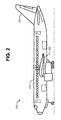
- FIG.2 illustrates a commercial aircraft 200.
- the aircraft 200 includes a fuselage 210, wing assemblies 220, and empennage 230.
- Each component 210-230 includes composite skin panels that are fastened together and to a stiffening substructure.
- Materials for the fasteners and skin panels are compatible.
- titanium fasteners may be used with skin panels made of carbon fiber reinforced plastic. These fasteners may have been installed by drilling holes into the skin panels, countersinking, inserting the fasteners into the drill holes, and terminating the fasteners.
- the fuselage 210 may be formed in sections, which are joined together. For instance, mid fuselage sections 43, 44 and 46 are joined together, and this mid fuselage is painted. Nose section 41 is separately painted and subsequently joined to the mid fuselage. Empennage sections 47 and 48 are also separately painted and subsequently joined to the mid fuselage. Additional painting is performed after the sections have been joined.
- FIG. 3 illustrates a method that may be applied to the fasteners at the surfaces of each of these sections individually (that is, prior to being joined to another section). The method of FIG. 3 may also be applied to the fasteners at joints of joined sections.
- FIG. 3 illustrates a method including applying a paint system to composite skin of a fuselage.
- the fuselage (either the entire fuselage or a portion of it) is moved to a paint hangar.
- the paint hangar may be a class 1 division 1 (C1D1) location having the area of a football field.
- C1D1 location refers to a location in which ignitable concentrations of such gases or vapors may exist.
- aliphatic urethane surfacer is forced into voids in composite skin around fastener heads to completely fill the voids. Only those exterior surfaces with fasteners may be treated.
- the aliphatic urethane surfacer may be applied manually using, for instance, a sponge, roller, brush or other tool.
- the aliphatic urethane surfacer is compatible with the type of paint system used on commercial aircraft, including a compatible strain modulus (which reduces cracking).
- the aliphatic urethane surfacer may be a two-component, chrome free, chemically cured, high solids, polyurethane surfacer.
- a first component contains pigment and polyester resin
- a second component is a clear, non-pigmented aliphatic isocyanate prepolymer, which acts as a hardener or curing agent for the first component.
- the components are mixed prior to forcing the aliphatic urethane surfacer into the voids.
- excess surfacer is removed from the surface of the skin.
- the excess surfacer may be removed manually using, for example, a squeegee.
- a coat of aliphatic urethane surfacer is sprayed over the skin.
- the coat which is typically no more than four mils thick, may be applied within one to six hours after the aliphatic urethane surfacer is forced into the voids.
- the surfacer is cured, and the fuselage is sanded.
- a paint system is applied.
- the paint system may include primer and one or more coats of paint.
- the surfacer coat (block 340) may be skipped. Instead, the surfacer filling the voids is cured, the fuselage is sanded, and the paint system is applied to the sanded fuselage.
- FIG. 4 illustrates an aircraft fastener 410 having a head 412 that is countersunk into a composite skin panel 420.
- Aliphatic urethane surfacer 430 completely fills a void in the skin panel 420 around the fastener head 412.
- a coat 440 of aliphatic urethane surfacer covers the surface of the skin panel 420, as well as the fastener head 412 and aliphatic urethane surfacer 430.
- a primer 450 covers the surfacer coat 440, and a topcoat 460 covers the primer 450.
- a halo does not appear around the fastener head 412.
- a method herein is not limited to a fuselage.
- the method may also be applied to the wings and empennage.
- a method herein may be applied to composite structures having small voids around fastener heads.
Landscapes
- Engineering & Computer Science (AREA)
- Aviation & Aerospace Engineering (AREA)
- Manufacturing & Machinery (AREA)
- Mechanical Engineering (AREA)
- Transportation (AREA)
- Life Sciences & Earth Sciences (AREA)
- Wood Science & Technology (AREA)
- Application Of Or Painting With Fluid Materials (AREA)
- Casting Or Compression Moulding Of Plastics Or The Like (AREA)
Abstract

Description
- A paint system is applied to a commercial aircraft prior to customer delivery. The paint system may include a decorative coating, which enhances the aircraft's appearance, provides operator markings, etc. The paint system may also include a protective coating in certain areas to prevent corrosion. On composite aircraft, the protective coating also prevents ultra violet radiation, erosion, and moisture ingress.
- The paint system may include a primer, which is applied to an exterior surface of the fuselage. In addition to covering composite skin, the primer covers fasteners. One or more coats of paint is applied over the primer.
- "Halos" sometimes appear around countersunk fasteners. The halos appear as visible circular or semi-circular depressions in the paint around the fasteners. These halos are undesirable, as they detract from the aircraft's appearance.
- According to an aspect of the present disclosure there is provided a method for a structure having a countersunk fastener head that includes forcing an aliphatic urethane surfacer into a void around the fastener head.
- Optionally, the surfacer is manually forced into the void, which is between the fastener head and a cut edge of the structure. Optionally, the void is completely filled with the aliphatic urethane surfacer. Optionally, the aliphatic urethane surfacer is a two-component, chrome free, chemically cured, high solids, polyurethane surfacer. Optionally, the method further comprises applying a coat of aliphatic urethane surfacer to the structure. Preferably, the coat is applied within one to six hours after the aliphatic urethane surfacer is forced into the void. Preferably, the method includes applying a paint system including a primer and at least one coat of paint. Optionally, the structure is a composite structure. Optionally, the structure is an aircraft fuselage structure. Preferably, the aliphatic urethane surfacer is applied only to those areas having fasteners.
- According to another aspect of the present disclosure there is provided a method for an aircraft fuselage having composite skin which comprises forcing an aliphatic urethane surfacer into voids in skin around countersunk fastener heads to completely fill the voids, and applying a paint system to the fuselage.
- Optionally, the method further comprises removing excess surfacer from the skin, and then applying a coat of aliphatic urethane surfacer to skin. Preferably, the surfacer coat is sprayed on one to six hours after the voids have been filled. Preferably, the method further comprises applying primer to the coat and at least one coat of paint
- According to yet another aspect of the present disclosure there is provided , an aircraft that comprises composite skin, a plurality of fasteners having heads countersunk in an exterior surface of the skin, and aliphatic urethane surfacer completely filling voids in the skin around the countersunk fastener heads.
- Optionally, the aircraft further comprises an aliphatic urethane surfacer coat on the exterior surface of the skin. Preferably, the aircraft further comprises a paint system on the surfacer coat.
- These features and functions may be achieved independently in various embodiments or may be combined in other embodiments. Further details of the embodiments can be seen with reference to the following description and drawings.
-
-
FIGS. 1A and 1B are illustrations of a fastener that is countersunk in a composite structure. -
FIG. 2 is an illustration of a commercial aircraft. -
FIG. 3 is an illustration of a method including applying a paint system to an aircraft. -
FIG. 4 is an illustration of an aircraft fastener that is countersunk in a composite skin panel and covered with a paint system. - Reference is made to
FIGS. 1A and 1B , which illustrate afastener 110 that is countersunk into astructure 120 made of composite material. The fastener'shead 112 may be flush with asurface 122 of thestructure 120, or it may be a few mils above or below thesurface 122. - To countersink the
fastener head 112, a counterbore may be machined into thesurface 122. Consequently, thefastener head 112 is surrounded by a cut edge. - A
void 124 exists between the cut edge and thefastener head 112. The void is formed because thefastener 110 is shaped in such a way that it leaves space between thefastener head 112 and the cut edge of thecomposite structure 120. Thevoid 124 may be circular and continuous (as shown inFIG. 1B ), and it may have a somewhat triangular shape in cross-section (as shown inFIG. 1A ). Typical depth and width of thevoid 124 may be five mils by eight mils for a mid size 5/16" fastener. - If an aliphatic urethane surfacer is applied to the
surface 122 in a conventional manner (spraying), a halo might subsequently form around thefastener head 112. The applicants have discovered that the halo might form because the conventionally-applied surfacer does not fill thevoid 124. - The applicants have also discovered that the halo can be eliminated by sufficiently forcing an aliphatic urethane surfacer into the
void 124 around thefastener head 112. For instance, the surfacer may be mechanically forced into thevoid 124 using a sponge, roller or brush. - In some embodiments, excess surfacer is applied to ensure that the
void 124 is completely filled. Any surfacer outside of thevoid 124 is removed. It is preferable to completely fill thevoid 124 to mitigate the potential for visible paint depressions around thefastener 110. Filling thevoid 124 at thesurface 122 may prevent air pockets, which may ultimately cause paint cracking around thefastener head 112 in service. - A surfacer denotes a particular functional category of coating material. Aliphatic urethane denotes the type of polymeric chemistry associated with the material.
- The
composite structure 120 is not limited to anything in particular. One example is composite skin of an aircraft fuselage. -
FIG.2 illustrates acommercial aircraft 200. Theaircraft 200 includes afuselage 210,wing assemblies 220, andempennage 230. Each component 210-230 includes composite skin panels that are fastened together and to a stiffening substructure. Materials for the fasteners and skin panels are compatible. For example, titanium fasteners may be used with skin panels made of carbon fiber reinforced plastic. These fasteners may have been installed by drilling holes into the skin panels, countersinking, inserting the fasteners into the drill holes, and terminating the fasteners. - Now consider the fabrication of the
fuselage 210. For some aircraft, thefuselage 210 may be formed in sections, which are joined together. For instance, mid fuselage sections 43, 44 and 46 are joined together, and this mid fuselage is painted. Nose section 41 is separately painted and subsequently joined to the mid fuselage. Empennage sections 47 and 48 are also separately painted and subsequently joined to the mid fuselage. Additional painting is performed after the sections have been joined. -
FIG. 3 illustrates a method that may be applied to the fasteners at the surfaces of each of these sections individually (that is, prior to being joined to another section). The method ofFIG. 3 may also be applied to the fasteners at joints of joined sections. - Reference is now made to
FIG. 3 , which illustrates a method including applying a paint system to composite skin of a fuselage. Atblock 310, the fuselage (either the entire fuselage or a portion of it) is moved to a paint hangar. In some embodiments, the paint hangar may be a class 1 division 1 (C1D1) location having the area of a football field. A C1D1 location refers to a location in which ignitable concentrations of such gases or vapors may exist. - At
block 320, aliphatic urethane surfacer is forced into voids in composite skin around fastener heads to completely fill the voids. Only those exterior surfaces with fasteners may be treated. The aliphatic urethane surfacer may be applied manually using, for instance, a sponge, roller, brush or other tool. - The aliphatic urethane surfacer is compatible with the type of paint system used on commercial aircraft, including a compatible strain modulus (which reduces cracking). In some embodiments, the aliphatic urethane surfacer may be a two-component, chrome free, chemically cured, high solids, polyurethane surfacer. A first component contains pigment and polyester resin, and a second component is a clear, non-pigmented aliphatic isocyanate prepolymer, which acts as a hardener or curing agent for the first component. The components are mixed prior to forcing the aliphatic urethane surfacer into the voids.
- At
block 330, excess surfacer is removed from the surface of the skin. The excess surfacer may be removed manually using, for example, a squeegee. - At
block 340, a coat of aliphatic urethane surfacer is sprayed over the skin. The coat, which is typically no more than four mils thick, may be applied within one to six hours after the aliphatic urethane surfacer is forced into the voids. The surfacer is cured, and the fuselage is sanded. - At
block 350, a paint system is applied. For instance, the paint system may include primer and one or more coats of paint. - In other embodiments, the surfacer coat (block 340) may be skipped. Instead, the surfacer filling the voids is cured, the fuselage is sanded, and the paint system is applied to the sanded fuselage.
- Reference is now made to
FIG. 4 , which illustrates anaircraft fastener 410 having ahead 412 that is countersunk into acomposite skin panel 420.Aliphatic urethane surfacer 430 completely fills a void in theskin panel 420 around thefastener head 412. - A
coat 440 of aliphatic urethane surfacer covers the surface of theskin panel 420, as well as thefastener head 412 andaliphatic urethane surfacer 430. Aprimer 450 covers thesurfacer coat 440, and atopcoat 460 covers theprimer 450. A halo does not appear around thefastener head 412. - A method herein is not limited to a fuselage. For a commercial aircraft, the method may also be applied to the wings and empennage. For other structures that will be painted, a method herein may be applied to composite structures having small voids around fastener heads.
Claims (13)
- A method for a structure (120) having a countersunk fastener head (112), the method comprising forcing an aliphatic urethane surfacer (430) into a void (124) around the fastener head (112).
- The method of claim 1, wherein the surfacer (430) is manually forced into the void (124), which is between the fastener head (112) and a cut edge of the structure (120).
- The method of claims 1 or 2, wherein the void (124) is completely filled with the aliphatic urethane surfacer (430).
- The method of any preceding claim, wherein the aliphatic urethane surfacer (430) is a two-component, chrome free, chemically cured, high solids, polyurethane surfacer.
- The method of any preceding claim, further comprising applying a coat (440) of aliphatic urethane surfacer (430) to the structure (120).
- The method of claim 5, wherein the coat (440) is applied within one to six hours after the aliphatic urethane surfacer (430) is forced into the void (124).
- The method of claim 5, further comprising applying a paint system including a primer (450) and at least one coat of paint.
- The method of any preceding claim, wherein the structure (120) is a composite structure.
- The method of any preceding claim, wherein the structure (120) is an aircraft fuselage (210) structure.
- The method of claim 9, wherein the aliphatic urethane surfacer (430) is applied only to those areas having fasteners (110).
- An aircraft (200) comprising:composite skin (420);a plurality of fasteners (110) having heads (112) countersunk in an exterior surface (122) of the skin 420; andaliphatic urethane surfacer (430) completely filling voids (124) in the skin (420) around the countersunk fastener heads (112).
- The aircraft (200) of claim 11, further comprising an aliphatic urethane surfacer coat (440) on the exterior surface (122) of the skin (420).
- The aircraft (200) of claim 12, further comprising a paint system on the surfacer coat (440).
Applications Claiming Priority (1)
| Application Number | Priority Date | Filing Date | Title |
|---|---|---|---|
| US13/479,262 US9481012B2 (en) | 2012-05-23 | 2012-05-23 | Method of filling voids around countersunk fastener heads |
Publications (3)
| Publication Number | Publication Date |
|---|---|
| EP2666715A2 true EP2666715A2 (en) | 2013-11-27 |
| EP2666715A3 EP2666715A3 (en) | 2017-05-10 |
| EP2666715B1 EP2666715B1 (en) | 2023-10-11 |
Family
ID=48468179
Family Applications (1)
| Application Number | Title | Priority Date | Filing Date |
|---|---|---|---|
| EP13169041.4A Active EP2666715B1 (en) | 2012-05-23 | 2013-05-23 | Method of filling voids around countersunk fastener heads |
Country Status (2)
| Country | Link |
|---|---|
| US (1) | US9481012B2 (en) |
| EP (1) | EP2666715B1 (en) |
Cited By (2)
| Publication number | Priority date | Publication date | Assignee | Title |
|---|---|---|---|---|
| FR3014709A1 (en) * | 2013-12-16 | 2015-06-19 | Airbus Operations Sas | PROCESS FOR TREATING TWO SURFACES OF TWO METAL PIECES |
| WO2017209963A1 (en) * | 2016-06-02 | 2017-12-07 | General Electric Company | A fan blade platform with a conical load spreader for composite bolted joint |
Families Citing this family (4)
| Publication number | Priority date | Publication date | Assignee | Title |
|---|---|---|---|---|
| EP4098891A1 (en) | 2014-04-14 | 2022-12-07 | Short Brothers Plc | Apparatus and method for forming fiber reinforced composite structures |
| JP6447557B2 (en) * | 2016-03-24 | 2019-01-09 | 日亜化学工業株式会社 | Method for manufacturing light emitting device |
| CN115234555A (en) * | 2022-06-23 | 2022-10-25 | 上海宇航系统工程研究所 | A preparation method for bonding cork on the surface of a large-diameter riveted cabin body |
| EP4516683B1 (en) * | 2023-08-31 | 2025-10-15 | Airbus Operations (S.A.S.) | Method for repairing a structural part of an aircraft having a protection defect, and aircraft structural part repaired in this way |
Family Cites Families (27)
| Publication number | Priority date | Publication date | Assignee | Title |
|---|---|---|---|---|
| US1944150A (en) * | 1932-06-30 | 1934-01-23 | Gulf States Steel Company | Nail |
| US3642312A (en) * | 1969-12-04 | 1972-02-15 | Us Air Force | Smear cladding for sealing and corrosion control in pure-aluminum-coated aluminum alloy sheets |
| US3906308A (en) * | 1973-09-27 | 1975-09-16 | Mc Donnell Douglas Corp | Aircraft lightning protection system |
| DE3278383D1 (en) * | 1982-09-30 | 1988-05-26 | Boeing Co | Integral lightning protection system for composite aircraft skins |
| US4502092A (en) * | 1982-09-30 | 1985-02-26 | The Boeing Company | Integral lightning protection system for composite aircraft skins |
| US4628402A (en) * | 1985-09-30 | 1986-12-09 | The Boeing Company | Lightning protection of fasteners in composite material |
| US4760493A (en) * | 1985-09-30 | 1988-07-26 | The Boeing Company | Lightning protection system for composite material aircraft structures |
| GB8628555D0 (en) * | 1986-11-28 | 1987-01-07 | British Aerospace | Anti lightning strike fasteners |
| US4884929A (en) * | 1987-12-21 | 1989-12-05 | Lockheed Corporation | Flush head fastener |
| US4905931A (en) * | 1988-02-18 | 1990-03-06 | The Boeing Company | Arc suppression around fasteners |
| US5043373A (en) * | 1988-06-16 | 1991-08-27 | The United States Of America As Represented By The Secretary Of The Navy | High gloss corrosion-resistant coatings |
| GB9411006D0 (en) * | 1994-06-02 | 1994-07-20 | British Aerospace | Method of fastening composite aircraft skins |
| US6679667B2 (en) * | 2001-02-28 | 2004-01-20 | Northrop Grumman Corporation | Hot melt fastener filler |
| DE602004002482T2 (en) * | 2003-05-30 | 2007-02-01 | Bae Systems Plc | COMPOSITE STRUCTURE LIGHTNING PROTECTION |
| ES2264299B1 (en) * | 2003-06-06 | 2007-11-16 | Airbus España S.L. | LIGHTNING PROTECTION SYSTEM FOR FUEL TANKS MANUFACTURED IN POOR ELECTRICAL CONDUCTIVITY MATERIALS. |
| US7554785B2 (en) * | 2004-03-23 | 2009-06-30 | The Boeing Company | Lightning damage protection for composite aircraft |
| ES2860724T3 (en) * | 2004-05-24 | 2021-10-05 | Hontek Corp | Abrasion resistant coatings |
| US7633283B2 (en) * | 2005-07-01 | 2009-12-15 | The Boeing Company | Method for lightning strike protection and verification of magnetizable dielectric inserts |
| US7755876B2 (en) * | 2005-07-01 | 2010-07-13 | The Boeing Company | Fastening assembly including washer for sealing the assembly for lightning strike protection in composite structures |
| US8231751B2 (en) * | 2005-09-06 | 2012-07-31 | The Boeing Company | Repair technique for lightning strike protection |
| US8246770B2 (en) * | 2005-09-06 | 2012-08-21 | The Boeing Company | Copper grid repair technique for lightning strike protection |
| US7277266B1 (en) * | 2006-03-29 | 2007-10-02 | The Boeing Company | Lightning protection system for composite structure |
| US7599164B2 (en) * | 2006-12-07 | 2009-10-06 | The Boeing Company | Lightning protection system for aircraft composite structure |
| ES2376323B1 (en) * | 2009-02-27 | 2013-01-24 | Airbus Operations, S.L. | IMPROVEMENT OF PROTECTION AGAINST DIRECT IMPACT OF RAYS IN RIVED PANEL AREAS IN CFRP. |
| US9034454B1 (en) * | 2011-09-30 | 2015-05-19 | Southern Rubber Company, Inc. | Composite joint filler seal material for joints in precast concrete structures |
| US20140283987A1 (en) * | 2013-03-19 | 2014-09-25 | Systems And Materials Research Corporation | Method and apparatus to apply a fill material to a substrate |
| FR3014709B1 (en) * | 2013-12-16 | 2016-01-29 | Airbus Operations Sas | PROCESS FOR TREATING TWO SURFACES OF TWO METAL PIECES |
-
2012
- 2012-05-23 US US13/479,262 patent/US9481012B2/en active Active
-
2013
- 2013-05-23 EP EP13169041.4A patent/EP2666715B1/en active Active
Cited By (6)
| Publication number | Priority date | Publication date | Assignee | Title |
|---|---|---|---|---|
| FR3014709A1 (en) * | 2013-12-16 | 2015-06-19 | Airbus Operations Sas | PROCESS FOR TREATING TWO SURFACES OF TWO METAL PIECES |
| US10053761B2 (en) | 2013-12-16 | 2018-08-21 | Airbus Operations Sas | Method for treatment of two surfaces of two metal parts |
| WO2017209963A1 (en) * | 2016-06-02 | 2017-12-07 | General Electric Company | A fan blade platform with a conical load spreader for composite bolted joint |
| CN109642466A (en) * | 2016-06-02 | 2019-04-16 | 通用电气公司 | The flabellum platform with tapered loading disperser for compound material bolt engagement |
| US10458425B2 (en) | 2016-06-02 | 2019-10-29 | General Electric Company | Conical load spreader for composite bolted joint |
| CN109642466B (en) * | 2016-06-02 | 2021-09-21 | 通用电气公司 | Fan blade platform with tapered load spreader for composite bolting |
Also Published As
| Publication number | Publication date |
|---|---|
| US20130316120A1 (en) | 2013-11-28 |
| EP2666715B1 (en) | 2023-10-11 |
| EP2666715A3 (en) | 2017-05-10 |
| US9481012B2 (en) | 2016-11-01 |
Similar Documents
| Publication | Publication Date | Title |
|---|---|---|
| EP2666715A2 (en) | Method of filling voids around countersunk fastener heads | |
| US8985515B2 (en) | Multi-directional load joint system | |
| RU2641959C2 (en) | Composite hat-shaped stiffening cross-section, composite stiffened hat-shaped cross-section of pressure bulkheads and methods of their manufacture | |
| EP2718180B1 (en) | A helicopter | |
| CN104058097B (en) | Form the adapter assembly of seal flow conduit | |
| US8088450B2 (en) | Automated wing painting system | |
| US7686905B2 (en) | Copper grid repair technique for lightning strike protection | |
| US10465736B2 (en) | Method of fastening structures using anti-rotation rivetless nut plate | |
| CA2869658C (en) | Method and system for installing fasteners with electromagnetic effect protection | |
| US12070770B2 (en) | Composite coatings having improved UV and paint stripping resistivity and methods for making same | |
| US20110006562A1 (en) | Modular floor system for vehicles | |
| EP2857186A2 (en) | Method for manufacturing a fibre composite component, fibre composite component, and structural component for an aircraft or spacecraft | |
| GB2458337A (en) | Bonded composite joint | |
| DE102007033261A1 (en) | Fiber composite component with thermoplastic stiffening elements | |
| WO2016055964A1 (en) | Process for assembling aircraft control surfaces | |
| EP3747646A1 (en) | Methods and apparatus to couple a decorative layer to a core layer of a panel via a barrier layer | |
| DE102014102117B4 (en) | Method and connection arrangement for connecting a flow body component with one or more components | |
| EP1984167B1 (en) | Method of repairing the surface of a formwork panel | |
| EP2978343A1 (en) | Furniture panel having a marking affixed in the face | |
| CA2423665A1 (en) | Composite skin panel opening edge and method for manufacture | |
| DE102007013819A1 (en) | Interior equipment component for an aircraft cabin | |
| US20090258291A1 (en) | Direct manufactured fuel cell plug and method | |
| DE102014013533A1 (en) | Assembled fiber composite components for aircraft or spacecraft and method of making same | |
| US10449725B2 (en) | Systems and methods to prevent cracking of exterior paint along structural joints of painted aerospace components | |
| EP4541599A1 (en) | Systems and methods for printing on a substrate |
Legal Events
| Date | Code | Title | Description |
|---|---|---|---|
| PUAI | Public reference made under article 153(3) epc to a published international application that has entered the european phase |
Free format text: ORIGINAL CODE: 0009012 |
|
| 17P | Request for examination filed |
Effective date: 20130523 |
|
| AK | Designated contracting states |
Kind code of ref document: A2 Designated state(s): AL AT BE BG CH CY CZ DE DK EE ES FI FR GB GR HR HU IE IS IT LI LT LU LV MC MK MT NL NO PL PT RO RS SE SI SK SM TR |
|
| AX | Request for extension of the european patent |
Extension state: BA ME |
|
| PUAL | Search report despatched |
Free format text: ORIGINAL CODE: 0009013 |
|
| AK | Designated contracting states |
Kind code of ref document: A3 Designated state(s): AL AT BE BG CH CY CZ DE DK EE ES FI FR GB GR HR HU IE IS IT LI LT LU LV MC MK MT NL NO PL PT RO RS SE SI SK SM TR |
|
| AX | Request for extension of the european patent |
Extension state: BA ME |
|
| RIC1 | Information provided on ipc code assigned before grant |
Ipc: F16B 19/04 20060101ALI20170401BHEP Ipc: B64C 1/00 20060101AFI20170401BHEP Ipc: B05D 7/22 20060101ALI20170401BHEP Ipc: B05D 1/28 20060101ALI20170401BHEP Ipc: F16B 5/00 20060101ALI20170401BHEP Ipc: B64C 1/12 20060101ALI20170401BHEP Ipc: B64F 5/00 20170101ALI20170401BHEP |
|
| STAA | Information on the status of an ep patent application or granted ep patent |
Free format text: STATUS: EXAMINATION IS IN PROGRESS |
|
| 17Q | First examination report despatched |
Effective date: 20190401 |
|
| REG | Reference to a national code |
Ref country code: DE Ref legal event code: R079 Ref document number: 602013084776 Country of ref document: DE Free format text: PREVIOUS MAIN CLASS: B64C0001120000 Ipc: B64C0001000000 Ref country code: DE Ref legal event code: R079 Free format text: PREVIOUS MAIN CLASS: B64C0001120000 Ipc: B64C0001000000 |
|
| GRAP | Despatch of communication of intention to grant a patent |
Free format text: ORIGINAL CODE: EPIDOSNIGR1 |
|
| STAA | Information on the status of an ep patent application or granted ep patent |
Free format text: STATUS: GRANT OF PATENT IS INTENDED |
|
| INTG | Intention to grant announced |
Effective date: 20230203 |
|
| RIC1 | Information provided on ipc code assigned before grant |
Ipc: F16B 19/04 20060101ALI20230123BHEP Ipc: F16B 5/00 20060101ALI20230123BHEP Ipc: B05D 7/22 20060101ALI20230123BHEP Ipc: B05D 1/28 20060101ALI20230123BHEP Ipc: B64F 5/10 20170101ALI20230123BHEP Ipc: B64C 1/12 20060101ALI20230123BHEP Ipc: B64C 1/00 20060101AFI20230123BHEP |
|
| RAP3 | Party data changed (applicant data changed or rights of an application transferred) |
Owner name: THE BOEING COMPANY |
|
| GRAJ | Information related to disapproval of communication of intention to grant by the applicant or resumption of examination proceedings by the epo deleted |
Free format text: ORIGINAL CODE: EPIDOSDIGR1 |
|
| STAA | Information on the status of an ep patent application or granted ep patent |
Free format text: STATUS: EXAMINATION IS IN PROGRESS |
|
| GRAP | Despatch of communication of intention to grant a patent |
Free format text: ORIGINAL CODE: EPIDOSNIGR1 |
|
| STAA | Information on the status of an ep patent application or granted ep patent |
Free format text: STATUS: GRANT OF PATENT IS INTENDED |
|
| INTC | Intention to grant announced (deleted) | ||
| INTG | Intention to grant announced |
Effective date: 20230512 |
|
| GRAS | Grant fee paid |
Free format text: ORIGINAL CODE: EPIDOSNIGR3 |
|
| GRAA | (expected) grant |
Free format text: ORIGINAL CODE: 0009210 |
|
| STAA | Information on the status of an ep patent application or granted ep patent |
Free format text: STATUS: THE PATENT HAS BEEN GRANTED |
|
| P01 | Opt-out of the competence of the unified patent court (upc) registered |
Effective date: 20230808 |
|
| AK | Designated contracting states |
Kind code of ref document: B1 Designated state(s): AL AT BE BG CH CY CZ DE DK EE ES FI FR GB GR HR HU IE IS IT LI LT LU LV MC MK MT NL NO PL PT RO RS SE SI SK SM TR |
|
| REG | Reference to a national code |
Ref country code: GB Ref legal event code: FG4D |
|
| REG | Reference to a national code |
Ref country code: CH Ref legal event code: EP |
|
| REG | Reference to a national code |
Ref country code: DE Ref legal event code: R096 Ref document number: 602013084776 Country of ref document: DE |
|
| REG | Reference to a national code |
Ref country code: IE Ref legal event code: FG4D |
|
| REG | Reference to a national code |
Ref country code: LT Ref legal event code: MG9D |
|
| REG | Reference to a national code |
Ref country code: NL Ref legal event code: MP Effective date: 20231011 |
|
| REG | Reference to a national code |
Ref country code: AT Ref legal event code: MK05 Ref document number: 1619989 Country of ref document: AT Kind code of ref document: T Effective date: 20231011 |
|
| PG25 | Lapsed in a contracting state [announced via postgrant information from national office to epo] |
Ref country code: NL Free format text: LAPSE BECAUSE OF FAILURE TO SUBMIT A TRANSLATION OF THE DESCRIPTION OR TO PAY THE FEE WITHIN THE PRESCRIBED TIME-LIMIT Effective date: 20231011 |
|
| PG25 | Lapsed in a contracting state [announced via postgrant information from national office to epo] |
Ref country code: GR Free format text: LAPSE BECAUSE OF FAILURE TO SUBMIT A TRANSLATION OF THE DESCRIPTION OR TO PAY THE FEE WITHIN THE PRESCRIBED TIME-LIMIT Effective date: 20240112 |
|
| PG25 | Lapsed in a contracting state [announced via postgrant information from national office to epo] |
Ref country code: IS Free format text: LAPSE BECAUSE OF FAILURE TO SUBMIT A TRANSLATION OF THE DESCRIPTION OR TO PAY THE FEE WITHIN THE PRESCRIBED TIME-LIMIT Effective date: 20240211 |
|
| PG25 | Lapsed in a contracting state [announced via postgrant information from national office to epo] |
Ref country code: LT Free format text: LAPSE BECAUSE OF FAILURE TO SUBMIT A TRANSLATION OF THE DESCRIPTION OR TO PAY THE FEE WITHIN THE PRESCRIBED TIME-LIMIT Effective date: 20231011 |
|
| PG25 | Lapsed in a contracting state [announced via postgrant information from national office to epo] |
Ref country code: AT Free format text: LAPSE BECAUSE OF FAILURE TO SUBMIT A TRANSLATION OF THE DESCRIPTION OR TO PAY THE FEE WITHIN THE PRESCRIBED TIME-LIMIT Effective date: 20231011 |
|
| PG25 | Lapsed in a contracting state [announced via postgrant information from national office to epo] |
Ref country code: ES Free format text: LAPSE BECAUSE OF FAILURE TO SUBMIT A TRANSLATION OF THE DESCRIPTION OR TO PAY THE FEE WITHIN THE PRESCRIBED TIME-LIMIT Effective date: 20231011 |
|
| PG25 | Lapsed in a contracting state [announced via postgrant information from national office to epo] |
Ref country code: LT Free format text: LAPSE BECAUSE OF FAILURE TO SUBMIT A TRANSLATION OF THE DESCRIPTION OR TO PAY THE FEE WITHIN THE PRESCRIBED TIME-LIMIT Effective date: 20231011 Ref country code: IS Free format text: LAPSE BECAUSE OF FAILURE TO SUBMIT A TRANSLATION OF THE DESCRIPTION OR TO PAY THE FEE WITHIN THE PRESCRIBED TIME-LIMIT Effective date: 20240211 Ref country code: GR Free format text: LAPSE BECAUSE OF FAILURE TO SUBMIT A TRANSLATION OF THE DESCRIPTION OR TO PAY THE FEE WITHIN THE PRESCRIBED TIME-LIMIT Effective date: 20240112 Ref country code: ES Free format text: LAPSE BECAUSE OF FAILURE TO SUBMIT A TRANSLATION OF THE DESCRIPTION OR TO PAY THE FEE WITHIN THE PRESCRIBED TIME-LIMIT Effective date: 20231011 Ref country code: BG Free format text: LAPSE BECAUSE OF FAILURE TO SUBMIT A TRANSLATION OF THE DESCRIPTION OR TO PAY THE FEE WITHIN THE PRESCRIBED TIME-LIMIT Effective date: 20240111 Ref country code: AT Free format text: LAPSE BECAUSE OF FAILURE TO SUBMIT A TRANSLATION OF THE DESCRIPTION OR TO PAY THE FEE WITHIN THE PRESCRIBED TIME-LIMIT Effective date: 20231011 Ref country code: PT Free format text: LAPSE BECAUSE OF FAILURE TO SUBMIT A TRANSLATION OF THE DESCRIPTION OR TO PAY THE FEE WITHIN THE PRESCRIBED TIME-LIMIT Effective date: 20240212 |
|
| PG25 | Lapsed in a contracting state [announced via postgrant information from national office to epo] |
Ref country code: SE Free format text: LAPSE BECAUSE OF FAILURE TO SUBMIT A TRANSLATION OF THE DESCRIPTION OR TO PAY THE FEE WITHIN THE PRESCRIBED TIME-LIMIT Effective date: 20231011 Ref country code: RS Free format text: LAPSE BECAUSE OF FAILURE TO SUBMIT A TRANSLATION OF THE DESCRIPTION OR TO PAY THE FEE WITHIN THE PRESCRIBED TIME-LIMIT Effective date: 20231011 Ref country code: PL Free format text: LAPSE BECAUSE OF FAILURE TO SUBMIT A TRANSLATION OF THE DESCRIPTION OR TO PAY THE FEE WITHIN THE PRESCRIBED TIME-LIMIT Effective date: 20231011 Ref country code: NO Free format text: LAPSE BECAUSE OF FAILURE TO SUBMIT A TRANSLATION OF THE DESCRIPTION OR TO PAY THE FEE WITHIN THE PRESCRIBED TIME-LIMIT Effective date: 20240111 Ref country code: LV Free format text: LAPSE BECAUSE OF FAILURE TO SUBMIT A TRANSLATION OF THE DESCRIPTION OR TO PAY THE FEE WITHIN THE PRESCRIBED TIME-LIMIT Effective date: 20231011 Ref country code: HR Free format text: LAPSE BECAUSE OF FAILURE TO SUBMIT A TRANSLATION OF THE DESCRIPTION OR TO PAY THE FEE WITHIN THE PRESCRIBED TIME-LIMIT Effective date: 20231011 |
|
| PG25 | Lapsed in a contracting state [announced via postgrant information from national office to epo] |
Ref country code: DK Free format text: LAPSE BECAUSE OF FAILURE TO SUBMIT A TRANSLATION OF THE DESCRIPTION OR TO PAY THE FEE WITHIN THE PRESCRIBED TIME-LIMIT Effective date: 20231011 |
|
| REG | Reference to a national code |
Ref country code: DE Ref legal event code: R097 Ref document number: 602013084776 Country of ref document: DE |
|
| PG25 | Lapsed in a contracting state [announced via postgrant information from national office to epo] |
Ref country code: CZ Free format text: LAPSE BECAUSE OF FAILURE TO SUBMIT A TRANSLATION OF THE DESCRIPTION OR TO PAY THE FEE WITHIN THE PRESCRIBED TIME-LIMIT Effective date: 20231011 |
|
| PG25 | Lapsed in a contracting state [announced via postgrant information from national office to epo] |
Ref country code: SK Free format text: LAPSE BECAUSE OF FAILURE TO SUBMIT A TRANSLATION OF THE DESCRIPTION OR TO PAY THE FEE WITHIN THE PRESCRIBED TIME-LIMIT Effective date: 20231011 |
|
| PG25 | Lapsed in a contracting state [announced via postgrant information from national office to epo] |
Ref country code: SM Free format text: LAPSE BECAUSE OF FAILURE TO SUBMIT A TRANSLATION OF THE DESCRIPTION OR TO PAY THE FEE WITHIN THE PRESCRIBED TIME-LIMIT Effective date: 20231011 Ref country code: SK Free format text: LAPSE BECAUSE OF FAILURE TO SUBMIT A TRANSLATION OF THE DESCRIPTION OR TO PAY THE FEE WITHIN THE PRESCRIBED TIME-LIMIT Effective date: 20231011 Ref country code: RO Free format text: LAPSE BECAUSE OF FAILURE TO SUBMIT A TRANSLATION OF THE DESCRIPTION OR TO PAY THE FEE WITHIN THE PRESCRIBED TIME-LIMIT Effective date: 20231011 Ref country code: IT Free format text: LAPSE BECAUSE OF FAILURE TO SUBMIT A TRANSLATION OF THE DESCRIPTION OR TO PAY THE FEE WITHIN THE PRESCRIBED TIME-LIMIT Effective date: 20231011 Ref country code: EE Free format text: LAPSE BECAUSE OF FAILURE TO SUBMIT A TRANSLATION OF THE DESCRIPTION OR TO PAY THE FEE WITHIN THE PRESCRIBED TIME-LIMIT Effective date: 20231011 Ref country code: DK Free format text: LAPSE BECAUSE OF FAILURE TO SUBMIT A TRANSLATION OF THE DESCRIPTION OR TO PAY THE FEE WITHIN THE PRESCRIBED TIME-LIMIT Effective date: 20231011 Ref country code: CZ Free format text: LAPSE BECAUSE OF FAILURE TO SUBMIT A TRANSLATION OF THE DESCRIPTION OR TO PAY THE FEE WITHIN THE PRESCRIBED TIME-LIMIT Effective date: 20231011 |
|
| PLBE | No opposition filed within time limit |
Free format text: ORIGINAL CODE: 0009261 |
|
| STAA | Information on the status of an ep patent application or granted ep patent |
Free format text: STATUS: NO OPPOSITION FILED WITHIN TIME LIMIT |
|
| 26N | No opposition filed |
Effective date: 20240712 |
|
| PG25 | Lapsed in a contracting state [announced via postgrant information from national office to epo] |
Ref country code: SI Free format text: LAPSE BECAUSE OF FAILURE TO SUBMIT A TRANSLATION OF THE DESCRIPTION OR TO PAY THE FEE WITHIN THE PRESCRIBED TIME-LIMIT Effective date: 20231011 |
|
| PG25 | Lapsed in a contracting state [announced via postgrant information from national office to epo] |
Ref country code: SI Free format text: LAPSE BECAUSE OF FAILURE TO SUBMIT A TRANSLATION OF THE DESCRIPTION OR TO PAY THE FEE WITHIN THE PRESCRIBED TIME-LIMIT Effective date: 20231011 |
|
| REG | Reference to a national code |
Ref country code: CH Ref legal event code: PL |
|
| PG25 | Lapsed in a contracting state [announced via postgrant information from national office to epo] |
Ref country code: MC Free format text: LAPSE BECAUSE OF FAILURE TO SUBMIT A TRANSLATION OF THE DESCRIPTION OR TO PAY THE FEE WITHIN THE PRESCRIBED TIME-LIMIT Effective date: 20231011 |
|
| PG25 | Lapsed in a contracting state [announced via postgrant information from national office to epo] |
Ref country code: LU Free format text: LAPSE BECAUSE OF NON-PAYMENT OF DUE FEES Effective date: 20240523 |
|
| PG25 | Lapsed in a contracting state [announced via postgrant information from national office to epo] |
Ref country code: MC Free format text: LAPSE BECAUSE OF FAILURE TO SUBMIT A TRANSLATION OF THE DESCRIPTION OR TO PAY THE FEE WITHIN THE PRESCRIBED TIME-LIMIT Effective date: 20231011 Ref country code: LU Free format text: LAPSE BECAUSE OF NON-PAYMENT OF DUE FEES Effective date: 20240523 Ref country code: CH Free format text: LAPSE BECAUSE OF NON-PAYMENT OF DUE FEES Effective date: 20240531 |
|
| REG | Reference to a national code |
Ref country code: BE Ref legal event code: MM Effective date: 20240531 |
|
| PG25 | Lapsed in a contracting state [announced via postgrant information from national office to epo] |
Ref country code: IE Free format text: LAPSE BECAUSE OF NON-PAYMENT OF DUE FEES Effective date: 20240523 |
|
| PG25 | Lapsed in a contracting state [announced via postgrant information from national office to epo] |
Ref country code: BE Free format text: LAPSE BECAUSE OF NON-PAYMENT OF DUE FEES Effective date: 20240531 |
|
| PGFP | Annual fee paid to national office [announced via postgrant information from national office to epo] |
Ref country code: DE Payment date: 20250529 Year of fee payment: 13 |
|
| PGFP | Annual fee paid to national office [announced via postgrant information from national office to epo] |
Ref country code: GB Payment date: 20250527 Year of fee payment: 13 |
|
| PGFP | Annual fee paid to national office [announced via postgrant information from national office to epo] |
Ref country code: FR Payment date: 20250526 Year of fee payment: 13 |
|
| PG25 | Lapsed in a contracting state [announced via postgrant information from national office to epo] |
Ref country code: CY Free format text: LAPSE BECAUSE OF FAILURE TO SUBMIT A TRANSLATION OF THE DESCRIPTION OR TO PAY THE FEE WITHIN THE PRESCRIBED TIME-LIMIT; INVALID AB INITIO Effective date: 20130523 |
|
| PG25 | Lapsed in a contracting state [announced via postgrant information from national office to epo] |
Ref country code: HU Free format text: LAPSE BECAUSE OF FAILURE TO SUBMIT A TRANSLATION OF THE DESCRIPTION OR TO PAY THE FEE WITHIN THE PRESCRIBED TIME-LIMIT; INVALID AB INITIO Effective date: 20130523 |
|
| PG25 | Lapsed in a contracting state [announced via postgrant information from national office to epo] |
Ref country code: FI Free format text: LAPSE BECAUSE OF FAILURE TO SUBMIT A TRANSLATION OF THE DESCRIPTION OR TO PAY THE FEE WITHIN THE PRESCRIBED TIME-LIMIT Effective date: 20231011 |