EP2666648A1 - Fahrzeugluftreifen - Google Patents
Fahrzeugluftreifen Download PDFInfo
- Publication number
- EP2666648A1 EP2666648A1 EP13167421.0A EP13167421A EP2666648A1 EP 2666648 A1 EP2666648 A1 EP 2666648A1 EP 13167421 A EP13167421 A EP 13167421A EP 2666648 A1 EP2666648 A1 EP 2666648A1
- Authority
- EP
- European Patent Office
- Prior art keywords
- rib
- tread
- block structure
- ribs
- pneumatic vehicle
- Prior art date
- Legal status (The legal status is an assumption and is not a legal conclusion. Google has not performed a legal analysis and makes no representation as to the accuracy of the status listed.)
- Granted
Links
Images
Classifications
-
- B—PERFORMING OPERATIONS; TRANSPORTING
- B60—VEHICLES IN GENERAL
- B60C—VEHICLE TYRES; TYRE INFLATION; TYRE CHANGING; CONNECTING VALVES TO INFLATABLE ELASTIC BODIES IN GENERAL; DEVICES OR ARRANGEMENTS RELATED TO TYRES
- B60C11/00—Tyre tread bands; Tread patterns; Anti-skid inserts
- B60C11/03—Tread patterns
- B60C11/0306—Patterns comprising block rows or discontinuous ribs
-
- B—PERFORMING OPERATIONS; TRANSPORTING
- B60—VEHICLES IN GENERAL
- B60C—VEHICLE TYRES; TYRE INFLATION; TYRE CHANGING; CONNECTING VALVES TO INFLATABLE ELASTIC BODIES IN GENERAL; DEVICES OR ARRANGEMENTS RELATED TO TYRES
- B60C11/00—Tyre tread bands; Tread patterns; Anti-skid inserts
- B60C11/03—Tread patterns
- B60C11/13—Tread patterns characterised by the groove cross-section, e.g. for buttressing or preventing stone-trapping
- B60C11/1376—Three dimensional block surfaces departing from the enveloping tread contour
- B60C11/1392—Three dimensional block surfaces departing from the enveloping tread contour with chamfered block edges
-
- B—PERFORMING OPERATIONS; TRANSPORTING
- B60—VEHICLES IN GENERAL
- B60C—VEHICLE TYRES; TYRE INFLATION; TYRE CHANGING; CONNECTING VALVES TO INFLATABLE ELASTIC BODIES IN GENERAL; DEVICES OR ARRANGEMENTS RELATED TO TYRES
- B60C11/00—Tyre tread bands; Tread patterns; Anti-skid inserts
- B60C11/03—Tread patterns
- B60C2011/0337—Tread patterns characterised by particular design features of the pattern
- B60C2011/0339—Grooves
- B60C2011/0341—Circumferential grooves
- B60C2011/0346—Circumferential grooves with zigzag shape
-
- B—PERFORMING OPERATIONS; TRANSPORTING
- B60—VEHICLES IN GENERAL
- B60C—VEHICLE TYRES; TYRE INFLATION; TYRE CHANGING; CONNECTING VALVES TO INFLATABLE ELASTIC BODIES IN GENERAL; DEVICES OR ARRANGEMENTS RELATED TO TYRES
- B60C11/00—Tyre tread bands; Tread patterns; Anti-skid inserts
- B60C11/03—Tread patterns
- B60C2011/0337—Tread patterns characterised by particular design features of the pattern
- B60C2011/0339—Grooves
- B60C2011/0358—Lateral grooves, i.e. having an angle of 45 to 90 degees to the equatorial plane
- B60C2011/0372—Lateral grooves, i.e. having an angle of 45 to 90 degees to the equatorial plane with particular inclination angles
-
- B—PERFORMING OPERATIONS; TRANSPORTING
- B60—VEHICLES IN GENERAL
- B60C—VEHICLE TYRES; TYRE INFLATION; TYRE CHANGING; CONNECTING VALVES TO INFLATABLE ELASTIC BODIES IN GENERAL; DEVICES OR ARRANGEMENTS RELATED TO TYRES
- B60C11/00—Tyre tread bands; Tread patterns; Anti-skid inserts
- B60C11/03—Tread patterns
- B60C2011/0337—Tread patterns characterised by particular design features of the pattern
- B60C2011/0386—Continuous ribs
- B60C2011/0393—Narrow ribs, i.e. having a rib width of less than 8 mm
- B60C2011/0395—Narrow ribs, i.e. having a rib width of less than 8 mm for linking shoulder blocks
-
- B—PERFORMING OPERATIONS; TRANSPORTING
- B60—VEHICLES IN GENERAL
- B60C—VEHICLE TYRES; TYRE INFLATION; TYRE CHANGING; CONNECTING VALVES TO INFLATABLE ELASTIC BODIES IN GENERAL; DEVICES OR ARRANGEMENTS RELATED TO TYRES
- B60C11/00—Tyre tread bands; Tread patterns; Anti-skid inserts
- B60C11/03—Tread patterns
- B60C11/12—Tread patterns characterised by the use of narrow slits or incisions, e.g. sipes
- B60C11/1236—Tread patterns characterised by the use of narrow slits or incisions, e.g. sipes with special arrangements in the tread pattern
- B60C2011/1254—Tread patterns characterised by the use of narrow slits or incisions, e.g. sipes with special arrangements in the tread pattern with closed sipe, i.e. not extending to a groove
Definitions
- the invention relates to a pneumatic vehicle tire having a tread with at least three circumferentially and substantially zigzag-shaped peripheral circumferential grooves, at least two extending in the central region of the tread ribs and each one shoulder-side extending rib.
- Pneumatic vehicle tires with such running treads are known in different embodiments. Also known are treads whose profile is composed of a combination of profile ribs and block rows and treads that consist exclusively of block rows. Treads having tread ribs are additionally provided with transverse grooves or transverse cuts and the like. As a result, transverse edges are provided, which are important for the wet grip of the tread.
- a pneumatic vehicle tire with a number of circumferentially extending tread ribs is known from the US-A-5,769,978 known. In order to increase the durability of the belt in the edge regions, in this tire, the shoulder ribs are designed at a lower height than the other profile ribs, which can be enclosed by a common envelope.
- the tread is composed of a number of spaced by circumferential grooves block rows.
- Each block is composed of two approximately parallelogram-shaped block parts, which are separated from each other by a narrow incision.
- Another tread with a plurality of circumferentially extending block rows, which are separated from each other by meander-shaped circumferential grooves, is known from DE-U-8809532 known.
- the two central block rows are in the region of the mid-circumferential plane, these cross-interlocked, interlocked with each other, that essentially a kind of mid-rib formed is divided only between the successive tread blocks each by a deep narrow transverse groove.
- the tread blocks are each provided with a number of cuts, which open into grooves or grooves.
- Transverse cuts and transverse grooves which open in circumferential grooves, as well as the block corners thus formed by cuts and transverse grooves, are susceptible to high stresses on the tires, such as may occur on poor, uneven road surfaces, under high temperatures or under heavy load the occurrence of tears and as a result of the tears of eruptions or exfoliation of rubber material.
- the invention is therefore based on the object to effectively prevent the occurrence of the aforementioned damage in a pneumatic vehicle tire of the type mentioned.
- the object is achieved according to the invention in that at least one profile rib in the radial direction, each composed of an unstructured base rib and a patch on this block structure, wherein the base rib, viewed in plan view, on the or the circumferential groove (s) projects beyond the block structure in that all or almost all of the corner regions formed by the circumferential groove (s) or the base rib and the block structure are rounded.
- the profile ribs in the middle region of the tread and / or the shoulder-side profile ribs in the radial direction are composed in each case of an unstructured base rib and a block structure placed thereon.
- edges for good wet grip and a good traction of the tire are provided by the zig-zag shape of the circumferential grooves.
- the boundary edges of the base ribs determine the zig-zag shape of the circumferential grooves and are composed of a sequence of a respective longer and a shorter section.
- the patch block structure provides transverse edges, at least over a certain tread wear, available.
- the block structure is formed in the central profile ribs of blocks which extend in the circumferential direction over four sections of the boundary edges according to the zig-zag shape of the boundary edges of the profile ribs and if the block structure in the shoulder-side profile ribs is formed in each case by block-like profile elements which extend in accordance with the zig-zag shape of the boundary edge of the base rib to the adjacent circumferential groove along the longer portions of the boundary edge and are separated from each other by short sacknutieri indentations.
- the supporting and reinforcing effect of the base rib (s) on the tread pattern is particularly effective when the height of the base rib (s) is between 70% and 80% of the tread depth.
- tread of a pneumatic vehicle tire is particularly designed to largely avoid the occurrence of tears and subsequently the emergence of chipping or peeling of rubber material.
- Such damage commonly referred to as “cut and chip,” occurs in treads especially when the tires are used on poor, uneven road surfaces, under high temperatures, or under excessive load.
- the ground-contacting part of the tread running across the width B corresponds to the statically determined footprint according to ETRTO standards (load at 70% of the carrying capacity at an internal pressure of 2.5 bar, internal pressure 85% of 2.5 bar).
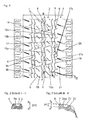
- Fig. 1 shows an example of a tread with three circumferential circumferential grooves 1 in the circumferential direction with matching in the example shown embodiment.
- the circumferential grooves 1 extend in a zig-zag shape, which will be described, wherein the circumferential grooves 1 are slightly offset from each other in the circumferential direction.
- One of the circumferential grooves 1 extends along the tire equator AA and delimits two circumferentially extending profile ribs 2, which in turn are delimited by one of the further circumferential grooves 1.
- These circumferential grooves 1 separate the tread ribs 2 each from a shoulder-side tread rib. 3
- each profile rib 2 is composed of a base rib 4 with these blocks 5 of low height together.
- Each base rib 4 has a radial extent constant over the tread circumference, so that its height a, determined from the lowest point of the circumferential grooves 1, between 70 and 80% of the depth P T - this is the maximum tread depth corresponding to the depth of the circumferential grooves 1 - is.
- the radial extent of the blocks 5 or their height b, determined by the outer upper edge of the base rib 4, is therefore between 20 and 30% of the tread depth P T.
- the circumferentially extending boundary edges 6 of the base ribs 4 extend substantially along a zig-zag path with longer sections 6a, which extend at an acute angle ⁇ of a few degrees, in particular 2 ° to 10 °, to the circumferential direction.
- the second portions 6b of the edges 6 are inclined in the opposite direction to the portions 6a to the circumferential direction and extend at an angle ⁇ 'of about 140 ° to 170 ° to the circumferential direction.
- the transitions between sections 6a and 6b are all rounded off.
- the shoulder-side profile ribs 3 have block-like profile elements 7, which are each mounted on a base rib 8, wherein the radial extent of the elements 7 and the base rib 8 correspond to the heights described a and b.
- the attached blocks 5 have a circumferential extent, which corresponds approximately to twice their transverse extent and extend in the circumferential direction substantially respectively over two portions 6a of the boundary edges 6.
- Their outer shape is substantially adapted to the zig-zag shape of the boundary edges 6 so that they are composed of two slightly offset in the transverse direction of the tire block parts 15.
- the block parts 15 are essentially rectangles with rounded corner areas and rounded transition areas.
- the circumferentially associated edges 15a of the block parts 15 extend at an angle ⁇ to the circumferential direction, which is greater by 1 ° to 5 ° than the angle ⁇ of the portions 6a of the boundary edges 6.
- the blocks 5 are not offset from the base rib 4.
- the block parts 5 in the axial direction delimiting edges 15b extend below an angle ⁇ of 70 ° to 80 ° to the circumferential direction.
- the edges 15b of circumferentially adjoining blocks 5 run parallel to each other at a small distance of 1 to 2 mm.
- Each block part 15 is provided with an in plan view substantially flat V-shaped recess 9.
- the incisions 9 extend exclusively within the block 5 and therefore do not open out at the block edges.
- the outer end portions 9a of the recesses 9 are raised stepwise, analogous to the formation of the base rib 4th
- the shoulder-side profile ribs 3 each have a base rib 8.
- the base rib 8 bounds with its edge 18, which is composed of longer sections 18a and shorter sections 18b, the adjacent circumferential groove 1, analogous to the boundary edge 6, with the angles ⁇ and ⁇ 'relative to the circumferential direction.
- the offset from the base rib 8 extending edges 17 of the block-like profile elements 7 have, in analogous to the blocks 5, short sections 17b and 17a longer portions associated with the sections 18a and extend at an angle ⁇ to the circumferential direction.
- the profile elements 7 are bounded by short sacknutartigen recesses 19. All corner regions of the block-like profile elements 7 are rounded and substantially rectangular corner regions.
- Approximately in the central region of each block-like profile element 7 and at a distance from the boundary edges 17 are the closed tread inside ends of transverse grooves 20 which extend beyond the ground contacting part of the tread.
- the transverse grooves 20 are made shallow except for a narrow, deeper incision 21 on the tread inside end portion.
- the incision 21 ends with a step 21 a, which is executed analogously to the offset region between the base rib 8 and the elements 7.
- pneumatic vehicle tires constructed in accordance with the invention may have more than four tread ribs.
Landscapes
- Engineering & Computer Science (AREA)
- Mechanical Engineering (AREA)
- Tires In General (AREA)
Abstract
Description
- Die Erfindung betrifft einen Fahrzeugluftreifen mit einem Laufstreifen mit zumindest drei in Umfangsrichtung und im Wesentlichen zick-zack-förmig umlaufenden Umfangsrillen, zumindest zwei im mittleren Bereich des Laufstreifens verlaufenden Profilrippen und jeweils einer schulterseitig verlaufenden Profilrippe.
- Fahrzeugluftreifen mit derart ausgeführten Laufstreifen sind in unterschiedlichen Ausführungsvarianten bekannt. Bekannt sind ferner Laufstreifen, deren Profil sich aus einer Kombination aus Profilrippen und Blockreihen zusammensetzt und Laufstreifen, die ausschließlich aus Blockreihen bestehen. Laufstreifen, die Profilrippen aufweisen, sind zusätzlich mit Querrillen oder Quereinschnitten und dergleichen versehen. Dadurch werden Querkanten zur Verfügung gestellt, welche für den Nassgriff des Laufstreifens wichtig sind. Ein Fahrzeugluftreifen mit einer Anzahl von in Umfangsrichtung verlaufenden Profilrippen ist aus der
US-A-5,769,978 bekannt. Um die Haltbarkeit des Gürtels in den Randbereichen zu erhöhen, sind bei diesem Reifen die Schulterrippen in einer geringeren Höhe ausgeführt als die anderen Profilrippen, die sich von einer gemeinsamen Einhüllenden umschließen lassen. Aus derEP-A-0 393 012 ist ein LKW-Reifen bekannt, dessen Laufstreifen sich aus einer Anzahl von durch Umfangsnuten voneinander getrennten Blockreihen zusammensetzt. Jeder Block setzt sich aus zwei etwa Parallelogramm förmigen Blockteilen zusammen, die voneinander durch einen schmalen Einschnitt getrennt sind. Ein weiterer Laufstreifen mit mehreren in Umfangsrichtung verlaufenden Blockreihen, die voneinander durch mäanderförmig verlaufende Umfangsnuten getrennt sind, ist aus derDE-U-8809532 bekannt. Die beiden mittig gelegenen Blockreihen sind im Bereich der Mittelumfangsebene, diese übergreifend, derart miteinander verzahnt, dass im Wesentlichen eine Art Mittelrippe gebildet wird, die nur zwischen den aufeinanderfolgenden Profilblöcken jeweils durch eine tiefe schmale Quernut unterteilt ist. Die Profilblöcke sind jeweils mit einer Anzahl von Einschnitten versehen, die in Rillen oder Nuten einmünden. - In Querrichtung verlaufende Einschnitte und Querrillen, welche in Umfangsnuten münden, sowie die derart durch Einschnitte und Querrillen gebildeten Blockecken sind bei höheren Beanspruchungen der Reifen, wie sie beispielsweise auf schlechten, unebenen Straßenbelägen, unter hohen Temperaturen oder unter hoher Last, auftreten können, anfällig für das Entstehen von Einrissen und in Folge der Einrisse von Ausbrüchen oder Abblätterungen von Gummimaterial sind.
- Der Erfindung liegt somit die Aufgabe zugrunde, bei einem Fahrzeugluftreifen der eingangs genannten Art das Auftreten der erwähnten Schäden wirkungsvoll zu verhindern.
- Gelöst wird die gestellte Aufgabe erfindungsgemäß dadurch, dass sich zumindest eine Profilrippe in radialer Richtung, jeweils aus einer unstrukturierten Basisrippe und einer auf dieser aufgesetzten Blockstruktur zusammensetzt, wobei die Basisrippe, in Draufsicht betrachtet, an der bzw. den Umfangsrille(n) die Blockstruktur überragt, und dass sämtliche oder nahezu sämtliche von der bzw. den Umfangsrille(n) bzw. der Basisrippe und der Blockstruktur gebildeten Eckbereiche gerundet sind.
- Diese Maßnahmen verhindern wirkungsvoll das Entstehen der erwähnten Schäden in Profilrippen im Laufstreifen der Reifen, wobei nach wie vor die für einen guten Nassgriff, ein gutes Aquaplaningverhalten, die Traktion, das Bremsverhalten und das Handling erforderlichen Profilstrukturen vorhanden sind.
- Bei einer bevorzugten Ausführungsform der Erfindung setzen sich die Profilrippen im mittleren Bereich des Laufstreifens und/oder die schulterseitig verlaufenden Profilrippen in radialer Richtung jeweils aus einer unstrukturierten Basisrippe und einer auf dieser aufgesetzten Blockstruktur zusammen. Je nach Reifentyp, Reifendimension und Einsatzzweck der Reifen kann es vorteilhaft sein, entweder nur die Profilrippen im mittleren Bereich des Laufstreifens oder nur die Profilrippen in den seitlichen Bereichen des Laufstreifens oder sämtliche Profilrippen erfindungsgemäß auszuführen.
- Eine weitere Maßnahme, die einem Entstehen von Einrissen, Ausbrüchen und dem Abblättern von Gummimaterial entgegenwirkt, besteht darin, dass in der Profilrippe bzw. der Blockstruktur Einschnitte ausgebildet sind, welche sämtlich bzw. nahezu sämtlich ausschließlich innerhalb der Profilrippe bzw. der Blockstruktur verlaufen. Diese Einschnitte stellen für den Nassgriff des Laufstreifens wichtige Querkanten zur Verfügung. In diesem Zusammenhang ist es ferner vorteilhaft, wenn die Einschnitte in Draufsicht im Wesentlichen einen gewinkelten Verlauf mit stumpfen Winkeln, insbesondere einen flach V-förmigen Verlauf aufweisen.
- Weitere Kanten für guten Nassgriff und ein gutes Traktionsverhalten des Reifens werden durch die Zick-Zack-Form der Umfangsrillen zur Verfügung gestellt. Diesbezüglich ist es daher günstig, wenn die Begrenzungskanten der Basisrippen die Zick-Zack-Form der Umfangsrillen bestimmen und sich aus einer Abfolge von jeweils einem längeren und einem kürzeren Abschnitt zusammensetzen. Auch die aufgesetzte Blockstruktur stellt Querkanten, zumindest über einen gewissen Laufstreifenabrieb, zur Verfügung. Für eine ausgewogene Profilsteifigkeit ist es von Vorteil, wenn die Blockstruktur in den mittleren Profilrippen von Blöcken gebildet ist, die entsprechend der Zick-Zack-Form der Begrenzungskanten der Profilrippen in Umfangsrichtung über jeweils vier Abschnitte der Begrenzungskanten verlaufen und wenn die Blockstruktur in den schulterseitigen Profilrippen jeweils von blockartigen Profilelementen gebildet ist, welche entsprechend der Zick-Zack-Form der Begrenzungskante der Basisrippe zur benachbarten Umfangsrille sich entlang der längeren Abschnitte der Begrenzungskante erstrecken und voneinander durch kurze sacknutartige Einbuchtungen getrennt sind.
- Die Abstütz- und Verstärkungswirkung der Basisrippe(n) auf das Laufstreifenprofil ist dann besonders effektiv, wenn die Höhe der Basisrippe(n) zwischen 70 % und 80 % der Profiltiefe beträgt.
- Das Auftreten von Kerbwirkungen an den Eckbereichen der Blockstruktur und der Rippenstruktur wird vor allem dann wirkungsvoll unterbunden, wenn diese Eckbereiche mit einem Radius von 2 mm bis 4 mm gerundet sind.
- Weitere Merkmale, Vorteile und Einzelheiten der Erfindung werden nun anhand der Zeichnung, die ein Ausführungsbeispiel darstellt, näher beschrieben. Dabei zeigen
-
Fig. 1 eine Draufsicht auf eine Teilabwicklung eines Laufstreifens, -
Fig. 2 einen Schnitt entlang der Linie II-II derFig. 1 und -
Fig. 3 einen Schnitt entlang der Linie III-III derFig. 1 . - Der in
Fig. 1 gezeigte Laufstreifen eines Fahrzeugluftreifens ist besonders gestaltet, um das Auftreten von Einrissen und nachfolgend das Entstehen von Ausbrüchen bzw. das Abblättern von Gummimaterial weitgehend zu vermeiden. Solche Schäden, die üblicherweise als "Cut and Chip" bezeichnet werden, treten in Laufstreifen vor allem dann auf, wenn die Reifen auf schlechten, unebenen Straßenbelägen, unter hohen Temperaturen oder unter zu hoher Last eingesetzt werden. Der über die Breite B verlaufende, bodenberührende Teil des Laufstreifen entspricht dem statisch ermittelten Footprint gemäß E.T.R.T.O.-Standards (Last bei 70 % der Tragfähigkeit bei einem Innendruck von 2,5 bar, Innendruck 85 % von 2,5 bar). -
Fig. 1 zeigt beispielhaft einen Laufstreifen mit drei in Umfangsrichtung umlaufenden Umfangsrillen 1 mit beim gezeigten Beispiel übereinstimmender Ausführung. Die Umfangsrillen 1 verlaufen in einer Zick-Zack-Form, die noch beschrieben wird, wobei die Umfangsrillen 1 in Umfangsrichtung gegeneinander geringfügig versetzt sind. Eine der Umfangsrillen 1 verläuft entlang des Reifenäquators A-A und begrenzt zwei in Umfangsrichtung umlaufende Profilrippen 2, die ihrerseits von je einer der weiteren Umfangsrillen 1 begrenzt sind. Diese Umfangsrillen 1 trennen die Profilrippen 2 von jeweils einer schulterseitigen Profilrippe 3. - Wie
Fig. 1 und die Schnittdarstellung inFig. 2 zeigen, setzt sich jede Profilrippe 2 aus einer Basisrippe 4 mit auf diesen aufgesetzten Blöcken 5 geringer Höhe zusammen. Jede Basisrippe 4 weist eine über den Laufstreifenumfang konstante radiale Erstreckung auf, sodass ihre Höhe a, vom tiefsten Punkt der Umfangsrillen 1 ermittelt, zwischen 70 und 80 % der Tiefe PT - dies ist die maximale Profiltiefe, welche der Tiefe der Umfangsrillen 1 entspricht - beträgt. Die radiale Erstreckung der Blöcke 5 bzw. deren Höhe b, von der äußeren oberen Kante der Basisrippe 4 ermittelt, beträgt demnach zwischen 20 und 30 % der Profiltiefe PT. Die in Umfangsrichtung verlaufenden Begrenzungskanten 6 der Basisrippen 4 verlaufen im Wesentlichen entlang eines Zick-Zack-Weges mit längeren Abschnitten 6a, welche unter einem spitzen Winkel α von einigen wenigen Grad, insbesondere 2° bis 10°, zur Umfangsrichtung verlaufen. Die zweiten Abschnitte 6b der Kanten 6 sind gegensinnig zu den Abschnitten 6a zur Umfangsrichtung geneigt und verlaufen unter einem Winkel α' von etwa 140° bis 170° zur Umfangsrichtung. Die Übergänge zwischen den Abschnitten 6a und 6b sind sämtlich abgerundet. Die schulterseitigen Profilrippen 3 weisen blockartige Profilelemente 7 auf, welche auf je eine Basisrippe 8 aufgesetzt sind, wobei die radialen Erstreckungen der Elemente 7 und der Basisrippe 8 den beschriebenen Höhen a und b entsprechen. - Die aufgesetzten Blöcke 5 weisen eine Umfangserstreckung auf, die ungefähr dem Doppelten ihrer Quererstreckung entspricht und verlaufen in Umfangsrichtung im Wesentlichen jeweils über zwei Abschnitte 6a der Begrenzungskanten 6. Ihre äußere Form ist im Wesentlichen der Zick-Zack-Form der Begrenzungskanten 6 angepasst, sodass sie sich aus zwei in Reifenquerrichtung geringfügig versetzten Blockteilen 15 zusammensetzen. Die Blockteile 15 sind im Wesentlichen Rechtecke mit abgerundeten Eckbereichen und abgerundeten Übergangsbereichen. Die der Umfangsrichtung zugeordneten Kanten 15a der Blockteile 15 verlaufen unter einem Winkel β zur Umfangsrichtung, welcher um 1° bis 5° größer ist als der Winkel α der Abschnitte 6a der Begrenzungskanten 6. Die Blöcke 5 sind, in Draufsicht betrachtet, auf die Profilrippen 2 derart aufgesetzt, dass jeweils zwei der einander diagonal gegenüberliegenden Eckbereiche der Blockteile 15 mit den kurzen Abschnitten 6b der Begrenzungskanten 6 zusammentreffen. Hier liegen somit lokal Stellen vor, wo die Blöcke 5 von der Basisrippe 4 nicht abgesetzt sind. Bei einer möglichen, nicht gezeigten Ausführung kann auch an diesen Eckbereichen eine "Trennung" in Basisrippe und aufgesetzte Blöcke vorliegen. Die die Blockteile 5 in Axialrichtung begrenzenden Kanten 15b verlaufen unter einem Winkel γ von 70° bis 80° zur Umfangsrichtung. Die Kanten 15b von in Umfangsrichtung aneinander anschließenden Blöcken 5 verlaufen in einem geringen Abstand von 1 bis 2 mm parallel zueinander.
- Jeder Blockteil 15 ist mit einem in Draufsicht im Wesentlichen flach V-förmig verlaufenden Einschnitt 9 versehen. Die Einschnitte 9 verlaufen ausschließlich innerhalb des Blockes 5 und münden daher nicht an den Blockkanten nach außen. Wie
Fig. 2 zeigt, sind die äußeren Endabschnitte 9a der Einschnitte 9 stufenförmig angehoben, analog zur Ausbildung der Basisrippe 4. - Wie bereits erwähnt, weisen auch die schulterseitigen Profilrippen 3 jeweils eine Basisrippe 8 auf. Die Basisrippe 8 begrenzt mit ihrer Kante 18, die sich aus längeren Abschnitten 18a und kürzeren Abschnitten 18b zusammensetzt, die benachbarte Umfangsrille 1, analog zur Begrenzungskante 6, mit den Winkeln α und α' relativ zur Umfangsrichtung. Die von der Basisrippe 8 abgesetzt verlaufenden Kanten 17 der blockartigen Profilelemente 7 weisen, in analoger Ausführung zu den Blöcken 5, kurze Abschnitte 17b und längere Abschnitte 17a auf, die den Abschnitten 18a zugeordnet sind und unter dem Winkel β zur Umfangsrichtung verlaufen. Bei den gerundeten Übergangsbereichen zwischen den Abschnitten 17a und 17b sind die Profilelemente 7 von kurzen sacknutartigen Einbuchtungen 19 begrenzt. Sämtliche Eckbereiche der blockartigen Profilelemente 7 sind gerundet und im Wesentlichen rechtwinkelige Eckbereiche. Etwa im mittleren Bereich jedes blockartigen Profilelementes 7 und in einem Abstand von den Begrenzungskanten 17 befinden sich die geschlossenen laufstreifeninnenseitigen Enden von Querrillen 20, die über den bodenberührenden Teil des Laufstreifens hinaus verlaufen.
- Wie die Schnittdarstellung in
Fig. 3 zeigt, sind die Querrillen 20 bis auf einen schmalen, tieferen Einschnitt 21 am laufstreifeninnenseitigen Endabschnitt seicht ausgeführt. Der Einschnitt 21 endet mit einer Stufe 21a, welche analog zum abgesetzten Bereich zwischen der Basisrippe 8 und den Elementen 7 ausgeführt ist. - Die Erfindung ist auf das dargestellte und beschriebene Ausführungsbeispiel nicht beschränkt. Erfindungsgemäß ausgeführte Fahrzeugluftreifen können beispielsweise mehr als vier Profilrippen aufweisen.
-
- 1 .....
- Umfangsrille
- 2 .....
- Profilrippe
- 3 .....
- schulterseitige Profilrippe
- 4 .....
- Basisrippe
- 5 .....
- Block
- 6 .....
- Kante
- 6a .....
- Abschnitt
- 6b .....
- Abschnitt
- 7 .....
- blockartiges Profilelement
- 8 .....
- Basisrippe
- 9 .....
- Einschnitt
- 9a .....
- Endabschnitt
- 15 .....
- Blockteil
- 15a .....
- Kante
- 15b .....
- Kante
- 17 .....
- Begrenzungskante
- 17a .....
- Abschnitt
- 17b .....
- Abschnitt
- 18 .....
- Kante
- 18a .....
- Abschnitt
- 18b .....
- Abschnitt
- 19 .....
- Einbuchtung
- 20 .....
- Querrillen
- 21 .....
- Einschnitt
- 21a .....
- Stufe
- a .....
- Höhe
- b .....
- Höhe
- PT .....
- Profiltiefe
- α .....
- Winkel
- α' .....
- Winkel
- β .....
- Winkel
- γ .....
- Winkel
Claims (9)
- Fahrzeugluftreifen mit einem Laufstreifen mit zumindest drei in Umfangsrichtung und im Wesentlichen zick-zack-förmig umlaufenden Umfangsrillen (1), zumindest zwei im mittleren Bereich des Laufstreifens verlaufenden Profilrippen (2) und jeweils einer schulterseitig verlaufenden Profilrippe (3),
dadurch gekennzeichnet,
dass sich zumindest eine Profilrippe (2, 3) in radialer Richtung jeweils aus einer unstrukturierten Basisrippe (4, 8) und einer auf dieser aufgesetzten Blockstruktur zusammensetzt, wobei die Basisrippe (4, 8), in Draufsicht betrachtet, an der bzw. den die Profilrippe (2, 3) begrenzenden Umfangsrille(n) (1) die Blockstruktur überragt, und dass sämtliche oder nahezu sämtliche von der bzw. den Umfangsrille(n) (1) bzw. der Basisrippe (4, 8) und der Blockstruktur gebildeten Eckbereiche gerundet sind. - Fahrzeugluftreifen nach Anspruch 1, dadurch gekennzeichnet, dass sich die Profilrippen (2) im mittleren Bereich des Laufstreifens und/oder die schulterseitig verlaufenden Profilrippen (3) in radialer Richtung jeweils aus einer unstrukturierten Basisrippe (4, 8) und einer auf dieser aufgesetzten Blockstruktur zusammensetzen.
- Fahrzeugluftreifen nach Anspruch 1 oder 2, dadurch gekennzeichnet, dass in der Profilrippe (2, 3) bzw. der Blockstruktur Einschnitte (9, 21) ausgebildet sind, welche sämtlich bzw. nahezu sämtlich ausschließlich innerhalb der Profilrippe (2, 3) bzw. der Blockstruktur verlaufen.
- Fahrzeugluftreifen nach einem der Ansprüche 1 bis 3, dadurch gekennzeichnet, dass Begrenzungskanten (6, 18) der Basisrippen (4, 8) die Zick-Zack-Form der Umfangsrillen (1) bestimmen und sich aus einer Abfolge von jeweils einem längeren und einem kürzeren Abschnitt (6a, 6b, 18a, 18b) zusammensetzen.
- Fahrzeugluftreifen nach einem der Ansprüche 1 bis 4, dadurch gekennzeichnet, dass die Blockstruktur in den mittleren Profilrippen (2) von Blöcken (5) gebildet ist, die entsprechend der Zick-Zack-Form der Begrenzungskanten (6) der Profilrippen (2, 3) in Umfangsrichtung über jeweils vier Abschnitte (6a, 6b) der Begrenzungskanten (6) verlaufen.
- Fahrzeugluftreifen nach einem der Ansprüche 1 bis 4, dadurch gekennzeichnet, dass die Blockstruktur in den schulterseitigen Profilrippen (3) jeweils von blockartigen Profilelementen (7) gebildet ist, welche entsprechend der Zick-Zack-Form der Begrenzungskante (18) der Basisrippe (8) zur benachbarten Umfangsrille (1) sich entlang der längeren Abschnitte (18a) der Begrenzungskante (18) erstrecken und voneinander durch kurze sacknutartige Einbuchtungen (19) getrennt sind.
- Fahrzeugluftreifen nach einem der Ansprüche 1 bis 6, dadurch gekennzeichnet, dass die Höhe der Basisrippe(n) (4, 8) zwischen 70 % und 80 % der Profiltiefe (PT) beträgt.
- Fahrzeugluftreifen nach einem der Ansprüche 1 bis 7, dadurch gekennzeichnet, dass die von der Blockstruktur und der Rippenstruktur gebildeten Eckbereiche mit einem Radius von 2 mm bis 4 mm gerundet sind.
- Fahrzeugluftreifen nach einem der Ansprüche 3 bis 8, dadurch gekennzeichnet, dass die Einschnitte (9, 21) in Draufsicht im Wesentlichen einen gewinkelten Verlauf mit stumpfen Winkeln, insbesondere einen flach V-förmigen Verlauf, aufweisen.
Priority Applications (1)
| Application Number | Priority Date | Filing Date | Title |
|---|---|---|---|
| PL13167421T PL2666648T3 (pl) | 2012-05-23 | 2013-05-13 | Opona pneumatyczna pojazdu |
Applications Claiming Priority (1)
| Application Number | Priority Date | Filing Date | Title |
|---|---|---|---|
| DE102012104468A DE102012104468A1 (de) | 2012-05-23 | 2012-05-23 | Fahrzeugluftreifen |
Publications (2)
| Publication Number | Publication Date |
|---|---|
| EP2666648A1 true EP2666648A1 (de) | 2013-11-27 |
| EP2666648B1 EP2666648B1 (de) | 2015-01-28 |
Family
ID=48430493
Family Applications (1)
| Application Number | Title | Priority Date | Filing Date |
|---|---|---|---|
| EP13167421.0A Active EP2666648B1 (de) | 2012-05-23 | 2013-05-13 | Fahrzeugluftreifen |
Country Status (3)
| Country | Link |
|---|---|
| EP (1) | EP2666648B1 (de) |
| DE (1) | DE102012104468A1 (de) |
| PL (1) | PL2666648T3 (de) |
Cited By (3)
| Publication number | Priority date | Publication date | Assignee | Title |
|---|---|---|---|---|
| WO2018153570A1 (de) * | 2017-02-24 | 2018-08-30 | Continental Reifen Deutschland Gmbh | Fahrzeugluftreifen |
| CN111251788A (zh) * | 2018-11-30 | 2020-06-09 | 大陆轮胎德国有限公司 | 车辆充气轮胎 |
| CN114080324A (zh) * | 2019-07-17 | 2022-02-22 | 米其林集团总公司 | 用于重型工地车辆的轮胎胎面 |
Families Citing this family (2)
| Publication number | Priority date | Publication date | Assignee | Title |
|---|---|---|---|---|
| DE102015225940A1 (de) | 2015-12-18 | 2017-06-22 | Continental Reifen Deutschland Gmbh | Fahrzeugluftreifen |
| JP7837698B2 (ja) * | 2021-10-28 | 2026-03-31 | 株式会社ブリヂストン | タイヤ |
Citations (7)
| Publication number | Priority date | Publication date | Assignee | Title |
|---|---|---|---|---|
| DE8809532U1 (de) | 1988-07-26 | 1988-09-08 | SP Reifenwerke GmbH, 6450 Hanau | Lauffläche für Fahrzeugluftreifen |
| EP0393012A2 (de) | 1989-04-13 | 1990-10-17 | Semperit Reifen Aktiengesellschaft | Radialreifen für Lastkraftwagen |
| US5769978A (en) | 1990-07-27 | 1998-06-23 | Compagnie Generale Des Etablissments Michelin - Michelin & Cie | Tire having a thread with lateral ribs the surface of which is radially recessed with respect to the other ribs |
| JP2005289122A (ja) * | 2004-03-31 | 2005-10-20 | Sumitomo Rubber Ind Ltd | 重荷重用タイヤ |
| US20090038723A1 (en) * | 2005-07-05 | 2009-02-12 | Philippe Thiebaud | Tread Having a Tread Pattern With Incisions |
| US20090090445A1 (en) * | 2005-12-20 | 2009-04-09 | Kuniaki Itou | Heavy Duty Tire |
| WO2011055681A1 (ja) * | 2009-11-05 | 2011-05-12 | 株式会社ブリヂストン | タイヤ |
-
2012
- 2012-05-23 DE DE102012104468A patent/DE102012104468A1/de not_active Withdrawn
-
2013
- 2013-05-13 PL PL13167421T patent/PL2666648T3/pl unknown
- 2013-05-13 EP EP13167421.0A patent/EP2666648B1/de active Active
Patent Citations (7)
| Publication number | Priority date | Publication date | Assignee | Title |
|---|---|---|---|---|
| DE8809532U1 (de) | 1988-07-26 | 1988-09-08 | SP Reifenwerke GmbH, 6450 Hanau | Lauffläche für Fahrzeugluftreifen |
| EP0393012A2 (de) | 1989-04-13 | 1990-10-17 | Semperit Reifen Aktiengesellschaft | Radialreifen für Lastkraftwagen |
| US5769978A (en) | 1990-07-27 | 1998-06-23 | Compagnie Generale Des Etablissments Michelin - Michelin & Cie | Tire having a thread with lateral ribs the surface of which is radially recessed with respect to the other ribs |
| JP2005289122A (ja) * | 2004-03-31 | 2005-10-20 | Sumitomo Rubber Ind Ltd | 重荷重用タイヤ |
| US20090038723A1 (en) * | 2005-07-05 | 2009-02-12 | Philippe Thiebaud | Tread Having a Tread Pattern With Incisions |
| US20090090445A1 (en) * | 2005-12-20 | 2009-04-09 | Kuniaki Itou | Heavy Duty Tire |
| WO2011055681A1 (ja) * | 2009-11-05 | 2011-05-12 | 株式会社ブリヂストン | タイヤ |
Cited By (6)
| Publication number | Priority date | Publication date | Assignee | Title |
|---|---|---|---|---|
| WO2018153570A1 (de) * | 2017-02-24 | 2018-08-30 | Continental Reifen Deutschland Gmbh | Fahrzeugluftreifen |
| CN110325378A (zh) * | 2017-02-24 | 2019-10-11 | 大陆轮胎德国有限公司 | 车辆充气轮胎 |
| US11345191B2 (en) | 2017-02-24 | 2022-05-31 | Continental Reifen Deutschland Gmbh | Pneumatic vehicle tyre |
| CN111251788A (zh) * | 2018-11-30 | 2020-06-09 | 大陆轮胎德国有限公司 | 车辆充气轮胎 |
| CN114080324A (zh) * | 2019-07-17 | 2022-02-22 | 米其林集团总公司 | 用于重型工地车辆的轮胎胎面 |
| CN114080324B (zh) * | 2019-07-17 | 2023-08-18 | 米其林集团总公司 | 用于重型工地车辆的轮胎胎面 |
Also Published As
| Publication number | Publication date |
|---|---|
| DE102012104468A1 (de) | 2013-11-28 |
| EP2666648B1 (de) | 2015-01-28 |
| PL2666648T3 (pl) | 2015-06-30 |
Similar Documents
| Publication | Publication Date | Title |
|---|---|---|
| DE602005004086T2 (de) | Luftreifen | |
| EP2646263B1 (de) | Fahrzeugluftreifen | |
| EP2460672B1 (de) | Fahrzeugluftreifen | |
| EP2785538B1 (de) | Fahrzeugluftreifen | |
| EP2463123B1 (de) | Fahrzeugluftreifen | |
| EP2666648B1 (de) | Fahrzeugluftreifen | |
| EP4061647A1 (de) | Fahrzeugluftreifen | |
| DE102008037563A1 (de) | Fahrzeugluftreifen | |
| EP4347277B1 (de) | Fahrzeugluftreifen | |
| EP3551476A1 (de) | Fahrzeugluftreifen | |
| EP2217455B1 (de) | Fahrzeugluftreifen | |
| EP2138327B1 (de) | Laufflächenprofil für einen Fahrzeugluftreifen | |
| EP3045326B1 (de) | Fahrzeugluftreifen | |
| EP3585627B1 (de) | Fahrzeugluftreifen | |
| EP1795372A2 (de) | Laufstreifenprofil | |
| EP3750723B1 (de) | Fahrzeugluftreifen | |
| EP2138329B1 (de) | Laufflächenprofil für einen Fahrzeugluftreifen | |
| EP3079925B1 (de) | Fahrzeugluftreifen | |
| EP2881264B1 (de) | Fahrzeugluftreifen | |
| EP3230086B1 (de) | Fahrzeugluftreifen | |
| EP2855172B1 (de) | Fahrzeugluftreifen | |
| EP2138328B1 (de) | Fahrzeugluftreifen | |
| EP3300925B1 (de) | Fahrzeugluftreifen | |
| EP4281297B1 (de) | Fahrzeugluftreifen | |
| EP3917791B1 (de) | Fahrzeugluftreifen |
Legal Events
| Date | Code | Title | Description |
|---|---|---|---|
| PUAI | Public reference made under article 153(3) epc to a published international application that has entered the european phase |
Free format text: ORIGINAL CODE: 0009012 |
|
| AK | Designated contracting states |
Kind code of ref document: A1 Designated state(s): AL AT BE BG CH CY CZ DE DK EE ES FI FR GB GR HR HU IE IS IT LI LT LU LV MC MK MT NL NO PL PT RO RS SE SI SK SM TR |
|
| AX | Request for extension of the european patent |
Extension state: BA ME |
|
| 17P | Request for examination filed |
Effective date: 20140527 |
|
| RBV | Designated contracting states (corrected) |
Designated state(s): AL AT BE BG CH CY CZ DE DK EE ES FI FR GB GR HR HU IE IS IT LI LT LU LV MC MK MT NL NO PL PT RO RS SE SI SK SM TR |
|
| GRAP | Despatch of communication of intention to grant a patent |
Free format text: ORIGINAL CODE: EPIDOSNIGR1 |
|
| INTG | Intention to grant announced |
Effective date: 20140929 |
|
| GRAS | Grant fee paid |
Free format text: ORIGINAL CODE: EPIDOSNIGR3 |
|
| GRAA | (expected) grant |
Free format text: ORIGINAL CODE: 0009210 |
|
| AK | Designated contracting states |
Kind code of ref document: B1 Designated state(s): AL AT BE BG CH CY CZ DE DK EE ES FI FR GB GR HR HU IE IS IT LI LT LU LV MC MK MT NL NO PL PT RO RS SE SI SK SM TR |
|
| REG | Reference to a national code |
Ref country code: GB Ref legal event code: FG4D Free format text: NOT ENGLISH |
|
| REG | Reference to a national code |
Ref country code: CH Ref legal event code: EP |
|
| REG | Reference to a national code |
Ref country code: IE Ref legal event code: FG4D Free format text: LANGUAGE OF EP DOCUMENT: GERMAN |
|
| REG | Reference to a national code |
Ref country code: DE Ref legal event code: R096 Ref document number: 502013000341 Country of ref document: DE Effective date: 20150312 |
|
| REG | Reference to a national code |
Ref country code: AT Ref legal event code: REF Ref document number: 708074 Country of ref document: AT Kind code of ref document: T Effective date: 20150315 |
|
| REG | Reference to a national code |
Ref country code: FR Ref legal event code: PLFP Year of fee payment: 3 |
|
| REG | Reference to a national code |
Ref country code: NL Ref legal event code: VDEP Effective date: 20150128 |
|
| REG | Reference to a national code |
Ref country code: LT Ref legal event code: MG4D |
|
| REG | Reference to a national code |
Ref country code: PL Ref legal event code: T3 |
|
| PG25 | Lapsed in a contracting state [announced via postgrant information from national office to epo] |
Ref country code: ES Free format text: LAPSE BECAUSE OF FAILURE TO SUBMIT A TRANSLATION OF THE DESCRIPTION OR TO PAY THE FEE WITHIN THE PRESCRIBED TIME-LIMIT Effective date: 20150128 Ref country code: HR Free format text: LAPSE BECAUSE OF FAILURE TO SUBMIT A TRANSLATION OF THE DESCRIPTION OR TO PAY THE FEE WITHIN THE PRESCRIBED TIME-LIMIT Effective date: 20150128 Ref country code: NO Free format text: LAPSE BECAUSE OF FAILURE TO SUBMIT A TRANSLATION OF THE DESCRIPTION OR TO PAY THE FEE WITHIN THE PRESCRIBED TIME-LIMIT Effective date: 20150428 Ref country code: LT Free format text: LAPSE BECAUSE OF FAILURE TO SUBMIT A TRANSLATION OF THE DESCRIPTION OR TO PAY THE FEE WITHIN THE PRESCRIBED TIME-LIMIT Effective date: 20150128 Ref country code: BG Free format text: LAPSE BECAUSE OF FAILURE TO SUBMIT A TRANSLATION OF THE DESCRIPTION OR TO PAY THE FEE WITHIN THE PRESCRIBED TIME-LIMIT Effective date: 20150428 Ref country code: FI Free format text: LAPSE BECAUSE OF FAILURE TO SUBMIT A TRANSLATION OF THE DESCRIPTION OR TO PAY THE FEE WITHIN THE PRESCRIBED TIME-LIMIT Effective date: 20150128 Ref country code: SE Free format text: LAPSE BECAUSE OF FAILURE TO SUBMIT A TRANSLATION OF THE DESCRIPTION OR TO PAY THE FEE WITHIN THE PRESCRIBED TIME-LIMIT Effective date: 20150128 |
|
| PG25 | Lapsed in a contracting state [announced via postgrant information from national office to epo] |
Ref country code: GR Free format text: LAPSE BECAUSE OF FAILURE TO SUBMIT A TRANSLATION OF THE DESCRIPTION OR TO PAY THE FEE WITHIN THE PRESCRIBED TIME-LIMIT Effective date: 20150429 Ref country code: LV Free format text: LAPSE BECAUSE OF FAILURE TO SUBMIT A TRANSLATION OF THE DESCRIPTION OR TO PAY THE FEE WITHIN THE PRESCRIBED TIME-LIMIT Effective date: 20150128 Ref country code: NL Free format text: LAPSE BECAUSE OF FAILURE TO SUBMIT A TRANSLATION OF THE DESCRIPTION OR TO PAY THE FEE WITHIN THE PRESCRIBED TIME-LIMIT Effective date: 20150128 Ref country code: RS Free format text: LAPSE BECAUSE OF FAILURE TO SUBMIT A TRANSLATION OF THE DESCRIPTION OR TO PAY THE FEE WITHIN THE PRESCRIBED TIME-LIMIT Effective date: 20150128 Ref country code: IS Free format text: LAPSE BECAUSE OF FAILURE TO SUBMIT A TRANSLATION OF THE DESCRIPTION OR TO PAY THE FEE WITHIN THE PRESCRIBED TIME-LIMIT Effective date: 20150528 |
|
| REG | Reference to a national code |
Ref country code: DE Ref legal event code: R097 Ref document number: 502013000341 Country of ref document: DE |
|
| PG25 | Lapsed in a contracting state [announced via postgrant information from national office to epo] |
Ref country code: CZ Free format text: LAPSE BECAUSE OF FAILURE TO SUBMIT A TRANSLATION OF THE DESCRIPTION OR TO PAY THE FEE WITHIN THE PRESCRIBED TIME-LIMIT Effective date: 20150128 Ref country code: SK Free format text: LAPSE BECAUSE OF FAILURE TO SUBMIT A TRANSLATION OF THE DESCRIPTION OR TO PAY THE FEE WITHIN THE PRESCRIBED TIME-LIMIT Effective date: 20150128 Ref country code: EE Free format text: LAPSE BECAUSE OF FAILURE TO SUBMIT A TRANSLATION OF THE DESCRIPTION OR TO PAY THE FEE WITHIN THE PRESCRIBED TIME-LIMIT Effective date: 20150128 Ref country code: DK Free format text: LAPSE BECAUSE OF FAILURE TO SUBMIT A TRANSLATION OF THE DESCRIPTION OR TO PAY THE FEE WITHIN THE PRESCRIBED TIME-LIMIT Effective date: 20150128 Ref country code: RO Free format text: LAPSE BECAUSE OF FAILURE TO SUBMIT A TRANSLATION OF THE DESCRIPTION OR TO PAY THE FEE WITHIN THE PRESCRIBED TIME-LIMIT Effective date: 20150128 |
|
| PLBE | No opposition filed within time limit |
Free format text: ORIGINAL CODE: 0009261 |
|
| STAA | Information on the status of an ep patent application or granted ep patent |
Free format text: STATUS: NO OPPOSITION FILED WITHIN TIME LIMIT |
|
| 26N | No opposition filed |
Effective date: 20151029 |
|
| PG25 | Lapsed in a contracting state [announced via postgrant information from national office to epo] |
Ref country code: MC Free format text: LAPSE BECAUSE OF FAILURE TO SUBMIT A TRANSLATION OF THE DESCRIPTION OR TO PAY THE FEE WITHIN THE PRESCRIBED TIME-LIMIT Effective date: 20150128 Ref country code: LU Free format text: LAPSE BECAUSE OF FAILURE TO SUBMIT A TRANSLATION OF THE DESCRIPTION OR TO PAY THE FEE WITHIN THE PRESCRIBED TIME-LIMIT Effective date: 20150513 |
|
| REG | Reference to a national code |
Ref country code: IE Ref legal event code: MM4A |
|
| PG25 | Lapsed in a contracting state [announced via postgrant information from national office to epo] |
Ref country code: SI Free format text: LAPSE BECAUSE OF FAILURE TO SUBMIT A TRANSLATION OF THE DESCRIPTION OR TO PAY THE FEE WITHIN THE PRESCRIBED TIME-LIMIT Effective date: 20150128 |
|
| PG25 | Lapsed in a contracting state [announced via postgrant information from national office to epo] |
Ref country code: IE Free format text: LAPSE BECAUSE OF NON-PAYMENT OF DUE FEES Effective date: 20150513 |
|
| REG | Reference to a national code |
Ref country code: FR Ref legal event code: PLFP Year of fee payment: 4 |
|
| PG25 | Lapsed in a contracting state [announced via postgrant information from national office to epo] |
Ref country code: MT Free format text: LAPSE BECAUSE OF FAILURE TO SUBMIT A TRANSLATION OF THE DESCRIPTION OR TO PAY THE FEE WITHIN THE PRESCRIBED TIME-LIMIT Effective date: 20150128 |
|
| REG | Reference to a national code |
Ref country code: CH Ref legal event code: PL |
|
| PG25 | Lapsed in a contracting state [announced via postgrant information from national office to epo] |
Ref country code: LI Free format text: LAPSE BECAUSE OF NON-PAYMENT OF DUE FEES Effective date: 20160531 Ref country code: CH Free format text: LAPSE BECAUSE OF NON-PAYMENT OF DUE FEES Effective date: 20160531 |
|
| REG | Reference to a national code |
Ref country code: FR Ref legal event code: PLFP Year of fee payment: 5 |
|
| PG25 | Lapsed in a contracting state [announced via postgrant information from national office to epo] |
Ref country code: HU Free format text: LAPSE BECAUSE OF FAILURE TO SUBMIT A TRANSLATION OF THE DESCRIPTION OR TO PAY THE FEE WITHIN THE PRESCRIBED TIME-LIMIT; INVALID AB INITIO Effective date: 20130513 |
|
| PG25 | Lapsed in a contracting state [announced via postgrant information from national office to epo] |
Ref country code: CY Free format text: LAPSE BECAUSE OF FAILURE TO SUBMIT A TRANSLATION OF THE DESCRIPTION OR TO PAY THE FEE WITHIN THE PRESCRIBED TIME-LIMIT Effective date: 20150128 |
|
| PG25 | Lapsed in a contracting state [announced via postgrant information from national office to epo] |
Ref country code: BE Free format text: LAPSE BECAUSE OF NON-PAYMENT OF DUE FEES Effective date: 20150531 |
|
| PG25 | Lapsed in a contracting state [announced via postgrant information from national office to epo] |
Ref country code: TR Free format text: LAPSE BECAUSE OF FAILURE TO SUBMIT A TRANSLATION OF THE DESCRIPTION OR TO PAY THE FEE WITHIN THE PRESCRIBED TIME-LIMIT Effective date: 20150128 |
|
| REG | Reference to a national code |
Ref country code: FR Ref legal event code: PLFP Year of fee payment: 6 |
|
| PG25 | Lapsed in a contracting state [announced via postgrant information from national office to epo] |
Ref country code: SM Free format text: LAPSE BECAUSE OF FAILURE TO SUBMIT A TRANSLATION OF THE DESCRIPTION OR TO PAY THE FEE WITHIN THE PRESCRIBED TIME-LIMIT Effective date: 20150128 |
|
| PG25 | Lapsed in a contracting state [announced via postgrant information from national office to epo] |
Ref country code: MK Free format text: LAPSE BECAUSE OF FAILURE TO SUBMIT A TRANSLATION OF THE DESCRIPTION OR TO PAY THE FEE WITHIN THE PRESCRIBED TIME-LIMIT Effective date: 20150128 Ref country code: PT Free format text: LAPSE BECAUSE OF FAILURE TO SUBMIT A TRANSLATION OF THE DESCRIPTION OR TO PAY THE FEE WITHIN THE PRESCRIBED TIME-LIMIT Effective date: 20150128 |
|
| PG25 | Lapsed in a contracting state [announced via postgrant information from national office to epo] |
Ref country code: AL Free format text: LAPSE BECAUSE OF FAILURE TO SUBMIT A TRANSLATION OF THE DESCRIPTION OR TO PAY THE FEE WITHIN THE PRESCRIBED TIME-LIMIT Effective date: 20150128 |
|
| REG | Reference to a national code |
Ref country code: AT Ref legal event code: MM01 Ref document number: 708074 Country of ref document: AT Kind code of ref document: T Effective date: 20180513 |
|
| PG25 | Lapsed in a contracting state [announced via postgrant information from national office to epo] |
Ref country code: AT Free format text: LAPSE BECAUSE OF NON-PAYMENT OF DUE FEES Effective date: 20180513 |
|
| PGFP | Annual fee paid to national office [announced via postgrant information from national office to epo] |
Ref country code: IT Payment date: 20220524 Year of fee payment: 10 Ref country code: GB Payment date: 20220520 Year of fee payment: 10 Ref country code: FR Payment date: 20220523 Year of fee payment: 10 |
|
| PGFP | Annual fee paid to national office [announced via postgrant information from national office to epo] |
Ref country code: PL Payment date: 20220506 Year of fee payment: 10 |
|
| GBPC | Gb: european patent ceased through non-payment of renewal fee |
Effective date: 20230513 |
|
| REG | Reference to a national code |
Ref country code: DE Ref legal event code: R081 Ref document number: 502013000341 Country of ref document: DE Owner name: CONTINENTAL REIFEN DEUTSCHLAND GMBH, DE Free format text: FORMER OWNER: CONTINENTAL REIFEN DEUTSCHLAND GMBH, 30165 HANNOVER, DE |
|
| PG25 | Lapsed in a contracting state [announced via postgrant information from national office to epo] |
Ref country code: IT Free format text: LAPSE BECAUSE OF NON-PAYMENT OF DUE FEES Effective date: 20230513 Ref country code: GB Free format text: LAPSE BECAUSE OF NON-PAYMENT OF DUE FEES Effective date: 20230513 |
|
| PG25 | Lapsed in a contracting state [announced via postgrant information from national office to epo] |
Ref country code: FR Free format text: LAPSE BECAUSE OF NON-PAYMENT OF DUE FEES Effective date: 20230531 |
|
| PGFP | Annual fee paid to national office [announced via postgrant information from national office to epo] |
Ref country code: DE Payment date: 20240531 Year of fee payment: 12 |
|
| REG | Reference to a national code |
Ref country code: DE Ref legal event code: R119 Ref document number: 502013000341 Country of ref document: DE |
|
| PG25 | Lapsed in a contracting state [announced via postgrant information from national office to epo] |
Ref country code: DE Free format text: LAPSE BECAUSE OF NON-PAYMENT OF DUE FEES Effective date: 20251202 |