EP2662802A1 - Method and system for preprocessing an image for optical character recognition - Google Patents
Method and system for preprocessing an image for optical character recognition Download PDFInfo
- Publication number
- EP2662802A1 EP2662802A1 EP13162939.6A EP13162939A EP2662802A1 EP 2662802 A1 EP2662802 A1 EP 2662802A1 EP 13162939 A EP13162939 A EP 13162939A EP 2662802 A1 EP2662802 A1 EP 2662802A1
- Authority
- EP
- European Patent Office
- Prior art keywords
- word
- column
- components
- sub
- component
- Prior art date
- Legal status (The legal status is an assumption and is not a legal conclusion. Google has not performed a legal analysis and makes no representation as to the accuracy of the status listed.)
- Withdrawn
Links
Images








Classifications
-
- G—PHYSICS
- G06—COMPUTING OR CALCULATING; COUNTING
- G06V—IMAGE OR VIDEO RECOGNITION OR UNDERSTANDING
- G06V30/00—Character recognition; Recognising digital ink; Document-oriented image-based pattern recognition
- G06V30/40—Document-oriented image-based pattern recognition
- G06V30/41—Analysis of document content
- G06V30/414—Extracting the geometrical structure, e.g. layout tree; Block segmentation, e.g. bounding boxes for graphics or text
-
- G—PHYSICS
- G06—COMPUTING OR CALCULATING; COUNTING
- G06V—IMAGE OR VIDEO RECOGNITION OR UNDERSTANDING
- G06V30/00—Character recognition; Recognising digital ink; Document-oriented image-based pattern recognition
- G06V30/10—Character recognition
- G06V30/28—Character recognition specially adapted to the type of the alphabet, e.g. Latin alphabet
- G06V30/293—Character recognition specially adapted to the type of the alphabet, e.g. Latin alphabet of characters other than Kanji, Hiragana or Katakana
Definitions
- the invention generally relates to preprocessing an image for Optical Character Recognition (OCR), wherein the image comprises one or more of Arabic text and non-text items. More specifically, the invention relates to preprocessing an image comprising a plurality of columns, wherein each column comprises the one or more of the Arabic text and the non-text items.
- OCR Optical Character Recognition
- OCR Optical Character Recognition
- Arabic scanned text includes a series of touching characters and is therefore harder to segment into characters. Another difficulty is that Arabic text may include many dots and accent marks placed above or below the letters to indicate the pronunciation of the letter and the vowel that follows it. This inhibits known preprocessing techniques designed for English from accurately processing Arabic text.
- Arabic text can be written with or without the accent marks that indicate the vowels.
- English text can have either an uppercase representation or a lowercase representation, many Arabic letters include three or four shapes depending on whether the letter is placed at the beginning of a word, at the middle of the word, at the end of the word, or as a standalone letter. Therefore, the various combinations possible with Arabic text due to the accent marks and the location of a letter within a word makes preprocessing Arabic text with present OCR preprocessing systems inaccurate.
- the Arabic text associated with each column may vary in font size, font style, font color, etc. Due to the varying font size, neighboring columns may not line up and cannot be accurately segmented.
- FIG. 1 illustrates an exemplary representation of an image including a plurality of columns, wherein the plurality of columns includes one or more of Arabic text and non-text items in accordance with various embodiments of the invention.
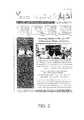
- FIG. 2 illustrates an exemplary representation of the image on correcting the skew associated with the image in accordance with an embodiment of the invention.
- FIG. 3 illustrates an exemplary representation of the image converted into binary in accordance with an embodiment of the invention.
- FIG. 4 illustrates a flow diagram of a method of preprocessing an image for optical character recognition in accordance with an embodiment of the invention.
- FIG. 5 illustrates a flow diagram of a method of determining a plurality of components in accordance with an embodiment of the invention.
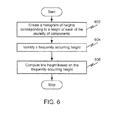
- FIG. 6 illustrates a flow diagram of a method of calculating a line height in accordance with an embodiment of the invention.
- FIG. 7 illustrates the image with one or more of the plurality of components associated with a column of a plurality of columns in accordance with an embodiment of the invention.
- FIG. 8 illustrates a flow diagram of a method of calculating a word spacing in accordance with an embodiment of the invention.
- FIG. 9 illustrates a flow diagram of a method of calculating a line spacing in accordance with an embodiment of the invention.
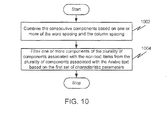
- FIG. 10 illustrates a method of merging the plurality of components to form one or more of one or more sub-words and one or more words in accordance with an embodiment of the invention.
- FIG 11 illustrates an exemplary representation of the image with the non-text items removed in accordance with an embodiment of the invention.
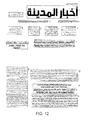
- FIG. 12 illustrates exemplary segmenting of the one or more words and the one or more sub-words into one or more horizontal lines depending on the line height and the line spacing in accordance with an embodiment of the invention.
- FIG. 13 illustrates a block diagram of a system for preprocessing an image including a plurality of columns, wherein the plurality of columns includes one or more of Arabic text and non-text items in accordance with various embodiments of the invention.
- FIG. 14 illustrates a schematic diagram of one or more of a plurality of components associated with a column or region vertically and/or horizontally overlapping another one or more columns or regions in accordance with an embodiment of the invention.
- FIG. 15 illustrates a schematic diagram of one or more of a plurality of components associated with a column or region vertically and/or horizontally overlapping another one or more columns or regions in accordance with an embodiment of the invention.
- OCR optical character recognition
- the image is obtained by converting at least one of a grayscale image and a color image into a binary image.
- the image is obtained by filtering salt and pepper noise.
- the image is obtained by correcting skew using a modified Hough transform, wherein the modified Hough transform is adapted for the Arabic text.
- determining the plurality of components comprises: performing a raster scan across the image; identifying a plurality of pixels associated with at least one of the plurality of components corresponding to at least one sweep of the raster scan; and aggregating the plurality of pixels based on an interconnection between the plurality of pixels to form at least one set of connected pixels.
- a pixel is interconnected with at least one of 8 neighboring pixels of the pixel.
- calculating the line height comprises:
- the column spacing is calculated based on the line height.
- the first set of characteristic parameters is at least one of a line height associated with each column, a word spacing associated with each column, a line spacing associated with each column, a number of pixels corresponding to each component, a width of each component, a height of each component, coordinates of each component, density of each component, and aspect ratio of each component.
- calculating the word spacing associated with each column comprises:
- the consecutive components comprise at least one of vertically overlapping components and components separated by a predefined distance, wherein the vertically overlapping components share at least one coordinate along a vertical axis.
- calculating the line spacing associated with each column comprises:
- merging the plurality of components comprises:
- the method is further comprising sorting the plurality of columns based on at least one coordinate associated with a column, wherein the at least one coordinate is associated with a position of the column in the image.
- the method is further comprising:
- the method is further comprising segmenting the at least one sub-word and the at least one word into at least one horizontal line based on at least one of the line height associated with at least one of each sub-word and each word and the iine spacing associated with at least one of each sub-word and each word.
- OCR optical character recognition
- the processor is further configured to perform at least one of:
- the processor is further configured to:
- the processor is configured to :
- the processor is further configured to calculate the column spacing based on the line height.
- the first set of characteristic parameters is at least one of a line height associated with each column, a word spacing associated with each column, a line spacing associated with each column, a number of pixels corresponding to each component, a width of each component, a height of each component, coordinates of each component, density of each component, and aspect ratio of each component.
- the processor is configured to:
- the processor is configured to:
- the processor is further configured to:
- the processor is further configured to sort the plurality of columns based on at least one coordinate associated with a column, wherein the at least one coordinate is associated with a position of the column in the image.
- the processor is further configured to:
- the processor is further configured to segment the at least one sub word and the at least one word into at least one horizontal line based on at least one of the line height associated with at least one of each sub-word and each word and the line spacing associated with at least one of each sub-word and each word.
- the embodiments reside primarily in combinations of method steps and apparatus components related to a method and system for preprocessing an image for OCR.
- the image includes a plurality of columns, wherein each column includes one or more of Arabic text and non-text items. Accordingly, the apparatus components and method steps have been represented where appropriate by conventional symbols in the drawings, showing only those specific details that are pertinent to understanding the embodiments of the invention so as not to obscure the disclosure with details that will be readily apparent to those of ordinary skill in the art having the benefit of the description herein.
- embodiments of the invention described herein may be comprised of one or more conventional transaction-clients and unique stored program instructions that control the one or more transaction-clients to implement, in conjunction with certain non-transaction-client circuits, some, most, or all of the functions of a method for preprocessing an image for OCR.
- the image includes a plurality of columns, wherein each column includes one or more of Arabic text and non-text items.
- the non-transaction-client circuits may include, but are not limited to, a radio receiver, a radio transmitter, signal drivers, clock circuits, power source circuits, and user input devices. As such, these functions may be interpreted as steps of methods for preprocessing an image including Arabic text and non-text items for OCR.
- the invention provides a method and system for preprocessing an image for OCR.
- the image includes a plurality of columns, wherein each column includes one or more of Arabic text and non-text items.
- the method includes determining a plurality of components associated with one or more of the Arabic text and the non-text items of the plurality of columns.
- a component includes a set of connected pixels.
- a line height and a column spacing associated with the plurality of components are calculated.
- one or more components of the plurality of components are associated with a column of the plurality of columns based on one or more of the line height and the column spacing.
- a first set of characteristic parameters associated with each column of the plurality of columns is calculated.
- the plurality of components associated with each column are then merged based on the first set of characteristic parameters to form one or more of one or more sub-words and one or more words.
- FIG. 1 illustrates an exemplary representation of an image including a plurality of columns, wherein each column of the plurality of columns include one or more of Arabic text and non-text items in accordance with various embodiments of the invention.
- the image may be one of a grayscale image and a color image. Additionally, the image may include salt and pepper noise and may also be skewed. Prior to preprocessing the image for OCR, the salt and pepper noise as well as the skew associated with the image are removed. Also, the image is converted from one of a grayscale image and a color image to a binary image.
- the skew associated with the image is corrected by determining a baseline associated with the image and orienting the image based on alignment of the baseline.
- the alignment of the baseline is determined by a modified Hough transform wherein horizontal projections are determined in several directions.
- the horizontal projections indicate a number of pixels associated with foreground of the image.
- a reasonable run length corresponding to an approximate word length in Arabic is considered to determine a direction having a highest density of pixels.
- the direction of the highest density of pixels is considered as the alignment of the baseline.
- FIG. 2 illustrates an exemplary representation of the image on correcting the skew associated with the image.
- the salt and pepper noise associated with the image is removed.
- the salt and pepper noise represents randomly occurring white and black pixels and may include light spots on a dark background or dark spots on a light background.
- the salt and pepper noise may be removed by using one or more of a median filter and a majority filter. It will be apparent to a person skilled in the art that the salt and pepper noise may also be removed using one or more noise removal techniques known in the art.
- the image is converted to binary from one of a grayscale image and a color image, in an instance when the image is a grayscale image, the image is converted to binary by converting each pixel value between 0 and 255 to either a pixel value 0 or a pixel value 1.
- the pixel value 0 represents a background value and the pixel value 1 represents a foreground value.
- the pixel value 0 may represent the foreground value and the pixel value 1 may represent the background value.
- the pixel value 0 is associated with a white pixel and the pixel value 1 is associated with a black pixel.
- a threshold value is determined for the grayscale image and accordingly pixel values that lie above the threshold value are converted into a pixel value 1 and pixel values that lie below the threshold value are converted into a pixel value 0.
- the threshold value is calculated by creating a histogram of the pixel values of the grayscale image.
- the histogram represents a frequency of each pixel value.
- a smoothened histogram may be generated by adding frequencies of consecutive pixel values and replacing the consecutive pixel values with a single pixel value having combined frequency of the consecutive pixel values.
- the number of consecutive pixel values considered may be predefined.
- FIG. 3 exemplarily illustrates the image converted into binary.
- the color image when the image is a color image, the color image is first converted to a grayscale image and subsequently to binary as described earlier.
- NTSC National Television System Committee
- default values may be used to convert the color image to a grayscale image.
- the number of occurrences of the pixel value 0 and the pixel value 1 is counted.
- the binary value having a lower count is considered the foreground value and the binary value having a higher count is considered the background value.
- FIG. 4 a flow diagram of a method of preprocessing an image for optical character recognition is illustrated in accordance with an embodiment of the invention.
- the image includes a plurality of columns, wherein each column of the plurality of columns include one or more of Arabic text and non-text items.
- the image is obtained by performing one or more of converting the image to binary, removing salt and pepper noise, and correcting skew associated with the image.
- a plurality of components associated with one or more of the Arabic text and the non-text items in the image are determined at step 402.
- a component includes a set of connected pixels.
- a component represents a single character of the Arabic text if that character does not touch any other characters. Accordingly, if more than one character touches each other, then the touching characters are considered as one component.
- the method of determining the plurality of components is further explained in conjunction with FIG. 5 .
- a line height and a column spacing associated with the plurality of components is calculated at step 404.
- the line height associated with the plurality of components is calculated by creating a histogram of heights corresponding to a height of each of the plurality of components.
- One or more of the line height and the column spacing is calculated based on an average value of all the components of the plurality of components of the image. For example, the line height is the frequently occurring height averaged over all the components of the plurality of components.
- the method of calculating the line height is further explained in conjunction with FIG. 6 .
- the column spacing is then dynamically computed as a function of the line height.
- one or more components of the plurality of components are associated with a column of the plurality of columns based on one or more of the line height and the column spacing as exemplarily illustrated in FIG 7 .
- the plurality of components are segregated into a plurality of columns based on the line height and the column spacing associated with the plurality of components as exemplarily illustrated by 702, 704, and 706 of FIG. 7 . For example, if a spacing between two horizontally consecutive components is less than the column spacing, then the components are considered to be of the same column and accordingly segregated.
- the first set of characteristic parameters includes a line height associated with each column, a word spacing associated with each column, a line spacing associated with each column, a number of pixels of each component, a width of each component, a height of each component, coordinates of each component, a density of each component, and an aspect ratio of each component.
- the method of calculating the line height, the word spacing, and the line spacing is explained in conjunction with FIG. 6 , FIG. 8 , and FIG. 9 respectively.
- step 410 the plurality of components associated with each column are merged based on the first set of characteristic parameters to form one or more of one or more sub-words and one or more words.
- the method of merging the plurality of components is further explained in conjunction with FIG. 10 .
- FIG. 5 illustrates a flow diagram of a method of determining a plurality of components in accordance with an embodiment of the invention.
- a raster scan is performed across the image.
- the raster scan performs a plurality of sweeps, one for each row of pixels corresponding to the plurality of components.
- one or more pixels associated with the foreground of the image are identified at step 504.
- the foreground of the image corresponds to the plurality of components.
- a plurality of pixels is aggregated based on an interconnection between the plurality of pixels to form one or more sets of connected pixels.
- the plurality of pixels is considered to be interconnected if they touch one or more of eight neighboring pixels.
- consecutive characters in Arabic text form a single component if one or more pixels associated with the consecutive characters are interconnected to each other.
- a pixel identified in a current sweep of the raster scan is aggregated with a pixel identified in a previous sweep if the two pixels touch each other. If the pixel identified in the current sweep touches more than one pixel identified in the previous sweep, then the pixel is aggregated with the more than one pixel. In another case, if more than one pixel identified in the current sweep is touching, then the more than one pixel is aggregated. Similarly, one or more pixels identified in subsequent sweeps of the raster scan are also aggregated if the one or more pixels touch each other.
- the aggregated pixels form a set of connected pixels and are associated with a component of the plurality of components. Accordingly, one or more sets of connected pixels are associated with the plurality of components.
- one or more of the number of pixels of each component, the width of each component, the height of each component, the coordinates of each component, the density of each component, and the aspect ratio of each component are calculated by tracking the connected pixels associated with each component.
- the method includes creating a histogram of heights corresponding to a height of each of the plurality of components at step 602.
- the histogram represents the frequency of occurrence of the height of each of the plurality of components.
- a smoothened histogram may be generated by adding the frequencies of consecutive height values and replacing the consecutive height values with a single height value having the combined frequency of the consecutive height values.
- the number of consecutive height values considered may be predefined. For example, the frequency at height twenty pixels becomes that at height nineteen pixels plus that at height twenty pixels plus that at height twenty one pixels if the number of consecutive height values is defined as three.
- a frequently occurring height is identified at step 604.
- the heights of small components such as accent marks corresponding to the Arabic text and punctuation marks are excluded. This is done by setting a threshold height and only considering the components having a height greater than the threshold height to identify the frequently occurring height.
- the frequently occurring height represents the dominant text size of the image if the image has more than one text size.
- the line height is computed based on the frequently occurring height at step 606.
- the line height is computed as a product of the frequently occurring height and a multiplying factor, wherein the multiplying factor depends on the frequently occurring height.
- the line height may be used to segment one or more of one or more words and one or more sub-words into one or more horizontal lines of the Arabic text.
- the line height is used to calculate the word spacing as explained in conjunction with FIG. 8 .
- FIG. 8 illustrates a flow diagram of a method of calculating a word spacing in accordance with an embodiment of the invention.
- the method includes creating a histogram of spaces between consecutive components of the plurality of components at step 802.
- any two components that overlap vertically and are not separated by other components are considered to be consecutive components.
- the two components overlap vertically if the two components share one or more common coordinates along a vertical axis. In other words, the consecutive components belong to a line of the Arabic text.
- the two components do not overlap vertically, the two components are considered consecutive components if the two components are separated by a predefined distance.
- a smoothened histogram may be generated by adding the frequencies of consecutive space values.
- the consecutive space values are then replaced by a single space value having the combined frequency of the consecutive space values. For example, the frequency at a space value of ten pixels is replaced by the sum of the frequencies at the space value of nine pixels, the space value of ten pixels, and the space value of eleven pixels.
- a frequently occurring space from the smoothened histogram is identified.
- the frequently occurring space is identified from within a threshold range determined by the line height. For example, the frequently occurring space value lying between one fifth the line height and half the line height may be considered.
- the word spacing is computed based on the frequently occurring space. The word spacing is the spacing between two consecutive words of the Arabic text.
- FIG. 9 illustrates a flow diagram of a method of calculating a line spacing in accordance with an embodiment of the invention.
- a histogram of a plurality of horizontal projections of the plurality of components corresponding to the foreground is created.
- a horizontal projection indicates a number of pixels associated with the plurality of components corresponding to a sweep of the raster scan. For example, if a sweep of the raster scan identifies 15 pixels associated with the plurality of components, then the horizontal projection for the row of pixels corresponding to that sweep is 15.
- step 904 an average distance between two consecutive maximum horizontal projections is calculated.
- the maximum horizontal projections represent the regions of highest density.
- step 906 the line spacing is computed based on the average distance.
- the plurality of components are merged to form one or more of one or more sub-words and one or more words as explained in conjunction with FIG. 10 .
- FIG. 10 illustrates a method of merging the plurality of components to form one or more of one or more sub-words and one or more words in accordance with an embodiment of the invention.
- the consecutive components associated with a column are combined if a spacing between the consecutive components is less than a factor of the word spacing.
- the coordinates of the consecutive components may also determine if the consecutive components are combined. Combining the consecutive components associated with a column based on one or more of the word spacing and the coordinates of the consecutive components cause different components corresponding to a word or a sub-word of the Arabic text to be combined.
- the components associated with the accent marks are combined with the words they belong to based on the word spacing and the position of the components.
- a word may include one or more components. The position of the components is determined from the coordinates of the components. If one or more of the first set of characteristic parameters associated with a component is similar to an Arabic punctuation or accent mark and is at an appropriate proximity with respect to the components corresponding to the letters of the Arabic text, then the component is grouped along with the letters to form a word or a sub-word. Else, the component is considered as noise and is removed.
- the components associated with the non-text items are also combined based on the word spacing.
- the components associated with the non-text items are combined to form one or more larger components.
- the components associated with the non-text items are filtered from the components associated with the Arabic text based on the first set of characteristic parameters. For example, components having a large height, a large width and a small density are removed. These components may correspond to frames or borders around a column or around other non-text items. Similarly, components with a large height, small width, and a high density are recognized as vertical lines and are removed. Horizontal lines are recognized as having small height, large width, and high density.
- non-text items are removed based on one or more filters.
- the one or more filters use the commonly occurring length of the components, the width of the components, the aspect ratio of the components, the density of the components, and the total number of components of the image to filter the non-text items from the Arabic text.
- Non-text items that spread over two or more columns are also removed by comparing the dimensions of the components associated with the non-text items with that of the commonly occurring dimensions of the components associated with the Arabic text.
- FIG 11 exemplarily illustrates the image with the non-text items removed.
- a second set of characteristic parameters of the one or more words and one or more sub-words is calculated.
- the second set of characteristic parameters includes a line height associated with at least one of each sub-word and each word, a word spacing associated with at least one of each sub-word and each word, and a line spacing associated with at least one of each sub-word and each word.
- the second set of characteristic parameters are calculated in order to further refine the process of combining the plurality of components to form one or more of one or more sub-words and one or more words.
- one or more sub-words may be grouped to form one or more of one or more sub-words and one or more words.
- the one or more sub-words and the one or more words that overlap vertically and are associated with a column of the plurality of columns are segmented to form a horizontal line of the Arabic text.
- the one or more sub-words and the one or more words may also be segmented based on one or more of the line height and the line spacing. For example, if two horizontal lines are segmented together as they have one or more vertically overlapping components with respect to each other, then the two horizontal lines are separated based on one or more of the line height and the line spacing.
- FIG. 12 illustrates exemplarily segmenting of the one or more words and the one or more sub-words into one or more horizontal lines depending on the line height and the line spacing.
- a method of preprocessing an image for OCR includes a plurality of columns, wherein each column includes one or more of Arabic text and non-text items.
- the method includes determining a plurality of components associated with the Arabic text and the non-text items.
- a component of the plurality of components represents one or more characters of the Arabic text or one or more of the non-text items.
- a component represents more than one character if the more than one character is interconnected.
- a line height and a column spacing associated with the plurality of components is calculated.
- the line height and the column spacing represent an average value of all the components across all the columns.
- the plurality of components is then segregated into one or more columns based on the averaged line height and the averaged column spacing.
- a first set of characteristic parameters associated with the plurality of components of each column are calculated.
- the plurality of components associated with each column are subsequently merged based on the first set of characteristic parameters to form one or more of one or more sub-words and one or more words.
- the method disclosed herein enables accurately preprocessing and segmenting Arabic text which includes touching characters and includes a plurality of columns, The method takes into consideration the accent marks and punctuation marks associated with Arabic text when determining if a component is noise or part of the Arabic text. Additionally, the method identifies if the image includes a plurality of columns and segregates them accordingly.
- FIG. 13 illustrates a block diagram of a system 1300 for preprocessing an image including one or more of Arabic text and non-text items for Optical Character Recognition (OCR) in accordance with an embodiment of the invention.
- the image includes a plurality of columns, wherein each column includes one or more of Arabic text and non-text items.
- the image may be one of a grayscale image and a color image. Additionally, the image may include salt and pepper noise and also may be skewed.
- system 1300 includes a memory 1302 and a processor 1304 coupled to memory 1302. Prior to preprocessing the image for OCR, processor 1304 removes any skew associated with the image using a modified Hough transform as explained in conjunction with FIG. 1 .
- processor 1304 removes the salt and pepper noise and converts the image to binary from one of a grayscale and a color image.
- the salt and pepper noise may be removed by using one or more of a median filter and a majority filter.
- processor 1304 determines a plurality of components associated with one or more of the Arabic text and the non-text items.
- a component includes a set of connected pixels.
- a component represents a single character of the Arabic text if that character does not touch any other characters. Accordingly, if more than one character touches each other, then the touching characters are considered one component.
- processor 1304 performs a raster scan across the image.
- the raster scan includes performing a plurality of sweeps, one sweep for each row of pixels corresponding to the plurality of components.
- processor 1304 aggregates a plurality of pixels based on an interconnection between the plurality of pixels to form one or more sets of connected pixels.
- the aggregated pixels form a set of connected pixels and are associated with a component of the plurality of components.
- the piuraiity of components thus determined by processor 1304 may be stored in memory 1302 and are used by processor 1304 to calculate a line height and a column spacing associated with the plurality of components.
- the line height and the column spacing are then used to associate the one or more components of the plurality of components into a column of the plurality of columns.
- the plurality of components is segregated into a plurality of columns by processor 1304 if the plurality of components satisfy one or more of the line height and the column spacing. For example, if a spacing between two horizontally or vertically consecutive components is less than the column spacing, then the components are considered to be of the same column and accordingly segregated. Subsequently, a first set of characteristic parameters associated with the plurality of components is calculated.
- the first set of characteristic parameters includes a line height associated with each column, a word spacing associated with each column, a line spacing associated with each column, a number of pixels of each component, a width of each component, a height of each component, coordinates of each component, density of each component, and an aspect ratio of each component.
- processor 1304 merges the plurality of components based on the first set of characteristic parameters.
- the merged components form one or more of one or more sub-words and one or more words.
- processor 1304 calculates the line height by creating a histogram of heights corresponding to a height of each of the plurality of components. A frequency occurring height from the histogram is then identified by processor 1304. Subsequently, processor 1304 computes the line height as a product of the frequently occurring height and a multiplying factor. The multiplying factor depends on the frequently occurring height.
- the line height may be used to segment one or more of one or more words and one or more sub-words into one or more horizontal lines of the Arabic text. Additionally, the line height is used by processor 1304 to calculate the word spacing.
- processor 1304 calculates the word spacing by creating a histogram of spaces between consecutive components of the plurality of components. Processor 1304 then identifies a frequently occurring space from the histogram. The frequently occurring space is identified from within a threshold range, wherein the threshold range is based on the line height. Subsequently, the word spacing is computed based on the frequently occurring space by processor 1304. The word spacing is the spacing between two consecutive words of the Arabic text.
- Processor 1304 is also configured to calculate the line spacing by creating a histogram of a plurality of horizontal projections of the plurality of components.
- a horizontal projection indicates a number of pixels associated with the plurality of components corresponding to each sweep of the raster scan. Then, an average distance between two consecutive horizontal projections is calculated by processor 1304. Subsequently, processor 1304 computes the line spacing based on the average distance.
- processor 1304 determines the number of pixels of each component, the width of each component, the height of each component, the coordinates of each component, the density of each component, and the aspect ratio of each component.
- processor 1304 merges the plurality of components associated with each coiumn based on the first set of characteristic parameters. In order to do so, processor 1304 combines the consecutive components if a spacing between the components is less than a factor of the word spacing associated with that column. In addition to the word spacing associated with each column, the coordinates of the consecutive components may also determine if the consecutive components are combined. Further, processor 1304 filters the components associated with the non-text items from the components associated with the Arabic text based on the first set of characteristic parameters as explained in conjunction with FIG. 10 . Filtering the non-text items results in one or more of one or more sub-words and one or more words.
- Processor 1304 is further configured to calculate a second set of characteristic parameters associated with the one or more of one or more sub-words and one or more words.
- the second set of characteristic parameters includes a line height associated with one or more of each sub-word and each word, a word spacing associated with one or more of each sub-word and each word, and a line spacing associated with one or more of each sub-word and each word.
- Two or more sub-words are then grouped by processor 1304 based on the second set of characteristic parameters to form one or more of one or more sub-words and one or more words. In other words, two or more sub-words are grouped together based on the second set of characteristic parameters to form either a complete word or a larger sub-word.
- processor 1304 segments the one or more sub-words and the one or more words that overlap vertically and are associated with a coiumn of the plurality of columns to form a horizontal iine of the Arabic text.
- processor 1304 may also be segmented by processor 1304 based on one or more of the line height and the line spacing.
- FIGS. 14 and 15 illustrate certain instances in which some of the text columns (or regions) fall within or overlap other columns. For example, one rectangular or circular area of text may fall within a larger rectangular or circular are of text.
- FIG. 14 shows one example in which text region "text2" is within text region "text 1" and text region "text3" partially vertically overlaps with “text4.” These text regions may have one or more lines, or rows, of text. Similar to the techniques set forth above, the techniques illustrated by example in FIGS. 14 and 15 involve the use of a segmentation and preprocessing engine. A complete raw scanned document with multi columns, text and non-text, possible skew, possible noise, and in grayscale or color is provided to the segmentation and preprocessing engine. In this example, the output of this system is a sequence of sorted columns and a list of line images within each column right side up, non-skewed, noise free, to be passed to the line recognition engine of choice in binary or grayscale formats.
- the document is segmented into clean segmented text line images which are oriented properly and clean of noise even though the segmentation and preprocessing engine has no prior information of the page structure or content or the font or the size of the font.
- the grayscale image is converted to a binarized image using dynamic thresholding that varies from page to another.
- the regions with different backgrounds and/or shading are identified and binarized separately. Each region may be binarized separately for accuracy.
- foreground/ background checking is done on each region, where the foreground of a text page has fewer pixels than the background.
- the binarization of each region is done using a histogram of the grayscale.
- the connected components are calculated from the binary image using single run length algorithms.
- the scan goes through the binary image from top left to right, moving down the document. Segments are found on each run length and long segments are disregarded as impurities. This process is repeated for next line and so on, merging segments that touch between lines until all new components are formed, as described above.
- the new row is checked against the old row; if nothing touches a certain segment or an unfinished component it will be converted into a finished component.
- the new segments that touch one or more unfinished components are added to them or used to merge more than one unfinished component into one.
- the statistical analyses are performed on the connected components using the component parameters such as the one or more dimensions, aspect ratio, density, and perimeter. Rules are added to filter out obvious non-text components.
- Statistical analyses are then performed on the remaining text-alike components to find the common height of words or lines of the dominant text size even though the page may have other sizes of text and regions.
- Statistical analyses are run again on components belonging to each single column to use the new column specific word common height for further text and non-text separation in case different columns have different sizes of text.
- Word spacing and column spacing are dynamically calculated using this common height. This way, there are no hard coded values and the page calculations are dynamic and do not change if the page has been enlarged or reduced in size. This is achieved using dimensionless parameters that change with size. If a distance calculated is greater than the calculated word spacing and less than the column spacing, the words may be merged.
- a distance is calculated based on the word height and column spacing to be used to segregate the components into columns. Since some of the columns may fall within other columns, such as the "text2" region falling within the "text1” region, or an L-shaped column in any direction with text columns underneath or above a horizontal part, such as the "text4" region falling under a portion of the "text3" region, the rectangles defining each column overlap in the horizontal and/or vertical direction.
- the separation of components into distinct overlapping columns or regions is done by analyzing each component and merging a component with a column if the closest text component to this component falls within that column and the distance is smaller than the margin calculated above. Since merging the component with the closest column would lead to all overlapping columns becoming one major column, merging is done to the column that hosts the closest component to the current component.
- FiG. 15 shows an exemplary technique of analyzing one or more components, such as regions “text3a” - “text3e,” which are then merged to be processed as region “text3,” as shown in FIG. 14 .
- Columns, such as “text3a” - “text3e,” that are layers above one another with similar font sizes and approximate dimensions may be merged into one column or region that has a varying dimension, such as height or width.
- the columns, or regions are sorted based on their location on the page (e.g., their coordinates) to help stream the recognized resulting text in the right order.
- the postprocessing algorithm may be configured to process the text from the top of the document down and from left to right making use of some wide columns that may span the entire width or height of the page for orientation and visual cues as to how to process the text of the document.
- the algorithm may also make use of non-text lines or borders to separate columns for processing.
- Statistical analyses may be further employed to find the average line height. If the line thickness is larger than the average line height by multiple times, the line is split into several lines at the horizontal places of least overlapping between the consecutive lines.
- Various embodiments of the invention provide methods and systems for preprocessing an image for OCR.
- the image includes a plurality of columns, wherein each column includes one or more of Arabic text and non-text items.
- the invention segments Arabic text into segmented lines of sub-words and words that can be accurately processed by an OCR system.
- the method also takes into consideration the accent marks and punctuation marks associated with Arabic text when determining if a component is noise or part of the Arabic text.
Landscapes
- Engineering & Computer Science (AREA)
- Physics & Mathematics (AREA)
- Computer Vision & Pattern Recognition (AREA)
- Computer Graphics (AREA)
- Geometry (AREA)
- Artificial Intelligence (AREA)
- General Physics & Mathematics (AREA)
- Multimedia (AREA)
- Theoretical Computer Science (AREA)
- Character Input (AREA)
Applications Claiming Priority (1)
| Application Number | Priority Date | Filing Date | Title |
|---|---|---|---|
| US13/467,873 US8548246B2 (en) | 2010-06-12 | 2012-05-09 | Method and system for preprocessing an image for optical character recognition |
Publications (1)
| Publication Number | Publication Date |
|---|---|
| EP2662802A1 true EP2662802A1 (en) | 2013-11-13 |
Family
ID=48184014
Family Applications (1)
| Application Number | Title | Priority Date | Filing Date |
|---|---|---|---|
| EP13162939.6A Withdrawn EP2662802A1 (en) | 2012-05-09 | 2013-04-09 | Method and system for preprocessing an image for optical character recognition |
Country Status (2)
| Country | Link |
|---|---|
| EP (1) | EP2662802A1 (enExample) |
| JP (1) | JP6082306B2 (enExample) |
Citations (1)
| Publication number | Priority date | Publication date | Assignee | Title |
|---|---|---|---|---|
| US5848184A (en) * | 1993-03-15 | 1998-12-08 | Unisys Corporation | Document page analyzer and method |
Family Cites Families (5)
| Publication number | Priority date | Publication date | Assignee | Title |
|---|---|---|---|---|
| US7724957B2 (en) * | 2006-07-31 | 2010-05-25 | Microsoft Corporation | Two tiered text recognition |
| WO2008138356A2 (en) * | 2007-05-15 | 2008-11-20 | The Engineering Company For The Development Of Computer Systems ; (Rdi) | System and method for arabic omni font written optica character recognition |
| US8150160B2 (en) * | 2009-03-26 | 2012-04-03 | King Fahd University Of Petroleum & Minerals | Automatic Arabic text image optical character recognition method |
| US8111911B2 (en) * | 2009-04-27 | 2012-02-07 | King Abdulaziz City For Science And Technology | System and methods for arabic text recognition based on effective arabic text feature extraction |
| US8218875B2 (en) * | 2010-06-12 | 2012-07-10 | Hussein Khalid Al-Omari | Method and system for preprocessing an image for optical character recognition |
-
2013
- 2013-04-09 EP EP13162939.6A patent/EP2662802A1/en not_active Withdrawn
- 2013-04-15 JP JP2013084694A patent/JP6082306B2/ja not_active Expired - Fee Related
Patent Citations (1)
| Publication number | Priority date | Publication date | Assignee | Title |
|---|---|---|---|---|
| US5848184A (en) * | 1993-03-15 | 1998-12-08 | Unisys Corporation | Document page analyzer and method |
Non-Patent Citations (3)
| Title |
|---|
| HADJAR K ET AL: "Arabic newspaper page segmentation", DOCUMENT ANALYSIS AND RECOGNITION, 2003. PROCEEDINGS. SEVENTH INTERNAT IONAL CONFERENCE ON AUG. 3-6, 2003, PISCATAWAY, NJ, USA,IEEE, 3 August 2003 (2003-08-03), pages 895 - 899, XP010656886, ISBN: 978-0-7695-1960-9, DOI: 10.1109/ICDAR.2003.1227789 * |
| LIANG J ET AL: "Document layout structure extraction using bounding boxes of different entitles", PROCEEDINGS / THIRD IEEE WORKSHOP ON APPLICATIONS OF COMPUTER VISION, WACV '96, DECEMBER 2 - 4, 1996, SARASOTA, FLORIDA, USA, IEEE COMPUTER SOCIETY PRESS, LOS ALAMITOS, CA, USA, 2 December 1996 (1996-12-02), pages 278 - 283, XP010206444, ISBN: 978-0-8186-7620-8, DOI: 10.1109/ACV.1996.572074 * |
| MING CHEN ET AL: "Analysis, understanding and representation of Chinese newspaper with complex layout", IMAGE PROCESSING, 2000. PROCEEDINGS. 2000 INTERNATIONAL CONFERENCE ON SEPTEMBER 10-13, 2000, IEEE, PISCATAWAY, NJ, USA, 10 September 2000 (2000-09-10), pages 590 - 593vol.2, XP031534522, ISBN: 978-0-7803-6297-0 * |
Also Published As
| Publication number | Publication date |
|---|---|
| JP2013235574A (ja) | 2013-11-21 |
| JP6082306B2 (ja) | 2017-02-15 |
Similar Documents
| Publication | Publication Date | Title |
|---|---|---|
| US8548246B2 (en) | Method and system for preprocessing an image for optical character recognition | |
| US8194983B2 (en) | Method and system for preprocessing an image for optical character recognition | |
| CN111814722B (zh) | 一种图像中的表格识别方法、装置、电子设备及存储介质 | |
| Nikolaou et al. | Segmentation of historical machine-printed documents using adaptive run length smoothing and skeleton segmentation paths | |
| CN101251892B (zh) | 一种字符切分方法和装置 | |
| Seni et al. | External word segmentation of off-line handwritten text lines | |
| Agrawal et al. | Voronoi++: A dynamic page segmentation approach based on voronoi and docstrum features | |
| US20190266431A1 (en) | Method, apparatus, and computer-readable medium for processing an image with horizontal and vertical text | |
| Mullick et al. | An efficient line segmentation approach for handwritten Bangla document image | |
| JP6116531B2 (ja) | 画像処理装置 | |
| CN110321887B (zh) | 文档图像处理方法、文档图像处理装置及存储介质 | |
| CN107798355B (zh) | 一种基于文档图像版式自动分析与判断的方法 | |
| Haji et al. | A novel segmentation and skew correction approach for handwritten Malayalam documents | |
| EP2662802A1 (en) | Method and system for preprocessing an image for optical character recognition | |
| JPH0410087A (ja) | 基本ライン抽出方法 | |
| Mitra et al. | Character segmentation for handwritten Bangla words using image processing | |
| JP4244692B2 (ja) | 文字認識装置及び文字認識プログラム | |
| CN108596182B (zh) | 满文部件切分方法 | |
| Dey et al. | Margin noise removal from printed document images | |
| CN108564078B (zh) | 提取满文单词图像中轴线的方法 | |
| JPH02116987A (ja) | 文字認識装置 | |
| CN108564089B (zh) | 满文部件集的构建方法 | |
| JP2728086B2 (ja) | 文字切り出し方法 | |
| CN108549896B (zh) | 满文部件切分中删除多余候选切分行的方法 | |
| CN115731250A (zh) | 文本分割方法、装置、设备及存储介质 |
Legal Events
| Date | Code | Title | Description |
|---|---|---|---|
| PUAI | Public reference made under article 153(3) epc to a published international application that has entered the european phase |
Free format text: ORIGINAL CODE: 0009012 |
|
| AK | Designated contracting states |
Kind code of ref document: A1 Designated state(s): AL AT BE BG CH CY CZ DE DK EE ES FI FR GB GR HR HU IE IS IT LI LT LU LV MC MK MT NL NO PL PT RO RS SE SI SK SM TR |
|
| AX | Request for extension of the european patent |
Extension state: BA ME |
|
| 17P | Request for examination filed |
Effective date: 20140423 |
|
| RBV | Designated contracting states (corrected) |
Designated state(s): AL AT BE BG CH CY CZ DE DK EE ES FI FR GB GR HR HU IE IS IT LI LT LU LV MC MK MT NL NO PL PT RO RS SE SI SK SM TR |
|
| STAA | Information on the status of an ep patent application or granted ep patent |
Free format text: STATUS: THE APPLICATION IS DEEMED TO BE WITHDRAWN |
|
| 18D | Application deemed to be withdrawn |
Effective date: 20171103 |
|
| P01 | Opt-out of the competence of the unified patent court (upc) registered |
Effective date: 20230411 |