EP2661145A1 - Device and method for video calls - Google Patents
Device and method for video calls Download PDFInfo
- Publication number
- EP2661145A1 EP2661145A1 EP11852810.8A EP11852810A EP2661145A1 EP 2661145 A1 EP2661145 A1 EP 2661145A1 EP 11852810 A EP11852810 A EP 11852810A EP 2661145 A1 EP2661145 A1 EP 2661145A1
- Authority
- EP
- European Patent Office
- Prior art keywords
- energy
- video
- frames
- ready
- energy level
- Prior art date
- Legal status (The legal status is an assumption and is not a legal conclusion. Google has not performed a legal analysis and makes no representation as to the accuracy of the status listed.)
- Withdrawn
Links
- 238000000034 method Methods 0.000 title claims abstract description 21
- 238000004891 communication Methods 0.000 claims abstract description 57
- 230000000694 effects Effects 0.000 abstract description 5
- 230000008901 benefit Effects 0.000 description 2
- 238000010586 diagram Methods 0.000 description 2
- 238000004519 manufacturing process Methods 0.000 description 2
- 230000004075 alteration Effects 0.000 description 1
- 230000009286 beneficial effect Effects 0.000 description 1
- 238000005265 energy consumption Methods 0.000 description 1
- 230000006872 improvement Effects 0.000 description 1
- 238000010295 mobile communication Methods 0.000 description 1
- 238000012986 modification Methods 0.000 description 1
- 230000004048 modification Effects 0.000 description 1
- 230000008569 process Effects 0.000 description 1
Images

Classifications
-
- H—ELECTRICITY
- H04—ELECTRIC COMMUNICATION TECHNIQUE
- H04N—PICTORIAL COMMUNICATION, e.g. TELEVISION
- H04N5/00—Details of television systems
- H04N5/222—Studio circuitry; Studio devices; Studio equipment
- H04N5/262—Studio circuits, e.g. for mixing, switching-over, change of character of image, other special effects ; Cameras specially adapted for the electronic generation of special effects
- H04N5/272—Means for inserting a foreground image in a background image, i.e. inlay, outlay
-
- H—ELECTRICITY
- H04—ELECTRIC COMMUNICATION TECHNIQUE
- H04W—WIRELESS COMMUNICATION NETWORKS
- H04W4/00—Services specially adapted for wireless communication networks; Facilities therefor
- H04W4/20—Services signaling; Auxiliary data signalling, i.e. transmitting data via a non-traffic channel
-
- H—ELECTRICITY
- H04—ELECTRIC COMMUNICATION TECHNIQUE
- H04L—TRANSMISSION OF DIGITAL INFORMATION, e.g. TELEGRAPHIC COMMUNICATION
- H04L65/00—Network arrangements, protocols or services for supporting real-time applications in data packet communication
- H04L65/60—Network streaming of media packets
- H04L65/70—Media network packetisation
-
- H—ELECTRICITY
- H04—ELECTRIC COMMUNICATION TECHNIQUE
- H04N—PICTORIAL COMMUNICATION, e.g. TELEVISION
- H04N7/00—Television systems
- H04N7/14—Systems for two-way working
- H04N7/141—Systems for two-way working between two video terminals, e.g. videophone
- H04N7/147—Communication arrangements, e.g. identifying the communication as a video-communication, intermediate storage of the signals
-
- H—ELECTRICITY
- H04—ELECTRIC COMMUNICATION TECHNIQUE
- H04W—WIRELESS COMMUNICATION NETWORKS
- H04W52/00—Power management, e.g. Transmission Power Control [TPC] or power classes
- H04W52/02—Power saving arrangements
- H04W52/0209—Power saving arrangements in terminal devices
- H04W52/0261—Power saving arrangements in terminal devices managing power supply demand, e.g. depending on battery level
-
- H—ELECTRICITY
- H04—ELECTRIC COMMUNICATION TECHNIQUE
- H04L—TRANSMISSION OF DIGITAL INFORMATION, e.g. TELEGRAPHIC COMMUNICATION
- H04L65/00—Network arrangements, protocols or services for supporting real-time applications in data packet communication
- H04L65/1066—Session management
- H04L65/1096—Supplementary features, e.g. call forwarding or call holding
-
- Y—GENERAL TAGGING OF NEW TECHNOLOGICAL DEVELOPMENTS; GENERAL TAGGING OF CROSS-SECTIONAL TECHNOLOGIES SPANNING OVER SEVERAL SECTIONS OF THE IPC; TECHNICAL SUBJECTS COVERED BY FORMER USPC CROSS-REFERENCE ART COLLECTIONS [XRACs] AND DIGESTS
- Y02—TECHNOLOGIES OR APPLICATIONS FOR MITIGATION OR ADAPTATION AGAINST CLIMATE CHANGE
- Y02D—CLIMATE CHANGE MITIGATION TECHNOLOGIES IN INFORMATION AND COMMUNICATION TECHNOLOGIES [ICT], I.E. INFORMATION AND COMMUNICATION TECHNOLOGIES AIMING AT THE REDUCTION OF THEIR OWN ENERGY USE
- Y02D30/00—Reducing energy consumption in communication networks
- Y02D30/70—Reducing energy consumption in communication networks in wireless communication networks
Definitions
- the present invention relates to a field of mobile communication, more particularly to a video communication device and a method thereof.
- wireless communication apparatus e.g. mobile phones and interphones
- wireless communication apparatus e.g. mobile phones and interphones
- demands for more energy of a battery are growing more and more.
- the energy of the battery is increased, lack of battery energy is still a problem to be faced when people use their wireless communication apparatus. For example, when one party is communicating with another party, the wireless communication apparatus shuts down suddenly due to the wireless communication apparatus being out of battery, this is an embarrassing situation for both parties.
- the video communications are utilized by many users increasingly, dynamic video information and audio information can be sent through the video phone, so that great communication effects are achieved.
- the video communication is an application with a great amount of energy consumption, and a user is often concerned about a video communication interruption due to out of battery when the user is using the video communication.
- a power prompting function is usually set up in the wireless communication apparatus.
- the traditional energy prompting function can only prompt the battery energy to the one party-user of the apparatus, but cannot automatically prompt to the party on the other end. Because the party on the other end cannot realize the information of the battery energy of the user's apparatus directly, the video communication interruption may occur suddenly, tempos of the video communication cannot be controlled well.
- a video communication device and a method thereof of the present invention are provided to solve main technical problems, a current information of a battery energy level of one party's video communication device can be displayed on images which another party receives, and the images which another party receives can be updated with variations of the battery energy level of the one party's device, thus another party can completely realize the information of the battery energy level of one party's device, tempos of a video communication can be controlled well.
- the present invention adopts a technical solution: providing a video communication method, comprising: a. obtain a current battery energy level of a device, set a plurality of energy sections and a plurality of energy indicators corresponding to the respective energy sections, determine which one of the energy sections the current battery energy level is sited, and then obtain a corresponding energy indicator thereof; b. select every frame of a ready-to-send video as a background frame, superimpose the energy indicator on the background frames in sequence, and select frames with an interval of a predetermined number of frames in the ready-to-send video as the background frames, superimpose the energy indicator on the background frames in sequence when the current battery energy level is lower than a threshold value; c. execute video encoding to the ready-to-send video and send the same.
- the threshold value is 5% of the total battery energy level and the predetermined number of frames is two frames.
- the present invention adopts a technical solution: providing a video communication method, comprising: a. obtain a current battery energy level of a device; b. load information of the current battery energy level to a ready-to-send video; c. execute video encoding to the ready-to-send video and send the same.
- step a a corresponding energy indicator is obtained according to the current battery energy level, and in step b, the energy indicator is loaded to the ready-to-send video.
- step a a plurality of energy sections and a plurality of energy indicators corresponding to the respective energy sections are set, and which one of the energy sections the current battery energy level is sited is determined, and then a corresponding energy indicator thereof is obtained.
- step b every frame of a ready-to-send video is selected as a background frame, and the energy indicator is superimposed on the background frame in sequence.
- step b frames with an interval of a predetermined number of frames in the ready-to-send video are set as the background frames, the energy indicator on the background frames is superimposed in sequence when the current battery energy level is lower than a threshold value.
- the threshold value is 5% of the total battery energy level and the predetermined number of frames is two frames
- the present invention adopts a technical solution: providing a video communication device, comprising: an energy obtaining module for obtaining a current battery energy level of a device; an image processing module for loading information of the battery energy level to a ready-to-send video; a video communication module for executing video encoding to the ready-to-send video and sending the same.
- the energy obtaining module obtains a energy indicator according to the current battery energy level, and the image processing module loads the energy indicator to the ready-to-send video.
- the energy obtaining module sets a plurality of energy sections and a plurality of energy indicators corresponding to the respective energy sections, and determines which one of the energy sections the current battery energy level is sited, and then obtains the corresponding energy indicator thereof.
- the image processing module selects every frame or an interval of a predetermined number of frames in the ready-to-send video as a background frame, and the energy indicators are superimposed to the background frame in sequence.
- the present invention can display the information of the energy level of one party's device on the video communication image of another party's device, so that another party can realize the actually current battery energy level of one party's device, tempos of the video communication can be controlled well, effects of the video communication can be raised, and costs of the video communication of the present invention are not increased, and the carrier's network support is not required, so that the present invention has an advantage of lower production cost.
- FIG. 1 is a diagram of a video communication device according to a first embodiment of the present invention
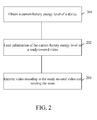
- FIG. 2 is a flow chart of a video communication method according to a first embodiment of the present invention.
- FIG. 1 illustrates a diagram of a video communication device according to a first embodiment of the present invention.
- the video communication device of the present invention comprises an energy obtaining module 101 which can obtain a current battery energy level of one party's video communication device; an image processing module 102 which can load information of the current battery energy level to a ready-to-send video; a video communication module 103, which can execute video encoding to the ready-to-send video and send the same.
- the energy obtaining module 101 can obtain an energy indicator corresponding to a current battery energy level through setting a plurality of energy sections and a plurality of energy indicators corresponding to the respective energy sections, and determining which one of the energy sections the current battery energy level is sited, as well send the energy indicator to the image processing module 102.
- the energy obtaining module 101 can set a full-bar energy indicator, a three-bar energy indicator, a two-bar energy indicator, a one-bar energy indicator, and a red energy indicator which exist in a graphic format, and the above-mentioned energy indicators are stored in a storage module (e.g. a random access memory).
- the energy obtaining module 101 can divide the total battery energy level into five energy sections, so that each of the energy sections corresponds to one of the above-mentioned energy indicators.
- the energy section which is 100 % -80 % of the total battery energy level corresponds to the full-bar energy indicator
- the energy section which is 79 % -50 % of the total battery energy level corresponds to the three-bar energy indicator
- the energy section which is 49 % -20 % of the total battery energy level corresponds to the two-bar energy indicator
- the energy section which is 19 % -5 % of the total battery energy level corresponds to the one-bar energy indicator
- the energy section which is less than 5% of the total battery energy level corresponds to the red energy indicator.
- the ways for dividing the energy level can be various, the above-mentioned way is one of the ways for dividing the battery energy level, and listed for exemplifying conveniently. Furthermore, after the energy obtaining module 101 obtained the current battery energy level, the energy obtaining module 101 firstly confirms whether or not the current battery energy level is sited in the energy section corresponding to the obtained energy indicator, if the current battery energy level is sited in the energy section which corresponds to the obtained energy indicator, then the energy indicator updating is needless, otherwise, the energy obtaining module 101 has to obtain a new energy indicator corresponding to the energy section, and the energy indicator is sent to the image processing module 102.
- the information of the current battery energy level can be presented by text or other formats, and the information of the current battery energy level is loaded to the ready-to-send video, there is no any limitation in the present invention.
- the image processing module 102 can select every frame of a ready-to-send video as a background frame, and the obtained energy indicator is superimposed on the background frames in sequence.
- the image processing module 102 can further select frames with an interval of a predetermined number of frame in the ready-to-send video as the background frames, and the energy indicator is superimposed on the background frames in sequence.
- the threshold value is preferably 5% of the total battery energy level, and the predetermined number of frames is two frames.
- the image processing module 102 can superimpose the energy indicators on the ready-to-send video.
- the image processing module 102 can superimpose and synthesize the energy indicator corresponding to the current battery energy level with the every frame of video images in sequence, new video images which contain the energy indicator of the battery are formed. Therefore, the superimposed video image can present stable energy indicator.
- the energy obtaining module 101 sends the red energy indicator to the image processing module 102, the image processing module 102 synthesizes the red hollow-bar energy indicator with the current video image one time every two frames, so that the superimposed video image can present a flickering red energy indicator, thus an effect about prompting low battery is achieved.
- the video communication device can prompt a user in two ways: one is prompting the user by the stable energy indicator under normal energy condition, the preferably current battery energy level is higher than 5% of the total battery energy level; the other is prompting the user by the flickering red energy indicator under low energy condition, that is, the current battery energy level is lower than 5% of the total battery energy level.
- FIG. 2 illustrates a flow chart of a video communication method according to a first embodiment of the present invention.
- the video communication method of a wireless communication apparatus comprises steps of:
- Step 201 a current battery energy level in one party's video communication device is obtained, the step can be completed by the energy obtaining module 101, and the energy obtaining module 101 can set a plurality of energy sections and a plurality of energy indicators corresponding to the respective energy sections, and determine which one of the energy sections the current battery energy level is sited, and then obtain the corresponding energy indicator thereof, as well the energy indicator is sent to the image processing module 102.
- Step 202 information of the current battery energy level are loaded to a ready-to-send video, and the step can be completed by the image processing module 102, in particularly, the image processing module 102 can select every frame of the ready-to-send video as a background frame, and superimpose the energy indicator on the background frames in sequence, or when the current battery energy level is lower than a threshold value, the image processing module 102 can select frames with an interval of a predetermined number of frames in the ready-to-send video as the background frames, and superimpose the energy indicator on the background frames in sequence, wherein the threshold value is preferably 5% of the total battery energy level, and the predetermined number of frames is two frames.
- the threshold value is preferably 5% of the total battery energy level
- the predetermined number of frames is two frames.
- Step 203 the ready-to-send video is executed with video encoding to the ready-to-send video and sent the same.
- Any video transceiver apparatus executes a video communication with the video communication device of the wireless communication apparatus which is disclosed in the present invention can receive video images prompting energy level information, therefore, the wireless communication apparatus which adopts the video communication device of the present invention can allow another party to know the usage condition of the energy level of the apparatus when it is prompted, the situation that another party does not know when a video communication is interrupted due to low energy level another party can be avoided.
- the present invention can display the information of the energy level of one party's device on the video communication image of another party's device, so that another party can realize the actually current battery energy level of one party's device, tempos of the video communication can be controlled well, effects of the video communication can be raised.
- costs of the video communication of the present invention are not increased, and network supports from transportation agencies are needless, so that the present invention has an advantage of lower production cost.
Landscapes
- Engineering & Computer Science (AREA)
- Signal Processing (AREA)
- Multimedia (AREA)
- Computer Networks & Wireless Communication (AREA)
- Telephone Function (AREA)
- Mobile Radio Communication Systems (AREA)
- Two-Way Televisions, Distribution Of Moving Picture Or The Like (AREA)
- Telephonic Communication Services (AREA)
Abstract
Description
- The present invention relates to a field of mobile communication, more particularly to a video communication device and a method thereof.
- With more and more functions of wireless communication apparatus (e.g. mobile phones and interphones) and bigger and bigger screens of the wireless communication apparatus, demands for more energy of a battery are growing more and more. Although the energy of the battery is increased, lack of battery energy is still a problem to be faced when people use their wireless communication apparatus. For example, when one party is communicating with another party, the wireless communication apparatus shuts down suddenly due to the wireless communication apparatus being out of battery, this is an embarrassing situation for both parties.
- With the advent of 3G era, the video communications are utilized by many users increasingly, dynamic video information and audio information can be sent through the video phone, so that great communication effects are achieved. However, the video communication is an application with a great amount of energy consumption, and a user is often worried about a video communication interruption due to out of battery when the user is using the video communication.
- Therefore, a power prompting function is usually set up in the wireless communication apparatus. However, the traditional energy prompting function can only prompt the battery energy to the one party-user of the apparatus, but cannot automatically prompt to the party on the other end. Because the party on the other end cannot realize the information of the battery energy of the user's apparatus directly, the video communication interruption may occur suddenly, tempos of the video communication cannot be controlled well.
- A video communication device and a method thereof of the present invention are provided to solve main technical problems, a current information of a battery energy level of one party's video communication device can be displayed on images which another party receives, and the images which another party receives can be updated with variations of the battery energy level of the one party's device, thus another party can completely realize the information of the battery energy level of one party's device, tempos of a video communication can be controlled well.
- In order to solve the above-mentioned problem, the present invention adopts a technical solution: providing a video communication method, comprising: a. obtain a current battery energy level of a device, set a plurality of energy sections and a plurality of energy indicators corresponding to the respective energy sections, determine which one of the energy sections the current battery energy level is sited, and then obtain a corresponding energy indicator thereof; b. select every frame of a ready-to-send video as a background frame, superimpose the energy indicator on the background frames in sequence, and select frames with an interval of a predetermined number of frames in the ready-to-send video as the background frames, superimpose the energy indicator on the background frames in sequence when the current battery energy level is lower than a threshold value; c. execute video encoding to the ready-to-send video and send the same.
- Wherein, the threshold value is 5% of the total battery energy level and the predetermined number of frames is two frames.
- In order to solve the above-mentioned problem, the present invention adopts a technical solution: providing a video communication method, comprising: a. obtain a current battery energy level of a device; b. load information of the current battery energy level to a ready-to-send video; c. execute video encoding to the ready-to-send video and send the same.
- Wherein, in step a, a corresponding energy indicator is obtained according to the current battery energy level, and in step b, the energy indicator is loaded to the ready-to-send video.
- Wherein, in step a, a plurality of energy sections and a plurality of energy indicators corresponding to the respective energy sections are set, and which one of the energy sections the current battery energy level is sited is determined, and then a corresponding energy indicator thereof is obtained.
- Wherein, in step b: every frame of a ready-to-send video is selected as a background frame, and the energy indicator is superimposed on the background frame in sequence.
- Wherein, in step b: frames with an interval of a predetermined number of frames in the ready-to-send video are set as the background frames, the energy indicator on the background frames is superimposed in sequence when the current battery energy level is lower than a threshold value.
- Wherein, the threshold value is 5% of the total battery energy level and the predetermined number of frames is two frames
- In order to solve the above-mentioned problem, the present invention adopts a technical solution: providing a video communication device, comprising: an energy obtaining module for obtaining a current battery energy level of a device; an image processing module for loading information of the battery energy level to a ready-to-send video; a video communication module for executing video encoding to the ready-to-send video and sending the same.
- Wherein, the energy obtaining module obtains a energy indicator according to the current battery energy level, and the image processing module loads the energy indicator to the ready-to-send video.
- Wherein, the energy obtaining module sets a plurality of energy sections and a plurality of energy indicators corresponding to the respective energy sections, and determines which one of the energy sections the current battery energy level is sited, and then obtains the corresponding energy indicator thereof.
- Wherein, the image processing module selects every frame or an interval of a predetermined number of frames in the ready-to-send video as a background frame, and the energy indicators are superimposed to the background frame in sequence.
- Beneficial effects of the present invention are as follows: the present invention can display the information of the energy level of one party's device on the video communication image of another party's device, so that another party can realize the actually current battery energy level of one party's device, tempos of the video communication can be controlled well, effects of the video communication can be raised, and costs of the video communication of the present invention are not increased, and the carrier's network support is not required, so that the present invention has an advantage of lower production cost.
- For a better understanding of the above-mentioned content of the present invention, preferable embodiments are illustrated in accordance with the attached figures for simply explanation. Apparently, the following figures only represent the embodiments of the present invention, the persons with ordinary skill in the art to which the subject invention pertains will more readily understand and obtain other attached figures based on these attached figures.
-
FIG. 1 . is a diagram of a video communication device according to a first embodiment of the present invention; -
FIG. 2 . is a flow chart of a video communication method according to a first embodiment of the present invention. - Please refer to
FIG. 1. FIG. 1 illustrates a diagram of a video communication device according to a first embodiment of the present invention. As shown inFIG. 1 , the video communication device of the present invention comprises anenergy obtaining module 101 which can obtain a current battery energy level of one party's video communication device; animage processing module 102 which can load information of the current battery energy level to a ready-to-send video; avideo communication module 103, which can execute video encoding to the ready-to-send video and send the same. - Operation modes of each module of the above-mentioned are described in detail with reference to
FIG. 1 as follows. - In a preferable embodiment of the present invention, the
energy obtaining module 101 can obtain an energy indicator corresponding to a current battery energy level through setting a plurality of energy sections and a plurality of energy indicators corresponding to the respective energy sections, and determining which one of the energy sections the current battery energy level is sited, as well send the energy indicator to theimage processing module 102. - In particularly, the
energy obtaining module 101 can set a full-bar energy indicator, a three-bar energy indicator, a two-bar energy indicator, a one-bar energy indicator, and a red energy indicator which exist in a graphic format, and the above-mentioned energy indicators are stored in a storage module (e.g. a random access memory). Theenergy obtaining module 101 can divide the total battery energy level into five energy sections, so that each of the energy sections corresponds to one of the above-mentioned energy indicators. That is, the energy section which is 100%-80% of the total battery energy level corresponds to the full-bar energy indicator, the energy section which is 79%-50% of the total battery energy level corresponds to the three-bar energy indicator, the energy section which is 49%-20% of the total battery energy level corresponds to the two-bar energy indicator, the energy section which is 19%-5% of the total battery energy level corresponds to the one-bar energy indicator, the energy section which is less than 5% of the total battery energy level corresponds to the red energy indicator. When theenergy obtaining module 101 reads that the current battery energy level is 75% of the total battery energy level, theenergy obtaining module 101 can obtain the three-bar energy indicator from the storage module, and the three-bar energy indicator is sent to theimage processing module 102. - It is worth mentioning that the ways for dividing the energy level can be various, the above-mentioned way is one of the ways for dividing the battery energy level, and listed for exemplifying conveniently. Furthermore, after the
energy obtaining module 101 obtained the current battery energy level, theenergy obtaining module 101 firstly confirms whether or not the current battery energy level is sited in the energy section corresponding to the obtained energy indicator, if the current battery energy level is sited in the energy section which corresponds to the obtained energy indicator, then the energy indicator updating is needless, otherwise, theenergy obtaining module 101 has to obtain a new energy indicator corresponding to the energy section, and the energy indicator is sent to theimage processing module 102. - In addition, in other embodiments of the present invention, the information of the current battery energy level can be presented by text or other formats, and the information of the current battery energy level is loaded to the ready-to-send video, there is no any limitation in the present invention.
- After the
image processing module 102 obtains the energy indicator, theimage processing module 102 can select every frame of a ready-to-send video as a background frame, and the obtained energy indicator is superimposed on the background frames in sequence. - When the current battery energy level is lower than a threshold value, the
image processing module 102 can further select frames with an interval of a predetermined number of frame in the ready-to-send video as the background frames, and the energy indicator is superimposed on the background frames in sequence. In the preferable embodiment of the present invention, the threshold value is preferably 5% of the total battery energy level, and the predetermined number of frames is two frames. - Therefore, the
image processing module 102 can superimpose the energy indicators on the ready-to-send video. - As mentioned above, under a normal energy condition, the
image processing module 102 can superimpose and synthesize the energy indicator corresponding to the current battery energy level with the every frame of video images in sequence, new video images which contain the energy indicator of the battery are formed. Therefore, the superimposed video image can present stable energy indicator. Under a low energy condition, theenergy obtaining module 101 sends the red energy indicator to theimage processing module 102, theimage processing module 102 synthesizes the red hollow-bar energy indicator with the current video image one time every two frames, so that the superimposed video image can present a flickering red energy indicator, thus an effect about prompting low battery is achieved. - After a superimposing process of the
image processing module 102 is completed, thevideo communication module 103 is utilized for executing video encoding to the video images having the energy indicator and sending the video images to the party on the other end. Wherein, the video image having the energy indicator can be encoded to a video encoding format which is stipulated in communication protocols adopted by wireless communication apparatus, and the video image having the energy indicator is sent in video channels. - Therefore, the video communication device can prompt a user in two ways: one is prompting the user by the stable energy indicator under normal energy condition, the preferably current battery energy level is higher than 5% of the total battery energy level; the other is prompting the user by the flickering red energy indicator under low energy condition, that is, the current battery energy level is lower than 5% of the total battery energy level.
- Please refer to
FIG. 2. FIG. 2 illustrates a flow chart of a video communication method according to a first embodiment of the present invention. As shown inFIG. 2 , the video communication method of a wireless communication apparatus comprises steps of: - Step 201: a current battery energy level in one party's video communication device is obtained, the step can be completed by the
energy obtaining module 101, and theenergy obtaining module 101 can set a plurality of energy sections and a plurality of energy indicators corresponding to the respective energy sections, and determine which one of the energy sections the current battery energy level is sited, and then obtain the corresponding energy indicator thereof, as well the energy indicator is sent to theimage processing module 102. - Step 202: information of the current battery energy level are loaded to a ready-to-send video, and the step can be completed by the
image processing module 102, in particularly, theimage processing module 102 can select every frame of the ready-to-send video as a background frame, and superimpose the energy indicator on the background frames in sequence, or when the current battery energy level is lower than a threshold value, theimage processing module 102 can select frames with an interval of a predetermined number of frames in the ready-to-send video as the background frames, and superimpose the energy indicator on the background frames in sequence, wherein the threshold value is preferably 5% of the total battery energy level, and the predetermined number of frames is two frames. - Step 203: the ready-to-send video is executed with video encoding to the ready-to-send video and sent the same.
- Any video transceiver apparatus executes a video communication with the video communication device of the wireless communication apparatus which is disclosed in the present invention can receive video images prompting energy level information, therefore, the wireless communication apparatus which adopts the video communication device of the present invention can allow another party to know the usage condition of the energy level of the apparatus when it is prompted, the situation that another party does not know when a video communication is interrupted due to low energy level another party can be avoided.
- The present invention can display the information of the energy level of one party's device on the video communication image of another party's device, so that another party can realize the actually current battery energy level of one party's device, tempos of the video communication can be controlled well, effects of the video communication can be raised. In addition, because costs of the video communication of the present invention are not increased, and network supports from transportation agencies are needless, so that the present invention has an advantage of lower production cost.
- The present invention has been disclosed as the preferred embodiments above, however, the above preferred embodiments are not described for limiting the present invention, various modifications, alterations and improvements can be made by persons skilled in this art without departing from the spirits and principles of the present invention, and therefore the protection scope of claims of the present invention is based on the range defined by the claims.
Claims (12)
- A video communication method, characterized in that, the method comprises steps of:a. obtaining a current battery energy level of a device, setting a plurality of energy sections and a plurality of energy indicators corresponding to the respective energy sections, determining which one of the energy sections the current battery energy level is sited, and then obtaining a corresponding energy indicator thereof.b. selecting every frame of a ready-to-send video as a background frame, superimposing the energy indicator on the background frames in sequence, and selecting frames with an interval of a predetermined number of frames in the ready-to-send video as the background frames, superimposing the energy indicator on the background frames in sequence when the current battery energy level is lower than a threshold value;c. executing video encoding to the ready-to-send video and sending the same.
- The method of claim 1, characterized in that, the threshold value is 5% of the total battery energy level and the predetermined number of frames is two frames.
- A video communication method, characterized in that, the method comprises steps of:a. obtaining a current battery energy level of a device;b. loading information of the current battery energy level to a ready-to-send video;c. executing video encoding to the ready-to-send video and sending the same.
- The method of claim 3, characterized in that, in step a, a corresponding energy indicator is obtained according to the current battery energy level, and in step b, the energy indicator is loaded to the ready-to-send video.
- The method of claim 4, characterized in that, in step a, a plurality of energy sections and a plurality of energy indicators corresponding to the respective energy sections are set, and which one of the energy sections the current battery energy level is sited is determined, and then a corresponding energy indicator thereof is obtained.
- The method of claim 4, characterized in that, in step b: every frame of a ready-to-send video is selected as a background frame, and the energy indicator is superimposed on the background frames in sequence.
- The method of claim 4, characterized in that, in step b: frames with an interval of a predetermined number of frames in the ready-to-send video are set as the background frames, the energy indicator on the background frames is superimposed in sequence when the current battery energy level is lower than a threshold value.
- The method of claim 7, characterized in that, the threshold value is 5% of the total battery energy level and the predetermined number of frames is two frames.
- A video communication device, characterized in that, the device comprises:an energy obtaining module for obtaining a current battery energy level of a device;an image processing module for loading information of the battery energy level to a ready-to-send video;a video communication module for executing video encoding to the ready-to-send video and sending the same.
- The device of claim 9, characterized in that, the energy obtaining module obtains an energy indicator according to the current battery energy level, and the image processing module loads the energy indicator to the ready-to-send video.
- The device of claim 10, characterized in that, the energy obtaining module sets a plurality of energy sections and a plurality of energy indicators corresponding to the respective energy sections, and determines which one of the energy sections the current battery energy level is sited, and then obtains the corresponding energy indicator thereof.
- The device of claim 9, characterized in that, the image processing module selects every frame or an interval of a predetermined number of frames in the ready-to-send video as a background frame, and the energy indicator is superimposed to the background frame in sequence.
Applications Claiming Priority (2)
| Application Number | Priority Date | Filing Date | Title |
|---|---|---|---|
| CN2010106097638A CN102065581A (en) | 2010-12-28 | 2010-12-28 | Video communication device and method |
| PCT/CN2011/080707 WO2012088943A1 (en) | 2010-12-28 | 2011-10-12 | Device and method for video calls |
Publications (2)
| Publication Number | Publication Date |
|---|---|
| EP2661145A1 true EP2661145A1 (en) | 2013-11-06 |
| EP2661145A4 EP2661145A4 (en) | 2017-11-22 |
Family
ID=44000605
Family Applications (1)
| Application Number | Title | Priority Date | Filing Date |
|---|---|---|---|
| EP11852810.8A Withdrawn EP2661145A4 (en) | 2010-12-28 | 2011-10-12 | Device and method for video calls |
Country Status (4)
| Country | Link |
|---|---|
| US (1) | US8730403B2 (en) |
| EP (1) | EP2661145A4 (en) |
| CN (1) | CN102065581A (en) |
| WO (1) | WO2012088943A1 (en) |
Families Citing this family (12)
| Publication number | Priority date | Publication date | Assignee | Title |
|---|---|---|---|---|
| CN102065581A (en) | 2010-12-28 | 2011-05-18 | 惠州Tcl移动通信有限公司 | Video communication device and method |
| CN103297584B (en) * | 2012-02-22 | 2015-09-02 | 宇龙计算机通信科技(深圳)有限公司 | A kind of acquisition method, system and mobile terminal remaining the air time |
| CN103929536A (en) * | 2014-03-31 | 2014-07-16 | 广东明创软件科技有限公司 | Method for Improving Image Processing Echo Speed and Mobile Terminal |
| US9872255B2 (en) | 2015-04-01 | 2018-01-16 | Ebay Inc. | Battery charge aware communications |
| CN106302105A (en) * | 2015-11-25 | 2017-01-04 | 小米科技有限责任公司 | Video communication method and device |
| CN106455018A (en) * | 2016-09-26 | 2017-02-22 | 维沃移动通信有限公司 | Video call processing method and mobile terminal |
| CN107277264A (en) * | 2017-07-10 | 2017-10-20 | Tcl移动通信科技(宁波)有限公司 | Battery electric quantity shares processing method and storage medium when mobile terminal and its call |
| CN111107213A (en) * | 2018-10-09 | 2020-05-05 | 奇酷互联网络科技(深圳)有限公司 | Mobile terminal, call reminding method and storage device |
| CN110633288B (en) * | 2019-04-13 | 2020-06-12 | 浩德科技股份有限公司 | On-site database access device |
| CN111143802B (en) * | 2019-04-13 | 2021-06-11 | 深圳市信瑞时代科技有限公司 | On-site database access method |
| US11036996B2 (en) * | 2019-07-02 | 2021-06-15 | Baidu Usa Llc | Method and apparatus for determining (raw) video materials for news |
| CN112399127B (en) * | 2020-10-29 | 2024-05-14 | 维沃移动通信有限公司 | Video communication control method and device and electronic equipment |
Family Cites Families (23)
| Publication number | Priority date | Publication date | Assignee | Title |
|---|---|---|---|---|
| DE4300772C2 (en) | 1993-01-14 | 1997-03-27 | Stockhausen Chem Fab Gmbh | Water-soluble, biodegradable copolymers based on unsaturated mono- and dicarboxylic acids, process for their preparation and their use |
| US5726636A (en) | 1996-12-05 | 1998-03-10 | Ericsson Inc. | Emergency telephone with automatic low-battery signaling |
| CA2274660C (en) * | 1996-12-11 | 2005-12-06 | Telefonaktiebolaget Lm Ericsson | Mobile communication apparatus uplink message transmission of battery output level information |
| KR100241899B1 (en) | 1997-07-16 | 2000-02-01 | 윤종용 | Apparatus and method for displaying remained electric source in a portable radio communication terminal |
| US7177690B2 (en) * | 1999-07-27 | 2007-02-13 | Advanced Bionics Corporation | Implantable system having rechargeable battery indicator |
| JP2002281128A (en) * | 2001-03-16 | 2002-09-27 | Nec Corp | Portable telephone terminal, its battery capacity notifying method and its program |
| US7400912B2 (en) * | 2002-10-10 | 2008-07-15 | Symbol Technologies, Inc. | Wlan communications system |
| US7378818B2 (en) * | 2002-11-25 | 2008-05-27 | Tiax Llc | Bidirectional power converter for balancing state of charge among series connected electrical energy storage units |
| EP1611448A1 (en) * | 2003-04-04 | 2006-01-04 | BP Corporation North America Inc. | Performance monitor for a photovoltaic supply |
| US7756322B2 (en) * | 2003-08-18 | 2010-07-13 | Honda Motor Co., Ltd. | Picture taking mobile robot |
| US7626365B2 (en) * | 2003-11-26 | 2009-12-01 | Motorola Inc. | Charging system and method |
| US20060120086A1 (en) * | 2004-12-07 | 2006-06-08 | Yuen Se K | Super searchlight with power station |
| JP5170972B2 (en) * | 2006-03-28 | 2013-03-27 | 株式会社東芝 | Wireless communication apparatus and wireless communication system |
| US7583951B2 (en) * | 2006-04-14 | 2009-09-01 | Sharp Laboratories Of America, Inc. | Virtual batteries for wireless communication device |
| CN101242104B (en) * | 2007-02-06 | 2011-05-04 | 鸿富锦精密工业(深圳)有限公司 | Uninterrupted power with solar charging function |
| KR101456072B1 (en) * | 2007-08-24 | 2014-11-03 | 삼성전자주식회사 | Method and apparatus for power control of multiple battery and displaying of power and potable device using the same |
| CN101246977A (en) | 2008-03-06 | 2008-08-20 | 深圳华为通信技术有限公司 | Reminding method and apparatus for mobile terminal battery power |
| CN101340730A (en) * | 2008-08-14 | 2009-01-07 | 华为技术有限公司 | Method, device and system for video call fallback to voice call |
| US20100130263A1 (en) * | 2008-11-21 | 2010-05-27 | Edward Zhang | System and method for dual power source management |
| US20100176760A1 (en) * | 2009-01-09 | 2010-07-15 | Bullen M James | System for photovoltaic power and charge management |
| CN101488333A (en) * | 2009-01-22 | 2009-07-22 | 中兴通讯股份有限公司 | Image display device and display outputting method thereof |
| KR101604696B1 (en) * | 2009-08-12 | 2016-03-18 | 엘지전자 주식회사 | Mobile terminal and method for controlling power source thereof |
| CN102065581A (en) | 2010-12-28 | 2011-05-18 | 惠州Tcl移动通信有限公司 | Video communication device and method |
-
2010
- 2010-12-28 CN CN2010106097638A patent/CN102065581A/en active Pending
-
2011
- 2011-10-12 US US13/702,312 patent/US8730403B2/en active Active
- 2011-10-12 EP EP11852810.8A patent/EP2661145A4/en not_active Withdrawn
- 2011-10-12 WO PCT/CN2011/080707 patent/WO2012088943A1/en not_active Ceased
Non-Patent Citations (1)
| Title |
|---|
| See references of WO2012088943A1 * |
Also Published As
| Publication number | Publication date |
|---|---|
| US20130265495A1 (en) | 2013-10-10 |
| US8730403B2 (en) | 2014-05-20 |
| WO2012088943A1 (en) | 2012-07-05 |
| CN102065581A (en) | 2011-05-18 |
| EP2661145A4 (en) | 2017-11-22 |
Similar Documents
| Publication | Publication Date | Title |
|---|---|---|
| US8730403B2 (en) | Video communication device and method thereof | |
| US20230251826A1 (en) | Method for Quickly Starting Application Service, and Terminal | |
| US12120772B2 (en) | Network access card switching method and electronic device | |
| US20250123862A1 (en) | Dynamic Interface Layout Method and Device | |
| CN107481709B (en) | Audio data transmission method and device | |
| CN113055742B (en) | Video display method, device, terminal and storage medium | |
| EP4626135A2 (en) | Bluetooth communication method, wearable device, and system | |
| US7898567B2 (en) | Transmitting image using mobile terminal | |
| EP4020953A1 (en) | Electronic device having foldable screen, and display method | |
| US10291768B2 (en) | Information processing method and user equipment | |
| EP2587340A2 (en) | Data display apparatus and method for mobile terminal | |
| EP3588997A1 (en) | Method and system for selecting volte according to sim card by mobile terminal, and mobile terminal | |
| US11792631B2 (en) | Emergency call method and user terminal | |
| CN104902088A (en) | Method and device for adjusting screen brightness of mobile terminal | |
| CN103702061A (en) | Automatic adjustment method of resolution of video call of intelligent terminal | |
| CN101917532A (en) | Intelligent incoming telephone call reminding method, television terminal and system | |
| CN103052175A (en) | Mobile terminal and application display method of mobile terminal | |
| CN105338403B (en) | Filter processing method, device and electronic device | |
| CN102724353A (en) | Mobile phone interface display method and device thereof | |
| JP6207146B2 (en) | Video display control apparatus and method for portable terminal | |
| US12603808B2 (en) | Method for sending information, communication device and computer-readable storage medium | |
| CN104317540B (en) | The method and apparatus of the information magnitude of associated terminal displayed on the terminals | |
| KR100699301B1 (en) | Mobile communication terminal | |
| US20120058795A1 (en) | Method and system for providing emergency service | |
| US20110106530A1 (en) | Apparatus and method for improving voice quality in portable terminal |
Legal Events
| Date | Code | Title | Description |
|---|---|---|---|
| PUAI | Public reference made under article 153(3) epc to a published international application that has entered the european phase |
Free format text: ORIGINAL CODE: 0009012 |
|
| 17P | Request for examination filed |
Effective date: 20121122 |
|
| AK | Designated contracting states |
Kind code of ref document: A1 Designated state(s): AL AT BE BG CH CY CZ DE DK EE ES FI FR GB GR HR HU IE IS IT LI LT LU LV MC MK MT NL NO PL PT RO RS SE SI SK SM TR |
|
| DAX | Request for extension of the european patent (deleted) | ||
| RA4 | Supplementary search report drawn up and despatched (corrected) |
Effective date: 20171019 |
|
| RIC1 | Information provided on ipc code assigned before grant |
Ipc: H04L 29/06 20060101ALN20171013BHEP Ipc: H04N 5/272 20060101ALI20171013BHEP Ipc: H04W 52/02 20090101AFI20171013BHEP Ipc: H04W 4/20 20090101ALI20171013BHEP Ipc: H04N 7/14 20060101ALI20171013BHEP |
|
| STAA | Information on the status of an ep patent application or granted ep patent |
Free format text: STATUS: REQUEST FOR EXAMINATION WAS MADE |
|
| STAA | Information on the status of an ep patent application or granted ep patent |
Free format text: STATUS: THE APPLICATION IS DEEMED TO BE WITHDRAWN |
|
| 18D | Application deemed to be withdrawn |
Effective date: 20180519 |