EP2657219B1 - Intermediate for producing bicyclic y-amino acid derivative - Google Patents
Intermediate for producing bicyclic y-amino acid derivative Download PDFInfo
- Publication number
- EP2657219B1 EP2657219B1 EP13177681.7A EP13177681A EP2657219B1 EP 2657219 B1 EP2657219 B1 EP 2657219B1 EP 13177681 A EP13177681 A EP 13177681A EP 2657219 B1 EP2657219 B1 EP 2657219B1
- Authority
- EP
- European Patent Office
- Prior art keywords
- solvents
- compound
- preferable
- reaction
- reagents
- Prior art date
- Legal status (The legal status is an assumption and is not a legal conclusion. Google has not performed a legal analysis and makes no representation as to the accuracy of the status listed.)
- Active
Links
Classifications
-
- C—CHEMISTRY; METALLURGY
- C07—ORGANIC CHEMISTRY
- C07C—ACYCLIC OR CARBOCYCLIC COMPOUNDS
- C07C49/00—Ketones; Ketenes; Dimeric ketenes; Ketonic chelates
- C07C49/587—Unsaturated compounds containing a keto groups being part of a ring
- C07C49/613—Unsaturated compounds containing a keto groups being part of a ring polycyclic
- C07C49/617—Unsaturated compounds containing a keto groups being part of a ring polycyclic a keto group being part of a condensed ring system
- C07C49/623—Unsaturated compounds containing a keto groups being part of a ring polycyclic a keto group being part of a condensed ring system having two rings
- C07C49/627—Unsaturated compounds containing a keto groups being part of a ring polycyclic a keto group being part of a condensed ring system having two rings the condensed ring system containing seven carbon atoms
-
- C—CHEMISTRY; METALLURGY
- C07—ORGANIC CHEMISTRY
- C07C—ACYCLIC OR CARBOCYCLIC COMPOUNDS
- C07C229/00—Compounds containing amino and carboxyl groups bound to the same carbon skeleton
- C07C229/02—Compounds containing amino and carboxyl groups bound to the same carbon skeleton having amino and carboxyl groups bound to acyclic carbon atoms of the same carbon skeleton
- C07C229/32—Compounds containing amino and carboxyl groups bound to the same carbon skeleton having amino and carboxyl groups bound to acyclic carbon atoms of the same carbon skeleton the carbon skeleton being unsaturated and containing rings other than six-membered aromatic rings
-
- A—HUMAN NECESSITIES
- A61—MEDICAL OR VETERINARY SCIENCE; HYGIENE
- A61K—PREPARATIONS FOR MEDICAL, DENTAL OR TOILETRY PURPOSES
- A61K31/00—Medicinal preparations containing organic active ingredients
- A61K31/185—Acids; Anhydrides, halides or salts thereof, e.g. sulfur acids, imidic, hydrazonic or hydroximic acids
- A61K31/19—Carboxylic acids, e.g. valproic acid
- A61K31/195—Carboxylic acids, e.g. valproic acid having an amino group
-
- A—HUMAN NECESSITIES
- A61—MEDICAL OR VETERINARY SCIENCE; HYGIENE
- A61K—PREPARATIONS FOR MEDICAL, DENTAL OR TOILETRY PURPOSES
- A61K31/00—Medicinal preparations containing organic active ingredients
- A61K31/21—Esters, e.g. nitroglycerine, selenocyanates
- A61K31/215—Esters, e.g. nitroglycerine, selenocyanates of carboxylic acids
- A61K31/22—Esters, e.g. nitroglycerine, selenocyanates of carboxylic acids of acyclic acids, e.g. pravastatin
- A61K31/221—Esters, e.g. nitroglycerine, selenocyanates of carboxylic acids of acyclic acids, e.g. pravastatin with compounds having an amino group, e.g. acetylcholine, acetylcarnitine
-
- A—HUMAN NECESSITIES
- A61—MEDICAL OR VETERINARY SCIENCE; HYGIENE
- A61K—PREPARATIONS FOR MEDICAL, DENTAL OR TOILETRY PURPOSES
- A61K9/00—Medicinal preparations characterised by special physical form
- A61K9/0012—Galenical forms characterised by the site of application
- A61K9/0053—Mouth and digestive tract, i.e. intraoral and peroral administration
-
- A—HUMAN NECESSITIES
- A61—MEDICAL OR VETERINARY SCIENCE; HYGIENE
- A61P—SPECIFIC THERAPEUTIC ACTIVITY OF CHEMICAL COMPOUNDS OR MEDICINAL PREPARATIONS
- A61P21/00—Drugs for disorders of the muscular or neuromuscular system
- A61P21/02—Muscle relaxants, e.g. for tetanus or cramps
-
- A—HUMAN NECESSITIES
- A61—MEDICAL OR VETERINARY SCIENCE; HYGIENE
- A61P—SPECIFIC THERAPEUTIC ACTIVITY OF CHEMICAL COMPOUNDS OR MEDICINAL PREPARATIONS
- A61P25/00—Drugs for disorders of the nervous system
-
- A—HUMAN NECESSITIES
- A61—MEDICAL OR VETERINARY SCIENCE; HYGIENE
- A61P—SPECIFIC THERAPEUTIC ACTIVITY OF CHEMICAL COMPOUNDS OR MEDICINAL PREPARATIONS
- A61P25/00—Drugs for disorders of the nervous system
- A61P25/02—Drugs for disorders of the nervous system for peripheral neuropathies
-
- A—HUMAN NECESSITIES
- A61—MEDICAL OR VETERINARY SCIENCE; HYGIENE
- A61P—SPECIFIC THERAPEUTIC ACTIVITY OF CHEMICAL COMPOUNDS OR MEDICINAL PREPARATIONS
- A61P25/00—Drugs for disorders of the nervous system
- A61P25/04—Centrally acting analgesics, e.g. opioids
-
- A—HUMAN NECESSITIES
- A61—MEDICAL OR VETERINARY SCIENCE; HYGIENE
- A61P—SPECIFIC THERAPEUTIC ACTIVITY OF CHEMICAL COMPOUNDS OR MEDICINAL PREPARATIONS
- A61P25/00—Drugs for disorders of the nervous system
- A61P25/08—Antiepileptics; Anticonvulsants
-
- A—HUMAN NECESSITIES
- A61—MEDICAL OR VETERINARY SCIENCE; HYGIENE
- A61P—SPECIFIC THERAPEUTIC ACTIVITY OF CHEMICAL COMPOUNDS OR MEDICINAL PREPARATIONS
- A61P25/00—Drugs for disorders of the nervous system
- A61P25/14—Drugs for disorders of the nervous system for treating abnormal movements, e.g. chorea, dyskinesia
-
- A—HUMAN NECESSITIES
- A61—MEDICAL OR VETERINARY SCIENCE; HYGIENE
- A61P—SPECIFIC THERAPEUTIC ACTIVITY OF CHEMICAL COMPOUNDS OR MEDICINAL PREPARATIONS
- A61P25/00—Drugs for disorders of the nervous system
- A61P25/22—Anxiolytics
-
- A—HUMAN NECESSITIES
- A61—MEDICAL OR VETERINARY SCIENCE; HYGIENE
- A61P—SPECIFIC THERAPEUTIC ACTIVITY OF CHEMICAL COMPOUNDS OR MEDICINAL PREPARATIONS
- A61P29/00—Non-central analgesic, antipyretic or antiinflammatory agents, e.g. antirheumatic agents; Non-steroidal antiinflammatory drugs [NSAID]
-
- A—HUMAN NECESSITIES
- A61—MEDICAL OR VETERINARY SCIENCE; HYGIENE
- A61P—SPECIFIC THERAPEUTIC ACTIVITY OF CHEMICAL COMPOUNDS OR MEDICINAL PREPARATIONS
- A61P35/00—Antineoplastic agents
- A61P35/02—Antineoplastic agents specific for leukemia
-
- A—HUMAN NECESSITIES
- A61—MEDICAL OR VETERINARY SCIENCE; HYGIENE
- A61P—SPECIFIC THERAPEUTIC ACTIVITY OF CHEMICAL COMPOUNDS OR MEDICINAL PREPARATIONS
- A61P43/00—Drugs for specific purposes, not provided for in groups A61P1/00-A61P41/00
-
- C—CHEMISTRY; METALLURGY
- C07—ORGANIC CHEMISTRY
- C07C—ACYCLIC OR CARBOCYCLIC COMPOUNDS
- C07C323/00—Thiols, sulfides, hydropolysulfides or polysulfides substituted by halogen, oxygen or nitrogen atoms, or by sulfur atoms not being part of thio groups
- C07C323/50—Thiols, sulfides, hydropolysulfides or polysulfides substituted by halogen, oxygen or nitrogen atoms, or by sulfur atoms not being part of thio groups containing thio groups and carboxyl groups bound to the same carbon skeleton
- C07C323/51—Thiols, sulfides, hydropolysulfides or polysulfides substituted by halogen, oxygen or nitrogen atoms, or by sulfur atoms not being part of thio groups containing thio groups and carboxyl groups bound to the same carbon skeleton having the sulfur atoms of the thio groups bound to acyclic carbon atoms of the carbon skeleton
- C07C323/57—Thiols, sulfides, hydropolysulfides or polysulfides substituted by halogen, oxygen or nitrogen atoms, or by sulfur atoms not being part of thio groups containing thio groups and carboxyl groups bound to the same carbon skeleton having the sulfur atoms of the thio groups bound to acyclic carbon atoms of the carbon skeleton the carbon skeleton being further substituted by nitrogen atoms, not being part of nitro or nitroso groups
- C07C323/58—Thiols, sulfides, hydropolysulfides or polysulfides substituted by halogen, oxygen or nitrogen atoms, or by sulfur atoms not being part of thio groups containing thio groups and carboxyl groups bound to the same carbon skeleton having the sulfur atoms of the thio groups bound to acyclic carbon atoms of the carbon skeleton the carbon skeleton being further substituted by nitrogen atoms, not being part of nitro or nitroso groups with amino groups bound to the carbon skeleton
-
- C—CHEMISTRY; METALLURGY
- C07—ORGANIC CHEMISTRY
- C07B—GENERAL METHODS OF ORGANIC CHEMISTRY; APPARATUS THEREFOR
- C07B2200/00—Indexing scheme relating to specific properties of organic compounds
- C07B2200/07—Optical isomers
-
- C—CHEMISTRY; METALLURGY
- C07—ORGANIC CHEMISTRY
- C07C—ACYCLIC OR CARBOCYCLIC COMPOUNDS
- C07C2601/00—Systems containing only non-condensed rings
- C07C2601/04—Systems containing only non-condensed rings with a four-membered ring
-
- C—CHEMISTRY; METALLURGY
- C07—ORGANIC CHEMISTRY
- C07C—ACYCLIC OR CARBOCYCLIC COMPOUNDS
- C07C2601/00—Systems containing only non-condensed rings
- C07C2601/06—Systems containing only non-condensed rings with a five-membered ring
- C07C2601/08—Systems containing only non-condensed rings with a five-membered ring the ring being saturated
-
- C—CHEMISTRY; METALLURGY
- C07—ORGANIC CHEMISTRY
- C07C—ACYCLIC OR CARBOCYCLIC COMPOUNDS
- C07C2602/00—Systems containing two condensed rings
- C07C2602/02—Systems containing two condensed rings the rings having only two atoms in common
- C07C2602/14—All rings being cycloaliphatic
- C07C2602/20—All rings being cycloaliphatic the ring system containing seven carbon atoms
-
- C—CHEMISTRY; METALLURGY
- C07—ORGANIC CHEMISTRY
- C07C—ACYCLIC OR CARBOCYCLIC COMPOUNDS
- C07C2603/00—Systems containing at least three condensed rings
- C07C2603/93—Spiro compounds
- C07C2603/94—Spiro compounds containing "free" spiro atoms
Definitions
- the present invention relates to an intermediate for producing a bicyclic ⁇ -amino acid derivative or a pharmacologically acceptable salt thereof, which derivative or salt has activity as an ⁇ 2 ⁇ ligand and affinity for voltage-dependent calcium channel subunit ⁇ 2 ⁇ .
- neuropathic pain refers to chronic pain caused by nervous tissue injury or the like and is a disease that significantly impairs quality of life to the extent that patients suffer from depression due to severe pain attacks.
- ⁇ 2 ⁇ ligands are currently known as therapeutic drugs for such neuropathic pain.
- Examples of ⁇ 2 ⁇ ligands include gabapentine and pregabalin.
- ⁇ 2 ⁇ ligands such as these compounds are useful for treating epilepsy and neuropathic pain or the like (e.g., Patent Document 1).
- Patent Documents 2, 3, and 4 Other compounds are disclosed in, for example, Patent Documents 2, 3, and 4. However, the compounds disclosed in these Patent Documents are, principally, bicyclic saturated hydrocarbon compounds, which evidently differ from the compounds of the present invention.
- (+/-)-(1S,5R)-Bicyclo[3.2.0]hept-3-en-6-one and (+/-)-(1S,5R)-3-methylbicyclo[3.2.0]hept-3-en-6-one, and their syntheses starting from 3-hydroxyhept-6-enoic acid or 3-hydroxy-4-methylhept-6-enoic acid, and acetic anhydride, are disclosed in Marotta E., et al.: Tetrahedron, 1994, 50, pp7645-7656 ; Marotta E., et al.: Tetrahedron Letters, 1994, 35, pp2949-2950 ; Confalonieri G., et al.: Tetrahedron, 1994, 50, pp3235-3250 ; Snider B., et al.: J.Org.Chem., 1988, 53, pp5320-5328 ; and Kirmse W., et al.: J.Org.Chem., 1987,
- an object of the present invention is to provide an intermediate for producing a bicyclic ⁇ -amino acid derivative having excellent activity as an ⁇ 2 ⁇ ligand, which derivative is represented by the general formula (I), (Ia) or (Ib), or a pharmacologically acceptable salt thereof: wherein
- the present invention provides:
- the present invention can provide an intermediate represented by the general formula (1) for producing a bicyclic ⁇ -amino acid derivative represented by the general formula (I) having excellent activity as an ⁇ 2 ⁇ ligand, or a pharmacologically acceptable salt thereof, which derivative or salt may be useful in a pharmaceutical composition having an excellent therapeutic and/or preventive effect on pain or disorders such as those involving the central nervous system.
- Salts based on an amino group include: hydrohalides such as hydrofluoride, hydrochloride, hydrobromide, and hydroiodide; inorganic acid salts such as hydrochloride, nitrate, perchlorate, sulfate, and phosphate; lower alkanesulfonates such as methanesulfonate, trifluoromethanesulfonate, and ethanesulfonate; arylsulfonates such as benzenesulfonate and p-toluenesulfonate; organic acid salts such as acetate, malate, fumarate, succinate, citrate, ascorbate, tartrate, oxalate, and maleate; and amino acid salts such as glycine salt, lysine salt, arginine salt, ornithine salt, glutamate, and aspartate. Inorganic acid salts or arylsulfonates are preferable, and hydrochloride
- Salts based on a carboxyl group include: alkali metal salts such as sodium salt, potassium salt, and lithium salt; alkaline-earth metal salts such as calcium salt and magnesium salt; metal salts such as aluminum salt and iron salt; inorganic salts such as ammonium salt; amine salts, for example, organic salts such as t-octylamine salt, dibenzylamine salt, morpholine salt, glucosamine salt, phenylglycine alkyl ester salt, ethylenediamine salt, N-methylglucamine salt, guanidine salt, diethylamine salt, triethylamine salt, dicyclohexylamine salt, N,N'-dibenzylethylenediamine salt, chloroprocaine salt, procaine salt, diethanolamine salt, N-benzylphenethylamine salt, piperazine salt, tetramethylammonium salt, and tris(hydroxymethyl)aminomethane salt; and amino acid salt
- Such hydrates are also encompassed by the salt of the present invention.
- the compound represented by the general formula (I) has an asymmetric carbon atom in its molecule and therefore includes optical isomers. All these isomers and mixtures of these isomers are represented by a single formula, i.e., the general formula (I). Thus, the compound represented by the general formula (I) also encompasses all such optical isomers and mixtures of these optical isomers at appropriate ratios.
- a compound represented by the general formula (I) is produced by, for example, a process A (step A-1, step A-2, step A-3, optional step A-4, and step A-5) or a process D (step A-1, step D-1, step D-2, optional step A-4, and step A-5).
- R 1 , R 2 , R 2' , R 3 , R 4 , R 5 , R 8 , and R 8' are as defined above;
- P 1 represents a protective group for a carboxyl group; and
- P 2 represents a protective group for an amino group.
- P 1 is not particularly limited as long as it is generally used as a protective group for carboxyl groups.
- Examples thereof include methyl, ethyl, propyl, isopropyl, butyl, isobutyl, sec-butyl, tert-butyl, hexyl, bromo-tert-butyl, trichloroethyl, benzyl, p-nitrobenzyl, o-nitrobenzyl, p-methoxybenzyl, p-tert-butylbenzyl, acetoxymethyl, propionyloxymethyl, butyryloxymethyl, isobutyryloxymethyl, valeryloxymethyl, pivaloyloxymethyl, acetoxyethyl, acetoxypropyl, acetoxybutyl, propionyloxyethyl, propionyloxypropyl, butyryloxyethyl, isobutyryloxyethyl, pivaloyloxy
- P 2 is not particularly limited as long as it is generally used as a protective group for amino groups.
- examples thereof include formyl, phenylcarbonyl, methoxycarbonyl, ethoxycarbonyl, phenyloxycarbonyl, 9-fluorenylmethyloxycarbonyl, adamantyloxycarbonyl, benzyloxycarbonyl, benzylcarbonyl, benzyl, benzhydryl, trityl, and phthaloyl groups.
- reaction time in each step differs depending on the types of starting compounds, secondary materials, catalysts, reagents, solvents, etc., used in the step and is usually 1 to 48 hours, preferably 1 to 24 hours. On the other hand, other conditions are described below in detail for each step.
- the step A-1 is a step of producing a compound (2) through alkenylation reaction from a compound (1).
- Solvents used are not particularly limited as long as they are solvents that do not inhibit the reaction and can dissolve the starting material to some extent.
- the solvents include aromatic solvents, ether solvents, ester solvents, halogenated hydrocarbon solvents, nitrile solvents, amide solvents, and sulfoxide solvents. Ether solvents are preferable, and tetrahydrofuran is more preferable.
- Secondary materials used include: Horner-Emmons reagents; alkyl dialkylphosphonoacetates such as ethyl diethylphosphonoacetate; phosphorus ylide reagents; and phosphonium ylides such as ethoxycarbonylmethylene triphenylphosphorane.
- Reagents used are inorganic bases, alkali metal alkoxides, organic bases, organic metal bases, and the like. Inorganic bases are preferable, and sodium hydride is more preferable.
- the reaction temperature differs depending on the types of the starting compound, the solvents, the secondary materials, the reagents, etc., and is usually 0 to 100°C, preferably 0°C to room temperature.
- the compound of interest of the present reaction is collected from the reaction mixture according to a standard method. For example, according to need, excess reagents are degraded, and the reaction is terminated. The reaction mixture is appropriately neutralized. Moreover, insoluble matter, if any, is removed by filtration. To the residue, water and a water-immiscible organic solvent such as ethyl acetate are then added, and the organic layer containing the compound of interest is separated, then washed with water or the like, and then dried over anhydrous magnesium sulfate, anhydrous sodium sulfate, anhydrous sodium bicarbonate, or the like. Then, the solvent is distilled off to obtain the compound of interest.
- a water-immiscible organic solvent such as ethyl acetate
- the obtained compound of interest is separated and purified by appropriately combining standard methods according to need, for example, usual methods routinely used in the separation and purification of organic compounds, such as recrystallization and reprecipitation, followed by elution with an appropriate eluent by use of chromatography.
- the compound of interest of each reaction is usually collected from the reaction mixture after completion of the reaction in each step in the same way as in the aftertreatment of the step A-1.
- the step A-2 is a step of producing a compound (3) from the compound (2).
- Solvents used are the same as those in the step A-1. Ether solvents or nitrile solvents are preferable, and tetrahydrofuran or acetonitrile is more preferable.
- Secondary materials used include nitromethane.
- Reagents used include the same as those in the step A-1.
- Organic bases or organic metal bases are preferable, and diazabicycloundecene or tetraalkyl ammonium halide is more preferable.
- the reaction temperature differs depending on the types of the starting compound, the solvents, the secondary materials, the reagents, etc., and is usually 0 to 100°C, preferably 0 to 60°C.
- the step A-3 is a step of reducing the compound (3) to produce a compound (5).
- Solvents used are not particularly limited as long as they are solvents that do not inhibit the reaction and can dissolve the starting material to some extent.
- the solvents include alcohol solvents, ester solvents, ether solvents, and aqueous solvents. Alcohol solvents and aqueous solvents are preferable, and ethanol or water is more preferable.
- Reagents used include palladium-carbon, palladium hydroxide-carbon, nickel chloride, tin chloride, sodium borohydride, iron powder, tin, zinc, and hydrogen. Iron powder or tin is preferable.
- the reaction temperature differs depending on the types of the starting compound, the solvents, the reagents, etc., and is usually 0 to 100°C, preferably 60 to 80°C.
- the step D-1 is a step of producing a compound (4) from the compound (2).
- Solvents used include the same as those in the step A-1, alcohol solvents, and aqueous solvents. Amide solvents are preferable, and N,N-dimethylformamide is more preferable.
- Reagents used include: cyanating agents; and metal cyanide reagents such as aluminum cyanide. Cyanating agents are preferable, and sodium cyanide or potassium cyanide is more preferable.
- the reaction temperature differs depending on the types of the starting compound, the solvents, the reagents, etc., and is usually 0 to 100°C, preferably 60 to 80°C.
- the step D-2 is a step of reducing the compound (4) to produce the compound (5).
- Solvents used include the same as those in the step D-1. Alcohol solvents or ether solvents are preferable, and methanol or tetrahydrofuran is more preferable.
- Catalysts used include transition metal catalysts. Nickel chloride or cobalt chloride is preferable.
- Reagents used include boron reagents. Sodium borohydride is preferable.
- the reaction temperature differs depending on the types of the starting compound, the solvents, the catalysts, the reagents, etc., and is usually 0 to 100°C, preferably 0°C to room temperature.
- step A-4 A step of protecting the amino group of the compound (5) (step A-4) may optionally be performed to prepare a compound (6).
- Solvents used include the same as those in the step A-3. Alcohol solvents or aqueous solvents are preferable, and ethanol or water is more preferable.
- Reagents used include di-tert-butyl dicarbonate, chloroformate, acid halide, acid anhydride, sulfonyl chloride, inorganic bases, alkali metal alkoxides, organic bases, and organic metal bases.
- Di-tert-butyl dicarbonate, inorganic bases, or organic bases are preferable, and di-tert-butyl dicarbonate, sodium hydroxide, or triethylamine is more preferable.
- the reaction temperature differs depending on the types of the starting compound, the solvents, the reagents, etc., and is usually 0 to 100°C, preferably 0°C to room temperature.
- the step A-5 is a step of producing a compound (7) from the compound (5) or (6) through deprotection of the protective group.
- Solvents used include the same as those in the step A-3. Ether solvents or ester solvents are preferable, and dioxane or ethyl acetate is more preferable.
- Reagents used are inorganic acids, inorganic bases, or organic acids. Hydrochloric acid, acetic acid, or trifluoroacetic acid is more preferable.
- the reaction temperature differs depending on the types of the starting compound, the solvents, the secondary materials, the reagents, etc., and is usually 0 to 100°C, preferably 0°C to room temperature.
- the compound (1) obtained by the production processes can be produced by, for example, a process B, C, or E shown below.
- the process B consists of steps B-1, B-2, B-3, and B-4.
- the process C consists of steps C-1, B-3, and B-4.
- R 1 , R 2 , R 2' , R 3 , R 4 , R 5 , R 8 , R 8' , and P 1 are as defined above.
- the step B-1 is a step of producing a compound (12) from a compound (11) through substitution reaction.
- Solvents used include the same as those in the step A-1. Ether solvents are preferable.
- Secondary materials used include allyl halide and crotyl halide. Allyl bromide or crotyl chloride is preferable.
- Reagents used include the same as those in the step A-1. Sodium hydride or butyllithium is preferable.
- the reaction temperature differs depending on the types of the starting compound, the solvents, the secondary materials, the reagents, etc., and is usually -78°C to room temperature, preferably 0°C to room temperature.
- the step B-2 is a step of producing a compound (13) from the compound (12) through reduction reaction.
- Solvents used include the same as those in the step A-1, alcohol solvents, and aqueous solvents. Ether solvents, alcohol solvents, or mixed solvents thereof are preferable, and tetrahydrofuran-methanol is more preferable.
- Reagents used include borohydride reagents. Sodium borohydride is preferable.
- the reaction temperature differs depending on the types of the starting compound, the solvents, the reagents, etc., and is usually 0 to 100°C, preferably 0°C to room temperature.
- the step C-1 is a step of producing the compound (13) from a compound (15) through coupling reaction.
- Solvents used include the same as those in the step A-1 and boric acid derivatives. Ether solvents or boric acid derivatives are preferable, and tetrahydrofuran, dimethyl ether, or trimethyl borate is more preferable.
- Secondary materials used include alkyl ⁇ -halogenoacetate.
- Alkyl bromoacetate is preferable, and methyl bromoacetate, ethyl bromoacetate, or tert-butyl bromoacetate is more preferable.
- Reagents used include zinc.
- the reaction temperature differs depending on the types of the starting compound, the solvents, the secondary materials, the reagents, etc., and is usually 0 to 100°C, preferably 60 to 80°C.
- the step B-3 is a step of hydrolyzing the compound (13) to produce a compound (14).
- Solvents used are not particularly limited as long as they are solvents that do not inhibit the reaction and can dissolve the starting material to some extent.
- the solvents include aromatic solvents, ether solvents, halogenated hydrocarbon solvents, nitrile solvents, amide solvents, sulfoxide solvents, alcohol solvents, and aqueous solvents. Alcohol solvents, aqueous solvents, or mixed solvents thereof are preferable, and methanol-water is more preferable.
- Reagents used include inorganic bases. Potassium hydroxide, sodium hydroxide, or lithium hydroxide is preferable.
- the reaction temperature differs depending on the types of the starting compound, the solvents, the reagents, etc., and is usually 0 to 100°C, preferably 0°C to room temperature.
- the step B-4 is a step of cyclizing the compound (14) through alkali treatment to produce the compound (1).
- Solvents used are not particularly limited as long as they are solvents that do not inhibit the reaction and can dissolve the starting material to some extent.
- the solvents include aromatic solvents, ether solvents, halogenated hydrocarbon solvents, nitrile solvents, acids, and acid anhydrides. Acids or acid anhydrides are preferable, and acetic acid or acetic anhydride is more preferable.
- Reagents used include alkali metal salts. Potassium acetate is preferable.
- the reaction temperature differs depending on the types of the starting compound, the solvents, the reagents, etc., and is usually 0 to 150°C, preferably room temperature to 140°C.
- R 1 , R 2 , R 2' , R 3 , R 4 , R 5 , R 8 , and R 8' are as defined above.
- the step E-1 is a step of producing a compound (17) from a compound (16).
- Solvents used include the same as those in the step A-1 and hydrocarbon solvents. Aromatic solvents, halogenated hydrocarbon solvents, or hydrocarbon solvents are preferable, and toluene is more preferable.
- Reagents used include oxalyl chloride and thionyl chloride. Oxalyl chloride is preferable.
- the reaction temperature differs depending on the types of the starting compound, the solvents, the reagents, etc., and is usually 0 to 150°C, preferably room temperature to 120°C.
- the step E-2 is a step of producing the compound (1) from the compound (17).
- Solvents used include the same as those in the step E-1. Aromatic solvents, halogenated hydrocarbon solvents, or hydrocarbon solvents are preferable, and toluene is more preferable.
- Reagents used include organic bases. Triethylamine is preferable.
- the reaction temperature differs depending on the types of the starting compound, the solvents, the reagents, etc., and is usually 0 to 150°C, preferably room temperature to 120°C.
- the compound represented by the general formula (Ia) or (Ib) is an optical isomer of the compound represented by the general formula (I) and is produced by the process A plus, for example, a process F, G, or H shown below.
- the process F is a process of performing, after the step A-2 in the process A, optical resolution to produce optical isomers (3a) and (3b) of the compound (3). From the optical isomer (3a) or (3b), the compound represented by the general formula (Ia) or (Ib) is produced through the steps A-3 to A-5.
- R 1 , R 2 , R 2' , R 3 , R 4 , R 5 , R 8 , R 8' , and P 1 are as defined above.
- Solvents used include the same as those in the step A-1, hydrocarbon solvents, alcohol solvents, and mixed solvents of hydrocarbon solvents and alcohol solvents. Hexane-isopropanol or hexane-ethanol is preferable.
- the column used in the optical resolution is not particularly limited as long as it is a chiral column that permits optical resolution.
- the column is preferably CHIRALPAK (registered trademark) AD-H or CHIRALPAK (registered trademark) IC manufactured by Daicel Chemical Industries, Ltd.
- the temperature used is usually 0 to 40°C, preferably 20 to 40°C.
- the compound represented by the general formula (Ia) or (Ib) is produced by subjecting the compound (1) to optical resolution as shown below and then performing the same steps as those in the process A.
- the process G is a process of performing, before the step A-1 in the process A, optical resolution to produce optical isomers (1a) and (1b) of the compound (1). From the optical isomer (1a) or (1b), the compound represented by the general formula (Ia) or (Ib) is produced through the steps A-1 to A-5.
- R 1 , R 2 , R 2' , R 3 , R 4 , R 5 , R 8 , and R 8' are as defined above; and P 4 represents a protective group for a hydroxyl group.
- P 4 is not particularly limited as long as it is generally used as a protective group for hydroxyl groups.
- examples thereof include trimethylsilyl, tert-butyldimethylsilyl, methoxymethyl, 2-methoxyethoxymethyl, tetrahydropyranyl, benzyl, p-methoxybenzyl, 2,4-dimethoxybenzyl, o-nitrobenzyl, p-nitrobenzyl, trityl, formyl, acetyl, tert-butoxycarbonyl, 2-iodoethoxycarbonyl, 2,2,2-trichloroethoxycarbonyl, 2-propenyloxycarbonyl, 2-chloro-2-propenyloxycarbonyl, 3-methoxycarbonyl-2-propenyloxycarbonyl, 2-methyl-2-propenyloxycarbonyl, 2-butenyloxycarbonyl, cinnamyloxycarbonyl, benzyloxycarbonyl,
- the step G-1 is a step of reducing the compound (1) to produce a compound (18).
- Solvents used are not particularly limited as long as they are solvents that do not inhibit the reaction and can dissolve the starting material to some extent.
- the solvents include aromatic solvents, ether solvents, ester solvents, halogenated hydrocarbon solvents, nitrile solvents, amide solvents, sulfoxide solvents, and hydrocarbon solvents.
- Aromatic solvents, halogenated hydrocarbon solvents, or hydrocarbon solvents are preferable, and tetrahydrofuran is more preferable.
- Reagents used include boron reagents and aluminum reagents. Trimethoxy aluminum hydride is preferable.
- the reaction temperature differs depending on the types of the starting compound, the solvents, the reagents, etc., and is usually -78°C to room temperature, preferably -78 to 0°C.
- the step G-2 is a process of performing optical resolution of the compound (18) using an enzyme such as lipase to obtain a compound (19a) or (19b).
- Solvents used are not particularly limited as long as they are solvents that do not inhibit the reaction and can dissolve the starting material to some extent.
- the solvents include aromatic solvents, ether solvents, ester solvents, halogenated hydrocarbon solvents, nitrile solvents, amide solvents, sulfoxide solvents, and hydrocarbon solvents.
- Aromatic solvents, halogenated hydrocarbon solvents, or hydrocarbon solvents are preferable, and hexane is more preferable.
- Reagents used include ester reagents. Vinyl esters are preferable, and vinyl acetate is more preferable.
- the enzyme used includes Candida antarctica lipase, Pseudomonas fluorescens lipase, Pseudomonas cepacia lipase, porcine pancreatic lipase, porcine liver esterase, and Candida rugosa lipase.
- the reaction temperature differs depending on the types of the starting compound, the solvents, the reagents, the enzyme, etc., and is usually 0 to 150°C, preferably room temperature to 40°C.
- the compound (18) can also be converted, using an appropriate chiral auxiliary, to diastereomers, which are then subjected to resolution by an appropriate method such as recrystallization, distillation, and column chromatography.
- the resolution can be performed by a method described in, for example, Experimental Chemistry 18, Reaction of Organic Compound -(II)-, first volume (Nov. 25, 1957, published by Maruzen Co. Ltd., ed. by the Chemical Society of Japan), p. 503-556 .
- the compound (18) is reacted with a carboxylic acid reagent such as phthalic anhydride, and from the resulting mixture of carboxylic acid derivatives (19a) and (19b), resolution can be performed by recrystallization or the like using phenethylamine, quinine, cinchonidine, methylbenzylamine, naphthylethylamine, or the like.
- a carboxylic acid reagent such as phthalic anhydride
- the step G-3 is a process of hydrolyzing the compound (19a) or (19b) to synthesize a compound (20a) or (20b).
- Solvents used are not particularly limited as long as they are solvents that do not inhibit the reaction and can dissolve the starting material to some extent.
- the solvents include aromatic solvents, ether solvents, ester solvents, halogenated hydrocarbon solvents, nitrile solvents, amide solvents, sulfoxide solvents, hydrocarbon solvents, alcohol solvents, aqueous solvents, and mixed solvents thereof.
- Ether solvents, alcohol solvents, aqueous solvents, or mixed solvents thereof are preferable, and methanol, ethanol, or water is more preferable.
- Reagents used include inorganic bases. Potassium carbonate, sodium hydroxide, or potassium hydroxide is preferable.
- the reaction temperature differs depending on the types of the starting compound, the solvents, the reagents, etc., and is usually 0 to 60°C, preferably 0°C to room temperature.
- the step G-4 is a process of oxidizing the compound (20a) or (20b) to synthesize the compound (1a) or (1b).
- Solvents used are not particularly limited as long as they are solvents that do not inhibit the reaction and can dissolve the starting material to some extent.
- the solvents include aromatic solvents, ether solvents, ester solvents, halogenated hydrocarbon solvents, nitrile solvents, amide solvents, sulfoxide solvents, and hydrocarbon solvents.
- halogenated hydrocarbon solvents are preferable, and dichloromethane is more preferable.
- Reagents used include acid chloride. Oxalyl chloride is preferable.
- the reaction temperature differs depending on the types of the starting compound, the solvents, the reagents, etc., and is usually -78°C to room temperature, preferably -78 to 0°C.
- the process H is a process of performing, before the step A-1 in the process A, optical resolution to produce the compound (1a) or (1b) as an optical isomer of the compound (1). From the compound (1a) or (1b), the compound represented by the general formula (Ia) or (Ib) is produced through the steps A-1 to A-5.
- the step H-1 is a step of producing a compound (21) from the compound (1).
- Solvents used are not particularly limited as long as they are solvents that do not inhibit the reaction and can dissolve the starting material to some extent.
- the solvents include aromatic solvents, ether solvents, ester solvents, halogenated hydrocarbon solvents, nitrile solvents, amide solvents, sulfoxide solvents, and hydrocarbon solvents.
- Aromatic solvents, halogenated hydrocarbon solvents, or hydrocarbon solvents are preferable, and benzene or toluene is more preferable.
- Reagents used include ethanediol and propanediol. Hydrobenzoin is preferable.
- the reaction temperature differs depending on the types of the starting compound, the solvents, the reagents, etc., and is usually -78°C to reflux conditions, preferably 60°C to reflux conditions.
- the step H-2 is a step of subjecting the compound (21) to optical resolution to produce a compound (21a) or (21b).
- Solvents used include the same as those in the step A-1, hydrocarbon solvents, alcohol solvents, and mixed solvents of hydrocarbon solvents and alcohol solvents. Hexane-isopropanol or hexane-ethanol is preferable.
- the column used in the optical resolution includes the same as those in the process F.
- the temperature used is usually 0 to 40°C, preferably 20 to 40°C.
- the step H-3 is a step of synthesizing the compound (1a) or (1b) from the compound (21a) or (21b).
- Solvents used are not particularly limited as long as they are solvents that do not inhibit the reaction and can dissolve the starting material to some extent.
- the solvents include aromatic solvents, ether solvents, ester solvents, halogenated hydrocarbon solvents, nitrile solvents, amide solvents, sulfoxide solvents, hydrocarbon solvents, ketone solvents, and aqueous solvents.
- Ketone solvents or aqueous solvents are preferable, and acetone or water is more preferable.
- Reagents used include acid catalysts, for example, inorganic or organic acids such as hydrochloric acid, acetic acid, sulfuric acid, toluenesulfonic acid, and camphorsulfonic acid.
- acid catalysts for example, inorganic or organic acids such as hydrochloric acid, acetic acid, sulfuric acid, toluenesulfonic acid, and camphorsulfonic acid.
- the reaction temperature differs depending on the types of the starting compound, the solvents, the reagents, etc., and is usually 0 to 100°C, preferably 60 to 100°C.
- the compound represented by the general formula (I), (Ia) or (Ib), obtained by the processes, or the pharmacologically acceptable salt thereof exhibits activity as an ⁇ 2 ⁇ ligand and affinity for voltage-dependent calcium channel subunit ⁇ 2 ⁇ and is useful as an active ingredient in a pharmaceutical composition used for treating and/or preventing pain, disorders involving the central nervous system, and other disorders.
- Ethyl 4-ethyl-3-hydroxyhept-6-enoate (3.64 g, 18.2 mmol) was dissolved in a 2 N potassium hydroxide-methanol solution (120 mL), and the solution was stirred overnight at room temperature. From the reaction solution, the solvent was distilled off under reduced pressure. To the residue, a 1 N aqueous sodium hydroxide solution (200 mL) was then added, followed by extraction with diethyl ether. The aqueous layer was made acidic by the addition of concentrated hydrochloric acid under ice cooling, followed by extraction with diethyl ether again. The organic layer was washed with saturated saline and dried over anhydrous magnesium sulfate. Then, the solvent was distilled off under reduced pressure to obtain the compound of interest as a pale yellow oil substance (3.14 g, ⁇ 100%, mixture of diastereomers).
- the aqueous layer was subjected to extraction with ethyl acetate. These organic layers were combined, then washed with saturated saline, and then dried over anhydrous magnesium sulfate. The solvent was distilled off under reduced pressure, and the residue was purified by silica gel column chromatography to obtain the compound of interest as a pale yellow oil substance (1.32 g, 31%, E/Z mixture).
- the filtrate was separated into organic and aqueous layers.
- the organic layer was washed with saturated saline and then dried over anhydrous magnesium sulfate, and the solvent was then distilled off under reduced pressure.
- a 4 N hydrochloric acid-ethyl acetate solution (20 mL) was added, and the mixture was stirred at room temperature for 1 hour. Then, the solvent was distilled off under reduced pressure.
- the residue was suspended in dichloromethane. To the suspension, triethylamine was added dropwise, and the resulting powder was collected by filtration, then washed with dichloromethane, and then dried to obtain the compound of interest as a white powder (425.1 mg, 43%).
- p-Toluenesulfonic acid 13.14 g, 69.1 mmol was added to an ethanol (150 mL)/water (50 mL) suspension of tert-butyl [(1R,5S,6R)-6- ⁇ [(tert-butoxycarbonyl)amino]methyl ⁇ -3-ethylbicyclo[3.2.0]hept-3-en-6-yl]acetate (10.20 g, 34.5 mmol) and iron powder (9.64 g, 172.7 mmol), and the mixture was stirred at 80°C for 2.5 hours. The mixture was allowed to cool and then filtered through Celite to remove insoluble matter.
- GBP detection system for binding reaction between Cacna2d1 and Gabapentin
- the human Cacna2d1-expressing cell membrane fraction obtainable according to Test Example 1(c) of EP2192109A1 and GBP labeled with a radioisotope 3 H (hereinafter, referred to as 3 H-GBP; Tocris Cookson Ltd.) were diluted with a binding assay buffer (10 mM MOPS (pH 7.4), 10 mM HEPES (pH 7.4), 100 mM NaCl) at a final concentration of 2.5 mg/ml in terms of the total protein level and a final 3 H-GBP concentration of 4.5 nM, respectively, to prepare 120 ⁇ l of a reaction solution, which was in turn left standing at 4°C for 3 hours.
- a binding assay buffer (10 mM MOPS (pH 7.4), 10 mM HEPES (pH 7.4), 100 mM NaCl)
- This reaction product was added to wells of a filter plate (UniFilter 350 GF/B (Whatman)) and filtered through the filter. Then, a washing procedure involving the addition of 350 ⁇ l of a binding assay buffer (10 mM MOPS (pH 7.4), 10 mM HEPES (pH 7.4), 100 mM NaCl) and filtration through the filter was repeated three times. The filter plate was thoroughly dried, and the underside was sealed. After addition of 50 ⁇ l of Microscint 20 (PerkinElmer Inc.), the upper surface was also sealed, and radiation derived from the radioisotope 3 H remaining on the filter was counted using TopCount (PerkinElmer Inc.).
- a binding assay buffer 10 mM MOPS (pH 7.4), 10 mM HEPES (pH 7.4), 100 mM NaCl
- mice suffering from mechanical hyperalgesia were used in evaluation.
- mice were acclimatized for 30 minutes in a plastic cage for measurement. Then, the test compound was orally administered to the mice, which were in turn evaluated for mechanical hyperalgesia at a measurement time predetermined by a person in charge of the test.
- the evaluation of mechanical hyperalgesia was conducted by a partial modification of the method of Takasaki et al. (Pain 86 95-101, 2000 ) to confirm the effect of the test compound on mechanical hyperalgesia. Specifically, mechanical hyperalgesia was evaluated by assessing, based on scores according to the following criteria, behavior induced by pressing 1.4 g of von Frey filament onto the sole of the animal:
- test compound was evaluated by calculating ID 50 , which is the dose of the compound that offers 50% improvement relative to the pain score of a vehicle-administered group.
- a compound of the present invention can be used as an intermediate for producing an active ingredient in a pharmaceutical composition for treating and/or preventing pain or disorders such as those involving the central nervous system.
Landscapes
- Health & Medical Sciences (AREA)
- Chemical & Material Sciences (AREA)
- Organic Chemistry (AREA)
- Medicinal Chemistry (AREA)
- Public Health (AREA)
- Veterinary Medicine (AREA)
- Pharmacology & Pharmacy (AREA)
- Life Sciences & Earth Sciences (AREA)
- Animal Behavior & Ethology (AREA)
- General Health & Medical Sciences (AREA)
- Chemical Kinetics & Catalysis (AREA)
- General Chemical & Material Sciences (AREA)
- Nuclear Medicine, Radiotherapy & Molecular Imaging (AREA)
- Bioinformatics & Cheminformatics (AREA)
- Engineering & Computer Science (AREA)
- Neurology (AREA)
- Biomedical Technology (AREA)
- Neurosurgery (AREA)
- Pain & Pain Management (AREA)
- Epidemiology (AREA)
- Physical Education & Sports Medicine (AREA)
- Hematology (AREA)
- Rheumatology (AREA)
- Orthopedic Medicine & Surgery (AREA)
- Oncology (AREA)
- Nutrition Science (AREA)
- Physiology (AREA)
- Psychology (AREA)
- Emergency Medicine (AREA)
- Pharmaceuticals Containing Other Organic And Inorganic Compounds (AREA)
- Acyclic And Carbocyclic Compounds In Medicinal Compositions (AREA)
- Organic Low-Molecular-Weight Compounds And Preparation Thereof (AREA)
- Nitrogen Condensed Heterocyclic Rings (AREA)
- Nitrogen And Oxygen Or Sulfur-Condensed Heterocyclic Ring Systems (AREA)
- Indole Compounds (AREA)
Description
- The present invention relates to an intermediate for producing a bicyclic γ-amino acid derivative or a pharmacologically acceptable salt thereof, which derivative or salt has activity as an α2δ ligand and affinity for voltage-dependent calcium channel subunit α2δ.
- Compounds that exhibit high-affinity binding to a voltage-dependent calcium channel subunit α2δ have been shown to be effective for treating, for example, neuropathic pain (see e.g., Non-Patent Documents 1 and 2). In this context, neuropathic pain refers to chronic pain caused by nervous tissue injury or the like and is a disease that significantly impairs quality of life to the extent that patients suffer from depression due to severe pain attacks.
- Several types of α2δ ligands are currently known as therapeutic drugs for such neuropathic pain. Examples of α2δ ligands include gabapentine and pregabalin. α2δ ligands such as these compounds are useful for treating epilepsy and neuropathic pain or the like (e.g., Patent Document 1).
- However, it has been reported that, for example, for gabapentine, its efficacy in the treatment of postherpetic neuralgia is approximately 60% according to patients' own evaluations (see e.g., Non-Patent Document 3) and that for pregabalin, its efficacy in the treatment of painful diabetic neuropathy is approximately 50% according to patients' own evaluations (see e.g., Non-Patent Document 4).
- Other compounds are disclosed in, for example, Patent Documents 2, 3, and 4. However, the compounds disclosed in these Patent Documents are, principally, bicyclic saturated hydrocarbon compounds, which evidently differ from the compounds of the present invention.
- Patent Document 1: Pamphlet of
WO 04/006836 - Patent Document 2: Pamphlet of
WO 99/21824 - Patent Document 3: Pamphlet of
WO 01/28978 - Patent Document 4: Pamphlet of
WO 02/085839 - Non-Patent Document 1: J Biol. Chem. 271 (10): 5768-5776, 1996
- Non-Patent Document 2: J Med. Chem. 41: 1838-1845, 1998
- Non-Patent Document 3: Acta Neurol. Scand. 101:359-371, 2000
- Non-Patent Document 4: Drugs 64 (24): 2813-2820, 2004
- (+/-)-(1S,5R)-Bicyclo[3.2.0]hept-3-en-6-one and (+/-)-(1S,5R)-3-methylbicyclo[3.2.0]hept-3-en-6-one, and their syntheses starting from 3-hydroxyhept-6-enoic acid or 3-hydroxy-4-methylhept-6-enoic acid, and acetic anhydride, are disclosed in Marotta E., et al.: Tetrahedron, 1994, 50, pp7645-7656; Marotta E., et al.: Tetrahedron Letters, 1994, 35, pp2949-2950; Confalonieri G., et al.: Tetrahedron, 1994, 50, pp3235-3250; Snider B., et al.: J.Org.Chem., 1988, 53, pp5320-5328; and Kirmse W., et al.: J.Org.Chem., 1987, 52, pp515-521.
- Of great significance in treatment will be to provide a compound having a greater therapeutic effect than that of compounds having activity as an α2δ ligand conventionally used in the treatment.
- Thus, an object of the present invention is to provide an intermediate for producing a bicyclic γ-amino acid derivative having excellent activity as an α2δ ligand, which derivative is represented by the general formula (I), (Ia) or (Ib), or a pharmacologically acceptable salt thereof:

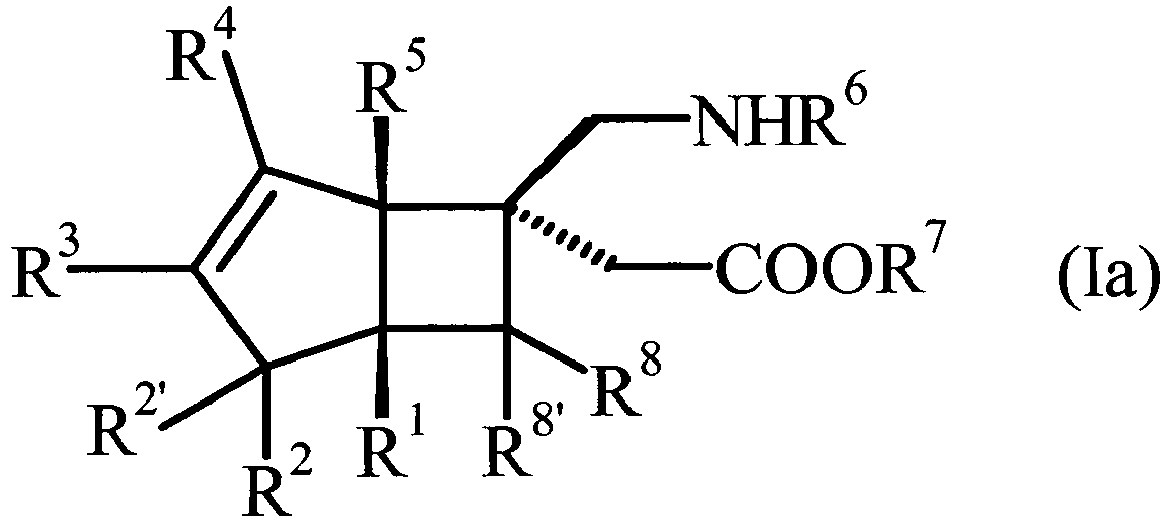

- R1, R2, R2, R4, R5, R6, R7, R8, and R8' are each independently a hydrogen atom; and
- R3 is an ethyl group.
- The present invention provides:
- (1) a compound represented by the general formula (1):

- R1, R2, R2', R4, R5, R8 and R8' are each independently a hydrogen atom; and
- R3 is an ethyl group;
- (2) a compound according to (1), wherein general formula (1) is the general formula (1a):

- (3) a compound according to (1), wherein general formula (1) is the general formula (1b):

- The present invention can provide an intermediate represented by the general formula (1) for producing a bicyclic γ-amino acid derivative represented by the general formula (I) having excellent activity as an α2δ ligand, or a pharmacologically acceptable salt thereof, which derivative or salt may be useful in a pharmaceutical composition having an excellent therapeutic and/or preventive effect on pain or disorders such as those involving the central nervous system.
- Since a compound represented by the general formula (I), when having amino and/or carboxyl groups in the structure, forms a salt through reaction with an acid or a base, a "pharmacologically acceptable salt" refers to this salt.
- Salts based on an amino group include: hydrohalides such as hydrofluoride, hydrochloride, hydrobromide, and hydroiodide; inorganic acid salts such as hydrochloride, nitrate, perchlorate, sulfate, and phosphate; lower alkanesulfonates such as methanesulfonate, trifluoromethanesulfonate, and ethanesulfonate; arylsulfonates such as benzenesulfonate and p-toluenesulfonate; organic acid salts such as acetate, malate, fumarate, succinate, citrate, ascorbate, tartrate, oxalate, and maleate; and amino acid salts such as glycine salt, lysine salt, arginine salt, ornithine salt, glutamate, and aspartate. Inorganic acid salts or arylsulfonates are preferable, and hydrochloride, benzenesulfonate, or p-toluenesulfonate is more preferable.
- Salts based on a carboxyl group include: alkali metal salts such as sodium salt, potassium salt, and lithium salt; alkaline-earth metal salts such as calcium salt and magnesium salt; metal salts such as aluminum salt and iron salt; inorganic salts such as ammonium salt; amine salts, for example, organic salts such as t-octylamine salt, dibenzylamine salt, morpholine salt, glucosamine salt, phenylglycine alkyl ester salt, ethylenediamine salt, N-methylglucamine salt, guanidine salt, diethylamine salt, triethylamine salt, dicyclohexylamine salt, N,N'-dibenzylethylenediamine salt, chloroprocaine salt, procaine salt, diethanolamine salt, N-benzylphenethylamine salt, piperazine salt, tetramethylammonium salt, and tris(hydroxymethyl)aminomethane salt; and amino acid salts such as glycine salt, lysine salt, arginine salt, ornithine salt, glutamate, and aspartate.
- A compound represented by the general formula (I), (Ia) or (Ib), when left in the air or recrystallized, may associate with adsorbed water through water absorption to form a hydrate. Such hydrates are also encompassed by the salt of the present invention.
- The compound represented by the general formula (I) has an asymmetric carbon atom in its molecule and therefore includes optical isomers. All these isomers and mixtures of these isomers are represented by a single formula, i.e., the general formula (I). Thus, the compound represented by the general formula (I) also encompasses all such optical isomers and mixtures of these optical isomers at appropriate ratios.
- The compound represented by the general formula (I) is specifically exemplified by the compounds described in, for example, Table 1 below.
[Table 1] 
No R1 R2 R2' R3 R4 8 -H -H -H -CH2CH3 -H No R5 R6 R7 R8 R8' 8 -H -H -H -H -H - A compound represented by the general formula (I) is produced by, for example, a process A (step A-1, step A-2, step A-3, optional step A-4, and step A-5) or a process D (step A-1, step D-1, step D-2, optional step A-4, and step A-5).
-

- P1 is not particularly limited as long as it is generally used as a protective group for carboxyl groups. Examples thereof include methyl, ethyl, propyl, isopropyl, butyl, isobutyl, sec-butyl, tert-butyl, hexyl, bromo-tert-butyl, trichloroethyl, benzyl, p-nitrobenzyl, o-nitrobenzyl, p-methoxybenzyl, p-tert-butylbenzyl, acetoxymethyl, propionyloxymethyl, butyryloxymethyl, isobutyryloxymethyl, valeryloxymethyl, pivaloyloxymethyl, acetoxyethyl, acetoxypropyl, acetoxybutyl, propionyloxyethyl, propionyloxypropyl, butyryloxyethyl, isobutyryloxyethyl, pivaloyloxyethyl, hexanoyloxyethyl, ethylbutyryloxymethyl, dimethylbutyryloxymethyl, pentanoyloxyethyl, methoxycarbonyloxymethyl, ethoxycarbonyloxymethyl, propoxycarbonyloxymethyl, tert-butoxycarbonyloxymethyl, methoxycarbonyloxyethyl, ethoxycarbonyloxyethyl, isopropoxycarbonyloxyethyl, tert-butyldimethylsilyl, trimethylsilyl, methoxymethyl, ethoxymethyl, propoxymethyl, isopropoxymethyl, (2-methylthio)-ethyl, 3-methyl-2-butenyl, 5-indanyl, and 3-phthalidyl groups.
- P2 is not particularly limited as long as it is generally used as a protective group for amino groups. Examples thereof include formyl, phenylcarbonyl, methoxycarbonyl, ethoxycarbonyl, phenyloxycarbonyl, 9-fluorenylmethyloxycarbonyl, adamantyloxycarbonyl, benzyloxycarbonyl, benzylcarbonyl, benzyl, benzhydryl, trityl, and phthaloyl groups.
- Of the various conditions for the production processes of the compound represented by the general formula (I), the reaction time in each step differs depending on the types of starting compounds, secondary materials, catalysts, reagents, solvents, etc., used in the step and is usually 1 to 48 hours, preferably 1 to 24 hours. On the other hand, other conditions are described below in detail for each step.
- The step A-1 is a step of producing a compound (2) through alkenylation reaction from a compound (1).
- Solvents used are not particularly limited as long as they are solvents that do not inhibit the reaction and can dissolve the starting material to some extent. The solvents include aromatic solvents, ether solvents, ester solvents, halogenated hydrocarbon solvents, nitrile solvents, amide solvents, and sulfoxide solvents. Ether solvents are preferable, and tetrahydrofuran is more preferable.
- Secondary materials used include: Horner-Emmons reagents; alkyl dialkylphosphonoacetates such as ethyl diethylphosphonoacetate; phosphorus ylide reagents; and phosphonium ylides such as ethoxycarbonylmethylene triphenylphosphorane.
- Reagents used are inorganic bases, alkali metal alkoxides, organic bases, organic metal bases, and the like. Inorganic bases are preferable, and sodium hydride is more preferable.
- The reaction temperature differs depending on the types of the starting compound, the solvents, the secondary materials, the reagents, etc., and is usually 0 to 100°C, preferably 0°C to room temperature.
- After completion of the reaction, the compound of interest of the present reaction is collected from the reaction mixture according to a standard method. For example, according to need, excess reagents are degraded, and the reaction is terminated. The reaction mixture is appropriately neutralized. Moreover, insoluble matter, if any, is removed by filtration. To the residue, water and a water-immiscible organic solvent such as ethyl acetate are then added, and the organic layer containing the compound of interest is separated, then washed with water or the like, and then dried over anhydrous magnesium sulfate, anhydrous sodium sulfate, anhydrous sodium bicarbonate, or the like. Then, the solvent is distilled off to obtain the compound of interest. The obtained compound of interest is separated and purified by appropriately combining standard methods according to need, for example, usual methods routinely used in the separation and purification of organic compounds, such as recrystallization and reprecipitation, followed by elution with an appropriate eluent by use of chromatography.
- Moreover, in the subsequent procedures, the compound of interest of each reaction is usually collected from the reaction mixture after completion of the reaction in each step in the same way as in the aftertreatment of the step A-1.
- The step A-2 is a step of producing a compound (3) from the compound (2).
- Solvents used are the same as those in the step A-1. Ether solvents or nitrile solvents are preferable, and tetrahydrofuran or acetonitrile is more preferable.
- Secondary materials used include nitromethane.
- Reagents used include the same as those in the step A-1. Organic bases or organic metal bases are preferable, and diazabicycloundecene or tetraalkyl ammonium halide is more preferable.
- The reaction temperature differs depending on the types of the starting compound, the solvents, the secondary materials, the reagents, etc., and is usually 0 to 100°C, preferably 0 to 60°C.
- The step A-3 is a step of reducing the compound (3) to produce a compound (5).
- Solvents used are not particularly limited as long as they are solvents that do not inhibit the reaction and can dissolve the starting material to some extent. The solvents include alcohol solvents, ester solvents, ether solvents, and aqueous solvents. Alcohol solvents and aqueous solvents are preferable, and ethanol or water is more preferable.
- Reagents used include palladium-carbon, palladium hydroxide-carbon, nickel chloride, tin chloride, sodium borohydride, iron powder, tin, zinc, and hydrogen. Iron powder or tin is preferable.
- The reaction temperature differs depending on the types of the starting compound, the solvents, the reagents, etc., and is usually 0 to 100°C, preferably 60 to 80°C.
- The step D-1 is a step of producing a compound (4) from the compound (2).
- Solvents used include the same as those in the step A-1, alcohol solvents, and aqueous solvents. Amide solvents are preferable, and N,N-dimethylformamide is more preferable.
- Reagents used include: cyanating agents; and metal cyanide reagents such as aluminum cyanide. Cyanating agents are preferable, and sodium cyanide or potassium cyanide is more preferable.
- The reaction temperature differs depending on the types of the starting compound, the solvents, the reagents, etc., and is usually 0 to 100°C, preferably 60 to 80°C.
- The step D-2 is a step of reducing the compound (4) to produce the compound (5).
- Solvents used include the same as those in the step D-1. Alcohol solvents or ether solvents are preferable, and methanol or tetrahydrofuran is more preferable.
- Catalysts used include transition metal catalysts. Nickel chloride or cobalt chloride is preferable.
- Reagents used include boron reagents. Sodium borohydride is preferable.
- The reaction temperature differs depending on the types of the starting compound, the solvents, the catalysts, the reagents, etc., and is usually 0 to 100°C, preferably 0°C to room temperature.
- A step of protecting the amino group of the compound (5) (step A-4) may optionally be performed to prepare a compound (6).
- Solvents used include the same as those in the step A-3. Alcohol solvents or aqueous solvents are preferable, and ethanol or water is more preferable.
- Reagents used include di-tert-butyl dicarbonate, chloroformate, acid halide, acid anhydride, sulfonyl chloride, inorganic bases, alkali metal alkoxides, organic bases, and organic metal bases. Di-tert-butyl dicarbonate, inorganic bases, or organic bases are preferable, and di-tert-butyl dicarbonate, sodium hydroxide, or triethylamine is more preferable.
- The reaction temperature differs depending on the types of the starting compound, the solvents, the reagents, etc., and is usually 0 to 100°C, preferably 0°C to room temperature.
- The step A-5 is a step of producing a compound (7) from the compound (5) or (6) through deprotection of the protective group.
- Solvents used include the same as those in the step A-3. Ether solvents or ester solvents are preferable, and dioxane or ethyl acetate is more preferable.
- Reagents used are inorganic acids, inorganic bases, or organic acids. Hydrochloric acid, acetic acid, or trifluoroacetic acid is more preferable.
- The reaction temperature differs depending on the types of the starting compound, the solvents, the secondary materials, the reagents, etc., and is usually 0 to 100°C, preferably 0°C to room temperature.
- The compound (1) obtained by the production processes can be produced by, for example, a process B, C, or E shown below. The process B consists of steps B-1, B-2, B-3, and B-4. The process C consists of steps C-1, B-3, and B-4.
-

- The step B-1 is a step of producing a compound (12) from a compound (11) through substitution reaction.
- Solvents used include the same as those in the step A-1. Ether solvents are preferable.
- Secondary materials used include allyl halide and crotyl halide. Allyl bromide or crotyl chloride is preferable.
- Reagents used include the same as those in the step A-1. Sodium hydride or butyllithium is preferable.
- The reaction temperature differs depending on the types of the starting compound, the solvents, the secondary materials, the reagents, etc., and is usually -78°C to room temperature, preferably 0°C to room temperature.
- The step B-2 is a step of producing a compound (13) from the compound (12) through reduction reaction.
- Solvents used include the same as those in the step A-1, alcohol solvents, and aqueous solvents. Ether solvents, alcohol solvents, or mixed solvents thereof are preferable, and tetrahydrofuran-methanol is more preferable.
- Reagents used include borohydride reagents. Sodium borohydride is preferable.
- The reaction temperature differs depending on the types of the starting compound, the solvents, the reagents, etc., and is usually 0 to 100°C, preferably 0°C to room temperature.
- The step C-1 is a step of producing the compound (13) from a compound (15) through coupling reaction.
- Solvents used include the same as those in the step A-1 and boric acid derivatives. Ether solvents or boric acid derivatives are preferable, and tetrahydrofuran, dimethyl ether, or trimethyl borate is more preferable.
- Secondary materials used include alkyl α-halogenoacetate. Alkyl bromoacetate is preferable, and methyl bromoacetate, ethyl bromoacetate, or tert-butyl bromoacetate is more preferable.
- Reagents used include zinc.
- The reaction temperature differs depending on the types of the starting compound, the solvents, the secondary materials, the reagents, etc., and is usually 0 to 100°C, preferably 60 to 80°C.
- The step B-3 is a step of hydrolyzing the compound (13) to produce a compound (14).
- Solvents used are not particularly limited as long as they are solvents that do not inhibit the reaction and can dissolve the starting material to some extent. The solvents include aromatic solvents, ether solvents, halogenated hydrocarbon solvents, nitrile solvents, amide solvents, sulfoxide solvents, alcohol solvents, and aqueous solvents. Alcohol solvents, aqueous solvents, or mixed solvents thereof are preferable, and methanol-water is more preferable.
- Reagents used include inorganic bases. Potassium hydroxide, sodium hydroxide, or lithium hydroxide is preferable.
- The reaction temperature differs depending on the types of the starting compound, the solvents, the reagents, etc., and is usually 0 to 100°C, preferably 0°C to room temperature.
- The step B-4 is a step of cyclizing the compound (14) through alkali treatment to produce the compound (1).
- Solvents used are not particularly limited as long as they are solvents that do not inhibit the reaction and can dissolve the starting material to some extent. The solvents include aromatic solvents, ether solvents, halogenated hydrocarbon solvents, nitrile solvents, acids, and acid anhydrides. Acids or acid anhydrides are preferable, and acetic acid or acetic anhydride is more preferable.
- Reagents used include alkali metal salts. Potassium acetate is preferable.
- The reaction temperature differs depending on the types of the starting compound, the solvents, the reagents, etc., and is usually 0 to 150°C, preferably room temperature to 140°C.
-

- The step E-1 is a step of producing a compound (17) from a compound (16).
- Solvents used include the same as those in the step A-1 and hydrocarbon solvents. Aromatic solvents, halogenated hydrocarbon solvents, or hydrocarbon solvents are preferable, and toluene is more preferable.
- Reagents used include oxalyl chloride and thionyl chloride. Oxalyl chloride is preferable.
- The reaction temperature differs depending on the types of the starting compound, the solvents, the reagents, etc., and is usually 0 to 150°C, preferably room temperature to 120°C.
- The step E-2 is a step of producing the compound (1) from the compound (17).
- Solvents used include the same as those in the step E-1. Aromatic solvents, halogenated hydrocarbon solvents, or hydrocarbon solvents are preferable, and toluene is more preferable.
- Reagents used include organic bases. Triethylamine is preferable.
- The reaction temperature differs depending on the types of the starting compound, the solvents, the reagents, etc., and is usually 0 to 150°C, preferably room temperature to 120°C.
- The compound represented by the general formula (Ia) or (Ib) is an optical isomer of the compound represented by the general formula (I) and is produced by the process A plus, for example, a process F, G, or H shown below.
- The process F is a process of performing, after the step A-2 in the process A, optical resolution to produce optical isomers (3a) and (3b) of the compound (3). From the optical isomer (3a) or (3b), the compound represented by the general formula (Ia) or (Ib) is produced through the steps A-3 to A-5.
-

- Solvents used include the same as those in the step A-1, hydrocarbon solvents, alcohol solvents, and mixed solvents of hydrocarbon solvents and alcohol solvents. Hexane-isopropanol or hexane-ethanol is preferable.
- The column used in the optical resolution is not particularly limited as long as it is a chiral column that permits optical resolution. The column is preferably CHIRALPAK (registered trademark) AD-H or CHIRALPAK (registered trademark) IC manufactured by Daicel Chemical Industries, Ltd.
- The temperature used is usually 0 to 40°C, preferably 20 to 40°C.
- After completion of the reaction, the eluent (solvent) is distilled off to obtain the compound of interest of the present reaction.
- The compound represented by the general formula (Ia) or (Ib) is produced by subjecting the compound (1) to optical resolution as shown below and then performing the same steps as those in the process A.
- The process G is a process of performing, before the step A-1 in the process A, optical resolution to produce optical isomers (1a) and (1b) of the compound (1). From the optical isomer (1a) or (1b), the compound represented by the general formula (Ia) or (Ib) is produced through the steps A-1 to A-5.
-

- P4 is not particularly limited as long as it is generally used as a protective group for hydroxyl groups. Examples thereof include trimethylsilyl, tert-butyldimethylsilyl, methoxymethyl, 2-methoxyethoxymethyl, tetrahydropyranyl, benzyl, p-methoxybenzyl, 2,4-dimethoxybenzyl, o-nitrobenzyl, p-nitrobenzyl, trityl, formyl, acetyl, tert-butoxycarbonyl, 2-iodoethoxycarbonyl, 2,2,2-trichloroethoxycarbonyl, 2-propenyloxycarbonyl, 2-chloro-2-propenyloxycarbonyl, 3-methoxycarbonyl-2-propenyloxycarbonyl, 2-methyl-2-propenyloxycarbonyl, 2-butenyloxycarbonyl, cinnamyloxycarbonyl, benzyloxycarbonyl, p-methoxybenzyloxycarbonyl, o-nitrobenzyloxycarbonyl, and p-nitrobenzyloxycarbonyl groups.
- The step G-1 is a step of reducing the compound (1) to produce a compound (18).
- Solvents used are not particularly limited as long as they are solvents that do not inhibit the reaction and can dissolve the starting material to some extent. The solvents include aromatic solvents, ether solvents, ester solvents, halogenated hydrocarbon solvents, nitrile solvents, amide solvents, sulfoxide solvents, and hydrocarbon solvents. Aromatic solvents, halogenated hydrocarbon solvents, or hydrocarbon solvents are preferable, and tetrahydrofuran is more preferable.
- Reagents used include boron reagents and aluminum reagents. Trimethoxy aluminum hydride is preferable.
- The reaction temperature differs depending on the types of the starting compound, the solvents, the reagents, etc., and is usually -78°C to room temperature, preferably -78 to 0°C.
- The step G-2 is a process of performing optical resolution of the compound (18) using an enzyme such as lipase to obtain a compound (19a) or (19b).
- Solvents used are not particularly limited as long as they are solvents that do not inhibit the reaction and can dissolve the starting material to some extent. The solvents include aromatic solvents, ether solvents, ester solvents, halogenated hydrocarbon solvents, nitrile solvents, amide solvents, sulfoxide solvents, and hydrocarbon solvents. Aromatic solvents, halogenated hydrocarbon solvents, or hydrocarbon solvents are preferable, and hexane is more preferable.
- Reagents used include ester reagents. Vinyl esters are preferable, and vinyl acetate is more preferable.
- The enzyme used includes Candida antarctica lipase, Pseudomonas fluorescens lipase, Pseudomonas cepacia lipase, porcine pancreatic lipase, porcine liver esterase, and Candida rugosa lipase.
- The reaction temperature differs depending on the types of the starting compound, the solvents, the reagents, the enzyme, etc., and is usually 0 to 150°C, preferably room temperature to 40°C.
- Moreover, in the step G-2, the compound (18) can also be converted, using an appropriate chiral auxiliary, to diastereomers, which are then subjected to resolution by an appropriate method such as recrystallization, distillation, and column chromatography. The resolution can be performed by a method described in, for example, Experimental Chemistry 18, Reaction of Organic Compound -(II)-, first volume (Nov. 25, 1957, published by Maruzen Co. Ltd., ed. by the Chemical Society of Japan), p. 503-556. More specifically, the compound (18) is reacted with a carboxylic acid reagent such as phthalic anhydride, and from the resulting mixture of carboxylic acid derivatives (19a) and (19b), resolution can be performed by recrystallization or the like using phenethylamine, quinine, cinchonidine, methylbenzylamine, naphthylethylamine, or the like.
- The step G-3 is a process of hydrolyzing the compound (19a) or (19b) to synthesize a compound (20a) or (20b).
- Solvents used are not particularly limited as long as they are solvents that do not inhibit the reaction and can dissolve the starting material to some extent. The solvents include aromatic solvents, ether solvents, ester solvents, halogenated hydrocarbon solvents, nitrile solvents, amide solvents, sulfoxide solvents, hydrocarbon solvents, alcohol solvents, aqueous solvents, and mixed solvents thereof. Ether solvents, alcohol solvents, aqueous solvents, or mixed solvents thereof are preferable, and methanol, ethanol, or water is more preferable.
- Reagents used include inorganic bases. Potassium carbonate, sodium hydroxide, or potassium hydroxide is preferable.
- The reaction temperature differs depending on the types of the starting compound, the solvents, the reagents, etc., and is usually 0 to 60°C, preferably 0°C to room temperature.
- The step G-4 is a process of oxidizing the compound (20a) or (20b) to synthesize the compound (1a) or (1b).
- Solvents used are not particularly limited as long as they are solvents that do not inhibit the reaction and can dissolve the starting material to some extent. The solvents include aromatic solvents, ether solvents, ester solvents, halogenated hydrocarbon solvents, nitrile solvents, amide solvents, sulfoxide solvents, and hydrocarbon solvents. Halogenated hydrocarbon solvents are preferable, and dichloromethane is more preferable.
- Reagents used include acid chloride. Oxalyl chloride is preferable.
- The reaction temperature differs depending on the types of the starting compound, the solvents, the reagents, etc., and is usually -78°C to room temperature, preferably -78 to 0°C.
- The process H is a process of performing, before the step A-1 in the process A, optical resolution to produce the compound (1a) or (1b) as an optical isomer of the compound (1). From the compound (1a) or (1b), the compound represented by the general formula (Ia) or (Ib) is produced through the steps A-1 to A-5.
-

- The step H-1 is a step of producing a compound (21) from the compound (1).
- Solvents used are not particularly limited as long as they are solvents that do not inhibit the reaction and can dissolve the starting material to some extent. The solvents include aromatic solvents, ether solvents, ester solvents, halogenated hydrocarbon solvents, nitrile solvents, amide solvents, sulfoxide solvents, and hydrocarbon solvents. Aromatic solvents, halogenated hydrocarbon solvents, or hydrocarbon solvents are preferable, and benzene or toluene is more preferable.
- Reagents used include ethanediol and propanediol. Hydrobenzoin is preferable.
- The reaction temperature differs depending on the types of the starting compound, the solvents, the reagents, etc., and is usually -78°C to reflux conditions, preferably 60°C to reflux conditions.
- The step H-2 is a step of subjecting the compound (21) to optical resolution to produce a compound (21a) or (21b).
- Solvents used include the same as those in the step A-1, hydrocarbon solvents, alcohol solvents, and mixed solvents of hydrocarbon solvents and alcohol solvents. Hexane-isopropanol or hexane-ethanol is preferable.
- The column used in the optical resolution includes the same as those in the process F.
- The temperature used is usually 0 to 40°C, preferably 20 to 40°C.
- After completion of the reaction, the eluent (solvent) is distilled off to obtain the compound of interest of the present reaction.
- The step H-3 is a step of synthesizing the compound (1a) or (1b) from the compound (21a) or (21b).
- Solvents used are not particularly limited as long as they are solvents that do not inhibit the reaction and can dissolve the starting material to some extent. The solvents include aromatic solvents, ether solvents, ester solvents, halogenated hydrocarbon solvents, nitrile solvents, amide solvents, sulfoxide solvents, hydrocarbon solvents, ketone solvents, and aqueous solvents. Ketone solvents or aqueous solvents are preferable, and acetone or water is more preferable.
- Reagents used include acid catalysts, for example, inorganic or organic acids such as hydrochloric acid, acetic acid, sulfuric acid, toluenesulfonic acid, and camphorsulfonic acid.
- The reaction temperature differs depending on the types of the starting compound, the solvents, the reagents, etc., and is usually 0 to 100°C, preferably 60 to 100°C.
- The compound represented by the general formula (I), (Ia) or (Ib), obtained by the processes, or the pharmacologically acceptable salt thereof exhibits activity as an α2δ ligand and affinity for voltage-dependent calcium channel subunit α2δ and is useful as an active ingredient in a pharmaceutical composition used for treating and/or preventing pain, disorders involving the central nervous system, and other disorders.
- Sodium hydride (>63% oil, 2.09 g, 55 mmol) was added to a tetrahydrofuran solution (50 mL) of ethyl 3-oxohexanoate (7.91 g, 50 mmol) under ice cooling, and the mixture was stirred in this state for 10 minutes. To the reaction solution, n-butyllithium (1.58 M hexane solution, 34.8 mL, 55 mmol) was added dropwise, and the mixture was further stirred for 10 minutes under ice cooling. Then, allyl bromide (4.7 mL, 55 mmol) was added thereto, and the mixture was stirred in this state for 1 hour and then further stirred at room temperature for 4 hours. To the reaction solution, 1 N hydrochloric acid and a saturated aqueous solution of ammonium chloride were added, followed by extraction with n-pentane. The organic layer was washed with saturated saline and dried over anhydrous magnesium sulfate, and the solvent was distilled off under reduced pressure. The obtained residue was dissolved in ethanol (80 mL). To the solution, sodium borohydride (1.51 g, 40 mmol) was added under ice cooling, and the mixture was stirred in this state for 2 hours. 1 N hydrochloric acid (50 mL) was added thereto, and the mixture was stirred for 30 minutes. Then, saturated saline was added thereto, followed by extraction with ethyl acetate. The organic layer was washed with saturated saline and then dried over anhydrous magnesium sulfate, and the solvent was distilled off under reduced pressure. The residue was purified by silica gel column chromatography to obtain the compound of interest as a pale yellow oil substance (3.64 g, 37%, mixture of diastereomers).
- Ethyl 4-ethyl-3-hydroxyhept-6-enoate (3.64 g, 18.2 mmol) was dissolved in a 2 N potassium hydroxide-methanol solution (120 mL), and the solution was stirred overnight at room temperature. From the reaction solution, the solvent was distilled off under reduced pressure. To the residue, a 1 N aqueous sodium hydroxide solution (200 mL) was then added, followed by extraction with diethyl ether. The aqueous layer was made acidic by the addition of concentrated hydrochloric acid under ice cooling, followed by extraction with diethyl ether again. The organic layer was washed with saturated saline and dried over anhydrous magnesium sulfate. Then, the solvent was distilled off under reduced pressure to obtain the compound of interest as a pale yellow oil substance (3.14 g, <100%, mixture of diastereomers).
- 4-Ethyl-3-hydroxyhept-6-enoic acid (3.13 g, 18.2 mmol) was dissolved in acetic anhydride (15 mL). To the solution, potassium acetate (4.27 g, 43.6 mmol) was added, and the mixture was stirred at room temperature for 100 minutes. The reaction solution was heated to reflux and stirred for 3.5 hours. To the reaction solution, ice water and toluene were then added, and this mixture was stirred overnight at room temperature. The mixture was separated into aqueous and organic layers by the addition of saturated saline (50 mL) and toluene (20 mL). Then, the organic layer was washed with a 1 N aqueous sodium hydroxide solution and saturated saline in this order, then dried over anhydrous magnesium sulfate, and then filtered. This filtrate was added to a reaction solution prepared by adding sodium hydride (>65% oil, 761.9 mg, 20 mmol) to a tetrahydrofuran solution (50 mL) of tert-butyl dimethoxyphosphorylacetate (4.48 g, 20 mmol) under ice cooling, and the mixture was further stirred for 1 hour. The reaction solution was separated into aqueous and organic layers by the addition of a saturated aqueous solution of ammonium chloride and saturated saline. The aqueous layer was subjected to extraction with ethyl acetate. These organic layers were combined, then washed with saturated saline, and then dried over anhydrous magnesium sulfate. The solvent was distilled off under reduced pressure, and the residue was purified by silica gel column chromatography to obtain the compound of interest as a pale yellow oil substance (1.32 g, 31%, E/Z mixture).
- Tert-butyl (±)-[(1S,5R)-3-ethylbicyclo[3.2.0]hept-3-en-6-ylideneacetate (1.32 g, 5.63 mmol) was dissolved in nitromethane (7 mL). To the solution, 1,8-diazabicyclo[5.4.0]undec-7-ene (1.2 mL, 7.3 mmol) was added, and the mixture was heated with stirring at 50 to 60°C for 7 hours. The mixture was allowed to cool, and a saturated aqueous solution of potassium dihydrogen phosphate was then added thereto, followed by extraction with ethyl acetate. Then, the organic layer was dried over anhydrous magnesium sulfate, and the solvent was distilled off under reduced pressure. The residue was purified by silica gel column chromatography to obtain the compound of interest as a colorless oil substance (1.39 g, 84%).
- Tert-butyl (+)-[(1S,5R,6R)-3-ethyl-6-(nitromethyl)bicyclo[3.2.0]hept-3-en-6-yl]acetate (1.09 g, 4.71 mmol) was dissolved in ethanol (10 mL) and water (5 mL). To the solution, iron powder (1.32 g, 23.5 mmol) and ammonium chloride (249.6 mg, 4.71 mmol) were added, and the mixture was stirred for 2 hours under heating to reflux. The mixture was allowed to cool, then diluted with saturated saline, a saturated aqueous solution of sodium bicarbonate, and ethyl acetate, and filtered through Celite to remove insoluble matter. The filtrate was separated into organic and aqueous layers. The organic layer was washed with saturated saline and then dried over anhydrous magnesium sulfate, and the solvent was then distilled off under reduced pressure. To the residue, a 4 N hydrochloric acid-ethyl acetate solution (20 mL) was added, and the mixture was stirred at room temperature for 1 hour. Then, the solvent was distilled off under reduced pressure. The residue was suspended in dichloromethane. To the suspension, triethylamine was added dropwise, and the resulting powder was collected by filtration, then washed with dichloromethane, and then dried to obtain the compound of interest as a white powder (425.1 mg, 43%).
-

- Tert-butyl (±)-[(1R,5S,6S)-3-ethyl-6-(nitromethyl)bicyclo[3.2.0]hept-3-en-6-yl]acetate (230 g, 778 mmol) was resolved using Chiralpak IC (N-Hex:EtOH=98:2, 1.0 mL/min, 40°C) manufactured by Daicel Chemical Industries, Ltd. to respectively obtain 115 g of a peak 1 (retention time: 5.2 min) and 93.7 g of a peak 2 (retention time: 6.3 min). (21-b) Tert-butyl ([(1R,5S,6S)-6-(tert-butoxycarbonylamino)methyl-3-ethylbicyclo[3.2.0]hept-3-en-6-yl]acetate
- Tert-butyl [(1R,5S,6S)-3-ethyl-6-(nitromethyl)bicyclo[3.2.0]hept-3-en-6-yl]acetate (peak 1, 7.0 g, 23.7 mmol) was dissolved in ethanol (60 mL) and water (21 mL). To the solution, iron powder (13.27 g, 237 mmol) and ammonium chloride (628.1 mg, 11.9 mmol) were added, and the mixture was stirred for 5.5 hours under heating to reflux. The mixture was allowed to cool, then diluted with saturated saline, a saturated aqueous solution of sodium bicarbonate, and ethyl acetate, and filtered through Celite to remove insoluble matter. The filtrate was separated into organic and aqueous layers. The organic layer was washed with saturated saline and then dried over anhydrous magnesium sulfate. Then, the solvent was distilled off under reduced pressure to obtain a pale yellow oil substance (7.02 g). This substance was dissolved in dichloromethane (200 mL). To the solution, (Boc)2O (5.25 g, 25 mmol) and triethylamine (5.01 g, 50 mmol) were added, and the mixture was stirred overnight at room temperature. The solvent was distilled off under reduced pressure, and the residue was then purified by silica gel chromatography to obtain the title compound of interest as a pale yellow oil substance (8.82 g, <100%).
- A 4 N hydrochloric acid-ethyl acetate solution (100 mL) was added to tert-butyl (1R,5S,6S)-[6-(tert-butoxycarbonylaminomethyl)-3-ethylbicyclo[3.2.0]hept-3-en-6-yl]acetate (9.82 g, 23.7 mmol), and the mixture was stirred at room temperature for 1 hour. Then, the solvent was distilled off under reduced pressure. The residue was dissolved in dichloromethane. To the solution, triethylamine was added dropwise, and the resulting powder was collected by filtration, then washed with dichloromethane, and then dried to obtain 4.02 g of a white powder. This powder was washed with ethanol and ethyl acetate to obtain the title compound of interest as a white powder (2.14 g, 43%).
-

- Tert-butyl
[(1R,5S,6S)-6-(tert-butoxycarbonylamino)methyl-3-ethylbicyclo[3.2.0]hept-3-en-6-yl]acetate (1152.23 g, 391.6 mmol) was dissolved in benzene (1.2 L). To the solution, thioanisole (145.57 g, 1173 mmol) and p-toluenesulfonic acid monohydrate (89.39 g) were then added, and the mixture was stirred for 2 hours under reflux. The mixture was left standing overnight at room temperature, and the resulting powder was collected by filtration. The obtained powder was washed with ethyl acetate and then dried to obtain the compound of interest as a white powder (88.29 g, 59%). -

- Tert-butyl [(1S,5R,6R)-6-(nitromethyl)-3-ethylbicyclo[3.2.0]hept-3-en-6-yl]acetate (peak 2, 6.90 g, 23.36 mmol) was dissolved in ethanol (80 mL) and water (20 mL). To the solution, iron powder (6.52 g, 116.8 mmol) and ammonium chloride (1.25 g, 23.36 mmol) were added, and the mixture was stirred for 4.5 hours under heating to reflux. The mixture was allowed to cool and then filtered through Celite to remove insoluble matter. To the filtrate, (Boc)2O (15.30 g, 70.08 mmol) was added, and the filtrate was then made basic (pH>9) using a 2 N sodium hydroxide solution and stirred at room temperature for 2 hours. The solution was concentrated, and the residue was diluted with ethyl acetate. The dilution was washed with water and saturated saline and dried over anhydrous magnesium sulfate. Then, the solvent was distilled off under reduced pressure, and the residue was purified by silica gel column chromatography to obtain the compound of interest as a colorless oil substance (8.51 g, 99%).
- Tert-butyl [(1S,5R,6R)-6-[(tert-butoxycarbonylamino)methyl-3-ethylbicyclo[3.2.0]hept-3-en-6-yl]acetate (8.54 g, 23.36 mmol) was dissolved in a 4 N hydrochloric acid-ethyl acetate solution (100 mL), and the solution was stirred at room temperature for 2 hours. Then, the solvent was distilled off under reduced pressure. The residue was suspended by the addition of dichloromethane. To the suspension, triethylamine was then added dropwise, and the resulting powder was collected by filtration. The obtained powder was washed with dichloromethane and then washed with isopropanol-ethyl acetate to obtain the compound of interest as a white powder (2.7 g, 55%).
-

- (1R,5S,6S)-6-(aminomethyl)-3-ethylbicyclo[3.2.0]hept-3-en-6-yl]acetic acid (4.50 g, 20.6 mmol) was dissolved by heating in a 1 M aqueous solution (22.7 mL) of benzenesulfonic acid monohydrate, and the solution was then allowed to cool to room temperature. The resulting solid was collected by filtration. The solid was washed with water (15 mL) and then dried using a vacuum pump to obtain the compound of interest as a colorless solid (6.45 g, 77%).
-

- p-Toluenesulfonic acid (13.14 g, 69.1 mmol) was added to an ethanol (150 mL)/water (50 mL) suspension of tert-butyl [(1R,5S,6R)-6-{[(tert-butoxycarbonyl)amino]methyl}-3-ethylbicyclo[3.2.0]hept-3-en-6-yl]acetate (10.20 g, 34.5 mmol) and iron powder (9.64 g, 172.7 mmol), and the mixture was stirred at 80°C for 2.5 hours. The mixture was allowed to cool and then filtered through Celite to remove insoluble matter. The solution was concentrated, and the residue was diluted with ethyl acetate. The dilution was washed with water and dried over anhydrous magnesium sulfate. Then, the solvent was distilled off under reduced pressure, and the obtained solid was washed with hexane to obtain a white solid (14.62 g). This compound was dissolved in benzene (100 mL). To the solution, p-toluenesulfonic acid (1.27 g, 6.7 mmol) was added, and the mixture was stirred at 80°C for 2.5 hours. The mixture was allowed to cool and then filtered to remove insoluble matter. The solution was concentrated, and the obtained solid (2.32 g) was dissolved in chloroform (50 mL). To the solution, triethylamine (1.4 mL) was added, and the resulting solid was collected by filtration and suspended in ethyl acetate (25 mL). To the suspension, p-toluenesulfonic acid (0.44 g) was added. The mixture was ultrasonically irradiated for 1 hour, and the obtained solid was washed with methanol to obtain the compound of interest as a white solid (0.06 g, 1%).
- The physical analysis data of the compounds described in the Examples is shown below.
8(8-a) 1H-NMR(400MHz, CDCl3) :d ppm: 0.91 (3H, t, J=7.5Hz), 1.28 (3H, t, J=7.2Hz), 1.43-1.55 (2H, m). 1.98-2.28 (2H, m), 2.45-2.48 (2H, m), 2.88-2.93 (1H, m), 4.07-4.10 (1H, m), 4.10-4.20 (2H, m), 5.01-5.09 (2H, m), 5.75-5.86(1H, m). MS (FAB) : m/z : 201 (M+H)+. 8 (8-b) 1H-NMR(400MHz, CDCl3) :d ppm: 0.91-0.96 (3H, m), 1.39-1.52 (3H, m), 2.01-2.28 (2H, m), 2.52-2.55 (2H, m), 4.05-4.15 (2H, m), 5.03-5.10 (2H, m), 5.74-5.86 (1H, m). MS (FAB) : m/z : 173 (M+H)+, 195 (M+Na)+. 8 (8-c) 1H-NMR(400MHz, CDCl3) :d ppm: Major isomer 1.06 (3H, t, J=7.4Hz), 1.45 (9H, s), 2.07-2.22 (3H, m), 2.59-2.70 (2H, m), 2.87-2.96 (1H, m), 3.30 (1H, ddt, J=8.6, 18.4, 2.7Hz), 3.86-3.88 (1H, m), 5.22-5.23 (1H, m), 5.45-5.47 (1H, m). Minor isomer 1.08 (3H, t, J=7.3Hz), 1.49 (9H, s), 2.07-2.21 (3H, m), 2.43-2.47 (1H, m), 2.59-2.70 (1H, m), 2.75-2.85 (1H, m), 2.87-2.96 (1H, m), 4.28-4.31 (1H, m), 5.35-5.38 (1H, m), 5.45-5.47 (1H, m). MS (FAB) : m/z : 235 (M+H)+, 257 (M+Na)+. 8 (8-d) 1H-NMR(400MHz, CDCl3) :d ppm: 1.09 (3H, t, J=7.4Hz), 1.46 (9H, s), 1.52 (1H, dd, J=7.6, 13.2Hz), 2.06(1H,d, 16.6Hz), 2.14 (2H, q, J=7.4Hz), 2.30 (1H, ddd, J=2.4, 7.6, 13.2Hz), 2.47 (2H, s), 2.49 (1H, dd, J=7.6,16.6Hz), 2.86 (1H, quint, J=7.6Hz), 3.21-3.22 (1H, m), 4.75 (1H, d, J=11.7Hz), 4.84 (1H, d, J=11.7Hz), 5.27 (1H, s). MS (FAB) : m/z : 296 (M+H)+, 318 (M+Na)+. 8 (8-e) Mp. 175-176°C. 1H-NMR(400MHz, CD30D) :d ppm: 1.10(3H, t, J=7.4Hz), 1.48(1H, dd, J=7.5, 12.5Hz), 2.03-2.08(2H, m), 2.14(2H, q, J=7.4Hz), 2.46(H, d, J=16.2Hz), 2.46-2.53(1H, m), 2.51(1H, d, J=16.2Hz), 2.85(1H, quint, J=7.5Hz), 3.09-3.10(1H, m), 3.14(1H, d, J=13.0Hz), 3.18(1H, d, J=13.0Hz), 5.38(1H, dd, J=1.7, 3.7Hz). IR (KBr) : cm-1: 2962, 2928, 2897, 2877, 1559, 1527, 1403. MS (FAB) : m/z : 210 (M+H)+, 232 (M+Na)+. Anal. calcd for C12H19NO2: C, 68.87; H, 9.15; N, 6.69; Found C, C, 67.64; H, 9.18; N, 6.61. 21 (21-b) 1H-NMR(400Hz, CDCl3) : δ ppm: 1.08 (3H, t, J=7.6Hz), 1.39(1H, dd, J=7.6, 12.1Hz), 1.44 (18H, s), 1.98-2.02(2H, m), 2.12 (2H, q, J=7.6Hz), 2.22(1H, d. J=14.5Hz), 2.27(1H, d, J=14,5Hz), 2.46-2.50(1H, m), 2.80-2.88(1H, m), 2.99-3.00 (1H, m), 3.33(1H, dd, J=6.2, 13.7Hz), 3.41 (1H, dd, J=6.2, 13.7Hz), 5.00(1H, broad), 5.33(1H, d, J=1.6Hz). [α]25D -90.6° (c=1.37, CHCl3). 21 (21-c) Mp. 182-183°C [α]25D -110.3° (c=0.85, MeOH). 1H-NMR(400MHz, CD3OD) : δ ppm: 1.10(3H, t, J=7.4Hz), 1.48(1H, dd, J=7.5, 12.5Hz), . 2.03-2.08(2H, m), 2.14(2H, q, J=7.4Hz), 2.46(1H, d, J=16.2Hz), 2.46-2.53(1H, m), 2.51(1H, d, J=16.2Hz), 2.85(1H, quint, J=7.5Hz), 3.09-3.10(1H, m), 3.14(1H, d, J=13.0Hz), 3.18(1H, d. J=13.0Hz), 5.38(1H, dd, J=1.7, 3.7Hz). IR (KBr) : cm-1: 2962, 2928, 2897. 2877, 1559, 1527, 1403. MS (FAB) : m/z : 210 (M+H)+, 232 (M+Na)+. Anal. calcd for C12H19NO2: C, 68.87: H, 9.15: N, 6.69: Found C, C, 65.55; H. 9.16: N, 6.45. 22 Mp. 171-172°C [α]25D -59.6° (c=1. 02. MeOH) 1H-NMR (400MHz, CD3OD) : δ ppm: 1. 11(3H, t, J=7.4Hz), 1.51(1H, dd, 7.4, 12.7Hz), 2.06-2.20 (4H, m), 2.37(3H, s), 2.49-2.56(1H, m), 2.51(2H, s), 2.87(1H, quint, J=7.4Hz), 3.12-3.14(1H, m), 3.28(1H, d. J=13.5Hz), 3.33(1H, d, J=13.5Hz), 5.31-5.32(1H, m), 7.21-7.25(2H, m), 7.69-7.72(2H, m). IR (KBr) : cm-1: 3155. 2963, 1707, 1497, 1410, 1236, 1163, 1037, 812, 687, 567. MS (FAD+) : m/z : 210 (free+H)+ ; (FAB-) ; m/z : 208 (free-H)-, 171 (TsOH-H)-. Anal. calcd for C19H27N05S: C, 59.82; H, 7.21: N, 3.67; S, 8.41; Found C. 59. 16; H, 7.21: N, 4.10; S, 8.53. 23(23-a) 1H-NMR(400MHz, CDCl3) : δ ppm: 1.08(3H, t. J=7.6Hz), 1.39(1H, dd, J=7.6, 12.1Hz), 1.44(18H, s), 1.98-2.02(2H, m), 2.12 (2H, q, J=7.6Hz), 2.22(1H, d, J=14.5Hz), 2.27(1H, d, J=14.5Hz), 2.46-2.50(1H, m), 2.80-2.88(1H, m), 2.99-3.00(1H, m), 3.33(1H, dd, J=6.2, 13.7Hz), 3.41(1H, dd, J=6.2, 13.7Hz), 5.00(1H, broad), 5.33(1H, d, J=1.6Hz). [α]21D +68.1° (c=1.37, CHCl3) 23(23-b) 1H-NMR(400MHz,CD3OD) : δ ppm: 1.10(3H, t, J=7.4Hz, Et), 1.48(1H, dd, J=7.5, 12.5Hz), 2.03-2.08(2H, m), 2.14(2H, q, J=7.4Hz, Et), 2.46(1H, d, J=16.2Hz), 2.46-2.53(1H, m), 2.51(1H, d, J=16.2Hz). 2.85(1H, quint, J=7.5Hz), 3.09-3.10(1H, m), 3.14(1H, d, J=13.0Hz), 3.18(1H, d, J=13.0Hz), 5.38(1H, dd, J=1.7. 3.7Hz). Mp. 163-166 °C 1R (KBr) : cm-1: 2963, 2926, 2877, 1560, 1527, 1402 MS (FAB) : m/z : 210 (M+H)+, 232 (M+Na)+, Anal. calcd for C12H19NO2 0.7H2O: C, 64.95: H, 9.30: N, 6.30: Found C, 64.97: H, 9.08; N, 6.41. [α]21D +96.2° (c=1.0, MeOH) 31 Mp. 172-173°C. [α]20D -68.1° (c 0.98, MeOH). 1H-NMR(400MHz, CD3OD) : ppm: 1.11 (3H, t, J=7.4Hz), 1. 50 (1H, dd, J=7.5, 12.6Hz), 2.08 (1H, d, 16.5Hz), 2.10-2.20 (3H, m), 2.46-2.56 (3H, m), 2. 87 (1H, quint. J=7.5Hz), 3.12-3.13 (1H, m). 3.28 (1H, d, J=13.4Hz), 3.33 (1H, d, J=13.4Hz), 5. 31 (1H, d, J=1.8Hz), 7.39-7.45 (3H, m), 7.80-7.85 (2H, m). IR (KBr) : cm-1:3197, 3149, 3054, 2964, 2927, 2878, 2831, 1714, 1495, 1415, 1410, 1220, 1164, 1123, 1019, 730. MS (FAB+) : m/z : 210 (free+H)+, (FAB-) : m/z : 157 (bensensulfonic acid-H)-. Anal. calcd for C18H25NO5S: C, 58.83: H, 6.86; N, 3.81; S, 8.73: Found C; 58.69: H, 6.94: N, 3.99: S, 8.73. 37 Mp. 167-169°C; 1H-NMR(500MHz, CDCl3) : δ ppm: 1.14 (3H, t, J=7.3Hz), 1.54 (1H, dd, J = 7.3, 11.7 Hz), 2.06-2. 14 (2H, m), 2.20 (1H, q, J = 7.3 Hz), 2.54 (1H, dd, J = 7.3, 17. 1 Hz), 2.71 (1H, d, J = 15.6 Hz), 2.81 (1H, d, J = 16.6 Hz), 2.95 (2H, s), 2.96 (1H, m), 3.04 (1H, br), 5.42 (1H, s). MS (ESI+) : m/z : 254 (M + 2Na -H)+, 232 (M + Na)+, 210 (M + H)+. HRMS(ESI+) calcd for (M + H)+: 210.14990. Found 210. 14842 (-0.98 mmu). Anal.calcd for C12H19NO2: C, 68.87; H, 9.15; N, 6.69; 0, 15.29. Found C, 67.32; H, 9.05; N, 6.53: 0, 16.30. - 5 g of the compound of Example 21, 90 g of lactose, 34 g of corn starch, 20 g of crystalline cellulose, and 1 g of magnesium stearate are mixed using a blender and then compressed using a tableting machine to obtain a tablet.
- The human Cacna2d1-expressing cell membrane fraction obtainable according to Test Example 1(c) of
EP2192109A1 and GBP labeled with a radioisotope 3H (hereinafter, referred to as 3H-GBP; Tocris Cookson Ltd.) were diluted with a binding assay buffer (10 mM MOPS (pH 7.4), 10 mM HEPES (pH 7.4), 100 mM NaCl) at a final concentration of 2.5 mg/ml in terms of the total protein level and a final 3H-GBP concentration of 4.5 nM, respectively, to prepare 120 µl of a reaction solution, which was in turn left standing at 4°C for 3 hours. This reaction product was added to wells of a filter plate (UniFilter 350 GF/B (Whatman)) and filtered through the filter. Then, a washing procedure involving the addition of 350 µl of a binding assay buffer (10 mM MOPS (pH 7.4), 10 mM HEPES (pH 7.4), 100 mM NaCl) and filtration through the filter was repeated three times. The filter plate was thoroughly dried, and the underside was sealed. After addition of 50 µl of Microscint 20 (PerkinElmer Inc.), the upper surface was also sealed, and radiation derived from the radioisotope 3H remaining on the filter was counted using TopCount (PerkinElmer Inc.). From the obtained value, a value obtained by adding unlabeled GBP (SIGMA-ALDRICH INC.) at a final concentration of 20 µM to the present assay was subtracted as that derived from nonspecific adsorption, and the obtained value was used as the specific binding level of 3H-GBP to Cacna2d1 (unit: "count"). - Each test compound was added at various concentrations to the Cacna2d1/GBP binding reaction detection assay constructed in paragraph a), and the binding level was measured by the method described in paragraph a). Then, with the Cacna2d1/GBP specific binding level obtained by the addition of the compound at a concentration of x nM defined as "binding level [x]" and the Cacna2d1/GBP binding inhibitory rate thereagainst defined as "inhibitory rate [x]", the inhibitory rate (%) was determined based on the following equation:

the binding level [0] refers to the binding level of 3H-GBP obtained without the addition of the compound.
The inhibitory rate was plotted against the concentration. From this result, an "IC50 value" was calculated, which is the concentration of the test compound necessary for inhibiting 50% of Cacna2d1/GBP binding. The test results of the test compounds of the Examples are shown in the Table below:Example IC50 (nM) 8 28 21 14 22 10 23 41 31 14 - It has been reported that animals with peripheral nerve injury and diabetic model animals exhibit hyperalgesia and allodynia symptoms to mechanical or thermal stimulation. In the present invention, mice suffering from mechanical hyperalgesia were used in evaluation.
- The mice were acclimatized for 30 minutes in a plastic cage for measurement. Then, the test compound was orally administered to the mice, which were in turn evaluated for mechanical hyperalgesia at a measurement time predetermined by a person in charge of the test. The evaluation of mechanical hyperalgesia was conducted by a partial modification of the method of Takasaki et al. (Pain 86 95-101, 2000) to confirm the effect of the test compound on mechanical hyperalgesia. Specifically, mechanical hyperalgesia was evaluated by assessing, based on scores according to the following criteria, behavior induced by pressing 1.4 g of von Frey filament onto the sole of the animal:
- 0: no response, 1: withdrawal from von Frey filament, and 2: shaking or licking of the hind paw immediately after the stimulation.
- In one measurement, 6 stimulations were given to the mice, and the total score was used as a pain score.
- The test compound was evaluated by calculating ID50, which is the dose of the compound that offers 50% improvement relative to the pain score of a vehicle-administered group.
- A compound of the present invention can be used as an intermediate for producing an active ingredient in a pharmaceutical composition for treating and/or preventing pain or disorders such as those involving the central nervous system.
Claims (3)
- A compound represented by the general formula (1):
 R1, R2, R2', R4, R5, R8 and R8' are each independently a hydrogen atom; andR3 is an ethyl group.
 - A compound according to claim 1, wherein general formula (1) is the general formula (1a):

- A compound according to claim 1, wherein general formula (1) is the general formula (1b) :

Applications Claiming Priority (2)
| Application Number | Priority Date | Filing Date | Title |
|---|---|---|---|
| JP2007255430 | 2007-09-28 | ||
| EP08833399.2A EP2192109B1 (en) | 2007-09-28 | 2008-09-25 | Bicyclic -amino acid derivative |
Related Parent Applications (2)
| Application Number | Title | Priority Date | Filing Date |
|---|---|---|---|
| EP08833399.2A Division EP2192109B1 (en) | 2007-09-28 | 2008-09-25 | Bicyclic -amino acid derivative |
| EP08833399.2 Division | 2008-09-25 |
Publications (2)
| Publication Number | Publication Date |
|---|---|
| EP2657219A1 EP2657219A1 (en) | 2013-10-30 |
| EP2657219B1 true EP2657219B1 (en) | 2014-12-10 |
Family
ID=40511336
Family Applications (2)
| Application Number | Title | Priority Date | Filing Date |
|---|---|---|---|
| EP08833399.2A Active EP2192109B1 (en) | 2007-09-28 | 2008-09-25 | Bicyclic -amino acid derivative |
| EP13177681.7A Active EP2657219B1 (en) | 2007-09-28 | 2008-09-25 | Intermediate for producing bicyclic y-amino acid derivative |
Family Applications Before (1)
| Application Number | Title | Priority Date | Filing Date |
|---|---|---|---|
| EP08833399.2A Active EP2192109B1 (en) | 2007-09-28 | 2008-09-25 | Bicyclic -amino acid derivative |
Country Status (25)
| Country | Link |
|---|---|
| US (1) | US7947738B2 (en) |
| EP (2) | EP2192109B1 (en) |
| JP (1) | JP4479974B2 (en) |
| KR (2) | KR101409079B1 (en) |
| CN (2) | CN103483169A (en) |
| AU (1) | AU2008304933B2 (en) |
| BR (2) | BRPI0818193B8 (en) |
| CA (1) | CA2701110C (en) |
| CO (1) | CO6270314A2 (en) |
| CY (1) | CY1114836T1 (en) |
| DK (1) | DK2192109T3 (en) |
| ES (2) | ES2531324T3 (en) |
| HR (1) | HRP20130935T1 (en) |
| IL (1) | IL204621A (en) |
| MX (1) | MX2010003394A (en) |
| MY (2) | MY172034A (en) |
| NZ (1) | NZ584699A (en) |
| PH (1) | PH12013501663B1 (en) |
| PL (1) | PL2192109T3 (en) |
| PT (1) | PT2192109E (en) |
| RU (1) | RU2446148C2 (en) |
| SI (1) | SI2192109T1 (en) |
| TW (2) | TWI526425B (en) |
| WO (1) | WO2009041453A1 (en) |
| ZA (1) | ZA201002013B (en) |
Families Citing this family (40)
| Publication number | Priority date | Publication date | Assignee | Title |
|---|---|---|---|---|
| KR101409079B1 (en) | 2007-09-28 | 2014-06-18 | 다이이찌 산쿄 가부시키가이샤 | BICYCLIC γ-AMINO ACID DERIVATIVE |
| WO2010079668A1 (en) * | 2009-01-08 | 2010-07-15 | 第一三共株式会社 | Olefin compound |
| KR101674700B1 (en) * | 2009-03-26 | 2016-11-09 | 다이이찌 산쿄 가부시키가이샤 | Method for producing 2-cyclic? -Amino acid derivatives |
| WO2012169475A1 (en) * | 2011-06-08 | 2012-12-13 | 第一三共株式会社 | Method for producing bicyclic compound via claisen rearrangement |
| EP2719676B1 (en) * | 2011-06-08 | 2017-12-13 | Daiichi Sankyo Company, Limited | Method for producing bicyclic compound via iminium salt |
| ES2686929T3 (en) | 2011-12-15 | 2018-10-22 | Daiichi Sankyo Company, Limited | Optical resolution procedure for bicyclic compound using asymmetric catalyst |
| WO2013089189A1 (en) * | 2011-12-16 | 2013-06-20 | 第一三共株式会社 | Optical resolution method for bicyclic compound using hydroxysulfonic acid |
| KR101951379B1 (en) * | 2012-02-08 | 2019-02-22 | 스텔라파머 가부시키가이샤 | Method for producing cereulide and derivative thereof, intermediate for production of cereulide, and cereulide derivative |
| KR101976891B1 (en) | 2012-04-10 | 2019-05-09 | 다이이찌 산쿄 가부시키가이샤 | Optical resolution method for bicyclic compound using enzyme |
| TWI645863B (en) * | 2013-04-04 | 2019-01-01 | 日商第一三共股份有限公司 | Solid composition of a salt of an aminocarboxylic acid |
| TWI635071B (en) * | 2013-07-08 | 2018-09-11 | 第一三共股份有限公司 | OPTICALLY ACTIVE BICYCLIC γ-AMINO ACID AND PREPARATION METHOD FOR THE SAME |
| US9663479B2 (en) | 2013-12-18 | 2017-05-30 | Novassay S.A. | γ-aminobutyric acid (GABA) analogues for the treatment of pain and other disorders |
| BR112017019918B1 (en) | 2015-03-19 | 2023-11-07 | Daiichi Sankyo Company, Limited | SOLID PHARMACEUTICAL PREPARATION, AND, METHOD FOR PRODUCING A SOLID PHARMACEUTICAL PREPARATION FOR STABILIZING A SOLID PHARMACEUTICAL PREPARATION |
| US10603285B2 (en) | 2015-03-19 | 2020-03-31 | Daiichi Sankyo Company, Limited | Solid preparation including colorant |
| CN107848953B (en) * | 2015-12-25 | 2021-05-18 | 四川海思科制药有限公司 | Condensed ring γ-amino acid derivative, preparation method and medical application thereof |
| CN107848952B (en) * | 2015-12-31 | 2021-04-09 | 四川海思科制药有限公司 | Condensed tricyclic γ-amino acid derivative, preparation method and medical application thereof |
| CN106928080B (en) * | 2015-12-31 | 2020-12-25 | 四川海思科制药有限公司 | Fused ring gamma-amino acid derivative, preparation method and application thereof in medicine |
| WO2017183539A1 (en) * | 2016-04-18 | 2017-10-26 | 第一三共株式会社 | Method for producing bicyclic compound using meldrum's acid |
| TW201806928A (en) * | 2016-07-01 | 2018-03-01 | 第一三共股份有限公司 | Crystals of aminocarboxylic acid acid addition salts and the synthetic method thereof |
| ES2906887T3 (en) * | 2016-07-21 | 2022-04-20 | Chia Tai Tianqing Pharmaceutical Group Co Ltd | Indole derivative used as a CRTH2 inhibitor |
| KR102335089B1 (en) * | 2016-09-14 | 2021-12-02 | 스촨 하이스코 파마수티컬 씨오., 엘티디 | Fused tricyclic Γ-amino acid derivative, method for preparing same, and medical use thereof |
| JP7051332B2 (en) * | 2017-08-23 | 2022-04-11 | キヤノン株式会社 | Organic compounds and photoelectric conversion elements |
| JP7222063B2 (en) * | 2018-07-12 | 2023-02-14 | 四川海思科制▲薬▼有限公司 | Compositions of Fused Tricyclic γ-Amino Acid Derivatives and Their Preparation |
| WO2020011258A1 (en) * | 2018-07-12 | 2020-01-16 | 四川海思科制药有限公司 | Crystal form of salt of fused tricyclic γ-amino acid derivative and preparation and use thereof |
| WO2020027019A1 (en) * | 2018-07-30 | 2020-02-06 | 第一三共株式会社 | Stabilizer-containing solid drug formulation |
| CN112384493B (en) * | 2018-08-09 | 2023-06-06 | 四川海思科制药有限公司 | Preparation method and intermediate of fused tricyclic γ-amino acid derivatives |
| CN114402198A (en) * | 2019-09-03 | 2022-04-26 | 四川海思科制药有限公司 | Impurity detection method for 2- ((1S,2S,3R,6S,8S) -2- (aminomethyl) tricyclo [4.2.1.03,8] nonane-2-yl) acetic acid benzene sulfonate or composition thereof |
| CN110511141B (en) * | 2019-09-09 | 2022-04-29 | 上海凌凯医药科技有限公司 | Synthesis method of valproyl urea |
| AU2020370758B2 (en) * | 2019-10-25 | 2025-08-14 | Kyoto University | Preventative or therapeutic agent for tauopathy |
| CN110818582B (en) * | 2019-11-20 | 2023-06-09 | 合肥拓锐生物科技有限公司 | GABA analogue and salt thereof, and synthetic method, application and medicine thereof |
| CN111116345A (en) * | 2019-12-30 | 2020-05-08 | 上海华理生物医药股份有限公司 | Novel method for preparing Mirogabalin |
| JP7728884B2 (en) | 2021-05-12 | 2025-08-25 | ベーリンガー インゲルハイム インターナショナル ゲゼルシャフト ミット ベシュレンクテル ハフツング | Pyridine derivatives with C-linked cyclic substituents as cGAS inhibitors |
| CN114195661B (en) * | 2021-12-21 | 2023-12-22 | 苏州楚凯药业有限公司 | Preparation method of milobalin benzenesulfonate |
| CN117986143A (en) * | 2022-11-03 | 2024-05-07 | 中科中山药物创新研究院 | Gamma-aminobutyric acid derivatives containing polycyclic structures and preparation methods and uses thereof |
| CN121218983A (en) | 2023-06-02 | 2025-12-26 | 第一三共株式会社 | Pharmaceutical compositions containing milobarin |
| CN116903468B (en) * | 2023-07-14 | 2024-01-26 | 山东新时代药业有限公司 | A kind of preparation method of milopaline intermediate |
| CN117623957A (en) * | 2023-12-04 | 2024-03-01 | 中国药科大学 | A diastereoisomer of milopaline besylate [(1R,5S,6R)-6-(aminomethyl)-3-ethylbicyclo[3.2.0]hept-3-ene-6- Synthetic method of benzenesulfonate acetate |
| CN117800858B (en) * | 2023-12-28 | 2024-06-21 | 南京津泓科技有限公司 | A method for preparing milobalin by catalytic cyanation |
| TW202535348A (en) * | 2024-01-08 | 2025-09-16 | 大陸商海思科醫藥集團股份有限公司 | Use of a fused tricyclic γ-amino acid derivative in treating central nervous system pathological pain |
| CN118420477B (en) * | 2024-07-01 | 2024-10-29 | 中节能万润股份有限公司 | Preparation method of milobalin benzenesulfonate |
Citations (1)
| Publication number | Priority date | Publication date | Assignee | Title |
|---|---|---|---|---|
| WO2002085839A1 (en) * | 2001-04-19 | 2002-10-31 | Warner-Lambert Company Llc | Fused bicyclic or tricyclic amino acids |
Family Cites Families (8)
| Publication number | Priority date | Publication date | Assignee | Title |
|---|---|---|---|---|
| DE19547766A1 (en) * | 1995-12-20 | 1997-06-26 | Gruenenthal Gmbh | 1-phenyl-2-dimethylaminomethyl-cyclohexan-1-ol compounds as active pharmaceutical ingredients |
| KR100589066B1 (en) | 1997-10-27 | 2006-06-13 | 워너-램버트 캄파니 엘엘씨 | Cyclic Amino Acids Useful as Pharmaceuticals and Derivatives thereof |
| HN2000000224A (en) | 1999-10-20 | 2001-04-11 | Warner Lambert Co | BICYCLE AMINO ACIDS AS PHARMACEUTICAL AGENTS |
| GB2374595A (en) * | 2001-04-19 | 2002-10-23 | Warner Lambert Co | Fused bicyclic or tricyclic amino acids |
| AU2003248907B2 (en) | 2002-07-11 | 2007-04-26 | Merck & Co., Inc. | Treatment of neuropathic pain with 6H-pyrrolo[3,4-d]pyridazine compounds |
| GB0223072D0 (en) * | 2002-10-04 | 2002-11-13 | Pfizer Ltd | Cyclic nitromethyl acetic acid derivatives |
| US8168181B2 (en) * | 2006-02-13 | 2012-05-01 | Alethia Biotherapeutics, Inc. | Methods of impairing osteoclast differentiation using antibodies that bind siglec-15 |
| KR101409079B1 (en) | 2007-09-28 | 2014-06-18 | 다이이찌 산쿄 가부시키가이샤 | BICYCLIC γ-AMINO ACID DERIVATIVE |
-
2008
- 2008-09-25 KR KR1020137020763A patent/KR101409079B1/en active Active
- 2008-09-25 BR BRPI0818193A patent/BRPI0818193B8/en active IP Right Grant
- 2008-09-25 MX MX2010003394A patent/MX2010003394A/en active IP Right Grant
- 2008-09-25 EP EP08833399.2A patent/EP2192109B1/en active Active
- 2008-09-25 PL PL08833399T patent/PL2192109T3/en unknown
- 2008-09-25 MY MYPI2013003126A patent/MY172034A/en unknown
- 2008-09-25 JP JP2009534336A patent/JP4479974B2/en active Active
- 2008-09-25 RU RU2010116708/04A patent/RU2446148C2/en active
- 2008-09-25 CN CN201310389454.8A patent/CN103483169A/en active Pending
- 2008-09-25 WO PCT/JP2008/067223 patent/WO2009041453A1/en not_active Ceased
- 2008-09-25 KR KR1020107006640A patent/KR101335784B1/en active Active
- 2008-09-25 BR BR122013020635-3A patent/BR122013020635A2/en not_active Application Discontinuation
- 2008-09-25 PT PT88333992T patent/PT2192109E/en unknown
- 2008-09-25 SI SI200831100T patent/SI2192109T1/en unknown
- 2008-09-25 HR HRP20130935AT patent/HRP20130935T1/en unknown
- 2008-09-25 AU AU2008304933A patent/AU2008304933B2/en active Active
- 2008-09-25 CA CA2701110A patent/CA2701110C/en active Active
- 2008-09-25 CN CN200880118892.8A patent/CN101878193B/en active Active
- 2008-09-25 DK DK08833399.2T patent/DK2192109T3/en active
- 2008-09-25 ES ES13177681T patent/ES2531324T3/en active Active
- 2008-09-25 NZ NZ584699A patent/NZ584699A/en unknown
- 2008-09-25 ES ES08833399T patent/ES2433890T3/en active Active
- 2008-09-25 MY MYPI2010001048A patent/MY153910A/en unknown
- 2008-09-25 EP EP13177681.7A patent/EP2657219B1/en active Active
- 2008-09-26 TW TW103112429A patent/TWI526425B/en active
- 2008-09-26 TW TW097137036A patent/TWI436762B/en active
-
2010
- 2010-02-26 US US12/714,267 patent/US7947738B2/en active Active
- 2010-03-19 ZA ZA2010/02013A patent/ZA201002013B/en unknown
- 2010-03-21 IL IL204621A patent/IL204621A/en active IP Right Grant
- 2010-04-28 CO CO10050291A patent/CO6270314A2/en active IP Right Grant
-
2013
- 2013-08-08 PH PH12013501663A patent/PH12013501663B1/en unknown
- 2013-12-03 CY CY20131101078T patent/CY1114836T1/en unknown
Patent Citations (1)
| Publication number | Priority date | Publication date | Assignee | Title |
|---|---|---|---|---|
| WO2002085839A1 (en) * | 2001-04-19 | 2002-10-31 | Warner-Lambert Company Llc | Fused bicyclic or tricyclic amino acids |
Also Published As
Similar Documents
| Publication | Publication Date | Title |
|---|---|---|
| EP2657219A1 (en) | Intermediate for producing bicyclic y-amino acid derivative | |
| CN112135812B (en) | Ketamine derivatives and pharmaceutical compositions thereof | |
| CN102356061B (en) | Method for producing bicyclic g-amino acid derivative | |
| JP3744928B2 (en) | Bicyclic amino acids as pharmaceutical formulations | |
| US6627771B1 (en) | Gamma amino butyric and acid analogs | |
| US7329746B2 (en) | Macrocyclic beta-secretase inhibitors for the treatment of Alzheimer's disease | |
| JP2002524551A (en) | Branched-chain alkylpyrrolidine-3-carboxylic acid | |
| CN105189450A (en) | Phenyl carbamate compound and composition containing same for preventing or treating mental disorders | |
| KR102598202B1 (en) | Separation of the enantiomers of 3-ethylbicyclo[3.2.0]hept-3-en-6-one | |
| WO2019179494A1 (en) | Substituted pentadecanedioic acid compound and pharmaceutical composition and use thereof | |
| US6503942B2 (en) | Ethers of O-Desmethyl venlafaxine | |
| HK1190698B (en) | Intermediate for producing bicyclic y-amino acid derivative | |
| US20030018065A1 (en) | Bridged tricyclid analogs of 2-(carboxycyclopropyl)glycine | |
| US6750364B2 (en) | Bridged tricyclic analogs of 2-(carboxycyclopropyl)glycine as inhibitors of glutamate transport | |
| Manna | Total synthesis studies on a novel neurotrophic Drimane-Type Sesquiterpenoid from Thai Basidiomycota | |
| IL149531A (en) | Ethers of o-desmethyl venlafaxine, process for their preparation and their use for manufacturing medicaments | |
| HK40038018B (en) | Ketamine derivatives and pharmaceutical compositions thereof | |
| HK40038018A (en) | Ketamine derivatives and pharmaceutical compositions thereof | |
| Chen | Asymmetric synthesis of novel fluorine-containing β-lactams for application to unnatural β-amino acid synthesis | |
| WO2004031115A1 (en) | Intermediates in the preparation of therapeutic fused bicyclic amino acids | |
| CN106278994A (en) | Spiro-compound and its production and use | |
| HK1201518A1 (en) | Compositions, synthesis, and methods of using phenylcycloalkylmethylamine derivatives |
Legal Events
| Date | Code | Title | Description |
|---|---|---|---|
| PUAI | Public reference made under article 153(3) epc to a published international application that has entered the european phase |
Free format text: ORIGINAL CODE: 0009012 |
|
| 17P | Request for examination filed |
Effective date: 20130723 |
|
| AC | Divisional application: reference to earlier application |
Ref document number: 2192109 Country of ref document: EP Kind code of ref document: P |
|
| AK | Designated contracting states |
Kind code of ref document: A1 Designated state(s): AT BE BG CH CY CZ DE DK EE ES FI FR GB GR HR HU IE IS IT LI LT LU LV MC MT NL NO PL PT RO SE SI SK TR |
|
| 17Q | First examination report despatched |
Effective date: 20140131 |
|
| REG | Reference to a national code |
Ref country code: HK Ref legal event code: DE Ref document number: 1190698 Country of ref document: HK |
|
| RIC1 | Information provided on ipc code assigned before grant |
Ipc: C07C 49/627 20060101AFI20140725BHEP Ipc: C07C 323/58 20060101ALI20140725BHEP Ipc: C07C 229/32 20060101ALI20140725BHEP |
|
| GRAP | Despatch of communication of intention to grant a patent |
Free format text: ORIGINAL CODE: EPIDOSNIGR1 |
|
| INTG | Intention to grant announced |
Effective date: 20140925 |
|
| INTG | Intention to grant announced |
Effective date: 20140930 |
|
| GRAS | Grant fee paid |
Free format text: ORIGINAL CODE: EPIDOSNIGR3 |
|
| GRAA | (expected) grant |
Free format text: ORIGINAL CODE: 0009210 |
|
| AC | Divisional application: reference to earlier application |
Ref document number: 2192109 Country of ref document: EP Kind code of ref document: P |
|
| AK | Designated contracting states |
Kind code of ref document: B1 Designated state(s): AT BE BG CH CY CZ DE DK EE ES FI FR GB GR HR HU IE IS IT LI LT LU LV MC MT NL NO PL PT RO SE SI SK TR |
|
| REG | Reference to a national code |
Ref country code: GB Ref legal event code: FG4D |
|
| REG | Reference to a national code |
Ref country code: CH Ref legal event code: EP |
|
| REG | Reference to a national code |
Ref country code: IE Ref legal event code: FG4D |
|
| REG | Reference to a national code |
Ref country code: AT Ref legal event code: REF Ref document number: 700567 Country of ref document: AT Kind code of ref document: T Effective date: 20150115 |
|
| REG | Reference to a national code |
Ref country code: DE Ref legal event code: R096 Ref document number: 602008035828 Country of ref document: DE Effective date: 20150122 |
|
| REG | Reference to a national code |
Ref country code: CH Ref legal event code: NV Representative=s name: MARKS AND CLERK (LUXEMBOURG) LLP, CH |
|
| REG | Reference to a national code |
Ref country code: ES Ref legal event code: FG2A Ref document number: 2531324 Country of ref document: ES Kind code of ref document: T3 Effective date: 20150313 |
|
| REG | Reference to a national code |
Ref country code: AT Ref legal event code: MK05 Ref document number: 700567 Country of ref document: AT Kind code of ref document: T Effective date: 20141210 Ref country code: NL Ref legal event code: VDEP Effective date: 20141210 |
|
| REG | Reference to a national code |
Ref country code: NL Ref legal event code: VDEP Effective date: 20141210 |
|
| PG25 | Lapsed in a contracting state [announced via postgrant information from national office to epo] |
Ref country code: LT Free format text: LAPSE BECAUSE OF FAILURE TO SUBMIT A TRANSLATION OF THE DESCRIPTION OR TO PAY THE FEE WITHIN THE PRESCRIBED TIME-LIMIT Effective date: 20141210 Ref country code: NO Free format text: LAPSE BECAUSE OF FAILURE TO SUBMIT A TRANSLATION OF THE DESCRIPTION OR TO PAY THE FEE WITHIN THE PRESCRIBED TIME-LIMIT Effective date: 20150310 Ref country code: FI Free format text: LAPSE BECAUSE OF FAILURE TO SUBMIT A TRANSLATION OF THE DESCRIPTION OR TO PAY THE FEE WITHIN THE PRESCRIBED TIME-LIMIT Effective date: 20141210 |
|
| REG | Reference to a national code |
Ref country code: LT Ref legal event code: MG4D |
|
| PG25 | Lapsed in a contracting state [announced via postgrant information from national office to epo] |
Ref country code: HR Free format text: LAPSE BECAUSE OF FAILURE TO SUBMIT A TRANSLATION OF THE DESCRIPTION OR TO PAY THE FEE WITHIN THE PRESCRIBED TIME-LIMIT Effective date: 20141210 Ref country code: SE Free format text: LAPSE BECAUSE OF FAILURE TO SUBMIT A TRANSLATION OF THE DESCRIPTION OR TO PAY THE FEE WITHIN THE PRESCRIBED TIME-LIMIT Effective date: 20141210 Ref country code: AT Free format text: LAPSE BECAUSE OF FAILURE TO SUBMIT A TRANSLATION OF THE DESCRIPTION OR TO PAY THE FEE WITHIN THE PRESCRIBED TIME-LIMIT Effective date: 20141210 Ref country code: GR Free format text: LAPSE BECAUSE OF FAILURE TO SUBMIT A TRANSLATION OF THE DESCRIPTION OR TO PAY THE FEE WITHIN THE PRESCRIBED TIME-LIMIT Effective date: 20150311 Ref country code: LV Free format text: LAPSE BECAUSE OF FAILURE TO SUBMIT A TRANSLATION OF THE DESCRIPTION OR TO PAY THE FEE WITHIN THE PRESCRIBED TIME-LIMIT Effective date: 20141210 |
|
| PG25 | Lapsed in a contracting state [announced via postgrant information from national office to epo] |
Ref country code: NL Free format text: LAPSE BECAUSE OF FAILURE TO SUBMIT A TRANSLATION OF THE DESCRIPTION OR TO PAY THE FEE WITHIN THE PRESCRIBED TIME-LIMIT Effective date: 20141210 |
|
| PG25 | Lapsed in a contracting state [announced via postgrant information from national office to epo] |
Ref country code: SK Free format text: LAPSE BECAUSE OF FAILURE TO SUBMIT A TRANSLATION OF THE DESCRIPTION OR TO PAY THE FEE WITHIN THE PRESCRIBED TIME-LIMIT Effective date: 20141210 Ref country code: EE Free format text: LAPSE BECAUSE OF FAILURE TO SUBMIT A TRANSLATION OF THE DESCRIPTION OR TO PAY THE FEE WITHIN THE PRESCRIBED TIME-LIMIT Effective date: 20141210 Ref country code: PT Free format text: LAPSE BECAUSE OF FAILURE TO SUBMIT A TRANSLATION OF THE DESCRIPTION OR TO PAY THE FEE WITHIN THE PRESCRIBED TIME-LIMIT Effective date: 20150410 Ref country code: CZ Free format text: LAPSE BECAUSE OF FAILURE TO SUBMIT A TRANSLATION OF THE DESCRIPTION OR TO PAY THE FEE WITHIN THE PRESCRIBED TIME-LIMIT Effective date: 20141210 Ref country code: RO Free format text: LAPSE BECAUSE OF FAILURE TO SUBMIT A TRANSLATION OF THE DESCRIPTION OR TO PAY THE FEE WITHIN THE PRESCRIBED TIME-LIMIT Effective date: 20141210 |
|
| REG | Reference to a national code |
Ref country code: HK Ref legal event code: GR Ref document number: 1190698 Country of ref document: HK |
|
| REG | Reference to a national code |
Ref country code: HU Ref legal event code: AG4A Ref document number: E023746 Country of ref document: HU |
|
| PG25 | Lapsed in a contracting state [announced via postgrant information from national office to epo] |
Ref country code: PL Free format text: LAPSE BECAUSE OF FAILURE TO SUBMIT A TRANSLATION OF THE DESCRIPTION OR TO PAY THE FEE WITHIN THE PRESCRIBED TIME-LIMIT Effective date: 20141210 Ref country code: IS Free format text: LAPSE BECAUSE OF FAILURE TO SUBMIT A TRANSLATION OF THE DESCRIPTION OR TO PAY THE FEE WITHIN THE PRESCRIBED TIME-LIMIT Effective date: 20150410 |
|
| REG | Reference to a national code |
Ref country code: DE Ref legal event code: R097 Ref document number: 602008035828 Country of ref document: DE |
|
| PLBE | No opposition filed within time limit |
Free format text: ORIGINAL CODE: 0009261 |
|
| STAA | Information on the status of an ep patent application or granted ep patent |
Free format text: STATUS: NO OPPOSITION FILED WITHIN TIME LIMIT |
|
| PG25 | Lapsed in a contracting state [announced via postgrant information from national office to epo] |
Ref country code: DK Free format text: LAPSE BECAUSE OF FAILURE TO SUBMIT A TRANSLATION OF THE DESCRIPTION OR TO PAY THE FEE WITHIN THE PRESCRIBED TIME-LIMIT Effective date: 20141210 |
|
| 26N | No opposition filed |
Effective date: 20150911 |
|
| PG25 | Lapsed in a contracting state [announced via postgrant information from national office to epo] |
Ref country code: SI Free format text: LAPSE BECAUSE OF FAILURE TO SUBMIT A TRANSLATION OF THE DESCRIPTION OR TO PAY THE FEE WITHIN THE PRESCRIBED TIME-LIMIT Effective date: 20141210 |
|
| PG25 | Lapsed in a contracting state [announced via postgrant information from national office to epo] |
Ref country code: LU Free format text: LAPSE BECAUSE OF FAILURE TO SUBMIT A TRANSLATION OF THE DESCRIPTION OR TO PAY THE FEE WITHIN THE PRESCRIBED TIME-LIMIT Effective date: 20150925 Ref country code: MC Free format text: LAPSE BECAUSE OF FAILURE TO SUBMIT A TRANSLATION OF THE DESCRIPTION OR TO PAY THE FEE WITHIN THE PRESCRIBED TIME-LIMIT Effective date: 20141210 |
|
| PG25 | Lapsed in a contracting state [announced via postgrant information from national office to epo] |
Ref country code: BE Free format text: LAPSE BECAUSE OF FAILURE TO SUBMIT A TRANSLATION OF THE DESCRIPTION OR TO PAY THE FEE WITHIN THE PRESCRIBED TIME-LIMIT Effective date: 20141210 |
|
| REG | Reference to a national code |
Ref country code: FR Ref legal event code: PLFP Year of fee payment: 9 |
|
| PG25 | Lapsed in a contracting state [announced via postgrant information from national office to epo] |
Ref country code: MT Free format text: LAPSE BECAUSE OF FAILURE TO SUBMIT A TRANSLATION OF THE DESCRIPTION OR TO PAY THE FEE WITHIN THE PRESCRIBED TIME-LIMIT Effective date: 20141210 |
|
| PG25 | Lapsed in a contracting state [announced via postgrant information from national office to epo] |
Ref country code: BG Free format text: LAPSE BECAUSE OF FAILURE TO SUBMIT A TRANSLATION OF THE DESCRIPTION OR TO PAY THE FEE WITHIN THE PRESCRIBED TIME-LIMIT Effective date: 20141210 |
|
| PG25 | Lapsed in a contracting state [announced via postgrant information from national office to epo] |
Ref country code: CY Free format text: LAPSE BECAUSE OF FAILURE TO SUBMIT A TRANSLATION OF THE DESCRIPTION OR TO PAY THE FEE WITHIN THE PRESCRIBED TIME-LIMIT Effective date: 20141210 |
|
| REG | Reference to a national code |
Ref country code: FR Ref legal event code: PLFP Year of fee payment: 10 |
|
| PG25 | Lapsed in a contracting state [announced via postgrant information from national office to epo] |
Ref country code: TR Free format text: LAPSE BECAUSE OF FAILURE TO SUBMIT A TRANSLATION OF THE DESCRIPTION OR TO PAY THE FEE WITHIN THE PRESCRIBED TIME-LIMIT Effective date: 20141210 |
|
| REG | Reference to a national code |
Ref country code: FR Ref legal event code: PLFP Year of fee payment: 11 |
|
| P01 | Opt-out of the competence of the unified patent court (upc) registered |
Effective date: 20230502 |
|
| PGFP | Annual fee paid to national office [announced via postgrant information from national office to epo] |
Ref country code: CH Payment date: 20231001 Year of fee payment: 16 |
|
| REG | Reference to a national code |
Ref country code: CH Ref legal event code: PL |
|
| PG25 | Lapsed in a contracting state [announced via postgrant information from national office to epo] |
Ref country code: CH Free format text: LAPSE BECAUSE OF NON-PAYMENT OF DUE FEES Effective date: 20240930 |
|
| PGFP | Annual fee paid to national office [announced via postgrant information from national office to epo] |
Ref country code: DE Payment date: 20250730 Year of fee payment: 18 |
|
| PGFP | Annual fee paid to national office [announced via postgrant information from national office to epo] |
Ref country code: IT Payment date: 20250825 Year of fee payment: 18 |
|
| PGFP | Annual fee paid to national office [announced via postgrant information from national office to epo] |
Ref country code: HU Payment date: 20250828 Year of fee payment: 18 Ref country code: GB Payment date: 20250807 Year of fee payment: 18 |
|
| PGFP | Annual fee paid to national office [announced via postgrant information from national office to epo] |
Ref country code: FR Payment date: 20250808 Year of fee payment: 18 |
|
| PGFP | Annual fee paid to national office [announced via postgrant information from national office to epo] |
Ref country code: IE Payment date: 20250812 Year of fee payment: 18 |
|
| PGFP | Annual fee paid to national office [announced via postgrant information from national office to epo] |
Ref country code: ES Payment date: 20251013 Year of fee payment: 18 |