EP2654790B1 - Modified antibody with improved half-life - Google Patents
Modified antibody with improved half-life Download PDFInfo
- Publication number
- EP2654790B1 EP2654790B1 EP11850362.2A EP11850362A EP2654790B1 EP 2654790 B1 EP2654790 B1 EP 2654790B1 EP 11850362 A EP11850362 A EP 11850362A EP 2654790 B1 EP2654790 B1 EP 2654790B1
- Authority
- EP
- European Patent Office
- Prior art keywords
- antibody
- human
- antibodies
- region
- igg4
- Prior art date
- Legal status (The legal status is an assumption and is not a legal conclusion. Google has not performed a legal analysis and makes no representation as to the accuracy of the status listed.)
- Active
Links
Images




Classifications
-
- A—HUMAN NECESSITIES
- A61—MEDICAL OR VETERINARY SCIENCE; HYGIENE
- A61P—SPECIFIC THERAPEUTIC ACTIVITY OF CHEMICAL COMPOUNDS OR MEDICINAL PREPARATIONS
- A61P1/00—Drugs for disorders of the alimentary tract or the digestive system
-
- C—CHEMISTRY; METALLURGY
- C07—ORGANIC CHEMISTRY
- C07K—PEPTIDES
- C07K16/00—Immunoglobulins [IG], e.g. monoclonal or polyclonal antibodies
-
- C—CHEMISTRY; METALLURGY
- C07—ORGANIC CHEMISTRY
- C07K—PEPTIDES
- C07K16/00—Immunoglobulins [IG], e.g. monoclonal or polyclonal antibodies
- C07K16/46—Hybrid immunoglobulins
-
- A—HUMAN NECESSITIES
- A61—MEDICAL OR VETERINARY SCIENCE; HYGIENE
- A61K—PREPARATIONS FOR MEDICAL, DENTAL OR TOILETRY PURPOSES
- A61K39/00—Medicinal preparations containing antigens or antibodies
- A61K39/395—Antibodies; Immunoglobulins; Immune serum, e.g. antilymphocytic serum
-
- A—HUMAN NECESSITIES
- A61—MEDICAL OR VETERINARY SCIENCE; HYGIENE
- A61P—SPECIFIC THERAPEUTIC ACTIVITY OF CHEMICAL COMPOUNDS OR MEDICINAL PREPARATIONS
- A61P1/00—Drugs for disorders of the alimentary tract or the digestive system
- A61P1/04—Drugs for disorders of the alimentary tract or the digestive system for ulcers, gastritis or reflux esophagitis, e.g. antacids, inhibitors of acid secretion, mucosal protectants
-
- A—HUMAN NECESSITIES
- A61—MEDICAL OR VETERINARY SCIENCE; HYGIENE
- A61P—SPECIFIC THERAPEUTIC ACTIVITY OF CHEMICAL COMPOUNDS OR MEDICINAL PREPARATIONS
- A61P1/00—Drugs for disorders of the alimentary tract or the digestive system
- A61P1/14—Prodigestives, e.g. acids, enzymes, appetite stimulants, antidyspeptics, tonics, antiflatulents
-
- A—HUMAN NECESSITIES
- A61—MEDICAL OR VETERINARY SCIENCE; HYGIENE
- A61P—SPECIFIC THERAPEUTIC ACTIVITY OF CHEMICAL COMPOUNDS OR MEDICINAL PREPARATIONS
- A61P11/00—Drugs for disorders of the respiratory system
-
- A—HUMAN NECESSITIES
- A61—MEDICAL OR VETERINARY SCIENCE; HYGIENE
- A61P—SPECIFIC THERAPEUTIC ACTIVITY OF CHEMICAL COMPOUNDS OR MEDICINAL PREPARATIONS
- A61P11/00—Drugs for disorders of the respiratory system
- A61P11/02—Nasal agents, e.g. decongestants
-
- A—HUMAN NECESSITIES
- A61—MEDICAL OR VETERINARY SCIENCE; HYGIENE
- A61P—SPECIFIC THERAPEUTIC ACTIVITY OF CHEMICAL COMPOUNDS OR MEDICINAL PREPARATIONS
- A61P11/00—Drugs for disorders of the respiratory system
- A61P11/06—Antiasthmatics
-
- A—HUMAN NECESSITIES
- A61—MEDICAL OR VETERINARY SCIENCE; HYGIENE
- A61P—SPECIFIC THERAPEUTIC ACTIVITY OF CHEMICAL COMPOUNDS OR MEDICINAL PREPARATIONS
- A61P17/00—Drugs for dermatological disorders
-
- A—HUMAN NECESSITIES
- A61—MEDICAL OR VETERINARY SCIENCE; HYGIENE
- A61P—SPECIFIC THERAPEUTIC ACTIVITY OF CHEMICAL COMPOUNDS OR MEDICINAL PREPARATIONS
- A61P21/00—Drugs for disorders of the muscular or neuromuscular system
-
- A—HUMAN NECESSITIES
- A61—MEDICAL OR VETERINARY SCIENCE; HYGIENE
- A61P—SPECIFIC THERAPEUTIC ACTIVITY OF CHEMICAL COMPOUNDS OR MEDICINAL PREPARATIONS
- A61P3/00—Drugs for disorders of the metabolism
-
- A—HUMAN NECESSITIES
- A61—MEDICAL OR VETERINARY SCIENCE; HYGIENE
- A61P—SPECIFIC THERAPEUTIC ACTIVITY OF CHEMICAL COMPOUNDS OR MEDICINAL PREPARATIONS
- A61P33/00—Antiparasitic agents
-
- A—HUMAN NECESSITIES
- A61—MEDICAL OR VETERINARY SCIENCE; HYGIENE
- A61P—SPECIFIC THERAPEUTIC ACTIVITY OF CHEMICAL COMPOUNDS OR MEDICINAL PREPARATIONS
- A61P33/00—Antiparasitic agents
- A61P33/10—Anthelmintics
-
- A—HUMAN NECESSITIES
- A61—MEDICAL OR VETERINARY SCIENCE; HYGIENE
- A61P—SPECIFIC THERAPEUTIC ACTIVITY OF CHEMICAL COMPOUNDS OR MEDICINAL PREPARATIONS
- A61P35/00—Antineoplastic agents
-
- A—HUMAN NECESSITIES
- A61—MEDICAL OR VETERINARY SCIENCE; HYGIENE
- A61P—SPECIFIC THERAPEUTIC ACTIVITY OF CHEMICAL COMPOUNDS OR MEDICINAL PREPARATIONS
- A61P35/00—Antineoplastic agents
- A61P35/02—Antineoplastic agents specific for leukemia
-
- A—HUMAN NECESSITIES
- A61—MEDICAL OR VETERINARY SCIENCE; HYGIENE
- A61P—SPECIFIC THERAPEUTIC ACTIVITY OF CHEMICAL COMPOUNDS OR MEDICINAL PREPARATIONS
- A61P37/00—Drugs for immunological or allergic disorders
- A61P37/02—Immunomodulators
-
- A—HUMAN NECESSITIES
- A61—MEDICAL OR VETERINARY SCIENCE; HYGIENE
- A61P—SPECIFIC THERAPEUTIC ACTIVITY OF CHEMICAL COMPOUNDS OR MEDICINAL PREPARATIONS
- A61P37/00—Drugs for immunological or allergic disorders
- A61P37/02—Immunomodulators
- A61P37/06—Immunosuppressants, e.g. drugs for graft rejection
-
- A—HUMAN NECESSITIES
- A61—MEDICAL OR VETERINARY SCIENCE; HYGIENE
- A61P—SPECIFIC THERAPEUTIC ACTIVITY OF CHEMICAL COMPOUNDS OR MEDICINAL PREPARATIONS
- A61P37/00—Drugs for immunological or allergic disorders
- A61P37/08—Antiallergic agents
-
- A—HUMAN NECESSITIES
- A61—MEDICAL OR VETERINARY SCIENCE; HYGIENE
- A61P—SPECIFIC THERAPEUTIC ACTIVITY OF CHEMICAL COMPOUNDS OR MEDICINAL PREPARATIONS
- A61P43/00—Drugs for specific purposes, not provided for in groups A61P1/00-A61P41/00
-
- A—HUMAN NECESSITIES
- A61—MEDICAL OR VETERINARY SCIENCE; HYGIENE
- A61P—SPECIFIC THERAPEUTIC ACTIVITY OF CHEMICAL COMPOUNDS OR MEDICINAL PREPARATIONS
- A61P7/00—Drugs for disorders of the blood or the extracellular fluid
-
- A—HUMAN NECESSITIES
- A61—MEDICAL OR VETERINARY SCIENCE; HYGIENE
- A61P—SPECIFIC THERAPEUTIC ACTIVITY OF CHEMICAL COMPOUNDS OR MEDICINAL PREPARATIONS
- A61P9/00—Drugs for disorders of the cardiovascular system
-
- C—CHEMISTRY; METALLURGY
- C07—ORGANIC CHEMISTRY
- C07K—PEPTIDES
- C07K16/00—Immunoglobulins [IG], e.g. monoclonal or polyclonal antibodies
- C07K16/18—Immunoglobulins [IG], e.g. monoclonal or polyclonal antibodies against material from animals or humans
-
- C—CHEMISTRY; METALLURGY
- C07—ORGANIC CHEMISTRY
- C07K—PEPTIDES
- C07K16/00—Immunoglobulins [IG], e.g. monoclonal or polyclonal antibodies
- C07K16/18—Immunoglobulins [IG], e.g. monoclonal or polyclonal antibodies against material from animals or humans
- C07K16/28—Immunoglobulins [IG], e.g. monoclonal or polyclonal antibodies against material from animals or humans against receptors, cell surface antigens or cell surface determinants
- C07K16/2803—Immunoglobulins [IG], e.g. monoclonal or polyclonal antibodies against material from animals or humans against receptors, cell surface antigens or cell surface determinants against the immunoglobulin superfamily
-
- C—CHEMISTRY; METALLURGY
- C12—BIOCHEMISTRY; BEER; SPIRITS; WINE; VINEGAR; MICROBIOLOGY; ENZYMOLOGY; MUTATION OR GENETIC ENGINEERING
- C12N—MICROORGANISMS OR ENZYMES; COMPOSITIONS THEREOF; PROPAGATING, PRESERVING, OR MAINTAINING MICROORGANISMS; MUTATION OR GENETIC ENGINEERING; CULTURE MEDIA
- C12N15/00—Mutation or genetic engineering; DNA or RNA concerning genetic engineering, vectors, e.g. plasmids, or their isolation, preparation or purification; Use of hosts therefor
- C12N15/09—Recombinant DNA-technology
- C12N15/11—DNA or RNA fragments; Modified forms thereof; Non-coding nucleic acids having a biological activity
-
- C—CHEMISTRY; METALLURGY
- C07—ORGANIC CHEMISTRY
- C07K—PEPTIDES
- C07K2317/00—Immunoglobulins specific features
- C07K2317/50—Immunoglobulins specific features characterized by immunoglobulin fragments
- C07K2317/52—Constant or Fc region; Isotype
-
- C—CHEMISTRY; METALLURGY
- C07—ORGANIC CHEMISTRY
- C07K—PEPTIDES
- C07K2317/00—Immunoglobulins specific features
- C07K2317/90—Immunoglobulins specific features characterized by (pharmaco)kinetic aspects or by stability of the immunoglobulin
Definitions
- the present invention relates to antibodies whose in vivo half-lives are increased by the combination of (i) a modified IgG4 Fc region or FcRn binding domain thereof and (ii) a modified IgG4 hinge region sequence.
- IgG is the most prevalent immunoglobulin class in human and other mammals and is utilised in various types of immunotherapies and diagnostic procedures.
- One critical issue in these therapies is the period of persistence of immunoglobulins in the circulation.
- the rate of clearance of an administered immunoglobulin directly affects the amount and frequency of dosage of the immunoglobulin.
- Studies of IgG catabolism in the circulation have identified the portions of the IgG constant domain that control IgG metabolism, including the rate of IgG degradation in the serum through interactions with FcRn (Fc receptor neonate). Increased binding affinity for FcRn increases the circulating (or serum) half-life of an IgG (see for example, Kim et al., Eur J Immunol., 24:2429 (1994 )).
- IgG molecules by amino acid substitution, addition or deletion to increase or reduce affinity for FcRn is disclosed in WO 98/23289 , however this document does not list any specific mutants that exhibit either longer or shorter in vivo half-lives.
- IgG4 differs from other human IgG isotypes in that upon SDS-PAGE under nonreducing conditions, two protein species are observed, the major species being tetrameric IgG (H2L2, that is, two heavy chains and two light chains) and a second minor species being a "half immunoglobulin" containing a single heavy chain and a single light chain (HL).
- the individual IgG4 molecules are able to dissociate into half immunoglobulins (HL) and which then re-associate to form tetrameric IgG (H2L2) that bind to two different antigens (bispecific antibodies). It is believed that the HL species is a major intermediate in the assembly of IgG4.
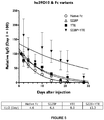
- the present invention relates to an isolated antibody, which specifically binds to interleukin (IL)-5 comprising: (i) a human IgG4 Fc region or the FcRn binding domain thereof modified relative to a corresponding unmodified IgG4 Fc region or FcRn binding domain thereof to comprise the amino acid substitutions M252Y, S254T and T256E numbered according to the EU index as in Kabat; and (ii) a human IgG4 core hinge region sequence modified to comprise the amino acid substitution S228P according to the EU index as in Kabat; wherein the combination of modifications results in a supra-additive lengthening of in vivo half-life of the modified interleukin (IL)-5 antibody compared to corresponding antibodies having (i) or (ii) alone.
- IL interleukin
- the invention is based on the surprising discovery that the above combination of the modifications increases the circulating half-life of the molecule relative to its wild-type unmodified counterpart substantially longer than either the Fc region modification(s) or hinge region modification alone. Moreover, the combination of modifications results in a supra-additive (synergistic) lengthening of half-life. Because any modification in a human protein-based drug (including a protein comprising a human antibody constant region) increases the risk of inducing an anti-drug immune response in a patient, it is generally advisable to limit the number of such mutations to limit the presumably additively increased risk of each such mutation with respect to inducing such immune responses against the drug.
- the present invention provides an isolated antibody, which specifically binds to interleukin (IL)-5 comprising: (i) a human IgG4 Fc region or the FcRn binding domain thereof modified relative to a corresponding unmodified IgG4 Fc region or FcRn binding domain thereof to comprise the amino acid substitutions M252Y, S254T and T256E numbered according to the EU index as in Kabat; and (ii) a human IgG4 core hinge region sequence modified to comprise the amino acid substitution S228P according to the EU index as in Kabat; wherein the combination of modifications results in a supra-additive lengthening of in vivo half-life of the modified interleukin (IL)-5 antibody compared to corresponding antibodies having (i) or (ii) alone.
- IL interleukin
- the increased in vivo half-life of the antibody is determined by reference to the half life of a corresponding human IgG4 antibody, which lacks the above substitutions.
- the present invention also provides an isolated antibody which specifically binds to interleukin (IL)-5, comprising: (i) a human IgG4 Fc region or the FcRn binding domain thereof modified relative to a corresponding unmodified IgG4 Fc region or FcRn binding domain thereof to comprise the amino acid substitutions M252Y, S254T and T256E numbered according to the EU index as in Kabat; and (ii) a human IgG4 core hinge region sequence modified to comprise the amino acid substitution S228P according to the EU index as in Kabat; for use in treating or preventing a disorder characterised by excess eosinophil production, wherein the combination of modifications results in a supra-additive lengthening of in vivo half-life of the modified interleukin (IL)-5 antibody compared to corresponding antibodies having (i) or (ii) alone.
- IL interleukin
- the antibody according to the invention may be a chimeric antibody, human antibody, humanized antibody, a superhumanised® antibody, a de-immunized antibody or a veneered antibody.
- EU index refers to the numbering of the human IgG1 EU antibody ( Edelman et al., Proc. Natl. Acad. USA, 63, 78-85, 1969 ).
- amino acid sequences of IgG2, IgG3 and IgG4 isotypes are aligned with the IgG1 sequence by placing the first and last cysteine residues of the respective hinge regions, which form the inter-heavy chain S-S bonds, in the same positions.
- Amino acid residues 251-256 according to the EU index as in Kabat are located within the immunoglobulin heavy chain CH2 domain of the Fc region. These residues have been implicated in binding of the Fc region to the FcRn and hence are implicated in altering antibody half-life.
- Specific antibody fragments include, but are not limited to (i) an Fab fragment (ii) an Fd fragment, (iii) an Fv fragment, (iv) a dAb fragment, (v) isolated CDR regions, (vi) F(ab')2 fragments, (vii) single chain Fv molecules (scFv), (viii) bispecific single chain Fv, and (ix) diabody (x) triabody and (xi) tetrabody.
- the human IgG4 core hinge region sequence according to the invention comprises an S228P substitution according to the EU index as in Kabat. This substitution has also been referred to as S241P according to Kabat et al (1987 Sequences of proteins of immunological interest. United States Department of Health and Human Services, Washington DC ).
- the substitution has the effect of making the sequence of the core of the hinge region the same as that of a wild-type IgG1 or IgG2 isotype antibody.
- the IgG4 isotype antibody it results in the production of the homogenous form of the IgG4 antibody and hence abrogates the dissociation and reassociation of the heavy chains which often leads to the production of heterodimeric IgG4 antibodies.
- the antibody of the invention comprises a human IgG4 Fc region or FcRn binding domain thereof comprising substitutions at each of residues 252, 254 and 256 of the human IgG4 Fc region sequence.
- residue 252 is substituted with tyrosine (M252Y)
- residue 254 is substituted with threonine (S254T)
- residue 256 is substituted with glutamic acid (T256E).
- the antibody according to the invention may be further recombinantly fused, chemically conjugated or engineered to contain to a moiety.
- the moiety according to the invention may be selected from, but not limited to a therapeutic agent which is directly or indirectly bound to the antibody, a cytotoxin, a radioisotope, an immunomodulatory agent, an anti-angiogenic agent, an anti-neovascularization and/or other vascularization agent, a toxin, an anti-proliferative agent, a pro-apoptotic agent, a chemotherapeutic agent and a therapeutic nucleic acid.
- the present invention also provides an isolated antibody that specifically binds to IL-5 comprising:
- the corresponding unmodified anti-IL-5 antibody is hu39D10.
- the Fab sequence of the isolated antibody may correspond to the light and heavy chain variable region sequence of mepolizumab.
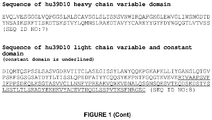
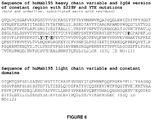
- the present invention provides an antibody that specifically binds to IL-5, the antibody comprising a constant heavy chain sequence set forth in SEQ ID NO: 6 and a heavy chain variable region sequence set forth in SEQ ID NO:7.
- the antibody that specifically binds to IL-5 further comprises a light chain comprising the variable and constant region sequences set forth in SEQ ID NO:8.
- the invention provides use of an isolated antibody with increased in vivo half-life that specifically binds to IL-5, comprising:
- the disorder is characterised by excess eosinophil production (eosinophilia).
- a disorder characterised by excess eosinophil production may be selected from the group consisting of atopic asthma, atopic dermatitis, allergic rhinitis, non-allergic rhinitis, asthma, sever asthma, chronic eosinophilic pneumonia, allergic bronchopulmonary aspergillosis, celiac disease, Churg-Strauss syndrome, eosinophilic myalgia syndrome, hypereosinophilic syndrome, oedematous reactions including episodic angiodema, helminth infections, onchocercal dermatitis, eosinophilic oesophagitis, eosinophilic gastritis, eosinophilic gastroenteritis, eosinophilic enteritis, eosinophilic colitis, nasal micropolyposis, nasal polyposis, aspirin intolerance asthma, obstructive sleep apnea, chronic asthma, Crohn's disease, sc
- the disorder is autoimmune disease.
- modified anti-IL-5 antibody according to the invention can be used in methods of prophylaxis or diagnosis relating to a disorder characterised by excess eosinophil production.
- the present invention also provides a nucleic acid encoding an antibody as described herein according to any embodiment.
- the present invention also provides a transformed cell expressing an antibody as described herein according to any embodiment.
- the present invention also provides a transformed cell comprising a nucleic acid encoding an antibody as described herein.
- the invention provides a pharmaceutical composition
- a pharmaceutical composition comprising the isolated antibody according to the invention, together with a pharmaceutically acceptable excipient.
- the composition comprises a therapeutically effective amount or the antibody.
- compositions of matter and methods described herein are produced or performed without undue experimentation using, unless otherwise indicated, conventional techniques of molecular biology, microbiology, virology, recombinant DNA technology, peptide synthesis in solution, solid phase peptide synthesis, and immunology.
- conventional techniques of molecular biology, microbiology, virology, recombinant DNA technology, peptide synthesis in solution, solid phase peptide synthesis, and immunology are described, for example, in Sambrook, Fritsch & Maniatis, Molecular Cloning: A Laboratory Manual, Cold Spring Harbor Laboratories, New York, Second Edition (1989), whole of Vols I, II, and III ; Benny K.C.Lo, Antibody Engineering: Methods and Protocols, (2004) Humana Press, Vol. 248 ; DNA Cloning: A Practical Approach, Vols. I and II (D. N.
- corresponding unmodified antibody means an antibody of the same sequence as the modified antibody but without the changes to the amino acid sequence described herein, in particular the Fc and the hinge region.
- epitope is intended to refer to the part of an antigenic molecule to which an antibody is produced and to which the antibody will bind.
- epitope refers to (a) portion(s) of a peptide having antigenic or immunogenic activity in an animal, preferably a vertebrate, more preferably a mammal, and most preferably in a human or a transgenic animal expressing relevant components of the human immune system.
- Epitopes may comprise proteins, protein fragments, peptides, carbohydrates, lipids, and other molecules, but for the purposes of the present invention are most commonly short oligopeptides.
- epitope is intended to encompass an "immunogenic epitope", an "antigenic epitope", or "antigen epitope”.
- antibody refers to a molecule that is capable of binding to a target through at least one epitope recognition site, located in the variable region of the immunoglobulin molecule.
- the terms immunoglobulin and antibody may be used interchangeably throughout the specification.
- the immunoglobulin or antibody molecule includes four chain antibodies (e.g., two light chains and two heavy chains), recombinant or modified antibodies (e.g., chimeric antibodies, humanized antibodies, human antibodies, CDR-grafted antibodies, primatized antibodies, de-immunized antibodies, superhumanized® antibodies, half antibodies, bispecific antibodies).
- An antibody generally comprises constant domains, which can be arranged into a constant region or constant fragment or fragment crystallisable (Fc).
- Exemplary forms of antibodies comprise a four-chain structure as their basic unit.
- Full-length antibodies comprise two heavy chains ( ⁇ 50-70 kD) covalently linked and two light chains ( ⁇ 23 kD each).
- Each heavy and light chain comprises variable regions and constant domains.
- a light chain generally comprises a variable region (if present) and a constant domain and in mammals is either a ⁇ light chain or a ⁇ light chain.
- a heavy chain generally comprises a variable region and one or two constant domain(s) linked by a hinge region to additional constant domain(s).
- Heavy chains of mammals are of one of the following types ⁇ , ⁇ , ⁇ , ⁇ , or ⁇ . Each light chain is also covalently linked to one of the heavy chains.
- each chain has an N-terminal variable region (V H or V L wherein each are -110 amino acids in length) and one or more constant domains at the C-terminus.
- the constant domain of the light chain (C L which is -110 amino acids in length) is aligned with and disulfide bonded to the first constant domain of the heavy chain (C H 1 which is 330-440 amino acids in length).
- the light chain variable region is aligned with the variable region of the heavy chain.
- the antibody heavy chain can comprise 2 or more additional C H domains (such as, C H 2, C H 3 and the like) and can comprise a hinge region between the C H 1 and C H 2 constant domains.
- Unmodified antibodies can be of any type (e.g., IgG, IgE, IgM, IgD, IgA, and IgY), class (e.g., IgG 1 IgG 2 , IgG 3 , IgG 4 , IgA 1 and IgA 2 ) or subclass.
- variable region refers to the portion of an immunoglobulin or antibody molecule having a core conserved amino acid sequence relative to the other portion of the immunoglobulin or antibody, termed the variable region, which contains the antigen binding site.
- the constant region contains the CH1, CH2 and CH3 domains.
- Fc region refers to the portion of an antibody or immunoglobulin molecule that correlates to a crystallisable fragment obtained by papain digestion of an IgG molecule.
- the Fc region consists of the C-terminal region of an IgG heavy chain-made up of the C-terminal approximately half of the two heavy chains of an IgG molecule that are linked by disulfide bonds. Although boundaries may vary slightly (in some cases it includes part of the hinge), as numbered according to the EU index of Kabat, the Fc region extends from amino acid 231 to amino acid 447.
- the Fc region of an IgG comprises two constant domains, CH2 and CH3.
- the CH2 domain of a human IgG Fc region usually extends from amino acid 231 to amino acid 341 according to the EU index of Kabat.
- the CH3 domain of a human IgG Fc region usually extends from amino acids 342 to 447 according to the EU index of Kabat.
- the Fc region has no antigen binding activity but contains the carbohydrate moiety and the binding site for the Fc receptor, including the neonatal Fc receptor (FcRn).
- FcRn binding domain thereof refers to a portion of the Fc region which is capable of binding to FcRn. In the present context, it is also intended to refer to a fragment of the Fc region sequence including at least the CH2 domain.
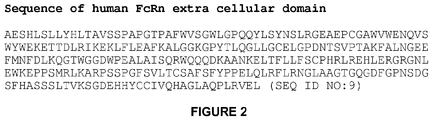
- FcRn receptor refers to an Fc receptor ("n" indicating neonatal) which is involved in transfer of maternal IgGs to a foetus through the human or primate placenta and to a neonate from the colostrum through the small intestine.
- the FcRn is also involved in the maintenance of constant serum IgG levels by binding the IgG molecules and recycling them into the serum.
- the binding of FcRn to IgG molecules is strictly pH dependent with optimum binding at pH 6.0.
- the FcRn is typically complexed with beta2 microglobulin.
- the "hinge region” as used herein refers to a proline-rich portion of an immunoglobulin heavy chain between the Fc and Fab regions that confers mobility on the two Fab arms of the antibody molecule. It is located between the first and second constant domains of the heavy chain.
- the hinge region includes cysteine residues which are involved in inter-heavy chain disulfide bonds. It is generally defined as stretching from Glu216 to Pro230 of human IgG1 according to the EU numbering system of Kabat (or Glu226 to Pro243 according to the numbering system of Kabat).
- Hinge regions of other IgG isotypes may be aligned with the IgGI sequence by placing the first and last cysteine residues forming inter-heavy chain disulphide (S-S) bonds in the same positions (see for example WO 2010/080538 ).
- the hinge region includes cysteine residues which are involved in inter-heavy chain disulfide bonds.
- core hinge region sequence as used herein is intended to refer to the amino acid sequence CPSCP (SEQ ID NO:1) present in IgG4 and extending from amino acid 226 to 230 according to the EU index of Kabat (often referred to as the lower hinge).
- the core hinge region is distinguished from the upper hinge region which in a human IgG4 is the sequence ESKYGPP.
- variable region refers to the portions of the light and/or heavy chains of an antibody as defined herein that is capable of specifically binding to an antigen and, includes amino acid sequences of complementarity determining regions (CDRs); i.e., CDRI, CDR2, and CDR3, and framework regions (FRs).
- CDRs complementarity determining regions
- FRs framework regions
- the variable region comprises three or four FRs (e.g., FR1, FR2, FR3 and optionally FR4) together with three CDRs.
- the protein may lack a CDR2.
- V H refers to the variable region of the heavy chain.
- V L refers to the variable region of the light chain.
- Fab as used herein is intended to refer to a region of an antibody composed of one constant and one variable domain of each of the heavy and the light chains (monovalent antigen-binding fragment), but wherein the heavy chain is truncated such that it lacks the CH2 and CH3 domain(ie VH, CH1, VL, and CL), and may also lack some or all of the hinge region. It can be produced by digestion of a whole antibody with the enzyme papain. Fab may refer to this region in isolation, or this region in the context of a full length antibody.
- Fab' as used herein can be obtained by treating a whole antibody with pepsin, followed by reduction, to yield a molecule consisting of an intact light chain and a portion of a heavy chain comprising a V H and a single constant domain. Two Fab' fragments are obtained per antibody treated in this manner.
- scFv an antibody fragment comprising the VH and VL domains of an antibody, wherein these domains are present in a single polypeptide chain. See, for example, U.S. Pat. Nos. 4,946,778 , 5,260,203 , 5,455,030 , and 5,856,456 .
- the Fv polypeptide further comprises a polypeptide linker between the V H and VL domains that enables the scFv to form the desired structure for antigen-binding.
- scFv see Pluckthun (1994) The Pharmacology of Monoclonal Antibodies vol 113 ed. Rosenburg and Moore (Springer-Verlag, New York) pp 269-315 .
- the VH and VL domain complex of Fv fragments may also be stabilized by a disulfide bond ( US Pat. No. 5,747,654 ).
- no or minimal effector function it is meant that certain activities normally attributable to IgG1 type antibodies such as complement fixation or stimulation of antibody-dependent cell-mediated cytotoxicity (ADCC) are reduced or eliminated.
- ADCC antibody-dependent cell-mediated cytotoxicity
- isolated refers to an antibody removed from its native environment.
- an antibody produced by a recombinant host is considered isolated for the purposes of the present invention.
- the isolated antibody is substantially purified.
- substantially purified is meant that the antibody is substantially free of cellular material or other contaminating proteins from the cell or tissue source from which it is derived, or is substantially free from chemical precursors or other chemicals when chemically synthesised.
- the language includes preparations of an antibody which is separated from cellular components of the cells from which it is isolated or recombinantly produced.
- an antibody that is substantially free of cellular material includes preparations having less than about 30%, 20%, 10% or 5% (by dry weight) of contaminating protein and culture medium.
- in vivo half-life refers to a circulating half-life of a particular antibody, containing an Fc region and/or FcRn binding domain thereof in the circulation of a given animal and is represented by a time required for half the quantity administered in the animal to be cleared from the circulation.
- a clearance curve of a given antibody according to the invention is constructed as a function of time the curve is usually biphasic with a rapid alpha phase which represents an equilibration of the injected IgG molecules between the intra and extra vascular space and which is, in part determined by the size of the molecules, and a longer beta phase which represents the catabolism of the IgG molecules in the intravascular space.
- the term " in vivo half-life” practically corresponds to the half-life of the modified or unmodified IgG4 immunoglobulins or fusion proteins in the beta phase.
- the term "increased in vivo half life" as used herein means that the antibody modified according to the invention has a greater persistence in the serum or plasma and/or takes a greater period of time to reduce to half the maximal measured serum or plasma concentration relative to the same antibody that does not contain the same substitutions.
- recombinant shall be understood to mean the product of artificial genetic recombination. Accordingly, in the context of a recombinant protein comprising an antibody antigen binding domain, this term does not encompass an antibody naturally-occurring within a subject's body that is the product of natural recombination that occurs during B cell maturation. However, if such an antibody is isolated, it is to be considered an isolated protein comprising an antibody variable region. Similarly, if a nucleic acid encoding the protein is isolated and expressed using recombinant means, the resulting protein is a recombinant protein comprising an antibody antigen binding domain.
- a term recombinant also encompasses an antibody, immunoglobulin or fusion protein expressed by artificial recombinant means when it is within a cell, tissue or subject, e.g., in which it is expressed.
- the term "specifically binds” refers to a molecule (eg. antibody) that specifically or preferentially binds to an antigen (e.g., eptiope or immune complex) and does not specifically bind to (i.e. cross-react with) antigens, such as, for example, other structurally or functionally related proteins, or proteins with sequence homology.
- an antigen e.g., eptiope or immune complex
- a molecule that specifically binds to an antigen may bind to other peptides or polypeptides with lower affinity as determined by, e.g., immunoassays, BIAcore, or other assays known in the art.
- molecules that specifically bind an antigen do not cross-react with other proteins.
- Molecules that specifically bind an antigen can be identified, for example, by immunoassays, BIAcore, or other techniques known to those of skill in the art.
- an antibody may be considered to bind to an antigen preferentially if it binds said antigen with dissociation constant (K D ) that is less than the antibody's K D for another antigen.
- an antibody may be considered to bind a first antigen preferentially if it binds said first antigen with an affinity that is at least one order of magnitude less than the antibody's K D for the second antigen.
- an antibody may be considered to bind a first antigen preferentially if it binds said first antigen with an affinity that is at least two orders of magnitude less than the antibody's K D for the second antigen.
- treating refers to administering a "therapeutically effective amount" of the antibody according to the invention sufficient to reduce or eliminate at least one symptom of a specified disease or condition.
- prevent refers to administration of a therapeutically effective amount of an antibody sufficient to stop or hinder the development of a specified disorder or condition.
- the term "therapeutically effective amount” shall be taken to mean a sufficient quantity of an antibody to reduce or inhibit one or more symptoms of a clinical disease to a level that is below that observed and accepted as clinically diagnostic or clinically characteristic of that disease.
- the skilled artisan will be aware that such an amount will vary depending on, for example, the specific antibody(ies), administered and/or the particular subject and/or the type or severity or level of disease. Accordingly, this term is not to be construed to limit the invention to a specific quantity, e.g., weight or amount rather the present invention encompasses any amount of the antibody(ies), sufficient to achieve the stated result in a subject.
- pharmaceutically acceptable means approved by a regulatory agency of the federal or a state government or listed in the US Pharmacopeia or other generally recognised pharmacopeia for use in humans.
- subject shall be taken to mean a human or non-human primate, or non-primate mammal with a human FcRn.
- amino acid substitutions can be made by site-directed mutagenesis (for example, Zoller and Smith Nucl. Acids Res. 10:6487 (1982 )).
- Mutagenesis can be performed by synthesising an oligonucleotide having one or more modifications within the sequence of the constant domain of an antibody to be modified.
- Site-specific mutagenesis allows the production of mutants through the use of specific oligonucleotide sequences which encode the DNA sequence of the desired mutation, as well as a sufficient number of adjacent oligonucleotides to provide a primer sequence of sufficient size and sequence complexity to form a stable duplex on both sides of the deletion junction being traversed.
- a primer of about 17 to about 75 nucleotides or more in length is preferred, with about 10 to about 25 or more residues on both sides of the junction of the sequence being altered.
- a number of such primers introducing a variety of different mutations at one or more positions may be used to generate a library of mutants.
- site-directed mutagenesis is performed by first obtaining a single-stranded vector or melting apart of two strands of a double stranded vector which includes within its sequence a DNA sequence which encodes the desired peptide.
- An oligonucleotide primer bearing the desired mutated sequence is prepared, generally synthetically. This primer is then annealed with the single-stranded vector, and subjected to DNA polymerizing enzymes such as T7 DNA polymerase, in order to complete the synthesis of the mutation-bearing strand.
- a heteroduplex is formed wherein one strand encodes the original non-mutated sequence and the second strand bears the desired mutation.
- This heteroduplex vector is then used to transform or transfect appropriate cells, such as E. coli cells, and clones are selected which include recombinant vectors bearing the mutated sequence arrangement.
- the technique typically employs a phage vector which exists in both a single stranded and double stranded form.
- Typical vectors useful in site-directed mutagenesis include vectors such as the M13 phage. These phage are readily commercially available and their use is generally well known to those skilled in the art.
- Double stranded plasmids are also routinely employed in site directed mutagenesis which eliminates the step of transferring the gene of interest from a plasmid to a phage.
- Site directed mutagenesis has also been used to identify amino acid residues that influence plasma clearance of murine IgG1 hinge-Fc fragments as described in Kim Jin-Kyoo et al., (1994) Eur. J. Immunol. 24:542-548 ).
- thermostable enzymes such as Taq DNA polymerase may be used to incorporate a mutagenic oligonucleotide primer into an amplified DNA fragment that can then be cloned into an appropriate cloning or expression vector. See, e.g., Tomic et al., Nucleic Acids Res., 18(6):1656, 1987 , and Upender et al., Biotechniques, 18(1):29-30, 32, 1995 , for PCR-mediated mutagenesis procedures.
- thermostable ligase in addition to a thermostable polymerase may also be used to incorporate a phosphorylated mutagenic oligonucleotide into an amplified DNA fragment that may then be cloned into an appropriate cloning or expression vector (see e.g., Michael, Biotechniques, 16(3):410-2, 1994 ).
- sequence variants of the Fc region of an antibody or an FcRn binding domain thereof can be used.
- recombinant vectors encoding the amino acid sequence of the constant domain of an antibody or a fragment thereof may be treated with mutagenic agents, such as hydroxylamine, to obtain sequence variants.
- Mutants that result in increased affinity for FcRn and increased in vivo half-life can be screened using routine assays such as those described later.
- Exemplary amino acid substitutions include T250Q and/or M428L or T252A, T254S and T266F or M252Y, S254T and T256E or H433K and N434F according to the EU Kabat numbering system. Additional or alternative amino acid substitutions are described, for example, in US20070135620 or US7083784 .
- the antibody according to the invention includes any antibody that binds, (as determined by immunoassays known in the art for assaying specific antigen-antibody binding) an antigen and contains an Fc region or FcRn binding domain.
- the antibodies may be polyclonal, monoclonal or monospecific, bi-specific (in the context of multimeric forms of the antibody), human, humanised, chimeric, superhumanised®, primatised or deimmunised.
- the antibodies of the present invention may be monospecific, (or bispecific, trispecific or of greater multispecificity if present in multimeric form).
- the antibody is a monospecific tetramer.
- the antibody may be from any animal origin.
- the antibody is human or humanised.
- the term "human” antibody include antibodies having the amino acid sequence of a human immunoglobulin and include antibodies isolated from human immunoglobulin libraries or from animals transgenic for one or more human immunoglobulin and that do not express endogenous immunoglobulins, as described for example in US 5,939,598 .
- the antibody(ies) of the invention comprise a stabilized IgG4 hinge region.
- stabilized IgG4 hinge region will be understood to mean an IgG4 hinge region that has been modified to reduce Fab arm exchange or the propensity to undergo Fab arm exchange or formation of a half-antibody or a propensity to form a half antibody.
- Fab arm exchange refers to a type of protein modification for human IgG4, in which an IgG4 heavy chain and attached light chain (half-molecule) is swapped for a heavy-light chain pair from another IgG4 molecule.
- IgG4 molecules may acquire two distinct Fab arms recognizing two distinct antigens (resulting in bispecific molecules).
- Fab arm exchange occurs naturally in vivo and can be induced in vitro by purified blood cells or reducing agents such as reduced glutathione.
- a "half antibody” forms when an IgG4 antibody dissociates to form two molecules each containing a single heavy chain and a single light chain.
- the stabilized IgG4 hinge region comprises a serine to proline substitution at position 228 according to the EU numbering system of Kabat ( Kabat et al., Sequences of Proteins of Immunological Interest Washington DC United States Department of Health and Human Services, 2001 and Edelman et al., Proc. Natl. Acad. USA, 63, 78-85, 1969 ), which corresponds to a serine to proline substitution at position 241 according to the numbering system of Kabat ( Kabat et al., Sequences of Proteins of Immunological Interest Washington DC United States Department of Health and Human Services, 1987 and/or 1991 ).
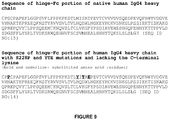
- the IgG4 hinge region comprises a sequence CPPCP.
- the "hinge region” is a proline-rich portion of an antibody heavy chain constant region that links the Fc and Fab regions that confers mobility on the two Fab arms of an antibody.
- the antibody of the invention may be in a multimeric form.
- the antibody may take the form of an antibody dimer, trimer, or higher-order multimer of monomeric immunoglobulin molecules. Dimers of whole immunoglobulin molecules or of F(ab') 2 fragments are tetravalent, whereas dimers of Fab fragments or scFv molecules are bivalent.
- Individual monomers within an antibody multimer may be identical or different, i.e., they may be heteromeric or homomeric antibody multimers. For example, individual antibodies within a multimer may have the same or different binding specificities.
- Multimerization of antibodies may be accomplished through natural aggregation of antibodies or through chemical or recombinant linking techniques known to one of ordinary skill in the art. For example, some percentage of purified antibody preparations spontaneously form protein aggregates containing antibody homodimers, and other higher-order antibody multimers. Alternatively, antibody homodimers may be formed through chemical linkage techniques known in the art. As a non-limiting example, heterobifunctional crosslinking agents including, but not limited to, SMCC [succinimidyl 4- (maleimidomethyl)cyclohexane-l-carboxylate] and SATA [N-succinimidyl S- acethylthio-acetate] (available, for example, from Pierce Biotechnology, Inc.
- SMCC succinimidyl 4- (maleimidomethyl)cyclohexane-l-carboxylate
- SATA N-succinimidyl S- acethylthio-acetate
- antibody homodimers can be converted to F(ab') 2 homodimers through digestion with pepsin. Another way to form antibody homodimers is through the use of the autophilic TI 5 peptide described in Zhao Y & Kohler H J. Immunother (1997) 25(5):396-404 .
- antibodies can be made to multimerize naturally or through recombinant DNA techniques.
- ScFv dimers can also be formed through recombinant techniques known in the art; an example of the construction of scFv dimers is given in Goel A et al. Cancer Research 60(24):6964-6971 .
- Antibody multimers may be purified by any suitable method known in the art, e.g. size exclusion chromatography.
- Antibodies may comprise, or alternatively consist of, variants (including derivatives) of the antibody molecules (e.g. the V H domains and/or V L domains) described herein, which antibodies specifically bind antigen peptides (for example, the IL-5 antigen or the CD33 antigen).
- Standard techniques known to those of skill in the art can be used to introduce mutations in the nucleotide sequence encoding a molecule of the invention, including for example, site-directed mutagenesis and PCR-mediated mutagenesis which result in amino acid substitutions.
- Antibody derivatives also encompass conservative amino acid substitutions into the immunoglobulin V L and/or V H region.
- a "conservative amino acid substitution” is one in which the amino acid residue is replaced with an amino acid residue having a side chain with a similar charge. Families of amino acid residues having side chains with similar charges have been defined in the art.
- amino acids with basic side chains e.g., lysine, arginine, histidine
- acidic side chains e.g., aspartic acid, glutamic acid
- uncharged polar side chains e.g., glycine, asparagine, glutamine, serine, threonine, tyrosine, cysteine
- nonpolar side chains e.g., alanine, valine, leucine, isoleucine, proline, phenylalanine, methionine, tryptophan
- beta-branched side chains e.g., threonine, valine, isoleucine
- aromatic side chains e.g., tyrosine, phenylalanine, tryptophan, histidine
- mutations can be introduced randomly along all or part of the coding sequence, such as by saturation mutagenesis, and the resultant mutants can be screened for biological activity to identify mutants that retain activity (e.g., the ability to bind antigen peptides of the invention (e.g. the ability to bind antigen peptides of the invention).
- substitutions shall be taken to mean amino acid substitutions set forth in Table 1.
- Table 1 Exemplary Substitutions Original residue Exemplary substitutions Ala (A) val; leu; ile; gly Arg (R) lys Asn (N) gln; his Asp (D) glu Cys (C) ser Gln (Q) asn; his Glu (E) asp Gly (G) pro; ala His (H) asn; gln Ile (I) leu; val; ala Leu (L) ile; val; met; ala; phe Lys (K) arq Met (M) leu; phe Phe (F) leu; val; ala Pro (P) gly Ser (S) thr Thr (T) ser Trp (W) tyr Tyr (Y) trp; phe Val (V) ile; leu; met; phe; ala
- mutations only in framework regions or only in CDR regions of an antibody molecule. Introduced mutations may be silent or neutral missense mutations, i.e. have no, or little, effect on the antibody's ability to bind antigen. These types of mutations may be useful to optimize codon usage, or improve antibody production from a cell line.
- non-neutral missense mutations may alter an antibody's ability to bind antigen.
- One of skill in the art would be able to design and test mutant molecules with desired properties such as no alteration in antigen binding activity or alteration in binding activity (e.g., improvements in antigen binding activity or change in antibody specificity).
- the encoded protein may routinely be expressed and the functional and/or biological activity of the encoded protein, (e.g., ability to specifically bind antigen peptides of the invention) can be determined using techniques described herein or by routinely modifying techniques known in the art.
- Antibodies may include derivatives that are otherwise modified by covalent attachment of any type of molecule to the antibody such that covalent attachment does not prevent the antibody from binding antigen.
- the antibody derivatives include antibodies that have been modified, for example, by glycosylation, acetylation, pegylation, phosphorylation, amidation, derivatisation by known protecting/blocking groups, proteolytic cleavage, linkage to a cellular ligand or other protein etc. Any of numerous chemical modifications may be carried out by techniques known in the art, including specific chemical cleavage, acetylation, formylation, metabolic synthesis of tunicamycin etc. Additionally, the derivative may contain one or more non-classical amino acids.
- the antibodies of the invention may be chemically synthesized.
- a peptide corresponding to a portion of a protein can by synthesized by use of a peptide synthesizer.
- non-classical amino acids or chemical amino acid analogs can be introduced as substitutions and/or additional into the sequence of one, any, both, several or all of the polypeptides of the complex.
- Non-classical amino acids include, but are not limited to, the D-isomers of the common amino acids, fluoro-amino acids, designer amino acids such as beta-methyl amino acids, C gamma-methyl amino acids, N gamma- methyl amino acids, and, and amino acid analogs in general.
- the present invention also provides immunoconjugates comprising an antibody or immunoglobulin contract of the present invention conjugated to a distinct moiety e.g. a therapeutic agent which is directly or indirectly bound to the antibody.
- a distinct moiety e.g. a therapeutic agent which is directly or indirectly bound to the antibody.
- moieties include, but are not limited to, a cytotoxin, a radioisotope (e.g., iodine-131, yttrium-90 or indium-111), an immunomodulatory agent, an anti-angiogenic agent, an anti-neovascularization and/or other vascularization agent, a toxin, an anti-proliferative agent, a pro-apoptotic agent, a chemotherapeutic agent and a therapeutic nucleic acid.
- a cytotoxin e.g., iodine-131, yttrium-90 or indium-111
- an immunomodulatory agent e.g.,
- a cytotoxin includes any agent that is detrimental to (e.g., kills) cells.
- kills any agent that is detrimental to (e.g., kills) cells.
- these classes of drugs which are known in the art, and their mechanisms of action, see Goodman et al., Goodman and Gilman's The Pharmacological Basis of Therapeutics, 8th Ed., Macmillan Publishing Co., 1990 . Additional techniques relevant to the preparation of antibody immunotoxins are provided in for instance Vitetta (1993) and US 5,194,594 .
- Exemplary toxins include diphtheria A chain, nonbinding active fragments of diphtheria toxin, exotoxin A chain (from Pseudomonas aeruginosa ), ricin A chain, abrin A chain, modeccin A chain, alpha-sarcin, Aleurites fordii proteins, dianthin proteins, Phytolaca americana proteins (PAPI, PAPII, and PAP-S), momordica charantia inhibitor, curcin, crotin, sapaonaria officinalis inhibitor, gelonin, mitogellin, restrictocin, phenomycin, enomycin and the tricothecenes. See, for example, WO 93/21232 .
- Suitable therapeutic agents for forming immunoconjugates of the present invention include taxol, cytochalasin B, gramicidin D, ethidium bromide, emetine, mitomycin, etoposide, tenoposide, vincristine, vinblastine, colchicin, doxorubicin, daunorubicin, dihydroxy anthracin dione, mitoxantrone, mithramycin, actinomycin D, 1-dehydrotestosterone, glucocorticoids, procaine, tetracaine, lidocaine, propranolol, and puromycin, antimetabolites (such as methotrexate, 6-mercaptopurine, 6-thioguanine, cytarabine, fludarabin, 5-fluorouracil, decarbazine, hydroxyurea, asparaginase, gemcitabine, cladribine), alkylating agents (such as mechlorethamine, thioe
- radionuclides are available for the production of radioconjugated antibodies. Examples include, but are not limited to, 212 Bi, 131 I, 90 Y, and 186 Re.
- Conjugates of the antibody and therapeutic agents are made using a variety of bifunctional protein-coupling agents such as, but not limited to, 4-(4'acetylphenoxy)butanoic acid (AcBut), 3-acetylphenyl acidic acid (AcPac), 4-mercapto-4-methyl-pentanoic acid (Amide), N-succinimidyl-3-(2-pyridyldithiol) propionate (SPDP), iminothiolane (IT), bifunctional derivatives of imidoesters (such as dimethyl adipimidate HCL), active esters (such as disuccinimidyl suberate), aldehydes (such as glutareldehyde), bis-azido compounds (such as bis (p-azidobenzoyl) hexanediamine), bis-diazonium derivatives (such as bis-(p-diazoniumbenzoyl)-ethylenediamine), diisocyanates (
- a ricin immunotoxin can be prepared as described by Vitetta et al . (1987).
- Carbon-14-labeled 1-isothiocyanatobenzyl-3-methyldiethylene triaminepentaacetic acid (MX-DTPA) is an exemplary chelating agent for conjugation of radionucleotide to the antibody ( WO 94/11026 ).
- Antibodies can be prepared using a wide variety of techniques known in the art including the use of hybridoma, recombinant and phage display technologies or a combination thereof.
- monoclonal antibodies can be produced using hybridoma techniques including those known in the art and taught by e.g. Harlow et al., Antibodies: A laboratory Manual (Cold Spring Harbor Laboratory Press 2nd Edn 1988 ).
- the term "monoclonal antibody” as used herein is not limited to antibodies produced through hybridoma technology.
- the term refers to any antibody that is derived from a single clone, including any prokaryotic, eukaryotic, or phage clone and not the method by which it is produced.
- mice can be immunised with an antigen of interest or a cell expressing such an antigen. Once an immune response is detected, the mouse spleen is harvested and splenocytes isolated. The splenocytes are then fused to myeloma cells. Hybridomas are selected and cloned by limiting dilution. The clones are then assayed by methods known in the art for cells that secrete antibodies capable of binding the antigen. Ascites fluid, which generally contains high levels of antibodies, can be generated by inoculating mice intraperitoneally with positive hybridoma clones.
- Antibody fragments which recognize specific epitopes may be generated by routine techniques.
- Fab and F(ab') 2 fragments may be produced by proteolytic cleavage of immunoglobulin molecules, using enzymes such as papain (to produce Fab fragments) or pepsin (to produce F(ab') 2 fragments).
- F(ab') 2 fragments contain the complete light chain, and the variable region, the CH1 region and the hinge region of the heavy chain.
- Antibodies can also be generated using various phage display methods.
- phage display methods functional antibody domains are displayed on the surface of phage particles which carry the polynucleotide sequences encoding them.
- phage can be utilized to display antigen binding domains, such as Fab and Fv or disulfide-bond stabilized Fv, expressed from a repertoire or combinatorial antibody library (e.g., human or murine).
- Phage expressing an antigen binding domain that binds the antigen of interest can be selected or identified with antigen, e.g., using labelled antigen or antigen bound or captured to a solid surface or bead. Phage used in these methods are typically filamentous phage, including fd and M13.
- the antigen binding domains are expressed as a recombinantly fused protein to either the phage gene III or gene VIII protein.
- the modified FcRn binding portion of immunoglobulins of the present invention can be also expressed in a phage display system.
- phage display methods that can be used to make the immunoglobulins, or fragments thereof, of the present invention include those disclosed in Brinkman et al., J. Immunol. Methods, 182:41-50, 1995 ; Ames et al., J. Immunol. Methods, 184:177-186, 1995 ; Kettleborough et al., Eur. J.
- the antibody coding regions from the phage can be isolated and used to generate whole antibodies, including human antibodies, or any other desired fragments, and expressed in any desired host, including mammalian cells, insect cells, plant cells, yeast, and bacteria.
- techniques to recombinantly produce Fab, Fab' and F(ab') 2 fragments can also be employed using methods known in the art such as those disclosed in PCT publication WO 92/22324 ; Mullinax et al., BioTechniques, 12(6):864-869, 1992 ; and Sawai et al., AJRI, 34:26-34, 1995 ; and Better et al., Science, 240:1041-1043, 1988 , examples of techniques which can be used to produce single-chain Fvs and antibodies include those described in U.S.
- the antibodies of the present invention can be produced recombinantly.
- DNA encoding an antibody of the invention is readily isolated and sequenced using conventional procedures (e.g., by using oligonucleotide probes that are capable of binding specifically to genes encoding the heavy and light chains of antibodies).
- a hybridoma cell serves as a preferred source of such DNA for antibodies.
- the DNA may be placed into expression vectors, which are then transfected into host cells such as E. coli cells, simian COS cells, Chinese Hamster Ovary (CHO) cells, or myeloma cells that do not otherwise produce antibody protein, to obtain the synthesis of monoclonal antibodies in the recombinant host cells.
- the nucleic acid encoding the antibody is preferably isolated and inserted into a replicable vector for further cloning (amplification of the DNA) or for expression.
- DNA encoding the antibody is readily isolated or synthesized using conventional procedures (e.g., by using oligonucleotide probes that are capable of binding specifically to DNAs encoding the heavy and light chains of the antibody).
- Many vectors are available.
- the vector components generally include, but are not limited to, one or more of the following: a signal sequence, a sequence encoding an antibody of the present invention or fragment thereof (e.g., derived from the information provided herein), an enhancer element, a promoter, and a transcription termination sequence.
- Promoters are known for eukaryotes. Virtually all eukaryotic genes have an AT- rich region located approximately 25 to 30 bases upstream from the site where transcription is initiated. Another sequence found 70 to 80 bases upstream from the start of transcription of many genes is a CNCAAT region where N may be any nucleotide. At the 3' end of most eukaryotic genes is an AATAAA sequence that may be the signal for addition of the poly A tail to the 3' end of the coding sequence. All of these sequences are suitably inserted into eukaryotic expression vectors.
- suitable promoting sequences for use with yeast hosts include the promoters for 3-phosphoglycerate kinase or other glycolytic enzymes, such as enolase, glyceraldehyde-3-phosphate dehydrogenase, hexokinase, pyruvate decarboxylase, phosphofructokinase, glucose-6-phosphate isomerase, 3-phosphoglycerate mutase, pyruvate kinase, triosephosphate isomerase, phosphoglucose isomerase, and glucokinase.
- 3-phosphoglycerate kinase or other glycolytic enzymes such as enolase, glyceraldehyde-3-phosphate dehydrogenase, hexokinase, pyruvate decarboxylase, phosphofructokinase, glucose-6-phosphate isomerase, 3-phosphoglycerate mutase, pyruvate
- yeast promoters which are inducible promoters having the additional advantage of transcription controlled by growth conditions, are the promoter regions for alcohol dehydrogenase 2, isocytochrome C, acid phosphatase, degradative enzymes associated with nitrogen metabolism, metallothionein, glyceraldehyde-3-phosphate dehydrogenase, and enzymes responsible for maltose and galactose utilization.
- Suitable vectors and promoters for use in yeast expression are further described in EP 73,657 .
- Yeast enhancers also are advantageously used with yeast promoters.
- Antibody transcription from vectors in mammalian host cells is controlled, for example, by promoters obtained from the genomes of viruses such as polyoma virus, fowlpox virus, adenovirus (such as Adenovirus 2).
- viruses such as polyoma virus, fowlpox virus, adenovirus (such as Adenovirus 2).
- CMV bovine papilloma virus, avian sarcoma virus, cytomegalovirus, a retrovirus, hepatitis-B virus and most preferably Simian Virus 40 (SV40), from heterologous mammalian promoters, e.g., the actin promoter or an immunoglobulin promoter, from heat-shock promoters, provided such promoters are compatible with the host cell systems.
- SV40 Simian Virus 40
- eukaryotic microbes such as filamentous fungi or yeast are suitable cloning or expression hosts for antibody-encoding vectors.
- Saccharomyces cerevisiae or common baker's yeast, is the most commonly used among lower eukaryotic host microorganisms.
- a number of other genera, species, and strains are commonly available and useful herein, such as Schizosaccharomyces pombe ; Kluyveromyces hosts such as, e.g., K. lactis, K. fragilis (ATCC 12,424), K. bulgaricus (ATCC 16,045), K . wickeramii (ATCC 24,178), K .
- waltii ATCC 56,500
- K. drosophilarum ATCC 36,906
- K. thermotolerans K. marxianus
- yarrowia EP 402,226
- Pichia pastoris EP 183,070
- Candida Trichoderma reesia
- Neurospora crassa Schwanniomyces such as Schwanniomyces occidentalis
- filamentous fungi such as, e.g., Neurospora , Penicillium , Tolypocladium , and Aspergillus hosts such as A. nidulans and A. niger.
- Suitable host cells for the expression of glycosylated antibody are derived from multicellular organisms.
- invertebrate cells include plant and insect cells.
- Numerous baculoviral strains and variants and corresponding permissive insect host cells from hosts such as Spodoptera frugiperda (caterpillar), Aedes aegypti (mosquito), Aedes albopictus (mosquito), Drosophila melanogaster (fruitfly), and Bombyx mori have been identified.
- a variety of viral strains for transfection are publicly available, e.g., the L-I variant of Autographa californica NPV and the Bm-5 strain of Bombyx mori NPV, and such viruses may be used as the virus herein according to the present invention, particularly for transfection of Spodoptera frugiperda cells.
- Examples of useful mammalian host cell lines are monkey kidney CVI line transformed by SV40 (COS-7, ATCC CRL 1651); human embryonic kidney line (293 or 293 cells subcloned for growth in suspension culture, Graham et al. (1977) Gen Virol. 36:59 ) ; baby hamster kidney cells (BHK, ATCC CCL 10); Chinese hamster ovary cells (CHO, Urlaub et al. (1980) Proc. Natl. Acad. ScL USA 77:4216 ) ; mouse Sertoli cells (TM4, Mather (1980) Biol. Reprod.
- COS-7 monkey kidney CVI line transformed by SV40
- human embryonic kidney line (293 or 293 cells subcloned for growth in suspension culture, Graham et al. (1977) Gen Virol. 36:59 )
- baby hamster kidney cells BHK, ATCC CCL 10
- Chinese hamster ovary cells CHO, Urlaub et al. (1980) Proc. Natl. Ac
- monkey kidney cells CVI ATCC CCL 70); African green monkey kidney cells (VERO-76, ATCC CRL- 1587); human cervical carcinoma cells (HELA, ATCC CCL 2); canine kidney cells (MDCK, ATCC CCL 34); buffalo rat liver cells (BRL 3A, ATCC CRL 1442); human lung cells (W138, ATCC CCL 75); human liver cells (Hep G2, HB 8065); mouse mammary tumor (MMT 060562, ATCC CCL51); TRI cells ( Mather et al. (1982) Annals N. Y. Acad. Sci. 383:44-68 ); MRC 5 cells; FS4 cells; and PER.C6TM (Crucell NV).
- Host cells are transformed with the above-described expression or cloning vectors for antibody or immunoglobulin IgG4 fusion protein production and cultured in conventional nutrient media modified as appropriate for inducing promoters, selecting transformants, or amplifying the genes encoding the desired sequences.
- the antibody according to the invention may be a chimeric antibody.
- Chimeric antibodies are made by recombinant means by combining the variable light and heavy chain regions (VL and VH), obtained from antibody producing cells of one species with the constant light and heavy chain regions from another.
- VL and VH variable light and heavy chain regions
- chimeric antibodies utilize rodent or rabbit variable regions and human constant regions, in order to produce an antibody with predominantly human domains.
- a chimeric antibody comprises a variable region from a mouse antibody fused to a human constant region.
- primary antibody refers to an antibody comprising monkey variable regions and human constant regions.
- Methods for producing primatized antibodies are known in the art. See e.g., U.S. Pat. Nos. 5,658,570 ; 5,681,722 ; and 5,693,780 ,
- de-immunised antibodies that have sequence variations produced using methods described in, for example, Patent Publication Nos EP0983303 , WO 00/34317 and WO 98/52976 .
- human antibodies includes antibodies having the amino acid sequence of a human immunoglobulin and include antibodies isolated from human immunoglobulin libraries or from animals transgenic for one or more human immunoglobulins as described, for example, in US Pat No. 5,939,598 .
- Human antibodies can be made by a variety of methods known in the art including phase display using antibody libraries derived from human immunoglobulin sequences. See also WO 98/46645 , WO 98/24893 , WO98/16654 , WO 96/34096 , WO 96/33735 and WO 91/10741 .
- the antibodies of the present invention may be humanized antibodies.
- Humanized forms of non-human (e.g., murine) antibodies are chimeric immunoglobulins, immunoglobulin chains or fragments thereof (such as Fv, Fab, Fab', F(ab') 2 or other antigen-binding subsequences of antibodies) which contain minimal sequence derived from non-human immunoglobulin.
- Humanized antibodies include human immunoglobulins (recipient antibody) in which residues from a complementary determining region (CDR) of the recipient are replaced by residues from a CDR of a non-human species (donor antibody) such as mouse, rat or rabbit having the desired specificity, affinity and capacity.
- CDR complementary determining region
- one or more Fv framework residues of the human immunoglobulin are replaced by corresponding non-human residues.
- Humanized antibodies may also comprise residues which are found neither in the recipient antibody nor in the imported CDR or framework sequences.
- the humanized antibody will comprise substantially all of at least one, and typically two, variable domains, in which all or substantially all of the CDR regions correspond to those of a non-human immunoglobulin and all or substantially all of the FR regions are those of a human immunoglobulin consensus sequence.
- the humanized antibody optimally also will comprise at least a portion of an immunoglobulin constant region (Fc), typically that of a human immunoglobulin ( Jones et al. (1986) Nature, 321:522-525 ; Riechmann et al. (1988) Nature, 332:323-329 ; and Presta (1992) Curr Op Struct Biol, 2:593-59 ).
- humanized antibodies are typically human antibodies in which some CDR residues and possibly some FR residues are substituted by residues from analogous sites in rodent antibodies.
- Antibodies can be humanized using a variety of techniques known in the art including, for example, CDR-grafting ( EP 239400 ; PCT publication WO 91/09967 ; US Patent Nos 5,225,539 ; 5,530,101 ; and 5,585,089 ), veneering or resurfacing ( EP 592106 ; EP519596 ; Padlan EA et al (1991) Mol Immunol 28(4-5):489 ; Studnicka GM et al (1994) Protein Eng 7(6):805-14 ) and chain shuffling ( US Patent 5,565,332 ).
- CDR-grafting EP 239400 ; PCT publication WO 91/09967 ; US Patent Nos 5,225,539 ; 5,530,101 ; and 5,585,089
- veneering or resurfacing EP 592106 ; EP519596 ; Padlan EA et al (1991) Mol Immunol 28(4-5):489 ; Studnicka GM et al
- residues within the framework regions of one or more variable regions of the human immunoglobulin are replaced by corresponding non-human residues (see for example, Queen US Patent 5,585,089 ; US Patent 5,693,761 ; 5,693,762 and 6,180,370 .
- the invention also extends to antibodies humanised according to the methods referred to as Superhumanization® described in US 6,881,557 and 7,732,578 .
- these methods for humanised antibodies are based on selecting variable region framework sequences from human antibody genes by comparing canonical CDR structure types for CDR sequences of the variable region of a non-human antibody to canonical CDR structure types for corresponding CDRs from a library of human antibody sequences.
- Human antibody variable regions having similar canonical CDR structure types to the non-human CDRs form a subset of member human antibody sequences from which to select human framework sequences.
- veneered antibody refers to selective replacement of framework region residues with human framework region residues in order to provide a xenogenic molecule comprising an antigen-binding site which retains substantially all of the native framework region folding structure.
- Veneering techniques are based on the understanding that the ligand-binding characteristics of an antigen-binding site are determined primarily by the structure and relative disposition of the heavy and light chain CDR sets within the antigen-binding surface.
- exterior (e.g. solvent accessible) framework region residues which are readily encountered by the immune system, are selectively replaced with human residues to provide a hybrid molecule that comprises either a weakly immunogenic, or substantially non-immunogenic, veneered surface.
- Human antibodies can also be produced using various techniques known in the art, including phage display libraries ( Hoogenboom and Winter (1991) J Mol Biol, 227:381 ; Marks et al. (1991) J Mol Biol, 222:581 ).
- the techniques of Cole et al. and Boerner et al. are also suitable for the preparation of human monoclonal antibodies ( Cole et al., Monoclonal Antibodies and Cancer Therapy, Alan R. Liss, p. 77 (1985 ) and Boerner et al. (1991) J Immunol, 147:86-95 ).
- human antibodies can be made by introducing human immunoglobulin loci into transgenic animals, e.g., mice in which the endogenous immunoglobulin genes have been partially or completely inactivated. Upon challenge, human antibody production is observed, which closely resembles that seen in humans in all respects, including gene rearrangement, assembly, and antibody repertoire. This approach is described, for example, in U.S. Pat. Nos. 5,545,807 ; 5,545,806 ; 5,569,825 ; 5,625,126 ; 5,633,425 ; 5,661,016 .
- Fully human antibodies are obtained by immunizing transgenic mice.
- One such mouse is obtained using XenoMouseTM technology (Abgenix; Fremont, Calif) and is disclosed in US Patent Nos 6,075,181 ; 6,091,001 and 6,114,598 .
- Fully human antibodies are expected to minimise the immunogenic and allergic responses intrinsic to mouse or mouse-derivatized monoclonal antibodies and thus to increase the efficacy and safety of the administered antibodies.
- Completely human antibodies which recognize a selected epitope can also be generated using a technique referred to as "guided selection.”
- a selected non-human monoclonal antibody e.g., a mouse antibody
- Jespers et al, Bio/technology 12:899-903 (1988 ) is used to guide the selection of a completely human antibody recognizing the same epitope.
- the antibodies may also be affinity matured using known selection and/or mutagenesis methods as are known in the art.
- Preferred affinity matured antibodies have an affinity which is five times, more preferably 10 times, even more preferably 20 or 30 times greater than the starting antibody (generally murine, humanized or human) from which the matured antibody is prepared.
- an "affinity matured” antibody is one with one or more alterations in one or more CDRs thereof which result in an improvement in the affinity of the antibody for IL-5, compared to a parent antibody which does not possess those alterations. Marks et al (1991) J Mol Biol 222:581-597 describes affinity maturation by VH and VL domain shuffling.
- the antibodies of the invention may be assayed for specific binding by any method known in the art.
- the immunoassays which can be used include but are not limited to competitive and non-competitive assay systems using techniques such as BIAcore analysis, FACS (Fluorescent Activated Cell Sorter) analysis, immunofluorescence, immunocytochemistry, western blots, radioimmunoassays, ELISA, sandwich immunoassays, immunoprecitation assays, precipitin reactions, gel diffusion precipitin reactions, immunodiffusion assays, agglutination assays, complement-fixation assays, immunoradiometric assays, fluorescent immunoassays, protein A immunoassays etc.
- BIAcore analysis FACS (Fluorescent Activated Cell Sorter) analysis
- immunofluorescence immunocytochemistry
- western blots radioimmunoassays
- ELISA sandwich immunoassays
- immunoprecitation assays precipitin reactions
- the half-life of the antibody of the invention can be measured by pharmacokinetic studies (PK) according to the method described by Kim et al, Eur J of Immunol 24:542 (1994 ).
- PK pharmacokinetic studies
- radiolabelled modified immunoglobulin is injected intravenously into mice and its plasma concentration is periodically measured as a function of time, for example at 3 minutes to 72 hours after the injection.
- the clearance curve thus obtained should be biphasic, that is, an alpha phase and beta phase.
- the clearance rate in beta-phase is calculated and compared with that of the wild type or unmodified antibody.
- PK studies such as that described above can be performed in a humanized FcRn mouse model wherein the murine endogenous FcRn is knocked out and the human FcRn knocked in as described in Petkova SB et al., (2006) International Immunology 18(12):1759-1769 .
- the cells expressing FcRn used in this assay are preferably endothelial cell lines including mouse pulomonary capillary endothelial cells (B10, D2.PCE) derived from lungs of B10.DBA/2 mice and SV40 transformed endothelial cells (SVEC) ( Kim et al., J.
- other types of cells such as intestinal brush borders isolated from 10- to 14-day old suckling mice, which express sufficient number of FcRn can also be used.
- mammalian cells which express recombinant FcRn of a species of choice can also be utilised. After counting the radioactivity of the bound fraction of modified immunoglobulin or fusion protein or that of wild type IgG4, the bound molecules can then be extracted with detergent and the precent release per unit number of cells can be calculated and compared.
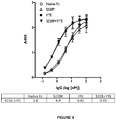
- Affinity of modified antibody for FcRn can be measured by surface Plasmon resonance (SPR) measurement using, for example, a BIAcore 2000 (BIAcore, Inc) as described ( Popov et al., Mol Immunol., 33:493-502 (1996 ); Karlsson et al., J. Immunol. Methods, 145:229-240 (1991 ),).
- SPR surface Plasmon resonance
- FcRn molecules are coupled to a BIAcore sensor chip (e,g, Cm5 chip by Pharmacia) and the binding of modified immunoglobulin or fusion protein to the immobilised FcRn is measured at a certain flow rate to obtain sensorgrams using BIA evaluation 2.1 software, based on which on- and off rates of the modified antibody to FcRn can be calculated.
- a BIAcore sensor chip e,g, Cm5 chip by Pharmacia
- Relative affinities of modified antibody and the wild type IgG 4 for FcRn can also be measured by a simple competition binding assay. Unlabeled modified antibody or wild-type IgG 4 is added in different amounts to the wells of a 96 well plate in which FcRn is immobilised. A constant amount of radio-labeled wild type IgG 4 is then added to each well. Percent radioactivity of the bound fraction is plotted against the amount of unlabeled modified immunoglobulin /fusion protein or wild type IgG 4 and the relative affinity of the modified antibody can be calculated from the slope of the curve.
- affinities of modified antibody, and the wild type IgG 4 for FcRn can also be measured by a saturation study and Scatchard analysis.
- Transfer of modified antibody and the wild type IgG 4 for FcRn can be measured by in vitro transfer assay using radiolabeled IgG 4 and FcRn expressing cells and comparing the radioactivity of the one side of the cell monolayer with that of the other side.
- transfer can be measured in vivo by feeding 10- to 14- day old suckling mice with radiolabeled, modified antibody and periodically counting the radioactivity in blood samples which indicates the transfer of the IgG 4 through the intestine to the circulation (or any other target tissue).
- the antibodies of the present invention are useful for parenteral, topical, oral, or local administration, aerosol administration, or transdermal administration, for prophylactic, or for therapeutic treatment.
- the pharmaceutical compositions can be administered in a variety of unit dosage forms depending upon the method of administration.
- unit dosage forms suitable for oral administration include powder, tablets, pills, capsules and lozenges.
- the pharmaceutical compositions of this invention when administered orally, must be protected from digestion. This is typically accomplished either by complexing the protein with a composition to render it resistant to acidic and enzymatic hydrolysis or by packaging the protein in an appropriately resistant carrier such as a liposome. Means of protecting proteins from digestion are known in the art.
- compositions of this invention are particularly useful for parenteral administration, such as intravenous administration or administration into a body cavity or lumen of an organ or joint.
- the compositions for administration will commonly comprise a solution of the antibody of the present invention dissolved in a pharmaceutically acceptable carrier, preferably an aqueous carrier.
- a pharmaceutically acceptable carrier preferably an aqueous carrier.
- aqueous carriers can be used, e.g., buffered saline and the like. These solutions are sterile and generally free of undesirable matter.
- These compositions may be sterilized by conventional, well known sterilization techniques.
- compositions may contain pharmaceutically acceptable auxiliary substances as required to approximate physiological conditions such as pH adjusting and buffering agents, toxicity adjusting agents and the like, for example, sodium acetate, sodium chloride, potassium chloride, calcium chloride, sodium lactate and the like.
- concentration of antibody of the present invention in these formulations can vary widely, and will be selected primarily based on fluid volumes, viscosities, body weight and the like in accordance with the particular mode of administration selected and the subject's needs.
- the subject antibodies may be formulated in a unit dosage injectable form (solution, suspension, emulsion) in association with a pharmaceutically acceptable parenteral vehicle.
- a pharmaceutically acceptable parenteral vehicle examples include water, saline, Ringer's solution, dextrose solution, and 5% human serum albumin.
- Nonaqueous vehicles such as mixed oils and ethyl oleate may also be used.
- Liposomes may also be used as carriers.
- the vehicles may contain minor amounts of additives that enhance isotonicity and chemical stability, e.g., buffers and preservatives.
- the antibodies, of the present invention can be formulated for parenteral administration, e.g., formulated for injection via the intravenous, intramuscular, sub-cutaneous, transdermal, or other such routes, including peristaltic administration and direct instillation into a tumor or disease site (intracavity administration).
- parenteral administration e.g., formulated for injection via the intravenous, intramuscular, sub-cutaneous, transdermal, or other such routes, including peristaltic administration and direct instillation into a tumor or disease site (intracavity administration).
- such compositions can be prepared as injectables, either as liquid solutions or suspensions; solid forms suitable for using to prepare solutions or suspensions upon the addition of a liquid prior to injection can also be prepared; and the preparations can also be emulsified.
- the pharmaceutical forms suitable for injectable use include sterile aqueous solutions or dispersions; formulations including sesame oil, peanut oil or aqueous propylene glycol; and sterile powders for the extemporaneous preparation of sterile injectable solutions or dispersions.
- the form should be sterile and fluid to the extent that syringability exists. It should be stable under the conditions of manufacture and storage and should be preserved against the contaminating action of microorganisms, such as bacteria and fungi.
- compositions can be formulated into a sterile aqueous composition in a neutral or salt form.
- Solutions of the antibodies of the present invention as free base or pharmacologically acceptable salts can be prepared in water suitably mixed with a surfactant, such as hydroxypropylcellulose.
- Pharmaceutically acceptable salts include the acid addition salts (formed with the free amino groups of the protein), and those that are formed with inorganic acids such as, for example, hydrochloric or phosphoric acids, or such organic acids as acetic, trifluoroacetic, oxalic, tartaric, mandelic, and the like.
- Salts formed with the free carboxyl groups can also be derived from inorganic bases such as, for example, sodium, potassium, ammonium, calcium, or ferric hydroxides, and such organic bases as isopropylamine, trimethylamine, histidine, procaine and the like.
- inorganic bases such as, for example, sodium, potassium, ammonium, calcium, or ferric hydroxides, and such organic bases as isopropylamine, trimethylamine, histidine, procaine and the like.
- Suitable carriers include solvents and dispersion media containing, for example, water, ethanol, polyol (for example, glycerol, propylene glycol, and liquid polyethylene glycol, and the like), suitable mixtures thereof, and vegetable oils.
- solvents and dispersion media containing, for example, water, ethanol, polyol (for example, glycerol, propylene glycol, and liquid polyethylene glycol, and the like), suitable mixtures thereof, and vegetable oils.
- isotonic agents for example, sugars or sodium chloride.
- the proper fluidity can be maintained, for example, by the use of a coating, such as lecithin, by the maintenance of the required particle size in the case of dispersion and/or by the use of surfactants.
- all such preparations can contain a preservative to prevent the growth of microorganisms.
- the prevention of the action of microorganisms can be brought about by various antibacterial and antifungal agents, for example, parabens, chlorobutanol, phenol, sorbic acid, thimerosal, and the like.
- Prolonged absorption of the injectable compositions can be brought about by the use in the compositions of agents delaying absorption, for example, aluminum monostearate and gelatin.
- the antibodies of the present invention can be extensively dialyzed to remove undesired small molecular weight molecules, and/or lyophilized for more ready formulation into a desired vehicle, where appropriate.
- Sterile injectable solutions are prepared by incorporating the active ingredients in the required amount in the appropriate solvent with various of the other ingredients enumerated above, as desired, followed by filtered sterilization.
- dispersions are prepared by incorporating the various sterilized active ingredients into a sterile vehicle that contains the basic dispersion medium and the required other ingredients from those enumerated above.
- the preferred methods of preparation are vacuum-drying and freeze-drying techniques that yield a powder of the active ingredients, plus any additional desired ingredient from a previously sterile- filtered solution thereof.
- Suitable pharmaceutical compositions in accordance with the invention will generally include an amount of the antibody of the present invention admixed with an acceptable pharmaceutical diluent or excipient, such as a sterile aqueous solution, to give a range of final concentrations, depending on the intended use.
- an acceptable pharmaceutical diluent or excipient such as a sterile aqueous solution
- the techniques of preparation are generally known in the art as exemplified by Remington's Pharmaceutical Sciences, 16th Ed. Mack Publishing Company, 1980 . It should be appreciated that endotoxin contamination should be kept minimally at a safe level, for example, less that 0.5 ng/mg protein.
- the antibody of the present invention Upon formulation, the antibody of the present invention will be administered in a manner compatible with the dosage formulation and in such amount as is therapeutically/prophylactically effective.
- Formulations are easily administered in a variety of dosage forms, such as the type of injectable solutions described above, but other pharmaceutically acceptable forms are also contemplated, e.g., tablets, pills, capsules or other solids for oral administration, suppositories, pessaries, nasal solutions or sprays, aerosols, inhalants, liposomal forms and the like.
- Pharmaceutical “slow release" capsules or compositions may also be used. Slow release formulations are generally designed to give a constant drug level over an extended period and may be used to deliver antibodies, of the present invention.
- liposomes and/or nanoparticles may also be employed with the active ingredients.
- the formation and use of liposomes is generally known to those of skill in the art.
- Liposomes can be formed from phospholipids that are dispersed in an aqueous medium and spontaneously form multilamellar concentric bilayer vesicles (also termed multilamellar vesicles (MLVs).
- MLVs can generally have diameters of from 25 nm to 4 ⁇ m. Sonication of MLVs results in the formation of small unilamellar vesicles (SUVs) with diameters in the range of 200 to 500 angstrom, containing an aqueous solution in the core.
- SUVs small unilamellar vesicles
- Phospholipids can form a variety of structures other than liposomes when dispersed in water, depending on the molar ratio of lipid to water. At low ratios the liposome is the preferred structure.
- the physical characteristics of liposomes depend on pH, ionic strength and the presence of divalent cations. Liposomes can show low permeability to ionic and polar substances, but at elevated temperatures undergo a phase transition which markedly alters their permeability. The phase transition involves a change from a closely packed, ordered structure, known as the gel state, to a loosely packed, less-ordered structure, known as the fluid state. This occurs at a characteristic phase-transition temperature and results in an increase in permeability to ions, sugars and drugs.
- Nanocapsules can generally entrap compounds in a stable and reproducible way. To avoid side effects due to intracellular polymeric overloading, such ultrafine particles (sized around 0.1 ⁇ m) should be designed using polymers able to be degraded in vivo. Biodegradable polyalkyl-cyanoacrylate nanoparticles that meet these requirements are contemplated for use in the present invention, and such particles may be are easily made.
- compositions and methods for administering aerosolized compositions comprising antibodies for the treatment of, e.g., asthma, which are also suitable for administration of an antibody of the present invention.
- the dosage of the antibody of the invention can be determined by a person skilled in the art. The dosage will, however depend upon the extent to which the in vivo half-life of the modified immunoglobulin or fusion protein has been increased. Further, the dosage and frequency of administration of antibodies or fusion proteins according to the invention may be reduced also by enhancing uptake and tissue penetration (e.g. into the lungs) by modifications such as, for example, lipidation.
- Treatment with the antibodies of the invention include single treatment or a series of treatments.
- the pharmaceutical composition of the invention may be administered once a week, twice a week, once every two weeks, once a month, or once every six weeks.
- the modified antibodies in the present invention can be used for various non-therapeutic purposes. They may be used as an affinity purification agent. They may also be useful in diagnostic assays, such as detecting expression of an antigen of interest in specific cells, tissues, or serum. For diagnostic applications, the antibodies typically will be labeled with a detectable moiety, including radioisotopes, fluorescent labels, and various enzyme substrate labels. The antibodies may also be employed in any known assay method, such as competitive binding assays, direct and indirect sandwich assays, and immunoprecipitation assays. The antibodies may also be used for in vivo diagnostic assays. Generally, the antibodies are labeled with a radionucleotide so that the antigen or cell expressing it can be localized using immunoscintigraphy.
- IL-5 interleukin 5
- IL-5 is a cytokine found in many mammalian species and among others both the human and murine gene for IL-5 have been cloned.
- the human gene consists of four exons with three introns positioned at chromosome 5 and codes for a 134 amino acid N-terminal leader sequence.
- the active IL-5 is a homo-dimer and the 3-dimensional structure of recombinant hIL-5 has been determined by X-ray crystallography.
- the receptor for IL-5 is primarily present on eosinophils and it is composed of an alpha chain and a beta chain. The alpha chain of the receptor is specific for IL-5 and the beta chain, which assures high affinity binding and signal transduction, is shared with the hetero-dimer receptors for IL-3 and GM-CSF.
- IL-5 is mainly secreted by fully differentiated Th2 cells, mast cells and eosinophils. It has been shown to act on eosinophils, basophils, cytotoxic T lymphocytes and on murine B cells.
- IL-5 The action of IL-5 on eosinophils include chemotaxis, enhanced adhesion to endothelial cells, and activation of terminal differentiation of the cells. Furthermore, it has been demonstrated that IL-5 prevents mature eosinophils from apoptosis. These findings have contributed to the concept of IL-5 being the most important cytokine for eosinophil differentiation.
- the modified antibodies have various therapeutic applications.
- the modified antibodies may be used to treat a subject suffering from, or predisposed to, a disease or disorder, who could benefit from administration of the modified antibodies.
- the conditions that can be treated with the antibodies include inflammatory conditions such as asthma; and autoimmune diseases.
- the autoimmune diseases include, but are not limited to, Addison's disease, autoimmune diseases of the ear, autoimmune diseases of the eye such as uveitis, autoimmune hepatitis, Crohn's disease, diabetes (Type I), epididymitis, glomerulonephritis, Graves' disease, Guillain-Barre syndrome, Hashimoto's disease, hemolytic anemia, systemic lupus erythematosus, multiple sclerosis, myasthenia gravis, pemphigus vulgaris, psoriasis, rheumatoid arthritis, sarcoidosis, scleroderma, Sjogren's syndrome, spondyloarthropathies, thyroiditis, ulcerative colitis, and vasculitis.
- Addison's disease autoimmune diseases of the ear, autoimmune diseases of the eye such as uveitis, autoimmune hepatitis, Crohn's disease, diabetes (Type I), epididy
- the present invention also includes methods for treating diseases characterised by eosinophilia.
- Asthma is a key target for the inventive method but also other chronic conditions such as multiple allergy, allergic rhinitis, and eosinophilic oesophagitis are suitable targets for treatment.
- an embodiment of the method of the invention comprises treating and/or preventing and/or ameliorating asthma or other chronic allergic conditions characterised by eosinophilia comprising administration of an anti-IL-5 antibody which down regulates IL-5 activity to such an extent that the number of eosinophil cells is significantly reduced.
- a significant reduction in eosinophil cell numbers is at least 20% compared to the eosinophil number prior art treatment, but higher percentages are contemplated, such as at least 30%, at least 40%, at least 50%, at least 60%, at least 70%, at least 80% and even at least 90%.
- the reduction may be systemic, or, more often locally, e.g. the lungs.
- Eosinophil numbers are determined by methods known in the art, typically using microscopy of a suitable sample bronchoalveolar lavage (BAL) fluid and counting the number of eosinophil cells manually under microscope. Alternatively, eosinophil numbers can be counted using flow cytometry capable of distinguishing eosinophils.
- BAL sample bronchoalveolar lavage
- the antibodies of the invention comprise a modified human IgG4 Fc region or FcRn binding domain thereof and a modified human IgG4 core hinge region sequence. It is known in the art that the isotype of the antibody constant domain influences the effector functions of the antibody. Of the various human immunoglobulin classes, only human IgG1, IgG2, IgG3 and IgM are known to activate complement; and human IgG1 and IgG3 mediate antibody dependent cell cytotoxicity (ADCC) more effectively than IgG2 and IgG4. Since the immunoglobulins and fusion proteins of the present invention comprise IgG4 constant region sequences, they are unable to activate the complement cascade or ADCC activity and hence any undesired NK-cell or T-cell activation. Accordingly, they are particularly amenable to allergic conditions such as asthma where it is not desirable to provoke activation of cells which may only exacerbate the condition.
- ADCC antibody dependent cell cytotoxicity
- IgG4 antibodies differ functionally from other IgG subclasses in their anti-inflammatory activity, which includes a poor ability to induce complement and cell activation because of low affinity for C1q (the q fragment of the first component of complement) and Fc gamma receptors. Consequently, IgG4 has become the preferred subclass for immunotherapy, in which recruitment of host effector function is undesirable.
- the present invention extends to antibodies comprising variable region sequences of light and heavy chains of known IL-5 antibodies joined to a modified human IgG4 Fc region and modified human IgG4 hinge region according to the present invention.
- anti-IL-5 antibodies are described in US 5,683,892 , US 5,693,323 , US 5,783, 184 , US 5,851, 525 , US 6,129,913 , US 5,096,071 , US 6,056,957 and US 6,451,982 .
- humanised anti-IL-5 antibodies CTIL-5-10gH/-gL6 (as described in US RE39,548E ), herein referred to as humanized 39D10 or hu39D10) and mepolizumab are particularly suitable for modification according to the present invention.
- the present inventors have found that the YTE substitutions (that is, M252Y, S254T and T256E mutations) in an IgG 4 immunoglobulin or antibody Fc region, when combined with the S228P hinge region mutation in an IgG 4 antibody, synergistically increased half-life of the modified IgG 4 antibody in vivo. This was demonstrated for two different antibodies which bind to two different, unrelated antigens, as described in the examples.
- the inventors found that while the YTE substitutions increased the affinity of the modified antibodies for human FcRn, the further inclusion of the S228P modification to the hinge region produced no further effect on antibody affinity for the FcRn. This is not entirely unexpected given that this region does not interact with the FcRn. It therefore would have been predicted that there would no synergy with regard to the S228P substitution and YTE substitutions. Because any modification in a human protein-based drug (including a protein comprising a human antibody constant region) increases the risk of inducing an anti-drug immune response in a patient, the general practice is to limit the number of such mutations to limit the presumably additively increased risk of each such mutation with respect to inducing such immune responses against the drug.
- the gene encoding the human IgG4 heavy chain constant region was isolated from the Quickclone cDNA Library (Clontech, Mountain View, CA) and cloned into the pTT5 expression vector ( Durocher et al, Nucleic Acids Research vol 30, No. 2, pp e9 ). To introduce the mutations described above in the Fc domain, a set of two primers of complementary sequence with one or more mutations were synthesized and used for PCR-based site-directed mutagenesis. The Ig kappa expression vector was constructed by similar means.
- the DNA fragments encoding the hu39D10 variable regions were reverse designed from the published protein sequences ( US RE39,548E ), using 18 (heavy chain) or 16 (light chain) oligonucleotides by PCR-based gene-assembly. The fragments were cloned into the expression vectors using restriction sites integrated into the vectors for cloning.
- the final amino acid sequence for the hu39D10 heavy and light chains is shown in Figure 1 .
- the figure also shows the sequence of hu39D10 with the 4 amino acid substitutions (YTE+S228P, SEQ ID NO:6).
- pTT5 expression vectors for hu39D10 and its variants were transfected into HEK293 6E cells according to Durocher et al, Nucleic Acids Research vol 30, No. 2, pp e9 . After 6 days of transfection, the culture media was isolated and then subjected to affinity purification using Protein G-agarose beads (GE Healthcare Life Sciences, Piscataway, NJ).
- the DNA fragments encoding human FcRn and ⁇ 2 microglobulin were isolated from cDNA synthesized with human Universal RNA (BioChain, Hayward, CA), a pool of human total RNA, using a Superscript III First-strand Synthesis kit (Invitrogen, Carlsbad, CA).
- the extracellular domain of FcRn (amino acid 24-290) and the mature part of ⁇ 2 microglobulin (amino acid 21-119) were cloned into the pTT5 expression vector individually.
- the sequences of the human FcRn extra cellular domain and ⁇ 2 microglobulin are shown Figure 2 and Figure 3 , respectively.
- the pTT5 expression vectors for producing human FcRn and ⁇ 2 microglobulin were co-transfected into HEK293 6E cells. Six days after the transfection, the culture media was isolated and then subjected to affinity purification using IgG-Sephasore beads (GE Healthcare Life Sciences, Piscataway, NJ).
- mice in each group received hu39D10 or its variants intraperitoneally (IP) (200 ug). Each mouse was bled from the retro orbital sinus at 2, 12, 24 hours and 2, 4, 7, 10, 14, 18, 21 and 28 days to prepare plasma samples.
- IP intraperitoneally
- the concentration of hu39D10 and the variants in the plasma was calculated using the Prism (GraphPad Software, La Jolla, CA) software and using the hu39D10 standard curve. For each mouse, the relative concentration of hu39D10 compared to the concentration measured at Day 1 (defined as 100%) was plotted as a function of time.
- the half-life of hu39D10 or its variants in individual animals was also calculated using the software, assuming an exponential decay and an asymptote of zero. For the half-life calculation of the variant with combined mutations (S228P + YTE), two outlier results (that is the results from two of the mice), which increase the calculated half-life, were excluded for the calculation of average half-life.
- the S228P mutation would cause the same or a reduced proportional increase in the half life in the context of the YTE-mutated hu39D10 as it does in the context of the non-YTE mutated hu39D10, yielding a half-life of no greater than 11 days for hu39D10 with both the YTE and S228P mutations.
- the DNA fragments encoding the CD33-binding antibody huMab195 variable regions were reverse engineered from the published protein sequences ( US 5,693,761 ), using 18 (heavy chain) and 18 (light chain) oligonucleotides by PCR-based gene assembly.
- the heavy and light chain variable region fragments were then cloned into the human IgG4 (native and variant) expression vectors described in the previous section to create an IgG4/kappa version of huMab195, with native IgG4 constant domain sequence, or versions containing the S228P mutation, the YTE mutations, or both the S228P and the YTE mutations.
- the sequence of huMab195 IgG4 heavy chain with both the S228P and YTE mutations is shown in Figure 6 , as is the light chain sequence.
- the pTT5 expression vectors for huMab195 and its variants were transfected into HEK293 6E cells in order to produce the various IgG4 proteins, as described in Example 2. These proteins were then purified using Protein G-agarose beads as in Example 2.
- hCD33 ECD human CD33 extracellular domain
- DNA encoding a (His) 6 tag followed by a thrombin cleavage site (Leu-Val-Pro-Arg-Gly-Ser) was added to the 3' end of the hCD33 ECD fragment by PCR using a primer carrying these sequences.
- the his6-tagged hCD33 ECD-encoding DNA fragment was then ligated to a human IgG1 Fc-encoding DNA fragment by PCR (hCD33 ECD-Fc) and cloned into the pTT5 expression vector.
- the protein sequence of the hCD33 ECD-Fc is shown in Figure 7 .
- the pTT5 expression vector encoding the hCD33 ECD-Fc fusion protein was transfected into HEK293 6E cells, and then the culture media was isolated and subjected to affinity purification using Protein G-agarose beads (GE Healthcare Sciences, Piscataway, NY). To isolate hCD33 ECD, the purified fusion protein was treated with thrombin (EMD Chemicals, San Diego, CA) to remove the Fc portion. Then, the hCD33 ECD was isolated by NiNTA-agarose (Qiagen GmbH, Hilden, Germany) affinity chromatography.
- mice in each group received huMab195 or its variants intraperitoneally (IP) (200 ug).
- IP intraperitoneally
- the half-life was further increased to 14 days, an increase of 312% compared to the YTE variant. Absent synergy, the maximum increase from the addition of the S228P mutation to the YTE-containing huMab195 would be 26%, resulting in a half-life of 4.3 days, which is significantly shorter than the observed 14 days.
Landscapes
- Health & Medical Sciences (AREA)
- Chemical & Material Sciences (AREA)
- Organic Chemistry (AREA)
- Life Sciences & Earth Sciences (AREA)
- General Health & Medical Sciences (AREA)
- Medicinal Chemistry (AREA)
- Veterinary Medicine (AREA)
- Engineering & Computer Science (AREA)
- Animal Behavior & Ethology (AREA)
- Pharmacology & Pharmacy (AREA)
- Public Health (AREA)
- Bioinformatics & Cheminformatics (AREA)
- Chemical Kinetics & Catalysis (AREA)
- General Chemical & Material Sciences (AREA)
- Nuclear Medicine, Radiotherapy & Molecular Imaging (AREA)
- Immunology (AREA)
- Genetics & Genomics (AREA)
- Molecular Biology (AREA)
- Biochemistry (AREA)
- Biophysics (AREA)
- Proteomics, Peptides & Aminoacids (AREA)
- Pulmonology (AREA)
- Biomedical Technology (AREA)
- Hematology (AREA)
- Diabetes (AREA)
- Zoology (AREA)
- Wood Science & Technology (AREA)
- Microbiology (AREA)
- General Engineering & Computer Science (AREA)
- Biotechnology (AREA)
- Tropical Medicine & Parasitology (AREA)
- Dermatology (AREA)
- Plant Pathology (AREA)
- Cardiology (AREA)
- Nutrition Science (AREA)
- Oncology (AREA)
- Transplantation (AREA)
- Physics & Mathematics (AREA)
- Otolaryngology (AREA)
- Physical Education & Sports Medicine (AREA)
Description
- This document claims priority from
USSN 61/425,858 - The present invention relates to antibodies whose in vivo half-lives are increased by the combination of (i) a modified IgG4 Fc region or FcRn binding domain thereof and (ii) a modified IgG4 hinge region sequence.
- IgG is the most prevalent immunoglobulin class in human and other mammals and is utilised in various types of immunotherapies and diagnostic procedures. One critical issue in these therapies is the period of persistence of immunoglobulins in the circulation. The rate of clearance of an administered immunoglobulin directly affects the amount and frequency of dosage of the immunoglobulin. Studies of IgG catabolism in the circulation have identified the portions of the IgG constant domain that control IgG metabolism, including the rate of IgG degradation in the serum through interactions with FcRn (Fc receptor neonate). Increased binding affinity for FcRn increases the circulating (or serum) half-life of an IgG (see for example, Kim et al., Eur J Immunol., 24:2429 (1994)). Methods for obtaining physiologically active molecules whose half-lives are modified by introducing an FcRn-binding polypeptide into the molecules are described, for example in
WO 97/43316 US 5,869,046 ,US 5,747,035 ,WO 96/32478 WO 99/43713 - The modification of IgG molecules by amino acid substitution, addition or deletion to increase or reduce affinity for FcRn is disclosed in
WO 98/23289 - One mutant of the mouse IgG1 that has been shown to increase circulating half-life is the triple mutation Thr252Ala, Thr254Ser and Thr256Phe described for example in
WO 97/34631 US 7,083,784 ) have demonstrated that, in the context of human lgG1, modifications of one or more of amino acid residues 251-256, 285-290, and 308-314, within the CH2 domain and amino acid residues 385-389 and 428-436 within the CH3 domain may increase the affinity of the constant domains for FcRn and hence increase circulating half-life. In particular, they demonstrated that a triple mutation M252Y, S254T and T256E, designated "YTE" in the Fc of a human IgG1 isotype antibody can increase the circulating half-life of antibodies about 2-3 fold in non-human primates. - IgG4 differs from other human IgG isotypes in that upon SDS-PAGE under nonreducing conditions, two protein species are observed, the major species being tetrameric IgG (H2L2, that is, two heavy chains and two light chains) and a second minor species being a "half immunoglobulin" containing a single heavy chain and a single light chain (HL). These findings indicate heterogeneity in disulphide bond formation between the two heavy chains in the hinge region. Furthermore, when different human IgG4s with different antigen-binding specificities are mixed together, the individual IgG4 molecules are able to dissociate into half immunoglobulins (HL) and which then re-associate to form tetrameric IgG (H2L2) that bind to two different antigens (bispecific antibodies). It is believed that the HL species is a major intermediate in the assembly of IgG4. Analysis of the hinge sequences of human IgG heavy chains suggested that the presence of serine at residue 228 (also referred to in some publications as residue 241 ; for the avoidance of doubt, this refers to the serine in the center of the IgG4 hinge region sequence CPSCP (SEQ ID NO:1)) of IgG4 (according to the numbering system of Kabat et al., Sequences of Proteins of Immunological Interest 4th Edition. Washington DC United States Department of Health and Human Services) may be the cause of the heterogeneity. When this residue in IgG4 is modified from serine to proline (the residue naturally found at that position in IgG1 and IgG2), it leads to the production of homogenous antibody with extended serum half-life (Angal S et al., Molecular Immunology ); Labrijn et al, Nature Biotechnology vol 27, no 8:767-771; Schuurman J et al., Molecular Immunology 38 (2001) 1-8).
- There is an ongoing need to generate antibodies for therapeutic purposes with enhanced properties, such as an enhanced circulating half-life.
- The present invention relates to an isolated antibody, which specifically binds to interleukin (IL)-5 comprising: (i) a human IgG4 Fc region or the FcRn binding domain thereof modified relative to a corresponding unmodified IgG4 Fc region or FcRn binding domain thereof to comprise the amino acid substitutions M252Y, S254T and T256E numbered according to the EU index as in Kabat; and (ii) a human IgG4 core hinge region sequence modified to comprise the amino acid substitution S228P according to the EU index as in Kabat; wherein the combination of modifications results in a supra-additive lengthening of in vivo half-life of the modified interleukin (IL)-5 antibody compared to corresponding antibodies having (i) or (ii) alone.
- The invention is based on the surprising discovery that the above combination of the modifications increases the circulating half-life of the molecule relative to its wild-type unmodified counterpart substantially longer than either the Fc region modification(s) or hinge region modification alone. Moreover, the combination of modifications results in a supra-additive (synergistic) lengthening of half-life. Because any modification in a human protein-based drug (including a protein comprising a human antibody constant region) increases the risk of inducing an anti-drug immune response in a patient, it is generally advisable to limit the number of such mutations to limit the presumably additively increased risk of each such mutation with respect to inducing such immune responses against the drug. However, due to the surprising results described herein that the combination of the two classes of substitutions (Fc modifications and hinge modifications) results in a supra-additive effect in increasing the circulating half-life of IgG4 antibodies. Consequently, this combination provides an unexpected advantage which can overcome a theoretical disadvantage relating to increasing the incidence of promoting anti-drug immune reactions. The advantages of increasing half-life of a molecule will be immediately evident to the person skilled in the art. Such benefits include lower dosing and/or frequency of administration which lowers the risk of adverse events in a subject and reduces costs. Accordingly, such immunoglobulins with increased half-life are of significant pharmaceutical importance.
- Furthermore, because the molecules comprise IgG4 isotype constant domains and an IgG4 hinge region, the molecules exhibit no or minimal effector function in vivo.
Accordingly, in one embodiment, the present invention provides an an isolated antibody, which specifically binds to interleukin (IL)-5 comprising: (i) a human IgG4 Fc region or the FcRn binding domain thereof modified relative to a corresponding unmodified IgG4 Fc region or FcRn binding domain thereof to comprise the amino acid substitutions M252Y, S254T and T256E numbered according to the EU index as in Kabat; and (ii) a human IgG4 core hinge region sequence modified to comprise the amino acid substitution S228P according to the EU index as in Kabat; wherein the combination of modifications results in a supra-additive lengthening of in vivo half-life of the modified interleukin (IL)-5 antibody compared to corresponding antibodies having (i) or (ii) alone. - The increased in vivo half-life of the antibody, is determined by reference to the half life of a corresponding human IgG4 antibody, which lacks the above substitutions.
- The present invention also provides an an isolated antibody which specifically binds to interleukin (IL)-5, comprising: (i) a human IgG4 Fc region or the FcRn binding domain thereof modified relative to a corresponding unmodified IgG4 Fc region or FcRn binding domain thereof to comprise the amino acid substitutions M252Y, S254T and T256E numbered according to the EU index as in Kabat; and (ii) a human IgG4 core hinge region sequence modified to comprise the amino acid substitution S228P according to the EU index as in Kabat; for use in treating or preventing a disorder characterised by excess eosinophil production, wherein the combination of modifications results in a supra-additive lengthening of in vivo half-life of the modified interleukin (IL)-5 antibody compared to corresponding antibodies having (i) or (ii) alone.
- The antibody according to the invention may be a chimeric antibody, human antibody, humanized antibody, a superhumanised® antibody, a de-immunized antibody or a veneered antibody.
- Throughout the specification, the numbering of residues in an immunoglobulin heavy chain is that of the EU index or numbering system of Kabat (Kabat et al., Sequences of Proteins of Immunological Interest 5th Ed., Washington DC United States Department of Health and Human Services, 1991, National Institutes of Health, Bethesda. The "EU index as Kabat" refers to the numbering of the human IgG1 EU antibody (Edelman et al., Proc. Natl. Acad. USA, 63, 78-85, 1969). The amino acid sequences of IgG2, IgG3 and IgG4 isotypes are aligned with the IgG1 sequence by placing the first and last cysteine residues of the respective hinge regions, which form the inter-heavy chain S-S bonds, in the same positions.
- Amino acid residues 251-256 according to the EU index as in Kabat are located within the immunoglobulin heavy chain CH2 domain of the Fc region. These residues have been implicated in binding of the Fc region to the FcRn and hence are implicated in altering antibody half-life.
- Specific antibody fragments include, but are not limited to (i) an Fab fragment (ii) an Fd fragment, (iii) an Fv fragment, (iv) a dAb fragment, (v) isolated CDR regions, (vi) F(ab')2 fragments, (vii) single chain Fv molecules (scFv), (viii) bispecific single chain Fv, and (ix) diabody (x) triabody and (xi) tetrabody.
- The human IgG4 core hinge region sequence according to the invention comprises an S228P substitution according to the EU index as in Kabat. This substitution has also been referred to as S241P according to Kabat et al (1987 Sequences of proteins of immunological interest. United States Department of Health and Human Services, Washington DC). The substitution has the effect of making the sequence of the core of the hinge region the same as that of a wild-type IgG1 or IgG2 isotype antibody. With respect to the IgG4 isotype antibody, it results in the production of the homogenous form of the IgG4 antibody and hence abrogates the dissociation and reassociation of the heavy chains which often leads to the production of heterodimeric IgG4 antibodies.
- The antibody of the invention comprises a human IgG4 Fc region or FcRn binding domain thereof comprising substitutions at each of residues 252, 254 and 256 of the human IgG4 Fc region sequence.
- In particular residue 252 is substituted with tyrosine (M252Y), residue 254 is substituted with threonine (S254T) and residue 256 is substituted with glutamic acid (T256E). These substitutions are referred to collectively as the "YTE modification".
- In another embodiment, the antibody according to the invention may be further recombinantly fused, chemically conjugated or engineered to contain to a moiety. The moiety according to the invention may be selected from, but not limited to a therapeutic agent which is directly or indirectly bound to the antibody, a cytotoxin, a radioisotope, an immunomodulatory agent, an anti-angiogenic agent, an anti-neovascularization and/or other vascularization agent, a toxin, an anti-proliferative agent, a pro-apoptotic agent, a chemotherapeutic agent and a therapeutic nucleic acid.
- Accordingly, in one example, the present invention also provides an isolated antibody that specifically binds to IL-5 comprising:
- (i) a human IgG4 Fc region or the FcRn binding domain thereof modified relative to a corresponding unmodified human IgG4 Fc region or FcRn binding domain thereof to comprise amino acid substitutions M252Y, S254T and T256E numbered according to the EU index as in Kabat, and
- (ii) a human IgG4 core hinge region sequence comprising the amino acid substitution S228P according to the EU index as in Kabat,
- In a particular example, the corresponding unmodified anti-IL-5 antibody is hu39D10.
- In another embodiment, the Fab sequence of the isolated antibody may correspond to the light and heavy chain variable region sequence of mepolizumab.
- In another example, the present invention provides an antibody that specifically binds to IL-5, the antibody comprising a constant heavy chain sequence set forth in SEQ ID NO: 6 and a heavy chain variable region sequence set forth in SEQ ID NO:7. In another example, the antibody that specifically binds to IL-5, further comprises a light chain comprising the variable and constant region sequences set forth in SEQ ID NO:8.
- In one example, the invention provides use of an isolated antibody with increased in vivo half-life that specifically binds to IL-5, comprising:
- (i) a human IgG4 Fc region or the FcRn binding domain thereof modified relative to a corresponding unmodified human IgG4 Fc region or FcRn binding domain thereof to comprise amino acid substitutions M252Y, S254T and T256E numbered according to the EU index as in Kabat, and
- (ii) a human IgG4 core hinge region sequence comprising the amino acid substitution S228P according to the EU index as in Kabat,
- In one example, the disorder is characterised by excess eosinophil production (eosinophilia).
- A disorder characterised by excess eosinophil production may be selected from the group consisting of atopic asthma, atopic dermatitis, allergic rhinitis, non-allergic rhinitis, asthma, sever asthma, chronic eosinophilic pneumonia, allergic bronchopulmonary aspergillosis, celiac disease, Churg-Strauss syndrome, eosinophilic myalgia syndrome, hypereosinophilic syndrome, oedematous reactions including episodic angiodema, helminth infections, onchocercal dermatitis, eosinophilic oesophagitis, eosinophilic gastritis, eosinophilic gastroenteritis, eosinophilic enteritis, eosinophilic colitis, nasal micropolyposis, nasal polyposis, aspirin intolerance asthma, obstructive sleep apnea, chronic asthma, Crohn's disease, scleroderma and endomyocardial fibrosis.
- In another example, the disorder is autoimmune disease.
- It will also be appreciated that the modified anti-IL-5 antibody according to the invention can be used in methods of prophylaxis or diagnosis relating to a disorder characterised by excess eosinophil production.
- The present invention also provides a nucleic acid encoding an antibody as described herein according to any embodiment.
- The present invention also provides a transformed cell expressing an antibody as described herein according to any embodiment.
- The present invention also provides a transformed cell comprising a nucleic acid encoding an antibody as described herein.
- In another embodiment, the invention provides a pharmaceutical composition comprising the isolated antibody according to the invention, together with a pharmaceutically acceptable excipient. Preferably, the composition comprises a therapeutically effective amount or the antibody.
-
-
Figure 1 shows the sequence of the relizumab heavy chain, including the variable domain and the IgG4 constant domain, sequences of the constant domain (native IgG4 isotype) or the IgG4 constant domain with the S228P mutation, the "YTE" mutations or a combination of the S228P and the YTE mutations; also shown is the sequence of the hu39D10 heavy chain variable domain and the hu39D10 light chain. -
Figure 2 shows the sequence of the human FcRn extracellular domain. -
Figure 3 shows the sequence of the mature portion of human beta2 microglobulin. -
Figure 4 shows an ELISA-based assay to measure the affinity of human FcRn for hu39D10 containing a native IgG4 Fc domain, or one that carries the S228P mutation, the YTE mutations, or both the S228P and the YTE mutations. -
Figure 5 shows a PK study in mice with humanised FcRn, i.e. mice which are deleted for the endogenous FcRn gene but have ectopic expression of the human counterpart. At day 0, mice received hu39D10 or variants containing either the YTE substitutions alone, the hinge substitution (S228P) alone or both types of substitutions. Each mouse was bled from the retro orbital sinus at 2, 12, 24 hours and 2, 4, 7, 10, 14, 18, 21 and 28 days. Plasma samples were analysed for humanised antibody concentration. Antibody levels are expressed as a percent of the level at the 24 hour time point in the same mouse. -
Figure 6 shows the sequence of the CD33 antibody huMab195 in which the Fc domain is an IgG4 isotype containing the S228P and TYE modifications; also shown is the light chain of huMab195. -
Figure 7 shows the sequence of the human CD33 extracellular domain-Fc fusion protein. -
Figure 8 shows a PK study in mice with humanised FcRn, i.e. mice which are deleted for the endogenous FcRn gene but have ectopic expression of the human counterpart. At day 0, mice received huMab195 with a native IgG4 Fc domain or variants containing either the YTE substitutions alone, the hinge substitution (S228P) alone or both types of substitutions. Each mouse was bled from the retro orbital sinus at 2, 12, 24 hours and 2, 4, 7, 10 and 14 days. Plasma samples were analysed for humanised antibody concentration. Antibody levels are expressed as a percent of the level at the 24 hour time point in the same mouse. -
Figure 9 shows the sequence of hinge-Fc portion of native human IgG4 heavy chain and the sequence of hinge-Fc portion of human IgG4 heavy chain with S228P and YTE mutations and lacking the C-terminal lysine. - The term "and/or", e.g., "X and/or Y" shall be understood to mean either "X and Y" or "X or Y" and shall be taken to provide explicit support for both meanings or for either meaning.
- Throughout this specification, unless specifically stated otherwise or the context requires otherwise, reference to a single step, composition of matter, group of steps or group of compositions of matter shall be taken to encompass one and a plurality (i.e. one or more) of those steps, compositions of matter, groups of steps or groups of compositions of matter. Thus, as used herein, the singular forms "a", "an" and "the" include plural aspects unless the context clearly dictates otherwise. For example, reference to "a" includes a single as well as two or more; reference to "an" includes a single as well as two or more; reference to "the" includes a single as well as two or more and so forth.
- Each example of the disclosure is to be applied mutatis mutandis to each and every other embodiment unless specifically stated otherwise.
- Those skilled in the art will appreciate that the disclosure herein is susceptible to variations and modifications other than those specifically described. It is to be understood that the disclosure encompasses all such variations and modifications. The disclosure also includes all of the steps, features, compositions and compounds referred to or indicated in this specification, individually or collectively, and any and all combinations or any two or more of said steps or features.
- The present disclosure is not to be limited in scope by the specific embodiments described herein, which are intended for the purpose of exemplification only. Functionally-equivalent products, compositions and methods are clearly within the scope of the disclosure.
- The compositions of matter and methods described herein are produced or performed without undue experimentation using, unless otherwise indicated, conventional techniques of molecular biology, microbiology, virology, recombinant DNA technology, peptide synthesis in solution, solid phase peptide synthesis, and immunology. Such procedures are described, for example, in Sambrook, Fritsch & Maniatis, Molecular Cloning: A Laboratory Manual, Cold Spring Harbor Laboratories, New York, Second Edition (1989), whole of Vols I, II, and III; Benny K.C.Lo, Antibody Engineering: Methods and Protocols, (2004) Humana Press, Vol. 248; DNA Cloning: A Practical Approach, Vols. I and II (D. N. Glover, ed., 1985), IRL Press, Oxford, whole of text; Oligonucleotide Synthesis: A Practical Approach (M. J. Gait, ed, 1984) IRL Press, Oxford, whole of text, and particularly the papers therein by Gait, ppl-22; Atkinson et al, pp35-81; Sproat et al, pp 83-115; and Wu et al, pp 135-151; 4. Nucleic Acid Hybridization: A Practical Approach (B. D. Hames & S. J. Higgins, eds., 1985) IRL Press, Oxford, whole of text; Immobilized Cells and Enzymes: A Practical Approach (1986) IRL Press, Oxford, whole of text; Perbal, B., A Practical Guide to Molecular Cloning (1984); Methods In Enzymology (S. Colowick and N. Kaplan, eds., Academic Press, Inc.), whole of series; J.F. Ramalho Ortigao, "The Chemistry of Peptide Synthesis" In: Knowledge database of Access to Virtual Laboratory website (Interactiva, Germany); Sakakibara, D., Teichman, J., Lien, E. Land Fenichel, R.L. (1976). Biochem. Biophys. Res. Commun. 73 336-342; Merrifield, R.B. (1963). J. Am. Chem. Soc. 85, 2149-2154; Barany, G. and Merrifield, R.B. (1979) in The Peptides (Gross, E. and Meienhofer, J. eds.), vol. 2, pp. 1-284, Academic Press, New York. 12. Wünsch, E., ed. (1974) Synthese von Peptiden in Houben-Weyls Metoden der Organischen Chemie (Müler, E., ed.), vol. 15, 4th edn., ; Bodanszky, M. (1984) Principles of Peptide Synthesis, Springer-Verlag, Heidelberg; Bodanszky, M. & Bodanszky, A. (1984) The Practice of Peptide Synthesis, Springer-Verlag, Heidelberg; Bodanszky, M. (1985) Int. J. Peptide Protein Res. 25, 449-474; Handbook of Experimental Immunology, Vols. I-IV (D. M. Weir and C. C. Blackwell, eds., 1986, Blackwell Scientific Publications); and Animal Cell Culture: Practical Approach, Third Edition (John R. W. Masters, ed., 2000), ISBN 0199637970, whole of text.
- Throughout this specification the word "comprise", or variations such as "comprises" or "comprising", will be understood to imply the inclusion of a stated element, integer or step, or group of elements, integers or steps, but not the exclusion of any other element, integer or step, or group of elements, integers or steps.
- As used herein the term "corresponding" unmodified antibody means an antibody of the same sequence as the modified antibody but without the changes to the amino acid sequence described herein, in particular the Fc and the hinge region.
- The term "epitope" is intended to refer to the part of an antigenic molecule to which an antibody is produced and to which the antibody will bind. The term "epitope," as used herein, refers to (a) portion(s) of a peptide having antigenic or immunogenic activity in an animal, preferably a vertebrate, more preferably a mammal, and most preferably in a human or a transgenic animal expressing relevant components of the human immune system. Epitopes may comprise proteins, protein fragments, peptides, carbohydrates, lipids, and other molecules, but for the purposes of the present invention are most commonly short oligopeptides. The term "epitope" is intended to encompass an "immunogenic epitope", an "antigenic epitope", or "antigen epitope".
- The term "antibody" as used herein refers to a molecule that is capable of binding to a target through at least one epitope recognition site, located in the variable region of the immunoglobulin molecule. The terms immunoglobulin and antibody may be used interchangeably throughout the specification. The immunoglobulin or antibody molecule includes four chain antibodies (e.g., two light chains and two heavy chains), recombinant or modified antibodies (e.g., chimeric antibodies, humanized antibodies, human antibodies, CDR-grafted antibodies, primatized antibodies, de-immunized antibodies, superhumanized® antibodies, half antibodies, bispecific antibodies). An antibody generally comprises constant domains, which can be arranged into a constant region or constant fragment or fragment crystallisable (Fc). Exemplary forms of antibodies comprise a four-chain structure as their basic unit. Full-length antibodies comprise two heavy chains (∼50-70 kD) covalently linked and two light chains (∼23 kD each). Each heavy and light chain comprises variable regions and constant domains. A light chain generally comprises a variable region (if present) and a constant domain and in mammals is either a κ light chain or a λ light chain. A heavy chain generally comprises a variable region and one or two constant domain(s) linked by a hinge region to additional constant domain(s). Heavy chains of mammals are of one of the following types α, δ, ε, γ, or µ. Each light chain is also covalently linked to one of the heavy chains. For example, the two heavy chains and the heavy and light chains are held together by inter-chain disulfide bonds and by non-covalent interactions. The number of inter-chain disulfide bonds can vary among different types of antibodies. Each chain has an N-terminal variable region (VH or VL wherein each are -110 amino acids in length) and one or more constant domains at the C-terminus. The constant domain of the light chain (CL which is -110 amino acids in length) is aligned with and disulfide bonded to the first constant domain of the heavy chain (CH1 which is 330-440 amino acids in length). The light chain variable region is aligned with the variable region of the heavy chain. The antibody heavy chain can comprise 2 or more additional CH domains (such as,
C H2, CH3 and the like) and can comprise a hinge region between the CH1 andC H2 constant domains. Unmodified antibodies can be of any type (e.g., IgG, IgE, IgM, IgD, IgA, and IgY), class (e.g., IgG1 IgG2, IgG3, IgG4, IgA1 and IgA2) or subclass. - The term "constant region" or "constant fragment" refers to the portion of an immunoglobulin or antibody molecule having a core conserved amino acid sequence relative to the other portion of the immunoglobulin or antibody, termed the variable region, which contains the antigen binding site. In the heavy chain, the constant region contains the CH1, CH2 and CH3 domains.
- The term "Fc region" as used herein refers to the portion of an antibody or immunoglobulin molecule that correlates to a crystallisable fragment obtained by papain digestion of an IgG molecule. The Fc region consists of the C-terminal region of an IgG heavy chain-made up of the C-terminal approximately half of the two heavy chains of an IgG molecule that are linked by disulfide bonds. Although boundaries may vary slightly (in some cases it includes part of the hinge), as numbered according to the EU index of Kabat, the Fc region extends from amino acid 231 to amino acid 447. The Fc region of an IgG comprises two constant domains, CH2 and CH3. The CH2 domain of a human IgG Fc region usually extends from amino acid 231 to amino acid 341 according to the EU index of Kabat. The CH3 domain of a human IgG Fc region usually extends from amino acids 342 to 447 according to the EU index of Kabat. The Fc region has no antigen binding activity but contains the carbohydrate moiety and the binding site for the Fc receptor, including the neonatal Fc receptor (FcRn).
- The term "FcRn binding domain thereof" as used herein refers to a portion of the Fc region which is capable of binding to FcRn. In the present context, it is also intended to refer to a fragment of the Fc region sequence including at least the CH2 domain.
- The term "FcRn receptor" as used herein refers to an Fc receptor ("n" indicating neonatal) which is involved in transfer of maternal IgGs to a foetus through the human or primate placenta and to a neonate from the colostrum through the small intestine. The FcRn is also involved in the maintenance of constant serum IgG levels by binding the IgG molecules and recycling them into the serum. The binding of FcRn to IgG molecules is strictly pH dependent with optimum binding at pH 6.0. The FcRn is typically complexed with beta2 microglobulin.
- The "hinge region" as used herein refers to a proline-rich portion of an immunoglobulin heavy chain between the Fc and Fab regions that confers mobility on the two Fab arms of the antibody molecule. It is located between the first and second constant domains of the heavy chain. The hinge region includes cysteine residues which are involved in inter-heavy chain disulfide bonds. It is generally defined as stretching from Glu216 to Pro230 of human IgG1 according to the EU numbering system of Kabat (or Glu226 to Pro243 according to the numbering system of Kabat). Hinge regions of other IgG isotypes may be aligned with the IgGI sequence by placing the first and last cysteine residues forming inter-heavy chain disulphide (S-S) bonds in the same positions (see for example
WO 2010/080538 ). The hinge region includes cysteine residues which are involved in inter-heavy chain disulfide bonds. - The term "core hinge region sequence" as used herein is intended to refer to the amino acid sequence CPSCP (SEQ ID NO:1) present in IgG4 and extending from amino acid 226 to 230 according to the EU index of Kabat (often referred to as the lower hinge). The core hinge region is distinguished from the upper hinge region which in a human IgG4 is the sequence ESKYGPP.
- The term "variable region" as used herein " refers to the portions of the light and/or heavy chains of an antibody as defined herein that is capable of specifically binding to an antigen and, includes amino acid sequences of complementarity determining regions (CDRs); i.e., CDRI, CDR2, and CDR3, and framework regions (FRs). For example, the variable region comprises three or four FRs (e.g., FR1, FR2, FR3 and optionally FR4) together with three CDRs. In the case of a protein derived from an IgNAR, the protein may lack a CDR2. VH refers to the variable region of the heavy chain. VL refers to the variable region of the light chain.
- The term "Fab" as used herein is intended to refer to a region of an antibody composed of one constant and one variable domain of each of the heavy and the light chains (monovalent antigen-binding fragment), but wherein the heavy chain is truncated such that it lacks the CH2 and CH3 domain(ie VH, CH1, VL, and CL), and may also lack some or all of the hinge region. It can be produced by digestion of a whole antibody with the enzyme papain. Fab may refer to this region in isolation, or this region in the context of a full length antibody.
- The term Fab' as used herein can be obtained by treating a whole antibody with pepsin, followed by reduction, to yield a molecule consisting of an intact light chain and a portion of a heavy chain comprising a VH and a single constant domain. Two Fab' fragments are obtained per antibody treated in this manner.
- By "scFv" it is meant an antibody fragment comprising the VH and VL domains of an antibody, wherein these domains are present in a single polypeptide chain. See, for example,
U.S. Pat. Nos. 4,946,778 ,5,260,203 ,5,455,030 , and5,856,456 . Generally, the Fv polypeptide further comprises a polypeptide linker between the VH and VL domains that enables the scFv to form the desired structure for antigen-binding. For a review of scFv see Pluckthun (1994) The Pharmacology of Monoclonal Antibodies vol 113 ed. Rosenburg and Moore (Springer-Verlag, New York) pp 269-315. The VH and VL domain complex of Fv fragments may also be stabilized by a disulfide bond (US Pat. No. 5,747,654 ). - By "no or minimal effector function" it is meant that certain activities normally attributable to IgG1 type antibodies such as complement fixation or stimulation of antibody-dependent cell-mediated cytotoxicity (ADCC) are reduced or eliminated.
- The term "isolated" as used herein refers to an antibody removed from its native environment. Thus, an antibody produced by a recombinant host is considered isolated for the purposes of the present invention. Preferably, the isolated antibody is substantially purified.
- By "substantially purified" is meant that the antibody is substantially free of cellular material or other contaminating proteins from the cell or tissue source from which it is derived, or is substantially free from chemical precursors or other chemicals when chemically synthesised. The language includes preparations of an antibody which is separated from cellular components of the cells from which it is isolated or recombinantly produced. Thus, an antibody that is substantially free of cellular material includes preparations having less than about 30%, 20%, 10% or 5% (by dry weight) of contaminating protein and culture medium.
- The term "in vivo half-life" as used herein refers to a circulating half-life of a particular antibody, containing an Fc region and/or FcRn binding domain thereof in the circulation of a given animal and is represented by a time required for half the quantity administered in the animal to be cleared from the circulation. When a clearance curve of a given antibody according to the invention is constructed as a function of time the curve is usually biphasic with a rapid alpha phase which represents an equilibration of the injected IgG molecules between the intra and extra vascular space and which is, in part determined by the size of the molecules, and a longer beta phase which represents the catabolism of the IgG molecules in the intravascular space. The term "in vivo half-life" practically corresponds to the half-life of the modified or unmodified IgG4 immunoglobulins or fusion proteins in the beta phase.
- The term "increased in vivo half life" as used herein means that the antibody modified according to the invention has a greater persistence in the serum or plasma and/or takes a greater period of time to reduce to half the maximal measured serum or plasma concentration relative to the same antibody that does not contain the same substitutions.
- The term "recombinant" shall be understood to mean the product of artificial genetic recombination. Accordingly, in the context of a recombinant protein comprising an antibody antigen binding domain, this term does not encompass an antibody naturally-occurring within a subject's body that is the product of natural recombination that occurs during B cell maturation. However, if such an antibody is isolated, it is to be considered an isolated protein comprising an antibody variable region. Similarly, if a nucleic acid encoding the protein is isolated and expressed using recombinant means, the resulting protein is a recombinant protein comprising an antibody antigen binding domain. A term recombinant also encompasses an antibody, immunoglobulin or fusion protein expressed by artificial recombinant means when it is within a cell, tissue or subject, e.g., in which it is expressed.
- The term "specifically binds" refers to a molecule (eg. antibody) that specifically or preferentially binds to an antigen (e.g., eptiope or immune complex) and does not specifically bind to (i.e. cross-react with) antigens, such as, for example, other structurally or functionally related proteins, or proteins with sequence homology. A molecule that specifically binds to an antigen may bind to other peptides or polypeptides with lower affinity as determined by, e.g., immunoassays, BIAcore, or other assays known in the art. Preferably, molecules that specifically bind an antigen do not cross-react with other proteins. Molecules that specifically bind an antigen can be identified, for example, by immunoassays, BIAcore, or other techniques known to those of skill in the art. By way of non-limiting example, an antibody may be considered to bind to an antigen preferentially if it binds said antigen with dissociation constant (KD) that is less than the antibody's KD for another antigen. In another non-limiting example, an antibody may be considered to bind a first antigen preferentially if it binds said first antigen with an affinity that is at least one order of magnitude less than the antibody's KD for the second antigen. In another non-limiting embodiment, an antibody may be considered to bind a first antigen preferentially if it binds said first antigen with an affinity that is at least two orders of magnitude less than the antibody's KD for the second antigen.
- The term "treating" or "treat" as used herein refers to administering a "therapeutically effective amount" of the antibody according to the invention sufficient to reduce or eliminate at least one symptom of a specified disease or condition.
- The term "prevent" or "preventing" as used herein refers to administration of a therapeutically effective amount of an antibody sufficient to stop or hinder the development of a specified disorder or condition.
- As used herein, the term "therapeutically effective amount" shall be taken to mean a sufficient quantity of an antibody to reduce or inhibit one or more symptoms of a clinical disease to a level that is below that observed and accepted as clinically diagnostic or clinically characteristic of that disease. The skilled artisan will be aware that such an amount will vary depending on, for example, the specific antibody(ies), administered and/or the particular subject and/or the type or severity or level of disease. Accordingly, this term is not to be construed to limit the invention to a specific quantity, e.g., weight or amount rather the present invention encompasses any amount of the antibody(ies), sufficient to achieve the stated result in a subject.
- The term "pharmaceutically acceptable" as used herein means approved by a regulatory agency of the federal or a state government or listed in the US Pharmacopeia or other generally recognised pharmacopeia for use in humans.
- As used herein, the term "subject" shall be taken to mean a human or non-human primate, or non-primate mammal with a human FcRn.
- Methods of substituting amino acids are known in the art. For example, amino acid substitutions can be made by site-directed mutagenesis (for example, Zoller and Smith Nucl. Acids Res. 10:6487 (1982)). Mutagenesis can be performed by synthesising an oligonucleotide having one or more modifications within the sequence of the constant domain of an antibody to be modified. Site-specific mutagenesis allows the production of mutants through the use of specific oligonucleotide sequences which encode the DNA sequence of the desired mutation, as well as a sufficient number of adjacent oligonucleotides to provide a primer sequence of sufficient size and sequence complexity to form a stable duplex on both sides of the deletion junction being traversed. Typically, a primer of about 17 to about 75 nucleotides or more in length is preferred, with about 10 to about 25 or more residues on both sides of the junction of the sequence being altered. A number of such primers introducing a variety of different mutations at one or more positions may be used to generate a library of mutants.
- The technique of site-specific mutagenesis is well known in the art, (see, e.g., Kunkel et al., Methods Enzymol., 154:367-82, 1987). In general, site-directed mutagenesis is performed by first obtaining a single-stranded vector or melting apart of two strands of a double stranded vector which includes within its sequence a DNA sequence which encodes the desired peptide. An oligonucleotide primer bearing the desired mutated sequence is prepared, generally synthetically. This primer is then annealed with the single-stranded vector, and subjected to DNA polymerizing enzymes such as T7 DNA polymerase, in order to complete the synthesis of the mutation-bearing strand. Thus, a heteroduplex is formed wherein one strand encodes the original non-mutated sequence and the second strand bears the desired mutation. This heteroduplex vector is then used to transform or transfect appropriate cells, such as E. coli cells, and clones are selected which include recombinant vectors bearing the mutated sequence arrangement. As will be appreciated, the technique typically employs a phage vector which exists in both a single stranded and double stranded form. Typical vectors useful in site-directed mutagenesis include vectors such as the M13 phage. These phage are readily commercially available and their use is generally well known to those skilled in the art. Double stranded plasmids are also routinely employed in site directed mutagenesis which eliminates the step of transferring the gene of interest from a plasmid to a phage. Site directed mutagenesis has also been used to identify amino acid residues that influence plasma clearance of murine IgG1 hinge-Fc fragments as described in Kim Jin-Kyoo et al., (1994) Eur. J. Immunol. 24:542-548).
- Alternatively, the use of PCR with commercially available thermostable enzymes such as Taq DNA polymerase may be used to incorporate a mutagenic oligonucleotide primer into an amplified DNA fragment that can then be cloned into an appropriate cloning or expression vector. See, e.g., Tomic et al., Nucleic Acids Res., 18(6):1656, 1987, and Upender et al., Biotechniques, 18(1):29-30, 32, 1995, for PCR-mediated mutagenesis procedures. PCR employing a thermostable ligase in addition to a thermostable polymerase may also be used to incorporate a phosphorylated mutagenic oligonucleotide into an amplified DNA fragment that may then be cloned into an appropriate cloning or expression vector (see e.g., Michael, Biotechniques, 16(3):410-2, 1994).
- Other methods known to those of skill in art of producing sequence variants of the Fc region of an antibody or an FcRn binding domain thereof can be used. For example, recombinant vectors encoding the amino acid sequence of the constant domain of an antibody or a fragment thereof may be treated with mutagenic agents, such as hydroxylamine, to obtain sequence variants.
- Mutants that result in increased affinity for FcRn and increased in vivo half-life can be screened using routine assays such as those described later.
- Exemplary amino acid substitutions include T250Q and/or M428L or T252A, T254S and T266F or M252Y, S254T and T256E or H433K and N434F according to the EU Kabat numbering system. Additional or alternative amino acid substitutions are described, for example, in
US20070135620 orUS7083784 . - The antibody according to the invention includes any antibody that binds, (as determined by immunoassays known in the art for assaying specific antigen-antibody binding) an antigen and contains an Fc region or FcRn binding domain. The antibodies may be polyclonal, monoclonal or monospecific, bi-specific (in the context of multimeric forms of the antibody), human, humanised, chimeric, superhumanised®, primatised or deimmunised. In another example, the antibodies of the present invention may be monospecific, (or bispecific, trispecific or of greater multispecificity if present in multimeric form).
- In particular, the antibody is a monospecific tetramer.
- The antibody may be from any animal origin. Preferably, the antibody is human or humanised. As used herein the term "human" antibody include antibodies having the amino acid sequence of a human immunoglobulin and include antibodies isolated from human immunoglobulin libraries or from animals transgenic for one or more human immunoglobulin and that do not express endogenous immunoglobulins, as described for example in
US 5,939,598 . - The antibody(ies) of the invention comprise a stabilized IgG4 hinge region. The term "stabilized IgG4 hinge region" will be understood to mean an IgG4 hinge region that has been modified to reduce Fab arm exchange or the propensity to undergo Fab arm exchange or formation of a half-antibody or a propensity to form a half antibody. "Fab arm exchange" refers to a type of protein modification for human IgG4, in which an IgG4 heavy chain and attached light chain (half-molecule) is swapped for a heavy-light chain pair from another IgG4 molecule. Thus, IgG4 molecules may acquire two distinct Fab arms recognizing two distinct antigens (resulting in bispecific molecules). Fab arm exchange occurs naturally in vivo and can be induced in vitro by purified blood cells or reducing agents such as reduced glutathione. A "half antibody" forms when an IgG4 antibody dissociates to form two molecules each containing a single heavy chain and a single light chain.
- The stabilized IgG4 hinge region comprises a serine to proline substitution at position 228 according to the EU numbering system of Kabat (Kabat et al., Sequences of Proteins of Immunological Interest Washington DC United States Department of Health and Human Services, 2001 and Edelman et al., Proc. Natl. Acad. USA, 63, 78-85, 1969), which corresponds to a serine to proline substitution at position 241 according to the numbering system of Kabat (Kabat et al., Sequences of Proteins of Immunological Interest Washington DC United States Department of Health and Human Services, 1987 and/or 1991). For the avoidance of doubt, this refers to the serine in the center of the IgG4 hinge region sequence CPSCP (SEQ ID NO:1). Following substitution of the serine for proline, the IgG4 hinge region comprises a sequence CPPCP. In this regard, the skilled person will be aware that the "hinge region" is a proline-rich portion of an antibody heavy chain constant region that links the Fc and Fab regions that confers mobility on the two Fab arms of an antibody.
- In one example, the antibody of the invention may be in a multimeric form. For example, the antibody may take the form of an antibody dimer, trimer, or higher-order multimer of monomeric immunoglobulin molecules. Dimers of whole immunoglobulin molecules or of F(ab')2 fragments are tetravalent, whereas dimers of Fab fragments or scFv molecules are bivalent. Individual monomers within an antibody multimer may be identical or different, i.e., they may be heteromeric or homomeric antibody multimers. For example, individual antibodies within a multimer may have the same or different binding specificities.
- Multimerization of antibodies may be accomplished through natural aggregation of antibodies or through chemical or recombinant linking techniques known to one of ordinary skill in the art. For example, some percentage of purified antibody preparations spontaneously form protein aggregates containing antibody homodimers, and other higher-order antibody multimers. Alternatively, antibody homodimers may be formed through chemical linkage techniques known in the art. As a non-limiting example, heterobifunctional crosslinking agents including, but not limited to, SMCC [succinimidyl 4- (maleimidomethyl)cyclohexane-l-carboxylate] and SATA [N-succinimidyl S- acethylthio-acetate] (available, for example, from Pierce Biotechnology, Inc. (Rockford, 111.)) can be used to form antibody multimers. An exemplary protocol for the formation of antibody homodimers is given in Ghetie MA et al. Antibody homodimers can be converted to F(ab')2 homodimers through digestion with pepsin. Another way to form antibody homodimers is through the use of the autophilic TI 5 peptide described in Zhao Y & Kohler H J. Immunother (1997) 25(5):396-404.
- Alternatively, antibodies can be made to multimerize naturally or through recombinant DNA techniques. ScFv dimers can also be formed through recombinant techniques known in the art; an example of the construction of scFv dimers is given in Goel A et al. Cancer Research 60(24):6964-6971. Antibody multimers may be purified by any suitable method known in the art, e.g. size exclusion chromatography.
- Antibodies may comprise, or alternatively consist of, variants (including derivatives) of the antibody molecules (e.g. the VH domains and/or VL domains) described herein, which antibodies specifically bind antigen peptides (for example, the IL-5 antigen or the CD33 antigen). Standard techniques known to those of skill in the art can be used to introduce mutations in the nucleotide sequence encoding a molecule of the invention, including for example, site-directed mutagenesis and PCR-mediated mutagenesis which result in amino acid substitutions.
- Antibody derivatives also encompass conservative amino acid substitutions into the immunoglobulin VL and/or VH region. A "conservative amino acid substitution" is one in which the amino acid residue is replaced with an amino acid residue having a side chain with a similar charge. Families of amino acid residues having side chains with similar charges have been defined in the art. These families include amino acids with basic side chains (e.g., lysine, arginine, histidine), acidic side chains (e.g., aspartic acid, glutamic acid), uncharged polar side chains (e.g., glycine, asparagine, glutamine, serine, threonine, tyrosine, cysteine), nonpolar side chains (e.g., alanine, valine, leucine, isoleucine, proline, phenylalanine, methionine, tryptophan), beta-branched side chains (e.g., threonine, valine, isoleucine) and aromatic side chains (e.g., tyrosine, phenylalanine, tryptophan, histidine). Alternatively, mutations can be introduced randomly along all or part of the coding sequence, such as by saturation mutagenesis, and the resultant mutants can be screened for biological activity to identify mutants that retain activity (e.g., the ability to bind antigen peptides of the invention (e.g. the ability to bind antigen peptides of the invention).
- The term "conservative substitution" shall be taken to mean amino acid substitutions set forth in Table 1.
Table 1 Exemplary Substitutions Original residue Exemplary substitutions Ala (A) val; leu; ile; gly Arg (R) lys Asn (N) gln; his Asp (D) glu Cys (C) ser Gln (Q) asn; his Glu (E) asp Gly (G) pro; ala His (H) asn; gln Ile (I) leu; val; ala Leu (L) ile; val; met; ala; phe Lys (K) arq Met (M) leu; phe Phe (F) leu; val; ala Pro (P) gly Ser (S) thr Thr (T) ser Trp (W) tyr Tyr (Y) trp; phe Val (V) ile; leu; met; phe; ala - For example, it is possible to introduce mutations only in framework regions or only in CDR regions of an antibody molecule. Introduced mutations may be silent or neutral missense mutations, i.e. have no, or little, effect on the antibody's ability to bind antigen. These types of mutations may be useful to optimize codon usage, or improve antibody production from a cell line.
- Alternatively, non-neutral missense mutations may alter an antibody's ability to bind antigen. One of skill in the art would be able to design and test mutant molecules with desired properties such as no alteration in antigen binding activity or alteration in binding activity (e.g., improvements in antigen binding activity or change in antibody specificity). Following mutagenesis, the encoded protein may routinely be expressed and the functional and/or biological activity of the encoded protein, (e.g., ability to specifically bind antigen peptides of the invention) can be determined using techniques described herein or by routinely modifying techniques known in the art.
- Antibodies may include derivatives that are otherwise modified by covalent attachment of any type of molecule to the antibody such that covalent attachment does not prevent the antibody from binding antigen. For example, the antibody derivatives include antibodies that have been modified, for example, by glycosylation, acetylation, pegylation, phosphorylation, amidation, derivatisation by known protecting/blocking groups, proteolytic cleavage, linkage to a cellular ligand or other protein etc. Any of numerous chemical modifications may be carried out by techniques known in the art, including specific chemical cleavage, acetylation, formylation, metabolic synthesis of tunicamycin etc. Additionally, the derivative may contain one or more non-classical amino acids.
- The antibodies of the invention may be chemically synthesized. For example, a peptide corresponding to a portion of a protein can by synthesized by use of a peptide synthesizer. Furthermore, if desired, non-classical amino acids or chemical amino acid analogs can be introduced as substitutions and/or additional into the sequence of one, any, both, several or all of the polypeptides of the complex.
- Non-classical amino acids include, but are not limited to, the D-isomers of the common amino acids, fluoro-amino acids, designer amino acids such as beta-methyl amino acids, C gamma-methyl amino acids, N gamma- methyl amino acids, and, and amino acid analogs in general.
- The present invention also provides immunoconjugates comprising an antibody or immunoglobulin contract of the present invention conjugated to a distinct moiety e.g. a therapeutic agent which is directly or indirectly bound to the antibody. Examples of other moieties include, but are not limited to, a cytotoxin, a radioisotope (e.g., iodine-131, yttrium-90 or indium-111), an immunomodulatory agent, an anti-angiogenic agent, an anti-neovascularization and/or other vascularization agent, a toxin, an anti-proliferative agent, a pro-apoptotic agent, a chemotherapeutic agent and a therapeutic nucleic acid.
- A cytotoxin includes any agent that is detrimental to (e.g., kills) cells. For a description of these classes of drugs which are known in the art, and their mechanisms of action, see Goodman et al., Goodman and Gilman's The Pharmacological Basis of Therapeutics, 8th Ed., Macmillan Publishing Co., 1990. Additional techniques relevant to the preparation of antibody immunotoxins are provided in for instance Vitetta (1993) and
US 5,194,594 . Exemplary toxins include diphtheria A chain, nonbinding active fragments of diphtheria toxin, exotoxin A chain (from Pseudomonas aeruginosa), ricin A chain, abrin A chain, modeccin A chain, alpha-sarcin, Aleurites fordii proteins, dianthin proteins, Phytolaca americana proteins (PAPI, PAPII, and PAP-S), momordica charantia inhibitor, curcin, crotin, sapaonaria officinalis inhibitor, gelonin, mitogellin, restrictocin, phenomycin, enomycin and the tricothecenes. See, for example,WO 93/21232 - Suitable therapeutic agents for forming immunoconjugates of the present invention include taxol, cytochalasin B, gramicidin D, ethidium bromide, emetine, mitomycin, etoposide, tenoposide, vincristine, vinblastine, colchicin, doxorubicin, daunorubicin, dihydroxy anthracin dione, mitoxantrone, mithramycin, actinomycin D, 1-dehydrotestosterone, glucocorticoids, procaine, tetracaine, lidocaine, propranolol, and puromycin, antimetabolites (such as methotrexate, 6-mercaptopurine, 6-thioguanine, cytarabine, fludarabin, 5-fluorouracil, decarbazine, hydroxyurea, asparaginase, gemcitabine, cladribine), alkylating agents (such as mechlorethamine, thioepa, chlorambucil, melphalan, carmustine (BSNU), lomustine (CCNU), cyclophosphamide, busulfan, dibromomannitol, streptozotocin, dacarbazine (DTIC), procarbazine, mitomycin C, cisplatin and other platinum derivatives, such as carboplatin), antibiotics (such as dactinomycin (formerly actinomycin), bleomycin, daunorubicin (formerly daunomycin), doxorubicin, idarubicin, mithramycin, mitomycin, mitoxantrone, plicamycin, anthramycin (AMC)).
- A variety of radionuclides are available for the production of radioconjugated antibodies. Examples include, but are not limited to, 212Bi, 131I, 90Y, and 186Re.
- Conjugates of the antibody and therapeutic agents are made using a variety of bifunctional protein-coupling agents such as, but not limited to, 4-(4'acetylphenoxy)butanoic acid (AcBut), 3-acetylphenyl acidic acid (AcPac), 4-mercapto-4-methyl-pentanoic acid (Amide), N-succinimidyl-3-(2-pyridyldithiol) propionate (SPDP), iminothiolane (IT), bifunctional derivatives of imidoesters (such as dimethyl adipimidate HCL), active esters (such as disuccinimidyl suberate), aldehydes (such as glutareldehyde), bis-azido compounds (such as bis (p-azidobenzoyl) hexanediamine), bis-diazonium derivatives (such as bis-(p-diazoniumbenzoyl)-ethylenediamine), diisocyanates (such as
tolyene 2,6-diisocyanate), and bis-active fluorine compounds (such as 1,5-difluoro-2,4-dinitrobenzene), and derivatives thereof. For example, a ricin immunotoxin can be prepared as described by Vitetta et al. (1987). Carbon-14-labeled 1-isothiocyanatobenzyl-3-methyldiethylene triaminepentaacetic acid (MX-DTPA) is an exemplary chelating agent for conjugation of radionucleotide to the antibody (WO 94/11026 - Antibodies can be prepared using a wide variety of techniques known in the art including the use of hybridoma, recombinant and phage display technologies or a combination thereof. For example monoclonal antibodies can be produced using hybridoma techniques including those known in the art and taught by e.g. Harlow et al., Antibodies: A laboratory Manual (Cold Spring Harbor Laboratory Press 2nd Edn 1988).
- The term "monoclonal antibody" as used herein is not limited to antibodies produced through hybridoma technology. The term refers to any antibody that is derived from a single clone, including any prokaryotic, eukaryotic, or phage clone and not the method by which it is produced.
- Methods for producing and screening for specific antibodies using hybridoma technology are routine in the art. For example, mice can be immunised with an antigen of interest or a cell expressing such an antigen. Once an immune response is detected, the mouse spleen is harvested and splenocytes isolated. The splenocytes are then fused to myeloma cells. Hybridomas are selected and cloned by limiting dilution. The clones are then assayed by methods known in the art for cells that secrete antibodies capable of binding the antigen. Ascites fluid, which generally contains high levels of antibodies, can be generated by inoculating mice intraperitoneally with positive hybridoma clones.
- Antibody fragments which recognize specific epitopes may be generated by routine techniques. For example, Fab and F(ab')2 fragments may be produced by proteolytic cleavage of immunoglobulin molecules, using enzymes such as papain (to produce Fab fragments) or pepsin (to produce F(ab')2 fragments). F(ab')2 fragments contain the complete light chain, and the variable region, the CH1 region and the hinge region of the heavy chain.
- Antibodies can also be generated using various phage display methods. In phage display methods, functional antibody domains are displayed on the surface of phage particles which carry the polynucleotide sequences encoding them. In a particular embodiment, such phage can be utilized to display antigen binding domains, such as Fab and Fv or disulfide-bond stabilized Fv, expressed from a repertoire or combinatorial antibody library (e.g., human or murine). Phage expressing an antigen binding domain that binds the antigen of interest can be selected or identified with antigen, e.g., using labelled antigen or antigen bound or captured to a solid surface or bead. Phage used in these methods are typically filamentous phage, including fd and M13. The antigen binding domains are expressed as a recombinantly fused protein to either the phage gene III or gene VIII protein. Alternatively, the modified FcRn binding portion of immunoglobulins of the present invention can be also expressed in a phage display system. Examples of phage display methods that can be used to make the immunoglobulins, or fragments thereof, of the present invention include those disclosed in Brinkman et al., J. Immunol. Methods, 182:41-50, 1995; Ames et al., J. Immunol. Methods, 184:177-186, 1995; Kettleborough et al., Eur. J. Immunol., 24:952-958, 1994; Persic et al., Gene, 187:9-18, 1997; Burton et al., Advances in Immunology, 57:191-280, 1994;
PCT application No. PCT/GB91/01134 PCT publications WO 90/02809 WO 91/10737 WO 92/01047 WO 92/18619 WO 93/1 1236 WO 95/15982 WO 95/20401 U.S. Pat. Nos. 5,698,426 ;5,223,409 ;5,403,484 ;5,580,717 ;5,427,908 ;5,750,753 ;5,821,047 ;5,571,698 ;5,427,908 ;5,516,637 ;5,780,225 ;5,658,727 ;5,733,743 and5,969,108 . - After phage selection, the antibody coding regions from the phage can be isolated and used to generate whole antibodies, including human antibodies, or any other desired fragments, and expressed in any desired host, including mammalian cells, insect cells, plant cells, yeast, and bacteria. For example, techniques to recombinantly produce Fab, Fab' and F(ab')2 fragments can also be employed using methods known in the art such as those disclosed in
PCT publication WO 92/22324 U.S. Pat. Nos. 4,946,778 and5,258,498 ; Huston et al., Methods in Enzymology, 203:46-88, 1991; Shu et al., PNAS, 90:7995-7999, 1993; and Skerra et al., Science, 240:1038-1040, 1988. - The antibodies of the present invention can be produced recombinantly. For example, DNA encoding an antibody of the invention is readily isolated and sequenced using conventional procedures (e.g., by using oligonucleotide probes that are capable of binding specifically to genes encoding the heavy and light chains of antibodies). A hybridoma cell serves as a preferred source of such DNA for antibodies. Once isolated, the DNA may be placed into expression vectors, which are then transfected into host cells such as E. coli cells, simian COS cells, Chinese Hamster Ovary (CHO) cells, or myeloma cells that do not otherwise produce antibody protein, to obtain the synthesis of monoclonal antibodies in the recombinant host cells. Review articles on recombinant expression in bacteria of DNA encoding the antibody include Skerra et al, Curr. Opinion in Immunol., 5:256-262 (1993) and Pluckthun, Immunol. Revs., 130:151-188 (1992). Molecular cloning techniques to achieve these ends are known in the art. A wide variety of cloning and in vitro amplification methods are suitable for the construction of recombinant nucleic acids. Examples of these techniques and instructions sufficient to direct persons of skill through many cloning exercises are found in Berger and Kimmel, Guide to Molecular Cloning Techniques, Methods in Enzymology volume 152 Academic Press, Inc., San Diego, Calif. (Berger); Sambrook et al. (1989) Molecular Cloning A Laboratory Manual (2nd ed.) Vol. 1 3, Cold Spring Harbor Laboratory, Cold Spring Harbor Press, N.Y., (Sambrook); and Current Protocols in Molecular Biology, F. M. Ausubel et al., eds., Current Protocols, a joint venture between Greene Publishing Associates, Inc. and John Wiley & Sons, Inc., (1994 Supplement) (Ausubel). Methods of producing recombinant immunoglobulins are also known in the art. See, Cabilly,
U.S. Pat. No. 4,816,567 ; and Queen et al. (1989) Proc. Natl Acad. Sci. USA 86: 10029 10033. - For recombinant production, the nucleic acid encoding the antibody is preferably isolated and inserted into a replicable vector for further cloning (amplification of the DNA) or for expression. DNA encoding the antibody is readily isolated or synthesized using conventional procedures (e.g., by using oligonucleotide probes that are capable of binding specifically to DNAs encoding the heavy and light chains of the antibody). Many vectors are available. The vector components generally include, but are not limited to, one or more of the following: a signal sequence, a sequence encoding an antibody of the present invention or fragment thereof (e.g., derived from the information provided herein), an enhancer element, a promoter, and a transcription termination sequence.
- (i) Signal sequence component. The antibody of this invention may be produced recombinantly not only directly, but also as a fusion polypeptide with a heterologous polypeptide, which is preferably a signal sequence or other polypeptide having a specific cleavage site at the N-terminus of the mature protein or polypeptide. The heterologous signal sequence selected preferably is one that is recognized and processed (i.e., cleaved by a signal peptidase) by the host cell. For prokaryotic host cells that do not recognize and process the native antibody signal sequence, the signal sequence is substituted by a prokaryotic signal sequence selected, for example, from the group of the alkaline phosphatase, penicillinase, Ipp, or heat-stable enterotoxin II leaders. For yeast secretion the native signal sequence may be substituted by, e.g., the yeast invertase leader, α factor leader, or acid phosphatase leader, the C. albicans glucoamylasc leader, or the signal described in
WO 90/13646 - (ii) Promoter component. Expression and cloning vectors usually contain a promoter that is recognized by the host organism and is operably linked to the antibody nucleic acid. Promoters suitable for use with prokaryotic hosts include the phoA promoter, β-lactamase and lactose promoter systems, alkaline phosphatase, a tryptophan (trp) promoter system, and hybrid promoters such as the tac promoter. However, other known bacterial promoters are suitable. Promoters for use in bacterial systems also will contain a Shine-Dalgarno (S. D.) sequence operably linked to the DNA encoding the antibody.
- Promoters are known for eukaryotes. Virtually all eukaryotic genes have an AT- rich region located approximately 25 to 30 bases upstream from the site where transcription is initiated. Another sequence found 70 to 80 bases upstream from the start of transcription of many genes is a CNCAAT region where N may be any nucleotide. At the 3' end of most eukaryotic genes is an AATAAA sequence that may be the signal for addition of the poly A tail to the 3' end of the coding sequence. All of these sequences are suitably inserted into eukaryotic expression vectors. Examples of suitable promoting sequences for use with yeast hosts include the promoters for 3-phosphoglycerate kinase or other glycolytic enzymes, such as enolase, glyceraldehyde-3-phosphate dehydrogenase, hexokinase, pyruvate decarboxylase, phosphofructokinase, glucose-6-phosphate isomerase, 3-phosphoglycerate mutase, pyruvate kinase, triosephosphate isomerase, phosphoglucose isomerase, and glucokinase. Other yeast promoters, which are inducible promoters having the additional advantage of transcription controlled by growth conditions, are the promoter regions for
alcohol dehydrogenase 2, isocytochrome C, acid phosphatase, degradative enzymes associated with nitrogen metabolism, metallothionein, glyceraldehyde-3-phosphate dehydrogenase, and enzymes responsible for maltose and galactose utilization. Suitable vectors and promoters for use in yeast expression are further described inEP 73,657 - Antibody transcription from vectors in mammalian host cells is controlled, for example, by promoters obtained from the genomes of viruses such as polyoma virus, fowlpox virus, adenovirus (such as Adenovirus 2). CMV, bovine papilloma virus, avian sarcoma virus, cytomegalovirus, a retrovirus, hepatitis-B virus and most preferably Simian Virus 40 (SV40), from heterologous mammalian promoters, e.g., the actin promoter or an immunoglobulin promoter, from heat-shock promoters, provided such promoters are compatible with the host cell systems.
- (iii) Enhancer element component. Transcription of a DNA encoding the antibody of this invention by higher eukaryotes is often increased by inserting an enhancer sequence into the vector. Many enhancer sequences are now known from mammalian genes (globin, elastase, albumin, α-fetoprotein, and insulin). Typically, however, one will use an enhancer from a eukaryotic cell virus. Examples include the SV40 enhancer on the late side of the replication origin (bp 100-270), the cytomegalovirus early promoter enhancer, the polyoma enhancer on the late side of the replication origin, and adenovirus enhancers. See also Yaniv (1982) Nature 297: 17-18 on enhancing elements for activation of eukaryotic promoters. The enhancer may be spliced into the vector at a position 5' or 3' to the antibody- encoding sequence, but is preferably located at a site 5' from the promoter.
- (iv) Transcription termination component. Expression vectors used in eukaryotic host cells (yeast, fungi, insect, plant, animal, human, or nucleated cells from other multicellular organisms) will also contain sequences necessary for the termination of transcription and for stabilizing the mRNA. Such sequences are commonly available from the 5' and, occasionally 3', untranslated regions of eukaryotic or viral DNAs or cDNAs. These regions contain nucleotide segments transcribed as polyadenylated fragments in the untranslated portion of the mRNA encoding the antibody. One useful transcription termination component is the bovine growth hormone polyadenylation region. See
WO94/1 1026 - (v) Selection and transformation of host cells. Suitable host cells for cloning or expressing the DNA in the vectors herein are the prokaryote, yeast, or higher eukaryote cells described above. Suitable prokaryotes for this purpose include eubacteria, such as Gram-negative or Gram-positive organisms, for example, Enterobacteriaceae such as Escherichia, e.g., E. coli, Enterobacter, Erwinia, Klebsiella, Proteus, Salmonella, e.g., Salmonella typhimurium, Serratia, e.g., Serratia marcescans, and Shigella, as well as Bacilli such as B. subtilis and B. licheniformis, Pseudomonas such as P. aeruginosa, and Streptomyces. One preferred E. coli cloning host is E. coli 294 (ATCC 31,446), although other strains such as E. coli B, E. coli X 1776 (ATCC 31,537), and E. coli W3110 (ATCC 27,325) are suitable. These examples are illustrative rather than limiting.
- In addition to prokaryotes, eukaryotic microbes such as filamentous fungi or yeast are suitable cloning or expression hosts for antibody-encoding vectors. Saccharomyces cerevisiae, or common baker's yeast, is the most commonly used among lower eukaryotic host microorganisms. However, a number of other genera, species, and strains are commonly available and useful herein, such as Schizosaccharomyces pombe; Kluyveromyces hosts such as, e.g., K. lactis, K. fragilis (ATCC 12,424), K. bulgaricus (ATCC 16,045), K. wickeramii (ATCC 24,178), K. waltii (ATCC 56,500), K. drosophilarum (ATCC 36,906), K. thermotolerans, and K. marxianus; yarrowia (
EP 402,226 EP 183,070 EP 244,234 - Suitable host cells for the expression of glycosylated antibody are derived from multicellular organisms. Examples of invertebrate cells include plant and insect cells. Numerous baculoviral strains and variants and corresponding permissive insect host cells from hosts such as Spodoptera frugiperda (caterpillar), Aedes aegypti (mosquito), Aedes albopictus (mosquito), Drosophila melanogaster (fruitfly), and Bombyx mori have been identified. A variety of viral strains for transfection are publicly available, e.g., the L-I variant of Autographa californica NPV and the Bm-5 strain of Bombyx mori NPV, and such viruses may be used as the virus herein according to the present invention, particularly for transfection of Spodoptera frugiperda cells.
- Examples of useful mammalian host cell lines are monkey kidney CVI line transformed by SV40 (COS-7, ATCC CRL 1651); human embryonic kidney line (293 or 293 cells subcloned for growth in suspension culture, Graham et al. (1977) Gen Virol. 36:59) ; baby hamster kidney cells (BHK, ATCC CCL 10); Chinese hamster ovary cells (CHO, Urlaub et al. (1980) Proc. Natl. Acad. ScL USA 77:4216) ; mouse Sertoli cells (TM4, Mather (1980) Biol. Reprod. 23:243-251); monkey kidney cells (CVI ATCC CCL 70); African green monkey kidney cells (VERO-76, ATCC CRL- 1587); human cervical carcinoma cells (HELA, ATCC CCL 2); canine kidney cells (MDCK, ATCC CCL 34); buffalo rat liver cells (BRL 3A, ATCC CRL 1442); human lung cells (W138, ATCC CCL 75); human liver cells (Hep G2, HB 8065); mouse mammary tumor (MMT 060562, ATCC CCL51); TRI cells (Mather et al. (1982) Annals N. Y. Acad. Sci. 383:44-68); MRC 5 cells; FS4 cells; and PER.C6™ (Crucell NV).
- Host cells are transformed with the above-described expression or cloning vectors for antibody or immunoglobulin IgG4 fusion protein production and cultured in conventional nutrient media modified as appropriate for inducing promoters, selecting transformants, or amplifying the genes encoding the desired sequences.
- (vii) Culturing the host cells. The host cells used to produce the antibody of this invention may be cultured in a variety of media. Commercially available media such as Ham's FI0 (Sigma), Minimal Essential Medium ((MEM), (Sigma), RPMI-1640 (Sigma), and Dulbecco's Modified Eagle's Medium ((DMEM), Sigma) are suitable for culturing the host cells. In addition, any of the media described in Ham et al. (1979) Meth. Enz. 58:44, Barnes et al. (1980) Anal. Biochem.102:255,
U.S. Pat. Nos. 4,767,704 ;4,657,866 ;4,927,762 ;4,560,655 ; or5,122,469 ;WO 90/03430 WO 87/00195 U.S. Patent Re. 30,985 may be used as culture media for the host cells. Any of these media may be supplemented as necessary with hormones and/or other growth factors (such as insulin, transferrin, or epidermal growth factor), salts (such as sodium chloride, calcium, magnesium, and phosphate), buffers (such as HEPES), nucleotides (such as adenosine and thymidine), antibiotics (such as GENTAMYCIN™ drug), trace elements (defined as inorganic compounds usually present at final concentrations in the micromolar range), and glucose or an equivalent energy source. Any other necessary supplements may also be included at appropriate concentrations that would be known to those skilled in the art. The culture conditions, such as temperature, pH, and the like, are those previously used with the host cell selected for expression, and will be apparent to the ordinarily skilled artisan. - The antibody according to the invention may be a chimeric antibody. Chimeric antibodies are made by recombinant means by combining the variable light and heavy chain regions (VL and VH), obtained from antibody producing cells of one species with the constant light and heavy chain regions from another. Typically chimeric antibodies utilize rodent or rabbit variable regions and human constant regions, in order to produce an antibody with predominantly human domains. For example, a chimeric antibody comprises a variable region from a mouse antibody fused to a human constant region. The production of such chimeric antibodies is known in the art, and may be achieved by standard means (as described, e.g., in Morrison, Science 229:1202 (1985); Oi et al, BioTechniques 4:214 (1986); Gillies et al, (1989) J. Immunol. Methods 125:191-202;
U.S. Pat. Nos. 5,807,715 ;4,816,567 and4,816,397 ). - The term "primatized antibody" refers to an antibody comprising monkey variable regions and human constant regions. Methods for producing primatized antibodies are known in the art. See e.g.,
U.S. Pat. Nos. 5,658,570 ;5,681,722 ; and5,693,780 , - Included within the scope of the invention are de-immunised antibodies that have sequence variations produced using methods described in, for example, Patent Publication Nos
EP0983303 ,WO 00/34317 WO 98/52976 - The term "human" antibodies includes antibodies having the amino acid sequence of a human immunoglobulin and include antibodies isolated from human immunoglobulin libraries or from animals transgenic for one or more human immunoglobulins as described, for example, in
US Pat No. 5,939,598 . Human antibodies can be made by a variety of methods known in the art including phase display using antibody libraries derived from human immunoglobulin sequences. See alsoWO 98/46645 WO 98/24893 WO98/16654 WO 96/34096 WO 96/33735 WO 91/10741 - The antibodies of the present invention may be humanized antibodies. Humanized forms of non-human (e.g., murine) antibodies are chimeric immunoglobulins, immunoglobulin chains or fragments thereof (such as Fv, Fab, Fab', F(ab')2 or other antigen-binding subsequences of antibodies) which contain minimal sequence derived from non-human immunoglobulin. Humanized antibodies include human immunoglobulins (recipient antibody) in which residues from a complementary determining region (CDR) of the recipient are replaced by residues from a CDR of a non-human species (donor antibody) such as mouse, rat or rabbit having the desired specificity, affinity and capacity. In some instances, one or more Fv framework residues of the human immunoglobulin are replaced by corresponding non-human residues. Humanized antibodies may also comprise residues which are found neither in the recipient antibody nor in the imported CDR or framework sequences. In general, the humanized antibody will comprise substantially all of at least one, and typically two, variable domains, in which all or substantially all of the CDR regions correspond to those of a non-human immunoglobulin and all or substantially all of the FR regions are those of a human immunoglobulin consensus sequence. The humanized antibody optimally also will comprise at least a portion of an immunoglobulin constant region (Fc), typically that of a human immunoglobulin (Jones et al. (1986) Nature, 321:522-525; Riechmann et al. (1988) Nature, 332:323-329; and Presta (1992) Curr Op Struct Biol, 2:593-59).
- Methods for humanizing non-human antibodies can be essentially performed following the method of Winter and co-workers (Jones PT et al (1986) Nature 321(6069):522; Riechmann L et al (1988) Nature 332(6162):323-327; Verhoeyen M et al (1988) Science 239(4847):1534-1536. Generally, a humanized antibody has one or more amino acid residues introduced into it from a source which is non-human. These non-human amino acid residues are often referred to as "import" residues, which are typically taken from an "import" variable domain. Accordingly, such "humanized" antibodies are chimeric antibodies (
U.S. Pat. No. 4,816,567 ), wherein substantially less than an intact human variable domain has been substituted by the corresponding sequence from a non-human species. In practice, humanized antibodies are typically human antibodies in which some CDR residues and possibly some FR residues are substituted by residues from analogous sites in rodent antibodies. - Antibodies can be humanized using a variety of techniques known in the art including, for example, CDR-grafting (
EP 239400 PCT publication WO 91/09967 US Patent Nos 5,225,539 ;5,530,101 ; and5,585,089 ), veneering or resurfacing (EP 592106 EP519596 US Patent 5,565,332 ). - In some instances residues within the framework regions of one or more variable regions of the human immunoglobulin are replaced by corresponding non-human residues (see for example, Queen
US Patent 5,585,089 ;US Patent 5,693,761 ;5,693,762 and6,180,370 . - The invention also extends to antibodies humanised according to the methods referred to as Superhumanization® described in
US 6,881,557 and7,732,578 . Briefly, these methods for humanised antibodies are based on selecting variable region framework sequences from human antibody genes by comparing canonical CDR structure types for CDR sequences of the variable region of a non-human antibody to canonical CDR structure types for corresponding CDRs from a library of human antibody sequences. Human antibody variable regions having similar canonical CDR structure types to the non-human CDRs form a subset of member human antibody sequences from which to select human framework sequences. - Also included within the scope of the invention are "veneered antibodies". The term veneered antibody refers to selective replacement of framework region residues with human framework region residues in order to provide a xenogenic molecule comprising an antigen-binding site which retains substantially all of the native framework region folding structure. Veneering techniques are based on the understanding that the ligand-binding characteristics of an antigen-binding site are determined primarily by the structure and relative disposition of the heavy and light chain CDR sets within the antigen-binding surface. By using veneering techniques, exterior (e.g. solvent accessible) framework region residues, which are readily encountered by the immune system, are selectively replaced with human residues to provide a hybrid molecule that comprises either a weakly immunogenic, or substantially non-immunogenic, veneered surface.
- Human antibodies can also be produced using various techniques known in the art, including phage display libraries (Hoogenboom and Winter (1991) J Mol Biol, 227:381; Marks et al. (1991) J Mol Biol, 222:581). The techniques of Cole et al. and Boerner et al. are also suitable for the preparation of human monoclonal antibodies (Cole et al., Monoclonal Antibodies and Cancer Therapy, Alan R. Liss, p. 77 (1985) and Boerner et al. (1991) J Immunol, 147:86-95). Similarly, human antibodies can be made by introducing human immunoglobulin loci into transgenic animals, e.g., mice in which the endogenous immunoglobulin genes have been partially or completely inactivated. Upon challenge, human antibody production is observed, which closely resembles that seen in humans in all respects, including gene rearrangement, assembly, and antibody repertoire. This approach is described, for example, in
U.S. Pat. Nos. 5,545,807 ;5,545,806 ;5,569,825 ;5,625,126 ;5,633,425 ;5,661,016 . - In another embodiment fully human antibodies are obtained by immunizing transgenic mice. One such mouse is obtained using XenoMouse™ technology (Abgenix; Fremont, Calif) and is disclosed in
US Patent Nos 6,075,181 ;6,091,001 and6,114,598 . Fully human antibodies are expected to minimise the immunogenic and allergic responses intrinsic to mouse or mouse-derivatized monoclonal antibodies and thus to increase the efficacy and safety of the administered antibodies. - Completely human antibodies which recognize a selected epitope can also be generated using a technique referred to as "guided selection." In this approach a selected non-human monoclonal antibody, e.g., a mouse antibody, is used to guide the selection of a completely human antibody recognizing the same epitope (Jespers et al, Bio/technology 12:899-903 (1988)).
- The antibodies may also be affinity matured using known selection and/or mutagenesis methods as are known in the art. Preferred affinity matured antibodies have an affinity which is five times, more preferably 10 times, even more preferably 20 or 30 times greater than the starting antibody (generally murine, humanized or human) from which the matured antibody is prepared.
- An "affinity matured" antibody is one with one or more alterations in one or more CDRs thereof which result in an improvement in the affinity of the antibody for IL-5, compared to a parent antibody which does not possess those alterations. Marks et al (1991) J Mol Biol 222:581-597 describes affinity maturation by VH and VL domain shuffling.
- The antibodies of the invention may be assayed for specific binding by any method known in the art. The immunoassays which can be used include but are not limited to competitive and non-competitive assay systems using techniques such as BIAcore analysis, FACS (Fluorescent Activated Cell Sorter) analysis, immunofluorescence, immunocytochemistry, western blots, radioimmunoassays, ELISA, sandwich immunoassays, immunoprecitation assays, precipitin reactions, gel diffusion precipitin reactions, immunodiffusion assays, agglutination assays, complement-fixation assays, immunoradiometric assays, fluorescent immunoassays, protein A immunoassays etc.
- The half-life of the antibody of the invention can be measured by pharmacokinetic studies (PK) according to the method described by Kim et al, Eur J of Immunol 24:542 (1994). According to this method radiolabelled modified immunoglobulin is injected intravenously into mice and its plasma concentration is periodically measured as a function of time, for example at 3 minutes to 72 hours after the injection. The clearance curve thus obtained should be biphasic, that is, an alpha phase and beta phase. For the determination of the in vivo half-life of the modified immunoglobulin or fusion protein of the invention, the clearance rate in beta-phase is calculated and compared with that of the wild type or unmodified antibody.
- PK studies such as that described above can be performed in a humanized FcRn mouse model wherein the murine endogenous FcRn is knocked out and the human FcRn knocked in as described in Petkova SB et al., (2006) International Immunology 18(12):1759-1769.
- It has recently been reported that enhanced antibody half-life can be correlated with improved in vivo activity (Zalevsky J et al., (2010) nature Biotechnology 28(2):157-159).
- In order to compare the ability of the modified antibody to bind FcRn with that of wild-type IgG4, or the modified IgG4 antibody comprising IgG4 hinge region modification and heavy chain constant region modifications, and the wild type IgG4 can be radio-labelled and reacted with FcRn-expressing cells in vitro. The radioactivity of the cell-bound fractions can then be counted and compared. The cells expressing FcRn used in this assay are preferably endothelial cell lines including mouse pulomonary capillary endothelial cells (B10, D2.PCE) derived from lungs of B10.DBA/2 mice and SV40 transformed endothelial cells (SVEC) (Kim et al., J. Immunol., 40:457-465, (1994)) derived from C3H/HeJ mice. However, other types of cells such as intestinal brush borders isolated from 10- to 14-day old suckling mice, which express sufficient number of FcRn can also be used. Alternatively, mammalian cells which express recombinant FcRn of a species of choice can also be utilised. After counting the radioactivity of the bound fraction of modified immunoglobulin or fusion protein or that of wild type IgG4, the bound molecules can then be extracted with detergent and the precent release per unit number of cells can be calculated and compared.
- Affinity of modified antibody for FcRn can be measured by surface Plasmon resonance (SPR) measurement using, for example, a BIAcore 2000 (BIAcore, Inc) as described (Popov et al., Mol Immunol., 33:493-502 (1996); Karlsson et al., J. Immunol. Methods, 145:229-240 (1991),). In this method, FcRn molecules are coupled to a BIAcore sensor chip (e,g, Cm5 chip by Pharmacia) and the binding of modified immunoglobulin or fusion protein to the immobilised FcRn is measured at a certain flow rate to obtain sensorgrams using BIA evaluation 2.1 software, based on which on- and off rates of the modified antibody to FcRn can be calculated.
- Relative affinities of modified antibody and the wild type IgG4 for FcRn can also be measured by a simple competition binding assay. Unlabeled modified antibody or wild-type IgG4 is added in different amounts to the wells of a 96 well plate in which FcRn is immobilised. A constant amount of radio-labeled wild type IgG4 is then added to each well. Percent radioactivity of the bound fraction is plotted against the amount of unlabeled modified immunoglobulin /fusion protein or wild type IgG4 and the relative affinity of the modified antibody can be calculated from the slope of the curve.
- Furthermore, affinities of modified antibody, and the wild type IgG4 for FcRn can also be measured by a saturation study and Scatchard analysis.
- Transfer of modified antibody and the wild type IgG4 for FcRn can be measured by in vitro transfer assay using radiolabeled IgG4 and FcRn expressing cells and comparing the radioactivity of the one side of the cell monolayer with that of the other side. Alternatively, such transfer can be measured in vivo by feeding 10- to 14- day old suckling mice with radiolabeled, modified antibody and periodically counting the radioactivity in blood samples which indicates the transfer of the IgG4 through the intestine to the circulation (or any other target tissue). To test the dose-dependent inhibition of the IgG transfer through the gut, a mixture of radiolabeled and unlabeled IgG4 at certain ratio is given to the mice and the radioactivity of the plasma can be periodically measured (Kim et al, Eur J of Immunol 24:542 (1994)).
- The antibodies of the present invention are useful for parenteral, topical, oral, or local administration, aerosol administration, or transdermal administration, for prophylactic, or for therapeutic treatment. The pharmaceutical compositions can be administered in a variety of unit dosage forms depending upon the method of administration. For example, unit dosage forms suitable for oral administration include powder, tablets, pills, capsules and lozenges. It is recognized that the pharmaceutical compositions of this invention, when administered orally, must be protected from digestion. This is typically accomplished either by complexing the protein with a composition to render it resistant to acidic and enzymatic hydrolysis or by packaging the protein in an appropriately resistant carrier such as a liposome. Means of protecting proteins from digestion are known in the art.
- The pharmaceutical compositions of this invention are particularly useful for parenteral administration, such as intravenous administration or administration into a body cavity or lumen of an organ or joint. The compositions for administration will commonly comprise a solution of the antibody of the present invention dissolved in a pharmaceutically acceptable carrier, preferably an aqueous carrier. A variety of aqueous carriers can be used, e.g., buffered saline and the like. These solutions are sterile and generally free of undesirable matter. These compositions may be sterilized by conventional, well known sterilization techniques. The compositions may contain pharmaceutically acceptable auxiliary substances as required to approximate physiological conditions such as pH adjusting and buffering agents, toxicity adjusting agents and the like, for example, sodium acetate, sodium chloride, potassium chloride, calcium chloride, sodium lactate and the like. The concentration of antibody of the present invention in these formulations can vary widely, and will be selected primarily based on fluid volumes, viscosities, body weight and the like in accordance with the particular mode of administration selected and the subject's needs.
- For example, for parenteral administration the subject antibodies may be formulated in a unit dosage injectable form (solution, suspension, emulsion) in association with a pharmaceutically acceptable parenteral vehicle. Examples of such vehicles are water, saline, Ringer's solution, dextrose solution, and 5% human serum albumin. Nonaqueous vehicles such as mixed oils and ethyl oleate may also be used. Liposomes may also be used as carriers. The vehicles may contain minor amounts of additives that enhance isotonicity and chemical stability, e.g., buffers and preservatives.
- The antibodies, of the present invention can be formulated for parenteral administration, e.g., formulated for injection via the intravenous, intramuscular, sub-cutaneous, transdermal, or other such routes, including peristaltic administration and direct instillation into a tumor or disease site (intracavity administration). Typically, such compositions can be prepared as injectables, either as liquid solutions or suspensions; solid forms suitable for using to prepare solutions or suspensions upon the addition of a liquid prior to injection can also be prepared; and the preparations can also be emulsified.
- The pharmaceutical forms suitable for injectable use include sterile aqueous solutions or dispersions; formulations including sesame oil, peanut oil or aqueous propylene glycol; and sterile powders for the extemporaneous preparation of sterile injectable solutions or dispersions. In all cases, the form should be sterile and fluid to the extent that syringability exists. It should be stable under the conditions of manufacture and storage and should be preserved against the contaminating action of microorganisms, such as bacteria and fungi.
- The compositions can be formulated into a sterile aqueous composition in a neutral or salt form. Solutions of the antibodies of the present invention as free base or pharmacologically acceptable salts can be prepared in water suitably mixed with a surfactant, such as hydroxypropylcellulose. Pharmaceutically acceptable salts, include the acid addition salts (formed with the free amino groups of the protein), and those that are formed with inorganic acids such as, for example, hydrochloric or phosphoric acids, or such organic acids as acetic, trifluoroacetic, oxalic, tartaric, mandelic, and the like. Salts formed with the free carboxyl groups can also be derived from inorganic bases such as, for example, sodium, potassium, ammonium, calcium, or ferric hydroxides, and such organic bases as isopropylamine, trimethylamine, histidine, procaine and the like.
- Suitable carriers include solvents and dispersion media containing, for example, water, ethanol, polyol (for example, glycerol, propylene glycol, and liquid polyethylene glycol, and the like), suitable mixtures thereof, and vegetable oils. In many cases, it will be preferable to include isotonic agents, for example, sugars or sodium chloride. The proper fluidity can be maintained, for example, by the use of a coating, such as lecithin, by the maintenance of the required particle size in the case of dispersion and/or by the use of surfactants.
- Under ordinary conditions of storage and use, all such preparations can contain a preservative to prevent the growth of microorganisms. The prevention of the action of microorganisms can be brought about by various antibacterial and antifungal agents, for example, parabens, chlorobutanol, phenol, sorbic acid, thimerosal, and the like. Prolonged absorption of the injectable compositions can be brought about by the use in the compositions of agents delaying absorption, for example, aluminum monostearate and gelatin.
- Prior to or upon formulation, the antibodies of the present invention can be extensively dialyzed to remove undesired small molecular weight molecules, and/or lyophilized for more ready formulation into a desired vehicle, where appropriate. Sterile injectable solutions are prepared by incorporating the active ingredients in the required amount in the appropriate solvent with various of the other ingredients enumerated above, as desired, followed by filtered sterilization. Generally, dispersions are prepared by incorporating the various sterilized active ingredients into a sterile vehicle that contains the basic dispersion medium and the required other ingredients from those enumerated above.
- In the case of sterile powders for the preparation of sterile injectable solutions, the preferred methods of preparation are vacuum-drying and freeze-drying techniques that yield a powder of the active ingredients, plus any additional desired ingredient from a previously sterile- filtered solution thereof.
- Suitable pharmaceutical compositions in accordance with the invention will generally include an amount of the antibody of the present invention admixed with an acceptable pharmaceutical diluent or excipient, such as a sterile aqueous solution, to give a range of final concentrations, depending on the intended use. The techniques of preparation are generally known in the art as exemplified by Remington's Pharmaceutical Sciences, 16th Ed. Mack Publishing Company, 1980. It should be appreciated that endotoxin contamination should be kept minimally at a safe level, for example, less that 0.5 ng/mg protein.
- Upon formulation, the antibody of the present invention will be administered in a manner compatible with the dosage formulation and in such amount as is therapeutically/prophylactically effective. Formulations are easily administered in a variety of dosage forms, such as the type of injectable solutions described above, but other pharmaceutically acceptable forms are also contemplated, e.g., tablets, pills, capsules or other solids for oral administration, suppositories, pessaries, nasal solutions or sprays, aerosols, inhalants, liposomal forms and the like. Pharmaceutical "slow release" capsules or compositions may also be used. Slow release formulations are generally designed to give a constant drug level over an extended period and may be used to deliver antibodies, of the present invention.
- In some embodiments, liposomes and/or nanoparticles may also be employed with the active ingredients. The formation and use of liposomes is generally known to those of skill in the art. Liposomes can be formed from phospholipids that are dispersed in an aqueous medium and spontaneously form multilamellar concentric bilayer vesicles (also termed multilamellar vesicles (MLVs). MLVs can generally have diameters of from 25 nm to 4 µm. Sonication of MLVs results in the formation of small unilamellar vesicles (SUVs) with diameters in the range of 200 to 500 angstrom, containing an aqueous solution in the core. Phospholipids can form a variety of structures other than liposomes when dispersed in water, depending on the molar ratio of lipid to water. At low ratios the liposome is the preferred structure. The physical characteristics of liposomes depend on pH, ionic strength and the presence of divalent cations. Liposomes can show low permeability to ionic and polar substances, but at elevated temperatures undergo a phase transition which markedly alters their permeability. The phase transition involves a change from a closely packed, ordered structure, known as the gel state, to a loosely packed, less-ordered structure, known as the fluid state. This occurs at a characteristic phase-transition temperature and results in an increase in permeability to ions, sugars and drugs.
- Nanocapsules can generally entrap compounds in a stable and reproducible way. To avoid side effects due to intracellular polymeric overloading, such ultrafine particles (sized around 0.1 µm) should be designed using polymers able to be degraded in vivo. Biodegradable polyalkyl-cyanoacrylate nanoparticles that meet these requirements are contemplated for use in the present invention, and such particles may be are easily made.
- International Publication No.
WO/2002/080967 describes compositions and methods for administering aerosolized compositions comprising antibodies for the treatment of, e.g., asthma, which are also suitable for administration of an antibody of the present invention. - The dosage of the antibody of the invention can be determined by a person skilled in the art. The dosage will, however depend upon the extent to which the in vivo half-life of the modified immunoglobulin or fusion protein has been increased. Further, the dosage and frequency of administration of antibodies or fusion proteins according to the invention may be reduced also by enhancing uptake and tissue penetration (e.g. into the lungs) by modifications such as, for example, lipidation.
- Treatment with the antibodies of the invention include single treatment or a series of treatments. The pharmaceutical composition of the invention may be administered once a week, twice a week, once every two weeks, once a month, or once every six weeks.
- The modified antibodies in the present invention can be used for various non-therapeutic purposes. They may be used as an affinity purification agent. They may also be useful in diagnostic assays, such as detecting expression of an antigen of interest in specific cells, tissues, or serum. For diagnostic applications, the antibodies typically will be labeled with a detectable moiety, including radioisotopes, fluorescent labels, and various enzyme substrate labels. The antibodies may also be employed in any known assay method, such as competitive binding assays, direct and indirect sandwich assays, and immunoprecipitation assays. The antibodies may also be used for in vivo diagnostic assays. Generally, the antibodies are labeled with a radionucleotide so that the antigen or cell expressing it can be localized using immunoscintigraphy.
- A general feature in the pathogenesis of asthma and other chronic allergic diseases has proven to be elevated numbers of eosinophils, especially in the bronchial mucosa of the lungs. Upon activation, eosinophils secrete a number of mediators that are actively involved in the inflammatory airway response. In the activation of eosinophils, interleukin 5 (IL-5) plays an important role.
- IL-5 is a cytokine found in many mammalian species and among others both the human and murine gene for IL-5 have been cloned. The human gene consists of four exons with three introns positioned at chromosome 5 and codes for a 134 amino acid N-terminal leader sequence. The active IL-5 is a homo-dimer and the 3-dimensional structure of recombinant hIL-5 has been determined by X-ray crystallography. The receptor for IL-5 is primarily present on eosinophils and it is composed of an alpha chain and a beta chain. The alpha chain of the receptor is specific for IL-5 and the beta chain, which assures high affinity binding and signal transduction, is shared with the hetero-dimer receptors for IL-3 and GM-CSF.
- IL-5 is mainly secreted by fully differentiated Th2 cells, mast cells and eosinophils. It has been shown to act on eosinophils, basophils, cytotoxic T lymphocytes and on murine B cells.
- The action of IL-5 on eosinophils include chemotaxis, enhanced adhesion to endothelial cells, and activation of terminal differentiation of the cells. Furthermore, it has been demonstrated that IL-5 prevents mature eosinophils from apoptosis. These findings have contributed to the concept of IL-5 being the most important cytokine for eosinophil differentiation.
- While current treatment of asthma involves corticosteroids, it is envisioned that future treatment of asthma as well as other conditions mediated by eosinophils will include anti-IL-5 antibodies. Inappropriate secretion of cytokines and other effector molecules from eosinophils causes damage and dysfunction to the surrounding tissue. End-organ damage resulting from eosinophil infiltration and activation represents a common pathogenic component of several disease states, including atopic diseases and hypereosinophilic syndromes (HES). There is clearly a need for therapies which reduce eosinophil numbers in humans.
- The modified antibodies have various therapeutic applications. The modified antibodies may be used to treat a subject suffering from, or predisposed to, a disease or disorder, who could benefit from administration of the modified antibodies. The conditions that can be treated with the antibodies include inflammatory conditions such as asthma; and autoimmune diseases.
- The autoimmune diseases include, but are not limited to, Addison's disease, autoimmune diseases of the ear, autoimmune diseases of the eye such as uveitis, autoimmune hepatitis, Crohn's disease, diabetes (Type I), epididymitis, glomerulonephritis, Graves' disease, Guillain-Barre syndrome, Hashimoto's disease, hemolytic anemia, systemic lupus erythematosus, multiple sclerosis, myasthenia gravis, pemphigus vulgaris, psoriasis, rheumatoid arthritis, sarcoidosis, scleroderma, Sjogren's syndrome, spondyloarthropathies, thyroiditis, ulcerative colitis, and vasculitis.
- The present invention also includes methods for treating diseases characterised by eosinophilia. Asthma is a key target for the inventive method but also other chronic conditions such as multiple allergy, allergic rhinitis, and eosinophilic oesophagitis are suitable targets for treatment. Thus an embodiment of the method of the invention comprises treating and/or preventing and/or ameliorating asthma or other chronic allergic conditions characterised by eosinophilia comprising administration of an anti-IL-5 antibody which down regulates IL-5 activity to such an extent that the number of eosinophil cells is significantly reduced.
- In the present context a significant reduction in eosinophil cell numbers is at least 20% compared to the eosinophil number prior art treatment, but higher percentages are contemplated, such as at least 30%, at least 40%, at least 50%, at least 60%, at least 70%, at least 80% and even at least 90%. The reduction may be systemic, or, more often locally, e.g. the lungs.
- Eosinophil numbers are determined by methods known in the art, typically using microscopy of a suitable sample bronchoalveolar lavage (BAL) fluid and counting the number of eosinophil cells manually under microscope. Alternatively, eosinophil numbers can be counted using flow cytometry capable of distinguishing eosinophils.
- The antibodies of the invention comprise a modified human IgG4 Fc region or FcRn binding domain thereof and a modified human IgG4 core hinge region sequence. It is known in the art that the isotype of the antibody constant domain influences the effector functions of the antibody. Of the various human immunoglobulin classes, only human IgG1, IgG2, IgG3 and IgM are known to activate complement; and human IgG1 and IgG3 mediate antibody dependent cell cytotoxicity (ADCC) more effectively than IgG2 and IgG4. Since the immunoglobulins and fusion proteins of the present invention comprise IgG4 constant region sequences, they are unable to activate the complement cascade or ADCC activity and hence any undesired NK-cell or T-cell activation. Accordingly, they are particularly amenable to allergic conditions such as asthma where it is not desirable to provoke activation of cells which may only exacerbate the condition.
- IgG4 antibodies differ functionally from other IgG subclasses in their anti-inflammatory activity, which includes a poor ability to induce complement and cell activation because of low affinity for C1q (the q fragment of the first component of complement) and Fc gamma receptors. Consequently, IgG4 has become the preferred subclass for immunotherapy, in which recruitment of host effector function is undesirable.
- The present invention extends to antibodies comprising variable region sequences of light and heavy chains of known IL-5 antibodies joined to a modified human IgG4 Fc region and modified human IgG4 hinge region according to the present invention. Several examples of anti-IL-5 antibodies are described in
US 5,683,892 ,US 5,693,323 ,US 5,783, 184 ,US 5,851, 525 ,US 6,129,913 ,US 5,096,071 ,US 6,056,957 andUS 6,451,982 . In addition, humanised anti-IL-5 antibodies CTIL-5-10gH/-gL6 (as described inUS RE39,548E ), herein referred to as humanized 39D10 or hu39D10) and mepolizumab are particularly suitable for modification according to the present invention. - It will be appreciated by persons skilled in the art that numerous variations and/or modifications may be made to the invention as shown in the specific embodiments without departing from the scope of the invention as broadly described. The present embodiments are, therefore, to be considered in all respects as illustrative and not restrictive.
- The present inventors have found that the YTE substitutions (that is, M252Y, S254T and T256E mutations) in an IgG4 immunoglobulin or antibody Fc region, when combined with the S228P hinge region mutation in an IgG4 antibody, synergistically increased half-life of the modified IgG4 antibody in vivo. This was demonstrated for two different antibodies which bind to two different, unrelated antigens, as described in the examples.
- In particular, the inventors found that while the YTE substitutions increased the affinity of the modified antibodies for human FcRn, the further inclusion of the S228P modification to the hinge region produced no further effect on antibody affinity for the FcRn. This is not entirely unexpected given that this region does not interact with the FcRn. It therefore would have been predicted that there would no synergy with regard to the S228P substitution and YTE substitutions. Because any modification in a human protein-based drug (including a protein comprising a human antibody constant region) increases the risk of inducing an anti-drug immune response in a patient, the general practice is to limit the number of such mutations to limit the presumably additively increased risk of each such mutation with respect to inducing such immune responses against the drug. However, due to the surprising results described herein that combination of the two classes of modifications (Fc modifications and hinge modifications) results in a supra-additive effect on increasing the circulating half-life of IgG4 antibodies, the benefits of combining these two classes of mutations may outweigh the theoretical disadvantages relating to increasing the incidence of promoting anti-drug immune reactions. The advantages of increasing half-life of a molecule will be immediately evident to the person skilled in the art. Such benefits include lower dosing and/or frequency of administration which lowers the risk of adverse events in a subject and reduces costs. Accordingly, such immunoglobulins with increased half-life are of significant pharmaceutical importance.
- Throughout this specification the word "comprise", or variations such as "comprises" or "comprising", will be understood to imply the inclusion of a stated element, integer or step, or group of elements, integers or steps, but not the exclusion of any other element, integer or step, or group of elements, integers or steps.
- Any discussion of documents, acts, materials, devices, articles or the like which has been included in the present specification is not to be taken as an admission that any or all of these matters form part of the prior art base or were common general knowledge in the field relevant to the present invention as it existed before the priority date of each claim of this application.
- The gene encoding the human IgG4 heavy chain constant region was isolated from the Quickclone cDNA Library (Clontech, Mountain View, CA) and cloned into the pTT5 expression vector (Durocher et al, Nucleic ). To introduce the mutations described above in the Fc domain, a set of two primers of complementary sequence with one or more mutations were synthesized and used for PCR-based site-directed mutagenesis. The Ig kappa expression vector was constructed by similar means. The DNA fragments encoding the hu39D10 variable regions (
Figure 1 ) were reverse designed from the published protein sequences (US RE39,548E ), using 18 (heavy chain) or 16 (light chain) oligonucleotides by PCR-based gene-assembly. The fragments were cloned into the expression vectors using restriction sites integrated into the vectors for cloning. The final amino acid sequence for the hu39D10 heavy and light chains is shown inFigure 1 . The figure also shows the sequence of hu39D10 with the 4 amino acid substitutions (YTE+S228P, SEQ ID NO:6). - pTT5 expression vectors for hu39D10 and its variants were transfected into HEK293 6E cells according to Durocher et al, Nucleic . After 6 days of transfection, the culture media was isolated and then subjected to affinity purification using Protein G-agarose beads (GE Healthcare Life Sciences, Piscataway, NJ).
- The DNA fragments encoding human FcRn and β2 microglobulin were isolated from cDNA synthesized with human Universal RNA (BioChain, Hayward, CA), a pool of human total RNA, using a Superscript III First-strand Synthesis kit (Invitrogen, Carlsbad, CA). The extracellular domain of FcRn (amino acid 24-290) and the mature part of β2 microglobulin (amino acid 21-119) were cloned into the pTT5 expression vector individually. The sequences of the human FcRn extra cellular domain and β2 microglobulin are shown
Figure 2 andFigure 3 , respectively. - The pTT5 expression vectors for producing human FcRn and β2 microglobulin were co-transfected into HEK293 6E cells. Six days after the transfection, the culture media was isolated and then subjected to affinity purification using IgG-Sephasore beads (GE Healthcare Life Sciences, Piscataway, NJ).
- Maxisorp 96-well plates (Thermo Fisher Scientific, Rochester, NY) were coated with 5 ug/ml anti-β2 microglobulin monoclonal antibody. Wells were then washed with PBS and treated with Superblock blocking solution (Thermo Fisher Scientific, Rockford, IL). Then, the FcRn/β2 microglobulin complex was diluted to 5 ug/ml in SPBS6T (50 mM sodium phosphate buffer pH 6.0, 150 mM NaCl, 0.05% Tween-20) and added to allow for capture by the coated anti-β2 microglobulin antibody for 60 min at room temperature. Wells were then washed by SPBS6T and then exposed to hu39D10 or its the variants in SPBS6T and incubated for 60 min at room temperature. The hu39D10/FcRn complex formed by the incubation was probed with an F(ab')2 fragment of an anti-human kappa HRP conjugate (SourthernBiotechnology, Birmingham, AL; 1/5000 dilution in SPBS6T) for 30 min at room temperature. After washing with SPBS6T, 100 ul of TMB (Sigma) was loaded into each well for signal detection. Then, 50 ul of 2N sulfuric acid was added to stop color development, and then A450 was measured in a Vmax plate reader (Molecular Devices, Sunnyvale, CA). The affinity of the IgG variants to FcRn was calculated and plotted using Prism software by GraphPad Software (La Jolla, CA).
- As shown in
Figure 4 , the affinity of hu39D10 for human FcRn (EC50 = 3.8 nM) was increased by 4.7 times by making the YTE mutations (to EC50 = 0.81 nM). The further addition of the S228P mutation had no effect on FcRn affinity (EC50 = 0.81 nM, the same as for hu39D10 with the YTE mutations). This result was not unexpected since the S228P mutation is far away from the region of the Fc that interacts with FcRn. Based on this result, one would not expect any synergy between the YTE and S228P mutations on circulating half-life. - The mouse PK study was performed by the Jackson Laboratory - West (Sacramento, CA) with mice that have their endogenous FcRn knocked out but have the human FcRn knocked in (the 4919 Tg276 hemizygous mouse model described in Petkova et al, (2006) International Immunology vol. 18, No. 12, pp. 1759-1769). At day 0, seven mice in each group received hu39D10 or its variants intraperitoneally (IP) (200 ug). Each mouse was bled from the retro orbital sinus at 2, 12, 24 hours and 2, 4, 7, 10, 14, 18, 21 and 28 days to prepare plasma samples.
- Maxisorp 96-well plates (Thermo Fisher Scientific, Rochester, NY) were coated with recombinant IL-5 (the hu39D10 antigen; R&D Systems, Minneapolis, MN) at 2 ug/ml in PBS overnight in a refrigerator. Wells were then washed with PBS and blocked with 200 ul Superblock blocking solution (Thermo Fisher Scientific, Rockford, IL) for 30 min to minimize nonspecific binding. The plasma samples were then diluted to 1/50 in PBS-Tween20 (PBST) and loaded into the IL-5-coated wells. In addition, a recombinant hu39D10 standard was diluted in PBST with 2% mouse serum (Sigma-Aldrich, St. Louis, MO) and loaded into coated wells to make a standard curve for the quantification. After a 60 min incubation at room temperature, wells were washed with PBST and then an anti-human Fc-HRP conjugate (Sigma-Aldrich, St. Louis, MO, 1/1000 dilution in PBST) was added and incubated for 30 min at room temperature. Wells were then washed with PBST. For signal detection, 100 ul of TMB (Sigma-Aldrich, St. Louis, MO) was loaded into each well. Then, 50 ul of 2N sulfuric acid was added to stop color development, and then A450 was measured in a Vmax plate reader (Molecular Devices, Sunnyvale, CA). The concentration of hu39D10 and the variants in the plasma was calculated using the Prism (GraphPad Software, La Jolla, CA) software and using the hu39D10 standard curve. For each mouse, the relative concentration of hu39D10 compared to the concentration measured at Day 1 (defined as 100%) was plotted as a function of time. The half-life of hu39D10 or its variants in individual animals was also calculated using the software, assuming an exponential decay and an asymptote of zero. For the half-life calculation of the variant with combined mutations (S228P + YTE), two outlier results (that is the results from two of the mice), which increase the calculated half-life, were excluded for the calculation of average half-life.
- As shown in
Figure 5 , the serum half-life of hu39D10 with the S228P mutation (t1/2 = 6.5 days) was increased by 42% compared to hu39D10 with unmodified Fc (t1/2 = 4.6 days). The YTE mutations also show significant enhancement of serum half-life by 75% (t1/2 = 8.0 days). Surprisingly, when combined, the S228P and YTE mutations further elongated the circulating half-life synergistically (to t1/2 = 13.3 days). The addition of the S228P mutation to the YTE mutations increased the circulating half-life by 66% (or by 5.3 days) relative to the YTE alone, whereas the half-life increase of S228P in the context of non-YTE mutated IgG4 resulted in only a 42% (1.9 day) increase. Absent synergy between the S228P and YTE mutations, the S228P mutation would cause the same or a reduced proportional increase in the half life in the context of the YTE-mutated hu39D10 as it does in the context of the non-YTE mutated hu39D10, yielding a half-life of no greater than 11 days for hu39D10 with both the YTE and S228P mutations. - Due to this synergy, it is concluded that it is beneficial to combine the YTE and S228P mutations in the same molecule in order to achieve a very long half-life for an antibody (or Fc fusion protein)-based drug, despite the increased chance of promoting anti-drug immune responses due to an increased number of mutations in the Fc constant region.
- The DNA fragments encoding the CD33-binding antibody huMab195 variable regions (
Figure 6 ), were reverse engineered from the published protein sequences (US 5,693,761 ), using 18 (heavy chain) and 18 (light chain) oligonucleotides by PCR-based gene assembly. The heavy and light chain variable region fragments were then cloned into the human IgG4 (native and variant) expression vectors described in the previous section to create an IgG4/kappa version of huMab195, with native IgG4 constant domain sequence, or versions containing the S228P mutation, the YTE mutations, or both the S228P and the YTE mutations. The sequence of huMab195 IgG4 heavy chain with both the S228P and YTE mutations is shown inFigure 6 , as is the light chain sequence. - The pTT5 expression vectors for huMab195 and its variants were transfected into HEK293 6E cells in order to produce the various IgG4 proteins, as described in Example 2. These proteins were then purified using Protein G-agarose beads as in Example 2.
- A DNA fragment encoding the human CD33 extracellular domain (hCD33 ECD, amino acid 1-258, including leader sequence) was amplified from the Quickclone human cDNA Library (Clontech, Mountain View, CA). DNA encoding a (His)6 tag followed by a thrombin cleavage site (Leu-Val-Pro-Arg-Gly-Ser) was added to the 3' end of the hCD33 ECD fragment by PCR using a primer carrying these sequences. The his6-tagged hCD33 ECD-encoding DNA fragment was then ligated to a human IgG1 Fc-encoding DNA fragment by PCR (hCD33 ECD-Fc) and cloned into the pTT5 expression vector. The protein sequence of the hCD33 ECD-Fc is shown in
Figure 7 . - The pTT5 expression vector encoding the hCD33 ECD-Fc fusion protein was transfected into HEK293 6E cells, and then the culture media was isolated and subjected to affinity purification using Protein G-agarose beads (GE Healthcare Sciences, Piscataway, NY). To isolate hCD33 ECD, the purified fusion protein was treated with thrombin (EMD Chemicals, San Diego, CA) to remove the Fc portion. Then, the hCD33 ECD was isolated by NiNTA-agarose (Qiagen GmbH, Hilden, Germany) affinity chromatography.
- The mouse PK study was performed by the Jackson Laboratory - West (Sacramento, CA) with mice that have their endogenous FcRn knocked out but have the human FcRn knocked in (the 4919 Tg276 hemizygous mouse model described in Petkova et al, International Immunology vol. 18, No. 12, pp. 1759-1769). At day 0, seven mice in each group received huMab195 or its variants intraperitoneally (IP) (200 ug). At 2, 12 and 24 hours and 2, 4, 7, 10, 14 days after the administration, each mouse was bled to prepare plasma samples.
- Maxisorp 96-well plates (Thermo Fisher Scientific, Rochester, NY) were coated with recombinant hCD33 ECD at 2 ug/ml in PBS solution. Wells were then washed with PBS and blocked with Superblock blocking solution (Thermo Fisher Scientific, Rockford, IL). The plasma samples were diluted to 1/50 in PBS-Tween20 (PBST) and then loaded into the hCD33 ECD-coated wells. In parallel, known concentrations of recombinant huMab195 standards were diluted in PBST with 2% mouse serum (Sigma-Aldrich, St. Louis, MO) and loaded into coated wells to make a standard curve for the quantification. After a 60 min incubation at room temperature, wells were washed with PBST and then an anti-human kappa fragment HRP-conjugate (Invitrogen, Carlsbad, CA; 1/2000 dilution in PBST) was added and incubated for 30 min. After washing the wells, the signals were developed, measured and analysed as described in Example 2.
- As shown in
Figure 8 , the serum half-life of the huMab195 with the S228P mutation (t1/2 = 2.0 days) was increased by 26% compared to the huMAb195 with unmodified Fc (t1/2 = 1.6 days). The YTE mutations also show significant enhancement of serum half-life by 110% (t1/2 = 3.4 days). When the S228P and YTE mutations were combined, the half-life was further increased to 14 days, an increase of 312% compared to the YTE variant. Absent synergy, the maximum increase from the addition of the S228P mutation to the YTE-containing huMab195 would be 26%, resulting in a half-life of 4.3 days, which is significantly shorter than the observed 14 days. This second example confirms the observation that the S228P and YTE modifications to human IgG4 antibodies are synergistic with respect to their effect on increasing the circulating half lives of IgG4 antibodies in subjects with a human FcRn. Such synergy may justify the use of these two modifications in same protein, in spite of the potential for increased immunogenicity. -
- <110> Cephalon Australia Pty Ltd
- <120> Modified antibody with improved half life
- <130> 511513
- <150>
61/425858
<151> 2010-12-22 - <160> 15
- <170> PatentIn version 3.5
- <210> 1
<211> 5
<212> PRT
<213> Homo sapiens - <400> 1

- <210> 2
<211> 443
<212> PRT
<213> artificial sequence - <220>
<223> sequence of hu39D10 heavy chain variable and constant region - <400> 2


- <210> 3
<211> 327
<212> PRT
<213> Homo sapiens - <400> 3


- <210> 4
<211> 327
<212> PRT
<213> artificial sequence - <220>
<223> sequence of modified human IgG4 constant retion - <400> 4


- <210> 5
<211> 327
<212> PRT
<213> artificial sequence - <220>
<223> sequence of modified human IgG4 constant region - <400> 5


- <210> 6
<211> 327
<212> PRT
<213> artificial sequence - <220>
<223> sequence of modified human IgG4 constant region - <400> 6


- <210> 7
<211> 116
<212> PRT
<213> Homo sapiens - <400> 7

- <210> 8
<211> 214
<212> PRT
<213> artificial sequence - <220>
<223> sequence of hu39D10 heavy chain variable domain - <400> 8

- <210> 9
<211> 267
<212> PRT
<213> Homo sapiens - <400> 9


- <210> 10
<211> 99
<212> PRT
<213> artificial sequence - <220>
<223> sequence of human beta-2 microglobulin mature domain - <400> 10

- <210> 11
<211> 443
<212> PRT
<213> artificial sequence - <220>
<223> sequence of huMab195 heavy chain variable and IgG4 modified constant and hinge region - <400> 11


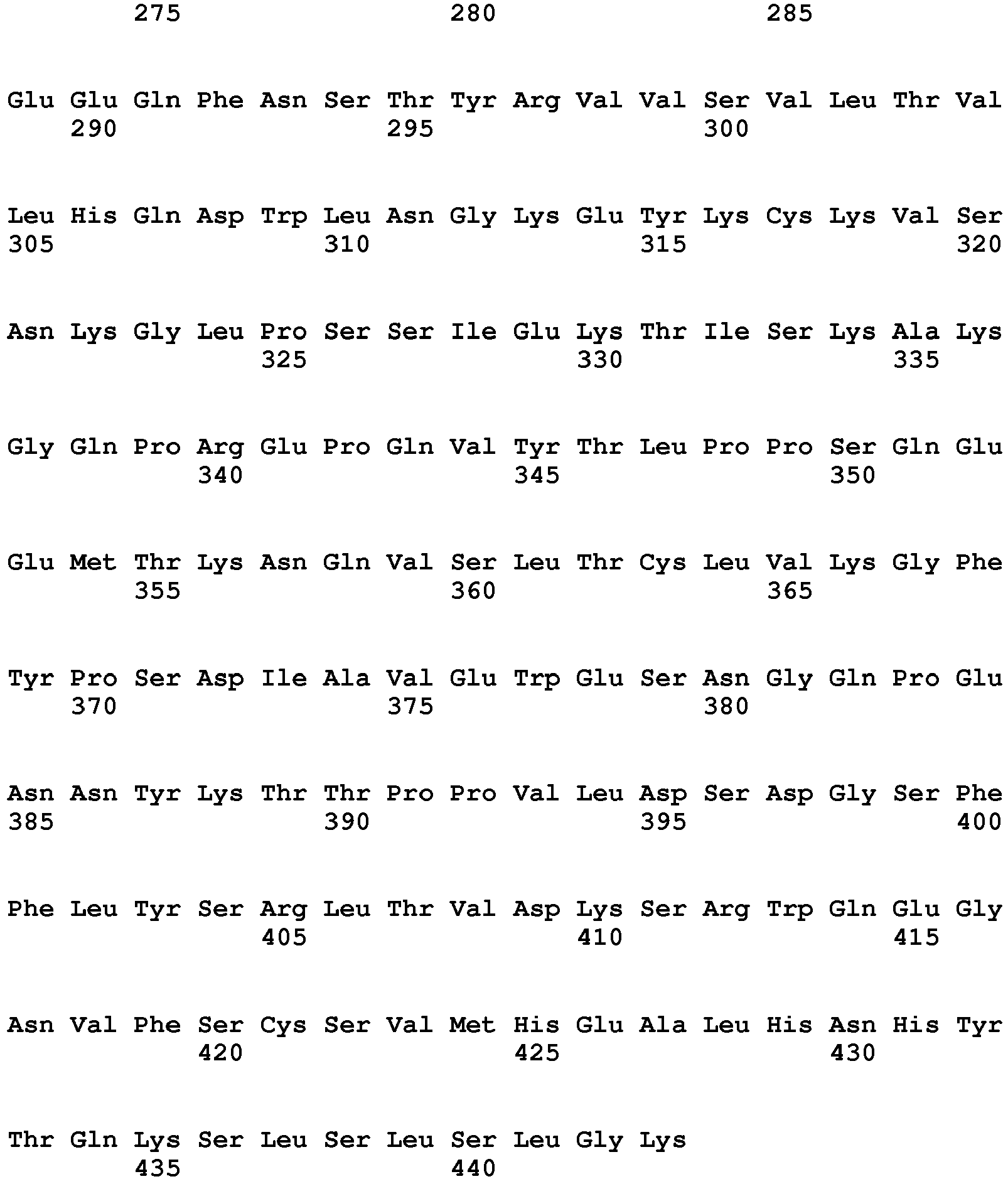
- <210> 12
<211> 218
<212> PRT
<213> artificial sequence - <220>
<223> sequence of huMab195 light chain variable and contant domains - <400> 12


- <210> 13
<211> 481
<212> PRT
<213> artificial sequence - <220>
<223> sequence of human CD33 extracellular domain Fc fusion - <400> 13


- <210> 14
<211> 221
<212> PRT
<213> artificial sequence - <220>
<223> sequence of hinge-Fc portion of human IgG4 heavy chain with S228P and YTE mutations and lacking the C-terminal lysine - <400> 14

- <210> 15
<211> 222
<212> PRT
<213> Homo sapiens - <400> 15

Claims (9)
- An isolated antibody, which specifically binds to interleukin (IL)-5 comprising:(i) a human IgG4 Fc region or the FcRn binding domain thereof modified relative to a corresponding unmodified IgG4 Fc region or FcRn binding domain thereof to comprise the amino acid substitutions M252Y, S254T and T256E numbered according to the EU index as in Kabat; and(ii) a human IgG4 core hinge region sequence modified to comprise the amino acid substitution S228P according to the EU index as in Kabat;wherein the combination of modifications results in a supra-additive lengthening of in vivo half-life of the modified interleukin (IL)-5 antibody compared to corresponding antibodies having (i) or (ii) alone.
- An isolated antibody which specifically binds to interleukin (IL)-5, comprising:(i) a human IgG4 Fc region or the FcRn binding domain thereof modified relative to a corresponding unmodified IgG4 Fc region or FcRn binding domain thereof to comprise the amino acid substitutions M252Y, S254T and T256E numbered according to the EU index as in Kabat; and(ii) a human IgG4 core hinge region sequence modified to comprise the amino acid substitution S228P according to the EU index as in Kabat;for use in treating or preventing a disorder characterised by excess eosinophil production,
wherein the combination of modifications results in a supra-additive lengthening of in vivo half-life of the modified interleukin (IL)-5 antibody compared to corresponding antibodies having (i) or (ii) alone. - The antibody according to claim 1 or the antibody for use according to claim 2, wherein the antibody is chimeric, humanized, human, CDR-grafted, primatized, de-immunized, veneered or bispecific.
- The antibody according to claim 1 or for use according to 2, comprising the heavy chain constant region sequence set forth in SEQ ID NO:6 and the heavy chain variable region sequence set forth in SEQ ID NO:7.
- The antibody according to claim 4 further comprising a light chain comprising the variable and constant region sequences set forth in SEQ ID NO:8.
- The antibody for use according to claim 2 wherein the disorder is selected from the group consisting of atopic asthma, atopic dermatitis, allergic rhinitis, non-allergic rhinitis, asthma, severe asthma, chronic eosinophilic pneumonia, allergic bronchopulmonary aspergillosis, celiac disease, Churg-Strauss syndrome, eosinophilic myalgia syndrome, hypereosinophilic syndrome, oedematous reactions including episodic angiodema, helminth infections, onchocercal dermatitis, eosinophilic oesophagitis, eosinophilic gastritis, eosinophilic gastroenteritis, eosinophilic enteritis, eosinophilic cholitis, nasal micropolyposis, nasal polyposis, asprin intolerance asthma, obstructive sleep apnea, chronic asthma, Crohn's disease, scleroderma, endomyocardial fibrosis and autoimmune disease.
- A nucleic acid encoding the antibody according to any one of claims 1, and 3-5.
- A transformed cell comprising the nucleic acid encoding an antibody according to claim 7.
- The antibody according to any one of claims 1 and 3-5, provided in a pharmaceutical composition together with a pharmaceutically acceptable excipient.
Applications Claiming Priority (2)
| Application Number | Priority Date | Filing Date | Title |
|---|---|---|---|
| US201061425858P | 2010-12-22 | 2010-12-22 | |
| PCT/AU2011/001662 WO2012083370A1 (en) | 2010-12-22 | 2011-12-22 | Modified antibody with improved half-life |
Publications (3)
| Publication Number | Publication Date |
|---|---|
| EP2654790A1 EP2654790A1 (en) | 2013-10-30 |
| EP2654790A4 EP2654790A4 (en) | 2014-05-28 |
| EP2654790B1 true EP2654790B1 (en) | 2019-02-06 |
Family
ID=46312907
Family Applications (1)
| Application Number | Title | Priority Date | Filing Date |
|---|---|---|---|
| EP11850362.2A Active EP2654790B1 (en) | 2010-12-22 | 2011-12-22 | Modified antibody with improved half-life |
Country Status (15)
| Country | Link |
|---|---|
| US (1) | US9505826B2 (en) |
| EP (1) | EP2654790B1 (en) |
| JP (2) | JP6147670B2 (en) |
| KR (1) | KR101941514B1 (en) |
| CN (1) | CN103429261A (en) |
| AU (1) | AU2011349049B2 (en) |
| BR (1) | BR112013016235B1 (en) |
| CA (1) | CA2824279A1 (en) |
| EA (1) | EA201390923A1 (en) |
| ES (1) | ES2720136T3 (en) |
| IL (1) | IL227081B (en) |
| MX (1) | MX2013007392A (en) |
| PT (1) | PT2654790T (en) |
| WO (1) | WO2012083370A1 (en) |
| ZA (1) | ZA201305123B (en) |
Families Citing this family (56)
| Publication number | Priority date | Publication date | Assignee | Title |
|---|---|---|---|---|
| CA2824279A1 (en) * | 2010-12-22 | 2012-06-28 | Cephalon Australia Pty Ltd | Modified antibody with improved half-life |
| WO2013059885A2 (en) | 2011-10-28 | 2013-05-02 | Cephalon Australia Pty Ltd | Polypeptide constructs and uses thereof |
| WO2014066744A2 (en) | 2012-10-25 | 2014-05-01 | True North Therapeutics, Inc. | Anti-complement c1s antibodies and uses thereof |
| PL2914291T3 (en) | 2012-11-02 | 2022-10-03 | Bioverativ Usa Inc. | Anti-complement c1s antibodies and uses thereof |
| HRP20192013T1 (en) | 2012-12-17 | 2020-02-07 | Trillium Therapeutics Inc. | TREATMENT OF CD47 + DISEASE CELLS WITH SIRP ALFA-FC FUSIONS |
| ITTO20130012A1 (en) | 2013-01-09 | 2014-07-10 | Metheresis Translational Res S A | NEW ANTICORPAL FRAGMENTS, RELATED COMPOSITIONS AND USES |
| EP2992010B1 (en) | 2013-04-29 | 2021-03-24 | F.Hoffmann-La Roche Ag | Fc-receptor binding modified asymmetric antibodies and methods of use |
| CA2909952C (en) | 2013-04-29 | 2021-10-12 | Teva Pharmaceuticals Australia Pty Ltd. | Anti-cd38 antibodies and fusions to attenuated interferon alpha-2b |
| SG10201800492PA (en) | 2013-04-29 | 2018-03-28 | Hoffmann La Roche | Human fcrn-binding modified antibodies and methods of use |
| US11117975B2 (en) | 2013-04-29 | 2021-09-14 | Teva Pharmaceuticals Australia Pty Ltd | Anti-CD38 antibodies and fusions to attenuated interferon alpha-2B |
| KR101895634B1 (en) | 2013-05-31 | 2018-09-05 | 한미약품 주식회사 | IgG4 Fc fragment comprising modified hinge region |
| AU2014285079A1 (en) | 2013-07-05 | 2016-01-21 | H. Lee Moffitt Cancer Center And Research Institute, Inc. | Soluble CD33 for treating myelodysplastic syndromes (MDS) |
| LT3702373T (en) | 2013-09-13 | 2022-11-10 | Beigene Switzerland Gmbh | Anti-pd1 antibodies and their use as therapeutics and diagnostics |
| BR112016014969A2 (en) | 2014-01-15 | 2018-01-23 | Hoffmann La Roche | polypeptide, pharmaceutical formulation and use of a polypeptide |
| UA119352C2 (en) | 2014-05-01 | 2019-06-10 | Тева Фармасьютикалз Острейліа Пті Лтд | COMBINATION OF LENALIDOMIDE OR POMALIDOMIDE AND STRUCTURES OF ANTI-CD38 ANTIBODY-ATHENED INTERPHERONE ALPHA-2B AND METHOD OF TREATMENT38 |
| TWI726608B (en) | 2014-07-03 | 2021-05-01 | 英屬開曼群島商百濟神州有限公司 | Anti-pd-l1 antibodies and their use as therapeutics and diagnostics |
| HRP20210680T1 (en) | 2014-07-10 | 2021-06-11 | Bioarctic Ab | Improved a-beta protofibril binding antibodies |
| AR101753A1 (en) | 2014-09-03 | 2017-01-11 | Boehringer Ingelheim Int | COMPOUND OF OBJECTIVE TO IL-23A AND TNF-A AND USE OF THE SAME |
| UA125637C2 (en) | 2014-10-29 | 2022-05-11 | Тева Фармасьютікалз Острейліа Пті Лтд | MERGER INTERFERON POLYPEPTIDE <font face = "Symbol"> a2 </font> b |
| US20160130324A1 (en) * | 2014-10-31 | 2016-05-12 | Shire Human Genetic Therapies, Inc. | C1 Inhibitor Fusion Proteins and Uses Thereof |
| JP7095992B2 (en) | 2014-12-08 | 2022-07-05 | 1グローブ バイオメディカル カンパニー, リミテッド | Soluble Universal ADCC Enhanced Synthetic Fusion Gene and Peptide Techniques and Their Use |
| UA126272C2 (en) | 2015-06-05 | 2022-09-14 | Дженентек, Інк. | Anti-tau antibodies and methods of use |
| US11820807B2 (en) * | 2015-06-12 | 2023-11-21 | Ubi Pharma Inc | Immunoglobulin fusion proteins and uses thereof |
| ES2983120T3 (en) * | 2015-06-12 | 2024-10-21 | Ubi Pharma Inc | Immunoglobulin fusion proteins and their uses |
| US20160362473A1 (en) * | 2015-06-12 | 2016-12-15 | Ubi Pharma Inc | Immunoglobulin fusion proteins and uses thereof |
| UA125433C2 (en) | 2015-07-23 | 2022-03-09 | Бьорінґер Інґельхайм Інтернаціональ Ґмбх | AIM-23A AIMED AND B-LYMPHOCYTIC ACTIVATING FACTOR (BAFF) COMPOUND AND ITS APPLICATIONS |
| EP3222672A1 (en) * | 2016-03-23 | 2017-09-27 | LANXESS Deutschland GmbH | Metal azo pigments |
| WO2018006785A1 (en) * | 2016-07-05 | 2018-01-11 | 江苏恒瑞医药股份有限公司 | Egfr antibody-drug conjugate and pharmaceutical use thereof |
| WO2018007885A1 (en) | 2016-07-05 | 2018-01-11 | Beigene, Ltd. | COMBINATION OF A PD-l ANTAGONIST AND A RAF INHIBITOR FOR TREATING CANCER |
| FI3494134T3 (en) | 2016-08-02 | 2026-02-19 | Visterra Inc | MODIFIED POLYPEPTIDES AND THEIR USES |
| AU2017313085B2 (en) | 2016-08-19 | 2024-06-20 | Beone Medicines I Gmbh | Use of a combination comprising a Btk inhibitor for treating cancers |
| EP4652926A3 (en) | 2016-10-12 | 2026-03-18 | Bioverativ USA Inc. | Anti-c1s antibodies and methods of use thereof |
| CA3042581A1 (en) | 2016-11-03 | 2018-05-11 | Trillium Therapeutics Inc. | Enhancement of cd47 blockade therapy by proteasome inhibitors |
| AR110321A1 (en) | 2016-12-07 | 2019-03-20 | Genentech Inc | ANTITAU ANTIBODIES AND METHODS OF USE |
| KR20240035636A (en) | 2016-12-07 | 2024-03-15 | 제넨테크, 인크. | Anti-tau antibodies and methods of their use |
| WO2018137681A1 (en) | 2017-01-25 | 2018-08-02 | Beigene, Ltd. | Crystalline forms of (s) -7- (1- (but-2-ynoyl) piperidin-4-yl) -2- (4-phenoxyphenyl) -4, 5, 6, 7-tetrahy dropyrazolo [1, 5-a] pyrimidine-3-carboxamide, preparation, and uses thereof |
| WO2018215964A1 (en) * | 2017-05-26 | 2018-11-29 | Glaxosmithkline Intellectual Property Development Limited | Biopharmaceutical compositions and related methods |
| KR102757960B1 (en) | 2017-06-26 | 2025-01-22 | 베이진 엘티디 | Immunotherapy for hepatocellular carcinoma (HCC) |
| JP7307720B2 (en) | 2017-09-29 | 2023-07-12 | 江蘇恒瑞医薬股▲ふん▼有限公司 | IL-5 Antibodies, Antigen-Binding Fragments Thereof, and Pharmaceutical Applications Thereof |
| CN111801334B (en) | 2017-11-29 | 2023-06-09 | 百济神州瑞士有限责任公司 | Treatment of Indolent or Aggressive B-Cell Lymphoma Using Combinations Containing BTK Inhibitors |
| CN109942706A (en) * | 2017-12-21 | 2019-06-28 | 三生国健药业(上海)股份有限公司 | Monoclonal antibody, preparation method and use in conjunction with people IL-5 |
| CN113227134A (en) | 2018-12-05 | 2021-08-06 | 株式会社梅花治疗 | Fc region variants of antibodies |
| CN110297093B (en) * | 2019-03-18 | 2022-04-22 | 山西瑞豪生物科技有限公司 | Method and kit for detecting human immunoglobulin G4 |
| CA3134401A1 (en) * | 2019-03-29 | 2020-10-08 | Jiangsu Hengrui Medicine Co., Ltd. | Pharmaceutical composition containing antibody against il-5 and use thereof |
| WO2021138407A2 (en) * | 2020-01-03 | 2021-07-08 | Marengo Therapeutics, Inc. | Multifunctional molecules that bind to cd33 and uses thereof |
| US20230057939A1 (en) | 2020-01-13 | 2023-02-23 | Neoimmunetech, Inc. | Method of treating a tumor with a combination of il-7 protein and a bispecific antibody |
| CN113307869B (en) * | 2020-10-30 | 2023-01-06 | 上海洛启生物医药技术有限公司 | anti-IL 5 nano antibody and application thereof |
| US20230405096A1 (en) * | 2020-11-18 | 2023-12-21 | Green Cross Corporation | Adamts13 variant having increased escaping rate or activity against autoantibody |
| WO2022105847A1 (en) * | 2020-11-19 | 2022-05-27 | Staidson (Beijing) Biopharmaceuticals Co. , Ltd. | Long-acting nerve growth factor polypeptides and uses thereof |
| TW202322850A (en) * | 2021-08-05 | 2023-06-16 | 美商美國禮來大藥廠 | Antibody optimization |
| KR20250042176A (en) | 2022-07-27 | 2025-03-26 | 아블린쓰 | A polypeptide that binds to a specific epitope of the neonatal FC receptor |
| EP4582457A1 (en) | 2022-08-30 | 2025-07-09 | Mirabiologics Inc. | Artificial protein and pharmaceutical composition |
| KR102923942B1 (en) * | 2022-11-10 | 2026-02-06 | (주)네오크레마 | Fusion protein comprising IL-22, and uses thereof |
| CN120813375A (en) | 2023-01-30 | 2025-10-17 | 凯玛布有限公司 | Antibodies to |
| AR131869A1 (en) | 2023-02-17 | 2025-05-07 | Ablynx Nv | POLYPEPTIDES THAT BIND TO THE NEONATAL Fc RECEPTOR |
| CN120189527B (en) * | 2025-05-27 | 2026-04-03 | 广州富肽生物有限公司 | A conjugate of a polypeptide and an antibody Fc fragment, a pharmaceutical composition and its uses |
Citations (1)
| Publication number | Priority date | Publication date | Assignee | Title |
|---|---|---|---|---|
| WO1995035375A1 (en) * | 1994-06-17 | 1995-12-28 | Celltech Therapeutics Limited | Interleukin-5 specific recombinant antibodies |
Family Cites Families (95)
| Publication number | Priority date | Publication date | Assignee | Title |
|---|---|---|---|---|
| USRE30985E (en) | 1978-01-01 | 1982-06-29 | Serum-free cell culture media | |
| NZ201705A (en) | 1981-08-31 | 1986-03-14 | Genentech Inc | Recombinant dna method for production of hepatitis b surface antigen in yeast |
| US4560655A (en) | 1982-12-16 | 1985-12-24 | Immunex Corporation | Serum-free cell culture medium and process for making same |
| US4657866A (en) | 1982-12-21 | 1987-04-14 | Sudhir Kumar | Serum-free, synthetic, completely chemically defined tissue culture media |
| GB8308235D0 (en) | 1983-03-25 | 1983-05-05 | Celltech Ltd | Polypeptides |
| US4816567A (en) | 1983-04-08 | 1989-03-28 | Genentech, Inc. | Recombinant immunoglobin preparations |
| US4767704A (en) | 1983-10-07 | 1988-08-30 | Columbia University In The City Of New York | Protein-free culture medium |
| US5807715A (en) | 1984-08-27 | 1998-09-15 | The Board Of Trustees Of The Leland Stanford Junior University | Methods and transformed mammalian lymphocyte cells for producing functional antigen-binding protein including chimeric immunoglobulin |
| US4879231A (en) | 1984-10-30 | 1989-11-07 | Phillips Petroleum Company | Transformation of yeasts of the genus pichia |
| GB8516415D0 (en) | 1985-06-28 | 1985-07-31 | Celltech Ltd | Culture of animal cells |
| US5225539A (en) | 1986-03-27 | 1993-07-06 | Medical Research Council | Recombinant altered antibodies and methods of making altered antibodies |
| GB8607679D0 (en) | 1986-03-27 | 1986-04-30 | Winter G P | Recombinant dna product |
| US4927762A (en) | 1986-04-01 | 1990-05-22 | Cell Enterprises, Inc. | Cell culture medium with antioxidant |
| GB8610600D0 (en) | 1986-04-30 | 1986-06-04 | Novo Industri As | Transformation of trichoderma |
| US4946778A (en) | 1987-09-21 | 1990-08-07 | Genex Corporation | Single polypeptide chain binding molecules |
| US5260203A (en) | 1986-09-02 | 1993-11-09 | Enzon, Inc. | Single polypeptide chain binding molecules |
| US5258498A (en) | 1987-05-21 | 1993-11-02 | Creative Biomolecules, Inc. | Polypeptide linkers for production of biosynthetic proteins |
| EP0768377A1 (en) | 1988-09-02 | 1997-04-16 | Protein Engineering Corporation | Generation and selection of recombinant varied binding proteins |
| US5223409A (en) | 1988-09-02 | 1993-06-29 | Protein Engineering Corp. | Directed evolution of novel binding proteins |
| DE68925971T2 (en) | 1988-09-23 | 1996-09-05 | Cetus Oncology Corp | CELL GROWING MEDIUM FOR INCREASED CELL GROWTH, FOR INCREASING LONGEVITY AND EXPRESSION OF PRODUCTS |
| GB8823869D0 (en) | 1988-10-12 | 1988-11-16 | Medical Res Council | Production of antibodies |
| US5530101A (en) | 1988-12-28 | 1996-06-25 | Protein Design Labs, Inc. | Humanized immunoglobulins |
| FR2646437B1 (en) | 1989-04-28 | 1991-08-30 | Transgene Sa | NOVEL DNA SEQUENCES, THEIR APPLICATION AS A SEQUENCE ENCODING A SIGNAL PEPTIDE FOR THE SECRETION OF MATURE PROTEINS BY RECOMBINANT YEASTS, EXPRESSION CASSETTES, PROCESSED YEASTS AND PROCESS FOR PREPARING THE SAME |
| EP0402226A1 (en) | 1989-06-06 | 1990-12-12 | Institut National De La Recherche Agronomique | Transformation vectors for yeast yarrowia |
| IT1237881B (en) | 1989-12-12 | 1993-06-18 | Fast Spa | COMPLEX PROFILE STRUCTURE, APPLICABLE ON STIRRING APPLIANCES, FOR THE LOCKING OF PAINT JARS, HAVING DIFFERENT LIDS |
| GB8928874D0 (en) | 1989-12-21 | 1990-02-28 | Celltech Ltd | Humanised antibodies |
| US5780225A (en) | 1990-01-12 | 1998-07-14 | Stratagene | Method for generating libaries of antibody genes comprising amplification of diverse antibody DNAs and methods for using these libraries for the production of diverse antigen combining molecules |
| AU7247191A (en) | 1990-01-11 | 1991-08-05 | Molecular Affinities Corporation | Production of antibodies using gene libraries |
| US6075181A (en) | 1990-01-12 | 2000-06-13 | Abgenix, Inc. | Human antibodies derived from immunized xenomice |
| ES2284161T3 (en) | 1990-01-12 | 2007-11-01 | Amgen Fremont Inc. | GENERATION OF XENOGENIC ANTIBODIES. |
| US5427908A (en) | 1990-05-01 | 1995-06-27 | Affymax Technologies N.V. | Recombinant library screening methods |
| GB9015198D0 (en) | 1990-07-10 | 1990-08-29 | Brien Caroline J O | Binding substance |
| US5625126A (en) | 1990-08-29 | 1997-04-29 | Genpharm International, Inc. | Transgenic non-human animals for producing heterologous antibodies |
| US5545806A (en) | 1990-08-29 | 1996-08-13 | Genpharm International, Inc. | Ransgenic non-human animals for producing heterologous antibodies |
| US5661016A (en) | 1990-08-29 | 1997-08-26 | Genpharm International Inc. | Transgenic non-human animals capable of producing heterologous antibodies of various isotypes |
| US5633425A (en) | 1990-08-29 | 1997-05-27 | Genpharm International, Inc. | Transgenic non-human animals capable of producing heterologous antibodies |
| AU8507191A (en) | 1990-08-29 | 1992-03-30 | Genpharm International, Inc. | Transgenic non-human animals capable of producing heterologous antibodies |
| US5194594A (en) | 1990-09-07 | 1993-03-16 | Techniclone, Inc. | Modified antibodies |
| US5698426A (en) | 1990-09-28 | 1997-12-16 | Ixsys, Incorporated | Surface expression libraries of heteromeric receptors |
| US5122469A (en) | 1990-10-03 | 1992-06-16 | Genentech, Inc. | Method for culturing Chinese hamster ovary cells to improve production of recombinant proteins |
| ES2113940T3 (en) | 1990-12-03 | 1998-05-16 | Genentech Inc | ENRICHMENT METHOD FOR PROTEIN VARIANTS WITH ALTERED UNION PROPERTIES. |
| AU662148B2 (en) | 1991-04-10 | 1995-08-24 | Scripps Research Institute, The | Heterodimeric receptor libraries using phagemids |
| DE69233482T2 (en) | 1991-05-17 | 2006-01-12 | Merck & Co., Inc. | Method for reducing the immunogenicity of antibody variable domains |
| WO1992022324A1 (en) | 1991-06-14 | 1992-12-23 | Xoma Corporation | Microbially-produced antibody fragments and their conjugates |
| MX9204374A (en) | 1991-07-25 | 1993-03-01 | Idec Pharma Corp | RECOMBINANT ANTIBODY AND METHOD FOR ITS PRODUCTION. |
| US5565332A (en) | 1991-09-23 | 1996-10-15 | Medical Research Council | Production of chimeric antibodies - a combinatorial approach |
| PT1696031E (en) | 1991-12-02 | 2010-06-25 | Medical Res Council | Production of anti-self antibodies from antibody segment repertoires and displayed on phage |
| SG49597A1 (en) * | 1992-02-06 | 1998-06-15 | Schering Corp | Design cloning and expression of humanized monoclonal antibodies against human interleukin-5 |
| US5733743A (en) | 1992-03-24 | 1998-03-31 | Cambridge Antibody Technology Limited | Methods for producing members of specific binding pairs |
| ZA932522B (en) | 1992-04-10 | 1993-12-20 | Res Dev Foundation | Immunotoxins directed against c-erbB-2(HER/neu) related surface antigens |
| US5639641A (en) | 1992-09-09 | 1997-06-17 | Immunogen Inc. | Resurfacing of rodent antibodies |
| DE69303494T2 (en) | 1992-11-13 | 1997-01-16 | Idec Pharma Corp | THERAPEUTIC USE OF CHIMERIC AND LABELED ANTIBODIES AGAINST HUMAN B LYMPHOCYTIC LIMITED DIFFERENTIATION ANTIQUES FOR THE TREATMENT OF B CELL LYMPHOMA |
| AU5670194A (en) | 1992-11-20 | 1994-06-22 | Enzon, Inc. | Linker for linked fusion polypeptides |
| US5747654A (en) | 1993-06-14 | 1998-05-05 | The United States Of America As Represented By The Department Of Health And Human Services | Recombinant disulfide-stabilized polypeptide fragments having binding specificity |
| JPH09506262A (en) | 1993-12-08 | 1997-06-24 | ジェンザイム・コーポレイション | Method for producing specific antibody |
| PT744958E (en) | 1994-01-31 | 2003-11-28 | Univ Boston | BANKS OF POLYCLONE ANTIBODIES |
| US5516637A (en) | 1994-06-10 | 1996-05-14 | Dade International Inc. | Method involving display of protein binding pairs on the surface of bacterial pili and bacteriophage |
| USRE39548E1 (en) | 1994-06-17 | 2007-04-03 | Celltech R&D Limited | Interleukin-5 specific recombinant antibodies |
| US6056957A (en) | 1994-08-04 | 2000-05-02 | Schering Corporation | Humanized monoclonal antibodies against human interleukin-5 |
| US5683892A (en) | 1994-12-23 | 1997-11-04 | Smithkline Beecham Corporation | DNA encoding recombinant IL-5 antagonists useful in treatment of IL-5 mediated disorders |
| ATE346867T1 (en) | 1994-12-23 | 2006-12-15 | Smithkline Beecham Corp | RECOMBINANT IL-5 ANTAGONISTS FOR THE TREATMENT OF IL-5 RELATED DISEASES |
| US5783184A (en) | 1994-12-23 | 1998-07-21 | Smithkline Beecham Corporation | Method for treatment and diagnosis of IL-5 mediated disorders |
| US6091001A (en) | 1995-03-29 | 2000-07-18 | Abgenix, Inc. | Production of antibodies using Cre-mediated site-specific recombination |
| US6096871A (en) | 1995-04-14 | 2000-08-01 | Genentech, Inc. | Polypeptides altered to contain an epitope from the Fc region of an IgG molecule for increased half-life |
| US5747035A (en) | 1995-04-14 | 1998-05-05 | Genentech, Inc. | Polypeptides with increased half-life for use in treating disorders involving the LFA-1 receptor |
| US5869046A (en) | 1995-04-14 | 1999-02-09 | Genentech, Inc. | Altered polypeptides with increased half-life |
| EP0822830B1 (en) | 1995-04-27 | 2008-04-02 | Amgen Fremont Inc. | Human anti-IL-8 antibodies, derived from immunized xenomice |
| WO1996034096A1 (en) | 1995-04-28 | 1996-10-31 | Abgenix, Inc. | Human antibodies derived from immunized xenomice |
| JP2978435B2 (en) | 1996-01-24 | 1999-11-15 | チッソ株式会社 | Method for producing acryloxypropyl silane |
| ATE279947T1 (en) | 1996-03-18 | 2004-11-15 | Univ Texas | IMMUNOGLOBULIN-LIKE DOMAIN WITH INCREASED HALF-LIFE TIMES |
| WO1997043316A1 (en) | 1996-05-10 | 1997-11-20 | Beth Israel Deaconess Medical Center, Inc. | Physiologically active molecules with extended half-lives and methods of using same |
| US5916771A (en) | 1996-10-11 | 1999-06-29 | Abgenix, Inc. | Production of a multimeric protein by cell fusion method |
| WO1998023289A1 (en) | 1996-11-27 | 1998-06-04 | The General Hospital Corporation | MODULATION OF IgG BINDING TO FcRn |
| ATE549918T1 (en) | 1996-12-03 | 2012-04-15 | Amgen Fremont Inc | HUMAN ANTIBODIES THAT EXPRESSLY BIND HUMAN TNF ALPHA |
| TR199902553T2 (en) | 1997-04-14 | 2000-03-21 | Micromet Gesellschaft F�R Biomedizinische Forschung Mbh | New methods and uses for the production of antigen receptors against the human body. |
| WO1998052976A1 (en) | 1997-05-21 | 1998-11-26 | Biovation Limited | Method for the production of non-immunogenic proteins |
| CN1204147C (en) | 1998-02-25 | 2005-06-01 | 利思进药品公司 | Methods of increasing the circulating half-life of antibody-based fusion proteins |
| EP1051432B1 (en) | 1998-12-08 | 2007-01-24 | Biovation Limited | Method for reducing immunogenicity of proteins |
| JP4336498B2 (en) | 2000-12-12 | 2009-09-30 | メディミューン,エルエルシー | Molecules with extended half-life and compositions and uses thereof |
| US8178098B2 (en) | 2001-04-03 | 2012-05-15 | National Jewish Health | Method to inhibit airway hyperresponsiveness using aerosolized T cell receptor antibodies |
| MXPA05000511A (en) | 2001-07-12 | 2005-09-30 | Jefferson Foote | Super humanized antibodies. |
| AU2003217912A1 (en) * | 2002-03-01 | 2003-09-16 | Xencor | Antibody optimization |
| ATE435239T1 (en) * | 2002-03-29 | 2009-07-15 | Schering Corp | HUMAN MONOCLONAL ANTIBODIES TO INTERLEUKIN-5 AND THESE COMPREHENSIVE METHODS AND COMPOSITIONS |
| US20070135620A1 (en) | 2004-11-12 | 2007-06-14 | Xencor, Inc. | Fc variants with altered binding to FcRn |
| US7592429B2 (en) * | 2005-05-03 | 2009-09-22 | Ucb Sa | Sclerostin-binding antibody |
| TWI461436B (en) * | 2005-11-25 | 2014-11-21 | Kyowa Hakko Kirin Co Ltd | Human CD134 (OX40) human monoclonal antibody and method of making and using same |
| GB0612928D0 (en) * | 2006-06-29 | 2006-08-09 | Ucb Sa | Biological products |
| WO2008134046A1 (en) | 2007-04-27 | 2008-11-06 | Genentech, Inc. | Potent, stable and non-immunosuppressive anti-cd4 antibodies |
| US8092804B2 (en) * | 2007-12-21 | 2012-01-10 | Medimmune Limited | Binding members for interleukin-4 receptor alpha (IL-4Rα)-173 |
| CN101952454B (en) * | 2008-02-08 | 2014-06-04 | 米迪缪尼有限公司 | Anti-IFNAR1 antibodies with reduced Fc ligand affinity |
| ES2733067T3 (en) | 2008-12-19 | 2019-11-27 | Macrogenics Inc | Covalent diabodies and uses thereof |
| BRPI1006998A2 (en) * | 2009-01-23 | 2015-08-25 | Biogen Idec Inc | Stabilized fc polypeptides with reduced effector function and methods of use |
| CA2749200A1 (en) * | 2009-01-29 | 2010-08-05 | Michael Bowen | Human anti-il-6 antibodies with extended in vivo half-life and their use in treatment of oncology, autoimmune diseases and inflammatory diseases |
| KR20120088550A (en) * | 2009-05-04 | 2012-08-08 | 애보트 리서치 비.브이. | Antibodies against nerve growth factor (ngf) with enhanced in vivo stability |
| CA2824279A1 (en) * | 2010-12-22 | 2012-06-28 | Cephalon Australia Pty Ltd | Modified antibody with improved half-life |
-
2011
- 2011-12-22 CA CA2824279A patent/CA2824279A1/en not_active Abandoned
- 2011-12-22 PT PT11850362T patent/PT2654790T/en unknown
- 2011-12-22 WO PCT/AU2011/001662 patent/WO2012083370A1/en not_active Ceased
- 2011-12-22 ES ES11850362T patent/ES2720136T3/en active Active
- 2011-12-22 BR BR112013016235-0A patent/BR112013016235B1/en active IP Right Grant
- 2011-12-22 JP JP2013544971A patent/JP6147670B2/en active Active
- 2011-12-22 KR KR1020137019148A patent/KR101941514B1/en active Active
- 2011-12-22 EA EA201390923A patent/EA201390923A1/en unknown
- 2011-12-22 MX MX2013007392A patent/MX2013007392A/en unknown
- 2011-12-22 US US13/996,733 patent/US9505826B2/en active Active
- 2011-12-22 EP EP11850362.2A patent/EP2654790B1/en active Active
- 2011-12-22 CN CN201180068272XA patent/CN103429261A/en active Pending
- 2011-12-22 AU AU2011349049A patent/AU2011349049B2/en active Active
-
2013
- 2013-06-20 IL IL227081A patent/IL227081B/en active IP Right Grant
- 2013-07-08 ZA ZA2013/05123A patent/ZA201305123B/en unknown
-
2016
- 2016-12-28 JP JP2016255652A patent/JP6334669B2/en active Active
Patent Citations (1)
| Publication number | Priority date | Publication date | Assignee | Title |
|---|---|---|---|---|
| WO1995035375A1 (en) * | 1994-06-17 | 1995-12-28 | Celltech Therapeutics Limited | Interleukin-5 specific recombinant antibodies |
Also Published As
| Publication number | Publication date |
|---|---|
| CA2824279A1 (en) | 2012-06-28 |
| BR112013016235B1 (en) | 2020-03-31 |
| AU2011349049B2 (en) | 2016-08-11 |
| ZA201305123B (en) | 2014-09-25 |
| PT2654790T (en) | 2019-05-16 |
| JP2014503209A (en) | 2014-02-13 |
| AU2011349049A1 (en) | 2013-05-02 |
| KR101941514B1 (en) | 2019-01-23 |
| ES2720136T3 (en) | 2019-07-18 |
| JP2017055771A (en) | 2017-03-23 |
| BR112013016235A2 (en) | 2016-11-22 |
| US9505826B2 (en) | 2016-11-29 |
| MX2013007392A (en) | 2013-11-01 |
| JP6334669B2 (en) | 2018-05-30 |
| KR20140003494A (en) | 2014-01-09 |
| US20130281677A1 (en) | 2013-10-24 |
| EP2654790A4 (en) | 2014-05-28 |
| WO2012083370A1 (en) | 2012-06-28 |
| JP6147670B2 (en) | 2017-06-14 |
| IL227081B (en) | 2018-04-30 |
| EP2654790A1 (en) | 2013-10-30 |
| CN103429261A (en) | 2013-12-04 |
| EA201390923A1 (en) | 2013-12-30 |
Similar Documents
| Publication | Publication Date | Title |
|---|---|---|
| US9505826B2 (en) | Modified antibody with improved half-life | |
| EP3088517B1 (en) | Human anti-il-33 neutralizing monoclonal antibody | |
| JP2018172384A (en) | Antigen-binding molecule that makes associated antigen disappear | |
| TWI790370B (en) | Anti-trem-1 antibodies and uses thereof | |
| CA3004830A1 (en) | Composition and methods for anti-tnfr2 antibodies | |
| JP2019524052A (en) | Binding molecules specific for FcγRIIA and uses thereof | |
| CN118638234B (en) | Anti-BDCA2 antibody and its preparation method and use | |
| CA3254085A1 (en) | Klrb1 binding agents and methods of use thereof | |
| HK1191216A (en) | Modified antibody with improved half-life | |
| HK1191216B (en) | Modified antibody with improved half-life | |
| US9738702B2 (en) | Antibodies with improved half-life in ferrets | |
| WO2025045250A1 (en) | Anti-human factor d antibody constructs and uses thereof | |
| TWI858383B (en) | A CDC platform antibody | |
| JP7839108B2 (en) | Pharmaceutical composition for the treatment of amyotrophic lateral sclerosis | |
| CA3123004C (en) | Fusion protein constructs for complement associated disease | |
| WO2025260123A1 (en) | Anti-c2 antibodies and uses thereof | |
| KR20240022546A (en) | Anti-IL-36R antibody and use thereof | |
| WO2026036080A1 (en) | Compositions and methods comprising combinations of tslp and il-13 antibodies | |
| CN121226557A (en) | anti-cMET antibody | |
| CN121226555A (en) | anti-cMET antibody | |
| WO2022122704A1 (en) | Antibodies binding to f-protein of metapneumovirus and uses thereof | |
| EA046142B1 (en) | ANTIBODIES TO TREM-1 AND THEIR APPLICATIONS | |
| AU2008201419A1 (en) | Molecules with extended half-lives, compositions and uses thereof |
Legal Events
| Date | Code | Title | Description |
|---|---|---|---|
| PUAI | Public reference made under article 153(3) epc to a published international application that has entered the european phase |
Free format text: ORIGINAL CODE: 0009012 |
|
| 17P | Request for examination filed |
Effective date: 20130719 |
|
| AK | Designated contracting states |
Kind code of ref document: A1 Designated state(s): AL AT BE BG CH CY CZ DE DK EE ES FI FR GB GR HR HU IE IS IT LI LT LU LV MC MK MT NL NO PL PT RO RS SE SI SK SM TR |
|
| RAP1 | Party data changed (applicant data changed or rights of an application transferred) |
Owner name: TEVA PHARMACEUTICALS AUSTRALIA PTY LTD |
|
| DAX | Request for extension of the european patent (deleted) | ||
| A4 | Supplementary search report drawn up and despatched |
Effective date: 20140429 |
|
| RIC1 | Information provided on ipc code assigned before grant |
Ipc: C07K 16/00 20060101ALI20140423BHEP Ipc: A61K 39/395 20060101AFI20140423BHEP Ipc: C12N 15/13 20060101ALI20140423BHEP Ipc: C07K 16/28 20060101ALI20140423BHEP Ipc: C07K 16/18 20060101ALI20140423BHEP |
|
| REG | Reference to a national code |
Ref country code: HK Ref legal event code: DE Ref document number: 1191216 Country of ref document: HK |
|
| RIC1 | Information provided on ipc code assigned before grant |
Ipc: C07K 16/00 20060101ALI20140807BHEP Ipc: C07K 16/28 20060101ALI20140807BHEP Ipc: C12N 15/13 20060101ALI20140807BHEP Ipc: C07K 16/18 20060101ALI20140807BHEP Ipc: A61K 39/395 20060101AFI20140807BHEP |
|
| 17Q | First examination report despatched |
Effective date: 20160405 |
|
| STAA | Information on the status of an ep patent application or granted ep patent |
Free format text: STATUS: EXAMINATION IS IN PROGRESS |
|
| GRAP | Despatch of communication of intention to grant a patent |
Free format text: ORIGINAL CODE: EPIDOSNIGR1 |
|
| STAA | Information on the status of an ep patent application or granted ep patent |
Free format text: STATUS: GRANT OF PATENT IS INTENDED |
|
| INTG | Intention to grant announced |
Effective date: 20180820 |
|
| GRAS | Grant fee paid |
Free format text: ORIGINAL CODE: EPIDOSNIGR3 |
|
| GRAA | (expected) grant |
Free format text: ORIGINAL CODE: 0009210 |
|
| STAA | Information on the status of an ep patent application or granted ep patent |
Free format text: STATUS: THE PATENT HAS BEEN GRANTED |
|
| AK | Designated contracting states |
Kind code of ref document: B1 Designated state(s): AL AT BE BG CH CY CZ DE DK EE ES FI FR GB GR HR HU IE IS IT LI LT LU LV MC MK MT NL NO PL PT RO RS SE SI SK SM TR |
|
| REG | Reference to a national code |
Ref country code: GB Ref legal event code: FG4D |
|
| REG | Reference to a national code |
Ref country code: CH Ref legal event code: EP Ref country code: AT Ref legal event code: REF Ref document number: 1094432 Country of ref document: AT Kind code of ref document: T Effective date: 20190215 |
|
| REG | Reference to a national code |
Ref country code: IE Ref legal event code: FG4D |
|
| REG | Reference to a national code |
Ref country code: DE Ref legal event code: R096 Ref document number: 602011056176 Country of ref document: DE |
|
| REG | Reference to a national code |
Ref country code: NL Ref legal event code: FP |
|
| REG | Reference to a national code |
Ref country code: PT Ref legal event code: SC4A Ref document number: 2654790 Country of ref document: PT Date of ref document: 20190516 Kind code of ref document: T Free format text: AVAILABILITY OF NATIONAL TRANSLATION Effective date: 20190415 |
|
| REG | Reference to a national code |
Ref country code: LT Ref legal event code: MG4D |
|
| REG | Reference to a national code |
Ref country code: ES Ref legal event code: FG2A Ref document number: 2720136 Country of ref document: ES Kind code of ref document: T3 Effective date: 20190718 |
|
| PG25 | Lapsed in a contracting state [announced via postgrant information from national office to epo] |
Ref country code: NO Free format text: LAPSE BECAUSE OF FAILURE TO SUBMIT A TRANSLATION OF THE DESCRIPTION OR TO PAY THE FEE WITHIN THE PRESCRIBED TIME-LIMIT Effective date: 20190506 Ref country code: FI Free format text: LAPSE BECAUSE OF FAILURE TO SUBMIT A TRANSLATION OF THE DESCRIPTION OR TO PAY THE FEE WITHIN THE PRESCRIBED TIME-LIMIT Effective date: 20190206 Ref country code: LT Free format text: LAPSE BECAUSE OF FAILURE TO SUBMIT A TRANSLATION OF THE DESCRIPTION OR TO PAY THE FEE WITHIN THE PRESCRIBED TIME-LIMIT Effective date: 20190206 Ref country code: SE Free format text: LAPSE BECAUSE OF FAILURE TO SUBMIT A TRANSLATION OF THE DESCRIPTION OR TO PAY THE FEE WITHIN THE PRESCRIBED TIME-LIMIT Effective date: 20190206 |
|
| REG | Reference to a national code |
Ref country code: AT Ref legal event code: MK05 Ref document number: 1094432 Country of ref document: AT Kind code of ref document: T Effective date: 20190206 |
|
| PG25 | Lapsed in a contracting state [announced via postgrant information from national office to epo] |
Ref country code: LV Free format text: LAPSE BECAUSE OF FAILURE TO SUBMIT A TRANSLATION OF THE DESCRIPTION OR TO PAY THE FEE WITHIN THE PRESCRIBED TIME-LIMIT Effective date: 20190206 Ref country code: RS Free format text: LAPSE BECAUSE OF FAILURE TO SUBMIT A TRANSLATION OF THE DESCRIPTION OR TO PAY THE FEE WITHIN THE PRESCRIBED TIME-LIMIT Effective date: 20190206 Ref country code: IS Free format text: LAPSE BECAUSE OF FAILURE TO SUBMIT A TRANSLATION OF THE DESCRIPTION OR TO PAY THE FEE WITHIN THE PRESCRIBED TIME-LIMIT Effective date: 20190606 Ref country code: BG Free format text: LAPSE BECAUSE OF FAILURE TO SUBMIT A TRANSLATION OF THE DESCRIPTION OR TO PAY THE FEE WITHIN THE PRESCRIBED TIME-LIMIT Effective date: 20190506 Ref country code: HR Free format text: LAPSE BECAUSE OF FAILURE TO SUBMIT A TRANSLATION OF THE DESCRIPTION OR TO PAY THE FEE WITHIN THE PRESCRIBED TIME-LIMIT Effective date: 20190206 Ref country code: GR Free format text: LAPSE BECAUSE OF FAILURE TO SUBMIT A TRANSLATION OF THE DESCRIPTION OR TO PAY THE FEE WITHIN THE PRESCRIBED TIME-LIMIT Effective date: 20190507 |
|
| PG25 | Lapsed in a contracting state [announced via postgrant information from national office to epo] |
Ref country code: DK Free format text: LAPSE BECAUSE OF FAILURE TO SUBMIT A TRANSLATION OF THE DESCRIPTION OR TO PAY THE FEE WITHIN THE PRESCRIBED TIME-LIMIT Effective date: 20190206 Ref country code: EE Free format text: LAPSE BECAUSE OF FAILURE TO SUBMIT A TRANSLATION OF THE DESCRIPTION OR TO PAY THE FEE WITHIN THE PRESCRIBED TIME-LIMIT Effective date: 20190206 Ref country code: SK Free format text: LAPSE BECAUSE OF FAILURE TO SUBMIT A TRANSLATION OF THE DESCRIPTION OR TO PAY THE FEE WITHIN THE PRESCRIBED TIME-LIMIT Effective date: 20190206 Ref country code: AL Free format text: LAPSE BECAUSE OF FAILURE TO SUBMIT A TRANSLATION OF THE DESCRIPTION OR TO PAY THE FEE WITHIN THE PRESCRIBED TIME-LIMIT Effective date: 20190206 Ref country code: RO Free format text: LAPSE BECAUSE OF FAILURE TO SUBMIT A TRANSLATION OF THE DESCRIPTION OR TO PAY THE FEE WITHIN THE PRESCRIBED TIME-LIMIT Effective date: 20190206 Ref country code: CZ Free format text: LAPSE BECAUSE OF FAILURE TO SUBMIT A TRANSLATION OF THE DESCRIPTION OR TO PAY THE FEE WITHIN THE PRESCRIBED TIME-LIMIT Effective date: 20190206 |
|
| REG | Reference to a national code |
Ref country code: DE Ref legal event code: R097 Ref document number: 602011056176 Country of ref document: DE |
|
| PG25 | Lapsed in a contracting state [announced via postgrant information from national office to epo] |
Ref country code: SM Free format text: LAPSE BECAUSE OF FAILURE TO SUBMIT A TRANSLATION OF THE DESCRIPTION OR TO PAY THE FEE WITHIN THE PRESCRIBED TIME-LIMIT Effective date: 20190206 Ref country code: PL Free format text: LAPSE BECAUSE OF FAILURE TO SUBMIT A TRANSLATION OF THE DESCRIPTION OR TO PAY THE FEE WITHIN THE PRESCRIBED TIME-LIMIT Effective date: 20190206 |
|
| PLBE | No opposition filed within time limit |
Free format text: ORIGINAL CODE: 0009261 |
|
| STAA | Information on the status of an ep patent application or granted ep patent |
Free format text: STATUS: NO OPPOSITION FILED WITHIN TIME LIMIT |
|
| PG25 | Lapsed in a contracting state [announced via postgrant information from national office to epo] |
Ref country code: AT Free format text: LAPSE BECAUSE OF FAILURE TO SUBMIT A TRANSLATION OF THE DESCRIPTION OR TO PAY THE FEE WITHIN THE PRESCRIBED TIME-LIMIT Effective date: 20190206 |
|
| 26N | No opposition filed |
Effective date: 20191107 |
|
| PG25 | Lapsed in a contracting state [announced via postgrant information from national office to epo] |
Ref country code: SI Free format text: LAPSE BECAUSE OF FAILURE TO SUBMIT A TRANSLATION OF THE DESCRIPTION OR TO PAY THE FEE WITHIN THE PRESCRIBED TIME-LIMIT Effective date: 20190206 |
|
| PG25 | Lapsed in a contracting state [announced via postgrant information from national office to epo] |
Ref country code: TR Free format text: LAPSE BECAUSE OF FAILURE TO SUBMIT A TRANSLATION OF THE DESCRIPTION OR TO PAY THE FEE WITHIN THE PRESCRIBED TIME-LIMIT Effective date: 20190206 |
|
| REG | Reference to a national code |
Ref country code: CH Ref legal event code: PL |
|
| REG | Reference to a national code |
Ref country code: BE Ref legal event code: MM Effective date: 20191231 |
|
| PG25 | Lapsed in a contracting state [announced via postgrant information from national office to epo] |
Ref country code: MC Free format text: LAPSE BECAUSE OF FAILURE TO SUBMIT A TRANSLATION OF THE DESCRIPTION OR TO PAY THE FEE WITHIN THE PRESCRIBED TIME-LIMIT Effective date: 20190206 |
|
| PG25 | Lapsed in a contracting state [announced via postgrant information from national office to epo] |
Ref country code: IE Free format text: LAPSE BECAUSE OF NON-PAYMENT OF DUE FEES Effective date: 20191222 Ref country code: LU Free format text: LAPSE BECAUSE OF NON-PAYMENT OF DUE FEES Effective date: 20191222 |
|
| PG25 | Lapsed in a contracting state [announced via postgrant information from national office to epo] |
Ref country code: BE Free format text: LAPSE BECAUSE OF NON-PAYMENT OF DUE FEES Effective date: 20191231 Ref country code: CH Free format text: LAPSE BECAUSE OF NON-PAYMENT OF DUE FEES Effective date: 20191231 Ref country code: LI Free format text: LAPSE BECAUSE OF NON-PAYMENT OF DUE FEES Effective date: 20191231 |
|
| PG25 | Lapsed in a contracting state [announced via postgrant information from national office to epo] |
Ref country code: CY Free format text: LAPSE BECAUSE OF FAILURE TO SUBMIT A TRANSLATION OF THE DESCRIPTION OR TO PAY THE FEE WITHIN THE PRESCRIBED TIME-LIMIT Effective date: 20190206 |
|
| PG25 | Lapsed in a contracting state [announced via postgrant information from national office to epo] |
Ref country code: MT Free format text: LAPSE BECAUSE OF FAILURE TO SUBMIT A TRANSLATION OF THE DESCRIPTION OR TO PAY THE FEE WITHIN THE PRESCRIBED TIME-LIMIT Effective date: 20190206 Ref country code: HU Free format text: LAPSE BECAUSE OF FAILURE TO SUBMIT A TRANSLATION OF THE DESCRIPTION OR TO PAY THE FEE WITHIN THE PRESCRIBED TIME-LIMIT; INVALID AB INITIO Effective date: 20111222 |
|
| PG25 | Lapsed in a contracting state [announced via postgrant information from national office to epo] |
Ref country code: MK Free format text: LAPSE BECAUSE OF FAILURE TO SUBMIT A TRANSLATION OF THE DESCRIPTION OR TO PAY THE FEE WITHIN THE PRESCRIBED TIME-LIMIT Effective date: 20190206 |
|
| P01 | Opt-out of the competence of the unified patent court (upc) registered |
Effective date: 20230518 |
|
| PGFP | Annual fee paid to national office [announced via postgrant information from national office to epo] |
Ref country code: PT Payment date: 20251121 Year of fee payment: 15 |
|
| PGFP | Annual fee paid to national office [announced via postgrant information from national office to epo] |
Ref country code: NL Payment date: 20251119 Year of fee payment: 15 |
|
| PGFP | Annual fee paid to national office [announced via postgrant information from national office to epo] |
Ref country code: DE Payment date: 20251126 Year of fee payment: 15 |
|
| PGFP | Annual fee paid to national office [announced via postgrant information from national office to epo] |
Ref country code: GB Payment date: 20251119 Year of fee payment: 15 |
|
| PGFP | Annual fee paid to national office [announced via postgrant information from national office to epo] |
Ref country code: IT Payment date: 20251119 Year of fee payment: 15 |
|
| PGFP | Annual fee paid to national office [announced via postgrant information from national office to epo] |
Ref country code: FR Payment date: 20251120 Year of fee payment: 15 |
|
| PGFP | Annual fee paid to national office [announced via postgrant information from national office to epo] |
Ref country code: ES Payment date: 20260102 Year of fee payment: 15 |