EP2654341A1 - Priority Queues Starvation Avoidance In Wireless Communication Systems - Google Patents
Priority Queues Starvation Avoidance In Wireless Communication Systems Download PDFInfo
- Publication number
- EP2654341A1 EP2654341A1 EP13171253.1A EP13171253A EP2654341A1 EP 2654341 A1 EP2654341 A1 EP 2654341A1 EP 13171253 A EP13171253 A EP 13171253A EP 2654341 A1 EP2654341 A1 EP 2654341A1
- Authority
- EP
- European Patent Office
- Prior art keywords
- data
- priority level
- queue
- data queue
- priority
- Prior art date
- Legal status (The legal status is an assumption and is not a legal conclusion. Google has not performed a legal analysis and makes no representation as to the accuracy of the status listed.)
- Granted
Links
- 235000003642 hunger Nutrition 0.000 title claims abstract description 31
- 230000037351 starvation Effects 0.000 title claims abstract description 31
- 238000004891 communication Methods 0.000 title description 17
- 238000000034 method Methods 0.000 claims abstract description 34
- 238000012546 transfer Methods 0.000 claims abstract description 7
- 230000005540 biological transmission Effects 0.000 claims description 5
- 239000000872 buffer Substances 0.000 description 32
- 238000007726 management method Methods 0.000 description 23
- 230000007246 mechanism Effects 0.000 description 9
- 241001522296 Erithacus rubecula Species 0.000 description 5
- 238000010586 diagram Methods 0.000 description 4
- 230000008901 benefit Effects 0.000 description 3
- 230000003044 adaptive effect Effects 0.000 description 2
- 238000013461 design Methods 0.000 description 2
- 230000000116 mitigating effect Effects 0.000 description 2
- 230000006855 networking Effects 0.000 description 2
- 230000002459 sustained effect Effects 0.000 description 2
- 230000003466 anti-cipated effect Effects 0.000 description 1
- 238000013459 approach Methods 0.000 description 1
- 230000009172 bursting Effects 0.000 description 1
- 230000001934 delay Effects 0.000 description 1
- 239000000284 extract Substances 0.000 description 1
- 238000012986 modification Methods 0.000 description 1
- 230000004048 modification Effects 0.000 description 1
- 238000012545 processing Methods 0.000 description 1
- 230000000750 progressive effect Effects 0.000 description 1
- 230000009467 reduction Effects 0.000 description 1
Images


Classifications
-
- H—ELECTRICITY
- H04—ELECTRIC COMMUNICATION TECHNIQUE
- H04W—WIRELESS COMMUNICATION NETWORKS
- H04W28/00—Network traffic management; Network resource management
- H04W28/02—Traffic management, e.g. flow control or congestion control
- H04W28/10—Flow control between communication endpoints
- H04W28/14—Flow control between communication endpoints using intermediate storage
-
- H—ELECTRICITY
- H04—ELECTRIC COMMUNICATION TECHNIQUE
- H04L—TRANSMISSION OF DIGITAL INFORMATION, e.g. TELEGRAPHIC COMMUNICATION
- H04L47/00—Traffic control in data switching networks
- H04L47/10—Flow control; Congestion control
- H04L47/24—Traffic characterised by specific attributes, e.g. priority or QoS
- H04L47/245—Traffic characterised by specific attributes, e.g. priority or QoS using preemption
-
- H—ELECTRICITY
- H04—ELECTRIC COMMUNICATION TECHNIQUE
- H04L—TRANSMISSION OF DIGITAL INFORMATION, e.g. TELEGRAPHIC COMMUNICATION
- H04L47/00—Traffic control in data switching networks
- H04L47/50—Queue scheduling
-
- H—ELECTRICITY
- H04—ELECTRIC COMMUNICATION TECHNIQUE
- H04L—TRANSMISSION OF DIGITAL INFORMATION, e.g. TELEGRAPHIC COMMUNICATION
- H04L47/00—Traffic control in data switching networks
- H04L47/50—Queue scheduling
- H04L47/62—Queue scheduling characterised by scheduling criteria
- H04L47/6215—Individual queue per QOS, rate or priority
-
- H—ELECTRICITY
- H04—ELECTRIC COMMUNICATION TECHNIQUE
- H04L—TRANSMISSION OF DIGITAL INFORMATION, e.g. TELEGRAPHIC COMMUNICATION
- H04L47/00—Traffic control in data switching networks
- H04L47/50—Queue scheduling
- H04L47/62—Queue scheduling characterised by scheduling criteria
- H04L47/622—Queue service order
- H04L47/6235—Variable service order
-
- H—ELECTRICITY
- H04—ELECTRIC COMMUNICATION TECHNIQUE
- H04L—TRANSMISSION OF DIGITAL INFORMATION, e.g. TELEGRAPHIC COMMUNICATION
- H04L47/00—Traffic control in data switching networks
- H04L47/50—Queue scheduling
- H04L47/62—Queue scheduling characterised by scheduling criteria
- H04L47/6285—Provisions for avoiding starvation of low priority queues
-
- H—ELECTRICITY
- H04—ELECTRIC COMMUNICATION TECHNIQUE
- H04W—WIRELESS COMMUNICATION NETWORKS
- H04W8/00—Network data management
- H04W8/02—Processing of mobility data, e.g. registration information at HLR [Home Location Register] or VLR [Visitor Location Register]; Transfer of mobility data, e.g. between HLR, VLR or external networks
- H04W8/04—Registration at HLR or HSS [Home Subscriber Server]
-
- H—ELECTRICITY
- H04—ELECTRIC COMMUNICATION TECHNIQUE
- H04W—WIRELESS COMMUNICATION NETWORKS
- H04W84/00—Network topologies
- H04W84/02—Hierarchically pre-organised networks, e.g. paging networks, cellular networks, WLAN [Wireless Local Area Network] or WLL [Wireless Local Loop]
- H04W84/10—Small scale networks; Flat hierarchical networks
- H04W84/12—WLAN [Wireless Local Area Networks]
Definitions
- the invention relates to Quality of Service (QoS) mechanisms in wireless Local Area Networking (LAN) communication systems. More particularly, it relates to management of multiple priority queues in wireless communications systems so as to ensure that lower priority traffic is not precluded from accessing the medium during sustained periods of higher priority traffic being sent.
- QoS Quality of Service
- 'transmit' packets flow from host memory to an internal transmit (packet) buffer usually under the control of a resident data movement or DMA engine, which in turn is commanded by the system driver or software.
- the Media Access Controller (MAC) retrieves transmit data from this packet buffer, frames it appropriately, and forwards it to a physical network layer device.
- MAC Media Access Controller
- 'receive' packets flow to the MAC from the receiver.
- the MAC extracts packet data from the surrounding header and CRC, while packet management logic determines whether each packet should be discarded, buffered, or merely decoded for network flow control and power management.
- Each packet which reaches the receive buffer is forwarded to the host computer via a data movement engine, gain operating under host driver control.
- the functional implementation of on-device buffers limits the amount of physical data that can be brought onto the device- i.e. packet memory is generally limited due to cost and area concerns.
- packets are sequentially queued and managed on a "best-effort" basis.
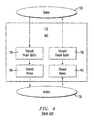
- FIG. 4 is a block diagram showing a conventional non-priority based management provisions.
- a MAC (Medium Access Control layer) 110 is interposed between a system 120 and a medium 130.
- the MAC 110 includes a Transmit Packet Buffer 150 and an associated Channel Access routine 160, as well as a Receive Packet Buffer 180 and an associated Channel Access routine 190.
- a boundary condition is effectively placed on the system software or driver requiring that in the transmit direction the software apply a minimum packet queuing strategy in the available (system/host) transmit buffers in systems that want to establish multiple-class priority traffic scenarios.
- the transmit direction is defined as the direction of packets which traverse from local system memory through the system out onto the medium.
- the receive direction is defined as the direction of incoming packets from the medium that are demodulated and placed into system memory.
- This requirement or boundary condition is typically placed on a system in an effort to prevent a potentially large delay situation when a high priority packet is passed down to the driver from the operating system.
- Such a priority frame cannot be "inserted" easily in the existing queue, mostly because the potential ownership or consumption of available buffer space is unknown (e.g., it may have already been relinquished to the device).
- a transmit direction is designated as a priority direction if a most recent data transfer was in a receive direction.
- the receive direction is designated as the priority direction if the most recent data transfer was in the transmit direction.
- Data is transferred in the priority direction if data is queued to be transferred in the priority direction.
- a method and apparatus for queuing data comprises providing a plurality of data queues in a transmit direction. Each of the data queues has one of a predetermined plurality of different level priorities. A data starvation condition is checked for in one of the plurality of data queues having a lowest priority. The lowest priority data queue is serviced if the data starvation condition is detected.
- a method of queuing data comprises providing a plurality of data queues in a transmit direction, each of the plurality of data queues having one of a predetermined plurality of different level priorities.
- a predetermined weighted round robin scheduling of servicing each of the plurality of data queues is established.
- the scheduling includes an unequal number of services to at least two of the plurality of data queues in each service round.
- multiple data queues are added into a communications system that when used with simple control mechanisms allow multiple classes of communications traffic, and different latency and delivery objectives to be treated differently.
- Quality of Service is an all-encompassing phrase that denotes that different types of communications traffic are treated differently.
- QoS Quality of Service
- video services where users, who are accustomed to using the telephone, expect high quality voice because historically, voice, was considered to be high priority.
- QoS is typically tied to multimedia services, or more generally speaking to data systems that handle all types of data streams (“streaming services") that require no "automatic" priority or re-transmission if a data packet is somehow lost in real-time.
- Wireless systems add a second level of uncertainty (and hence potential delay) in that traffic flows are unpredictable. This unpredictability is in no small part due to the unpredictability of the wireless radio links, as well as external interference sources.
- basic goals of a managed WLAN system preferably include retaining a basic "collision avoidance" approach together with adaptive flow control to keep priority traffic flowing.
- a system preferably also includes load feedback of the medium used to drive local service rate decisions, e.g., per service class, and the use of drop rate feedback to tell the relevant application whether or not a new "connection" is possible.
- a key requirement in QoS-managed systems is that all devices preferably implement a given model and policy.
- a single queuing structure is generally used to buffer up packets at the system level.
- the relevant routines apply a minimum packet queuing strategy to the available buffer. This requirement is placed on the system in an effort to prevent a potentially large delay situation when a high priority packet is passed down to the driver.
- An underlying assumption is that such a priority frame cannot be "inserted" easily into an existing queue because it is unknown whether or not the ownership of the available buffer has been relinquished to the device.
- a separate or multiple separate high priority queues allow more low priority packets to be queued independently of a high priority traffic queue.
- a mechanism exists within the system to allow an on-chip data movement engine to retrieve data from the priority queues/buffers if it exists prior to servicing best-effort (i.e., lower priority) queues.
- QoS Quality of Service
- packets can no longer be treated on a "best-effort" basis and additional considerations such as queue management need to be considered.
- IEEE802.11(e) is currently considering four classes or tiers of priority defined as (in order of lowest to highest priority):
- a second level of management occurs within a particular direction or service, and can be applicable in either a transmit or receive direction.
- an additional register or registers is/are added to the design to allow higher priority transmit packets to be queued up and sent through the network independent from "best-effort" transmit packets. This requirement allows increased system flexibility from a driver perspective as it removes established boundaries on minimizing the number of queued transmit packets residing in a given buffer structure.
- packets will be moved off of the device into system memory quickly such that priority class management of incoming (receive) packets is not required.
- similar techniques as described to manage the transmit direction can also be leveraged at the receive level as well.
- FIG. 1 shows a block diagram showing hardware-based priority management provisions according to a preferred embodiment of the present invention.
- a MAC 210 is interposed between a system 220 and a medium 230.
- the Mac 210 includes in a transmit path a plurality of different priority queues 240, a Scheduler/Queue manager 250, and a Channel Accesser 260, and includes in a receive path a plurality of different priority queues 270, a Scheduler/Queue manager 280, and a Channel Accesser 290.
- the data queues 240, 270 are serviced in order of increasing priority, starting with high priority traffic such as voice traffic (highest priority), then video traffic and the like, and then 'best effort' traffic (lowest priority). However, importantly, if a low priority queue holding, e.g., 'best effort' traffic is 'starved', i.e., if insufficient or essentially no low priority 'best effort' traffic has been transferred recently, then a special flag or bit is set, indicating that a low priority queue is to be accessed first.
- high priority traffic such as voice traffic (highest priority)
- video traffic and the like and then 'best effort' traffic (lowest priority).
- 'best effort' traffic lowest priority
- a special flag or bit is set, indicating that a low priority queue is to be accessed first.
- voice traffic is given strict priority and other data queues are serviced on a weighted round-robin basis, i.e. each is serviced in turn, with a queue or queues having higher priority being serviced more frequently.
- competition between transmit and receive queues may be preferably resolved by rotating priority between the two directions of data transfer.
- a simple rotating priority scheme between the Transmit (Tx) and Receiver (Rx) states may be preferable. This is considered in a manner such that one state would not have absolute priority over the other state, which could cause a starvation condition to occur on a per "service" basis ("service" defined as either Tx or Rx).
- service defined as either Tx or Rx.
- FIG. 2 is a flow chart showing exemplary overall priority management between transmit and receive directions, in accordance with the principles of the present invention.
- the state machine when the controller leaves either the transmit state 320 or receive state 330 and reaches an IDLE state 310, the state machine will look to see if another pending transfer is required. If so, it will arbitrate between transmit and receive sections on a rotating priority basis.
- the ability to accommodate priority traffic on a per service basis (used in this context to mean either a transmit service or a receive service) needs to then be considered.
- the ability to accommodate priority traffic in the transmit direction can simply be added into a system by supporting additional dedicated priority buffers (i.e., better than "best effort"). This requirement removes the aforementioned queuing issue encountered with a single buffer or queue and allows more low priority packet queuing to occur (in its own separate and distinct buffer), while not affecting high priority traffic.
- the priority rules remain intact and require a state machine to provide a fixed priority between multiple queues (e.g., 3 queues in the predefined example) as transmit buffers while maintaining a rotating priority scheme between the Tx and Rx states.
- transmit priority queues get absolute priority over lower priority queues such as the best-effort queue, or the normal and best-effort queues should be active concurrently.
- FIG. 3 is a flow chart showing exemplary transmit queue priority management according to a preferred embodiment of the invention in a three-class system.
- Handling video and best/excellent effort buffers with some kind of "weighted round robin" scheduling is one method that can be employed to ensure that data starvation does not occur. This is implemented fairly simply by servicing the queues in a given sequence, e.g., video, video, normal, video, video, normal, etc. Because of the nature of voice traffic, it can still be serviced with strict priority.
- provisions are added to ensure that "best-effort" priority level traffic is not “starved out” by the engine servicing higher priority queues that are not as rigid as the aforementioned "weighted round robin" scheme.
- Starvation of the best effort traffic in the lowest priority queue can be detected by any suitable means known in the art, such as by measuring the data rate by identifying whether the number of data message messages buffered for transmission exceeds a specified threshold, or by any other means.
- Lpesc Low Priority Escalation
- step 420 it is determined whether the LPesc bit is set, and if the LPesc bit is set, then the method jumps to step 450. If the LPesc bit is not set, then the method proceeds to step 430, in which the High Priority transmit buffer is checked. If High Priority data is found to be present in the High Priority transmit buffer in step 430, then the High Priority data is read from the High Priority transmit buffer in step 460, and in step 410 the system returns to an idle transmit state.
- the method proceeds to check if Medium Priority data is present in the Medium Priority transmit buffer in step 440, and if Medium Priority data is present it is read in step 470 and the system returns to the idle transmit state in step 410. If no Medium Priority data is detected in the Medium Priority transmit buffer in step 440, then the method proceeds to check the Low Priority transmit buffer in step 450, and if Low Priority data is present in the Low Priority transmit buffer it is read in step 480 and the system returned to the idle transmit state in step 410.
- step 420 it is determined whether the LPesc bit is set. If the LPesc bit is set, then the method would service the low priority transmit buffer by switching to a weighted round robin scheduling technique. If the LPesc bit is not set, then the method would proceed to step 430, as illustrated in Fig. 3 . With further reference to step 420, if the LPesc bit is set, a weighted round robin scheduling technique is used to ensure that the lowest priority queue will not be data starved. The lowest priority queue will be given an opportunity to transmit in accordance with the scheduling technique used. The lowest priority queue may not be given the opportunity to transmit at the next available transmit opportunity, but it will eventually obtain a transmit opportunity as provided for in the scheduling technique.
- An interesting property of this invention is that it does not necessarily require changes in the 802.11 MAC and therefore it can be retrofitted onto an existing system. Clearly, if multiple queues are made available on the MAC device itself and the ability to obey the above priority and management rules considered, the ability to support different types of communications traffic in an efficient manner can be realized.
- This invention provides a method to resolve Quality of Service issues in emerging communications systems by offering support for multiple queue management within the system. Also, an escalation mechanism is provided for the purposes of mitigating low priority class data starvation in communications systems, when it becomes an issue.
- queue management mechanisms can be leveraged by existing WLAN systems. While queue management techniques can be implemented in either hardware or software, multiple queues and queue management, as well as escalation techniques, can be used within a given piece of hardware to increase overall efficiency of the system.
- the invention also builds on the proven success of the current IEEE802.11 MAC and concepts, and can be retrofitted into existing designs. Furthermore, the invention adds QoS features that are adaptive and robust and fit well with existing traffic models. Efficient channel filling of the basic Wireless MAC is maintained by "filling" empty service levels. QoS with multiple traffic classes in accordance with anticipated requirements of future versions of the IEEE 802.11(e) specification, and can be implemented in accordance with the preferred embodiments of the invention.
Landscapes
- Engineering & Computer Science (AREA)
- Computer Networks & Wireless Communication (AREA)
- Signal Processing (AREA)
- Databases & Information Systems (AREA)
- Small-Scale Networks (AREA)
- Data Exchanges In Wide-Area Networks (AREA)
- Time-Division Multiplex Systems (AREA)
- Communication Control (AREA)
- Mobile Radio Communication Systems (AREA)
Abstract
Description
- This application claims priority from
U.S. Appl. No. 60/425,895, filed November 13, 2002 - The invention relates to Quality of Service (QoS) mechanisms in wireless Local Area Networking (LAN) communication systems. More particularly, it relates to management of multiple priority queues in wireless communications systems so as to ensure that lower priority traffic is not precluded from accessing the medium during sustained periods of higher priority traffic being sent.
- In communications systems according to the background art, 'transmit' packets flow from host memory to an internal transmit (packet) buffer usually under the control of a resident data movement or DMA engine, which in turn is commanded by the system driver or software. The Media Access Controller (MAC) retrieves transmit data from this packet buffer, frames it appropriately, and forwards it to a physical network layer device. Likewise, 'receive' packets flow to the MAC from the receiver. The MAC extracts packet data from the surrounding header and CRC, while packet management logic determines whether each packet should be discarded, buffered, or merely decoded for network flow control and power management. Each packet which reaches the receive buffer is forwarded to the host computer via a data movement engine, gain operating under host driver control. Generally, the functional implementation of on-device buffers limits the amount of physical data that can be brought onto the device- i.e. packet memory is generally limited due to cost and area concerns.
- In these communications systems according to the background art, packets are sequentially queued and managed on a "best-effort" basis.
-
FIG. 4 is a block diagram showing a conventional non-priority based management provisions. - In particular, as shown in
FIG. 4 , a MAC (Medium Access Control layer) 110 is interposed between asystem 120 and amedium 130. The MAC 110 includes aTransmit Packet Buffer 150 and an associatedChannel Access routine 160, as well as aReceive Packet Buffer 180 and an associatedChannel Access routine 190. - In systems that offer only a single queue structure, a boundary condition is effectively placed on the system software or driver requiring that in the transmit direction the software apply a minimum packet queuing strategy in the available (system/host) transmit buffers in systems that want to establish multiple-class priority traffic scenarios. (The transmit direction is defined as the direction of packets which traverse from local system memory through the system out onto the medium. The receive direction is defined as the direction of incoming packets from the medium that are demodulated and placed into system memory.) This requirement or boundary condition is typically placed on a system in an effort to prevent a potentially large delay situation when a high priority packet is passed down to the driver from the operating system. Such a priority frame cannot be "inserted" easily in the existing queue, mostly because the potential ownership or consumption of available buffer space is unknown (e.g., it may have already been relinquished to the device).
- In accordance with the present invention, a transmit direction is designated as a priority direction if a most recent data transfer was in a receive direction. The receive direction is designated as the priority direction if the most recent data transfer was in the transmit direction. Data is transferred in the priority direction if data is queued to be transferred in the priority direction.
- In accordance with another aspect of the present invention, a method and apparatus for queuing data comprises providing a plurality of data queues in a transmit direction. Each of the data queues has one of a predetermined plurality of different level priorities. A data starvation condition is checked for in one of the plurality of data queues having a lowest priority. The lowest priority data queue is serviced if the data starvation condition is detected.
- In accordance with yet another aspect of the present invention, a method of queuing data comprises providing a plurality of data queues in a transmit direction, each of the plurality of data queues having one of a predetermined plurality of different level priorities. A predetermined weighted round robin scheduling of servicing each of the plurality of data queues is established. The scheduling includes an unequal number of services to at least two of the plurality of data queues in each service round.
- Features and advantages of the present invention will become apparent to those skilled in the art from the following description with reference to the drawings, in which:
-
FIG. 1 is a block diagram showing hardware-based priority management provisions according to a preferred embodiment of the present invention. -
FIG. 2 is a flow chart showing exemplary overall priority management between transmit and receive directions according to a preferred embodiment of the invention. -
FIG. 3 is a flow chart showing exemplary transmit queue priority management according to a preferred embodiment of the invention, and -
FIG. 4 is a block diagram showing a conventional non-priority based management provisions. - In accordance with the principles of the present invention, multiple data queues are added into a communications system that when used with simple control mechanisms allow multiple classes of communications traffic, and different latency and delivery objectives to be treated differently.
- To enrich the consumer experience, it is valuable to consider mechanisms that can be employed to support Quality of Service initiatives in wireless Local Area Networking communication systems. Quality of Service (QoS) is an all-encompassing phrase that denotes that different types of communications traffic are treated differently.
- In a telecommunications system, QoS is typically tied to voice and video services where users, who are accustomed to using the telephone, expect high quality voice because historically, voice, was considered to be high priority. In a data communications system, QoS is typically tied to multimedia services, or more generally speaking to data systems that handle all types of data streams ("streaming services") that require no "automatic" priority or re-transmission if a data packet is somehow lost in real-time.
- Telecom systems are inherently stream oriented whereas data streams are inherently "bursty" in nature. In the circuit switched world of telecom systems, "control" is the model solution for all problems.
- While a "control" solution may be fine for constant rate applications like voice and video where prediction of future needs is easy, a "control" solution looses some efficiency when handling data communications. On the other hand, data systems are complex and contain mixes of data sources and sinks (i.e., software applications). Breaking data streams into packets makes it possible to serve many sources efficiently by multiplexing many data streams. However, delays are caused in the system, making the price high. Some applications must bound or at the very least minimize this delay component, whereas other applications may be more immune to delivery latencies (herein referred to as "best-effort" delivery).
- Wireless systems add a second level of uncertainty (and hence potential delay) in that traffic flows are unpredictable. This unpredictability is in no small part due to the unpredictability of the wireless radio links, as well as external interference sources.
- Accordingly, rigid management controls of traffic classes in wireless LANs is not advised. Rather, basic goals of a managed WLAN system preferably include retaining a basic "collision avoidance" approach together with adaptive flow control to keep priority traffic flowing.
- In disclosed embodiments, this results in a progressive reduction of service rates for lower classes of service as the load of the medium increases. Moreover, such a system preferably also includes load feedback of the medium used to drive local service rate decisions, e.g., per service class, and the use of drop rate feedback to tell the relevant application whether or not a new "connection" is possible.
- A key requirement in QoS-managed systems is that all devices preferably implement a given model and policy.
- In a non-priority managed system, a single queuing structure is generally used to buffer up packets at the system level. Using this strategy when priority traffic is available, however, effectively places a boundary condition on the device driver requiring that in either the transmit (Tx) or receive (Rx) directions, the relevant routines apply a minimum packet queuing strategy to the available buffer. This requirement is placed on the system in an effort to prevent a potentially large delay situation when a high priority packet is passed down to the driver. An underlying assumption is that such a priority frame cannot be "inserted" easily into an existing queue because it is unknown whether or not the ownership of the available buffer has been relinquished to the device.
- To remediate this possibility, a separate or multiple separate high priority queues allow more low priority packets to be queued independently of a high priority traffic queue. When high priority traffic is then available, a mechanism exists within the system to allow an on-chip data movement engine to retrieve data from the priority queues/buffers if it exists prior to servicing best-effort (i.e., lower priority) queues.
- In emerging systems, multiple classes of traffic having different latency and delivery objectives are being considered. Quality of Service (QoS) is an all-encompassing phrase that denotes that different types of communications traffic are treated differently. Given the latency and delivery objectives of certain traffic classes, certain packets can no longer be treated on a "best-effort" basis and additional considerations such as queue management need to be considered.
- IEEE802.11(e) is currently considering four classes or tiers of priority defined as (in order of lowest to highest priority):
- Best effort
- Excellent effort
- Video (& Audio)
- Voice
- For the purposes of this analysis we consider a three class system that offers provisions for low priority "best effort" traffic (i.e., non time-sensitive traffic), medium or intermediate priority class traffic (traffic having some latency demands), and very high priority (e.g., voice applications). In this three class system, we have for convenience grouped the excellent effort and video traffic classes of the four class system together. While these techniques can be addressed by either software or on-chip hardware methods, significant throughput and efficiency advantages can be realized by providing realtime hardware-based queuing and escalation mechanisms. Accordingly, henceforth only hardware-based techniques will be discussed in detail, although it will be appreciated by those skilled in the art that the scope of the invention is not limited thereto.
- Several levels of "priority" are considered. At one level the ability to manage both transmit and receive packets is considered. A second level of management occurs within a particular direction or service, and can be applicable in either a transmit or receive direction. In this context, an additional register or registers is/are added to the design to allow higher priority transmit packets to be queued up and sent through the network independent from "best-effort" transmit packets. This requirement allows increased system flexibility from a driver perspective as it removes established boundaries on minimizing the number of queued transmit packets residing in a given buffer structure. In a receive direction it is assumed that packets will be moved off of the device into system memory quickly such that priority class management of incoming (receive) packets is not required. However, similar techniques as described to manage the transmit direction can also be leveraged at the receive level as well.
-
FIG. 1 shows a block diagram showing hardware-based priority management provisions according to a preferred embodiment of the present invention. - In particular, as shown in
FIG. 1 , aMAC 210 is interposed between asystem 220 and a medium 230. TheMac 210 includes in a transmit path a plurality ofdifferent priority queues 240, a Scheduler/Queue manager 250, and aChannel Accesser 260, and includes in a receive path a plurality ofdifferent priority queues 270, a Scheduler/Queue manager 280, and aChannel Accesser 290. - In a preferred embodiment of the invention, the
data queues - In another preferred embodiment of the invention, voice traffic is given strict priority and other data queues are serviced on a weighted round-robin basis, i.e. each is serviced in turn, with a queue or queues having higher priority being serviced more frequently.
- In yet another embodiment, competition between transmit and receive queues may be preferably resolved by rotating priority between the two directions of data transfer. In particular, when management of both transmit and receive packets needs to be considered, a simple rotating priority scheme between the Transmit (Tx) and Receiver (Rx) states may be preferable. This is considered in a manner such that one state would not have absolute priority over the other state, which could cause a starvation condition to occur on a per "service" basis ("service" defined as either Tx or Rx). In this scheme, given a limited on-chip receive packet buffer, general priority is given to quickly bursting packets from on-chip storage registers into system memory for processing as quickly and efficiently as possible.
-
FIG. 2 is a flow chart showing exemplary overall priority management between transmit and receive directions, in accordance with the principles of the present invention. - In particular, as shown in
FIG. 2 , when the controller leaves either the transmitstate 320 or receivestate 330 and reaches anIDLE state 310, the state machine will look to see if another pending transfer is required. If so, it will arbitrate between transmit and receive sections on a rotating priority basis. - It should be noted that this constraint applies for both the transmit and receive directions. Furthermore, this constraint effectively results in a desired automatic rotating priority scheme without the need to explicitly handle the case that both events are active.
- Upon accounting for a rotating priority scheme with either the receive or transmit direction, the ability to accommodate priority traffic on a per service basis (used in this context to mean either a transmit service or a receive service) needs to then be considered. Considering the transmit service side, the ability to accommodate priority traffic in the transmit direction can simply be added into a system by supporting additional dedicated priority buffers (i.e., better than "best effort"). This requirement removes the aforementioned queuing issue encountered with a single buffer or queue and allows more low priority packet queuing to occur (in its own separate and distinct buffer), while not affecting high priority traffic.
- Preferably, the priority rules remain intact and require a state machine to provide a fixed priority between multiple queues (e.g., 3 queues in the predefined example) as transmit buffers while maintaining a rotating priority scheme between the Tx and Rx states. Preferably, transmit priority queues get absolute priority over lower priority queues such as the best-effort queue, or the normal and best-effort queues should be active concurrently.
-
FIG. 3 is a flow chart showing exemplary transmit queue priority management according to a preferred embodiment of the invention in a three-class system. - Note that in
FIG. 3 , without certain policy management in place and further assuming constantly filled buffers for all traffic classes, the potential for low priority data starvation becomes an issue caused by strict priority handling of higher priority queues (e.g., video, best effort, and excellent effort buffers). - Handling video and best/excellent effort buffers with some kind of "weighted round robin" scheduling is one method that can be employed to ensure that data starvation does not occur. This is implemented fairly simply by servicing the queues in a given sequence, e.g., video, video, normal, video, video, normal, etc. Because of the nature of voice traffic, it can still be serviced with strict priority.
- In yet another embodiment of the invention, provisions are added to ensure that "best-effort" priority level traffic is not "starved out" by the engine servicing higher priority queues that are not as rigid as the aforementioned "weighted round robin" scheme. Starvation of the best effort traffic in the lowest priority queue can be detected by any suitable means known in the art, such as by measuring the data rate by identifying whether the number of data message messages buffered for transmission exceeds a specified threshold, or by any other means.
- These provisions are preferably controlled by device firmware or by a software-based scheduling mechanism using a predefined flag or bit (e.g., called Low Priority Escalation or "Lpesc") in a local device register. The Lpesc bit is used to indicate to the device data movement engine that the Low Priority data buffer is being starved and should be serviced next or first, even if a pending high(er) priority data packet is waiting in its respective data queue/buffer.
- Referring now to
FIG. 3 , instep 420 it is determined whether the LPesc bit is set, and if the LPesc bit is set, then the method jumps to step 450. If the LPesc bit is not set, then the method proceeds to step 430, in which the High Priority transmit buffer is checked. If High Priority data is found to be present in the High Priority transmit buffer instep 430, then the High Priority data is read from the High Priority transmit buffer instep 460, and instep 410 the system returns to an idle transmit state. If no High Priority data is found to be present in the High Priority transmit buffer instep 430, then the method proceeds to check if Medium Priority data is present in the Medium Priority transmit buffer instep 440, and if Medium Priority data is present it is read instep 470 and the system returns to the idle transmit state instep 410. If no Medium Priority data is detected in the Medium Priority transmit buffer instep 440, then the method proceeds to check the Low Priority transmit buffer instep 450, and if Low Priority data is present in the Low Priority transmit buffer it is read instep 480 and the system returned to the idle transmit state instep 410. - In accordance with another embodiment of the invention, at
step 420 it is determined whether the LPesc bit is set. If the LPesc bit is set, then the method would service the low priority transmit buffer by switching to a weighted round robin scheduling technique. If the LPesc bit is not set, then the method would proceed to step 430, as illustrated inFig. 3 . With further reference to step 420, if the LPesc bit is set, a weighted round robin scheduling technique is used to ensure that the lowest priority queue will not be data starved. The lowest priority queue will be given an opportunity to transmit in accordance with the scheduling technique used. The lowest priority queue may not be given the opportunity to transmit at the next available transmit opportunity, but it will eventually obtain a transmit opportunity as provided for in the scheduling technique. - An interesting property of this invention is that it does not necessarily require changes in the 802.11 MAC and therefore it can be retrofitted onto an existing system. Clearly, if multiple queues are made available on the MAC device itself and the ability to obey the above priority and management rules considered, the ability to support different types of communications traffic in an efficient manner can be realized.
- This invention provides a method to resolve Quality of Service issues in emerging communications systems by offering support for multiple queue management within the system. Also, an escalation mechanism is provided for the purposes of mitigating low priority class data starvation in communications systems, when it becomes an issue.
- These multiple queue management mechanisms and escalation techniques can be leveraged by existing WLAN systems. While queue management techniques can be implemented in either hardware or software, multiple queues and queue management, as well as escalation techniques, can be used within a given piece of hardware to increase overall efficiency of the system.
- The solutions described herein can be implemented in a fairly straightforward manner into existing WLAN systems by offering support for multiple queue management within the system with the ability to escalate a lower priority entity during sustained periods of higher priority traffic. This advantage is important because the ability to provide a simple real-time method to support multiple traffic classes becomes extremely valuable, especially in emerging applications where Quality of Service (QoS) objectives will be highly desired. Further, having escalation mechanisms for the purposes of mitigating low priority class data starvation in these communications systems will further add value to these systems.
- The invention also builds on the proven success of the current IEEE802.11 MAC and concepts, and can be retrofitted into existing designs. Furthermore, the invention adds QoS features that are adaptive and robust and fit well with existing traffic models. Efficient channel filling of the basic Wireless MAC is maintained by "filling" empty service levels. QoS with multiple traffic classes in accordance with anticipated requirements of future versions of the IEEE 802.11(e) specification, and can be implemented in accordance with the preferred embodiments of the invention.
- While the invention has been described with reference to the exemplary embodiments thereof, those skilled in the art will be able to make various modifications to the described embodiments of the invention without departing from the true spirit and scope of the invention.
Claims (15)
- A method for managing transfers of outgoing data, the method comprising:a) providing a first data queue in a transmit direction for storing outgoing data corresponding to a first priority level;b) providing at least one other data queue in the transmit direction for storing outgoing data corresponding to at least one other priority level, wherein the at least one other priority level is lower than the first priority level;c) servicing the first data queue and the at least one other data queue in the transmit direction such that a data starvation condition of the at least one other data queue is prevented.
- The method of claim 1, wherein step c) comprises:c1) checking for a data starvation condition corresponding to the at least one other data queue;c2) servicing, if the data starvation condition is detected, one or more of the at least one other data queue before servicing the first data queue; andc3) servicing, if the data starvation condition is not detected, the first data queue and the at least one other data queue in order from highest to lowest priority levels.
- The method of claim 2, wherein:the at least one other data queue comprises at least two data queues, each for storing outgoing data corresponding to a priority level different from the first data queue and different from all other data queues;step c1) comprises checking for a data starvation condition corresponding to the at least two data queues; andstep c2) comprises servicing, before servicing the first data queue, only data queues of the at least two data queues that correspond to the starvation condition.
- The method of claim 1, wherein step c) comprises:c1) checking for a data starvation condition corresponding to the at least one other data queue; andc2) servicing, if the data starvation condition is detected, the first data queue and the at least one other data queue in a weighted round-robin fashion.
- The method of claims 2 to 4, wherein step c1) comprises:c1i) determining a number of messages buffered for transmission;c1ii) comparing the determined number of messages buffered for transmission to a specified threshold value; andc1iii) determining whether or not the data starvation condition is detected based on the comparison.
- The method of claim 1, wherein:the at least one other data queue comprises at least second and third data queues for storing data corresponding to second and third priority levels, respectively, wherein the second priority level is lower than the first priority level, and the third priority level is lower than the second priority level; andstep c) comprises servicing the at least second and third data queues in a weighted round-robin fashion after servicing the first data queue with strict priority such that the second data queue is serviced more frequently than the third data queue.
- The method of claims 1 to 6, wherein:the at least one other data queue comprises at least second and third data queues for storing data corresponding to second and third priority levels, respectively, wherein the second priority level is lower than the first priority level, and the third priority level is lower than the second priority level;the first priority level corresponds to voice data;the third priority level corresponds to best-effort data; andthe second priority level corresponds to an intermediate priority level, between best-effort data and voice data.
- The method of claims 1 to 7, wherein the first data queue and the at least one other data queue are implemented in a device transmitting over a wireless local area network.
- An apparatus for managing transfers of outgoing data, the apparatus comprising:means for providing a first data queue in a transmit direction for storing outgoing data corresponding to a first priority level;
means for providing at least one other data queue in the transmit direction for storing outgoing data corresponding to at least one other priority level, wherein the at least one other priority level is lower than the first priority level;
means for servicing the first data queue and the at least one other data queue in the transmit direction such that a data starvation condition of the at least one other data queue is prevented. - The apparatus of claim 9, wherein the means for servicing the first data queue and the at least one other data queue comprises:means for checking for a data starvation condition corresponding to the at least one other data queue;means for servicing, if the data starvation condition is detected, one or more of the at least one other data queue before servicing the first data queue; andmeans for servicing, if the data starvation condition is not detected, the first data queue and the at least one other data queue in order from highest to lowest priority levels.
- The apparatus of claim 10, wherein:the at least one other data queue comprises at least two data queues, each for storing outgoing data corresponding to a priority level different from the first data queue and different from all other data queues;the means for checking for the data starvation condition comprises checking for a data starvation condition corresponding to the at least two data queues; andthe means for servicing, if the data starvation condition is detected, the first data queue and the at least one other data queue comprises means for servicing, before servicing the first data queue, only data queues of the at least two data queues that correspond to the starvation condition.
- The apparatus of claim 9, wherein the means for servicing the first data queue and the at least one other data queue comprises:means for checking for a data starvation condition corresponding to the at least one other data queue; andmeans for servicing, if the data starvation condition is detected, the first data queue and the at least one other data queue in a weighted round-robin fashion.
- The apparatus of claims 10 to 12, wherein the means for checking for a data starvation condition comprises:means for determining a number of messages buffered for transmission;means for comparing the determined number of messages buffered for transmission to a specified threshold value; andmeans for determining whether or not the data starvation condition is detected based on the comparison.
- The apparatus of claim 9, wherein:the at least one other data queue comprises at least second and third data queues for storing data corresponding to second and third priority levels, respectively, wherein the second priority level is lower than the first priority level, and the third priority level is lower than the second priority level; andthe means for servicing the first data queue and the at least one other data queue comprises means for servicing the at least second and third data queues in a weighted round-robin fashion after servicing the first data queue with strict priority such that the second data queue is serviced more frequently than the third data queue.
- The apparatus of claims 9 to 14, wherein:the at least one other data queue comprises at least second and third data queues for storing data corresponding to second and third priority levels, respectively, wherein the second priority level is lower than the first priority level, and the third priority level is lower than the second priority level;the first priority level corresponds to voice data;the third priority level corresponds to best-effort data; andthe second priority level corresponds to an intermediate priority level, between best-effort data and voice data.
Applications Claiming Priority (3)
| Application Number | Priority Date | Filing Date | Title |
|---|---|---|---|
| US42589502P | 2002-11-13 | 2002-11-13 | |
| US10/443,072 US7421273B2 (en) | 2002-11-13 | 2003-05-22 | Managing priority queues and escalation in wireless communication systems |
| EP03786641A EP1568163A4 (en) | 2002-11-13 | 2003-11-12 | Managing priority queues and escalation in wireless communication systems |
Related Parent Applications (2)
| Application Number | Title | Priority Date | Filing Date |
|---|---|---|---|
| EP03786641A Division EP1568163A4 (en) | 2002-11-13 | 2003-11-12 | Managing priority queues and escalation in wireless communication systems |
| EP03786641.5 Division | 2003-11-12 |
Publications (2)
| Publication Number | Publication Date |
|---|---|
| EP2654341A1 true EP2654341A1 (en) | 2013-10-23 |
| EP2654341B1 EP2654341B1 (en) | 2018-05-02 |
Family
ID=32233667
Family Applications (2)
| Application Number | Title | Priority Date | Filing Date |
|---|---|---|---|
| EP03786641A Ceased EP1568163A4 (en) | 2002-11-13 | 2003-11-12 | Managing priority queues and escalation in wireless communication systems |
| EP13171253.1A Expired - Lifetime EP2654341B1 (en) | 2002-11-13 | 2003-11-12 | Priority Queues Starvation Avoidance In Wireless Communication Systems |
Family Applications Before (1)
| Application Number | Title | Priority Date | Filing Date |
|---|---|---|---|
| EP03786641A Ceased EP1568163A4 (en) | 2002-11-13 | 2003-11-12 | Managing priority queues and escalation in wireless communication systems |
Country Status (5)
| Country | Link |
|---|---|
| US (1) | US7421273B2 (en) |
| EP (2) | EP1568163A4 (en) |
| JP (1) | JP4719001B2 (en) |
| AU (1) | AU2003295454A1 (en) |
| WO (1) | WO2004045120A1 (en) |
Cited By (1)
| Publication number | Priority date | Publication date | Assignee | Title |
|---|---|---|---|---|
| US10628240B2 (en) | 2016-12-15 | 2020-04-21 | Ab Initio Technology Llc | Heterogeneous event queue |
Families Citing this family (76)
| Publication number | Priority date | Publication date | Assignee | Title |
|---|---|---|---|---|
| US7397768B1 (en) | 2002-09-11 | 2008-07-08 | Qlogic, Corporation | Zone management in a multi-module fibre channel switch |
| US6886141B1 (en) * | 2002-10-07 | 2005-04-26 | Qlogic Corporation | Method and system for reducing congestion in computer networks |
| US7453802B2 (en) | 2003-07-16 | 2008-11-18 | Qlogic, Corporation | Method and apparatus for detecting and removing orphaned primitives in a fibre channel network |
| US7525910B2 (en) | 2003-07-16 | 2009-04-28 | Qlogic, Corporation | Method and system for non-disruptive data capture in networks |
| US7471635B2 (en) * | 2003-07-16 | 2008-12-30 | Qlogic, Corporation | Method and apparatus for test pattern generation |
| US7463646B2 (en) | 2003-07-16 | 2008-12-09 | Qlogic Corporation | Method and system for fibre channel arbitrated loop acceleration |
| US7620059B2 (en) | 2003-07-16 | 2009-11-17 | Qlogic, Corporation | Method and apparatus for accelerating receive-modify-send frames in a fibre channel network |
| US7792115B2 (en) | 2003-07-21 | 2010-09-07 | Qlogic, Corporation | Method and system for routing and filtering network data packets in fibre channel systems |
| US7558281B2 (en) | 2003-07-21 | 2009-07-07 | Qlogic, Corporation | Method and system for configuring fibre channel ports |
| US7894348B2 (en) | 2003-07-21 | 2011-02-22 | Qlogic, Corporation | Method and system for congestion control in a fibre channel switch |
| US7525983B2 (en) | 2003-07-21 | 2009-04-28 | Qlogic, Corporation | Method and system for selecting virtual lanes in fibre channel switches |
| US7477655B2 (en) | 2003-07-21 | 2009-01-13 | Qlogic, Corporation | Method and system for power control of fibre channel switches |
| US7522529B2 (en) | 2003-07-21 | 2009-04-21 | Qlogic, Corporation | Method and system for detecting congestion and over subscription in a fibre channel network |
| US7630384B2 (en) | 2003-07-21 | 2009-12-08 | Qlogic, Corporation | Method and system for distributing credit in fibre channel systems |
| US7583597B2 (en) | 2003-07-21 | 2009-09-01 | Qlogic Corporation | Method and system for improving bandwidth and reducing idles in fibre channel switches |
| US7580354B2 (en) | 2003-07-21 | 2009-08-25 | Qlogic, Corporation | Multi-speed cut through operation in fibre channel switches |
| US7646767B2 (en) | 2003-07-21 | 2010-01-12 | Qlogic, Corporation | Method and system for programmable data dependant network routing |
| US7406092B2 (en) * | 2003-07-21 | 2008-07-29 | Qlogic, Corporation | Programmable pseudo virtual lanes for fibre channel systems |
| US7420982B2 (en) * | 2003-07-21 | 2008-09-02 | Qlogic, Corporation | Method and system for keeping a fibre channel arbitrated loop open during frame gaps |
| US7522522B2 (en) | 2003-07-21 | 2009-04-21 | Qlogic, Corporation | Method and system for reducing latency and congestion in fibre channel switches |
| US7684401B2 (en) | 2003-07-21 | 2010-03-23 | Qlogic, Corporation | Method and system for using extended fabric features with fibre channel switch elements |
| US7512067B2 (en) | 2003-07-21 | 2009-03-31 | Qlogic, Corporation | Method and system for congestion control based on optimum bandwidth allocation in a fibre channel switch |
| US7466700B2 (en) * | 2003-07-21 | 2008-12-16 | Qlogic, Corporation | LUN based hard zoning in fibre channel switches |
| US7430175B2 (en) * | 2003-07-21 | 2008-09-30 | Qlogic, Corporation | Method and system for managing traffic in fibre channel systems |
| US7447224B2 (en) | 2003-07-21 | 2008-11-04 | Qlogic, Corporation | Method and system for routing fibre channel frames |
| US7573909B2 (en) | 2003-07-21 | 2009-08-11 | Qlogic, Corporation | Method and system for programmable data dependant network routing |
| US7480293B2 (en) * | 2004-02-05 | 2009-01-20 | Qlogic, Corporation | Method and system for preventing deadlock in fibre channel fabrics using frame priorities |
| US7564789B2 (en) | 2004-02-05 | 2009-07-21 | Qlogic, Corporation | Method and system for reducing deadlock in fibre channel fabrics using virtual lanes |
| US7930377B2 (en) | 2004-04-23 | 2011-04-19 | Qlogic, Corporation | Method and system for using boot servers in networks |
| US7340167B2 (en) | 2004-04-23 | 2008-03-04 | Qlogic, Corporation | Fibre channel transparent switch for mixed switch fabrics |
| US7965646B2 (en) | 2004-08-11 | 2011-06-21 | Qwest Communications International Inc | Wireless code-passing system for stateful connection monitoring |
| GB0421719D0 (en) * | 2004-09-30 | 2004-11-03 | Koninkl Philips Electronics Nv | Communication system |
| US8295299B2 (en) | 2004-10-01 | 2012-10-23 | Qlogic, Corporation | High speed fibre channel switch element |
| US7411958B2 (en) * | 2004-10-01 | 2008-08-12 | Qlogic, Corporation | Method and system for transferring data directly between storage devices in a storage area network |
| US7593997B2 (en) | 2004-10-01 | 2009-09-22 | Qlogic, Corporation | Method and system for LUN remapping in fibre channel networks |
| KR100588001B1 (en) | 2004-12-13 | 2006-06-08 | 한국전자통신연구원 | Weighted Packet Scheduling System and Its Method |
| US7519058B2 (en) | 2005-01-18 | 2009-04-14 | Qlogic, Corporation | Address translation in fibre channel switches |
| KR100655290B1 (en) * | 2005-01-31 | 2006-12-11 | 삼성전자주식회사 | Method and apparatus for moving transmission queue data in communication system |
| US7903690B2 (en) * | 2005-04-28 | 2011-03-08 | Hewlett-Packard Development Company, L.P. | Method and system of sending an audio stream and a data stream |
| US7756050B2 (en) * | 2005-04-29 | 2010-07-13 | Alcatel-Lucent Usa Inc. | Method to provide unequal error protection and unequal error detection for internet protocol applications |
| US20060277330A1 (en) * | 2005-06-01 | 2006-12-07 | Wilhelmus Diepstraten | Techniques for managing priority queues and escalation considerations in USB wireless communication systems |
| NO323212B1 (en) * | 2005-06-03 | 2007-01-29 | Telenor Asa | Method and Device for Managing Traffic in a Communication System Using Competitive Access Control |
| KR101184094B1 (en) * | 2005-07-15 | 2012-09-18 | 칭화대학교 | Voice packet scheduling method for wireless local area network |
| US20070070894A1 (en) * | 2005-09-26 | 2007-03-29 | Fan Wang | Method to determine a scheduling priority value for a user data connection based on a quality of service requirement |
| US20070116007A1 (en) * | 2005-11-18 | 2007-05-24 | Weimin Xiao | Method and system for scheduling and resource allocation in a data communication network |
| JP4904136B2 (en) * | 2005-12-07 | 2012-03-28 | 韓國電子通信研究院 | Single-port memory controller for bidirectional data communication and control method thereof |
| US7653038B2 (en) * | 2006-02-16 | 2010-01-26 | Marvell World Trade Ltd. | Dual MAC arbitration |
| US7548560B1 (en) | 2006-02-27 | 2009-06-16 | Qlogic, Corporation | Method and system for checking frame-length in fibre channel frames |
| US7616960B2 (en) * | 2006-03-31 | 2009-11-10 | Sap Ag | Channel selection for wireless transmission from a remote device |
| CN101098527B (en) * | 2006-06-27 | 2012-06-13 | 雅斯拓(北京)智能卡科技有限公司 | Thread controller for processing simultaneously data transmission conversation of individual token |
| US8391255B2 (en) * | 2006-08-17 | 2013-03-05 | Cisco Technology, Inc. | Content throughput on wireless mesh networks |
| US7920592B2 (en) * | 2006-12-20 | 2011-04-05 | Lantiq Deutschland Gmbh | Method of bandwidth control and bandwidth control device |
| JP4899961B2 (en) * | 2007-03-19 | 2012-03-21 | 富士通株式会社 | Communication apparatus and output control method |
| US8965291B2 (en) | 2010-07-13 | 2015-02-24 | United Technologies Corporation | Communication of avionic data |
| US8982901B2 (en) * | 2012-07-22 | 2015-03-17 | Imagination Technologies, Limited | Counter based fairness scheduling for QoS queues to prevent starvation |
| CN102833170A (en) * | 2012-09-10 | 2012-12-19 | 中国航天科技集团公司第五研究院第五一三研究所 | Virtual channel dynamic dispatching method of AOS (Advanced Orbiting System) |
| US9942161B1 (en) | 2012-09-29 | 2018-04-10 | Western Digital Technologies, Inc. | Methods and systems for configuring and updating session-based quality of service for multimedia traffic in a local area network |
| US9559975B1 (en) * | 2012-09-29 | 2017-01-31 | Western Digital Technologies, Inc. | Real-time analysis of quality of service for multimedia traffic in a local area network |
| US9516078B2 (en) | 2012-10-26 | 2016-12-06 | Cisco Technology, Inc. | System and method for providing intelligent chunk duration |
| TWI487331B (en) * | 2012-12-18 | 2015-06-01 | Wistron Corp | Method for managing transmission order in network and non-volatile computer-readable media thereof |
| US20140281000A1 (en) * | 2013-03-14 | 2014-09-18 | Cisco Technology, Inc. | Scheduler based network virtual player for adaptive bit rate video playback |
| WO2015065003A1 (en) * | 2013-10-28 | 2015-05-07 | 주식회사 케이티 | Method for controlling qos by handling traffic depending on service |
| KR101877595B1 (en) * | 2013-10-28 | 2018-07-12 | 주식회사 케이티 | METHOD FOR CONTROLLING QoS USING TRAFFIC PROCESSING BASED ON SERVICE |
| US20150180791A1 (en) * | 2013-12-20 | 2015-06-25 | Avaya, Inc. | Adaptive modification of class of service for supporting bandwidth over-allocation |
| US9603052B2 (en) * | 2014-07-31 | 2017-03-21 | Imagination Technologies Limited | Just in time packet body provision for wireless transmission |
| US10055327B2 (en) | 2014-09-30 | 2018-08-21 | International Business Machines Corporation | Evaluating fairness in devices under test |
| US9952776B1 (en) * | 2015-07-24 | 2018-04-24 | EMC IP Holding Company LLC | Automatic non-disruptive congestion control of a fabric in a data storage system |
| EP3437413A2 (en) * | 2016-04-01 | 2019-02-06 | Convida Wireless, LLC | Methods and apparatuses for dynamic resource and schedule management in time slotted channel hopping networks |
| CN107277780B (en) | 2016-04-07 | 2020-11-20 | 中兴通讯股份有限公司 | Method and device for sending broadcast message, and mobile terminal |
| US10489220B2 (en) | 2017-01-26 | 2019-11-26 | Microsoft Technology Licensing, Llc | Priority based scheduling |
| KR102509487B1 (en) * | 2018-02-13 | 2023-03-14 | 에스케이하이닉스 주식회사 | Memory system and operating method thereof |
| FR3081277B1 (en) * | 2018-09-07 | 2021-05-28 | Continental Automotive France | PROCESS FOR MANAGING DATA PACKET PROCESSING PRIORITIES, IN A LINUX ENVIRONMENT |
| CN112055382B (en) * | 2020-07-28 | 2024-04-12 | 西安空间无线电技术研究所 | Service access method based on refined distinction |
| US11617187B2 (en) | 2020-10-28 | 2023-03-28 | Hewlett Packard Enterprise Development Lp | Systems and methods for prioritizing bi-directional traffic flows |
| CN112764904A (en) * | 2021-01-22 | 2021-05-07 | 珠海亿智电子科技有限公司 | Method for preventing starvation of low priority tasks in multitask-based system |
| CN114430587B (en) * | 2021-11-23 | 2025-10-17 | 华信咨询设计研究院有限公司 | 5G dynamic scheduling method based on double queues |
Citations (2)
| Publication number | Priority date | Publication date | Assignee | Title |
|---|---|---|---|---|
| WO1999007124A1 (en) * | 1997-08-01 | 1999-02-11 | United Video Properties, Inc. | System and method for transmitting and receiving data |
| US6205150B1 (en) * | 1998-05-28 | 2001-03-20 | 3Com Corporation | Method of scheduling higher and lower priority data packets |
Family Cites Families (16)
| Publication number | Priority date | Publication date | Assignee | Title |
|---|---|---|---|---|
| JPH08256154A (en) * | 1995-03-17 | 1996-10-01 | Nec Corp | Cell buffer control method for atm |
| JPH10224410A (en) * | 1997-01-31 | 1998-08-21 | Hitachi Inf Technol:Kk | Data transfer method |
| US6178414B1 (en) * | 1997-12-16 | 2001-01-23 | Nortel Networks Limited | Method and apparatus for updating and searching an ordered list of values stored within a memory resource |
| US6345345B1 (en) * | 1999-01-26 | 2002-02-05 | Advanced Micro Devices, Inc. | Data communications device and associated method for arbitrating access using dynamically programmable arbitration scheme and limits on data transfers |
| US6542490B1 (en) * | 1999-01-29 | 2003-04-01 | Nortel Networks Limited | Data link control proctocol for 3G wireless system |
| JP3733784B2 (en) * | 1999-05-21 | 2006-01-11 | 株式会社日立製作所 | Packet relay device |
| JP2000354065A (en) * | 1999-06-11 | 2000-12-19 | Mitsubishi Electric Corp | Communication control device |
| US6438135B1 (en) * | 1999-10-21 | 2002-08-20 | Advanced Micro Devices, Inc. | Dynamic weighted round robin queuing |
| JP3623420B2 (en) * | 2000-01-11 | 2005-02-23 | 日本電信電話株式会社 | Traffic control method |
| US7075927B2 (en) * | 2000-05-05 | 2006-07-11 | Fujitsu Limited | Method and system for quality of service (QoS) support in a packet-switched network |
| US6404772B1 (en) * | 2000-07-27 | 2002-06-11 | Symbol Technologies, Inc. | Voice and data wireless communications network and method |
| US20020159418A1 (en) * | 2000-11-02 | 2002-10-31 | Sharp Laboratories Of America, Inc. | Quality of service using wireless lan |
| JP2002185503A (en) * | 2000-12-11 | 2002-06-28 | Nippon Telegr & Teleph Corp <Ntt> | Packet processing device and communication system |
| GB0031763D0 (en) * | 2000-12-29 | 2001-02-07 | Mitel Semiconductor Ltd | Arbiter for a queue management system |
| US7149227B2 (en) * | 2002-05-31 | 2006-12-12 | Mellanox Technologies Ltd. | Round-robin arbiter with low jitter |
| US20040047319A1 (en) * | 2002-09-06 | 2004-03-11 | Johannes Elg | Contention-based medium access control for ad hoc wireless piconets |
-
2003
- 2003-05-22 US US10/443,072 patent/US7421273B2/en not_active Expired - Lifetime
- 2003-11-12 EP EP03786641A patent/EP1568163A4/en not_active Ceased
- 2003-11-12 JP JP2005507135A patent/JP4719001B2/en not_active Expired - Lifetime
- 2003-11-12 WO PCT/US2003/035852 patent/WO2004045120A1/en not_active Ceased
- 2003-11-12 EP EP13171253.1A patent/EP2654341B1/en not_active Expired - Lifetime
- 2003-11-12 AU AU2003295454A patent/AU2003295454A1/en not_active Abandoned
Patent Citations (2)
| Publication number | Priority date | Publication date | Assignee | Title |
|---|---|---|---|---|
| WO1999007124A1 (en) * | 1997-08-01 | 1999-02-11 | United Video Properties, Inc. | System and method for transmitting and receiving data |
| US6205150B1 (en) * | 1998-05-28 | 2001-03-20 | 3Com Corporation | Method of scheduling higher and lower priority data packets |
Non-Patent Citations (1)
| Title |
|---|
| HUANG T-Y: "Analysis and modeling of a threshold based priority queueing system", COMPUTER COMMUNICATIONS, ELSEVIER SCIENCE PUBLISHERS BV, AMSTERDAM, NL, vol. 24, no. 3-4, 15 February 2001 (2001-02-15), pages 284 - 291, XP004248980, ISSN: 0140-3664, DOI: 10.1016/S0140-3664(00)00221-8 * |
Cited By (1)
| Publication number | Priority date | Publication date | Assignee | Title |
|---|---|---|---|---|
| US10628240B2 (en) | 2016-12-15 | 2020-04-21 | Ab Initio Technology Llc | Heterogeneous event queue |
Also Published As
| Publication number | Publication date |
|---|---|
| US20040092278A1 (en) | 2004-05-13 |
| US7421273B2 (en) | 2008-09-02 |
| EP1568163A4 (en) | 2011-01-26 |
| EP2654341B1 (en) | 2018-05-02 |
| EP1568163A1 (en) | 2005-08-31 |
| WO2004045120A1 (en) | 2004-05-27 |
| JP4719001B2 (en) | 2011-07-06 |
| JP2006506932A (en) | 2006-02-23 |
| AU2003295454A1 (en) | 2004-06-03 |
Similar Documents
| Publication | Publication Date | Title |
|---|---|---|
| US7421273B2 (en) | Managing priority queues and escalation in wireless communication systems | |
| US7987302B2 (en) | Techniques for managing priority queues and escalation considerations in USB wireless communication systems | |
| KR101169594B1 (en) | Method for priority based queuing and assembling of packets | |
| US7042843B2 (en) | Algorithm for time based queuing in network traffic engineering | |
| US6879561B1 (en) | Method and system for wireless packet scheduling with per packet QoS support and link adaptation | |
| US7321554B1 (en) | Method and apparatus for preventing blocking in a quality of service switch | |
| CN101803311B (en) | Priority Scheduling and Admission Control in Communication Networks | |
| US7123622B2 (en) | Method and system for network processor scheduling based on service levels | |
| US8005079B1 (en) | Network switch having virtual input queues for flow control | |
| EP2002617B1 (en) | Memory management for high speed media access control | |
| CA2320693C (en) | Method for controlling data flow associated with a communications node | |
| US6438135B1 (en) | Dynamic weighted round robin queuing | |
| JP4787556B2 (en) | Method for improving service quality in wireless network, access point and control method thereof | |
| CN1520663A (en) | Method and apparatus for priority-based allocation of communication bandwidth to users with agreed data rates | |
| WO2002062013A2 (en) | Methods and systems providing fair queuing and priority scheduling to enhance quality of service in a network | |
| KR20070092274A (en) | Request permission from base station to send packet queued at mobile station according to transmission delay | |
| CN101346971A (en) | Method and device for solving data packet traffic congestion | |
| KR20050039376A (en) | A packet scheduling system and a method of mobile telecommunication system | |
| US20090103438A1 (en) | Grant Based Adaptive Media Access Control Scheduling | |
| AU2005261458A1 (en) | QOS differentiation for WCDMA services mapped onto an E-DCH channel | |
| US7035273B1 (en) | Quality of service queueing system for a network switch | |
| JP4907545B2 (en) | Provisions for fair transmission of communication time without using clear traffic specifications for wireless networks | |
| Fukuda et al. | Unfair and inefficient share of wireless LAN resource among uplink and downlink data traffic and its solution | |
| KR100523996B1 (en) | Packet scheduling system and a packet scheduling method in a mobile communication system | |
| EP1506644A1 (en) | Shared-communications channel utilization for applications having different class of service requirements |
Legal Events
| Date | Code | Title | Description |
|---|---|---|---|
| PUAI | Public reference made under article 153(3) epc to a published international application that has entered the european phase |
Free format text: ORIGINAL CODE: 0009012 |
|
| AC | Divisional application: reference to earlier application |
Ref document number: 1568163 Country of ref document: EP Kind code of ref document: P |
|
| AK | Designated contracting states |
Kind code of ref document: A1 Designated state(s): DE FR GB |
|
| 17P | Request for examination filed |
Effective date: 20140423 |
|
| RBV | Designated contracting states (corrected) |
Designated state(s): DE FR GB |
|
| RAP1 | Party data changed (applicant data changed or rights of an application transferred) |
Owner name: AVAGO TECHNOLOGIES GENERAL IP (SINGAPORE) PTE. LTD |
|
| 17Q | First examination report despatched |
Effective date: 20160606 |
|
| STAA | Information on the status of an ep patent application or granted ep patent |
Free format text: STATUS: EXAMINATION IS IN PROGRESS |
|
| RIC1 | Information provided on ipc code assigned before grant |
Ipc: H04W 28/14 20090101AFI20170316BHEP Ipc: H04L 12/801 20130101ALN20170316BHEP Ipc: H04L 12/863 20130101ALI20170316BHEP Ipc: H04L 12/54 20130101ALI20170316BHEP Ipc: H04W 84/12 20090101ALN20170316BHEP Ipc: H04L 12/851 20130101ALI20170316BHEP |
|
| GRAP | Despatch of communication of intention to grant a patent |
Free format text: ORIGINAL CODE: EPIDOSNIGR1 |
|
| STAA | Information on the status of an ep patent application or granted ep patent |
Free format text: STATUS: GRANT OF PATENT IS INTENDED |
|
| RIC1 | Information provided on ipc code assigned before grant |
Ipc: H04L 12/801 20130101ALN20171016BHEP Ipc: H04L 12/863 20130101ALI20171016BHEP Ipc: H04L 12/54 20130101ALI20171016BHEP Ipc: H04W 28/14 20090101AFI20171016BHEP Ipc: H04W 84/12 20090101ALN20171016BHEP Ipc: H04L 12/851 20130101ALI20171016BHEP |
|
| INTG | Intention to grant announced |
Effective date: 20171115 |
|
| GRAS | Grant fee paid |
Free format text: ORIGINAL CODE: EPIDOSNIGR3 |
|
| GRAA | (expected) grant |
Free format text: ORIGINAL CODE: 0009210 |
|
| STAA | Information on the status of an ep patent application or granted ep patent |
Free format text: STATUS: THE PATENT HAS BEEN GRANTED |
|
| AC | Divisional application: reference to earlier application |
Ref document number: 1568163 Country of ref document: EP Kind code of ref document: P |
|
| AK | Designated contracting states |
Kind code of ref document: B1 Designated state(s): DE FR GB |
|
| REG | Reference to a national code |
Ref country code: GB Ref legal event code: FG4D |
|
| REG | Reference to a national code |
Ref country code: DE Ref legal event code: R096 Ref document number: 60351174 Country of ref document: DE |
|
| REG | Reference to a national code |
Ref country code: DE Ref legal event code: R082 Ref document number: 60351174 Country of ref document: DE Representative=s name: DILG, HAEUSLER, SCHINDELMANN PATENTANWALTSGESE, DE Ref country code: DE Ref legal event code: R082 Ref document number: 60351174 Country of ref document: DE Representative=s name: DILG HAEUSLER SCHINDELMANN PATENTANWALTSGESELL, DE Ref country code: DE Ref legal event code: R081 Ref document number: 60351174 Country of ref document: DE Owner name: AVAGO TECHNOLOGIES INTERNATIONAL SALES PTE. LT, SG Free format text: FORMER OWNER: AVAGO TECHNOLOGIES GENERAL IP (SINGAPORE) PTE. LTD., SINGAPORE, SG |
|
| REG | Reference to a national code |
Ref country code: DE Ref legal event code: R097 Ref document number: 60351174 Country of ref document: DE |
|
| RAP2 | Party data changed (patent owner data changed or rights of a patent transferred) |
Owner name: AVAGO TECHNOLOGIES INTERNATIONAL SALES PTE. LIMITE |
|
| PLBE | No opposition filed within time limit |
Free format text: ORIGINAL CODE: 0009261 |
|
| STAA | Information on the status of an ep patent application or granted ep patent |
Free format text: STATUS: NO OPPOSITION FILED WITHIN TIME LIMIT |
|
| 26N | No opposition filed |
Effective date: 20190205 |
|
| GBPC | Gb: european patent ceased through non-payment of renewal fee |
Effective date: 20181112 |
|
| PG25 | Lapsed in a contracting state [announced via postgrant information from national office to epo] |
Ref country code: FR Free format text: LAPSE BECAUSE OF NON-PAYMENT OF DUE FEES Effective date: 20181130 |
|
| PG25 | Lapsed in a contracting state [announced via postgrant information from national office to epo] |
Ref country code: GB Free format text: LAPSE BECAUSE OF NON-PAYMENT OF DUE FEES Effective date: 20181112 |
|
| PGFP | Annual fee paid to national office [announced via postgrant information from national office to epo] |
Ref country code: DE Payment date: 20201110 Year of fee payment: 18 |
|
| REG | Reference to a national code |
Ref country code: DE Ref legal event code: R119 Ref document number: 60351174 Country of ref document: DE |
|
| PG25 | Lapsed in a contracting state [announced via postgrant information from national office to epo] |
Ref country code: DE Free format text: LAPSE BECAUSE OF NON-PAYMENT OF DUE FEES Effective date: 20220601 |