EP2653713A1 - Restart device of vehicular engine and method for controlling same - Google Patents
Restart device of vehicular engine and method for controlling same Download PDFInfo
- Publication number
- EP2653713A1 EP2653713A1 EP11848744.6A EP11848744A EP2653713A1 EP 2653713 A1 EP2653713 A1 EP 2653713A1 EP 11848744 A EP11848744 A EP 11848744A EP 2653713 A1 EP2653713 A1 EP 2653713A1
- Authority
- EP
- European Patent Office
- Prior art keywords
- pinion
- rotational speed
- ring gear
- plunging
- energization
- Prior art date
- Legal status (The legal status is an assumption and is not a legal conclusion. Google has not performed a legal analysis and makes no representation as to the accuracy of the status listed.)
- Withdrawn
Links
Images

Classifications
-
- F—MECHANICAL ENGINEERING; LIGHTING; HEATING; WEAPONS; BLASTING
- F02—COMBUSTION ENGINES; HOT-GAS OR COMBUSTION-PRODUCT ENGINE PLANTS
- F02N—STARTING OF COMBUSTION ENGINES; STARTING AIDS FOR SUCH ENGINES, NOT OTHERWISE PROVIDED FOR
- F02N11/00—Starting of engines by means of electric motors
- F02N11/08—Circuits specially adapted for starting of engines
- F02N11/0851—Circuits specially adapted for starting of engines characterised by means for controlling the engagement or disengagement between engine and starter, e.g. meshing of pinion and engine gear
- F02N11/0855—Circuits specially adapted for starting of engines characterised by means for controlling the engagement or disengagement between engine and starter, e.g. meshing of pinion and engine gear during engine shutdown or after engine stop before start command, e.g. pre-engagement of pinion
-
- F—MECHANICAL ENGINEERING; LIGHTING; HEATING; WEAPONS; BLASTING
- F02—COMBUSTION ENGINES; HOT-GAS OR COMBUSTION-PRODUCT ENGINE PLANTS
- F02N—STARTING OF COMBUSTION ENGINES; STARTING AIDS FOR SUCH ENGINES, NOT OTHERWISE PROVIDED FOR
- F02N15/00—Other power-operated starting apparatus; Component parts, details, or accessories, not provided for in, or of interest apart from groups F02N5/00 - F02N13/00
- F02N15/02—Gearing between starting-engines and started engines; Engagement or disengagement thereof
- F02N15/04—Gearing between starting-engines and started engines; Engagement or disengagement thereof the gearing including disengaging toothed gears
- F02N15/043—Gearing between starting-engines and started engines; Engagement or disengagement thereof the gearing including disengaging toothed gears the gearing including a speed reducer
-
- F—MECHANICAL ENGINEERING; LIGHTING; HEATING; WEAPONS; BLASTING
- F02—COMBUSTION ENGINES; HOT-GAS OR COMBUSTION-PRODUCT ENGINE PLANTS
- F02N—STARTING OF COMBUSTION ENGINES; STARTING AIDS FOR SUCH ENGINES, NOT OTHERWISE PROVIDED FOR
- F02N15/00—Other power-operated starting apparatus; Component parts, details, or accessories, not provided for in, or of interest apart from groups F02N5/00 - F02N13/00
- F02N15/02—Gearing between starting-engines and started engines; Engagement or disengagement thereof
- F02N15/04—Gearing between starting-engines and started engines; Engagement or disengagement thereof the gearing including disengaging toothed gears
- F02N15/06—Gearing between starting-engines and started engines; Engagement or disengagement thereof the gearing including disengaging toothed gears the toothed gears being moved by axial displacement
- F02N15/067—Gearing between starting-engines and started engines; Engagement or disengagement thereof the gearing including disengaging toothed gears the toothed gears being moved by axial displacement the starter comprising an electro-magnetically actuated lever
-
- F—MECHANICAL ENGINEERING; LIGHTING; HEATING; WEAPONS; BLASTING
- F02—COMBUSTION ENGINES; HOT-GAS OR COMBUSTION-PRODUCT ENGINE PLANTS
- F02N—STARTING OF COMBUSTION ENGINES; STARTING AIDS FOR SUCH ENGINES, NOT OTHERWISE PROVIDED FOR
- F02N2200/00—Parameters used for control of starting apparatus
- F02N2200/02—Parameters used for control of starting apparatus said parameters being related to the engine
- F02N2200/022—Engine speed
-
- F—MECHANICAL ENGINEERING; LIGHTING; HEATING; WEAPONS; BLASTING
- F02—COMBUSTION ENGINES; HOT-GAS OR COMBUSTION-PRODUCT ENGINE PLANTS
- F02N—STARTING OF COMBUSTION ENGINES; STARTING AIDS FOR SUCH ENGINES, NOT OTHERWISE PROVIDED FOR
- F02N2200/00—Parameters used for control of starting apparatus
- F02N2200/04—Parameters used for control of starting apparatus said parameters being related to the starter motor
- F02N2200/048—Information about pinion speed, both translational or rotational speed
Definitions
- the present invention relates to a restart apparatus for a vehicle engine and a control method thereof.
- the present invention relates to a restart apparatus and a control method thereof for automatically stopping a vehicle engine when the engine is under no load or a low load, thereby reducing the fuel consumption of the engine, and for automatically restarting the engine when the power of the engine is needed.
- JP 2005-330813 A (PTL 1).
- This publication describes starting cranking, when a restart request is generated during a reduction in engine rotation immediately after the generation of an automatic stop request, by engaging a pinion with a ring gear without waiting until the engine rotation is stopped. This aims at restarting the engine quickly.
- Patent No .4321796 (PTL 2) for satisfying simultaneously the promptness of an engine start during an idle stop and the durability of a starter
- PTL 2 Patent No .4321796
- This publication describes a control method for a magnet switch including a coil and a plunger that protrudes a pinion toward a ring gear. This publication states that "the energization of the coil of the magnet switch is reduced after a predetermined time since the start of the energization.”
- Patent No. 4118344 (PTL 3) describes a technique to reduce the noise of a starter.
- This publication describes a circuit for a latching relay engaging two toothed wheels in a starting device of an internal combustion engine. This publication describes reducing the relay current by changing the on/off ratio for control signals.
- An idle stop system automatically stops an engine without an operation directly performed by a driver, and, thus, it is necessary to restart the engine in response to a restart request by the driver without causing the driver to feel a delay even during the automatic stop.
- a most stringent condition for satisfying this requirement is imposed when the engine restart request is generated immediately after the automatic stop operation has been started. This is because the use of a typical pinion-plunging type starter requires the engine to completely stop before the starter starts the engine. In other words, the typical pinion-plunging type starter, if used with the rotation of the engine not stopped, would generate a significant noise before a plunged pinion meshes with a ring gear of the engine, which would also wear the pinion of the starter and the ring gear of the engine.
- Another object of the present invention is to reduce a noise caused when the pinion meshes with the ring gear, thereby avoiding uneasiness felt by a driver and reducing wear of the pinion and the ring gear, which eliminates a need to replace the components due to deterioration even if an idle stop is performed frequently.
- a restart apparatus for a vehicle engine including:
- a control method of a restart apparatus for a vehicle engine including:
- the use of the present invention allows a pinion of a starter to engage with a ring gear of an engine quietly while the engine is still rotating, thereby allowing the engine to restart quickly even if a restart request is generated immediately after an stop operation of the engine has been started.
- the use of the present invention also reduces a noise caused when the pinion meshes with the ring gear, thereby avoiding uneasiness felt by a driver and reducing wear of the pinion and the ring gear, which eliminates a need to replace the components due to deterioration even if an idle stop is performed frequently.
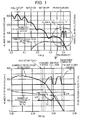
- FIG. 1 is graphs of an exemplary operation by the engine and the starter according to the present embodiment.
- the upper part of FIG. 1 is a graph of an operation over a general time.
- the lower part is a graph enlarged to specifically illustrate an operation before and after meshing of the pinion.
- An idle stop operation is started when it has been determined that an idle stop be performed. This operation starts with an interruption of fuel injection. Because of this fuel cut-off, the rotation of the engine stops involving combustion, making the engine unable to maintain the rotation. Consequently, the ring gear, which rotates with a crankshaft of the engine, starts reducing the number of revolutions thereof (the number of revolutions of the engine, the number of revolutions of the ring gear, and the rotational speed of the ring gear have an identical meaning herein). The engine, even when rotating due to inertia without the combustion, entails pulsating variations in rotational speed as illustrated in the figure because of incoming and outgoing air to/from a combustion chamber.
- a timing to start the preliminary rotation may also be defined by the rotational speed of the ring gear.
- the number of revolutions of the pinion (which is identical to the rotational speed thereof) is continuously detected.
- the energization of the motor is stopped to cause the rotation of the starter to switch to an inertial rotation.
- a timing to stop energizing the motor may also be defined by the number of revolutions of the pinion.
- a magnet switch which performs an operation to plunge the pinion, starts being energized at a timing marked with "MAGNET SWITCH ON” illustrated in the figure, but at this point in time, the rotational speeds of the ring gear and the pinion are significantly different from each other.
- This timing is decided by predicting the rotational speeds at a point in time marked with "END FACE COLLISION” in the figure and by performing calculation for bringing the predicted values within a defined range.
- Information necessary for the calculation includes the number of revolutions of the ring gear and the number of revolutions of the pinion, with each passing moment, a time taken since the start of the energization of the magnet switch until an end face collision is achieved, a deceleration characteristic of the rotation of the ring gear, and a deceleration characteristic of the rotation of the pinion.
- a relationship of the rotational speeds at the point in time of the end face collision, in the case where the energization of the magnet switch is started at the present time can be predicted.
- the magnet switch includes a solenoid coil and a plunger.
- the solenoid coil is magnetized and operates to attract the plunger. This movement of the plunger is transmitted through a shift lever to the pinion, so that the pinion is plunged.
- the plunging operation of the pinion is performed by the magnet switch, and, thus, a reduction in magnetic attraction force of the magnet switch reduces the plunging velocity of the pinion.
- the plunging velocity of the pinion can be reduced to an appropriate value. Note that, if the current to energize the magnet switch is simply reduced, the delay time from the start of the energization to the start of the movement of the plunger is increased.
- the energizing current can be passed in full during the time period from the start of the energization to the start of the movement of the plunger and then suppressed, by using a switching device, at and beyond the point in time when the pinion starts being plunged.
- an energizing pattern predetermined for the magnet switch will provide a steady operation from the start of the energization to the end face collision, stabilizing, to a certain level, the time period taken for the operation. If this time period is specified to a certain value, the rotational speeds of the ring gear and the pinion at the point in time of the end face collision can be predicted, and, thus, the timing to start the energization of the magnet switch can be determined by following a definition to be described herein.
- FIG. 2 is a diagram of a configuration of an electric circuit for performing the operation described above.
- a starter 1 a pinion 11 is rotated by a motor 13.
- the motor is energized through a switch 17.
- the switch 17 may be configured by a relay switch and may also be configured by a switch achieved by a semiconductor device, which can suppress a current through PWM control (which controls the energizing current by cycling ON/OFF rapidly through the ratio of ON time and OFF time).
- PWM control which controls the energizing current by cycling ON/OFF rapidly through the ratio of ON time and OFF time.
- As electrical wiring a cable from the negative pole is routed to a body metal to provide body ground, so that the wiring from a battery 4 can be carried out only with the positive pole.
- a magnet switch 12 provides a driving force to perform the plunging operation of the pinion 11.
- the magnet switch 12 includes a solenoid coil, a plunger 14, and a spring.
- the plunger 14 is attracted by the magnetic attraction force.
- the spring returns the plunger to an original position thereof when the magnetic attraction force is unavailable.
- the plunger 14, when attracted, makes the pinion 11 to perform the plunging operation through leverage by a shift lever 15.
- a switch 18 enables the energization of the magnet switch 12.
- the switch 18 may be configured by a relay switch, and it may also be configured by a semiconductor switch.
- the use of the semiconductor switch as the switch 18 may be suitable in the case where the energization is provided in full while the solenoid coil is generating the magnetic flux and the energizing current is suppressed at the timing when the pinion starts moving to perform the plunging operation of the pinion.
- the semiconductor switch is advantageous in that the semiconductor switch responds faster than the relay switch. Calculation of a timing to switch ON a relay switch should include consideration for a response delay time of the relay switch, while such consideration is not necessary for a semiconductor switch, which thus provides a better controllability.
- the switch 17 for the motor 13 and the switch 18 for the magnet switch 12 are controlled by a controller 2.
- the controller 2 may be an independent controller. Alternatively, a controller that controls the entire operation of the engine may serve as the controller 2.
- a significant characteristic of an idle stop system according to the present invention is that the system allows the plunging of the starter to be performed when the engine has not come to a complete stop. To achieve this characteristic, it is important to obtain the rotational speeds of the starter and the engine.
- a sensor 16 for detecting the rotational speed of the pinion 11 and a sensor 5 for detecting the rotational speed of the ring gear 3 are provided. The controller 2 obtains a result of the detection of the sensors, so that the plunging timing of the pinion can be determined.
- the rotational speed of the ring gear at the point in time when the pinion achieves the end face collision is predicted by using the deceleration characteristic of the rotation of the ring gear.
- the controller 2 obtains information on a crank angle of the engine for this prediction, the accuracy of the prediction can be further improved.
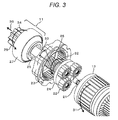
- FIG. 3 is an exploded view of an exemplary arrangement of the starter for use in the system according to the present invention.
- the motor 13 when energized, rotates in a direction of an arrow 31.
- the speed of the rotation of the motor is reduced by a planetary gear speed reducer to obtain an increased torque before the rotation is transferred to the pinion.
- a sun gear 21 is attached to a shaft of the motor 13.
- a planet gear 22 is in mesh with a sun gear 21 and an internal gear 23 simultaneously.
- the internal gear 23 is fixed by a body member and does not rotate.
- a shaft of the planet gear 22 constitutes a carrier of a planetary gear mechanism and is integral with a pinion shaft 24.
- the planet gear 22 When the sun gear 21 is rotated with the internal gear 23 fixed, the planet gear 22 is rotated while revolving around the sun gear.
- the revolution of the planet gear 22 rotates the pinion shaft 24, which is the carrier, in a direction of an arrow 32, which is an identical direction to the rotation of the motor 13.
- the pinion shaft 24 serves as a shaft to rotate the pinion 11, and the pinion shaft 24 and the pinion 11 are separate components.
- the pinion shaft 24 has a helical spline 25 formed thereon. This spiral protrusion meshes with a groove 26, formed on an inner side of the pinion 11, to transmit the rotation.
- the pinion shaft 24 does not move in an axial direction and allows the pinion 11 alone to travel in the axial direction.
- the pinion 11 travels, upon the plunging operation, in a direction of an arrow 35.
- the helical splines are configured in a spiral shape such that the helical spline turns in a reverse direction to the pinion shaft when the pinion 11 is advanced in the direction of the arrow 35.
- the pinion 11 performs the plunging operation as an integral part, but includes a plurality of components therein.
- the rotation is transmitted through a one-way clutch 27 to a gear 28 of the pinion.
- the one-way clutch 27 is configured to transmit to the gear 28 the rotating power in a direction from the motor, but not a rotating power in a reverse direction thereto. Because of this configuration, if the rotational speed of the ring gear is faster than the rotational speed of the pinion when the pinion is plunged, the power that rotates the motor of the starter is not transmitted in the direction from the ring gear. This can relieve an impact force of a collision of teeth's surfaces of the gears.
- the rotational speed of the pinion 11 decreases in a manner dependent on the plunging velocity.
- the traveling of the pinion in the plunging direction results in a rotation in the reverse direction to the forward rotation of the pinion due to an inclination 33 of the helical spline.
- the rotational speed of the pinion is reduced commensurately with the rotational speed in the reverse direction.
- the plunging velocity of the pinion is zero, and hence no change to the rotational speed is caused by the plunging.
- the rotational speed of the pinion is changed by the plunging operation.
- a characteristic of the present invention is that the determination of the plunging is performed with consideration given to an amount of this change to the rotational speed due to the plunging operation.
- An evaluation of the rotational speed of the pinion as the number of revolutions that synchronizes with the ring gear is equivalent to an evaluation of a circumferential velocity at a pitch circle of the gear.
- Np obtained by expression (1), is equal to Nr which is the rotational speed of the ring gear.
- the number of revolutions of the pinion in FIG. 1 refers to the number of revolutions converted in this way.
- the pinion when not traveling on the helical spline, is rotated at the number of revolutions per minute identical with that of the pinion shaft. Conversely, the pinion, when traveling on the helical spline, is rotated at the number of revolutions different from that of the pinion shaft because of the addition of a rotational speed dependent on the inclination of the helical spline.
- distinctive variables, Np and Np' are presented.
- ⁇ is defined as the number of revolutions at which the pinion is rotated over a distance the pinion has traveled in the axial direction.
- the product of the plunging velocity of the pinion and the inclination is the number of revolutions to be added due to the plunging. Consequently, the sum of the pinion shaft and the number of revolutions to be added equals the true number of revolutions of the pinion.
- a difference of the rotational speed of the ring gear of the pinion is also defined, as described by expression (3) and expression (4), as a difference based on the number of revolutions of the pinion shaft and as a difference with an effect of the plunging velocity taken into consideration.
- Expression (5) is a determination expression to define the plunging timing of the pinion. To perform the determination, the rotational speeds at a point in time when the pinion comes in contact with the ring gear are predicted. If a speed difference ⁇ N', calculated from the predicted rotational speeds, is equal to or lower than 180 revolutions per minute, the plunging is determined. By using this definition, the relative rotational speed difference at the time when the pinion, which has been plunged, comes in contact with the ring gear for the first time, will be equal to or lower than a constant value. A collision of solid objects generates greater noise and impact as a relative speed difference increases. A characteristic of the present invention is that the relative speeds of the pinion and the ring gear are defined with the effect of the plunging velocity of the pinion on the rotational speed taken into consideration, in order to reduce the noise.
- the magnet switch starts being energized, and through a mechanical operation, the pinion comes in contact with the ring gear.
- the rotational speeds of the ring gear and the pinion change.
- the rotational speed of the ring gear in particular, pulses as it decreases.
- Variables subjected to determination expression (5) are predicted values of the rotational speed of the ring gear and the rotational speed of the pinion at the point in time when the pinion comes in contact with the ring gear.
- the calculation of the predicted values bases on the rotational speed of the ring gear and the rotational speed of the pinion at the point in time of the determination.
- a predetermined value can be used because the plunging velocity is decided by the magnetic attraction force of the magnet switch.
- Expression (6) which is a modification of expression (5), has a physical significance identical to that of expression (5) but provides a view point of the plunging velocity of the pinion, which is different from that of expression (5).
- Expression (7) is another determination expression for the plunging.
- the speed difference between the ring gear and the pinion should be small, and even if the speed difference has a negative value, the condition is satisfied.
- the engagement is achieved more quietly by performing the determination of the plunging such that a condition of expression (7) is also satisfied.
- the plunging is started such that the pinion comes in contact with the ring gear at the point in time when the difference between the rotational speed of the ring gear and the rotational speed of the pinion, calculated from the number of revolutions of the pinion shaft, is greater than zero.
- the plunging timing can be delayed until a specific timing.
- the plunging timing cannot be delayed excessively.
- Nr decreases as the timing is delayed, resulting in lower ⁇ N and ⁇ N'.
- ⁇ N' is further lowered due to the timing that is delayed, the condition of expression (5) will not be dissatisfied.
- the condition of expression (7) will be dissatisfied at a certain timing.
- the condition of expression (7) is defined for the purpose of facilitating an operation to be performed after the pinion has been plunged and collided with the side face of the ring gear.
- the plunging velocity of the pinion will be zero, which raises the true rotational speed of the pinion until the true rotational speed equals Np.
- the change in rotational speed during this time period is also illustrated in the lower part of FIG. 1 .
- a relative rotational speed difference is needed.
- the definition of expression (7) is provided to ensure the difference in rotational speed between the ring gear and the pinion.
- the speed difference can be negative in order to merely allow a difference in rotational speed between the ring gear and the pinion. Whether the speed difference is positive or negative, however, makes a difference in the noise to be generated during the tooth surface collision caused when the pinion meshes with the ring gear. In other words, as described for the arrangement of the starter illustrated in FIG.
- the one-way clutch 27 is provided so that the impact of the tooth surface collision can be relieved by the one-way clutch when the rotational speed of the ring gear is higher than that of the pinion. Since this enables a noise reduction, the condition is defined as in expression (7).
- Expression (8) specifically defines the plunging velocity of the pinion when the pinion is plunged according to the present invention.
- a reduction in the plunging velocity of the pinion increases the time period, taken from the start of the plunging operation until the pinion comes in contact with the ring gear, and variability of this time period.
- the rotational speed of the ring gear varies significantly even in a short time, and thus, an increase in the time period taken for the plunging increases a variation, caused during this time period, of the rotational speed of the ring gear.
- This increases the level of estimation to be added to a measured value, resulting in lowered accuracy of the estimation.
- the lowered accuracy of the estimation prevents the engagement of the pinion under the conditions defined according to the present invention, resulting in an increased noise.
- the plunging velocity of the pinion is equal to or higher than 0.2 m/s according to the present invention.
- an excessively high plunging velocity of the pinion increases the impact of the end face collision, also increasing the noise.
- the plunging velocity of the pinion is equal to or lower than 0.5 m/s.
- the magnet switch can be energized in full for a certain time period after the start of the energization, and then the energizing current can be suppressed by the PWM control after the certain time period, so that the plunging velocity of the pinion is made equal to or lower than 0.5 m/s.
- the operation of the magnet switch so that the plunging velocity of the pinion is between an upper limit and a lower limit, it is possible to reduce the noise generated when the pinion is engaged during the rotation of the engine.
- an operation has been described to mesh the pinion of the starter with the ring gear when a restart request has not be generated and while the engine is in the process of stopping.
- the pinion and the ring gear can be also meshed with a similar method, when a restart request has been generated while the engine is in the process of stopping. In this case, the pinion is meshed with the ring gear, and then the motor is energized to restart the engine.
Landscapes
- Engineering & Computer Science (AREA)
- Chemical & Material Sciences (AREA)
- Combustion & Propulsion (AREA)
- Mechanical Engineering (AREA)
- General Engineering & Computer Science (AREA)
- Control Of Vehicle Engines Or Engines For Specific Uses (AREA)
- Connection Of Motors, Electrical Generators, Mechanical Devices, And The Like (AREA)
Abstract
There is provided a system, in which, during an engine stop through an idle stop operation and when the engine is in a process of stopping, a starter is rotated preliminarily, and then the rotational speeds of a ring gear and a pinion are detected by the sensors to determine a plunging timing of the pinion. In such a system, a reverse rotation speed, determined by an action of the helical spline configuration and a plunging velocity of the pinion, is subtracted from the rotational speed of the pinion, determined by the rotational speed of a motor. A resultant rotational speed is converted to the rotational speed of the ring gear by using the reduction ratio of the pinion and the ring gear. Calculation is performed such that, when a difference between the converted rotational speed and the rotational speed of the ring gear is equal to or lower than 180 revolutions per minute, the pinion contacts the ring gear. The start of energization of the magnet switch is determined accordingly to perform the plunging operation of the pinion. This enables a quiet engagement of the pinion of the starter with the ring gear of the engine, while the engine is in the process of stopping and is still rotating.
Description
- The present invention relates to a restart apparatus for a vehicle engine and a control method thereof. In particular, the present invention relates to a restart apparatus and a control method thereof for automatically stopping a vehicle engine when the engine is under no load or a low load, thereby reducing the fuel consumption of the engine, and for automatically restarting the engine when the power of the engine is needed.
- The background art of the present technical field is exemplified by
JP 2005-330813 A - In addition, a technique is described in Publication of Patent No
.4321796 - Publication of Patent No.
4118344 -
- PTL 1:
JP 2005-330813 A - PTL 2: Publication of Patent No.
4321796 - PTL 3: Publication of Patent No.
4118344 - An idle stop system automatically stops an engine without an operation directly performed by a driver, and, thus, it is necessary to restart the engine in response to a restart request by the driver without causing the driver to feel a delay even during the automatic stop. A most stringent condition for satisfying this requirement is imposed when the engine restart request is generated immediately after the automatic stop operation has been started. This is because the use of a typical pinion-plunging type starter requires the engine to completely stop before the starter starts the engine. In other words, the typical pinion-plunging type starter, if used with the rotation of the engine not stopped, would generate a significant noise before a plunged pinion meshes with a ring gear of the engine, which would also wear the pinion of the starter and the ring gear of the engine. If, to avoid these problems, this type of starter is used after the complete stop of the engine, it takes a considerable time before the engine recovers rotation, which would make a driver feel insecure. As a solution to this, there is a demand to engage a pinion of a starter with a ring gear of an engine quietly while the engine is in the process of stopping and thus still rotating.
- It is therefore an object of the present invention to allow a pinion of a starter to engage with a ring gear of an engine quietly while the engine is still rotating, thereby allowing the engine to restart quickly even if a restart request is generated immediately after an stop operation of the engine has been started. Another object of the present invention is to reduce a noise caused when the pinion meshes with the ring gear, thereby avoiding uneasiness felt by a driver and reducing wear of the pinion and the ring gear, which eliminates a need to replace the components due to deterioration even if an idle stop is performed frequently.
- In order to achieve the above object, there is provided a restart apparatus for a vehicle engine, the apparatus including:
- a starter that includes a shaft for transmitting a rotation of a motor to a pinion, the shaft having a helical spline, the pinion performing a plunging operation along a tooth of the spline, the plunging operation allowing a reverse rotation to be applied to the pinion, the reverse rotation being reverse to a direction of a forward rotation of the pinion; and
- a magnet switch for, through energization, enabling the plunging operation of the pinion into the ring gear, the apparatus being configured to restart the vehicle engine, when the engine is in a process of stopping through an idle stop operation, by rotating the starter and then plunging the pinion into the ring gear,
wherein the apparatus includes:- detecting means for detecting a rotational speed of the ring gear of the engine;
- detecting means for detecting a rotational speed of the pinion;
- calculating means for calculating a projected rotational speed of the pinion at a point in time of the plunging in conformity with the rotational speed of the pinion, an angle of inclination of the helical spline, and a reduction ratio of the pinion and the ring gear; and
- means for starting the energization of the magnet switch such that a difference between the projected rotational speed and the rotational speed of the ring gear is equal to or lower than a predetermined value of the number of revolutions.
- In order to achieve the above object, there is provided a control method of a restart apparatus for a vehicle engine, the restart apparatus including:
- a starter that includes a shaft for transmitting a rotation of a motor to a pinion, the shaft having a helical spline, the pinion performing a plunging operation along a tooth of the spline, the plunging operation allowing a reverse rotation to be applied to the pinion, the reverse rotation being reverse to a direction of a forward rotation of the pinion; and
- a magnet switch for, through energization, enabling the plunging operation of the pinion into the ring gear,
- the method including:
- rotating the starter when the engine is in a process of stopping through an idle stop operation;
- calculating a projected rotational speed of the pinion at a point in time of the plunging in conformity with a rotational speed of the pinion, an angle of inclination of the helical spline, and a reduction ratio of the pinion and the ring gear; and
- obtaining a difference between the projected rotational speed and a rotational speed of the ring gear, and when the difference is equal to or lower than a predetermined value of the number of revolutions, starting the energization of the magnet switch.
- The description and/or drawings of Japanese Patent Application No.
2010-281122 - The use of the present invention allows a pinion of a starter to engage with a ring gear of an engine quietly while the engine is still rotating, thereby allowing the engine to restart quickly even if a restart request is generated immediately after an stop operation of the engine has been started. The use of the present invention also reduces a noise caused when the pinion meshes with the ring gear, thereby avoiding uneasiness felt by a driver and reducing wear of the pinion and the ring gear, which eliminates a need to replace the components due to deterioration even if an idle stop is performed frequently.
-
- [
FIG. 1] FIG. 1 is graphs of an exemplary operation by an engine and a starter according to the present invention. - [
FIG. 2] FIG. 2 is a diagram of an exemplary electric circuit configuration of an idle stop system according to the present invention. - [
FIG. 3] FIG. 3 is an exploded view of an exemplary arrangement of the starter according to the present invention. - An embodiment will now be described with reference to the drawings.
- In the present embodiment, an exemplary operation will be described, in which an engine is in the process of stopping and a restart request has not been generated, when a pinion of a starter is meshed with a ring gear.
-
FIG. 1 is graphs of an exemplary operation by the engine and the starter according to the present embodiment. The upper part ofFIG. 1 is a graph of an operation over a general time. The lower part is a graph enlarged to specifically illustrate an operation before and after meshing of the pinion. - An idle stop operation is started when it has been determined that an idle stop be performed. This operation starts with an interruption of fuel injection. Because of this fuel cut-off, the rotation of the engine stops involving combustion, making the engine unable to maintain the rotation. Consequently, the ring gear, which rotates with a crankshaft of the engine, starts reducing the number of revolutions thereof (the number of revolutions of the engine, the number of revolutions of the ring gear, and the rotational speed of the ring gear have an identical meaning herein). The engine, even when rotating due to inertia without the combustion, entails pulsating variations in rotational speed as illustrated in the figure because of incoming and outgoing air to/from a combustion chamber. Once the engine rotation starts to decrease, only a motor of the starter is then energized to start a preliminary rotation of the starter. A timing to start the preliminary rotation may also be defined by the rotational speed of the ring gear. After the start of the preliminary rotation, the number of revolutions of the pinion (which is identical to the rotational speed thereof) is continuously detected. Once a certain condition is satisfied, the energization of the motor is stopped to cause the rotation of the starter to switch to an inertial rotation. A timing to stop energizing the motor may also be defined by the number of revolutions of the pinion. When the starter is rotating due to the inertia and while the number of revolutions of the ring gear is reducing, the pinion is plunged at a planned timing so that the pinion engages with the ring gear. An operation performed at this time will be described in detail with reference to the enlarged graph of the lower part.
- A magnet switch, which performs an operation to plunge the pinion, starts being energized at a timing marked with "MAGNET SWITCH ON" illustrated in the figure, but at this point in time, the rotational speeds of the ring gear and the pinion are significantly different from each other. This timing is decided by predicting the rotational speeds at a point in time marked with "END FACE COLLISION" in the figure and by performing calculation for bringing the predicted values within a defined range. Information necessary for the calculation includes the number of revolutions of the ring gear and the number of revolutions of the pinion, with each passing moment, a time taken since the start of the energization of the magnet switch until an end face collision is achieved, a deceleration characteristic of the rotation of the ring gear, and a deceleration characteristic of the rotation of the pinion. In other words, by combining the rotational speeds of the ring gear and the pinion at the present time, the deceleration characteristics thereof, and the time taken to achieve the end face collision, a relationship of the rotational speeds at the point in time of the end face collision, in the case where the energization of the magnet switch is started at the present time, can be predicted. When the relationship is within a defined range, which will be described hereinafter, is when the energization of the magnet switch should be started. The rotational speed of the ring gear is allowed to decrease until the relationship is brought within the defined range. The magnet switch includes a solenoid coil and a plunger. When the energization is started, the solenoid coil is magnetized and operates to attract the plunger. This movement of the plunger is transmitted through a shift lever to the pinion, so that the pinion is plunged. There is a time delay from the start of the energization of the magnet switch to the start of the movement of the pinion, because a sufficient magnetic field should be generated by the solenoid coil. Hence, a shift in timing is present between "MAGNET SWITCH ON" and "PLUNGING STARTED" in the figure. This shift in timing is mostly due to a time taken for the solenoid coil to generate a magnetic flux, and, therefore, the time delay can be reduced as an electric current to energize the magnet switch is increased. The pinion starts making the movement and travels a distance of a gap between the pinion and the ring gear until a face at an end of the pinion comes in contact with a side face of the ring gear, achieving "END FACE COLLISION" in the figure. A velocity at which the pinion travels is marked as PINION PLUNGING VELOCITY in the figure. Before "PLUNGING STARTED," the velocity is zero, and the plunging velocity is raised by "PLUNGING STARTED" to arrive at a peak of the plunging velocity immediately before "END FACE COLLISION." A higher pinion plunging velocity reduces a time period taken from "PLUNGING STARTED" to "END FACE COLLISION, " which can improve an accuracy with which the rotational speeds of the ring gear and the pinion are predicted at the point in time of "END FACE COLLISION." An end face collision achieved with a high plunging velocity, however, increases the noise, and, thus, suppressing the plunging velocity of the pinion to an appropriate value is also effective means for noise reduction. The plunging operation of the pinion is performed by the magnet switch, and, thus, a reduction in magnetic attraction force of the magnet switch reduces the plunging velocity of the pinion. Hence, by reducing the current to energize the magnet switch, the plunging velocity of the pinion can be reduced to an appropriate value. Note that, if the current to energize the magnet switch is simply reduced, the delay time from the start of the energization to the start of the movement of the plunger is increased. Thus, the energizing current can be passed in full during the time period from the start of the energization to the start of the movement of the plunger and then suppressed, by using a switching device, at and beyond the point in time when the pinion starts being plunged. In either case, an energizing pattern predetermined for the magnet switch will provide a steady operation from the start of the energization to the end face collision, stabilizing, to a certain level, the time period taken for the operation. If this time period is specified to a certain value, the rotational speeds of the ring gear and the pinion at the point in time of the end face collision can be predicted, and, thus, the timing to start the energization of the magnet switch can be determined by following a definition to be described herein.
- After "END FACE COLLISION, at which the face at the end of the pinion comes in contact with the side face of the ring gear, an operation is performed in which the pinion and the ring gear continue rotating with the end faces sliding with each other. During this time period, the plunging velocity of the pinion is zero. Then, when a tooth of the pinion coincides with a gap between teeth of the ring gear, the pinion starts being inserted, resulting again in an increased plunging velocity of the pinion. When the pinion is fully inserted and the plunging velocity is zero, the engagement of the pinion is completed.
-
FIG. 2 is a diagram of a configuration of an electric circuit for performing the operation described above. In astarter 1, apinion 11 is rotated by amotor 13. The motor is energized through aswitch 17. Theswitch 17 may be configured by a relay switch and may also be configured by a switch achieved by a semiconductor device, which can suppress a current through PWM control (which controls the energizing current by cycling ON/OFF rapidly through the ratio of ON time and OFF time). As electrical wiring, a cable from the negative pole is routed to a body metal to provide body ground, so that the wiring from abattery 4 can be carried out only with the positive pole. - A
magnet switch 12 provides a driving force to perform the plunging operation of thepinion 11. Themagnet switch 12 includes a solenoid coil, aplunger 14, and a spring. Theplunger 14 is attracted by the magnetic attraction force. The spring returns the plunger to an original position thereof when the magnetic attraction force is unavailable. Theplunger 14, when attracted, makes thepinion 11 to perform the plunging operation through leverage by ashift lever 15. Aswitch 18 enables the energization of themagnet switch 12. Similarly to theswitch 17 for the motor, theswitch 18 may be configured by a relay switch, and it may also be configured by a semiconductor switch. The use of the semiconductor switch as theswitch 18 may be suitable in the case where the energization is provided in full while the solenoid coil is generating the magnetic flux and the energizing current is suppressed at the timing when the pinion starts moving to perform the plunging operation of the pinion. In addition, the semiconductor switch is advantageous in that the semiconductor switch responds faster than the relay switch. Calculation of a timing to switch ON a relay switch should include consideration for a response delay time of the relay switch, while such consideration is not necessary for a semiconductor switch, which thus provides a better controllability. - The
switch 17 for themotor 13 and theswitch 18 for themagnet switch 12 are controlled by acontroller 2. Thecontroller 2 may be an independent controller. Alternatively, a controller that controls the entire operation of the engine may serve as thecontroller 2. A significant characteristic of an idle stop system according to the present invention is that the system allows the plunging of the starter to be performed when the engine has not come to a complete stop. To achieve this characteristic, it is important to obtain the rotational speeds of the starter and the engine. Thus, asensor 16 for detecting the rotational speed of thepinion 11 and asensor 5 for detecting the rotational speed of the ring gear 3 are provided. Thecontroller 2 obtains a result of the detection of the sensors, so that the plunging timing of the pinion can be determined. Furthermore, the rotational speed of the ring gear at the point in time when the pinion achieves the end face collision is predicted by using the deceleration characteristic of the rotation of the ring gear. Here, if thecontroller 2 obtains information on a crank angle of the engine for this prediction, the accuracy of the prediction can be further improved. -
FIG. 3 is an exploded view of an exemplary arrangement of the starter for use in the system according to the present invention. Themotor 13, when energized, rotates in a direction of anarrow 31. The speed of the rotation of the motor is reduced by a planetary gear speed reducer to obtain an increased torque before the rotation is transferred to the pinion. Thus, asun gear 21 is attached to a shaft of themotor 13. Aplanet gear 22 is in mesh with asun gear 21 and aninternal gear 23 simultaneously. Theinternal gear 23 is fixed by a body member and does not rotate. A shaft of theplanet gear 22 constitutes a carrier of a planetary gear mechanism and is integral with apinion shaft 24. When thesun gear 21 is rotated with theinternal gear 23 fixed, theplanet gear 22 is rotated while revolving around the sun gear. The revolution of theplanet gear 22 rotates thepinion shaft 24, which is the carrier, in a direction of anarrow 32, which is an identical direction to the rotation of themotor 13. Thepinion shaft 24 serves as a shaft to rotate thepinion 11, and thepinion shaft 24 and thepinion 11 are separate components. Thepinion shaft 24 has ahelical spline 25 formed thereon. This spiral protrusion meshes with agroove 26, formed on an inner side of thepinion 11, to transmit the rotation. Since the rotation is transmitted in this way, upon the plunging operation performed by thepinion 11, thepinion shaft 24 does not move in an axial direction and allows thepinion 11 alone to travel in the axial direction. Thepinion 11 travels, upon the plunging operation, in a direction of anarrow 35. The helical splines are configured in a spiral shape such that the helical spline turns in a reverse direction to the pinion shaft when thepinion 11 is advanced in the direction of thearrow 35. When a rotating power from the motor is transmitted with thepinion 11 being loaded, the configuration of the spiral shape in the direction as described above allows an inclined surface in mesh with the helical spline to act to generate a force to push thepinion 11 in the direction of thearrow 35. This prevents the pinion and the ring gear from moving out of mesh with each other during the cranking in which the engine is rotated by the starter. - The
pinion 11 performs the plunging operation as an integral part, but includes a plurality of components therein. The rotation is transmitted through a one-way clutch 27 to agear 28 of the pinion. The one-way clutch 27 is configured to transmit to thegear 28 the rotating power in a direction from the motor, but not a rotating power in a reverse direction thereto. Because of this configuration, if the rotational speed of the ring gear is faster than the rotational speed of the pinion when the pinion is plunged, the power that rotates the motor of the starter is not transmitted in the direction from the ring gear. This can relieve an impact force of a collision of teeth's surfaces of the gears. - With the spiral direction of the helical spline configured in the direction described above, when the pinion is plunged after the preliminary rotation, the rotational speed of the
pinion 11 decreases in a manner dependent on the plunging velocity. In other words, the traveling of the pinion in the plunging direction results in a rotation in the reverse direction to the forward rotation of the pinion due to aninclination 33 of the helical spline. Thus, the rotational speed of the pinion is reduced commensurately with the rotational speed in the reverse direction. At the time of determination of the plunging of the pinion, the plunging velocity of the pinion is zero, and hence no change to the rotational speed is caused by the plunging. Once the determination of the plunging has been performed and the plunging operation has started, the rotational speed of the pinion is changed by the plunging operation. A characteristic of the present invention is that the determination of the plunging is performed with consideration given to an amount of this change to the rotational speed due to the plunging operation. - Some relational expressions associated with the determination of the plunging timing of the starter according to the present invention will now be described. Variables to be used in the relational expressions are defined below.
-
- Zp: the number of teeth of the pinion
- Zr: the number of teeth of the ring gear
- Np0: the number of revolutions per minute (= rotational speed) of the pinion shaft [r/min]
- Np: the number of revolutions per minute (= rotational speed) obtained by converting the number of revolutions per minute of the pinion shaft to the number of revolutions of the synchronizing ring gear [r/min]
- Np': the number of revolutions per minute (= rotational speed) obtained by converting the true number of revolutions of the pinion to the number of revolutions of the synchronizing ring gear [r/min]
- Vp: plunging velocity of the pinion [m/s]
- φ: the inclination of the helical spline (the number of turns over a distance in an axial direction) [r/m]
- An evaluation of the rotational speed of the pinion as the number of revolutions that synchronizes with the ring gear is equivalent to an evaluation of a circumferential velocity at a pitch circle of the gear. When the pinion and the ring gear are rotated in synchronization with each other, the numbers of revolutions per minute differ but the circumferential velocities of their respective pitch circles are identical with each other. Similarly, when the pinion and the ring gear are rotated in synchronization with each other, Np, obtained by expression (1), is equal to Nr which is the rotational speed of the ring gear. The number of revolutions of the pinion in
FIG. 1 refers to the number of revolutions converted in this way. The pinion, when not traveling on the helical spline, is rotated at the number of revolutions per minute identical with that of the pinion shaft. Conversely, the pinion, when traveling on the helical spline, is rotated at the number of revolutions different from that of the pinion shaft because of the addition of a rotational speed dependent on the inclination of the helical spline. Hence, distinctive variables, Np and Np', are presented. As the inclination of the helical spline, φ is defined as the number of revolutions at which the pinion is rotated over a distance the pinion has traveled in the axial direction. Thus, the product of the plunging velocity of the pinion and the inclination is the number of revolutions to be added due to the plunging. Consequently, the sum of the pinion shaft and the number of revolutions to be added equals the true number of revolutions of the pinion. A difference of the rotational speed of the ring gear of the pinion is also defined, as described by expression (3) and expression (4), as a difference based on the number of revolutions of the pinion shaft and as a difference with an effect of the plunging velocity taken into consideration.
[Expression 3]
[Expression 4]
- Expression (5) is a determination expression to define the plunging timing of the pinion. To perform the determination, the rotational speeds at a point in time when the pinion comes in contact with the ring gear are predicted. If a speed difference ΔN', calculated from the predicted rotational speeds, is equal to or lower than 180 revolutions per minute, the plunging is determined. By using this definition, the relative rotational speed difference at the time when the pinion, which has been plunged, comes in contact with the ring gear for the first time, will be equal to or lower than a constant value. A collision of solid objects generates greater noise and impact as a relative speed difference increases. A characteristic of the present invention is that the relative speeds of the pinion and the ring gear are defined with the effect of the plunging velocity of the pinion on the rotational speed taken into consideration, in order to reduce the noise.
- Once the determination of the plunging is performed, the magnet switch starts being energized, and through a mechanical operation, the pinion comes in contact with the ring gear. In a period of time up to the contact, the rotational speeds of the ring gear and the pinion change. The rotational speed of the ring gear, in particular, pulses as it decreases. Hence, it is necessary to perform the determination on the basis of an accurately predicted rotational speed after a specific time has elapsed. Variables subjected to determination expression (5) are predicted values of the rotational speed of the ring gear and the rotational speed of the pinion at the point in time when the pinion comes in contact with the ring gear. The calculation of the predicted values bases on the rotational speed of the ring gear and the rotational speed of the pinion at the point in time of the determination. As the plunging velocity of the pinion, which is needed for the calculation of the true number of revolutions of the pinion, a predetermined value can be used because the plunging velocity is decided by the magnetic attraction force of the magnet switch.
- Expression (6), which is a modification of expression (5), has a physical significance identical to that of expression (5) but provides a view point of the plunging velocity of the pinion, which is different from that of expression (5).
[Expression 5]
[Expression 6]
- Satisfying a condition of expression (5) conforms to satisfying a condition of the plunging velocity defined by expression (6). In other words, the plunging velocity of the pinion at the point in time when the pinion comes in contact with the ring gear will be equal to or lower than a value obtained by expression (6).
[Expression 7]
[Expression 8]
- Expression (7) is another determination expression for the plunging. In order to satisfy the determination of expression (5), the speed difference between the ring gear and the pinion should be small, and even if the speed difference has a negative value, the condition is satisfied. In a method according to the present invention, the engagement is achieved more quietly by performing the determination of the plunging such that a condition of expression (7) is also satisfied. In other words, the plunging is started such that the pinion comes in contact with the ring gear at the point in time when the difference between the rotational speed of the ring gear and the rotational speed of the pinion, calculated from the number of revolutions of the pinion shaft, is greater than zero. In order to satisfy the condition of expression (5) with the rotation speed of the engine decreasing, the plunging timing can be delayed until a specific timing. In order to satisfy expression (7) simultaneously, however, the plunging timing cannot be delayed excessively. In other words, when the rotational speed of the ring gear is decreasing, Nr decreases as the timing is delayed, resulting in lower ΔN and ΔN'. Even if ΔN' is further lowered due to the timing that is delayed, the condition of expression (5) will not be dissatisfied. The condition of expression (7), however, will be dissatisfied at a certain timing.
- The condition of expression (7) is defined for the purpose of facilitating an operation to be performed after the pinion has been plunged and collided with the side face of the ring gear. In other words, upon the end face collision of the pinion and the ring gear, the plunging velocity of the pinion will be zero, which raises the true rotational speed of the pinion until the true rotational speed equals Np. The change in rotational speed during this time period is also illustrated in the lower part of
FIG. 1 . In order for sliding between the end face of the pinion and the side face of the ring gear to advance to entry of a tooth of the pinion into a gap between teeth of the ring gear, a relative rotational speed difference is needed. If the rotational speed of the ring gear agrees with that of the pinion completely, the relative positional relationship between the teeth of the ring gear and the pinion does not change while the ring gear and the pinion continue sliding and rotating, and thus the pinion fails to achieve the entry. Hence, the definition of expression (7) is provided to ensure the difference in rotational speed between the ring gear and the pinion. The speed difference can be negative in order to merely allow a difference in rotational speed between the ring gear and the pinion. Whether the speed difference is positive or negative, however, makes a difference in the noise to be generated during the tooth surface collision caused when the pinion meshes with the ring gear. In other words, as described for the arrangement of the starter illustrated inFIG. 3 , the one-way clutch 27 is provided so that the impact of the tooth surface collision can be relieved by the one-way clutch when the rotational speed of the ring gear is higher than that of the pinion. Since this enables a noise reduction, the condition is defined as in expression (7). - Expression (8) specifically defines the plunging velocity of the pinion when the pinion is plunged according to the present invention. A reduction in the plunging velocity of the pinion increases the time period, taken from the start of the plunging operation until the pinion comes in contact with the ring gear, and variability of this time period. The rotational speed of the ring gear varies significantly even in a short time, and thus, an increase in the time period taken for the plunging increases a variation, caused during this time period, of the rotational speed of the ring gear. This increases the level of estimation to be added to a measured value, resulting in lowered accuracy of the estimation. The lowered accuracy of the estimation prevents the engagement of the pinion under the conditions defined according to the present invention, resulting in an increased noise. Hence, the plunging velocity of the pinion is equal to or higher than 0.2 m/s according to the present invention. In addition, an excessively high plunging velocity of the pinion increases the impact of the end face collision, also increasing the noise. Thus, the plunging velocity of the pinion is equal to or lower than 0.5 m/s. Furthermore, as means to reduce the time period taken for the plunging without increasing the plunging velocity of the pinion, the magnet switch can be energized in full for a certain time period after the start of the energization, and then the energizing current can be suppressed by the PWM control after the certain time period, so that the plunging velocity of the pinion is made equal to or lower than 0.5 m/s. As described above, by designing the operation of the magnet switch so that the plunging velocity of the pinion is between an upper limit and a lower limit, it is possible to reduce the noise generated when the pinion is engaged during the rotation of the engine.
- In the embodiment of the present invention, an operation has been described to mesh the pinion of the starter with the ring gear when a restart request has not be generated and while the engine is in the process of stopping. The pinion and the ring gear can be also meshed with a similar method, when a restart request has been generated while the engine is in the process of stopping. In this case, the pinion is meshed with the ring gear, and then the motor is energized to restart the engine.
-
- 1 starter
- 2 controller
- 3 ring gear
- 4 battery
- 5 ring gear rotational speed sensor
- 11 pinion
- 12 magnet switch
- 13 motor
- 14 plunger
- 15 shift lever
- 16 pinion rotational speed sensor
- 17 switch for motor
[Expression 1]

[Expression 2]

Claims (10)
- A restart apparatus for a vehicle engine, the apparatus comprising:a starter that includes a shaft for transmitting a rotation of a motor to a pinion, the shaft having a helical spline, the pinion performing a plunging operation along a tooth of the spline, the plunging operation allowing a reverse rotation to be applied to the pinion, the reverse rotation being reverse to a direction of a forward rotation of the pinion; anda magnet switch for, through energization, enabling the plunging operation of the pinion into the ring gear,the apparatus being configured to restart the vehicle engine, when the engine is in a process of stopping through an idle stop operation, by rotating the starter and then plunging the pinion into the ring gear,wherein the apparatus comprises:detecting means for detecting a rotational speed of the ring gear of the engine;detecting means for detecting a rotational speed of the pinion;calculating means for calculating a projected rotational speed of the pinion at a point in time of the plunging in conformity with the rotational speed of the pinion, an angle of inclination of the helical spline, and a reduction ratio of the pinion and the ring gear; andmeans for starting the energization of the magnet switch such that a difference between the projected rotational speed and the rotational speed of the ring gear is equal to or lower than a predetermined value of the number of revolutions.
- The restart apparatus for a vehicle engine according to claim 1,
wherein the predetermined value of the number of revolutions is 180 revolutions per minute. - The restart apparatus for a vehicle engine according to claim 2,
wherein the calculating means subtracts a speed of the reverse rotation, determined by an action of the angle of inclination of the helical spline and a velocity of the plunging of the pinion, from the rotational speed of the pinion, and multiplies a resultant rotational speed by the reduction ratio of the pinion and the ring gear, in order to obtain the projected rotational speed of the pinion at the point in time of the plunging. - The restart apparatus for a vehicle engine according to claim 2,
wherein the energization is started only when the rotational speed of the ring gear is higher than the projected rotational speed. - The restart apparatus for a vehicle engine according to any of claims 1 to 4,
wherein the magnet switch is energized continuously from, the starting of the energization until a specific time, and then the magnet switch is energized discontinuously through PWM control to suppress an energizing current, so that the velocity of the plunging immediately before the pinion comes in contact with the ring gear is in a range of 0.2 to 0.5 m/s. - A control method of a restart apparatus for a vehicle engine, the restart apparatus comprising:a starter that includes a shaft for transmitting a rotation of a motor to a pinion, the shaft having a helical spline, the pinion performing a plunging operation along a tooth of the spline, the plunging operation allowing a reverse rotation to be applied to the pinion, the reverse rotation being reverse to a direction of a forward rotation of the pinion; anda magnet switch for, through energization, enabling the plunging operation of the pinion into the ring gear,the method comprising:rotating the starter when the engine is in a process of stopping through an idle stop operation;calculating a projected rotational speed of the pinion at a point in time of the plunging in conformity with a rotational speed of the pinion, an angle of inclination of the helical spline, and a reduction ratio of the pinion and the ring gear; andobtaining a difference between the projected rotational speed and a rotational speed of the ring gear, and when the difference is equal to or lower than a predetermined value of the number of revolutions, starting the energization of the magnet switch.
- The control method of the restart apparatus for a vehicle engine according to claim 6,
wherein the predetermined value of the number of revolutions is 180 revolutions per minute. - The control method of the restart apparatus for a vehicle engine according to claim 7,
wherein the calculating subtracts a speed of the reverse rotation, determined by an action of the angle of inclination of the helical spline and a velocity of the plunging of the pinion, from the rotational speed of the pinion, and multiplies a resultant rotational speed by the reduction ratio of the pinion and the ring gear, in order to obtain the projected rotational speed of the pinion at the point in time of the plunging. - The control method of the restart apparatus for a vehicle engine according to claim 7,
wherein the energization is started only when the rotational speed of the ring gear is higher than the projected rotational speed. - The control method of the restart apparatus for a vehicle engine according to any of claim 6 to 9,
wherein the magnet switch is energized continuously from the starting of the energization until a specific time, and then the magnet switch is energized discontinuously through PWM control to suppress an energizing current, so that the velocity of the plunging immediately before the pinion comes in contact with the ring gear is in a range of 0.2 to 0.5 m/s.
Applications Claiming Priority (2)
| Application Number | Priority Date | Filing Date | Title |
|---|---|---|---|
| JP2010281122A JP5409587B2 (en) | 2010-12-17 | 2010-12-17 | Vehicle engine restart device and control method thereof |
| PCT/JP2011/078987 WO2012081651A1 (en) | 2010-12-17 | 2011-12-15 | Restart device of vehicular engine and method for controlling same |
Publications (1)
| Publication Number | Publication Date |
|---|---|
| EP2653713A1 true EP2653713A1 (en) | 2013-10-23 |
Family
ID=46244745
Family Applications (1)
| Application Number | Title | Priority Date | Filing Date |
|---|---|---|---|
| EP11848744.6A Withdrawn EP2653713A1 (en) | 2010-12-17 | 2011-12-15 | Restart device of vehicular engine and method for controlling same |
Country Status (4)
| Country | Link |
|---|---|
| EP (1) | EP2653713A1 (en) |
| JP (1) | JP5409587B2 (en) |
| CN (1) | CN103261671B (en) |
| WO (1) | WO2012081651A1 (en) |
Cited By (2)
| Publication number | Priority date | Publication date | Assignee | Title |
|---|---|---|---|---|
| RU2618983C1 (en) * | 2016-05-25 | 2017-05-11 | Частное образовательное учреждение дополнительного профессионального образования "Саранский Дом науки и техники Российского Союза научных и инженерных общественных объединений" | Ice starter |
| US10266255B2 (en) | 2014-04-01 | 2019-04-23 | Airbus Operations Limited | Drive system for aircraft landing gear |
Families Citing this family (2)
| Publication number | Priority date | Publication date | Assignee | Title |
|---|---|---|---|---|
| US20140096642A1 (en) * | 2012-10-05 | 2014-04-10 | Remy Technologies, Llc | Starter motor |
| JP6071736B2 (en) * | 2013-05-08 | 2017-02-01 | 三菱電機株式会社 | Engine starter |
Family Cites Families (9)
| Publication number | Priority date | Publication date | Assignee | Title |
|---|---|---|---|---|
| DE19702932A1 (en) | 1997-01-28 | 1998-07-30 | Bosch Gmbh Robert | Circuit arrangement for an engagement relay |
| JP4321796B2 (en) | 2000-08-10 | 2009-08-26 | 株式会社デンソー | Starter control method |
| JP4211208B2 (en) * | 2000-08-23 | 2009-01-21 | トヨタ自動車株式会社 | Fuel consumption saving car |
| JP4214401B2 (en) * | 2004-05-18 | 2009-01-28 | 株式会社デンソー | Engine automatic stop / restart device |
| DE102006011644A1 (en) * | 2006-03-06 | 2007-09-13 | Robert Bosch Gmbh | Device having a first gear part for meshing in a second gear part, in particular starting device with a pinion for meshing in a ring gear of an internal combustion engine and method for operating such a device |
| FR2925615B1 (en) * | 2007-12-20 | 2017-07-28 | Renault Sas | CONTROL METHOD FOR STARTER OF A COMBUSTION ENGINE AND ITS APPLICATION |
| JP5007839B2 (en) * | 2008-09-02 | 2012-08-22 | 株式会社デンソー | Engine automatic stop / start control device |
| EP2211051B8 (en) * | 2009-01-21 | 2019-09-11 | Denso Corporation | System for restarting internal combustion engine |
| JP2010281122A (en) | 2009-06-05 | 2010-12-16 | Kawamura Electric Inc | Louver mounting structure |
-
2010
- 2010-12-17 JP JP2010281122A patent/JP5409587B2/en not_active Expired - Fee Related
-
2011
- 2011-12-15 WO PCT/JP2011/078987 patent/WO2012081651A1/en not_active Ceased
- 2011-12-15 CN CN201180060709.5A patent/CN103261671B/en not_active Expired - Fee Related
- 2011-12-15 EP EP11848744.6A patent/EP2653713A1/en not_active Withdrawn
Non-Patent Citations (1)
| Title |
|---|
| See references of WO2012081651A1 * |
Cited By (3)
| Publication number | Priority date | Publication date | Assignee | Title |
|---|---|---|---|---|
| US10266255B2 (en) | 2014-04-01 | 2019-04-23 | Airbus Operations Limited | Drive system for aircraft landing gear |
| US11066154B2 (en) * | 2014-04-01 | 2021-07-20 | Airbus Operations Limited | Drive system for aircraft landing gear |
| RU2618983C1 (en) * | 2016-05-25 | 2017-05-11 | Частное образовательное учреждение дополнительного профессионального образования "Саранский Дом науки и техники Российского Союза научных и инженерных общественных объединений" | Ice starter |
Also Published As
| Publication number | Publication date |
|---|---|
| WO2012081651A1 (en) | 2012-06-21 |
| CN103261671B (en) | 2016-02-03 |
| JP5409587B2 (en) | 2014-02-05 |
| CN103261671A (en) | 2013-08-21 |
| JP2012127306A (en) | 2012-07-05 |
Similar Documents
| Publication | Publication Date | Title |
|---|---|---|
| JP4835774B2 (en) | Engine stop / start control device | |
| US9115683B2 (en) | Engine starting device | |
| US9267479B2 (en) | Engine starting device and engine starting method | |
| JP5978904B2 (en) | Engine control device | |
| US20150096535A1 (en) | Engine starting device and engine starting method | |
| US9429131B2 (en) | Starter system and method | |
| CN102597490B (en) | Engine starting device | |
| JP5321524B2 (en) | Engine automatic stop / start control device | |
| US20130081514A1 (en) | Engine starter | |
| EP2653713A1 (en) | Restart device of vehicular engine and method for controlling same | |
| JP6198971B2 (en) | Engine starter | |
| EP2895733B1 (en) | Control device of vehicle and control method of vehicle | |
| CN110425070B (en) | Brushless starting system with pinion pre-engagement control | |
| CN108825419B (en) | Engine starting apparatus | |
| JP2011140939A (en) | Engine automatic stop-and-start control appartus | |
| JP2010190208A (en) | Engine automatic stop/start control device | |
| JP6181954B2 (en) | Vehicle control device | |
| US11098687B2 (en) | Engine starting device | |
| JP2013100749A (en) | Internal combustion engine stop device | |
| JP2012021494A (en) | Starting device of engine and vehicle mounted therewith | |
| JP2017141701A (en) | Engine start control device and engine start control method | |
| JPWO2012131845A1 (en) | Starter control device and control method, and vehicle | |
| WO2013046388A1 (en) | Engine control device and control method | |
| JP6432492B2 (en) | Engine starter | |
| JP2014234762A (en) | Engine starter of vehicle employing idle stop system |
Legal Events
| Date | Code | Title | Description |
|---|---|---|---|
| PUAI | Public reference made under article 153(3) epc to a published international application that has entered the european phase |
Free format text: ORIGINAL CODE: 0009012 |
|
| 17P | Request for examination filed |
Effective date: 20130717 |
|
| AK | Designated contracting states |
Kind code of ref document: A1 Designated state(s): AL AT BE BG CH CY CZ DE DK EE ES FI FR GB GR HR HU IE IS IT LI LT LU LV MC MK MT NL NO PL PT RO RS SE SI SK SM TR |
|
| DAX | Request for extension of the european patent (deleted) | ||
| STAA | Information on the status of an ep patent application or granted ep patent |
Free format text: STATUS: THE APPLICATION HAS BEEN WITHDRAWN |
|
| 18W | Application withdrawn |
Effective date: 20160308 |