EP2653700A2 - High bleed flow muffling system - Google Patents
High bleed flow muffling system Download PDFInfo
- Publication number
- EP2653700A2 EP2653700A2 EP13163433.9A EP13163433A EP2653700A2 EP 2653700 A2 EP2653700 A2 EP 2653700A2 EP 13163433 A EP13163433 A EP 13163433A EP 2653700 A2 EP2653700 A2 EP 2653700A2
- Authority
- EP
- European Patent Office
- Prior art keywords
- orifice plate
- flow
- muffling device
- orifice
- compressible fluid
- Prior art date
- Legal status (The legal status is an assumption and is not a legal conclusion. Google has not performed a legal analysis and makes no representation as to the accuracy of the status listed.)
- Withdrawn
Links
- 239000012530 fluid Substances 0.000 claims abstract description 71
- 238000011144 upstream manufacturing Methods 0.000 claims abstract description 11
- 238000000034 method Methods 0.000 claims description 19
- 238000007599 discharging Methods 0.000 claims description 5
- 230000001052 transient effect Effects 0.000 claims description 5
- 239000000446 fuel Substances 0.000 claims description 4
- 239000007789 gas Substances 0.000 description 20
- 238000002485 combustion reaction Methods 0.000 description 3
- 230000000740 bleeding effect Effects 0.000 description 2
- 230000006835 compression Effects 0.000 description 2
- 238000007906 compression Methods 0.000 description 2
- 239000000463 material Substances 0.000 description 2
- 230000003068 static effect Effects 0.000 description 2
- 239000000567 combustion gas Substances 0.000 description 1
- 238000001816 cooling Methods 0.000 description 1
- 230000003116 impacting effect Effects 0.000 description 1
- 238000010926 purge Methods 0.000 description 1
- 239000007787 solid Substances 0.000 description 1
Images




Classifications
-
- F—MECHANICAL ENGINEERING; LIGHTING; HEATING; WEAPONS; BLASTING
- F02—COMBUSTION ENGINES; HOT-GAS OR COMBUSTION-PRODUCT ENGINE PLANTS
- F02C—GAS-TURBINE PLANTS; AIR INTAKES FOR JET-PROPULSION PLANTS; CONTROLLING FUEL SUPPLY IN AIR-BREATHING JET-PROPULSION PLANTS
- F02C7/00—Features, components parts, details or accessories, not provided for in, or of interest apart form groups F02C1/00 - F02C6/00; Air intakes for jet-propulsion plants
- F02C7/04—Air intakes for gas-turbine plants or jet-propulsion plants
- F02C7/045—Air intakes for gas-turbine plants or jet-propulsion plants having provisions for noise suppression
-
- F—MECHANICAL ENGINEERING; LIGHTING; HEATING; WEAPONS; BLASTING
- F02—COMBUSTION ENGINES; HOT-GAS OR COMBUSTION-PRODUCT ENGINE PLANTS
- F02C—GAS-TURBINE PLANTS; AIR INTAKES FOR JET-PROPULSION PLANTS; CONTROLLING FUEL SUPPLY IN AIR-BREATHING JET-PROPULSION PLANTS
- F02C7/00—Features, components parts, details or accessories, not provided for in, or of interest apart form groups F02C1/00 - F02C6/00; Air intakes for jet-propulsion plants
- F02C7/24—Heat or noise insulation
-
- F—MECHANICAL ENGINEERING; LIGHTING; HEATING; WEAPONS; BLASTING
- F02—COMBUSTION ENGINES; HOT-GAS OR COMBUSTION-PRODUCT ENGINE PLANTS
- F02K—JET-PROPULSION PLANTS
- F02K1/00—Plants characterised by the form or arrangement of the jet pipe or nozzle; Jet pipes or nozzles peculiar thereto
- F02K1/28—Plants characterised by the form or arrangement of the jet pipe or nozzle; Jet pipes or nozzles peculiar thereto using fluid jets to influence the jet flow
- F02K1/34—Plants characterised by the form or arrangement of the jet pipe or nozzle; Jet pipes or nozzles peculiar thereto using fluid jets to influence the jet flow for attenuating noise
-
- Y—GENERAL TAGGING OF NEW TECHNOLOGICAL DEVELOPMENTS; GENERAL TAGGING OF CROSS-SECTIONAL TECHNOLOGIES SPANNING OVER SEVERAL SECTIONS OF THE IPC; TECHNICAL SUBJECTS COVERED BY FORMER USPC CROSS-REFERENCE ART COLLECTIONS [XRACs] AND DIGESTS
- Y02—TECHNOLOGIES OR APPLICATIONS FOR MITIGATION OR ADAPTATION AGAINST CLIMATE CHANGE
- Y02T—CLIMATE CHANGE MITIGATION TECHNOLOGIES RELATED TO TRANSPORTATION
- Y02T50/00—Aeronautics or air transport
- Y02T50/60—Efficient propulsion technologies, e.g. for aircraft
Definitions
- the subject matter disclosed herein relates generally to muffling systems, and, more specifically, to muffling devices capable of providing pressure drops, acoustic improvements, and desirable flow properties.
- air is pressurized in a compression module.
- the air channeled through the compression module is mixed with fuel in a combustor and ignited, generating hot combustion gases, which flow through turbine stages that extract energy therefrom for powering the fan and compressor rotors and generate engine thrust to propel an aircraft in flight or to power a load, such as an electrical generator.
- a portion of the high-pressure air such as, for example, bleed air from a compressor, may be extracted or bled from the compressor for various needs. These needs include, for example, compressor flow bleeding which may be used to improve operability as well as to provide turbine cooling, bearing sump pressurization, purge air, or aircraft environment control.
- the air may be bled off from the compressor using bleed slots located over specific portions or stages of the compressor.
- the compressor may pump more air than is required for needs including the combustion process.
- a portion of the excess bleed air from the compressor may be routed through bleed conduits and exhausted into the fan flow stream, engine exhaust, or to ambient.
- the pressure and temperature of the air stream bled from the compressor may be very high.
- bleed air pressure may be greater than about 1375 kPa and the bleed air temperature may be greater than about 538 degrees C.
- TBV transient bleed valve system
- the exhaust area of some conventional bleed systems may be oversized to lower the flow velocity at the exhaust location to assure that the acoustic requirements are met for the application.
- the exhaust area, as well as the relatively gently expansions between the source pressure and exhaust, may contribute to the relatively large size and/or weight of these systems.
- At least one solution for the above-mentioned problem(s) is provided by the present disclosure to include example embodiments, provided for illustrative teaching and not meant to be limiting.
- An example muffling device may include a muffling device body including an inlet (which may include an inlet flow restrictor) arranged to direct a flow of a compressible fluid into an interior of the muffling device body; a first orifice plate arranged to receive at least some of the flow of the compressible fluid from the interior of the muffling device body, the first orifice plate including at least one orifice extending through a wall; and/or a second orifice plate arranged to receive at least some of the flow of the compressible fluid from the interior of the muffling device body, the second orifice plate including at least one orifice extending through a wall.
- the first orifice plate and the second orifice plate may at least partially define a plenum arranged to receive the flow of the compressible fluid from the interior of the muffling device body via the orifice of the first orifice plate and via the orifice of the second orifice plate.
- the first orifice plate and the second orifice plate may be fluidicly opposed such that the flow of the compressible fluid through the orifice of the first orifice plate from the interior of the muffling device body into the plenum is directed at the wall of the second orifice plate and such that flow of the compressible fluid through the orifice of the second orifice plate from the interior of the muffling device body into the plenum is directed at the wall of the first orifice plate.
- An example gas turbine engine may include a compressor; a combustor arranged to combust fuel in compressed air received from the compressor; a turbine configured to receive hot, pressurized gas from the combustor and to drive the compressor; and a bleed air system.
- the bleed air system may include a bleed conduit arranged to withdraw bleed air from the compressor and a muffling device arranged to discharge the bleed air.
- the muffling device may include an inlet (which may include an inlet flow restrictor) fluidicly coupled to receive the bleed air from the bleed conduit, a first generally planar orifice plate and a second generally planar orifice plate arranged generally in parallel to direct the bleed air in a cross-impinging flow into a plenum, and an outlet arranged to discharge the bleed air from the plenum.
- an inlet which may include an inlet flow restrictor
- An example method of operating a muffling device may include receiving a flow of a compressible fluid into an interior of a muffling device body of a muffling device via an inlet (which may include an inlet flow restrictor).
- the method may include directing the flow of the compressible fluid from the interior of the muffling device body into a plenum at least partially defined by substantially parallel first and second orifice plates, including directing a first portion of the flow of the compressible fluid from the interior of the muffling device into the plenum through at least one orifice extending through the first orifice plate generally towards a wall of the second orifice plate, and directing a second portion of the flow of the compressible fluid from the interior of the muffling device into the plenum through at least one orifice extending through the second orifice plate generally towards a wall of the first orifice plate.
- the method may include discharging the flow of the compressible fluid from the plenum via an outlet.
- the present disclosure includes, inter alia, gas turbine engines, muffling devices, and methods of operating muffling devices.
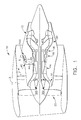
- FIG. 1 is a schematic cross-sectional view of a gas turbine engine (GTE) 10 including an example muffling device 100, according to at least some aspects of the present disclosure.
- GTE 10 may include a bleed system 40, which may incorporate muffling device 100.
- GTE 10 may include a core gas turbine engine 12 that includes a high-pressure compressor 14, a combustor 16, and/or a high-pressure turbine 18.
- GTE 10 may also include a low-pressure compressor 19, a low-pressure turbine 20, and/or a fan assembly 22.
- air may flow through fan assembly 22.
- a portion of the air discharged from fan assembly 22 may be channeled to high-pressure compressor 14, where it may be further compressed and channeled to combustor 16. Products of combustion from combustor 16 may be utilized to drive high-pressure turbine 18 and/or low-pressure turbine 20.
- Another portion of the air discharged from fan assembly 22 may bypass core gas turbine engine 10 (e.g., via fan duct 3) and/or may be referred to as a fan flow stream 4.
- bleed system 40 a portion of the compressed air produced by high-pressure compressor 14 may be routed through bleed system 40, thereby becoming bleed air 2.
- Bleed air 2 from high-pressure compressor 14 may enter a bleed flow conduit 44.
- Bleed air 2 may pass through bleed flow conduit 44 and enter muffling device 100, which may direct bleed air 2 into a flow path, such as the fan flow stream 4.
- Flow of bleed air 2 through bleed flow conduit 44 may be controlled by a transient bleed valve 45.
- Muffling device 100 may be in flow communication with bleed flow conduit 44 such that the bleed air 2 is discharged as exit flow stream 5 into a flow path, such as a fan duct 3 and mixes the air with another flow, such as fan flow stream 4.
- a flow mixing vent system such as an aero chimney, as described in U.S. Patent Application Publication No. 2011/0265490 , which is incorporated herein by reference.
- An aero chimney and/or other plume control device may be arranged to prevent exit flow 5 from impacting temperature sensitive materials (e.g., materials capable of withstanding only relatively low temperatures).
- FIG. 2 is an elevation view of an example muffling device 100, according to at least some aspects of the present disclosure.
- Muffling device 100 may include a muffling device body 102.
- Muffling device 100 may be configured to receive a flow 108 of a compressible fluid into muffling device body 102 via an inlet 106 and/or may be configured to discharge flow 108 from muffling device body 102 via an outlet 110.
- inlet 106 of muffling device 100 may receive bleed air 2 from bleed conduit 44 and/or may discharge bleed air 2 (as exit flow stream 5) via outlet 110 into fan flow stream 4 (see, e.g., FIG. 1 ).
- muffling device 100 may be arranged generally in an L-shape, with inlet 106 receiving flow 108 generally in a horizontal direction and outlet 110 discharging flow 108 generally in a vertical direction.
- inlet 106 may include a generally circular, horizontally facing opening and/or outlet 110 may include an elongated, generally rectangular, vertically facing opening.
- FIG. 3 is an isometric view of an example muffling device 100, according to at least some aspects of the present disclosure.
- Muffling device 100 may include a plenum 112 fluidicly connected to outlet 110.
- Plenum 112 may be disposed at least partially within muffling device body 102.
- Plenum 112 may be at least partially defined by a first orifice plate 116 and/or a second orifice plate 120 (see, e.g., FIG. 6 ), which may be generally planar and/or may be arranged generally in parallel.
- Orifice plate 116 may include a wall 132 through which orifices 114 may extend and/or orifice plate 120 may include a wall 134 through which orifices 118 may extend (see, e.g., FIG. 6 ). At least a portion of flow 108 may enter plenum 112 via orifices 114 and/or at least a portion of flow 108 may enter plenum 112 via orifices 118. Flow 108 may exit plenum 112 via outlet 110.
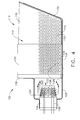
- FIG. 4 is a partial cross-sectional view of an example muffling device 100, according to at least some aspects of the present disclosure.
- Muffling device 100 may include an inlet flow restrictor 122, which may be disposed fluidicly downstream of inlet 106 and/or fluidicly upstream of an interior 104 of muffling device body 102.
- inlet flow restrictor 122 may include a generally conical frustrum including a side wall 124 and/or a downstream end wall 126.
- Inlet flow restrictor 122 may taper inwardly in a generally downstream direction.
- Side wall 124 may include a plurality of holes 128 extending through the side wall.
- Holes 128 may be arranged to direct flow 108 of the compressible fluid received via inlet 106 into interior 104 of muffling device body 102. Some example embodiments may include holes 128 having substantially uniform sizes and/or having a plurality of different sizes. In some example embodiments, adjacent rows of holes 128 may be offset and/or staggered, which may improve flow uniformity.
- inlet flow restrictor 122 may be configured to create a choked condition at a design flow rate. For example, the number, size, and/or spacing of holes 128 and/or the length of inlet flow restrictor 122 may be selected to provide a choked flow condition and/or to achieve acoustic characteristics.
- inlet flow restrictor may operate as a secondary flow restrictor, secondary to transient bleed valve 45 ( FIG. 1 ).
- downstream end wall 126 may be substantially solid (e.g., without holes). In some example embodiments, downstream end wall 126 may include one or more holes.
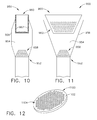
- FIG. 12 is an isometric view of an alternative inlet flow restrictor 1100, which may comprise a substantially planar orifice plate 1102 with a plurality of orifices 1104 extending therethrough. Orifices 1104 may be arranged in a generally staggered arrangement.
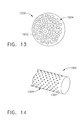
- FIG. 13 is an isometric view of an alternative inlet flow restrictor 1200, which may comprise a generally hemispherical shape 1202 with a plurality of orifices 1204 extending therethrough. Orifices 1204 may be arranged in a generally staggered arrangement.
- FIG. 12 is an isometric view of an alternative inlet flow restrictor 1100, which may comprise a substantially planar orifice plate 1102 with a plurality of orifices 1104 extending therethrough. Orifices 1104 may be arranged in a generally staggered arrangement.
- FIG. 13 is an isometric view of an alternative inlet flow restrictor 1200, which may comprise a generally hemispherical shape 1202 with
- FIG. 14 is an isometric view of an alternative inlet flow restrictor 1300, which may comprise a generally tubular shape 1302 with a plurality of orifices 1304 extending therethrough. Orifices 1304 may be arranged in a generally staggered arrangement.
- plenum 112 may be at least partially defined by a downstream end wall 130 and/or an upstream end wall 136 (see, e.g., FIG. 4 ). Downstream end wall 130 may be angled arranged such that plenum 112 tapers outwardly in a direction generally towards outlet 110. In connection with orifice plate 116 (having orifices 114 through wall 132) and/or orifice plate 120 (having holes 118 through wall 134), upstream end wall 136 and/or downstream end wall 130 may at least partially define plenum and/or may fluidicly interpose interior 104 and plenum 112.
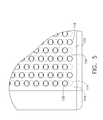
- FIG. 5 is a detailed view of example cross-impinging orifice plates 116, 120, according to at least some aspects of the present disclosure.
- Orifices 114 through orifice plate 116 may be offset (e.g., not coaxial) with respect to orifices 118 through orifice plate 120.
- orifices 114 may be arranged relative to orifices 118 such that flow through orifices 114 of first orifice plate 116 may be directed at wall 134 of second orifice plate 120 and/or such that flow through orifices 118 of second orifice plate 120 may be directed at wall 132 of first orifice plate.
- Such a flow arrangement may be referred to as cross-impinging.
- first orifice plate 116 and orifices 118 of second orifice plate 120 there may be no "line-of-sight" through orifices 114 of first orifice plate 116 and orifices 118 of second orifice plate 120.
- the sizes and arrangement of orifices 114 of first orifice plate 116 and/or orifices 118 of second orifice plate 120 may be configured to achieve desired flow and/or acoustic characteristics.
- diameters of orifices 114, 118, spacing between orifices 114, 118, and/or relative positions of orifices 114, 118 may be tuned to achieve desired flow and/or acoustic characteristics. See, for example, FIG.
- Orifice plate 902 may include orifices 906 and/or orifice plate 904 may include orifices 908. As illustrated, orifices 906 and orifices 908 may each be arranged in a triangular pattern, and orifices 906 may be offset from orifices 908.
- FIG. 6 is a cross-sectional plan view of an example muffling device 100, according to at least some aspects of the present disclosure.
- Flow 108 may enter muffling device 100 through inlet 106.
- Flow 108 may be directed from inlet 106 into interior 104 of muffling device body 102 via inlet flow restrictor 122, such as via holes 128 in side wall 124.
- Flow 108 may be directed along the outer sides (e.g., along orifice plate 116 and orifice plate 120) of plenum 112, such as by downstream end wall 126 of inlet flow restrictor and/or upstream end wall 136 of plenum 112.
- Upstream end wall 136 of plenum 112 may include rounded corners 137 connecting to orifice plate 116 and/or orifice plate 120, which may aid in smoothly directing flow 108.
- Interior 104 of muffling device body 102 may be at least partially defined by side wall 140 and side wall 142, which may taper inwardly in a generally downstream direction.
- Muffling device body 102 may be generally widest at an upstream end near inlet 106 and/or may be generally narrowest at a downstream end near downstream end wall 130 of plenum 112.
- such tapering may provide a substantially uniform static pressure distribution, which may provide a substantially even flow distribution.
- orifice plate 116 and orifice plate 120 may create a cross-impinging flow into plenum 112.
- an axis 144 of orifice 114 of first orifice plate 116 may not be coaxial with an axis 146 of orifice 118 of second orifice plate 120.
- flow through orifice 114 of first orifice plate 116 may generally impinge on wall 134 of second orifice plate 120 and/or flow through orifice 118 of second orifice plate 120 may generally impinge on wall 132 of first orifice plate 116.
- first orifice plate 116 and second orifice plate 120 may be disposed within interior 104 of muffling device body 102 such that flow 108 from interior 104 through orifices 114 of first orifice plate 116 and/or flow through orifices 118 of second orifice plate 120 substantially changes direction (see, e.g., FIG. 7 ).
- flow from interior 104 e.g., generally from inlet flow restrictor 122
- orifices 114 and/or orifices 118 may change direction by about 90 degrees.
- static pressures at various points may be as follows: point 204 about 1100 kPa; point 208 about 345 kPa; point 210 about 160 kPa ( FIGS. 6 and 7 ).
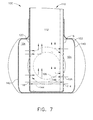
- FIG. 7 is a cross-sectional view of an example muffling device 100, according to at least some aspects of the present disclosure.
- First orifice plate 116, second orifice plate 120, and plenum 112 may be arranged such that flow 108 through orifices 114 of first orifice plate 116 into plenum 112 and/or flow through orifices 118 of second orifice plate 120 into plenum 112 substantially changes direction.
- through orifices 114 and/or orifices 118 e.g., from interior 104 of muffling device body 102 into plenum 112 may change direction by about 90 degrees.
- flow through first orifice plate 116 and/or second orifice plate 120 may not be choked. In some example embodiments, flow through first orifice plate 116 and/or second orifice plate 120 may be choked.
- an effective flow area of first orifice plate 116 and second orifice plate 118 may be greater than an effective flow area of inlet flow restrictor 122. In some example embodiments, an effective flow area of outlet 110 may be greater than the effective flow area of first orifice plate 116 and second orifice plate 118.
- FIG. 8 is flow chart of an example method 800 of operating a muffling device, according to at least some aspects of the present disclosure.
- Method 800 may include an operation 802, which may include receiving a flow of a compressible fluid into an interior of a muffling device body of a muffling device via an inlet.
- Operation 802 may be followed by an operation 804.
- Operation 804 may include directing the flow of the compressible fluid from the interior of the muffling device body into a plenum at least partially defined by substantially parallel first and second orifice plates.
- Operation 804 may include operation 806, which may include directing a first portion of the flow of the compressible fluid from the interior of the muffling device into the plenum through at least one orifice extending through the first orifice plate generally towards a wall of the second orifice plate. Operation 804 may include operation 808, which may include directing a second portion of the flow of the compressible fluid from the interior of the muffling device into the plenum through at least one orifice extending through the second orifice plate generally towards a wall of the first orifice plate. Operation 804 may be followed by an operation 810. Operation 810 may include discharging the flow of the compressible fluid from the plenum via an outlet.
- FIG. 10 is a schematic cross-sectional view of an alternative example muffling device 950 and FIG. 11 is a schematic cross-sectional view of an alternative example muffling device 950, according to at least some aspects of the present disclosure.
- Muffling device 950 may include an inlet 952, which may receive bleed air 2 ( FIG. 1 ). Inlet 952 may deliver bleed air 2 to an interior 954 of a muffling device body 956 via an inlet flow restrictor 958. Air may flow from interior 954 to an outlet 960 via one or more orifice plates 962, which may be arranged to produce a cross-impinging flow.
- muffling device 950 may be similar to muffling device 100 described above.
- an embodiment may be constructed in a modular form.
- an embodiment may include an inlet flow restrictor 122, at one orifice plate 116, 120, and/or both an inlet flow restrictor 122 and one or more orifice plates 116, 120.
- Some embodiments may be readily reconfigurable, such as by being assembled using removable fasteners.
Landscapes
- Engineering & Computer Science (AREA)
- Chemical & Material Sciences (AREA)
- Combustion & Propulsion (AREA)
- Mechanical Engineering (AREA)
- General Engineering & Computer Science (AREA)
- Exhaust Silencers (AREA)
- Structures Of Non-Positive Displacement Pumps (AREA)
- Soundproofing, Sound Blocking, And Sound Damping (AREA)
- Pipe Accessories (AREA)
- Jet Pumps And Other Pumps (AREA)
Abstract
Description
- The subject matter disclosed herein relates generally to muffling systems, and, more specifically, to muffling devices capable of providing pressure drops, acoustic improvements, and desirable flow properties.
- In a gas turbine engine, air is pressurized in a compression module. The air channeled through the compression module is mixed with fuel in a combustor and ignited, generating hot combustion gases, which flow through turbine stages that extract energy therefrom for powering the fan and compressor rotors and generate engine thrust to propel an aircraft in flight or to power a load, such as an electrical generator. In some gas turbine engines, a portion of the high-pressure air, such as, for example, bleed air from a compressor, may be extracted or bled from the compressor for various needs. These needs include, for example, compressor flow bleeding which may be used to improve operability as well as to provide turbine cooling, bearing sump pressurization, purge air, or aircraft environment control. The air may be bled off from the compressor using bleed slots located over specific portions or stages of the compressor.
- In least some gas turbine engines, during engine operation occurring in some operating conditions, the compressor may pump more air than is required for needs including the combustion process. In order to manage operability of the engine and combustion performance, a portion of the excess bleed air from the compressor may be routed through bleed conduits and exhausted into the fan flow stream, engine exhaust, or to ambient. The pressure and temperature of the air stream bled from the compressor may be very high. For example, bleed air pressure may be greater than about 1375 kPa and the bleed air temperature may be greater than about 538 degrees C. A transient bleed valve system (TBV) system is sometimes used for bleeding and exhausting the air removed from the compressor. For example, the exhaust area of some conventional bleed systems may be oversized to lower the flow velocity at the exhaust location to assure that the acoustic requirements are met for the application. The exhaust area, as well as the relatively gently expansions between the source pressure and exhaust, may contribute to the relatively large size and/or weight of these systems.
- In some applications (e.g., aircraft), it may be undesirable to use large and/or heavy components to reduce noise generated by bleed air and/or to direct bleed air into a fan flow stream or other locations.
- At least one solution for the above-mentioned problem(s) is provided by the present disclosure to include example embodiments, provided for illustrative teaching and not meant to be limiting.
- An example muffling device according to at least some aspects of the present disclosure may include a muffling device body including an inlet (which may include an inlet flow restrictor) arranged to direct a flow of a compressible fluid into an interior of the muffling device body; a first orifice plate arranged to receive at least some of the flow of the compressible fluid from the interior of the muffling device body, the first orifice plate including at least one orifice extending through a wall; and/or a second orifice plate arranged to receive at least some of the flow of the compressible fluid from the interior of the muffling device body, the second orifice plate including at least one orifice extending through a wall. The first orifice plate and the second orifice plate may at least partially define a plenum arranged to receive the flow of the compressible fluid from the interior of the muffling device body via the orifice of the first orifice plate and via the orifice of the second orifice plate. The first orifice plate and the second orifice plate may be fluidicly opposed such that the flow of the compressible fluid through the orifice of the first orifice plate from the interior of the muffling device body into the plenum is directed at the wall of the second orifice plate and such that flow of the compressible fluid through the orifice of the second orifice plate from the interior of the muffling device body into the plenum is directed at the wall of the first orifice plate.
- An example gas turbine engine according to at least some aspects of the present disclosure may include a compressor; a combustor arranged to combust fuel in compressed air received from the compressor; a turbine configured to receive hot, pressurized gas from the combustor and to drive the compressor; and a bleed air system. The bleed air system may include a bleed conduit arranged to withdraw bleed air from the compressor and a muffling device arranged to discharge the bleed air. The muffling device may include an inlet (which may include an inlet flow restrictor) fluidicly coupled to receive the bleed air from the bleed conduit, a first generally planar orifice plate and a second generally planar orifice plate arranged generally in parallel to direct the bleed air in a cross-impinging flow into a plenum, and an outlet arranged to discharge the bleed air from the plenum.
- An example method of operating a muffling device according to at least some aspects of the present disclosure may include receiving a flow of a compressible fluid into an interior of a muffling device body of a muffling device via an inlet (which may include an inlet flow restrictor). The method may include directing the flow of the compressible fluid from the interior of the muffling device body into a plenum at least partially defined by substantially parallel first and second orifice plates, including directing a first portion of the flow of the compressible fluid from the interior of the muffling device into the plenum through at least one orifice extending through the first orifice plate generally towards a wall of the second orifice plate, and directing a second portion of the flow of the compressible fluid from the interior of the muffling device into the plenum through at least one orifice extending through the second orifice plate generally towards a wall of the first orifice plate. The method may include discharging the flow of the compressible fluid from the plenum via an outlet.
- The subject matter for which patent claim coverage is sought is particularly pointed out and claimed herein. The subject matter and embodiments thereof, however, may be best understood by reference to the following description taken in conjunction with the accompanying drawing figures in which:
-
FIG. 1 is a schematic cross-sectional view of a gas turbine engine including an example muffling device; -
FIG. 2 is an elevation view of an example muffling device; -
FIG. 3 is an isometric view of an example muffling device; -
FIG. 4 is a partial cross-sectional view of an example muffling device; -
FIG. 5 is a detailed view of example cross-impinging orifice plates; -
FIG. 6 is a cross-sectional plan view of an example muffling device; -
FIG. 7 is a cross-sectional view of an example muffling device; -
FIG. 8 is flow chart of an example method of operating a muffling device; -
FIG. 9 is a detailed view of example cross-impinging orifice plates; and -
FIG. 10 is a schematic cross-sectional view of an alternative example muffling device; -
FIG. 11 is a schematic cross-sectional view of an alternative example muffling device; -
FIG. 12 is an isometric view of an alternative inlet flow restrictor comprising a substantially planar orifice plate; -
FIG. 13 is an isometric view of an alternative inlet flow restrictor comprising a generally hemispherical shape; and -
FIG. 14 is an isometric view of an alternative inlet flow restrictor comprising a generally tubular shape, all in accordance with at least some aspects of the present disclosure. - In the following detailed description, reference is made to the accompanying drawings, which form a part hereof. In the drawings, similar symbols typically identify similar components, unless context dictates otherwise. The illustrative embodiments described in the detailed description, drawings, and claims are not meant to be limiting. Other embodiments may be utilized, and other changes may be made, without departing from the scope of the subject matter presented here. It will be readily understood that the aspects of the present disclosure, as generally described herein, and illustrated in the figures, can be arranged, substituted, combined, and designed in a wide variety of different configurations, all of which are explicitly contemplated and make part of this disclosure.
- The present disclosure includes, inter alia, gas turbine engines, muffling devices, and methods of operating muffling devices.
-
FIG. 1 is a schematic cross-sectional view of a gas turbine engine (GTE) 10 including anexample muffling device 100, according to at least some aspects of the present disclosure. GTE 10 may include ableed system 40, which may incorporatemuffling device 100. GTE 10 may include a coregas turbine engine 12 that includes a high-pressure compressor 14, acombustor 16, and/or a high-pressure turbine 18. GTE 10 may also include a low-pressure compressor 19, a low-pressure turbine 20, and/or afan assembly 22. - In operation, air may flow through
fan assembly 22. A portion of the air discharged fromfan assembly 22 may be channeled to high-pressure compressor 14, where it may be further compressed and channeled tocombustor 16. Products of combustion fromcombustor 16 may be utilized to drive high-pressure turbine 18 and/or low-pressure turbine 20. Another portion of the air discharged fromfan assembly 22 may bypass core gas turbine engine 10 (e.g., via fan duct 3) and/or may be referred to as a fan flow stream 4. - At some operating conditions, a portion of the compressed air produced by high-pressure compressor 14 may be routed through
bleed system 40, thereby becomingbleed air 2. Bleedair 2 from high-pressure compressor 14 may enter a bleedflow conduit 44. Bleedair 2 may pass through bleedflow conduit 44 and entermuffling device 100, which may direct bleedair 2 into a flow path, such as the fan flow stream 4. Flow of bleedair 2 through bleedflow conduit 44 may be controlled by a transient bleedvalve 45.Muffling device 100, described in more detail herein below, may be in flow communication withbleed flow conduit 44 such that thebleed air 2 is discharged as exit flow stream 5 into a flow path, such as afan duct 3 and mixes the air with another flow, such as fan flow stream 4. Some example embodiments may include a flow mixing vent system, such as an aero chimney, as described inU.S. Patent Application Publication No. 2011/0265490 , which is incorporated herein by reference. An aero chimney and/or other plume control device may be arranged to prevent exit flow 5 from impacting temperature sensitive materials (e.g., materials capable of withstanding only relatively low temperatures). -
FIG. 2 is an elevation view of anexample muffling device 100, according to at least some aspects of the present disclosure.Muffling device 100 may include amuffling device body 102.Muffling device 100 may be configured to receive aflow 108 of a compressible fluid intomuffling device body 102 via aninlet 106 and/or may be configured to dischargeflow 108 frommuffling device body 102 via anoutlet 110. For example,inlet 106 ofmuffling device 100 may receivebleed air 2 frombleed conduit 44 and/or may discharge bleed air 2 (as exit flow stream 5) viaoutlet 110 into fan flow stream 4 (see, e.g.,FIG. 1 ). In some example embodiments,muffling device 100 may be arranged generally in an L-shape, withinlet 106 receivingflow 108 generally in a horizontal direction andoutlet 110discharging flow 108 generally in a vertical direction. In some example embodiments,inlet 106 may include a generally circular, horizontally facing opening and/oroutlet 110 may include an elongated, generally rectangular, vertically facing opening. -
FIG. 3 is an isometric view of anexample muffling device 100, according to at least some aspects of the present disclosure.Muffling device 100 may include aplenum 112 fluidicly connected tooutlet 110.Plenum 112 may be disposed at least partially within mufflingdevice body 102.Plenum 112 may be at least partially defined by afirst orifice plate 116 and/or a second orifice plate 120 (see, e.g.,FIG. 6 ), which may be generally planar and/or may be arranged generally in parallel.Orifice plate 116 may include awall 132 through whichorifices 114 may extend and/ororifice plate 120 may include awall 134 through whichorifices 118 may extend (see, e.g.,FIG. 6 ). At least a portion offlow 108 may enterplenum 112 viaorifices 114 and/or at least a portion offlow 108 may enterplenum 112 viaorifices 118. Flow 108 may exitplenum 112 viaoutlet 110. -
FIG. 4 is a partial cross-sectional view of anexample muffling device 100, according to at least some aspects of the present disclosure.Muffling device 100 may include aninlet flow restrictor 122, which may be disposed fluidicly downstream ofinlet 106 and/or fluidicly upstream of an interior 104 of mufflingdevice body 102. In some example embodiments,inlet flow restrictor 122 may include a generally conical frustrum including aside wall 124 and/or adownstream end wall 126.Inlet flow restrictor 122 may taper inwardly in a generally downstream direction.Side wall 124 may include a plurality ofholes 128 extending through the side wall.Holes 128 may be arranged todirect flow 108 of the compressible fluid received viainlet 106 intointerior 104 of mufflingdevice body 102. Some example embodiments may includeholes 128 having substantially uniform sizes and/or having a plurality of different sizes. In some example embodiments, adjacent rows ofholes 128 may be offset and/or staggered, which may improve flow uniformity. - In some example embodiments,
inlet flow restrictor 122 may be configured to create a choked condition at a design flow rate. For example, the number, size, and/or spacing ofholes 128 and/or the length ofinlet flow restrictor 122 may be selected to provide a choked flow condition and/or to achieve acoustic characteristics. In some example embodiments, inlet flow restrictor may operate as a secondary flow restrictor, secondary to transient bleed valve 45 (FIG. 1 ). In some example embodiments,downstream end wall 126 may be substantially solid (e.g., without holes). In some example embodiments,downstream end wall 126 may include one or more holes. - Although some example embodiments described herein incorporate a basket-type inlet flow restrictor, it is within the scope of the disclosure to use alternative inlet flow restrictors.
FIG. 12 is an isometric view of an alternative inlet flow restrictor 1100, which may comprise a substantiallyplanar orifice plate 1102 with a plurality oforifices 1104 extending therethrough.Orifices 1104 may be arranged in a generally staggered arrangement.FIG. 13 is an isometric view of an alternative inlet flow restrictor 1200, which may comprise a generallyhemispherical shape 1202 with a plurality oforifices 1204 extending therethrough.Orifices 1204 may be arranged in a generally staggered arrangement.FIG. 14 is an isometric view of an alternative inlet flow restrictor 1300, which may comprise a generallytubular shape 1302 with a plurality oforifices 1304 extending therethrough.Orifices 1304 may be arranged in a generally staggered arrangement. - In some example embodiments,
plenum 112 may be at least partially defined by adownstream end wall 130 and/or an upstream end wall 136 (see, e.g.,FIG. 4 ).Downstream end wall 130 may be angled arranged such thatplenum 112 tapers outwardly in a direction generally towardsoutlet 110. In connection with orifice plate 116 (havingorifices 114 through wall 132) and/or orifice plate 120 (havingholes 118 through wall 134),upstream end wall 136 and/ordownstream end wall 130 may at least partially define plenum and/or may fluidicly interpose interior 104 andplenum 112. -
FIG. 5 is a detailed view of examplecross-impinging orifice plates Orifices 114 throughorifice plate 116 may be offset (e.g., not coaxial) with respect toorifices 118 throughorifice plate 120. For example,orifices 114 may be arranged relative toorifices 118 such that flow throughorifices 114 offirst orifice plate 116 may be directed atwall 134 ofsecond orifice plate 120 and/or such that flow throughorifices 118 ofsecond orifice plate 120 may be directed atwall 132 of first orifice plate. Such a flow arrangement may be referred to as cross-impinging. In some example embodiments, there may be no "line-of-sight" throughorifices 114 offirst orifice plate 116 andorifices 118 ofsecond orifice plate 120. In various embodiments, the sizes and arrangement oforifices 114 offirst orifice plate 116 and/ororifices 118 ofsecond orifice plate 120 may be configured to achieve desired flow and/or acoustic characteristics. For example, diameters oforifices orifices orifices FIG. 9 , which is a detailed view of examplecross-impinging orifice plates Orifice plate 902 may includeorifices 906 and/ororifice plate 904 may includeorifices 908. As illustrated,orifices 906 andorifices 908 may each be arranged in a triangular pattern, andorifices 906 may be offset fromorifices 908. -
FIG. 6 is a cross-sectional plan view of anexample muffling device 100, according to at least some aspects of the present disclosure. Flow 108 may enter mufflingdevice 100 throughinlet 106. Flow 108 may be directed frominlet 106 intointerior 104 of mufflingdevice body 102 viainlet flow restrictor 122, such as viaholes 128 inside wall 124. Flow 108 may be directed along the outer sides (e.g., alongorifice plate 116 and orifice plate 120) ofplenum 112, such as bydownstream end wall 126 of inlet flow restrictor and/orupstream end wall 136 ofplenum 112.Upstream end wall 136 ofplenum 112 may includerounded corners 137 connecting toorifice plate 116 and/ororifice plate 120, which may aid in smoothly directingflow 108. -
Interior 104 of mufflingdevice body 102 may be at least partially defined byside wall 140 andside wall 142, which may taper inwardly in a generally downstream direction.Muffling device body 102 may be generally widest at an upstream end nearinlet 106 and/or may be generally narrowest at a downstream end neardownstream end wall 130 ofplenum 112. In some example embodiments, such tapering may provide a substantially uniform static pressure distribution, which may provide a substantially even flow distribution. - In some example embodiments,
orifice plate 116 andorifice plate 120 may create a cross-impinging flow intoplenum 112. For example, anaxis 144 oforifice 114 offirst orifice plate 116 may not be coaxial with anaxis 146 oforifice 118 ofsecond orifice plate 120. As a result, flow throughorifice 114 offirst orifice plate 116 may generally impinge onwall 134 ofsecond orifice plate 120 and/or flow throughorifice 118 ofsecond orifice plate 120 may generally impinge onwall 132 offirst orifice plate 116. - In some example embodiments,
first orifice plate 116 andsecond orifice plate 120 may be disposed withininterior 104 of mufflingdevice body 102 such that flow 108 from interior 104 throughorifices 114 offirst orifice plate 116 and/or flow throughorifices 118 ofsecond orifice plate 120 substantially changes direction (see, e.g.,FIG. 7 ). For example, flow from interior 104 (e.g., generally from inlet flow restrictor 122) throughorifices 114 and/ororifices 118 may change direction by about 90 degrees. - In an example embodiment operating at a design flow condition, static pressures at various points may be as follows:
point 204 about 1100 kPa;point 208 about 345 kPa;point 210 about 160 kPa (FIGS. 6 and7 ). -
FIG. 7 is a cross-sectional view of anexample muffling device 100, according to at least some aspects of the present disclosure.First orifice plate 116,second orifice plate 120, andplenum 112 may be arranged such thatflow 108 throughorifices 114 offirst orifice plate 116 intoplenum 112 and/or flow throughorifices 118 ofsecond orifice plate 120 intoplenum 112 substantially changes direction. For example, throughorifices 114 and/or orifices 118 (e.g., frominterior 104 of muffling device body 102) intoplenum 112 may change direction by about 90 degrees. - In some example embodiments, flow through
first orifice plate 116 and/orsecond orifice plate 120 may not be choked. In some example embodiments, flow throughfirst orifice plate 116 and/orsecond orifice plate 120 may be choked. - In some example embodiments, an effective flow area of
first orifice plate 116 andsecond orifice plate 118 may be greater than an effective flow area ofinlet flow restrictor 122. In some example embodiments, an effective flow area ofoutlet 110 may be greater than the effective flow area offirst orifice plate 116 andsecond orifice plate 118. -
FIG. 8 is flow chart of anexample method 800 of operating a muffling device, according to at least some aspects of the present disclosure.Method 800 may include anoperation 802, which may include receiving a flow of a compressible fluid into an interior of a muffling device body of a muffling device via an inlet.Operation 802 may be followed by anoperation 804.Operation 804 may include directing the flow of the compressible fluid from the interior of the muffling device body into a plenum at least partially defined by substantially parallel first and second orifice plates.Operation 804 may includeoperation 806, which may include directing a first portion of the flow of the compressible fluid from the interior of the muffling device into the plenum through at least one orifice extending through the first orifice plate generally towards a wall of the second orifice plate.Operation 804 may includeoperation 808, which may include directing a second portion of the flow of the compressible fluid from the interior of the muffling device into the plenum through at least one orifice extending through the second orifice plate generally towards a wall of the first orifice plate.Operation 804 may be followed by anoperation 810.Operation 810 may include discharging the flow of the compressible fluid from the plenum via an outlet. -
FIG. 10 is a schematic cross-sectional view of an alternativeexample muffling device 950 andFIG. 11 is a schematic cross-sectional view of an alternativeexample muffling device 950, according to at least some aspects of the present disclosure.Muffling device 950 may include aninlet 952, which may receive bleed air 2 (FIG. 1 ).Inlet 952 may deliver bleedair 2 to an interior 954 of amuffling device body 956 via aninlet flow restrictor 958. Air may flow from interior 954 to an outlet 960 via one ormore orifice plates 962, which may be arranged to produce a cross-impinging flow. Generally, mufflingdevice 950 may be similar to mufflingdevice 100 described above. - Some example embodiments according to at least some aspects of the present disclosure may be constructed in a modular form. For example, an embodiment may include an
inlet flow restrictor 122, at oneorifice plate inlet flow restrictor 122 and one ormore orifice plates - This written description uses examples to disclose the invention, including the best mode, and also to enable any person skilled in the art to practice the invention, including making and using any devices or systems and performing any incorporated methods. The patentable scope of the invention is defined by the claims, and may include other examples that occur to those skilled in the art. Such other examples are intended to be within the scope of the claims if they have structural elements that do not differ from the literal language of the claims, or if they include equivalent structural elements with insubstantial differences from the literal languages of the claims.
- Various aspects and embodiments of the present invention are defined by the following numbered clauses:
- 1. A muffling device, comprising:
- a muffling device body comprising an inlet arranged to direct a flow of a compressible fluid into an interior of the muffling device body;
- a first orifice plate arranged to receive the at least some of the flow of the compressible fluid from the interior of the muffling device body, the first orifice plate comprising at least one orifice extending through a wall; and
- a second orifice plate arranged to receive the at least some of the flow of the compressible fluid from the interior of the muffling device body, the second orifice plate comprising at least one orifice extending through a wall;
- wherein the first orifice plate and the second orifice plate at least partially define a plenum arranged to receive the flow of the compressible fluid from the interior of the muffling device body via the at least one orifice of the first orifice plate and via the at least one orifice of the second orifice plate;
- wherein the first orifice plate and the second orifice plate are fluidicly opposed such that the flow of the compressible fluid through the at least one orifice of the first orifice plate from the interior of the muffling device body into the plenum is directed at the wall of the second orifice plate and such that flow of the compressible fluid through the at least one orifice of the second orifice plate from the interior of the muffling device body into the plenum is directed at the wall of the first orifice plate.
- 2. The muffling device of clause 1, wherein an axis of the at least one orifice of the first orifice plate is not coaxial with an axis of the at least one orifice of the second orifice plate.
- 3. The muffling device of any preceding clause, further comprising an inlet flow restrictor disposed fluidicly downstream of the inlet and fluidicly upstream of the interior of the muffling device body.
- 4. The muffling device of any preceding clause, wherein the inlet flow restrictor comprises a plurality of orifices arranged in a generally staggered arrangement.
- 5. The muffling device of any preceding clause,
wherein the inlet flow restrictor comprises a generally conical frustrum comprising a side wall and a downstream end wall, the conical frustrum tapering inwardly in a generally downstream direction; and
wherein the side wall comprises a plurality of holes extending therethrough arranged to direct the flow of the compressible fluid into the interior of the muffling device body. - 6. The muffling device of any preceding clause, wherein the downstream end wall comprises a plurality of holes extending therethrough arranged to direct the flow of the compressible fluid into the interior of the muffling device body.
- 7. The muffling device of any preceding clause,
wherein the plenum comprises an outlet arranged to discharge the flow of the compressible fluid; and
wherein the plenum tapers outwardly in a direction generally towards the outlet. - 8. The muffling device of any preceding clause, wherein the first orifice plate and the second orifice plate are disposed within the interior of the muffling device body such that the flow of the compressible fluid from the interior of the muffling device body through the at least one orifice of the first orifice plate changes direction by about 90 degrees and the flow of the compressible fluid from the interior of the muffling device body through the at least one orifice of the second orifice plate changes direction by about 90 degrees.
- 9. The muffling device of any preceding clause, wherein the plenum is disposed between the first orifice plate and the second orifice plate such that the flow of the compressible fluid through the at least one orifice of the first orifice plate into the plenum changes direction by about 90 degrees and the flow of the compressible fluid through the at least one orifice of the second orifice plate into the plenum changes direction by about 90 degrees.
- 10. The muffling device of any preceding clause,
wherein the inlet is fluidicly coupled to a bleed system associated with a gas turbine engine; and
wherein the plenum is arranged to discharge into a fan flow stream of the gas turbine engine. - 11. A gas turbine engine, comprising:
- a compressor;
- a combustor arranged to combust fuel in compressed air received from the compressor;
- a turbine configured to receive hot, pressurized gas from the combustor and to drive the compressor; and
- a bleed air system comprising
- a bleed conduit arranged to withdraw bleed air from the compressor, and
- a muffling device arranged to discharge the bleed air, the muffling device comprising
an inlet fluidicly coupled to receive the bleed air from the bleed conduit,
a first generally planar orifice plate and a second generally planar orifice plate arranged generally in parallel to direct the bleed air in a cross-impinging flow into a plenum, and
an outlet arranged to discharge the bleed air from the plenum.
- 12. The gas turbine engine of any preceding clause, wherein the muffling device further comprises an inlet flow restrictor fluidicly downstream of the bleed conduit and fluidicly upstream of the first orifice plate and the second orifice plate.
- 13. The gas turbine engine of any preceding clause, wherein the inlet flow restrictor is configured to create a choked condition at a design flow rate.
- 14. The gas turbine engine of any preceding clause, wherein the outlet is arranged to discharge the bleed air into a fan flow stream of the gas turbine engine.
- 15. The gas turbine engine of any preceding clause, wherein the bleed air system further comprises a transient bleed valve operatively arranged to control bleed air flow through the bleed conduit.
- 16. A method of operating a muffling device, the method comprising:
- receiving a flow of a compressible fluid into an interior of a muffling device body of a muffling device via an inlet;
- directing the flow of the compressible fluid from the interior of the muffling device body into a plenum at least partially defined by substantially parallel first and second orifice plates, including
- directing a first portion of the flow of the compressible fluid from the interior of the muffling device into the plenum through at least one orifice extending through the first orifice plate generally towards a wall of the second orifice plate, and
- directing a second portion of the flow of the compressible fluid from the interior of the muffling device into the plenum through at least one orifice extending through the second orifice plate generally towards a wall of the first orifice plate; and
- discharging the flow of the compressible fluid from the plenum via an outlet.
- 17. The method of any preceding clause,
wherein directing a first portion of the flow of the compressible fluid from the interior of the muffling device into the plenum through at least one orifice extending through the first orifice plate generally towards a wall of the second orifice plate comprises impinging the first portion of the flow of the compressible fluid on the wall of the second orifice plate; and
wherein directing a second portion of the flow of the compressible fluid from the interior of the muffling device into the plenum through at least one orifice extending through the second orifice plate generally towards a wall of the first orifice plate comprises impinging the second portion of the flow of the compressible fluid on the wall of the first orifice plate. - 18. The method of any preceding clause, wherein receiving a flow of a compressible fluid into the interior of the muffling device body comprises directing the flow of the compressible fluid through an inlet flow restrictor fluidicly interposing an inlet of the muffling device body and the interior of the muffling device body.
- 19. The method of any preceding clause, wherein directing the flow of the compressible fluid through the inlet flow restrictor comprises directing the flow of the compressible fluid through a plurality of holes extending through a sidewall of the inlet flow restrictor, the inlet flow restrictor comprising a generally conical frustrum comprising the side wall and a downstream end wall, the conical frustrum tapering inwardly in a generally downstream direction.
- 20. The method of any preceding clause, wherein directing the flow of the compressible fluid through the inlet flow restrictor comprises causing flow sufficient to create a choked condition at the inlet flow restrictor.
- 21. The method of any preceding clause, wherein receiving the flow of the compressible fluid into the interior of the muffling device body comprises receiving bleed air discharged from a compressor of a gas turbine engine.
Claims (15)
- A muffling device (100), comprising:a muffling device body (102) comprising an inlet (106) arranged to direct a flow (108) of a compressible fluid into an interior (104) of the muffling device body (102);a first orifice plate (116) arranged to receive the at least some of the flow (108) of the compressible fluid from the interior of the muffling device body (102), the first orifice plate comprising at least one orifice (114) extending through a wall (132); anda second orifice plate (120) arranged to receive the at least some of the flow (108) of the compressible fluid from the interior of the muffling device body (102), the second orifice plate comprising at least one orifice (118) extending through a wall (134);wherein the first orifice plate (116) and the second orifice plate (120) at least partially define a plenum (112) arranged to receive the flow (108) of the compressible fluid from the interior the muffling device body (102) via the at least one orifice (114) of the first orifice plate (116) and via the at least one orifice (118) of the second orifice plate (120);wherein the first orifice plate (116) and the second orifice plate (120) are fluidicly opposed such that the flow of the compressible fluid through the at least one orifice (114) of the first orifice plate (116) from the interior of the muffling device body into the plenum (112) is directed at the wall (134) of the second orifice plate (120) and such that flow of the compressible fluid through the at least one orifice (118) of the second orifice plate (120) from the interior of the muffling device body into the plenum is directed at the wall (132) of the first orifice plate (116).
- The muffling device (100) of claim 1, wherein an axis (144) of the at least one orifice (114) of the first orifice plate (116) is not coaxial with an axis (146) of the at least one orifice (118) of the second orifice plate (120).
- The muffling device (100) of either of claim 1 or 2, further comprising an inlet flow restrictor (122) disposed fluidicly downstream of the inlet (106) and fluidicly upstream of the interior (104) of the muffling device body (102).
- The muffling device (100) of claim 3, wherein the inlet flow restrictor (1100) comprises a plurality of orifices (1104) arranged in a generally staggered arrangement.
- The muffling device (100) of claim 3,
wherein the inlet flow restrictor (122) comprises a generally conical frustrum comprising a side wall (124) and a downstream end wall (126), the conical frustrum tapering inwardly in a generally downstream direction; and
wherein the side wall (124) comprises a plurality of holes (128) extending therethrough arranged to direct the flow (108) of the compressible fluid into the interior (104) of the muffling device body (102). - The muffling device (100) of claim 5, wherein the downstream end wall (126) comprises a plurality of holes extending therethrough arranged to direct the flow of the compressible fluid into the interior (104) of the muffling device body (102).
- The muffling device (100) of any of the preceding claims,
wherein the plenum (112) comprises an outlet (110) arranged to discharge the flow (108) of the compressible fluid; and
wherein the plenum (112) tapers outwardly in a direction generally towards the outlet (110). - The muffling device (100) of any of the preceding claims, wherein the first orifice plate (116) and the second orifice plate (120) are disposed within the interior (104) of the muffling device body (102) such that the flow of the compressible fluid from the interior of the muffling device body through the at least one orifice (114) of the first orifice plate changes direction by about 90 degrees and the flow of the compressible fluid from the interior of the muffling device bodthrough the at least one orifice (118) of the second orifice plate changes direction by about 90 degrees.
- The muffling device of any of the preceding claims, wherein the plenum (112) is disposed between the first orifice plate (116) and the second orifice plate (120) such that the flow (108) of the compressible fluid through the at least one orifice of the first orifice plate (116) into the plenum (112) changes direction by about 90 degrees and the flow (108) of the compressible fluid through the at least one orifice of the second orifice plate (120) into the plenum (112) changes direction by about 90 degrees.
- A gas turbine engine (10), comprising:a compressor (14);a combustor (16) arranged to combust fuel in compressed air received from the compressor;a turbine (18) configured to receive hot, pressurized gas from the combustor and to drive the compressor; anda bleed air system comprising
a bleed conduit (44) arranged to withdraw bleed air (2) from the compressor (14), and
a muffling device (100) arranged to discharge the bleed air (2), the muffling device comprising
an inlet (106) fluidicly coupled to receive the bleed air from the bleed conduit, a first generally planar orifice plate (116) and a second generally planar orifice plate (120) arranged generally in parallel to direct the bleed air in a cross-impinging flow into a plenum (112), and
an outlet (110) arranged to discharge the bleed air from the plenum (112). - The gas turbine engine (10) of claim 10, wherein the muffling device (100) further comprises an inlet flow restrictor (122) fluidicly downstream of the bleed conduit and fluidicly upstream of the first orifice plate (116) and the second orifice plate (120).
- The gas turbine engine (10) of either of claim 10 or 11, wherein the bleed air system further comprises a transient bleed valve (45) operatively arranged to control bleed air flow through the bleed conduit (44).
- A method (800) of operating a muffling device (100), the method comprising:receiving (802) a flow (108) of a compressible fluid into an interior (104) of a muffling device body (102) of a muffling device via an inlet (106);directing (804) the flow (108) of the compressible fluid from the interior (104) of the muffling device body into a plenum (112) at least partially defined by substantially parallel first and second orifice plates (116,120), includingdirecting (806) a first portion of the flow of the compressible fluid from the interior (104) of the muffling device (100) into the plenum (112) through at least one orifice (114) extending through the first orifice plate (116) generally towards a wall (134) of the second orifice plate (120), anddirecting (808) a second portion of the flow (108) of the compressible fluid from the interior of the muffling device (100) into the plenum (112) through at least one orifice (118) extending through the second orifice plate (120) generally towards a wall of the first orifice plate; anddischarging (810) the flow (108) of the compressible fluid from the plenum (112) via an outlet (110).
- The method of claim 13,
wherein directing (806) a first portion of the flow of the compressible fluid from the interior (104) of the muffling device (100) into the plenum (112) through at least one orifice (114) extending through the first orifice plate (116) generally towards a wall of the second orifice plate (120) comprises impinging the first portion of the flow of the compressible fluid on the wall of the second orifice plate; and
wherein directing (808) a second portion of the flow of the compressible fluid from the interior of the muffling device (100) into the plenum (112) through at least one orifice (118) extending through the second orifice plate (120) generally towards a wall of the first orifice plate (116) comprises impinging the second portion of the flow of the compressible fluid on the wall of the first orifice plate. - The method of either of claim 13 or 14, wherein receiving (802) a flow of a compressible fluid into the interior (104) of the muffling device body (102) comprises directing the flow of the compressible fluid through an inlet flow restrictor (122) fluidicly interposing an inlet (106) of the muffling device body and the interior of the muffling device body.
Applications Claiming Priority (1)
| Application Number | Priority Date | Filing Date | Title |
|---|---|---|---|
| US13/448,470 US8511096B1 (en) | 2012-04-17 | 2012-04-17 | High bleed flow muffling system |
Publications (2)
| Publication Number | Publication Date |
|---|---|
| EP2653700A2 true EP2653700A2 (en) | 2013-10-23 |
| EP2653700A3 EP2653700A3 (en) | 2017-12-20 |
Family
ID=48139735
Family Applications (1)
| Application Number | Title | Priority Date | Filing Date |
|---|---|---|---|
| EP13163433.9A Withdrawn EP2653700A3 (en) | 2012-04-17 | 2013-04-11 | High bleed flow muffling system |
Country Status (6)
| Country | Link |
|---|---|
| US (1) | US8511096B1 (en) |
| EP (1) | EP2653700A3 (en) |
| JP (1) | JP6130709B2 (en) |
| CN (1) | CN103375239B (en) |
| BR (1) | BR102013008564A2 (en) |
| CA (1) | CA2811818C (en) |
Families Citing this family (19)
| Publication number | Priority date | Publication date | Assignee | Title |
|---|---|---|---|---|
| US9399951B2 (en) | 2012-04-17 | 2016-07-26 | General Electric Company | Modular louver system |
| PL225152B1 (en) * | 2012-12-28 | 2017-02-28 | Gen Electric | System for the expansion of the compressor flow, especially in gas turbine engines |
| US9771865B2 (en) * | 2014-10-28 | 2017-09-26 | General Electric Company | Inlet bleed heat manifold including acoustically treated feed pipe |
| US10100730B2 (en) | 2015-03-11 | 2018-10-16 | Pratt & Whitney Canada Corp. | Secondary air system with venturi |
| FR3037617B1 (en) * | 2015-06-17 | 2019-06-28 | Safran Aircraft Engines | TURBOMACHINE DISCHARGE VEIN CONDUIT COMPRISING VARIABLE SECTION VBV GRID AND PASSIVE ACTUATION |
| US10513984B2 (en) | 2015-08-25 | 2019-12-24 | General Electric Company | System for suppressing acoustic noise within a gas turbine combustor |
| US10113484B2 (en) | 2015-12-21 | 2018-10-30 | General Electric Company | High pressure exhaust muffling device with multiple sources |
| US20170292456A1 (en) * | 2016-04-12 | 2017-10-12 | General Electric Company | Integrated gas turbine inlet silencer and bleed heat system |
| US10077118B2 (en) * | 2016-06-06 | 2018-09-18 | Hamilton Sundstrand Corporation | Integral rat generator cooling holes |
| US10233845B2 (en) | 2016-10-07 | 2019-03-19 | General Electric Company | Bleed valve assembly for a gas turbine engine |
| US10221773B2 (en) | 2016-10-07 | 2019-03-05 | General Electric Company | Bleed valve assembly for a gas turbine engine |
| EP3323726A1 (en) * | 2016-11-22 | 2018-05-23 | Airbus Defence and Space SA | An aircraft with turboprop engines having active means to avoid damages caused by ice impacts |
| US10215193B2 (en) | 2017-01-31 | 2019-02-26 | Meggitt Aerospace Ltd. | Valve assembly |
| GB2580128B (en) * | 2018-12-21 | 2021-12-01 | Gkn Aerospace Sweden Ab | Plenum resonance prevention arrangement |
| US11002300B2 (en) * | 2019-01-30 | 2021-05-11 | General Electric Company | Flow conditioning system |
| US11078842B2 (en) * | 2019-03-26 | 2021-08-03 | Raytheon Technologies Corporation | Exhaust distribution manifold |
| CN115788673B (en) * | 2021-09-10 | 2026-01-23 | 中国航发商用航空发动机有限责任公司 | Core engine of aeroengine and aeroengine |
| US12044169B2 (en) | 2022-07-22 | 2024-07-23 | General Electric Company | Sump arrangement for a gas turbine engine |
| US12049845B2 (en) * | 2022-08-09 | 2024-07-30 | General Electric Company | Variable bleed valves with struts for aerodynamic stability |
Family Cites Families (90)
| Publication number | Priority date | Publication date | Assignee | Title |
|---|---|---|---|---|
| US700785A (en) | 1901-03-22 | 1902-05-27 | Albert L Kull | Muffler for explosive or other engines. |
| US1473349A (en) | 1921-04-01 | 1923-11-06 | Kach Robert | Gas mixer |
| US1539595A (en) | 1921-10-10 | 1925-05-26 | Powell Herbert Spencer | Muffler for explosive engines |
| US1697794A (en) | 1927-02-28 | 1929-01-01 | Gen Motors Corp | Exhaust-manifold muffler |
| US1794276A (en) | 1929-12-14 | 1931-02-24 | John J Bowes | Exhaust muffler |
| US2485555A (en) * | 1944-12-15 | 1949-10-25 | Leonard R Bester | Baffle type muffler with plural expansion chambers |
| US2701557A (en) | 1950-11-24 | 1955-02-08 | Axiuer J Ramey | Atomizing and mixing device for internal-combustion engines |
| US2919761A (en) | 1957-05-13 | 1960-01-05 | Vernon N Holderman | Mufflers |
| US2929248A (en) | 1957-11-13 | 1960-03-22 | Bailey Meter Co | Flow meter |
| US3092206A (en) | 1958-12-29 | 1963-06-04 | Moreau Rene | Internal combustion engine silencers |
| US3016972A (en) | 1959-04-10 | 1962-01-16 | Rebert J Dugas | Muffler for an internal combustion engine |
| US3120877A (en) | 1960-10-27 | 1964-02-11 | Curtiss Wright Corp | Exhaust noise suppressor for reaction engines |
| US3159238A (en) | 1960-12-01 | 1964-12-01 | Curtiss Wright Corp | Diffuser screen with heat-insulating rungs for exhaust noise suppressor for reactionengines |
| US3105570A (en) | 1962-04-17 | 1963-10-01 | Bezemes Nicholas | Internal combustion engine exhaust muffler |
| US3235001A (en) * | 1962-07-20 | 1966-02-15 | Giannotti Associates | Silencer and heat exchanger device |
| US3191630A (en) | 1963-04-11 | 1965-06-29 | Cottrell Res Inc | Gas flow control system for sub-sonic divergent diffusers |
| US3338331A (en) | 1965-03-05 | 1967-08-29 | Walker Mfg Co | Exhaust system with plural silencing units |
| US3398881A (en) | 1967-01-10 | 1968-08-27 | United Aircraft Corp | Compressor bleed device |
| US3493169A (en) | 1968-06-03 | 1970-02-03 | United Aircraft Corp | Bleed for compressor |
| US3572391A (en) | 1969-07-10 | 1971-03-23 | Hirsch Abraham A | Flow uniformizing baffling for closed process vessels |
| US3632223A (en) | 1969-09-30 | 1972-01-04 | Gen Electric | Turbine engine having multistage compressor with interstage bleed air system |
| US3665965A (en) | 1970-05-26 | 1972-05-30 | Masonellan International Inc | Apparatus for reducing flowing fluid pressure with low noise generation |
| US3840051A (en) | 1971-03-11 | 1974-10-08 | Mitsubishi Heavy Ind Ltd | Straightener |
| US3692140A (en) | 1971-04-05 | 1972-09-19 | Cloyd D Smith | Exhaust noise suppressor for gas turbine |
| US4130173A (en) | 1971-10-01 | 1978-12-19 | Vought Corporation | Apparatus and method for reducing flow disturbances in a flowing stream of compressible fluid |
| US3777489A (en) | 1972-06-01 | 1973-12-11 | Gen Electric | Combustor casing and concentric air bleed structure |
| GB1454630A (en) | 1973-12-11 | 1976-11-03 | Electricite De France | Axial-flow fan |
| US3945759A (en) | 1974-10-29 | 1976-03-23 | General Electric Company | Bleed air manifold |
| US3964519A (en) | 1974-11-18 | 1976-06-22 | Air Monitor Corporation | Fluid velocity equalizing apparatus |
| DE2530800A1 (en) | 1975-07-10 | 1977-01-27 | Volkswagenwerk Ag | CONNECTING LINE WITHIN AN EXHAUST SYSTEM OF A MOTOR VEHICLE |
| GB1547168A (en) | 1975-09-25 | 1979-06-06 | British Gas Corp | Gas-flow noise reduction systems |
| US4022112A (en) | 1975-12-15 | 1977-05-10 | The Bendix Corporation | Flow through cap for attenuating any noise caused by air flow in a pneumatic servomotor |
| NL181292C (en) | 1976-06-08 | 1987-07-16 | Nederlandse Gasunie Nv | DEVICE FOR IMPROVING THE FLOW PROFILE IN A GAS PIPE. |
| US4128769A (en) | 1976-09-27 | 1978-12-05 | The Garrett Corporation | Eductor muffler |
| FR2370867A1 (en) | 1976-11-16 | 1978-06-09 | Pellerin Albert | DEVICE MAKING THE AIR-GASOLINE MIXTURE MORE HOMOGENEOUS IN EXPLOSION ENGINES |
| US4156344A (en) | 1976-12-27 | 1979-05-29 | The Boeing Company | Inlet guide vane bleed system |
| US4244440A (en) | 1978-12-01 | 1981-01-13 | General Electric Company | Apparatus for suppressing internally generated gas turbine engine low frequency noise |
| US4244441A (en) | 1979-07-31 | 1981-01-13 | The Garrett Corporation | Broad band acoustic attenuator |
| US4375841A (en) | 1981-06-18 | 1983-03-08 | Fluid Kinetics Corporation | Fluid flow apparatus for accommodating a pressure drop |
| US4463552A (en) | 1981-12-14 | 1984-08-07 | United Technologies Corporation | Combined surge bleed and dust removal system for a fan-jet engine |
| US4537277A (en) | 1982-12-03 | 1985-08-27 | The Secretary Of State For Defence In Her Britannic Majesty's Government Of The United Kingdom Of Great Britain And Northern Ireland | Silencer for high velocity gas flow |
| DE3464128D1 (en) | 1983-04-08 | 1987-07-16 | Avl Verbrennungskraft Messtech | Automotive vehicle |
| US4685533A (en) | 1985-12-27 | 1987-08-11 | General Dynamics, Pomona Division | Exhaust dissipator device |
| AU598944B2 (en) | 1987-07-22 | 1990-07-05 | Engenuity Pty Ltd | A gas blow-off attenuator |
| US4890691A (en) * | 1988-11-16 | 1990-01-02 | Ching Ho Chen | Muffler |
| US4979587A (en) | 1989-08-01 | 1990-12-25 | The Boeing Company | Jet engine noise suppressor |
| JP2911510B2 (en) * | 1990-01-23 | 1999-06-23 | 株式会社熊谷組 | Silencer |
| US5205719A (en) | 1992-01-13 | 1993-04-27 | Copeland Corporation | Refrigerant compressor discharge muffler |
| US5327941A (en) | 1992-06-16 | 1994-07-12 | The United States Of America As Represented By The Secretary Of The Navy | Cascade orificial resistive device |
| US5429102A (en) | 1992-06-23 | 1995-07-04 | Anhydrous Devices, Inc. | Fuel saving device |
| US5261228A (en) | 1992-06-25 | 1993-11-16 | General Electric Company | Apparatus for bleeding air |
| US5758488A (en) | 1993-05-11 | 1998-06-02 | Roderick Thomson | Core flow expansion chamber device system for reduction of jet turbine engine noise |
| US5495872A (en) | 1994-01-31 | 1996-03-05 | Integrity Measurement Partners | Flow conditioner for more accurate measurement of fluid flow |
| US5428954A (en) | 1994-04-11 | 1995-07-04 | Cowan, Sr.; Howard H. | System for suppressing engine exhaust noise |
| US5557917A (en) | 1994-09-13 | 1996-09-24 | Scientific Monitoring, Inc. | Engine stall and distortion suppression system |
| FR2776033B1 (en) | 1998-03-13 | 2000-08-18 | Gaz De France | FLOW CONDITIONER FOR GAS TRANSPORT PIPING |
| CA2275851A1 (en) | 1998-06-19 | 1999-12-19 | Kiyomori Asano | Two stroke, multiple cylinder engine for small vehicle |
| DE19938578A1 (en) | 1999-08-18 | 2001-02-22 | Delmag Maschinenfabrik | Mobile working device |
| DE19959596A1 (en) | 1999-12-10 | 2001-06-13 | Rolls Royce Deutschland | Blow-off valve of a compressor, in particular for a twin-jet aircraft engine |
| US6558137B2 (en) | 2000-12-01 | 2003-05-06 | Tecumseh Products Company | Reciprocating piston compressor having improved noise attenuation |
| US6695094B2 (en) | 2001-02-02 | 2004-02-24 | The Boeing Company | Acoustic muffler for turbine engine |
| JP2003097292A (en) * | 2001-09-21 | 2003-04-03 | Mitsubishi Heavy Ind Ltd | Intake silencer |
| US6565313B2 (en) | 2001-10-04 | 2003-05-20 | United Technologies Corporation | Bleed deflector for a gas turbine engine |
| US20050067218A1 (en) | 2001-11-21 | 2005-03-31 | Dunlop Aerospace Limited | Noise attenuator arrangement |
| US6807986B2 (en) | 2002-03-22 | 2004-10-26 | Dresser, Inc. | Noise reduction device for fluid flow systems |
| US7089963B2 (en) | 2002-11-26 | 2006-08-15 | David Meheen | Flow laminarizing device |
| US8580076B2 (en) | 2003-05-22 | 2013-11-12 | Lam Research Corporation | Plasma apparatus, gas distribution assembly for a plasma apparatus and processes therewith |
| DE10341319B4 (en) | 2003-09-08 | 2006-02-02 | Veritas Ag | silencer |
| DE102004028744B3 (en) | 2004-06-14 | 2005-10-27 | Veritas Ag | silencer |
| US7267297B2 (en) | 2004-09-02 | 2007-09-11 | The Boeing Company | Integrated axially varying engine muffler, and associated methods and systems |
| US7364116B2 (en) | 2004-09-27 | 2008-04-29 | The Boeing Company | Automatic control systems for aircraft auxiliary power units, and associated methods |
| US7344107B2 (en) | 2004-10-26 | 2008-03-18 | The Boeing Company | Dual flow APU inlet and associated systems and methods |
| US7513119B2 (en) | 2005-02-03 | 2009-04-07 | The Boeing Company | Systems and methods for starting aircraft engines |
| US7367424B2 (en) | 2005-02-14 | 2008-05-06 | Honeywell International, Inc. | Eccentric exhaust muffler for use with auxiliary power units |
| US7146961B1 (en) | 2005-02-18 | 2006-12-12 | Jeff Westcott | Engine air inlet flow enhancement device for internal combustion engines |
| US7431125B2 (en) | 2005-03-15 | 2008-10-07 | Honeywell International Inc. | Composite muffler for use with airborne auxiliary power unit |
| US7797945B2 (en) | 2006-09-06 | 2010-09-21 | Honeywell International Inc. | Bleed valve outlet flow deflector |
| US7765784B2 (en) | 2006-09-25 | 2010-08-03 | The Boeing Company | Thermally compliant APU exhaust duct arrangements and associated systems and methods |
| GB2443418B (en) | 2006-11-02 | 2011-05-04 | Rolls Royce Plc | An acoustic arrangement |
| US7762374B2 (en) | 2006-11-22 | 2010-07-27 | Honeywell International Inc. | Turbine engine diffusing exhaust muffler |
| EP2192289B1 (en) * | 2007-09-13 | 2012-04-25 | Alphatech CO., LTD. | Intake silencer for gas turbine |
| GB0810883D0 (en) | 2008-06-16 | 2008-07-23 | Rolls Royce Plc | A bleed valve arrangement |
| GB0820598D0 (en) | 2008-11-11 | 2008-12-17 | Rolls Royce Plc | A noise reduction device |
| GB0820597D0 (en) * | 2008-11-11 | 2008-12-17 | Rolls Royce Plc | A noise reduction device |
| US7798285B2 (en) | 2008-11-14 | 2010-09-21 | Rohr, Inc. | Acoustic barrel for aircraft engine nacelle including crack and delamination stoppers |
| GB2468669C (en) | 2009-03-17 | 2013-11-13 | Rolls Royce Plc | A flow discharge device |
| US20110265490A1 (en) | 2010-04-30 | 2011-11-03 | Kevin Samuel Klasing | Flow mixing vent system |
| US8016071B1 (en) | 2010-06-21 | 2011-09-13 | Trane International Inc. | Multi-stage low pressure drop muffler |
| US8307943B2 (en) | 2010-07-29 | 2012-11-13 | General Electric Company | High pressure drop muffling system |
| JP5285112B2 (en) * | 2011-04-21 | 2013-09-11 | Necディスプレイソリューションズ株式会社 | Silencer, electronic equipment |
-
2012
- 2012-04-17 US US13/448,470 patent/US8511096B1/en active Active
-
2013
- 2013-04-04 CA CA 2811818 patent/CA2811818C/en not_active Expired - Fee Related
- 2013-04-09 BR BR102013008564A patent/BR102013008564A2/en not_active IP Right Cessation
- 2013-04-11 EP EP13163433.9A patent/EP2653700A3/en not_active Withdrawn
- 2013-04-16 JP JP2013085742A patent/JP6130709B2/en active Active
- 2013-04-17 CN CN201310133461.1A patent/CN103375239B/en active Active
Also Published As
| Publication number | Publication date |
|---|---|
| CA2811818C (en) | 2015-03-31 |
| CN103375239B (en) | 2016-01-20 |
| JP6130709B2 (en) | 2017-05-17 |
| CA2811818A1 (en) | 2013-10-17 |
| EP2653700A3 (en) | 2017-12-20 |
| JP2013221519A (en) | 2013-10-28 |
| BR102013008564A2 (en) | 2017-12-05 |
| US8511096B1 (en) | 2013-08-20 |
| CN103375239A (en) | 2013-10-30 |
Similar Documents
| Publication | Publication Date | Title |
|---|---|---|
| US8511096B1 (en) | High bleed flow muffling system | |
| US8550208B1 (en) | High pressure muffling devices | |
| US8430202B1 (en) | Compact high-pressure exhaust muffling devices | |
| US8307943B2 (en) | High pressure drop muffling system | |
| US9399951B2 (en) | Modular louver system | |
| EP2184447B1 (en) | A noise reduction device | |
| US10544737B2 (en) | Method and system for mitigation of cavity resonance | |
| US7921652B2 (en) | Aeroengine bleed valve | |
| EP2236772A2 (en) | Gas turbine engine with active tip clearance control device and corresponding operating method | |
| EP2604807A2 (en) | System and method for active clearance control | |
| EP2184448A2 (en) | An air bleeding assembly | |
| JP2012229690A (en) | Flow device and method and system using the flow device | |
| EP2275655A2 (en) | A flow discharge device | |
| US20180371952A1 (en) | Backflow prevention system for a gas turbine engine | |
| EP3418508A1 (en) | Protective baffles for gas turbine noise attenuation system | |
| EP3418509A1 (en) | Ducts for silencing gas turbine noise in compact exhaust systems | |
| US20180371951A1 (en) | Protective baffles for gas turbine noise attenuation system | |
| EP3112610A1 (en) | System for discharging compressed air from a compressor |
Legal Events
| Date | Code | Title | Description |
|---|---|---|---|
| PUAI | Public reference made under article 153(3) epc to a published international application that has entered the european phase |
Free format text: ORIGINAL CODE: 0009012 |
|
| AK | Designated contracting states |
Kind code of ref document: A2 Designated state(s): AL AT BE BG CH CY CZ DE DK EE ES FI FR GB GR HR HU IE IS IT LI LT LU LV MC MK MT NL NO PL PT RO RS SE SI SK SM TR |
|
| AX | Request for extension of the european patent |
Extension state: BA ME |
|
| PUAL | Search report despatched |
Free format text: ORIGINAL CODE: 0009013 |
|
| AK | Designated contracting states |
Kind code of ref document: A3 Designated state(s): AL AT BE BG CH CY CZ DE DK EE ES FI FR GB GR HR HU IE IS IT LI LT LU LV MC MK MT NL NO PL PT RO RS SE SI SK SM TR |
|
| AX | Request for extension of the european patent |
Extension state: BA ME |
|
| RIC1 | Information provided on ipc code assigned before grant |
Ipc: F02K 1/34 20060101ALI20171113BHEP Ipc: F02C 7/24 20060101ALI20171113BHEP Ipc: F02C 7/045 20060101AFI20171113BHEP |
|
| STAA | Information on the status of an ep patent application or granted ep patent |
Free format text: STATUS: THE APPLICATION IS DEEMED TO BE WITHDRAWN |
|
| 18D | Application deemed to be withdrawn |
Effective date: 20180621 |