EP2653163A1 - Estrogenic components for use in the treatment of neurological disorders - Google Patents
Estrogenic components for use in the treatment of neurological disorders Download PDFInfo
- Publication number
- EP2653163A1 EP2653163A1 EP12164741.6A EP12164741A EP2653163A1 EP 2653163 A1 EP2653163 A1 EP 2653163A1 EP 12164741 A EP12164741 A EP 12164741A EP 2653163 A1 EP2653163 A1 EP 2653163A1
- Authority
- EP
- European Patent Office
- Prior art keywords
- estrogenic
- group
- use according
- estrogenic component
- disease
- Prior art date
- Legal status (The legal status is an assumption and is not a legal conclusion. Google has not performed a legal analysis and makes no representation as to the accuracy of the status listed.)
- Withdrawn
Links
- 230000001076 estrogenic effect Effects 0.000 title claims abstract description 49
- 208000012902 Nervous system disease Diseases 0.000 title claims abstract description 35
- 238000011282 treatment Methods 0.000 title claims description 24
- 208000025966 Neurological disease Diseases 0.000 title abstract description 12
- 208000009973 brain hypoxia - ischemia Diseases 0.000 claims abstract description 26
- 206010070511 Hypoxic-ischaemic encephalopathy Diseases 0.000 claims abstract description 25
- 208000037212 Neonatal hypoxic and ischemic brain injury Diseases 0.000 claims abstract description 25
- 208000033300 perinatal asphyxia Diseases 0.000 claims abstract description 25
- AJIPIJNNOJSSQC-NYLIRDPKSA-N estetrol Chemical compound OC1=CC=C2[C@H]3CC[C@](C)([C@H]([C@H](O)[C@@H]4O)O)[C@@H]4[C@@H]3CCC2=C1 AJIPIJNNOJSSQC-NYLIRDPKSA-N 0.000 claims abstract description 22
- 229950009589 estetrol Drugs 0.000 claims abstract description 14
- 125000002887 hydroxy group Chemical group [H]O* 0.000 claims description 21
- 239000000203 mixture Substances 0.000 claims description 21
- 229940106582 estrogenic substances Drugs 0.000 claims description 17
- JKKFKPJIXZFSSB-CBZIJGRNSA-N estrone 3-sulfate Chemical compound OS(=O)(=O)OC1=CC=C2[C@H]3CC[C@](C)(C(CC4)=O)[C@@H]4[C@@H]3CCC2=C1 JKKFKPJIXZFSSB-CBZIJGRNSA-N 0.000 claims description 17
- 239000002243 precursor Substances 0.000 claims description 15
- -1 hydrocarbon carboxylic Chemical class 0.000 claims description 14
- 125000004435 hydrogen atom Chemical group [H]* 0.000 claims description 14
- 125000004432 carbon atom Chemical group C* 0.000 claims description 13
- 230000004770 neurodegeneration Effects 0.000 claims description 12
- 208000029028 brain injury Diseases 0.000 claims description 10
- 208000015122 neurodegenerative disease Diseases 0.000 claims description 10
- 208000024827 Alzheimer disease Diseases 0.000 claims description 7
- 208000018737 Parkinson disease Diseases 0.000 claims description 7
- 125000003545 alkoxy group Chemical group 0.000 claims description 5
- 239000004215 Carbon black (E152) Substances 0.000 claims description 4
- 208000030886 Traumatic Brain injury Diseases 0.000 claims description 4
- 229930195733 hydrocarbon Natural products 0.000 claims description 4
- 208000020431 spinal cord injury Diseases 0.000 claims description 4
- 230000009529 traumatic brain injury Effects 0.000 claims description 4
- LSNNMFCWUKXFEE-UHFFFAOYSA-M Bisulfite Chemical compound OS([O-])=O LSNNMFCWUKXFEE-UHFFFAOYSA-M 0.000 claims description 3
- 230000009517 anoxic brain damage Effects 0.000 claims description 3
- 230000009524 hypoxic brain injury Effects 0.000 claims description 3
- LNOPIUAQISRISI-UHFFFAOYSA-N n'-hydroxy-2-propan-2-ylsulfonylethanimidamide Chemical compound CC(C)S(=O)(=O)CC(N)=NO LNOPIUAQISRISI-UHFFFAOYSA-N 0.000 claims description 3
- 125000003718 tetrahydrofuranyl group Chemical group 0.000 claims description 3
- 125000001412 tetrahydropyranyl group Chemical group 0.000 claims description 3
- 230000001225 therapeutic effect Effects 0.000 abstract description 5
- 230000000069 prophylactic effect Effects 0.000 abstract description 3
- 241000700159 Rattus Species 0.000 description 37
- 208000037265 diseases, disorders, signs and symptoms Diseases 0.000 description 35
- 208000035475 disorder Diseases 0.000 description 28
- 239000003981 vehicle Substances 0.000 description 28
- 210000004556 brain Anatomy 0.000 description 26
- 239000008194 pharmaceutical composition Substances 0.000 description 26
- 239000000243 solution Substances 0.000 description 16
- 210000003169 central nervous system Anatomy 0.000 description 15
- 230000006378 damage Effects 0.000 description 15
- 241001465754 Metazoa Species 0.000 description 14
- 230000037396 body weight Effects 0.000 description 14
- 239000004480 active ingredient Substances 0.000 description 13
- 210000004027 cell Anatomy 0.000 description 13
- LFQSCWFLJHTTHZ-UHFFFAOYSA-N Ethanol Chemical compound CCO LFQSCWFLJHTTHZ-UHFFFAOYSA-N 0.000 description 12
- 206010021143 Hypoxia Diseases 0.000 description 12
- QVGXLLKOCUKJST-UHFFFAOYSA-N atomic oxygen Chemical compound [O] QVGXLLKOCUKJST-UHFFFAOYSA-N 0.000 description 12
- 208000014674 injury Diseases 0.000 description 12
- 239000001301 oxygen Substances 0.000 description 12
- 229910052760 oxygen Inorganic materials 0.000 description 12
- 239000000126 substance Substances 0.000 description 12
- 229940011871 estrogen Drugs 0.000 description 11
- 239000000262 estrogen Substances 0.000 description 11
- 239000002904 solvent Substances 0.000 description 11
- 208000027418 Wounds and injury Diseases 0.000 description 10
- 210000001320 hippocampus Anatomy 0.000 description 9
- 238000000034 method Methods 0.000 description 9
- 239000000546 pharmaceutical excipient Substances 0.000 description 9
- DNXHEGUUPJUMQT-CBZIJGRNSA-N Estrone Chemical compound OC1=CC=C2[C@H]3CC[C@](C)(C(CC4)=O)[C@@H]4[C@@H]3CCC2=C1 DNXHEGUUPJUMQT-CBZIJGRNSA-N 0.000 description 8
- FAPWRFPIFSIZLT-UHFFFAOYSA-M Sodium chloride Chemical compound [Na+].[Cl-] FAPWRFPIFSIZLT-UHFFFAOYSA-M 0.000 description 8
- 206010008129 cerebral palsy Diseases 0.000 description 8
- 239000007787 solid Substances 0.000 description 8
- 239000000969 carrier Substances 0.000 description 7
- 201000010099 disease Diseases 0.000 description 7
- 239000003814 drug Substances 0.000 description 7
- 239000003826 tablet Substances 0.000 description 7
- GUBGYTABKSRVRQ-XLOQQCSPSA-N Alpha-Lactose Chemical compound O[C@@H]1[C@@H](O)[C@@H](O)[C@@H](CO)O[C@H]1O[C@@H]1[C@@H](CO)O[C@H](O)[C@H](O)[C@H]1O GUBGYTABKSRVRQ-XLOQQCSPSA-N 0.000 description 6
- IJGRMHOSHXDMSA-UHFFFAOYSA-N Atomic nitrogen Chemical compound N#N IJGRMHOSHXDMSA-UHFFFAOYSA-N 0.000 description 6
- WVDDGKGOMKODPV-UHFFFAOYSA-N Benzyl alcohol Chemical compound OCC1=CC=CC=C1 WVDDGKGOMKODPV-UHFFFAOYSA-N 0.000 description 6
- PEDCQBHIVMGVHV-UHFFFAOYSA-N Glycerine Chemical compound OCC(O)CO PEDCQBHIVMGVHV-UHFFFAOYSA-N 0.000 description 6
- GUBGYTABKSRVRQ-QKKXKWKRSA-N Lactose Natural products OC[C@H]1O[C@@H](O[C@H]2[C@H](O)[C@@H](O)C(O)O[C@@H]2CO)[C@H](O)[C@@H](O)[C@H]1O GUBGYTABKSRVRQ-QKKXKWKRSA-N 0.000 description 6
- 239000003795 chemical substances by application Substances 0.000 description 6
- 230000000694 effects Effects 0.000 description 6
- 239000008101 lactose Substances 0.000 description 6
- 229960001375 lactose Drugs 0.000 description 6
- HQKMJHAJHXVSDF-UHFFFAOYSA-L magnesium stearate Chemical compound [Mg+2].CCCCCCCCCCCCCCCCCC([O-])=O.CCCCCCCCCCCCCCCCCC([O-])=O HQKMJHAJHXVSDF-UHFFFAOYSA-L 0.000 description 6
- 230000000324 neuroprotective effect Effects 0.000 description 6
- 238000002360 preparation method Methods 0.000 description 6
- XLYOFNOQVPJJNP-UHFFFAOYSA-N water Substances O XLYOFNOQVPJJNP-UHFFFAOYSA-N 0.000 description 6
- FBPFZTCFMRRESA-KVTDHHQDSA-N D-Mannitol Chemical compound OC[C@@H](O)[C@@H](O)[C@H](O)[C@H](O)CO FBPFZTCFMRRESA-KVTDHHQDSA-N 0.000 description 5
- 229930195725 Mannitol Natural products 0.000 description 5
- 229920002472 Starch Polymers 0.000 description 5
- 150000001875 compounds Chemical class 0.000 description 5
- 210000001947 dentate gyrus Anatomy 0.000 description 5
- 239000003085 diluting agent Substances 0.000 description 5
- 239000000839 emulsion Substances 0.000 description 5
- 238000009472 formulation Methods 0.000 description 5
- 239000007903 gelatin capsule Substances 0.000 description 5
- 238000001802 infusion Methods 0.000 description 5
- 239000007924 injection Substances 0.000 description 5
- 238000002347 injection Methods 0.000 description 5
- 235000010355 mannitol Nutrition 0.000 description 5
- 239000000594 mannitol Substances 0.000 description 5
- 230000002980 postoperative effect Effects 0.000 description 5
- 238000010186 staining Methods 0.000 description 5
- 235000019698 starch Nutrition 0.000 description 5
- 239000000725 suspension Substances 0.000 description 5
- 208000024891 symptom Diseases 0.000 description 5
- 238000002560 therapeutic procedure Methods 0.000 description 5
- 201000011240 Frontotemporal dementia Diseases 0.000 description 4
- WQZGKKKJIJFFOK-GASJEMHNSA-N Glucose Natural products OC[C@H]1OC(O)[C@H](O)[C@@H](O)[C@@H]1O WQZGKKKJIJFFOK-GASJEMHNSA-N 0.000 description 4
- 230000002159 abnormal effect Effects 0.000 description 4
- WQZGKKKJIJFFOK-VFUOTHLCSA-N beta-D-glucose Chemical compound OC[C@H]1O[C@@H](O)[C@H](O)[C@@H](O)[C@@H]1O WQZGKKKJIJFFOK-VFUOTHLCSA-N 0.000 description 4
- 230000000035 biogenic effect Effects 0.000 description 4
- 230000006931 brain damage Effects 0.000 description 4
- 231100000874 brain damage Toxicity 0.000 description 4
- 239000003995 emulsifying agent Substances 0.000 description 4
- 230000001146 hypoxic effect Effects 0.000 description 4
- 239000007788 liquid Substances 0.000 description 4
- 239000000314 lubricant Substances 0.000 description 4
- 210000002569 neuron Anatomy 0.000 description 4
- 230000035935 pregnancy Effects 0.000 description 4
- 230000002265 prevention Effects 0.000 description 4
- 239000008107 starch Substances 0.000 description 4
- 229940032147 starch Drugs 0.000 description 4
- 150000003431 steroids Chemical class 0.000 description 4
- 239000000829 suppository Substances 0.000 description 4
- 241000283690 Bos taurus Species 0.000 description 3
- 241000283086 Equidae Species 0.000 description 3
- 108010025020 Nerve Growth Factor Proteins 0.000 description 3
- 102000007072 Nerve Growth Factors Human genes 0.000 description 3
- 208000002537 Neuronal Ceroid-Lipofuscinoses Diseases 0.000 description 3
- 241000288906 Primates Species 0.000 description 3
- 230000001476 alcoholic effect Effects 0.000 description 3
- 239000011230 binding agent Substances 0.000 description 3
- 230000008499 blood brain barrier function Effects 0.000 description 3
- 230000017531 blood circulation Effects 0.000 description 3
- 210000001218 blood-brain barrier Anatomy 0.000 description 3
- 239000001506 calcium phosphate Substances 0.000 description 3
- 210000001168 carotid artery common Anatomy 0.000 description 3
- 239000003937 drug carrier Substances 0.000 description 3
- 230000004064 dysfunction Effects 0.000 description 3
- 230000001605 fetal effect Effects 0.000 description 3
- 235000013305 food Nutrition 0.000 description 3
- 230000006870 function Effects 0.000 description 3
- 239000008103 glucose Substances 0.000 description 3
- 230000007954 hypoxia Effects 0.000 description 3
- 238000001990 intravenous administration Methods 0.000 description 3
- 235000019359 magnesium stearate Nutrition 0.000 description 3
- 238000004519 manufacturing process Methods 0.000 description 3
- 238000005259 measurement Methods 0.000 description 3
- 230000002503 metabolic effect Effects 0.000 description 3
- 238000002156 mixing Methods 0.000 description 3
- 239000007922 nasal spray Substances 0.000 description 3
- 230000000926 neurological effect Effects 0.000 description 3
- 239000003900 neurotrophic factor Substances 0.000 description 3
- 229910052757 nitrogen Inorganic materials 0.000 description 3
- 230000009984 peri-natal effect Effects 0.000 description 3
- 239000006187 pill Substances 0.000 description 3
- 229920001223 polyethylene glycol Polymers 0.000 description 3
- 239000003755 preservative agent Substances 0.000 description 3
- 230000002829 reductive effect Effects 0.000 description 3
- 150000003839 salts Chemical class 0.000 description 3
- 210000000278 spinal cord Anatomy 0.000 description 3
- 239000003381 stabilizer Substances 0.000 description 3
- 210000000130 stem cell Anatomy 0.000 description 3
- 235000000346 sugar Nutrition 0.000 description 3
- 230000004083 survival effect Effects 0.000 description 3
- 208000011580 syndromic disease Diseases 0.000 description 3
- 239000006188 syrup Substances 0.000 description 3
- 235000020357 syrup Nutrition 0.000 description 3
- 230000009885 systemic effect Effects 0.000 description 3
- 239000000454 talc Substances 0.000 description 3
- 229910052623 talc Inorganic materials 0.000 description 3
- 235000012222 talc Nutrition 0.000 description 3
- 230000000007 visual effect Effects 0.000 description 3
- 239000000080 wetting agent Substances 0.000 description 3
- PUPZLCDOIYMWBV-UHFFFAOYSA-N (+/-)-1,3-Butanediol Chemical compound CC(O)CCO PUPZLCDOIYMWBV-UHFFFAOYSA-N 0.000 description 2
- VOXZDWNPVJITMN-ZBRFXRBCSA-N 17β-estradiol Chemical compound OC1=CC=C2[C@H]3CC[C@](C)([C@H](CC4)O)[C@@H]4[C@@H]3CCC2=C1 VOXZDWNPVJITMN-ZBRFXRBCSA-N 0.000 description 2
- 244000215068 Acacia senegal Species 0.000 description 2
- CIWBSHSKHKDKBQ-JLAZNSOCSA-N Ascorbic acid Chemical compound OC[C@H](O)[C@H]1OC(=O)C(O)=C1O CIWBSHSKHKDKBQ-JLAZNSOCSA-N 0.000 description 2
- 201000006474 Brain Ischemia Diseases 0.000 description 2
- 241000282472 Canis lupus familiaris Species 0.000 description 2
- CURLTUGMZLYLDI-UHFFFAOYSA-N Carbon dioxide Chemical compound O=C=O CURLTUGMZLYLDI-UHFFFAOYSA-N 0.000 description 2
- 241000700198 Cavia Species 0.000 description 2
- 208000035473 Communicable disease Diseases 0.000 description 2
- 229920002261 Corn starch Polymers 0.000 description 2
- 206010012559 Developmental delay Diseases 0.000 description 2
- 241000282326 Felis catus Species 0.000 description 2
- 108010010803 Gelatin Proteins 0.000 description 2
- DHMQDGOQFOQNFH-UHFFFAOYSA-N Glycine Chemical compound NCC(O)=O DHMQDGOQFOQNFH-UHFFFAOYSA-N 0.000 description 2
- AEMRFAOFKBGASW-UHFFFAOYSA-N Glycolic acid Chemical compound OCC(O)=O AEMRFAOFKBGASW-UHFFFAOYSA-N 0.000 description 2
- 229920000084 Gum arabic Polymers 0.000 description 2
- 206010019233 Headaches Diseases 0.000 description 2
- 208000023105 Huntington disease Diseases 0.000 description 2
- 208000006136 Leigh Disease Diseases 0.000 description 2
- 208000017507 Leigh syndrome Diseases 0.000 description 2
- CPLXHLVBOLITMK-UHFFFAOYSA-N Magnesium oxide Chemical compound [Mg]=O CPLXHLVBOLITMK-UHFFFAOYSA-N 0.000 description 2
- 208000036626 Mental retardation Diseases 0.000 description 2
- 229920000168 Microcrystalline cellulose Polymers 0.000 description 2
- 241000699670 Mus sp. Species 0.000 description 2
- 206010057115 Platybasia Diseases 0.000 description 2
- 208000006011 Stroke Diseases 0.000 description 2
- CZMRCDWAGMRECN-UGDNZRGBSA-N Sucrose Chemical compound O[C@H]1[C@H](O)[C@@H](CO)O[C@@]1(CO)O[C@@H]1[C@H](O)[C@@H](O)[C@H](O)[C@@H](CO)O1 CZMRCDWAGMRECN-UGDNZRGBSA-N 0.000 description 2
- 229930006000 Sucrose Natural products 0.000 description 2
- 102400001320 Transforming growth factor alpha Human genes 0.000 description 2
- 101800004564 Transforming growth factor alpha Proteins 0.000 description 2
- MJOQJPYNENPSSS-XQHKEYJVSA-N [(3r,4s,5r,6s)-4,5,6-triacetyloxyoxan-3-yl] acetate Chemical compound CC(=O)O[C@@H]1CO[C@@H](OC(C)=O)[C@H](OC(C)=O)[C@H]1OC(C)=O MJOQJPYNENPSSS-XQHKEYJVSA-N 0.000 description 2
- 235000010489 acacia gum Nutrition 0.000 description 2
- 230000001154 acute effect Effects 0.000 description 2
- 239000000443 aerosol Substances 0.000 description 2
- 150000001298 alcohols Chemical class 0.000 description 2
- 206010002026 amyotrophic lateral sclerosis Diseases 0.000 description 2
- 238000010171 animal model Methods 0.000 description 2
- 230000003542 behavioural effect Effects 0.000 description 2
- 235000019445 benzyl alcohol Nutrition 0.000 description 2
- 239000004067 bulking agent Substances 0.000 description 2
- 229910000389 calcium phosphate Inorganic materials 0.000 description 2
- 235000011010 calcium phosphates Nutrition 0.000 description 2
- 239000001913 cellulose Substances 0.000 description 2
- 235000010980 cellulose Nutrition 0.000 description 2
- 229920002678 cellulose Polymers 0.000 description 2
- 230000003727 cerebral blood flow Effects 0.000 description 2
- 239000003086 colorant Substances 0.000 description 2
- 238000002648 combination therapy Methods 0.000 description 2
- 208000018631 connective tissue disease Diseases 0.000 description 2
- 230000001054 cortical effect Effects 0.000 description 2
- 230000034994 death Effects 0.000 description 2
- 230000006735 deficit Effects 0.000 description 2
- 230000003111 delayed effect Effects 0.000 description 2
- 238000011161 development Methods 0.000 description 2
- 239000007884 disintegrant Substances 0.000 description 2
- 239000002270 dispersing agent Substances 0.000 description 2
- 239000002552 dosage form Substances 0.000 description 2
- 239000008298 dragée Substances 0.000 description 2
- 239000008157 edible vegetable oil Substances 0.000 description 2
- 206010015037 epilepsy Diseases 0.000 description 2
- 239000003925 fat Substances 0.000 description 2
- 239000000945 filler Substances 0.000 description 2
- 239000000796 flavoring agent Substances 0.000 description 2
- 235000003599 food sweetener Nutrition 0.000 description 2
- 239000008273 gelatin Substances 0.000 description 2
- 229920000159 gelatin Polymers 0.000 description 2
- 235000019322 gelatine Nutrition 0.000 description 2
- 235000011852 gelatine desserts Nutrition 0.000 description 2
- RWSXRVCMGQZWBV-WDSKDSINSA-N glutathione Chemical compound OC(=O)[C@@H](N)CCC(=O)N[C@@H](CS)C(=O)NCC(O)=O RWSXRVCMGQZWBV-WDSKDSINSA-N 0.000 description 2
- 239000008187 granular material Substances 0.000 description 2
- 239000001257 hydrogen Substances 0.000 description 2
- 229910052739 hydrogen Inorganic materials 0.000 description 2
- 239000007943 implant Substances 0.000 description 2
- JVTAAEKCZFNVCJ-UHFFFAOYSA-N lactic acid Chemical compound CC(O)C(O)=O JVTAAEKCZFNVCJ-UHFFFAOYSA-N 0.000 description 2
- 210000004185 liver Anatomy 0.000 description 2
- 230000008774 maternal effect Effects 0.000 description 2
- 235000012054 meals Nutrition 0.000 description 2
- 239000003094 microcapsule Substances 0.000 description 2
- 235000019813 microcrystalline cellulose Nutrition 0.000 description 2
- 239000008108 microcrystalline cellulose Substances 0.000 description 2
- 229940016286 microcrystalline cellulose Drugs 0.000 description 2
- 239000002674 ointment Substances 0.000 description 2
- 210000001428 peripheral nervous system Anatomy 0.000 description 2
- 229920005862 polyol Polymers 0.000 description 2
- 150000003077 polyols Chemical class 0.000 description 2
- 235000010482 polyoxyethylene sorbitan monooleate Nutrition 0.000 description 2
- 229920000053 polysorbate 80 Polymers 0.000 description 2
- 239000000843 powder Substances 0.000 description 2
- 238000011552 rat model Methods 0.000 description 2
- 230000000241 respiratory effect Effects 0.000 description 2
- 230000004044 response Effects 0.000 description 2
- 210000002966 serum Anatomy 0.000 description 2
- 239000011780 sodium chloride Substances 0.000 description 2
- 239000007921 spray Substances 0.000 description 2
- 239000005720 sucrose Substances 0.000 description 2
- 239000007940 sugar coated tablet Substances 0.000 description 2
- 239000000375 suspending agent Substances 0.000 description 2
- 230000002459 sustained effect Effects 0.000 description 2
- 239000003765 sweetening agent Substances 0.000 description 2
- 230000002195 synergetic effect Effects 0.000 description 2
- QORWJWZARLRLPR-UHFFFAOYSA-H tricalcium bis(phosphate) Chemical compound [Ca+2].[Ca+2].[Ca+2].[O-]P([O-])([O-])=O.[O-]P([O-])([O-])=O QORWJWZARLRLPR-UHFFFAOYSA-H 0.000 description 2
- LWIHDJKSTIGBAC-UHFFFAOYSA-K tripotassium phosphate Chemical compound [K+].[K+].[K+].[O-]P([O-])([O-])=O LWIHDJKSTIGBAC-UHFFFAOYSA-K 0.000 description 2
- 235000015112 vegetable and seed oil Nutrition 0.000 description 2
- 239000008158 vegetable oil Substances 0.000 description 2
- 239000001993 wax Substances 0.000 description 2
- NMWKYTGJWUAZPZ-WWHBDHEGSA-N (4S)-4-[[(4R,7S,10S,16S,19S,25S,28S,31R)-31-[[(2S)-2-[[(1R,6R,9S,12S,18S,21S,24S,27S,30S,33S,36S,39S,42R,47R,53S,56S,59S,62S,65S,68S,71S,76S,79S,85S)-47-[[(2S)-2-[[(2S)-4-amino-2-[[(2S)-2-[[(2S)-2-[[(2S)-2-[[(2S)-2-[[(2S)-2-amino-3-methylbutanoyl]amino]-3-methylbutanoyl]amino]-3-hydroxypropanoyl]amino]-3-(1H-imidazol-4-yl)propanoyl]amino]-3-phenylpropanoyl]amino]-4-oxobutanoyl]amino]-3-carboxypropanoyl]amino]-18-(4-aminobutyl)-27,68-bis(3-amino-3-oxopropyl)-36,71,76-tribenzyl-39-(3-carbamimidamidopropyl)-24-(2-carboxyethyl)-21,56-bis(carboxymethyl)-65,85-bis[(1R)-1-hydroxyethyl]-59-(hydroxymethyl)-62,79-bis(1H-imidazol-4-ylmethyl)-9-methyl-33-(2-methylpropyl)-8,11,17,20,23,26,29,32,35,38,41,48,54,57,60,63,66,69,72,74,77,80,83,86-tetracosaoxo-30-propan-2-yl-3,4,44,45-tetrathia-7,10,16,19,22,25,28,31,34,37,40,49,55,58,61,64,67,70,73,75,78,81,84,87-tetracosazatetracyclo[40.31.14.012,16.049,53]heptaoctacontane-6-carbonyl]amino]-3-methylbutanoyl]amino]-7-(3-carbamimidamidopropyl)-25-(hydroxymethyl)-19-[(4-hydroxyphenyl)methyl]-28-(1H-imidazol-4-ylmethyl)-10-methyl-6,9,12,15,18,21,24,27,30-nonaoxo-16-propan-2-yl-1,2-dithia-5,8,11,14,17,20,23,26,29-nonazacyclodotriacontane-4-carbonyl]amino]-5-[[(2S)-1-[[(2S)-1-[[(2S)-3-carboxy-1-[[(2S)-1-[[(2S)-1-[[(1S)-1-carboxyethyl]amino]-4-methyl-1-oxopentan-2-yl]amino]-4-methyl-1-oxopentan-2-yl]amino]-1-oxopropan-2-yl]amino]-1-oxopropan-2-yl]amino]-3-(1H-imidazol-4-yl)-1-oxopropan-2-yl]amino]-5-oxopentanoic acid Chemical compound CC(C)C[C@H](NC(=O)[C@H](CC(C)C)NC(=O)[C@H](CC(O)=O)NC(=O)[C@H](C)NC(=O)[C@H](Cc1c[nH]cn1)NC(=O)[C@H](CCC(O)=O)NC(=O)[C@@H]1CSSC[C@H](NC(=O)[C@@H](NC(=O)[C@@H]2CSSC[C@@H]3NC(=O)[C@H](Cc4ccccc4)NC(=O)[C@H](CCC(N)=O)NC(=O)[C@@H](NC(=O)[C@H](Cc4c[nH]cn4)NC(=O)[C@H](CO)NC(=O)[C@H](CC(O)=O)NC(=O)[C@@H]4CCCN4C(=O)[C@H](CSSC[C@H](NC(=O)[C@@H](NC(=O)CNC(=O)[C@H](Cc4c[nH]cn4)NC(=O)[C@H](Cc4ccccc4)NC3=O)[C@@H](C)O)C(=O)N[C@@H](CCCNC(N)=N)C(=O)N[C@@H](Cc3ccccc3)C(=O)N[C@@H](CC(C)C)C(=O)N[C@@H](C(C)C)C(=O)N[C@@H](CCC(N)=O)C(=O)N[C@@H](CCC(O)=O)C(=O)N[C@@H](CC(O)=O)C(=O)N[C@@H](CCCCN)C(=O)N3CCC[C@H]3C(=O)N[C@@H](C)C(=O)N2)NC(=O)[C@H](CC(O)=O)NC(=O)[C@H](CC(N)=O)NC(=O)[C@H](Cc2ccccc2)NC(=O)[C@H](Cc2c[nH]cn2)NC(=O)[C@H](CO)NC(=O)[C@@H](NC(=O)[C@@H](N)C(C)C)C(C)C)[C@@H](C)O)C(C)C)C(=O)N[C@@H](Cc2c[nH]cn2)C(=O)N[C@@H](CO)C(=O)NCC(=O)N[C@@H](Cc2ccc(O)cc2)C(=O)N[C@@H](C(C)C)C(=O)NCC(=O)N[C@@H](C)C(=O)N[C@@H](CCCNC(N)=N)C(=O)N1)C(=O)N[C@@H](C)C(O)=O NMWKYTGJWUAZPZ-WWHBDHEGSA-N 0.000 description 1
- WRIDQFICGBMAFQ-UHFFFAOYSA-N (E)-8-Octadecenoic acid Natural products CCCCCCCCCC=CCCCCCCC(O)=O WRIDQFICGBMAFQ-UHFFFAOYSA-N 0.000 description 1
- AUVALWUPUHHNQV-UHFFFAOYSA-N 2-hydroxy-3-propylbenzoic acid Chemical class CCCC1=CC=CC(C(O)=O)=C1O AUVALWUPUHHNQV-UHFFFAOYSA-N 0.000 description 1
- LQJBNNIYVWPHFW-UHFFFAOYSA-N 20:1omega9c fatty acid Natural products CCCCCCCCCCC=CCCCCCCCC(O)=O LQJBNNIYVWPHFW-UHFFFAOYSA-N 0.000 description 1
- HBAQYPYDRFILMT-UHFFFAOYSA-N 8-[3-(1-cyclopropylpyrazol-4-yl)-1H-pyrazolo[4,3-d]pyrimidin-5-yl]-3-methyl-3,8-diazabicyclo[3.2.1]octan-2-one Chemical class C1(CC1)N1N=CC(=C1)C1=NNC2=C1N=C(N=C2)N1C2C(N(CC1CC2)C)=O HBAQYPYDRFILMT-UHFFFAOYSA-N 0.000 description 1
- QSBYPNXLFMSGKH-UHFFFAOYSA-N 9-Heptadecensaeure Natural products CCCCCCCC=CCCCCCCCC(O)=O QSBYPNXLFMSGKH-UHFFFAOYSA-N 0.000 description 1
- 208000030507 AIDS Diseases 0.000 description 1
- 208000000187 Abnormal Reflex Diseases 0.000 description 1
- 235000006491 Acacia senegal Nutrition 0.000 description 1
- QTBSBXVTEAMEQO-UHFFFAOYSA-M Acetate Chemical compound CC([O-])=O QTBSBXVTEAMEQO-UHFFFAOYSA-M 0.000 description 1
- 208000006888 Agnosia Diseases 0.000 description 1
- 208000007848 Alcoholism Diseases 0.000 description 1
- 208000031277 Amaurotic familial idiocy Diseases 0.000 description 1
- 208000019901 Anxiety disease Diseases 0.000 description 1
- 206010003062 Apraxia Diseases 0.000 description 1
- 206010003101 Arnold-Chiari Malformation Diseases 0.000 description 1
- 208000036640 Asperger disease Diseases 0.000 description 1
- 201000006062 Asperger syndrome Diseases 0.000 description 1
- 241000416162 Astragalus gummifer Species 0.000 description 1
- 206010003591 Ataxia Diseases 0.000 description 1
- 208000006096 Attention Deficit Disorder with Hyperactivity Diseases 0.000 description 1
- 208000036864 Attention deficit/hyperactivity disease Diseases 0.000 description 1
- 206010003805 Autism Diseases 0.000 description 1
- 208000020706 Autistic disease Diseases 0.000 description 1
- 208000023275 Autoimmune disease Diseases 0.000 description 1
- 208000008035 Back Pain Diseases 0.000 description 1
- 208000020925 Bipolar disease Diseases 0.000 description 1
- 208000002381 Brain Hypoxia Diseases 0.000 description 1
- 208000014644 Brain disease Diseases 0.000 description 1
- 241000282421 Canidae Species 0.000 description 1
- 208000003417 Central Sleep Apnea Diseases 0.000 description 1
- 241000282693 Cercopithecidae Species 0.000 description 1
- 206010050389 Cerebral ataxia Diseases 0.000 description 1
- 241000282994 Cervidae Species 0.000 description 1
- 208000015321 Chiari malformation Diseases 0.000 description 1
- 206010008723 Chondrodystrophy Diseases 0.000 description 1
- 208000017667 Chronic Disease Diseases 0.000 description 1
- 206010009696 Clumsiness Diseases 0.000 description 1
- 208000027205 Congenital disease Diseases 0.000 description 1
- 206010010947 Coordination abnormal Diseases 0.000 description 1
- 208000011990 Corticobasal Degeneration Diseases 0.000 description 1
- 208000020406 Creutzfeldt Jacob disease Diseases 0.000 description 1
- 208000003407 Creutzfeldt-Jakob Syndrome Diseases 0.000 description 1
- 208000010859 Creutzfeldt-Jakob disease Diseases 0.000 description 1
- 241000699800 Cricetinae Species 0.000 description 1
- FBPFZTCFMRRESA-FSIIMWSLSA-N D-Glucitol Natural products OC[C@H](O)[C@H](O)[C@@H](O)[C@H](O)CO FBPFZTCFMRRESA-FSIIMWSLSA-N 0.000 description 1
- FBPFZTCFMRRESA-JGWLITMVSA-N D-glucitol Chemical compound OC[C@H](O)[C@@H](O)[C@H](O)[C@H](O)CO FBPFZTCFMRRESA-JGWLITMVSA-N 0.000 description 1
- 208000012239 Developmental disease Diseases 0.000 description 1
- 239000004375 Dextrin Substances 0.000 description 1
- 229920001353 Dextrin Polymers 0.000 description 1
- 235000019739 Dicalciumphosphate Nutrition 0.000 description 1
- 201000010374 Down Syndrome Diseases 0.000 description 1
- 206010058314 Dysplasia Diseases 0.000 description 1
- 206010013976 Dyspraxia Diseases 0.000 description 1
- KCXVZYZYPLLWCC-UHFFFAOYSA-N EDTA Chemical compound OC(=O)CN(CC(O)=O)CCN(CC(O)=O)CC(O)=O KCXVZYZYPLLWCC-UHFFFAOYSA-N 0.000 description 1
- 208000002197 Ehlers-Danlos syndrome Diseases 0.000 description 1
- 206010014612 Encephalitis viral Diseases 0.000 description 1
- 208000032274 Encephalopathy Diseases 0.000 description 1
- 208000008967 Enuresis Diseases 0.000 description 1
- 241000283074 Equus asinus Species 0.000 description 1
- 239000004606 Fillers/Extenders Substances 0.000 description 1
- 206010064157 Foramen magnum stenosis Diseases 0.000 description 1
- 241000282818 Giraffidae Species 0.000 description 1
- 208000010055 Globoid Cell Leukodystrophy Diseases 0.000 description 1
- 108010024636 Glutathione Proteins 0.000 description 1
- 239000004471 Glycine Substances 0.000 description 1
- 241001272567 Hominoidea Species 0.000 description 1
- 241000282412 Homo Species 0.000 description 1
- UFHFLCQGNIYNRP-UHFFFAOYSA-N Hydrogen Chemical compound [H][H] UFHFLCQGNIYNRP-UHFFFAOYSA-N 0.000 description 1
- 201000002980 Hyperparathyroidism Diseases 0.000 description 1
- 206010061216 Infarction Diseases 0.000 description 1
- 201000006347 Intellectual Disability Diseases 0.000 description 1
- 208000032984 Intraoperative Complications Diseases 0.000 description 1
- 208000028226 Krabbe disease Diseases 0.000 description 1
- 101100175376 Lavandula angustifolia GERDS gene Proteins 0.000 description 1
- 235000019759 Maize starch Nutrition 0.000 description 1
- 241000124008 Mammalia Species 0.000 description 1
- 206010027202 Meningitis bacterial Diseases 0.000 description 1
- 206010027304 Menopausal symptoms Diseases 0.000 description 1
- 208000029725 Metabolic bone disease Diseases 0.000 description 1
- 229920000881 Modified starch Polymers 0.000 description 1
- 208000002678 Mucopolysaccharidoses Diseases 0.000 description 1
- 206010028095 Mucopolysaccharidosis IV Diseases 0.000 description 1
- 208000001089 Multiple system atrophy Diseases 0.000 description 1
- 208000008238 Muscle Spasticity Diseases 0.000 description 1
- 102100026784 Myelin proteolipid protein Human genes 0.000 description 1
- 206010028836 Neck pain Diseases 0.000 description 1
- 206010028980 Neoplasm Diseases 0.000 description 1
- 208000001738 Nervous System Trauma Diseases 0.000 description 1
- 239000005642 Oleic acid Substances 0.000 description 1
- ZQPPMHVWECSIRJ-UHFFFAOYSA-N Oleic acid Natural products CCCCCCCCC=CCCCCCCCC(O)=O ZQPPMHVWECSIRJ-UHFFFAOYSA-N 0.000 description 1
- 241000283973 Oryctolagus cuniculus Species 0.000 description 1
- 208000010191 Osteitis Deformans Diseases 0.000 description 1
- 208000001132 Osteoporosis Diseases 0.000 description 1
- 208000027868 Paget disease Diseases 0.000 description 1
- 241000282579 Pan Species 0.000 description 1
- 241000282320 Panthera leo Species 0.000 description 1
- 241000282376 Panthera tigris Species 0.000 description 1
- 208000007542 Paresis Diseases 0.000 description 1
- 241001494479 Pecora Species 0.000 description 1
- 208000017493 Pelizaeus-Merzbacher disease Diseases 0.000 description 1
- 208000000609 Pick Disease of the Brain Diseases 0.000 description 1
- 239000002202 Polyethylene glycol Substances 0.000 description 1
- 241000282405 Pongo abelii Species 0.000 description 1
- 208000036757 Postencephalitic parkinsonism Diseases 0.000 description 1
- 208000010366 Postpoliomyelitis syndrome Diseases 0.000 description 1
- 208000032991 Profound mental retardation Diseases 0.000 description 1
- 241000283984 Rodentia Species 0.000 description 1
- 206010040026 Sensory disturbance Diseases 0.000 description 1
- 206010041235 Snoring Diseases 0.000 description 1
- 235000021355 Stearic acid Nutrition 0.000 description 1
- 208000034972 Sudden Infant Death Diseases 0.000 description 1
- 206010042440 Sudden infant death syndrome Diseases 0.000 description 1
- 241000282887 Suidae Species 0.000 description 1
- 235000019486 Sunflower oil Nutrition 0.000 description 1
- 208000001871 Tachycardia Diseases 0.000 description 1
- 208000022292 Tay-Sachs disease Diseases 0.000 description 1
- 229920001615 Tragacanth Polymers 0.000 description 1
- 206010044688 Trisomy 21 Diseases 0.000 description 1
- 241000251539 Vertebrata <Metazoa> Species 0.000 description 1
- 241000700605 Viruses Species 0.000 description 1
- 206010047601 Vitamin B1 deficiency Diseases 0.000 description 1
- 239000003070 absorption delaying agent Substances 0.000 description 1
- 229940124532 absorption promoter Drugs 0.000 description 1
- 239000000205 acacia gum Substances 0.000 description 1
- 239000008351 acetate buffer Substances 0.000 description 1
- 208000008919 achondroplasia Diseases 0.000 description 1
- 230000009471 action Effects 0.000 description 1
- 239000013543 active substance Substances 0.000 description 1
- 239000000654 additive Substances 0.000 description 1
- 239000002671 adjuvant Substances 0.000 description 1
- 235000010443 alginic acid Nutrition 0.000 description 1
- 229920000615 alginic acid Polymers 0.000 description 1
- 125000003342 alkenyl group Chemical group 0.000 description 1
- 125000000217 alkyl group Chemical group 0.000 description 1
- 150000001413 amino acids Chemical class 0.000 description 1
- 210000004381 amniotic fluid Anatomy 0.000 description 1
- 239000003708 ampul Substances 0.000 description 1
- 239000010775 animal oil Substances 0.000 description 1
- 229940121375 antifungal agent Drugs 0.000 description 1
- 239000003429 antifungal agent Substances 0.000 description 1
- 239000003963 antioxidant agent Substances 0.000 description 1
- 235000006708 antioxidants Nutrition 0.000 description 1
- 230000036506 anxiety Effects 0.000 description 1
- 239000007864 aqueous solution Substances 0.000 description 1
- 150000005840 aryl radicals Chemical group 0.000 description 1
- 235000010323 ascorbic acid Nutrition 0.000 description 1
- 229960005070 ascorbic acid Drugs 0.000 description 1
- 239000011668 ascorbic acid Substances 0.000 description 1
- 208000015802 attention deficit-hyperactivity disease Diseases 0.000 description 1
- 208000029560 autism spectrum disease Diseases 0.000 description 1
- 230000002567 autonomic effect Effects 0.000 description 1
- 201000009904 bacterial meningitis Diseases 0.000 description 1
- 230000009286 beneficial effect Effects 0.000 description 1
- 230000008901 benefit Effects 0.000 description 1
- 208000002894 beriberi Diseases 0.000 description 1
- 210000004369 blood Anatomy 0.000 description 1
- 239000008280 blood Substances 0.000 description 1
- 239000000872 buffer Substances 0.000 description 1
- 239000007975 buffered saline Substances 0.000 description 1
- 239000000378 calcium silicate Substances 0.000 description 1
- 229910052918 calcium silicate Inorganic materials 0.000 description 1
- 229960003340 calcium silicate Drugs 0.000 description 1
- 235000012241 calcium silicate Nutrition 0.000 description 1
- OYACROKNLOSFPA-UHFFFAOYSA-N calcium;dioxido(oxo)silane Chemical compound [Ca+2].[O-][Si]([O-])=O OYACROKNLOSFPA-UHFFFAOYSA-N 0.000 description 1
- 208000035269 cancer or benign tumor Diseases 0.000 description 1
- 239000001569 carbon dioxide Substances 0.000 description 1
- 229910002092 carbon dioxide Inorganic materials 0.000 description 1
- 125000003178 carboxy group Chemical group [H]OC(*)=O 0.000 description 1
- 150000001768 cations Chemical class 0.000 description 1
- 230000005779 cell damage Effects 0.000 description 1
- 230000030833 cell death Effects 0.000 description 1
- 208000025434 cerebellar degeneration Diseases 0.000 description 1
- 230000008859 change Effects 0.000 description 1
- 239000002738 chelating agent Substances 0.000 description 1
- 238000006243 chemical reaction Methods 0.000 description 1
- 230000001684 chronic effect Effects 0.000 description 1
- 230000004087 circulation Effects 0.000 description 1
- 238000000576 coating method Methods 0.000 description 1
- 229940110456 cocoa butter Drugs 0.000 description 1
- 235000019868 cocoa butter Nutrition 0.000 description 1
- 239000003026 cod liver oil Substances 0.000 description 1
- 235000012716 cod liver oil Nutrition 0.000 description 1
- 230000001149 cognitive effect Effects 0.000 description 1
- 230000003920 cognitive function Effects 0.000 description 1
- 239000000084 colloidal system Substances 0.000 description 1
- 239000007891 compressed tablet Substances 0.000 description 1
- 238000007906 compression Methods 0.000 description 1
- 230000006835 compression Effects 0.000 description 1
- 229920001577 copolymer Polymers 0.000 description 1
- 239000008120 corn starch Substances 0.000 description 1
- 210000003792 cranial nerve Anatomy 0.000 description 1
- 125000000753 cycloalkyl group Chemical group 0.000 description 1
- 230000003247 decreasing effect Effects 0.000 description 1
- 230000002939 deleterious effect Effects 0.000 description 1
- 230000003210 demyelinating effect Effects 0.000 description 1
- 239000007933 dermal patch Substances 0.000 description 1
- 235000019425 dextrin Nutrition 0.000 description 1
- 239000008121 dextrose Substances 0.000 description 1
- NEFBYIFKOOEVPA-UHFFFAOYSA-K dicalcium phosphate Chemical compound [Ca+2].[Ca+2].[O-]P([O-])([O-])=O NEFBYIFKOOEVPA-UHFFFAOYSA-K 0.000 description 1
- 229910000390 dicalcium phosphate Inorganic materials 0.000 description 1
- 229940038472 dicalcium phosphate Drugs 0.000 description 1
- 235000005911 diet Nutrition 0.000 description 1
- 230000037213 diet Effects 0.000 description 1
- 235000014113 dietary fatty acids Nutrition 0.000 description 1
- 230000004069 differentiation Effects 0.000 description 1
- LOKCTEFSRHRXRJ-UHFFFAOYSA-I dipotassium trisodium dihydrogen phosphate hydrogen phosphate dichloride Chemical compound P(=O)(O)(O)[O-].[K+].P(=O)(O)([O-])[O-].[Na+].[Na+].[Cl-].[K+].[Cl-].[Na+] LOKCTEFSRHRXRJ-UHFFFAOYSA-I 0.000 description 1
- 239000002612 dispersion medium Substances 0.000 description 1
- 208000002173 dizziness Diseases 0.000 description 1
- 239000006196 drop Substances 0.000 description 1
- 229940079593 drug Drugs 0.000 description 1
- 206010013932 dyslexia Diseases 0.000 description 1
- 230000002526 effect on cardiovascular system Effects 0.000 description 1
- 230000001804 emulsifying effect Effects 0.000 description 1
- 230000002124 endocrine Effects 0.000 description 1
- 150000002148 esters Chemical class 0.000 description 1
- 229960005309 estradiol Drugs 0.000 description 1
- 239000003687 estradiol congener Substances 0.000 description 1
- 150000002159 estradiols Chemical class 0.000 description 1
- 230000029142 excretion Effects 0.000 description 1
- 230000004424 eye movement Effects 0.000 description 1
- 235000019197 fats Nutrition 0.000 description 1
- 239000000194 fatty acid Substances 0.000 description 1
- 229930195729 fatty acid Natural products 0.000 description 1
- 150000004665 fatty acids Chemical class 0.000 description 1
- 210000003754 fetus Anatomy 0.000 description 1
- 235000013355 food flavoring agent Nutrition 0.000 description 1
- 230000005021 gait Effects 0.000 description 1
- 210000000609 ganglia Anatomy 0.000 description 1
- 239000000499 gel Substances 0.000 description 1
- 229940014259 gelatin Drugs 0.000 description 1
- 235000001727 glucose Nutrition 0.000 description 1
- 229960003180 glutathione Drugs 0.000 description 1
- 125000005456 glyceride group Chemical group 0.000 description 1
- 210000004884 grey matter Anatomy 0.000 description 1
- 239000007902 hard capsule Substances 0.000 description 1
- 231100000869 headache Toxicity 0.000 description 1
- 230000036541 health Effects 0.000 description 1
- 238000001794 hormone therapy Methods 0.000 description 1
- 150000004677 hydrates Chemical class 0.000 description 1
- 230000033444 hydroxylation Effects 0.000 description 1
- 238000005805 hydroxylation reaction Methods 0.000 description 1
- 206010020745 hyperreflexia Diseases 0.000 description 1
- 230000035859 hyperreflexia Effects 0.000 description 1
- 208000018875 hypoxemia Diseases 0.000 description 1
- 201000002972 idiopathic scoliosis Diseases 0.000 description 1
- 239000012729 immediate-release (IR) formulation Substances 0.000 description 1
- 230000006872 improvement Effects 0.000 description 1
- 238000001727 in vivo Methods 0.000 description 1
- 239000003701 inert diluent Substances 0.000 description 1
- 230000007574 infarction Effects 0.000 description 1
- 208000015181 infectious disease Diseases 0.000 description 1
- 208000027866 inflammatory disease Diseases 0.000 description 1
- 239000004615 ingredient Substances 0.000 description 1
- 230000003871 intestinal function Effects 0.000 description 1
- 238000000185 intracerebroventricular administration Methods 0.000 description 1
- 238000007917 intracranial administration Methods 0.000 description 1
- 238000010255 intramuscular injection Methods 0.000 description 1
- 239000007927 intramuscular injection Substances 0.000 description 1
- 229960004903 invert sugar Drugs 0.000 description 1
- 239000003456 ion exchange resin Substances 0.000 description 1
- 229920003303 ion-exchange polymer Polymers 0.000 description 1
- 230000003447 ipsilateral effect Effects 0.000 description 1
- 208000028867 ischemia Diseases 0.000 description 1
- 230000000302 ischemic effect Effects 0.000 description 1
- QXJSBBXBKPUZAA-UHFFFAOYSA-N isooleic acid Natural products CCCCCCCC=CCCCCCCCCC(O)=O QXJSBBXBKPUZAA-UHFFFAOYSA-N 0.000 description 1
- 208000017476 juvenile neuronal ceroid lipofuscinosis Diseases 0.000 description 1
- 208000028756 lack of coordination Diseases 0.000 description 1
- 239000004310 lactic acid Substances 0.000 description 1
- 235000014655 lactic acid Nutrition 0.000 description 1
- 208000025014 late infantile neuronal ceroid lipofuscinosis Diseases 0.000 description 1
- 208000036546 leukodystrophy Diseases 0.000 description 1
- 230000000670 limiting effect Effects 0.000 description 1
- 239000002502 liposome Substances 0.000 description 1
- 239000006210 lotion Substances 0.000 description 1
- 239000007937 lozenge Substances 0.000 description 1
- ZLNQQNXFFQJAID-UHFFFAOYSA-L magnesium carbonate Chemical compound [Mg+2].[O-]C([O-])=O ZLNQQNXFFQJAID-UHFFFAOYSA-L 0.000 description 1
- 239000001095 magnesium carbonate Substances 0.000 description 1
- 229910000021 magnesium carbonate Inorganic materials 0.000 description 1
- 235000014380 magnesium carbonate Nutrition 0.000 description 1
- 239000000395 magnesium oxide Substances 0.000 description 1
- 235000012245 magnesium oxide Nutrition 0.000 description 1
- 229940057948 magnesium stearate Drugs 0.000 description 1
- 208000027202 mammary Paget disease Diseases 0.000 description 1
- 239000000463 material Substances 0.000 description 1
- 230000007246 mechanism Effects 0.000 description 1
- 238000002844 melting Methods 0.000 description 1
- 230000008018 melting Effects 0.000 description 1
- 229910052751 metal Inorganic materials 0.000 description 1
- 239000002184 metal Substances 0.000 description 1
- 229920000609 methyl cellulose Polymers 0.000 description 1
- 239000001923 methylcellulose Substances 0.000 description 1
- 239000002480 mineral oil Substances 0.000 description 1
- 235000019426 modified starch Nutrition 0.000 description 1
- 239000003607 modifier Substances 0.000 description 1
- 239000007932 molded tablet Substances 0.000 description 1
- 230000007659 motor function Effects 0.000 description 1
- 238000000465 moulding Methods 0.000 description 1
- 206010028093 mucopolysaccharidosis Diseases 0.000 description 1
- 201000006417 multiple sclerosis Diseases 0.000 description 1
- 230000005996 muscular dysfunction Effects 0.000 description 1
- 210000000653 nervous system Anatomy 0.000 description 1
- 208000028412 nervous system injury Diseases 0.000 description 1
- 210000003061 neural cell Anatomy 0.000 description 1
- 230000001537 neural effect Effects 0.000 description 1
- 230000007971 neurological deficit Effects 0.000 description 1
- 201000007607 neuronal ceroid lipofuscinosis 3 Diseases 0.000 description 1
- 230000006764 neuronal dysfunction Effects 0.000 description 1
- 230000003961 neuronal insult Effects 0.000 description 1
- 230000007935 neutral effect Effects 0.000 description 1
- 208000005346 nocturnal enuresis Diseases 0.000 description 1
- 231100000344 non-irritating Toxicity 0.000 description 1
- 231100000252 nontoxic Toxicity 0.000 description 1
- 230000003000 nontoxic effect Effects 0.000 description 1
- 239000000346 nonvolatile oil Substances 0.000 description 1
- 230000000414 obstructive effect Effects 0.000 description 1
- QIQXTHQIDYTFRH-UHFFFAOYSA-N octadecanoic acid Chemical compound CCCCCCCCCCCCCCCCCC(O)=O QIQXTHQIDYTFRH-UHFFFAOYSA-N 0.000 description 1
- OQCDKBAXFALNLD-UHFFFAOYSA-N octadecanoic acid Natural products CCCCCCCC(C)CCCCCCCCC(O)=O OQCDKBAXFALNLD-UHFFFAOYSA-N 0.000 description 1
- HGASFNYMVGEKTF-UHFFFAOYSA-N octan-1-ol;hydrate Chemical compound O.CCCCCCCCO HGASFNYMVGEKTF-UHFFFAOYSA-N 0.000 description 1
- 239000003921 oil Substances 0.000 description 1
- 235000019198 oils Nutrition 0.000 description 1
- ZQPPMHVWECSIRJ-KTKRTIGZSA-N oleic acid Chemical compound CCCCCCCC\C=C/CCCCCCCC(O)=O ZQPPMHVWECSIRJ-KTKRTIGZSA-N 0.000 description 1
- 208000031237 olivopontocerebellar atrophy Diseases 0.000 description 1
- 238000011275 oncology therapy Methods 0.000 description 1
- 230000002746 orthostatic effect Effects 0.000 description 1
- 230000011164 ossification Effects 0.000 description 1
- 239000012188 paraffin wax Substances 0.000 description 1
- 230000001769 paralizing effect Effects 0.000 description 1
- 230000036961 partial effect Effects 0.000 description 1
- 238000005192 partition Methods 0.000 description 1
- 230000007170 pathology Effects 0.000 description 1
- 230000010412 perfusion Effects 0.000 description 1
- 229940124531 pharmaceutical excipient Drugs 0.000 description 1
- 239000000825 pharmaceutical preparation Substances 0.000 description 1
- 230000000144 pharmacologic effect Effects 0.000 description 1
- 239000008363 phosphate buffer Substances 0.000 description 1
- 239000002953 phosphate buffered saline Substances 0.000 description 1
- 239000002504 physiological saline solution Substances 0.000 description 1
- 210000002826 placenta Anatomy 0.000 description 1
- 229920000155 polyglutamine Polymers 0.000 description 1
- 108010040003 polyglutamine Proteins 0.000 description 1
- 239000000244 polyoxyethylene sorbitan monooleate Substances 0.000 description 1
- 229920001184 polypeptide Polymers 0.000 description 1
- 229920001451 polypropylene glycol Polymers 0.000 description 1
- 229940068968 polysorbate 80 Drugs 0.000 description 1
- 229920006316 polyvinylpyrrolidine Polymers 0.000 description 1
- 235000013855 polyvinylpyrrolidone Nutrition 0.000 description 1
- 239000001267 polyvinylpyrrolidone Substances 0.000 description 1
- 229920000036 polyvinylpyrrolidone Polymers 0.000 description 1
- 208000000170 postencephalitic Parkinson disease Diseases 0.000 description 1
- 229910000160 potassium phosphate Inorganic materials 0.000 description 1
- 235000011009 potassium phosphates Nutrition 0.000 description 1
- 102000004196 processed proteins & peptides Human genes 0.000 description 1
- 108090000765 processed proteins & peptides Proteins 0.000 description 1
- 230000000750 progressive effect Effects 0.000 description 1
- 201000002212 progressive supranuclear palsy Diseases 0.000 description 1
- 230000035755 proliferation Effects 0.000 description 1
- BDERNNFJNOPAEC-UHFFFAOYSA-N propan-1-ol Chemical compound CCCO BDERNNFJNOPAEC-UHFFFAOYSA-N 0.000 description 1
- 239000003380 propellant Substances 0.000 description 1
- 102000004169 proteins and genes Human genes 0.000 description 1
- 108090000623 proteins and genes Proteins 0.000 description 1
- 230000029058 respiratory gaseous exchange Effects 0.000 description 1
- 230000004043 responsiveness Effects 0.000 description 1
- 201000000980 schizophrenia Diseases 0.000 description 1
- 230000001953 sensory effect Effects 0.000 description 1
- 230000021317 sensory perception Effects 0.000 description 1
- 230000036332 sexual response Effects 0.000 description 1
- 201000002859 sleep apnea Diseases 0.000 description 1
- HRZFUMHJMZEROT-UHFFFAOYSA-L sodium disulfite Chemical compound [Na+].[Na+].[O-]S(=O)S([O-])(=O)=O HRZFUMHJMZEROT-UHFFFAOYSA-L 0.000 description 1
- 229940001584 sodium metabisulfite Drugs 0.000 description 1
- 235000010262 sodium metabisulphite Nutrition 0.000 description 1
- 230000003381 solubilizing effect Effects 0.000 description 1
- 239000012453 solvate Substances 0.000 description 1
- 239000000600 sorbitol Substances 0.000 description 1
- 235000010356 sorbitol Nutrition 0.000 description 1
- 208000018198 spasticity Diseases 0.000 description 1
- 208000027765 speech disease Diseases 0.000 description 1
- 210000005070 sphincter Anatomy 0.000 description 1
- 239000008117 stearic acid Substances 0.000 description 1
- 239000012058 sterile packaged powder Substances 0.000 description 1
- 208000003755 striatonigral degeneration Diseases 0.000 description 1
- 238000007920 subcutaneous administration Methods 0.000 description 1
- 238000010254 subcutaneous injection Methods 0.000 description 1
- 239000007929 subcutaneous injection Substances 0.000 description 1
- 150000008163 sugars Chemical class 0.000 description 1
- 239000002600 sunflower oil Substances 0.000 description 1
- 230000001629 suppression Effects 0.000 description 1
- 239000004094 surface-active agent Substances 0.000 description 1
- 238000001356 surgical procedure Methods 0.000 description 1
- 230000009747 swallowing Effects 0.000 description 1
- 229920001059 synthetic polymer Polymers 0.000 description 1
- 230000006794 tachycardia Effects 0.000 description 1
- 230000002123 temporal effect Effects 0.000 description 1
- 229940124597 therapeutic agent Drugs 0.000 description 1
- 239000002562 thickening agent Substances 0.000 description 1
- 210000001519 tissue Anatomy 0.000 description 1
- 235000010487 tragacanth Nutrition 0.000 description 1
- 239000000196 tragacanth Substances 0.000 description 1
- 229940116362 tragacanth Drugs 0.000 description 1
- 238000012546 transfer Methods 0.000 description 1
- 230000008733 trauma Effects 0.000 description 1
- 230000008736 traumatic injury Effects 0.000 description 1
- 210000003932 urinary bladder Anatomy 0.000 description 1
- 230000002485 urinary effect Effects 0.000 description 1
- 210000002700 urine Anatomy 0.000 description 1
- VBEQCZHXXJYVRD-GACYYNSASA-N uroanthelone Chemical compound C([C@@H](C(=O)N[C@H](C(=O)N[C@@H](CS)C(=O)N[C@@H](CC(N)=O)C(=O)N[C@@H](CS)C(=O)N[C@H](C(=O)N[C@@H]([C@@H](C)CC)C(=O)NCC(=O)N[C@@H](CC=1C=CC(O)=CC=1)C(=O)N[C@@H](CO)C(=O)NCC(=O)N[C@@H](CC(O)=O)C(=O)N[C@@H](CCCNC(N)=N)C(=O)N[C@@H](CS)C(=O)N[C@@H](CCC(N)=O)C(=O)N[C@@H]([C@@H](C)O)C(=O)N[C@@H](CCCNC(N)=N)C(=O)N[C@@H](CC(O)=O)C(=O)N[C@@H](CC(C)C)C(=O)N[C@@H](CCCNC(N)=N)C(=O)N[C@@H](CC=1C2=CC=CC=C2NC=1)C(=O)N[C@@H](CC=1C2=CC=CC=C2NC=1)C(=O)N[C@@H](CCC(O)=O)C(=O)N[C@@H](CC(C)C)C(=O)N[C@@H](CCCNC(N)=N)C(O)=O)C(C)C)[C@@H](C)O)NC(=O)[C@H](CO)NC(=O)[C@H](CC(O)=O)NC(=O)[C@H](CC(C)C)NC(=O)[C@H](CO)NC(=O)[C@H](CCC(O)=O)NC(=O)[C@@H](NC(=O)[C@H](CC=1NC=NC=1)NC(=O)[C@H](CCSC)NC(=O)[C@H](CS)NC(=O)[C@@H](NC(=O)CNC(=O)CNC(=O)[C@H](CC(N)=O)NC(=O)[C@H](CC(C)C)NC(=O)[C@H](CS)NC(=O)[C@H](CC=1C=CC(O)=CC=1)NC(=O)CNC(=O)[C@H](CC(O)=O)NC(=O)[C@H](CC=1C=CC(O)=CC=1)NC(=O)[C@H](CO)NC(=O)[C@H](CO)NC(=O)[C@H]1N(CCC1)C(=O)[C@H](CS)NC(=O)CNC(=O)[C@H]1N(CCC1)C(=O)[C@H](CC=1C=CC(O)=CC=1)NC(=O)[C@H](CO)NC(=O)[C@@H](N)CC(N)=O)C(C)C)[C@@H](C)CC)C1=CC=C(O)C=C1 VBEQCZHXXJYVRD-GACYYNSASA-N 0.000 description 1
- 235000013311 vegetables Nutrition 0.000 description 1
- 208000027491 vestibular disease Diseases 0.000 description 1
- 201000002498 viral encephalitis Diseases 0.000 description 1
- 230000036266 weeks of gestation Effects 0.000 description 1
- 238000009736 wetting Methods 0.000 description 1
- 210000004885 white matter Anatomy 0.000 description 1
Images


Classifications
-
- A—HUMAN NECESSITIES
- A61—MEDICAL OR VETERINARY SCIENCE; HYGIENE
- A61K—PREPARATIONS FOR MEDICAL, DENTAL OR TOILETRY PURPOSES
- A61K31/00—Medicinal preparations containing organic active ingredients
- A61K31/56—Compounds containing cyclopenta[a]hydrophenanthrene ring systems; Derivatives thereof, e.g. steroids
- A61K31/565—Compounds containing cyclopenta[a]hydrophenanthrene ring systems; Derivatives thereof, e.g. steroids not substituted in position 17 beta by a carbon atom, e.g. estrane, estradiol
- A61K31/567—Compounds containing cyclopenta[a]hydrophenanthrene ring systems; Derivatives thereof, e.g. steroids not substituted in position 17 beta by a carbon atom, e.g. estrane, estradiol substituted in position 17 alpha, e.g. mestranol, norethandrolone
-
- A—HUMAN NECESSITIES
- A61—MEDICAL OR VETERINARY SCIENCE; HYGIENE
- A61K—PREPARATIONS FOR MEDICAL, DENTAL OR TOILETRY PURPOSES
- A61K31/00—Medicinal preparations containing organic active ingredients
- A61K31/56—Compounds containing cyclopenta[a]hydrophenanthrene ring systems; Derivatives thereof, e.g. steroids
- A61K31/565—Compounds containing cyclopenta[a]hydrophenanthrene ring systems; Derivatives thereof, e.g. steroids not substituted in position 17 beta by a carbon atom, e.g. estrane, estradiol
-
- A—HUMAN NECESSITIES
- A61—MEDICAL OR VETERINARY SCIENCE; HYGIENE
- A61P—SPECIFIC THERAPEUTIC ACTIVITY OF CHEMICAL COMPOUNDS OR MEDICINAL PREPARATIONS
- A61P25/00—Drugs for disorders of the nervous system
-
- A—HUMAN NECESSITIES
- A61—MEDICAL OR VETERINARY SCIENCE; HYGIENE
- A61P—SPECIFIC THERAPEUTIC ACTIVITY OF CHEMICAL COMPOUNDS OR MEDICINAL PREPARATIONS
- A61P25/00—Drugs for disorders of the nervous system
- A61P25/02—Drugs for disorders of the nervous system for peripheral neuropathies
-
- A—HUMAN NECESSITIES
- A61—MEDICAL OR VETERINARY SCIENCE; HYGIENE
- A61P—SPECIFIC THERAPEUTIC ACTIVITY OF CHEMICAL COMPOUNDS OR MEDICINAL PREPARATIONS
- A61P25/00—Drugs for disorders of the nervous system
- A61P25/14—Drugs for disorders of the nervous system for treating abnormal movements, e.g. chorea, dyskinesia
- A61P25/16—Anti-Parkinson drugs
-
- A—HUMAN NECESSITIES
- A61—MEDICAL OR VETERINARY SCIENCE; HYGIENE
- A61P—SPECIFIC THERAPEUTIC ACTIVITY OF CHEMICAL COMPOUNDS OR MEDICINAL PREPARATIONS
- A61P25/00—Drugs for disorders of the nervous system
- A61P25/28—Drugs for disorders of the nervous system for treating neurodegenerative disorders of the central nervous system, e.g. nootropic agents, cognition enhancers, drugs for treating Alzheimer's disease or other forms of dementia
-
- A—HUMAN NECESSITIES
- A61—MEDICAL OR VETERINARY SCIENCE; HYGIENE
- A61P—SPECIFIC THERAPEUTIC ACTIVITY OF CHEMICAL COMPOUNDS OR MEDICINAL PREPARATIONS
- A61P9/00—Drugs for disorders of the cardiovascular system
- A61P9/10—Drugs for disorders of the cardiovascular system for treating ischaemic or atherosclerotic diseases, e.g. antianginal drugs, coronary vasodilators, drugs for myocardial infarction, retinopathy, cerebrovascula insufficiency, renal arteriosclerosis
Definitions
- the present invention is in the medical field.
- the invention more particularly relates to new medical uses of certain estrogenic components such as estetrol (1,3,5(10)-estratrien-3, 15 ⁇ , 16 ⁇ , 17 ⁇ -tetrol).
- Neurological disorders in particular central nervous system (CNS) disorders, encompass numerous afflictions, including inter alia acute CNS injury (e.g., hypoxic-ischemic encephalopathies, stroke, traumatic brain injury, spinal cord injury, cerebral palsy), neurodegenerative diseases (e.g., Alzheimer's disease, Parkinson's disease, frontotemporal dementia), and a large number of central nervous system dysfunctions (e.g. depression, epilepsy, and schizophrenia).
- acute CNS injury e.g., hypoxic-ischemic encephalopathies, stroke, traumatic brain injury, spinal cord injury, cerebral palsy
- neurodegenerative diseases e.g., Alzheimer's disease, Parkinson's disease, frontotemporal dementia
- central nervous system dysfunctions e.g. depression, epilepsy, and schizophrenia.
- Neonatal hypoxic-ischemic encephalopathy is a neurological disorder that causes damage to cells in the brain in neonates due to inadequate oxygen supply. Brain hypoxia and ischemia due to systemic hypoxemia and reduced cerebral blood flow (CBF) are primary reasons leading to neonatal HIE accompanied by gray and white matter injuries occurring in neonates ( Ferriero 2004. N Engl J Med, vol. 351, 1985-1995 ; Grow et al. 2002. Clin Perinatal, vol. 29, 585-602 ). Neonatal HIE may cause death in the newborn period or result in what is later recognized as developmental delay, mental retardation, or cerebral palsy (CP).
- CP cerebral palsy
- hypoxic-ischemic brain damage became the most employed model in perinatal medicine.
- P7 post-natal day 7
- the rats brain is histologically similar to that of a 32- to 34-week gestation human fetus or newborn infant.
- hypoxic-ischemic brain damage in the 7-day-old rat pups, they undergo unilateral common carotid artery ligation followed by systemic hypoxia produced by the inhalation of 8% oxygen/balance nitrogen, at constant temperature (37°C) ( Vanucci et al. 2005. Dev Neurosci, vol. 27, 81-86 ).
- Neurothrophic factors such as e.g., epidermal growth factor (EGF) and transforming growth factor-alpha (TGF- ⁇ ), are polypeptides that variously support the survival, proliferation, differentiation, size, and function of nerve cells. Treatment of neurological disorders may also encompass the administration of stem cells to replace those neural cells lost by natural cell death, injury or disease.
- EGF epidermal growth factor
- TGF- ⁇ transforming growth factor-alpha
- a problem encountered with the administration of such neurotrophic factors or stem cells is the blood-brain barrier, which may impede their transfer from the blood flow into the CNS. Therefore, treatments often require the direct application of a neurotrophic factor or infusion of stem cells to a site of injury or damage in the CNS in a subject in need of such treatment.
- the present invention addresses one or more of the above discussed needs in the art.
- the inventors found that certain estrogenic components, exemplified by estetrol, have neuroprotective effects. For example, the inventors surprisingly demonstrated that treating rat pups with estetrol protected them against brain damage due to hypoxia-ischemia.
- Estetrol (E4) is an estrogenic steroid substance synthesized exclusively by the fetal liver during human pregnancy and reaching the maternal circulation through the placenta. It is found in maternal urine as early as 9 weeks of gestation, increasing substantially as pregnancy progresses ( Holinka et al. 2008. J Steroid Biochem Mol Biol, vol. 110, 138-143 ). Unconjugated E4 is also found in amniotic fluid. Estetrol is a major metabolite of estradiol (E2), formed from its precursors via hydroxylation.
- the invention provides an estrogenic component selected from the group consisting of:
- the invention also provides a method for treating a neurological disorder in a patient in need of such treatment, comprising administering a therapeutically effective amount of the estrogenic component as taught herein to said patient.
- the invention also provides use of the estrogenic component as taught herein for the manufacture of a medicament for the treatment of a neurological disorder.
- R 3 represents a hydroxyl group or an alkoxy group with 1-5 carbon atoms, more preferably R 3 represents a hydroxyl group.
- At least 2, more preferably 3 of R 1 , R 2 , R 3 and R 4 represent hydrogen atoms. In particularly preferred embodiments, R 1 , R 2 and R 4 represent hydrogen atoms.
- R 3 represents a hydroxyl group or an alkoxy group with 1-5 carbon atoms, more preferably R 3 represents a hydroxyl group, and at least 1, more preferably at least 2, and even more preferably all 3 of the groups R 1 , R 2 and R 4 represent hydrogen atoms.
- R 1 , R 2 and R 4 represent hydrogen atoms and R 3 , R 5 , R 6 and R 7 are hydroxyl groups; hence, the estrogenic substance or the estrogenic component is 1,3,5(10)-estratrien-3, 15, 16, 17-tetrol. In a particularly preferred embodiment, the estrogenic substance or the estrogenic component is 1,3,5(10)-estratrien-3, 15 ⁇ , 16 ⁇ , 17 ⁇ -tetrol (estetrol).
- the precursors are derivatives of the estrogenic substances, wherein the hydrogen atom of at least one of the hydroxyl groups has been substituted by an acyl radical of a hydrocarbon carboxylic, sulfonic or sulfamic acid of 1-25 carbon atoms; tetrahydrofuranyl; tetrahydropyranyl; or a straight or branched chain glycosydic residue containing 1-20 glycosidic units per residue.
- the present invention provides for an estrogenic component as taught herein for use in the treatment of a neurological disorder.
- neurological disorder is generally meant a disorder affecting the nervous system, including the central nervous system and the peripheral nervous system.
- the neurological disorder is an injury, preferably a central nervous system injury, more preferably a brain injury, or is a neurodegenerative disease.
- the neurological disorder is thus selected from the group comprising or consisting of a brain injury, a spinal cord injury, and a neurodegenerative disease.
- the neurological disorder is selected from the group comprising or consisting of hypoxic brain injury, anoxic brain injury, traumatic brain injury, Alzheimer's disease, and Parkinson's disease.
- hypoxic injury or "anoxic injury” is meant herein brain injury as a result of oxygen deprivation either due to hypoxic (i.e., a reduced supply of oxygen to the brain) or anoxic (i.e., a complete lack of oxygen to the brain) mechanisms, respectively.
- Hypoxic/anoxic injuries may affect localized area(s) of the brain or the entire brain.
- the neurological disorder is a hypoxic-ischemic encephalopathy (HIE).
- HIE hypoxic-ischemic encephalopathy
- hypoxia-ischemic encephalopathy or "HIE” is specifically meant herein a condition that occurs when the entire brain is deprived of an adequate oxygen supply, but the deprivation is not total.
- the inadequate oxygen supply may be hypoxic in origin, i.e., reduced oxygen availability, and/or ischemic in origin, i.e., oxygen deprivation due to a disruption in blood flow.
- the estrogenic component as taught herein is used for the treatment of neonatal hypoxic-ischemic encephalopathy (HIE).
- HIE neonatal hypoxic-ischemic encephalopathy
- the expression "treatment of neonatal HIE” may encompass protection against brain damage, and may further encompass the prevention of, alleviation of symptoms associated with, or diminishment of extent of neonatal HIE-related disorders, such as, e.g., developmental delay, mental retardation, or cerebral palsy (CP) (amelioration of CP includes for example improvement in motor, behavior, and/or cognitive function).
- CP cerebral palsy
- Cerebral palsy refers to a group of conditions that are characterized by chronic disorders of movement or posture. Cerebral palsy may be accompanied by seizure disorders, sensory impairment and/or cognitive limitation.
- the term "one or more”, such as one or more members of a group of members, is clear per se, by means of further exemplification, the term encompasses inter alia a reference to any one of said members, or to any two or more of said members, such as, e.g., any ⁇ 3, ⁇ 4, ⁇ 5, ⁇ 6 or ⁇ 7 etc. of said members, and up to all said members.
- estetrol and related estrogenic components have neuroprotective effects, as illustrated in an established model of neonatal hypoxic-ischemic encephalopathy in rat pups.
- estrogenic component refers to an estrogenic substance as taught herein, a precursor thereof or a mixture of one or more of said estrogenic substances and/or precursors.
- the estrogenic substances as taught herein are distinct from both the biogenic and synthetic estrogens that are commonly applied in pharmaceutical formulations in that the 5-membered ring in the steroid skeleton comprises at least 3 hydroxyl substituents rather than 0-2.
- the estrogenic substances also encompass their stereoisomeric forms, their pharmaceutically acceptable addition salts, hydrates and solvates.
- the estrogenic substances represented by formula (I) encompass various enantiomers since the carbon atoms that carry hydroxyl-substituents, in particular R 5 , R 6 and R 7 , are chirally active.
- the estrogenic substance is 15 ⁇ -hydroxy substituted.
- the substance is 16 ⁇ -hydroxy substituted.
- the substance is 17 ⁇ -hydroxy substituted.
- the estrogenic substances are 15 ⁇ , 16 ⁇ , 17 ⁇ -trihydroxy substituted.
- the other chirally active carbon atoms in the steroid skeleton of the estrogenic substances as taught herein preferably have the same configuration as the corresponding carbon atoms in 17 ⁇ -estradiol and other biogenic estrogens.
- the estrogenic substances as used herein are so-called biogenic estrogens, i.e., estrogens that occur naturally in the human body. Because biogenic estrogens are naturally present in the fetal and female body, side-effects are not expected to occur, particularly not if the serum levels resulting from the exogenous administration of such estrogens do not substantially exceed naturally occurring concentrations.
- At least one, more preferably exactly one, of R 1 , R 2 , R 3 , R 4 represents a hydroxyl group, meaning that the estrogenic substance contains at least 4, more preferably exactly 4, hydroxyl groups.
- the estrogenic substance may also be denoted as a tetrahydroxylated estrogen.
- Non-limiting examples of commercially available estrogens that contain at least 4 hydroxyl groups or their precursors are: 1,3,5(10)-estratrien-2, 3, 15 ⁇ , 16 ⁇ , 17 ⁇ -pentol 2-methyl ether; 1,3,5(10)-estratrien-2, 3, 15 ⁇ , 16 ⁇ , 17 ⁇ -pentol 2-methyl ether; 1,3,5(10)-estratrien-3, 15 ⁇ , 16 ⁇ , 17 ⁇ -tetrol; 1,3,5(10)-estratrien-3, 15 ⁇ , 16 ⁇ , 17 ⁇ -tetrol tetra acetate; or 1,3,5(10)-estratrien-3, 15 ⁇ , 16 ⁇ , 17 ⁇ -tetrol tetra acetate.
- the estrogenic substance is 1,3,5(10)-estratrien-3, 15, 16, 17-tetrol.
- the estrogenic substance is estetrol.
- Estetrol "1,3,5(10)-estratrien-3, 15 ⁇ , 16 ⁇ , 17 ⁇ -tetrol” and “E 4 " are synonyms and are used interchangeably herein to refer to an estrogenic compound, known to be produced in nature by the human fetal liver during pregnancy only. It is a tetrahydroxylated estrogen, characterized by the presence of four hydroxyl groups, hence its acronym E 4 . Its general formula is represented by formula (II):
- the invention also encompasses the use of precursors of the estrogenic substances as taught herein. These precursors are capable of liberating the estrogenic substances, in particular when used according to the invention, e.g., as a result of metabolic conversion.
- these precursors are derivatives of the estrogen substances, wherein the hydrogen atom of at least one of the hydroxyl groups has been substituted by an acyl radical of a hydrocarbon carboxylic, sulfonic or sulfamic acid of 1-25 carbon atoms; tetrahydrofuranyl; tetrahydropyranyl; or a straight or branched chain glycosydic residue containing 1-20 glycosidic units per residue.
- Non-limiting examples of precursors which can suitably be used in accordance with the invention are esters that can be obtained by reacting the hydroxyl groups of the estrogen substances with substances that contain one or more carboxy (M +- OOC-) groups, wherein M + represents a hydrogen or (akali) metal cation.
- Particulary preferred examples of precursors are derivatives of the estrogen substances, wherein the hydrogen atom of at least one of the hydroxyl groups in formula (I) or (II) has been substituted by -CO-R, wherein R is a hydrocarbon radical comprising from 1-25 carbon atoms, preferably R is a hydrogen, or an alkyl, alkenyl, cycloalkyl or aryl radical comprising from 1-20 carbon atoms.
- estrogenic components as taught herein are useful in the treatment of neurological disorders in subjects.
- the terms “treat” or “treatment” refer to both therapeutic treatment and prophylactic or preventative measures, wherein the object is to prevent or slow down (lessen) an undesired physiological change or disorder, such as the development of a neurological disorder.
- Beneficial or desired clinical results include, but are not limited to, prevention of a disorder, reducing the incidence of a disorder, alleviation of symptoms associated with a disorder, diminishment of extent of a disorder, stabilised (i.e., not worsening) state of a disorder, delay or slowing of progression of a disorder, amelioration or palliation of the state of a disorder, remission (whether partial or total), whether detectable or undetectable, or combinations thereof.
- Treatment can also mean prolonging survival as compared to expected survival if not receiving treatment.
- subject or “patient” are used interchangeably and refer to animals, preferably warm-blooded animals, more preferably vertebrates, even more preferably mammals, still more preferably primates, and specifically include human patients and non-human mammals and primates.
- “Mammalian” subjects refer to any animal classified as such and include, but are not limited to, humans, domestic animals, commercial animals, farm animals, zoo animals, sport animals, pet and experimental animals such as dogs, cats, guinea pigs, rabbits, rats, mice, horses, cattle, cows; primates such as apes, monkeys, orangutans, and chimpanzees; canids such as dogs and wolves; felids such as cats, lions, and tigers; equids such as horses, donkeys, and zebras; food animals such as cows, pigs, and sheep; ungulates such as deer and giraffes; rodents such as mice, rats, hamsters and guinea pigs; and so on. Preferred patients are human subjects.
- a phrase such as "a subject in need of treatment” includes subjects that would benefit from treatment of a recited disorder, in particular a neurological disorder.
- Such subjects may include, without limitation, those that have been diagnosed with said disorder, those prone to contract or develop said disorder and/or those in whom said disorder is to be prevented.
- Particularly intended are patients diagnosed with a neurological disorder or in whom a neurological disorder is to be prevented.
- terapéuticaally effective amount refers to an amount of an estrogenic component or a pharmaceutical composition as taught herein effective to treat a neurological disorder in a subject, i.e., to obtain a desired local or systemic effect and performance.
- the term thus refers to the quantity of estrogenic component or pharmaceutical composition that elicits the biological or medicinal response in a tissue, system, animal, or human that is being sought by a researcher, veterinarian, medical doctor or other clinician.
- the term refers to the quantity of estrogenic component or pharmaceutical composition as taught herein which is necessary to prevent, cure, ameliorate, or at least minimize the clinical impairment, symptoms, or complications associated with a neurological disorder in either a single or multiple doses.
- neurological disorder refers to any neurological disease, neurological condition, neurological behavior, and/or any symptom related thereto, affecting the central nervous system and/or the peripheral nervous system.
- the neurological disorder may affect the central nervous system, including brain and spinal cord, more preferably it may affect at least the brain.
- Neurological disorders to be treated using the estrogenic components or pharmaceutical compositions taught herein may involve neuronal dysfunction and/or degeneration, damage or loss.
- the neurological disorders to be treated involve neuronal degeneration, damage or loss, such as, for example, but without limitation, brain injuries, spinal cord injuries, or neurodegenerative diseases.
- Exemplary brain injuries include, but are not limited to, hypoxic/anoxic brain injuries, including hypoxic-ischemic encephalopathy (HIE) such as preferably neonatal HIE, and further brain ischemia, or stroke, or traumatic brain injury.
- HIE hypoxic-ischemic encephalopathy
- Exemplary injuries to the spinal cord and associated ganglia include, but are not limited to, post-polio syndrome, traumatic injury, surgical injury, or paralytic diseases.
- neurodegenerative disease or disorder is generally meant a neurological disorder characterized by the progressive loss of structure or function of neurons, including death of neurons.
- exemplary neurodegenerative diseases include, but are not limited to, Alzheimer's Disease (AD), Parkinson's Disease (PD), frontotemporal dementia (FTD), amyotrophic lateral sclerosis (ALS), Huntington's Disease (HD) and other polyglutamine expansion diseases, Pick's disease, progressive supranuclear palsy, striatonigral degeneration, cortico-basal degeneration, olivopontocerebellar atrophy, Leigh's disease, infantile necrotizing encephalomyelopathy, Hunter's disease, mucopolysaccharidosis, various leukodystrophies (such as Krabbe's disease, Pelizaeus-Merzbacher disease and the like), amaurotic (familial) idiocy, Kuf's disease, Spielmayer-Vogt disease, Tay Sachs disease, Batten disease
- AD
- neurological disorders that may be treated using the estrogenic components or pharmaceutical compositions taught herein may include but are not limited to: demyelinating autoimmune disorders, such as multiple sclerosis; neurological deficits caused by infection of inflammatory diseases, such as Creutzfeldt-Jacob disease or other slow virus infectious diseases of the central nervous system (CNS), AIDS encephalopathy, post-encephalitic Parkinsonism, viral encephalitis, bacterial meningitis or other CNS effects of infectious diseases; cortical motor function disorders, such as spasticity, paresis, clones, or hyperreflexia; cortical sensory perception disorders, such as vestibular function disorders, balance and coordination disorders, dizziness, gait problems, dyslexia, clumsiness, development delay, audition discrimination and modulation disorders, delayed and mechanical speech disorders, vision problems, eye movement and coordination disorders, or sensory disturbance disorders; lower cranial nerve dysfunctions, such as lack of coordination between speech, swallowing or smooth articulation; bowel function disorders, such as gastro-esophage
- estrogenic components taught herein may be used alone or in combination with any of the known therapies for neurological disorders ("combination therapy").
- Combination therapies as contemplated herein may comprise the administration of at least one estrogenic component as taught herein and at least one other pharmaceutically or biologically active ingredient.
- Said estrogenic component(s) and said pharmaceutically or biologically active ingredient(s) may be administered in either the same or separate pharmaceutical composition(s), simultaneously, separately or sequentially in any order.
- the at least one "other pharmaceutically or biologically active ingredient” particularly refers to a substance other than the estrogenic components described herein which is effective to treat a neurological disorder and which may or may not lead to a synergistic effect with the estrogenic component.
- the estrogenic components as disclosed herein may be formulated into pharmaceutical compositions or formulations with one or more pharmaceutically acceptable carriers/excipients.
- the pharmaceutical compositions may comprise one or more estrogenic components as disclosed herein.
- the pharmaceutical compositions may also further comprise one or more other pharmaceutically or biologically active ingredients as defined above. Accordingly, also disclosed herein is a pharmaceutical composition comprising an estrogenic component as disclosed herein.
- pharmaceutically acceptable as used herein is consistent with the art and means compatible with the other ingredients of a pharmaceutical composition and not deleterious to the recipient thereof.
- carrier or “excipient” includes any and all solvents, diluents, buffers (such as, e.g., neutral buffered saline, phosphate buffered saline, or optionally Tris-HCI, acetate or phosphate buffers), solubilisers (such as, e.g., Tween 80, Polysorbate 80), colloids, dispersion media, vehicles, fillers, chelating agents (such as, e.g., EDTA or glutathione), amino acids (such as, e.g., glycine), proteins, disintegrants, binders, lubricants, wetting agents, stabilisers, emulsifiers, sweeteners, colorants, flavourings, aromatisers, thickeners, agents for achieving a depot effect, coatings, antifungal agents, preservatives (such as, e.g., ThimerosalTM, benzyl alcohol), antioxidants (such as, e.g.
- the pharmaceutical composition can be prepared in a manner known per se to one of skill in the art.
- at least one estrogenic component as disclosed herein, one or more solid or liquid pharmaceutical excipients and, if desired, in combination with one or more other pharmaceutically or biologically active ingredients as defined above are brought into a suitable administration form or dosage form which can then be used as a pharmaceutical in human medicine or veterinary medicine.
- suitable administration forms - which may be solid, semi-solid, or liquid, depending on the manner of administration - as well as methods and carriers for use in the preparation thereof, will be clear to the skilled person; reference is made to for instance standard handbooks, such as Remington's Pharmaceutical Sciences ( supra ) .
- the pharmaceutical composition as taught herein may be administered parenterally (such as by intravenous, intracerebral, intracerebroventricular, intramuscular, or subcutaneous injection, or intravenous infusion) in the form of a parenterally acceptable aqueous solution, which is pyrogen-free and has suitable pH, isotonicity and stability.
- parenterally such as by intravenous, intracerebral, intracerebroventricular, intramuscular, or subcutaneous injection, or intravenous infusion
- a parenterally acceptable aqueous solution which is pyrogen-free and has suitable pH, isotonicity and stability.
- the pharmaceutical composition as taught herein may be administered orally, for example in the form of pills, tablets, lacquered tablets, sugar-coated tablets, granules, hard and soft gelatin capsules, aqueous, alcoholic or oily solutions, syrups, emulsions or suspensions, or rectally, for example in the form of suppositories, percutaneous or topically (including ocular administration), for example in the form of ointments, tinctures, sprays or transdermal therapeutic systems (such as, e.g. a skin patch), or by inhalation in the form of nasal sprays or aerosol mixtures, or, for example, in the form of microcapsules, implants or rods.
- pills pills, tablets, lacquered tablets, sugar-coated tablets, granules, hard and soft gelatin capsules, aqueous, alcoholic or oily solutions, syrups, emulsions or suspensions, or rectally, for example in the form of suppositories, percutaneous or
- Carriers for soft gelatin capsules and suppositories are, for example, fats, waxes, semisolid and liquid polyols, natural or hardened oils, etc.
- Suitable carriers for the preparation of solutions, for example of solutions for injection, or of emulsions or syrups are, for example, water, physiological sodium chloride solution, alcohols such as ethanol, glycerol, polyols, sucrose, invert sugar, glucose, mannitol, vegetable oils, etc.
- Suitable carriers for microcapsules, implants or rods are, for example, copolymers of glycolic acid and lactic acid.
- compositions of the present invention can be mixed with suitable additives, such as excipients, stabilizers, or inert diluents, and brought by means of the customary methods into the suitable administration forms, such as tablets, coated tablets, hard capsules, aqueous, alcoholic, or oily solutions.
- suitable inert carriers are gum arabic, magnesia, magnesium carbonate, potassium phosphate, lactose, glucose, or starch, in particular, corn starch.
- the preparation can be carried out both as dry and as moist granules.
- Suitable oily excipients or solvents are vegetable or animal oils, such as sunflower oil or cod liver oil.
- Suitable solvents for aqueous or alcoholic solutions are water, ethanol, sugar solutions, or mixtures thereof.
- Polyethylene glycols and polypropylene glycols are also useful as further auxiliaries for other administration forms.
- these compositions may contain microcrystalline cellulose, dicalcium phosphate, starch, magnesium stearate, and lactose and/or other excipients, binders, extenders, disintegrants, diluents, and lubricants known in the art.
- the oral administration of a pharmaceutical composition comprising at least one estrogenic component as disclosed herein, is suitably accomplished by uniformly and intimately blending together a suitable amount of said component in the form of a powder, optionally also including a finely divided solid carrier, and encapsulating the blend in, for example, a hard gelatin capsule.
- the solid carrier can include one or more substances, which act as binders, lubricants, disintegrating agents, coloring agents, and the like.
- Suitable solid carriers include, for example, calcium phosphate, magnesium stearate, talc, sugars, lactose, dextrin, starch, gelatin, cellulose, polyvinylpyrrolidine, low melting waxes and ion exchange resins.
- Compressed tablets containing the pharmaceutical composition described herein can be prepared by uniformly and intimately mixing the active ingredient(s) with a solid carrier such as described above to provide a mixture having the necessary compression properties, and then compacting the mixture in a suitable machine to the shape and size desired.
- Molded tablets maybe made by molding in a suitable machine, a mixture of powdered active ingredient(s) moistened with an inert liquid diluent.
- compositions When administered by nasal aerosol or inhalation, these compositions may be prepared according to techniques well-known in the art of pharmaceutical formulation and may be prepared as solutions in saline, employing benzyl alcohol or other suitable preservatives, absorption promoters to enhance bioavailability, fluorocarbons, and/or other solubilizing or dispersing agents known in the art.
- Suitable pharmaceutical formulations for administration in the form of aerosols or sprays are, for example, solutions, suspensions, or emulsions of the compounds of the invention or their physiologically tolerable salts in a pharmaceutically acceptable solvent, such as ethanol or water, or a mixture of such solvents.
- the formulation can also additionally contain other pharmaceutical auxiliaries such as surfactants, emulsifiers and stabilizers as well as a propellant.
- the estrogenic component(s) described herein if desired with the substances customary therefore such as solubilizers, emulsifiers, or further auxiliaries, are brought into solution, suspension, or emulsion.
- the active ingredient(s) can also be lyophilized and the lyophilizates obtained used, for example, for the production of injection or infusion preparations.
- Suitable solvents are, for example, water, physiological saline solution, or alcohols, e.g. ethanol, propanol, glycerol, in addition also sugar solutions such as glucose or mannitol solutions, or alternatively mixtures of the various solvents mentioned.
- the injectable solutions or suspensions may be formulated according to known art, using suitable non-toxic, parenterally-acceptable diluents, or solvents, such as mannitol, 1,3-butanediol, water, Ringer's solution, or isotonic sodium chloride solution, or suitable dispersing or wetting and suspending agents, such as sterile, bland, fixed oils, including synthetic mono- or diglycerides, and fatty acids, including oleic acid.
- suitable non-toxic, parenterally-acceptable diluents, or solvents such as mannitol, 1,3-butanediol, water, Ringer's solution, or isotonic sodium chloride solution, or suitable dispersing or wetting and suspending agents, such as sterile, bland, fixed oils, including synthetic mono- or diglycerides, and fatty acids, including oleic acid.
- these formulations When rectally administered in the form of suppositories, these formulations may be prepared by mixing the estrogenic component described herein with a suitable nonirritating excipient, such as cocoa butter, synthetic glyceride esters, or polyethylene glycols, which are solid at ordinary temperatures, but liquefy and/or dissolve in the rectal cavity to release the drug.
- a suitable nonirritating excipient such as cocoa butter, synthetic glyceride esters, or polyethylene glycols, which are solid at ordinary temperatures, but liquefy and/or dissolve in the rectal cavity to release the drug.
- Such preparations include tablets, pills, powders, lozenges, sachets, cachets, elixirs, suspensions, emulsions, solutions, syrups, aerosols, ointments, cremes, lotions, soft and hard gelatin capsules, suppositories, drops, sterile injectable solutions and sterile packaged powders (which are usually reconstituted prior to use) for administration as a bolus and/or for continuous administration, which may be formulated with carriers, excipients, and diluents that are suitable per se for such formulations, such as lactose, dextrose, sucrose, sorbitol, mannitol, starches, gum acacia, calcium phosphate, alginates, tragacanth, gelatin, calcium silicate, microcrystalline cellulose, polyvinylpyrrolidone, polyethylene glycol, cellulose, (sterile) water, methylcellulose, methyl- and propy
- the formulations can optionally contain other pharmaceutically active substances (which may or may not lead to a synergistic effect with the compounds of the invention) and other substances that are commonly used in pharmaceutical formulations, such as lubricating agents, wetting agents, emulsifying, and suspending agents, dispersing agents, desintegrants, bulking agents, fillers, preserving agents, sweetening agents, flavoring agents, flow regulators, release agents, etc.
- other pharmaceutically active substances which may or may not lead to a synergistic effect with the compounds of the invention
- other substances that are commonly used in pharmaceutical formulations such as lubricating agents, wetting agents, emulsifying, and suspending agents, dispersing agents, desintegrants, bulking agents, fillers, preserving agents, sweetening agents, flavoring agents, flow regulators, release agents, etc.
- compositions may be formulated so as to provide rapid, sustained, or delayed release of the active ingredient(s) contained therein, for example using liposomes or hydrophilic polymeric matrices based on natural gels or synthetic polymers.
- the dosage or amount of the estrogenic component as disclosed herein used, optionally in combination with one or more other pharmaceutically or biologically active ingredients as defined above, depends on the individual case and is, as is customary, to be adapted to the individual circumstances to achieve an optimum effect. Thus, it depends on the nature and the severity of the disorder to be treated, and also on the sex, age, body weight, diet, general health, individual responsiveness of the human or animal to be treated, on the efficacy, metabolic stability and duration of action of the components used, on mode and time of administration, rate of excretion, on whether the therapy is acute or chronic or prophylactic, or on whether other pharmaceutically or biologically active ingredients as defined above are administered, or other therapies applied, in addition to the estrogenic component.
- a typical daily dosage might range from about 1 ⁇ g/kg to about 250 mg/kg body weight or more, preferably from about 1 ⁇ g/kg to about 100 mg/kg body weight, more preferably from about 1 ⁇ g/kg to about 50 mg/kg body weight, even more preferably from about 1 ⁇ g/kg to about 10 mg/kg body weight, still more preferably from about 1 ⁇ g/kg to about 10 mg/kg body weight or from about 1 ⁇ g/kg to about 1 mg/kg body weight, yet more preferably from about 1 ⁇ g/kg to about 0.4 mg/kg body weight or from about 5 ⁇ g/kg to about 0.4 mg/kg body weight, depending on the factors mentioned above.
- a preferred dosage of the estrogenic component may be in the range from about 0.01 to about 20 mg/kg, more preferably from about 0.05 mg/kg to about 10 mg/kg.
- one or more doses of about 0.1 mg/kg, 0.2 mg/kg, 0.3 mg/kg, 0.4 mg/kg, 0.5 mg/kg, 1.0 mg/kg, 2.0 mg/kg, 4.0 mg/kg or 10 mg/kg (or any combination thereof) may be administered to the patient.
- Such doses may be administered as a single daily dose, divided over one or more daily doses, or essentially continuously, e.g., using a drip infusion, or intermittently, e.g., every week or every three weeks.
- the pharmaceutical preparations disclosed herein are preferably in a unit dosage form, and may be suitably packaged, for example in a box, blister, vial, bottle, sachet, ampoule, or in any other suitable single-dose or multi-dose holder or container (which may be properly labeled); optionally with one or more leaflets containing product information and/or instructions for use.
- unit dosages will contain between 1 and 1000 mg, and usually between 5 and 500 mg, of at least one estrogenic component of the invention, e.g., about 10, 25, 50, 100, 200, 300, or 400 mg per unit dosage.
- the pharmaceutical composition will preferably comprise from 0.05 to 99 % by weight, more preferably from 0.1 to 70 % by weight, even more preferably from 0.1 to 50 % by weight of the estrogenic component as described herein, and, from 1 to 99.95 % by weight, more preferably from 30 to 99.9 % by weight, even more preferably from 50 to 99.9 % by weight of a pharmaceutically acceptable carrier, all percentages being based on the total weight of the composition.
- compositions can be administered separately at different times during the course of therapy or concurrently in divided or single combination forms.
- present disclosure embraces all such regimes of simultaneous or alternating treatment and the term "administering" is to be interpreted accordingly.
- the administration may be performed with food, e.g., a high-fat meal.
- food e.g., a high-fat meal.
- with food means the consumption of a meal either during or no more than about one hour before or after administration of a pharmaceutical composition as described herein.
- rat pups were assigned to one of the following 4 groups: Sham group (neither vehicle nor estetrol (E4) applied), Vehicle treated group (saline solution is used as a vehicle), E4 5 mg/kg/per day group and E4 50 mg/kg/per day group. From day 4 to day 7 inclusively rat pups were injected intraperitoneally (IP) either by vehicle (Vehicle group) or E4 (5mg/kg or 50 mg/kg in accordance to the group assignment) or not injected at all (Sham group).
- IP intraperitoneally
- animals from Vehicle and E4 (5 mg/kg or 50 mg/kg) groups passed through surgery encompassing left common carotid artery double ligation and cut, followed by hypoxia produced by the inhalation of 11%-8% of oxygen balanced by nitrogen at decreased concentration for 20 minutes, followed by inhalation of 8% oxygen and 92% nitrogen at constant concentration for 35 minutes.
- the Sham group went through similar procedures without left common carotid artery ligation and hypoxia. All the manipulations were performed at 37°C. Rat pups recovered with their dams until being sacrificed at postnatal day 14.
- Rat pups weight measurements were performed from day 4 to day 7 (in order to evaluate the amount of vehicle and E4 necessary for injections) and from day 7 until up to day 14 (in order to evaluate the postoperative weight of rat pups in the study groups).
- Paraformaldehyde-fixed paraffin embedded samples of the removed brains were sectioned at the same level of the hippocampus region in accordance to the Paxinos rat brain atlas. Thickness of sections was 5 ⁇ m. Hematoxylin-eosin staining was performed.
- Intact cell counting was performed on Hematoxylin-Eosin-stained sections of the rat pups brains at magnification of 400x in 3 fields of the respective brain area. Countings were performed in cortex and hippocampus (regions: dentate gyrus (DG), subgranular zone (SGZ), cornu ammonis (CA1, CA2/CA3)).
- DG dentate gyrus
- SGZ subgranular zone
- CA1, CA2/CA3 cornu ammonis
Landscapes
- Health & Medical Sciences (AREA)
- Life Sciences & Earth Sciences (AREA)
- Medicinal Chemistry (AREA)
- Veterinary Medicine (AREA)
- Animal Behavior & Ethology (AREA)
- Public Health (AREA)
- General Health & Medical Sciences (AREA)
- Chemical & Material Sciences (AREA)
- Pharmacology & Pharmacy (AREA)
- Engineering & Computer Science (AREA)
- Bioinformatics & Cheminformatics (AREA)
- Epidemiology (AREA)
- Biomedical Technology (AREA)
- Neurology (AREA)
- Neurosurgery (AREA)
- General Chemical & Material Sciences (AREA)
- Nuclear Medicine, Radiotherapy & Molecular Imaging (AREA)
- Organic Chemistry (AREA)
- Chemical Kinetics & Catalysis (AREA)
- Hospice & Palliative Care (AREA)
- Heart & Thoracic Surgery (AREA)
- Cardiology (AREA)
- Vascular Medicine (AREA)
- Psychiatry (AREA)
- Psychology (AREA)
- Urology & Nephrology (AREA)
- Pharmaceuticals Containing Other Organic And Inorganic Compounds (AREA)
- Acyclic And Carbocyclic Compounds In Medicinal Compositions (AREA)
- Steroid Compounds (AREA)
- Medicines Containing Plant Substances (AREA)
Abstract
The invention relates to the prophylactic and therapeutic applications of certain estrogenic components such as estetrol in neurological disorders such as neonatal hypoxic-ischemic encephalopathy (HIE).
Description
- The present invention is in the medical field. The invention more particularly relates to new medical uses of certain estrogenic components such as estetrol (1,3,5(10)-estratrien-3, 15α, 16α, 17β-tetrol).
- Neurological disorders, in particular central nervous system (CNS) disorders, encompass numerous afflictions, including inter alia acute CNS injury (e.g., hypoxic-ischemic encephalopathies, stroke, traumatic brain injury, spinal cord injury, cerebral palsy), neurodegenerative diseases (e.g., Alzheimer's disease, Parkinson's disease, frontotemporal dementia), and a large number of central nervous system dysfunctions (e.g. depression, epilepsy, and schizophrenia).
- Neonatal hypoxic-ischemic encephalopathy (HIE) is a neurological disorder that causes damage to cells in the brain in neonates due to inadequate oxygen supply. Brain hypoxia and ischemia due to systemic hypoxemia and reduced cerebral blood flow (CBF) are primary reasons leading to neonatal HIE accompanied by gray and white matter injuries occurring in neonates (Ferriero 2004. N Engl J Med, vol. 351, 1985-1995; Grow et al. 2002. Clin Perinatal, vol. 29, 585-602). Neonatal HIE may cause death in the newborn period or result in what is later recognized as developmental delay, mental retardation, or cerebral palsy (CP). Even though different therapeutic strategies have been developed recently, neonatal HIE remains a serious condition that causes significant mortality and morbidity in near-term and term newborns (Gluckman et al. 2005. Lancet, vol. 65, 663-670; Shankaran et al. 2005. N Engl J Med, vol. 353, 1574-1584) and therefore, it remains a challenge for perinatal medicine.
- Over the past several years, a rat model of hypoxic-ischemic brain damage became the most employed model in perinatal medicine. At post-natal day 7 (P7; day of birth = P1), the rats brain is histologically similar to that of a 32- to 34-week gestation human fetus or newborn infant. In order to produce hypoxic-ischemic brain damage in the 7-day-old rat pups, they undergo unilateral common carotid artery ligation followed by systemic hypoxia produced by the inhalation of 8% oxygen/balance nitrogen, at constant temperature (37°C) (Vanucci et al. 2005. Dev Neurosci, vol. 27, 81-86).
- Therapies for neurological disorders, in particular CNS injuries or neurodegenerative diseases, may center on protecting against brain or spinal cord damage or restoring nerve cell activity, e.g., through the use of neurotrophic factors. Neurothrophic factors, such as e.g., epidermal growth factor (EGF) and transforming growth factor-alpha (TGF-α), are polypeptides that variously support the survival, proliferation, differentiation, size, and function of nerve cells. Treatment of neurological disorders may also encompass the administration of stem cells to replace those neural cells lost by natural cell death, injury or disease.
- A problem encountered with the administration of such neurotrophic factors or stem cells is the blood-brain barrier, which may impede their transfer from the blood flow into the CNS. Therefore, treatments often require the direct application of a neurotrophic factor or infusion of stem cells to a site of injury or damage in the CNS in a subject in need of such treatment.
- Given the paucity of successful treatments for neurological disorders in general, there remains a need for additional therapeutic agents and methods, that preferably do not rely on invasive intracranial procedures or substances with improved blood-brain barrier passage.
- The present invention addresses one or more of the above discussed needs in the art.
- As shown in the experimental section, the inventors found that certain estrogenic components, exemplified by estetrol, have neuroprotective effects. For example, the inventors surprisingly demonstrated that treating rat pups with estetrol protected them against brain damage due to hypoxia-ischemia.
- Estetrol (E4) is an estrogenic steroid substance synthesized exclusively by the fetal liver during human pregnancy and reaching the maternal circulation through the placenta. It is found in maternal urine as early as 9 weeks of gestation, increasing substantially as pregnancy progresses (Holinka et al. 2008. J Steroid Biochem Mol Biol, vol. 110, 138-143). Unconjugated E4 is also found in amniotic fluid. Estetrol is a major metabolite of estradiol (E2), formed from its precursors via hydroxylation.
- Warmerdam et al. 2008 (Climacteric, vol. 11 (suppl. 1), 59-63) reported octanol-water partition (Pow) coefficient - which is a measure of the lipophilic or hydrophilic properties of a compound, expressed as logarithm of Pow or "Pow Log" - of estetrol, Pow Log = 1.47 or 1.695, depending on experimental settings. Because Pow Log of 2.0 is considered optimal to allow the passage of compounds through the blood-brain barrier (Warmerdam et al. 2008, supra), the strong neuroprotective action of estetrol in the rat model of neonatal HIE is surprising.
- Recent pharmacological and clinical data support the potential clinical use of E4 for applications such as hormone therapy, contraception, prevention of osteoporosis and menopausal hot flushes, cancer therapy, and treatment or prevention of cardiovascular pathologies (Coeling Bennink et al. 2008. Contraception, vol. 77, 186-190; Visser et al. 2008. Climacteric, vol. 11 (suppl. 1), 31-40;
WO 2003/103683 ). To our knowledge, no effects of estrogenic components illustrated by E4 in the central nervous system have been described so far. - Accordingly, in an aspect, the invention provides an estrogenic component selected from the group consisting of:
- estrogenic substances having the formula (1):

precursors of the estrogenic substances; and
mixtures of one or more of the estrogenic substances and/or the precursors;
for use in the treatment of a neurological disorder. - The invention also provides a method for treating a neurological disorder in a patient in need of such treatment, comprising administering a therapeutically effective amount of the estrogenic component as taught herein to said patient.
- The invention also provides use of the estrogenic component as taught herein for the manufacture of a medicament for the treatment of a neurological disorder.
- In preferred embodiments R3 represents a hydroxyl group or an alkoxy group with 1-5 carbon atoms, more preferably R3 represents a hydroxyl group.
- In preferred embodiments, at least 2, more preferably 3 of R1, R2, R3 and R4 represent hydrogen atoms. In particularly preferred embodiments, R1, R2 and R4 represent hydrogen atoms.
- In certain embodiments, R3 represents a hydroxyl group or an alkoxy group with 1-5 carbon atoms, more preferably R3 represents a hydroxyl group, and at least 1, more preferably at least 2, and even more preferably all 3 of the groups R1, R2 and R4 represent hydrogen atoms.
- In further preferred embodiments R1, R2 and R4 represent hydrogen atoms and R3, R5, R6 and R7 are hydroxyl groups; hence, the estrogenic substance or the estrogenic component is 1,3,5(10)-estratrien-3, 15, 16, 17-tetrol. In a particularly preferred embodiment, the estrogenic substance or the estrogenic component is 1,3,5(10)-estratrien-3, 15α, 16α, 17β-tetrol (estetrol).
- In preferred embodiments, the precursors are derivatives of the estrogenic substances, wherein the hydrogen atom of at least one of the hydroxyl groups has been substituted by an acyl radical of a hydrocarbon carboxylic, sulfonic or sulfamic acid of 1-25 carbon atoms; tetrahydrofuranyl; tetrahydropyranyl; or a straight or branched chain glycosydic residue containing 1-20 glycosidic units per residue.
- As noted, the present invention provides for an estrogenic component as taught herein for use in the treatment of a neurological disorder.
- With the term "neurological disorder" is generally meant a disorder affecting the nervous system, including the central nervous system and the peripheral nervous system.
- In preferred embodiments, the neurological disorder is an injury, preferably a central nervous system injury, more preferably a brain injury, or is a neurodegenerative disease. Preferaby, the neurological disorder is thus selected from the group comprising or consisting of a brain injury, a spinal cord injury, and a neurodegenerative disease.
- In preferred embodiments, the neurological disorder is selected from the group comprising or consisting of hypoxic brain injury, anoxic brain injury, traumatic brain injury, Alzheimer's disease, and Parkinson's disease.
- With the terms "hypoxic injury" or "anoxic injury" is meant herein brain injury as a result of oxygen deprivation either due to hypoxic (i.e., a reduced supply of oxygen to the brain) or anoxic (i.e., a complete lack of oxygen to the brain) mechanisms, respectively. Hypoxic/anoxic injuries may affect localized area(s) of the brain or the entire brain.
- In preferred embodiments, the neurological disorder is a hypoxic-ischemic encephalopathy (HIE).
- With the terms "hypoxic-ischemic encephalopathy" or "HIE" is specifically meant herein a condition that occurs when the entire brain is deprived of an adequate oxygen supply, but the deprivation is not total. The inadequate oxygen supply may be hypoxic in origin, i.e., reduced oxygen availability, and/or ischemic in origin, i.e., oxygen deprivation due to a disruption in blood flow.
- In particularly preferred embodiments, the estrogenic component as taught herein is used for the treatment of neonatal hypoxic-ischemic encephalopathy (HIE).
- As used herein, the expression "treatment of neonatal HIE" may encompass protection against brain damage, and may further encompass the prevention of, alleviation of symptoms associated with, or diminishment of extent of neonatal HIE-related disorders, such as, e.g., developmental delay, mental retardation, or cerebral palsy (CP) (amelioration of CP includes for example improvement in motor, behavior, and/or cognitive function). As used herein, the term "cerebral palsy" refers to a group of conditions that are characterized by chronic disorders of movement or posture. Cerebral palsy may be accompanied by seizure disorders, sensory impairment and/or cognitive limitation.
- The above and additional aspects, preferred embodiments and features of the invention are described in the following sections and in the appended claims. Each aspect, embodiment or feature described herein may be combined with any other aspect(s), embodiment(s) or feature(s) unless clearly indicated to the contrary. In particular, any feature specified herein, and particularly any feature indicated as being preferred or advantageous, may be combined with any other feature(s) specified herein, and particularly with any other feature(s) indicated as being preferred or advantageous. The subject matter of the appended claims is hereby specifically incorporated in this specification.
-
-
Figure 1 Post-operative body weights of rat pups. Post-operative body weights of rat pups that were injected intraperitoneally from day 4 to day 7 including after delivery either by vehicle (saline solution) (Vehicle), 5 mg/kg E4 (E4 5 mg/kg) or 50 mg/kg E4 (E4 50 mg/kg) or not injected (Sham). Mean ± SEM of body weights of 7 rat pups from the Sham group, 11 rat pups of Vehicle groups, 7 rat pups from the E4 5 mg/kg group and 5 rat pups from theE4 50 mg/kg group are shown. -
Figure 2 Brain weights of rat pups. Brain weights of rat pups that were injected intraperitoneally from day 4 to day 7 including after delivery either by vehicle (saline solution) (Vehicle), 5 mg/kg E4 (5 mg/kg) or 50 mg/kg E4 (50 mg/kg) or not injected (Sham). Mean ± SEM of brain weights upon sacrifice at day 14 after delivery of 7 rat pups from the Sham group, 11 rat pups of Vehicle groups, 7 rat pups from the E4 5 mg/kg group and 5 rat pups from theE4 50 mg/kg group are shown. Scalebar: 2 mm. -
Figure 3 Hematoxylin-Eosin staining of brain sections of the hippocampus region of rat pups. Brains of rat pups were removed upon sacrifice at day 14 after delivery and paraformaldehyde-fixed and paraffin-embedded samples were proceeded for sectioning at the hippocampus region and Hematoxylin-Eosin staining. Rat pups were either injected intraperitoneally from day 4 to day 7 including after delivery either by vehicle (saline solution) (Vehicle), 5 mg/kg E4 (E4 5 mg/kg) or 50 mg/kg E4 (E4 50 mg/kg) or not injected (Sham). -
Figure 4 Intact cell counting in Hematoxylin-Eosin-stained brain sections of rat pups. Intact cells were counted in hippocampus in dentate gyrus zone (DG), subgranular zone (SGZ) and cornu ammonis (CA1, CA2/CA3) and in cortex on Hematoxylin-Eosin-stained brain sections of rat pups. Intact cells were counted at magnification 400x in 3 fields of the respective brain area and the average is expressed as the intact cell number per visual field. Mean ± SEM of intact cell number/ visual field weights of 7 rat pups from the Sham group, 11 rat pups of Vehicle groups, 7 rat pups from the E4 5 mg/kg group and 5 rat pups from theE4 50 mg/kg group are shown. - As used herein, the singular forms "a", "an", and "the" include both singular and plural referents unless the context clearly dictates otherwise.
- The terms "comprising", "comprises" and "comprised of" as used herein are synonymous with "including", "includes" or "containing", "contains", and are inclusive or open-ended and do not exclude additional, non-recited members, elements or method steps. The term also encompasses "consisting of" and "consisting essentially of".
- The recitation of numerical ranges by endpoints includes all numbers and fractions subsumed within the respective ranges, as well as the recited endpoints.
- The term "about" as used herein when referring to a measurable value such as a parameter, an amount, a temporal duration, and the like, is meant to encompass variations of and from the specified value, in particular variations of +/-10% or less, preferably +/-5% or less, more preferably +/-1% or less, and still more preferably +/-0.1% or less of and from the specified value, insofar such variations are appropriate to perform in the disclosed invention. It is to be understood that the value to which the modifier "about" refers is itself also specifically, and preferably, disclosed.
- Whereas the term "one or more", such as one or more members of a group of members, is clear per se, by means of further exemplification, the term encompasses inter alia a reference to any one of said members, or to any two or more of said members, such as, e.g., any ≥3, ≥4, ≥5, ≥6 or ≥7 etc. of said members, and up to all said members.
- All documents cited in the present specification are hereby incorporated by reference in their entirety.
- Unless otherwise specified, all terms used in disclosing the invention, including technical and scientific terms, have the meaning as commonly understood by one of ordinary skill in the art to which this invention belongs. By means of further guidance, term definitions may be included to better appreciate the teaching of the present invention. When certain terms are explained or defined in connection with a particular aspect or embodiment, such connotation is meant to apply throughout this specification, i.e., also for other aspects or embodiments, unless otherwise specified or unless the context clearly dictates otherwise.
- The present inventors found that estetrol and related estrogenic components have neuroprotective effects, as illustrated in an established model of neonatal hypoxic-ischemic encephalopathy in rat pups.
- As used herein, the term "estrogenic component" refers to an estrogenic substance as taught herein, a precursor thereof or a mixture of one or more of said estrogenic substances and/or precursors.
- The estrogenic substances as taught herein are distinct from both the biogenic and synthetic estrogens that are commonly applied in pharmaceutical formulations in that the 5-membered ring in the steroid skeleton comprises at least 3 hydroxyl substituents rather than 0-2.
- The estrogenic substances also encompass their stereoisomeric forms, their pharmaceutically acceptable addition salts, hydrates and solvates.
- The estrogenic substances represented by formula (I) encompass various enantiomers since the carbon atoms that carry hydroxyl-substituents, in particular R5, R6 and R7, are chirally active. In preferred embodiments, the estrogenic substance is 15α-hydroxy substituted. In other preferred embodiments the substance is 16α-hydroxy substituted. In yet other preferred embodiments, the substance is 17β-hydroxy substituted. Most preferably the estrogenic substances are 15α, 16α, 17β-trihydroxy substituted. The other chirally active carbon atoms in the steroid skeleton of the estrogenic substances as taught herein preferably have the same configuration as the corresponding carbon atoms in 17β-estradiol and other biogenic estrogens.
- Preferably, the estrogenic substances as used herein are so-called biogenic estrogens, i.e., estrogens that occur naturally in the human body. Because biogenic estrogens are naturally present in the fetal and female body, side-effects are not expected to occur, particularly not if the serum levels resulting from the exogenous administration of such estrogens do not substantially exceed naturally occurring concentrations.
- In preferred embodiments, at least one, more preferably exactly one, of R1, R2, R3, R4 represents a hydroxyl group, meaning that the estrogenic substance contains at least 4, more preferably exactly 4, hydroxyl groups. In case the estrogenic substance contains 4 hydroxyl groups, it may also be denoted as a tetrahydroxylated estrogen.
- Non-limiting examples of commercially available estrogens that contain at least 4 hydroxyl groups or their precursors are: 1,3,5(10)-estratrien-2, 3, 15α, 16α, 17β-pentol 2-methyl ether; 1,3,5(10)-estratrien-2, 3, 15β, 16α, 17β-pentol 2-methyl ether; 1,3,5(10)-estratrien-3, 15α, 16α, 17β-tetrol; 1,3,5(10)-estratrien-3, 15α, 16α, 17β-tetrol tetra acetate; or 1,3,5(10)-estratrien-3, 15β, 16β, 17β-tetrol tetra acetate.
- In particularly preferred embodiments, the estrogenic substance is 1,3,5(10)-estratrien-3, 15, 16, 17-tetrol.
- In further particularly preferred embodiments, the estrogenic substance is estetrol.
- "Estetrol", "1,3,5(10)-estratrien-3, 15α, 16α, 17β-tetrol" and "E4" are synonyms and are used interchangeably herein to refer to an estrogenic compound, known to be produced in nature by the human fetal liver during pregnancy only. It is a tetrahydroxylated estrogen, characterized by the presence of four hydroxyl groups, hence its acronym E4. Its general formula is represented by formula (II):
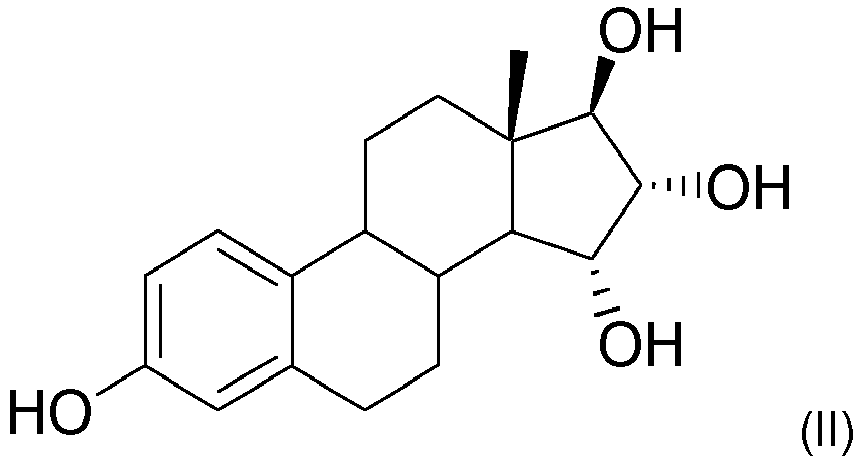
- The invention also encompasses the use of precursors of the estrogenic substances as taught herein. These precursors are capable of liberating the estrogenic substances, in particular when used according to the invention, e.g., as a result of metabolic conversion.
- Preferably, these precursors are derivatives of the estrogen substances, wherein the hydrogen atom of at least one of the hydroxyl groups has been substituted by an acyl radical of a hydrocarbon carboxylic, sulfonic or sulfamic acid of 1-25 carbon atoms; tetrahydrofuranyl; tetrahydropyranyl; or a straight or branched chain glycosydic residue containing 1-20 glycosidic units per residue.
- Non-limiting examples of precursors which can suitably be used in accordance with the invention are esters that can be obtained by reacting the hydroxyl groups of the estrogen substances with substances that contain one or more carboxy (M+-OOC-) groups, wherein M+ represents a hydrogen or (akali) metal cation. Hence, particulary preferred examples of precursors are derivatives of the estrogen substances, wherein the hydrogen atom of at least one of the hydroxyl groups in formula (I) or (II) has been substituted by -CO-R, wherein R is a hydrocarbon radical comprising from 1-25 carbon atoms, preferably R is a hydrogen, or an alkyl, alkenyl, cycloalkyl or aryl radical comprising from 1-20 carbon atoms.
- As noted, the estrogenic components as taught herein are useful in the treatment of neurological disorders in subjects.
- As used herein, the terms "treat" or "treatment" refer to both therapeutic treatment and prophylactic or preventative measures, wherein the object is to prevent or slow down (lessen) an undesired physiological change or disorder, such as the development of a neurological disorder. Beneficial or desired clinical results include, but are not limited to, prevention of a disorder, reducing the incidence of a disorder, alleviation of symptoms associated with a disorder, diminishment of extent of a disorder, stabilised (i.e., not worsening) state of a disorder, delay or slowing of progression of a disorder, amelioration or palliation of the state of a disorder, remission (whether partial or total), whether detectable or undetectable, or combinations thereof. "Treatment" can also mean prolonging survival as compared to expected survival if not receiving treatment.
- Except when noted, "subject" or "patient" are used interchangeably and refer to animals, preferably warm-blooded animals, more preferably vertebrates, even more preferably mammals, still more preferably primates, and specifically include human patients and non-human mammals and primates. "Mammalian" subjects refer to any animal classified as such and include, but are not limited to, humans, domestic animals, commercial animals, farm animals, zoo animals, sport animals, pet and experimental animals such as dogs, cats, guinea pigs, rabbits, rats, mice, horses, cattle, cows; primates such as apes, monkeys, orangutans, and chimpanzees; canids such as dogs and wolves; felids such as cats, lions, and tigers; equids such as horses, donkeys, and zebras; food animals such as cows, pigs, and sheep; ungulates such as deer and giraffes; rodents such as mice, rats, hamsters and guinea pigs; and so on. Preferred patients are human subjects.
- As used herein, a phrase such as "a subject in need of treatment" includes subjects that would benefit from treatment of a recited disorder, in particular a neurological disorder. Such subjects may include, without limitation, those that have been diagnosed with said disorder, those prone to contract or develop said disorder and/or those in whom said disorder is to be prevented. Particularly intended are patients diagnosed with a neurological disorder or in whom a neurological disorder is to be prevented.
- The term "therapeutically effective amount" as used herein refers to an amount of an estrogenic component or a pharmaceutical composition as taught herein effective to treat a neurological disorder in a subject, i.e., to obtain a desired local or systemic effect and performance. The term thus refers to the quantity of estrogenic component or pharmaceutical composition that elicits the biological or medicinal response in a tissue, system, animal, or human that is being sought by a researcher, veterinarian, medical doctor or other clinician. In particular, the term refers to the quantity of estrogenic component or pharmaceutical composition as taught herein which is necessary to prevent, cure, ameliorate, or at least minimize the clinical impairment, symptoms, or complications associated with a neurological disorder in either a single or multiple doses.
- As used herein, the term "neurological disorder" refers to any neurological disease, neurological condition, neurological behavior, and/or any symptom related thereto, affecting the central nervous system and/or the peripheral nervous system.
- Preferably, the neurological disorder may affect the central nervous system, including brain and spinal cord, more preferably it may affect at least the brain.
- Neurological disorders to be treated using the estrogenic components or pharmaceutical compositions taught herein may involve neuronal dysfunction and/or degeneration, damage or loss. Preferably, the neurological disorders to be treated involve neuronal degeneration, damage or loss, such as, for example, but without limitation, brain injuries, spinal cord injuries, or neurodegenerative diseases.
- Exemplary brain injuries include, but are not limited to, hypoxic/anoxic brain injuries, including hypoxic-ischemic encephalopathy (HIE) such as preferably neonatal HIE, and further brain ischemia, or stroke, or traumatic brain injury.
- Exemplary injuries to the spinal cord and associated ganglia include, but are not limited to, post-polio syndrome, traumatic injury, surgical injury, or paralytic diseases.
- With the term "neurodegenerative disease or disorder" is generally meant a neurological disorder characterized by the progressive loss of structure or function of neurons, including death of neurons. Exemplary neurodegenerative diseases include, but are not limited to, Alzheimer's Disease (AD), Parkinson's Disease (PD), frontotemporal dementia (FTD), amyotrophic lateral sclerosis (ALS), Huntington's Disease (HD) and other polyglutamine expansion diseases, Pick's disease, progressive supranuclear palsy, striatonigral degeneration, cortico-basal degeneration, olivopontocerebellar atrophy, Leigh's disease, infantile necrotizing encephalomyelopathy, Hunter's disease, mucopolysaccharidosis, various leukodystrophies (such as Krabbe's disease, Pelizaeus-Merzbacher disease and the like), amaurotic (familial) idiocy, Kuf's disease, Spielmayer-Vogt disease, Tay Sachs disease, Batten disease, Jansky-Bielschowsky disease, Reye's disease, cerebral ataxia, chronic alcoholism, beriberi, Hallervorden-Spatz; syndrome, cerebellar degeneration, and the like. Preferably, the neurodegenerative disease is Alzheimer's Disease (AD) or Parkinson's Disease (PD).
- Further exemplary neurological disorders that may be treated using the estrogenic components or pharmaceutical compositions taught herein may include but are not limited to: demyelinating autoimmune disorders, such as multiple sclerosis; neurological deficits caused by infection of inflammatory diseases, such as Creutzfeldt-Jacob disease or other slow virus infectious diseases of the central nervous system (CNS), AIDS encephalopathy, post-encephalitic Parkinsonism, viral encephalitis, bacterial meningitis or other CNS effects of infectious diseases; cortical motor function disorders, such as spasticity, paresis, clones, or hyperreflexia; cortical sensory perception disorders, such as vestibular function disorders, balance and coordination disorders, dizziness, gait problems, dyslexia, clumsiness, development delay, audition discrimination and modulation disorders, delayed and mechanical speech disorders, vision problems, eye movement and coordination disorders, or sensory disturbance disorders; lower cranial nerve dysfunctions, such as lack of coordination between speech, swallowing or smooth articulation; bowel function disorders, such as gastro-esophageal sphincter control problems; abnormal urinary functioning, such as enuresis, bedwetting, or urinary bladder control disorders; respiratory dysfunctions, such as excessive snoring, obstructive or central apnea, or abnormal respiratory response to oxygen and carbon dioxide levels; sleep-disordered breathing, such as sleep apnea, muscular dysfunction, or sudden infant death; developmental disorders, such as Chiari Malformation; or congenital diseases, such as Down's Syndrome, Morquio's syndrome, spondyloepiphysial dysplasia, achondroplasia, or osteogenesis; neurological behavioral disorders, such as attention deficit hyperactivity disorder, psychological problems, including anxiety, bipolar disorder, scizophrenia, or depression, autism spectrum disorders, including autism, Asperger Syndrome, and pervasive behavioral disorders-not otherwise specified; anatomic conditions, such as platybasia, retroflexed odontoid, basilar invagination, and foramen magnum stenosis; acquired bone-softening conditions, such as Rickets, Paget's disease, or hyperparathyroidism; metabolic bone disorders; connective tissue disorders, including hypermobility connective tissue disorders, such as Ehlers Danlos Syndrome; cervico-medullary syndrome; renal, metabolic, or endocrine syndromes; autonomic neural function disorders that cause abnormal blood flow to the skin, abnormal sexual response, GERDS, dyspraxia, idiopathic scoliosis, headaches, neck pain, back pain, head pain, encephalomyelopathy in the setting of trauma, neoplasm, positional orthostatic tachycardia, and bulbar findings.
- The estrogenic components taught herein may be used alone or in combination with any of the known therapies for neurological disorders ("combination therapy").
- Combination therapies as contemplated herein may comprise the administration of at least one estrogenic component as taught herein and at least one other pharmaceutically or biologically active ingredient. Said estrogenic component(s) and said pharmaceutically or biologically active ingredient(s) may be administered in either the same or separate pharmaceutical composition(s), simultaneously, separately or sequentially in any order.
- The at least one "other pharmaceutically or biologically active ingredient" particularly refers to a substance other than the estrogenic components described herein which is effective to treat a neurological disorder and which may or may not lead to a synergistic effect with the estrogenic component.
- The estrogenic components as disclosed herein may be formulated into pharmaceutical compositions or formulations with one or more pharmaceutically acceptable carriers/excipients. The pharmaceutical compositions may comprise one or more estrogenic components as disclosed herein. The pharmaceutical compositions may also further comprise one or more other pharmaceutically or biologically active ingredients as defined above. Accordingly, also disclosed herein is a pharmaceutical composition comprising an estrogenic component as disclosed herein.
- The term "pharmaceutically acceptable" as used herein is consistent with the art and means compatible with the other ingredients of a pharmaceutical composition and not deleterious to the recipient thereof.
- As used herein, "carrier" or "excipient" includes any and all solvents, diluents, buffers (such as, e.g., neutral buffered saline, phosphate buffered saline, or optionally Tris-HCI, acetate or phosphate buffers), solubilisers (such as, e.g., Tween 80, Polysorbate 80), colloids, dispersion media, vehicles, fillers, chelating agents (such as, e.g., EDTA or glutathione), amino acids (such as, e.g., glycine), proteins, disintegrants, binders, lubricants, wetting agents, stabilisers, emulsifiers, sweeteners, colorants, flavourings, aromatisers, thickeners, agents for achieving a depot effect, coatings, antifungal agents, preservatives (such as, e.g., ThimerosalTM, benzyl alcohol), antioxidants (such as, e.g., ascorbic acid, sodium metabisulfite), tonicity controlling agents, absorption delaying agents, adjuvants, bulking agents (such as, e.g., lactose, mannitol) and the like. The use of such media and agents for formulating pharmaceutical compositions is well known in the art. Except insofar as any conventional media or agent is incompatible with the active ingredient(s), its use in the therapeutic compositions may be contemplated. Suitable pharmaceutical carriers are described inter alia in Remington's Pharmaceutical Sciences, 18th ed., Mack Publishing Co., Easton, PA (1990).
- The pharmaceutical composition can be prepared in a manner known per se to one of skill in the art. For this purpose, at least one estrogenic component as disclosed herein, one or more solid or liquid pharmaceutical excipients and, if desired, in combination with one or more other pharmaceutically or biologically active ingredients as defined above, are brought into a suitable administration form or dosage form which can then be used as a pharmaceutical in human medicine or veterinary medicine. The precise nature of the carrier or excipient or other material will depend on the route of administration. Such suitable administration forms - which may be solid, semi-solid, or liquid, depending on the manner of administration - as well as methods and carriers for use in the preparation thereof, will be clear to the skilled person; reference is made to for instance standard handbooks, such as Remington's Pharmaceutical Sciences (supra).
- For example, the pharmaceutical composition as taught herein may be administered parenterally (such as by intravenous, intracerebral, intracerebroventricular, intramuscular, or subcutaneous injection, or intravenous infusion) in the form of a parenterally acceptable aqueous solution, which is pyrogen-free and has suitable pH, isotonicity and stability. Alternatively, the pharmaceutical composition as taught herein may be administered orally, for example in the form of pills, tablets, lacquered tablets, sugar-coated tablets, granules, hard and soft gelatin capsules, aqueous, alcoholic or oily solutions, syrups, emulsions or suspensions, or rectally, for example in the form of suppositories, percutaneous or topically (including ocular administration), for example in the form of ointments, tinctures, sprays or transdermal therapeutic systems (such as, e.g. a skin patch), or by inhalation in the form of nasal sprays or aerosol mixtures, or, for example, in the form of microcapsules, implants or rods.
- For the production of pills, tablets, sugar-coated tablets and hard gelatin capsules it is possible to use, for example, lactose, starch, for example maize starch, or starch derivatives, talc, stearic acid or its salts, etc. Carriers for soft gelatin capsules and suppositories are, for example, fats, waxes, semisolid and liquid polyols, natural or hardened oils, etc. Suitable carriers for the preparation of solutions, for example of solutions for injection, or of emulsions or syrups are, for example, water, physiological sodium chloride solution, alcohols such as ethanol, glycerol, polyols, sucrose, invert sugar, glucose, mannitol, vegetable oils, etc. It is also possible to lyophilize the active ingredient(s) and to use the resulting lyophilisates, for example, for preparing preparations for injection or infusion. Suitable carriers for microcapsules, implants or rods are, for example, copolymers of glycolic acid and lactic acid.
- For an oral administration form, the compositions of the present invention can be mixed with suitable additives, such as excipients, stabilizers, or inert diluents, and brought by means of the customary methods into the suitable administration forms, such as tablets, coated tablets, hard capsules, aqueous, alcoholic, or oily solutions. Examples of suitable inert carriers are gum arabic, magnesia, magnesium carbonate, potassium phosphate, lactose, glucose, or starch, in particular, corn starch. In this case, the preparation can be carried out both as dry and as moist granules. Suitable oily excipients or solvents are vegetable or animal oils, such as sunflower oil or cod liver oil. Suitable solvents for aqueous or alcoholic solutions are water, ethanol, sugar solutions, or mixtures thereof. Polyethylene glycols and polypropylene glycols are also useful as further auxiliaries for other administration forms. As immediate release tablets, these compositions may contain microcrystalline cellulose, dicalcium phosphate, starch, magnesium stearate, and lactose and/or other excipients, binders, extenders, disintegrants, diluents, and lubricants known in the art.
- The oral administration of a pharmaceutical composition comprising at least one estrogenic component as disclosed herein, is suitably accomplished by uniformly and intimately blending together a suitable amount of said component in the form of a powder, optionally also including a finely divided solid carrier, and encapsulating the blend in, for example, a hard gelatin capsule. The solid carrier can include one or more substances, which act as binders, lubricants, disintegrating agents, coloring agents, and the like. Suitable solid carriers include, for example, calcium phosphate, magnesium stearate, talc, sugars, lactose, dextrin, starch, gelatin, cellulose, polyvinylpyrrolidine, low melting waxes and ion exchange resins.
- Compressed tablets containing the pharmaceutical composition described herein can be prepared by uniformly and intimately mixing the active ingredient(s) with a solid carrier such as described above to provide a mixture having the necessary compression properties, and then compacting the mixture in a suitable machine to the shape and size desired. Molded tablets maybe made by molding in a suitable machine, a mixture of powdered active ingredient(s) moistened with an inert liquid diluent.
- When administered by nasal aerosol or inhalation, these compositions may be prepared according to techniques well-known in the art of pharmaceutical formulation and may be prepared as solutions in saline, employing benzyl alcohol or other suitable preservatives, absorption promoters to enhance bioavailability, fluorocarbons, and/or other solubilizing or dispersing agents known in the art. Suitable pharmaceutical formulations for administration in the form of aerosols or sprays are, for example, solutions, suspensions, or emulsions of the compounds of the invention or their physiologically tolerable salts in a pharmaceutically acceptable solvent, such as ethanol or water, or a mixture of such solvents. If required, the formulation can also additionally contain other pharmaceutical auxiliaries such as surfactants, emulsifiers and stabilizers as well as a propellant.
- For subcutaneous or intravenous administration, the estrogenic component(s) described herein, if desired with the substances customary therefore such as solubilizers, emulsifiers, or further auxiliaries, are brought into solution, suspension, or emulsion. The active ingredient(s) can also be lyophilized and the lyophilizates obtained used, for example, for the production of injection or infusion preparations. Suitable solvents are, for example, water, physiological saline solution, or alcohols, e.g. ethanol, propanol, glycerol, in addition also sugar solutions such as glucose or mannitol solutions, or alternatively mixtures of the various solvents mentioned. The injectable solutions or suspensions may be formulated according to known art, using suitable non-toxic, parenterally-acceptable diluents, or solvents, such as mannitol, 1,3-butanediol, water, Ringer's solution, or isotonic sodium chloride solution, or suitable dispersing or wetting and suspending agents, such as sterile, bland, fixed oils, including synthetic mono- or diglycerides, and fatty acids, including oleic acid.
- When rectally administered in the form of suppositories, these formulations may be prepared by mixing the estrogenic component described herein with a suitable nonirritating excipient, such as cocoa butter, synthetic glyceride esters, or polyethylene glycols, which are solid at ordinary temperatures, but liquefy and/or dissolve in the rectal cavity to release the drug.
- Some preferred, but non-limiting examples of such preparations include tablets, pills, powders, lozenges, sachets, cachets, elixirs, suspensions, emulsions, solutions, syrups, aerosols, ointments, cremes, lotions, soft and hard gelatin capsules, suppositories, drops, sterile injectable solutions and sterile packaged powders (which are usually reconstituted prior to use) for administration as a bolus and/or for continuous administration, which may be formulated with carriers, excipients, and diluents that are suitable per se for such formulations, such as lactose, dextrose, sucrose, sorbitol, mannitol, starches, gum acacia, calcium phosphate, alginates, tragacanth, gelatin, calcium silicate, microcrystalline cellulose, polyvinylpyrrolidone, polyethylene glycol, cellulose, (sterile) water, methylcellulose, methyl- and propylhydroxybenzoates, talc, magnesium stearate, edible oils, vegetable oils and mineral oils or suitable mixtures thereof. The formulations can optionally contain other pharmaceutically active substances (which may or may not lead to a synergistic effect with the compounds of the invention) and other substances that are commonly used in pharmaceutical formulations, such as lubricating agents, wetting agents, emulsifying, and suspending agents, dispersing agents, desintegrants, bulking agents, fillers, preserving agents, sweetening agents, flavoring agents, flow regulators, release agents, etc.
- The pharmaceutical compositions may be formulated so as to provide rapid, sustained, or delayed release of the active ingredient(s) contained therein, for example using liposomes or hydrophilic polymeric matrices based on natural gels or synthetic polymers.
- The dosage or amount of the estrogenic component as disclosed herein used, optionally in combination with one or more other pharmaceutically or biologically active ingredients as defined above, depends on the individual case and is, as is customary, to be adapted to the individual circumstances to achieve an optimum effect. Thus, it depends on the nature and the severity of the disorder to be treated, and also on the sex, age, body weight, diet, general health, individual responsiveness of the human or animal to be treated, on the efficacy, metabolic stability and duration of action of the components used, on mode and time of administration, rate of excretion, on whether the therapy is acute or chronic or prophylactic, or on whether other pharmaceutically or biologically active ingredients as defined above are administered, or other therapies applied, in addition to the estrogenic component.
- Without limitation, depending on the type and severity of the disorder, a typical daily dosage might range from about 1 µg/kg to about 250 mg/kg body weight or more, preferably from about 1 µg/kg to about 100 mg/kg body weight, more preferably from about 1 µg/kg to about 50 mg/kg body weight, even more preferably from about 1 µg/kg to about 10 mg/kg body weight, still more preferably from about 1 µg/kg to about 10 mg/kg body weight or from about 1 µg/kg to about 1 mg/kg body weight, yet more preferably from about 1 µg/kg to about 0.4 mg/kg body weight or from about 5 µg/kg to about 0.4 mg/kg body weight, depending on the factors mentioned above.
- For repeated administrations over several days or longer, depending on the condition, the treatment is sustained until a desired suppression of disease symptoms occurs. A preferred dosage of the estrogenic component may be in the range from about 0.01 to about 20 mg/kg, more preferably from about 0.05 mg/kg to about 10 mg/kg. Thus, one or more doses of about 0.1 mg/kg, 0.2 mg/kg, 0.3 mg/kg, 0.4 mg/kg, 0.5 mg/kg, 1.0 mg/kg, 2.0 mg/kg, 4.0 mg/kg or 10 mg/kg (or any combination thereof) may be administered to the patient. Such doses may be administered as a single daily dose, divided over one or more daily doses, or essentially continuously, e.g., using a drip infusion, or intermittently, e.g., every week or every three weeks.
- The pharmaceutical preparations disclosed herein are preferably in a unit dosage form, and may be suitably packaged, for example in a box, blister, vial, bottle, sachet, ampoule, or in any other suitable single-dose or multi-dose holder or container (which may be properly labeled); optionally with one or more leaflets containing product information and/or instructions for use. Generally, such unit dosages will contain between 1 and 1000 mg, and usually between 5 and 500 mg, of at least one estrogenic component of the invention, e.g., about 10, 25, 50, 100, 200, 300, or 400 mg per unit dosage.
- Depending on the mode of administration, the pharmaceutical composition will preferably comprise from 0.05 to 99 % by weight, more preferably from 0.1 to 70 % by weight, even more preferably from 0.1 to 50 % by weight of the estrogenic component as described herein, and, from 1 to 99.95 % by weight, more preferably from 30 to 99.9 % by weight, even more preferably from 50 to 99.9 % by weight of a pharmaceutically acceptable carrier, all percentages being based on the total weight of the composition.
- The pharmaceutical compositions can be administered separately at different times during the course of therapy or concurrently in divided or single combination forms. The present disclosure embraces all such regimes of simultaneous or alternating treatment and the term "administering" is to be interpreted accordingly.
- The administration may be performed with food, e.g., a high-fat meal. The term "with food" means the consumption of a meal either during or no more than about one hour before or after administration of a pharmaceutical composition as described herein.
- After delivery, newborn rat pups were assigned to one of the following 4 groups: Sham group (neither vehicle nor estetrol (E4) applied), Vehicle treated group (saline solution is used as a vehicle), E4 5 mg/kg/per day group and
E4 50 mg/kg/per day group. From day 4 to day 7 inclusively rat pups were injected intraperitoneally (IP) either by vehicle (Vehicle group) or E4 (5mg/kg or 50 mg/kg in accordance to the group assignment) or not injected at all (Sham group). At day 7, 30 minutes after last injection, animals from Vehicle and E4 (5 mg/kg or 50 mg/kg) groups passed through surgery encompassing left common carotid artery double ligation and cut, followed by hypoxia produced by the inhalation of 11%-8% of oxygen balanced by nitrogen at decreased concentration for 20 minutes, followed by inhalation of 8% oxygen and 92% nitrogen at constant concentration for 35 minutes. The Sham group went through similar procedures without left common carotid artery ligation and hypoxia. All the manipulations were performed at 37°C. Rat pups recovered with their dams until being sacrificed at postnatal day 14. - Blood was withdrawn, centrifuged and the serum samples were stored at -80° C. Brains were removed after transcardial perfusion and fixation.
- Rat pups weight measurements were performed from day 4 to day 7 (in order to evaluate the amount of vehicle and E4 necessary for injections) and from day 7 until up to day 14 (in order to evaluate the postoperative weight of rat pups in the study groups).
- Paraformaldehyde-fixed paraffin embedded samples of the removed brains were sectioned at the same level of the hippocampus region in accordance to the Paxinos rat brain atlas. Thickness of sections was 5 µm. Hematoxylin-eosin staining was performed.
- Intact cell counting was performed on Hematoxylin-Eosin-stained sections of the rat pups brains at magnification of 400x in 3 fields of the respective brain area. Countings were performed in cortex and hippocampus (regions: dentate gyrus (DG), subgranular zone (SGZ), cornu ammonis (CA1, CA2/CA3)).
- At post-operative days 13 and 14 E4 5mg/kg treated rat pups had significantly higher body weight than Vehicle treated animals, whereas at other post-operative days Sham operated group had significantly higher body weight than the other groups: days 8 (Sham vs. Vehicle and E4 5 mg/kg), 10 (Sham vs.
E4 50 mg/kg), 12 (Sham vs. Vehicle), 13 (Sham vs. Vehicle) and 14 (Sham vs. Vehicle) (Fig. 1 ). - Measurement of brains weights revealed that they were significantly higher in E4 5 mg/kg and Sham operated groups than in the Vehicle treated group (
Fig. 2 ). - Only sections from the Vehicle treated group showed visible disorganization of the hippocampus region ipsilateral to damage (left side), surrounded with infarct areas extended to the hippocampus region contralateral to damage (right side) (
Fig. 3 ). These results show that E4, at both doses, has neuroprotective effect. - In DG region of hippocampus the number of intact cells per visual field was significantly higher in E4 5 mg/kg and Sham operated animal groups than in the Vehicle group (
Fig. 4 ). In SGZ intact cell number was significantly higher in E4 5 mg/kg group alone in comparison with Sham and Vehicle groups, whereas in CA1 non-significant difference was detected among the study groups. In CA2/CA3 region ofhippocampus E4 50 mg/kg group alone had a significantly higher number of intact cells than Vehicle treated and E4 5 mg/kg groups, whereas incortex E4 50 mg/kg group had significantly higher number of intact cells compared to the Vehicle group alone. These results show that estetrol has neuroprotective effect.
Claims (9)
- An estrogenic component selected from the group consisting of:estrogenic substances having the formula (1):

precursors of the estrogenic substances; and
mixtures of one or more of the estrogenic substances and/or the precursors;
for use in the treatment of a neurological disorder. - The estrogenic component for use according to claim 1, wherein R3 represents a hydroxyl group or an alkoxy group with 1-5 carbon atoms.
- The estrogenic component for use according to any one of claims 1 or 2, wherein 3 of R1, R2, R3, R4 represent hydrogen atoms.
- The estrogenic component for use according to any one of claims 1 to 3, wherein the estrogenic component is 1,3,5(10)-estratrien-3, 15α, 16α, 17β-tetrol (estetrol).
- The estrogenic component for use according to any one of claims 1 to 4, wherein the precursors are derivatives of the estrogenic substances wherein the hydrogen atom of at least one of the hydroxyl groups has been substituted by an acyl radical of a hydrocarbon carboxylic, sulfonic or sulfamic acid of 1-25 carbon atoms; tetrahydrofuranyl; tetrahydropyranyl; or a straight or branched chain glycosydic residue containing 1-20 glycosidic units per residue.
- The estrogenic component for use according to any one of claims 1 to 5, wherein the neurological disorder is selected from the group comprising a brain injury, a spinal cord injury, and a neurodegenerative disease.
- The estrogenic component for use according to any one of claims 1 to 6, wherein the neurological disorder is selected from the group comprising hypoxic brain injury, anoxic brain injury, traumatic brain injury, Alzheimer's disease, and Parkinson's disease.
- The estrogenic component for use according to any one of claims 1 to 7, for use in the treatment of hypoxic-ischemic encephalopathy (HIE).
- The estrogenic component for use according to any one of claims 1 to 8, for use in the treatment of neonatal hypoxic-ischemic encephalopathy (HIE).
Priority Applications (22)
| Application Number | Priority Date | Filing Date | Title |
|---|---|---|---|
| EP12164741.6A EP2653163A1 (en) | 2012-04-19 | 2012-04-19 | Estrogenic components for use in the treatment of neurological disorders |
| NO13714917A NO2838539T3 (en) | 2012-04-19 | 2013-04-08 | |
| RU2014145800A RU2627846C2 (en) | 2012-04-19 | 2013-04-08 | Estrogen components for application in neurological disorders treatment |
| SI201330825T SI2838539T1 (en) | 2012-04-19 | 2013-04-08 | Estrogenic derivatives for use in the treatment of neurological disorders. |
| CN201380020555.6A CN104379148B (en) | 2012-04-19 | 2013-04-08 | Estrogenic component for treating neurological disorder |
| LTEP13714917.5T LT2838539T (en) | 2012-04-19 | 2013-04-08 | Estrogenic derivatives for use in the treatment of neurological disorders. |
| RS20171122A RS56595B1 (en) | 2012-04-19 | 2013-04-08 | Estrogenic derivatives for use in the treatment of neurological disorders |
| JP2015506173A JP6139662B2 (en) | 2012-04-19 | 2013-04-08 | Estrogenic components for use in the treatment of neurological disorders |
| EP13714917.5A EP2838539B1 (en) | 2012-04-19 | 2013-04-08 | Estrogenic derivatives for use in the treatment of neurological disorders. |
| US14/395,465 US9238035B2 (en) | 2012-04-19 | 2013-04-08 | Estrogenic components for use in the treatment of neurological disorders |
| PL13714917T PL2838539T3 (en) | 2012-04-19 | 2013-04-08 | Estrogenic components for use in the treatment of neurological disorders |
| HUE13714917A HUE034902T2 (en) | 2012-04-19 | 2013-04-08 | Estrogenic derivatives for use in the treatment of neurological disorders. |
| ES13714917.5T ES2647111T3 (en) | 2012-04-19 | 2013-04-08 | Estrogenic derivatives for use in the treatment of neurological disorders |
| PCT/EP2013/057279 WO2013156329A1 (en) | 2012-04-19 | 2013-04-08 | Estrogenic components for use in the treatment of neurological disorders. |
| HRP20171627TT HRP20171627T1 (en) | 2012-04-19 | 2013-04-08 | Estrogenic derivatives for use in the treatment of neurological disorders |
| AU2013248481A AU2013248481B2 (en) | 2012-04-19 | 2013-04-08 | Estrogenic components for use in the treatment of neurological disorders. |
| SM20170531T SMT201700531T1 (en) | 2012-04-19 | 2013-04-08 | Estrogenic derivatives for use in the treatment of neurological disorders. |
| DK13714917.5T DK2838539T3 (en) | 2012-04-19 | 2013-04-08 | ESTROGENDER DERIVATIVES TO USE IN THE TREATMENT OF NEUROLOGICAL DISORDERS |
| PT137149175T PT2838539T (en) | 2012-04-19 | 2013-04-08 | ESTROGENIC DERIVATIVES FOR USE IN THE TREATMENT OF NEUROLOGICAL DISORDERS. |
| CA2869902A CA2869902C (en) | 2012-04-19 | 2013-04-08 | Estrogenic components for use in the treatment of neurological disorders |
| US14/963,676 US9808470B2 (en) | 2012-04-19 | 2015-12-09 | Estrogenic components for use in the treatment of neurological disorders |
| CY20171101193T CY1119603T1 (en) | 2012-04-19 | 2017-11-14 | Estrogenic Derivatives for Use in the Treatment of Neurological Disorders |
Applications Claiming Priority (1)
| Application Number | Priority Date | Filing Date | Title |
|---|---|---|---|
| EP12164741.6A EP2653163A1 (en) | 2012-04-19 | 2012-04-19 | Estrogenic components for use in the treatment of neurological disorders |
Publications (1)
| Publication Number | Publication Date |
|---|---|
| EP2653163A1 true EP2653163A1 (en) | 2013-10-23 |
Family
ID=48050711
Family Applications (2)
| Application Number | Title | Priority Date | Filing Date |
|---|---|---|---|
| EP12164741.6A Withdrawn EP2653163A1 (en) | 2012-04-19 | 2012-04-19 | Estrogenic components for use in the treatment of neurological disorders |
| EP13714917.5A Active EP2838539B1 (en) | 2012-04-19 | 2013-04-08 | Estrogenic derivatives for use in the treatment of neurological disorders. |
Family Applications After (1)
| Application Number | Title | Priority Date | Filing Date |
|---|---|---|---|
| EP13714917.5A Active EP2838539B1 (en) | 2012-04-19 | 2013-04-08 | Estrogenic derivatives for use in the treatment of neurological disorders. |
Country Status (20)
| Country | Link |
|---|---|
| US (1) | US9238035B2 (en) |
| EP (2) | EP2653163A1 (en) |
| JP (1) | JP6139662B2 (en) |
| CN (1) | CN104379148B (en) |
| AU (1) | AU2013248481B2 (en) |
| CA (1) | CA2869902C (en) |
| CY (1) | CY1119603T1 (en) |
| DK (1) | DK2838539T3 (en) |
| ES (1) | ES2647111T3 (en) |
| HR (1) | HRP20171627T1 (en) |
| HU (1) | HUE034902T2 (en) |
| LT (1) | LT2838539T (en) |
| NO (1) | NO2838539T3 (en) |
| PL (1) | PL2838539T3 (en) |
| PT (1) | PT2838539T (en) |
| RS (1) | RS56595B1 (en) |
| RU (1) | RU2627846C2 (en) |
| SI (1) | SI2838539T1 (en) |
| SM (1) | SMT201700531T1 (en) |
| WO (1) | WO2013156329A1 (en) |
Families Citing this family (16)
| Publication number | Priority date | Publication date | Assignee | Title |
|---|---|---|---|---|
| WO2012164096A1 (en) | 2011-06-01 | 2012-12-06 | Estetra S.A. | Process for the production of estetrol intermediates |
| BR112013030833B1 (en) | 2011-06-01 | 2019-09-03 | Estetra S A | process for the preparation of a compound of formula (i) and process for the preparation of estetrol |
| EP2383279A1 (en) | 2011-07-19 | 2011-11-02 | Pantarhei Bioscience B.V. | Process for the preparation of estetrol |
| WO2016187558A2 (en) * | 2015-05-20 | 2016-11-24 | University Of Pittsburgh-Of The Commonwealth System Of Higher Education | Method to improve neurologic outcomes in temperature managed patients |
| RS57328B1 (en) | 2015-06-18 | 2018-08-31 | Mithra Pharmaceuticals S A | Orodispersible dosage unit containing an estetrol component |
| NZ737945A (en) * | 2015-06-18 | 2023-06-30 | Estetra Sprl | Orodispersible dosage unit containing an estetrol component |
| LT3310345T (en) | 2015-06-18 | 2021-06-25 | Estetra Sprl | ORAL DISPERSIBLE TABLET CONTAINING ESTETROL |
| WO2016203044A1 (en) * | 2015-06-18 | 2016-12-22 | Mithra Pharmaceuticals S.A. | Orodispersible tablet containing estetrol |
| CA3178291A1 (en) | 2016-08-05 | 2018-04-12 | Estetra Srl | Method for the management of dysmenorrhea and menstrual pain |
| CN107260712A (en) * | 2017-06-22 | 2017-10-20 | 中国人民解放军第三军医大学 | Applications of the Ao Pei meter Fen in the medicine for promoting myelin formation and regeneration is prepared |
| TWI801561B (en) | 2018-04-19 | 2023-05-11 | 比利時商依思特拉私人有限責任公司 | Compounds and their uses for alleviating menopause-associated symptoms |
| CR20200486A (en) | 2018-04-19 | 2021-01-27 | Estetra Sprl | Compounds and their uses for alleviating menopause-associated symptoms |
| HU231240B1 (en) | 2019-09-03 | 2022-04-28 | Richter Gedeon Nyrt. | Industrial process for the preparation of high-purity estetrol |
| CN113243332B (en) * | 2020-02-07 | 2023-07-28 | 上海市东方医院(同济大学附属东方医院) | Preparation and application of extensive brain area neuron tree sudden-breeding obstacle animal model |
| TWI893101B (en) | 2020-04-16 | 2025-08-11 | 比利時商埃斯特拉有限責任公司 | Contraceptive compositions with reduced adverse effects |
| HUP2400151A1 (en) | 2024-02-28 | 2025-09-28 | Richter Gedeon Nyrt | Process for the crystallization of estetrol monohydrate |
Citations (4)
| Publication number | Priority date | Publication date | Assignee | Title |
|---|---|---|---|---|
| WO2003103683A1 (en) | 2002-06-11 | 2003-12-18 | Pantarhei Bioscience B.V. | Use of estetrol and analogues for treating or preventing cardiovascular pathologies, in particular atherosclerosis |
| WO2007038636A2 (en) * | 2005-09-26 | 2007-04-05 | The Regents Of The University Of California | Estriol therapy for autoimmune and neurodegenerataive diseases and disorders |
| WO2008156365A1 (en) * | 2007-06-21 | 2008-12-24 | Pantarhei Bioscience B.V. | Treatment of meconium aspiration syndrome with estrogens |
| WO2009061428A1 (en) * | 2007-11-06 | 2009-05-14 | Kline Ellis L | Compositions and methods for treating parkinson's disease and related disorders |
Family Cites Families (4)
| Publication number | Priority date | Publication date | Assignee | Title |
|---|---|---|---|---|
| GB2378898A (en) * | 2001-08-14 | 2003-02-26 | Hunter Fleming Ltd | Prophylactic and therapeutic use of hydroxysteroids |
| AU2003274946A1 (en) * | 2002-06-11 | 2003-12-22 | Pantarhei Bioscience B.V. | Method of treating or preventing immune mediated disorders and pharmaceutical formulation for use therein |
| EP1971344B1 (en) * | 2006-01-09 | 2010-09-22 | Pantarhei Bioscience B.V. | A method of treating an acute vascular disorder |
| CN101884638B (en) * | 2010-07-09 | 2011-11-09 | 中山大学 | Application of 5alpha-androstane-3beta,5,6beta-triol in preparing neuro-protective medicaments |
-
2012
- 2012-04-19 EP EP12164741.6A patent/EP2653163A1/en not_active Withdrawn
-
2013
- 2013-04-08 AU AU2013248481A patent/AU2013248481B2/en active Active
- 2013-04-08 DK DK13714917.5T patent/DK2838539T3/en active
- 2013-04-08 PL PL13714917T patent/PL2838539T3/en unknown
- 2013-04-08 RS RS20171122A patent/RS56595B1/en unknown
- 2013-04-08 RU RU2014145800A patent/RU2627846C2/en active
- 2013-04-08 HU HUE13714917A patent/HUE034902T2/en unknown
- 2013-04-08 SM SM20170531T patent/SMT201700531T1/en unknown
- 2013-04-08 LT LTEP13714917.5T patent/LT2838539T/en unknown
- 2013-04-08 HR HRP20171627TT patent/HRP20171627T1/en unknown
- 2013-04-08 ES ES13714917.5T patent/ES2647111T3/en active Active
- 2013-04-08 PT PT137149175T patent/PT2838539T/en unknown
- 2013-04-08 CA CA2869902A patent/CA2869902C/en active Active
- 2013-04-08 US US14/395,465 patent/US9238035B2/en active Active
- 2013-04-08 NO NO13714917A patent/NO2838539T3/no unknown
- 2013-04-08 JP JP2015506173A patent/JP6139662B2/en active Active
- 2013-04-08 EP EP13714917.5A patent/EP2838539B1/en active Active
- 2013-04-08 WO PCT/EP2013/057279 patent/WO2013156329A1/en not_active Ceased
- 2013-04-08 SI SI201330825T patent/SI2838539T1/en unknown
- 2013-04-08 CN CN201380020555.6A patent/CN104379148B/en active Active
-
2017
- 2017-11-14 CY CY20171101193T patent/CY1119603T1/en unknown
Patent Citations (4)
| Publication number | Priority date | Publication date | Assignee | Title |
|---|---|---|---|---|
| WO2003103683A1 (en) | 2002-06-11 | 2003-12-18 | Pantarhei Bioscience B.V. | Use of estetrol and analogues for treating or preventing cardiovascular pathologies, in particular atherosclerosis |
| WO2007038636A2 (en) * | 2005-09-26 | 2007-04-05 | The Regents Of The University Of California | Estriol therapy for autoimmune and neurodegenerataive diseases and disorders |
| WO2008156365A1 (en) * | 2007-06-21 | 2008-12-24 | Pantarhei Bioscience B.V. | Treatment of meconium aspiration syndrome with estrogens |
| WO2009061428A1 (en) * | 2007-11-06 | 2009-05-14 | Kline Ellis L | Compositions and methods for treating parkinson's disease and related disorders |
Non-Patent Citations (11)
| Title |
|---|
| "Remington's Pharmaceutical Sciences", 1990, MACK PUBLISHING CO. |
| COELING BENNINK ET AL., CONTRACEPTION, vol. 77, 2008, pages 186 - 190 |
| FERRIERO, N ENGL J MED, vol. 351, 2004, pages 1985 - 1995 |
| GLUCKMAN ET AL., LANCET, vol. 65, 2005, pages 663 - 670 |
| GROW ET AL., CLIN PERINATAL, vol. 29, 2002, pages 585 - 602 |
| HOLINKA ET AL., J STEROID BIOCHEM MOL BIOL, vol. 110, 2008, pages 138 - 143 |
| NUNEZ ET AL: "17beta-Estradiol protects the neonatal brain from hypoxia-ischemia", EXPERIMENTAL NEUROLOGY, ACADEMIC PRESS, NEW YORK, NY, US, vol. 208, no. 2, 16 November 2007 (2007-11-16), pages 269 - 276, XP022348700, ISSN: 0014-4886 * |
| SHANKARAN ET AL., N ENGL J MED, vol. 353, 2005, pages 1574 - 1584 |
| VANUCCI ET AL., DEV NEUROSCI, vol. 27, 2005, pages 81 - 86 |
| VISSER ET AL., CLIMACTERIC, vol. 11, no. 1, 2008, pages 31 - 40 |
| WARMERDAM ET AL., CLIMACTERIC, vol. 11, no. 1, 2008, pages 59 - 63 |
Also Published As
| Publication number | Publication date |
|---|---|
| LT2838539T (en) | 2017-11-27 |
| RS56595B1 (en) | 2018-02-28 |
| PL2838539T3 (en) | 2018-01-31 |
| WO2013156329A1 (en) | 2013-10-24 |
| US20150133419A1 (en) | 2015-05-14 |
| AU2013248481A1 (en) | 2014-10-30 |
| CY1119603T1 (en) | 2018-04-04 |
| PT2838539T (en) | 2017-11-15 |
| EP2838539B1 (en) | 2017-08-16 |
| HRP20171627T1 (en) | 2017-12-01 |
| DK2838539T3 (en) | 2017-11-27 |
| ES2647111T3 (en) | 2017-12-19 |
| RU2014145800A (en) | 2016-06-10 |
| SI2838539T1 (en) | 2017-12-29 |
| CN104379148A (en) | 2015-02-25 |
| RU2627846C2 (en) | 2017-08-14 |
| US9238035B2 (en) | 2016-01-19 |
| CA2869902C (en) | 2019-07-02 |
| AU2013248481B2 (en) | 2017-02-16 |
| EP2838539A1 (en) | 2015-02-25 |
| JP6139662B2 (en) | 2017-05-31 |
| CN104379148B (en) | 2017-08-25 |
| SMT201700531T1 (en) | 2018-01-11 |
| NO2838539T3 (en) | 2018-01-13 |
| JP2015514731A (en) | 2015-05-21 |
| CA2869902A1 (en) | 2013-10-24 |
| HUE034902T2 (en) | 2018-03-28 |
Similar Documents
| Publication | Publication Date | Title |
|---|---|---|
| EP2838539B1 (en) | Estrogenic derivatives for use in the treatment of neurological disorders. | |
| US9808470B2 (en) | Estrogenic components for use in the treatment of neurological disorders | |
| CN109734701B (en) | ROCK inhibitor-dichloroacetic acid double salt and preparation method and use thereof | |
| US9301943B2 (en) | Use of eupatilin | |
| US20120225853A1 (en) | Hormone replacement therapy and depression | |
| EP2767533B1 (en) | Derivative of butylphthalide and preparation method and use thereof | |
| EP3632447B1 (en) | Pharmaceutical composition for prevention or treatment of bone-related disease | |
| EP2985037B1 (en) | A pharmaceutical composition comprising palmitoylethanolamid and cytidine-diphosphocholine | |
| CA3025858A1 (en) | Crystalline forms of 4-(5-(4,7-dimethylbenzofuran-2-yl)-1,2,4-oxadiazol-3-yl)benzoic acid and processes for their preparation | |
| AU2001267709A1 (en) | 7-hydroxyepiandrosterone having neuroprotective activity | |
| EP1294382A1 (en) | 7-hydroxyepiandrosterone having neuroprotective activity | |
| EP2253228B1 (en) | Composition for controlling and improving female and male gametogenesis | |
| WO2022247763A1 (en) | Compositions for treating insomnia and uses thereof | |
| US10485808B2 (en) | Selective progesterone receptor modulators (SPRM) and stabilized estrogen level in patient | |
| JP2657614B2 (en) | Aromatase inhibitor | |
| CN113795492A (en) | Amorphous PI3K inhibitors and pharmaceutical compositions containing the same | |
| KR102013375B1 (en) | Composition for Preventing or Treating of Menopause Disease | |
| JP5646358B2 (en) | Aromatase activator | |
| CN113491680A (en) | Application of catechol and derivatives in preparation of drugs for treating sleep disorders | |
| HK1167828A1 (en) | Application of nicotinic acid derivates in preparation of medicaments for promoting follicular development and maintaining ovarian functions |
Legal Events
| Date | Code | Title | Description |
|---|---|---|---|
| PUAI | Public reference made under article 153(3) epc to a published international application that has entered the european phase |
Free format text: ORIGINAL CODE: 0009012 |
|
| AK | Designated contracting states |
Kind code of ref document: A1 Designated state(s): AL AT BE BG CH CY CZ DE DK EE ES FI FR GB GR HR HU IE IS IT LI LT LU LV MC MK MT NL NO PL PT RO RS SE SI SK SM TR |
|
| AX | Request for extension of the european patent |
Extension state: BA ME |
|
| STAA | Information on the status of an ep patent application or granted ep patent |
Free format text: STATUS: THE APPLICATION IS DEEMED TO BE WITHDRAWN |
|
| 18D | Application deemed to be withdrawn |
Effective date: 20140424 |