EP2652106B1 - Low streak degreasing composition - Google Patents
Low streak degreasing composition Download PDFInfo
- Publication number
- EP2652106B1 EP2652106B1 EP11794745.7A EP11794745A EP2652106B1 EP 2652106 B1 EP2652106 B1 EP 2652106B1 EP 11794745 A EP11794745 A EP 11794745A EP 2652106 B1 EP2652106 B1 EP 2652106B1
- Authority
- EP
- European Patent Office
- Prior art keywords
- composition
- surfactant
- cleaning
- silica particles
- cpp
- Prior art date
- Legal status (The legal status is an assumption and is not a legal conclusion. Google has not performed a legal analysis and makes no representation as to the accuracy of the status listed.)
- Active
Links
Images

Classifications
-
- C—CHEMISTRY; METALLURGY
- C11—ANIMAL OR VEGETABLE OILS, FATS, FATTY SUBSTANCES OR WAXES; FATTY ACIDS THEREFROM; DETERGENTS; CANDLES
- C11D—DETERGENT COMPOSITIONS; USE OF SINGLE SUBSTANCES AS DETERGENTS; SOAP OR SOAP-MAKING; RESIN SOAPS; RECOVERY OF GLYCEROL
- C11D3/00—Other compounding ingredients of detergent compositions covered in group C11D1/00
- C11D3/02—Inorganic compounds ; Elemental compounds
- C11D3/12—Water-insoluble compounds
- C11D3/124—Silicon containing, e.g. silica, silex, quartz or glass beads
-
- B—PERFORMING OPERATIONS; TRANSPORTING
- B82—NANOTECHNOLOGY
- B82Y—SPECIFIC USES OR APPLICATIONS OF NANOSTRUCTURES; MEASUREMENT OR ANALYSIS OF NANOSTRUCTURES; MANUFACTURE OR TREATMENT OF NANOSTRUCTURES
- B82Y30/00—Nanotechnology for materials or surface science, e.g. nanocomposites
-
- C—CHEMISTRY; METALLURGY
- C11—ANIMAL OR VEGETABLE OILS, FATS, FATTY SUBSTANCES OR WAXES; FATTY ACIDS THEREFROM; DETERGENTS; CANDLES
- C11D—DETERGENT COMPOSITIONS; USE OF SINGLE SUBSTANCES AS DETERGENTS; SOAP OR SOAP-MAKING; RESIN SOAPS; RECOVERY OF GLYCEROL
- C11D1/00—Detergent compositions based essentially on surface-active compounds; Use of these compounds as a detergent
- C11D1/66—Non-ionic compounds
- C11D1/825—Mixtures of compounds all of which are non-ionic
-
- C—CHEMISTRY; METALLURGY
- C11—ANIMAL OR VEGETABLE OILS, FATS, FATTY SUBSTANCES OR WAXES; FATTY ACIDS THEREFROM; DETERGENTS; CANDLES
- C11D—DETERGENT COMPOSITIONS; USE OF SINGLE SUBSTANCES AS DETERGENTS; SOAP OR SOAP-MAKING; RESIN SOAPS; RECOVERY OF GLYCEROL
- C11D1/00—Detergent compositions based essentially on surface-active compounds; Use of these compounds as a detergent
- C11D1/66—Non-ionic compounds
- C11D1/835—Mixtures of non-ionic with cationic compounds
-
- C—CHEMISTRY; METALLURGY
- C11—ANIMAL OR VEGETABLE OILS, FATS, FATTY SUBSTANCES OR WAXES; FATTY ACIDS THEREFROM; DETERGENTS; CANDLES
- C11D—DETERGENT COMPOSITIONS; USE OF SINGLE SUBSTANCES AS DETERGENTS; SOAP OR SOAP-MAKING; RESIN SOAPS; RECOVERY OF GLYCEROL
- C11D1/00—Detergent compositions based essentially on surface-active compounds; Use of these compounds as a detergent
- C11D1/88—Ampholytes; Electroneutral compounds
- C11D1/94—Mixtures with anionic, cationic or non-ionic compounds
-
- C—CHEMISTRY; METALLURGY
- C11—ANIMAL OR VEGETABLE OILS, FATS, FATTY SUBSTANCES OR WAXES; FATTY ACIDS THEREFROM; DETERGENTS; CANDLES
- C11D—DETERGENT COMPOSITIONS; USE OF SINGLE SUBSTANCES AS DETERGENTS; SOAP OR SOAP-MAKING; RESIN SOAPS; RECOVERY OF GLYCEROL
- C11D17/00—Detergent materials or soaps characterised by their shape or physical properties
- C11D17/06—Powder; Flakes; Free-flowing mixtures; Sheets
-
- C—CHEMISTRY; METALLURGY
- C11—ANIMAL OR VEGETABLE OILS, FATS, FATTY SUBSTANCES OR WAXES; FATTY ACIDS THEREFROM; DETERGENTS; CANDLES
- C11D—DETERGENT COMPOSITIONS; USE OF SINGLE SUBSTANCES AS DETERGENTS; SOAP OR SOAP-MAKING; RESIN SOAPS; RECOVERY OF GLYCEROL
- C11D3/00—Other compounding ingredients of detergent compositions covered in group C11D1/00
- C11D3/02—Inorganic compounds ; Elemental compounds
- C11D3/12—Water-insoluble compounds
-
- C—CHEMISTRY; METALLURGY
- C11—ANIMAL OR VEGETABLE OILS, FATS, FATTY SUBSTANCES OR WAXES; FATTY ACIDS THEREFROM; DETERGENTS; CANDLES
- C11D—DETERGENT COMPOSITIONS; USE OF SINGLE SUBSTANCES AS DETERGENTS; SOAP OR SOAP-MAKING; RESIN SOAPS; RECOVERY OF GLYCEROL
- C11D3/00—Other compounding ingredients of detergent compositions covered in group C11D1/00
- C11D3/02—Inorganic compounds ; Elemental compounds
- C11D3/12—Water-insoluble compounds
- C11D3/124—Silicon containing, e.g. silica, silex, quartz or glass beads
- C11D3/1246—Silicates, e.g. diatomaceous earth
-
- C—CHEMISTRY; METALLURGY
- C11—ANIMAL OR VEGETABLE OILS, FATS, FATTY SUBSTANCES OR WAXES; FATTY ACIDS THEREFROM; DETERGENTS; CANDLES
- C11D—DETERGENT COMPOSITIONS; USE OF SINGLE SUBSTANCES AS DETERGENTS; SOAP OR SOAP-MAKING; RESIN SOAPS; RECOVERY OF GLYCEROL
- C11D1/00—Detergent compositions based essentially on surface-active compounds; Use of these compounds as a detergent
- C11D1/38—Cationic compounds
- C11D1/62—Quaternary ammonium compounds
-
- C—CHEMISTRY; METALLURGY
- C11—ANIMAL OR VEGETABLE OILS, FATS, FATTY SUBSTANCES OR WAXES; FATTY ACIDS THEREFROM; DETERGENTS; CANDLES
- C11D—DETERGENT COMPOSITIONS; USE OF SINGLE SUBSTANCES AS DETERGENTS; SOAP OR SOAP-MAKING; RESIN SOAPS; RECOVERY OF GLYCEROL
- C11D1/00—Detergent compositions based essentially on surface-active compounds; Use of these compounds as a detergent
- C11D1/66—Non-ionic compounds
- C11D1/662—Carbohydrates or derivatives
-
- C—CHEMISTRY; METALLURGY
- C11—ANIMAL OR VEGETABLE OILS, FATS, FATTY SUBSTANCES OR WAXES; FATTY ACIDS THEREFROM; DETERGENTS; CANDLES
- C11D—DETERGENT COMPOSITIONS; USE OF SINGLE SUBSTANCES AS DETERGENTS; SOAP OR SOAP-MAKING; RESIN SOAPS; RECOVERY OF GLYCEROL
- C11D1/00—Detergent compositions based essentially on surface-active compounds; Use of these compounds as a detergent
- C11D1/66—Non-ionic compounds
- C11D1/72—Ethers of polyoxyalkylene glycols
-
- C—CHEMISTRY; METALLURGY
- C11—ANIMAL OR VEGETABLE OILS, FATS, FATTY SUBSTANCES OR WAXES; FATTY ACIDS THEREFROM; DETERGENTS; CANDLES
- C11D—DETERGENT COMPOSITIONS; USE OF SINGLE SUBSTANCES AS DETERGENTS; SOAP OR SOAP-MAKING; RESIN SOAPS; RECOVERY OF GLYCEROL
- C11D1/00—Detergent compositions based essentially on surface-active compounds; Use of these compounds as a detergent
- C11D1/66—Non-ionic compounds
- C11D1/722—Ethers of polyoxyalkylene glycols having mixed oxyalkylene groups; Polyalkoxylated fatty alcohols or polyalkoxylated alkylaryl alcohols with mixed oxyalkylele groups
-
- C—CHEMISTRY; METALLURGY
- C11—ANIMAL OR VEGETABLE OILS, FATS, FATTY SUBSTANCES OR WAXES; FATTY ACIDS THEREFROM; DETERGENTS; CANDLES
- C11D—DETERGENT COMPOSITIONS; USE OF SINGLE SUBSTANCES AS DETERGENTS; SOAP OR SOAP-MAKING; RESIN SOAPS; RECOVERY OF GLYCEROL
- C11D1/00—Detergent compositions based essentially on surface-active compounds; Use of these compounds as a detergent
- C11D1/66—Non-ionic compounds
- C11D1/75—Amino oxides
-
- C—CHEMISTRY; METALLURGY
- C11—ANIMAL OR VEGETABLE OILS, FATS, FATTY SUBSTANCES OR WAXES; FATTY ACIDS THEREFROM; DETERGENTS; CANDLES
- C11D—DETERGENT COMPOSITIONS; USE OF SINGLE SUBSTANCES AS DETERGENTS; SOAP OR SOAP-MAKING; RESIN SOAPS; RECOVERY OF GLYCEROL
- C11D1/00—Detergent compositions based essentially on surface-active compounds; Use of these compounds as a detergent
- C11D1/88—Ampholytes; Electroneutral compounds
-
- C—CHEMISTRY; METALLURGY
- C11—ANIMAL OR VEGETABLE OILS, FATS, FATTY SUBSTANCES OR WAXES; FATTY ACIDS THEREFROM; DETERGENTS; CANDLES
- C11D—DETERGENT COMPOSITIONS; USE OF SINGLE SUBSTANCES AS DETERGENTS; SOAP OR SOAP-MAKING; RESIN SOAPS; RECOVERY OF GLYCEROL
- C11D2111/00—Cleaning compositions characterised by the objects to be cleaned; Cleaning compositions characterised by non-standard cleaning or washing processes
- C11D2111/10—Objects to be cleaned
- C11D2111/14—Hard surfaces
- C11D2111/18—Glass; Plastics
-
- C—CHEMISTRY; METALLURGY
- C11—ANIMAL OR VEGETABLE OILS, FATS, FATTY SUBSTANCES OR WAXES; FATTY ACIDS THEREFROM; DETERGENTS; CANDLES
- C11D—DETERGENT COMPOSITIONS; USE OF SINGLE SUBSTANCES AS DETERGENTS; SOAP OR SOAP-MAKING; RESIN SOAPS; RECOVERY OF GLYCEROL
- C11D2111/00—Cleaning compositions characterised by the objects to be cleaned; Cleaning compositions characterised by non-standard cleaning or washing processes
- C11D2111/10—Objects to be cleaned
- C11D2111/14—Hard surfaces
- C11D2111/24—Mineral surfaces, e.g. stones, frescoes, plasters, walls or concretes
Definitions
- hard surface refers in particular to hard surfaces encountered in the home, such as surfaces of stone, ceramics, wood, plastics, metals, glass and any lacquered or painted such hard surface.
- WO2007/109327 discloses a cleaning composition comprising from about 0.001 to about 25% of nanoparticles.
- the composition may in addition contain other detergent ingredients such as surfactants that can be chosen from the group of anionic, cationic, non-ionic, amphoteric, ampholytic, and zwitterionic surfactant and mixtures thereof.
- EP1010421 discloses aqueous surfactant-containing formulations containing a magnesium-aluminum silicate and an organic thickener.
- WO03/062365 discloses a cleaning article with flexible substrate comprising a cleaning composition containing one or more surfactants and a scouring agent
- WO2008/157754 discloses a cleaning composition that contains an alkylpolyglucoside, ethanol and colloidal silica.
- WO2006/117542 discloses a hard surface cleaner containing an amine oxide as surfactant, an alkanolamine, and water.
- the cleaner is said to be low streaking.
- nano-particles in cleaning formulations is well known.
- the addition of the nano particle to the formulation has been claimed to provide surface modification benefits like hydrophilization, soil repelling and anti resoiling properties.
- nanosilicas in combination with two additional surfactants to provide excellent degreasing and as well as low streaking is new and cannot be anticipated from the prior art.
- Streaking is a visible residue left after the cleaning process. It is believed that streaking may be attributed to formation of an ordered structure that is big enough to be seen by the naked eye. In theory the residue could come from residual dirt not completely removed during the cleaning process. It is often caused by an improperly formulated cleaning composition such that as the cleaning composition dries it forms a visible "residue" of the components.
- the other mechanism for cleaning surfaces is emulsification of the soil with surfactants.
- the dirt is removed from the soil by a roll up method.
- the soil is emulsified into the surfactant phase and essentially prevented from depositing back down on the surface.
- Cleaning by roll up results in a much cleaner surface with less residue, some people refer to this as being "squeaky clean".
- the present invention relates to an aqueous composition
- the first component being a primary detergent, non-ionic surfactant with a critical packing parameter of ⁇ 0.95.
- the second component being an inorganic particle whose surface has been modified to improve stability.
- the third component is a secondary surfactant with a critical packing parameter of ⁇ 0.85.
- the present invention relates to a method for cleaning hard surfaces utilizing the aforementioned composition.
- the present invention relates to an aqueous composition
- an aqueous composition comprising three components according to claim 1.
- the first component is a primary detergent, non-ionic surfactant with a critical packing parameters (CPP) of ⁇ 0.95.
- the second component is a inorganic particle whose surface has been modified to improve stability.
- the third necessary component is a secondary surfactant with a CPP of ⁇ 0.85.
- the secondary surfactant can function to improve the overall cleaning performance, the streaking performance and provide overall formulation stability.
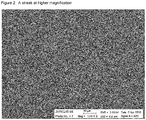
- the composition of the invention can be formulated into an excellent cleaning composition that leaves no streaks on the surface. Without wishing to be bound by theory it is believed that the dried composition does not result in visible "blisters", bumps or imperfections as observed in Figure 2 , which is treated with a typical hard surface cleaner.
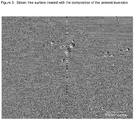
- a picture of a surface treated with the composition of the present invention is given in Figure 3 .
- the imperfections observed in the photograph of Figure 3 are attributed to the surface itself and not the formulated cleaning solution.
- Figure 4 shows the same area as Figure 3 but at higher magnification.
- the advantage of the invention can be clearly seen by comparing Figure 4 (low streak) to Figure 2 (typical hard surface cleaner).
- Figure 2 and Figure 4 are presented at similar magnification but for Figure 2 it is slightly less. Evident on comparison of these two images is the lack of larger "blisters" on the surface treated with the low streak cleaning formulation.
- the primary detergent component which comprises at least one non-ionic surfactant having a critical packing parameter (CPP) of ⁇ 0.95 is selected from C9-C11 alcohol + 4, 5, or 6 moles of EO and 2-propylheptanol with 5 or 8 moles of EO, and combinations or mixtures thereof.
- CCP critical packing parameter
- Linear nonionic surfactants for use in the present invention are C 9 -C 11 alcohol + 4, 5 or 6 moles of EO.
- Branched nonionic surfactants for use in the present invention are 2-propylheptanol + 5 or 8 moles of EO.
- the final formulation containing builders and optional ingredients is clear.
- inorganic based “nanoparticle” refers to a particle that in no dimension has a size exceeding about 500 nm, and that is formed from an optionally surface modified inorganic material, the optional surface modification possibly comprising an organic material.
- the inorganic based nanoparticles suitable for use in the present invention preferably are those able to form a stable dispersion in a composition of the present invention.
- stable particularly in the context of a “stable dispersion” is meant a stable compound, mixture or dispersion that does not substantially gel or precipitate within a period of preferably at least about 2 months, more preferably at least about 4 months, and most preferably at least about 5 months at normal storage in room temperature, i.e. at a temperature from about 15 to about 35°C.
- colloidal silica particles and silica sols according to the invention may be modified and can contain other elements such as amines, aluminium and/or boron, which can be present in the particles and/or the continuous phase.
- Boron-modified silica sols are described in e.g. U.S. Patent No. 2,630,410 .
- the aluminium modified silica particles suitably have an Al 2 O 3 content of from about 0.05 to about 3 wt%, in another embodiment from about 0.1 to about 2 wt%.
- the procedure of preparing an aluminium modified silica sol is further described in e.g. " The Chemistry of Silica", by IIer, K. Ralph, pages 407-409, John Wiley & Sons (1979 ) and in US 5 368 833 .
- the colloidal silica particles suitably have an average particle diameter ranging from about 2 to about 150 nm, in another embodiment from about 3 to about 50 nm, and in still another embodiment from about 5 to about 40 nm.
- the colloidal silica particles have a specific surface area from about 20 to about 1500, in another embodiment from about 50 to about 900, and in still another embodiment from about 70 2 to about 600 m 2 /g.
- the silica content in the sol is from about 20 to about 80, in another embodiment from about 25 to about 70, and in still another embodiment from about 30 to about 60 wt%.
- the pH of the silica sol suitably is from about 1 to about 13, in another embodiment from about 6 to about 12, and in still another embodiment from about 7.5 to about 11.
- the pH suitably is from about 1 to about 12, in another embodiment from about 3.5 to about 11.
- the silica sol has an S-value from about 20 to about 100, in another embodiment from about 30 to about 90, and in yet another embodiment from about 60 to about 90.
- the S-value characterises the extent of aggregation of colloidal silica particles, i.e. the degree of aggregate or microgel formation.
- the S-value has been measured and calculated according to the formulas given in J. Phys. Chem. 60(1956), 955-957 by IIer, R.K. & Dalton, R.L.
- the S-value depends on the silica content, the viscosity, and the density of the colloidal silica particles.
- a high S-value indicates a low microgel content.
- the S-value represents the amount of SiO 2 in percent by weight present in the dispersed phase of e.g. a silica sol.
- the degree of microgel can be controlled during the production process as further described in e.g. U.S. Patent No. 5368833 .
- the composition may comprise besides silane in the form of silane groups or silane derivatives bound or linked to the surface of the silica particles also at least to some extent freely dispersed unbound silane compounds.
- at least about 40, in another embodiment, at least about 60, in still another embodiment at least about 75, in yet another embodiment at least about 90, and in another embodiment at least about 95 wt% of the silane compounds are bound or linked to the surface of the silica particles.
- At least about 1 % by number of the silanol surface groups on the colloidal silica particles are capable of binding or linking to silane groups on the silane compounds, in another embodiment at least about 5 %, in a second embodiment at least about 10 %, in a third embodiment at least about 30 %, and in a fourth embodiment at least about 50 % bind or link to a silane group.
- the weight ratio of the total silane content to the total silica content in the composition is from about 0.01 to about 1.5, in a second embodiment from about 0.05 to about 1, and in a third embodiment from about 0.1 to about 0.5.
- the total content of silica comprises silica in modified silanized silica particles and non-modified silica particles which also may be present.
- the total content of silane is based on all freely dispersed silane and all linked or bound silane groups or derivatives.
- colloidal silanized silica particles available as Bindzil CC30 and CC301 are available from Eka Chemicals, Sweden.
- silanized colloidal silica particles have no silicone coat.
- Suitable silane compounds for silanization of colloidal silica particles include tris-(trimethoxy)silane, octyl triethoxysilane, methyl triethoxysilane, methyl trimethoxysilane; isocyanate silane such as tris-[3-(trimethoxysilyl)propyl]isocyanurate; gamma-mercaptopropyl trimethoxysilane, bis-(3-[triethoxysilyl]propyl)polysulfide, beta-(3,4-epoxycyclohexyl)-ethyl trimethoxysilane; silanes containing an epoxy group (epoxy silane), glycidoxy and/or a glycidoxypropy
- the silanes are epoxy silanes and silane compounds containing a glycidoxy or glycidoxypropyl group, particularly gamma-glycidoxypropyltrimethoxysilane and/or gamma glycidoxypropyltmethyldiethoxysilane.
- Silica nanoparticles advantageously utilized in the invention are sold under the tradenames Bindzil® CC30 and Bindzil® CC301.
- Table 1 Listing the properties of the silica sols included in the study silica sol particle size (nm) surface area (m 2 /g) pH modification solid content (%) stability CaCl2 (30%) Bindzil Cat80 42 85 - Cationic Fail Bindzil 159/500 6.1 525 - anionic Fail Bindzil 15/500 6.1 525 - Unmodified 15 Fail Bindzil 30/360 9 356 10.4 Unmodified 30 Fail Bindzil 30/220 14.5 220 10.0 Unmodified 30 Fail Bindzil 820DI 8 400 2.6 Unmodified 20 Fail Bindzil 2034DI 16 200 - Unmodified 34 Fail Bindzil CC30 7.2 445 7.9 glycidoxypropyl 30 Stable Bindzil CC301 7.2 445 7.9 glycidoxy
- the critical aspect for the choice of the secondary surfactant is the CPP ⁇ 0.85.
- the secondary surfactant is an alkyl (poly)glucoside having the formula R 2 OG p where,
- composition of the invention can comprise two or more secondary surfactants selected from the secondary surfactants described above.
- an aqueous composition according to the present invention may further comprise additional components, such as builders, co-builders, complexing agents, fillers, enzymes, pH regulators, hydrophilizing agents, perfumes, rheology modifiers and other ingredients typically used in cleaning formulations.
- additional components such as builders, co-builders, complexing agents, fillers, enzymes, pH regulators, hydrophilizing agents, perfumes, rheology modifiers and other ingredients typically used in cleaning formulations.
- the builder can be an alkali carbonate or an alkali hydrogen carbonate, such as sodium carbonate, potassium carbonate, sodium hydrogen carbonate or potassium hydrogen carbonate, an alkali salt of a silicate, such as sodium silicate or sodium metasilicate, or alkali salts of phosphates, such as sodium orthophosphate.
- Alkaline builders which act through complexation are e.g. sodium pyrophosphate and sodium tripolyphosphate and the corresponding potassium salts.
- organic builders/complexing agents examples include aminocarboxylates, such as sodium nitrilotriacetate (Na 3 NTA), sodium ethylenediaminetetraacetate (EDTA), sodium diethylenetriaminepentaacetate, sodium 1,3-propylenediaminetetraacetate and sodium hydroxyethylethylenediaminetriacetate; aminopolyphosphonates, such as nitrilotrimethylenephosphonate; organic phosphates; polycarboxylates, such as citrates; and alkali salts of gluconic acid, such as sodium or potassium gluconates.
- aminocarboxylates such as sodium nitrilotriacetate (Na 3 NTA), sodium ethylenediaminetetraacetate (EDTA), sodium diethylenetriaminepentaacetate, sodium 1,3-propylenediaminetetraacetate and sodium hydroxyethylethylenediaminetriacetate
- aminopolyphosphonates such as nitrilotrimethylene
- the hydrophilizing agents are preferably selected from ethanol, n- or i- propanol, butanols, ethylene glycol methyl ether, ethylene glycol ethyl ether, ethylene glycol propyl ether, ethylene glycol mono-n-butyl ether, diethylene glycol methyl ether, diethylene glycol ethyl ether, propylene glycol methyl, ethyl or propyl ether, dipropylene glycol monomethyl or monoethyl ether, diisopropylene glycol monomethyl or monoethyl ether, methoxy, ethoxy or butoxytriglycol, 1-butoxyethoxy-2- propanol, 3-methyl-3-methoxybutanol, propylene glycol t-butyl ether, alcohols, more particularly C 1-4 alkanols, glycols, polyethylene glycols, preferably with a molecular weight of 100 to 100, 000 and more particularly in the range from
- the preferred pH of the composition is alkaline.
- the preferred pH range is 10-12.
- the concentration of secondary surfactant in the ready-to-use composition is generally in any amount from 0.05 wt % up to about 10 wt%, in another embodiment 0.1 wt% up to 10 wt%, in another embodiment from 0.2 to 8 wt%, in a another embodiment from 0.3 to 5 wt%, in yet another embodiment from 0.4, to 5 wt %, in still another embodiment 0.5 to 3, in a seventh embodiment 0.5 to 1.5, and in an eighth embodiment to 0.5 to 1 wt% based on the weight of the total composition.
- the concentration of inorganic based nanoparticles in the ready to use composition is generally in the range of from about 0.5 wt% up to 5 wt%, in another embodiment 0.5 wt% up to 4 wt%, in still another embodiment 0.5 wt% up to 3, and in yet another embodiment from 0.5 wt% up to 2 wt%.
- Soil for cleaning testing is prepared according to the following procedure. Residue is scraped out of a diesel locomotive engine. After the pistons are removed for refurbishing, there is a black, oily residue that remains in the engine block. This residue, for lack of better name, designated as train dirt, is removed and placed in a suitable container. Approximately 9 parts of train dirt are mixed with 1 part non detergent motor oil. This material is stored in a suitable container and used as the soil for cleaning testing.
- This table illustrates the difficulty in preparing a low streaking excellent cleaning formulation without using the subject of this invention. Despite not meeting the cleaning and streaking targets information derived from this table was important in understanding the problem of streaking.
- Surfactant 1 Area volume length Surfactant a 0 v 0 1 0,corr cpp corr wt% Contribution C9E5 41.6 554 13.6 0.98 9 8.81 C9E6 43.8 554 13.6 0.93 9 838 C10E5 41.2 599 14.7 0.99 21 20.77 C10E6 43.2 608 14.9 0.95 21 19.85 C11E5 41.9 634 16.0 0.94 19 17.95 C11E6 42.4 649 16.1 0.95 19 18.03 cpp_avg : 0.96 Surfactant 2 Surfactant a 0 v 0 1 0,corr cpp corr composition corr C9E4 39.6 551 13.7 1.01 18 18.26 C10E4 39.6 604 15.0 1.02 42 42.73 C11E4 39.6 660 16.2 1.03 38 39.06 cpp_avg : 1.02 Surfactant 3 Surfactant a_0 v_0 1_0,corr cpp_corr 2-propyl
Landscapes
- Chemical & Material Sciences (AREA)
- Engineering & Computer Science (AREA)
- Chemical Kinetics & Catalysis (AREA)
- Oil, Petroleum & Natural Gas (AREA)
- Wood Science & Technology (AREA)
- Organic Chemistry (AREA)
- Life Sciences & Earth Sciences (AREA)
- Inorganic Chemistry (AREA)
- Nanotechnology (AREA)
- Physics & Mathematics (AREA)
- Condensed Matter Physics & Semiconductors (AREA)
- General Physics & Mathematics (AREA)
- Materials Engineering (AREA)
- Crystallography & Structural Chemistry (AREA)
- Composite Materials (AREA)
- Detergent Compositions (AREA)
Description
- The present invention relates to an aqueous composition comprising three components. The first component is a primary detergent, non-ionic surfactant with certain critical packing parameters (CPP). The primary function of the first component is to provide good cleaning performance. The second component is a inorganic particle whose surface has been modified to improve stability. The third necessary component is a secondary surfactant with a certain CPP that can function to improve the overall cleaning performance, the streaking performance and provide overall formulation stability. Methods for manufacturing such compositions and the use of such compositions for cleaning of hard surfaces are provided.
- Surfactant compositions are currently being used in many cleaning applications, including cleaning of hard surfaces and soft surfaces, e.g. textile, and many other applications in household and industrial use. As used herein, the term "hard surface" refers in particular to hard surfaces encountered in the home, such as surfaces of stone, ceramics, wood, plastics, metals, glass and any lacquered or painted such hard surface.
-
WO2007/109327 discloses a cleaning composition comprising from about 0.001 to about 25% of nanoparticles. The composition may in addition contain other detergent ingredients such as surfactants that can be chosen from the group of anionic, cationic, non-ionic, amphoteric, ampholytic, and zwitterionic surfactant and mixtures thereof. -
EP1215276 discloses a cleaning composition comprising microdispersed, hydrophilic silicate particles. The composition may in addition contain further components such as anionic, cationic, non-ionic and/or zwitterionic surfactants. -
EP1010421 discloses aqueous surfactant-containing formulations containing a magnesium-aluminum silicate and an organic thickener. -
WO03/062365 -
WO2008/157754 discloses a cleaning composition that contains an alkylpolyglucoside, ethanol and colloidal silica. -
WO2004/055145 discloses a cleaning composition containing colloidal silica. The composition may in addition contain other ingredients such as anionic or non-ionic surfactants. -
WO2006/117542 discloses a hard surface cleaner containing an amine oxide as surfactant, an alkanolamine, and water. The cleaner is said to be low streaking. - In hard surface cleaning, there is a desire to provide a surfactant composition which exhibits good degreasing performance and at the same time leaves the surface visually clean of spots, streaks and residue. A typical window cleaner usually leaves the surface free of visual imperfections; however the cleaning performance of most windows cleaners is very poor on heavy soils and greases. On the other hand, many formulations are available for effectively cleaning greases and heavy soils from surfaces.
- The use of nano-particles in cleaning formulations is well known. The addition of the nano particle to the formulation has been claimed to provide surface modification benefits like hydrophilization, soil repelling and anti resoiling properties. However, the use of nanosilicas in combination with two additional surfactants to provide excellent degreasing and as well as low streaking is new and cannot be anticipated from the prior art.
- Streaking is a visible residue left after the cleaning process. It is believed that streaking may be attributed to formation of an ordered structure that is big enough to be seen by the naked eye. In theory the residue could come from residual dirt not completely removed during the cleaning process. It is often caused by an improperly formulated cleaning composition such that as the cleaning composition dries it forms a visible "residue" of the components.
- Without wishing to be bound by theory it is believed that the mechanism of cleaning is critical to the formation of a visible residue. There are two main types of cleaning mechanisms. One is solvency, where the dirt is dissolved from the surface by a formulation that contains high levels of solvents. For example, according to
US 7,314,852 column 1, line 29, "the commercially available glass cleaning products sold under the Glass Plus® trademark have a organic solvent system comprising a mixture of ethylene glycol monobutylether (EGBE) and isopropyl alcohol". In this type of formulation is it impossible to obtain a surface that is totally clean. When cleaning with solvents, especially high soil loading conditions, it is difficult to get a streak free surface. These types of formulations work best when the surface is already clean or has very low soil content. - The other mechanism for cleaning surfaces is emulsification of the soil with surfactants. By this mechanism the dirt is removed from the soil by a roll up method. Compared to cleaning with solvents where the soil is dissolved, the soil is emulsified into the surfactant phase and essentially prevented from depositing back down on the surface. Cleaning by roll up results in a much cleaner surface with less residue, some people refer to this as being "squeaky clean".
- Surface analysis of a hard surface that has been cleaned using a traditional type cleaning formulation was performed. In this case there was considerable amount of filming and streaking that is visible to the eye. Without wishing to be bound by theory, it appears that formulations that form structured systems, such as a lamellar phase on drying are more susceptible to leaving a visible residue compared to systems that form less structured systems on drying.
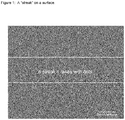
Figure 1 shows a surface that has a visible streak. The streak is indicated as a lane with "dots" on it. -
Figure 2 shows the same area but under higher magnification. As evident on examination ofFigure 2 , the streak is composed of multiple bumps, blisters and imperfections that happen as a result of the cleaning solution as it dries. So the ability to produce a cleaning solution that after drying does not have any visible residue is critical to controlling the perception of streaking. - Accordingly, it is evident that there is still a need in the art for surfactant compositions that both have high detergency and exhibit a low streaking and low filming behaviour.
- An object of the present is to at least partly overcome the drawbacks of the prior art and to provide a surfactant composition which, when used in hard surface cleaning, exhibits good degreasing performance and a low streaking behaviour. The present inventors have surprisingly found that this object is met by an aqueous composition according to the appended claims.
- The present invention relates to an aqueous composition comprising three essential components. The first component being a primary detergent, non-ionic surfactant with a critical packing parameter of ≥ 0.95. The second component being an inorganic particle whose surface has been modified to improve stability. The third component is a secondary surfactant with a critical packing parameter of ≤ 0.85.
- In a second aspect, the present invention relates to a method for cleaning hard surfaces utilizing the aforementioned composition.
-
-
Figure 1 is a high magnification view of a surface with streaks. -
Figure 2 , is a hard surface treated with a typical hard surface cleaner demonstrating visible "blisters", bumps or imperfections associated with streaking. -
Figure 3 is a surface treated with the composition of the present invention; the imperfections observed in the photograph ofFigure 3 are attributed to the surface itself and not the formulated cleaning solution. -
Figure 4 shows the same area asFigure 3 but at higher magnification. - The present invention relates to an aqueous composition comprising three components according to claim 1. The first component is a primary detergent, non-ionic surfactant with a critical packing parameters (CPP) of ≥0.95. The second component is a inorganic particle whose surface has been modified to improve stability. The third necessary component is a secondary surfactant with a CPP of ≤0.85. The secondary surfactant can function to improve the overall cleaning performance, the streaking performance and provide overall formulation stability.
- The composition of the invention can be formulated into an excellent cleaning composition that leaves no streaks on the surface. Without wishing to be bound by theory it is believed that the dried composition does not result in visible "blisters", bumps or imperfections as observed in
Figure 2 , which is treated with a typical hard surface cleaner. A picture of a surface treated with the composition of the present invention is given inFigure 3 . The imperfections observed in the photograph ofFigure 3 are attributed to the surface itself and not the formulated cleaning solution.Figure 4 shows the same area asFigure 3 but at higher magnification. The advantage of the invention can be clearly seen by comparingFigure 4 (low streak) toFigure 2 (typical hard surface cleaner).Figure 2 andFigure 4 are presented at similar magnification but forFigure 2 it is slightly less. Evident on comparison of these two images is the lack of larger "blisters" on the surface treated with the low streak cleaning formulation. - The primary detergent component which comprises at least one non-ionic surfactant having a critical packing parameter (CPP) of ≥0.95 is selected from C9-C11 alcohol + 4, 5, or 6 moles of EO and 2-propylheptanol with 5 or 8 moles of EO, and combinations or mixtures thereof.
- Linear nonionic surfactants for use in the present invention are C9-C11 alcohol + 4, 5 or 6 moles of EO. Branched nonionic surfactants for use in the present invention are 2-propylheptanol + 5 or 8 moles of EO.
- In one embodiment, the final formulation containing builders and optional ingredients is clear.
- As used herein, the term "inorganic based "nanoparticle" refers to a particle that in no dimension has a size exceeding about 500 nm, and that is formed from an optionally surface modified inorganic material, the optional surface modification possibly comprising an organic material.
- The inorganic based nanoparticles suitable for use in the present invention preferably are those able to form a stable dispersion in a composition of the present invention.
- By the term "stable", particularly in the context of a "stable dispersion" is meant a stable compound, mixture or dispersion that does not substantially gel or precipitate within a period of preferably at least about 2 months, more preferably at least about 4 months, and most preferably at least about 5 months at normal storage in room temperature, i.e. at a temperature from about 15 to about 35°C.
- In one embodiment, the inorganic based nano particles are colloidal silica particles. Colloidal silica particles, also referred to as silica sols herein, may be derived from e.g. precipitated silica, micro silica (silica fume), pyrogenic silica (fumed silica) or silica gels with sufficient purity, and mixtures thereof.
- Colloidal silica particles and silica sols according to the invention may be modified and can contain other elements such as amines, aluminium and/or boron, which can be present in the particles and/or the continuous phase. Boron-modified silica sols are described in e.g.
U.S. Patent No. 2,630,410 . The aluminium modified silica particles suitably have an Al2O3 content of from about 0.05 to about 3 wt%, in another embodiment from about 0.1 to about 2 wt%. The procedure of preparing an aluminium modified silica sol is further described in e.g. "The Chemistry of Silica", by IIer, K. Ralph, pages 407-409, John Wiley & Sons (1979) and inUS 5 368 833 . - The colloidal silica particles suitably have an average particle diameter ranging from about 2 to about 150 nm, in another embodiment from about 3 to about 50 nm, and in still another embodiment from about 5 to about 40 nm. Suitably, the colloidal silica particles have a specific surface area from about 20 to about 1500, in another embodiment from about 50 to about 900, and in still another embodiment from about 70 2 to about 600 m2/g.
- The colloidal silica particles preferably have a narrow particle size distribution, i.e. a low relative standard deviation of the particle size. The relative standard deviation of the particle size distribution is the ratio of the standard deviation of the particle size distribution to the mean particle size by numbers. The relative standard deviation of the particle size distribution preferably is lower than about 60 % by numbers, more preferably lower than about 30 % by numbers, and most preferably lower than about 15 % by numbers.
- The colloidal silica particles are suitably dispersed in an aqueous solvent, suitably in the presence of stabilizing cations such as K+, Na+, Li+, NH4 +, organic cations, primary, secondary, tertiary, and quaternary amines, or mixtures thereof so as to form an aqueous silica sol. However, also dispersions comprising organic solvents, e.g. lower alcohols, acetone or mixtures thereof may be used, suitably in an amount of from about 1 to about 20, in another embodiment from about 1 to about 10, and in yet another embodiment from about 1 to about 5 volume percent of the total solvent volume. However, aqueous silica sols without any further solvents are advantageously used, as are colloidal silica particles that are negatively charged.
- Suitably, the silica content in the sol is from about 20 to about 80, in another embodiment from about 25 to about 70, and in still another embodiment from about 30 to about 60 wt%. The higher the silica content, the more concentrated the resulting silanized colloidal silica dispersion. The pH of the silica sol suitably is from about 1 to about 13, in another embodiment from about 6 to about 12, and in still another embodiment from about 7.5 to about 11. However, for aluminium-modified silica sols, the pH suitably is from about 1 to about 12, in another embodiment from about 3.5 to about 11.
On one embodiment of the invention, the silica sol has an S-value from about 20 to about 100, in another embodiment from about 30 to about 90, and in yet another embodiment from about 60 to about 90. It has been found that dispersions with an S-value within these ranges can improve the stability of the resulting dispersion. The S-value characterises the extent of aggregation of colloidal silica particles, i.e. the degree of aggregate or microgel formation. The S-value has been measured and calculated according to the formulas given in J. Phys. Chem. 60(1956), 955-957 by IIer, R.K. & Dalton, R.L. - The S-value depends on the silica content, the viscosity, and the density of the colloidal silica particles. A high S-value indicates a low microgel content. The S-value represents the amount of SiO2 in percent by weight present in the dispersed phase of e.g. a silica sol. The degree of microgel can be controlled during the production process as further described in e.g.
U.S. Patent No. 5368833 . - In one embodiment, at least part of the inorganic nanoparticles are silanized colloidal silica particles. In such an embodiment, the composition may contain besides silanized colloidal silica particles also, at least to some extent, non-silanized colloidal silica particles depending on the size of the silica particles, weight ratio of silane to silica, type of silane compound, reaction conditions etc. Suitably, at least about 40 wt% of the colloidal silica particles are silanized (silane-modified), in another embodiment at least about 65, in still another embodiment at least about 90, and in yet another embodiment at least about 99 wt%. The composition may comprise besides silane in the form of silane groups or silane derivatives bound or linked to the surface of the silica particles also at least to some extent freely dispersed unbound silane compounds. Suitably, at least about 40, in another embodiment, at least about 60, in still another embodiment at least about 75, in yet another embodiment at least about 90, and in another embodiment at least about 95 wt% of the silane compounds are bound or linked to the surface of the silica particles.
- Suitably, at least about 1 % by number of the silanol surface groups on the colloidal silica particles are capable of binding or linking to silane groups on the silane compounds, in another embodiment at least about 5 %, in a second embodiment at least about 10 %, in a third embodiment at least about 30 %, and in a fourth embodiment at least about 50 % bind or link to a silane group.
- The weight ratio of the total silane content to the total silica content in the composition is from about 0.01 to about 1.5, in a second embodiment from about 0.05 to about 1, and in a third embodiment from about 0.1 to about 0.5. The total content of silica comprises silica in modified silanized silica particles and non-modified silica particles which also may be present. The total content of silane is based on all freely dispersed silane and all linked or bound silane groups or derivatives.
- Colloidal silanized silica particles available as Bindzil CC30 and CC301 are available from Eka Chemicals, Sweden.
- Silanization of colloidal silica particles is described in detail in
WO 2005/097961 A1 , incorporated herein by reference. According to one embodiment, the silanized colloidal silica particles have no silicone coat. Suitable silane compounds for silanization of colloidal silica particles include tris-(trimethoxy)silane, octyl triethoxysilane, methyl triethoxysilane, methyl trimethoxysilane; isocyanate silane such as tris-[3-(trimethoxysilyl)propyl]isocyanurate; gamma-mercaptopropyl trimethoxysilane, bis-(3-[triethoxysilyl]propyl)polysulfide, beta-(3,4-epoxycyclohexyl)-ethyl trimethoxysilane; silanes containing an epoxy group (epoxy silane), glycidoxy and/or a glycidoxypropyl group such as gamma-glycidoxypropyl trimethoxysilane, gamma-glycidoxypropyl methyldiethoxysilane, (3-glycidoxypropyl)trimethoxy silane, (3-glycidoxypropyl) hexyltrimethoxy silane, beta-(3,4-epoxycyclohexyl)-ethyltriethoxysilane; silanes containing a vinyl group such as vinyl triethoxysilane, vinyl trimethoxysilane, vinyl tris-(2-methoxyethoxy)silane, vinyl methyldimethoxysilane, vinyl triisopropoxysilane; gamma-methacryloxypropyl trimethoxysilane, gamma-methacryloxypropyl triisopropoxysilane, gamma-methacryloxypropyl triethoxysilane, octyltrimethyloxy silane, ethyltrimethoxy silane, propyltriethoxy silane, phenyltrimethoxy silane, 3-mercaptopropyltriethoxy silane, cyclohexyltrimethoxy silane, cyclohexyltriethoxy silane, dimethyldimethyoxy silane, 3-chloropropyltriethoxy silane, 3-methacryoxypropyltrimethoxy silane, i-butyltriethoxy silane, trimethylethoxy silane, phenyldimethylethoxy silane, hexamethyldisiloxane, trimethylsilyl chloride, vinyltriethoxy silane, hexamethyldisilizane, and mixtures thereof. -
U.S. Patent No. 4,927,749 discloses further suitable silanes which may be used in the present invention. - In one embodiment the silanes are epoxy silanes and silane compounds containing a glycidoxy or glycidoxypropyl group, particularly gamma-glycidoxypropyltrimethoxysilane and/or gamma glycidoxypropyltmethyldiethoxysilane.
- Silica nanoparticles advantageously utilized in the invention are sold under the tradenames Bindzil® CC30 and Bindzil® CC301.
Table 1: Listing the properties of the silica sols included in the study silica sol particle size (nm) surface area (m2/g) pH modification solid content (%) stability CaCl2 (30%) Bindzil Cat80 42 85 - Cationic Fail Bindzil 159/500 6.1 525 - anionic Fail Bindzil 15/500 6.1 525 - Unmodified 15 Fail Bindzil 30/360 9 356 10.4 Unmodified 30 Fail Bindzil 30/220 14.5 220 10.0 Unmodified 30 Fail Bindzil 820DI 8 400 2.6 Unmodified 20 Fail Bindzil 2034DI 16 200 - Unmodified 34 Fail Bindzil CC30 7.2 445 7.9 glycidoxypropyl 30 Stable Bindzil CC301 7.2 445 7.9 glycidoxypropyl 29 Stable - The influence of silica in cleaning formulations was briefly investigated. Solution stability is believed to be important in reducing the streaks. Low streaking requires the silica sol to be moderately to highly stable in the formulation in order to prevent the sol actually contributing to the formation of streaks. Without wishing to be bound by theory it is believed that tolerance to salt levels leads to lower the streak intensity in the final formulation. Bindzil® CC30 and Bindzil® CC301 are the best in resisting salinity at high pH. Since most useful cleaners are formulated under alkaline pH conditions, a variety of commercially sold silica sols were tested for salt tolerance at pH = 10.5 ± 0.5. A solution containing 2% of the silica sol was adjusted to pH = 10.5 using 10% NaOH solution. A 30% solution of CaCl2 was added. Only two of the silica sols tested under these conditions resulted in a stable formulation. These are the Bindzil® CC30 and Bindzil® CC301. The other silica sols were destabilized with relatively small amounts of the calcium chloride solution. In contrast the silica sols advantageously utilized in the invention were stable at all levels of salt up to 30%.
- The critical aspect for the choice of the secondary surfactant is the CPP ≤0.85.
- The secondary surfactant is an alkyl (poly)glucoside having the formula
R2OGp
where, - R2 is a straight or branched, saturated or unsaturated hydrocarbyl group, in one embodiment an alkyl group containing from 6 to 12, in a second embodiment containing 6 to 10, carbon atoms, and in a
third embodiment 6 carbon atoms. - G is a glucoside;
- p is a real number from 1 to 5, in a second embodiment from 1 to 3, in a third embodiment from 1 to 2, and in a fourth embodiment 1.5. A nonionic surfactant advantageously employed is sold under the tradename AG® 6206 by AkzoNobel Surface Chemistry, Chicago, Illinois.
- In another embodiment the composition of the invention can comprise two or more secondary surfactants selected from the secondary surfactants described above.
- In still another embodiment, the composition of the invention contains at least two secondary surfactants, wherein the first secondary surfactant is an alkyl (poly)glucoside having the formula
R2OGp
where,
R2 and G are as defined above, and the second secondary surfactant is a nonionic C10-14 alcohol with 0-2 PO and 6-10 EO. - As will be realized by those skilled in the art, an aqueous composition according to the present invention, suitable for surface, especially hard surface cleaning, may further comprise additional components, such as builders, co-builders, complexing agents, fillers, enzymes, pH regulators, hydrophilizing agents, perfumes, rheology modifiers and other ingredients typically used in cleaning formulations.
- The builder can be an alkali carbonate or an alkali hydrogen carbonate, such as sodium carbonate, potassium carbonate, sodium hydrogen carbonate or potassium hydrogen carbonate, an alkali salt of a silicate, such as sodium silicate or sodium metasilicate, or alkali salts of phosphates, such as sodium orthophosphate. Alkaline builders which act through complexation are e.g. sodium pyrophosphate and sodium tripolyphosphate and the corresponding potassium salts. Examples of organic builders/complexing agents are aminocarboxylates, such as sodium nitrilotriacetate (Na3NTA), sodium ethylenediaminetetraacetate (EDTA), sodium diethylenetriaminepentaacetate, sodium 1,3-propylenediaminetetraacetate and sodium hydroxyethylethylenediaminetriacetate; aminopolyphosphonates, such as nitrilotrimethylenephosphonate; organic phosphates; polycarboxylates, such as citrates; and alkali salts of gluconic acid, such as sodium or potassium gluconates.
- The hydrophilizing agents are preferably selected from ethanol, n- or i- propanol, butanols, ethylene glycol methyl ether, ethylene glycol ethyl ether, ethylene glycol propyl ether, ethylene glycol mono-n-butyl ether, diethylene glycol methyl ether, diethylene glycol ethyl ether, propylene glycol methyl, ethyl or propyl ether, dipropylene glycol monomethyl or monoethyl ether, diisopropylene glycol monomethyl or monoethyl ether, methoxy, ethoxy or butoxytriglycol, 1-butoxyethoxy-2- propanol, 3-methyl-3-methoxybutanol, propylene glycol t-butyl ether, alcohols, more particularly C1-4 alkanols, glycols, polyethylene glycols, preferably with a molecular weight of 100 to 100, 000 and more particularly in the range from 200 to 10,000 and polyols, such as sorbitol and mannitol, and polyethylene glycol liquid at room temperature, carboxylic acid esters, polyvinyl alcohols, ethylene oxide/propylene oxide block copolymers and mixtures of the above.
- The pH regulators are preferably sodium carbonate, citric acid, sodium citrate, bicarbonate and/or alkali hydroxides, such a sodium and/or potassium hydroxide and chelates such as EDTA or GLDA sodium salts.
- The preferred pH of the composition is alkaline. The preferred pH range is 10-12.
- The composition of the present invention may comprise organic solvents, such as e.g. a lower (C1-C6) alcohol, such as ethanol or iso-propanol, or a glycol ether solvent such as glycol monobutyl ether. In one embodiment, the composition comprises at most 5, in another embodiment at most 2, and in still another embodiment at most 1 wt% of organic solvents. The composition of the present may also be free from, or essentially free from, i.e. containing no more than trace amounts of organic solvents.
- The composition of the invention may be provided in a ready-to-use formulation or may be provided as a concentrate to be diluted, typically in water, to the ready-to-use formulation. Further, the concentration in the ready-to-use formulation may be tailored to fit the purpose.
- In a ready-to-use composition, the concentration of the primary non-ionic surfactant is generally in any amount from 0.05 wt % up to about 10 wt%, in a second embodiment 0.1 wt% up to 10 wt%, in another embodiment from 0.2 to 8 wt%, in a fourth embodiment from 0.3 to 5 wt%, in a fifth embodiment from 0.4, to 5 wt %, in a sixth embodiment 0.5 to 3, in a seventh embodiment 0.5 to 1.5, and in a eighth embodiment to 0.5 to 1 wt% based on the weight of the total composition.
- The concentration of secondary surfactant in the ready-to-use composition is generally in any amount from 0.05 wt % up to about 10 wt%, in another embodiment 0.1 wt% up to 10 wt%, in another embodiment from 0.2 to 8 wt%, in a another embodiment from 0.3 to 5 wt%, in yet another embodiment from 0.4, to 5 wt %, in still another embodiment 0.5 to 3, in a seventh embodiment 0.5 to 1.5, and in an eighth embodiment to 0.5 to 1 wt% based on the weight of the total composition.
- In the composition of the invention, the weight ratio of the primary non-ionic surfactant to secondary surfactant is in the range of from about 80:20 to about 20:80, in another embodiment from about 70:30 to about 30:70, and in a third embodiment from about 60:40 to about 40:60. In representative compositions, the weight ratio is about 50:50 on an as-is basis (for AG6206, an ideal ratio on an actives basis is∼60:40). For other secondary surfactants the optimum ratio may be different but 50:50 is a good starting point for formulation evaluation. There has to be enough of the secondary surfactant to make a clear solution, and this will depend on the specific combination used. On the other hand there must be enough of the primary surfactant to give the cleaning performance (if the ratio is skewed too much in favor of the secondary surfactant, the formulation will be low streaking but will not clean).
- The concentration of inorganic based nanoparticles in the ready to use composition is generally in the range of from about 0.5 wt% up to 5 wt%, in another embodiment 0.5 wt% up to 4 wt%, in still another embodiment 0.5 wt% up to 3, and in yet another embodiment from 0.5 wt% up to 2 wt%.
- The weight ratio of total surfactants to inorganic based nanoparticles is typically in the range of from about 80:20 to about 20:80, in another embodiment from about 70:30 to about 30:70 and in still another embodiment from about 60:40 to about 40:60. In representative compositions, the weight ratio is about 50:50.
- The compositions of the present invention may be used as cleaning compositions for the cleaning of hard surfaces. Especially, and due to the low streak performance, the composition of the invention is suitable for cleaning of surfaces which, after cleaning, should have a shiny appearance, such as windows, mirrors, glossy wood, glossy tiles, granite, ceramic and others.
- The invention will now be illustrated by the following nonlimiting examples.
- Soil for cleaning testing is prepared according to the following procedure. Residue is scraped out of a diesel locomotive engine. After the pistons are removed for refurbishing, there is a black, oily residue that remains in the engine block. This residue, for lack of better name, designated as train dirt, is removed and placed in a suitable container. Approximately 9 parts of train dirt are mixed with 1 part non detergent motor oil. This material is stored in a suitable container and used as the soil for cleaning testing.
-
- 1. 100 ml and 25 ml Pyrex beakers
- 2. Spectrophotometer or reflectometer (any instrument capable of accurately measuring changes in substrates reflectance, such as Minolta CM-508D spectrophotometer) .
- 3. 1 inch paint brush
- 4. Sink with a water spray nozzle
- 5. 1 x 140 x 220 mm steel plates, which were primed, painted (white) plus two coats of lacquer, not unlike a car surface.
-
- 1. The panels are washed with detergent, then cleaned with IPA and allowed to dry before use.
- 2. The spectrophotometer is placed on the marked sections and a base reading is taken (marked as ΔLB, ΔaB or ΔbB - the base reading).
- 3. The cleaning test soil is applied on to the test panel with a brush, then the soil is smoothed over the surface to obtain as even a coating as possible using a Kimwipe. The plates are then allowed to stand for at least 4 hours before testing.
- 4. The spectrophotometer is placed on the marked sections of the soiled panels and the soiled reading is taken (marked as ΔLS, ΔaS or AbS - the soiled reading).
- 5. 100 mls of the test solutions are prepared and the solution is "diluted as required".
- 6. Twenty ml of each diluted test cleaner is poured onto the soiled plate (three solutions per plate). The control solution (Formulation D diluted 1:10, see below for composition), is applied in the fourth position on the plate.
- 7. The test solutions are left for twenty seconds. The plates are then cleaned using a low-pressure water spray. The plates are cleaned from the bottom up to remove the emulsified dirt.
- 8. The panels are allowed to air dry. The spectrophotometer is placed on the marked sections and the final reading is taken (marked as ΔLC, ΔaC or AbC - the cleaned reading).
- 9. The Delta values are used to calculated the amount of soil removed from the panel using the C.I.E. Lab or L∗a∗b Color Space standard.


- 10. Percentage of soil removal is calculated as the difference between ΔE2 and ΔE1 as shown below:

- 11. Each test formulation is repeated three times and the standard deviation calculated. However, if the standard deviation of a single test is greater than 15%, the formulation is re-tested and any outlying points eliminated. In some cases the repeated studies show no outlying points and both data sets are combined. The control solution should give 95 ± 7 % soil removal.
- In some cases, subjective ratings were given to the cleaning performance rather than quantify with a spectrophotometer. The procedure as outlined above was followed up to and including
step 7. At this point the panels were visually inspected and a rating given to estimate the cleaning performance. An explanation of the ratings is given below. In all cases the cleaning performance is approximated. - None = no visible zero soil removal
- Poor = ∼0-25% soil removal
- Fair = ∼25-50% soil removal
- Good = ∼50-75% soil removal
- Excellent = ∼75% 100% soil removal
-
- 1. Prepare a clean 15 cm" x 15 cm glass mirror tile (thoroughly washed with hand dish wash detergent solution, followed by deionized water, followed by wiping with ethanol and allowing to dry) and lay it flat on the bench.
- 2. Fold a sheet of Bounty® paper towel in half four times and attach a binder clip to the top edge to use as a handle.
- 3. Using a micropipette, apply 200µl of the test solution in a thin line just inside the top edge of the tile in the center (the aim is eventually to cover the center third of the tile with a stripe of the solution).
- 4. With the paper towel, wipe the solution over the tile for three cycles (one time towards and one time away from the operator is one cycle).
- 5. Pick up the tile and watch how the strip of solution dries (fast, slow, evenly, from the edges in, etc.). When it is fully dry, assess how streaky it is on a scale of 0-4, where 0 is essentially no streaks (e.g. Windex Original) and Formulation D* diluted 1:10 gives a 4 (very bad streaking).
- *9% Berol® 226 SA , 9% Ethylene Diamine tetraacetic acid EDTA (40%), 4% TKPP (tetrapotassium pyrophosphate) made up to 100% with water, which is diluted 1 part solution to 9 parts water (i.e. 1:10) before testing. This is our lab standard high efficiency degreaser.
- Compositions tested for cleaning and streaking performance are reported in Tables 2 and 3. The percentages reported in the table are for the product as is and are not corrected for the presence of solvents and or diluents.
- In table 1 all of the reported comparative examples are formulations containing 1% Dissolvine® 100-S as the "builders". All of the formulations reported in Table 2 contain only two additional ingredients beside the builders. It is apparent on looking at the results that out of these numerous examples tested there was not a combination that produced low streaking and excellent cleaning. In this case the lower the streaking the better, so a score of 0 would be the most preferred. In fact in most cases the relationship of cleaning to streaking is inverted. Thus excellent cleaning tended to be accompanied by streaking scores of higher than 2 and in most cases a 3 or 4 in streaking was observed. Also evident is that those formulations with the best streaking tended to clean poorly. Those formulations that scored a 0 or 1 on streaking, cleaned poorly or in one case, example AB, showed fair cleaning.
- This table illustrates the difficulty in preparing a low streaking excellent cleaning formulation without using the subject of this invention. Despite not meeting the cleaning and streaking targets information derived from this table was important in understanding the problem of streaking.
- Compare the results for examples A to F. In this case we are looking at the performance of surfactant 4 having a CPP ≤ 0.85. It is evident that the cleaning performance of this product is excellent but the streaking is very poor. Compare this to the results for examples G to P. These examples show the effect of increasing the concentration of Bindzil® CC30 in a formulation. It is apparent that Bindzil® CC30 is inherently low in streaking by nature. Concentrations up to 4% were very low in streaking. At higher concentration levels however, streaking becomes more apparent. It is also clear that in this test the Bindzil® CC30 performed very poorly as a cleaner. Comparative examples Q toY show the performance of
surfactant 6 having a CPP ≤ 0.85. It is evident that the over all streaking performance is much better than compared to surfactant 4 (examples A to F). It is also evident that secondary surfactants can show very poor detergency even at high concentrations. - Addition of Bindzil® CC30 to surfactants improves the streaking. Compare example B to AC. A formulation containing 0.5% of surfactant 4 had a poor streaking score of 4. In example AC, 0.5% Bindzil® CC30 added to surfactant 4 improved the streaking score from a 4 to a 2. Similar comparative examples can be made showing that at the same surfactant concentration, addition of Bindzil® CC30 improved the streaking score. It should be noted that although streaking can be improved by the addition of a nanoparticle, it cannot be brought to the ideal score of 0 or even less preferred a streaking score of 1.
- Examples BE to BI show the results for compositions containing two surfactants and no nanoparticles. It is evident from these results that both the performance attributes of low streaking and excellent cleaning cannot be met by the combination of two ingredients.
- Table 3 contains comparative examples on more complex formulations that demonstrate the elements of the present invention. It is clear on examining the results in Table 2 that a low streaking and excellent cleaning formulations requires a minimum of three ingredients.
- Comparative example CA contains no primary surfactant so the cleaning performance is poor. Addition of a small amount of detersive surfactant to example CA resulted in a formulation CB that shows both low streaking and excellent cleaning. Formulation CC also had good cleaning and low streaking. It is clear from example CD that the balance of the three components is critical to obtain the desired performance. Compare example CD to CC. The difference is a small amount of detersive surfactant yet the impact on streaking performance is critical. Numerous examples exist in the attached table showing that the presence of the three components is important as is the ratio of the three components.
Table 2. Comparative Examples Containing Two Components. 1% Dissolvine 100-S Surfactant 4 CPP = 0.72 Nanoparticle Surfactant 6 CPP = 0.63 Ingredient wt % wt % Bindzil CC30 wt % Streaking Cleaning Comparative Example A 0.25 0.00 0.00 4 Excellent B 0.50 0.00 0.00 4 Excellent C 1.00 0.00 0.00 4 Excellent D 2.00 0.00 0.00 4 Excellent E 3.00 0.00 0.00 4 Excellent F 4.00 0.00 0.00 4 Excellent G 0.00 0.25 0.00 0 Poor H 0.00 0.50 0.00 0 Poor I 0.00 1.00 0.00 0 Poor J 0.00 2.00 0.00 0 Poor K 0.00 3.00 0.00 0 Poor L 0.00 4.00 0.00 0 Poor M 0.00 5.00 0.00 1 Poor N 0.00 7.00 0.00 2 Poor O 0.00 10.00 0.00 3 Poor P 0.00 12.00 0.00 4 Poor Q 0.00 0.00 1.00 0 Poor R 0.00 0.00 2.00 0 Poor S 0.00 0.00 3.00 1 Poor T 0.00 0.00 4.00 1 Poor U 0.00 0.00 5.00 2 Poor V 0.00 0.00 7.00 2 Poor W 0.00 0.00 10.00 2 Poor Y 0.00 0.00 12.00 2 Poor Z 0.13 0.13 0.00 2 Excellent AA 0.25 0.25 0.00 3 Excellent AB 0.25 2.75 0.00 0 Fair AC 0.50 0.50 0.00 2 Excellent AD 0.50 2.50 0.00 1 Excellent AE 0.75 2.25 0.00 2 Excellent AF 1.00 1.00 0.00 2 Excellent AG 1.00 2.00 0.00 2 Excellent AH 1.25 1.75 0.00 2 Excellent AI 1.50 1.50 0.00 2 Excellent AJ 1.75 1.25 0.00 3 Excellent AK 2.00 1.00 0.00 3 Excellent AL 2.00 2.00 0.00 1 Excellent AM 2.25 0.75 0.00 4 Excellent AN 2.50 2.50 0.00 1 Excellent AO 2.50 0.50 0.00 4 Excellent AP 2.75 0.25 0.00 4 Excellent AQ 3.50 3.50 0.00 2 Excellent AR 5.00 5.00 0.00 2 Excellent AS 0.00 0.50 0.50 1 Poor AT 0.00 0.50 2.50 0 Poor AU 0.00 1.00 1.00 1 Poor AV 0.00 1.00 2.00 0 Poor AW 0.00 1.50 1.50 1 Poor AX 0.00 2.00 1.00 0 Poor AY 0.00 2.00 2.00 1 Poor AZ 0.00 2.50 2.50 1 Poor BA 0.00 2.50 0.50 0 Poor BB 0.00 3.50 3.50 1 Poor BC 0.00 5.00 5.00 1 Poor BD 0.00 6.00 6.00 2 Poor BE 1.00 0.00 1.00 3 Excellent BF 1.50 0.00 1.50 3 Excellent BG 2.00 0.00 2.00 3 Excellent BH 2.50 0.00 2.50 4 Excellent BI 3.00 0.00 3.00 4 Excellent Table 3. Comparative Examples Containing Multiple Components. 1. 1% Dissolvine 100-S, balamce water 2. 0.9% Dissolvine 100-S, 0.4% TKPP balance water Ingredient Detersive Surfactant Nanoparticle Secondary Surfactant Other Builders Comparative Example Surfactant 1 CPP = 0.96 Surfactant 3 CPP = 1.16 Surfactant 2 CPP = 1.02 Bindzil CC301 Bindzil CC30 Surfactant 6 CPP = 0.63 Surfactant 10 CPP = 0.65 Surfactant 11 CPP = 0.54 Surfactant 12 CPP = 0.32 Surfactant 4 CPP = 0.72 SXS Witconate AOS Streaking Cleaning CA 0.00 2.00 1.00 1 0 None CB 0.33 2.00 0.66 1 0 Excellent CC 0.50 2.00 0.50 1 0 Excellent CD 0.66 2.00 0.33 1 2 Excellent CE 1.00 2.00 1 4 Excellent CF 0.50 2.00 0.50 1 3 Excellent CG 0.33 2.00 0.66 1 <1 94.30% CH 0.50 2.00 0.50 1 <1 96.30% CI 0.66 2.00 0.33 1 2 93.70% CJ 2.00 1.00 1 0 None CK 0.33 2.00 0.66 1 0 Fair CL 0.50 2.00 0.50 1 0 Excellent CM 0.66 2.00 0.33 1 2 Excellent CN 2.00 0.66 0.33 1 0 Fair CO 2.00 0.50 0.50 1 0 Fair CP 2.00 0.33 0.66 1 2 Fair CQ 3.00 1 2 6.10% CR 1.50 1.50 1 2 90.70% CS 3.00 1 4 89.10% CT 0.50 2.00 0.50 1 1 75.20% CU 0.50 0.50 2.00 1 3 90.10% CV 1.00 1.00 1.00 1 1 85% CW 1.50 1.50 1 0 17.10% CX 1.50 1.50 1 2 78.8 CY 2.00 0.50 0.50 1 0 76% CZ 3.00 1 0 17.90% DA 0.44 0.32 2 4 ND DB 0.44 1.00 0.32 2 4 ND DC 0.44 2.00 0.32 2 4 ND DD 0.44 3.00 0.32 2 3 ND DE 0.44 5.00 0.32 2 3 ND DF 0.44 0.32 0.90 2 4 77.60 % DG 0.44 1.00 0.32 0.90 2 1 57.90% DH 0.44 2.00 0.32 0.90 2 0 68.20% DI 0.44 3.00 0.32 0.90 2 0 69.60% DJ 0.44 2.00 0.32 0.50 2 1 ND DK 0.44 2.00 0.32 0.30 2 2 ND DL 0.44 2.00 0.32 0.10 2 3 ND DM 0.44 2.00 0.32 1 4 ND DN 0.50 2.00 0.50 1 0 Excellent DO 0.24 0.50 0.16 2 3 Excellent DP 0.24 2.00 0.50 0.16 2 0 Excellent DQ 0.24 2.00 0.50 0.16 0.90 2 0 Fair DR 0.30 2.00 0.50 0.20 1 0 Excellent - Examples CB, CC, CD, DN, DO, DP, DQ and DR are according to the present invention
The data show the improved performance of the compositions of the invention compared to prior art compositions. - The CPP is defined as follows:

- To determine the shape of a single surfactant, it was modelled using the molecular modelling module Discover® in Materials Studio (Materials Studio v4.3.0.0. Copyright 2008, Accelrys Software Inc.). The surfactant is modelled by defining the atoms and assuming a harmonic potential for the bonds using the pcff forcefield. This forcefield was developed based on CFF91. More details on this type of modelling can be found in the work by Allen and Tildesley (1 M.P. Allen; D.J. Tildesley. Computer Simulation of Liquids, Oxford University Press (1987)).
- Discover® was used to find a (local) energy minimum of the surfactant molecular structure, the starting point for the minimization was an extended conformation of the tail. After minimisation, the three necessary parameters to calculate a CPP can be determined: νtail (volume of the hydrophobic tail), ltail (the length of the hydrophobic tail) and a 0 (the area of the head group). For those materials that are not a pure chemical substance a CPP was calculated for each major homologue of the series and the CPP estimated based on the mole fraction of the component.
Table 4. Summary of CPP calculations. Surfactant 1 Area volume length Surfactant a 0 v 0 1 0,corr cpp corr wt% Contribution C9E5 41.6 554 13.6 0.98 9 8.81 C9E6 43.8 554 13.6 0.93 9 838 C10E5 41.2 599 14.7 0.99 21 20.77 C10E6 43.2 608 14.9 0.95 21 19.85 C11E5 41.9 634 16.0 0.94 19 17.95 C11E6 42.4 649 16.1 0.95 19 18.03 cpp_avg: 0.96 Surfactant 2 Surfactant a 0 v 0 1 0,corr cpp corr composition corr C9E4 39.6 551 13.7 1.01 18 18.26 C10E4 39.6 604 15.0 1.02 42 42.73 C11E4 39.6 660 16.2 1.03 38 39.06 cpp_avg: 1.02 Surfactant 3 Surfactant a_0 v_0 1_0,corr cpp_corr 2-propyl heptanol E5 41.1 527 11.0 1.16 Surfactant 4 Surfactant a 0 v 0 1 0,corr cpp corr d10(PO)2(EO)8 55.7 599 14.9 0.72 85 61.36 C12(PO)2(EO)8 55.9 707 17.5 0.72 15 10.85 cpp_avg: 0.72 Surfactant 5 Surfactant a_0 v_0 1_0,corr cpp_corr 2-propyl heptanol E8 44.9 585 11.2 1.16 Surfactant 6 Surfactant a 0 v 0 1 0,corr cpp corr C6Gluc 61.9 383 9.0 0.69 50 34.31 C6Gluc2 72.3 380 9.1 0.58 50 28.85 cpp_avg: 0.63 Surfactant 7 Surfactant a_0 v_0 1_0,corr cpp_corr C10Gluc 61.9 600 13.9 0.70 25 17.44 C10Gluc2 72.5 597 14.1 0.58 25 14.60 2-ethylhexylGluc 42.0 323 8.9 0.86 25 21.60 2-ethylhexylGluc2 72.6 471 8.8 0.74 25 18.43 cpp_avg: 0.72 Surfactant 8 Surfactant a_0 v_0 1_0,corr cpp_corr 2-ethylhexylGluc 42.0 323 8.9 0.86 50 43.20 2-ethylhexylGluc2 72.6 471 8.8 0.74 50 36.87 cpp_avg: 0.80 Surfactant 9 Surfactant a 0 v 0 1 0,corr cpp corr C12NC2O 63.3 702 17.7 0.63 20 12.53 C14NC2O 63.1 810 20.3 0.63 50 31.60 cpp_avg: 0.63 Surfactant 10 Surfactant a_0 v_0 1_0,corr cpp_corr C12N(C2OH)2O 61.7 695 17.5 0.64 20 12.88 C14N(C2OH)2O 61.7 804 20.1 0.65 50 32.43 cpp_avg: 0.65 Surfactant 11 Surfactant a_0 v_0 1_0,corr cpp_corr C8N(CH2CH2COOH)2 71.9 485 12.5 0.54 Surfactant 12 Surfactant a_0 v_0 1_0,corr cpp_corr C12N(C)(E5)(E10) 122.8 694 14.5 0.39 50 19.48 C12N(C)(E7)(E8) 206.7 760 14.3 0.26 50 12.85 cpp_avg: 0.32
Claims (11)
- A cleaning composition comprising:a) a primary detergent component which comprises at least one non-ionic surfactant having a critical packing parameter of ≥ 0.95b) inorganic based nanoparticles, andc) a secondary surfactant having a critical packing parameter of ≤0.85wherein said primary detergent component is selected from C9-C11 alcohol + 4, 5 or 6 moles of EO, and 2-propylheptanol alcohol with 5 or 8 moles of EO, and combinations or mixtures thereof; and
wherein said secondary surfactant is an alkyl (poly)glucoside having the formula
R2OGp
where R2 is a straight or branched, saturated or unsaturated hydrocarbyl group, containing from 6 to 10 carbon atoms,G is a glucoside; andp is a real number from 1 to 5 - The composition of claim 1 wherein inorganic based nanoparticles are colloidal silica particles.
- The composition of claim 2 wherein the silica content in the sol is from 20 to 80 wt%, the pH of the silica sol from 1 to about 13, and the silica sol has an S-value from 20 to 100.
- The composition of claim 1 wherein said inorganic nanoparticles are silanized colloidal silica particles wherein at least 40 wt% of the colloidal silica particles are silanized.
- The composition of claim 1 further comprising a C10-14 alcohol with 0-2 PO and 6-10 EO.
- A ready to use cleaning formulation comprising an effective amount of the composition of claim 1 wherein, the concentration of the primary non-ionic surfactant is from 0.05 to 1.5wt% based on the weight of the total composition, the concentration of the secondary surfactant is from 0.05 to 1.5 wt% based on the weight of the total composition and the weight ratio of the primary non-ionic surfactant to secondary surfactant is in the range of from 70:30 to 30:70.
- The formulation of claim 6 wherein the concentration of inorganic based nanoparticles in the ready to use composition is in the range of from 0.5 wt% up to 3 wt%.
- A cleaning composition according to claim 1 whereinthe composition is a hard surface cleaning compositionthe inorganic based nanoparticles comprise colloidal silica particles having a particle size of from 5 to 40 nm, andthe secondary surfactant is an alkyl (poly)glucoside having the formula
R2OGp
where,R2 is a straight or branched, saturated or unsaturated alkyl group containing from 6 to 10, carbon atoms,G is glucoside; andp is a real number from 1 to 3. - The cleaning composition according to claim 8 wherein the colloidal silica particles are silanized.
- The hard surface cleaning composition of claims 8 or 9 additionally comprising a second secondary surfactant comprising a C10-14 alcohol with 0-2 PO and 6-10 EO.
- The cleaning composition of claim 10 wherein the weight ratio of said primary non-ionic surfactant to the total amount of secondary surfactant present is in the range of from 70:30 to 30:70.
Applications Claiming Priority (2)
| Application Number | Priority Date | Filing Date | Title |
|---|---|---|---|
| US42380810P | 2010-12-16 | 2010-12-16 | |
| PCT/EP2011/072501 WO2012080197A1 (en) | 2010-12-16 | 2011-12-13 | Low streak degreasing composition |
Publications (2)
| Publication Number | Publication Date |
|---|---|
| EP2652106A1 EP2652106A1 (en) | 2013-10-23 |
| EP2652106B1 true EP2652106B1 (en) | 2019-10-09 |
Family
ID=45346481
Family Applications (1)
| Application Number | Title | Priority Date | Filing Date |
|---|---|---|---|
| EP11794745.7A Active EP2652106B1 (en) | 2010-12-16 | 2011-12-13 | Low streak degreasing composition |
Country Status (12)
| Country | Link |
|---|---|
| US (1) | US8980818B2 (en) |
| EP (1) | EP2652106B1 (en) |
| JP (1) | JP5941925B2 (en) |
| KR (1) | KR101891228B1 (en) |
| CN (1) | CN103261387B (en) |
| BR (1) | BR112013014424A2 (en) |
| CL (1) | CL2013001737A1 (en) |
| CO (1) | CO6721064A2 (en) |
| MX (1) | MX351856B (en) |
| PE (1) | PE20140470A1 (en) |
| SG (1) | SG190899A1 (en) |
| WO (1) | WO2012080197A1 (en) |
Families Citing this family (15)
| Publication number | Priority date | Publication date | Assignee | Title |
|---|---|---|---|---|
| CN102241899B (en) | 2010-05-11 | 2014-05-14 | 3M创新有限公司 | Coating composition, method for modifying matrix surface, and product |
| EP2841525B1 (en) | 2012-04-27 | 2018-08-22 | Akzo Nobel Chemicals International B.V. | Foam or viscosified composition containing a chelating agent |
| MX2015009837A (en) | 2013-02-01 | 2016-02-16 | Cognis Ip Man Gmbh | Cleaning compositions comprising low hlb 2-propyl heptyl alcohol alkoxylates and alkyl polyglucosides. |
| BR102014003807A2 (en) * | 2014-02-18 | 2014-09-09 | Demoiselle Ind E Com De Prod Para Revitalizacao Ltda | COMPOSITION FOR CLEANING, PROTECTION AND RECOVERY OF SURFACES IN GENERAL AND PRODUCT OBTAINED |
| PL3359515T3 (en) | 2015-10-07 | 2020-07-27 | Elementis Specialties, Inc. | Wetting and anti-foaming agent |
| BR112018067762A2 (en) | 2016-03-04 | 2019-01-15 | Johnson & Son Inc S C | multipurpose floor finishing composition |
| AU2017267050B2 (en) | 2016-05-17 | 2020-03-05 | Unilever Global Ip Limited | Liquid laundry detergent compositions |
| US10149471B2 (en) | 2016-11-11 | 2018-12-11 | Lonza Inc. | Disinfectant composition having residual biocidal properties |
| US11432545B2 (en) | 2017-06-05 | 2022-09-06 | Arxada, LLC | Fast kill disinfectant wiping composition and premoistened wipes made from same |
| KR102170240B1 (en) * | 2020-01-28 | 2020-10-26 | 정훈도 | Water-soluble suspension composition comprising inorganic particles and use thereof |
| JP7602329B2 (en) * | 2020-07-03 | 2024-12-18 | 花王株式会社 | Cleaning composition for hard surfaces |
| WO2022224064A1 (en) * | 2021-04-20 | 2022-10-27 | 3M Innovative Properties Company | Methods and compositions for restoring and maintaining hard surfaces |
| WO2023021317A1 (en) | 2021-08-17 | 2023-02-23 | Rachid Ennamany | Plant cells stabilized with lecithin |
| CN113980747B (en) * | 2021-11-10 | 2023-08-25 | 重庆臻宝科技股份有限公司 | Cleaning agent for degreasing treatment of semiconductor material surface |
| CN121889030A (en) * | 2023-08-30 | 2026-04-17 | 诺力昂化学品国际有限公司 | Agricultural Composition |
Family Cites Families (30)
| Publication number | Priority date | Publication date | Assignee | Title |
|---|---|---|---|---|
| US2220099A (en) | 1934-01-10 | 1940-11-05 | Gen Aniline & Flim Corp | Sulphonic acids |
| US2477383A (en) | 1946-12-26 | 1949-07-26 | California Research Corp | Sulfonated detergent and its method of preparation |
| US2630410A (en) | 1949-04-19 | 1953-03-03 | Union Carbide & Carbon Corp | Nongelling aqueous silica sols stabilized with boron compounds |
| JPS57115499A (en) | 1980-07-28 | 1982-07-17 | Procter & Gamble | Detergent composition |
| GR75649B (en) | 1980-07-28 | 1984-08-02 | Procter & Gamble | |
| EP0091802B1 (en) * | 1982-04-13 | 1987-09-30 | The Procter & Gamble Company | Foam-controlling detergent additive compositions and use thereof in detergent compositions |
| US4927749A (en) | 1986-04-09 | 1990-05-22 | Jeanette Simpson | Reagent for cell separation |
| SE500387C2 (en) | 1989-11-09 | 1994-06-13 | Eka Nobel Ab | Silica sols, process for making silica sols and using the soles in paper making |
| JPH09202896A (en) * | 1996-01-26 | 1997-08-05 | Lion Corp | High bulk density bleaching detergent composition |
| JPH1088198A (en) * | 1996-09-13 | 1998-04-07 | Kao Corp | Method for producing briquette-type detergent composition |
| DE19858241A1 (en) * | 1998-12-17 | 2000-06-21 | Henkel Kgaa | Thickened preparation of water-soluble surfactants |
| US6228910B1 (en) | 1999-09-16 | 2001-05-08 | General Electric Company | Weatherable colored resin compositions |
| US6814088B2 (en) | 1999-09-27 | 2004-11-09 | The Procter & Gamble Company | Aqueous compositions for treating a surface |
| DE10021726A1 (en) | 2000-05-04 | 2001-11-15 | Henkel Kgaa | Nanoparticles are used for loosening dirt and/or reducing resoiling of hard surface or textile, especially in a textile finish, washing, pretreatment or after-treatment agent |
| DE10061897A1 (en) * | 2000-12-12 | 2002-06-13 | Clariant Gmbh | Washing or cleaning composition, useful for fabrics or hard surfaces, contains microdisperse, hydrophilic silicate particles that improve soil removal and prevent resoiling |
| GB2384243A (en) * | 2002-01-17 | 2003-07-23 | Reckitt Benckiser Inc | Cleaners for hard surfaces |
| US7098181B2 (en) | 2002-05-22 | 2006-08-29 | Kao Corporation | Liquid detergent composition |
| DE10258831A1 (en) * | 2002-12-17 | 2004-07-08 | Henkel Kgaa | Hard surface cleaner |
| JP4798969B2 (en) * | 2003-06-27 | 2011-10-19 | ライオン株式会社 | Cleaning composition |
| US8361946B2 (en) * | 2004-04-08 | 2013-01-29 | Akzo Nobel N.V. | Detergent composition |
| DE602005021868D1 (en) | 2004-04-08 | 2010-07-29 | Akzo Nobel Nv | LAUNDRY DETERGENT |
| ITRA20050014A1 (en) | 2005-03-16 | 2006-09-17 | Erreti Srl | HINGE |
| JP5100636B2 (en) | 2005-05-02 | 2012-12-19 | ラドーフ ゲーエムベーハー | Lithographic method for maskless pattern transfer onto photoresponsive substrates |
| GB0509120D0 (en) * | 2005-05-05 | 2005-06-08 | Reckitt Benckiser Inc | Glass and hard surface cleaning composition |
| ATE457343T1 (en) * | 2005-11-09 | 2010-02-15 | Ecolab Inc | COMPOSITION WITH SURFACE MODIFYING PROPERTIES |
| WO2007109327A2 (en) * | 2006-03-21 | 2007-09-27 | The Procter & Gamble Company | Nano-fluids as cleaning compositions for cleaning soiled surfaces, a method for formulation and use |
| US7314852B1 (en) | 2006-09-14 | 2008-01-01 | S.C. Johnson & Son, Inc. | Glass cleaning composition |
| JP5269330B2 (en) * | 2007-03-12 | 2013-08-21 | 株式会社Adeka | Mold cleaning agent composition and mold cleaning method |
| US7465700B1 (en) * | 2007-06-20 | 2008-12-16 | The Clorox Company | Natural cleaning compositions |
| WO2010073752A1 (en) * | 2008-12-22 | 2010-07-01 | 花王株式会社 | Process for production of amine oxide powder or granule |
-
2011
- 2011-12-13 KR KR1020137015843A patent/KR101891228B1/en active Active
- 2011-12-13 SG SG2013040837A patent/SG190899A1/en unknown
- 2011-12-13 US US13/995,005 patent/US8980818B2/en active Active
- 2011-12-13 PE PE2013001361A patent/PE20140470A1/en not_active Application Discontinuation
- 2011-12-13 WO PCT/EP2011/072501 patent/WO2012080197A1/en not_active Ceased
- 2011-12-13 MX MX2013006822A patent/MX351856B/en active IP Right Grant
- 2011-12-13 EP EP11794745.7A patent/EP2652106B1/en active Active
- 2011-12-13 JP JP2013543694A patent/JP5941925B2/en not_active Expired - Fee Related
- 2011-12-13 CN CN201180060647.8A patent/CN103261387B/en active Active
- 2011-12-13 BR BR112013014424A patent/BR112013014424A2/en not_active Application Discontinuation
-
2013
- 2013-06-14 CL CL2013001737A patent/CL2013001737A1/en unknown
- 2013-07-09 CO CO13162419A patent/CO6721064A2/en unknown
Non-Patent Citations (1)
| Title |
|---|
| None * |
Also Published As
| Publication number | Publication date |
|---|---|
| RU2013131270A (en) | 2015-01-27 |
| BR112013014424A2 (en) | 2016-09-13 |
| CN103261387B (en) | 2015-09-02 |
| US8980818B2 (en) | 2015-03-17 |
| WO2012080197A1 (en) | 2012-06-21 |
| KR20140005901A (en) | 2014-01-15 |
| CL2013001737A1 (en) | 2013-10-11 |
| JP5941925B2 (en) | 2016-06-29 |
| PE20140470A1 (en) | 2014-04-17 |
| SG190899A1 (en) | 2013-07-31 |
| US20130267453A1 (en) | 2013-10-10 |
| JP2014505126A (en) | 2014-02-27 |
| MX351856B (en) | 2017-10-31 |
| CO6721064A2 (en) | 2013-07-31 |
| KR101891228B1 (en) | 2018-09-28 |
| EP2652106A1 (en) | 2013-10-23 |
| MX2013006822A (en) | 2014-01-31 |
| CN103261387A (en) | 2013-08-21 |
Similar Documents
| Publication | Publication Date | Title |
|---|---|---|
| US8980818B2 (en) | Low streak degreasing composition | |
| JP5774307B2 (en) | Hard surface cleaning composition having hydrophilizing agent and method for cleaning hard surface | |
| US7745383B2 (en) | Method for cleaning hard surfaces using a composition comprising a colloidal silica sol | |
| EP3561033B1 (en) | Acidic hard surface cleaners comprising alkylpyrrolidones | |
| EP2129763B1 (en) | Product for treating hard surfaces | |
| EP3309243B1 (en) | Hard surface cleaners | |
| EP2473592B1 (en) | Use of agents for treating hard surfaces | |
| EP2329003B1 (en) | All-purpose cleaner with improved cleaning performance in diluted application | |
| ES3032894T3 (en) | Vehicle hard surface composition containing graphene | |
| RU2588127C2 (en) | Degreasing composition forming small number of strips | |
| US20240026250A1 (en) | Liquid detergent composition for household or industrial use comprising a polymer in the form of a pulverulent solid as thickening agent | |
| EP2414495B1 (en) | Cleaning agent for floors | |
| DE10020332A1 (en) | Detergents and cleaning agents | |
| DE102014226909A1 (en) | Polymers for surface-modifying cleaners | |
| EP3004304B1 (en) | Composition for cleaning of hard surfaces |
Legal Events
| Date | Code | Title | Description |
|---|---|---|---|
| PUAI | Public reference made under article 153(3) epc to a published international application that has entered the european phase |
Free format text: ORIGINAL CODE: 0009012 |
|
| 17P | Request for examination filed |
Effective date: 20130702 |
|
| AK | Designated contracting states |
Kind code of ref document: A1 Designated state(s): AL AT BE BG CH CY CZ DE DK EE ES FI FR GB GR HR HU IE IS IT LI LT LU LV MC MK MT NL NO PL PT RO RS SE SI SK SM TR |
|
| DAX | Request for extension of the european patent (deleted) | ||
| RAP3 | Party data changed (applicant data changed or rights of an application transferred) |
Owner name: AKZO NOBEL CHEMICALS INTERNATIONAL B.V. |
|
| STAA | Information on the status of an ep patent application or granted ep patent |
Free format text: STATUS: EXAMINATION IS IN PROGRESS |
|
| 17Q | First examination report despatched |
Effective date: 20171212 |
|
| GRAP | Despatch of communication of intention to grant a patent |
Free format text: ORIGINAL CODE: EPIDOSNIGR1 |
|
| STAA | Information on the status of an ep patent application or granted ep patent |
Free format text: STATUS: GRANT OF PATENT IS INTENDED |
|
| INTG | Intention to grant announced |
Effective date: 20190506 |
|
| RAP1 | Party data changed (applicant data changed or rights of an application transferred) |
Owner name: NOURYON CHEMICALS INTERNATIONAL B.V. |
|
| GRAS | Grant fee paid |
Free format text: ORIGINAL CODE: EPIDOSNIGR3 |
|
| GRAA | (expected) grant |
Free format text: ORIGINAL CODE: 0009210 |
|
| STAA | Information on the status of an ep patent application or granted ep patent |
Free format text: STATUS: THE PATENT HAS BEEN GRANTED |
|
| AK | Designated contracting states |
Kind code of ref document: B1 Designated state(s): AL AT BE BG CH CY CZ DE DK EE ES FI FR GB GR HR HU IE IS IT LI LT LU LV MC MK MT NL NO PL PT RO RS SE SI SK SM TR |
|
| REG | Reference to a national code |
Ref country code: GB Ref legal event code: FG4D |
|
| REG | Reference to a national code |
Ref country code: CH Ref legal event code: EP |
|
| REG | Reference to a national code |
Ref country code: DE Ref legal event code: R096 Ref document number: 602011062629 Country of ref document: DE |
|
| REG | Reference to a national code |
Ref country code: IE Ref legal event code: FG4D |
|
| REG | Reference to a national code |
Ref country code: AT Ref legal event code: REF Ref document number: 1188809 Country of ref document: AT Kind code of ref document: T Effective date: 20191115 |
|
| REG | Reference to a national code |
Ref country code: NL Ref legal event code: MP Effective date: 20191009 |
|
| REG | Reference to a national code |
Ref country code: LT Ref legal event code: MG4D |
|
| PGFP | Annual fee paid to national office [announced via postgrant information from national office to epo] |
Ref country code: FR Payment date: 20191226 Year of fee payment: 9 |
|
| REG | Reference to a national code |
Ref country code: AT Ref legal event code: MK05 Ref document number: 1188809 Country of ref document: AT Kind code of ref document: T Effective date: 20191009 |
|
| PG25 | Lapsed in a contracting state [announced via postgrant information from national office to epo] |
Ref country code: GR Free format text: LAPSE BECAUSE OF FAILURE TO SUBMIT A TRANSLATION OF THE DESCRIPTION OR TO PAY THE FEE WITHIN THE PRESCRIBED TIME-LIMIT Effective date: 20200110 Ref country code: FI Free format text: LAPSE BECAUSE OF FAILURE TO SUBMIT A TRANSLATION OF THE DESCRIPTION OR TO PAY THE FEE WITHIN THE PRESCRIBED TIME-LIMIT Effective date: 20191009 Ref country code: NO Free format text: LAPSE BECAUSE OF FAILURE TO SUBMIT A TRANSLATION OF THE DESCRIPTION OR TO PAY THE FEE WITHIN THE PRESCRIBED TIME-LIMIT Effective date: 20200109 Ref country code: BG Free format text: LAPSE BECAUSE OF FAILURE TO SUBMIT A TRANSLATION OF THE DESCRIPTION OR TO PAY THE FEE WITHIN THE PRESCRIBED TIME-LIMIT Effective date: 20200109 Ref country code: SE Free format text: LAPSE BECAUSE OF FAILURE TO SUBMIT A TRANSLATION OF THE DESCRIPTION OR TO PAY THE FEE WITHIN THE PRESCRIBED TIME-LIMIT Effective date: 20191009 Ref country code: LV Free format text: LAPSE BECAUSE OF FAILURE TO SUBMIT A TRANSLATION OF THE DESCRIPTION OR TO PAY THE FEE WITHIN THE PRESCRIBED TIME-LIMIT Effective date: 20191009 Ref country code: NL Free format text: LAPSE BECAUSE OF FAILURE TO SUBMIT A TRANSLATION OF THE DESCRIPTION OR TO PAY THE FEE WITHIN THE PRESCRIBED TIME-LIMIT Effective date: 20191009 Ref country code: AT Free format text: LAPSE BECAUSE OF FAILURE TO SUBMIT A TRANSLATION OF THE DESCRIPTION OR TO PAY THE FEE WITHIN THE PRESCRIBED TIME-LIMIT Effective date: 20191009 Ref country code: LT Free format text: LAPSE BECAUSE OF FAILURE TO SUBMIT A TRANSLATION OF THE DESCRIPTION OR TO PAY THE FEE WITHIN THE PRESCRIBED TIME-LIMIT Effective date: 20191009 Ref country code: PL Free format text: LAPSE BECAUSE OF FAILURE TO SUBMIT A TRANSLATION OF THE DESCRIPTION OR TO PAY THE FEE WITHIN THE PRESCRIBED TIME-LIMIT Effective date: 20191009 Ref country code: PT Free format text: LAPSE BECAUSE OF FAILURE TO SUBMIT A TRANSLATION OF THE DESCRIPTION OR TO PAY THE FEE WITHIN THE PRESCRIBED TIME-LIMIT Effective date: 20200210 Ref country code: ES Free format text: LAPSE BECAUSE OF FAILURE TO SUBMIT A TRANSLATION OF THE DESCRIPTION OR TO PAY THE FEE WITHIN THE PRESCRIBED TIME-LIMIT Effective date: 20191009 |
|
| PG25 | Lapsed in a contracting state [announced via postgrant information from national office to epo] |
Ref country code: IS Free format text: LAPSE BECAUSE OF FAILURE TO SUBMIT A TRANSLATION OF THE DESCRIPTION OR TO PAY THE FEE WITHIN THE PRESCRIBED TIME-LIMIT Effective date: 20200224 Ref country code: HR Free format text: LAPSE BECAUSE OF FAILURE TO SUBMIT A TRANSLATION OF THE DESCRIPTION OR TO PAY THE FEE WITHIN THE PRESCRIBED TIME-LIMIT Effective date: 20191009 Ref country code: RS Free format text: LAPSE BECAUSE OF FAILURE TO SUBMIT A TRANSLATION OF THE DESCRIPTION OR TO PAY THE FEE WITHIN THE PRESCRIBED TIME-LIMIT Effective date: 20191009 |
|
| PG25 | Lapsed in a contracting state [announced via postgrant information from national office to epo] |
Ref country code: AL Free format text: LAPSE BECAUSE OF FAILURE TO SUBMIT A TRANSLATION OF THE DESCRIPTION OR TO PAY THE FEE WITHIN THE PRESCRIBED TIME-LIMIT Effective date: 20191009 |
|
| REG | Reference to a national code |
Ref country code: DE Ref legal event code: R097 Ref document number: 602011062629 Country of ref document: DE |
|
| PG2D | Information on lapse in contracting state deleted |
Ref country code: IS |
|
| PG25 | Lapsed in a contracting state [announced via postgrant information from national office to epo] |
Ref country code: DK Free format text: LAPSE BECAUSE OF FAILURE TO SUBMIT A TRANSLATION OF THE DESCRIPTION OR TO PAY THE FEE WITHIN THE PRESCRIBED TIME-LIMIT Effective date: 20191009 Ref country code: EE Free format text: LAPSE BECAUSE OF FAILURE TO SUBMIT A TRANSLATION OF THE DESCRIPTION OR TO PAY THE FEE WITHIN THE PRESCRIBED TIME-LIMIT Effective date: 20191009 Ref country code: CZ Free format text: LAPSE BECAUSE OF FAILURE TO SUBMIT A TRANSLATION OF THE DESCRIPTION OR TO PAY THE FEE WITHIN THE PRESCRIBED TIME-LIMIT Effective date: 20191009 Ref country code: RO Free format text: LAPSE BECAUSE OF FAILURE TO SUBMIT A TRANSLATION OF THE DESCRIPTION OR TO PAY THE FEE WITHIN THE PRESCRIBED TIME-LIMIT Effective date: 20191009 Ref country code: IS Free format text: LAPSE BECAUSE OF FAILURE TO SUBMIT A TRANSLATION OF THE DESCRIPTION OR TO PAY THE FEE WITHIN THE PRESCRIBED TIME-LIMIT Effective date: 20200209 |
|
| REG | Reference to a national code |
Ref country code: CH Ref legal event code: PL |
|
| PLBE | No opposition filed within time limit |
Free format text: ORIGINAL CODE: 0009261 |
|
| STAA | Information on the status of an ep patent application or granted ep patent |
Free format text: STATUS: NO OPPOSITION FILED WITHIN TIME LIMIT |
|
| REG | Reference to a national code |
Ref country code: BE Ref legal event code: MM Effective date: 20191231 |
|
| PG25 | Lapsed in a contracting state [announced via postgrant information from national office to epo] |
Ref country code: SM Free format text: LAPSE BECAUSE OF FAILURE TO SUBMIT A TRANSLATION OF THE DESCRIPTION OR TO PAY THE FEE WITHIN THE PRESCRIBED TIME-LIMIT Effective date: 20191009 Ref country code: SK Free format text: LAPSE BECAUSE OF FAILURE TO SUBMIT A TRANSLATION OF THE DESCRIPTION OR TO PAY THE FEE WITHIN THE PRESCRIBED TIME-LIMIT Effective date: 20191009 Ref country code: MC Free format text: LAPSE BECAUSE OF FAILURE TO SUBMIT A TRANSLATION OF THE DESCRIPTION OR TO PAY THE FEE WITHIN THE PRESCRIBED TIME-LIMIT Effective date: 20191009 |
|
| 26N | No opposition filed |
Effective date: 20200710 |
|
| PG25 | Lapsed in a contracting state [announced via postgrant information from national office to epo] |
Ref country code: IE Free format text: LAPSE BECAUSE OF NON-PAYMENT OF DUE FEES Effective date: 20191213 Ref country code: LU Free format text: LAPSE BECAUSE OF NON-PAYMENT OF DUE FEES Effective date: 20191213 |
|
| PG25 | Lapsed in a contracting state [announced via postgrant information from national office to epo] |
Ref country code: BE Free format text: LAPSE BECAUSE OF NON-PAYMENT OF DUE FEES Effective date: 20191231 Ref country code: SI Free format text: LAPSE BECAUSE OF FAILURE TO SUBMIT A TRANSLATION OF THE DESCRIPTION OR TO PAY THE FEE WITHIN THE PRESCRIBED TIME-LIMIT Effective date: 20191009 Ref country code: CH Free format text: LAPSE BECAUSE OF NON-PAYMENT OF DUE FEES Effective date: 20191231 Ref country code: LI Free format text: LAPSE BECAUSE OF NON-PAYMENT OF DUE FEES Effective date: 20191231 |
|
| PG25 | Lapsed in a contracting state [announced via postgrant information from national office to epo] |
Ref country code: CY Free format text: LAPSE BECAUSE OF FAILURE TO SUBMIT A TRANSLATION OF THE DESCRIPTION OR TO PAY THE FEE WITHIN THE PRESCRIBED TIME-LIMIT Effective date: 20191009 |
|
| PG25 | Lapsed in a contracting state [announced via postgrant information from national office to epo] |
Ref country code: HU Free format text: LAPSE BECAUSE OF FAILURE TO SUBMIT A TRANSLATION OF THE DESCRIPTION OR TO PAY THE FEE WITHIN THE PRESCRIBED TIME-LIMIT; INVALID AB INITIO Effective date: 20111213 Ref country code: MT Free format text: LAPSE BECAUSE OF FAILURE TO SUBMIT A TRANSLATION OF THE DESCRIPTION OR TO PAY THE FEE WITHIN THE PRESCRIBED TIME-LIMIT Effective date: 20191009 |
|
| PG25 | Lapsed in a contracting state [announced via postgrant information from national office to epo] |
Ref country code: FR Free format text: LAPSE BECAUSE OF NON-PAYMENT OF DUE FEES Effective date: 20201231 |
|
| PG25 | Lapsed in a contracting state [announced via postgrant information from national office to epo] |
Ref country code: TR Free format text: LAPSE BECAUSE OF FAILURE TO SUBMIT A TRANSLATION OF THE DESCRIPTION OR TO PAY THE FEE WITHIN THE PRESCRIBED TIME-LIMIT Effective date: 20191009 |
|
| PG25 | Lapsed in a contracting state [announced via postgrant information from national office to epo] |
Ref country code: MK Free format text: LAPSE BECAUSE OF FAILURE TO SUBMIT A TRANSLATION OF THE DESCRIPTION OR TO PAY THE FEE WITHIN THE PRESCRIBED TIME-LIMIT Effective date: 20191009 |
|
| P01 | Opt-out of the competence of the unified patent court (upc) registered |
Effective date: 20230515 |
|
| PGFP | Annual fee paid to national office [announced via postgrant information from national office to epo] |
Ref country code: IT Payment date: 20241218 Year of fee payment: 14 |
|
| PGFP | Annual fee paid to national office [announced via postgrant information from national office to epo] |
Ref country code: GB Payment date: 20251229 Year of fee payment: 15 |
|
| PGFP | Annual fee paid to national office [announced via postgrant information from national office to epo] |
Ref country code: DE Payment date: 20251229 Year of fee payment: 15 |